EP1757612A2 - Tantal- und Niob- Verbindungen und ihre Verwendung für die Chemical Vapour Deposition (CVD) - Google Patents
Tantal- und Niob- Verbindungen und ihre Verwendung für die Chemical Vapour Deposition (CVD) Download PDFInfo
- Publication number
- EP1757612A2 EP1757612A2 EP06014019A EP06014019A EP1757612A2 EP 1757612 A2 EP1757612 A2 EP 1757612A2 EP 06014019 A EP06014019 A EP 06014019A EP 06014019 A EP06014019 A EP 06014019A EP 1757612 A2 EP1757612 A2 EP 1757612A2
- Authority
- EP
- European Patent Office
- Prior art keywords
- radical
- optionally substituted
- alkyl
- buad
- cycloalkyl
- Prior art date
- Legal status (The legal status is an assumption and is not a legal conclusion. Google has not performed a legal analysis and makes no representation as to the accuracy of the status listed.)
- Granted
Links
- 238000005229 chemical vapour deposition Methods 0.000 title claims abstract description 34
- GUVRBAGPIYLISA-UHFFFAOYSA-N tantalum atom Chemical compound [Ta] GUVRBAGPIYLISA-UHFFFAOYSA-N 0.000 title claims description 13
- 150000003682 vanadium compounds Chemical class 0.000 title 1
- 150000001875 compounds Chemical class 0.000 claims abstract description 42
- 229910052758 niobium Inorganic materials 0.000 claims abstract description 23
- 238000000034 method Methods 0.000 claims abstract description 17
- 125000000217 alkyl group Chemical group 0.000 claims abstract description 13
- 229910052736 halogen Inorganic materials 0.000 claims abstract description 8
- 229910052794 bromium Inorganic materials 0.000 claims abstract description 7
- 150000002367 halogens Chemical class 0.000 claims abstract description 7
- YBYIRNPNPLQARY-UHFFFAOYSA-N 1H-indene Chemical class C1=CC=C2CC=CC2=C1 YBYIRNPNPLQARY-UHFFFAOYSA-N 0.000 claims abstract description 5
- SLRMQYXOBQWXCR-UHFFFAOYSA-N 2154-56-5 Chemical class [CH2]C1=CC=CC=C1 SLRMQYXOBQWXCR-UHFFFAOYSA-N 0.000 claims abstract description 5
- HPYIUKIBUJFXII-UHFFFAOYSA-N Cyclopentadienyl radical Chemical class [CH]1C=CC=C1 HPYIUKIBUJFXII-UHFFFAOYSA-N 0.000 claims abstract description 5
- RMRFFCXPLWYOOY-UHFFFAOYSA-N allyl radical Chemical class [CH2]C=C RMRFFCXPLWYOOY-UHFFFAOYSA-N 0.000 claims abstract description 5
- 229910052801 chlorine Inorganic materials 0.000 claims abstract description 5
- 150000005840 aryl radicals Chemical class 0.000 claims abstract description 4
- FZHAPNGMFPVSLP-UHFFFAOYSA-N silanamine Chemical compound [SiH3]N FZHAPNGMFPVSLP-UHFFFAOYSA-N 0.000 claims abstract description 4
- 125000000753 cycloalkyl group Chemical group 0.000 claims abstract description 3
- 125000002577 pseudohalo group Chemical group 0.000 claims abstract description 3
- -1 amino radicals Chemical class 0.000 claims description 47
- 239000010955 niobium Substances 0.000 claims description 35
- 239000002243 precursor Substances 0.000 claims description 30
- 238000002360 preparation method Methods 0.000 claims description 29
- 229910052715 tantalum Inorganic materials 0.000 claims description 28
- 150000003254 radicals Chemical class 0.000 claims description 13
- MZLGASXMSKOWSE-UHFFFAOYSA-N tantalum nitride Chemical compound [Ta]#N MZLGASXMSKOWSE-UHFFFAOYSA-N 0.000 claims description 13
- 238000004519 manufacturing process Methods 0.000 claims description 9
- 239000000758 substrate Substances 0.000 claims description 9
- 150000002822 niobium compounds Chemical class 0.000 claims description 7
- GUCVJGMIXFAOAE-UHFFFAOYSA-N niobium atom Chemical compound [Nb] GUCVJGMIXFAOAE-UHFFFAOYSA-N 0.000 claims description 6
- CFJRGWXELQQLSA-UHFFFAOYSA-N azanylidyneniobium Chemical compound [Nb]#N CFJRGWXELQQLSA-UHFFFAOYSA-N 0.000 claims description 4
- CIUQDSCDWFSTQR-UHFFFAOYSA-N [C]1=CC=CC=C1 Chemical class [C]1=CC=CC=C1 CIUQDSCDWFSTQR-UHFFFAOYSA-N 0.000 claims description 2
- 150000003482 tantalum compounds Chemical class 0.000 claims 2
- 230000008569 process Effects 0.000 abstract description 7
- 229910052740 iodine Inorganic materials 0.000 abstract description 3
- VLKZOEOYAKHREP-UHFFFAOYSA-N n-Hexane Chemical compound CCCCCC VLKZOEOYAKHREP-UHFFFAOYSA-N 0.000 description 90
- WYURNTSHIVDZCO-UHFFFAOYSA-N Tetrahydrofuran Chemical compound C1CCOC1 WYURNTSHIVDZCO-UHFFFAOYSA-N 0.000 description 36
- RTZKZFJDLAIYFH-UHFFFAOYSA-N Diethyl ether Chemical compound CCOCC RTZKZFJDLAIYFH-UHFFFAOYSA-N 0.000 description 35
- 239000002904 solvent Substances 0.000 description 23
- 238000005160 1H NMR spectroscopy Methods 0.000 description 21
- 238000004009 13C{1H}-NMR spectroscopy Methods 0.000 description 20
- YXFVVABEGXRONW-UHFFFAOYSA-N Toluene Chemical compound CC1=CC=CC=C1 YXFVVABEGXRONW-UHFFFAOYSA-N 0.000 description 19
- 239000007858 starting material Substances 0.000 description 15
- 238000000921 elemental analysis Methods 0.000 description 14
- 239000011541 reaction mixture Substances 0.000 description 14
- 239000000047 product Substances 0.000 description 13
- 238000000151 deposition Methods 0.000 description 12
- 230000008021 deposition Effects 0.000 description 12
- 238000003756 stirring Methods 0.000 description 12
- RHUYHJGZWVXEHW-UHFFFAOYSA-N 1,1-Dimethyhydrazine Chemical compound CN(C)N RHUYHJGZWVXEHW-UHFFFAOYSA-N 0.000 description 11
- JUJWROOIHBZHMG-UHFFFAOYSA-N Pyridine Chemical group C1=CC=NC=C1 JUJWROOIHBZHMG-UHFFFAOYSA-N 0.000 description 11
- 150000001412 amines Chemical class 0.000 description 10
- 239000000725 suspension Substances 0.000 description 10
- WEVYAHXRMPXWCK-UHFFFAOYSA-N Acetonitrile Chemical compound CC#N WEVYAHXRMPXWCK-UHFFFAOYSA-N 0.000 description 8
- 239000012159 carrier gas Substances 0.000 description 8
- 239000003446 ligand Substances 0.000 description 8
- 239000000203 mixture Substances 0.000 description 8
- 229910006400 μ-Cl Inorganic materials 0.000 description 8
- 238000005481 NMR spectroscopy Methods 0.000 description 7
- 238000001816 cooling Methods 0.000 description 7
- 238000000859 sublimation Methods 0.000 description 7
- 230000008022 sublimation Effects 0.000 description 7
- 239000000843 powder Substances 0.000 description 6
- 239000007787 solid Substances 0.000 description 6
- 239000003638 chemical reducing agent Substances 0.000 description 5
- 125000000058 cyclopentadienyl group Chemical group C1(=CC=CC1)* 0.000 description 5
- 229910052744 lithium Inorganic materials 0.000 description 5
- 239000011777 magnesium Substances 0.000 description 5
- UMJSCPRVCHMLSP-UHFFFAOYSA-N pyridine Natural products COC1=CC=CN=C1 UMJSCPRVCHMLSP-UHFFFAOYSA-N 0.000 description 5
- 238000004611 spectroscopical analysis Methods 0.000 description 5
- IJGRMHOSHXDMSA-UHFFFAOYSA-N Atomic nitrogen Chemical compound N#N IJGRMHOSHXDMSA-UHFFFAOYSA-N 0.000 description 4
- 0 C(C1C2)C1=*C2C1CCC1 Chemical compound C(C1C2)C1=*C2C1CCC1 0.000 description 4
- 101000913970 Ipomoea nil Chalcone synthase D Proteins 0.000 description 4
- CUJRVFIICFDLGR-UHFFFAOYSA-N acetylacetonate Chemical compound CC(=O)[CH-]C(C)=O CUJRVFIICFDLGR-UHFFFAOYSA-N 0.000 description 4
- YRKCREAYFQTBPV-UHFFFAOYSA-N acetylacetone Chemical compound CC(=O)CC(C)=O YRKCREAYFQTBPV-UHFFFAOYSA-N 0.000 description 4
- 238000000231 atomic layer deposition Methods 0.000 description 4
- ZSWFCLXCOIISFI-UHFFFAOYSA-N endo-cyclopentadiene Natural products C1C=CC=C1 ZSWFCLXCOIISFI-UHFFFAOYSA-N 0.000 description 4
- 229910052757 nitrogen Inorganic materials 0.000 description 4
- 238000003786 synthesis reaction Methods 0.000 description 4
- 125000000999 tert-butyl group Chemical group [H]C([H])([H])C(*)(C([H])([H])[H])C([H])([H])[H] 0.000 description 4
- YBRBMKDOPFTVDT-UHFFFAOYSA-N tert-butylamine Chemical compound CC(C)(C)N YBRBMKDOPFTVDT-UHFFFAOYSA-N 0.000 description 4
- 239000003039 volatile agent Substances 0.000 description 4
- WHXSMMKQMYFTQS-UHFFFAOYSA-N Lithium Chemical compound [Li] WHXSMMKQMYFTQS-UHFFFAOYSA-N 0.000 description 3
- ZMXDDKWLCZADIW-UHFFFAOYSA-N N,N-Dimethylformamide Chemical compound CN(C)C=O ZMXDDKWLCZADIW-UHFFFAOYSA-N 0.000 description 3
- 125000003545 alkoxy group Chemical group 0.000 description 3
- 230000015572 biosynthetic process Effects 0.000 description 3
- 229910052799 carbon Inorganic materials 0.000 description 3
- 125000004432 carbon atom Chemical group C* 0.000 description 3
- 239000013078 crystal Substances 0.000 description 3
- 125000002496 methyl group Chemical group [H]C([H])([H])* 0.000 description 3
- 150000004767 nitrides Chemical class 0.000 description 3
- 239000000376 reactant Substances 0.000 description 3
- 239000000126 substance Substances 0.000 description 3
- 238000001644 13C nuclear magnetic resonance spectroscopy Methods 0.000 description 2
- 125000003903 2-propenyl group Chemical group [H]C([*])([H])C([H])=C([H])[H] 0.000 description 2
- 125000003542 3-methylbutan-2-yl group Chemical group [H]C([H])([H])C([H])(*)C([H])(C([H])([H])[H])C([H])([H])[H] 0.000 description 2
- QGZKDVFQNNGYKY-UHFFFAOYSA-N Ammonia Chemical compound N QGZKDVFQNNGYKY-UHFFFAOYSA-N 0.000 description 2
- 238000006418 Brown reaction Methods 0.000 description 2
- 125000006539 C12 alkyl group Chemical group [H]C([H])([H])C([H])([H])C([H])([H])C([H])([H])C([H])([H])C([H])([H])C([H])([H])C([H])([H])C([H])([H])C([H])([H])C([H])([H])C([H])([H])* 0.000 description 2
- 101100243399 Caenorhabditis elegans pept-2 gene Proteins 0.000 description 2
- OKTJSMMVPCPJKN-UHFFFAOYSA-N Carbon Chemical compound [C] OKTJSMMVPCPJKN-UHFFFAOYSA-N 0.000 description 2
- 101150075848 Clta gene Proteins 0.000 description 2
- XTHFKEDIFFGKHM-UHFFFAOYSA-N Dimethoxyethane Chemical compound COCCOC XTHFKEDIFFGKHM-UHFFFAOYSA-N 0.000 description 2
- IMNFDUFMRHMDMM-UHFFFAOYSA-N N-Heptane Chemical compound CCCCCCC IMNFDUFMRHMDMM-UHFFFAOYSA-N 0.000 description 2
- OFBQJSOFQDEBGM-UHFFFAOYSA-N Pentane Chemical compound CCCCC OFBQJSOFQDEBGM-UHFFFAOYSA-N 0.000 description 2
- DKGAVHZHDRPRBM-UHFFFAOYSA-N Tert-Butanol Chemical compound CC(C)(C)O DKGAVHZHDRPRBM-UHFFFAOYSA-N 0.000 description 2
- GUDBSTJKAWCJQP-UHFFFAOYSA-N [Mg]CC1=CC=CC=C1 Chemical compound [Mg]CC1=CC=CC=C1 GUDBSTJKAWCJQP-UHFFFAOYSA-N 0.000 description 2
- 150000001408 amides Chemical class 0.000 description 2
- 238000004458 analytical method Methods 0.000 description 2
- 230000004888 barrier function Effects 0.000 description 2
- 125000000484 butyl group Chemical group [H]C([*])([H])C([H])([H])C([H])([H])C([H])([H])[H] 0.000 description 2
- 238000004140 cleaning Methods 0.000 description 2
- 238000000576 coating method Methods 0.000 description 2
- 239000012043 crude product Substances 0.000 description 2
- 125000000113 cyclohexyl group Chemical group [H]C1([H])C([H])([H])C([H])([H])C([H])(*)C([H])([H])C1([H])[H] 0.000 description 2
- 238000004821 distillation Methods 0.000 description 2
- 238000001035 drying Methods 0.000 description 2
- 238000005516 engineering process Methods 0.000 description 2
- 150000002170 ethers Chemical class 0.000 description 2
- 238000000605 extraction Methods 0.000 description 2
- 239000000706 filtrate Substances 0.000 description 2
- 239000007789 gas Substances 0.000 description 2
- 150000004820 halides Chemical class 0.000 description 2
- 150000003949 imides Chemical class 0.000 description 2
- 238000010348 incorporation Methods 0.000 description 2
- 239000011261 inert gas Substances 0.000 description 2
- 229910052749 magnesium Inorganic materials 0.000 description 2
- 229910052751 metal Inorganic materials 0.000 description 2
- 239000002184 metal Substances 0.000 description 2
- 238000004377 microelectronic Methods 0.000 description 2
- 125000001971 neopentyl group Chemical group [H]C([*])([H])C(C([H])([H])[H])(C([H])([H])[H])C([H])([H])[H] 0.000 description 2
- 230000003287 optical effect Effects 0.000 description 2
- 125000001181 organosilyl group Chemical group [SiH3]* 0.000 description 2
- 238000000746 purification Methods 0.000 description 2
- 238000001953 recrystallisation Methods 0.000 description 2
- 239000012265 solid product Substances 0.000 description 2
- MUQNAPSBHXFMHT-UHFFFAOYSA-N tert-butylhydrazine Chemical compound CC(C)(C)NN MUQNAPSBHXFMHT-UHFFFAOYSA-N 0.000 description 2
- 238000005979 thermal decomposition reaction Methods 0.000 description 2
- AQRLNPVMDITEJU-UHFFFAOYSA-N triethylsilane Chemical compound CC[SiH](CC)CC AQRLNPVMDITEJU-UHFFFAOYSA-N 0.000 description 2
- 125000004642 (C1-C12) alkoxy group Chemical group 0.000 description 1
- 125000004178 (C1-C4) alkyl group Chemical group 0.000 description 1
- 125000005919 1,2,2-trimethylpropyl group Chemical group 0.000 description 1
- 125000005918 1,2-dimethylbutyl group Chemical group 0.000 description 1
- 125000006218 1-ethylbutyl group Chemical group [H]C([H])([H])C([H])([H])C([H])([H])C([H])(*)C([H])([H])C([H])([H])[H] 0.000 description 1
- RPNMGUBLKCLAEK-UHFFFAOYSA-N 2-(4-chlorophenyl)sulfanyl-n,n-diethylethanamine;hydrochloride Chemical compound [Cl-].CC[NH+](CC)CCSC1=CC=C(Cl)C=C1 RPNMGUBLKCLAEK-UHFFFAOYSA-N 0.000 description 1
- 125000006176 2-ethylbutyl group Chemical group [H]C([H])([H])C([H])([H])C([H])(C([H])([H])*)C([H])([H])C([H])([H])[H] 0.000 description 1
- 125000004493 2-methylbut-1-yl group Chemical group CC(C*)CC 0.000 description 1
- 125000005916 2-methylpentyl group Chemical group 0.000 description 1
- 125000005917 3-methylpentyl group Chemical group 0.000 description 1
- XVMSFILGAMDHEY-UHFFFAOYSA-N 6-(4-aminophenyl)sulfonylpyridin-3-amine Chemical compound C1=CC(N)=CC=C1S(=O)(=O)C1=CC=C(N)C=N1 XVMSFILGAMDHEY-UHFFFAOYSA-N 0.000 description 1
- WDYVUKGVKRZQNM-UHFFFAOYSA-N 6-phosphonohexylphosphonic acid Chemical compound OP(O)(=O)CCCCCCP(O)(O)=O WDYVUKGVKRZQNM-UHFFFAOYSA-N 0.000 description 1
- DKPFZGUDAPQIHT-UHFFFAOYSA-N Butyl acetate Natural products CCCCOC(C)=O DKPFZGUDAPQIHT-UHFFFAOYSA-N 0.000 description 1
- 125000006538 C11 alkyl group Chemical group [H]C([H])([H])C([H])([H])C([H])([H])C([H])([H])C([H])([H])C([H])([H])C([H])([H])C([H])([H])C([H])([H])C([H])([H])C([H])([H])* 0.000 description 1
- LPEWUCOITKGYSF-UHFFFAOYSA-N CC1C2C1CC1C2C1 Chemical compound CC1C2C1CC1C2C1 LPEWUCOITKGYSF-UHFFFAOYSA-N 0.000 description 1
- VEXZGXHMUGYJMC-UHFFFAOYSA-M Chloride anion Chemical compound [Cl-] VEXZGXHMUGYJMC-UHFFFAOYSA-M 0.000 description 1
- PXGOKWXKJXAPGV-UHFFFAOYSA-N Fluorine Chemical compound FF PXGOKWXKJXAPGV-UHFFFAOYSA-N 0.000 description 1
- FYYHWMGAXLPEAU-UHFFFAOYSA-N Magnesium Chemical compound [Mg] FYYHWMGAXLPEAU-UHFFFAOYSA-N 0.000 description 1
- 229910014299 N-Si Inorganic materials 0.000 description 1
- KJTLSVCANCCWHF-UHFFFAOYSA-N Ruthenium Chemical compound [Ru] KJTLSVCANCCWHF-UHFFFAOYSA-N 0.000 description 1
- BLRPTPMANUNPDV-UHFFFAOYSA-N Silane Chemical compound [SiH4] BLRPTPMANUNPDV-UHFFFAOYSA-N 0.000 description 1
- VYPSYNLAJGMNEJ-UHFFFAOYSA-N Silicium dioxide Chemical compound O=[Si]=O VYPSYNLAJGMNEJ-UHFFFAOYSA-N 0.000 description 1
- NINIDFKCEFEMDL-UHFFFAOYSA-N Sulfur Chemical compound [S] NINIDFKCEFEMDL-UHFFFAOYSA-N 0.000 description 1
- 229910004200 TaSiN Inorganic materials 0.000 description 1
- RTAQQCXQSZGOHL-UHFFFAOYSA-N Titanium Chemical compound [Ti] RTAQQCXQSZGOHL-UHFFFAOYSA-N 0.000 description 1
- 229920004482 WACKER® Polymers 0.000 description 1
- 125000005073 adamantyl group Chemical group C12(CC3CC(CC(C1)C3)C2)* 0.000 description 1
- 125000001931 aliphatic group Chemical group 0.000 description 1
- 150000001338 aliphatic hydrocarbons Chemical class 0.000 description 1
- 125000003342 alkenyl group Chemical group 0.000 description 1
- 229910052782 aluminium Inorganic materials 0.000 description 1
- 229910021529 ammonia Inorganic materials 0.000 description 1
- 239000000010 aprotic solvent Substances 0.000 description 1
- 150000004982 aromatic amines Chemical class 0.000 description 1
- 150000004945 aromatic hydrocarbons Chemical class 0.000 description 1
- 125000003118 aryl group Chemical group 0.000 description 1
- QVGXLLKOCUKJST-UHFFFAOYSA-N atomic oxygen Chemical compound [O] QVGXLLKOCUKJST-UHFFFAOYSA-N 0.000 description 1
- 239000010953 base metal Substances 0.000 description 1
- 230000009286 beneficial effect Effects 0.000 description 1
- 125000001797 benzyl group Chemical group [H]C1=C([H])C([H])=C(C([H])=C1[H])C([H])([H])* 0.000 description 1
- 239000003990 capacitor Substances 0.000 description 1
- 238000001460 carbon-13 nuclear magnetic resonance spectrum Methods 0.000 description 1
- 239000000919 ceramic Substances 0.000 description 1
- 230000008859 change Effects 0.000 description 1
- 238000006243 chemical reaction Methods 0.000 description 1
- 239000003795 chemical substances by application Substances 0.000 description 1
- 239000011248 coating agent Substances 0.000 description 1
- 239000000470 constituent Substances 0.000 description 1
- 238000010276 construction Methods 0.000 description 1
- 238000005260 corrosion Methods 0.000 description 1
- 230000007797 corrosion Effects 0.000 description 1
- 238000002425 crystallisation Methods 0.000 description 1
- 230000008025 crystallization Effects 0.000 description 1
- 125000004093 cyano group Chemical group *C#N 0.000 description 1
- 125000004122 cyclic group Chemical group 0.000 description 1
- 125000000582 cycloheptyl group Chemical group [H]C1([H])C([H])([H])C([H])([H])C([H])([H])C([H])(*)C([H])([H])C1([H])[H] 0.000 description 1
- 125000001511 cyclopentyl group Chemical group [H]C1([H])C([H])([H])C([H])([H])C([H])(*)C1([H])[H] 0.000 description 1
- 238000000354 decomposition reaction Methods 0.000 description 1
- 238000009792 diffusion process Methods 0.000 description 1
- PZPGRFITIJYNEJ-UHFFFAOYSA-N disilane Chemical compound [SiH3][SiH3] PZPGRFITIJYNEJ-UHFFFAOYSA-N 0.000 description 1
- 238000004090 dissolution Methods 0.000 description 1
- 125000001495 ethyl group Chemical group [H]C([H])([H])C([H])([H])* 0.000 description 1
- 238000001704 evaporation Methods 0.000 description 1
- 230000008020 evaporation Effects 0.000 description 1
- 238000001914 filtration Methods 0.000 description 1
- 229910052731 fluorine Inorganic materials 0.000 description 1
- 239000011737 fluorine Substances 0.000 description 1
- 125000004428 fluoroalkoxy group Chemical group 0.000 description 1
- 125000003709 fluoroalkyl group Chemical group 0.000 description 1
- 238000010438 heat treatment Methods 0.000 description 1
- 125000005842 heteroatom Chemical group 0.000 description 1
- FUZZWVXGSFPDMH-UHFFFAOYSA-N hexanoic acid Chemical compound CCCCCC(O)=O FUZZWVXGSFPDMH-UHFFFAOYSA-N 0.000 description 1
- 125000004051 hexyl group Chemical group [H]C([H])([H])C([H])([H])C([H])([H])C([H])([H])C([H])([H])C([H])([H])* 0.000 description 1
- 150000002429 hydrazines Chemical class 0.000 description 1
- 229910052739 hydrogen Inorganic materials 0.000 description 1
- 238000011065 in-situ storage Methods 0.000 description 1
- 238000002329 infrared spectrum Methods 0.000 description 1
- 125000004491 isohexyl group Chemical group C(CCC(C)C)* 0.000 description 1
- 125000001972 isopentyl group Chemical group [H]C([H])([H])C([H])(C([H])([H])[H])C([H])([H])C([H])([H])* 0.000 description 1
- 125000001449 isopropyl group Chemical group [H]C([H])([H])C([H])(*)C([H])([H])[H] 0.000 description 1
- 239000007788 liquid Substances 0.000 description 1
- DWWZPYPYUFXZTL-UHFFFAOYSA-N lithium;2h-inden-2-ide Chemical compound [Li+].C1=CC=C2[CH-]C=CC2=C1 DWWZPYPYUFXZTL-UHFFFAOYSA-N 0.000 description 1
- DBKDYYFPDRPMPE-UHFFFAOYSA-N lithium;cyclopenta-1,3-diene Chemical compound [Li+].C=1C=C[CH-]C=1 DBKDYYFPDRPMPE-UHFFFAOYSA-N 0.000 description 1
- 125000000040 m-tolyl group Chemical group [H]C1=C([H])C(*)=C([H])C(=C1[H])C([H])([H])[H] 0.000 description 1
- 239000000463 material Substances 0.000 description 1
- 238000002844 melting Methods 0.000 description 1
- 150000001247 metal acetylides Chemical class 0.000 description 1
- 229910001092 metal group alloy Inorganic materials 0.000 description 1
- 150000002739 metals Chemical class 0.000 description 1
- 239000012452 mother liquor Substances 0.000 description 1
- HACCVLBYBQLWMC-UHFFFAOYSA-N n,n'-ditert-butylethane-1,2-diimine Chemical compound CC(C)(C)N=CC=NC(C)(C)C HACCVLBYBQLWMC-UHFFFAOYSA-N 0.000 description 1
- 125000004108 n-butyl group Chemical group [H]C([H])([H])C([H])([H])C([H])([H])C([H])([H])* 0.000 description 1
- 125000003136 n-heptyl group Chemical group [H]C([H])([H])C([H])([H])C([H])([H])C([H])([H])C([H])([H])C([H])([H])C([H])([H])* 0.000 description 1
- 125000001280 n-hexyl group Chemical group C(CCCCC)* 0.000 description 1
- 125000004123 n-propyl group Chemical group [H]C([H])([H])C([H])([H])C([H])([H])* 0.000 description 1
- 125000001624 naphthyl group Chemical group 0.000 description 1
- 150000002821 niobium Chemical class 0.000 description 1
- URLJKFSTXLNXLG-UHFFFAOYSA-N niobium(5+);oxygen(2-) Chemical compound [O-2].[O-2].[O-2].[O-2].[O-2].[Nb+5].[Nb+5] URLJKFSTXLNXLG-UHFFFAOYSA-N 0.000 description 1
- 150000002825 nitriles Chemical class 0.000 description 1
- TVMXDCGIABBOFY-UHFFFAOYSA-N octane Chemical compound CCCCCCCC TVMXDCGIABBOFY-UHFFFAOYSA-N 0.000 description 1
- 125000002347 octyl group Chemical group [H]C([*])([H])C([H])([H])C([H])([H])C([H])([H])C([H])([H])C([H])([H])C([H])([H])C([H])([H])[H] 0.000 description 1
- 238000005580 one pot reaction Methods 0.000 description 1
- 230000003647 oxidation Effects 0.000 description 1
- 238000007254 oxidation reaction Methods 0.000 description 1
- 229910052760 oxygen Inorganic materials 0.000 description 1
- 239000001301 oxygen Substances 0.000 description 1
- BPUBBGLMJRNUCC-UHFFFAOYSA-N oxygen(2-);tantalum(5+) Chemical compound [O-2].[O-2].[O-2].[O-2].[O-2].[Ta+5].[Ta+5] BPUBBGLMJRNUCC-UHFFFAOYSA-N 0.000 description 1
- 125000003538 pentan-3-yl group Chemical group [H]C([H])([H])C([H])([H])C([H])(*)C([H])([H])C([H])([H])[H] 0.000 description 1
- 125000001147 pentyl group Chemical group C(CCCC)* 0.000 description 1
- 125000001997 phenyl group Chemical group [H]C1=C([H])C([H])=C(*)C([H])=C1[H] 0.000 description 1
- CUQOHAYJWVTKDE-UHFFFAOYSA-N potassium;butan-1-olate Chemical compound [K+].CCCC[O-] CUQOHAYJWVTKDE-UHFFFAOYSA-N 0.000 description 1
- 239000002244 precipitate Substances 0.000 description 1
- 125000002924 primary amino group Chemical group [H]N([H])* 0.000 description 1
- 238000000197 pyrolysis Methods 0.000 description 1
- 230000009467 reduction Effects 0.000 description 1
- 229910052707 ruthenium Inorganic materials 0.000 description 1
- 125000002914 sec-butyl group Chemical group [H]C([H])([H])C([H])([H])C([H])(*)C([H])([H])[H] 0.000 description 1
- 125000003548 sec-pentyl group Chemical group [H]C([H])([H])C([H])([H])C([H])([H])C([H])(*)C([H])([H])[H] 0.000 description 1
- 239000004065 semiconductor Substances 0.000 description 1
- 229910000077 silane Inorganic materials 0.000 description 1
- 229910052708 sodium Inorganic materials 0.000 description 1
- 239000011734 sodium Substances 0.000 description 1
- AIWZOHBYSFSQGV-LNKPDPKZSA-M sodium;(z)-4-oxopent-2-en-2-olate Chemical compound [Na+].C\C([O-])=C\C(C)=O AIWZOHBYSFSQGV-LNKPDPKZSA-M 0.000 description 1
- 239000008247 solid mixture Substances 0.000 description 1
- 125000001424 substituent group Chemical group 0.000 description 1
- 238000006467 substitution reaction Methods 0.000 description 1
- 229910052717 sulfur Inorganic materials 0.000 description 1
- 239000011593 sulfur Substances 0.000 description 1
- 230000008685 targeting Effects 0.000 description 1
- UNWUYTNKSRTDDC-UHFFFAOYSA-N tert-butylsilane Chemical compound CC(C)(C)[SiH3] UNWUYTNKSRTDDC-UHFFFAOYSA-N 0.000 description 1
- 125000001973 tert-pentyl group Chemical group [H]C([H])([H])C([H])([H])C(*)(C([H])([H])[H])C([H])([H])[H] 0.000 description 1
- 150000003512 tertiary amines Chemical class 0.000 description 1
- VCZQFJFZMMALHB-UHFFFAOYSA-N tetraethylsilane Chemical compound CC[Si](CC)(CC)CC VCZQFJFZMMALHB-UHFFFAOYSA-N 0.000 description 1
- 229910052719 titanium Inorganic materials 0.000 description 1
- 239000010936 titanium Substances 0.000 description 1
- 125000004665 trialkylsilyl group Chemical group 0.000 description 1
- 238000007740 vapor deposition Methods 0.000 description 1
- 238000005406 washing Methods 0.000 description 1
- 229910052725 zinc Inorganic materials 0.000 description 1
Classifications
-
- C—CHEMISTRY; METALLURGY
- C07—ORGANIC CHEMISTRY
- C07F—ACYCLIC, CARBOCYCLIC OR HETEROCYCLIC COMPOUNDS CONTAINING ELEMENTS OTHER THAN CARBON, HYDROGEN, HALOGEN, OXYGEN, NITROGEN, SULFUR, SELENIUM OR TELLURIUM
- C07F9/00—Compounds containing elements of Groups 5 or 15 of the Periodic Table
- C07F9/005—Compounds of elements of Group 5 of the Periodic Table without metal-carbon linkages
-
- C—CHEMISTRY; METALLURGY
- C23—COATING METALLIC MATERIAL; COATING MATERIAL WITH METALLIC MATERIAL; CHEMICAL SURFACE TREATMENT; DIFFUSION TREATMENT OF METALLIC MATERIAL; COATING BY VACUUM EVAPORATION, BY SPUTTERING, BY ION IMPLANTATION OR BY CHEMICAL VAPOUR DEPOSITION, IN GENERAL; INHIBITING CORROSION OF METALLIC MATERIAL OR INCRUSTATION IN GENERAL
- C23C—COATING METALLIC MATERIAL; COATING MATERIAL WITH METALLIC MATERIAL; SURFACE TREATMENT OF METALLIC MATERIAL BY DIFFUSION INTO THE SURFACE, BY CHEMICAL CONVERSION OR SUBSTITUTION; COATING BY VACUUM EVAPORATION, BY SPUTTERING, BY ION IMPLANTATION OR BY CHEMICAL VAPOUR DEPOSITION, IN GENERAL
- C23C16/00—Chemical coating by decomposition of gaseous compounds, without leaving reaction products of surface material in the coating, i.e. chemical vapour deposition [CVD] processes
- C23C16/22—Chemical coating by decomposition of gaseous compounds, without leaving reaction products of surface material in the coating, i.e. chemical vapour deposition [CVD] processes characterised by the deposition of inorganic material, other than metallic material
- C23C16/30—Deposition of compounds, mixtures or solid solutions, e.g. borides, carbides, nitrides
- C23C16/34—Nitrides
-
- Y—GENERAL TAGGING OF NEW TECHNOLOGICAL DEVELOPMENTS; GENERAL TAGGING OF CROSS-SECTIONAL TECHNOLOGIES SPANNING OVER SEVERAL SECTIONS OF THE IPC; TECHNICAL SUBJECTS COVERED BY FORMER USPC CROSS-REFERENCE ART COLLECTIONS [XRACs] AND DIGESTS
- Y10—TECHNICAL SUBJECTS COVERED BY FORMER USPC
- Y10T—TECHNICAL SUBJECTS COVERED BY FORMER US CLASSIFICATION
- Y10T428/00—Stock material or miscellaneous articles
- Y10T428/12—All metal or with adjacent metals
- Y10T428/12493—Composite; i.e., plural, adjacent, spatially distinct metal components [e.g., layers, joint, etc.]
- Y10T428/12528—Semiconductor component
Definitions
- the present invention relates to special, new tantalum and niobium compounds, their use for the deposition of tantalum or niob restroomr layers by means of chemical vapor deposition and the tantalum or niob restroomn layers prepared according to this method.
- PVD plasma vapor deposition
- CVD chemical vapor deposition
- ALD atomic layer deposition
- Ta-based layered structures predominantly halides, such as TaCl 5 , TaBr 5 , see WO 2000065123 al, AE Kaloyeros et al., J. Electrochem. Soc. 146 (1999), pp. 170-176 , or K. Hieber, Thin Solid Films 24 (1974), p.157-164 ) used.
- halogen radicals are often undesirable because of their corrosive / corrosive properties for the construction of complex layer structures
- the tantalum halides have disadvantages due to their low volatility and difficult processability as high-melting solids.
- Simple tantalum-V-amides such as ((CH 3 ) 2 N) 5 Ta, are also proposed, see eg Fix et. al., Chem. Mater., 5 (1993), pp. 614-619 . With the simple amides, however, only certain decomposition ratios of Ta to N can usually be set, which make precise control of the individual element concentrations in the layers more difficult. In many cases Ta -V nitride films are formed (see eg Fix et al .: Ta 3 N 5 ) and not the desired electrically conductive Ta-III nitride layers (TaN). In addition, the films made with these starting materials very often show high, undesirable levels of carbon. Tsai et. al., Appl.
- t-BuN Ta (NEt 2 ) 3 - in TaN-CVD at 600 ° C.
- This compound because of its relatively low volatility, requires a high temperature of the system and is therefore not very compatible with typical integrated circuit manufacturing processes.
- Other, similar tantalamide imides have been proposed, see eg Chiu et. al., J. Mat. Sci. Lett. 11 (1992), pp. 96-98 , which, however, without further reactive gas high carbon contents in the Tantalum nitride layers were generated.
- tantalum nitride precursors have been proposed, eg by Bleau et al., Polyhedron 24 (3), (2005), pp. 463-468 which, because of their complexity and complicated production, have disadvantages from the outset, or specific cyclopentadienyl compounds which either inevitably lead to TaSiN (not tantalum nitride) or require an additional, unspecified nitrogen source ( Kamepalli et al., US Pat. Appl. Publ. 2004142555 A1 , Prior. 2003-01-16, ATMI, Inc.). In US 6,593,484 (Kojundo Chemicals Laboratory Co., Ltd., Japan), a suitable specific tantalamide-imide is proposed, but the indicated synthesis is difficult and poorly reproducible.
- the object underlying the present invention was to provide such precursors.
- the invention relates to complex tantalum amides with a DAD ligand that meet these requirements.
- DAD represents from 1,4-D i a za-buta d ien-derived radicals of the general structure (A) in which R 1 and R 2 independently of one another optionally substituted C 1 - to C 12 -alkyl, C 5 - to C 12 -cycloalkyl, C 6 - to C 10 -aryl radicals, 1-alkenyl, 2-alkenyl-, 3-alkenyl, triorganosilyl radicals -SiR 3 or amino radicals NR 2 in which R is a C 1 - to C 4 -alkyl radical, R 7 and R 8 independently of one another are H, optionally substituted C 1 - to C 12 -alkyl-, C 5 - to C 12 -cycloalkyl or C 6 - to C 10 -aryl radicals.
- the invention further relates to the analog niobium compounds, which are e.g. suitable as CVD precursors for niobium nitride conductive layers (NbN).
- Tantalum and / or niobium-containing metals, metal alloys, oxides, nitrides and carbides, and mixtures thereof and / or compounds in amorphous and / or crystalline form, by means of CVD, ALD (Atomic Layer Deposition), can be obtained from the tantalum and niobium compounds according to the invention. and thermal decomposition.
- Such mixtures and compounds are used, for example, as dielectric layers in capacitors and gates in transistors, microwave ceramics, piezoceramics, thermal and chemical barrier layers, diffusion barrier layers, hard coatings, electrically conductive layers, antireflection layers, optical layers and layers for IR mirrors.
- An example of optical materials are Li tantalates and niobates.
- Examples of electrically conductive and corrosion-resistant layers for electrodes are tantalum and / or niobium-containing titanium and ruthenium mixed oxides.
- the tantalum and niobium compounds according to the invention are also suitable as precursors for flame pyrolysis for the production of powders.
- tantalamide imides with tert-butyl substituted DAD ligands which the
- Structure (III) have: in which R 3 and R 4 are each independently a same or different radical from the group of C 1 - to C 5 -alkyl radicals or optionally substituted by one to three C 1 to C 5 alkyl groups, C 6 - C 10 aryl radicals or SiR 3 , or NR 2 mean.
- Particularly preferred compounds are furthermore those of the general formula (XI), in which R 6 represents an optionally substituted C 1 - to C 12 -alkyl radical.
- preferred compounds are those of the general structure (XIII), in which R 9 is a residue of an enolate of the formula (XIV) by doing R 10 is a C 1 to C 4 alkyl radical and R 11 is R 10 or independently of one another is OR 10 .
- Alkyl or alkoxy in each case independently represents a straight-chain, cyclic or branched alkyl or alkoxy radical, it being possible where appropriate for the radicals mentioned to be further substituted.
- C 1 -C 4 -alkyl is, for example, methyl, ethyl, n-propyl, isopropyl, n-butyl, sec-butyl, tert-butyl, C 1 -C 5 -alkyl, moreover, for example, n Pentyl, 1-methylbutyl, 2-methylbutyl, 3-methylbutyl, neo-pentyl (2,2-dimethylpropyl), 1-ethylpropyl, 1,1-dimethylpropyl, 1,2-dimethylpropyl, 1,2-dimethylpropyl, C 1 C6 alkyl addition, for example, n-hexyl, 1-methylpentyl, 2-methylpentyl, 3-methylpentyl, 4-methylpentyl, 1,1-dimethylbutyl, 1,2-dimethylbutyl, 1,3-dimethylbutyl, 2,2 Dimethylbutyl, 2,3-di
- 1-alkenyl, 2-alkenyl, 3-alkenyl is, for example, the alkenyl groups corresponding to the preceding alkyl groups.
- C 1 -C 4 -alkoxy is, for example, the alkoxy groups corresponding to the preceding alkyl groups, such as, for example, methoxy, ethoxy, n-propoxy, isopropoxy, n-butoxy, sec-butoxy, tert-butoxy.
- C 5 -C 12 -cycloalkyl is, for example, optionally substituted niobium, bi- or tricylic alkyl radicals. Examples which may be mentioned are cyclopentyl, cyclohexyl, cycloheptyl, pinanyl, adamantyl, the isomeric menthyls, n-nonyl, n-decyl, n-dodecyl.
- Preferred as C 5 -C 6 -cycloalkyl are cylopentyl and cyclohexyl.
- Aryl is in each case independently an aromatic radical having 6 to 14, preferably 6 to 10, skeletal carbon atoms in which none, one, two or three skeletal carbon atoms per cycle can be replaced by heteroatoms selected from the group of nitrogen, sulfur or oxygen, but preferably for a carbocyclic aromatic radical having 6 to 14, preferably 6 to 10 skeleton carbon atoms.
- C 6 -C 10 -aryl examples include phenyl, 2,6-diisopropylphenyl, o-, p-, m-tolyl or naphthyl.
- carbocyclic aromatic radical or heteroaromatic radical may be substituted with up to five identical or different substituents per cycle, which are selected from the group fluorine, cyano, C 1 -C 12 alkyl, C 1 -C 12 fluoroalkyl, C 1 - C 12 fluoroalkoxy, C 1 -C 12 alkoxy or di (C 1 -C 8 alkyl) amino.
- the compounds according to the invention can be prepared in a simple manner by reacting DAD ligand precursors of the general formula (B) in which R 1 , R 2 , R 5 and R 6 have the abovementioned meaning, in the presence of at least one reducing agent with Ta or Nb complexes of the general formula (C), [M (NR 3 ) (R 4 ) Cl 2 L 2 ] wherein M stands for Ta or Nb L is a ligand selected from aliphatic or aromatic amines, ethers, halide, preferably chloride, or nitriles, preferably acetonitrile, R 3 or R 4 have the abovementioned meaning, in a suitable solvent, preferably at a temperature of -20 ° C to 120 ° C, are reacted.
- Suitable reducing agents are base metals such as Mg, Zn, Li, Na, Al, etc. in question.
- Suitable solvents are, for example, ethers, such as THF, diethyl ether or 1,2-dimethoxyethane, dipolar aprotic solvents, such as acetonitrile, N, N-dimethylformamide or tertiary amines or aliphatic or aromatic hydrocarbons, such as toluene, pentane, hexane , etc., as well as mixtures of these or mixtures with optionally further solvents.
- the Ta or Nb complexes of the general formula (C) [M (NR 3 ) (R 4 ) Cl 2 L 2 ] can be prepared in isolated form or in situ by generally known processes.
- the DAD ligand precursor of the general formula (B) in a suitable solvent with the reducing agent, so that solutions of the pre-reduced DAD ligands, such as when using Li as a reducing agent Li [DAD] or Li 2 [DAD] are reacted with the solution of the complexes of the general formula (C).
- solutions of the pre-reduced DAD ligands such as when using Li as a reducing agent Li [DAD] or Li 2 [DAD] are reacted with the solution of the complexes of the general formula (C).
- the reaction temperature between -20 ° C and 120 ° C
- the compounds of the invention in a one-pot synthesis in which, for example, TaCl 5 is combined with and reacted with the amine (s) H 2 NR 3 or H 2 NR 4 , the reducing agent and the DAD ligand precursor of the general formula (B).
- the solvent is removed, for example, by distillation under reduced pressure, and it may be followed by further cleaning by means of washing and subsequent drying. Such suitable methods are known to the person skilled in the art.
- Another object of the invention is the use of compounds of formula I as a precursor for tantalum nitride (TaN) layers by means of chemical vapor deposition and the correspondingly from the compounds of formula I by CVD produced TaN layers.
- the definition of the radicals here corresponds to the definitions given above.
- the invention furthermore relates to substrates which have a TaN or an NbN layer which is prepared from the compounds of the formula I or preferably of the formula II having the definitions given above for the various radicals.
- the invention also relates to the use of the Ta and Nb compounds according to the invention for the deposition of Ta or Nb-containing layers, optionally with the addition of further compounds, for the defined adjustment of certain concentrations of the respective elements in the layer by means of Chemical Vapor Deposition (CVD)
- CVD Chemical Vapor Deposition
- a suitable substrate such as a Si wafer or even another surface-structured single or multilayer Si disk, as are typically used for the production of Si-based integrated circuits, is introduced into a CVD system and heated to a suitable temperature for the layer deposition in the range of 250 ° C to 700 ° C.
- a carrier gas is loaded with the educts in defined concentrations, inert gases such as N 2 and / or Ar, can also be used in combination with inert, evaporated solvents such as hexane, heptane, octane, toluene or butyl acetate, as a carrier gas, and also reactive, for example reducing gases, such as H 2 , can be added.
- the loaded carrier gas is passed over the surface of the heated substrate for a defined exposure time, wherein the respective concentrations of starting materials and the exposure time are coordinated with the proviso that a Ta or Nb-containing layer having a predetermined layer thickness and a predetermined composition is formed on the surface of the substrate either amorphous, nano- or microcrystalline or polycrystalline.
- Typical exposure times are, for example, a few seconds to several minutes or hours, depending on the deposition rate.
- Typical deposition rates may be, for example, from 0.1 nm / sec to 1 nm / sec. However, other deposition rates are possible.
- Typical layer thicknesses are, for example, 0.1 to 100 nm, preferably 0.5 to 50 nm, particularly preferably 1 to 10 nm.
- the formulas II to XIII for the production of pure Ta or Nb metal layers (Ta- or Nb-rich individual layers), Ta- or Nb-rich Layers as well as Ta-N or Nb-N-containing mixed layers and the following reactants for targeted adjustment of the N concentration of Ta-N or Nb-N-containing mixed system layers - also called N-reactants below - used: ammonia (NH 3 ), or C 1 -C 8 -monoalkylhydrazines, in particular tert- butylhydrazine ( t Bu-NH-NH 2 ), and / or C 1 -C 5 -1,1-dialkylhydrazines, in particular 1,1-dimethylhydrazine ( (CH 3 ) 2 N-NH 2 ), where the alkyl groups can be linear or branched.
- NH 3 ammonia
- C 1 -C 8 -monoalkylhydrazines in particular tert- butylhydrazine ( t Bu-NH
- Si starting materials used in CVD technology silane (SiH 4 ), and / or disilane (Si 2 H 6 ), and / or C 1 -C 8 -monoalkylsilanes, in particular tert-butyl silane (tBu-SiH 3 ), and / or C 1 -C 8 -Dialkylsilane, in particular di- tert .butylsilan (tBu 2 SiH 2), and / or C 1 -C 8 -Trialkylsilane, especially triethylsilane ((C 2 H 5) 3 SiH), and / or C 1 -C 8 -tetraalkylsilanes, in particular tetraethylsilane ((C 2 H 5 ).
- the exact concentrations of the starting materials are based on the thermal decomposition properties of the respective educts in the CVD process.
- the starting materials are preferably used in the following molar ratios: N-educt / Ta or Nb starting material 0 to 20,000, Si educts / Ta or Nb starting material 0-100.
- the surface temperature of the substrate is preferably set in the range of 300 ° C to 600 ° C.
- the total pressure of carrier gas and educts is preferably set to pressures in the range from 10 hPa to 1000 hPa, the ratio of the partial pressure of the sum of all educts to the partial pressure of the carrier gas being between 0.0001 and 0.5.
- the deposition rate is preferably 0.05 nm / min to 50 nm / min.
- tantalum and niobium compounds according to the invention are also suitable as precursors for tantalum oxide (Ta 2 O 5 ) layers or niobium oxide (Nb 2 O 5 ) layers, which are of interest for microelectronics due to their high dielectric constants.
- Example 19 500 mg of the pyridine complex of Example 19 were sublimed at 150 ° C / 10 -4 mbar. Yield: 230 mg (56%). M.p. 188 ° C. Analysis analogous to precursor Example E.
- Example 7 Preparation of (D t BuAD) (t BuN) Ta (AcAc) from (D t BuAD) (N t Bu) Ta (NH t Bu)
- a Si wafer manufactured in a CVD apparatus (type Aix 200 from Aixtron AG).
- a thermal baking step of the Si wafer for cleaning purposes at 750 ° C in an inert carrier gas stream.
- the disc was cooled to a substrate temperature of 350 ° C.
- a layer of the Ta starting materials according to the invention was deposited.
- an inert gas stream of N 2 was loaded with the various educts.
- the starting materials used were: (DAD) ( t BuN) Ta (BH 4 ) and 1,1-dimethylhydrazine, the 1,1-dimethylhydrazine being commercially available in the purity suitable for CVD (for example from Akzo Nobel HPMO).
- the following conditions were selected by way of example at a total pressure of the CVD reactor of 100 hPa: 0.0005 hPa (DAD) ( t BuN) Ta (BH 4 ), 3 hPa 1,1-dimethylhydrazine.
- the N / Ta ratio was thus chosen to be 6000.
- the loaded N 2 carrier gas stream with a total pressure of 100 hPa was then passed over the heated to 350 ° C surface of the Si wafer for a period of 1 h.
- a layer according to the invention with a thickness of 145 nm was obtained.
- the CVD unit was switched to the deposition conditions of a desired additional layer, or the layer was cooled under an inert carrier gas stream and removed from the CVD reactor.
Landscapes
- Chemical & Material Sciences (AREA)
- Organic Chemistry (AREA)
- Inorganic Chemistry (AREA)
- General Chemical & Material Sciences (AREA)
- Chemical Kinetics & Catalysis (AREA)
- Engineering & Computer Science (AREA)
- Materials Engineering (AREA)
- Mechanical Engineering (AREA)
- Metallurgy (AREA)
- Chemical Vapour Deposition (AREA)
Abstract

M für Nb oder Ta steht,
R4 Halogen aus der Gruppe Cl, Br, I, oder NH-R5 mit R5 = gegebenenfalls substituierter C1- bis C8-Alkyl-, C5- bis C10-Cycloalkyl- oder C6- bis C10-Aryl-Rest, oder O-R6 mit R6 = gegebenenfalls substituierter C1- bis C11-Alkyl-, C5- bis C10-Cycloalkyl-, C6- bis C10-Aryl-Rest, oder -SiR3, oder BH4, oder ein gegebenenfalls substituierter Allyl-Rest, oder ein Indenyl-Rest, oder ein gegebenenfalls substituierter Benzyl-Rest, oder ein gegebenenfalls substituierter Cyclopentadienyl-Rest, oder -NR-NR'R" (Hydrazido(-1), wobei R, R' und R" die oben genannte Bedeutung von R haben, oder CH2SiMe3, Pseudohalogenid (z.B. -N3), oder Silylamid -N(SiMe3)2.
Description
- Die vorliegende Erfindung betrifft spezielle, neue Tantal- und Niobverbindungen, deren Verwendung zur Abscheidung tantal- bzw. niobhaltiger Schichten mittels Chemical Vapor Deposition sowie die gemäß diesem Verfahren hergestellten tantal- bzw. niobhaltigen Schichten.
- Ta- sowie Ta-N-basierende Mischsystemschichten für die Anwendung in der Si-Mikroelektronik werden gegenwärtig durch plasmabasierende Abscheideverfahren (Physical Vapour Deposition PVD) hergestellt. Im Hinblick auf die extremen Anforderungen für immer höher integrierte Schaltkreise, z.B. der konformen Schichtabscheidung auf strukturierten Oberflächen, gelangen die PVD-Verfahren zunehmend an die Grenzen der technischen Realisierbarkeit. Für diese Anwendungen werden verstärkt chemische Gasphasenabscheidungen (Chemical Vapour Deposition CVD) bis hin zur atomlagen-genauen Abscheidung mit einem Spezialverfahren der CVD, der sogenannten Atomic Layer Deposition (ALD), eingesetzt. Für diese CVD-Verfahren müssen naturgemäß für die jeweiligen gewünschten Schichten entsprechende chemische Ausgangsstoffe der einzelnen Elemente zur Verfügung stehen.
- Zum gegenwärtigen Zeitpunkt werden für die CVD Ta-basierender Schichtstrukturen vorwiegend Halogenide, wie z.B. TaCl5, TaBr5, siehe
WO 2000065123 Al, A. E. Kaloyeros et al., J. Electrochem. Soc. 146 (1999), S. 170-176, oder K. Hieber, Thin Solid Films 24 (1974), S.157-164) eingesetzt. Dies ist mit verschiedenen Nachteilen behaftet. Zum einen sind Halogenradikale vielfach aufgrund ihrer ätzenden/korrodierenden Eigenschaften für den Aufbau komplexer Schichtstrukturen unerwünscht, andererseits haben die Tantalhalogenide Nachteile durch ihre geringe Flüchtigkeit und die schwierige Verarbeitbarkeit als hochschmelzende Feststoffe. Einfache Tantal-V-amide, wie z.B. ((CH3)2N)5Ta, werden ebenfalls vorgeschlagen, siehe z.B. Fix et. al., Chem. Mater., 5 (1993), S. 614-619. Mit den einfachen Amiden lassen sich aber meist nur bestimmte Zerlegungsverhältnisse von Ta zu N einstellen, die eine genaue Kontrolle der einzelnen Elementkonzentrationen in den Schichten erschweren. Vielfach bilden sich Ta -V-Nitridfilme (siehe z.B. Fix et al.: Ta3N5) und nicht die angestrebten elektrisch leitfähigen Ta-III-Nitrid-schichten (TaN). Zudem zeigen die mit diesen Ausgangsstoffen hergestellten Filme sehr oft hohe, unerwünschte Konzentrationen an Kohlenstoff. Tsai et. al., Appl. Phys. Lett. 67(8), (1995), S. 1128-1130 schlugen deshalb t-BuN=Ta(NEt2)3 - in TaN-CVD bei 600°C vor. Diese Verbindung bedarf wegen ihrer relativ geringen Flüchtigkeit einer hohen Anlagentemperatur und ist deshalb nicht sehr gut kompatibel mit den typischen Herstellungsprozessen integrierter Schaltkreise. Auch andere, ähnliche Tantalamidimide wurden vorgeschlagen, siehe z.B. Chiu et. al., J. Mat. Sci. Lett. 11 (1992), S. 96-98, womit jedoch ohne weiteres Reaktivgas hohe Kohlenstoffgehalte in den Tantalnitridschichten erzeugt wurden. In jüngerer Zeit wurden weitere Tantalnitrid-Prekursoren vorgeschlagen, z.B. durch Bleau et al., Polyhedron 24(3), (2005), S. 463-468, die wegen ihrer Komplexität und aufwändigen Herstellung von vornherein Nachteile aufweisen, oder spezielle Cyclopentadienylverbindungen, die entweder zwangsläufig zu TaSiN (nicht Tantalnitrid) führen oder einer zusätzlichen, nicht näher spezifizierten Stickstoffquelle bedürfen (Kamepalli et al., US Pat. Appl. Publ. 2004142555 A1 , Prior. 2003-01-16, ATMI, Inc.). InUS 6 593 484 (Kojundo Chemicals Laboratory Co., Ltd., Japan) wird ein geeignetes spezielles Tantalamidimid vorgeschlagen, wobei die angegebene Synthese jedoch schwierig und schlecht reproduzierbar ist. - Somit ist ein erheblicher Bedarf nach weiteren, neuen Prekursoren für TaN-Schichten erkennbar, die die vorgenannten Nachteile nicht haben oder mindestens deutliche Verbesserungen bewirken.
- Somit bestand die Aufgabe, die der vorliegenden Erfindung zugrunde lag, darin, solche Precursoren bereitzustellen.
- Die Erfindung betrifft komplexe Tantalamide mit einem DAD-Liganden, die diese Voraussetzungen erfüllen. DAD steht für vom 1,4-Diaza-butadien abgeleitete Reste der allgemeinen Struktur (A)

R1 und R2 unabhängig voneinander gegebenenfalls substituierte C1- bis C12-Alkyl-, C5- bis C12-Cycloalkyl-, C6- bis C10-Aryl-Reste, 1-Alkenyl-, 2-Alkenyl-, 3-Alkenyl, Triorganosilylreste -SiR3 oder Aminoreste NR2 worin R für einen C1- bis C4-Alkylrest steht, R7 und R8 unabhängig voneinander H, gegebenenfalls substituierte C1-bis C12-Alkyl-, C5- bis C12-Cycloalkyl- oder C6- bis C10-Aryl-Reste bedeuten. - Die Erfindung betrifft weiterhin die analogen Niob-Verbindungen, welche sich z.B. als CVD-Prekursoren für leitfähige Niob-Nitrid-Schichten (NbN) eignen.
- Gegenstand der Erfindung sind Verbindungen der allgemeinen Formel (I),

- M
- für Nb oder Ta steht,
- R1 und R2
- unabhängig voneinander gegebenenfalls substituierte C1- bis C12-Alkyl-, C5- bis C12-Cycloalkyl-, C6- bis C10-Aryl-Reste, 1-Alkenyl-, 2-Alkenyl-, 3-Alkenyl,Triorganosilylreste -SiR3 oder Aminoreste NR2 worin R für einen C1- bis C4-Alkylrest steht,
- R3
- einen gegebenenfalls substituierten C1- bis C8-Allcyl-, C5- bis C10-Cycloalkyl-, C6- bis C14-Aryl-Rest, SiR3 oder NR2, wobei R die oben genannte Bedeutung hat,
- R4
- Halogen aus der Gruppe Cl, Br, I, oder NH-R5 mit R5 = gegebenenfalls substituierter C1-bis C8-Alkyl-, C5- bis C10-Cycloalkyl- oder C6- bis C10-Aryl-Rest, oder O-R6 mit R6 = gegebenenfalls substituierter C1- bis C11-Alkyl-, C5- bis C10-Cycloalkyl-, C6- bis C10-Aryl-Rest, oder -SiR3, oder BH4, oder ein gegebenenfalls substituierter Allyl-Rest, oder ein Indenyl-Rest, oder ein gegebenenfalls substituierter Benzyl-Rest, oder ein gegebenenfalls substituierter Cyclopentadienyl-Rest, oder -NR-NR'R" (Hydrazido(-1), wobei R, R' und R" unabhängig voneinander die genannte Bedeutung von R haben oder CH2SiMe3, Pseudohalogenid (z.B. -N3), oder Silylamid ―N(SiMe3)2,
- R7 und R8
- unabhängig voneinander H, gegebenenfalls substituierte C1- bis C12-Alkyl-, C5- bis C12-Cycloalkyl- oder C6- bis C10-Aryl-Reste bedeuten.
- Unter substituiert wird hier, wenn nicht anders erwähnt, eine Substitution mit C1 bis C4 - Alkoxy- oder Di (C1 bis C4 - Alkyl) amino-Resten verstanden.
- Aus den erfmdungsgemäßen Tantal- und Niobverbindungen können Tantal- und/oder Niob-haltige Metalle, Metalllegierungen, Oxide, Nitride und Carbide, sowie deren Mischungen und/oder Verbindungen in amorpher und/oder kristalliner Form, mittels CVD, ALD (Atomic Layer Deposition) und thermischer Zersetzung erzeugt werden. Anwendung finden derartige Mischungen und Verbindungen z.B. als dielektrische Schichten in Kondensatoren und Gates in Transistoren, Mikrowellenkeramiken, Piezokeramiken, thermische und chemische Barriereschichten, Diffusionsbarriereschichten, Hartstoffbeschichtungen, elektrisch leitfähigen Schichten, Antireflektionsschichten, optische Schichten und Schichten für IR-Spiegel. Ein Beispiel für optische Materialien sind Li-Tantalate und -Niobate. Beispiele für elektrisch leitfähige und korrosionsbeständige Schichten für Elektroden sind Tantal- und/oder Niob-haltige Titan- und Ruthenium-Mischoxide. Auch als Prekursoren für Flammpyrolysen zur Herstellung von Pulvern sind die erfindungsgemäßen Tantal- und Niobverbindungen geeignet.
- Bevorzugt sind Tantal- und Niobimide der allgemeinen Formel (II),

- M
- für Ta oder Nb steht,
- R1 und R2
- gleiche C1- bis C5-Alkyl- oder C5- bis C6-Cycloalkyl-Reste,
- R3
- einen C1- bis C5-Alkyl-, C5- bis C6-Cycloalkyl- oder gegebenenfalls substituierten Phenyl-Rest, oder SiR3, oder NR2, wobei R für C1-C4-Alkyl steht,
- R4
- ein Halogen aus der Gruppe Cl, Br, J, einen Rest NH-R5 mit R5 = C1- bis C5-Alkyl-, C5- bis C6-Cycloalkyl- oder gegebenenfalls substituierten C6- bis C10-Aryl-Rest, oder BH4, oder einen gegebenenfalls substituierter Allyl-Rest, oder einen Indenyl-Rest, oder einen ggf. substituierten Benzyl-Rest, oder einen gegebenenfalls substituierten Cyclopentadienyl-Rest oder einen Oxyalkyl-Rest bedeuten.
- Besonders bevorzugt werden dabei Tantalamidimide mit tert.Butyl-substituierten DAD-Liganden, welche die
- Struktur (III) aufweisen:

R3 und R4 unabhängig voneinander einen gleichen oder verschiedenen Rest aus der Gruppe der C1- bis C5-Alkyl-Reste bzw. gegebenenfalls durch eine bis drei C1 bis C5-Alkylgruppen substituierten, C6- C10-Arylreste oder SiR3, oder NR2 bedeuten. - Ganz besonders bevorzugt ist die Verbindung der Struktur (IV)

- Ebenso ganz besonders bevorzugt sind die analogen Verbindungen der Formel (V)
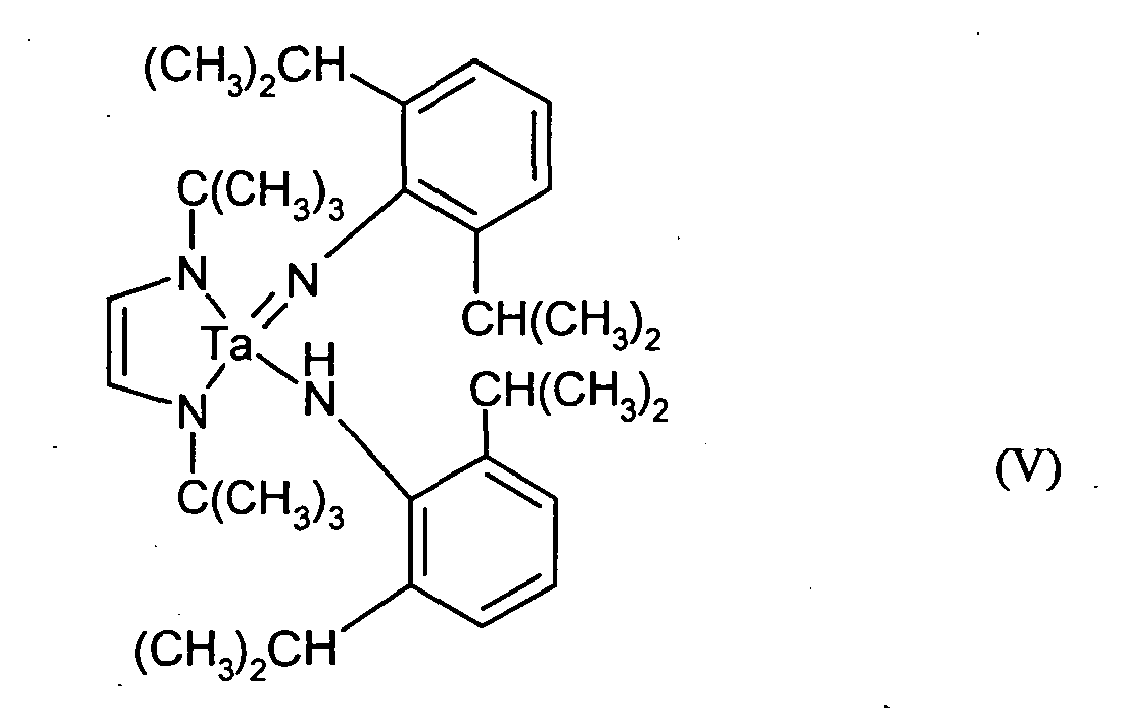

- Weitere ganz besonders bevorzugte Verbindungen sind solche der Struktur (VII),


- Besonders bevorzugte Verbindungen sind weiterhin solche der allgemeinen Formel (XI),

R6 einen gegebenenfalls substituierten C1- bis C12-Alkyl-Rest bedeutet. - Aus dieser Gruppe wird besonders bevorzugt die Verbindung der Struktur (XII).

- Weiterhin sind bevorzugte Verbindungen diejenigen der allgemeinen Struktur (XIII),

R9 einen Rest eines Enolats der Formel (XIV),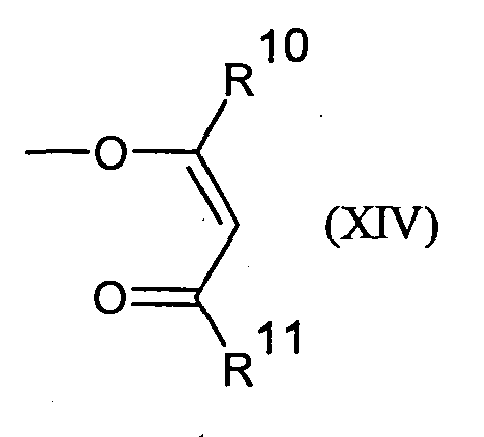
R10 einen C1- bis C4-Alkylrest bedeutet und R11 gleich R10 oder unabhängig voneinander OR10 ist, bedeutet. - Alkyl beziehungsweise Alkoxy steht jeweils unabhängig für einen geradkettigen, cyclischen oder verzweigten Alkyl- beziehungsweise Alkoxy-Rest, wobei die genannten Reste gegebenenfalls weiter substituiert sein können. Gleiches gilt für den Alkylteil eines Trialkylsilyl- bzw. Mono- oder Dialkylaminorestes oder den Alkylteil von Mono- oder Dialkylhydrazinen oder Mono-, Di-, Tri-oder Tetraalkylsilanen.
- C1-C4-Alkyl steht im Rahmen der Erfindung beispielsweise für Methyl, Ethyl, n-Propyl, isoPropyl, n-Butyl, sec.-Butyl, tert.-Butyl, C1-C5-Alkyl darüber hinaus beispielsweise für n-Pentyl, 1-Methylbutyl, 2-Methylbutyl, 3-Methylbutyl, neo-Pentyl (2,2-Dimethylpropyl), 1-Ethylpropyl, 1,1-Dimethylpropyl, 1,2-Dimethylpropyl, 1,2-Dimethylpropyl, C1-C6-Alkyl darüber hinaus beispielsweise für n-Hexyl, 1-Methylpentyl, 2-Methylpentyl, 3-Methylpentyl, 4-Methylpentyl, 1,1-Dimethylbutyl, 1,2-Dimethylbutyl, 1,3-Dimethylbutyl, 2,2-Dimethylbutyl, 2,3-Dimethylbutyl, 3,3-Dimethylbutyl, -1-Ethylbutyl, 2-Ethylbutyl, 1,1,2-Trimethylpropyl, 1,2,2-Trimethylpropyl, 1-Ethyl-1-methylpropyl, 1-Ethyl-2-methylpropyl oder 1-Ethyl-2-methylpropyl, C1-C12-Alkyl darüber hinaus beispielsweise für n-Heptyl und n-Octyl, n-Nonyl, n-Decyl und n-Dodecyl.
- 1-Alkenyl, 2-Alkenyl, 3-Alkenyl steht beispielsweise für die den vorangehenden Alkylgruppen entsprechenden Alkenylgruppen. C1-C4-Alkoxy steht beispielsweise für die den vorangehenden Alkylgruppen entsprechenden Alkoxygruppen, wie z.B. Methoxy, Ethoxy, n-Propoxy, iso-Propoxy, n-Butoxy, sec.-Butoxy, tert.-Butoxy.
- C5-C12-Cycloalkyl steht beispielsweise für gegebenenfalls substituierte niono-, bi- oder tricylische Alkylreste. Als Beispiele seien Cylopentyl, Cyclohexyl, Cycloheptyl, Pinanyl, Adamantyl, die isomeren Menthyle, n-Nonyl, n-Decyl, n-Dodecyl. Bevorzugt als C5-C6-Cycloalkyl sind Cylopentyl und Cyclohexyl.
- Aryl steht jeweils unabhängig für einen aromatischen Rest mit 6 bis 14, bevorzugt 6 bis 10 Gerüstkohlenstoffatomen, in denen keines, ein, zwei oder drei Gerüstkohlenstoffatome pro Cyclus durch Heteroatome, ausgewählt aus der Gruppe Stickstoff, Schwefel oder Sauerstoff, ersetzt sein können, vorzugsweise jedoch für einen carbocyclischen aromatischen Rest mit 6 bis 14, bevorzugt 6 bis 10 Gerüstkohlenstoffatomen.
- Beispiele für gegebenenfalls substituierte C6-C10-Aryl sind Phenyl, 2,6-Diisopropylphenyl, o-, p-, m-Tolyl oder Naphthyl.
- Weiterhin kann der carbocyclische aromatische Rest oder heteroaromatische Rest mit bis zu fünf gleichen oder verschiedenen Substituenten pro Cyclus substituiert sein, die ausgewählt sind ausder Gruppe Fluor, Cyano, C1-C12-Alkyl, C1-C12-Fluoralkyl, C1-C12-Fluoralkoxy, C1-C12-Alkoxy oder Di(C1-C8-allcyl)amino.
- Die erfindungsgemäßen Verbindungen können auf einfache Weise hergestellt werden, indem DAD-Ligandenvorläufer der allgemeinen Formel (B)

[M(NR3)(R4)Cl2L2]
worin
M für Ta oder Nb steht
L für einen Liganded ausgewählt aus aliphatischen oder aromatischen Aminen, Ethern, Halogenid, bevorzugt Chlorid, oder Nitrilen, bevorzugt Acetonitril,
R3 oder R4 die vorangehend genannte Bedeutung haben,
in einem geeigneten Lösungsmittel, bevorzugt bei einer Temperatur von -20°C bis 120°C, umgesetzt werden. - Als geeignete Reduktionsmittel kommen unedle Metalle wie z.B. Mg, Zn, Li, Na, Al etc. in Frage. Geeignete Lösungsmittel sind beispielsweise Ether, wie z.B. THF, Diethylether oder 1,2-Dimethoxyethan, dipolar-aprotische Lösungsmittel, wie z.B. Acetonitril, N,N-Dimethylformamid oder tert.-Amine oder aliphatische oder aromatische Kohlenwasserstoffe, wie z.B. Toluol, Pentan, Hexan, etc., sowie Mischungen aus diesen oder Mischungen mit gegebenenfalls weiteren Lösungsmitteln. Die Ta- oder Nb-Komplexe der allgemeinen Formel (C) [M(NR3)(R4)Cl2L2] sind nach allgemein bekannten Verfahren in isolierter Form oder in-situ herstellbar.
- Darüber hinaus ist es auch möglich, den DAD-Ligandenvorläufer der allgemeinen Formel (B) vorab in einem geeigneten Lösungsmittel mit dem Reduktionsmittel zu reduzieren, so dass Lösungen der vorreduzierten DAD-Liganden, wie z.B. bei Verwendung von Li als Reduktionsmittel Li[DAD] oder Li2[DAD], mit der Lösung der Komplexe der allgemeinen Formel (C) umgesetzt werden. Bei sorgfältiger Wahl und Kontrolle der Reaktionstemperatur zwischen -20°C und 120°C ist es auch möglich, die erfindungsgemäßen Verbindungen in einer Eintopfsynthese herzustellen, bei der z.B. TaCl5 mit dem oder den Amin(en) H2NR3 oder H2NR4, dem Reduktionsmittel und dem DAD-Ligandenvorläufer der allgemeinen Formel (B) zusammengegeben und zur Reaktion gebracht wird.
- Zur Isolation der erfindungsgemäßen Verbindungen wird das Lösungsmittel beispielsweise mittels Abdestillieren unter vermindertem Druck entfernt, und es kann sich eine weitere Reinigung mittels Waschen sowie eine nachfolgende Trocknung anschließen. Solche geeigneten Verfahren sind dem Fachmann bekannt.
- Weiterer Gegenstand der Erfindung ist die Verwendung von Verbindungen gemäß Formel I als Precursor für Tantalnitrid-(TaN)-schichten mittels Chemical Vapour Deposition sowie die entsprechend aus den Verbindungen der Formel I durch CVD hergestellten TaN-Schichten. Bevorzugt sind Verbindungen der Formel II, besonders bevorzugt sind Verbindungen der Formel III, ganz besonders bevorzugt sind Verbindungen der Formel IV bis XIII in diesen Verfahren einzusetzen.
Die Definition der Reste entspricht hierbei den oben angegebenen Definitionen. - Gegenstand der Erfindung sind ferner Substrate, die eine TaN- oder eine NbN-Schicht aufweisen, die aus den Verbindungen der Formel I oder bevorzugt der Formel II mit den oben angegebenen Definitionen für die verschiedenen Reste hergestellt ist.
- Als technische Vorteile der in der vorliegenden Erfindung vorgeschlagenen Verbindungen sind die folgenden Punkte anzusehen:
- 1) Die Synthese der flüchtigen Ta- und Nb-Verbindungen verzichtet auf teure Lithiumalkyle oder ―amide.
- 2) Die Einführung des DAD-Liganden als CVD-geeignete Abgangsgruppe für Ta-III- oder Nb-III-Schichten reduziert die Gefahr eines unerwünschten C-Einbaus in die Substratbeschichtung.
- 3) Durch die Einführung weiterer stabiler Abgangsgruppen, wie zum Beispiel Cyclopentadienyl (Cp) oder Boranat (BH4), wird die Reduktion des C-Einbau in der CVD weiter gefördert.
- 4) In der Kombination mit N-Edukten, beispielsweise Hydrazin-Derivaten (wie z.B. 1,1-Dimethylhydrazin, bzw. tert.-Butylhydrazin) ist bei der CVD eine gezielte Veränderung der Schicht-Zusammensetzung möglich.
- 5) Gezielte Beeinflussung des Oxidationszustandes Ta-III- bzw. Ta-V-Verbindungen und ihrer Nb-Analoga.
- Die Erfindung betrifft auch die Verwendung der erfindungsgemäßen Ta- und Nb-Verbindungen zur Abscheidung Ta- bzw. Nb-haltiger Schichten, gegebenenfalls unter Beimischung weiterer Verbindungen, zur definierten Einstellung bestimmter Konzentrationen der jeweiligen Elemente in der Schicht mittels Chemical Vapour Deposition (CVD) mit folgenden Verfahrensschritten: Ein geeignetes Substrat, wie z.B. eine Si-Scheibe oder auch eine bereits weitere oberflächenstrukturierte Einzel- oder Mehrfachschichten aufweisende Si-Scheibe, wie sie typischerweise für die Herstellung von Si-basierenden integrierten Schaltkreisen eingesetzt werden, wird in eine CVD-Anlage eingebracht und auf eine für die Schichtabscheidung geeignete Temperatur im Bereich von 250°C bis 700°C aufgeheizt. Ein Trägergas wird mit den Edukten in definierten Konzentrationen beladen, wobei inerte Gase wie z.B. N2 und/oder Ar, auch in Kombination mit inerten, verdampften Lösungsmitteln wie z.B. Hexan, Heptan, Octan, Toluol oder Butylacetat, als Trägergas eingesetzt werden können, und auch reaktive, z.B. reduzierende Gase, wie z.B. H2, zugesetzt werden können. Das beladene Trägergas wird für eine definierte Expositionsdauer über die Oberfläche des aufgeheizten Substrates geleitet, wobei die jeweiligen Konzentrationen an Edukten und die Expositionsdauer mit der Maßgabe aufeinander abgestimmt sind, dass eine Ta- bzw. Nb-haltige Schicht mit einer vorgegebenen Schichtdicke und einer vorgegebenen Zusammensetzung auf der Oberfläche des Substrats entweder amorph, nano- oder mikrokristallin bzw. polykristallin gebildet wird. Typische Expositionsdauern sind je nach Abscheiderate beispielsweise wenige Sekunden bis hin zu mehreren Minuten oder Stunden. Typische Abscheideraten können beispielsweise von 0,1 nm/sec bis 1 nm/sec sein. Es sind jedoch auch andere Abscheideraten möglich. Typische Schichtdicken sind beispielsweise 0,1 bis 100 nm, bevorzugt 0,5 bis 50 nm, besonders bevorzugt 1 bis 10 nm.
- Vorteilhafterweise werden im Rahmen der CVD-Technologie neben den Edukten gemäß Formel I, bevorzugt der Formeln II bis XIII zur Herstellung von reinen Ta- bzw. Nb-Metallschichten (Ta- bzw. Nb-reichen Einzelschichten), Ta- bzw. Nb-reichen Schichten als auch Ta-N- bzw. Nb-N-haltigen Mischschichten auch die folgenden Edukte zur gezielten Einstellung der N-Konzentration von Ta-N- bzw. Nb-N-haltigen Mischsystemschichten - auch nachfolgend N-Edukte genannt - eingesetzt: Ammoniak (NH3), oder C1-C8-Monoalkylhydrazine, insbesondere tert.Butylhydrazin (tBu-NH-NH2), und/oder C1-C5-1,1-Dialkylhydrazine, insbesondere 1,1-DimethyIhydazin ((CH3)2N-NH2), wobei die Alkylgruppen linear oder verzweigt sein können. Insbesondere zur Beeinflussung der Stabilität der hergestellten Mischsystemschichten in nachfolgenden Hochtemperaturausheizschritten kann es günstig sein, weitere Elemente in der CVD-Abscheidung beizumischen, um das Rekristallisationsverhalten der gebildeten Schicht zu beeinflussen. Für die Anwendung in Si-basierenden integrierten Schaltkreisen kommt hierfür besonders das Element Si in Frage. Vorteilhafterweise werden für die Herstellung von Ta(oder Nb)-N-Si-haltigen Mischsystemschichten neben den oben angesprochenen Edukten die folgenden Edukte für Si - auch nachfolgend Si-Edukte genannt - in der CVD-Technologie eingesetzt: Silan (SiH4), und/oder Disilan (Si2H6), und/oder C1-C8-Monoalkylsilane, insbesondere tert.Butylsilan (tBu-SiH3), und/oder C1-C8-Dialkylsilane, insbesondere Di-tert.butylsilan (tBu2SiH2), und/oder C1-C8-Trialkylsilane, insbesondere Triethylsilan ((C2H5)3SiH), und/oder C1-C8-Tetraalkylsilane, insbesondere Tetraethylsilan ((C2H5)4Si), wobei die Alkylgruppen linear oder verzweigt sein können.
- Grundsätzlich richten sich die genauen Konzentrationen der Edukte nach den thermischen Zerlegungseigenschaften der jeweiligen Edukte im CVD-Prozess. Vorzugsweise werden die Edukte in folgenden Mol-Verhältnissen eingesetzt: N-Edukt/Ta- bzw. Nb-Edukt 0 bis 20 000, Si-Edukte/Ta- bzw. Nb-Edukt 0-100. Die Oberflächentemperatur des Substrats wird bevorzugt im Bereich von 300°C bis 600°C eingestellt. Der Gesamtdruck von Trägergas und Edukten wird bevorzugt auf Drücke im Bereich von 10 hPa bis 1000 hPa eingestellt, wobei das Verhältnis des Partialdrucks der Summe aller Edukte zum Partialdruck des Trägergases zwischen 0,0001 bis 0,5 liegt. Die Abscheiderate beträgt vorzugsweise 0,05 nm/min bis 50 nm/min.
- Die erfmdungsgemäßen Tantal- und Niobverbindungen eignen sich auch als Prekursoren für Tantaloxid(Ta2O5)-Schichten bzw. Nioboxid(Nb2O5)-Schichten, die durch ihre hohen Dielektrizitätskonstanten für die Mikroelektronik interessant sind.
- Die folgenden Beispiele dienen der beispielhaften Erläuterung der Erfindung und sind nicht als Beschränkung aufzufassen.
- In den nachfolgenden Beispielen bedeuten die Abkürzungen und abgekürzten Verbindungsnamen folgende Strukturen:
- DtBuAD =
- 1,4-Di-tert-butyl-1,4-diaza-butadien
bzw. sein zweiwertiger Rest =
- tBu =
- tert. Butyl
- tBuN =
- tert.Butylimino = tBu-N=
- Me =
- Methyl
- Py =
- Pyridin
- Bz =
- Benzyl
- AcAc =
- einwertiger Rest der Enolat-Form des Acetylacetons =
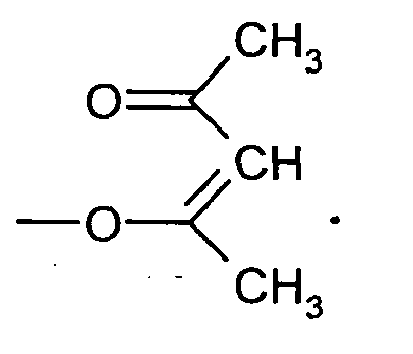
- Cp =
- Cyclopentadienyl
- Ind =
- einwertiger Rest des Indens =

- Dip =
- 2,6-Di-isopropyl-phenyl =

- all =
- Allyl
- 870 mg (125 mmol) Lithium wurden zu einer Lösung von 10 g (60 mmol) DtBuAD in 200 ml Diethylether unter Eiskühlung zugegeben. Nach 8 h Rühren bei 23°C wurde die orangefarbene Lösung filtriert. Anschließend wurde das Lösungsmittel bei 20 mbar abdestilliert und der Rückstand im Hochvakuum 48 h getrocknet. Ausbeute 10,8 g (praktisch quantitativ).
- Analytik:
1H-NMR (δ gegen TMS, C6D5CD3, 300 K, 200 MHz): 5,52 (s, 2H), 1,10 (s, 18H). - 61,3 ml tBuNH2 (587 mmol) in 50 ml CH2Cl2 wurden unter Eiskühlung zu einer Suspension von 21,0 g TaCl5 (58,7 mmol) in 200 ml CH2Cl2 getropft. Danach wurde das Reaktionsgemisch auf 23°C erwärmt und 4 h gerührt. Die erhaltene Suspension wurde erneut mit einem Eisbad gekühlt und eine Lösung von 23,7 ml (294 mmol) Pyridin in 50 ml CH2Cl2 hinzugegeben. Nach 4 h Rühren bei 23°C wurden 150 m Hexan zum Reaktionsgemisch hinzugefügt und die erhaltene Lösung durch Celite filtriert. Der Rückstand wurde noch zweimal mit je 100 ml CH2Cl2/Hexan 1:1 bis zur Farblosigkeit gewaschen. Die vereinigten Lösungen wurden bei 20 mbar von allen flüchtigen Bestandteilen befreit, der Rückstand mit Hexan gewaschen und getrocknet. Hellgelbes, mikrokristallines Produkt, Ausbeute 25,9 g (84 % d. Th.) Schmp. > 120°C (Zers.).
Elementaranalyse: Ber. (%) für C18H29N4Cl2Ta (M = 553,31 g·mol-1): C 39,07; H 5,28; N 10,13 Gef. (%): C 40,15; H 5,17; N 10,02
1H-NMR (300,1 MHz, CDCl3): δ = 1,28 (s, 9H, NHC(CH 3)3), 1,31 (s, 9H, NC(CH3)3), 7,44 (pseudo-t, 4H, m-Hpy), 7,86 (tt, J1 = 7,7 Hz, J2 = 1,5 Hz, 2H, p-Hpy), 8,60 (breites s, 1H, NHC(CH3)3), 9,40 (dd, J1 = 6,9 Hz, J2 = 1,5 Hz, 4H, o-Hpy)
13C{1H}-NMR (CDCl3, 75 MHz, 300 K): 32,3 (NC(CH3)3), 33,9 (NHC(CH3)3), 56,4 (NHC(CH3)3), 64,8 (s, NC(CH3)3),124,1 (m-Py), 139,2 (p-Py), 153,5 (o-Py). - 43,8 ml tert.Butylamin (418,7 mmol) wurden bei 0 °C unter Rühren zu einer Suspension von 50,00 g TaCl5 (139,6 mmol) in 300 ml CH2Cl2 zugetropft. Das Reaktionsgemisch wurde auf 23°C erwärmt und 3 h bei dieser Temperatur gerührt. Danach wurden 23,49 g (139,6 mmol) DtBuAD zugegeben und die resultierende Suspension 8 h gerührt. Danach wurde nach Zugabe von 150 ml Hexan filtriert. Aus dem Filtrat wurden die flüchtigen Bestandteile bei 20 mbar entfernt und der Rückstand anschließend in 200 ml THF gelöst. Hierzu wurden 1,94 g (279,2 mmol) Lithium-Pulver langsam und unter Eiskühlung hinzugegeben (sofortige dunkelbraune Färbung). Nach 8 h Rühren wurde das Lösungsmittel bei 20 mbar abgedampft und der Rückstand zweimal mit je 150 ml Diethylether extrahiert. Aus dem Extrakt wurde das Lösungsmittel bei 20 mbar abgedampft. Der Rückstand wurde bei 160 °C/10-4 mbar sublimiert. Ausbeute: 38,8 g (61 % d. Th.), Schmp. 150,0°C.
Elementaranalyse: Ber. (%) für monomeres C14H29N3ClTa (M= 455,81 g mol-1): C 36,89; H 6,41; N 9,22 Gef.(%): C 36,39; H 6,37; N 9,18
1H-NMR (C6D6, 300 MHz, 300 K): 6,07 (bs, 2H, CH-DtBuAD), 1,47 (s, 9H, N tBu), 1,35 (s, 18H, tBu-DtBuAD)
13C{1H}-NMR (C6D6, 75 MHz, 300 K): 103,8 (CH-DtBuAD), 65,7 (NCMe3), 56,9 (CMe3-DtBuAD), 33,8 (NCMe3 ), 31,1 (CMe3 -DtBuAD)
IR (KBr, cm-1): 3036(w), 1503(w), 1456(s), 1364(s), 1356(w), 1285(s), 1217(s), 1146(m), 1113(w), 1069(w), 1038(w), 1026(w), 1018(w), 964(w), 870(m), 810(m), 770(s), 723(w), 567(w), 544(w), 511(w), 453(w). - 500 mg des Pyridinkomplexes aus Beispiel 19 wurden bei 150°C/ /10-4 mbar sublimiert. Ausbeute: 230 mg (56%). Schmp. 188°C. Analytik analog Vorprodukt Beispiel E.
- 23,2 ml tert.Butylamin (222 mmol) wurden bei 0°C unter Rühren zu einer Suspension von 20,00 g NbCl5 (74 mmol) in 300 ml CH2Cl2 zugetropft. Das Reaktionsgemisch wurde auf 23°C erwärmt und 3 h bei dieser Temperatur gerührt. Danach wurden 12,5 g (74 mmol) DtBuAD zugegeben und die resultierende Suspension 8 h gerührt. Danach wurde nach Zugabe von 150 ml Hexan filtriert. Aus dem Filtrat wurden die flüchtigen Bestandteile bei 20 mbar entfernt und der Rückstand anschließend in 200 ml THF gelöst. Hierzu wurden 1,0 g (148 mmol) Lithium-Pulver langsam und unter Eiskühlung hinzugegeben. Nach 8 h Rühren wurde das Lösungsmittel bei 20 mbar abgedampft und der Rückstand zweimal mit je 150 ml Diethylether extrahiert. Aus dem Extrakt wurde das Lösungsmittel bei 20 mbar abgedampft. Der Rückstand wurde bei 160°C/10-4 mbar sublimiert. Ausbeute: 12,9 g (47 % d. Th.), Schmp. 188,4°C.
Elementaranalyse: Ber. (%) für monomeres C14H29N3ClNb (M= 367,77 g mol-1): C 45,72; H 7,95; N 11,43 Gef. (%): C 45,88; H 8,04; N 11,41
1H-NMR (C6D6, 300 MHz, 300 K): 6,08 (breites s, 2H, CH-DtBuAD), 1,45 (s, 9H, N tBu), 1,38 (s, 18H, tBu-DtBuAD).
13C{1H}-NMR (C6D6, 75 MHz, 300 K): 106,0 (CH-DtBuAD), 57,7 (CMe3-DtBuAD), 32,4 (NCMe3 ), 30,8 (CMe3 -DAD).
IR (KBr, cm-1): 3032(w), 1491(w), 1456(s), 1393(w), 1360(m), 1263(s), 1246(w), 1215(s), 1155(w), 1144(w), 1092(w), 1061(w), 1036(w), 1026(w), 1017(w), 951(w), 870(m), 810(m), 774(s), 723(w), 698(w),669(w), 584(w), 569(m), 540(w), 515(w). - Zu einer Lösung von 5,00 g (9,7 mmol) tBuN=TaCl32Py (hergestellt nach Lit. J. Sundermeyer, J. Putterlik, M. Foth, J. S. Field, N. Ramesar, Chem. Ber. 1994, 127, 1201-1212) in 20 ml THF wurde eine Lösung von 1,76 g (9,7 mmol) Li2DtBuAD aus Vorprodukt-Beispiel A in 20 ml THF bei -80°C zugetropft. Nach 30 min Rühren wurde das dunkelbraune Reaktionsgemisch erwärmt und für weitere 10 h bei 23°C gerührt. Nach Abdestillation aller flüchtigen Bestandteile wurde der Rückstand zweimal mit je 10 ml Diethylether extrahiert. Die Etherphasen wurden vereinigt, der Ether abdestilliert und der gelbe Rückstand zweimal mit je 10 ml Hexan gewaschen. Ausbeute 2,11 g; darüber hinaus wurden durch Kristallisation der Mutterlauge bei -80°C weitere 0,64 g erhalten. Gesamtausbeute 2,75 g (53,1 % d. Th.), Schmp. 142,8°C.
Elementaranalyse: Ber. (%) für C19H34N4ClTa (M= 534,91 g·mol-1): C 42,66; H 6,41; N 10,47 Gef. (%): C 42,27; H 5,97; N 10,19
1H-NMR (δ gegen TMS, C6D6, 300 MHz, 300 K): 8,57 (d, 3JHH = 4,9 Hz, 2H, o-Py), 6,77 (t, 3JHH= 7,7 Hz, 1H, p-Py), 6,45 (pseudo-t, 3JHH = 6,7 Hz, 2H, m-Py), 6,17 (breites s, 2H, CH-DtBuAD), 1,55 (s, 9H, tBuN), 1,34 (breites s, 18H, tBu-DtBUAD)
13C {1H}-NMR (C6D6, 75 MHz, 300 K): 150,7, 137,5 und 124,0 (Py), 65,5 (CMe3N), 56,6 (CMe3-DtBuAD), 34,2 (NCMe3 ), 30,9 (CMe3 -DtBuAD)
13C {1H}-NMR (d8-Toluol, 400 MHz, 230 K): 152,9, 139,9 und 126,8 (Py), 111,8 und 101,4 (CH-DtBuAD), 68,1 (NCMe3), 59,0 and 58,8 (CMe3-DtBuAD), 36,7 (NCMe3 ), 33,5 and 33,0 (CMe3 -DtBuAD)
IR (KBr, cm-1): 3075(w), 3040(w), 1604(w), 1504(w), 1458(s), 1444(m), 1359(m), 1354(m), 1275(s), 1251(w), 1217(s), 1145(m), 1145(w), 1064(w), 1045(w), 1012(w), 871(w), 814(w), 771(m), 761(m), 723(w), 698(m), 636(w), 567(w), 538(w), 507(w). - Zur gelben Lösung von 3,50 g (3,7 mmol) [(tBuN)(tBuNH)TaCl2(tBuNH2)]2 (hergestellt nach Lit. K. C. Javaratne, G. P. A. Yap, B. S. Haggerty, A. L. Rheingold, C. H. Winter, Inorg. Chem. 1996, 35, 4910 - 4920) in 40 ml THF wurden 1,26 g DtBuAD (7,5 mmol) zugegeben. Die Mischung wurde anschließend ca. 30 min bei 23°C gerührt. Danach wurden 0,19 g (7,8 mmol) MagnesiumPulver hinzugefügt und weitere 10 h bei 23°C gerührt. Nach vollständiger Auflösung des Mg wurde das THF bei 20 mbar abgezogen und das verbleibende gelbe Öl zweimal mit 25 ml Hexan extrahiert. Nach Abdampfen des Hexans ergab die Sublimation bei 80°C/10-2 mbar das Produkt als schwach gelben Festkörper. Ausbeute: 1,54 g (60 % d. Th.), Schmp. 70°C.
Analytik:
1H-NMR (C6D6, 300 MHz, 300 K): 5,62 (s, 2H, CH-DtBuAD), 3,41 (s, 1H, NH), 1,56 (s, 9H, N tBu), 1,32 (s, 18H, tBu-DtBuAD), 1,27 (s, 9H, NH tBu)
13C {1H}-NMR (C6D6, 75 MHz, 300 K): 102,6 (CH-DtBuAD), 64,9 (NCMe3), 55,7 (CMe3-DtBuAD), 53,5 (NHCMe3), 35,3 (NCMe3 ), 35,2 (NHCMe3 ), 32,0 (CMe3 -DtBuAD)
IR (KBr, cm-1): 3246(w), 3030(w), 1504(w), 1456(s), 1388(w), 1361(s), 1352(m), 1280(s), 1221(s), 1140(m), 1107(w), 1072(w), 1037(w), 1024(w), 985(m), 960(w), 920(w), 870(m), 816(w), 781(w), 771(m), 756(w), 590(w), 567(m), 527(m), 445(w). - Anstelle von [(tBuN)(tBuNH)TaCl2(tBuNH2)]2 wurde (tBuN)(tBuNH)TaCl2·2Py (2,05 g = 3,7 mmol, Vorprodukt Beispiel B) als Ausgangsmaterial bei sonst gleicher Vorgehensweise benutzt. Ausbeute 1,22 g = 67 % d. Th., Schmp. 70°C.
Elementaranalyse: Ber. (%) für C18H39N4Ta (M= 492,49 g mol -1): C 43,90; H 7,98; N 11,38 Gef. (%): C 42,56; H 7,89; N 10,88 - Weitere spektroskopische Daten (1H-NMR, 13C {1H}-NMR und IR) wie in Beispiel 2.
- Zu einer Suspension von 50,0 g TaCl5 (139,58 mmol) in 500 ml Toluol wurden 145,84 ml tert.Butylamin (1,40 mol) unter Eiskühlung zugetropft. Nach 8 h Rühren bei 23°C wurde die gelbe Lösung filtriert und das Lösungsmittel bei 20 mbar abgezogen. Das ölige Zwischenprodukt wurde ohne weitere Reinigung in 250 ml THF gelöst, hierzu wurden 23,49 g (139,6 mmol) DtBuAD, gefolgt von 3,39 g Mg- Pulver (139,6 mmol) zugegeben. Das Reaktionsgemisch wurde 12 h bei 23°C gerührt, danach wurde das Lösungsmittel bei 20 mbar abgezogen. Die zweimalige Extraktion des Rückstandes mit je 150 ml Hexan ergab ein gelbes, öliges Rohprodukt, das durch Sublimation bei 80°C/10-2 mbar gereinigt wurde. Ausbeute 35,7 g (52 % d. Th.), Schmp. 70°C.
- Spektroskopische Daten (1H-NMR, 13C {1H}-NMR und IR) wie in Beispiel 2.
- Zu einer Lösung von 5,00 g (10,15 mmol) (DtBuAD)(tBuN)Ta(NHtBu) aus Beispiel 2 in 100 ml Hexan wurde bei -80°C eine Lösung von 0,75 g tert.Butanol (10,15 mmol) in 100 ml Hexan zugetropft. Das Reaktionsgemisch wurde anschließend 3 h bei 23°C gerührt. Das Lösungsmittel wurde bei 20 mbar abgezogen und das farblose Produkt bei 100°C/10-2 mbar sublimiert. Ausbeute: 4,65 g (93 % d. Th.), Schmp. 79°C.
Elementaranalyse: Ber. (%) für C18H39N3OTa (M= 493,47 g mol-1): C 43,81; H 7,76; N 8,52 Gef. (%): C 42,89; H 7,88; N 8.29
1H-NMR (δ gegen TMS, C6D6, 300 MHz, 300 K): 5,82 (s, 2H, CH-DtBUAD), 1,54 (s, 9H, N tBu), 1,33 (s, 9H, O tBu), 1,32 (s, 18H, tBu-DtBuAD)
13C{1H}-NMR (C6D6, 75 MHz, 300 K): 104.4 (CH-DAD), 55,9 (CMe3-DtBuAD), 35,3 (s, NCMe3 ), 33,3 (OCMe3 ), 32,0 (CMe3 -DtBuAD)
IR: (υ, cm-1) 3034(w), 1586(w), 1361(s), 1286(s), 1261(w), 1223(s), 1188(s), 1142(m), 1072(w), 1008(s), 959(w), 920(w), 869(m), 806(m), 789(m), 772(m), 722(w), 563(w), 529(w), 514(w), 471(w). - Zu 200 mg (0,37 mmol) (DtBuAD)(tBuN)TaCl(Py) aus Beispiel 1 in 10 ml THF wurden 42 mg (0,37 mmol) tBuOK in 10 ml THF bei ― 80°C zugegeben. Nach 5 h Rühren bei 23°C wurde das Lösungsmittel bei 20 mbar abdestilliert. Der braune, ölige Rückstand wurde bei 100°C/10-2 mbar sublimiert und ergab 95 mg Produkt (52 % d. Th. Ausbeute) vom Schmp. 79°C.
- Spektroskopische Daten (1H-NMR, 13C-NMR, IR) identisch zu Beispiel 5.
- Zu einer Lösung von 1,00 g (2,0 mmol) (DtBuAD)(tBuN)Ta(NHtBu) aus Beispiel 4 in 10 ml Hexan wurden 0,20 g Acetylaceton (2,0 mmol), gelöst in 10 ml Hexan, bei - 80°C zugegeben. Anschließend wurde das Reaktionsgemisch 5 h bei 23°C gerührt. Nach Abdestillation des Lösungsmittels bei 20 mbar wurden 0,97 g (92 % d. Th.) des analytisch reinen Produkts als orangefarbenes Pulver isoliert, Schmp. 99,1°C.
MS-EI: 519 (M+, 74 %), 504 (M+ ― Me, 43 %), 448 (M+ ― Me2C=CH2, 3%), 57 (tBu+, 100 %)
1H-NMR (δ gegen TMS, C6D6, 300 MHz, 300 K): 6,04 (s, 2H, CH-DtBuAD), 5,06 (s, 1H, CH-AcAc), 1,60 (s, 6H, Me-AcAc), 1,56 (s, 18H, tBu-DtBuAD), 1,47 (s, 9H, N tBu)
13C{1H}-NMR (C6D6, 75 MHz, 300 K): 191,7 (CO-AcAc), 103,6 (CH-AcAc) 103,4 (CH-DtBuAD), 55,7 (CMe3-DtBuAD), 54,2 (NCMe3) 34,3 (NCMe3 ), 31,5 (CMe3 -DtBuAD), 26,1 (Me-AcAc)
IR (KBr, cm-1): 1590(m), 1530(m), 1281(m), 1262(w), 1223(m), 1137(w), 1093(w), 1026(w), 968(w); 933(w), 861(w), 804(w), 762(w), 722(w), 665(w), 566(w), 534(w), 432(w). - - 640 mg (1,2 mmol) (DtBuAD)Ta(NtBu)Cl(Py) aus Beispiel 1 wurden in 15 ml THF gelöst. Hierzu wurde eine Suspension von 146 mg (1,2 mmol) Natrium-acetylacetonat in 10 ml THF bei -80°C zugegeben. Nach Erwärmen auf 23°C und 10 h Rühren bei dieser Temperatur wurde das Lösungsmittel bei 20 mbar abdestilliert. Der braune, ölige Rückstand wurde mit Hexan extrahiert und aus Hexan kristallisiert, wobei 0,28 g (50 % d. Th.) orangefarbene Kristalle vom Schmp. 99°C erhalten wurden.
- Analytik: Spektroskopische Daten (MS, 1H-NMR, 13C-NMR und IR) identisch zu Beispiel 8.
- Zu 500 mg (0,94 mmol) [(DtBuAD)(tBuN)TaCl(Py)] aus Beispiel 1, gelöst in 10 ml Diethylether, wurde eine Suspension von 210 mg Benzylmagnesiumchlorid-THF-Komplex (0,94 mmol) in 10 ml Diethylether bei ― 80°C zugegeben. Nach 10 min wurde die orangefarbene Reaktionsmischung auf 23°C erwärmt und 5 h bei dieser Temperatur gerührt. Der gebildete gelbe Niederschlag wurde danach abfiltriert und mit 5 ml Diethylether gewaschen. Trocknung und anschließende Umkristallisation aus Hexan ergab 210 mg (38 % d. Th.) reines Produkte als orangefarbene Kristalle, Schmp. 117,7° C.
MS-EI: 511 (M+ ― Py, 3 %), 52 (100 %)
1H-NMR (δ gegen TMS, C6D6, 300 MHz, 300 K): 8,21 (d, 3JHH = 3,1 Hz, 2H, o-Py), 6,91 (t, 3JHH= 7,6 Hz, 1H, m-Bz), 6,72-6,62 (m, 4H, o- und p-Bz mit p-Py überlappt), 6,30 (pseudo-t, 3JHH = 6,7 Hz, 2H, m-Py), 6,06 (s, 2H, CH-DtBuAD), 2,10 (breites s, 2H, CH2 -Bz), 1,58 (s, 9H, N tBu), 1,26 (breites s, 18H, tBu-DAD)
13C {1H}-NMR (C6D6, 75 MHz, 300 K): 153,8 (Ci -Bz), 150,2 (o-Py), 136,7 (p-Py), 127,2 (m-Bz), 126,5 (o-Bz), 123,8 (m-Py), 119,5 (p-Bz), 104,8 (CH-DtBuAD), 65,5 (NCMe3), 56,3 (CMe3-DtBuAD), 53,6 (CH2-Bz), 34,8 (NCMe3 ), 31,2 (CMe3 -DtBuAD)
IR (KBr, cm-1): 3057(w), 1602(w), 1591(w), 1361(w), 1276(m), 1262(w), 1218(m), 1172(w), 1152(w), 1137(w), 1094(w), 1071(w), 1058(w), 1040(w), 1028(w), 1014(m), 986(w), 960(w), 867(w), 805(m), 764(w), 747(w), 723(w), 693(w), 631(w), 592(w), 557(w), 538(w), 503(w). - 0,50 g (1,0 mmol) (DtBuAD)(tBuN)Ta(OtBu) aus Beispiel 6 und 0,22 g (1,0 mmol) Benzylmagnesiumchlorid-THF-Komplex (BzMgCl*THF) wurden bei 23°C gemischt. Dieses Feststoff-Gemisch wurde in 20 ml THF gelöst und die erhaltene Lösung 12 h bei 23°C gerührt. THF wurde anschließend im Vakuum (Rotationsverdampfer) entfernt und das zurückbleibende Öl mit 10 ml Hexan extrahiert. Hexan wurde abdestilliert und das Produkt destilliert (150 °C/10-4 mbar). Ausbeute: 0,14 g (27 %) als leicht gelbliche Flüssigkeit.
MS-EI: 511 (M+, 23 %), 496 (M+ - Me, 32 %), 420 (M+ - Bz, 5 %), 363 ([(DtBuAD)TaN]+, 13%), 57 (tBu+, 100 %).
1H-NMR(C6D6, 200 MHz, 300 K): 7,22 - 6,90 (m, 5H, Bz), 5,66 (s, 2H, CH-DtBUAD), 2,01 (s, 2H, CH2 -Bz), 1,62 (s, 9H, N tBu), 1,18 (s, 18H, tBu-DtBuAD)
13C{1H}-NMR (C6D6, 50 MHz, 300 K): 143,2, 128,4, 127,4 und 122,4 (arom. Bz), 103,1 (CH-DtBuAD), 65,4 (NCMe3), 57,6 (CH2-Bz), 57,1 (CMe3-DtBuAD), 35,0 (NCMe3 ), 31,3 (CMe3 -DtBuAD).
IR (KBr, cm-1): 3071(w), 3051(w), 3015(m), 2965(s), 2940(s), 2924(s), 2897(s), 2866(m), 1593(s), 1483(s), 1470(m), 1456(m), 1402(w), 1391(m), 1375(m), 1363(s), 1354(s), 1283(s), 1221(s), 1179(w), 1138(s), 1107(w), 1076(w), 1030(m), 1018(m), 993(w), 963(m), 872(s), 820(m), 808(w), 787(w), 777(s), 747(s), 694(s), 625(w), 565(m), 523(s), 451(m). - Anstelle von (DtBuAD)(tBuN)Ta(OtBu) wurden 0,46 g [(DtBuAD)(tBuN)Ta(µ-Cl)]2 aus Vorprodukt Beispiel C (1,00 mmol, als monomere Verbindung gerechnet) als Ausgangsmaterial bei sonst gleicher Vorgehensweise wie in Beispiel 14 benutzt. Ausbeute 1,22 g = 74 % d. Th.
- Analytische Daten (MS, 1H-NMR, 13C-NMR, IR) identisch zu Beispiel 10.
- Zu 300 mg (0,56 mmol) (DtBuAD)(NtBu)TaCl(Py) aus Beispiel 1 in 5 ml THF wurde bei -80°C eine Lösung von 40 mg Cyclopentadienyl-Lithium (0,56 mmol) in 5 ml THF getropft. Nach Ende der Zugabe wurde das Reaktionsgemisch auf 23°C erwärmt und weitere 3 h bei dieser Temperatur gerührt. Danach wurde das THF bei 20 mbar abdestilliert und der dunkle, ölige Rückstand zweimal mit 15 ml Hexan extrahiert. Umkristallisation mit Hexan und anschließende Sublimation bei 90°C und 10-2 mbar ergab 130 mg (48 % d. Th.) analytisch reines Produkt vom Schmp. 65,3°C.
Elementaranalyse: Ber. (%) für C19H34N3Ta (M= 485,45 g mol-1): C 47,01; H 7,06; N 8,66 Gef. (%): C 45,03; H 7,06; N 7,93
1H-NMR (δ gegen TMS, C6D6, 300 MHz, 300 K): 5,67 (s, 2H, CH-DtBuAD), 5,66 (s, 5H, C5 H5 ), 1,30 (s, 9H, N tBu), 1,25 (s, 18H, tBu-DtBuAD)
13C{1H}-NMR (C6D6, 75 MHz, 300 K): 108,3 (CH-DtBuAD), 100,8 (C5H5), 55,5 (CMe3-DtBuAD), 34,1 (NCMe3 ), 31,9 (CMe3 -DtBuAD)
IR (KBr, cm-1): 3028(w), 1506(w), 1358(m), 1274(s), 1221(s), 1156(w), 1095(w), 1061(w), 1013(w), 958(w), 865(w), 795(s), 766(m), 722(w). - Zu 2,00 g (5,15 mmol) CpTa(NtBu)Cl2 (hergestellt nach Lit. S. Schmidt, J. Sundermeyer, J. Organomet. Chem. (1994), 472(1-2), 127-38) in 20 ml THF wurde bei - 80°C eine Lösung von 940 mg Li2DtBuAD (5,15 mmol) in 20 ml THF getropft. Nach Ende des Zutrppfens wurde durch Entfernung der Kühlung auf 23°C erwärmt und der Ansatz bei dieser Temperatur 8 h gerührt. Danach wurde das THF bei 20 mbar abgezogen und das Produkt mit 30 ml Hexan extrahiert. Sublimation bei 120°C/0,01 mbar ergab 500 mg (20,0 % d. Th.) (DtBuAD)(tBuN)TaCp als gelben Festkörper.
- Spektroskopische Daten (1H-, 13C-NMR- und IR-Spektren) identisch zu Beispiel 12.
- Zu 500 mg (DtBuAD)(tBuN)TaCl(Py) (0,93 mmol) aus Beispiel 1 in 10 ml THF wurde bei -80°C eine Lösung von Indenyl-Lithium (114 mg, 0,93 mmol) in 10 ml THF gegeben und die Reaktionsmischung anschließend 8 h bei 23°C gerührt. THF wurde bei 20 mbar abdestilliert und der Komplex zweimal mit je 15 ml Hexan extrahiert. Abdestillation des Hexans bei 20 mbar ergab 300 mg (60 % d. Th.) des analytisch reinen Produkts. Schmp. 147,3°C.
Elementaranalyse: Ber. (%) für C23H36N3Ta (M= 535,51 g mol-1): C 51,59; H 6,78; N 7,85 Gef. (%): C 50,39; H 6,79; N 7,56
1H-NMR (δ gegen TMS, C6D6, 300 MHz, 300 K): 7,17 (d, 2H, JH-H = 2.9 Hz, Ind), 6,92 (t, 1H, JH-H = 3,2 Hz, Ind), 6,.92 (dd, 2H, JH-H = 3,2 Hz, JH-H = 2,9 Hz, Ind), 6,14 (d, 2H, JH-H = 3,2 Hz, Ind), 5,11 (s, 2H, CH-DtBuAD), 1,28 (s, 27H, N tBu überlappend mit tBu-DtBuAD)
13C{1H}-NMR (C6D6, 75MHz, 300K): 123,1, 122,8 und 110,6 (Ind), 107,4 (CH-DtBuAD), 84,8 (Ind), 64,5 (NCMe3), 55,8 (CMe3-DtBuAD), 34, (NCMe3 ), 31,8 (CMe3 -DtBuAD)
IR (KBr, cm-1): 3075(w), 3038(w), 1504(w), 1464(s), 1360(m), 1329(w), 1279(s), 1248(w), 1221(s), 1157(w), 1095(w), 1064(w), 1038(w), 1026(w), 932(w), 868(m), 814(m), 783(s), 771(m), 740(w), 735(m), 600(w), 559(w). - Eine Lösung von 0,72 g DipNH2 (4,0 mmol) in 10 ml Hexan wurde bei 0°C zu einer Lösung von 1,00 g (2,0 mmol) (DtBuAD)(tBuN)Ta(NHtBu) aus Beispiel 2 in 10 ml Hexan hinzugetropft. Das Reaktionsgemisch wurde 24 h bei 23°C gerührt. Danach wurde die Lösung bis auf 5 ml eingedampft und stehen gelassen. Nach Abscheidung erster Kristalle wurde die Lösung auf -30°C abgekühlt, wobei das Produkt auskristallisierte. Abfiltrieren ergab 0,64 g (45 % d. Th) Produkt vom Schmp. 149,8°C.
Elementaranalyse: Ber. (%) für C34H55N4Ta (M= 700,79 g mol-1): C 58,27; H 7,91; N 7,99 Gef. (%): C 57,43, H 7,93; N 7,90
1H-NMR (δ gegen TMS, C6D6, 300 MHz, 300 K): 7,19 - 6,92 (m, 6H, Dip), 5,67 (s, 2H, CH-DtBuAD), 4,69 (breites s, 1H, NH), 3,97 und 3,47 (sept, 2H, 3JHH = 6,7Hz, CH-DipN und CH-DipNH) 1,27 (s, 18H, tBu-DtBuAD), 1,24 und 1,22 (d, 12H, 3JHH = 6,7Hz, CH3 -DipN überlappend mit CH3 -DipNH)
13C{1H}-NMR (C6D6, 75 MHz, 300 K): 145,8, 142,8, 141,0, 123,7, 122,9, 122,5 and 122,0 (arom. DipNH and DipN), 102,9 (CH-DtBuAD), 57,9 (CMe3-DtBuAD), 31,1 (CMe3 -DtBuAD), 29,2 und 27,9 (CH-DipNH und CH-DipN), 24,4 und 23,6 (CH3-DipNH und CH3-DipN)
IR (KBr, cm-1): 3270(m), 3048(w), 3032(w), 1620(w), 1588(w), 1431(m), 1364(s), 1323(w), 1296(w), 1251(w), 1221(s), 1159(w), 1142(m), 1115(w), 1099(w), 1074(w), 1057(w), 1045(w), 1024(w), 988(m), 963(w), 934(w), 889(w), 876(m), 864(w), 818(w), 802(w), 797(w), 777(w), 770(w), 750(m), 723(w), 698(w), 583(w), 567(w), 521(w), 446(w). - 2,00 g (4,39 mmol, als monomere Verbindung gerechnet) [(DtBuAD)(tBuN)Ta(µ-Cl)]2 aus Vorprodukt Beispiel C und 0,17 g NaBH4 (4,39 mmol) wurden in 50 ml THF suspendiert und bei 23°C 12 h gerührt. THF wurde bei 20 mbar abdestilliert und das Produkt mit 20 ml Hexan extrahiert. Aus dem Extrakt wurde das Lösungsmittel abgedampft und das zurückgebliebene rote Öl bei 60 °C/10-4 mbar sublimiert. Die Sublimation ergab 1,64 g (86 %d. Th.) blaßgelbes, festes Produkt vom Schmp. 69,5°C.
Elementaranalyse: Ber. (%) für C14H33BN3Ta (M= 435,20 g mol -1): C 38,64; H 7,64; N 9,66 Gef. (%): C 38,86; H 7,71; N 9,47
1H-NMR (δ gegen TMS in C6D6, 500 MHz, 300 K): 5,91 (s, 2H, CH-DtBuAD), 1.73 (q, 4H,1JBH = 85 Hz, BH4 ), 1,41 (s, 9H, N tBu), 1,24 (s, 18H, tBu-DtBuAD)
13C{1H}-NMR (C6D6, 125MHz, 300K): 105,8 (CH-DAD), 65,8 (NCMe3), 57,0 (CMe3-DtBuAD), 34,5 (NCMe3 ), 31,8 (CMe3 -DtBuAD)
11B-NMR (C6D5CD3, 160 MHz, 300 K): -20,2 (pent,1JBH = 85Hz, BH4)
IR (KBr, cm-1): 3041(w), 2519(s), 2326(w), 2284(w), 2097(w), 2037(s), 1505(w), 1456(s), 1389(m), 1379(s), 1364(s), 1356(s), 1279(s), 1217(s), 1148(s), 1111(w), 1071(m), 1038(w), 1028(w), 961(m), 916(w), 874(s), 818(s), 810(w), 775(s), 723(w), 546(w). - 1,00 g [(DtBuAD)(tBuN)Ta(µ-Cl)]2 (2,19 mmol, als monomere Verbindung gerechnet) aus Vorprodukt Beispiel C und 0,48 g Allylmagnesiumbromid-THF-Komplex (AllMgBr*THF) (2,19 mmol) wurden in 20 ml THF gelöst und bei 23°C 12 h gerührt. Danach wurde das Lösungsmittel bei 20 mbar abgezogen. Der verbleibende gelbe Festkörper wurde zweimal mit je 10 ml Hexan extrahiert. Nach Entfernung des Lösungsmittels im Vakuum (20 mbar) wurde bei 80°C/10-4 mbar sublimiert. Ausbeute: 0,74g (73 % d. Th.) (DtBuAD)(tBuN)Ta(η 3-all) als gelber Festkörper vom Schmp. 61,9°C.
Elementaranalyse: Ber. (%) für C17H34N3Ta (M= 461,43 g mol-1): C 44,25; H 7,43; N 9,11 Gef. (%): C 43,81; H 7,37; N 9,04
1H-NMR (δ gegen TMS in C6D6, 300 MHz, 300 K): 6,44 (pent, 1H, 3JHH = 11,4Hz, η3-all), 5,50 (s, 2H, CH-DAD), 2,31 (breites s, 4H, η3-all), 1,36 (s, 18H, tBu-DtBuAD), 1,26 (s, 9H, N tBu)
13C{1H}-NMR (C6D6, 75 MHz, 300 K): 133,0 (η3-all), 102,3 (CH-DtBuAD), 68,8 (η3-all ), 65,4 (NCMe3), 56,2 (CMe3-DtBuAD), 34,4 (NCMe3 ), 31,8 (CMe3 -DtBuAD)
IR (KBr, cm-1): 3065(w), 3027(m), 1628(w), 1501(m), 1456(s), 1389(m), 1360(s), 1281(s), 1248(w), 1221(s), 1150(m), 1109(w), 1063(w), 1016(w), 1003(m), 961(w), 866(m), 841(s), 808(m), 768(s), 723(w), 694(w), 629(w), 563(w). - Nach üblicher Vorbehandlung wurde eine Si-Scheibe (Hersteller: Wacker oder Virginia Semiconductor) in eine CVD-Apparatur (Typ Aix 200 des Herstellers Aixtron AG) eingesetzt. Zunächst erfolgte in üblicher Weise ein thermischer Ausheizschritt der Si-Scheibe zu Reinigungszwecken bei 750°C in einem inerten Trägergasstrom. Danach wurde die Scheibe auf eine Substrattemperatur von 350°C abgekühlt. Auf die so erhaltene Oberfläche wurde eine Schicht aus den erfindungsgemäßen Ta-Ausgangssubstanzen abgeschieden. Hierzu wurde ein Inertgasstrom aus N2 mit den verschiedenen Edukten beladen. Als Edukte wurden eingesetzt: (DAD)(tBuN)Ta(BH4) und 1,1-Dimethylhydrazin, wobei das 1,1-Dimethylhydrazin kommerziell in der für die CVD geeigneten Reinheit erhältlich ist (beispielsweise von Akzo Nobel HPMO).
- Für die Herstellung erfindungsgemäßer Ta-haltiger Schichten wurden beispielhaft die folgenden Bedingungen bei einem Gesamtdruck des CVD-Reaktors von 100 hPa gewählt: 0,0005 hPa (DAD)(tBuN)Ta(BH4), 3 hPa 1,1-Dimethylhydrazin. Das N/Ta-Verhältnis wurd somit zu 6000 gewählt. Der beladene N2-Trägergasstrom mit einem Gesamtdruck von 100 hPa wurde sodann für die Dauer von 1 h über die auf 350°C erwärmte Oberfläche der Si-Scheibe geleitet. Es wurde eine erfindungsgemäße Schicht mit einer Dicke von 145 nm erhalten. Nach Ablauf der Expositionsdauer wurde die CVD-Anlage auf die Abscheidebedingungen einer gewünschten weiteren Schicht umgestellt, oder die Schicht wurde unter einem inerten Trägergasstrom abgekühlt und dem CVD-Reaktor entnommen.
- Zu einer Lösung von 5,0 g (11,7 mmol) tBuN=NbCl32Py (hergestellt nach Lit. J. Sundermeyer, J. Putterlik, M. Foth, J. S. Field, N. Ramesar, Chem. Ber. 1994, 127, 1201-1212) in 20 ml THF wurde eine Lösung von 2,1 g (11,7 mmol) Li2DtBuAD aus Vorprodukt-Beispiel A in 20 ml THF bei -80°C zugetropft. Nach 30 min Rühren wurde das dunkelbraune Reaktionsgemisch erwärmt und für weitere 10 h bei 23°C gerührt. Nach Abdestillieren aller flüchtigen Bestandteile wurde der Rückstand zweimal mit je 10 ml Diethylether extrahiert. Die Etherphasen wurden vereinigt, der Ether abdestilliert und der gelbe Rückstand mit 20 ml Hexan gewaschen. Ausbeute 3,8 g (72 % d. Th.), Schmp. 115,4°C.
Elementaranalyse: Ber. (%) für C19H34N4ClNb (M= 446,87 g·mol-1): C 51,07; H 7,67; N 12,54 Gef. (%): C 49,26; H 7,64; N 11,84
1H-NMR (δ gegen TMS, C6D6, 300 MHz, 300 K): 8,53 (pseudo-d, 3JHH = 3,6 Hz, 2H, o-Py), 6,79 (pseudo-t, 3JHH = 7,6 Hz, 1H, p-Py), 6,47 (pseudo-t, 3JHH = 6,3 Hz, 2H, m-Py), 6,17 (breites s, 2H, CH-DtBuAD), 1,52 (s, 9H, tBuN), 1,35 (breites s, 18H, tBu-DtBuAD)
1H-NMR (δ gegen TMS, d8-Toluol, 100MHz, 230K): 8,39 (dd, 3JHH = 6,4Hz, 4JHH = 1,5Hz, 2H, o-Py), 6,69 (tt, 3JHH = 7,6Hz, 4JHH = 1,5Hz, 1H, p-Py), 6,38 - 6,35 (m, 3H, m-Py überlappend mit CH-DtBuAD), 5,82 (d, 1H, 3JHH = 3,5 Hz, CH-DtBuAD), 1,64 (s, 9H, tBu-DtBuAD), 1,51 (s, 9H, tBuN), 0,96 (breites s, 9H, tBu-DtBuAD).
13C{1H}-NMR (C6D6, 75 MHz, 300 K): 150,6, 136,9 und 123,7 (Py), 57,3 (CMe3-DtBuAD), 32,9 (NCMe3 ), 30,7 (CMe3 -DtBuAD).
13C{1H}-NMR (d8-Toluol, 400 MHz, 230 K): 150,1, 137,7 und 123,9 (Py), 110,3 und 101,2 (CH-DtBuAD), 67,0 (NCMe3), 57,0 und 56,6 (CMe3-DtBuAD), 32,7 (NCMe3 ), 30,5 und 30,2 (CMe3 -DtBuAD).
IR (KBr, cm-1): 3020(w), 1602(w), 1480(w), 1360(m), 1353(w), 1258(m), 1244(m), 1217(s), 1155(w), 1138(w), 1057(w), 1045(w), 1012(w), 875(m), 814(m), 775(m), 761(m), 723(w), 700(m), 634(w). - 1,6 g (4,35 mmol, als monomere Verbindung gerechnet) [(DtBuAD)(tBuN)Nb(µ-Cl)]2 aus Vorprodukt Beispiel E und 0,37 g NaBH4 (9,78 mmol) wurden in 50 ml THF suspendiert und bei 23°C 12 h gerührt. Das Lösungsmittel bei 20 mbar abdestilliert und der Rückstand bei 60 °C/10-4 mbar sublimiert. Die Sublimation ergab 0,95 g (67 %d. Th.) gelbes, festes Produkt vom Schmp 65,4°C.
Elementaranalyse: Ber. (%) für C14H33BN3Nb (M= 347,16 g mol-1): C 48,44; H 9,58; N 12,10 Gef. (%): C 47,88; H 9,56; N 12,11
1H-NMR (d8-Toluol, 500 MHz, 300 K): 5,87 (s, 2H, CH-DtBUAD), 1,31 (s, 9H, N tBu), 1,19 (s, 18H, tBu-DtBuAD), 0,04 (q, 4H, 1JBH = 85 Hz, BH4 ).
13C{1H)-NMR (C6D6, 75 MHz, 300 K): 107,8 (CH-DtBuAD), 33,1 (NCMe3 ), 31,6 (CMe3 -DtBuAD). 11B-NMR (d8-Toluol, 160 MHz, 300 K): -21,3 (quint, 1JBH = 85 Hz, BH4).
IR (KBr, cm-1): 3032(w), 2507(s), 2319(w), 2274(w), 2099(w), 2037(s), 1495(w), 1456(s), 1390(w), 1364(s), 1302(w), 1258(s), 1217(s), 1157(s), 1140(w), 1111(w), 1061(w), 1026(w), 1017(w), 947(w), 876(s), 816(s), 777(s), 723(w), 567(w), 516(w), 513(w), 494(w), 449(w). - Zu einer Suspension von 50,0 g NbCl5 (185 mmol) in 300 ml Toluol wurden 225 ml tert.Butylamin (2,15 mol) unter Eiskühlung zugetropft. Nach 8 h Rühren bei 23°C wurde die gelbe Lsg. filtriert und das Lösungsmittel bei 20 mbar abgezogen. Das ölige Zwischenprodukt wurde ohne weitere Reinigung in 250 ml THF gelöst, hierzu wurden 31,2 g (185 mmol) DtBuAD, gefolgt von 4,5 g Mg-Pulver (185 mmol) zugegeben. Das Reaktionsgemisch wurde 12 h bei 23°C gerührt, danach wurde das Lösungsmittel bei 20 mbar abgezogen. Die zweimalige Extraktion des Rückstandes mit je 250 ml Hexan ergab ein gelbes, öliges Rohprodukt, das durch Sublimation bei 100°C710-4 mbar gereinigt wurde. Ausbeute 30,8 g (41 % d. Th.), Schmp. 70,6°C.
Elementaranalyse: Ber. (%) für C18H39N4Nb (M= 404,44 g mol-1): C 53,46; H 9,72; N 13,85. Gef. (%): C 52,87; H 9,59; N 13,56.
1H-NMR (C6D6, 300 MHz, 300 K): 5,86 (s, 2H, CH-DtBuAD), 4,10 (s, 1H, NH), 1,54 (s, 9H, N tBu), 1,33 (s, 18H, tBu-DtBuAD), 1,26 (s, 9H, NH tBu).
13C{1H}-NMR (C6D6, 75 MHz, 300 K): 104,2 (CH-DtBuAD), 64,0 (NCMe3), 55,7 (CMe3-DtBuAD), 53,4 (NHCMe3), 35,1 (NCMe3 ), 34,1 (NHCMe3 ), 31,9 (CMe3 -DtBuAD).
IR (KBr, cm-1): 3021(w), 1456(w), 1389(w), 1361(m), 1260(s), 1242(w), 1221(s), 1148(w), 1136(w), 1107(w), 1064(w), 1024(w), 980(w), 950(w), 870(w), 814(w), 771(w), 754(w), 592(w), 572(w),515(w).
Claims (15)
- Verbindungen der allgemeinen Formel (I)
 M für Ta oder Nb steht,R1 und R2 unabhängig voneinander ggf. substituierte C1- bis C12-Alkyl-, C5- bis C12-Cycloalkyl- oder C6- bis C10-Aryl-Reste, 1-Alkenyl-, 2-Alkenyl-, 3-Alkenyl oder Triorganosilylreste -SiR3, oder Aminoreste NR2 wobei R für einen C1- bis C4-Alkylrest steht,R3 einen ggf. substituierten C1- bis C8-Alkyl-, C5- bis C10-Cycloalkyl-, C6- bis C14-Aryl-Rest, oder SiR3, oder NR2 wobei R die oben angegebene Bedeutung hat,R4 Halogen aus der Gruppe Cl, Br, J, oder NH-R5 mit R5 = ggf. substituierter C1- bis C8-Alkyl-, C5- bis C10-Cycloalkyl- oder C6- bis C10-Aryl-Rest, oder O-R6 mit R6 = ggf. substituierter C1- bis C11-Alkyl-, C5- bis C10-Cycloalkyl- oder C6- bis C10-Aryl-Rest, oder -SiR3, oder BH4, oder ein ggf. substituierter Allyl-Rest; oder ein Indenyl-Rest, oder ein ggf. substituierter Benzyl-Rest, oder ein ggf. substituierter Cyclopentadienyl-Rest, oder ―NR-NR'R" (Hydrazido(-1), wobei R, R' und R" unabhängig voneinander die oben genannte Bedeutung von R haben, oder CH2SiMe3, Pseudohalogenid (z.B. -N3), oder Silylamid -N(SiMe3)2,R7 und R8 unabhängig voneinander H, ggf. substituierte C1- bis C12-Alkyl-, C5- bis C12-Cycloalkyl- oder C6- bis C10-Aryl-Reste bedeuten.
 - Verbindungen nach Anspruch 1, dadurch gekennzeichnet, dass sie der allgemeinen Formel II entsprechen,
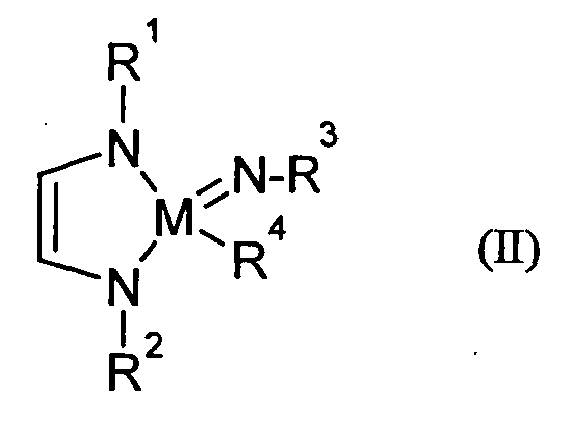 M für Ta oder Nb steht,R1 und R2 gleiche C1- bis C5-Alkyl- oder C5- bis C6-Cycloalkyl-Reste,R3 einen C1- bis C5-Alkyl-, C5- bis C6-Cycloalkyl- oder ggf. substituierten Phenyl-Rest,R4 ein Halogen aus der Gruppe Cl, Br, J, einen Rest NH-R5 mit R5 = C1- bis C5-Alkyl-, C5- bis C6-Cycloalkyl- oder ggf. substituierten C6- bis C10-Aryl-Rest, oder BH4, oder einen ggf. substituierter Allyl-Rest, oder einen ggf. substituierten Benzyl-Rest, oder einen ggf. substituierten Cyclopentadienyl-Rest oder einen Oxyalkyl-Rest bedeuten.
 - Verbindungen nach Anspruch 1, dadurch gekennzeichnet, dass sie der allgemeinen Formel (III) entsprechen,
 R3 und R4 unabhängig voneinander einen gleichen oder verschiedenen Rest aus der Gruppe der C1- bis C5-Alkyl-Reste bzw. der, ggf. durch eine bis drei C1 bis C5-Alkylgruppen substituierten, C6-C10-Arylreste bedeuten.
 - Verbindungen nach Anspruch 2, dadurch gekennzeichnet, dass sie ausgewählt sind aus der Gruppe:


- Verbindungen nach Anspruch 2, dadurch gekennzeichnet, dass sie der allgemeinen Formel (XI) entsprechen,

- Verbindung nach Anspruch 5, dadurch gekennzeichnet, dass sie der Struktur (XII) entspricht.

- Verbindungen nach Anspruch 2, dadurch gekennzeichnet, dass sie der allgemeinen Formel (XIII) entsprechen,
 R9 einen Rest eines Enolats der Formel XIV,in dem
 R10 einen C1- bis C4-Alkylrest bedeutet und R11 gleich R10 oder unabhängig voneinander OR10 ist, bedeutet.
 - Verwendung von Tantal-Verbindungen gemäß den Ansprüchen 1 bis 7 als Vorläuferverbindung (Prekursor) für die Herstellung Tantal-haltiger Schichten mittels des Chemical Vapour Deposition-Verfahrens.
- Verwendung von Tantal-Verbindungen gemäß den Ansprüchen 1 bis 7 als Vorläuferverbindung (Prekursor) für die Herstellung für Tantalnitrid-(TaN)-schichten mittels des Chemical Vapour Deposition-Verfahrens.
- Verwendung von Niob-Verbindungen gemäß den Ansprüchen 1 bis 2 als Prekursor für die-Herstellung Niob-haltiger Schichten mittels des Chemical Vapour Deposition-Verfahrens.
- Verwendung von Niob-Verbindungen gemäß den Ansprüchen 1 bis 2 als Prekursor für die Herstellung Niob-haltiger Schichten Niobnitrid-(NbN)-schichten mittels des Chemical Vapour Deposition-Verfahrens.
- Gemäß Anspruch 8 oder 9 hergestellte Tantal-haltige Schichten, bevorzugt TaN-Schichten.
- Substrate aufweisend eine Tantal-haltige, bevorzugt TaN-Schicht hergestellt aus einer Verbindung gemäß einem der Ansprüche 1 bis 7.
- Gemäß Anspruch 10 oder 11 hergestellte Niob-haltige Schichten, bevorzugt NbN-Schichten.
- Substrate aufweisend eine Niob-haltige, bevorzugt NbN-Schicht hergestellt aus einer Verbindung gemäß einem der Ansprüche 1 bis 2.
Applications Claiming Priority (1)
| Application Number | Priority Date | Filing Date | Title |
|---|---|---|---|
| DE102005033102A DE102005033102A1 (de) | 2005-07-15 | 2005-07-15 | Tantal- und Niob-Verbindungen und ihre Verwendung für die Chemical Vapour Deposition (CVD) |
Publications (3)
| Publication Number | Publication Date |
|---|---|
| EP1757612A2 true EP1757612A2 (de) | 2007-02-28 |
| EP1757612A3 EP1757612A3 (de) | 2007-07-18 |
| EP1757612B1 EP1757612B1 (de) | 2008-10-08 |
Family
ID=37529343
Family Applications (1)
| Application Number | Title | Priority Date | Filing Date |
|---|---|---|---|
| EP06014019A Revoked EP1757612B1 (de) | 2005-07-15 | 2006-07-06 | Tantal- und Niob- Verbindungen und ihre Verwendung für die Chemical Vapour Deposition (CVD) |
Country Status (7)
| Country | Link |
|---|---|
| US (1) | US7442407B2 (de) |
| EP (1) | EP1757612B1 (de) |
| JP (1) | JP2007031431A (de) |
| CN (1) | CN1896079A (de) |
| AT (1) | ATE410434T1 (de) |
| DE (2) | DE102005033102A1 (de) |
| TW (1) | TW200716485A (de) |
Cited By (2)
| Publication number | Priority date | Publication date | Assignee | Title |
|---|---|---|---|---|
| EP1884518A1 (de) * | 2006-07-31 | 2008-02-06 | Rohm and Haas Electronic Materials LLC | Vorläauferverbindungen für Dampfphasen-abscheidung. |
| EP1894937A1 (de) * | 2006-08-12 | 2008-03-05 | H.C. Starck GmbH | Tantal- und Niob-Verbindungen und ihre Verwendung für die Chemical Vapour Deposition (CVD) |
Families Citing this family (18)
| Publication number | Priority date | Publication date | Assignee | Title |
|---|---|---|---|---|
| US7482289B2 (en) * | 2006-08-25 | 2009-01-27 | Battelle Memorial Institute | Methods and apparatus for depositing tantalum metal films to surfaces and substrates |
| EP1916253A1 (de) * | 2006-10-26 | 2008-04-30 | L'AIR LIQUIDE, Société Anonyme pour l'Etude et l'Exploitation des Procédés Georges Claude | Gruppe-V-Metall enthaltende Vorläuferverbindungen und deren Verwendung zur Abscheidung von metallhaltigen dünnen Schichten |
| US20080254256A1 (en) * | 2007-04-10 | 2008-10-16 | Sumitomo Meta Mining Co., Ltd. | Heat-resistant light-shading film and production method thereof, and diaphragm or light intensity adjusting device using the same |
| ATE535534T1 (de) | 2008-10-07 | 2011-12-15 | Air Liquide | Metall-organische niobium- und vanadium-vorläufer zur dünnschichtablagerung |
| KR20160124028A (ko) * | 2015-04-16 | 2016-10-26 | 레르 리키드 쏘시에떼 아노님 뿌르 레뜌드 에렉스뿔라따시옹 데 프로세데 조르즈 클로드 | V 족-함유 필름 형성 조성물 및 v 족-함유 필름의 증착 |
| TW201722971A (zh) * | 2015-12-28 | 2017-07-01 | Up Chemical Co Ltd | 鉭化合物、其製備方法、包含其的膜沉積用前體組合物及利用該前體組合物的膜沉積方法 |
| TWI736631B (zh) * | 2016-06-06 | 2021-08-21 | 韋恩州立大學 | 二氮雜二烯錯合物與胺類的反應 |
| JP6735163B2 (ja) * | 2016-06-22 | 2020-08-05 | 株式会社Adeka | バナジウム化合物、薄膜形成用原料及び薄膜の製造方法 |
| CN107623050A (zh) * | 2017-09-22 | 2018-01-23 | 常州天合光能有限公司 | 太阳能电池 |
| US11524973B2 (en) | 2019-05-14 | 2022-12-13 | Samsung Electronics Co., Ltd. | Metal compounds and methods of fabricating semiconductor devices using the same |
| US12371787B2 (en) | 2020-07-28 | 2025-07-29 | L'Air Liquide, Société Anonyme pour l'Etude et l'Exploitation des Procédés Georges Claude | Method of forming dielectric films, new precursors and their use in the semi-conductor manufacturing |
| KR102862617B1 (ko) * | 2020-10-30 | 2025-09-22 | 솔브레인 주식회사 | 3족 금속 전구체 및 금속 함유 박막 |
| KR102862610B1 (ko) * | 2020-10-30 | 2025-09-22 | 솔브레인 주식회사 | 3족 금속 전구체 화합물 및 이를 이용한 금속 함유 박막의 제조 방법 |
| JP2023107274A (ja) * | 2022-01-24 | 2023-08-03 | レール・リキード-ソシエテ・アノニム・プール・レテュード・エ・レクスプロワタシオン・デ・プロセデ・ジョルジュ・クロード | 化合物、金属含有膜の形成方法および化合物の製造方法 |
| WO2023200429A1 (en) * | 2022-04-12 | 2023-10-19 | L'air Liquide, Societe Anonyme Pour L'etude Et L'exploitation Des Procedes Georges Claude | Niobium vanadium, tantalum film forming compositions and deposition of group v (five) containing films using the same |
| US20230323530A1 (en) * | 2022-04-12 | 2023-10-12 | L'Air Liquide, Société Anonyme pour l'Etude et l'Exploitatation des Procédés Georges Claude | Niobium, vanadium, tantalum film forming compositions and deposition of group v (five) containing films using the same |
| TWI915861B (zh) * | 2023-07-14 | 2026-02-21 | 法商液態空氣喬治斯克勞帝方法研究開發股份有限公司 | 鈮、釩、鉭成膜組成物及使用其沈積含第5族金屬之膜 |
| TW202604922A (zh) * | 2023-07-14 | 2026-02-01 | 法商液態空氣喬治斯克勞帝方法研究開發股份有限公司 | 含第5族過渡金屬的先質及其在半導體製造中之用途 |
Family Cites Families (3)
| Publication number | Priority date | Publication date | Assignee | Title |
|---|---|---|---|---|
| US6410433B1 (en) | 1999-04-27 | 2002-06-25 | Tokyo Electron Limited | Thermal CVD of TaN films from tantalum halide precursors |
| JP3963078B2 (ja) * | 2000-12-25 | 2007-08-22 | 株式会社高純度化学研究所 | ターシャリーアミルイミドトリス(ジメチルアミド)タンタルとその製造方法及びそれを用いたmocvd用原料溶液並びにそれを用いた窒化タンタル膜の形成方法 |
| US6989457B2 (en) | 2003-01-16 | 2006-01-24 | Advanced Technology Materials, Inc. | Chemical vapor deposition precursors for deposition of tantalum-based materials |
-
2005
- 2005-07-15 DE DE102005033102A patent/DE102005033102A1/de not_active Withdrawn
-
2006
- 2006-07-06 DE DE502006001724T patent/DE502006001724D1/de not_active Revoked
- 2006-07-06 AT AT06014019T patent/ATE410434T1/de not_active IP Right Cessation
- 2006-07-06 EP EP06014019A patent/EP1757612B1/de not_active Revoked
- 2006-07-07 US US11/482,397 patent/US7442407B2/en not_active Expired - Fee Related
- 2006-07-13 TW TW095125568A patent/TW200716485A/zh unknown
- 2006-07-14 CN CNA2006101063357A patent/CN1896079A/zh active Pending
- 2006-07-18 JP JP2006195761A patent/JP2007031431A/ja active Pending
Cited By (2)
| Publication number | Priority date | Publication date | Assignee | Title |
|---|---|---|---|---|
| EP1884518A1 (de) * | 2006-07-31 | 2008-02-06 | Rohm and Haas Electronic Materials LLC | Vorläauferverbindungen für Dampfphasen-abscheidung. |
| EP1894937A1 (de) * | 2006-08-12 | 2008-03-05 | H.C. Starck GmbH | Tantal- und Niob-Verbindungen und ihre Verwendung für die Chemical Vapour Deposition (CVD) |
Also Published As
| Publication number | Publication date |
|---|---|
| DE102005033102A1 (de) | 2007-01-25 |
| EP1757612A3 (de) | 2007-07-18 |
| JP2007031431A (ja) | 2007-02-08 |
| US20070042213A1 (en) | 2007-02-22 |
| ATE410434T1 (de) | 2008-10-15 |
| US7442407B2 (en) | 2008-10-28 |
| TW200716485A (en) | 2007-05-01 |
| DE502006001724D1 (de) | 2008-11-20 |
| EP1757612B1 (de) | 2008-10-08 |
| CN1896079A (zh) | 2007-01-17 |
Similar Documents
| Publication | Publication Date | Title |
|---|---|---|
| EP1757612B1 (de) | Tantal- und Niob- Verbindungen und ihre Verwendung für die Chemical Vapour Deposition (CVD) | |
| EP1806352B1 (de) | Wolfram- und Molybdän-Verbindungen und ihre Verwendung für die Chemical Vapour Deposition (CVD) | |
| KR101538982B1 (ko) | 고분자량 알킬알릴 코발트트리카르보닐 착체 및 유전체 박막 제조를 위한 그 용도 | |
| DE102011012515A1 (de) | Metallkomplexe mit N-Amino-Amidinat-Liganden | |
| EP2307589B1 (de) | Verfahren zur aufbringung von übergangsmetallhaltigen schichten unter verwendung heteroleptischer cyclopentadienylübergangsmetallvorläufer | |
| US20090208670A1 (en) | Organometallic compounds, processes for the preparation thereof and methods of use thereof | |
| KR20210156444A (ko) | 몰리브데넘 함유 전구체, 이를 이용한 몰리브데넘 함유 박막 및 이의 제조 방법. | |
| EP0873343A1 (de) | Reagenzien auf der basis von metallkomplexen zur erzeugung von chemischem niederschlag aus der gasphase | |
| EP1894937B1 (de) | Tantal- und Niob-Verbindungen und ihre Verwendung für die Chemical Vapour Deposition (CVD) | |
| KR20070101385A (ko) | 유기금속 화합물의 제조 방법 | |
| WO2009094263A1 (en) | Organometallic compounds, processes and methods of use | |
| US20090200524A1 (en) | Organometallic compounds, processes for the preparation thereof and methods of use thereof | |
| WO2006044446A2 (en) | Organometallic compounds and processes for preparation thereof | |
| KR100807947B1 (ko) | 비대칭형 β-케토이미네이트 리간드 화합물의 제조방법 | |
| EP3342899A1 (de) | Ausgangsmaterial für chemische dampfabscheidung mit einem binuklearen rutheniumkomplex und verfahren zur chemischen dampfabscheidung mit verwendung des ausgangsmaterials für chemische dampfabscheidung | |
| JP4696454B2 (ja) | 新規有機イリジウム化合物、その製造方法、及び膜の製造方法 | |
| EP2048146B1 (de) | Neue Tantal- und Niob-Verbindungen | |
| KR102644483B1 (ko) | 루테늄 유기금속화합물, 이의 제조방법 및 이를 이용하여 박막을 제조하는 방법 | |
| DE112005000292T5 (de) | Metallorganische Verbindungen mit hoher Keimbildungsdichte | |
| US12091427B2 (en) | Metal complexes for gas-phase thin-film deposition | |
| EP3680247A1 (de) | Metallorganische verbindungen | |
| WO2024218468A1 (en) | Ruthenium complexes and process for producing ruthenium film | |
| EP4702031A1 (de) | Neue halbsandwichkomplexe des rutheniums |
Legal Events
| Date | Code | Title | Description |
|---|---|---|---|
| PUAI | Public reference made under article 153(3) epc to a published international application that has entered the european phase |
Free format text: ORIGINAL CODE: 0009012 |
|
| AK | Designated contracting states |
Kind code of ref document: A2 Designated state(s): AT BE BG CH CY CZ DE DK EE ES FI FR GB GR HU IE IS IT LI LT LU LV MC NL PL PT RO SE SI SK TR |
|
| AX | Request for extension of the european patent |
Extension state: AL BA HR MK YU |
|
| PUAL | Search report despatched |
Free format text: ORIGINAL CODE: 0009013 |
|
| AK | Designated contracting states |
Kind code of ref document: A3 Designated state(s): AT BE BG CH CY CZ DE DK EE ES FI FR GB GR HU IE IS IT LI LT LU LV MC NL PL PT RO SE SI SK TR |
|
| AX | Request for extension of the european patent |
Extension state: AL BA HR MK YU |
|
| RTI1 | Title (correction) |
Free format text: TANTAL- AND NIOB- COMPOUNDS AND THEIR USE IN CHEMICAL VAPOUR DEPOSITION (CVD) |
|
| RAP1 | Party data changed (applicant data changed or rights of an application transferred) |
Owner name: H.C. STARCK GMBH |
|
| 17P | Request for examination filed |
Effective date: 20080118 |
|
| AKX | Designation fees paid |
Designated state(s): AT BE BG CH CY CZ DE DK EE ES FI FR GB GR HU IE IS IT LI LT LU LV MC NL PL PT RO SE SI SK TR |
|
| GRAP | Despatch of communication of intention to grant a patent |
Free format text: ORIGINAL CODE: EPIDOSNIGR1 |
|
| RIC1 | Information provided on ipc code assigned before grant |
Ipc: C07F 9/00 20060101AFI20080310BHEP Ipc: C23C 16/34 20060101ALN20080310BHEP Ipc: C23C 16/18 20060101ALN20080310BHEP |
|
| RTI1 | Title (correction) |
Free format text: TANTALUM- AND NIOBIUM- COMPOUNDS AND THEIR USE IN CHEMICAL VAPOUR DEPOSITION (CVD) |
|
| GRAS | Grant fee paid |
Free format text: ORIGINAL CODE: EPIDOSNIGR3 |
|
| GRAA | (expected) grant |
Free format text: ORIGINAL CODE: 0009210 |
|
| AK | Designated contracting states |
Kind code of ref document: B1 Designated state(s): AT BE BG CH CY CZ DE DK EE ES FI FR GB GR HU IE IS IT LI LT LU LV MC NL PL PT RO SE SI SK TR |
|
| REG | Reference to a national code |
Ref country code: GB Ref legal event code: FG4D Free format text: NOT ENGLISH |
|
| REG | Reference to a national code |
Ref country code: CH Ref legal event code: EP |
|
| REG | Reference to a national code |
Ref country code: IE Ref legal event code: FG4D Free format text: LANGUAGE OF EP DOCUMENT: GERMAN |
|
| REF | Corresponds to: |
Ref document number: 502006001724 Country of ref document: DE Date of ref document: 20081120 Kind code of ref document: P |
|
| PG25 | Lapsed in a contracting state [announced via postgrant information from national office to epo] |
Ref country code: SI Free format text: LAPSE BECAUSE OF FAILURE TO SUBMIT A TRANSLATION OF THE DESCRIPTION OR TO PAY THE FEE WITHIN THE PRESCRIBED TIME-LIMIT Effective date: 20081008 |
|
| NLV1 | Nl: lapsed or annulled due to failure to fulfill the requirements of art. 29p and 29m of the patents act | ||
| PG25 | Lapsed in a contracting state [announced via postgrant information from national office to epo] |
Ref country code: BG Free format text: LAPSE BECAUSE OF FAILURE TO SUBMIT A TRANSLATION OF THE DESCRIPTION OR TO PAY THE FEE WITHIN THE PRESCRIBED TIME-LIMIT Effective date: 20090108 Ref country code: LT Free format text: LAPSE BECAUSE OF FAILURE TO SUBMIT A TRANSLATION OF THE DESCRIPTION OR TO PAY THE FEE WITHIN THE PRESCRIBED TIME-LIMIT Effective date: 20081008 Ref country code: ES Free format text: LAPSE BECAUSE OF FAILURE TO SUBMIT A TRANSLATION OF THE DESCRIPTION OR TO PAY THE FEE WITHIN THE PRESCRIBED TIME-LIMIT Effective date: 20090119 |
|
| PG25 | Lapsed in a contracting state [announced via postgrant information from national office to epo] |
Ref country code: LV Free format text: LAPSE BECAUSE OF FAILURE TO SUBMIT A TRANSLATION OF THE DESCRIPTION OR TO PAY THE FEE WITHIN THE PRESCRIBED TIME-LIMIT Effective date: 20081008 Ref country code: PT Free format text: LAPSE BECAUSE OF FAILURE TO SUBMIT A TRANSLATION OF THE DESCRIPTION OR TO PAY THE FEE WITHIN THE PRESCRIBED TIME-LIMIT Effective date: 20090218 Ref country code: NL Free format text: LAPSE BECAUSE OF FAILURE TO SUBMIT A TRANSLATION OF THE DESCRIPTION OR TO PAY THE FEE WITHIN THE PRESCRIBED TIME-LIMIT Effective date: 20081008 Ref country code: PL Free format text: LAPSE BECAUSE OF FAILURE TO SUBMIT A TRANSLATION OF THE DESCRIPTION OR TO PAY THE FEE WITHIN THE PRESCRIBED TIME-LIMIT Effective date: 20081008 Ref country code: FI Free format text: LAPSE BECAUSE OF FAILURE TO SUBMIT A TRANSLATION OF THE DESCRIPTION OR TO PAY THE FEE WITHIN THE PRESCRIBED TIME-LIMIT Effective date: 20081008 Ref country code: IS Free format text: LAPSE BECAUSE OF FAILURE TO SUBMIT A TRANSLATION OF THE DESCRIPTION OR TO PAY THE FEE WITHIN THE PRESCRIBED TIME-LIMIT Effective date: 20090208 |
|
| PLBI | Opposition filed |
Free format text: ORIGINAL CODE: 0009260 |
|
| REG | Reference to a national code |
Ref country code: IE Ref legal event code: FD4D |
|
| PG25 | Lapsed in a contracting state [announced via postgrant information from national office to epo] |
Ref country code: IE Free format text: LAPSE BECAUSE OF FAILURE TO SUBMIT A TRANSLATION OF THE DESCRIPTION OR TO PAY THE FEE WITHIN THE PRESCRIBED TIME-LIMIT Effective date: 20081008 Ref country code: RO Free format text: LAPSE BECAUSE OF FAILURE TO SUBMIT A TRANSLATION OF THE DESCRIPTION OR TO PAY THE FEE WITHIN THE PRESCRIBED TIME-LIMIT Effective date: 20081008 Ref country code: DK Free format text: LAPSE BECAUSE OF FAILURE TO SUBMIT A TRANSLATION OF THE DESCRIPTION OR TO PAY THE FEE WITHIN THE PRESCRIBED TIME-LIMIT Effective date: 20081008 Ref country code: EE Free format text: LAPSE BECAUSE OF FAILURE TO SUBMIT A TRANSLATION OF THE DESCRIPTION OR TO PAY THE FEE WITHIN THE PRESCRIBED TIME-LIMIT Effective date: 20081008 |
|
| PLAB | Opposition data, opponent's data or that of the opponent's representative modified |
Free format text: ORIGINAL CODE: 0009299OPPO |
|
| PLAX | Notice of opposition and request to file observation + time limit sent |
Free format text: ORIGINAL CODE: EPIDOSNOBS2 |
|
| 26 | Opposition filed |
Opponent name: CABOT CORP. Effective date: 20090708 |
|
| PG25 | Lapsed in a contracting state [announced via postgrant information from national office to epo] |
Ref country code: SE Free format text: LAPSE BECAUSE OF FAILURE TO SUBMIT A TRANSLATION OF THE DESCRIPTION OR TO PAY THE FEE WITHIN THE PRESCRIBED TIME-LIMIT Effective date: 20090108 Ref country code: IT Free format text: LAPSE BECAUSE OF FAILURE TO SUBMIT A TRANSLATION OF THE DESCRIPTION OR TO PAY THE FEE WITHIN THE PRESCRIBED TIME-LIMIT Effective date: 20081008 Ref country code: CZ Free format text: LAPSE BECAUSE OF FAILURE TO SUBMIT A TRANSLATION OF THE DESCRIPTION OR TO PAY THE FEE WITHIN THE PRESCRIBED TIME-LIMIT Effective date: 20081008 |
|
| PG25 | Lapsed in a contracting state [announced via postgrant information from national office to epo] |
Ref country code: SK Free format text: LAPSE BECAUSE OF FAILURE TO SUBMIT A TRANSLATION OF THE DESCRIPTION OR TO PAY THE FEE WITHIN THE PRESCRIBED TIME-LIMIT Effective date: 20081008 |
|
| PGFP | Annual fee paid to national office [announced via postgrant information from national office to epo] |
Ref country code: FR Payment date: 20090710 Year of fee payment: 4 |
|
| PGFP | Annual fee paid to national office [announced via postgrant information from national office to epo] |
Ref country code: DE Payment date: 20090702 Year of fee payment: 4 |
|
| BERE | Be: lapsed |
Owner name: H.C. STARCK G.M.B.H. Effective date: 20090731 |
|
| PG25 | Lapsed in a contracting state [announced via postgrant information from national office to epo] |
Ref country code: MC Free format text: LAPSE BECAUSE OF NON-PAYMENT OF DUE FEES Effective date: 20090731 |
|
| RDAF | Communication despatched that patent is revoked |
Free format text: ORIGINAL CODE: EPIDOSNREV1 |
|
| PG25 | Lapsed in a contracting state [announced via postgrant information from national office to epo] |
Ref country code: BE Free format text: LAPSE BECAUSE OF NON-PAYMENT OF DUE FEES Effective date: 20090731 |
|
| RDAG | Patent revoked |
Free format text: ORIGINAL CODE: 0009271 |
|
| STAA | Information on the status of an ep patent application or granted ep patent |
Free format text: STATUS: PATENT REVOKED |
|
| REG | Reference to a national code |
Ref country code: CH Ref legal event code: PL |
|
| 27W | Patent revoked |
Effective date: 20100521 |
|
| GBPR | Gb: patent revoked under art. 102 of the ep convention designating the uk as contracting state |
Effective date: 20100521 |
|
| PG25 | Lapsed in a contracting state [announced via postgrant information from national office to epo] |
Ref country code: LI Free format text: LAPSE BECAUSE OF THE APPLICANT RENOUNCES Effective date: 20081008 Ref country code: GR Free format text: LAPSE BECAUSE OF FAILURE TO SUBMIT A TRANSLATION OF THE DESCRIPTION OR TO PAY THE FEE WITHIN THE PRESCRIBED TIME-LIMIT Effective date: 20090109 Ref country code: CH Free format text: LAPSE BECAUSE OF THE APPLICANT RENOUNCES Effective date: 20081008 |
|
| PG25 | Lapsed in a contracting state [announced via postgrant information from national office to epo] |
Ref country code: LU Free format text: LAPSE BECAUSE OF NON-PAYMENT OF DUE FEES Effective date: 20090706 |
|
| PG25 | Lapsed in a contracting state [announced via postgrant information from national office to epo] |
Ref country code: HU Free format text: LAPSE BECAUSE OF FAILURE TO SUBMIT A TRANSLATION OF THE DESCRIPTION OR TO PAY THE FEE WITHIN THE PRESCRIBED TIME-LIMIT Effective date: 20090409 |
|
| PG25 | Lapsed in a contracting state [announced via postgrant information from national office to epo] |
Ref country code: TR Free format text: LAPSE BECAUSE OF FAILURE TO SUBMIT A TRANSLATION OF THE DESCRIPTION OR TO PAY THE FEE WITHIN THE PRESCRIBED TIME-LIMIT Effective date: 20081008 |
|
| PG25 | Lapsed in a contracting state [announced via postgrant information from national office to epo] |
Ref country code: CY Free format text: LAPSE BECAUSE OF FAILURE TO SUBMIT A TRANSLATION OF THE DESCRIPTION OR TO PAY THE FEE WITHIN THE PRESCRIBED TIME-LIMIT Effective date: 20081008 |