EP1748397A2 - Vorrichtung und Verfahren zur Verarbeitung von Papierwährung - Google Patents
Vorrichtung und Verfahren zur Verarbeitung von Papierwährung Download PDFInfo
- Publication number
- EP1748397A2 EP1748397A2 EP06011028A EP06011028A EP1748397A2 EP 1748397 A2 EP1748397 A2 EP 1748397A2 EP 06011028 A EP06011028 A EP 06011028A EP 06011028 A EP06011028 A EP 06011028A EP 1748397 A2 EP1748397 A2 EP 1748397A2
- Authority
- EP
- European Patent Office
- Prior art keywords
- paper currency
- deposited
- fold
- folded
- genuine
- Prior art date
- Legal status (The legal status is an assumption and is not a legal conclusion. Google has not performed a legal analysis and makes no representation as to the accuracy of the status listed.)
- Withdrawn
Links
Images





Classifications
-
- G—PHYSICS
- G07—CHECKING-DEVICES
- G07D—HANDLING OF COINS OR VALUABLE PAPERS, e.g. TESTING, SORTING BY DENOMINATIONS, COUNTING, DISPENSING, CHANGING OR DEPOSITING
- G07D7/00—Testing specially adapted to determine the identity or genuineness of valuable papers or for segregating those which are unacceptable, e.g. banknotes that are alien to a currency
- G07D7/181—Testing mechanical properties or condition, e.g. wear or tear
- G07D7/183—Detecting folds or doubles
-
- G—PHYSICS
- G07—CHECKING-DEVICES
- G07D—HANDLING OF COINS OR VALUABLE PAPERS, e.g. TESTING, SORTING BY DENOMINATIONS, COUNTING, DISPENSING, CHANGING OR DEPOSITING
- G07D11/00—Devices accepting coins; Devices accepting, dispensing, sorting or counting valuable papers
- G07D11/10—Mechanical details
- G07D11/16—Handling of valuable papers
- G07D11/175—Flattening, e.g. straightening out folds
Definitions
- the present invention relates to handling of partially folded paper currency.
- Dog-eared paper currency which is paper currency wherein a corner part is folded, is often an impediment to stabilized operation of automated teller (ATMs) by causing jams when the folded parts get into the joints in the conveyance paths within the equipment, destabilizing the paper currency conveyers because of the thickness of the folded parts, and so forth. Consequently, typically dog-eared paper currency is returned to the user. Usually the user who has received the rejected dog-eared paper currency straightens the currency to correct the problem and reinserts the paper currency into the ATM.
- Japanese Unexamined Patent Application Publication H 7-14048 and Japanese Unexamined Patent Application Publication 2003-288628 described these types of related technologies.
- the corner of the paper currency may be folded again through the use of the rollers in the conveyance system because the direction of conveyance is not good, causing the paper currency to be rejected again as being dog-eared paper currency.
- the user may have to fix the folds and reinsert the paper currency any number of times, with the problem that this costs the user too much time.
- This type of problem is not limited to dog-eared paper currency wherein the corner part of the paper currency is folded, but rather is the same problem for creased paper currency that is partially torn, where the location where the tear curls and folds back. Furthermore the problem is not limited to ATMs, but rather is also common to chase dispensers, ticket vending machines, and other automatic transaction machines or money handling machines that have functions that handle paper currency.
- the present invention was created to solve the problem described above, and the object thereof is to provide a technology aiming to reduce the burden on the user when inserting creased currency.
- the apparatus for processing paper currency, comprising: a sensor unit for acquiring deposited paper currency characteristic data indicating characteristics of deposited paper currency by reading characteristics of the deposited paper currency; a folded paper currency determining unit for determining if the deposited paper is a folded paper currency or not, based on the deposited paper currency characteristic data, the folded paper currency having a possibility to have a folded portion, the determination being based on whether or not there is a missing area in the deposited paper currency; and a fold correcting processing unit for executing a fold correcting process in order to correct the fold in the deposited paper currency if the deposited paper currency is the folded paper currency.
- a conveying unit for conveying the paper currency may be provided, the fold correcting process may be a process for controlling the conveying unit to reverse a direction of conveyance of the deposited paper currency.
- the aforementioned fold correcting process may be is a process for returning the deposited currency to a user and displaying a guidance indicative of a direction of reinsertion of the returned deposited paper currency.
- the direction of reinsertion is a direction in which there is a possibility that the fold will be corrected at a time of conveyance of the deposited paper currency.
- the deposited paper currency characteristic data includes image data of the deposited paper currency within the apparatus, and the fold correcting processing part may display, in the aforementioned instructions, an image of the deposited paper currency based on the aforementioned image data.
- the aforementioned fold correcting processing part may further be provided with a determining part that determines, based on the aforementioned deposited characteristic data, whether or not there is the possibility of correcting the fold when the deposited paper currency is folded paper currency; wherein the aforementioned determining part may perform the aforementioned fold correcting process only when it has been determined that there is the possibility of correction.
- the aforementioned fold correcting processing unit may further be provided with a return part that returns the deposited paper currency if it is determined by the aforementioned determining part that there is no probability of correcting the fold in the aforementioned deposited paper currency.
- the aforementioned fold correcting processing part may further be provided with a memory part for storing genuine characteristic data that indicates the characteristics of genuine paper currency, an authenticity determining part that determines whether or not the aforementioned deposited paper currency is a genuine paper currency that is folded, based on the aforementioned deposited paper currency characteristic data and the aforementioned genuine characteristic data, where the aforementioned paper correcting process is performed only for those notes wherein the deposited paper currency is genuine, with a fold.
- the fold correcting process is performed only when the deposited paper currency is genuine, thus reducing the performance of unnecessary fold correcting processes.
- the aforementioned authenticity determining part may determine whether or not a deposited paper currency is genuine with a fold by determining, based on the aforementioned genuine currency characteristic data, whether or not the deposited currency is genuine with a fold through generating characteristic data, when there is a fold in genuine currency the produces the aforementioned missing area, and comparing this characteristic data to the aforementioned deposited paper currency characteristic data.
- the aforementioned folded paper currency may be dog-eared paper currency wherein a corner of the paper currency is folded, or may be torn paper currency wherein a part of the paper currency is torn and the torn part of the paper currency is folded.
- the apparatus is An apparatus for executing a deposit transaction or a payment transaction using paper currency, comprising a conveying unit for conveying the paper currency, and a fold correcting processing part for performing a fold correcting process that changes, to the reverse direction, the direction of conveyance of the paper currency for the purpose of correcting a fold in the deposited paper currency regardless of whether or not there is a fold in a part of the paper currency that has been deposited.
- the fold correcting process is performed regardless of whether or not there is a fold in a part of the paper currency that has been deposited, and thus it is also possible to correct a fold, if there is one, through the fold correcting process, eliminate the determination of whether or not there is a fold in the deposited paper currency. This makes it possible to reduce the time for the user when folded paper currency has been inserted.
- the present invention may be embodied in a variety of forms, for example, the present invention can be embodied as a method, as a paper currency discriminating apparatus and method, as a computer program for producing the functions of these methods or apparatus, as a recording medium upon which said computer program is recorded, and so forth.
- Fig. 1 is a block diagram illustrating an ATM (Automated Teller Machine) that is one type of apparatus according to the present invention.
- the ATM 1000 has a function that executes a fold correcting process intended to correct a fold (lay out the fold) in folded paper currency wherein one part is folded.
- the ATM 1000 has a display/operating unit 100, a passbook handling unit 200, a card handling unit 300, a detailed receipt issuing unit 400, a paper currency handling apparatus 500, a memory unit 600, and a control unit 700.
- the display/operating unit 100 displays guidance (instructions) such as the details of operations, and has a touch panel that receives inputs from the user regarding the details of transactions.
- the passbook handling unit 200 reads out the bank account number from a passbook that is inserted by the user, and has a function that, for example, prints the balance in the passbook.
- the card handling unit 300 has a function that reads out the bank account number from a cash card that is inserted by the user.
- the detailed receipt issuing unit 400 has a function that prints and issues a detailed receipt indicating the details of the transaction.
- the paper currency handling apparatus 500 handles the deposited paper currency that is deposited by the user in order to perform the transaction. Note that the deposited paper currency is not limited to paper currency that is deposited for a deposit transaction, but also includes paper currency that is deposited for a payment transaction using cash.
- Fig. 2 is an explanatory diagram illustrating a paper currency handling apparatus 500.
- the paper currency handling apparatus 500 has a cash deposit/withdrawal opening 510, a paper currency deposit/withdrawal receptacle unit 520, a paper currency discriminating unit 530, a temporary storage vault 540, a conveying unit 550, and a paper currency storage vault 560.
- the cash deposit/withdrawal opening 510 is an openable/closeable shutter, and is opened when the user deposits the money.
- the paper currency deposit/withdrawal receptacle unit 520 is provided with separating plate 524 to 526, where an insertion area 521, a resend area 522, and a return area 523 are divided by the separating plates 524 and 525.
- the separating plates 524 to 526 can be moved in both directions shown by the arrow A1 within the paper currency deposit/withdrawal receptacle unit 520 by the functioning of a movement control apparatus, not shown.
- the paper currency discriminating unit 530 is provided with a sensor unit 530a.
- Fig. 3 is an explanatory diagram illustrating the sensor unit 530a.
- Fig. 3 (a) is a schematic diagram of a vertical section of the sensor unit 530a
- Fig. 3 (b) is a schematic diagram of horizontal section of the sensor unit 530a.
- the shaded parts each correspond to one sensor.
- a plurality of sensors is lined up laterally across a distance that is longer than the width of the paper currency.
- Each of the sensors 531 to 535 can independently read the characteristics of the deposited paper currency Pm that is conveyed thereto in the direction shown by the arrow A2. Note that the number of the sensors 531 to 533 shown in the figure is merely an example, and actually a greater number of sensors will be lined up laterally than shown in the figure.
- the sensor unit 530a is provided with two reflective color sensors 531 and 532, a transmissive sensor 533, a magnetic sensor 534, and a thickness sensor 535.
- the light-emitting part 531a and the light-receiving part 531b of the reflected color sensor 531 are disposed on the same side from the perspective of paper currency. The same is true also for the light-emitting part 532a and the light-receiving part 532b of the other reflected color sensor 532.
- the reflected color sensors 531 and 532 read out images of both sides of the deposited paper currency, which are stored in the deposited paper currency data memory area 581, shown in Fig. 2, as deposited paper currency image data. The images correspond to the design in the present invention.
- FIG. 4 (b) is a schematic diagram illustrating an image of a deposited paper currency note based on the deposited paper currency image data in the case of the deposited paper currency Pm being that which is in Fig. 4 (a). There is a part that is folded in the deposited paper currency Pm in Fig. 4 (a), and the fold can be confirmed in the image of the deposited paper currency PM in Fig. 4 (b), as well.
- Fig. 4 (c) is an explanatory diagram illustrating the external shape of deposited paper currency based on the deposited paper currency external shape data for the deposited paper currency Pm. In the external shape of the deposited paper currency Pm of Fig. 4 (c) it can be seen that a part of the paper currency is missing.
- the magnetic sensor 534 of Fig. 3 reads the magnetic properties of magnetic ink used in printing of the deposited paper currency Pm, and stores the result in the deposited paper currency characteristic data memory area 581 as deposited paper currency magnetic data.
- Fig. 4 (d) is an explanatory diagram illustrating a magnetic pattern of the deposited paper currency based on the deposited paper currency magnetic data.
- Fig. 4 (d) is an example of a magnetic pattern. In the magnetic pattern for the deposited paper currency Pm of Fig. 4 (d) the magnetism stacks in the folded area Aa shown by the dotted line.
- the thickness sensor 325 of Fig. 3 measures the thickness of the paper currency from the amount of movement of the axels of rollers 535a and 535b as the paper currency passes between these two rollers 535a and 535b. Furthermore, the thicknesses are stored in the deposited paper currency characteristic data memory area 581 as deposited paper currency thickness data.
- Fig. 4 (d) is an explanatory diagram illustrating the thickness of the deposited paper currency Pm based on the deposited paper currency thickness data. th11 through thmn illustrate the thicknesses of the various positions in the deposited paper currency.
- the deposited paper currency image data, the deposited paper currency external shape data, the deposited paper currency magnetic data, and the deposited paper currency thickness data is, together, referred to as the deposited paper currency characteristic data. Note that the external shape of the deposited paper currency Pm can also be discerned from the deposited paper currency image data.
- the temporary storage vault 540 of Fig. 2 is An apparatus for storing paper currency temporarily prior to storage of the deposited paper currency Pm in the paper currency storage vault 560 when the deposited paper currency Pm is genuine (genuine paper currency).
- the conveying unit 550 is provided with conveying rollers 551 through 553, switching gates 554 and 555, and a conveying path 556.
- the conveying rollers 551 to 553 each operate by rotating as a pair of rollers to convey the deposited paper currency Pm along the conveying path 556.
- the conveying rollers 551 to 553 may exist in a large number, different from that which is shown in the figure.
- the switching gates 554 and 555 switch the direction in which the deposited paper currency Pm is conveyed. Details will be described below.
- the paper currency storage vault 560 stores genuine paper currency. Paper currency aside from the genuine paper currency may be stored as rejected paper currency that is unusable.
- the paper currency handling apparatus control unit 570 has a paper currency state determining unit 571, a fold correcting processing unit 572, and a return unit 573.
- the paper currency handling apparatus control unit 570 determine whether or not there is potentially a fold in a portion of the deposited paper currency Pm based on whether or not there is a missing area wherein a portion of the deposited paper currency Pm is missing.
- the paper currency handling apparatus control unit 570 corresponds to the folded paper currency determining unit in the present invention.
- the paper currency state determining unit 571 determines the paper currency state of the deposited paper currency Pm when there is a missing area in the deposited paper currency Pm, and stores the results in the paper currency state memory area 582.
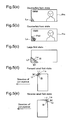
- Fig. 5 is an explanatory drawing for illustrating the paper currency states.
- the paper currency states include the counterfeit/torn state, the large fold state, the front large fold state, and the back large fold state.
- Fig. 5 (a) and (b) illustrate example of deposited paper currency Pm in the counterfeit/torn states.
- Fig. (a) is deposited papery currency wherein a portion of the paper currency is torn.
- Fig. 5 (b) is deposited paper currency Pm wherein a counterfeit paper currency Pm1, made using, for example, a color copier, is adhered. As is shown in Fig.
- the paper currency state determining unit 571 will store the fact that the paper currency is counterfeit/torn in the paper currency state memory area 582.
- counterfeit/torn state deposited paper currency Pm such as torn counterfeit paper currency.
- Fig. 5 (c) shows an example of the external shape of deposited paper currency Pm in the large fold state.
- the deposited paper currency Pm is genuine folded paper currency, and if the length L1 or the width W1 of the missing area shown by the dotted lines, such as shown in Fig. 5 (c), is greater than a threshold value B1 (for example, 20mm in the vertical direction or 20mm in the horizontal direction), then the paper currency state determining part 571 will store the large-fold paper currency state for the paper currency in the paper currency state memory area 582.
- a threshold value B1 for example, 20mm in the vertical direction or 20mm in the horizontal direction
- Fig. 5 (d) shows an example of the external shape of a forward small fold state deposited paper currency Pm.
- the deposited paper currency Pm is genuine folded paper currency, and if both the length L1 and the width W1 of the missing area La, as shown in Fig. 5 (d), are less than the threshold value B1, then the small fold state is acknowledged. Moreover, if, in this small fold state, the position corresponding to the crease at the fold L1, shown by the heavy line in Fig. 5 (d) faces the forward direction of the conveyance direction for the paper currency, then the paper currency state determining unit 571 stores in the paper currency state memory area 582 that the paper currency is in the forward small fold state.
- Fig. 5 (e) shows an example of the external shape for a deposited paper currency Pm in the reverse small fold state.
- the reverse small fold state is a small fold state wherein the position corresponding to the crease of the fold L1 is facing in the backwards direction of the direction of conveyance for the paper currency.
- the paper currency state determining part 571 stores in the paper currency state memory area 582 that the paper currency is in the reverse small fold state.
- the paper currency state determining unit 571 corresponds to the determining unit and the genuine determining unit as well in the present invention.
- the fold correcting processing unit 572 in Fig. 2 performs a fold correcting process intended to correct a fold in deposited paper currency Pm in the forward small fold state.
- the return part 573 returns, to a return area 523, any deposited paper currency in the counterfeit/torn state, the large-folded state, or the reverse small folded state.
- the paper currency handling apparatus memory unit 580 is provided with a deposited paper currency characteristic data memory area 581, a paper currency state memory unit 582, and a genuine characteristic database (DB) 583.
- the deposited paper currency characteristic data memory area 581 is an area for storing the deposited paper currency characteristic data, as described above.
- the paper currency state memory area 582 is an area for storing the paper currency state of the deposited paper currency Pm, as described above.
- Fig. 6 is an explanatory diagram illustrating the paper currency state memory area 582 in the case of a plurality of deposited paper currency Pm being deposited at one time into the ATM 1000.
- the paper currency states of the deposited paper currency Pm are stored in the paper currency state memory area 582 in the sequence in which the deposited paper currency Pm is conveyed.
- Fig. 7 is an explanatory diagram illustrating the genuine characteristic database 583.
- the genuine characteristic database 583 stores in advance, for each side of each denomination, genuine image data, external shape data, magnetic data, and thickness data (hereinafter termed, respectively, the "genuine image data,” “genuine external shape data,” “genuine magnetic data,” and “genuine thickness data”).
- the genuine image data, the genuine external shape data, the genuine magnetic data, and the genuine thickness data are termed, together, the "genuine characteristic data.”
- the data that is stored may not be limited to data regarding Japanese paper currency, but may also store genuine characteristic data for foreign paper currency as well.
- the memory unit 600 in Fig. 1 stores a variety of types of data and programs.
- the control unit 700 performs overall control of the various parts and various apparatuss of the ATM 1000.
- Fig. 8 is a flow chart illustrating processes performed by the ATM 1000 when paper currency is deposited.
- the paper currency handling apparatus control unit 570 of the ATM 1000 first initializes the paper currency state memory area 582 and performs the paper currency transport process (Step 1).
- Fig. 9 is a flow chart illustrating the paper currency conveying process.
- the paper currency handling apparatus control unit 570 shifts the separating plate 524 in the direction of the right arrow of the arrow A1, and conveys one of the paper currency from within the insertion area 521 following the arrow B1, causing the paper currency to arrive at the sensor unit 530a.
- the sensor unit 530a reads out the deposited paper currency characteristic data for the deposited paper currency Pm, and stores the data in the deposited paper currency characteristic data memory area 581.
- the paper currency handling apparatus control unit 570 searches the genuine characteristic database 583, shown in Fig. 7, using the deposited paper currency characteristic data, to retrieve the denomination, front or back, and orientation of the deposited paper currency Pm. (Step S10) This process is performed through comparing the deposited paper currency characteristic data within the narrow area Na in the deposited paper currency Pm shown in Fig. 9 to the genuine characteristic data within the narrow area Na. The reason for this is to determine the denomination, front/back, and orientation regardless of the presence or absence of a small fold.
- the paper currency handling apparatus control unit 570 compares the deposited paper currency external shape data of the deposited paper currency Pm to the genuine external shape data to determine whether or not there is a missing area La in the deposited paper currency Pm (Step S20). If there is not, then the authenticity decision is made for the deposited paper currency Pm (Step S30). At this time, the determination is made by comparing the deposited paper currency characteristic data in a paper currency area Pa of the deposited paper currency Pm shown in Fig. 9 to the genuine characteristic data within the paper currency area Pa.
- Step S40: Yes If the deposited paper currency Pa is genuine (Step S40: Yes), then the paper currency handling apparatus control unit 570 sets the switching gate 554 in Fig. 2 to the state 554b shown by the dotted line, to convey the deposited paper currency Pm along arrow B3 and arrow B4 to the temporary storage vault 540. If the deposited paper currency Pm is not genuine (Step S40: No) then the paper currency handling apparatus control unit 570 stores the counterfeit/torn state in the paper currency state memory area 582 (Step S60). Moreover, the switching gate 554 in Fig. 2 is put to state 554a, and the switching gate 555 is put to the state 555b shown by the dotted line and the paper currency is conveyed to the return area 523 along arrow B3 and arrow B5 (Step S70).
- Fig. 10 is a flow chart illustrating the paper currency state determining process.
- the paper currency state determining unit 571 first generates characteristic data for a genuine folded paper currency from the genuine characteristic data in order to check whether or not the deposited paper currency Pm is genuine folded paper currency (Step S101).
- Fig. 11 is an explanatory diagram illustrating the process for generating the image data for the genuine folded paper currency.
- the paper currency state determining unit 571 first removes image data within the missing area La from the genuine image data that was applied in Step S10 in Fig. 9 to generate the cut image data Cd (Process 1). After this, then genuine image data is retrieved from the genuine characteristic database 583, retrieving image data for the back if the genuine image data is that of the front, or retrieving genuine image data for the front, if the genuine image data is that of the back, to thereby acquire the image data within the missing area La of the genuine image data that has been retrieved (Process 2).
- the image data that has been achieved shall be termed the "folded part image data" Bd.
- a folded part image data Bd is laid over the cut part image data Cd, so as to align the fold lines L1 (Process 3).
- the overlaying is done so that only the folded part image data Bd will remain in the overlaying part.
- Processes 1 through 3 generate the genuine folded paper currency image data. Note that while the deposited design data will have parts from both sides, as shown in Fig. 4 (b), from the missing area La it is not clear whether the fold is on the front or the back, and thus there will be image data for the genuine folded paper currency for both the case wherein the fold is folded towards the front and the case wherein the fold is folded towards the back.
- the genuine folded paper currency magnetic data, thickness data, and image data are generated similarly, for the magnetic data and thickness data, the overlay part is produced through overlaying by adding together the data for the folded part image data Bd and the cut image data Cd.
- the paper currency state determining unit 571 compares the deposited characteristic data and the genuine folded paper currency characteristic data for the image data, the magnetic data, and the thickness data (Step S102). If not all of the individual characteristic data match within the predetermined tolerance values, then the deposited paper currency is not genuine folded paper currency, and so the counterfeit/torn state is stored in the paper currency state memory area 582 (Step S103). However, for the image data, if one of the two sides matches beyond a tolerance value, then the decision of genuine folded paper currency may be made. When the paper currency is a counterfeit/torn state, then the return part 573 conveys the deposited paper currency Pm to the return area 523, shown in Fig. 2 (Step S108).
- Step S104 If matching beyond the tolerance value, an investigation is performed on the deposited external diameter data as to whether either the length L1 or width W1 of the missing part La are outside of the respective threshold values B1 (Step S104). If the length L1 or the width W1 is greater than the threshold value B1 then the folded-large state is stored in the paper currency state memory area 582 (Step S105), and the deposited paper currency Pm is conveyed to the return area 523 (Step S108).
- Step S106 If both the lengths length L1 and width W1 are less than the threshold values B1, then an investigation is performed as to whether the crease of the fold L1 is facing in the forward direction of the conveyance direction of the paper currency, based on the deposited external shape data (Step S106). If not in the forward direction, then the reverse small fold state is stored in the paper currency state memory area 582 (Step S107), and the deposited paper currency Pm is conveyed to the return area 523 (Step S108).
- Step S106 If facing the forward direction (Step S106: Yes) then the forward small fold state is stored in the paper currency state memory area 582 (Step S109). Following this, the fold correcting processing unit 572 not only switches the switching gate 554, shown in Fig. 2, to the state 554a, but also switches the switching gate 555 to the state 555a, and the deposited paper currency Pm is conveyed to the resend area 522 along arrow B3 and arrow B5 (Step S110). The paper currency that has a forward small fold state will have the crease of the fold L1 to the top when conveyed to the resend area 522 (Fig. 5 (d)) at the sensor unit 530a.
- the process of conveying the deposited paper currency Pm to the resend area 522 corresponds to the process of changing the direction of conveyance of the deposited paper currency Pm to be the opposite direction.
- the fold correcting processing unit 572 references the paper currency state memory area 582 of Fig. 6 to investigate whether or not there is a forward small fold in the paper currency state (Step S3). If there is, then the fold correcting processing unit 572 erases all of the forward small fold states from the paper currency state memory area 582 and performs the resend preparation process (Step S4). In the resend preparation process, specifically the separating plate 524 and the separating plate 525 in Fig. 2 are shifted in the direction of the right arrow of arrow A1 to eliminate the insertion area 521, to position the resend area 522 at the position of the insertion area 521.
- the fold correcting processing unit 572 performs the paper currency conveyance process for the deposited paper currency Pm within the resend area 522 (Step S1).
- the process of the fold correcting processing unit 572 conveying the deposited paper currency Pm from the resend area 572 to the sensor unit 530a shall be termed the "resend process.”
- the fold correcting processing unit 572 conveys the paper currency within the resend area 522 one sheet at a time following the arrow B1 while shifting the separating plate 525 in the direction of the right arrow of arrow A1 to convey said paper currency one sheet at a time to the sensor unit 530a.
- the fold in the deposited paper currency Pm can be expected to be pressed and extended to be straightened out, and thus corrected by the conveyer rollers 551 and 552 during the conveyance along the arrow B1. Conversely, the fold may be corrected within the resend area 522.
- the process wherein the fold correcting processing unit 572 convey the deposited paper currency Pm to the resend area 522 (Step S110) and the resend process together shall be termed the "fold correcting process.” If the fold is corrected by the fold correcting process, then it is determined in step S20 in Fig.
- the fold correcting process may be performed repetitively a number of times, or may be repeated until the fold is corrected.
- conveyer rollers 551 and 552 were used in the conveying unit, the present invention is not limited thereto, but rather other structures may be used insofar as the paper currency can be conveyed and the fold correcting effect can be anticipated.
- Step S6 If the paper currency conveying process has been performed for all of the paper currency within the resend area 522 (Step 2 in Fig. 9: Yes), then the forward small fold states are erased by the process in Step S4, and because there will be none of this state in the paper currency state memory area 582 (Step S3: No), then processing will advance to Step S5. If there is, in the paper currency state memory area 582, a counterfeit/torn state, a large fold state, or a reverse small fold state (Step S5: Yes), then the return part 573 performs the return process (Step S6). In the return process, specifically, the separating plates 524 through 526 in Fig.
- paper currency Pm that has been conveyed to the temporary storage vault 540 is genuine, and so this paper currency Pm is conveyed in the direction opposite of the arrows B4 and B3, along the arrow B2 to be conveyed to and stored in the paper currency storage vault 560.
- the ATM 1000 of the aforementioned example of embodiment is able to perform fold correcting processes for correcting folds in the deposited paper currency Pm. Because the folds are corrected automatically, this can reduce the burden on the user in terms of correcting the folds, making it possible to reduce the per-user transaction time, making it possible to reduce the wait time for other users.
- a process is performed wherein the fold is corrected when it has been determined by a paper currency state determining unit 571 that the deposited paper currency Pm is in a forward small fold state that can be corrected, and thus there is little wasted effort at attempting to correct folds.
- the deposited paper currency Pm is returned, making it possible to prevent folded deposited paper currency from becoming an obstruction to the stable operation of the ATM 1000.
- the ATM 1000 in the present example of embodiment is provided with multiple sensors of multiple types, it is possible to obtain more detailed characteristic data, making it possible to perform the genuine/counterfeit determination more accurately. Because paper currency in the counterfeit/torn state is returned, it is possible to prevent counterfeit or altered notes from becoming an impediment to the stable operation of the ATM 1000.
- the paper currency states were categorized into the counterfeit/torn state, the large fold state, the reverse small fold state, and the forward small fold state; however, the method of categorizing is not limited thereto, and other categories may be added or a portion thereof may be omitted.
- the counterfeit/torn state, large fold state, and reverse small fold state may all be categorized as a "reject state," where the deposited paper currency Pm is returned if in the reject state.
- Fig. 12 is a flow chart illustrating the paper currency state determining process when all are categorized as "reject.” The difference from the paper currency state determining process of Fig.
- Step S103a and 104a paper currency to which the forward small fold state does not apply is all determined to be of the reject state. In this way, if paper currency of a reject state is inserted, no decision is performed as to whether or not the paper currency is genuine folded currency, which makes it possible to reduce the processing time. In this way, the processing in the paper currency state determining process can be eliminated in part, and the sequence of processes may also be modified.
- the direction of conveyance of the paper currency was reversed by conveying the deposited paper currency Pm to the resend area 522; however, the method of reversing the direction of conveyance is not limited thereto, but rather a variety of methods may be envisioned. Mechanically turning around the direction of conveyance during the conveyance in the conveying unit 550 is also possible.
- the fold correcting process is not limited to that which was illustrated in the example of embodiment, described above, but rather there are a variety of processes.
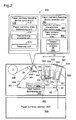
- the fold correcting processing unit 572 may return to the user any deposited paper currency Pm in the forward small fold state and may display guidance Gd, such as shown in Fig. 13, on the display/operating unit 100. With the guidance, the user is instructed on how to correct the fold in such a manner that it would be unlikely that the fold would occur again in the deposited paper currency Pm. Given this, the fold correcting processing unit 572 resends the inserted paper currency.
- This fold correcting process may be defined as the fold correcting.
- the display/operating unit 100 corresponds to the fold correcting processing unit according to the present invention.
- the image of the paper currency displayed in the guidance Gd of Fig. 13 may be displayed based on the deposited paper currency characteristic data, and, in particular, displayed based on the deposited paper currency image data.
- the image data acquiring unit for acquiring image data of the deposited paper currency Pm is provided separately from the sensor unit 530, an image of the deposited paper currency Pm may be displayed based on the image data acquired by the image data acquiring unit.
- the user is notified of the state, within the ATM 1000, of the paper currency inserted by the user, making it possible to display the guidance Gd in a more compelling way.
- the image of the deposited paper currency Pm may be used even in an image for instructing regarding the direction for inserting the paper currency.
- the determination of whether or not the fold has been corrected by the fold correcting process was performed base on the deposited characteristic data read out by the sensor unit 530a; however, a separate sensor may be provided instead of the sensor unit 530a, and the determination may be performed base on the output of that sensor.
- deposited paper currency Pm aside from genuine paper currency was conveyed directly to the resend area 522 or the return area 523; however, the deposited paper currency Pm that is not genuine paper currency may be conveyed to the resend area 522 or the return area 523 after storage in the temporary storage vault.
- Fig. 14 is a flowchart illustrating the process in the ATM 1000 when provided with a return/resend area. Steps S1A and S2A are the same as Steps S1 and S2 in Fig. 8.
- Step S3A if the paper currency state of the paper currency state memory area 582 is a forward small fold state, a resend preparation process is performed (Step S4A), and all of the paper currency within the resend/return area is resent and processed. If there is paper currency of the forward small fold state (State S5A: Yes), then even if there is no forward small fold state for all of the paper currency states (State S3A: No), then the guidance of Fig. 13 is displayed (Step S6A), and all of the paper currency within the resend/return area is returned to the user (Step S7A).
- the guidance in Step 13 may provide a display indicating which of the bills in the resend/return area should be turned around, based on the contents of the paper currency state memory area 582. If there is no paper currency in the forward small fold state (Step S5A: No) and paper currency in the counterfeit/torn state, the large fold state, or the reverse small fold state (Step S7A: Yes), then the paper currency in the resend/return area is returned to the user (Step S8a).
- the paper currency handling apparatus control unit of 570 searches the genuine characteristic database of 503 in Fig. 7 using the deposited paper currency characteristic data in Step S10 in Fig. 9, and if there is no genuine characteristic data corresponding to the deposited paper currency characteristic data, then the deposited paper currency Pm may be conveyed to the return area 523 as being in the counterfeit/torn state.
- the paper currency handling apparatus control unit 570 and the paper currency handling apparatus memory unit 580 were provided within the paper currency handling apparatus 500; however, at least portion thereof may be provided within the paper currency discriminating apparatus 530.
- a paper currency state determining unit 571 and a genuine characteristic database 583 may be provided in a paper currency discriminating unit 530, where the paper currency discriminating unit 530 may be structured as a paper currency discriminating apparatus.
- at least portion of the paper currency handling apparatus control unit 570 and the paper currency handling apparatus memory unit 580 may also be provided within a control unit 700 or a memory unit 600 for the ATM 1000. A variety of different structures is possible.
- paper currency of a counterfeit/torn state, a large fold state, or a reverse small fold state was returned to the user; however, a reject box may be provided and this paper currency may be placed in the reject box. In this case, instead of paper currency in the large fold state or the reverse small fold state, paper currency that is not for the may be returned to the user.
- a fold correcting process was performed only on the deposited paper currency Pm in the forward small fold state; however, the fold correcting process may be performed regardless of the state of the paper currency. Furthermore, the fold correcting process may be performed regardless of whether or not there exists a missing area La. Conversely, after the fold correcting process has been performed one or more times, and a determination is made as to whether or not there is a missing area La, the paper currency may be returned to the user if there is still a missing area La, but if it is determined that there is no missing area, then Steps S30 - S70 may be performed.
- the fold correcting process is performed depending on whether or not there is a missing area La in the deposited paper currency, or performed regardless of the state of the deposited paper currency Pm, and thus it is possible to eliminate the decision as to whether or not there is a missing area La in the deposited paper currency Pm and the determination of the state of the paper currency, making it possible to correcting the fold, using the fold correcting process, if there is a fold. This makes it possible to reduce the time for the user when inserting folded paper currency.
- the explanation was for an ATM 1000 as the apparatus; however, the apparatus is not limited to the ATM 1000, but rather may be an automatic cash payment machine (a cash dispenser), an automatic transaction apparatus such as a ticket vending machine, a paper currency handling apparatus 500, or another apparatus having paper currency handling functions.
Landscapes
- Physics & Mathematics (AREA)
- General Physics & Mathematics (AREA)
- Inspection Of Paper Currency And Valuable Securities (AREA)
- Financial Or Insurance-Related Operations Such As Payment And Settlement (AREA)
Applications Claiming Priority (1)
| Application Number | Priority Date | Filing Date | Title |
|---|---|---|---|
| JP2005197761A JP4709596B2 (ja) | 2005-07-06 | 2005-07-06 | 一部に折れがある紙幣の取扱 |
Publications (2)
| Publication Number | Publication Date |
|---|---|
| EP1748397A2 true EP1748397A2 (de) | 2007-01-31 |
| EP1748397A3 EP1748397A3 (de) | 2007-09-12 |
Family
ID=37075145
Family Applications (1)
| Application Number | Title | Priority Date | Filing Date |
|---|---|---|---|
| EP06011028A Withdrawn EP1748397A3 (de) | 2005-07-06 | 2006-05-29 | Vorrichtung und Verfahren zur Verarbeitung von Papierwährung |
Country Status (4)
| Country | Link |
|---|---|
| US (1) | US7631743B2 (de) |
| EP (1) | EP1748397A3 (de) |
| JP (1) | JP4709596B2 (de) |
| CN (1) | CN1892710B (de) |
Cited By (2)
| Publication number | Priority date | Publication date | Assignee | Title |
|---|---|---|---|---|
| EP2131335A2 (de) | 2008-06-05 | 2009-12-09 | Hitachi-Omron Terminal Solutions, Corp. | Papierhandhabungsvorrichtung und -verfahren |
| CN112614283A (zh) * | 2020-12-31 | 2021-04-06 | 深圳怡化电脑股份有限公司 | 薄片介质数据的处理方法、装置、电子设备及存储介质 |
Families Citing this family (23)
| Publication number | Priority date | Publication date | Assignee | Title |
|---|---|---|---|---|
| JP2008009511A (ja) * | 2006-06-27 | 2008-01-17 | Noa:Kk | 印刷紙葉類のチェッカー |
| JP2008133123A (ja) * | 2006-11-29 | 2008-06-12 | Ricoh Co Ltd | 画像形成装置及び記録体搬送装置 |
| JP5210012B2 (ja) * | 2008-03-19 | 2013-06-12 | 株式会社ユニバーサルエンターテインメント | 紙葉類処理装置 |
| US8682056B2 (en) * | 2008-06-30 | 2014-03-25 | Ncr Corporation | Media identification |
| JP2010181987A (ja) * | 2009-02-04 | 2010-08-19 | Hitachi Omron Terminal Solutions Corp | 紙幣取引装置および紙幣取引システム |
| RU2421818C1 (ru) * | 2010-04-08 | 2011-06-20 | Общество С Ограниченной Ответственностью "Конструкторское Бюро "Дорс" (Ооо "Кб "Дорс") | Способ классификации банкнот (варианты) |
| RU2438182C1 (ru) * | 2010-04-08 | 2011-12-27 | Общество С Ограниченной Ответственностью "Конструкторское Бюро "Дорс" (Ооо "Кб "Дорс") | Способ обработки банкнот (варианты) |
| US8983168B2 (en) * | 2012-04-30 | 2015-03-17 | Ncr Corporation | System and method of categorising defects in a media item |
| JP6004928B2 (ja) * | 2012-12-11 | 2016-10-12 | 日立オムロンターミナルソリューションズ株式会社 | 紙葉類取扱装置および紙葉類の取扱方法 |
| JP6098331B2 (ja) * | 2013-04-22 | 2017-03-22 | 沖電気工業株式会社 | 紙葉類処理装置 |
| JP6399845B2 (ja) * | 2014-07-29 | 2018-10-03 | グローリー株式会社 | 紙葉類処理機 |
| CN104331978B (zh) * | 2014-11-19 | 2017-02-01 | 广州广电运通金融电子股份有限公司 | 纸币褶皱的识别装置和方法 |
| JP6634698B2 (ja) * | 2015-05-13 | 2020-01-22 | 沖電気工業株式会社 | 自動取引装置 |
| CN105354914B (zh) * | 2015-08-18 | 2018-01-02 | 深圳怡化电脑股份有限公司 | 一种纸币折角面向识别方法和装置 |
| CN105096441B (zh) * | 2015-08-25 | 2018-01-12 | 昆山古鳌电子机械有限公司 | 一种纸币储存装置及纸币检测存储方法 |
| US10167152B2 (en) * | 2016-06-30 | 2019-01-01 | Ncr Corporation | Folded media detection and processing |
| KR102718757B1 (ko) * | 2016-08-19 | 2024-10-18 | 효성티앤에스 주식회사 | 시뮬레이션을 통한 낡은 지폐 이미지 생성 방법 |
| US10373007B2 (en) * | 2017-03-29 | 2019-08-06 | Ncr Corporation | Double feed exceptions identifying system |
| CN107301722B (zh) * | 2017-08-03 | 2023-06-09 | 恒银金融科技股份有限公司 | 可换向且能处理异常钞的纸币传输通道装置 |
| ES2991869T3 (es) | 2017-12-07 | 2024-12-05 | Crane Payment Innovations Inc | Sistema de trayectoria abierta de billetes |
| CN109685971B (zh) * | 2018-12-10 | 2021-09-10 | 广州广电运通金融电子股份有限公司 | 折叠纸币检测方法、装置及设备 |
| JP7309549B2 (ja) * | 2019-09-18 | 2023-07-18 | 株式会社東芝 | 紙葉類処理装置、及び紙葉類処理システム |
| JP7250735B2 (ja) * | 2020-07-07 | 2023-04-03 | 日立チャネルソリューションズ株式会社 | 入金装置および入金装置の制御方法 |
Citations (5)
| Publication number | Priority date | Publication date | Assignee | Title |
|---|---|---|---|---|
| JPH0714048A (ja) | 1993-06-29 | 1995-01-17 | Oki Joho Syst:Kk | 紙幣鑑別装置 |
| EP0702338A2 (de) * | 1994-09-19 | 1996-03-20 | AT&T GLOBAL INFORMATION SOLUTIONS INTERNATIONAL INC. | Vorrichtung zur Bearbeitung von Dokumenten |
| JP2003288628A (ja) | 2002-01-28 | 2003-10-10 | Omron Corp | 紙葉類確定装置 |
| EP1369832A2 (de) * | 2002-06-08 | 2003-12-10 | Ncr International Inc. | Selbstbedienungsterminal |
| US20050133990A1 (en) | 2002-08-30 | 2005-06-23 | Fujitsu Limited | Paper sheets corner fold detection method and paper sheets corner fold detection program |
Family Cites Families (15)
| Publication number | Priority date | Publication date | Assignee | Title |
|---|---|---|---|---|
| FR2358268A1 (fr) | 1976-07-12 | 1978-02-10 | Sodern | Dispositif de planage de feuilles |
| EP0080158B1 (de) * | 1981-11-20 | 1987-09-02 | Kabushiki Kaisha Toshiba | Gerät zur Feststellung der Profile und der Art der Zuführung von Papierblättern |
| JPS63101988A (ja) * | 1986-10-20 | 1988-05-06 | 株式会社日立製作所 | 現金自動取引装置 |
| US5147274A (en) * | 1991-05-20 | 1992-09-15 | Xerox Corporation | Document feeding dog-ear straightening system |
| GB2268735B (en) | 1992-07-17 | 1996-02-28 | Xerox Corp | Sheet feeding apparatus |
| JPH0710346A (ja) * | 1993-06-22 | 1995-01-13 | Hitachi Ltd | 紙葉類搬送装置 |
| JP3055950B2 (ja) * | 1995-11-21 | 2000-06-26 | 富士通株式会社 | 紙葉類処理装置 |
| US5895904A (en) * | 1997-05-27 | 1999-04-20 | Y. Nissim Coporation | Magnetic ink character recognition encoder utilizing a dot matrix printer head and plurality of sensors for detecting, activating, and controlling the speed of the media |
| JP4180715B2 (ja) | 1998-12-14 | 2008-11-12 | 株式会社東芝 | 印刷物の汚損度判別装置 |
| KR100436939B1 (ko) | 1999-02-04 | 2004-06-23 | 오브체스토브 에스 오르가니첸노이 오트베트스트벤노스티쥬 퍼마 "데이타 센터" | 지폐의 신빙성과 금액 및 손상도를 결정하는 방법과 지폐분류 및 계수장치 |
| DE10029442A1 (de) | 2000-06-21 | 2002-01-03 | Giesecke & Devrient Gmbh | Verfahren zur Bestimmung von Strukturinhomogenitäten in Blattgut |
| DE10049432A1 (de) | 2000-10-06 | 2002-04-18 | Giesecke & Devrient Gmbh | Verfahren und Vorrichtung für die Annahme von Blattgut |
| JP5193409B2 (ja) * | 2001-09-21 | 2013-05-08 | 株式会社東芝 | 紙葉類処理装置と紙葉類処理装置の点検方法とテスト媒体 |
| JP2004168489A (ja) | 2002-11-20 | 2004-06-17 | Ricoh Co Ltd | 画像形成装置 |
| US6994201B2 (en) | 2003-06-23 | 2006-02-07 | International Currency Technologies Corporation | Bill acceptor |
-
2005
- 2005-07-06 JP JP2005197761A patent/JP4709596B2/ja not_active Expired - Fee Related
-
2006
- 2006-05-25 US US11/439,952 patent/US7631743B2/en not_active Expired - Fee Related
- 2006-05-29 EP EP06011028A patent/EP1748397A3/de not_active Withdrawn
- 2006-07-05 CN CN2006101054521A patent/CN1892710B/zh not_active Expired - Fee Related
Patent Citations (5)
| Publication number | Priority date | Publication date | Assignee | Title |
|---|---|---|---|---|
| JPH0714048A (ja) | 1993-06-29 | 1995-01-17 | Oki Joho Syst:Kk | 紙幣鑑別装置 |
| EP0702338A2 (de) * | 1994-09-19 | 1996-03-20 | AT&T GLOBAL INFORMATION SOLUTIONS INTERNATIONAL INC. | Vorrichtung zur Bearbeitung von Dokumenten |
| JP2003288628A (ja) | 2002-01-28 | 2003-10-10 | Omron Corp | 紙葉類確定装置 |
| EP1369832A2 (de) * | 2002-06-08 | 2003-12-10 | Ncr International Inc. | Selbstbedienungsterminal |
| US20050133990A1 (en) | 2002-08-30 | 2005-06-23 | Fujitsu Limited | Paper sheets corner fold detection method and paper sheets corner fold detection program |
Cited By (4)
| Publication number | Priority date | Publication date | Assignee | Title |
|---|---|---|---|---|
| EP2131335A2 (de) | 2008-06-05 | 2009-12-09 | Hitachi-Omron Terminal Solutions, Corp. | Papierhandhabungsvorrichtung und -verfahren |
| EP2131335A3 (de) * | 2008-06-05 | 2010-09-08 | Hitachi-Omron Terminal Solutions, Corp. | Papierhandhabungsvorrichtung und -verfahren |
| CN112614283A (zh) * | 2020-12-31 | 2021-04-06 | 深圳怡化电脑股份有限公司 | 薄片介质数据的处理方法、装置、电子设备及存储介质 |
| CN112614283B (zh) * | 2020-12-31 | 2022-05-31 | 深圳怡化电脑股份有限公司 | 薄片介质数据的处理方法、装置、电子设备及存储介质 |
Also Published As
| Publication number | Publication date |
|---|---|
| CN1892710A (zh) | 2007-01-10 |
| JP4709596B2 (ja) | 2011-06-22 |
| EP1748397A3 (de) | 2007-09-12 |
| CN1892710B (zh) | 2010-05-12 |
| US7631743B2 (en) | 2009-12-15 |
| JP2007018170A (ja) | 2007-01-25 |
| US20070007103A1 (en) | 2007-01-11 |
Similar Documents
| Publication | Publication Date | Title |
|---|---|---|
| EP1748397A2 (de) | Vorrichtung und Verfahren zur Verarbeitung von Papierwährung | |
| EP2827306B1 (de) | Verarbeitungsvorrichtung für wertmedien | |
| JP2010108197A (ja) | 自動取引装置 | |
| US20030121077A1 (en) | Bill handling machine | |
| JP2009295132A (ja) | 自動取引装置 | |
| TW201007624A (en) | Paper sheet handling apparatus and paper sheet handling method | |
| JP2001312762A (ja) | 媒体処理装置および紙幣処理装置 | |
| JP5635968B2 (ja) | 紙幣取扱装置及び現金自動取引装置 | |
| WO2013153572A1 (ja) | 紙葉類処理装置 | |
| JP2014058396A (ja) | 厚み検知装置 | |
| CN104346878B (zh) | 自动交易装置、自动交易系统以及纸币交换交易方法 | |
| JP5946738B2 (ja) | 有価媒体処理装置 | |
| JP4414625B2 (ja) | 紙葉処理装置 | |
| JPWO2001041080A1 (ja) | 紙葉処理装置 | |
| CN107111910A (zh) | 纸张类集积库、现金自动交易装置 | |
| JP4184933B2 (ja) | 現金処理装置 | |
| JP6004928B2 (ja) | 紙葉類取扱装置および紙葉類の取扱方法 | |
| JP2018067254A (ja) | 紙葉類識別装置、紙葉類取扱装置 | |
| KR100641250B1 (ko) | 지엽류 모서리 접힘 검출 방법 및 지엽류 모서리 접힘 검출 프로그램을 기록한 컴퓨터로 읽을 수 있는 기록 매체 | |
| JP6237911B2 (ja) | 媒体搬送識別装置及び媒体取引装置 | |
| JP4951251B2 (ja) | 現金自動取引装置 | |
| JP6022284B2 (ja) | 有価媒体処理装置 | |
| JP2009123016A (ja) | 自動取引装置 | |
| JP2011103088A (ja) | 紙葉類識別ユニット、および紙葉類処理装置 | |
| JP6029838B2 (ja) | 紙葉類処理装置および紙葉類処理方法 |
Legal Events
| Date | Code | Title | Description |
|---|---|---|---|
| PUAI | Public reference made under article 153(3) epc to a published international application that has entered the european phase |
Free format text: ORIGINAL CODE: 0009012 |
|
| AK | Designated contracting states |
Kind code of ref document: A2 Designated state(s): AT BE BG CH CY CZ DE DK EE ES FI FR GB GR HU IE IS IT LI LT LU LV MC NL PL PT RO SE SI SK TR |
|
| AX | Request for extension of the european patent |
Extension state: AL BA HR MK YU |
|
| PUAL | Search report despatched |
Free format text: ORIGINAL CODE: 0009013 |
|
| AK | Designated contracting states |
Kind code of ref document: A3 Designated state(s): AT BE BG CH CY CZ DE DK EE ES FI FR GB GR HU IE IS IT LI LT LU LV MC NL PL PT RO SE SI SK TR |
|
| AX | Request for extension of the european patent |
Extension state: AL BA HR MK YU |
|
| 17P | Request for examination filed |
Effective date: 20080312 |
|
| AKX | Designation fees paid |
Designated state(s): DE FR GB |
|
| 17Q | First examination report despatched |
Effective date: 20100618 |
|
| STAA | Information on the status of an ep patent application or granted ep patent |
Free format text: STATUS: EXAMINATION IS IN PROGRESS |
|
| STAA | Information on the status of an ep patent application or granted ep patent |
Free format text: STATUS: THE APPLICATION IS DEEMED TO BE WITHDRAWN |
|
| 18D | Application deemed to be withdrawn |
Effective date: 20171201 |