EP1741734A1 - Tieftemperaturschlagzähe hitze-härtbare Epoxidharzzusammensetzung mit Epoxidfestharzen - Google Patents
Tieftemperaturschlagzähe hitze-härtbare Epoxidharzzusammensetzung mit Epoxidfestharzen Download PDFInfo
- Publication number
- EP1741734A1 EP1741734A1 EP20050106097 EP05106097A EP1741734A1 EP 1741734 A1 EP1741734 A1 EP 1741734A1 EP 20050106097 EP20050106097 EP 20050106097 EP 05106097 A EP05106097 A EP 05106097A EP 1741734 A1 EP1741734 A1 EP 1741734A1
- Authority
- EP
- European Patent Office
- Prior art keywords
- composition according
- weight
- composition
- polymer
- epoxy resin
- Prior art date
- Legal status (The legal status is an assumption and is not a legal conclusion. Google has not performed a legal analysis and makes no representation as to the accuracy of the status listed.)
- Withdrawn
Links
- 239000000203 mixture Substances 0.000 title claims abstract description 108
- 229920000647 polyepoxide Polymers 0.000 title claims abstract description 20
- 239000003822 epoxy resin Substances 0.000 title claims abstract description 18
- 239000007787 solid Substances 0.000 title claims abstract description 15
- LNEPOXFFQSENCJ-UHFFFAOYSA-N haloperidol Chemical compound C1CC(O)(C=2C=CC(Cl)=CC=2)CCN1CCCC(=O)C1=CC=C(F)C=C1 LNEPOXFFQSENCJ-UHFFFAOYSA-N 0.000 title claims abstract description 7
- 229920000642 polymer Polymers 0.000 claims abstract description 54
- -1 cycloaliphatic Chemical group 0.000 claims abstract description 41
- 229920001730 Moisture cure polyurethane Polymers 0.000 claims abstract description 31
- 125000002887 hydroxy group Chemical group [H]O* 0.000 claims abstract description 28
- 150000002118 epoxides Chemical class 0.000 claims abstract description 27
- 239000000463 material Substances 0.000 claims abstract description 19
- 150000003672 ureas Chemical class 0.000 claims abstract description 17
- 238000000034 method Methods 0.000 claims abstract description 14
- 229910052751 metal Inorganic materials 0.000 claims abstract description 9
- 239000002184 metal Substances 0.000 claims abstract description 9
- 125000003118 aryl group Chemical group 0.000 claims abstract description 8
- 150000002739 metals Chemical class 0.000 claims abstract description 6
- 125000001931 aliphatic group Chemical group 0.000 claims abstract description 5
- 239000007795 chemical reaction product Substances 0.000 claims abstract description 5
- 239000004848 polyfunctional curative Substances 0.000 claims abstract description 4
- 125000005442 diisocyanate group Chemical group 0.000 claims description 27
- 239000005022 packaging material Substances 0.000 claims description 26
- 239000004593 Epoxy Substances 0.000 claims description 19
- 239000000853 adhesive Substances 0.000 claims description 18
- 230000001070 adhesive effect Effects 0.000 claims description 18
- 235000013824 polyphenols Nutrition 0.000 claims description 18
- 238000006243 chemical reaction Methods 0.000 claims description 16
- 150000008442 polyphenolic compounds Chemical class 0.000 claims description 16
- 239000013008 thixotropic agent Substances 0.000 claims description 12
- 125000002924 primary amino group Chemical group [H]N([H])* 0.000 claims description 11
- 150000003573 thiols Chemical group 0.000 claims description 11
- NIMLQBUJDJZYEJ-UHFFFAOYSA-N isophorone diisocyanate Chemical compound CC1(C)CC(N=C=O)CC(C)(CN=C=O)C1 NIMLQBUJDJZYEJ-UHFFFAOYSA-N 0.000 claims description 10
- 238000002360 preparation method Methods 0.000 claims description 10
- 239000005058 Isophorone diisocyanate Substances 0.000 claims description 9
- 239000003795 chemical substances by application Substances 0.000 claims description 9
- 239000000047 product Substances 0.000 claims description 9
- HQABUPZFAYXKJW-UHFFFAOYSA-N butan-1-amine Chemical compound CCCCN HQABUPZFAYXKJW-UHFFFAOYSA-N 0.000 claims description 8
- 229920005989 resin Polymers 0.000 claims description 8
- 239000011347 resin Substances 0.000 claims description 8
- 239000012876 carrier material Substances 0.000 claims description 7
- 239000004850 liquid epoxy resins (LERs) Substances 0.000 claims description 7
- 229920002857 polybutadiene Polymers 0.000 claims description 7
- 239000005062 Polybutadiene Substances 0.000 claims description 6
- IQPQWNKOIGAROB-UHFFFAOYSA-N isocyanate group Chemical group [N-]=C=O IQPQWNKOIGAROB-UHFFFAOYSA-N 0.000 claims description 6
- ISWSIDIOOBJBQZ-UHFFFAOYSA-N phenol group Chemical group C1(=CC=CC=C1)O ISWSIDIOOBJBQZ-UHFFFAOYSA-N 0.000 claims description 6
- QGBSISYHAICWAH-UHFFFAOYSA-N dicyandiamide Chemical compound NC(N)=NC#N QGBSISYHAICWAH-UHFFFAOYSA-N 0.000 claims description 5
- 239000003085 diluting agent Substances 0.000 claims description 5
- 125000001424 substituent group Chemical group 0.000 claims description 5
- 239000000945 filler Substances 0.000 claims description 4
- 239000007788 liquid Substances 0.000 claims description 4
- 239000004014 plasticizer Substances 0.000 claims description 3
- WNLRTRBMVRJNCN-UHFFFAOYSA-L adipate(2-) Chemical compound [O-]C(=O)CCCCC([O-])=O WNLRTRBMVRJNCN-UHFFFAOYSA-L 0.000 claims description 2
- HAMNKKUPIHEESI-UHFFFAOYSA-N aminoguanidine Chemical compound NNC(N)=N HAMNKKUPIHEESI-UHFFFAOYSA-N 0.000 claims description 2
- XLYOFNOQVPJJNP-UHFFFAOYSA-M hydroxide Chemical compound [OH-] XLYOFNOQVPJJNP-UHFFFAOYSA-M 0.000 claims description 2
- XNGIFLGASWRNHJ-UHFFFAOYSA-L phthalate(2-) Chemical compound [O-]C(=O)C1=CC=CC=C1C([O-])=O XNGIFLGASWRNHJ-UHFFFAOYSA-L 0.000 claims description 2
- 229920001515 polyalkylene glycol Polymers 0.000 claims description 2
- 229920001195 polyisoprene Polymers 0.000 claims description 2
- ZRALSGWEFCBTJO-UHFFFAOYSA-N Guanidine Chemical compound NC(N)=N ZRALSGWEFCBTJO-UHFFFAOYSA-N 0.000 claims 2
- VZXTWGWHSMCWGA-UHFFFAOYSA-N 1,3,5-triazine-2,4-diamine Chemical compound NC1=NC=NC(N)=N1 VZXTWGWHSMCWGA-UHFFFAOYSA-N 0.000 claims 1
- CHJJGSNFBQVOTG-UHFFFAOYSA-N N-methyl-guanidine Natural products CNC(N)=N CHJJGSNFBQVOTG-UHFFFAOYSA-N 0.000 claims 1
- SWSQBOPZIKWTGO-UHFFFAOYSA-N dimethylaminoamidine Natural products CN(C)C(N)=N SWSQBOPZIKWTGO-UHFFFAOYSA-N 0.000 claims 1
- 239000004849 latent hardener Substances 0.000 claims 1
- 239000000654 additive Substances 0.000 abstract 2
- 230000000996 additive effect Effects 0.000 abstract 2
- 230000009974 thixotropic effect Effects 0.000 abstract 2
- XSQUKJJJFZCRTK-UHFFFAOYSA-N Urea Chemical compound NC(N)=O XSQUKJJJFZCRTK-UHFFFAOYSA-N 0.000 abstract 1
- 239000004202 carbamide Substances 0.000 abstract 1
- 229920005862 polyol Polymers 0.000 description 26
- 150000003077 polyols Chemical class 0.000 description 24
- IISBACLAFKSPIT-UHFFFAOYSA-N bisphenol A Chemical compound C=1C=C(O)C=CC=1C(C)(C)C1=CC=C(O)C=C1 IISBACLAFKSPIT-UHFFFAOYSA-N 0.000 description 20
- PXKLMJQFEQBVLD-UHFFFAOYSA-N bisphenol F Chemical compound C1=CC(O)=CC=C1CC1=CC=C(O)C=C1 PXKLMJQFEQBVLD-UHFFFAOYSA-N 0.000 description 20
- KWYUFKZDYYNOTN-UHFFFAOYSA-M Potassium hydroxide Chemical compound [OH-].[K+] KWYUFKZDYYNOTN-UHFFFAOYSA-M 0.000 description 17
- GYZLOYUZLJXAJU-UHFFFAOYSA-N diglycidyl ether Chemical class C1OC1COCC1CO1 GYZLOYUZLJXAJU-UHFFFAOYSA-N 0.000 description 17
- 239000004743 Polypropylene Substances 0.000 description 14
- 229920001451 polypropylene glycol Polymers 0.000 description 14
- ZJCCRDAZUWHFQH-UHFFFAOYSA-N Trimethylolpropane Chemical compound CCC(CO)(CO)CO ZJCCRDAZUWHFQH-UHFFFAOYSA-N 0.000 description 13
- PEDCQBHIVMGVHV-UHFFFAOYSA-N Glycerine Chemical compound OCC(O)CO PEDCQBHIVMGVHV-UHFFFAOYSA-N 0.000 description 10
- 150000001875 compounds Chemical class 0.000 description 10
- LYCAIKOWRPUZTN-UHFFFAOYSA-N Ethylene glycol Chemical compound OCCO LYCAIKOWRPUZTN-UHFFFAOYSA-N 0.000 description 9
- HEMHJVSKTPXQMS-UHFFFAOYSA-M Sodium hydroxide Chemical compound [OH-].[Na+] HEMHJVSKTPXQMS-UHFFFAOYSA-M 0.000 description 9
- 229940106691 bisphenol a Drugs 0.000 description 9
- 150000002009 diols Chemical class 0.000 description 8
- UPMLOUAZCHDJJD-UHFFFAOYSA-N 4,4'-Diphenylmethane Diisocyanate Chemical compound C1=CC(N=C=O)=CC=C1CC1=CC=C(N=C=O)C=C1 UPMLOUAZCHDJJD-UHFFFAOYSA-N 0.000 description 7
- 239000012948 isocyanate Substances 0.000 description 7
- 150000002513 isocyanates Chemical class 0.000 description 7
- 150000002989 phenols Chemical class 0.000 description 7
- 229920001228 polyisocyanate Polymers 0.000 description 7
- PVFQHGDIOXNKIC-UHFFFAOYSA-N 4-[2-[3-[2-(4-hydroxyphenyl)propan-2-yl]phenyl]propan-2-yl]phenol Chemical compound C=1C=CC(C(C)(C)C=2C=CC(O)=CC=2)=CC=1C(C)(C)C1=CC=C(O)C=C1 PVFQHGDIOXNKIC-UHFFFAOYSA-N 0.000 description 6
- 229920003319 Araldite® Polymers 0.000 description 6
- 239000004609 Impact Modifier Substances 0.000 description 6
- 239000004721 Polyphenylene oxide Substances 0.000 description 6
- 150000001298 alcohols Chemical class 0.000 description 6
- JBKVHLHDHHXQEQ-UHFFFAOYSA-N epsilon-caprolactam Chemical compound O=C1CCCCCN1 JBKVHLHDHHXQEQ-UHFFFAOYSA-N 0.000 description 6
- 229920001748 polybutylene Polymers 0.000 description 6
- 239000005056 polyisocyanate Substances 0.000 description 6
- 241000894007 species Species 0.000 description 6
- AOBIOSPNXBMOAT-UHFFFAOYSA-N 2-[2-(oxiran-2-ylmethoxy)ethoxymethyl]oxirane Chemical compound C1OC1COCCOCC1CO1 AOBIOSPNXBMOAT-UHFFFAOYSA-N 0.000 description 5
- VPWNQTHUCYMVMZ-UHFFFAOYSA-N 4,4'-sulfonyldiphenol Chemical class C1=CC(O)=CC=C1S(=O)(=O)C1=CC=C(O)C=C1 VPWNQTHUCYMVMZ-UHFFFAOYSA-N 0.000 description 5
- BRLQWZUYTZBJKN-UHFFFAOYSA-N Epichlorohydrin Chemical compound ClCC1CO1 BRLQWZUYTZBJKN-UHFFFAOYSA-N 0.000 description 5
- 229920000570 polyether Polymers 0.000 description 5
- KUBDPQJOLOUJRM-UHFFFAOYSA-N 2-(chloromethyl)oxirane;4-[2-(4-hydroxyphenyl)propan-2-yl]phenol Chemical compound ClCC1CO1.C=1C=C(O)C=CC=1C(C)(C)C1=CC=C(O)C=C1 KUBDPQJOLOUJRM-UHFFFAOYSA-N 0.000 description 4
- MECNWXGGNCJFQJ-UHFFFAOYSA-N 3-piperidin-1-ylpropane-1,2-diol Chemical compound OCC(O)CN1CCCCC1 MECNWXGGNCJFQJ-UHFFFAOYSA-N 0.000 description 4
- NLHHRLWOUZZQLW-UHFFFAOYSA-N Acrylonitrile Chemical compound C=CC#N NLHHRLWOUZZQLW-UHFFFAOYSA-N 0.000 description 4
- IJGRMHOSHXDMSA-UHFFFAOYSA-N Atomic nitrogen Chemical compound N#N IJGRMHOSHXDMSA-UHFFFAOYSA-N 0.000 description 4
- IAYPIBMASNFSPL-UHFFFAOYSA-N Ethylene oxide Chemical compound C1CO1 IAYPIBMASNFSPL-UHFFFAOYSA-N 0.000 description 4
- 229910000831 Steel Inorganic materials 0.000 description 4
- WYURNTSHIVDZCO-UHFFFAOYSA-N Tetrahydrofuran Chemical compound C1CCOC1 WYURNTSHIVDZCO-UHFFFAOYSA-N 0.000 description 4
- UKLDJPRMSDWDSL-UHFFFAOYSA-L [dibutyl(dodecanoyloxy)stannyl] dodecanoate Chemical compound CCCCCCCCCCCC(=O)O[Sn](CCCC)(CCCC)OC(=O)CCCCCCCCCCC UKLDJPRMSDWDSL-UHFFFAOYSA-L 0.000 description 4
- 239000012975 dibutyltin dilaurate Substances 0.000 description 4
- MTHSVFCYNBDYFN-UHFFFAOYSA-N diethylene glycol Chemical compound OCCOCCO MTHSVFCYNBDYFN-UHFFFAOYSA-N 0.000 description 4
- 125000003700 epoxy group Chemical group 0.000 description 4
- 235000011187 glycerol Nutrition 0.000 description 4
- 229920001223 polyethylene glycol Polymers 0.000 description 4
- 229920000909 polytetrahydrofuran Polymers 0.000 description 4
- 239000002994 raw material Substances 0.000 description 4
- 239000010959 steel Substances 0.000 description 4
- 229920001187 thermosetting polymer Polymers 0.000 description 4
- 150000004072 triols Chemical class 0.000 description 4
- HSDVRWZKEDRBAG-UHFFFAOYSA-N 2-[1-(oxiran-2-ylmethoxy)hexoxymethyl]oxirane Chemical compound C1OC1COC(CCCCC)OCC1CO1 HSDVRWZKEDRBAG-UHFFFAOYSA-N 0.000 description 3
- QTWJRLJHJPIABL-UHFFFAOYSA-N 2-methylphenol;3-methylphenol;4-methylphenol Chemical compound CC1=CC=C(O)C=C1.CC1=CC=CC(O)=C1.CC1=CC=CC=C1O QTWJRLJHJPIABL-UHFFFAOYSA-N 0.000 description 3
- CSCPPACGZOOCGX-UHFFFAOYSA-N Acetone Chemical compound CC(C)=O CSCPPACGZOOCGX-UHFFFAOYSA-N 0.000 description 3
- KAKZBPTYRLMSJV-UHFFFAOYSA-N Butadiene Chemical compound C=CC=C KAKZBPTYRLMSJV-UHFFFAOYSA-N 0.000 description 3
- 239000005057 Hexamethylene diisocyanate Substances 0.000 description 3
- 229920013646 Hycar Polymers 0.000 description 3
- 229920002121 Hydroxyl-terminated polybutadiene Polymers 0.000 description 3
- 239000004698 Polyethylene Substances 0.000 description 3
- XXROGKLTLUQVRX-UHFFFAOYSA-N allyl alcohol Chemical compound OCC=C XXROGKLTLUQVRX-UHFFFAOYSA-N 0.000 description 3
- 150000001412 amines Chemical class 0.000 description 3
- WERYXYBDKMZEQL-UHFFFAOYSA-N butane-1,4-diol Chemical compound OCCCCO WERYXYBDKMZEQL-UHFFFAOYSA-N 0.000 description 3
- 239000003054 catalyst Substances 0.000 description 3
- 229930003836 cresol Natural products 0.000 description 3
- 125000004122 cyclic group Chemical group 0.000 description 3
- 230000006735 deficit Effects 0.000 description 3
- 229920006332 epoxy adhesive Polymers 0.000 description 3
- 150000002148 esters Chemical class 0.000 description 3
- 150000002334 glycols Chemical class 0.000 description 3
- RRAMGCGOFNQTLD-UHFFFAOYSA-N hexamethylene diisocyanate Chemical compound O=C=NCCCCCCN=C=O RRAMGCGOFNQTLD-UHFFFAOYSA-N 0.000 description 3
- 125000004464 hydroxyphenyl group Chemical group 0.000 description 3
- 238000004519 manufacturing process Methods 0.000 description 3
- 229920005906 polyester polyol Polymers 0.000 description 3
- 229920000573 polyethylene Polymers 0.000 description 3
- 229920006395 saturated elastomer Polymers 0.000 description 3
- DVKJHBMWWAPEIU-UHFFFAOYSA-N toluene 2,4-diisocyanate Chemical compound CC1=CC=C(N=C=O)C=C1N=C=O DVKJHBMWWAPEIU-UHFFFAOYSA-N 0.000 description 3
- ALQLPWJFHRMHIU-UHFFFAOYSA-N 1,4-diisocyanatobenzene Chemical compound O=C=NC1=CC=C(N=C=O)C=C1 ALQLPWJFHRMHIU-UHFFFAOYSA-N 0.000 description 2
- VZXPHDGHQXLXJC-UHFFFAOYSA-N 1,6-diisocyanato-5,6-dimethylheptane Chemical compound O=C=NC(C)(C)C(C)CCCCN=C=O VZXPHDGHQXLXJC-UHFFFAOYSA-N 0.000 description 2
- JTINZFQXZLCHNS-UHFFFAOYSA-N 2,2-bis(oxiran-2-ylmethoxymethyl)butan-1-ol Chemical compound C1OC1COCC(CO)(CC)COCC1CO1 JTINZFQXZLCHNS-UHFFFAOYSA-N 0.000 description 2
- PQXKWPLDPFFDJP-UHFFFAOYSA-N 2,3-dimethyloxirane Chemical compound CC1OC1C PQXKWPLDPFFDJP-UHFFFAOYSA-N 0.000 description 2
- STMDPCBYJCIZOD-UHFFFAOYSA-N 2-(2,4-dinitroanilino)-4-methylpentanoic acid Chemical compound CC(C)CC(C(O)=O)NC1=CC=C([N+]([O-])=O)C=C1[N+]([O-])=O STMDPCBYJCIZOD-UHFFFAOYSA-N 0.000 description 2
- RUGWIVARLJMKDM-UHFFFAOYSA-N 2-(oxiran-2-ylmethoxymethyl)furan Chemical compound C1OC1COCC1=CC=CO1 RUGWIVARLJMKDM-UHFFFAOYSA-N 0.000 description 2
- GNNHGXRETBSBMR-UHFFFAOYSA-N 2-(pentadec-3-enoxymethyl)oxirane Chemical compound CCCCCCCCCCCC=CCCOCC1CO1 GNNHGXRETBSBMR-UHFFFAOYSA-N 0.000 description 2
- YIWUKEYIRIRTPP-UHFFFAOYSA-N 2-ethylhexan-1-ol Chemical compound CCCCC(CC)CO YIWUKEYIRIRTPP-UHFFFAOYSA-N 0.000 description 2
- XMTQQYYKAHVGBJ-UHFFFAOYSA-N 3-(3,4-DICHLOROPHENYL)-1,1-DIMETHYLUREA Chemical compound CN(C)C(=O)NC1=CC=C(Cl)C(Cl)=C1 XMTQQYYKAHVGBJ-UHFFFAOYSA-N 0.000 description 2
- OAMHYUFAZBQLPK-UHFFFAOYSA-N 5,6-di(propan-2-ylidene)cyclohexa-1,3-diene Chemical compound CC(C)=C1C=CC=CC1=C(C)C OAMHYUFAZBQLPK-UHFFFAOYSA-N 0.000 description 2
- 229920003327 Araldite® GT 7071 Polymers 0.000 description 2
- 229930185605 Bisphenol Natural products 0.000 description 2
- VTYYLEPIZMXCLO-UHFFFAOYSA-L Calcium carbonate Chemical compound [Ca+2].[O-]C([O-])=O VTYYLEPIZMXCLO-UHFFFAOYSA-L 0.000 description 2
- XFXPMWWXUTWYJX-UHFFFAOYSA-N Cyanide Chemical compound N#[C-] XFXPMWWXUTWYJX-UHFFFAOYSA-N 0.000 description 2
- FBPFZTCFMRRESA-FSIIMWSLSA-N D-Glucitol Natural products OC[C@H](O)[C@H](O)[C@@H](O)[C@H](O)CO FBPFZTCFMRRESA-FSIIMWSLSA-N 0.000 description 2
- FBPFZTCFMRRESA-JGWLITMVSA-N D-glucitol Chemical compound OC[C@H](O)[C@@H](O)[C@H](O)[C@H](O)CO FBPFZTCFMRRESA-JGWLITMVSA-N 0.000 description 2
- ZVFDTKUVRCTHQE-UHFFFAOYSA-N Diisodecyl phthalate Chemical compound CC(C)CCCCCCCOC(=O)C1=CC=CC=C1C(=O)OCCCCCCCC(C)C ZVFDTKUVRCTHQE-UHFFFAOYSA-N 0.000 description 2
- VGGSQFUCUMXWEO-UHFFFAOYSA-N Ethene Chemical compound C=C VGGSQFUCUMXWEO-UHFFFAOYSA-N 0.000 description 2
- 239000005977 Ethylene Substances 0.000 description 2
- WSFSSNUMVMOOMR-UHFFFAOYSA-N Formaldehyde Chemical compound O=C WSFSSNUMVMOOMR-UHFFFAOYSA-N 0.000 description 2
- 229910001335 Galvanized steel Inorganic materials 0.000 description 2
- QIGBRXMKCJKVMJ-UHFFFAOYSA-N Hydroquinone Chemical compound OC1=CC=C(O)C=C1 QIGBRXMKCJKVMJ-UHFFFAOYSA-N 0.000 description 2
- 229920005863 Lupranol® Polymers 0.000 description 2
- ALQSHHUCVQOPAS-UHFFFAOYSA-N Pentane-1,5-diol Chemical compound OCCCCCO ALQSHHUCVQOPAS-UHFFFAOYSA-N 0.000 description 2
- FQYUMYWMJTYZTK-UHFFFAOYSA-N Phenyl glycidyl ether Chemical compound C1OC1COC1=CC=CC=C1 FQYUMYWMJTYZTK-UHFFFAOYSA-N 0.000 description 2
- YGYAWVDWMABLBF-UHFFFAOYSA-N Phosgene Chemical compound ClC(Cl)=O YGYAWVDWMABLBF-UHFFFAOYSA-N 0.000 description 2
- 239000002202 Polyethylene glycol Substances 0.000 description 2
- DNIAPMSPPWPWGF-UHFFFAOYSA-N Propylene glycol Chemical compound CC(O)CO DNIAPMSPPWPWGF-UHFFFAOYSA-N 0.000 description 2
- GOOHAUXETOMSMM-UHFFFAOYSA-N Propylene oxide Chemical compound CC1CO1 GOOHAUXETOMSMM-UHFFFAOYSA-N 0.000 description 2
- 229920000122 acrylonitrile butadiene styrene Polymers 0.000 description 2
- 229910052782 aluminium Inorganic materials 0.000 description 2
- XAGFODPZIPBFFR-UHFFFAOYSA-N aluminium Chemical compound [Al] XAGFODPZIPBFFR-UHFFFAOYSA-N 0.000 description 2
- 150000008064 anhydrides Chemical class 0.000 description 2
- ZFMQKOWCDKKBIF-UHFFFAOYSA-N bis(3,5-difluorophenyl)phosphane Chemical compound FC1=CC(F)=CC(PC=2C=C(F)C=C(F)C=2)=C1 ZFMQKOWCDKKBIF-UHFFFAOYSA-N 0.000 description 2
- YCIMNLLNPGFGHC-UHFFFAOYSA-N catechol Chemical compound OC1=CC=CC=C1O YCIMNLLNPGFGHC-UHFFFAOYSA-N 0.000 description 2
- 229920001577 copolymer Polymers 0.000 description 2
- 150000001896 cresols Chemical class 0.000 description 2
- QSAWQNUELGIYBC-UHFFFAOYSA-N cyclohexane-1,2-dicarboxylic acid Chemical compound OC(=O)C1CCCCC1C(O)=O QSAWQNUELGIYBC-UHFFFAOYSA-N 0.000 description 2
- 150000004985 diamines Chemical class 0.000 description 2
- 150000001991 dicarboxylic acids Chemical class 0.000 description 2
- ZBCBWPMODOFKDW-UHFFFAOYSA-N diethanolamine Chemical class OCCNCCO ZBCBWPMODOFKDW-UHFFFAOYSA-N 0.000 description 2
- 239000000539 dimer Substances 0.000 description 2
- XXOYNJXVWVNOOJ-UHFFFAOYSA-N fenuron Chemical compound CN(C)C(=O)NC1=CC=CC=C1 XXOYNJXVWVNOOJ-UHFFFAOYSA-N 0.000 description 2
- 239000008397 galvanized steel Substances 0.000 description 2
- 230000009477 glass transition Effects 0.000 description 2
- 150000002390 heteroarenes Chemical class 0.000 description 2
- ACCCMOQWYVYDOT-UHFFFAOYSA-N hexane-1,1-diol Chemical compound CCCCCC(O)O ACCCMOQWYVYDOT-UHFFFAOYSA-N 0.000 description 2
- XXMIOPMDWAUFGU-UHFFFAOYSA-N hexane-1,6-diol Chemical compound OCCCCCCO XXMIOPMDWAUFGU-UHFFFAOYSA-N 0.000 description 2
- WGCNASOHLSPBMP-UHFFFAOYSA-N hydroxyacetaldehyde Natural products OCC=O WGCNASOHLSPBMP-UHFFFAOYSA-N 0.000 description 2
- BMLIZLVNXIYGCK-UHFFFAOYSA-N monuron Chemical compound CN(C)C(=O)NC1=CC=C(Cl)C=C1 BMLIZLVNXIYGCK-UHFFFAOYSA-N 0.000 description 2
- JAYXSROKFZAHRQ-UHFFFAOYSA-N n,n-bis(oxiran-2-ylmethyl)aniline Chemical compound C1OC1CN(C=1C=CC=CC=1)CC1CO1 JAYXSROKFZAHRQ-UHFFFAOYSA-N 0.000 description 2
- CLCWCGOCHZSFQE-UHFFFAOYSA-N n,n-bis(oxiran-2-ylmethyl)cyclohexanamine Chemical compound C1OC1CN(C1CCCCC1)CC1CO1 CLCWCGOCHZSFQE-UHFFFAOYSA-N 0.000 description 2
- 229940117969 neopentyl glycol Drugs 0.000 description 2
- 229910052757 nitrogen Inorganic materials 0.000 description 2
- KJFMBFZCATUALV-UHFFFAOYSA-N phenolphthalein Chemical compound C1=CC(O)=CC=C1C1(C=2C=CC(O)=CC=2)C2=CC=CC=C2C(=O)O1 KJFMBFZCATUALV-UHFFFAOYSA-N 0.000 description 2
- 239000000049 pigment Substances 0.000 description 2
- 229920002647 polyamide Polymers 0.000 description 2
- 238000006116 polymerization reaction Methods 0.000 description 2
- 229920002635 polyurethane Polymers 0.000 description 2
- 239000004814 polyurethane Substances 0.000 description 2
- GHMLBKRAJCXXBS-UHFFFAOYSA-N resorcinol Chemical compound OC1=CC=CC(O)=C1 GHMLBKRAJCXXBS-UHFFFAOYSA-N 0.000 description 2
- VYPSYNLAJGMNEJ-UHFFFAOYSA-N silicon dioxide Inorganic materials O=[Si]=O VYPSYNLAJGMNEJ-UHFFFAOYSA-N 0.000 description 2
- 235000012239 silicon dioxide Nutrition 0.000 description 2
- 239000000600 sorbitol Substances 0.000 description 2
- 239000007858 starting material Substances 0.000 description 2
- 238000003756 stirring Methods 0.000 description 2
- 229920000638 styrene acrylonitrile Polymers 0.000 description 2
- 239000000126 substance Substances 0.000 description 2
- 238000006467 substitution reaction Methods 0.000 description 2
- 229920003051 synthetic elastomer Polymers 0.000 description 2
- 239000005061 synthetic rubber Substances 0.000 description 2
- YLQBMQCUIZJEEH-UHFFFAOYSA-N tetrahydrofuran Natural products C=1C=COC=1 YLQBMQCUIZJEEH-UHFFFAOYSA-N 0.000 description 2
- XFVUECRWXACELC-UHFFFAOYSA-N trimethyl oxiran-2-ylmethyl silicate Chemical compound CO[Si](OC)(OC)OCC1CO1 XFVUECRWXACELC-UHFFFAOYSA-N 0.000 description 2
- 239000003981 vehicle Substances 0.000 description 2
- XLYOFNOQVPJJNP-UHFFFAOYSA-N water Chemical compound O XLYOFNOQVPJJNP-UHFFFAOYSA-N 0.000 description 2
- PAPBSGBWRJIAAV-UHFFFAOYSA-N ε-Caprolactone Chemical compound O=C1CCCCCO1 PAPBSGBWRJIAAV-UHFFFAOYSA-N 0.000 description 2
- HSINOMROUCMIEA-FGVHQWLLSA-N (2s,4r)-4-[(3r,5s,6r,7r,8s,9s,10s,13r,14s,17r)-6-ethyl-3,7-dihydroxy-10,13-dimethyl-2,3,4,5,6,7,8,9,11,12,14,15,16,17-tetradecahydro-1h-cyclopenta[a]phenanthren-17-yl]-2-methylpentanoic acid Chemical class C([C@@]12C)C[C@@H](O)C[C@H]1[C@@H](CC)[C@@H](O)[C@@H]1[C@@H]2CC[C@]2(C)[C@@H]([C@H](C)C[C@H](C)C(O)=O)CC[C@H]21 HSINOMROUCMIEA-FGVHQWLLSA-N 0.000 description 1
- GAFWRUXZGSUTHS-UHFFFAOYSA-N (3-chloro-4-methylphenyl)urea Chemical compound CC1=CC=C(NC(N)=O)C=C1Cl GAFWRUXZGSUTHS-UHFFFAOYSA-N 0.000 description 1
- DNIAPMSPPWPWGF-GSVOUGTGSA-N (R)-(-)-Propylene glycol Chemical compound C[C@@H](O)CO DNIAPMSPPWPWGF-GSVOUGTGSA-N 0.000 description 1
- SBJCUZQNHOLYMD-UHFFFAOYSA-N 1,5-Naphthalene diisocyanate Chemical compound C1=CC=C2C(N=C=O)=CC=CC2=C1N=C=O SBJCUZQNHOLYMD-UHFFFAOYSA-N 0.000 description 1
- YKPXTMAQTAVHDA-UHFFFAOYSA-N 1-methylcyclohexa-3,5-diene-1,3-diol Chemical compound CC1(O)CC(O)=CC=C1 YKPXTMAQTAVHDA-UHFFFAOYSA-N 0.000 description 1
- SCZZNWQQCGSWSZ-UHFFFAOYSA-N 1-prop-2-enoxy-4-[2-(4-prop-2-enoxyphenyl)propan-2-yl]benzene Chemical compound C=1C=C(OCC=C)C=CC=1C(C)(C)C1=CC=C(OCC=C)C=C1 SCZZNWQQCGSWSZ-UHFFFAOYSA-N 0.000 description 1
- IVIDDMGBRCPGLJ-UHFFFAOYSA-N 2,3-bis(oxiran-2-ylmethoxy)propan-1-ol Chemical class C1OC1COC(CO)COCC1CO1 IVIDDMGBRCPGLJ-UHFFFAOYSA-N 0.000 description 1
- BPRJQFIHEGORJE-UHFFFAOYSA-N 2-(1-hydroxypropan-2-yloxy)propan-1-ol 1-(2-hydroxypropoxy)propan-2-ol Chemical compound CC(O)COCC(C)O.CC(CO)OC(C)CO BPRJQFIHEGORJE-UHFFFAOYSA-N 0.000 description 1
- HIXDQWDOVZUNNA-UHFFFAOYSA-N 2-(3,4-dimethoxyphenyl)-5-hydroxy-7-methoxychromen-4-one Chemical compound C=1C(OC)=CC(O)=C(C(C=2)=O)C=1OC=2C1=CC=C(OC)C(OC)=C1 HIXDQWDOVZUNNA-UHFFFAOYSA-N 0.000 description 1
- YSUQLAYJZDEMOT-UHFFFAOYSA-N 2-(butoxymethyl)oxirane Chemical compound CCCCOCC1CO1 YSUQLAYJZDEMOT-UHFFFAOYSA-N 0.000 description 1
- JPEGUDKOYOIOOP-UHFFFAOYSA-N 2-(hexoxymethyl)oxirane Chemical compound CCCCCCOCC1CO1 JPEGUDKOYOIOOP-UHFFFAOYSA-N 0.000 description 1
- WNISWKAEAPQCJQ-UHFFFAOYSA-N 2-[(2-nonylphenoxy)methyl]oxirane Chemical compound CCCCCCCCCC1=CC=CC=C1OCC1OC1 WNISWKAEAPQCJQ-UHFFFAOYSA-N 0.000 description 1
- HHRACYLRBOUBKM-UHFFFAOYSA-N 2-[(4-tert-butylphenoxy)methyl]oxirane Chemical compound C1=CC(C(C)(C)C)=CC=C1OCC1OC1 HHRACYLRBOUBKM-UHFFFAOYSA-N 0.000 description 1
- SYEWHONLFGZGLK-UHFFFAOYSA-N 2-[1,3-bis(oxiran-2-ylmethoxy)propan-2-yloxymethyl]oxirane Chemical compound C1OC1COCC(OCC1OC1)COCC1CO1 SYEWHONLFGZGLK-UHFFFAOYSA-N 0.000 description 1
- HIGURUTWFKYJCH-UHFFFAOYSA-N 2-[[1-(oxiran-2-ylmethoxymethyl)cyclohexyl]methoxymethyl]oxirane Chemical class C1OC1COCC1(COCC2OC2)CCCCC1 HIGURUTWFKYJCH-UHFFFAOYSA-N 0.000 description 1
- KUAUJXBLDYVELT-UHFFFAOYSA-N 2-[[2,2-dimethyl-3-(oxiran-2-ylmethoxy)propoxy]methyl]oxirane Chemical compound C1OC1COCC(C)(C)COCC1CO1 KUAUJXBLDYVELT-UHFFFAOYSA-N 0.000 description 1
- PLDLPVSQYMQDBL-UHFFFAOYSA-N 2-[[3-(oxiran-2-ylmethoxy)-2,2-bis(oxiran-2-ylmethoxymethyl)propoxy]methyl]oxirane Chemical compound C1OC1COCC(COCC1OC1)(COCC1OC1)COCC1CO1 PLDLPVSQYMQDBL-UHFFFAOYSA-N 0.000 description 1
- WMRCTEPOPAZMMN-UHFFFAOYSA-N 2-undecylpropanedioic acid Chemical compound CCCCCCCCCCCC(C(O)=O)C(O)=O WMRCTEPOPAZMMN-UHFFFAOYSA-N 0.000 description 1
- FOLVZNOYNJFEBK-UHFFFAOYSA-N 3,5-bis(isocyanatomethyl)bicyclo[2.2.1]heptane Chemical compound C1C(CN=C=O)C2C(CN=C=O)CC1C2 FOLVZNOYNJFEBK-UHFFFAOYSA-N 0.000 description 1
- UYEMGAFJOZZIFP-UHFFFAOYSA-N 3,5-dihydroxybenzoic acid Chemical class OC(=O)C1=CC(O)=CC(O)=C1 UYEMGAFJOZZIFP-UHFFFAOYSA-N 0.000 description 1
- VTPXYFSCMLIIFK-UHFFFAOYSA-N 3-(oxiran-2-ylmethoxy)-2,2-bis(oxiran-2-ylmethoxymethyl)propan-1-ol Chemical compound C1OC1COCC(COCC1OC1)(CO)COCC1CO1 VTPXYFSCMLIIFK-UHFFFAOYSA-N 0.000 description 1
- 125000004203 4-hydroxyphenyl group Chemical group [H]OC1=C([H])C([H])=C(*)C([H])=C1[H] 0.000 description 1
- JDCCCHBBXRQRGU-UHFFFAOYSA-N 5-phenylpenta-2,4-dienenitrile Chemical compound N#CC=CC=CC1=CC=CC=C1 JDCCCHBBXRQRGU-UHFFFAOYSA-N 0.000 description 1
- MGPOZFJWYRNWBH-UHFFFAOYSA-N 7-oxabicyclo[4.1.0]heptan-6-ylmethanol Chemical compound C1CCCC2OC21CO MGPOZFJWYRNWBH-UHFFFAOYSA-N 0.000 description 1
- RGCKGOZRHPZPFP-UHFFFAOYSA-N Alizarin Natural products C1=CC=C2C(=O)C3=C(O)C(O)=CC=C3C(=O)C2=C1 RGCKGOZRHPZPFP-UHFFFAOYSA-N 0.000 description 1
- 239000005995 Aluminium silicate Substances 0.000 description 1
- 244000226021 Anacardium occidentale Species 0.000 description 1
- LCFVJGUPQDGYKZ-UHFFFAOYSA-N Bisphenol A diglycidyl ether Chemical compound C=1C=C(OCC2OC2)C=CC=1C(C)(C)C(C=C1)=CC=C1OCC1CO1 LCFVJGUPQDGYKZ-UHFFFAOYSA-N 0.000 description 1
- GIXXQTYGFOHYPT-UHFFFAOYSA-N Bisphenol P Chemical compound C=1C=C(C(C)(C)C=2C=CC(O)=CC=2)C=CC=1C(C)(C)C1=CC=C(O)C=C1 GIXXQTYGFOHYPT-UHFFFAOYSA-N 0.000 description 1
- OKTJSMMVPCPJKN-UHFFFAOYSA-N Carbon Chemical compound [C] OKTJSMMVPCPJKN-UHFFFAOYSA-N 0.000 description 1
- 239000005494 Chlorotoluron Substances 0.000 description 1
- 239000005510 Diuron Substances 0.000 description 1
- VZCYOOQTPOCHFL-OWOJBTEDSA-N Fumaric acid Chemical compound OC(=O)\C=C\C(O)=O VZCYOOQTPOCHFL-OWOJBTEDSA-N 0.000 description 1
- CTKINSOISVBQLD-UHFFFAOYSA-N Glycidol Chemical compound OCC1CO1 CTKINSOISVBQLD-UHFFFAOYSA-N 0.000 description 1
- 239000004831 Hot glue Substances 0.000 description 1
- OKIZCWYLBDKLSU-UHFFFAOYSA-M N,N,N-Trimethylmethanaminium chloride Chemical compound [Cl-].C[N+](C)(C)C OKIZCWYLBDKLSU-UHFFFAOYSA-M 0.000 description 1
- JPYHHZQJCSQRJY-UHFFFAOYSA-N Phloroglucinol Natural products CCC=CCC=CCC=CCC=CCCCCC(=O)C1=C(O)C=C(O)C=C1O JPYHHZQJCSQRJY-UHFFFAOYSA-N 0.000 description 1
- 229920003171 Poly (ethylene oxide) Polymers 0.000 description 1
- 239000004952 Polyamide Substances 0.000 description 1
- 229920003006 Polybutadiene acrylonitrile Polymers 0.000 description 1
- 239000002253 acid Substances 0.000 description 1
- 150000007513 acids Chemical class 0.000 description 1
- 150000001252 acrylic acid derivatives Chemical class 0.000 description 1
- 150000008360 acrylonitriles Chemical class 0.000 description 1
- 239000013466 adhesive and sealant Substances 0.000 description 1
- WNLRTRBMVRJNCN-UHFFFAOYSA-N adipic acid Chemical compound OC(=O)CCCCC(O)=O WNLRTRBMVRJNCN-UHFFFAOYSA-N 0.000 description 1
- 229910052783 alkali metal Inorganic materials 0.000 description 1
- 239000004411 aluminium Substances 0.000 description 1
- WNROFYMDJYEPJX-UHFFFAOYSA-K aluminium hydroxide Chemical compound [OH-].[OH-].[OH-].[Al+3] WNROFYMDJYEPJX-UHFFFAOYSA-K 0.000 description 1
- 235000012211 aluminium silicate Nutrition 0.000 description 1
- 150000001414 amino alcohols Chemical class 0.000 description 1
- 150000001448 anilines Chemical class 0.000 description 1
- 239000011952 anionic catalyst Substances 0.000 description 1
- 150000001491 aromatic compounds Chemical class 0.000 description 1
- 239000000440 bentonite Substances 0.000 description 1
- 229910000278 bentonite Inorganic materials 0.000 description 1
- SVPXDRXYRYOSEX-UHFFFAOYSA-N bentoquatam Chemical compound O.O=[Si]=O.O=[Al]O[Al]=O SVPXDRXYRYOSEX-UHFFFAOYSA-N 0.000 description 1
- 230000015572 biosynthetic process Effects 0.000 description 1
- VCCBEIPGXKNHFW-UHFFFAOYSA-N biphenyl-4,4'-diol Chemical group C1=CC(O)=CC=C1C1=CC=C(O)C=C1 VCCBEIPGXKNHFW-UHFFFAOYSA-N 0.000 description 1
- JRPRCOLKIYRSNH-UHFFFAOYSA-N bis(oxiran-2-ylmethyl) benzene-1,2-dicarboxylate Chemical compound C=1C=CC=C(C(=O)OCC2OC2)C=1C(=O)OCC1CO1 JRPRCOLKIYRSNH-UHFFFAOYSA-N 0.000 description 1
- 229920001400 block copolymer Polymers 0.000 description 1
- 230000000903 blocking effect Effects 0.000 description 1
- CDQSJQSWAWPGKG-UHFFFAOYSA-N butane-1,1-diol Chemical compound CCCC(O)O CDQSJQSWAWPGKG-UHFFFAOYSA-N 0.000 description 1
- 239000006227 byproduct Substances 0.000 description 1
- 229910000019 calcium carbonate Inorganic materials 0.000 description 1
- BRPQOXSCLDDYGP-UHFFFAOYSA-N calcium oxide Chemical compound [O-2].[Ca+2] BRPQOXSCLDDYGP-UHFFFAOYSA-N 0.000 description 1
- 239000000292 calcium oxide Substances 0.000 description 1
- ODINCKMPIJJUCX-UHFFFAOYSA-N calcium oxide Inorganic materials [Ca]=O ODINCKMPIJJUCX-UHFFFAOYSA-N 0.000 description 1
- QXJJQWWVWRCVQT-UHFFFAOYSA-K calcium;sodium;phosphate Chemical compound [Na+].[Ca+2].[O-]P([O-])([O-])=O QXJJQWWVWRCVQT-UHFFFAOYSA-K 0.000 description 1
- LDVVMCZRFWMZSG-UHFFFAOYSA-N captan Chemical compound C1C=CCC2C(=O)N(SC(Cl)(Cl)Cl)C(=O)C21 LDVVMCZRFWMZSG-UHFFFAOYSA-N 0.000 description 1
- 235000013877 carbamide Nutrition 0.000 description 1
- 150000004649 carbonic acid derivatives Chemical class 0.000 description 1
- 150000001735 carboxylic acids Chemical class 0.000 description 1
- 239000000969 carrier Substances 0.000 description 1
- 235000020226 cashew nut Nutrition 0.000 description 1
- 239000004359 castor oil Substances 0.000 description 1
- 235000019438 castor oil Nutrition 0.000 description 1
- 239000000919 ceramic Substances 0.000 description 1
- 229910001919 chlorite Inorganic materials 0.000 description 1
- 229910052619 chlorite group Inorganic materials 0.000 description 1
- JXCGFZXSOMJFOA-UHFFFAOYSA-N chlorotoluron Chemical compound CN(C)C(=O)NC1=CC=C(C)C(Cl)=C1 JXCGFZXSOMJFOA-UHFFFAOYSA-N 0.000 description 1
- QBWCMBCROVPCKQ-UHFFFAOYSA-N chlorous acid Chemical compound OCl=O QBWCMBCROVPCKQ-UHFFFAOYSA-N 0.000 description 1
- 238000000576 coating method Methods 0.000 description 1
- 239000002131 composite material Substances 0.000 description 1
- 238000010276 construction Methods 0.000 description 1
- 238000001816 cooling Methods 0.000 description 1
- 229910052906 cristobalite Inorganic materials 0.000 description 1
- GUJOJGAPFQRJSV-UHFFFAOYSA-N dialuminum;dioxosilane;oxygen(2-);hydrate Chemical compound O.[O-2].[O-2].[O-2].[Al+3].[Al+3].O=[Si]=O.O=[Si]=O.O=[Si]=O.O=[Si]=O GUJOJGAPFQRJSV-UHFFFAOYSA-N 0.000 description 1
- 235000014113 dietary fatty acids Nutrition 0.000 description 1
- IMHDGJOMLMDPJN-UHFFFAOYSA-N dihydroxybiphenyl Natural products OC1=CC=CC=C1C1=CC=CC=C1O IMHDGJOMLMDPJN-UHFFFAOYSA-N 0.000 description 1
- SZXQTJUDPRGNJN-UHFFFAOYSA-N dipropylene glycol Chemical compound OCCCOCCCO SZXQTJUDPRGNJN-UHFFFAOYSA-N 0.000 description 1
- 239000010459 dolomite Substances 0.000 description 1
- 229910000514 dolomite Inorganic materials 0.000 description 1
- 239000000975 dye Substances 0.000 description 1
- RTZKZFJDLAIYFH-UHFFFAOYSA-N ether Substances CCOCC RTZKZFJDLAIYFH-UHFFFAOYSA-N 0.000 description 1
- 150000002170 ethers Chemical class 0.000 description 1
- 239000000194 fatty acid Substances 0.000 description 1
- 229930195729 fatty acid Natural products 0.000 description 1
- 150000004665 fatty acids Chemical class 0.000 description 1
- 239000010433 feldspar Substances 0.000 description 1
- GNBHRKFJIUUOQI-UHFFFAOYSA-N fluorescein Chemical compound O1C(=O)C2=CC=CC=C2C21C1=CC=C(O)C=C1OC1=CC(O)=CC=C21 GNBHRKFJIUUOQI-UHFFFAOYSA-N 0.000 description 1
- 238000009472 formulation Methods 0.000 description 1
- 125000000524 functional group Chemical group 0.000 description 1
- 239000011521 glass Substances 0.000 description 1
- ZEMPKEQAKRGZGQ-XOQCFJPHSA-N glycerol triricinoleate Natural products CCCCCC[C@@H](O)CC=CCCCCCCCC(=O)OC[C@@H](COC(=O)CCCCCCCC=CC[C@@H](O)CCCCCC)OC(=O)CCCCCCCC=CC[C@H](O)CCCCCC ZEMPKEQAKRGZGQ-XOQCFJPHSA-N 0.000 description 1
- VOZRXNHHFUQHIL-UHFFFAOYSA-N glycidyl methacrylate Chemical compound CC(=C)C(=O)OCC1CO1 VOZRXNHHFUQHIL-UHFFFAOYSA-N 0.000 description 1
- 150000002357 guanidines Chemical class 0.000 description 1
- 239000012760 heat stabilizer Substances 0.000 description 1
- 238000000589 high-performance liquid chromatography-mass spectrometry Methods 0.000 description 1
- 125000004435 hydrogen atom Chemical group [H]* 0.000 description 1
- 238000005984 hydrogenation reaction Methods 0.000 description 1
- 150000002460 imidazoles Chemical class 0.000 description 1
- 239000004615 ingredient Substances 0.000 description 1
- QQVIHTHCMHWDBS-UHFFFAOYSA-N isophthalic acid Chemical compound OC(=O)C1=CC=CC(C(O)=O)=C1 QQVIHTHCMHWDBS-UHFFFAOYSA-N 0.000 description 1
- 238000005304 joining Methods 0.000 description 1
- NLYAJNPCOHFWQQ-UHFFFAOYSA-N kaolin Chemical compound O.O.O=[Al]O[Si](=O)O[Si](=O)O[Al]=O NLYAJNPCOHFWQQ-UHFFFAOYSA-N 0.000 description 1
- 150000002596 lactones Chemical class 0.000 description 1
- 239000004611 light stabiliser Substances 0.000 description 1
- 239000000395 magnesium oxide Substances 0.000 description 1
- CPLXHLVBOLITMK-UHFFFAOYSA-N magnesium oxide Inorganic materials [Mg]=O CPLXHLVBOLITMK-UHFFFAOYSA-N 0.000 description 1
- AXZKOIWUVFPNLO-UHFFFAOYSA-N magnesium;oxygen(2-) Chemical compound [O-2].[Mg+2] AXZKOIWUVFPNLO-UHFFFAOYSA-N 0.000 description 1
- 238000005259 measurement Methods 0.000 description 1
- WSFSSNUMVMOOMR-NJFSPNSNSA-N methanone Chemical compound O=[14CH2] WSFSSNUMVMOOMR-NJFSPNSNSA-N 0.000 description 1
- 239000010445 mica Substances 0.000 description 1
- 229910052618 mica group Inorganic materials 0.000 description 1
- 230000005012 migration Effects 0.000 description 1
- 238000013508 migration Methods 0.000 description 1
- KKZJGLLVHKMTCM-UHFFFAOYSA-N mitoxantrone Chemical compound O=C1C2=C(O)C=CC(O)=C2C(=O)C2=C1C(NCCNCCO)=CC=C2NCCNCCO KKZJGLLVHKMTCM-UHFFFAOYSA-N 0.000 description 1
- 229960001156 mitoxantrone Drugs 0.000 description 1
- 150000002763 monocarboxylic acids Chemical class 0.000 description 1
- 229910052901 montmorillonite Inorganic materials 0.000 description 1
- NXPPAOGUKPJVDI-UHFFFAOYSA-N naphthalene-1,2-diol Chemical compound C1=CC=CC2=C(O)C(O)=CC=C21 NXPPAOGUKPJVDI-UHFFFAOYSA-N 0.000 description 1
- SLCVBVWXLSEKPL-UHFFFAOYSA-N neopentyl glycol Chemical compound OCC(C)(C)CO SLCVBVWXLSEKPL-UHFFFAOYSA-N 0.000 description 1
- 229920003986 novolac Polymers 0.000 description 1
- 239000012038 nucleophile Substances 0.000 description 1
- 239000003921 oil Substances 0.000 description 1
- 238000005580 one pot reaction Methods 0.000 description 1
- QQWAKSKPSOFJFF-UHFFFAOYSA-N oxiran-2-ylmethyl 2,2-dimethyloctanoate Chemical compound CCCCCCC(C)(C)C(=O)OCC1CO1 QQWAKSKPSOFJFF-UHFFFAOYSA-N 0.000 description 1
- XRQKARZTFMEBBY-UHFFFAOYSA-N oxiran-2-ylmethyl benzoate Chemical compound C=1C=CC=CC=1C(=O)OCC1CO1 XRQKARZTFMEBBY-UHFFFAOYSA-N 0.000 description 1
- WXZMFSXDPGVJKK-UHFFFAOYSA-N pentaerythritol Chemical compound OCC(CO)(CO)CO WXZMFSXDPGVJKK-UHFFFAOYSA-N 0.000 description 1
- 238000009527 percussion Methods 0.000 description 1
- QCDYQQDYXPDABM-UHFFFAOYSA-N phloroglucinol Chemical compound OC1=CC(O)=CC(O)=C1 QCDYQQDYXPDABM-UHFFFAOYSA-N 0.000 description 1
- 229960001553 phloroglucinol Drugs 0.000 description 1
- 125000005506 phthalide group Chemical group 0.000 description 1
- 229920003023 plastic Polymers 0.000 description 1
- 239000004033 plastic Substances 0.000 description 1
- 229920000768 polyamine Polymers 0.000 description 1
- 239000004417 polycarbonate Substances 0.000 description 1
- 229920000515 polycarbonate Polymers 0.000 description 1
- 229920000728 polyester Polymers 0.000 description 1
- 229920001955 polyphenylene ether Polymers 0.000 description 1
- 229920001155 polypropylene Polymers 0.000 description 1
- 239000000843 powder Substances 0.000 description 1
- SCUZVMOVTVSBLE-UHFFFAOYSA-N prop-2-enenitrile;styrene Chemical compound C=CC#N.C=CC1=CC=CC=C1 SCUZVMOVTVSBLE-UHFFFAOYSA-N 0.000 description 1
- 235000013772 propylene glycol Nutrition 0.000 description 1
- 230000001698 pyrogenic effect Effects 0.000 description 1
- 239000010453 quartz Substances 0.000 description 1
- 238000000926 separation method Methods 0.000 description 1
- 125000005624 silicic acid group Chemical class 0.000 description 1
- 239000002904 solvent Substances 0.000 description 1
- 210000002023 somite Anatomy 0.000 description 1
- 238000001228 spectrum Methods 0.000 description 1
- 239000000454 talc Substances 0.000 description 1
- 229910052623 talc Inorganic materials 0.000 description 1
- 150000003512 tertiary amines Chemical class 0.000 description 1
- 238000010998 test method Methods 0.000 description 1
- 239000013638 trimer Substances 0.000 description 1
- 229920006305 unsaturated polyester Polymers 0.000 description 1
- 238000010792 warming Methods 0.000 description 1
- 238000005406 washing Methods 0.000 description 1
- 238000003466 welding Methods 0.000 description 1
- 239000010456 wollastonite Substances 0.000 description 1
- 229910052882 wollastonite Inorganic materials 0.000 description 1
Classifications
-
- C—CHEMISTRY; METALLURGY
- C08—ORGANIC MACROMOLECULAR COMPOUNDS; THEIR PREPARATION OR CHEMICAL WORKING-UP; COMPOSITIONS BASED THEREON
- C08G—MACROMOLECULAR COMPOUNDS OBTAINED OTHERWISE THAN BY REACTIONS ONLY INVOLVING UNSATURATED CARBON-TO-CARBON BONDS
- C08G18/00—Polymeric products of isocyanates or isothiocyanates
- C08G18/06—Polymeric products of isocyanates or isothiocyanates with compounds having active hydrogen
- C08G18/08—Processes
- C08G18/10—Prepolymer processes involving reaction of isocyanates or isothiocyanates with compounds having active hydrogen in a first reaction step
- C08G18/12—Prepolymer processes involving reaction of isocyanates or isothiocyanates with compounds having active hydrogen in a first reaction step using two or more compounds having active hydrogen in the first polymerisation step
-
- C—CHEMISTRY; METALLURGY
- C08—ORGANIC MACROMOLECULAR COMPOUNDS; THEIR PREPARATION OR CHEMICAL WORKING-UP; COMPOSITIONS BASED THEREON
- C08G—MACROMOLECULAR COMPOUNDS OBTAINED OTHERWISE THAN BY REACTIONS ONLY INVOLVING UNSATURATED CARBON-TO-CARBON BONDS
- C08G18/00—Polymeric products of isocyanates or isothiocyanates
- C08G18/06—Polymeric products of isocyanates or isothiocyanates with compounds having active hydrogen
- C08G18/08—Processes
- C08G18/10—Prepolymer processes involving reaction of isocyanates or isothiocyanates with compounds having active hydrogen in a first reaction step
-
- C—CHEMISTRY; METALLURGY
- C08—ORGANIC MACROMOLECULAR COMPOUNDS; THEIR PREPARATION OR CHEMICAL WORKING-UP; COMPOSITIONS BASED THEREON
- C08G—MACROMOLECULAR COMPOUNDS OBTAINED OTHERWISE THAN BY REACTIONS ONLY INVOLVING UNSATURATED CARBON-TO-CARBON BONDS
- C08G18/00—Polymeric products of isocyanates or isothiocyanates
- C08G18/06—Polymeric products of isocyanates or isothiocyanates with compounds having active hydrogen
- C08G18/28—Polymeric products of isocyanates or isothiocyanates with compounds having active hydrogen characterised by the compounds used containing active hydrogen
- C08G18/2805—Compounds having only one group containing active hydrogen
- C08G18/285—Nitrogen containing compounds
- C08G18/2865—Compounds having only one primary or secondary amino group; Ammonia
-
- C—CHEMISTRY; METALLURGY
- C08—ORGANIC MACROMOLECULAR COMPOUNDS; THEIR PREPARATION OR CHEMICAL WORKING-UP; COMPOSITIONS BASED THEREON
- C08G—MACROMOLECULAR COMPOUNDS OBTAINED OTHERWISE THAN BY REACTIONS ONLY INVOLVING UNSATURATED CARBON-TO-CARBON BONDS
- C08G18/00—Polymeric products of isocyanates or isothiocyanates
- C08G18/06—Polymeric products of isocyanates or isothiocyanates with compounds having active hydrogen
- C08G18/28—Polymeric products of isocyanates or isothiocyanates with compounds having active hydrogen characterised by the compounds used containing active hydrogen
- C08G18/67—Unsaturated compounds having active hydrogen
- C08G18/69—Polymers of conjugated dienes
- C08G18/698—Mixtures with compounds of group C08G18/40
-
- C—CHEMISTRY; METALLURGY
- C08—ORGANIC MACROMOLECULAR COMPOUNDS; THEIR PREPARATION OR CHEMICAL WORKING-UP; COMPOSITIONS BASED THEREON
- C08G—MACROMOLECULAR COMPOUNDS OBTAINED OTHERWISE THAN BY REACTIONS ONLY INVOLVING UNSATURATED CARBON-TO-CARBON BONDS
- C08G59/00—Polycondensates containing more than one epoxy group per molecule; Macromolecules obtained by polymerising compounds containing more than one epoxy group per molecule using curing agents or catalysts which react with the epoxy groups
- C08G59/18—Macromolecules obtained by polymerising compounds containing more than one epoxy group per molecule using curing agents or catalysts which react with the epoxy groups ; e.g. general methods of curing
- C08G59/20—Macromolecules obtained by polymerising compounds containing more than one epoxy group per molecule using curing agents or catalysts which react with the epoxy groups ; e.g. general methods of curing characterised by the epoxy compounds used
- C08G59/22—Di-epoxy compounds
- C08G59/226—Mixtures of di-epoxy compounds
-
- C—CHEMISTRY; METALLURGY
- C08—ORGANIC MACROMOLECULAR COMPOUNDS; THEIR PREPARATION OR CHEMICAL WORKING-UP; COMPOSITIONS BASED THEREON
- C08G—MACROMOLECULAR COMPOUNDS OBTAINED OTHERWISE THAN BY REACTIONS ONLY INVOLVING UNSATURATED CARBON-TO-CARBON BONDS
- C08G59/00—Polycondensates containing more than one epoxy group per molecule; Macromolecules obtained by polymerising compounds containing more than one epoxy group per molecule using curing agents or catalysts which react with the epoxy groups
- C08G59/18—Macromolecules obtained by polymerising compounds containing more than one epoxy group per molecule using curing agents or catalysts which react with the epoxy groups ; e.g. general methods of curing
- C08G59/20—Macromolecules obtained by polymerising compounds containing more than one epoxy group per molecule using curing agents or catalysts which react with the epoxy groups ; e.g. general methods of curing characterised by the epoxy compounds used
- C08G59/22—Di-epoxy compounds
- C08G59/28—Di-epoxy compounds containing acyclic nitrogen atoms
-
- C—CHEMISTRY; METALLURGY
- C08—ORGANIC MACROMOLECULAR COMPOUNDS; THEIR PREPARATION OR CHEMICAL WORKING-UP; COMPOSITIONS BASED THEREON
- C08G—MACROMOLECULAR COMPOUNDS OBTAINED OTHERWISE THAN BY REACTIONS ONLY INVOLVING UNSATURATED CARBON-TO-CARBON BONDS
- C08G59/00—Polycondensates containing more than one epoxy group per molecule; Macromolecules obtained by polymerising compounds containing more than one epoxy group per molecule using curing agents or catalysts which react with the epoxy groups
- C08G59/18—Macromolecules obtained by polymerising compounds containing more than one epoxy group per molecule using curing agents or catalysts which react with the epoxy groups ; e.g. general methods of curing
- C08G59/20—Macromolecules obtained by polymerising compounds containing more than one epoxy group per molecule using curing agents or catalysts which react with the epoxy groups ; e.g. general methods of curing characterised by the epoxy compounds used
- C08G59/32—Epoxy compounds containing three or more epoxy groups
- C08G59/3227—Compounds containing acyclic nitrogen atoms
-
- C—CHEMISTRY; METALLURGY
- C08—ORGANIC MACROMOLECULAR COMPOUNDS; THEIR PREPARATION OR CHEMICAL WORKING-UP; COMPOSITIONS BASED THEREON
- C08L—COMPOSITIONS OF MACROMOLECULAR COMPOUNDS
- C08L63/00—Compositions of epoxy resins; Compositions of derivatives of epoxy resins
-
- Y—GENERAL TAGGING OF NEW TECHNOLOGICAL DEVELOPMENTS; GENERAL TAGGING OF CROSS-SECTIONAL TECHNOLOGIES SPANNING OVER SEVERAL SECTIONS OF THE IPC; TECHNICAL SUBJECTS COVERED BY FORMER USPC CROSS-REFERENCE ART COLLECTIONS [XRACs] AND DIGESTS
- Y10—TECHNICAL SUBJECTS COVERED BY FORMER USPC
- Y10T—TECHNICAL SUBJECTS COVERED BY FORMER US CLASSIFICATION
- Y10T428/00—Stock material or miscellaneous articles
- Y10T428/31504—Composite [nonstructural laminate]
- Y10T428/31511—Of epoxy ether
- Y10T428/31515—As intermediate layer
Definitions
- the invention relates to thermosetting compositions which simultaneously have high impact strength and good mechanical properties at low temperatures.
- thermosetting epoxy adhesives Therefore, it has been attempted by various methods to improve the impact resistance of thermosetting epoxy adhesives.
- EP-A-1 359 202 describes an improvement in impact resistance by the use of a urea derivative in a non-diffusing carrier material as well as impact-resistant compositions containing this urea derivative and epoxy adducts.
- EP-A-1 431 325 describes the use of an epoxy group terminated impact modifier polymer as well as impact compositions containing this impact modifier polymer as well as epoxy adducts.
- EP-A-1 498 441 also describes another epoxy group terminated impact modifier polymer and impact compositions containing this impact modifier polymer as well as epoxy adducts.
- this object could be achieved by compositions according to claim 1.
- Such compositions have high impact strength at low temperatures, in particular at temperatures below -20 ° C.
- these properties can be achieved without epoxy adducts and are characterized by a simplified manufacturing process. It has been surprising that high impact strengths can also be achieved by the use of solid resins.
- Such adhesives can achieve high impact strengths, measured as fracture energy, above 13 J at 23 ° C and above 5 J at -40 ° C. Furthermore, the typical large differences between low and normal temperatures can be reduced in impact resistance. Thus, with the compositions ratios of fracture energy at -40 ° C to 23 ° C of over 40%, sometimes even over 80%, can be achieved. Furthermore, it has been found that these compositions are highly suitable as adhesives, in particular as structural adhesives, and can be used over a wide temperature range.
- the present invention relates to compositions which contain at least one solid epoxy resin A, at least one polymer B of the formula (I), at least one thiotropic agent C , based on a urea derivative and at least one hardener D for epoxy resins, which is activated by elevated temperature.
- solid epoxy resin is well known to the person skilled in the art and is used in contrast to "liquid epoxy resins".
- the glass transition temperature of solid resins is above room temperature, ie they can be comminuted at room temperature to form pourable powders.
- Preferred solid epoxy resins A have the formula (II)
- substituents R 'and R "independently of one another are either H or CH 3.
- subscript s stands for a value of> 1.5, in particular from 2 to 12.
- Such solid epoxy resins are commercially available, for example from Dow or Huntsman or Resolution.
- the total amount of the solid epoxy resin A is 1 to 40 wt .-%, in particular 5 to 40 wt .-%, preferably 5 to 30 wt .-%, most preferably 5 to 20 wt .-%, based on the weight of entire composition.
- composition comprises at least one polymer B of the formula (I)
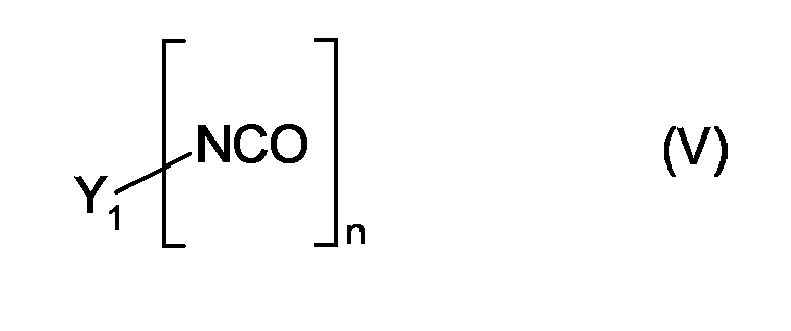
- Y 1 represents an n-valent radical of an isocyanate-terminated linear or branched polyurethane prepolymer PU1 after removal of the terminal isocyanate groups.
- Y 2 represents a radical of a primary or secondary hydroxyl-containing aliphatic, cycloaliphatic, aromatic or araliphatic epoxide after removal the hydroxide and epoxide groups.
- the indices m stand for the values 1, 2 or 3 and n for the values 2 to 8.
- the polymer B of the formula (I) is obtainable, for example, by the reaction of a monohydroxyl epoxy compound of the formula (IV) and of an isocyanate-group-terminated linear or branched polyurethane prepolymer PU1 of the formula (V):
- This polyurethane prepolymer PU1 is prepared from at least one diisocyanate or triisocyanate and from a polymer Q PM with terminal amino, thiol or hydroxyl groups and / or from an optionally substituted polyphenol Q PP .
- poly in “polyisocyanate”, “polyol”, “polyphenol” and “polymer kaptan” refers to molecules which formally contain two or more of the respective functional groups.
- Suitable diisocyanates are aliphatic, cycloaliphatic, aromatic or araliphatic diisocyanates, in particular commercial products such as methylene diphenyl diisocyanate (MDI), hexamethylene diisocyanate (HDI), toluene diisocyanate (TDI), tolidine diisocyanate (TODI), isophorone diisocyanate (IPDI), trimethylhexamethylene diisocyanate (TMDI), 2,5- or 2,6-bis (isocyanatomethyl) bicyclo [2.2.1] heptane, 1,5-naphthalene diisocyanate (NDI), dicyclohexylmethyl diisocyanate (H 12 MDI), p-phenylene diisocyanate (PPDI), m-tetramethylxylylene diisocyanate (TMXDI), etc.
- MDI methylene diphenyl diisocyanate
- HDI hexam
- Suitable triisocyanates are trimers or biurets of aliphatic, cycloaliphatic, aromatic or araliphatic diisocyanates, especially the isocyanurates and biurets of the diisocyanates described in the previous paragraph.
- polymers Q PM with terminal amino, thiol or hydroxyl groups are particularly suitable polymers Q PM having two or three terminal amino, thiol or hydroxyl groups.
- the polymers Q PM advantageously have an equivalent weight of 600-6000, in particular of 600-4000, preferably of 700-2200 g / equivalent of NCO-reactive groups.
- the polyols selected from the group consisting of polyethylene glycols, polypropylene glycols, polyethylene glycol-polypropylene glycol block co-polymers, polybutylene glycols, hydroxyl-terminated polybutadienes, hydroxyl-terminated polybutadiene-co-acrylonitriles, hydroxyl-terminated synthetic rubbers, their hydrogenation products and mixtures of said polyols.
- polymers Q PM di- or higher functional amino-terminated polyethylene, polypropylene, polybutylene, polybutadiene, polybutadiene / acrylonitriles, such as those sold under the name Hycar® CTBN of Hanse Chemie AG, Germany, and other amino -terminated synthetic rubbers or mixtures of said components.
- suitable polymers Q PM are in particular hydroxyl-containing polybutadienes or polyisoprenes or their hydrogenated reaction products.
- polymers Q PM can also be chain-extended, as can be carried out in a manner known to the person skilled in the art by the reaction of polyamines, polyols and polyisocyanates, in particular of diamines, diols and diisocyanates.
- a species of the formula (VI) or (VII) forms, as shown below, depending on the selected stoichiometry.
- the radicals R 1 and R 2 represent a divalent organic radical and the indices v and w vary from 1 to typically 5, depending on the stoichiometric ratio. These species of formula (VI) or (VII) can then in turn be further reacted.
- a chain-extended polyurethane prepolymer PU1 of the following formula can be formed:
- the indices x and y vary from 1 to typically 5, depending on the stoichiometric ratio, and are in particular 1 or 2.
- the species of the formula (VI) can also be reacted with the species of the formula (VII) to give a chain-extended polyurethane prepolymer PU1 having NCO groups.
- chain extension in particular diols and / or diamines and diisocyanates are preferred.
- polyols such as trimethylolpropane or pentaerythritol
- polyisocyanates such as isocyanurates of diisocyanates
- polyurethane prepolymers PU1 in general and in the chain-extended polyurethane prepolymers in particular is advantageous to ensure that the prepolymers do not have too high viscosities, especially when higher functional compounds are used for chain extension, because this can their implementation to the polymers of the formula B or complicate the application of the composition.
- polymers Q PM are preferred polyols having molecular weights between 600 and 6000 daltons selected from the group consisting of polyethylene glycols, polypropylene glycols, polyethylene glycol-polypropylene glycol block polymers, polybutylene glycols, hydroxyl-terminated polybutadienes, hydroxyl-terminated polybutadiene-acrylonitrile copolymers and mixtures thereof.
- polymers Q PM particular preference is given to ⁇ , ⁇ -polyalkylene glycols having C 2 -C 6 -alkylene groups or having mixed C 2 -C 6 -alkylene groups, which are terminated with amino, thiol or, preferably, hydroxyl groups.
- polyphenol Q PP are particularly suitable bis-, tris- and tetraphenols. These are not just pure phenols, but optionally also understood substituted phenols.
- the type of substitution can be very diverse. In particular, this is understood to mean a substitution directly on the aromatic nucleus to which the phenolic OH group is bonded.
- phenols are understood to mean not only mononuclear aromatics but also polynuclear or condensed aromatics or heteroaromatics which have the phenolic OH group directly on the aromatic or heteroaromatic compounds. Due to the nature and position of such a substituent, among other things, the reaction necessary for the formation of the polyurethane prepolymer PU1 with isocyanates is influenced.
- the bis- and trisphenols are particularly suitable.
- low-volatility bisphenols are particularly preferred.
- bisphenol-M is particularly preferred.
- bisphenol-S is particularly preferred.
- the Q PP has 2 or 3 phenolic groups.
- the polyurethane prepolymer PU1 is prepared from at least one diisocyanate or triisocyanate and from a polymer Q PM with terminal amino, thiol or hydroxyl groups.
- the preparation of the polyurethane prepolymer PU1 is carried out in a manner known to the polyurethane expert, in particular by using the diisocyanate or triisocyanate in a stoichiometric excess with respect to the amino, thiol or hydroxyl groups of the polymer Q PM .
- the polyurethane prepolymer PU1 is prepared from at least one diisocyanate or triisocyanate and from an optionally substituted polyphenol Q PP .
- the preparation of the polyurethane prepolymer PU1 is carried out in a manner known to the polyurethane expert, in particular by using the diisocyanate or triisocyanate in a stoichiometric excess with respect to the phenolic groups of the polyphenol Q PP .
- the polyurethane prepolymer PU1 is prepared from at least one diisocyanate or triisocyanate and from a polymer Q PM with terminal amino, thiol or hydroxyl groups and from an optionally substituted polyphenol Q PP .
- polyphenol Q PP are available in different ways.
- a mixture of at least one polyphenol Q PP and at least one polymer Q PM is reacted with at least one diisocyanate or triisocyanate in an excess of isocyanate.
- a second process called “2-step process I” , at least one polyphenol Q PP is reacted with at least one diisocyanate or triisocyanate in an excess of isocyanate and subsequently reacted with at least one polymer Q PM in a deficit.
- the isocyanate-terminated polyurethane prepolymers PU1 described are built up from difunctional components, it has been found that the equivalence ratio of polymer Q PM / polyphenol Q PP is preferably greater than 1.50 and the equivalence ratio polyisocyanate / (polyphenol Q PP + polymer Q PM ) is preferably greater than 1.20. If the average functionality of the components used is greater than 2, the molecular weight increase is more rapid than in the purely difunctional case.
- the polyurethane prepolymer PU1 preferably has elastic character and exhibits a glass transition temperature Tg of less than 0 ° C.
- the monohydroxyl epoxy compound of the formula (IV) has 1, 2 or 3 epoxide groups.
- the hydroxyl group of this monohydroxyl epoxy compound (IV) may be a primary or a secondary hydroxyl group.
- Such monohydroxyl epoxy compounds can be produced, for example, by reacting polyols with epichlorohydrin. Depending on the reaction, the corresponding monohydroxyl epoxide compounds are formed in different concentrations in the reaction of polyfunctional alcohols with epichlorohydrin as by-products. These can be isolated by conventional separation operations. In general, however, it is sufficient to use the product mixture obtained in the glycidylation reaction of polyols from completely and partially reacted to the glycidyl ether polyol.
- hydroxyl-containing epoxies examples include trimethylolpropane diglycidyl ethers (contained as a mixture in trimethylolpropane triglycidyl ether), glycerol diglycidyl ethers (contained as a mixture in glycerol triglycidyl ether), pentaerythritol triglycidyl ether (contained as a mixture in pentaerythritol tetraglycidyl ether).
- trimethylolpropane diglycidyl ether which occurs at a relatively high level in commonly prepared trimethylolpropane triglycidyl ether, is used.
- epoxides with a ⁇ -hydroxy ether group prepared by the reaction of (poly) epoxides with a deficit of monovalent nucleophiles such as carboxylic acids, phenols, thiols or sec-amines, can be used.
- the free primary or secondary OH functionality of the monohydroxyl epoxy compound of the formula (IV) permits efficient reaction with terminal isocyanate groups of prepolymers without having to use disproportionate excesses of the epoxide component.
- stoichiometric amounts of monohydroxyl epoxy compound of the formula (IV) or mixtures thereof can be used. From the stoichiometry with respect to its equivalents OH groups or isocyanate groups can be deviated.
- the ratio [OH] / [NCO] is 0.6 to 3.0, preferably 0.9 to 1.5, in particular 0.98 to 1.1.
- the polymer B advantageously has an elastic character and is furthermore advantageously soluble or dispersible in epoxy liquid resins.
- the proportion by weight of all polymers B of the formula (I) is preferably between 5 and 40% by weight, preferably between 7 and 35% by weight, based on the weight of the total composition.
- the polymer B can be diluted with further epoxide resins.
- Preferred for this purpose are diglycidyl ethers of bisphenol A, bisphenol F and bisphenol A / F, and the epoxide group-carrying reactive diluents F described below, in particular hexanediol diglycidyl ether, polypropylene glycol diglycidyl ether and trimethylolpropane triglycidyl ether.
- the composition comprises at least one thixotropic agent C based on a urea derivative.
- the urea derivative is a reaction product of an aromatic monomeric diisocyanate with an aliphatic amine compound. It is also quite possible to react several different monomeric diisocyanates with one or more aliphatic amine compounds or a monomeric diisocyanate with several aliphatic amine compounds.
- the reaction product of 4,4'-diphenylmethylene diisocyanate (MDI) with butylamine has proved to be particularly advantageous.
- the urea derivative is preferably present in a carrier material.
- the carrier material may be a plasticizer, in particular a phthalate or an adipate, preferably a diisodecyl phthalate (DIDP) or dioctyl adipate (DOA).
- the carrier may also be a non-diffusing carrier. This is preferred to ensure as little as possible migration after curing of unregulated components.
- Preferred non-diffusing carriers are blocked polyurethane prepolymers. The preparation of such preferred urea derivatives and support materials are described in detail in the patent application EP 1 152 019 A1 described.
- the support material is advantageously a blocked polyurethane prepolymer PU2 , in particular obtained by reacting a trifunctional polyether polyol with IPDI and subsequent blocking of the terminal isocyanate groups with caprolactam.
- the total amount of the thixotropic agent C is 5-40% by weight, preferably 10-25% by weight, based on the weight of the total composition.
- the ratio of the weight of the urea derivative to the weight of the carrier possibly present is preferably from 2:98 to 50:50, in particular from 5:95 to 25:75.
- the inventive composition further contains at least one curing agent D for epoxy resins, which is activated by elevated temperature.
- a curing agent which is selected from the group dicyandiamide, guanamines, guanidines, aminoguanidines and derivatives thereof.
- catalytically active substituted ureas such as 3-chloro-4-methylphenylurea (chlorotoluron), or phenyl-dimethylureas, in particular p-chlorophenyl-N, N-dimethylurea (monuron), 3-phenyl-1,1-dimethylurea (fenuron) or 3,4-dichlorophenyl-N, N-dimethylurea (diuron).
- compounds of the class of imidazoles and amine complexes can be used. Particularly preferred is dicyandiamide.
- the total amount of the curing agent D is 1-10% by weight, preferably 2-8% by weight, based on the weight of the total composition.
- the composition additionally contains at least one liquid epoxy resin E.
- Preferred liquid epoxy resins E have the formula (III)
- the composition additionally contains at least one filler F.
- filler F are preferably mica, talc, kaolin, wollastonite, feldspar, chlorite, bentonite, montmorillonite, calcium carbonate (precipitated or ground), dolomite, quartz, silicic acids (pyrogenic or precipitated), cristobalite, calcium oxide, aluminum hydroxide, magnesium oxide, ceramic hollow spheres, Glass hollow spheres, organic hollow spheres, glass spheres, color pigments.
- Filler F is meant to mean both the organic coated and the uncoated commercially available and known to those skilled forms.
- the total content of the total filler F is 3-30% by weight, preferably 5-25% by weight, based on the weight of the total composition.
- Trimethylolpropane glycidyl ether was prepared according to the method in patent US 5,668,227 Example 1 from trimethylolpropane and epichlorohydrin prepared with tetramethylammonium chloride and sodium hydroxide. A yellowish product having an epoxide number of 7.5 eq / kg and a hydroxyl group content of 1.8 eq / kg is obtained. It can be concluded from the HPLC-MS spectrum that essentially a mixture of trimethylolpropane diglycidyl ether and trimethylolpropane triglycidyl ether is present.
- a thixotropic agent C based on a urea derivative in a non-diffusing carrier material was a thixotropic agent C according to the patent application EP 1 152 019 A1 prepared in a blocked polyurethane prepolymer with the above-mentioned raw materials:
- Carrier material Blocked polyurethane prepolymer "BlockPUP"
- HSD Urea derivative
- ZSF Tensile shear strength
- test specimens were produced from the described example compositions and with electrolytically galvanized steel (eloZn) with the dimensions 100 ⁇ 25 ⁇ 0.8 mm, the bond area being 25 ⁇ 10 mm and a layer thickness of 0.3 mm. Hardened for 30 min. At 180 ° C. The pulling speed was 10mm / min.
- electrolytically galvanized steel eloZn
- the specimens were produced from the described example compositions and with electrolytically galvanized steel (eloZn) with the dimensions 90 ⁇ 20 ⁇ 0.8 mm, while the adhesive surface was 20 ⁇ 30 mm with a layer thickness of 0.3 mm. Hardened for 30 min. At 180 ° C. The pulling speed was 2 m / s. The fracture energy in joules is the area under the measurement curve (from 25% to 90%, according to DIN 11343). Table 2. Compositions and properties.
Landscapes
- Chemical & Material Sciences (AREA)
- Health & Medical Sciences (AREA)
- Chemical Kinetics & Catalysis (AREA)
- Medicinal Chemistry (AREA)
- Polymers & Plastics (AREA)
- Organic Chemistry (AREA)
- Adhesives Or Adhesive Processes (AREA)
- Epoxy Resins (AREA)
- Polyurethanes Or Polyureas (AREA)
- Compositions Of Macromolecular Compounds (AREA)
Abstract
Description
- Die Erfindung betrifft hitzehärtende Zusammensetzungen, welche bei tiefen Temperaturen gleichzeitig eine hohe Schlagzähigkeit und gute mechanische Eigenschaften aufweisen.
- In der Fertigung sowohl von Fahrzeugen und Anbauteilen oder auch Maschinen und Geräten werden anstelle oder in Kombination mit herkömmlichen Fügeverfahren wie Schrauben, Nieten, Stanzen oder Schweißen immer häufiger hochwertige Klebstoffe eingesetzt. Werden strukturelle Teile verklebt, sind eine hohe Festigkeit und Schlagzähigkeit des Klebstoffes von grösster Wichtigkeit.
- Herkömmliche Epoxyklebstoffe zeichnen sich zwar durch eine hohe mechanische Festigkeit, insbesondere eine hohe Zugfestigkeit aus. Bei schlagartiger Beanspruchung der Verklebung sind klassische Epoxyklebstoffe jedoch meist zu spröde und können deshalb unter Crashbedingungen, bei denen sowohl grosse Zug- als auch Schälbeanspruchungen auftreten, den Anforderungen, insbesondere der Automobilindustrie, bei weitem nicht genügen. Ungenügend sind diesbezüglich oft besonders die Festigkeiten bei hohen, insbesondere aber auch bei tiefen Temperaturen unter -10°C.
- Deshalb wurde mittels verschiedener Methoden angestrebt, die Schlagzähigkeit von hitzehärtenden Epoxyklebstoffen zu verbessern.
-
EP-A-1 359 202 beschreibt eine Verbesserung der Schlagzähigkeit durch die Verwendung eines Harnstoffderivates in einem nicht-diffundierenden Trägermaterial sowie schlagzähe Zusammensetzungen, welche dieses Harnstoffderivat sowie Epoxid-Addukte enthalten.EP-A-1 431 325 beschreibt die Verwendung eines Epoxidgruppen-terminierten Schlagzähigkeitsmodifkator-Polymers sowie schlagzähe Zusammensetzungen, welche dieses Schlagzähigkeitsmodifkator-Polymer sowie Epoxid-Addukte enthalten.EP-A-1 498 441 beschreibt ebenfalls ein weiteres Epoxidgruppen-terminiertes Schlagzähigkeitsmodifkator-Polymer sowie schlagzähe Zusammensetzungen, welche dieses Schlagzähigkeitsmodifkator-Polymer sowie Epoxid-Addukte enthalten. Durch die Verwendung der Epoxidgruppen-terminierten Schlagzähigkeitsmodifkator-Polymere konnte zwar die Schlagzähigkeit bei tiefen Temperaturen markant erhöht werden, aber alle in diesen Dokumenten offenbarten schlagzähen Zusammensetzungen enthielten ein Epoxid-Addukt. Derartige Epoxid-Addukte müssen separat hergestellt werden und weisen tendenziell eine höhere Viskosität auf. - Aufgabe der vorliegenden Erfindung ist es daher, hitze-härtbare schlagzähe Epoxidharzzusammensetzungen zur Verfügung zu stellen, welche einerseits sowohl über eine hohe Tieftemperaturschlagzähigkeit als auch hohe mechanische Festigkeit verfügen und andererseits einfach hergestellt werden können.
Überraschenderweise hat sich erwiesen, dass diese Aufgabe durch Zusammensetzungen gemäss Anspruch 1 gelöst werden konnte.
Derartige Zusammensetzungen weisen eine hohe Schlagzähigkeit bei tiefen Temperaturen, insbesondere bei Temperaturen von unter - 20°C, auf.
Insbesondere hat sich gezeigt, dass diese Eigenschaften ohne Epoxid-Addukte erreicht werden können und sich durch ein vereinfachtes Herstellverfahren auszeichnen. Es zeigte sich nämlich überraschend, dass durch den Einsatz von Festharzen ebenfalls hohe Schlagfestigkeiten erreicht werden können. - Derartige Klebstoffe können hohe Schlagfestigkeiten, gemessen als Bruchenergie, von über 13 J bei 23 °C und von über 5 J bei -40°C, erreichen. Weiterhin können die typischen grossen Unterschiede zwischen Tief- und Normaltemperatur in der Schlagfestigkeit reduziert werden. So können mit den Zusammensetzungen Verhältnisse von Bruchenergie bei -40°C zu 23°C von über 40%, zuweilen sogar über 80%, erreicht werden.
Weiterhin wurde gefunden, dass sich diese Zusammensetzungen bestens als Klebstoffe, insbesondere als Rohbauklebstoffe, eignen, und über einen breiten Temperaturbereich zum Einsatz kommen können. - Die vorliegende Erfindung betrifft Zusammensetzungen, welche mindestens ein Epoxid-Festharz A, mindestens ein Polymer B der Formel (I), mindestens ein Thixotropiermittel C, auf Basis eines Harnstoffderivates und mindestens einen Härter D für Epoxidharze, welcher durch erhöhte Temperatur aktiviert wird, enthalten.
- Der Begriff "Epoxid-Festharz" ist dem Epoxid-Fachmann bestens bekannt und wird im Gegensatz zu "Epoxid-Flüssigharzen" verwendet. Die Glastemperatur von Festharzen liegt über Raumtemperatur, d.h. sie lassen sich bei Raumtemperatur zu schüttfähigen Pulvern zerkleinern.
Bevorzugte Epoxid-Festharze A weisen die Formel (II) auf
- Hierbei stehen die Substituenten R' und R" unabhängig von einander entweder für H oder CH3. Weiterhin steht der Index s für einen Wert von > 1.5, insbesondere von 2 bis 12.
Derartige Epoxid-Festharze sind kommerziell erhältlich beispielsweise von Dow oder Huntsman oder Resolution. - Bevorzugt beträgt der Gesamtanteil des Epoxid-Festharzes A 1 - 40 Gew.-%, insbesondere 5 - 40 Gew.-%, bevorzugt 5 - 30 Gew.-%, meist bevorzugt 5 - 20 Gew.-%, bezogen auf das Gewicht der gesamten Zusammensetzung.
- Weiterhin umfasst die Zusammensetzung mindestens ein Polymer B der Formel (I)

- Hierbei stellt Y1 einen n-wertigen Rest eines mit Isocyanatgruppen terminierten linearen oder verzweigten Polyurethanprepolymeren PU1 nach dem Entfernen der endständigen Isocyanatgruppen dar. Y2 steht für einen Rest eines eine primäre oder sekundäre Hydroxylgruppe enthaltenden aliphatischen, cycloaliphatischen, aromatischen oder araliphatischen Epoxids nach dem Entfernen der Hydroxid- und Epoxidgruppen. Weiterhin stehen die Indizes m für die Werte 1, 2 oder 3 und n für die Werte 2 bis 8.
- Das Polymer B der Formel (I) ist beispielsweise erhältlich durch die Reaktion einer Monohydroxyl-Epoxidverbindung der Formel (IV) und eines Isocyanatgruppen-terminierten linearen oder verzweigten Polyurethanprepolymeren PU1 der Formel (V):

- Dieses Polyurethanprepolymer PU1 wird hergestellt aus mindestens einem Diisocyanat oder Triisocyanat sowie aus einem Polymeren QPM mit endständigen Amino-, Thiol- oder Hydroxylgruppen und / oder aus einem, gegebenenfalls substituierten, Polyphenol QPP.
- In der gesamten hier vorliegenden Schrift werden mit der Vorsilbe "Poly" in "Polyisocyanat", "Polyol", "Polyphenol" und "Polymerkaptan" Moleküle bezeichnet, die formal zwei oder mehr der jeweiligen funktionellen Gruppen enthalten.
- Geeignete Diisocyanate sind aliphatische, cycloaliphatische, aromatische oder araliphatische Diisocyanate, insbesondere handelsübliche Produkte wie Methylendiphenyldiisocyanat (MDI), Hexamethylendiisocyanat (HDI), Toluoldiisocyanat (TDI), Tolidindiisocyanat (TODI), Isophorondiisocyanat (IPDI), Trimethylhexamethylendiisocyanat (TMDI), 2,5- oder 2,6-Bis-(isocyanatomethyl)- bicyclo[2.2.1]heptan, 1,5-Naphthalindiisocyanat (NDI), Dicyclohexylmethyldiisocyanat (H12MDI), p-Phenylendiisocyanat (PPDI), m-Tetramethylxylylen diisocyanat (TMXDI), etc. sowie deren Dimere. Bevorzugt sind HDI, IPDI, MDI oder TDI.
Geeignete Triisocyanate sind Trimere oder Biurete von aliphatischen, cycloaliphatischen, aromatischen oder araliphatischen Diisocyanaten, insbesondere die Isocyanurate und Biurete der im vorherigen Absatz beschriebenen Diisocyanate. - Als Polymere QPM mit endständigen Amino-, Thiol- oder Hydroxylgruppen sind insbesondere geeignet Polymere QPM mit zwei oder drei endständige Amino-, Thiol- oder Hydroxylgruppen.
- Die Polymere QPM weisen vorteilhaft ein Equivalenzgewicht von 600 - 6000, insbesondere von 600 - 4000, bevorzugt von 700 - 2200 g/Equivalent NCO-reaktiver Gruppen auf.
- Als Polymere QPM geeignet sind Polyole, beispielsweise die folgenden handelsüblichen Polyole oder beliebige Mischungen davon:
- Polyoxyalkylenpolyole, auch Polyetherpolyole genannt, welche das Polymerisationsprodukt von Ethylenoxid, 1,2-Propylenoxid, 1,2- oder 2,3-Butylenoxid, Tetrahydrofuran oder Mischungen davon sind, gegebenenfalls polymerisiert mit Hilfe eines Startermoleküls mit zwei oder drei aktiven H-Atomen wie beispielsweise Wasser oder Verbindungen mit zwei oder drei OH-Gruppen. Eingesetzt werden können sowohl Polyoxyalkylenpolyole, die einen niedrigen Ungesättigtheitsgrad aufweisen (gemessen nach ASTM D-2849-69 und angegeben in Milliequivalent Ungesättigtheit pro Gramm Polyol (mEq/g)), hergestellt beispielsweise mit Hilfe von sogenannten Double Metal Cyanide Complex Katalysatoren (kurz DMC-Katalysatoren), als auch Polyoxyalkylenpolyole mit einem höheren Ungesättigtheitsgrad, hergestellt beispielsweise mit Hilfe von anionischen Katalysatoren wie NaOH, KOH oder Alkalialkoholaten. Speziell geeignet sind Polyoxypropylendiole und -triole mit einem Ungesättigtheitsgrad tiefer als 0.02 mEq/g und mit einem Molekulargewicht im Bereich von 1000 - 30'000 Dalton, Polyoxybutylendiole und -triole, Polyoxypropylendiole und -triole mit einem Molekulargewicht von 400 - 8'000 Dalton, sowie sogenannte "EO-endcapped" (ethylene oxide-endcapped) Polyoxypropylendiole oder -triole. Letztere sind spezielle Polyoxypropylenpolyoxyethylenpolyole, die beispielsweise dadurch erhalten werden, dass reine Polyoxypropylenpolyole nach Abschluss der Polypropoxylierung mit Ethylenoxid alkoxyliert werden und dadurch primäre Hydroxylgruppen aufweisen.
- Polyhydroxyterminierte Polybutadienpolyole, wie beispielsweise solche, die durch Polymerisation von 1,3-Butadien und Allylalkohol hergestellt werden, sowie deren Hydryrierungsprodukte;
- Styrol-Acrylnitril gepfropfte Polyetherpolyole, wie sie beispielsweise von Elastogran unter dem Namen Lupranol® geliefert werden;
- Polyhydroxyterminierte Acrylonitril/Polybutadien-Copolymere, wie sie beispielsweise aus Carboxylterminierten Acrylonitril/Polybutadien-Copolymere (kommerziell erhältlich unter dem Namen Hycar® CTBN von Hanse Chemie AG, Deutschland) und Epoxiden oder aus Aminoalkoholen hergestellt werden können;
- Polyesterpolyole, hergestellt beispielsweise aus zwei- bis dreiwertigen Alkoholen wie beispielsweise 1,2-Ethandiol, Diethylenglykol, 1,2-Propandiol, Dipropylenglykol, 1,4-Butandiol, 1,5-Pentandiol, 1,6-Hexandiol, Neopentylglykol, Glycerin, 1,1,1-Trimethylolpropan oder Mischungen der vorgenannten Alkohole mit organischen Dicarbonsäuren oder deren Anhydride oder Ester wie beispielsweise Bernsteinsäure, Glutarsäure, Adipinsäure, Korksäure, Sebacinsäure, Dodecandicarbonsäure, Maleinsäure, Fumarsäure, Phthalsäure, Isophthalsäure, Terephthalsäure und Hexahydrophthalsäure oder Mischungen der vorgenannten Säuren, sowie Polyesterpolyole aus Lactonen wie beispielsweise ε-Caprolacton;
- Polycarbonatpolyole, wie sie durch Umsetzung beispielsweise der oben genannten - zum Aufbau der Polyesterpolyole eingesetzten - Alkohole mit Dialkylcarbonaten, Diarylcarbonaten oder Phosgen zugänglich sind.
- Vorteilhaft sind die Polymere QPM di- oder höherfunktioneller Polyole mit OH-Equivalentsgewichten von 600 bis 6000 g/OH-Equivalent, insbesondere von 600 bis 4000 g/OH-Equivalent, vorzugsweise 700 - 2200 g/OH-Equivalent. Weiterhin vorteilhaft sind die Polyole ausgewählt aus der Gruppe bestehend aus Polyethylenglycolen, Polypropylenglycolen, Polyethylenglycol-Polypropylenglycol-Block-Co-polymeren, Polybutylenglycolen, hydroxylterminierten Polybutadienen, hydroxylterminierten Polybutadien-co-Acrylnitrilen, hydroxylterminierten synthetischen Kautschuken, deren Hydrierungsprodukte und Gemischen dieser genannten Polyole.
Im Weiteren können als Polymere QPM auch di- oder höherfunktionelle amino-terminierte Polyethylenether, Polypropylenether, Polybutylenether, Polybutadiene, Polybutadien/Acrylnitrile, wie sie zum Beispiel die unter dem Namen Hycar® CTBN von Hanse Chemie AG, Deutschland vertrieben werden, sowie weitere amino-terminierte synthetische Kautschuke oder Gemische der genannte Komponenten verwendet werden.
Für gewisse Anwendungen sind als Polymere QPM insbesondere Hydroxyl-Gruppen aufweisende Polybutadiene oder Polyisoprene oder deren hydrierte Reaktionsprodukte geeignet. - Es ist weiterhin möglich, dass die Polymere QPM auch kettenverlängert sein können, wie es in dem Fachmann bekannter Art und Weise durch die Reaktion von Polyaminen, Polyolen und Polyisocyanaten, insbesondere von Diaminen, Diolen und Diisocyanaten, durchgeführt werden kann.
Am Beispiel eines Diisocyanates und eines Diols bildet sich daraus, wie im Folgenden gezeigt, je nach gewählter Stöchiometrie eine Spezies der Formel (VI) oder (VII)
- Die Reste R1 und R2 stellen einen divalenten organischen Rest dar und die Indizes v und w variieren je nach Stöchiometrieverhältnis von 1 bis typischerweise 5.
Diese Spezies der Formel (VI) oder (VII) können dann wiederum weiterreagiert werden. So kann beispielsweise aus der Spezies der Formel (VI) und einem Diol mit einem divalenten organischen Rest R3 ein kettenverlängertes Polyurethanprepolymer PU1 der folgenden Formel gebildet werden:
- Aus der Spezies der Formel (VII) und einem Diisocyanat mit einem divalenten organischen Rest R4 kann ein kettenverlängertes Polyurethanprepolymer PU1 der folgenden Formel gebildet werden:

- Die Indizes x und y variieren je nach Stöchiometrieverhältnis von 1 bis typischerweise 5, und sind insbesondere 1 oder 2.
- Weiterhin kann auch die Spezies der Formel (VI) mit der Species der Formel (VII) umgesetzt werden, so dass ein NCO Gruppen aufweisendes kettenverlängertes Polyurethanprepolymer PU1 entsteht.
Für die Kettenverlängerung werden insbesondere Diole und/oder Diamine und Diisocyanate bevorzugt. Selbstverständlich ist dem Fachmann klar, dass auch höherfunktionelle Polyole, wie beispielsweise Trimethylolpropan oder Pentaerythrit, oder höherfunktionelle Polyisocyanate, wie Isocyanurate von Diisocyanten, für die Kettenverlängerung verwendet werden können.
Bei den Polyurethanprepolymeren PU1 generell und bei den kettenverlängerten Polyurethanprepolymeren im Speziellen ist vorteilhaft darauf zu achten, dass die Prepolymere nicht zu hohe Viskositäten aufweisen, insbesondere wenn höher funktionelle Verbindungen für die Kettenverlängerung eingesetzt werden, denn dies kann deren Umsetzung zu den Polymeren den Formel B beziehungsweise die Applikation der Zusammensetzung erschweren. - Als Polymere QPM bevorzugt sind Polyole mit Molekulargewichten zwischen 600 und 6000 Dalton ausgewählt aus der Gruppe bestehend aus Polyethylenglykolen, Polypropylenglykolen, Polyethylenglykol-Polypropylenglykol-Blockpolymeren, Polybutylenglykolen, hydroxylterminierte Polybutadiene, hydroxylterminierte Polybutadien-Acrylnitril-Copolymere sowie deren Gemische.
- Als Polymere QPM sind insbesondere bevorzugt α,ω-Polyalkylenglykole mit C2-C6-Alkylengruppen oder mit gemischten C2-C6- Alkylengruppen, die mit Amino-, Thiol- oder, bevorzugt, Hydroxylgruppen terminiert sind. Besonders bevorzugt sind Polypropylenglykole oder Polybutylenglykole. Weiterhin besonders bevorzugt sind Hydroxylgruppen-terminierte Polyoxybutylene.
- Als Polyphenol QPP sind insbesondere geeignet Bis-, Tris- und Tetraphenole. Hierunter werden nicht nur reine Phenole, sondern gegebenenfalls auch substituierte Phenole verstanden. Die Art der Substitution kann sehr vielfältig sein. Insbesondere wird hierunter eine Substitution direkt am aromatischen Kern, an den die phenolische OH-Gruppe gebunden ist, verstanden. Unter Phenole werden weiterhin nicht nur einkernige Aromaten, sondern auch mehrkernige oder kondensierte Aromaten oder Heteroaromaten verstanden, welche die phenolische OH-Gruppe direkt am Aromaten beziehungsweise Heteroaromaten aufweisen.
Durch die Art und Stellung eines solchen Substituenten wird unter anderem die für die Bildung des Polyurethanprepolymeren PU1 nötige Reaktion mit Isocyanaten beeinflusst.
Besonders eignen sich die Bis- und Trisphenole. Als Bisphenole oder Trisphenole sind beispielsweise geeignet 1,4-Dihydroxybenzol, 1,3-Dihydroxybenzol, 1,2-Dihydroxybenzol, 1,3-Dihydroxytoluol, 3,5-Dihydroxybenzoate, 2,2-Bis(4-hydroxyphenyl)propan (=Bisphenol-A), Bis(4-hydroxyphenyl)methan (=Bisphenol-F), Bis(4-hydroxyphenyl)sulfon (=Bisphenol-S), Naphtoresorcin, Dihydroxynaphthalin, Dihydroxyanthrachinon, Dihydroxy-biphenyl, 3,3-bis(p-hydroxyphenyl)phthalide, 5,5-Bis(4-hydroxyphenyl)hexahydro-4,7-methanoindan, Phenolpthalein, Fluorescein, 4,4'-[bis-(hydroxyphenyl)-1,3-Phenylene-bis-(1-Methyl-ethyliden)] (=Bisphenol-M), 4,4'-[bis-(hydroxyphenyl)-1,4-Phenylenebis-(1-Methyl-ethyliden)] (=Bisphenol-P), o,o-Diallyl-bisphenol-A, Diphenole und Dikresole hergestellt durch Umsetzung von Phenolen oder Kresolen mit Di-isopropylidenbenzol, Phloroglucin, Gallsäureester, Phenol- oder Kresolnovolacke mit ―OH-Funktionalität von 2.0 bis 3.5 sowie alle Isomeren der vorgenannten Verbindungen.
Bevorzugte Diphenole und Dikresole hergestellt durch Umsetzung von Phenolen oder Kresolen mit Di-isopropylidenbenzol weisen eine chemische Strukturformel auf, wie sie entsprechend für Kresol als Bespiel nachfolgend gezeigt ist:
- Besonders bevorzugt sind schwerflüchtige Bisphenole. Als meist bevorzugt gelten Bisphenol-M, Bisphenol-S.
Bevorzugt weist das QPP 2 oder 3 phenolische Gruppen auf. - In einer ersten Ausführungsform wird das Polyurethanprepolymer PU1 aus mindestens einem Diisocyanat oder Triisocyanat sowie aus einem Polymeren QPM mit endständigen Amino-, Thiol- oder Hydroxylgruppen hergestellt. Die Herstellung des Polyurethanprepolymers PU1 erfolgt in einer dem Polyurethan-Fachmann bekannten Art und Weise, insbesondere, indem, dass das Diisocyanat oder Triisocyanat in einem stöchiometrischen Überschuss in Bezug auf die Amino, Thiol oder Hydroxylgruppen des Polymeren QPM eingesetzt wird.
In einer zweiten Ausführungsform wird das Polyurethanprepolymer PU1 aus mindestens einem Diisocyanat oder Triisocyanat sowie aus einem, gegebenenfalls substituierten, Polyphenol QPP hergestellt. Die Herstellung des Polyurethanprepolymers PU1 erfolgt in einer dem Polyurethan-Fachmann bekannter Art und Weise, insbesondere indem, dass das Diisocyanat oder Triisocyanat in einem stöchiometrischen Überschuss in Bezug auf die phenolischen Gruppen des Polyphenols QPP eingesetzt wird. - In einer dritten Ausführungsform wird das Polyurethanprepolymer PU1 aus mindestens einem Diisocyanat oder Triisocyanat sowie aus einem Polymeren QPM mit endständigen Amino-, Thiol- oder Hydroxylgruppen sowie aus einem, gegebenenfalls substituierten, Polyphenol QPP hergestellt. Zur Herstellung des Polyurethanprepolymers PU1 aus mindestens einem Diisocyanat oder Triisocyanat sowie aus einem Polymeren QPM mit endständigen Amino-, Thiol- oder Hydroxylgruppen und / oder aus einem, gegebenenfalls substituierten, Polyphenol QPP stehen unterschiedliche Möglichkeiten zur Verfügung.
In einem ersten Verfahren, "Eintopfverfahren" genannt, wird eine Mischung von mindestens einem Polyphenol QPP und mindestens einem Polymeren QPM mit mindestens einem Diisocyanat oder Triisocyanat in einem Isocyanatüberschuss umgesetzt.
In einem zweiten Verfahren, "2-Schrittverfahren I" genannt, wird mindestens ein Polyphenol QPP mit mindestens einem Diisocyanat oder Triisocyanat in einem Isocyanatüberschuss umgesetzt und anschliessend mit mindestens einem Polymeren QPM in Unterschuss umgesetzt.
Im dritten Verfahren schliesslich, "2-Schrittverfahren II" genannt, wird mit mindestens ein Polymer QPM mit mindestens einem Diisocyanat oder Triisocyanat in einem Isocyanatüberschuss umgesetzt und anschliessend mit mindestens einem Polyphenol QPP in Unterschuss umgesetzt.
Die drei Verfahren führen zu Isocyanat-terminierten Polyurethanprepolymeren PU1, die sich bei gleicher Zusammensetzung in der Sequenz ihrer Bausteine unterscheiden können. Es sind alle drei Verfahren geeignet, jedoch ist das "2-Schrittverfahren II" bevorzugt.
Werden die beschriebenen Isocyanat-endständigen Polyurethanprepolymeren PU1 aus difunktionellen Komponenten aufgebaut, zeigte sich, dass das Equivalenz-Verhältnis Polymer QPM /Polyphenol QPP bevorzugt grösser als 1.50 und das Equivalenz-Verhältnis Polyisocyanat/(Polyphenol QPP + Polymer QPM) bevorzugt grösser als 1.20 ist.
Wird die durchschnittliche Funktionalität der verwendeten Komponenten grösser als 2, so erfolgt eine raschere Molekulargewichtserhöhung als im rein difunktionellen Fall. Für den Fachmann ist klar, dass die Grenzen der möglichen Equivalenz-Verhältnisse stark davon abhängen, ob entweder das gewählte Polymer QPM, das Polyphenol QPP, das Diisocyanat oder Triisocyanat oder mehrere der genannten Komponenten eine Funktionalität >2 besitzen. Je nach dem können unterschiedliche Equivalenz-Verhältnisse eingestellt werden, deren Grenzen durch die Viskosität der resultierenden Polymere bestimmt wird und die experimentell von Fall zu Fall bestimmt werden müssen.
Das Polyurethanprepolymer PU1 weist bevorzugt elastischen Charakter auf und zeigt eine Glasumwandlungstemperatur Tg von kleiner als 0°C. - Die Monohydroxyl-Epoxidverbindung der Formel (IV) weist 1, 2 oder 3 Epoxidgruppen auf. Die Hydroxylgruppe dieser Monohydroxyl-Epoxidverbindung (IV) kann eine primäre oder eine sekundäre Hydroxylgruppe darstellen.
Solche Monohydroxyl-Epoxidverbindungen lassen sich beispielsweise durch Umsetzung von Polyolen mit Epichlorhydrin erzeugen. Je nach Reaktionsführung entstehen bei der Umsetzung von mehrfunktionellen Alkoholen mit Epichlorhydrin als Nebenprodukte auch die entsprechenden Monohydroxyl-Epoxidverbindungen in unterschiedlichen Konzentrationen. Diese lassen sich durch übliche Trennoperationen isolieren. In der Regel genügt es aber, das bei der Glycidylisierungsreaktion von Polyolen erhaltene Produktgemisch aus vollständig und partiell zum Glycidylether reagiertem Polyol einzusetzen. Beispiele solcher hydroxylhaltigen Epoxide sind Trimethylolpropandiglycidylether (als Gemisch enthalten in Trimethylolpropantriglycidylether), Glycerindiglycidylether (als Gemisch enthalten in Glycerintriglycidylether), Pentaerythrittriglycidylether (als Gemisch enthalten in Pentaerythrittetraglycidylether). Vorzugsweise wird Trimethylolpropandiglycidylether, welcher zu einem relativ hohen Anteil in üblich hergestellten Trimethylolpropantriglycidylether vorkommt, verwendet.
Es können aber auch andere ähnliche hydroxylhaltige Epoxide, insbesondere Glycidol, 3-Glycidyloxybenzylalkohol oder Hydroxymethyl-cyclohexenoxid eingesetzt werden. Weiterhin bevorzugt ist der β-Hydroxyether der Formel (VI), der in handelsüblichen flüssigen Epoxidharzen hergestellt aus Bisphenol-A (R = CH3) und Epichlorhydrin zu etwa 15 % enthalten ist, sowie die entsprechenden β-Hydroxyether der Formel (VI), die bei der Reaktion von Bisphenol-F (R = H) oder des Gemisches von Bisphenol-A und Bisphenol-F mit Epichlorhydrin gebildet werden.
- Im Weiteren können auch unterschiedlichste Epoxide mit einer β-Hydroxyether-Gruppe, hergestellt durch die Reaktion von (Poly-)Epoxiden mit einem Unterschuss von einwertigen Nukleophilen wie Carbonsäuren, Phenolen, Thiolen oder sec.- Aminen, eingesetzt werden.
- Die freie primäre oder sekundäre OH-Funktionalität der Monohydroxyl-Epoxidverbindung der Formel (IV) lässt eine effiziente Umsetzung mit terminalen Isocyanatgruppen von Prepolymeren zu, ohne dafür unverhältnismässige Überschüsse der Epoxidkomponente einsetzen zu müssen.
- Zur Umsetzung der Polyurethanprepolymeren PU1 der Formel (V) können stöchiometrische Mengen Monohydroxyl-Epoxidverbindung der Formel (IV) oder ihrer Mischungen eingesetzt werden. Von der Stöchiometrie in Bezug auf dessen Equivalente OH-Gruppen respektive Isocyanatgruppen kann abgewichen werden. Das Verhältnis [OH]/[NCO] beträgt 0.6 bis 3.0, vorzugsweise 0.9 bis 1.5, insbesondere 0.98 bis 1.1.
- Das Polymer B weist vorteilhaft einen elastischen Charakter auf und ist weiterhin vorteilhaft in Epoxid-Flüssigharzen löslich oder dispergierbar.
Der Gewichtsanteil aller Polymere B der Formel (I) beträgt vorzugsweise zwischen 5 und 40 Gewichts-%, vorzugsweise zwischen 7 und 35 Gewichts-% bezogen auf das Gewicht der gesamten Zusammensetzung. - Das Polymer B kann bei Bedarf und je nach der resultierenden Viskosität mit weiteren Epoxidharzen verdünnt werden. Bevorzugt sind hierzu Diglycidylether von Bisphenol-A, Bisphenol-F sowie von Bisphenol-A/F, sowie die weiter unten beschriebenen epoxidgruppentragenden Reaktivverdünner F, insbesondere Hexandioldiglycidylether, Polypropylenglykoldiglycidylether und Trimethylolpropantriglycidylether.
- Weiterhin umfasst die Zusammensetzung mindestens ein Thixotropiermittel C auf Basis eines Harnstoffderivates. Das Harnstoffderivat ist insbesondere ein Umsetzungsprodukt eines aromatischen monomeren Diisocyanates mit einer aliphatischen Aminverbindung. Es ist auch durchaus möglich, mehrere unterschiedliche monomere Diisocyanate mit einer oder mehreren aliphatischen Aminverbindungen oder ein monomeres Diisocyanat mit mehreren aliphatischen Aminverbindungen umzusetzen. Als besonders vorteilhaft hat sich das Umsetzungsprodukt von 4,4'-Diphenyl-methylen-diisocyanat (MDI) mit Butylamin erwiesen.
Das Harnstoffderivat ist vorzugsweise in einem Trägermaterial vorhanden. Das Trägermaterial kann ein Weichmacher, insbesondere ein Phthalat oder ein Adipat sei, vorzugsweise ein Diisodecylphthalat (DIDP) oder Dioctyladipat (DOA). Das Trägermittel kann auch ein nicht-diffundierendes Trägermittel sein. Dies ist bevorzugt, um möglichst eine geringe Migration nach Aushärtung von nicht regierten Bestandteilen zu gewährleisten. Bevorzugt sind als nicht-diffundierende Trägermittel blockierte Polyurethanprepolymere.
Die Herstellung von solchen bevorzugten Harnstoffderivaten und Trägermaterialien sind im Detail in der PatentanmeldungEP 1 152 019 A1 beschrieben. Das Trägermaterial ist vorteilhaft ein blockiertes Polyurethanprepolymer PU2, insbesondere erhalten durch Umsetzung eines trifunktionellen Polyetherpolyols mit IPDI und anschliessender Blockierung der endständigen Isocyanatgruppen mit Caprolactam.
Vorteilhaft beträgt der Gesamtanteil des Thixotropiermittels C 5 - 40 Gewichts-%, vorzugsweise 10 - 25 % Gewichts-%, bezogen auf das Gewicht der gesamten Zusammensetzung. Das Verhältnis vom Gewicht des Harnstoffderivates zu Gewicht des allenfalls vorhandenen Trägermittels beträgt vorzugsweise 2 / 98 bis 50 / 50, insbesondere 5 / 95 - 25 /75. - Die erfindungsgemässe Zusammensetzung enthält weiterhin mindestens einen Härter D für Epoxidharze, welcher durch erhöhte Temperatur aktiviert wird. Es handelt sich hierbei vorzugsweise um einen Härter, welcher ausgewählt ist aus der Gruppe Dicyandiamid, Guanamine, Guanidine, Aminoguanidine und deren Derivate. Weiterhin möglich sind katalytisch wirksame substituierte Harnstoffe wie 3-Chlor-4-Methylphenylharnstoff (Chlortoluron), oder Phenyl-Dimethylharnstoffe, insbesondere p-Chlorphenyl-N,N-dimethylharnstoff (Monuron), 3-Phenyl-1,1-dimethylharnstoff (Fenuron) oder 3,4-Dichlorphenyl-N,N-dimethylharnstoff (Diuron). Weiterhin können Verbindungen der Klasse der Imidazole und Amin-Komplexe eingesetzt werden. Besonders bevorzugt ist Dicyandiamid.
- Vorteilhaft beträgt der Gesamtanteil des Härters D 1 - 10 Gewichts-%, vorzugsweise 2 - 8 Gewichts-%, bezogen auf das Gewicht der gesamten Zusammensetzung.
- In einer bevorzugten Ausführungsform enthält die Zusammensetzung zusätzlich mindestens ein Epoxid-Flüssigharz E. Bevorzugte Epoxid-Flüssigharze E weisen die Formel (III) auf

- Hierbei stehen die Substituenten R''' und R'''' unabhängig von einander entweder für H oder CH3. Weiterhin steht der Index r für einen Wert von 0 bis
- 1. Bevorzugt steht r für einen Wert von kleiner als 0.2.
Es handelt sich somit vorzugsweise um Diglycidylether von Bisphenol-A (DGEBA), von Bisphenol-F sowie von Bisphenol-A/F (Die Bezeichnung 'A/F' verweist hierbei auf eine Mischung von Aceton mit Formaldehyd, welche als Edukt bei dessen Herstellung verwendet wird). Solche Flüssigharze sind beispielsweise als Araldite® GY 250, Araldite® PY 304, Araldite® GY 282 (Huntsman) oder D.E.R 331 (Dow) oder Epikote 828 (Resolution) erhältlich.
Die Zusammensetzung weist vorzugsweise einen Gesamtanteil des Epoxid-Flüssigharz E von 10 - 70 Gew.-%, insbesondere 15 - 60 Gew.-%, bezogen auf das Gewicht der gesamten Zusammensetzung auf. - In einer weiter bevorzugten Ausführungsform enthält die Zusammensetzung zusätzlich mindestens einen Füllstoff F. Bevorzugt handelt es sich hierbei um Glimmer, Talk, Kaolin, Wollastonit, Feldspat, Chlorit, Bentonit, Montmorillonit, Calciumcarbonat (gefällt oder gemahlen), Dolomit, Quarz, Kieselsäuren (pyrogen oder gefällt), Cristobalit, Calciumoxid, Aluminiumhydroxid, Magnesiumoxid, Keramikhohlkugeln, Glashohlkugeln, organische Hohlkugeln, Glaskugeln, Farbpigmente. Als Füllstoff F sind sowohl die organisch beschichteten als auch die unbeschichteten kommerziell erhältlichen und dem Fachmann bekannten Formen gemeint.
Vorteilhaft beträgt der Gesamtanteil des gesamten Füllstoffs F 3 - 30 Gewichts-%, vorzugsweise 5 - 25 Gewichts-%, bezogen auf das Gewicht der gesamten Zusammensetzung. - In einer weiteren bevorzugten Ausführungsform enthält die Zusammensetzung zusätzlich mindestens einen epoxidgruppentragenden Reaktivverdünner G. Bei diesen Reaktivverdünnern G handelt es sich insbesondere um:
- Glycidylether von monofunktionellen gesättigten oder ungesättigten, verzweigten oder unverzweigten, zyklischen oder offenkettigen C4 - C30 Alkoholen, z.B. Butanolglycidylether, Hexanolglycidylether, 2-Ethylhexanolether, Allylglycidylether, Tetrahydrofurfuryl- und Furfurylglycidylether, Trimethoxysilylglycidylether etc.
- Glycidylether von difunktionellen gesättigten oder ungesättigten, verzweigten oder unverzweigten, zyklischen oder offenkettigen C2 - C30 Alkolen, z.B Ethylenglykol-, Butandiol-, Hexandiol-, Oktandiolgylcidylether, Cyclohexandimethanoldigylcidylether, Neopentylglycoldiglycidylether etc.
- Glycidylether von tri- oder polyfunktionellen, gesättigten oder ungesättigten, verzweigten oder unverzweigten, zyklischen oder offenkettigen Akoholen wie epoxidiertes Rhizinusöl, epoxidiertes Trimethylolpropan, epoxidiertes Pentaerythrol oder Polyglycidylether von aliphatischen Polyolen wie Sorbitol, Glycerin, Trimethylolpropan etc.
- Glycidylether von Phenol- und Anilinverbindungen wie Phenylglycidylether, Kresolglycidylether, p-tert.-Butylphenylglycidylether, Nonylphenolglycidylether, 3-n-Pentadecenyl-glycidylether (aus Cashewnuss-Schalen-Öl), N,N-Diglycidylanilin etc.
- Epoxidierte Tertiäre Amine wie N, N-Diglycidylcyclohexylamin etc.
- Epoxidierte Mono- oder Dicarbonsäuren wie Neodecansäure-glycidylester, Methacrylsäureglycidylester, Benzoesäureglycidylester, Phthalsäure-, Tetra- und Hexahydrophthalsäurediglycidylester, Diglycidylester von dimeren Fettsäuren etc.
- Epoxidierte di- oder trifunktionelle, nieder- bis hochmolekulare Polyetherpolyole wie Polyethylenglycol-diglycidylether, Polypropyleneglycol-diglycidylether etc.
Besonders bevorzugt sind Hexandioldiglycidylether, Polypropylenglycoldiglycidylether und Polyethylenglycoldiglycidylether.
Vorteilhaft beträgt der Gesamtanteil des epoxidgruppentragenden Reaktivverdünners G 1 - 7 Gewichts-%, vorzugsweise 2 - 6 Gewichts-%, bezogen auf das Gewicht der gesamten Zusammensetzung.
Die Zusammensetzung kann weitere Bestandteile, insbesondere Katalysatoren, Hitze- und/oder Lichtstabilisatoren, Thixotropiermittel, Weichmacher, Lösungsmittel, Farbstoffe und Pigmente, umfassen.
Als besonders vorteilhaft hat sich erwiesen, dass auch mit Zusammensetzungen, welche keine Epoxid-Addukte, wie sie aus dem Stand der TechnikEP-A-1 359 202 ,EP-A-1 431 325 oderEP-A-1 498 441 bekannt sind, enthalten, derart gute Schlagzähigkeiten erhalten werden können.
Es hat sich gezeigt, dass sich die erfindungsgemässen Zusammensetzungen besonders als einkomponentige Klebstoffe eignen. Ein derartiger einkomponentiger Klebstoff weist breite Einsatzmöglichkeiten auf. Insbesondere sind hiermit hitzehärtende einkomponentige Klebstoffe realisierbar, die sich durch eine hohe Schlagzähigkeit sowohl bei höheren Temperaturen und vor allem bei tiefen Temperaturen, insbesondere zwischen 0°C bis -40°C auszeichnen. Solche Klebstoffe werden für das Verkleben von hitzestabilen Materialien benötigt. Unter hitzestabilen Materialien werden Materialien verstanden, welche bei einer Aushärtetemperatur von 100 - 220 °C, vorzugswiese 120 - 200°C zumindest während der Aushärtezeit formstabil sind. Insbesondere handelt es sich hierbei um Metalle und Kunststoffe wie ABS, Polyamid, Polyphenylenether, Verbundmaterialien wie SMC, ungesättigte Polyester GFK, Epoxid- oder Acrylatverbundwerkstoffe. Bevorzugt ist die Anwendung, bei der zumindest ein Material ein Metall ist. Als besonders bevorzugte Verwendung gilt das Verkleben von gleichen oder verschiedenen Metallen, insbesondere im Rohbau in der Automobilindustrie. Die bevorzugten Metalle sind vor allem Stahl insbesondere elektrolytisch verzinkter, feuerverzinkter, beölter Stahl, Bonazink-beschichteter Stahl, und nachträglich phosphatierter Stahl, sowie Aluminium insbesondere in den im Autobau typischerweise vorkommenden Varianten.
Es sind grundsätzlich auch zweikomponentige Klebstoffe denkbar.
Mit einem Klebstoff basierend auf einer erfindungsgemässen Zusammensetzung ist es möglich, die gewünschte Kombination von hoher Crashfestigkeit und hoher sowie tiefer Einsatztemperatur zu erreichen.
Ein solcher Klebstoff wird zuerst mit den zu verklebenden Materialien bei einer Temperatur von zwischen 10° C und 80°C, insbesondere zwischen 10°C und 60°C, kontaktiert und später ausgehärtet bei einer Temperatur von typischerweise 100 - 220 °C, vorzugsweise 120 - 200°C,.
Selbstverständlich können mit einer erfindungsgemässen Zusammensetzung neben hitzehärtenden Klebstoffen auch Dichtmassen oder Beschichtungen realisiert werden. Ferner eignen sich die erfindungsgemässen Zusammensetzungen nicht nur für den Automobilbau sondern auch für andere Anwendungsgebiete. Besonders zu erwähnen sind verwandte Anwendungen in Transportmittelbau wie Schiffe, Lastwagen, Busse oder Schienenfahrtzeuge oder im Bau von Gebrauchsgütern wie beispielsweise Waschmaschinen.
Die mittels einer erfindungsgemässen Zusammensetzung verklebten Materialien kommen bei Temperaturen zwischen typischerweise 100°C und - 40°C, vorzugsweise zwischen 80°C und -40°C, insbesondere zwischen 50°C und -40°C zum Einsatz.
Es lassen sich Zusammensetzungen formulieren, welche typischerweise Bruchenergien, gemessen nach DIN 11343, von mehr als 10.0 J bei 23°C und mehr als 5.0 J bei -40°C aufweisen. Es lassen sich zuweilen Zusammensetzungen formulieren, welche Bruchenergien von mehr als 11.0 J bei 23°C und von mehr als 7.0 J bei -40°C. Besonders vorteilhafte Zusammensetzungen weisen gar Bruchenergien von mehr als 15.0 J bei 23°C und von mehr als 13.0 J bei -40°C auf.
Insbesondere ist es auch möglich, dass die Bruchenergien bei -40°C nicht sehr viel geringer sind als bei Raumtemperaturen. So sind Verhältnisse der Bruchenergie bei -40°C zur Bruchenergie bei 23°C von ≥ 0.40, insbesondere ≥ 0.50 möglich. Die besonders bevorzugten Zusammensetzungen erreichen derartige Verhältnisse von ≥ 0.70, beziehungsweise gar von ≥ 0.80.
In einer speziellen Weise sind auch Schmelzklebstoffe auf der Basis der erfindungsgemässen Zusammensetzung realisierbar. Hierbei werden zusätzlich die beim Epoxid-Festharz A entstehenden Hydroxylgruppen mit Polyisocyanat, beziehungsweise einem Polyisocyanat-Prepolymer, umgesetzt. Dadurch wird die Viskosität erhöht, und eine Warmapplikation erforderlich. - Im Folgenden sollen einige Beispiele aufgezeigt werden, welche die Erfindung weiter veranschaulichen, den Umfang der Erfindung aber in keiner Weise beschränken sollen. Die in den Beispielen verwendeten Rohstoffe sind in Tabelle 1 aufgelistet.
Tabelle1. Eingesetzte Rohstoffe. Verwendete Rohstoffe Lieferant Bisphenol-A-diglycidylether (=DGEBA) Huntsman Araldite GT 7071 (Festharz) (EP-Equivalentsgewicht ca. 515 g/EP-Equivalent) Huntsman Dicyandiamid (=Dicy) Degussa Isophoron-diisocyanat (=IPDI) Degussa-Hüls Caprolactam EMS Chemie N-Butylamin BASF 4,4'-Diphenyl-methylen-diisocyanat (=MDI) Bayer Hexandioldiglycidylether Prümmer Alcupol® D-2021 (Difunktionelles Polypropylenglykol) (OH-Equivalentgewicht = 1000 g/OH-Equivalent) Repsol Desmophen 3060 BS (Trifunktionelles Polypropylenglykol) (OH-Equivalentgewicht = 1000 g/OH-Equivalent) Bayer PolyTHF 1800 (Difunktionelles Polybutylenglykol) (OH-Equivalentgewicht = 900 g/OH-Equivalent) BASF PolyTHF 2000 (Difunktionelles Polybutylenglykol) (OH-Equivalentgewicht = 1000 g/OH-Equivalent) BASF Poly bd® R45 HTLO ((Hydroxylterminertes Polybutadien) (OH-Equivalentgewicht = ca. 1200 g/OH-Equivalent) Arkema 4,4'-[bis-(hydroxyphenyl)-1,3-Phenylene-bis-(1-Methyl-ethyliden)] (=Bisphenol-M) Mitsui Chemicals - Trimethylolpropanglycidylether wurde gemäss dem Verfahren in Patent
US 5,668,227 , Beispiel 1 aus Trimethylolpropan und Epichlorhydrin mit Tetramethylammoniumchlorid und Natronlauge hergestellt. Man erhält ein gelbliches Produkt mit Epoxidzahl von 7.5 eq/kg und einem Hydroxylgruppengehalt von 1.8 eq/kg. Aus dem HPLC-MS Spektrum kann geschlossen werden, dass im Wesentlichen ein Gemisch von Trimethylolpropandiglycidylether und Trimethylolpropantriglycidylether vorliegt. - 80 g PolyTHF-1800 (OH-Zahl 62.3 mg/g KOH), 55 g Poly-bd® R-45HTLO (OH-Zahl 46.6 mg/g KOH) und 65 g Alcupol D2021 (OH-Zahl 56.0 mg/g KOH) wurden 30 Minuten unter Vakuum bei 100°C getrocknet. Anschliessend wurden 46.2 g IPDI und 0.04 g Dibutylzinndilaurat zugegeben. Die Reaktion wurde unter Vakuum bei 90°C bis zur Konstanz des NCO-Gehaltes bei 3.44% nach 2.5 h geführt (theoretischer NCO-Gehalt: 3.6%). Anschliessend wurden 117.6 g des oben beschriebenen Trimethylolpropanglycidylethers als monohydroxylhaltiges Epoxid der Formel (IV) zugegeben. Es wurde bei 90°C unter Vakuum weitergerührt, bis der NCO-Gehalt nach weiteren 3h unter 0.1 % gesunken war. So wurde ein klares Produkt mit einem Epoxid-Gehalt ("End-EP-Gehalt") von 2.47 eq/kg erhalten
- 200 g PolyTHF 2000 (OH-Zahl 57.5 mg/g KOH) wurden 30 Minuten unter Vakuum bei 100°C getrocknet. Anschliessend wurden 47.5 g IPDI und 0.04 g Dibutylzinndilaurat zugegeben. Die Reaktion wurde unter Vakuum bei 90°C bis zur Konstanz des NCO-Gehaltes bei 3.58% nach 2.5 h geführt (theoretischer NCO-Gehalt: 3.70%). Anschliessend wurden 118.0 g des oben beschriebenen Trimethylolpropanglycidylethers als monohydroxylhaltiges Epoxid der Formel (IV) zugegeben. Es wurde bei 90°C unter Vakuum weitergerührt, bis der NCO-Gehalt nach weiteren 3h unter 0.1 % gesunken war. So wurde ein klares Produkt mit einem Epoxid-Gehalt ("End-EP-Gehalt") von 2.50 eq/kg erhalten.
- 200 g PolyTHF 2000 (OH-Zahl 57.5 mg/g KOH) wurden 30 Minuten unter Vakuum bei 100°C getrocknet. Anschliessend wurden 47.5 g IPDI und 0.04 g Dibutylzinndilaurat zugegeben. Nach 2.5 h Reaktion bei 90°C unter Vakuum wurden 17.7 g Bisphenol-M zugegeben. Die Reaktion wurde weitere 2.0 h unter Vakuum bei 90°C bis zur Konstanz des NCO-Gehaltes bei 1.99% geführt (theoretischer NCO-Gehalt: 2.03%). Anschliessend wurden 72.6 g des oben beschriebenen Trimethylolpropanglycidylethers als monohydroxylhaltiges Epoxid der Formel (IV) zugegeben. Es wurde bei 90°C unter Vakuum weitergerührt, bis der NCO-Gehalt nach weiteren 3h unter 0.1 % gesunken war. So wurde ein klares Produkt mit einem Epoxid-Gehalt ("End-EP-Gehalt") von 1.60 eq/kg erhalten.
- Als Beispiel für ein Thixotropiermittel C auf Basis eines Harnstoffderivates in einem nicht-diffundierenden Trägermaterial wurde ein Thixotropiermittel C gemäss Patentanmeldung
EP 1 152 019 A1 in einem blockierten Polyurethan- Prepolymer mit oben erwähnten Rohstoffen hergestellt: - 600.0 g eines Polyetherpolyols (Desmophen 3060BS; 3000 Dalton; OH-Zahl 57 mg/g KOH) wurden unter Vakuum und Rühren bei 90°C mit 140.0 g IPDI und 0.10 g Dibutylzinndilaurat zum Isocyanat-terminierten Prepolymer umgesetzt. Die Reaktion wurde bis zur Konstanz des NCO-Gehaltes bei 3.41 % nach 2.5 h geführt (theoretischer NCO-Gehalt: 3.60%). Anschliessend wurden die freien Isocyanatgruppen bei 90°C unter Vakuum mit 69.2g Caprolactam (2% Überschuss) blockiert, wobei ein NCO-Gehalt von < 0.1% nach 3h erreicht wurde.
- Unter Stickstoff und leichtem Wärmen wurden 68.7 g MDI-Flocken in 181.3 g des oben beschriebenen blockierten Prepolymeres "BlockPUP" eingeschmolzen. Danach wurden während zwei Stunden unter Stickstoff und schnellem Rühren 40.1 g N-Butylamin gelöst in 219.9 g des oben beschriebenen blockierten Prepolymers "BlockPUP" zugetropft. Nach Beendigung der Zugabe der Aminlösung wurde die weisse Paste für weitere 30 Minuten weitergerührt. So wurde nach dem Abkühlen eine weisse, weiche Paste erhalten, welche einen freien Isocyanatgehalt von < 0.1 % aufwies (Anteil Harnstoffderivat ca. 21 %).
- Es wurden gemäss Tabelle 2 die Referenzzusammensetzungen Ref.1
- Ref. 5 sowie die erfindungsgemässe Zusammensetzungen Z-01, Z-02 und Z-03 hergestellt. Da ein Teil der endständigen Isocyanate in B-03 mit Bisphenol-M blockiert und nicht mit monohydroxylhaltigem Epoxid abreagiert wurden, führte dies zu einem niedrigeren End-EP-Gehalt als in den Polymeren B-01 und B-02. Deshalb wurde in der das Polymer B-03 enthaltenden Formulierung die im Vergleich zu B-01 und B-02 "fehlende" Menge an monohydroxylhaltigen Epoxid der Formel (IV), wie es vorgängig als MHE beschrieben wurde, zusätzlich zugegeben. Aus demselben Grund wurde den Referenzzusammensetzungen Ref.2 und Ref. 3, welche anstelle von Polymer B ein blockiertes Prepolymer "BlockPUP" enthalten, ebenfalls das beschriebene MHE zugesetzt.
- Die Probekörper wurden aus den beschriebenen Beispiel-Zusammensetzungen und mit elektrolytisch verzinktem Stahl (eloZn) mit dem Mass 100 x 25 x 0.8mm hergestellt, dabei betrug die Klebfläche 25 x 10mm bei einer Schichtdicke von 0.3mm. Gehärtet wurde 30 Min. bei 180°C. Die Zuggeschwindigkeit betrug 10mm/Min.
- Die Probekörper wurden aus den beschriebenen Beispiel-Zusammensetzungen und mit elektrolytisch verzinktem Stahl (eloZn) mit dem Mass 90 x 20 x 0.8mm hergestellt, dabei betrug die Klebfläche 20 x 30mm bei einer Schichtdicke von 0.3mm. Gehärtet wurde 30 Min. bei 180°C. Die Zuggeschwindigkeit betrug 2 m/s. Als Bruchenergie in Joule wird die Fläche unter der Messkurve (von 25% bis 90%, gemäss DIN 11343) angegeben.
Tabelle 2. Zusammensetzungen und Eigenschaften. 1BE=Bruchenergie Ref.1 Ref.2 Ref.3 Ref.4 Ref.5 Z1 Z2 Z3 Araldite GT 7071 (A)[g] 20.0 20.0 20.0 20.0 20.0 20.0 B-01 (B)[g] 30.0 30.0 30.0 B-02 (B)[g] 30.0 B-03 (B)[g] 30.0 HSD [g] 4.3 4.3 4.3 4.3 4.3 4.3 BlockPUP [g] 15.7 35.7 35.7 15.7 15.7 15.7 15.7 15.7 Dicyanamid (D) [g] 3.9 5.1 5.1 5.1 5.1 5.1 5.1 5.1 DGEBA (E) [g] 36.0 36.0 43.0 43.0 36.0 36.0 36.0 36.0 Füllstoffgemisch (F) [g] 13.0 13.0 13.0 13.0 13.0 13.0 13.0 13.0 Hexandioldiglycidyl-ether (G)[g] 3.0 3.0 3.0 3.0 3.0 3.0 3.0 3.0 Trimethylolpropan-glycidylether MHE [g] 10.0 10.0 3.5 ZSF[MPa] 24.3 23.6 20.1 20.1 24.0 23.6 24.1 22.6 BE1 bei 50°C [J] 15.1 13.5 10.0 9.6 10.3 15.0 15.2 14.8 BE1 bei 23°C [J] 13.4 12.2 9.4 9.6 10.6 14.3 15.9 15.2 BE1 bei -20°C [J] 3.7 2.7 6.3 9.2 3.3 13.1 12.4 13.8 BE1 bei -40°C [J] 0.8 1.6 0.6 8.7 1.7 7.3 11.2 13.0 - Die Ergebnisse aus Tabelle 2 zeigen die vorteilhaften Eigenschaften der erfindungsgemässen Zusammensetzungen im Vergleich zu den Referenzbeispielen.
Claims (33)
- Zusammensetzung umfassend- mindestens ein Epoxid-Festharz A;- mindestens ein Polymer B der Formel (I)
 Y1 für einen n-wertigen Rest eines mit Isocyanatgruppen terminierten linearen oder verzweigten Polyurethanprepolymeren PU1 nach dem Entfernen der endständigen Isocyanatgruppen steht;Y2 für einen Rest eines eine primäre oder sekundäre Hydroxylgruppe enthaltenden aliphatischen, cycloaliphatischen, aromatischen oder araliphatischen Epoxids nach dem Entfernen der Hydroxid- und Epoxidgruppen, steht;m = 1, 2 oder 3 ist;n = 2 bis 8 ist;- mindestens ein Thixotropiermittel C auf Basis eines Harnstoffderivates;- mindestens einen Härter D für Epoxidharze, welcher durch erhöhte Temperatur aktiviert wird.
 - Zusammensetzung gemäss Anspruch 1, dadurch gekennzeichnet, dass das Epoxid-Festharz A die Formel (II) aufweist

und der Index s für einen Wert von > 1.5 steht. - Zusammensetzung gemäss Anspruch 2 oder 3, dadurch gekennzeichnet, der Gesamtanteil des Epoxid-Festharzes A 1 - 40 Gew.-%, insbesondere 5 - 40 Gew.-%, bevorzugt 5 - 20 Gew.-%, bezogen auf das Gewicht der gesamten Zusammensetzung beträgt.
- Zusammensetzung gemäss einem der vorhergehenden Ansprüche, dadurch gekennzeichnet, dass das Polymer B elastisch ist.
- Zusammensetzung gemäss einem der vorhergehenden Ansprüche, dadurch gekennzeichnet, dass das Polymer B löslich oder dispergierbar in Epoxid-Flüssigharzen ist.
- Zusammensetzung gemäss einem der vorhergehenden Ansprüche, dadurch gekennzeichnet, dass das Polyurethanprepolymer PU1, auf dem Y1 basiert, hergestellt wird
aus mindestens einem Diisocyanat oder Triisocyanat sowie
aus einem Polymeren QPM mit endständigen Amino-, Thiol- oder Hydroxylgruppen;
und / oder
aus einem, gegebenenfalls substituierten, Polyphenol QPP. - Zusammensetzung gemäss Anspruch 6, dadurch gekennzeichnet, dass das Polymer QPM 2 oder 3 endständige Amino-, Thiol- oder Hydroxylgruppen aufweist.
- Zusammensetzung gemäss Anspruch 6, dadurch gekennzeichnet, dass das Polyphenol QPP 2 oder 3 phenolische Gruppen aufweist.
- Zusammensetzung gemäss einem der Ansprüche 6 - 8, dadurch gekennzeichnet, dass das Polymer QPM ein α,ω- Polyalkylenglykol mit C2-C6-Alkylengruppen oder mit gemischten C2-C6- Alkylengruppen ist, welches mit Amino-, Thiol- oder, bevorzugt, Hydroxylgruppen terminiert ist.
- Zusammensetzung gemäss einem der Ansprüche 6 - 9, , dadurch gekennzeichnet, dass das Polymer QPM ein Hydroxyl-Gruppen aufweisendes Polybutadien oder Polyisopren oder ein hydriertes Reaktionsprodukt davon ist.
- Zusammensetzung gemäss einem der Ansprüche 6 - 10, einem der vorhergehenden Ansprüche, dadurch gekennzeichnet, dass das Polymer QPM ein OH-Equivalenzgewicht von 600 - 6'000 g/OH-Equivalent, insbesondere von 700 - 2200 g/OH-Equivalent ist.
- Zusammensetzung gemäss einem der Ansprüche 6 - 11, dadurch gekennzeichnet, dass das für die Herstellung des Polyurethanprepolymers PU1 ein Diisocyanat, bevorzugt HDI, IPDI, MDI oder TDI, eingesetzt wird.
- Zusammensetzung gemäss einem der vorhergehenden Ansprüche, dadurch gekennzeichnet, dass der Gewichtsanteil aller Polymere B der Formel (I) zwischen 5 und 40 Gewichts-%, vorzugsweise zwischen 7 und 35 Gewichts-% bezogen auf das Gewicht der gesamten Zusammensetzung beträgt.
- Zusammensetzung gemäss einem der vorhergehenden Ansprüche, dadurch gekennzeichnet, dass das Thixotropiermittel C auf Basis eines Harnstoffderivates in einem Trägermittel vorhanden ist.
- Zusammensetzung gemäss Anspruch 14, dadurch gekennzeichnet, dass das Trägermaterial des Thixotropiermittels C ein nicht-diffundierendes Trägermittel, insbesondere ein blockiertes Polyurethanprepolymer, ist.
- Zusammensetzung gemäss Anspruch 14, dadurch gekennzeichnet, dass das Trägermaterial des Thixotropiermittels C ein Weichmacher, insbesondere eine Phthalat oder ein Adipat ist.
- Zusammensetzung gemäss Anspruch 14 oder 15 oder 16, dadurch gekennzeichnet, dass das Verhältnis vom Gewicht des Harnstoffderivates zu Gewicht des Trägermittels 2 / 98 bis 50 / 50, insbesondere 5 / 95 - 25 / 75 beträgt.
- Zusammensetzung gemäss einem der vorhergehenden Ansprüche, dadurch gekennzeichnet, dass das Harnstoffderivat im Thixotropiermittel C das Produkt der Umsetzung eines aromatischen monomeren Diisocyanaten, insbesondere 4,4'-Diphenyl-methylen-diisocyanat, mit einer aliphatischen Aminverbindung, insbesondere Butylamin ist.
- Zusammensetzung gemäss einem der vorhergehenden Ansprüche, dadurch gekennzeichnet, dass der Gesamtanteil des Thixotropiermittels C 5 - 40 Gewichts-%, vorzugsweise 10 - 25 % Gewichts-%, bezogen auf das Gewicht der gesamten Zusammensetzung, beträgt.
- Zusammensetzung gemäss einem der vorhergehenden Ansprüche, dadurch gekennzeichnet, dass der Härter D ein latenter Härter ist ausgewählt aus der Gruppe umfassend Dicyandiamid, Guanamine, Guanidine und Aminoguanidine.
- Zusammensetzung gemäss einem der vorhergehenden Ansprüche, dadurch gekennzeichnet, dass der Gesamtanteil des Härters D 1 - 10 Gewichts-%, vorzugsweise 2 - 8 Gewichts-%, bezogen auf das Gewicht der gesamten Zusammensetzung, beträgt.
- Zusammensetzung gemäss einem der vorhergehenden Ansprüche, dadurch gekennzeichnet, dass die Zusammensetzung zusätzlich mindestens ein Epoxid-Flüssigharz E enthält.
- Zusammensetzung gemäss Anspruch 22, dadurch gekennzeichnet, dass das Epoxid-Flüssigharz E die Formel (III) aufweist

und der Index r für einen Wert von 0-1, insbesondere von < 0.2, steht. - Zusammensetzung gemäss Anspruch 22 oder 23, dadurch gekennzeichnet, dass der Gesamtanteil des Epoxid-Flüssigharz E 10 - 70 Gew.-%, insbesondere 15 - 60 Gew.-%, bezogen auf das Gewicht der gesamten Zusammensetzung beträgt.
- Zusammensetzung gemäss einem der vorhergehenden Ansprüche, dadurch gekennzeichnet, dass zusätzlich mindestens ein Füllstoff F vorhanden ist, insbesondere in einem Anteil von 5 - 30 Gewichts-%, vorzugsweise 10 - 25 Gewichts-%, bezogen auf das Gewicht der gesamten Zusammensetzung.
- Zusammensetzung gemäss einem der vorhergehenden Ansprüche, dadurch gekennzeichnet, dass zusätzlich mindestens ein epoxidgruppentragender Reaktivverdünner G vorhanden ist.
- Zusammensetzung gemäss einem der vorhergehenden Ansprüche, dadurch gekennzeichnet, dass die Zusammensetzung nach Aushärtung eine Bruchenergie gemessen nach DIN 11343 von mehr als 10 J bei 23°C und bevorzugt mehr als 5 J bei -40°C, aufweist.
- Zusammensetzung gemäss Anspruch 27, dadurch gekennzeichnet, dass das Verhältnis der Bruchenergie bei -40°C zur Bruchenergie bei 23°C ≥ 0.40, insbesondere ≥ 0.50, ist.
- Verwendung einer Zusammensetzung gemäss einem der Ansprüche 1 - 28 als einkomponentiger Klebstoff.
- Verwendung gemäss Anspruch 29, dadurch gekennzeichnet, dass der Klebstoff für das Verkleben von hitzestabilen Materialien, insbesondere von Metallen, verwendet wird.
- Verwendung gemäss Anspruch 29 oder 30, dadurch gekennzeichnet, dass der Klebstoff als Rohbauklebstoff im Automobilbau verwendet wird.
- Verfahren zum Verkleben von hitzestabilen Materialien, insbesondere von Metallen, dadurch gekennzeichnet, dass diese Materialien mit einer Zusammensetzung gemäss einem der Ansprüche 1 - 28 kontaktiert werden und einen Schritt des Aushärtens bei einer Temperatur von 100 - 220 °C, vorzugsweise 120 - 200°C umfasst.
- Verfahren zum Verkleben gemäss Anspruch 32, dadurch gekennzeichnet, dass die Materialien mit einer Zusammensetzung gemäss einem der Ansprüche 1 - 27 kontaktiert werden und dass die verklebten Materialien bei Temperaturen zwischen 100°C und -40°C, vorzugsweise zwischen 80°C und -40°C, insbesondere zwischen 50°C und -40°C eingesetzt werden.
Priority Applications (9)
| Application Number | Priority Date | Filing Date | Title |
|---|---|---|---|
| EP20050106097 EP1741734A1 (de) | 2005-07-05 | 2005-07-05 | Tieftemperaturschlagzähe hitze-härtbare Epoxidharzzusammensetzung mit Epoxidfestharzen |
| AT06777583T ATE458015T1 (de) | 2005-07-05 | 2006-07-05 | Tieftemperatur-schlagzähe hitze-härtbare epoxidharzzusammensetzung mit epoxidfestharzen |
| US11/988,290 US8062468B2 (en) | 2005-07-05 | 2006-07-05 | Low-temperature impact resistant thermosetting epoxide resin compositions with solid epoxide resins |
| JP2008519935A JP5165562B2 (ja) | 2005-07-05 | 2006-07-05 | 固体エポキシ樹脂を用いる低温耐衝撃性熱硬化性エポキシ樹脂組成物 |
| CA 2635031 CA2635031A1 (en) | 2005-07-05 | 2006-07-05 | Low-temperature impact resistant thermosetting epoxide resin compositions with solid epoxide resins |
| CN2006800306839A CN101466753B (zh) | 2005-07-05 | 2006-07-05 | 具有环氧固体树脂的低温抗冲击性可热固化的环氧树脂组合物 |
| EP20060777583 EP1957554B1 (de) | 2005-07-05 | 2006-07-05 | Tieftemperatur-schlagzähe hitze-härtbare epoxidharzzusammensetzung mit epoxidfestharzen |
| PCT/EP2006/063891 WO2007003650A1 (de) | 2005-07-05 | 2006-07-05 | Tieftemperatur-schlagzähe hitze-härtbare epoxidharzzusammensetzung mit epoxidfestharzen |
| DE200650006200 DE502006006200D1 (de) | 2005-07-05 | 2006-07-05 | Tieftemperatur-schlagzähe hitze-härtbare epoxidharzzusammensetzung mit epoxidfestharzen |
Applications Claiming Priority (1)
| Application Number | Priority Date | Filing Date | Title |
|---|---|---|---|
| EP20050106097 EP1741734A1 (de) | 2005-07-05 | 2005-07-05 | Tieftemperaturschlagzähe hitze-härtbare Epoxidharzzusammensetzung mit Epoxidfestharzen |
Publications (1)
| Publication Number | Publication Date |
|---|---|
| EP1741734A1 true EP1741734A1 (de) | 2007-01-10 |
Family
ID=34940270
Family Applications (2)
| Application Number | Title | Priority Date | Filing Date |
|---|---|---|---|
| EP20050106097 Withdrawn EP1741734A1 (de) | 2005-07-05 | 2005-07-05 | Tieftemperaturschlagzähe hitze-härtbare Epoxidharzzusammensetzung mit Epoxidfestharzen |
| EP20060777583 Not-in-force EP1957554B1 (de) | 2005-07-05 | 2006-07-05 | Tieftemperatur-schlagzähe hitze-härtbare epoxidharzzusammensetzung mit epoxidfestharzen |
Family Applications After (1)
| Application Number | Title | Priority Date | Filing Date |
|---|---|---|---|
| EP20060777583 Not-in-force EP1957554B1 (de) | 2005-07-05 | 2006-07-05 | Tieftemperatur-schlagzähe hitze-härtbare epoxidharzzusammensetzung mit epoxidfestharzen |
Country Status (8)
| Country | Link |
|---|---|
| US (1) | US8062468B2 (de) |
| EP (2) | EP1741734A1 (de) |
| JP (1) | JP5165562B2 (de) |
| CN (1) | CN101466753B (de) |
| AT (1) | ATE458015T1 (de) |
| CA (1) | CA2635031A1 (de) |
| DE (1) | DE502006006200D1 (de) |
| WO (1) | WO2007003650A1 (de) |
Cited By (10)
| Publication number | Priority date | Publication date | Assignee | Title |
|---|---|---|---|---|
| EP2060592A1 (de) * | 2007-11-14 | 2009-05-20 | Sika Technology AG | Hitzehärtende Epoxidharzzusammensetzung enthaltend nichtaromatische Harnstoffe als Beschleuniger |
| WO2009094295A1 (en) * | 2008-01-22 | 2009-07-30 | Dow Global Technologies Inc. | Structural epoxy resin adhesives containing epoxide-functional, polyphenol-extended elastomeric tougheners |
| WO2010019539A2 (en) | 2008-08-11 | 2010-02-18 | Dow Global Technologies Inc. | One-part structural epoxy resin adhesives containing elastomeric tougheners capped with phenols and hydroxy-terminated acrylates or hydroxy-terminated methacrylates |
| WO2010098950A1 (en) | 2009-02-26 | 2010-09-02 | Dow Global Technologies Inc. | One-part structural epoxy resin adhesives containing dimerized fatty acid/epoxy resin adduct and a polyol |
| WO2011056357A1 (en) | 2009-11-05 | 2011-05-12 | Dow Global Technologies Llc | Structural epoxy resin adhasives containing elastomeric tougheners capped with ketoximes |
| CN103524714A (zh) * | 2008-08-27 | 2014-01-22 | Sika技术股份公司 | 作为用于环氧树脂组合物的可热活化固化剂的硅烷化合物/脲化合物 |
| WO2014072515A1 (de) | 2012-11-12 | 2014-05-15 | Sika Technology Ag | Neue schlagzähigkeitsmodifikatoren für epoxy-basierte klebstoffe |
| WO2016196448A1 (en) | 2015-06-02 | 2016-12-08 | Dow Global Technologies Llc | Blocked polyurethane tougheners for epoxy adhesives |
| EP1966267B1 (de) | 2005-07-01 | 2017-12-13 | Sika Technology Ag | Festes thermisch expandierbares material |
| WO2023247278A1 (de) | 2022-06-22 | 2023-12-28 | Basf Se | Epoxy-terminierte isocyanat-prepolymere und verfahren zu deren herstellung |
Families Citing this family (46)
| Publication number | Priority date | Publication date | Assignee | Title |
|---|---|---|---|---|
| EP1431325A1 (de) * | 2002-12-17 | 2004-06-23 | Sika Technology AG | Hitze-härtbare Epoxidharzzusammensetzung mit verbesserter Tieftemperatur-Schlagzähigkeit |
| EP1876194A1 (de) * | 2006-06-30 | 2008-01-09 | Sika Technology AG | Hitzehärtende Zusammensetzung geeignet zum Verkleben von beschichteten Substraten |
| EP1972646A1 (de) | 2007-03-20 | 2008-09-24 | Sika Technology AG | Epoxidgruppen terminierte Polymer, deren Zusammensetzungen und deren Verwendung als Schlagzähigkeitsmodifikatoren |
| DE502008001517D1 (de) * | 2008-01-30 | 2010-11-25 | Sika Technology Ag | Auswaschbeständige hitzehärtende Epoxidharzklebstoffe |
| CN102575138B (zh) | 2009-09-11 | 2013-10-16 | 3M创新有限公司 | 固化性和固化的粘合剂组合物 |
| KR101727345B1 (ko) | 2009-09-11 | 2017-04-14 | 쓰리엠 이노베이티브 프로퍼티즈 컴파니 | 경화성 및 경화된 접착제 조성물 |
| JP5784134B2 (ja) | 2010-11-12 | 2015-09-24 | スリーエム イノベイティブ プロパティズ カンパニー | 硬化性組成物 |
| CN103189411B (zh) | 2010-11-12 | 2015-11-25 | 3M创新有限公司 | 可固化组合物和已固化组合物 |
| EP2655516B1 (de) | 2010-12-26 | 2018-12-26 | Dow Global Technologies LLC | Epoxidharzstrukturkleber enthaltend kettenverlängerten elastomerzähigkeitsverbesserer |
| ITTO20110283A1 (it) * | 2011-03-29 | 2012-09-30 | Avio Spa | Formulazioni polimeriche a reologia chimicamente regolabile per la fabbricazione di preimpregnati e articoli in materiale composito |
| JP5177252B2 (ja) * | 2011-04-12 | 2013-04-03 | 横浜ゴム株式会社 | エポキシ樹脂組成物 |
| KR102062414B1 (ko) | 2012-03-21 | 2020-01-03 | 다우 글로벌 테크놀로지스 엘엘씨 | 워시-오프 저항성 에폭시 접착제 조성물 및 예비-겔화된 접착제 |
| JP2015514149A (ja) | 2012-04-02 | 2015-05-18 | ダウ グローバル テクノロジーズ エルエルシー | エポキシ系接着剤並びにその製造および用途 |
| JP5929466B2 (ja) * | 2012-04-23 | 2016-06-08 | 味の素株式会社 | 樹脂組成物 |
| BR112014032019A2 (pt) | 2012-08-27 | 2017-06-27 | Dow Global Technologies Llc | adesivo, método para fazer um adesivo de epóxi e kit |
| KR101596880B1 (ko) * | 2012-09-17 | 2016-02-23 | 한국생산기술연구원 | 알콕시실릴기를 갖는 에폭시 화합물, 이의 제조 방법, 이를 포함하는 조성물, 경화물 및 이의 용도 |
| US9562176B2 (en) * | 2012-09-24 | 2017-02-07 | Sika Technology Ag | Prepolymer toughener for crack-resistant adhesives for windmills |
| TWI694109B (zh) * | 2013-06-12 | 2020-05-21 | 日商味之素股份有限公司 | 樹脂組成物 |
| EP3074474B1 (de) | 2013-11-27 | 2019-12-25 | Dow Global Technologies LLC | Härtbare polyurethanbeschichtungszusammensetzung und verfahren zur herstellung davon |
| KR101842822B1 (ko) * | 2014-03-25 | 2018-03-27 | 파나소닉 아이피 매니지먼트 가부시키가이샤 | 액상 수지 조성물, 경화물, 배선 구조체 및 이 배선 구조체를 이용한 실장체 |
| KR102341570B1 (ko) | 2014-04-14 | 2021-12-22 | 다우 글로벌 테크놀로지스 엘엘씨 | 프리-겔 오븐용 에폭시 수지 조성물 |
| CN106715505B (zh) * | 2014-10-13 | 2020-03-27 | 陶氏环球技术有限责任公司 | 含有基于丙烯酸酯的增韧剂的环氧组合物 |
| EP3240830B1 (de) | 2014-12-31 | 2020-09-30 | Dow Global Technologies LLC | Crash-resistente epoxidhaftmittelzusammensetzungen mit verbesserter kälteschlagzähigkeit und abwaschbeständigkeit |
| WO2016129350A1 (ja) * | 2015-02-12 | 2016-08-18 | Dic株式会社 | ウレタン(メタ)アクリレート樹脂、硬化性樹脂組成物、その硬化物、及びプラスチックレンズ |
| KR102626998B1 (ko) | 2015-09-10 | 2024-01-19 | 다우 글로벌 테크놀로지스 엘엘씨 | 높은 종횡비의 충전제를 갖는 높은 모듈러스의 강인화된 1성분 에폭시 구조용 접착제 |
| EP3347398B1 (de) | 2015-09-10 | 2024-07-31 | DDP Specialty Electronic Materials US, LLC | Einkomponentige schlagfeste epoxidklebstoffe mit verbesserter haftung an ölartigen oberflächen und hoher abwaschbeständigkeit |
| FR3041317B1 (fr) * | 2015-09-18 | 2017-10-06 | Peugeot Citroen Automobiles Sa | Caisse de vehicule avec des elements de tole assembles par collage |
| WO2017127253A1 (en) | 2016-01-19 | 2017-07-27 | Dow Global Technologies Llc | One-component epoxy-modified polyurethane and/or polyurea adhesives having high elongation and excellent thermal stability, and assembly processes using same |
| BR112019008052B1 (pt) | 2016-10-24 | 2023-10-31 | Dow Global Technologies Llc | Adesivo de epóxi termocurável de componente único e método para formar uma ligação adesiva entre dois substratos |
| EP3585854B1 (de) | 2017-02-26 | 2021-10-13 | Dow Global Technologies, LLC | Einkomponentige gehärtete epoxidklebstoffe mit einem gemisch aus latenten härtungsmitteln |
| EP3661990A1 (de) | 2017-07-31 | 2020-06-10 | 3M Innovative Properties Company | Härtbare zusammensetzung mit epoxidharz und härtbarem festem füllstoff |
| EP3668936B1 (de) | 2017-08-15 | 2024-07-17 | DDP Specialty Electronic Materials US, LLC | Zweikomponentige, bei raumtemperatur härtbare, gehärtete epoxidklebstoffe |
| EP3681966A1 (de) | 2017-09-12 | 2020-07-22 | DDP Specialty Electronic Materials US, Inc. | Einkomponentige gehärtete epoxidklebstoffe |
| WO2019055129A1 (en) | 2017-09-12 | 2019-03-21 | Dow Global Technologies Llc | FORMULATION FOR ADHESIVE |
| JP7411577B2 (ja) | 2018-05-29 | 2024-01-11 | ディディピー スペシャルティ エレクトロニック マテリアルズ ユーエス,エルエルシー | 一液型エポキシ接着剤混合物を使用する接合方法 |
| US20220177754A1 (en) * | 2019-04-27 | 2022-06-09 | Ppg Industries Ohio, Inc. | Curable coating compositions |
| US20220204820A1 (en) | 2019-05-21 | 2022-06-30 | Ddp Specialty Electronic Materials Us, Llc | Epoxy adhesive composition and method of use |
| CN114008162A (zh) | 2019-06-18 | 2022-02-01 | Ddp特种电子材料美国有限责任公司 | 具有改进的耐湿性的单组分增韧环氧胶粘剂 |
| KR102232340B1 (ko) | 2019-11-15 | 2021-03-26 | 한국생산기술연구원 | 알콕시실릴기를 갖는 에폭시 수지의 조성물 및 이의 복합체 |
| CN115279814B (zh) * | 2020-04-28 | 2024-07-30 | 田冈化学工业株式会社 | 环氧树脂组合物 |
| US20230365845A1 (en) | 2020-10-26 | 2023-11-16 | Ddp Specialty Electronic Materials Us, Llc | One-component structural adhesive |
| CN112852363B (zh) * | 2021-01-12 | 2022-11-01 | 北京九天行歌航天科技有限公司 | 一种高强度耐低温胶黏剂及其制备方法和应用 |
| US20240376353A1 (en) | 2021-08-30 | 2024-11-14 | Ddp Specialty Electronic Materials Us, Llc | Two-component structural adhesive |
| WO2023086852A1 (en) * | 2021-11-11 | 2023-05-19 | Ddp Specialty Electronic Materials Us, Llc | Two-component polyurethane adhesive |
| CN117511493B (zh) * | 2023-11-14 | 2024-09-27 | 山东凯恩新材料科技有限公司 | 一种绝缘导热电子灌封胶及其制备方法 |
| EP4596598A1 (de) * | 2024-01-31 | 2025-08-06 | Sika Technology AG | Schmelzklebstoffzusammensetzung mit einstellbarem härtungsverhalten |
Citations (3)
| Publication number | Priority date | Publication date | Assignee | Title |
|---|---|---|---|---|
| EP0343676A2 (de) * | 1988-05-27 | 1989-11-29 | Teroson Gmbh | Reaktiver Strukturschmelzklebstoff |
| EP1431325A1 (de) * | 2002-12-17 | 2004-06-23 | Sika Technology AG | Hitze-härtbare Epoxidharzzusammensetzung mit verbesserter Tieftemperatur-Schlagzähigkeit |
| EP1498441A1 (de) * | 2003-07-16 | 2005-01-19 | Sika Technology AG | Hitzehärtende Zusammensetzungen mit Tieftemperatur-Schlagzähigkeitsmodifikatoren |
Family Cites Families (48)
| Publication number | Priority date | Publication date | Assignee | Title |
|---|---|---|---|---|
| US3148167A (en) * | 1958-11-14 | 1964-09-08 | Gen Tire & Rubber Co | Polyurethane composition containing an epoxy compound |
| US3533983A (en) * | 1966-06-01 | 1970-10-13 | Furane Plastics | Thermosetting phenyl glycidyl ether derivatives of isocyanate-terminated organic compounds |
| US3505283A (en) * | 1967-05-15 | 1970-04-07 | Merck & Co Inc | Isocyanates as thickening agents for epoxy resins |
| GB1326669A (en) | 1970-09-03 | 1973-08-15 | Koelbel H | Self-curing epoxy resins |
| CA1006284A (en) * | 1972-12-11 | 1977-03-01 | August Merckens Nachf. Kommanditgesellschaft | Thixotropic coating agent, process for the preparation and use |
| US4486556A (en) * | 1982-09-30 | 1984-12-04 | Ford Motor Company | Thermosetting coating composition-III |
| DE3767855D1 (de) * | 1986-12-19 | 1991-03-07 | Ciba Geigy Gmbh | Epoxidharze enthaltend polyester auf polyalkylenglykolbasis. |
| US5278257A (en) * | 1987-08-26 | 1994-01-11 | Ciba-Geigy Corporation | Phenol-terminated polyurethane or polyurea(urethane) with epoxy resin |
| EP0307666A1 (de) | 1987-08-26 | 1989-03-22 | Ciba-Geigy Ag | Phenol-terminierte Polyurethane oder Polyharnstoffe und Epoxidharze enthaltend diese Verbindungen |
| IT213534Z2 (it) | 1988-02-02 | 1990-01-22 | Rinaldi Superforni | Forno elettrico per la cottura in continuo di pizze disposte in teglia. |
| EP0338985B1 (de) | 1988-04-18 | 1994-05-18 | Ciba-Geigy Ag | Modifizierte Epoxidharze |
| US4918878A (en) | 1988-05-27 | 1990-04-24 | Electric Avenue, Inc. | Pay telephone enclosure |
| US5079094A (en) * | 1988-05-27 | 1992-01-07 | W. R. Grace & Co.-Conn. | Article comprising metal substrates bonded with reactive hot melt structural adhesive and process thereof |
| US5189081A (en) * | 1988-07-04 | 1993-02-23 | Somar Corporation | Penetrable, epoxy resin composition comprising glycidyl ether of bisphenol modified with glycol or urethane, and inorganic filler |
| ES2068911T3 (es) * | 1988-07-28 | 1995-05-01 | Ciba Geigy Ag | Combinaciones de flexibilizadores para resinas epoxi. |
| US5151327A (en) * | 1990-03-15 | 1992-09-29 | Nitto Denko Corporation | Adhesive sheet for reinforcing thin rigid plates |
| JPH0772233B2 (ja) * | 1991-02-19 | 1995-08-02 | 日本ゼオン株式会社 | エポキシ樹脂系発泡性組成物 |
| US5290857A (en) * | 1991-09-04 | 1994-03-01 | Nippon Zeon Co., Ltd. | Epoxy resin adhesive composition |
| TW289763B (de) * | 1992-11-11 | 1996-11-01 | Ciba Geigy Ag | |
| DE4240480A1 (de) * | 1992-12-02 | 1994-08-25 | Bayer Ag | Organische Polyisocyanate mit zumindest teilweise blockierten Isocyanatgruppen |
| JP3655646B2 (ja) * | 1993-05-24 | 2005-06-02 | 日産自動車株式会社 | エポキシ樹脂用接着補強剤及び該補強剤を含有する自動車用エポキシ樹脂系構造接着性組成物 |
| US5484853A (en) * | 1993-07-28 | 1996-01-16 | China Technical Consultants, Inc. | Cryogenic adhesives made from epoxy terminated urethanes |
| US5530052A (en) * | 1995-04-03 | 1996-06-25 | General Electric Company | Layered minerals and compositions comprising the same |
| EP0754742B1 (de) * | 1995-07-19 | 2001-10-24 | Raytheon Company | Bei Raumtemperatur stabiler flexibler Einkomponenten-Epoxidklebstoff |
| DE19549028A1 (de) | 1995-12-28 | 1997-07-03 | Huels Chemische Werke Ag | Feuchtigkeitsvernetzende Schmelzklebstoffe, welche kein oder nur geringe Mengen an Kohlendioxid emittieren |
| JP3245354B2 (ja) | 1996-06-12 | 2002-01-15 | 神東塗料株式会社 | カチオン性電着塗料用樹脂組成物 |
| US6077884A (en) * | 1996-11-20 | 2000-06-20 | Sika Chemie Gmbh | Aqueous dispersion of epoxy resin and blend of epoxy resin-polyoxyalkylene amines |
| US6153709A (en) * | 1998-01-26 | 2000-11-28 | Essex Specialty Products, Inc. | Chip resistant, vibration damping coatings for vehicles |
| DE69907162T2 (de) * | 1998-02-20 | 2004-02-19 | Vantico Ag | Organophile phyllosilikate |
| US6322890B1 (en) * | 1998-03-30 | 2001-11-27 | Wm. Marsh Rice University | Supra-molecular alkylalumoxanes |
| AT407748B (de) * | 1998-05-12 | 2001-05-25 | Solutia Austria Gmbh | Verkappte amine als härter für wasserverdünnbare einkomponenten (1k)-epoxidharzsysteme |
| US6137012A (en) * | 1998-10-13 | 2000-10-24 | E. I. Du Pont De Nemours And Company | Phosphole and diphosphole ligands for catalysis |
| DE19858921A1 (de) | 1998-12-19 | 2000-06-21 | Henkel Teroson Gmbh | Schlagfeste Epoxidharz-Zusammensetzungen |
| WO2000037520A1 (en) | 1998-12-22 | 2000-06-29 | Akzo Nobel N.V. | Thixotropic amino formaldehyde resin |
| JP2000212504A (ja) | 1999-01-26 | 2000-08-02 | Somar Corp | コイル被覆用塗膜 |
| US6248204B1 (en) * | 1999-05-14 | 2001-06-19 | Loctite Corporation | Two part, reinforced, room temperature curable thermosetting epoxy resin compositions with improved adhesive strength and fracture toughness |
| DE19924170A1 (de) | 1999-05-25 | 2000-11-30 | Basf Coatings Ag | Thixotropierungsmittel |
| US6740192B1 (en) * | 1999-09-27 | 2004-05-25 | Georgia Tech Research Corp. | Joining electroconductive materials with electroconductive adhesive containing epoxide-modified polyurethane |
| AU7722300A (en) | 1999-09-27 | 2001-04-30 | Georgia Tech Research Corporation | Electrically conductive adhesive containing epoxide-modified polyurethane |
| EP1152019A1 (de) * | 2000-05-02 | 2001-11-07 | Sika AG, vorm. Kaspar Winkler & Co. | Thixotropiermittel |
| US20020061970A1 (en) * | 2000-09-14 | 2002-05-23 | Hidenori Sawada | Resin composition for coating material |
| US6903180B2 (en) | 2000-12-11 | 2005-06-07 | Nippon Steel Chemical Co., Ltd. | Epoxy resins, process for preparation thereof, epoxy resin compositions and cured articles |
| DE10250399A1 (de) * | 2001-10-30 | 2003-05-28 | Yokohama Rubber Co Ltd | Härtbare Harzzusammensetzung |
| EP1359202A1 (de) | 2002-05-03 | 2003-11-05 | Sika Schweiz AG | Hitze-härtbare Epoxydharzzusammensetzung |
| CA2529737C (en) | 2003-07-07 | 2013-05-07 | Dow Global Technologies Inc. | Adhesive epoxy composition and process for applying it |
| ATE352576T1 (de) * | 2004-03-12 | 2007-02-15 | Dow Global Technologies Inc | Epoxidharz klebstoffzusammensetzung |
| EP1916269A1 (de) * | 2006-10-24 | 2008-04-30 | Sika Technology AG | Blockierte Polyurethanprepolymere und hitzehärtende Epoxidharzzusammensetzungen |
| EP1916272A1 (de) * | 2006-10-24 | 2008-04-30 | Sika Technology AG | Hitzehärtende Epoxidharzzusammensetzung enthaltend ein blockiertes und ein epoxidterminiertes Polyurethanprepolymer |
-
2005
- 2005-07-05 EP EP20050106097 patent/EP1741734A1/de not_active Withdrawn
-
2006
- 2006-07-05 CN CN2006800306839A patent/CN101466753B/zh not_active Expired - Fee Related
- 2006-07-05 JP JP2008519935A patent/JP5165562B2/ja not_active Expired - Fee Related
- 2006-07-05 DE DE200650006200 patent/DE502006006200D1/de active Active
- 2006-07-05 CA CA 2635031 patent/CA2635031A1/en not_active Abandoned
- 2006-07-05 EP EP20060777583 patent/EP1957554B1/de not_active Not-in-force
- 2006-07-05 WO PCT/EP2006/063891 patent/WO2007003650A1/de not_active Ceased
- 2006-07-05 US US11/988,290 patent/US8062468B2/en not_active Expired - Fee Related
- 2006-07-05 AT AT06777583T patent/ATE458015T1/de active
Patent Citations (3)
| Publication number | Priority date | Publication date | Assignee | Title |
|---|---|---|---|---|
| EP0343676A2 (de) * | 1988-05-27 | 1989-11-29 | Teroson Gmbh | Reaktiver Strukturschmelzklebstoff |
| EP1431325A1 (de) * | 2002-12-17 | 2004-06-23 | Sika Technology AG | Hitze-härtbare Epoxidharzzusammensetzung mit verbesserter Tieftemperatur-Schlagzähigkeit |
| EP1498441A1 (de) * | 2003-07-16 | 2005-01-19 | Sika Technology AG | Hitzehärtende Zusammensetzungen mit Tieftemperatur-Schlagzähigkeitsmodifikatoren |
Cited By (17)
| Publication number | Priority date | Publication date | Assignee | Title |
|---|---|---|---|---|
| EP1966267B1 (de) | 2005-07-01 | 2017-12-13 | Sika Technology Ag | Festes thermisch expandierbares material |
| EP1966267B2 (de) † | 2005-07-01 | 2025-07-16 | Sika Technology Ag | Festes thermisch expandierbares material |
| WO2009063043A1 (de) * | 2007-11-14 | 2009-05-22 | Sika Technology Ag | Hitzehärtende epoxidharzzusammensetzung enthaltend nichtaromatische harnstoffe als beschleuniger |
| EP2060592A1 (de) * | 2007-11-14 | 2009-05-20 | Sika Technology AG | Hitzehärtende Epoxidharzzusammensetzung enthaltend nichtaromatische Harnstoffe als Beschleuniger |
| US11198754B2 (en) | 2007-11-14 | 2021-12-14 | Sika Technology Ag | Heat-curing epoxy resin composition containing non-aromatic ureas as accelerator |
| WO2009094295A1 (en) * | 2008-01-22 | 2009-07-30 | Dow Global Technologies Inc. | Structural epoxy resin adhesives containing epoxide-functional, polyphenol-extended elastomeric tougheners |
| WO2010019539A2 (en) | 2008-08-11 | 2010-02-18 | Dow Global Technologies Inc. | One-part structural epoxy resin adhesives containing elastomeric tougheners capped with phenols and hydroxy-terminated acrylates or hydroxy-terminated methacrylates |
| CN103524714A (zh) * | 2008-08-27 | 2014-01-22 | Sika技术股份公司 | 作为用于环氧树脂组合物的可热活化固化剂的硅烷化合物/脲化合物 |
| CN103524714B (zh) * | 2008-08-27 | 2016-04-06 | Sika技术股份公司 | 作为用于环氧树脂组合物的可热活化固化剂的硅烷化合物/脲化合物 |
| WO2010098950A1 (en) | 2009-02-26 | 2010-09-02 | Dow Global Technologies Inc. | One-part structural epoxy resin adhesives containing dimerized fatty acid/epoxy resin adduct and a polyol |
| WO2011056357A1 (en) | 2009-11-05 | 2011-05-12 | Dow Global Technologies Llc | Structural epoxy resin adhasives containing elastomeric tougheners capped with ketoximes |
| CN104768991A (zh) * | 2012-11-12 | 2015-07-08 | Sika技术股份公司 | 用于环氧基粘合剂的新型抗冲改性剂 |
| CN104768991B (zh) * | 2012-11-12 | 2018-01-19 | Sika技术股份公司 | 用于环氧基粘合剂的新型抗冲改性剂 |
| US10214611B2 (en) | 2012-11-12 | 2019-02-26 | Sika Technology Ag | Impact modifiers for epoxy-based adhesives |
| WO2014072515A1 (de) | 2012-11-12 | 2014-05-15 | Sika Technology Ag | Neue schlagzähigkeitsmodifikatoren für epoxy-basierte klebstoffe |
| WO2016196448A1 (en) | 2015-06-02 | 2016-12-08 | Dow Global Technologies Llc | Blocked polyurethane tougheners for epoxy adhesives |
| WO2023247278A1 (de) | 2022-06-22 | 2023-12-28 | Basf Se | Epoxy-terminierte isocyanat-prepolymere und verfahren zu deren herstellung |
Also Published As
| Publication number | Publication date |
|---|---|
| CA2635031A1 (en) | 2007-01-11 |
| CN101466753A (zh) | 2009-06-24 |
| EP1957554A1 (de) | 2008-08-20 |
| WO2007003650A1 (de) | 2007-01-11 |
| ATE458015T1 (de) | 2010-03-15 |
| JP2009500484A (ja) | 2009-01-08 |
| DE502006006200D1 (de) | 2010-04-01 |
| US8062468B2 (en) | 2011-11-22 |
| US20100116433A1 (en) | 2010-05-13 |
| CN101466753B (zh) | 2011-12-14 |
| EP1957554B1 (de) | 2010-02-17 |
| JP5165562B2 (ja) | 2013-03-21 |
Similar Documents
| Publication | Publication Date | Title |
|---|---|---|
| EP1957554B1 (de) | Tieftemperatur-schlagzähe hitze-härtbare epoxidharzzusammensetzung mit epoxidfestharzen | |
| EP1648950B1 (de) | Hitzehärtende zusammensetzungen mit tieftemperatur-schlagzähigkeitsmodifikatoren | |
| EP1578838B1 (de) | Hitze-härtbare epoxidharzzusammensetzung mit verbesserter tieftemperatur-schlagzähigkeit | |
| EP2084199B1 (de) | Blockierte polyurethanprepolymere und hitzehärtende epoxidharzzusammensetzungen | |
| EP2085426B1 (de) | Auswaschbeständige hitzehärtende Epoxidharzklebstoffe | |
| EP2060592B1 (de) | Hitzehärtende Epoxidharzzusammensetzung enthaltend nichtaromatische Harnstoffe als Beschleuniger | |
| EP2084203B1 (de) | Hitzehärtende epoxidharzzusammensetzung mit blockiertem polyurethanprepolymer | |
| EP2137226B1 (de) | Epoxidgruppen terminierte polymere, deren zusammensetzungen und deren verwendung als schlagzähigkeitsmodifikatoren | |
| EP1916272A1 (de) | Hitzehärtende Epoxidharzzusammensetzung enthaltend ein blockiertes und ein epoxidterminiertes Polyurethanprepolymer | |
| EP2917254B1 (de) | Reaktive flüssigkautschuke aus blockierten isocyanat-terminierten präpolymeren mit glycolfänger | |
| EP2110397A1 (de) | Auf amphiphilen Block-Copolymer basierendes Polyurethan-Polymer und dessen Verwendung als Schlagzähigkeitsmodifikator | |
| WO2008000830A1 (de) | Hitzehärtende zusammensetzung geeignet zum verkleben von beschichteten substraten | |
| WO2017121826A1 (de) | Einkomponentiger hitzehärtender epoxidklebstoff mit verbesserter haftung | |
| EP3652047B1 (de) | Einkomponentiger hitzehärtender epoxidklebstoff mit hoher auswaschbeständigkeit | |
| EP3559076B1 (de) | Hitzehärtende epoxidharzzusammensetzung enthaltend einen beschleuniger |
Legal Events
| Date | Code | Title | Description |
|---|---|---|---|
| PUAI | Public reference made under article 153(3) epc to a published international application that has entered the european phase |
Free format text: ORIGINAL CODE: 0009012 |
|
| AK | Designated contracting states |
Kind code of ref document: A1 Designated state(s): AT BE BG CH CY CZ DE DK EE ES FI FR GB GR HU IE IS IT LI LT LU LV MC NL PL PT RO SE SI SK TR |
|
| AX | Request for extension of the european patent |
Extension state: AL BA HR MK YU |
|
| 17P | Request for examination filed |
Effective date: 20070710 |
|
| AKX | Designation fees paid |
Designated state(s): AT BE BG CH CY CZ DE DK EE ES FI FR GB GR HU IE IS IT LI LT LU LV MC NL PL PT RO SE SI SK TR |
|
| GRAP | Despatch of communication of intention to grant a patent |
Free format text: ORIGINAL CODE: EPIDOSNIGR1 |
|
| GRAS | Grant fee paid |
Free format text: ORIGINAL CODE: EPIDOSNIGR3 |
|
| STAA | Information on the status of an ep patent application or granted ep patent |
Free format text: STATUS: THE APPLICATION IS DEEMED TO BE WITHDRAWN |
|
| 18D | Application deemed to be withdrawn |
Effective date: 20080612 |