EP1697747B1 - Verfahren und vorrichtung zur markierung von biomolekuelen - Google Patents
Verfahren und vorrichtung zur markierung von biomolekuelen Download PDFInfo
- Publication number
- EP1697747B1 EP1697747B1 EP04790945A EP04790945A EP1697747B1 EP 1697747 B1 EP1697747 B1 EP 1697747B1 EP 04790945 A EP04790945 A EP 04790945A EP 04790945 A EP04790945 A EP 04790945A EP 1697747 B1 EP1697747 B1 EP 1697747B1
- Authority
- EP
- European Patent Office
- Prior art keywords
- micromixer
- reaction
- labeling
- volume
- solution
- Prior art date
- Legal status (The legal status is an assumption and is not a legal conclusion. Google has not performed a legal analysis and makes no representation as to the accuracy of the status listed.)
- Expired - Lifetime
Links
- 238000000034 method Methods 0.000 title claims abstract description 24
- 108090000623 proteins and genes Proteins 0.000 claims abstract description 23
- 102000004169 proteins and genes Human genes 0.000 claims abstract description 23
- 238000006243 chemical reaction Methods 0.000 claims description 39
- 238000002372 labelling Methods 0.000 claims description 27
- 150000001875 compounds Chemical class 0.000 claims description 11
- 125000002924 primary amino group Chemical group [H]N([H])* 0.000 claims description 8
- 239000011541 reaction mixture Substances 0.000 claims description 6
- 125000003396 thiol group Chemical group [H]S* 0.000 claims description 5
- 230000003068 static effect Effects 0.000 claims description 4
- 239000012752 auxiliary agent Substances 0.000 abstract 1
- 239000000243 solution Substances 0.000 description 44
- 238000002156 mixing Methods 0.000 description 23
- 239000003550 marker Substances 0.000 description 19
- 239000000975 dye Substances 0.000 description 16
- IAZDPXIOMUYVGZ-UHFFFAOYSA-N Dimethylsulphoxide Chemical compound CS(C)=O IAZDPXIOMUYVGZ-UHFFFAOYSA-N 0.000 description 12
- AVXURJPOCDRRFD-UHFFFAOYSA-N Hydroxylamine Chemical compound ON AVXURJPOCDRRFD-UHFFFAOYSA-N 0.000 description 6
- 239000000523 sample Substances 0.000 description 5
- -1 NHS ester Chemical class 0.000 description 4
- 238000005227 gel permeation chromatography Methods 0.000 description 4
- 238000004128 high performance liquid chromatography Methods 0.000 description 4
- 150000001299 aldehydes Chemical class 0.000 description 3
- 238000013459 approach Methods 0.000 description 3
- 239000000872 buffer Substances 0.000 description 3
- LOKCTEFSRHRXRJ-UHFFFAOYSA-I dipotassium trisodium dihydrogen phosphate hydrogen phosphate dichloride Chemical compound P(=O)(O)(O)[O-].[K+].P(=O)(O)([O-])[O-].[Na+].[Na+].[Cl-].[K+].[Cl-].[Na+] LOKCTEFSRHRXRJ-UHFFFAOYSA-I 0.000 description 3
- MHMNJMPURVTYEJ-UHFFFAOYSA-N fluorescein-5-isothiocyanate Chemical compound O1C(=O)C2=CC(N=C=S)=CC=C2C21C1=CC=C(O)C=C1OC1=CC(O)=CC=C21 MHMNJMPURVTYEJ-UHFFFAOYSA-N 0.000 description 3
- 239000002953 phosphate buffered saline Substances 0.000 description 3
- XPDXVDYUQZHFPV-UHFFFAOYSA-N Dansyl Chloride Chemical compound C1=CC=C2C(N(C)C)=CC=CC2=C1S(Cl)(=O)=O XPDXVDYUQZHFPV-UHFFFAOYSA-N 0.000 description 2
- 108010043121 Green Fluorescent Proteins Proteins 0.000 description 2
- 102000004144 Green Fluorescent Proteins Human genes 0.000 description 2
- 239000004472 Lysine Substances 0.000 description 2
- KDXKERNSBIXSRK-UHFFFAOYSA-N Lysine Natural products NCCCCC(N)C(O)=O KDXKERNSBIXSRK-UHFFFAOYSA-N 0.000 description 2
- 102000003992 Peroxidases Human genes 0.000 description 2
- 239000004696 Poly ether ether ketone Substances 0.000 description 2
- UIIMBOGNXHQVGW-UHFFFAOYSA-M Sodium bicarbonate Chemical compound [Na+].OC([O-])=O UIIMBOGNXHQVGW-UHFFFAOYSA-M 0.000 description 2
- 150000001413 amino acids Chemical class 0.000 description 2
- 239000003153 chemical reaction reagent Substances 0.000 description 2
- 239000000470 constituent Substances 0.000 description 2
- 230000000694 effects Effects 0.000 description 2
- 239000003480 eluent Substances 0.000 description 2
- 238000011010 flushing procedure Methods 0.000 description 2
- RWSXRVCMGQZWBV-WDSKDSINSA-N glutathione Chemical compound OC(=O)[C@@H](N)CCC(=O)N[C@@H](CS)C(=O)NCC(O)=O RWSXRVCMGQZWBV-WDSKDSINSA-N 0.000 description 2
- 239000005090 green fluorescent protein Substances 0.000 description 2
- 238000001746 injection moulding Methods 0.000 description 2
- 150000002540 isothiocyanates Chemical class 0.000 description 2
- 150000002576 ketones Chemical class 0.000 description 2
- 239000007788 liquid Substances 0.000 description 2
- 238000004519 manufacturing process Methods 0.000 description 2
- 229920002530 polyetherether ketone Polymers 0.000 description 2
- 239000002244 precipitate Substances 0.000 description 2
- 239000000047 product Substances 0.000 description 2
- 239000012460 protein solution Substances 0.000 description 2
- 239000000376 reactant Substances 0.000 description 2
- JQWHASGSAFIOCM-UHFFFAOYSA-M sodium periodate Chemical compound [Na+].[O-]I(=O)(=O)=O JQWHASGSAFIOCM-UHFFFAOYSA-M 0.000 description 2
- 239000012089 stop solution Substances 0.000 description 2
- 238000007669 thermal treatment Methods 0.000 description 2
- 150000003573 thiols Chemical class 0.000 description 2
- 238000000870 ultraviolet spectroscopy Methods 0.000 description 2
- XLYOFNOQVPJJNP-UHFFFAOYSA-N water Substances O XLYOFNOQVPJJNP-UHFFFAOYSA-N 0.000 description 2
- MTCFGRXMJLQNBG-REOHCLBHSA-N (2S)-2-Amino-3-hydroxypropansäure Chemical compound OC[C@H](N)C(O)=O MTCFGRXMJLQNBG-REOHCLBHSA-N 0.000 description 1
- 150000003923 2,5-pyrrolediones Chemical class 0.000 description 1
- MEUCHQDLZYLNQY-UHFFFAOYSA-N 5-(aminocarbamothioylamino)-2-(3-hydroxy-6-oxoxanthen-9-yl)benzoic acid Chemical compound OC(=O)C1=CC(NC(=S)NN)=CC=C1C1=C2C=CC(=O)C=C2OC2=CC(O)=CC=C21 MEUCHQDLZYLNQY-UHFFFAOYSA-N 0.000 description 1
- 102000002260 Alkaline Phosphatase Human genes 0.000 description 1
- 108020004774 Alkaline Phosphatase Proteins 0.000 description 1
- 241000283707 Capra Species 0.000 description 1
- 102000004190 Enzymes Human genes 0.000 description 1
- 108090000790 Enzymes Proteins 0.000 description 1
- LFQSCWFLJHTTHZ-UHFFFAOYSA-N Ethanol Chemical compound CCO LFQSCWFLJHTTHZ-UHFFFAOYSA-N 0.000 description 1
- 108010024636 Glutathione Proteins 0.000 description 1
- AYFVYJQAPQTCCC-GBXIJSLDSA-N L-threonine Chemical compound C[C@@H](O)[C@H](N)C(O)=O AYFVYJQAPQTCCC-GBXIJSLDSA-N 0.000 description 1
- OUYCCCASQSFEME-QMMMGPOBSA-N L-tyrosine Chemical compound OC(=O)[C@@H](N)CC1=CC=C(O)C=C1 OUYCCCASQSFEME-QMMMGPOBSA-N 0.000 description 1
- 108010052285 Membrane Proteins Proteins 0.000 description 1
- NQTADLQHYWFPDB-UHFFFAOYSA-N N-Hydroxysuccinimide Chemical compound ON1C(=O)CCC1=O NQTADLQHYWFPDB-UHFFFAOYSA-N 0.000 description 1
- 108700020962 Peroxidase Proteins 0.000 description 1
- 239000002262 Schiff base Substances 0.000 description 1
- 150000004753 Schiff bases Chemical class 0.000 description 1
- 229920005654 Sephadex Polymers 0.000 description 1
- 239000012507 Sephadex™ Substances 0.000 description 1
- MTCFGRXMJLQNBG-UHFFFAOYSA-N Serine Natural products OCC(N)C(O)=O MTCFGRXMJLQNBG-UHFFFAOYSA-N 0.000 description 1
- AYFVYJQAPQTCCC-UHFFFAOYSA-N Threonine Natural products CC(O)C(N)C(O)=O AYFVYJQAPQTCCC-UHFFFAOYSA-N 0.000 description 1
- 239000004473 Threonine Substances 0.000 description 1
- 230000004913 activation Effects 0.000 description 1
- 238000001042 affinity chromatography Methods 0.000 description 1
- 150000001298 alcohols Chemical class 0.000 description 1
- 150000001408 amides Chemical class 0.000 description 1
- 150000001412 amines Chemical class 0.000 description 1
- 125000003277 amino group Chemical group 0.000 description 1
- 230000015572 biosynthetic process Effects 0.000 description 1
- 150000001720 carbohydrates Chemical class 0.000 description 1
- 150000001732 carboxylic acid derivatives Chemical class 0.000 description 1
- 125000002843 carboxylic acid group Chemical group 0.000 description 1
- 150000001735 carboxylic acids Chemical class 0.000 description 1
- 238000013375 chromatographic separation Methods 0.000 description 1
- 238000004587 chromatography analysis Methods 0.000 description 1
- 238000007796 conventional method Methods 0.000 description 1
- 238000001816 cooling Methods 0.000 description 1
- 229910003460 diamond Inorganic materials 0.000 description 1
- 239000010432 diamond Substances 0.000 description 1
- 238000009792 diffusion process Methods 0.000 description 1
- 238000009826 distribution Methods 0.000 description 1
- DNJIEGIFACGWOD-UHFFFAOYSA-N ethyl mercaptane Natural products CCS DNJIEGIFACGWOD-UHFFFAOYSA-N 0.000 description 1
- 238000011049 filling Methods 0.000 description 1
- 239000012530 fluid Substances 0.000 description 1
- 239000007850 fluorescent dye Substances 0.000 description 1
- 230000004907 flux Effects 0.000 description 1
- 238000004108 freeze drying Methods 0.000 description 1
- 229960003180 glutathione Drugs 0.000 description 1
- 210000003714 granulocyte Anatomy 0.000 description 1
- 238000010438 heat treatment Methods 0.000 description 1
- 229940042795 hydrazides for tuberculosis treatment Drugs 0.000 description 1
- 150000002429 hydrazines Chemical class 0.000 description 1
- 238000004255 ion exchange chromatography Methods 0.000 description 1
- 230000001788 irregular Effects 0.000 description 1
- 230000000394 mitotic effect Effects 0.000 description 1
- 239000000203 mixture Substances 0.000 description 1
- 239000003068 molecular probe Substances 0.000 description 1
- 102000039446 nucleic acids Human genes 0.000 description 1
- 108020004707 nucleic acids Proteins 0.000 description 1
- 150000007523 nucleic acids Chemical class 0.000 description 1
- 230000003647 oxidation Effects 0.000 description 1
- 238000007254 oxidation reaction Methods 0.000 description 1
- 108040007629 peroxidase activity proteins Proteins 0.000 description 1
- 238000005191 phase separation Methods 0.000 description 1
- 230000010349 pulsation Effects 0.000 description 1
- 238000005086 pumping Methods 0.000 description 1
- 238000010926 purge Methods 0.000 description 1
- 238000000746 purification Methods 0.000 description 1
- 238000010791 quenching Methods 0.000 description 1
- 238000004366 reverse phase liquid chromatography Methods 0.000 description 1
- 150000003349 semicarbazides Chemical class 0.000 description 1
- 238000011896 sensitive detection Methods 0.000 description 1
- 238000007086 side reaction Methods 0.000 description 1
- 229910000030 sodium bicarbonate Inorganic materials 0.000 description 1
- 235000017557 sodium bicarbonate Nutrition 0.000 description 1
- 238000011895 specific detection Methods 0.000 description 1
- 238000001228 spectrum Methods 0.000 description 1
- 238000010561 standard procedure Methods 0.000 description 1
- 239000000758 substrate Substances 0.000 description 1
- 238000003786 synthesis reaction Methods 0.000 description 1
- 238000012360 testing method Methods 0.000 description 1
- OUYCCCASQSFEME-UHFFFAOYSA-N tyrosine Natural products OC(=O)C(N)CC1=CC=C(O)C=C1 OUYCCCASQSFEME-UHFFFAOYSA-N 0.000 description 1
- DGVVWUTYPXICAM-UHFFFAOYSA-N β‐Mercaptoethanol Chemical compound OCCS DGVVWUTYPXICAM-UHFFFAOYSA-N 0.000 description 1
Images



Classifications
-
- B—PERFORMING OPERATIONS; TRANSPORTING
- B01—PHYSICAL OR CHEMICAL PROCESSES OR APPARATUS IN GENERAL
- B01J—CHEMICAL OR PHYSICAL PROCESSES, e.g. CATALYSIS OR COLLOID CHEMISTRY; THEIR RELEVANT APPARATUS
- B01J19/00—Chemical, physical or physico-chemical processes in general; Their relevant apparatus
- B01J19/0093—Microreactors, e.g. miniaturised or microfabricated reactors
-
- B—PERFORMING OPERATIONS; TRANSPORTING
- B01—PHYSICAL OR CHEMICAL PROCESSES OR APPARATUS IN GENERAL
- B01J—CHEMICAL OR PHYSICAL PROCESSES, e.g. CATALYSIS OR COLLOID CHEMISTRY; THEIR RELEVANT APPARATUS
- B01J2219/00—Chemical, physical or physico-chemical processes in general; Their relevant apparatus
- B01J2219/00274—Sequential or parallel reactions; Apparatus and devices for combinatorial chemistry or for making arrays; Chemical library technology
- B01J2219/00277—Apparatus
- B01J2219/0054—Means for coding or tagging the apparatus or the reagents
- B01J2219/00572—Chemical means
- B01J2219/00576—Chemical means fluorophore
-
- B—PERFORMING OPERATIONS; TRANSPORTING
- B01—PHYSICAL OR CHEMICAL PROCESSES OR APPARATUS IN GENERAL
- B01J—CHEMICAL OR PHYSICAL PROCESSES, e.g. CATALYSIS OR COLLOID CHEMISTRY; THEIR RELEVANT APPARATUS
- B01J2219/00—Chemical, physical or physico-chemical processes in general; Their relevant apparatus
- B01J2219/00781—Aspects relating to microreactors
- B01J2219/00788—Three-dimensional assemblies, i.e. the reactor comprising a form other than a stack of plates
-
- B—PERFORMING OPERATIONS; TRANSPORTING
- B01—PHYSICAL OR CHEMICAL PROCESSES OR APPARATUS IN GENERAL
- B01J—CHEMICAL OR PHYSICAL PROCESSES, e.g. CATALYSIS OR COLLOID CHEMISTRY; THEIR RELEVANT APPARATUS
- B01J2219/00—Chemical, physical or physico-chemical processes in general; Their relevant apparatus
- B01J2219/00781—Aspects relating to microreactors
- B01J2219/00851—Additional features
- B01J2219/00858—Aspects relating to the size of the reactor
- B01J2219/0086—Dimensions of the flow channels
-
- B—PERFORMING OPERATIONS; TRANSPORTING
- B01—PHYSICAL OR CHEMICAL PROCESSES OR APPARATUS IN GENERAL
- B01J—CHEMICAL OR PHYSICAL PROCESSES, e.g. CATALYSIS OR COLLOID CHEMISTRY; THEIR RELEVANT APPARATUS
- B01J2219/00—Chemical, physical or physico-chemical processes in general; Their relevant apparatus
- B01J2219/00781—Aspects relating to microreactors
- B01J2219/00873—Heat exchange
-
- B—PERFORMING OPERATIONS; TRANSPORTING
- B01—PHYSICAL OR CHEMICAL PROCESSES OR APPARATUS IN GENERAL
- B01J—CHEMICAL OR PHYSICAL PROCESSES, e.g. CATALYSIS OR COLLOID CHEMISTRY; THEIR RELEVANT APPARATUS
- B01J2219/00—Chemical, physical or physico-chemical processes in general; Their relevant apparatus
- B01J2219/00781—Aspects relating to microreactors
- B01J2219/00889—Mixing
-
- B—PERFORMING OPERATIONS; TRANSPORTING
- B01—PHYSICAL OR CHEMICAL PROCESSES OR APPARATUS IN GENERAL
- B01J—CHEMICAL OR PHYSICAL PROCESSES, e.g. CATALYSIS OR COLLOID CHEMISTRY; THEIR RELEVANT APPARATUS
- B01J2219/00—Chemical, physical or physico-chemical processes in general; Their relevant apparatus
- B01J2219/00781—Aspects relating to microreactors
- B01J2219/0095—Control aspects
- B01J2219/00984—Residence time
Definitions
- the invention relates to a method for the efficient labeling of biomolecules, preferably proteins, nucleic acids and saccharides, with the aid of a micromixer and a device with which the method according to the invention can be carried out with little effort on other auxiliaries.
- the labeling reaction in the micromixer is superior to conventional methods for labeling biomolecules.
- marker molecules can be dyes, electrochemically active compounds or even proteins, such as the peroxidase or the green fluorescent protein (GFP).
- GFP green fluorescent protein
- One possibility for labeling is the conversion of a biomolecule, which may also be present in a modified form for the purpose of specific labeling, with an activated form of the marker molecule.
- an activated form of the marker molecule typically amino or sulfhydryl groups present on the biomolecule are labeled.
- a marker molecule For the labeling of amino groups, for example the e-amino groups of the amino acid lysine present in a protein, a marker molecule is provided with a corresponding activated functionality.
- This functionality may be, for example, an isothiocyanate (ITC) or an N-hydroxysuccinimide (NHS) or tetrafluorophenyl (TFP) activated carboxylic acid function on the label molecule.
- ITC isothiocyanate
- NHS N-hydroxysuccinimide
- TFP tetrafluorophenyl
- An NHS ester then reacts, for example, with a primary amino group to the corresponding amide according to the following reaction:
- each biomolecule reacts with exactly the desired number of marker molecules and to provide a device suitable for this method.
- the protein or the biomolecule and the marker molecule must therefore be rapidly mixed with each other in previously fixed proportions in as few volume compartments as possible. Thereafter, it must be ensured that the molecules are in contact for sufficient time to react with each other. After this time, the reaction is stopped to avoid side reactions.
- a micromixer preferably a static micromixer, supplied and intensively mixed there.
- the reaction mixture is preferably fed into a residence structure, where it passes a through the volume of the residence structure and the Flow rate of the reaction mixture remains predetermined time. After a given time by the reaction conditions, the reaction is stopped.
- proteins all common compounds can be used, such. Enzymes, membrane proteins, antibodies.
- the efficiency of the labeling reaction is significantly increased by the use of micromixers and residence structures due to the better mixing and metering of the reactants and the very precisely adjustable and narrow residence spectrum compared to all previously known methods.
- static mixers are preferably used, which are flowed through continuously, such as e.g. Multilamination.
- These include, for example, stack mixers, slotted plate mixers, i. Mixers in which streams of two different liquids fanned and the streams are alternately combined by an interdigital configuration, or comb mixers in which the two fluid streams to be mixed are fanned into a plurality of thin lamellae or films and these lamellae are then alternately combed into one another so that diffusion and secondary flows cause rapid mixing.
- EMB Ehrfeld Mikrotechnik BTS GmbH
- V-type mixers of the Anlagenstechnik Düsseldorf (FZK), Split and Recombinemischer such as. Cascade mixer or diamond mixer (EMB), in which the solution streams are divided into smaller streams and these small streams are repeatedly combined and divided, Caterpillarmischer the Institute of Microtechnology Mainz (IMM), or mixer with a cross-sectional constriction, such as focus mixer or cyclone mixer (IMM), or also jet mixers of the company Synthesis Chemistry and Impingement Jet Mixers (IMM) or Valve Mixers (EMB).
- a micromixer is preferably used, in which the connections and supply lines are designed so that only a small volume must be flowed through until the entry or exit of the actual microstructure (dead volume micromixer).
- This volume is preferably less than 10% of the volume of the solutions to be mixed, more preferably less than 1%, ie, for example, with a solution amount of 500 ⁇ l below 5 ⁇ l.
- Particularly suitable is a PEEK (polyetheretherketone) produced Multilaminationsmicromischer.
- the capillary inputs of the leads became immediate attached to the openings of the microstructure, so that thereby the dead volume could be further minimized.
- micromixers with channel widths of less than 100 ⁇ m are used.
- the biomolecule and marker molecular envelopes are prepared by means of precise and low pulsation pumps, such as e.g. Syringe pumps, too metered.
- the thus mixed reaction solution is then fed into a residence structure with a predetermined residence time.
- the solutions can also be metered into the micromixer via two syringes coupled to one another.
- the mixing device preferably contains two openings for placing dosing syringes, the actual microstructured mixing structure, a short capillary-like structure with which a certain residence time and a pressure drop is realized for easier dosing, an outlet for the mixed reaction solution and recesses, so that the mixing device safely the common reaction vessels, such as eg the reaction vessels (e.g., 0.5-2 ml) from Eppendorf or the screw-capped tubes (e.g., 2-50 ml) from Greiner-Bio One can be placed.
- the reaction vessels e.g. 0.5-2 ml
- the screw-capped tubes e.g., 2-50 ml
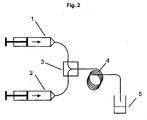
- two commercial syringes can be used, see for example Fig. 2 or 3 ,
- the syringes are filled with the solutions.
- the volume of the syringes is preferably oriented at the desired metering ratio of the two solutions.
- the syringes are placed on the corresponding openings of the mixing device.
- the two pistons and plunger of the syringe are connected to each other with small auxiliary devices, so that both pistons move downwards at the same speed when the connected punches are pressed down. This ensures that a ratio of the diameter of the syringe barrel corresponding volume ratio of the two reaction solutions is metered into the mixing device, see Fig. 4 ,
- the mixing device may be a multiple use device. But it is also possible by means of a cost-effective manufacturing process, such as by injection molding, to produce a large number of inexpensive mixing devices, which are intended for single use.
- the mixing device preferably contains two reservoirs at the top (10/11), the actual microstructured mixing structure (3), a short capillary-like structure, with a certain residence time and a pressure drop is realized for easier dosing, an outlet for the mixed reaction solution and Recesses, so that the mixing device can be safely placed on the usual reaction vessels.
- the two solutions are filled into the reservoirs (10/11).
- the size ratio of the reservoirs corresponds to the volume ratio of the solutions usually used in the reaction.
- the reservoirs with the mixing structure (3) are connected.
- the dimension of the opening and the supply lines is preferably chosen so that only when a force is applied to the solutions in the reservoir the two solutions in the desired ratio are metered into the mixing structure.
- the force can be generated by centrifuging the filled mixing device placed on a collecting vessel, for example a 2 ml reaction vessel, in a laboratory centrifuge.
- a collecting vessel for example a 2 ml reaction vessel
- the embodiment is preferred, in which the two openings of the reservoirs are aligned to the mixing structure out exactly right angles to the axis of rotation of the centrifuge, so that the same force acts on both solutions.
- the mixing device is provided with corresponding markings.
- the force may be generated by applying a pressure to the top of the reservoir or by applying a vacuum to the outlet of the mixing device.
- the mixing device may also be a multiple use device. But it is also possible by means of a cost-effective manufacturing process, such as by injection molding, to produce a large number of inexpensive mixing devices, which are intended for single use.
- the device according to the invention for carrying out a method for labeling biomolecules carrying reactive groups, preferably proteins therefore preferably contains two reservoirs for liquids which optionally have a metering unit, preferably two syringes, a micromixer, optionally a residence structure and optionally any one Fall arrester for the product.
- Residence time structures in the sense of the invention are defined volumes which, owing to their internal volume, can be flowed through in a predetermined time, such as e.g. Capillaries or micromixers. It can be used different dwell structures, each characterized by a very narrow residence time distribution and have low dead volumes.
- the residence structure consists of a capillary of predetermined length, but other uniformly flowed through volumes or arrangements can be used. It is also possible to use dwell structures in which the mixture is circulated in the circulation, with a micromixer possibly being inserted into the circuit. The latter especially when two phases and phase separation are present.
- reaction solution After passing through the residence structure, the reaction solution is collected.
- the reaction can be stopped by metering in a further reagent by means of a further micromixer, by thermal treatment with a micro-heat exchanger or by dropping the reaction mixture into a collecting vessel with a corresponding terminating reagent.
- the marker compound used is preferably a dye molecule which carries a reactive group, ie free amino, thiol, alcohol, aldehyde / ketone and / or carboxylic acid groups. These reactive group-bearing marker compounds react to form covalent bonds, such as in M. Brinkley in Bioconjugate Chemistry 1992, 3, 2-13 and from RP Haugland in Methods in Molecular Biology 1995, 45, 205-221 are described.
- the labeling of alcohols in biomolecules is preferably via sulfonic acid chlorides, e.g. dansyl chloride (5-dimethylamino-naphthalene-1-sulfonyl chloride) or oxidation with sodium periodate to the aldehyde and subsequent labeling with hydrazine derivatives of the dyes, e.g. Hydrazides, semicarbazides, carbohydrazides, e.g. Fluorescein-5-thiosemicarbazide.
- sulfonic acid chlorides e.g. Dansyl chloride (5-dimethylamino-naphthalene-1-sulfonyl chloride) or oxidation with sodium periodate to the aldehyde and subsequent labeling with hydrazine derivatives of the dyes, e.g. Hydrazides, semicarbazides, carbohydrazides, e.g. Fluorescein-5-thiosemicarbazide.
- aldehydes / ketones is preferably carried out with amines (Schiff bases) or with Hydrazinderviaries to hydrazide, while the labeling of carboxylic acids is preferably carried out with Hydrazinderviaries to the hydrazide.
- the marker molecule carries a reactive group which reacts with the free amino, triol-carrying protein to form covalent bonds and the marker molecule also catalyzes a chemical reaction leading to an easily detectable color change or change of the redox potential of his Substrates leads, such as peroxidases and alkaline phosphatases.
- Bersonders preferred as reactive groups are amino and / or thiol groups.
- the labeling reaction can be stopped after leaving the residence structure by addition of a compound which reacts quickly with the unreacted marker molecules.
- a compound which reacts quickly with the unreacted marker molecules are commercially available amino and / or thiol group-containing compounds, such as. Hydroxylamine, glutathione or mercaptoethanol.
- the reaction can be stopped after leaving the residence structure by chromatographic separation of the unreacted marker molecules.
- any customary chromatography methods such as gel permeation chromatography using, for example, Sephadex ® G or Biogel P ®, or the ion exchange chromatography, affinity chromatography, reversed phase chromatography (HPLC) and the Festphasenextrakion suitable.
- the reaction can be terminated after leaving the residence structure by a thermal treatment of the reaction solution. This is preferably done by cooling the reaction solution preferably by means of a microstrictured heat exchanger or by heating the reaction solution, preferably by means of a microstructured heat exchanger.
- the inventive method leads to higher yields and to an improved sample quality, since a rapid and thorough mixing of the two reactants takes place in the micromixer and the residence time can be set very accurately in the residence structure.
- Anti-human IgG antibodies should be labeled with fluorescein isothiocyanate (FITC).
- the antibodies supplier: Sigma, Saint Louis
- 0.1 M sodium bicarbonate buffer pH 8.5
- 10 mg FITC supplier: Molecular Probes, Eugene
- 1 ml DMSO 1 ml DMSO.
- a 1.5 m hydroxylamine solution pH 8.4 was prepared to stop the reaction.
- the two in Fig. 2 syringes (1, 2) were connected via capillaries with a micromixer (3).
- an in Fig. 3 shown flushing line attached to the capillary of one of the syringes, which was initially closed with a clamp. This purge line was connected to an HPLC pump, which was supplied with water (double-distilled).
- the micromixer (3) was in turn connected to a capillary (4) with a length of 28 cm.
- a receiver (5) was provided, in which the reaction solution was collected.
- the labeled antibodies were tested for their ability to stain granulocytes.
- a protein is tagged with a fluorescent label.
- the NHS ester of the fluorescent marker was used to react nonspecifically with the ⁇ -amino groups of the amino acid lysine present in the protein.
- the labeling batch collected in the stop solution was stirred for a further 15 minutes and then centrifuged in a bench centrifuge (model 5804 R from Eppendorf) at room temperature and 13,200 rpm to separate off insoluble constituents. In this reaction, however, hardly any insoluble constituents were observed.
- the batch was applied with a pipette to PD-10 columns (supplier: Amersham).
- the eluate was collected in freeze-drying vials, frozen and then lyophilized.
- sample prepared in the micromixer showed a slightly improved activity in the subsequent activity test compared to the sample prepared conventionally.
Landscapes
- Chemical & Material Sciences (AREA)
- Organic Chemistry (AREA)
- Chemical Kinetics & Catalysis (AREA)
- Investigating Or Analysing Biological Materials (AREA)
- Measuring Or Testing Involving Enzymes Or Micro-Organisms (AREA)
- Preparation Of Compounds By Using Micro-Organisms (AREA)
- Dot-Matrix Printers And Others (AREA)
Applications Claiming Priority (2)
| Application Number | Priority Date | Filing Date | Title |
|---|---|---|---|
| DE10350484A DE10350484B4 (de) | 2003-12-20 | 2003-12-20 | Verfahren und Vorrichtung zur Markierung von Proteinen |
| PCT/EP2004/012172 WO2005064335A2 (de) | 2003-12-20 | 2004-10-28 | Verfahren und vorrichtung zur markierung von biomolekülen |
Publications (2)
| Publication Number | Publication Date |
|---|---|
| EP1697747A2 EP1697747A2 (de) | 2006-09-06 |
| EP1697747B1 true EP1697747B1 (de) | 2008-12-03 |
Family
ID=34706241
Family Applications (1)
| Application Number | Title | Priority Date | Filing Date |
|---|---|---|---|
| EP04790945A Expired - Lifetime EP1697747B1 (de) | 2003-12-20 | 2004-10-28 | Verfahren und vorrichtung zur markierung von biomolekuelen |
Country Status (6)
| Country | Link |
|---|---|
| US (1) | US20080058506A1 (https=) |
| EP (1) | EP1697747B1 (https=) |
| JP (1) | JP2007518071A (https=) |
| AT (1) | ATE416382T1 (https=) |
| DE (2) | DE10350484B4 (https=) |
| WO (1) | WO2005064335A2 (https=) |
Families Citing this family (3)
| Publication number | Priority date | Publication date | Assignee | Title |
|---|---|---|---|---|
| DE102005049294C5 (de) * | 2005-10-14 | 2012-05-03 | Ehrfeld Mikrotechnik Bts Gmbh | Verfahren zur Herstellung organischer Peroxide mittels Mikroreaktionstechnik |
| CN111246936B (zh) * | 2017-10-25 | 2022-05-03 | 深圳华大生命科学研究院 | 用于核酸合成的微流控芯片 |
| CN108927082A (zh) * | 2018-07-03 | 2018-12-04 | 江苏省原子医学研究所 | 一种氟化铝标记的微流反应装置 |
Family Cites Families (7)
| Publication number | Priority date | Publication date | Assignee | Title |
|---|---|---|---|---|
| US5244816A (en) * | 1989-10-11 | 1993-09-14 | Akzo N.V. | Method for purifying chelator conjugated compounds |
| DE4408729A1 (de) * | 1994-03-15 | 1995-09-21 | Hoechst Ag | Nichtcyclische Chelatbildner auf Basis von Aminodialkylphosphoroxiden zur Herstellung von Technetium- oder Rheniumkomplexen |
| US6001229A (en) * | 1994-08-01 | 1999-12-14 | Lockheed Martin Energy Systems, Inc. | Apparatus and method for performing microfluidic manipulations for chemical analysis |
| AU6160896A (en) * | 1995-06-07 | 1996-12-30 | Life Technologies, Inc. | On line detection of a desired solute in an effluent stream using fluorescence spectroscopy |
| ATE194143T1 (de) * | 1996-08-28 | 2000-07-15 | Immunomedics Inc | Stabile radioiodium-konjugate und verfahren zu deren herstellung |
| CA2297158C (en) * | 1997-07-22 | 2009-12-22 | Rapigene Inc. | Methods and compounds for analyzing nucleic acids by mass spectrometry |
| DE19840489A1 (de) * | 1998-09-04 | 2000-03-09 | Basf Ag | Wirkstoffzubereitungen sowie ein Verfahren zu deren Herstellung |
-
2003
- 2003-12-20 DE DE10350484A patent/DE10350484B4/de not_active Expired - Fee Related
-
2004
- 2004-10-28 JP JP2006544232A patent/JP2007518071A/ja active Pending
- 2004-10-28 WO PCT/EP2004/012172 patent/WO2005064335A2/de not_active Ceased
- 2004-10-28 DE DE502004008602T patent/DE502004008602D1/de not_active Expired - Lifetime
- 2004-10-28 AT AT04790945T patent/ATE416382T1/de not_active IP Right Cessation
- 2004-10-28 EP EP04790945A patent/EP1697747B1/de not_active Expired - Lifetime
- 2004-10-28 US US10/583,524 patent/US20080058506A1/en not_active Abandoned
Also Published As
| Publication number | Publication date |
|---|---|
| DE10350484A1 (de) | 2005-07-28 |
| ATE416382T1 (de) | 2008-12-15 |
| EP1697747A2 (de) | 2006-09-06 |
| WO2005064335A3 (de) | 2005-09-22 |
| US20080058506A1 (en) | 2008-03-06 |
| DE10350484B4 (de) | 2006-02-02 |
| JP2007518071A (ja) | 2007-07-05 |
| DE502004008602D1 (de) | 2009-01-15 |
| WO2005064335A2 (de) | 2005-07-14 |
Similar Documents
| Publication | Publication Date | Title |
|---|---|---|
| DE60123480T2 (de) | Behandlung von hydrophoben oder hydrophilen oberflächen mit polymeren | |
| DE69314969T2 (de) | Analyse durch isoelektrische fokussierung | |
| EP1740721A1 (de) | Verfahren und anordnung zur dna-amplifikation mittels pcr unter einsatz von trockenreagenzien | |
| CN112782291A (zh) | 一种阿胶及其制剂中驴源性成分的鉴定方法 | |
| JP2002527750A (ja) | 微細組み立て拡散チャンバを含む装置 | |
| DE112014001433T5 (de) | Verfahren zur Bestimmung derivatisierter Analyte in einem separierten biologischen Fluid | |
| Wei et al. | Automated solid phase extraction and electrospray chip based on programmatic pneumatic micro-valves | |
| EP1697747B1 (de) | Verfahren und vorrichtung zur markierung von biomolekuelen | |
| EP1009999B1 (de) | Verfahren und vorrichtung zur identifizierung von wirkstoffen | |
| EP2959297B1 (de) | Neues poc-testsystem und verfahren | |
| Cecala et al. | Sampling techniques for single-cell electrophoresis | |
| Friel et al. | Flash-heater ethylation of some antiepileptic drugs | |
| WO2013026808A1 (de) | Neues poc-testsystem und verfahren | |
| CN101372709A (zh) | 一种快速定量评价药物核酸相互作用的方法 | |
| WO2002020831A2 (de) | Verfahren zur messung der aktivität der no-synthase | |
| CN109439654A (zh) | 一种免前处理自动化提取大体积全血dna的方法 | |
| Petzoldt et al. | Free amino acids in the early cleavage stages of the rabbit egg | |
| JPH0212059A (ja) | γ−アミノ酪酸分析法 | |
| Windman et al. | Microfluidics for ultrasmall-volume biological analysis | |
| DE112020002216T5 (de) | Verfahren zur Verbesserung des Glykosylamin-Nachweises | |
| CN111921572A (zh) | 一种微流控芯片及多靶点活性成分筛选方法 | |
| WO2025056245A1 (de) | Verfahren und mikrofluidische vorrichtung zur aufbereitung einer probe für eine analyse biologischer zellen, insbesondere zirkulierender tumorzellen | |
| Miao | Neurotransmitter and neuromodulator analysis using capillary electrophoresis with laser-induced fluorescence detection | |
| Hrušková et al. | of Thesis: Instrumentation and methods for the | |
| Peterson | Analysis of Clinically Important Compounds Using Electrophoretic Separation Techniques Coupled to Time-of-Flight Mass Spectrometry |
Legal Events
| Date | Code | Title | Description |
|---|---|---|---|
| PUAI | Public reference made under article 153(3) epc to a published international application that has entered the european phase |
Free format text: ORIGINAL CODE: 0009012 |
|
| 17P | Request for examination filed |
Effective date: 20060720 |
|
| AK | Designated contracting states |
Kind code of ref document: A2 Designated state(s): AT BE BG CH CY CZ DE DK EE ES FI FR GB GR HU IE IT LI LU MC NL PL PT RO SE SI SK TR |
|
| 17Q | First examination report despatched |
Effective date: 20061020 |
|
| DAX | Request for extension of the european patent (deleted) | ||
| GRAP | Despatch of communication of intention to grant a patent |
Free format text: ORIGINAL CODE: EPIDOSNIGR1 |
|
| GRAS | Grant fee paid |
Free format text: ORIGINAL CODE: EPIDOSNIGR3 |
|
| GRAS | Grant fee paid |
Free format text: ORIGINAL CODE: EPIDOSNIGR3 |
|
| GRAA | (expected) grant |
Free format text: ORIGINAL CODE: 0009210 |
|
| AK | Designated contracting states |
Kind code of ref document: B1 Designated state(s): AT BE BG CH CY CZ DE DK EE ES FI FR GB GR HU IE IT LI LU MC NL PL PT RO SE SI SK TR |
|
| REG | Reference to a national code |
Ref country code: GB Ref legal event code: FG4D Free format text: NOT ENGLISH |
|
| REG | Reference to a national code |
Ref country code: CH Ref legal event code: EP |
|
| REG | Reference to a national code |
Ref country code: IE Ref legal event code: FG4D Free format text: LANGUAGE OF EP DOCUMENT: GERMAN |
|
| REF | Corresponds to: |
Ref document number: 502004008602 Country of ref document: DE Date of ref document: 20090115 Kind code of ref document: P |
|
| REG | Reference to a national code |
Ref country code: CH Ref legal event code: NV Representative=s name: E. BLUM & CO. AG PATENT- UND MARKENANWAELTE VSP |
|
| PG25 | Lapsed in a contracting state [announced via postgrant information from national office to epo] |
Ref country code: ES Free format text: LAPSE BECAUSE OF FAILURE TO SUBMIT A TRANSLATION OF THE DESCRIPTION OR TO PAY THE FEE WITHIN THE PRESCRIBED TIME-LIMIT Effective date: 20090314 |
|
| NLV1 | Nl: lapsed or annulled due to failure to fulfill the requirements of art. 29p and 29m of the patents act | ||
| PG25 | Lapsed in a contracting state [announced via postgrant information from national office to epo] |
Ref country code: PL Free format text: LAPSE BECAUSE OF FAILURE TO SUBMIT A TRANSLATION OF THE DESCRIPTION OR TO PAY THE FEE WITHIN THE PRESCRIBED TIME-LIMIT Effective date: 20081203 Ref country code: SI Free format text: LAPSE BECAUSE OF FAILURE TO SUBMIT A TRANSLATION OF THE DESCRIPTION OR TO PAY THE FEE WITHIN THE PRESCRIBED TIME-LIMIT Effective date: 20081203 Ref country code: NL Free format text: LAPSE BECAUSE OF FAILURE TO SUBMIT A TRANSLATION OF THE DESCRIPTION OR TO PAY THE FEE WITHIN THE PRESCRIBED TIME-LIMIT Effective date: 20081203 Ref country code: FI Free format text: LAPSE BECAUSE OF FAILURE TO SUBMIT A TRANSLATION OF THE DESCRIPTION OR TO PAY THE FEE WITHIN THE PRESCRIBED TIME-LIMIT Effective date: 20081203 |
|
| REG | Reference to a national code |
Ref country code: IE Ref legal event code: FD4D |
|
| PG25 | Lapsed in a contracting state [announced via postgrant information from national office to epo] |
Ref country code: RO Free format text: LAPSE BECAUSE OF FAILURE TO SUBMIT A TRANSLATION OF THE DESCRIPTION OR TO PAY THE FEE WITHIN THE PRESCRIBED TIME-LIMIT Effective date: 20081203 Ref country code: IE Free format text: LAPSE BECAUSE OF FAILURE TO SUBMIT A TRANSLATION OF THE DESCRIPTION OR TO PAY THE FEE WITHIN THE PRESCRIBED TIME-LIMIT Effective date: 20081203 Ref country code: EE Free format text: LAPSE BECAUSE OF FAILURE TO SUBMIT A TRANSLATION OF THE DESCRIPTION OR TO PAY THE FEE WITHIN THE PRESCRIBED TIME-LIMIT Effective date: 20081203 Ref country code: BG Free format text: LAPSE BECAUSE OF FAILURE TO SUBMIT A TRANSLATION OF THE DESCRIPTION OR TO PAY THE FEE WITHIN THE PRESCRIBED TIME-LIMIT Effective date: 20090303 |
|
| PG25 | Lapsed in a contracting state [announced via postgrant information from national office to epo] |
Ref country code: SE Free format text: LAPSE BECAUSE OF FAILURE TO SUBMIT A TRANSLATION OF THE DESCRIPTION OR TO PAY THE FEE WITHIN THE PRESCRIBED TIME-LIMIT Effective date: 20090303 Ref country code: CZ Free format text: LAPSE BECAUSE OF FAILURE TO SUBMIT A TRANSLATION OF THE DESCRIPTION OR TO PAY THE FEE WITHIN THE PRESCRIBED TIME-LIMIT Effective date: 20081203 Ref country code: PT Free format text: LAPSE BECAUSE OF FAILURE TO SUBMIT A TRANSLATION OF THE DESCRIPTION OR TO PAY THE FEE WITHIN THE PRESCRIBED TIME-LIMIT Effective date: 20090504 |
|
| PG25 | Lapsed in a contracting state [announced via postgrant information from national office to epo] |
Ref country code: SK Free format text: LAPSE BECAUSE OF FAILURE TO SUBMIT A TRANSLATION OF THE DESCRIPTION OR TO PAY THE FEE WITHIN THE PRESCRIBED TIME-LIMIT Effective date: 20081203 |
|
| PLBE | No opposition filed within time limit |
Free format text: ORIGINAL CODE: 0009261 |
|
| STAA | Information on the status of an ep patent application or granted ep patent |
Free format text: STATUS: NO OPPOSITION FILED WITHIN TIME LIMIT |
|
| PG25 | Lapsed in a contracting state [announced via postgrant information from national office to epo] |
Ref country code: DK Free format text: LAPSE BECAUSE OF FAILURE TO SUBMIT A TRANSLATION OF THE DESCRIPTION OR TO PAY THE FEE WITHIN THE PRESCRIBED TIME-LIMIT Effective date: 20081203 |
|
| 26N | No opposition filed |
Effective date: 20090904 |
|
| PGFP | Annual fee paid to national office [announced via postgrant information from national office to epo] |
Ref country code: CH Payment date: 20091014 Year of fee payment: 6 Ref country code: DE Payment date: 20090929 Year of fee payment: 6 |
|
| BERE | Be: lapsed |
Owner name: EHRFELD MIKROTECHNIK BTS G.M.B.H. Effective date: 20091031 |
|
| PGFP | Annual fee paid to national office [announced via postgrant information from national office to epo] |
Ref country code: FR Payment date: 20091029 Year of fee payment: 6 Ref country code: GB Payment date: 20091028 Year of fee payment: 6 |
|
| PG25 | Lapsed in a contracting state [announced via postgrant information from national office to epo] |
Ref country code: MC Free format text: LAPSE BECAUSE OF NON-PAYMENT OF DUE FEES Effective date: 20091031 |
|
| PG25 | Lapsed in a contracting state [announced via postgrant information from national office to epo] |
Ref country code: GR Free format text: LAPSE BECAUSE OF FAILURE TO SUBMIT A TRANSLATION OF THE DESCRIPTION OR TO PAY THE FEE WITHIN THE PRESCRIBED TIME-LIMIT Effective date: 20090304 Ref country code: BE Free format text: LAPSE BECAUSE OF NON-PAYMENT OF DUE FEES Effective date: 20091031 |
|
| PG25 | Lapsed in a contracting state [announced via postgrant information from national office to epo] |
Ref country code: AT Free format text: LAPSE BECAUSE OF NON-PAYMENT OF DUE FEES Effective date: 20091028 |
|
| PG25 | Lapsed in a contracting state [announced via postgrant information from national office to epo] |
Ref country code: IT Free format text: LAPSE BECAUSE OF FAILURE TO SUBMIT A TRANSLATION OF THE DESCRIPTION OR TO PAY THE FEE WITHIN THE PRESCRIBED TIME-LIMIT Effective date: 20081203 |
|
| PG25 | Lapsed in a contracting state [announced via postgrant information from national office to epo] |
Ref country code: LU Free format text: LAPSE BECAUSE OF NON-PAYMENT OF DUE FEES Effective date: 20091028 |
|
| REG | Reference to a national code |
Ref country code: CH Ref legal event code: PL |
|
| GBPC | Gb: european patent ceased through non-payment of renewal fee |
Effective date: 20101028 |
|
| PG25 | Lapsed in a contracting state [announced via postgrant information from national office to epo] |
Ref country code: HU Free format text: LAPSE BECAUSE OF FAILURE TO SUBMIT A TRANSLATION OF THE DESCRIPTION OR TO PAY THE FEE WITHIN THE PRESCRIBED TIME-LIMIT Effective date: 20090604 |
|
| PG25 | Lapsed in a contracting state [announced via postgrant information from national office to epo] |
Ref country code: FR Free format text: LAPSE BECAUSE OF NON-PAYMENT OF DUE FEES Effective date: 20101102 Ref country code: LI Free format text: LAPSE BECAUSE OF NON-PAYMENT OF DUE FEES Effective date: 20101031 Ref country code: CH Free format text: LAPSE BECAUSE OF NON-PAYMENT OF DUE FEES Effective date: 20101031 |
|
| REG | Reference to a national code |
Ref country code: FR Ref legal event code: ST Effective date: 20110630 |
|
| PG25 | Lapsed in a contracting state [announced via postgrant information from national office to epo] |
Ref country code: TR Free format text: LAPSE BECAUSE OF FAILURE TO SUBMIT A TRANSLATION OF THE DESCRIPTION OR TO PAY THE FEE WITHIN THE PRESCRIBED TIME-LIMIT Effective date: 20081203 Ref country code: GB Free format text: LAPSE BECAUSE OF NON-PAYMENT OF DUE FEES Effective date: 20101028 |
|
| REG | Reference to a national code |
Ref country code: DE Ref legal event code: R119 Ref document number: 502004008602 Country of ref document: DE Effective date: 20110502 |
|
| PG25 | Lapsed in a contracting state [announced via postgrant information from national office to epo] |
Ref country code: CY Free format text: LAPSE BECAUSE OF FAILURE TO SUBMIT A TRANSLATION OF THE DESCRIPTION OR TO PAY THE FEE WITHIN THE PRESCRIBED TIME-LIMIT Effective date: 20081203 |
|
| PG25 | Lapsed in a contracting state [announced via postgrant information from national office to epo] |
Ref country code: DE Free format text: LAPSE BECAUSE OF NON-PAYMENT OF DUE FEES Effective date: 20110502 |