EP1697469B1 - Solution containing surface-modified nanoparticles - Google Patents
Solution containing surface-modified nanoparticles Download PDFInfo
- Publication number
- EP1697469B1 EP1697469B1 EP04809933A EP04809933A EP1697469B1 EP 1697469 B1 EP1697469 B1 EP 1697469B1 EP 04809933 A EP04809933 A EP 04809933A EP 04809933 A EP04809933 A EP 04809933A EP 1697469 B1 EP1697469 B1 EP 1697469B1
- Authority
- EP
- European Patent Office
- Prior art keywords
- liquid
- nanoparticles
- coating solution
- combinations
- coating
- Prior art date
- Legal status (The legal status is an assumption and is not a legal conclusion. Google has not performed a legal analysis and makes no representation as to the accuracy of the status listed.)
- Expired - Lifetime
Links
- 239000002105 nanoparticle Substances 0.000 title claims abstract description 105
- 239000007788 liquid Substances 0.000 claims abstract description 145
- 238000000576 coating method Methods 0.000 claims abstract description 75
- 239000011248 coating agent Substances 0.000 claims abstract description 72
- 239000000758 substrate Substances 0.000 claims abstract description 27
- 238000000034 method Methods 0.000 claims abstract description 22
- DXPPIEDUBFUSEZ-UHFFFAOYSA-N 6-methylheptyl prop-2-enoate Chemical compound CC(C)CCCCCOC(=O)C=C DXPPIEDUBFUSEZ-UHFFFAOYSA-N 0.000 claims description 22
- 239000002245 particle Substances 0.000 claims description 22
- 239000000463 material Substances 0.000 claims description 17
- 229920000642 polymer Polymers 0.000 claims description 12
- 239000011521 glass Substances 0.000 claims description 8
- 229920003229 poly(methyl methacrylate) Polymers 0.000 claims description 8
- 239000004926 polymethyl methacrylate Substances 0.000 claims description 8
- 150000001252 acrylic acid derivatives Chemical class 0.000 claims description 7
- 150000001298 alcohols Chemical class 0.000 claims description 7
- XLYOFNOQVPJJNP-UHFFFAOYSA-N water Substances O XLYOFNOQVPJJNP-UHFFFAOYSA-N 0.000 claims description 7
- 229910001868 water Inorganic materials 0.000 claims description 7
- FIHBHSQYSYVZQE-UHFFFAOYSA-N 6-prop-2-enoyloxyhexyl prop-2-enoate Chemical compound C=CC(=O)OCCCCCCOC(=O)C=C FIHBHSQYSYVZQE-UHFFFAOYSA-N 0.000 claims description 6
- 238000001704 evaporation Methods 0.000 claims description 6
- 239000003960 organic solvent Substances 0.000 claims description 6
- 230000005855 radiation Effects 0.000 claims description 6
- 239000004793 Polystyrene Substances 0.000 claims description 5
- 230000008020 evaporation Effects 0.000 claims description 5
- 229910001867 inorganic solvent Inorganic materials 0.000 claims description 5
- 239000003049 inorganic solvent Substances 0.000 claims description 5
- 229920000647 polyepoxide Polymers 0.000 claims description 5
- 229920002223 polystyrene Polymers 0.000 claims description 5
- 239000000919 ceramic Substances 0.000 claims description 4
- 238000010894 electron beam technology Methods 0.000 claims description 4
- 230000002708 enhancing effect Effects 0.000 claims description 4
- 239000000835 fiber Substances 0.000 claims description 4
- 239000012948 isocyanate Substances 0.000 claims description 4
- 150000002513 isocyanates Chemical class 0.000 claims description 4
- 150000002576 ketones Chemical class 0.000 claims description 4
- LLHKCFNBLRBOGN-UHFFFAOYSA-N propylene glycol methyl ether acetate Chemical compound COCC(C)OC(C)=O LLHKCFNBLRBOGN-UHFFFAOYSA-N 0.000 claims description 4
- NIXOWILDQLNWCW-UHFFFAOYSA-M Acrylate Chemical compound [O-]C(=O)C=C NIXOWILDQLNWCW-UHFFFAOYSA-M 0.000 claims description 3
- 239000004593 Epoxy Substances 0.000 claims description 3
- 239000000975 dye Substances 0.000 claims description 3
- 125000003700 epoxy group Chemical group 0.000 claims description 3
- 239000004744 fabric Substances 0.000 claims description 3
- 239000000945 filler Substances 0.000 claims description 3
- 239000003999 initiator Substances 0.000 claims description 3
- 150000002734 metacrylic acid derivatives Chemical class 0.000 claims description 3
- 239000002184 metal Substances 0.000 claims description 3
- 229910052751 metal Inorganic materials 0.000 claims description 3
- 239000000123 paper Substances 0.000 claims description 3
- 239000000049 pigment Substances 0.000 claims description 3
- 229920000728 polyester Polymers 0.000 claims description 3
- 229920000193 polymethacrylate Polymers 0.000 claims description 3
- 229920005862 polyol Polymers 0.000 claims description 3
- 150000003077 polyols Chemical class 0.000 claims description 3
- 229920002635 polyurethane Polymers 0.000 claims description 3
- 239000004814 polyurethane Substances 0.000 claims description 3
- 239000002023 wood Substances 0.000 claims description 3
- GOXQRTZXKQZDDN-UHFFFAOYSA-N 2-Ethylhexyl acrylate Chemical compound CCCCC(CC)COC(=O)C=C GOXQRTZXKQZDDN-UHFFFAOYSA-N 0.000 claims description 2
- 239000003054 catalyst Substances 0.000 claims description 2
- 238000004132 cross linking Methods 0.000 claims description 2
- 229920000058 polyacrylate Polymers 0.000 claims description 2
- 239000004971 Cross linker Substances 0.000 claims 1
- 150000004945 aromatic hydrocarbons Chemical class 0.000 claims 1
- 238000001035 drying Methods 0.000 abstract description 13
- 239000000243 solution Substances 0.000 description 83
- YXFVVABEGXRONW-UHFFFAOYSA-N Toluene Chemical compound CC1=CC=CC=C1 YXFVVABEGXRONW-UHFFFAOYSA-N 0.000 description 66
- VYPSYNLAJGMNEJ-UHFFFAOYSA-N Silicium dioxide Chemical compound O=[Si]=O VYPSYNLAJGMNEJ-UHFFFAOYSA-N 0.000 description 33
- -1 aryl nitro compounds Chemical class 0.000 description 24
- 239000011344 liquid material Substances 0.000 description 20
- ZAXXZBQODQDCOW-UHFFFAOYSA-N 1-methoxypropyl acetate Chemical compound CCC(OC)OC(C)=O ZAXXZBQODQDCOW-UHFFFAOYSA-N 0.000 description 17
- 239000003795 chemical substances by application Substances 0.000 description 16
- 239000000203 mixture Substances 0.000 description 13
- 230000000052 comparative effect Effects 0.000 description 12
- 238000012876 topography Methods 0.000 description 11
- 239000000377 silicon dioxide Substances 0.000 description 9
- 239000007787 solid Substances 0.000 description 9
- 239000002904 solvent Substances 0.000 description 9
- 230000007547 defect Effects 0.000 description 8
- 229920001223 polyethylene glycol Polymers 0.000 description 7
- 239000004094 surface-active agent Substances 0.000 description 7
- KDLHZDBZIXYQEI-UHFFFAOYSA-N Palladium Chemical compound [Pd] KDLHZDBZIXYQEI-UHFFFAOYSA-N 0.000 description 6
- 238000006243 chemical reaction Methods 0.000 description 6
- 238000002156 mixing Methods 0.000 description 6
- 238000002360 preparation method Methods 0.000 description 6
- ZWEHNKRNPOVVGH-UHFFFAOYSA-N 2-Butanone Chemical compound CCC(C)=O ZWEHNKRNPOVVGH-UHFFFAOYSA-N 0.000 description 5
- ZDHCZVWCTKTBRY-UHFFFAOYSA-N omega-Hydroxydodecanoic acid Natural products OCCCCCCCCCCCC(O)=O ZDHCZVWCTKTBRY-UHFFFAOYSA-N 0.000 description 5
- 239000011343 solid material Substances 0.000 description 5
- 239000000126 substance Substances 0.000 description 5
- BLRPTPMANUNPDV-UHFFFAOYSA-N Silane Chemical compound [SiH4] BLRPTPMANUNPDV-UHFFFAOYSA-N 0.000 description 4
- 239000002253 acid Substances 0.000 description 4
- 230000015572 biosynthetic process Effects 0.000 description 4
- 239000010931 gold Substances 0.000 description 4
- 229910044991 metal oxide Inorganic materials 0.000 description 4
- 150000004706 metal oxides Chemical class 0.000 description 4
- 239000004005 microsphere Substances 0.000 description 4
- 230000004048 modification Effects 0.000 description 4
- 238000012986 modification Methods 0.000 description 4
- 239000002077 nanosphere Substances 0.000 description 4
- 229910000077 silane Inorganic materials 0.000 description 4
- 150000004756 silanes Chemical class 0.000 description 4
- ARXJGSRGQADJSQ-UHFFFAOYSA-N 1-methoxypropan-2-ol Chemical compound COCC(C)O ARXJGSRGQADJSQ-UHFFFAOYSA-N 0.000 description 3
- XDLMVUHYZWKMMD-UHFFFAOYSA-N 3-trimethoxysilylpropyl 2-methylprop-2-enoate Chemical compound CO[Si](OC)(OC)CCCOC(=O)C(C)=C XDLMVUHYZWKMMD-UHFFFAOYSA-N 0.000 description 3
- XMWRBQBLMFGWIX-UHFFFAOYSA-N C60 fullerene Chemical class C12=C3C(C4=C56)=C7C8=C5C5=C9C%10=C6C6=C4C1=C1C4=C6C6=C%10C%10=C9C9=C%11C5=C8C5=C8C7=C3C3=C7C2=C1C1=C2C4=C6C4=C%10C6=C9C9=C%11C5=C5C8=C3C3=C7C1=C1C2=C4C6=C2C9=C5C3=C12 XMWRBQBLMFGWIX-UHFFFAOYSA-N 0.000 description 3
- LFQSCWFLJHTTHZ-UHFFFAOYSA-N Ethanol Chemical compound CCO LFQSCWFLJHTTHZ-UHFFFAOYSA-N 0.000 description 3
- OKKJLVBELUTLKV-UHFFFAOYSA-N Methanol Chemical compound OC OKKJLVBELUTLKV-UHFFFAOYSA-N 0.000 description 3
- OAICVXFJPJFONN-UHFFFAOYSA-N Phosphorus Chemical compound [P] OAICVXFJPJFONN-UHFFFAOYSA-N 0.000 description 3
- GWEVSGVZZGPLCZ-UHFFFAOYSA-N Titan oxide Chemical compound O=[Ti]=O GWEVSGVZZGPLCZ-UHFFFAOYSA-N 0.000 description 3
- MCMNRKCIXSYSNV-UHFFFAOYSA-N Zirconium dioxide Chemical compound O=[Zr]=O MCMNRKCIXSYSNV-UHFFFAOYSA-N 0.000 description 3
- UKLDJPRMSDWDSL-UHFFFAOYSA-L [dibutyl(dodecanoyloxy)stannyl] dodecanoate Chemical compound CCCCCCCCCCCC(=O)O[Sn](CCCC)(CCCC)OC(=O)CCCCCCCCCCC UKLDJPRMSDWDSL-UHFFFAOYSA-L 0.000 description 3
- 230000002776 aggregation Effects 0.000 description 3
- 150000001732 carboxylic acid derivatives Chemical class 0.000 description 3
- 238000001246 colloidal dispersion Methods 0.000 description 3
- 239000008119 colloidal silica Substances 0.000 description 3
- 239000004020 conductor Substances 0.000 description 3
- 239000012530 fluid Substances 0.000 description 3
- 229910003472 fullerene Inorganic materials 0.000 description 3
- XPFVYQJUAUNWIW-UHFFFAOYSA-N furfuryl alcohol Chemical compound OCC1=CC=CO1 XPFVYQJUAUNWIW-UHFFFAOYSA-N 0.000 description 3
- 230000002209 hydrophobic effect Effects 0.000 description 3
- 230000001965 increasing effect Effects 0.000 description 3
- 229920000962 poly(amidoamine) Polymers 0.000 description 3
- 238000002390 rotary evaporation Methods 0.000 description 3
- 239000002356 single layer Substances 0.000 description 3
- 238000003756 stirring Methods 0.000 description 3
- KDYFGRWQOYBRFD-UHFFFAOYSA-L succinate(2-) Chemical compound [O-]C(=O)CCC([O-])=O KDYFGRWQOYBRFD-UHFFFAOYSA-L 0.000 description 3
- UWSYCPWEBZRZNJ-UHFFFAOYSA-N trimethoxy(2,4,4-trimethylpentyl)silane Chemical compound CO[Si](OC)(OC)CC(C)CC(C)(C)C UWSYCPWEBZRZNJ-UHFFFAOYSA-N 0.000 description 3
- WRIDQFICGBMAFQ-UHFFFAOYSA-N (E)-8-Octadecenoic acid Natural products CCCCCCCCCC=CCCCCCCC(O)=O WRIDQFICGBMAFQ-UHFFFAOYSA-N 0.000 description 2
- SMZOUWXMTYCWNB-UHFFFAOYSA-N 2-(2-methoxy-5-methylphenyl)ethanamine Chemical compound COC1=CC=C(C)C=C1CCN SMZOUWXMTYCWNB-UHFFFAOYSA-N 0.000 description 2
- NIXOWILDQLNWCW-UHFFFAOYSA-N 2-Propenoic acid Natural products OC(=O)C=C NIXOWILDQLNWCW-UHFFFAOYSA-N 0.000 description 2
- RIWRBSMFKVOJMN-UHFFFAOYSA-N 2-methyl-1-phenylpropan-2-ol Chemical compound CC(C)(O)CC1=CC=CC=C1 RIWRBSMFKVOJMN-UHFFFAOYSA-N 0.000 description 2
- LQJBNNIYVWPHFW-UHFFFAOYSA-N 20:1omega9c fatty acid Natural products CCCCCCCCCCC=CCCCCCCCC(O)=O LQJBNNIYVWPHFW-UHFFFAOYSA-N 0.000 description 2
- JSOZORWBKQSQCJ-UHFFFAOYSA-N 3-[ethoxy(dimethyl)silyl]propyl 2-methylprop-2-enoate Chemical compound CCO[Si](C)(C)CCCOC(=O)C(C)=C JSOZORWBKQSQCJ-UHFFFAOYSA-N 0.000 description 2
- UUEWCQRISZBELL-UHFFFAOYSA-N 3-trimethoxysilylpropane-1-thiol Chemical compound CO[Si](OC)(OC)CCCS UUEWCQRISZBELL-UHFFFAOYSA-N 0.000 description 2
- KBQVDAIIQCXKPI-UHFFFAOYSA-N 3-trimethoxysilylpropyl prop-2-enoate Chemical compound CO[Si](OC)(OC)CCCOC(=O)C=C KBQVDAIIQCXKPI-UHFFFAOYSA-N 0.000 description 2
- QSBYPNXLFMSGKH-UHFFFAOYSA-N 9-Heptadecensaeure Natural products CCCCCCCC=CCCCCCCCC(O)=O QSBYPNXLFMSGKH-UHFFFAOYSA-N 0.000 description 2
- CURLTUGMZLYLDI-UHFFFAOYSA-N Carbon dioxide Chemical compound O=C=O CURLTUGMZLYLDI-UHFFFAOYSA-N 0.000 description 2
- 241001012508 Carpiodes cyprinus Species 0.000 description 2
- LYCAIKOWRPUZTN-UHFFFAOYSA-N Ethylene glycol Chemical compound OCCO LYCAIKOWRPUZTN-UHFFFAOYSA-N 0.000 description 2
- UQSXHKLRYXJYBZ-UHFFFAOYSA-N Iron oxide Chemical compound [Fe]=O UQSXHKLRYXJYBZ-UHFFFAOYSA-N 0.000 description 2
- 239000005642 Oleic acid Substances 0.000 description 2
- ZQPPMHVWECSIRJ-UHFFFAOYSA-N Oleic acid Natural products CCCCCCCCC=CCCCCCCCC(O)=O ZQPPMHVWECSIRJ-UHFFFAOYSA-N 0.000 description 2
- 238000004220 aggregation Methods 0.000 description 2
- 125000000217 alkyl group Chemical group 0.000 description 2
- 150000001343 alkyl silanes Chemical class 0.000 description 2
- 230000004075 alteration Effects 0.000 description 2
- PNEYBMLMFCGWSK-UHFFFAOYSA-N aluminium oxide Inorganic materials [O-2].[O-2].[O-2].[Al+3].[Al+3] PNEYBMLMFCGWSK-UHFFFAOYSA-N 0.000 description 2
- 150000001412 amines Chemical class 0.000 description 2
- 239000003963 antioxidant agent Substances 0.000 description 2
- 125000003118 aryl group Chemical group 0.000 description 2
- 239000000412 dendrimer Substances 0.000 description 2
- 229920000736 dendritic polymer Polymers 0.000 description 2
- SBZXBUIDTXKZTM-UHFFFAOYSA-N diglyme Chemical compound COCCOCCOC SBZXBUIDTXKZTM-UHFFFAOYSA-N 0.000 description 2
- POULHZVOKOAJMA-UHFFFAOYSA-N dodecanoic acid Chemical compound CCCCCCCCCCCC(O)=O POULHZVOKOAJMA-UHFFFAOYSA-N 0.000 description 2
- 125000003438 dodecyl group Chemical group [H]C([H])([H])C([H])([H])C([H])([H])C([H])([H])C([H])([H])C([H])([H])C([H])([H])C([H])([H])C([H])([H])C([H])([H])C([H])([H])C([H])([H])* 0.000 description 2
- SVMUEEINWGBIPD-UHFFFAOYSA-N dodecylphosphonic acid Chemical compound CCCCCCCCCCCCP(O)(O)=O SVMUEEINWGBIPD-UHFFFAOYSA-N 0.000 description 2
- 239000003822 epoxy resin Substances 0.000 description 2
- NKSJNEHGWDZZQF-UHFFFAOYSA-N ethenyl(trimethoxy)silane Chemical compound CO[Si](OC)(OC)C=C NKSJNEHGWDZZQF-UHFFFAOYSA-N 0.000 description 2
- WOXXJEVNDJOOLV-UHFFFAOYSA-N ethenyl-tris(2-methoxyethoxy)silane Chemical compound COCCO[Si](OCCOC)(OCCOC)C=C WOXXJEVNDJOOLV-UHFFFAOYSA-N 0.000 description 2
- 230000004927 fusion Effects 0.000 description 2
- PCHJSUWPFVWCPO-UHFFFAOYSA-N gold Chemical compound [Au] PCHJSUWPFVWCPO-UHFFFAOYSA-N 0.000 description 2
- 229910052737 gold Inorganic materials 0.000 description 2
- QXJSBBXBKPUZAA-UHFFFAOYSA-N isooleic acid Natural products CCCCCCCC=CCCCCCCCCC(O)=O QXJSBBXBKPUZAA-UHFFFAOYSA-N 0.000 description 2
- 239000010410 layer Substances 0.000 description 2
- BFXIKLCIZHOAAZ-UHFFFAOYSA-N methyltrimethoxysilane Chemical compound CO[Si](C)(OC)OC BFXIKLCIZHOAAZ-UHFFFAOYSA-N 0.000 description 2
- 239000000178 monomer Substances 0.000 description 2
- WWZKQHOCKIZLMA-UHFFFAOYSA-N octanoic acid Chemical compound CCCCCCCC(O)=O WWZKQHOCKIZLMA-UHFFFAOYSA-N 0.000 description 2
- ZQPPMHVWECSIRJ-KTKRTIGZSA-N oleic acid Chemical compound CCCCCCCC\C=C/CCCCCCCC(O)=O ZQPPMHVWECSIRJ-KTKRTIGZSA-N 0.000 description 2
- 230000003287 optical effect Effects 0.000 description 2
- 150000001282 organosilanes Chemical class 0.000 description 2
- 229910052763 palladium Inorganic materials 0.000 description 2
- 229910052698 phosphorus Inorganic materials 0.000 description 2
- 239000011574 phosphorus Substances 0.000 description 2
- 239000000843 powder Substances 0.000 description 2
- 230000008569 process Effects 0.000 description 2
- 238000010992 reflux Methods 0.000 description 2
- 239000011347 resin Substances 0.000 description 2
- 229920005989 resin Polymers 0.000 description 2
- 238000000518 rheometry Methods 0.000 description 2
- 150000003839 salts Chemical group 0.000 description 2
- 238000005507 spraying Methods 0.000 description 2
- 239000012258 stirred mixture Substances 0.000 description 2
- FRGPKMWIYVTFIQ-UHFFFAOYSA-N triethoxy(3-isocyanatopropyl)silane Chemical compound CCO[Si](OCC)(OCC)CCCN=C=O FRGPKMWIYVTFIQ-UHFFFAOYSA-N 0.000 description 2
- CPUDPFPXCZDNGI-UHFFFAOYSA-N triethoxy(methyl)silane Chemical compound CCO[Si](C)(OCC)OCC CPUDPFPXCZDNGI-UHFFFAOYSA-N 0.000 description 2
- NMEPHPOFYLLFTK-UHFFFAOYSA-N trimethoxy(octyl)silane Chemical compound CCCCCCCC[Si](OC)(OC)OC NMEPHPOFYLLFTK-UHFFFAOYSA-N 0.000 description 2
- IDXCKOANSQIPGX-UHFFFAOYSA-N (acetyloxy-ethenyl-methylsilyl) acetate Chemical compound CC(=O)O[Si](C)(C=C)OC(C)=O IDXCKOANSQIPGX-UHFFFAOYSA-N 0.000 description 1
- CLLLODNOQBVIMS-UHFFFAOYSA-N 2-(2-methoxyethoxy)acetic acid Chemical compound COCCOCC(O)=O CLLLODNOQBVIMS-UHFFFAOYSA-N 0.000 description 1
- SBASXUCJHJRPEV-UHFFFAOYSA-N 2-(2-methoxyethoxy)ethanol Chemical compound COCCOCCO SBASXUCJHJRPEV-UHFFFAOYSA-N 0.000 description 1
- VBTBMFHAQSMSDM-UHFFFAOYSA-N 2-(2-methoxyethoxy)ethyl carbamate Chemical compound COCCOCCOC(N)=O VBTBMFHAQSMSDM-UHFFFAOYSA-N 0.000 description 1
- HZBGBOWFTGSNLM-UHFFFAOYSA-N 2-[2-(2-methoxyethoxy)ethoxy]ethyl carbamate Chemical compound COCCOCCOCCOC(N)=O HZBGBOWFTGSNLM-UHFFFAOYSA-N 0.000 description 1
- XMLYCEVDHLAQEL-UHFFFAOYSA-N 2-hydroxy-2-methyl-1-phenylpropan-1-one Chemical compound CC(C)(O)C(=O)C1=CC=CC=C1 XMLYCEVDHLAQEL-UHFFFAOYSA-N 0.000 description 1
- LZMNXXQIQIHFGC-UHFFFAOYSA-N 3-[dimethoxy(methyl)silyl]propyl 2-methylprop-2-enoate Chemical compound CO[Si](C)(OC)CCCOC(=O)C(C)=C LZMNXXQIQIHFGC-UHFFFAOYSA-N 0.000 description 1
- CYUZOYPRAQASLN-UHFFFAOYSA-N 3-prop-2-enoyloxypropanoic acid Chemical compound OC(=O)CCOC(=O)C=C CYUZOYPRAQASLN-UHFFFAOYSA-N 0.000 description 1
- URDOJQUSEUXVRP-UHFFFAOYSA-N 3-triethoxysilylpropyl 2-methylprop-2-enoate Chemical compound CCO[Si](OCC)(OCC)CCCOC(=O)C(C)=C URDOJQUSEUXVRP-UHFFFAOYSA-N 0.000 description 1
- NITQIDAIEDYYQB-UHFFFAOYSA-N 3-trimethoxysilylprop-2-enyl 2-methylprop-2-enoate Chemical compound CO[Si](OC)(OC)C=CCOC(=O)C(C)=C NITQIDAIEDYYQB-UHFFFAOYSA-N 0.000 description 1
- UZFMOKQJFYMBGY-UHFFFAOYSA-N 4-hydroxy-TEMPO Chemical group CC1(C)CC(O)CC(C)(C)N1[O] UZFMOKQJFYMBGY-UHFFFAOYSA-N 0.000 description 1
- CTJNIFYNYXUFFE-UHFFFAOYSA-N 6-prop-2-enoyloxyhexyl prop-2-enoate Chemical compound C(C=C)(=O)OCCCCCCOC(C=C)=O.C(C=C)(=O)OCCCCCCOC(C=C)=O CTJNIFYNYXUFFE-UHFFFAOYSA-N 0.000 description 1
- OKTJSMMVPCPJKN-UHFFFAOYSA-N Carbon Chemical compound [C] OKTJSMMVPCPJKN-UHFFFAOYSA-N 0.000 description 1
- MHZGKXUYDGKKIU-UHFFFAOYSA-N Decylamine Chemical compound CCCCCCCCCCN MHZGKXUYDGKKIU-UHFFFAOYSA-N 0.000 description 1
- SNRUBQQJIBEYMU-UHFFFAOYSA-N Dodecane Natural products CCCCCCCCCCCC SNRUBQQJIBEYMU-UHFFFAOYSA-N 0.000 description 1
- 238000004566 IR spectroscopy Methods 0.000 description 1
- CERQOIWHTDAKMF-UHFFFAOYSA-M Methacrylate Chemical compound CC(=C)C([O-])=O CERQOIWHTDAKMF-UHFFFAOYSA-M 0.000 description 1
- CERQOIWHTDAKMF-UHFFFAOYSA-N Methacrylic acid Chemical compound CC(=C)C(O)=O CERQOIWHTDAKMF-UHFFFAOYSA-N 0.000 description 1
- REYJJPSVUYRZGE-UHFFFAOYSA-N Octadecylamine Chemical compound CCCCCCCCCCCCCCCCCCN REYJJPSVUYRZGE-UHFFFAOYSA-N 0.000 description 1
- 229910019142 PO4 Inorganic materials 0.000 description 1
- ISWSIDIOOBJBQZ-UHFFFAOYSA-N Phenol Chemical compound OC1=CC=CC=C1 ISWSIDIOOBJBQZ-UHFFFAOYSA-N 0.000 description 1
- 229920003171 Poly (ethylene oxide) Polymers 0.000 description 1
- 239000002202 Polyethylene glycol Substances 0.000 description 1
- 241001415846 Procellariidae Species 0.000 description 1
- NINIDFKCEFEMDL-UHFFFAOYSA-N Sulfur Chemical compound [S] NINIDFKCEFEMDL-UHFFFAOYSA-N 0.000 description 1
- QYKIQEUNHZKYBP-UHFFFAOYSA-N Vinyl ether Chemical class C=COC=C QYKIQEUNHZKYBP-UHFFFAOYSA-N 0.000 description 1
- NOZAQBYNLKNDRT-UHFFFAOYSA-N [diacetyloxy(ethenyl)silyl] acetate Chemical compound CC(=O)O[Si](OC(C)=O)(OC(C)=O)C=C NOZAQBYNLKNDRT-UHFFFAOYSA-N 0.000 description 1
- 150000001243 acetic acids Chemical group 0.000 description 1
- 150000007513 acids Chemical class 0.000 description 1
- 239000000654 additive Substances 0.000 description 1
- 230000002411 adverse Effects 0.000 description 1
- 238000005054 agglomeration Methods 0.000 description 1
- 150000001299 aldehydes Chemical class 0.000 description 1
- 125000002723 alicyclic group Chemical group 0.000 description 1
- 125000001931 aliphatic group Chemical group 0.000 description 1
- 150000003973 alkyl amines Chemical class 0.000 description 1
- OBETXYAYXDNJHR-UHFFFAOYSA-N alpha-ethylcaproic acid Natural products CCCCC(CC)C(O)=O OBETXYAYXDNJHR-UHFFFAOYSA-N 0.000 description 1
- 150000001408 amides Chemical class 0.000 description 1
- 235000001014 amino acid Nutrition 0.000 description 1
- 150000001413 amino acids Chemical class 0.000 description 1
- 229910000410 antimony oxide Inorganic materials 0.000 description 1
- 239000002216 antistatic agent Substances 0.000 description 1
- 238000013459 approach Methods 0.000 description 1
- 239000003849 aromatic solvent Substances 0.000 description 1
- 150000004652 butanoic acids Chemical group 0.000 description 1
- XGZGKDQVCBHSGI-UHFFFAOYSA-N butyl(triethoxy)silane Chemical compound CCCC[Si](OCC)(OCC)OCC XGZGKDQVCBHSGI-UHFFFAOYSA-N 0.000 description 1
- SXPLZNMUBFBFIA-UHFFFAOYSA-N butyl(trimethoxy)silane Chemical compound CCCC[Si](OC)(OC)OC SXPLZNMUBFBFIA-UHFFFAOYSA-N 0.000 description 1
- 239000001506 calcium phosphate Substances 0.000 description 1
- 229910000389 calcium phosphate Inorganic materials 0.000 description 1
- 235000011010 calcium phosphates Nutrition 0.000 description 1
- 229910052799 carbon Inorganic materials 0.000 description 1
- 239000001569 carbon dioxide Substances 0.000 description 1
- 229910002092 carbon dioxide Inorganic materials 0.000 description 1
- QGJOPFRUJISHPQ-NJFSPNSNSA-N carbon disulfide-14c Chemical compound S=[14C]=S QGJOPFRUJISHPQ-NJFSPNSNSA-N 0.000 description 1
- CETPSERCERDGAM-UHFFFAOYSA-N ceric oxide Chemical compound O=[Ce]=O CETPSERCERDGAM-UHFFFAOYSA-N 0.000 description 1
- 229910000422 cerium(IV) oxide Inorganic materials 0.000 description 1
- 239000008199 coating composition Substances 0.000 description 1
- 239000011247 coating layer Substances 0.000 description 1
- 239000000084 colloidal system Substances 0.000 description 1
- 150000001875 compounds Chemical class 0.000 description 1
- 239000007822 coupling agent Substances 0.000 description 1
- 239000003431 cross linking reagent Substances 0.000 description 1
- 238000007766 curtain coating Methods 0.000 description 1
- HPXRVTGHNJAIIH-UHFFFAOYSA-N cyclohexanol Chemical compound OC1CCCCC1 HPXRVTGHNJAIIH-UHFFFAOYSA-N 0.000 description 1
- DZQISOJKASMITI-UHFFFAOYSA-N decyl-dioxido-oxo-$l^{5}-phosphane;hydron Chemical compound CCCCCCCCCCP(O)(O)=O DZQISOJKASMITI-UHFFFAOYSA-N 0.000 description 1
- 238000011161 development Methods 0.000 description 1
- 239000012975 dibutyltin dilaurate Substances 0.000 description 1
- PKTOVQRKCNPVKY-UHFFFAOYSA-N dimethoxy(methyl)silicon Chemical compound CO[Si](C)OC PKTOVQRKCNPVKY-UHFFFAOYSA-N 0.000 description 1
- 239000004205 dimethyl polysiloxane Substances 0.000 description 1
- 239000006185 dispersion Substances 0.000 description 1
- JRBPAEWTRLWTQC-UHFFFAOYSA-N dodecylamine Chemical compound CCCCCCCCCCCCN JRBPAEWTRLWTQC-UHFFFAOYSA-N 0.000 description 1
- 238000010981 drying operation Methods 0.000 description 1
- 150000002148 esters Chemical class 0.000 description 1
- FWDBOZPQNFPOLF-UHFFFAOYSA-N ethenyl(triethoxy)silane Chemical compound CCO[Si](OCC)(OCC)C=C FWDBOZPQNFPOLF-UHFFFAOYSA-N 0.000 description 1
- FEHYCIQPPPQNMI-UHFFFAOYSA-N ethenyl(triphenoxy)silane Chemical compound C=1C=CC=CC=1O[Si](OC=1C=CC=CC=1)(C=C)OC1=CC=CC=C1 FEHYCIQPPPQNMI-UHFFFAOYSA-N 0.000 description 1
- MBGQQKKTDDNCSG-UHFFFAOYSA-N ethenyl-diethoxy-methylsilane Chemical compound CCO[Si](C)(C=C)OCC MBGQQKKTDDNCSG-UHFFFAOYSA-N 0.000 description 1
- JEWCZPTVOYXPGG-UHFFFAOYSA-N ethenyl-ethoxy-dimethylsilane Chemical compound CCO[Si](C)(C)C=C JEWCZPTVOYXPGG-UHFFFAOYSA-N 0.000 description 1
- MABAWBWRUSBLKQ-UHFFFAOYSA-N ethenyl-tri(propan-2-yloxy)silane Chemical compound CC(C)O[Si](OC(C)C)(OC(C)C)C=C MABAWBWRUSBLKQ-UHFFFAOYSA-N 0.000 description 1
- DYFMAHYLCRSUHA-UHFFFAOYSA-N ethenyl-tris(2-methylpropoxy)silane Chemical compound CC(C)CO[Si](OCC(C)C)(OCC(C)C)C=C DYFMAHYLCRSUHA-UHFFFAOYSA-N 0.000 description 1
- GBFVZTUQONJGSL-UHFFFAOYSA-N ethenyl-tris(prop-1-en-2-yloxy)silane Chemical compound CC(=C)O[Si](OC(C)=C)(OC(C)=C)C=C GBFVZTUQONJGSL-UHFFFAOYSA-N 0.000 description 1
- BQRPSOKLSZSNAR-UHFFFAOYSA-N ethenyl-tris[(2-methylpropan-2-yl)oxy]silane Chemical compound CC(C)(C)O[Si](OC(C)(C)C)(OC(C)(C)C)C=C BQRPSOKLSZSNAR-UHFFFAOYSA-N 0.000 description 1
- 150000002170 ethers Chemical class 0.000 description 1
- SBRXLTRZCJVAPH-UHFFFAOYSA-N ethyl(trimethoxy)silane Chemical compound CC[Si](OC)(OC)OC SBRXLTRZCJVAPH-UHFFFAOYSA-N 0.000 description 1
- 150000002334 glycols Chemical class 0.000 description 1
- 230000005484 gravity Effects 0.000 description 1
- 150000008282 halocarbons Chemical class 0.000 description 1
- LNEPOXFFQSENCJ-UHFFFAOYSA-N haloperidol Chemical compound C1CC(O)(C=2C=CC(Cl)=CC=2)CCN1CCCC(=O)C1=CC=C(F)C=C1 LNEPOXFFQSENCJ-UHFFFAOYSA-N 0.000 description 1
- CZWLNMOIEMTDJY-UHFFFAOYSA-N hexyl(trimethoxy)silane Chemical compound CCCCCC[Si](OC)(OC)OC CZWLNMOIEMTDJY-UHFFFAOYSA-N 0.000 description 1
- 229930195733 hydrocarbon Natural products 0.000 description 1
- 150000002430 hydrocarbons Chemical class 0.000 description 1
- 229910052739 hydrogen Inorganic materials 0.000 description 1
- 239000001257 hydrogen Substances 0.000 description 1
- 230000005660 hydrophilic surface Effects 0.000 description 1
- 230000005661 hydrophobic surface Effects 0.000 description 1
- WGCNASOHLSPBMP-UHFFFAOYSA-N hydroxyacetaldehyde Natural products OCC=O WGCNASOHLSPBMP-UHFFFAOYSA-N 0.000 description 1
- 229910052588 hydroxylapatite Inorganic materials 0.000 description 1
- 230000003116 impacting effect Effects 0.000 description 1
- 230000000977 initiatory effect Effects 0.000 description 1
- 239000011256 inorganic filler Substances 0.000 description 1
- 229910003475 inorganic filler Inorganic materials 0.000 description 1
- 230000003993 interaction Effects 0.000 description 1
- 239000011229 interlayer Substances 0.000 description 1
- 239000004922 lacquer Substances 0.000 description 1
- 238000004519 manufacturing process Methods 0.000 description 1
- QSHDDOUJBYECFT-UHFFFAOYSA-N mercury Chemical compound [Hg] QSHDDOUJBYECFT-UHFFFAOYSA-N 0.000 description 1
- 229910052753 mercury Inorganic materials 0.000 description 1
- 125000000956 methoxy group Chemical group [H]C([H])([H])O* 0.000 description 1
- SDQQBPKWLSANJO-UHFFFAOYSA-N methyl 2-methylprop-2-enoate;toluene Chemical compound COC(=O)C(C)=C.CC1=CC=CC=C1 SDQQBPKWLSANJO-UHFFFAOYSA-N 0.000 description 1
- 125000002496 methyl group Chemical group [H]C([H])([H])* 0.000 description 1
- GRVDJDISBSALJP-UHFFFAOYSA-N methyloxidanyl Chemical compound [O]C GRVDJDISBSALJP-UHFFFAOYSA-N 0.000 description 1
- 239000000693 micelle Substances 0.000 description 1
- 239000012299 nitrogen atmosphere Substances 0.000 description 1
- FTMKAMVLFVRZQX-UHFFFAOYSA-N octadecylphosphonic acid Chemical compound CCCCCCCCCCCCCCCCCCP(O)(O)=O FTMKAMVLFVRZQX-UHFFFAOYSA-N 0.000 description 1
- IOQPZZOEVPZRBK-UHFFFAOYSA-N octan-1-amine Chemical compound CCCCCCCCN IOQPZZOEVPZRBK-UHFFFAOYSA-N 0.000 description 1
- NJGCRMAPOWGWMW-UHFFFAOYSA-N octylphosphonic acid Chemical compound CCCCCCCCP(O)(O)=O NJGCRMAPOWGWMW-UHFFFAOYSA-N 0.000 description 1
- MSRJTTSHWYDFIU-UHFFFAOYSA-N octyltriethoxysilane Chemical compound CCCCCCCC[Si](OCC)(OCC)OCC MSRJTTSHWYDFIU-UHFFFAOYSA-N 0.000 description 1
- 150000007524 organic acids Chemical class 0.000 description 1
- 235000005985 organic acids Nutrition 0.000 description 1
- 150000007530 organic bases Chemical class 0.000 description 1
- 150000002894 organic compounds Chemical class 0.000 description 1
- 239000012766 organic filler Substances 0.000 description 1
- VTRUBDSFZJNXHI-UHFFFAOYSA-N oxoantimony Chemical compound [Sb]=O VTRUBDSFZJNXHI-UHFFFAOYSA-N 0.000 description 1
- RVTZCBVAJQQJTK-UHFFFAOYSA-N oxygen(2-);zirconium(4+) Chemical compound [O-2].[O-2].[Zr+4] RVTZCBVAJQQJTK-UHFFFAOYSA-N 0.000 description 1
- 239000003973 paint Substances 0.000 description 1
- XYJRXVWERLGGKC-UHFFFAOYSA-D pentacalcium;hydroxide;triphosphate Chemical compound [OH-].[Ca+2].[Ca+2].[Ca+2].[Ca+2].[Ca+2].[O-]P([O-])([O-])=O.[O-]P([O-])([O-])=O.[O-]P([O-])([O-])=O XYJRXVWERLGGKC-UHFFFAOYSA-D 0.000 description 1
- WVDDGKGOMKODPV-ZQBYOMGUSA-N phenyl(114C)methanol Chemical compound O[14CH2]C1=CC=CC=C1 WVDDGKGOMKODPV-ZQBYOMGUSA-N 0.000 description 1
- NBIIXXVUZAFLBC-UHFFFAOYSA-K phosphate Chemical compound [O-]P([O-])([O-])=O NBIIXXVUZAFLBC-UHFFFAOYSA-K 0.000 description 1
- 239000010452 phosphate Substances 0.000 description 1
- UEZVMMHDMIWARA-UHFFFAOYSA-M phosphonate Chemical compound [O-]P(=O)=O UEZVMMHDMIWARA-UHFFFAOYSA-M 0.000 description 1
- 150000003009 phosphonic acids Chemical class 0.000 description 1
- 239000002798 polar solvent Substances 0.000 description 1
- 229920000435 poly(dimethylsiloxane) Polymers 0.000 description 1
- 229920006294 polydialkylsiloxane Polymers 0.000 description 1
- 150000004672 propanoic acids Chemical group 0.000 description 1
- 230000009257 reactivity Effects 0.000 description 1
- 230000009467 reduction Effects 0.000 description 1
- 241000894007 species Species 0.000 description 1
- 238000007655 standard test method Methods 0.000 description 1
- 239000007858 starting material Substances 0.000 description 1
- 125000004079 stearyl group Chemical group [H]C([*])([H])C([H])([H])C([H])([H])C([H])([H])C([H])([H])C([H])([H])C([H])([H])C([H])([H])C([H])([H])C([H])([H])C([H])([H])C([H])([H])C([H])([H])C([H])([H])C([H])([H])C([H])([H])C([H])([H])C([H])([H])[H] 0.000 description 1
- 229910052717 sulfur Inorganic materials 0.000 description 1
- 239000011593 sulfur Substances 0.000 description 1
- 235000020357 syrup Nutrition 0.000 description 1
- 239000006188 syrup Substances 0.000 description 1
- 238000010345 tape casting Methods 0.000 description 1
- 238000010998 test method Methods 0.000 description 1
- WYURNTSHIVDZCO-UHFFFAOYSA-N tetrahydrofuran Substances C1CCOC1 WYURNTSHIVDZCO-UHFFFAOYSA-N 0.000 description 1
- WHRNULOCNSKMGB-UHFFFAOYSA-N tetrahydrofuran thf Chemical compound C1CCOC1.C1CCOC1 WHRNULOCNSKMGB-UHFFFAOYSA-N 0.000 description 1
- XOLBLPGZBRYERU-UHFFFAOYSA-N tin dioxide Chemical compound O=[Sn]=O XOLBLPGZBRYERU-UHFFFAOYSA-N 0.000 description 1
- 229910001887 tin oxide Inorganic materials 0.000 description 1
- OGIDPMRJRNCKJF-UHFFFAOYSA-N titanium oxide Inorganic materials [Ti]=O OGIDPMRJRNCKJF-UHFFFAOYSA-N 0.000 description 1
- BHAROVLESINHSM-UHFFFAOYSA-N toluene Chemical compound CC1=CC=CC=C1.CC1=CC=CC=C1 BHAROVLESINHSM-UHFFFAOYSA-N 0.000 description 1
- QORWJWZARLRLPR-UHFFFAOYSA-H tricalcium bis(phosphate) Chemical compound [Ca+2].[Ca+2].[Ca+2].[O-]P([O-])([O-])=O.[O-]P([O-])([O-])=O QORWJWZARLRLPR-UHFFFAOYSA-H 0.000 description 1
- DENFJSAFJTVPJR-UHFFFAOYSA-N triethoxy(ethyl)silane Chemical compound CCO[Si](CC)(OCC)OCC DENFJSAFJTVPJR-UHFFFAOYSA-N 0.000 description 1
- JCVQKRGIASEUKR-UHFFFAOYSA-N triethoxy(phenyl)silane Chemical compound CCO[Si](OCC)(OCC)C1=CC=CC=C1 JCVQKRGIASEUKR-UHFFFAOYSA-N 0.000 description 1
- NBXZNTLFQLUFES-UHFFFAOYSA-N triethoxy(propyl)silane Chemical compound CCC[Si](OCC)(OCC)OCC NBXZNTLFQLUFES-UHFFFAOYSA-N 0.000 description 1
- HQYALQRYBUJWDH-UHFFFAOYSA-N trimethoxy(propyl)silane Chemical compound CCC[Si](OC)(OC)OC HQYALQRYBUJWDH-UHFFFAOYSA-N 0.000 description 1
- 239000012808 vapor phase Substances 0.000 description 1
- 229910001928 zirconium oxide Inorganic materials 0.000 description 1
Images


Classifications
-
- C—CHEMISTRY; METALLURGY
- C09—DYES; PAINTS; POLISHES; NATURAL RESINS; ADHESIVES; COMPOSITIONS NOT OTHERWISE PROVIDED FOR; APPLICATIONS OF MATERIALS NOT OTHERWISE PROVIDED FOR
- C09D—COATING COMPOSITIONS, e.g. PAINTS, VARNISHES OR LACQUERS; FILLING PASTES; CHEMICAL PAINT OR INK REMOVERS; INKS; CORRECTING FLUIDS; WOODSTAINS; PASTES OR SOLIDS FOR COLOURING OR PRINTING; USE OF MATERIALS THEREFOR
- C09D4/00—Coating compositions, e.g. paints, varnishes or lacquers, based on organic non-macromolecular compounds having at least one polymerisable carbon-to-carbon unsaturated bond ; Coating compositions, based on monomers of macromolecular compounds of groups C09D183/00 - C09D183/16
-
- B—PERFORMING OPERATIONS; TRANSPORTING
- B01—PHYSICAL OR CHEMICAL PROCESSES OR APPARATUS IN GENERAL
- B01J—CHEMICAL OR PHYSICAL PROCESSES, e.g. CATALYSIS OR COLLOID CHEMISTRY; THEIR RELEVANT APPARATUS
- B01J13/00—Colloid chemistry, e.g. the production of colloidal materials or their solutions, not otherwise provided for; Making microcapsules or microballoons
- B01J13/0052—Preparation of gels
- B01J13/0065—Preparation of gels containing an organic phase
-
- B—PERFORMING OPERATIONS; TRANSPORTING
- B01—PHYSICAL OR CHEMICAL PROCESSES OR APPARATUS IN GENERAL
- B01J—CHEMICAL OR PHYSICAL PROCESSES, e.g. CATALYSIS OR COLLOID CHEMISTRY; THEIR RELEVANT APPARATUS
- B01J13/00—Colloid chemistry, e.g. the production of colloidal materials or their solutions, not otherwise provided for; Making microcapsules or microballoons
-
- B—PERFORMING OPERATIONS; TRANSPORTING
- B01—PHYSICAL OR CHEMICAL PROCESSES OR APPARATUS IN GENERAL
- B01J—CHEMICAL OR PHYSICAL PROCESSES, e.g. CATALYSIS OR COLLOID CHEMISTRY; THEIR RELEVANT APPARATUS
- B01J13/00—Colloid chemistry, e.g. the production of colloidal materials or their solutions, not otherwise provided for; Making microcapsules or microballoons
- B01J13/0004—Preparation of sols
- B01J13/0026—Preparation of sols containing a liquid organic phase
-
- C—CHEMISTRY; METALLURGY
- C09—DYES; PAINTS; POLISHES; NATURAL RESINS; ADHESIVES; COMPOSITIONS NOT OTHERWISE PROVIDED FOR; APPLICATIONS OF MATERIALS NOT OTHERWISE PROVIDED FOR
- C09D—COATING COMPOSITIONS, e.g. PAINTS, VARNISHES OR LACQUERS; FILLING PASTES; CHEMICAL PAINT OR INK REMOVERS; INKS; CORRECTING FLUIDS; WOODSTAINS; PASTES OR SOLIDS FOR COLOURING OR PRINTING; USE OF MATERIALS THEREFOR
- C09D7/00—Features of coating compositions, not provided for in group C09D5/00; Processes for incorporating ingredients in coating compositions
- C09D7/40—Additives
- C09D7/60—Additives non-macromolecular
- C09D7/61—Additives non-macromolecular inorganic
- C09D7/62—Additives non-macromolecular inorganic modified by treatment with other compounds
-
- B—PERFORMING OPERATIONS; TRANSPORTING
- B82—NANOTECHNOLOGY
- B82Y—SPECIFIC USES OR APPLICATIONS OF NANOSTRUCTURES; MEASUREMENT OR ANALYSIS OF NANOSTRUCTURES; MANUFACTURE OR TREATMENT OF NANOSTRUCTURES
- B82Y30/00—Nanotechnology for materials or surface science, e.g. nanocomposites
-
- C—CHEMISTRY; METALLURGY
- C08—ORGANIC MACROMOLECULAR COMPOUNDS; THEIR PREPARATION OR CHEMICAL WORKING-UP; COMPOSITIONS BASED THEREON
- C08K—Use of inorganic or non-macromolecular organic substances as compounding ingredients
- C08K3/00—Use of inorganic substances as compounding ingredients
- C08K3/34—Silicon-containing compounds
- C08K3/36—Silica
-
- C—CHEMISTRY; METALLURGY
- C08—ORGANIC MACROMOLECULAR COMPOUNDS; THEIR PREPARATION OR CHEMICAL WORKING-UP; COMPOSITIONS BASED THEREON
- C08K—Use of inorganic or non-macromolecular organic substances as compounding ingredients
- C08K9/00—Use of pretreated ingredients
- C08K9/04—Ingredients treated with organic substances
- C08K9/06—Ingredients treated with organic substances with silicon-containing compounds
-
- Y—GENERAL TAGGING OF NEW TECHNOLOGICAL DEVELOPMENTS; GENERAL TAGGING OF CROSS-SECTIONAL TECHNOLOGIES SPANNING OVER SEVERAL SECTIONS OF THE IPC; TECHNICAL SUBJECTS COVERED BY FORMER USPC CROSS-REFERENCE ART COLLECTIONS [XRACs] AND DIGESTS
- Y10—TECHNICAL SUBJECTS COVERED BY FORMER USPC
- Y10T—TECHNICAL SUBJECTS COVERED BY FORMER US CLASSIFICATION
- Y10T428/00—Stock material or miscellaneous articles
- Y10T428/31504—Composite [nonstructural laminate]
- Y10T428/31511—Of epoxy ether
-
- Y—GENERAL TAGGING OF NEW TECHNOLOGICAL DEVELOPMENTS; GENERAL TAGGING OF CROSS-SECTIONAL TECHNOLOGIES SPANNING OVER SEVERAL SECTIONS OF THE IPC; TECHNICAL SUBJECTS COVERED BY FORMER USPC CROSS-REFERENCE ART COLLECTIONS [XRACs] AND DIGESTS
- Y10—TECHNICAL SUBJECTS COVERED BY FORMER USPC
- Y10T—TECHNICAL SUBJECTS COVERED BY FORMER US CLASSIFICATION
- Y10T428/00—Stock material or miscellaneous articles
- Y10T428/31504—Composite [nonstructural laminate]
- Y10T428/31678—Of metal
-
- Y—GENERAL TAGGING OF NEW TECHNOLOGICAL DEVELOPMENTS; GENERAL TAGGING OF CROSS-SECTIONAL TECHNOLOGIES SPANNING OVER SEVERAL SECTIONS OF THE IPC; TECHNICAL SUBJECTS COVERED BY FORMER USPC CROSS-REFERENCE ART COLLECTIONS [XRACs] AND DIGESTS
- Y10—TECHNICAL SUBJECTS COVERED BY FORMER USPC
- Y10T—TECHNICAL SUBJECTS COVERED BY FORMER US CLASSIFICATION
- Y10T428/00—Stock material or miscellaneous articles
- Y10T428/31504—Composite [nonstructural laminate]
- Y10T428/31786—Of polyester [e.g., alkyd, etc.]
Definitions
- the present invention relates to coating solutions comprising surface-modified nanoparticles.
- a wide variety of products are produced by coating a solution onto a substrate.
- These solutions comprise at least one material that is a liquid at the coating conditions and, optionally, one or more materials that are solid at the coating conditions.
- Common liquid materials include, for example, solvents (for example, water, organic solvents and inorganic solvents) and syrups (for example, monomers, oligomers, and polymers).
- Common solid materials include, for example, resins (for example, polymers), and fillers (for example, particles and fibers).
- a subsequent drying step is used to evaporate at least a portion of one or more of the liquid materials, allowing the solid materials to form a film on the coated surface of the substrate.
- one or more of the liquid materials can be solidified by, for example, curing and/or crosslinking to aid in the formation of a film.
- defects may be generated during both the coating and drying operations.
- application method for example, roll coating, knife coating, and spray coating
- drying method for example, forced-air and radiant energy
- process conditions for example, line speed, temperature gradients, and coating thickness
- coating composition for example, density, surface tension, viscosity, and solids content
- Efforts to reduce defects have included adding a surfactant to the coating solution, adjusting the solids content of the coating solution, and using less extreme drying conditions.
- a surfactant may compromise overcoating potential or interlayer adhesion, and introduce a species that may migrate through the dried coating layer. Alterations to the solids content may limit the window of operation for the coating process (that is, the optimum solids content to minimize defects generated during drying may be very different than the optimum solids content for the desired coating operation).
- Less extreme drying conditions generally require reductions in line speed, which may impact the coating operation and increase production costs.
- the present invention provides a coating solution comprising surface-modified nanoparticles, a first liquid having a vapor pressure, VP1, and a second liquid miscible with the first liquid, having a vapor pressure, VP2, that is less than VP1, wherein the nanoparticles are more compatible with the first liquid than with the second liquid.
- the second liquid is curable by for example, heat, actinic radiation, electron beam radiation, moisture, or combinations thereof.
- the second liquid is selected from the group consisting of: acrylates, methacrylates, epoxies, polyesters, polyols, isocyanates, polystyrene, polyacrylates, polymethacrylates, vinyl ethers, polyurethane, and combinations thereof.
- the first liquid and/or the second liquid is selected from the group consisting of: water, organic solvents (for example, alcohols, ketones, toluene, and combinations thereof), inorganic solvents, and combinations thereof.
- the second liquid is 1-methoxy-2-propanol acetate.
- the coating solution further comprises a material selected from the group consisting of dyes, pigments, fillers, electrically conductive materials, thermally conductive materials, fibers, film-forming polymers (for example, polymethylmethacrylate), clays, silicas, antioxidants, catalysts, initiators, microspheres (for example, ceramic or polymeric microspheres), and combinations thereof.
- a material selected from the group consisting of dyes, pigments, fillers, electrically conductive materials, thermally conductive materials, fibers, film-forming polymers (for example, polymethylmethacrylate), clays, silicas, antioxidants, catalysts, initiators, microspheres (for example, ceramic or polymeric microspheres), and combinations thereof.
- the present invention provides a method of enhancing coating uniformity comprising applying a coating solution to the surface of a substrate, wherein the coating solution comprises surface-modified nanoparticles, a first liquid having a vapor pressure, VP1, and a second liquid miscible with the first liquid, having a vapor pressure, VP2, that is less than VP1, wherein the nanoparticles are more compatible with the first liquid than with the second liquid, and removing at least a portion of the first liquid.
- the first liquid is removed by evaporation.
- the present invention provides a method of enhancing coating uniformity comprising applying a coating solution to the surface of a substrate, wherein the coating solution comprises surface-modified nanoparticles, a first liquid having a vapor pressure, VP1, and a second liquid miscible with the first liquid, having a vapor pressure, VP2, that is less than VP1, wherein the nanoparticles are more compatible with the first liquid than with the second liquid, and removing at least a portion of the first liquid and removing at least a portion of the second liquid.
- the present invention provides a method of enhancing coating uniformity comprising applying a coating solution to the surface of a substrate, wherein the coating solution comprises surface-modified nanoparticles, a first liquid having a vapor pressure, VP1, and a second liquid miscible with the first liquid, having a vapor pressure, VP2, that is less than VP1, wherein the nanoparticles are more compatible with the first liquid than with the second liquid, and removing at least a portion of the first liquid and curing the second liquid.
- the present invention provides a coated substrate comprising a substrate having a surface, and a coating solution applied to that surface, wherein the coating solution comprises surface-modified nanoparticles, a first liquid having a vapor pressure, VP1, and a second liquid miscible with the first liquid, having a vapor pressure, VP2, that is less than VP1, wherein the nanoparticles are more compatible with the first liquid than with the second liquid, and wherein at least a portion of the first liquid has been removed.
- the coating solution comprises surface-modified nanoparticles, a first liquid having a vapor pressure, VP1, and a second liquid miscible with the first liquid, having a vapor pressure, VP2, that is less than VP1, wherein the nanoparticles are more compatible with the first liquid than with the second liquid, and wherein at least a portion of the first liquid has been removed.
- the present invention provides a coated substrate comprising a substrate having a surface, and coating solution applied to that surface, wherein the coating solution comprises surface-modified nanoparticles, a first liquid having a vapor pressure, VP1, and a second liquid miscible with the first liquid, having a vapor pressure, VP2, that is less than VP1, wherein the nanoparticles are more compatible with the first liquid than with the second liquid, wherein at least a portion of the first liquid has been removed, and wherein the second liquid has been cured.
- the coating solution comprises surface-modified nanoparticles, a first liquid having a vapor pressure, VP1, and a second liquid miscible with the first liquid, having a vapor pressure, VP2, that is less than VP1, wherein the nanoparticles are more compatible with the first liquid than with the second liquid, wherein at least a portion of the first liquid has been removed, and wherein the second liquid has been cured.
- the coated substrate is selected from the group consisting of: glass, metal, polymer, ceramic, paper, wood, fabric, and combinations thereof.
- the present invention enables greater control over the surface topography of dried films. In some embodiments, the present invention enables the use of more rigorous drying conditions and permits increased line speeds. In some embodiments, the present invention enables the use of thicker wet films during the coating operation without the development of drying defects such as mottle.
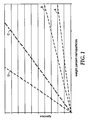
- FIG. 1 shows an idealized chart of viscosity versus weight percent of nanoparticles in various liquids, from which the relative compatibility of surface modified nanoparticles may be determined.
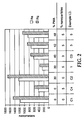
- FIG. 2 is a plot of Ra and Rq values for Comparative Examples C1-C4 and Examples 1, 3, and 5.
- FIG. 3 is a plot of Ra and Rq values for Comparative Examples C1-C3 and C5, and Examples 7, 11, and 13.
- FIG. 4 is a plot of Ra and Rq values for Comparative Example C2 and Examples 8-12.
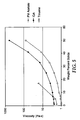
- FIG. 5 is a plot of solution viscosity versus weight percent of nanoparticles for toluene, isooctyl acrylate (IOA), and 1-methoxy-2-propanol acetate (PM acetate).
- IOA isooctyl acrylate
- PM acetate 1-methoxy-2-propanol acetate
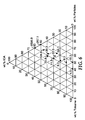
- FIG. 6 is a ternary plot of solution viscosity versus weight percent of nanoparticles, toluene, and IOA.
- the present inventors have discovered that the addition of surface-modified nanoparticles to a coating solution can inhibit defect formation without adversely impacting the coating and drying processes.
- the nanoparticles may be organic nanoparticles, inorganic nanoparticles, or a combination thereof.
- the coating solutions of the present invention comprise at least two liquid materials, and, after the coating solution has been applied to a substrate, at least one of the liquid materials is substantially removed by, for example, evaporation.
- the liquid materials disperse the nanoparticles and aid in handling and applying (for example, coating) the solution.
- more than one of the liquid materials is removed, for example, evaporated, after the coating solution has been applied to a substrate.
- at least one liquid material is solidified (for example, cured and/or crosslinked) after the coating solution has been applied to a substrate.
- Liquid materials that are removed after coating generally have a vapor pressure at the drying conditions (for example, temperature, pressure, and vapor phase composition) sufficient to evaporate the liquid.
- a vapor pressure at the drying conditions for example, temperature, pressure, and vapor phase composition
- at least about 80 percent by weight of the liquid is removed during drying.
- substantially all of the liquid is removed during drying, that is, at least about 98 percent by weight (for example, at least about 99%) of the liquid is removed.
- a liquid having a higher vapor pressure at the drying conditions will be removed preferentially relative to a liquid having a lower vapor pressure. In some embodiments, more than one liquid will be removed simultaneously; however, the liquid with the higher vapor pressure will be removed at a higher rate relative to the liquid with the lower vapor pressure. In some embodiments, some portion of a second liquid will remain present in the coating solution after substantially all of a first liquid has been removed.
- the slowest evaporating (that is, lowest vapor pressure) liquid is called the "tail solvent.” Generally, at least a portion of the tail solvent remains in the coating solution after substantially all of the other liquids that will be removed have been removed.
- Suitable removable liquids include, for example, organic solvents, inorganic solvents, and combinations thereof.
- Suitable organic solvents include, for example, aliphatic, alicyclic, and aromatic solvents, including, for example, hydrocarbons (for example, toluene), alcohols, ketones, aldehydes, amines, amides, esters, glycols, ethers, halocarbons, alkyl and aryl nitro compounds, partially or fully fluorinated compounds, and combinations thereof.
- Suitable inorganic solvents include, for example, water, carbon dioxide, carbon disulfide, and combinations thereof.
- Liquids solidified after coating include, for example, monomers, oligomers, polymers, or combination thereof. In some embodiments, these liquids may be cured with, for example, heat, actinic radiation, electron beam, moisture, or combinations thereof. In some embodiments, these liquids may be crosslinkable. In some embodiments, the solidified liquid may be a paint, for example, a lacquer.
- suitable organic nanoparticles include buckminsterfullerenes (fullerenes), dendrimers, organic polymeric nanospheres, aminoacids, and linear or branched or hyperbranched "star” polymers such as 4, 6, or 8 armed polyethylene oxide (available, for example, from Aldrich Chemical Company, Milwaukee, Wisconsin; or Shearwater Corporation, Huntsville, Alabama) with a variety of end groups, and combinations thereof. Further examples of suitable organic nanoparticles include those described in U.S. Application No. 10/449,677 (filed on May 30, 2003 ). Examples of suitable organic nanoparticles also include combined materials such as a mixture of materials or layers of materials surrounding a central organic core.
- fullerenes include C 60 , C 70 , C 82 , and C 84 .
- dendrimers include polyamidoamine (PAMAM) dendrimers of Generations 2 through 10 (G2-G10), available from, for example, Aldrich Chemical Company, Milwaukee, Wisconsin.
- useful organic polymeric nanospheres include nanospheres that comprise polystyrene, available from Bangs Laboratories, Inc., Fishers, Indiana, as powders or dispersions. Average particle sizes of the polystyrene nanospheres range from at least 20 nanometers (nm) to not more than 60 nm. Current commercially available average particle sizes include 20, 30, 50, and 60 nm.
- suitable inorganic nanoparticles include, but are not limited to, calcium phosphate (for example, hydroxy-apatite), clays, metal oxides, silica, zirconia, titania, ceria, alumina, iron oxide, vanadia, antimony oxide, tin oxide, alumina/silica, and any combinations thereof. Further examples of suitable inorganic nanoparticles include those described in U.S. Application No. 10/449,359 (filed on May 30, 2003 ). Examples of suitable inorganic nanoparticles also include combined materials such as a mixture of materials or layers of materials surrounding a central inorganic core.
- the nanoparticles may be in the form of a colloidal dispersion.
- useful commercially available unmodified silica starting materials include nano-sized colloidal silicas available under the product designations NALCO 1040, 1050, 1060, 2326, 2327, and 2329 colloidal silica from Nalco Chemical Co., Naperville, Illinois.
- Useful metal oxide colloidal dispersions include colloidal zirconium oxide, suitable examples of which are described in U.S. Patent No. 5,037,579 ; and colloidal titanium oxide, useful examples of which are described in PCT Publication No. WO 00/06495 , entitled, “Nanosize Metal Oxide Particles for Producing Transparent Metal Oxide Colloids and Ceramers,” (Amey et al.), filed July 30, 1998.
- the surface-modified nanoparticles are desirably individual, unassociated (that is, non-aggregated) nanoparticles dispersed throughout the solution. Desirably, the surface-modified nanoparticles do not irreversibly associate with each other prior to the application of the solution to a substrate and the initiation of the removal of any liquids present in the solution.
- the terms "associate with” and “associating with” include, for example, covalent bonding, hydrogen bonding, electrostatic attraction, London forces, and hydrophobic interactions.
- the surface-modified nanoparticles are selected such that the solution formed therewith is free from a degree of particle agglomeration or aggregation that would interfere with the desired properties of the solution.
- the surface-modified nanoparticles have surface groups that modify the "solubility" or “wettability” characteristics of the nanoparticles.
- the surface groups are selected to render the particles more compatible with one or more of the liquid materials in the solution. In some embodiments, the surface groups are selected to render the particles less compatible with one or more of the liquid materials in the solution.
- One method of assessing the compatibility of surface-modified nanoparticles with liquid materials is to measure the viscosity of a mixture of the liquid with increasing amounts (percent by weight) of nanoparticles.
- a chart can be prepared comparing the viscosity increase with an increase in the weight percent of nanoparticles for various liquids.
- a liquid having a lower rate of viscosity build is more compatible with the nanoparticles than a liquid having a higher rate of viscosity build.
- nanoparticles are not compatible with, or have very low compatibility with a particular liquid, they will not be sufficiently wet by that liquid and they will aggregate and separate out of the liquid. In such cases, meaningful viscosity build data generally cannot be obtained.
- hydrophobically surface-modified nanoparticles are expected to have very low, or no compatibility with polar solvents (for example, water and/or alcohols). The compatibility of the nanoparticles with such liquids would be ranked lower than the compatibility with the liquid showing the highest rate of viscosity build.
- FIG. 1 An idealized chart showing the relative viscosity build for various hypothetical liquids (A, B, C, and D) with increasing amounts of a surface-modified nanoparticle is shown in FIG. 1 .
- the lower the viscosity build (that is, the lower the slope), the greater the compatibility of the nanoparticles with the liquid.
- the nanoparticles are most compatible with liquid A, and least compatible with liquid D.
- Viscosity build data for surface-modified nanoparticles in toluene, isooctyl acrylate, and PM acetate are shown in FIG. 5 .
- Desirable nanoparticles are selected such that they do not settle out of the solution, that is, the nanoparticles remain suspended for a useful period of time.
- a useful period of time may be minutes, hours, days, weeks, or years, depending upon the application.
- the organic or inorganic unmodified nanoparticles are chosen to be insoluble in the liquid materials; thus, the nanoparticles will disperse but not dissolve.
- the surface modification of the nanoparticles will allow them to be compatible with the liquid materials so that they can completely disperse.
- Suitable surface groups can be selected based upon the solubility parameters of the surface group and one or more of the liquids in the coating solution.
- the surface group, or the agent from which the surface group is derived has a solubility parameter similar to the solubility parameter of at least one liquid material.
- the liquid is hydrophobic (for example, toluene, ketones, and acrylates, for example, isooctyl acrylate (IOA), 2-ethylhexyl acrylate, and 1,6-hexanediol diacrylate (HDDA))
- IOA isooctyl acrylate
- 2-ethylhexyl acrylate 2-ethylhexyl acrylate
- HDDA 1,6-hexanediol diacrylate
- the liquid material is hydrophilic (for example, water, alcohols, for example, methanol and ethanol, and combinations thereof), one skilled in the art can select from hydrophilic surface groups, and, when the liquid material is a hydrofluorocarbon, one skilled in the art can select from among various compatible surface groups.
- the nanoparticle can also include at least two different surface groups that combine to provide a nanoparticle having a solubility parameter that is similar to the solubility parameter of a liquid.
- the surface groups may be selected to provide a statistically averaged, randomly surface-modified particle.
- the surface-modified nanoparticles are not amphiphilic.
- the surface groups are present on the surface of the particle in an amount sufficient to provide surface-modified nanoparticles that are capable of being subsequently dispersed in the liquid material(s) of the coating solution without aggregation. In some embodiments, the surface groups are present in an amount sufficient to form a monolayer, preferably a continuous monolayer, on the surface of the nanoparticle. In some embodiments, the surface groups are present in an amount less than that required to form a monolayer.
- Surface-modifying groups may be derived from surface-modifying agents.
- Surface-modifying agents contain group(s) capable of attaching to the surface of the nanoparticle, and compatibilizing group(s) that may be reactive or non-reactive with a liquid material of the coating solution.
- the compatibilizing groups can be selected to render the particle relatively more polar, relatively less polar, or relatively non-polar.
- Suitable classes of surface-modifying agents include, for example, silanes, organic acids organic bases, alcohols, and combinations thereof.
- Particularly useful surface-modifying agents include silanes.
- useful silanes include organosilanes including, for example, alkylchlorosilanes, alkoxysilanes, for example, methyltrimethoxysilane, methyltriethoxysilane, ethyltrimethoxysilane, ethyltriethoxysilane, n-propyltrimethoxysilane, n-propyltriethoxysilane, i-propyltrimethoxysilane, i-propyltriethoxysilane, butyltrimethoxysilane, butyltriethoxysilane, hexyltrimethoxysi lane, octyltrimethoxysilane, 3-mercaptopropyltrimethoxysilane, n-octyltriethoxysilane, phenyltriethoxysilane, polytriethoxysi
- Useful organic acid surface-modifying agents include, for example, oxyacids of carbon (for example, carboxylic acid), sulfur, and phosphorus, and combinations thereof.
- polar surface-modifying agents having carboxylic acid functionality include CH 3 O(CH 2 CH 2 O) 2 CH 2 COOH (hereafter MEEAA) and 2-(2-methoxyethoxy)acetic acid having the chemical structure CH 3 OCH 2 CH 2 OCH 2 COOH (hereafter MEAA), acid functionalized polyethylene glycols such as mono(polyethylene glycol) succinate in either acid or salt forms, and polyethylene glycols mono substituted with acetic, propionic, or butanoic acids.
- MEEAA CH 3 O(CH 2 CH 2 O) 2 CH 2 COOH
- MEAA 2-(2-methoxyethoxy)acetic acid having the chemical structure CH 3 OCH 2 CH 2 OCH 2 COOH
- acid functionalized polyethylene glycols such as mono(polyethylene glycol) succinate in either acid or salt forms
- polyethylene glycols mono substituted with acetic, propionic, or butanoic acids Such polymers or their derivatives may be prepared for example, as described in U.S. Patent No
- non-polar surface-modifying agents having carboxylic acid functionality include octanoic acid, dodecanoic acid, and oleic acid.
- Suitable phosphorus containing acids include phosphonic acids including, for example, octylphosphonic acid, laurylphosphonic acid, decylphosphonic acid, dodecylphosphonic acid, octadecylphosphonic acid, monopolyethylene glycol phosphonate in either acid or salt forms, and phosphate or phosphonic substituted polyethylene glycols.
- Useful organic base surface-modifying agents include, for example, alkylamines including, for example, octylamine, decylamine, dodecylamine, octadecylamine, and amine functionalized polyethylene glycols.
- Examples of other useful non-silane surface-modifying agents include acrylic acid, methacrylic acid, beta-carboxyethyl acrylate, mono-2-(methacryloyloxyethyl) succinate, and combinations thereof.
- a useful surface-modifying agent that imparts both polar character and reactivity to the nanoparticles is mono(methacryloyloxypolyethyleneglycol) succinate.
- suitable surface-modifying alcohols include, for example, aliphatic alcohols including, for example, octadecyl, dodecyl, lauryl, and furfuryl alcohol; alicyclic alcohols including, for example, cyclohexanol; and aromatic alcohols including, for example, phenol and benzyl alcohol, polyethylene glycols, monomethyl polyethylene glycols, and combinations thereof.
- useful surface-modifying groups can include an aromatic ring.
- Examples of surface-modifying groups particularly suitable for epoxy resin compositions are disclosed in U.S. Patent No. 5,648,407 .
- Useful surface-modifying groups for fullerenes and PAMAM dendrimers include, for example, straight or branched alkyl groups and may range from at least C 3 to not greater than C 30 and may be any size or range in between C 3 and C 30 .
- Useful surface-modified zirconia nanoparticles include a combination of oleic acid and acrylic acid adsorbed onto the surface of the particle.
- silica nanoparticles include silica nanoparticles surface-modified with silane surface-modifying agents including, for example, acryloyloxypropyl trimethoxysilane, 3-methacryloyloxypropyltrimethoxysilane, 3-mercaptopropyltrimethoxysilane, n-octyltrimethoxysilane, isooctyltrimethoxysilane, and combinations thereof.
- silane surface-modifying agents including, for example, acryloyloxypropyl trimethoxysilane, 3-methacryloyloxypropyltrimethoxysilane, 3-mercaptopropyltrimethoxysilane, n-octyltrimethoxysilane, isooctyltrimethoxysilane, and combinations thereof.
- Silica nanoparticles can be treated with a number of surface-modifying agents including, for example, alcohol, organosilane including, for example, alkyltrichlorosilanes, trialkoxyarylsilanes, trialkoxy(alkyl)silanes, and combinations thereof and organotitanates and mixtures thereof.
- surface-modifying agents including, for example, alcohol, organosilane including, for example, alkyltrichlorosilanes, trialkoxyarylsilanes, trialkoxy(alkyl)silanes, and combinations thereof and organotitanates and mixtures thereof.
- a variety of methods are available for modifying the surface of nanoparticles including, for example, adding a surface-modifying agent to nanoparticles (for example, in the form of a powder or a colloidal dispersion) and allowing the surface-modifying agent to react with the nanoparticles.
- a surface-modifying agent for example, in the form of a powder or a colloidal dispersion
- the reactive group/linker may be reacted with the nanoparticle followed by reaction with the compatibilizing group.
- the reactive group/linker may be reacted with the compatibilizing group followed by reaction with the nanoparticle.
- Other useful surface modification processes are described in, for example, U.S. Patent Nos. 2,801,185 and 4,522,958 .
- the nanoparticles whether surface-modified or not, have an average particle diameter less than 500 nm (for example, less than 400 nm, or less than 200 nm, or less than 100 nm); in other embodiments, the average diameter of the nanoparticles is no greater than 80, 50, 40, 30, 20, 15, 10, 5, or 1 nm. In some embodiments, the average diameter of the nanoparticles is from 1 nm to 80 nm (for example, 1 nm to 50 nm; or from 1 nm to 20 nm). If the nanoparticles are aggregated, the maximum cross-sectional dimension of the aggregated particle is subject to the above-defined limitations on the average diameter of an unaggregated nanoparticle.
- the dimensions of the nanoparticles referred to herein are the dimensions of the nanoparticles or agglomerates of nanoparticles in the bulk coating solution. After the coating solution has been applied to a surface (for example, by coating the solution onto a substrate), the nanoparticles may agglomerate, thus forming larger structures.
- the nanoparticles are employed in the solutions of the invention in an effective amount to minimize defect formation.
- the nanoparticles are present in an amount greater than 0.005 percent by weight (wt.%) (for example, greater than 0.05 wt.%, or greater than 0.1 wt.%, or greater than 0.2 wt.%) based on the dried weight of the coating.
- the amount of nanoparticles employed is generally selected to minimize the impact on the coating process.
- the nanoparticles are present in an amount less than 80 wt.% (for example, less than 60 wt.%, or less than 50 wt.%, or less than 25 wt.%, or less than 10 wt.%).
- the nanoparticles are present in any amount or range between 0.005 and 10 wt.% (for example, between 0.05 and 5 wt.%). In some embodiments, the nanoparticles are present in any amount or range between 30 and 80 wt.% (for example, between 40 and 75 wt.%).
- the effective amount required will depend upon the liquid materials present in the solution, the surface functionality and particle size of the nanoparticles, and the presence of other elements (for example, solid materials) in the coating solution.
- the coating solutions of the present invention are selected to achieve the desired relationship of relative compatibility and vapor pressure. If the coating solution comprises a first liquid that is removed and a second liquid that is solidified to aid in forming the film, then the surface-modified nanoparticles should be more compatible with the first liquid than with the second liquid.
- a coating solution may comprise a first liquid, a second liquid, and a solid material, wherein the first and second liquids are evaporated to leave a film formed by the solid material.
- the vapor pressure of the first liquid (VP1) is greater than the vapor pressure of the second liquid (VP2), then the compatibility of the nanoparticles with the first liquid should be greater than the compatibility of the nanoparticles with the second liquid.
- Vapor pressure data for a wide variety of liquids is readily available, for example, Handbook of Vapor Pressure, Yaws, Carl L., Gulf Publishing Company, Houston, Texas (1994 ); and Vapor Pressure of Organic Compounds, Jordan, T. Earl, Interscience Publishers, Inc., New York, New York (1954 ). Vapor pressure may also be determined using ASTM E 1194-01 " Standard Test Method for Vapor Pressure" (Vol. 11.05, ASTM Standards 2003, pages 450-456 ).
- Table 1 shows the relative compatibility and relative vapor pressures for the hypothetical liquids of FIG. 1 .
- a lower number indicates a liquid with greater compatibility with the nanoparticles.
- a lower number indicates a liquid with a higher vapor pressure.
- the surface-modified nanoparticles are most compatible with liquid A, and least compatible with liquid D.
- liquid D has the highest vapor pressure, while liquid C has the lowest vapor pressure.
- liquids A and B would be acceptable for the present invention, as liquid A has both a greater compatibility with the nanoparticles than liquid B, and a higher vapor pressure than liquid B.
- the combinations of liquids A and C, and liquids B and C could be used.
- the combination of liquids A and D would not be acceptable.
- A has a greater compatibility with the nanoparticles than liquid D
- the vapor pressure of liquid A is less than the vapor pressure of liquid D.
- the combinations of B with D and C with D would not be acceptable.
- the coating solutions of the present invention may also comprise materials that are solids at the coating conditions.
- These materials may include, for example, organic and inorganic fillers (for example, particles and fibers), clays, silicas, antioxidants, microspheres (for example, glass and polymeric microspheres), dyes, pigments, thermally and/or electrically conductive materials, antistatic agents, resins, polymers, and combinations thereof.
- Suitable polymeric materials include, for example, (meth)acrylates, poly(meth)acrylates, epoxies, polyesters, polyols, isocyanates, polystyrene, polyurethanes, and combinations thereof.
- the solution comprises other additives, including for example, curing agents, initiators, accelerators, crosslinking agents, surface active agents, and combinations thereof.
- the solution comprises surface active agents in concentrations less than their critical micelle concentrations in that solution.
- the coating solution comprises less than 1 wt.% (for example, less than 0.5 wt.%, or less than 0.1 wt.%) surface active agents.
- the coating solution is substantially free of surface active agents, containing, for example, less than 0.05 wt.% (for example, less than 0.005 wt.%, or less than 0.001 wt.%), or even no surface active agents.
- the solutions of the present invention may be used to form coated substrates.
- the solution may be prepared by, for example, mixing or blending the at least two liquids, the surface-modified nanoparticles, and any optional materials. Any known mixing and/or blending equipment or techniques, including for example, stirring, shaking, high-shear and low-shear mixing, may be used.
- the coating solution appears homogeneous after mixing.
- the solution may then be applied to the surface of a substrate using any coating method known in the art (for example, roll coating, curtain coating, bar coating, spraying, and the like.) At least one liquid is removed from the coated solution and a film is formed on the surface of the substrate. In some embodiments, the liquid is removed by evaporation. In some embodiments, one or more of the remaining coated materials may be cured by, for example, heat, actinic radiation (for example, infrared, visible, or ultraviolet light, and combinations thereof), electron beam, moisture, and combinations thereof.
- actinic radiation for example, infrared, visible, or ultraviolet light, and combinations thereof
- the substrate may be any substrate upon which a coating is desired, including, for example, glass, metal, ceramic, polymeric substrates (for example, polymeric films), paper, wood, fabric, and the like.
- the sample to be tested was sputtered with gold/palladium (Au/Pd) to enhance contrast. At least two areas of 2.0 millimeters (mm) by 2.5 mm were measured using a WYKO NT-3300 optical interferometer (obtained from Wyko, Arlington, Arizona). The resulting images were filtered to remove tilt. The following surface topography numbers were calculated from the data obtained:
- the sample to be tested was sputtered with gold/palladium (Au/Pd) to enhance contrast.
- Au/Pd gold/palladium
- Four areas of 2.4 mm by 1.9 mm were measured in VSI mode using a WYKO NT3000 optical interferometer (obtained from Wyko, Arlington, Arizona). The resulting images were filtered to remove tilt. The following surface topography numbers were calculated from the data obtained:
- NALCO 2326 Two hundred fifty grams (g) of NALCO 2326 were weighed into a 500-milliliter (mL) round-bottom, 3-neck flask, equipped with a mechanical stirrer and a reflux condenser. A solution of 15.36 g IOTMS and 281.25 g MOP was prepared separately in a beaker.
- the IOTMS/MOP solution was added to the flask containing NALCO 2326 via an open port while the NALCO 2326 sol was stirred.
- the beaker was then rinsed with an additional 34.4 g MOP, which was subsequently added to the stirred mixture.
- the open port in the flask was stoppered and the flask was placed in an oil bath.
- the oil bath was then heated to 80 °C and the reaction was allowed to proceed for about 16 hours.
- the resultant sol was dried in a flow-through oven at 150 °C to recover the surface modified nanoparticles (SILICA-A).
- N-(3-triethoxysilylpropyl) methoxyethoxyethyl carbamate was prepared as follows: 35 g DIGLYME and 77 g MEK were added to a 250 mL roundbottomed flask equipped with a magnetic stir bar and subjected to rotary evaporation to remove water. Then, 68.60 g 3-(triethoxysilyl)propylisocyanate were added to the flask, followed by approximately 3 milligrams DBTDL, and the mixture stirred. The reaction proceeded with a mild exotherm. The reaction was run for approximately 16 hours at which time IR Spectroscopy showed no isocyanate present. The remainder of the solvent was removed via rotary evaporation at 90 °C to yield 104.46 g PEG2TES as a somewhat viscous fluid.
- a solution of 20 percent by weight of PMMA in toluene was prepared in a beaker to provide STOCK PMMA SOLUTION.
- the modified particles SILICA-A or SILICA-B
- PM Acetate 1-methoxy-2-propanol acetate
- toluene were added in the amounts shown in the tables below.
- the PMMA concentration was maintained at 10 wt.% of the total weight of coatable solution.
- PM Acetate concentration listed in the tables is wt.% based on the total weight of solvent (that is, PM Acetate plus toluene).
- Modified particle concentration is wt.% based on the total dry weight of polymer (PMMA).
- Ra and Rq values for Comparative Examples C1-C4 and Examples 1, 3, and 5 are shown in FIG. 2 .
- Ra and Rq values for Comparative Examples C1-C3 and C5, and Examples 7, 11, and 13 are shown in FIG. 3 .
- Ra and Rq values for Comparative Example C2 and Examples 8-12 are shown in FIG. 4 .
- SILICA-C Two hundred grams of SILICA-C and 56.7 g HDDA were combined in a 1-liter round-bottom large neck flask. Solvent was removed via rotary evaporation. The resulting material was a high viscosity gel at room temperature.
- the SILICA-C/HDDA gel contained approximately 40 wt.% SILICA-C.
- SILICA-C/HDDA gel Five grams were added to a blend of 33.5 g HDDA and 61.5 g THF. To this mixture, 0.1 g DAROCUR 1173 was added. A Comparative Example without SILICA-C was also prepared. Each solution was coated onto a 2 inch (5.1 cm) wide by 3 inch (7.6 cm) long glass slide (available from Coming, Inc., Coming, New York) using a micropipette (Eppendorf) set to deliver 75 microliters of fluid. The coated slide was then dried at room temperature.
- Varying amounts of SILICA-A and a liquid (IOA, toluene, or PM acetate) were prepared by combining the components at room temperature to obtain a 20 g sample.
- the solution rheology of each sample was measured with a BOHLIN C-VOR Rheometer (obtained from Bohlin Instruments, Inc., East Brunswick, New Jersey) using a C25 Couette geometry. Controlled stress sweeps were completed in a shear stress range of 1x10 -3 to 1x10 +3 at 25 °C.
- the temperature was controlled using a PELTIER unit to within +/-0.2 °C.
- a Newtonian model was fit to the measured data and the viscosity recorded.
Landscapes
- Chemical & Material Sciences (AREA)
- Organic Chemistry (AREA)
- Dispersion Chemistry (AREA)
- Chemical Kinetics & Catalysis (AREA)
- Engineering & Computer Science (AREA)
- Life Sciences & Earth Sciences (AREA)
- Materials Engineering (AREA)
- Wood Science & Technology (AREA)
- Inorganic Chemistry (AREA)
- Paints Or Removers (AREA)
- Application Of Or Painting With Fluid Materials (AREA)
- Silicon Compounds (AREA)
- Physical Or Chemical Processes And Apparatus (AREA)
- Compounds Of Alkaline-Earth Elements, Aluminum Or Rare-Earth Metals (AREA)
Applications Claiming Priority (2)
| Application Number | Priority Date | Filing Date | Title |
|---|---|---|---|
| US10/722,177 US7189768B2 (en) | 2003-11-25 | 2003-11-25 | Solution containing surface-modified nanoparticles |
| PCT/US2004/033586 WO2005056698A1 (en) | 2003-11-25 | 2004-10-12 | Solution containing surface-modified nanoparticles |
Publications (2)
| Publication Number | Publication Date |
|---|---|
| EP1697469A1 EP1697469A1 (en) | 2006-09-06 |
| EP1697469B1 true EP1697469B1 (en) | 2008-03-19 |
Family
ID=34591973
Family Applications (1)
| Application Number | Title | Priority Date | Filing Date |
|---|---|---|---|
| EP04809933A Expired - Lifetime EP1697469B1 (en) | 2003-11-25 | 2004-10-12 | Solution containing surface-modified nanoparticles |
Country Status (8)
| Country | Link |
|---|---|
| US (1) | US7189768B2 (enExample) |
| EP (1) | EP1697469B1 (enExample) |
| JP (1) | JP4805840B2 (enExample) |
| KR (1) | KR101129780B1 (enExample) |
| CN (1) | CN1886469B (enExample) |
| AT (1) | ATE389698T1 (enExample) |
| DE (1) | DE602004012606T2 (enExample) |
| WO (1) | WO2005056698A1 (enExample) |
Families Citing this family (70)
| Publication number | Priority date | Publication date | Assignee | Title |
|---|---|---|---|---|
| DE10326538A1 (de) * | 2003-06-12 | 2005-01-05 | Institut für Neue Materialien Gemeinnützige GmbH | Abriebfeste optische Schichten und Formkörper |
| DE102004004147A1 (de) * | 2004-01-28 | 2005-08-18 | Degussa Ag | Oberflächenmodifizierte, mit Siliziumdioxid umhüllte Metalloid/Metalloxide |
| US7405246B2 (en) | 2005-04-05 | 2008-07-29 | Momentive Performance Materials Inc. | Cure system, adhesive system, electronic device |
| US7446136B2 (en) | 2005-04-05 | 2008-11-04 | Momentive Performance Materials Inc. | Method for producing cure system, adhesive system, and electronic device |
| WO2007103310A2 (en) * | 2006-03-07 | 2007-09-13 | Qd Vision, Inc. | An article including semiconductor nanocrystals |
| US8718437B2 (en) * | 2006-03-07 | 2014-05-06 | Qd Vision, Inc. | Compositions, optical component, system including an optical component, devices, and other products |
| US8849087B2 (en) * | 2006-03-07 | 2014-09-30 | Qd Vision, Inc. | Compositions, optical component, system including an optical component, devices, and other products |
| US9874674B2 (en) | 2006-03-07 | 2018-01-23 | Samsung Electronics Co., Ltd. | Compositions, optical component, system including an optical component, devices, and other products |
| US20100119697A1 (en) * | 2006-05-10 | 2010-05-13 | 3M Innovative Properties Company | Compositions and coatings containing fluorescent, inorganic nanoparticles |
| US7981949B2 (en) * | 2006-05-23 | 2011-07-19 | 3M Innovative Properties Company | Curable hydrophilic compositions |
| US9051473B2 (en) * | 2006-06-14 | 2015-06-09 | Axalta Coating Systems Ip Co., Llc | Clear coating compositions comprising dispersed silica nono-particles and processes for using |
| EP2027224A2 (en) * | 2006-06-14 | 2009-02-25 | E.I. Du Pont De Nemours And Company | Coated substrate having enhanced scratch and mar resistance |
| US8030376B2 (en) * | 2006-07-12 | 2011-10-04 | Minusnine Technologies, Inc. | Processes for dispersing substances and preparing composite materials |
| EP2074201A4 (en) * | 2006-09-05 | 2011-09-14 | Cerion Technology Inc | METHOD FOR CONDITIONING A COMBUSTION ENGINE |
| US10435639B2 (en) | 2006-09-05 | 2019-10-08 | Cerion, Llc | Fuel additive containing lattice engineered cerium dioxide nanoparticles |
| US8883865B2 (en) | 2006-09-05 | 2014-11-11 | Cerion Technology, Inc. | Cerium-containing nanoparticles |
| US7632425B1 (en) * | 2006-10-06 | 2009-12-15 | General Electric Company | Composition and associated method |
| US8946200B2 (en) * | 2006-11-02 | 2015-02-03 | Southwest Research Institute | Pharmaceutically active nanosuspensions |
| US8836212B2 (en) * | 2007-01-11 | 2014-09-16 | Qd Vision, Inc. | Light emissive printed article printed with quantum dot ink |
| US20080287586A1 (en) * | 2007-03-22 | 2008-11-20 | Jones Jamie N | Functionalized nanoparticles and their use in particle/bulk material systems |
| US7758961B2 (en) * | 2007-03-22 | 2010-07-20 | Milliken & Company | Functionalized nanoparticles and their use in particle/bulk material systems |
| CN101663581A (zh) * | 2007-04-19 | 2010-03-03 | 3M创新有限公司 | 水分散性二氧化硅纳米颗粒在连接生物分子方面的用途 |
| EP2140264A1 (en) * | 2007-04-19 | 2010-01-06 | 3M Innovative Properties Company | Methods of use of solid support material for binding biomolecules |
| GB0714436D0 (en) * | 2007-07-24 | 2007-09-05 | Imp Innovations Ltd | Particle stabilised hiogh internal phase emulsions |
| KR100942506B1 (ko) * | 2007-12-11 | 2010-02-12 | 한국식품연구원 | 광학적 특성을 이용한 분석용 센서를 위한 기판 제조 방법및 그 기판 |
| KR100926220B1 (ko) * | 2007-12-12 | 2009-11-09 | 제일모직주식회사 | 하드코팅액 조성물 및 이를 이용한 반사방지필름 |
| FR2927005B1 (fr) * | 2008-02-05 | 2011-12-23 | Commissariat Energie Atomique | Materiau hybride organique-inorganique, couche mince optique de ce materiau, materiau optique les comprenant, et leur procede de fabrication |
| US8404850B2 (en) * | 2008-03-13 | 2013-03-26 | Southwest Research Institute | Bis-quaternary pyridinium-aldoxime salts and treatment of exposure to cholinesterase inhibitors |
| EP2297762B1 (en) | 2008-05-06 | 2017-03-15 | Samsung Electronics Co., Ltd. | Solid state lighting devices including quantum confined semiconductor nanoparticles |
| WO2009137053A1 (en) | 2008-05-06 | 2009-11-12 | Qd Vision, Inc. | Optical components, systems including an optical component, and devices |
| US9207385B2 (en) | 2008-05-06 | 2015-12-08 | Qd Vision, Inc. | Lighting systems and devices including same |
| EP2296628B1 (en) * | 2008-05-22 | 2014-05-14 | 3M Innovative Properties Company | Process for manufacturing flowable powder drug compositions |
| WO2009158300A1 (en) * | 2008-06-26 | 2009-12-30 | 3M Innovative Properties Company | Dry powder pharmaceutical compositions for pulmonary administration, and methods of manufacturing thereof |
| US9861580B2 (en) * | 2008-07-02 | 2018-01-09 | 3M Innovative Properties Company | Method of making a dry powder pharmaceutical composition |
| US8722706B2 (en) * | 2008-08-15 | 2014-05-13 | Southwest Research Institute | Two phase bioactive formulations of bis-quaternary pyridinium oxime sulfonate salts |
| US8309134B2 (en) * | 2008-10-03 | 2012-11-13 | Southwest Research Institute | Modified calcium phosphate nanoparticle formation |
| DE102009035797A1 (de) | 2009-07-31 | 2011-02-03 | Leibniz-Institut Für Neue Materialien Gemeinnützige Gmbh | Verfahren zur Herstellung von Beschichtungen mit Antireflexionseigenschaften |
| WO2011025228A2 (ko) * | 2009-08-26 | 2011-03-03 | 주식회사 엘지화학 | 전도성 금속 잉크 조성물 및 전도성 패턴의 형성 방법 |
| JP5388150B2 (ja) | 2009-08-26 | 2014-01-15 | エルジー・ケム・リミテッド | 導電性金属インク組成物および導電性パターンの形成方法 |
| US8961835B2 (en) | 2009-08-26 | 2015-02-24 | Lg Chem, Ltd. | Conductive metal ink composition and method for forming a conductive pattern |
| WO2011025229A2 (ko) * | 2009-08-28 | 2011-03-03 | 주식회사 엘지화학 | 전도성 금속 잉크 조성물 및 전도성 패턴의 형성 방법 |
| KR101221780B1 (ko) | 2009-08-28 | 2013-01-11 | 주식회사 엘지화학 | 전도성 금속 잉크 조성물 및 전도성 패턴의 형성 방법 |
| US9153354B2 (en) * | 2009-11-20 | 2015-10-06 | 3M Innovative Properties Company | Compositions comprising conductive particles with surface-modified nanoparticles covalently attached thereto, and methods of making |
| US8894466B2 (en) * | 2009-12-03 | 2014-11-25 | 3M Innovative Properties Company | Method of electrostatic deposition of particles, abrasive grain and articles |
| US9028873B2 (en) * | 2010-02-08 | 2015-05-12 | Southwest Research Institute | Nanoparticles for drug delivery to the central nervous system |
| KR101356810B1 (ko) | 2010-05-10 | 2014-01-28 | 주식회사 엘지화학 | 전도성 금속 잉크 조성물 및 전도성 패턴의 형성 방법 |
| JP5788003B2 (ja) | 2010-08-27 | 2015-09-30 | エルジー・ケム・リミテッド | 導電性金属インク組成物および導電性パターンの形成方法 |
| JP6016797B2 (ja) * | 2010-10-04 | 2016-10-26 | スリーエム イノベイティブ プロパティズ カンパニー | 疎水性ナノ粒子の添加による粒子の溶解速度の変更方法 |
| US9062245B2 (en) | 2011-02-09 | 2015-06-23 | Technion Research & Development Foundation Limited | Liquid-retaining elastomeric compositions |
| CN103608726B (zh) | 2011-06-08 | 2016-11-09 | 3M创新有限公司 | 包含聚合物系留的纳米颗粒的光致抗蚀剂 |
| BR112014029833B1 (pt) | 2012-05-29 | 2019-10-01 | 3M Innovative Properties Company | Artigo absorvente que compreende espuma polimérica e intermediários |
| EP2674450A1 (en) | 2012-06-11 | 2013-12-18 | 3M Innovative Properties Company | Nanosilica coating for retarding dew formation |
| KR101331930B1 (ko) * | 2012-11-07 | 2013-11-21 | 이에이바이오스 주식회사 | 기능성 도료 |
| WO2015058037A1 (en) | 2013-10-17 | 2015-04-23 | Cerion, Llc | Malic acid stabilized nanoceria particles |
| MX385134B (es) | 2014-01-29 | 2025-03-14 | 3M Innovative Properties Company | Composición acuosa para recubrimiento de superficies y partículas modificadas. |
| TWI610812B (zh) * | 2015-07-21 | 2018-01-11 | 電子元件表面保護材料及其製備方法 | |
| WO2017062294A1 (en) | 2015-10-05 | 2017-04-13 | 3M Innovative Properties Company | Absorbent article comprising flexible polymeric foam and intermediates |
| CN108884362A (zh) * | 2016-03-28 | 2018-11-23 | 株式会社Uacj | 涂料、网点印刷用印刷部件以及ptp包装体 |
| IL245656B (en) | 2016-05-16 | 2018-02-28 | Technion Res & Dev Foundation | Polymer structures with high absorption capacity |
| WO2018002916A1 (en) | 2016-06-26 | 2018-01-04 | Technion Research & Development Foundation Limited | Hhh |
| KR101879055B1 (ko) * | 2016-06-29 | 2018-07-18 | 한양대학교 에리카산학협력단 | 나노 구조체 네트워크 및 그 제조 방법 |
| WO2018004092A1 (ko) * | 2016-06-29 | 2018-01-04 | 한양대학교에리카산학협력단 | 나노 구조체 네트워크 및 그 제조 방법 |
| WO2018023033A1 (en) | 2016-07-29 | 2018-02-01 | Western Michigan University Research Foundation | Magnetic nanoparticle-based gyroscopic sensor |
| IL247302B (en) | 2016-08-16 | 2019-03-31 | Technion Res & Dev Foundation | Systems for releasing materials based on polymer emulsions |
| WO2019016816A1 (en) | 2017-07-19 | 2019-01-24 | Technion Research & Development Foundation Limited | HYDROGELS WITH EMULSION MATRIX DOUBLELY RETICULATED BY REVERSIBLE METAL COORDINATION |
| CN107254248A (zh) * | 2017-07-20 | 2017-10-17 | 江南大学 | 多功能高强复合织物涂层剂、涂层及其制备方法与应用 |
| IL255404B (en) | 2017-11-02 | 2018-10-31 | Technion Res & Dev Foundation | A zwitterionic hydrogel in the configuration of an internal multiphase emulsion |
| KR102731347B1 (ko) | 2017-12-08 | 2024-11-15 | 쓰리엠 이노베이티브 프로퍼티즈 컴파니 | 가요성 하드코트 |
| CN108806830A (zh) * | 2018-07-24 | 2018-11-13 | 原晋波 | 一种高性能太阳能电池用导电浆料及其制备方法 |
| CN113354960A (zh) * | 2021-05-24 | 2021-09-07 | 广东海浦倍尔新材料有限公司 | 一种改性无机纳米粒子及其制备方法 |
Family Cites Families (36)
| Publication number | Priority date | Publication date | Assignee | Title |
|---|---|---|---|---|
| US2801185A (en) * | 1952-05-16 | 1957-07-30 | Du Pont | Silica hydrosol powder |
| US4478876A (en) * | 1980-12-18 | 1984-10-23 | General Electric Company | Process of coating a substrate with an abrasion resistant ultraviolet curable composition |
| US4455205A (en) * | 1981-06-01 | 1984-06-19 | General Electric Company | UV Curable polysiloxane from colloidal silica, methacryloyl silane, diacrylate, resorcinol monobenzoate and photoinitiator |
| US4491508A (en) * | 1981-06-01 | 1985-01-01 | General Electric Company | Method of preparing curable coating composition from alcohol, colloidal silica, silylacrylate and multiacrylate monomer |
| US4486504A (en) * | 1982-03-19 | 1984-12-04 | General Electric Company | Solventless, ultraviolet radiation-curable silicone coating compositions |
| US4522958A (en) * | 1983-09-06 | 1985-06-11 | Ppg Industries, Inc. | High-solids coating composition for improved rheology control containing chemically modified inorganic microparticles |
| JPS61268763A (ja) * | 1984-11-26 | 1986-11-28 | Shiseido Co Ltd | 処理粉体の製造方法 |
| JPH028285A (ja) * | 1988-06-28 | 1990-01-11 | Kansai Paint Co Ltd | 撥水性被膜を形成しうる組成物 |
| JPH028284A (ja) * | 1988-06-28 | 1990-01-11 | Kansai Paint Co Ltd | 撥水被膜形成可能な組成物 |
| US5037579A (en) * | 1990-02-12 | 1991-08-06 | Nalco Chemical Company | Hydrothermal process for producing zirconia sol |
| US5258225A (en) * | 1990-02-16 | 1993-11-02 | General Electric Company | Acrylic coated thermoplastic substrate |
| JP2509378B2 (ja) * | 1990-08-27 | 1996-06-19 | 出光興産株式会社 | 表面処理剤 |
| JPH04266976A (ja) | 1990-10-31 | 1992-09-22 | Dow Corning Corp | 耐摩耗性熱硬化性エポキシコーティング組成物 |
| JP2687060B2 (ja) * | 1991-12-18 | 1997-12-08 | トヨタ自動車株式会社 | 高耐久撥水皮膜の形成溶液 |
| US5433973A (en) * | 1994-05-26 | 1995-07-18 | Minnesota Mining And Manufacturing Company | Method of coating a magnetic recording media coating onto a substrate |
| JPH08134437A (ja) * | 1994-11-15 | 1996-05-28 | Sekisui Chem Co Ltd | 撥水性被膜 |
| JPH08295846A (ja) * | 1995-03-01 | 1996-11-12 | Seiko Epson Corp | コーティング用組成物および積層体 |
| US5688867A (en) * | 1995-05-01 | 1997-11-18 | Ferro Corporation | Low VOC unsaturated polyester systems and uses thereof |
| US5648407A (en) * | 1995-05-16 | 1997-07-15 | Minnesota Mining And Manufacturing Company | Curable resin sols and fiber-reinforced composites derived therefrom |
| US5672662A (en) * | 1995-07-07 | 1997-09-30 | Shearwater Polymers, Inc. | Poly(ethylene glycol) and related polymers monosubstituted with propionic or butanoic acids and functional derivatives thereof for biotechnical applications |
| US5695820A (en) * | 1996-06-20 | 1997-12-09 | Hewlett-Packard Company | Method for alleviating marangoni flow-induced print defects in ink-jet printing |
| DE19725984C2 (de) | 1997-06-19 | 1999-09-30 | Kaldewei Franz Gmbh & Co | Verfahren und Vorrichtung zur Herstellung von Acryloberflächen mit erhöhter Abrieb- und Kratzfestigkeit |
| DE69827166T2 (de) | 1998-07-30 | 2006-02-23 | Minnesota Mining & Manufacturing Company, St. Paul | Metalloxid teilchen im nano-bereich für die herstellung von metalloxidkolloiden und ceramers |
| US6268464B1 (en) * | 1998-10-19 | 2001-07-31 | Neste Chemicals Oy | Unsaturated polyester resins |
| AU5215800A (en) * | 1999-06-02 | 2000-12-28 | E.I. Du Pont De Nemours And Company | Binding agents modified by nanoparticles for coating agents and use of the same |
| US6572693B1 (en) * | 1999-10-28 | 2003-06-03 | 3M Innovative Properties Company | Aesthetic dental materials |
| WO2001030307A1 (en) * | 1999-10-28 | 2001-05-03 | 3M Innovative Properties Company | Dental materials with nano-sized silica particles |
| DE69923359T2 (de) | 1999-10-28 | 2005-12-22 | 3M Innovative Properties Co., Saint Paul | Zusammensetzungen und daraus hergestellte gegenstände |
| FI108043B (fi) | 2000-03-31 | 2001-11-15 | Ashland Inc | Tyydyttymättömät polyesterigeelipinnoitteet, joilla on kasvittumista estäviä ominaisuuksia |
| US20030162874A1 (en) * | 2000-07-05 | 2003-08-28 | Keith Redford | Organic based varnish or gelcoat, methods for its manufacture and use, and substrate comprising such varnish or gelcoat |
| US6586483B2 (en) * | 2001-01-08 | 2003-07-01 | 3M Innovative Properties Company | Foam including surface-modified nanoparticles |
| US6467897B1 (en) * | 2001-01-08 | 2002-10-22 | 3M Innovative Properties Company | Energy curable inks and other compositions incorporating surface modified, nanometer-sized particles |
| US7369122B2 (en) * | 2001-12-14 | 2008-05-06 | 3M Innovative Properties Company | Touch panel spacer dots and methods of making |
| US6700708B2 (en) * | 2002-05-30 | 2004-03-02 | Agere Systems, Inc. | Micro-lens array and method of making micro-lens array |
| DK1479734T3 (da) | 2003-05-20 | 2009-05-11 | Dsm Ip Assets Bv | Nanostruktureret overflade-coatingsproces, nanostrukturerede coatinger og artikler omfattende coatingen |
| US7074463B2 (en) * | 2003-09-12 | 2006-07-11 | 3M Innovative Properties Company | Durable optical element |
-
2003
- 2003-11-25 US US10/722,177 patent/US7189768B2/en not_active Expired - Lifetime
-
2004
- 2004-10-12 WO PCT/US2004/033586 patent/WO2005056698A1/en not_active Ceased
- 2004-10-12 DE DE200460012606 patent/DE602004012606T2/de not_active Expired - Lifetime
- 2004-10-12 KR KR1020067010135A patent/KR101129780B1/ko not_active Expired - Fee Related
- 2004-10-12 AT AT04809933T patent/ATE389698T1/de not_active IP Right Cessation
- 2004-10-12 EP EP04809933A patent/EP1697469B1/en not_active Expired - Lifetime
- 2004-10-12 JP JP2006541155A patent/JP4805840B2/ja not_active Expired - Fee Related
- 2004-10-12 CN CN2004800348758A patent/CN1886469B/zh not_active Expired - Fee Related
Also Published As
| Publication number | Publication date |
|---|---|
| DE602004012606D1 (de) | 2008-04-30 |
| DE602004012606T2 (de) | 2009-04-30 |
| US7189768B2 (en) | 2007-03-13 |
| EP1697469A1 (en) | 2006-09-06 |
| WO2005056698A1 (en) | 2005-06-23 |
| US20050113489A1 (en) | 2005-05-26 |
| JP2007512412A (ja) | 2007-05-17 |
| CN1886469A (zh) | 2006-12-27 |
| KR101129780B1 (ko) | 2012-03-26 |
| ATE389698T1 (de) | 2008-04-15 |
| JP4805840B2 (ja) | 2011-11-02 |
| KR20060130568A (ko) | 2006-12-19 |
| CN1886469B (zh) | 2011-07-13 |
Similar Documents
| Publication | Publication Date | Title |
|---|---|---|
| EP1697469B1 (en) | Solution containing surface-modified nanoparticles | |
| EP2024453B1 (en) | Compositions and coatings containing fluorescent, inorganic nanoparticles | |
| US9296656B2 (en) | UV protective coatings | |
| Mirabedini et al. | Weathering performance of the polyurethane nanocomposite coatings containing silane treated TiO2 nanoparticles | |
| US7129277B2 (en) | Emulsions including surface-modified inorganic nanoparticles | |
| BRPI0610259B1 (pt) | partículas revestidas, método para a preparação das mesmas, dispersão coloidal de partículas revestidas, uso de partículas revestidas ou de dispersão coloidal, composição de revestimento, e, processo para a fabricação da mesma | |
| CN103649237B (zh) | 用于改善色漆中遮盖效率的方法 | |
| PT1204709E (pt) | Composições de revestimento que têm resistência ao arranhão melhorada, substratos revestidos e métodos relacionados com eles | |
| KR20220025172A (ko) | 수성 코팅 | |
| WO2008064114A1 (en) | Particulate filled polymers | |
| CN1889928A (zh) | 金属氧化物分散体 | |
| Colombo et al. | Highly transparent nanocomposite films from water-based poly (2-ethyl-2-oxazoline)/TiO 2 dispersions | |
| Zhang et al. | Environmentally benign paints for superhydrophobic coatings | |
| US20100029807A1 (en) | Method for producing dispersions | |
| US20230079912A1 (en) | Aqueous surface treating composition | |
| CA2718217A1 (en) | Binder for air-drying paint comprising nanoparticle bonded silicon derivative of unsaturated fatty acid | |
| US20100116172A1 (en) | Method for making a dispersion | |
| EP4103531A1 (en) | Natural stone sealer compositions | |
| Arzt | Jahresbericht= Annual report 2009 |
Legal Events
| Date | Code | Title | Description |
|---|---|---|---|
| PUAI | Public reference made under article 153(3) epc to a published international application that has entered the european phase |
Free format text: ORIGINAL CODE: 0009012 |
|
| 17P | Request for examination filed |
Effective date: 20060531 |
|
| AK | Designated contracting states |
Kind code of ref document: A1 Designated state(s): AT BE BG CH CY CZ DE DK EE ES FI FR GB GR HU IE IT LI LU MC NL PL PT RO SE SI SK TR |
|
| 17Q | First examination report despatched |
Effective date: 20061114 |
|
| DAX | Request for extension of the european patent (deleted) | ||
| GRAP | Despatch of communication of intention to grant a patent |
Free format text: ORIGINAL CODE: EPIDOSNIGR1 |
|
| GRAS | Grant fee paid |
Free format text: ORIGINAL CODE: EPIDOSNIGR3 |
|
| GRAA | (expected) grant |
Free format text: ORIGINAL CODE: 0009210 |
|
| AK | Designated contracting states |
Kind code of ref document: B1 Designated state(s): AT BE BG CH CY CZ DE DK EE ES FI FR GB GR HU IE IT LI LU MC NL PL PT RO SE SI SK TR |
|
| REG | Reference to a national code |
Ref country code: GB Ref legal event code: FG4D |
|
| REG | Reference to a national code |
Ref country code: CH Ref legal event code: EP |
|
| REF | Corresponds to: |
Ref document number: 602004012606 Country of ref document: DE Date of ref document: 20080430 Kind code of ref document: P |
|
| REG | Reference to a national code |
Ref country code: IE Ref legal event code: FG4D |
|
| PG25 | Lapsed in a contracting state [announced via postgrant information from national office to epo] |
Ref country code: FI Free format text: LAPSE BECAUSE OF FAILURE TO SUBMIT A TRANSLATION OF THE DESCRIPTION OR TO PAY THE FEE WITHIN THE PRESCRIBED TIME-LIMIT Effective date: 20080319 |
|
| PG25 | Lapsed in a contracting state [announced via postgrant information from national office to epo] |
Ref country code: AT Free format text: LAPSE BECAUSE OF FAILURE TO SUBMIT A TRANSLATION OF THE DESCRIPTION OR TO PAY THE FEE WITHIN THE PRESCRIBED TIME-LIMIT Effective date: 20080319 |
|
| NLV1 | Nl: lapsed or annulled due to failure to fulfill the requirements of art. 29p and 29m of the patents act | ||
| PG25 | Lapsed in a contracting state [announced via postgrant information from national office to epo] |
Ref country code: PL Free format text: LAPSE BECAUSE OF FAILURE TO SUBMIT A TRANSLATION OF THE DESCRIPTION OR TO PAY THE FEE WITHIN THE PRESCRIBED TIME-LIMIT Effective date: 20080319 Ref country code: BE Free format text: LAPSE BECAUSE OF FAILURE TO SUBMIT A TRANSLATION OF THE DESCRIPTION OR TO PAY THE FEE WITHIN THE PRESCRIBED TIME-LIMIT Effective date: 20080319 Ref country code: SI Free format text: LAPSE BECAUSE OF FAILURE TO SUBMIT A TRANSLATION OF THE DESCRIPTION OR TO PAY THE FEE WITHIN THE PRESCRIBED TIME-LIMIT Effective date: 20080319 |
|
| PG25 | Lapsed in a contracting state [announced via postgrant information from national office to epo] |
Ref country code: CZ Free format text: LAPSE BECAUSE OF FAILURE TO SUBMIT A TRANSLATION OF THE DESCRIPTION OR TO PAY THE FEE WITHIN THE PRESCRIBED TIME-LIMIT Effective date: 20080319 Ref country code: ES Free format text: LAPSE BECAUSE OF FAILURE TO SUBMIT A TRANSLATION OF THE DESCRIPTION OR TO PAY THE FEE WITHIN THE PRESCRIBED TIME-LIMIT Effective date: 20080630 Ref country code: PT Free format text: LAPSE BECAUSE OF FAILURE TO SUBMIT A TRANSLATION OF THE DESCRIPTION OR TO PAY THE FEE WITHIN THE PRESCRIBED TIME-LIMIT Effective date: 20080826 Ref country code: SE Free format text: LAPSE BECAUSE OF FAILURE TO SUBMIT A TRANSLATION OF THE DESCRIPTION OR TO PAY THE FEE WITHIN THE PRESCRIBED TIME-LIMIT Effective date: 20080619 Ref country code: SK Free format text: LAPSE BECAUSE OF FAILURE TO SUBMIT A TRANSLATION OF THE DESCRIPTION OR TO PAY THE FEE WITHIN THE PRESCRIBED TIME-LIMIT Effective date: 20080319 |
|
| PG25 | Lapsed in a contracting state [announced via postgrant information from national office to epo] |
Ref country code: RO Free format text: LAPSE BECAUSE OF FAILURE TO SUBMIT A TRANSLATION OF THE DESCRIPTION OR TO PAY THE FEE WITHIN THE PRESCRIBED TIME-LIMIT Effective date: 20080319 Ref country code: NL Free format text: LAPSE BECAUSE OF FAILURE TO SUBMIT A TRANSLATION OF THE DESCRIPTION OR TO PAY THE FEE WITHIN THE PRESCRIBED TIME-LIMIT Effective date: 20080319 |
|
| EN | Fr: translation not filed | ||
| PLBE | No opposition filed within time limit |
Free format text: ORIGINAL CODE: 0009261 |
|
| STAA | Information on the status of an ep patent application or granted ep patent |
Free format text: STATUS: NO OPPOSITION FILED WITHIN TIME LIMIT |
|
| PG25 | Lapsed in a contracting state [announced via postgrant information from national office to epo] |
Ref country code: DK Free format text: LAPSE BECAUSE OF FAILURE TO SUBMIT A TRANSLATION OF THE DESCRIPTION OR TO PAY THE FEE WITHIN THE PRESCRIBED TIME-LIMIT Effective date: 20080319 |
|
| 26N | No opposition filed |
Effective date: 20081222 |
|
| PG25 | Lapsed in a contracting state [announced via postgrant information from national office to epo] |
Ref country code: EE Free format text: LAPSE BECAUSE OF FAILURE TO SUBMIT A TRANSLATION OF THE DESCRIPTION OR TO PAY THE FEE WITHIN THE PRESCRIBED TIME-LIMIT Effective date: 20080319 Ref country code: BG Free format text: LAPSE BECAUSE OF FAILURE TO SUBMIT A TRANSLATION OF THE DESCRIPTION OR TO PAY THE FEE WITHIN THE PRESCRIBED TIME-LIMIT Effective date: 20080619 Ref country code: FR Free format text: LAPSE BECAUSE OF FAILURE TO SUBMIT A TRANSLATION OF THE DESCRIPTION OR TO PAY THE FEE WITHIN THE PRESCRIBED TIME-LIMIT Effective date: 20090109 |
|
| PG25 | Lapsed in a contracting state [announced via postgrant information from national office to epo] |
Ref country code: MC Free format text: LAPSE BECAUSE OF NON-PAYMENT OF DUE FEES Effective date: 20081031 |
|
| REG | Reference to a national code |
Ref country code: CH Ref legal event code: PL |
|
| PG25 | Lapsed in a contracting state [announced via postgrant information from national office to epo] |
Ref country code: IT Free format text: LAPSE BECAUSE OF FAILURE TO SUBMIT A TRANSLATION OF THE DESCRIPTION OR TO PAY THE FEE WITHIN THE PRESCRIBED TIME-LIMIT Effective date: 20080319 |
|
| PG25 | Lapsed in a contracting state [announced via postgrant information from national office to epo] |
Ref country code: CY Free format text: LAPSE BECAUSE OF FAILURE TO SUBMIT A TRANSLATION OF THE DESCRIPTION OR TO PAY THE FEE WITHIN THE PRESCRIBED TIME-LIMIT Effective date: 20080319 |
|
| PG25 | Lapsed in a contracting state [announced via postgrant information from national office to epo] |
Ref country code: LI Free format text: LAPSE BECAUSE OF NON-PAYMENT OF DUE FEES Effective date: 20081031 Ref country code: IE Free format text: LAPSE BECAUSE OF NON-PAYMENT OF DUE FEES Effective date: 20081013 Ref country code: CH Free format text: LAPSE BECAUSE OF NON-PAYMENT OF DUE FEES Effective date: 20081031 |
|
| PGFP | Annual fee paid to national office [announced via postgrant information from national office to epo] |
Ref country code: GB Payment date: 20091026 Year of fee payment: 6 |
|
| PG25 | Lapsed in a contracting state [announced via postgrant information from national office to epo] |
Ref country code: LU Free format text: LAPSE BECAUSE OF NON-PAYMENT OF DUE FEES Effective date: 20081012 Ref country code: HU Free format text: LAPSE BECAUSE OF FAILURE TO SUBMIT A TRANSLATION OF THE DESCRIPTION OR TO PAY THE FEE WITHIN THE PRESCRIBED TIME-LIMIT Effective date: 20080920 |
|
| PG25 | Lapsed in a contracting state [announced via postgrant information from national office to epo] |
Ref country code: TR Free format text: LAPSE BECAUSE OF FAILURE TO SUBMIT A TRANSLATION OF THE DESCRIPTION OR TO PAY THE FEE WITHIN THE PRESCRIBED TIME-LIMIT Effective date: 20080319 |
|
| PG25 | Lapsed in a contracting state [announced via postgrant information from national office to epo] |
Ref country code: GR Free format text: LAPSE BECAUSE OF FAILURE TO SUBMIT A TRANSLATION OF THE DESCRIPTION OR TO PAY THE FEE WITHIN THE PRESCRIBED TIME-LIMIT Effective date: 20080620 |
|
| GBPC | Gb: european patent ceased through non-payment of renewal fee |
Effective date: 20101012 |
|
| PG25 | Lapsed in a contracting state [announced via postgrant information from national office to epo] |
Ref country code: GB Free format text: LAPSE BECAUSE OF NON-PAYMENT OF DUE FEES Effective date: 20101012 |
|
| PGFP | Annual fee paid to national office [announced via postgrant information from national office to epo] |
Ref country code: DE Payment date: 20200929 Year of fee payment: 17 |
|
| REG | Reference to a national code |
Ref country code: DE Ref legal event code: R119 Ref document number: 602004012606 Country of ref document: DE |
|
| PG25 | Lapsed in a contracting state [announced via postgrant information from national office to epo] |
Ref country code: DE Free format text: LAPSE BECAUSE OF NON-PAYMENT OF DUE FEES Effective date: 20220503 |