EP1680418B1 - Derives de n-[heteroaryl(piperidin-2-yl)methyl]benzamide, leur preparation et leur application en therapeutique - Google Patents
Derives de n-[heteroaryl(piperidin-2-yl)methyl]benzamide, leur preparation et leur application en therapeutique Download PDFInfo
- Publication number
- EP1680418B1 EP1680418B1 EP04791552A EP04791552A EP1680418B1 EP 1680418 B1 EP1680418 B1 EP 1680418B1 EP 04791552 A EP04791552 A EP 04791552A EP 04791552 A EP04791552 A EP 04791552A EP 1680418 B1 EP1680418 B1 EP 1680418B1
- Authority
- EP
- European Patent Office
- Prior art keywords
- alkyl
- compound
- group
- cycloalkyl
- formula
- Prior art date
- Legal status (The legal status is an assumption and is not a legal conclusion. Google has not performed a legal analysis and makes no representation as to the accuracy of the status listed.)
- Expired - Lifetime
Links
Classifications
-
- C—CHEMISTRY; METALLURGY
- C07—ORGANIC CHEMISTRY
- C07D—HETEROCYCLIC COMPOUNDS
- C07D401/00—Heterocyclic compounds containing two or more hetero rings, having nitrogen atoms as the only ring hetero atoms, at least one ring being a six-membered ring with only one nitrogen atom
- C07D401/02—Heterocyclic compounds containing two or more hetero rings, having nitrogen atoms as the only ring hetero atoms, at least one ring being a six-membered ring with only one nitrogen atom containing two hetero rings
- C07D401/06—Heterocyclic compounds containing two or more hetero rings, having nitrogen atoms as the only ring hetero atoms, at least one ring being a six-membered ring with only one nitrogen atom containing two hetero rings linked by a carbon chain containing only aliphatic carbon atoms
-
- A—HUMAN NECESSITIES
- A61—MEDICAL OR VETERINARY SCIENCE; HYGIENE
- A61P—SPECIFIC THERAPEUTIC ACTIVITY OF CHEMICAL COMPOUNDS OR MEDICINAL PREPARATIONS
- A61P11/00—Drugs for disorders of the respiratory system
-
- A—HUMAN NECESSITIES
- A61—MEDICAL OR VETERINARY SCIENCE; HYGIENE
- A61P—SPECIFIC THERAPEUTIC ACTIVITY OF CHEMICAL COMPOUNDS OR MEDICINAL PREPARATIONS
- A61P15/00—Drugs for genital or sexual disorders; Contraceptives
-
- A—HUMAN NECESSITIES
- A61—MEDICAL OR VETERINARY SCIENCE; HYGIENE
- A61P—SPECIFIC THERAPEUTIC ACTIVITY OF CHEMICAL COMPOUNDS OR MEDICINAL PREPARATIONS
- A61P15/00—Drugs for genital or sexual disorders; Contraceptives
- A61P15/10—Drugs for genital or sexual disorders; Contraceptives for impotence
-
- A—HUMAN NECESSITIES
- A61—MEDICAL OR VETERINARY SCIENCE; HYGIENE
- A61P—SPECIFIC THERAPEUTIC ACTIVITY OF CHEMICAL COMPOUNDS OR MEDICINAL PREPARATIONS
- A61P19/00—Drugs for skeletal disorders
-
- A—HUMAN NECESSITIES
- A61—MEDICAL OR VETERINARY SCIENCE; HYGIENE
- A61P—SPECIFIC THERAPEUTIC ACTIVITY OF CHEMICAL COMPOUNDS OR MEDICINAL PREPARATIONS
- A61P25/00—Drugs for disorders of the nervous system
-
- A—HUMAN NECESSITIES
- A61—MEDICAL OR VETERINARY SCIENCE; HYGIENE
- A61P—SPECIFIC THERAPEUTIC ACTIVITY OF CHEMICAL COMPOUNDS OR MEDICINAL PREPARATIONS
- A61P25/00—Drugs for disorders of the nervous system
- A61P25/02—Drugs for disorders of the nervous system for peripheral neuropathies
-
- A—HUMAN NECESSITIES
- A61—MEDICAL OR VETERINARY SCIENCE; HYGIENE
- A61P—SPECIFIC THERAPEUTIC ACTIVITY OF CHEMICAL COMPOUNDS OR MEDICINAL PREPARATIONS
- A61P25/00—Drugs for disorders of the nervous system
- A61P25/04—Centrally acting analgesics, e.g. opioids
-
- A—HUMAN NECESSITIES
- A61—MEDICAL OR VETERINARY SCIENCE; HYGIENE
- A61P—SPECIFIC THERAPEUTIC ACTIVITY OF CHEMICAL COMPOUNDS OR MEDICINAL PREPARATIONS
- A61P25/00—Drugs for disorders of the nervous system
- A61P25/06—Antimigraine agents
-
- A—HUMAN NECESSITIES
- A61—MEDICAL OR VETERINARY SCIENCE; HYGIENE
- A61P—SPECIFIC THERAPEUTIC ACTIVITY OF CHEMICAL COMPOUNDS OR MEDICINAL PREPARATIONS
- A61P25/00—Drugs for disorders of the nervous system
- A61P25/08—Antiepileptics; Anticonvulsants
-
- A—HUMAN NECESSITIES
- A61—MEDICAL OR VETERINARY SCIENCE; HYGIENE
- A61P—SPECIFIC THERAPEUTIC ACTIVITY OF CHEMICAL COMPOUNDS OR MEDICINAL PREPARATIONS
- A61P25/00—Drugs for disorders of the nervous system
- A61P25/14—Drugs for disorders of the nervous system for treating abnormal movements, e.g. chorea, dyskinesia
- A61P25/16—Anti-Parkinson drugs
-
- A—HUMAN NECESSITIES
- A61—MEDICAL OR VETERINARY SCIENCE; HYGIENE
- A61P—SPECIFIC THERAPEUTIC ACTIVITY OF CHEMICAL COMPOUNDS OR MEDICINAL PREPARATIONS
- A61P25/00—Drugs for disorders of the nervous system
- A61P25/22—Anxiolytics
-
- A—HUMAN NECESSITIES
- A61—MEDICAL OR VETERINARY SCIENCE; HYGIENE
- A61P—SPECIFIC THERAPEUTIC ACTIVITY OF CHEMICAL COMPOUNDS OR MEDICINAL PREPARATIONS
- A61P25/00—Drugs for disorders of the nervous system
- A61P25/24—Antidepressants
-
- A—HUMAN NECESSITIES
- A61—MEDICAL OR VETERINARY SCIENCE; HYGIENE
- A61P—SPECIFIC THERAPEUTIC ACTIVITY OF CHEMICAL COMPOUNDS OR MEDICINAL PREPARATIONS
- A61P25/00—Drugs for disorders of the nervous system
- A61P25/28—Drugs for disorders of the nervous system for treating neurodegenerative disorders of the central nervous system, e.g. nootropic agents, cognition enhancers, drugs for treating Alzheimer's disease or other forms of dementia
-
- A—HUMAN NECESSITIES
- A61—MEDICAL OR VETERINARY SCIENCE; HYGIENE
- A61P—SPECIFIC THERAPEUTIC ACTIVITY OF CHEMICAL COMPOUNDS OR MEDICINAL PREPARATIONS
- A61P25/00—Drugs for disorders of the nervous system
- A61P25/30—Drugs for disorders of the nervous system for treating abuse or dependence
- A61P25/32—Alcohol-abuse
-
- A—HUMAN NECESSITIES
- A61—MEDICAL OR VETERINARY SCIENCE; HYGIENE
- A61P—SPECIFIC THERAPEUTIC ACTIVITY OF CHEMICAL COMPOUNDS OR MEDICINAL PREPARATIONS
- A61P29/00—Non-central analgesic, antipyretic or antiinflammatory agents, e.g. antirheumatic agents; Non-steroidal antiinflammatory drugs [NSAID]
-
- A—HUMAN NECESSITIES
- A61—MEDICAL OR VETERINARY SCIENCE; HYGIENE
- A61P—SPECIFIC THERAPEUTIC ACTIVITY OF CHEMICAL COMPOUNDS OR MEDICINAL PREPARATIONS
- A61P3/00—Drugs for disorders of the metabolism
- A61P3/04—Anorexiants; Antiobesity agents
-
- C—CHEMISTRY; METALLURGY
- C07—ORGANIC CHEMISTRY
- C07D—HETEROCYCLIC COMPOUNDS
- C07D409/00—Heterocyclic compounds containing two or more hetero rings, at least one ring having sulfur atoms as the only ring hetero atoms
- C07D409/02—Heterocyclic compounds containing two or more hetero rings, at least one ring having sulfur atoms as the only ring hetero atoms containing two hetero rings
- C07D409/06—Heterocyclic compounds containing two or more hetero rings, at least one ring having sulfur atoms as the only ring hetero atoms containing two hetero rings linked by a carbon chain containing only aliphatic carbon atoms
-
- C—CHEMISTRY; METALLURGY
- C07—ORGANIC CHEMISTRY
- C07D—HETEROCYCLIC COMPOUNDS
- C07D417/00—Heterocyclic compounds containing two or more hetero rings, at least one ring having nitrogen and sulfur atoms as the only ring hetero atoms, not provided for by group C07D415/00
- C07D417/02—Heterocyclic compounds containing two or more hetero rings, at least one ring having nitrogen and sulfur atoms as the only ring hetero atoms, not provided for by group C07D415/00 containing two hetero rings
- C07D417/06—Heterocyclic compounds containing two or more hetero rings, at least one ring having nitrogen and sulfur atoms as the only ring hetero atoms, not provided for by group C07D415/00 containing two hetero rings linked by a carbon chain containing only aliphatic carbon atoms
Definitions
- the compounds of formula (I) may comprise one or more asymmetric carbon atoms. They can therefore exist in the form of enantiomers or threo or erythro diastereoisomers. These enantiomers, diastereoisomers, as well as their mixtures, including the racemic mixtures, form part of the invention.
- the compounds of formula (I) may exist in the form of bases or addition salts with acids. Such addition salts are part of the invention.
- salts are advantageously prepared with pharmaceutically acceptable acids, but the salts of other acids that are useful, for example, for the purification or the isolation of the compounds of formula (I) are also part of the invention.
- the compounds of formula (I) may also exist in the form of hydrates or solvates, namely in the form of associations or combinations with one or more water molecules or with a solvent. Such hydrates and solvates are also part of the invention.
- the compounds of the invention exhibit particular activity as specific inhibitors of the glyt1 and / or glyt2 glycine transporters.
- the compounds of general formula (I), of threo or erythro configuration, in which R 1 is different from a hydrogen atom, may be prepared by a process illustrated by the following scheme 1.
- the diamine of general formula (II) may be prepared by a process illustrated in Scheme 2 which follows.
- a reducing agent such as K-Selectride® or L-Selectride® (tri-sec-butylborohydride).
- the carbamate of general formula (VII) can then be reduced to the threo N-methylaminoalcohol of general formula (VIII) by the action of a mixed hydride such as lithium aluminum hydride, in an ethereal solvent such as tetrahydrofuran, between room temperature and reflux temperature.
- a mixed hydride such as lithium aluminum hydride
- an ethereal solvent such as tetrahydrofuran
- the alcohol function is first converted into a nucleofugal group, for example a methanesulphonate group, by the action of methylsulfonyl chloride, in a chlorinated solvent such as dichloromethane, and in the presence of a base such as triethylamine, between 0 ° C and room temperature, then the nucleofuge group is reacted with liquefied ammonia at -50 ° C, in an alcohol such as ethanol, in a closed medium such as autoclave, between -50 ° C and room temperature.
- a nucleofugal group for example a methanesulphonate group
- the chiral compounds of general formula (I) corresponding to the enantiomers (1R, 2R) - (1S, 2S) - (1S, 2R) and (1R, 2S) of the various erythro / threo diastereoisomers can be obtained by separation of the racemic compounds by high performance liquid chromatography (HPLC) on a chiral column, or by resolution of the racemic amine of general formula (II) using a chiral acid, such as tartaric acid, camphorsulfonic acid, dibenzoyltartric acid, N-acetyleucine, by the fractional and preferential recrystallization of a diastereoisomeric salt in an alcohol-type solvent, or by enantioselective synthesis according to Scheme 2 using a chiral Weinreb amide of general formula (IV).
- HPLC high performance liquid chromatography
- the Weinreb amide of formula (IV) racemic or chiral can be prepared according to a method similar to that described in Eur. J. Med. Chem., 35, (2000), 979-988 and J. Med. Chem., 41 (1998) 591-601.
- the lithiated heterocycles of general formula (V) can be prepared according to methods known to those skilled in the art and similar to those described in JOC, 62, (1997), 5484-5496 and Tetrahedron Letters, 35 , (1994), 3673 -3674.
- acids and chlorides of acids of general formula (III) are commercially available or, when they are new, they can be obtained according to methods analogous to those described in patents EP-0556672, US-3801636, and in US Pat. J. Chem. Soc., (1927), 25, Chem. Pharm. Bull., (1992), 1789-1792, Aust. J. Chem., (1984), 1938-1950 and J. O. C. , (1980), 527.
- the hyphen "_” is part of the word, and the hyphen “_” is only used for the cut at the end of the line; it must be deleted in the absence of a cut, and must not be replaced by a normal dash or a space.
- the lithiated heterocycle is added to a solution of 1.5 g (5.5 mmol) of 2- ( N- methoxy- N -methylcarbamoyl) piperidine-1-carboxylate of 1 , 1-dimethylethyl in 50 ml of anhydrous diethyl ether cooled to -20 ° C and the mixture is allowed to stir at ambient temperature for 2 hours.
- the aqueous phase is separated off and extracted with ethyl acetate.
- the combined organic phases are dried over sodium sulphate, filtered, concentrated under reduced pressure and the residue is purified by chromatography on a column of silica gel, eluting with a mixture of ethyl acetate and cyclohexane.
- the mixture is transferred to a flask, concentrated to dryness, the residue is diluted with water and dichloromethane, the phases are separated and the aqueous phase is extracted with dichloromethane. After washing the combined organic phases, drying over sodium sulphate, filtration and evaporation of the solvents, 0.5 g of amine is isolated in the form of an oily compound which is used as it is in the next step.
- the mixture is treated with water and extracted several times with dichloromethane. After washing the organic phases with water and then with a 1N aqueous sodium hydroxide solution, drying over magnesium sulfate, filtering and evaporation of the solvent under reduced pressure, the residue is purified by chromatography on a column of silica gel, eluting with a mixture of dichloromethane and methanol. 0.23 g of oily product is obtained which is isolated in hydrochloride form from a 0.1N solution of hydrochloric acid in propan-2-ol.
- the aqueous phase is separated off and extracted with ethyl acetate.
- the combined organic phases are dried over sodium sulphate, filtered, concentrated under reduced pressure and the residue is purified by chromatography on a column of silica gel, eluting with a mixture of ethyl acetate and cyclohexane.
- the mixture is transferred to a flask, concentrated to dryness, the residue is diluted with water and dichloromethane, the phases are separated and the aqueous phase is extracted with water. dichloromethane. After washing the combined organic phases, drying over sodium sulfate, filtration and evaporation, 0.57 g of amine is isolated in the form of an oily compound which is used as it is in the next step.
- the mixture is treated with water and extracted several times with dichloromethane. After washing the organic phases with water and then with a 1N aqueous sodium hydroxide solution, drying over magnesium sulfate, filtering and evaporation of the solvent under reduced pressure, the residue is purified by chromatography on a column of silica gel, eluting with a mixture of dichloromethane and methanol. 0.15 g of oily product is obtained which is isolated in hydrochloride form from a 0.1N solution of hydrochloric acid in propan-2-ol.
- the compounds of the invention have been subjected to a series of pharmacological tests which have demonstrated their interest as substances with therapeutic activities.
- SK-N-MC cells human neuroepithelial cells
- native human transporter glyt1 The uptake of [14 C] glycine is studied in SK-N-MC cells (human neuroepithelial cells) expressing the native human transporter glyt1 by measuring the radioactivity incorporated in the presence or absence of the test compound.
- the cells are cultured in monolayer for 48 h in 0.02% fibronectin pretreated plates. On the day of the experiment, the culture medium is removed and the cells are washed with Krebs-HEPES buffer ([4- (2-hydroxyethyl) piperazine-1-ethanesulfonic acid) at pH 7.4.
- Krebs-HEPES buffer [4- (2-hydroxyethyl) piperazine-1-ethanesulfonic acid
- the most active compounds of the invention in this test, have an IC 50 of the order of 0.001 to 1 ⁇ M.
- [ 14 C] glycine uptake by the glyt2 transporter is studied in mouse spinal cord homogenate by measurement of radioactivity incorporated in the presence or absence of test compound.
- the most active compounds of the invention in this test have an IC 50 of less than 1 ⁇ M.
- the compounds according to the invention are specific inhibitors of glycine glycine and / or glyt2 transporters.
- the compounds according to the invention can therefore be used for the preparation of medicaments, in particular inhibitory drugs of glycine glycine1 and / or glyt2 transporters.
- the subject of the invention is medicaments which comprise a compound of formula (I), or an addition salt thereof to a pharmaceutically acceptable acid, or a hydrate or a solvate of compound of formula (I).
- the compounds of the invention may be used in particular for the treatment of behavioral disorders associated with dementia, psychoses, in particular schizophrenia (deficient form and productive form) and acute or chronic extrapyramidal symptoms induced by neuroleptics, for the treatment of dementia.
- They can also be used for the treatment of painful muscular contractures in rheumatology and acute spinal pathology, for the treatment of spastic contractures of medullary or cerebral origin, for the symptomatic treatment of acute and subacute pain of mild to moderate intensity.
- the treatment of severe and / or chronic pain, neurogenic pain and rebel pain for the treatment of Parkinson's disease and Parkinson's symptoms of neurodegenerative or neuroleptic origin, for the treatment of primary and secondary generalized partial epilepsies at simple or complex symptomatology, mixed forms and other epileptic syndromes in addition to another antiepileptic treatment, or as monotherapy, for the treatment of sleep apnea, and for neuroprotection.
- compositions containing an effective dose of at least one compound according to the invention, in the form of a base or of a pharmaceutically acceptable salt or solvate, and in a mixture, if appropriate, with a or several suitable excipients.
- Said excipients are chosen according to the pharmaceutical form and the desired mode of administration.
- compositions according to the invention can thus be intended for oral, sublingual, subcutaneous, intramuscular, intravenous, topical, intratracheal, intranasal, transdermal, rectal, intraocular administration.
- the unit dosage forms may be, for example, tablets, capsules, granules, powders, oral or injectable solutions or suspensions, transdermal patches, suppositories.
- topical administration we can consider ointments, lotions and eye drops.
- a unitary form of administration of a compound according to the invention in tablet form may comprise the following components: Compound according to the invention 50.0 mg mannitol 223.75 mg Croscaramellose sodium 6.0 mg Corn starch 15.0 mg Hydroxypropylmethylcellulose 2.25 mg Magnesium stearate 3.0 mg
- Said unit forms are dosed to allow a daily administration of 0.01 to 20 mg of active ingredient per kg of body weight, according to the dosage form.
- the dosage appropriate to each patient is determined by the physician according to the mode of administration, the weight and the response of said patient.
- the present invention also relates to the use of a compound according to the invention for the preparation of a medicament for the treatment of the pathologies indicated above, said treatment comprising the administration, to a patient , an effective dose of a compound according to the invention, or a pharmaceutically acceptable salt thereof or hydrates or solvates.
Landscapes
- Health & Medical Sciences (AREA)
- Chemical & Material Sciences (AREA)
- Organic Chemistry (AREA)
- Engineering & Computer Science (AREA)
- Bioinformatics & Cheminformatics (AREA)
- Veterinary Medicine (AREA)
- Animal Behavior & Ethology (AREA)
- Public Health (AREA)
- Chemical Kinetics & Catalysis (AREA)
- General Chemical & Material Sciences (AREA)
- Medicinal Chemistry (AREA)
- Nuclear Medicine, Radiotherapy & Molecular Imaging (AREA)
- General Health & Medical Sciences (AREA)
- Pharmacology & Pharmacy (AREA)
- Life Sciences & Earth Sciences (AREA)
- Neurology (AREA)
- Neurosurgery (AREA)
- Biomedical Technology (AREA)
- Pain & Pain Management (AREA)
- Psychiatry (AREA)
- Endocrinology (AREA)
- Addiction (AREA)
- Reproductive Health (AREA)
- Gynecology & Obstetrics (AREA)
- Obesity (AREA)
- Hospice & Palliative Care (AREA)
- Hematology (AREA)
- Diabetes (AREA)
- Pulmonology (AREA)
- Child & Adolescent Psychology (AREA)
- Rheumatology (AREA)
- Psychology (AREA)
- Physical Education & Sports Medicine (AREA)
- Pharmaceuticals Containing Other Organic And Inorganic Compounds (AREA)
- Plural Heterocyclic Compounds (AREA)
- Hydrogenated Pyridines (AREA)
- Medicines That Contain Protein Lipid Enzymes And Other Medicines (AREA)
- Acyclic And Carbocyclic Compounds In Medicinal Compositions (AREA)
Description
- Les composés de l'invention répondent à la formule générale (I)

- R1 représente soit un atome d'hydrogène, soit un groupe (C1-C7)alkyle linéaire ou ramifié éventuellement substitué par un ou plusieurs atomes de fluor, soit un groupe (C3-C7-cycloalkyle, soit un groupe (C3-C7) cycloalkyl (C1-C3) alkyle, soit un groupe phényl (C1-C3)alkyle éventuellement substitué par un ou deux groupes méthoxy, soit un groupe (C2-C9) alcényle, soit un groupe (C2-C4)alcynyle ;
- R2 représente un groupe pyridinyle, furanyle, thiényle, thiazolyle ou oxazolyle, ce groupe étant éventuellement substitué par un ou plusieurs substituants choisis parmi les atomes d'halogène et les groupes trifluorométhyle, (C1-C6) alkyle linéaire ou ramifié et (C1-C6) alcoxy ;
- R3 représente soit un atome d'hydrogène, soit un ou plusieurs substituants choisis parmi les atomes d'halogène et les groupes trifluorométhyle, (C1-C6)alkyle linéaire ou ramifié, (C3-C7)cycloalkyle, (C1-C6) alcoxy, phényle, cyano, acétyle, benzoyle, (C1-C6)thioalkyle, (C1-C6)alkylsulfonyle, carboxy ou (C1-C6) alcoxycarbonyle, soit un groupe de formule générale NR4R5 ou SO2NR4R5 ou CONR4R5 dans lesquelles R4 et R5 représentent chacun, indépendamment l'un de l'autre, un atome d'hydrogène ou un groupe (C1-C6) alkyle linéaire ou ramifié ou (C3-C7) cycloalkyle, ou R4 et R5 forment, avec l'atome d'azote qui les porte, un cycle pyrrolidine, pipéridine ou morpholine.
- Les composés de formule (I) peuvent comporter un ou plusieurs atomes de carbone asymétriques. Ils peuvent donc exister sous forme d'énantiomères ou de diastéréoisomères thréo ou érythro. Ces énantiomères, diastéréoisomères, ainsi que leurs mélanges, y compris les mélanges racémiques, font partie de l'invention.
- Les composés de formule (I) peuvent exister à l'état de bases ou de sels d'addition à des acides. De tels sels d'addition font partie de l'invention.
- Ces sels sont avantageusement préparés avec des acides pharmaceutiquement acceptables, mais les sels d'autres acides utiles, par exemple, pour la purification ou l'isolement des composés de formule (I) font également partie de l'invention.
- Les composés de formule (I) peuvent également exister sous forme d'hydrates ou de solvats, à savoir sous forme d'associations ou de combinaisons avec une ou plusieurs molécules d'eau ou avec un solvant. De tels hydrates et solvats font également partie de l'invention.
- Les composés de l'invention présentent une activité particulière comme inhibiteurs spécifiques des transporteurs de la glycine glyt1 et/ou glyt2.
- Les composés de formule générale (I), de configuration thréo ou érythro, dans laquelle R1 est différent d'un atome d'hydrogène peuvent être préparés par un procédé illustré par le schéma 1 qui suit.

- On effectue un couplage d'une diamine de formule générale (II), dans laquelle R1 et R2 sont tels que définis ci-dessus (avec R1 différent d'un atome d'hydrogène) avec un acide activé ou un chlorure d'acide de formule générale (III) dans laquelle Y représente un groupe OH activé ou un atome de chlore et R3 est tel que défini ci-dessus, en utilisant les méthodes connues de l'homme du métier.
- La diamine de formule générale (II) peut être préparée par un procédé illustré par le schéma 2 qui suit.
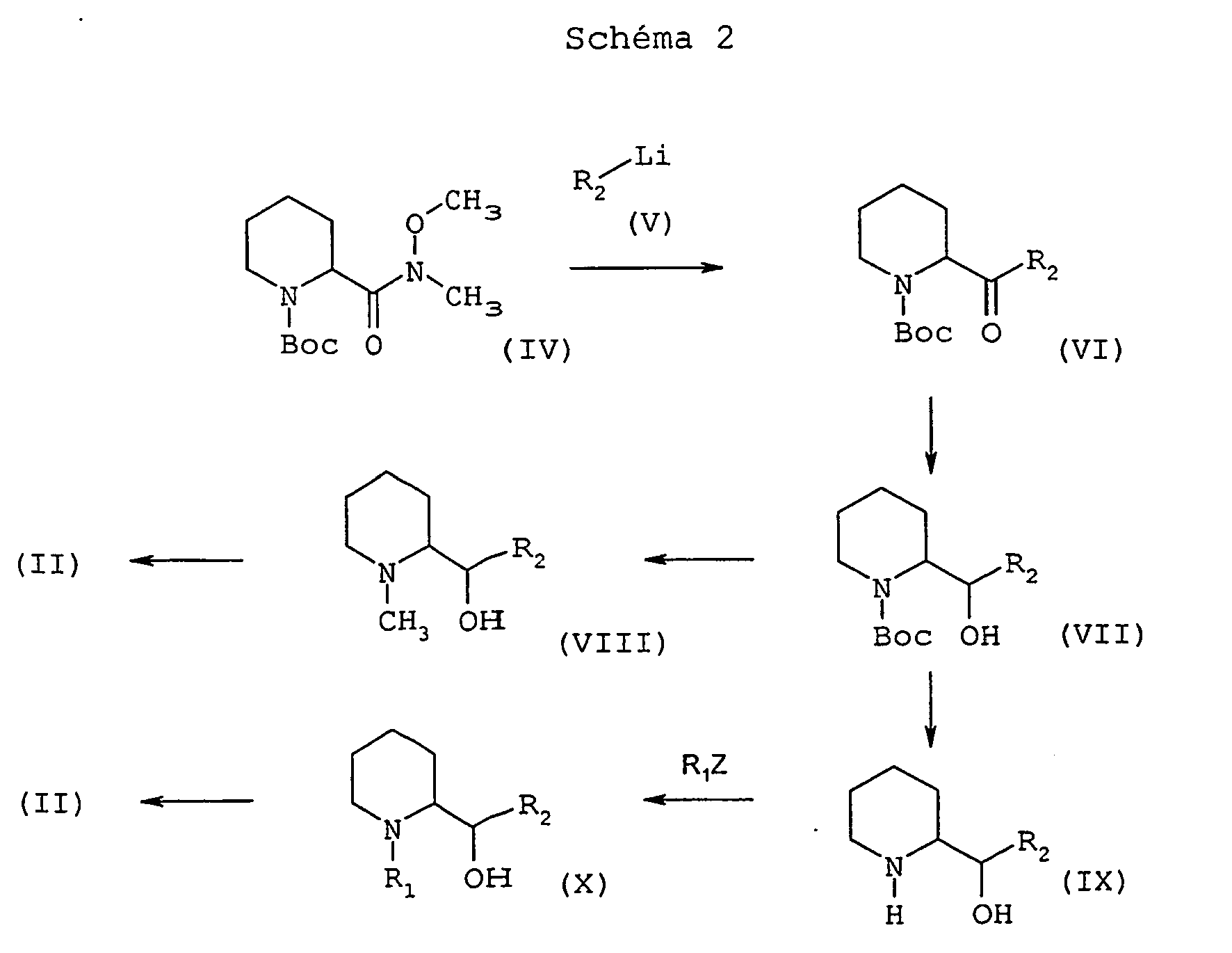
- On fait réagir l'amide de Weinreb de formule (IV), dans laquelle Boc désigne un groupe 1,1-diméthyléthoxycarbonyle, avec l'hétérocycle lithié de formule générale (V), dans laquelle R2 est tel que défini ci-dessus, dans un solvant éthéré tel que l'éther diéthylique, entre -90°C et -30°C ; on obtient une cétone de formule générale (VI) que l'on réduit en alcool de configuration thréo de formule générale (VII) par un agent réducteur tel que le K-Selectride® ou le L-Selectride® (tri-sec-butylborohydrure de potassium ou de lithium), dans un solvant éthéré tel que le tétrahydrofurane, entre -78°C et la température ambiante. Le carbamate de formule générale (VII) peut ensuite être réduit en N-méthylaminoalcool thréo de formule générale (VIII) par action d'un hydrure mixte tel que l'hydrure double d'aluminium et de lithium, dans un solvant éthéré tel que le tétrahydrofurane, entre la température ambiante et la température de reflux. On transforme ensuite en deux étapes l'alcool thréo de formule générale (VIII) en une diamine intermédiaire de formule générale (II) dans laquelle R1 représente un groupe méthyle sous la forme thréo ou d'un mélange érythro-thréo dépendant de la nature de l'hétérocycle de la manière suivante : on transforme d'abord la fonction alcool en groupe nucléofuge, par exemple un groupe méthanesulfonate, par action du chlorure de méthylsulfonyle, dans un solvant chloré tel que le dichlorométhane, et en présence d'une base telle que la triéthylamine, entre 0°C et la température ambiante, puis on fait réagir le groupe nucléofuge avec de l'ammoniac liquéfié à -50°C, dans un alcool tel que l'éthanol, dans un milieu clos tel qu'un autoclave, entre -50°C et la température ambiante. On peut également déprotéger le carbamate de formule générale (VII) au moyen d'une base forte telle que la potasse aqueuse, dans un alcool tel que le méthanol pour obtenir l'aminoalcool thréo de formule générale (IX), procéder ensuite à une N-alkylation au moyen d'un dérivé halogéné de formule R1Z, dans laquelle R1 est tel que défini ci-dessus, mais différent d'un atome d'hydrogène, et Z représente un atome d'halogène, en présence d'une base telle que le carbonate de potassium, dans un solvant polaire tel que le N,N-diméthylformamide, entre la température ambiante et 100°C. On traite ensuite l'alcool de formule générale (X) ainsi obtenu comme décrit à propos de l'alcool de formule générale (VIII).
- Les composés de formule générale (I) dans laquelle R1 représente un atome d'hydrogène peuvent être préparés à partir d'un composé de formule générale (I) dans laquelle R1 représente :
- soit un groupe phénylméthyle éventuellement substitué, en déprotégeant l'azote du cycle pipéridine, par exemple par un agent oxydant ou par un acide de Lewis tel que le tribromure de bore, ou par hydrogénolyse ,
- soit un groupe alcényle, de préférence allyle, en déprotégeant l'azote du cycle pipéridine, par exemple par un complexe du palladium 0,
- Par ailleurs les composés chiraux de formule générale (I) correspondants aux énantiomères (1R,2R)-(1S,2S)-(1S,2R) et (1R,2S) des différents diastéréoisomère erythro / thréo, peuvent être obtenus par séparation des composés racémiques par chromatographie liquide à haute performance (CLHP) sur colonne chirale, ou par dédoublement de l'amine racémique de formule générale (II) par utilisation d'un acide chiral, tel que l'acide tartrique, l'acide camphorsulfonique, l'acide dibenzoyltartrique, la N-acétylleucine, par la recristallisation fractionnée et préférentielle d'un sel diastéréoisomérique dans un solvant de type alcool, soit par synthèse énantiosélective selon le schéma 2 en utilisant un amide de Weinreb chiral de formule générale (IV).
- L'amide de Weinreb de formule (IV) racémique ou chiral peut être préparé selon une méthode analogue à celle décrite dans Eur. J. Med. Chem., 35, (2000), 979-988 et J. Med. Chem., 41, (1998), 591-601. Les hétérocycles lithiés de formule générale (V) peuvent être préparés selon des méthodes connues de l'homme du métier et analogues à celles décrites dans J.O.C., 62, (1997), 5484-5496 et Tetrahedron Letters, 35, (1994), 3673-3674.
- Les dérivés halogénés de formule R1Z sont disponibles dans le commerce .
- Certains acides et chlorures d'acides de formule générale (III) sont disponibles dans le commerce ou, lorsqu'ils sont nouveaux, ils peuvent être obtenus selon des méthodes analogues à celles décrites dans les brevets EP-0556672, US-3801636, et dans J. Chem. Soc., (1927), 25, Chem. Pharm. Bull., (1992), 1789-1792, Aust. J. Chem., (1984), 1938-1950 et J. O. C., (1980), 527.
- Les exemples qui vont suivre illustrent la préparation de quelques composés de l'invention. Les microanalyses élémentaires, les spectres I.R. et R.M.N. et la CLHP sur colonne chirale confirment les structures et les puretés énantiométriques des composés obtenus.
- Les numéros indiqués entre parenthèses dans les titres des exemples correspondent à ceux de la 1ère colonne du tableau donné plus loin.
- Dans les noms des composés, le tiret "_" fait partie du mot, et le tiret "_" ne sert que pour la coupure en fin de ligne ; il est à supprimer en l'absence de coupure, et ne doit être remplacé ni par un tiret normal ni par un espace.
- Dans un ballon de 100 ml, sous atmosphère d'argon, on introduit 1,8 g (10,8 mmoles) de 3-bromothiophène en solution dans 20 ml d'éther diéthylique anhydre et on refroidit le milieu à -40°C. On ajoute ensuite lentement, 4,8 ml (12 mmoles) d'une solution 2,5M de butyllithium dans le cyclohexane et on laisse le mélange à cette température pendant 2 h.
- A l'aide d'une aiguille de transfert, on ajoute l'hétérocycle lithié à une solution de 1,5 g (5,5 mmoles) de 2-(N-méthoxy-N-méthylcarbamoyl)pipéridine-1-carboxylate de 1,1-diméthyléthyle dans 50 ml d'éther diéthylique anhydre refroidie à -20°C et on laisse sous agitation le mélange revenir à température ambiante pendant 2 h.
- Après hydrolyse avec une solution aqueuse saturée de chlorure d'ammonium, on sépare la phase aqueuse et on l'extrait avec de l'acétate d'éthyle. On sèche les phases organiques réunies sur sulfate de sodium, on filtre, on concentre sous pression réduite et on purifie le résidu par chromatographie sur colonne de gel de silice en éluant avec un mélange d'acétate d'éthyle et de cyclohexane.
- On obtient 1,2 g d'un composée sous forme d'huile incolore que l'on utilise tel quel dans l'étape suivante.
- Dans un ballon de 250 ml, sous atmosphère d'argon, on introduit 1,2 g (4 mmoles) de 2-(3-thiénylcarbonyl)-pipéridine-1-carboxylate de 1,1-diméthyléthyle dans 40 ml de tétrahydrofurane anhydre, on refroidit la solution à -78°C, on ajoute, goutte à goutte, 12 ml (12 mmoles) d'une solution 1M de L-Selectride® (tri-sec-butylborohydrure de lithium) dans le tétrahydrofurane et on agite le mélange à -78°C pendant 5 h.
- On l'hydrolyse à froid lentement avec 7 ml d'eau et 7 ml d'une solution aqueuse à 35% de peroxyde d'hydrogène, et on laisse le mélange revenir à température ambiante en l'agitant pendant 2 h.
- On le dilue avec de l'eau et de l'acétate d'éthyle, on sépare les phases et on extrait la phase aqueuse avec de l'acétate d'éthyle. Après lavage des phases organiques réunies, séchage sur sulfate de sodium, filtration et évaporation on purifie le résidu par chromatographie sur colonne de gel de silice en éluant avec un mélange d'acétate d'éthyle et de cyclohexane.
- On obtient 1 g de produit sous forme d'huile incolore que l'on utilise tel quel dans l'étape suivante.
- Dans un bicol de 50 ml, sous atmosphère d'azote, on introduit 0,63 g (16,6 mmoles) d'hydrure double d'aluminium et de lithium dans 10 ml de tétrahydrofurane anhydre, on chauffe le mélange au reflux, on ajoute 1 g (3,3 mmoles) d'une solution de thréo-[hydroxy(3-thiényl)méthyl]-pipéridine-1-carboxylate de 1,1-diméthyléthyle dans 35 ml de tétrahydrofurane et on maintient le mélange au reflux pendant 2 h.
- On le refroidit, on l'hydrolyse lentement avec une solution O,1M de tartrate double de potassium et de sodium et on laisse le mélange sous agitation pendant une nuit.
- On le filtre et on rinçe le précipité avec du tétrahydrofurane, puis on concentre le filtrat sous pression réduite. On obtient 0,6 g d'un produit huileux incolore.
- Dans un ballon de 50 ml, sous atmosphère d'azote, on introduit 0,6 g (2,8 mmoles) de thréo-(1-méthylpipéridin-2-yl) (3-thiényl)méthanol et O, 4 ml (2, 8 mmoles) de triéthylamine dans 10 ml de dichlorométhane anhydre, on refroidit le milieu à 0°C, on ajoute 0,22 ml (2,8 mmoles) de chlorure de méthanesulfonyle, on laisse le mélange revenir lentement à température ambiante pendant 1 h et on le concentre sous pression réduite. Dans un autoclave muni d'une agitation magnétique et refroidi à -50°C on introduit de l'ammoniac liquéfié, on ajoute une solution du méthanesulfonate brut précédemment préparé en solution dans 30 ml d'éthanol absolu, on ferme l'autoclave et on maintient l'agitation pendant 48 h.
- On transvase le mélange dans un ballon, on concentre à sec, on dilue le résidu avec de l'eau et du dichlorométhane, on sépare les phases et on extrait la phase aqueuse avec du dichlorométhane. Après lavage des phases organiques réunies, séchage sur sulfate de sodium, filtration et évaporation des solvants, on isole 0,5 g d'amine sous forme de composé huileux que l'on utilise tel quel dans l'étape suivante.
- yl) (3-thiényl)méthyl]-3-triflurométhylbenzamide 1:1 Dans un ballon de 50 ml on introduit, 0,25 g (1,17 mmoles) de (1-méthylpipéridin-2-yl) (3-thiényl)méthanamine et 0,26 ml (1,4 mmoles) de triethylamine en solution dans 20 ml de dichlorométhane à 0°C. On ajoute ensuite, une solution de 0,34 g (1,4 mmoles) de chlorure d'acide 2-chloro-3-triflorométhylbenzoïque dans 10 ml de dichlorométhane et on laisse le mélange sous agitation revenir à température ambiante pendant 2 h.
- On traite le mélange avec de l'eau, on l'extrait plusieurs fois avec du dichlorométhane. Après lavage des phases organiques avec de l'eau puis avec une solution aqueuse de soude 1N, séchage sur sulfate de magnésium, filtration et évaporation du solvant sous pression réduite, on purifie le résidu par chromatographie sur colonne de gel de silice en éluant avec un mélange de dichlorométhane et de méthanol. On obtient 0,23 g de produit huileux qu'on isole sous forme de chlorhydrate à partir d'une solution 0,1N d'acide chlorhydrique dans le propan-2-ol.
- On isole finalement 0,11 g de chlorhydrate sous forme de solide blanc composé d'un mélange de diastéréoisomères thréo / érythro dans un rapport 83/17.
Point de fusion : 124-126°C. - Dans un ballon de 500 ml, sous atmosphère d'argon, on introduit 14,5 g (91,8 mmoles) de 3-bromopyridine en solution dans 100 ml d'éther diéthylique anhydre et on refroidit le milieu à -78°C. On ajoute ensuite lentement, 40,4 ml (100,9 mmoles) d'une solution 2,5M de butyllithium dans le cyclohexane et on laisse le mélange à cette température pendant 0,5 h.
- On ajoute une solution de 10 g (36,7 mmoles) de 2-(N-méthoxy-N-méthylcarbamoyl)pipéridine-1-carboxylate de 1,1-diméthyléthyle dans 50 ml d'éther diéthylique anhydre refroidie à -78°C et on laisse à cette température 2 heures sous agitation le mélange puis 12 heures à température ambiante.
- Après hydrolyse avec une solution aqueuse saturée de chlorure d'ammonium, on sépare le phase aqueuse et on l'extrait avec de l'acétate d'éthyle. On sèche les phases organiques réunies sur sulfate de sodium, on filtre, on concentre sous pression réduite et on purifie le résidu par chromatographie sur colonne de gel de silice en éluant avec un mélange d'acétate d'éthyle et de cyclohexane.
- On obtient 5,5 g d'un composée sous forme d'huile incolore que l'on utilise tel quel dans l'étape suivante.
- Dans un ballon de 500 ml, sous atmosphère d'argon, on introduit 5,4 g (18,6 mmoles) de 2-(3-pyridinylcarbonyl)-pipéridine-1-carboxylate de 1,1-diméthyléthyle dans 220 ml de tétrahydrofurane anhydre, on refroidit la solution à -78°C, on ajoute, goutte à goutte, 55,8 ml (55,8 mmoles) d'une solution 1M de L-Selectride® (tri-sec-butylborohydrure de lithium) dans le tétrahydrofurane et on agite le mélange à -78°C pendant 3 h.
- On l'hydrolyse à froid lentement avec 67 ml d'eau et 67 ml d'une solution aqueuse à 35% de peroxyde d'hydrogène, et on laisse le mélange revenir à température ambiante en l'agitant pendant 2 h.
- On le dilue avec de l'eau et de l'acétate d'éthyle, on sépare les phases et on extrait la phase aqueuse avec de l'acétate d'éthyle. Après lavage des phases organiques réunies, séchage sur sulfate de sodium, filtration et évaporation, on purifie le résidu par chromatographie sur colonne de gel de silice en éluant avec un mélange d'acétate d'éthyle et de cyclohexane.
- On obtient 4,13 g de produit sous forme d'huile incolore que l'on utilise tel quel dans l'étape suivante.
- Dans un ballon de 50 ml on place une solution de 0,5 g (1,71 mmole) de thréo- [hydroxy(3-pryridinyl)méthyl]-pipéridine-1-carboxylate de 1,1-diméthyléthyle dans 6 ml d'éthanol, on ajoute une solution aqueuse de potasse préparée à partir de 0,5 g de potasse en pastilles et 3 ml d'eau, et on chauffe le mélange au reflux pendant 2 h.
- On refroidit le mélange, on évapore le solvant sous pression réduite, on ajoute de l'eau et on extrait le mélange plusieurs fois avec du dichlorométhane. Après lavage des phases organiques réunies, séchage sur sulfate de magnésium, filtration et évaporation du solvant sous pression réduite, on obtient 0,3 g de solide blanc que l'on utilise tel quel dans l'étape suivante.
- Dans un ballon de 50 ml muni d'une agitation magnétique et d'une circulation d'argon, on introduit 0,3 g (1,56 mmol) de thréo-3-pyridinyl(2-pipéridin-2-yl)méthanol et 10 ml d'acétonitrile. A la suspension obtenue on ajoute ensuite 0,32 g carbonate de potassium et 0,17 ml (1,2 eq) de bromure d'allyle. On maintient l'agitation de la suspension pendant 6h à 25°C. On ajoute 10 ml d'eau et 10 ml d'acétate d'éthyle, on décante et extrait la phase aqueuse trois fois avec 10 ml d'acétate d'éthyle, on lave les phases organiques réunies par 50 ml d'eau puis 500 ml d'une solution saturée de chlorure de sodium. On sèche sur sulfate de sodium, filtre et élimine les solvants sous pression réduite.
- On obtient 0, 22 g d'huile jaune que l'on purifie par chromatographie sur gel de silice(colonne de 120 g et gradient d'élution de 2% à 10% de méthanol dans le dichlorométhane en 30 min). On isole 0,10 g sous forme d'huile jaune.
- Dans un ballon de 50 ml, sous atmosphère d'azote, on introduit 0, 71 g (3,05 mmoles) de thréo-1-allylpipéridin-2-yl (3-pyridinyl) méthanol et 0,43 ml (3,05 mmoles) de triéthylamine dans 15 ml de dichlorométhane anhydre, on refroidit le milieu à 0°C, on ajoute 0,23 ml (3,05 mmoles) de chlorure de méthanesulfonyle, on laisse le mélange revenir lentement à température ambiante pendant 1 h et on le concentre sous pression réduite.
- Dans un autoclave muni d'une agitation magnétique et refroidi à - 50°C on introduit de l'ammoniac liquéfié, on ajoute une solution du méthanesulfonate brut précédemment préparé en solution dans 30 ml d'éthanol absolu, on ferme l'autoclave et on maintient l'agitation pendant 48 h.
- On transvase le mélange dans un ballon, on concentre à sec, on dilue le résidu avec de l'eau et du dichlorométhane, on sépare les phases et on extrait la phase aqueuse avec du dichlorométhane. Après lavage des phases organiques réunies, séchage sur sulfate de sodium, filtration et évaporation on isole 0,57 g d'amine sous forme de composé huileux que l'on utilise tel quel dans l'étape suivante.
- Dans un ballon de 50 ml on introduit successivement dans 10 ml de dichlorométhane, 0,22 g (1,28 mmole) d'acide 2,3-dichlorobenzoïque, 0,25 g (1,29 mmole) de chlorhydrate de 1-[3-(diméthylamino)propyl]-3-éthylcarbodiimide et 0,17 g (1,29 mmole)d'hydroxybenzotriazole et on agite le mélange à température ambiante pendant 1 h.
- On ajoute 0,3 g (1,29 mmole) de thréo-(1-allylpipéridin-2-yl)(3-pyridinyl)méthylamine en solution dans 4 ml de dichlorométhane et on poursuit l'agitation pendant 15 h.
- On traite le mélange avec de l'eau, on l'extrait plusieurs fois avec du dichlorométhane. Après lavage des phases organiques avec de l'eau puis avec une solution aqueuse de soude 1N, séchage sur sulfate de magnésium, filtration et évaporation du solvant sous pression réduite, on purifie le résidu par chromatographie sur colonne de gel de silice en éluant avec un mélange de dichlorométhane et de méthanol. On obtient 0,15 g de produit huileux qu'on isole sous forme de chlorhydrate à partir d'une solution 0,1N d'acide chlorhydrique dans le propan-2-ol.
- On isole finalement 0,10 g de chlorhydrate sous forme de solide blanc.
Point de fusion : 149-151°C. - Le tableau qui suit illustre les structures chimiques et les propriétés physiques de quelques composés de l'invention.
- Dans la colonne "Sel", "_" désigne un composé à l'état de base et "HCl" désigne un chlorhydrate.
Tableau 
N° R1 R2 R3 Sel F (°C) Stéréochimie 1 CH3 
2-Cl, 3-CF3 HCl 131-133 Thréo/Erythro 0/100 2 CH3 
2-Cl, 3-CF3 HCl 124-126 Thréo/Erythro 83/17 3 CH3 
2-CH3, 3-CF3 HCl 139-141 Thréo/Erythro 62/38 4 CH3 
2- CH3, 3-CF3 HCl 166-168 Thréo/Erythro 7/93 5 CH3 
2-Cl, 3-CF3 HCl 168-170 Thréo/Erythro 0/100 6 CH2-CH=CH2 
2-Cl, 3- CH3 HCl 149-151 Thréo/Erythro 100/0 7 CH2-CH=CH2 
2-Cl, 3-CF3 HCl 144-146 Thréo/Erythro 100/0 - Les composés de l'invention ont été soumis à une série d'essais pharmacologiques qui ont mis en évidence leur intérêt comme substances à activités thérapeutiques.
- La capture de [14C] glycine est étudiée dans les cellules SK-N-MC (cellules neuro-épithéliales humaines) exprimant le transporteur humain glyt1 natif par la mesure de la radioactivité incorporée en présence ou en absence du composé à tester. Les cellules sont cultivées en monocouche pendant 48 h dans des plaques prétraitées à la fibronectine à 0,02%. Le jour de l'expérience, le milieu de culture est éliminé et les cellules sont lavées par un tampon Krebs-HEPES (acide [4-(2-hydroxyéthyl)pipérazine-l-éthanesulfonique) à pH 7,4. Après 10 min de préincubation à 37°C en présence soit de tampon (lot témoin), soit de composé à tester a différentes concentrations ou de 10 mM de glycine (détermination de la capture non spécifique), 10 µM de [14C]glycine (activité spécifique 112 mCi/mmole) sont ensuite ajoutés. L'incubation se poursuit pendant 10 min à 37°C, et la réaction est arrêtée par 2 lavages avec un tampon Krebs-HEPES à pH 7,4. La radioactivité incorporée par les cellules est alors estimée après ajout de 100 µl de scintillant liquide et agitation pendant 1 h. Le comptage est réalisé sur compteur Microbeta Tri-lux™. L'efficacité du composé est déterminée par la CI50, concentration du composé qui diminue de 50% la capture spécifique de glycine, définie par la différence de radioactivité incorporée par le lot témoin et le lot qui a reçu la glycine à 10 mM.
- Les composés les plus actifs de l'invention, dans ce test, ont une CI50 de l'ordre de 0,001 à 1 µM.
- La capture de [14C]glycine par le transporteur glyt2 est étudiée dans l'homogénat de moelle épinière de souris par la mesure de radioactivité incorporée en présence ou en absence de composé à étudier.
- Après euthanasie des animaux (souris mâles OF1 Iffa Crédo pesant 20 à 25 g le jour de l'expérience), la moelle épinière de chaque animal est rapidement prélevée, pesée et conservée sur glace. Les échantillons sont homogénéisés dans un tampon Krebs-HEPES (acide [4-(2-hydroxyéthyl)pipérazine-1-éthanesulfonique), pH 7,4, à raison de 25 ml/g de tissu.
- 50 µl d'homogénat sont pré-incubés pendant 10 min à 25°C en présence de tampon Krebs-HEPES , pH 7,4 et de composé à étudier à différentes concentrations, ou de 10 mM de glycine pour déterminer la capture non spécifique. La [14C] glycine (activité spécifique = 112mCi/mmole) est ensuite ajoutée pendant 10 min à 25°C à la concentration finale de 10 µM. La réaction est arrêtée par filtration sous vide et la radioactivité est estimée par scintillation solide par comptage sur un compteur Microbeta Tri-lux™. L'efficacité du composé est déterminée par la concentration CI50 capable de diminuer de 50% la capture spécifique de glycine, définie par la différence de radioactivité incorporée par le lot témoin et le lot qui a reçu la glycine 10 mM.
- Les composés les plus actifs de l'invention dans ce test, ont une CI50 inférieure à 1 µM.
- Il apparaît donc que les composés selon l'invention sont des inhibiteurs spécifiques des transporteurs de la glycine glyt1 et/ou glyt2.
- Les composés selon l'invention peuvent donc être utilisés pour la préparation de médicaments, en particulier de médicaments inhibiteurs des transporteurs de la glycine glyt1 et/ou glyt2.
- Ainsi, selon un autre de ses aspects, l'invention a pour objet des médicaments qui comprennent un composé de formule (I), ou un sel d'addition de ce dernier à un acide pharmaceutiquement acceptable, ou encore un hydrate ou un solvat du composé de formule (I).
- Les composés de l'invention peuvent être utilisés notamment pour le traitement des troubles comportementaux associés à la démence, des psychoses, en particulier de la schizophrénie (forme déficitaire et forme productive) et des symptômes extrapyramidaux aigus ou chroniques induits par les neuroleptiques, pour le traitement des diverses formes d'anxiété, des attaques de panique, des phobies, des troubles obsessionnels compulsifs, pour le traitement des différentes formes de dépression, y compris la dépression psychotique, pour le traitement des troubles dus à l'abus ou au sevrage d'alcool, des troubles du comportement sexuel, des troubles de la prise de nourriture, et pour le traitement de la migraine.
- Ils peuvent également être utilisés pour le traitement des contractures musculaires douloureuses en rhumatologie et en pathologie rachidienne aiguë, pour le traitement des contractures spastiques d'origine médullaire ou cérébrale, pour le traitement symptomatique des douleurs aiguës et subaiguës d'intensité légère à modérée, pour le traitement des douleurs intenses et/ou chroniques, des douleurs neurogènes et algies rebelles, pour le traitement de la maladie de Parkinson et des symptômes parkinsoniens d'origine neurodégénérative ou induits par des neuroleptiques, pour le traitement des épilepsies généralisées primaires et secondaires, partielles à symptomatologie simple ou complexe, des formes mixtes et autres syndromes épileptiques en complément d'un autre traitement antiépileptique, ou en monothérapie, pour le traitement des apnées du sommeil, et pour la neuroprotection.
- La présente invention a également pour objet des compositions pharmaceutiques contenant une dose efficace d'au moins un composé selon l'invention, à l'état de base ou de sel ou de solvat pharmaceutiquement acceptable, et en mélange, le cas échéant, avec un ou plusieurs excipients convenables.
- Lesdits excipients sont choisis selon la forme pharmaceutique et le mode d'administration souhaité.
- Les compositions pharmaceutiques selon l'invention peuvent ainsi être destinées à l'administration orale, sublinguale, sous-cutanée, intramusculaire, intraveineuse, topique, intratrachéale, intranasale, transdermique, rectale, intraocculaire.
- Les formes unitaires d'administration peuvent être, par exemple, des comprimés, des gélules, des granules, des poudres, des solutions ou suspensions orales ou injectables, des timbres transdermiques ("patch"), des suppositoires. Pour l'administration topique on peut envisager des pommades, lotions et collyres.
- A titre d'exemple, une forme unitaire d'administration d'un composé selon l'invention sous forme de comprimé peut comprendre les composants suivants :
Composé selon l'invention 50,0 mg Mannitol 223,75 mg Croscaramellose sodique 6,0 mg Amidon de maïs 15,0 mg Hydroxypropyl-méthylcellulose 2,25 mg Stéarate de magnésium 3,0 mg - Lesdites formes unitaires sont dosées pour permettre une administration journalière de 0,01 à 20 mg de principe actif par kg de poids corporel, selon la forme galénique.
- Il peut y avoir des cas particuliers où des dosages plus élevés ou plus faibles sont appropriés ; de tels dosages ne sortent pas du cadre de l'invention. Selon la pratique habituelle, le dosage approprié à chaque patient est déterminé par le médecin selon le mode d'administration, le poids et la réponse dudit patient.
- La présente invention, selon un autre de ses aspects, concerne également l'utilisation d'un composé selon l'invention pour la préparation d'un médicament destiné au traitement des pathologies ci-dessus indiquées ledit traitement comprenant l'administration, à un patient, d'une dose efficace d'un composé selon l'invention, ou un de ses sels pharmaceutiquement acceptables ou hydrates ou solvats.
Claims (5)
- Composé répondant à la formule générale (I)
 R1 représente soit un atome d'hydrogène, soit un groupe (C1-C7)alkyle linéaire ou ramifié éventuellement substitué par un ou plusieurs atomes de fluor, soit un groupe (C3-C7-cycloalkyle, soit un groupe (C3-C7)cycloalkyl(C1-C3)alkyle, soit un groupe phényl(C1-C3)alkyle éventuellement substitué par un ou deux groupes méthoxy, soit un groupe (C2-C4)alcényle, soit un groupe (C2-C4) alcynyle ;R2 représente un groupe pyridinyle, furanyle, thiényle, thiazolyle ou oxazolyle, ce groupe étant éventuellement substitué par un ou plusieurs substituants choisis parmi les atomes d'halogène et les groupes trifluorométhyle, (C1-C6) alkyle linéaire ou ramifié et (C1-C6) alcoxyR3 représente soit un atome d'hydrogène, soit un ou plusieurs substituants choisis parmi les atomes d'halogène et les groupes trifluorométhyle, (C1-C6)alkyle linéaire ou ramifié, (C3-C7)cycloalkyle, (C1-C6) alcoxy, phényle, cyano, acétyle, benzoyle, (C1-C6)thioalkyle, (C1-C6)alkylsulfonyle, carboxy ou (C1-C6)alcoxycarbonyle, soit un groupe de formule générale NR4R5 ou SO2NR4R5 ou CONR4R5 dans lesquelles R4 et R5 représentent chacun, indépendamment l'un de l'autre, un atome d'hydrogène ou un.groupe (C1-C6) alkyle linéaire ou ramifié ou (C3-C7) cycloalkyle, ou R4 et R5 forment, avec l'atome d'azote qui les porte, un cycle pyrrolidine, pipéridine ou morpholine ;à l'état de base libre ou de sel d'addition à un acide, d'hydrate ou de solvat.
 - Médicament caractérisé en ce qu'il comprend un composé selon la revendication 1, ou un sel d'addition de ce composé à un acide pharmaceutiquement acceptable ou encore un hydrate ou un solvat du composé de formule (I).
- Composition pharmaceutique, caractérisée en ce qu'elle comprend un composé selon la revendication 1, ou un sel pharmaceutiquement acceptable, un hydrate ou un solvat de ce composé, ainsi qu'au moins un excipient pharmaceutiquement acceptable.
- Utilisation d'un composé de formule (I) selon la revendication 1 pour la préparation d'un médicament destiné au traitement des troubles comportementaux associés à la démence, des psychoses, des diverses formes d'anxiété, des attaques de panique, des phobies, des troubles obsessionnels compulsifs, des différentes formes de dépression, des troubles dus à l'abus ou au sevrage d'alcool, des troubles du comportement sexuel, des troubles de la prise de nourriture et de la migraine.
- Utilisation d'un composé de formule (I) selon la revendication 1 pour la préparation d'un médicament destiné au traitement des contractures, de la douleur, de la maladie de Parkinson et des symptômes parkinsoniens, des épilepsies, des formes mixtes et autres syndromes épileptiques en complément d'un autre traitement antiépileptique, ou en monothérapie, des apnées du sommeil, et pour la neuroprotection.
Priority Applications (2)
| Application Number | Priority Date | Filing Date | Title |
|---|---|---|---|
| SI200430375T SI1680418T1 (sl) | 2003-10-17 | 2004-10-15 | Derivati N-(heteroaril(piperidin-2-il)metil)benzamida, njihova priprava in njihova terapevtska uporaba |
| PL04791552T PL1680418T3 (pl) | 2003-10-17 | 2004-10-15 | Pochodne N-[heteroarylo(piperydyn-2-ylo)metylo]benzamidu, ich wytwarzanie i zastosowanie ich w lecznictwie |
Applications Claiming Priority (2)
| Application Number | Priority Date | Filing Date | Title |
|---|---|---|---|
| FR0312142A FR2861073B1 (fr) | 2003-10-17 | 2003-10-17 | Derives de n-[heteroaryl(piperidin-2-yl)methyl]benzamide, leur preparation et leur application en therapeutique |
| PCT/FR2004/002641 WO2005037781A2 (fr) | 2003-10-17 | 2004-10-15 | Derives de n-[heteroaryl(piperidin-2-yl)methyl]benzamide, leur preparation et leur application en therapeutique |
Publications (2)
| Publication Number | Publication Date |
|---|---|
| EP1680418A2 EP1680418A2 (fr) | 2006-07-19 |
| EP1680418B1 true EP1680418B1 (fr) | 2007-05-09 |
Family
ID=34385235
Family Applications (1)
| Application Number | Title | Priority Date | Filing Date |
|---|---|---|---|
| EP04791552A Expired - Lifetime EP1680418B1 (fr) | 2003-10-17 | 2004-10-15 | Derives de n-[heteroaryl(piperidin-2-yl)methyl]benzamide, leur preparation et leur application en therapeutique |
Country Status (26)
| Country | Link |
|---|---|
| US (1) | US7335670B2 (fr) |
| EP (1) | EP1680418B1 (fr) |
| JP (1) | JP4696069B2 (fr) |
| KR (1) | KR20060087598A (fr) |
| CN (1) | CN100430394C (fr) |
| AT (1) | ATE361923T1 (fr) |
| AU (1) | AU2004281215B2 (fr) |
| BR (1) | BRPI0415452A (fr) |
| CA (1) | CA2542370A1 (fr) |
| CY (1) | CY1106786T1 (fr) |
| DE (1) | DE602004006431T2 (fr) |
| DK (1) | DK1680418T3 (fr) |
| ES (1) | ES2287782T3 (fr) |
| FR (1) | FR2861073B1 (fr) |
| HR (1) | HRP20070327T3 (fr) |
| IL (1) | IL174941A (fr) |
| MA (1) | MA28097A1 (fr) |
| ME (1) | MEP22008A (fr) |
| NO (1) | NO20062151L (fr) |
| NZ (1) | NZ547165A (fr) |
| PL (1) | PL1680418T3 (fr) |
| PT (1) | PT1680418E (fr) |
| RS (1) | RS20060316A (fr) |
| RU (1) | RU2351596C2 (fr) |
| WO (1) | WO2005037781A2 (fr) |
| ZA (1) | ZA200603941B (fr) |
Families Citing this family (41)
| Publication number | Priority date | Publication date | Assignee | Title |
|---|---|---|---|---|
| FR2842804B1 (fr) | 2002-07-29 | 2004-09-03 | Sanofi Synthelabo | Derives de n-[phenyl(piperidin-2-yl)methyl]benzamide, leur preparation et leur application en therapeutique |
| FR2861074B1 (fr) * | 2003-10-17 | 2006-04-07 | Sanofi Synthelabo | Derives de n-[phenyl(piperidin-2-yl)methyl]benzamide, leur preparation et leur application en therapeutique |
| FR2861071B1 (fr) * | 2003-10-17 | 2006-01-06 | Sanofi Synthelabo | Derives de n-[phenyl(alkylpiperidin-2-yl) methyl]benzamide, leur prepartation et leur application en therapeutique |
| RU2395502C2 (ru) * | 2004-12-09 | 2010-07-27 | Ф.Хоффманн-Ля Рош Аг | Производные фенил-пиперазин метанона |
| JP2008525398A (ja) * | 2004-12-23 | 2008-07-17 | グラクソ グループ リミテッド | グリシン輸送阻害剤 |
| PE20061156A1 (es) | 2004-12-23 | 2006-12-16 | Glaxo Group Ltd | Derivados de benzamida como agentes inhibidores del transportador de glicina |
| GB0428233D0 (en) * | 2004-12-23 | 2005-01-26 | Glaxo Group Ltd | Compounds |
| WO2006131711A1 (fr) | 2005-06-06 | 2006-12-14 | Merck Sharp & Dohme Limited | Dérivés de cyclohexanesulfonyle en tant qu’inhibiteurs de glyt1 pour traiter la schizophrénie |
| FR2906251B1 (fr) * | 2006-09-22 | 2008-11-07 | Sanofi Aventis Sa | Derives de pyrrolizine, indolizine et quinolizine, leur preparation et leur application en therapeutique |
| ATE449062T1 (de) * | 2007-02-22 | 2009-12-15 | Indena Spa | Verfahren zur herstellung von (2r,3s)-3- phenylisoserin-methylester-acetatsalz |
| EP2178842A2 (fr) | 2007-08-22 | 2010-04-28 | Abbott GmbH & Co. KG | 4-benzylaminoquinolines, compositions pharmaceutiques les contenant et leur utilisation |
| ES2397764T3 (es) | 2008-04-01 | 2013-03-11 | Abbott Gmbh & Co. Kg | Tetrahidroisoquinolinas, composiciones farmacéuticas que las contienen, y su uso en terapia |
| AR075182A1 (es) * | 2009-01-28 | 2011-03-16 | Astrazeneca Ab | Compuestos 2-aza-biciclo (2.2.2) octano y sus usos |
| AR075442A1 (es) | 2009-02-16 | 2011-03-30 | Abbott Gmbh & Co Kg | Derivados de aminotetralina, composiciones farmaceuticas que las contienen y sus usos en terapia |
| TW201038569A (en) | 2009-02-16 | 2010-11-01 | Abbott Gmbh & Co Kg | Heterocyclic compounds, pharmaceutical compositions containing them, and their use in therapy |
| JP5618047B2 (ja) * | 2010-01-29 | 2014-11-05 | 国立大学法人千葉大学 | ポジトロン断層撮影法およびポジトロン放出化合物 |
| KR101180174B1 (ko) * | 2010-04-23 | 2012-09-05 | 동아제약주식회사 | 신규한 벤즈아미드 유도체 |
| US9051280B2 (en) | 2010-08-13 | 2015-06-09 | AbbVie Deutschland GmbH & Co. KG | Tetraline and indane derivatives, pharmaceutical compositions containing them, and their use in therapy |
| US8883839B2 (en) | 2010-08-13 | 2014-11-11 | Abbott Laboratories | Tetraline and indane derivatives, pharmaceutical compositions containing them, and their use in therapy |
| US8877794B2 (en) | 2010-08-13 | 2014-11-04 | Abbott Laboratories | Phenalkylamine derivatives, pharmaceutical compositions containing them, and their use in therapy |
| US8846743B2 (en) | 2010-08-13 | 2014-09-30 | Abbott Laboratories | Aminoindane derivatives, pharmaceutical compositions containing them, and their use in therapy |
| US9045459B2 (en) | 2010-08-13 | 2015-06-02 | AbbVie Deutschland GmbH & Co. KG | Phenalkylamine derivatives, pharmaceutical compositions containing them, and their use in therapy |
| US9309200B2 (en) | 2011-05-12 | 2016-04-12 | AbbVie Deutschland GmbH & Co. KG | Benzazepine derivatives, pharmaceutical compositions containing them, and their use in therapy |
| JP2014521682A (ja) | 2011-08-05 | 2014-08-28 | アッヴィ・ドイチュラント・ゲー・エム・ベー・ハー・ウント・コー・カー・ゲー | アミノクロマン、アミノチオクロマンおよびアミノ−1,2,3,4−テトラヒドロキノリン誘導体、これらを含有する医薬組成物、ならびに治療におけるこれらの使用 |
| EP2780328A1 (fr) | 2011-11-18 | 2014-09-24 | Abbvie Deutschland GmbH & Co. KG | Dérivés aminobenzocycloheptène, aminotétraline, aminoindane et phénalkylamine n-substitués, composition pharmaceutiques les contenant, et leur application thérapeutique |
| WO2013075624A1 (fr) * | 2011-11-22 | 2013-05-30 | 北京哈三联科技股份有限公司 | Inhibiteur de recaptage de glycine et son utilisation |
| WO2013081400A2 (fr) * | 2011-11-29 | 2013-06-06 | 주식회사 비보존 | Nouveau dérivé de benzamide et son utilisation |
| US9365512B2 (en) | 2012-02-13 | 2016-06-14 | AbbVie Deutschland GmbH & Co. KG | Isoindoline derivatives, pharmaceutical compositions containing them, and their use in therapy |
| US9650334B2 (en) | 2013-03-15 | 2017-05-16 | Abbvie Inc. | Pyrrolidine derivatives, pharmaceutical compositions containing them, and their use in therapy |
| US9656955B2 (en) | 2013-03-15 | 2017-05-23 | Abbvie Inc. | Pyrrolidine derivatives, pharmaceutical compositions containing them, and their use in therapy |
| WO2015055771A1 (fr) | 2013-10-17 | 2015-04-23 | AbbVie Deutschland GmbH & Co. KG | Dérivés d'aminotétraline et d'aminoindane, compositions pharmaceutiques les contenant et leur utilisation en thérapie |
| MX2016004936A (es) | 2013-10-17 | 2016-12-20 | Abbvie Deutschland | Derivados de aminocromano, aminotiocromano y amino-1,2,3,4-tetrahi droquinilina, composiciones farmaceuticas que los contienen, y su uso en terapia. |
| US9550754B2 (en) | 2014-09-11 | 2017-01-24 | AbbVie Deutschland GmbH & Co. KG | 4,5-dihydropyrazole derivatives, pharmaceutical compositions containing them, and their use in therapy |
| CN108218846A (zh) * | 2016-12-22 | 2018-06-29 | 四川海思科制药有限公司 | 噻吩衍生物的新固态形式及其制备方法和用途 |
| GB201714740D0 (en) | 2017-09-13 | 2017-10-25 | Atrogi Ab | New compounds and uses |
| GB201714745D0 (en) | 2017-09-13 | 2017-10-25 | Atrogi Ab | New compounds and uses |
| GB201714734D0 (en) | 2017-09-13 | 2017-10-25 | Atrogi Ab | New compounds and uses |
| GB201714736D0 (en) | 2017-09-13 | 2017-10-25 | Atrogi Ab | New compounds and uses |
| GB201903832D0 (en) | 2019-03-20 | 2019-05-01 | Atrogi Ab | New compounds and methods |
| WO2020256456A1 (fr) * | 2019-06-20 | 2020-12-24 | Vivozon Inc. | Méthode de prévention ou de traitement de douleur post-opératoire |
| CN114478360B (zh) * | 2022-02-10 | 2023-08-15 | 江苏海洋大学 | 一种苯甲酰胺类衍生物及其制备方法和应用 |
Family Cites Families (6)
| Publication number | Priority date | Publication date | Assignee | Title |
|---|---|---|---|---|
| US5254569A (en) * | 1991-01-14 | 1993-10-19 | The Du Pont Merck Pharmaceutical Company | (Amidomethyl)nitrogen heterocyclic analgesics |
| JP3026845B2 (ja) * | 1991-02-20 | 2000-03-27 | 日清製粉株式会社 | ピペリジン誘導体 |
| US6319920B1 (en) * | 1998-02-27 | 2001-11-20 | Syntex (U.S.A.) Llc | 2-arylethyl-(piperidin-4-ylmethyl)amine derivatives |
| WO2001081308A2 (fr) * | 2000-04-20 | 2001-11-01 | Nps Allelix Corp. | Aminopiperidines |
| FR2838739B1 (fr) * | 2002-04-19 | 2004-05-28 | Sanofi Synthelabo | Derives de n-[phenyl(piperidin-2-yl)methyl)benzamide, leur preparation et leur application en therapeutique |
| FR2842804B1 (fr) * | 2002-07-29 | 2004-09-03 | Sanofi Synthelabo | Derives de n-[phenyl(piperidin-2-yl)methyl]benzamide, leur preparation et leur application en therapeutique |
-
2003
- 2003-10-17 FR FR0312142A patent/FR2861073B1/fr not_active Expired - Fee Related
-
2004
- 2004-10-15 AT AT04791552T patent/ATE361923T1/de active
- 2004-10-15 RU RU2006116887/04A patent/RU2351596C2/ru not_active IP Right Cessation
- 2004-10-15 DE DE602004006431T patent/DE602004006431T2/de not_active Expired - Lifetime
- 2004-10-15 DK DK04791552T patent/DK1680418T3/da active
- 2004-10-15 AU AU2004281215A patent/AU2004281215B2/en not_active Ceased
- 2004-10-15 CA CA002542370A patent/CA2542370A1/fr not_active Abandoned
- 2004-10-15 KR KR1020067007372A patent/KR20060087598A/ko not_active Ceased
- 2004-10-15 WO PCT/FR2004/002641 patent/WO2005037781A2/fr not_active Ceased
- 2004-10-15 ES ES04791552T patent/ES2287782T3/es not_active Expired - Lifetime
- 2004-10-15 PL PL04791552T patent/PL1680418T3/pl unknown
- 2004-10-15 RS YUP-2006/0316A patent/RS20060316A/sr unknown
- 2004-10-15 HR HR20070327T patent/HRP20070327T3/xx unknown
- 2004-10-15 EP EP04791552A patent/EP1680418B1/fr not_active Expired - Lifetime
- 2004-10-15 CN CNB2004800338737A patent/CN100430394C/zh not_active Expired - Fee Related
- 2004-10-15 PT PT04791552T patent/PT1680418E/pt unknown
- 2004-10-15 JP JP2006534798A patent/JP4696069B2/ja not_active Expired - Fee Related
- 2004-10-15 BR BRPI0415452-5A patent/BRPI0415452A/pt not_active IP Right Cessation
- 2004-10-15 ME MEP-220/08A patent/MEP22008A/xx unknown
- 2004-10-15 NZ NZ547165A patent/NZ547165A/en not_active IP Right Cessation
-
2006
- 2006-04-11 IL IL174941A patent/IL174941A/en not_active IP Right Cessation
- 2006-04-17 MA MA28942A patent/MA28097A1/fr unknown
- 2006-04-17 US US11/405,170 patent/US7335670B2/en not_active Expired - Fee Related
- 2006-05-12 NO NO20062151A patent/NO20062151L/no not_active Application Discontinuation
- 2006-05-16 ZA ZA200603941A patent/ZA200603941B/en unknown
-
2007
- 2007-08-02 CY CY20071101037T patent/CY1106786T1/el unknown
Also Published As
Similar Documents
| Publication | Publication Date | Title |
|---|---|---|
| FR2861073A1 (fr) | Derives de n-[heteroaryl(piperidin-2-yl)methyl]benzamide, leur preparation et leur application en therapeutique | |
| EP1682503B1 (fr) | Derives de n-[phenyl(alkylpiperidin-2-yl)methyl]benzamide, leur preparation et leur application en therapeutique | |
| EP1499589B1 (fr) | Derives de n-¬phenyl(piperidin-2-yl)methyl|benzamide, leur preparation et leur application en therapeutique | |
| CA2542647C (fr) | Derives de n-heterocyclylmethylbenzamides, leur preparation et leur application en therapeutique | |
| EP1527048B1 (fr) | Derives de n-[phenyl(piperidin-2-yl)methyl]benzamide, leur preparation et leur application en therapeutique | |
| EP1680400B1 (fr) | Derives de n-[ phenyl(pyrrolidin-2-yl)methyl]benzamide, et n-[(azepan-2-yl) phenylmethyl]benzamide, leur preparation et leur application en therapeutique | |
| EP2393809B1 (fr) | Derives d'azaspiranyl-alkylcarbamates d'heterocycles a 5 chainons, leur preparation et leur application en therapeutique | |
| FR2861074A1 (fr) | Derives de n-[phenyl(piperidin-2-yl)methyl]benzamide, leur preparation et leur application en therapeutique | |
| WO2004013100A2 (fr) | Derives de n-[phenyl(piperidin-2-yl)methyl]benzamide, leur preparation et leur application en therapeutique | |
| FR2934265A1 (fr) | Derives de carbamates d'alkylthiazoles, leur preparation et leur application en therapeutique | |
| CA2761658A1 (fr) | Derives de cyclopenta[c]pyrrolylalkylcarbamates d'heterocycles a 5 chainons, leur preparation et leur application en therapeutique | |
| CA2663080A1 (fr) | Derives de pyrrolizine, indolizine et quinolizine, leur preparation et leur application en therapeutique. | |
| EP0929550A1 (fr) | DERIVES DE $i(N)-(BENZOTHIAZOL-2-YL)PIPERIDINE-1-ETHANAMINE, LEUR PREPARATION ET LEUR APPLICATION EN THERAPEUTIQUE | |
| EP2185525B1 (fr) | Dérivés de pyrazole 3,5-carboxylates, leur préparation et leur application en thérapeutique | |
| FR2738567A1 (fr) | Derives de alpha-phenylpiperidine-1-propanol, leur preparation et leur application en therapeutique | |
| MXPA06004271A (en) | Derivatives of n-[heteroaryl(piperidine-2-yl)methyl]benzamide, preparation method thereof and application of same in therapeutics |
Legal Events
| Date | Code | Title | Description |
|---|---|---|---|
| PUAI | Public reference made under article 153(3) epc to a published international application that has entered the european phase |
Free format text: ORIGINAL CODE: 0009012 |
|
| 17P | Request for examination filed |
Effective date: 20060517 |
|
| AK | Designated contracting states |
Kind code of ref document: A2 Designated state(s): AT BE BG CH CY CZ DE DK EE ES FI FR GB GR HU IE IT LI LU MC NL PL PT RO SE SI SK TR |
|
| AX | Request for extension of the european patent |
Extension state: AL HR LT LV MK |
|
| GRAP | Despatch of communication of intention to grant a patent |
Free format text: ORIGINAL CODE: EPIDOSNIGR1 |
|
| GRAS | Grant fee paid |
Free format text: ORIGINAL CODE: EPIDOSNIGR3 |
|
| GRAA | (expected) grant |
Free format text: ORIGINAL CODE: 0009210 |
|
| AK | Designated contracting states |
Kind code of ref document: B1 Designated state(s): AT BE BG CH CY CZ DE DK EE ES FI FR GB GR HU IE IT LI LU MC NL PL PT RO SE SI SK TR |
|
| AX | Request for extension of the european patent |
Extension state: AL HR LT LV MK |
|
| REG | Reference to a national code |
Ref country code: GB Ref legal event code: FG4D Free format text: NOT ENGLISH |
|
| REG | Reference to a national code |
Ref country code: CH Ref legal event code: EP |
|
| REG | Reference to a national code |
Ref country code: IE Ref legal event code: FG4D Free format text: LANGUAGE OF EP DOCUMENT: FRENCH |
|
| REF | Corresponds to: |
Ref document number: 602004006431 Country of ref document: DE Date of ref document: 20070621 Kind code of ref document: P |
|
| REG | Reference to a national code |
Ref country code: HR Ref legal event code: TUEP Ref document number: P20070327 Country of ref document: HR |
|
| REG | Reference to a national code |
Ref country code: RO Ref legal event code: EPE |
|
| REG | Reference to a national code |
Ref country code: PT Ref legal event code: SC4A Free format text: AVAILABILITY OF NATIONAL TRANSLATION Effective date: 20070730 |
|
| GBT | Gb: translation of ep patent filed (gb section 77(6)(a)/1977) |
Effective date: 20070726 |
|
| REG | Reference to a national code |
Ref country code: SE Ref legal event code: TRGR |
|
| REG | Reference to a national code |
Ref country code: GR Ref legal event code: EP Ref document number: 20070402277 Country of ref document: GR |
|
| REG | Reference to a national code |
Ref country code: DK Ref legal event code: T3 |
|
| REG | Reference to a national code |
Ref country code: HR Ref legal event code: T1PR Ref document number: P20070327 Country of ref document: HR |
|
| REG | Reference to a national code |
Ref country code: ES Ref legal event code: FG2A Ref document number: 2287782 Country of ref document: ES Kind code of ref document: T3 |
|
| REG | Reference to a national code |
Ref country code: IE Ref legal event code: FD4D |
|
| REG | Reference to a national code |
Ref country code: HU Ref legal event code: AG4A Ref document number: E002016 Country of ref document: HU |
|
| PG25 | Lapsed in a contracting state [announced via postgrant information from national office to epo] |
Ref country code: IE Free format text: LAPSE BECAUSE OF FAILURE TO SUBMIT A TRANSLATION OF THE DESCRIPTION OR TO PAY THE FEE WITHIN THE PRESCRIBED TIME-LIMIT Effective date: 20070509 |
|
| REG | Reference to a national code |
Ref country code: PL Ref legal event code: T3 |
|
| REG | Reference to a national code |
Ref country code: IE Ref legal event code: ERR Free format text: IN JOURNAL NUMBER 2088 OF 20071221, UNDER THE HEADING EUROPEAN PATENTS DESIGNATING IRELAND TREATED AS ALWAYS HAVING BEEN VOID IN ACCORDANCE WITH SECTION 119(7), EUROPEAN PATENT NUMBER 1680418 WAS ADVERTISED IN ERROR AS ALWAYS HAVING BEEN VOID. |
|
| PLBE | No opposition filed within time limit |
Free format text: ORIGINAL CODE: 0009261 |
|
| STAA | Information on the status of an ep patent application or granted ep patent |
Free format text: STATUS: NO OPPOSITION FILED WITHIN TIME LIMIT |
|
| 26N | No opposition filed |
Effective date: 20080212 |
|
| PGFP | Annual fee paid to national office [announced via postgrant information from national office to epo] |
Ref country code: AT Payment date: 20101014 Year of fee payment: 7 |
|
| PGFP | Annual fee paid to national office [announced via postgrant information from national office to epo] |
Ref country code: DE Payment date: 20101013 Year of fee payment: 7 Ref country code: SI Payment date: 20100908 Year of fee payment: 7 |
|
| PGFP | Annual fee paid to national office [announced via postgrant information from national office to epo] |
Ref country code: GB Payment date: 20101013 Year of fee payment: 7 Ref country code: IT Payment date: 20101020 Year of fee payment: 7 |
|
| REG | Reference to a national code |
Ref country code: HR Ref legal event code: ODRP Ref document number: P20070327 Country of ref document: HR Payment date: 20111008 Year of fee payment: 8 |
|
| PGFP | Annual fee paid to national office [announced via postgrant information from national office to epo] |
Ref country code: MC Payment date: 20110928 Year of fee payment: 8 |
|
| PGFP | Annual fee paid to national office [announced via postgrant information from national office to epo] |
Ref country code: SK Payment date: 20110921 Year of fee payment: 8 Ref country code: PL Payment date: 20110913 Year of fee payment: 8 Ref country code: RO Payment date: 20110914 Year of fee payment: 8 Ref country code: GR Payment date: 20110914 Year of fee payment: 8 Ref country code: TR Payment date: 20110926 Year of fee payment: 8 Ref country code: CZ Payment date: 20110915 Year of fee payment: 8 Ref country code: EE Payment date: 20110919 Year of fee payment: 8 |
|
| PGFP | Annual fee paid to national office [announced via postgrant information from national office to epo] |
Ref country code: HU Payment date: 20111003 Year of fee payment: 8 Ref country code: DK Payment date: 20111011 Year of fee payment: 8 Ref country code: FR Payment date: 20111103 Year of fee payment: 8 Ref country code: ES Payment date: 20111115 Year of fee payment: 8 Ref country code: FI Payment date: 20111011 Year of fee payment: 8 Ref country code: IE Payment date: 20111011 Year of fee payment: 8 Ref country code: LU Payment date: 20111013 Year of fee payment: 8 Ref country code: BG Payment date: 20111215 Year of fee payment: 8 Ref country code: CH Payment date: 20111012 Year of fee payment: 8 Ref country code: BE Payment date: 20111012 Year of fee payment: 8 Ref country code: SE Payment date: 20111011 Year of fee payment: 8 Ref country code: NL Payment date: 20111021 Year of fee payment: 8 Ref country code: PT Payment date: 20111013 Year of fee payment: 8 |
|
| PGFP | Annual fee paid to national office [announced via postgrant information from national office to epo] |
Ref country code: CY Payment date: 20111003 Year of fee payment: 8 |
|
| REG | Reference to a national code |
Ref country code: DE Ref legal event code: R081 Ref document number: 602004006431 Country of ref document: DE Owner name: SANOFI, FR Free format text: FORMER OWNER: SANOFI-AVENTIS, PARIS, FR Effective date: 20130205 Ref country code: DE Ref legal event code: R081 Ref document number: 602004006431 Country of ref document: DE Owner name: SANOFI-AVENTIS, FR Free format text: FORMER OWNER: SANOFI-AVENTIS, PARIS, FR Effective date: 20130205 |
|
| REG | Reference to a national code |
Ref country code: HR Ref legal event code: PBON Ref document number: P20070327 Country of ref document: HR Effective date: 20121016 |
|
| REG | Reference to a national code |
Ref country code: PT Ref legal event code: MM4A Free format text: LAPSE DUE TO NON-PAYMENT OF FEES Effective date: 20130415 |
|
| BERE | Be: lapsed |
Owner name: SANOFI-AVENTIS Effective date: 20121031 |
|
| REG | Reference to a national code |
Ref country code: NL Ref legal event code: V1 Effective date: 20130501 |
|
| PG25 | Lapsed in a contracting state [announced via postgrant information from national office to epo] |
Ref country code: MC Free format text: LAPSE BECAUSE OF NON-PAYMENT OF DUE FEES Effective date: 20121031 |
|
| REG | Reference to a national code |
Ref country code: CH Ref legal event code: PL |
|
| REG | Reference to a national code |
Ref country code: DK Ref legal event code: EBP |
|
| REG | Reference to a national code |
Ref country code: AT Ref legal event code: MM01 Ref document number: 361923 Country of ref document: AT Kind code of ref document: T Effective date: 20121015 |
|
| REG | Reference to a national code |
Ref country code: EE Ref legal event code: MM4A Ref document number: E001374 Country of ref document: EE Effective date: 20121031 |
|
| REG | Reference to a national code |
Ref country code: GR Ref legal event code: ML Ref document number: 20070402277 Country of ref document: GR Effective date: 20130508 |
|
| REG | Reference to a national code |
Ref country code: LT Ref legal event code: MM9D Effective date: 20121015 |
|
| GBPC | Gb: european patent ceased through non-payment of renewal fee |
Effective date: 20121015 |
|
| REG | Reference to a national code |
Ref country code: SI Ref legal event code: KO00 Effective date: 20130520 |
|
| REG | Reference to a national code |
Ref country code: SK Ref legal event code: MM4A Ref document number: E 2245 Country of ref document: SK Effective date: 20121015 |
|
| REG | Reference to a national code |
Ref country code: IE Ref legal event code: MM4A |
|
| REG | Reference to a national code |
Ref country code: FR Ref legal event code: ST Effective date: 20130628 |
|
| PG25 | Lapsed in a contracting state [announced via postgrant information from national office to epo] |
Ref country code: AT Free format text: LAPSE BECAUSE OF NON-PAYMENT OF DUE FEES Effective date: 20121015 Ref country code: SE Free format text: LAPSE BECAUSE OF NON-PAYMENT OF DUE FEES Effective date: 20121016 Ref country code: IE Free format text: LAPSE BECAUSE OF NON-PAYMENT OF DUE FEES Effective date: 20121015 Ref country code: BE Free format text: LAPSE BECAUSE OF NON-PAYMENT OF DUE FEES Effective date: 20121031 Ref country code: LI Free format text: LAPSE BECAUSE OF NON-PAYMENT OF DUE FEES Effective date: 20121031 Ref country code: DE Free format text: LAPSE BECAUSE OF NON-PAYMENT OF DUE FEES Effective date: 20130501 Ref country code: CH Free format text: LAPSE BECAUSE OF NON-PAYMENT OF DUE FEES Effective date: 20121031 Ref country code: SK Free format text: LAPSE BECAUSE OF NON-PAYMENT OF DUE FEES Effective date: 20121015 Ref country code: CY Free format text: LAPSE BECAUSE OF NON-PAYMENT OF DUE FEES Effective date: 20121015 Ref country code: EE Free format text: LAPSE BECAUSE OF NON-PAYMENT OF DUE FEES Effective date: 20121031 Ref country code: GB Free format text: LAPSE BECAUSE OF NON-PAYMENT OF DUE FEES Effective date: 20121015 Ref country code: CZ Free format text: LAPSE BECAUSE OF NON-PAYMENT OF DUE FEES Effective date: 20121015 |
|
| REG | Reference to a national code |
Ref country code: DE Ref legal event code: R119 Ref document number: 602004006431 Country of ref document: DE Effective date: 20130501 |
|
| PG25 | Lapsed in a contracting state [announced via postgrant information from national office to epo] |
Ref country code: HU Free format text: LAPSE BECAUSE OF NON-PAYMENT OF DUE FEES Effective date: 20121016 Ref country code: IT Free format text: LAPSE BECAUSE OF NON-PAYMENT OF DUE FEES Effective date: 20121015 Ref country code: FR Free format text: LAPSE BECAUSE OF NON-PAYMENT OF DUE FEES Effective date: 20121031 Ref country code: PT Free format text: LAPSE BECAUSE OF NON-PAYMENT OF DUE FEES Effective date: 20130415 Ref country code: RO Free format text: LAPSE BECAUSE OF NON-PAYMENT OF DUE FEES Effective date: 20121015 Ref country code: SI Free format text: LAPSE BECAUSE OF NON-PAYMENT OF DUE FEES Effective date: 20121016 Ref country code: FI Free format text: LAPSE BECAUSE OF NON-PAYMENT OF DUE FEES Effective date: 20121015 Ref country code: NL Free format text: LAPSE BECAUSE OF NON-PAYMENT OF DUE FEES Effective date: 20130501 Ref country code: GR Free format text: LAPSE BECAUSE OF NON-PAYMENT OF DUE FEES Effective date: 20130508 |
|
| PG25 | Lapsed in a contracting state [announced via postgrant information from national office to epo] |
Ref country code: DK Free format text: LAPSE BECAUSE OF NON-PAYMENT OF DUE FEES Effective date: 20121031 |
|
| REG | Reference to a national code |
Ref country code: ES Ref legal event code: FD2A Effective date: 20140116 |
|
| REG | Reference to a national code |
Ref country code: PL Ref legal event code: LAPE |
|
| PG25 | Lapsed in a contracting state [announced via postgrant information from national office to epo] |
Ref country code: TR Free format text: LAPSE BECAUSE OF NON-PAYMENT OF DUE FEES Effective date: 20121015 Ref country code: PL Free format text: LAPSE BECAUSE OF NON-PAYMENT OF DUE FEES Effective date: 20121015 |
|
| PG25 | Lapsed in a contracting state [announced via postgrant information from national office to epo] |
Ref country code: ES Free format text: LAPSE BECAUSE OF NON-PAYMENT OF DUE FEES Effective date: 20121016 Ref country code: LU Free format text: LAPSE BECAUSE OF NON-PAYMENT OF DUE FEES Effective date: 20121015 |
|
| PG25 | Lapsed in a contracting state [announced via postgrant information from national office to epo] |
Ref country code: BG Free format text: LAPSE BECAUSE OF NON-PAYMENT OF DUE FEES Effective date: 20121031 |