EP1527048B1 - Derives de n-[phenyl(piperidin-2-yl)methyl]benzamide, leur preparation et leur application en therapeutique - Google Patents
Derives de n-[phenyl(piperidin-2-yl)methyl]benzamide, leur preparation et leur application en therapeutique Download PDFInfo
- Publication number
- EP1527048B1 EP1527048B1 EP03755635A EP03755635A EP1527048B1 EP 1527048 B1 EP1527048 B1 EP 1527048B1 EP 03755635 A EP03755635 A EP 03755635A EP 03755635 A EP03755635 A EP 03755635A EP 1527048 B1 EP1527048 B1 EP 1527048B1
- Authority
- EP
- European Patent Office
- Prior art keywords
- threo
- general formula
- phenyl
- group
- alkyl group
- Prior art date
- Legal status (The legal status is an assumption and is not a legal conclusion. Google has not performed a legal analysis and makes no representation as to the accuracy of the status listed.)
- Expired - Lifetime
Links
- 238000002360 preparation method Methods 0.000 title description 4
- FYAFZECZBPTDGS-UHFFFAOYSA-N n-[phenyl(piperidin-2-yl)methyl]benzamide Chemical class C=1C=CC=CC=1C(=O)NC(C=1C=CC=CC=1)C1CCCCN1 FYAFZECZBPTDGS-UHFFFAOYSA-N 0.000 title 1
- 238000002560 therapeutic procedure Methods 0.000 title 1
- 150000001875 compounds Chemical class 0.000 claims abstract description 63
- 125000004435 hydrogen atom Chemical group [H]* 0.000 claims abstract description 21
- 125000005843 halogen group Chemical group 0.000 claims abstract description 13
- 125000001424 substituent group Chemical group 0.000 claims abstract description 6
- 125000002023 trifluoromethyl group Chemical group FC(F)(F)* 0.000 claims abstract description 3
- RWRDLPDLKQPQOW-UHFFFAOYSA-N Pyrrolidine Chemical compound C1CCNC1 RWRDLPDLKQPQOW-UHFFFAOYSA-N 0.000 claims description 21
- 125000001997 phenyl group Chemical group [H]C1=C([H])C([H])=C(*)C([H])=C1[H] 0.000 claims description 11
- NQRYJNQNLNOLGT-UHFFFAOYSA-N Piperidine Chemical compound C1CCNCC1 NQRYJNQNLNOLGT-UHFFFAOYSA-N 0.000 claims description 10
- 239000002253 acid Substances 0.000 claims description 10
- YNAVUWVOSKDBBP-UHFFFAOYSA-N Morpholine Chemical group C1COCCN1 YNAVUWVOSKDBBP-UHFFFAOYSA-N 0.000 claims description 8
- 125000004178 (C1-C4) alkyl group Chemical group 0.000 claims description 7
- 150000003839 salts Chemical class 0.000 claims description 7
- 229910052757 nitrogen Inorganic materials 0.000 claims description 6
- 125000003277 amino group Chemical group 0.000 claims description 5
- 125000006273 (C1-C3) alkyl group Chemical group 0.000 claims description 4
- 125000004433 nitrogen atom Chemical group N* 0.000 claims description 4
- 239000008194 pharmaceutical composition Substances 0.000 claims description 4
- VANILVISFTVXLI-WMZOPIPTSA-N 2,3-dichloro-n-[(s)-phenyl-[(2s)-piperidin-2-yl]methyl]benzamide Chemical compound ClC1=CC=CC(C(=O)N[C@H]([C@H]2NCCCC2)C=2C=CC=CC=2)=C1Cl VANILVISFTVXLI-WMZOPIPTSA-N 0.000 claims description 3
- 239000000546 pharmaceutical excipient Substances 0.000 claims description 3
- 125000000229 (C1-C4)alkoxy group Chemical group 0.000 claims description 2
- 125000006701 (C1-C7) alkyl group Chemical group 0.000 claims description 2
- 125000006650 (C2-C4) alkynyl group Chemical group 0.000 claims description 2
- 125000006272 (C3-C7) cycloalkyl group Chemical group 0.000 claims description 2
- 125000004399 C1-C4 alkenyl group Chemical group 0.000 claims description 2
- 125000001153 fluoro group Chemical group F* 0.000 claims description 2
- 125000000956 methoxy group Chemical group [H]C([H])([H])O* 0.000 claims description 2
- KBYJKCLKZHJLAZ-UHFFFAOYSA-N 3,5-dichloro-n-[(1-methylpiperidin-2-yl)-phenylmethyl]-4-pyrrolidin-1-ylbenzamide Chemical compound CN1CCCCC1C(C=1C=CC=CC=1)NC(=O)C(C=C1Cl)=CC(Cl)=C1N1CCCC1 KBYJKCLKZHJLAZ-UHFFFAOYSA-N 0.000 claims 1
- OVHAMVLXBOGVFB-IEBWSBKVSA-N 4-amino-3,5-dichloro-n-[(r)-[(2r)-1-methylpiperidin-2-yl]-phenylmethyl]benzamide Chemical compound CN1CCCC[C@@H]1[C@@H](C=1C=CC=CC=1)NC(=O)C1=CC(Cl)=C(N)C(Cl)=C1 OVHAMVLXBOGVFB-IEBWSBKVSA-N 0.000 claims 1
- 239000003814 drug Substances 0.000 claims 1
- 239000012458 free base Substances 0.000 claims 1
- 230000003287 optical effect Effects 0.000 claims 1
- 229940124531 pharmaceutical excipient Drugs 0.000 claims 1
- 125000003342 alkenyl group Chemical group 0.000 abstract description 2
- 125000000217 alkyl group Chemical group 0.000 abstract description 2
- 125000002924 primary amino group Chemical group [H]N([H])* 0.000 abstract description 2
- 230000001225 therapeutic effect Effects 0.000 abstract description 2
- 125000003545 alkoxy group Chemical group 0.000 abstract 1
- 125000001316 cycloalkyl alkyl group Chemical group 0.000 abstract 1
- 125000003884 phenylalkyl group Chemical group 0.000 abstract 1
- 125000005415 substituted alkoxy group Chemical group 0.000 abstract 1
- 125000000547 substituted alkyl group Chemical group 0.000 abstract 1
- VEXZGXHMUGYJMC-UHFFFAOYSA-N Hydrochloric acid Chemical compound Cl VEXZGXHMUGYJMC-UHFFFAOYSA-N 0.000 description 72
- 125000001309 chloro group Chemical group Cl* 0.000 description 64
- YMWUJEATGCHHMB-UHFFFAOYSA-N Dichloromethane Chemical compound ClCCl YMWUJEATGCHHMB-UHFFFAOYSA-N 0.000 description 51
- OKKJLVBELUTLKV-UHFFFAOYSA-N Methanol Chemical compound OC OKKJLVBELUTLKV-UHFFFAOYSA-N 0.000 description 36
- 239000000203 mixture Substances 0.000 description 35
- DHMQDGOQFOQNFH-UHFFFAOYSA-N Glycine Chemical compound NCC(O)=O DHMQDGOQFOQNFH-UHFFFAOYSA-N 0.000 description 32
- 239000000243 solution Substances 0.000 description 30
- XEKOWRVHYACXOJ-UHFFFAOYSA-N Ethyl acetate Chemical compound CCOC(C)=O XEKOWRVHYACXOJ-UHFFFAOYSA-N 0.000 description 27
- LFQSCWFLJHTTHZ-UHFFFAOYSA-N Ethanol Chemical compound CCO LFQSCWFLJHTTHZ-UHFFFAOYSA-N 0.000 description 22
- RTZKZFJDLAIYFH-UHFFFAOYSA-N Diethyl ether Chemical compound CCOCC RTZKZFJDLAIYFH-UHFFFAOYSA-N 0.000 description 21
- 238000000034 method Methods 0.000 description 18
- XLYOFNOQVPJJNP-UHFFFAOYSA-N water Substances O XLYOFNOQVPJJNP-UHFFFAOYSA-N 0.000 description 17
- 230000002829 reductive effect Effects 0.000 description 16
- WYURNTSHIVDZCO-UHFFFAOYSA-N Tetrahydrofuran Chemical compound C1CCOC1 WYURNTSHIVDZCO-UHFFFAOYSA-N 0.000 description 14
- 239000002904 solvent Substances 0.000 description 14
- 239000004471 Glycine Substances 0.000 description 11
- VYPSYNLAJGMNEJ-UHFFFAOYSA-N Silicium dioxide Chemical compound O=[Si]=O VYPSYNLAJGMNEJ-UHFFFAOYSA-N 0.000 description 10
- 238000002844 melting Methods 0.000 description 10
- 230000008018 melting Effects 0.000 description 10
- -1 tri-sec-butylborohydride Chemical compound 0.000 description 10
- QGZKDVFQNNGYKY-UHFFFAOYSA-N Ammonia Chemical compound N QGZKDVFQNNGYKY-UHFFFAOYSA-N 0.000 description 9
- KWYUFKZDYYNOTN-UHFFFAOYSA-M Potassium hydroxide Chemical compound [OH-].[K+] KWYUFKZDYYNOTN-UHFFFAOYSA-M 0.000 description 9
- ZMANZCXQSJIPKH-UHFFFAOYSA-N Triethylamine Chemical compound CCN(CC)CC ZMANZCXQSJIPKH-UHFFFAOYSA-N 0.000 description 9
- 239000000047 product Substances 0.000 description 9
- 238000003756 stirring Methods 0.000 description 9
- 239000004480 active ingredient Substances 0.000 description 8
- 239000003112 inhibitor Substances 0.000 description 8
- 125000002496 methyl group Chemical group [H]C([H])([H])* 0.000 description 8
- 239000007787 solid Substances 0.000 description 8
- 230000000694 effects Effects 0.000 description 7
- 238000001914 filtration Methods 0.000 description 7
- YLQBMQCUIZJEEH-UHFFFAOYSA-N tetrahydrofuran Natural products C=1C=COC=1 YLQBMQCUIZJEEH-UHFFFAOYSA-N 0.000 description 7
- IJGRMHOSHXDMSA-UHFFFAOYSA-N Atomic nitrogen Chemical compound N#N IJGRMHOSHXDMSA-UHFFFAOYSA-N 0.000 description 6
- 108010078791 Carrier Proteins Proteins 0.000 description 6
- 239000007995 HEPES buffer Substances 0.000 description 6
- PMZURENOXWZQFD-UHFFFAOYSA-L Sodium Sulfate Chemical compound [Na+].[Na+].[O-]S([O-])(=O)=O PMZURENOXWZQFD-UHFFFAOYSA-L 0.000 description 6
- 150000001412 amines Chemical class 0.000 description 6
- 239000012074 organic phase Substances 0.000 description 6
- KFZMGEQAYNKOFK-UHFFFAOYSA-N Isopropanol Chemical compound CC(C)O KFZMGEQAYNKOFK-UHFFFAOYSA-N 0.000 description 5
- 241001465754 Metazoa Species 0.000 description 5
- MUBZPKHOEPUJKR-UHFFFAOYSA-N Oxalic acid Chemical compound OC(=O)C(O)=O MUBZPKHOEPUJKR-UHFFFAOYSA-N 0.000 description 5
- FAPWRFPIFSIZLT-UHFFFAOYSA-M Sodium chloride Chemical compound [Na+].[Cl-] FAPWRFPIFSIZLT-UHFFFAOYSA-M 0.000 description 5
- 210000004027 cell Anatomy 0.000 description 5
- 238000001035 drying Methods 0.000 description 5
- 239000012299 nitrogen atmosphere Substances 0.000 description 5
- 206010015548 Euthanasia Diseases 0.000 description 4
- CSNNHWWHGAXBCP-UHFFFAOYSA-L Magnesium sulfate Chemical compound [Mg+2].[O-][S+2]([O-])([O-])[O-] CSNNHWWHGAXBCP-UHFFFAOYSA-L 0.000 description 4
- 229920003091 Methocel™ Polymers 0.000 description 4
- 241000699666 Mus <mouse, genus> Species 0.000 description 4
- 229910021529 ammonia Inorganic materials 0.000 description 4
- 239000008346 aqueous phase Substances 0.000 description 4
- 239000007864 aqueous solution Substances 0.000 description 4
- 125000004429 atom Chemical group 0.000 description 4
- 238000006243 chemical reaction Methods 0.000 description 4
- 208000037265 diseases, disorders, signs and symptoms Diseases 0.000 description 4
- 238000001704 evaporation Methods 0.000 description 4
- 230000008020 evaporation Effects 0.000 description 4
- 238000002474 experimental method Methods 0.000 description 4
- 239000004570 mortar (masonry) Substances 0.000 description 4
- 239000003921 oil Substances 0.000 description 4
- 229920000642 polymer Polymers 0.000 description 4
- 229920000136 polysorbate Polymers 0.000 description 4
- BWHMMNNQKKPAPP-UHFFFAOYSA-L potassium carbonate Chemical compound [K+].[K+].[O-]C([O-])=O BWHMMNNQKKPAPP-UHFFFAOYSA-L 0.000 description 4
- 239000002244 precipitate Substances 0.000 description 4
- 238000001953 recrystallisation Methods 0.000 description 4
- 239000000741 silica gel Substances 0.000 description 4
- 229910002027 silica gel Inorganic materials 0.000 description 4
- 229910052938 sodium sulfate Inorganic materials 0.000 description 4
- 235000011152 sodium sulphate Nutrition 0.000 description 4
- 210000000278 spinal cord Anatomy 0.000 description 4
- 238000005406 washing Methods 0.000 description 4
- ASOKPJOREAFHNY-UHFFFAOYSA-N 1-Hydroxybenzotriazole Chemical compound C1=CC=C2N(O)N=NC2=C1 ASOKPJOREAFHNY-UHFFFAOYSA-N 0.000 description 3
- WEVYAHXRMPXWCK-UHFFFAOYSA-N Acetonitrile Chemical compound CC#N WEVYAHXRMPXWCK-UHFFFAOYSA-N 0.000 description 3
- XDTMQSROBMDMFD-UHFFFAOYSA-N Cyclohexane Chemical compound C1CCCCC1 XDTMQSROBMDMFD-UHFFFAOYSA-N 0.000 description 3
- 102000010726 Glycine Plasma Membrane Transport Proteins Human genes 0.000 description 3
- 108010063380 Glycine Plasma Membrane Transport Proteins Proteins 0.000 description 3
- UFHFLCQGNIYNRP-UHFFFAOYSA-N Hydrogen Chemical compound [H][H] UFHFLCQGNIYNRP-UHFFFAOYSA-N 0.000 description 3
- 241000699670 Mus sp. Species 0.000 description 3
- ZMXDDKWLCZADIW-UHFFFAOYSA-N N,N-Dimethylformamide Chemical compound CN(C)C=O ZMXDDKWLCZADIW-UHFFFAOYSA-N 0.000 description 3
- 208000002193 Pain Diseases 0.000 description 3
- DNIAPMSPPWPWGF-UHFFFAOYSA-N Propylene glycol Chemical compound CC(O)CO DNIAPMSPPWPWGF-UHFFFAOYSA-N 0.000 description 3
- HEMHJVSKTPXQMS-UHFFFAOYSA-M Sodium hydroxide Chemical compound [OH-].[Na+] HEMHJVSKTPXQMS-UHFFFAOYSA-M 0.000 description 3
- 150000007513 acids Chemical class 0.000 description 3
- 230000001154 acute effect Effects 0.000 description 3
- 150000001408 amides Chemical class 0.000 description 3
- 125000001797 benzyl group Chemical group [H]C1=C([H])C([H])=C(C([H])=C1[H])C([H])([H])* 0.000 description 3
- WGQKYBSKWIADBV-UHFFFAOYSA-N benzylamine Chemical compound NCC1=CC=CC=C1 WGQKYBSKWIADBV-UHFFFAOYSA-N 0.000 description 3
- 239000000872 buffer Substances 0.000 description 3
- 239000002775 capsule Substances 0.000 description 3
- 150000004985 diamines Chemical class 0.000 description 3
- 208000035475 disorder Diseases 0.000 description 3
- 239000002270 dispersing agent Substances 0.000 description 3
- 239000012153 distilled water Substances 0.000 description 3
- 239000001257 hydrogen Substances 0.000 description 3
- 229910052739 hydrogen Inorganic materials 0.000 description 3
- 238000005984 hydrogenation reaction Methods 0.000 description 3
- 239000002609 medium Substances 0.000 description 3
- QARBMVPHQWIHKH-UHFFFAOYSA-N methanesulfonyl chloride Chemical compound CS(Cl)(=O)=O QARBMVPHQWIHKH-UHFFFAOYSA-N 0.000 description 3
- 229920006395 saturated elastomer Polymers 0.000 description 3
- 239000000377 silicon dioxide Substances 0.000 description 3
- 239000000725 suspension Substances 0.000 description 3
- 239000003826 tablet Substances 0.000 description 3
- 210000001519 tissue Anatomy 0.000 description 3
- 238000001665 trituration Methods 0.000 description 3
- 238000003828 vacuum filtration Methods 0.000 description 3
- 239000000080 wetting agent Substances 0.000 description 3
- QNXXTJYLDCTBJA-STQMWFEESA-N (s)-[(2s)-1-methylpiperidin-2-yl]-phenylmethanamine Chemical compound CN1CCCC[C@H]1[C@@H](N)C1=CC=CC=C1 QNXXTJYLDCTBJA-STQMWFEESA-N 0.000 description 2
- SKOLQDLVAYRMCV-UHFFFAOYSA-M 1-(1-methylpyridin-1-ium-2-yl)-1-phenyl-n-phenylmethoxymethanimine;trifluoromethanesulfonate Chemical compound [O-]S(=O)(=O)C(F)(F)F.C[N+]1=CC=CC=C1C(C=1C=CC=CC=1)=NOCC1=CC=CC=C1 SKOLQDLVAYRMCV-UHFFFAOYSA-M 0.000 description 2
- QAOJBHRZQQDFHA-UHFFFAOYSA-N 2,3-dichlorobenzoic acid Chemical compound OC(=O)C1=CC=CC(Cl)=C1Cl QAOJBHRZQQDFHA-UHFFFAOYSA-N 0.000 description 2
- NGNBDVOYPDDBFK-UHFFFAOYSA-N 2-[2,4-di(pentan-2-yl)phenoxy]acetyl chloride Chemical compound CCCC(C)C1=CC=C(OCC(Cl)=O)C(C(C)CCC)=C1 NGNBDVOYPDDBFK-UHFFFAOYSA-N 0.000 description 2
- JKMHFZQWWAIEOD-UHFFFAOYSA-N 2-[4-(2-hydroxyethyl)piperazin-1-yl]ethanesulfonic acid Chemical compound OCC[NH+]1CCN(CCS([O-])(=O)=O)CC1 JKMHFZQWWAIEOD-UHFFFAOYSA-N 0.000 description 2
- CRRHVMZOOBWYRG-UHFFFAOYSA-N 3,5-dichloro-4-fluorobenzoic acid Chemical compound OC(=O)C1=CC(Cl)=C(F)C(Cl)=C1 CRRHVMZOOBWYRG-UHFFFAOYSA-N 0.000 description 2
- OLYBMCFOHXZLFD-UHFFFAOYSA-N 3,5-dichloro-4-pyrrolidin-1-ylbenzoic acid Chemical compound ClC1=CC(C(=O)O)=CC(Cl)=C1N1CCCC1 OLYBMCFOHXZLFD-UHFFFAOYSA-N 0.000 description 2
- FPQQSJJWHUJYPU-UHFFFAOYSA-N 3-(dimethylamino)propyliminomethylidene-ethylazanium;chloride Chemical compound Cl.CCN=C=NCCCN(C)C FPQQSJJWHUJYPU-UHFFFAOYSA-N 0.000 description 2
- HBAQYPYDRFILMT-UHFFFAOYSA-N 8-[3-(1-cyclopropylpyrazol-4-yl)-1H-pyrazolo[4,3-d]pyrimidin-5-yl]-3-methyl-3,8-diazabicyclo[3.2.1]octan-2-one Chemical class C1(CC1)N1N=CC(=C1)C1=NNC2=C1N=C(N=C2)N1C2C(N(CC1CC2)C)=O HBAQYPYDRFILMT-UHFFFAOYSA-N 0.000 description 2
- QTBSBXVTEAMEQO-UHFFFAOYSA-N Acetic acid Chemical compound CC(O)=O QTBSBXVTEAMEQO-UHFFFAOYSA-N 0.000 description 2
- XKRFYHLGVUSROY-UHFFFAOYSA-N Argon Chemical compound [Ar] XKRFYHLGVUSROY-UHFFFAOYSA-N 0.000 description 2
- WVDDGKGOMKODPV-UHFFFAOYSA-N Benzyl alcohol Chemical compound OCC1=CC=CC=C1 WVDDGKGOMKODPV-UHFFFAOYSA-N 0.000 description 2
- KXDHJXZQYSOELW-UHFFFAOYSA-M Carbamate Chemical compound NC([O-])=O KXDHJXZQYSOELW-UHFFFAOYSA-M 0.000 description 2
- IAZDPXIOMUYVGZ-UHFFFAOYSA-N Dimethylsulphoxide Chemical compound CS(C)=O IAZDPXIOMUYVGZ-UHFFFAOYSA-N 0.000 description 2
- ULGZDMOVFRHVEP-RWJQBGPGSA-N Erythromycin Chemical compound O([C@@H]1[C@@H](C)C(=O)O[C@@H]([C@@]([C@H](O)[C@@H](C)C(=O)[C@H](C)C[C@@](C)(O)[C@H](O[C@H]2[C@@H]([C@H](C[C@@H](C)O2)N(C)C)O)[C@H]1C)(C)O)CC)[C@H]1C[C@@](C)(OC)[C@@H](O)[C@H](C)O1 ULGZDMOVFRHVEP-RWJQBGPGSA-N 0.000 description 2
- MHAJPDPJQMAIIY-UHFFFAOYSA-N Hydrogen peroxide Chemical compound OO MHAJPDPJQMAIIY-UHFFFAOYSA-N 0.000 description 2
- WHXSMMKQMYFTQS-UHFFFAOYSA-N Lithium Chemical compound [Li] WHXSMMKQMYFTQS-UHFFFAOYSA-N 0.000 description 2
- AFVFQIVMOAPDHO-UHFFFAOYSA-M Methanesulfonate Chemical compound CS([O-])(=O)=O AFVFQIVMOAPDHO-UHFFFAOYSA-M 0.000 description 2
- 102000003840 Opioid Receptors Human genes 0.000 description 2
- 108090000137 Opioid Receptors Proteins 0.000 description 2
- MUBZPKHOEPUJKR-UHFFFAOYSA-L Oxalate Chemical compound [O-]C(=O)C([O-])=O MUBZPKHOEPUJKR-UHFFFAOYSA-L 0.000 description 2
- 208000028017 Psychotic disease Diseases 0.000 description 2
- 239000001961 anticonvulsive agent Substances 0.000 description 2
- 239000011230 binding agent Substances 0.000 description 2
- 230000015572 biosynthetic process Effects 0.000 description 2
- ILAHWRKJUDSMFH-UHFFFAOYSA-N boron tribromide Chemical compound BrB(Br)Br ILAHWRKJUDSMFH-UHFFFAOYSA-N 0.000 description 2
- 244000309464 bull Species 0.000 description 2
- 239000003054 catalyst Substances 0.000 description 2
- 239000003795 chemical substances by application Substances 0.000 description 2
- 239000000460 chlorine Substances 0.000 description 2
- 238000004587 chromatography analysis Methods 0.000 description 2
- 238000004440 column chromatography Methods 0.000 description 2
- 208000006111 contracture Diseases 0.000 description 2
- 238000001816 cooling Methods 0.000 description 2
- 230000008878 coupling Effects 0.000 description 2
- 238000010168 coupling process Methods 0.000 description 2
- 238000005859 coupling reaction Methods 0.000 description 2
- 230000007423 decrease Effects 0.000 description 2
- 230000003111 delayed effect Effects 0.000 description 2
- 239000002552 dosage form Substances 0.000 description 2
- 239000003937 drug carrier Substances 0.000 description 2
- 238000007908 dry granulation Methods 0.000 description 2
- IIEWJVIFRVWJOD-UHFFFAOYSA-N ethyl cyclohexane Natural products CCC1CCCCC1 IIEWJVIFRVWJOD-UHFFFAOYSA-N 0.000 description 2
- 235000003599 food sweetener Nutrition 0.000 description 2
- 239000000499 gel Substances 0.000 description 2
- 239000008187 granular material Substances 0.000 description 2
- 238000004128 high performance liquid chromatography Methods 0.000 description 2
- 238000000338 in vitro Methods 0.000 description 2
- 230000002401 inhibitory effect Effects 0.000 description 2
- 150000002576 ketones Chemical class 0.000 description 2
- 239000007788 liquid Substances 0.000 description 2
- 229910052744 lithium Inorganic materials 0.000 description 2
- 239000012280 lithium aluminium hydride Substances 0.000 description 2
- HQKMJHAJHXVSDF-UHFFFAOYSA-L magnesium stearate Chemical compound [Mg+2].CCCCCCCCCCCCCCCCCC([O-])=O.CCCCCCCCCCCCCCCCCC([O-])=O HQKMJHAJHXVSDF-UHFFFAOYSA-L 0.000 description 2
- 229910052943 magnesium sulfate Inorganic materials 0.000 description 2
- 235000019341 magnesium sulphate Nutrition 0.000 description 2
- 238000003760 magnetic stirring Methods 0.000 description 2
- OIRDBPQYVWXNSJ-UHFFFAOYSA-N methyl trifluoromethansulfonate Chemical compound COS(=O)(=O)C(F)(F)F OIRDBPQYVWXNSJ-UHFFFAOYSA-N 0.000 description 2
- LXCFILQKKLGQFO-UHFFFAOYSA-N methylparaben Chemical compound COC(=O)C1=CC=C(O)C=C1 LXCFILQKKLGQFO-UHFFFAOYSA-N 0.000 description 2
- MUMZUERVLWJKNR-UHFFFAOYSA-N oxoplatinum Chemical compound [Pt]=O MUMZUERVLWJKNR-UHFFFAOYSA-N 0.000 description 2
- NFHFRUOZVGFOOS-UHFFFAOYSA-N palladium;triphenylphosphane Chemical compound [Pd].C1=CC=CC=C1P(C=1C=CC=CC=1)C1=CC=CC=C1.C1=CC=CC=C1P(C=1C=CC=CC=1)C1=CC=CC=C1.C1=CC=CC=C1P(C=1C=CC=CC=1)C1=CC=CC=C1.C1=CC=CC=C1P(C=1C=CC=CC=1)C1=CC=CC=C1 NFHFRUOZVGFOOS-UHFFFAOYSA-N 0.000 description 2
- RGSFGYAAUTVSQA-UHFFFAOYSA-N pentamethylene Natural products C1CCCC1 RGSFGYAAUTVSQA-UHFFFAOYSA-N 0.000 description 2
- RLZZZVKAURTHCP-UHFFFAOYSA-N phenanthrene-3,4-diol Chemical compound C1=CC=C2C3=C(O)C(O)=CC=C3C=CC2=C1 RLZZZVKAURTHCP-UHFFFAOYSA-N 0.000 description 2
- NHKJPPKXDNZFBJ-UHFFFAOYSA-N phenyllithium Chemical class [Li]C1=CC=CC=C1 NHKJPPKXDNZFBJ-UHFFFAOYSA-N 0.000 description 2
- 239000002504 physiological saline solution Substances 0.000 description 2
- 229910003446 platinum oxide Inorganic materials 0.000 description 2
- 239000004810 polytetrafluoroethylene Substances 0.000 description 2
- 229920001343 polytetrafluoroethylene Polymers 0.000 description 2
- 239000001267 polyvinylpyrrolidone Substances 0.000 description 2
- 229920000036 polyvinylpyrrolidone Polymers 0.000 description 2
- 235000013855 polyvinylpyrrolidone Nutrition 0.000 description 2
- 229910000027 potassium carbonate Inorganic materials 0.000 description 2
- 239000000843 powder Substances 0.000 description 2
- QELSKZZBTMNZEB-UHFFFAOYSA-N propylparaben Chemical compound CCCOC(=O)C1=CC=C(O)C=C1 QELSKZZBTMNZEB-UHFFFAOYSA-N 0.000 description 2
- JUJWROOIHBZHMG-UHFFFAOYSA-N pyridine Substances C1=CC=NC=C1 JUJWROOIHBZHMG-UHFFFAOYSA-N 0.000 description 2
- 239000002287 radioligand Substances 0.000 description 2
- 238000010992 reflux Methods 0.000 description 2
- 239000011780 sodium chloride Substances 0.000 description 2
- 239000000126 substance Substances 0.000 description 2
- 239000000829 suppository Substances 0.000 description 2
- 239000012730 sustained-release form Substances 0.000 description 2
- 239000003765 sweetening agent Substances 0.000 description 2
- 208000024891 symptom Diseases 0.000 description 2
- 238000003786 synthesis reaction Methods 0.000 description 2
- 230000000699 topical effect Effects 0.000 description 2
- 239000003981 vehicle Substances 0.000 description 2
- 238000005550 wet granulation Methods 0.000 description 2
- PUPZLCDOIYMWBV-UHFFFAOYSA-N (+/-)-1,3-Butanediol Chemical compound CC(O)CCO PUPZLCDOIYMWBV-UHFFFAOYSA-N 0.000 description 1
- YONLFQNRGZXBBF-ZIAGYGMSSA-N (2r,3r)-2,3-dibenzoyloxybutanedioic acid Chemical compound O([C@@H](C(=O)O)[C@@H](OC(=O)C=1C=CC=CC=1)C(O)=O)C(=O)C1=CC=CC=C1 YONLFQNRGZXBBF-ZIAGYGMSSA-N 0.000 description 1
- MIOPJNTWMNEORI-GMSGAONNSA-N (S)-camphorsulfonic acid Chemical compound C1C[C@@]2(CS(O)(=O)=O)C(=O)C[C@@H]1C2(C)C MIOPJNTWMNEORI-GMSGAONNSA-N 0.000 description 1
- WZCPDFBYBSINPZ-RYUDHWBXSA-N (s)-phenyl-[(2s)-piperidin-2-yl]methanol Chemical compound C([C@H]1[C@@H](O)C=2C=CC=CC=2)CCCN1 WZCPDFBYBSINPZ-RYUDHWBXSA-N 0.000 description 1
- DMBUODUULYCPAK-UHFFFAOYSA-N 1,3-bis(docosanoyloxy)propan-2-yl docosanoate Chemical compound CCCCCCCCCCCCCCCCCCCCCC(=O)OCC(OC(=O)CCCCCCCCCCCCCCCCCCCCC)COC(=O)CCCCCCCCCCCCCCCCCCCCC DMBUODUULYCPAK-UHFFFAOYSA-N 0.000 description 1
- BWQFQKZDLBJZAW-UHFFFAOYSA-N 1,3-dichloro-2-fluoro-5-(trifluoromethyl)benzene Chemical compound FC1=C(Cl)C=C(C(F)(F)F)C=C1Cl BWQFQKZDLBJZAW-UHFFFAOYSA-N 0.000 description 1
- XMFAAIVNNSITSV-UHFFFAOYSA-N 1,3-dihydropyrrol-3-ide Chemical compound C1=CNC=[C-]1 XMFAAIVNNSITSV-UHFFFAOYSA-N 0.000 description 1
- VVSASNKOFCZVES-UHFFFAOYSA-N 1,3-dimethyl-1,3-diazinane-2,4,6-trione Chemical compound CN1C(=O)CC(=O)N(C)C1=O VVSASNKOFCZVES-UHFFFAOYSA-N 0.000 description 1
- LMDZBCPBFSXMTL-UHFFFAOYSA-N 1-ethyl-3-(3-dimethylaminopropyl)carbodiimide Chemical compound CCN=C=NCCCN(C)C LMDZBCPBFSXMTL-UHFFFAOYSA-N 0.000 description 1
- AOPVJJIRZLHRLL-UHFFFAOYSA-N 1-phenyl-n-phenylmethoxy-1-pyridin-2-ylmethanimine Chemical compound C=1C=CC=CC=1CON=C(C=1N=CC=CC=1)C1=CC=CC=C1 AOPVJJIRZLHRLL-UHFFFAOYSA-N 0.000 description 1
- 125000004214 1-pyrrolidinyl group Chemical group [H]C1([H])N(*)C([H])([H])C([H])([H])C1([H])[H] 0.000 description 1
- 125000003903 2-propenyl group Chemical group [H]C([*])([H])C([H])=C([H])[H] 0.000 description 1
- UHXYYTSWBYTDPD-UHFFFAOYSA-N 4-amino-3,5-dichlorobenzoic acid Chemical compound NC1=C(Cl)C=C(C(O)=O)C=C1Cl UHXYYTSWBYTDPD-UHFFFAOYSA-N 0.000 description 1
- LIGLNUIEGAOZHA-UHFFFAOYSA-N 4-chloro-1,3-dihydropyrrol-3-ide Chemical compound ClC1=CNC=[C-]1 LIGLNUIEGAOZHA-UHFFFAOYSA-N 0.000 description 1
- KBIWNQVZKHSHTI-UHFFFAOYSA-N 4-n,4-n-dimethylbenzene-1,4-diamine;oxalic acid Chemical compound OC(=O)C(O)=O.CN(C)C1=CC=C(N)C=C1 KBIWNQVZKHSHTI-UHFFFAOYSA-N 0.000 description 1
- 102000035037 5-HT3 receptors Human genes 0.000 description 1
- 108091005477 5-HT3 receptors Proteins 0.000 description 1
- 208000007848 Alcoholism Diseases 0.000 description 1
- KHOITXIGCFIULA-UHFFFAOYSA-N Alophen Chemical compound C1=CC(OC(=O)C)=CC=C1C(C=1N=CC=CC=1)C1=CC=C(OC(C)=O)C=C1 KHOITXIGCFIULA-UHFFFAOYSA-N 0.000 description 1
- NLXLAEXVIDQMFP-UHFFFAOYSA-N Ammonium chloride Substances [NH4+].[Cl-] NLXLAEXVIDQMFP-UHFFFAOYSA-N 0.000 description 1
- VHUUQVKOLVNVRT-UHFFFAOYSA-N Ammonium hydroxide Chemical compound [NH4+].[OH-] VHUUQVKOLVNVRT-UHFFFAOYSA-N 0.000 description 1
- 208000019901 Anxiety disease Diseases 0.000 description 1
- 208000000094 Chronic Pain Diseases 0.000 description 1
- 229920000858 Cyclodextrin Polymers 0.000 description 1
- QNAYBMKLOCPYGJ-UHFFFAOYSA-N D-alpha-Ala Natural products CC([NH3+])C([O-])=O QNAYBMKLOCPYGJ-UHFFFAOYSA-N 0.000 description 1
- 206010012289 Dementia Diseases 0.000 description 1
- FEWJPZIEWOKRBE-JCYAYHJZSA-N Dextrotartaric acid Chemical compound OC(=O)[C@H](O)[C@@H](O)C(O)=O FEWJPZIEWOKRBE-JCYAYHJZSA-N 0.000 description 1
- 208000030814 Eating disease Diseases 0.000 description 1
- 208000002877 Epileptic Syndromes Diseases 0.000 description 1
- 208000027776 Extrapyramidal disease Diseases 0.000 description 1
- 208000019454 Feeding and Eating disease Diseases 0.000 description 1
- 102000016359 Fibronectins Human genes 0.000 description 1
- 108010067306 Fibronectins Proteins 0.000 description 1
- 208000003078 Generalized Epilepsy Diseases 0.000 description 1
- QNAYBMKLOCPYGJ-UWTATZPHSA-N L-Alanine Natural products C[C@@H](N)C(O)=O QNAYBMKLOCPYGJ-UWTATZPHSA-N 0.000 description 1
- QNAYBMKLOCPYGJ-REOHCLBHSA-N L-alanine Chemical compound C[C@H](N)C(O)=O QNAYBMKLOCPYGJ-REOHCLBHSA-N 0.000 description 1
- GUBGYTABKSRVRQ-QKKXKWKRSA-N Lactose Natural products OC[C@H]1O[C@@H](O[C@H]2[C@H](O)[C@@H](O)C(O)O[C@@H]2CO)[C@H](O)[C@@H](O)[C@H]1O GUBGYTABKSRVRQ-QKKXKWKRSA-N 0.000 description 1
- 239000002841 Lewis acid Substances 0.000 description 1
- AFVFQIVMOAPDHO-UHFFFAOYSA-N Methanesulfonic acid Chemical group CS(O)(=O)=O AFVFQIVMOAPDHO-UHFFFAOYSA-N 0.000 description 1
- 239000012359 Methanesulfonyl chloride Substances 0.000 description 1
- 229920000168 Microcrystalline cellulose Polymers 0.000 description 1
- 208000019695 Migraine disease Diseases 0.000 description 1
- 206010062575 Muscle contracture Diseases 0.000 description 1
- HSHXDCVZWHOWCS-UHFFFAOYSA-N N'-hexadecylthiophene-2-carbohydrazide Chemical compound CCCCCCCCCCCCCCCCNNC(=O)c1cccs1 HSHXDCVZWHOWCS-UHFFFAOYSA-N 0.000 description 1
- WXNXCEHXYPACJF-SSDOTTSWSA-N N-acetyl-D-leucine Chemical compound CC(C)C[C@H](C(O)=O)NC(C)=O WXNXCEHXYPACJF-SSDOTTSWSA-N 0.000 description 1
- 208000012902 Nervous system disease Diseases 0.000 description 1
- 208000025966 Neurological disease Diseases 0.000 description 1
- 206010033664 Panic attack Diseases 0.000 description 1
- 208000018737 Parkinson disease Diseases 0.000 description 1
- ZLMJMSJWJFRBEC-UHFFFAOYSA-N Potassium Chemical compound [K] ZLMJMSJWJFRBEC-UHFFFAOYSA-N 0.000 description 1
- KAESVJOAVNADME-UHFFFAOYSA-N Pyrrole Chemical compound C=1C=CNC=1 KAESVJOAVNADME-UHFFFAOYSA-N 0.000 description 1
- DBMJMQXJHONAFJ-UHFFFAOYSA-M Sodium laurylsulphate Chemical compound [Na+].CCCCCCCCCCCCOS([O-])(=O)=O DBMJMQXJHONAFJ-UHFFFAOYSA-M 0.000 description 1
- 239000004141 Sodium laurylsulphate Substances 0.000 description 1
- 229920002472 Starch Polymers 0.000 description 1
- 235000021355 Stearic acid Nutrition 0.000 description 1
- 229930006000 Sucrose Natural products 0.000 description 1
- CZMRCDWAGMRECN-UGDNZRGBSA-N Sucrose Chemical compound O[C@H]1[C@H](O)[C@@H](CO)O[C@@]1(CO)O[C@@H]1[C@H](O)[C@@H](O)[C@H](O)[C@@H](CO)O1 CZMRCDWAGMRECN-UGDNZRGBSA-N 0.000 description 1
- FEWJPZIEWOKRBE-UHFFFAOYSA-N Tartaric acid Natural products [H+].[H+].[O-]C(=O)C(O)C(O)C([O-])=O FEWJPZIEWOKRBE-UHFFFAOYSA-N 0.000 description 1
- 206010047700 Vomiting Diseases 0.000 description 1
- 229960000583 acetic acid Drugs 0.000 description 1
- 230000002378 acidificating effect Effects 0.000 description 1
- 239000000654 additive Substances 0.000 description 1
- 239000002671 adjuvant Substances 0.000 description 1
- 239000000443 aerosol Substances 0.000 description 1
- 229960003767 alanine Drugs 0.000 description 1
- 206010001584 alcohol abuse Diseases 0.000 description 1
- 125000003158 alcohol group Chemical group 0.000 description 1
- 208000025746 alcohol use disease Diseases 0.000 description 1
- 230000001476 alcoholic effect Effects 0.000 description 1
- 238000005804 alkylation reaction Methods 0.000 description 1
- BHELZAPQIKSEDF-UHFFFAOYSA-N allyl bromide Chemical compound BrCC=C BHELZAPQIKSEDF-UHFFFAOYSA-N 0.000 description 1
- 150000001414 amino alcohols Chemical class 0.000 description 1
- 235000011114 ammonium hydroxide Nutrition 0.000 description 1
- 229940035676 analgesics Drugs 0.000 description 1
- 229940035674 anesthetics Drugs 0.000 description 1
- 239000000730 antalgic agent Substances 0.000 description 1
- 230000003556 anti-epileptic effect Effects 0.000 description 1
- 230000002421 anti-septic effect Effects 0.000 description 1
- 229940125681 anticonvulsant agent Drugs 0.000 description 1
- 230000036506 anxiety Effects 0.000 description 1
- 239000011260 aqueous acid Substances 0.000 description 1
- 239000007900 aqueous suspension Substances 0.000 description 1
- 229910052786 argon Inorganic materials 0.000 description 1
- 239000012300 argon atmosphere Substances 0.000 description 1
- 239000012298 atmosphere Substances 0.000 description 1
- 230000003542 behavioural effect Effects 0.000 description 1
- 230000037396 body weight Effects 0.000 description 1
- 210000004556 brain Anatomy 0.000 description 1
- FJDQFPXHSGXQBY-UHFFFAOYSA-L caesium carbonate Chemical compound [Cs+].[Cs+].[O-]C([O-])=O FJDQFPXHSGXQBY-UHFFFAOYSA-L 0.000 description 1
- 229910000024 caesium carbonate Inorganic materials 0.000 description 1
- 229910052799 carbon Inorganic materials 0.000 description 1
- 230000002490 cerebral effect Effects 0.000 description 1
- 230000001966 cerebroprotective effect Effects 0.000 description 1
- 239000003638 chemical reducing agent Substances 0.000 description 1
- 229910052801 chlorine Inorganic materials 0.000 description 1
- 150000001805 chlorine compounds Chemical class 0.000 description 1
- 230000001684 chronic effect Effects 0.000 description 1
- 239000011248 coating agent Substances 0.000 description 1
- 238000000576 coating method Methods 0.000 description 1
- 229940110456 cocoa butter Drugs 0.000 description 1
- 235000019868 cocoa butter Nutrition 0.000 description 1
- 239000012230 colorless oil Substances 0.000 description 1
- 230000001054 cortical effect Effects 0.000 description 1
- 239000006071 cream Substances 0.000 description 1
- 239000013078 crystal Substances 0.000 description 1
- 230000003247 decreasing effect Effects 0.000 description 1
- 230000002950 deficient Effects 0.000 description 1
- 239000003085 diluting agent Substances 0.000 description 1
- 238000007907 direct compression Methods 0.000 description 1
- 201000010099 disease Diseases 0.000 description 1
- 235000014632 disordered eating Nutrition 0.000 description 1
- 239000006185 dispersion Substances 0.000 description 1
- 238000004090 dissolution Methods 0.000 description 1
- 239000002934 diuretic Substances 0.000 description 1
- 229940030606 diuretics Drugs 0.000 description 1
- 239000006196 drop Substances 0.000 description 1
- 238000010828 elution Methods 0.000 description 1
- 239000000839 emulsion Substances 0.000 description 1
- MVPICKVDHDWCJQ-UHFFFAOYSA-N ethyl 3-pyrrolidin-1-ylpropanoate Chemical compound CCOC(=O)CCN1CCCC1 MVPICKVDHDWCJQ-UHFFFAOYSA-N 0.000 description 1
- 239000003889 eye drop Substances 0.000 description 1
- 229940012356 eye drops Drugs 0.000 description 1
- 239000000706 filtrate Substances 0.000 description 1
- 239000000796 flavoring agent Substances 0.000 description 1
- 235000013355 food flavoring agent Nutrition 0.000 description 1
- 238000009472 formulation Methods 0.000 description 1
- 230000002496 gastric effect Effects 0.000 description 1
- 239000003193 general anesthetic agent Substances 0.000 description 1
- 239000012362 glacial acetic acid Substances 0.000 description 1
- 239000011521 glass Substances 0.000 description 1
- 239000001963 growth medium Substances 0.000 description 1
- 239000012943 hotmelt Substances 0.000 description 1
- 150000004678 hydrides Chemical class 0.000 description 1
- 238000007327 hydrogenolysis reaction Methods 0.000 description 1
- 230000007062 hydrolysis Effects 0.000 description 1
- 238000006460 hydrolysis reaction Methods 0.000 description 1
- 125000002887 hydroxy group Chemical group [H]O* 0.000 description 1
- 239000001866 hydroxypropyl methyl cellulose Substances 0.000 description 1
- 229920003088 hydroxypropyl methyl cellulose Polymers 0.000 description 1
- 235000010979 hydroxypropyl methyl cellulose Nutrition 0.000 description 1
- 238000011534 incubation Methods 0.000 description 1
- 238000002329 infrared spectrum Methods 0.000 description 1
- 238000007918 intramuscular administration Methods 0.000 description 1
- 238000001990 intravenous administration Methods 0.000 description 1
- 239000008101 lactose Substances 0.000 description 1
- 150000007517 lewis acids Chemical class 0.000 description 1
- 150000002632 lipids Chemical class 0.000 description 1
- 239000006210 lotion Substances 0.000 description 1
- 239000000314 lubricant Substances 0.000 description 1
- 235000019359 magnesium stearate Nutrition 0.000 description 1
- 208000024714 major depressive disease Diseases 0.000 description 1
- 238000004519 manufacturing process Methods 0.000 description 1
- 239000000463 material Substances 0.000 description 1
- 239000011159 matrix material Substances 0.000 description 1
- 238000005259 measurement Methods 0.000 description 1
- 230000010534 mechanism of action Effects 0.000 description 1
- 239000004292 methyl p-hydroxybenzoate Substances 0.000 description 1
- 235000010270 methyl p-hydroxybenzoate Nutrition 0.000 description 1
- 229960002216 methylparaben Drugs 0.000 description 1
- 239000004530 micro-emulsion Substances 0.000 description 1
- 239000003094 microcapsule Substances 0.000 description 1
- 239000008108 microcrystalline cellulose Substances 0.000 description 1
- 235000019813 microcrystalline cellulose Nutrition 0.000 description 1
- 229940016286 microcrystalline cellulose Drugs 0.000 description 1
- 206010027599 migraine Diseases 0.000 description 1
- 238000002156 mixing Methods 0.000 description 1
- 125000004573 morpholin-4-yl group Chemical group N1(CCOCC1)* 0.000 description 1
- FEKRFYZGYUTGRY-UHFFFAOYSA-N n'-ethylmethanediimine Chemical compound CCN=C=N FEKRFYZGYUTGRY-UHFFFAOYSA-N 0.000 description 1
- PSHKMPUSSFXUIA-UHFFFAOYSA-N n,n-dimethylpyridin-2-amine Chemical compound CN(C)C1=CC=CC=N1 PSHKMPUSSFXUIA-UHFFFAOYSA-N 0.000 description 1
- CPQCSJYYDADLCZ-UHFFFAOYSA-N n-methylhydroxylamine Chemical compound CNO CPQCSJYYDADLCZ-UHFFFAOYSA-N 0.000 description 1
- 208000004296 neuralgia Diseases 0.000 description 1
- 230000000626 neurodegenerative effect Effects 0.000 description 1
- 210000000461 neuroepithelial cell Anatomy 0.000 description 1
- 239000003176 neuroleptic agent Substances 0.000 description 1
- 230000000701 neuroleptic effect Effects 0.000 description 1
- 230000004112 neuroprotection Effects 0.000 description 1
- 238000000655 nuclear magnetic resonance spectrum Methods 0.000 description 1
- QIQXTHQIDYTFRH-UHFFFAOYSA-N octadecanoic acid Chemical compound CCCCCCCCCCCCCCCCCC(O)=O QIQXTHQIDYTFRH-UHFFFAOYSA-N 0.000 description 1
- OQCDKBAXFALNLD-UHFFFAOYSA-N octadecanoic acid Natural products CCCCCCCC(C)CCCCCCCCC(O)=O OQCDKBAXFALNLD-UHFFFAOYSA-N 0.000 description 1
- 239000002674 ointment Substances 0.000 description 1
- 229940127240 opiate Drugs 0.000 description 1
- 235000006408 oxalic acid Nutrition 0.000 description 1
- 239000007800 oxidant agent Substances 0.000 description 1
- KDLHZDBZIXYQEI-UHFFFAOYSA-N palladium Substances [Pd] KDLHZDBZIXYQEI-UHFFFAOYSA-N 0.000 description 1
- 208000019906 panic disease Diseases 0.000 description 1
- 238000007911 parenteral administration Methods 0.000 description 1
- 230000036961 partial effect Effects 0.000 description 1
- 230000007170 pathology Effects 0.000 description 1
- 239000008188 pellet Substances 0.000 description 1
- 230000000144 pharmacologic effect Effects 0.000 description 1
- 239000012071 phase Substances 0.000 description 1
- 208000019899 phobic disease Diseases 0.000 description 1
- 230000000704 physical effect Effects 0.000 description 1
- 125000000587 piperidin-1-yl group Chemical group [H]C1([H])N(*)C([H])([H])C([H])([H])C([H])([H])C1([H])[H] 0.000 description 1
- DNUTZBZXLPWRJG-UHFFFAOYSA-M piperidine-1-carboxylate Chemical compound [O-]C(=O)N1CCCCC1 DNUTZBZXLPWRJG-UHFFFAOYSA-M 0.000 description 1
- 125000003386 piperidinyl group Chemical group 0.000 description 1
- BASFCYQUMIYNBI-UHFFFAOYSA-N platinum Chemical compound [Pt] BASFCYQUMIYNBI-UHFFFAOYSA-N 0.000 description 1
- 239000002798 polar solvent Substances 0.000 description 1
- 229920001223 polyethylene glycol Polymers 0.000 description 1
- 229910052700 potassium Inorganic materials 0.000 description 1
- 239000011591 potassium Substances 0.000 description 1
- LJCNRYVRMXRIQR-OLXYHTOASA-L potassium sodium L-tartrate Chemical compound [Na+].[K+].[O-]C(=O)[C@H](O)[C@@H](O)C([O-])=O LJCNRYVRMXRIQR-OLXYHTOASA-L 0.000 description 1
- 229940074439 potassium sodium tartrate Drugs 0.000 description 1
- 230000003389 potentiating effect Effects 0.000 description 1
- 238000011533 pre-incubation Methods 0.000 description 1
- 230000002035 prolonged effect Effects 0.000 description 1
- 239000004405 propyl p-hydroxybenzoate Substances 0.000 description 1
- 235000010232 propyl p-hydroxybenzoate Nutrition 0.000 description 1
- 229960003415 propylparaben Drugs 0.000 description 1
- 208000020016 psychiatric disease Diseases 0.000 description 1
- UMJSCPRVCHMLSP-UHFFFAOYSA-N pyridine Natural products COC1=CC=CN=C1 UMJSCPRVCHMLSP-UHFFFAOYSA-N 0.000 description 1
- 230000000717 retained effect Effects 0.000 description 1
- 230000002441 reversible effect Effects 0.000 description 1
- HFHDHCJBZVLPGP-UHFFFAOYSA-N schardinger α-dextrin Chemical compound O1C(C(C2O)O)C(CO)OC2OC(C(C2O)O)C(CO)OC2OC(C(C2O)O)C(CO)OC2OC(C(O)C2O)C(CO)OC2OC(C(C2O)O)C(CO)OC2OC2C(O)C(O)C1OC2CO HFHDHCJBZVLPGP-UHFFFAOYSA-N 0.000 description 1
- 201000000980 schizophrenia Diseases 0.000 description 1
- 239000000932 sedative agent Substances 0.000 description 1
- 229940125723 sedative agent Drugs 0.000 description 1
- 238000000926 separation method Methods 0.000 description 1
- 239000003369 serotonin 5-HT3 receptor antagonist Substances 0.000 description 1
- 230000009329 sexual behaviour Effects 0.000 description 1
- 239000002356 single layer Substances 0.000 description 1
- 238000009097 single-agent therapy Methods 0.000 description 1
- 201000002859 sleep apnea Diseases 0.000 description 1
- WBHQBSYUUJJSRZ-UHFFFAOYSA-M sodium bisulfate Chemical compound [Na+].OS([O-])(=O)=O WBHQBSYUUJJSRZ-UHFFFAOYSA-M 0.000 description 1
- 235000019333 sodium laurylsulphate Nutrition 0.000 description 1
- 235000011006 sodium potassium tartrate Nutrition 0.000 description 1
- 229940045902 sodium stearyl fumarate Drugs 0.000 description 1
- 239000012265 solid product Substances 0.000 description 1
- 239000012453 solvate Substances 0.000 description 1
- 230000001148 spastic effect Effects 0.000 description 1
- 239000008107 starch Substances 0.000 description 1
- 235000019698 starch Nutrition 0.000 description 1
- 239000008117 stearic acid Substances 0.000 description 1
- 238000007920 subcutaneous administration Methods 0.000 description 1
- 239000005720 sucrose Substances 0.000 description 1
- QAOWNCQODCNURD-UHFFFAOYSA-N sulfuric acid Substances OS(O)(=O)=O QAOWNCQODCNURD-UHFFFAOYSA-N 0.000 description 1
- 239000004094 surface-active agent Substances 0.000 description 1
- 238000013268 sustained release Methods 0.000 description 1
- 238000002636 symptomatic treatment Methods 0.000 description 1
- 239000006188 syrup Substances 0.000 description 1
- 235000020357 syrup Nutrition 0.000 description 1
- 235000002906 tartaric acid Nutrition 0.000 description 1
- 239000011975 tartaric acid Substances 0.000 description 1
- XPNLXLJSAOATSK-AWEZNQCLSA-N tert-butyl (2s)-2-benzoylpiperidine-1-carboxylate Chemical compound CC(C)(C)OC(=O)N1CCCC[C@H]1C(=O)C1=CC=CC=C1 XPNLXLJSAOATSK-AWEZNQCLSA-N 0.000 description 1
- RQCNHUCCQJMSRG-UHFFFAOYSA-N tert-butyl piperidine-1-carboxylate Chemical compound CC(C)(C)OC(=O)N1CCCCC1 RQCNHUCCQJMSRG-UHFFFAOYSA-N 0.000 description 1
- 238000011200 topical administration Methods 0.000 description 1
- 238000005303 weighing Methods 0.000 description 1
- 208000016153 withdrawal disease Diseases 0.000 description 1
Classifications
-
- C—CHEMISTRY; METALLURGY
- C07—ORGANIC CHEMISTRY
- C07D—HETEROCYCLIC COMPOUNDS
- C07D211/00—Heterocyclic compounds containing hydrogenated pyridine rings, not condensed with other rings
- C07D211/04—Heterocyclic compounds containing hydrogenated pyridine rings, not condensed with other rings with only hydrogen or carbon atoms directly attached to the ring nitrogen atom
- C07D211/06—Heterocyclic compounds containing hydrogenated pyridine rings, not condensed with other rings with only hydrogen or carbon atoms directly attached to the ring nitrogen atom having no double bonds between ring members or between ring members and non-ring members
- C07D211/08—Heterocyclic compounds containing hydrogenated pyridine rings, not condensed with other rings with only hydrogen or carbon atoms directly attached to the ring nitrogen atom having no double bonds between ring members or between ring members and non-ring members with hydrocarbon or substituted hydrocarbon radicals directly attached to ring carbon atoms
- C07D211/18—Heterocyclic compounds containing hydrogenated pyridine rings, not condensed with other rings with only hydrogen or carbon atoms directly attached to the ring nitrogen atom having no double bonds between ring members or between ring members and non-ring members with hydrocarbon or substituted hydrocarbon radicals directly attached to ring carbon atoms with substituted hydrocarbon radicals attached to ring carbon atoms
- C07D211/26—Heterocyclic compounds containing hydrogenated pyridine rings, not condensed with other rings with only hydrogen or carbon atoms directly attached to the ring nitrogen atom having no double bonds between ring members or between ring members and non-ring members with hydrocarbon or substituted hydrocarbon radicals directly attached to ring carbon atoms with substituted hydrocarbon radicals attached to ring carbon atoms with hydrocarbon radicals, substituted by nitrogen atoms
-
- A—HUMAN NECESSITIES
- A61—MEDICAL OR VETERINARY SCIENCE; HYGIENE
- A61P—SPECIFIC THERAPEUTIC ACTIVITY OF CHEMICAL COMPOUNDS OR MEDICINAL PREPARATIONS
- A61P25/00—Drugs for disorders of the nervous system
-
- A—HUMAN NECESSITIES
- A61—MEDICAL OR VETERINARY SCIENCE; HYGIENE
- A61P—SPECIFIC THERAPEUTIC ACTIVITY OF CHEMICAL COMPOUNDS OR MEDICINAL PREPARATIONS
- A61P25/00—Drugs for disorders of the nervous system
- A61P25/06—Antimigraine agents
-
- A—HUMAN NECESSITIES
- A61—MEDICAL OR VETERINARY SCIENCE; HYGIENE
- A61P—SPECIFIC THERAPEUTIC ACTIVITY OF CHEMICAL COMPOUNDS OR MEDICINAL PREPARATIONS
- A61P25/00—Drugs for disorders of the nervous system
- A61P25/14—Drugs for disorders of the nervous system for treating abnormal movements, e.g. chorea, dyskinesia
-
- A—HUMAN NECESSITIES
- A61—MEDICAL OR VETERINARY SCIENCE; HYGIENE
- A61P—SPECIFIC THERAPEUTIC ACTIVITY OF CHEMICAL COMPOUNDS OR MEDICINAL PREPARATIONS
- A61P25/00—Drugs for disorders of the nervous system
- A61P25/18—Antipsychotics, i.e. neuroleptics; Drugs for mania or schizophrenia
-
- A—HUMAN NECESSITIES
- A61—MEDICAL OR VETERINARY SCIENCE; HYGIENE
- A61P—SPECIFIC THERAPEUTIC ACTIVITY OF CHEMICAL COMPOUNDS OR MEDICINAL PREPARATIONS
- A61P25/00—Drugs for disorders of the nervous system
- A61P25/22—Anxiolytics
-
- A—HUMAN NECESSITIES
- A61—MEDICAL OR VETERINARY SCIENCE; HYGIENE
- A61P—SPECIFIC THERAPEUTIC ACTIVITY OF CHEMICAL COMPOUNDS OR MEDICINAL PREPARATIONS
- A61P25/00—Drugs for disorders of the nervous system
- A61P25/24—Antidepressants
-
- A—HUMAN NECESSITIES
- A61—MEDICAL OR VETERINARY SCIENCE; HYGIENE
- A61P—SPECIFIC THERAPEUTIC ACTIVITY OF CHEMICAL COMPOUNDS OR MEDICINAL PREPARATIONS
- A61P25/00—Drugs for disorders of the nervous system
- A61P25/28—Drugs for disorders of the nervous system for treating neurodegenerative disorders of the central nervous system, e.g. nootropic agents, cognition enhancers, drugs for treating Alzheimer's disease or other forms of dementia
-
- A—HUMAN NECESSITIES
- A61—MEDICAL OR VETERINARY SCIENCE; HYGIENE
- A61P—SPECIFIC THERAPEUTIC ACTIVITY OF CHEMICAL COMPOUNDS OR MEDICINAL PREPARATIONS
- A61P25/00—Drugs for disorders of the nervous system
- A61P25/30—Drugs for disorders of the nervous system for treating abuse or dependence
- A61P25/32—Alcohol-abuse
-
- A—HUMAN NECESSITIES
- A61—MEDICAL OR VETERINARY SCIENCE; HYGIENE
- A61P—SPECIFIC THERAPEUTIC ACTIVITY OF CHEMICAL COMPOUNDS OR MEDICINAL PREPARATIONS
- A61P43/00—Drugs for specific purposes, not provided for in groups A61P1/00-A61P41/00
Definitions
- the compounds of general formula (I) may exist in the form of the threo racemate (1 R , 2 R ; 1 S , 2 S ) or in the form of enantiomers (1 R , 2 R ) or (1 S , 2 S ); they may exist in the form of free bases or addition salts with acids.
- Preferred compounds of the invention lack activity on opiate or 5-HT3 receptors and exhibit particular activity as specific inhibitors of glycine glyt1 and / or glyt2 transporters.
- the preferred compounds as glyt1 transporter inhibitors are of the (1 S , 2 S ) configuration with R 2 representing one or more halogen atoms
- the preferred compounds as glyt2 transporter inhibitors are of the (1 R , 2 R ) configuration. with R 2 representing one or more halogen atoms and an amino group of the general formula NR 6 R 7 .
- the diamine of general formula (II) may be prepared by a process illustrated in Scheme 2 which follows.
- the Weinreb amide of formula (IV) is reacted with the phenyllithium derivative of general formula (V), in which X is as defined above, in an ethereal solvent such as diethyl ether, between -30.degree. ° C and the ambient temperature; a ketone of general formula (VI) is obtained which is reduced to threo-configuration alcohol of general formula (VII) by a reducing agent such as K-Selectride® or L-Selectride® (tri-sec-butylborohydride). potassium or lithium), in an ethereal solvent such as tetrahydrofuran, between -78 ° C and room temperature.
- a reducing agent such as K-Selectride® or L-Selectride® (tri-sec-butylborohydride).
- the carbamate of general formula (VII) can then be reduced to the threo N-methylaminoalcohol of general formula (VIII) by the action of a mixed hydride such as lithium aluminum hydride, in an ethereal solvent such as tetrahydrofuran, between room temperature and reflux temperature.
- a mixed hydride such as lithium aluminum hydride
- an ethereal solvent such as tetrahydrofuran
- nucleofuge group is reacted with ammonia liquefied at -50 ° C, in an alcohol such as ethanol, in a closed medium such as an autoclave, between -50 ° C and room temperature.
- the diamine of general formula (II) is obtained wherein R 1 represents a methyl group and X represents a hydrogen atom in the form of a mixture of the two 9/1 threo / erythro diastereoisomers. It can be salified, for example with oxalic acid, and then purified by recrystallization of the oxalate formed in a mixture of alcohol and an ethereal solvent such as methanol and diethyl ether, to obtain the diastereoisomer threo (1R, 2 R, 1 S, 2 S) pure.
- the compounds of the general formula (II) in which R 1 represents a hydrogen atom can be prepared by a process illustrated by the following scheme 4. From the amine of general formula (XIII), in which X is as defined above, an coupling with an activated acid or an acid chloride, as described above, of general formula (III), according to methods known to those skilled in the art, to obtain the compound of general formula (XIV). Finally hydrogenation of the latter is carried out, for example by hydrogen in the presence of a catalyst such as 5% platinum on carbon, in an acidic solvent such as glacial acetic acid, to obtain a compound of general formula (I) wherein R 1 represents a hydrogen atom.
- a catalyst such as 5% platinum on carbon
- Another method consists in modifying a compound of general formula (I) in which R 1 represents either an optionally substituted phenylmethyl group and deprotecting the nitrogen of the piperidine ring, for example by an oxidizing agent or by a Lewis acid, such as the boron tribromide, or by hydrogenolysis, is an alkenyl group, preferably allyl, and deprotecting the nitrogen with a complex of Pd °, to obtain a compound of general formula (I) in which R 1 represents an atom of hydrogen.
- the chiral compounds of general formula (I) corresponding to the enantiomers (1 R , 2 R ) or (1 S , 2 S ) of the threo diastereoisomer can also be obtained by separation of the racemic compounds by high performance liquid chromatography (HPLC) on a chiral column, or by resolution of the racemic amine of general formula (II) by use of a chiral acid such as tartaric acid, camphorsulfonic acid, dibenzoyltartric acid or N-acetyleucine, by the fractional and preferential recrystallization of a diastereoisomeric salt, in an alcohol-type solvent or by enantioselective synthesis according to Scheme 2 using a chiral Weinreb amide of formula (IV).
- HPLC high performance liquid chromatography
- the Weinreb amide of formula (IV) which is racemic or chiral, as well as the ketone of general formula (VI), may be prepared according to a method analogous to that described in US Pat. Eur. J. Med. Chem., 35, (2000), 979-988 and J. Med. Chem., 41, (1998), 591-601
- the phenyllithic compound of general formula (V) wherein X represents a hydrogen atom is commercially available. Its substituted derivatives can be prepared according to a method analogous to that described in Tetrahedron Lett., 57, 33, (1996), 5905-5908 .
- the pyridineoxime of general formula (XI) may be prepared according to a method analogous to that described in the patent application EP-0366006 .
- the amine of general formula (IX) in which X represents a hydrogen atom may be prepared in chiral series according to a method described in the patent US 2928835 .
- the amine of general formula (XIII) may be prepared according to a method analogous to that described in Chem. Pharm. Bull., 32, 12, (1984), 4893-4906 and Synthesis, (1976), 593-595 .
- the hyphen "-" is part of the word, and the hyphen “_” is only used for the cut at the end of the line; it must be deleted in the absence of a cut, and must not be replaced by a normal dash or a space.
- R 1 X R 2 Salt F (° C) 1 threo (1 R , 2 R ; 1 S , 2 S ) CH 3 H 3-OCH 3 , 4-Cl - 159-161 2 threo (1 R , 2 R ; 1 S , 2 S ) CH 3 H 3-I, 4-Cl - 102-104 3 threo (1 R , 2 R ; 1 S , 2 S ) CH 3 H 4-Cl - 149, 5-150, 5 4 threo (1 R , 2 R ; 1 S , 2 S ) CH 3 H 3,5-Cl 2 HCl 1: 1 152-154 5 threo (1 R , 2 R ; 1 S , 2 S ) CH 3 H 4-N (CH 3 ) 2 - 128-130 6 threo (1 R , 2 R ; 1 S, 2 S ) CH 3 H 3,4-Cl 2 - 50-52 7 threo (1 R , 2 R ; 1 S , 2 S )
- the compounds of the invention have been subjected to a series of pharmacological tests which have demonstrated their interest as substances with therapeutic activities.
- [ 14 C] glycine uptake is studied in SK-N-MC cells (human neuroepithelial cells) expressing the native human glyt1 transporter by measuring the radioactivity incorporated in the presence or absence of the test compound.
- the cells are cultured in monolayer for 48 h in 0.02% fibronectin pretreated plates. On the day of the experiment, the culture medium is removed and the cells are washed with Krebs-HEPES buffer ([4- (2-hydroxyethyl) piperazine-1-ethanesulfonic acid) at pH 7.4.
- Krebs-HEPES buffer [4- (2-hydroxyethyl) piperazine-1-ethanesulfonic acid
- the compounds of the invention in this test, have an IC 50 of the order of 0.001 to 10. ⁇ M.
- test compound Increasing doses of the test compound are administered orally (trituration preparation of the test molecule in a mortar in a solution of 0.5% Tween / Methocel TM in distilled water) or intraperitoneally (dissolution of the test molecule in physiological saline or prepation by trituration in a mortar in a solution of Tween / methocel at 0.5% in water, according to the solubility of the molecule) in male OF1 Iffa Crudo mice of 20 to 25 g on the day of the experiment.
- the control group is treated by the vehicle.
- the doses in mg / kg, the route of administration and the treatment time are determined according to the molecule to be studied.
- each animal is rapidly removed from ice, weighed and stored at 4 ° C or frozen at -80 ° C (in both cases the samples are preserved 1 maximum day).
- Each sample is homogenized in Krebs-HEPES buffer pH 7.4 at 10 ml / g of tissue. 20 ⁇ l of each homogenate are incubated for 10 min at room temperature in the presence of 10 mM L-alanine and buffer. Nonspecific uptake is determined by addition of 10 mM glycine to the control group. The reaction is stopped by vacuum filtration and the retained radioactivity is estimated by solid scintillation by counting on a Microbeta Tri-lux TM counter.
- An inhibitor of the capture of [14 C] glycine will reduce the quantity of radioligand incorporated into each homogenate.
- the activity of the compound is evaluated by its ED 50 , which dose inhibits 50% of [ 14 C] glycine uptake compared to the control group.
- the most potent compounds of the invention in this test have an ED 50 of 0.1 to 5 mg / kg intraperitoneally or orally.
- [ 14 C] glycine uptake by the glyt2 transporter is studied in mouse spinal cord homogenate by measurement of radioactivity incorporated in the presence or absence of test compound.
- the reaction is stopped by vacuum filtration and the radioactivity is estimated by solid scintillation by counting on a Microbeta Tri-lux TM counter.
- the effectiveness of the compound is determined by the IC 50 concentration capable of decreasing by 50% the specific uptake of glycine, defined by the difference in radioactivity incorporated by the control group and the batch which received 10 mM glycine.
- the compounds of the invention in this test have an IC 50 of the order of 0.001 to 10 ⁇ M.
- test compound Increasing doses of the test compound are administered orally (preparation by trituration of the test compound in a mortar, in a solution of 0.5% Tween / Methocel TM in distilled water) or intraperitoneally (test compound dissolved in physiological saline, or triturated in a mortar, in a solution of 0.5% Tween / Methocel TM in distilled water) to male OF1 Iffa Crudo mice of 20 to 25 g on the day of the experiment .
- the control group is treated by the vehicle.
- the doses in mg / kg, the route of administration, the treatment time as well as the euthanasia time are determined according to the compound to be studied.
- the marrow is removed rapidly, weighed and placed in glass scintillation vials, stored in crushed ice or frozen at -80 ° C (in both cases the samples are kept 1 day maximum).
- Each sample is homogenized in Krebs-HEPES buffer at pH 7.4 at 25 ml / g of tissue. 50 ⁇ l of each homogenate are incubated for 10 min at room temperature in the presence of buffer. Nonspecific uptake is determined by addition of 10 mM glycine to the control group. The reaction is stopped by vacuum filtration and the radioactivity is estimated by solid scintillation by counting on a Microbeta Tri-lux TM counter.
- An inhibitor of [ 14 C] glycine uptake will decrease the amount of radioligand incorporated into each homogenate.
- the activity of the compound is evaluated by its ED 50 , an effective dose which inhibits 50% of [ 14 C] glycine uptake compared to the control group.
- the best compounds of the invention have, in this test, an ED 50 of 1 to 20 mg / kg, intraperitoneally or orally.
- the compounds of the invention can be used for the treatment of behavioral disorders associated with dementia, psychoses, in particular schizophrenia (deficient form and productive form) and acute or chronic extrapyramidal symptoms induced by neuroleptics.
- behavioral disorders associated with dementia dementia
- psychoses in particular schizophrenia (deficient form and productive form) and acute or chronic extrapyramidal symptoms induced by neuroleptics.
- schizophrenia deficient form and productive form
- extrapyramidal symptoms induced by neuroleptics.
- anxiety anxiety
- panic attacks phobias
- obsessive disorders for the treatment of various forms of depression, including psychotic depression
- for the treatment of alcohol abuse or withdrawal disorders sexual behavior disorders, eating disorders, and for the treatment of migraine.
- the compounds of the invention can be used for the treatment of painful muscle contractures in rheumatology and acute spinal pathology, for the treatment of spastic contractures of medullary or cerebral origin, for the symptomatic treatment of acute and subacute pain. mild to moderate, for the treatment of severe and / or chronic pain, neurogenic pain and rebel pain, for the treatment of Parkinson's disease and Parkinson's symptoms of neurodegenerative or neuroleptic origin, for treatment primary and secondary generalized epilepsies, partial with simple or complex symptomatology, mixed forms and other epileptic syndromes in addition to another antiepileptic treatment, or as monotherapy, for the treatment of sleep apnea, and for neuroprotection.
- the subject of the present invention is also pharmaceutical compositions containing an effective dose of at least one compound according to the invention, in the form of a base or of a pharmaceutically acceptable salt or solvate, and in a mixture, where appropriate. with appropriate excipients.
- Said excipients are chosen according to the pharmaceutical form and the desired mode of administration.
- compositions according to the invention can thus be intended for oral, sublingual, subcutaneous, intramuscular, intravenous, topical, intratracheal, intranasal, transdermal, rectal, intraocular administration.
- the unit dosage forms may be, for example, tablets, capsules, granules, powders, oral or injectable solutions or suspensions, transdermal patches, suppositories.
- Said unit forms are dosed to allow a daily administration of 0.01 to 20 mg of active ingredient per kg of body weight, according to the dosage form.
- a pharmaceutical carrier which may be composed of diluents, for example lactose, microcrystalline cellulose or starch, and formulation adjuvants such as binders, polyvinylpyrrolidone, is added to the active ingredient, which may or may not be micronized. hydroxypropyl methylcellulose, etc.), flow agents such as silica, lubricants such as magnesium stearate, stearic acid, glycerol tribehenate, sodium stearyl fumarate. Wetting agents or surfactants such as sodium lauryl sulphate may also be added.
- the production techniques can be direct compression, dry granulation, wet granulation or hot melt.
- the tablets may be bare, sugar-coated, for example with sucrose, or coated with various polymers or other suitable materials. It can be designed to allow rapid, delayed or sustained release of the active ingredient through polymer matrices or specific polymers used in the coating.
- capsules the active ingredient is mixed with dry pharmaceutical vehicles (simple mixing, dry or wet granulation, or hot melting), liquid or semi-solid.
- dry pharmaceutical vehicles simple mixing, dry or wet granulation, or hot melting
- liquid or semi-solid may be hard or soft, film-coated or not, so as to have a rapid, prolonged or delayed activity (for example for an enteric form).
- a composition in the form of syrup or elixir or for administration in the form of drops may contain the active ingredient together with a sweetener, preferably acaloric, methylparaben or propylparaben as antiseptic, a flavoring agent and a dye.
- a sweetener preferably acaloric, methylparaben or propylparaben as antiseptic, a flavoring agent and a dye.
- the water-dispersible powders and granules may contain the active ingredient in admixture with dispersing agents or wetting agents, or dispersing agents such as polyvinylpyrrolidone, as well as with sweeteners and taste-correcting agents.
- suppositories prepared with binders melting at the rectal temperature for example cocoa butter or polyethylene glycols, are used.
- aqueous suspensions For parenteral administration, aqueous suspensions, isotonic saline solutions or sterile injectable solutions containing pharmacologically compatible dispersing agents and / or wetting agents, for example propylene glycol or butylene glycol, are used.
- pharmacologically compatible dispersing agents and / or wetting agents for example propylene glycol or butylene glycol
- the active ingredient may also be formulated in the form of microcapsules, optionally with one or more supports or additives, or with a polymer matrix or with a cyclodextrin (transdermal patches, sustained-release forms).
- compositions according to the invention comprise a environment compatible with the skin. They may be in the form of aqueous, alcoholic or aqueous-alcoholic solutions, gels, water-in-oil or oil-in-water emulsions having the appearance of a cream or a gel, microemulsions, aerosols, or in the form of vesicular dispersions containing ionic and / or nonionic lipids. These galenic forms are prepared according to the usual methods of the fields considered.
- compositions according to the invention may contain, besides a compound of general formula (I), other active ingredients which may be useful in the treatment of the disorders and diseases indicated above.
Landscapes
- Health & Medical Sciences (AREA)
- Organic Chemistry (AREA)
- Chemical & Material Sciences (AREA)
- Bioinformatics & Cheminformatics (AREA)
- Engineering & Computer Science (AREA)
- General Health & Medical Sciences (AREA)
- Veterinary Medicine (AREA)
- Nuclear Medicine, Radiotherapy & Molecular Imaging (AREA)
- General Chemical & Material Sciences (AREA)
- Pharmacology & Pharmacy (AREA)
- Life Sciences & Earth Sciences (AREA)
- Animal Behavior & Ethology (AREA)
- Chemical Kinetics & Catalysis (AREA)
- Public Health (AREA)
- Medicinal Chemistry (AREA)
- Biomedical Technology (AREA)
- Neurology (AREA)
- Neurosurgery (AREA)
- Psychiatry (AREA)
- Pain & Pain Management (AREA)
- Addiction (AREA)
- Psychology (AREA)
- Hospice & Palliative Care (AREA)
- Hydrogenated Pyridines (AREA)
- Pharmaceuticals Containing Other Organic And Inorganic Compounds (AREA)
Description
- Les composés de l'invention répondent à la formule générale (I)

- R1 représente soit un atome d'hydrogène, soit un groupe (C1-C7)alkyle linéaire ou ramifié éventuellement substitué par un ou plusieurs atomes de fluor, soit un groupe (C3-C7)cycloalkyl(C1-C3)alkyle, soit un groupe phényl(C1-C3)alkyle éventuellement substitué par un ou deux groupes méthoxy, soit un groupe (C2-C4)alcényle, soit un groupe (C2-C4)alcynyle,
- X représente un atome d'hydrogène ou un ou plusieurs substituants choisis parmi les atomes d'halogènes et les groupes trifluorométhyle, (C1-C4)alkyle linéaire ou ramifié et (C1-C4) alcoxy,
- R2 représente un ou plusieurs substituants choisis parmi les atomes d'halogènes, parmi les groupe de formule générale OR3 dans laquelle R3 représente un atome d'hydrogène, un groupe (C1-C4) alkyle, un groupe phényl(C1-C3)alkyle, ou un groupe de formule générale (CH2)n-NR4R5 dans laquelle n représente le nombre 2, 3 ou 4 et R4 et R5 représentent chacun, indépendamment l'un de l'autre, un atome d'hydrogène ou un groupe (C1-C4) alkyle ou forment, avec l'atome d'azote qui les porte, un cycle pyrrolidine, pipéridine ou morpholine, et parmi les groupes amino de formule générale NR6R7 dans laquelle R6 et R7 représentent chacun, indépendamment l'un de l'autre, un atome d'hydrogène ou un groupe (C1-C4)alkyle, un groupe phényle ou un groupe phényl(C1-C3)alkyle, ou forment, avec l'atome d'azote qui les porte, un cycle pyrrolidine, pipéridine ou morpholine.
- Les composés de formule générale (I) peuvent exister sous forme du racémate thréo (1R,2R ; 1S,2S) ou sous forme d'énantiomères (1R,2R) ou (1S,2S); ils peuvent exister à l'état de bases libres ou de sels d'addition à des acides.
- Des composés de structure analogue à celle des composés de l'invention sont décrits dans le brevet
US-5254569 comme analgésiques, diurétiques, anticonvulsivants, anesthésiques, sédatifs, cérébroprotecteurs, par un, mécanisme d'action sur les récepteurs opiacés. D'autres composés de structure analogue sont décrits dans la demande de brevetEP-0499995 comme antagonistes 5-HT3 utiles dans le traitement des désordres psychotiques, des maladies neurologiques, des symptômes gastriques, des nausées et des vomissements.WO 99/45011 - Les composés préférés de l'invention sont dépourvus d'activité sur les récepteurs opiacés ou 5-HT3 et présentent une activité particulière comme inhibiteurs spécifiques des transporteurs de la glycine glyt1 et/ou glyt2.
- Les composés préférés comme inhibiteurs du transporteur glyt1 sont de configuration (1S,2S) avec R2 représentant un ou plusieurs atomes d'halogènes, alors que les composés préférés comme inhibiteurs du transporteur glyt2 sont de configuration (1R,2R) avec R2 représentant un ou plusieurs atomes d'halogènes et un groupe amino de formule générale NR6R7.
- Les composés de formule générale (I) dans laquelle R1 est différent d'un atome d'hydrogène peuvent être préparés par un procédé illustré par le schéma 1 qui suit.
- On effectue un couplage d'une diamine de formule générale (II), dans laquelle R1 et X sont tels que définis ci-dessus (avec R1 différent d'un atome d'hydrogène) avec un acide activé ou un chlorure d'acide de formule générale (III) dans laquelle Y représente un groupe OH activé ou un

- La diamine de formule générale (II) peut être préparée par un procédé illustré par le schéma 2 qui suit.

- On fait réagir l'amide de Weinreb de formule (IV) avec le dérivé de phényllithium de formule générale (V), dans laquelle X est tel que défini ci-dessus, dans un solvant éthéré tel que l'éther diéthylique, entre -30°C et la température ambiante ; on obtient une cétone de formule générale (VI) que l'on réduit en alcool de configuration thréo de formule générale (VII) par un agent réducteur tel que le K-Selectride® ou le L-Selectride® (tri-sec-butylborohydrure de potassium ou de lithium), dans un solvant éthéré tel que le tétrahydrofurane, entre -78°C et la température ambiante. Le carbamate de formule générale (VII) peut ensuite être réduit en N-méthylaminoalcool thréo de formule générale (VIII) par action d'un hydrure mixte tel que l'hydrure double d'aluminium et de lithium, dans un solvant éthéré tel que le tétrahydrofurane, entre la température ambiante et la température de reflux. On transforme ensuite l'alcool thréo de formule générale (VIII) en intermédiaire thréo de formule générale (II) où R1 représente un groupe méthyle en deux étapes : on transforme d'abord la fonction alcool en groupe nucléofuge, par exemple un groupe méthanesulfonate, par action du chlorure de méthylsulfonyle, dans un solvant chloré tel que le dichlorométhane, et en présence d'une base telle que la triéthylamine, entre 0°C et la température ambiante, puis on fait réagir le groupe nucléofuge avec de l'ammoniac liquéfié à -50°C, dans un alcool tel que l'éthanol, dans un milieu clos tel qu'un autoclave, entre -50°C et la température ambiante.
- On peut également déprotéger le carbamate de formule générale (VII) au moyen d'une base forte telle que la potasse aqueuse, dans un alcool tel que le méthanol pour obtenir l'aminoalcool thréo de formule générale (IX), procéder ensuite à une N-alkylation au moyen d'un dérivé halogéné de formule R1Z, dans laquelle R1 est tel que défini ci-dessus, mais différent d'un atome d'hydrogène, et Z représente un atome d'halogène, en présence d'une base telle que le carbonate de potassium, dans un solvant polaire tel que le N,N-diméthylformamide, entre la température ambiante et 100°C. On traite ensuite l'alcool de formule générale (X) ainsi obtenu comme décrit à propos de l'alcool de formule générale (VIII).
- Une autre variante de procédé, illustrée par le schéma 3 qui suit, peut être utilisée dans le cas où R1 représente un groupe méthyle et X représente un atome d'hydrogène. On quaternarise la pyridineoxime de formule (XI), par exemple par action du trifluorométhanesulfonate de méthyle, dans un solvant éthéré tel que l'éther diéthylique à température ambiante. On soumet ensuite le sel de pyridinium ainsi obtenu, de formule (XII) à une hydrogénation sous atmosphère d'hydrogène, en présence d'un

- Les composés de formule générale (II) dans laquelle R1 représente un atome d'hydrogène peuvent être préparés par un procédé illustré par le schéma 4 qui suit.
A partir de l'amine de formule générale (XIII), dans laquelle X est tel que défini ci-dessus, on effectue un couplage avec un acide activé ou un chlorure d'acide, tel que décrit ci-dessus, de formule générale (III), selon des
- Une autre méthode consiste à modifier un composé de formule générale (I) dans laquelle R1 représente soit un groupe phénylméthyle éventuellement substitué et à déprotéger l'azote du cycle pipéridine, par exemple par un agent oxydant ou par un acide de Lewis, tel que le tribromure de bore, ou par hydrogénolyse, soit un groupe alcényle, de préférence allyle, et à déprotéger l'azote par un complexe du Pd°, pour obtenir un composé de formule générale (I) dans laquelle R1 représente un atome d'hydrogène.
- Par ailleurs les composés chiraux de formule générale (I) correspondant aux énantiomères (1R,2R) ou (1S,2S) du diastéréoisomère thréo peuvent être également obtenus par séparation des composés racémiques par chromatographie liquide à haute performance (CLHP) sur colonne chirale, ou par dédoublement de l'amine racémique de formule générale (II) par utilisation d'un acide chiral tel que l'acide tartrique, l'acide camphorsulfonique, l'acide dibenzoyltartrique ou la N-acétylleucine, par la recristallisation fractionnée et préférentielle d'un sel diastéréoisomérique, dans un solvant de type alcool, ou encore par synthèse énantiosélective selon le schéma 2 avec utilisation d'un amide de Weinreb chiral de formule (IV).
- L'amide de Weinreb de formule (IV) racémique ou chiral, ainsi que la cétone de formule générale (VI), peuvent être préparés selon une méthode analogue à celle décrite dans Eur. J. Med. Chem., 35, (2000), 979-988 et J. Med. Chem., 41, (1998), 591-601.,Le composé phényllithié de formule générale (V) où X représente un atome d'hydrogène est disponible dans le commerce. Ses dérivés substitués peuvent être préparés selon une méthode analogue à celle décrite dans Tetrahedron Lett., 57, 33, (1996), 5905-5908. La pyridineoxime de formule générale (XI) peut être préparée selon une méthode analogue à celle décrite dans la demande de brevet
EP-0366006 . L'amine de formule générale (IX) dans laquelle X représente un atome d'hydrogène peut être préparée en série chirale selon une méthode décrite dans le brevetUS-2928835 . Enfin, l'amine de formule générale (XIII) peut être préparée selon une méthode analogue à celle décrite dans Chem. Pharm. Bull., 32, 12, (1984), 4893-4906 et Synthesis, (1976), 593-595. - Certains acides et chlorures d'acides de formule générale (III) sont disponibles dans le commerce ou, lorsqu'ils sont nouveaux, ils peuvent être obtenus selon des méthodes analoques à celles décrites dans les brevets
EP-0556672 ,US-3801636 , et dans J. Chem. Soc., (1927), 25, Chem. Pharm. Bull., (1992), 1789-1792, Aust. J. Chem., (1984), 1938-1950 et J. O. C., (1980), 527. - Les exemples qui vont suivre illustrent la préparation de quelques composés de l'invention. Les microanalyses élémentaires, les spectres I.R. et R.M.N. et la CLHP sur colonne chirale confirment les structures et les puretés énantiométriques des composés obtenus.
- Les numéros indiqués entre parenthèses dans les titres des exemples correspondent à ceux de la 1ère colonne du tableau donné plus loin.
- Dans les noms des composés, le tiret "-" fait partie du mot, et le tiret "_" ne sert que pour la coupure en fin de ligne ; il est à supprimer en l'absence de coupure, et ne doit être remplacé ni par un tiret normal ni par un espace.
- Dans un ballon de 500 ml, sous atmosphère d'azote, on introduit 11,8 g (43,3 mmoles) de (2S)-2-(N-méthoxy-N-méthylcarbamoyl)pipéridine-1-carboxylate de 1,1-diméthyléthyle dans 100 ml d'éther diéthylique anhydre, on refroidit le milieu à -23°C, on ajoute, goutte à goutte, 21,6 ml (43,2 mmoles) d'une solution 1,8M de phényllithium dans un mélange 70/30 de cyclohexane et d'éther diéthylique et on agite le mélange à température ambiante pendant 3 h. Après hydrolyse avec une solution aqueuse saturée de chlorure de sodium on sépare la phase aqueuse et on l'extrait avec de l'acétate d'éthyle. On sèche la phase organique sur sulfate de sodium, on la filtre, on la concentre sous pression réduite et on purifie le résidu par chromatographie sur colonne de gel de silice en éluant avec un mélange d'acétate d'éthyle et de cyclohexane.
On obtient 4,55 g de produit solide.
Point de fusion : 123-125°C.

- Dans un ballon de 500 ml, sous atmosphère d'azote, on introduit 4,68 g (16,2 mmoles) de (25)-2-benzoylpipéridine-1-carboxylate de 1,1-diméthyléthyle dans 170 ml de tétrahydrofurane anhydre, on refroidit la solution à -78°C, on ajoute, goutte à goutte , 48,5 ml (48,5 mmoles) d'une solution 1M de L-Selectride® (tri-sec-butylborohydrure de lithium) dans le tétrahydrofurane, et on agite le mélange à température ambiante pendant 5 h.
On l'hydrolyse à froid lentement avec 34 ml d'eau et 34 ml d'une solution aqueuse à 35% de peroxyde d'hydrogène, et on laisse le mélange revenir à température ambiante en l'agitant pendant 2 h.
On le dilue avec de l'eau et de l'acétate d'éthyle, , on sépare la phase aqueuse, on l'extrait avec de l'acétate d'éthyle. Après lavage des phases organiques réunies, séchage, séchage sur sulfate de sodium, filtration et évaporation on purifie le résidu par chromatographie sur colonne de gel de silice en éluant avec un mélange d'acétate d'éthyle et de cyclohexane.
On obtient 4,49 g d'une huile jaune pâle.

- Dans un bicol de 200 ml, sous atmosphère d'azote, on introduit 2,96 g (78,1 mmoles) d'hydrure double d'aluminium et de lithium dans 50 ml de tétrahydrofurane anhydre, on chauffe le mélange au reflux, on ajoute 4,49 g (15,4 mmoles) d'une solution de (1S)-2-[(2S)-hydroxy(phényl)-méthyl]pipéridine-1-carboxylate de 1,1-diméthyléthyle dans 35 ml de tétrahydrofurane et on maintient le mélange au reflux pendant 3,5 h.
On le refroidit, on l'hydrolyse lentement avec une solution 0,1M de tartrate double de potassium et de sodium et on laisse le mélange sous agitation pendant une nuit.
On le filtre et on rinçe le précipité avec du tétrahydrofurane, puis on concentre le filtrat sous pression réduite.
On obtient 2,95 g d'un produit huileux incolore. - Dans un ballon de 250 ml, sous atmosphère d'azote, on introduit 2, 95 g (14,4 mmoles) de (1S)-[(2S)-(1-méthylpipéridin-2-yl)]phénylméthanol et 2 ml (14,4 mmoles) de triéthylamine dans 70 ml de dichlorométhane anhydre, on refroidit le milieu à 0°C, on ajoute 1,1 ml (14,4 mmoles) de chlorure de méthanesulfonyle, on laisse le mélange revenir lentement à température ambiante pendant 2 h et on le concentre sous pression réduite.
Dans un autoclave muni d'une agitation magnétique et refroidi à -50°C on introduit de l'ammoniac liquéfié, on ajoute une solution du méthanesulfonate brut précédemment préparé en solution dans 30 ml d'éthanol absolu, on ferme l'autoclave et on maintient l'agitation pendant 48 h.
On transvase le mélange dans un ballon, on évapore le solvant sous pression réduite, et on isole l'amine sous forme de produit huileux qu'on utilise tel quel dans l'étape suivante. - Dans un ballon de 50 ml on introduit 0,5 g (2,6 mmoles) d'acide 2,3-dichlorobenzoïque, 0,5 g (2,6 mmoles) de chlorhydrate de 1-[3-(diméthylamino)propyl]-3-éthylcarbodiimide, 0,35 g (2,6 mmoles) de 1-hydroxybenzotriazole en solution dans 10 ml de dichlorométhane et on agite le mélange à température ambiante pendant 30 min. On ajoute 0,53 g (2,5 mmoles) de
(1S)-[(2S)-(1-méthylpipéridin-2-yl)]phénylméthanamine en solution dans quelques ml de dichlorométhane et on poursuit l'agitation pendant 5 h.
On traite le mélange avec de l'eau, on l'extrait plusieurs fois avec du dichlorométhane. Après lavage des phases organiques avec de l'eau puis avec une solution aqueuse de soude 1N, séchage sur sulfate de magnésium, filtration et évaporation du solvant sous pression réduite, on purifie le résidu par chromatographie sur colonne de gel de silice en éluant avec un mélange de dichlorométhane et de méthanol.
On obtient 0,52 g de produit huileux qu'on isole sous forme de chlorhydrate à partir d'une solution 0,1N d'acide chlorhydrique dans le propan-2-ol.
On isole finalement 0,5 g de chlorhydrate sous forme de solide blanc.
Point de fusion : 124-126°C.

- A une suspension de 35 g (120 mmoles) de phényl(pyridin-2-yl)méthanone O-benzyloxime dans 200 ml d'éther diéthylique on ajoute, goutte à goutte et à 0°C, 17,4 ml (120 mmoles) de trifluorométhanesulfonate de méthyle et on agite le mélange à température ambiante pendant 3 h.
On recueille le précipité formé par filtration et on le sèche sous pression réduite.
On obtient 49 g de produit qu'on utilise tel quel dans l'étape suivante. - Dans une fiole de Parr on place 14,8 g (31,89 mmoles) de trifluorométhane sulfonate de 2-(benzyloxyiminophénylméthyl)-1-méthylpyridinium et 0,74 g d'oxyde de platine dans 50 ml d'éthanol et 50 ml d'acide chlorhydrique 1N et on effectue une hydrogénation pendant 5 h.
On évapore l'éthanol sous pression réduite, on extrait le résidu avec du dichlorométhane, on sépare la phase aqueuse, on y ajoute une solution d'ammoniaque et on l'extrait avec du dichlorométhane. Après lavage des phases organiques réunies, séchage sur sulfate de sodium, filtration et évaporation du solvant sous pression réduite, on obtient 6,7 g de produit huileux comprenant 10% de diastéréoisomère érythro.
On prépare l'éthanedioate en dissolvant ces 6,7 g de base dans le méthanol, par action de deux équivalents d'acide éthanedioïque dissous dans le minimum de méthanol.
On purifie le sel obtenu par recristallisation dans un mélange de méthanol et d'éther diéthylique.
On isole finalement 4,7 g d'éthanedioate du diastéréoisomère thréo pur.
Point de fusion : 156-159°C. - Dans un ballon de 4 1 on introduit 80 g (390 mmoles) de thréo-(1-méthylpipéridin-2-yl)phénylméthanamine en solution dans 300 ml de méthanol et 68 g (390 mmoles) de N-acétyl-D-leucine en solution dans 450 ml de méthanol. On concentre la solution sous pression réduite et on recristallise le résidu dans 1100 ml de propan-2-ol. On obtient 72 g de sels de (1R)-[(2R)-(1-méthylpipéridin-2-yl)]phénylméthanamine.
On réitère trois fois la recristallisation et on obtient finalement 15 g de sel de (1R)-[(2R)-(1-méthylpipéridin-2-yl)]phénylméthanamine.
Point de fusion : 171,5°C.

- En utilisant le mode opératoire décrit au point 1.6 ci-dessus, à partir de 2,18 g (11,65 mmoles) d'acide 4-amino-3,5-dichlorobenzoïque, de 2,23 g (10,6 mmoles) de chlorhydrate de 1-[3-(diméthylamino)propyl]-3-éthylcarbodiimide, de 1,41 g (10,6 mmoles) de 1-hydroxybenzotriazole et de 2,16 g (10,6 mmoles) de
(1R)-[(2R)-méthylpipéridin-2-yl)]phénylméthanamine, on obtient 3,92 g de produit sous forme de base.
On en prépare le chlorhydrate à partir d'une solution O,1N d'acide chlorhydrique dans le propan-2-ol.
On isole finalement 3,94 g de chlorhydrate sous forme de solide blanc.
Point de fusion : 250-260°C.
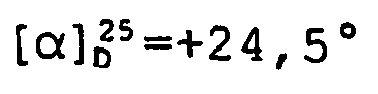
- Dans un autoclave on introduit 5 g (21,46 mmoles) de 3,5-dichloro-4-fluoro[(trifluorométhyl)benzène] en solution dans 10 ml d'acide sulfurique concentré et on chauffe la solution à 120°C pendant une nuit.
Après refroidissement on reprend le mélange avec de l'eau, on recueille le précipité formé par filtration et on le sèche sous pression réduite.
On obtient quantitativement l'acide qu'on utilise tel quel dans l'étape suivante. - Dans un ballon de 100 ml on introduit 1 g (4,8 mmoles) d'acide 3,5-dichloro-4-fluorobenzoïque, 1,56 g (4,8 mmoles) de carbonate de césium et 1 ml (12 mmoles) de pyrrolidine en solution dans 5 ml de diméthylsulfoxyde et on chauffe le mélange à 125 pendant une nuit.
Après refroidissement on l'hydrolyse avec de l'acide chlorhydrique concentré, on recueille le précipité formé par filtration et on le sèche sous pression réduite.
On obtient 0,65 g d'acide. - En utilisant le mode opératoire décrit au point 1.6 ci-dessus, à partir de 0,5 g (2 mmoles) d'acide 3,5-dichloro-4-(pyrrolidin-1-yl)benzoïque, de 0,35 g (1,82 mmoles) de chlorhydrate de 1-[3-(diméthylamino)propyl]-3-éthylcarbodiimide, de 0,25 g (1,82 mmoles) de 1-hydroxybenzotriazole et de 0,37 g (1,82 mmoles) de thréo-(1-méthylpipéridin-2-yl)]phénylméthanamine, on obtient 0,1 g de produit sous forme de base.
On en prépare le chlorhydrate à partir d'une solution 0,1N d'acide chlorhydrique dans le propan-2-ol.
On isole finalement 0,85 g de chlorhydrate sous forme de solide blanc.
Point de fusion : 157-159°C. - Dans un ballon de 250 ml on place une solution de 2,0 g (6,9 mmoles) de (1S)-2-[(2S)-hydroxy(phényl)méthyl]pipéridine-1-carboxylate de 1,1-diméthyléthyle (obtenu selon le mode opératoire décrit dans l'étape 1.2 de l'exemple 1) dans 40 ml de méthanol, on ajoute une solution aqueuse de potasse préparée à partir de 2 g de potasse en pastilles et 20 ml d'eau, et on chauffe le mélange au reflux pendant 2 h.
On le refroidit, on évapore le solvant sous pression réduite, on ajoute de l'eau et on extrait le mélange plusieurs fois avec du dichlorométhane. Après lavage des phases organiques réunies, séchage sur sulfate de magnésium, filtration et évaporation du solvant sous pression réduite on obtient 1 g de solide blanc.
Point de fusion : 148-150°C.

- Dans un ballon de 500 ml muni d'une agitation magnétique et d'une circulation d'argon on introduit 2,6 g (13,58 mmoles) de (S)-phényl[(2S)-pipéridin-2-yl]méthanol et 100 ml d'acétonitrile. A la suspension obtenue on ajoute ensuite 2,8 g de carbonate de potassium et 1,4 ml (1,2 éq.)de bromure d'allyle, et on maintient l'agitation à 25°C pendant 6 h.
On ajoute 100 ml d'eau et 100 ml d'acétate d'éthyle, on sépare la phase aqueuse, on l'extrait trois fois avec 50 ml d'acétate d'éthyle, on lave les phases organiques réunies avec 100 ml d'eau puis 100 ml d'une solution aqueuse saturée de chlorure de sodium, on sèche sur sulfate de sodium, on filtre et on évapore le solvant sous pression réduite.
On obtient 3 g d'huile jaune que l'on purifie par chromatographie sur colonne de gel de silice (120 g, gradient d'élution de 2% à 10% de méthanol dans le dichlorométhane en 30 min).
On isole 2,7 g de produit sous forme d'huile jaune. - Dans un ballon de 250 ml, sous atmosphère d'azote, on introduit 2,7 g (11,67 mmoles) de (S)-[(2S)-1-allylpipéridin-2-yl](phényl)méthanol et 1,62 ml de triéthylamine dans 80 ml de dichlorométhane anhydre, on refroidit le milieu à 0°C, on ajoute 0,9 ml de chlorure de méthylsulfonyle, on laisse le mélange revenir lentement à température ambiante pendant 2 h et on le concentre sous pression réduite.
Dans un autoclave muni d'une agitation magnétique et refroidi à -50°C on introduit de l'ammoniac liquéfié, on ajoute une solution de méthanesulfonate brut précédemment préparé en solution dans 30 ml d'éthanol absolu, on ferme l'autoclave et on maintient l'agitation pendant 48 h.
On transvase le mélange dans un ballon, on le concentre sous pression réduite et on isole 1,5 g d'amine sous forme de produit huileux qu'on utilise tel quel dans l'étape suivante. - Dans un ballon de 10 ml on introduit successivement, dans 5 ml de dichlorométhane, 0,13 g (0,68 mmole) d'acide 2,3-dichlorobenzoïque, 0,13 g (0,68 mmole) de chlorhydrate de 1-[3-(diméthylamino)propyl]-3-éthylcarbodiimide et 0,085 g de diméthylaminopyridine, et on agite le mélange à température ambiante pendant 30 min.
On ajoute 0,18 g de (S)-[(2S)-1-allylpipéridin-2-yl]-(phényl)méthanamine en solution dans quelques ml de dichlorométhane et on poursuit l'agitation pendant 24 h.
On ajoute 5 ml d'eau, on filtre sur cartouche Whatman® (PTFE) et on purifie directement sur cartouche de 10 g de silice en éluant avec un mélange 98/2 à 90/10 de dichloro méthane et de méthanol.
On isole 0,18 g de base sous forme d'huile incolore. - Dans un ballon de 10 ml muni d'uni d'une agitation magnétique on introduit, sous atmosphère d'argon, 0,21 g (3 éq.) d'acide 1,3-diméthylbarbiturique en solution dans 3 ml de dichlorométhane anhydre, on ajoute 0,005 g (0,01 éq.) de tétrakis(triphénylphosphine)palladium (0) et on chauffe le mélange à 30°C.
- On ajoute une solution de 0,18 g (0,3 mmole) de N-[(S)-[(2S)-1-allylpipéridin-2-yl](phényl)méthyl]-2,3-dichlorobenzamide dans 1 ml de dichlorométhane et on laisse le mélange sous agitation pendant 24 h.
On ajoute 3 ml d'une solution aqueuse saturée d'hydrogénosulfate de sodium, on on filtre sur cartouche Whatman® (PTFE) et on purifie directement sur cartouche de 10 g de silice en éluant avec du dichlorométhane contenant 0,4% d'ammonique à 33%.
On isole 0,1 g de base que l'on salifie par une solution O,1N d'acide chlorhydrique dans le propan-2-ol.
On obtient 0,076 g de chlorhydrate qu'on purifie en phase inverse sur colonne XTerra® MS C18 (pH 10).
On isole finalement 0,037 g de base sous forme de cristaux blancs.
Point de fusion : 156-158°C.
Le tableau de la page suivante illustre les structures chimiques et les propriétés physiques de quelques composés de l'invention.
Dans la colonne "R2" de ce tableau, "piperid" désigne un groupe pipéridin-1-yle, "pyrrolid" désigne un groupe pyrrolidin-1-yle et "morphol" désigne un groupe morpholin-4-yle.
Dans la colonne "Sel", "-" désigne un composé à l'état de base et "HCl" désigne un chlorhydrate ; le rapport molaire acide:base est indiqué en regard. - Les pouvoirs rotatoires des composés optiquement purs sont les suivants
N° stéréochimie 
41 thréo (1S,2S) -73,3 c=0,225 55 thréo (1R,2R) +24,5 c=0, 9 64 thréo (1S,2S) +13,2 c=0, 84 65 thréo (1S,2S) +66, 3 c=0, 58 71 thréo (1S,2S) +73,9 c=0, 89 72 thréo (1R,2R) -97,0 c=1 74 thréo (1R,2R) -104,4 c=1 Tableau 
N° stéréochimie R1 X R2 Sel F (°C) 1 thréo (1R,2R;1S,2S) CH3 H 3-OCH3, 4-Cl - 159-161 2 thréo (1R,2R;1S,2S) CH3 H 3-I, 4-Cl - 102-104 3 thréo (1R,2R;1S,2S) CH3 H 4-Cl - 149, 5-150, 5 4 thréo (1R,2R;1S,2S) CH3 H 3,5-Cl2 HCl 1:1 152-154 5 thréo (1R,2R;1S,2S) CH3 H 4-N(CH3)2 - 128-130 6 thréo (1R,2R;1S,2S) CH3 H 3,4-Cl2 - 50-52 7 thréo (1R,2R;1S,2S) CH3 H 3,4-(OCH3)2 HCl 1:1 68-70 8 thréo (1R,2R;1S,2S) CH3 H 3,4-F2 HCl 1:1 62-64 9 thréo (1R,2R;1S,2S) CH3 H 3-F HCl 1:1 36-38 10 thréo (1R, 2R; 1S, 2S) CH3 H 3-Br HCl 1:1 116-118 11 thréo (1R, 2R; 1S, 2S) CH3 H 3, 5-Cl2, 4-OH - 266-268 12 thréo (1R, 2R; 1S, 2S) CH3 H 3-N(CH3)2 HCl 1:1 87-88 13 thréo (1R, 2R; 1S, 2S) CH3 H 3, 5-Cl2, 4-NH2 - 170-171 14 thréo (1R, 2R; 1S, 2S) CH3 H 3-Br, 4-OCH3 HCl 1:1 136-137 15 thréo (1R, 2R; 1S, 2S) CH3 H 2,4,6-Cl3 - 97-104 16 thréo (1R, 2R; 1S, 2S) CH3 H 2,3-Cl2 - 107-114 17 thréo (1R, 2R; 1S, 2S) CH3 H 2-Cl - 126-130 18 thréo (1R, 2R; 1S, 2S) CH3 H 2,4-Cl2 - 138-142 19 thréo (1R,2R;1S,2S) CH3 H 2-Cl, 4-Br - 143-145 20 thréo (1R,2R;1S,2S) CH3 H 2,5-Cl2 - 133-134 21 thréo (1R, 2R, 1S, 2S) CH3 H 2,6-Cl2 - 138-143 22 thréo (1R, 2R; 1S, 2S) CH3 H 2,3,5-Cl3 - 156-159 23 thréo (1R, 2R; 1S, 2S) CH3 H 2-NH2, 3,5-Cl2 HCl 1:1 186-188 24 thréo (1R, 2R; 1S, 2S) CH3 H 2-Cl, 5-NH2 HCl 1:1 266-268 25 thréo (1R, 2R; 1S, 2S) CH3 H 3-Cl, 4-NH2 HCl 1:1 164-166 26 thréo (1R, 2R; 1S, 2S) CH3 H 3-NH2, 4-Cl HCl 1:1 230-232 27 thréo (1R, 2R; 1S, 2S) CH3 H 2-Cl, 4-NH2 HCl 1:1 254-256 28 thréo (1R, 2R; 1S, 2S) CH3 H 2-NH2, 4-Cl HCl 1:1 236-238 29 thréo (1R, 2R; 1S, 2S) CH3 H 2-Cl, 3-NH2 HCl 1:1 195-200 30 thréo (1R, 2R; 1S, 2S) CH3 H 6-NH2, 2, 5-Cl2 HCl 1: 1 267-268 31 thréo (1R, 2R; 1S, 2S) CH3 H 3,5-Cl2, 4-O(CH2)2piperid HCl 2:1 44-46 32 thréo (1R, 2R; 1S, 2S) CH3 H 3,5-Cl2, 4-O(CH2)3N(CH3)2 HCl 2:1 39-41 33 thréo (1R, 2R; 1S, 2S) CH3 H 3, 5-Cl2, 4-O(CH2)2N(CH3)2 HCl 2: 1 130-132 34 thréo (1R, 2R; 1S, 2S) CH3 H 3, 5-Cl2, 4-O(CH2)2pyrrolid HCl 2:1 78-80 35 thréo (1R, 2R; 1S, 2S) CH3 H 3, 5-Cl2, 4-O(CH2)2morphol HCl 2:1 166-168 36 thréo (2R, 2R; 1S, 2S) CH3 H 2-Cl, 6-F HCl 1:1 266-268 37 thréo (1R, 2R; 1S, 2S) CH3 H 3, 5-Cl2, 4-N(CH3)2 HCl 1:1 157-159 38 thréo (1R, 2R; 1S, 2S) CH3 H 2-Cl, 5-I HCl 1:1 281-285 39 thréo (1R,2R;1S,2S) CH3 H 3,5-Cl2, 4-NHCH2CH3 HCl 1:1 175-180 40 thréo (1R,2R;1S,2S) CH3 H 3-Cl, 4-I HCl 1:1 98-99 41 thréo (1S,2S) CH3 H 3,5-Cl2, 4-NH2 - 176-177 42 thréo (1R,2R,1S,2S) CH3 H 2-I, 4-Cl - 213-214 43 thréo (1R,2R;1S,2S) CH3 H 3-Cl, 4-OH HCl 1:1 194-195 44 thréo (1R,2R;1S,2S) CH3 H 3-Cl, 4-piperid HCl 1:1 270-272 45 thréo (1R,2R;1S,2S) CH3 H 2-OCH3, 3,5-Cl2 - 97-98 46 thréo (1R,2R;1S,2S) CH3 H 2-Cl, 3,4-(OCH3)2 - 229-230 47 thréo (1R,2R;1S,2S) CH3 H 2-Br, 4-F - 124-125 48 thréo (1R, 2R; 1S, 2S) CH3 H 3-Cl, 4-pyrrolid HCl 1:1 154-156 49 thréo (1R, 2R; 1S, 2S) CH3 H 2-Br, 5-Cl - 156-157 50 thréo (1R, 2R; 1S, 2S) CH3 H 2-Br - 202-203 51 thréo (1R, 2R, 1S, 2S) CH3 H 2-Br, 4,5-(OCH3)2 - 218-219 52 thréo (1R, 2R; 1S, 2S) CH3 H 2-Cl, 3,6-F2 - 52-53 53 thréo (1R, 2R; 1S, 2S) CH3 H 3-Cl, 4-morphol HCl 1:1 158-162 54 thréo (1R, 2R; 1S, 2S) CH3 H 3,5-Cl, 4-piperid HCl 1:1 154-163 55 thréo (1R, 2R) CH3 H 3,5-Cl2, 4-NH2 HCl 1:1 250-260 56 thréo (1R, 2R; 1S, 2S) CH3 H 2-I, 3-Cl HCl 1:1 253-255 57 thréo (1R, 2R; 1S, 2S) CH3 H 2-Cl, 3-I HCl 1:1 297-298 58 thréo (1R, 2R; 1S, 2S) CH3 H 3,5-Cl2, 4-NHC6H5 HCl 1:1 236-240 59 thréo (1R, 2R; 1S, 2S) CH3 H 3,5-Cl2, 4-pyrrolid HCl 1:1 157-159 60 thréo (1R, 2R; 1S, 2S) CH3 H 2-Cl, 6-F HCl 1:1 271-272 61 thréo (1R, 2R; 1S, 2S) CH3 H 2-Cl, 4,5- (OCH3)2 - 242-243 62 thréo (1R, 2R; 1S, 2S) CH3 H 2-Cl, 4-F HCl 1:1 365-366 63 thréo (1R, 2R; 1S, 2S) CH3 H 2-Br, 5-OCH3 - 213-214 64 thréo (1S, 2S) CH3 H 3,5-Cl2, 4-N(CH3)2 HCl 1:1 158-168 65 thréo (1S, 2S) CH3 H 2,3-Cl2 HCl 1:1 124-126 66 thréo (1R, 2R; 1S, 2S) CH3 H 3,5-(OCH3)2, 4-OCH2C6H5 HCl 1:1 274-275 67 thréo (1R, 2R; 1S, 2S) CH3 H 3, 5-Cl2, 4-OCH2C6H5 HCl 1 : 1 165-175 68 thréo (1R, 2R; 1S, 2S) CH3 H 3,5-Cl2, 4-NHCH2C6H5 HCl 1:1 165-175 69 thréo (1R, 2R; 1S, 2S) CH3 H 2-Cl, 3-F HCl 1:1 115-116 70 thréo (1R, 2R; 1S, 2S) CH3 H 2-Cl, 5-F HCl 1:1 212-215 71 thréo (1S, 2S) CH3 H 2-Cl, 4-F HCl 1:1 123-125 72 thréo (1R, 2R) CH3 H 2, 5-Cl2, 6-NH2 HCl 1:1 66-67 73 thréo (1R, 2R; 1S, 2S) CH3 H 2-Cl, 5-OCH3, 6-NH2 HCl 1:1 258-259 74 thréo (1R, 2R) CH3 H 2-Cl, 5-OCH3, 6-NH2 HCl 1:1 138-139 75 thréo (1R, 2R; 1S, 2S) CH3 H 2, 3-Cl2, 6-NH2 HCl 1:1 230-236 76 thréo (1S, 2S) H H 2,3-Cl2 - - 156-158 - Les composés de l'invention ont été soumis à une série d'essais pharmacologiques qui ont mis en évidence leur intérêt comme substances à activités thérapeutiques.
- La capture de [14C]glycine est étudiée dans les cellules SK-N-MC (cellules neuro-épithéliales humaines) exprimant le transporteur humain glyt1 natif par la mesure de la radioactivité incorporée en présence ou en absence du composé à tester. Les cellules sont cultivées en monocouche pendant 48 h dans des plaques prétraitées à la fibronectine à 0,02%. Le jour de l'expérience, le milieu de culture est éliminé et les cellules sont lavées par un tampon Krebs-HEPES (acide [4-(2-hydroxyéthyl)pipérazine-1-éthanesulfonique) à pH 7,4. Après 10 min de préincubation à 37°C en présence soit de tampon (lot témoin), soit de composé à tester a différentes concentrations ou de 10 mM de glycine (détermination de la capture non spécifique), 10 µM de [14C]glycine (activité spécifique 112 mCi/mmole) sont ensuite ajoutés. L'incubation se poursuit pendant 10 min à 37°C, et la réaction est arrêtée par 2 lavages avec un tampon Krebs-HEPES à pH 7,4. La radioactivité incorporée par les cellules est alors estimée après ajout de 100 µl de scintillant liquide et agitation pendant 1 h. Le comptage est réalisé sur compteur Microbeta Tri-lux™. L'efficacité du composé est déterminée par la CI50, concentration du composé qui diminue de 50% la capture spécifique de glycine, définie par la différence de radioactivité incorporée par le lot témoin et le lot qui a reçu la glycine à 10 mM.
- Les composés de l'invention, dans ce test, ont une CI50 de l'ordre de 0,001 à 10.µM.
- Des doses croissantes du composé à étudier sont administrées par voie orale (préparation par trituration de la molécule à tester dans un mortier dans une solution de Tween/Methocel™ à 0,5% dans de l'eau distillée) ou intrapéritonéale (dissolution de la molécule à tester dans du sérum physiologique ou prépation par trituration dans un mortier dans une solution de Tween/methocel à 0,5% dans de l'eau, selon la solubilité de la molécule) sur des souris mâles OF1 Iffa Crédo de 20 à 25 g le jour de l'expérience. Le groupe témoin est traité par le véhicule. Les doses en mg/kg, la voie d'administration et le temps de traitement sont déterminés en fonction de la molécule à étudier.
Après euthanasie par décapitation des animaux à un temps donné après l'administration, le cortex de chaque animal est rapidement prélevé sur glace, pesé et conservé à 4°C ou congelé à -80°C (dans les deux cas les échantillons sont conservés 1 jour maximum). Chaque échantillon est homogénéisé dans un tampon Krebs-HEPES à pH 7,4 à raison de 10 ml/g de tissu. 20 µl de chaque homogénat sont incubés pendant 10 min à température ambiante en présence de 10 mM de L-alanine et de tampon. La capture non spécifique est déterminée par addition de 10 mM de glycine au groupe témoin. La réaction est arrêtée par filtration sous vide et la radioactivité retenue est estimée par scintillation solide par comptage sur compteur Microbeta Tri-lux™.
Un inhibiteur de la capture de la [14C]glycine diminuera la quantité de radioligand incorporée dans chaque homogénat. L'activité du composé est évaluée par sa DE50, dose qui inhibe 50% de la capture de la [14C]glycine par rapport au groupe témoin.
Les composés de l'invention les plus puissants, dans ce test, ont une DE50 de 0,1 à 5 mg/kg par voie intrapéritonéale ou par voie orale. - La capture de [14C]glycine par le transporteur glyt2 est étudiée dans l'homogénat de moelle épinière de souris par la mesure de radioactivité incorporée en présence ou en absence de composé à étudier.
- Après euthanasie des animaux (souris mâles OF1 Iffa Crédo pesant 20 à 25 g le jour de l'expérience), la moelle épinière de chaque animal est rapidement prélevée, pesée et conservée sur glace. Les échantillons sont homogénéisés dans un tampon Krebs-HEPES (acide [4-(2-hydroxyéthyl)pipérazine-1-éthanesulfonique), pH 7,4, à raison de 25 ml/g de tissu.
50 µl d'homogénat sont pré-incubés pendant 10 min à 25°C en présence de tampon Krebs-HEPES , pH 7,4 et de composé à étudier à différentes concentrations, ou de 10 mM de glycine pour déterminer la capture non spécifique. La [14C]glycine (activité spécifique = 112mCi/mmole) est ensuite ajoutée pendant 10 min à 25°C à la concentration finale de 10 µM. La réaction est arrêtée par filtration sous vide et la radioactivité est estimée par scintillation solide par comptage sur un compteur Microbeta Tri-lux™. L'efficacité du composé est déterminée par la concentration CI50 capable de diminuer de 50% la capture spécifique de glycine, définie par la différence de radioactivité incorporée par le lot témoin et le lot qui a reçu la glycine 10 mM.
Les composés de l'inventiondans ce test, ont une CI50 de l'ordre de 0,001 à 10 µM. - Des doses croissantes du composé à étudier sont aministrées par voie orale (préparation par trituration du composé à tester dans un mortier, dans une solution de Tween/Methocel™ à 0,5% dans de l'eau distillée) ou intrapéritonéale (composé à tester dissous dans du sérum physiologique, ou trituré dans un mortier, dans une solution de Tween/Methocel™ à 0,5% dans de l'eau distillée) à des souris mâles OF1 Iffa Crédo de 20 à 25 g le jour de l'expérience. Le groupe témoin est traité par le véhicule. Les doses en mg/kg, la voie d'administration, le temps de traitement ainsi que le temps d'euthanasie sont déterminés en fonction du composé à étudier.
Après euthanasie par décapitation des animaux à un temps donné après l'administration, les moelles sont prélevées rapidement, pesées et introduites dans des fioles à scintillation en verre, conservées dans de la glace pilée
ou congelées à -80°C (dans les deux cas les échantillons sont conservés 1 jour maximum). Chaque échantillon est homogénéisé dans un tampon Krebs-HEPES à pH 7,4, à raison de 25 ml/g de tissu. 50 µl de chaque homogénat sont incubés pendant 10 min à température ambiante en présence de tampon.
La capture non spécifique est déterminée par addition de 10 mM de glycine au groupe témoin.
La réaction est arrêtée par filtration sous vide et la radioactivité est estimée par scintillation solide par comptage sur un compteur Microbeta Tri-lux™.
Un inhibiteur de la capture de la [14C]glycine diminuera la quantité de radioligand incorporée dans chaque homogénat. L'activité du composé est évaluée par sa DE50, dose efficace qui inhibe 50% de la capture de la [14C]glycine par rapport au groupe témoin.
Les meilleurs composés de l'invention ont, dans ce test, une DE50 de 1 à 20 mg/kg, par voie intrapéritonéale ou par voie orale. - Les résultats des essais effectués sur les composés de l'invention de configuration (1S,2S) et leurs racémates thréo de configuration (1R,2R ;1S,2S) dans la formule générale (I) desquels R2 représente un ou plusieurs atomes d'halogènes montrent qu'ils sont des inhibiteurs du transporteur de la glycine glyt1 présents dans le cerveau, et cela in vitro et ex vivo.
- Ces résultats suggèrent que les composés de l'invention peuvent être utilisés pour le traitement des troubles comportementaux associés à la démence, des psychoses, en particulier de la schizophrénie (forme déficitaire et forme productive) et des symptômes extrapyramidaux aigus ou chroniques induits par les neuroleptiques, pour le traitement des diverses formes d'anxiété, des attaques de panique, des phobies, des troubles obsessionnels compulsifs, pour le traitement des différentes formes de dépression, y compris la dépression psychotique, pour le traitement des troubles dus à l'abus ou au sevrage d'alcool, des troubles du comportement sexuel, des troubles de la prise de nourriture, et pour le traitement de la migraine.
- Les résultats des essais effectués sur les composés de l'invention de configuration (1R,2R) et leurs racémates de configuration (1R,2R;1S,2S) dans la formule générale (I) desquels R2 représente à la fois un atome d'halogène et un groupe amino NR6R7 montrent qu'ils sont des inhibiteurs du transporteur des la glycine glyt2, présent majoritairement dans la moelle épinière, et cela in vitro et ex vivo.
- Ces résultats suggèrent que les composés de l'invention peuvent être utilisés pour le traitement des contractures musculaires douloureuses en rhumatologie et en pathologie rachidienne aiguë, pour le traitement des contractures spastiques d'origine médullaire ou cérébrale, pour le traitement symptomatique des douleurs aiguës et subaiguës d'intensité légère à modérée, pour le traitement des douleurs intenses et/ou chroniques, des douleurs neurogènes et algies rebelles, pour le traitement de la maladie de Parkinson et des symptômes parkinsoniens d'origine neurodégénérative ou induits par des neuroleptiques, pour le traitement des épilepsies généralisées primaires et secondaires, partielles à symptomatologie simple ou complexe, des formes mixtes et autres syndromes épileptiques en complément d'un autre traitement antiépileptique, ou en monothérapie, pour le traitement des apnées du sommeil, et pour la neuroprotection.
- C'est pourquoi la présente invention a également pour objet des compositions pharmaceutiques contenant une dose efficace d'au moins un composé selon l'invention, à l'état de base ou de sel ou de solvat pharmaceutiquement acceptable, et en mélange, le cas échéant, avec des excipients convenables.
- Lesdits excipients sont choisis selon la forme pharmaceutique et le mode d'administration souhaité.
- Les compositions pharmaceutiques selon l'invention peuvent ainsi être destinées à l'administration orale, sublinguale, sous-cutanée, intramusculaire, intraveineuse, topique, intratrachéale, intranasale, transdermique, rectale, intraocculaire.
- Les formes unitaires d'administration peuvent être, par exemple, des comprimés, des gélules, des granules, des poudres, des solutions ou suspensions orales ou injectables, des timbres transdermiques ("patch"), des suppositoires. Pour l'administration topique on peut envisager des pommades, lotions et collyres.
Lesdites formes unitaires sont dosées pour permettre une administration journalière de 0,01 à 20 mg de principe actif par kg de poids corporel, selon la forme galénique. - Pour préparer des comprimés on ajoute au principe actif, micronisé ou non, un véhicule pharmaceutique qui peut être composé de diluants, comme par exemple le lactose, la cellulose microcristalline, l'amidon, et des adjuvants de formulation comme des liants, (polyvinylpyrrolidone, hydroxypropylméthylcellulose, etc), des agents d'écoulement comme la silice, des lubrifiants comme le stéarate de magnésium, l'acide stéarique, le tribehenate de glycerol, le stéarylfumarate de sodium. Des agents mouillants ou tensioactifs tels que le laurylsulfate de sodium peuvent aussi être ajoutés.
Les techniques de réalisation peuvent être la compression directe, la granulation sèche, la granulation humide ou la fusion à chaud.
Les comprimés peuvent être nus, dragéifiés, par exemple par du saccharose, ou enrobés avec divers polymères ou autres matières appropriées. Il peuvent être conçus pour permettre une libération rapide, retardée ou prolongée du principe actif grâce à des matrices polymères ou à des polymères spécifiques utilisés dans l'enrobage. - Pour préparer des gélules on mélange le principe actif avec des véhicules pharmaceutiques secs (simple mélange, granulation sèche ou humide, ou fusion à chaud), liquides ou semi-solides.
Les gélules peuvent être dures ou molles, pelliculées ou non, de manière à avoir une activité rapide, prolongée ou retardée (par exemple pour une forme entérique). - Une composition sous forme de sirop ou d'élixir ou pour l'administration sous forme de gouttes peut contenir le principe actif conjointement à un édulcorant, de préférence acalorique, du méthylparaben ou du propylparaben comme antiseptique, un agent de sapidité et un colorant.
- Les poudres et granules dispersibles dans de l'eau peuvent contenir le principe actif en mélange avec des agents de dispersion ou des agents mouillants, ou des agents dispersants comme la polyvinylpyrrolidone, de même qu'avec des édulcorants et des agents correcteurs de goût.
- Pour l'administration rectale, on recourt à des suppositoires préparés avec des liants fondant à la température rectale, par exemple du beurre de cacao ou des polyéthylèneglycols.
- Pour une administration parentérale, on utilise des suspensions aqueuses, des solutions salines isotoniques ou des solutions stériles injectables contenant des agents de dispersion et/ou des mouillants pharmacologiquement compatibles, par exemple le propylèneglycol ou le butylèneglycol.
- Le principe actif peut être formulé également sous forme de microcapsules, éventuellement avec un ou plusieurs supports ou additifs, ou bien avec une matrice polymère ou avec une cyclodextrine (timbres transdermiques, formes à libération prolongée).
- Les compositions topiques selon l'invention comprennent un milieu compatible avec la peau. Elles peuvent se présenter notamment sous forme de solutions aqueuses, alcooliques ou hydroalcooliques, de gels, d'émulsions eau-dans-huile ou huile-dans-eau ayant l'aspect d'une crème ou d'un gel, de microémulsions, d'aérosols, ou encore sous forme de dispersions vésiculaires contenant des lipides ioniques et/ou non ioniques. Ces formes galéniques sont préparées selon les méthodes usuelles des domaines considérés.
- Enfin, les compositions pharmaceutiques selon l'invention peuvent contenir, à côté d'un composé de formule générale (I), d'autres principes actifs qui peuvent être utiles dans le traitement des troubles et maladies indiqués ci-dessus.
Claims (6)
- Composé, sous forme d'isomère optique pur (1R,2R) ou (1S,2S) ou sous forme de diastéréoisomère thréo, répondant à la formule générale (I)
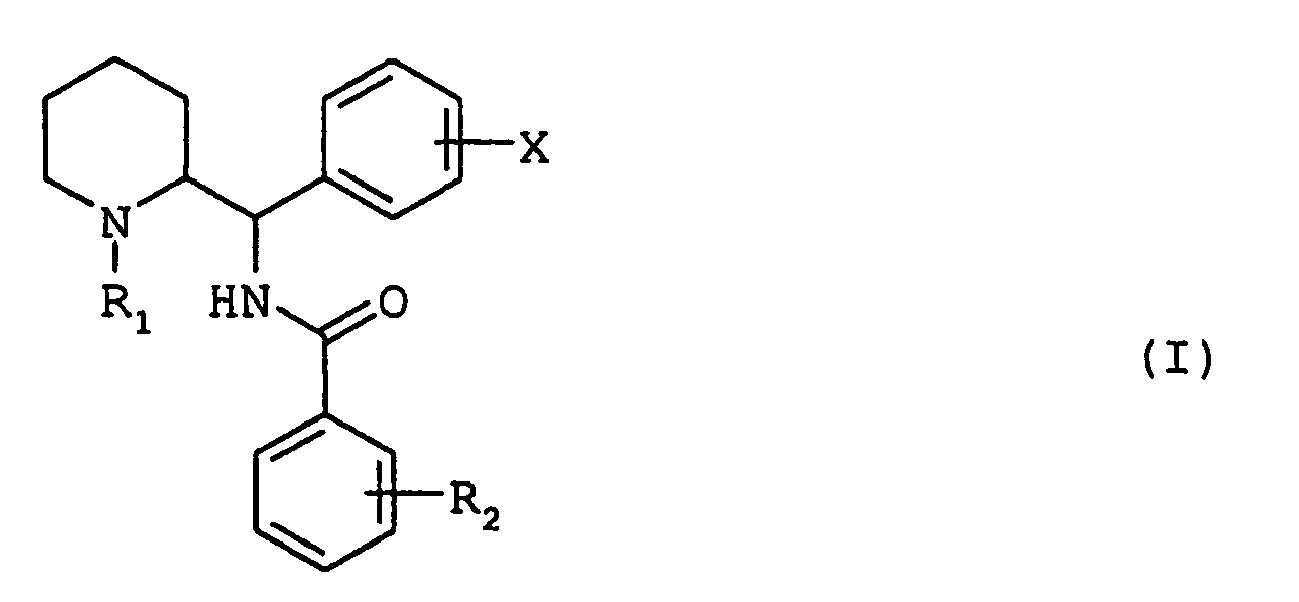 R1 représente soit un atome d'hydrogène, soit un groupe (C1-C7)alkyle linéaire ou ramifié éventuellement substitué par un ou plusieurs atomes de fluor, soit un groupe (C3-C7)cycloalkyl(C1-C3)alkyle, soit un groupe phényl(C1-C3)alkyle éventuellement substitué par un ou deux groupes méthoxy, soit un groupe (C2-C4)alcényle, soit un groupe (C2-C4)alcynyle,X représente un atome d'hydrogène ou un ou plusieurs substituants choisis parmi les atomes d'halogènes et les groupes trifluorométhyle, (C1-C4) alkyle linéaire ou ramifié et (C1-C9) alcoxy,R2 représente un ou plusieurs substituants choisis parmi les atomes d'halogènes, parmi les groupe de formule générale OR3 dans laquelle R3 représente un atome d'hydrogène, un groupe (C1-C4) alkyle, un groupe phényl(C1-C3)alkyle, ou un groupe de formule générale (CH2)n-NR4R5 dans laquelle n représente le nombre 2, 3 ou 4 et R4 et R5 représentent chacun, indépendamment l'un de l'autre, un atome d'hydrogène ou un groupe (C1-C4) alkyle ou forment, avec l'atome d'azote qui les porte, un cycle pyrrolidine, pipéridine ou morpholine, et parmi les groupes amino de formule générale NR6R7 dans laquelle R6 et R7 représentent chacun, indépendamment l'un de l'autre, un atome d'hydrogène ou un groupe (C1-C4)alkyle, un groupe phényle ou un groupe phényl(C1-C3)alkyle, ou forment, avec l'atome d'azote qui les porte, un cycle pyrrolidine, pipéridine ou morpholine,à l'état de base libre ou de sel d'addition à un acide.
 - Composé selon la revendication 1, caractérisé en ce qu'il est de configuration (1S,2S), avec R2 représentant un ou plusieurs atomes d'halogènes.
- Composé selon la revendication 1, caractérisé en ce qu'il est de configuration (1R,2R) avec R2 représentant un ou plusieurs atomes d'halogènes et un groupe amino de formule générale NR6R7.
- Médicament caractérisé en ce qu'il consiste en un composé selon l'une des revendications 1 à 3.
- Composition pharmaceutique, caractérisée en ce qu'elle contient un composé selon l'une des revendications 1 à 3, associé à un excipient pharmaceutique.
- Composé selon la revendication 1, caractérisé en ce qu'il est choisi parmi les composés suivants :2,3-dichloro-N-[(1S)-[(2S)-1-méthylpipéridin-2-yl]phénylméthyl]benzamide ;4-amino-3,5-dichloro-N-[(1R)-[(2R)-1-méthylpipéridin-2-yl]phénylméthyl]benzamide ;3,5-dichloro-N-[(1-méthylpipéridin-2-yl)phénylméthyl]-4-(pyrrolidin-1-yl)benzamide ;2,3-dichloro-N-[(S)-phényl[(2S)-pipéridin-2-yl]méthyl]benzamide.
Applications Claiming Priority (3)
| Application Number | Priority Date | Filing Date | Title |
|---|---|---|---|
| FR0209588 | 2002-07-29 | ||
| FR0209588A FR2842804B1 (fr) | 2002-07-29 | 2002-07-29 | Derives de n-[phenyl(piperidin-2-yl)methyl]benzamide, leur preparation et leur application en therapeutique |
| PCT/FR2003/002356 WO2004013101A2 (fr) | 2002-07-29 | 2003-07-25 | Derives de n-[phenyl(piperidin-2-yl)methyl]benzamide, leur preparation et leur application en therapeutique |
Publications (2)
| Publication Number | Publication Date |
|---|---|
| EP1527048A2 EP1527048A2 (fr) | 2005-05-04 |
| EP1527048B1 true EP1527048B1 (fr) | 2008-01-09 |
Family
ID=30011556
Family Applications (1)
| Application Number | Title | Priority Date | Filing Date |
|---|---|---|---|
| EP03755635A Expired - Lifetime EP1527048B1 (fr) | 2002-07-29 | 2003-07-25 | Derives de n-[phenyl(piperidin-2-yl)methyl]benzamide, leur preparation et leur application en therapeutique |
Country Status (9)
| Country | Link |
|---|---|
| US (2) | US7205319B2 (fr) |
| EP (1) | EP1527048B1 (fr) |
| JP (1) | JP4488891B2 (fr) |
| AT (1) | ATE383338T1 (fr) |
| AU (1) | AU2003273475A1 (fr) |
| DE (1) | DE60318583T2 (fr) |
| ES (1) | ES2297205T3 (fr) |
| FR (1) | FR2842804B1 (fr) |
| WO (1) | WO2004013101A2 (fr) |
Families Citing this family (32)
| Publication number | Priority date | Publication date | Assignee | Title |
|---|---|---|---|---|
| FR2861070B1 (fr) * | 2003-10-17 | 2006-01-06 | Sanofi Synthelabo | Derives de n-[phenyl(pyrrolidin-2-yl)methyl]benzamide et n-[(azepan-2-yl)phenylmethyl]benzamide, leur preparation et leur application en therapeutique |
| FR2861074B1 (fr) * | 2003-10-17 | 2006-04-07 | Sanofi Synthelabo | Derives de n-[phenyl(piperidin-2-yl)methyl]benzamide, leur preparation et leur application en therapeutique |
| FR2861073B1 (fr) * | 2003-10-17 | 2006-01-06 | Sanofi Synthelabo | Derives de n-[heteroaryl(piperidin-2-yl)methyl]benzamide, leur preparation et leur application en therapeutique |
| FR2861071B1 (fr) * | 2003-10-17 | 2006-01-06 | Sanofi Synthelabo | Derives de n-[phenyl(alkylpiperidin-2-yl) methyl]benzamide, leur prepartation et leur application en therapeutique |
| CA2593274C (fr) * | 2005-01-14 | 2013-10-29 | N.V. Organon | Inhibiteurs du recaptage de la glycine pour le traitement de la dependance a une drogue |
| WO2009013535A1 (fr) * | 2007-07-23 | 2009-01-29 | Astrazeneca Ab | Dérivés de 2-azabicyclo(2,2,2)octane en tant que modulateurs du récepteur transporteur de type i de la glycine |
| US8420670B2 (en) | 2007-08-22 | 2013-04-16 | Abbott Laboratories | 4-benzylaminoquinolines, pharmaceutical compositions containing them, and their use in therapy |
| MX2010010773A (es) | 2008-04-01 | 2011-04-11 | Abbott Gmbh & Co Kg | Tetrahidroisoquinolinas, composiciones farmaceuticas que las contienen y su uso en terapia. |
| AR075182A1 (es) * | 2009-01-28 | 2011-03-16 | Astrazeneca Ab | Compuestos 2-aza-biciclo (2.2.2) octano y sus usos |
| AR075442A1 (es) | 2009-02-16 | 2011-03-30 | Abbott Gmbh & Co Kg | Derivados de aminotetralina, composiciones farmaceuticas que las contienen y sus usos en terapia |
| TW201038569A (en) | 2009-02-16 | 2010-11-01 | Abbott Gmbh & Co Kg | Heterocyclic compounds, pharmaceutical compositions containing them, and their use in therapy |
| RU2011141778A (ru) * | 2009-03-16 | 2013-04-27 | Санофи | Производные n-[(2-азабицикло[2.1.1]гекс-1-ил)арилметил]гетеробензамида, их получение и их применение в терапии |
| FR2943056A1 (fr) * | 2009-03-16 | 2010-09-17 | Sanofi Aventis | Derives de n-°2-aza-bicyclo°2.1.1!hex-1-yl)-aryl-methyl!- heterobenzamide, leur preparation et leur application en therapeutique |
| FR2944284A1 (fr) * | 2009-04-14 | 2010-10-15 | Sanofi Aventis | Derives de n-°7-aza-bicyclo°2.2.1!hept-1-yl)-aryl-methyl! -benzamide, leur preparation et leur application en therapeutique |
| US8883839B2 (en) | 2010-08-13 | 2014-11-11 | Abbott Laboratories | Tetraline and indane derivatives, pharmaceutical compositions containing them, and their use in therapy |
| US8877794B2 (en) | 2010-08-13 | 2014-11-04 | Abbott Laboratories | Phenalkylamine derivatives, pharmaceutical compositions containing them, and their use in therapy |
| US9045459B2 (en) | 2010-08-13 | 2015-06-02 | AbbVie Deutschland GmbH & Co. KG | Phenalkylamine derivatives, pharmaceutical compositions containing them, and their use in therapy |
| US8846743B2 (en) | 2010-08-13 | 2014-09-30 | Abbott Laboratories | Aminoindane derivatives, pharmaceutical compositions containing them, and their use in therapy |
| US9051280B2 (en) | 2010-08-13 | 2015-06-09 | AbbVie Deutschland GmbH & Co. KG | Tetraline and indane derivatives, pharmaceutical compositions containing them, and their use in therapy |
| US9309200B2 (en) | 2011-05-12 | 2016-04-12 | AbbVie Deutschland GmbH & Co. KG | Benzazepine derivatives, pharmaceutical compositions containing them, and their use in therapy |
| US20140155419A1 (en) * | 2011-07-29 | 2014-06-05 | Erkan Baloglu | Compounds and methods |
| US8853196B2 (en) | 2011-08-05 | 2014-10-07 | AbbVie Deutschland GmbH & Co. KG | Aminochromane, aminothiochromane and amino-1,2,3,4-tetrahydroquinoline derivatives, pharmaceutical compositions containing them, and their use in therapy |
| MX2014006004A (es) | 2011-11-18 | 2015-04-16 | Abbvie Deutschland | Derivados de aminobenzociclohepteno, aminotetralina, aminoindano y fenalcilamina n-sustituidas, composiciones farmaceuticas que los contienen, y su uso en terapia. |
| FR2983197B1 (fr) * | 2011-11-29 | 2014-07-25 | Assist Publ Hopitaux De Paris | Utilisation de phacetoperane pour traiter un trouble deficit de l'attention hyperactivite |
| US9365512B2 (en) | 2012-02-13 | 2016-06-14 | AbbVie Deutschland GmbH & Co. KG | Isoindoline derivatives, pharmaceutical compositions containing them, and their use in therapy |
| US9650334B2 (en) | 2013-03-15 | 2017-05-16 | Abbvie Inc. | Pyrrolidine derivatives, pharmaceutical compositions containing them, and their use in therapy |
| US9656955B2 (en) | 2013-03-15 | 2017-05-23 | Abbvie Inc. | Pyrrolidine derivatives, pharmaceutical compositions containing them, and their use in therapy |
| EP3057960B1 (fr) | 2013-10-17 | 2019-02-27 | AbbVie Deutschland GmbH & Co. KG | Dérivés d'aminochromane, d'aminothiochromane et d'amino-1,2,3,4-tétrahydroquinoléine, compositions pharmaceutiques contenant ceux-ci et leur utilisation thérapeutique |
| MX2016004934A (es) | 2013-10-17 | 2016-12-20 | Abbvie Deutschland | Derivados de aminotetralina y aminoindano, composiciones farmaceuticas que los contienen, y su uso en terapia. |
| US9550754B2 (en) | 2014-09-11 | 2017-01-24 | AbbVie Deutschland GmbH & Co. KG | 4,5-dihydropyrazole derivatives, pharmaceutical compositions containing them, and their use in therapy |
| US12178902B1 (en) | 2020-01-12 | 2024-12-31 | University Of Southern California | Methods and compositions for fluid drainage by Piezo ion channel activation |
| CN114478360B (zh) * | 2022-02-10 | 2023-08-15 | 江苏海洋大学 | 一种苯甲酰胺类衍生物及其制备方法和应用 |
Family Cites Families (22)
| Publication number | Priority date | Publication date | Assignee | Title |
|---|---|---|---|---|
| US2928835A (en) | 1959-02-19 | 1960-03-15 | Rhone Poulenc Sa | New esters |
| US3336300A (en) | 1965-04-13 | 1967-08-15 | American Home Prod | 1, 2, 3, 4-tetrahydro-5h-benzodiazepin-5-ones |
| US3801636A (en) | 1971-08-13 | 1974-04-02 | Abbott Lab | 3,4,5-tri-substituted cinnamides |
| JPH02262562A (ja) | 1988-10-20 | 1990-10-25 | Ishihara Sangyo Kaisha Ltd | イミダゾール系化合物 |
| JP2765876B2 (ja) | 1988-10-24 | 1998-06-18 | 科研製薬株式会社 | ピリジルケトオキシムエーテル誘導体 |
| US5254569A (en) * | 1991-01-14 | 1993-10-19 | The Du Pont Merck Pharmaceutical Company | (Amidomethyl)nitrogen heterocyclic analgesics |
| JP3026845B2 (ja) * | 1991-02-20 | 2000-03-27 | 日清製粉株式会社 | ピペリジン誘導体 |
| CZ284456B6 (cs) | 1992-02-15 | 1998-12-16 | Hoechst Aktiengesellschaft | Aminosubstituované benzoylguanidiny, způsob jejich přípravy, jejich použití jako léčiv a léčivo, které je obsahuje |
| PL342818A1 (en) * | 1998-03-06 | 2001-07-02 | Janssen Pharmaceutica Nv | Glycin transport inhibitors |
| TWI243173B (en) * | 1999-11-17 | 2005-11-11 | Akzo Nobel Nv | Spiro[2H-1-benzopyran-2,4'-piperidine] derivatives |
| EP1296950A2 (fr) * | 2000-04-20 | 2003-04-02 | NPS Allelix Corp. | Aminopiperidines et leur utilisation comme inhibiteurs de glyt-1 |
| AR032653A1 (es) * | 2001-02-09 | 2003-11-19 | Telik Inc | Inhibidores heterociclicos del trasportador de glicina 2 composiciones farmaceuticas, uso y metodos. |
| FR2838739B1 (fr) | 2002-04-19 | 2004-05-28 | Sanofi Synthelabo | Derives de n-[phenyl(piperidin-2-yl)methyl)benzamide, leur preparation et leur application en therapeutique |
| KR20050085673A (ko) | 2002-12-18 | 2005-08-29 | 에프엠씨 코포레이션 | N-(치환된 아릴메틸)-4-(이치환된 메틸)피페리딘 및피페라진 |
| FR2861073B1 (fr) | 2003-10-17 | 2006-01-06 | Sanofi Synthelabo | Derives de n-[heteroaryl(piperidin-2-yl)methyl]benzamide, leur preparation et leur application en therapeutique |
| FR2861071B1 (fr) | 2003-10-17 | 2006-01-06 | Sanofi Synthelabo | Derives de n-[phenyl(alkylpiperidin-2-yl) methyl]benzamide, leur prepartation et leur application en therapeutique |
| FR2861076B1 (fr) | 2003-10-17 | 2006-01-06 | Sanofi Synthelabo | Derives de n-heterocyclymethylbenzamide, leur preparation et leur application en therapeutique |
| FR2861074B1 (fr) | 2003-10-17 | 2006-04-07 | Sanofi Synthelabo | Derives de n-[phenyl(piperidin-2-yl)methyl]benzamide, leur preparation et leur application en therapeutique |
| FR2861070B1 (fr) | 2003-10-17 | 2006-01-06 | Sanofi Synthelabo | Derives de n-[phenyl(pyrrolidin-2-yl)methyl]benzamide et n-[(azepan-2-yl)phenylmethyl]benzamide, leur preparation et leur application en therapeutique |
| US7326732B2 (en) | 2004-02-12 | 2008-02-05 | Pharmagene Laboratories Limited | EP2 receptor agonists |
| WO2006110724A2 (fr) | 2005-04-11 | 2006-10-19 | Yale University | Methode de traitement d'un prodrome schizophrenique |
| FR2906251B1 (fr) | 2006-09-22 | 2008-11-07 | Sanofi Aventis Sa | Derives de pyrrolizine, indolizine et quinolizine, leur preparation et leur application en therapeutique |
-
2002
- 2002-07-29 FR FR0209588A patent/FR2842804B1/fr not_active Expired - Fee Related
-
2003
- 2003-07-25 WO PCT/FR2003/002356 patent/WO2004013101A2/fr not_active Ceased
- 2003-07-25 AT AT03755635T patent/ATE383338T1/de not_active IP Right Cessation
- 2003-07-25 ES ES03755635T patent/ES2297205T3/es not_active Expired - Lifetime
- 2003-07-25 DE DE60318583T patent/DE60318583T2/de not_active Expired - Lifetime
- 2003-07-25 JP JP2004525473A patent/JP4488891B2/ja not_active Expired - Fee Related
- 2003-07-25 EP EP03755635A patent/EP1527048B1/fr not_active Expired - Lifetime
- 2003-07-25 AU AU2003273475A patent/AU2003273475A1/en not_active Abandoned
-
2005
- 2005-01-28 US US11/045,247 patent/US7205319B2/en not_active Expired - Fee Related
-
2007
- 2007-03-01 US US11/680,782 patent/US7951821B2/en not_active Expired - Fee Related
Also Published As
| Publication number | Publication date |
|---|---|
| US20070155789A1 (en) | 2007-07-05 |
| US7205319B2 (en) | 2007-04-17 |
| DE60318583T2 (de) | 2009-01-08 |
| WO2004013101A3 (fr) | 2004-05-13 |
| ATE383338T1 (de) | 2008-01-15 |
| JP4488891B2 (ja) | 2010-06-23 |
| WO2004013101A2 (fr) | 2004-02-12 |
| ES2297205T3 (es) | 2008-05-01 |
| AU2003273475A1 (en) | 2004-02-23 |
| DE60318583D1 (de) | 2008-02-21 |
| FR2842804A1 (fr) | 2004-01-30 |
| FR2842804B1 (fr) | 2004-09-03 |
| JP2005537293A (ja) | 2005-12-08 |
| US20050153963A1 (en) | 2005-07-14 |
| AU2003273475A8 (en) | 2004-02-23 |
| US7951821B2 (en) | 2011-05-31 |
| EP1527048A2 (fr) | 2005-05-04 |
Similar Documents
| Publication | Publication Date | Title |
|---|---|---|
| EP1527048B1 (fr) | Derives de n-[phenyl(piperidin-2-yl)methyl]benzamide, leur preparation et leur application en therapeutique | |
| EP1499589B1 (fr) | Derives de n-¬phenyl(piperidin-2-yl)methyl|benzamide, leur preparation et leur application en therapeutique | |
| EP1682503B1 (fr) | Derives de n-[phenyl(alkylpiperidin-2-yl)methyl]benzamide, leur preparation et leur application en therapeutique | |
| EP1680400B1 (fr) | Derives de n-[ phenyl(pyrrolidin-2-yl)methyl]benzamide, et n-[(azepan-2-yl) phenylmethyl]benzamide, leur preparation et leur application en therapeutique | |
| EP1680418B1 (fr) | Derives de n-[heteroaryl(piperidin-2-yl)methyl]benzamide, leur preparation et leur application en therapeutique | |
| FR2861074A1 (fr) | Derives de n-[phenyl(piperidin-2-yl)methyl]benzamide, leur preparation et leur application en therapeutique | |
| WO2004013100A2 (fr) | Derives de n-[phenyl(piperidin-2-yl)methyl]benzamide, leur preparation et leur application en therapeutique | |
| EP0673928A1 (fr) | Nouveaux dérivés de la N-(3,4-dichlorophényl-propyl)-pipéridine comme antagonistes sélectifs du récepteur NK3 humain | |
| EP1150970B1 (fr) | Derives de (1-phenacy-3-phenyl-3-piperidylethyl)piperidine, procede pour leur obtention et compositions pharmaceutiques les contenant | |
| FR2706894A1 (en) | N-Phenyl-N-(piperidinoalkyl)arylamide derivatives, their preparation and their application in therapeutics | |
| WO2010119222A1 (fr) | Derives de n-[(7-aza-bicyclo[2.2.1]hept-1-yl)-aryl-methyl]-benzamide, leur preparation et leur application en therapeutique | |
| EP2396334A1 (fr) | Derives de n-[(2-aza-bicyclo[2.1.1]hex-1-yl]-aryl-methyl]-benzamide, leur preparation et leur application en therapeutique | |
| EP2396335A1 (fr) | Derives de n-[(6-aza-bicyclo[3.2.1]oct-1-yl)-aryl-methyl]-benzamide, leur preparation et leur application en therapeutique |
Legal Events
| Date | Code | Title | Description |
|---|---|---|---|
| PUAI | Public reference made under article 153(3) epc to a published international application that has entered the european phase |
Free format text: ORIGINAL CODE: 0009012 |
|
| 17P | Request for examination filed |
Effective date: 20050228 |
|
| AK | Designated contracting states |
Kind code of ref document: A2 Designated state(s): AT BE BG CH CY CZ DE DK EE ES FI FR GB GR HU IE IT LI LU MC NL PT RO SE SI SK TR |
|
| AX | Request for extension of the european patent |
Extension state: AL LT LV MK |
|
| GRAP | Despatch of communication of intention to grant a patent |
Free format text: ORIGINAL CODE: EPIDOSNIGR1 |
|
| GRAS | Grant fee paid |
Free format text: ORIGINAL CODE: EPIDOSNIGR3 |
|
| RTI1 | Title (correction) |
Free format text: N- PHENYL(PIPERIDIN-2-YL)METHYL BENZAMIDE DERIVATIVES, PREPARATION THEREOF, AND USE THEREOF IN THERAPY |
|
| GRAA | (expected) grant |
Free format text: ORIGINAL CODE: 0009210 |
|
| RTI1 | Title (correction) |
Free format text: N-(PHENYL(PIPERIDIN-2-YL)METHYL)BENZAMIDE DERIVATIVES, PREPARATION THEREOF, AND USE THEREOF IN THERAPY |
|
| AK | Designated contracting states |
Kind code of ref document: B1 Designated state(s): AT BE BG CH CY CZ DE DK EE ES FI FR GB GR HU IE IT LI LU MC NL PT RO SE SI SK TR |
|
| AX | Request for extension of the european patent |
Extension state: AL LT LV MK |
|
| REG | Reference to a national code |
Ref country code: GB Ref legal event code: FG4D Free format text: NOT ENGLISH |
|
| REG | Reference to a national code |
Ref country code: CH Ref legal event code: EP |
|
| REG | Reference to a national code |
Ref country code: IE Ref legal event code: FG4D Free format text: LANGUAGE OF EP DOCUMENT: FRENCH |
|
| REF | Corresponds to: |
Ref document number: 60318583 Country of ref document: DE Date of ref document: 20080221 Kind code of ref document: P |
|
| REG | Reference to a national code |
Ref country code: ES Ref legal event code: FG2A Ref document number: 2297205 Country of ref document: ES Kind code of ref document: T3 |
|
| GBT | Gb: translation of ep patent filed (gb section 77(6)(a)/1977) |
Effective date: 20080414 |
|
| PG25 | Lapsed in a contracting state [announced via postgrant information from national office to epo] |
Ref country code: SI Free format text: LAPSE BECAUSE OF FAILURE TO SUBMIT A TRANSLATION OF THE DESCRIPTION OR TO PAY THE FEE WITHIN THE PRESCRIBED TIME-LIMIT Effective date: 20080109 Ref country code: NL Free format text: LAPSE BECAUSE OF FAILURE TO SUBMIT A TRANSLATION OF THE DESCRIPTION OR TO PAY THE FEE WITHIN THE PRESCRIBED TIME-LIMIT Effective date: 20080109 |
|
| NLV1 | Nl: lapsed or annulled due to failure to fulfill the requirements of art. 29p and 29m of the patents act | ||
| PG25 | Lapsed in a contracting state [announced via postgrant information from national office to epo] |
Ref country code: FI Free format text: LAPSE BECAUSE OF FAILURE TO SUBMIT A TRANSLATION OF THE DESCRIPTION OR TO PAY THE FEE WITHIN THE PRESCRIBED TIME-LIMIT Effective date: 20080109 |
|
| PG25 | Lapsed in a contracting state [announced via postgrant information from national office to epo] |
Ref country code: AT Free format text: LAPSE BECAUSE OF FAILURE TO SUBMIT A TRANSLATION OF THE DESCRIPTION OR TO PAY THE FEE WITHIN THE PRESCRIBED TIME-LIMIT Effective date: 20080109 Ref country code: BG Free format text: LAPSE BECAUSE OF FAILURE TO SUBMIT A TRANSLATION OF THE DESCRIPTION OR TO PAY THE FEE WITHIN THE PRESCRIBED TIME-LIMIT Effective date: 20080409 |
|
| PG25 | Lapsed in a contracting state [announced via postgrant information from national office to epo] |
Ref country code: PT Free format text: LAPSE BECAUSE OF FAILURE TO SUBMIT A TRANSLATION OF THE DESCRIPTION OR TO PAY THE FEE WITHIN THE PRESCRIBED TIME-LIMIT Effective date: 20080609 |
|
| REG | Reference to a national code |
Ref country code: IE Ref legal event code: FD4D |
|
| PG25 | Lapsed in a contracting state [announced via postgrant information from national office to epo] |
Ref country code: CZ Free format text: LAPSE BECAUSE OF FAILURE TO SUBMIT A TRANSLATION OF THE DESCRIPTION OR TO PAY THE FEE WITHIN THE PRESCRIBED TIME-LIMIT Effective date: 20080109 Ref country code: SK Free format text: LAPSE BECAUSE OF FAILURE TO SUBMIT A TRANSLATION OF THE DESCRIPTION OR TO PAY THE FEE WITHIN THE PRESCRIBED TIME-LIMIT Effective date: 20080109 Ref country code: SE Free format text: LAPSE BECAUSE OF FAILURE TO SUBMIT A TRANSLATION OF THE DESCRIPTION OR TO PAY THE FEE WITHIN THE PRESCRIBED TIME-LIMIT Effective date: 20080409 Ref country code: DK Free format text: LAPSE BECAUSE OF FAILURE TO SUBMIT A TRANSLATION OF THE DESCRIPTION OR TO PAY THE FEE WITHIN THE PRESCRIBED TIME-LIMIT Effective date: 20080109 Ref country code: IE Free format text: LAPSE BECAUSE OF FAILURE TO SUBMIT A TRANSLATION OF THE DESCRIPTION OR TO PAY THE FEE WITHIN THE PRESCRIBED TIME-LIMIT Effective date: 20080109 |
|
| PLBE | No opposition filed within time limit |
Free format text: ORIGINAL CODE: 0009261 |
|
| STAA | Information on the status of an ep patent application or granted ep patent |
Free format text: STATUS: NO OPPOSITION FILED WITHIN TIME LIMIT |
|
| PG25 | Lapsed in a contracting state [announced via postgrant information from national office to epo] |
Ref country code: RO Free format text: LAPSE BECAUSE OF FAILURE TO SUBMIT A TRANSLATION OF THE DESCRIPTION OR TO PAY THE FEE WITHIN THE PRESCRIBED TIME-LIMIT Effective date: 20080109 |
|
| 26N | No opposition filed |
Effective date: 20081010 |
|
| PG25 | Lapsed in a contracting state [announced via postgrant information from national office to epo] |
Ref country code: MC Free format text: LAPSE BECAUSE OF NON-PAYMENT OF DUE FEES Effective date: 20080731 |
|
| PG25 | Lapsed in a contracting state [announced via postgrant information from national office to epo] |
Ref country code: EE Free format text: LAPSE BECAUSE OF FAILURE TO SUBMIT A TRANSLATION OF THE DESCRIPTION OR TO PAY THE FEE WITHIN THE PRESCRIBED TIME-LIMIT Effective date: 20080109 |
|
| PG25 | Lapsed in a contracting state [announced via postgrant information from national office to epo] |
Ref country code: CY Free format text: LAPSE BECAUSE OF FAILURE TO SUBMIT A TRANSLATION OF THE DESCRIPTION OR TO PAY THE FEE WITHIN THE PRESCRIBED TIME-LIMIT Effective date: 20080109 |
|
| PG25 | Lapsed in a contracting state [announced via postgrant information from national office to epo] |
Ref country code: HU Free format text: LAPSE BECAUSE OF FAILURE TO SUBMIT A TRANSLATION OF THE DESCRIPTION OR TO PAY THE FEE WITHIN THE PRESCRIBED TIME-LIMIT Effective date: 20080710 Ref country code: BE Free format text: LAPSE BECAUSE OF NON-PAYMENT OF DUE FEES Effective date: 20080731 Ref country code: LU Free format text: LAPSE BECAUSE OF NON-PAYMENT OF DUE FEES Effective date: 20080725 |
|
| PG25 | Lapsed in a contracting state [announced via postgrant information from national office to epo] |
Ref country code: TR Free format text: LAPSE BECAUSE OF FAILURE TO SUBMIT A TRANSLATION OF THE DESCRIPTION OR TO PAY THE FEE WITHIN THE PRESCRIBED TIME-LIMIT Effective date: 20080109 |
|
| PG25 | Lapsed in a contracting state [announced via postgrant information from national office to epo] |
Ref country code: GR Free format text: LAPSE BECAUSE OF FAILURE TO SUBMIT A TRANSLATION OF THE DESCRIPTION OR TO PAY THE FEE WITHIN THE PRESCRIBED TIME-LIMIT Effective date: 20080410 |
|
| PGFP | Annual fee paid to national office [announced via postgrant information from national office to epo] |
Ref country code: FR Payment date: 20110727 Year of fee payment: 9 Ref country code: CH Payment date: 20110712 Year of fee payment: 9 |
|
| PGFP | Annual fee paid to national office [announced via postgrant information from national office to epo] |
Ref country code: GB Payment date: 20110720 Year of fee payment: 9 Ref country code: ES Payment date: 20110817 Year of fee payment: 9 Ref country code: DE Payment date: 20110720 Year of fee payment: 9 |
|
| PGFP | Annual fee paid to national office [announced via postgrant information from national office to epo] |
Ref country code: IT Payment date: 20110721 Year of fee payment: 9 |
|
| REG | Reference to a national code |
Ref country code: DE Ref legal event code: R119 Ref document number: 60318583 Country of ref document: DE |
|
| REG | Reference to a national code |
Ref country code: CH Ref legal event code: PL |
|
| GBPC | Gb: european patent ceased through non-payment of renewal fee |
Effective date: 20120725 |
|
| REG | Reference to a national code |
Ref country code: DE Ref legal event code: R081 Ref document number: 60318583 Country of ref document: DE Owner name: SANOFI, FR Free format text: FORMER OWNER: SANOFI-AVENTIS, PARIS, FR Effective date: 20130205 Ref country code: DE Ref legal event code: R081 Ref document number: 60318583 Country of ref document: DE Owner name: SANOFI-AVENTIS, FR Free format text: FORMER OWNER: SANOFI-AVENTIS, PARIS, FR Effective date: 20130205 |
|
| REG | Reference to a national code |
Ref country code: FR Ref legal event code: ST Effective date: 20130329 |
|
| PG25 | Lapsed in a contracting state [announced via postgrant information from national office to epo] |
Ref country code: GB Free format text: LAPSE BECAUSE OF NON-PAYMENT OF DUE FEES Effective date: 20120725 Ref country code: CH Free format text: LAPSE BECAUSE OF NON-PAYMENT OF DUE FEES Effective date: 20120731 Ref country code: FR Free format text: LAPSE BECAUSE OF NON-PAYMENT OF DUE FEES Effective date: 20120731 Ref country code: DE Free format text: LAPSE BECAUSE OF NON-PAYMENT OF DUE FEES Effective date: 20130201 Ref country code: LI Free format text: LAPSE BECAUSE OF NON-PAYMENT OF DUE FEES Effective date: 20120731 |
|
| PG25 | Lapsed in a contracting state [announced via postgrant information from national office to epo] |
Ref country code: IT Free format text: LAPSE BECAUSE OF NON-PAYMENT OF DUE FEES Effective date: 20120725 |
|
| REG | Reference to a national code |
Ref country code: DE Ref legal event code: R119 Ref document number: 60318583 Country of ref document: DE Effective date: 20130201 |
|
| REG | Reference to a national code |
Ref country code: ES Ref legal event code: FD2A Effective date: 20131021 |
|
| PG25 | Lapsed in a contracting state [announced via postgrant information from national office to epo] |
Ref country code: ES Free format text: LAPSE BECAUSE OF NON-PAYMENT OF DUE FEES Effective date: 20120726 |