EP0366006A1 - Pyridylketoxime ether compound and pharmaceutical composition containing it - Google Patents
Pyridylketoxime ether compound and pharmaceutical composition containing it Download PDFInfo
- Publication number
- EP0366006A1 EP0366006A1 EP89119437A EP89119437A EP0366006A1 EP 0366006 A1 EP0366006 A1 EP 0366006A1 EP 89119437 A EP89119437 A EP 89119437A EP 89119437 A EP89119437 A EP 89119437A EP 0366006 A1 EP0366006 A1 EP 0366006A1
- Authority
- EP
- European Patent Office
- Prior art keywords
- group
- pyridylketoxime
- phenyl
- naphthyl
- substituted
- Prior art date
- Legal status (The legal status is an assumption and is not a legal conclusion. Google has not performed a legal analysis and makes no representation as to the accuracy of the status listed.)
- Granted
Links
Classifications
-
- C—CHEMISTRY; METALLURGY
- C07—ORGANIC CHEMISTRY
- C07D—HETEROCYCLIC COMPOUNDS
- C07D213/00—Heterocyclic compounds containing six-membered rings, not condensed with other rings, with one nitrogen atom as the only ring hetero atom and three or more double bonds between ring members or between ring members and non-ring members
- C07D213/02—Heterocyclic compounds containing six-membered rings, not condensed with other rings, with one nitrogen atom as the only ring hetero atom and three or more double bonds between ring members or between ring members and non-ring members having three double bonds between ring members or between ring members and non-ring members
- C07D213/04—Heterocyclic compounds containing six-membered rings, not condensed with other rings, with one nitrogen atom as the only ring hetero atom and three or more double bonds between ring members or between ring members and non-ring members having three double bonds between ring members or between ring members and non-ring members having no bond between the ring nitrogen atom and a non-ring member or having only hydrogen or carbon atoms directly attached to the ring nitrogen atom
- C07D213/24—Heterocyclic compounds containing six-membered rings, not condensed with other rings, with one nitrogen atom as the only ring hetero atom and three or more double bonds between ring members or between ring members and non-ring members having three double bonds between ring members or between ring members and non-ring members having no bond between the ring nitrogen atom and a non-ring member or having only hydrogen or carbon atoms directly attached to the ring nitrogen atom with substituted hydrocarbon radicals attached to ring carbon atoms
- C07D213/44—Radicals substituted by doubly-bound oxygen, sulfur, or nitrogen atoms, or by two such atoms singly-bound to the same carbon atom
- C07D213/53—Nitrogen atoms
-
- A—HUMAN NECESSITIES
- A61—MEDICAL OR VETERINARY SCIENCE; HYGIENE
- A61P—SPECIFIC THERAPEUTIC ACTIVITY OF CHEMICAL COMPOUNDS OR MEDICINAL PREPARATIONS
- A61P9/00—Drugs for disorders of the cardiovascular system
- A61P9/08—Vasodilators for multiple indications
-
- A—HUMAN NECESSITIES
- A61—MEDICAL OR VETERINARY SCIENCE; HYGIENE
- A61P—SPECIFIC THERAPEUTIC ACTIVITY OF CHEMICAL COMPOUNDS OR MEDICINAL PREPARATIONS
- A61P9/00—Drugs for disorders of the cardiovascular system
- A61P9/10—Drugs for disorders of the cardiovascular system for treating ischaemic or atherosclerotic diseases, e.g. antianginal drugs, coronary vasodilators, drugs for myocardial infarction, retinopathy, cerebrovascula insufficiency, renal arteriosclerosis
-
- C—CHEMISTRY; METALLURGY
- C07—ORGANIC CHEMISTRY
- C07D—HETEROCYCLIC COMPOUNDS
- C07D409/00—Heterocyclic compounds containing two or more hetero rings, at least one ring having sulfur atoms as the only ring hetero atoms
- C07D409/02—Heterocyclic compounds containing two or more hetero rings, at least one ring having sulfur atoms as the only ring hetero atoms containing two hetero rings
- C07D409/12—Heterocyclic compounds containing two or more hetero rings, at least one ring having sulfur atoms as the only ring hetero atoms containing two hetero rings linked by a chain containing hetero atoms as chain links
Definitions
- the present invention relates to novel pyridylketoxime compounds and pharmaceutical compositions containing them.
- a calcium antagonistic agent particularly, a calcium channel blocking agent
- a calcium antagonistic agent is clinically widely used as one of curing agents of these diseases.
- ketoxime ether derivaties are useful as drugs. Namely, e.g. U.S. Patent 4,352,804 discloses pyradinylketoxime ether derivatives, and U.S. Patent 4,297,359 discloses ketoxime alkyl ether derivatives.
- these derivaties are all disclosed to be used for the treatment of the gastroenteric tract, and no study has been made for their application to the treatment of ischemic diseases or various diseases related thereto.
- a first object of the present invention is to provide a novel compound having a calmodulin antagonism and being useful for the treatment of ischemic diseases and various diseases related thereto.
- a second object of the present invention is to provide a pharmaceutical composition containing such a novel compound as an active ingredient.
- the present inventors have synthesized novel pyridylketoxime ether compounds and studied their calmodulin antagonism. As a result, it has been found that these compounds have not only a calmodulin antagonism but also a calcium channel antagonism and an activity to improve the deformation of erythrocytes, and as such they are very useful as curing agents for ischemic diseases.
- the above objects have been accomplished on the basis of this discovery.
- the present invention also provides a pharmaceutical composition
- a pharmaceutical composition comprising an effective amount of the compound of the formula I or its salt, as the active ingredient, and a pharmaceutical carrier or diluent and having a calmodulin antagonism.
- the pyridylketoxime ether compounds of the formula I are novel compounds which are distinguished from the compounds disclosed in the above-mentioned U.S. Patents 4,352,804 and 4,297,359 in respect of the following structural diferences (a) and (b).
- the aromatic ring for Ar and R is preferably a phenyl group or a naphthyl group
- the heterocyclic group is preferably a single ring or condensed ring heterocyclic group having from 1 to 3 nitrogen, oxygen or sulfur atoms as hetero atoms, more preferably a single ring heterocyclic group containing one nitrogen, oxygen or sulfur atom as a hetero atom or a condensed ring heterocyclic group containing two oxygen atoms as hetero atoms
- a single heterocyclic group containing one nitrogen, oxygen or sulfur atom as a hetero atom a furyl group, a thienyl group or a pyridyl group is, for example, preferred.
- a condensed ring heterocyclic group containing two oxygen atoms as hetero atoms a 1,3-dioxaindanyl group is, for example, preferred.
- the cycloalkyl group for R is preferably a cycloalkyl group having from 3 to 8 carbon atoms such as a cyclopropyl group, a cyclobutyl group, a cyclopentyl group, a cyclohexyl group, a cycloheptyl group or a cyclooctyl group.
- the phenyl group, the naphthyl group and the heterocyclic group for Ar or the phenyl group, the naphthyl group, the cycloalkyl group and the heterocyclic group for R may be substituted preferably by one or two substitutents.
- Such substitutents may be an alkyl group having from 1 to 8 carbon atoms, an alkylamino group having from 1 to 8 carbon atoms, an alkoxy group having from 1 to 8 carbon atoms, an alkoxycarbnyl group having from 1 to 8 carbon atoms, a trifluoromethyl group, a nitro group or a halogen atom.
- the alkyl group having from 1 to 8 carbon atoms may be a straight chain or branched alkyl group such as a methyl group, an ethyl group, a n-propyl group, an isopropyl group, a n-butyl group, a s-butyl group, a t-butyl group, a n-pentyl group, a n-hexyl group, a n-heptyl group or a n-octyl group.
- the alkylamino group having from 1 to 8 carbon atoms may preferably be, for example, a methylamino group, a dimethylamino group, an ethylamino group, a diethylamino group, a n-propylamino group, an isopropylamino group, a n-butylamino group, a s-butylamino group, a t-butylamino group, a n-pentylamino group, a n-hexylamino group, a n-heptylamino group or a n-octylamino group.
- the alkoxy group having from 1 to 8 carbon atoms may preferably be, for example, a methoxy group, an ethoxy group, a n-propoxy group, an isopropoxy group, a n-butoxy group, a s-butoxy group, a t-butoxy group, a n pentoxy group, a n-hexoxy group, a n-heptoxy group or a n-octoxy group.
- the alkoxycarbonyl group having from 1 to 8 carbon atoms may preferably be, for example, a methoxy carbonyl group, an ethoxycarbonyl group, a n-propoxycarbonyl group, an isopropoxycarbonyl group, a n-butoxycarbonyl group, a s-butoxycarbonyl group, a t-butoxycarbonyl group, a n-pentoxycarbonyl group, a n-hexoxycarbonyl group, a n-heptoxycarbonyl group or a n-octoxycarbonyl group.
- the halogen atom is preferably, for example, a fluorine atom, a chlorine atom or a bromine atom.
- the pyridylketoxime ether compounds of the present invention may be salts.
- acid addition salts may be mentioned.
- Such acid addition salts can readily be obtained by reacting the pyridylketoxime ether compounds with inorganic acids or organic acids.
- inorganic acids include, for example, hydrochloric acid, hydrobromic acid, hydroiodic acid and sulfuric acid.
- organic acids include, for example, maleic acid, fumaric acid, succinic acid, acetic acid, malonic acid, a citric acid, benzoic acid, oxalic acid and methane sulfonic acid.
- Ar, X and R are as defined above, and Hat is a halogen atom.
- a pyridylketone of the formula IV is reacted with hydroxylamine to obtain a pyridylketoxime of the formula II (Step A).
- Step B a halide of the formula III is reacted thereto for a condensation reaction to obtain a compound of the formula I as the desired substance. Further, if necessary, this product is converted to its salt.
- the reaction temperature is usually from about 0 to 200° C, preferably from room temperature to 100°C.
- the solvent methanol, ethanol, propanol, benzene, toluene or water may, for example, be employed.
- the reaction temperature is usually from about 0 to 100°C.
- the solvent dimethylformamide (DMF), dimethylsulfoxide (DMSO), methanol, ethanol, propanol, benzene or toluene may, for example, be used.
- a base such as sodium hydride (NaH), triethylamine, dimethylaniline, potassium hydroxide, sodium methoxide, sodium ethoxide or potassium t-butoxide.
- reaction temperature is usually from about 0 to 200 ° C, and as the solvent, methanol, ethanol, propanol, benzene, toluene or water may, for example, be used.
- the pyridylketoxime ether compounds of.the present invention are found to have not only an excellent calmodulin antagonism but also a Ca 2+ channel antagonism and an acitivity to improve the deformation of erythrocytes. Accordingly, the pharmaceutical compositions of the present invention containing such pyridylketoxime ether compounds as active ingredients, are useful as curing agents based on these activities, for example, as curing agents for isochemic diseases or vasodilators.
- cerebral vessel troubles such as ephemeral cerebral ischemic attack, cerebral infarction and encephalo-arteriosclerosis, or ischemic heart troubles such as angina pectoris and myocardial infarction. Further, they are useful for the prevention of the recurrence of these diseases or for improvement after the treatment.
- the pharmaceutical compostion of the present invention may be constituted solely by the pyridylketoxime ether compound of the formula I andior its salt. However, it is usually preferred to formulate it with a suitable carrier into a drug formulation for oral or non-oral administration.
- a suitable carrier for oral or non-oral administration.
- formulations for oral administration tablets, capsules and granules may be mentioned.
- formulations for non-oral administration intravenous, intramuscular or subcutaneous injection drugs, or suppositories may be mentioned. These formulations can be prepared readily in accordance with conventional methods.
- the dose of the pyridylketoxime ether compound of the present invention varies depending upon the administration route, the type of formulation, the diseased condition of the patient, etc., but is usually within a range of from 0.01 to 100 mgikg of the body weight, preferably from 0.1 to 10 mg/kg of the body weight.
- the extract solution was washed with a 3N sodium hydroxide aqueous solution and water and dried over anhydrous sodium sulfate. Then, benzene was distilled off under reduced pressure. The residual oily substance was purified by silica gel chromatography to obtain 2.6 g of the above-identified compound as an oily substance.
- Calmodulin is effective to increase the activities of c-AMP phosphodiesterase (PDE) from 2 to 3 times in the presence of Ca2+.
- the calmodulin antagonism was determined in terms of the inhibitory activity against the 5 -AMP forming rate by adding a compound of the present invention to a reaction system comprising 50 m units of bovine cerebral calmodulin, 0.1 mM of Ca 2+ , 1 ⁇ M of c-AMP (3H-c-AMP 50 n Ci) and 0.75 m units of bovine myocardial c-AMP-PDE.
- the formed amount of 5 -AMP was measured in accordance with the Tompson et al's method (Biochemistry 10(2), 311, (1971)).
- W-7 [N-(6-aminohexyl)-5-chloro-1-naphthalenesulfonamide] was used. The results are shown in Table 1.
- the cecum string of a male Hartley guinea pig having a body weight of 350 g was taken out, and while air was supplied, it was hanged with a load of 0.5 g in a high potassium Krebs solution bath (32 0 C) having calcium removed. Calcium chloride was accumulatively added, and the reaction was recorded by means of an isotonic tranduser (manufactured by Nippon Koden K.K.) to obtain a constant standard concentration reaction curve.
- a suspension of washed erythrocytes was prepared from a blood collected by heart puncture from a male New Zealand rabbit having a body weight of about 3 kg and having Heparin added thereto, by using a Krebs-Henseleit solution containing 20 mM of HEPES.
- the activity of a compound of the present invention to improve the deformation of erythrocytes was examined by measuring the time for erythrocytes to pass through a millipore filter (5 u.m) by treating the suspension with Ca 2 and with Ca 2+ ionofore A-23187 (Calimycin) in accordance with a Reid et al's method (J. Clin. Pathol. 29, 855, (1976)).
- W-7 was used as a control drug. Results are shown in Table 3.
- LD 50 was calculated by an area method from the mortality after 72 hours.
- LDso of compounds of the present invention obtained in the Examples was more than 500 mg/kg.
- tablets can be prepared in accordance with a conventional method.
- the present invention presents novel pyridylketoxime ether compounds having a calmodulin antagonism, and a pharmaceutical composition containing such a compound.
Landscapes
- Chemical & Material Sciences (AREA)
- Organic Chemistry (AREA)
- Health & Medical Sciences (AREA)
- Engineering & Computer Science (AREA)
- Bioinformatics & Cheminformatics (AREA)
- Cardiology (AREA)
- Heart & Thoracic Surgery (AREA)
- Chemical Kinetics & Catalysis (AREA)
- General Chemical & Material Sciences (AREA)
- Medicinal Chemistry (AREA)
- Nuclear Medicine, Radiotherapy & Molecular Imaging (AREA)
- Pharmacology & Pharmacy (AREA)
- Life Sciences & Earth Sciences (AREA)
- Animal Behavior & Ethology (AREA)
- General Health & Medical Sciences (AREA)
- Public Health (AREA)
- Veterinary Medicine (AREA)
- Urology & Nephrology (AREA)
- Vascular Medicine (AREA)
- Pyridine Compounds (AREA)
- Pharmaceuticals Containing Other Organic And Inorganic Compounds (AREA)
- Plural Heterocyclic Compounds (AREA)
Abstract
Description
- The present invention relates to novel pyridylketoxime compounds and pharmaceutical compositions containing them.
- In recent years, as the old aged population has increased, various ischemic diseases which cause serious health troubles and various cerebral diseases, heart diseases and pheripheral circulatory failures related thereto, such as myocardial infarction, angina pectoris, cerbral apoplexy, cerebral thrombosis and cerebral infarction, have increased.
- At present, a calcium antagonistic agent, particularly, a calcium channel blocking agent, is clinically widely used as one of curing agents of these diseases. In future, however, it is desired to develop a drug having a calmodulin antagonism as a calcium antagonistic agent having a better functional mechanism.
- On the other hand, it has been reported that various ketoxime ether derivaties are useful as drugs. Namely, e.g. U.S. Patent 4,352,804 discloses pyradinylketoxime ether derivatives, and U.S. Patent 4,297,359 discloses ketoxime alkyl ether derivatives. However, these derivaties are all disclosed to be used for the treatment of the gastroenteric tract, and no study has been made for their application to the treatment of ischemic diseases or various diseases related thereto.
- Accordingly, a first object of the present invention is to provide a novel compound having a calmodulin antagonism and being useful for the treatment of ischemic diseases and various diseases related thereto.
- A second object of the present invention is to provide a pharmaceutical composition containing such a novel compound as an active ingredient.
- The present inventors have synthesized novel pyridylketoxime ether compounds and studied their calmodulin antagonism. As a result, it has been found that these compounds have not only a calmodulin antagonism but also a calcium channel antagonism and an activity to improve the deformation of erythrocytes, and as such they are very useful as curing agents for ischemic diseases. The above objects have been accomplished on the basis of this discovery.
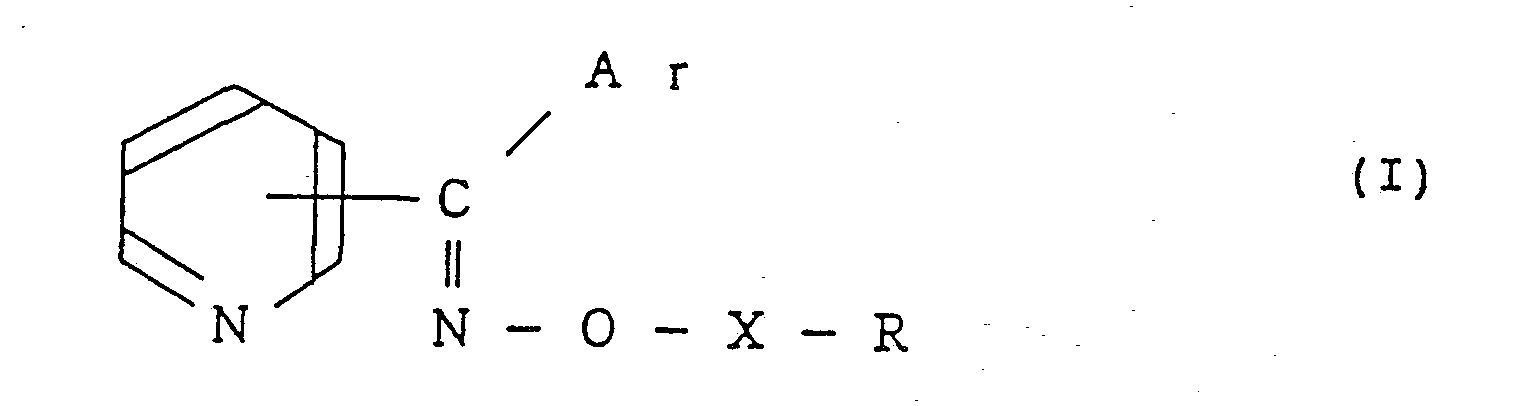
- The present invention provides a pyridylketoxime ether compound of the formula:

- The present invention also provides a pharmaceutical composition comprising an effective amount of the compound of the formula I or its salt, as the active ingredient, and a pharmaceutical carrier or diluent and having a calmodulin antagonism.
- Now, the present invention will be descirbed in detail with reference to the preferred embodiments.
- Firstly, the pyridylketoxime ether compounds of the present invention will be described.
- The pyridylketoxime ether compounds of the formula I are novel compounds which are distinguished from the compounds disclosed in the above-mentioned U.S. Patents 4,352,804 and 4,297,359 in respect of the following structural diferences (a) and (b).
- (a) The pyridylketoxime ether compounds of the formula I of the present invention have a pyridyl group as an essential substituent. Whereas, the compounds disclosed in U.S. Patent 4,352,804 have, instead of the pyridyl group, a heterocyclic group containing two hetero atoms, at least one of which is a nitrogen atom.
- (b) The pyridylketoxime ether compounds of the formula I of the present invention are different from the compounds disclosed in U.S. Patents 4,352,804 and 4,297,359 in the substitutent bonded to the oxygen atom of the ketoxime ether group.
- In the formula I representing the pyridylketoxime ether compounds of the present invention, the aromatic ring for Ar and R is preferably a phenyl group or a naphthyl group, and the heterocyclic group is preferably a single ring or condensed ring heterocyclic group having from 1 to 3 nitrogen, oxygen or sulfur atoms as hetero atoms, more preferably a single ring heterocyclic group containing one nitrogen, oxygen or sulfur atom as a hetero atom or a condensed ring heterocyclic group containing two oxygen atoms as hetero atoms, As a single heterocyclic group containing one nitrogen, oxygen or sulfur atom as a hetero atom, a furyl group, a thienyl group or a pyridyl group is, for example, preferred. Likewise, as a condensed ring heterocyclic group containing two oxygen atoms as hetero atoms, a 1,3-dioxaindanyl group is, for example, preferred.
- In the formula I, the cycloalkyl group for R is preferably a cycloalkyl group having from 3 to 8 carbon atoms such as a cyclopropyl group, a cyclobutyl group, a cyclopentyl group, a cyclohexyl group, a cycloheptyl group or a cyclooctyl group.
- In the formula I, the phenyl group, the naphthyl group and the heterocyclic group for Ar or the phenyl group, the naphthyl group, the cycloalkyl group and the heterocyclic group for R may be substituted preferably by one or two substitutents. Such substitutents may be an alkyl group having from 1 to 8 carbon atoms, an alkylamino group having from 1 to 8 carbon atoms, an alkoxy group having from 1 to 8 carbon atoms, an alkoxycarbnyl group having from 1 to 8 carbon atoms, a trifluoromethyl group, a nitro group or a halogen atom.
- The alkyl group having from 1 to 8 carbon atoms may be a straight chain or branched alkyl group such as a methyl group, an ethyl group, a n-propyl group, an isopropyl group, a n-butyl group, a s-butyl group, a t-butyl group, a n-pentyl group, a n-hexyl group, a n-heptyl group or a n-octyl group. The alkylamino group having from 1 to 8 carbon atoms may preferably be, for example, a methylamino group, a dimethylamino group, an ethylamino group, a diethylamino group, a n-propylamino group, an isopropylamino group, a n-butylamino group, a s-butylamino group, a t-butylamino group, a n-pentylamino group, a n-hexylamino group, a n-heptylamino group or a n-octylamino group. The alkoxy group having from 1 to 8 carbon atoms may preferably be, for example, a methoxy group, an ethoxy group, a n-propoxy group, an isopropoxy group, a n-butoxy group, a s-butoxy group, a t-butoxy group, a n pentoxy group, a n-hexoxy group, a n-heptoxy group or a n-octoxy group. The alkoxycarbonyl group having from 1 to 8 carbon atoms may preferably be, for example, a methoxy carbonyl group, an ethoxycarbonyl group, a n-propoxycarbonyl group, an isopropoxycarbonyl group, a n-butoxycarbonyl group, a s-butoxycarbonyl group, a t-butoxycarbonyl group, a n-pentoxycarbonyl group, a n-hexoxycarbonyl group, a n-heptoxycarbonyl group or a n-octoxycarbonyl group.
- The halogen atom is preferably, for example, a fluorine atom, a chlorine atom or a bromine atom.
- The pyridylketoxime ether compounds of the present invention may be salts. As such salts, acid addition salts may be mentioned. Such acid addition salts can readily be obtained by reacting the pyridylketoxime ether compounds with inorganic acids or organic acids. Such inorganic acids include, for example, hydrochloric acid, hydrobromic acid, hydroiodic acid and sulfuric acid. The organic acids include, for example, maleic acid, fumaric acid, succinic acid, acetic acid, malonic acid, a citric acid, benzoic acid, oxalic acid and methane sulfonic acid.
- For the production of the pyridylketoxime compounds of the formula I of the present invention, the following processes are preferably employed.
-


- Namely, a pyridylketone of the formula IV is reacted with hydroxylamine to obtain a pyridylketoxime of the formula II (Step A).
- Then, a halide of the formula III is reacted thereto for a condensation reaction to obtain a compound of the formula I as the desired substance (Step B). Further, if necessary, this product is converted to its salt.
- In Step A, the reaction temperature is usually from about 0 to 200° C, preferably from room temperature to 100°C. As the solvent, methanol, ethanol, propanol, benzene, toluene or water may, for example, be employed.
- In Step B, the reaction temperature is usually from about 0 to 100°C. As the solvent, dimethylformamide (DMF), dimethylsulfoxide (DMSO), methanol, ethanol, propanol, benzene or toluene may, for example, be used. In this case, particularly good results can be obtained by conducting the reaction in the presence of a base such as sodium hydride (NaH), triethylamine, dimethylaniline, potassium hydroxide, sodium methoxide, sodium ethoxide or potassium t-butoxide.
-
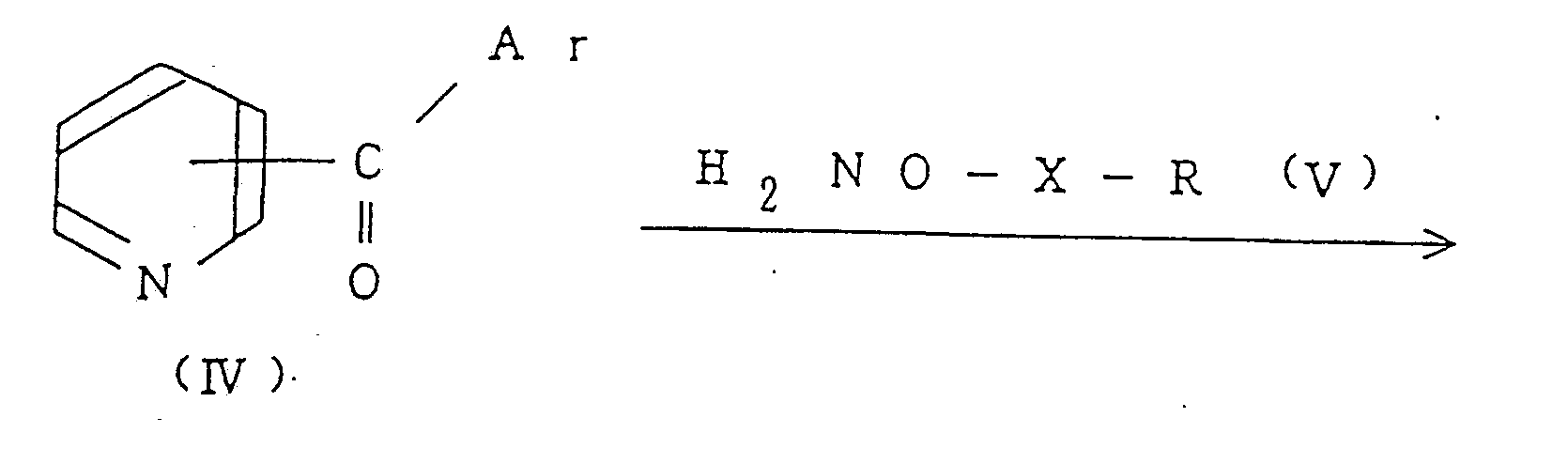

- To the compound of the formula IV, an O-substituted hydroxylamine derivative of the formula V is reacted for condensation to obtain the desired compound of the formula I. In this process (b), the reaction temperature is usually from about 0 to 200 ° C, and as the solvent, methanol, ethanol, propanol, benzene, toluene or water may, for example, be used.
- Now, the representative examples of the pyridiylketoxime ether compound of the formula I of the present invention will be given. However, these examples are presented to facilitate the understanding of the present invention, and it should be understood that the present invention is by no means restricted by such specific examples.
- 0-benzyl-phenyl-2-pyridylketoxime,
- 0-benzyl-phenyl-3 pyridylketoxime,
- O-benzyl phenyl-4-pyridylketoxime,
- 0-(4-methylbenzyl)-phenyl-2-pyridylketoxime,
- O-(4-methylbenzyl) phenyl-3-pyridylketoxime,
- 0-(4 methylbenzyl)phenyl 4-pyridylketoxime,
- O-(4-chlorobenzyl)-phenyl-2-pyridylketoxime,
- O-(4-chlorobenzyl)-phenyl-3-pyridylketoxime,
- 0-(4-chlorobenzyl)-phenyl-4-pyridylketoxime,
- O-(3,4-dimethoxybenzyl)-phenyl-2-pyridylketoxime,
- 0-(3,4-dimethoxybenzyl)-phenyl-3-pyridiylketoxime,
- 0-(3,4-dimethoxybenzyl) phenyl-4-pyridylketoxime,
- 0-(2-pyridylmethyl)-phenyl-2-pyridylketoxime,
- O-(2-pyridylmethyl}-phenyl-3-pyridylketoxime,
- O-(2-pyridylmethyl)-phenyl-4-pyridylketoxime,
- 0-(1 naphthylmethyl)-phenyl-2-pyridylketoxime,
- O-(1-naphthylmethyl)-phenyl-3-pyridylketoxime,
- 0-(1-naphthylmethyl) phenyl-4-pyridylketoxime,
- 0-(2 thienylmethyl)-phenyl-2-pyridylketoxime,
- O-(2-thienylmethyl)-phenyl-3-pyridylketoxime,
- O-(2-thienylmethyl)-phenyl-4-pyridylketoxime,
- 0-cinnamyl-phenyl-2-pyridylketoxime,
- 0-cinnamyl-phenyl-3-pyridylketoxime,
- O-cinnamyl-phenyl-4-pyridylketoxime,
- 0-[2-(2-methylphenyl)ethyl]-phenyl-3-pyridylketoxime,
- 0-[2-(3-methylphenyl)ethyl]-phenyl-3-pyridylketoxime,
- O-[2-(4-methylphenyl)ethyl] phenyl-3-pyridylketoxime,
- O-[2-(2-methoxyphenyl)ethyl]-phenyl-3-pyridylketoxime,
- 0-[2-(3-methoxyphenyl)ethyl] phenyl-3-pyridylketoxime,
- O-[2-(4-methoxyphenyl)ethyl]-phenyl-3-pyridylketoxime,
- O-[2-(2,5-dimethoxyphenyl)ethyl]-phenyl-3-pyridylketoxime,
- O-[2-(3,4-dimethoxyphenyl)ethyl]-phenyt-3-pyridylketoxime,
- O-[2-(2,6-dimethoxyphenyl)ethyl]-phenyl-3-pyridylketoxime, O-[2-(2-thienyl)ethyl]-phenyl-3-pyridylketoxime,
- O-[2-(3-thienyl)ethyl]-phenyl-3-pyridylketoxime,
- O-[2-(1-naphthyl)ethyl]-phenyl-3-pyridylketoxime,
- O-[2-(2-furyl)ethyl]-phenyl-3-pyridylketoxime,
- 0-[2-(3-pyridyl)ethyl]-phenyl-3-pyridylketoxime,
- O-(2-cyclohexylethyl)-phenyl-3-pyridylketoxime,
- O-(3-phenylpropyl)-phenyl-3-pyridylketoxime
- 0-(4-phenylbutyl)-phenyl-3-pyridylketoxime,
- O-(5-phenylpentyl)-phenyl-3-pyridylketoxime,
- 0-(2 phenylethyl)-o-tolyl-3-pyridylketoxime,
- O-(2-phenylethyl)-m-tolyl-3 pyridylketoxime,
- 0-(2-phenylethyl)-p-tolyl-3-pyridylketoxime,
- 0-(2-phenylethyl)-2,4-dimethoxyphenyl-3-pyridylketoxime,
- 0-(2-phenylethyl)-2,5-dimethoxyphenyl-3-pyridylketoxime,
- O-{2-phenylethyl)-3,4-dimethoxyphenyl-3-pyridylketoxime,
- 0-(2-phenylethyl)-2-chlorophenyl-3-pyridylketoxime,
- 0-(2 phenylethyl)-3-chlorophenyl-3-pyridylketoxime,
- O-(2-phenylethyl)-3-fluorophenyl-3-pyridylketoxime,
- O-(2-phenylethyl)-3-trifluoromethylphenyl-3-pyridylketoxime,
- O-(2-phenylethyl)-3-nitrophenyl-3 pyridylketoxime,
- O-(2-phenylethyl-2,5-xylyl-3-pyridylketoxime,
- 0-(2-phenylethyl)-2-thienyl-3-pyridylketoxime,
- O-(2-phenylethyl)-2-furyl-3-pyridylketoxime,
- O-(2-phenylethyl)-4-N,N-dimethylaminophenyl-3-pyridylketoxime,
- O-(2-phenylethyl)-1-naphthyl-3-pyridylketoxime,
- 0-(2-phenylethyl-3,4-methylenedioxyphenyl-3-pyridylketoxime,
- O-(2-phenylethyl)-bis-(3-pyridyl)ketoxime,
- O-[(2-phenylthio)ethyl]-phenyl-3-pyridylketoxime,
- O-[(2-phenoxy)ethyl]-phenyl-2-pyridylketoxime,
- O-[(2-phenoxy)ethyl]-phenyl-3-pyridylketoxime,
- O-[(2-phenoxy)ethyl]-phenyl-4-pyridylketoxime,
- O-[2-(4-methoxyphenoxy)ethyl]-phenyl-3-pyridylketoxime,
- 0-[2-(4-methoxyphenoxy)ethyl]-phenyl-2-pyridylketoxime,
- 0 [2-(4-methoxyphenoxy)ethyl]-phenyl-4-pyridylketoxime,
- O-[2-(4-chlorophenoxy)ethyl]-phenyl-2-pyridylketoxime,
- 0-[2-(4-chlorophenoxy)ethyl]-phenyl-3-pyridylketoxime,
- O-[2-(4-chlorophenoxy)ethyl]-phenyl-4-pyridylketoxime,
- 0-[2-(3-trifluoromethylphenoxy)ethyl]-phenyl-2-pyridylketoxime,
- O-[2-(3-trifluoromethylphenoxy)ethyl]-phenyl-3-pyridylketoxime,
- 0-[2-(3-trifluoromethylphenoxy)ethyl]-phenyl-4-pyridylketoxime,
- O-[2-(4-methoxyphenyl)ethyl]-3,4-dimethoxyphenyl-4-pyridyiketoxime,
- O-[2-(3,4-dimethoxyphenyl)ethyl]-3,4-dimethoxylphenyl-4-pyridylketoxime,
- O-[2-thienylethyl]-3,4-dimethoxyphenyl-4-pyridylketoxime,
- O-[2-(3,4-dimethoxyphenyl)ethyl]-3-nitrophenyl-4-pyridylketoxime;
- 0-[2-(4-chlorophenyl)ethyl]-3,4-dimethoxyphenyl-4-pyridylketoxime, and
- 0-[2-(3,4-dimethoxyphenyl)ethyl]-bis-(3-pyridyl)ketoxime.
- Now, the pharmaceutical composition of the present invention will be described.
- The pyridylketoxime ether compounds of.the present invention are found to have not only an excellent calmodulin antagonism but also a Ca2+ channel antagonism and an acitivity to improve the deformation of erythrocytes. Accordingly, the pharmaceutical compositions of the present invention containing such pyridylketoxime ether compounds as active ingredients, are useful as curing agents based on these activities, for example, as curing agents for isochemic diseases or vasodilators. Specifically, they are useful for curing or preventing cerebral vessel troubles such as ephemeral cerebral ischemic attack, cerebral infarction and encephalo-arteriosclerosis, or ischemic heart troubles such as angina pectoris and myocardial infarction. Further, they are useful for the prevention of the recurrence of these diseases or for improvement after the treatment.
- The pharmaceutical compostion of the present invention may be constituted solely by the pyridylketoxime ether compound of the formula I andior its salt. However, it is usually preferred to formulate it with a suitable carrier into a drug formulation for oral or non-oral administration. As formulations for oral administration, tablets, capsules and granules may be mentioned. As formulations for non-oral administration, intravenous, intramuscular or subcutaneous injection drugs, or suppositories may be mentioned. These formulations can be prepared readily in accordance with conventional methods.
- The dose of the pyridylketoxime ether compound of the present invention varies depending upon the administration route, the type of formulation, the diseased condition of the patient, etc., but is usually within a range of from 0.01 to 100 mgikg of the body weight, preferably from 0.1 to 10 mg/kg of the body weight.
- Now, the present invention will be described in further detail with reference to Examples and Test Examples. However, it should be understood that the present invention is by no means restricted by such specific Examples.
- 1.06 g (0.016 mol) of potassium hydroxide was dissolved in 80 ml of ethanol, and 3.17 g (0.016 mol) of phenyl-3-pyridylketoxime was added thereto and dissolved under stirring. To this solution, 2.96 g (0.016 mol) of β-phenylethylbromide was added, and the mixture was stirred at room temperature for two hours. Then, it was stirred and reacted at 80 C. Four hours later, the reaction solution was distilled under reduced pressure to remove ethanol. Then, 100 ml of a 3N sodium hydroxide aqueous solution was added to the residue, and the mixture was extracted with benzene. The extract solution was washed with a 3N sodium hydroxide aqueous solution and water and dried over anhydrous sodium sulfate. Then, benzene was distilled off under reduced pressure. The residual oily substance was purified by silica gel chromatography to obtain 2.6 g of the above-identified compound as an oily substance.
- NMR(CDCt3)5: 2.96(t, 2H), 4.40(t, 2H),
- 6.80 7.76(m, 12H), 8.32-8.72(m, 2H)
- 3.48 g (0.015 mol) of 3,4-dimethoxyphenyl-3-pyridylketone was dissolved in 80 ml of ethanol, and 2.7 g (0.015 mol) of o-phenethylhydroxylamine hydrochloride was added thereto. The mixture was stirred and reacted at room temperature. Ten hours later, the reaction solution was distilled under reduced pressure to remove ethanol. A 2N sodium hydroxide aqueous solution was added to the reaction solution, and the mixture was extracted with benzene. The extract solution was washed with water and dried over anhydrous sodium sulfate. Benzene was distilled off, and the residual oily substance was purified by silica gel chromatography to obtain 2.3 g of the above-identified compound.
- NMR(CDCt3)5: 2.93(t), 3.00(t) (2H), 3.67(s, 3H), 3.77(s, 3H), 4.36(t), 4.43(t)(2H),
- 6.67-7.86(m, 10H), 8.50-8.80(m, 2H)
- The compounds identified in the following Table were obtained in a manner similar to Examples 1 and 2.


- Now, the activities of the compounds of the present invention will be described with reference to Test Examples.
- Calmodulin is effective to increase the activities of c-AMP phosphodiesterase (PDE) from 2 to 3 times in the presence of Ca2+. The calmodulin antagonism was determined in terms of the inhibitory activity against the 5 -AMP forming rate by adding a compound of the present invention to a reaction system comprising 50 m units of bovine cerebral calmodulin, 0.1 mM of Ca2+, 1 µM of c-AMP (3H-c-AMP 50 n Ci) and 0.75 m units of bovine myocardial c-AMP-PDE. The formed amount of 5 -AMP was measured in accordance with the Tompson et al's method (Biochemistry 10(2), 311, (1971)). As a control drug, W-7 [N-(6-aminohexyl)-5-chloro-1-naphthalenesulfonamide] was used. The results are shown in Table 1.

- The cecum string of a male Hartley guinea pig having a body weight of 350 g was taken out, and while air was supplied, it was hanged with a load of 0.5 g in a high potassium Krebs solution bath (320 C) having calcium removed. Calcium chloride was accumulatively added, and the reaction was recorded by means of an isotonic tranduser (manufactured by Nippon Koden K.K.) to obtain a constant standard concentration reaction curve.
- On the other hand, pretreatment with a compound of the present invention was conducted for 30 minutes, and then calcium chloride was added to the reaction bath, and from concetration reaction curve thereby obtained, pA2 was obtained. The results are shown in Table 2.

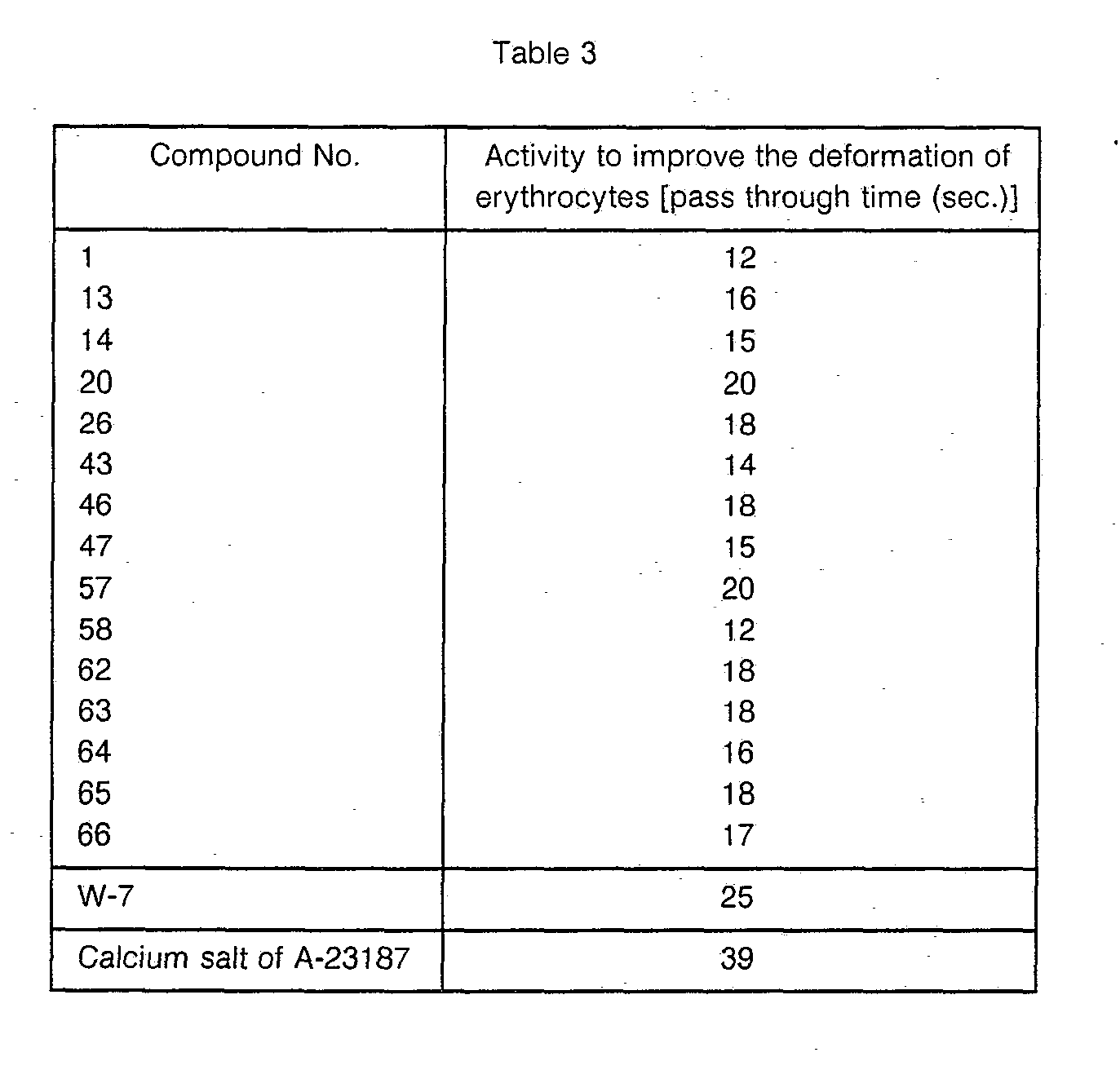
- A suspension of washed erythrocytes was prepared from a blood collected by heart puncture from a male New Zealand rabbit having a body weight of about 3 kg and having Heparin added thereto, by using a Krebs-Henseleit solution containing 20 mM of HEPES. The activity of a compound of the present invention to improve the deformation of erythrocytes was examined by measuring the time for erythrocytes to pass through a millipore filter (5 u.m) by treating the suspension with Ca2 and with Ca2+ ionofore A-23187 (Calimycin) in accordance with a Reid et al's method (J. Clin. Pathol. 29, 855, (1976)). As a control drug, W-7 was used. Results are shown in Table 3.
- For the determination of the acute toxicity, 10 male mice having body weights of from 22 to 25 g were used as a group, and a compound in an amount corresponding to the body weight was orally administered. LD50 was calculated by an area method from the mortality after 72 hours.
- LDso of compounds of the present invention obtained in the Examples was more than 500 mg/kg.
- By using the following components, tablets can be prepared in accordance with a conventional method.

- As described in the foregoing, the present invention presents novel pyridylketoxime ether compounds having a calmodulin antagonism, and a pharmaceutical composition containing such a compound.
Claims (6)

Applications Claiming Priority (2)
| Application Number | Priority Date | Filing Date | Title |
|---|---|---|---|
| JP267893/88 | 1988-10-24 | ||
| JP63267893A JP2765876B2 (en) | 1988-10-24 | 1988-10-24 | Pyridyl ketoxime ether derivatives |
Publications (2)
| Publication Number | Publication Date |
|---|---|
| EP0366006A1 true EP0366006A1 (en) | 1990-05-02 |
| EP0366006B1 EP0366006B1 (en) | 1993-09-29 |
Family
ID=17451086
Family Applications (1)
| Application Number | Title | Priority Date | Filing Date |
|---|---|---|---|
| EP89119437A Expired - Lifetime EP0366006B1 (en) | 1988-10-24 | 1989-10-19 | Pyridylketoxime ether compound and pharmaceutical composition containing it |
Country Status (5)
| Country | Link |
|---|---|
| US (1) | US4971985A (en) |
| EP (1) | EP0366006B1 (en) |
| JP (1) | JP2765876B2 (en) |
| CA (1) | CA2001182A1 (en) |
| DE (1) | DE68909555T2 (en) |
Cited By (6)
| Publication number | Priority date | Publication date | Assignee | Title |
|---|---|---|---|---|
| EP0623597A1 (en) * | 1993-04-28 | 1994-11-09 | Takeda Chemical Industries, Ltd. | Pyridine derivatives, with potassium channel opening activity |
| US5480998A (en) * | 1992-07-21 | 1996-01-02 | Ono Pharmaceutical Co., Ltd. | Oxime derivative |
| CN1094487C (en) * | 1994-04-01 | 2002-11-20 | 盐野义制药株式会社 | Oxime derivative and fungicide containing the same as active ingredient |
| US7750025B2 (en) | 2003-10-17 | 2010-07-06 | Sanofi-Aventis | Derivatives of N-phenyl (piperidine-2-yl) methyl benzamide, preparation method thereof and applications of same in therapeutics |
| US7951821B2 (en) | 2002-07-29 | 2011-05-31 | Sanofi-Aventis | N-[phenyl(piperidin-2-yl)methyl]benzamide derivatives, preparation thereof, and use thereof in therapy |
| EA027433B1 (en) * | 2012-10-08 | 2017-07-31 | Дафот Энтерпраизес Лимитед | Benzoylpyridine oxime derivative having anticonvulsant activity |
Families Citing this family (2)
| Publication number | Priority date | Publication date | Assignee | Title |
|---|---|---|---|---|
| DE69701298T2 (en) * | 1996-04-15 | 2000-10-05 | Takeda Chemical Industries, Ltd. | Hydroxypyridine derivatives, their preparation and their pharmaceutical use |
| WO2019141256A1 (en) * | 2018-01-19 | 2019-07-25 | 沈阳福洋医药科技有限公司 | Use of carrimycin or active ingredient thereof |
Citations (3)
| Publication number | Priority date | Publication date | Assignee | Title |
|---|---|---|---|---|
| US4297359A (en) * | 1978-07-25 | 1981-10-27 | Acf Chemiefarma Nv | Anti-ulcer compositions containing certain pyridyl oxime ethers |
| GB2117772A (en) * | 1982-03-31 | 1983-10-19 | Hoffmann La Roche | Heterocyclic oximes |
| EP0221601A1 (en) * | 1985-11-04 | 1987-05-13 | Janssen Pharmaceutica N.V. | [[[(3-Pyridinyl)methylen]amino]oxy]alkanoic acids and esters |
Family Cites Families (4)
| Publication number | Priority date | Publication date | Assignee | Title |
|---|---|---|---|---|
| JPS5311076A (en) * | 1976-07-19 | 1978-02-01 | Omron Tateisi Electronics Co | Vibration sensor |
| DE2658762A1 (en) * | 1976-12-24 | 1978-06-29 | Hoechst Ag | NEW O-ALKYLATED OXIMES, METHOD FOR THE PRODUCTION THEREOF AND THEIR USE AS MEDICINAL PRODUCTS |
| US4352804A (en) * | 1978-07-25 | 1982-10-05 | Acf Chemiefarma Nv | Oxime ethers, their preparation and pharmaceutical compositions containing them |
| DK270488D0 (en) * | 1988-05-18 | 1988-05-18 | Novo Industri As | Hitherto unknown O-SUBSTITUTED KETOXIMES |
-
1988
- 1988-10-24 JP JP63267893A patent/JP2765876B2/en not_active Expired - Lifetime
-
1989
- 1989-10-19 US US07/424,129 patent/US4971985A/en not_active Expired - Lifetime
- 1989-10-19 EP EP89119437A patent/EP0366006B1/en not_active Expired - Lifetime
- 1989-10-19 DE DE89119437T patent/DE68909555T2/en not_active Expired - Fee Related
- 1989-10-23 CA CA002001182A patent/CA2001182A1/en not_active Abandoned
Patent Citations (3)
| Publication number | Priority date | Publication date | Assignee | Title |
|---|---|---|---|---|
| US4297359A (en) * | 1978-07-25 | 1981-10-27 | Acf Chemiefarma Nv | Anti-ulcer compositions containing certain pyridyl oxime ethers |
| GB2117772A (en) * | 1982-03-31 | 1983-10-19 | Hoffmann La Roche | Heterocyclic oximes |
| EP0221601A1 (en) * | 1985-11-04 | 1987-05-13 | Janssen Pharmaceutica N.V. | [[[(3-Pyridinyl)methylen]amino]oxy]alkanoic acids and esters |
Non-Patent Citations (1)
| Title |
|---|
| CHEMICAL ABSTRACTS, vol. 90, no. 13, March 26, 1979, Columbus, Ohio, USA TANAKA et al.: "Pyridylketone Oxime benzyl ethers" page 582, column 1, abstract-no. 103 840m * |
Cited By (7)
| Publication number | Priority date | Publication date | Assignee | Title |
|---|---|---|---|---|
| US5480998A (en) * | 1992-07-21 | 1996-01-02 | Ono Pharmaceutical Co., Ltd. | Oxime derivative |
| EP0623597A1 (en) * | 1993-04-28 | 1994-11-09 | Takeda Chemical Industries, Ltd. | Pyridine derivatives, with potassium channel opening activity |
| US5716971A (en) * | 1993-04-28 | 1998-02-10 | Takeda Chemical Industries, Ltd. | Pyridine derivatives, their production and use |
| CN1094487C (en) * | 1994-04-01 | 2002-11-20 | 盐野义制药株式会社 | Oxime derivative and fungicide containing the same as active ingredient |
| US7951821B2 (en) | 2002-07-29 | 2011-05-31 | Sanofi-Aventis | N-[phenyl(piperidin-2-yl)methyl]benzamide derivatives, preparation thereof, and use thereof in therapy |
| US7750025B2 (en) | 2003-10-17 | 2010-07-06 | Sanofi-Aventis | Derivatives of N-phenyl (piperidine-2-yl) methyl benzamide, preparation method thereof and applications of same in therapeutics |
| EA027433B1 (en) * | 2012-10-08 | 2017-07-31 | Дафот Энтерпраизес Лимитед | Benzoylpyridine oxime derivative having anticonvulsant activity |
Also Published As
| Publication number | Publication date |
|---|---|
| DE68909555T2 (en) | 1994-04-28 |
| DE68909555D1 (en) | 1993-11-04 |
| EP0366006B1 (en) | 1993-09-29 |
| JPH02115166A (en) | 1990-04-27 |
| JP2765876B2 (en) | 1998-06-18 |
| US4971985A (en) | 1990-11-20 |
| CA2001182A1 (en) | 1990-04-24 |
Similar Documents
| Publication | Publication Date | Title |
|---|---|---|
| EP0373998B1 (en) | Propenone oxime ethers, method for their preparation and pharmaceutical compositions containing them | |
| SK142694A3 (en) | N-aryl and n-heteroarylurea derivatives as inhibitors of acylcoenzyme a:cholesterol-acyltransferase, pharmaceutical preparations contains these compounds and use | |
| JP3238397B2 (en) | New sulfonyl compounds | |
| FI59799B (en) | NYTT FOERFARANDE FOER FRAMSTAELLNING AV 6,7-DIMETOXY-4-AMINO-2- (4- (2-FUROYL) -PIPERAZIN-1-YL) -QUINAZOLINE FOER ANVAENDNING SOM ETT ANTIHYPERTENSIVT MEDEL | |
| IT8348746A1 (en) | Aryl-substituted aminomethyl-benzene derivatives with cardiac rhythm-regulating activity and compositions containing them | |
| AU682768B2 (en) | Bicyclic amidine derivatives as inhibitors of nitric oxide synthetase | |
| PL140573B1 (en) | Method of obtaining new dihydropyridine derivatives | |
| NZ260505A (en) | Cyclic indole derivatives and medicaments thereof | |
| EP0366006B1 (en) | Pyridylketoxime ether compound and pharmaceutical composition containing it | |
| PL145196B1 (en) | Method of obtaining novel 2-ketoindolo-1-carbonamides | |
| SK147897A3 (en) | Azacycloalcane derivatives, preparation thereof and their applications in therapy | |
| EP0589037B1 (en) | Indian derivative and thromboxane antagonist containing the same | |
| FI89492C (en) | FREEZING FOR PHARMACOLOGICAL PROPERTIES OF TETRAHYDRO-6H-THIAZOLO / 5,4-D / AZEPINER | |
| EP0406739A2 (en) | Piperidine derivative, method for preparation thereof, and a pharmaceutical composition comprising the same | |
| DK174505B1 (en) | Benzene derivatives and processes for their preparation as well as pharmaceutical agents containing the derivatives | |
| US4612312A (en) | Glutarimide antianxiety and antihypertensive agents | |
| KR20000048767A (en) | N-benzothiazol-2-yl)piperidine-1-ethanamine derivatives, their preparation and application in therapeutics | |
| EP0298703B1 (en) | A thiophene derivative and process for preparing the same | |
| US5298503A (en) | N-(isoquinolin-5-ylsulphonyl) azacycloalkanes | |
| US4661522A (en) | Cycloalkane-indene-carboximidamide derivatives | |
| EP0964861B1 (en) | Process for the production of tetrazolylbenzopyrans | |
| US4032640A (en) | 4H-Benzo[4,5]cyclohepta[1,2-b]thiophenes | |
| US20040267015A1 (en) | Peptide deformylase inhibitors | |
| US4452982A (en) | Process for the preparation of nitrogen-bridgehead condensed pyrimidine compounds, and pharmaceutical compositions containing them | |
| HU202506B (en) | Process for producing benzoxazolone derivatives |
Legal Events
| Date | Code | Title | Description |
|---|---|---|---|
| PUAI | Public reference made under article 153(3) epc to a published international application that has entered the european phase |
Free format text: ORIGINAL CODE: 0009012 |
|
| AK | Designated contracting states |
Kind code of ref document: A1 Designated state(s): CH DE FR GB IT LI |
|
| 17P | Request for examination filed |
Effective date: 19900808 |
|
| 17Q | First examination report despatched |
Effective date: 19920706 |
|
| GRAA | (expected) grant |
Free format text: ORIGINAL CODE: 0009210 |
|
| AK | Designated contracting states |
Kind code of ref document: B1 Designated state(s): CH DE FR GB IT LI |
|
| REF | Corresponds to: |
Ref document number: 68909555 Country of ref document: DE Date of ref document: 19931104 |
|
| ITF | It: translation for a ep patent filed | ||
| ET | Fr: translation filed | ||
| PLBE | No opposition filed within time limit |
Free format text: ORIGINAL CODE: 0009261 |
|
| STAA | Information on the status of an ep patent application or granted ep patent |
Free format text: STATUS: NO OPPOSITION FILED WITHIN TIME LIMIT |
|
| 26N | No opposition filed | ||
| PGFP | Annual fee paid to national office [announced via postgrant information from national office to epo] |
Ref country code: FR Payment date: 19991011 Year of fee payment: 11 |
|
| PGFP | Annual fee paid to national office [announced via postgrant information from national office to epo] |
Ref country code: GB Payment date: 19991013 Year of fee payment: 11 |
|
| PGFP | Annual fee paid to national office [announced via postgrant information from national office to epo] |
Ref country code: CH Payment date: 19991027 Year of fee payment: 11 |
|
| PGFP | Annual fee paid to national office [announced via postgrant information from national office to epo] |
Ref country code: DE Payment date: 19991130 Year of fee payment: 11 |
|
| PG25 | Lapsed in a contracting state [announced via postgrant information from national office to epo] |
Ref country code: GB Free format text: LAPSE BECAUSE OF NON-PAYMENT OF DUE FEES Effective date: 20001019 |
|
| PG25 | Lapsed in a contracting state [announced via postgrant information from national office to epo] |
Ref country code: LI Free format text: LAPSE BECAUSE OF NON-PAYMENT OF DUE FEES Effective date: 20001031 Ref country code: CH Free format text: LAPSE BECAUSE OF NON-PAYMENT OF DUE FEES Effective date: 20001031 |
|
| GBPC | Gb: european patent ceased through non-payment of renewal fee |
Effective date: 20001019 |
|
| REG | Reference to a national code |
Ref country code: CH Ref legal event code: PL |
|
| PG25 | Lapsed in a contracting state [announced via postgrant information from national office to epo] |
Ref country code: FR Free format text: LAPSE BECAUSE OF NON-PAYMENT OF DUE FEES Effective date: 20010629 |
|
| PG25 | Lapsed in a contracting state [announced via postgrant information from national office to epo] |
Ref country code: DE Free format text: LAPSE BECAUSE OF NON-PAYMENT OF DUE FEES Effective date: 20010703 |
|
| REG | Reference to a national code |
Ref country code: FR Ref legal event code: ST |
|
| PG25 | Lapsed in a contracting state [announced via postgrant information from national office to epo] |
Ref country code: IT Free format text: LAPSE BECAUSE OF NON-PAYMENT OF DUE FEES Effective date: 20051019 |