EP1652893A2 - Herstellungsverfahren sowie -Vorrichtung für unloesliche Azopigmente - Google Patents
Herstellungsverfahren sowie -Vorrichtung für unloesliche Azopigmente Download PDFInfo
- Publication number
- EP1652893A2 EP1652893A2 EP05020506A EP05020506A EP1652893A2 EP 1652893 A2 EP1652893 A2 EP 1652893A2 EP 05020506 A EP05020506 A EP 05020506A EP 05020506 A EP05020506 A EP 05020506A EP 1652893 A2 EP1652893 A2 EP 1652893A2
- Authority
- EP
- European Patent Office
- Prior art keywords
- solution
- pigment
- fluid
- ejector
- diazo
- Prior art date
- Legal status (The legal status is an assumption and is not a legal conclusion. Google has not performed a legal analysis and makes no representation as to the accuracy of the status listed.)
- Granted
Links
Images


Classifications
-
- C—CHEMISTRY; METALLURGY
- C09—DYES; PAINTS; POLISHES; NATURAL RESINS; ADHESIVES; COMPOSITIONS NOT OTHERWISE PROVIDED FOR; APPLICATIONS OF MATERIALS NOT OTHERWISE PROVIDED FOR
- C09B—ORGANIC DYES OR CLOSELY-RELATED COMPOUNDS FOR PRODUCING DYES, e.g. PIGMENTS; MORDANTS; LAKES
- C09B41/00—Special methods of performing the coupling reaction
- C09B41/006—Special methods of performing the coupling reaction characterised by process features
- C09B41/008—Special methods of performing the coupling reaction characterised by process features using mechanical or physical means, e.g. using ultra-sound, milling during coupling or microreactors
-
- B—PERFORMING OPERATIONS; TRANSPORTING
- B01—PHYSICAL OR CHEMICAL PROCESSES OR APPARATUS IN GENERAL
- B01J—CHEMICAL OR PHYSICAL PROCESSES, e.g. CATALYSIS OR COLLOID CHEMISTRY; THEIR RELEVANT APPARATUS
- B01J19/00—Chemical, physical or physico-chemical processes in general; Their relevant apparatus
- B01J19/18—Stationary reactors having moving elements inside
-
- B—PERFORMING OPERATIONS; TRANSPORTING
- B01—PHYSICAL OR CHEMICAL PROCESSES OR APPARATUS IN GENERAL
- B01J—CHEMICAL OR PHYSICAL PROCESSES, e.g. CATALYSIS OR COLLOID CHEMISTRY; THEIR RELEVANT APPARATUS
- B01J4/00—Feed or outlet devices; Feed or outlet control devices
- B01J4/02—Feed or outlet devices; Feed or outlet control devices for feeding measured, i.e. prescribed quantities of reagents
-
- B—PERFORMING OPERATIONS; TRANSPORTING
- B01—PHYSICAL OR CHEMICAL PROCESSES OR APPARATUS IN GENERAL
- B01J—CHEMICAL OR PHYSICAL PROCESSES, e.g. CATALYSIS OR COLLOID CHEMISTRY; THEIR RELEVANT APPARATUS
- B01J2219/00—Chemical, physical or physico-chemical processes in general; Their relevant apparatus
- B01J2219/00049—Controlling or regulating processes
- B01J2219/00164—Controlling or regulating processes controlling the flow
Definitions
- This invention relates to a process and system for producing insoluble azo pigments by using an ejector, and more specifically to an ejector-relying process and system for the production of insoluble azo pigments useful as offset inks, gravure inks, paints, colorants for plastics, textile-printing pigments, color toners, inkJet printing inks, and the like.
- insoluble azo pigment as used herein means an azo pigment the raw materials of which, that is, a diazonium salt or tetrazonium salt and a grounder component both contain no water-soluble group(s) such as carboxyl and/or sulfonic group(s).
- diazo solution as used herein means a solution of the diazonium salt or tetrazonium salt of an aromatic amine or diamine.
- grounding solution as used herein means a solution of a grounder component or a fine dispersion of a grounder component. Further, the term “grounder component” as used herein has the same meaning as a coupling component.
- JP-B-55-10630 a process is disclosed in JP-B-55-10630.
- a monoazo pigment is produced by mixing and coupling an acetoacetanilide-, pyrazolone- and/or naphthol-based grounder component, another grounder component modified with carboxyl group(s), sulfonic group(s), carboxamido group(s) or the like, and a diazo component.
- Another process is disclosed in JP-B-55-49087.
- a disazo pigment is produced by mixing and coupling an acetoacetanilide- and/or pyrazolone-based grounder component, another grounder component modified with carboxyl group (s) , sulfonic group(s) and/or the like, and a disazo component.
- a second grounder component in combination with a first grounder component makes it possible to provide the resulting pigment with smaller particle sizes, thereby bringing about good effects on the transparency, coloring strength, dispersibility and the like of the pigment upon its use.
- the resulting pigment particles are so fine that the pigment particles are prone to flocculation, thereby possibly giving adverse effects on the transparency, coloring strength, dispersibility and the like of the pigment upon its use.
- the resulting pigment tends to have irregular particle sizes even when the above-mentioned second grounder component is added.
- the conventional single reaction tank requires the use of a greater stirrer as its scale becomes greater. Enormous time and energy are, therefore, required for the production of a pigment. Similarly to the foregoing, a reduction is induced in the productivity of the pigment so that in the production of the pigment, the payability is lowered.
- the conventional production process as described in JP-A-56-81367 can hardly control the coupling reaction, so that the resulting pigment is irregular in particle sizes and is not provided with sufficient quality.
- the production process of the above-cited non-patent publication is low in pigment productivity, and can be hardly applied for the industrial mass production of the pigment.
- An object of the present invention is, therefore, to provide a process and system for the production of an insoluble azo pigment, said process being easily capable of also meeting the mass production of the pigment and being industrially effective, by continuouslymixing and reacting a diazo solution and a grounding solution in an ejector.
- the present inventors have proceeded with extensive research to resolve the above-described problems. Asa result, it has been found that by using an ejector in the production of an insoluble azo pigment and subjecting a diazo solution and a grounding solution to a coupling reaction in a severe turbulence produced within the ejector, the resulting pigment particles can be controlled in particle size, the coupling reaction time can be shortened, the coupling reaction rate can be increased, and the productivity can be improved, leading to the present invention.
- the present invention provides the following production methods and systems:
- the use of the ejector which is widely used in industry has made it possible to react a diazo solution and a grounding solution in a severe turbulence produced within the ejector, so that the resulting insoluble azo pigment particles can be controlled in particle size, the coupling reaction time can be shortened, the coupling reaction rate can be increased, and the productivity of the pigment can be improved.
- the insoluble azo pigment obtained in accordance with the process of the present invention shows excellent dispersibility, transparency, vividness, coloring strength and gloss upon its use.
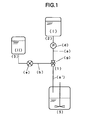
- a diazo solution I is fed by a feed pump d from a first feed tank 2 through a first flow path a such that the diazo solution I is ejected at a desired flow rate from nozzles of an ejector 1 and at the same time, a grounding solution II is drawn at a desired flow rate via a first flow control means e from a second feed tank 3 into the ejector 1 through a second flow path b.
- the ejector 1 is controlled at a desired temperature by a temperature control means g, both of the solutions are mixed together within the ejector 1, and a coupling reaction between the diazo solution and the grounding solution is conducted under turbulent conditions.
- the thus-obtained suspension of the resultant insoluble azo pigment is fed into a treatment tank 5, which may be provided with a heating means, from the ejector 1 through a third flow path a' to produce the insoluble azo pigment.
- the thus-stored suspension may be subjected to heat treatment at a desired temperature in the treatment tank 5 as needed.
- FIG. 2 illustrates the production of an insoluble azo pigment in a similar manner as in the process illustrated in FIG. 1 except that as solutions to be charged into the ejector 1, a buffer solution III is used in addition to the diazo solution I and grounding solution II by drawing the buffer solution III at a desired flow rate via a second flow control means f from a third feed tank 4 through a fifth flow path c.
- the solution to be ejected through the nozzles of the ejector (hereinafter abbreviated as "the first fluid") in the first embodiment is the diazo solution I
- the solution to be drawn into the ejector (hereinafter abbreviated as “the second fluid") is the grounding solution II.
- the first fluid is the grounding solution II
- the second fluid is the diazo solution I
- the other solution to be drawn into the ejector hereinafter abbreviated as “the third fluid”
- the second fluid and the third fluid are interchangeable with each other.
- the buffer solution III may be charged beforehand in the treatment tank.
- the buffer solution III may be added to the diazo solution I or the grounding solution II.
- the temperatures of the first fluid, second fluid and third fluid can be -5°C or higher and 50°C or lower, preferably 0°C or higher and 30°C or lower, and the temperature of the mixture in the ejector in which the insoluble azo pigment is formed can be -5°C or higher and 50°C or lower, preferably 0°C or higher and 30°C or lower.
- Any temperatures higher than 50°C are generally not preferred, because the diazo component may decompose and its decomposition products may adversely affect the hue, vividness and the like of the pigment.
- Any temperatures of -5°C or lower are generally not preferred, because the solvent is aqueous.
- the production system according to the first embodiment may preferably be provided at the ejector thereof with a temperature control means for controlling the temperatures.
- the suspension discharged from the ejector and containing the insoluble azo pigment can preferably be subjected to heat treatment in the treatment tank.
- the suspension of the insoluble azo pigment can be provided with more uniform particle sizes and excellent dispersibility.
- a heat treatment temperature lower than 50°C may not allow the particle size of the pigment to grow and therefore, and may not be preferred depending on the application.
- a heat treatment temperature higher than 98°C may be not preferred because the solvent is aqueous.
- the first fluid can be fed preferably at a flow rate sufficient to produce such a degree of depressurization that the second fluid or third fluid can be sufficiently drawn.
- the preferred flow rate of the first fluid cannot be specified because it is determined depending upon the size (dimensions) of the ejector, the capacity of the feed pump and the diameter of the flow path. In view of working efficiency and the like, however, the flow rate can be generally 1 L/min or higher, preferably 5 L/min or higher. A flow rate lower than 1 L/min leads to low working efficiency and does not produce any sufficient degree of depressurization, and therefore, is not preferred.
- the drawn flow rate of the second fluid or the total drawn flow rate of the second fluid and third fluid can be not greater than one third (on a volume basis) of the flow rate of the first fluid.
- a drawn flow rate higher than one third leads to an excessively large total volume of liquid in the suction chamber, so that no sufficient turbulence is obtained in the ejector and the reaction between the diazo component and the grounder component cannot be conducted efficiently. Such a high drawn flow rate is hence not preferred.
- the ejectors useful in the first embodiment and the remaining second to fourth embodiments are devices, each of which ejects the first fluid from the nozzles into the suction chamber and then causes the first fluid to flow into the diffuser such that the suction chamber is depressurized to draw the second fluid or third fluid and the second fluid or third fluid and the first fluid are then pressurized and discharged.
- the suction chamber is provided with one or more suction ports to permit mixing two or more fluids together in a turbulent state in the suction chamber and diffuser and at the same time, to permit performing the coupling reaction efficiently in a short time.
- the coupling reaction time can be significantly shortened.
- variations can be prevented in the reaction temperature, reactant concentrations and pH, thereby making it possible to eliminate factors which may give adverse effects on pigment particles.
- a diazo solution I is fed by the feed pump d from the first feed tank 2 through the first flow path a such that the diazo solution I is ejected at a desired flow rate from the nozzles of the ejector 1 and at the same time, a grounding solution II is drawn at a desired flow rate via the first flow control means e from the second feed tank 3 into the ejector 1 through the second flow path b.
- the ejector 1 is controlled at a desired temperature by the temperature control means g, both of the solutions are mixed together within the ejector 1, and a coupling reaction is conducted under turbulent conditions.
- the thus-obtained suspension of the resultant insoluble azo pigment is recirculated back to the first feed tank 2 through a third flow path a", and the resulting mixture (also indicated by I) of the diazo solution and the suspension of the insoluble azo pigment is again fed by the feed pump d from the first feed tank 2 through the first flow path a such that the mixture is ejected from the nozzles of the ejector 1, and this recirculation is continued until the coupling reaction is completed.
- the grounding solution II is continuously drawn and, when the reaction has been completed, the grounding solution II no longer remains in the second feed tank 3.
- the suspension of the insoluble azo pigment which has been obtained after the completion of the reaction, is stored in the treatment tank 5 from the ejector 1 through the third flow path a' , and is subjected to a heat treatment at a desired temperature to produce the insoluble azo pigment.
- a heat treatment at a desired temperature to produce the insoluble azo pigment.
- only the diazo solution flows through the first flow path a until the reaction begins, and the mixture of the diazo solution and the suspension of the insoluble azo pigment flow through the first flow path a after the reaction has begun.
- an insoluble azo pigment is produced by a similar production process as the production process shown in FIG. 3 although three solutions are charged into the ejector.
- the solution to be mixed with the insoluble azo pigment suspension(hereinafter abbreviated as “the first fluid") in the second embodiment is the diazo solution I
- the solution to be drawn into the ejector (hereinafter abbreviated as “the second fluid") is the grounding solution II.
- the first fluid is the grounding solution II
- the second fluid is the diazo solution I
- the other solution to be drawn into the ejector (hereinafter abbreviated as “the third fluid”) is the grounding solution II.
- the second fluid and the third fluid are interchangeable with each other.
- the buffer solution III may be charged beforehand in the treatment tank.
- a component of the buffer solution that is, a buffer may be added to the diazo solution I or the grounding solution II.
- the first fluid and second fluid or the first fluid, second fluid and third fluid are reacted in the ejector to form an insoluble azo pigment, whereby a suspension of the insoluble azo pigment is formed.
- the insoluble azo pigment is produced by recirculating a mixture of the suspension and the first fluid until the coupling reaction is completed.
- the temperatures of the first fluid, the suspension of the insoluble azo pigment, the mixture of the first fluid and the suspension of the insoluble azo pigment, the second fluid and the third fluid can be -5°C or higher and 50°C or lower, preferably 0°C or higher and 30°C or lower, and the temperature of the mixture in the ejector in which the insoluble azo pigment is formed can be -5°C or higher and 50°C or lower, preferably 0°C or higher and 30°C or lower. Any temperatures higher than 50°C are generally not preferred, because the diazo component may decompose and its decomposition products may adversely affect the hue, vividness and the like of the pigment. Any temperatures lower than -5°C are generally not preferred, because the solvent is aqueous. To maintain the above-described temperatures, the production system according to the second embodiment may preferably be provided at the ejector thereof with a temperature control means for controlling the temperatures.
- the suspension of the insoluble azo pigment is discharged from the ejector and then stored in the treatment tank. Subsequently, the suspension can preferably be subjected to heat treatment in the treatment tank.
- the suspension of the insoluble azo pigment can be provided with more uniform particlesizesand excellent dispersibility.
- a heat treatment temperature lower than 50°C may not allow the particle size of the pigment to grow and therefore, may not be preferred depending on the application.
- a heat treatment temperature higher than 98°C is not preferable because the solvent is aqueous.
- the first fluid and the suspension of the insoluble azo pigment can be fed preferably at a total flow rate sufficient to produce such a degree of depressurization that the second fluid or third fluid can be sufficiently drawn.
- the preferred total flow rate of the first fluid and the suspension of the insoluble azo pigment cannot be specified because it is determined depending upon the size (dimension) of the ejector, the capacity of the feed pump and the diameter of the flow path. In view of working efficiency and the like, however, the total flow rate can be generally 1 L/min or higher, preferably 5 L/min or higher. A total flow rate lower than 1 L/min leads to low working efficiency and does not produce any sufficient degree of depressurization, and therefore, is not preferred.
- the drawn flow rate of the second fluid or the total drawn flow rate of the second fluid and third fluid can be not greater than one third (on a volume basis) of the total flow rate of the first fluid and the suspension of the insoluble azo pigment.
- a drawn flow rate higher than the one third leads to an excessively large total volume of liquid in the suction chamber, so that no sufficient turbulence is obtained and the reaction cannot be conducted efficiently. Such a high drawn flow rate is hence not preferred.
- the mixture of the first fluid and the suspension of the insoluble azo pigment newly forms the pigment, and as a result, the concentration of the insoluble azo pigment in the mixture of the first fluid and the suspension of the insoluble azo pigment becomes higher and the concentration of the first fluid becomes lower.
- concentrations of the reactants in the ejector varies. It is, therefore, preferred to adjust the drawn flow rates of the second fluid and third fluid such that the concentrations of the reactants are maintained constant in the ejector.
- the third embodiment is characterized in that in the above-described first embodiment, a diazo solution comprising a first diazo component and a second diazo component, said second diazo component amounting to 0.1 to 50 mole % of the first diazo component, is used as the diazo solution, and/or a grounding solution comprising a first grounder component and a second grounder component, said second grounder component amounting to 0.1 to 50 mole % of the first grounder component, is used as the grounding solution; and all the other production conditions and the like are the same as in the first embodiment.
- the fourth embodiment is characterized in that in the above-described second embodiment, a diazo solution comprising a first diazo component and a second diazo component, said second diazo component amounting to 0.1 to 50 mole % of the first diazo component, is used as the diazo solution, and/or a grounding solution comprising a first grounder component and a second grounder component, said second grounder component amounting to 0. 1 to 50 mole % of the first grounder component, is used as the grounding solution; and the other production conditions and the like are the same as in the second embodiment.
- a derivative of the first diazo component is used.
- the derivative of the first diazo component include derivatives of the first diazo component, which are each substituted by one or more of lower alkyl groups having 1 to 4 carbon atoms, alkoxy groups, halogen atoms, carboxyl groups, sulfonic groups, hydroxyl groups, carboxamido groups, sulfonamido groups, acetylamino groups, and the like.
- These second diazo components can be used either singly or in combination.
- the content of the second diazo component may be preferably from 0.1 to 50 mole%, more preferably from 0.1 to 20 mole % per 100 mole % of the first diazo component. A content of the second diazo component greater than 50 mole % provides the resulting insoluble azo pigment with reduced vividness, and therefore, is not preferred.
- a derivative of the first grounder component is used.
- the derivative of the first grounder component include derivatives of the first grounder component, which are each substituted by one or more of lower alkyl groups having 1 to 4 carbon atoms, alkoxy groups, halogen atoms, carboxyl groups, sulfonic groups, hydroxyl groups, carboxamido groups, sulfonamido groups, acetylamino groups, and the like.
- These second grounder components can be used either singly or in combination.
- the content of the second grounder component may be preferably from 0.1 to 50 mole %, more preferably from 0.1 to 20 mole % per 100 mole % of the first grounder component.
- a content of the second grounder component greater than 50 mole % provides the resulting insoluble azo pigment with reduced vividness, and therefore, is not preferred.
- Insoluble azo pigments which can be produced by the present invention can include monoazo pigments, disazo pigments, ⁇ -naphthol pigments, naphthol AS pigments, and benzimidazolone pigments. They can be obtained by coupling diazo components, such as anilines orbenzidines, with grounder components including acetoacetanilides, pyrazolone derivatives, ⁇ -naphthols, naphthols AS or the like.
- the diazo components and grounder components usable in the present invention are those employed in the production of conventionally-known, insoluble azo pigments as described above, and no particular limitation is imposed thereon.
- acetic acid/sodium acetate, formic acid/sodium formate, or carbonic acid/sodium carbonate or sodium hydrogencarbonate can be mentioned.
- the pH of the buffer solution may range from 3.0 to 6.5, preferably from 3.5 to 5.5.
- a pH lower than 3.0 results in a slower coupling reaction, and therefore, is not preferred.
- a pH higher than 6.5 results in a faster coupling reaction, but tends to induce the decomposition of the diazo component, and hence, results in the inclusion of impurities at higher concentrations in the resulting pigment. Such an excessively high pH is, therefore, not preferred.
- the grounder component in excess relative to the diazo component.
- the degree of an excess of the grounder component relative to the diazo component can range from 0.5 to 5 mole %, preferably from 0.5 to 3 mole %.
- the coupling reaction can be conducted by continuously feeding and drawing the diazo solution and the grounding solution such that the molar ratio of the diazo component to the grounder solution falls within a range of from 1:1.005 to 1:1.05, preferably from 1:1.005 to 1:1.03.
- the coupling reaction takes place through a reaction of 2 moles of the grounder component with 1 mole of the diazo component.
- the coupling reaction can be conducted by continuously feeding and drawing the diazo solution and the grounding solution such that the molar ratio of the diazo component to the grounder solution falls within a range of from 1:2.01 to 1:2.10, preferably from 1:2.01 to 1:2.06.
- the diazo component does not remain unreacted, thereby making it possible to prevent side reactions which would otherwise take place through the decomposition of the diazo component or the intermolecular condensation of the diazo component.
- the production process according to the present invention makes it possible to reduce the degree of an excess of the grounder component compared with the reaction in the conventional batchwise single reaction tank as described above, leading to a reduction in the amount of the unreacted grounder component so that the resulting pigment can be provided with improved vividness and coloring strength.
- a surfactant, rosin or solvent may be added, as an aid to the dispersibility of the pigment, to the diazo solution, grounding solution or buffer solution, or such an aid may also be added to the suspension of the pigment before, during or after subjecting the suspension to heat treatment in the treatment tank. It is also possible to provide the ejector with a still further intake port and to draw a solution or solvent with the above-described aid dissolved therein.
- 3,3'-Dichlorobenzidine hydrochloride was diazotized in a manner known per se in the art by using a threefold molar amount of hydrochloric acid and a twofoldmolar amount of sodium nitrite to prepare a 0.125 mole/L diazo solution (8 L, solution temperature: 5°C).
- acetoacetanilide (358 parts) was dissolved in an aqueous solution, which contained sodium hydroxide (120 parts), to prepare a 0.253 mole/L grounding solution (8 L, solution temperature: 20°C).
- a buffer solution of pH 4.7 (80 L, solution temperature: 20°C) which consisted of an 80% solution of acetic acid in water (300 parts), sodium hydroxide (80 parts) and water.
- the buffer solution was next caused to flow as a first fluid I at a flow rate of 6 L/min by the feed pump d from the first feed tank 2 into the ejector 1 through the first flow path a.
- the diazo solution was drawn as a second fluid II at a flow rate of 0.6 L/min (adjusted by the first flow control means e) from the second feed tank 3 through the second flow path b and the grounding solution was also drawn as a third fluid III at a flow rate of 0.
- the yield of the disazo pigment was very good owing to the effects of a severe turbulence occurred concurrently with the coupling reaction in the ejector.
- the degree of an excess of the grounder component relative to the diazo component was as much as about 1 mole %. Nonetheless, the coupling reaction proceeded smoothly, and the coupling reaction time was about 14 min.
- the thus-obtained aqueous suspension of the resulting pigment was discharged from the ejector 1 through the third flow path a', and was stored in the treatment tank 5. After the thus-stored aqueous suspension of the pigment was heated to 90°C, the pigment was collected by filtration and washed with water to obtain a wet cake of the disazo pigment (PY12) . The pigment content of the wet cake was 24.5%.
- a diazo solution was prepared in a similar manner as in Example 1.
- acetoacetanilide (376 parts) was dissolved in an aqueous solution, which contained sodium hydroxide (120 parts), to prepare a 0.265 mole/L grounding solution (8 L, solution temperature: 20°C).
- a buffer solution of pH 4.7 (20 L, solution temperature: 20°C) which consisted of an 80% solution of acetic acid in water (300 parts) , sodium hydroxide (80 parts) and water.
- the buffer was charged in a batchwise single reaction tank equipped with a stirrer, and under stirring, the diazo solution and the grounding solution were simultaneously charged over 1.5 hours through separate inlet lines to form a disazo pigment (PY12).
- the degree of an excess of the grounder component relative to the diazo component was 6mole %. After the aqueous suspension of the pigment was heated to 90°C, the pigment was collected by filtration and washed with water to afford a wet cake of the disazo pigment (PY12). The pigment content of the wet cake was 25.8%.
- Each test ink was spread by an RI tester over a sheet of art paper, and its density was measured by a Gretag densitometer (reflection densitometer) to rank the coloring strength. A greater value indicates higher coloring strength.
- Example 1 Each test ink was spread by an RI tester over a sheet of art paper, and the reflected light was measured by a densitometer to rank the gloss. A greater value indicates higher gloss.
- Table 1 The results of the above evaluation are shown in Table 1.
- the pigment of Example 1 showed excellent transparency, coloring strength and gloss compared with the pigment of Comparative Example 1.
- Example 1 can provide a pigment having finer and more uniform particles and better dispersibility than the production process of Comparative Example 1.
- a disazo pigment (PY14) was produced in a similar manner as in Example 1 except for the use of acetoacet-o-toluidide (387 parts) instead of the use of acetoacetanilide (358 parts). The thus-obtained wet cake pigment was dried to afford the disazo pigment (PY14) in a dry form.
- a disazo pigment (PY14) was produced in a similar manner as in Comparative Example 1 except for the use of acetoacet-o-toluidide (405 parts) instead of the use of acetoacetanilide (376 parts). The thus-obtained wet cake pigment was dried to afford the disazo pigment (PY14) in a dry form.
- the test gravure ink was prepared by placing a nitrocellulose-based, gravure ink varnish (90 parts) and the pigment (10 parts), which had been ground through a 60-mesh wire screen, in a glass bottle (capacity: 200 parts), adding glass beads of 3 mm in diameter (100 parts), and then conducting dispersion for 1 hour on a Red Devil dispenser.
- Reflected light from each ink-spread film was measured by a gloss meter to rank its gloss. A greater value indicates higher gloss.
- Example 2 showed excellent transparency, coloring strength and gloss compared with the pigment of Comparative Example 2. It is clear from the foregoing that the production process of Example 2 can provide a pigment having finer and more uniform particles and better dispersibility than the production process of Comparative Example 2. Table 2 Transparency Coloring strength Gloss Example 2 7 6 62.2 Comp. Ex. 2 5 5 46.4
- 3-Amino-4-methoxybenzanilide was diazotized in a manner known per se in the art by using a 3. 5-fold molar amount of hydrochloric acid and an equimolar amount of sodium nitrite, followed by the addition of sodium acetate to prepare a 0.025 mole/L diazo solution of pH 4.0 (40 L, solution temperature: 5°C) .
- N-(4-chloro-2,5-dimethoxyphenyl)-3-hydroxy-2-napthaleneca rboxamide (naphthol AS-LC) (362 parts) was dissolved in an aqueous solution, which contained sodium hydroxide (100 parts), to prepare a 0.126 mole/L grounding solution (8 L, solution temperature: 20°C).
- the diazo solution was next caused to flow as a first fluid I at a flow rate of 6 L/min by the feed pump d from the first feed tank 2 into the ejector 1 through the first flow path a.
- the grounding solution was drawn as a second fluid II at a flow rate of 1.2 L/min (adjusted by the first flow control means e) from the second feed tank 3 through the second flow path b into the ejector 1 maintained at 20°C by the temperature control means g, and through a coupling reaction, a naphthol AS pigment [C.I. Pigment Red 146 (PR146)] was yielded.
- the yield of the naphthol AS pigment was very good owing to the effects of a severe turbulence occurred concurrently with the coupling reaction in the ejector.
- the degree of an excess of the grounder component relative to the diazo component was as much as about 1 mole %. Nonetheless, the coupling reaction proceeded smoothly, and the coupling reaction time was about 7 min.
- the thus-obtained aqueous suspension of the resulting pigment was discharged from the ejector 1 through the third flow path a' , and was stored in the treatment tank 5. After the thus-stored aqueous suspension of the pigment was heated to 90°C, the pigment was collected by filtration, washed with water and then dried to obtain the naphthol AS pigment (PR146) in a dry form.
- a diazo solution was prepared in a similar manner as in Example 3. On the side, N-(4-chloro-2,5-dimethoxyphenyl)-3-hydroxy-2-napthaleneca rboxamide (naphthol AS-LC) (376 parts) was dissolved in an aqueous solution, which contained sodium hydroxide (100 parts) , to prepare a 0.131 mole/L grounding solution (8 L, solution temperature: 20°C). The diazo solution was charged in a batchwise single reaction tank equipped with a stirrer, and under stirring, the grounding solution was charged over 1 hour to form a naphthol AS pigment (PR146). The degree of an excess of the grounder component relative to the diazo component was 5 mole %. After the resulting aqueous suspension of the pigment was heated to 90°C, the pigment was collected by filtration, washed with water and then dried to obtain the naphthol AS pigment (PR146) in a dry form.
- naphthol AS-LC N
- Example 3 An applicability test of each of the dry pigments of PR146, which were obtained in Example 3 and Comparative Example 3, respectively, in gravure inks was performed in a similar manner as in Test 2. The results of the evaluation are shown in Table 3.
- the pigment of Example 3 showed excellent transparency, coloring strength and gloss compared with the pigment of Comparative Example 3. It is clear from the foregoing that the production process of Example 3 can provide a pigment having finer and more uniform particles and better dispersibility than the production process of Comparative Example 3.
- 2-Methoxy-4-nitroaniline was diazotized in a manner known per se in the art by using a 2.5-fold molar amount of hydrochloric acid and an equimolar amount of sodium nitrite to prepare a 0.125 mole/L diazo solution (8 L, solution temperature: 10°C).
- acetoacet-o-anisidide (209.3 parts) was dissolved in an aqueous solution which contained sodium hydroxide (50 parts) , followed by the addition of an aqueous solution of acetic acid to have a grounder component deposited so that a 0.0253 mole/L grounding solution of pH 4.2 (40 L, solution temperature: 20°C) was prepared.
- the grounding solution was next caused to flow as a first fluid I at a flow rate of 5 L/min by the feed pump d from the first feed tank 2 into the ejector 1 through the first flow path a.
- the diazo solution was drawn as a second fluid II at a flow rate of 1 L/min (adjusted by the first flow control means e) from the second feed tank 3 through the second flow path b into the ejector 1 maintained at 20°C by the temperature control means g, and through a coupling reaction, a monoazo pigment [C.I. Pigment Yellow 74 (PY74)] was yielded.
- the yield of the monoazo pigment was very good owing to the effects of a severe turbulence occurred concurrently with the coupling reaction in the ejector.
- the degree of an excess of the grounder component relative to the diazo component was as much as about 1 mole %. Nonetheless, the coupling reaction proceeded smoothly, and the coupling reaction time was about 8 min.
- the thus-obtained aqueous suspension of the resulting pigment was discharged from the ejector 1 through the third flow path a' , and was stored in the treatment tank 5. After the thus-stored aqueous suspension of the pigment was heated to 90°C, the pigment was collected by filtration, washed with water and then dried to obtain the monoazo pigment (PY74) in a dry form.
- a diazo solution was prepared in a similar manner as in Example 4. On the side, acetoacet-o-anisidide (218 parts) was dissolved in an aqueous solution which contained sodium hydroxide (50 parts), followed by the addition of an aqueous solution of acetic acid to have a grounder component deposited so that a 0.0525 mole/L grounding solution of pH 4.2 (20 L, solution temperature: 20°C) was prepared. The grounding solution was charged in a batchwise single reaction tank equipped with a stirrer, and under stirring, the diazo solution was charged over 2 hours to form a monoazo pigment (PY74). The degree of an excess of the grounder component relative to the diazo component was 5 mole %. After the resulting aqueous suspension of the pigment was heated to 90°C, the pigment was collected by filtration, washed with water and then dried to obtain the monoazo pigment (PY74) in a dry form. Test 4
- Hydrophobic silica (0.3 part) was added to the thus-obtained toner (50 parts), and with an electrophotographic printer, an evaluation was performed by the following methods.
- the coloring strength was visually determined in a similar manner as in the ranking of transparency. Supposing that the coloring strength of the toner making use of the pigment afforded in Comparative Example 4 had a standard value of 5, coloring strength was ranked in accordance with a 10-level grading scale. A greater value indicates higher coloring strength.
- Example 4 showed excellent transparency, coloring strength and dispersibility compared with the pigment of Comparative Example 4. It is clear from the foregoing that the production process of Example 4 can provide a pigment having finer and more uniform particles and better dispersibility than the production process of Comparative Example 4.
- Example 1 Employed were the diazo solution (8 L, solution temperature: 5°C) prepared in Example 1 and the grounding solution (8 L, solution temperature: 20°C) prepared in Example 1. Also prepared was a buffer solution of pH 4.7 (20L, solution temperature: 20°C) which consisted of an 80% solution of acetic acid in water (300 parts), sodium hydroxide (80 parts) and water.
- the buffer solution was next caused to flow as a first fluid I at a flow rate of 5 L/min by the feed pump d from the first feed tank 2 into the ejector 1 through the first flow path a.
- the diazo solution was drawn as a second fluid II at a flow rate of 0.5 L/min (adjusted by the first flow control means e) from the second feed tank 3 through the second flow path b, and the grounding solution was also drawn as a third fluid III at a flow rate of 0.5 L/min (adjusted by the second flow control means f) from the third feed tank 4 through the fifth flow path c, both into the ejector 1 maintained at 20°C by the temperature control means g, and through a coupling reaction, a disazo pigment (PY12) was yielded.
- a mixture of the resulting suspension of the disazo pigment (PY12) and the buffer solution was recirculated to the first feed tank 2 through the fourth flow path a", and was again fed by the feed pump d to the ejector 1 through the first flow path a.
- the recirculation was continued until the diazo solution and grounding solution to be drawn through the second and fifth flow paths b,c, respectively, became no longer remaining.
- the drawn rates of the diazo solution and grounding solution were gradually reduced by the first and second flow control means e,f.
- the yield of the pigment was very good owing to the effects of a severe turbulence occurred concurrently with the coupling reaction in the ejector.
- the degree of an excess of the grounder component relative to the diazo component was as much as about 1 mole %. Nonetheless, the coupling reaction proceeded smoothly, and the coupling reaction time was about 30 min.
- the thus-obtained aqueous suspension of the resulting pigment was discharged from the ejector 1 through the third flow path a', and was stored in the treatment tank 5. After the thus-stored aqueous suspension of the pigment was heated to 90°C, the pigment was collected by filtration and washed with water to obtain a wet cake of the disazo pigment (PY12) . The pigment content of the wet cake was 24.3%.
- Example 5 An applicability test of each of the wet cakes of PY12, which were afforded in Example 5 and Comparative Example 1, respectively, in offset inks was performed in a similar manner as in Test 1, and the results of Table 5 were obtained. The ranking methods were the same as those described above in Test 1.
- the pigment of Example 5 showed excellent transparency, coloring strength and gloss compared with the pigment of Comparative Example 1. It is clear from the foregoing that the production process of Example 5 can provide a pigment having finer and more uniform particles and better dispersibility than the production process of Comparative Example 1.
- a disazo pigment (PY14) was produced in a similar manner as in Example 5 except for the use of acetoacet-o-toluidide (387 parts) instead of the use of acetoacetanilide (358 parts) .
- the thus-obtained wet cake pigment was dried to afford the disazo pigment (PY14) in a dry form.
- Example 6 An applicability test of each of the dry pigments of PY14, which were afforded in Example 6 and Comparative Example 2, respectively, in gravure inks was performed in a similar manner as in Test 2, and the results of Table 6 were obtained.
- the ranking methods were the same as those described above in Example 2.
- the pigment of Example 6 showed excellent transparency, coloring strength and gloss compared with the pigment of Comparative Example 2. It is clear from the foregoing that the production process of Example 6 can provide a pigment having finer and more uniform particles and better dispersibility than the production process of Comparative Example 2.
- 3-Amino-4-methoxybenzanilide was diazotized in a manner known per se in the art by using a 3. 5-fold molar amount of hydrochloric acid and an equimolar amount of sodium nitrite, followed by the addition of sodium acetate to prepare a 0.05 mole/L diazo solution of pH 4.0 (20 L, solution temperature: 5°C) .
- a grounding solution on the other hand, the grounding solution (8 L, solution temperature: 20°C) prepared in Example 3 was used.
- the diazo solution was next caused to flow as a first fluid I at a flow rate of 5 L/min by the feed pump d from the first feed tank 2 into the ejector 1 through the first flow path a.
- the grounding solution was drawn as a second fluid II at a flow rate of 1 L/min (adjusted by the first flow control means e) from the second feed tank 3 through the second flow path b into the ejector 1 maintained at 20°C by the temperature control means g, and through a coupling reaction, a naphthol AS pigment (PR146) was yielded.
- a mixture of the resulting suspension of the naphthol AS pigment (PR146) and the diazo solution was recirculated to the first feed tank 2 through the fourth flow path a", and was again fed by the feed pump d to the ejector 1 through the first flow path a.
- the recirculation was continued until the grounding solution to be drawn through the second flow path b became no longer remaining.
- the drawn rate of the grounding solution was gradually reduced by the first flow control means e.
- the yield of the naphthol AS pigment was very good owing to the effects of a severe turbulence occurred concurrently with the coupling reaction in the ejector.
- the degree of an excess of the grounder component relative to the diazo component was as much as about 1 mole %.
- the aqueous suspension of the resulting pigment was discharged from the ejector 1 through the third flow path a' , and was stored in the treatment tank 5. After the thus-stored aqueous suspension of the pigment was heated to 90°C, the pigment was collected by filtration, washed with water, and then dried to obtain the naphthol AS pigment (PR146) in a dry form.
- Example 7 An applicability test of each of the dry pigments of PR146, which were obtained in Example 7 and Comparative Example 3, respectively, in gravure inks was performed in a similar manner as in Test 3. The results of the evaluation are shown in Table 7. The ranking methods were the same as those described above in Test 3. The pigment of Example 7 showed excellent transparency, coloring strength and gloss compared with the pigment of Comparative Example 3. It is clear from the foregoing that the production process of Example 7 can provide a pigment having finer and more uniform particles and better dispersibility than the production process of Comparative Example 3. Table 7 Transparency Coloring strength Gloss Example 7 7 6 64.5 Comp. Ex. 3 5 5 53.2
- the diazo solution (8 L, solution temperature: 10°C) prepared in Example 4 was used.
- acetoacet-o-anisidide (209.3 parts) was dissolved in an aqueous solution which contained sodium hydroxide (50 parts) , followed by the addition of an aqueous solution of acetic acid to have a grounder component deposited so that a 0.0505 mole/L grounding solution of pH 4.2 (40 L, solution temperature: 20°C) was prepared.
- the grounding solution was next caused to flow as a first fluid I at a flow rate of 5 L/min by the feed pump d from the first feed tank 2 into the ejector 1 through the first flow path a.
- the diazo solution was drawn as a second fluid II at a flow rate of 1 L/min (adjusted by the first flow control means e) from the second feed tank 3 through the second flow path b into the ejector 1 maintained at 20°C by the temperature control means g, and through a coupling reaction, a monoazo pigment (PY74) was yielded.
- a mixture of the resulting suspension of the monoazo pigment (PY74) and the grounding solution was recirculated to the first feed tank 2 through the fourth flow path a", and was again fed by the feed pump d to the ejector 1 through the first flow path a.
- the recirculation was continued until the diazo solution to be drawn through the second flow path b became no longer remaining.
- the drawn rate of the diazo solution was gradually reduced by the first flow control means e.
- the yield of the monoazo pigment was very good owing to the effects of a severe turbulence occurred concurrently with the coupling reaction in the ejector.
- the degree of an excess of the grounder component relative to the diazo component was as much as about 1 mole %.
- the aqueous suspension of the resulting pigment was discharged from the ejector 1 through the third flow path a' , and was stored in the treatment tank 5. After the thus-stored aqueous suspension of the pigment was heated to 90°C, the pigment was collected by filtration, washed with water, and then dried to obtain the monoazo pigment (PY74) in a dry form.
- Example 8 An applicability test of each of the dry pigments of PY74, which were obtained in Example 8 and Comparative Example 4, respectively, in color toners was performed in a similar manner as in Test 4. The results of the evaluation are shown in Table 8. The ranking methods were the same as those described above in Test 4. The pigment of Example 8 showed excellent transparency, coloring strength and dispersibility compared with the pigment of Comparative Example 4. It is clear from the foregoing that the production process of Example 8 can provide a pigment having finer and more uniform particles and better dispersibility than the production process of Comparative Example 4. Table 8 Transparency Coloring strength Dispersibility Example 8 7 7 7 Comp. Ex. 4 5 5 5 5
- acetoacetanilide (344 parts), 2-acetoacetylaminobenzoic acid (8.9 parts) and 4-acetoacetylaminobenzamide (8.9 parts) were dissolved to prepare a 0.253 mole/L grounding solution (8 L, solution temperature: 20°C).
- the grounding solution, the diazo solution (8 L, solution temperature: 5°C) prepared in Example 1, and the buffer solution (80 L, solution temperature: 20°C) prepared in Example 1 were provided.
- a wet cake of a disazo pigment (PY12) was then obtained in a similar manner as in Example 1. The pigment content of the wet cake was 24.3%.
- a diazo solution was prepared in a similar manner as in Example 1.
- acetoacetanilide (361 parts), 2-acetoacetylaminobezoic acid (9.3 parts) and 4-acetoacetylaminobenzamide (9.3 parts) were dissolved in an aqueous solution, which contained sodium hydroxide (120 parts) , to prepare a 0.265 mole/L grounding solution (8 L, solution temperature: 20°C) .
- a buffer solution of pH 4.7 (20 L, solution temperature: 20°C) which consisted of an 80% solution of acetic acid in water (300 parts), sodium hydroxide (80 parts) and water.
- the buffer was charged in a batchwise single reaction tank equipped with a stirrer, and under stirring, the diazo solution and the grounding solution were simultaneously charged over 1.5 hours through separate inlet lines to form a disazo pigment (PY12).
- the degree of an excess of the grounder component relative to the diazo component was 6 mole %.
- the pigment was collected by filtration and washed with water to afford a wet cake of the disazo pigment (PY12).
- the pigment content of the wet cake was 25.4%.
- Example 9 An applicability test of each of the wet cakes of PY12, which were afforded in Example 9 and Comparative Example 5, respectively, in offset inks was performed in a similar manner as in Test 1, and the results of Table 9 were obtained. The ranking methods were the same as those described above in Test 1.
- the pigment of Example 9 showed excellent transparency, coloring strength and gloss compared with the pigment of Comparative Example 5. It is clear from the foregoing that the production process of Example 9 can provide a pigment having finer and more uniform particles and better dispersibility than the production process of Comparative Example 5.
- a diazo solution was prepared in a similar manner as in Example 1.
- acetoacet-o-toluidide (367 parts) and 4-acetoacetylaminobenzenesulfonic acid (26 parts) were dissolved in an aqueous solution, which contained sodium hydroxide (120 parts), to prepare a 0.253 mole/L grounding solution (8 L, solution temperature: 20°C).
- a buffer solution of pH 4.7 (80 L, solution temperature: 20°C) which consisted of an 80% solution of acetic acid in water (300 parts), sodium hydroxide (80 parts) and water.
- a disazo pigment (PY14) was then produced in a similar manner as in Example 9. The thus-obtained wet cake pigment was dried to afford the disazo pigment (PY14) in a dry form.
- a diazo solution was prepared in a similar manner as in Example 1.
- acetoacet-o-toluidide (385 parts) and4-acetoacetylaminobenzenesulfonic acid (27.3 parts) were dissolved in an aqueous solution, which contained sodium hydroxide (120 parts), to prepare a 0.265 mole/L grounding solution (8 L, solution temperature: 20°C).
- a buffer solution of pH 4.7 (20 L, solution temperature: 20°C) which consisted of an 80% solution of acetic acid in water (300 parts), sodium hydroxide (80 parts) and water.
- a disazo pigment (PY14) was then produced in a similar manner as in Comparative Example 5. The thus-obtained wet cake pigment was dried to afford the disazo pigment (PY14) in a dry form.
- Example 10 An applicability test of each of the dry pigments of PY14, which were obtained in Example 10 and Comparative Example 6, respectively, in gravure inks was performed in a similar manner as in Test 2. The results of the evaluation are shown in Table 10. The ranking methods were the same as those described above in Test 2. The pigment of Example 10 showed excellent transparency, coloring strength and gloss compared with the pigment of Comparative Example 6. It is clear from the foregoing that the production process of Example 10 can provide a pigment having finer and more uniform particles and better dispersibility than the production process of Comparative Example 6. Table 10 Transparency Coloring strength Gloss Example 10 7 6 64.8 Comp. Ex. 6 5 5 50.4
- acetoacet-o-anisidide (209.3 parts) was dissolved in an aqueous solution which contained sodium hydroxide (50 parts) , followed by the addition of an aqueous solution of acetic acid to have a grounder component deposited so that a 0.0253 mole/L grounding solution of pH 4.2 (40 L, solution temperature: 20°C) was prepared.
- a monoazo pigment (PY74) was then obtained in a dry form in a manner similar to Example 4.
- a diazo solution was prepared in a similar manner as in Example 11. On the side, acetoacet-o-anisidide (218 parts) was dissolved in an aqueous solution which contained sodium hydroxide (50 parts), followed by the addition of acetic acid to have a grounder component deposited so that a 0.0525 mole/L grounding solution of pH 4.2 (20 L, solution temperature: 20°C) was prepared.
- the grounding solution was charged in a batchwise single reaction tank equipped with a stirrer, and under stirring, the diazo solution was charged over 2 hours to form a monoazo pigment (PY74). The degree of an excess of the grounder component relative to the diazo component was 5 mole %. After the resulting aqueous suspension of the pigment was heated to 90°C, the pigment was collected by filtration, washed with water and then dried to obtain the monoazo pigment (PY74) in a dry form.
- Example 11 An applicability test of each of the dry pigments of PY74, which were obtained in Example 11 and Comparative Example 7, respectively, in color toners was performed in a similar manner as in Test 4. The results of the evaluation are shown in Table 11. The ranking methods were the same as those described above in Test 4. The pigment of Example 11 showed excellent transparency, coloring strength and dispersibility compared with the pigment of Comparative Example 7. It is clear from the foregoing that the production process of Example 11 can provide a pigment having finer and more uniform particles and better dispersibility than the production process of Comparative Example 7. Table 11 Transparency Coloring strength Dispersibility Example 11 7 7 7 Comp. Ex. 7 5 5 5 5
- Example 9 A wet cake of a disazo pigment (PY12) was then afforded in a similar manner as in Example 5. The pigment content of the wet cake was 24.5%.
- Example 12 An applicability test of each of the wet cakes of PY12, which were afforded in Example 12 and Comparative Example 5, respectively, in offset inks was performed in a similar manner as in Test 1, and the results of the evaluation are shown in Table 12 .
- the invention pigment of Example 12 showed excellent transparency, coloring strength and gloss compared with the pigment of Comparative Example 5. It is clear from the foregoing that the production process of Example 12 can provide a pigment having finer and more uniform particles and better dispersibility.
- Table 12 Transparency Coloring strength Gloss Example 12 7 1.57 56.5 Comp. Ex. 5 5 1.50 51.5
- Example 12 Provided were the diazo solution (8 L, solution temperature: 5°C) and the buffer (20 L, solution temperature: 20°C), both of which were used in Example 12. Further, acetoacet-o-toluidide (367 parts) and 4-acetoacetylaminobenzenesulfonic acid (26 parts) were dissolved in an aqueous solution, which contained sodium hydroxide (120 parts), to prepare a 0.253 mole/L grounding solution (8 L, solution temperature: 20°C). A disazo pigment (PY14) was then produced in a similar manner as in Example 12. The thus-obtained wet cake pigment was dried to afford the disazo pigment (PY14) in a dry form.
- Example 13 An applicability test of each of the dry pigments of PY14, which were afforded in Example 13 and Comparative Example 6, respectively, in gravure inks was performed in a similar manner as in Test 2, and the results of the evaluation are shown in Table 13.
- the invention pigment of Example 13 showed excellent transparency, coloring strength and gloss compared with the pigment of Comparative Example 6. It is clear from the foregoing that the production process of Example 13 can provide a pigment having finer and more uniform particles and better dispersibility.
- Table 13 Transparency Coloring strength Gloss Example 13 7 6 63.7 Comp. Ex. 6 5 5 50.4
- acetoacet-o-anisidide (209.3 parts) was dissolved in an aqueous solution which contained sodium hydroxide (50 parts) , followed by the addition of acetic acid to have a grounder component deposited so that a 0.0505 mole/L grounding solution of pH 4.2 (20 L, solution temperature: 20°C) was prepared.
- a monoazo pigment (PY74) was then obtained in a dry form in a manner similar to Example 8.
- Example 14 An applicability test of each of the dry pigments of PY74, which were obtained in Example 14 and Comparative Example 7, respectively, in color toners was performed in a similar manner as in Test 4. The results of the evaluation are shown in Table 14.
- the invention pigment of Example 14 showed excellent transparency, coloring strength and dispersibility compared with the pigment of Comparative Example 7. It is clear from the foregoing that the production process of Example 14 can provide a pigment having finer and more uniform particles and better dispersibility.
- the process and system according to the present invention can produce insoluble azo pigment excellent in dispersibility, transparency, vividness, coloring strength and gloss, and moreover, can substantially shorten the coupling reaction time, can readily meet mass production, are economical, and have good productivity.
- insoluble azo pigments are useful as offset inks, gravure inks, paints, colorants for plastics, textile-printing pigments, color toners, inkjet printing inks, and the like.
Landscapes
- Chemical & Material Sciences (AREA)
- Chemical Kinetics & Catalysis (AREA)
- Organic Chemistry (AREA)
- Inks, Pencil-Leads, Or Crayons (AREA)
- Physical Or Chemical Processes And Apparatus (AREA)
Applications Claiming Priority (4)
| Application Number | Priority Date | Filing Date | Title |
|---|---|---|---|
| JP2004306807 | 2004-10-21 | ||
| JP2004312064 | 2004-10-27 | ||
| JP2004325833 | 2004-11-10 | ||
| JP2004325834 | 2004-11-10 |
Publications (3)
| Publication Number | Publication Date |
|---|---|
| EP1652893A2 true EP1652893A2 (de) | 2006-05-03 |
| EP1652893A3 EP1652893A3 (de) | 2006-06-07 |
| EP1652893B1 EP1652893B1 (de) | 2011-11-02 |
Family
ID=35809679
Family Applications (1)
| Application Number | Title | Priority Date | Filing Date |
|---|---|---|---|
| EP05020506A Expired - Lifetime EP1652893B1 (de) | 2004-10-21 | 2005-09-20 | Herstellungsverfahren sowie -Vorrichtung für unloesliche Azopigmente |
Country Status (5)
| Country | Link |
|---|---|
| US (1) | US20060086290A1 (de) |
| EP (1) | EP1652893B1 (de) |
| KR (1) | KR100962922B1 (de) |
| CN (1) | CN1763136B (de) |
| TW (1) | TW200704719A (de) |
Cited By (3)
| Publication number | Priority date | Publication date | Assignee | Title |
|---|---|---|---|---|
| WO2008058592A1 (de) * | 2006-11-14 | 2008-05-22 | Clariant Finance (Bvi) Limited | Verfahren zur kontinuierlichen herstellung von dispersionen in mikrostrukturierten apparaten |
| EP2196504A3 (de) * | 2008-07-02 | 2010-12-01 | Xerox Corporation | Verfahren zur Herstellung von Teilchen von AZO-Pigmenten im Nanomaßstab in einem Mikroreaktor oder Mikromischer |
| EP2452924A1 (de) * | 2010-11-16 | 2012-05-16 | Italtecno S.r.l. | Anlage und Verfahren zur Behandlung Bitfehlerdetektion von Abwässern aus Industrieverfahren |
Families Citing this family (3)
| Publication number | Priority date | Publication date | Assignee | Title |
|---|---|---|---|---|
| CN104830089B (zh) * | 2015-04-29 | 2017-04-19 | 绍兴文理学院 | 一种染料连续偶合及减少能耗的方法 |
| KR102850555B1 (ko) * | 2019-01-11 | 2025-08-25 | 산요 시키소 가부시키가이샤 | 아조 안료 조성물 및 그의 제조 방법 |
| CN110845860B (zh) * | 2019-11-20 | 2025-06-10 | 浙江工业大学 | 一种自动连续化液状偶氮染料的生产工艺及其合成系统 |
Family Cites Families (11)
| Publication number | Priority date | Publication date | Assignee | Title |
|---|---|---|---|---|
| US2232727A (en) * | 1938-03-15 | 1941-02-25 | Houdry Process Corp | Reaction of solutions |
| CH396945A (de) * | 1959-01-22 | 1965-08-15 | Hoechst Ag | Verfahren zur kontinuierlichen und intensiven Vermischung zweier flüssiger Phasen |
| DE2352735C2 (de) * | 1973-10-20 | 1984-12-06 | Hoechst Ag, 6230 Frankfurt | Verfahren und Vorrichtung zum Regeln der Zugabe einer Komponente bei der diskontinuierlichen Azofarbstoffherstellung |
| US4341701A (en) * | 1979-11-07 | 1982-07-27 | Ciba-Geigy Corporation | Production of pigments |
| US4371701A (en) * | 1981-12-14 | 1983-02-01 | Standard Oil Company (Indiana) | Adducts of 1-cyclohexene-1,2-dicarboxylic anhydride with olefins |
| JPH0694771B2 (ja) * | 1989-09-25 | 1994-11-24 | 大阪瓦斯株式会社 | 水圧式掘削装置 |
| ATE242282T1 (de) * | 1997-08-27 | 2003-06-15 | Rhodia Chimie Sa | Verfahren zur maskierung von in emulsion vorliegenden polyisocyanaten |
| DE19946134A1 (de) * | 1999-09-27 | 2001-03-29 | Linde Ag | Verfahren zur Herstellung eines Epoxids |
| FR2805475B1 (fr) * | 2000-02-29 | 2003-03-21 | Mecmas Ind | Tete melangeuse pour composants chimiques |
| DE10049200A1 (de) * | 2000-10-05 | 2002-04-11 | Clariant Gmbh | Verfahren zur Herstellung von Azofarbmitteln |
| DE10249747A1 (de) * | 2002-10-25 | 2004-05-06 | Clariant Gmbh | Verfahren und Vorrichtung zur Durchführung chemischer und physikalischer Prozesse |
-
2005
- 2005-09-20 EP EP05020506A patent/EP1652893B1/de not_active Expired - Lifetime
- 2005-09-21 US US11/230,625 patent/US20060086290A1/en not_active Abandoned
- 2005-09-23 TW TW094132940A patent/TW200704719A/zh unknown
- 2005-10-20 KR KR1020050099116A patent/KR100962922B1/ko not_active Expired - Fee Related
- 2005-10-20 CN CN200510118132.5A patent/CN1763136B/zh not_active Expired - Lifetime
Non-Patent Citations (1)
| Title |
|---|
| None |
Cited By (3)
| Publication number | Priority date | Publication date | Assignee | Title |
|---|---|---|---|---|
| WO2008058592A1 (de) * | 2006-11-14 | 2008-05-22 | Clariant Finance (Bvi) Limited | Verfahren zur kontinuierlichen herstellung von dispersionen in mikrostrukturierten apparaten |
| EP2196504A3 (de) * | 2008-07-02 | 2010-12-01 | Xerox Corporation | Verfahren zur Herstellung von Teilchen von AZO-Pigmenten im Nanomaßstab in einem Mikroreaktor oder Mikromischer |
| EP2452924A1 (de) * | 2010-11-16 | 2012-05-16 | Italtecno S.r.l. | Anlage und Verfahren zur Behandlung Bitfehlerdetektion von Abwässern aus Industrieverfahren |
Also Published As
| Publication number | Publication date |
|---|---|
| CN1763136B (zh) | 2011-01-19 |
| EP1652893A3 (de) | 2006-06-07 |
| EP1652893B1 (de) | 2011-11-02 |
| TW200704719A (en) | 2007-02-01 |
| KR100962922B1 (ko) | 2010-06-10 |
| US20060086290A1 (en) | 2006-04-27 |
| KR20060049092A (ko) | 2006-05-18 |
| CN1763136A (zh) | 2006-04-26 |
Similar Documents
| Publication | Publication Date | Title |
|---|---|---|
| CN1298786C (zh) | 进行化学和物理工艺的方法和设备 | |
| US6548647B2 (en) | Process for preparing azo colorants | |
| CN103717680B (zh) | 包括偶氮颜料、着色组合物、喷墨记录油墨的分散体和制备分散体的方法 | |
| US20070240618A1 (en) | High-Purity Naphthol as Pigments | |
| US20030083410A1 (en) | Preparation of azo colorants in microreactors and their use in electrophotographic toners and developers, powder coatings, ink jet inks and electronic medias | |
| CN109890908B (zh) | 喹吖啶酮固溶体颜料的制造方法、颜料分散液和喷墨用墨 | |
| US20070213516A1 (en) | Process For Producing High-Purity Azo Dyes | |
| EP1652893B1 (de) | Herstellungsverfahren sowie -Vorrichtung für unloesliche Azopigmente | |
| KR101086541B1 (ko) | 색지수 황색 안료 74에 기초한 혼합된 결정을 포함하는 안료 조성물의 용도 | |
| EP0592907A1 (de) | Pigmentzusammensetzungen für Tintensysteme auf Lösungsmittel, beziehungsweise Wasserbasis sowie ihre Herstellugsmethoden | |
| US7722715B2 (en) | Pigment compositions for inks with improved rheology | |
| JP3856481B2 (ja) | 溶剤含有包装用凹版−および−フレキソ印刷インキの為にアゾ顔料調製物を用いる方法 | |
| JP4495050B2 (ja) | 不溶性アゾ顔料の製造方法およびその製造装置 | |
| EP0595857A1 (de) | Gemischte gekuppelte azopigmente | |
| EP0826742A1 (de) | Verfahren zur herstellung von disazopigmenten und die so hergestellten pigmente | |
| JP2943996B2 (ja) | ジスアゾ顔料の製造方法 | |
| JPS6191263A (ja) | 易分散性アゾレ−キ顔料の製造方法 | |
| JP2003321620A (ja) | 表面被覆アゾ顔料及びその製造方法 | |
| JPH1180580A (ja) | ジスアゾ顔料組成物の製造方法およびその用途 | |
| JPH11310731A (ja) | 新規顔料及びその製造方法 | |
| JP2001214094A (ja) | インクジェット用記録液 |
Legal Events
| Date | Code | Title | Description |
|---|---|---|---|
| PUAI | Public reference made under article 153(3) epc to a published international application that has entered the european phase |
Free format text: ORIGINAL CODE: 0009012 |
|
| AK | Designated contracting states |
Kind code of ref document: A2 Designated state(s): AT BE BG CH CY CZ DE DK EE ES FI FR GB GR HU IE IS IT LI LT LU LV MC NL PL PT RO SE SI SK TR |
|
| AX | Request for extension of the european patent |
Extension state: AL BA HR MK YU |
|
| PUAL | Search report despatched |
Free format text: ORIGINAL CODE: 0009013 |
|
| AK | Designated contracting states |
Kind code of ref document: A3 Designated state(s): AT BE BG CH CY CZ DE DK EE ES FI FR GB GR HU IE IS IT LI LT LU LV MC NL PL PT RO SE SI SK TR |
|
| AX | Request for extension of the european patent |
Extension state: AL BA HR MK YU |
|
| RIC1 | Information provided on ipc code assigned before grant |
Ipc: B01J 19/26 20060101ALI20060424BHEP Ipc: C09B 41/00 20060101AFI20060310BHEP |
|
| 17P | Request for examination filed |
Effective date: 20060713 |
|
| 17Q | First examination report despatched |
Effective date: 20060814 |
|
| AKX | Designation fees paid |
Designated state(s): CH DE LI |
|
| GRAP | Despatch of communication of intention to grant a patent |
Free format text: ORIGINAL CODE: EPIDOSNIGR1 |
|
| GRAS | Grant fee paid |
Free format text: ORIGINAL CODE: EPIDOSNIGR3 |
|
| GRAA | (expected) grant |
Free format text: ORIGINAL CODE: 0009210 |
|
| AK | Designated contracting states |
Kind code of ref document: B1 Designated state(s): CH DE LI |
|
| REG | Reference to a national code |
Ref country code: CH Ref legal event code: EP Ref country code: CH Ref legal event code: NV Representative=s name: BOHEST AG |
|
| REG | Reference to a national code |
Ref country code: DE Ref legal event code: R096 Ref document number: 602005030906 Country of ref document: DE Effective date: 20111229 |
|
| PLBE | No opposition filed within time limit |
Free format text: ORIGINAL CODE: 0009261 |
|
| STAA | Information on the status of an ep patent application or granted ep patent |
Free format text: STATUS: NO OPPOSITION FILED WITHIN TIME LIMIT |
|
| 26N | No opposition filed |
Effective date: 20120803 |
|
| REG | Reference to a national code |
Ref country code: DE Ref legal event code: R097 Ref document number: 602005030906 Country of ref document: DE Effective date: 20120803 |
|
| REG | Reference to a national code |
Ref country code: CH Ref legal event code: PCAR Free format text: NEW ADDRESS: HOLBEINSTRASSE 36-38, 4051 BASEL (CH) |
|
| PGFP | Annual fee paid to national office [announced via postgrant information from national office to epo] |
Ref country code: DE Payment date: 20240730 Year of fee payment: 20 |
|
| PGFP | Annual fee paid to national office [announced via postgrant information from national office to epo] |
Ref country code: CH Payment date: 20241001 Year of fee payment: 20 |
|
| REG | Reference to a national code |
Ref country code: DE Ref legal event code: R071 Ref document number: 602005030906 Country of ref document: DE |
|
| REG | Reference to a national code |
Ref country code: CH Ref legal event code: PL |