EP1632290A1 - Zinnhaltiger fester säurekatalysator und herstellungsverfahren dafür - Google Patents
Zinnhaltiger fester säurekatalysator und herstellungsverfahren dafür Download PDFInfo
- Publication number
- EP1632290A1 EP1632290A1 EP04728692A EP04728692A EP1632290A1 EP 1632290 A1 EP1632290 A1 EP 1632290A1 EP 04728692 A EP04728692 A EP 04728692A EP 04728692 A EP04728692 A EP 04728692A EP 1632290 A1 EP1632290 A1 EP 1632290A1
- Authority
- EP
- European Patent Office
- Prior art keywords
- acid
- catalyst
- solid acid
- tin oxide
- acid catalyst
- Prior art date
- Legal status (The legal status is an assumption and is not a legal conclusion. Google has not performed a legal analysis and makes no representation as to the accuracy of the status listed.)
- Withdrawn
Links
Images

Classifications
-
- B—PERFORMING OPERATIONS; TRANSPORTING
- B01—PHYSICAL OR CHEMICAL PROCESSES OR APPARATUS IN GENERAL
- B01J—CHEMICAL OR PHYSICAL PROCESSES, e.g. CATALYSIS OR COLLOID CHEMISTRY; THEIR RELEVANT APPARATUS
- B01J27/00—Catalysts comprising the elements or compounds of halogens, sulfur, selenium, tellurium, phosphorus or nitrogen; Catalysts comprising carbon compounds
- B01J27/02—Sulfur, selenium or tellurium; Compounds thereof
- B01J27/053—Sulfates
-
- B—PERFORMING OPERATIONS; TRANSPORTING
- B01—PHYSICAL OR CHEMICAL PROCESSES OR APPARATUS IN GENERAL
- B01J—CHEMICAL OR PHYSICAL PROCESSES, e.g. CATALYSIS OR COLLOID CHEMISTRY; THEIR RELEVANT APPARATUS
- B01J23/00—Catalysts comprising metals or metal oxides or hydroxides, not provided for in group B01J21/00
- B01J23/14—Catalysts comprising metals or metal oxides or hydroxides, not provided for in group B01J21/00 of germanium, tin or lead
Definitions
- the present invention relates to a solid acid catalyst having a sulfate group supported on tin oxide, and to a method for preparation thereof.
- a solid acid catalyst is useful in acid-catalytic reactions such as transesterification reactions and esterification reactions.
- Sulfated zirconia catalysts having a sulfate group supported on zirconium oxide are popular as solid acid catalysts because of their high level of activity. Recently a sulfated tin oxide catalyst having a sulfate group supported on tin oxide has been reported to be more active than sulfated zirconia catalysts (H. Matsuhashi et al, Chem. Mater. 2001 Vol. 13, pp. 3038-3042).
- the inventors discovered that in preparing a solid acid catalyst containing tin, stronger solid acid properties than before could be achieved by preparing a support comprising a crystalline tin oxide, preferably metastannic acid, bringing that support into contact with organic acid ions, then bringing it into contact with a sulfate group-containing compound, and then calcining it.
- the solid acid catalyst of the present invention preferably has a tin content of 30% or more by weight as metal in the catalyst, a sulfate group supported thereon, and an absolute value of argon adsorption heat of 30 kJ/mol or more, and is used in acid-catalytic reactions.
- reflectance at 1280 cm- 1 is preferably lower than reflectance at 1220 cm- 1 .
- reflectance at 450 nm is preferably 80% or more.
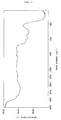
- Figure 1 shows the infrared reflection spectrum of the sulfated tin oxide catalyst MO-858.
- Figure 2 shows the infrared reflection spectrum of the sulfated tin oxide catalyst MO-817.
- the support comprises a crystalline tin oxide, preferably metastannic acid.
- the support may be either powdered or shaped, or may consist of a tin oxide formed on the surface of a support consisting of a component other than tin oxide. Any form of tin oxide can be used as long as it is crystalline rather than amorphous, and stannous oxide or stannic oxide can be used, but metastannic acid is particularly desirable.
- the tin oxide may be a hydrated oxide.
- the surface of the tin oxide is preferably pre-treated with organic acid ions, particularly a solution, preferably an aqueous solution, of carboxylic acid ions.
- the carboxylic acid ions preferably have 1 to 3 carbon atoms.
- Desirable examples of such aqueous solutions include aqueous solutions of ammonium acetate and other carboxylic acid ammonium salts and carboxylic acid metal salts such as sodium salts and potassium salts.
- Organic acid ions normally takes place at a temperature of 10 to 80°C or preferably 15 to 40°C for 0.1 to 10 hours.
- concentration of organic acid ions when used in solution is 1% by mass or more or preferably 3 to 50% by mass.
- the sulfate group-containing compound is a compound containing a sulfate component or a compound containing a sulfur component which can be converted to a sulfate component by subsequent calcining or other treatment
- examples of sulfate group-containing compounds include sulfuric acid, ammonium sulfate, sulfurous acid, ammonium sulfite, thionyl chloride, dimethyl sulfate and the like.
- a solution such as an aqueous solution.
- sulfate group-containing compound normally takes place at 10 to 80°C, preferably 15 to 40°C for 0.1 to 10 hours.
- concentration of the sulfate group-containing compound when used in solution is 10% by mass or more, preferably 20 to 98% by mass.
- the tin oxide may be either dried or not dried before being brought into contact with the sulfate group-containing compound.
- Calcining is performed in air or a nitrogen or other gas atmosphere, and is preferably performed in air.
- the calcining temperature differs depending on the calcining time, gas flow rate and other calcining conditions but is normally 300° to 900°C, preferably 400° to 800°C.
- the calcining time differs depending on the gas flow rate and other calcining conditions but is normally 0.05 to 20 hours, preferably 0.1 to 10 hours, more preferably 0.2 to 5 hours. Calcining may be preceded by drying at 50 to 200°C.
- the solid acid catalyst of the present invention comprises a tin oxide component and contains a sulfate component.
- the metal oxide is defined so as to include hydrated metal oxides.
- the tin oxide component is preferably substantially composed of tin oxide having a tetragonal crystal structure.
- the catalyst contains tin oxide in an amount of 20 to 72% by weight, more preferably 30 to 72% by weight, in terms of weight of elemental tin.
- the tin oxide is crystallized to a degree that can be confirmed by the diffraction peak, with a crystallite size of preferably 10 to 50 nm or more preferably 20 to 45 nm.
- the specific surface area of the catalyst is 100 m 2 /g or more or preferably 100 to 200 m 2 /g.
- the proportion of the sulfate component is 0.7 to 10% by weight, preferably 1 to 9% by weight, more preferably 2 to 8% by weight, as elemental sulfur weight. Too much or too little sulfate component detracts from catalytic activity.
- a desirable property of the solid acid is a Hammett acidity function H 0 of -14 or less, preferably -16 or less.
- the argon adsorption heat is preferably -20 kJ/mol or less, more preferably -30 kJ/mol or less, still more preferably -30 to -60 kJ/mol.
- This argon adsorption heat is the adsorption amount measured by means of a volumetrical method when argon is introduced at the temperature of liquid nitrogen after the object being measured has been heated to 300°C while being exhausted in vacuum, as disclosed in detail in J. Phys. Chem. B, Vol. 105, No. 40, p. 9667 (2001).
- the solid acid catalyst of the present invention is also characterized in that reflectance at 1280 cm -1 is less than reflectance at 1220 cm -1 in the infrared reflection spectrum.
- the solid acid catalyst of the present invention is also characterized by being white and specifically by having a reflectance at 450 nm of 80% or more in the ultraviolet reflection spectrum.
- the solid acid catalyst of the present invention is useful in acid-catalytic reactions.
- Lewis acid catalysts typically aluminum chloride based catalysts, and Br ⁇ nsted acid catalysts, typically sulfuric acid
- Br ⁇ nsted acid catalysts typically sulfuric acid
- examples of such reactions include isomerization, disproportionation, nitration, decomposition, alkylation, esterification, transesterification, acylation, etherification, polymerization and the like.
- the solid acid catalyst of the present invention is used favorably in transesterification, esterification and etherification reactions.
- a transesterification reaction is accomplished by bringing a raw material ester and an alcohol into contact with the solid acid catalyst of the present invention.
- the reaction temperature is a temperature at which the raw material ester is in a liquid phase and the alcohol is in a gaseous phase, and specifically 100°C or more or particularly 150 to 350°C is desirable.
- There are no particular limits on the reaction pressure but a satisfactory reaction can be accomplished at an atmospheric pressure of about 0.5 to 2 atmospheres.
- There are also no limits on the reaction time but sufficient product can be obtained in about 0.1 to 1 hour in a batch reaction or at a WHSV (weight hourly space velocity) of 0.5 to 5/hour in a flow system.
- a batch system or flow system may be used for the reaction system.
- the raw material ester may have an ester compound as a principal component, or may be a polyhydric ester.
- a glyceride of a saturated or unsaturated fatty carboxylic acid having about 8 to 24 carbon atoms can be used by preference.
- triglycerides which are known as fats and oils can be used by preference. Examples of such fats and oils include soy bean oil, coconut oil, olive oil, peanut oil, cottonseed oil, sesame seed oil, palm oil, castor oil and other vegetable oils as well as beef fat, pork fat, horse fat, whale oil, sardine oil, shark oil and other animal fats and oils.
- the raw material ester may contain 0 to 30% by weight or especially 1% to 20% by weight of free fatty acids.
- An alcohol with 1 to 3 carbon atoms, particularly methanol or ethanol, can be used favorably as the alcohol in the transesterification reaction, but a polyhydric alcohol is also acceptable.
- An esterification reaction is accomplished by bringing a raw material carboxylic acid and an alcohol into contact with the solid acid catalyst of the present invention.
- the reaction temperature is a temperature at which the raw material carboxylic acid is in a liquid phase and the alcohol is in a gaseous phase, and specifically 100°C or more or particularly 150 to 350°C is desirable.
- There are no particular limits on the reaction pressure but a satisfactory reaction can be achieved at an atmospheric pressure of about 0.5 to 2 atmospheres.
- There are also no limits on the reaction time but sufficient product can be obtained in about 0.1 to 1 hour in a batch reaction or at a WHSV (weight hourly space velocity) of 0.5 to 5/hour in a flow system.
- a batch system or flow system may be used for the reaction system.
- the raw material carboxylic acid may be a component constituting natural or synthetic ester compounds, such as fats, and a polyhydric carboxylic acid may be used.
- a saturated or unsaturated fatty carboxylic acid having about 8 to 24 carbon atoms can be used by preference.
- many can be prepared from triglycerides which are known as fats and oils.
- the alcohol used in the esterification reaction may be an alcohol with 1 to 3 carbon atoms, particularly methanol or ethanol, but a polyhydric alcohol is also acceptable.
- stannic chloride SnCl 4 nH 2 O, produced by Wako Pure Chemicals
- an ammonia water 25% concentration
- the pH was 8.
- the filtered precipitate was dispersed in a 4% by weight aqueous ammonium acetate solution, filtered again and dried for 24 hours in air at 100°C to obtain precursor 1.
- 4 g of the resulting precursor 1 was contacted for 1 hour with 60 mL of 6N sulfuric acid, filtered, dried for 2 hours in air at 100°C, and calcined for 3 hours at 500°C in air to obtain sulfated tin oxide catalyst 1 (hereunder called MO-858).
- This MO-858 was a yellow powder with a specific surface area of 135 m 2 /g, a pore size of 0.002 to 10 ⁇ m and a pore volume of 0.1 ml/g. Within the pore size range of 0.002 to 0.05 ⁇ m, the median pore size of MO-858 was 3.1 nm.
- the argon adsorption heat was -29.7 kJ/mol.
- the tin content was 71.4% by weight, the elemental sulfur content was 1.96% by weight, and the crystal structure was tetragonal with a crystallite size of 32 nm.
- the infrared reflection spectrum reflectance was 52.8% at 1280 cm -1 and 52.2% at 1220 cm -1 .
- the infrared reflection spectrum was obtained by mixing the sulfated tin oxide catalyst and KBr under stirring, compression molding the mixture into pellets, and measuring the surface reflection of the pellets by the diffuse reflection method. The measurement results are shown in Figure 1.
- reflectance at 450 nm was about 65%.
- the ultraviolet reflection spectrum was measured by measuring reflection from the surface of a sulfated tin oxide catalyst sample which had been powdered and compression molded.
- sulfated tin oxide catalyst 100 g of commercial metastannic acid (SnO 2 , produced by Yamanaka Industries) was dispersed in a 4% by weight aqueous ammonium acetate solution, and filtered and dried for 24 hours in air at 100°C to obtain precursor 2. 4 g of the resulting precursor 2 was contacted for 1 hour with 60 mL of 6N sulfuric acid, filtered, dried for 2 hours in air at 100°C, and further calcined for 3 hours in air at 500°C to obtain a sulfated tin oxide catalyst (hereunder called MO-817).
- MO-817 sulfated tin oxide catalyst
- This MO-817 was a white powder with a specific surface area of 152 m 2 /g, a pore size of 0.002 to 10 ⁇ m and a pore volume of 0.1 ml/g. Within the range of 0.002 to 0.05 ⁇ m, the median pore size of MO-817 was 2.8 nm.
- the argon adsorption heat was -31.0 kJ/mol.
- the tin content was 70.6% by weight, the elemental sulfur content was 2.44% by weight, and the crystal structure was tetragonal with a crystallite size of 35 nm.
Landscapes
- Chemical & Material Sciences (AREA)
- Engineering & Computer Science (AREA)
- Materials Engineering (AREA)
- Organic Chemistry (AREA)
- Chemical Kinetics & Catalysis (AREA)
- Catalysts (AREA)
- Low-Molecular Organic Synthesis Reactions Using Catalysts (AREA)
- Organic Low-Molecular-Weight Compounds And Preparation Thereof (AREA)
Applications Claiming Priority (2)
| Application Number | Priority Date | Filing Date | Title |
|---|---|---|---|
| JP2003117891 | 2003-04-23 | ||
| PCT/JP2004/005720 WO2004094058A1 (ja) | 2003-04-23 | 2004-04-21 | スズを含有する固体酸触媒およびその製造方法 |
Publications (2)
| Publication Number | Publication Date |
|---|---|
| EP1632290A1 true EP1632290A1 (de) | 2006-03-08 |
| EP1632290A4 EP1632290A4 (de) | 2007-06-13 |
Family
ID=33308056
Family Applications (1)
| Application Number | Title | Priority Date | Filing Date |
|---|---|---|---|
| EP04728692A Withdrawn EP1632290A4 (de) | 2003-04-23 | 2004-04-21 | Zinnhaltiger fester säurekatalysator und herstellungsverfahren dafür |
Country Status (5)
| Country | Link |
|---|---|
| US (1) | US7442668B2 (de) |
| EP (1) | EP1632290A4 (de) |
| JP (1) | JP4890028B2 (de) |
| CN (1) | CN1777475A (de) |
| WO (1) | WO2004094058A1 (de) |
Cited By (2)
| Publication number | Priority date | Publication date | Assignee | Title |
|---|---|---|---|---|
| CN103877965A (zh) * | 2014-04-04 | 2014-06-25 | 湖南大学 | 一种二氧化锡基固体超强碱催化剂的制备与应用 |
| CN104028307A (zh) * | 2014-06-25 | 2014-09-10 | 中国矿业大学 | 一种磁性固体超强酸催化剂及制备方法 |
Families Citing this family (12)
| Publication number | Priority date | Publication date | Assignee | Title |
|---|---|---|---|---|
| JP4976016B2 (ja) * | 2006-01-17 | 2012-07-18 | Jx日鉱日石エネルギー株式会社 | エステル交換反応によるエステルの製造方法 |
| EP2219783B1 (de) * | 2007-10-26 | 2017-10-11 | Purolite International, Ltd. | Kontrollierte katalyse |
| CN103508892A (zh) * | 2013-10-10 | 2014-01-15 | 上海市计量测试技术研究院 | 一种邻苯二甲酸酯化合物的合成方法 |
| CN104098467B (zh) * | 2014-07-09 | 2015-12-30 | 常州大学 | 一种合成丁氧基三乙二醇丙烯酸酯的方法 |
| CN104117365A (zh) * | 2014-07-09 | 2014-10-29 | 江苏怡达化学股份有限公司 | 一种S2O82-/SnO2-SiO2固体酸催化剂的制备方法及其应用 |
| WO2016100329A1 (en) * | 2014-12-15 | 2016-06-23 | Associated Hygienic Products, Llc | Absorbent article with 3-dimensional softness signal using poly film with air pockets |
| CN104624207A (zh) * | 2015-01-15 | 2015-05-20 | 淮阴师范学院 | 木质素基磁性固体酸催化剂的制备方法 |
| US12401042B2 (en) | 2015-06-01 | 2025-08-26 | Forge Nano Inc. | Nano-engineered coatings for anode active materials, cathode active materials, and solid-state electrolytes and methods of making batteries containing nano-engineered coatings |
| US11996564B2 (en) | 2015-06-01 | 2024-05-28 | Forge Nano Inc. | Nano-engineered coatings for anode active materials, cathode active materials, and solid-state electrolytes and methods of making batteries containing nano-engineered coatings |
| US12027661B2 (en) | 2015-06-01 | 2024-07-02 | Forge Nano Inc. | Nano-engineered coatings for anode active materials, cathode active materials, and solid-state electrolytes and methods of making batteries containing nano-engineered coatings |
| CN105964287A (zh) * | 2016-06-06 | 2016-09-28 | 北京化工大学 | 一种无机双电层固体多元酸及其制备方法和应用 |
| CN115092957B (zh) * | 2022-05-16 | 2023-08-18 | 中南大学 | 一种锑精矿火法冶炼协同处置砷碱渣浸出渣的方法 |
Family Cites Families (11)
| Publication number | Priority date | Publication date | Assignee | Title |
|---|---|---|---|---|
| US1529261A (en) * | 1923-04-07 | 1925-03-10 | Simon J Lubowsky | Method of producing crystalline oxide of tin |
| JPS566374B2 (de) * | 1974-05-10 | 1981-02-10 | ||
| US4048294A (en) * | 1975-11-03 | 1977-09-13 | M&T Chemicals Inc. | Preparation of stannic oxide |
| US4208537A (en) * | 1977-10-27 | 1980-06-17 | Mitsui Toatsu Chemicals Incorporated | Process for the selective ortho-alkylation of phenolic compounds |
| JPS596181B2 (ja) * | 1979-08-27 | 1984-02-09 | 日本鉱業株式会社 | 固体酸触媒 |
| EP0106448A3 (de) * | 1982-08-13 | 1985-11-21 | United Kingdom Atomic Energy Authority | Verfahren zur Herstellung von oxidischen Stoffen bestehend aus, oder Zinnoxid enthaltend |
| JPS59182229A (ja) * | 1983-03-30 | 1984-10-17 | Mitsubishi Metal Corp | 酸化スズ微粉末の製法 |
| US5652192A (en) * | 1992-07-10 | 1997-07-29 | Battelle Memorial Institute | Catalyst material and method of making |
| JPH0975735A (ja) * | 1995-09-19 | 1997-03-25 | Japan Energy Corp | 固体酸触媒の製造方法 |
| US6376701B1 (en) * | 1995-12-29 | 2002-04-23 | Council Of Scientific & Industrial Research | Process for the transesterification of keto esters using solid acids as catalysts |
| AU2003304018A1 (en) * | 2003-03-26 | 2004-10-18 | Japan Energy Corporation | Process for producing ester through transesterification with solid acid catalyst |
-
2004
- 2004-04-21 US US10/550,716 patent/US7442668B2/en not_active Expired - Fee Related
- 2004-04-21 JP JP2005505766A patent/JP4890028B2/ja not_active Expired - Fee Related
- 2004-04-21 EP EP04728692A patent/EP1632290A4/de not_active Withdrawn
- 2004-04-21 CN CNA2004800105332A patent/CN1777475A/zh active Pending
- 2004-04-21 WO PCT/JP2004/005720 patent/WO2004094058A1/ja not_active Ceased
Cited By (4)
| Publication number | Priority date | Publication date | Assignee | Title |
|---|---|---|---|---|
| CN103877965A (zh) * | 2014-04-04 | 2014-06-25 | 湖南大学 | 一种二氧化锡基固体超强碱催化剂的制备与应用 |
| CN103877965B (zh) * | 2014-04-04 | 2015-10-28 | 湖南大学 | 一种二氧化锡基固体超强碱催化剂的制备与应用 |
| CN104028307A (zh) * | 2014-06-25 | 2014-09-10 | 中国矿业大学 | 一种磁性固体超强酸催化剂及制备方法 |
| CN104028307B (zh) * | 2014-06-25 | 2016-03-09 | 中国矿业大学 | 一种磁性固体超强酸催化剂及制备方法 |
Also Published As
| Publication number | Publication date |
|---|---|
| EP1632290A4 (de) | 2007-06-13 |
| JPWO2004094058A1 (ja) | 2006-07-13 |
| US7442668B2 (en) | 2008-10-28 |
| US20070004590A1 (en) | 2007-01-04 |
| CN1777475A (zh) | 2006-05-24 |
| WO2004094058A1 (ja) | 2004-11-04 |
| JP4890028B2 (ja) | 2012-03-07 |
Similar Documents
| Publication | Publication Date | Title |
|---|---|---|
| EP1607467B1 (de) | Verfahren zur herstellung von ester durch umesterung mit einem festen sauren katalysator | |
| EP1632290A1 (de) | Zinnhaltiger fester säurekatalysator und herstellungsverfahren dafür | |
| EP0925830B1 (de) | Saurer katalysator in fester form und verfahren zur herstellung desselben | |
| RU2154527C2 (ru) | Способ получения бутен-2-диола-1,4 | |
| US4119567A (en) | Vinyl acetate catalyst | |
| RU2595341C1 (ru) | Катализатор изомеризации парафиновых углеводородов и способ его приготовления | |
| EP0152112A2 (de) | Umwandlung von Olefinen | |
| DE4301470A1 (de) | Verfahren zur katalytischen Zersetzung von reinem oder in Gasgemischen enthaltenem Distickstoffmonoxid | |
| US4158737A (en) | Vinyl acetate preparation | |
| CN111225742A (zh) | 铜基催化剂及其制备方法和使用该催化剂制备乙二醇的方法 | |
| US4990662A (en) | Process for preparation of alpha, beta-unsaturated acids | |
| KR20070026294A (ko) | 알칸티올 합성용 촉매 및 이의 제조방법 | |
| EP1491613B1 (de) | Verfahren zur isomerisierung von kohlenwasserstoffen | |
| EP1506152A1 (de) | Verfahren zur herstellung von äthylenisch ungesättigten säuren bzw. ihren estern | |
| CN113713795A (zh) | 一种复合氧化物载体及其制备方法 | |
| EP1824595B1 (de) | Halogenidhaltige caesiumwolframate enthaltende katalysatoren zur synthese von alkylmercaptan und verfahren zu ihrer herstellung | |
| CN113578372B (zh) | 一种二甘醇合成吗啉用催化剂及其制备方法 | |
| KR100644246B1 (ko) | 동·식물유로부터 지방산 알킬 에스테르를 제조하는 방법 | |
| JP3730792B2 (ja) | 炭化水素の異性化方法 | |
| EP1052280B1 (de) | Verfahren zur isomerisation von kohlenwasserstoffen, fester säurekatalysator und dafür verwendete vorrichtung | |
| EP4129962B1 (de) | Verfahren zur herstellung von isobutylen, verfahren zur herstellung von methacrylsäure und verfahren zur herstellung von methylmethacrylat | |
| EP0773212B1 (de) | Verfahren zur Herstellung von Lactamid | |
| CN102093206A (zh) | 硅胶负载硫酸镍催化水解蔗糖制备乙酰丙酸的方法 | |
| EP0033589A1 (de) | Verfahren zur Herstellung eines Katalysators für die Synthese ungesättigter Ester | |
| JP2000344718A (ja) | 非対称炭酸エステルの製造方法 |
Legal Events
| Date | Code | Title | Description |
|---|---|---|---|
| PUAI | Public reference made under article 153(3) epc to a published international application that has entered the european phase |
Free format text: ORIGINAL CODE: 0009012 |
|
| 17P | Request for examination filed |
Effective date: 20051103 |
|
| AK | Designated contracting states |
Kind code of ref document: A1 Designated state(s): DE ES FR GB IT |
|
| DAX | Request for extension of the european patent (deleted) | ||
| RBV | Designated contracting states (corrected) |
Designated state(s): DE ES FR GB IT |
|
| A4 | Supplementary search report drawn up and despatched |
Effective date: 20070511 |
|
| RIC1 | Information provided on ipc code assigned before grant |
Ipc: B01J 23/00 20060101AFI20070507BHEP |
|
| 17Q | First examination report despatched |
Effective date: 20071029 |
|
| STAA | Information on the status of an ep patent application or granted ep patent |
Free format text: STATUS: THE APPLICATION IS DEEMED TO BE WITHDRAWN |
|
| 18D | Application deemed to be withdrawn |
Effective date: 20090407 |