EP1622936B1 - Verfahren zur herstellung eines n-terminal modifizierten chemotaktischen faktors - Google Patents
Verfahren zur herstellung eines n-terminal modifizierten chemotaktischen faktors Download PDFInfo
- Publication number
- EP1622936B1 EP1622936B1 EP04739081A EP04739081A EP1622936B1 EP 1622936 B1 EP1622936 B1 EP 1622936B1 EP 04739081 A EP04739081 A EP 04739081A EP 04739081 A EP04739081 A EP 04739081A EP 1622936 B1 EP1622936 B1 EP 1622936B1
- Authority
- EP
- European Patent Office
- Prior art keywords
- mcp
- pyroglu
- preparation
- gln
- protein
- Prior art date
- Legal status (The legal status is an assumption and is not a legal conclusion. Google has not performed a legal analysis and makes no representation as to the accuracy of the status listed.)
- Expired - Lifetime
Links
Images




Classifications
-
- C—CHEMISTRY; METALLURGY
- C07—ORGANIC CHEMISTRY
- C07K—PEPTIDES
- C07K14/00—Peptides having more than 20 amino acids; Gastrins; Somatostatins; Melanotropins; Derivatives thereof
- C07K14/435—Peptides having more than 20 amino acids; Gastrins; Somatostatins; Melanotropins; Derivatives thereof from animals; from humans
- C07K14/52—Cytokines; Lymphokines; Interferons
-
- C—CHEMISTRY; METALLURGY
- C07—ORGANIC CHEMISTRY
- C07K—PEPTIDES
- C07K14/00—Peptides having more than 20 amino acids; Gastrins; Somatostatins; Melanotropins; Derivatives thereof
- C07K14/435—Peptides having more than 20 amino acids; Gastrins; Somatostatins; Melanotropins; Derivatives thereof from animals; from humans
- C07K14/52—Cytokines; Lymphokines; Interferons
- C07K14/521—Chemokines
- C07K14/523—Beta-chemokines, e.g. RANTES, I-309/TCA-3, MIP-1alpha, MIP-1beta/ACT-2/LD78/SCIF, MCP-1/MCAF, MCP-2, MCP-3, LDCF-1, LDCF-2
-
- A—HUMAN NECESSITIES
- A61—MEDICAL OR VETERINARY SCIENCE; HYGIENE
- A61K—PREPARATIONS FOR MEDICAL, DENTAL OR TOILETRY PURPOSES
- A61K38/00—Medicinal preparations containing peptides
- A61K38/16—Peptides having more than 20 amino acids; Gastrins; Somatostatins; Melanotropins; Derivatives thereof
- A61K38/17—Peptides having more than 20 amino acids; Gastrins; Somatostatins; Melanotropins; Derivatives thereof from animals; from humans
- A61K38/19—Cytokines; Lymphokines; Interferons
-
- A—HUMAN NECESSITIES
- A61—MEDICAL OR VETERINARY SCIENCE; HYGIENE
- A61P—SPECIFIC THERAPEUTIC ACTIVITY OF CHEMICAL COMPOUNDS OR MEDICINAL PREPARATIONS
- A61P35/00—Antineoplastic agents
-
- A—HUMAN NECESSITIES
- A61—MEDICAL OR VETERINARY SCIENCE; HYGIENE
- A61P—SPECIFIC THERAPEUTIC ACTIVITY OF CHEMICAL COMPOUNDS OR MEDICINAL PREPARATIONS
- A61P43/00—Drugs for specific purposes, not provided for in groups A61P1/00-A61P41/00
-
- A—HUMAN NECESSITIES
- A61—MEDICAL OR VETERINARY SCIENCE; HYGIENE
- A61P—SPECIFIC THERAPEUTIC ACTIVITY OF CHEMICAL COMPOUNDS OR MEDICINAL PREPARATIONS
- A61P9/00—Drugs for disorders of the cardiovascular system
-
- A—HUMAN NECESSITIES
- A61—MEDICAL OR VETERINARY SCIENCE; HYGIENE
- A61P—SPECIFIC THERAPEUTIC ACTIVITY OF CHEMICAL COMPOUNDS OR MEDICINAL PREPARATIONS
- A61P9/00—Drugs for disorders of the cardiovascular system
- A61P9/10—Drugs for disorders of the cardiovascular system for treating ischaemic or atherosclerotic diseases, e.g. antianginal drugs, coronary vasodilators, drugs for myocardial infarction, retinopathy, cerebrovascula insufficiency, renal arteriosclerosis
-
- A—HUMAN NECESSITIES
- A61—MEDICAL OR VETERINARY SCIENCE; HYGIENE
- A61P—SPECIFIC THERAPEUTIC ACTIVITY OF CHEMICAL COMPOUNDS OR MEDICINAL PREPARATIONS
- A61P9/00—Drugs for disorders of the cardiovascular system
- A61P9/14—Vasoprotectives; Antihaemorrhoidals; Drugs for varicose therapy; Capillary stabilisers
-
- C—CHEMISTRY; METALLURGY
- C12—BIOCHEMISTRY; BEER; SPIRITS; WINE; VINEGAR; MICROBIOLOGY; ENZYMOLOGY; MUTATION OR GENETIC ENGINEERING
- C12N—MICROORGANISMS OR ENZYMES; COMPOSITIONS THEREOF; PROPAGATING, PRESERVING, OR MAINTAINING MICROORGANISMS; MUTATION OR GENETIC ENGINEERING; CULTURE MEDIA
- C12N15/00—Mutation or genetic engineering; DNA or RNA concerning genetic engineering, vectors, e.g. plasmids, or their isolation, preparation or purification; Use of hosts therefor
- C12N15/09—Recombinant DNA-technology
- C12N15/11—DNA or RNA fragments; Modified forms thereof; Non-coding nucleic acids having a biological activity
-
- A—HUMAN NECESSITIES
- A61—MEDICAL OR VETERINARY SCIENCE; HYGIENE
- A61K—PREPARATIONS FOR MEDICAL, DENTAL OR TOILETRY PURPOSES
- A61K38/00—Medicinal preparations containing peptides
-
- Y—GENERAL TAGGING OF NEW TECHNOLOGICAL DEVELOPMENTS; GENERAL TAGGING OF CROSS-SECTIONAL TECHNOLOGIES SPANNING OVER SEVERAL SECTIONS OF THE IPC; TECHNICAL SUBJECTS COVERED BY FORMER USPC CROSS-REFERENCE ART COLLECTIONS [XRACs] AND DIGESTS
- Y02—TECHNOLOGIES OR APPLICATIONS FOR MITIGATION OR ADAPTATION AGAINST CLIMATE CHANGE
- Y02A—TECHNOLOGIES FOR ADAPTATION TO CLIMATE CHANGE
- Y02A50/00—TECHNOLOGIES FOR ADAPTATION TO CLIMATE CHANGE in human health protection, e.g. against extreme weather
- Y02A50/30—Against vector-borne diseases, e.g. mosquito-borne, fly-borne, tick-borne or waterborne diseases whose impact is exacerbated by climate change
Definitions
- the invention relates to a process for the preparation of pyroGlu-MCP-1 from recombinantly produced Gln-MCP-1.
- MCP-1 monocyte chemoattractant protein-1, also known as monocyte chemotactic and activating factor 'MCAF', macrophage chemotactic factor 'MCF', tumor necrosis factor stimulated gene-8 'TSG-8', 'HC-11' Smooth muscle cell chemotactic factor 'SMC-CF', lymphocyte derived chemotactic factor 'LDCF' and glioma derived chemotactic factor 'GDCF'
- monocyte chemotactic and activating factor 'MCAF' macrophage chemotactic factor 'MCF'
- tumor necrosis factor stimulated gene-8 'TSG-8' 'HC-11' Smooth muscle cell chemotactic factor 'SMC-CF'
- lymphocyte derived chemotactic factor 'LDCF' lymphocyte derived chemotactic factor 'LDCF'
- glioma derived chemotactic factor 'GDCF' a member of the CC chemokine
- Matured human MCP-1 (hMCP-1) is a glycoprotcin with a molecular weight of 14 kDa and is secreted by many types of cells, eg vascular smooth muscle cells and endothelial cells ( Leonard and Yoshimura (1990), Immology Today 11, 97-101 ). It contains two intramolecular disulfide bridges and is O-glycosylated and sialylylated upon native expression ( J. Yan Ling et al. (1990), Journal of Biological Chemistry, 265, 18318-18321 ).
- the protein is a product of the JE gene of the chromosomal localization 17q11.2-q21.1.
- This gene locus is also known as SCY A2 (small inducible cytokine A2) U.S. Patent No. 5,212,073 .
- SCY A2 small inducible cytokine A2
- the expression of this gene can be induced by a variety of cytokines, such as tumor necrosis factor alpha, but also eg by immunoglobulin G.
- the gene sequence and other information about the gene and the gene product are available in the NCBI database under accession number M37719 (see Table 1).
- MCP-1 encoding open reading frames in the US 5,212,073 allowed the recombinant expression of the protein.
- An MCP-1 produced by recombinant means for example in E. coli , does not have the typical N- or O-glycosylation patterns of the native MCP-1.
- a prepared in this way MCP-1 preparation unlike a native material derived preparation does not resist the Edman degradation, thus containing unblocked N-termini (glutamine). In cellular assays based on the chemotactic effect on macrophages, initially no difference was found between the biological activity of native and recombinant MCP-1 preparations.
- MCP-1 acts as an agonist under physiological conditions on the beta-chemokine receptors CCR2 and CCR4, which are mainly expressed on monocytes and also found on basophils as well as T and B lymphocytes. MCP-1 induces monocyte chemotaxis even at subnanomolar concentrations.
- the receptors CCR2 and CCR4 are G protein-coupled seven transmembrane domain receptors that lead to activation of monocytes and increased adhesion of integrins. This process ultimately results in attachment of monocytes to endothelial cells and subsequent escape of monocytes from the vasculature.
- MCP-1 is an influence of MCP-1 on the arteriogenesis, ie the growth of collateral arteries and / or other arteries revealed from existing arteriolar compounds.
- MCP-1 for therapeutic purposes, namely for the treatment of vascular occlusive diseases, which can be alleviated by the stimulation of neovascularization.
- vascular occlusive diseases are in particular coronary artery disease (CAD), peripheral arterial occlusive disease (PAOD), cerebral and mesenteric arterial occlusive diseases, etc.
- CAD coronary artery disease
- PAOD peripheral arterial occlusive disease
- cerebral and mesenteric arterial occlusive diseases etc.
- MCP-1 neutralizing agents such as CAD
- anti-MCP-1 antibodies to prevent neovascularization in order to fight in particular the growth of tumors, which is dependent on an adequate blood supply and thus a sufficient vascularization of the tumor tissue.
- MCP-1 can be produced recombinantly.
- recombinant human MCP-1 is already available on the market, in particular from the companies R & D Systems (catalog No. 279-MC) and Peprotech (catalog No. 300-04; see Table 2; Numbers are on the January 2003 issue).
- the MCP-1 protein contained therein contains the amino acid glutamine (Q) at the N-terminus.
- Q amino acid glutamine
- a conventional method for the recombinant production of human MCP-1 protein consists in the temperature-induced expression of the protein as a fusion protein, the purification of the subsequently formed inclusion bodies, the dissolution and refolding of the protein and the subsequent enzymatic release of the hMCP-1 - Protein from the fusion protein.
- MCP-2 has a degree of homology of 62% to MCP-1 at the level of the amino acid sequence and also differs from this in so far as N-terminally unmodified MCP-1 is biologically active in contrast to MCP-2 (see line "Biological Activity in Table 2).
- MCP-1 preparation MCP-1 composition
- MCP-1 composition MCP-1 composition
- (a) is therapeutically useful for its biological activity
- the (b) offers advantages in terms of drug regulatory approval procedures, which in the case of biopharmaceuticals particularly difficult to meet requirements such with regard to the purity and reproducibility of the preparation of the medicament, and in particular (c) has a high storage stability.
- the invention provides a process for the preparation of pyroGlu-MCP-1 from recombinantly produced Gln-MCP-1, in which Gln-MCP-1 in a Temperature in the range of 30 ° C and 80 ° C, preferably in the range of 30 ° C and 70 ° C and more preferably in the range of 35 ° C to 60 ° C, is incubated in a buffer solution having a salt concentration in the range of 10 mM to 160 mM, preferably in the range of 10 mM to 100 mM, and which has a pH in the range from 2 to 7.5, preferably 3.5 to 7.5, more preferably 3.5 to 6.5, more preferably 5 to 6.5, more preferably 5.5 to 6.5, and more preferably has a pH of about 6.
- the incubation is carried out until at least 90%, preferably at least 95% and more preferably at least 96% of the MCP-1 contained in the incubation buffer solution in the form of pyroGlu-MCP-1.
- MCP-1 means the MCP-1 protein (without prepro sequence), depending on the context, with N-terminal glutamine residue ("Gln-MCP-1", see Table 1 and Table 2) amino acid sequence shown) or already converted to pyroglutamate / cyclized N-terminus (“pyroGlu-MCP-1").
- Gln-MCP-1 N-terminal glutamine residue
- pyroGlu-MCP-1 N-terminal glutamine residue
- modifications of the MCP-1 protein that do not affect its biological function (in particular the monocyte-attracting effect or the action on the CCR receptor) and not its structure, modify the reaction parameters described above no longer lead to the desired result (the protein can therefore no longer be converted into a pyroGlu variant by the process according to the invention), do not lead out of the scope.
- the method of the invention can also be applied to MCP-1 proteins of other mammals, e.g. of the rat, mouse, guinea pig, rabbit and ferret (and a few more).
- the buffer solution in which the method described above is carried out is preferably a phosphate buffered (sodium and / or potassium phosphate buffered) aqueous solution of low or physiological molarity, namely in the range of 10 to 160 mM, 10 to 80 mM, 10 to 50 mM, 20 to 40 mM or around 20 or 40 mM. If you take longer incubation periods in purchase, so can according to a special Embodiment of the invention also at physiological molarities, such as to work around the 150 mM salt concentration, this molarity is preferably achieved by using a phosphate-buffered saline solution or "PBS".
- PBS phosphate-buffered saline solution
- the buffer solution in which the modification step is carried out can also be used e.g. a (mild) detergent, an antioxidant, a preservative, a chelating agent, stabilizers, antimicrobial reagents, etc.
- a (mild) detergent e.g. a (mild) detergent, an antioxidant, a preservative, a chelating agent, stabilizers, antimicrobial reagents, etc.
- the incubation temperature is chosen in the range of 30 ° C to 80 ° C, ie above room temperature. At lower temperatures, the conversion step is slow. Nevertheless, to achieve a virtually complete conversion, the incubation period would have to be extended considerably to over a week. This would lead to unacceptable downtime in the biotechnological process and also significantly increase the risk of other contamination of the protein solution (by degradation or oxidation products, by bacteria, viruses and other germs). On the other hand, an increase in the incubation temperature to more than 80 ° C. leads to a strong acceleration of the conversion reaction, but also to a greater formation of undesired by-products and degradation products (compare Examples 1 and 2).
- an incubation temperature of 35 to 40 ° C is particularly preferred. In cases where, if possible, it should be incubated much shorter, on the other hand, in the range of e.g. from 50 to 60, 70 or 80 ° C are incubated. Temperatures between 40 and 50 ° C naturally lead to the desired result.
- the pH of the incubation buffer solution should be in the range of 2 and 7.5, ie in the neutral to acidic range. It is preferably in the range of 3.5 to 7.5. more preferably in the range of 3.5 to 6.5, more preferably in the range of 5 to 6.5, more preferably in the range of 5.5 to 6.5, and further preferably, it selects a pH of about 6.
- the pyroGlu-MCP-1 variant in a purity of at least 90%, but also higher, e.g. 95%, 96% or 98%, this percentage being the amount of pyroGlu-MCP-1 (determined, for example, as the area under the curve in an HPLC elution profile) based on the amount of total MCP-1 present in the solution (including any remaining Gln-MCP-1 portion and possible oxidation and other by-products or degradation products).
- Processes for the biotechnological production of recombinant proteins are known. They include in particular fermentation, purification, concentration, and other steps.
- the above-described conversion step can be inserted at different positions within such a "multi-step process", ie, for example, with an MCP-1 protein solution which is still largely unpurified or which has already been fully purified as starting solution.
- a process sequence is conceivable in which in the meantime not (completely) converted Gln-MCP-1 in more, less or virtually completely purified form in order to improve the Shelf life in still unconverted form is lyophilized and brought back into solution in due course and then converted according to the above method in pyroGlu-MCP-1.
- the resulting protein solution can be lyophilized.
- the process product namely the pyroGlu-MCP-1 preparation subjected to the N-terminal modification (conversion), contains a fraction of pyroGlu, based on the total content of MCP-1 (converted plus unconverted protein plus, for example, by-products formed by oxidation).
- MCP-1 of at least 90%, preferably at least 95% and more preferably at least 96%.
- preparation (Gln or pyroGlu-MCP-1) is intended to express that in the various process stages the MCP-1 protein is present in dissolved form in a (buffer) solution and thus in addition to the MCP 1, further components may be present, in any case the ions of the buffer salt used and, if appropriate, further salts, antioxidants, stabilizers, antimicrobial reagents, detergents, preservatives, complexing agents, etc.
- a composition may be provided comprising pyroGlu-MCP-1 or a pyroGlu-MCP-1 preparation prepared by the aforementioned methods, wherein at least 90% of the MCP-1 ( converted plus unconverted protein plus by-products, ie the "area under the curve" eg in an HPLC elution chromatogram) in the form of pyroGlu-MCP-1.
- MCP-1 preparation produced by recombinant means, in particular in prokaryotes and more preferably in E. coli , in which at least 90% of the MCP-1 protein is present as pyroGlu-MCP-1.
- the protein When produced in common expression cells, the protein often will not show the natural glycosylation pattern, unlike native production.
- the resulting pyroGlu-MCP-1 or the pyroGlu-MCP-1 preparation obtained unlike the occurring in native expression in the human organism form is not glycosylated and / or sialylyliert and so differentiate from such a native protein or native protein preparation.
- Such a composition prepared according to the method according to the invention may in particular be a pharmaceutical or a pharmaceutical composition which, in addition to an amount of at least 90%, 95% or 96% of pyroGlu-MCP-1 in the total MCP-1 content ( converted plus unconverted protein plus by-products) nor conventional excipients and carriers, salts, antioxidants, stabilizers, antimicrobial reagents, detergents, preservatives, complexing agents, etc. contains.
- the composition may be used to treat patients suffering from arterial disease, such as PAOD or CAD.
- the treatment involves administering such a composition in a therapeutically effective amount by a suitable route, e.g. via intra-arterial infusion or in the form of a periarterially deposited gel, from which the MCP-1 protein is released over a longer period of time.
- drugs based on a protein must be subjected to intensive and complicated multi-step purification according to their production in a more or less complex cellular organism and must not be altered in their structure in an uncontrolled manner, eg due to oxidation or other spontaneous chemical reactions .
- the end product should have acceptable shelf life stability in order to provide non-complicated and expensive supply networks between the manufacturer and the practitioner or clinician, a requirement which is to maintain the correct secondary structure (folding), especially for proteins where it is important , which is usually only to be met with great effort.
- an MCP-1 preparation could be provided, which is due to high purity and homogeneity, excellent reproducible manufacturability and their storage stability suitable for use as a drug substance, which has good chances to meet the above strict requirements in corresponding approval procedures, and the new therapeutic method based on the action of MCP-1.
- the methods of the present invention make it possible to carry out a method of treating a patient suffering from said vascular occlusive diseases, wherein the pyroGlu MCP-1 preparation prepared by conversion or the drug produced using such pyroGlu MCP-1 preparation is administered, e.g. by injection or infusion.
- Example 1 Preparation of a pyroGlu MCP-1 preparation according to the method of the invention
- the fermentation was carried out with a strain of Escherichia coli K12 (W3110).
- the strain was transformed with a ColE1 plasmid (pBR322 derivative) containing the following elements: the hMCP-1 genomic sequence under the control of a common promoter (phosphatase, pPhoA), a ColE1 origin of replication, and the tetracycline resistance gene.
- the production strain was pre-cultured in a shaking flask in LB medium containing tetracycline. Incubation was at 37 ° C until an OD of 1 was achieved. The preculture was transferred to the fermenter and cultured with stirring and air at 37 ° C.
- the medium contained glucose, various salts, trace elements, yeast extract, amino acids and tetracycline.
- the pH was maintained at 6.8 with ammonia.
- the dissolved oxygen (pO 2 ) was kept constant at the setpoint of 40% by adding glucose.
- the induction of the phosphatase promoter was automatic as soon as the phosphate in the medium was consumed.
- the biomass was harvested with a tube centrifuge (CEPA) and stored at -70 ° C.
- the frozen cell pellet was resuspended in four times the amount of lysis buffer (200 mM Tris, 55 mM NaCl, 5 mM EDTA, pH 7.5) with an Ultraturrax.
- the cell disruption was carried out by two passages with a homogenizer at 460 bar. Cell debris were removed with a CEPA centrifuge. The supernatant was optionally filtered with Polysep II (1.2 ⁇ m) filters (Millipore) and then loaded onto a column combination consisting of a Q Sepharose FF and an SP Sepharose FF. The columns were equilibrated with lysis buffer.
- the column combination was washed with lysis buffer and the Q Sepharose column was clamped.
- the SP Sepharose was further washed with lysis buffer, then with 5 M urea (in lysis buffer) and again with lysis buffer. Elution of the product was done in a linear NaCl gradient.
- the eluate was salinated with ammonium sulfate to a final concentration of 1.3 mol / L and centrifuged for 15 min at 3200 g. The supernatant was loaded on a phenyl Sepharose column equilibrated with 1.3 M ammonium sulfate (in lysis buffer).
- the flow through the phenyl sepharose was applied to a Source 30 RPC column equilibrated with lysis buffer.
- the rinsing was carried out with lysis buffer, water and buffer A (5% EtOH, 0.1% TFA).
- the product was eluted in a linear gradient from 20% Buffer B (95% EtOH, 0.1% TFA) to 70% Buffer B in 10 column volumes.
- the eluate was stored in different buffers, e.g. Phosphate buffer, 10-40 mM, pH 6.0 - 7.4 diluted to 1:10.
- the final pH of the conversion solution was, according to a preferred embodiment, a value between 6.0 and 6.5.
- the protein concentration was between 0.2 and 1.0 mg / mL.
- the solution was sterile filtered and incubated with gentle shaking (60 rpm) at temperatures of (in different batches) 35-80 ° C. The course of the reaction was monitored by HPLC analyzes.
- the conversion solution was loaded onto an SP Sepharose HP column equilibrated in buffer A (40 mM phosphate, pH 6.0). Elution was carried out with a linear NaCl gradient. The NaCl concentration in the eluate was about 350 mmol / L, the protein concentration about 3 mg / mL. The eluate was diluted with buffer A to a conductivity equivalent to 250 mM NaCl. Subsequently, further dilution with 40 mM phosphate, pH 6.0, 250 mM NaCl until the protein concentration was 1 mg / mL. The resulting bulk solution was sterile filtered and stored at 4 ° C or -70 ° C until formulation.
- buffer A 40 mM phosphate, pH 6.0
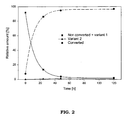
- Fig. 2 shows the kinetics of the conversion of Gln-MCP-1 to pyroGlu-MCP-1 under the conditions described. It can be seen that with increasing reaction time an in Fig. 2 as "Variant 2" designated, not to be further characterized contamination appears in appearance.
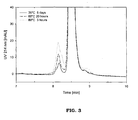
- Fig. 3 are shown in high resolution the chromatograms of the elution profile of pyroGlu MCP-1 preparations obtained under the conditions summarized in Table 3 (20 mM phosphate buffer, 35 ° C, 60 ° C and 80 ° C, respectively). As can be seen from this, occur at high temperatures even with a short incubation period (eg 3 hours at 80 ° C) significantly more impurities with MCP-1 by-products or - degradation products than in a five-day incubation at 35 ° C.
- Example 2 Preparation of a pyroGlu MCP-1 preparation according to an alternative method according to the invention
- Source 30 RPC eluate was diluted 1:10 with PBS, 0.02% Tween 20.
- the protein concentration was then between about 0.2 and 0.5 mg / mL, the pH about 7.4.
- the solution contained about 3.5% EtOH and 0.01% TFA derived from the eluate of the previous Source 30 RPC step.
- the solution was sterile filtered with a Millipak 20 (0.2 ⁇ m, Millipore) in polypropylene bottles and incubated at 35 ° C with gentle shaking. The course of the reaction was monitored by HPLC analyzes.
- the conversion solution was ultradiafiltered with a Pellikon 2 UDF membrane (3k, Millipore) against PBS, 0.02% Tween 20 and the protein concentration adjusted to 0, mg / mL.
- the filling was carried out sterile via a Millipore GV filter (0.22 ⁇ m) in 1 ml portions in glass containers.
- Example 3 Preparation of a medicament based on the MCP-1 preparation prepared according to Example 1 or Example 2
- the pyroGlu-MCP-1 preparation obtained in Example 1 or Example 2 was dissolved in PBS (sodium chloride, disodium hydrogenphosphate, potassium chloride, potassium dihydrogenphosphate, pH 7.0), also containing 0.02% Tween 20, to a concentration of 0.1 mg / ml diluted and bottled in 1 mL volumes in glass jars.
- PBS sodium chloride, disodium hydrogenphosphate, potassium chloride, potassium dihydrogenphosphate, pH 7.0
- Tween 20 sodium chloride, disodium hydrogenphosphate, potassium chloride, potassium dihydrogenphosphate, pH 7.0
- the finished drug solution was clear, colorless and odorless and can be administered by injection or infusion.
- MCP-1 binds and activates the MCP-1 receptor CCR2b.
- the receptor activation leads to a calcium influx into the cytosol.
- FLIPR fluorescence imaging plate reader
- the fluorescent dye binds Ca 2+ ions.
- excitation with a wavelength of 488 nm there is an emission with a maximum at 528 nm.
- the emission intensity is dependent on the cytosolic calcium concentration. The intensity change of the emitted light thus correlates with the cytosolic calcium concentration, which in turn depends on the activation state of the receptor.
- FIG. 5 A characteristic time-resolved measurement signal after addition of MCP-1 is in Fig. 5 shown. From this it can be seen that after the addition of MCP-1 a rapid release of calcium occurs, which is associated with a strong increase in fluorescence. The maximum (b) is reached just a few seconds after application (a). The time between application (a) and maximum stimulation (b) is approximately 20-30 sec.
- the coding region of the human CCR2b receptor (Genbank Accession No: D29984) was amplified by PCR. Subsequently, the 1.08 kb BamHI-XbaI fragment was cloned into an expression vector. CHO-K1 cells were transfected with this plasmid serving as an expression vector.
- the cells were cultured in a culture medium based on Ham's F12 medium and passaged regularly. On the day before the measurement, 5,000 cells were plated in 384-well assay plates (Corning Costar) with 40 ⁇ l of culture medium and allowed to adhere overnight at 37 ° C., 5% CO 2 , 95% relative humidity overnight (approximately 24 h). Four assays were performed in all assays.
- the substance plates were first prepared. Hanks buffer with 0.1% BSA (protease-free) was used as dilution buffer for the various MCP-1 preparations. As an empty control Hanks buffer with 0.1% BSA was used. Subsequently, 40 ⁇ l / well Fluo-4 staining medium was added to the cells and the mixtures were incubated for 45 min. incubated at 37 ° C, 5% CO 2 , 95% relative humidity. Thereafter, the stained cells were washed four times with 60 ⁇ l of wash buffer, leaving a residue of 25 ⁇ l of wash buffer per well. The cells were then incubated for a further 5 min at room temperature with washing buffer.
- BSA proteo-4 staining medium
- the FLIPR instrument was set so that colored and unstained wells differed by at least a factor of 1: 5 and the stained wells had approx. 11,000 fluorescence counts.
- the samples to be tested were pipetted in parallel with the reference control in identical dilution steps.
- the concentrations used in the experiments were chosen to be in the EC 50 range of the reference control.
- PyroGlu-MCP-1 was incubated for 1 and 2 hours at 56 ° C or 95 ° C, respectively. The remaining biological activity was then measured using the test system of Example 4.
- a PyroGlu MCP-1 preparation as prepared above is adjusted to a concentration of between 1.2 and 120 ⁇ g / ml. Immediately prior to use, this solution is brought to a final concentration of between 0.1 to 10 ⁇ g / ml and infused intra-arterially to the patient at a flow rate of 2 to 12 ml / min for a period of 1 to 6 hours near the vessel-occluded region , The infusion can be repeated after 1 to 7 days.
Landscapes
- Health & Medical Sciences (AREA)
- Life Sciences & Earth Sciences (AREA)
- Chemical & Material Sciences (AREA)
- Engineering & Computer Science (AREA)
- Organic Chemistry (AREA)
- Bioinformatics & Cheminformatics (AREA)
- General Health & Medical Sciences (AREA)
- Medicinal Chemistry (AREA)
- Pharmacology & Pharmacy (AREA)
- Animal Behavior & Ethology (AREA)
- Public Health (AREA)
- Veterinary Medicine (AREA)
- Genetics & Genomics (AREA)
- Nuclear Medicine, Radiotherapy & Molecular Imaging (AREA)
- Zoology (AREA)
- General Chemical & Material Sciences (AREA)
- Chemical Kinetics & Catalysis (AREA)
- Molecular Biology (AREA)
- Biochemistry (AREA)
- Cardiology (AREA)
- Biomedical Technology (AREA)
- Gastroenterology & Hepatology (AREA)
- Proteomics, Peptides & Aminoacids (AREA)
- Biophysics (AREA)
- Heart & Thoracic Surgery (AREA)
- Biotechnology (AREA)
- Toxicology (AREA)
- Wood Science & Technology (AREA)
- Vascular Medicine (AREA)
- General Engineering & Computer Science (AREA)
- Microbiology (AREA)
- Urology & Nephrology (AREA)
- Plant Pathology (AREA)
- Epidemiology (AREA)
- Immunology (AREA)
- Physics & Mathematics (AREA)
- Preparation Of Compounds By Using Micro-Organisms (AREA)
- Peptides Or Proteins (AREA)
- Medicines That Contain Protein Lipid Enzymes And Other Medicines (AREA)
- Medicines Containing Material From Animals Or Micro-Organisms (AREA)
Description
- Die Erfindung betrifft ein Verfahren zur Herstellung von pyroGlu-MCP-1 aus rekombinant hergestelltem Gln-MCP-1.
- MCP-1 (monocyte chemoattractant protein-1; auch bekannt unter den Bezeichnungen: monocyte chemotactic and activating factor 'MCAF', macrophage chemotactic factor 'MCF', tumor necrosis factor stimulated gene-8 'TSG-8', ,HC-11', smooth muscle cell chemotactic factor 'SMC-CF', lymphocyte derived chemotactic factor 'LDCF' sowie glioma derived chemotactic factor 'GDCF') ist ein Mitglied der CC-Chemokin-Familie. Das MCP-1-Protein des Menschen wurde ursprünglich im
US-Patent Nr. 5,714,578 beschrieben. Es wird unter natürlichen Bedingungen im Organismus (nativ) als 99 Aminosäuren langes Vorläuferprotein synthetisiert, welches anschließend zu einem Peptid mit 76 Aminosäureresten prozessiert wird. Gereiftes humanes MCP-1 (hMCP-1) ist ein Glycoprotcin mit einem Molekulargewicht von 14 kDa und wird von vielerlei Zellarten, z.B. glatten Gefäßmuskelzellen und Endothelzellen sekretiert (Leonard und Yoshimura (1990), Immology Today 11, 97 - 101). Es enthält zwei intramolekulare Disulfidbrücken und ist bei nativer Expression O-glykosyliert und sialylyliert (J. Yan Ling et al. (1990), Journal of Biological Chemistry, 265, 18318 - 18321). - Das Protein ist ein Produkt des JE-Gens der chromosomalen Lokalisation 17q11.2-q21.1. Dieser Genlocus ist auch bekannt als SCY A2 ("small inducible cytokine A2). Das menschliche Gen wurde zuerst beschrieben im
US-Patent Nr. 5,212,073 . Die Expression dieses Gens kann durch vielerlei Zytokine, so z.B. Tumor necrosis factor alpha, aber auch z.B. durch Immunglobulin G induziert werden. Die Gensequenz und weitere Informationen über das Gen und das Genprodukt sind in der NCBI-Datenbank unter der Zugangsnummer M37719 zugänglich (s. Tabelle 1).

- In der oben erwähnten
US 5,714,578 wurde bereits beschrieben, dass im Falle eines aus nativer Quelle isolierten MCP-1 Proteins der N-Terminus blockiert ist. Wie erst später gefunden wurde, ist dies zurückzuführen auf eine posttranslationale Modifikation, bei der das nach Abspaltung der Leadersequenz am N-Terminus des reifen Proteins freigelegte Glutamin unter Austritt eines Moleküls NH3 zu einem pyroGlutamatrest zyklisiert. - Die Identifizierung des für MCP-1 codierenden open reading frames in der
US 5,212,073 ermöglichte die rekombinante Expression des Proteins. Ein auf rekombinantem Weg z.B. in E. coli hergestelltes MCP-1 weist nicht die typischen N- bzw. O-Glykosylierungsmuster des nativen MCP-1 auf. Eine auf diesem Wege hergestellte MCP-1-Präparation widersetzt sich auch anders als eine aus nativem Material gewonnene Präparation nicht dem Edman-Abbau, enthält also unblockierte N-Termini (Glutamine). In zellulären Assays, die auf der chemotaktischen Wirkung auf Makrophagen beruhten, konnte ursprünglich kein Unterschied zwischen der biologischen Aktivität nativer und auf rekombinantem Weg gewonnener MCP-1-Präparationen festgestellt werden. - MCP-1 wirkt unter physiologischen Bedingungen als Agonist an den Beta-Chemokin-Rezeptoren CCR2 und CCR4, die beide hauptsächlich auf Monozyten exprimiert sind und außerdem auch noch auf Basophilen sowie auf T- und B-Lymphozyten gefunden wurden. MCP-1 induziert die Monozytenchemotaxis bereits in subnanomolaren Konzentrationen. Die Rezeptoren CCR2 und CCR4 sind G-Protein-gekoppelte Sieben-Transmembrandomänen-Rezeptoren, die zur Aktivierung von Monozyten und verstärkter Adhesion von Integrinen führen. Dieser Prozess resultiert letztlich in einem Andocken von Monozyten an Endothelzellen und anschließendem Austreten der Monozyten aus dem Gefäßsystem.
- In der
WO 98/44953 - Anti-MCP-1-Antikörper zur Verhinderung von Gefäßneubildungen einzusetzen um damit insbesondere das Wachstums von Tumoren zu bekämpfen, das auf eine ausreichende Blutversorgung und damit eine hinreichende Vaskularisierung des Tumorgewebes angewiesen ist.
- In der Veröffentlichung von Voskuil et al., Am. J. Physiol. Heart Circ. Physiol. 284: 1422-1428 (2003) wird die Verwendung von MCP-1 (isoliert oder hergestellt nach einem nicht näher offenbarten Verfahren) in einem Tiermodell beschrieben und dessen Verwendung zur Behandlung von Gefäßverschlusskrankheiten vorgeschlagen.
- Um das MCP-1-Protein wie oben erläutert in einem therapeutischen Ansatz zur Förderung der Vaskularisierung von Geweben verwenden zu können, müssen hinreichende Mengen dieses Proteins in für pharmazeutische Zwecke hinreichend hoher Reinheit bereitgestellt werden. Humanes MCP-1 wurde ursprünglich in nativer Form aus Kulturen der menschlichen Gliomzelllinie U105MG oder aus menschlichen mononucleären Leukozyten des peripheren Blutes gewonnen. Eine Isolierung von für therapeutische Zwecke gedachtem Protein aus diesen Quellen scheitert bereits daran, dass auf diese Weise hinreichend große Mengen allenfalls unter inakzeptabel hohem Aufwand und/oder Materialeinsatz zu gewinnen wäre: Menschliche Leukozyten wären in der erforderlichen Menge nicht zu erhalten. Die Gliomzellen ließen sich zwar fast unbeschränkt vermehren, eignen sich jedoch nicht zur Kultivierung in biotechnologischen Fermentern und erfordern darüber hinaus z.B. fötales Kälberserum zu deren Kultivierung, mit allen damit verbundenen Problemen.
- Anstelle der nativen Expression von MCP-1 bietet sich daher an, MCP-1 auf rekombinantem Weg herzustellen. In der Tat ist rekombinantes humanes MCP-1 bereits auf dem Markt erhältlich, so insbesondere von den Firmen R&D Systems (Katalog-Nr. 279-MC) und Peprotech (Katalog-Nr. 300-04; s. Tabelle 2; die angegebenen Katalog-Nummern sind auf dem Stand Januar 2003). Gemäß Produktspezifikation der käuflich erhältlichen rekombinanten MCP-1-Präparationen enthält das darin enthaltene MCP-1-Protein die Aminosäure Glutamin (Q) am N-Terminus. Die Produktbeschreibung deutet außerdem darauf hin, dass diese Proteinpräparation insbesondere in rekonstituiertem, flüssigen Zustand sehr empfindlich ist (Lagerung bei 4°C empfohlen für max. 1 Woche). In der Tat wurde bei Versuchen der Erfinder (interner Stand der Technik) festgestellt, dass bei einer Lagerung der konventionellen MCP-1-Proteinpräparationen in gelöstem Zustand die - biologisch aktive - Proteinpräparation insbesondere bei Temperaturen über 4 °C sehr schnell Zeichen von Verunreinigung durch Abbauprodukte zu zeigen scheint (Auftreten von Nebenbanden in analytischen HPLC-Chromatogrammen).
Tabelle 2 (Auszug aus der Internet-Website der Firma Peprotech http://www.peprotech.com/content/details.htm?results=1 &prod=1392): Recombinant Human MCAF (Human MCP-1) Description : Human monocyte chemotactic protein-1 (MCP-1) also known as macrophage/monocyte chemotactic and activating factor (MCAF) is an 8.6 kDa protein containing 76 amino acid residues. It plays an important role in the inflammatory response of blood monocytes and tissue macrophages. Catalog #: 300-04 Source : E. coli. Formulation : The sterile filtered solution was lyophilized with no additives. Stability : The lyophilized protein is stable for a few weeks at room temperature, but best stored at -20°C. Reconstituted human MCAF should be stored in working aliquots at -20°C. Purity : Greater than 99% by SDS-PAGE and HPLC analyses. Endotoxin level is less than 0.1 ng per µg (1EU/µg). Reconstitution: We recommend a quick spin followed by reconsitution in water to a concentration of 0.1-1.0 mg/ml. This solution can then be diluted into other aqueous buffers and stored at 4°C for 1 week or -20°C for future use. Biological Activity : Determined by its ability to chemoattract human monocytes using a concentration range of 5.0-20.0 ng/ml. AA Sequence: QPDAINAPVT CCYNFTNRKI SVQRLASYRR ITSSKCPKEA VIFKTIVAKE ICADPKQKWV QDSMDHLDKQ TQTPKT Country of Origin : USA - Ein herkömmliches Verfahren zur rekombinanten Herstellung humanen MCP-1 - Proteins besteht in der temperaturinduzierten Expression des Proteins als Fusionsprotein, der Reinigung der daraufhin gebildeten Inclusion-Bodies, dem In-Lösung-bringen und Rückfalten des Proteins und der anschließenden enzymatischen Freisetzung des hMCP-1 - Proteins aus dem Fusionsprotein.
- Bei konventionellen Verfahren zur rekombinanten Herstellung humanen MCP-1 - Proteins tritt das Problem auf, dass als Nebenprodukt häufig ein Protein erhalten wird, das N-terminal um eine oder mehrere Aminosäuren verkürzt ist. Diese Nebenprodukte können sich in biologischen Systemen als Antagonisten an MCP-1-Rezeptoren verhalten.
- In Van Coillie et al. (1998), Biochemistry 37: 12672, 12673 a.E. ist im Zusammenhang mit Versuchen zum Einfluss N-terminaler Modifikationen auf die biologische Aktivität von MCP-2 ein Verfahren beschrieben, bei dem eine auf rekombinantem Weg erhaltene MCP-2-Präparation in 0.01 M Na2HPO4, pH 8.0, 24 Stunden bei 37 °C inkubiert wird. MCP-2 weist auf der Ebene der Aminosäuresequenz einen Homologiegrad von 62 % zu MCP-1 auf und unterscheidet sich von diesem auch insoweit als N-terminal unmodifiziertes MCP-1 im Gegensatz zu MCP-2 biologisch aktiv ist (vgl. Zeile "Biological Activity" in Tabelle 2). Das Ausmaß der unter den o.g. Bedingungen erfolgenden Konvertierung des N-terminalen Glutamin-Rests zu einem pyroGlutamat-Rest wurde von den Autoren nicht bestimmt. Eine Anwendung vergleichbarer Bedingungen auf MCP-1 führt nach Erkenntnis der Erfinder ( interner Stand der Technik) jedenfalls nur zu einer partiellen Zyklisierung der N-terminalen Aminosäure (vgl. Tabelle 3, Vergleichsversuch 2).
- Eine Aufgabe der Erfindung ist in Anbetracht der vorstehenden Erläuterungen daher die Bereitstellung eines Verfahrens, mit dessen Hilfe eine MCP-1-Präparation (MCP-1-Zusammensetzung) hergestellt werden kann, die sich (a) hinsichtlich ihrer biologischen Aktivität für therapeutische Zwecke eignet und die (b) Vorteile hinsichtlich arzneimittelrechtlicher Zulassungsverfahren bietet, welche im Falle von Biopharmazeutika besonders schwer zu erfüllende Anforderungen z.B. hinsichtlich der Reinheit und Reproduzierbarkeit der Herstellung des Arzneimittels beinhalten, und die insbesondere (c) eine hohe Lagerstabilität aufweist.
- Diese Aufgabe wird gelöst durch die in den Ansprüchen angegebenen Verfahren.
- So wird erfindungsgemäß ein Verfahren zur Herstellung von pyroGlu-MCP-1 aus rekombinant hergestelltem Gln-MCP-1 bereitgestellt, bei dem Gln-MCP-1 bei einer Temperatur im Bereich von 30°C und 80°C, vorzugsweise im Bereich von 30°C und 70°C und weiter vorzugsweise im Bereich von 35 °C bis 60 °C, in einer Pufferlösung inkubiert wird, die eine Salzkonzentration im Bereich von 10 mM bis 160 mM, vorzugsweise im Bereich von 10 mM bis 100 mM, aufweist und die einen pH-Wert im Bereich von 2 bis 7,5, vorzugsweise 3,5 bis 7,5, weiter vorzugsweise 3,5 bis 6,5, weiter vorzugsweise 5 bis 6,5, weiter vorzugsweise 5,5 bis 6,5 und weiter vorzugsweise einen pH-Wert von um die 6 aufweist. Die Inkubation wird dabei so lange durchgeführt, bis mindestens 90 %, vorzugsweise mindestens 95 % und weiter vorzugsweise mindestens 96 % des in der Inkubationspufferlösung enthaltenen MCP-1 in Form des pyroGlu-MCP-1 vorliegen.
- Unter "MCP-1" wird im Rahmen dieser Offenbarung das MCP-1-Protein (ohne Präprosequenz), je nach Kontext mit N-terminalem Glutamin-Rest ("Gln-MCP-1"; vgl. die in Tabelle 1 und Tabelle 2 gezeigte Aminosäuresequenz) oder mit bereits zum pyroGlutamat-Rest konvertiertem/zyklisiertem N-Terminus ("pyroGlu-MCP-1 ") verstanden. Es ist jedoch einsichtig, dass Modifikationen des MCP-1-Proteins, die sich nicht auf dessen biologische Funktion auswirken (insb. die Monozyten-anziehende Wirkung oder die Wirkung am CCR-Rezeptor) und nicht dessen Struktur so abändern, dass die oben beschriebenen Reaktionsparameter nicht mehr zum gewünschten Ergebnis führen (sich das Protein also nicht mehr nach dem erfindungsgemäßen Verfahren in eine pyroGlu-Variante überführen lässt), nicht aus dem Schutzbereich herausführen. So ist das erfindungsgemäße Verfahren natürlich auch anwendbar auf ein MCP=1, bei dem ein konservativer Aminosäureaustausch, so z.B. Serin zu Threonin oder Leucin zu Isoleucin, stattgefunden hat, soweit sich dieser weder auf die biologische Funktion oder Aktivität des resultierenden Proteins, noch auf die Konvertierbarkeit des N-terminalen Glutamins zu pyroGlutamat gemäß dem obigen Verfahren auswirkt. Das erfindungsgemäße Verfahren lässt sich auch auf MCP-1-Proteine anderer Säuger wie z.B. der Ratte, der Maus, des Meerschweinchens, des Kaninchens und des Frettchens (und einiger mehr) anwenden.
- Die Pufferlösung, in der das vorstehend beschriebene Verfahren ausgeführt wird, ist vorzugsweise eine phosphatgepufferte (Natrium- und/oder Kaliumphosphat-gepufferte) wässrige Lösung niedriger oder physiologischer Molarität, nämlich im Bereich von 10 bis 160 mM, 10 bis 80 mM, 10 bis 50 mM, 20 bis 40 mM oder um die 20 oder 40 mM. Nimmt man längere Inkubationszeiten in Kauf, so kann entsprechend einer speziellen Ausführungsform der Erfindung auch bei physiologischen Molaritäten, wie z.B. um die 150 mM Salzkonzentration, gearbeitet werden, wobei diese Molarität vorzugsweise durch Verwendung einer phosphatgepufferten Salinelösung oder "PBS" erzielt wird. Der Nachteil der längeren Inkubationsdauer - und damit der Gefahr eines steigenden Anteils an Abbau-, Neben- oder Oxidationsprodukten - wird bei dieser speziellen Ausführungsform durch den Vorteil wettgemacht, die Proteinpräparation gleich in Form einer Lösung mit physiologischer Salzkonzentration gewinnen zu können.
- Die Pufferlösung, in der der Modifikationsschritt ausgeführt wird, kann darüber hinaus auch noch z.B. ein (mildes) Detergens, ein Antioxidationsmittel, ein Konservierungsmittel einen Komplexbildner, Stabilisatoren, antimikrobielle Reagenzien, etc. enthalten.
- Die Inkubationstemperatur wird im Bereich von 30 °C bis 80 °C gewählt, also über Raumtemperatur. Bei niedrigeren Temperaturen verläuft der Konvertierungsschritt nur langsam. Um dennoch eine praktisch vollständige Konvertierung zu erreichen, müsste dann die Inkubationsdauer erheblich verlängert werden auf über eine Woche. Dies würde zu im biotechnologischen Verfahrensablauf inakzeptablen Standzeiten führen und außerdem die Gefahr anderweitiger Verunreinigungen der Proteinlösung (durch Abbau- oder Oxidationsprodukte, durch Bakterien, Viren und sonstige Keime) erheblich erhöhen. Andererseits führt eine Erhöhung der Inkubationstemperatur auf über 80 °C zwar zu einer starken Beschleunigung der Konvertierungsreaktion, dabei aber auch zu einer stärkeren Bildung unerwünschter Neben- und Abbauprodukte (vgl. Beispiele 1 und 2). Sind Standzeiten von bis zu 6 Tagen akzeptabel, dann ist eine Inkubationstemperatur von 35 bis 40 °C besonders bevorzugt. In Fällen, in denen nach Möglichkeit deutlich kürzer inkubiert werden soll, kann dagegen auch im Bereich z.B. von 50 bis 60, 70 oder 80 °C inkubiert werden. Temperaturen zwischen 40 und 50 °C führen natürlich auch zum gewünschten Ergebnis.
- Der pH-Wert der Inkubationspufferlösung sollte im Bereich von 2 und 7,5 liegen, also im neutralen bis sauren Bereich. Vorzugsweise liegt er im Bereich von 3,5 bis 7,5. weiter vorzugsweise im Bereich von 3,5 bis 6,5, weiter vorzugsweise im Bereich von 5 bis 6,5, weiter vorzugsweise im Bereich von 5,5 bis 6,5 und weiter vorzugsweise wählt man einen pH-Wert von um die 6.
- Bei geeigneter, z.B. in den Beispielen näher beschriebener Wahl der obigen Parameter kann die pyroGlu-MCP-1-Variante in einem Reinheitsgrad von jedenfalls 90 %, aber auch höher, z.B. 95%, 96% oder 98% gewonnen werden, wobei diese Prozentzahl die Menge an pyroGlu-MCP-1 (ermittelt z.B. als Fläche unter der Kurve in einem HPLC-Elutionsprofil) bezogen auf die in der Lösung vorhandene Menge an Gesamt-MCP-1 (also einschließlich eines ggf. noch verbliebenen Gln-MCP-1-Anteils und möglicher Oxidations- und anderer Neben- oder Abbauprodukte) angibt.
- Gemäß einer weiteren Ausführungsform der Erfindung wird ein Verfahren zur Herstellung einer pyroGlu-MCP-1-Präparation bereitgestellt, das zumindest die folgenden Schritte beinhaltet:
- Herstellen einer Gln-MCP-1-Präparation auf rekombinantem Wege durch Expression eines für MCP-1 kodierenden Genkonstrukts in einer Wirtszelle,
- optional Aufkonzentrieren und/oder Aufreinigen des Gln-MCP-1, das in der Gln-MCP-1-Präparation enthalten ist, und schließlich
- Konvertieren des Gln-MCP-1, das in der Gln-MCP-1-Präparation enthalten ist bzw. vor der Aufkonzentrierung und/oder dem Aufreinigen enthalten war, zu einer pyroGlu-MCP-1-Präparation, die die Proteinmolekülspezies pyroGlu-MCP-1 enthält, wobei dieser Schritt gemäß dem obenstehend beschriebenen "Verfahren zur Herstellung von pyroGlu-MCP-1 aus rekombinant hergestelltem Gln-MCP-1" ausgeführt wird.
Optional kann dieses Verfahren außerdem z.B. noch das Umpuffern der pyroGlu-MCP-1-Präparation oder die weitere Aufreinigung beinhalten, so z.B. durch einen anschließenden Säulenchromatographie-Schritt, eine Dialyse, eine Ultrafiltration, etc. - Verfahren zur biotechnologischen Herstellung rekombinanter Proteine sind bekannt. Sie umfassen insbesondere Fermentations-, Reinigungs-, Konzentrations-, und andere Schritte. Der oben erläuterte Konvertierungsschritt kann innerhalb eines solchen "Mehrschrittverfahrens" an verschiedenen Positionen eingefügt werden, also z.B. mit einer noch weitgehend ungereinigten oder auch einer bereits voll aufgereinigten MCP-1-Proteinlösung als Ausgangslösung. Insbesondere denkbar ist auch ein Verfahrensablauf, bei dem zwischendurch noch nicht (vollständig) konvertiertes Gln-MCP-1 in mehr, weniger oder praktisch vollständig gereinigter Form zwecks Verbesserung der Lagerfähigkeit in noch unkonvertierter Form lyophilisiert wird und zu gegebener Zeit wieder in Lösung gebracht und dann gemäß dem obigen Verfahren in pyroGlu-MCP-1 überführt wird. Natürlich kann auch nach der Konvertierung zu pyroGlu-MCP-1 die erhaltene Proteinlösung lyophilisiert werden.
- Das Verfahrensprodukt, nämlich die der N-terminalen Modifizierung (Konvertierung) unterzogene pyroGlu-MCP-1-Präparation, enthält bezogen auf den Gesamtgehalt an MCP-1 (konvertiertes plus nicht-konvertiertes Protein plus z.B. durch Oxidation entstandene Nebenprodukte) einen Anteil an pyroGlu-MCP-1 von mindestens 90 %, vorzugsweise mindestens 95 % und weiter vorzugsweise mindestens 96 %.
- Mit der Bezeichnung (Gln- bzw. pyroGlu-MCP-1-)"Präparation" soll ausgedrückt werden, dass in den verschiedenen Verfahrensstufen das MCP-1-Protein in gelöster Form in einer (Puffer-)Lösung vorliegt und damit neben dem MCP-1 noch weitere Komponenten vorhanden sein können, so jedenfalls die Ionen des verwendeten Puffersalzes und dazu ggf. weitere Salze, Antioxidanzien, Stabilisatoren, antimikrobielle Reagenzien, Detergenzien, Konservierungsmittel, Komplexbildner, etc.
- Unter Einsatz der erfindungsgemäßen Verfahren kann eine Zusammensetzung bereitgestellt werden, die pyroGlu-MCP-1 oder eine pyroGlu-MCP-1-Präparation enthält, die nach den zuvor genannten Verfahren hergestellt wurde, wobei mindestens 90 % des in der Zusammensetzung enthaltenen MCP-1 (konvertiertes plus nicht-konvertiertes Protein plus Nebenprodukte; also die "Fläche unter der Kurve" z.B. in einem HPLC-Elutionschromatogramm) in Form des pyroGlu-MCP-1 vorliegen.
- Auf diese Weise kann eine auf rekombinantem Weg insbesondere in Prokaryonten und besonders bevorzugt in E. coli hergestellte MCP-1-Präparation erhalten werden, in der zumindest 90 % des MCP-1-Proteins als pyroGlu-MCP-1 vorliegen. Bei der Herstellung in gängigen Expressionszellen wird häufig das Protein - anders als bei nativer Produktion - nicht das natürliche Glykosylierungsmuster zeigen. Insbesondere bei Herstellung in Prokaryonten wie z.B. E. coli wird das erhaltene pyroGlu-MCP-1 bzw. die erhaltene pyroGlu-MCP-1-Präparation im Gegensatz zu der bei nativer Expression im menschlichen Organismus vorkommenden Form nicht glykosyliert und/oder sialylyliert sein und sich so von einem solchen nativen Protein bzw. einer aus nativer Quelle erhaltenen Proteinpräparation unterscheiden.
- Eine derartige, gemäß dem erfindungsgemäßen Verfahren hergestellte Zusammensetzung kann insbesondere ein Arzneimittel oder eine pharmazeutische Zusammensetzung sein, die, neben einem zu mindestens 90 %, 95% oder 96% betragenden Anteil von pyroGlu-MCP-1 am Gesamt-MCP-1-Gehalt (konvertiertes plus nicht-konvertiertes Protein plus Nebenprodukte) noch übliche Hilfs- und Trägerstoffe, Salze, Antioxidanzien, Stabilisatoren, antimikrobielle Reagenzien, Detergenzien, Konservierungsmittel, Komplexbildner, etc. enthält. Die Zusammensetzung kann zur Behandlung von Patienten verwendet werden, die an einer arteriellen Verschlusskrankheit, wie insbesondere PAOD oder CAD, leiden. Die Behandlung beinhaltet die Verabreichung einer solchen Zusammensetzung in therapeutisch wirksamer Menge auf geeignetem Wege, z.B. über intraarterielle Infusion oder in Form eines periarteriell deponierten Gels, aus dem das MCP-1 - Protein über einen längeren Zeitraum hinweg freigesetzt wird.
- Überraschenderweise wurde also gefunden, dass - anders als erwartet - die Inkubation einer auf rekombinantem Wege hergestellten MCP-1-Proteinpräparation in wässriger Lösung und bei erhöhter Temperatur nicht zu deren Abbau und biologischer Inaktivierung führt, sondern über diesen aus biotechnologischer Sicht sehr ungewöhnlichen und an sich in der Regel unerwünschten Verfahrensschritt - bei geeigneter Wahl einer Mehrzahl von Parametern - eine überraschend homogene, biologisch voll aktive pyroGlu-MCP-1-Präparation erhalten werden kann, die darüber hinaus dann ihrerseits auch bei längerer Lagerung ihre Homogenität beibehält, also stabiler als die Gln-MCP-1-(Ausgangs- )Präparation ist.
- Behörden wie die Food and Drug Administration in den USA oder die EMEA in Europa machen die Erteilung einer arzneimittelrechtliche Marktzulassung eines Pharmazeutikums von der Erfüllung zahlreicher, letzlich den Patienten schützenden, den Arzneimittelherstellern auferlegten Bedingungen abhängig. So müssen von dem jeweiligen Hersteller Belege vorgelegt werden, die z.B. die Reinheit des pharmazeutischen Produktes, dessen Lagerstabilität und dessen reproduzierbare Herstellbarkeit zeigen. Diese drei genannten Aspekte sind nur eine kleine Auswahl, spielen aber gerade bei der Zulassung von Biopharmazeutika, also Arzneimitteln, die makromolekulare, aus Naturstoffen bestehende oder von diesen abgeleitete Wirkstoffe (Proteine, Nukleinsäuren, Proteoglycane, Polysaccharide, etc.) enthalten, eine zentrale Rolle. Häufig sind die im Rahmen dieser Zulassung gestellten Anforderungen an das (Bio-)Pharmazeutikum sehr schwer zu erfüllen. Z.B. Wirkstoffe beruhend auf einem Protein müssen nach ihrer in einem mehr oder weniger komplexen zellulären Organismus erfolgten Produktion einer intensiven und komplizierten, mehrstufigen Reinigung unterzogen werden und dürfen dabei nicht - z.B. durch Oxidationen oder andere spontane chemische Reaktionen - in unkontrollierter Weise in ihrer Struktur verändert werden. Darüber hinaus sollte das Endprodukt eine akzeptable Lagerstabilität besitzen um nicht komplizierte und teure Versorgungsnetze zwischen Hersteller und anwendendem Arzt oder Patient oder anwendender Klinik bereitstellen zu müssen - ein Erfordernis, das insbesondere bei Proteinen, bei denen es darauf ankommt, die korrekte Sekundärstruktur (Faltung) aufrechtzuerhalten, in der Regel nur unter großen Anstrengungen zu erfüllen ist.
- Im Falle des MCP-1-Proteins reicht die Qualität kommerziell erhältlicher Präparationen für z.B. in vitro-Versuche in vielerlei Hinsicht häufig aus. Wie die Erfinder jedoch im Zuge ihrer Arbeiten zu Tage gefördert haben, eignen sich selbige Präparationen gar nicht gut um ein zulassungsfähiges Pharmazeutikum herzustellen. Bereits ein kurzes Stehenlassen in Lösung bei Raumtemperatur vor Verabreichung am Patienten, wie es z.B. in Arztpraxen oder Krankenhäusern nie ganz ausgeschlossen werden kann, führt nach Erkenntnissen der Erfinder zum Auftreten ursprünglich als Verunreinigung angesehener "Abbau-"Produkte in den MCP-1-Präparationen. Eine verstärkte Aufreinigung des ursprünglich als Wirkstoff vorgesehenen Gln-MCP-1 konnte kurzfristig einen hohen Reinheitsgrad wiederherstellen, auch diese Präparation war aber erneut gegenüber einer kurzzeitigen Aufbewahrung in Lösung und bei Raumtemperatur nicht stabil. Das Betreiben eines arzneimittelrechtlichen Zulassungsverfahrens auf der Basis einer solch instabilen Wirkstoffpräparation ist mit enormen Schwierigkeiten verbunden, wenn nicht schlichtweg aussichtslos.
- Überraschend konnten gemäß der Lehre der Erfindung diese Probleme überwunden werden, indem ein ungewöhnlicher, auf den ersten Blick hochgradig kontraproduktiver Verfahrensschritt, nämlich die Inkubation bei erhöhter Temperatur (die ja nach früherer Anschauung gerade die Inhomogenität förderte) in das eigentliche Herstellungs- und Aufreinigungsverfahren eingeschlossen wurde. Durchgeführt unter von den Erfindern im Detail analysierten und optimierten Bedingungen kann eine solche Inkubation nämlich eine fast quantitative Konvertierung des ursprünglichen eigentlichen Wirkstoffs Gln-MCP-1 in die ursprünglich als Verunreinigung angesehene pyroGlu-MCP-1-Form bewirken. Letztere Form ist dann gegenüber proteindenaturierenden Einflüssen wie Inkubation bei erhöhter Temperatur o.ä. erstaunlich stabil. Somit konnte eine MCP-1-Präparation bereitgestellt werden, die sich aufgrund hoher Reinheit und Homogenität, hervorragend reproduzierbarer Herstellbarkeit und ihrer Lagerstabilität für die Verwendung als Arzneimittelwirkstoff eignet, die gute Chancen besitzt, in entsprechenden Zulassungsverfahren die genannten strengen Anforderungen zu erfüllen, und die damit neue, auf der Wirkung von MCP-1 beruhende therapeutische Verfahren ermöglicht.
- Eine nach dem oben und in den Ansprüchen genannten Verfahren hergestellte pyroGlu-MCP-1-Präparation kann
- zur therapeutischen Behandlung von Gefäßverschlusserkrankungen wie insbesondere von Koronararterienerkrankungen (coronary artery disease, CAD), peripheren Arterienverschlusserkrankungen (peripheral arterial occlusive disease, PAOD), zerebralen und mesenterialen arteriellen Verschlusserkrankheiten, oder
- zur Herstellung eines Arzneimittels zur Behandlung von Gefäßverschlusserkrankungen wie insbesondere von Koronararterienerkrankungen (coronary artery disease, CAD), peripheren Arterienverschlusserkrankungen (peripheral arterial occlusive disease, PAOD), zerebralen und mesenterialen arteriellen Verschlusserkrankheiten verwendet werden.
- Die erfindungsgemäßen Verfahren ermöglichen die Durchführung eines Verfahrens zur Behandlung eines an den genannten Gefäßverschlusserkrankungen leidenden Patienten, wobei die durch Konvertierung hergestellte pyroGlu-MCP-1-Präparation oder das unter Verwendung einer solchen pyroGlu-MCP-1-Präparation hergestellte Arzneimittel verabreicht wird, z.B. durch Injektion oder Infusion.
- Bezüglich der einzelnen optimierten Verfahrensparameter ist noch zu bemerken, dass es den Biotechnologen nicht nur einiges an Überwindung kostet, eine Proteinpräparation über einen längeren Zeitraum von u.U. mehreren Tagen bei erhöhten Temperaturen von z.B. auch 60 °C zu inkubieren. Bezüglich des oben als optimal offenbarten, neutralen bis sauren pH-Werts der Inkubationslösung steht dem eigentlich die chemische Logik entgegen: Die Konvertierung von Glutamin zum zyklischen Pyroglutamat ist eine nukleophile Substitutionsreaktion, bei der ein freies Elektronenpaar am angreifenden Stickstoffatom der C-alpha-Aminogruppe des Glutamats am C-Atom der C-gamma-Amidgruppe angreift. Ein saurer pH-Wert würde an sich zu einer verstärkten Protonierung der C-alpha-Aminogruppe führen und sich daher negativ auf die Reaktionsgeschwindigkeit auswirken. Dies ist nach Erkenntnissen der Erfinder aber gerade nicht der Fall. Eine - nicht einschränkend zu interpretierende - denkbare Erklärung könnte sein, dass das gefaltete MCP-1-Protein für den N-Terminus eine Mikroumgebung bildet, in der trotz saurem pH-Werts der umgebenden wässrigen Lösung die Aminogruppe unprotoniert vorliegt, also ein freies Elektronenpaar für den nukleophilen Angriff zur Verfügung steht.
- Die Fermentation wurde mit einem Stamm von Escherichia coli K12 (W3110), durchgeführt. Der Stamm wurde mit einem ColE1-Plasmid (pBR322-Derivat) transformiert, welches folgende Elemente enthält: die genomische Sequenz von hMCP-1 unter der Kontrolle eines allgemein gebräuchlichen Promoters (Phosphatase, pPhoA), ein ColE1-Replikationsursprung und das Resistenzgen für Tetrazyklin. Zur Fermentation wurde der Produktionsstamm im Schüttelkolben in LB Medium, das Tetracyclin enthielt, vorkultiviert. Die Inkubation erfolgte bei 37°C bis eine OD von 1 erreicht war. Die Vorkultur wurde in den Fermenter transferiert und unter Rühren und Luftzufuhr bei 37°C weitergezüchtet. Das Medium enthielt Glukose, diverse Salze, Spurenelemente, Hefeextrakt, Aminosäuren und Tetracyclin. Der pH-Wert wurde mit Ammoniak auf 6,8 gehalten. Sobald die vorgelegte Glukose verbraucht war, wurde durch Zufuhr von Glukose der Gelöstsauerstoff (pO2) auf dem Sollwert von 40% konstant gehalten. Die Induktion des Phosphatasepromotors erfolgte automatisch, sobald das Phosphat im Medium verbraucht war. Nach 39 Stunden wurde die Biomasse mit einer Röhrenzentrifuge (CEPA) geerntet und bei -70°C gelagert.
- Das gefrorene Zellpellet wurde in der vierfachen Menge Lysepuffer (200 mM Tris, 55 mM NaCl, 5mM EDTA, pH 7,5) mit einem Ultraturrax resuspendiert. Der Zellaufschluss erfolgte durch zwei Passagen mit einem Homogenisator bei 460 bar. Zellbruchstücke wurden mit einer CEPA Zentrifuge entfernt. Der Überstand wurde optional mit Polysep II (1,2 µm) - Filtern (Millipore) filtriert, und dann auf eine Säulenkombination bestehend aus einer Q Sepharose FF und einer SP Sepharose FF geladen. Die Säulen waren mit Lysepuffer equilibriert.
- Nach Ende des Beladens wurde die Säulenkombination mit Lysepuffer gewaschen und die Q Sepharose - Säule abgeklemmt. Die SP Sepharose wurde weiter mit Lysepuffer, anschließend mit 5 M Harnstoff (in Lysepuffer) und wieder mit Lysepuffer gewaschen. Die Elution des Produkts erfolgte in einem linearen NaCl Gradienten.
- Das Eluat wurde mit Ammoniumsulfat bis zu einer Endkonzentration von 1,3 mol/L aufgesalzen und 15 min bei 3200 g zentrifugiert. Der Überstand wurde auf eine Phenyl Sepharose-Säule geladen, die mit 1,3 M Ammoniumsulfat (in Lysepuffer) equilibriert war.
- Der Durchfluss der Phenyl-Sepharose wurde auf eine Source 30 RPC-Säule aufgetragen, die mit Lysepuffer equilibriert war. Das Nachwaschen erfolgte mit Lysepuffer, Wasser und Puffer A (5% EtOH, 0,1% TFA). Das Produkt wurde in einem linearen Gradienten von 20% Puffer B (95% EtOH, 0,1% TFA) auf 70% Puffer B in 10 Säulenvolumina eluiert.
- Das Eluat wurde in unterschiedlichen Puffern, z.B. Phosphatpuffer, 10-40 mM, pH 6,0 - 7,4 bis zu 1:10 verdünnt. Als End - pH der Konvertierungslösung wurde gemäß einer bevorzugten Ausführungsform ein Wert zwischen 6,0 und 6,5 angestrebt. Die Proteinkonzentration lag zwischen 0,2 und 1,0 mg/mL.
- Die Lösung wurde sterilfiltriert und unter leichtem Schütteln (60 rpm) bei Temperaturen von (in unterschiedlichen Ansätzen) 35 - 80°C inkubiert. Der Reaktionsverlauf wurde durch HPLC-Analysen verfolgt.
- Sobald das Reaktionsende erreicht war, wurde die Konvertierungslösung auf eine SP Sepharose HP - Säule geladen, die in Puffer A (40 mM Phosphat, pH 6,0) equilibriert war. Die Elution erfolgte mit einem linearen NaCl Gradienten. Die NaCl - Konzentration im Eluat war etwa 350 mmol/L, die Proteinkonzentration etwa 3 mg/mL. Das Eluat wurde mit Puffer A auf eine Leitfähigkeit verdünnt, die 250 mM NaCl entspricht. Anschließend wurde mit 40 mM Phosphat, pH 6,0, 250 mM NaCl weiterverdünnt bis die Proteinkonzentration 1 mg/mL betrug. Die so entstandene Bulklösung wurde sterilfiltriert und bei 4°C oder -70°C bis zur Formulierung gelagert.
- Der Verlauf des oben erläuterten Konvertierungsschritts wurde per RP-HPLC verfolgt. Chromatogramme der Elutionsprofile wurden vor Start der Konvertierungsreaktion (t0) und zu den Zeitpunkten t = 24 h, t= 48 h und t = 120 h aufgenommen. Wie aus den in
Fig. 1 gezeigten vier Chromatogrammen zu erkennen ist, waren bei einer Inkubationstemperatur von 35 °C nach 48 h ca. 90 % des Proteins zu pyroGlu-MCP-1 konvertiert. HPLC-Analysen zeigten die korrekte Bildung der beiden Disulfidbrücken an. -
Fig. 2 zeigt die Kinetik der Umsetzung von Gln-MCP-1 zu pyroGlu-MCP-1 unter den beschriebenen Bedingungen. Darin ist zu erkennen, dass bei zunehmender Reaktionsdauer eine inFig. 2 als "Variant 2" bezeichnete, nicht näher zu charakterisierende Verunreinigung in Erscheinung tritt. - Ähnliche Reaktionsverläufe wurden bei Durchführung des Konvertierungsschrittes in 0.1 M Natriumacetatpuffer, pH 5.5, oder 0.1 M Natriumcitratpuffer, pH 3.5, beobachtet (Daten nicht gezeigt).
- Die zuvor beschriebenene Reaktion wurde wiederholt, außer dass anstelle einer Reaktionstemperatur von 35 °C Temperaturen von 24 °C, 60 °C und 80 °C gewählt wurden. Wie anhand der in Tabelle 3 zusammengefassten Daten ersichtlich ist, waren bei 24 °C in vertretbarer Zeit keine zufriedenstellenden Ausbeuten an pyroGlu-MCP-1 zu erhalten. Bei 60 °C und 80 °C waren dagegen signifikant höhere Reaktionsgeschwindigkeiten zu beobachten. Die Reaktionsrate bei 80 °C betrug in etwa das 50fache der Rate bei Raumtemperatur.
Tabelle 3: Temperatur [°C] Geschw.konst. [l/h] Halbwertzeit [h] Dauer Reinheit [%] Vergleichsversuch 1: 20 mM Phosphat pH 6,0 24 0,031 22,4 7,5 d n.d. 20 mM Phosphat pH 6,0 35 0,089 7,8 2,6 d 96,6 20 mM Phosphat pH 6,0 60 0,660 1,1 8,8 h 95,0 20 mM Phosphat pH 6,0 80 1,670 0,4 3,2 h 91,3 20 mM Phosphat pH 6,0 150 mM NaCl 35 0,041 16,9 5,6 d n.d. 20 mM Phosphat pH 6,0 5% EtOH 35 0,108 6,4 2,1 d 95 Vergleichsversuch 2: 20 mM Phosphat pH 8,5 35 0,037 18,7 6,2 d n.d. PBS Tween, 3,5% EtOH, 0,01% TFA pH 7,4 35 0,040 17,3 5,7 d 95 n.d. = not determined, nach der angegebenen Dauer war das Reaktionsende noch nicht erreicht - Eine höhere Reaktionstemperatur begünstigt allerdings auch die Bildung von Neben- oder Abbauprodukten, was den Reinheitsgrad - insbesondere im Falle der Durchführung des Versuchs bei 80°C - reduziert (Tabelle 3).
- In
Fig. 3 sind in hoher Auflösung die Chromatogramme des Elutionsprofils von pyroGlu-MCP-1-Präparationen gezeigt, die unter den in der Tabelle 3 zusammengefassten Bedingungen (20 mM Phosphatpuffer, 35 °C, 60 °C bzw. 80 °C) erhalten wurden. Wie hieraus zu erkennen ist, treten bei hohen Temperaturen selbst bei kurzer Inkubationsdauer (z.B. 3 Stunden bei 80 °C) deutlich mehr Verunreinigungen mit MCP-1-Neben- oder - Abbauprodukten auf als bei einer fünftägigen Inkubation bei 35 °C. - Der bei bestimmten Verfahrensausführungen produktionstechnisch bedingte Gehalt an (z.B. 5 %) Ethanol (EtOH) wirkte sich bei ansonsten konstanten Versuchsbedingungen (20 mM Phosphatpuffer, pH 6.0) nicht negativ auf die Reaktionsraten oder den Reinheitsgrad des Produkts aus.
- Die Fermentation, der Zellaufschluss und die Proteinreinigungsschritte wurden wie in Beispiel 1 erläutert durchgeführt.
- Das Eluat der Source 30 RPC wurde 1:10 mit PBS, 0,02% Tween 20 verdünnt. Die Proteinkonzentration betrug dann etwa zwischen 0,2 und 0,5 mg/mL, der pH etwa 7,4. Die Lösung enthielt außer den Pufferkomponenten etwa 3,5% EtOH und 0,0 1 % TFA, die aus dem Eluat des vorangegangenen Source 30 RPC -Schrittes stammten. Die Lösung wurde mit einem Millipak 20 (0,2 µm, Millipore) steril in Polypropylenflaschen filtriert und unter leichtem Schütteln bei 35°C inkubiert. Der Reaktionsverlauf wurde durch HPLC-Analysen verfolgt. Sobald das Reaktionsende erreicht war, wurde die Konvertierungslösung mit einer Pellikon 2 UDF-Membran (3k, Millipore) gegen PBS, 0,02% Tween 20 ultradiafiltriert und die Proteinkonzentration auf 0, mg/mL eingestellt. Die Abfüllung erfolgte steril über einen Millipore GV-Filter (0,22µm) in 1mL-Portionen in Glasgefäße.
- Der Verlauf des Konvertierungsschritts wurde per RP-HPLC verfolgt. Wie in
Fig. 4 zu sehen ist, waren nach 5 Tagen mehr als 90 % des Proteins zu pyroGlu-MCP-1 konvertiert, wobei überraschenderweise trotz der langen Inkubationsdauer ein sehr hoher Reinheitsgrad von 95 % erhalten wurde (Tabelle 3). Wie aus einem Vergleich zwischen Ansätzen mit 20 mM Phosphatpuffer und solchen mit 20 mM Phosphatpuffer plus 150 mM Salz (Beispiel 1 , Tabelle 3, Zeile 3 vs. Zeile 6) zu entnehmen ist, dürfte die relativ niedrige Geschwindigkeitskonstante in Ansätzen mit PBS als Inkubationslösung zurückzuführen zu sein auf die höhere Salzkonzentration, Ionenstärke oder Osmolarität. - Die in Beispiel 1 oder Beispiel 2 erhaltene pyroGlu-MCP-1-Präparation wurde in PBS (Natriumchlorid, Dinatriumhydrogenphosphat, Kaliumchlorid, Kaliumdihydrogenphosphat; pH 7.0), enthaltend außerdem 0,02 % Tween 20, auf eine Konzentration von 0,1 mg/mL verdünnt und in 1-mL-Volumina in Glasgefäße abgefüllt. Die fertige Arzneimittellösung war klar, farblos und geruchlos und kann per Injektion oder Infusion verabreicht werden.
- MCP-1 bindet an und aktiviert den MCP-1 Rezeptor CCR2b. Die Rezeptoraktivierung führt zu einem Calciumeinstrom ins Cytosol. Dieser kann mit einem Fluorescence Imaging Plate Reader (FLIPR; Molecular Devices) gemessen werden. Hierzu wird in Zellen, die hCCR2b an ihrer Oberfläche exprimieren, der inaktive Fluoreszenzfarbstoffester Fluo-4 AM eingeschleust, der dann durch intrazelluläre Esterasen gespalten wird. In dieser Form bindet der Fluoreszenzfarbstoff Ca2+-Ionen. Bei einer Anregung mit einer Wellenlänge von 488 nm kommt es zu einer Emission mit einem Maximum bei 528 nm. Die Emissionintensität ist abhängig von der cytosolischen Calciumkonzentration. Die Intensitätsänderung des emittierten Lichts korreliert also mit der cytosolischen Calciumkonzentration welche wiederum vom Aktivierungszustand des Rezeptors abhängig ist.
- Ein charakteristisches zeitaufgelöstes Messsignal nach Zugabe von MCP-1 ist in
Fig. 5 gezeigt. Hieraus lässt sich erkennen, dass es nach der Zugabe von MCP-1 zu einer schnellen Calcium-Freisetzung kommt, die mit einem starken Anstieg der Fluoreszenz verbunden ist. Das Maximum (b) wird dabei bereits wenige Sekunden nach der Applikation (a) erreicht. Der Zeitraum zwischen Applikation (a) und maximaler Stimulation (b) beträgt ungefähr 20-30 sec. - In den nachfolgend beschriebenen Versuchen wurde die Auswertung anhand der Maximalwerte vorgenommen, da diese von Sekundäreffekten, wie z. B. einem Calciuminduzierten Calciumeinstrom, weniger beeinflusst werden und damit eine exaktere Messung ermöglicht wird.
- Die kodierende Region des humanen CCR2b Rezeptors (Genbank-Accession No: D29984) wurde über PCR amplifiziert. Anschließend wurde das 1.08 kb BamHI-XbaI Fragment in einen Expressionsvektor einkloniert. Mit diesem als Expressionsvektor dienenden Plasmid wurden CHO-K1-Zellen transfiziert.
- Die Zellen wurden in einem auf Ham's F12 Medium basierenden Kulturmedium kultiviert und regelmäßig passagiert. Am Vortag der Messung wurden 5000 Zellen in 384-well-Assayplatten (Corning Costar) mit 40 µl Kultivierungsmedium ausplattiert und über Nacht (ca. 24 h) bei 37 °C, 5 % CO2, 95 % relativer Feuchte anhaften gelassen. In allen Assays wurden vierfach-Bestimmungen durchgeführt.
- Am Versuchstag wurden zunächst die Substanzplatten hergestellt. Als Verdünnungspuffer für die verschiedenen MCP-1-Präparationen wurde Hanks Puffer mit 0.1 % BSA (proteasefrei) verwendet. Als Leerkontrolle diente Hanks Puffer mit 0.1 % BSA. Anschließend wurden zu den Zellen 40 µl / well Fluo-4 Färbemedium zugegeben und die Ansätze für 45 min. bei 37 °C, 5 % CO2, 95 % relativer Feuchte inkubiert. Danach wurden die gefärbten Zellen viermal mit 60 µl Waschpuffer gewaschen, wobei ein Rest von 25 µl des Waschpuffers pro well verblieb. Die Zellen wurden danach weitere 5 min bei Raumtemperatur mit Waschpuffer inkubiert.
- Zur Fluoreszenzmessung wurde das FLIPR Meßgerät so eingestellt, dass sich gefärbte und ungefärbte wells mindestens um einen Faktor 1:5 unterschieden und die gefärbten wells ca. 11.000 fluorescence counts aufwiesen. Die weiteren FLIPR-Einstellungen waren:
Excitation: 488 nm Emission: 510 - 570 nm (bandpass) Negative correction: Hanks/BSA (= Leerkontrollenabgleich) Bias substraction: 6 (= Nivellierung aller wells vor Substanzzugabe auf 0) Prcsoak der tips: mit 25 µl der jeweiligen Substanzlösung aus der Substanzplatte (= Minimierung eines Adhäsionsartefakts) - Der Meßverlauf bestand aus folgenden Schritten:
- 6 Intervalle im 5 sec. Takt
- 15 µl Substanzzugabe
- 60 Intervalle im 1 sec. Takt
- 18 Intervalle im 5 sec Takt
- Zur Auswertung wurde das Maximalsignal der 78 Intervalle nach Substanzzugabe verwendet. Als Kontrollansätze dienten:
Lecrkontrolle: zur negative correction Positivkontrolle (ATP): zur Überprüfung der Färbung Referenzkontrolle ("Standard"): -Kontrolle der Rezeptorexpression auf den Zellen -Berechnungsgrundlage für die Aktivitätsbestimmung unbekannter Proben - Die zu testenden Proben wurden parallel mit der Referenzkontrolle in identischen Verdünnungsschritten pipettiert. Die in die Versuche eingesetzten Konzentrationen wurden so gewählt, dass sie im EC50-Bereich der Referenzkontrolle lagen.
- Es wurden zwei nach dem erfindungsgemäßen Verfahren hergestellte pyroGlu-MCP-1-Präparationen ("Batch 071100kh" und "Batch 0141921") und eine auf rekombinantem Weg hergestellte MCP- 1 -Präparation, deren N-terminaler Glutamin-Rest nicht in dem oben beschriebenen, erfindungsgemäßen Verfahrensschritt zu einem pyroGlutamat-Rest konvertiert worden war (MCP-1-Präparationen erhältlich von Peprotech) im zuvor erläuterten Versuchssystem getestet und verglichen. Aus den wie beschrieben aufgenommenen Messkurven wurde der EC50-Wert ermittelt (s.
Fig. 6 ). - Für die beiden pyroGlu-MCP-1-Präparationen ergaben sich praktisch identische EC50-Werte, während die Werte für die nicht N-terminal modifizierte MCP-1-Präparation hiervon deutlich abwichen (
Fig. 6 ). Der EC50-Wert letzterer Präparation erwies sich als um einen Faktor 2 bis 3 schlechter (pyroGlu-MCP-1: EC50 = 7,82 nM; MCP-1-Präparation von Peprotech: EC50 = 20,76 nM). - Zuerst wird eine positive correction auf das pyroGlu MCP-1 bei der Konzentration 1e-8 M durchgeführt, d.h. der bei einer Konzentration von 10 nM pyroGlu-MCP-1 erzielte Wert wurde auf 100 % gesetzt. Dies ist im fast linearen Bereich des Kurvenanstiegs. Anhand dieses prozentualen Signals wird dann die Aktivität anderer Präparationen, wie z.B. des MCP-1 von Peprotech nach der Formel

berechnet. Hieraus ergibt sich im obigen Beispiel, wie in Tabelle 4 gezeigt, ein Wert von 48 % Aktivität für die nicht-N-terminal-modifizierte MCP-1-Präparation bezogen auf die pyroGlu-MCP-1-Präparation.Tabelle 4: Meßwerte: (neg.corr.:Hanks/BSA; bias substraction:6) pyroGlu MCP-1 (071100kh) bei 1e-8M Wert 1 Wert 2 Wert 3 Wert 4 MCP-1 (Peprotech) bei 1e-8M 12137,63 13919,36 12286,6 13249,68 6216,81 6125,89 6836,11 5425,31 pyroGlu MCP-1 (071100kh) bei 1e-8M Mittelwert SD MCP-1 (Peprotech) bei 1e-8M 12898,3 727,8 6151,0 500,2 
- PyroGlu-MCP-1 wurde 1 bzw. 2 Stunden bei 56°C oder 95°C inkubiert. Die danach noch vorhandene biologische Aktivität wurde dann anhand des Testsystems des Beispiels 4 gemessen.
- Es zeigte sich, dass sowohl eine einstündige als auch eine zweistündige Inkubation einer pyroGlu-MCP-1-Präparation bei 56 °C keine Denaturierung verursacht. Dagegen führte, wie in
Fig. 7 gezeigt ist, die Inkubation bei 95 °C zu einem sehr deutlichen Denaturierungseffekt. - Zur Behandlung von PAOD - Patienten wird eine wie oben hergestellte pyroGlu-MCP-1-Präparation auf eine Konzentration von zwischen 1,2 und 120 µg/ml eingestellt. Unmittelbar vor dem Gebrauch wird diese Lösung auf eine Endkonzentration von zwischen 0,1 bis 10 µg/ml gebracht und dem Patienten mit einer Flussrate von 2 bis 12 ml/min über einen Zeitraum von 1 bis 6 Stunden intraarteriell nahe der vom Gefäßverschluss betroffenen Region infundiert. Die Infusion kann nach 1 bis 7 Tagen wiederholt werden.
Claims (4)
- Verfahren zur Herstellung von pyroGlu-MCP-1 aus rekombinant hergestelltem Gln-MCP-1, bei dem Gln-MCP-1- bei einer Temperatur im Bereich von 30°C und 80°C- in einer Pufferlösung mit-- einer Salzkonzentration im Bereich von 10 mM bis 160 mM und-- einem pH-Wert im Bereich von 2 bis 7.5inkubiert wird bis mindestens 90 % des MCP-1 in Form des pyroGlu-MCP-1 vorliegen.
- Verfahren nach Anspruch 1, bei dem die Pufferlösung ein Phosphatpuffer mit einer Konzentration im Bereich von 20 mM bis 50 mM und mit einem pH-Wert im Bereich von 3.5 bis 6.5 ist.
- Verfahren nach einem der Ansprüche 1 oder 2, bei dem die Pufferlösung zusätzlich ein Detergens, ein Antioxidationsmittel, ein Konservierungsmittel, einen Stabilisator, ein antimikrobielles Reagens und/oder einen Komplexbildner enthält.
- Verfahren zur Herstellung einer pyroGlu-MCP-1-Präparation, beinhaltend zumindest die Schritte- Herstellen einer Gln-MCP-1-Präparation durch Expression eines für MCP-1 kodierenden Genkonstrukts in einer Wirtszelle,- optional Aufkonzentrieren und/oder Aufreinigen des Gln-MCP-1 der Gln-MCP-1-Präparation,- Konvertieren des Gln-MCP-1 der Gln-MCP-1-Präparation zu einer pyroGlu-MCP-1 beinhaltenden pyroGlu-MCP-1-Präparation nach einem der Verfahren der Ansprüche 1 bis 3, und- optional Umpuffern und/oder weitere Aufreinigung der pyroGlu-MCP-1-Präparation,wobei der Anteil an pyroGlu-MCP-1 bezogen auf den Gesamtgehalt an MCP-1 in der resultierenden pyroGlu-MCP-1-Präparation mindestens 90 % beträgt.
Priority Applications (3)
| Application Number | Priority Date | Filing Date | Title |
|---|---|---|---|
| SI200430837T SI1622936T1 (sl) | 2003-05-02 | 2004-04-13 | Postopek za pripravo N-terminalno modificiranega kemotaktičega faktorja |
| PL04739081T PL1622936T3 (pl) | 2003-05-02 | 2004-04-13 | Sposób wytwarzania modyfikowanego N-końcowo czynnika chemotaktycznego |
| EP04739081A EP1622936B1 (de) | 2003-05-02 | 2004-04-13 | Verfahren zur herstellung eines n-terminal modifizierten chemotaktischen faktors |
Applications Claiming Priority (3)
| Application Number | Priority Date | Filing Date | Title |
|---|---|---|---|
| EP03010014A EP1473304A1 (de) | 2003-05-02 | 2003-05-02 | Verfahren zur Herstellung eines N-terminal modifizierten chemotaktischen Faktors |
| EP04739081A EP1622936B1 (de) | 2003-05-02 | 2004-04-13 | Verfahren zur herstellung eines n-terminal modifizierten chemotaktischen faktors |
| PCT/EP2004/003856 WO2004096850A1 (de) | 2003-05-02 | 2004-04-13 | Verfahren zur herstellung eines n-terminal modifizierten chemotaktischen faktors |
Publications (2)
| Publication Number | Publication Date |
|---|---|
| EP1622936A1 EP1622936A1 (de) | 2006-02-08 |
| EP1622936B1 true EP1622936B1 (de) | 2008-06-18 |
Family
ID=32981800
Family Applications (2)
| Application Number | Title | Priority Date | Filing Date |
|---|---|---|---|
| EP03010014A Withdrawn EP1473304A1 (de) | 2003-05-02 | 2003-05-02 | Verfahren zur Herstellung eines N-terminal modifizierten chemotaktischen Faktors |
| EP04739081A Expired - Lifetime EP1622936B1 (de) | 2003-05-02 | 2004-04-13 | Verfahren zur herstellung eines n-terminal modifizierten chemotaktischen faktors |
Family Applications Before (1)
| Application Number | Title | Priority Date | Filing Date |
|---|---|---|---|
| EP03010014A Withdrawn EP1473304A1 (de) | 2003-05-02 | 2003-05-02 | Verfahren zur Herstellung eines N-terminal modifizierten chemotaktischen Faktors |
Country Status (20)
| Country | Link |
|---|---|
| EP (2) | EP1473304A1 (de) |
| JP (1) | JP2007535891A (de) |
| KR (1) | KR20050121751A (de) |
| CN (1) | CN1784420A (de) |
| AT (1) | ATE398631T1 (de) |
| AU (1) | AU2004233964A1 (de) |
| BR (1) | BRPI0410023A (de) |
| CA (1) | CA2524270A1 (de) |
| CO (1) | CO5640145A2 (de) |
| DE (1) | DE502004007394D1 (de) |
| DK (1) | DK1622936T3 (de) |
| ES (1) | ES2309528T3 (de) |
| MX (1) | MXPA05011700A (de) |
| PL (1) | PL1622936T3 (de) |
| PT (1) | PT1622936E (de) |
| RU (1) | RU2005137356A (de) |
| SI (1) | SI1622936T1 (de) |
| UA (1) | UA83661C2 (de) |
| WO (1) | WO2004096850A1 (de) |
| ZA (1) | ZA200507702B (de) |
Families Citing this family (2)
| Publication number | Priority date | Publication date | Assignee | Title |
|---|---|---|---|---|
| US7713521B2 (en) | 2005-08-12 | 2010-05-11 | Schering Corporation | MCP1 fusions |
| US8524217B2 (en) | 2010-05-11 | 2013-09-03 | Merck Sharp & Dohme Corp. | MCP1-Ig fusion variants |
Family Cites Families (3)
| Publication number | Priority date | Publication date | Assignee | Title |
|---|---|---|---|---|
| IL92937A0 (en) * | 1989-01-31 | 1990-09-17 | Us Health | Human derived monocyte attracting protein,pharmaceutical compositions comprising it and dna encoding it |
| US6869924B1 (en) * | 1989-01-31 | 2005-03-22 | The United States Of America As Represented By The Department Of Health And Human Services | Human derived monocyte attracting purified protein product useful in a method of treating infection and neoplasms in a human body, and the cloning of full length cDNA thereof |
| US6383782B1 (en) * | 1997-07-25 | 2002-05-07 | Zeneca Limited | MCP-1 analogs |
-
2003
- 2003-05-02 EP EP03010014A patent/EP1473304A1/de not_active Withdrawn
-
2004
- 2004-04-13 BR BRPI0410023-9A patent/BRPI0410023A/pt not_active IP Right Cessation
- 2004-04-13 MX MXPA05011700A patent/MXPA05011700A/es active IP Right Grant
- 2004-04-13 AU AU2004233964A patent/AU2004233964A1/en not_active Abandoned
- 2004-04-13 PT PT04739081T patent/PT1622936E/pt unknown
- 2004-04-13 EP EP04739081A patent/EP1622936B1/de not_active Expired - Lifetime
- 2004-04-13 RU RU2005137356/13A patent/RU2005137356A/ru not_active Application Discontinuation
- 2004-04-13 CN CNA2004800118830A patent/CN1784420A/zh active Pending
- 2004-04-13 CA CA002524270A patent/CA2524270A1/en not_active Abandoned
- 2004-04-13 SI SI200430837T patent/SI1622936T1/sl unknown
- 2004-04-13 PL PL04739081T patent/PL1622936T3/pl unknown
- 2004-04-13 KR KR1020057020762A patent/KR20050121751A/ko not_active Withdrawn
- 2004-04-13 DK DK04739081T patent/DK1622936T3/da active
- 2004-04-13 WO PCT/EP2004/003856 patent/WO2004096850A1/de not_active Ceased
- 2004-04-13 JP JP2006500089A patent/JP2007535891A/ja not_active Ceased
- 2004-04-13 AT AT04739081T patent/ATE398631T1/de not_active IP Right Cessation
- 2004-04-13 DE DE502004007394T patent/DE502004007394D1/de not_active Expired - Fee Related
- 2004-04-13 ES ES04739081T patent/ES2309528T3/es not_active Expired - Lifetime
- 2004-04-13 UA UAA200511327A patent/UA83661C2/ru unknown
-
2005
- 2005-09-23 ZA ZA200507702A patent/ZA200507702B/en unknown
- 2005-12-02 CO CO05122775A patent/CO5640145A2/es not_active Application Discontinuation
Non-Patent Citations (1)
| Title |
|---|
| JIANG Y ET AL.: "Post-translational Modification of a Monocyte-specific Chemoattractant Synthesized by Glioma, Osteosarcoma, and Vascular Smooth Muscle Cells", THE JOURNAL OF BIOLOGICAL CHEMISTRY, vol. 265, no. 30, 25 October 1990 (1990-10-25), pages 18318 - 18321 * |
Also Published As
| Publication number | Publication date |
|---|---|
| CN1784420A (zh) | 2006-06-07 |
| EP1473304A1 (de) | 2004-11-03 |
| CO5640145A2 (es) | 2006-05-31 |
| DE502004007394D1 (de) | 2008-07-31 |
| DK1622936T3 (da) | 2008-10-27 |
| PT1622936E (pt) | 2008-08-08 |
| BRPI0410023A (pt) | 2006-04-25 |
| CA2524270A1 (en) | 2004-11-11 |
| PL1622936T3 (pl) | 2008-11-28 |
| ATE398631T1 (de) | 2008-07-15 |
| WO2004096850A1 (de) | 2004-11-11 |
| AU2004233964A1 (en) | 2004-11-11 |
| RU2005137356A (ru) | 2006-06-10 |
| JP2007535891A (ja) | 2007-12-13 |
| MXPA05011700A (es) | 2006-01-23 |
| UA83661C2 (ru) | 2008-08-11 |
| KR20050121751A (ko) | 2005-12-27 |
| SI1622936T1 (sl) | 2008-12-31 |
| EP1622936A1 (de) | 2006-02-08 |
| ES2309528T3 (es) | 2008-12-16 |
| ZA200507702B (en) | 2007-02-28 |
Similar Documents
| Publication | Publication Date | Title |
|---|---|---|
| DE3520228C2 (de) | Wasserlösliche bioaktive Trockenfeststoffzusammensetzung, Verfahren zu ihrer Herstellung und sie enthaltende pharmazeutische Präparate | |
| DE69232008T2 (de) | Verwendung von insulinähnlichen Wachstumsfaktoren und Analogen zur BEHANDLUNG VON ERKRANKUNGEN DER SEHNERVEN | |
| DE69034040T2 (de) | Rekombinanter Abkömmling des menschlichen Faktors VIII | |
| DE3687500T2 (de) | Insulinabkoemmlinge und arzneimittel die diese enthalten. | |
| DE69719408T2 (de) | Verwendung von Strontiumsälze zur Behandlung von Arthrose | |
| DE69828330T2 (de) | Aktiviertes Protein C Formulierungen | |
| DE60034445T2 (de) | Gefriergetrocknete hgf-präparationen | |
| DE69607749T2 (de) | Analoge des calcitonin aus lachs, ihre herstellung und ihre verwendung als medizin und als analytische reagentien | |
| DE60117919T2 (de) | Fusionsprotein mit verbesserter in vivo erythropoietinwirkung | |
| DE69633336T2 (de) | Zusamenzetzung enthaltend einen inhibitor des myelin assoziierten glycoproteins (mag), welcher einer veränderten oder mutierten form von mag enthält | |
| DE69103755T2 (de) | Wachstumshormonkristalle und verfahren zu deren herstellung. | |
| DE10235248B4 (de) | Fusionsprotein mit verstärkter in vivo-Aktivität von Erythropoietin | |
| DE69032598T2 (de) | Zusammensetzungen und methoden zur synthese des b-rezeptors für das natriuretische protein und verwendungsmethoden | |
| EP0508194A1 (de) | Stabilisierte Faktor VIII-Präparationen | |
| DE60207053T2 (de) | Rekombinante gelatineartige proteine zur verwendung als plasmaexpander | |
| DE69919533T2 (de) | Proteinhaltige arzneimittel | |
| DE60125218T2 (de) | Verfahren zur herstellung von humanen serumalbumin unter einbeziehen eines erwärmungsschrittes | |
| EP0012156A1 (de) | Immunserumglobulin (ISG)-Präparate und Verfahren zu ihrer Herstellung | |
| DE60028565T2 (de) | Vaskuläre endothelzellen wachstumsfaktor (vegf) varianten und dessen verwendungen | |
| EP0705846A1 (de) | Hochmolekulare und niedermolekulare Fraktionen des von Willebrand-Faktors | |
| DE60207043T2 (de) | Histidin-reiches glykoprotein (hrgp) zur inhibierung der angiogenese | |
| DE69528048T2 (de) | Peptid oder protein enthaltende hyaluronsäure mit niedrigem molekulargewicht | |
| DE69233451T2 (de) | Ein verfahren zur herstellung therapeutisch wirksamer bruchstücke von von willebrand-faktor | |
| DE3890998B4 (de) | Neutrophilenaktivierungsfaktor, Verfahren zu seiner Herstellung und ihn enthaltende pharmazeutische Zusammensetzung | |
| DE69417397T2 (de) | Lösung, die igf-1 enthält |
Legal Events
| Date | Code | Title | Description |
|---|---|---|---|
| PUAI | Public reference made under article 153(3) epc to a published international application that has entered the european phase |
Free format text: ORIGINAL CODE: 0009012 |
|
| 17P | Request for examination filed |
Effective date: 20051202 |
|
| AK | Designated contracting states |
Kind code of ref document: A1 Designated state(s): AT BE BG CH CY CZ DE DK EE ES FI FR GB GR HU IE IT LI LU MC NL PL PT RO SE SI SK TR |
|
| RIN1 | Information on inventor provided before grant (corrected) |
Inventor name: SEIDLER, RANDOLPH Inventor name: NECINA, ROMAN Inventor name: LENTER, MARTIN Inventor name: WANDL, ROBERT Inventor name: DOODS, HENRI |
|
| RAP1 | Party data changed (applicant data changed or rights of an application transferred) |
Owner name: BOEHRINGER INGELHEIM PHARMA GMBH & CO.KG Owner name: BOEHRINGER INGELHEIM INTERNATIONAL GMBH |
|
| DAX | Request for extension of the european patent (deleted) | ||
| 17Q | First examination report despatched |
Effective date: 20060224 |
|
| GRAP | Despatch of communication of intention to grant a patent |
Free format text: ORIGINAL CODE: EPIDOSNIGR1 |
|
| GRAS | Grant fee paid |
Free format text: ORIGINAL CODE: EPIDOSNIGR3 |
|
| GRAA | (expected) grant |
Free format text: ORIGINAL CODE: 0009210 |
|
| AK | Designated contracting states |
Kind code of ref document: B1 Designated state(s): AT BE BG CH CY CZ DE DK EE ES FI FR GB GR HU IE IT LI LU MC NL PL PT RO SE SI SK TR |
|
| REG | Reference to a national code |
Ref country code: GB Ref legal event code: FG4D Free format text: NOT ENGLISH |
|
| REF | Corresponds to: |
Ref document number: 502004007394 Country of ref document: DE Date of ref document: 20080731 Kind code of ref document: P |
|
| REG | Reference to a national code |
Ref country code: CH Ref legal event code: EP |
|
| REG | Reference to a national code |
Ref country code: PT Ref legal event code: SC4A Free format text: AVAILABILITY OF NATIONAL TRANSLATION Effective date: 20080728 |
|
| REG | Reference to a national code |
Ref country code: IE Ref legal event code: FG4D Free format text: LANGUAGE OF EP DOCUMENT: GERMAN |
|
| REG | Reference to a national code |
Ref country code: RO Ref legal event code: EPE |
|
| REG | Reference to a national code |
Ref country code: SE Ref legal event code: TRGR |
|
| REG | Reference to a national code |
Ref country code: GR Ref legal event code: EP Ref document number: 20080402434 Country of ref document: GR |
|
| REG | Reference to a national code |
Ref country code: PL Ref legal event code: T3 |
|
| REG | Reference to a national code |
Ref country code: ES Ref legal event code: FG2A Ref document number: 2309528 Country of ref document: ES Kind code of ref document: T3 |
|
| REG | Reference to a national code |
Ref country code: HU Ref legal event code: AG4A Ref document number: E004331 Country of ref document: HU |
|
| PLBE | No opposition filed within time limit |
Free format text: ORIGINAL CODE: 0009261 |
|
| STAA | Information on the status of an ep patent application or granted ep patent |
Free format text: STATUS: NO OPPOSITION FILED WITHIN TIME LIMIT |
|
| 26N | No opposition filed |
Effective date: 20090319 |
|
| BERE | Be: lapsed |
Owner name: BOEHRINGER INGELHEIM INTERNATIONAL G.M.B.H. Effective date: 20090430 |
|
| REG | Reference to a national code |
Ref country code: CH Ref legal event code: PL |
|
| REG | Reference to a national code |
Ref country code: DK Ref legal event code: EBP |
|
| EUG | Se: european patent has lapsed | ||
| REG | Reference to a national code |
Ref country code: EE Ref legal event code: MM4A Ref document number: E002165 Country of ref document: EE Effective date: 20090430 |
|
| GBPC | Gb: european patent ceased through non-payment of renewal fee |
Effective date: 20090413 |
|
| NLV4 | Nl: lapsed or anulled due to non-payment of the annual fee |
Effective date: 20091101 |
|
| REG | Reference to a national code |
Ref country code: SK Ref legal event code: MM4A Ref document number: E 3895 Country of ref document: SK Effective date: 20090413 |
|
| REG | Reference to a national code |
Ref country code: FR Ref legal event code: ST Effective date: 20091231 |
|
| REG | Reference to a national code |
Ref country code: PT Ref legal event code: MM4A Free format text: LAPSE DUE TO NON-PAYMENT OF FEES Effective date: 20100113 |
|
| PG25 | Lapsed in a contracting state [announced via postgrant information from national office to epo] |
Ref country code: FI Free format text: LAPSE BECAUSE OF NON-PAYMENT OF DUE FEES Effective date: 20090413 Ref country code: EE Free format text: LAPSE BECAUSE OF NON-PAYMENT OF DUE FEES Effective date: 20090430 Ref country code: CH Free format text: LAPSE BECAUSE OF NON-PAYMENT OF DUE FEES Effective date: 20090430 Ref country code: LI Free format text: LAPSE BECAUSE OF NON-PAYMENT OF DUE FEES Effective date: 20090430 Ref country code: DE Free format text: LAPSE BECAUSE OF NON-PAYMENT OF DUE FEES Effective date: 20091103 Ref country code: CZ Free format text: LAPSE BECAUSE OF NON-PAYMENT OF DUE FEES Effective date: 20090413 Ref country code: HU Free format text: LAPSE BECAUSE OF NON-PAYMENT OF DUE FEES Effective date: 20090414 |
|
| REG | Reference to a national code |
Ref country code: SI Ref legal event code: KO00 Effective date: 20091229 |
|
| REG | Reference to a national code |
Ref country code: IE Ref legal event code: MM4A |
|
| PG25 | Lapsed in a contracting state [announced via postgrant information from national office to epo] |
Ref country code: NL Free format text: LAPSE BECAUSE OF NON-PAYMENT OF DUE FEES Effective date: 20091101 Ref country code: SI Free format text: LAPSE BECAUSE OF NON-PAYMENT OF DUE FEES Effective date: 20090414 Ref country code: SK Free format text: LAPSE BECAUSE OF NON-PAYMENT OF DUE FEES Effective date: 20090413 |
|
| PG25 | Lapsed in a contracting state [announced via postgrant information from national office to epo] |
Ref country code: CY Free format text: LAPSE BECAUSE OF NON-PAYMENT OF DUE FEES Effective date: 20090413 |
|
| PG25 | Lapsed in a contracting state [announced via postgrant information from national office to epo] |
Ref country code: FR Free format text: LAPSE BECAUSE OF NON-PAYMENT OF DUE FEES Effective date: 20091222 Ref country code: RO Free format text: LAPSE BECAUSE OF NON-PAYMENT OF DUE FEES Effective date: 20080618 Ref country code: MC Free format text: LAPSE BECAUSE OF NON-PAYMENT OF DUE FEES Effective date: 20090430 Ref country code: DK Free format text: LAPSE BECAUSE OF NON-PAYMENT OF DUE FEES Effective date: 20090430 Ref country code: GB Free format text: LAPSE BECAUSE OF NON-PAYMENT OF DUE FEES Effective date: 20090413 Ref country code: PT Free format text: LAPSE BECAUSE OF NON-PAYMENT OF DUE FEES Effective date: 20100113 Ref country code: IE Free format text: LAPSE BECAUSE OF NON-PAYMENT OF DUE FEES Effective date: 20090413 |
|
| PG25 | Lapsed in a contracting state [announced via postgrant information from national office to epo] |
Ref country code: BE Free format text: LAPSE BECAUSE OF NON-PAYMENT OF DUE FEES Effective date: 20090430 |
|
| REG | Reference to a national code |
Ref country code: ES Ref legal event code: FD2A Effective date: 20090414 |
|
| PG25 | Lapsed in a contracting state [announced via postgrant information from national office to epo] |
Ref country code: GR Free format text: LAPSE BECAUSE OF NON-PAYMENT OF DUE FEES Effective date: 20091104 |
|
| PG25 | Lapsed in a contracting state [announced via postgrant information from national office to epo] |
Ref country code: ES Free format text: LAPSE BECAUSE OF NON-PAYMENT OF DUE FEES Effective date: 20090414 |
|
| REG | Reference to a national code |
Ref country code: PL Ref legal event code: LAPE |
|
| PG25 | Lapsed in a contracting state [announced via postgrant information from national office to epo] |
Ref country code: PL Free format text: LAPSE BECAUSE OF NON-PAYMENT OF DUE FEES Effective date: 20090413 Ref country code: AT Free format text: LAPSE BECAUSE OF NON-PAYMENT OF DUE FEES Effective date: 20090413 |
|
| PG25 | Lapsed in a contracting state [announced via postgrant information from national office to epo] |
Ref country code: BG Free format text: LAPSE BECAUSE OF FAILURE TO SUBMIT A TRANSLATION OF THE DESCRIPTION OR TO PAY THE FEE WITHIN THE PRESCRIBED TIME-LIMIT Effective date: 20090430 Ref country code: IT Free format text: LAPSE BECAUSE OF NON-PAYMENT OF DUE FEES Effective date: 20090413 |
|
| PG25 | Lapsed in a contracting state [announced via postgrant information from national office to epo] |
Ref country code: LU Free format text: LAPSE BECAUSE OF NON-PAYMENT OF DUE FEES Effective date: 20090413 |
|
| PG25 | Lapsed in a contracting state [announced via postgrant information from national office to epo] |
Ref country code: SE Free format text: LAPSE BECAUSE OF NON-PAYMENT OF DUE FEES Effective date: 20090414 |
|
| PG25 | Lapsed in a contracting state [announced via postgrant information from national office to epo] |
Ref country code: TR Free format text: LAPSE BECAUSE OF FAILURE TO SUBMIT A TRANSLATION OF THE DESCRIPTION OR TO PAY THE FEE WITHIN THE PRESCRIBED TIME-LIMIT Effective date: 20080618 |