EP1602705A1 - Procédé d'amelioration de coupes essences et de transformation en gazoles avec traitement complementaire permettant d'augmenter le rendement de la coupe gazole - Google Patents
Procédé d'amelioration de coupes essences et de transformation en gazoles avec traitement complementaire permettant d'augmenter le rendement de la coupe gazole Download PDFInfo
- Publication number
- EP1602705A1 EP1602705A1 EP05291115A EP05291115A EP1602705A1 EP 1602705 A1 EP1602705 A1 EP 1602705A1 EP 05291115 A EP05291115 A EP 05291115A EP 05291115 A EP05291115 A EP 05291115A EP 1602705 A1 EP1602705 A1 EP 1602705A1
- Authority
- EP
- European Patent Office
- Prior art keywords
- cut
- membrane
- unit
- separation
- charge
- Prior art date
- Legal status (The legal status is an assumption and is not a legal conclusion. Google has not performed a legal analysis and makes no representation as to the accuracy of the status listed.)
- Granted
Links
- 238000000034 method Methods 0.000 title claims abstract description 44
- 230000008569 process Effects 0.000 title claims abstract description 36
- 239000003502 gasoline Substances 0.000 title claims abstract description 26
- 230000001131 transforming effect Effects 0.000 title 1
- 239000012528 membrane Substances 0.000 claims abstract description 72
- 150000001336 alkenes Chemical class 0.000 claims abstract description 56
- TVMXDCGIABBOFY-UHFFFAOYSA-N octane Chemical compound CCCCCCCC TVMXDCGIABBOFY-UHFFFAOYSA-N 0.000 claims abstract description 34
- 238000000926 separation method Methods 0.000 claims abstract description 34
- 238000006384 oligomerization reaction Methods 0.000 claims abstract description 26
- 229930195733 hydrocarbon Natural products 0.000 claims abstract description 24
- 150000002430 hydrocarbons Chemical class 0.000 claims abstract description 24
- 238000005984 hydrogenation reaction Methods 0.000 claims abstract description 20
- 238000004821 distillation Methods 0.000 claims abstract description 19
- 239000004215 Carbon black (E152) Substances 0.000 claims abstract description 13
- CIWBSHSKHKDKBQ-JLAZNSOCSA-N Ascorbic acid Chemical compound OC[C@H](O)[C@H]1OC(=O)C(O)=C1O CIWBSHSKHKDKBQ-JLAZNSOCSA-N 0.000 claims abstract description 12
- 239000003054 catalyst Substances 0.000 claims description 41
- 238000006356 dehydrogenation reaction Methods 0.000 claims description 28
- 239000000203 mixture Substances 0.000 claims description 24
- 239000010457 zeolite Substances 0.000 claims description 19
- 125000004432 carbon atom Chemical group C* 0.000 claims description 11
- 229910052751 metal Inorganic materials 0.000 claims description 11
- 239000002184 metal Substances 0.000 claims description 11
- 238000009835 boiling Methods 0.000 claims description 8
- 150000001993 dienes Chemical class 0.000 claims description 8
- 238000006243 chemical reaction Methods 0.000 claims description 6
- 230000000737 periodic effect Effects 0.000 claims description 6
- 229910000323 aluminium silicate Inorganic materials 0.000 claims description 3
- 229910052799 carbon Inorganic materials 0.000 claims description 3
- 239000002808 molecular sieve Substances 0.000 claims description 3
- QJGQUHMNIGDVPM-UHFFFAOYSA-N nitrogen group Chemical group [N] QJGQUHMNIGDVPM-UHFFFAOYSA-N 0.000 claims description 3
- URGAHOPLAPQHLN-UHFFFAOYSA-N sodium aluminosilicate Chemical compound [Na+].[Al+3].[O-][Si]([O-])=O.[O-][Si]([O-])=O URGAHOPLAPQHLN-UHFFFAOYSA-N 0.000 claims description 3
- 239000000470 constituent Substances 0.000 claims description 2
- 239000012535 impurity Substances 0.000 claims description 2
- 150000002500 ions Chemical class 0.000 claims description 2
- 150000002739 metals Chemical class 0.000 claims description 2
- 238000001728 nano-filtration Methods 0.000 claims description 2
- 238000005373 pervaporation Methods 0.000 claims description 2
- 238000001223 reverse osmosis Methods 0.000 claims description 2
- 150000004760 silicates Chemical class 0.000 claims description 2
- 238000011144 upstream manufacturing Methods 0.000 claims 1
- 239000002283 diesel fuel Substances 0.000 abstract description 5
- 241000861223 Issus Species 0.000 abstract description 4
- 150000001875 compounds Chemical class 0.000 description 18
- PXHVJJICTQNCMI-UHFFFAOYSA-N Nickel Chemical compound [Ni] PXHVJJICTQNCMI-UHFFFAOYSA-N 0.000 description 14
- IJGRMHOSHXDMSA-UHFFFAOYSA-N Atomic nitrogen Chemical compound N#N IJGRMHOSHXDMSA-UHFFFAOYSA-N 0.000 description 12
- VYPSYNLAJGMNEJ-UHFFFAOYSA-N Silicium dioxide Chemical compound O=[Si]=O VYPSYNLAJGMNEJ-UHFFFAOYSA-N 0.000 description 12
- 229910021536 Zeolite Inorganic materials 0.000 description 12
- HNPSIPDUKPIQMN-UHFFFAOYSA-N dioxosilane;oxo(oxoalumanyloxy)alumane Chemical compound O=[Si]=O.O=[Al]O[Al]=O HNPSIPDUKPIQMN-UHFFFAOYSA-N 0.000 description 12
- 238000004519 manufacturing process Methods 0.000 description 12
- PNEYBMLMFCGWSK-UHFFFAOYSA-N aluminium oxide Inorganic materials [O-2].[O-2].[O-2].[Al+3].[Al+3] PNEYBMLMFCGWSK-UHFFFAOYSA-N 0.000 description 11
- 239000001257 hydrogen Substances 0.000 description 10
- 229910052739 hydrogen Inorganic materials 0.000 description 10
- 239000007787 solid Substances 0.000 description 10
- MCMNRKCIXSYSNV-UHFFFAOYSA-N Zirconium dioxide Chemical compound O=[Zr]=O MCMNRKCIXSYSNV-UHFFFAOYSA-N 0.000 description 8
- 125000003118 aryl group Chemical class 0.000 description 8
- BASFCYQUMIYNBI-UHFFFAOYSA-N platinum Chemical compound [Pt] BASFCYQUMIYNBI-UHFFFAOYSA-N 0.000 description 8
- UFHFLCQGNIYNRP-UHFFFAOYSA-N Hydrogen Chemical compound [H][H] UFHFLCQGNIYNRP-UHFFFAOYSA-N 0.000 description 7
- 229910052759 nickel Inorganic materials 0.000 description 7
- 238000000746 purification Methods 0.000 description 7
- 238000011160 research Methods 0.000 description 7
- 239000000126 substance Substances 0.000 description 7
- KDLHZDBZIXYQEI-UHFFFAOYSA-N Palladium Chemical compound [Pd] KDLHZDBZIXYQEI-UHFFFAOYSA-N 0.000 description 6
- RTAQQCXQSZGOHL-UHFFFAOYSA-N Titanium Chemical compound [Ti] RTAQQCXQSZGOHL-UHFFFAOYSA-N 0.000 description 6
- 230000015572 biosynthetic process Effects 0.000 description 6
- 229910052757 nitrogen Inorganic materials 0.000 description 6
- 239000000377 silicon dioxide Substances 0.000 description 6
- 229910052719 titanium Inorganic materials 0.000 description 6
- 239000010936 titanium Substances 0.000 description 6
- -1 for example Chemical class 0.000 description 5
- 239000007789 gas Substances 0.000 description 5
- JRZJOMJEPLMPRA-UHFFFAOYSA-N olefin Natural products CCCCCCCC=C JRZJOMJEPLMPRA-UHFFFAOYSA-N 0.000 description 5
- 241000894007 species Species 0.000 description 5
- XLYOFNOQVPJJNP-UHFFFAOYSA-N water Substances O XLYOFNOQVPJJNP-UHFFFAOYSA-N 0.000 description 5
- 150000001491 aromatic compounds Chemical class 0.000 description 4
- 239000000686 essence Substances 0.000 description 4
- 229910052732 germanium Inorganic materials 0.000 description 4
- GNPVGFCGXDBREM-UHFFFAOYSA-N germanium atom Chemical compound [Ge] GNPVGFCGXDBREM-UHFFFAOYSA-N 0.000 description 4
- 229910052500 inorganic mineral Inorganic materials 0.000 description 4
- 239000007788 liquid Substances 0.000 description 4
- 239000011707 mineral Substances 0.000 description 4
- 235000010755 mineral Nutrition 0.000 description 4
- 239000003921 oil Substances 0.000 description 4
- 229910052710 silicon Inorganic materials 0.000 description 4
- 239000010703 silicon Substances 0.000 description 4
- ZOKXTWBITQBERF-UHFFFAOYSA-N Molybdenum Chemical compound [Mo] ZOKXTWBITQBERF-UHFFFAOYSA-N 0.000 description 3
- NINIDFKCEFEMDL-UHFFFAOYSA-N Sulfur Chemical compound [S] NINIDFKCEFEMDL-UHFFFAOYSA-N 0.000 description 3
- ATJFFYVFTNAWJD-UHFFFAOYSA-N Tin Chemical compound [Sn] ATJFFYVFTNAWJD-UHFFFAOYSA-N 0.000 description 3
- 239000002253 acid Substances 0.000 description 3
- 229910052784 alkaline earth metal Inorganic materials 0.000 description 3
- 150000001342 alkaline earth metals Chemical class 0.000 description 3
- 229910052782 aluminium Inorganic materials 0.000 description 3
- XAGFODPZIPBFFR-UHFFFAOYSA-N aluminium Chemical compound [Al] XAGFODPZIPBFFR-UHFFFAOYSA-N 0.000 description 3
- 150000007514 bases Chemical class 0.000 description 3
- 239000000919 ceramic Substances 0.000 description 3
- 230000008030 elimination Effects 0.000 description 3
- 238000003379 elimination reaction Methods 0.000 description 3
- 150000002431 hydrogen Chemical class 0.000 description 3
- 230000006872 improvement Effects 0.000 description 3
- 229910052750 molybdenum Inorganic materials 0.000 description 3
- 239000011733 molybdenum Substances 0.000 description 3
- 229910052763 palladium Inorganic materials 0.000 description 3
- 229910052697 platinum Inorganic materials 0.000 description 3
- 229910052717 sulfur Inorganic materials 0.000 description 3
- 239000011593 sulfur Substances 0.000 description 3
- 229910052718 tin Inorganic materials 0.000 description 3
- OKTJSMMVPCPJKN-UHFFFAOYSA-N Carbon Chemical compound [C] OKTJSMMVPCPJKN-UHFFFAOYSA-N 0.000 description 2
- GYHNNYVSQQEPJS-UHFFFAOYSA-N Gallium Chemical compound [Ga] GYHNNYVSQQEPJS-UHFFFAOYSA-N 0.000 description 2
- XEEYBQQBJWHFJM-UHFFFAOYSA-N Iron Chemical compound [Fe] XEEYBQQBJWHFJM-UHFFFAOYSA-N 0.000 description 2
- BZLVMXJERCGZMT-UHFFFAOYSA-N Methyl tert-butyl ether Chemical compound COC(C)(C)C BZLVMXJERCGZMT-UHFFFAOYSA-N 0.000 description 2
- KJTLSVCANCCWHF-UHFFFAOYSA-N Ruthenium Chemical compound [Ru] KJTLSVCANCCWHF-UHFFFAOYSA-N 0.000 description 2
- XUIMIQQOPSSXEZ-UHFFFAOYSA-N Silicon Chemical compound [Si] XUIMIQQOPSSXEZ-UHFFFAOYSA-N 0.000 description 2
- QAOWNCQODCNURD-UHFFFAOYSA-N Sulfuric acid Chemical compound OS(O)(=O)=O QAOWNCQODCNURD-UHFFFAOYSA-N 0.000 description 2
- QCWXUUIWCKQGHC-UHFFFAOYSA-N Zirconium Chemical compound [Zr] QCWXUUIWCKQGHC-UHFFFAOYSA-N 0.000 description 2
- 230000002378 acidificating effect Effects 0.000 description 2
- 150000001345 alkine derivatives Chemical class 0.000 description 2
- 238000004523 catalytic cracking Methods 0.000 description 2
- 230000003197 catalytic effect Effects 0.000 description 2
- 230000000052 comparative effect Effects 0.000 description 2
- 239000002131 composite material Substances 0.000 description 2
- 230000003247 decreasing effect Effects 0.000 description 2
- 238000010586 diagram Methods 0.000 description 2
- 238000006471 dimerization reaction Methods 0.000 description 2
- 239000004205 dimethyl polysiloxane Substances 0.000 description 2
- 235000013870 dimethyl polysiloxane Nutrition 0.000 description 2
- 230000000694 effects Effects 0.000 description 2
- 235000021183 entrée Nutrition 0.000 description 2
- 238000006266 etherification reaction Methods 0.000 description 2
- 239000000446 fuel Substances 0.000 description 2
- 229910052733 gallium Inorganic materials 0.000 description 2
- 229910052738 indium Inorganic materials 0.000 description 2
- APFVFJFRJDLVQX-UHFFFAOYSA-N indium atom Chemical compound [In] APFVFJFRJDLVQX-UHFFFAOYSA-N 0.000 description 2
- 229910052741 iridium Inorganic materials 0.000 description 2
- GKOZUEZYRPOHIO-UHFFFAOYSA-N iridium atom Chemical compound [Ir] GKOZUEZYRPOHIO-UHFFFAOYSA-N 0.000 description 2
- NNPPMTNAJDCUHE-UHFFFAOYSA-N isobutane Chemical compound CC(C)C NNPPMTNAJDCUHE-UHFFFAOYSA-N 0.000 description 2
- 229910052680 mordenite Inorganic materials 0.000 description 2
- VLKZOEOYAKHREP-UHFFFAOYSA-N n-Hexane Chemical compound CCCCCC VLKZOEOYAKHREP-UHFFFAOYSA-N 0.000 description 2
- 229910052758 niobium Inorganic materials 0.000 description 2
- 239000010955 niobium Substances 0.000 description 2
- GUCVJGMIXFAOAE-UHFFFAOYSA-N niobium atom Chemical compound [Nb] GUCVJGMIXFAOAE-UHFFFAOYSA-N 0.000 description 2
- CXQXSVUQTKDNFP-UHFFFAOYSA-N octamethyltrisiloxane Chemical compound C[Si](C)(C)O[Si](C)(C)O[Si](C)(C)C CXQXSVUQTKDNFP-UHFFFAOYSA-N 0.000 description 2
- 238000004987 plasma desorption mass spectroscopy Methods 0.000 description 2
- 229920000435 poly(dimethylsiloxane) Polymers 0.000 description 2
- 229920000642 polymer Polymers 0.000 description 2
- 238000004064 recycling Methods 0.000 description 2
- 229920005989 resin Polymers 0.000 description 2
- 239000011347 resin Substances 0.000 description 2
- 229910052703 rhodium Inorganic materials 0.000 description 2
- 239000010948 rhodium Substances 0.000 description 2
- MHOVAHRLVXNVSD-UHFFFAOYSA-N rhodium atom Chemical compound [Rh] MHOVAHRLVXNVSD-UHFFFAOYSA-N 0.000 description 2
- 229910052715 tantalum Inorganic materials 0.000 description 2
- GUVRBAGPIYLISA-UHFFFAOYSA-N tantalum atom Chemical compound [Ta] GUVRBAGPIYLISA-UHFFFAOYSA-N 0.000 description 2
- HVZJRWJGKQPSFL-UHFFFAOYSA-N tert-Amyl methyl ether Chemical compound CCC(C)(C)OC HVZJRWJGKQPSFL-UHFFFAOYSA-N 0.000 description 2
- 229910052716 thallium Inorganic materials 0.000 description 2
- BKVIYDNLLOSFOA-UHFFFAOYSA-N thallium Chemical compound [Tl] BKVIYDNLLOSFOA-UHFFFAOYSA-N 0.000 description 2
- 238000012546 transfer Methods 0.000 description 2
- 230000009466 transformation Effects 0.000 description 2
- 238000005829 trimerization reaction Methods 0.000 description 2
- 229910052726 zirconium Inorganic materials 0.000 description 2
- VXNZUUAINFGPBY-UHFFFAOYSA-N 1-Butene Chemical compound CCC=C VXNZUUAINFGPBY-UHFFFAOYSA-N 0.000 description 1
- DURPTKYDGMDSBL-UHFFFAOYSA-N 1-butoxybutane Chemical compound CCCCOCCCC DURPTKYDGMDSBL-UHFFFAOYSA-N 0.000 description 1
- ZFFMLCVRJBZUDZ-UHFFFAOYSA-N 2,3-dimethylbutane Chemical compound CC(C)C(C)C ZFFMLCVRJBZUDZ-UHFFFAOYSA-N 0.000 description 1
- HIXDQWDOVZUNNA-UHFFFAOYSA-N 2-(3,4-dimethoxyphenyl)-5-hydroxy-7-methoxychromen-4-one Chemical compound C=1C(OC)=CC(O)=C(C(C=2)=O)C=1OC=2C1=CC=C(OC)C(OC)=C1 HIXDQWDOVZUNNA-UHFFFAOYSA-N 0.000 description 1
- LFQSCWFLJHTTHZ-UHFFFAOYSA-N Ethanol Chemical compound CCO LFQSCWFLJHTTHZ-UHFFFAOYSA-N 0.000 description 1
- 239000003377 acid catalyst Substances 0.000 description 1
- 150000007513 acids Chemical class 0.000 description 1
- 150000001299 aldehydes Chemical class 0.000 description 1
- 125000001931 aliphatic group Chemical group 0.000 description 1
- 229910052783 alkali metal Inorganic materials 0.000 description 1
- 150000001340 alkali metals Chemical class 0.000 description 1
- 150000005215 alkyl ethers Chemical group 0.000 description 1
- 230000029936 alkylation Effects 0.000 description 1
- 238000005804 alkylation reaction Methods 0.000 description 1
- 239000007864 aqueous solution Substances 0.000 description 1
- 239000002585 base Substances 0.000 description 1
- IAQRGUVFOMOMEM-UHFFFAOYSA-N butene Natural products CC=CC IAQRGUVFOMOMEM-UHFFFAOYSA-N 0.000 description 1
- 238000001833 catalytic reforming Methods 0.000 description 1
- 229920001429 chelating resin Polymers 0.000 description 1
- 239000003245 coal Substances 0.000 description 1
- 238000005336 cracking Methods 0.000 description 1
- 238000000354 decomposition reaction Methods 0.000 description 1
- 230000007423 decrease Effects 0.000 description 1
- AFABGHUZZDYHJO-UHFFFAOYSA-N dimethyl butane Natural products CCCC(C)C AFABGHUZZDYHJO-UHFFFAOYSA-N 0.000 description 1
- RTZKZFJDLAIYFH-UHFFFAOYSA-N ether Substances CCOCC RTZKZFJDLAIYFH-UHFFFAOYSA-N 0.000 description 1
- 150000002170 ethers Chemical class 0.000 description 1
- 239000000945 filler Substances 0.000 description 1
- 238000001914 filtration Methods 0.000 description 1
- 239000011521 glass Substances 0.000 description 1
- 229910052736 halogen Inorganic materials 0.000 description 1
- 150000002367 halogens Chemical class 0.000 description 1
- 239000002638 heterogeneous catalyst Substances 0.000 description 1
- 239000003456 ion exchange resin Substances 0.000 description 1
- 229920003303 ion-exchange polymer Polymers 0.000 description 1
- 229910052742 iron Inorganic materials 0.000 description 1
- 239000001282 iso-butane Substances 0.000 description 1
- 150000002576 ketones Chemical class 0.000 description 1
- WABPQHHGFIMREM-UHFFFAOYSA-N lead(0) Chemical compound [Pb] WABPQHHGFIMREM-UHFFFAOYSA-N 0.000 description 1
- 239000000314 lubricant Substances 0.000 description 1
- 235000012245 magnesium oxide Nutrition 0.000 description 1
- AXZKOIWUVFPNLO-UHFFFAOYSA-N magnesium;oxygen(2-) Chemical class [O-2].[Mg+2] AXZKOIWUVFPNLO-UHFFFAOYSA-N 0.000 description 1
- 239000000463 material Substances 0.000 description 1
- 230000007246 mechanism Effects 0.000 description 1
- 229910044991 metal oxide Inorganic materials 0.000 description 1
- 150000004706 metal oxides Chemical class 0.000 description 1
- 125000002496 methyl group Chemical group [H]C([H])([H])* 0.000 description 1
- 150000002902 organometallic compounds Chemical class 0.000 description 1
- 125000002524 organometallic group Chemical group 0.000 description 1
- 239000012188 paraffin wax Chemical class 0.000 description 1
- 239000002574 poison Substances 0.000 description 1
- 231100000614 poison Toxicity 0.000 description 1
- 238000006116 polymerization reaction Methods 0.000 description 1
- 238000012545 processing Methods 0.000 description 1
- QQONPFPTGQHPMA-UHFFFAOYSA-N propylene Natural products CC=C QQONPFPTGQHPMA-UHFFFAOYSA-N 0.000 description 1
- 125000004805 propylene group Chemical group [H]C([H])([H])C([H])([*:1])C([H])([H])[*:2] 0.000 description 1
- 230000009467 reduction Effects 0.000 description 1
- 229910052702 rhenium Inorganic materials 0.000 description 1
- WUAPFZMCVAUBPE-UHFFFAOYSA-N rhenium atom Chemical compound [Re] WUAPFZMCVAUBPE-UHFFFAOYSA-N 0.000 description 1
- 229910052707 ruthenium Inorganic materials 0.000 description 1
- UVGLBOPDEUYYCS-UHFFFAOYSA-N silicon zirconium Chemical compound [Si].[Zr] UVGLBOPDEUYYCS-UHFFFAOYSA-N 0.000 description 1
- 238000001179 sorption measurement Methods 0.000 description 1
- 150000003464 sulfur compounds Chemical class 0.000 description 1
- NUMQCACRALPSHD-UHFFFAOYSA-N tert-butyl ethyl ether Chemical compound CCOC(C)(C)C NUMQCACRALPSHD-UHFFFAOYSA-N 0.000 description 1
- 238000004227 thermal cracking Methods 0.000 description 1
- 238000000844 transformation Methods 0.000 description 1
- WFKWXMTUELFFGS-UHFFFAOYSA-N tungsten Chemical compound [W] WFKWXMTUELFFGS-UHFFFAOYSA-N 0.000 description 1
- 229910052721 tungsten Inorganic materials 0.000 description 1
- 239000010937 tungsten Substances 0.000 description 1
- 238000005406 washing Methods 0.000 description 1
Images
Classifications
-
- C—CHEMISTRY; METALLURGY
- C10—PETROLEUM, GAS OR COKE INDUSTRIES; TECHNICAL GASES CONTAINING CARBON MONOXIDE; FUELS; LUBRICANTS; PEAT
- C10G—CRACKING HYDROCARBON OILS; PRODUCTION OF LIQUID HYDROCARBON MIXTURES, e.g. BY DESTRUCTIVE HYDROGENATION, OLIGOMERISATION, POLYMERISATION; RECOVERY OF HYDROCARBON OILS FROM OIL-SHALE, OIL-SAND, OR GASES; REFINING MIXTURES MAINLY CONSISTING OF HYDROCARBONS; REFORMING OF NAPHTHA; MINERAL WAXES
- C10G50/00—Production of liquid hydrocarbon mixtures from lower carbon number hydrocarbons, e.g. by oligomerisation
-
- C—CHEMISTRY; METALLURGY
- C10—PETROLEUM, GAS OR COKE INDUSTRIES; TECHNICAL GASES CONTAINING CARBON MONOXIDE; FUELS; LUBRICANTS; PEAT
- C10G—CRACKING HYDROCARBON OILS; PRODUCTION OF LIQUID HYDROCARBON MIXTURES, e.g. BY DESTRUCTIVE HYDROGENATION, OLIGOMERISATION, POLYMERISATION; RECOVERY OF HYDROCARBON OILS FROM OIL-SHALE, OIL-SAND, OR GASES; REFINING MIXTURES MAINLY CONSISTING OF HYDROCARBONS; REFORMING OF NAPHTHA; MINERAL WAXES
- C10G31/00—Refining of hydrocarbon oils, in the absence of hydrogen, by methods not otherwise provided for
- C10G31/10—Refining of hydrocarbon oils, in the absence of hydrogen, by methods not otherwise provided for with the aid of centrifugal force
-
- C—CHEMISTRY; METALLURGY
- C10—PETROLEUM, GAS OR COKE INDUSTRIES; TECHNICAL GASES CONTAINING CARBON MONOXIDE; FUELS; LUBRICANTS; PEAT
- C10G—CRACKING HYDROCARBON OILS; PRODUCTION OF LIQUID HYDROCARBON MIXTURES, e.g. BY DESTRUCTIVE HYDROGENATION, OLIGOMERISATION, POLYMERISATION; RECOVERY OF HYDROCARBON OILS FROM OIL-SHALE, OIL-SAND, OR GASES; REFINING MIXTURES MAINLY CONSISTING OF HYDROCARBONS; REFORMING OF NAPHTHA; MINERAL WAXES
- C10G2300/00—Aspects relating to hydrocarbon processing covered by groups C10G1/00 - C10G99/00
- C10G2300/10—Feedstock materials
- C10G2300/1037—Hydrocarbon fractions
- C10G2300/104—Light gasoline having a boiling range of about 20 - 100 °C
-
- C—CHEMISTRY; METALLURGY
- C10—PETROLEUM, GAS OR COKE INDUSTRIES; TECHNICAL GASES CONTAINING CARBON MONOXIDE; FUELS; LUBRICANTS; PEAT
- C10G—CRACKING HYDROCARBON OILS; PRODUCTION OF LIQUID HYDROCARBON MIXTURES, e.g. BY DESTRUCTIVE HYDROGENATION, OLIGOMERISATION, POLYMERISATION; RECOVERY OF HYDROCARBON OILS FROM OIL-SHALE, OIL-SAND, OR GASES; REFINING MIXTURES MAINLY CONSISTING OF HYDROCARBONS; REFORMING OF NAPHTHA; MINERAL WAXES
- C10G2300/00—Aspects relating to hydrocarbon processing covered by groups C10G1/00 - C10G99/00
- C10G2300/10—Feedstock materials
- C10G2300/1037—Hydrocarbon fractions
- C10G2300/1044—Heavy gasoline or naphtha having a boiling range of about 100 - 180 °C
-
- C—CHEMISTRY; METALLURGY
- C10—PETROLEUM, GAS OR COKE INDUSTRIES; TECHNICAL GASES CONTAINING CARBON MONOXIDE; FUELS; LUBRICANTS; PEAT
- C10G—CRACKING HYDROCARBON OILS; PRODUCTION OF LIQUID HYDROCARBON MIXTURES, e.g. BY DESTRUCTIVE HYDROGENATION, OLIGOMERISATION, POLYMERISATION; RECOVERY OF HYDROCARBON OILS FROM OIL-SHALE, OIL-SAND, OR GASES; REFINING MIXTURES MAINLY CONSISTING OF HYDROCARBONS; REFORMING OF NAPHTHA; MINERAL WAXES
- C10G2300/00—Aspects relating to hydrocarbon processing covered by groups C10G1/00 - C10G99/00
- C10G2300/20—Characteristics of the feedstock or the products
- C10G2300/201—Impurities
- C10G2300/202—Heteroatoms content, i.e. S, N, O, P
-
- C—CHEMISTRY; METALLURGY
- C10—PETROLEUM, GAS OR COKE INDUSTRIES; TECHNICAL GASES CONTAINING CARBON MONOXIDE; FUELS; LUBRICANTS; PEAT
- C10G—CRACKING HYDROCARBON OILS; PRODUCTION OF LIQUID HYDROCARBON MIXTURES, e.g. BY DESTRUCTIVE HYDROGENATION, OLIGOMERISATION, POLYMERISATION; RECOVERY OF HYDROCARBON OILS FROM OIL-SHALE, OIL-SAND, OR GASES; REFINING MIXTURES MAINLY CONSISTING OF HYDROCARBONS; REFORMING OF NAPHTHA; MINERAL WAXES
- C10G2300/00—Aspects relating to hydrocarbon processing covered by groups C10G1/00 - C10G99/00
- C10G2300/20—Characteristics of the feedstock or the products
- C10G2300/30—Physical properties of feedstocks or products
- C10G2300/301—Boiling range
-
- C—CHEMISTRY; METALLURGY
- C10—PETROLEUM, GAS OR COKE INDUSTRIES; TECHNICAL GASES CONTAINING CARBON MONOXIDE; FUELS; LUBRICANTS; PEAT
- C10G—CRACKING HYDROCARBON OILS; PRODUCTION OF LIQUID HYDROCARBON MIXTURES, e.g. BY DESTRUCTIVE HYDROGENATION, OLIGOMERISATION, POLYMERISATION; RECOVERY OF HYDROCARBON OILS FROM OIL-SHALE, OIL-SAND, OR GASES; REFINING MIXTURES MAINLY CONSISTING OF HYDROCARBONS; REFORMING OF NAPHTHA; MINERAL WAXES
- C10G2300/00—Aspects relating to hydrocarbon processing covered by groups C10G1/00 - C10G99/00
- C10G2300/20—Characteristics of the feedstock or the products
- C10G2300/30—Physical properties of feedstocks or products
- C10G2300/305—Octane number, e.g. motor octane number [MON], research octane number [RON]
-
- C—CHEMISTRY; METALLURGY
- C10—PETROLEUM, GAS OR COKE INDUSTRIES; TECHNICAL GASES CONTAINING CARBON MONOXIDE; FUELS; LUBRICANTS; PEAT
- C10G—CRACKING HYDROCARBON OILS; PRODUCTION OF LIQUID HYDROCARBON MIXTURES, e.g. BY DESTRUCTIVE HYDROGENATION, OLIGOMERISATION, POLYMERISATION; RECOVERY OF HYDROCARBON OILS FROM OIL-SHALE, OIL-SAND, OR GASES; REFINING MIXTURES MAINLY CONSISTING OF HYDROCARBONS; REFORMING OF NAPHTHA; MINERAL WAXES
- C10G2300/00—Aspects relating to hydrocarbon processing covered by groups C10G1/00 - C10G99/00
- C10G2300/20—Characteristics of the feedstock or the products
- C10G2300/30—Physical properties of feedstocks or products
- C10G2300/307—Cetane number, cetane index
-
- C—CHEMISTRY; METALLURGY
- C10—PETROLEUM, GAS OR COKE INDUSTRIES; TECHNICAL GASES CONTAINING CARBON MONOXIDE; FUELS; LUBRICANTS; PEAT
- C10G—CRACKING HYDROCARBON OILS; PRODUCTION OF LIQUID HYDROCARBON MIXTURES, e.g. BY DESTRUCTIVE HYDROGENATION, OLIGOMERISATION, POLYMERISATION; RECOVERY OF HYDROCARBON OILS FROM OIL-SHALE, OIL-SAND, OR GASES; REFINING MIXTURES MAINLY CONSISTING OF HYDROCARBONS; REFORMING OF NAPHTHA; MINERAL WAXES
- C10G2300/00—Aspects relating to hydrocarbon processing covered by groups C10G1/00 - C10G99/00
- C10G2300/40—Characteristics of the process deviating from typical ways of processing
- C10G2300/4081—Recycling aspects
-
- C—CHEMISTRY; METALLURGY
- C10—PETROLEUM, GAS OR COKE INDUSTRIES; TECHNICAL GASES CONTAINING CARBON MONOXIDE; FUELS; LUBRICANTS; PEAT
- C10G—CRACKING HYDROCARBON OILS; PRODUCTION OF LIQUID HYDROCARBON MIXTURES, e.g. BY DESTRUCTIVE HYDROGENATION, OLIGOMERISATION, POLYMERISATION; RECOVERY OF HYDROCARBON OILS FROM OIL-SHALE, OIL-SAND, OR GASES; REFINING MIXTURES MAINLY CONSISTING OF HYDROCARBONS; REFORMING OF NAPHTHA; MINERAL WAXES
- C10G2400/00—Products obtained by processes covered by groups C10G9/00 - C10G69/14
- C10G2400/02—Gasoline
-
- C—CHEMISTRY; METALLURGY
- C10—PETROLEUM, GAS OR COKE INDUSTRIES; TECHNICAL GASES CONTAINING CARBON MONOXIDE; FUELS; LUBRICANTS; PEAT
- C10G—CRACKING HYDROCARBON OILS; PRODUCTION OF LIQUID HYDROCARBON MIXTURES, e.g. BY DESTRUCTIVE HYDROGENATION, OLIGOMERISATION, POLYMERISATION; RECOVERY OF HYDROCARBON OILS FROM OIL-SHALE, OIL-SAND, OR GASES; REFINING MIXTURES MAINLY CONSISTING OF HYDROCARBONS; REFORMING OF NAPHTHA; MINERAL WAXES
- C10G2400/00—Products obtained by processes covered by groups C10G9/00 - C10G69/14
- C10G2400/04—Diesel oil
Definitions
- the present invention relates to a method for a simple and economical way to modulate the respective productions of gasoline and diesel. More precisely, according to the process object of the present application, it is possible to transform an initial charge of hydrocarbons in the petrol section, comprising from 4 to 15 carbon atoms and preferably from 4 to 11 carbon atoms, in a gasoline fraction of octane number improved with respect to the load, and a diesel fraction with a high cetane number.
- the object of the present invention is, from any gasoline cut, to produce an improved octane gasoline cut with respect to the starting gasoline cut, and a diesel fuel cut of cetane number at least equal to 45 and preferably greater than 50.
- the effluents resulting from the processes of conversion of residues more or less heavy contain an olefin content between 10 and 80%.
- One of the objects of the present invention is to separate from an initial fuel charge the linear olefins of branched olefins.
- Another object of the present invention is to provide an alternative allowing a increased flexibility in the management of products from the refinery.
- the use of the present process can advantageously Modulate the gasoline / diesel proportions obtained at the refinery outlet according to the needs of the market.
- the isobutane addition processes of alkenes having between 2 and 5 carbon atoms make it possible to produce highly branched molecules having between 7 and 9 carbon atoms, and generally characterized by high octane numbers.
- the oligomerization processes based essentially on the dimerization and trimerization of light olefins from the catalytic cracking process and possessing between 2 and 4 carbon atoms, allow the production of cuts essences or distillates.
- An example of such a process is described in patent EP 0734766.
- US Pat. No. 5,382,705 proposes to couple the previously described oligomerization and etherification processes in order to produce, from a C 4 fraction, tertiary alkyl ethers such as MTBE or ETBE and lubricants.
- the ⁇ cut resulting from the separation step by distillation and comprising the majority of linear paraffins and a part of olefins linear is introduced directly into a catalytic reforming unit supposed to exist on the production site.
- the section ⁇ resulting from the dehydrogenation (F) is recycled at least in part to the entrance of the membrane separation unit (B), the other part of said section ⁇ being sent in mixture with the section ⁇ to form a high octane gasoline.
- the ⁇ cut resulting from the hydrogenation (G) is not completely recycled at the inlet of the membrane separation unit (B), at least one part is mixed with the ⁇ cut to form a high octane gasoline.
- the oligomerization step is carried out at a pressure of between 0.2 and 10 MPa, with a volume flow rate ratio of catalyst volume (called VVH) between 0.05 and 50 liters / liter / hour, and at a temperature between 15 ° C and 300 ° C.
- VVH volume flow rate ratio of catalyst volume
- the oligomerization step is generally carried out in the presence of a catalyst comprising at least one Group VIB metal of the Periodic Table.
- the step of separating linear olefins and paraffins from the olefins and branched paraffins is carried out in a so-called separation unit by membrane which will be able to use very diverse types of membrane, the invention being not related to a particular type of membrane.
- membranes that may be used in the context of the invention are preferentially membranes used in nanofiltration and in reverse osmosis (membranes falling under the category of membranes for filtration processes) or membranes used in permeation in gas phase or in pervaporation (re-entrant membrane in the category of membranes for permeation processes).
- these membranes could be either membranes of the type zeolitic, either membranes of polymeric (or organic) type, or even membranes of the ceramic (or mineral) type, that is to say of composite type in the sense that they may consist of a polymer and at least one mineral compound.
- the membranes that can be used in the process which is the subject of the invention may also be movie base.
- membranes based on zeolites mention may be made more particularly membrane based on zeolites of type MFI or ZSM-5, native or having been exchanged with H + ions; Na +; K +; Cs +; Ca +; Ba + and the zeolite membrane type LTA.
- the method according to the invention may comprise an elimination step at least a part of the nitrogen or basic impurities contained in the initial charge hydrocarbons.
- the initial charge of hydrocarbons will result from a cracking process catalytic, thermal cracking or dehydrogenation of paraffins. It can be introduced in the method that is the subject of the present invention either alone or in admixture with other charges.
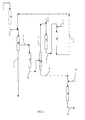
- FIG. 1 corresponds to the diagram of FIG. according to the invention and in which the dotted lines optional, the other units in solid lines being obligatory.
- the hydrocarbon feedstock is conveyed by line 1 to a unit A of purification.
- This unit A makes it possible to eliminate a large part of the nitrogenous and / or basic compounds contained in the load. This elimination, although optional, is necessary when the filler comprises a high level of nitrogen and / or basic compounds, as these constitute a poison for the catalysts of the following steps of the present process.
- Said compounds can be removed by adsorption on an acidic solid.
- This solid can be selected from the group formed by silicoaluminates, titanosilicates, oxides mixed titanium alumina, clays, resins.
- the solid may also be chosen from mixed oxides obtained by grafting from less an organometallic compound, organosoluble or water-soluble, of at least one element selected from the group consisting of titanium, zirconium, silicon, germanium, tin, tantalum, niobium, on at least one oxide support such as alumina (forms gamma, delta, eta, alone or in admixture) silica, silica aluminas, titanium silicas, zirconia silicas, Amberlyst type ion exchange resins, or any other solid having any acidity.
- organometallic compound organosoluble or water-soluble
- oxide support such as alumina (forms gamma, delta, eta, alone or in admixture) silica, silica aluminas, titanium silicas, zirconia
- a particular embodiment of the invention may consist in implementing a mixture of at least two of the previously described catalysts.
- the pressure of the purification unit (A) of the charge is between the pressure atmospheric pressure and 10 MPa, preferably between atmospheric pressure and 5 MPa, and will preferably choose a pressure under which the charge is in the liquid state.
- VVH The ratio of the volume flow rate of charge to the volume of catalytic solid
- the temperature of the purification unit (A) is between 15 ° C and 300 ° C, preferably between 15 ° C and 150 ° C, and more preferably between 15 ° C and 60 ° C.
- the removal of the nitrogenous and / or basic compounds contained in the feed may also be carried out by washing with an acidic aqueous solution, or by any equivalent means known to those skilled in the art.
- the purified ⁇ -cut feed is conveyed via line 2 to the separation unit (B). on membrane.
- the linear olefins and paraffins forming the ⁇ -section are separated by a membrane from the rest of the petrol cut (forming the ⁇ cut), and are evacuated via line 3 to feed an oligomerization unit (C).
- the depleted fraction of olefins and linear paraffins is removed from the unit (B) by the line 7.
- This section called ⁇ cut whose linear olefin content has significantly decreased since it mainly contains only branched olefins, has a subscript improved octane compared to the initial gasoline cut or ⁇ cut.
- any type of membrane making it possible to effect the separation between paraffins and linear olefins on the one hand, and paraffins and branched olefins on the other hand, can be used, whether organic or polymeric membranes (for example, the Sulzer Chemtech Membrane Systems PDMS 1060 Membrane), Ceramics or (for example at least partly of zeolite, silica, alumina, glass or carbon), or composites consisting of polymer and at least one mineral compound or ceramic (for example, the Sulzer Chemtech Membrane PDMS 1070 membrane Systems).
- organic or polymeric membranes for example, the Sulzer Chemtech Membrane Systems PDMS 1060 Membrane
- Ceramics or for example at least partly of zeolite, silica, alumina, glass or carbon
- composites consisting of polymer and at least one mineral compound or ceramic for example, the Sulzer Chemtech Membrane PDMS 1070 membrane Systems.
- membranes based on MFI zeolites be they membranes based of silicalite, based on MFI zeolite completely dealuminated, exhibit a selectivity normal / isoparaffins and can therefore be used in the context of the present invention.
- the selectivity of this type of membrane is essentially based on a difference in diffusivity between linear compounds, diffusing faster because offering a diameter significantly lower kinetics than the micropore diameter of the zeolite, and the connected compounds, diffusing more slowly because having a kinetic diameter close to that of micropores.
- the operating temperature of the membrane will be between the temperature ambient temperature and 400 ° C, and preferably between 80 ° C and 300 ° C.
- the linear olefins and paraffins ( ⁇ -section) separated from the petrol fraction in unit B, are sent to an oligomerization reactor, represented by unit C, by via line 3.
- This unit C contains an acid catalyst.
- the hydrocarbons present in the mixture of paraffins and linear olefins will undergo moderate oligomerization reactions, this is to say in general dimerizations or trimerizations, the conditions of the reaction being optimized for the production of a majority of hydrocarbons with carbon numbers is predominantly between 9 and 25, and preferably between 10 and 20.
- the catalyst of unit C can be chosen from the group formed by silicoaluminates, titanosilicates, mixed titanium alumina, clays, resins, mixed oxides obtained by grafting at least one organometallic, organosoluble or water-soluble compound (selected from the group consisting of alkys and / or alkoxy metals having at least one such as titanium, zirconium silicon, germanium, tin, tantalum, niobium) on an oxide support such as alumina (gamma, delta, eta forms, alone or in mixture), silica, silica aluminas, titanium silicas, zirconia silicas, or any other solid having any acidity.
- organometallic, organosoluble or water-soluble compound selected from the group consisting of alkys and / or alkoxy metals having at least one such as titanium, zirconium silicon, germanium, tin, tantalum, niobium
- an oxide support such as alumina (gamma
- the catalyst used to carry out the oligomerization comprises at least a metal of group VIB of the periodic table, and advantageously an oxide of said metal.
- Said catalyst may further comprise an oxide support selected from the group formed by aluminas, titanates, silicas, zirconia, alumino-silicates.
- a particular embodiment of the invention consists in implementing a mixture of at least two of the catalysts mentioned above.
- the pressure of the unit C is most often such that the charge is in liquid form. This pressure is in principle between 0.2 MPa and 10 MPa, preferably between 0.3 and 6 MPa, and more preferably between 0.3 and 4 MPa.
- the volume flow ratio of load on the catalyst volume (also called hourly volume velocity or VVH) can be between 0.05 liter / liter.hour and 50 liters / liter.hour, preferably between 0.1 liter / liter.hour and 20 liters / liter.hour, and even more preferably between 0.2 liter / liter.hour and 10 liters / liter.hour.
- reaction temperature should have been between 15 ° C and 300 ° C, preferably between 60 ° C and 250 ° C, and more particularly between 100 ° C and 250 ° C for optimize the quality of the products obtained.
- the effluent from the unit (C) is then sent via line 4 in one or several distillation columns shown in the diagram of Figure 1 by the unit (D).
- This cut consists mainly of olefins and diolefins resulting from the polymerization of linear olefins.
- This cup can be hydrogenated in a unit conventional hydrogenation in the presence of a catalyst and under operating conditions well known to those skilled in the art. These olefins are then converted into paraffins linear.
- the effluent of the hydrogenation unit (E) is a cetane gas oil greater than 45 and preferably greater than 50.
- the ⁇ cut consists mainly of non-reactive linear paraffins during the oligomerization reaction.
- This cut conveyed by line 5, is mixed with the hydrogen, conveyed via line 10, is injected into a dehydrogenation unit (F).
- Water or any other compound likely to decompose into water under the conditions of dehydrogenation may be added to the charge.
- the amount of water present in the load hydrocarbons, (this water may be generated by the decomposition of another compound, as for example an alcohol, an aldehyde, a ketone, an ether), will be between 1 and 10000 ppm weight of water relative to the hydrocarbon charge.
- the dehydrogenation unit (F) operates under temperature conditions between 400 ° C and 520 ° C, preferably between 450 ° C and 490 ° C.
- the pressures of the dehydrogenation unit (F) are between 0.05 MPa and 1 MPa, preferably between 0.1 MPa and 0.5 MPa.
- the ratio of the volume flow rate of the feedstock to the catalyst volume is between 1 h -1 and 500 h -1 , preferably between 15 h -1 and 300 h -1 .
- the molar ratio of hydrogen to hydrocarbon is between 1 and 20 mol / mol, and preferably between 4 and 12 mol / mol.
- the dehydrogenation catalyst of the unit (F) may be chosen from catalysts known to those skilled in the art for the dehydrogenation of short paraffins ranging from C 2 to C 5 or long paraffins ranging from C 10 to C 14.
- the catalyst thus consists of a metal phase supported on a support whose specific surface is advantageously between 5 and 300 m 2 / g.
- This catalyst support comprises at least one refractory oxide which is generally selected from the group IIA, IIIA, IIIB, IVA or IVB metal oxides of the periodic classification of elements such as, for example, magnesium oxides, aluminum, silicon, zirconium alone or mixed with each other, or as a mixture with oxides of other elements of the Periodic Table. We can also use the coal.
- the dehydrogenation catalyst of the unit (F) may also contain a sulfur compound, at a weight content of sulfur element generally between 0.005 and 1% with respect to the catalyst mass.
- the catalyst of the unit (F) may also contain one or more additional elements typically allowing to limit the acidity of the support such as alkaline or alkaline earth, with a weight percentage of 0.01% to 3%.
- alkaline and / or alkaline earth compounds on the one hand, and halogenated substances may be adjusted to modify the content of alkylaromatics, and / or branched paraffins formed during the reaction of dehydrogenation.
- the diesel cut will for example be favored by the use of a catalyst of dehydrogenation having from 0.01% to 3% of at least one alkaline and / or alkaline earth metal and less than 0.2% of halogenated compound.
- the proportion of aromatic compounds resulting from this dehydrogenation step may also be minimized by a judicious choice of operating conditions, known to those skilled in the art.
- VVH charge-to-volume ratio
- H2 / HC ratio makes it possible to limit the formation of aromatics during the dehydrogenation step (F).
- a VVH value of between 15 and 300 h -1 , and an H 2 / HC value of between 4 and 12 will generally be preferred.
- the petrol cut will for example be favored by the use of a catalyst of dehydrogenation having 0.1% to 3% of a halogenated compound, and less than 0.5% of an alkaline and / or alkaline earth metal.
- the catalyst may in some cases not contain alkali metal or alkaline earth metal.
- the proportion of aromatic compounds resulting from this dehydrogenation step (F) may also be optimized by a judicious choice of operating conditions, known to those skilled in the art.
- VVH charge-to-volume ratio of catalyst
- the step of dehydrogenating paraffins to olefins is also accompanied, in addition to branched aromatic and paraffin compounds, diolefin formation and optionally other unsaturated compounds such as alkynes, triolefins.
- diolefins The formation of diolefins is strongly influenced by the thermodynamic equilibrium between paraffins / olefins / diolefins.
- the effluent from the unit (F) discharged via the line (11) is mixed with hydrogen supplied by the line (12) and then sent to a selective hydrogenation unit (G) whose purpose is the elimination by hydrogenation of the small quantities of diolefins and possible alkynes and triolefins, without affecting the olefins and aromatic compounds formed in the unit (F).
- This selective hydrogenation operates in pressure ranges between 1 MPa and 8 MPa, and preferably between 2 MPa and 6 MPa.
- the temperature is between 40 ° C and 350 ° C, and preferably between 40 ° C and 250 ° C.
- the ratio of the volume flow rate of charge to the volume of catalyst is between 0.5 and 10 m 3 / m 3 / hour and preferably between 1 and 5 m 3 / m 3 / hour.
- the catalyst of the hydrogenation unit (G) consists of a support based on silica, or of alumina on which is deposited a metal type nickel, platinum or palladium.
- the catalyst of the hydrogenation unit (G) may also consist of mixtures of nickel and molybdenum or mixtures of nickel and tungsten.
- the effluent of the unit (G) contains mainly linear paraffins, olefins and aromatics. This so-called cup ⁇ cut, is then recycled in whole or in part by the line (13) at the entrance of the unit (B).
- Example 1 corresponds to the invention and will be better understood by following FIG.
- Example 2 is a comparative example
- the load is a FCC gasoline with a boiling point between 40 ° C and 150 ° C.
- This gasoline contains 10 ppm nitrogen.
- This charge is sent to a purification reactor A containing a solid a mixture of 20% alumina and 80% by weight of zeolite of the mordenite type.
- the zeolite used in the present example has a silicon / aluminum ratio of 45.
- the pressure of the purification unit is 0.2 MPa.
- the ratio of the liquid volume flow rate of the charge to the acid solid volume (VVH) is of 1 liter / liter.hour.
- the temperature of the reactor is 20 ° C.
- Table 1 gives the composition of the initial charge and that of the effluent from unit A ( ⁇ cut).
- the charge rate used is 1 kg / h. characteristics of the charge and effluent of unit A.
- Charge A Effluent of unit A Nitrogen (ppm) 10 0.2 Paraffins (% wt) 25.2 25.1 Naphthenes (% wt) 9.6 9.8 Aromatic (% by weight) 34.9 35 Olefins (% by weight) 30.3 30.1
- the effluent from unit A ( ⁇ cut) is then sent to a membrane reactor B consisting of a support based on ⁇ -alumina on which is deposited a layer of zeolite MFI with a thickness of between 5 and 15 ⁇ m.
- the pressure of the membrane reactor B is equal to 0.1 MPa and the temperature is equal to 150 ° C.
- Table 2 gives the composition of effluents from unit B ( ⁇ cut and ⁇ cut). effluent characteristics of stage B (before recycling). ⁇ cut ⁇ cup Yield (%) (relative to the ⁇ cut) 8.8 91.2 Production (g / h) 88 912 Paraffins (% wt) 45.5 23.1 Naphthenes (% wt) 10.7 Aromatic (% by weight) 38.5 Olefins (% by weight) 54.5 27.7
- the ⁇ cut from the membrane separation unit is injected into an oligomerization reactor (C) containing a catalyst consisting of a mixture of 50% by weight of zirconia and 50% by weight of H 3 PW 12 O 40 .
- the pressure of the unit is 2 MPa, the ratio of the volumetric load flow on the volume of catalyst (VVH) is equal to 1.5 liters / liter.hour.
- the temperature is set at 170 ° C.
- the heavy cut ⁇ is sent to a hydrogenation reactor (E) containing a catalyst comprising an alumina support on which nickel and molybdenum (marketed by AXENS under the trade name HR348, brand Mark).
- the pressure of the unit is 5 MPa, the ratio of the volumetric load flow on the volume of catalyst (VVH) is equal to 2 liters / liter.hour.
- the ratio of the injected hydrogen flow rate to the feed rate is equal to 600 liters / liter.
- the reactor temperature is 320 ° C.
- the light cut ⁇ distillation range 40 ° C-200 ° C from the distillation step (D), is mixed with hydrogen with a hydrogen to hydrocarbon molar ratio of 6 moles / mole, then sent to the dehydrogenation unit (F).
- the total pressure of the dehydrogenation unit (F) is equal to 0.3 MPa, and the temperature is 475 ° C.
- the ratio of the volume flow rate of charge to the volume of catalyst (VVH) is equal to 20 liters / liter.hour.
- the catalyst used in the dehydrogenation unit (F) is sold by AXENS under the reference DP 805, registered trademark.
- composition of the section ⁇ resulting from the dehydrogenation (F) or ⁇ section is presented in Table 5 and compared to the charge of the dehydrogenation unit (F) or cut ⁇ .
- characteristics of the effluent from unit F ( ⁇ section) Cup ⁇ ⁇ section Linear paraffins (% by weight) 100 85.1 Branched paraffins (% by weight) 0.3 Olefins (% by weight) 12 Aromatic (%) 2 Diolefins (% by weight) 0.6
- This section ⁇ is mixed with hydrogen and sent to a reactor hydrogenation product (G) containing a catalyst marketed by AXENS under the reference LD 265, registered trademark.
- the pressure of the unit is 2.8 MPa, the temperature is equal to 90 ° C, and the flow ratio
- the volume of charge on the volume of catalyst (VVH) is equal to 3 liters / liter / hour.
- composition of the ⁇ -section resulting from this selective hydrogenation is compared with that of the ⁇ -section in Table 6.
- characteristics of the effluent from unit G ⁇ cut
- ⁇ section ⁇ cut Linear paraffins (% by weight) 85.1 85.2 Branched paraffins (% by weight) 0.3 0.3 Olefins (% by weight) 12 12.5 Aromatic (%) 2 2 Diolefins (% by weight) 0.6 0
- This section ⁇ is completely recycled at the entrance of the membrane reactor (B).
- Paraffins and linear olefins are thus found in the new ⁇ -section obtained after recycling and thereby increase the diesel yield.
- the present method makes it possible to obtain, from a petrol cut from an FCC, a cut gasoline ( ⁇ cut) with an improved octane number compared to that of the cut initial (97 against 92) and a diesel cut, effluent of the unit (E), with high cetane number (55), perfectly compatible with marketing to European specifications and US.
- Example 2 corresponds to the prior art and consists in sending directly to a unit of oligomerization (C) a gasoline fraction of FCC ( ⁇ cut) whose boiling point is between 40 ° C and 150 ° C.
- C unit of oligomerization
- ⁇ cut gasoline fraction of FCC
- This gasoline contains 10 ppm nitrogen.
- This charge is sent to a purification reactor A containing a solid a mixture of 20% alumina and 80% by weight of zeolite of the mordenite type.
- the zeolite used in the present example has a silicon / aluminum ratio of 45.
- the pressure of the purification unit is 0.2 MPa.
- the ratio of the liquid volume flow rate of the charge to the acid solid volume (VVH) is of 1 liter / liter.hour.
- the temperature of the reactor is 20 ° C.
- Table 7 gives the composition of the initial charge and that of the effluent from unit A.
- the charge rate used is 1 kg / h. characteristics of the charge and effluent of unit A.
- Charge A Effluent of unit A Nitrogen (ppm) 10 0.2 Paraffins (% wt) 25.2 25.1 Naphthenes (% wt) 9.6 9.8 Aromatic (% by weight) 34.9 35 Olefins (% by weight) 30.3 30.1
- the heavy cut ⁇ ' is sent to a hydrogenation reactor (E) containing a Alumina catalyst on which nickel and molybdenum are deposited.
- the pressure of the unit (E) is 5 MPa
- the ratio of the flow rate of charge on the catalyst volume (VVH) is equal to 2 liters / liter.hour.
- the ratio of hydrogen flow injected on the charge flow is equal to 600 liters / liter.
- the reactor temperature of the unit (E) is 320 ° C.
- the characteristics of the effluent from the unit (E) which are those of a diesel fuel, are presented in Table 8. characteristics of the effluent from unit E Effluent of unit E Density at 20 ° C (kg / l) 0.787 Sulfur (ppm) 1 Motor cetane index 35
- the gas oil obtained according to the scheme of Example 2 is unfit for marketing, which is not the case of that obtained in Example 1 according to the invention.
- the final gasoline cut ⁇ ' has an octane number of 85, lower than obtained in Example 1, which can make marketing problematic.
Landscapes
- Chemical & Material Sciences (AREA)
- Oil, Petroleum & Natural Gas (AREA)
- Engineering & Computer Science (AREA)
- Chemical Kinetics & Catalysis (AREA)
- General Chemical & Material Sciences (AREA)
- Organic Chemistry (AREA)
- Production Of Liquid Hydrocarbon Mixture For Refining Petroleum (AREA)
- Organic Low-Molecular-Weight Compounds And Preparation Thereof (AREA)
- Separation Using Semi-Permeable Membranes (AREA)
Abstract

Description
- une coupe légère dite coupe δ, comprenant les hydrocarbures dont le point d'ébullition final est inférieur à une température comprise entre 150°C et 200°C,
- une coupe lourde dite coupe η, comprenant les hydrocarbures dont le point d'ébullition initial est supérieur à une température comprise entre 150°C et 200°C,
- van de Graaf, J.M., van der Bijl, E., Stol, A., Kapteijn, F., Moulijn, J.A., dans Industrial Engineering Chemistry Research ("Recherche en genie des procédés industriels"), 37, 1998, 4071-4083;
- Gora, L., Nishiyama, N., Jansen, J.C., Kapteijn, F., Teplyakov, V., Maschmeyer, Th., dans Separation Purification Technology ("Technologies de séparation/purification"), 22-23, 2001, 223-229;
- Nishiyama, N., Gora, L., Teplyakov, V., Kapteijn, F., Moulijn, J.A., dans Separation
- Coronas, J., Falconer, J.L., Noble, R.D., dans AIChE Journal ("Journal de l'Association de Ingénieurs en Génie des Procédés"), 43, 1997, 1797-1812;
- Gump, C.J., Lin, X., Falconer, J.L., Noble, R.D., dans Journal of Membrane Science ("Journal de la science des membranes"), 173, 2000, 35-52.
Les sélectivités de séparation observées avec des membranes à base de zéolithes MFI appliquées à la séparation n-hexane / diméthylbutane sont encore plus élevées :
- 200 à 400 tel que cité dans la publication de Coronas, J., Noble, R.D., Falconer, J.L., dans Industrial Engeneering and Chemical Research ("Recherche en génie des procédés industriels"), 37, 1998, 166-176;
- de 100 à 700 (Gump, C.J., Noble, R.D., Falconer, J.L., dans Industrial Engeneering and Chemical Research ("Recherche en génie des procédés industriels"), 38, 1999,2775-2781;
- de 600 à plus de 2000 (Keizer, K., Burggraaf, A.J., Vroon, Z.A.E.P., Verweij, H., dans
- une coupe δ dite légère dont le point final de distillation est compris entre environ 150°C et environ 200°C, de préférence entre 150°C et 180°C.
- une coupe η dite lourde dont le point initial d'ébullition est compris entre environ 150°C et environ 200°C, de préférence entre 150°C et 180°C. Cette coupe est transportée par la ligne 6 vers l'unité (E).
| caractéristiques de la charge et de l'effluent de l'unité A. | ||
| Charge A | Effluent de l'unité A | |
| Azote (ppm) | 10 | 0,2 |
| Paraffines (%poids) | 25,2 | 25,1 |
| Naphtènes (% poids) | 9,6 | 9,8 |
| Aromatiques (% poids) | 34,9 | 35 |
| Oléfines (% poids) | 30,3 | 30,1 |
| caractéristiques des effluents de l'étape B (avant recyclage). | ||
| Coupe β | Coupe γ | |
| Rendement (%) (par rapport à la coupe α) | 8,8 | 91,2 |
| Production (g/h) | 88 | 912 |
| Paraffines (%poids) | 45,5 | 23,1 |
| Naphtènes (% poids) | 10,7 | |
| Aromatiques (% poids) | 38,5 | |
| Oléfines (% poids) | 54,5 | 27,7 |
| Production et composition des coupes δ et η | ||
| Coupe δ | Coupe η | |
| Production (g/h) | 39,6 | 48 |
| Paraffines (%) | 100 | |
| Oléfines (%) | 100 |
| caractéristiques de l'effluent issu de l'unité E | |
| effluent de l'unité E | |
| Densité à 20°C (kg/l) | 0,787 |
| Soufre (ppm) | 1 |
| Cétane moteur | 55 |
| caractéristiques de l'effluent issu de l'unité F (coupe µ) | ||
| Coupe δ | Coupe µ | |
| Paraffines linéaires (%poids) | 100 | 85,1 |
| Paraffines ramifiées (%poids) | 0,3 | |
| Oléfines (% poids) | 12 | |
| Aromatiques (%) | 2 | |
| Dioléfines (%poids) | 0,6 |
| caractéristiques de l'effluent issu de l'unité G (coupe λ) | ||
| Coupe µ | Coupe λ | |
| Paraffines linéaires (%poids) | 85,1 | 85,2 |
| Paraffines ramifiées (%poids) | 0,3 | 0,3 |
| Oléfines (% poids) | 12 | 12,5 |
| Aromatiques (%) | 2 | 2 |
| Dioléfines (%poids) | 0,6 | 0 |
| Comparaison des caractéristiques de la coupe initiale α et de la coupe finale γ. | ||
| Coupe α | Coupe γ finale | |
| Paraffines (%poids) | 25,2 | 22,9 |
| Naphtènes (% poids) | 9,6 | 10,4 |
| Aromatiques (% poids) | 34,9 | 37,8 |
| Oléfines (% poids) | 30,3 | 27,6 |
| Indice d'octane RON | 92 | 97 |
| caractéristiques de la charge et de l'effluent de l'unité A. | ||
| Charge A | Effluent de l'unité A | |
| Azote (ppm) | 10 | 0,2 |
| Paraffines (%poids) | 25,2 | 25,1 |
| Naphtènes (% poids) | 9,6 | 9,8 |
| Aromatiques (% poids) | 34,9 | 35 |
| Oléfines (% poids) | 30,3 | 30,1 |
- une coupe légère δ' d'intervalle de distillation 40°C-200°C obtenue avec un rendement poids de 70%,
- une coupe lourde η' comprenant les hydrocarbures dont le point de distillation initial est supérieur à 200°C, obtenue avec un rendement poids de 30%.
| caractéristiques de l'effluent de l'unité E | |
| Effluent de l'unité E | |
| Densité à 20°C (kg/l) | 0,787 |
| Soufre (ppm) | 1 |
| Indice cétane moteur | 35 |
| caractéristiques des coupes α et δ' | ||
| Coupe α | Coupe δ' | |
| Production (g/l) | 1000 | 700 |
| Paraffines (%poids) | 25,2 | 36,2 |
| Naphtènes (% poids) | 9,6 | 13,7 |
| Aromatiques (% poids) | 34,9 | 50,1 |
| Oléfines (% poids) | 30,3 | |
| Indice d'octane RON | 92 | 85 |
Claims (13)
- Procédé de transformation d'une charge hydrocarbonée de type essence, comprenant de 4 à 15 atomes de carbone, en une coupe essence de nombre d'octane supérieur à celui de la charge et une coupe gazole d'indice de cétane supérieur à 45, ledit procédé comprenant les étapes suivantes :a) une étape de séparation par membrane (B) de la charge hydrocarbonée dans des conditions permettant la séparation sélective de la majorité des oléfines linéaires présentes dans ladite charge et constituant la coupe β, la coupe contenant la majorité des oléfines ramifiées, dite coupe γ, constituant une essence à fort indice d'octane, supérieur à celui de la charge.b) une étape d'oligomérisation (C) des oléfines linéaires (coupe β) contenues dans les effluents issus de l'étape de séparation sur membrane (B) dans des conditions d'oligomérisation modérées,c) une étape de séparation par distillation (D) des effluents issus de l'étape d'oligomérisation en au moins deux coupes :une coupe δ comprenant les hydrocarbures dont le point d'ébullition final est inférieur à une température comprise entre 150°C et 200°C,une coupe η comprenant les hydrocarbures dont le point d'ébullition initial est supérieur à une température comprise entre 150°C et 200°C,d) une étape d'hydrogénation (E) de la coupe η permettant d'obtenir un gazole d'indice de cétane au moins égal à 45.
- Procédé selon la revendication 1 comprenant en outre après l'étape d) une étape e) de déshydrogénation (F) de la coupe δ permettant de convertir une partie au moins des paraffines en oléfines, et produisant une coupe µ qui est, au moins en partie, recyclée à l'étape de séparation par membrane (B).
- Procédé selon la revendication 2 dans lequel la coupe µ issue de l'étape de déshydrogénation (F) subit une hydrogénation sélective (G), en vue d'éliminer les dioléfines de manière à produire une coupe λ qui est recyclée au moins en partie à l'étape de séparation par membrane (B).
- Procédé selon la revendication 2 dans lequel la coupe µ issue de l'étape de déshydrogénation (F) de la coupe δ, est mélangée au moins en partie avec la coupe γ, issue de l'unité de séparation par membrane (B).
- Procédé selon la revendication 3 dans lequel la coupe λ issue de l'étape d'hydrogénation sélective (G) est au moins en partie mélangée avec la coupe γ, issue de l'étape de séparation par membrane (B).
- Procédé selon l'une quelconque des revendications 1 à 5 dans lequel l'étape d'oligomérisation (C) est effectuée à une pression comprise entre 0,2 et 10 MPa, un rapport de débit volumique de charge sur volume de catalyseur (VVH) compris entre 0,05 litre/litre.heure et 50 litres/litre.heure, une température comprise entre 15°C et 300°C, et en présence d'un catalyseur comprenant au moins un métal du groupe VIB de la classification périodique.
- Procédé selon l'une des revendications 1 à 6 dans lequel l'étape de séparation sur membrane est réalisée avec une membrane telle que celles utilisées dans les procédés de nanofiltration ou d' osmose inverse, ou de perméation en phase gaz, ou de pervaporation.
- Procédé selon l'une quelconque des revendications 1 à 6 dans lequel l'unité de séparation par membrane utilise une membrane à base de film formé de tamis moléculaire de type silicates, aluminosilicates, aluminophosphates, silicoalumino-phosphates, métalloaluminophosphates, stanosilicates ou un mélange d'au moins un de ces deux types de constituants.
- Procédé selon l'une quelconque des revendications 1 à 6 dans lequel l'unité de séparation par membrane utilise une membrane à base de zéolithes de type MFI ou ZSM-5, natives ou ayant été échangées avec des ions H+; Na +; K+; Cs+; Ca+; Ba+.
- Procédé selon l'une quelconque des revendications 1 à 6 dans lequel l'unité de séparation par membrane utilise une membrane à base de zéolithes de type LTA.
- Procédé selon l'une quelconque des revendications 1 à 10 dans lequel le catalyseur de déshydrogénation de l'unité (F) est constitué d'une phase métallique déposée sur un support, ce support comportant au moins un oxyde réfractaire choisi parmi les oxydes de métaux des groupes IIA, IIIA, IIIB, IVA ou IVB de la classification périodique des éléments.
- Procédé selon l'une quelconque des revendications 1 à 11 dans lequel le catalyseur de l'unité (F) contient un ou plusieurs éléments additionnels choisi parmi les alcalins ou les alcalino-terreux, avec un pourcentage pondéral compris entre 0,01% et 3%.
- Procédé selon l'une quelconque des revendications 1 à 12 comprenant une étape (A) d'élimination d'au moins une partie des impuretés azotés ou basiques contenues dans la charge initiale d'hydrocarbures, cette étape (A) étant située en amont de l'unité de séparation par membrane (B).
Applications Claiming Priority (2)
| Application Number | Priority Date | Filing Date | Title |
|---|---|---|---|
| FR0406097A FR2871168B1 (fr) | 2004-06-04 | 2004-06-04 | Procede d'amelioration de coupes essences et de transformation en gazoles avec traitement complementaire permettant d'augmenter le rendement de la coupe gazole |
| FR0406097 | 2004-06-04 |
Publications (2)
| Publication Number | Publication Date |
|---|---|
| EP1602705A1 true EP1602705A1 (fr) | 2005-12-07 |
| EP1602705B1 EP1602705B1 (fr) | 2008-11-12 |
Family
ID=34942341
Family Applications (1)
| Application Number | Title | Priority Date | Filing Date |
|---|---|---|---|
| EP05291115A Expired - Lifetime EP1602705B1 (fr) | 2004-06-04 | 2005-05-24 | Procédé d'amelioration de coupes essences et de transformation en gazoles avec traitement complementaire permettant d'augmenter le rendement de la coupe gazole |
Country Status (6)
| Country | Link |
|---|---|
| US (1) | US7705193B2 (fr) |
| EP (1) | EP1602705B1 (fr) |
| JP (1) | JP4860188B2 (fr) |
| CN (1) | CN1706919B (fr) |
| DE (1) | DE602005010937D1 (fr) |
| FR (1) | FR2871168B1 (fr) |
Cited By (1)
| Publication number | Priority date | Publication date | Assignee | Title |
|---|---|---|---|---|
| WO2012076758A3 (fr) * | 2010-12-10 | 2012-10-04 | Neste Oil Oyj | Procédé pour la production de composants de distillat moyen à partir de composants d'essence |
Families Citing this family (23)
| Publication number | Priority date | Publication date | Assignee | Title |
|---|---|---|---|---|
| FR2871167B1 (fr) * | 2004-06-04 | 2006-08-04 | Inst Francais Du Petrole | Procede d'amelioration de coupes essences et de transformation en gazoles |
| RU2344161C1 (ru) * | 2007-05-14 | 2009-01-20 | Олег Юрьевич Иванов | Способ переработки смеси жидких углеводородов и установка для его осуществления |
| FR2952646B1 (fr) * | 2009-11-13 | 2012-09-28 | Inst Francais Du Petrole | Procede de production de carburants kerosene et diesel de haute qualite et de coproduction d'hydrogene a partir de coupes saturees legeres |
| FR2975103B1 (fr) | 2011-05-12 | 2014-08-29 | IFP Energies Nouvelles | Procede de production de coupes kerosene ou gazole a partir d'une charge olefinique ayant majoritairement de 4 a 6 atomes de carbone |
| FR2980195B1 (fr) | 2011-09-20 | 2013-08-23 | IFP Energies Nouvelles | Procede de separation du pentene-2 d'une coupe c5 contenant du pentene-2 et du pentene-1 par oligomerisation selective du pentene-1 |
| US9914673B2 (en) | 2012-11-12 | 2018-03-13 | Uop Llc | Process for oligomerizing light olefins |
| US9278893B2 (en) | 2012-11-12 | 2016-03-08 | Uop Llc | Process for making gasoline by oligomerization |
| US9441173B2 (en) | 2012-11-12 | 2016-09-13 | Uop Llc | Process for making diesel by oligomerization |
| US10508064B2 (en) | 2012-11-12 | 2019-12-17 | Uop Llc | Process for oligomerizing gasoline without further upgrading |
| US9834492B2 (en) | 2012-11-12 | 2017-12-05 | Uop Llc | Process for fluid catalytic cracking oligomerate |
| US9644159B2 (en) | 2012-11-12 | 2017-05-09 | Uop Llc | Composition of oligomerate |
| US9522373B2 (en) | 2012-11-12 | 2016-12-20 | Uop Llc | Apparatus for oligomerizing light olefins |
| US9567267B2 (en) | 2012-11-12 | 2017-02-14 | Uop Llc | Process for oligomerizing light olefins including pentenes |
| US9663415B2 (en) | 2012-11-12 | 2017-05-30 | Uop Llc | Process for making diesel by oligomerization of gasoline |
| US9434891B2 (en) | 2012-11-12 | 2016-09-06 | Uop Llc | Apparatus for recovering oligomerate |
| US9522375B2 (en) | 2012-11-12 | 2016-12-20 | Uop Llc | Apparatus for fluid catalytic cracking oligomerate |
| PT107381B (pt) | 2013-12-23 | 2018-07-04 | Inst Superior Tecnico | Processo de oligomerização catalítica utilizando um reactor catalítico para a oligomerização de olefinas em c4-c7 |
| US10378427B2 (en) | 2017-03-31 | 2019-08-13 | Saudi Arabian Oil Company | Nitrogen enriched air supply for gasoline compression ignition combustion |
| US10508017B2 (en) * | 2017-10-13 | 2019-12-17 | Saudi Arabian Oil Company | Point-of-sale octane/cetane-on-demand systems for automotive engines |
| US10378462B1 (en) | 2018-01-31 | 2019-08-13 | Saudi Arabian Oil Company | Heat exchanger configuration for adsorption-based onboard octane on-demand and cetane on-demand |
| US10436126B2 (en) | 2018-01-31 | 2019-10-08 | Saudi Arabian Oil Company | Adsorption-based fuel systems for onboard cetane on-demand and octane on-demand |
| US10422288B1 (en) | 2018-03-29 | 2019-09-24 | Saudi Arabian Oil Company | Adsorbent circulation for onboard octane on-demand and cetane on-demand |
| US10408139B1 (en) | 2018-03-29 | 2019-09-10 | Saudi Arabian Oil Company | Solvent-based adsorbent regeneration for onboard octane on-demand and cetane on-demand |
Citations (4)
| Publication number | Priority date | Publication date | Assignee | Title |
|---|---|---|---|---|
| DE3030998A1 (de) * | 1980-08-16 | 1982-04-01 | Metallgesellschaft Ag, 6000 Frankfurt | Verfahren zur herstellung von kraftstoffen mit einem ueberwiegenden anteil an dieseloel |
| US4456779A (en) * | 1983-04-26 | 1984-06-26 | Mobil Oil Corporation | Catalytic conversion of olefins to higher hydrocarbons |
| US20030171632A1 (en) * | 2000-07-10 | 2003-09-11 | Du Toit Francois Benjamin | Process and apparatus for the production of diesel fuels by oligomerisation of olefinic feed streams |
| US20040033370A1 (en) * | 2002-06-03 | 2004-02-19 | Institut Francais Du Petrole | Thin zeolite membrane, its preparation and its use in separation |
Family Cites Families (9)
| Publication number | Priority date | Publication date | Assignee | Title |
|---|---|---|---|---|
| US4677237A (en) * | 1984-11-29 | 1987-06-30 | Uop Inc. | Dehydrogenation catalyst compositions |
| JPH01259089A (ja) * | 1988-03-04 | 1989-10-16 | Res Assoc Util Of Light Oil | 重質油熱分解軽質留分の処理方法 |
| CN1042937A (zh) * | 1989-04-03 | 1990-06-13 | 吴兆平 | 渣油炼制油品的方法和装置 |
| JP3184833B2 (ja) * | 1992-03-27 | 2001-07-09 | スティヒチング エネルギーオンデルズーク セントルム ネーデルラント | 小分子分離用の膜及びその製造方法 |
| US6043177A (en) * | 1997-01-21 | 2000-03-28 | University Technology Corporation | Modification of zeolite or molecular sieve membranes using atomic layer controlled chemical vapor deposition |
| JP2002348579A (ja) * | 2001-05-23 | 2002-12-04 | Nard Inst Ltd | ゼオライト系分離膜を用いた炭化水素混合物の分離方法、および分離して炭化水素を得る方法 |
| FR2840236B1 (fr) * | 2002-06-03 | 2005-02-04 | Inst Francais Du Petrole | Membrane zeolithique de faible epaisseur, sa preparation et son utilisation en separation |
| CN1209441C (zh) * | 2002-11-01 | 2005-07-06 | 石油大学(北京) | 催化汽油改质油气的分离方法和装置 |
| FR2871167B1 (fr) * | 2004-06-04 | 2006-08-04 | Inst Francais Du Petrole | Procede d'amelioration de coupes essences et de transformation en gazoles |
-
2004
- 2004-06-04 FR FR0406097A patent/FR2871168B1/fr not_active Expired - Fee Related
-
2005
- 2005-05-24 DE DE602005010937T patent/DE602005010937D1/de not_active Expired - Lifetime
- 2005-05-24 EP EP05291115A patent/EP1602705B1/fr not_active Expired - Lifetime
- 2005-06-03 CN CN200510076016.1A patent/CN1706919B/zh not_active Expired - Fee Related
- 2005-06-06 JP JP2005164957A patent/JP4860188B2/ja not_active Expired - Fee Related
- 2005-06-06 US US11/144,740 patent/US7705193B2/en not_active Expired - Fee Related
Patent Citations (4)
| Publication number | Priority date | Publication date | Assignee | Title |
|---|---|---|---|---|
| DE3030998A1 (de) * | 1980-08-16 | 1982-04-01 | Metallgesellschaft Ag, 6000 Frankfurt | Verfahren zur herstellung von kraftstoffen mit einem ueberwiegenden anteil an dieseloel |
| US4456779A (en) * | 1983-04-26 | 1984-06-26 | Mobil Oil Corporation | Catalytic conversion of olefins to higher hydrocarbons |
| US20030171632A1 (en) * | 2000-07-10 | 2003-09-11 | Du Toit Francois Benjamin | Process and apparatus for the production of diesel fuels by oligomerisation of olefinic feed streams |
| US20040033370A1 (en) * | 2002-06-03 | 2004-02-19 | Institut Francais Du Petrole | Thin zeolite membrane, its preparation and its use in separation |
Cited By (1)
| Publication number | Priority date | Publication date | Assignee | Title |
|---|---|---|---|---|
| WO2012076758A3 (fr) * | 2010-12-10 | 2012-10-04 | Neste Oil Oyj | Procédé pour la production de composants de distillat moyen à partir de composants d'essence |
Also Published As
| Publication number | Publication date |
|---|---|
| CN1706919A (zh) | 2005-12-14 |
| JP4860188B2 (ja) | 2012-01-25 |
| US7705193B2 (en) | 2010-04-27 |
| FR2871168B1 (fr) | 2006-08-04 |
| DE602005010937D1 (de) | 2008-12-24 |
| CN1706919B (zh) | 2011-06-08 |
| JP2005344119A (ja) | 2005-12-15 |
| US20060009670A1 (en) | 2006-01-12 |
| EP1602705B1 (fr) | 2008-11-12 |
| FR2871168A1 (fr) | 2005-12-09 |
Similar Documents
| Publication | Publication Date | Title |
|---|---|---|
| EP1602705B1 (fr) | Procédé d'amelioration de coupes essences et de transformation en gazoles avec traitement complementaire permettant d'augmenter le rendement de la coupe gazole | |
| EP1602637B1 (fr) | Procédé d'amelioration de coupes essences et de transformation en gazoles | |
| EP2333031B1 (fr) | Procédé de production de carburants kérosène et diesel de haute qualité et de coproduction d'hydrogène à partir de coupes saturées légères | |
| WO2006067305A1 (fr) | Procede de conversion directe d’une charge comprenant des olefines a quatre et/ou cinq atomes de carbone, pour la production de propylene avec une co-production d’essence | |
| EP2321385A1 (fr) | Procédé de conversion d'une charge lourde en essence et en propylène présentant une structure de rendement modulable | |
| EP2636661B1 (fr) | Procédé de conversion d'une charge lourde, mettant en oeuvre une unité de craquage catalytique et une étape d'hydrogénation sélective de l'essence issue du craquage catalytique | |
| EP1406989B1 (fr) | Procede de production de distillats moyens par hydroisomerisation et hydrocraquage d'une fraction lourde issue d'un effluent produit par le procede fischer-tropsch | |
| EP1088879A1 (fr) | Procédé de production d'essences à indice d'octane amélioré | |
| FR2862311A1 (fr) | Procede de production d'essences a haut indice d'octane a partir d'une coupe c5/c6 utilisant une unite de separation par menbrane | |
| FR2968010A1 (fr) | Procede de conversion d'une charge lourde en distillat moyen | |
| EP3164467B1 (fr) | Procédé de désaromatisation de coupes pétrolières | |
| EP1777284B1 (fr) | Procédé de conversion directe d'une charge comprenant des oléfines à quatre, et/ou cinq atomes de carbone, pour la production de propylène avec une co-production d'essence désulfurée à haut indice d'octane | |
| CA2139286A1 (fr) | Procede de reduction de la teneur en benzene dans les essences | |
| EP2158303A2 (fr) | Procede de production de distillats moyens par hydroisomerisation et hydrocraquage d'une fraction lourde issue d'un effluent fischer-tropsch | |
| EP1417283B1 (fr) | Procede d'isomerisation d'une coupe c5-c8 mettant en oeuvre deux reacteurs en parallele | |
| EP1433835B1 (fr) | Procédé de transformation d'hydrocarbures en une fraction présentant un indice d'octane amélioré et une fraction à fort indice de cétane | |
| FR2989381A1 (fr) | Production de distillats moyens a partir d'un effluent issu de la synthese fischer-tropsch comprenant une etape de reduction de la teneur en composes oxygenes | |
| FR2520356A1 (fr) | Procede de valorisation des coupes c4 olefiniques | |
| EP1396532B1 (fr) | Procédé de valorisation d'une charge d'hydrocarbures et de diminution de la tension de vapeur de ladite charge | |
| WO2012153011A2 (fr) | Procede de production de coupes kerosene ou gazole a partir d'une charge olefinique ayant majoritairement de 4 a 6 atomes de carbone | |
| FR3084084A1 (fr) | Procede de production d'olefines et de distillats moyens a partir d'un effluent hydrocarbone issu de la synhtese fischer-tropsch | |
| FR2857370A1 (fr) | Procede de production de distillats et d'huiles lubrifiantes | |
| FR2686094A1 (fr) | Production de base pour carburant exempt de benzene, presentant un indice d'octane eleve. |
Legal Events
| Date | Code | Title | Description |
|---|---|---|---|
| PUAI | Public reference made under article 153(3) epc to a published international application that has entered the european phase |
Free format text: ORIGINAL CODE: 0009012 |
|
| AK | Designated contracting states |
Kind code of ref document: A1 Designated state(s): AT BE BG CH CY CZ DE DK EE ES FI FR GB GR HU IE IS IT LI LT LU MC NL PL PT RO SE SI SK TR |
|
| AX | Request for extension of the european patent |
Extension state: AL BA HR LV MK YU |
|
| RIN1 | Information on inventor provided before grant (corrected) |
Inventor name: MORIN, STEPHANE Inventor name: METHIVIER, ALAIN Inventor name: COUPARD, VINCENT Inventor name: BAUDOT, ARNAUD Inventor name: BRIOT, PATRICK |
|
| 17P | Request for examination filed |
Effective date: 20060607 |
|
| AKX | Designation fees paid |
Designated state(s): BE DE GB NL |
|
| 17Q | First examination report despatched |
Effective date: 20070314 |
|
| GRAP | Despatch of communication of intention to grant a patent |
Free format text: ORIGINAL CODE: EPIDOSNIGR1 |
|
| GRAS | Grant fee paid |
Free format text: ORIGINAL CODE: EPIDOSNIGR3 |
|
| GRAA | (expected) grant |
Free format text: ORIGINAL CODE: 0009210 |
|
| AK | Designated contracting states |
Kind code of ref document: B1 Designated state(s): BE DE GB NL |
|
| REG | Reference to a national code |
Ref country code: GB Ref legal event code: FG4D Free format text: NOT ENGLISH |
|
| REF | Corresponds to: |
Ref document number: 602005010937 Country of ref document: DE Date of ref document: 20081224 Kind code of ref document: P |
|
| PLBE | No opposition filed within time limit |
Free format text: ORIGINAL CODE: 0009261 |
|
| STAA | Information on the status of an ep patent application or granted ep patent |
Free format text: STATUS: NO OPPOSITION FILED WITHIN TIME LIMIT |
|
| 26N | No opposition filed |
Effective date: 20090813 |
|
| REG | Reference to a national code |
Ref country code: DE Ref legal event code: R081 Ref document number: 602005010937 Country of ref document: DE Owner name: IFP ENERGIES NOUVELLES, FR Free format text: FORMER OWNER: INSTITUT FRANCAIS DU PETROLE, RUEIL MALMAISON, FR Effective date: 20110331 |
|
| PGFP | Annual fee paid to national office [announced via postgrant information from national office to epo] |
Ref country code: DE Payment date: 20180521 Year of fee payment: 14 |
|
| PGFP | Annual fee paid to national office [announced via postgrant information from national office to epo] |
Ref country code: BE Payment date: 20180516 Year of fee payment: 14 Ref country code: NL Payment date: 20180517 Year of fee payment: 14 |
|
| PGFP | Annual fee paid to national office [announced via postgrant information from national office to epo] |
Ref country code: GB Payment date: 20180518 Year of fee payment: 14 |
|
| REG | Reference to a national code |
Ref country code: DE Ref legal event code: R119 Ref document number: 602005010937 Country of ref document: DE |
|
| REG | Reference to a national code |
Ref country code: NL Ref legal event code: MM Effective date: 20190601 |
|
| GBPC | Gb: european patent ceased through non-payment of renewal fee |
Effective date: 20190524 |
|
| REG | Reference to a national code |
Ref country code: BE Ref legal event code: MM Effective date: 20190531 |
|
| PG25 | Lapsed in a contracting state [announced via postgrant information from national office to epo] |
Ref country code: DE Free format text: LAPSE BECAUSE OF NON-PAYMENT OF DUE FEES Effective date: 20191203 Ref country code: NL Free format text: LAPSE BECAUSE OF NON-PAYMENT OF DUE FEES Effective date: 20190601 Ref country code: GB Free format text: LAPSE BECAUSE OF NON-PAYMENT OF DUE FEES Effective date: 20190524 |
|
| PG25 | Lapsed in a contracting state [announced via postgrant information from national office to epo] |
Ref country code: BE Free format text: LAPSE BECAUSE OF NON-PAYMENT OF DUE FEES Effective date: 20190531 |