EP1590852B1 - Sekundärzelle mit polymerbeschichter anode - Google Patents
Sekundärzelle mit polymerbeschichter anode Download PDFInfo
- Publication number
- EP1590852B1 EP1590852B1 EP04702754A EP04702754A EP1590852B1 EP 1590852 B1 EP1590852 B1 EP 1590852B1 EP 04702754 A EP04702754 A EP 04702754A EP 04702754 A EP04702754 A EP 04702754A EP 1590852 B1 EP1590852 B1 EP 1590852B1
- Authority
- EP
- European Patent Office
- Prior art keywords
- cell
- anode
- undergoes
- structural change
- tin
- Prior art date
- Legal status (The legal status is an assumption and is not a legal conclusion. Google has not performed a legal analysis and makes no representation as to the accuracy of the status listed.)
- Expired - Lifetime
Links
- 229920000642 polymer Polymers 0.000 title abstract description 27
- 239000000463 material Substances 0.000 claims abstract description 43
- ATJFFYVFTNAWJD-UHFFFAOYSA-N Tin Chemical compound [Sn] ATJFFYVFTNAWJD-UHFFFAOYSA-N 0.000 claims abstract description 31
- 229910001416 lithium ion Inorganic materials 0.000 claims abstract description 24
- HBBGRARXTFLTSG-UHFFFAOYSA-N Lithium ion Chemical compound [Li+] HBBGRARXTFLTSG-UHFFFAOYSA-N 0.000 claims abstract description 23
- 229910052744 lithium Inorganic materials 0.000 claims abstract description 15
- 238000000576 coating method Methods 0.000 claims abstract description 13
- 239000003792 electrolyte Substances 0.000 claims abstract description 13
- WHXSMMKQMYFTQS-UHFFFAOYSA-N Lithium Chemical group [Li] WHXSMMKQMYFTQS-UHFFFAOYSA-N 0.000 claims abstract description 12
- 239000011248 coating agent Substances 0.000 claims abstract description 12
- 238000007599 discharging Methods 0.000 claims abstract description 4
- 238000000034 method Methods 0.000 claims description 13
- 229920001577 copolymer Polymers 0.000 claims description 4
- 229920001519 homopolymer Polymers 0.000 claims description 4
- 229910003002 lithium salt Inorganic materials 0.000 claims description 4
- 159000000002 lithium salts Chemical class 0.000 claims description 4
- 229910052710 silicon Inorganic materials 0.000 claims description 4
- 239000010703 silicon Substances 0.000 claims description 4
- 238000004140 cleaning Methods 0.000 claims description 3
- BQCIDUSAKPWEOX-UHFFFAOYSA-N 1,1-Difluoroethene Chemical compound FC(F)=C BQCIDUSAKPWEOX-UHFFFAOYSA-N 0.000 claims 1
- 230000003247 decreasing effect Effects 0.000 claims 1
- 229920002981 polyvinylidene fluoride Polymers 0.000 abstract description 8
- 239000002033 PVDF binder Substances 0.000 abstract description 3
- 230000006866 deterioration Effects 0.000 abstract description 3
- 230000001351 cycling effect Effects 0.000 abstract description 2
- 210000004027 cell Anatomy 0.000 description 44
- KMTRUDSVKNLOMY-UHFFFAOYSA-N Ethylene carbonate Chemical compound O=C1OCCO1 KMTRUDSVKNLOMY-UHFFFAOYSA-N 0.000 description 6
- IEJIGPNLZYLLBP-UHFFFAOYSA-N dimethyl carbonate Chemical compound COC(=O)OC IEJIGPNLZYLLBP-UHFFFAOYSA-N 0.000 description 6
- OKTJSMMVPCPJKN-UHFFFAOYSA-N Carbon Chemical compound [C] OKTJSMMVPCPJKN-UHFFFAOYSA-N 0.000 description 4
- 229920003171 Poly (ethylene oxide) Polymers 0.000 description 4
- 239000000203 mixture Substances 0.000 description 4
- 229910001290 LiPF6 Inorganic materials 0.000 description 3
- XUIMIQQOPSSXEZ-UHFFFAOYSA-N Silicon Chemical compound [Si] XUIMIQQOPSSXEZ-UHFFFAOYSA-N 0.000 description 3
- 238000004090 dissolution Methods 0.000 description 3
- 238000009830 intercalation Methods 0.000 description 3
- 230000002687 intercalation Effects 0.000 description 3
- 229910001496 lithium tetrafluoroborate Inorganic materials 0.000 description 3
- 239000004014 plasticizer Substances 0.000 description 3
- 229910032387 LiCoO2 Inorganic materials 0.000 description 2
- 239000010405 anode material Substances 0.000 description 2
- 229910052799 carbon Inorganic materials 0.000 description 2
- 239000010406 cathode material Substances 0.000 description 2
- 230000000052 comparative effect Effects 0.000 description 2
- 238000009713 electroplating Methods 0.000 description 2
- 239000007789 gas Substances 0.000 description 2
- 229910002804 graphite Inorganic materials 0.000 description 2
- 239000010439 graphite Substances 0.000 description 2
- 238000003780 insertion Methods 0.000 description 2
- 230000037431 insertion Effects 0.000 description 2
- RUOJZAUFBMNUDX-UHFFFAOYSA-N propylene carbonate Chemical compound CC1COC(=O)O1 RUOJZAUFBMNUDX-UHFFFAOYSA-N 0.000 description 2
- RYGMFSIKBFXOCR-UHFFFAOYSA-N Copper Chemical compound [Cu] RYGMFSIKBFXOCR-UHFFFAOYSA-N 0.000 description 1
- OIFBSDVPJOWBCH-UHFFFAOYSA-N Diethyl carbonate Chemical compound CCOC(=O)OCC OIFBSDVPJOWBCH-UHFFFAOYSA-N 0.000 description 1
- 229910002981 Li4.4Si Inorganic materials 0.000 description 1
- 229910002980 Li4.4Sn Inorganic materials 0.000 description 1
- 229910013458 LiC6 Inorganic materials 0.000 description 1
- 229910001091 LixCoO2 Inorganic materials 0.000 description 1
- 229910003092 TiS2 Inorganic materials 0.000 description 1
- 239000002253 acid Substances 0.000 description 1
- 239000004411 aluminium Substances 0.000 description 1
- 229910052782 aluminium Inorganic materials 0.000 description 1
- XAGFODPZIPBFFR-UHFFFAOYSA-N aluminium Chemical compound [Al] XAGFODPZIPBFFR-UHFFFAOYSA-N 0.000 description 1
- 239000003575 carbonaceous material Substances 0.000 description 1
- 238000005266 casting Methods 0.000 description 1
- 239000000571 coke Substances 0.000 description 1
- 239000011889 copper foil Substances 0.000 description 1
- 210000001787 dendrite Anatomy 0.000 description 1
- 239000007772 electrode material Substances 0.000 description 1
- 239000000835 fiber Substances 0.000 description 1
- 229910021480 group 4 element Inorganic materials 0.000 description 1
- HCDGVLDPFQMKDK-UHFFFAOYSA-N hexafluoropropylene Chemical group FC(F)=C(F)C(F)(F)F HCDGVLDPFQMKDK-UHFFFAOYSA-N 0.000 description 1
- 238000005470 impregnation Methods 0.000 description 1
- 238000003475 lamination Methods 0.000 description 1
- 238000004519 manufacturing process Methods 0.000 description 1
- 239000005022 packaging material Substances 0.000 description 1
- 229920006254 polymer film Polymers 0.000 description 1
- 238000001878 scanning electron micrograph Methods 0.000 description 1
- 239000002904 solvent Substances 0.000 description 1
Images
Classifications
-
- H—ELECTRICITY
- H01—ELECTRIC ELEMENTS
- H01M—PROCESSES OR MEANS, e.g. BATTERIES, FOR THE DIRECT CONVERSION OF CHEMICAL ENERGY INTO ELECTRICAL ENERGY
- H01M4/00—Electrodes
- H01M4/02—Electrodes composed of, or comprising, active material
-
- H—ELECTRICITY
- H01—ELECTRIC ELEMENTS
- H01M—PROCESSES OR MEANS, e.g. BATTERIES, FOR THE DIRECT CONVERSION OF CHEMICAL ENERGY INTO ELECTRICAL ENERGY
- H01M4/00—Electrodes
- H01M4/02—Electrodes composed of, or comprising, active material
- H01M4/04—Processes of manufacture in general
- H01M4/0438—Processes of manufacture in general by electrochemical processing
-
- H—ELECTRICITY
- H01—ELECTRIC ELEMENTS
- H01M—PROCESSES OR MEANS, e.g. BATTERIES, FOR THE DIRECT CONVERSION OF CHEMICAL ENERGY INTO ELECTRICAL ENERGY
- H01M10/00—Secondary cells; Manufacture thereof
- H01M10/05—Accumulators with non-aqueous electrolyte
-
- H—ELECTRICITY
- H01—ELECTRIC ELEMENTS
- H01M—PROCESSES OR MEANS, e.g. BATTERIES, FOR THE DIRECT CONVERSION OF CHEMICAL ENERGY INTO ELECTRICAL ENERGY
- H01M10/00—Secondary cells; Manufacture thereof
- H01M10/05—Accumulators with non-aqueous electrolyte
- H01M10/052—Li-accumulators
-
- H—ELECTRICITY
- H01—ELECTRIC ELEMENTS
- H01M—PROCESSES OR MEANS, e.g. BATTERIES, FOR THE DIRECT CONVERSION OF CHEMICAL ENERGY INTO ELECTRICAL ENERGY
- H01M4/00—Electrodes
- H01M4/02—Electrodes composed of, or comprising, active material
- H01M4/04—Processes of manufacture in general
-
- H—ELECTRICITY
- H01—ELECTRIC ELEMENTS
- H01M—PROCESSES OR MEANS, e.g. BATTERIES, FOR THE DIRECT CONVERSION OF CHEMICAL ENERGY INTO ELECTRICAL ENERGY
- H01M4/00—Electrodes
- H01M4/02—Electrodes composed of, or comprising, active material
- H01M4/04—Processes of manufacture in general
- H01M4/0402—Methods of deposition of the material
-
- H—ELECTRICITY
- H01—ELECTRIC ELEMENTS
- H01M—PROCESSES OR MEANS, e.g. BATTERIES, FOR THE DIRECT CONVERSION OF CHEMICAL ENERGY INTO ELECTRICAL ENERGY
- H01M4/00—Electrodes
- H01M4/02—Electrodes composed of, or comprising, active material
- H01M4/04—Processes of manufacture in general
- H01M4/0402—Methods of deposition of the material
- H01M4/0416—Methods of deposition of the material involving impregnation with a solution, dispersion, paste or dry powder
-
- H—ELECTRICITY
- H01—ELECTRIC ELEMENTS
- H01M—PROCESSES OR MEANS, e.g. BATTERIES, FOR THE DIRECT CONVERSION OF CHEMICAL ENERGY INTO ELECTRICAL ENERGY
- H01M4/00—Electrodes
- H01M4/02—Electrodes composed of, or comprising, active material
- H01M4/04—Processes of manufacture in general
- H01M4/0438—Processes of manufacture in general by electrochemical processing
- H01M4/044—Activating, forming or electrochemical attack of the supporting material
- H01M4/0445—Forming after manufacture of the electrode, e.g. first charge, cycling
-
- H—ELECTRICITY
- H01—ELECTRIC ELEMENTS
- H01M—PROCESSES OR MEANS, e.g. BATTERIES, FOR THE DIRECT CONVERSION OF CHEMICAL ENERGY INTO ELECTRICAL ENERGY
- H01M4/00—Electrodes
- H01M4/02—Electrodes composed of, or comprising, active material
- H01M4/04—Processes of manufacture in general
- H01M4/0438—Processes of manufacture in general by electrochemical processing
- H01M4/0459—Electrochemical doping, intercalation, occlusion or alloying
-
- H—ELECTRICITY
- H01—ELECTRIC ELEMENTS
- H01M—PROCESSES OR MEANS, e.g. BATTERIES, FOR THE DIRECT CONVERSION OF CHEMICAL ENERGY INTO ELECTRICAL ENERGY
- H01M4/00—Electrodes
- H01M4/02—Electrodes composed of, or comprising, active material
- H01M4/13—Electrodes for accumulators with non-aqueous electrolyte, e.g. for lithium-accumulators; Processes of manufacture thereof
- H01M4/139—Processes of manufacture
-
- H—ELECTRICITY
- H01—ELECTRIC ELEMENTS
- H01M—PROCESSES OR MEANS, e.g. BATTERIES, FOR THE DIRECT CONVERSION OF CHEMICAL ENERGY INTO ELECTRICAL ENERGY
- H01M4/00—Electrodes
- H01M4/02—Electrodes composed of, or comprising, active material
- H01M2004/026—Electrodes composed of, or comprising, active material characterised by the polarity
- H01M2004/027—Negative electrodes
-
- H—ELECTRICITY
- H01—ELECTRIC ELEMENTS
- H01M—PROCESSES OR MEANS, e.g. BATTERIES, FOR THE DIRECT CONVERSION OF CHEMICAL ENERGY INTO ELECTRICAL ENERGY
- H01M4/00—Electrodes
- H01M4/02—Electrodes composed of, or comprising, active material
- H01M4/13—Electrodes for accumulators with non-aqueous electrolyte, e.g. for lithium-accumulators; Processes of manufacture thereof
- H01M4/139—Processes of manufacture
- H01M4/1395—Processes of manufacture of electrodes based on metals, Si or alloys
-
- Y—GENERAL TAGGING OF NEW TECHNOLOGICAL DEVELOPMENTS; GENERAL TAGGING OF CROSS-SECTIONAL TECHNOLOGIES SPANNING OVER SEVERAL SECTIONS OF THE IPC; TECHNICAL SUBJECTS COVERED BY FORMER USPC CROSS-REFERENCE ART COLLECTIONS [XRACs] AND DIGESTS
- Y02—TECHNOLOGIES OR APPLICATIONS FOR MITIGATION OR ADAPTATION AGAINST CLIMATE CHANGE
- Y02E—REDUCTION OF GREENHOUSE GAS [GHG] EMISSIONS, RELATED TO ENERGY GENERATION, TRANSMISSION OR DISTRIBUTION
- Y02E60/00—Enabling technologies; Technologies with a potential or indirect contribution to GHG emissions mitigation
- Y02E60/10—Energy storage using batteries
Definitions
- This invention relates to a secondary cell in which the anode comprises a material which undergoes a structural change when it is charged and discharged for the first time, such as silicon or tin, and to a method of making such a cell.
- cathode materials for rechargeable lithium cells, such as TiS 2 or V 6 O 13 .
- an intercalation material such as carbon as the anode material.
- the cathode material will be generally an intercalation material that initially contains lithium ions, such as Li x CoO 2 where x is less than 1.
- Rechargeable cells of this type in which both the anode and cathode contain intercalated lithium ions, are now available commercially, and may be referred to as lithium ion cells, or as swing or rocking-chair cells.
- lithium ion cells or as swing or rocking-chair cells.
- carbonaceous materials such as coke, graphite or carbon fibre have been suggested for use in anodes.
- Graphite is commonly used commercially, but the capacity of this material in commercial cells is close to the theoretical limit for LiC 6 (372 mA h/g).
- the present invention provides a process for making an anode for a secondary lithium cell comprising: electrochemically inserting lithium ions into an anode comprising a material which undergoes a structural change when charged and discharged for the first time, then electrochemically removing the lithium ions and subsequently applying a layer comprising polymeric material to the material which undergoes a structural change.
- an anode for a secondary lithium cell is made by a process comprising: making an anode comprising a material which undergoes a structural change when charged and discharged for the first time; assembling a cell comprising the said anode, a cathode containing lithium ions, and an electrolyte containing lithium ions; passing an electric current through the cell so as to insert lithium ions into the material which undergoes a structural change and so charge the cell, and then discharging the cell; removing the anode from the cell and cleaning the surface of the material which undergoes a structural change; and coating the material which undergoes a structural change with a layer comprising a polymeric material.
- a secondary lithium cell can then be made by assembling this coated anode with a suitable cathode and an electrolyte.
- the material which undergoes a structural change when charged and discharged for the first time is preferably a group IV element, more preferably silicon or tin, most preferably tin.
- the material typically is in the form of a layer in the anode.
- the process for making an anode for a secondary lithium cell comprises: electrochemically inserting lithium ions into an anode comprising a layer of tin, then electrochemically removing the lithium ions and subsequently applying a layer comprising polymeric material to the layer of tin.
- the process for making an anode for a secondary lithium cell comprises: making an anode comprising a layer of tin; assembling a cell comprising the said anode, a cathode containing lithium ions, and an electrolyte containing lithium ions; passing an electric current through the cell so as to insert lithium ions into the tin and so charge the cell, and then discharging the cell; removing the anode from the cell and cleaning the surface of the tin; and coating the layer of tin with a layer comprising a polymeric material.
- the polymeric material used for the coating must be compatible with the electrolyte to be used in the secondary cell, and must not prevent transfer of lithium ions to and from the material which undergoes a structural change.
- the polymeric material may therefore be of the type used in polymeric electrolytes.
- it may comprise PVdF (polyvinylidene fluoride) homopolymer, or a polyvinylidene fluoride copolymer, or a polyethylene oxide polymer.
- the polymeric material may be a microporous polymer, a plasticised polymer, a gel polymer, or a polymeric electrolyte. It may be applied by coating from a solution in a suitable casting solvent, or by lamination. Surprisingly such a coating has been found to suppress the deterioration in cell performance when the cell is subsequently cycled.
- the coating step involves vacuum impregnation of the material which undergoes a structural change, to ensure the polymer penetrates into all cracks in the layer.
- a solution of homopolymer PVdF in dimethyl carbonate/ethylene carbonate was then prepared, by dissolving 1 g of PVdF in 3 g EC and 32 g DMC, this mixture being warmed to ensure dissolution.
- the cycled tin electrode was then immersed in the polymer solution, and the solution exposed to vacuum for a period of 10 seconds to ensure any gases would escape from the cracks in the surface of the tin, so that the polymer would penetrate into any such cracks.
- the electrode was then removed, air dried, and then vacuum dried at room temperature for 16 hours. Thus a polymer coated electrode is formed.
- Test cells were then made, each cell being a 3-electrode test cell with a coated tin anode made as described above, a lithium metal reference electrode, and a cathode containing LiCoO 2 .
- the electrolyte consisted of ethylene carbonate and propylene carbonate (2:1 by volume) containing 1 M LiPF 6 .
- the electrodes were separated by a porous PVdF polymer separator and the cells were vacuum packaged in aluminium laminate packaging material.
- test cells were then cycled repeatedly between voltage limits of 0.01 V and 2.00 V, this being the voltage of the anode with respect to the lithium reference electrode, at a constant current of 0,125 mAcm -2
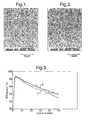
- A the cycle efficiency of various cells made in this way are shown for successive cycles, marked A.
- C the results are also shown for a comparative cell in which the anode was coated in exactly the same way but without having previously been cycled; this is marked C.
- the deterioration in cell efficiency over 50 charge and discharge cycles was from about 98.5% down to about 94.0% for the cells of the invention, and down to about 93.2% for the comparative cell.
- polymer coating may be different from that described in this example, and some other polymer coatings are described in subsequent
- a solution of vinylidene fluoride hexafluoropropylene copolymer with 6% hexafluoropropylene was prepared by dissolving 1 g of the copolymer in 3 g EC and 30 g DMC, this mixture being warmed to ensure dissolution; 0.4 g LiPF 6 was also dissolved in the mixture.
- a cycled tin electrode was then immersed in the polymer solution, and the solution exposed to vacuum for a period of 10 seconds to ensure any gases would escape from the cracks in the surface of the tin, so that the polymer would penetrate into any such cracks. The electrode was then removed, air dried, and then vacuum dried at room temperature for 16 hours. Thus a polymer coated electrode is formed, the polymer coating containing PVdF/HFP copolymer, EC plasticiser and lithium salt.
- Test cells were made exactly as in Example 1, and were cycled in the same way.
- a solution containing PVdF homopolymer was prepared by dissolving 5 g of the polymer and also 0.36 g LiBF 4 in a mixture of 15 g ethylene carbonate and 30 g dimethyl carbonate. The solution was warmed to ensure dissolution. As in Example 1, a cycled tin electrode was dipped into the polymer solution, removed, and the excess solution allowed to drain away. The electrode was vacuum dried overnight. Thus a polymer coated electrode is formed, the polymer coating containing PVdF polymer, EC plasticiser and lithium salt.
- Test cells were made in a similar way to those of Example 1, but in this case the electrolyte was ethylene carbonate/diethyl carbonate containing 1 M LiBF 4.
- a solution containing poly (ethylene oxide) was made by dissolving 2.7 g PEO and 0.8 g LiBF 4 in 47 g dimethyl carbonate and 14 g ethylene carbonate.
- a cycled tin electrode was dipped into the solution, removed, and the excess allowed to drain off. The electrode was vacuum dried overnight.
- the polymer coating contains PEO polymer, EC plasticiser and lithium salt.
- Test cells were made as in Example 3.
Landscapes
- Chemical & Material Sciences (AREA)
- Engineering & Computer Science (AREA)
- Chemical Kinetics & Catalysis (AREA)
- Electrochemistry (AREA)
- General Chemical & Material Sciences (AREA)
- Manufacturing & Machinery (AREA)
- Dispersion Chemistry (AREA)
- Materials Engineering (AREA)
- Secondary Cells (AREA)
- Battery Electrode And Active Subsutance (AREA)
Claims (10)
- Verfahren zur Herstellung einer Anode für eine Sekundär-Lithiumzelle mit den Verfahrensschritten des elektrochemischen Einbringens von Lithiumionen in eine Anode aus einem Material, das sich einer strukturellen Änderung unterzieht, wenn es erstmals aufgeladen und entladen wird, dann des elektrochemischen Entfernens der Lithiumionen und anschließenden Aufbringens einer Schicht aus polymerem Material auf das Material, das sich einer strukturellen Änderung unterzieht.
- Verfahren nach Anspruch 1 mit den Verfahrensschritten: Herstellung einer Anode aus einem Material, das sich einer strukturellen Änderung unterzieht, wenn es erstmals aufgeladen und entlanden wird; Zusammensetzung einer Zelle, die diese Anode und eine Lithiumionen enthaltende Kathode sowie ein Lithiumionen enthaltendes Elektrolyt aufweist; Hindurchleiten eines elektrischen Stromes durch die Zelle hindurch, um so Lithiumionen in das Material einzubringen, das sich einer strukturellen Änderung unterzieht, und so die Zelle aufzuladen, und dann Entladen der Zelle; Wegnahme der Anode von der Zelle und Reinigen der Oberfläche des Materials, welches sich einer strukturellen Änderung unterzieht; und Überziehen des einer strukturellen Änderung unterliegenden Materials mit einer ein polymeres Material aufweisenden Schicht.
- Verfahren nach Anspruch 2, bei dem die Oberfläche des Materials, welches einer strukturellen Änderung unterliegt, mit einer polymeres Material enthaltenden Lösung in Kontakt gebracht wird.
- Verfahren nach Anspruch 3, bei dem das einer strukturellen Änderung unerliegende, mit einer polymerisches Material enthaltenden Lösung überzogene Material einem verminderten Druck ausgesetzt wird, um ein Entfernen von Gas aus Oberflächenrissen zu unterstützen.
- Verfahren nach jedem der Ansprüche 2 bis 4, bei dem die Schicht aus polymerem Material außerdem ein Lithiumsalz enthält.
- Verfahren nach jedem der Ansprüche 2 bis 5, bei dem das polymere Material ein Homopolymer oder Kopolymer von Vinylidenfluorid ist.
- Verfahren nach dem der Ansprüche 1 bis 6, bei dem das einer strukturellen Änderung unterliegende Material Silizium oder Zinn ist.
- Verfahren nach Anspruch 7, bei dem das einer strukturellen Änderung unterliegende Material Zinn ist.
- Sekundär-Lithiumzelle mit einer durch ein Verfahren nach jedem der vorangehenden Ansprüche hergestellten überzogenen Anode.
- Apparatur mit einer Sekundär-Lithiumzelle nach Anspruch 9.
Applications Claiming Priority (3)
| Application Number | Priority Date | Filing Date | Title |
|---|---|---|---|
| GB0302834 | 2003-02-07 | ||
| GBGB0302834.7A GB0302834D0 (en) | 2003-02-07 | 2003-02-07 | Secondary cell with tin anode |
| PCT/GB2004/000208 WO2004070861A2 (en) | 2003-02-07 | 2004-01-16 | Secondary cell with polymer coated anode |
Publications (2)
| Publication Number | Publication Date |
|---|---|
| EP1590852A2 EP1590852A2 (de) | 2005-11-02 |
| EP1590852B1 true EP1590852B1 (de) | 2006-09-06 |
Family
ID=9952619
Family Applications (1)
| Application Number | Title | Priority Date | Filing Date |
|---|---|---|---|
| EP04702754A Expired - Lifetime EP1590852B1 (de) | 2003-02-07 | 2004-01-16 | Sekundärzelle mit polymerbeschichter anode |
Country Status (9)
| Country | Link |
|---|---|
| US (1) | US20060191794A1 (de) |
| EP (1) | EP1590852B1 (de) |
| JP (1) | JP4673289B2 (de) |
| KR (1) | KR101118482B1 (de) |
| AT (1) | ATE339015T1 (de) |
| DE (1) | DE602004002276T2 (de) |
| GB (1) | GB0302834D0 (de) |
| TW (1) | TWI360248B (de) |
| WO (1) | WO2004070861A2 (de) |
Families Citing this family (13)
| Publication number | Priority date | Publication date | Assignee | Title |
|---|---|---|---|---|
| JP5470696B2 (ja) * | 2007-10-31 | 2014-04-16 | ソニー株式会社 | リチウムイオン二次電池用負極およびリチウムイオン二次電池 |
| JP5343516B2 (ja) * | 2008-11-06 | 2013-11-13 | 株式会社豊田中央研究所 | リチウム2次電池用負極、リチウム2次電池及びリチウム2次電池用負極の製造方法 |
| US8247096B2 (en) * | 2009-02-13 | 2012-08-21 | Panasonic Corporation | Negative electrode for non-aqueous electrolyte secondary battery and non-aqueous electrolyte secondary battery |
| KR101177995B1 (ko) * | 2009-02-27 | 2012-08-29 | 파나소닉 주식회사 | 비수 전해질 이차전지용 음극 및 비수 전해질 이차전지 |
| US8658313B2 (en) * | 2009-09-30 | 2014-02-25 | Semiconductor Energy Laboratory Co., Ltd. | Method for manufacturing electrode, and method for manufacturing power storage device and power generation and storage device having the electrode |
| JP5655494B2 (ja) * | 2010-10-19 | 2015-01-21 | 日産自動車株式会社 | 電極製造方法及び電極の補修剤 |
| JP2014160540A (ja) * | 2011-06-16 | 2014-09-04 | Panasonic Corp | リチウムイオン二次電池用負極とその製造法、およびその負極を用いたリチウムイオン二次電池 |
| TWI494350B (zh) | 2013-09-26 | 2015-08-01 | Univ Nat Taiwan Science Tech | 寡聚物高分子的製備方法及鋰電池 |
| KR102781734B1 (ko) | 2015-03-30 | 2025-03-13 | 에스이에스 홀딩스 피티이. 엘티디. | 배터리 애플리케이션에서의 리튬 금속 애노드를 위한 복합 코팅 시스템 및 방법 |
| WO2016205653A1 (en) | 2015-06-19 | 2016-12-22 | SolidEnergy Systems | Multi-layer polymer coated li anode for high density li metal battery |
| US10897040B2 (en) | 2016-09-30 | 2021-01-19 | Lg Chem, Ltd. | Anode having double-protection layer formed thereon for lithium secondary battery, and lithium secondary battery comprising same |
| CN112106234B (zh) * | 2017-07-28 | 2024-03-08 | 纽约城市大学研究基金会 | 用于使二氧化锰及其多晶型物可逆的方法 |
| EP3840086A1 (de) * | 2019-12-20 | 2021-06-23 | Arkema France | Alkalimetall-elektroden und verfahren zu ihrer herstellung |
Family Cites Families (15)
| Publication number | Priority date | Publication date | Assignee | Title |
|---|---|---|---|---|
| US3445288A (en) * | 1966-01-03 | 1969-05-20 | Standard Oil Co | Aluminum anode electrical energy storage device |
| US3770506A (en) * | 1969-03-20 | 1973-11-06 | Standard Oil Co | Electrical energy storage device containing a tellurium additive |
| US4981672A (en) * | 1983-06-27 | 1991-01-01 | Voltaix, Inc. | Composite coating for electrochemical electrode and method |
| US5296318A (en) * | 1993-03-05 | 1994-03-22 | Bell Communications Research, Inc. | Rechargeable lithium intercalation battery with hybrid polymeric electrolyte |
| US5342710A (en) * | 1993-03-30 | 1994-08-30 | Valence Technology, Inc. | Lakyer for stabilization of lithium anode |
| DE69516351T2 (de) * | 1994-09-21 | 2000-12-07 | Matsushita Electric Industrial Co., Ltd. | Sekundäre Lithium Feststoffbatterie |
| JPH0969362A (ja) * | 1995-06-23 | 1997-03-11 | Hitachi Ltd | 二次電池及び二次電池を用いた電源 |
| US5759715A (en) * | 1995-09-26 | 1998-06-02 | Valence Technology, Inc. | Lithium ion batteries containing pre-lithiated electrodes |
| WO1998031064A1 (en) * | 1997-01-10 | 1998-07-16 | Motorola Inc. | Polymer electrolyte solvent for electrochemical cell |
| JP2948205B1 (ja) * | 1998-05-25 | 1999-09-13 | 花王株式会社 | 二次電池用負極の製造方法 |
| JP4393610B2 (ja) * | 1999-01-26 | 2010-01-06 | 日本コークス工業株式会社 | リチウム二次電池用負極材料、リチウム二次電池、及び同二次電池の充電方法 |
| JP2001176497A (ja) * | 1999-12-15 | 2001-06-29 | Sanyo Electric Co Ltd | 非水電解質二次電池 |
| WO2002099920A2 (en) * | 2001-06-05 | 2002-12-12 | Aea Technology Battery Systems Limited | Electrochemical cell production |
| JP4614625B2 (ja) * | 2002-09-30 | 2011-01-19 | 三洋電機株式会社 | リチウム二次電池の製造方法 |
| US20040253510A1 (en) * | 2003-06-04 | 2004-12-16 | Polyplus Battery Company | Aliovalent protective layers for active metal anodes |
-
2003
- 2003-02-07 GB GBGB0302834.7A patent/GB0302834D0/en not_active Ceased
-
2004
- 2004-01-16 AT AT04702754T patent/ATE339015T1/de not_active IP Right Cessation
- 2004-01-16 WO PCT/GB2004/000208 patent/WO2004070861A2/en not_active Ceased
- 2004-01-16 EP EP04702754A patent/EP1590852B1/de not_active Expired - Lifetime
- 2004-01-16 US US10/543,418 patent/US20060191794A1/en not_active Abandoned
- 2004-01-16 KR KR1020057014437A patent/KR101118482B1/ko not_active Expired - Fee Related
- 2004-01-16 JP JP2006502192A patent/JP4673289B2/ja not_active Expired - Fee Related
- 2004-01-16 DE DE602004002276T patent/DE602004002276T2/de not_active Expired - Lifetime
- 2004-02-04 TW TW093102488A patent/TWI360248B/zh not_active IP Right Cessation
Also Published As
| Publication number | Publication date |
|---|---|
| TW200423449A (en) | 2004-11-01 |
| EP1590852A2 (de) | 2005-11-02 |
| WO2004070861A3 (en) | 2005-03-31 |
| KR20050100658A (ko) | 2005-10-19 |
| US20060191794A1 (en) | 2006-08-31 |
| JP2006517719A (ja) | 2006-07-27 |
| TWI360248B (en) | 2012-03-11 |
| DE602004002276T2 (de) | 2007-10-04 |
| KR101118482B1 (ko) | 2012-03-12 |
| JP4673289B2 (ja) | 2011-04-20 |
| DE602004002276D1 (de) | 2006-10-19 |
| GB0302834D0 (en) | 2003-03-12 |
| ATE339015T1 (de) | 2006-09-15 |
| WO2004070861A2 (en) | 2004-08-19 |
Similar Documents
| Publication | Publication Date | Title |
|---|---|---|
| US6924065B2 (en) | Separators for winding-type lithium secondary batteries having gel-type polymer electrolytes and manufacturing method for the same | |
| US6610109B2 (en) | Method of manufacturing lithium secondary cell | |
| CN1168172C (zh) | 非水电解质蓄电池及其制造方法 | |
| US7422826B2 (en) | In situ thermal polymerization method for making gel polymer lithium ion rechargeable electrochemical cells | |
| US20040029008A1 (en) | Method for producing rechargeable lithium-polymer batteries and a battery produced according to said method | |
| JP4276816B2 (ja) | リチウム電池の製造方法 | |
| JP2000331710A (ja) | 再充電可能な電気化学電池の非水性電解液のホスフェート添加剤 | |
| KR100825820B1 (ko) | 2 차 전지용 비수계 전해액 및 비수계 전해액 2 차 전지 | |
| KR20050118214A (ko) | 2 차 전지용 비수계 전해액 및 비수계 전해질 2 차 전지 | |
| EP1590852B1 (de) | Sekundärzelle mit polymerbeschichter anode | |
| CN101743678A (zh) | 锂离子电池的充电 | |
| JP2000067914A (ja) | 再充電可能な電気化学電池の低温度での放電のための非水性有機電解液 | |
| JP2004146348A (ja) | リチウム二次電池用負極及びこれを含むリチウム二次電池 | |
| JPH0896849A (ja) | 非水電解質二次電池 | |
| WO2022217067A9 (en) | Lithium metal battery and method of forming | |
| JP3664560B2 (ja) | リチウム2次電池 | |
| US5772702A (en) | Method of preparing electrochemical cells | |
| KR102871930B1 (ko) | 리튬전지용 리튬금속 음극재 | |
| US20020172859A1 (en) | Polymer electrolyte precursor having improved impedence | |
| JP2000195522A (ja) | 非水電解質二次電池 | |
| WO2021100272A1 (ja) | 二次電池及びその製造方法 | |
| KR100475697B1 (ko) | 충전용리튬2차전지의제조방법 | |
| KR20210080030A (ko) | 리튬 금속 음극의 제조 방법, 이에 따라 제조된 리튬 금속 음극, 및 이를 포함하는 리튬 이차 전지 | |
| JP2000323121A (ja) | 非水電解質二次電池とその製造方法 | |
| KR20210080086A (ko) | 리튬 이차 전지용 음극의 제조 방법과 이에 따라 제조된 음극 및 이를 포함하는 리튬 이차 전지 |
Legal Events
| Date | Code | Title | Description |
|---|---|---|---|
| PUAI | Public reference made under article 153(3) epc to a published international application that has entered the european phase |
Free format text: ORIGINAL CODE: 0009012 |
|
| 17P | Request for examination filed |
Effective date: 20050707 |
|
| AK | Designated contracting states |
Kind code of ref document: A2 Designated state(s): AT BE BG CH CY CZ DE DK EE ES FI FR GB GR HU IE IT LI LU MC NL PT RO SE SI SK TR |
|
| AX | Request for extension of the european patent |
Extension state: AL LT LV MK |
|
| GRAP | Despatch of communication of intention to grant a patent |
Free format text: ORIGINAL CODE: EPIDOSNIGR1 |
|
| DAX | Request for extension of the european patent (deleted) | ||
| RAP1 | Party data changed (applicant data changed or rights of an application transferred) |
Owner name: ABSL POWER SOLUTIONS LTD |
|
| GRAS | Grant fee paid |
Free format text: ORIGINAL CODE: EPIDOSNIGR3 |
|
| GRAA | (expected) grant |
Free format text: ORIGINAL CODE: 0009210 |
|
| AK | Designated contracting states |
Kind code of ref document: B1 Designated state(s): AT BE BG CH CY CZ DE DK EE ES FI FR GB GR HU IE IT LI LU MC NL PT RO SE SI SK TR |
|
| PG25 | Lapsed in a contracting state [announced via postgrant information from national office to epo] |
Ref country code: IT Free format text: LAPSE BECAUSE OF FAILURE TO SUBMIT A TRANSLATION OF THE DESCRIPTION OR TO PAY THE FEE WITHIN THE PRESCRIBED TIME-LIMIT;WARNING: LAPSES OF ITALIAN PATENTS WITH EFFECTIVE DATE BEFORE 2007 MAY HAVE OCCURRED AT ANY TIME BEFORE 2007. THE CORRECT EFFECTIVE DATE MAY BE DIFFERENT FROM THE ONE RECORDED. Effective date: 20060906 Ref country code: NL Free format text: LAPSE BECAUSE OF FAILURE TO SUBMIT A TRANSLATION OF THE DESCRIPTION OR TO PAY THE FEE WITHIN THE PRESCRIBED TIME-LIMIT Effective date: 20060906 Ref country code: SI Free format text: LAPSE BECAUSE OF FAILURE TO SUBMIT A TRANSLATION OF THE DESCRIPTION OR TO PAY THE FEE WITHIN THE PRESCRIBED TIME-LIMIT Effective date: 20060906 Ref country code: BE Free format text: LAPSE BECAUSE OF FAILURE TO SUBMIT A TRANSLATION OF THE DESCRIPTION OR TO PAY THE FEE WITHIN THE PRESCRIBED TIME-LIMIT Effective date: 20060906 Ref country code: SK Free format text: LAPSE BECAUSE OF FAILURE TO SUBMIT A TRANSLATION OF THE DESCRIPTION OR TO PAY THE FEE WITHIN THE PRESCRIBED TIME-LIMIT Effective date: 20060906 Ref country code: AT Free format text: LAPSE BECAUSE OF FAILURE TO SUBMIT A TRANSLATION OF THE DESCRIPTION OR TO PAY THE FEE WITHIN THE PRESCRIBED TIME-LIMIT Effective date: 20060906 Ref country code: CH Free format text: LAPSE BECAUSE OF FAILURE TO SUBMIT A TRANSLATION OF THE DESCRIPTION OR TO PAY THE FEE WITHIN THE PRESCRIBED TIME-LIMIT Effective date: 20060906 Ref country code: FI Free format text: LAPSE BECAUSE OF FAILURE TO SUBMIT A TRANSLATION OF THE DESCRIPTION OR TO PAY THE FEE WITHIN THE PRESCRIBED TIME-LIMIT Effective date: 20060906 Ref country code: RO Free format text: LAPSE BECAUSE OF FAILURE TO SUBMIT A TRANSLATION OF THE DESCRIPTION OR TO PAY THE FEE WITHIN THE PRESCRIBED TIME-LIMIT Effective date: 20060906 Ref country code: LI Free format text: LAPSE BECAUSE OF FAILURE TO SUBMIT A TRANSLATION OF THE DESCRIPTION OR TO PAY THE FEE WITHIN THE PRESCRIBED TIME-LIMIT Effective date: 20060906 Ref country code: CZ Free format text: LAPSE BECAUSE OF FAILURE TO SUBMIT A TRANSLATION OF THE DESCRIPTION OR TO PAY THE FEE WITHIN THE PRESCRIBED TIME-LIMIT Effective date: 20060906 |
|
| REG | Reference to a national code |
Ref country code: GB Ref legal event code: FG4D |
|
| REG | Reference to a national code |
Ref country code: CH Ref legal event code: EP |
|
| REG | Reference to a national code |
Ref country code: IE Ref legal event code: FG4D |
|
| REF | Corresponds to: |
Ref document number: 602004002276 Country of ref document: DE Date of ref document: 20061019 Kind code of ref document: P |
|
| PG25 | Lapsed in a contracting state [announced via postgrant information from national office to epo] |
Ref country code: BG Free format text: LAPSE BECAUSE OF FAILURE TO SUBMIT A TRANSLATION OF THE DESCRIPTION OR TO PAY THE FEE WITHIN THE PRESCRIBED TIME-LIMIT Effective date: 20061206 Ref country code: SE Free format text: LAPSE BECAUSE OF FAILURE TO SUBMIT A TRANSLATION OF THE DESCRIPTION OR TO PAY THE FEE WITHIN THE PRESCRIBED TIME-LIMIT Effective date: 20061206 Ref country code: DK Free format text: LAPSE BECAUSE OF FAILURE TO SUBMIT A TRANSLATION OF THE DESCRIPTION OR TO PAY THE FEE WITHIN THE PRESCRIBED TIME-LIMIT Effective date: 20061206 |
|
| PG25 | Lapsed in a contracting state [announced via postgrant information from national office to epo] |
Ref country code: ES Free format text: LAPSE BECAUSE OF FAILURE TO SUBMIT A TRANSLATION OF THE DESCRIPTION OR TO PAY THE FEE WITHIN THE PRESCRIBED TIME-LIMIT Effective date: 20061217 |
|
| PG25 | Lapsed in a contracting state [announced via postgrant information from national office to epo] |
Ref country code: IE Free format text: LAPSE BECAUSE OF NON-PAYMENT OF DUE FEES Effective date: 20070116 |
|
| ET | Fr: translation filed | ||
| PG25 | Lapsed in a contracting state [announced via postgrant information from national office to epo] |
Ref country code: MC Free format text: LAPSE BECAUSE OF NON-PAYMENT OF DUE FEES Effective date: 20070131 |
|
| PG25 | Lapsed in a contracting state [announced via postgrant information from national office to epo] |
Ref country code: PT Free format text: LAPSE BECAUSE OF FAILURE TO SUBMIT A TRANSLATION OF THE DESCRIPTION OR TO PAY THE FEE WITHIN THE PRESCRIBED TIME-LIMIT Effective date: 20070219 |
|
| NLV1 | Nl: lapsed or annulled due to failure to fulfill the requirements of art. 29p and 29m of the patents act | ||
| REG | Reference to a national code |
Ref country code: CH Ref legal event code: PL |
|
| PLBE | No opposition filed within time limit |
Free format text: ORIGINAL CODE: 0009261 |
|
| STAA | Information on the status of an ep patent application or granted ep patent |
Free format text: STATUS: NO OPPOSITION FILED WITHIN TIME LIMIT |
|
| 26N | No opposition filed |
Effective date: 20070607 |
|
| PG25 | Lapsed in a contracting state [announced via postgrant information from national office to epo] |
Ref country code: GR Free format text: LAPSE BECAUSE OF FAILURE TO SUBMIT A TRANSLATION OF THE DESCRIPTION OR TO PAY THE FEE WITHIN THE PRESCRIBED TIME-LIMIT Effective date: 20061207 |
|
| PG25 | Lapsed in a contracting state [announced via postgrant information from national office to epo] |
Ref country code: EE Free format text: LAPSE BECAUSE OF FAILURE TO SUBMIT A TRANSLATION OF THE DESCRIPTION OR TO PAY THE FEE WITHIN THE PRESCRIBED TIME-LIMIT Effective date: 20060906 |
|
| REG | Reference to a national code |
Ref country code: GB Ref legal event code: 732E |
|
| REG | Reference to a national code |
Ref country code: FR Ref legal event code: TP |
|
| PG25 | Lapsed in a contracting state [announced via postgrant information from national office to epo] |
Ref country code: CY Free format text: LAPSE BECAUSE OF FAILURE TO SUBMIT A TRANSLATION OF THE DESCRIPTION OR TO PAY THE FEE WITHIN THE PRESCRIBED TIME-LIMIT Effective date: 20060906 Ref country code: LU Free format text: LAPSE BECAUSE OF NON-PAYMENT OF DUE FEES Effective date: 20070116 |
|
| PG25 | Lapsed in a contracting state [announced via postgrant information from national office to epo] |
Ref country code: TR Free format text: LAPSE BECAUSE OF FAILURE TO SUBMIT A TRANSLATION OF THE DESCRIPTION OR TO PAY THE FEE WITHIN THE PRESCRIBED TIME-LIMIT Effective date: 20060906 Ref country code: HU Free format text: LAPSE BECAUSE OF FAILURE TO SUBMIT A TRANSLATION OF THE DESCRIPTION OR TO PAY THE FEE WITHIN THE PRESCRIBED TIME-LIMIT Effective date: 20070307 |
|
| REG | Reference to a national code |
Ref country code: GB Ref legal event code: 732E Free format text: REGISTERED BETWEEN 20090910 AND 20090916 |
|
| REG | Reference to a national code |
Ref country code: FR Ref legal event code: TP |
|
| REG | Reference to a national code |
Ref country code: GB Ref legal event code: 732E Free format text: REGISTERED BETWEEN 20110217 AND 20110223 |
|
| REG | Reference to a national code |
Ref country code: FR Ref legal event code: PLFP Year of fee payment: 13 |
|
| REG | Reference to a national code |
Ref country code: FR Ref legal event code: PLFP Year of fee payment: 14 |
|
| REG | Reference to a national code |
Ref country code: FR Ref legal event code: PLFP Year of fee payment: 15 |
|
| PGFP | Annual fee paid to national office [announced via postgrant information from national office to epo] |
Ref country code: DE Payment date: 20180131 Year of fee payment: 15 Ref country code: GB Payment date: 20180207 Year of fee payment: 15 |
|
| PGFP | Annual fee paid to national office [announced via postgrant information from national office to epo] |
Ref country code: FR Payment date: 20180130 Year of fee payment: 15 |
|
| REG | Reference to a national code |
Ref country code: DE Ref legal event code: R119 Ref document number: 602004002276 Country of ref document: DE |
|
| GBPC | Gb: european patent ceased through non-payment of renewal fee |
Effective date: 20190116 |
|
| PG25 | Lapsed in a contracting state [announced via postgrant information from national office to epo] |
Ref country code: FR Free format text: LAPSE BECAUSE OF NON-PAYMENT OF DUE FEES Effective date: 20190131 Ref country code: DE Free format text: LAPSE BECAUSE OF NON-PAYMENT OF DUE FEES Effective date: 20190801 |
|
| PG25 | Lapsed in a contracting state [announced via postgrant information from national office to epo] |
Ref country code: GB Free format text: LAPSE BECAUSE OF NON-PAYMENT OF DUE FEES Effective date: 20190116 |