EP1590491B1 - Addukte auf basis cyclischer verbindungen und ihre verwendung als gerbstoffe und konservierungsmittel - Google Patents
Addukte auf basis cyclischer verbindungen und ihre verwendung als gerbstoffe und konservierungsmittel Download PDFInfo
- Publication number
- EP1590491B1 EP1590491B1 EP04703789A EP04703789A EP1590491B1 EP 1590491 B1 EP1590491 B1 EP 1590491B1 EP 04703789 A EP04703789 A EP 04703789A EP 04703789 A EP04703789 A EP 04703789A EP 1590491 B1 EP1590491 B1 EP 1590491B1
- Authority
- EP
- European Patent Office
- Prior art keywords
- butyl
- iso
- substituted
- unsubstituted
- alkyl
- Prior art date
- Legal status (The legal status is an assumption and is not a legal conclusion. Google has not performed a legal analysis and makes no representation as to the accuracy of the status listed.)
- Expired - Lifetime
Links
- 150000001923 cyclic compounds Chemical class 0.000 title claims abstract description 9
- 125000004400 (C1-C12) alkyl group Chemical group 0.000 claims abstract description 17
- 229910052739 hydrogen Inorganic materials 0.000 claims abstract description 17
- 239000001257 hydrogen Substances 0.000 claims abstract description 17
- 125000005915 C6-C14 aryl group Chemical group 0.000 claims abstract description 15
- 150000001728 carbonyl compounds Chemical class 0.000 claims abstract description 15
- 229910052760 oxygen Inorganic materials 0.000 claims abstract description 7
- 239000001301 oxygen Substances 0.000 claims abstract description 7
- QVGXLLKOCUKJST-UHFFFAOYSA-N atomic oxygen Chemical compound [O] QVGXLLKOCUKJST-UHFFFAOYSA-N 0.000 claims abstract description 6
- 125000002485 formyl group Chemical group [H]C(*)=O 0.000 claims abstract description 6
- NINIDFKCEFEMDL-UHFFFAOYSA-N Sulfur Chemical compound [S] NINIDFKCEFEMDL-UHFFFAOYSA-N 0.000 claims abstract description 5
- 229910052717 sulfur Inorganic materials 0.000 claims abstract description 4
- 239000011593 sulfur Substances 0.000 claims abstract description 4
- 238000000034 method Methods 0.000 claims description 50
- 239000000203 mixture Substances 0.000 claims description 35
- 239000010985 leather Substances 0.000 claims description 23
- 238000004519 manufacturing process Methods 0.000 claims description 18
- 238000003860 storage Methods 0.000 claims description 17
- 239000011265 semifinished product Substances 0.000 claims description 16
- 239000006227 byproduct Substances 0.000 claims description 15
- 238000002360 preparation method Methods 0.000 claims description 14
- 238000006243 chemical reaction Methods 0.000 claims description 13
- VYPSYNLAJGMNEJ-UHFFFAOYSA-N Silicium dioxide Chemical compound O=[Si]=O VYPSYNLAJGMNEJ-UHFFFAOYSA-N 0.000 claims description 11
- 150000002431 hydrogen Chemical class 0.000 claims description 11
- UFHFLCQGNIYNRP-UHFFFAOYSA-N Hydrogen Chemical compound [H][H] UFHFLCQGNIYNRP-UHFFFAOYSA-N 0.000 claims description 9
- 230000002378 acidificating effect Effects 0.000 claims description 8
- 239000000654 additive Substances 0.000 claims description 8
- 239000004480 active ingredient Substances 0.000 claims description 7
- 230000015572 biosynthetic process Effects 0.000 claims description 7
- 239000002798 polar solvent Substances 0.000 claims description 6
- 239000000377 silicon dioxide Substances 0.000 claims description 5
- 239000003755 preservative agent Substances 0.000 claims description 4
- 229920002472 Starch Polymers 0.000 claims description 3
- 229910052782 aluminium Inorganic materials 0.000 claims description 3
- XAGFODPZIPBFFR-UHFFFAOYSA-N aluminium Chemical compound [Al] XAGFODPZIPBFFR-UHFFFAOYSA-N 0.000 claims description 3
- 229910052615 phyllosilicate Inorganic materials 0.000 claims description 3
- 229910052710 silicon Inorganic materials 0.000 claims description 3
- 239000010703 silicon Substances 0.000 claims description 3
- 239000008107 starch Substances 0.000 claims description 3
- 235000019698 starch Nutrition 0.000 claims description 3
- 239000000843 powder Substances 0.000 claims 5
- NPDLYUOYAGBHFB-WDSKDSINSA-N Asn-Arg Chemical group NC(=O)C[C@H](N)C(=O)N[C@H](C(O)=O)CCCN=C(N)N NPDLYUOYAGBHFB-WDSKDSINSA-N 0.000 claims 2
- 230000002335 preservative effect Effects 0.000 claims 2
- 230000000996 additive effect Effects 0.000 claims 1
- PNEYBMLMFCGWSK-UHFFFAOYSA-N aluminium oxide Inorganic materials [O-2].[O-2].[O-2].[Al+3].[Al+3] PNEYBMLMFCGWSK-UHFFFAOYSA-N 0.000 claims 1
- 238000001694 spray drying Methods 0.000 claims 1
- 125000003710 aryl alkyl group Chemical group 0.000 abstract description 10
- 125000004435 hydrogen atom Chemical class [H]* 0.000 abstract 4
- -1 methyl acetal Chemical class 0.000 description 396
- 125000001972 isopentyl group Chemical group [H]C([H])([H])C([H])(C([H])([H])[H])C([H])([H])C([H])([H])* 0.000 description 44
- 125000002496 methyl group Chemical group [H]C([H])([H])* 0.000 description 44
- 125000001495 ethyl group Chemical group [H]C([H])([H])C([H])([H])* 0.000 description 33
- 125000000959 isobutyl group Chemical group [H]C([H])([H])C([H])(C([H])([H])[H])C([H])([H])* 0.000 description 33
- 125000001449 isopropyl group Chemical group [H]C([H])([H])C([H])(*)C([H])([H])[H] 0.000 description 33
- 125000004108 n-butyl group Chemical group [H]C([H])([H])C([H])([H])C([H])([H])C([H])([H])* 0.000 description 33
- 125000004123 n-propyl group Chemical group [H]C([H])([H])C([H])([H])C([H])([H])* 0.000 description 33
- CSCPPACGZOOCGX-UHFFFAOYSA-N Acetone Chemical compound CC(C)=O CSCPPACGZOOCGX-UHFFFAOYSA-N 0.000 description 30
- 125000003542 3-methylbutan-2-yl group Chemical group [H]C([H])([H])C([H])(*)C([H])(C([H])([H])[H])C([H])([H])[H] 0.000 description 22
- 125000004491 isohexyl group Chemical group C(CCC(C)C)* 0.000 description 22
- 125000001280 n-hexyl group Chemical group C(CCCCC)* 0.000 description 22
- 125000000740 n-pentyl group Chemical group [H]C([H])([H])C([H])([H])C([H])([H])C([H])([H])C([H])([H])* 0.000 description 22
- 125000001971 neopentyl group Chemical group [H]C([*])([H])C(C([H])([H])[H])(C([H])([H])[H])C([H])([H])[H] 0.000 description 22
- HEMHJVSKTPXQMS-UHFFFAOYSA-M Sodium hydroxide Chemical compound [OH-].[Na+] HEMHJVSKTPXQMS-UHFFFAOYSA-M 0.000 description 21
- 239000003795 chemical substances by application Substances 0.000 description 21
- 125000001997 phenyl group Chemical group [H]C1=C([H])C([H])=C(*)C([H])=C1[H] 0.000 description 18
- 125000002914 sec-butyl group Chemical group [H]C([H])([H])C([H])([H])C([H])(*)C([H])([H])[H] 0.000 description 18
- 125000000999 tert-butyl group Chemical group [H]C([H])([H])C(*)(C([H])([H])[H])C([H])([H])[H] 0.000 description 18
- 239000000243 solution Substances 0.000 description 16
- XLYOFNOQVPJJNP-UHFFFAOYSA-N water Substances O XLYOFNOQVPJJNP-UHFFFAOYSA-N 0.000 description 15
- WSFSSNUMVMOOMR-UHFFFAOYSA-N Formaldehyde Chemical compound O=C WSFSSNUMVMOOMR-UHFFFAOYSA-N 0.000 description 14
- 125000001797 benzyl group Chemical group [H]C1=C([H])C([H])=C(C([H])=C1[H])C([H])([H])* 0.000 description 14
- 125000000582 cycloheptyl group Chemical group [H]C1([H])C([H])([H])C([H])([H])C([H])([H])C([H])(*)C([H])([H])C1([H])[H] 0.000 description 14
- 125000000113 cyclohexyl group Chemical group [H]C1([H])C([H])([H])C([H])([H])C([H])(*)C([H])([H])C1([H])[H] 0.000 description 14
- 125000001511 cyclopentyl group Chemical group [H]C1([H])C([H])([H])C([H])([H])C([H])(*)C1([H])[H] 0.000 description 14
- 125000001637 1-naphthyl group Chemical group [H]C1=C([H])C([H])=C2C(*)=C([H])C([H])=C([H])C2=C1[H] 0.000 description 12
- 125000001622 2-naphthyl group Chemical group [H]C1=C([H])C([H])=C2C([H])=C(*)C([H])=C([H])C2=C1[H] 0.000 description 12
- VYZAMTAEIAYCRO-UHFFFAOYSA-N Chromium Chemical compound [Cr] VYZAMTAEIAYCRO-UHFFFAOYSA-N 0.000 description 12
- 239000000047 product Substances 0.000 description 12
- 125000003229 2-methylhexyl group Chemical group [H]C([H])([H])C([H])([H])C([H])([H])C([H])([H])C([H])(C([H])([H])[H])C([H])([H])* 0.000 description 11
- 125000003136 n-heptyl group Chemical group [H]C([H])([H])C([H])([H])C([H])([H])C([H])([H])C([H])([H])C([H])([H])C([H])([H])* 0.000 description 11
- BDAGIHXWWSANSR-UHFFFAOYSA-N methanoic acid Natural products OC=O BDAGIHXWWSANSR-UHFFFAOYSA-N 0.000 description 10
- 125000001147 pentyl group Chemical group C(CCCC)* 0.000 description 10
- SXRSQZLOMIGNAQ-UHFFFAOYSA-N Glutaraldehyde Chemical compound O=CCCCC=O SXRSQZLOMIGNAQ-UHFFFAOYSA-N 0.000 description 8
- 229960000587 glutaral Drugs 0.000 description 8
- XCYWUZHUTJDTGS-UHFFFAOYSA-N 2-methoxy-3,4-dihydro-2h-pyran Chemical compound COC1CCC=CO1 XCYWUZHUTJDTGS-UHFFFAOYSA-N 0.000 description 7
- 125000003890 2-phenylbutyl group Chemical group [H]C1=C([H])C([H])=C(C([H])=C1[H])C([H])(C([H])([H])*)C([H])([H])C([H])([H])[H] 0.000 description 7
- 125000006201 3-phenylpropyl group Chemical group [H]C1=C([H])C([H])=C(C([H])=C1[H])C([H])([H])C([H])([H])C([H])([H])* 0.000 description 7
- 241001465754 Metazoa Species 0.000 description 7
- 125000003118 aryl group Chemical group 0.000 description 7
- 230000000052 comparative effect Effects 0.000 description 7
- 125000001995 cyclobutyl group Chemical group [H]C1([H])C([H])([H])C([H])(*)C1([H])[H] 0.000 description 7
- 125000006547 cyclononyl group Chemical group [H]C1([H])C([H])([H])C([H])([H])C([H])([H])C([H])([H])C([H])(*)C([H])([H])C([H])([H])C1([H])[H] 0.000 description 7
- 125000000640 cyclooctyl group Chemical group [H]C1([H])C([H])([H])C([H])([H])C([H])([H])C([H])(*)C([H])([H])C([H])([H])C1([H])[H] 0.000 description 7
- 125000001559 cyclopropyl group Chemical group [H]C1([H])C([H])([H])C1([H])* 0.000 description 7
- 238000009826 distribution Methods 0.000 description 7
- KSCFJBIXMNOVSH-UHFFFAOYSA-N dyphylline Chemical group O=C1N(C)C(=O)N(C)C2=C1N(CC(O)CO)C=N2 KSCFJBIXMNOVSH-UHFFFAOYSA-N 0.000 description 7
- 238000002474 experimental method Methods 0.000 description 7
- MNCMBBIFTVWHIP-UHFFFAOYSA-N 1-anthracen-9-yl-2,2,2-trifluoroethanone Chemical group C1=CC=C2C(C(=O)C(F)(F)F)=C(C=CC=C3)C3=CC2=C1 MNCMBBIFTVWHIP-UHFFFAOYSA-N 0.000 description 6
- ZWEHNKRNPOVVGH-UHFFFAOYSA-N 2-Butanone Chemical compound CCC(C)=O ZWEHNKRNPOVVGH-UHFFFAOYSA-N 0.000 description 6
- WKBOTKDWSSQWDR-UHFFFAOYSA-N Bromine atom Chemical compound [Br] WKBOTKDWSSQWDR-UHFFFAOYSA-N 0.000 description 6
- ZAMOUSCENKQFHK-UHFFFAOYSA-N Chlorine atom Chemical compound [Cl] ZAMOUSCENKQFHK-UHFFFAOYSA-N 0.000 description 6
- PEDCQBHIVMGVHV-UHFFFAOYSA-N Glycerine Chemical compound OCC(O)CO PEDCQBHIVMGVHV-UHFFFAOYSA-N 0.000 description 6
- AFVFQIVMOAPDHO-UHFFFAOYSA-N Methanesulfonic acid Chemical compound CS(O)(=O)=O AFVFQIVMOAPDHO-UHFFFAOYSA-N 0.000 description 6
- NBIIXXVUZAFLBC-UHFFFAOYSA-N Phosphoric acid Chemical compound OP(O)(O)=O NBIIXXVUZAFLBC-UHFFFAOYSA-N 0.000 description 6
- QAOWNCQODCNURD-UHFFFAOYSA-N Sulfuric acid Chemical compound OS(O)(=O)=O QAOWNCQODCNURD-UHFFFAOYSA-N 0.000 description 6
- 125000002777 acetyl group Chemical group [H]C([H])([H])C(*)=O 0.000 description 6
- 150000001298 alcohols Chemical class 0.000 description 6
- 125000002078 anthracen-1-yl group Chemical group [H]C1=C([H])C([H])=C2C([H])=C3C([*])=C([H])C([H])=C([H])C3=C([H])C2=C1[H] 0.000 description 6
- 125000000748 anthracen-2-yl group Chemical group [H]C1=C([H])C([H])=C2C([H])=C3C([H])=C([*])C([H])=C([H])C3=C([H])C2=C1[H] 0.000 description 6
- 125000003236 benzoyl group Chemical group [H]C1=C([H])C([H])=C(C([H])=C1[H])C(*)=O 0.000 description 6
- 229910052804 chromium Inorganic materials 0.000 description 6
- 239000011651 chromium Substances 0.000 description 6
- 125000000753 cycloalkyl group Chemical group 0.000 description 6
- 238000004821 distillation Methods 0.000 description 6
- 125000004178 (C1-C4) alkyl group Chemical group 0.000 description 5
- 125000004169 (C1-C6) alkyl group Chemical group 0.000 description 5
- 150000001875 compounds Chemical class 0.000 description 5
- 239000002245 particle Substances 0.000 description 5
- 150000003254 radicals Chemical group 0.000 description 5
- 125000001088 1-naphthoyl group Chemical group C1(=CC=CC2=CC=CC=C12)C(=O)* 0.000 description 4
- 125000001216 2-naphthoyl group Chemical group C1=C(C=CC2=CC=CC=C12)C(=O)* 0.000 description 4
- WEVYAHXRMPXWCK-UHFFFAOYSA-N Acetonitrile Chemical compound CC#N WEVYAHXRMPXWCK-UHFFFAOYSA-N 0.000 description 4
- PXGOKWXKJXAPGV-UHFFFAOYSA-N Fluorine Chemical compound FF PXGOKWXKJXAPGV-UHFFFAOYSA-N 0.000 description 4
- 125000000217 alkyl group Chemical group 0.000 description 4
- GDTBXPJZTBHREO-UHFFFAOYSA-N bromine Substances BrBr GDTBXPJZTBHREO-UHFFFAOYSA-N 0.000 description 4
- 229910052794 bromium Inorganic materials 0.000 description 4
- 239000003054 catalyst Substances 0.000 description 4
- 239000000460 chlorine Substances 0.000 description 4
- 229910052801 chlorine Inorganic materials 0.000 description 4
- 125000006640 cycloheptyl carbonyl group Chemical group 0.000 description 4
- 125000006639 cyclohexyl carbonyl group Chemical group 0.000 description 4
- 125000006638 cyclopentyl carbonyl group Chemical group 0.000 description 4
- PNDPGZBMCMUPRI-UHFFFAOYSA-N iodine Chemical compound II PNDPGZBMCMUPRI-UHFFFAOYSA-N 0.000 description 4
- 125000006606 n-butoxy group Chemical group 0.000 description 4
- 125000003884 phenylalkyl group Chemical group 0.000 description 4
- 125000001501 propionyl group Chemical group O=C([*])C([H])([H])C([H])([H])[H] 0.000 description 4
- 238000010992 reflux Methods 0.000 description 4
- 239000000523 sample Substances 0.000 description 4
- 239000002904 solvent Substances 0.000 description 4
- 125000005346 substituted cycloalkyl group Chemical group 0.000 description 4
- 238000004383 yellowing Methods 0.000 description 4
- OSWFIVFLDKOXQC-UHFFFAOYSA-N 4-(3-methoxyphenyl)aniline Chemical compound COC1=CC=CC(C=2C=CC(N)=CC=2)=C1 OSWFIVFLDKOXQC-UHFFFAOYSA-N 0.000 description 3
- QTBSBXVTEAMEQO-UHFFFAOYSA-N Acetic acid Chemical compound CC(O)=O QTBSBXVTEAMEQO-UHFFFAOYSA-N 0.000 description 3
- LYCAIKOWRPUZTN-UHFFFAOYSA-N Ethylene glycol Chemical compound OCCO LYCAIKOWRPUZTN-UHFFFAOYSA-N 0.000 description 3
- WOBHKFSMXKNTIM-UHFFFAOYSA-N Hydroxyethyl methacrylate Chemical compound CC(=C)C(=O)OCCO WOBHKFSMXKNTIM-UHFFFAOYSA-N 0.000 description 3
- IMNFDUFMRHMDMM-UHFFFAOYSA-N N-Heptane Chemical compound CCCCCCC IMNFDUFMRHMDMM-UHFFFAOYSA-N 0.000 description 3
- YXFVVABEGXRONW-UHFFFAOYSA-N Toluene Chemical compound CC1=CC=CC=C1 YXFVVABEGXRONW-UHFFFAOYSA-N 0.000 description 3
- 239000007859 condensation product Substances 0.000 description 3
- 239000000470 constituent Substances 0.000 description 3
- 230000018044 dehydration Effects 0.000 description 3
- 238000006297 dehydration reaction Methods 0.000 description 3
- MTHSVFCYNBDYFN-UHFFFAOYSA-N diethylene glycol Chemical compound OCCOCCO MTHSVFCYNBDYFN-UHFFFAOYSA-N 0.000 description 3
- 235000019253 formic acid Nutrition 0.000 description 3
- 239000000499 gel Substances 0.000 description 3
- 239000007788 liquid Substances 0.000 description 3
- 229940098779 methanesulfonic acid Drugs 0.000 description 3
- 230000003647 oxidation Effects 0.000 description 3
- 238000007254 oxidation reaction Methods 0.000 description 3
- TWNQGVIAIRXVLR-UHFFFAOYSA-N oxo(oxoalumanyloxy)alumane Chemical compound O=[Al]O[Al]=O TWNQGVIAIRXVLR-UHFFFAOYSA-N 0.000 description 3
- 235000011007 phosphoric acid Nutrition 0.000 description 3
- 239000007921 spray Substances 0.000 description 3
- 235000013311 vegetables Nutrition 0.000 description 3
- 239000002351 wastewater Substances 0.000 description 3
- 125000004642 (C1-C12) alkoxy group Chemical group 0.000 description 2
- 125000004191 (C1-C6) alkoxy group Chemical group 0.000 description 2
- 241000283690 Bos taurus Species 0.000 description 2
- 235000017399 Caesalpinia tinctoria Nutrition 0.000 description 2
- 102100026735 Coagulation factor VIII Human genes 0.000 description 2
- RTZKZFJDLAIYFH-UHFFFAOYSA-N Diethyl ether Chemical compound CCOCC RTZKZFJDLAIYFH-UHFFFAOYSA-N 0.000 description 2
- 101000911390 Homo sapiens Coagulation factor VIII Proteins 0.000 description 2
- ISWSIDIOOBJBQZ-UHFFFAOYSA-N Phenol Chemical compound OC1=CC=CC=C1 ISWSIDIOOBJBQZ-UHFFFAOYSA-N 0.000 description 2
- 241000388430 Tara Species 0.000 description 2
- 125000002947 alkylene group Chemical group 0.000 description 2
- 239000008346 aqueous phase Substances 0.000 description 2
- 239000007864 aqueous solution Substances 0.000 description 2
- RWCCWEUUXYIKHB-UHFFFAOYSA-N benzophenone Chemical compound C=1C=CC=CC=1C(=O)C1=CC=CC=C1 RWCCWEUUXYIKHB-UHFFFAOYSA-N 0.000 description 2
- CODNYICXDISAEA-UHFFFAOYSA-N bromine monochloride Chemical compound BrCl CODNYICXDISAEA-UHFFFAOYSA-N 0.000 description 2
- 238000007796 conventional method Methods 0.000 description 2
- 238000004132 cross linking Methods 0.000 description 2
- 125000006637 cyclobutyl carbonyl group Chemical group 0.000 description 2
- 125000006641 cyclooctyl carbonyl group Chemical group 0.000 description 2
- 125000006255 cyclopropyl carbonyl group Chemical group [H]C1([H])C([H])([H])C1([H])C(*)=O 0.000 description 2
- 238000011156 evaluation Methods 0.000 description 2
- 229910052731 fluorine Inorganic materials 0.000 description 2
- 239000011737 fluorine Substances 0.000 description 2
- 229910052736 halogen Inorganic materials 0.000 description 2
- 150000002367 halogens Chemical class 0.000 description 2
- 229920001519 homopolymer Polymers 0.000 description 2
- 230000007062 hydrolysis Effects 0.000 description 2
- 238000006460 hydrolysis reaction Methods 0.000 description 2
- 239000012535 impurity Substances 0.000 description 2
- 229910052740 iodine Inorganic materials 0.000 description 2
- 239000012071 phase Substances 0.000 description 2
- 229920000642 polymer Polymers 0.000 description 2
- 238000004321 preservation Methods 0.000 description 2
- 238000004064 recycling Methods 0.000 description 2
- 235000012239 silicon dioxide Nutrition 0.000 description 2
- 239000007787 solid Substances 0.000 description 2
- 239000000126 substance Substances 0.000 description 2
- 150000003457 sulfones Chemical class 0.000 description 2
- 239000000725 suspension Substances 0.000 description 2
- 229920001864 tannin Polymers 0.000 description 2
- 239000001648 tannin Substances 0.000 description 2
- 235000018553 tannin Nutrition 0.000 description 2
- 239000002699 waste material Substances 0.000 description 2
- 229920002818 (Hydroxyethyl)methacrylate Polymers 0.000 description 1
- SQAINHDHICKHLX-UHFFFAOYSA-N 1-naphthaldehyde Chemical class C1=CC=C2C(C=O)=CC=CC2=C1 SQAINHDHICKHLX-UHFFFAOYSA-N 0.000 description 1
- DBCAQXHNJOFNGC-UHFFFAOYSA-N 4-bromo-1,1,1-trifluorobutane Chemical compound FC(F)(F)CCCBr DBCAQXHNJOFNGC-UHFFFAOYSA-N 0.000 description 1
- 0 C*1(C)C(*)=C(*)OC1(*)* Chemical compound C*1(C)C(*)=C(*)OC1(*)* 0.000 description 1
- 241000283707 Capra Species 0.000 description 1
- 241000282994 Cervidae Species 0.000 description 1
- 208000032544 Cicatrix Diseases 0.000 description 1
- 235000008733 Citrus aurantifolia Nutrition 0.000 description 1
- MYMOFIZGZYHOMD-UHFFFAOYSA-N Dioxygen Chemical compound O=O MYMOFIZGZYHOMD-UHFFFAOYSA-N 0.000 description 1
- SNRUBQQJIBEYMU-UHFFFAOYSA-N Dodecane Natural products CCCCCCCCCCCC SNRUBQQJIBEYMU-UHFFFAOYSA-N 0.000 description 1
- 230000005526 G1 to G0 transition Effects 0.000 description 1
- CERQOIWHTDAKMF-UHFFFAOYSA-N Methacrylic acid Chemical compound CC(=C)C(O)=O CERQOIWHTDAKMF-UHFFFAOYSA-N 0.000 description 1
- KWYUFKZDYYNOTN-UHFFFAOYSA-M Potassium hydroxide Chemical compound [OH-].[K+] KWYUFKZDYYNOTN-UHFFFAOYSA-M 0.000 description 1
- 241000282887 Suidae Species 0.000 description 1
- 235000011941 Tilia x europaea Nutrition 0.000 description 1
- DHKHKXVYLBGOIT-UHFFFAOYSA-N acetaldehyde Diethyl Acetal Natural products CCOC(C)OCC DHKHKXVYLBGOIT-UHFFFAOYSA-N 0.000 description 1
- 238000006359 acetalization reaction Methods 0.000 description 1
- 150000001241 acetals Chemical class 0.000 description 1
- 235000011054 acetic acid Nutrition 0.000 description 1
- 206010000496 acne Diseases 0.000 description 1
- 239000013543 active substance Substances 0.000 description 1
- 238000004026 adhesive bonding Methods 0.000 description 1
- 230000002411 adverse Effects 0.000 description 1
- 150000001299 aldehydes Chemical class 0.000 description 1
- 239000012670 alkaline solution Substances 0.000 description 1
- 229910000147 aluminium phosphate Inorganic materials 0.000 description 1
- 239000003125 aqueous solvent Substances 0.000 description 1
- 239000007900 aqueous suspension Substances 0.000 description 1
- 150000005840 aryl radicals Chemical class 0.000 description 1
- 239000012965 benzophenone Substances 0.000 description 1
- 230000002902 bimodal effect Effects 0.000 description 1
- 230000008033 biological extinction Effects 0.000 description 1
- 150000001720 carbohydrates Chemical class 0.000 description 1
- 125000004432 carbon atom Chemical group C* 0.000 description 1
- 238000001311 chemical methods and process Methods 0.000 description 1
- 150000001844 chromium Chemical class 0.000 description 1
- 239000003086 colorant Substances 0.000 description 1
- 239000012141 concentrate Substances 0.000 description 1
- 239000002537 cosmetic Substances 0.000 description 1
- 230000002950 deficient Effects 0.000 description 1
- 238000001514 detection method Methods 0.000 description 1
- 239000000539 dimer Substances 0.000 description 1
- 238000006471 dimerization reaction Methods 0.000 description 1
- 238000002845 discoloration Methods 0.000 description 1
- 239000006185 dispersion Substances 0.000 description 1
- 125000003438 dodecyl group Chemical group [H]C([H])([H])C([H])([H])C([H])([H])C([H])([H])C([H])([H])C([H])([H])C([H])([H])C([H])([H])C([H])([H])C([H])([H])C([H])([H])C([H])([H])* 0.000 description 1
- 238000001035 drying Methods 0.000 description 1
- 239000000975 dye Substances 0.000 description 1
- 230000000694 effects Effects 0.000 description 1
- 239000003480 eluent Substances 0.000 description 1
- 239000003995 emulsifying agent Substances 0.000 description 1
- 239000000839 emulsion Substances 0.000 description 1
- STVZJERGLQHEKB-UHFFFAOYSA-N ethylene glycol dimethacrylate Substances CC(=C)C(=O)OCCOC(=O)C(C)=C STVZJERGLQHEKB-UHFFFAOYSA-N 0.000 description 1
- 239000010419 fine particle Substances 0.000 description 1
- 238000005227 gel permeation chromatography Methods 0.000 description 1
- 229910052500 inorganic mineral Inorganic materials 0.000 description 1
- 230000003993 interaction Effects 0.000 description 1
- 159000000014 iron salts Chemical class 0.000 description 1
- 230000001788 irregular Effects 0.000 description 1
- 239000000991 leather dye Substances 0.000 description 1
- 239000004571 lime Substances 0.000 description 1
- 244000144972 livestock Species 0.000 description 1
- 239000000395 magnesium oxide Substances 0.000 description 1
- CPLXHLVBOLITMK-UHFFFAOYSA-N magnesium oxide Inorganic materials [Mg]=O CPLXHLVBOLITMK-UHFFFAOYSA-N 0.000 description 1
- AXZKOIWUVFPNLO-UHFFFAOYSA-N magnesium;oxygen(2-) Chemical compound [O-2].[Mg+2] AXZKOIWUVFPNLO-UHFFFAOYSA-N 0.000 description 1
- 235000013372 meat Nutrition 0.000 description 1
- 238000002844 melting Methods 0.000 description 1
- 230000008018 melting Effects 0.000 description 1
- 239000011707 mineral Substances 0.000 description 1
- 239000002808 molecular sieve Substances 0.000 description 1
- 238000006384 oligomerization reaction Methods 0.000 description 1
- 239000013618 particulate matter Substances 0.000 description 1
- 239000003208 petroleum Substances 0.000 description 1
- 125000005561 phenanthryl group Chemical group 0.000 description 1
- 150000002989 phenols Chemical class 0.000 description 1
- 235000021110 pickles Nutrition 0.000 description 1
- 238000005554 pickling Methods 0.000 description 1
- 229920001223 polyethylene glycol Polymers 0.000 description 1
- 229920000151 polyglycol Polymers 0.000 description 1
- 239000010695 polyglycol Substances 0.000 description 1
- 238000006116 polymerization reaction Methods 0.000 description 1
- 238000002203 pretreatment Methods 0.000 description 1
- 238000012545 processing Methods 0.000 description 1
- 239000011541 reaction mixture Substances 0.000 description 1
- 230000035484 reaction time Effects 0.000 description 1
- 239000013557 residual solvent Substances 0.000 description 1
- 239000011347 resin Substances 0.000 description 1
- 229920005989 resin Polymers 0.000 description 1
- 231100000241 scar Toxicity 0.000 description 1
- 230000037387 scars Effects 0.000 description 1
- 125000003548 sec-pentyl group Chemical group [H]C([H])([H])C([H])([H])C([H])([H])C([H])(*)C([H])([H])[H] 0.000 description 1
- 239000010865 sewage Substances 0.000 description 1
- 239000000741 silica gel Substances 0.000 description 1
- 229910002027 silica gel Inorganic materials 0.000 description 1
- 238000003307 slaughter Methods 0.000 description 1
- 239000010802 sludge Substances 0.000 description 1
- URGAHOPLAPQHLN-UHFFFAOYSA-N sodium aluminosilicate Chemical compound [Na+].[Al+3].[O-][Si]([O-])=O.[O-][Si]([O-])=O URGAHOPLAPQHLN-UHFFFAOYSA-N 0.000 description 1
- 239000012798 spherical particle Substances 0.000 description 1
- 238000005507 spraying Methods 0.000 description 1
- 239000007858 starting material Substances 0.000 description 1
- 229940061610 sulfonated phenol Drugs 0.000 description 1
- 150000003460 sulfonic acids Chemical class 0.000 description 1
- 238000012360 testing method Methods 0.000 description 1
- JOXIMZWYDAKGHI-UHFFFAOYSA-N toluene-4-sulfonic acid Chemical compound CC1=CC=C(S(O)(=O)=O)C=C1 JOXIMZWYDAKGHI-UHFFFAOYSA-N 0.000 description 1
- 230000002588 toxic effect Effects 0.000 description 1
- 231100000563 toxic property Toxicity 0.000 description 1
- ZIBGPFATKBEMQZ-UHFFFAOYSA-N triethylene glycol Chemical compound OCCOCCOCCO ZIBGPFATKBEMQZ-UHFFFAOYSA-N 0.000 description 1
- 238000005303 weighing Methods 0.000 description 1
- 238000010626 work up procedure Methods 0.000 description 1
Classifications
-
- C—CHEMISTRY; METALLURGY
- C14—SKINS; HIDES; PELTS; LEATHER
- C14C—CHEMICAL TREATMENT OF HIDES, SKINS OR LEATHER, e.g. TANNING, IMPREGNATING, FINISHING; APPARATUS THEREFOR; COMPOSITIONS FOR TANNING
- C14C3/00—Tanning; Compositions for tanning
- C14C3/02—Chemical tanning
- C14C3/08—Chemical tanning by organic agents
- C14C3/16—Chemical tanning by organic agents using aliphatic aldehydes
-
- C—CHEMISTRY; METALLURGY
- C07—ORGANIC CHEMISTRY
- C07D—HETEROCYCLIC COMPOUNDS
- C07D307/00—Heterocyclic compounds containing five-membered rings having one oxygen atom as the only ring hetero atom
- C07D307/02—Heterocyclic compounds containing five-membered rings having one oxygen atom as the only ring hetero atom not condensed with other rings
- C07D307/26—Heterocyclic compounds containing five-membered rings having one oxygen atom as the only ring hetero atom not condensed with other rings having one double bond between ring members or between a ring member and a non-ring member
- C07D307/30—Heterocyclic compounds containing five-membered rings having one oxygen atom as the only ring hetero atom not condensed with other rings having one double bond between ring members or between a ring member and a non-ring member with hetero atoms or with carbon atoms having three bonds to hetero atoms with at the most one bond to halogen, e.g. ester or nitrile radicals, directly attached to ring carbon atoms
- C07D307/32—Oxygen atoms
-
- C—CHEMISTRY; METALLURGY
- C07—ORGANIC CHEMISTRY
- C07D—HETEROCYCLIC COMPOUNDS
- C07D309/00—Heterocyclic compounds containing six-membered rings having one oxygen atom as the only ring hetero atom, not condensed with other rings
- C07D309/16—Heterocyclic compounds containing six-membered rings having one oxygen atom as the only ring hetero atom, not condensed with other rings having one double bond between ring members or between a ring member and a non-ring member
- C07D309/28—Heterocyclic compounds containing six-membered rings having one oxygen atom as the only ring hetero atom, not condensed with other rings having one double bond between ring members or between a ring member and a non-ring member with hetero atoms or with carbon atoms having three bonds to hetero atoms with at the most one bond to halogen, e.g. ester or nitrile radicals, directly attached to ring carbon atoms
- C07D309/30—Oxygen atoms, e.g. delta-lactones
-
- C—CHEMISTRY; METALLURGY
- C14—SKINS; HIDES; PELTS; LEATHER
- C14C—CHEMICAL TREATMENT OF HIDES, SKINS OR LEATHER, e.g. TANNING, IMPREGNATING, FINISHING; APPARATUS THEREFOR; COMPOSITIONS FOR TANNING
- C14C3/00—Tanning; Compositions for tanning
- C14C3/02—Chemical tanning
- C14C3/08—Chemical tanning by organic agents
- C14C3/18—Chemical tanning by organic agents using polycondensation products or precursors thereof
-
- C—CHEMISTRY; METALLURGY
- C14—SKINS; HIDES; PELTS; LEATHER
- C14C—CHEMICAL TREATMENT OF HIDES, SKINS OR LEATHER, e.g. TANNING, IMPREGNATING, FINISHING; APPARATUS THEREFOR; COMPOSITIONS FOR TANNING
- C14C9/00—Impregnating leather for preserving, waterproofing, making resistant to heat or similar purposes
- C14C9/02—Impregnating leather for preserving, waterproofing, making resistant to heat or similar purposes using fatty or oily materials, e.g. fat liquoring
Definitions
- chrome tanning in leather production has been an important chemical treatment, see for example Ullmann's Encyclopedia of Industrial Chemistry, Vol. A15, pages 259 to 282 and particularly Page 268 ff., 5th edition, (1990), Verlag Chemie Weinheim ,
- chrome tanning is looking for alternatives to chrome tanning.
- chromium salts are offered in an amount of 1.5 to 8% by weight based on the pelt weight of the leather, or even more. Of this, a significant part is usually not bound and enters the sewage.
- lime and iron salts of considerable proportions of chromium, but there are chromium-containing sludge that must be disposed of in special landfills or laboriously worked up.
- the tanning using aldehydes especially dialdehydes such as glutaric dialdehyde, known, see, for example H. Herfeld, Library of the leather, volume III, page 191, Umschau publishing house Frankfurt / Main, 1984 .
- the disadvantage is that with small amounts of glutaric dialdehyde, for example, 0.5 to 0.9 wt .-% (based on the pelt weight), the shrinkage temperatures do not exceed 70 ° C and that the semi-finished products produced can therefore be insufficiently dewatered.
- a gluing occurs on the meat side of the leather and adversely affects the quality of the leather.
- glutaric dialdehyde in partially or completely acetalized form for tanning, for example as methyl acetal ( Ullmann's Encyclopedia of Industrial Chemistry, Vol. A15, pages 259 to 282 and particularly Page 273 ff., 5th edition, (1990), Verlag Chemie Weinheim ).
- methyl acetal Ullmann's Encyclopedia of Industrial Chemistry, Vol. A15, pages 259 to 282 and particularly Page 273 ff., 5th edition, (1990), Verlag Chemie Weinheim .
- the tanned semi-finished products described generally tend to yellow rapidly.
- GB1462309 discloses adducts of carbonyl compounds with acetalized 2-methoxy-2,3-dihydro-4H-pyran as tanning agent.
- R 1 and R 2 are covalently linked together to form a 4- to 13-membered ring.
- R 1 and R 2 may be C 3 -C 8 alkylene, unsubstituted or substituted with z.
- B. together C 3 -C 8 alkylene, unsubstituted or substituted with z.
- Examples include: - (CH 2 ) 3 -, - (CH 2 ) 2 -CH (CH 3 ) -, - (CH 2 ) 2 -CH (C 2 H 5 ) -, - (CH 2 ) 2 -CH (C 6 H 5 ) -, - (CH 2 ) 4 -, - (CH 2 ) 5 -, - (CH 2 ) 6 -, - (CH 2 ) 7 -, -CH (CH 3 ) -CH 2 - CH 2 -CH (CH 3 ) -, -CH (CH 3 ) -CH 2 -CH 2 -CH 2 -CH (CH 3 ) -, preferably C 3 -C 5 -alkylene such as - (CH 2 ) 3 - , - (CH 2 ) 4 -, - (CH 2 ) 5 -.
- R 1 and R 2 are each methyl.
- X is selected from oxygen, sulfur or NR 8 , with oxygen being preferred.
- R 6 and R 7 can together be C 1 -C 8 -alkylene, unsubstituted or substituted by C 1 -C 12 -alkyl or C 6 -C 14 -aryl.
- Examples include: -CH 2 -, -CH (CH 3 ) -, - (CH 2 ) 2 -, -CH 2 -CH (CH 3 ) -, -CH 2 -CH (C 2 H 5 ) -, - (CH 2 ) 3 -, - (CH 2 ) 2 -CH (CH 3 ) -, - (CH 2) 2 -CH (C 2 H 5 ) -, - (CH 2 ) 2 -CH (C 6 H 5 ) -, - (CH 2 ) 4 -, - (CH 2 ) 5 -, - (CH 2 ) 6 -, - (CH 2 ) 7 -, -CH (CH 3 ) -CH 2 -CH 2 -CH ( CH 3 ) -, -CH (CH 3 ) -CH 2 -CH 2 -CH (CH 3 ) -, preferably C 3 -C 5 -alkylene such as - (CH (CH 3
- radicals R 4 to R 7 are each methyl.
- radicals R 4 to R 7 are each methyl.
- Very particular preference is given to choosing compound of the general formula II 2-methoxy-2,3-dihydro-4H-pyran (formula II.1).
- Very particularly preferred carbonyl compounds of the general formula I are methyl ethyl ketone, formaldehyde and in particular acetone.
- the adducts according to the invention can be present in monomeric or dimeric form. However, the adducts according to the invention can also be present in oligomeric or polymeric form. Usually, the adducts according to the invention are in the form of a mixture of dimers, oligomers and polymers, it being possible furthermore for the mixtures to comprise compounds of the general formula HXR 3 as a result of the preparation.
- the adducts according to the invention may also be present in admixture with storage-related impurities, for example dehydration products, oxidation products, hydrolysis products, crosslinked products or products of one or more retroaldol reactions.
- the adducts according to the invention can be prepared by reacting one or more carbonyl compounds of the general formula I with one or more cyclic compounds of the general formula II.
- Another object of the present invention is a process for the preparation of the adducts of the invention.
- the process according to the invention is based on at least one cyclic compound of the general formula II and at least one carbonyl compound of the general formula I which are reacted with one another.
- At least one cyclic compound of the formula II is reacted with up to 1000 mol%, preferably with up to 500 mol% and particularly preferably up to 200 mol%, of at least one carbonyl compound of the general formula I.
- the process according to the invention is preferably carried out at temperatures of from 0 to 120.degree. C., in particular from 20 to 85.degree.
- the reaction can be carried out at any desired pressure of from 0.1 to 100 bar, preferably at atmospheric pressure.
- the reaction is advantageously carried out in the presence of a solvent, for example water, toluene, petroleum ether or n-heptane, but the addition of solvents is not necessary.
- a solvent for example water, toluene, petroleum ether or n-heptane
- the water formed during the reaction can be distilled off completely or to a certain extent, together with HXR 3 formed in the course of the reaction.
- the process according to the invention is carried out at acidic pH, ie for example at a pH which is in the range from 0.5 to 6.8, preferably 0.7 to 4.
- acidic pH ie for example at a pH which is in the range from 0.5 to 6.8, preferably 0.7 to 4.
- one or more acidic catalysts are used to practice the process of the invention at acidic pH.
- Suitable acidic catalysts are, for example, phosphoric acid, in particular ortho-phosphoric acid, formic acid, acetic acid, acidic silica gels, acidic aluminum oxide, dilute sulfuric acid, sulfonic acids such as, for example, methanesulfonic acid or para-toluenesulfonic acid. If you work in non-aqueous solvents, then the application of P 2 O 5 or molecular sieve is conceivable. It is possible to use from 0.1 to 20% by weight of catalyst, based on carbonyl compound I.
- reaction time for the formation of the adducts according to the invention 10 minutes to 24 hours are useful, preferably one to three hours.
- any solvents used may be removed completely or to some extent, for example by distillation, e.g. under reduced pressure.
- aqueous alkaline solution such as sodium hydroxide solution or potassium hydroxide solution.
- unreacted starting materials e.g. remove excess carbonyl compound of the formula I.
- the carbonyl compound of the general formula I is highly volatile, for example acetone or methyl ethyl ketone, it is advantageous to separate off carbonyl compounds of the general formula I by distillation.
- the formation of a multiphase mixture is observed while carrying out the process of the invention.
- it is possible to remove the respective aqueous phase by, for example, decanting or other methods known per se.
- Another object of the present invention are mixtures of the adducts according to the invention with production-related and / or storage-related by-products described above.
- Another object of the present invention is the use of the adducts or mixtures of the invention for the production of semi-finished products and leather.
- the adducts or the mixtures according to the invention are used in the pretanning, tanning or retanning of animal hides.
- adducts according to the invention and the mixtures according to the invention for the pretanning, tanning or retanning of animal skins and a method for pretanning, tanning or retanning animal skins using the adducts or the mixtures according to the invention.
- tanning method for pretanning, tanning or retanning animal hides, also referred to below as tanning method according to the invention, is based on hides pretreated by conventional methods from animals such as, for example, cattle, pigs, goats or deer. It is not essential for the tanning process according to the invention, whether the animals were killed, for example, by slaughtering or have died of natural causes. Conventional methods of pre-treatment include, for example, liming, deliming, pickling and pimpling, as well as mechanical operations, for example, for defloaming the hides.
- the tanning process according to the invention is usually carried out in the presence of water.
- the tanning process according to the invention is carried out, for example, by adding one or more adducts according to the invention optionally in admixture with production-related and / or storage-related by-products in one portion or in several portions immediately before or else during a tanning step.
- the tanning process according to the invention is preferably carried out at a pH of 2.5 to 4, it being frequently observed that the pH increases by about 0.3 to three units during the performance of the tanning process according to the invention. It is also possible to increase the pH by about 0.3 to three units by adding blunting agents.
- the tanning process according to the invention is generally carried out at temperatures in the range from 10 to 45.degree. C., preferably in the range from 20 to 30.degree. Has proven useful a duration of 10 minutes to 12 hours, preferably one to 3 hours.
- the tanning process according to the invention can be carried out in any conventional tanning vessels, for example by walking in barrels or in rotatable drums with internals.
- the adducts or mixtures according to the invention are used together with one or more conventional tanning agents, for example with chrome tanning agents, mineral tannins, syntans, polymer tanning agents or vegetable tanning agents, as described, for example Ullmann's Encyclopedia of Industrial Chemistry, Vol. A15, pages 259 to 282 and particularly Page 268 ff., 5th edition, (1990), Verlag Chemie Weinheim ,
- the weight ratio of the adduct according to the invention or of the mixture according to the invention: conventional tanning agent or sum of the conventional tanning agents is expediently from 0.01: 1 to 100: 1, whereby possibly existing production-related or storage-related impurities of the adducts are counted.
- only a few ppm of the conventional tannins are added to the adducts according to the invention. However, it is particularly advantageous to dispense entirely with the admixture of conventional tanning agents.
- one or more adducts are optionally added together with production-related and / or storage-related By-products in one portion or in several portions before or during Vorgerbens to, in a particular variant already in the pimple.
- one or more adducts or mixtures according to the invention optionally together with production-related and / or storage-related by-products in one portion or in several portions before or during a retanning step.
- This variant is also referred to below as Nachgerbvon invention.
- the Nachgerbvon invention is based on pre-tanned hides. These are treated with the adducts according to the invention.
- the retanning process according to the invention can be carried out under otherwise customary conditions. It is expedient to choose one or more, for example 2 to 6, action steps and to be able to rinse with water between the interaction steps.
- the temperature in the individual reaction steps is in each case from 5 to 60.degree. C., preferably from 20 to 45.degree.
- further agents used during the retanning for example fatliquors, leather dyes or emulsifiers, are used.
- tanning agents containing one or more adducts according to the invention as the active component.
- Another aspect of the present invention are semi-finished products and leather produced by the method according to the invention.
- the leathers according to the invention are distinguished by an overall advantageous quality, for example smooth scars, more homogeneous tanning over the cross section, improved resistance to tearing and fullness and a lower tendency to discoloration, in particular to yellowing.
- the adducts according to the invention are used in the form of pulverulent active ingredients.
- Another object of the method according to the invention relates to powdered active substances containing From 10 to 100% by weight, preferably from 40 to 90% by weight, of one or more adducts according to the invention, optionally mixed with production-related or storage-related by-products, and 0 to 90 wt .-%, preferably 10 to 60 wt .-% of one or more additives.
- Suitable aggregates are usually solid particulate matter. They are preferably selected from starch, silicon dioxide, for example in the form of silica gel, in particular in the form of spheroidal silica gels, phyllosilicates, aluminum oxide and mixed oxides of silicon and aluminum.
- the powdery active compounds according to the invention can consist of fine particles having a mean particle diameter of 100 nm to 0.1 mm.
- the particle diameters follow a particle diameter distribution, which can be narrow or wide. Also bimodal particle size distributions are conceivable.
- the particles themselves may be irregular or spherical in shape, with spherical particle shapes being preferred.
- the powdery active compounds according to the invention can be metered in the tanning process according to the invention under particularly hygienic conditions.
- Another object of the present invention relates to a process for the preparation of the powdered active compounds according to the invention.
- the process according to the invention is based on adducts according to the invention which are present in solution, in suspension or in emulsion or else isolated and which may contain production-related or storage-related by-products. Particular preference is given to starting from reaction solutions as obtained in the process according to the invention in the preparation of the adducts according to the invention.
- Spray dryers are known to the person skilled in the art and described, for example, in US Pat Vauck / Müller, Basic Operations of Chemical Process Engineering, VCH Weinheim, 1988, 7th Edition, pp. 638-740 and pp. 765-766 , as well as in the literature cited therein.
- the adducts according to the invention are used in the form of suspensions, for example as aqueous suspensions.
- one or more adducts according to the invention are diluted in polar solvents.
- Suitable examples are alcohols or aqueous alcohols.
- Suitable alcohols include ethylene glycol, glycerol, diethylene glycol, triethylene glycol and polyethylene glycols, as well as mixtures of the above alcohols exemplified.
- 1 to 80% by weight are suitable as concentrations of the polar solvent (s).
- one or more adducts according to the invention are diluted in polar solvents and also admixing with additives.
- Suitable additives are, for example, starch, silicon dioxide, phyllosilicates, aluminum oxide and mixed oxides of silicon and aluminum.
- Another object of the present invention are mixtures of the adducts of the invention, optionally as mixtures with production-related or storage-related by-products, with polar solvents such as alcohols or aqueous alcohols.
- a further aspect of the present invention relates to the use of the adducts according to the invention, if appropriate as mixtures with production-related or storage-related by-products, for preservation and preservatives containing the adducts or the mixtures according to the invention.
- the preservatives according to the invention are suitable for the preservation of products, for example cosmetic products, and of surfaces.
- the cooler was exchanged for a distillation bridge and distilled off over a period of 3 hours at 70-80 ° C and 1 bar aqueous acetone.
- the condenser was exchanged for a distillation bridge and distilled off at 82 ° C and atmospheric pressure volatile components over a period of 3 hours aqueous acetone.
- In% by weight refers to the pickle weight, unless stated otherwise.
- Stripes weighing 2500 g each of split bovine hide with a split thickness of 2.5 mm were taken at a pH of 3.0-3.2 and 25 ° C in a 10 l drum containing 750 ml of water and water to the Pickelbl Conducte, 3 wt .-% of adduct 1.1 added. After a drumming time of 60 minutes, 2% by weight of the sulfone tanning agent Basyntan® SW (BASF Aktiengesellschaft) was added and drumming for a further 2 hours. Subsequently, with 0.5% by weight of magnesium oxide, the pH was adjusted to 4.9-5.1 within 6 hours. The liquor was drained and the skin washed with 300 ml of water. After withering, the skins were folded to 1.6-1.8 mm. The semi-finished product 2.1 according to the invention was obtained.
- the foldability was determined by tests on a folding machine. Folding machines works with rotating knives. With poor folding ability, the blades smeared over the surface, causing an increase in temperature on the surface of the leather, so that a homonymous melting irreversibly damaged the skin.
- the grading was based on a grading system from 1 (very good) to 5 (deficient).
- Comparative experiment V 2.6 was carried out analogously, but the adduct according to the invention was replaced by 3% by weight of glutaraldehyde (50% by weight aqueous solution). The comparative semi-finished product V 2.6 was obtained.
- the leather thus obtained was washed twice with 100 wt .-% water, stored wet overnight and dried after Abwalken on the tenter at 50 ° C.
- leather 3.1 was obtained. After cleats, leather 3.1 was judged as below.
- the rating was based on a grading system from 1 (very good) to 5 (poor).
- Fleet livestock was evaluated visually according to the criteria residual colorant (extinction) and turbidity (fatliquoring agent), from which the mean value was calculated.
- the tensile strength was determined according to DIN 53328.
- the puncture pull-out force was determined according to DIN 53331.
Landscapes
- Chemical & Material Sciences (AREA)
- Organic Chemistry (AREA)
- Chemical Kinetics & Catalysis (AREA)
- General Chemical & Material Sciences (AREA)
- Oil, Petroleum & Natural Gas (AREA)
- Organic Low-Molecular-Weight Compounds And Preparation Thereof (AREA)
- Pharmaceuticals Containing Other Organic And Inorganic Compounds (AREA)
- Acyclic And Carbocyclic Compounds In Medicinal Compositions (AREA)
- Treatment And Processing Of Natural Fur Or Leather (AREA)
Abstract
Description
- Die vorliegende Erfindung betrifft Addukte, erhältlich durch Umsetzung von Carbonylverbindungen der allgemeinen Formel
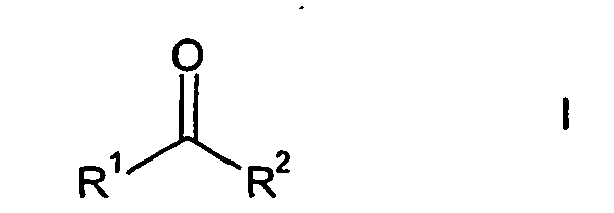
- R1, R2 ausgewählt aus Wasserstoff, C1-C12-Alkyl, C3-C12-Cycloalkyl, substituiert oder unsubstituiert, C7-C13-Aralkyl, wobei R1 und R2 miteinander unter Bildung eines Rings verbunden sein können,
mit cyclischen Verbindungen der allgemeinen Formel II,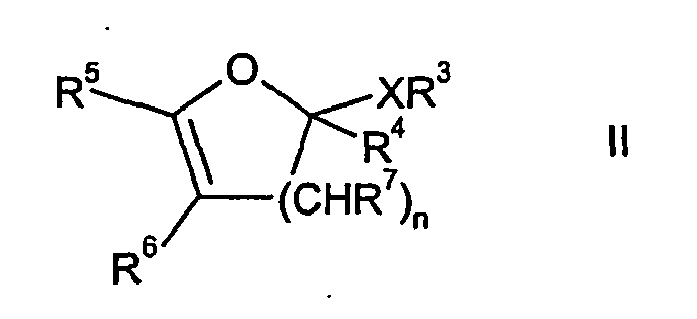
- X ausgewählt aus Sauerstoff, Schwefel und N-R8,
- R3, R8 gleich oder verschieden und ausgewählt aus Wasserstoff, C1-C12-Alkyl, C3-C12-Cycloalkyl, substituiert oder unsubstituiert, C7-C13-Aralkyl, C6-C14-Aryl, substituiert oder unsubstituiert, Formyl, CO-C1-C12-Alkyl, CO-C3-C12-Cycloalkyl, substituiert oder unsubstituiert, CO-C7-C13-Aralkyl, CO-C6-C14-Aryl, wobei für den Fall, dass X = N-R8 bedeutet, R3 und R8 unter Bildung eines Rings miteinander verbunden sein können;
- R4, R5, R6 gleich oder verschieden und ausgewählt aus Wasserstoff, C1-C12-Alkyl, C3-C12-Cycloalkyl, substituiert oder unsubstituiert, C7-C13-Aralkyl, C6-C14-Aryl, substituiert oder unsubstituiert, wobei jeweils zwei benachbarte Reste unter Bildung eines Rings miteinander verbunden sein können;
- n eine ganze Zahl im Bereich von 1 bis 4;
- R7 gleich oder verschieden und ausgewählt aus Wasserstoff, C1-C12-Alkyl, C3-C12-Cycloalkyl, substituiert oder unsubstituiert, C7-C13-Aralkyl, C6-C14-Aryl, wobei R7 mit R6 oder auch jeweils zwei benachbarte Reste R7 miteinander unter Bildung eines Rings verbunden sein können.
- Seit über 100 Jahren ist die Chromgerbung in der Lederherstellung eine wichtige chemische Behandlung, siehe beispielsweise Ullmann's Encyclopedia of Industrial Chemistry, Band A15, Seite 259 bis 282 und insbesondere Seite 268 ff., 5. Auflage, (1990), Verlag Chemie Weinheim. Aus ökologischen Gründen wird jedoch nach Alternativen zur Chromgerbung gesucht. Bei der herkömmlichen Chromgerbung werden Chromsalze in einer Menge von 1,5 bis 8 Gew.-%, bezogen auf das Blößengewicht des Leders, oder sogar mehr angeboten. Hiervon wird meist ein erheblicher Teil nicht gebunden und gelangt ins Abwasser. Zwar gelingt es, das Abwasser durch chemische Behandlung mit beispielsweise Kalk und Eisensalzen von beträchtlichen Anteilen Chrom zu befreien, es fallen jedoch Chrom-haltige Schlämme an, die auf Sonderdeponien entsorgt oder aufwändig aufgearbeitet werden müssen.
- Außerdem fallen beispielsweise beim Spalten der Häute und beim Egalisieren der Leder Chrom-haltige Lederabfälle an, die etwa 8 bis 15 Gew.-%, bezogen auf das Hautgewicht, ausmachen können und ebenfalls aufwändig entsorgt werden müssen.
- Es hat nicht an Versuchen gefehlt, durch beispielsweise Recyclieren der Chromgerbflotten oder Chromrecyclingverfahren die Chrombelastung der Abwässer zu verringern. Diese Verfahren waren aber im Ganzen unbefriedigend und insbesondere nicht in der Lage, das Problem der Chrom-haltigen Lederabfälle zu lösen.
- Bekannt sind des weiteren Verfahren, in denen das Chrom ganz oder teilweise durch organische Gerbmittel ersetzt wurde. Genannt seien der Einsatz der sogenannten Syntane, das sind sulfonierte Kondensationsprodukte von Formaldehyd und Phenol oder sulfonierte Naphthalin-Formaldehyd-Kondensationsprodukte. Genannt sei weiterhin der Einsatz sogenannter vegetabiler Gerbstoffe. Beide Klassen von Gerbmitteln sorgen jedoch für einen erhöhten CSB-Wert der Abwässer und sind aus Umweltgründen ebenfalls nicht unbedenklich. Außerdem hat sich erwiesen, dass die Lichtechtheit der Leder bei der Verwendung von sulfonierten Phenol/Formaldehyd-Kondensationsprodukten oft zu wünschen übrig lässt (Ullmann's Encyclopedia of Industrial Chemistry, Band A15, Seite 259 bis 282 und insbesondere Seite 270 ff.,5. Auflage, (1990), Verlag Chemie Weinheim).
- Weiterhin ist die Gerbung unter Verwendung von Aldehyden, insbesondere Dialdehyden wie beispielsweise Glutardialdehyd, bekannt, siehe beispielsweise H. Herfeld, Bibliothek des Leders, Band III, Seite 191, Umschau Verlag Frankfurt/Main, 1984. Nachteilig ist jedoch, dass bei geringen Mengen an Glutardialdehyd, beispielsweise 0,5 bis 0,9 Gew.-% (bezogen auf das Blößengewicht), die Schrumpfungstemperaturen nicht über 70°C hinausgehen und dass sich die erzeugten Halbfabrikate daher nur unzureichend entwässern lassen. Während des Falzens tritt eine Verleimung auf der Fleischseite des Leders auf und beeinflusst die Qualität des Leders nachteilig.
- Bei größeren Mengen an eingesetztem Glutardialdehyd können Arbeitssicherheitsprobleme aufgrund der toxischen Eigenschaften des Glutardialdehyds entstehen. Außerdem wird beobachtet, dass man im Allgemeinen ausgegerbte Leder erhält und dass eine anschließende variable Verarbeitung, wie es viele Gerbereien wünschen, nicht mehr möglich ist.
- Es ist bekannt, Glutardialdehyd in partiell oder ganz acetalisierter Form zum Gerben einzusetzen, beispielsweise als Methylacetal (Ullmann's Encyclopedia of Industrial Chemistry, Band A15, Seite 259 bis 282 und insbesondere Seite 273 ff., 5. Auflage, (1990), Verlag Chemie Weinheim). Die beschriebenen gegerbten Halbfabrikate neigen jedoch im Allgemeinen rasch zum Vergilben.
- In
DE-C 38 11 267 wird offenbart, dass eine Acetalisierung von Glutardialdehyd oder anderen Dialdehyden, die 2 bis 8 C-Atome haben, mit kurzkettigen Alkylglykolen, Alkylpolyglykolen, aliphatischen Alkoholen, Glycerin oder Sacchariden vorteilhafte Effekte bringt. Jedoch ist der Dampfdruck der Dialdehyde, die leicht aus den sehr hydrolyseempfindlichen Acetalen rückgebildet wird, noch immer merklich. Auch lassen sich die anwendungstechnischen Eigenschaften der so erhaltenen Leder weiter verbessern. -
GB1462309 - Es bestand daher die Aufgabe, ein neues Verfahren zur Vorgerbung, Gerbung und Nachgerbung von Tierhäuten bereit zu stellen, das die oben genannten Nachteile vermeidet. Insbesondere bestand die Aufgabe, ein Gerbmittel bereit zu stellen, das die oben beschriebenen Nachteile vermeidet.
- Demgemäß wurden die eingangs definierten Addukte gefunden. In Formel I

- R1, R2 sind gleich oder verschieden und gewählt aus Wasserstoff,
- C1-C12-Alkyl, wie Methyl, Ethyl, n-Propyl, iso-Propyl, n-Butyl, iso-Butyl, sec.-Butyl, tert.-Butyl, n-Pentyl, iso-Pentyl, sec.-Pentyl, neo-Pentyl, 1,2-Dimethylpropyl, iso-Amyl, n-Hexyl, iso-Hexyl, sec.-Hexyl, n-Heptyl, iso-Heptyl, n-Octyl, n-Nonyl, n-Decyl, und n-Dodecyl; bevorzugt C1-C6-Alkyl wie Methyl, Ethyl, n-Propyl, iso-Propyl, n-Butyl, iso-Butyl, sec.-Butyl, tert.-Butyl, n-Pentyl, iso-Pentyl, sec.-Pentyl, neo-Pentyl, 1,2-Dimethylpropyl, iso-Amyl, n-Hexyl, iso-Hexyl, sec.-Hexyl, besonders bevorzugt C1-C4-Alkyl wie Methyl, Ethyl, n-Propyl, iso-Propyl, n-Butyl, iso-Butyl, sec.-Butyl und tert.-Butyl und ganz besonders bevorzugt Methyl;
- C3-C12-Cycloalkyl wie Cyclopropyl, Cyclobutyl, Cyclopentyl, Cyclohexyl, Cycloheptyl, Cyclooctyl, Cyclononyl, Cyclodecyl, Cycloundecyl und Cyclododecyl; bevorzugt sind Cyclopentyl, Cyclohexyl und Cycloheptyl;
unter substituierten Cycloalkylresten seien beispielhaft genannt: 2-Methylcyclopentyl, 3-Methylcyclopentyl, cis-2,4-Dimethylcyclopentyl, trans-2,4-Dimethyl-cyclopentyl 2,2,4,4-Tetramethylcyclopentyl, 2-Methylcyclohexyl, 3-Methylcyclohexyl, 4-Methylcyclohexyl, cis-2,5-Dimethylcyclohexyl, trans-2,5-Dimethylcyclohexyl, 2,2,5,5-Tetramethylcyclohexyl, 2-Methoxycyclopentyl, 2-Methoxycyclohexyl, 3-Methoxycyclopentyl, 3-Methoxycyclohexyl, 2-Chlorcyclopentyl, 3-Chlorcyclopentyl, 2,4-Dichlorcyclopentyl, 2,2,4,4-Tetrachlorcyclopentyl, 2-Chlorcyclohexyl, 3-Chlorcyclohexyl, 4-Chlorcyclohexyl, 2,5-Dichlorcyclohexyl, 2,2,5,5-Tetrachlorcyclohexyl, 2-Thiomethylcyclopentyl, 2-Thiomethylcyclohexyl, 3-Thiomethyl-cyclopentyl, 3-Thiomethylcyclohexyl und weitere Derivate; - C7-C13-Aralkyl, bevorzugt C7- bis C12-Phenylalkyl wie Benzyl, 1-Phenethyl, 2-Phenethyl, 1-Phenyl-propyl, 2-Phenyl-propyl, 3-Phenyl-propyl, Neophyl (1-Methyl-1-phenylethyl), 1-Phenyl-butyl, 2-Phenyl-butyl, 3-Phenyl-butyl und 4-Phenyl-butyl, besonders bevorzugt Benzyl,
- In einer besonderen Ausführungsform sind die Reste R1 und R2 miteinander unter Bildung eines 4- bis 13-gliedrigen Rings kovalent verbunden. So können R1 und R2 beigemeinsam C3-C8-Alkylen, unsubstituiert oder substituiert mit z. B. gemeinsam C3-C8-Alkylen, unsubstituiert oder substituiert mit z. B. C1-C12-Alkyl oder C6-C14-Aryl, sein. Beispielhaft seien genannt: -(CH2)3-, -(CH2)2-CH(CH3)-, -(CH2)2-CH(C2H5)-, -(CH2)2-CH(C6H5)-, -(CH2)4-, -(CH2)5-, -(CH2)6-, -(CH2)7-, -CH(CH3)-CH2-CH2-CH(CH3)-, -CH(CH3)-CH2-CH2-CH2-CH(CH3)-, vorzugsweise C3-C5-Alkylen wie beispielsweise -(CH2)3-, -(CH2)4-, -(CH2)5-.
- Ganz besonders bevorzugt sind R1 und R2 jeweils Methyl.
- In cyclischen Verbindungen der Formel II

- X ist ausgewählt aus Sauerstoff, Schwefel oder N-R8, wobei Sauerstoff bevorzugt ist.
- R3 und R8 sind gleich oder verschieden und ausgewählt aus
Wasserstoff,
C1-C12-Alkyl, wie Methyl, Ethyl, n-Propyl, iso-Propyl, n-Butyl, iso-Butyl, sec.-Butyl, tert.-Butyl, n-Pentyl, iso-Pentyl, sec.-Pentyl, neo-Pentyl, 1,2-Dimethylpropyl, iso-Amyl, n-Hexyl, iso-Hexyl, sec.-Hexyl, n-Heptyl, iso-Heptyl, n-Octyl, n-Nonyl, n-Decyl, und n-Dodecyl; bevorzugt C1-C6-Alkyl wie Methyl, Ethyl, n-Propyl, iso-Propyl, n-Butyl, iso-Butyl, sec.-Butyl, tert.-Butyl, n-Pentyl, iso-Pentyl, sec.-Pen tyl, neo-Pentyl, 1,2-Dimethylpropyl, iso-Amyl, n-Hexyl, iso-Hexyl, sec.-Hexyl, besonders bevorzugt C1-C4-Alkyl wie Methyl, Ethyl, n-Propyl, iso-Propyl, n-Bu tyl, iso-Butyl, sec.-Butyl und tert.-Butyl, ganz besonders bevorzugt Methyl;
C3-C12-Cycloalkyl wie Cyclopropyl, Cyclobutyl, Cyclopentyl, Cyclohexyl, Cycloheptyl, Cyclooctyl, Cyclononyl, Cyclodecyl, Cycloundecyl und Cyclododecyl; bevorzugt sind Cyclopentyl, Cyclohexyl und Cycloheptyl; unter substituierten Cycloalkylgruppen seien beispielhaft genannt: 2-Methylcyclopentyl, 3-Methylcyclopentyl, cis-2,4-Dimethylcyclopentyl, trans-2,4-Dimethyl-cyclopentyl 2,2,4,4-Tetramethylcyclopentyl, 2-Methylcyclohexyl, 3-Methylcyclohexyl, 4-Methylcyclohexyl, cis-2,5-Dimethylcyclohexyl, trans-2,5-Dimethylcyclohexyl, 2,2,5,5-Tetramethylcyclohexyl, 2-Methoxycyclopentyl, 2-Methoxycyclohexyl, 3-Methoxycyclopentyl, 3-Methoxycyclohexyl, 2-Chlorcyclopentyl, 3-Chlorcyclopentyl, 2,4-Dichlorcyclopentyl, 2,2,4,4-Tetrachlorcyclopentyl, 2-Chlorcyclohexyl, 3-Chlorcyclohexyl, 4-Chlorcyclohexyl, 2,5-Dichlor-cyclohexyl, 2,2,5,5-Tetrachlorcyclohexyl, 2-Thiomethylcyclopentyl, 2-Thio-methylcyclohexyl, 3-Thiomethyl-cyclopentyl, 3-Thiomethylcyclohexyl;
C7-C13-Aralkyl, bevorzugt C7- bis C12-Phenylalkyl wie Benzyl, 1-Phenethyl, 2-Phenethyl, 1-Phenyl-propyl, 2-Phenyl-propyl, 3-Phenyl-propyl, Neophyl (1-Methyl-1-phenylethyl), 1-Phenyl-butyl, 2-Phenyl-butyl, 3-Phenyl-butyl und 4-Phenyl-butyl, besonders bevorzugt Benzyl,
C6-C14-Aryl, beispielsweise Phenyl, 1-Naphthyl, 2-Naphthyl, 1-Anthryl, 2-Anthryl, 9-Anthryl, 1-Phenanthryl, 2-Phenanthryl, 3-Phenanthryl, 4-Phenanthryl und 9-Phenanthryl, bevorzugt Phenyl, 1-Naphthyl und 2-Naphthyl, besonders bevorzugt Phenyl, unsubstituiert
oder substituiertes C6-C14-Aryl, beispielsweise Phenyl, 1-Naphthyl, 2-Naphthyl, 1-Anthryl, 2-Anthryl, 9-Anthryl, 1-Phenanthryl, 2-Phenanthryl, 3-Phenanthryl, 4-Phenanthryl und 9-Phenanthryl, bevorzugt Phenyl, 1-Naphthyl und 2-Naphthyl, besonders bevorzugt Phenyl, substituiert durch eine oder mehrere - C1-C12-Alkylgruppen, wie Methyl, Ethyl, n-Propyl, iso-Propyl, n-Butyl, iso-Butyl, sec.-Butyl, tert.-Butyl, n-Pentyl, iso-Pentyl, sec.-Pentyl, neo-Pentyl, 1,2-Dimethylpropyl, iso-Amyl, n-Hexyl, iso-Hexyl, sec.-Hexyl, n-Heptyl, iso-Heptyl, n-Octyl, n-Nonyl, n-Decyl, und n-Dodecyl; bevorzugt C1-C6-Alkyl wie Methyl, Ethyl, n-Propyl, iso-Propyl, n-Butyl, iso-Butyl, sec.-Butyl, tert.-Butyl, n-Pentyl, iso-Pentyl, sec.-Pentyl, neo-Pentyl, 1,2-Dimethylpropyl, iso-Amyl, n-Hexyl, iso-Hexyl, sec.-Hexyl, besonders bevorzugt C1-C4-Alkyl wie Methyl, Ethyl, n-Propyl, iso-Propyl, n-Butyl, iso-Butyl, sec.-Butyl und tert.-Butyl;
- Halogene wie Fluor, Chlor, Brom und Jod, wobei Chlor und Brom bevorzugt sind,
- C1-C12-Alkoxygruppen, bevorzugt C1-C6-Alkoxygruppen wie Methoxy, Ethoxy, n-Propoxy, iso-Propoxy, n-Butoxy, iso-Butoxy, sec.-Butoxy, tert.-Butoxy, n-Pentoxy, iso-Pentoxy, n-Hexoxy und iso-Hexoxy, besonders bevorzugt Methoxy, Ethoxy, n-Propoxy und n-Butoxy;
- C1-C12-Alkylgruppen, wie Methyl, Ethyl, n-Propyl, iso-Propyl, n-Butyl, iso-Butyl, sec.-Butyl, tert.-Butyl, n-Pentyl, iso-Pentyl, sec.-Pentyl, neo-Pentyl, 1,2-Dimethylpropyl, iso-Amyl, n-Hexyl, iso-Hexyl, sec.-Hexyl, n-Heptyl, iso-Heptyl, n-Octyl, n-Nonyl, n-Decyl, und n-Dodecyl; bevorzugt C1-C6-Alkyl wie Methyl, Ethyl, n-Propyl, iso-Propyl, n-Butyl, iso-Butyl, sec.-Butyl, tert.-Butyl, n-Pentyl, iso-Pentyl, sec.-Pentyl, neo-Pentyl, 1,2-Dimethylpropyl, iso-Amyl, n-Hexyl, iso-Hexyl, sec.-Hexyl, besonders bevorzugt C1-C4-Alkyl wie Methyl, Ethyl, n-Propyl, iso-Propyl, n-Butyl, iso-Butyl, sec.-Butyl und tert.-Butyl;
- Halogene wie Fluor, Chlor, Brom und Jod, wobei Chlor und Brom bevorzugt sind,
- C1-C12-Alkoxygruppen, bevorzugt C1-C6-Alkoxygruppen wie Methoxy, Ethoxy, n-Propoxy, iso-Propoxy, n-Butoxy, iso-Butoxy, sec.-Butoxy, tert.-Butoxy, n-Pentoxy, iso-Pentoxy, n-Hexoxy und iso-Hexoxy, besonders bevorzugt Methoxy, Ethoxy, n-Propoxy und n-Butoxy;
- In einer Ausführungsform der vorliegenden Erfindung können R7 mit R6 oder R7 mit R4 oder R7 mit R3 oder für den Fall, dass n größer als 1 ist, jeweils zwei benachbarte Reste R7 miteinander unter Bildung eines Rings verbunden sein. So können R6 und R7 beispielsweise gemeinsam C1-C8-Alkylen, unsubstituiert oder substituiert mit C1-C12-Alkyl oder C6-C14-Aryl, sein. Beispielhaft seien genannt: -CH2-, -CH(CH3)-, -(CH2)2-, -CH2-CH(CH3)-, -CH2-CH(C2H5)-, -(CH2)3-,-(CH2)2-CH(CH3)-, -(CH2)2-CH(C2H5)-, -(CH2)2-CH(C6H5)-, -(CH2)4-, -(CH2)5-, -(CH2)6-, -(CH2)7-, -CH(CH3)-CH2-CH2-CH(CH3)-, -CH(CH3)-CH2-CH2-CH2-CH(CH3)-, vorzugsweise C3-C5-Alkylen wie beispielsweise -(CH2)3-, -(CH2)4-, -(CH2)5-.
- Ganz besonders bevorzugt sind die Reste R4 bis R7 jeweils Methyl. Ganz besonders bevorzugt wird als Verbindung der allgemeinen Formel II 2-Methoxy-2,3-dihydro-4H-Pyran (Formel II.1) gewählt.

- Ganz besonders bevorzugte Carbonylverbindungen der allgemeinen Formel I sind Methylethylketon, Formaldehyd und insbesondere Aceton.
- Die erfindungsgemäßen Addukte können in monomerer oder dimerer Form vorliegen. Die erfindungsgemäßen Addukte können aber auch in oligomerer oder polymerer Form vorliegen. Üblicherweise liegen die erfindungsgemäßen Addukte als Gemisch von Dimeren, Oligomeren und Polymeren vor, wobei die Gemische weiterhin herstellungsbedingt Verbindungen der allgemeinen Formel H-X-R3 enthalten können. Auch können die erfindungsgemäßen Addukte im Gemisch mit lagerungsbedingte Verunreinigungen vorliegen, beispielsweise Dehydratisierungsprodukten, Oxidationsprodukten, Hydrolyseprodukten, vernetzten Produkten oder Produkten von einer oder mehreren Retroaldolreaktionen.
- Die erfindungsgemäßen Addukte sind herstellbar durch Umsetzung von einer oder mehreren Carbonylverbindungen der allgemeinen Formel I mit einer oder mehreren cyclischen Verbindungen der allgemeinen Formel II.
- Ein weiterer Gegenstand der vorliegenden Erfindung ist ein Verfahren zur Herstellung der erfindungsgemäßen Addukte. Das erfindungsgemäße Verfahren geht aus von mindestens einer cyclischen Verbindung der allgemeinen Formel II und mindestens einer Carbonylverbindung der allgemeinen Formel I, die miteinander umgesetzt werden.
- In einer Ausführungsform des erfindungsgemäßen Verfahrens setzt man mindestens eine cyclische Verbindung der Formel II mit bis zu 1000 mol-%, bevorzugt mit bis zu 500 mol-% und besonders bevorzugt bis zu 200 mol-% mindestens einer Carbonylverbindungen der allgemeinen Formel I um.
- Das erfindungsgemäße Verfahren übt man vorzugsweise bei Temperaturen von 0 bis 120°C, insbesondere 20 bis 85°C aus. Man kann die Umsetzung bei beliebigen Drücken von 0,1 bis 100 bar durchführen, bevorzugt bei Atmosphärendruck. Die Umsetzung erfolgt vorteilhaft in Gegenwart eines Lösemittels, beispielsweise Wasser, Toluol, Petrolether oder n-Heptan, aber der Zusatz von Lösemitteln ist nicht notwendig. Für den Fall, dass die Carbonylverbindung der allgemeinen Formel I unter Reaktionsbedingung flüssig ist, ist die Verwendung von Lösemittel bei der Ausübung des erfindungsgemäßen Verfahrens nicht notwendig.
- Man kann das während der Reaktion entstehende Wasser - zusammen mit im Verlaufe der Reaktion gebildetem H-X-R3 - ganz oder zu einem gewissen Anteil abdestillieren.
- In einer Ausführungsform der vorliegenden Erfindung führt man das erfindungsgemäße Verfahren bei saurem pH-Wert durch, d.h. beispielsweise bei einem pH-Wert, der im Bereich von 0,5 bis 6,8, bevorzugt 0,7 bis 4 liegt. Vorzugsweise setzt man zur Ausübung des erfindungsgemäßen Verfahrens bei saurem pH-Wert einen oder mehrere saure Katalysatoren ein.
- Geeignete saure Katalysatoren sind beispielsweise Phosphorsäure, insbesondere ortho-Phosphorsäure, Ameisensäure, Essigsäure, saure Kieselgele, saures Aluminiumoxid, verdünnte Schwefelsäure, Sulfonsäuren wie beispielsweise Methansulfonsäure oder para-Toluolsulfonsäure. Arbeitet man in nicht-wässrigen Lösemitteln, so ist die Anwendung von P2O5 oder Molekularsieb denkbar. Man kann 0,1 bis 20 Gew.-% Katalysator, bezogen auf Carbonylverbindung I, einsetzen.
- Als Reaktionszeit für die Bildung der erfindungsgemäßen Addukte sind 10 Minuten bis 24 Stunden sinnvoll, bevorzugt eine bis drei Stunden.
- Nach der Reaktion ist es möglich, die durch das erfindungsgemäße Verfahren entstehenden Reaktionsgemische aufzuarbeiten. So kann man eventuell verwendete Lösemittel ganz oder zu einem gewissen Anteil entfernen, beispielsweise durch Destillation, z.B. unter vermindertem Druck. Beispielsweise kann man eventuell verwendete saure Katalysatoren neutralisieren, beispielsweise mit wässriger alkalischer Lösung wie Natronlauge oder Kalilauge. Auch ist es möglich, nicht umgesetzte Ausgangsmaterialien wie z.B. überschüssige Carbonylverbindung der Formel I abzutrennen. Insbesondere in den Fällen, in denen die Carbonylverbindung der allgemeinen Formel I leicht flüchtig ist, beispielsweise Aceton oder Methylethylketon, ist es vorteilhaft, Carbonylverbindungen der allgemeinen Formel I durch Destillation abzutrennen.
- In einigen Fällen wird während der Durchführung des erfindungsgemäßen Verfahrens die Bildung eines mehrphasigen Gemischs beobachtet. In den genannten Fällen ist es möglich, die jeweilige wässrige Phase durch beispielsweise Dekantieren oder andere an sich bekannte Methoden zu entfernen.
- Bei der Ausübung des erfindungsgemäßen Verfahrens unter den oben beschriebenen Bedingungen kommt es üblicherweise zur Bildung von herstellungsbedingten Neben-und Folgeprodukten, beispielsweise durch Wasserabspaltung (Dehydratisierung), unvollständig abgelaufene Reaktionen, Oxidationen oder auch durch intramolekulare Vernetzung. Bei der Lagerung der erfindungsgemäßen Addukte kann es fernerhin zu lagerungsbedingten Nebenprodukten kommen, beispielsweise durch Wasserabspaltung (Dehydratisierung), Oxidationen oder auch durch Dimerisierung, Oligomerisierung oder Polymerisation sowie durch Vernetzung.
- Es ist möglich, die erfindungsgemäße Addukte aufzureinigen und zu isolieren.
- Ein weiterer Gegenstand der vorliegenden Erfindung sind Gemische der erfindungsgemäßen Addukte mit oben beschriebenen herstellungsbedingten und/oder lagerungsbedingten Nebenprodukten.
- Ein weiterer Gegenstand der vorliegenden Erfindung ist die Verwendung der erfindungsgemäßen Addukte oder der erfindungsgemäßen Gemische zur Herstellung von Halbfabrikaten und von Leder.
- In einer Ausführungsform der vorliegenden Erfindung werden die erfindungsgemäßen Addukte oder die erfindungsgemäßen Gemische bei der Vorgerbung, Gerbung oder Nachgerbung von Tierhäuten verwendet.
- Weitere Gegenstände der vorliegenden Erfindung sind die Verwendung der erfindungsgemäßen Addukte und der erfindungsgemäßen Gemische zum Vorgerben, Gerben oder Nachgerben von Tierhäuten sowie ein Verfahren zum Vorgerben, Gerben oder Nachgerben von Tierhäuten unter Verwendung der erfindungsgemäßen Addukte oder der erfindungsgemäßen Gemische.
- Das erfindungsgemäße Verfahren zum Vorgerben, Gerben oder Nachgerben von Tierhäuten, im Folgenden auch erfindungsgemäßes Gerbverfahren genannt, geht aus von nach konventionellen Methoden vorbehandelten Häuten von Tieren wie beispielsweise Rindern, Schweinen, Ziegen oder Hirschen. Dabei ist es für das erfindungsgemäßen Gerbverfahren nicht wesentlich, ob die Tiere beispielsweise durch Schlachten getötet wurden oder aber an natürlichen Ursachen verendet sind. Zu den konventionellen Methoden der Vorbehandlung gehören das beispielsweise das Äschern, Entkälken, Beizen und Pickeln sowie mechanische Arbeitschritte, beispielsweise zur Entfleischung der Häute.
- Das erfindungsgemäße Gerbverfahren wird üblicherweise in Gegenwart von Wasser durchgeführt.
- Das erfindungsgemäße Gerbverfahren übt man beispielsweise so aus, dass man ein oder mehrere erfindungsgemäße Addukte gegebenenfalls als Gemisch mit herstellungsbedingten und/oder lagerungsbedingten Nebenprodukten in einer Portion oder in mehreren Portionen unmittelbar vor oder aber während eines Gerbungsschrittes zusetzt. Das erfindungsgemäße Gerbverfahren wird vorzugsweise bei einem pH-Wert von 2,5 bis 4 durchgeführt, wobei man häufig beobachtet, dass der pH-Wert während der Durchführung des erfindungsgemäßen Gerbverfahrens um etwa 0,3 bis drei Einheiten ansteigt. Man kann den pH-Wert auch durch Zugabe abstumpfender Mittel um etwa 0,3 bis drei Einheiten erhöhen.
- Das erfindungsgemäße Gerbverfahren übt man im Allgemeinen bei Temperaturen im Bereich von 10 bis 45°C, bevorzugt im Bereich von 20 bis 30°C aus. Bewährt hat sich eine Dauer von 10 Minuten bis 12 Stunden, bevorzugt sind eine bis 3 Stunden. Das erfindungsgemäße Gerbverfahren kann man in beliebigen gerbereiüblichen Gefäßen durchführen, beispielsweise durch Walken in Fässern oder in drehbaren Trommeln mit Einbauten.
- In einer Variante des erfindungsgemäßen Gerbverfahrens setzt man die erfindungsgemäßen Addukte oder die erfindungsgemäßen Gemische zusammen mit einem oder mehreren herkömmlichen Gerbstoffen ein, beispielsweise mit Chromgerbstoffen, mineralischen Gerbstoffen, Syntanen, Polymergerbstoffen oder vegetabilen Gerbstoffen, wie sie beispielsweise beschrieben sind in Ullmann's Encyclopedia of Industrial Chemistry, Band A15, Seite 259 bis 282 und insbesondere Seite 268 ff., 5. Auflage, (1990), Verlag Chemie Weinheim. Das Gewichtsverhältnis erfindungsgemäßes Addukt bzw. erfindungsgemäßes Gemisch : herkömmlicher Gerbstoff bzw. Summe der herkömmlichen Gerbstoffe beträgt zweckmäßig von 0,01 : 1 bis 100 : 1, wobei gegebenenfalls vorhandene herstellungsbedingte oder lagerungsbedingte Verunreinigungen der Addukte mitgezählt werden. In einer vorteilhaften Variante des erfindungsgemäßen Verfahrens setzt man nur wenige ppm der herkömmlichen Gerbstoffe den erfindungsgemäßen Addukten. Besonders vorteilhaft ist es jedoch, auf die Beimischung herkömmlicher Gerbstoffe ganz zu verzichten.
- In einer Variante des erfindungsgemäßen Gerbverfahrens setzt man ein oder mehrere Addukte gegebenenfalls zusammen mit herstellungsbedingten und/oder lagerungsbedingten Nebenprodukten in einer Portion oder in mehreren Portionen vor oder während des Vorgerbens zu, in einer besonderen Variante bereits im Pickel.
- In einer weiteren Variante des erfindungsgemäßen Gerbverfahrens setzt man ein oder mehrere Addukte oder erfindungsgemäße Gemische gegebenenfalls zusammen mit herstellungsbedingten und/oder lagerungsbedingten Nebenprodukten in einer Portion oder in mehreren Portionen vor oder während eines Nachgerbungsschrittes zu. Diese Variante wird im Folgenden auch als erfindungsgemäßes Nachgerbverfahren bezeichnet. Das erfindungsgemäße Nachgerbverfahren geht aus von vorgegerbten Häuten. Diese werden mit den erfindungsgemäßen Addukten behandelt.
- Man kann das erfindungsgemäße Nachgerbverfahren unter ansonsten üblichen Bedingungen durchführen. Man wählt zweckmäßig einen oder mehrere, beispielsweise 2 bis 6 Einwirkschritte und kann zwischen den Einwirkschritten mit Wasser spülen. Die Temperatur bei den einzelnen Einwirkschritten beträgt jeweils von 5 bis 60°C, bevorzugt 20 bis 45°C. Man setzt zweckmäßig weitere, während der Nachgerbung üblicherweise verwendete Mittel ein, beispielsweise Fettlicker, Lederfarbstoffe oder Emulgatoren ein.
- Ein weiterer Aspekt der vorliegenden Erfindung sind Gerbmittel, enthaltend eine oder mehrere erfindungsgemäße Addukte als aktive Komponente.
- Ein weiterer Aspekt der vorliegenden Erfindung sind Halbfabrikate und Leder, hergestellt durch das erfindungsgemäße Verfahren. Die erfindungsgemäßen Leder zeichnen sich durch eine insgesamt vorteilhafte Qualität aus, beispielsweise glatten Narben, homogenere Gerbung über den Querschnitt, verbesserte Reißfestigkeit und Fülle sowie geringere Neigung zum Verfärben, insbesondere zum Vergilben.
- In einer speziellen Ausführungsform des erfindungsgemäßen Gerbverfahrens setzt man die erfindungsgemäßen Addukte, gegebenenfalls als Gemische mit herstellungsbedingten oder lagerungsbedingten Nebenprodukten, in Form pulverförmiger Wirkstoffe ein.
- Ein weiterer Gegenstand des erfindungsgemäßen Verfahrens betrifft pulverförmige Wirkstoffe, enthaltend 10 bis 100 Gew.-%, bevorzugt 40 bis 90 Gew.-% eines oder mehrere erfindungsgemäße Addukte, gegebenenfalls im Gemisch mit herstellungsbedingten oder lagerungsbedingten Nebenprodukten,
und 0 bis 90 Gew.-%, bevorzugt 10 bis 60 Gew.-% eines oder mehrerer Zuschlagstoffe. - Geeignete Zuschlagstoffe sind in der Regel feste partikuläre Stoffe. Bevorzugt werden sie gewählt aus Stärke, Siliziumdioxid, beispielsweise in der Form von Kieselgel, insbesondere in der Form von sphäroidalen Kieselgelen, Schichtsilikate, Aluminiumoxid sowie Mischoxiden von Silizium und Aluminium.
- Die erfindungsgemäßen pulverförmigen Wirkstoffe können aus feinen Partikeln mit einem mittleren Partikeldurchmesser von 100 nm bis 0,1 mm bestehen. Die Partikeldurchmesser folgen dabei einer Partikeldurchmesserverteilung, die eng oder breit sein kann. Auch bimodale Partikelgrößenverteilungen sind denkbar. Die Partikel selbst können irregulär oder sphärischer Form sein, wobei sphärische Partikelformen bevorzugt sind. Die erfindungsgemäßen pulverförmigen Wirkstoffe lassen sich im erfindungsgemäßen Gerbverfahren unter besonders hygienischen Verhältnissen dosieren.
- Ein weiterer Gegenstand der vorliegenden Erfindung betrifft ein Verfahren zur Herstellung der erfindungsgemäßen pulverförmigen Wirkstoffe. Das erfindungsgemäße Verfahren geht aus von in Lösung, in Suspension oder Emulsion oder aber von isoliert vorliegenden erfindungsgemäßen Addukten, die herstellungsbedingte oder lagerungsbedingte Nebenprodukte enthalten können. Besonders bevorzugt geht man von Reaktionslösungen aus, wie sie im erfindungsgemäßen Verfahren bei der Herstellung der erfindungsgemäßen Addukte anfallen.
- Es hat sich bewährt, die Reaktionslösungen zunächst bis zu einem Restlösemittelgehalt von 50 Gew.-% oder weniger aufzukonzentrieren.
- Weiterhin gibt man - so es gewünscht ist - einen oder mehrere Zuschlagstoffe zu.
- Anschließend entfernt man die verbliebenen flüchtigen Komponenten. Bevorzugt versprüht man die anfallenden flüssigen, festen oder öligen aufkonzentrierten Reaktionslösungen in einem Sprühtrockner, bevorzugt in einem Sprühturm. Sprühtrockner sind dem Fachmann bekannt und beispielsweise beschrieben in Vauck/Müller, Grundoperationen chemischer Verfahrenstechnik, VCH Weinheim, 1988, 7. Auflage, S. 638-740 und S. 765-766, sowie in der darin zitierten Literatur.
- In einer speziellen Ausführungsform des erfindungsgemäßen Gerbverfahrens setzt man die erfindungsgemäßen Addukte, gegebenenfalls als Gemische mit herstellungsbedingten oder lagerungsbedingten Nebenprodukten, in Form von Suspensionen ein, beispielsweise als wässrige Suspensionen.
- In einer Ausführungsform des erfindungsgemäßen Gerbverfahrens setzt man ein oder mehrere erfindungsgemäße Addukte, gegebenenfalls als Gemische mit herstellungsbedingten oder lagerungsbedingten Nebenprodukten, in mit polaren Lösemitteln verdünnter Form ein. Geeignet sind beispielsweise Alkohole oder wässrige Alkohole. Als geeignete Alkohole seien Ethylenglykol, Glycerin, Diethylenglykol, Triethylenglykol und Polyethylenglykole sowie Gemische der vorstehenden Alkohole beispielhaft genannt. Als Konzentrationen des oder der polaren Lösungsmittel sind beispielsweise 1 bis 80 Gew.-% geeignet. In einer speziellen Ausführungsform des erfindungsgemäßen Gerbverfahrens setzt man ein oder mehrere erfindungsgemäße Addukte, gegebenenfalls als Gemische mit herstellungsbedingten oder lagerungsbedingten Nebenprodukten, in mit polaren Lösungsmitteln verdünnter Form ein und mischt außerdem Zuschlagstoffe zu. Geeignete Zuschlagstoffe sind beispielsweise Stärke, Siliziumdioxid, Schichtsilikate, Aluminiumoxid sowie Mischoxide von Silizium und Aluminium.
- Ein weiterer Gegenstand der vorliegenden Erfindung sind Mischungen der erfindungsgemäßen Addukte, gegebenenfalls als Gemische mit herstellungsbedingten oder lagerungsbedingten Nebenprodukten, mit polaren Lösemitteln wie beispielsweise Alkoholen oder wässrigen Alkoholen.
- Ein weiterer Aspekt der vorliegenden Erfindung betrifft die Verwendung der erfindungsgemäßen Addukte, gegebenenfalls als Gemische mit herstellungsbedingten oder lagerungsbedingten Nebenprodukten, zur Konservierung sowie Konservierungsmittel, enthaltend die erfindungsgemäßen Addukte oder die erfindungsgemäßen Gemische. Die erfindungsgemäßen Konservierungsmittel eignen sich zur Konservierung von Erzeugnissen, beispielsweise kosmetischen Erzeugnissen, und von Oberflächen.
- Die Erfindung wird durch Beispiele erläutert.
- Die Molekulargewichtsbestimmungen erfolgten durch Gelpermeationschromatographie unter den folgenden Bedingungen:
- Stationäre Phase: mit Ethylenglykoldimethacrylat vernetztes Hydroxyethylmethacrylatgel, kommerziell erhältlich als: HEMA BIO von FA. PSS, Mainz, Deutschland,
- Fluss: 1,5 ml/min, Konzentration: 1 Gew.-% im Laufmittel mit internem Standard, Laufmittel: THF 30 Gew.-%, Acetonitril 10 Gew.-%, 0,1 molare wässrige NaNO3-Lsg. 60 Gew.-%, interner Standard: 0,01 Gew.-% Benzophenon;
- Detektion: UV/vis bei 254 nm.
- In einem 1-Liter-Dreihalskolben mit Kühler, Rührer und Thermometer wurden 114 g 2-Methoxy-2,3-dihydro-4H-Pyran (Formel II.1; 1 mol), 114 ml Wasser und 58 g Aceton (1 mol) und 24,6 g einer 85 Gew.-% wässrigen ortho-Phosphorsäure gemischt und 3 Stunden am Rückfluss gekocht. Der pH-Wert betrug 1.
- Man erhielt 311 g einer wässrigen Dispersion von Addukt 1.1 in Form eines honigfarbenen Produkts mit breiter Molmassenverteilung (Q = 4,7) und Mn 380 g.
- In einem 1-Liter-Dreihalskolben mit Kühler, Rührer und Thermometer wurden 128 g 2-Methoxy-2,3-dihydro-4H-Pyran (Formel II.1; 1,12 mol), 128 ml Wasser und 112 g Aceton (2 mol) mit 21 g einer 50 Gew.-% Schwefelsäure vermischt und 3 Stunden am Rückfluss gekocht. Der pH-Wert betrug 0,9.
- Anschließend wurde der Kühler gegen eine Destillationsbrücke ausgetauscht und über einen Zeitraum von 3 Stunden bei 70-80 °C und 1 bar wässriges Aceton abdestilliert. Man ließ auf Raumtemperatur abkühlen und stellte mit 25 Gew.-% wässriger Natronlauge einen pH-Wert von 5,2 ein. Danach wurde die Mischung in einen Scheidetrichter überführt und etwa 25 ml einer wässrigen Phase abgetrennt und verworfen. Man erhielt 317 g Addukt 1.2 in Form eines bernsteinfarbenen öligen Produkts mit breiter Molmassenverteilung (Q = 5,1) und Mn 610 g.
- In einem 1-Liter-Dreihalskolben mit Kühler, Rührer und Thermometer wurden 141 g 2-Methoxy-2,3-dihydro-4H-Pyran (Formel II.1; 1,24 mol), 141 ml Wasser und 83,7 g Aceton (1,44 mol) mit 11 g einer 50 Gew.-% Schwefelsäure vermischt und 3 Stunden am Rückfluss gekocht. Der pH-Wert betrug 0,9.
- Anschließend wurde der Kühler gegen eine Destillationsbrücke ausgetauscht und über einen Zeitraum von 3 Stunden bei 70-80 °C und 1 bar wässriges Aceton abdestilliert. Man ließ auf Raumtemperatur abkühlen und stellte mit 25 Gew.-% wässriger Natronlauge einen pH-Wert von 5,2 ein. Anschließend wurden bei 55°C und 450 mbar weitere flüchtige Bestandteile abdestilliert. Man erhielt 297 g Addukt 1.3 in Form eines bernsteinfarbenen öligen Produkts mit breiter Molmassenverteilung (Q = 5,2) mit Mn 810 g.
- In einem 1-Liter-Dreihalskolben mit Kühler, Rührer und Thermometer wurden 141 g 2-Methoxy-2,3-dihydro-4H-Pyran (Formel II.1; 1,24 mol), 141 ml Wasser und 83,7 g Aceton (1,44 mol) mit 7,5 g einer 70 Gew.-% Methansulfonsäure vermischt und 3 Stunden am Rückfluss gekocht. Der pH-Wert betrug 0,9.
- anschließend wurde der Kühler gegen eine Destillationsbrücke ausgetauscht und bei 82°C und Normaldruck flüchtige Bestandteile über einen Zeitraum von 3 Stunden wässriges Aceton abdestilliert.
- Man ließ auf Raumtemperatur abkühlen und stellte mit 6 ml 50 Gew.-% wässriger Natronlauge einen pH-Wert von 5,3 ein. Anschließend wurden bei 55°C und 550 mbar über einen Zeitraum von einer Stunde weitere flüchtige Bestandteile abdestilliert. Man erhielt 280 g Addukt 1.4 in Form einer gelben öligen Flüssigkeit mit breiter Molmassenverteilung (Q = 3,8) mit Mn 840 g.
- In einem 1-Liter-Dreihalskolben mit Kühler, Rührer und Thermometer wurden 141 g 2-Methoxy-2,3-dihydro-4H-Pyran (Formel II.1; 1,24 mol), 144,3 g wässrige Formalinlösung (1,44 mol Formaldehyd) und 45 ml Wasser mit 7,5 g einer 70 Gew.-% Methansulfonsäure vermischt und 3 Stunden am Rückfluss gekocht. Der pH-Wert betrug 0,9. Anschließend wurde der Kühler gegen eine Destillationsbrücke ausgetauscht und bei 75°C und Normaldruck über einen Zeitraum von 3 Stunden wässriges Aceton abdestilliert.
- Man ließ auf Raumtemperatur abkühlen und stellte mit etwa 9 ml 50 Gew.-% wässriger Natronlauge einen pH-Wert von 4,2 ein. Anschließend wurden bei 49°C und 35 mbar weitere flüchtige Bestandteile abdestilliert. Man erhielt 151 g Addukt 1.5 in Form eines öligen braunen Produkts mit breiter Molmassenverteilung (Q = 4,6) mit Mn 1120 g.
- Angaben in Gew.-% beziehen sich auf das Pickelgewicht, wenn nicht anders angegeben.
- Streifen mit einem Gewicht von je 2500 g gepickelter Rindsblöße mit einer Spaltstärke von 2,5 mm wurden bei einem pH-Wert von 3,0-3,2 und 25°C in einem 10-I-Fass mit 750 ml Wasser und, bezogen auf die Pickelblöße, 3 Gew.-% der Addukt 1.1 versetzt. Nach einer Walkzeit von 60 Minuten wurden 2 Gew.-% des Sulfongerbstoffs Basyntan® SW (BASF Aktiengesellschaft) zugesetzt und weitere 2 Stunden gewalkt. Anschließend wurde mit 0,5 Gew.-% Magnesiumoxid innerhalb von 6 Stunden der pH-Wert auf 4,9-5,1 gestellt. Die Flotte wurde abgelassen und die Haut mit 300 ml Wasser gewaschen. Nach dem Abwelken wurden die Häute auf 1,6-1,8 mm gefalzt. Man erhielt das erfindungsgemäße Halbfabrikat 2.1.
- Die Falzbarkeit wurde durch Versuche an einer Falzmaschine bestimmt. Falzmaschinen arbeitet mit rotierenden Messern. Bei schlechter Falzbarkeit schmierten die Messer über die Oberfläche, es kam zu einer Temperaturerhöhung auf der Oberfläche der Leder, so dass ein homartiges Aufschmelzen die Haut irreversibel schädigte. Die Benotung erfolgte nach einem Notensystem von 1 (sehr gut) bis 5 (mangelhaft).
- 2.2 bis 2.5. Erfindungsgemäße Gerbversuche 2.2 bis 2.5 und Vergleichsversuch V 2.6
- Der oben beschriebene Gerbversuch wurde wiederholt, jedoch wurde das erfindungsgemäße Addukt 1.1 durch die erfindungsgemäßen Addukte 1.2, 1.3, 1.4 bzw. 1.5 ersetzt. Man erhielt dementsprechend die erfindungsgemäßen Halbfabrikate 2.2, 2.3, 2.4 bzw. 2.5.
- Der Vergleichsversuch V 2.6 wurde analog durchgeführt, jedoch wurde das erfindungsgemäße Addukt durch 3 Gew.-% Glutaraldehyd (50 Gew.-% wässrige Lösung) ersetzt. Man erhielt das Vergleichs-Halbfabrikat V 2.6.
- Die Schrumpftemperaturen wurden gemäß der Vorschrift aus DIN 53 336 (Jahr 1977) bestimmt, wobei die Vorschrift wie folgt modifiziert wurde:
- Punkt 4.1: Die Probestücke hatten die Abmessungen 3 cm · 1 cm; die Dicke wurde nicht bestimmt.
- Punkt 4.2: es wurde nur eine anstatt 2 Proben pro Ledermuster geprüft.
- Punkt 6: entfiel
- Punkt 7: die Trocknung im Vakuumexsikkator entfiel.
- Punkt 8: bei Rückgang des Zeigers wurde die Schrumpfungstemperatur gemessen.
- Die Benotung der Falzbarkeit und der Vergilbung erfolgte wie in der Schule: 1 sehr gut, 2 gut, 3 befriedigend, 4 ausreichend.
Tabelle 1: Ergebnis der Gerbung und analytische Bewertung der erfindungsgemäßen Halbfabrikate Nummer Halbfabrikat Falzbarkeit Schrumpftemperatur Vergilbung [°C] 2.1 2.1 3 74,5 2 2.2 2.2 2,5 76 2,5 2.3 2.3 2 77,5 2,5 2.4 2.4 2 79 2 2.5 2.5 3 74 3,5 V 2.6 Glutaraldehyd 3 77 4 - Angaben in Gew.-% beziehen sich auf das Falzgewicht, wenn nicht anders angegeben.
- 1800 g Halbfabrikat 2.1 wurde zusammen mit den folgenden Agenzien 20 Minuten gewalkt:
- 120 Gew.-% Wasser, 5 Gew.-% des Sulfongerbstoffs Basyntan® SW (BASF Aktiengesellschaft) und
- 4 % einer 30 Gew.-% wässrigen, mit NaOH teilneutralisierten Lösung eines Methacrylsäure-Homopolymers mit den folgenden analytischen Daten: Mn ca. 10.000; K-Wert nach Fikentscher: 12 (bestimmt als 1 Gew.-% wässrige Lösung), Viskosität der 30 Gew.-% Lösung: 65 mPa·s (DIN EN ISO 3219, 23°C), pH-Wert 5,1.
- Dann wurden 6 Gew.-% des Vegetabilgerbstoffs Tara® (BASF Aktiengesellschaft) und 2 Gew.-% des Harzgerbstoffs Relugan® S (BASF Aktiengesellschaft) sowie 2 Gew.-% Farbstoff Luganil® braun NGB dosiert und die Mischung gewalkt. Nach zwei Stunden wurde mit Ameisensäure der pH-Wert 3,6 eingestellt. Als Fettungskomponente wurden 6 Gew.-% Lipodermliquer CMG® (BASF Aktiengesellschaft) und 1 Gew.-% Lipamin OK® (BASF Aktiengesellschaft) zugesetzt. Nach einer Walkzeit von weiteren 60 Minuten wurde mit Ameisensäure der pH-Wert 3,2 eingestellt. Vor dem Ablassen der Flotte wurde eine Probe der Flotte gezogen. Man ließ die Flotte ab.
- Das so erhaltene Leder wurde zweimal mit je 100 Gew.-% Wasser gewaschen, über Nacht feucht gelagert und nach dem Abwalken auf dem Spannrahmen bei 50 °C getrocknet. Man erhielt Leder 3.1. Nach dem Stollen wurde Leder 3.1 wie unten stehend beurteilt.
- Die Bewertung erfolgte nach einem Notensystem von 1 (sehr gut) bis 5 (mangelhaft). Die Bewertung der Flottenauszehrung erfolgte visuell nach den Kriterien Restfarbstoff (Extinktion) und Trübung (Fettungsmittel), aus denen der Mittelwert gebildet wurde.
- Das obige Beispiel wurde wiederholt, jedoch jeweils mit den erfindungsgemäßen Halbfabrikaten 2.2 bis 2.5. Für das Vergleichsbeispiel V3.6 wurde das Halbfabrikat aus Vergleichsbeispiel V2.6 weiter verarbeitet. Die Bewertung der anwendungstechnischen Eigenschaften findet sich in Tabelle 2.
Tabelle 2 Leder Flottenauszehrung Fülle Narben-festigkeit Weich Zugfestigkeit Stichausreißkraft Egalität heit [N] [N] 3.1 3 2,5 3 3,5 256 196 2,5 3.2 2,5 2,5 2 3 270 194 2,5 3.3 2 1,5 2,5 2 283 201 1 3.4 1,5 1 1,5 2 287 229 1 3.5 1,5 2,5 2 2,5 260 218 1,5 V 3.6 3 3,5 3,5 3 247 191 3 - Die Zugfestigkeit wurde nach DIN 53328 bestimmt.
- Die Stichausreißkraft wurde nach DIN 53331 bestimmt.
CO-C1-C12-Alkyl wie Acetyl, Propionyl, n-Butyryl, iso-Butyryl, sec.-Butyryl, tert.-Butyryl, n-Valeroyl, iso-Valeroyl, sec.-Valeroyl, n-Capryl, n-Dodecanoyl; bevorzugt CO-C1-C4-Alkyl wie Acetyl, Propionyl, n-Butyryl, iso-Butyryl, sec.-Butyryl, tert.-Butyryl, ganz besonders bevorzugt Acetyl;
CO-C3-C12-Cycloalkyl wie Cyclopropylcarbonyl, Cyclobutylcarbonyl, Cyclopentylcarbonyl, Cyclohexylcarbonyl, Cycloheptylcarbonyl, Cyclooctylcarbonyl, Cyclononylcarbonyl, Cyclodecylcarbonyl, Cycloundecylcarbonyl und Cyclododecylcarbonyl; bevorzugt sind Cyclopentylcarbonyl, Cyclohexylcarbonyl und Cycloheptylcarbonyl;
unter substituierten Cycloalkylgruppen seien beispielhaft genannt: 2-Methylcyclopentylcarbonyl, 3-Methylcyclopentylcarbonyl, 2-Methylcyclohexylcarbonyl, 3-Methylcyclohexylcarbonyl, 4-Methylcyclohexylcarbonyl, cis-2,5-Dimethylcyclohexylcarbonyl, trans-2,5-Dimethylcyclohexylcarbonyl, 2-Methoxycyclopentylcarbonyl, 2-Methoxycyclohexylcarbonyl, 3-Methoxycyclopentylcarbonyl, 3-Methoxycyclohexylcarbonyl, 2-Chlorcyclopentylcarbonyl, 3-Chlorcyclopentylcarbonyl, 2,4-Dichlorcyclopentylcarbonyl, 2-Chlorcyclohexylcarbonyl, 3-Chlorcyclohexylcarbonyl, 4-Chlorcyclohexylcarbonyl, 2,5-Dichlorcyclohexylcarbonyl, 2-Thiomethylcyclopentylcarbonyl, 2-Thiomethylcyclohexylcarbonyl, 3-Thiomethyl-cyclopentylcarbonyl, 3-Thiomethylcyclohexyl;
CO-C7-C13-Aralkyl, bevorzugt CO-C7-C12-Phenylalkyl wie Phenylacetyl, ω-Phenylpropionyl, besonders bevorzugt Phenylacetyl,
C6-C14-Aryl, beispielsweise Benzoyl, 1-Naphthoyl, 2-Naphthoyl, 1-Anthroyl, 2-Anthroyl, 9-Anthroyl, 1-Phenanthroyl, 2-Phenanthroyl, 3-Phenanthroyl, 4-Phenanthroyl und 9-Phenanthroyl, bevorzugt Benzoyl, 1-Naphthoyl und 2-Naphthoyl, besonders bevorzugt Benzoyl.
R4, R5, R6 gleich oder verschieden und ausgewählt aus Wasserstoff,
C1-C12Alkyl, wie Methyl, Ethyl, n-Propyl, iso-Propyl, n-Butyl, iso-Butyl, sec.-Butyl, tert.-Butyl, n-Pentyl, iso-Pentyl, sec.-Pentyl, neo-Pentyl, 1,2-Dimethylpropyl, iso-Amyl, n-Hexyl, iso-Hexyl, sec.-Hexyl, n-Heptyl, iso-Heptyl, n-Octyl, n-Nonyl, n-Decyl, und n-Dodecyl; bevorzugt C1-C6-Alkyl wie Methyl, Ethyl, n-Propyl, iso-Propyl, n-Butyl, iso-Butyl, sec.-Butyl, tert.-Butyl, n-Pentyl, iso-Pentyl, sec.-Pentyl, neo-Pentyl, 1,2-Dimethylpropyl, iso-Amyl, n-Hexyl, iso-Hexyl, sec.-Hexyl, besonders bevorzugt C1-C4-Alkyl wie Methyl, Ethyl, n-Propyl, iso-Propyl, n-Butyl, iso-Butyl, sec.-Butyl und tert.-Butyl, ganz besonders bevorzugt Methyl;
C3-C12-Cycloalkyl, substituiert oder unsubstituiert, wie Cyclopropyl, Cyclobutyl, Cyclopentyl, Cyclohexyl, Cycloheptyl, Cyclooctyl, Cyclononyl, Cyclodecyl, Cycloundecyl und Cyclododecyl; bevorzugt sind Cyclopentyl, Cyclohexyl und Cycloheptyl;
unter substituierten Cycloalkylgruppen seien beispielhaft genannt: 2-Methylcyclopentyl, 3-Methylcyclopentyl, cis-2,4-Dimethylcyclopentyl, trans-2,4-Dimethylcyclopentyl 2,2,4,4-Tetramethylcyclopentyl, 2-Methylcyclohexyl, 3-Methylcyclohexyl, 4-Methylcyclohexyl, cis-2,5-Dimethylcyclohexyl, trans-2,5-Dimethylcyclohexyl, 2,2,5,5-Tetramethylcyclohexyl, 2-Methoxycyclopentyl, 2-Methoxycyclohexyl, 3-Methoxycyclopentyl, 3-Methoxycyclohexyl, 2-Chlorcyclopentyl, 3-Chlorcyclopentyl, 2,4-Dichlorcyclopentyl, 2,2,4,4-Tetrachlorcyclopentyl, 2-Chlorcyclohexyl, 3-Chlorcyclohexyl, 4-Chlorcyclohexyl, 2,5-Dichlorcyclohexyl, 2,2,5,5-Tetrachlorcyclohexyl, 2-Thiomethylcyclopentyl, 2-Thiomethylcyclohexyl, 3-Thiomethyl-cyclopentyl, 3-Thiomethylcyclohexyl;
C7-C13-Aralkyl, bevorzugt C7- bis C12-Phenylalkyl wie Benzyl, 1-Phenethyl, 2-Phenethyl, 1-Phenyl-propyl, 2-Phenyl-propyl, 3-Phenyl-propyl, Neophyl (1-Methyl-1-phenylethyl), 1-Phenyl-butyl, 2-Phenyl-butyl, 3-Phenyl-butyl und 4-Phenyl-butyl, besonders bevorzugt Benzyl,
C6-C14-Aryl, beispielsweise Phenyl, 1-Naphthyl, 2-Naphthyl, 1-Anthryl, 2-Anthryl, 9-Anthryl, 1-Phenanthryl, 2-Phenanthryl, 3-Phenanthryl, 4-Phenanthryl und 9-Phenanthryl, bevorzugt Phenyl, 1-Naphthyl und 2-Naphthyl, besonders bevorzugt Phenyl,
unsubstituiert oder substituiertes
C6-C14-Aryl, beispielsweise Phenyl, 1-naphthyl, 2-Naphthyl, 1-Anthryl, 2-Anthryl, 9-Anthryl, 1-Phenanthryl, 2-Phenanthryl, 3-Phenanthryl, 4-Phenanthryl und 9-Phenanthryl, bevorzugt Phenyl, 1-Naphthyl und 2-Naphthyl, besonders bevorzugt Phenyl, unsubstituiert oder substituiert durch eine oder mehrere
n eine ganze Zahl im Bereich von 1 bis 4, insbesondere 2 oder 3;
R7 gleich oder verschieden und ausgewählt aus Wasserstoff,
C1-C12-Alkyl, wie Methyl, Ethyl, n-Propyl, iso-Propyl, n-Butyl, iso-Butyl, sec.-Butyl, tert.-Butyl, n-Pentyl, iso-Pentyl, sec.-Pentyl, neo-Pentyl, 1,2-Dimethylpropyl, iso-Amyl, n-Hexyl, iso-Hexyl, sec.-Hexyl, n-Heptyl, iso-Heptyl, n-Octyl, n-Nonyl, n-Decyl, und n-Dodecyl; bevorzugt C1-C6-Alkyl wie Methyl, Ethyl, n-Propyl, iso-Propyl, n-Butyl, iso-Butyl, sec.-Butyl, tert.-Butyl, n-Pentyl, iso-Pentyl, sec.-Pentyl, neo-Pentyl, 1,2-Dimethylpropyl, iso-Amyl, n-Hexyl, iso-Hexyl, sec.-Hexyl, besonders bevorzugt C1-C4-Alkyl wie Methyl, Ethyl, n-Propyl, iso-Propyl, n-Butyl, iso-Butyl, sec.-Butyl und tert.-Butyl, ganz besonders bevorzugt Methyl;
C3-C12-Cycloalkyl, substituiert oder unsubstituiert, wie Cyclopropyl, Cyclobutyl, Cyclopentyl, Cyclohexyl, Cycloheptyl, Cyclooctyl, Cyclononyl, Cyclodecyl, Cycloundecyl und Cyclododecyl; bevorzugt sind Cyclopentyl, Cyclohexyl und Cycloheptyl;
unter substituierten Cycloalkylgruppen seien beispielhaft genannt: 2-Methylcyclopentyl, 3-Methylcyclopentyl, cis-2,4-Dimethylcyclopentyl, trans-2,4-Di-methylcyclopentyl 2,2,4,4-Tetramethylcyclopentyl, 2-Methylcyclohexyl, 3-Methylcyclohexyl, 4-Methylcyclohexyl, cis-2,5-Dimethylcyclohexyl, trans-2,5-Dimethylcyclohexyl, 2,2,5,5-Tetramethylcyclohexyl, 2-Methoxycyclopentyl, 2-Methoxycyclohexyl, 3-Methoxycyclopentyl, 3-Methoxycyclohexyl, 2-Chlorcyclopentyl, 3-Chlorcyclopentyl, 2,4-Dichlorcyclopentyl, 2,2,4,4-Tetrachlorcyclopentyl, 2-Chlorcyclohexyl, 3-Chlorcyclohexyl, 4-Chlorcyclohexyl, 2,5-Dichlor-cyclohexyl, 2,2,5,5-Tetrachlorcyclohexyl, 2-Thiomethylcyclopentyl, 2-Thio-methylcyclohexyl, 3-Thiomethyl-cyclopentyl, 3-Thiomethylcyclohexyl;
C7-C13-Aralkyl, bevorzugt C7- bis C12-Phenylalkyl wie Benzyl, 1-Phenethyl, 2-Phenethyl, 1-Phenyl-propyl, 2-Phenyl-propyl, 3-Phenyl-propyl, Neophyl (1-Methyl-1-phenylethyl), 1-Phenyl-butyl, 2-Phenyl-butyl, 3-Phenyl-butyl und 4-Phenyl-butyl, besonders bevorzugt Benzyl,
C6-C14-Aryl, substituiert oder unsubstituiert, wobei substituierte und unsubstituierte C6-C14-Arylreste wie oben stehend definiert sind.
Claims (17)
- Addukte, erhältlich durch Umsetzung von Carbonylverbindungen der allgemeinen Formel I,
 R1, R2 ausgewählt aus Wasserstoff, C1-C12-Alkyl, C3-C12-Cycloalkyl, substituiert oder unsubstituiert, C7-C13-Aralkyl, wobei R1 und R2 miteinander unter Bildung eines Rings verbunden sein können,mit cyclischen Verbindungen der allgemeinen Formel II,
 in denen die Variablen wie folgt definiert sind:X ausgewählt aus Sauerstoff, Schwefel und N-R8,
R3, R8 gleich oder verschieden und ausgewählt aus Wasserstoff, C1-C12-Alkyl, C3-C12-Cycloalkyl, substituiert oder unsubstituiert, C7-C13-Aralkyl, C6-C14-Aryl, substituiert oder unsubstituiert, Formyl, CO-C1-C12-Alkyl, CO-C3-C12-Cycloalkyl, substituiert oder unsubstituiert, CO-C7-C13-Aralkyl, CO-C6-C14-Aryl, wobei für den Fall, dass X für N-R8 steht, R3 und R8 unter Bildung eines Rings miteinander verbunden sein können;
R4, R5, R6 gleich oder verschieden und ausgewählt aus Wasserstoff, C1-C12-Alkyl, C3-C12-Cycloalkyl, substituiert oder unsubstituiert, C7-C13-Aralkyl, C6-C14-Aryl, substituiert oder unsubstituiert, wobei jeweils zwei benachbarte Reste unter Bildung eines Rings miteinander verbunden sein können;
n eine ganze Zahl im Bereich von 1 bis 4;
R7 gleich oder verschieden und ausgewählt aus Wasserstoff, C1-C12-Alkyl, C3-C12-Cycloalkyl, substituiert oder unsubstituiert, C7-C13-Aralkyl, C6-C14-Aryl, substituiert oder unsubstituiert, wobei R7 mit R5 oder auch jeweils zwei benachbarte Reste R7 miteinander unter Bildung eines Rings verbunden sein können. - Addukte nach Anspruch 1, dadurch gekennzeichnet, dass X Sauerstoff bedeutet.
- Addukte nach Anspruch 1 oder 2, dadurch gekennzeichnet, dass R4 bis R7 jeweils Wasserstoff bedeuten.
- Gemische, enthaltend mindestens ein Addukt nach Anspruch 1 bis 3 mit herstellungs- oder lagerungsbedingten Nebenprodukten.
- Verfahren zur Herstellung von Addukten nach Anspruch 1 bis 3 oder Gemischen nach Anspruch 4, dadurch gekennzeichnet, dass man Carbonylverbindungen der allgemeinen Formel I mit cyclischen Verbindungen der allgemeinen Formel II umsetzt.
- Verfahren nach Anspruch 5, dadurch gekennzeichnet, dass man die Umsetzung bei saurem pH-Wert durchführt.
- Verwendung von Addukten nach den Ansprüchen 1 bis 3 oder Gemischen nach Anspruch 4 zur Herstellung von Halbfabrikaten und von Leder.
- Verfahren zur Herstellung von Halbfabrikaten und Leder, dadurch gekennzeichnet, dass man Addukte nach den Ansprüchen 1 bis 3 oder Gemische nach Anspruch 4 einsetzt.
- Verfahren nach Anspruch 8, dadurch gekennzeichnet, dass man Addukte nach den Ansprüchen 1 bis 3 oder Gemische nach Anspruch 4 in mit polaren Lösemitteln verdünnter Form einsetzt.
- Verfahren nach Anspruch 9, dadurch gekennzeichnet, dass man ein oder mehrere Addukte nach den Ansprüchen 1 bis 3 oder Gemische nach Anspruch 4, als pulverförmigen Wirkstoff einsetzt.
- Pulverförmiger Wirkstoff, enthaltend10 bis 100 Gew.-% eines oder mehrerer Addukte nach Anspruch 1 bis 3 oder Gemische nach Anspruch 4,und 0 bis 90 Gew.-% eines oder mehrerer Zuschlagstoffe.
- Pulverförmiger Wirkstoff nach Anspruch 11, in dem der oder die Zuschlagstoffe gewählt werden aus Stärke, Siliziumdioxid, Schichtsilikaten, Aluminiumoxid sowie Mischoxiden von Silizium und Aluminium.
- Verfahren zur Herstellung von pulverförmigen Wirkstoffen nach Anspruch 11 oder 12, dadurch gekennzeichnet, dass man sie durch Sprühtrocknung gewinnt.
- Verfahren nach Anspruch 8, dadurch gekennzeichnet, dass man ein oder mehrere Addukte nach den Ansprüchen 1 bis 3 oder Gemische nach Anspruch 4 in mit polarem Lösemittel verdünnter Form in Anwesenheit von Zuschlagstoffen einsetzt.
- Halbfabrikate und Leder, hergestellt nach einem Verfahren nach Anspruch 8 bis 9 oder 14.
- Verwendung von Addukten nach Anspruch 1 bis 3 oder von Gemischen nach Anspruch 4 als Konservierungsmittel.
- Verwendung von pulverförmigen Wirkstoffen nach Anspruch 11 oder 12 als Konservierungsmittel.
Applications Claiming Priority (3)
| Application Number | Priority Date | Filing Date | Title |
|---|---|---|---|
| DE10303311 | 2003-01-28 | ||
| DE2003103311 DE10303311A1 (de) | 2003-01-28 | 2003-01-28 | Addukte auf Basis cyclischer Verbindungen und ihre Verwendung als Gerbstoffe und Konservierungsmittel |
| PCT/EP2004/000454 WO2004067781A1 (de) | 2003-01-28 | 2004-01-21 | Addukte auf basis cyclischer verbindungen und ihre verwendung als gerbstoffe und konservierungsmittel |
Publications (2)
| Publication Number | Publication Date |
|---|---|
| EP1590491A1 EP1590491A1 (de) | 2005-11-02 |
| EP1590491B1 true EP1590491B1 (de) | 2011-06-01 |
Family
ID=32603003
Family Applications (1)
| Application Number | Title | Priority Date | Filing Date |
|---|---|---|---|
| EP04703789A Expired - Lifetime EP1590491B1 (de) | 2003-01-28 | 2004-01-21 | Addukte auf basis cyclischer verbindungen und ihre verwendung als gerbstoffe und konservierungsmittel |
Country Status (9)
| Country | Link |
|---|---|
| US (1) | US7410504B2 (de) |
| EP (1) | EP1590491B1 (de) |
| KR (1) | KR20050097522A (de) |
| CN (2) | CN100383254C (de) |
| AR (1) | AR043714A1 (de) |
| AT (1) | ATE511552T1 (de) |
| BR (1) | BRPI0406639A (de) |
| DE (1) | DE10303311A1 (de) |
| WO (1) | WO2004067781A1 (de) |
Families Citing this family (6)
| Publication number | Priority date | Publication date | Assignee | Title |
|---|---|---|---|---|
| KR101639642B1 (ko) * | 2008-12-05 | 2016-07-14 | 애브비 바하마스 리미티드 | 암 치료에 사용하기 위한 키나제 억제제로서의 티에노[3,2-c]피리딘 유도체 |
| CN102604004B (zh) * | 2012-03-21 | 2013-10-09 | 陕西科技大学 | 一种柔软丰满助染型两性皮革复鞣剂的制备方法 |
| EP2607499A3 (de) * | 2013-02-14 | 2013-07-10 | Basf Se | Verfahren zur Herstellung von Leder |
| CN104878130B (zh) * | 2015-05-19 | 2017-03-29 | 兄弟科技股份有限公司 | 一种复合功能氨基树脂鞣剂及其制备方法 |
| CN106191337B (zh) * | 2016-08-19 | 2018-06-29 | 福建隆上超纤有限公司 | 一种皮革鞣剂及其制备方法 |
| CN110357817B (zh) * | 2019-08-02 | 2022-07-26 | 华东理工大学 | 一类可逆性检测丙酮醛和乙二醛荧光探针及其制备方法和应用 |
Family Cites Families (12)
| Publication number | Priority date | Publication date | Assignee | Title |
|---|---|---|---|---|
| US2546018A (en) * | 1947-09-06 | 1951-03-20 | Shell Dev | Production of glutaraldehyde and csubstituted glutaraldehyde from dihydro pyrans |
| US2624764A (en) * | 1949-12-27 | 1953-01-06 | Monsanto Chemicals | Preparation of keto aldehydes |
| US2941859A (en) * | 1959-04-08 | 1960-06-21 | Martin L Fein | Tanning with glutaraldehyde |
| FI212374A7 (de) * | 1973-07-21 | 1975-01-22 | Basf Ag | |
| US3983252A (en) * | 1973-10-26 | 1976-09-28 | Gilbert Buchalter | Stable dialdehyde-containing disinfectant compositions and methods |
| CA1175850A (en) | 1981-05-21 | 1984-10-09 | Nan S. Chu | Preparation of a glutaraldehyde precursor |
| CA1321851C (en) * | 1988-01-11 | 1993-08-31 | Kathleen Anne Hughes | Process for preparing functionalized polymeric compositions |
| DE3811267C1 (de) | 1988-04-02 | 1989-05-18 | Schill & Seilacher Gmbh & Co, 7030 Boeblingen, De | |
| DE4444709A1 (de) | 1994-12-15 | 1996-06-20 | Basf Ag | Verfahren zur Herstellung von Glutardialdehyd |
| DE19546254A1 (de) * | 1995-12-12 | 1997-06-19 | Basf Ag | Verwendung von wäßrigen Lösungen oder Dispersionen von Copolymerisaten aus carboxylgruppenhaltigen Monomeren, ethylenisch ungesättigten Acetalen, Ketalen oder Orthocarbonsäureestern und gegebenenfalls weiteren copolymerisierbaren Monomeren als Ledergerbstoffe |
| AU2003232247A1 (en) | 2002-05-07 | 2003-11-11 | Basf Aktiengesellschaft | Tanning agent and curing agent based on dialdehydes |
| BRPI0406641A (pt) | 2003-01-28 | 2005-12-06 | Basf Ag | Processos para a preparaçãoz de formulações aquosas, de produtos semi-acabados ou de couro, e de formulações pulverulentas, formulação aquosa, mistura, uso de uma formulação aquosa, e uma formulação pulverulenta, formulação pulverulenta, e, produto semi-acabado ou couro |
-
2003
- 2003-01-28 DE DE2003103311 patent/DE10303311A1/de not_active Withdrawn
-
2004
- 2004-01-21 BR BR0406639-1A patent/BRPI0406639A/pt not_active Application Discontinuation
- 2004-01-21 WO PCT/EP2004/000454 patent/WO2004067781A1/de not_active Ceased
- 2004-01-21 KR KR1020057013923A patent/KR20050097522A/ko not_active Withdrawn
- 2004-01-21 AT AT04703789T patent/ATE511552T1/de active
- 2004-01-21 EP EP04703789A patent/EP1590491B1/de not_active Expired - Lifetime
- 2004-01-21 CN CNB2004800030251A patent/CN100383254C/zh not_active Expired - Fee Related
- 2004-01-21 US US10/543,495 patent/US7410504B2/en not_active Expired - Fee Related
- 2004-01-22 CN CNB2004800030266A patent/CN100523223C/zh not_active Expired - Fee Related
- 2004-01-26 AR ARP040100219A patent/AR043714A1/es not_active Application Discontinuation
Also Published As
| Publication number | Publication date |
|---|---|
| CN100383254C (zh) | 2008-04-23 |
| WO2004067781A1 (de) | 2004-08-12 |
| DE10303311A1 (de) | 2004-07-29 |
| EP1590491A1 (de) | 2005-11-02 |
| US7410504B2 (en) | 2008-08-12 |
| CN1745181A (zh) | 2006-03-08 |
| AR043714A1 (es) | 2005-08-10 |
| KR20050097522A (ko) | 2005-10-07 |
| CN100523223C (zh) | 2009-08-05 |
| BRPI0406639A (pt) | 2005-12-06 |
| ATE511552T1 (de) | 2011-06-15 |
| CN1745182A (zh) | 2006-03-08 |
| US20060101583A1 (en) | 2006-05-18 |
Similar Documents
| Publication | Publication Date | Title |
|---|---|---|
| DE3811267C1 (de) | ||
| EP1590491A1 (de) | Addukte auf basis cyclischer verbindungen und ihre verwendung als gerbstoffe und konservierungsmittel | |
| EP1506319B1 (de) | Gerbmittel und konservierungsmittel auf der basis von dialdehyden | |
| WO2004037589A2 (de) | Verfahren zur herstellung von leder | |
| EP1590492B1 (de) | Gerbstoffe und konservierungsmittel | |
| WO2005031007A1 (de) | Verfahren zur herstellung von leder und halbfabrikaten und dafür geeignete formulierungen | |
| EP2205768B1 (de) | Verfahren zur herstellung von leder | |
| DE10354396A1 (de) | Gerbstoffe und Konservierungsmittel | |
| EP1693393A1 (de) | Säuregruppenhaltige Kondensationsprodukte | |
| DE10231293A1 (de) | Gerbmittel und Konservierungsmittel auf der Basis von Dialdehyden | |
| EP2257649B1 (de) | Verfahren zur herstellung von leder mit geringer neigung zum vergilben | |
| WO2004070063A1 (de) | Verfahren zur herstellung von leder | |
| EP3390673B1 (de) | Verfahren zur herstellung von leder- oder pelz-halbfabrikaten | |
| WO2010043680A1 (de) | Verfahren zur herstellung von leder | |
| US5360454A (en) | Tanning of leather and fur | |
| EP1568788A2 (de) | Aromatische Sulfonsäuren, ihr Herstellungsverfahren, ihre Aldehydkondensate und ihre Verwendung im Leder-, Papier- und Textilbereich | |
| DE1543571A1 (de) | Kondensationsprodukte und Verfahren zu deren Herstellung und Verwendung | |
| DE19507838A1 (de) | Verfahren und Verbindung zum Gerben von Leder und Pelzen | |
| WO2011131542A1 (de) | Produkte, verfahren zu ihrer herstellung und ihre verwendung |
Legal Events
| Date | Code | Title | Description |
|---|---|---|---|
| PUAI | Public reference made under article 153(3) epc to a published international application that has entered the european phase |
Free format text: ORIGINAL CODE: 0009012 |
|
| 17P | Request for examination filed |
Effective date: 20050829 |
|
| AK | Designated contracting states |
Kind code of ref document: A1 Designated state(s): AT BE BG CH CY CZ DE DK EE ES FI FR GB GR HU IE IT LI LU MC NL PT RO SE SI SK TR |
|
| AX | Request for extension of the european patent |
Extension state: AL LT LV MK |
|
| DAX | Request for extension of the european patent (deleted) | ||
| RAP1 | Party data changed (applicant data changed or rights of an application transferred) |
Owner name: BASF SE |
|
| GRAP | Despatch of communication of intention to grant a patent |
Free format text: ORIGINAL CODE: EPIDOSNIGR1 |
|
| GRAS | Grant fee paid |
Free format text: ORIGINAL CODE: EPIDOSNIGR3 |
|
| GRAA | (expected) grant |
Free format text: ORIGINAL CODE: 0009210 |
|
| AK | Designated contracting states |
Kind code of ref document: B1 Designated state(s): AT BE BG CH CY CZ DE DK EE ES FI FR GB GR HU IE IT LI LU MC NL PT RO SE SI SK TR |
|
| REG | Reference to a national code |
Ref country code: GB Ref legal event code: FG4D Free format text: NOT ENGLISH |
|
| REG | Reference to a national code |
Ref country code: CH Ref legal event code: EP |
|
| REG | Reference to a national code |
Ref country code: IE Ref legal event code: FG4D Free format text: LANGUAGE OF EP DOCUMENT: GERMAN |
|
| REG | Reference to a national code |
Ref country code: DE Ref legal event code: R096 Ref document number: 502004012564 Country of ref document: DE Effective date: 20110714 |
|
| REG | Reference to a national code |
Ref country code: NL Ref legal event code: VDEP Effective date: 20110601 |
|
| PG25 | Lapsed in a contracting state [announced via postgrant information from national office to epo] |
Ref country code: SE Free format text: LAPSE BECAUSE OF FAILURE TO SUBMIT A TRANSLATION OF THE DESCRIPTION OR TO PAY THE FEE WITHIN THE PRESCRIBED TIME-LIMIT Effective date: 20110601 |
|
| PG25 | Lapsed in a contracting state [announced via postgrant information from national office to epo] |
Ref country code: SI Free format text: LAPSE BECAUSE OF FAILURE TO SUBMIT A TRANSLATION OF THE DESCRIPTION OR TO PAY THE FEE WITHIN THE PRESCRIBED TIME-LIMIT Effective date: 20110601 Ref country code: ES Free format text: LAPSE BECAUSE OF FAILURE TO SUBMIT A TRANSLATION OF THE DESCRIPTION OR TO PAY THE FEE WITHIN THE PRESCRIBED TIME-LIMIT Effective date: 20110912 Ref country code: FI Free format text: LAPSE BECAUSE OF FAILURE TO SUBMIT A TRANSLATION OF THE DESCRIPTION OR TO PAY THE FEE WITHIN THE PRESCRIBED TIME-LIMIT Effective date: 20110601 Ref country code: CY Free format text: LAPSE BECAUSE OF FAILURE TO SUBMIT A TRANSLATION OF THE DESCRIPTION OR TO PAY THE FEE WITHIN THE PRESCRIBED TIME-LIMIT Effective date: 20110601 Ref country code: GR Free format text: LAPSE BECAUSE OF FAILURE TO SUBMIT A TRANSLATION OF THE DESCRIPTION OR TO PAY THE FEE WITHIN THE PRESCRIBED TIME-LIMIT Effective date: 20110902 |
|
| REG | Reference to a national code |
Ref country code: IE Ref legal event code: FD4D |
|
| PG25 | Lapsed in a contracting state [announced via postgrant information from national office to epo] |
Ref country code: NL Free format text: LAPSE BECAUSE OF FAILURE TO SUBMIT A TRANSLATION OF THE DESCRIPTION OR TO PAY THE FEE WITHIN THE PRESCRIBED TIME-LIMIT Effective date: 20110601 |
|
| PG25 | Lapsed in a contracting state [announced via postgrant information from national office to epo] |
Ref country code: PT Free format text: LAPSE BECAUSE OF FAILURE TO SUBMIT A TRANSLATION OF THE DESCRIPTION OR TO PAY THE FEE WITHIN THE PRESCRIBED TIME-LIMIT Effective date: 20111003 Ref country code: IE Free format text: LAPSE BECAUSE OF FAILURE TO SUBMIT A TRANSLATION OF THE DESCRIPTION OR TO PAY THE FEE WITHIN THE PRESCRIBED TIME-LIMIT Effective date: 20110601 Ref country code: EE Free format text: LAPSE BECAUSE OF FAILURE TO SUBMIT A TRANSLATION OF THE DESCRIPTION OR TO PAY THE FEE WITHIN THE PRESCRIBED TIME-LIMIT Effective date: 20110601 Ref country code: CZ Free format text: LAPSE BECAUSE OF FAILURE TO SUBMIT A TRANSLATION OF THE DESCRIPTION OR TO PAY THE FEE WITHIN THE PRESCRIBED TIME-LIMIT Effective date: 20110601 |
|
| PG25 | Lapsed in a contracting state [announced via postgrant information from national office to epo] |
Ref country code: SK Free format text: LAPSE BECAUSE OF FAILURE TO SUBMIT A TRANSLATION OF THE DESCRIPTION OR TO PAY THE FEE WITHIN THE PRESCRIBED TIME-LIMIT Effective date: 20110601 Ref country code: RO Free format text: LAPSE BECAUSE OF FAILURE TO SUBMIT A TRANSLATION OF THE DESCRIPTION OR TO PAY THE FEE WITHIN THE PRESCRIBED TIME-LIMIT Effective date: 20110601 |
|
| PLBE | No opposition filed within time limit |
Free format text: ORIGINAL CODE: 0009261 |
|
| STAA | Information on the status of an ep patent application or granted ep patent |
Free format text: STATUS: NO OPPOSITION FILED WITHIN TIME LIMIT |
|
| 26N | No opposition filed |
Effective date: 20120302 |
|
| PG25 | Lapsed in a contracting state [announced via postgrant information from national office to epo] |
Ref country code: IT Free format text: LAPSE BECAUSE OF FAILURE TO SUBMIT A TRANSLATION OF THE DESCRIPTION OR TO PAY THE FEE WITHIN THE PRESCRIBED TIME-LIMIT Effective date: 20110601 |
|
| REG | Reference to a national code |
Ref country code: DE Ref legal event code: R097 Ref document number: 502004012564 Country of ref document: DE Effective date: 20120302 |
|
| PG25 | Lapsed in a contracting state [announced via postgrant information from national office to epo] |
Ref country code: DK Free format text: LAPSE BECAUSE OF FAILURE TO SUBMIT A TRANSLATION OF THE DESCRIPTION OR TO PAY THE FEE WITHIN THE PRESCRIBED TIME-LIMIT Effective date: 20110601 |
|
| BERE | Be: lapsed |
Owner name: BASF SE Effective date: 20120131 |
|
| PG25 | Lapsed in a contracting state [announced via postgrant information from national office to epo] |
Ref country code: MC Free format text: LAPSE BECAUSE OF NON-PAYMENT OF DUE FEES Effective date: 20120131 |
|
| REG | Reference to a national code |
Ref country code: CH Ref legal event code: PL |
|
| GBPC | Gb: european patent ceased through non-payment of renewal fee |
Effective date: 20120121 |
|
| REG | Reference to a national code |
Ref country code: FR Ref legal event code: ST Effective date: 20120928 |
|
| PG25 | Lapsed in a contracting state [announced via postgrant information from national office to epo] |
Ref country code: LI Free format text: LAPSE BECAUSE OF NON-PAYMENT OF DUE FEES Effective date: 20120131 Ref country code: DE Free format text: LAPSE BECAUSE OF NON-PAYMENT OF DUE FEES Effective date: 20120801 Ref country code: GB Free format text: LAPSE BECAUSE OF NON-PAYMENT OF DUE FEES Effective date: 20120121 Ref country code: CH Free format text: LAPSE BECAUSE OF NON-PAYMENT OF DUE FEES Effective date: 20120131 |
|
| REG | Reference to a national code |
Ref country code: DE Ref legal event code: R119 Ref document number: 502004012564 Country of ref document: DE Effective date: 20120801 |
|
| PG25 | Lapsed in a contracting state [announced via postgrant information from national office to epo] |
Ref country code: BE Free format text: LAPSE BECAUSE OF NON-PAYMENT OF DUE FEES Effective date: 20120131 Ref country code: FR Free format text: LAPSE BECAUSE OF NON-PAYMENT OF DUE FEES Effective date: 20120131 |
|
| REG | Reference to a national code |
Ref country code: AT Ref legal event code: MM01 Ref document number: 511552 Country of ref document: AT Kind code of ref document: T Effective date: 20120121 |
|
| PG25 | Lapsed in a contracting state [announced via postgrant information from national office to epo] |
Ref country code: BG Free format text: LAPSE BECAUSE OF FAILURE TO SUBMIT A TRANSLATION OF THE DESCRIPTION OR TO PAY THE FEE WITHIN THE PRESCRIBED TIME-LIMIT Effective date: 20110901 Ref country code: AT Free format text: LAPSE BECAUSE OF NON-PAYMENT OF DUE FEES Effective date: 20120121 |
|
| PG25 | Lapsed in a contracting state [announced via postgrant information from national office to epo] |
Ref country code: TR Free format text: LAPSE BECAUSE OF FAILURE TO SUBMIT A TRANSLATION OF THE DESCRIPTION OR TO PAY THE FEE WITHIN THE PRESCRIBED TIME-LIMIT Effective date: 20110601 |
|
| PG25 | Lapsed in a contracting state [announced via postgrant information from national office to epo] |
Ref country code: LU Free format text: LAPSE BECAUSE OF NON-PAYMENT OF DUE FEES Effective date: 20120121 |
|
| PG25 | Lapsed in a contracting state [announced via postgrant information from national office to epo] |
Ref country code: HU Free format text: LAPSE BECAUSE OF FAILURE TO SUBMIT A TRANSLATION OF THE DESCRIPTION OR TO PAY THE FEE WITHIN THE PRESCRIBED TIME-LIMIT Effective date: 20040121 |