EP1589019A1 - Stereoselektives Verfahren zur Herstellung von Clopidogrel - Google Patents
Stereoselektives Verfahren zur Herstellung von Clopidogrel Download PDFInfo
- Publication number
- EP1589019A1 EP1589019A1 EP04009280A EP04009280A EP1589019A1 EP 1589019 A1 EP1589019 A1 EP 1589019A1 EP 04009280 A EP04009280 A EP 04009280A EP 04009280 A EP04009280 A EP 04009280A EP 1589019 A1 EP1589019 A1 EP 1589019A1
- Authority
- EP
- European Patent Office
- Prior art keywords
- radicals
- mixture
- formula
- radical
- compound
- Prior art date
- Legal status (The legal status is an assumption and is not a legal conclusion. Google has not performed a legal analysis and makes no representation as to the accuracy of the status listed.)
- Granted
Links
- 238000002360 preparation method Methods 0.000 title claims abstract description 13
- 238000000034 method Methods 0.000 title claims description 56
- GKTWGGQPFAXNFI-HNNXBMFYSA-N clopidogrel Chemical compound C1([C@H](N2CC=3C=CSC=3CC2)C(=O)OC)=CC=CC=C1Cl GKTWGGQPFAXNFI-HNNXBMFYSA-N 0.000 title description 28
- 229960003009 clopidogrel Drugs 0.000 title description 22
- 239000005552 B01AC04 - Clopidogrel Substances 0.000 title description 20
- 230000000707 stereoselective effect Effects 0.000 title description 2
- 239000000203 mixture Substances 0.000 claims abstract description 112
- 150000001875 compounds Chemical class 0.000 claims abstract description 87
- -1 6,7-dihydro-4H-thieno[3,2-c]pyridin-5-yl Chemical group 0.000 claims abstract description 79
- 229910052757 nitrogen Inorganic materials 0.000 claims abstract description 33
- 125000005843 halogen group Chemical group 0.000 claims abstract description 32
- 125000005842 heteroatom Chemical group 0.000 claims abstract description 29
- 150000003839 salts Chemical class 0.000 claims abstract description 22
- 229910052760 oxygen Inorganic materials 0.000 claims abstract description 19
- 125000001424 substituent group Chemical group 0.000 claims abstract description 19
- 125000000449 nitro group Chemical group [O-][N+](*)=O 0.000 claims abstract description 16
- 229920006395 saturated elastomer Polymers 0.000 claims abstract description 16
- 229910052717 sulfur Inorganic materials 0.000 claims abstract description 11
- 125000000217 alkyl group Chemical group 0.000 claims abstract description 8
- 239000004215 Carbon black (E152) Substances 0.000 claims abstract description 6
- 229930195733 hydrocarbon Natural products 0.000 claims abstract description 6
- 125000000592 heterocycloalkyl group Chemical group 0.000 claims abstract description 4
- 150000003254 radicals Chemical class 0.000 claims description 70
- 238000006243 chemical reaction Methods 0.000 claims description 30
- IJGRMHOSHXDMSA-UHFFFAOYSA-N Atomic nitrogen Chemical compound N#N IJGRMHOSHXDMSA-UHFFFAOYSA-N 0.000 claims description 24
- VYPSYNLAJGMNEJ-UHFFFAOYSA-N Silicium dioxide Chemical group O=[Si]=O VYPSYNLAJGMNEJ-UHFFFAOYSA-N 0.000 claims description 21
- AVXURJPOCDRRFD-UHFFFAOYSA-N Hydroxylamine Chemical compound ON AVXURJPOCDRRFD-UHFFFAOYSA-N 0.000 claims description 20
- 238000005809 transesterification reaction Methods 0.000 claims description 20
- 125000004093 cyano group Chemical group *C#N 0.000 claims description 18
- 125000002887 hydroxy group Chemical group [H]O* 0.000 claims description 17
- 238000000926 separation method Methods 0.000 claims description 17
- QVGXLLKOCUKJST-UHFFFAOYSA-N atomic oxygen Chemical compound [O] QVGXLLKOCUKJST-UHFFFAOYSA-N 0.000 claims description 16
- 239000001301 oxygen Substances 0.000 claims description 16
- 125000004432 carbon atom Chemical group C* 0.000 claims description 15
- 125000004433 nitrogen atom Chemical group N* 0.000 claims description 14
- 125000004043 oxo group Chemical group O=* 0.000 claims description 13
- 239000003054 catalyst Substances 0.000 claims description 12
- 125000004435 hydrogen atom Chemical group [H]* 0.000 claims description 12
- QJGQUHMNIGDVPM-UHFFFAOYSA-N nitrogen group Chemical group [N] QJGQUHMNIGDVPM-UHFFFAOYSA-N 0.000 claims description 12
- 125000004434 sulfur atom Chemical group 0.000 claims description 12
- LYCAIKOWRPUZTN-UHFFFAOYSA-N Ethylene glycol Chemical compound OCCO LYCAIKOWRPUZTN-UHFFFAOYSA-N 0.000 claims description 9
- 229910052739 hydrogen Inorganic materials 0.000 claims description 9
- 239000001257 hydrogen Substances 0.000 claims description 9
- UFHFLCQGNIYNRP-UHFFFAOYSA-N Hydrogen Chemical compound [H][H] UFHFLCQGNIYNRP-UHFFFAOYSA-N 0.000 claims description 8
- NINIDFKCEFEMDL-UHFFFAOYSA-N Sulfur Chemical compound [S] NINIDFKCEFEMDL-UHFFFAOYSA-N 0.000 claims description 7
- 239000011593 sulfur Substances 0.000 claims description 7
- 150000005840 aryl radicals Chemical class 0.000 claims description 6
- 125000006552 (C3-C8) cycloalkyl group Chemical group 0.000 claims description 5
- 229910052799 carbon Inorganic materials 0.000 claims description 5
- 125000001313 C5-C10 heteroaryl group Chemical group 0.000 claims description 4
- 239000007795 chemical reaction product Substances 0.000 claims description 4
- 229910052801 chlorine Inorganic materials 0.000 claims description 4
- 125000001997 phenyl group Chemical group [H]C1=C([H])C([H])=C(*)C([H])=C1[H] 0.000 claims description 4
- 239000010936 titanium Substances 0.000 claims description 4
- 125000001183 hydrocarbyl group Chemical group 0.000 claims description 3
- 125000004430 oxygen atom Chemical group O* 0.000 claims description 3
- 125000004169 (C1-C6) alkyl group Chemical group 0.000 claims description 2
- FEWJPZIEWOKRBE-UHFFFAOYSA-N Tartaric acid Natural products [H+].[H+].[O-]C(=O)C(O)C(O)C([O-])=O FEWJPZIEWOKRBE-UHFFFAOYSA-N 0.000 claims description 2
- 125000001309 chloro group Chemical group Cl* 0.000 claims description 2
- 229910052736 halogen Inorganic materials 0.000 claims description 2
- 150000002367 halogens Chemical class 0.000 claims description 2
- 125000006413 ring segment Chemical group 0.000 claims description 2
- 229910052710 silicon Inorganic materials 0.000 claims description 2
- NXFFJDQHYLNEJK-UHFFFAOYSA-N 2-[4-[(4-chlorophenyl)methyl]-7-fluoro-5-methylsulfonyl-2,3-dihydro-1h-cyclopenta[b]indol-3-yl]acetic acid Chemical compound C1=2C(S(=O)(=O)C)=CC(F)=CC=2C=2CCC(CC(O)=O)C=2N1CC1=CC=C(Cl)C=C1 NXFFJDQHYLNEJK-UHFFFAOYSA-N 0.000 claims 1
- 125000000999 tert-butyl group Chemical group [H]C([H])([H])C(*)(C([H])([H])[H])C([H])([H])[H] 0.000 claims 1
- 150000001414 amino alcohols Chemical class 0.000 abstract description 13
- NCXUNZWLEYGQAH-UHFFFAOYSA-N 1-(dimethylamino)propan-2-ol Chemical compound CC(O)CN(C)C NCXUNZWLEYGQAH-UHFFFAOYSA-N 0.000 abstract description 6
- 125000003118 aryl group Chemical group 0.000 abstract description 3
- 125000003545 alkoxy group Chemical group 0.000 abstract description 2
- UHOVQNZJYSORNB-UHFFFAOYSA-N Benzene Chemical compound C1=CC=CC=C1 UHOVQNZJYSORNB-UHFFFAOYSA-N 0.000 abstract 3
- NQRYJNQNLNOLGT-UHFFFAOYSA-N Piperidine Chemical compound C1CCNCC1 NQRYJNQNLNOLGT-UHFFFAOYSA-N 0.000 abstract 2
- YTPLMLYBLZKORZ-UHFFFAOYSA-N Thiophene Chemical compound C=1C=CSC=1 YTPLMLYBLZKORZ-UHFFFAOYSA-N 0.000 abstract 2
- 239000003146 anticoagulant agent Substances 0.000 abstract 2
- 150000001555 benzenes Chemical class 0.000 abstract 2
- 125000000753 cycloalkyl group Chemical group 0.000 abstract 2
- 125000003342 alkenyl group Chemical group 0.000 abstract 1
- 229940127219 anticoagulant drug Drugs 0.000 abstract 1
- 239000003705 antithrombocytic agent Substances 0.000 abstract 1
- 230000000694 effects Effects 0.000 abstract 1
- 150000002430 hydrocarbons Chemical class 0.000 abstract 1
- 230000010534 mechanism of action Effects 0.000 abstract 1
- 229930192474 thiophene Natural products 0.000 abstract 1
- 230000002537 thrombolytic effect Effects 0.000 abstract 1
- OKKJLVBELUTLKV-UHFFFAOYSA-N Methanol Chemical compound OC OKKJLVBELUTLKV-UHFFFAOYSA-N 0.000 description 45
- RTZKZFJDLAIYFH-UHFFFAOYSA-N Diethyl ether Chemical compound CCOCC RTZKZFJDLAIYFH-UHFFFAOYSA-N 0.000 description 36
- LFQSCWFLJHTTHZ-UHFFFAOYSA-N Ethanol Chemical compound CCO LFQSCWFLJHTTHZ-UHFFFAOYSA-N 0.000 description 32
- 239000000243 solution Substances 0.000 description 28
- HEMHJVSKTPXQMS-UHFFFAOYSA-M sodium hydroxide Inorganic materials [OH-].[Na+] HEMHJVSKTPXQMS-UHFFFAOYSA-M 0.000 description 26
- VEXZGXHMUGYJMC-UHFFFAOYSA-N Hydrochloric acid Chemical compound Cl VEXZGXHMUGYJMC-UHFFFAOYSA-N 0.000 description 21
- 239000000047 product Substances 0.000 description 21
- KFZMGEQAYNKOFK-UHFFFAOYSA-N Isopropanol Chemical compound CC(C)O KFZMGEQAYNKOFK-UHFFFAOYSA-N 0.000 description 19
- 239000002904 solvent Substances 0.000 description 18
- XLYOFNOQVPJJNP-UHFFFAOYSA-N water Substances O XLYOFNOQVPJJNP-UHFFFAOYSA-N 0.000 description 17
- WYURNTSHIVDZCO-UHFFFAOYSA-N Tetrahydrofuran Chemical compound C1CCOC1 WYURNTSHIVDZCO-UHFFFAOYSA-N 0.000 description 16
- 238000003756 stirring Methods 0.000 description 16
- ZMANZCXQSJIPKH-UHFFFAOYSA-N Triethylamine Chemical compound CCN(CC)CC ZMANZCXQSJIPKH-UHFFFAOYSA-N 0.000 description 15
- NCXUNZWLEYGQAH-RXMQYKEDSA-N (2r)-1-(dimethylamino)propan-2-ol Chemical compound C[C@@H](O)CN(C)C NCXUNZWLEYGQAH-RXMQYKEDSA-N 0.000 description 13
- HEDRZPFGACZZDS-UHFFFAOYSA-N Chloroform Chemical compound ClC(Cl)Cl HEDRZPFGACZZDS-UHFFFAOYSA-N 0.000 description 12
- YMWUJEATGCHHMB-UHFFFAOYSA-N Dichloromethane Chemical compound ClCCl YMWUJEATGCHHMB-UHFFFAOYSA-N 0.000 description 12
- KWYUFKZDYYNOTN-UHFFFAOYSA-M Potassium hydroxide Chemical compound [OH-].[K+] KWYUFKZDYYNOTN-UHFFFAOYSA-M 0.000 description 12
- 239000002253 acid Substances 0.000 description 12
- 230000003287 optical effect Effects 0.000 description 12
- 125000004182 2-chlorophenyl group Chemical group [H]C1=C([H])C(Cl)=C(*)C([H])=C1[H] 0.000 description 11
- 238000001816 cooling Methods 0.000 description 11
- 239000012458 free base Substances 0.000 description 11
- UIIMBOGNXHQVGW-UHFFFAOYSA-M Sodium bicarbonate Chemical compound [Na+].OC([O-])=O UIIMBOGNXHQVGW-UHFFFAOYSA-M 0.000 description 10
- 0 *C(C1C(*)CCCC1)C(*)=O Chemical compound *C(C1C(*)CCCC1)C(*)=O 0.000 description 9
- CSCPPACGZOOCGX-UHFFFAOYSA-N Acetone Chemical compound CC(C)=O CSCPPACGZOOCGX-UHFFFAOYSA-N 0.000 description 9
- XTHFKEDIFFGKHM-UHFFFAOYSA-N Dimethoxyethane Chemical compound COCCOC XTHFKEDIFFGKHM-UHFFFAOYSA-N 0.000 description 9
- ZMXDDKWLCZADIW-UHFFFAOYSA-N N,N-Dimethylformamide Chemical compound CN(C)C=O ZMXDDKWLCZADIW-UHFFFAOYSA-N 0.000 description 9
- 238000001704 evaporation Methods 0.000 description 9
- VLKZOEOYAKHREP-UHFFFAOYSA-N n-Hexane Chemical compound CCCCCC VLKZOEOYAKHREP-UHFFFAOYSA-N 0.000 description 9
- BZLVMXJERCGZMT-UHFFFAOYSA-N Methyl tert-butyl ether Chemical compound COC(C)(C)C BZLVMXJERCGZMT-UHFFFAOYSA-N 0.000 description 8
- 239000002585 base Substances 0.000 description 8
- 150000002148 esters Chemical class 0.000 description 8
- 230000008020 evaporation Effects 0.000 description 8
- FYSNRJHAOHDILO-UHFFFAOYSA-N thionyl chloride Chemical compound ClS(Cl)=O FYSNRJHAOHDILO-UHFFFAOYSA-N 0.000 description 8
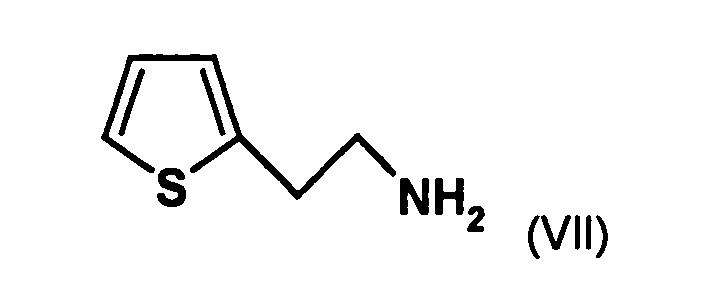
- HVLUYXIJZLDNIS-UHFFFAOYSA-N 2-thiophen-2-ylethanamine Chemical compound NCCC1=CC=CS1 HVLUYXIJZLDNIS-UHFFFAOYSA-N 0.000 description 7
- CPELXLSAUQHCOX-UHFFFAOYSA-N Hydrogen bromide Chemical compound Br CPELXLSAUQHCOX-UHFFFAOYSA-N 0.000 description 7
- 239000012074 organic phase Substances 0.000 description 7
- 238000000746 purification Methods 0.000 description 7
- 239000000377 silicon dioxide Substances 0.000 description 7
- YONLFQNRGZXBBF-ZIAGYGMSSA-N (2r,3r)-2,3-dibenzoyloxybutanedioic acid Chemical compound O([C@@H](C(=O)O)[C@@H](OC(=O)C=1C=CC=CC=1)C(O)=O)C(=O)C1=CC=CC=C1 YONLFQNRGZXBBF-ZIAGYGMSSA-N 0.000 description 6
- WEVYAHXRMPXWCK-UHFFFAOYSA-N Acetonitrile Chemical compound CC#N WEVYAHXRMPXWCK-UHFFFAOYSA-N 0.000 description 6
- WSFSSNUMVMOOMR-UHFFFAOYSA-N Formaldehyde Chemical compound O=C WSFSSNUMVMOOMR-UHFFFAOYSA-N 0.000 description 6
- RWRDLPDLKQPQOW-UHFFFAOYSA-N Pyrrolidine Chemical compound C1CCNC1 RWRDLPDLKQPQOW-UHFFFAOYSA-N 0.000 description 6
- 230000015572 biosynthetic process Effects 0.000 description 6
- 229950009815 dimepranol Drugs 0.000 description 6
- 239000000706 filtrate Substances 0.000 description 6
- 238000010438 heat treatment Methods 0.000 description 6
- JMMWKPVZQRWMSS-UHFFFAOYSA-N isopropanol acetate Natural products CC(C)OC(C)=O JMMWKPVZQRWMSS-UHFFFAOYSA-N 0.000 description 6
- 239000012044 organic layer Substances 0.000 description 6
- 239000011541 reaction mixture Substances 0.000 description 6
- 239000000725 suspension Substances 0.000 description 6
- 238000003786 synthesis reaction Methods 0.000 description 6
- MCLHDUKNRHKVBJ-UHFFFAOYSA-N 2-chloro-2-(2-chlorophenyl)acetyl chloride Chemical compound ClC(=O)C(Cl)C1=CC=CC=C1Cl MCLHDUKNRHKVBJ-UHFFFAOYSA-N 0.000 description 5
- HBAQYPYDRFILMT-UHFFFAOYSA-N 8-[3-(1-cyclopropylpyrazol-4-yl)-1H-pyrazolo[4,3-d]pyrimidin-5-yl]-3-methyl-3,8-diazabicyclo[3.2.1]octan-2-one Chemical class C1(CC1)N1N=CC(=C1)C1=NNC2=C1N=C(N=C2)N1C2C(N(CC1CC2)C)=O HBAQYPYDRFILMT-UHFFFAOYSA-N 0.000 description 5
- QTBSBXVTEAMEQO-UHFFFAOYSA-N Acetic acid Chemical compound CC(O)=O QTBSBXVTEAMEQO-UHFFFAOYSA-N 0.000 description 5
- QAOWNCQODCNURD-UHFFFAOYSA-N Sulfuric acid Chemical class OS(O)(=O)=O QAOWNCQODCNURD-UHFFFAOYSA-N 0.000 description 5
- GDTBXPJZTBHREO-UHFFFAOYSA-N bromine Chemical compound BrBr GDTBXPJZTBHREO-UHFFFAOYSA-N 0.000 description 5
- 229910052500 inorganic mineral Inorganic materials 0.000 description 5
- 239000000543 intermediate Substances 0.000 description 5
- 235000010755 mineral Nutrition 0.000 description 5
- 239000011707 mineral Substances 0.000 description 5
- 238000010992 reflux Methods 0.000 description 5
- 238000007363 ring formation reaction Methods 0.000 description 5
- 235000017557 sodium bicarbonate Nutrition 0.000 description 5
- 229910000030 sodium bicarbonate Inorganic materials 0.000 description 5
- YLQBMQCUIZJEEH-UHFFFAOYSA-N tetrahydrofuran Natural products C=1C=COC=1 YLQBMQCUIZJEEH-UHFFFAOYSA-N 0.000 description 5
- 229940125670 thienopyridine Drugs 0.000 description 5
- 239000002175 thienopyridine Substances 0.000 description 5
- IUJAAIZKRJJZGQ-UHFFFAOYSA-N 2-(2-chlorophenyl)acetic acid Chemical compound OC(=O)CC1=CC=CC=C1Cl IUJAAIZKRJJZGQ-UHFFFAOYSA-N 0.000 description 4
- VHYFNPMBLIVWCW-UHFFFAOYSA-N 4-Dimethylaminopyridine Chemical compound CN(C)C1=CC=NC=C1 VHYFNPMBLIVWCW-UHFFFAOYSA-N 0.000 description 4
- DHMQDGOQFOQNFH-UHFFFAOYSA-N Glycine Chemical compound NCC(O)=O DHMQDGOQFOQNFH-UHFFFAOYSA-N 0.000 description 4
- AWMVMTVKBNGEAK-UHFFFAOYSA-N Styrene oxide Chemical class C1OC1C1=CC=CC=C1 AWMVMTVKBNGEAK-UHFFFAOYSA-N 0.000 description 4
- 150000001412 amines Chemical class 0.000 description 4
- 239000008346 aqueous phase Substances 0.000 description 4
- 239000007864 aqueous solution Substances 0.000 description 4
- 239000002244 precipitate Substances 0.000 description 4
- 238000001953 recrystallisation Methods 0.000 description 4
- 239000007787 solid Substances 0.000 description 4
- DBDCNCCRPKTRSD-UHFFFAOYSA-N thieno[3,2-b]pyridine Chemical compound C1=CC=C2SC=CC2=N1 DBDCNCCRPKTRSD-UHFFFAOYSA-N 0.000 description 4
- 238000005406 washing Methods 0.000 description 4
- FUKFNSSCQOYPRM-JTQLQIEISA-N (1r)-2-(dimethylamino)-1-phenylethanol Chemical compound CN(C)C[C@H](O)C1=CC=CC=C1 FUKFNSSCQOYPRM-JTQLQIEISA-N 0.000 description 3
- UFUVLAQFZSUWHR-HTQZYQBOSA-N (1r,2r)-2-(dimethylamino)cyclohexan-1-ol Chemical compound CN(C)[C@@H]1CCCC[C@H]1O UFUVLAQFZSUWHR-HTQZYQBOSA-N 0.000 description 3
- FHBPYEQRIDZSBP-UHFFFAOYSA-N 1-phenyl-2-pyrrolidin-1-ylethanol Chemical compound C=1C=CC=CC=1C(O)CN1CCCC1 FHBPYEQRIDZSBP-UHFFFAOYSA-N 0.000 description 3
- FUKFNSSCQOYPRM-UHFFFAOYSA-N 2-(dimethylamino)-1-phenylethanol Chemical compound CN(C)CC(O)C1=CC=CC=C1 FUKFNSSCQOYPRM-UHFFFAOYSA-N 0.000 description 3
- UUPZTFTUZUQRQT-UHFFFAOYSA-N 2-thiophen-2-ylacetamide Chemical compound NC(=O)CC1=CC=CS1 UUPZTFTUZUQRQT-UHFFFAOYSA-N 0.000 description 3
- QCQCHGYLTSGIGX-GHXANHINSA-N 4-[[(3ar,5ar,5br,7ar,9s,11ar,11br,13as)-5a,5b,8,8,11a-pentamethyl-3a-[(5-methylpyridine-3-carbonyl)amino]-2-oxo-1-propan-2-yl-4,5,6,7,7a,9,10,11,11b,12,13,13a-dodecahydro-3h-cyclopenta[a]chrysen-9-yl]oxy]-2,2-dimethyl-4-oxobutanoic acid Chemical compound N([C@@]12CC[C@@]3(C)[C@]4(C)CC[C@H]5C(C)(C)[C@@H](OC(=O)CC(C)(C)C(O)=O)CC[C@]5(C)[C@H]4CC[C@@H]3C1=C(C(C2)=O)C(C)C)C(=O)C1=CN=CC(C)=C1 QCQCHGYLTSGIGX-GHXANHINSA-N 0.000 description 3
- ZCYVEMRRCGMTRW-UHFFFAOYSA-N 7553-56-2 Chemical group [I] ZCYVEMRRCGMTRW-UHFFFAOYSA-N 0.000 description 3
- CURLTUGMZLYLDI-UHFFFAOYSA-N Carbon dioxide Chemical compound O=C=O CURLTUGMZLYLDI-UHFFFAOYSA-N 0.000 description 3
- IAZDPXIOMUYVGZ-UHFFFAOYSA-N Dimethylsulphoxide Chemical compound CS(C)=O IAZDPXIOMUYVGZ-UHFFFAOYSA-N 0.000 description 3
- JUJWROOIHBZHMG-UHFFFAOYSA-N Pyridine Chemical group C1=CC=NC=C1 JUJWROOIHBZHMG-UHFFFAOYSA-N 0.000 description 3
- YXFVVABEGXRONW-UHFFFAOYSA-N Toluene Chemical compound CC1=CC=CC=C1 YXFVVABEGXRONW-UHFFFAOYSA-N 0.000 description 3
- 229910052794 bromium Inorganic materials 0.000 description 3
- 238000006555 catalytic reaction Methods 0.000 description 3
- 239000000460 chlorine Substances 0.000 description 3
- 238000004587 chromatography analysis Methods 0.000 description 3
- 239000013078 crystal Substances 0.000 description 3
- 238000002425 crystallisation Methods 0.000 description 3
- 230000008025 crystallization Effects 0.000 description 3
- NTBIYBAYFBNTCD-ZIAGYGMSSA-N dibenzoyl (2r,3r)-2,3-dihydroxybutanedioate Chemical compound O=C([C@H](O)[C@@H](O)C(=O)OC(=O)C=1C=CC=CC=1)OC(=O)C1=CC=CC=C1 NTBIYBAYFBNTCD-ZIAGYGMSSA-N 0.000 description 3
- 125000001495 ethyl group Chemical group [H]C([H])([H])C([H])([H])* 0.000 description 3
- 238000004128 high performance liquid chromatography Methods 0.000 description 3
- 229910000042 hydrogen bromide Inorganic materials 0.000 description 3
- IXCSERBJSXMMFS-UHFFFAOYSA-N hydrogen chloride Substances Cl.Cl IXCSERBJSXMMFS-UHFFFAOYSA-N 0.000 description 3
- 229910000041 hydrogen chloride Inorganic materials 0.000 description 3
- UHZYTMXLRWXGPK-UHFFFAOYSA-N phosphorus pentachloride Chemical compound ClP(Cl)(Cl)(Cl)Cl UHZYTMXLRWXGPK-UHFFFAOYSA-N 0.000 description 3
- 238000001556 precipitation Methods 0.000 description 3
- 150000003333 secondary alcohols Chemical class 0.000 description 3
- VXUYXOFXAQZZMF-UHFFFAOYSA-N titanium(IV) isopropoxide Chemical compound CC(C)O[Ti](OC(C)C)(OC(C)C)OC(C)C VXUYXOFXAQZZMF-UHFFFAOYSA-N 0.000 description 3
- FHBPYEQRIDZSBP-LBPRGKRZSA-N (1r)-1-phenyl-2-pyrrolidin-1-ylethanol Chemical compound C([C@H](O)C=1C=CC=CC=1)N1CCCC1 FHBPYEQRIDZSBP-LBPRGKRZSA-N 0.000 description 2
- UVZOEGFQUYHNLZ-UHFFFAOYSA-N 1-phenyl-2-pyrrolidin-1-ylethanol;hydrochloride Chemical compound Cl.C=1C=CC=CC=1C(O)CN1CCCC1 UVZOEGFQUYHNLZ-UHFFFAOYSA-N 0.000 description 2
- GKTWGGQPFAXNFI-UHFFFAOYSA-N 2-(2-chlorophenyl)-2-(6,7-dihydro-4H-thieno[3,2-c]pyridin-5-yl)acetic acid methyl ester Chemical compound C1CC=2SC=CC=2CN1C(C(=O)OC)C1=CC=CC=C1Cl GKTWGGQPFAXNFI-UHFFFAOYSA-N 0.000 description 2
- WKBOTKDWSSQWDR-UHFFFAOYSA-N Bromine atom Chemical compound [Br] WKBOTKDWSSQWDR-UHFFFAOYSA-N 0.000 description 2
- CSNNHWWHGAXBCP-UHFFFAOYSA-L Magnesium sulfate Chemical compound [Mg+2].[O-][S+2]([O-])([O-])[O-] CSNNHWWHGAXBCP-UHFFFAOYSA-L 0.000 description 2
- PMZURENOXWZQFD-UHFFFAOYSA-L Sodium Sulfate Chemical compound [Na+].[Na+].[O-]S([O-])(=O)=O PMZURENOXWZQFD-UHFFFAOYSA-L 0.000 description 2
- FAPWRFPIFSIZLT-UHFFFAOYSA-M Sodium chloride Chemical compound [Na+].[Cl-] FAPWRFPIFSIZLT-UHFFFAOYSA-M 0.000 description 2
- RTAQQCXQSZGOHL-UHFFFAOYSA-N Titanium Chemical compound [Ti] RTAQQCXQSZGOHL-UHFFFAOYSA-N 0.000 description 2
- 150000001263 acyl chlorides Chemical class 0.000 description 2
- 239000000010 aprotic solvent Substances 0.000 description 2
- 230000031709 bromination Effects 0.000 description 2
- 238000005893 bromination reaction Methods 0.000 description 2
- 238000004296 chiral HPLC Methods 0.000 description 2
- MVPPADPHJFYWMZ-UHFFFAOYSA-N chlorobenzene Chemical compound ClC1=CC=CC=C1 MVPPADPHJFYWMZ-UHFFFAOYSA-N 0.000 description 2
- ZWAJLVLEBYIOTI-UHFFFAOYSA-N cyclohexene oxide Chemical class C1CCCC2OC21 ZWAJLVLEBYIOTI-UHFFFAOYSA-N 0.000 description 2
- FWFSEYBSWVRWGL-UHFFFAOYSA-N cyclohexene oxide Natural products O=C1CCCC=C1 FWFSEYBSWVRWGL-UHFFFAOYSA-N 0.000 description 2
- 125000002147 dimethylamino group Chemical group [H]C([H])([H])N(*)C([H])([H])[H] 0.000 description 2
- 238000001035 drying Methods 0.000 description 2
- 239000000284 extract Substances 0.000 description 2
- 238000000605 extraction Methods 0.000 description 2
- 229960002449 glycine Drugs 0.000 description 2
- 235000013905 glycine and its sodium salt Nutrition 0.000 description 2
- 229910052740 iodine Inorganic materials 0.000 description 2
- 229940011051 isopropyl acetate Drugs 0.000 description 2
- GWYFCOCPABKNJV-UHFFFAOYSA-N isovaleric acid Chemical compound CC(C)CC(O)=O GWYFCOCPABKNJV-UHFFFAOYSA-N 0.000 description 2
- KULBBIWEXOOAHU-UHFFFAOYSA-N methyl 2-(6,7-dihydro-4h-thieno[3,2-c]pyridin-5-yl)acetate Chemical class C1N(CC(=O)OC)CCC2=C1C=CS2 KULBBIWEXOOAHU-UHFFFAOYSA-N 0.000 description 2
- 239000003960 organic solvent Substances 0.000 description 2
- 125000000466 oxiranyl group Chemical group 0.000 description 2
- 239000012071 phase Substances 0.000 description 2
- 239000011148 porous material Substances 0.000 description 2
- 239000007858 starting material Substances 0.000 description 2
- YBBRCQOCSYXUOC-UHFFFAOYSA-N sulfuryl dichloride Chemical class ClS(Cl)(=O)=O YBBRCQOCSYXUOC-UHFFFAOYSA-N 0.000 description 2
- 150000003509 tertiary alcohols Chemical class 0.000 description 2
- 125000000335 thiazolyl group Chemical group 0.000 description 2
- 229910052719 titanium Inorganic materials 0.000 description 2
- JMXKSZRRTHPKDL-UHFFFAOYSA-N titanium ethoxide Chemical compound [Ti+4].CC[O-].CC[O-].CC[O-].CC[O-] JMXKSZRRTHPKDL-UHFFFAOYSA-N 0.000 description 2
- 238000010626 work up procedure Methods 0.000 description 2
- 125000006273 (C1-C3) alkyl group Chemical group 0.000 description 1
- 125000004178 (C1-C4) alkyl group Chemical group 0.000 description 1
- 125000001399 1,2,3-triazolyl group Chemical group N1N=NC(=C1)* 0.000 description 1
- KZEVSDGEBAJOTK-UHFFFAOYSA-N 1-(2,4,6,7-tetrahydrotriazolo[4,5-c]pyridin-5-yl)-2-[5-[2-[[3-(trifluoromethoxy)phenyl]methylamino]pyrimidin-5-yl]-1,3,4-oxadiazol-2-yl]ethanone Chemical compound N1N=NC=2CN(CCC=21)C(CC=1OC(=NN=1)C=1C=NC(=NC=1)NCC1=CC(=CC=C1)OC(F)(F)F)=O KZEVSDGEBAJOTK-UHFFFAOYSA-N 0.000 description 1
- DURPTKYDGMDSBL-UHFFFAOYSA-N 1-butoxybutane Chemical compound CCCCOCCCC DURPTKYDGMDSBL-UHFFFAOYSA-N 0.000 description 1
- WJFYLCXWEXZNHU-UHFFFAOYSA-N 2,3,3a,4-tetrahydrothieno[3,2-b]pyridine Chemical compound N1C=CC=C2SCCC21 WJFYLCXWEXZNHU-UHFFFAOYSA-N 0.000 description 1
- LDXJRKWFNNFDSA-UHFFFAOYSA-N 2-(2,4,6,7-tetrahydrotriazolo[4,5-c]pyridin-5-yl)-1-[4-[2-[[3-(trifluoromethoxy)phenyl]methylamino]pyrimidin-5-yl]piperazin-1-yl]ethanone Chemical compound C1CN(CC2=NNN=C21)CC(=O)N3CCN(CC3)C4=CN=C(N=C4)NCC5=CC(=CC=C5)OC(F)(F)F LDXJRKWFNNFDSA-UHFFFAOYSA-N 0.000 description 1
- WIHSAOYVGKVRJX-UHFFFAOYSA-N 2-(2-chlorophenyl)acetyl chloride Chemical class ClC(=O)CC1=CC=CC=C1Cl WIHSAOYVGKVRJX-UHFFFAOYSA-N 0.000 description 1
- NGNBDVOYPDDBFK-UHFFFAOYSA-N 2-[2,4-di(pentan-2-yl)phenoxy]acetyl chloride Chemical compound CCCC(C)C1=CC=C(OCC(Cl)=O)C(C(C)CCC)=C1 NGNBDVOYPDDBFK-UHFFFAOYSA-N 0.000 description 1
- GSFNQBFZFXUTBN-UHFFFAOYSA-N 2-chlorothiophene Chemical compound ClC1=CC=CS1 GSFNQBFZFXUTBN-UHFFFAOYSA-N 0.000 description 1
- CLSHQIDDCJTHAJ-UHFFFAOYSA-N 2-thienylacetonitrile Chemical compound N#CCC1=CC=CS1 CLSHQIDDCJTHAJ-UHFFFAOYSA-N 0.000 description 1
- AJYXPNIENRLELY-UHFFFAOYSA-N 2-thiophen-2-ylacetyl chloride Chemical compound ClC(=O)CC1=CC=CS1 AJYXPNIENRLELY-UHFFFAOYSA-N 0.000 description 1
- PXACTUVBBMDKRW-UHFFFAOYSA-M 4-bromobenzenesulfonate Chemical group [O-]S(=O)(=O)C1=CC=C(Br)C=C1 PXACTUVBBMDKRW-UHFFFAOYSA-M 0.000 description 1
- ATRRKUHOCOJYRX-UHFFFAOYSA-N Ammonium bicarbonate Chemical compound [NH4+].OC([O-])=O ATRRKUHOCOJYRX-UHFFFAOYSA-N 0.000 description 1
- PKXCSZWZEMZYJR-UHFFFAOYSA-N CC(C(CCCC1)C1Cl)C(Cl)=O Chemical compound CC(C(CCCC1)C1Cl)C(Cl)=O PKXCSZWZEMZYJR-UHFFFAOYSA-N 0.000 description 1
- BVKZGUZCCUSVTD-UHFFFAOYSA-L Carbonate Chemical compound [O-]C([O-])=O BVKZGUZCCUSVTD-UHFFFAOYSA-L 0.000 description 1
- VEXZGXHMUGYJMC-UHFFFAOYSA-M Chloride anion Chemical compound [Cl-] VEXZGXHMUGYJMC-UHFFFAOYSA-M 0.000 description 1
- KZBUYRJDOAKODT-UHFFFAOYSA-N Chlorine Chemical compound ClCl KZBUYRJDOAKODT-UHFFFAOYSA-N 0.000 description 1
- ZAMOUSCENKQFHK-UHFFFAOYSA-N Chlorine atom Chemical compound [Cl] ZAMOUSCENKQFHK-UHFFFAOYSA-N 0.000 description 1
- ZAFNJMIOTHYJRJ-UHFFFAOYSA-N Diisopropyl ether Chemical compound CC(C)OC(C)C ZAFNJMIOTHYJRJ-UHFFFAOYSA-N 0.000 description 1
- VGGSQFUCUMXWEO-UHFFFAOYSA-N Ethene Chemical compound C=C VGGSQFUCUMXWEO-UHFFFAOYSA-N 0.000 description 1
- 239000005977 Ethylene Substances 0.000 description 1
- PXGOKWXKJXAPGV-UHFFFAOYSA-N Fluorine Chemical compound FF PXGOKWXKJXAPGV-UHFFFAOYSA-N 0.000 description 1
- 238000003747 Grignard reaction Methods 0.000 description 1
- DGAQECJNVWCQMB-PUAWFVPOSA-M Ilexoside XXIX Chemical compound C[C@@H]1CC[C@@]2(CC[C@@]3(C(=CC[C@H]4[C@]3(CC[C@@H]5[C@@]4(CC[C@@H](C5(C)C)OS(=O)(=O)[O-])C)C)[C@@H]2[C@]1(C)O)C)C(=O)O[C@H]6[C@@H]([C@H]([C@@H]([C@H](O6)CO)O)O)O.[Na+] DGAQECJNVWCQMB-PUAWFVPOSA-M 0.000 description 1
- FYYHWMGAXLPEAU-UHFFFAOYSA-N Magnesium Chemical compound [Mg] FYYHWMGAXLPEAU-UHFFFAOYSA-N 0.000 description 1
- AFCARXCZXQIEQB-UHFFFAOYSA-N N-[3-oxo-3-(2,4,6,7-tetrahydrotriazolo[4,5-c]pyridin-5-yl)propyl]-2-[[3-(trifluoromethoxy)phenyl]methylamino]pyrimidine-5-carboxamide Chemical compound O=C(CCNC(=O)C=1C=NC(=NC=1)NCC1=CC(=CC=C1)OC(F)(F)F)N1CC2=C(CC1)NN=N2 AFCARXCZXQIEQB-UHFFFAOYSA-N 0.000 description 1
- OAICVXFJPJFONN-UHFFFAOYSA-N Phosphorus Chemical compound [P] OAICVXFJPJFONN-UHFFFAOYSA-N 0.000 description 1
- 239000002262 Schiff base Substances 0.000 description 1
- 150000004753 Schiff bases Chemical class 0.000 description 1
- XUIMIQQOPSSXEZ-UHFFFAOYSA-N Silicon Chemical compound [Si] XUIMIQQOPSSXEZ-UHFFFAOYSA-N 0.000 description 1
- UIIMBOGNXHQVGW-DEQYMQKBSA-M Sodium bicarbonate-14C Chemical compound [Na+].O[14C]([O-])=O UIIMBOGNXHQVGW-DEQYMQKBSA-M 0.000 description 1
- 150000001298 alcohols Chemical class 0.000 description 1
- 239000003513 alkali Substances 0.000 description 1
- 150000001408 amides Chemical class 0.000 description 1
- 239000001099 ammonium carbonate Substances 0.000 description 1
- 235000012501 ammonium carbonate Nutrition 0.000 description 1
- 229940127218 antiplatelet drug Drugs 0.000 description 1
- 125000002393 azetidinyl group Chemical group 0.000 description 1
- 125000004069 aziridinyl group Chemical group 0.000 description 1
- 125000004369 butenyl group Chemical group C(=CCC)* 0.000 description 1
- 125000000484 butyl group Chemical group [H]C([*])([H])C([H])([H])C([H])([H])C([H])([H])[H] 0.000 description 1
- 239000001569 carbon dioxide Substances 0.000 description 1
- 229910002092 carbon dioxide Inorganic materials 0.000 description 1
- 235000011089 carbon dioxide Nutrition 0.000 description 1
- 239000003610 charcoal Substances 0.000 description 1
- 239000003153 chemical reaction reagent Substances 0.000 description 1
- 229940005991 chloric acid Drugs 0.000 description 1
- 238000005660 chlorination reaction Methods 0.000 description 1
- 230000002860 competitive effect Effects 0.000 description 1
- 150000004292 cyclic ethers Chemical class 0.000 description 1
- 125000001995 cyclobutyl group Chemical group [H]C1([H])C([H])([H])C([H])(*)C1([H])[H] 0.000 description 1
- 125000000582 cycloheptyl group Chemical group [H]C1([H])C([H])([H])C([H])([H])C([H])([H])C([H])(*)C([H])([H])C1([H])[H] 0.000 description 1
- 125000000113 cyclohexyl group Chemical group [H]C1([H])C([H])([H])C([H])([H])C([H])(*)C([H])([H])C1([H])[H] 0.000 description 1
- 125000001511 cyclopentyl group Chemical group [H]C1([H])C([H])([H])C([H])([H])C([H])(*)C1([H])[H] 0.000 description 1
- 125000001559 cyclopropyl group Chemical group [H]C1([H])C([H])([H])C1([H])* 0.000 description 1
- 238000000354 decomposition reaction Methods 0.000 description 1
- 238000011161 development Methods 0.000 description 1
- 230000018109 developmental process Effects 0.000 description 1
- XHFGWHUWQXTGAT-UHFFFAOYSA-N dimethylamine hydrochloride Natural products CNC(C)C XHFGWHUWQXTGAT-UHFFFAOYSA-N 0.000 description 1
- IQDGSYLLQPDQDV-UHFFFAOYSA-N dimethylazanium;chloride Chemical compound Cl.CNC IQDGSYLLQPDQDV-UHFFFAOYSA-N 0.000 description 1
- VCSZKSHWUBFOOE-UHFFFAOYSA-N dioxidanium;sulfate Chemical compound O.O.OS(O)(=O)=O VCSZKSHWUBFOOE-UHFFFAOYSA-N 0.000 description 1
- 238000004821 distillation Methods 0.000 description 1
- 229940079593 drug Drugs 0.000 description 1
- 239000003814 drug Substances 0.000 description 1
- 238000001914 filtration Methods 0.000 description 1
- 239000012467 final product Substances 0.000 description 1
- 239000011737 fluorine Substances 0.000 description 1
- 229910052731 fluorine Inorganic materials 0.000 description 1
- 125000001153 fluoro group Chemical group F* 0.000 description 1
- 125000001072 heteroaryl group Chemical group 0.000 description 1
- 230000007062 hydrolysis Effects 0.000 description 1
- 238000006460 hydrolysis reaction Methods 0.000 description 1
- 125000002883 imidazolyl group Chemical group 0.000 description 1
- 239000012442 inert solvent Substances 0.000 description 1
- 239000004615 ingredient Substances 0.000 description 1
- 238000011081 inoculation Methods 0.000 description 1
- 239000013067 intermediate product Substances 0.000 description 1
- PNDPGZBMCMUPRI-UHFFFAOYSA-N iodine Chemical compound II PNDPGZBMCMUPRI-UHFFFAOYSA-N 0.000 description 1
- 239000011630 iodine Substances 0.000 description 1
- 238000002955 isolation Methods 0.000 description 1
- 125000001449 isopropyl group Chemical group [H]C([H])([H])C([H])(*)C([H])([H])[H] 0.000 description 1
- 125000000842 isoxazolyl group Chemical group 0.000 description 1
- 239000010410 layer Substances 0.000 description 1
- 239000011777 magnesium Substances 0.000 description 1
- 229910052749 magnesium Inorganic materials 0.000 description 1
- 229910052943 magnesium sulfate Inorganic materials 0.000 description 1
- 235000019341 magnesium sulphate Nutrition 0.000 description 1
- 238000004519 manufacturing process Methods 0.000 description 1
- 239000000463 material Substances 0.000 description 1
- 230000007246 mechanism Effects 0.000 description 1
- 150000004702 methyl esters Chemical class 0.000 description 1
- 125000002496 methyl group Chemical group [H]C([H])([H])* 0.000 description 1
- 125000004108 n-butyl group Chemical group [H]C([H])([H])C([H])([H])C([H])([H])C([H])([H])* 0.000 description 1
- 125000004123 n-propyl group Chemical group [H]C([H])([H])C([H])([H])C([H])([H])* 0.000 description 1
- 239000003921 oil Substances 0.000 description 1
- 125000002971 oxazolyl group Chemical group 0.000 description 1
- SOQBVABWOPYFQZ-UHFFFAOYSA-N oxygen(2-);titanium(4+) Chemical class [O-2].[O-2].[Ti+4] SOQBVABWOPYFQZ-UHFFFAOYSA-N 0.000 description 1
- 125000001147 pentyl group Chemical group C(CCCC)* 0.000 description 1
- 239000000106 platelet aggregation inhibitor Substances 0.000 description 1
- 150000003138 primary alcohols Chemical class 0.000 description 1
- 125000004368 propenyl group Chemical group C(=CC)* 0.000 description 1
- ZMRUPTIKESYGQW-UHFFFAOYSA-N propranolol hydrochloride Chemical compound [H+].[Cl-].C1=CC=C2C(OCC(O)CNC(C)C)=CC=CC2=C1 ZMRUPTIKESYGQW-UHFFFAOYSA-N 0.000 description 1
- 125000003373 pyrazinyl group Chemical group 0.000 description 1
- 125000002098 pyridazinyl group Chemical group 0.000 description 1
- UMJSCPRVCHMLSP-UHFFFAOYSA-N pyridine Natural products COC1=CC=CN=C1 UMJSCPRVCHMLSP-UHFFFAOYSA-N 0.000 description 1
- 125000004076 pyridyl group Chemical group 0.000 description 1
- 125000000714 pyrimidinyl group Chemical group 0.000 description 1
- 125000000168 pyrrolyl group Chemical group 0.000 description 1
- 238000006798 ring closing metathesis reaction Methods 0.000 description 1
- 239000010703 silicon Substances 0.000 description 1
- 235000012239 silicon dioxide Nutrition 0.000 description 1
- 229910000033 sodium borohydride Inorganic materials 0.000 description 1
- 239000012279 sodium borohydride Substances 0.000 description 1
- 239000011780 sodium chloride Substances 0.000 description 1
- 229910052938 sodium sulfate Inorganic materials 0.000 description 1
- 235000011152 sodium sulphate Nutrition 0.000 description 1
- 238000000638 solvent extraction Methods 0.000 description 1
- 238000003860 storage Methods 0.000 description 1
- 238000006467 substitution reaction Methods 0.000 description 1
- 150000003467 sulfuric acid derivatives Chemical class 0.000 description 1
- LMBFAGIMSUYTBN-MPZNNTNKSA-N teixobactin Chemical compound C([C@H](C(=O)N[C@@H]([C@@H](C)CC)C(=O)N[C@@H](CO)C(=O)N[C@H](CCC(N)=O)C(=O)N[C@H]([C@@H](C)CC)C(=O)N[C@@H]([C@@H](C)CC)C(=O)N[C@@H](CO)C(=O)N[C@H]1C(N[C@@H](C)C(=O)N[C@@H](C[C@@H]2NC(=N)NC2)C(=O)N[C@H](C(=O)O[C@H]1C)[C@@H](C)CC)=O)NC)C1=CC=CC=C1 LMBFAGIMSUYTBN-MPZNNTNKSA-N 0.000 description 1
- 150000003512 tertiary amines Chemical class 0.000 description 1
- 125000003718 tetrahydrofuranyl group Chemical group 0.000 description 1
- GWEVSGVZZGPLCZ-UHFFFAOYSA-N titanium dioxide Inorganic materials O=[Ti]=O GWEVSGVZZGPLCZ-UHFFFAOYSA-N 0.000 description 1
- 239000004408 titanium dioxide Substances 0.000 description 1
- 125000005490 tosylate group Chemical group 0.000 description 1
- 125000002827 triflate group Chemical group FC(S(=O)(=O)O*)(F)F 0.000 description 1
- 125000000391 vinyl group Chemical group [H]C([*])=C([H])[H] 0.000 description 1
Classifications
-
- C—CHEMISTRY; METALLURGY
- C07—ORGANIC CHEMISTRY
- C07D—HETEROCYCLIC COMPOUNDS
- C07D495/00—Heterocyclic compounds containing in the condensed system at least one hetero ring having sulfur atoms as the only ring hetero atoms
- C07D495/02—Heterocyclic compounds containing in the condensed system at least one hetero ring having sulfur atoms as the only ring hetero atoms in which the condensed system contains two hetero rings
- C07D495/04—Ortho-condensed systems
-
- C—CHEMISTRY; METALLURGY
- C07—ORGANIC CHEMISTRY
- C07C—ACYCLIC OR CARBOCYCLIC COMPOUNDS
- C07C213/00—Preparation of compounds containing amino and hydroxy, amino and etherified hydroxy or amino and esterified hydroxy groups bound to the same carbon skeleton
- C07C213/10—Separation; Purification; Stabilisation; Use of additives
-
- C—CHEMISTRY; METALLURGY
- C07—ORGANIC CHEMISTRY
- C07D—HETEROCYCLIC COMPOUNDS
- C07D333/00—Heterocyclic compounds containing five-membered rings having one sulfur atom as the only ring hetero atom
- C07D333/02—Heterocyclic compounds containing five-membered rings having one sulfur atom as the only ring hetero atom not condensed with other rings
- C07D333/04—Heterocyclic compounds containing five-membered rings having one sulfur atom as the only ring hetero atom not condensed with other rings not substituted on the ring sulphur atom
- C07D333/06—Heterocyclic compounds containing five-membered rings having one sulfur atom as the only ring hetero atom not condensed with other rings not substituted on the ring sulphur atom with only hydrogen atoms, hydrocarbon or substituted hydrocarbon radicals, directly attached to the ring carbon atoms
- C07D333/14—Radicals substituted by singly bound hetero atoms other than halogen
- C07D333/20—Radicals substituted by singly bound hetero atoms other than halogen by nitrogen atoms
-
- C—CHEMISTRY; METALLURGY
- C07—ORGANIC CHEMISTRY
- C07B—GENERAL METHODS OF ORGANIC CHEMISTRY; APPARATUS THEREFOR
- C07B2200/00—Indexing scheme relating to specific properties of organic compounds
- C07B2200/07—Optical isomers
Definitions
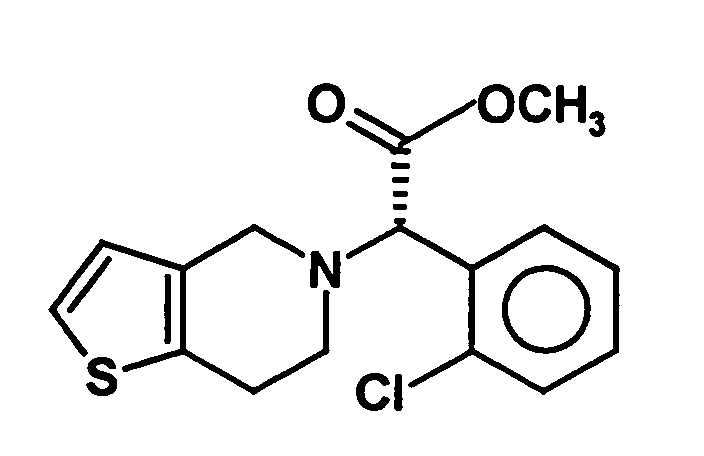
- the present invention relates to a stereoselective process for the production of optical pure (2-halophenyl) (6,7-dihydro-4H-thieno [3,2-c] pyridin-5-yl) acetic acid methyl esters, especially clopidogrel, and intermediates for use in this Method. Surprisingly, the process allows the optically pure To get final compounds easier and in better yield.
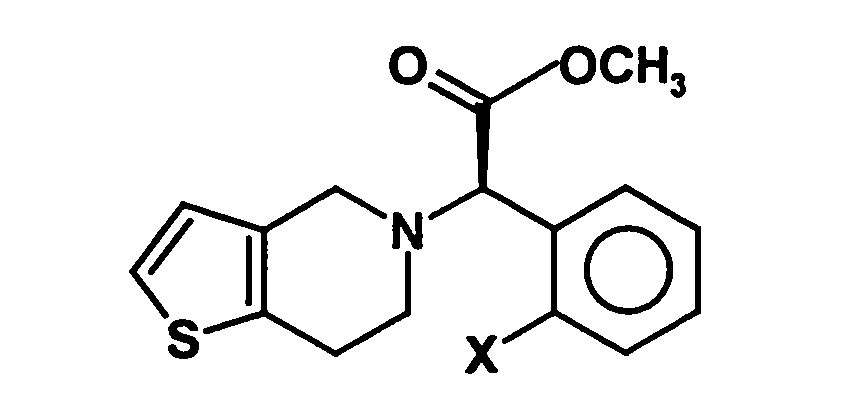
- Clopidogrel is the dextrorotatory compound (+) - [(S) - (2-chlorophenyl) - (6,7-dihydro-4H-thieno [3,2-c] pyridin-5-yl) -acetic acid methyl ester, which is in the form of Hydrogen sulfate salt is marketed.
- WO 98/51681 discloses a process that uses the open-chain intermediates runs.
- the racemate separation is particularly difficult when it takes place on a compound in which the pyridine ring is already closed. Accordingly, in the process of WO 98/51681, the enantiomer separation takes place in an open-chain intermediate, for example the intermediate product
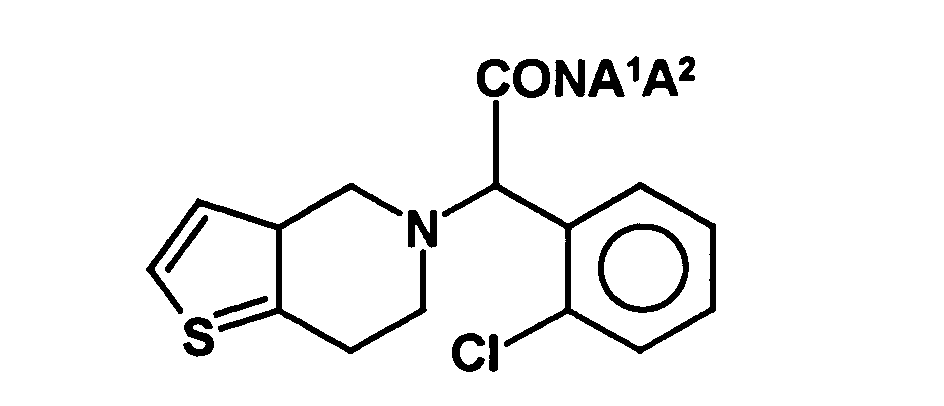
- WO 03/035652 discloses a process for the preparation of clopidogrel, which comprises the preparation of an intermediate compound of the formula A 1 and A 2 independently of one another can form hydrogen or C 1 -C 4 -alkyl groups or form a ring.
- the compound is first prepared as a racemate and then cleaved into the individual enantiomers. From the optically active acid amide clopidogrel is then obtained by reaction with eg methanol and sulfuric acid.
- the invention is based on the object, a new synthesis of compounds of the formula in which X represents a halogen atom, which can be carried out economically and with few steps.
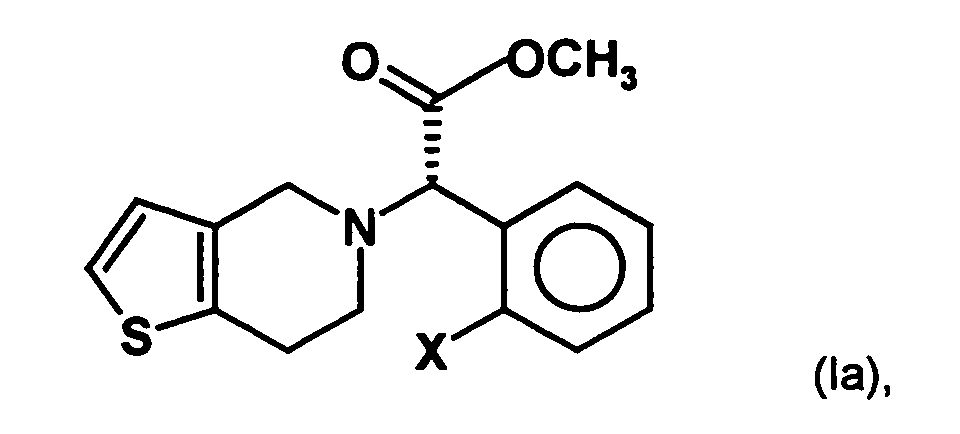
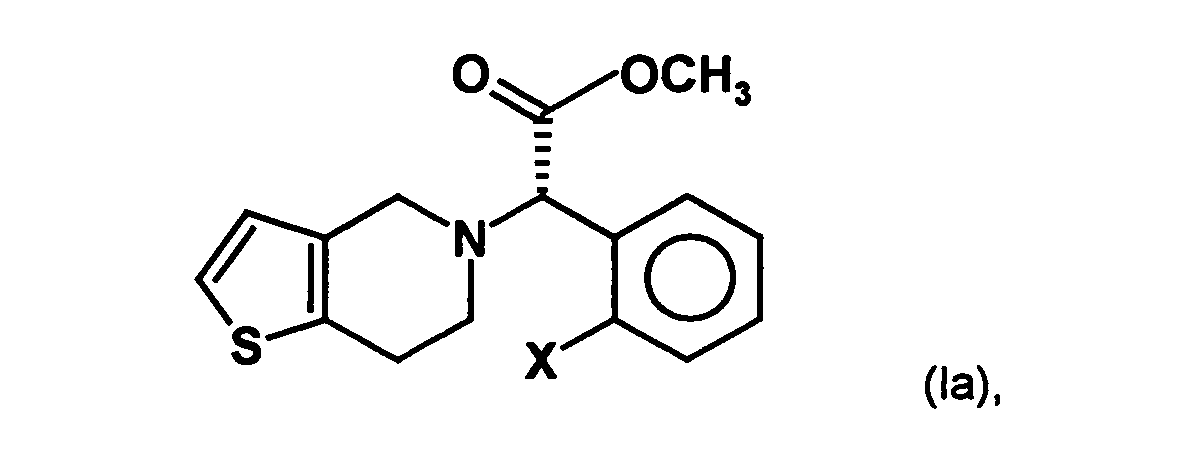
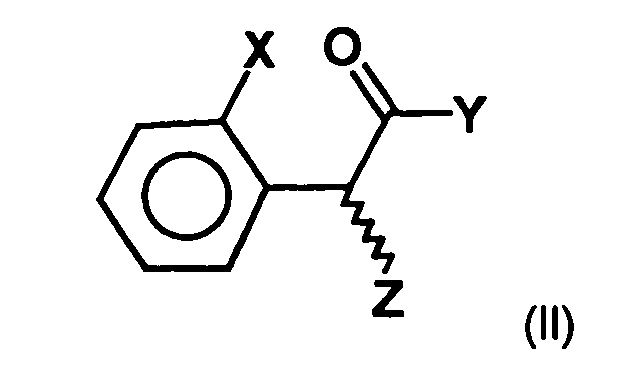
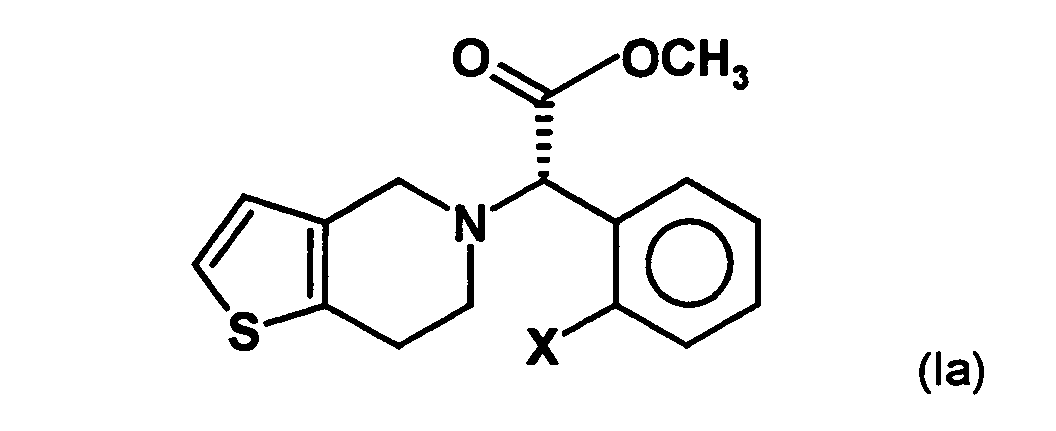
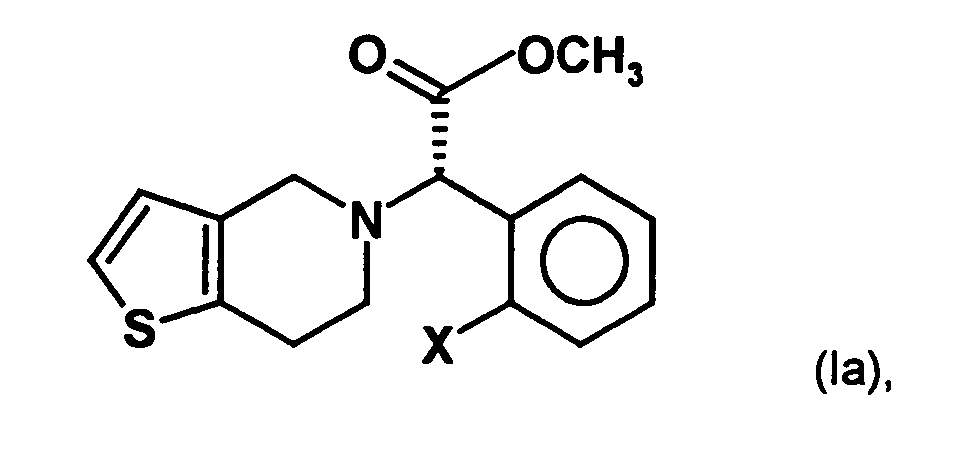
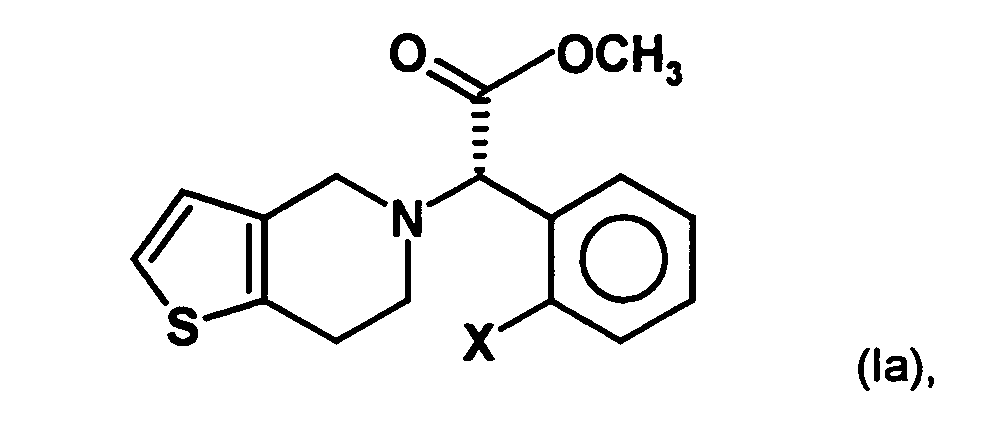
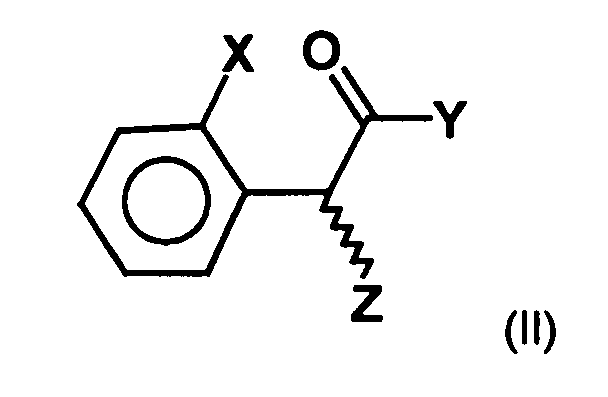
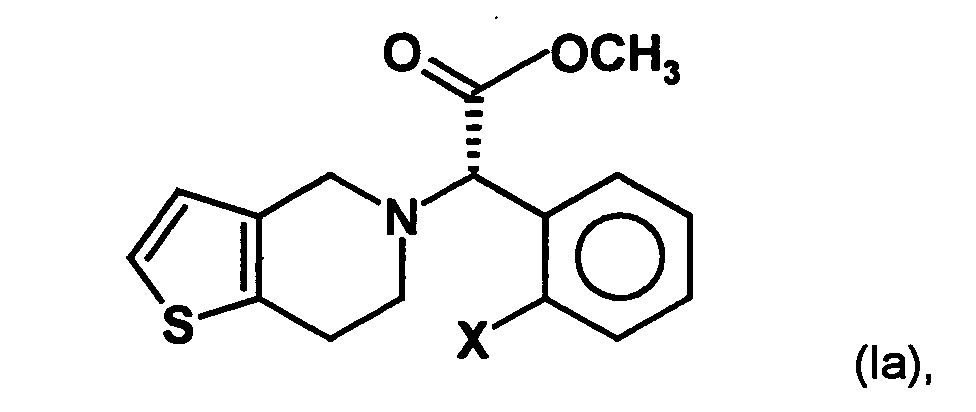
- a process for the preparation of a compound of general formula (Ia) in which X represents a halogen atom, or a pharmaceutically acceptable salt thereof comprising the step of preparing a compound of the formula (II) in which X is as defined above and Y and Z, independently of one another, each represent a leaving group, is reacted with an optically active aminoalcohol to give a first mixture of diastereomers.
- a first mixture of diastereomers is formed in which one of the two diastereomers is enriched, in particular, a mixture of diastereomers, in which the ratio of the one diastereomer to the second diastereomer is 2: 1 or higher. It is possible according to the invention to separate off the desired diastereomer already from the first mixture of diastereomers and to carry out the further synthesis of clopidogrel only with this one diastereomer. According to the invention, however, the first mixture of diastereomers is preferably further processed as such.
- a second mixture of diastereomers is formed in which one of the two diastereomers is enriched even more than in the first mixture of diastereomers.
- the ratio of one diastereomer to the second diastereomer is 3: 1 or higher, more preferably 4: 1 or higher, most preferably 9: 1 or higher.
- optical activity of the optically active aminoalcohol can either one or the other diastereomer is obtained in excess.
- the radical X represents a halogen atom, in particular a fluorine, chlorine, Bromine or iodine atom, more preferably a chlorine atom.
- the radicals Y and Z represent customary leaving groups, as in the prior art are known in the art, and for example in Peter Sykes, reaction mechanisms of organic chemistry, 9th edition, Weinheim 1988.
- preferred Leaving groups are the halogen atoms, in particular iodine, chlorine, bromine or Fluorine atoms, a tosylate residue, a triflate residue or a brosylate residue.
- optically active aminoalcohol is not particularly limited. Preferred are optically active amino alcohols, in which at least one optically active center in spatial proximity to the hydroxyl group which couples to the compound of formula II, preferably no further than one, two or three bonds away from the hydroxyl group.
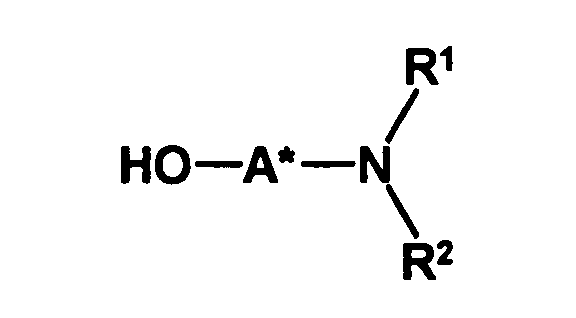
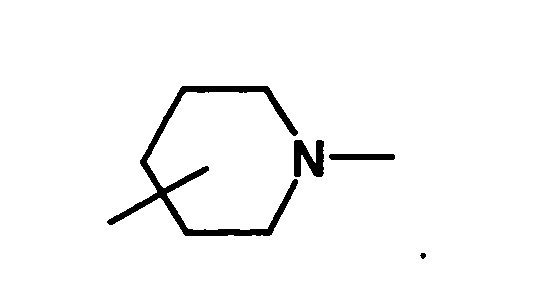
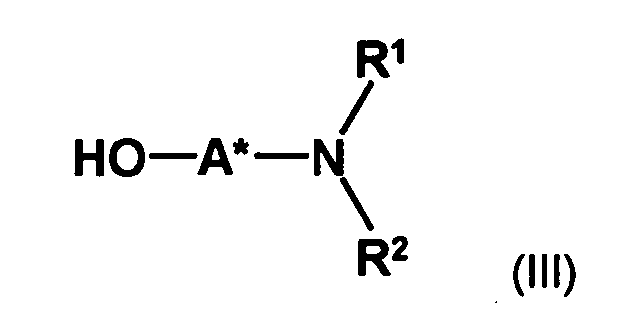
- an optically active aminoalcohol of the formula (III) wherein A * represents a hydrocarbon radical of 1 to 30 carbon atoms which may contain up to 5 heteroatoms selected from nitrogen, oxygen, sulfur and halogen atoms which may be substituted with up to 5 substituents selected from hydroxyl groups, oxo groups , Cyano groups and nitro groups, and having one or more optically active moieties, and R 1 and R 2 are each independently hydrogen or hydrocarbyl of from 1 to 20 carbon atoms, each of up to 4 heteroatoms selected from nitrogen, oxygen, sulfur and halogen atoms, and up to 5 substituents selected from hydroxy, oxo, Cyano groups and nitro groups, or may have one or both of the radicals R 1 and R 2 having a carbon atom or a heteroatom of the radical A * forms a 5- to 10-membered saturated or unsaturated ring which optionally contains, in addition to the nitrogen atom, 1 to 3 further heteroatoms selected from nitrogen, Oxygen
- optically active amino alcohols used according to the invention Only a single hydroxyl group can be used for competitive reactions in the Reaction with the compound of formula (II) can be avoided.
- the radicals R 1 and R 2 preferably independently of one another are a C 1 -C 6 -alkyl radical, a C 5 -C 10 -aryl radical (preferably C 6 -C 10 -aryl radical), a C 5 -C 10 -heteroaryl radical, a C 3 -C 8 -cycloalkyl radical or C 2 -C 8 -heterocycloalkyl radical or, together with the nitrogen atom to which they are bonded, form a saturated or unsaturated ring having 2 to 8 carbon atoms, which is optionally substituted by a C 1 -C 6 -alkyl radical; Alkyl group or a halogen atom may be substituted and in addition to the nitrogen atom 1 or 2 further heteroatoms selected from sulfur atoms, nitrogen atoms and oxygen atoms may contain.
- a * on a molecule grouping means that these Molecular grouping has optical activity.
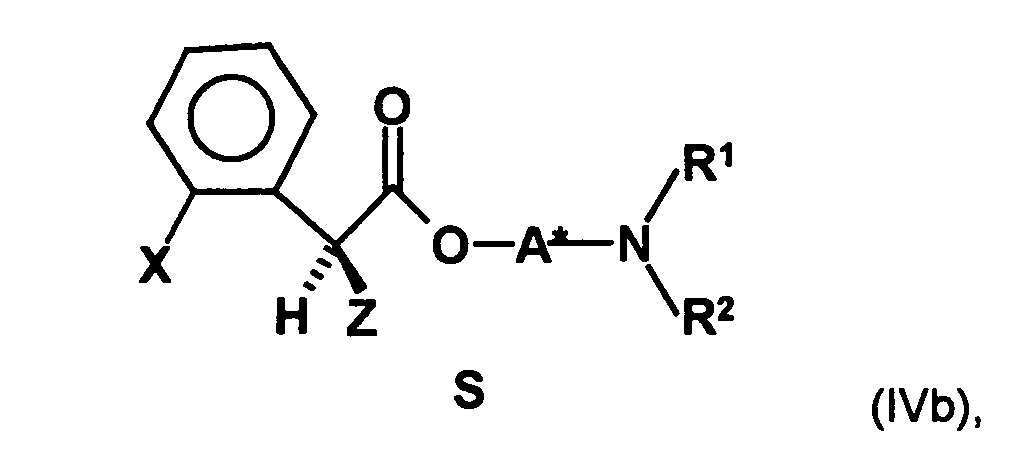
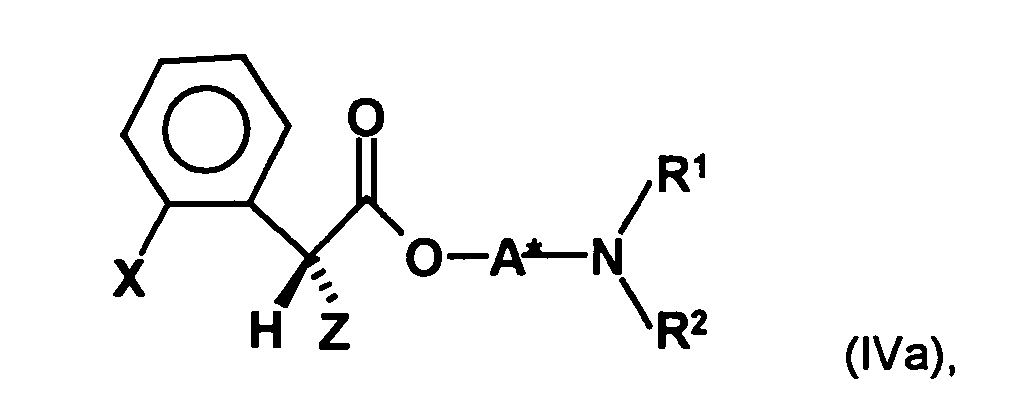
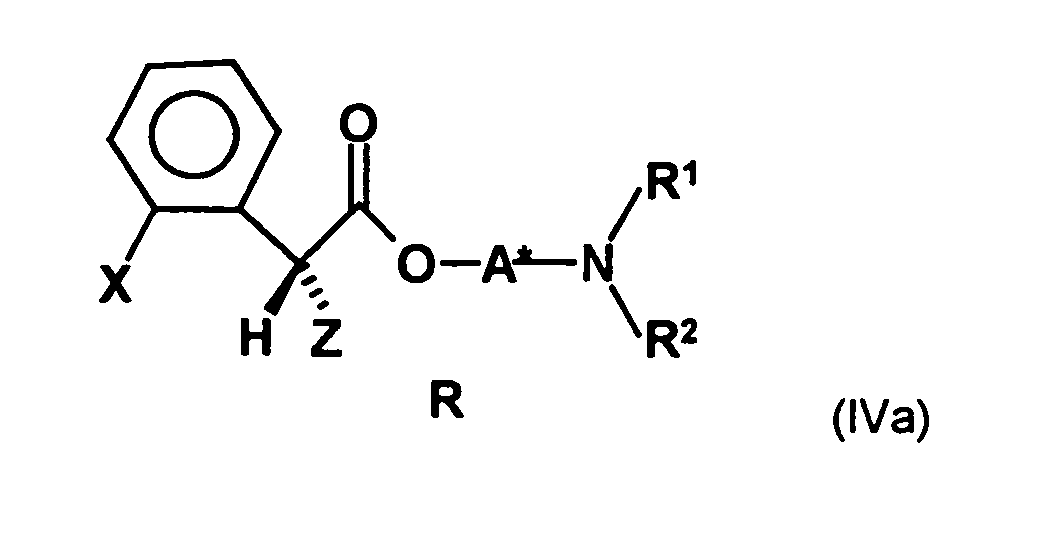
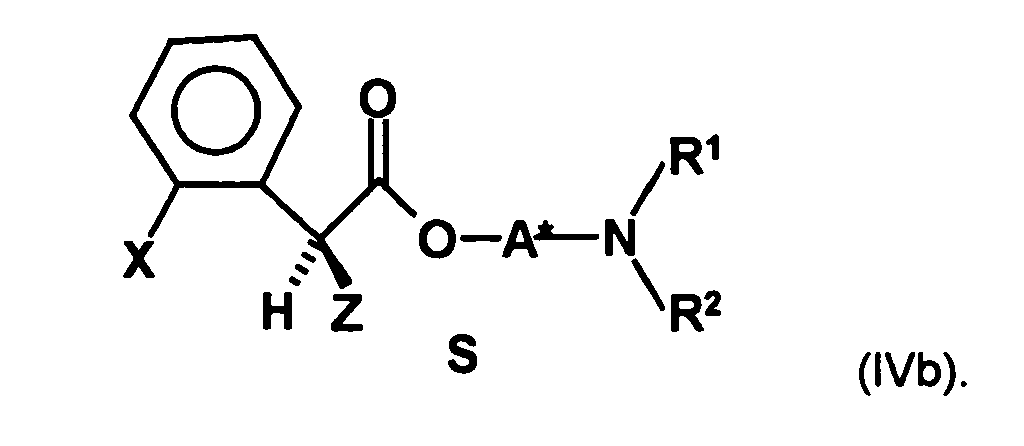
- the first mixture of diastereomers contains an excess, preferably on the diastereomer of the formula (IVa) and the excess is usually about 2: 1 or higher.
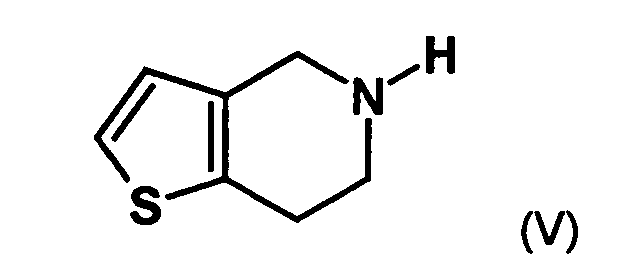
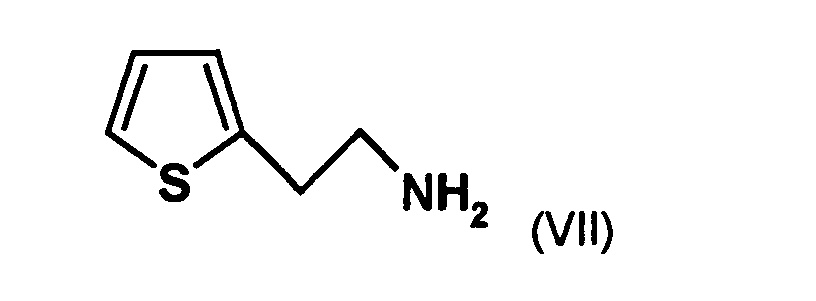
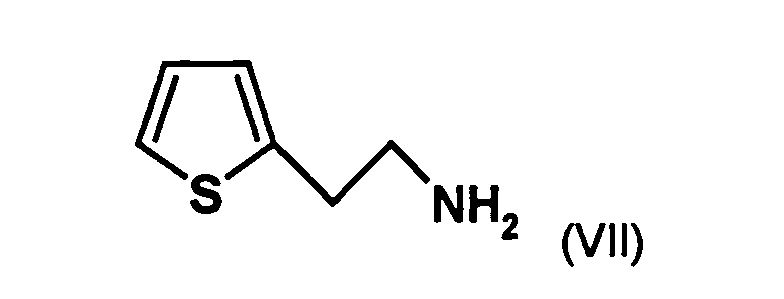
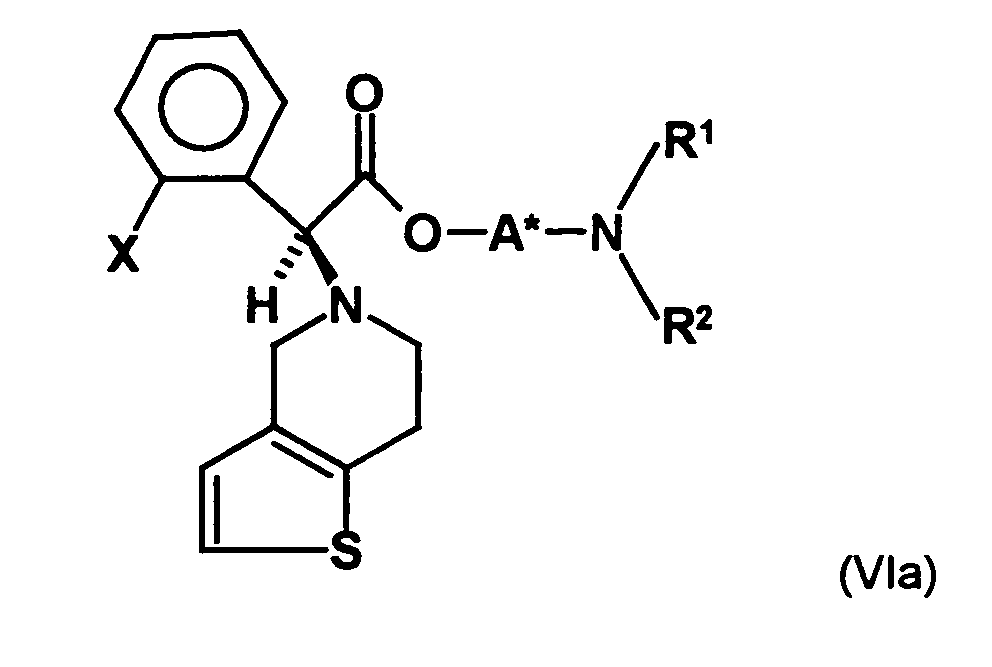
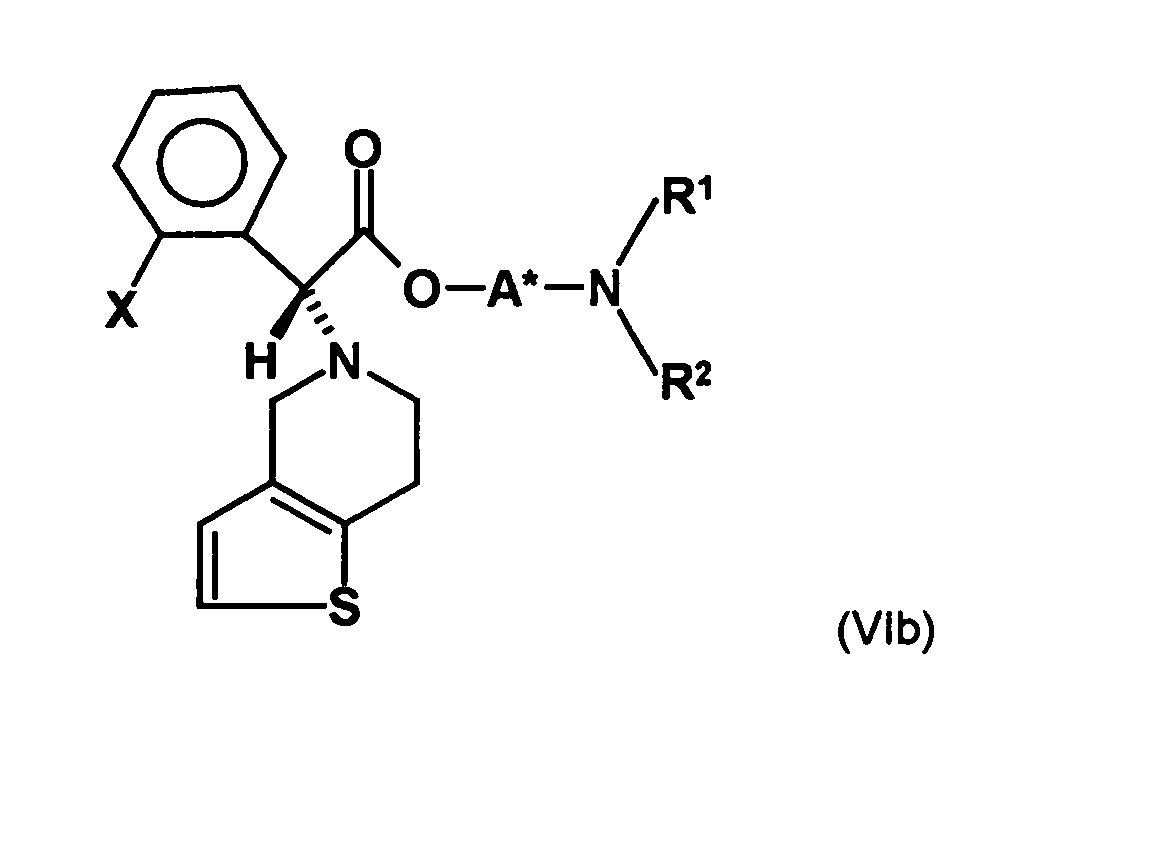
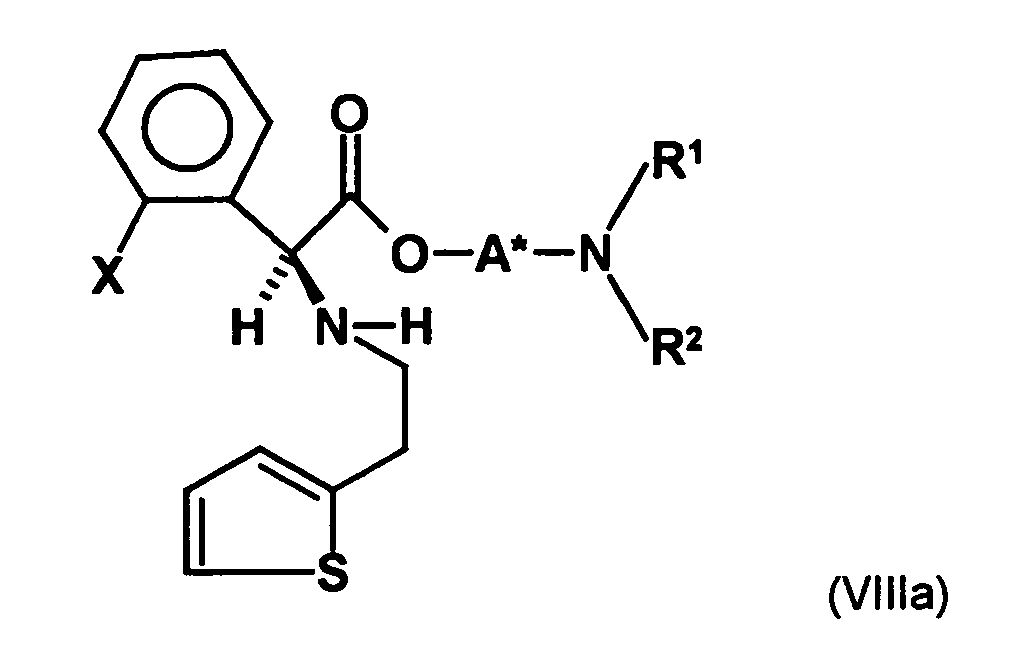
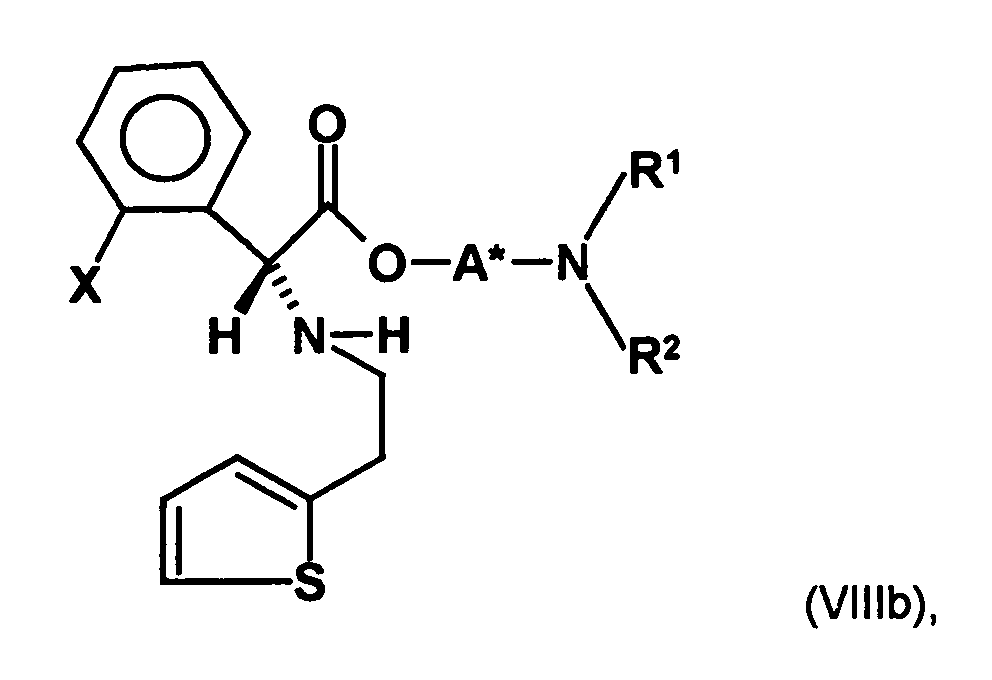
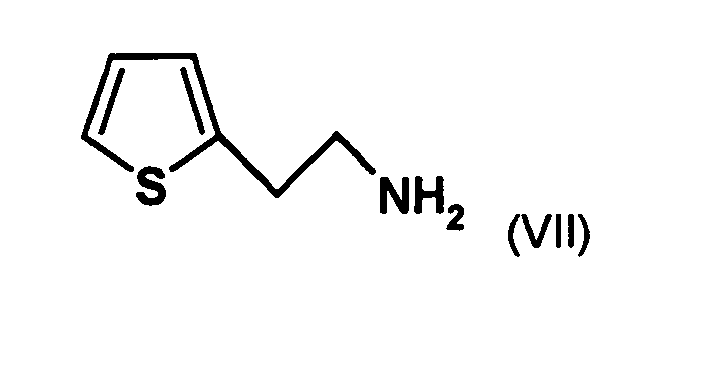
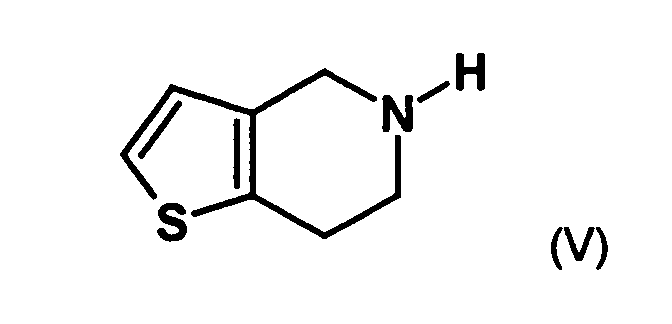
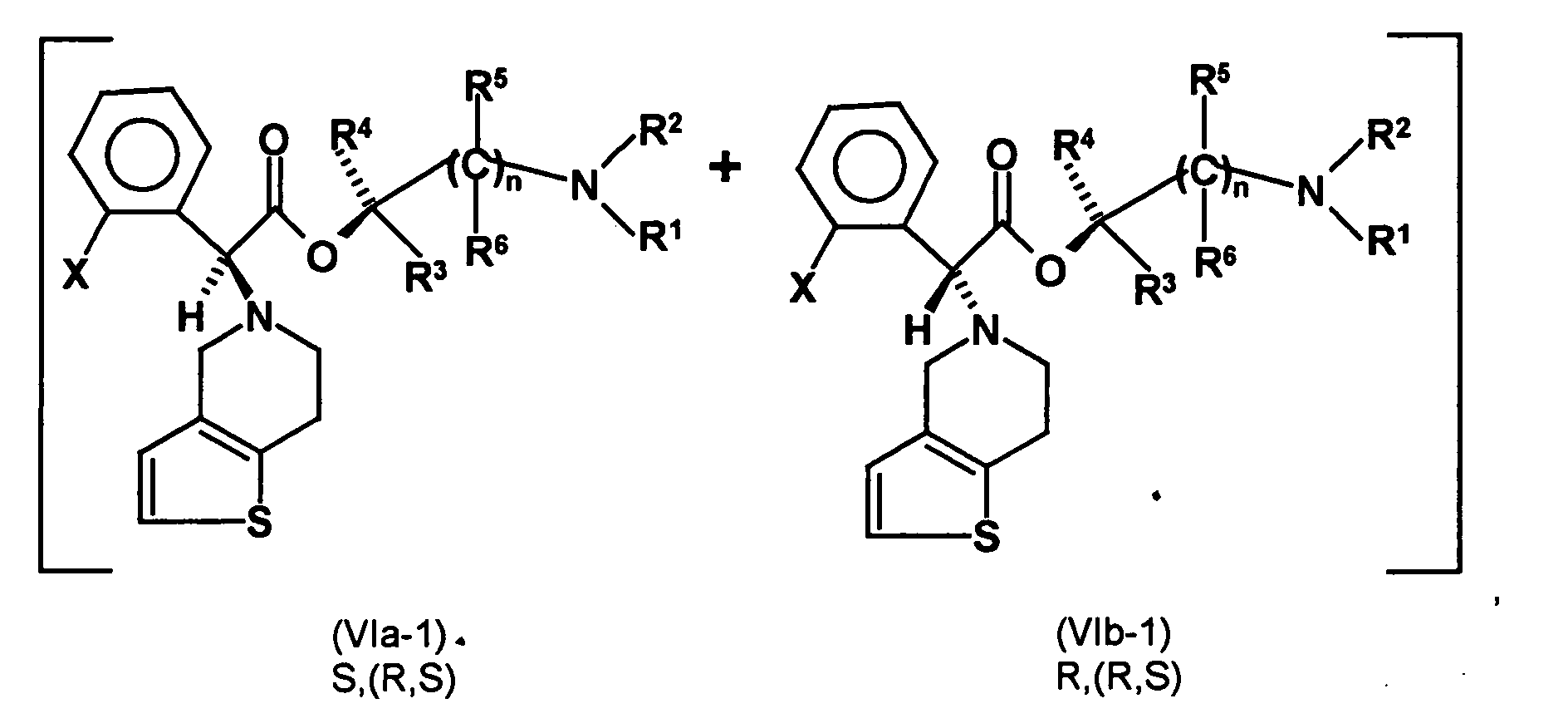
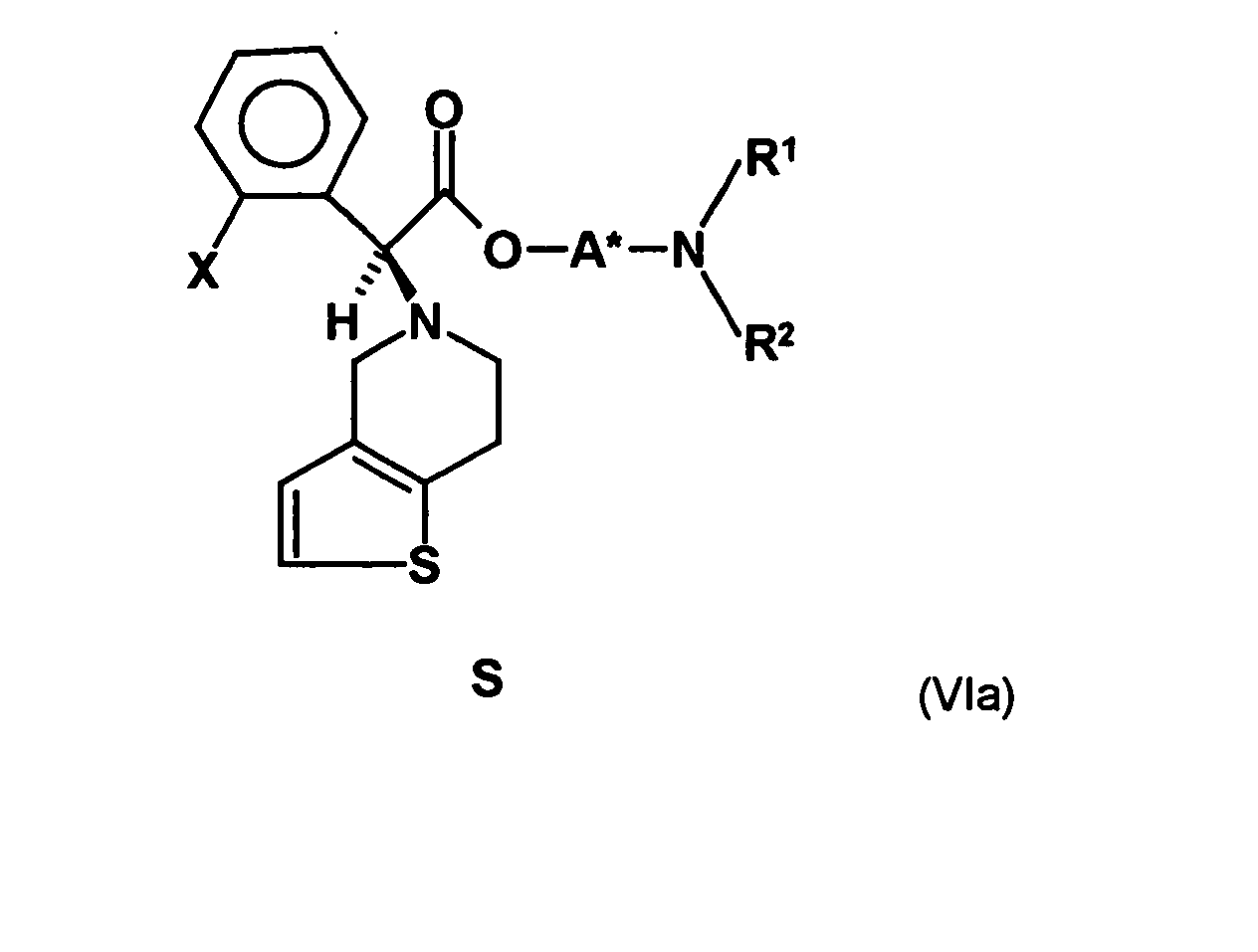
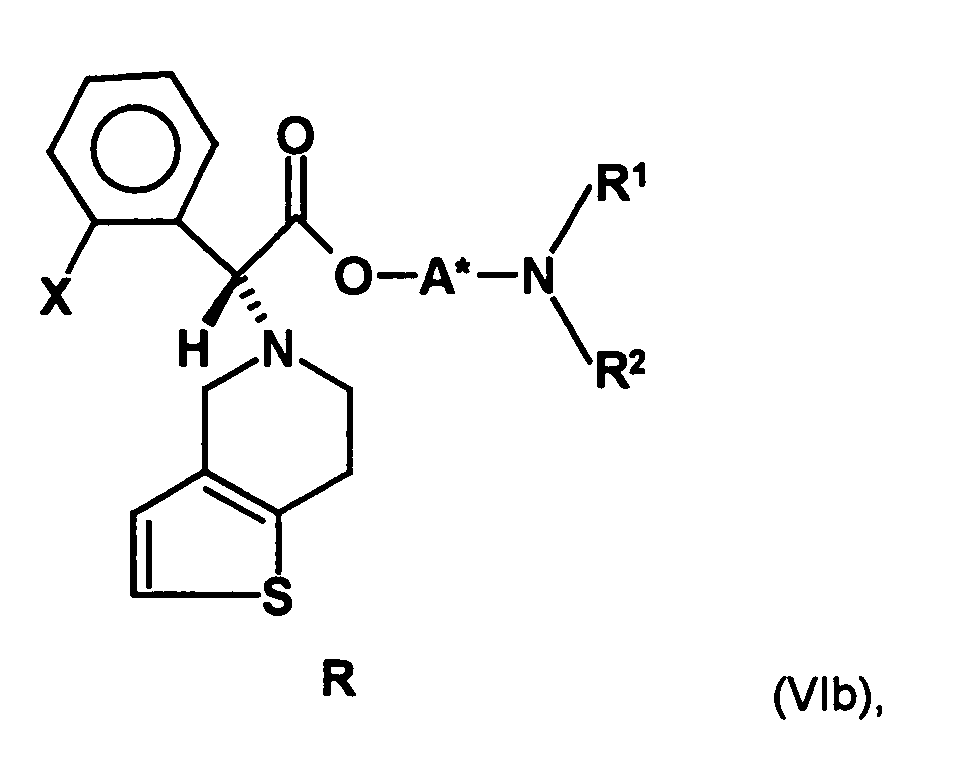
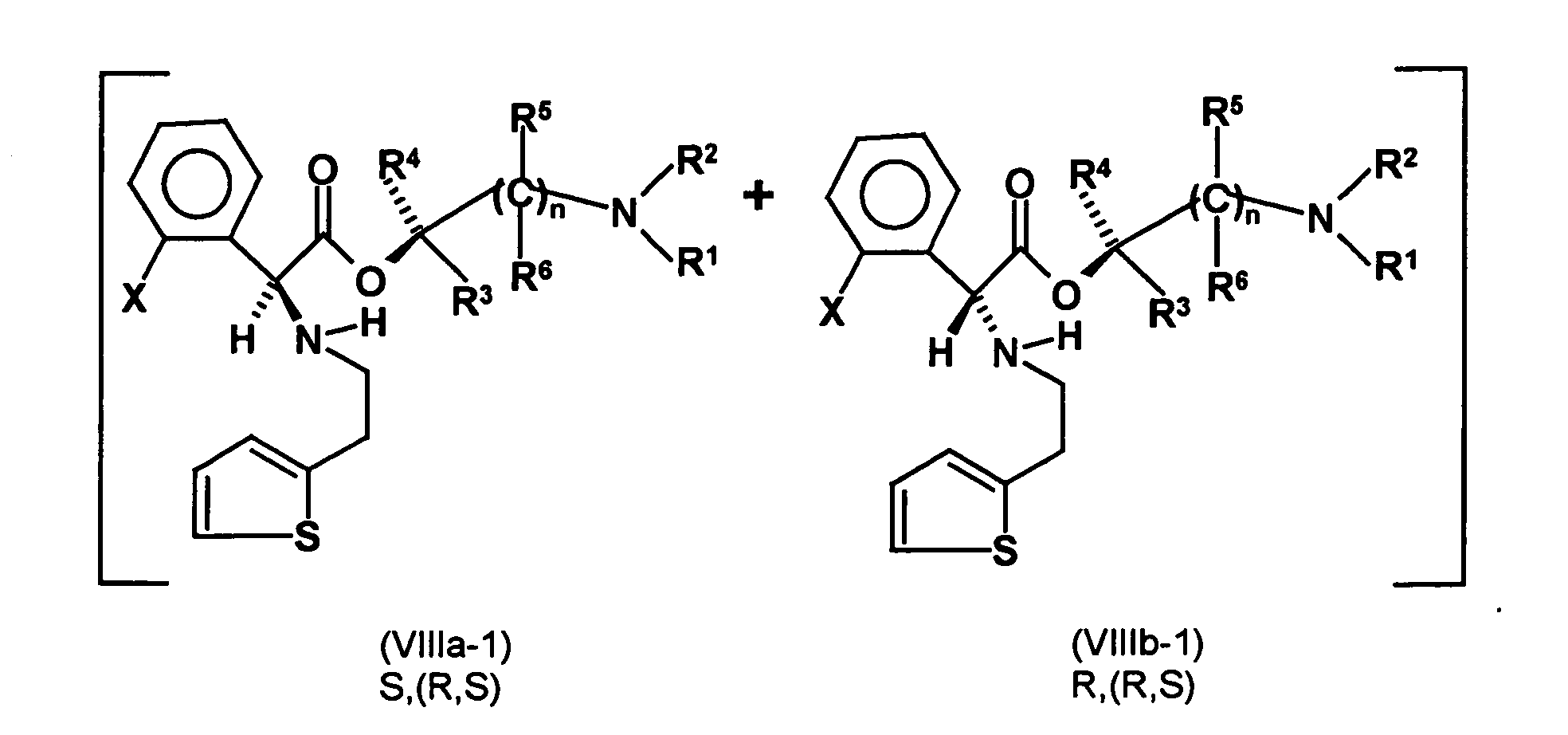
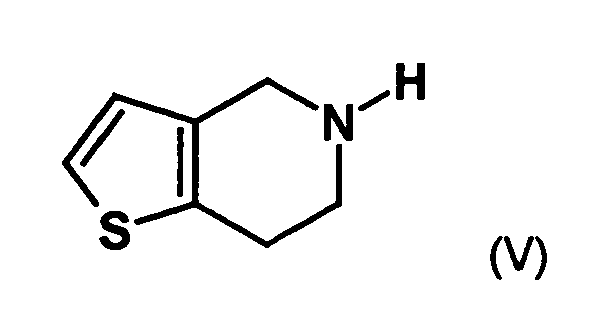
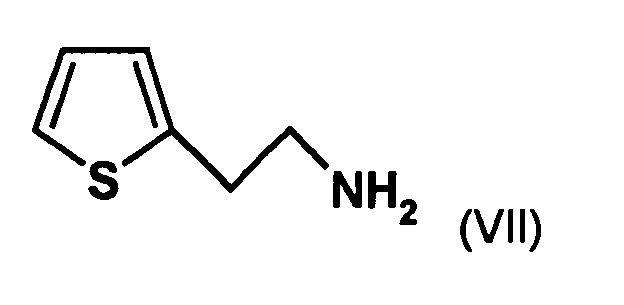
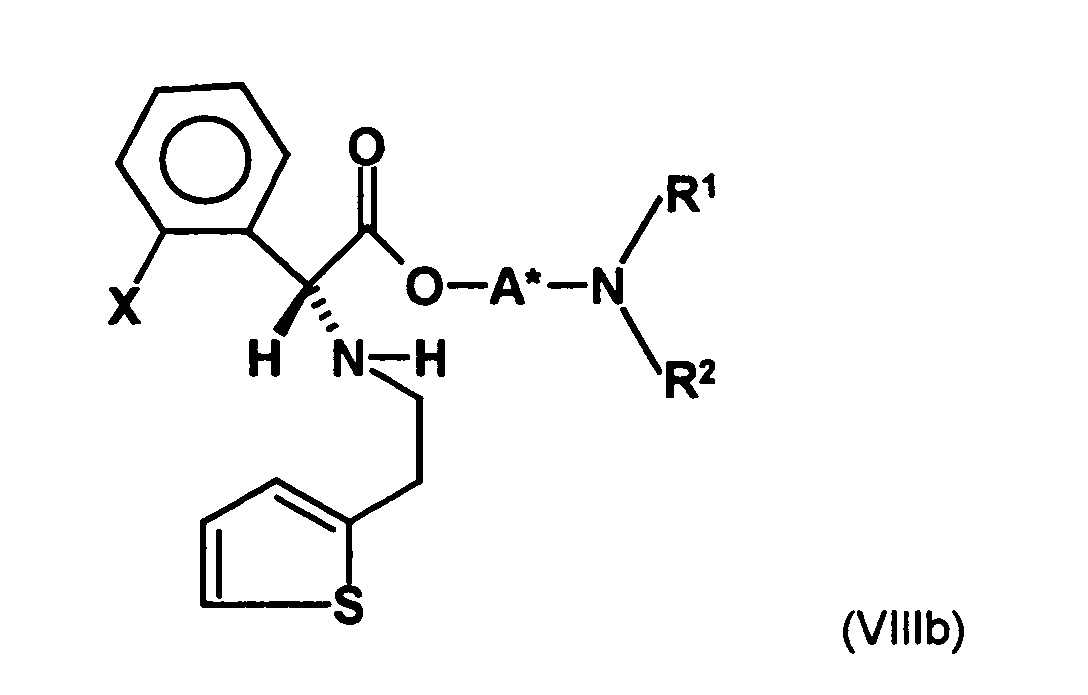
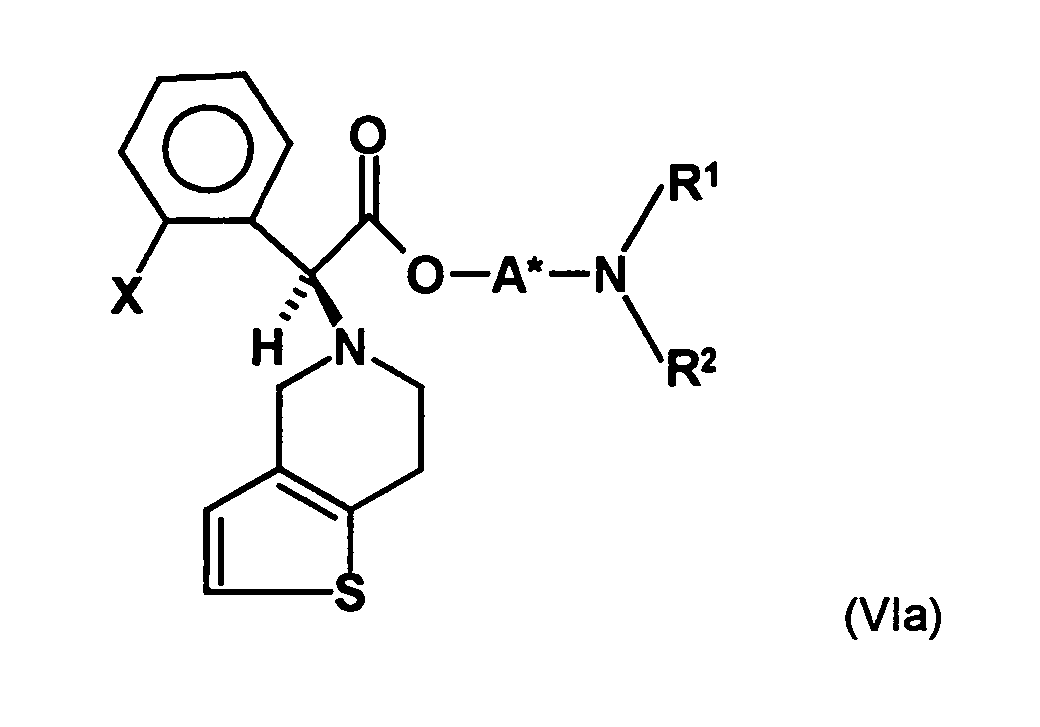
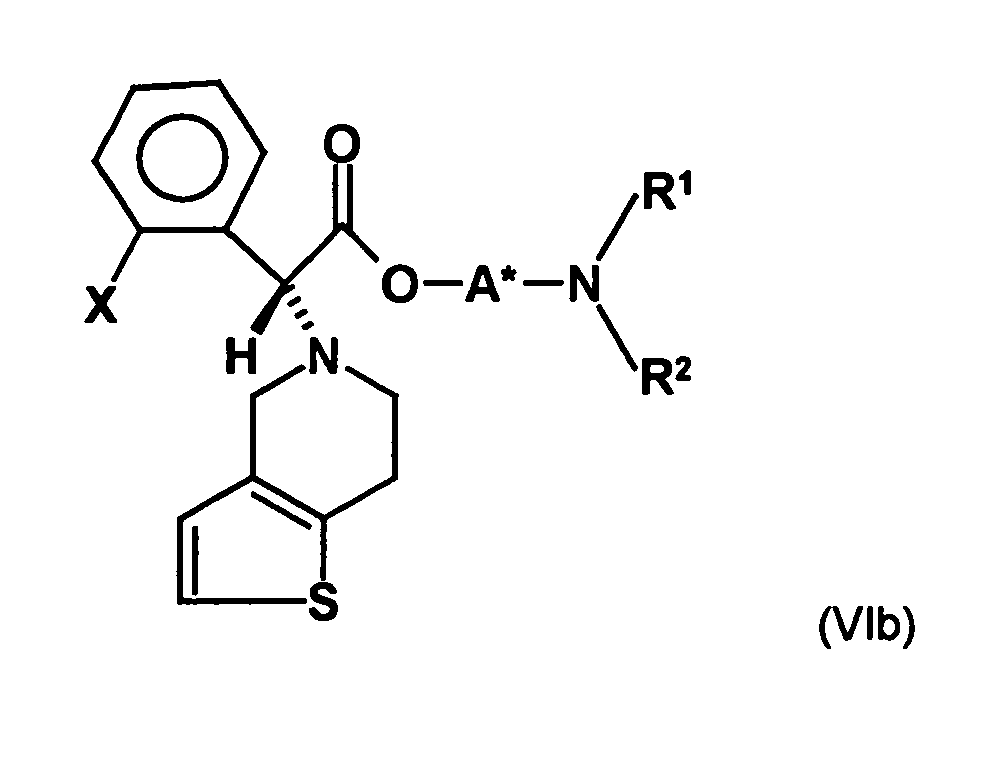
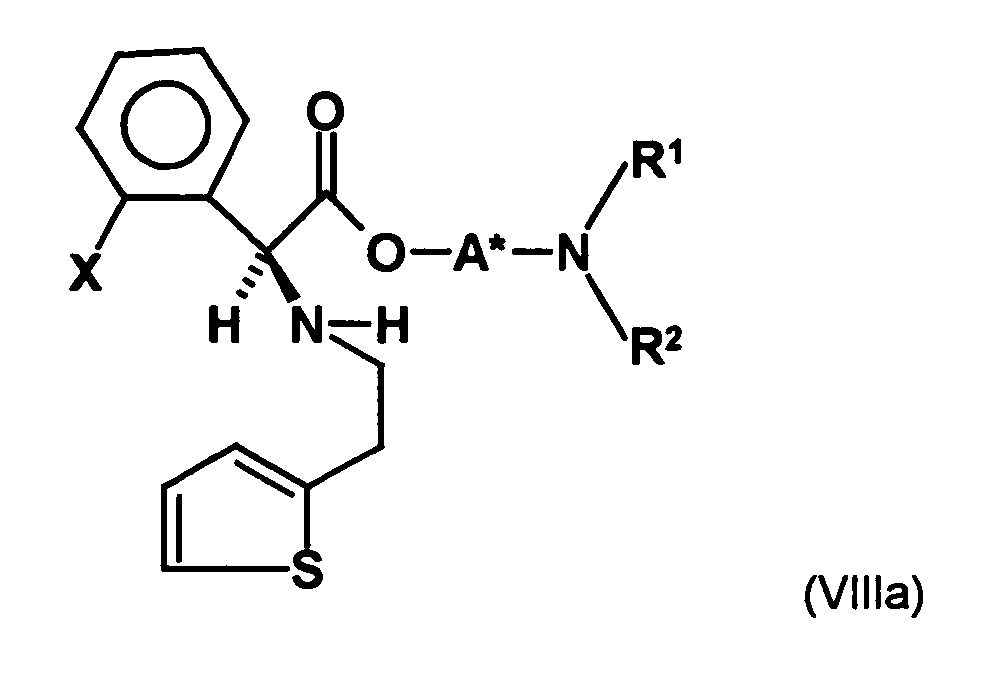
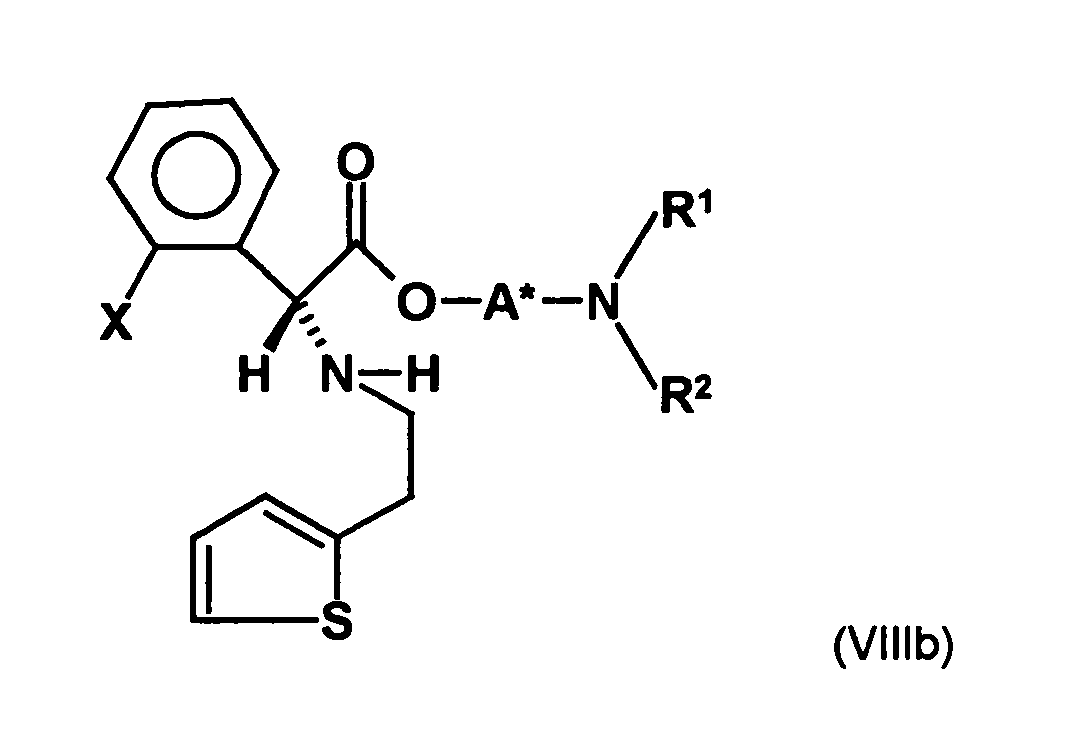
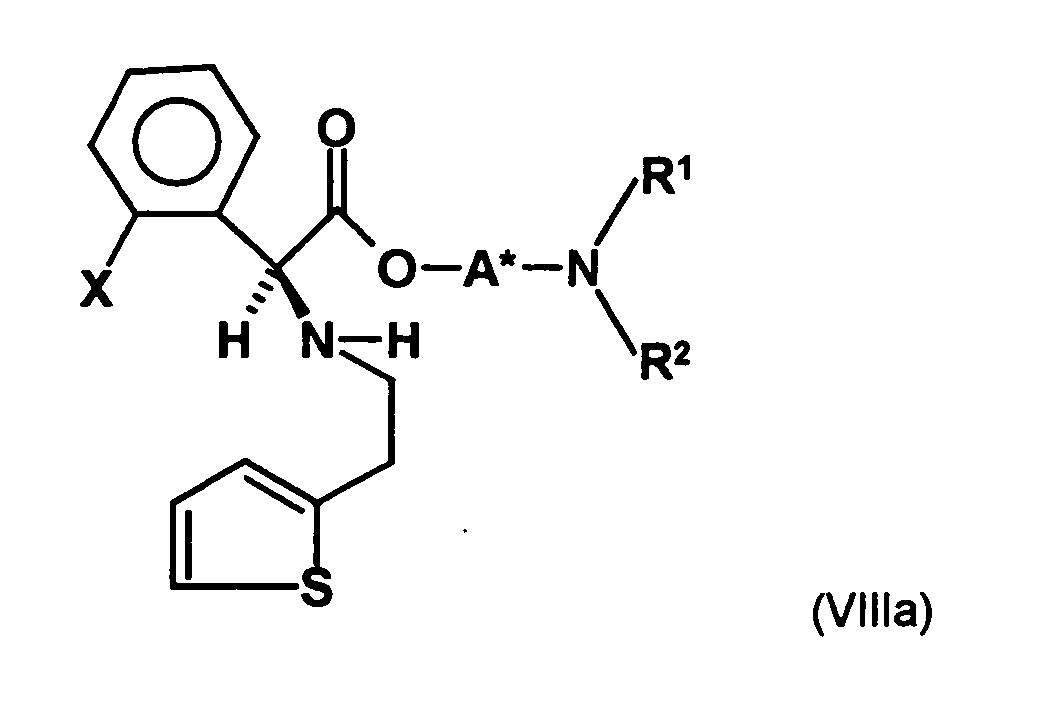
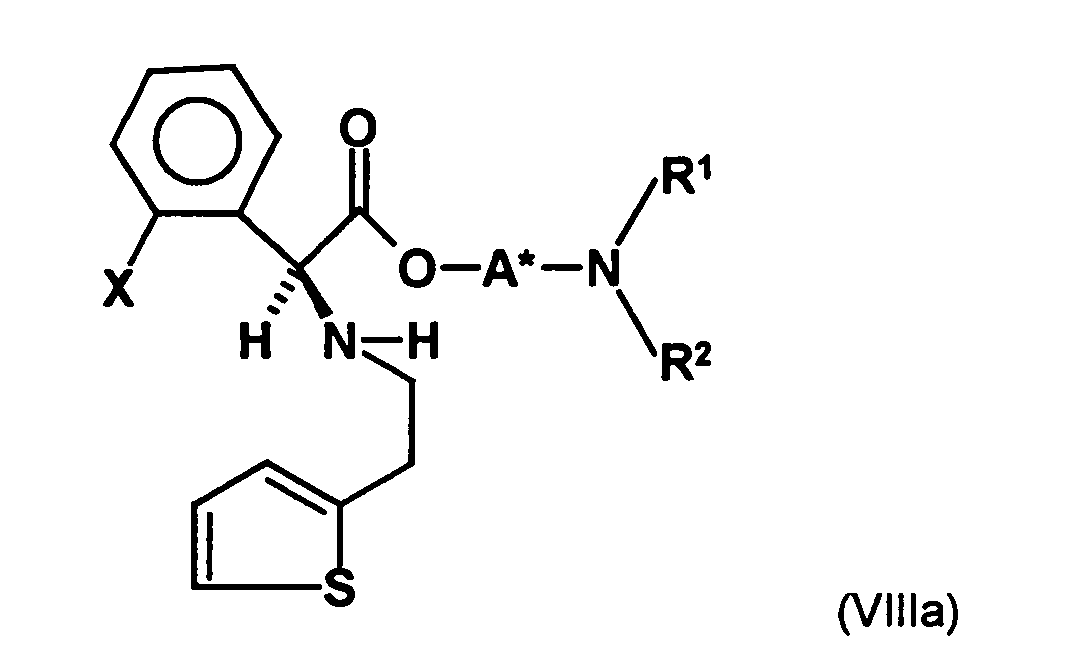
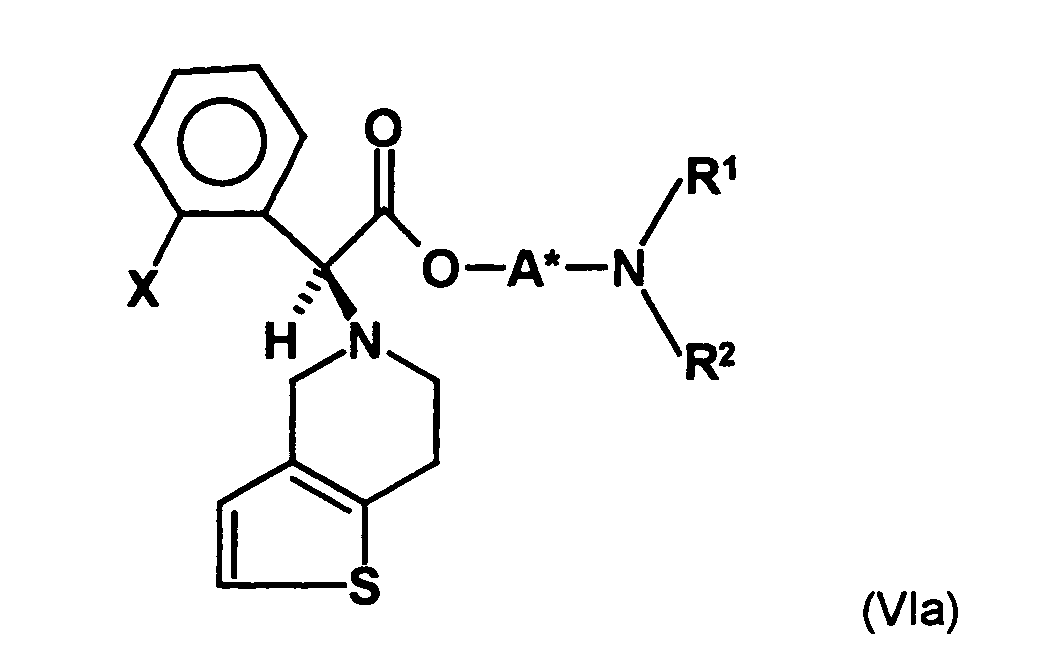
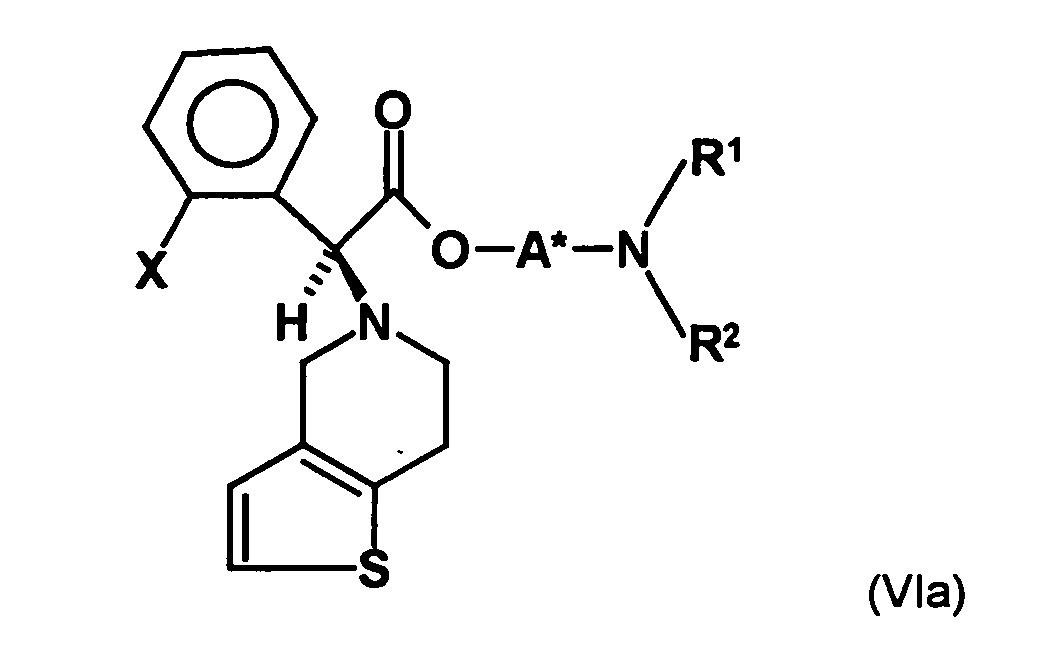
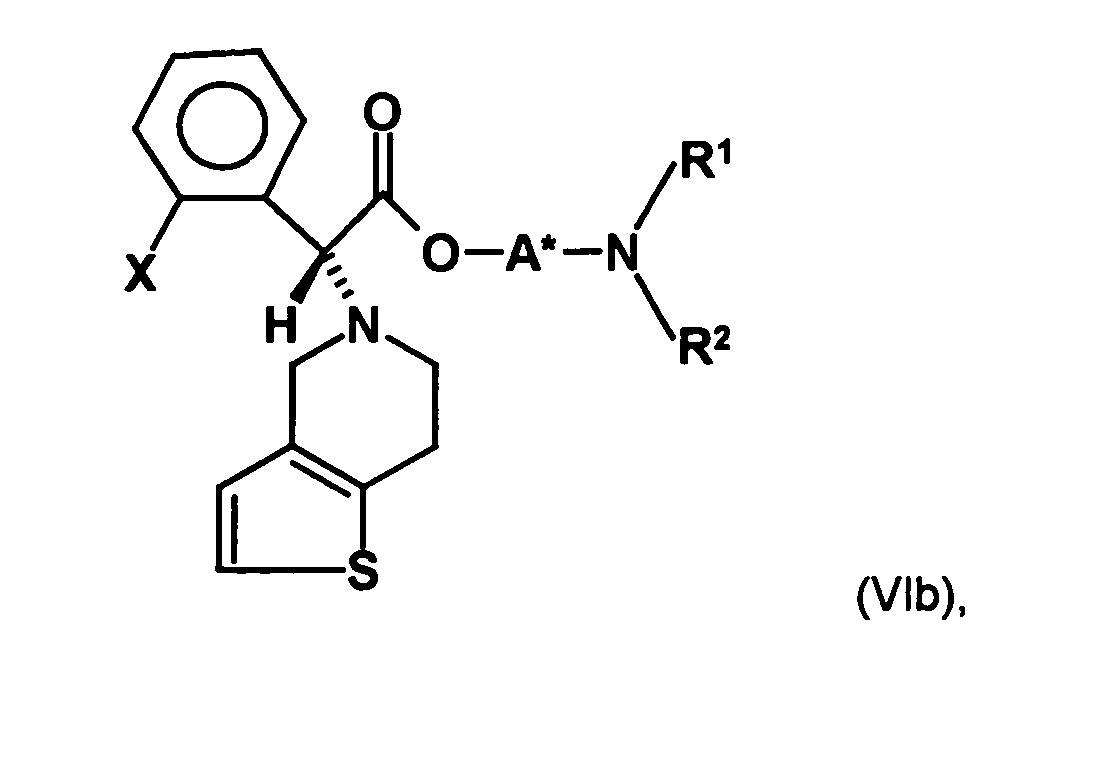
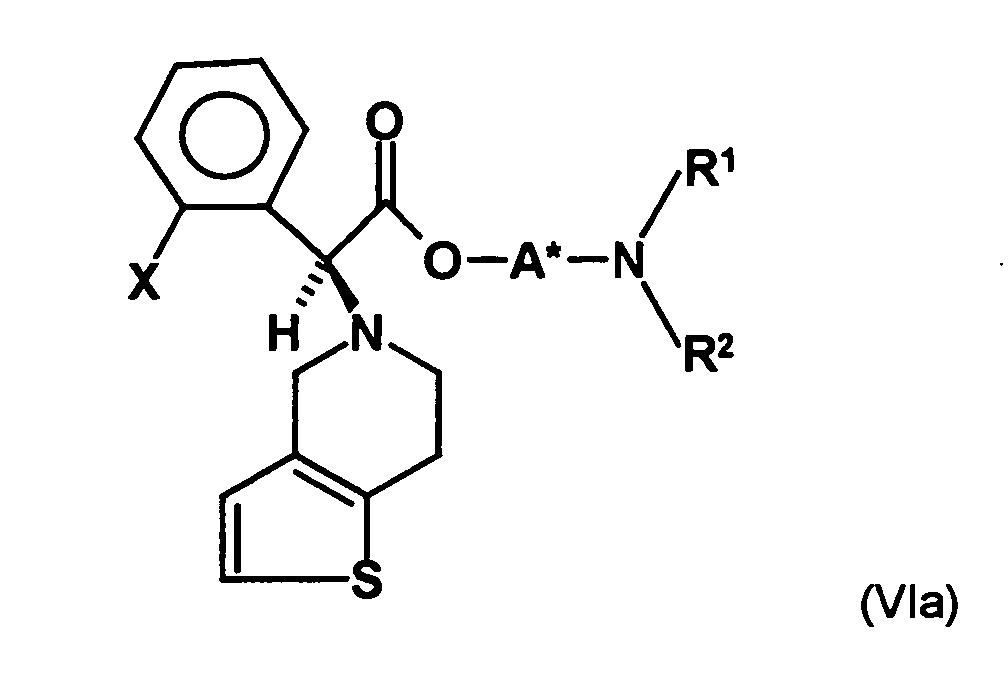
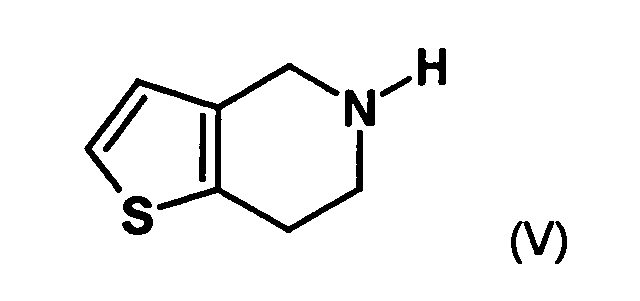
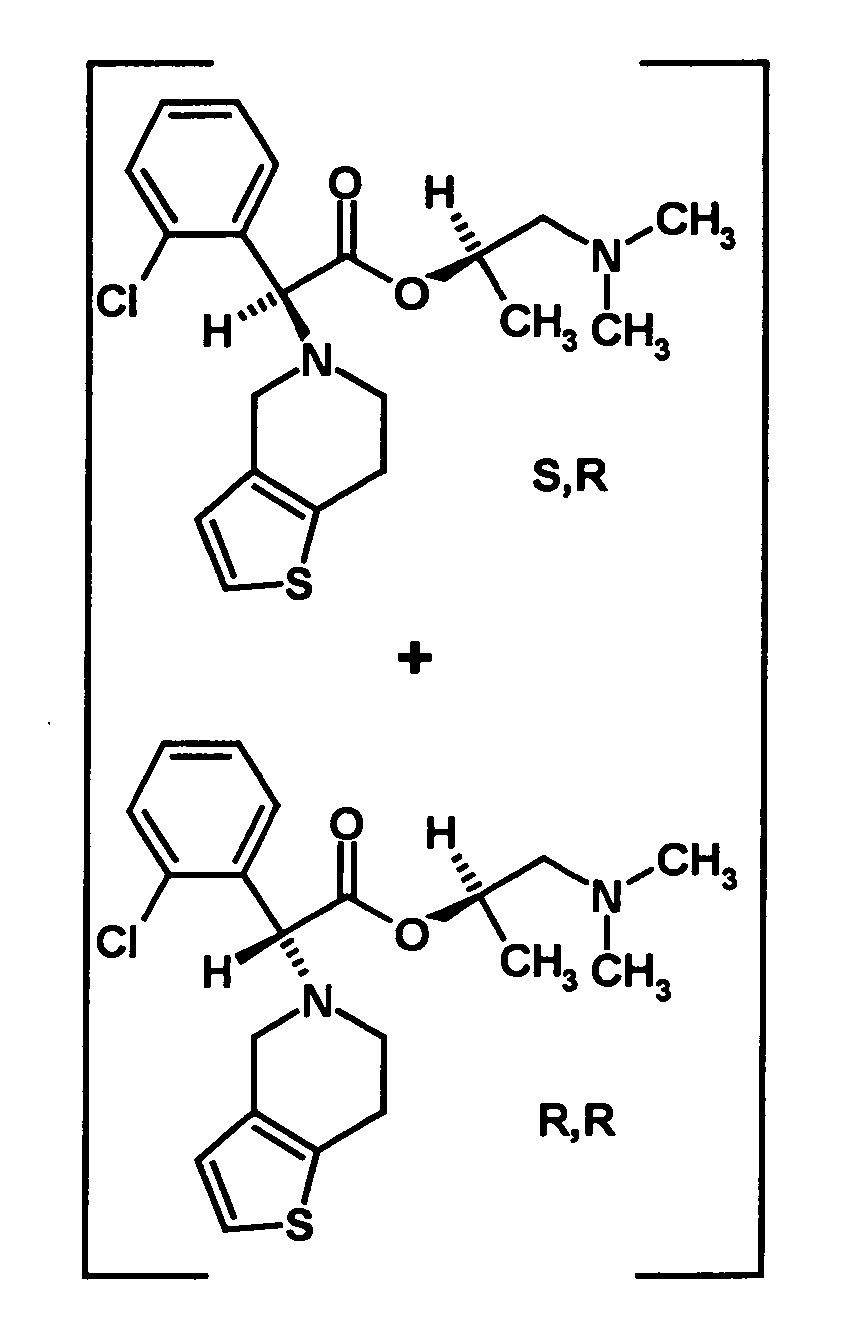
- the first mixture of diastereomers is preferably mixed with the compound of formula (V) or the compound of the formula (VII) reacted, whereby a mixture of diastereomers of the formula (VIa) and (vlb) or of the formula (VIIIa) and the formula (VIIIb) is obtained, and these diastereomer mixtures are each referred to as a second mixture of diastereomers.
- the ratio of the diastereomer of the formula (VIa) to the diastereomer of the formula (VIb) and the diastereomer of the formula (VIIIa) to the diastereomer of the formula (VIIIb) is preferably about 3 or more, more preferably about 4 or more, and may be more particularly preferably up to 9 or even higher.
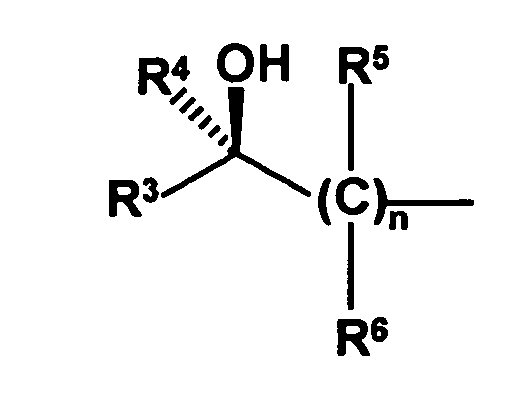
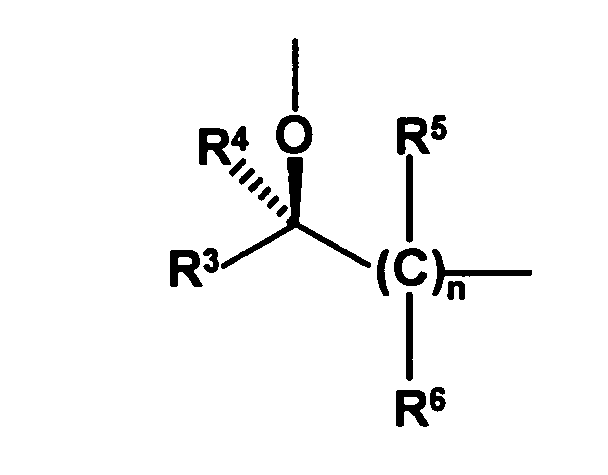
- the radical of the formula HO-A * is a radical of the formula wherein each of R 3 to R 6 is independently hydrogen or hydrocarbyl having from 1 to 20 carbon atoms each having up to 4 heteroatoms selected from nitrogen, oxygen, sulfur and halogen atoms and up to 5 substituents selected from hydroxyl groups , Oxo groups, cyano groups and nitro groups, or one or two of the radicals R 3 to R 6 with the radical R 1 or the radical R 2 form a 5- to 10-membered saturated or unsaturated ring which, in addition to the nitrogen atom, optionally also contains 1 to 3 further heteroatoms selected from nitrogen , Oxygen and sulfur atoms, containing as ring members, and having up to 5 substituents selected from C 1 -C 6 -alkyl radicals, C 2 -C 6 -alkenyl radicals, C 1 -C 6 -alkoxy radicals, C 5 -C 10 - Aryl radicals (preferably C 6 -C 10 -
- the radicals R 5 and R 6 are preferably selected independently of one another from hydrogen atoms and C 1 -C 6 -alkyl radicals, the preferred C 1 -C 6 -alkyl radicals being the same as stated above. Most preferably, only one of R 5 and R 6 is other than hydrogen, and in the most preferred embodiment, all R 5 and R 6 are hydrogen.
- the index n is preferably 1 or 2, more preferably 1.
- the radical R 3 is preferably a C 1 -C 6 -alkyl, C 1 -C 6 -alkoxy, C 5 -C 10 -aryl (preferably C 6 -C 10 -aryl), C 5 -C 10 -heteroaryl, C 2 -C 8 -heterocycloalkyl or C 3 -C 8 -cycloalkyl, where the alkyl, alkoxy, aryl, heteroaryl, heterocycloalkyl and cycloalkyl radicals more preferably have the same meaning as stated above. Most preferably, the radical R 3 is a C 1 -C 6 alkyl radical.
- the radical R 3 is also connected to the radical R 2 to form a ring which has 5 to 10 ring atoms and, in addition to the nitrogen atom to which the radical R 2 is bonded, also 1 to 3 further heteroatoms selected from oxygen atoms.
- Nitrogen and sulfur atoms and which may be saturated or mono or diunsaturated and which may have 1 to 3 substituents selected from C 1 -C 6 alkyl radicals, C 1 -C 6 alkoxy radicals, C 5 -C 5 10 aryl radicals (preferably C 6 -C 10 aryl radicals), C 3 -C 8 cycloalkyl radicals, C 2 -C 8 heterocycloalkyl radicals, C 5 -C 10 heteroaryl radicals and halogen atoms.
- the radical R 4 is particularly preferably a hydrogen atom or a C 1 -C 6 -alkyl radical, most preferably a hydrogen atom.
- the radicals R 3 and R 4 are preferably different, so that the optically active center is located on the carbon atom which also carries the hydroxyl groups. But it is also possible that the radicals R 3 and R 4 are the same, for example, both represent hydrogen atoms and the optically active center is located on another carbon atom and, for example, is effected by the fact that at this carbon atom, the radicals R 5 and R 6 are different , Preferably, the substitution pattern is chosen so that the above-mentioned radical HO-A *, namely is present in the R-configuration, as this results in the later reaction steps Diastereomerengemische in which the diastereomer is present in excess, which gives clopidogrel in the desired steric configuration.
- radical HO-A * is a radical of the formula is
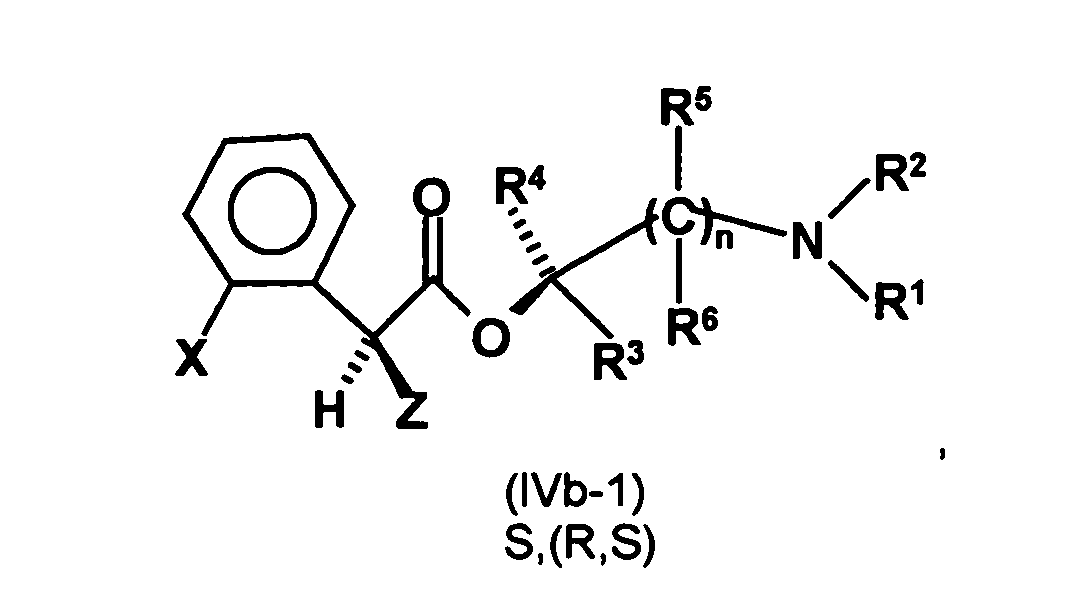
- the R, (R, S) -compound of the formula (IVa-1) is formed in an excess to the S, (R, S) -compound of the formula (IVb-1), namely the ratio between the R, ( R, S) - and the S, (R, S) compound preferably 2: 1 or higher.
- the mixture results from the diastereomers wherein the radicals X, R 1 to R 6 and the index n are as defined above and which is referred to as a second mixture of diastereomers.
- This is the mixture of diastereomers and in which the radical -OA * is a radical of the formula represents.
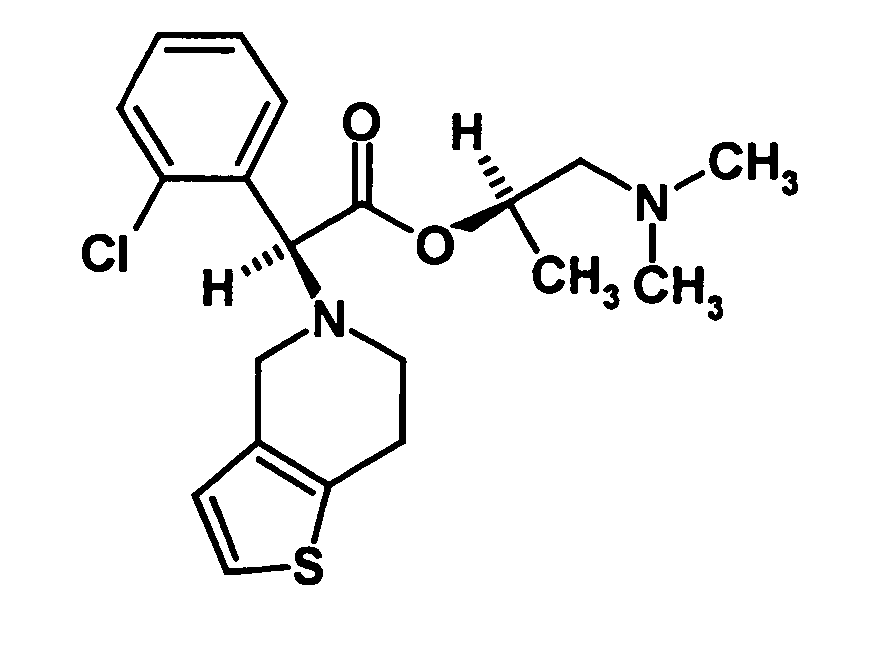
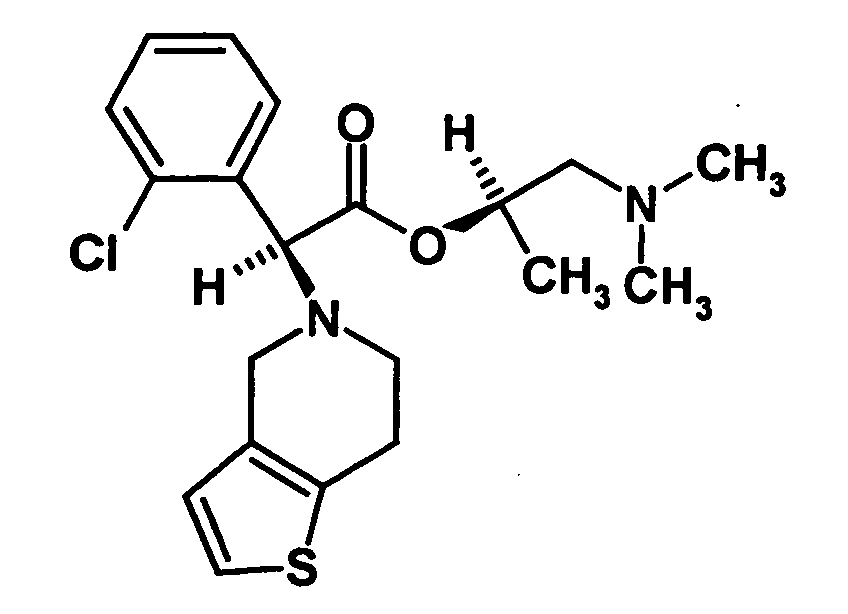
- the S, (R, S) compound of formula (VIa-1) is preferably present in excess of the R, (R, S) compound of formula (Vlb-1) and, surprisingly, the diastereomeric excess has the reaction with the compound of the formula (V) again increased so that the ratio of the compound of the formula (Vla-1) to the compound of the formula (Vlb-1) is preferably 3: 1 or higher, more preferably 4: 1 or higher. In the most preferred embodiment of the invention, even a ratio of diastereomers of 9: 1 or higher is achieved.
- the diastereomer S, (R, S) of the formula (VIIIa-1) preferably in an excess to the diastereomer R, (R, S) of the formula (VIIIb-1) present (if the "correct" enantiomer of the aminoalcohol is used, otherwise the ratio of diastereomers is reversed), and here too has
- the excess of the diastereomer of the formula (VIIIa-1) the diastereomer of formula (VIIIb-1) is increased and is preferably 3: 1 or higher, stronger preferably 4: 1 or higher or 9: 1 or higher.
- the mixture of the diastereomers (second mixture of diastereomers) can in the usual way to the mixture of diastereomers (second mixture of diastereomers) be implemented, as is known in principle in the art.
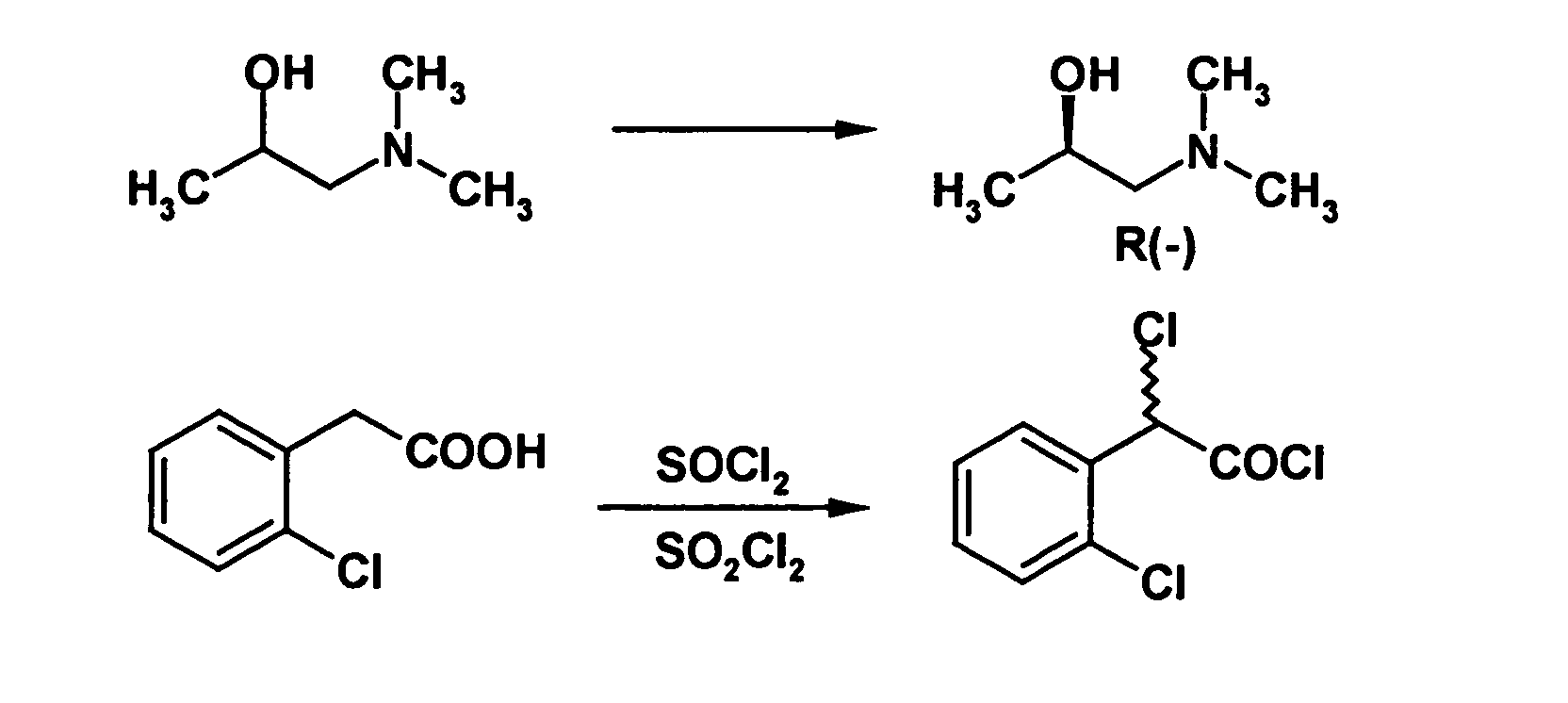
- optically active aminoalcohol is (R) -1- (dimethylamino) -2-propanol ((R) -Dimepranol).
- This optically active aminoalcohol is commercially available, However, according to the invention, it has been found that it can also be carried out in a simple manner optical resolution of the corresponding racemic aminoalcohol with di-O-benzoyl-L - (-) - tartaric acid can be obtained. This increases the profitability of the inventive method.
- Other optically active alcohols which are used in the methods according to the invention can be used in this way be obtained from the corresponding racemic alcohol.
- First diastereomer mixture second diastereomer mixture: or with the open-chain connection:
- optically active amino alcohols are the compounds of the formulas (shown below without stating the stereochemistry): wherein the radicals R 1 and R 2 are as defined above and "sub" has the meaning that the ring may be substituted at any point with a C 1 -C 3 alkyl radical.
- connections can be readily prepared from the corresponding derivatives of substituted styrene oxide or substituted cyclohexene oxide and resolved into their individual enantiomers as described in "Optical Resolution via Diastereoisomeric Salts Formation", David Kozma, Ed., CRC Press, London, New York, Washington DC is.
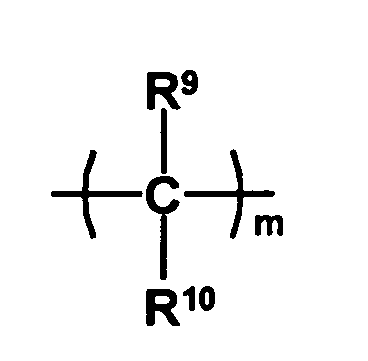
- the radical HO-A * may be a radical of the formula represent, wherein Y 1 is a remainder represents, and Y 2 a remainder in which R 9 and R 10 are independently selected from hydrogen atoms and C 1 -C 6 -alkyl radicals and the radicals R 7 and R 8 represent groups which prevent the free rotatability of the two phenyl groups relative to each other, m is an integer of 0 to 2 and p represents 1 or 2.
- all radicals R 9 and R 10 are hydrogen atoms or only one radical is different from a hydrogen atom and a C 1 -C 6 -alkyl radical, preferably a C 1 -C 3 -alkyl radical.
- one of the radicals R 7 and R 8 is selected from a C 1 -C 6 -alkyl group, a halogen atom and a cyano group
- the second radical is selected from a C 3 -C 6 branched alkyl groups, preferably a tertiary butyl group, a halogen atom and a cyano group.
- Voluminous halogen atoms such as iodine atoms, are preferred.
- the optical activity is produced by the fact that at least one of the radicals R 7 and R 8 , preferably both radicals R 7 and R 8 , are large-volume radicals, such as branched alkyl groups (in particular a branched C 3 -C 6 alkyl group), Halogen atoms or cyano groups and thereby the rotation of the two phenyl rings is prevented.
- radicals R 7 and R 8 are large-volume radicals, such as branched alkyl groups (in particular a branched C 3 -C 6 alkyl group), Halogen atoms or cyano groups and thereby the rotation of the two phenyl rings is prevented.
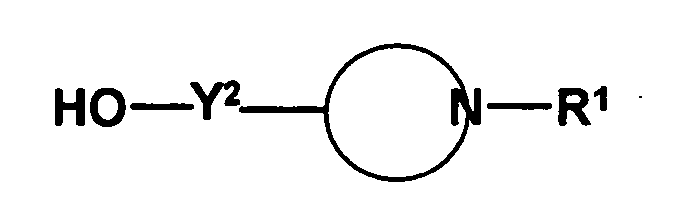
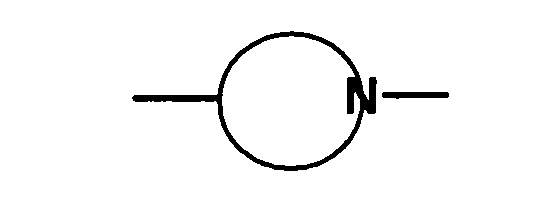
- the compound of the formula a compound of the formula wherein Y 2 is as defined above, R 1 is as defined above, and preferably represents a hydrogen atom or a hydrocarbon radical having 1 to 20 carbon atoms containing up to 4 heteroatoms selected from nitrogen, oxygen, sulfur and halogen atoms, and bis may have 5 substituents selected from hydroxyl groups, oxo groups, cyano groups and nitro groups, and the group represents a 5- to 10-membered saturated or unsaturated ring which, in addition to the nitrogen atom, optionally also contains 1 to 3 further heteroatoms selected from nitrogen, oxygen and sulfur atoms as ring members, and containing up to 5 substituents selected from C 1 -C 6 alkyl, C 1 -C 6 alkoxy, C 2 -C 6 alkenyl radicals, C 5 -C 10 -aryl radicals (especially C 6 -C 10 -aryl), C 5 -C 10 -Heteroarylresten, C
- the group is preferred a group
- reaction products of the abovementioned optically active amino alcohols with the compounds of the formula (II) to give the first mixture of diastereomers and the reaction products of the first mixture of diastereomers with a compound of the formula (V) or a compound of the formula (VII) to the second mixture of diastereomers are new compounds, and the invention also relates to the corresponding diastereomeric mixtures with any proportions of the individual diastereomers and the individual isolated diastereomers of these diastereomeric mixtures.
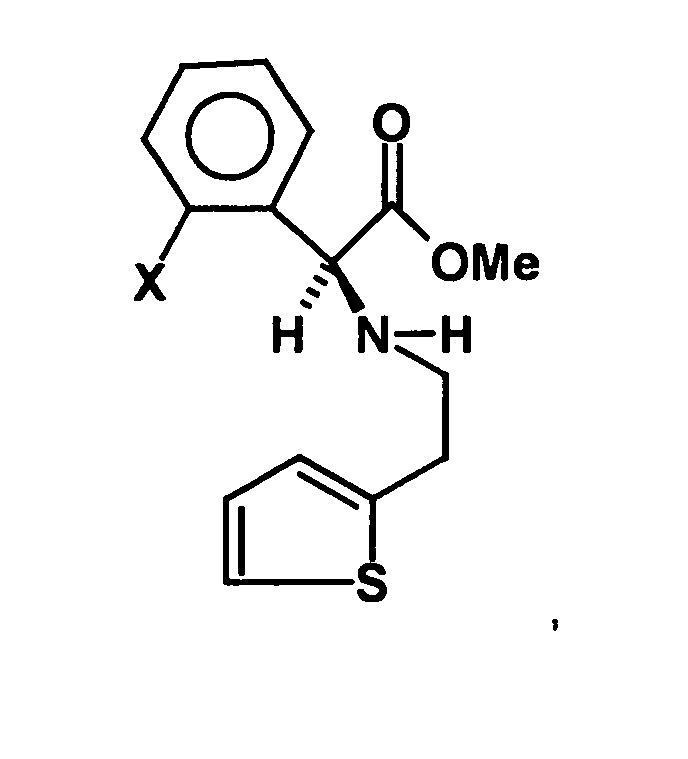
- the single diastereomer of the formula (VIIIa) can then either first by a ring closure reaction to obtain the stereochemistry in the compound of formula (VIa) as shown in the prior art for similar compounds, and then subjected to a transesterification, as shown below, or the compound of formula (VIIIa) can first be subjected to a transesterification reaction, so that the compound of formula is formed, which then by ring closure in the compound of formula (la) preferably in clopidogrel, as described in the prior art, for example in EP 466 569.
- the second mixture of diastereomers with the already closed-chain diastereomers of the formulas (VIa) and (VIb) in which the diastereomer of the formula (VIa) preferably in an excess of at least 3: 1 or more, more preferably 4: 1 or more, most preferably 9: 1 or more, may be either initially subjected to diastereomer separation, which is preferred in the invention, and thereby the diastereomer of Formula (VIa) separated.
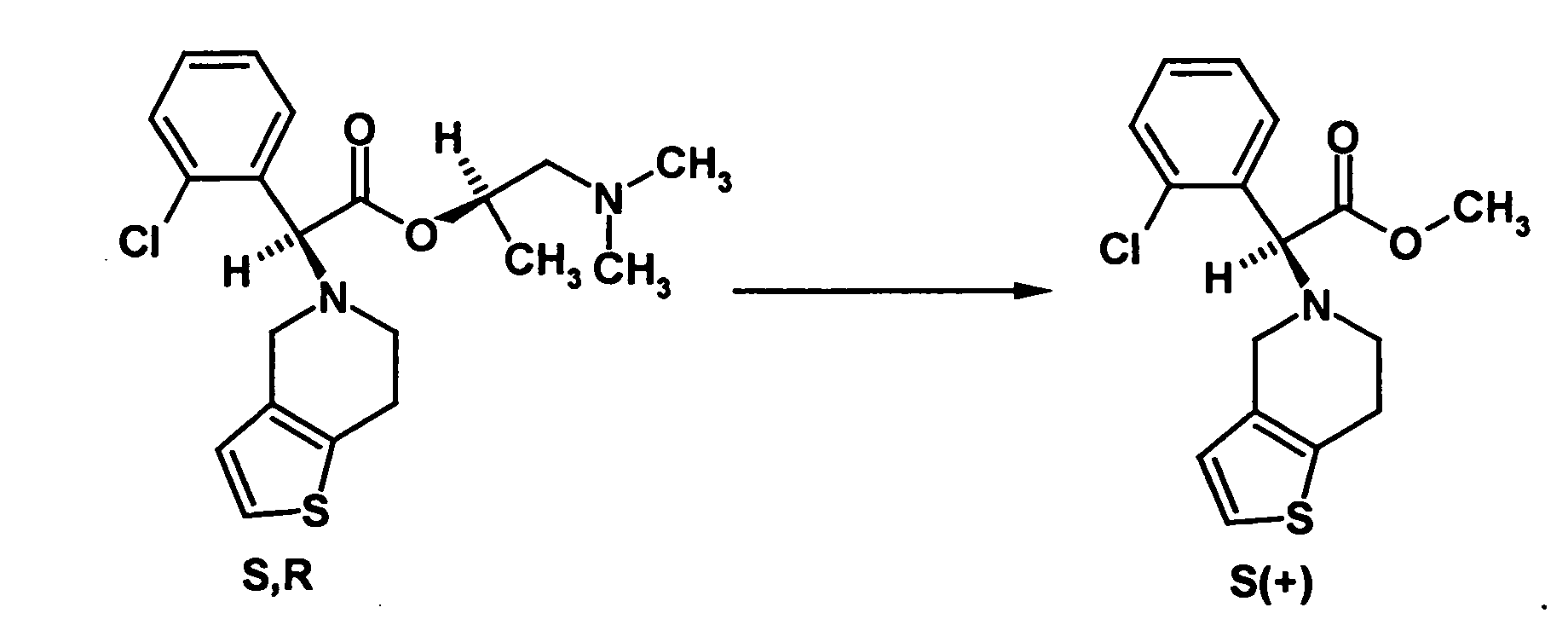
- the diastereomer separation can be carried out in a manner known per se, as described in the prior art and as explained in more detail in the examples. Subsequently, the diastereomer of the formula (VIa) subjected to a transesterification reaction to give the stereochemistry to the compound of the formula (Ia)
- the mixture of diastereomers of the compounds of formula (VIa) and (vlb) be subjected without prior separation of a transesterification reaction.
- This variant is particularly preferred when a very large excess of the diastereomer of the formula (VIa) or if the subsequent transesterification can not be carried out completely to obtain the stereochemistry.
- a mixture of the compounds (la) is formed and (Ib) but in which the compound (Ia) is in substantial excess to the compound of formula (Ib).
- This mixture of enantiomers can then be subjected, if necessary, to enantiomer separation, as is known in principle in the prior art.
- the transesterification is preferably carried out using a titanium or silicon catalyst, particularly preferably using a titanium (IV) alkoxide, in particular one Titanium (IV) isopropoxide (tetraisopropyl orthotitanate) or a titanium (IV) ethoxide, as they are for example, from the company Fluka are commercially available.
- a titanium (IV) alkoxide in particular one Titanium (IV) isopropoxide (tetraisopropyl orthotitanate) or a titanium (IV) ethoxide, as they are for example, from the company Fluka are commercially available.
- the titanium alkoxide is through Reaction with a suitable alcohol, e.g. with ethylene glycol, activated.
- another Catalyst may be used, for example, chlorinated silica, which is e.g.
- silica by reaction of silica with thienyl chloride, optionally in Phosphorus pentachloride can be obtained, or by reaction of silica exclusively with phosphorus pentachloride in a suitable inert solvent such as hexane, Chloroform, chlorobenzene or dichloromethane can be obtained.
- a suitable inert solvent such as hexane, Chloroform, chlorobenzene or dichloromethane
- optically active aminoalcohol (R) -dimepranol is commercially available, according to the invention, a process has been found with which the optically active aminoalcohol can be prepared easily and inexpensively from the racemic aminoalcohol.
- a process has been found with which the optically active aminoalcohol can be prepared easily and inexpensively from the racemic aminoalcohol.
- dibenzoyl-L-tartaric acid are dissolved with one equivalent of the racemic alcohol in a suitable solvent, such as a C 1 -C 4 -alkanol, in particular ethanol.
- a suitable solvent such as a C 1 -C 4 -alkanol, in particular ethanol.
- This forms the corresponding dibenzoyl-L-tartaric acid derivative of R (-) dimepranol is then acidified with an achiral mineral acid, eg hydrochloric acid.
- the salt eg, the hydrochloride salt
- the dibenzoyl-L-tartaric acid derivative of R (-) dimepranol precipitates as a crystalline product while the salt of S (+) dimepranol remains in solution.
- the free (R) -dimepranol base can be obtained by reaction with a suitable base, such as sodium or potassium hydroxide, in a suitable solvent, such as an alcohol, especially in ethanol, in a manner known per se.
- the dibenzoyl-L-tartaric acid derivative of R-dimepranol can be converted by treatment with dry hydrogen chloride in the R-dimepranol hydrochloride, which can be used as such or after treatment with a suitable base in the basic form.
- the inventive method the amount of required dibenzoyl-L-tartaric acid explains what makes the process very economical. Furthermore, the obtained Product of high optical purity, and multiple recrystallizations are usually not mandatory.
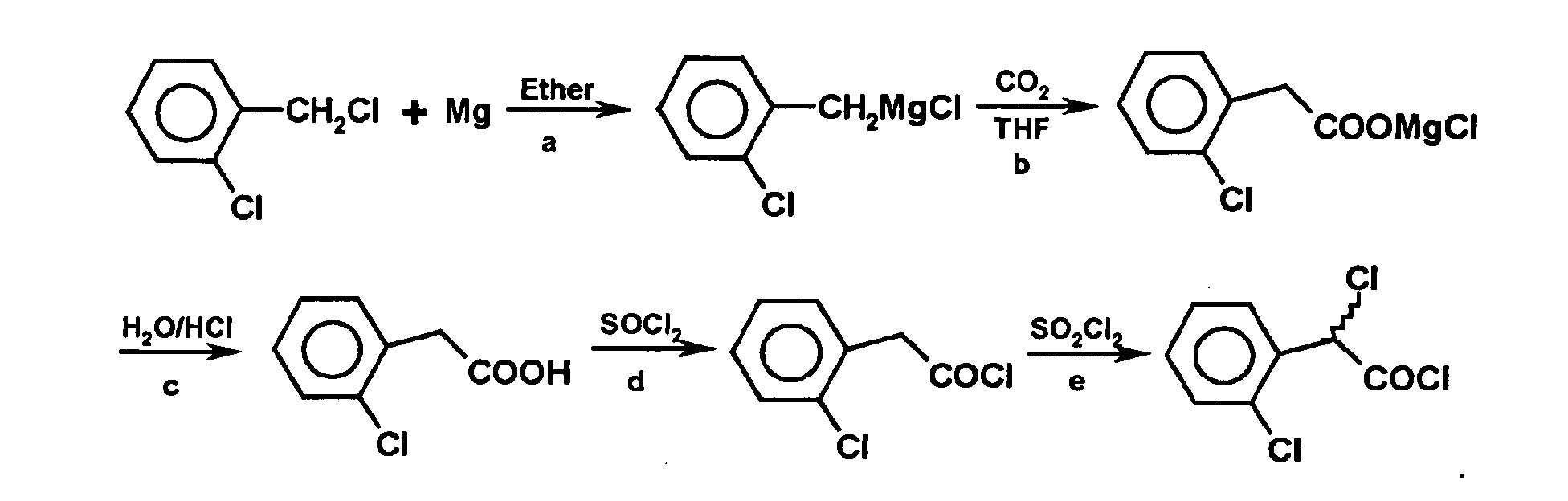
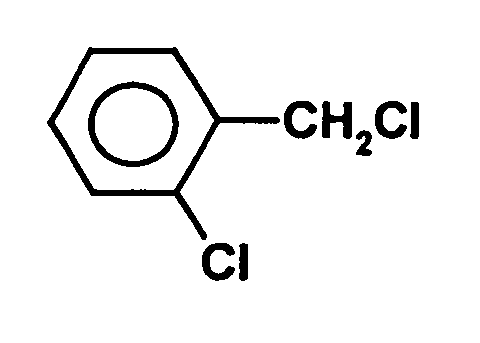
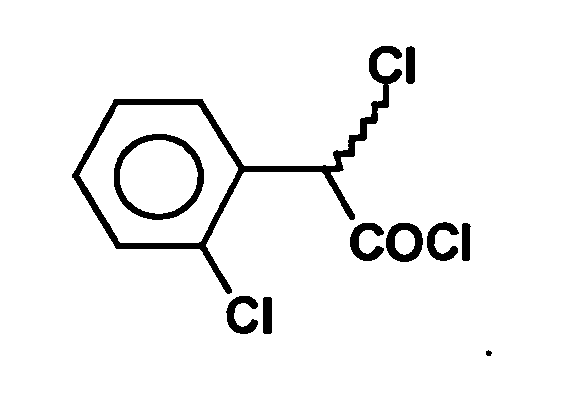
- ⁇ -dichlorophenylacetyl can be prepared in a manner known per se, for example according to the following reaction scheme:
- Step (a) is performed by reacting the compound with metallic magnesium in a suitable solvent such as, for example, ether (ie diethyl ether), dibutyl ether or higher ether, THF or other cyclic ether, toluene etc., preferably ether, at reflux. It is a common Grignard reaction.
- a suitable solvent such as, for example, ether (ie diethyl ether), dibutyl ether or higher ether, THF or other cyclic ether, toluene etc., preferably ether, at reflux. It is a common Grignard reaction.
- ether ie diethyl ether
- THF cyclic ether
- toluene etc. preferably ether
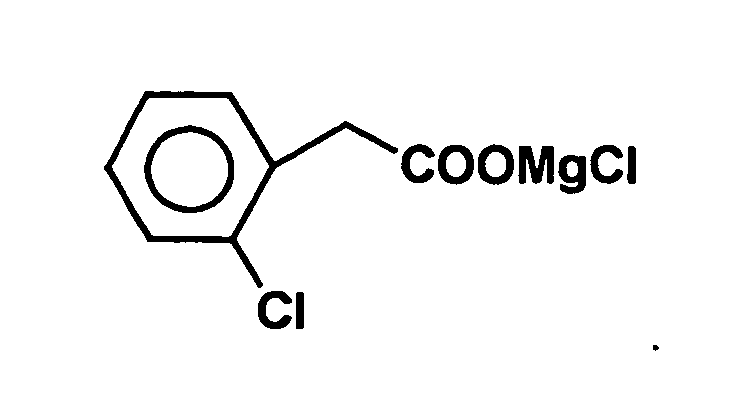
- step (c) hydrolysis is carried out.
- diluted mineral acid for example, dilute hydrochloric acid
- a suitable base for example with an aqueous base such as an NH 4 OH solution in water or an alkali carbonate solution or ammonium carbonate solution in water.
- aqueous base such as an NH 4 OH solution in water or an alkali carbonate solution or ammonium carbonate solution in water.
- the organic phase is separated, and the aqueous phase containing the salt of 2-halophenylacetic acid, for example, mixed with dilute mineral acid until the desired 2-halophenylacetic acid, especially the 2-chlorophenylacetic acid precipitates.
- the acid is separated and worked up in a suitable manner, for example, by dissolving in a suitable solvent such as chloroform, extraction with water, drying the chloroform phase with sodium sulfate or magnesium sulfate and Evaporation of the solvent.
- a suitable solvent such as chloroform
- extraction with water drying the chloroform phase with sodium sulfate or magnesium sulfate and Evaporation of the solvent.
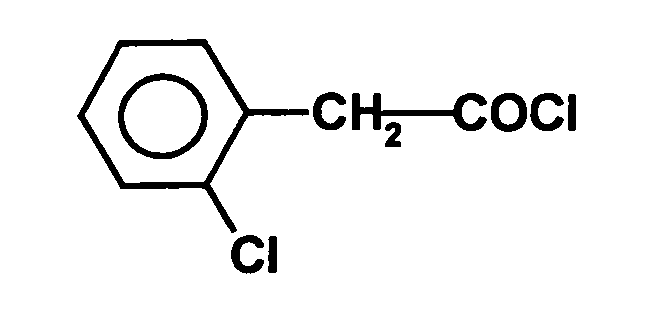
- the 2-halophenylacetic acid is converted to the acid chloride in the usual way, for example, as shown in step (d) is dissolved by heating in thionyl chloride, whereby the compound of formula is obtained.
- a bromination or a chlorination is subsequently carried out in step (e), for example.
- the bromination can be carried out by adding liquid bromine in the presence of red phosphorus with heating to reflux. The reaction mixture is allowed to stand overnight, then unreacted thionyl chloride and bromine is evaporated off to give the compound of the formula
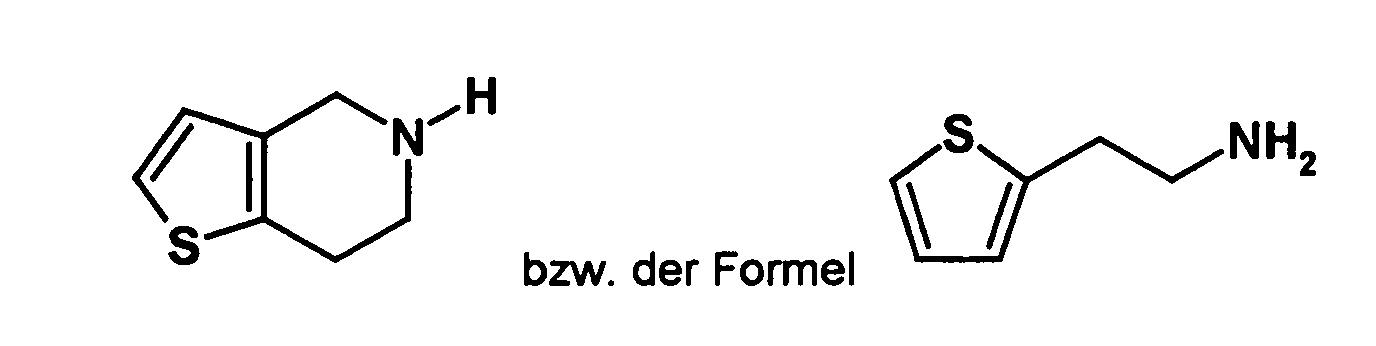
- the compound of the formula can be obtained in a manner known per se, for example according to the following reaction scheme:
- the starting compound 2-thienylacetamide for example, from 2-thienylacetonitrile or 2-thienylacetyl chloride in a known manner.
- the 2-thienylacetamide is for example with dimethoxyethane with cooling with Sodium borohydride added. Then, with further cooling with stirring Added acetic acid. The mixture is heated with stirring, and with the addition of Water is hydrolyzed, optionally cooling.
- a suitable base e.g. Potassium hydroxide or sodium hydroxide, basified, and a suitable solvent such as e.g. Ether is added.
- the aqueous phase is separated off.
- the organic phase becomes washed, acidified, for example, with a mineral acid, and it will be redone extracted.
- the organic phase is separated off.
- the aqueous phase is basified, for example, by adding potassium hydroxide or sodium hydroxide, and it becomes ether added.
- the organic phase contains the desired 2- (2-thienyl) ethylamine, and After evaporation of the solvent gives the 2- (2-thienyl) ethylamine in a purity of preferably 95% or higher, more preferably 98% or higher.
- the resulting 2- (2-thienyl) ethylamine can be, for example, with aqueous formaldehyde be heated with stirring. It is then cooled, it becomes a suitable added organic solvent such as dichloromethane, and it is after addition of a Base, for example sodium hydroxide or potassium hydroxide, such as a 10% Sodium hydroxide solution, extracted. The aqueous phase is separated, and the organic Phase is evaporated to dryness. The residue is in z. B. dimethoxyethane dissolved, and it is acidified. This is followed by cyclization by Schiff base with stirring. After cooling, filtering off and washing, the desired 4,5,6,7-tetrahydro [3,2-c] thienopyridine is obtained.
- a Base for example sodium hydroxide or potassium hydroxide, such as a 10% Sodium hydroxide solution
- the starting compounds of the syntheses are known to the person skilled in the art and are either commercially available or can be easily prepared by literature methods become.
- the reaction of the compound of the formula (II) with the compound of the formula (III) takes place in a known manner.
- a suitable solvent for example in a dipolar aprotic solvent, for example an ether such as THF
- (R) -1- (dimethylamino) -2-propanol preferably in the presence of a pyridine compound, such as 4- ( Dimethylamino) pyridine.
- a pyridine compound such as 4- ( Dimethylamino) pyridine.
- the crystalline hydrochloride of the resulting aminoester precipitates and can be separated.
- the workup and optionally purification is carried out in a known manner, for example by recrystallization and / or chromatography.
- the usable solvents are not particularly limited, however, no primary alcohols such as methanol or ethanol should be used to avoid the risk of transesterification. Secondary or tertiary alcohols such as 2-propanol may be used, and especially for recrystallization, the use of such secondary alcohols as 2-propanol may be advantageous.
- the ratio of the two diastereomers in the resulting mixture can be determined, for example, by chiral HPLC. It is preferably about 2: 1 or more.
- the diastereomer mixture is preferred without separation into the individual diastereomers with the compound of the formula (V) or the compound of the formula (VII) reacted, preferably with the compound of formula (V).
- thienopyridine hydrochloride in a suitable solvent, in particular a dipolar aprotic solvent, for example dimethylformamide or DMSO, in the presence of a suitable base, in particular an amine such as triethylamine with 2 , ⁇ -dichlorophenylacetic acid- (R) -1- (dimethylamino) -2-propyl ester hydrochloride, preferably at a temperature in the range of 0 to 100 ° C for a suitable period of time, usually several hours to be stirred.
- a suitable solvent in particular a dipolar aprotic solvent, for example dimethylformamide or DMSO
- a suitable base in particular an amine such as triethylamine with 2 , ⁇ -dichlorophenylacetic acid- (R) -1- (dimethylamino) -2-propyl ester hydrochloride, preferably at a temperature in the range of 0 to 100 ° C for a suitable period of time,
- a crystalline salt By conversion into the hydrochloride or the hydrobromide with the corresponding mineral acid, a crystalline salt can be obtained.
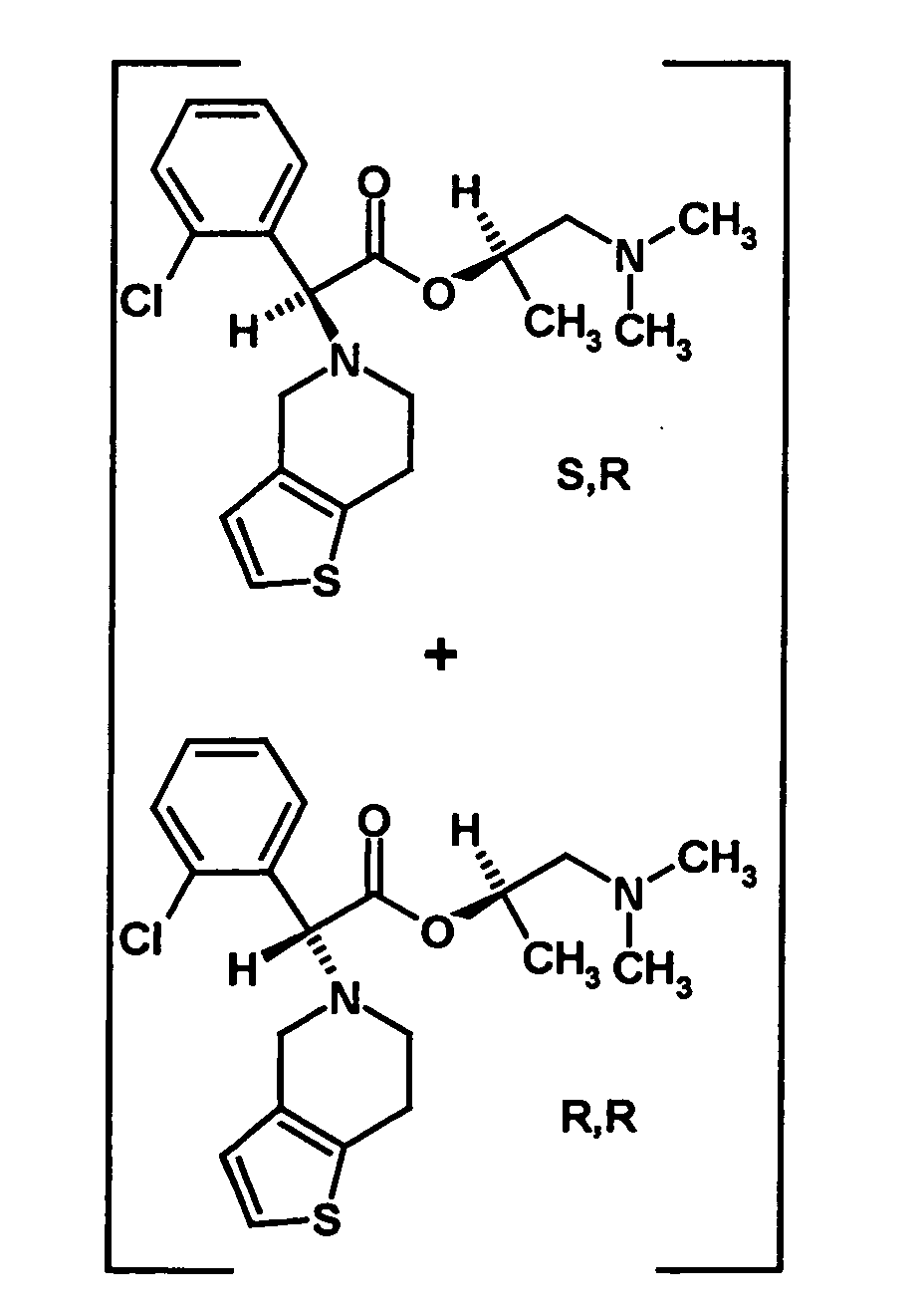
- the resulting mixture of diastereomers has an excess of the S, R diastereomer of preferably 4: 1 or more, more preferably about 9: 1 or more.
- a suitable solvent such as a secondary or tertiary alcohol, for example 2-propanol, the ratio of diastereomers can be further increased.
- the mixture of diastereomers or the separated diastereomer is converted by transesterification into the mixture of the S and R enantiomers of clopidogrel enriched in the S-enantiomer or converted to pure clopidogrel.
- the titanium or silicon dioxide catalysts are preferably used, as stated above.
- the transesterification is preferably carried out by heating the compound of the formula or the mixture of diastereomers with the catalyst in methanol. After completion of the reaction, the reaction mixture is basified, filtered off and worked up in the usual way. If the final product nor the compound of formula contains, can be separated in the usual way the desired Clopidogrelenantiomer. For this purpose, reference may be made to the documents mentioned above.
- 2-Chlorophenylacetic acid (171 g) was added to 300 ml of thionyl chloride, and the mixture was stirred at 60 ° C for 30 minutes. An iodine crystal followed by 300 ml sulfuryl chloride was added distributed over several times. The mixture was allowed to stand for a total of 7 hours Reflux heated. Excess reagents were distilled off under reduced pressure. The residue (228 g) contained 82-84% 2, ⁇ -dichlorophenylacetyl chloride, 5-6% non- ⁇ -chlorinated 2-chlorophenylacetyl chloride and about 10% 2,4, (2,6), ⁇ -trichlorophenylacetyl chloride. The crude acyl chloride was used without further purification in the further reactions used.
- the salt was dissolved in 1000 ml of cold 20% sodium hydroxide solution and extracted into dichloromethane. The extract was dried, filtered, evaporated, and the residual oil was purified by distillation at atmospheric pressure. The product distilled at 122-124 ° C and the yield was 46 g of ( R ) -dimepranol (45% based on the starting racemate), [ ⁇ D 20 ] -27 °.
- Racemic 2-dimethylamino-1-phenylethanol was cleaved corresponding to the 2-pyrrolidinyl-1-phenylethanol (see Example 5) using 16.5 g of crude aminoalcohol as described in Example 7.
- the yield of oily (R) -2-dimethylamino-1-phenylethanol with an [ ⁇ D 20] value of -45.5 ° (methanol) was 8.9 g.
- the aminoalcohol was prepared as described in Example 7 using cyclohexene oxide (19,6) instead of styrene oxide. Oily trans -2-dimethylaminocyclohexan-1-ol was obtained in a yield of 22.0 g (76%).
- Example 10 The racemic aminoalcohol of Example 10 was prepared according to Examples 3, 5 and 8 using di-O-benzoyl-L-tartaric acid in a molar ratio of 1: 1 (35.8 g of di-O-benzoyl-L-tartaric acid and 14 , 5 g racemic trans -2-dimethylaminocyclohexan-1-ol) using acetone as solvent. Oily trans - ( S, R ) -2-dimethylaminocyclohexan-1-ol was obtained in a yield of 5.2 g. The [ ⁇ D 20 ] value was -23 ° (methanol).
- the ester of trans -2- (S) -dimethylamino-1- (R) -hydroxycyclohexans 2, ⁇ -dichlorophenylacetic acid was prepared from 4.4 g of the amino alcohol and 6.5 g of acyl chloride in tetrahydrofuran in a yield of 6.7 g receive. According to HPLC analysis, the product contained 68% of the diastereomer of the ester of ⁇ - ( R ) -chloric acid.
- reaction mixture was partitioned between diisopropyl ether and 10% aqueous sodium bicarbonate, the organic layer was separated, washed with water, dried and evaporated under reduced pressure The residue was dissolved in 30 ml of a 1: 1 mixture of 2-propanol and 2-propyl acetate.
- Gaseous hydrogen bromide (1.6 g) was added to the mixture with stirring and cooling to 10 ° C.
- the precipitated salt was filtered off, washed with 2-propyl acetate and dried to give 2.85 g of a crystalline product (chiral HPLC) contained about 92% ( R, S ) and 8% ( R, R ) diastereomer t.
- Ethylene glycol (1.36 g) was added to 12.6 g of titanium (IV) isopropoxide and both ingredients were mixed thoroughly. There was an exothermic reaction to form ethylene bis (triisopropyl) orthotitanate, which was used after cooling the mixture as a transesterification catalyst. The catalyst was added to a solution of 7.43 g of ( S ) - (2-chlorophenyl) -4,5,6,7-tetrahydro [3,2-c] thienopyridin-5-yl-acetic acid ( R ).
- silica having an average pore diameter of 60 ⁇ (20 g) was suspended in 60 ml of thionyl chloride, and the suspension was refluxed for 46 hours.
- the modified silica was filtered off, dried for 2 hours in a vacuum dryer at 125 ° C under reduced pressure and then activated by heating to 360 ° C for 30 minutes.
- Example 20 Purification of the transesterification product was carried out as in Example 20, but triethylamine or other suitable volatile tertiary amine was added in an amount corresponding to the enantiomeric excess of ( S ) -clopidogrel prior to the precipitation of the racemic clopidogrel sulfate.
- the amine forms a double sulphate salt with ( S ) -clopidogrel with increased solubility, which contributes to increasing the optical purity of the product.
- the volatile amine can be easily removed after salt decomposition, extraction of the free base into an organic solvent, and evaporation.
Landscapes
- Organic Chemistry (AREA)
- Chemical & Material Sciences (AREA)
- Organic Low-Molecular-Weight Compounds And Preparation Thereof (AREA)
- Pharmaceuticals Containing Other Organic And Inorganic Compounds (AREA)
- Steroid Compounds (AREA)
- Semiconductor Lasers (AREA)
- Catalysts (AREA)
- Heterocyclic Carbon Compounds Containing A Hetero Ring Having Oxygen Or Sulfur (AREA)
- Hydrogenated Pyridines (AREA)
- Nitrogen Condensed Heterocyclic Rings (AREA)
- Saccharide Compounds (AREA)
- Heterocyclic Compounds Containing Sulfur Atoms (AREA)
- Low-Molecular Organic Synthesis Reactions Using Catalysts (AREA)
Abstract
Description
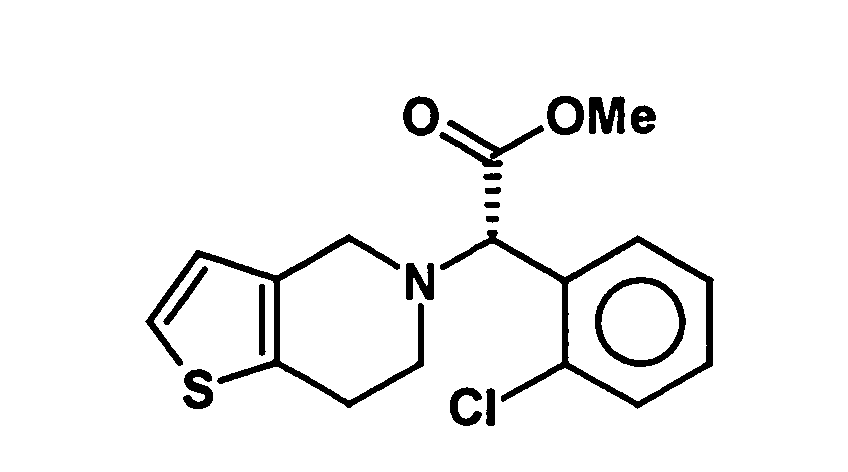
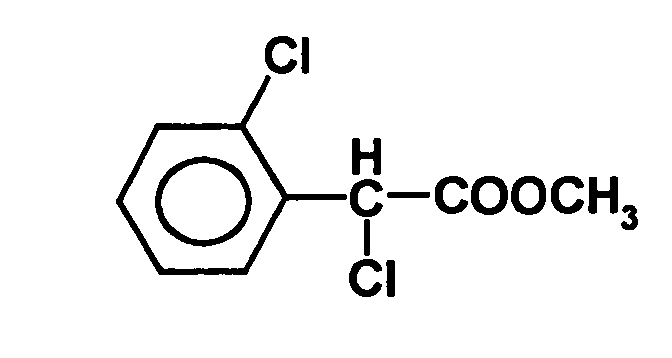
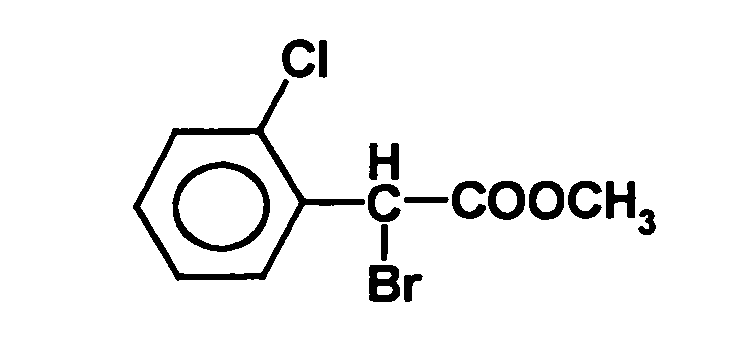
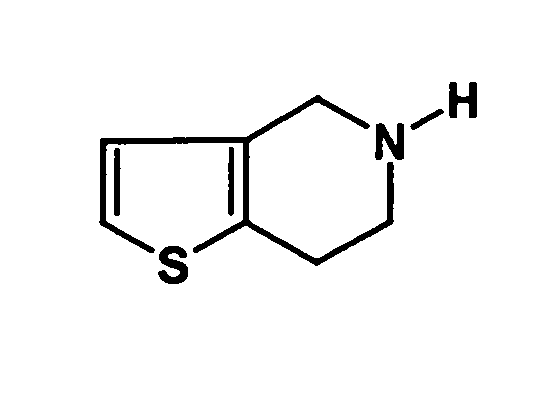



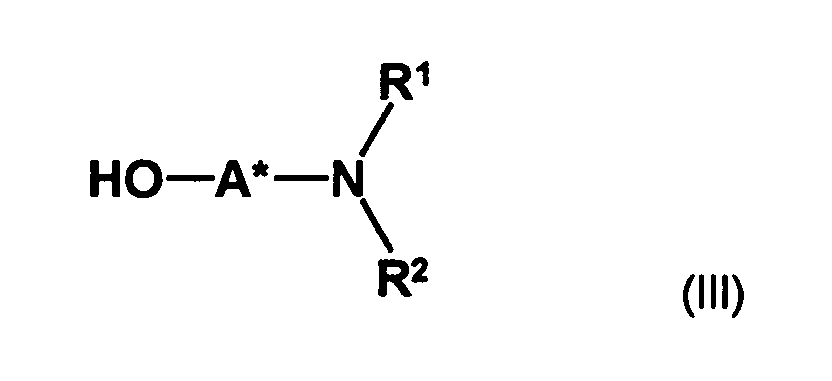
R1 und R2 jeweils unabhängig voneinander Wasserstoffatome oder Kohlenwasserstoffreste mit 1 bis 20 Kohlenstoffatomen darstellen, die jeweils bis zu 4 Heteroatome, ausgewählt aus Stickstoff-, Sauerstoff-, Schwefel- und Halogenatomen, und bis zu 5 Substituenten, ausgewählt aus Hydroxylgruppen, Oxogruppen, Cyanogruppen und Nitrogruppen, aufweisen können, oder
einer oder beide der Reste R1 und R2 mit einem Kohlenstoffatom oder einem Heteroatom des Rests A* einen 5- bis 10-gliedrigen gesättigten oder ungesättigten Ring bildet, der neben dem Stickstoffatom gegebenenfalls noch 1 bis 3 weitere Heteroatome, ausgewählt aus Stickstoff-, Sauerstoff- und Schwefelatomen, als Ringglieder enthält, und der mit bis zu 5 Substituenten, ausgewählt aus C1-C6-Alkylresten, C2-C6-Alkenylresten, C1-C6-Alkoxyresten, C5-C10-Arylresten (bevorzugt C6-C10-Arylresten), C5-C10-Heteroarylresten, C3-C8-Cycloalkylresten, C2-C8-Heterocycloalkylresten, Halogenatomen, Hydroxylgruppen, Oxogruppen, Cyanogruppen und Nitrogruppen, substituiert sein kann.




einer oder zwei der Reste R3 bis R6 mit dem Rest R1 bzw. dem Rest R2 einen 5- bis 10-gliedrigen gesättigten oder ungesättigten Ring bilden, der neben dem Stickstoffatom gegebenenfalls noch 1 bis 3 weitere Heteroatome, ausgewählt aus Stickstoff-, Sauerstoff-und Schwefelatomen, als Ringglieder enthält, und der mit bis zu 5 Substituenten, ausgewählt aus C1-C6-Alkylresten, C2-C6-Alkenylresten, C1-C6-Alkoxyresten, C5-C10-Arylresten (bevorzugt C6-C10-Arylresten), C3-C8-Cycloalkylresten, C2-C8-Heterocycloalkylresten, C5-C10-Heteroarylresten, Halogenatomen, Hydroxylgruppen, Oxogruppen, Cyanogruppen und Nitrogruppen, substituiert sein kann, und n eine ganze Zahl von 1 bis 3 darstellt.






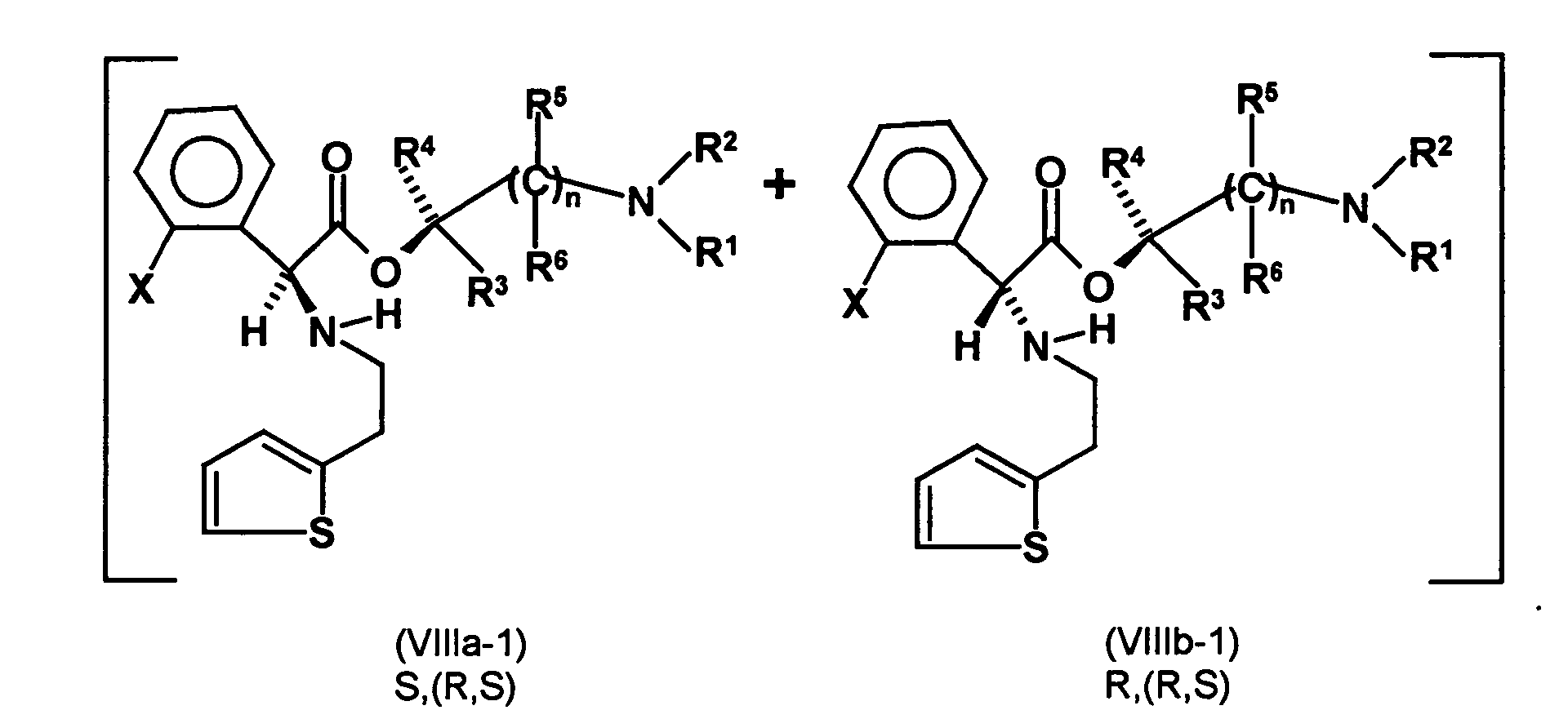
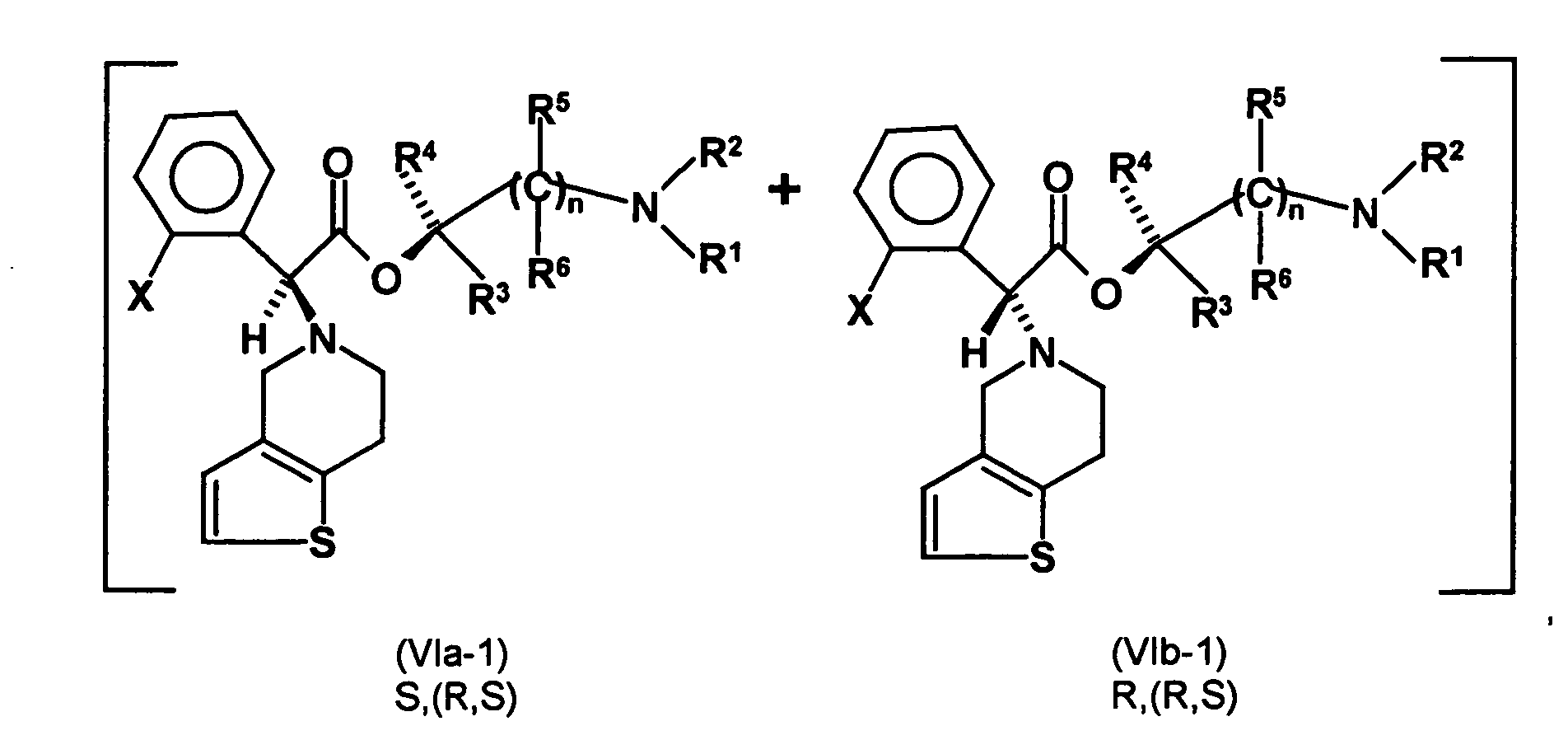

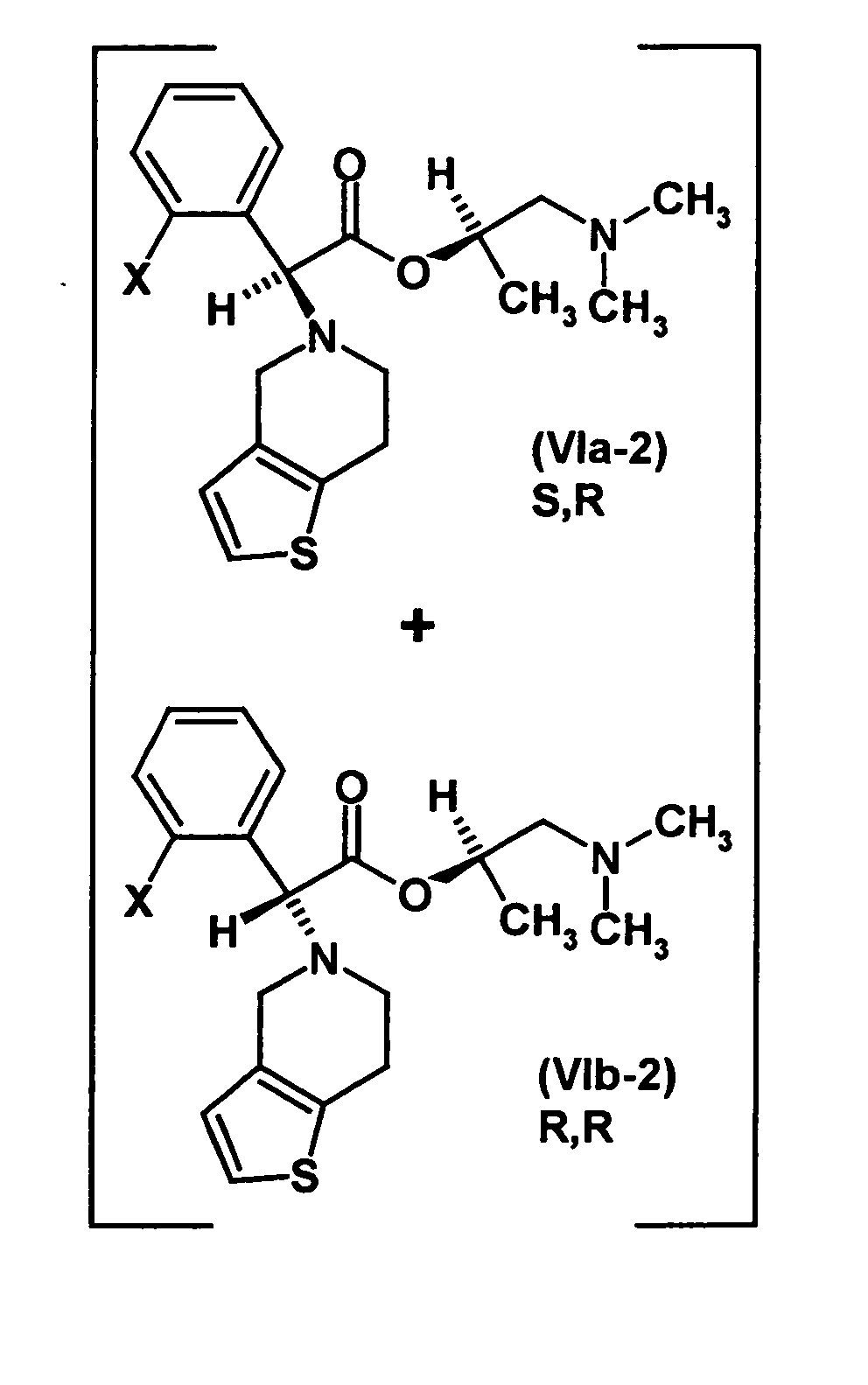
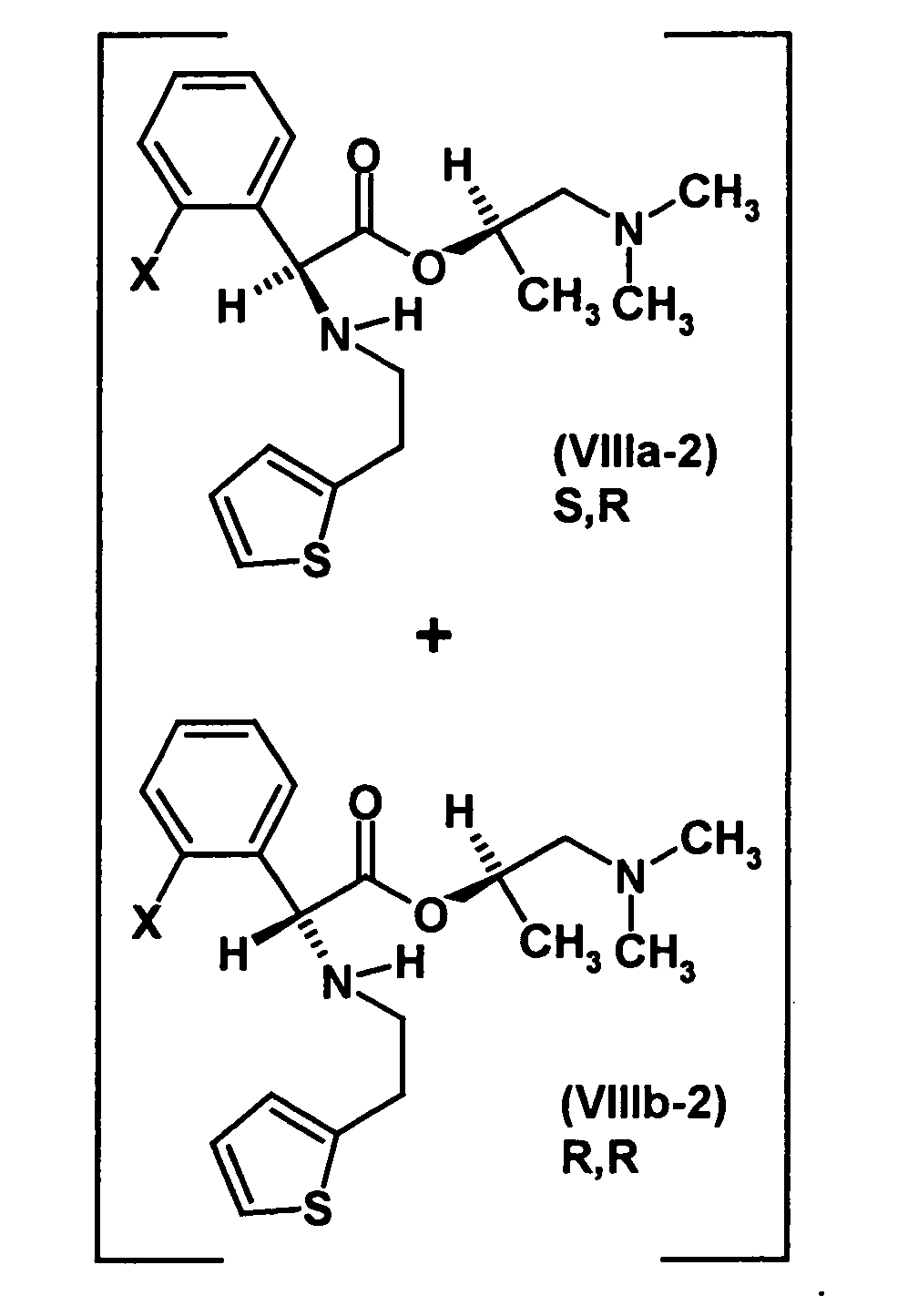



















Claims (34)
- Verfahren zur Herstellung einer Verbindung der allgemeinen Formel (la)in der X ein Halogenatom darstellt, oder eines pharmazeutisch verträglichen Salzes davon, umfassend den Verfahrensschritt, daß eine Verbindung der Formel (II)
 in der X wie vorstehend definiert ist und Y und Z unabhängig voneinander jeweils eine Abgangsgruppe darstellen, mit einem optisch aktiven Aminoalkohol zu einem ersten Gemisch aus Diastereomeren umgesetzt wird.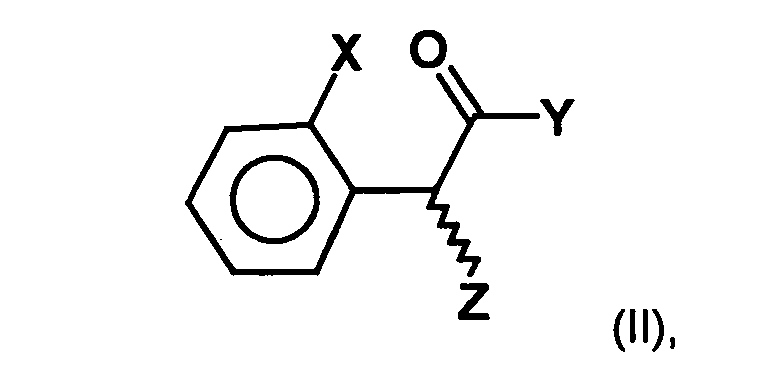
- Verfahren nach Anspruch 1, bei dem das erste Gemisch aus Diastereomeren weiter mit einer Verbindung der Formel (V)oder einer Verbindung der Formel (VII)
 zu einem zweiten Gemisch aus Diastereomeren umgesetzt wird, das gegebenenfalls nach Abtrennung eines Diastereomeren weiter zu der Verbindung der Formel (Ia) umgesetzt wird.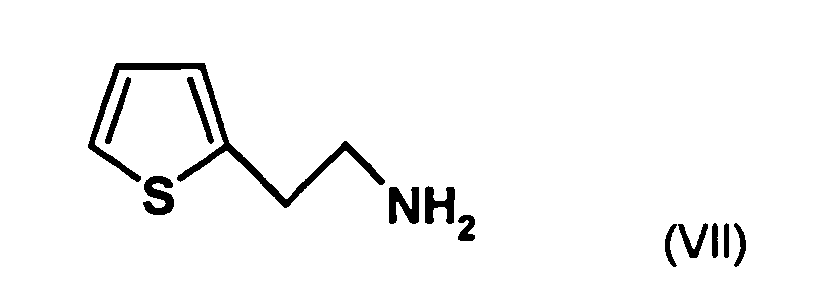
- Verfahren nach Anspruch 2, bei dem die Umsetzung des zweiten Gemisches aus Diastereomeren zu der Verbindung der Formel (Ia) eine Umesterung in Gegenwart eines Ti-oder Si-Katalysators umfaßt.
- Verfahren nach Anspruch 3, bei dem der Ti-Katalysator ein Umsetzungsprodukt aus Ethylenglycol und einem Titan(IV)alkoxid und der Si-Katalysator ein chloriertes Siliciumdioxid ist.
- Verfahren nach einem der Ansprüche 1 bis 4, bei dem in dem ersten Gemisch aus Diastereomeren das Verhältnis des einen Diastereomeren zu dem zweiten Diastereomeren 2:1 oder höher ist.
- Verfahren nach einem der Ansprüche 2 bis 5, bei dem in dem zweiten Gemisch aus Diastereomeren das Verhältnis des einen Diastereomeren zu dem zweiten Diastereomeren 3:1 oder höher ist.
- Verfahren nach einem der Ansprüche 2 bis 6, bei dem von dem zweiten Gemisch aus Diastereomeren ein Diastereomer abgetrennt wird, das dann weiter zu der Verbindung der Formel (Ia) umgesetzt wird.
- Verfahren nach einem der Ansprüche 2 bis 6, bei dem das zweite Gemisch aus Diastereomeren ohne vorherige Abtrennung eines Diastereomeren zu einem Gemisch der Verbindungen (la)und (Ib)
 umgesetzt wird, wobei X wie vorstehend definiert ist, und anschließend aus dem Gemisch der Verbindungen der Formeln (la) und (Ib) die Verbindung der Formel (Ia) isoliert wird, die gegebenenfalls in ein pharmazeutisch verträgliches Salz davon überführt wird.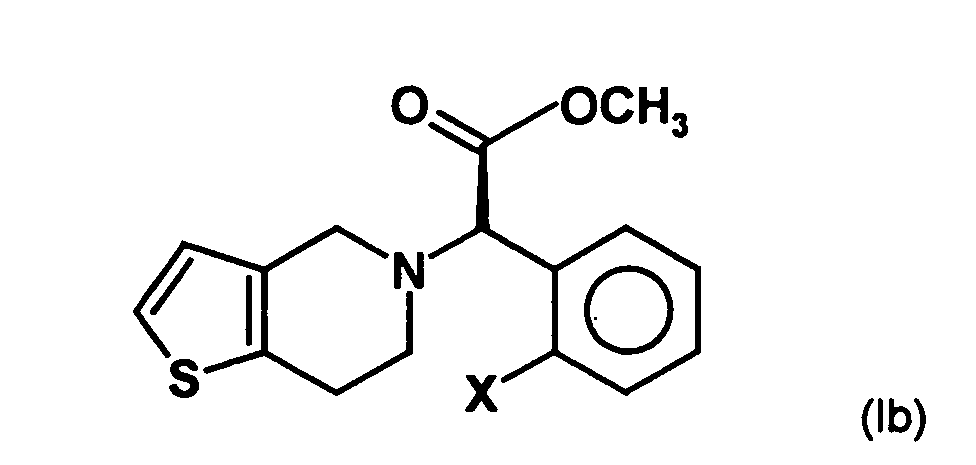
- Verfahren nach einem der Ansprüche 1 bis 8, wobei X ein Chloratom darstellt.
- Verfahren nach einem der Ansprüche 1 bis 9, wobei der optisch aktive Aminoalkohol die Formel (III)aufweist, wobei A* einen Kohlenwasserstoffrest mit 1 bis 30 Kohlenstoffatomen darstellt, der bis zu 5 Heteroatome enthalten kann, ausgewählt aus Stickstoff-, Sauerstoff-, Schwefel-und Halogenatomen, mit bis zu 5 Substituenten substituiert sein kann, ausgewählt aus Hydroxylgruppen, Oxogruppen, Cyanogruppen und Nitrogruppen, und der eine oder mehrere optisch aktive Einheiten aufweist, und

R1 und R2 jeweils unabhängig voneinander Wasserstoffatome oder Kohlenwasserstoffreste mit 1 bis 20 Kohlenstoffatomen darstellen, die jeweils bis zu 4 Heteroatome, ausgewählt aus Stickstoff-, Sauerstoff-, Schwefel- und Halogenatomen, und bis zu 5 Substituenten, ausgewählt aus Hydroxylgruppen, Oxogruppen, Cyanogruppen und Nitrogruppen, aufweisen können, oder
einer oder beide der Reste R1 und R2 mit einem Kohlenstoffatom oder einem Heteroatom des Rests A* einen 5- bis 10-gliedrigen gesättigten oder ungesättigten Ring bildet, der neben dem Stickstoffatom gegebenenfalls noch 1 bis 3 weitere Heteroatome, ausgewählt aus Stickstoff-, Sauerstoff- und Schwefelatomen, als Ringglieder enthält, und der mit bis zu 5 Substituenten, ausgewählt aus C1-C6-Alkylresten, C2-C6-Alkenylresten, C1-C6-Alkoxyresten, C5-C10-Arylresten, C5-C10-Heteroarylresten, C3-C8-Cycloalkylresten, C2-C8-Heterocycloalkylresten, Halogenatomen, Hydroxylgruppen, Oxogruppen, Cyanogruppen und Nitrogruppen, substituiert sein kann. - Verfahren nach Anspruch 10, bei dem die Reste R1 und R2 unabhängig voneinander einen C1-C6-Alkylrest, einen C5-C10-Arylrest, einen C5-C10-Heteroarylrest, einen C3-C8-Cycloalkylrest oder einen C2-C8-Heterocycloalkylrest darstellen oder zusammen mit dem Stickstoffatom, an das sie gebunden sind, einen gesättigten oder einfach ungesättigten Ring mit 3 bis 8 Kohlenstoffatomen darstellen, der gegebenenfalls mit einer C1-C6-Alkylgruppe oder einem Halogenatom substituiert ist und neben dem Stickstoffatom 1 oder 2 weitere Heteroatome, ausgewählt aus Schwefelatomen, Stickstoffatomen und Sauerstoffatomen, enthalten kann.
- Verfahren nach Anspruch 10 oder 11, bei dem der Rest HO-A* einen Rest der Formeldarstellt, wobei die Reste R3 bis R6 jeweils unabhängig voneinander Wasserstoffatome oder Kohlenwasserstoffreste mit 1 bis 20 Kohlenstoffatomen darstellen, die jeweils bis zu 4 Heteroatome, ausgewählt aus Stickstoff-, Sauerstoff-, Schwefel- und Halogenatomen, und bis zu 5 Substituenten, ausgewählt aus Hydroxylgruppen, Oxogruppen, Cyanogruppen und Nitrogruppen, aufweisen können, oder
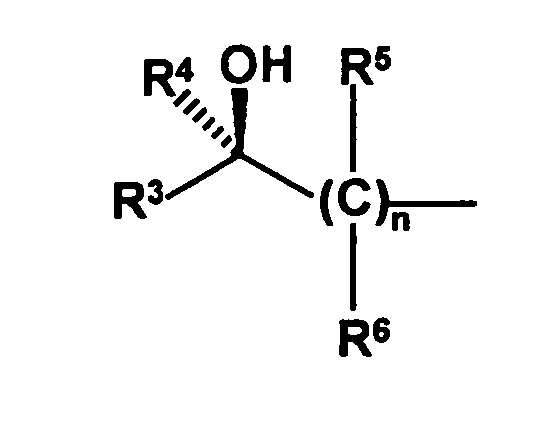
einer oder zwei der Reste R3 bis R6 mit dem Rest R1 bzw. dem Rest R2 einen 5- bis 10-gliedrigen gesättigten oder ungesättigten Ring bilden, der neben dem Stickstoffatom gegebenenfalls noch 1 bis 3 weitere Heteroatome, ausgewählt aus Stickstoff-, Sauerstoff-und Schwefelatomen, als Ringglieder enthält, und der mit bis zu 5 Substituenten, ausgewählt aus C1-C6-Alkylresten, C2-C6-Alkenylresten, C1-C6-Alkoxyresten, C5-C10-Arylresten, C5-C10-Heteroarylresten, C3-C8-Cycloalkylresten, C2-C8-Heterocycloalkylresten, Halogenatomen, Hydroxylgruppen, Oxogruppen, Cyanogruppen und Nitrogruppen, substituiert sein kann, und n eine ganze Zahl von 1 bis 3 darstellt. - Verfahren nach Anspruch 12, bei dem die Reste R5 und R6 unabhängig voneinander aus Wasserstoff und C1-C6-Alkylresten ausgewählt sind.
- Verfahren nach Anspruch 13, bei dem nur einer der Reste R5 und R6 von einem Wasserstoffatom verschieden ist.
- Verfahren nach Anspruch 14, bei dem alle Reste R5 und R6 Wasserstoffatome darstellen.
- Verfahren nach einem der Ansprüche 12 bis 15, bei dem der Index n 1 oder 2 ist.
- Verfahren nach einem der Ansprüche 12 bis 16, bei dem der Rest R3 einen C1-C6-Alkyl-, C5-C10-Aryl-, C5-C10-Heteroaryl-, C2-C8-Heterocycloalkyl- oder C3-C8-Cycloalkylrest darstellt.
- Verfahren nach Anspruch 17, bei dem der Rest R3 einen C1-C6-Alkylrest darstellt.
- Verfahren nach einem der Ansprüche 12 bis 18, bei dem der Rest R4 ein Wasserstoffatom darstellt.
- Verfahren nach Anspruch 12, bei dem der Rest R3 mit dem Rest R2 zu einem Ring verbunden ist, der 5 bis 10 Ringatome aufweist und der neben dem Stickstoffatom, an das der Rest R2 gebunden ist, noch 1 bis 3 weitere Heteroatome, ausgewählt aus Sauerstoff-, Stickstoff- und Schwefelatomen, aufweisen kann, und der gesättigt oder einfach oder zweifach ungesättigt sein kann und der 1 bis 3 Substituenten aufweisen kann, ausgewählt aus C1-C6-Alkylresten, C5-C10-Arylresten, C5-C10-Heteroarylresten, C3-C8-Cycloalkylresten, C2-C8-Heterocycloalkylresten und Halogenatomen.
- Verfahren nach Anspruch 10 oder 11, bei dem der Rest HO-A* einen Rest der Formeldarstellt, wobei Y1 einen Rest
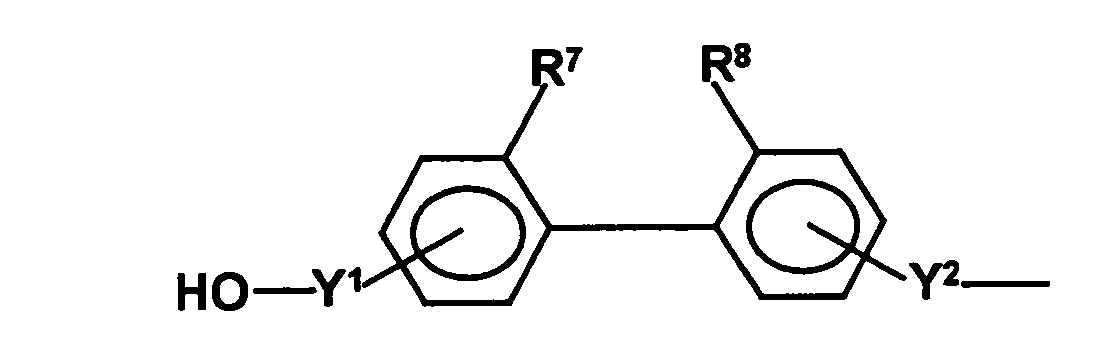 und Y2 einen Rest
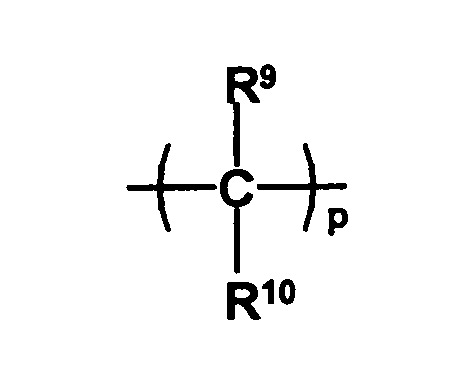 darstellt, in dem R9 und R10 unabhängig voneinander aus Wasserstoffatomen und C1-C6-Alkylresten ausgewählt sind und die Reste R7 und R8 Gruppen darstellen, die die freie Drehbarkeit der beiden Phenylgruppen relativ zueinander verhindern, m eine ganze Zahl von 0 bis 2 ist und p 1 oder 2 darstellt.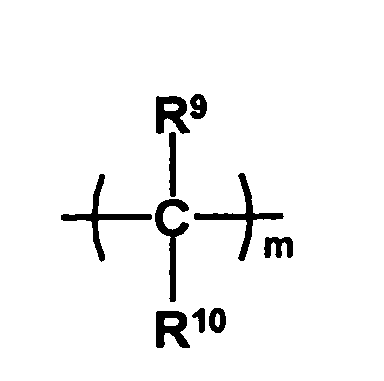
- Verfahren nach Anspruch 21, bei dem einer der Reste R7 und R8 ausgewählt ist aus einer C1-C6-Alkylgruppe, einem Halogenatom und einer Cyanogruppe und der zweite ausgewählt ist aus einer C3-C6-verzweigten Alkylgruppe, bevorzugt eine tert.-Butylgruppe, einem Halogenatom und einer Cyanogruppe.
- Verfahren nach Anspruch 10, bei dem die Verbindung der Formel (III)eine Verbindung der Formel
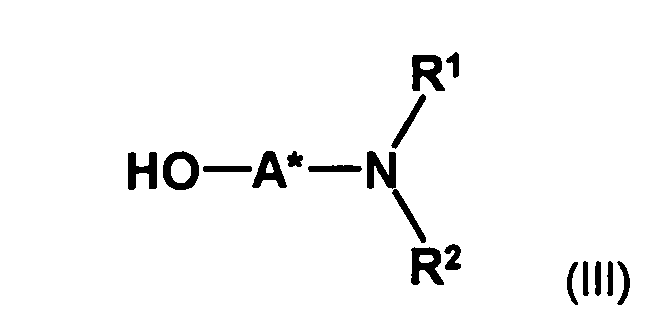 ist, in der Y2 wie in Anspruch 21 definiert ist, R1 wie in Anspruch 10 definiert ist und die Gruppe
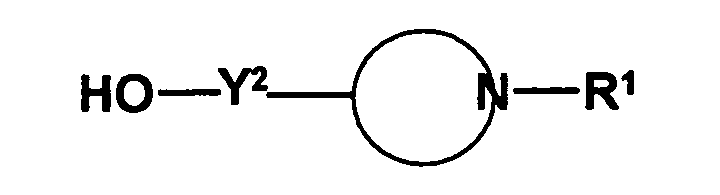 einen 5- bis 10-gliedrigen gesättigten oder ungesättigten Ring darstellt, der neben dem Stickstoffatom gegebenenfalls noch 1 bis 3 weitere Heteroatome, ausgewählt aus Stickstoff-, Sauerstoff- und Schwefelatomen, als Ringglieder enthält, und der mit bis zu 5 Substituenten, ausgewählt aus C1-C6-Alkylresten, C2-C6-Alkenylresten, C1-C6-Alkoxyresten, C5-C10-Arylresten, C5-C10-Heteroarylresten, C3-C8-Cycloalkylresten, C2-C8-Heterocycloalkylresten, Halogenatomen, Hydroxylgruppen, Oxogruppen, Cyanogruppen und Nitrogruppen, substituiert sein kann.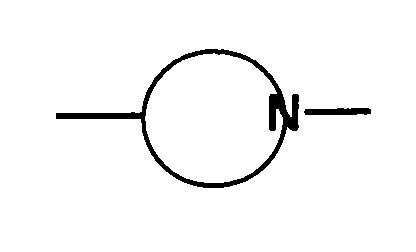
- Verfahren nach Anspruch 23, bei dem die Gruppeeine Gruppe
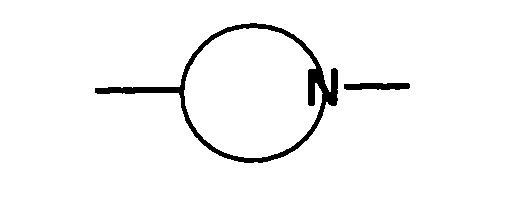 darstellt.
- Gemisch der Diastereomeren (IVa)und (IVb)
 wobei X und Z wie in Anspruch 1 definiert sind und A*, R1 und R2 wie in einem der Ansprüche 10 bis 24 definiert sind.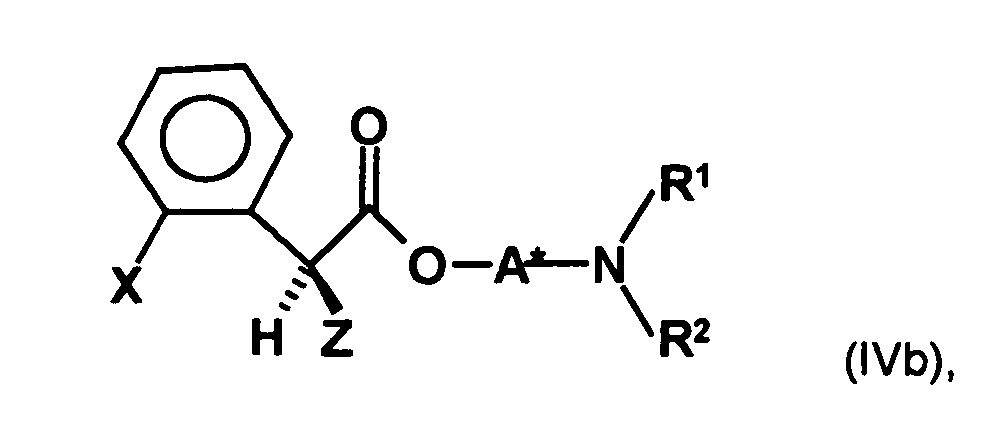
- Gemisch nach Anspruch 25, in dem das Verhältnis zwischen dem Diastereomer (IVa) und dem Diastereomer (IVb) 2:1 oder größer ist.
- Verbindung der Formel (IVa)wobei die Reste X, Z, A*, R1 und R2 wie in Anspruch 25 definiert sind.

- Gemisch der Diastereomeren (VIa)und (VIb)
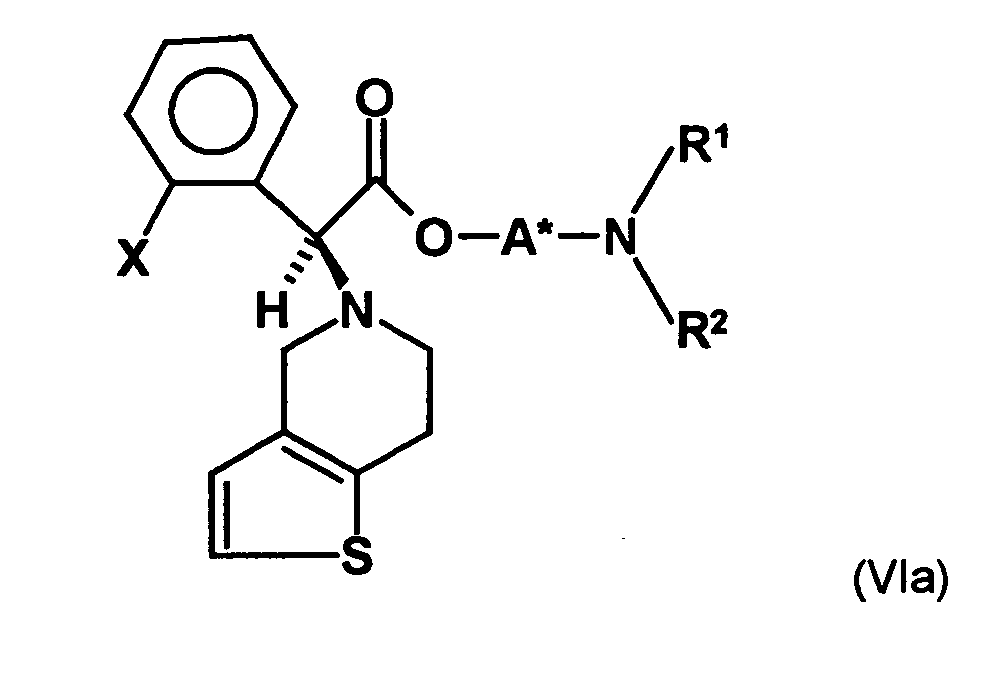 wobei der Rest X wie in Anspruch 1 definiert ist und die Reste A*, R1 und R2 wie in einem der Ansprüche 10 bis 24 definiert ist.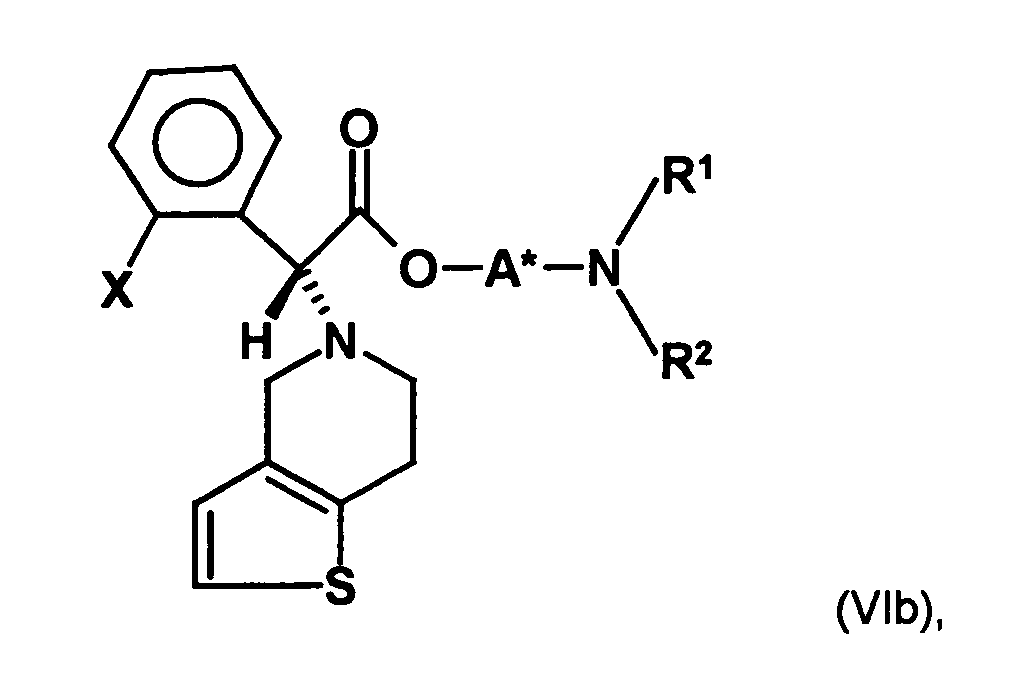
- Gemisch nach Anspruch 28, in dem das Verhältnis zwischen dem Diastereomer (VIa) und dem Diastereomer (VIb) 3:1 oder größer ist.
- Verbindung der Formel (VIa)wobei die Reste X, A*, R1 und R2 wie in Anspruch 28 definiert sind.

- Gemisch der Diastereomeren (VIIIa)und (Vlllb)
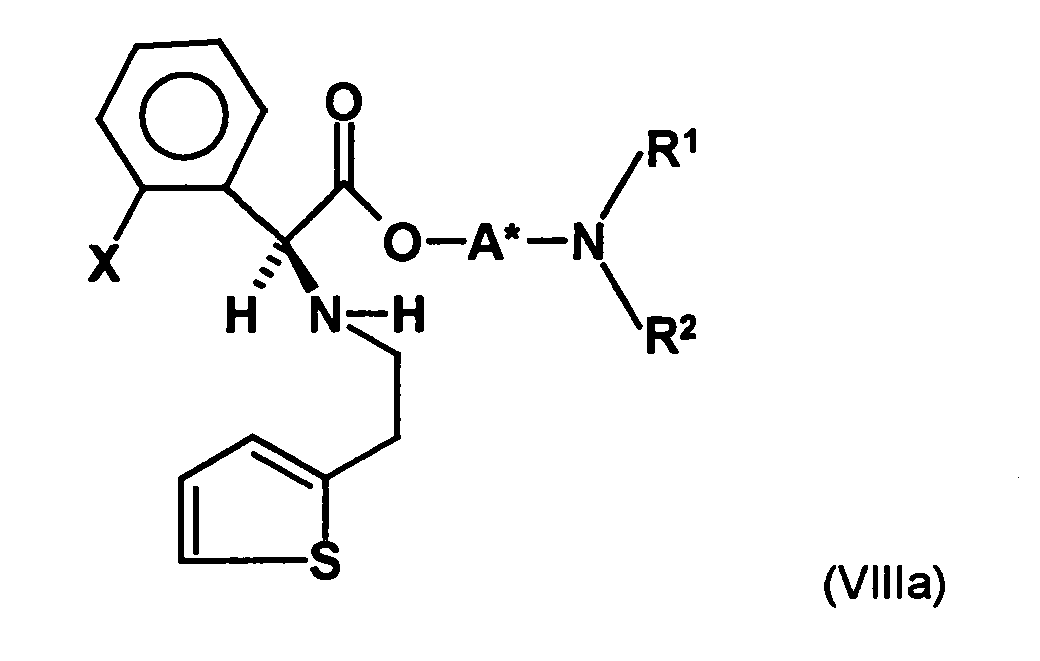 wobei der Rest X wie in Anspruch 1 definiert ist und die Reste A*, R1 und R2 wie in einem der Ansprüche 10 bis 24 definiert sind.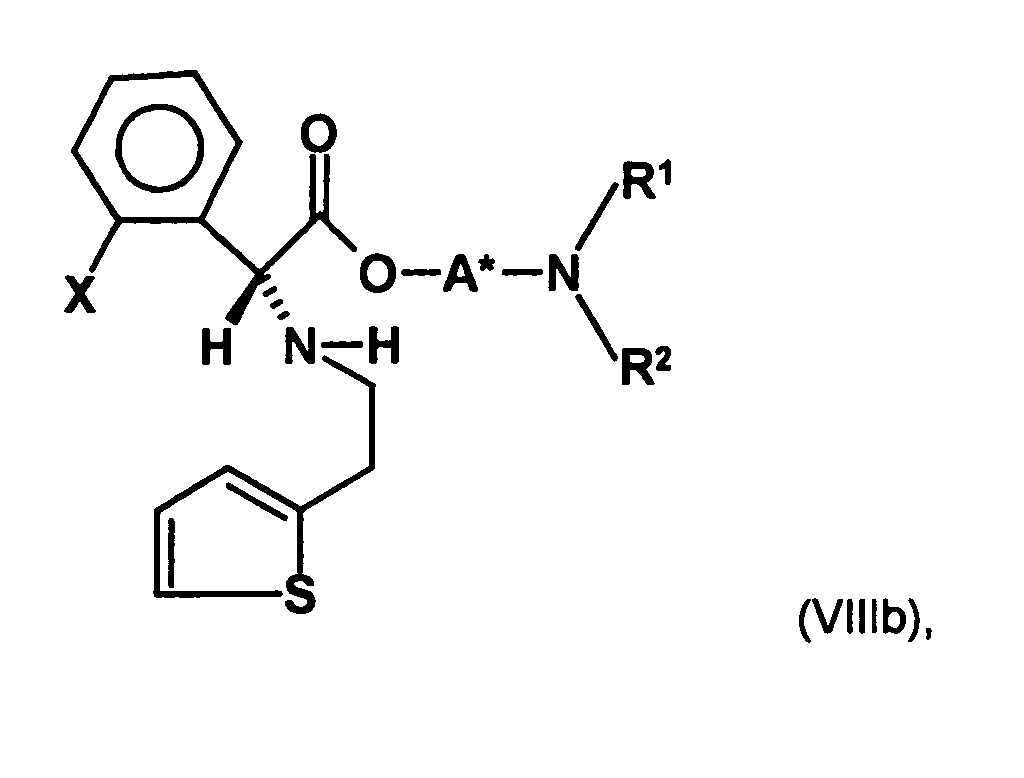
- Gemisch nach Anspruch 30, in dem das Verhältnis zwischen den Diastereomeren (VIIIa) und (VIIIb) 3:1 oder größer ist.
- Verbindung der Formel (VIIIa) der Formelwobei die Reste X, A*, R1 und R2 wie in Anspruch 31 definiert sind.
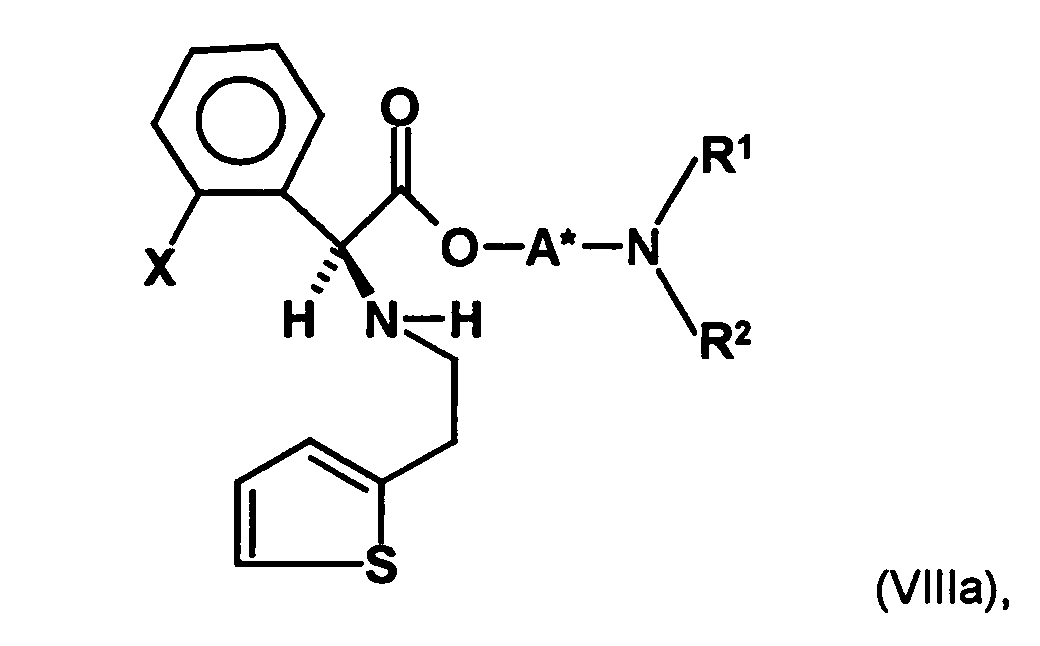
- Verfahren zur Herstellung der Verbindungbei dem ein Gemisch der Verbindungen
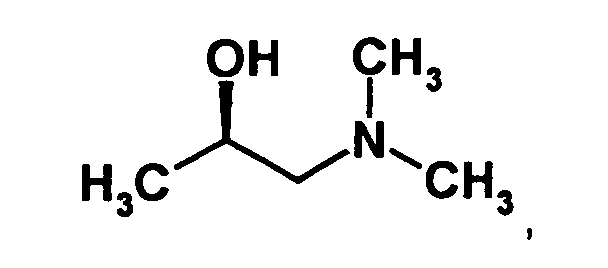 und
und mit L-(-)-Di-O-benzoyl-L-(-)-Weinsäure (L-(-)-DBTA) umgesetzt und das L-(-)-DBTA-Salz der Verbindung
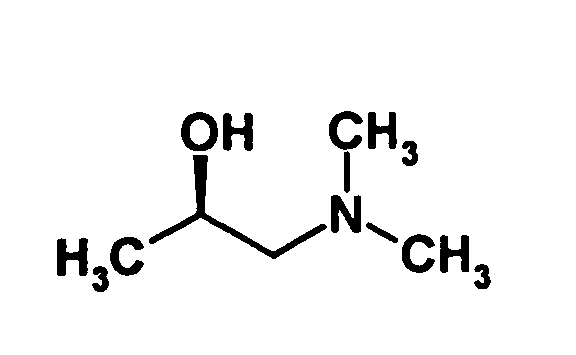 abgetrennt wird.
Priority Applications (30)
| Application Number | Priority Date | Filing Date | Title |
|---|---|---|---|
| PT04009280T PT1589019E (pt) | 2004-04-20 | 2004-04-20 | Processo estereosselectivo para a preparação de clopidogrel |
| AT04009280T ATE404566T1 (de) | 2004-04-20 | 2004-04-20 | Stereoselektives verfahren zur herstellung von clopidogrel |
| ES04009280T ES2309416T3 (es) | 2004-04-20 | 2004-04-20 | Procedimiento estereoselectivo para la preparacion de clopidogrel. |
| SI200430861T SI1589019T1 (sl) | 2004-04-20 | 2004-04-20 | Stereoselektivni postopek za pripravo klopidogrela |
| EP04009280A EP1589019B1 (de) | 2004-04-20 | 2004-04-20 | Stereoselektives Verfahren zur Herstellung von Clopidogrel |
| PL04009280T PL1589019T3 (pl) | 2004-04-20 | 2004-04-20 | Stereoselektywny sposób wytwarzania klopidogrelu |
| DK04009280T DK1589019T3 (da) | 2004-04-20 | 2004-04-20 | Stereoselektiv fremgangsmåde til fremstilling af clopidogrel |
| DE502004007831T DE502004007831D1 (de) | 2004-04-20 | 2004-04-20 | Stereoselektives Verfahren zur Herstellung von Clopidogrel |
| CA002563662A CA2563662A1 (en) | 2004-04-20 | 2004-12-03 | A stereoselectivce process for the preparation of clopidogrel |
| US11/587,124 US7507827B2 (en) | 2004-04-20 | 2004-12-03 | Stereoselective method for the production of Clopidogrel |
| DE502004006368T DE502004006368D1 (de) | 2004-04-20 | 2004-12-03 | Stereoselektives verfahren zur herstellung von clopidogrel |
| DK04803495T DK1737868T3 (da) | 2004-04-20 | 2004-12-03 | Stereoselektiv fremgangsmåde til fremstilling af clopidogrel |
| AT04803495T ATE387454T1 (de) | 2004-04-20 | 2004-12-03 | Stereoselektives verfahren zur herstellung von clopidogrel |
| PT04803495T PT1737868E (pt) | 2004-04-20 | 2004-12-03 | Processo estereoselectivo para a preparação de clopidogrel |
| ES04803495T ES2300854T3 (es) | 2004-04-20 | 2004-12-03 | Procedimiento estereoselectivo para la preparacion de clopidogrel. |
| PL04803495T PL1737868T3 (pl) | 2004-04-20 | 2004-12-03 | Stereoselektywny sposób wytwarzania Clopidogrelu |
| PCT/EP2004/013773 WO2005113559A1 (de) | 2004-04-20 | 2004-12-03 | Stereoselektives verfahren zur herstellung von clopidogrel |
| BRPI0418760-1A BRPI0418760A (pt) | 2004-04-20 | 2004-12-03 | processo estereosseletivo para a preparação de clopidogrel |
| EP04803495A EP1737868B1 (de) | 2004-04-20 | 2004-12-03 | Stereoselektives verfahren zur herstellung von clopidogrel |
| JP2007508735A JP2007533671A (ja) | 2004-04-20 | 2004-12-03 | クロピドグレルの立体選択的な製造方法 |
| HR20080091T HRP20080091T3 (en) | 2004-04-20 | 2004-12-03 | Stereoselective method for the production of clopidogrel |
| UAA200611996A UA93030C2 (ru) | 2004-04-20 | 2004-12-03 | Способ получения клопидогрела (варианты) и промежуточные соединения |
| SI200430682T SI1737868T1 (sl) | 2004-04-20 | 2004-12-03 | Stereoselektivni postopek za pripravo klopidogrela |
| CNB2004800433958A CN100522970C (zh) | 2004-04-20 | 2004-12-03 | 制备氯吡格雷的立体选择性方法 |
| AU2004319901A AU2004319901A1 (en) | 2004-04-20 | 2004-12-03 | Stereoselective method for the production of clopidogrel |
| RU2006137112/04A RU2369610C2 (ru) | 2004-04-20 | 2004-12-03 | Стереоселективный способ получения клопидогреля |
| NO20065313A NO20065313L (no) | 2004-04-20 | 2006-11-20 | Stereoselektiv fremgangsmate for fremstilling av klopiogrel |
| CY20081100304T CY1107908T1 (el) | 2004-04-20 | 2008-03-18 | Στερεοεκλεκτικη μεθοδος για την παραγωγη της κλοπιδογρελης |
| CY20081101094T CY1108391T1 (el) | 2004-04-20 | 2008-10-02 | Στερεοεκλεκτικη μεθοδος παραγωγης της κλοπιδογρελης |
| US12/368,967 US7799952B2 (en) | 2004-04-20 | 2009-02-10 | Stereoselective method for the production of (R)-Dimepranol |
Applications Claiming Priority (1)
| Application Number | Priority Date | Filing Date | Title |
|---|---|---|---|
| EP04009280A EP1589019B1 (de) | 2004-04-20 | 2004-04-20 | Stereoselektives Verfahren zur Herstellung von Clopidogrel |
Publications (2)
| Publication Number | Publication Date |
|---|---|
| EP1589019A1 true EP1589019A1 (de) | 2005-10-26 |
| EP1589019B1 EP1589019B1 (de) | 2008-08-13 |
Family
ID=34924660
Family Applications (2)
| Application Number | Title | Priority Date | Filing Date |
|---|---|---|---|
| EP04009280A Expired - Lifetime EP1589019B1 (de) | 2004-04-20 | 2004-04-20 | Stereoselektives Verfahren zur Herstellung von Clopidogrel |
| EP04803495A Expired - Lifetime EP1737868B1 (de) | 2004-04-20 | 2004-12-03 | Stereoselektives verfahren zur herstellung von clopidogrel |
Family Applications After (1)
| Application Number | Title | Priority Date | Filing Date |
|---|---|---|---|
| EP04803495A Expired - Lifetime EP1737868B1 (de) | 2004-04-20 | 2004-12-03 | Stereoselektives verfahren zur herstellung von clopidogrel |
Country Status (20)
| Country | Link |
|---|---|
| US (2) | US7507827B2 (de) |
| EP (2) | EP1589019B1 (de) |
| JP (1) | JP2007533671A (de) |
| CN (1) | CN100522970C (de) |
| AT (2) | ATE404566T1 (de) |
| AU (1) | AU2004319901A1 (de) |
| BR (1) | BRPI0418760A (de) |
| CA (1) | CA2563662A1 (de) |
| CY (2) | CY1107908T1 (de) |
| DE (2) | DE502004007831D1 (de) |
| DK (2) | DK1589019T3 (de) |
| ES (2) | ES2309416T3 (de) |
| HR (1) | HRP20080091T3 (de) |
| NO (1) | NO20065313L (de) |
| PL (2) | PL1589019T3 (de) |
| PT (2) | PT1589019E (de) |
| RU (1) | RU2369610C2 (de) |
| SI (2) | SI1589019T1 (de) |
| UA (1) | UA93030C2 (de) |
| WO (1) | WO2005113559A1 (de) |
Families Citing this family (1)
| Publication number | Priority date | Publication date | Assignee | Title |
|---|---|---|---|---|
| FR2909377A1 (fr) | 2006-12-05 | 2008-06-06 | Arkema France | Procede de synthese d'esters (meth)acryliques catalyse par un titanate de polyol |
Citations (2)
| Publication number | Priority date | Publication date | Assignee | Title |
|---|---|---|---|---|
| WO1999018110A1 (fr) * | 1997-10-06 | 1999-04-15 | Sanofi-Synthelabo | Derives d'esters hydroxyacetiques, leur procede de preparation et leur utilisation comme intermediaires de synthese |
| WO2003035652A1 (en) * | 2001-10-26 | 2003-05-01 | Merck Generics [Uk] Limited | A PROCESS FOR PREPARING ENANTIOMERICALLY PURE α-PHENYL-α-(6,7-DIHYDRO-4H-THIENO[3,2-C]PYRIDIN-5-YL)-ACETIC ACID DERIVATIVES |
Family Cites Families (5)
| Publication number | Priority date | Publication date | Assignee | Title |
|---|---|---|---|---|
| IT1196334B (it) * | 1984-11-22 | 1988-11-16 | Alfa Chem Ital | Processo per la risoluzione ottica di miscugli racemi di acidi alfanaftil-propionici |
| DE4428531A1 (de) * | 1994-08-12 | 1996-02-15 | Boehringer Ingelheim Kg | Neue enantiomerenreine Pyridylcycloalkylethylamine und deren Salze sowie Verfahren zu ihrer Herstellung |
| HU222283B1 (hu) * | 1997-05-13 | 2003-05-28 | Sanofi-Synthelabo | Eljárás tieno[3,2-c]piridin-származékok előállítására |
| HU225503B1 (en) * | 1997-05-13 | 2007-01-29 | Sanofi Aventis | Novel 2-(2-halophenyl)-2-(2-(2-thienyl)-ethylamino)-acetamides and process for producing them |
| EP1254885A1 (de) * | 2000-02-08 | 2002-11-06 | Asahi Kasei Kabushiki Kaisha | Verfahren zur herstellung optisch aktiver sekundärer alkohole mit stickstoff- oder sauerstoff-enthaltenden funktionellen gruppen |
-
2004
- 2004-04-20 EP EP04009280A patent/EP1589019B1/de not_active Expired - Lifetime
- 2004-04-20 ES ES04009280T patent/ES2309416T3/es not_active Expired - Lifetime
- 2004-04-20 AT AT04009280T patent/ATE404566T1/de not_active IP Right Cessation
- 2004-04-20 SI SI200430861T patent/SI1589019T1/sl unknown
- 2004-04-20 PT PT04009280T patent/PT1589019E/pt unknown
- 2004-04-20 DE DE502004007831T patent/DE502004007831D1/de not_active Expired - Lifetime
- 2004-04-20 DK DK04009280T patent/DK1589019T3/da active
- 2004-04-20 PL PL04009280T patent/PL1589019T3/pl unknown
- 2004-12-03 DK DK04803495T patent/DK1737868T3/da active
- 2004-12-03 HR HR20080091T patent/HRP20080091T3/xx unknown
- 2004-12-03 ES ES04803495T patent/ES2300854T3/es not_active Expired - Lifetime
- 2004-12-03 SI SI200430682T patent/SI1737868T1/sl unknown
- 2004-12-03 AU AU2004319901A patent/AU2004319901A1/en not_active Abandoned
- 2004-12-03 WO PCT/EP2004/013773 patent/WO2005113559A1/de not_active Ceased
- 2004-12-03 UA UAA200611996A patent/UA93030C2/ru unknown
- 2004-12-03 DE DE502004006368T patent/DE502004006368D1/de not_active Expired - Lifetime
- 2004-12-03 AT AT04803495T patent/ATE387454T1/de active
- 2004-12-03 CN CNB2004800433958A patent/CN100522970C/zh not_active Expired - Fee Related
- 2004-12-03 CA CA002563662A patent/CA2563662A1/en not_active Abandoned
- 2004-12-03 PL PL04803495T patent/PL1737868T3/pl unknown
- 2004-12-03 BR BRPI0418760-1A patent/BRPI0418760A/pt not_active Application Discontinuation
- 2004-12-03 JP JP2007508735A patent/JP2007533671A/ja active Pending
- 2004-12-03 RU RU2006137112/04A patent/RU2369610C2/ru not_active IP Right Cessation
- 2004-12-03 US US11/587,124 patent/US7507827B2/en not_active Expired - Fee Related
- 2004-12-03 PT PT04803495T patent/PT1737868E/pt unknown
- 2004-12-03 EP EP04803495A patent/EP1737868B1/de not_active Expired - Lifetime
-
2006
- 2006-11-20 NO NO20065313A patent/NO20065313L/no not_active Application Discontinuation
-
2008
- 2008-03-18 CY CY20081100304T patent/CY1107908T1/el unknown
- 2008-10-02 CY CY20081101094T patent/CY1108391T1/el unknown
-
2009
- 2009-02-10 US US12/368,967 patent/US7799952B2/en not_active Expired - Fee Related
Patent Citations (2)
| Publication number | Priority date | Publication date | Assignee | Title |
|---|---|---|---|---|
| WO1999018110A1 (fr) * | 1997-10-06 | 1999-04-15 | Sanofi-Synthelabo | Derives d'esters hydroxyacetiques, leur procede de preparation et leur utilisation comme intermediaires de synthese |
| WO2003035652A1 (en) * | 2001-10-26 | 2003-05-01 | Merck Generics [Uk] Limited | A PROCESS FOR PREPARING ENANTIOMERICALLY PURE α-PHENYL-α-(6,7-DIHYDRO-4H-THIENO[3,2-C]PYRIDIN-5-YL)-ACETIC ACID DERIVATIVES |
Non-Patent Citations (1)
| Title |
|---|
| M.M-L. CHAM AND J.B. ROBINSON: "Stereoisomeric Lactoyl-beta-methylcholine Iodides. Interaction with Cholinesterase and Acetylcholinesterase", J. MED. CHEM., vol. 17, no. 10, 1974, pages 1057 - 60, XP002297328 * |
Also Published As
Similar Documents
| Publication | Publication Date | Title |
|---|---|---|
| DE60217062T2 (de) | Verfahren zur herstellung von clopidogrel | |
| EP4045501A1 (de) | Verfahren zur herstellung von 2-cyanoethyl (4s)-4-(4-cyano-2-methoxy-phenyl)-5-ethoxy-2,8-dimethyl-1,4-dihydro-1,6-naphthyridine-3-carboxylat durch racemat-spaltung mittels diastereomerer weinsäureester | |
| DE69814608T2 (de) | Verfahren zur herstellung von 2-thienylamin-derivaten | |
| DE69610089T2 (de) | Verfahren zur trennung der chiralen säuren mittels 1-aminoindan-olen | |
| EP0146080A2 (de) | Verfahren zur Racematspaltung bicyclischer Imino-alpha-carbonsäureester | |
| DE2345302A1 (de) | Aufspaltung von optisch aktiven verbindungen | |
| DE112020001032T5 (de) | Verfahren zur Herstellung von Levoamphetamin | |
| CH617934A5 (de) | ||
| DE60313157T2 (de) | Ein verfahren zur herstellung von clopidogrel | |
| DE69932269T2 (de) | Herstellung optisch aktiver Cyclohexylphenylglykolsäureester | |
| EP1067129B1 (de) | Racemisierung von R,S-Dioxo-benzylpyrrolopiperidin | |
| EP1737868B1 (de) | Stereoselektives verfahren zur herstellung von clopidogrel | |
| DE2138122C3 (de) | Verfahren zur Gewinnung von D-Penicillamin | |
| DE60007835T2 (de) | Verfahren zur herstellung von chiralen aminosäuren | |
| DE60309511T2 (de) | Verfahren zur herstellung von ondansetron und zwischenprodukte dazu | |
| DE2362687C3 (de) | Verfahren zur Gewinnung der optischen Isomeren des Penicillamins | |
| DE69804853T2 (de) | Verfahren zur herstellung von mequitazin und zwischenprodukt der synthese | |
| DD213922A5 (de) | Verfahren zur herstellung von phenothiazinverbindungen | |
| DE2653251A1 (de) | Azabicyclo eckige klammer auf 3.1.o eckige klammer zu hexan-derivate, ihre herstellung und verwendung | |
| DE69731090T2 (de) | Thienylcyclohexan-derivte zur herstellung von thienylcyclohexylen | |
| DE19505994C2 (de) | Verfahren zur Herstellung von optisch aktivem tert-Leucinol und dessen Verwendung | |
| EP0012801A1 (de) | 2-(1-Phenyl-2,5-cyclohexadienyl)-äthylaminderivate, Verfahren zu deren Herstellung, deren Verwendung als pharmazeutische Wirkstoffe sowie diese enthaltende Arzneimittel | |
| DE2854069C2 (de) | Verfahren zur Gewinnung von optisch aktiven Basen | |
| DE69407789T2 (de) | Verfahren zur herstellung von (s)-4-aminohepta-5,6-diencarbon-säure und intermediate | |
| AT410545B (de) | Verfahren zur herstellung von chiralen alpha-hydroxycarbonsäuren |
Legal Events
| Date | Code | Title | Description |
|---|---|---|---|
| PUAI | Public reference made under article 153(3) epc to a published international application that has entered the european phase |
Free format text: ORIGINAL CODE: 0009012 |
|
| AK | Designated contracting states |
Kind code of ref document: A1 Designated state(s): AT BE BG CH CY CZ DE DK EE ES FI FR GB GR HU IE IT LI LU MC NL PL PT RO SE SI SK TR |
|
| AX | Request for extension of the european patent |
Extension state: AL HR LT LV MK |
|
| 17P | Request for examination filed |
Effective date: 20060217 |
|
| REG | Reference to a national code |
Ref country code: HK Ref legal event code: DE Ref document number: 1082251 Country of ref document: HK |
|
| AKX | Designation fees paid |
Designated state(s): AT BE BG CH CY CZ DE DK EE ES FI FR GB GR HU IE IT LI LU MC NL PL PT RO SE SI SK TR |
|
| AXX | Extension fees paid |
Extension state: HR Payment date: 20060323 Extension state: LV Payment date: 20060323 Extension state: LT Payment date: 20060323 Extension state: AL Payment date: 20060323 Extension state: MK Payment date: 20060323 |
|
| 17Q | First examination report despatched |
Effective date: 20060824 |
|
| 17Q | First examination report despatched |
Effective date: 20060824 |
|
| GRAP | Despatch of communication of intention to grant a patent |
Free format text: ORIGINAL CODE: EPIDOSNIGR1 |
|
| GRAS | Grant fee paid |
Free format text: ORIGINAL CODE: EPIDOSNIGR3 |
|
| GRAA | (expected) grant |
Free format text: ORIGINAL CODE: 0009210 |
|
| AK | Designated contracting states |
Kind code of ref document: B1 Designated state(s): AT BE BG CH CY CZ DE DK EE ES FI FR GB GR HU IE IT LI LU MC NL PL PT RO SE SI SK TR |
|
| AX | Request for extension of the european patent |
Extension state: AL HR LT LV MK |
|
| REG | Reference to a national code |
Ref country code: GB Ref legal event code: FG4D Free format text: NOT ENGLISH |
|
| REG | Reference to a national code |
Ref country code: CH Ref legal event code: EP |
|
| REG | Reference to a national code |
Ref country code: IE Ref legal event code: FG4D Free format text: LANGUAGE OF EP DOCUMENT: GERMAN |
|
| REF | Corresponds to: |
Ref document number: 502004007831 Country of ref document: DE Date of ref document: 20080925 Kind code of ref document: P |
|
| REG | Reference to a national code |
Ref country code: CH Ref legal event code: NV Representative=s name: PATENTANWAELTE SCHAAD, BALASS, MENZL & PARTNER AG |
|
| REG | Reference to a national code |
Ref country code: PT Ref legal event code: SC4A Free format text: AVAILABILITY OF NATIONAL TRANSLATION Effective date: 20080925 |
|
| REG | Reference to a national code |
Ref country code: GR Ref legal event code: EP Ref document number: 20080402572 Country of ref document: GR |
|
| REG | Reference to a national code |
Ref country code: RO Ref legal event code: EPE |
|
| REG | Reference to a national code |
Ref country code: DK Ref legal event code: T3 |
|
| REG | Reference to a national code |
Ref country code: SE Ref legal event code: TRGR |
|
| REG | Reference to a national code |
Ref country code: EE Ref legal event code: FG4A Ref document number: E002527 Country of ref document: EE Effective date: 20081003 |
|
| REG | Reference to a national code |
Ref country code: ES Ref legal event code: FG2A Ref document number: 2309416 Country of ref document: ES Kind code of ref document: T3 |
|
| REG | Reference to a national code |
Ref country code: PL Ref legal event code: T3 |
|
| LTIE | Lt: invalidation of european patent or patent extension |
Effective date: 20080813 |
|
| REG | Reference to a national code |
Ref country code: HU Ref legal event code: AG4A Ref document number: E004287 Country of ref document: HU |
|
| PLBE | No opposition filed within time limit |
Free format text: ORIGINAL CODE: 0009261 |
|
| STAA | Information on the status of an ep patent application or granted ep patent |
Free format text: STATUS: NO OPPOSITION FILED WITHIN TIME LIMIT |
|
| 26N | No opposition filed |
Effective date: 20090514 |
|
| PGFP | Annual fee paid to national office [announced via postgrant information from national office to epo] |
Ref country code: LU Payment date: 20100426 Year of fee payment: 7 |
|
| PGFP | Annual fee paid to national office [announced via postgrant information from national office to epo] |
Ref country code: GB Payment date: 20100324 Year of fee payment: 7 |
|
| PGFP | Annual fee paid to national office [announced via postgrant information from national office to epo] |
Ref country code: BG Payment date: 20100426 Year of fee payment: 7 Ref country code: DK Payment date: 20100426 Year of fee payment: 7 Ref country code: ES Payment date: 20100423 Year of fee payment: 7 Ref country code: FI Payment date: 20100426 Year of fee payment: 7 Ref country code: FR Payment date: 20100506 Year of fee payment: 7 Ref country code: HU Payment date: 20100416 Year of fee payment: 7 Ref country code: IE Payment date: 20100419 Year of fee payment: 7 Ref country code: MC Payment date: 20100421 Year of fee payment: 7 Ref country code: PT Payment date: 20100408 Year of fee payment: 7 Ref country code: RO Payment date: 20100412 Year of fee payment: 7 |
|
| PGFP | Annual fee paid to national office [announced via postgrant information from national office to epo] |
Ref country code: AT Payment date: 20100422 Year of fee payment: 7 Ref country code: CZ Payment date: 20100408 Year of fee payment: 7 Ref country code: DE Payment date: 20100330 Year of fee payment: 7 Ref country code: EE Payment date: 20100423 Year of fee payment: 7 Ref country code: IT Payment date: 20100429 Year of fee payment: 7 Ref country code: NL Payment date: 20100421 Year of fee payment: 7 Ref country code: PL Payment date: 20100409 Year of fee payment: 7 Ref country code: SI Payment date: 20100408 Year of fee payment: 7 Ref country code: SK Payment date: 20100413 Year of fee payment: 7 |
|
| PGFP | Annual fee paid to national office [announced via postgrant information from national office to epo] |
Ref country code: BE Payment date: 20100423 Year of fee payment: 7 Ref country code: CH Payment date: 20100426 Year of fee payment: 7 |
|
| PGFP | Annual fee paid to national office [announced via postgrant information from national office to epo] |
Ref country code: CY Payment date: 20100419 Year of fee payment: 7 Ref country code: SE Payment date: 20100423 Year of fee payment: 7 Ref country code: TR Payment date: 20100416 Year of fee payment: 7 |
|
| PGFP | Annual fee paid to national office [announced via postgrant information from national office to epo] |
Ref country code: GR Payment date: 20100330 Year of fee payment: 7 |
|
| REG | Reference to a national code |
Ref country code: PT Ref legal event code: MM4A Free format text: LAPSE DUE TO NON-PAYMENT OF FEES Effective date: 20111020 |
|
| BERE | Be: lapsed |
Owner name: RATIOPHARM G.M.B.H. Effective date: 20110430 |
|
| REG | Reference to a national code |
Ref country code: NL Ref legal event code: V1 Effective date: 20111101 |
|
| REG | Reference to a national code |
Ref country code: SE Ref legal event code: EUG |
|
| PG25 | Lapsed in a contracting state [announced via postgrant information from national office to epo] |
Ref country code: MC Free format text: LAPSE BECAUSE OF NON-PAYMENT OF DUE FEES Effective date: 20110430 |
|
| REG | Reference to a national code |
Ref country code: CH Ref legal event code: PL |
|
| REG | Reference to a national code |
Ref country code: EE Ref legal event code: MM4A Ref document number: E002527 Country of ref document: EE Effective date: 20110430 |
|
| GBPC | Gb: european patent ceased through non-payment of renewal fee |
Effective date: 20110420 |
|
| REG | Reference to a national code |
Ref country code: SI Ref legal event code: KO00 Effective date: 20111123 |
|
| REG | Reference to a national code |
Ref country code: SK Ref legal event code: MM4A Ref document number: E 4312 Country of ref document: SK Effective date: 20110420 |
|
| REG | Reference to a national code |
Ref country code: AT Ref legal event code: MM01 Ref document number: 404566 Country of ref document: AT Kind code of ref document: T Effective date: 20110420 |
|
| REG | Reference to a national code |
Ref country code: GR Ref legal event code: ML Ref document number: 20080402572 Country of ref document: GR Effective date: 20111102 |
|
| REG | Reference to a national code |
Ref country code: FR Ref legal event code: ST Effective date: 20111230 |
|
| PG25 | Lapsed in a contracting state [announced via postgrant information from national office to epo] |
Ref country code: NL Free format text: LAPSE BECAUSE OF NON-PAYMENT OF DUE FEES Effective date: 20111101 Ref country code: PT Free format text: LAPSE BECAUSE OF NON-PAYMENT OF DUE FEES Effective date: 20111020 Ref country code: CH Free format text: LAPSE BECAUSE OF NON-PAYMENT OF DUE FEES Effective date: 20110430 Ref country code: BE Free format text: LAPSE BECAUSE OF NON-PAYMENT OF DUE FEES Effective date: 20110430 Ref country code: FI Free format text: LAPSE BECAUSE OF NON-PAYMENT OF DUE FEES Effective date: 20110420 Ref country code: EE Free format text: LAPSE BECAUSE OF NON-PAYMENT OF DUE FEES Effective date: 20110430 Ref country code: CZ Free format text: LAPSE BECAUSE OF NON-PAYMENT OF DUE FEES Effective date: 20110420 Ref country code: DE Free format text: LAPSE BECAUSE OF NON-PAYMENT OF DUE FEES Effective date: 20111101 Ref country code: HU Free format text: LAPSE BECAUSE OF NON-PAYMENT OF DUE FEES Effective date: 20110421 Ref country code: LI Free format text: LAPSE BECAUSE OF NON-PAYMENT OF DUE FEES Effective date: 20110430 Ref country code: FR Free format text: LAPSE BECAUSE OF NON-PAYMENT OF DUE FEES Effective date: 20110502 |
|
| REG | Reference to a national code |
Ref country code: IE Ref legal event code: MM4A |
|
| REG | Reference to a national code |
Ref country code: DK Ref legal event code: EBP |
|
| REG | Reference to a national code |
Ref country code: DE Ref legal event code: R119 Ref document number: 502004007831 Country of ref document: DE Effective date: 20111101 |
|
| PG25 | Lapsed in a contracting state [announced via postgrant information from national office to epo] |
Ref country code: IT Free format text: LAPSE BECAUSE OF NON-PAYMENT OF DUE FEES Effective date: 20110420 Ref country code: CY Free format text: LAPSE BECAUSE OF NON-PAYMENT OF DUE FEES Effective date: 20110420 Ref country code: GR Free format text: LAPSE BECAUSE OF NON-PAYMENT OF DUE FEES Effective date: 20111102 Ref country code: GB Free format text: LAPSE BECAUSE OF NON-PAYMENT OF DUE FEES Effective date: 20110420 Ref country code: SK Free format text: LAPSE BECAUSE OF NON-PAYMENT OF DUE FEES Effective date: 20110420 Ref country code: AT Free format text: LAPSE BECAUSE OF NON-PAYMENT OF DUE FEES Effective date: 20110420 Ref country code: SI Free format text: LAPSE BECAUSE OF NON-PAYMENT OF DUE FEES Effective date: 20110421 |
|
| PG25 | Lapsed in a contracting state [announced via postgrant information from national office to epo] |
Ref country code: IE Free format text: LAPSE BECAUSE OF NON-PAYMENT OF DUE FEES Effective date: 20110420 |
|
| PG25 | Lapsed in a contracting state [announced via postgrant information from national office to epo] |
Ref country code: RO Free format text: LAPSE BECAUSE OF NON-PAYMENT OF DUE FEES Effective date: 20110420 |
|
| REG | Reference to a national code |
Ref country code: ES Ref legal event code: FD2A Effective date: 20120604 |
|
| PG25 | Lapsed in a contracting state [announced via postgrant information from national office to epo] |
Ref country code: DK Free format text: LAPSE BECAUSE OF NON-PAYMENT OF DUE FEES Effective date: 20110430 |
|
| PG25 | Lapsed in a contracting state [announced via postgrant information from national office to epo] |
Ref country code: ES Free format text: LAPSE BECAUSE OF NON-PAYMENT OF DUE FEES Effective date: 20110421 |
|
| REG | Reference to a national code |
Ref country code: PL Ref legal event code: LAPE |
|
| PG25 | Lapsed in a contracting state [announced via postgrant information from national office to epo] |
Ref country code: PL Free format text: LAPSE BECAUSE OF NON-PAYMENT OF DUE FEES Effective date: 20110420 |
|
| REG | Reference to a national code |
Ref country code: HK Ref legal event code: WD Ref document number: 1082251 Country of ref document: HK |
|
| PG25 | Lapsed in a contracting state [announced via postgrant information from national office to epo] |
Ref country code: SE Free format text: LAPSE BECAUSE OF NON-PAYMENT OF DUE FEES Effective date: 20110421 |
|
| PG25 | Lapsed in a contracting state [announced via postgrant information from national office to epo] |
Ref country code: LU Free format text: LAPSE BECAUSE OF NON-PAYMENT OF DUE FEES Effective date: 20110420 |
|
| PG25 | Lapsed in a contracting state [announced via postgrant information from national office to epo] |
Ref country code: BG Free format text: LAPSE BECAUSE OF NON-PAYMENT OF DUE FEES Effective date: 20111231 |
|
| PG25 | Lapsed in a contracting state [announced via postgrant information from national office to epo] |
Ref country code: TR Free format text: LAPSE BECAUSE OF NON-PAYMENT OF DUE FEES Effective date: 20110420 |