EP1583789B1 - Hochmolekulare polyazole - Google Patents
Hochmolekulare polyazole Download PDFInfo
- Publication number
- EP1583789B1 EP1583789B1 EP03782267.3A EP03782267A EP1583789B1 EP 1583789 B1 EP1583789 B1 EP 1583789B1 EP 03782267 A EP03782267 A EP 03782267A EP 1583789 B1 EP1583789 B1 EP 1583789B1
- Authority
- EP
- European Patent Office
- Prior art keywords
- acid
- aromatic
- mononuclear
- polymer
- stand
- Prior art date
- Legal status (The legal status is an assumption and is not a legal conclusion. Google has not performed a legal analysis and makes no representation as to the accuracy of the status listed.)
- Expired - Lifetime
Links
- 125000003118 aryl group Chemical group 0.000 claims description 40
- -1 aromatic carboxylic acids Chemical class 0.000 claims description 30
- 229920000642 polymer Polymers 0.000 claims description 30
- 239000002253 acid Substances 0.000 claims description 26
- 125000001072 heteroaryl group Chemical group 0.000 claims description 26
- 238000000034 method Methods 0.000 claims description 26
- 239000012528 membrane Substances 0.000 claims description 23
- 239000002245 particle Substances 0.000 claims description 19
- 239000000203 mixture Substances 0.000 claims description 13
- 229920002480 polybenzimidazole Polymers 0.000 claims description 12
- NBIIXXVUZAFLBC-UHFFFAOYSA-N Phosphoric acid Chemical compound OP(O)(O)=O NBIIXXVUZAFLBC-UHFFFAOYSA-N 0.000 claims description 11
- 229920006254 polymer film Polymers 0.000 claims description 11
- 239000002019 doping agent Substances 0.000 claims description 10
- QQVIHTHCMHWDBS-UHFFFAOYSA-N isophthalic acid Chemical compound OC(=O)C1=CC=CC(C(O)=O)=C1 QQVIHTHCMHWDBS-UHFFFAOYSA-N 0.000 claims description 10
- 150000002148 esters Chemical class 0.000 claims description 9
- 239000011261 inert gas Substances 0.000 claims description 9
- QAOWNCQODCNURD-UHFFFAOYSA-N Sulfuric acid Chemical compound OS(O)(=O)=O QAOWNCQODCNURD-UHFFFAOYSA-N 0.000 claims description 8
- 150000001805 chlorine compounds Chemical class 0.000 claims description 8
- ARCGXLSVLAOJQL-UHFFFAOYSA-N trimellitic acid Chemical compound OC(=O)C1=CC=C(C(O)=O)C(C(O)=O)=C1 ARCGXLSVLAOJQL-UHFFFAOYSA-N 0.000 claims description 8
- 238000004519 manufacturing process Methods 0.000 claims description 7
- 238000002156 mixing Methods 0.000 claims description 7
- 150000000000 tetracarboxylic acids Chemical class 0.000 claims description 7
- KLSJWNVTNUYHDU-UHFFFAOYSA-N Amitrole Chemical group NC1=NC=NN1 KLSJWNVTNUYHDU-UHFFFAOYSA-N 0.000 claims description 6
- KWYUFKZDYYNOTN-UHFFFAOYSA-M Potassium hydroxide Chemical compound [OH-].[K+] KWYUFKZDYYNOTN-UHFFFAOYSA-M 0.000 claims description 6
- KKEYFWRCBNTPAC-UHFFFAOYSA-N Terephthalic acid Chemical compound OC(=O)C1=CC=C(C(O)=O)C=C1 KKEYFWRCBNTPAC-UHFFFAOYSA-N 0.000 claims description 6
- 150000008065 acid anhydrides Chemical class 0.000 claims description 6
- 125000000217 alkyl group Chemical group 0.000 claims description 6
- WJJMNDUMQPNECX-UHFFFAOYSA-N dipicolinic acid Chemical compound OC(=O)C1=CC=CC(C(O)=O)=N1 WJJMNDUMQPNECX-UHFFFAOYSA-N 0.000 claims description 6
- 238000001035 drying Methods 0.000 claims description 6
- 238000010438 heat treatment Methods 0.000 claims description 6
- XNGIFLGASWRNHJ-UHFFFAOYSA-N phthalic acid Chemical compound OC(=O)C1=CC=CC=C1C(O)=O XNGIFLGASWRNHJ-UHFFFAOYSA-N 0.000 claims description 6
- 150000003628 tricarboxylic acids Chemical class 0.000 claims description 6
- 125000003837 (C1-C20) alkyl group Chemical group 0.000 claims description 5
- OYFRNYNHAZOYNF-UHFFFAOYSA-N 2,5-dihydroxyterephthalic acid Chemical compound OC(=O)C1=CC(O)=C(C(O)=O)C=C1O OYFRNYNHAZOYNF-UHFFFAOYSA-N 0.000 claims description 5
- FXHOOIRPVKKKFG-UHFFFAOYSA-N N,N-Dimethylacetamide Chemical compound CN(C)C(C)=O FXHOOIRPVKKKFG-UHFFFAOYSA-N 0.000 claims description 5
- 239000004693 Polybenzimidazole Substances 0.000 claims description 5
- NINIDFKCEFEMDL-UHFFFAOYSA-N Sulfur Chemical group [S] NINIDFKCEFEMDL-UHFFFAOYSA-N 0.000 claims description 5
- 229910000147 aluminium phosphate Inorganic materials 0.000 claims description 5
- 239000000010 aprotic solvent Substances 0.000 claims description 5
- 229910052760 oxygen Inorganic materials 0.000 claims description 5
- 239000001301 oxygen Chemical group 0.000 claims description 5
- 239000002904 solvent Substances 0.000 claims description 5
- CDOWNLMZVKJRSC-UHFFFAOYSA-N 2-hydroxyterephthalic acid Chemical compound OC(=O)C1=CC=C(C(O)=O)C(O)=C1 CDOWNLMZVKJRSC-UHFFFAOYSA-N 0.000 claims description 4
- BCEQKAQCUWUNML-UHFFFAOYSA-N 4-hydroxybenzene-1,3-dicarboxylic acid Chemical compound OC(=O)C1=CC=C(O)C(C(O)=O)=C1 BCEQKAQCUWUNML-UHFFFAOYSA-N 0.000 claims description 4
- QNVNLUSHGRBCLO-UHFFFAOYSA-N 5-hydroxybenzene-1,3-dicarboxylic acid Chemical compound OC(=O)C1=CC(O)=CC(C(O)=O)=C1 QNVNLUSHGRBCLO-UHFFFAOYSA-N 0.000 claims description 4
- 229910052757 nitrogen Inorganic materials 0.000 claims description 4
- FOMVFKTYQSZBMJ-UHFFFAOYSA-N 1,5-dihydroxycyclohexa-3,5-diene-1,2-dicarboxylic acid Chemical compound OC(=O)C1C=CC(O)=CC1(O)C(O)=O FOMVFKTYQSZBMJ-UHFFFAOYSA-N 0.000 claims description 3
- UKGMFBZPIQCNPM-UHFFFAOYSA-N 1,6-dihydroxycyclohexa-3,5-diene-1,2-dicarboxylic acid Chemical compound OC(=O)C1C=CC=C(O)C1(O)C(O)=O UKGMFBZPIQCNPM-UHFFFAOYSA-N 0.000 claims description 3
- YDMVPJZBYSWOOP-UHFFFAOYSA-N 1h-pyrazole-3,5-dicarboxylic acid Chemical compound OC(=O)C=1C=C(C(O)=O)NN=1 YDMVPJZBYSWOOP-UHFFFAOYSA-N 0.000 claims description 3
- HSTOKWSFWGCZMH-UHFFFAOYSA-N 3,3'-diaminobenzidine Chemical group C1=C(N)C(N)=CC=C1C1=CC=C(N)C(N)=C1 HSTOKWSFWGCZMH-UHFFFAOYSA-N 0.000 claims description 3
- QXGJCWSBOZXWOV-UHFFFAOYSA-N 3,4-dihydroxyphthalic acid Chemical compound OC(=O)C1=CC=C(O)C(O)=C1C(O)=O QXGJCWSBOZXWOV-UHFFFAOYSA-N 0.000 claims description 3
- WAJQSFFBBJKSBB-UHFFFAOYSA-N 4,5-dihydroxynaphthalene-2,7-dicarboxylic acid Chemical compound OC1=CC(C(O)=O)=CC2=CC(C(=O)O)=CC(O)=C21 WAJQSFFBBJKSBB-UHFFFAOYSA-N 0.000 claims description 3
- LFEWXDOYPCWFHR-UHFFFAOYSA-N 4-(4-carboxybenzoyl)benzoic acid Chemical compound C1=CC(C(=O)O)=CC=C1C(=O)C1=CC=C(C(O)=O)C=C1 LFEWXDOYPCWFHR-UHFFFAOYSA-N 0.000 claims description 3
- WVDRSXGPQWNUBN-UHFFFAOYSA-N 4-(4-carboxyphenoxy)benzoic acid Chemical compound C1=CC(C(=O)O)=CC=C1OC1=CC=C(C(O)=O)C=C1 WVDRSXGPQWNUBN-UHFFFAOYSA-N 0.000 claims description 3
- NEQFBGHQPUXOFH-UHFFFAOYSA-N 4-(4-carboxyphenyl)benzoic acid Chemical compound C1=CC(C(=O)O)=CC=C1C1=CC=C(C(O)=O)C=C1 NEQFBGHQPUXOFH-UHFFFAOYSA-N 0.000 claims description 3
- VNLYHYHJIXGBFX-UHFFFAOYSA-N 4-(trifluoromethyl)phthalic acid Chemical compound OC(=O)C1=CC=C(C(F)(F)F)C=C1C(O)=O VNLYHYHJIXGBFX-UHFFFAOYSA-N 0.000 claims description 3
- XFFZVIRSYFJKEX-UHFFFAOYSA-N 4-phenylpyridine-2,5-dicarboxylic acid Chemical compound C1=NC(C(=O)O)=CC(C=2C=CC=CC=2)=C1C(O)=O XFFZVIRSYFJKEX-UHFFFAOYSA-N 0.000 claims description 3
- 125000003277 amino group Chemical group 0.000 claims description 3
- QVGXLLKOCUKJST-UHFFFAOYSA-N atomic oxygen Chemical group [O] QVGXLLKOCUKJST-UHFFFAOYSA-N 0.000 claims description 3
- 125000003785 benzimidazolyl group Chemical group N1=C(NC2=C1C=CC=C2)* 0.000 claims description 3
- 125000004432 carbon atom Chemical group C* 0.000 claims description 3
- MPFLRYZEEAQMLQ-UHFFFAOYSA-N dinicotinic acid Chemical compound OC(=O)C1=CN=CC(C(O)=O)=C1 MPFLRYZEEAQMLQ-UHFFFAOYSA-N 0.000 claims description 3
- GWZCCUDJHOGOSO-UHFFFAOYSA-N diphenic acid Chemical compound OC(=O)C1=CC=CC=C1C1=CC=CC=C1C(O)=O GWZCCUDJHOGOSO-UHFFFAOYSA-N 0.000 claims description 3
- 239000000446 fuel Substances 0.000 claims description 3
- LVPMIMZXDYBCDF-UHFFFAOYSA-N isocinchomeronic acid Chemical compound OC(=O)C1=CC=C(C(O)=O)N=C1 LVPMIMZXDYBCDF-UHFFFAOYSA-N 0.000 claims description 3
- MJIVRKPEXXHNJT-UHFFFAOYSA-N lutidinic acid Chemical compound OC(=O)C1=CC=NC(C(O)=O)=C1 MJIVRKPEXXHNJT-UHFFFAOYSA-N 0.000 claims description 3
- 239000000178 monomer Substances 0.000 claims description 3
- ABMFBCRYHDZLRD-UHFFFAOYSA-N naphthalene-1,4-dicarboxylic acid Chemical compound C1=CC=C2C(C(=O)O)=CC=C(C(O)=O)C2=C1 ABMFBCRYHDZLRD-UHFFFAOYSA-N 0.000 claims description 3
- DFFZOPXDTCDZDP-UHFFFAOYSA-N naphthalene-1,5-dicarboxylic acid Chemical compound C1=CC=C2C(C(=O)O)=CC=CC2=C1C(O)=O DFFZOPXDTCDZDP-UHFFFAOYSA-N 0.000 claims description 3
- RXOHFPCZGPKIRD-UHFFFAOYSA-N naphthalene-2,6-dicarboxylic acid Chemical compound C1=C(C(O)=O)C=CC2=CC(C(=O)O)=CC=C21 RXOHFPCZGPKIRD-UHFFFAOYSA-N 0.000 claims description 3
- WPUMVKJOWWJPRK-UHFFFAOYSA-N naphthalene-2,7-dicarboxylic acid Chemical compound C1=CC(C(O)=O)=CC2=CC(C(=O)O)=CC=C21 WPUMVKJOWWJPRK-UHFFFAOYSA-N 0.000 claims description 3
- IJGRMHOSHXDMSA-UHFFFAOYSA-N nitrogen Substances N#N IJGRMHOSHXDMSA-UHFFFAOYSA-N 0.000 claims description 3
- GMIOYJQLNFNGPR-UHFFFAOYSA-N pyrazine-2,5-dicarboxylic acid Chemical compound OC(=O)C1=CN=C(C(O)=O)C=N1 GMIOYJQLNFNGPR-UHFFFAOYSA-N 0.000 claims description 3
- CHGYKYXGIWNSCD-UHFFFAOYSA-N pyridine-2,4,6-tricarboxylic acid Chemical compound OC(=O)C1=CC(C(O)=O)=NC(C(O)=O)=C1 CHGYKYXGIWNSCD-UHFFFAOYSA-N 0.000 claims description 3
- HLRLQGYRJSKVNX-UHFFFAOYSA-N pyrimidine-2,4-dicarboxylic acid Chemical compound OC(=O)C1=CC=NC(C(O)=O)=N1 HLRLQGYRJSKVNX-UHFFFAOYSA-N 0.000 claims description 3
- CYIDZMCFTVVTJO-UHFFFAOYSA-N pyromellitic acid Chemical class OC(=O)C1=CC(C(O)=O)=C(C(O)=O)C=C1C(O)=O CYIDZMCFTVVTJO-UHFFFAOYSA-N 0.000 claims description 3
- 235000011149 sulphuric acid Nutrition 0.000 claims description 3
- PIPQOFRJDBZPFR-UHFFFAOYSA-N 1h-benzimidazole-5,6-dicarboxylic acid Chemical compound C1=C(C(O)=O)C(C(=O)O)=CC2=C1NC=N2 PIPQOFRJDBZPFR-UHFFFAOYSA-N 0.000 claims description 2
- WFNRNCNCXRGUKN-UHFFFAOYSA-N 2,3,5,6-tetrafluoroterephthalic acid Chemical compound OC(=O)C1=C(F)C(F)=C(C(O)=O)C(F)=C1F WFNRNCNCXRGUKN-UHFFFAOYSA-N 0.000 claims description 2
- PGRIMKUYGUHAKH-UHFFFAOYSA-N 2,4,5,6-tetrafluorobenzene-1,3-dicarboxylic acid Chemical compound OC(=O)C1=C(F)C(F)=C(F)C(C(O)=O)=C1F PGRIMKUYGUHAKH-UHFFFAOYSA-N 0.000 claims description 2
- YJLVXRPNNDKMMO-UHFFFAOYSA-N 3,4,5,6-tetrafluorophthalic acid Chemical compound OC(=O)C1=C(F)C(F)=C(F)C(F)=C1C(O)=O YJLVXRPNNDKMMO-UHFFFAOYSA-N 0.000 claims description 2
- GWHLJVMSZRKEAQ-UHFFFAOYSA-N 3-(2,3-dicarboxyphenyl)phthalic acid Chemical compound OC(=O)C1=CC=CC(C=2C(=C(C(O)=O)C=CC=2)C(O)=O)=C1C(O)=O GWHLJVMSZRKEAQ-UHFFFAOYSA-N 0.000 claims description 2
- BBCQSMSCEJBIRD-UHFFFAOYSA-N 3-fluorophthalic acid Chemical compound OC(=O)C1=CC=CC(F)=C1C(O)=O BBCQSMSCEJBIRD-UHFFFAOYSA-N 0.000 claims description 2
- RQBIGPMJQUKYAH-UHFFFAOYSA-N 4-(3,4-diaminophenoxy)benzene-1,2-diamine Chemical compound C1=C(N)C(N)=CC=C1OC1=CC=C(N)C(N)=C1 RQBIGPMJQUKYAH-UHFFFAOYSA-N 0.000 claims description 2
- JKETWUADWJKEKN-UHFFFAOYSA-N 4-(3,4-diaminophenyl)sulfonylbenzene-1,2-diamine Chemical compound C1=C(N)C(N)=CC=C1S(=O)(=O)C1=CC=C(N)C(N)=C1 JKETWUADWJKEKN-UHFFFAOYSA-N 0.000 claims description 2
- UITKHKNFVCYWNG-UHFFFAOYSA-N 4-(3,4-dicarboxybenzoyl)phthalic acid Chemical compound C1=C(C(O)=O)C(C(=O)O)=CC=C1C(=O)C1=CC=C(C(O)=O)C(C(O)=O)=C1 UITKHKNFVCYWNG-UHFFFAOYSA-N 0.000 claims description 2
- LFBALUPVVFCEPA-UHFFFAOYSA-N 4-(3,4-dicarboxyphenyl)phthalic acid Chemical compound C1=C(C(O)=O)C(C(=O)O)=CC=C1C1=CC=C(C(O)=O)C(C(O)=O)=C1 LFBALUPVVFCEPA-UHFFFAOYSA-N 0.000 claims description 2
- ILPWTQGYOZFLBN-UHFFFAOYSA-N 4-[(3,4-diaminophenyl)methyl]benzene-1,2-diamine Chemical compound C1=C(N)C(N)=CC=C1CC1=CC=C(N)C(N)=C1 ILPWTQGYOZFLBN-UHFFFAOYSA-N 0.000 claims description 2
- PHQYMDAUTAXXFZ-UHFFFAOYSA-N 4-[2-(4-carboxyphenyl)-1,1,1,3,3,3-hexafluoropropan-2-yl]benzoic acid Chemical compound C1=CC(C(=O)O)=CC=C1C(C(F)(F)F)(C(F)(F)F)C1=CC=C(C(O)=O)C=C1 PHQYMDAUTAXXFZ-UHFFFAOYSA-N 0.000 claims description 2
- HAEJSGLKJYIYTB-ZZXKWVIFSA-N 4-carboxycinnamic acid Chemical compound OC(=O)\C=C\C1=CC=C(C(O)=O)C=C1 HAEJSGLKJYIYTB-ZZXKWVIFSA-N 0.000 claims description 2
- QURGMSIQFRADOZ-UHFFFAOYSA-N 5-(3,5-dicarboxyphenyl)benzene-1,3-dicarboxylic acid Chemical compound OC(=O)C1=CC(C(O)=O)=CC(C=2C=C(C=C(C=2)C(O)=O)C(O)=O)=C1 QURGMSIQFRADOZ-UHFFFAOYSA-N 0.000 claims description 2
- MMHLSHSAOIJBHI-UHFFFAOYSA-N 5-(3-carboxyphenyl)benzene-1,3-dicarboxylic acid Chemical compound OC(=O)C1=CC=CC(C=2C=C(C=C(C=2)C(O)=O)C(O)=O)=C1 MMHLSHSAOIJBHI-UHFFFAOYSA-N 0.000 claims description 2
- LQEZHWGJSWHXPJ-UHFFFAOYSA-N 5-(4-carboxyphenyl)benzene-1,3-dicarboxylic acid Chemical compound C1=CC(C(=O)O)=CC=C1C1=CC(C(O)=O)=CC(C(O)=O)=C1 LQEZHWGJSWHXPJ-UHFFFAOYSA-N 0.000 claims description 2
- KBZFDRWPMZESDI-UHFFFAOYSA-N 5-aminobenzene-1,3-dicarboxylic acid Chemical compound NC1=CC(C(O)=O)=CC(C(O)=O)=C1 KBZFDRWPMZESDI-UHFFFAOYSA-N 0.000 claims description 2
- AUIOTTUHAZONIC-UHFFFAOYSA-N 5-fluorobenzene-1,3-dicarboxylic acid Chemical compound OC(=O)C1=CC(F)=CC(C(O)=O)=C1 AUIOTTUHAZONIC-UHFFFAOYSA-N 0.000 claims description 2
- OFOBLEOULBTSOW-UHFFFAOYSA-N Malonic acid Chemical compound OC(=O)CC(O)=O OFOBLEOULBTSOW-UHFFFAOYSA-N 0.000 claims description 2
- SCKXCAADGDQQCS-UHFFFAOYSA-N Performic acid Chemical compound OOC=O SCKXCAADGDQQCS-UHFFFAOYSA-N 0.000 claims description 2
- 125000003545 alkoxy group Chemical group 0.000 claims description 2
- ANUAIBBBDSEVKN-UHFFFAOYSA-N benzene-1,2,4,5-tetramine Chemical compound NC1=CC(N)=C(N)C=C1N ANUAIBBBDSEVKN-UHFFFAOYSA-N 0.000 claims description 2
- ZOQOMVWXXWHKGT-UHFFFAOYSA-N benzene-1,3,5-tricarboxylic acid Chemical compound OC(=O)C1=CC(C(O)=O)=CC(C(O)=O)=C1.OC(=O)C1=CC(C(O)=O)=CC(C(O)=O)=C1 ZOQOMVWXXWHKGT-UHFFFAOYSA-N 0.000 claims description 2
- NLNRQJQXCQVDQJ-UHFFFAOYSA-N bis(3,4-diaminophenyl)methanone Chemical compound C1=C(N)C(N)=CC=C1C(=O)C1=CC=C(N)C(N)=C1 NLNRQJQXCQVDQJ-UHFFFAOYSA-N 0.000 claims description 2
- 238000001816 cooling Methods 0.000 claims description 2
- NEQVFHFOWYYPBS-UHFFFAOYSA-M dimethyl(3-triphenylphosphaniumylpropyl)azanium;dibromide Chemical compound Br.[Br-].C=1C=CC=CC=1[P+](C=1C=CC=CC=1)(CCCN(C)C)C1=CC=CC=C1 NEQVFHFOWYYPBS-UHFFFAOYSA-M 0.000 claims description 2
- 125000004435 hydrogen atom Chemical group [H]* 0.000 claims description 2
- OBKARQMATMRWQZ-UHFFFAOYSA-N naphthalene-1,2,5,6-tetracarboxylic acid Chemical compound OC(=O)C1=C(C(O)=O)C=CC2=C(C(O)=O)C(C(=O)O)=CC=C21 OBKARQMATMRWQZ-UHFFFAOYSA-N 0.000 claims description 2
- OLAPPGSPBNVTRF-UHFFFAOYSA-N naphthalene-1,4,5,8-tetracarboxylic acid Chemical class C1=CC(C(O)=O)=C2C(C(=O)O)=CC=C(C(O)=O)C2=C1C(O)=O OLAPPGSPBNVTRF-UHFFFAOYSA-N 0.000 claims description 2
- 125000004437 phosphorous atom Chemical group 0.000 claims description 2
- 229920002577 polybenzoxazole Polymers 0.000 claims description 2
- IAYUQKZZQKUOFL-UHFFFAOYSA-N pyridine-2,3,5,6-tetramine Chemical compound NC1=CC(N)=C(N)N=C1N IAYUQKZZQKUOFL-UHFFFAOYSA-N 0.000 claims description 2
- 239000007848 Bronsted acid Substances 0.000 claims 2
- 239000002841 Lewis acid Substances 0.000 claims 2
- 239000005864 Sulphur Chemical group 0.000 claims 2
- WPYMKLBDIGXBTP-UHFFFAOYSA-N benzoic acid Chemical compound OC(=O)C1=CC=CC=C1 WPYMKLBDIGXBTP-UHFFFAOYSA-N 0.000 claims 2
- 239000002322 conducting polymer Substances 0.000 claims 2
- 229920001940 conductive polymer Polymers 0.000 claims 2
- 239000001117 sulphuric acid Substances 0.000 claims 2
- RJWSLEMWVKCUCE-UHFFFAOYSA-N 1,2-dihydroxycyclohexa-3,5-diene-1,3-dicarboxylic acid Chemical compound OC1C(C(O)=O)=CC=CC1(O)C(O)=O RJWSLEMWVKCUCE-UHFFFAOYSA-N 0.000 claims 1
- GOEWOMATKBPGDT-UHFFFAOYSA-N 2,5-dihydroxybenzene-1,3-dicarboxylic acid Chemical compound OC(=O)C1=CC(O)=CC(C(O)=O)=C1O GOEWOMATKBPGDT-UHFFFAOYSA-N 0.000 claims 1
- YUWKPDBHJFNMAD-UHFFFAOYSA-N 2-fluoroterephthalic acid Chemical compound OC(=O)C1=CC=C(C(O)=O)C(F)=C1 YUWKPDBHJFNMAD-UHFFFAOYSA-N 0.000 claims 1
- SBBQDUFLZGOASY-OWOJBTEDSA-N 4-[(e)-2-(4-carboxyphenyl)ethenyl]benzoic acid Chemical compound C1=CC(C(=O)O)=CC=C1\C=C\C1=CC=C(C(O)=O)C=C1 SBBQDUFLZGOASY-OWOJBTEDSA-N 0.000 claims 1
- 238000005266 casting Methods 0.000 claims 1
- 238000004090 dissolution Methods 0.000 claims 1
- QJGQUHMNIGDVPM-UHFFFAOYSA-N nitrogen group Chemical group [N] QJGQUHMNIGDVPM-UHFFFAOYSA-N 0.000 claims 1
- 238000009736 wetting Methods 0.000 claims 1
- 239000000835 fiber Substances 0.000 description 19
- 229920005597 polymer membrane Polymers 0.000 description 13
- 238000000926 separation method Methods 0.000 description 12
- 0 *c1nc(nc2[n]c(-c3ccc(*)cc3)nc2c2)c2[n]1 Chemical compound *c1nc(nc2[n]c(-c3ccc(*)cc3)nc2c2)c2[n]1 0.000 description 10
- 239000007789 gas Substances 0.000 description 7
- UHOVQNZJYSORNB-UHFFFAOYSA-N Benzene Chemical compound C1=CC=CC=C1 UHOVQNZJYSORNB-UHFFFAOYSA-N 0.000 description 6
- 239000007788 liquid Substances 0.000 description 6
- 239000000463 material Substances 0.000 description 6
- 238000001556 precipitation Methods 0.000 description 6
- 150000007513 acids Chemical class 0.000 description 5
- 238000005194 fractionation Methods 0.000 description 5
- 150000003254 radicals Chemical class 0.000 description 5
- SMWDFEZZVXVKRB-UHFFFAOYSA-N Quinoline Chemical compound N1=CC=CC2=CC=CC=C21 SMWDFEZZVXVKRB-UHFFFAOYSA-N 0.000 description 4
- 125000001931 aliphatic group Chemical group 0.000 description 4
- 150000008064 anhydrides Chemical class 0.000 description 4
- 230000015572 biosynthetic process Effects 0.000 description 4
- 239000000945 filler Substances 0.000 description 4
- 238000001914 filtration Methods 0.000 description 4
- 239000012510 hollow fiber Substances 0.000 description 4
- 125000002496 methyl group Chemical group [H]C([H])([H])* 0.000 description 4
- 235000011007 phosphoric acid Nutrition 0.000 description 4
- 229920005594 polymer fiber Polymers 0.000 description 4
- 238000002360 preparation method Methods 0.000 description 4
- XSCHRSMBECNVNS-UHFFFAOYSA-N quinoxaline Chemical compound N1=CC=NC2=CC=CC=C21 XSCHRSMBECNVNS-UHFFFAOYSA-N 0.000 description 4
- XLYOFNOQVPJJNP-UHFFFAOYSA-N water Substances O XLYOFNOQVPJJNP-UHFFFAOYSA-N 0.000 description 4
- YMWUJEATGCHHMB-UHFFFAOYSA-N Dichloromethane Chemical compound ClCCl YMWUJEATGCHHMB-UHFFFAOYSA-N 0.000 description 3
- PEDCQBHIVMGVHV-UHFFFAOYSA-N Glycerine Chemical compound OCC(O)CO PEDCQBHIVMGVHV-UHFFFAOYSA-N 0.000 description 3
- PCNDJXKNXGMECE-UHFFFAOYSA-N Phenazine Natural products C1=CC=CC2=NC3=CC=CC=C3N=C21 PCNDJXKNXGMECE-UHFFFAOYSA-N 0.000 description 3
- 150000001412 amines Chemical class 0.000 description 3
- 238000009826 distribution Methods 0.000 description 3
- 229910052751 metal Inorganic materials 0.000 description 3
- 239000002184 metal Substances 0.000 description 3
- 238000006116 polymerization reaction Methods 0.000 description 3
- YWJNJZBDYHRABW-UHFFFAOYSA-N 2,4-dihydroxybenzene-1,3-dicarboxylic acid Chemical compound OC(=O)C1=CC=C(O)C(C(O)=O)=C1O YWJNJZBDYHRABW-UHFFFAOYSA-N 0.000 description 2
- MZGVIIXFGJCRDR-UHFFFAOYSA-N 4,6-dihydroxybenzene-1,3-dicarboxylic acid Chemical compound OC(=O)C1=CC(C(O)=O)=C(O)C=C1O MZGVIIXFGJCRDR-UHFFFAOYSA-N 0.000 description 2
- KSFAWAYSJUPRED-UHFFFAOYSA-N 5-phenylbenzene-1,2,3,4-tetramine Chemical compound NC1=C(N)C(N)=CC(C=2C=CC=CC=2)=C1N KSFAWAYSJUPRED-UHFFFAOYSA-N 0.000 description 2
- UJOBWOGCFQCDNV-UHFFFAOYSA-N 9H-carbazole Chemical compound C1=CC=C2C3=CC=CC=C3NC2=C1 UJOBWOGCFQCDNV-UHFFFAOYSA-N 0.000 description 2
- CURLTUGMZLYLDI-UHFFFAOYSA-N Carbon dioxide Chemical compound O=C=O CURLTUGMZLYLDI-UHFFFAOYSA-N 0.000 description 2
- MYMOFIZGZYHOMD-UHFFFAOYSA-N Dioxygen Chemical compound O=O MYMOFIZGZYHOMD-UHFFFAOYSA-N 0.000 description 2
- AVXURJPOCDRRFD-UHFFFAOYSA-N Hydroxylamine Chemical compound ON AVXURJPOCDRRFD-UHFFFAOYSA-N 0.000 description 2
- SIKJAQJRHWYJAI-UHFFFAOYSA-N Indole Chemical compound C1=CC=C2NC=CC2=C1 SIKJAQJRHWYJAI-UHFFFAOYSA-N 0.000 description 2
- UFWIBTONFRDIAS-UHFFFAOYSA-N Naphthalene Chemical compound C1=CC=CC2=CC=CC=C21 UFWIBTONFRDIAS-UHFFFAOYSA-N 0.000 description 2
- ISWSIDIOOBJBQZ-UHFFFAOYSA-N Phenol Chemical compound OC1=CC=CC=C1 ISWSIDIOOBJBQZ-UHFFFAOYSA-N 0.000 description 2
- KYQCOXFCLRTKLS-UHFFFAOYSA-N Pyrazine Chemical compound C1=CN=CC=N1 KYQCOXFCLRTKLS-UHFFFAOYSA-N 0.000 description 2
- JUJWROOIHBZHMG-UHFFFAOYSA-N Pyridine Chemical compound C1=CC=NC=C1 JUJWROOIHBZHMG-UHFFFAOYSA-N 0.000 description 2
- MCMNRKCIXSYSNV-UHFFFAOYSA-N Zirconium dioxide Chemical compound O=[Zr]=O MCMNRKCIXSYSNV-UHFFFAOYSA-N 0.000 description 2
- 239000000654 additive Substances 0.000 description 2
- 150000001298 alcohols Chemical class 0.000 description 2
- 150000001335 aliphatic alkanes Chemical class 0.000 description 2
- 150000003973 alkyl amines Chemical class 0.000 description 2
- 238000000137 annealing Methods 0.000 description 2
- MWPLVEDNUUSJAV-UHFFFAOYSA-N anthracene Chemical compound C1=CC=CC2=CC3=CC=CC=C3C=C21 MWPLVEDNUUSJAV-UHFFFAOYSA-N 0.000 description 2
- 230000000712 assembly Effects 0.000 description 2
- 238000000429 assembly Methods 0.000 description 2
- WZJYKHNJTSNBHV-UHFFFAOYSA-N benzo[h]quinoline Chemical compound C1=CN=C2C3=CC=CC=C3C=CC2=C1 WZJYKHNJTSNBHV-UHFFFAOYSA-N 0.000 description 2
- RWCCWEUUXYIKHB-UHFFFAOYSA-N benzophenone Chemical compound C=1C=CC=CC=1C(=O)C1=CC=CC=C1 RWCCWEUUXYIKHB-UHFFFAOYSA-N 0.000 description 2
- 239000003990 capacitor Substances 0.000 description 2
- IVMYJDGYRUAWML-UHFFFAOYSA-N cobalt(ii) oxide Chemical compound [Co]=O IVMYJDGYRUAWML-UHFFFAOYSA-N 0.000 description 2
- 239000002131 composite material Substances 0.000 description 2
- 238000010276 construction Methods 0.000 description 2
- 229920001577 copolymer Polymers 0.000 description 2
- 238000004132 cross linking Methods 0.000 description 2
- UFULAYFCSOUIOV-UHFFFAOYSA-N cysteamine Chemical compound NCCS UFULAYFCSOUIOV-UHFFFAOYSA-N 0.000 description 2
- ZUOUZKKEUPVFJK-UHFFFAOYSA-N diphenyl Chemical compound C1=CC=CC=C1C1=CC=CC=C1 ZUOUZKKEUPVFJK-UHFFFAOYSA-N 0.000 description 2
- FHESUNXRPBHDQM-UHFFFAOYSA-N diphenyl benzene-1,3-dicarboxylate Chemical compound C=1C=CC(C(=O)OC=2C=CC=CC=2)=CC=1C(=O)OC1=CC=CC=C1 FHESUNXRPBHDQM-UHFFFAOYSA-N 0.000 description 2
- USIUVYZYUHIAEV-UHFFFAOYSA-N diphenyl ether Chemical compound C=1C=CC=CC=1OC1=CC=CC=C1 USIUVYZYUHIAEV-UHFFFAOYSA-N 0.000 description 2
- KZTYYGOKRVBIMI-UHFFFAOYSA-N diphenyl sulfone Chemical compound C=1C=CC=CC=1S(=O)(=O)C1=CC=CC=C1 KZTYYGOKRVBIMI-UHFFFAOYSA-N 0.000 description 2
- 238000005516 engineering process Methods 0.000 description 2
- 125000001495 ethyl group Chemical group [H]C([H])([H])C([H])([H])* 0.000 description 2
- 230000007717 exclusion Effects 0.000 description 2
- 239000006260 foam Substances 0.000 description 2
- 238000005187 foaming Methods 0.000 description 2
- 150000002443 hydroxylamines Chemical class 0.000 description 2
- JKQOBWVOAYFWKG-UHFFFAOYSA-N molybdenum trioxide Chemical compound O=[Mo](=O)=O JKQOBWVOAYFWKG-UHFFFAOYSA-N 0.000 description 2
- 229910052901 montmorillonite Inorganic materials 0.000 description 2
- 238000000465 moulding Methods 0.000 description 2
- 229910000480 nickel oxide Inorganic materials 0.000 description 2
- 239000012299 nitrogen atmosphere Substances 0.000 description 2
- NLRKCXQQSUWLCH-UHFFFAOYSA-N nitrosobenzene Chemical compound O=NC1=CC=CC=C1 NLRKCXQQSUWLCH-UHFFFAOYSA-N 0.000 description 2
- GNRSAWUEBMWBQH-UHFFFAOYSA-N oxonickel Chemical compound [Ni]=O GNRSAWUEBMWBQH-UHFFFAOYSA-N 0.000 description 2
- YNPNZTXNASCQKK-UHFFFAOYSA-N phenanthrene Chemical compound C1=CC=C2C3=CC=CC=C3C=CC2=C1 YNPNZTXNASCQKK-UHFFFAOYSA-N 0.000 description 2
- 229910052698 phosphorus Inorganic materials 0.000 description 2
- 230000000704 physical effect Effects 0.000 description 2
- 230000001681 protective effect Effects 0.000 description 2
- 239000010453 quartz Substances 0.000 description 2
- 238000001223 reverse osmosis Methods 0.000 description 2
- 238000012216 screening Methods 0.000 description 2
- 238000005029 sieve analysis Methods 0.000 description 2
- VYPSYNLAJGMNEJ-UHFFFAOYSA-N silicon dioxide Inorganic materials O=[Si]=O VYPSYNLAJGMNEJ-UHFFFAOYSA-N 0.000 description 2
- 238000005245 sintering Methods 0.000 description 2
- 238000003756 stirring Methods 0.000 description 2
- 229910052717 sulfur Inorganic materials 0.000 description 2
- 239000011593 sulfur Substances 0.000 description 2
- 239000004753 textile Substances 0.000 description 2
- XOLBLPGZBRYERU-UHFFFAOYSA-N tin dioxide Chemical compound O=[Sn]=O XOLBLPGZBRYERU-UHFFFAOYSA-N 0.000 description 2
- 239000010457 zeolite Substances 0.000 description 2
- OWQPOVKKUWUEKE-UHFFFAOYSA-N 1,2,3-benzotriazine Chemical compound N1=NN=CC2=CC=CC=C21 OWQPOVKKUWUEKE-UHFFFAOYSA-N 0.000 description 1
- SLLFVLKNXABYGI-UHFFFAOYSA-N 1,2,3-benzoxadiazole Chemical compound C1=CC=C2ON=NC2=C1 SLLFVLKNXABYGI-UHFFFAOYSA-N 0.000 description 1
- JYEUMXHLPRZUAT-UHFFFAOYSA-N 1,2,3-triazine Chemical compound C1=CN=NN=C1 JYEUMXHLPRZUAT-UHFFFAOYSA-N 0.000 description 1
- VMLKTERJLVWEJJ-UHFFFAOYSA-N 1,5-naphthyridine Chemical compound C1=CC=NC2=CC=CN=C21 VMLKTERJLVWEJJ-UHFFFAOYSA-N 0.000 description 1
- WJFKNYWRSNBZNX-UHFFFAOYSA-N 10H-phenothiazine Chemical compound C1=CC=C2NC3=CC=CC=C3SC2=C1 WJFKNYWRSNBZNX-UHFFFAOYSA-N 0.000 description 1
- TZMSYXZUNZXBOL-UHFFFAOYSA-N 10H-phenoxazine Chemical compound C1=CC=C2NC3=CC=CC=C3OC2=C1 TZMSYXZUNZXBOL-UHFFFAOYSA-N 0.000 description 1
- KKTUQAYCCLMNOA-UHFFFAOYSA-N 2,3-diaminobenzoic acid Chemical compound NC1=CC=CC(C(O)=O)=C1N KKTUQAYCCLMNOA-UHFFFAOYSA-N 0.000 description 1
- VEPOHXYIFQMVHW-XOZOLZJESA-N 2,3-dihydroxybutanedioic acid (2S,3S)-3,4-dimethyl-2-phenylmorpholine Chemical compound OC(C(O)C(O)=O)C(O)=O.C[C@H]1[C@@H](OCCN1C)c1ccccc1 VEPOHXYIFQMVHW-XOZOLZJESA-N 0.000 description 1
- NDEOFSCLJFPNSR-UHFFFAOYSA-N 2-nitrosopropane Chemical compound CC(C)N=O NDEOFSCLJFPNSR-UHFFFAOYSA-N 0.000 description 1
- MILSYCKGLDDVLM-UHFFFAOYSA-N 2-phenylpropan-2-ylbenzene Chemical compound C=1C=CC=CC=1C(C)(C)C1=CC=CC=C1 MILSYCKGLDDVLM-UHFFFAOYSA-N 0.000 description 1
- GSSXLFACIJSBOM-UHFFFAOYSA-N 2h-pyran-2-ol Chemical compound OC1OC=CC=C1 GSSXLFACIJSBOM-UHFFFAOYSA-N 0.000 description 1
- GDRVFDDBLLKWRI-UHFFFAOYSA-N 4H-quinolizine Chemical compound C1=CC=CN2CC=CC=C21 GDRVFDDBLLKWRI-UHFFFAOYSA-N 0.000 description 1
- KDCGOANMDULRCW-UHFFFAOYSA-N 7H-purine Chemical compound N1=CNC2=NC=NC2=C1 KDCGOANMDULRCW-UHFFFAOYSA-N 0.000 description 1
- 229910018072 Al 2 O 3 Inorganic materials 0.000 description 1
- ROFVEXUMMXZLPA-UHFFFAOYSA-N Bipyridyl Chemical compound N1=CC=CC=C1C1=CC=CC=N1 ROFVEXUMMXZLPA-UHFFFAOYSA-N 0.000 description 1
- 229930185605 Bisphenol Natural products 0.000 description 1
- XJTGYUUSGKRHTF-UHFFFAOYSA-N Cc1n[nH]cc1[AlH]C Chemical compound Cc1n[nH]cc1[AlH]C XJTGYUUSGKRHTF-UHFFFAOYSA-N 0.000 description 1
- 229920013666 Celanese acetate Polymers 0.000 description 1
- PXGOKWXKJXAPGV-UHFFFAOYSA-N Fluorine Chemical compound FF PXGOKWXKJXAPGV-UHFFFAOYSA-N 0.000 description 1
- UFHFLCQGNIYNRP-UHFFFAOYSA-N Hydrogen Chemical compound [H][H] UFHFLCQGNIYNRP-UHFFFAOYSA-N 0.000 description 1
- WTKZEGDFNFYCGP-UHFFFAOYSA-N Pyrazole Chemical compound C=1C=NNC=1 WTKZEGDFNFYCGP-UHFFFAOYSA-N 0.000 description 1
- CZPWVGJYEJSRLH-UHFFFAOYSA-N Pyrimidine Chemical compound C1=CN=CN=C1 CZPWVGJYEJSRLH-UHFFFAOYSA-N 0.000 description 1
- 229910052581 Si3N4 Inorganic materials 0.000 description 1
- 229910006404 SnO 2 Inorganic materials 0.000 description 1
- DPOPAJRDYZGTIR-UHFFFAOYSA-N Tetrazine Chemical compound C1=CN=NN=N1 DPOPAJRDYZGTIR-UHFFFAOYSA-N 0.000 description 1
- 229910004369 ThO2 Inorganic materials 0.000 description 1
- SMEGJBVQLJJKKX-HOTMZDKISA-N [(2R,3S,4S,5R,6R)-5-acetyloxy-3,4,6-trihydroxyoxan-2-yl]methyl acetate Chemical compound CC(=O)OC[C@@H]1[C@H]([C@@H]([C@H]([C@@H](O1)O)OC(=O)C)O)O SMEGJBVQLJJKKX-HOTMZDKISA-N 0.000 description 1
- DGEZNRSVGBDHLK-UHFFFAOYSA-N [1,10]phenanthroline Chemical compound C1=CN=C2C3=NC=CC=C3C=CC2=C1 DGEZNRSVGBDHLK-UHFFFAOYSA-N 0.000 description 1
- 150000008044 alkali metal hydroxides Chemical class 0.000 description 1
- PNEYBMLMFCGWSK-UHFFFAOYSA-N aluminium oxide Inorganic materials [O-2].[O-2].[O-2].[Al+3].[Al+3] PNEYBMLMFCGWSK-UHFFFAOYSA-N 0.000 description 1
- LJCFOYOSGPHIOO-UHFFFAOYSA-N antimony pentoxide Inorganic materials O=[Sb](=O)O[Sb](=O)=O LJCFOYOSGPHIOO-UHFFFAOYSA-N 0.000 description 1
- 150000004982 aromatic amines Chemical class 0.000 description 1
- 229910052785 arsenic Inorganic materials 0.000 description 1
- 125000004429 atom Chemical group 0.000 description 1
- SCJFJWNHJWAJSX-UHFFFAOYSA-N benzaldehyde N-(2,2-dimethylpropylidene)hydroxylamine Chemical compound CC(C)(C)C=NO.O=CC1=CC=CC=C1 SCJFJWNHJWAJSX-UHFFFAOYSA-N 0.000 description 1
- BTZVACANDIHKJX-UHFFFAOYSA-N benzo[g]pteridine Chemical compound N1=CN=CC2=NC3=CC=CC=C3N=C21 BTZVACANDIHKJX-UHFFFAOYSA-N 0.000 description 1
- 239000012965 benzophenone Substances 0.000 description 1
- QRUDEWIWKLJBPS-UHFFFAOYSA-N benzotriazole Chemical compound C1=CC=C2N[N][N]C2=C1 QRUDEWIWKLJBPS-UHFFFAOYSA-N 0.000 description 1
- 239000012964 benzotriazole Substances 0.000 description 1
- 239000004305 biphenyl Substances 0.000 description 1
- 235000010290 biphenyl Nutrition 0.000 description 1
- 125000002529 biphenylenyl group Chemical group C1(=CC=CC=2C3=CC=CC=C3C12)* 0.000 description 1
- IISBACLAFKSPIT-UHFFFAOYSA-N bisphenol A Chemical compound C=1C=C(O)C=CC=1C(C)(C)C1=CC=C(O)C=C1 IISBACLAFKSPIT-UHFFFAOYSA-N 0.000 description 1
- 229920001400 block copolymer Polymers 0.000 description 1
- 238000009835 boiling Methods 0.000 description 1
- 239000006227 byproduct Substances 0.000 description 1
- 229910002092 carbon dioxide Inorganic materials 0.000 description 1
- 239000001569 carbon dioxide Substances 0.000 description 1
- 150000001735 carboxylic acids Chemical class 0.000 description 1
- 238000006243 chemical reaction Methods 0.000 description 1
- 239000003795 chemical substances by application Substances 0.000 description 1
- 229910052804 chromium Inorganic materials 0.000 description 1
- 239000011248 coating agent Substances 0.000 description 1
- 238000000576 coating method Methods 0.000 description 1
- 229910000428 cobalt oxide Inorganic materials 0.000 description 1
- 238000005056 compaction Methods 0.000 description 1
- 238000009833 condensation Methods 0.000 description 1
- 230000005494 condensation Effects 0.000 description 1
- 229910052593 corundum Inorganic materials 0.000 description 1
- 238000002425 crystallisation Methods 0.000 description 1
- 230000008025 crystallization Effects 0.000 description 1
- 238000010612 desalination reaction Methods 0.000 description 1
- 238000000502 dialysis Methods 0.000 description 1
- 150000001991 dicarboxylic acids Chemical class 0.000 description 1
- CZZYITDELCSZES-UHFFFAOYSA-N diphenylmethane Chemical compound C=1C=CC=CC=1CC1=CC=CC=C1 CZZYITDELCSZES-UHFFFAOYSA-N 0.000 description 1
- 230000000694 effects Effects 0.000 description 1
- 238000005868 electrolysis reaction Methods 0.000 description 1
- 150000002170 ethers Chemical class 0.000 description 1
- 229910052731 fluorine Inorganic materials 0.000 description 1
- 239000011737 fluorine Substances 0.000 description 1
- 238000001879 gelation Methods 0.000 description 1
- 239000011521 glass Substances 0.000 description 1
- 239000003365 glass fiber Substances 0.000 description 1
- 125000005843 halogen group Chemical group 0.000 description 1
- 229920006158 high molecular weight polymer Polymers 0.000 description 1
- 229910052739 hydrogen Inorganic materials 0.000 description 1
- 239000001257 hydrogen Substances 0.000 description 1
- 125000002887 hydroxy group Chemical group [H]O* 0.000 description 1
- HOBCFUWDNJPFHB-UHFFFAOYSA-N indolizine Chemical compound C1=CC=CN2C=CC=C21 HOBCFUWDNJPFHB-UHFFFAOYSA-N 0.000 description 1
- 239000012212 insulator Substances 0.000 description 1
- 229910052740 iodine Inorganic materials 0.000 description 1
- 125000001449 isopropyl group Chemical group [H]C([H])([H])C([H])(*)C([H])([H])[H] 0.000 description 1
- 150000002576 ketones Chemical class 0.000 description 1
- 229910000464 lead oxide Inorganic materials 0.000 description 1
- AMWRITDGCCNYAT-UHFFFAOYSA-L manganese oxide Inorganic materials [Mn].O[Mn]=O.O[Mn]=O AMWRITDGCCNYAT-UHFFFAOYSA-L 0.000 description 1
- PPNAOCWZXJOHFK-UHFFFAOYSA-N manganese(2+);oxygen(2-) Chemical class [O-2].[Mn+2] PPNAOCWZXJOHFK-UHFFFAOYSA-N 0.000 description 1
- 238000000691 measurement method Methods 0.000 description 1
- 239000000155 melt Substances 0.000 description 1
- 229960003151 mercaptamine Drugs 0.000 description 1
- 150000001247 metal acetylides Chemical class 0.000 description 1
- 238000001471 micro-filtration Methods 0.000 description 1
- 150000007522 mineralic acids Chemical class 0.000 description 1
- 229910052750 molybdenum Inorganic materials 0.000 description 1
- 229910052680 mordenite Inorganic materials 0.000 description 1
- 125000004123 n-propyl group Chemical group [H]C([H])([H])C([H])([H])C([H])([H])* 0.000 description 1
- 125000001624 naphthyl group Chemical group 0.000 description 1
- 229910052674 natrolite Inorganic materials 0.000 description 1
- 229910052755 nonmetal Inorganic materials 0.000 description 1
- 150000002926 oxygen Chemical class 0.000 description 1
- 230000000737 periodic effect Effects 0.000 description 1
- 150000002989 phenols Chemical class 0.000 description 1
- 229950000688 phenothiazine Drugs 0.000 description 1
- 125000001997 phenyl group Chemical group [H]C1=C([H])C([H])=C(*)C([H])=C1[H] 0.000 description 1
- 125000000843 phenylene group Chemical group C1(=C(C=CC=C1)*)* 0.000 description 1
- BCTWNMTZAXVEJL-UHFFFAOYSA-N phosphane;tungsten;tetracontahydrate Chemical compound O.O.O.O.O.O.O.O.O.O.O.O.O.O.O.O.O.O.O.O.O.O.O.O.O.O.O.O.O.O.O.O.O.O.O.O.O.O.O.O.P.[W].[W].[W].[W].[W].[W].[W].[W].[W].[W].[W].[W] BCTWNMTZAXVEJL-UHFFFAOYSA-N 0.000 description 1
- AQSJGOWTSHOLKH-UHFFFAOYSA-N phosphite(3-) Chemical class [O-]P([O-])[O-] AQSJGOWTSHOLKH-UHFFFAOYSA-N 0.000 description 1
- DHRLEVQXOMLTIM-UHFFFAOYSA-N phosphoric acid;trioxomolybdenum Chemical compound O=[Mo](=O)=O.O=[Mo](=O)=O.O=[Mo](=O)=O.O=[Mo](=O)=O.O=[Mo](=O)=O.O=[Mo](=O)=O.O=[Mo](=O)=O.O=[Mo](=O)=O.O=[Mo](=O)=O.O=[Mo](=O)=O.O=[Mo](=O)=O.O=[Mo](=O)=O.OP(O)(O)=O DHRLEVQXOMLTIM-UHFFFAOYSA-N 0.000 description 1
- OJMIONKXNSYLSR-UHFFFAOYSA-N phosphorous acid Chemical compound OP(O)O OJMIONKXNSYLSR-UHFFFAOYSA-N 0.000 description 1
- 229910052615 phyllosilicate Inorganic materials 0.000 description 1
- 239000000843 powder Substances 0.000 description 1
- CPNGPNLZQNNVQM-UHFFFAOYSA-N pteridine Chemical compound N1=CN=CC2=NC=CN=C21 CPNGPNLZQNNVQM-UHFFFAOYSA-N 0.000 description 1
- 238000000746 purification Methods 0.000 description 1
- PBMFSQRYOILNGV-UHFFFAOYSA-N pyridazine Chemical compound C1=CC=NN=C1 PBMFSQRYOILNGV-UHFFFAOYSA-N 0.000 description 1
- UMJSCPRVCHMLSP-UHFFFAOYSA-N pyridine Natural products COC1=CC=CN=C1 UMJSCPRVCHMLSP-UHFFFAOYSA-N 0.000 description 1
- 150000003222 pyridines Chemical class 0.000 description 1
- 150000003230 pyrimidines Chemical class 0.000 description 1
- JWVCLYRUEFBMGU-UHFFFAOYSA-N quinazoline Chemical compound N1=CN=CC2=CC=CC=C21 JWVCLYRUEFBMGU-UHFFFAOYSA-N 0.000 description 1
- 229920005604 random copolymer Polymers 0.000 description 1
- 239000012783 reinforcing fiber Substances 0.000 description 1
- 150000003839 salts Chemical class 0.000 description 1
- 238000001878 scanning electron micrograph Methods 0.000 description 1
- 238000007873 sieving Methods 0.000 description 1
- 150000004760 silicates Chemical class 0.000 description 1
- 229910052665 sodalite Inorganic materials 0.000 description 1
- 239000007787 solid Substances 0.000 description 1
- 239000007858 starting material Substances 0.000 description 1
- 239000000126 substance Substances 0.000 description 1
- 125000001424 substituent group Chemical group 0.000 description 1
- 238000006467 substitution reaction Methods 0.000 description 1
- 239000000758 substrate Substances 0.000 description 1
- 229910052645 tectosilicate Inorganic materials 0.000 description 1
- 229910052714 tellurium Inorganic materials 0.000 description 1
- 125000000999 tert-butyl group Chemical group [H]C([H])([H])C(*)(C([H])([H])[H])C([H])([H])[H] 0.000 description 1
- ZCUFMDLYAMJYST-UHFFFAOYSA-N thorium dioxide Chemical compound O=[Th]=O ZCUFMDLYAMJYST-UHFFFAOYSA-N 0.000 description 1
- 238000000108 ultra-filtration Methods 0.000 description 1
- 229910052720 vanadium Inorganic materials 0.000 description 1
- 229910001845 yogo sapphire Inorganic materials 0.000 description 1
Classifications
-
- C—CHEMISTRY; METALLURGY
- C08—ORGANIC MACROMOLECULAR COMPOUNDS; THEIR PREPARATION OR CHEMICAL WORKING-UP; COMPOSITIONS BASED THEREON
- C08G—MACROMOLECULAR COMPOUNDS OBTAINED OTHERWISE THAN BY REACTIONS ONLY INVOLVING UNSATURATED CARBON-TO-CARBON BONDS
- C08G73/00—Macromolecular compounds obtained by reactions forming a linkage containing nitrogen with or without oxygen or carbon in the main chain of the macromolecule, not provided for in groups C08G12/00 - C08G71/00
- C08G73/06—Polycondensates having nitrogen-containing heterocyclic rings in the main chain of the macromolecule
-
- C—CHEMISTRY; METALLURGY
- C08—ORGANIC MACROMOLECULAR COMPOUNDS; THEIR PREPARATION OR CHEMICAL WORKING-UP; COMPOSITIONS BASED THEREON
- C08G—MACROMOLECULAR COMPOUNDS OBTAINED OTHERWISE THAN BY REACTIONS ONLY INVOLVING UNSATURATED CARBON-TO-CARBON BONDS
- C08G73/00—Macromolecular compounds obtained by reactions forming a linkage containing nitrogen with or without oxygen or carbon in the main chain of the macromolecule, not provided for in groups C08G12/00 - C08G71/00
- C08G73/06—Polycondensates having nitrogen-containing heterocyclic rings in the main chain of the macromolecule
- C08G73/08—Polyhydrazides; Polytriazoles; Polyaminotriazoles; Polyoxadiazoles
-
- B—PERFORMING OPERATIONS; TRANSPORTING
- B01—PHYSICAL OR CHEMICAL PROCESSES OR APPARATUS IN GENERAL
- B01D—SEPARATION
- B01D61/00—Processes of separation using semi-permeable membranes, e.g. dialysis, osmosis or ultrafiltration; Apparatus, accessories or auxiliary operations specially adapted therefor
- B01D61/02—Reverse osmosis; Hyperfiltration ; Nanofiltration
- B01D61/025—Reverse osmosis; Hyperfiltration
-
- B—PERFORMING OPERATIONS; TRANSPORTING
- B01—PHYSICAL OR CHEMICAL PROCESSES OR APPARATUS IN GENERAL
- B01D—SEPARATION
- B01D71/00—Semi-permeable membranes for separation processes or apparatus characterised by the material; Manufacturing processes specially adapted therefor
- B01D71/06—Organic material
- B01D71/58—Other polymers having nitrogen in the main chain, with or without oxygen or carbon only
- B01D71/62—Polycondensates having nitrogen-containing heterocyclic rings in the main chain
-
- C—CHEMISTRY; METALLURGY
- C08—ORGANIC MACROMOLECULAR COMPOUNDS; THEIR PREPARATION OR CHEMICAL WORKING-UP; COMPOSITIONS BASED THEREON
- C08G—MACROMOLECULAR COMPOUNDS OBTAINED OTHERWISE THAN BY REACTIONS ONLY INVOLVING UNSATURATED CARBON-TO-CARBON BONDS
- C08G73/00—Macromolecular compounds obtained by reactions forming a linkage containing nitrogen with or without oxygen or carbon in the main chain of the macromolecule, not provided for in groups C08G12/00 - C08G71/00
- C08G73/06—Polycondensates having nitrogen-containing heterocyclic rings in the main chain of the macromolecule
- C08G73/0605—Polycondensates containing five-membered rings, not condensed with other rings, with nitrogen atoms as the only ring hetero atoms
- C08G73/0616—Polycondensates containing five-membered rings, not condensed with other rings, with nitrogen atoms as the only ring hetero atoms with only two nitrogen atoms in the ring
-
- C—CHEMISTRY; METALLURGY
- C08—ORGANIC MACROMOLECULAR COMPOUNDS; THEIR PREPARATION OR CHEMICAL WORKING-UP; COMPOSITIONS BASED THEREON
- C08G—MACROMOLECULAR COMPOUNDS OBTAINED OTHERWISE THAN BY REACTIONS ONLY INVOLVING UNSATURATED CARBON-TO-CARBON BONDS
- C08G73/00—Macromolecular compounds obtained by reactions forming a linkage containing nitrogen with or without oxygen or carbon in the main chain of the macromolecule, not provided for in groups C08G12/00 - C08G71/00
- C08G73/06—Polycondensates having nitrogen-containing heterocyclic rings in the main chain of the macromolecule
- C08G73/0683—Polycondensates containing six-membered rings, condensed with other rings, with nitrogen atoms as the only ring hetero atoms
- C08G73/0688—Polycondensates containing six-membered rings, condensed with other rings, with nitrogen atoms as the only ring hetero atoms with only one nitrogen atom in the ring, e.g. polyquinolines
-
- C—CHEMISTRY; METALLURGY
- C08—ORGANIC MACROMOLECULAR COMPOUNDS; THEIR PREPARATION OR CHEMICAL WORKING-UP; COMPOSITIONS BASED THEREON
- C08G—MACROMOLECULAR COMPOUNDS OBTAINED OTHERWISE THAN BY REACTIONS ONLY INVOLVING UNSATURATED CARBON-TO-CARBON BONDS
- C08G73/00—Macromolecular compounds obtained by reactions forming a linkage containing nitrogen with or without oxygen or carbon in the main chain of the macromolecule, not provided for in groups C08G12/00 - C08G71/00
- C08G73/06—Polycondensates having nitrogen-containing heterocyclic rings in the main chain of the macromolecule
- C08G73/0683—Polycondensates containing six-membered rings, condensed with other rings, with nitrogen atoms as the only ring hetero atoms
- C08G73/0694—Polycondensates containing six-membered rings, condensed with other rings, with nitrogen atoms as the only ring hetero atoms with only two nitrogen atoms in the ring, e.g. polyquinoxalines
-
- C—CHEMISTRY; METALLURGY
- C08—ORGANIC MACROMOLECULAR COMPOUNDS; THEIR PREPARATION OR CHEMICAL WORKING-UP; COMPOSITIONS BASED THEREON
- C08G—MACROMOLECULAR COMPOUNDS OBTAINED OTHERWISE THAN BY REACTIONS ONLY INVOLVING UNSATURATED CARBON-TO-CARBON BONDS
- C08G73/00—Macromolecular compounds obtained by reactions forming a linkage containing nitrogen with or without oxygen or carbon in the main chain of the macromolecule, not provided for in groups C08G12/00 - C08G71/00
- C08G73/06—Polycondensates having nitrogen-containing heterocyclic rings in the main chain of the macromolecule
- C08G73/18—Polybenzimidazoles
-
- C—CHEMISTRY; METALLURGY
- C08—ORGANIC MACROMOLECULAR COMPOUNDS; THEIR PREPARATION OR CHEMICAL WORKING-UP; COMPOSITIONS BASED THEREON
- C08G—MACROMOLECULAR COMPOUNDS OBTAINED OTHERWISE THAN BY REACTIONS ONLY INVOLVING UNSATURATED CARBON-TO-CARBON BONDS
- C08G73/00—Macromolecular compounds obtained by reactions forming a linkage containing nitrogen with or without oxygen or carbon in the main chain of the macromolecule, not provided for in groups C08G12/00 - C08G71/00
- C08G73/06—Polycondensates having nitrogen-containing heterocyclic rings in the main chain of the macromolecule
- C08G73/22—Polybenzoxazoles
-
- C—CHEMISTRY; METALLURGY
- C08—ORGANIC MACROMOLECULAR COMPOUNDS; THEIR PREPARATION OR CHEMICAL WORKING-UP; COMPOSITIONS BASED THEREON
- C08G—MACROMOLECULAR COMPOUNDS OBTAINED OTHERWISE THAN BY REACTIONS ONLY INVOLVING UNSATURATED CARBON-TO-CARBON BONDS
- C08G75/00—Macromolecular compounds obtained by reactions forming a linkage containing sulfur with or without nitrogen, oxygen, or carbon in the main chain of the macromolecule
- C08G75/32—Polythiazoles; Polythiadiazoles
-
- C—CHEMISTRY; METALLURGY
- C08—ORGANIC MACROMOLECULAR COMPOUNDS; THEIR PREPARATION OR CHEMICAL WORKING-UP; COMPOSITIONS BASED THEREON
- C08J—WORKING-UP; GENERAL PROCESSES OF COMPOUNDING; AFTER-TREATMENT NOT COVERED BY SUBCLASSES C08B, C08C, C08F, C08G or C08H
- C08J5/00—Manufacture of articles or shaped materials containing macromolecular substances
- C08J5/20—Manufacture of shaped structures of ion-exchange resins
- C08J5/22—Films, membranes or diaphragms
- C08J5/2206—Films, membranes or diaphragms based on organic and/or inorganic macromolecular compounds
- C08J5/2218—Synthetic macromolecular compounds
- C08J5/2256—Synthetic macromolecular compounds based on macromolecular compounds obtained by reactions other than those involving carbon-to-carbon bonds, e.g. obtained by polycondensation
-
- H—ELECTRICITY
- H01—ELECTRIC ELEMENTS
- H01M—PROCESSES OR MEANS, e.g. BATTERIES, FOR THE DIRECT CONVERSION OF CHEMICAL ENERGY INTO ELECTRICAL ENERGY
- H01M50/00—Constructional details or processes of manufacture of the non-active parts of electrochemical cells other than fuel cells, e.g. hybrid cells
- H01M50/40—Separators; Membranes; Diaphragms; Spacing elements inside cells
- H01M50/409—Separators, membranes or diaphragms characterised by the material
- H01M50/411—Organic material
- H01M50/414—Synthetic resins, e.g. thermoplastics or thermosetting resins
-
- H—ELECTRICITY
- H01—ELECTRIC ELEMENTS
- H01M—PROCESSES OR MEANS, e.g. BATTERIES, FOR THE DIRECT CONVERSION OF CHEMICAL ENERGY INTO ELECTRICAL ENERGY
- H01M8/00—Fuel cells; Manufacture thereof
- H01M8/10—Fuel cells with solid electrolytes
- H01M8/1016—Fuel cells with solid electrolytes characterised by the electrolyte material
- H01M8/1018—Polymeric electrolyte materials
- H01M8/102—Polymeric electrolyte materials characterised by the chemical structure of the main chain of the ion-conducting polymer
- H01M8/103—Polymeric electrolyte materials characterised by the chemical structure of the main chain of the ion-conducting polymer having nitrogen, e.g. sulfonated polybenzimidazoles [S-PBI], polybenzimidazoles with phosphoric acid, sulfonated polyamides [S-PA] or sulfonated polyphosphazenes [S-PPh]
-
- H—ELECTRICITY
- H01—ELECTRIC ELEMENTS
- H01M—PROCESSES OR MEANS, e.g. BATTERIES, FOR THE DIRECT CONVERSION OF CHEMICAL ENERGY INTO ELECTRICAL ENERGY
- H01M8/00—Fuel cells; Manufacture thereof
- H01M8/10—Fuel cells with solid electrolytes
- H01M8/1016—Fuel cells with solid electrolytes characterised by the electrolyte material
- H01M8/1018—Polymeric electrolyte materials
- H01M8/1041—Polymer electrolyte composites, mixtures or blends
- H01M8/1046—Mixtures of at least one polymer and at least one additive
- H01M8/1048—Ion-conducting additives, e.g. ion-conducting particles, heteropolyacids, metal phosphate or polybenzimidazole with phosphoric acid
-
- C—CHEMISTRY; METALLURGY
- C08—ORGANIC MACROMOLECULAR COMPOUNDS; THEIR PREPARATION OR CHEMICAL WORKING-UP; COMPOSITIONS BASED THEREON
- C08J—WORKING-UP; GENERAL PROCESSES OF COMPOUNDING; AFTER-TREATMENT NOT COVERED BY SUBCLASSES C08B, C08C, C08F, C08G or C08H
- C08J2379/00—Characterised by the use of macromolecular compounds obtained by reactions forming in the main chain of the macromolecule a linkage containing nitrogen with or without oxygen, or carbon only, not provided for in groups C08J2361/00 - C08J2377/00
- C08J2379/04—Polycondensates having nitrogen-containing heterocyclic rings in the main chain; Polyhydrazides; Polyamide acids or similar polyimide precursors
- C08J2379/06—Polyhydrazides; Polytriazoles; Polyamino-triazoles; Polyoxadiazoles
-
- H—ELECTRICITY
- H01—ELECTRIC ELEMENTS
- H01G—CAPACITORS; CAPACITORS, RECTIFIERS, DETECTORS, SWITCHING DEVICES, LIGHT-SENSITIVE OR TEMPERATURE-SENSITIVE DEVICES OF THE ELECTROLYTIC TYPE
- H01G11/00—Hybrid capacitors, i.e. capacitors having different positive and negative electrodes; Electric double-layer [EDL] capacitors; Processes for the manufacture thereof or of parts thereof
- H01G11/22—Electrodes
-
- H—ELECTRICITY
- H01—ELECTRIC ELEMENTS
- H01G—CAPACITORS; CAPACITORS, RECTIFIERS, DETECTORS, SWITCHING DEVICES, LIGHT-SENSITIVE OR TEMPERATURE-SENSITIVE DEVICES OF THE ELECTROLYTIC TYPE
- H01G9/00—Electrolytic capacitors, rectifiers, detectors, switching devices, light-sensitive or temperature-sensitive devices; Processes of their manufacture
- H01G9/004—Details
- H01G9/02—Diaphragms; Separators
-
- H—ELECTRICITY
- H01—ELECTRIC ELEMENTS
- H01M—PROCESSES OR MEANS, e.g. BATTERIES, FOR THE DIRECT CONVERSION OF CHEMICAL ENERGY INTO ELECTRICAL ENERGY
- H01M2300/00—Electrolytes
- H01M2300/0017—Non-aqueous electrolytes
- H01M2300/0065—Solid electrolytes
- H01M2300/0082—Organic polymers
-
- Y—GENERAL TAGGING OF NEW TECHNOLOGICAL DEVELOPMENTS; GENERAL TAGGING OF CROSS-SECTIONAL TECHNOLOGIES SPANNING OVER SEVERAL SECTIONS OF THE IPC; TECHNICAL SUBJECTS COVERED BY FORMER USPC CROSS-REFERENCE ART COLLECTIONS [XRACs] AND DIGESTS
- Y02—TECHNOLOGIES OR APPLICATIONS FOR MITIGATION OR ADAPTATION AGAINST CLIMATE CHANGE
- Y02E—REDUCTION OF GREENHOUSE GAS [GHG] EMISSIONS, RELATED TO ENERGY GENERATION, TRANSMISSION OR DISTRIBUTION
- Y02E60/00—Enabling technologies; Technologies with a potential or indirect contribution to GHG emissions mitigation
- Y02E60/10—Energy storage using batteries
-
- Y—GENERAL TAGGING OF NEW TECHNOLOGICAL DEVELOPMENTS; GENERAL TAGGING OF CROSS-SECTIONAL TECHNOLOGIES SPANNING OVER SEVERAL SECTIONS OF THE IPC; TECHNICAL SUBJECTS COVERED BY FORMER USPC CROSS-REFERENCE ART COLLECTIONS [XRACs] AND DIGESTS
- Y02—TECHNOLOGIES OR APPLICATIONS FOR MITIGATION OR ADAPTATION AGAINST CLIMATE CHANGE
- Y02E—REDUCTION OF GREENHOUSE GAS [GHG] EMISSIONS, RELATED TO ENERGY GENERATION, TRANSMISSION OR DISTRIBUTION
- Y02E60/00—Enabling technologies; Technologies with a potential or indirect contribution to GHG emissions mitigation
- Y02E60/30—Hydrogen technology
- Y02E60/50—Fuel cells
-
- Y—GENERAL TAGGING OF NEW TECHNOLOGICAL DEVELOPMENTS; GENERAL TAGGING OF CROSS-SECTIONAL TECHNOLOGIES SPANNING OVER SEVERAL SECTIONS OF THE IPC; TECHNICAL SUBJECTS COVERED BY FORMER USPC CROSS-REFERENCE ART COLLECTIONS [XRACs] AND DIGESTS
- Y02—TECHNOLOGIES OR APPLICATIONS FOR MITIGATION OR ADAPTATION AGAINST CLIMATE CHANGE
- Y02P—CLIMATE CHANGE MITIGATION TECHNOLOGIES IN THE PRODUCTION OR PROCESSING OF GOODS
- Y02P70/00—Climate change mitigation technologies in the production process for final industrial or consumer products
- Y02P70/50—Manufacturing or production processes characterised by the final manufactured product
Definitions
- the present invention relates to novel high molecular weight polyazoles, a process for their preparation and their use.
- Polyazoles such as polybenzimidazoles (®Celazole) have long been known.
- the preparation of such polybenzimidazoles (PBI) is usually carried out by reacting 3,3 ', 4,4'-tetraaminobiphenyl with isophthalic acid or diphenyl isophthalate or their esters in the melt.
- PBI polybenzimidazoles
- DPIP gaseous phenol
- the resulting prepolymer solidifies in the reactor and is then mechanically comminuted.
- the powdery prepolymer is polymerized in a solid state polymerization at temperatures of up to 400 ° C and the desired Polybenzimidazole obtained.
- the PBI is dissolved in a further step in polar, aprotic solvents such as dimethylacetamide (DMAc) and a film or a fiber produced by classical methods.
- polar, aprotic solvents such as dimethylacetamide (DMAc)
- the object of the present invention is to provide a polyazole which overcomes the above problems and, on the other hand, exhibits excellent physical properties.
- the aromatic and heteroaromatic tetra-amino compounds used according to the invention are preferably 3,3 ', 4,4'-tetraaminobiphenyl, 2,3,5,6-tetraaminopyridine, 1,2,4,5-tetraaminobenzene, 3 , 3 ', 4,4'-tetraaminodiphenylsulfone, 3,3', 4,4'-tetraaminodiphenyl ether, 3,3 ', 4,4'-tetraaminobenzophenone, 3,3', 4,4'-tetraaminodiphenylmethane and 3,3 ', 4,4'- Tetraaminodiphenyldimethylmethan and salts thereof, in particular their mono-, di-, tri- and tetrahydrochloride derivatives.
- aromatic carboxylic acids used according to the invention are dicarboxylic acids or their esters or their anhydrides or their acid chlorides.
- aromatic carboxylic acids equally includes heteroaromatic carboxylic acids.
- the aromatic dicarboxylic acids are isophthalic acid, terephthalic acid, phthalic acid, 5-hydroxyisophthalic acid, 4-hydroxyisophthalic acid, 2-hydroxyterephthalic acid, 5-aminoisophthalic acid, 5-N, N-dimethylaminoisophthalic acid, 5-N, N-diethylaminoisophthalic acid, 2.5 Dihydroxyterephthalic acid, 2,6-dihydroxyisophthalic acid, 4,6-dihydroxyisophthalic acid, 2,3-dihydroxyphthalic acid, 2,4-dihydroxyphthalic acid.
- heteroaromatic carboxylic acids used according to the invention are heteroaromatic dicarboxylic acids or their esters or their anhydrides.
- Heteroaromatic carboxylic acids are aromatic systems which contain at least one nitrogen, oxygen, sulfur or phosphorus atom in the aromatic.
- pyridine-2,5-dicarboxylic acid pyridine-3,5-dicarboxylic acid, pyridine-2,6-dicarboxylic acid, pyridine-2,4-dicarboxylic acid, 4-phenyl-2,5-pyridinedicarboxylic acid, 3,5 Pyrazole dicarboxylic acid, 2,6-pyrimidine dicarboxylic acid, 2,5-pyrazine dicarboxylic acid, 2,4,6-pyridine tricarboxylic acid, Benzimidazole-5,6-dicarboxylic acid.
- C1-C20 alkyl esters or C5-C12 aryl esters or their acid anhydrides or their acid chlorides.
- aromatic and heteroaromatic diaminocarboxylic acids used according to the invention are preferably diaminobenzoic acid and its mono and dihydrochloride derivatives.
- step A) it is preferred to use mixtures of at least 2 different aromatic carboxylic acids. Particular preference is given to using mixtures which, in addition to aromatic carboxylic acids, also contain heteroaromatic carboxylic acids.
- the mixing ratio of aromatic carboxylic acids to heteroaromatic carboxylic acids is between 1:99 and 99: 1, preferably 1:50 to 50: 1.
- mixtures are in particular mixtures of N-heteroaromatic di-carboxylic acids and aromatic dicarboxylic acids or their esters.
- Non-limiting examples thereof are isophthalic acid, terephthalic acid, phthalic acid, 2,5-dihydroxyterephthalic acid, 2,6-dihydroxyisophthalic acid, 4,6-dihydroxyisophthalic acid, 2,3-dihydroxyphthalic acid, 2,4-dihydroxyphthalic acid.
- Preferred aromatic or heteroaromatic groups are derived from benzene, naphthalene, biphenyl, diphenyl ether, diphenylmethane, diphenyldimethylmethane, bisphenol, diphenylsulfone, quinoline, pyridine, bipyridine, pyridazine, pyrimidine, pyrazine, triazine, tetrazine, pyrol, pyrazole, anthracene, benzopyrrole, benzotriazole, Benzodiaxiadiazole, benzooxadiazole, benzopyridine, benzopyrazine, Benzopyrazidine, benzopyrimidine, benzopyrazine, benzotriazine, indolizine, quinolizine, pyridopyridine, imidazopyrimidine, pyrazinopyrimidine, carbazole, aciridine, phenazine, benzoquinoline, pheno
- the substitution pattern of Ar 1 , Ar 4 , Ar 6 , Ar 7 , Ar 8 , Ar 9 , Ar 10 , Ar 11 is arbitrary, in the case of phenylene, for example, AR 1 , Ar 4 , Ar 6 , Ar 7 , Ar 8 , Ar 9 , Ar 10 , Ar 11 are ortho, meta and para-phenylene. Particularly preferred groups are derived from benzene and biphenylene, which may optionally also be substituted.
- Preferred alkyl groups are short chain alkyl groups of 1 to 4 carbon atoms, such as. For example, methyl, ethyl, n- or i-propyl and t-butyl groups.
- Preferred aromatic groups are phenyl or naphthyl groups.
- the alkyl groups and the aromatic groups may be substituted.
- Preferred substituents are halogen atoms such as. As fluorine, amino groups, hydroxy groups or short-chain alkyl groups such as. For example, methyl or ethyl groups.
- the polyazoles can also have different recurring units which differ, for example, in their radical X. Preferably, however, it has only the same X radicals in a repeating unit.
- polyazole polymers are polyimidazoles, polybenzothiazoles, polybenzoxazoles, polyoxadiazoles, polyquinoxalines, polythiadiazoles, poly (pyridines), poly (pyrimidines), and poly (tetrazapyrenes).
- the polymer containing recurring azole units is a copolymer or a blend containing at least two units of the formulas (I) to (X) which differ from each other.
- the polymers can be present as block copolymers (diblock, triblock), random copolymers, periodic copolymers and / or alternating polymers.
- the polymer containing recurring azole units is a polyazole which contains only units of the formula (I) and / or (II).
- the number of repeating azole units in the polymer is preferably an integer greater than or equal to 10.
- Particularly preferred polymers contain at least 100 recurring azole units.
- polymers containing recurring benzimidazole units are preferred.
- Some examples of extremely useful polymers containing recurring benzimidazole units are represented by the following formulas: where n and m is an integer greater than or equal to 10, preferably greater than or equal to 100.
- the polyazoles according to the invention are distinguished by a high molecular weight. Measured as intrinsic viscosity, this is at least 1.3 dl / g, in particular at least 1.4 dl / g, and is thus significantly higher than that of commercially available polybenzimidazole (IV ⁇ 1.1 dl / g).
- the heating according to step B) is carried out under inert gas and preferably in the absence of moisture.
- the heating takes place for a period of 30 minutes to 24 hours, preferably between 1 hour and 15 hours, in particular between 2 hours and 10 hours.
- the mass is stirred in step B).
- This has a further advantage, since the foam formation to be observed in the temperature range from 170 to 270 ° C. can be controlled or reduced.
- the sieve analysis is sufficient for particle size determination, so that fractionation takes place by sieving in step C). In principle, however, all other fractionation methods are suitable, which lead to a corresponding division.
- a set of screens of different mesh sizes is arranged one above the other in a screening machine.
- the grain size is determined by the mesh size of the sieve, which allows the grain (sieve run, undersize) just happen.
- the sieves are characterized by clear mesh size in microns.
- the particle fraction is separated 300 microns to 1000 microns from the remaining particles and then used in step D).
- the materials used in step D) contain at least 90 wt .-% of the particle fraction 300 .mu.m to 1000 .mu.m, preferably at least 95 wt .-%, in particular at least 98 wt .-%.
- the fractionation of the particles in step C) is preferably carried out under inert gas and with the exclusion of moisture. If this is not possible, it may be necessary to dry the particle fraction to be processed.
- the residual water content of the particles used in step D) should not exceed 5% by weight, preferably 3% by weight, in particular 1% by weight. The drying can be carried out by known methods.
- step D) the particle fraction 300 .mu.m to 1000 .mu.m under inert gas, preferably with exclusion of moisture, to temperatures of up to 450 ° C., preferably of up to 400 ° C, heated.
- the minimum temperature in step is 300 ° C, preferably more than 350 ° C.
- the treatment time depending on the selected temperature, is between 15 minutes and up to 24 hours, preferably between 30 minutes and 15 hours, in particular between 1 hour and 10 hours.
- step D) is stirred.
- step D) can be carried out in a separate reactor and the desired fraction fraction can be temporarily stored as a depot substance.
- step D) is carried out in a separate reactor.
- step D the condensation to the polyazole polymer and the construction of the high molecular weight takes place.
- the molecular weight can be determined.
- the polyazoles according to the invention are distinguished by a high molecular weight. Measured as intrinsic viscosity, this is at least 1.3 dl / g, in particular at least 1.4 dl / g, and is thus significantly higher than that of commercially available polybenzimidazole (IV ⁇ 1.1 dl / g).
- the polyazoles according to the invention are particularly suitable for the production of moldings, fibers, in particular high-strength fibers, and films in which high demands are placed on the mechanical properties.
- Another advantage of the high molecular weight polyazole of the present invention is that it forms more stable solutions that have improved shelf life.
- the present invention thus also provides solutions of the high molecular weight polyazole according to the invention in polar, aprotic solvents, in particular in dimethylacetamide.
- polar, aprotic solvents in particular in dimethylacetamide.
- dimethylacetamide dimethylacetamide.
- the general preparation of such solutions is, for example, in the German patent application 10052237.8 described.
- Such solutions are suitable for coating surfaces, in particular metal surfaces.
- Another object of the present invention are moldings which are obtained by sintering or annealing of the high molecular weight polyazole according to the invention, preferably by sintering or annealing in molds.
- the high molecular weight polyazole according to the invention has a crosslinking.
- tricarboxylic acids or tetracarboxylic acids are also added in step A).
- the desired branching / crosslinking is achieved in the polymer according to the invention.
- the tri-carboxylic acids and tetracarboxylic acids or their esters or their anhydrides or their acid chlorides added in step A) are preferably their C 1 -C 20 -alkyl esters or C 5 -C 12 -aryl esters.
- 1,3,5-benzenetricarboxylic acid trimesic acid
- 1,2,4-benzenetricarboxylic acid trimellitic acid
- (2-carboxyphenyl) iminodiacetic acid 3,5,3'-biphenyltricarboxylic acid, 3,5,4'-biphenyltricarboxylic, 3,5,3 ', 5'-biphenyltetracarboxylic acid, 1,2,4,5-benzenetetracarboxylic acid
- benzophenone tetracarboxylic acid 3,3', 4,4'-biphenyltetracarboxylic acid, 2,2 ', 3,3'-biphenyltetracarboxylic acid, 1 , 2,5,6-naphthalenetetracarboxylic acid, 1,4,5,8-naphthalenetetracarboxylic acid.
- the content of tricarboxylic acid or tetracarboxylic acids is between 0 and 30 mol%, preferably 0.1 and 20 mol%, in particular 0.5 and 10 mol%.
- Such high molecular weight polyazoles are also the subject of the present invention.
- the films produced from the high molecular weight polyazole solutions according to the invention have improved material properties compared to the previously known polymer films and are suitable as separation membranes
- Such separation membranes can be produced as dense polymer films, porous hollow-fiber membranes or as porous, open-cell polymer films, optionally with a compact cover layer.
- a polymer solution according to the invention may additionally contain a so-called pore-forming agent, such as glycerol, which, depending on the choice of the composition of the precipitant, lead to different morphologies of the separation membranes.
- a so-called pore-forming agent such as glycerol
- Membranes with symmetric porous structure are used as separation or filtration membranes for air and gas filtration or micro- or ultrafiltration for liquids.
- Membranes with asymmetric, porous structure can be used in many ways for reverse osmosis, in particular water desalination, dialysis or gas treatment.
- a particularly useful application is the separation of hydrogen and carbon dioxide from gas mixtures in combination with a porous metallic carrier.
- Alternative CO 2 separation technologies require the gas to cool to 150 ° C. because of the low thermal stability of the polymer membrane, thereby reducing efficiency.
- the inventive separation membranes based Of polyazoles can be operated up to a temperature of 400 ° C permanently and thus lead to an increase in yield and a reduction in costs.
- fillers in particular nanoscale fillers, may additionally be added to the polymer film.
- Possible applications of the polymer films according to the invention include the use as a filter medium in gas filtration and separation or gas purification, as well as in reverse osmosis, as substrates for flexible electrical circuits, as battery separators, as a protective film for electrical cables, as an insulator in electrical Components and devices such as capacitors, as a protective film for metal and other surfaces.
- the fibers produced from the high molecular weight polyazole solutions according to the invention have improved material properties, such as strength and modulus of elasticity, compared with the hitherto known polymer fibers and are particularly suitable for producing high-strength fibers.
- the fibers are to be used for textile purposes, they are still treated with dilute sulfuric acid at a temperature above 400 ° C., preferably above 450 ° C.
- the high-strength fibers are used as reinforcing fibers in so-called composite materials, composite materials and fiber-reinforced molded parts, in particular polymer-based.
- Another object of the present invention are thus polymer fibers based on polyazoles whose molecular weight expressed as intrinsic viscosity is at least 1.3 dl / g, preferably at least 1.4 dl / g.
- the fibers formed may be continuous filaments or - if the fiber formation analogous to the "melt blow method" - have staple fiber character.
- the titres of the formed fibers are not limited so that also monofilaments, i. Wire-like fibers can be produced. In addition to these hollow fibers are produced.
- the desired titer results from the intended use of the fiber. All handling of the formed fiber can be accomplished by known fiber technologies (see Complete Textile Glossary, Celanese Acetate LLC, 2000).
- the freshly formed, still solvent-containing fibers can be introduced into a precipitation bath. This introduction takes place in the temperature range between room temperature (20 ° C) and the boiling temperature of the precipitation liquid (at atmospheric pressure).
- the precipitation liquid in the sense of the invention at room temperature [i.e. 20 ° C] liquid present solvents selected from the group of alcohols, ketones, alkanes (aliphatic and cycloaliphatic), ethers (aliphatic and cycloaliphatic), esters, carboxylic acids, wherein the above group members may be halogenated, water, inorganic acids (such as H3PO4 , H2SO4) and mixtures thereof.
- solvents selected from the group of alcohols, ketones, alkanes (aliphatic and cycloaliphatic), ethers (aliphatic and cycloaliphatic), esters, carboxylic acids, wherein the above group members may be halogenated, water, inorganic acids (such as H3PO4 , H2SO4) and mixtures thereof.
- C 1 -C 10 alcohols Preferably, C 1 -C 10 alcohols, C 2 -C 5 ketones, C 1 -C 10 alkanes (aliphatic and cycloaliphatic), C 2 -C 6 ethers (aliphatic and cycloaliphatic), C 2 -C 5 esters, C 1 -C 3 carboxylic acids, dichloromethane, water, and mixtures thereof used.
- the fiber is freed from the precipitation liquid.
- This is preferably done by drying, wherein the temperature and the ambient pressure in dependence on the partial vapor pressure of the precipitation liquid is selected.
- the drying takes place at atmospheric pressure and temperatures between 20 ° C and 200 ° C.
- a gentler drying can also be done in a vacuum.
- the drying method is not limited.
- the treatment in the precipitation bath can lead to the formation of porous structures, in particular hollow fibers. Depending on the use, these are desired for subsequent use.
- the films produced from the high molecular weight polyazole solutions according to the invention have, as already explained above, improved material properties compared with the previously known polymer films and are outstandingly suitable as starting material for the production of proton-conducting membranes.
- a film is first cast from the polymer solution according to the invention and the solvent is removed.
- preference is given in the German patent application no. 10109829.4 measures described.
- the high molecular weight polymer film is wetted with a dopant or inserted in this.
- dopants for the polymer membranes according to the invention acids are preferably used for all known Lewis and Br ⁇ nsted acids, in particular inorganic Lewis and Br ⁇ nsted acids, or alkali metal hydroxides.
- heteropolyacids mean inorganic polyacids having at least two different central atoms, each of which is composed of weak, polybasic oxygen acids of a metal (preferably Cr, Mo, V, W) and a nonmetal (preferably As, I, P, Se, Si, Te) as partial mixed anhydrides.
- a metal preferably Cr, Mo, V, W
- a nonmetal preferably As, I, P, Se, Si, Te
- Particularly preferred dopants according to the invention are sulfuric acid, phosphoric acid and potassium hydroxide.
- a most preferred dopant is phosphoric acid (H 3 PO 4 ).
- the polymer membranes according to the invention are doped.
- doped polymer membranes designate those polymer membranes which, due to the presence of dopants, show an increased proton conductivity in comparison with the non-doped polymer membranes.
- Methods for producing doped polymer membranes are known. In a preferred embodiment of the present invention, they are obtained by reacting a film of the relevant polymer over a suitable time, preferably 5 minutes to 96 hours, more preferably 1 to 72 hours, at from room temperature to 100 ° C. and optionally elevated pressure concentrated acid, preferably wetted with highly concentrated phosphoric acid.
- the conductivity of the polymer membrane of the invention can be influenced.
- the conductivity increases with increasing concentration of dopant until a maximum value is reached.
- the degree of doping is given as mol of acid per mole of repeat unit of the polymer. In the context of the present invention, a degree of doping between 3 and 15, in particular between 6 and 12, is preferred.
- the polymer membrane according to the invention has improved material properties compared to previously known doped polymer membranes. In particular, they have very good mechanical properties and show in comparison with conventional membranes an improved life.
- the doped polymer membranes according to the invention include, inter alia, use in fuel cells, in electrolysis, in capacitors and in battery systems. Because of their property profile, the doped polymer membranes are preferably used in fuel cells.
- the present invention also relates to a membrane-electrode assembly comprising at least one polymer membrane according to the invention.
- membrane-electrode assemblies For more information about membrane-electrode assemblies, refer to the specialized literature, in particular to the patents US Patent No. 4,191,618 . US Pat No. 4,212,714 and US-A-4,333,805 directed. The references in the abovementioned references US Patent No. 4,191,618 . US Pat No. 4,212,714 and US-A-4,333,805 The disclosure of the structure and manufacture of membrane-electrode assemblies is also part of the description.
- the polymer is first dried at 160 ° C for 2 hours. 100 mg of the polymer thus dried are then dissolved for 4 hours at 80 ° C in 100 ml of concentrated sulfuric acid (at least 96 wt .-%). The inherent viscosity is determined from this solution according to ISO 3105 with an Ubbelhode viscometer at a temperature of 25 ° C.
- Table 1 shows the inherent viscosities (IV) and fractions of the individual fractions. Subsequently, each individual fraction was filled in a quartz reactor and polymerized under N2 atmosphere at 380 ° C with stirring for 3 hours, then cooled and measured the IV of the polymer.
- Table 1 Particle size [um] Percent [%] IV before fractionation IV after final polymerization ⁇ 212 31.16 0.23 0.56 212-300 16.47 0.25 1.04 300-500 18.94 0.25 1.40 500-1000 27,38 0.26 1.44 > 1000 6.06 0.25 1.17
Landscapes
- Chemical & Material Sciences (AREA)
- Chemical Kinetics & Catalysis (AREA)
- Organic Chemistry (AREA)
- Health & Medical Sciences (AREA)
- Medicinal Chemistry (AREA)
- Polymers & Plastics (AREA)
- Engineering & Computer Science (AREA)
- Manufacturing & Machinery (AREA)
- Electrochemistry (AREA)
- General Chemical & Material Sciences (AREA)
- Sustainable Development (AREA)
- Life Sciences & Earth Sciences (AREA)
- Water Supply & Treatment (AREA)
- Sustainable Energy (AREA)
- Crystallography & Structural Chemistry (AREA)
- Inorganic Chemistry (AREA)
- Nanotechnology (AREA)
- Materials Engineering (AREA)
- Composite Materials (AREA)
- Macromolecular Compounds Obtained By Forming Nitrogen-Containing Linkages In General (AREA)
- Manufacture Of Macromolecular Shaped Articles (AREA)
- Fuel Cell (AREA)
- Heterocyclic Carbon Compounds Containing A Hetero Ring Having Nitrogen And Oxygen As The Only Ring Hetero Atoms (AREA)
- Polymers With Sulfur, Phosphorus Or Metals In The Main Chain (AREA)
Description
- Die vorliegende Erfindung betrifft neuartige hochmolekulare Polyazole, ein Verfahren zu deren Herstellung und deren Verwendung.
- Polyazole wie beispielsweise Polybenzimidazole (®Celazole) sind seit langem bekannt. Die Herstellung derartiger Polybenzimidazole (PBI) erfolgt üblicherweise durch Umsetzung von 3,3',4,4'-Tetraaminobiphenyl mit Isophthalsäure oder Diphenyl-isophthalat bzw. deren Estern in der Schmelze. Bei der Reaktion mit DPIP entsteht als Nebenprodukt gasförmiges Phenol, das zu einer starken Schaumbildung und Volumenexpansion führt. Das enstehende Präpolymer erstarrt im Reaktor und wird anschließend mechanisch zerkleinert. Anschließend wird das pulverförmige Präpolymer in einer Festphasen-Polymerisation bei Temperaturen von bis zu 400°C endpolymerisiert und das gewünschte Polybenzimidazole erhalten.
- Zur Herstellung von Polymerfolien bzw. Polymerfasern wird das PBI in einem weiteren Schritt in polaren, aprotischen Lösemitteln wie beispielsweise Dimethylacetamid (DMAc) gelöst und eine Folie bzw. eine Faser mittels klassischer Verfahren erzeugt.
- Bei der Herstellung der Lösungen hat sich gezeigt, daß diese stark von den Eigenschaften des eingesetzten Polyazols abhängen. Insbesondere die beobachtete Gelbildungen und andere Kristallisationseffekte führen zu einer geringen Lagerfähigkeit der Lösungen. Diese Probleme sind bereits in der Deutschen Patentanmeldung Nr.
10052237.8 beschrieben. Die dort beschriebene Prozedur ist jedoch sehr aufwendig und führt zu einer schlechten Ausbeute an eingesetztem Polyazolpolymeren. - Aufgabe der vorliegenden Erfindung ist es ein Polyazol bereitzustellen, das die vorstehenden Probleme überwindet und andererseits die hervorragenden physikalischen Eigenschaften ausweist.
- Es wurde nunmehr gefunden, daß hochmolekulare Polyazole einerseits zur Bildung von lagerstabilen Lösungen führen und andererseits die hervorragenden physikalischen Eigenschaften bislang bekannter Polyazole noch übertreffen. Die hochmolekularen Polyazole werden zudem in einfacher Weise bereitgestellt.
- Gegenstand der vorliegenden Erfindung sind Polyazole deren Molekulargewicht gemessen als Intrinsische Viskosität mindestens 1,3 dl/g beträgt erhältlich durch ein Verfahren umfassend die Schritte
- A) Mischen von einem oder mehreren aromatischen Tetra-Amino-Verbindungen mit einer oder mehreren aromatischen Carbonsäuren bzw. deren Estern, die mindestens zwei Säuregruppen pro Carbonsäure-Monomer enthalten, oder Mischen von einer oder mehreren aromatischen und/oder heteroaromatischen Diaminocarbonsäuren,
- B) Erwärmen der Mischung erhältlich gemäß Schritt B) unter Inertgas auf Temperaturen von bis zu 350°C, vorzugsweise bis zu 300°C,
- C) Zerkleinern der gemäß Schritt B) erhaltenen Masse und Fraktionierung der erhaltenen Teilchen,
- D) Erwärmen der Teilchenfraktion 300µm bis 1000µm unter Inertgas auf Temperaturen von bis zu 450°C, vorzugsweise bis zu 400°C, und abkühlen.
- Bei den erfindungsgemäß eingesetzten aromatischen und heteroaromatischen Tetra-Amino-Verbindungen handelt es sich vorzugsweise um 3,3',4,4'-Tetraaminobiphenyl, 2,3,5,6-Tetraaminopyridin, 1,2,4,5-Tetraaminobenzol, 3,3',4,4'-Tetraaminodiphenylsulfon, 3,3',4,4'-Tetraaminodiphenylether, 3,3',4,4`-Tetraaminobenzophenon, 3,3',4,4'-Tetraaminodiphenylmethan und 3,3',4,4'- Tetraaminodiphenyldimethylmethan sowie deren Salze, insbesondere deren Mono-, Di-, Tri- und Tetrahydrochloridderivate.
- Bei den erfindungsgemäß eingesetzten aromatischen Carbonsäuren handelt es sich um Dicarbonsäuren bzw. deren Estern oder deren Anhydride oder deren Säurechloride. Der Begriff aromatische Carbonsäuren umfasst gleichermaßen auch heteroaromatische Carbonsäuren. Vorzugsweise handelt es sich bei den aromatischen Dicarbonsäuren um Isophthalsäure, Terephthalsäure, Phthalsäure, 5-Hydröxyisophthalsäure, 4-Hydroxyisophthalsäure, 2-Hydroxyterephthalsäure, 5-Aminoisophthalsäure, 5-N,N-Dimethylaminoisophthalsäure, 5-N,N-Diethylaminoisophthalsäure, 2,5-Dihydroxyterephthalsäure, 2,6-Dihydroxyisophthalsäure, 4,6-Dihydroxyisophthalsäure, 2,3-Dihydroxyphthalsäure, 2,4-Dihydroxyphthalsäure. 3,4-Dihydroxyphthalsäure, 3-Fluorophthalsäure, 5-Fluoroisophthalsäure, 2-Fluoroterphthalsäure, Tetrafluorophthalsäure, Tetrafluoroisophthalsäure, Tetrafluoroterephthalsäure,1,4-Naphthalindicarbonsäure, 1,5-Naphthalindicarbonsäure, 2,6-Naphthalindicarbonsäure, 2,7-Naphthalindicarbonsäure, Diphensäure, 1,8-dihydroxynaphthalin-3,6-dicarbonsäure, Diphenylether-4,4'-dicarbonsäure, Benzophenon-4,4'-dicarbonsäure, Diphenylsulfon-4,4'-dicarbonsäure, Biphenyl-4,4'-dicarbonsäure, 4-Trifluoromethylphthalsäure, 2,2-Bis(4-carboxyphenyl)hexafluoropropan, 4,4'-Stlibendicarbonsäure, 4-Carboxyzimtsäure, bzw. deren C1-C20-Alkyl-Ester oder C5-C12-Aryl-Ester, oder deren Säureanhydride oder deren Säurechloride.
- Bei den erfindungsgemäß eingesetzten heteroaromatischen Carbonsäuren handelt es sich um heteroaromatischen Di-carbonsäuren bzw. deren Estern oder deren Anhydride. Als Heteroaromatische Carbonsäuren werden aromatische Systeme verstanden welche mindestens ein Stickstoff, Sauerstoff, Schwefel oder Phosphoratom im Aromaten enthalten. Vorzugsweise handelt es sich um Pyridin-2,5-dicarbonsäure, Pyridin-3,5-dicarbonsäure, Pyridin-2,6-dicarbonsäure, Pyridin-2,4-dicarbonsäure, 4-Phenyl-2,5-pyridindicarbonsäure, 3,5-Pyrazoldicarbonsäure, 2,6 -Pyrimidindicarbonsäure, 2,5-Pyrazindicarbonsäure, 2,4,6-Pyridintricarbonsäure, Benzimidazol-5,6-dicarbonsäure. Sowie deren C1-C20-Alkyl-Ester oder C5-C12-Aryl-Ester, oder deren Säureanhydride oder deren Säurechloride.
- Bei den erfindungsgemäß eingesetzten aromatischen und heteroaromatischen Diaminocarbonsäuren handelt es sich bevorzugt um Diaminobenzoesäure und deren Mono und Dihydrochloridderivate.
- Bevorzugt werden in Schritt A) Mischungen von mindestens 2 verschiedenen aromatischen Carbonsäuren einzusetzen. Besonders bevorzugt_werden Mischungen eingesetzt, die neben aromatischen Carbonsäuren auch heteroaromatische Carbonsäuren enthalten. Das Mischungsverhältnis von aromatischen Carbonsäuren zu heteroaromatischen Carbonsäuren beträgt zwischen 1:99 und 99:1, vorzugsweise 1:50 bis 50:1.
- Bei diesem Mischungen handelt es sich insbesondere um Mischungen von N-heteroaromatischen Di-carbonsäuren und aromatischen Dicarbonsäuren bzw. deren Ester. Nicht limitierende Beispiele dafür sind Isophthalsäure, Terephthalsäure, Phthalsäure, 2,5-Dihydroxyterephthalsäure, 2,6-Dihydroxyisophthalsäure, 4,6-Dihydroxyisophthalsäure, 2,3-Dihydroxyphthalsäure, 2,4-Dihydroxyphthalsäure. 3,4-Dihydroxyphthalsäure,1,4-Naphthalindicarbonsäure, 1,5-Naphthalindicarbonsäure, 2,6-Naphthalindicarbonsäure, 2,7-Naphthalindicarbonsäure, Diphensäure, 1,8-dihydroxynaphthalin-3,6-dicarbonsäure, Diphenylether-4,4'-dicarbonsäure, Benzophenon-4,4'-dicarbonsäure, Diphenylsulfon-4,4'-dicarbonsäure, Biphenyl-4,4'-dicarbonsäure, 4-Trifluoromethylphthalsäure, Pyridin-2,5-dicarbonsäure, Pyridin-3,5-dicarbonsäure, Pyridin-2,6-dicarbonsäure, Pyridin-2,4-dicarbonsäure, 4-Phenyl-2,5-pyridindicarbonsäure, 3,5-Pyrazoldicarbonsäure, 2,6 - Pyrimidindicarbonsäure,2,5-Pyrazindicarbonsäure. Bevorzugt handelt es sich um Di-Phenylisophthalat (DPIP) und deren Ester.
- Das erfindungsgemäß gebildete Polymer auf Basis von Polyazol enthält wiederkehrende Azoleinheiten der allgemeinen Formel (I) und/oder (II) und/oder (III) und/oder (IV) und/oder (V) und/oder (VI) und/oder (VII) und/oder (VIII) und/oder (IX) und/oder (X)


- Ar
- gleich oder verschieden sind und für eine vierbindige aromatische oder heteroaromatische Gruppe, die ein- oder mehrkernig sein kann,
- Ar-1
- gleich oder verschieden sind und für eine zweibindige aromatische oder heteroaromatische Gruppe, die ein- oder mehrkernig sein kann,
- Ar2
- gleich oder verschieden sind und für eine zwei oder dreibindige aromatische oder heteroaromatische Gruppe, die ein- oder mehrkernig sein kann,
- Ar3
- gleich oder verschieden sind und für eine dreibindige aromatische oder heteroaromatische Gruppe, die ein- oder mehrkernig sein kann,
- Ar4
- gleich oder verschieden sind und für eine dreibindige aromatische oder heteroaromatische Gruppe, die ein- oder mehrkernig sein kann,
- Ar5
- gleich oder verschieden sind und für eine vierbindige aromatische oder heteroaromatische Gruppe, die ein- oder mehrkernig sein kann,
- Ar6
- gleich oder verschieden sind und für eine zweibindige aromatische oder heteroaromatische Gruppe, die ein- oder mehrkernig sein kann,
- Ar7
- gleich oder verschieden sind und für eine zweibindige aromatische oder heteroaromatische Gruppe, die ein- oder mehrkernig sein kann,
- Ar8
- gleich oder verschieden sind und für eine dreibindige aromatische oder heteroaromatische Gruppe, die ein- oder mehrkernig sein kann,
- Ar2
- gleich oder verschieden sind und für eine zwei- oder drei- oder vierbindige aromatische oder heteroaromatische Gruppe, die ein- oder mehrkernig sein kann,
- Ar10
- gleich oder verschieden sind und für eine zwei- oder dreibindige aromatische oder heteroaromatische Gruppe, die ein- oder mehrkernig sein kann,
- Ar11
- gleich oder verschieden sind und für eine zweibindige aromatische oder heteroaromatische Gruppe, die ein- oder mehrkernig sein kann,
- X
- gleich oder verschieden ist und für Sauerstoff, Schwefel oder eine Aminogruppe, die ein Wasserstoffatom, eine 1- 20 Kohlenstoffatome aufweisende Gruppe, vorzugsweise eine verzweigte oder nicht verzweigte Alkyl- oder Alkoxygruppe, oder eine Arylgruppe als weiteren Rest trägt
- n
- eine ganze Zahl größer gleich 10, bevorzugt größer gleich 100 ist.
- Bevorzugte aromatische oder heteroaromatische Gruppen leiten sich von Benzol, Naphthalin, Biphenyl, Diphenylether, Diphenylmethan, Diphenyldimethyfmethan, Bisphenol, Diphenylsulfon, Chinolin, Pyridin, Bipyridin, Pyridazin, Pyrimidin, Pyrazin, Triazin, Tetrazin, Pyrol, Pyrazol, Anthracen, Benzopyrrol, Benzotriazol, Benzödxathiadiazol, Benzooxadiazol, Benzopyridin, Benzopyrazin,
Benzopyrazidin, Benzopyrimidin, Benzopyrazin, Benzotriazin, Indolizin, Chinolizin, Pyridopyridin, Imidazopyrimidin, Pyrazinopyrimidin, Carbazol, Aciridin, Phenazin, Benzochinolin, Phenoxazin, Phenothiazin, Acridizin, Benzopteridin, Phenanthrolin und Phenanthren, die gegebenenfalls auch substituiert sein können, ab. - Dabei ist das Substitionsmuster von Ar1, Ar4, Ar6, Ar7, Ar8, Ar9, Ar10, Ar11 beliebig, im Falle vom Phenylen beispielsweise kann AR1, Ar4, Ar6, Ar7, Ar8, Ar9, Ar10, Ar11 ortho-, meta- und para-Phenylen sein. Besonders bevorzugte Gruppen leiten sich von Benzol und Biphenylen, die gegebenenfalls auch substituiert sein können, ab.
- Bevorzugte Alkylgruppen sind kurzkettige Alkylgruppen mit 1 bis 4 Kohlenstoffatomen, wie z. B. Methyl-, Ethyl-, n- oder i-Propyl- und t-Butyl-Gruppen.
- Bevorzugte aromatische Gruppen sind Phenyl- oder Naphthyl-Gruppen. Die Alkylgruppen und die aromatischen Gruppen können substituiert sein.
- Bevorzugte Substituenten sind Halogenatome wie z. B. Fluor, Aminogruppen, Hydroxygruppen oder kurzkettige Alkylgruppen wie z. B. Methyl- oder Ethylgruppen.
- Bevorzugt sind Polyazole mit wiederkehrenden Einheiten der Formel (I) bei denen die Reste X innerhalb einer wiederkehrenden Einheit gleich sind.
- Die Polyazole können grundsätzlich auch unterschiedliche wiederkehrende Einheiten aufweisen, die sich beispielsweise in ihrem Rest X unterscheiden. Vorzugsweise jedoch weist es nur gleiche Reste X in einer wiederkehrenden Einheit auf.
- Weitere bevorzugte Polyazol-Polymere sind Polyimidazole, Polybenzthiazole, Polybenzoxazole, Polyoxadiazole, Polyquinoxalines, Polythiadiazole Poly(pyridine), Poly(pyrimidine), und Poly(tetrazapyrene).
- In einer weiteren Ausführungsform der vorliegenden Erfindung ist das Polymer enthaltend wiederkehrende Azoleinheiten ein Copolymer oder ein Blend, das mindestens zwei Einheiten der Formel (I) bis (X) enthält, die sich voneinander unterscheiden. Die Polymere können als Blockcopolymere (Diblock, Triblock), statistische Copolymere, periodische Copolymere und/oder alternierende Polymere vorliegen.
- In einer besonders bevorzugten Ausführungsform der vorliegenden Erfindung ist das - Polymer enthaltend wiederkehrende Azoleinheiten ein Polyazol, das nur Einheiten der Formel (I) und/oder (II) enthält.
- Die Anzahl der wiederkehrende Azoleinheiten im Polymer ist vorzugsweise eine ganze Zahl größer gleich 10. Besonders bevorzugte Polymere enthalten mindestens 100 wiederkehrende Azoleinheiten.
- Im Rahmen der vorliegenden Erfindung sind Polymere enthaltend wiederkehrenden Benzimidazoleinheiten bevorzugt. Einige Beispiele der äußerst zweckmäßigen Polymere enthaltend wiederkehrende Benzimidazoleinheiten werden durch die nachfolgende Formeln wiedergegeben:


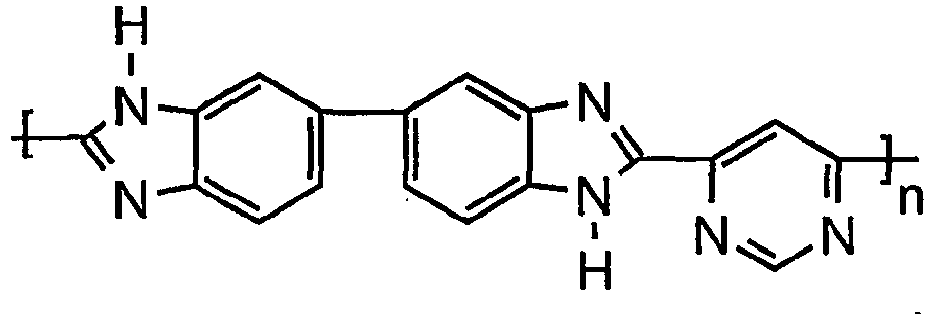


- Die erfindungsgemäßen Polyazole, insbesondere jedoch die Polybenzimidazole zeichnen sich durch ein hohes Molekulargewicht aus. Gemessen als Intrinsische Viskosität beträgt diese mindestens 1,3 dl/g, insbesondere mindestens 1,4 dl/g, und liegt somit deutlich über dem von handelsüblichem Polybenzimidazol (IV < 1,1 dl/g).
- Die Erwärmung gemäß Schritt B) erfolgt unter Inertgas und vorzugsweise unter Ausschluß von Feuchtigkeit. Die Erwärmung erfolgt für eine Dauer von 30 Minuten bis zu 24 Stunden, vorzugsweise zwischen 1 Stunde und 15 Stunden, insbesondere zwischen 2 Stunden und 10 Stunden. Zur besseren Verteilung der einzubringenden Wärme ist es von Vorteil für eine innige Durchmischung der zu erwärmenden Masse zu sorgen. Vorzugsweise wird die Masse in Schritt B) gerührt. Dieses hat einen weiteren Vorteil, da die im Temperaturbereich von 170 bis 270°C zu beobachtende Schaumbildung kontrolliert bzw. reduziert werden kann. Es ist von Vorteil, einen Rührer zu wählen der geeignet ist, die Zerkleinerung der gemäß Schritt B) erhaltenen schaumartigen Masse, in Schritt C), zu bewerkstelligen. Die erhaltenen Partikelkönnen, sofern die Zerkleinerung mit dem vorhandenen Rührer noch unzureichend war, weiter zerkleinert werden.
- Zur Ermittlung der Teilchengröße und der Teilchengrößen-Verteilung existieren eine Reihe von Meßmethoden. Im Rahmen dieser Erfindung genügt zur Teilchengrößen-Bestimmung die Siebanalyse, so daß in Schritt C) eine Fraktionierung durch Siebung erfolgt. Grundsätzlich sind jedoch auch alle anderen Fraktionierungsmethoden geeignet, die zu einer entsprechenden Aufteilung führen.
- Zur erfindungsgemäßen Fraktionierung wird in einer Siebmaschine ein Satz von Sieben verschiedener Maschenweiten übereinander angeordnet. Bei der Siebanalyse wird die Korngröße durch die Maschenweite desjenigen Siebes bestimmt, welches das Korn (Siebdurchlauf, Unterkorn) gerade noch passieren läßt. Die Siebe werden nach lichter Maschenweite in Micrometer charakterisiert.
- Auf diese Art und Weise wird die Teilchenfraktion 300 µm bis 1000 µm von den restlichen Teilchen abgetrennt und anschließend in Schritt D) eingesetzt. Die in Schritt D) eingesetzten Materialien enthalten mindestens 90 Gew.-% der Teilchenfraktion 300 µm bis 1000 µm, vorzugsweise mindestens 95 Gew.-%, insbesondere mindestens 98 Gew.-%.
- Die Fraktionierung der Teilchen in Schritt C) erfolgt vorzugsweise unter Inertgas und unter Ausschluß von Feuchtigkeit. Sollte dies nicht möglich sein, so kann eine Trocknung der weiterzuverarbeitenden Teilchenfraktion erforderlich werden. Der Restwassergehalt der in Schritt D) verwendeten Teilchen sollte 5 Gew.-%, vorzugsweise 3 Gew.-%, insbesondere 1Gew.-%, nicht übersteigen. Die Trocknung kann mittels bekannter Verfahren erfolgen.
- Anschließend wird in Schritt D) die Teilchenfraktion 300 µm bis 1000 µm unter Inertgas, vorzugsweise unter Ausschluß von Feuchtigkeit, auf Temperaturen von bis zu 450°C, vorzugsweise von bis zu 400°C, erwärmt. Die Mindesttemperatur in Schritt beträgt 300°C, vorzugsweise mehr als 350°C. Die Behandlungsdauer beträgt in Abhängigkeit von der gewählten Temperatur zwischen 15 Minuten und bis zu 24 Stunden, vorzugsweise zwischen 30 Minuten und 15 Stunden, insbesondere zwischen 1 Stunde und 10 Stunden. Zur besseren Verteilung der einzubringenden Wärme ist es von Vorteil für eine innige Durchmischung der zu erwärmenden Masse zu sorgen. Vorzugsweise wird in Schritt D) gerührt.
- In einer weiteren Ausführungsform der Erfindung kann Schritt D) in einem separaten Reaktor durchgeführt werden und die gewünschte Teilfraktion als Depotsubstanz zwischengelagert werden. Vorzugsweise wird Schritt D) in einem separaten Reaktor durchgeführt.
- In Schritt D) erfolgt die Kondensation zum Polyazolpolymeren und der Aufbau des hohen Molekulargewichtes.
- Nach Abkühlung kann das Molekulargewicht bestimmt werden.
- Die erfindungsgemäßen Polyazole, insbesondere jedoch die Polybenzimidazole zeichnen sich durch ein hohes Molekulargewicht aus. Gemessen als Intrinsische Viskosität beträgt diese mindestens 1,3 dl/g, insbesondere mindestens 1,4 dl/g, und liegt somit deutlich über dem von handelsüblichem Polybenzimidazol (IV < 1,1 dl/g).
- Aufgrund des hohen Molekulargewichtes eignen sich die erfindungsgemäßen Polyazole besonders gut zur Herstellung von Formkörpern, Fasern, insbesondere hochfesten Fasern, und Folien bei denen hohe Ansprüche an die mechanische Eigenschaften gestellt werden. Ein weiterer Vorteil des erfindungsgemäßen hochmolekularen Polyazol besteht darin, das diese stabilere Lösungen bildet, die eine verbesserte Lagerfähigkeit besitzen.
- Gegenstand der vorliegenden Erfindung sind somit auch Lösungen des erfindungsgemäßen hochmolekularen Polyazols in polaren, aprotischen Lösemitteln, insbesondere in Dimethylacetamid. Die allgemeine Herstellung solcher Lösungen ist beispielsweise in der Deutschen Patentanmeldung
10052237.8 beschrieben. Derartige Lösungen eignen sich zur Beschichtung von Oberflächen, insbesondere von Metalloberflächen. - Weiterer Gegenstand der vorliegenden Erfindung sind Formkörper die durch Sinterung oder Tempern des erfindungsgemäßen hochmolekularen Polyazols, vorzugsweise durch Sinterung oder Tempern in Formen, erhalten werden.
- Hierbei hat es sich als vorteilhaft erwiesen, wenn das erfindungsgemäße hochmolekulare Polyazol eine Vernetzung aufweist. Insofern das erfindungsgemäße Material in diesem Gebiet Verwendung findet, wird in Schritt A) auch Tricarbonsäuren bzw. Tetracarbonsäre zugesetzt. Hierdurch wird die gewünschte Verzweigung/ Vernetzung im erfindungsgemäßen Polymeren erzielt.
- Bei den in Schritt A) zugesetzten Tri-carbonsäuren und Tetra-Carbonsäuren bzw. deren Estern oder deren Anhydride oder deren Säurechloride, handelt es sich vorzugweise deren C1-C20-Alkyl-Ester oder C5-C12-Aryl-Ester. Besonders bevorzugt handelt es sich um 1,3,5-Benzol-tricarbonsäure (Trimesic acid), 1,2,4-Benzol-tricarbonsäure (Trimellitic acid), (2-Carboxyphenyl)iminodiessigsäure, 3,5,3'-Biphenyltricarbonsäure, 3,5,4'-Biphenyltricarbonsäure, 3,5,3',5'-biphenyltetracarboxylic acid, 1,2,4,5-Benzoltetracarbonsäure, Benzophenontetracarbonsäure, 3,3',4,4'-Biphenyltetracarbonsäure, 2,2',3,3'-Biphenyltetracarbonsäure, 1,2,5,6-Naphthalintetracarbonsäure, 1,4,5,8-Naphthalintetracarbonsäure.
- Der Gehalt an Tri-carbonsäure bzw. Tetracarbonsäuren (bezogen auf eingesetzte Dicarbonsäure) beträgt zwischen 0 und 30 Mol-%, vorzugsweise 0,1 und 20 Mol %, insbesondere 0,5 und 10 Mol-%.
- Auch derartige hochmolekulare Polyazole sind Gegenstand der vorliegenden Erfindung.
- Die aus dem erfindungsgemäßen hochmolekularen Polyazollösungen hergestellten Filme weisen verbesserte Materialeigenschaften gegenüber den bisher bekannten Polymerfolien auf und eignen sich als Separationsmembranen
- Solche Separationsmembranen können als dichte Polymerfilme, poröse Hohlfasermembranen oder als poröse, offenzellige Polymerfilme gegebenfalls mit kompakter Deckschicht hergestellt werden.
- Zur Herstellung einer porösen Membran kann eine erfindungsgemäße Polymerlösung zusätzlich einen sogenannten Porenbildner, wie zum Beispiel Glycerin, enthalten die, je nach Wahl der Zusammensetzung des Fällmittels, zu unterschiedlichen Morphologien der Separationsmembranen führen.
- Für Separationsanwendungen werden folgende Strukturen bevorzugt: i) symmetrische, poröse Struktur; ii) Asymmetrische poröse Struktur mit einer Polymerverdichtung nahe einer Membranoberfläche. Rasterelektronenmikroskopische Aufnahmen solcher besonders geeigneter Strukturen von Polybenzimidazolmembran sind in Journal of Membrane Science Band 20 ,1984, Seiten 147-66 offenbart.
- Solche Phaseninversionsmembranen und Strukturen sind dem Fachmann bekannt. Membranen mit symmetrischer poröser Struktur werden angewendet als Separations- bzw. Filtrationsmembranen für Luft und Gasfiltration oder der Mikro- oder Ultrafiltration für Flüssigkeiten. Membranen mit asymmetrischer, poröser Struktur können vielseitig zur Umkehrosmose insbesondere Wasserentsalzung, Dialyse oder Gasaufbereitung benutzt werden.
- Eine besonders zweckmässige Anwendung ist die Separation von Wasserstoff und Kohlendioxid aus Gasgemischen in Kombination mit einem porösen metallischen Träger. Alternative Technologien zur CO2-Trennung benötigen wegen der geringen thermischen Stabilität der Polymermembran eine Abkühlung des Gases auf 150°C wodurch der Wirkungsgrad verringert wird. Die erfindungsgemässen Separationsmembranen auf Basis von Polyazolen können bis zu einer Temperatur von 400°C dauerhaft betrieben werden und führen so zu einer Erhöhung der Ausbeute und einer Verringerung der Kosten.
- Für weitere Informationen über Separationsmembranen auf Basis von Polyazolen wird auf die Fachliteratur, insbesondere auf die Patente
WO 98/14505 US-A-4693815 ;US-A-4693824 ;US-A-375262 ;US-A-3737042 ;US-A-4512894 ;US-A-448687 ;US-A-3841492 verwiesen. Die in den vorstehend genannten Literaturstellen enthaltene Offenbarung hinsichtlich des Aufbaues und der Herstellung von Separationsmembranen wird durch die vorliegende Erfindung mit umfaßt und ist Bestandteil der vorliegenden Beschreibung. Insbesondere können solche Separationsmembranen in Form von flachen Filmen oder als Hohlfasermembranen hergestellt werden. - Zur weiteren Verbesserung der anwendungstechnischen Eigenschaften können der Polymerfolie zusätzlich noch Füllstoffe, insbesondere nano-skalige Füllstoffe, zugesetzt werden.
- Nicht limitierende Beispiele für derartige Füllstoffe sind
- Oxide wie
- Al2O3, Sb2O5, ThO2, SnO2, ZrO2, MoO3
- Silikate wie
- Zeolithe, Zeolithe(NH4+), Schichtsilikate, Gerüstsilikate, H-Natrolite, H-Mordenite, NH4-Analcine, NH4-Sodalite, NH4-Gallate, H-Montmorillonite
- Füllstoffe wie
- Carbide, insbesondere SiC, Si3N4, Fasern, insbesondere-Glasfasern, Glaspulvern und/oder Polymerfasern, bevorzugt auf Basis von Polyazolen.
- Als weiteres kann die Polymerfolie auch Additive enthalten, die die im Betrieb bei der Gasfiltration möglicherweise erzeugten Radikale abfangen oder zerstören.
Nicht limitierende Beispiele für solche Additive sind: - Bis(trifluormethyl)nitroxid, 2,2-Diphenyl-1-pikrinylhydrazyl, Phenole, Alkylphenole, sterisch gehinderte Alkylphenole wie zum Beispiel Irganox, aromatische Amine, sterisch gehinderte Amine wie zum Beispiel Chimassorb; sterisch gehinderte Hydroxylamine, sterisch gehinderte Alkylamine, sterisch gehinderte Hydroxylamine, sterisch gehinderte Hydroxylaminether, Phosphite wie zum Beispiel Irgafos, Nitrosobenzol, Methyl.2-nitroso-propan, Benzophenon, Benzaldehyd-tert.-butylnitron, Cysteamin, Melanine, Bleioxide, Manganoxide, Nickeloxide, Cobaltoxide.
- Zu möglichen Einsatzgebieten der erfindungsgemäßen Polymerfolien gehört unter anderem die Verwendung als Filtermedium in der Gasfiltration und -trennung bzw. Gasaufreinigung, sowie in der Umkehr-Osmose, als Substrate für flexible elektrische Schaltungen, als Batterieseparatoren, als Schutzfolie für elektrische Kabel, als Isolator in elektrischen Bauteilen und Vorrichtungen wie Kondensatoren, als Schutzfolie für Metall- und sonstige Oberflächen.
- Die aus dem erfindungsgemäßen hochmolekularen Polyazollösungen hergestellten Fasern weisen verbesserte Materialeigenschaften, wie Festigkeit und E-Modul, gegenüber den bisher bekannten Polymerfasern auf und eignen sich insbesondere zur Herstellung hochfester Fasern. Insofern die Fasern für textile Zwecke eingesetzt werden sollen, werden diese noch mit verdünnter Schwefelsäure bei einer Temperatur oberhalb von 400°C, vorzugsweise oberhalb von 450°C, behandelt. Die hochfesten Fasern finden Verwendung als Verstärkungsfasern in sogenannten Composite-Materialien, Verbund-Werkstoffen und faserverstärkten Formteilen, insbesondere auch Polymerbasis.
- Ein weiterer Gegenstand der vorliegenden Erfindung sind somit Polymerfasern auf Basis von Polyazolen deren Molekulargewicht ausgedrückt als Intrinsische Viskosität mindestens 1,3 dl/g, vorzugsweise mindestens 1,4 dl/g, beträgt.
- Die Herstellung dieser Fasern erfolgt mittels bekannter Methoden. Im Rahmen der vorliegenden Erfindung wird eine Lösung des erfindungsgemäßen hochmolekularen Polyazols in polaren, aprotischen Lösemitteln, insbesondere in Dimethylacetamid, mittel der für PBI bekannten Methoden extrudiert und anschließend das Lösemittel mit bekannten Methoden entfernt.
- Die gebildeten Fasern können Endlos-Filamente sein oder - falls die Faserbildung analog der "Melt blow - Methode" erfolgt - Stapelfaser-Charakter aufweisen. Die Titer der gebildeten Fasern unterliegen keiner Einschränkung, so daß auch Monofile, d.h. Draht-ähnliche Fasern herstellbar sind. Neben diesen sind auch Hohlfasern herstellbar. Der gewünschte Titer ergibt sich aus der beabsichtigten Verwendung der Faser. Das gesamte Handling der gebildeten Faser kann mittels bekannter Faser-Technologien (vgl. Complete Textile Glossary, Celanese Acetate LLC, 2000) erfolgen.
- In einer Variante können die frisch gebildeten, noch lösemittelhaltigen Fasern, in ein Fällungsbad eingebracht werden. Dieses Einbringen erfolgt im Temperaturbereich zwischen Raumtemperatur (20°C) und der Siedetemperatur der Fällungs-Flüssigkeit (bei Normaldruck).
- Als Fällungs-Flüssigkeit im Sinne der Erfindung werden bei Raumtemperatur [d.h. 20°C] flüssig vorliegende Lösungsmittel ausgewählt aus der Gruppe der Alkohole, Ketone, Alkane (aliphatische und cycloaliphatische), Ether (aliphatische und cycloaliphatische), Ester, Carbonsäuren, wobei die vorstehenden Gruppenmitglieder halogeniert sein können, Wasser, anorganischen Säuren (wie z.B. H3PO4, H2SO4) und Gemische derselben eingesetzt.
- Vorzugsweise werden C1-C10 Alkohole, C2-C5 Ketone, C1-C10-Alkane (aliphatische und cycloaliphatische), C2-C6-Ether (aliphatische und cycloaliphatische), C2-C5 Ester, C1-C3 Carbonsäuren, Dichlormethan, Wasser und Gemische derselben eingesetzt.
- Nachfolgend wird die Faser von dem Fällungs-Flüssigkeit befreit. Dieses erfolgt vorzugsweise durch Trocknung, wobei die Temperatur und der Umgebungsdruck in Abhängigkeit vom Partial-Dampfdruck der Fällungs-Flüssigkeit gewählt wird. Üblicherweise erfolgt die Trocknung bei Normaldruck und Temperaturen zwischen 20°C und 200°C. Eine schonendere Trocknung kann auch im Vakuum erfolgen. Die Trocknungsmethode unterliegt keiner Einschränkung.
- Die Behandlung im Fällungsbad kann zur Ausbildung von porösen Strukturen, insbesondere bei Hohlfasern, führen. Je nach Verwendung sind diese für die nachfolgende Verwendung erwünscht.
- Die aus dem erfindungsgemäßen hochmolekularen Polyazollösungen hergestellten Filme weisen, wie bereits vorstehend dargelegt, verbesserte Materialeigenschaften gegenüber den bisher bekannten Polymerfolien auf und eignen sich hervorragend als Ausgangsmaterials für die Herstellung von protonenleitenden Membranen.
- Zur Herstellung von protonenleitenden Membranen wird aus der erfindungsgemäßen Polymerlösung zunächst eine Folie gegossen und das Lösemittel entfernt. Hierzu werden bevorzugt die in der deutschen Patentanmeldung Nr.
10109829.4 beschriebenen Maßnahmen durchgeführt. Anschließend wird die hochmolekulare Polymerfolie mit einem Dotierungsmittel benetzt oder in diesem eingelegt. Als Dotierungsmittel für die erfindungsgemäßen Polymermembranen werden Säuren vorzugsweise alle bekannten Lewis- und Brønsted-Säuren, insbesondere anorganische Lewis- und Brønsted-Säuren, oder Alkalihydroxide eingesetzt. - Neben diesen vorstehend genannten Säure ist auch der Einsatz von Polysäuren möglich, insbesondere Isopolysäuren und Heteropolysäuren sowie von Mischungen verschiedener Säuren. Dabei bezeichnen im Sinne der vorliegenden Erfindung Heteropolysäuren anorganische Polysäuren mit mindestens zwei verschiedenen Zentralatomen, die aus jeweils schwachen, mehrbasischen Sauerstoff-Säuren eines Metalls (vorzugsweise Cr, Mo, V, W) und eines Nichtmetalls (vorzugsweise As, I, P, Se, Si, Te) als partielle gemischte Anhydride entstehen. Zu ihnen gehören unter anderen die 12-Molybdatophosphorsäure und die 12-Wolframatophosphorsäure.
- Erfindungsgemäß besonders bevorzugte Dotierungsmittel sind Schwefelsäure, Phosphorsäure und Kaliumhydroxid. Ein ganz besonders bevorzugtes Dotierungsmittel ist Phosphorsäure (H3PO4).
- Die erfindungsgemäßen Polymermembranen sind dotiert. Im Rahmen der vorliegenden Erfindung bezeichnen dotierte Polymermembranen solche Polymermembranen, die aufgrund der Gegenwart von Dotierungsmitteln eine erhöhte Protonenleitfähigkeit im Vergleich mit den nicht dotierten Polymermembranen zeigen.
- Verfahren zur Herstellung von dotierten Polymermembrane sind bekannt. In einer bevorzugten Ausführungsform der vorliegenden Erfindung werden sie erhalten, indem man eine Folie des betreffenden Polymeren über eine geeignete Zeit, vorzugsweise 5 Minuten - 96 Stunden, besonders bevorzugt 1 - 72 Stunden, bei Temperaturen zwischen Raumtemperatur und 100°C und gegebenenfalls erhöhtem Druck mit konzentrierter Säure, vorzugsweise mit hochkonzentrierter Phosphorsäure benetzt.
- Über den Dotierungsgrad kann die Leitfähigkeit der erfindungsgemäßen Polymermembran beeinflußt werden. Dabei nimmt die Leitfähigkeit mit steigender Konzentration an Dotierungsmittel solange zu, bis ein maximaler Wert erreicht ist. Erfindungsgemäß wird der Dotierungsgrad angegeben als Mol Säure pro Mol Wiederholungseinheit des Polymers. Im Rahmen der vorliegenden Erfindung ist ein Dotierungsgrad zwischen 3 und 15, insbesondere zwischen 6 und 12, bevorzugt.
- Die erfindungsgemäße Polymermembran weist verbesserte Materialeigenschaften gegenüber den bisher bekannten dotierten Polymermembranen auf. Insbesondere besitzen sie sehr gute mechanische Eigenschaften und zeigen im Vergleich mit konventionellen Membranen eine verbesserte Lebensdauer.
- Zu möglichen Einsatzgebieten der erfindungsgemäßen, dotierten Polymermembranen gehören unter anderem die Verwendung in Brennstoffzellen, bei der Elektrolyse, in Kondensatoren und in Batteriesystemen. Aufgrund ihres Eigenschaftsprofils werden die dotierten Polymermembranen vorzugsweise in Brennstoffzellen verwendet.
- Die vorliegende Erfindung betrifft auch eine Membran-Elektroden-Einheit, die mindestens eine erfindungsgemäße Polymermembran aufweist. Für weitere Informationen über Membran-Elektroden-Einheiten wird auf die Fachliteratur, insbesondere auf die Patente
US-A-4,191,618 ,US-A-4,212,714 undUS-A-4,333,805 verwiesen. Die in den vorstehend genannten Literaturstellen [US-A-4,191,618 ,US-A-4,212,714 undUS-A-4,333,805 ] enthaltene Offenbarung hinsichtlich des Aufbaues und der Herstellung von Membran-Elektroden-Einheiten ist auch Bestandteil der Beschreibung. - Zur Bestimmung der inhärenten Viskosität (IV) wird das Polymer zunächst bei 160°C während 2 Stunden getrocknet. 100 mg des so getrockneten Polymers werden dann während 4 Stunden bei 80°C in 100 ml konzentrierter Schwefelsäure (mindestens 96 Gew.-%) gelöst. Die inhärente Viskosität wird aus dieser Lösung gemäss ISO 3105 mit einem Ubbelhode Viskosimeter bei einer Temperatur von 25°C ermittelt.
- 214,27 g TAB (Tetraaminobiphenyl) und 166,14 g Isophthalsäure wurden unter N2-Atmosphäre in einem Quarzreaktor vorgelegt, welcher mit einem Rührer ausgestattet war. Anschließend wurde die Mischung unter Rühren für 1 Stunde auf 150°C, für 1 Stunde auf 190°C, für 1 Stunde auf 250°C, und anschließend 1,5 Stunden auf 290°C erhitzt. Zwischen 190°C und 250°C wurde eine starke Schaumbildung beobachtet. Anschließend wurde der gebildete Schaum mittels des vorhandenen Rührers in kleine Partikel zerkleinert. Nach weiteren 1,5 Stunden bei 290°C wurde der Reaktor abgekühlt und das Polymer mit einem Siebmaschine in 5 Fraktionen (<212, 212-300, 300-500, 500-1000 und >1000µm) gesiebt.
- Tabelle 1 zeigt die inhärenten Viskositäten (IV) und Anteile der einzelnen Fraktionen. Anschließend wurde jede einzelne Fraktion in einen Quarzreaktor gefüllt und unter N2-Atmosphäre bei 380°C unter Rühren für 3 Stunden polymerisiert, anschließend abgekühlt und die IV des Polymeren gemessen.
- Die gefundenen IV-Ergebnisse der jeweiligen Polymersation sind in Tabelle 1 aufgeführt.
Tabelle 1: Partikelgröße [um] Prozent [%] IV vor Fraktionierung IV nach Endpolymerisation <212 31,16 0,23 0,56 212-300 16,47 0,25 1,04 300-500 18,94 0,25 1,40 500-1000 27,38 0,26 1,44 >1000 6,06 0,25 1,17
Claims (17)
- Verfahren zur Herstellung einer protonleitenden Polymermembran auf Basis von Polyazolen dessen Molekulargewicht gemessen als Intrinsische Viskosität, nach vorheriger Trocknung bei 160°C für die Dauer von 2 Stunden und Lösen in min. 96%-iger Schwelfelsäure bei 80°C für die Dauer von 4 Stunden, gemäß ISO 3105 bei einer Temperatur von 25°C mindestens 1,3 dl/g beträgt umfassend die SchritteA) Mischen von einem oder mehreren aromatischen Tetra-Amino-Verbindungen mit einer oder mehreren aromatischen Carbonsäuren bzw. deren Estern, die mindestens zwei Säuregruppen pro Carbonsäure-Monomer enthalten, oder Mischen von einer oder mehreren aromatischen und/oder heteroaromatischen Diaminocarbonsäuren,B) Erwärmen der Mischung erhältlich gemäß Schritt B) unter Inertgas auf Temperaturen von bis zu 350°C, vorzugsweise bis zu 300°C,C) Zerkleinern der gemäß Schritt B) erhaltenen Masse und Fraktionierung der erhaltenen Teilchen,D) Erwärmen der Teilchenfraktion 300µm bis 1000µm unter Inertgas auf Temperaturen von bis zu 450°C, vorzugsweise bis zu 400°C, und abkühlen,E) Herstellung einer Lösung in einem polaren, aprotischen Lösemittel,F) Gießen einer Polymerfolie,G) Entfernung des Lösemittels,H) Dotierung der Polymerfolie durch Benetzen der Polymerfolie mit einem Dotierungsmittel oder Einlegen der Polymerfolie in einem Dotierungsmittel.
- Verfahren gemäß Anspruch 1, dadurch gekennzeichnet, dass als aromatische Tetra-Amino-Verbindungen 3,3',4,4'-Tetraaminobiphenyl, 2,3,5,6-Tetraaminopyridin, 1,2,4,5-Tetraaminobenzol, 3,3',4,4'-Tetraaminodiphenylsulfon, 3,3',4,4'-Tetraaminodiphenylether, 3,3`,4,4`-Tetraaminobenzophenon, 3,3',4,4'-Tetraaminodiphenylmethan und 3,3',4,4'-Tetraaminodiphenyldimethylmethan eingesetzt werden.
- Verfahren gemäß Anspruch 1, dadurch gekennzeichnet, dass als aromatische Dicarbonsäuren Isophthalsäure, Terephthalsäure, Phthalsäure, 5-Hydroxyisophthalsäure, 4-Hydroxyisophthalsäure, 2-Hydroxyterephthalsäure, 5-Aminoisophthalsäure, 5-N,N-Dimethylaminoisophthalsäure, 5-N,N-Diethylaminoisophthalsäure, 2,5-Dihydroxyterephthalsäure, 2,5-Dihydroxyisophthalsäure, 2,3-Dihydroxyisophthalsäure, 2,3-Dihydroxyphthalsäure, 2,4-Dihydroxyphthalsäure. 3,4-Dihydroxyphthalsäure, 3-Fluorophthalsäure, 5-Fluoroisophthalsäure, 2-Fluoroterphthalsäure, Tetrafluorophthalsäure, Tetrafluoroisophthalsäure, Tetrafluoroterephthalsäure, 1,4-Naphthalindicarbonsäure, 1,5-Naphthalindicarbonsäure, 2,6-Naphthalindicarbonsäure, 2,7-Naphthalindicarbonsäure, Diphensäure, 1,8-dihydroxynaphthalin-3,6-dicarbonsäure, Diphenylether-4,4'-dicarbonsäure, Benzophenon-4,4'-dicarbonsäure, Diphenylsulfon-4,4'-dicarbonsäure, Biphenyl-4,4'-dicarbonsäure, 4-Trifluoromethylphthalsäure, 2,2-Bis(4-carboxyphenyl)hexafluoropropan, 4,4'-Stilbendicarbonsäure, 4-Carboxyzimtsäure, bzw. deren C1-C20-Alkyl-Ester oder C5-C12-Aryl-Ester, oder deren Säureanhydride oder deren Säurechloride eingesetzt werden.
- Verfahren gemäß Anspruch 1, dadurch gekennzeichnet, dass als aromatische Carbonsäure Tri-carbonsäuren, Tetracarbonsäuren bzw. deren C1-C20-Alkyl-Ester oder C5-C12-Aryl-Ester oder deren Säureanhydride oder deren Säurechloride, vorzugsweise 1,3,5-benzene-tricarboxylic acid (trimesic acid); 1,2,4-benzenetricarboxylic acid (trimellitic acid); (2-Carboxyphenyl)iminodiessigsäure, 3,5,3'-biphenyltricarboxylic acid; 3,5,4'-biphenyltricarboxylic acid und/oder 2,4,6-pyridinetricarboxylic acid eingesetzt werden.
- Verfahren gemäß Anspruch 1, dadurch gekennzeichnet, dass als aromatische Carbonsäure Tetracarbonsäuren deren C1-C20-Alkyl-Ester oder C5-C12-Aryl-Ester oder deren Säureanhydride oder deren Säurechloride, vorzugsweise Benzol 1,2,4,5-tetracarbonsäuren; Naphthalin-1,4,5,8-tetracarbonsäuren 3,5,3',5'-biphenyltetracarboxylic acid; Benzophenontetracarbonsäure, 3,3',4,4'-Biphenyltetracarbonsäure, 2,2',3,3'-Biphenyltetracarbonsäure, 1,2,5,6-Naphthalintetracarbonsäure, 1,4,5,8-Naphthalintetracarbonsäure eingesetzt werden.
- Verfahren gemäß Anspruch 4, dadurch gekennzeichnet, dass der Gehalt an Tricarbonsäure bzw. Tetracarbonsäuren (bezogen auf eingesetzte Dicarbonsäure) zwischen 0 und 30 Mol-%, vorzugsweise 0,1 und 20 Mol %, insbesondere 0,5 und 10 Mol-%. beträgt.
- Verfahren gemäß Anspruch 1, dadurch gekennzeichnet, dass als heteroaromatische Carbonsäuren heteroaromatische Di-carbonsäuren und Tri-carbonsäuren und Tetra-Carbonsäuren eingesetzt werden, welche mindestens ein Stickstoff, Sauerstoff, Schwefel oder Phosphoratom im Aromaten enthalten, vorzugsweise Pyridin-2,5-dicarbonsäure, Pyridin-3,5-dicarbonsäure, Pyridin-2,6-dicarbonsäure, Pyridin-2,4-dicarbonsäure, 4-Phenyl-2,5-pyridindicarbonsäure, 3,5-Pyrazoldicarbonsäure, 2,6 -Pyrimidindicarbonsäure,2,5-Pyrazindicarbonsäure, 2,4,6-Pyridintricarbonsäure, Benzimidazol-5,6-dicarbonsäure, sowie deren C1-C20-Alkyl-Ester oder C5-C12-Aryl-Ester, oder deren Säureanhydride oder deren Säurechloride.
- Verfahren gemäß Anspruch 1, dadurch gekennzeichnet, dass das Polymer auf Basis von Polyazolen wiederkehrende Azoleinheiten der allgemeinen Formel (I) und/oder (II) und/oder (III) und/oder (IV) und/oder (V) und/oder (VI) und/oder (VII) und/oder (VIII) und/oder (IX) und/oder (X)


 Ar gleich oder verschieden sind und für eine vierbindige aromatische oder heteroaromatische Gruppe, die ein- oder mehrkernig sein kann,Ar1 gleich oder verschieden sind und für eine zweibindige aromatische oder heteroaromatische Gruppe, die ein- oder mehrkernig sein kann,Ar2 gleich oder verschieden sind und für eine zwei oder dreibindige aromatische oder heteroaromatische Gruppe, die ein- oder mehrkernig sein kann,Ar3 gleich oder verschieden sind und für eine dreibindige aromatische oder heteroaromatische Gruppe, die ein- oder mehrkernig sein kann,Ar4 gleich oder verschieden sind und für eine dreibindige aromatische oder heteroaromatische Gruppe, die ein- oder mehrkernig sein kann,Ar5 gleich oder verschieden sind und für eine vierbindige aromatische oder heteroaromatische Gruppe, die ein- oder mehrkernig sein kann,Ar6 gleich oder verschieden sind und für eine zweibindige aromatische oder heteroaromatische Gruppe, die ein- oder mehrkernig sein kann,Ar7 gleich oder verschieden sind und für eine zweibindige aromatische oder heteroaromatische Gruppe, die ein- oder mehrkernig sein kann,Ar8 gleich oder verschieden sind und für eine dreibindige aromatische oder heteroaromatische Gruppe, die ein- oder mehrkernig sein kann,Ar9 gleich oder verschieden sind und für eine zwei- oder drei- oder vierbindige aromatische oder heteroaromatische Gruppe, die ein- oder mehrkernig sein kann,Ar10 gleich oder verschieden sind und für eine zwei- oder dreibindige aromatische oder heteroaromatische Gruppe, die ein- oder mehrkernig sein kann,Ar11 gleich oder verschieden sind und für eine zweibindige aromatische oder heteroaromatische Gruppe, die ein- oder mehrkernig sein kann,X gleich oder verschieden ist und für Sauerstoff, Schwefel oder eine Aminogruppe, die ein Wasserstoffatom, eine 1- 20 Kohlenstoffatome aufweisende Gruppe, vorzugsweise eine verzweigte oder nicht verzweigte Alkyl- oder Alkoxygruppe, oder eine Arylgruppe als weiteren Rest trägt undn eine ganze Zahl größer gleich 10, bevorzugt größer gleich 100 ist,aufweist.
 - Verfahren gemäß Anspruch 8, dadurch gekennzeichnet, dass es sich um ein Polymer ausgewählt aus der Gruppe Polybenzimidazol, Poly(pyridine), Poly(pyrimidine), Polyimidazole, Polybenzthiazole, Polybenzoxazole, Polyoxadiazole, Polyquinoxalines, Polythiadiazole und Poly(tetrazapyrene) handelt.
- Verfahren gemäß Anspruch 1, dadurch gekennzeichnet, daß es sich um ein Polymer enthaltend wiederkehrende Benzimidazoleinheiten der Formel


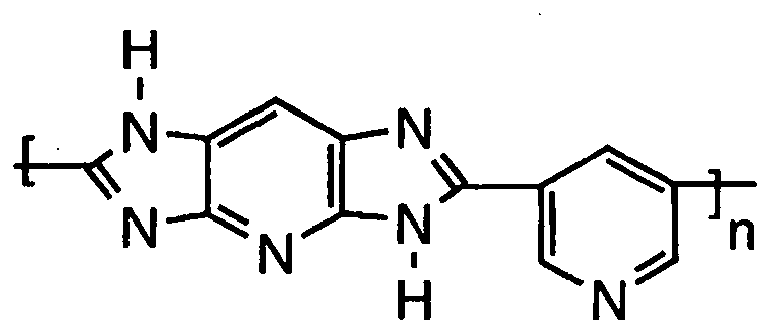


- Verfahren gemäß Anspruch 1, dadurch gekennzeichnet, dass die in Schritt D) eingesetzte Teilchenfraktion mindestens 90 Gew.-% der Teilchenfraktion 300µm bis 1000µm, vorzugsweise mindestens 95 Gew.-%, insbesondere mindestens 98 Gew.-%, enthält.
- Verfahren gemäß Anspruch 1, dadurch gekennzeichnet, dass das polare, aprotische Lösemittel in Schritt E) Dimethylacetamid ist.
- Verfahren gemäß Anspruch 1, dadurch gekennzeichnet, dass die Intrinsische Viskosität mindestens 1,4 dl/g beträgt.
- Verfahren gemäß Anspruch 1, dadurch gekennzeichnet, dass das Dotierungsmittel in Schritt H) eine Säure, vorzugsweise eine Lewis- oder Broensted-Säure, vorzugsweise eine anorganische Lewis- oder Broensted-Säure, ist.
- Verfahren gemäß Anspruch 1, dadurch gekennzeichnet, dass das Dotierungsmittel in Schritt H) Schwefelsäure, Phosphorsäure oder Kaliumhydroxid, vorzugsweise Phosphorsäure, ist.
- Verfahren gemäß Anspruch 1, dadurch gekennzeichnet, dass der Dotierungsgrad in zwischen 3 und 15 Mol Säure pro Mol Wiederholungseinheit des Polymeren, vorzugsweise 6 bis 12 Mol Säure pro Mol Wiederholungseinheit des Polymeren, beträgt.
- Verwendung der gemäß einem oder mehreren der Ansprüche 1 bis 16 hergestellten protonenleitenden Polymermembranen zur Herstellung einer Membran-Elektroden Einheit für Brennstoffzellen.
Priority Applications (1)
| Application Number | Priority Date | Filing Date | Title |
|---|---|---|---|
| EP10005797.5A EP2267060B1 (de) | 2002-12-16 | 2003-12-02 | Hochmolekulare Polyazole |
Applications Claiming Priority (3)
| Application Number | Priority Date | Filing Date | Title |
|---|---|---|---|
| DE10258580 | 2002-12-16 | ||
| DE10258580A DE10258580A1 (de) | 2002-12-16 | 2002-12-16 | Hochmolekular Polyazole |
| PCT/EP2003/013529 WO2004055097A1 (de) | 2002-12-16 | 2003-12-02 | Hochmolekulare polyazole |
Related Child Applications (2)
| Application Number | Title | Priority Date | Filing Date |
|---|---|---|---|
| EP10005797.5A Division-Into EP2267060B1 (de) | 2002-12-16 | 2003-12-02 | Hochmolekulare Polyazole |
| EP10005797.5A Division EP2267060B1 (de) | 2002-12-16 | 2003-12-02 | Hochmolekulare Polyazole |
Publications (2)
| Publication Number | Publication Date |
|---|---|
| EP1583789A1 EP1583789A1 (de) | 2005-10-12 |
| EP1583789B1 true EP1583789B1 (de) | 2014-07-02 |
Family
ID=32336333
Family Applications (2)
| Application Number | Title | Priority Date | Filing Date |
|---|---|---|---|
| EP10005797.5A Expired - Lifetime EP2267060B1 (de) | 2002-12-16 | 2003-12-02 | Hochmolekulare Polyazole |
| EP03782267.3A Expired - Lifetime EP1583789B1 (de) | 2002-12-16 | 2003-12-02 | Hochmolekulare polyazole |
Family Applications Before (1)
| Application Number | Title | Priority Date | Filing Date |
|---|---|---|---|
| EP10005797.5A Expired - Lifetime EP2267060B1 (de) | 2002-12-16 | 2003-12-02 | Hochmolekulare Polyazole |
Country Status (10)
| Country | Link |
|---|---|
| US (2) | US7696302B2 (de) |
| EP (2) | EP2267060B1 (de) |
| JP (2) | JP4520860B2 (de) |
| KR (2) | KR101160032B1 (de) |
| CN (3) | CN1732208A (de) |
| BR (1) | BR0317338B1 (de) |
| CA (1) | CA2509228C (de) |
| DE (1) | DE10258580A1 (de) |
| MX (1) | MXPA05006414A (de) |
| WO (1) | WO2004055097A1 (de) |
Families Citing this family (23)
| Publication number | Priority date | Publication date | Assignee | Title |
|---|---|---|---|---|
| KR20060104163A (ko) * | 2005-03-29 | 2006-10-09 | 한국과학기술연구원 | 연료전지용 고분자 및 그 제조 방법 |
| US7504475B2 (en) * | 2005-07-11 | 2009-03-17 | Pbi Performance Products, Inc. | Process for a two stage melt polymerization for the production of polybenzimidazole |
| DE102005058578A1 (de) * | 2005-12-08 | 2007-06-28 | Sartorius Ag | Membranen aus Polyazolen, Verfahren zu ihrer Herstellung und Brennstoffzellen unter Verwendung derartiger Membranen |
| DE102005058579A1 (de) * | 2005-12-08 | 2007-06-14 | Sartorius Ag | Hochmolekulare Polyazole mit verbesserter Löslichkeit und Verfahren zu ihrer Herstellung |
| JP2011516619A (ja) * | 2008-02-27 | 2011-05-26 | ソルヴェイ(ソシエテ アノニム) | ポリマー組成物、このポリマー組成物を含むポリマー膜、その製造方法、およびこの膜を含む燃料電池 |
| EP2192090A1 (de) * | 2008-12-01 | 2010-06-02 | Technische Universiteit Delft | Verfahren zur Herstellung von ultrareinem Wasser unter Verwendung einer Membran |
| JP5399517B2 (ja) * | 2009-01-14 | 2014-01-29 | ビーエーエスエフ ソシエタス・ヨーロピア | プロトン伝導性の膜を製造するためのモノマービーズ |
| KR101144398B1 (ko) * | 2009-01-15 | 2012-05-10 | 서울대학교산학협력단 | 염기성 치환기를 갖는 폴리벤즈이미다졸계 고분자 및 이를 포함하는 전해질막 |
| JP5305162B2 (ja) * | 2009-08-20 | 2013-10-02 | 東洋紡株式会社 | 多孔質材料を用いた燃料電池用触媒 |
| US8199595B2 (en) * | 2009-09-04 | 2012-06-12 | Micron Technology, Inc. | Techniques for sensing a semiconductor memory device |
| US8420732B2 (en) * | 2009-12-21 | 2013-04-16 | Pbi Performance Products, Inc. | Polybenzimidazole solution in an ionic liquid |
| US20110189484A1 (en) | 2010-02-04 | 2011-08-04 | Hopkins Jr John B | Porous polybenzimidazole resin and method of making same |
| US9283523B2 (en) * | 2012-05-25 | 2016-03-15 | Pbi Performance Products, Inc. | Acid resistant PBI membrane for pervaporation dehydration of acidic solvents |
| US9598541B2 (en) | 2013-06-04 | 2017-03-21 | Pbi Performance Products, Inc. | Method of making polybenzimidazole |
| US10071345B2 (en) | 2015-06-23 | 2018-09-11 | Los Alamos National Security, Llc | Polybenzimidazole hollow fiber membranes and method for making an asymmetric hollow fiber membrane |
| US11959196B2 (en) | 2015-07-06 | 2024-04-16 | Pbi Performance Products, Inc. | Phosphonated PBI fiber |
| DE102017122416A1 (de) * | 2017-09-27 | 2019-03-28 | Airbus Operations Gmbh | Batterie mit integrierter Flammschutzvorrichtung |
| JP7523808B2 (ja) | 2018-09-14 | 2024-07-29 | ユニバーシティー オブ サウス カロライナ | レドックスフロー電池膜を形成する方法 |
| WO2020060857A1 (en) | 2018-09-14 | 2020-03-26 | University Of South Carolina | New method for producing pbi films without organic solvents |
| WO2020056268A2 (en) | 2018-09-14 | 2020-03-19 | University Of South Carolina | Low permeability polybenzimidazole (pbi) membranes for redox flow batteries |
| US11777124B2 (en) | 2020-03-06 | 2023-10-03 | University Of South Carolina | Proton-conducting PBI membrane processing with enhanced performance and durability |
| WO2022123497A1 (en) * | 2020-12-09 | 2022-06-16 | King Abdullah University Of Science And Technology | Thermally crosslinked polytriazole separation membranes |
| CN116059801B (zh) * | 2023-01-10 | 2024-05-28 | 中南大学 | 一种气体膜分离装置、及气体选择性分离的方法 |
Family Cites Families (37)
| Publication number | Priority date | Publication date | Assignee | Title |
|---|---|---|---|---|
| US448687A (en) * | 1891-03-24 | stanley | ||
| US375262A (en) * | 1887-12-20 | Coal-drilling machine | ||
| US3699038A (en) | 1970-04-22 | 1972-10-17 | Celanese Corp | Production of improved semipermeable polybenzimidazole membranes |
| US3783137A (en) * | 1971-06-09 | 1974-01-01 | Horizons Inc | Process for the preparation of heterocyclic polymers fromaromatic tetra-mines and derivatives of polycarboxylic acids |
| US3841492A (en) | 1972-01-19 | 1974-10-15 | Celanese Corp | Production of semipermeable polybenzimidazole membranes |
| GB1422177A (en) | 1973-05-08 | 1976-01-21 | Furukawa Electric Co Ltd | Method for producing a shaped article of a poly-1,3,4-oxadiazole resin having improved properties |
| JPS5633961B2 (de) * | 1974-12-19 | 1981-08-07 | ||
| US4154919A (en) * | 1976-08-31 | 1979-05-15 | Acurex Corporation | Linear and cross-linked polybenzimidazoles |
| US4191618A (en) * | 1977-12-23 | 1980-03-04 | General Electric Company | Production of halogens in an electrolysis cell with catalytic electrodes bonded to an ion transporting membrane and an oxygen depolarized cathode |
| US4212714A (en) | 1979-05-14 | 1980-07-15 | General Electric Company | Electrolysis of alkali metal halides in a three compartment cell with self-pressurized buffer compartment |
| US4333805A (en) | 1980-05-02 | 1982-06-08 | General Electric Company | Halogen evolution with improved anode catalyst |
| WO1984001162A1 (en) | 1982-09-17 | 1984-03-29 | Stanford Res Inst Int | Liquid crystalline polymer compositions, process, and products |
| EP0119192A1 (de) * | 1982-09-17 | 1984-09-26 | Sri International | Flüssigkristalline polymerzusammensetzungen, verfahren und gegenstände |
| US4512894A (en) | 1982-12-17 | 1985-04-23 | Celanese Corporation | Process for the production of semipermeable polybenzimidazole membranes and the resultant product |
| US4448687A (en) | 1982-12-17 | 1984-05-15 | Celanese Corporation | Process for the production of semipermeable polybenzimidazole membranes with low temperature annealing |
| US4533725A (en) * | 1983-01-28 | 1985-08-06 | Delanese Corporation | Synthesis of high molecular weight polybenzimidazole with arylhalo phosphorus compound catalyst |
| US4535144A (en) * | 1983-01-28 | 1985-08-13 | Celanese Corporation | Synthesis of high molecular weight polybenzimidazole with arylhalo phosphorus compound catalyst |
| US4463167A (en) | 1983-03-21 | 1984-07-31 | Celanese Corporation | Two stage high molecular weight polybenzimidazole production with phosphorus containing catalyst |
| US4588808A (en) * | 1984-08-31 | 1986-05-13 | Celanese Corporation | Two-stage process and product for producing polybenzimidazoles from free dicarboxylic acids |
| US4672104A (en) | 1984-08-31 | 1987-06-09 | Celanese Corporation | Two stage polybenzimidazole process and product |
| US4693824A (en) * | 1985-09-23 | 1987-09-15 | Celanese Corporation | Process for the production of polybenzimidazole ultrafiltration membranes |
| JPS6322833A (ja) * | 1986-06-05 | 1988-01-30 | ヘキスト セラニーズ コーポレーション | 2段階ポリベンズイミダゾ−ル法の改良 |
| US4693815A (en) * | 1986-08-01 | 1987-09-15 | Collins Jr Henry R | Self-cleaning filter system |
| US5017420A (en) * | 1986-10-23 | 1991-05-21 | Hoechst Celanese Corp. | Process for preparing electrically conductive shaped articles from polybenzimidazoles |
| US5091500A (en) * | 1990-09-21 | 1992-02-25 | The Dow Chemical Company | Polybenzazole polymer containing perfluorocyclobutane rings |
| US5599639A (en) * | 1995-08-31 | 1997-02-04 | Hoechst Celanese Corporation | Acid-modified polybenzimidazole fuel cell elements |
| JP3521579B2 (ja) * | 1995-10-18 | 2004-04-19 | Jsr株式会社 | リン酸基含有重合体 |
| JP4201350B2 (ja) | 1996-10-01 | 2008-12-24 | バスフ・ヒュエル・セル・ゲーエムベーハー | 燃料電池として使用するためのポリマーフィルムを製造するための方法 |
| DE10052237A1 (de) | 2000-10-21 | 2002-08-01 | Celanese Ventures Gmbh | Verfahren zur Herstellung einer Lösung von einem Polymer enthaltend wiederkehrende Azoleinheiten, nach dem Verfahren hergestellte Lösungen und deren Verwendung |
| CN100358938C (zh) * | 2000-11-13 | 2008-01-02 | 东洋纺织株式会社 | 具有磺酸基和/或膦酸基的聚吲哚类化合物、固体电解质膜/电极催化剂层复合体及其制造方法 |
| JP3690589B2 (ja) * | 2000-11-13 | 2005-08-31 | 東洋紡績株式会社 | スルホン酸含有ポリイミダゾール化合物およびその成型物 |
| JP2002146022A (ja) * | 2000-11-15 | 2002-05-22 | Toyobo Co Ltd | スルホン酸またはホスホン酸含有イオン伝導性ポリイミダゾール |
| DE10109829A1 (de) | 2001-03-01 | 2002-09-05 | Celanese Ventures Gmbh | Polymermembran, Verfahren zu deren Herstellung sowie deren Verwendung |
| US6681648B1 (en) * | 2001-04-04 | 2004-01-27 | The Regents Of The University Of California | Meniscus membranes for separations |
| JP2003105259A (ja) * | 2001-09-28 | 2003-04-09 | Clariant (Japan) Kk | ポリベンゾイミダゾール被膜およびフィルムの形成方法 |
| CA2496589A1 (en) * | 2002-08-29 | 2004-03-25 | Pemeas Gmbh | Process for producing proton-conducting polymer membranes, improved polymer membranes and thier use in fuel cells |
| ITPG20030005A1 (it) * | 2003-02-19 | 2004-08-20 | Giulio Alberti | Preparazione di nuovi fosfati acidi di metalli tetravalenti |
-
2002
- 2002-12-16 DE DE10258580A patent/DE10258580A1/de not_active Withdrawn
-
2003
- 2003-12-02 KR KR1020067027978A patent/KR101160032B1/ko not_active Expired - Fee Related
- 2003-12-02 EP EP10005797.5A patent/EP2267060B1/de not_active Expired - Lifetime
- 2003-12-02 CN CNA2003801062556A patent/CN1732208A/zh active Pending
- 2003-12-02 MX MXPA05006414A patent/MXPA05006414A/es active IP Right Grant
- 2003-12-02 BR BRPI0317338-0B1A patent/BR0317338B1/pt not_active IP Right Cessation
- 2003-12-02 CN CN2006101567931A patent/CN1978500B/zh not_active Expired - Fee Related
- 2003-12-02 CN CN2010101863096A patent/CN101914203B/zh not_active Expired - Fee Related
- 2003-12-02 JP JP2004559737A patent/JP4520860B2/ja not_active Expired - Lifetime
- 2003-12-02 EP EP03782267.3A patent/EP1583789B1/de not_active Expired - Lifetime
- 2003-12-02 CA CA2509228A patent/CA2509228C/en not_active Expired - Fee Related
- 2003-12-02 KR KR1020057011010A patent/KR101205612B1/ko not_active Expired - Fee Related
- 2003-12-02 WO PCT/EP2003/013529 patent/WO2004055097A1/de not_active Ceased
- 2003-12-02 US US10/538,190 patent/US7696302B2/en active Active
-
2006
- 2006-12-01 JP JP2006326048A patent/JP4663618B2/ja not_active Expired - Fee Related
-
2007
- 2007-03-12 US US11/684,826 patent/US7837763B2/en not_active Expired - Fee Related
Also Published As
| Publication number | Publication date |
|---|---|
| BR0317338A (pt) | 2005-11-08 |
| CN101914203A (zh) | 2010-12-15 |
| BR0317338B1 (pt) | 2013-07-23 |
| CA2509228C (en) | 2012-03-06 |
| JP4520860B2 (ja) | 2010-08-11 |
| JP2006509867A (ja) | 2006-03-23 |
| US20070151926A1 (en) | 2007-07-05 |
| KR20070011625A (ko) | 2007-01-24 |
| KR20050092704A (ko) | 2005-09-22 |
| CA2509228A1 (en) | 2004-07-01 |
| US7837763B2 (en) | 2010-11-23 |
| EP2267060A1 (de) | 2010-12-29 |
| KR101205612B1 (ko) | 2012-11-27 |
| CN1732208A (zh) | 2006-02-08 |
| US7696302B2 (en) | 2010-04-13 |
| MXPA05006414A (es) | 2006-03-08 |
| CN101914203B (zh) | 2012-04-25 |
| EP1583789A1 (de) | 2005-10-12 |
| EP2267060B1 (de) | 2014-09-17 |
| JP2007146165A (ja) | 2007-06-14 |
| US20080119634A1 (en) | 2008-05-22 |
| KR101160032B1 (ko) | 2012-06-26 |
| DE10258580A1 (de) | 2004-06-24 |
| CN1978500B (zh) | 2013-10-02 |
| WO2004055097A1 (de) | 2004-07-01 |
| JP4663618B2 (ja) | 2011-04-06 |
| CN1978500A (zh) | 2007-06-13 |
Similar Documents
| Publication | Publication Date | Title |
|---|---|---|
| EP2267060B1 (de) | Hochmolekulare Polyazole | |
| DE10239701A1 (de) | Polymerfolie auf Basis von Polyazolen und deren Verwendung | |
| EP1379572B1 (de) | Protonenleitende membran und deren verwendung | |
| EP1379573B1 (de) | Protonenleitende membran und deren verwendung | |
| EP1550174B1 (de) | Protonenleitende membran und deren verwendung | |
| EP1527490B1 (de) | Membran-elektrodeneinheit mit polyimidschicht | |
| EP2387807B1 (de) | Monomerperlen zur herstellung einer protonenleitenden membran | |
| EP1652259A2 (de) | Protonenleitende membran und deren verwendung | |
| WO2008031554A1 (de) | Verfahren zur herstellung einer protonenleitenden, polyazol-enthaltenden membran | |
| WO2003007411A2 (de) | Verfahren zur herstellung einer plasmapolymerisierten polymer-elektrolytmembran sowie eine plasmabeschichtete polyazol-membran | |
| EP2373406A1 (de) | Verfahren zur herstellung einer protonenleitenden membran | |
| EP2443175B1 (de) | Polyazol-haltige zusammensetzung | |
| WO2011003539A1 (de) | Verfahren zur stabilisierung von stickstoffhaltigen polymeren |
Legal Events
| Date | Code | Title | Description |
|---|---|---|---|
| PUAI | Public reference made under article 153(3) epc to a published international application that has entered the european phase |
Free format text: ORIGINAL CODE: 0009012 |
|
| 17P | Request for examination filed |
Effective date: 20050718 |
|
| AK | Designated contracting states |
Kind code of ref document: A1 Designated state(s): AT BE BG CH CY CZ DE DK EE ES FI FR GB GR HU IE IT LI LU MC NL PT RO SE SI SK TR |
|
| AX | Request for extension of the european patent |
Extension state: AL LT LV MK |
|
| DAX | Request for extension of the european patent (deleted) | ||
| RAP1 | Party data changed (applicant data changed or rights of an application transferred) |
Owner name: BASF FUEL CELL GMBH |
|
| 17Q | First examination report despatched |
Effective date: 20090323 |
|
| RAP1 | Party data changed (applicant data changed or rights of an application transferred) |
Owner name: BASF FUEL CELL RESEARCH GMBH |
|
| GRAP | Despatch of communication of intention to grant a patent |
Free format text: ORIGINAL CODE: EPIDOSNIGR1 |
|
| INTG | Intention to grant announced |
Effective date: 20140117 |
|
| GRAS | Grant fee paid |
Free format text: ORIGINAL CODE: EPIDOSNIGR3 |
|
| GRAA | (expected) grant |
Free format text: ORIGINAL CODE: 0009210 |
|
| AK | Designated contracting states |
Kind code of ref document: B1 Designated state(s): AT BE BG CH CY CZ DE DK EE ES FI FR GB GR HU IE IT LI LU MC NL PT RO SE SI SK TR |
|
| REG | Reference to a national code |
Ref country code: GB Ref legal event code: FG4D Free format text: NOT ENGLISH |
|
| REG | Reference to a national code |
Ref country code: AT Ref legal event code: REF Ref document number: 675906 Country of ref document: AT Kind code of ref document: T Effective date: 20140715 Ref country code: CH Ref legal event code: EP |
|
| REG | Reference to a national code |
Ref country code: IE Ref legal event code: FG4D Free format text: LANGUAGE OF EP DOCUMENT: GERMAN |
|
| REG | Reference to a national code |
Ref country code: DE Ref legal event code: R096 Ref document number: 50315082 Country of ref document: DE Effective date: 20140814 |
|
| REG | Reference to a national code |
Ref country code: NL Ref legal event code: VDEP Effective date: 20140702 |
|
| PG25 | Lapsed in a contracting state [announced via postgrant information from national office to epo] |
Ref country code: FI Free format text: LAPSE BECAUSE OF FAILURE TO SUBMIT A TRANSLATION OF THE DESCRIPTION OR TO PAY THE FEE WITHIN THE PRESCRIBED TIME-LIMIT Effective date: 20140702 Ref country code: BG Free format text: LAPSE BECAUSE OF FAILURE TO SUBMIT A TRANSLATION OF THE DESCRIPTION OR TO PAY THE FEE WITHIN THE PRESCRIBED TIME-LIMIT Effective date: 20141002 Ref country code: ES Free format text: LAPSE BECAUSE OF FAILURE TO SUBMIT A TRANSLATION OF THE DESCRIPTION OR TO PAY THE FEE WITHIN THE PRESCRIBED TIME-LIMIT Effective date: 20140702 Ref country code: CZ Free format text: LAPSE BECAUSE OF FAILURE TO SUBMIT A TRANSLATION OF THE DESCRIPTION OR TO PAY THE FEE WITHIN THE PRESCRIBED TIME-LIMIT Effective date: 20140702 Ref country code: SE Free format text: LAPSE BECAUSE OF FAILURE TO SUBMIT A TRANSLATION OF THE DESCRIPTION OR TO PAY THE FEE WITHIN THE PRESCRIBED TIME-LIMIT Effective date: 20140702 Ref country code: GR Free format text: LAPSE BECAUSE OF FAILURE TO SUBMIT A TRANSLATION OF THE DESCRIPTION OR TO PAY THE FEE WITHIN THE PRESCRIBED TIME-LIMIT Effective date: 20141003 Ref country code: PT Free format text: LAPSE BECAUSE OF FAILURE TO SUBMIT A TRANSLATION OF THE DESCRIPTION OR TO PAY THE FEE WITHIN THE PRESCRIBED TIME-LIMIT Effective date: 20141103 |
|
| PG25 | Lapsed in a contracting state [announced via postgrant information from national office to epo] |
Ref country code: CY Free format text: LAPSE BECAUSE OF FAILURE TO SUBMIT A TRANSLATION OF THE DESCRIPTION OR TO PAY THE FEE WITHIN THE PRESCRIBED TIME-LIMIT Effective date: 20140702 Ref country code: NL Free format text: LAPSE BECAUSE OF FAILURE TO SUBMIT A TRANSLATION OF THE DESCRIPTION OR TO PAY THE FEE WITHIN THE PRESCRIBED TIME-LIMIT Effective date: 20140702 |
|
| REG | Reference to a national code |
Ref country code: DE Ref legal event code: R097 Ref document number: 50315082 Country of ref document: DE |
|
| PG25 | Lapsed in a contracting state [announced via postgrant information from national office to epo] |
Ref country code: SK Free format text: LAPSE BECAUSE OF FAILURE TO SUBMIT A TRANSLATION OF THE DESCRIPTION OR TO PAY THE FEE WITHIN THE PRESCRIBED TIME-LIMIT Effective date: 20140702 Ref country code: RO Free format text: LAPSE BECAUSE OF FAILURE TO SUBMIT A TRANSLATION OF THE DESCRIPTION OR TO PAY THE FEE WITHIN THE PRESCRIBED TIME-LIMIT Effective date: 20140702 Ref country code: IT Free format text: LAPSE BECAUSE OF FAILURE TO SUBMIT A TRANSLATION OF THE DESCRIPTION OR TO PAY THE FEE WITHIN THE PRESCRIBED TIME-LIMIT Effective date: 20140702 Ref country code: DK Free format text: LAPSE BECAUSE OF FAILURE TO SUBMIT A TRANSLATION OF THE DESCRIPTION OR TO PAY THE FEE WITHIN THE PRESCRIBED TIME-LIMIT Effective date: 20140702 Ref country code: EE Free format text: LAPSE BECAUSE OF FAILURE TO SUBMIT A TRANSLATION OF THE DESCRIPTION OR TO PAY THE FEE WITHIN THE PRESCRIBED TIME-LIMIT Effective date: 20140702 |
|
| PGFP | Annual fee paid to national office [announced via postgrant information from national office to epo] |
Ref country code: DE Payment date: 20150227 Year of fee payment: 12 |
|
| PLBE | No opposition filed within time limit |
Free format text: ORIGINAL CODE: 0009261 |
|
| STAA | Information on the status of an ep patent application or granted ep patent |
Free format text: STATUS: NO OPPOSITION FILED WITHIN TIME LIMIT |
|
| 26N | No opposition filed |
Effective date: 20150407 |
|
| PG25 | Lapsed in a contracting state [announced via postgrant information from national office to epo] |
Ref country code: BE Free format text: LAPSE BECAUSE OF NON-PAYMENT OF DUE FEES Effective date: 20141231 |
|
| PG25 | Lapsed in a contracting state [announced via postgrant information from national office to epo] |
Ref country code: LU Free format text: LAPSE BECAUSE OF FAILURE TO SUBMIT A TRANSLATION OF THE DESCRIPTION OR TO PAY THE FEE WITHIN THE PRESCRIBED TIME-LIMIT Effective date: 20141202 |
|
| REG | Reference to a national code |
Ref country code: CH Ref legal event code: PL |
|
| GBPC | Gb: european patent ceased through non-payment of renewal fee |
Effective date: 20141202 |
|
| REG | Reference to a national code |
Ref country code: IE Ref legal event code: MM4A |
|
| REG | Reference to a national code |
Ref country code: FR Ref legal event code: ST Effective date: 20150831 |
|
| PG25 | Lapsed in a contracting state [announced via postgrant information from national office to epo] |
Ref country code: IE Free format text: LAPSE BECAUSE OF NON-PAYMENT OF DUE FEES Effective date: 20141202 Ref country code: GB Free format text: LAPSE BECAUSE OF NON-PAYMENT OF DUE FEES Effective date: 20141202 Ref country code: LI Free format text: LAPSE BECAUSE OF NON-PAYMENT OF DUE FEES Effective date: 20141231 Ref country code: CH Free format text: LAPSE BECAUSE OF NON-PAYMENT OF DUE FEES Effective date: 20141231 |
|
| PG25 | Lapsed in a contracting state [announced via postgrant information from national office to epo] |
Ref country code: FR Free format text: LAPSE BECAUSE OF NON-PAYMENT OF DUE FEES Effective date: 20141231 Ref country code: SI Free format text: LAPSE BECAUSE OF FAILURE TO SUBMIT A TRANSLATION OF THE DESCRIPTION OR TO PAY THE FEE WITHIN THE PRESCRIBED TIME-LIMIT Effective date: 20140702 |
|
| REG | Reference to a national code |
Ref country code: AT Ref legal event code: MM01 Ref document number: 675906 Country of ref document: AT Kind code of ref document: T Effective date: 20141202 |
|
| PG25 | Lapsed in a contracting state [announced via postgrant information from national office to epo] |
Ref country code: MC Free format text: LAPSE BECAUSE OF FAILURE TO SUBMIT A TRANSLATION OF THE DESCRIPTION OR TO PAY THE FEE WITHIN THE PRESCRIBED TIME-LIMIT Effective date: 20140702 Ref country code: AT Free format text: LAPSE BECAUSE OF NON-PAYMENT OF DUE FEES Effective date: 20141202 |
|
| REG | Reference to a national code |
Ref country code: DE Ref legal event code: R119 Ref document number: 50315082 Country of ref document: DE |
|
| PG25 | Lapsed in a contracting state [announced via postgrant information from national office to epo] |
Ref country code: TR Free format text: LAPSE BECAUSE OF FAILURE TO SUBMIT A TRANSLATION OF THE DESCRIPTION OR TO PAY THE FEE WITHIN THE PRESCRIBED TIME-LIMIT Effective date: 20140702 Ref country code: HU Free format text: LAPSE BECAUSE OF FAILURE TO SUBMIT A TRANSLATION OF THE DESCRIPTION OR TO PAY THE FEE WITHIN THE PRESCRIBED TIME-LIMIT; INVALID AB INITIO Effective date: 20031202 |
|
| PG25 | Lapsed in a contracting state [announced via postgrant information from national office to epo] |
Ref country code: DE Free format text: LAPSE BECAUSE OF NON-PAYMENT OF DUE FEES Effective date: 20160701 |