EP1577749B1 - Physikalischer Zufallszahlengenerator, Verfahren zum Generieren von physikalischen Zufallszahlen und Speichermedium für physikalische Zufallszahlen - Google Patents
Physikalischer Zufallszahlengenerator, Verfahren zum Generieren von physikalischen Zufallszahlen und Speichermedium für physikalische Zufallszahlen Download PDFInfo
- Publication number
- EP1577749B1 EP1577749B1 EP05013677A EP05013677A EP1577749B1 EP 1577749 B1 EP1577749 B1 EP 1577749B1 EP 05013677 A EP05013677 A EP 05013677A EP 05013677 A EP05013677 A EP 05013677A EP 1577749 B1 EP1577749 B1 EP 1577749B1
- Authority
- EP
- European Patent Office
- Prior art keywords
- random number
- physical random
- data
- number generator
- digital
- Prior art date
- Legal status (The legal status is an assumption and is not a legal conclusion. Google has not performed a legal analysis and makes no representation as to the accuracy of the status listed.)
- Expired - Lifetime
Links
Images






Classifications
-
- G—PHYSICS
- G06—COMPUTING OR CALCULATING; COUNTING
- G06F—ELECTRIC DIGITAL DATA PROCESSING
- G06F7/00—Methods or arrangements for processing data by operating upon the order or content of the data handled
- G06F7/58—Random or pseudo-random number generators
- G06F7/588—Random number generators, i.e. based on natural stochastic processes
Definitions
- This invention relates to a physical random number generator, a method of generating physical random numbers and a physical random number storing medium. More, particularly, this invention relates to a physical random number generator, a method of generating physical random numbers and a physical random number storing medium that are applicable to a wide field ranging from general purpose computers to such a civil life level as personal computers, game machines, etc.
- Physical random numbers are those random numbers prepared utilizing random phenomena of the physical world, and as representative random phenomena, generation of radiation, fluctuation of thermal noises and the like are pointed out.
- a conventional physical random number generator measures interval of generation or frequency of generation of random pulses generated from noise sources using radiation and thermal noise as noise sources.
- the numbers of radiation generated per unit time are measured repeatedly and a frequency distribution of measured values is prepared, it becomes close to the normal distribution of an average N and a standard deviation N 1/2 . That is, when the measurements are made 100 times, the measured values in 99 times will fall in the range from N-3N 1/2 to N+3N 1/2 . Since the frequency distribution of measured values is the normal distribution, they are usable directly as normal distribution random numbers; however, a uniform distribution is generally convenient in many cases and it is necessary to convert the normal distribution into uniform random numbers.
- a conventional physical random number generator uses only lowest digit values of the measured results to generate random numbers that are not depending on the frequency distribution shape. Further, by using one bit value as the lowest digits of obtained measured values, the measured result can be divided into two categories: an even number or an odd number, and if the number N of generations is sufficiently large, respective generating frequency thereof becomes 50% and the character as random numbers is improved.
- random number data that can be generated from one noise source as a result of the above-described counting is of one bit
- 8 non-correlative noise sources and 8 systems of random number generating circuits become necessary. This is a problem that must be solved for achieving a physical random number generator which is small in size and cheap in price.
- the conventional physical random number generator is large scaled, and this is the factor that impedes the achievement of a low priced physical random number generator and the spread use thereof.
- DE 195 00 599 relates to a random number generator wherein noise signal is amplified and A/D converted to obtain 10.000 data. Then, an average value thereof is obtained. The data larger than the average value are decided as value "1" and the data smaller than the average value are decided as value "0". Then, the 10.000 data is converted to a random number composed of one system of random number sequence of bits ("1" or "0").
- TURKO ET AL "A high resolution 14-bit ADC for Gammasphere Project” CONFERENCE RECORD OF THE 1992 NUCLEAR SCIENCE SYMPOSIUM AND MEDICAL IMAGING CONFERENCE, IEEE ORLANDO; FL, USA 25 October 1992 (1992-10-25), pages 444-446 , XP010108526 NY, cited in accordance with Guideline C-VI, 8.2. relates to a system of 110 high-performance A/D converters.
- WURZ A ET AL "FLEXIBLE 64 CHANNEL FASTBUS ADC WITH PROGRAMMABLE ZERO SUPPRESSION AND BIAS CONNECTION" IEEE TRANSACTIONS ON NUCLEAR SCIENCE, IEEE INC. NEW YORK, US, vol. 37, no. 2,1 April 1990 (1990-04-01), pages 262-265 , XP000142802 ISSN: 0018-9499 relates to a modular FASTBUS ADC system for data acquisition in high-energy and nuclear physics experiments with a high number of channels.
- ADACHI R ET AL "A low power 12-bit ADC for nuclear instrumentation”25 October 1992 (1992-10-25), NUCLEAR SCIENCE SYMPOSIUM AND MEDICAL IMAGING CONFERENCE, 1992., CONFERENCE RECORD OF THE 1992 IEEE ORLANDO; FL; USA 25-31 OCT. 1992, NEW YORK, NY, USA, IEEE, US, PAGES(S) 365-367 , XP010108435 ISBN: 0-7803-0884-0 relates to a low-power, successive approximation, analog-to-digital converter (ADC) for low rate, low cost, battery powered applications.
- ADC analog-to-digital converter
- US-A-4251803 discloses a dynamic compensation circuit for correcting the residual offset voltage encountered in an analog-to-digital conversion chain.
- one object of this invention is to provide a physical random number generator and a method of generating physical random numbers which can improve a physical random number generating speed and can provide physical random numbers of good quality as random numbers.
- Another object of this invention is to provide a physical random number generator and a method of generating physical random numbers which are applicable to a wide field ranging from general purpose computers to such a civil life level as personal computers, game machines, etc.
- Still another object of this invention is to provide a physical random number storing medium which can provide physical random numbers of good quality as random numbers.
- Another object of this invention is to provide a physical random number storing medium which is applicable to a wide field ranging from general purpose computers to such a civil life level as personal computers, game machines, etc.
- a physical random number generator including a noise source for generating a noise signal, an AC coupling amplifying unit for amplifying the noise signal while removing DC component therefrom by AC coupling to generate an amplified noise signal, and an A/D conversion unit for A/D converting the amplified noise signal to digital values and for generating random number data based on the digital values as an output of the physical random number generator.
- a physical random number display device including the physical random number generator as described above, and a display unit for displaying data based on the random number data generated from the physical random number generator.
- a communication equipment including the physical random number generator as described above, and a signal modulation unit for modulating a signal using the random number data generated from the physical random number generator.
- a data encoder including the physical random number generator as described above, and an encoding unit for encoding data using the random number data generated from the physical random number generator.
- a physical random number input device including the physical random number generator as described above, and a bus interface unit connected to interface with a data input/output bus of a computer for inputting the random number data generated from the physical random number generator into the computer.
- a physical random number input device including the physical random number generator as described above, and a network interface unit connected to interface with a computer network for transmitting the random number data generated from the physical random number generator to the computer network in response to a request from a computer.
- a physical random number storing medium readable by a computer in which the random number data generated by the physical random number generator as described above are stored.
- a method of generating physical random numbers including the steps of generating step for generating a noise signal from a noise source, AC coupling amplifying step for amplifying the noise signal while removing DC component therefrom by AC coupling to generate an amplified noise signal, A/D conversion step for A/D converting the amplified noise signal to digital values, and generating step for generating random number data based on the digital values as an output of the physical random number generator.
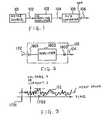
- FIG. 1 is a block diagram showing the structure of a physical random number generator according to a first embodiment of the present invention.
- a noise signal 102 from a noise source 101 is input to an AC coupling amplifier 103 and its amplified noise signal 104 is A/D converted in an analog-to-digital converter (hereinafter referred to as A/D converter) 105 into digital values 206, which are output as a random number data 106.
- A/D converter 105 is an A/D converter having accuracy of 1 bit or not less than 2 bits.
- FIG. 2 is a diagram showing the inner structure of AC coupling amplifier 103 of the physical random number generator shown in FIG. 1 .
- AC coupling amplifier 103 is a portion to amplify noise signal 102 while keeping its DC component not to pass by AC coupling. It is composed of an input capacitor 1801 to which noise signal 102 is input, an amplifier 1802 to amplify the output signal of input capacitor 1801 and to input the amplified output signal to an output capacitor 1803 and output capacitor 1803 to output amplified noise signal 104.
- noise component caused by a random phenomenon is output from noise source 101.
- An example of this noise signal waveform is shown in FIG. 3 .
- FIG. 3 is a diagram showing an example of the noise signal waveform.
- the noise signal waveform becomes a waveform that is composed by adding an offset voltage (or current) 1701 and a noise component 1702 that is distributed around it.
- noise component obtained from noise source 101 is generally small, and it is therefore necessary to amplify noise signal 102 using an amplifier having a large amplification factor.
- noise signal 102 is amplified together with offset 1701, the output signal of the amplifier is saturated, and as a result, the amplifier does not properly operate. So, AC coupling amplifier 103 is used as an amplifier circuit, and only noise component 1702 excluding offset 1701 is amplified.
- offset 1701 in noise signal 102 is removed by input capacitor 1801, and noise component 1702 only is amplified by amplifier 1802. Further, DC voltage obtained by amplifying the offset of amplifier 1802 itself is removed by output capacitor 1803 so that it is not included in amplified noise signal 104.
- amplified noise signal 104 will become a waveform wherein the offset is made zero by the AC coupling and the noise components are distributed uniformly around the zero.
- amplified noise signal 104 when amplified noise signal 104 is converted into digital values 206 using A/D converter 105 of 1-bit accuracy, it becomes a value of 0 or 1 according to the polarity of amplified noise signal 104.
- A/D converter 105 This operation of A/D converter 105 will be described in more detail using examples shown in FIG. 3A and FIG. 3B .
- A/D converter 105 is of 1-bit accuracy and the waveform of amplified noise signal 104 is shown in FIG. 3A .
- A/D converter 105 converts amplified noise signal 104 into digital values 206 at predetermined time intervals ⁇ t.
- Digital values 206 obtained at the output of A/D converter 105 become values 0 and 1 as shown in FIG. 3A .
- A/D converter 105 is of 2-bit accuracy and the waveform of amplified noise signal 104 is shown in FIG. 3B .
- A/D converter 105 converts amplified noise signal 104 into digital values 206 at predetermined time intervals ⁇ t.
- Digital values 206 obtained at the output of A/D converter 105 become values 0, 1, 2 and 3 as shown in FIG. 3B .
- noise signal 102 obtained from noise source 101 is random, the order for becoming 0 or 1 is not decided. Further, signals are AC coupled, the probability for becoming 0 is equal to that for becoming 1. That is, it is possible to obtain 1-bit random data of good quality which is provided with uniformity and without periodicity.
- A/D converter 105 of not less than 2-bit accuracy, it is possible to obtain random number data having the frequency distribution of amplified noise signal 104 without less periodicity. For instance, if a noise generating factor of noise source 101 is of thermal noise, it is possible to obtain random number data having the probability for generating noises in the normal distribution state. Further, when random number data is prepared from the lower bits out of a plurality of bits composing an A/D converted digital value, it is possible to obtain random number data which does not depend on the shape of frequency distribution of amplified noise signal 104.
- the physical random number generator in this embodiment of the present invention, it is devised to generate random number data 106 based on digital data obtained by amplifying noise signal 102 from noise source 101 caused by the random phenomenon up to the range of conversion of A/D converter 105 using AC coupling amplifier 103 and converting it into digital values 206 by A/D converter 105. It is therefore possible to obtain random number data having the noise generating probability distribution of noise source 101 or uniform distribution without periodicity.
- the physical random number generator in this embodiment as it is possible to obtain one random number data by one conversion operation by the A/D conversion of amplified noise signal instead of counting random pulses of the noise signal, it is possible to generate physical random numbers at a higher speed than the counting in the prior art.
- A/D converter 105 having accuracy of 2 bits or more when A/D converter 105 having accuracy of 2 bits or more is used, random number data of multi-bits can be generated by one time of the A/D conversion, and thus it is possible to simplify the circuit configuration.
- the frequency distribution when noise signal 102 obtained from random noise source 101 is converted to digital data 206 using AC coupling amplifier 103 and A/D converter 105 will become the normal distribution.
- even number data and odd number data are uniformly distributed around the mean value, and the even number and odd number frequency distributions of all bits composing converted digital value 206 become uniform.
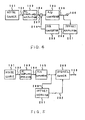
- FIG. 4 is a block diagram showing the structure of a physical random number generator according to a second embodiment of the present invention, and the same component elements as those shown in FIG. 1 are assigned with the same reference numerals and the explanations of them are omitted.
- This physical random number generator is in the same structure as in the first embodiment, and is additionally provided with an offset detector 201 which outputs a digital offset adjusting signal 202 based on output 206 from A/D converter 105, a digital-to-analog converter (hereinafter referred to as D/A converter) 203 to D/A convert this signal 202 and output it as an analog offset adjusting signal 204 and a computing unit 207 to subtract the same from amplified noise signal 104. As described above, it has the offset adjusting function by analog signal.
- D/A converter digital-to-analog converter
- offset component (DC component) of amplified noise signal 104 is made small by using AC coupling amplifier 103.
- this offset component becomes the same value as the offset component of A/D converter 105 itself, a mean value of the frequency distribution does not become 0. That is, the presence of the offset component changes the probability for MSB (Most Significant Digit) of a multi-bit A/D converter becoming 0 and 1, and thus, an error is produced in uniformity.
- a mean value of digital values 206 converted by A/D converter 105 is obtained by offset detector 201 and thus, an offset amount between amplified noise signal 104 and A/D converter 105 is detected.
- Digital offset adjusting signal 202 is output from offset detector 210 based on the detected offset amount.
- digital offset adjusting signal 202 is D/A converted by D/A converter 203 and is output as analog offset adjusting signal 204.
- Analog offset adjusting signal 204 is input to computing unit 207, wherein adjusting signal 204 is subtracted from amplified noise signal 104.
- the output of computing unit 207 is applied to A/D converter 105, and thus an offset amount is adjusted automatically to zero.
- the physical random number generator in this embodiment of the present invention is in the same structure as in the first embodiment, and is additionally provided with an offset automatic adjusting function composed of offset detector 201, D/A converter 203 and computing unit 207. Therefore, the same effects as those in the first embodiment are obtained, and in addition, it is possible to generate physical random numbers with ensured uniformity so as to make odd and even number frequency distributions always uniform by canceling various offsets and offset drifts, etc. of an amplifier circuit and the A/D converter and the like.
- FIG. 5 is a block diagram showing the structure of a physical random number generator according to a third embodiment of the present invention, and the same component elements as those shown in FIGs. 1 and 2 are assigned with the same reference numerals and the explanations of them are omitted.
- the offset automatic adjusting function as in the second embodiment is digitally realized.
- This physical random number generator is in the same structure as in the first embodiment, and is additionally provided with the same offset detector 201 as in the second embodiment and a digital adder 205 to add digital offset adjusting signal 202 from offset detector 201 and output 206 from A/D converter 105 and to output the sum as random number data 106. As described above, it has the offset adjusting function using digital signal.
- digital offset adjusting signal 202 is output from offset detector 201 likewise the offset adjustment by analog signal in the second embodiment.
- This adjusting signal 202 is added to converted digital value 206 from A/D converter 105 by digital adder 205, and the offset amount is thus automatically adjusted.
- the physical random number generator in this embodiment of the present invention is in the same structure as in the first embodiment, and is additionally provided with the automatic offset adjusting function composed of offset detector 201 and digital adder 205. It is therefore possible to obtain the same effects as in the first and the second embodiments. In addition, it is possible to prevent the increase in the number of component parts by using analog circuit as in the second embodiment, and the bringing of offset voltage fluctuating element of the offset applying circuit itself as in the second embodiment.
- the digital process is also executed in the offset automatic adjusting function, it does not depend on the temperature characteristic. Furthermore, the digital circuit can be easily made in a small size through the large scale integration, etc. and is favorable in downsizing.
- bit data at the fifth and the subsequent bits are able to maintain uniformity even when there are some drift and fluctuation.
- FIG. 6 is a block diagram showing the structure of the physical random number generator according to the fourth embodiment, and the same component elements as those shown in FIG. 1 are assigned with the same reference numerals and their explanations are omitted.
- the physical random number generator in this embodiment is in such structure that an A/D converter having accuracy of 6 bits or more is used as A/D converter 105 and not less than two bits data at the fifth and the subsequent bits from MSB are taken out as a random number data 301.
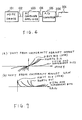
- FIG. 7 is a diagram showing the results of the simulations conducted with respect to uniformities of offset and gain fluctuations.
- FIG. 7(a) shows the change in uniformity for the fluctuation of offset.
- the offset is changed by about ⁇ 10% against the range of conversion of A/D converter 105, and the frequency for becoming 0 or 1 is checked for each bit composing converted digital value 206. The result is that the higher a bit is, the larger a deviation in uniformity for offset is.
- FIG. 7(b) shows the change in uniformity for fluctuation of gain. It is assumed that amplified noise signal 104 is distributed in the standard normal distribution, and gain is changed and the conversion range of A/D converter 105 is set at ⁇ 6 ⁇ to ⁇ . (Here, ⁇ designates standard deviation.) At this time, the frequency of each of bits composing converted digital value 206 for becoming 0 or 1 is checked. The result is that the higher a bit is, the larger a deviation in uniformity for gain fluctuation is, as shown in this figure.
- data of the fifth and the subsequent bits from the MSB of converted digital value 206 are taken out as random number data 301 based on the above information.
- the physical random number generator in this embodiment of the present invention is in the same structure as in the first embodiment, and in addition, is so devised as to adopt the fifth and subsequent bits from the MSB as random number data 301, and therefore, the same effects as in the first embodiment are obtained and further, random number data of better uniformity can be obtained.
- a technique to maintain uniformity of frequency for generating even and odd numbers of each bit by clarifying the range of conversion of an A/D converter for the noise distribution of a noise source according to the result of simulation conducted with respect to uniformity of frequency of generating even and odd numbers of each bit.
- FIG. 8 is a diagram showing the result of the simulation conducted to decide the range of A/D conversion in the physical random number generator according to the fifth embodiment of the present invention. Further, this embodiment is applicable to a physical random number generator in the same structure as in the first embodiment shown in FIG. 1 .
- FIG. 8 the relationship between the frequency distribution of converted digital value 206 and a conversion range of A/D converter 105 in this embodiment is shown.
- conversion range 401 of A/D converter 105 is set as described above. It uses the fifth and subsequent bits of converted digital value 206 for random number data as in the fourth embodiment, and all others are in the same structure as in the first embodiment.
- the probability for amplified noise signal 104 shown in FIG. 1 to exceed the conversion range of A/D converter 105 becomes high, the random number generating efficiency decreases.
- the degree of decrease follows the probability distribution of converted digital value 206, and in case of the normal distribution, a loss of about 30% is caused when the conversion range of A/D converter 105 is N ⁇ against amplified noise signal 104.
- the physical random number generator in this embodiment of the present invention is in the same structure as in the first and fourth embodiments, and in addition, conversion range 401 of A/D converter 105 for the noise distribution of noise source 101 is set at above N ⁇ . Therefore, it is possible to obtain the same effects as those in the first and fourth embodiments, and in addition, to maintain uniformity of the frequency to generate even and odd numbers of each bit more certainly.
- this embodiment it is devised to obtain random numbers having higher uniformity by previously defining conversion range 401 shown in FIG. 8 of A/D converter 105 likewise the fifth embodiment. That is, this embodiment provides a concrete handling of a noise signal when it exceeds the conversion range of A/D converter 105.
- the bit pattern composing data that is output when the noise signal exceeds conversion range may possibly be fixed, and the correlation between bits is affected remarkably when multi-bit data is made a random number data.
- the data that is output when the noise signal exceeds conversion range 401 is regarded to have no randomness and is excluded from the random number generation.
- FIG. 9 is a block diagram showing the structure of the physical random number generator according to the sixth embodiment of the present invention.
- the same component elements as those shown in FIG. 1 are assigned with the same reference numerals and their explanations are omitted.
- This physical random number generator is provided with an over range processor 502 to output converted digital values 501 only within conversion range 401 as random number data 106 based on converted digital value 501 and an over range signal 503 from A/D converter 105, and all others are in the same structure as in the first embodiment.
- amplified noise signal 104 exceeds the conversion range of A/D converter 105, over range signal 503 is firstly generated from A/D converter 105.
- over range processor 502 which has received this over range signal 503, A/D converted digital values 501 are processed and converted digital values 501 in over range 404 are removed from random number data 106.
- the concrete processing contents of over range processor 502 differ depending on the throughput of random number data 106.
- random number data 106 When, for instance, it is required to output random number data 106 at a fixed speed, such a buffer as an FIFO (First In First Out) memory is built in over range processor 502, and random number data 106 is output so as not to lack any data output caused by the over range processing.
- a buffer as an FIFO (First In First Out) memory
- the random number data throughput becomes slower than the data conversion speed of A/D converter 105.
- the ratio of the becoming slower is determined by the frequency distribution of noise signal 104 when it is A/D converted.
- the physical random number generator in this embodiment of the present invention is made in the same structure as in the first embodiment, and in addition, is so designed as to output converted digital value 501 only within conversion range 401 as random number data 106 by over range processor 502, it is possible to obtain the same effects as in the first embodiment and further to maintain the uniformity in the frequency to generate even and odd numbers of each bit more certainly. That is, data that is output when the noise signal exceeds conversion range 401 is regarded to have no randomness and is excluded from the random number generation, and thus, the quality of generated random numbers can be improved.
- the drop of uniformity caused by the differential nonlinearity is improved by performing the conversion operation at various positions relative to the conversion range of A/D converter 501.
- the differential nonlinearity of a high speed A/D converter is at the worst ⁇ 0.5 LSB (Least Significant Bit).
- LSB Large Significant Bit
- an A/D converter of 10-bit accuracy is capable of converting a voltage of 1.024V into digital values by dividing it into 1024.
- the voltage between conversion results N and N+1 does not become 1mV (1.024V/1024) exactly and becomes a value between 0.5mV to 1.5mV depending on conversion result N. This will result in the drop of uniformity when the result of A/D conversion is used random number data.
- the physical random number generator is added with a mechanism which performs the A/D conversion of an analog signal after adding a known voltage to the analog signal and then subtracts from the converted digital signal the same digital value as the value added to the analog signal, by utilizing the fact that differential nonlinearity depends on conversion result N.
- FIG. 10 is a block diagram showing the structure of the principal part of a physical random number generator according to the seventh embodiment of the present invention.
- This physical random number generator is in such structure that an analog correction signal 2104 is added to the input of A/D converter 105 and a digital correction signal 2102 is subtracted from the output of A/D converter 105 and all others are in the same structure as in one of the first through the sixth embodiments.
- the physical random number generator is provided with an correction signal generator 2101, a D/A converter 2103, an adder 2106 and a digital subtracter 2105.
- digital correction signal 2102 is first generated by correction signal generator 2101. This digital correction signal 2102 is converted into analog correction signal 2104 by D/A converter 2103 and added to amplified noise signal 104. This added value is applied to A/D converter 105 and is converted into digital value 206.
- digital correction signal 2102 is input to digital subtracter 2105 and subtracted from digital value 206, and random number data 106 is thus obtained.
- the physical random number generator in this embodiment of the present invention As described above, in the physical random number generator in this embodiment of the present invention, as a known voltage is added to an analog signal, the A/D conversion is made and the same digital value as the value added to the analog signal is subtracted therefrom, it becomes possible to obtain the same effect as in one of the first through the sixth embodiments. In addition, it is possible to obtain the same value as random number data 106 while changing a value of conversion result N of A/D converter 105, and thus, it becomes possible to level differential nonlinearity depending on the conversion result N and to improve uniformity of random numbers.
- This embodiment is to improve the drop of uniformity caused by differential nonlinearity of A/D converter 105 likewise the seventh embodiment. That is, the basic principle to reduce the effect by the differential nonlinearity in this embodiment is the same as that in the seventh embodiment.
- the drop of uniformity depending on conversion result N is improved by generating a different value.
- FIG. 11 is a block diagram showing the structure of the principal part of a physical random number generator according to the eighth embodiment of the present invention.
- This physical random number generator is provided with a register (#1) 2201 and a register (#2) 2202 to store the output of A/D converter 105 and a digital adder 2203 to add values of both registers 2201 and 2202, and all others are in the same structure as in one of the first through sixth embodiments.
- the frequency for generating random number data 106 becomes a half of the conversion frequency of A/D converter 105.
- a digital value that is converted by another A/D converter (not shown) using another system of noise source may be used as a value to be input to register 2202.
- pseudo random numbers generated from a pseudo random number generator may be used as a value to be input to register 2202.
- FIG. 12 is a block diagram showing one example of a noise source in a physical random number generator according to the ninth embodiment of the present invention. Further, this noise source 101 is applied to any of the physical random number generators shown in the first through the eighth embodiments.
- This noise source 101 utilizes thermal noise of resistors.
- resistors 601 and 602 are connected in series and earthed from a power source V.
- heaters 603 and 604 are connected in series and earthed from power source V. Further, these heaters 603 and 604 are arranged to heat resistors 601 and 602, respectively, and noise signal 102 is output from the connection point of resistors 601 and 602.
- resistors 601 and 602 are respectively heated by heaters 603 and 604 to make thermal noise large. Furthermore, as the temperature of resistors 601 and 602 are kept at a fixed level, stabilized noise signal 102 is obtained.
- the physical random number generator in this embodiment of the present invention As described above, in the physical random number generator in this embodiment of the present invention, as the above-described noise source is used, it is possible to obtain random number data having high uniformity of even and odd number generating frequency based on the stabilized noise signal.
- FIG. 13 is a block diagram showing one example of a noise source in a physical random number generator according to the tenth embodiment of the present invention. Further, this noise source 101 is applied to any of the physical random number generators shown in the first through the eighth embodiments.
- This noise source 101 uses a transistor, as an example of a semiconductor device.
- a transistor 703 is connected to a connection point of resistors 701 and 702 connected in series between a power source V and an earth.
- bias is applied to transistor 703, and further, a resistor 704, transistor 703 and a resistor 707 are connected in series between power source V and the earth.
- Noise signal 102 is output from a connection point of resistor 704 and transistor 703 by utilizing thermal noise of transistor 703 generated at both ends of resistor 704.
- the physical random number generator in this embodiment of the present invention As described above, in the physical random number generator in this embodiment of the present invention, as the above-described noise source is used, it is possible to obtain random number data having high uniformity of even and odd number generating frequency based on the stabilized noise signal.
- FIG. 14 is a block diagram showing one example of a noise source in a physical random number generator according to the eleventh embodiment of the present invention. Further, this noise source 101 is applied to any of the physical random number generator shown in the first through the eighth embodiments.
- This noise source 101 uses a Zener diode, as another example of a semiconductor device.
- a resistor 705 and a Zener diode 706 are connected in series between power source V and the earth, and noise signal 102 is output from a connection point of them.
- Zener diode When a Zener diode is used, by flowing Zener current to Zener diode 706 through resistor 705, thermal noise generated at both ends of resistor 705 is utilized. As a circuit to flow current to Zener diode 706, for instance, a constant current circuit may be used instead of resistor 705.
- the physical random number generator in this embodiment of the present invention As described above, in the physical random number generator in this embodiment of the present invention, as the above-described noise source is used, it is possible to obtain random number data having high uniformity of even and odd number generating frequency based on the stabilized noise signal.
- FIG. 15 is a block diagram showing one example of a noise source in a physical random number generator according to the twelfth embodiment of the present invention. Further, this noise source 101 is applied to any of the physical random number generator shown in the first through the eighth embodiments.
- This noise source 101 utilizes a photomultiplier and as shown in FIG. 15 , it is composed of a photomultiplier 801, bias applying resistors 806, 807 and 808 and a high voltage power source 809.
- Photomultiplier 801 multiplies electrons after converting light into electron.
- noise signal 102 is generated from the output of photomultiplier 801 by thermions existing on photoelectric surface 802.
- dark current which becomes the lower limit when measuring a light quantity, and it is regarded that the smaller, the better.
- noise signal 102 can be utilized as a noise source of physical random numbers.
- the physical random number generator in this embodiment of the present invention As described above, in the physical random number generator in this embodiment of the present invention, as the above-described noise source is used, it is possible to obtain random number data having high uniformity of even and odd number generating frequency based on the stabilized noise signal.
- FIG. 16 is a block diagram showing one example of a noise source in a physical random number generator according to the thirteenth embodiment of the present invention. Further, this noise source 101 is applied to any of the physical random number generator shown in the first through the eighth embodiments.
- This noise source 101 utilizes a vacuum tube, and it is composed such that a high voltage power source 906 is connected to a bipolar vacuum tube 901 via a bias applying resistor 905 and a heater power source 907 is connected to bipolar vacuum tube 901.
- bipolar vacuum tube 901 thermions are generated when heating an electrode 903 by a heater 902, and the generated electrons reach a high potential electrode 904. Quantity of electrons flown from electrode 903 to electrode 904 is obtained by measuring a voltage between both ends of resistor 905.
- the obtained current value has a fluctuation caused by thermal noise, and this fluctuation is used as noise signal 102.
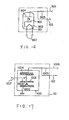
- the physical random number generator in this embodiment of the present invention As described above, in the physical random number generator in this embodiment of the present invention, as the above-described noise source is used, it is possible to obtain random number data having high uniformity of even and odd number generating frequency based on the stabilized noise signal.
- FIG. 17 is a block diagram showing one example of a noise source in a physical random number generator according to the fourteenth embodiment of the present invention. Further, this noise source 101 is applied to any of the physical random number generator shown in the first through the eighth embodiments.
- This noise source 101 utilizes a vacuum microelement, and it is composed such that a high voltage power source 1006 is connected to a vacuum microelement 1001 via a bias applying resistor 1005 and a control power source 1007 is connected to vacuum microelement 1001.
- an electrode 1003 is arranged near an earthed electrode 1002.
- the electric field is applied to this electrode 1003 from control power source 1007, electrons are generated from electrode 1002 by the tunnel effect.
- the generated electrons move toward electrode 1003 and are attracted by a higher potential electrode 1004 that is arranged so as to sandwich electrode 1003 with electrode 1002.
- current flows between electrodes 1002 and 1004 and is measured as a voltage between both ends of resistor 1005.
- the current value thus obtained has fluctuation resulting from the statistically generating tunnel effect and this fluctuation is used as noise signal 102.
- the physical random number generator in this embodiment of the present invention As described above, in the physical random number generator in this embodiment of the present invention, as the above-described noise source is used, it is possible to obtain random number data having high uniformity of even and odd number generating frequency based on the stabilized noise signal.
- This embodiment is applicable to the noise source in any of the ninth through the thirteenth embodiments for stabilizing the noise signal from the noise source.
- thermal noise fluctuates in proportion to the square root of absolute temperature
- signal level generated from the noise source is fluctuated by the effect of ambient temperature. This embodiment is to prevent this fluctuation.
- the fluctuating component of the vacuum microelement shown in the fourteenth embodiment is caused due to the tunnel effect and so on and is not affected by temperature.
- the effect of making constant temperature by this method is not obtainable and it is therefore excluded here.
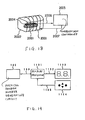
- FIG. 18 is a block diagram showing one example of a noise source thermostatic device in a physical random number generator in the fifteenth embodiment of the present invention.
- noise source thermostatic device a noise source element 2001 is housed in a thermostatic case 2002.
- Thermostatic case 2002 has built in a heater 2003, and the temperature therein is controlled to a constant level by a thermostatic controller 2005.
- noise source element 2001 is an element portion of the noise source used in any of noise sources 101 in the ninth through thirteenth embodiments.
- Temperature of noise source element 2001 is measured by a resistance temperature sensor 2004, and the measured temperature is applied to thermostatic controller 2005 as a temperature signal 2006.
- Thermostatic controller 2005 controls a heater heating signal 2007 according to temperature signal 2006 and controls heater heating power applied to heater 2003 so that the temperature of noise source element 2001 becomes constant.
- a temperature lower than the operating limit temperature of noise source element 2001 and higher than the environmental temperature is selected.
- an ambient temperature of a computer is 25°C
- an ambient temperature of the physical random number generator is 35°C
- an upper limit operating temperature of noise source element 2001 is 55°C.
- the ambient temperature of the computer changes by ⁇ 5°C by the air conditioning and the ambient temperature of the physical random number generator rises up to maximum 40°C. If a value of temperature to be controlled is set at 45 - 50°C, it is possible to control the temperature of noise source element 2001 at a constant level only by heater 2003 without incorporating the cooling apparutus.
- the noise source thermostatic device As described above, in the physical random number generator in this embodiment of the present invention, as the temperature of its noise source 101 is maintained at a constant level by the noise source thermostatic device, it is possible to prevent the fluctuation of the noise level. Furthermore, it is possible to generate thermal noise easily and make cooling apparatus unnecessary by maintaining the temperature at a high temperature and at a constant level.
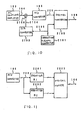
- FIG. 19 is a block diagram showing the structure of a display device using the physical random number generator according to a sixteenth embodiment of the present invention.
- random number data 106 from a physical random number generating circuit 100 is input to a display processor 1101, and further, a display data 1102 from this display processor 1101 is displayed on a display unit 1103.
- Display processor 1101 under the control of a control panel 1104, based on inputted random number data 106 outputs display data 1102 to display unit 1103.
- buttons, etc. provided on control panel 1104 and the result of pushing the buttons is input to display processor 1101 as a control signal 1105.
- Physical random number generating circuit 100 is in the same structure as any of the physical random number generators described in the first through the fifteenth embodiments.
- a various random number generating function is incorporated in a random number output portion that is composed of physical random number generating circuit 100 and display processor 1101.
- the various random number generating function is, for instance, to change a range of values of uniform random number data 106 by changing the number of bits of A/D converter 105 and to choose out of random number data 106 received by display processor 1101.
- values of 0 to 7 can be generated using 3-bit uniform random number data 106.
- a program is set in display processor 1101 so as to generate random numbers until one of values of 1 through 6 is generated when the value of 0 or 7 is generated.
- random numbers can be easily obtained and applied to various uses. For instance, it can be applied to such uses as preparation of the table of random numbers, imitation of the die, generation of figures of bingo game, and a lottery wheel, etc.
- this display device By applying this display device to such uses, the mass production of noise sources and random number generating circuits becomes possible and the downsizing and low pricing of the display devices can be realized.
- a communication equipment using the physical random number generator will be described.
- a communication method using random numbers there is, for instance, a spectrum diffusion system. This system enables to make the communication without being known by a third person by the frequency modulation using random number data generated by the physical random number generator.
- random numbers that are used for this purpose random numbers with no periodicity but having uniformity are demanded.
- Pseudo random numbers have periodicity and uniformity is not perfect. Therefore, it is suited to use physical random numbers rather than pseudo random numbers.
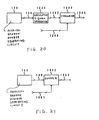
- FIG. 20 is a block diagram showing the structure of a communication equipment using the physical random number generator according to the seventeenth embodiment of the present invention.
- This communication equipment is composed of physical random number generating circuit 100, a modulation signal generator 1201 and a modulator 1203. Further, physical random number generating circuit 100 is in the same structure as any of the physical random number generators shown in the first through the fifteenth embodiments.
- the communication equipment using the physical random number generator in such structure operates as shown below.
- a modulation signal 1202 is generated in modulation signal generator 1201 based on random number data 106 from physical random number generating circuit 100. Then, a transmission data 1204 and modulation signal 1202 are modulated by modulator 1203 and transmission signal 1205 is prepared and transmitted.
- modulation signals are prepared from such random number data.
- modulation signals must not be known by a third person, but it is necessary for those persons who make the communication to know modulation signals each other.
- modulation signal generator 1201 The role of modulation signal generator 1201 is to prepare modulation signals from random number data 106, retain them until new modulation signals are recognized by those who perform the communication, and update them to new modulation signals at the time when they are recognized.
- random number data is used to encode three characters of, such as ABC, and to replace with other three characters.
- codes are used for fighting planes as an identification code to show friends each other. It is necessary to change such codes frequently so that they are not easily decoded by a third party.
- FIG. 21 is a block diagram showing the structure of a data encoder using the physical random number generator according to the eighteenth embodiment of the present invention.
- This data encoder is composed of physical random number generating circuit 100 and an encoder 1302.
- Physical random number generating circuit 100 is in the same structure as any of the physical random number generators described in the first through the fifteenth embodiments.
- the data encoder using the physical random number generator in such structure operates as shown below.
- Random number data 106 from physical random number generating circuit 100 are input to encoder 1302 together with original data 1301.
- coded data 1303 are prepared and output based on this original data 1301 and random number data 106.
- random number data 106 from the physical random number generating circuit 100 is used for encoding, it is possible to achieve downsizing and low pricing of a data encoder. It is also possible to eliminate such problems as periodicity, and the order of data generation, etc. by using random number data 106 as the code for encoding and to improve the secrecy of encoding.
- FIG. 22 is a block diagram showing the structure of one example of a random number input device using the physical random number generator according to the nineteenth embodiment of the present invention.
- FIG. 23 is a block diagram showing the structure of another example of a random number input device using the physical random number generator according to the nineteenth embodiment of the present invention.
- FIG. 24 is a block diagram showing the structure of still another example of a random number input device using the physical random number generator according to the nineteenth embodiment of the present invention.
- the same component elements shown in FIG. 22 through FIG. 24 are assigned with the same reference numerals.
- random number data 106 output from physical random number generating circuit 100 is input to a bus interface 1401, and further, random numbers converted from random number data 106 in bus interface 1401 are output to a computer as a bus interface signal 1402.
- physical random number generating circuit 100 shown in any of FIG. 22 through FIG. 24 is in the same structure as in any of the physical random number generators described in the first through the fifteenth embodiments.
- Bus interface signal 1402 is input to the computer via a computer data I/O bus 1403 ( FIG. 22, FIG. 23 ) or a card internal bus 1404 ( FIG. 24 ). This portion and the entire package, etc. differs for each of the random number input devices shown in FIGs. 22 - 24 .
- bus interface 1401 obtains random number data 106 from physical random number generating circuit 100 according to the instruction received from the computer via computer data I/O bus 1403 and transmits bus interface signal 1402 to the computer which has requested.
- FIG. 22 Shown in FIG. 22 is an example of the random number input device which is provided as a substrate 1400a.
- this substrate type input device physical random number generating substrate 1400a is used by inserting it into such a computer slot as a PCI bus.
- FIG. 23 Shown in FIG. 23 is an example of the random number input device which is provided as a card 1400b.
- this card type input device physical random number generating card 1400b is used by inserting it into such a card slot as a PCMCIA.
- Shown in FIG. 24 is an example of the random number input device which is provided as an IC card 1400c.
- An IC card can be regarded as a kind of computer with a CPU (not shown) built in. Therefore, in this case, the random number input device is in a shape that it is incorporated in a computer itself.
- IC card 1400c has a built-in CPU (not shown), random number data are output to the CPU in IC card 1400c via card inner bus 1404 instead of computer data I/O bus 1403.
- card inner bus 1404 instead of computer data I/O bus 1403.
- random number input device using the physical random number generator As described above, in the random number input device using the physical random number generator according to this embodiment of the present invention, it is possible to achieve the downsizing and low pricing of a random number input device, as random number data 106 from physical random number generating circuit 100 are used for inputting random numbers into a computer.
- a bus having the general usability such as a PCI bus
- EWS Engineing Work Station
- parallel computers by the development of one kind of substrate, and therefore the mass production also becomes possible.
- the low pricing that is an object of the present invention, can be achieved more effectively.
- FIG. 25 is a block diagram showing the structure of a physical random number generator according to the twentieth embodiment of the present invention.
- This physical random number generator is composed of physical random number generating circuit 100 and a network interface 1501. Further, physical random number generating circuit 100 is in the same structure as in any of the physical random number generators described in the first through the fifteenth embodiments.
- Network interface 1501 obtains random number data 106 from physical random number generating circuit 100 and transmits them to a network according to an instruction received via a network cable 1502.
- random number data 106 from physical random number generating circuit 100 are used for random numbers to be provided to a network, it is possible to use physical random numbers at a low price in a plurality of computers.
- the physical random number generator in this embodiment enables it to provide random number data at a high speed and sufficiently against a demand up to the capacity of a memory by storing random number data in the memory, for instance, during the night time with less demands for physical random number data and supplying them from the memory when demanded.
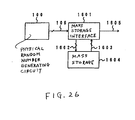
- FIG. 26 is a block diagram showing the structure of a physical random number generator according to the twenty-first embodiment of the present invention.
- This physical random number generator with the storing and reproducing function is composed of physical random number generating circuit 100, a mass storage interface 1601 and a mass storage 1604. Further, physical random number generating circuit 100 is in the same structure as any of the physical random number generators described in the first through the fifteenth embodiments.
- Mass storage interface 1601 stores random number data 106 once in mass storage 1604 as data 1602, and then reproduces random number data from mass storage 1604 based on an output 1603 according to a demand by an external device (not shown), and outputs them as reproduced random number data 1605.
- the physical random number generator which enables to provide physical random number data by storing on a storing medium such as floppy disk, CD-ROM, etc. will be described.
- physical random number data prepared by any of the physical random number generators in the first through the fifteenth embodiments are stored on a portable storing medium.
- a storing medium for this purpose FD (Floppy Disk), MO (Magnet Optical disk), CD-ROM, DVD-ROM and the like are used.
- the physical random number generator in this embodiment of the present invention as the physical random number data generated by any of the physical random number generators in the first through the fifteenth embodiments is stored on a portable storing medium, it is possible to retain a storing medium stored with physical random number data by the parties concerned making the communication and to make the encoding/decoding of data without being known by the third party.
- random number data can be obtained at a price far cheaper than a price for purchasing hardware for generating physical random data.
- physical random number data prepared by any of the physical random number generators in the first through the fifteenth embodiments are stored on a portable storing medium and also, its examination method and the result of examination are stored on that storing medium.
- a method that is usually used is to examine an assumption that the sequence is a random sample from a uniform population by several methods and to make the judgement from the overall result of these methods.
- FD compact disc
- MO compact disc
- CD-ROM compact disc-read only memory
- DVD-ROM digital versatile disc-read only memory
- the examination methods and the examination results thereof are stored in a portable storing medium, the same effects as those in the twenty-second embodiment are obtained.
- the quality of random number data stored on the storing medium can be easily confirmed.
- programs stored in storage media include setup programs for installing, in a computer, software (including not only execution programs but also table and data structures) executed in the computer.
- a computer realizing this physical random number generator reads the program stored in a storing medium, installs this software by the setup program when necessary, and by controlling the operation by this software executes the above-described processes.
- a physical random number generator and a method of generating physical random numbers which can improve the physical random number generating speed and can provide physical random numbers having the characteristic of good quality as random numbers. Furthermore, it is possible to provide a physical random number generator and a method of generating physical random numbers and a physical random number storing medium capable of applying to a wide field including general use computers, personal computers, and civil life level application such as game machines, etc.
Landscapes
- Physics & Mathematics (AREA)
- General Physics & Mathematics (AREA)
- Engineering & Computer Science (AREA)
- Theoretical Computer Science (AREA)
- Computational Mathematics (AREA)
- Mathematical Analysis (AREA)
- Mathematical Optimization (AREA)
- Pure & Applied Mathematics (AREA)
- General Engineering & Computer Science (AREA)
- Analogue/Digital Conversion (AREA)
Claims (27)
- Physikalischer Zufallszahlgenerator mit
einer Rauschquelle (101), die konfiguriert ist zum Erzeugen eines Rauschsignals (102) in Normalverteilung;
einer Wechselstrom-AC-Kopplungsverstärkungsschaltung (103), die konfiguriert ist zum Verstärken des Rauschsignals, während eine Gleichstrom-DC-Komponente durch AC-Kopplung daraus entfernt wird, zum Erzeugen eines verstärkten Rauschsignals (104); und
einer Analog/Digital-A/D-Wandlervorrichtung (105), dadurch gekennzeichnet, dass die Analog/Digital-A/D-Wandlerschaltung (105) eine Genauigkeit von nicht weniger als zwei Bits aufweist und konfiguriert ist zur A/D-Umwandlung des verstärkten Rauschsignals in digitale Werte (206), die aus Bitdaten von nicht weniger als zwei Bits bestehen; und ferner mit
einer Verarbeitungsvorrichtung, die konfiguriert ist zum Verarbeiten des verstärkten Rauschsignals vor der A/D-Umwandlung und zum Verarbeiten der digitalen Werte von Multi-Bits, die umgewandelt sind von dem verarbeiteten verstärkten Rauschsignals und ein MSB und LSB aufweisen, zum Erzeugen von Zufallszahldaten von Multi-Bits durch Herausnehmen von nicht weniger als 2-Bit Daten bei dem fünften und nachfolgend niedrigeren Bits von MSB der digitalen Werte der Multi-Bits aus, als die Zufallszahldaten zum Reduzieren einer Gleichmäßigkeitsabweichung für eine Gewinnschwankung der Wechselstrom-AC-Kopplungsverstärkungsvorrichtung (103) oder der Analog/Digital-A/D-Wandlervorrichtung (105). - Physikalischer Zufallsgenerator nach Anspruch 1, ferner mit
einer Offset-Einstellungsvorrichtung, die konfiguriert ist zum Erhalten eines Mittelwerts der Digitalwerte, die von der A/D-Wandlervorrichtung (105) umgewandelt worden sind, zum Erzeugen des Mittelwerts als ein digitales Offset-Einstellungssignal, zum D/A Umwandeln des digitalen Offset-Einstellungssignals in ein analoges Offset-Einstellungssignal, und zum Subtrahieren des analogen Offset-Einstellungssignals von dem verstärkten Rauschsignal;
wobei anstelle des verstärkten Rauschsignals ein subtrahierter Wert des analogen Offset-Einstellungssignals von dem verstärkten Rauschsignal in die A/D Wandlervorrichtung (105) eingegeben wird. - Physikalischer Zufallszahlgenerator nach Anspruch 1, ferner mit
einer Offset-Einstellungsvorrichtung, die konfiguriert ist zum Gewinnen eines Mittelwerts der Digitalwerte, die von der A/D Wandlervorrichtung (105) umgewandelt worden sind, zum Erzeugen des Mittelwerts als ein digitales Offset-Einstellungssignal (202) für die Digitalwerte, wobei hinzugefügte Werte des digitalen Offset-Einstellungssignal (202) und das digitale Signal als die Zufallszahldaten ausgegeben werden. - Physikalischer Zufallszahlgenerator nach Anspruch 1, wobei
die A/D Wandlervorrichtung (105) eine Genauigkeit von nicht weniger als 6 Bits aufweist;
die A/D Wandlervorrichtung (105) mindestens zwei Bits von dem fünften und nachfolgendem Bits, gezählt von dem höchsten Bit, in nicht weniger als 6-Bit Daten, die die digitalen Werte bilden, die von der A/D Wandlervorrichtung (105) umgewandelt werden, als herausgenommene Daten herausnimmt; und
die A/D Wandlervorrichtung (105) die herausgenommenen Daten als Zufallszahldaten erzeugt. - Physikalischer Zufallszahlgenerator nach Anspruch 1, wobei
die A/D Wandlervorrichtung (105) einen Umwandlungsbereich aufweist, der breiter als ein Bereich (N±σ) ist, wenn die digitalen Werte, die von der A/D Wandlervorrichtung umgewandelt worden sind, die Normalverteilung von einem Durchschnitt N und einer Varianz σ2 werden, und die digitalen Werte nur als gültig ansieht, wenn die digitalen Werte in den Umwandlungsbereich fallen. - Physikalischer Zufallsgenerator nach Anspruch 1, wobei
die Verarbeitungsvorrichtung (207) eine Differential-Nichtlinearitäts-Verbesserungsvorrichtung aufweist, die konfiguriert ist zum Addieren von analogen Differential-Nichtlinearitäts-Verbesserungsdaten zu Eingabewerten der A/D Wandlervorrichtung als einen Offset, und zum Subtrahieren der digitalen Differential-Nichtlinearitäts-Erhöhungsdaten äquivalent von den digitalen Werten, die von einem addierten verstärkten Rauschsignal umgewandelt werden; wobei die resultierenden subtrahierten Daten als die Zufallszahldaten ausgegeben werden. - Physikalischer Zufallszahlgenerator nach Anspruch 1, wobei
die Verarbeitungsvorrichtung (207) eine Differential-Nichtlinearitäts-Verbesserungsvorrichtung aufweist, die konfiguriert ist zum Hinzufügen und Mitteln einer Mehrzahl der digitalen Werten, die von der A/D Wandlervorrichtung (105) umgewandelt worden sind, wobei
Durchschnittswerte der digitalen Werte als Zufallszahldaten ausgegeben werden. - Physikalischer Zufallszahlgenerator nach Anspruch 1, wobei eine Mehrzahl von A/D Wandlervorrichtungen jeweils mit der Verarbeitungsvorrichtung bereitgestellt sind, wobei:die Verarbeitungsvorrichtung eine Differential-Nichtlinearitäts-Verbesserungsvorrichtung aufweist, die konfiguriert ist zum Hinzufügen und Mitteln einer Mehrzahl der digitalen Werte, die von der A/D Wandlervorrichtung umgewandelt worden sind, wobei Mittelwerte der digitalen Werte als die Zufallszahldaten ausgegeben werden.
- Physikalischer Zufallsgenerator nach Anspruch 1, ferner mit
einem Pseudozufallszahlgenerator, der konfiguriert ist zum Erzeugen von Pseudozufallszahldaten; und
einer Differential-Nichtlinearitäts-Verbesserungsvorrichtung, die konfiguriert ist zum Addieren und Subtrahieren der digitalen Werte, die von der A/D Wandlervorrichtung (105) gewandelt worden sind, und der Pseudozufallszahldaten, wobei
Mittelwerte der digitalen Werte und die Pseudozufallszahldaten als die Zufallszahldaten ausgegeben werden. - Physikalischer Zufallszahlgenerator nach Anspruch 1, wobei
die Rauschquelle (101) thermisches Rauschen als das Rauschsignal (102) erzeugt. - Physikalischer Zufallszahlgenerator nach Anspruch 10, wobei
die Rauschquelle (101) das thermische Rauschen eines Widerstands (705) als das Rauschsignal (102) erzeugt. - Physikalischer Zufallszahlgenerator nach Anspruch 10, wobei
die Rauschquelle (101) das thermische Rauschen einer Halbleitervorrichtung als das Rauschsignal (102) erzeugt. - Physikalischer Zufallszahlgenerator nach Anspruch 10, wobei
die Rauschquelle (101) das thermische Rauschen einer fotoelektrischen Umwandlungsoberfläche eines Fotovervielfachers als das Rauschsignal erzeugt. - Physikalischer Zufallszahlgenerator nach Anspruch 10, wobei
die Rauschquelle (101) das thermische Rauschen, das von einer Kathode (904) einer Vakuumröhre (901) erzeugt wird, als das Rauschsignal (102) erzeugt wird. - Physikalischer Zufallszahlgenerator nach einem der Ansprüche 10 bis 14, ferner mit
einer thermostatischen Vorrichtung, die konfiguriert ist zum Halten der Rauschquelle bei einer konstanten hohen Temperatur. - Physikalischer Zufallszahlgenerator nach Anspruch 1, wobei
die Rauschquelle eine Schwankung von Elektroden, die in einem Vakuum-Mikroelemente erzeugt, als das Rauschsignal erzeugt. - Physikalische Zufallszahlanzeigenvorrichtung mit
dem physikalischen Zufallszahlgenerator (100) nach Anspruch 1; und
einer Anzeigenvorrichtung (1103), die konfiguriert ist zum Anzeigen von Daten basierend auf den Zufallszahldaten, die von dem physikalischen Zufallszahlgenerator erzeugt werden. - Kommunikationseinrichtung mit
dem physikalischen Zufallszahlgenerator (100) nach Anspruch 1; und
einer Signalmodulationsvorrichtung (1201), die konfiguriert ist zum Modulieren eines Signals unter Verwendung der Zufallszahldaten, die von dem physikalischen Zufallszahlgenerator erzeugt worden sind. - Datencodierer, mit
dem physikalischen Zufallszahlgenerator (100) nach Anspruch 1; und
einem Codieren von Daten unter Verwendung der Zufallszahldaten, die von dem physikalischen Zufallszahlgenerator erzeugt worden sind. - Physikalische Zufallszahleingabevorrichtung mit
dem physikalischen Zufallszahlgenerator (100) nach Anspruch 1; und
einer Busschnittstellenvorrichtung, die verbunden ist zum Verbinden mit einem Eingabe/Ausgabebus eines Computers, der konfiguriert ist zum Eingeben der Zufallszahldaten, die von dem physikalischen Zufallszahlgenerator erzeugt worden sind, in den Computer. - Physikalische Zufallszahleingabevorrichtung mit
dem physikalischen Zufallszahlgenerator (100) nach Anspruch 1; und
einer Netzwerkschnittstellenvorrichtung (1501), die verbunden ist zum Verbinden mit einem Computernetzwerk, das konfiguriert ist zum Senden der Zufallszahldaten, die von dem physikalischen Zufallszahlgenerator erzeugt worden sind, an das Computernetzwerk in Antwort auf eine Anfrage von einem Computer. - Physikalischer Zufallszahlgenerator nach Anspruch 1, ferner mit
einer Speichervorrichtung (1601), die konfiguriert ist zum Speichern der Zufallszahldaten und zum Liefern der gespeicherten Zufallszahldaten in Antwort auf eine Anfrage zur Ausgabe der Zufallszahldaten. - Physikalisches Zufallszahlspeichermedium, das durch einen Computer lesbar ist, in welchen Zufallszahldaten, die von dem physikalischen Zufallszahlgenerator (100) nach Anspruch 1 erzeugt worden sind, gespeichert sind.
- Physikalisches Zufallszahlspeichermedium nach Anspruch 23, wobei
mindestens ein Untersuchungsverfahren der gespeicherten Zufallszahldaten und/oder ein Untersuchungsergebnis der gespeicherten Zufallszahldaten gespeichert ist. - Physikalischer Zufallszahlgenerator nach Anspruch 1, wobei
die A/D Wandlervorrichtung (105) einen Umwandlungsbereich für ihr Eingangssignal des verstärkten Rauschsignals aufweist, und digitale Werte nur als gültig ansieht, wenn das Eingangssignal in den Umwandlungsbereich fällt. - Physikalischer Zufallszahlgenerator nach Anspruch 1, wobei
das Verarbeitungsmittel (207) eine Differential-Nichtlinearitäts-Verbesserungsvorrichtung aufweist, die konfiguriert ist zum Addieren und Mitteln der digitalen Werte, die von der A/D Wandlervorrichtung umgewandelt worden sind, und zwei digitalen Daten, die von einer zweiten Rauschquelle bereitgestellt und umgewandelt worden sind, wobei die zweiten digitalen Daten von einer anderen A/D Wandlervorrichtung umgewandelt werden; wobei Mittelwerte der digitalen Werte als die verarbeiteten Daten ausgegeben werden. - Verfahren zum Erzeugen von physikalischen Zufallszahlen mit den Schritten:Erzeugen eines Rauschsignals von einer Rauschquelle in Normalverteilung;Verstärken des Rauschsignals während eine Gleichstrom-DC-Komponente daraus entfernt wird mittels einer Wechselstrom-AC-Kopplung zum Erzeugen eines verstärkten Rauschsignals;Analog/Digital-A/D-Umwandlen des verstärkten Rauschsignals in digitale Werte, die aus Bitdaten von nicht weniger als zwei Bits bestehen;Verarbeiten des verstärkten Rauschsignals vor der A/D Umwandlung; undVerarbeiten, um digitale Werte von Multi-Bits, die von dem verarbeiteten verstärkten Rauschsignal umgewandelt worden sind und ein MSB und LSB aufweisen, zu verarbeiten, zum Erzeugen von Zufallszahldaten von Multi-Bits, indem nicht weniger als 2-Bit Daten bei dem fünften und nachfolgenden niedrigeren Bits von MSB aus der digitalen Werte der Multi-Bits als die Zufallszahldaten herausgenommen werden, um eine Abweichung der Gleichmäßigkeit für eine Gewinnschwankung der Wechselstrom-AC-Kopplungsverstärkungsvorrichtung (103) oder der Analog/Digital/A/D Wandlervorrichtung (105) zu reduzieren;Ausgeben der Zufallszahldaten als eine Ausgabe des physikalischen Zufallszahlgenerators.
Applications Claiming Priority (3)
| Application Number | Priority Date | Filing Date | Title |
|---|---|---|---|
| JP24910997 | 1997-09-12 | ||
| JP9249109A JP2980576B2 (ja) | 1997-09-12 | 1997-09-12 | 物理乱数発生装置及び方法並びに物理乱数記録媒体 |
| EP98117061A EP0903665A3 (de) | 1997-09-12 | 1998-09-09 | Physikalischer Zufallszahlengenerator, Verfahren zum Generieren von physikalischen Zufallszahlen und Speichermedium für physikalische Zufallszahlen |
Related Parent Applications (2)
| Application Number | Title | Priority Date | Filing Date |
|---|---|---|---|
| EP98117061A Division EP0903665A3 (de) | 1997-09-12 | 1998-09-09 | Physikalischer Zufallszahlengenerator, Verfahren zum Generieren von physikalischen Zufallszahlen und Speichermedium für physikalische Zufallszahlen |
| EP98117061.6 Division | 1998-09-09 |
Publications (3)
| Publication Number | Publication Date |
|---|---|
| EP1577749A2 EP1577749A2 (de) | 2005-09-21 |
| EP1577749A3 EP1577749A3 (de) | 2005-10-19 |
| EP1577749B1 true EP1577749B1 (de) | 2009-07-15 |
Family
ID=17188096
Family Applications (2)
| Application Number | Title | Priority Date | Filing Date |
|---|---|---|---|
| EP98117061A Withdrawn EP0903665A3 (de) | 1997-09-12 | 1998-09-09 | Physikalischer Zufallszahlengenerator, Verfahren zum Generieren von physikalischen Zufallszahlen und Speichermedium für physikalische Zufallszahlen |
| EP05013677A Expired - Lifetime EP1577749B1 (de) | 1997-09-12 | 1998-09-09 | Physikalischer Zufallszahlengenerator, Verfahren zum Generieren von physikalischen Zufallszahlen und Speichermedium für physikalische Zufallszahlen |
Family Applications Before (1)
| Application Number | Title | Priority Date | Filing Date |
|---|---|---|---|
| EP98117061A Withdrawn EP0903665A3 (de) | 1997-09-12 | 1998-09-09 | Physikalischer Zufallszahlengenerator, Verfahren zum Generieren von physikalischen Zufallszahlen und Speichermedium für physikalische Zufallszahlen |
Country Status (4)
| Country | Link |
|---|---|
| US (1) | US6195669B1 (de) |
| EP (2) | EP0903665A3 (de) |
| JP (1) | JP2980576B2 (de) |
| DE (1) | DE69840987D1 (de) |
Families Citing this family (76)
| Publication number | Priority date | Publication date | Assignee | Title |
|---|---|---|---|---|
| US6324558B1 (en) * | 1995-02-14 | 2001-11-27 | Scott A. Wilber | Random number generator and generation method |
| JP2000066592A (ja) * | 1998-08-19 | 2000-03-03 | Syst Kogaku Kk | 乱数生成装置 |
| JP2000310942A (ja) * | 1999-02-25 | 2000-11-07 | Yazaki Corp | 疑似乱数発生器、ストリーム暗号化方法、及びストリーム暗号通信方法 |
| US6539410B1 (en) * | 1999-03-17 | 2003-03-25 | Michael Jay Klass | Random number generator |
| US6374278B1 (en) * | 1999-03-25 | 2002-04-16 | Intel Corporation | Method and apparatus for the generation of statistically random numbers |
| JP3480822B2 (ja) * | 1999-11-02 | 2003-12-22 | 斎藤 威 | 熱雑音ランダムパルス発生装置及び乱数生成装置 |
| US7270193B2 (en) | 2000-02-14 | 2007-09-18 | Kabushiki Kaisha Toshiba | Method and system for distributing programs using tamper resistant processor |
| FR2806555A1 (fr) * | 2000-03-17 | 2001-09-21 | St Microelectronics Sa | Generateur de nombres pseudo-aleatoires |
| US6463449B2 (en) * | 2000-05-01 | 2002-10-08 | Clyde L. Tichenor | System for creating non-algorithmic random numbers and publishing the numbers on the internet |
| JP3507886B2 (ja) | 2000-07-24 | 2004-03-15 | 新潟大学長 | 乱数発生方法 |
| US7242776B1 (en) * | 2000-08-08 | 2007-07-10 | Verizon Corporate Services Group Inc. | Method and apparatus for the generation and distribution of random bits |
| US7124157B2 (en) * | 2000-10-24 | 2006-10-17 | Hmi Co., Ltd. | Random number generator |
| JP3581094B2 (ja) | 2000-10-31 | 2004-10-27 | 株式会社プロトコーポレーション | 残価予測システム及びその方法、並びにコンピュータ上で動作する残価予測プログラムを記録した記録媒体 |
| DE10103071A1 (de) * | 2001-01-24 | 2002-08-08 | Infineon Technologies Ag | Zufallszahlengenerator und Verfahren zum Erzeugen einer Zufallszahl |
| JP2003051819A (ja) * | 2001-08-08 | 2003-02-21 | Toshiba Corp | マイクロプロセッサ |
| ITVA20010033A1 (it) * | 2001-10-12 | 2003-04-12 | St Microelectronics Srl | Circuito di generazione di una sequenza casuale di bit. |
| JP2003216037A (ja) * | 2001-11-16 | 2003-07-30 | Yazaki Corp | 暗号キー、暗号化装置、暗号化復号化装置、暗号キー管理装置及び復号化装置 |
| DE10219135B4 (de) * | 2002-04-29 | 2004-03-04 | Infineon Technologies Ag | Vorrichtung und Verfahren zum Erzeugen einer Zufallszahl |
| US7007060B2 (en) * | 2002-05-08 | 2006-02-28 | Agilent Technologies, Inc. | Random bit stream generation by amplification of thermal noise in a CMOS process |
| DE60224263T2 (de) * | 2002-07-01 | 2008-12-11 | Mitsubishi Denki K.K. | Bestimmung der statistischen Analyse von Signalen |
| FR2849938A1 (fr) * | 2003-01-09 | 2004-07-16 | Denis Ledoux | Dispositif et procede pour proteger un systeme ou un sous-systeme informatique |
| US7483537B2 (en) * | 2003-02-10 | 2009-01-27 | Mauricio Sanchez | Selecting cached RSA keys in response to RSA key requests |
| US20040267847A1 (en) * | 2003-05-13 | 2004-12-30 | Bsi2000, Inc. | Hardware random-number generator |
| FR2862394B1 (fr) * | 2003-11-18 | 2006-02-17 | Atmel Grenoble Sa | Generateur de sequences binaires aleatoires |
| WO2005083643A1 (en) * | 2004-03-02 | 2005-09-09 | Noriyoshi Tsuyuzaki | Authentication apparatus and authentication method using random pulse generator |
| US7290154B2 (en) | 2004-04-27 | 2007-10-30 | Georgia Tech Research Corporation | Probabilistic and introverted switching to conserve energy in a digital system |
| US7224305B2 (en) * | 2004-06-08 | 2007-05-29 | Telefonaktiebolaget L M Ericsson (Publ) | Analog-to-digital modulation |
| US20060010183A1 (en) * | 2004-07-09 | 2006-01-12 | President And Fellows Of Harvard College | Random number generation |
| US7472148B2 (en) * | 2004-07-23 | 2008-12-30 | Qualcomm Incorporated | Method and apparatus for random-number generator |
| KR100594292B1 (ko) | 2004-09-09 | 2006-06-30 | 삼성전자주식회사 | 저 전력 무작위 비트 생성기 및 난수생성기 |
| EP1804408A1 (de) * | 2004-10-06 | 2007-07-04 | Matsushita Electric Industrial Co., Ltd. | Datenkommunikationssystem |
| WO2006054476A1 (ja) * | 2004-11-18 | 2006-05-26 | Niigata Tlo Corporation | 乱数生成方法及び乱数生成装置 |
| JP2006270337A (ja) * | 2005-03-23 | 2006-10-05 | Dx Antenna Co Ltd | ノイズ発生器及びこれを用いたcn比対ビット誤り率測定用装置 |
| US20070180009A1 (en) * | 2005-03-30 | 2007-08-02 | Impinj, Inc. | RFID tag with random number generator having a noise-based input |
| CN101030709A (zh) * | 2005-11-01 | 2007-09-05 | 布莱克和戴克公司 | 可再充电电池组和操作系统 |
| GB0603523D0 (en) | 2006-02-22 | 2006-04-05 | Qinetiq Ltd | Apparatus and method for generating random numbers |
| JP4757664B2 (ja) | 2006-03-07 | 2011-08-24 | スタンレー電気株式会社 | マイクロ波供給源装置 |
| JP2007273030A (ja) * | 2006-03-31 | 2007-10-18 | Toshiba Samsung Storage Technology Corp | 光ディスク装置における乱数データ発生装置、及び乱数データ発生方法 |
| JP4536050B2 (ja) * | 2006-10-05 | 2010-09-01 | 株式会社ユニバーサルエンターテインメント | 遊技機 |
| JP4536049B2 (ja) * | 2006-10-05 | 2010-09-01 | 株式会社ユニバーサルエンターテインメント | 遊技機 |
| JP4836766B2 (ja) * | 2006-12-13 | 2011-12-14 | 株式会社エルイーテック | 物理乱数生成装置及び物理乱数生成回路 |
| JP4837549B2 (ja) * | 2006-12-28 | 2011-12-14 | Fdk株式会社 | 物理乱数発生器および物理乱数発生装置 |
| JP5545915B2 (ja) * | 2007-01-25 | 2014-07-09 | アズビル株式会社 | 計数装置、距離計、計数方法および距離計測方法 |
| JP2008228961A (ja) | 2007-03-20 | 2008-10-02 | Brother Ind Ltd | ミシン及びミシン制御プログラム |
| US7561085B2 (en) * | 2007-03-21 | 2009-07-14 | Honeywell International Inc. | Systems and methods for improving data converters |
| KR100871810B1 (ko) * | 2007-03-23 | 2008-12-03 | 삼성전자주식회사 | 랜덤 신호 발생기, 이를 포함하는 난수 발생기 및 난수발생 방법 |
| JP2008245021A (ja) * | 2007-03-28 | 2008-10-09 | Advanced Telecommunication Research Institute International | 無線通信システムおよびそれに用いる無線装置 |
| JP5545913B2 (ja) * | 2007-10-03 | 2014-07-09 | アズビル株式会社 | 計数装置、距離計、計数方法および距離計測方法 |
| TWI362611B (en) * | 2007-12-12 | 2012-04-21 | Phison Electronics Corp | Random number generator and random number generating method thereof |
| US8495118B2 (en) * | 2008-10-30 | 2013-07-23 | Seagate Technology Llc | Tunable random bit generator with magnetic tunnel junction |
| GB0915000D0 (en) | 2009-08-27 | 2009-09-30 | Univ Bruxelles | Quantum random number generation |
| JP5341690B2 (ja) * | 2009-09-14 | 2013-11-13 | 株式会社日立製作所 | 物理乱数生成装置 |
| US8448945B2 (en) * | 2010-01-06 | 2013-05-28 | Eric A. HANCOCK | Three dimensional random number generator |
| EP2375622A1 (de) * | 2010-04-08 | 2011-10-12 | Nagravision S.A. | Vorrichtung und Verfahren zur Durchführung einer kryptographischen Funktion |
| TWI450625B (zh) * | 2011-06-27 | 2014-08-21 | Nuvoton Technology Corp | 無線通信方法 |
| JP5346993B2 (ja) * | 2011-07-08 | 2013-11-20 | 株式会社エルイーテック | 物理乱数生成装置及び物理乱数生成回路 |
| EP2605404A1 (de) * | 2011-12-13 | 2013-06-19 | tecData AG | Einrichtung und Verfahren zur Erzeugung von modulierten Rauschsignalen und Verwendung einer Einrichtung zur Erzeugung von modulierten Rauschsignalen |
| TWI506540B (zh) | 2012-07-19 | 2015-11-01 | Nuvoton Technology Corp | 亂數產生電路與方法 |
| CN103049243B (zh) * | 2012-12-17 | 2015-11-25 | 深圳国微技术有限公司 | 真随机数产生方法及其装置 |
| US9049232B2 (en) | 2013-02-28 | 2015-06-02 | Amazon Technologies, Inc. | Configurable-quality random data service |
| US9819727B2 (en) | 2013-02-28 | 2017-11-14 | Amazon Technologies, Inc. | Computing infrastructure for configurable-quality random data |
| US9459835B2 (en) | 2014-01-15 | 2016-10-04 | HGST Netherlands B.V. | Random number generator by superparamagnetism |
| US9524619B2 (en) | 2014-02-05 | 2016-12-20 | Z4 Poker, LLC | Systems and methods for playing a wagering game |
| US9916884B2 (en) * | 2014-03-07 | 2018-03-13 | Intel Corporation | Physically unclonable function circuit using resistive memory device |
| CA2948408C (en) * | 2014-05-09 | 2023-03-07 | Quantum Numbers Corp. | Method for generating random numbers and associated random number generator |
| US10116441B1 (en) | 2015-06-11 | 2018-10-30 | Amazon Technologies, Inc. | Enhanced-security random data |
| DE102016202305A1 (de) * | 2016-02-16 | 2017-08-17 | Robert Bosch Gmbh | Verfahren und Vorrichtung zum Betreiben eines Steuergeräts |
| JP6907020B2 (ja) * | 2017-05-12 | 2021-07-21 | パナソニック株式会社 | 乱数生成装置、情報処理装置及び乱数生成方法 |
| US10168996B1 (en) * | 2018-01-15 | 2019-01-01 | Quantum Numbers Corp. | Method and system for generating a random bit sample |
| US10698658B2 (en) * | 2018-02-12 | 2020-06-30 | Seagate Technology Llc | Random number generation from spin torque oscillator noise |
| US11757632B2 (en) * | 2018-12-19 | 2023-09-12 | Micron Technology, Inc. | Generating a random value based on a noise characteristic of a memory cell |
| US11216251B2 (en) * | 2019-03-20 | 2022-01-04 | Raytheon Company | Wideband photonic radio frequency (RF) noise generator |
| US11132177B2 (en) * | 2019-05-14 | 2021-09-28 | International Business Machines Corporation | CMOS-compatible high-speed and low-power random number generator |
| KR102792398B1 (ko) | 2019-06-17 | 2025-04-10 | 한국전자통신연구원 | 난수 생성 장치 및 이의 동작 방법 |
| CN112230885B (zh) * | 2019-07-15 | 2024-05-03 | 瑞昱半导体股份有限公司 | 真随机数产生器与真随机数产生方法 |
| JPWO2021100385A1 (de) * | 2019-11-21 | 2021-05-27 |
Citations (2)
| Publication number | Priority date | Publication date | Assignee | Title |
|---|---|---|---|---|
| US4355366A (en) * | 1980-11-28 | 1982-10-19 | Ncr Corporation | Circuitry for minimizing auto-correlation and bias in a random number generator |
| WO1997011423A2 (en) * | 1995-09-22 | 1997-03-27 | United Technologies Automotive, Inc. | A method of generating secret identification numbers |
Family Cites Families (11)
| Publication number | Priority date | Publication date | Assignee | Title |
|---|---|---|---|---|
| US3582882A (en) * | 1968-09-12 | 1971-06-01 | George E Titcomb | Randomness monitor |
| FR2396463A1 (fr) * | 1977-06-30 | 1979-01-26 | Ibm France | Circuit pour compenser les decalages du zero dans les dispositifs analogiques et application de ce circuit a un convertisseur analogique-numerique |
| JPS5745645A (en) * | 1980-08-29 | 1982-03-15 | Matsushita Electric Ind Co Ltd | Random number generator |
| US4853884A (en) * | 1987-09-11 | 1989-08-01 | Motorola, Inc. | Random number generator with digital feedback |
| DE4114971A1 (de) * | 1991-05-03 | 1992-11-05 | Siemens Ag | Schaltungsanordnung zum wandeln mehrerer an eingangsanschluessen liegender, analoger elektrischer messsignale in entsprechende digitale signale |
| DE4213988A1 (de) * | 1992-04-29 | 1993-11-04 | Hechtenberg Rolf Rene | Verfahren und vorrichtung zur gewinnung von zufallszahlen |
| JPH06308881A (ja) * | 1993-04-08 | 1994-11-04 | Internatl Business Mach Corp <Ibm> | 暗号化方法及び装置 |
| JPH07111420A (ja) | 1993-10-14 | 1995-04-25 | Niko Denshi Kk | 2値化雑音信号発生器 |
| JPH07154214A (ja) * | 1993-11-26 | 1995-06-16 | Nec Corp | ディジタル信号処理回路 |
| DE19500599C2 (de) * | 1995-01-11 | 1998-03-19 | Peter Dipl Phys Westphal | Nicht-deterministischer Zufallszahlengenerator |
| JP2842389B2 (ja) * | 1996-07-11 | 1999-01-06 | 日本電気株式会社 | 乱数発生装置 |
-
1997
- 1997-09-12 JP JP9249109A patent/JP2980576B2/ja not_active Expired - Lifetime
-
1998
- 1998-09-09 EP EP98117061A patent/EP0903665A3/de not_active Withdrawn
- 1998-09-09 EP EP05013677A patent/EP1577749B1/de not_active Expired - Lifetime
- 1998-09-09 DE DE69840987T patent/DE69840987D1/de not_active Expired - Lifetime
- 1998-09-10 US US09/150,928 patent/US6195669B1/en not_active Expired - Lifetime
Patent Citations (2)
| Publication number | Priority date | Publication date | Assignee | Title |
|---|---|---|---|---|
| US4355366A (en) * | 1980-11-28 | 1982-10-19 | Ncr Corporation | Circuitry for minimizing auto-correlation and bias in a random number generator |
| WO1997011423A2 (en) * | 1995-09-22 | 1997-03-27 | United Technologies Automotive, Inc. | A method of generating secret identification numbers |
Non-Patent Citations (2)
| Title |
|---|
| GREEN ET AL: "Empirical Tests of an Additive Random Number Generator", JACM, vol. 6, no. 4, October 1959 (1959-10-01), pages 527 - 537 * |
| TURKO ET AL: "A high resolution 14-bit ADC for Gammasphere Project", CONFERENCE RECORD OF THE 1992 NUCLEAR SCIENCE SYMPOSIUM AND MEDICAL IMAGING CONFERENCE, IEEE ORLANDO, FL, USA, 25 October 1992 (1992-10-25), NY, pages 444 - 446, XP010108526 * |
Also Published As
| Publication number | Publication date |
|---|---|
| DE69840987D1 (de) | 2009-08-27 |
| EP1577749A2 (de) | 2005-09-21 |
| EP0903665A3 (de) | 1999-04-21 |
| US6195669B1 (en) | 2001-02-27 |
| EP0903665A2 (de) | 1999-03-24 |
| EP1577749A3 (de) | 2005-10-19 |
| JP2980576B2 (ja) | 1999-11-22 |
| JPH1185472A (ja) | 1999-03-30 |
Similar Documents
| Publication | Publication Date | Title |
|---|---|---|
| EP1577749B1 (de) | Physikalischer Zufallszahlengenerator, Verfahren zum Generieren von physikalischen Zufallszahlen und Speichermedium für physikalische Zufallszahlen | |
| US6369727B1 (en) | Analog-to-digital conversion method of random number generation | |
| Lee et al. | TRNG (True Random Number Generator) method using visible spectrum for secure communication on 5G network | |
| CN104079304B (zh) | 用于处理数据的设备和方法 | |
| Baker et al. | Modeling kicks from the merger of nonprecessing black hole binaries | |
| JP3480822B2 (ja) | 熱雑音ランダムパルス発生装置及び乱数生成装置 | |
| US7266575B2 (en) | Random number generator which can generate a random number based on an uniform distribution | |
| Vujicic | Generalized low-frequency stochastic true RMS instrument | |
| CN103776544A (zh) | 一种非制冷红外焦平面阵列的读出电路 | |
| US20080136697A1 (en) | Method and system for random number generator with random sampling | |
| CN103049243A (zh) | 真随机数产生方法及其装置 | |
| Park et al. | QEC: A quantum entropy chip and its applications | |
| Trotta et al. | Cosmological constant and general isocurvature initial conditions | |
| US6323792B1 (en) | Method for correcting analog-to-digital converter (ADC) errors, and apparatus embodying same | |
| CN108279865B (zh) | 一种量子随机数发生器及量子随机数生成方法 | |
| Lygouras | Nonlinear ADC with digitally selectable quantizing characteristic | |
| US10430159B1 (en) | Gas discharge tube true random number generator | |
| Živanović et al. | Investigation of statistical behaviour of electrical breakdown voltage distribution for nitrogen‐filled diode at 13.3 mbar pressure | |
| CN112416299B (zh) | 一种利用零漂数据获取随机数的方法 | |
| Bogdanova | Orthonormal polynomials in one and two dimensions: application to calibration problems in high energy physics | |
| RU2845475C1 (ru) | Автоэмиссионный генератор квантово-случайных чисел | |
| Koike et al. | A digital divider with extension bits for position-sensitive detectors | |
| CN119030541A (zh) | 提高片上自测试系统信号发生器信号精度的装置、方法、终端及介质 | |
| RU2343628C2 (ru) | Способ преобразования случайных чисел с произвольным законом распределения в случайные числа с равномерным законом распределения | |
| Shelton | Radiation-Hardened Data Acquisition System Based on a Mask-programmable Analog Array |
Legal Events
| Date | Code | Title | Description |
|---|---|---|---|
| PUAI | Public reference made under article 153(3) epc to a published international application that has entered the european phase |
Free format text: ORIGINAL CODE: 0009012 |
|
| PUAL | Search report despatched |
Free format text: ORIGINAL CODE: 0009013 |
|
| 17P | Request for examination filed |
Effective date: 20050624 |
|
| AC | Divisional application: reference to earlier application |
Ref document number: 0903665 Country of ref document: EP Kind code of ref document: P |
|
| AK | Designated contracting states |
Kind code of ref document: A2 Designated state(s): DE FR GB |
|
| AK | Designated contracting states |
Kind code of ref document: A3 Designated state(s): DE FR GB |
|
| RIC1 | Information provided on ipc code assigned before grant |
Ipc: 7H 03M 1/10 B Ipc: 7G 06F 7/58 A |
|
| AKX | Designation fees paid |
Designated state(s): DE FR GB |
|
| 17Q | First examination report despatched |
Effective date: 20080103 |
|
| GRAP | Despatch of communication of intention to grant a patent |
Free format text: ORIGINAL CODE: EPIDOSNIGR1 |
|
| GRAS | Grant fee paid |
Free format text: ORIGINAL CODE: EPIDOSNIGR3 |
|
| GRAA | (expected) grant |
Free format text: ORIGINAL CODE: 0009210 |
|
| AC | Divisional application: reference to earlier application |
Ref document number: 0903665 Country of ref document: EP Kind code of ref document: P |
|
| AK | Designated contracting states |
Kind code of ref document: B1 Designated state(s): DE FR GB |
|
| REG | Reference to a national code |
Ref country code: GB Ref legal event code: FG4D |
|
| REF | Corresponds to: |
Ref document number: 69840987 Country of ref document: DE Date of ref document: 20090827 Kind code of ref document: P |
|
| PLBE | No opposition filed within time limit |
Free format text: ORIGINAL CODE: 0009261 |
|
| STAA | Information on the status of an ep patent application or granted ep patent |
Free format text: STATUS: NO OPPOSITION FILED WITHIN TIME LIMIT |
|
| 26N | No opposition filed |
Effective date: 20100416 |
|
| PGFP | Annual fee paid to national office [announced via postgrant information from national office to epo] |
Ref country code: DE Payment date: 20140903 Year of fee payment: 17 |
|
| PGFP | Annual fee paid to national office [announced via postgrant information from national office to epo] |
Ref country code: GB Payment date: 20140903 Year of fee payment: 17 |
|
| PGFP | Annual fee paid to national office [announced via postgrant information from national office to epo] |
Ref country code: FR Payment date: 20140906 Year of fee payment: 17 |
|
| REG | Reference to a national code |
Ref country code: DE Ref legal event code: R119 Ref document number: 69840987 Country of ref document: DE |
|
| GBPC | Gb: european patent ceased through non-payment of renewal fee |
Effective date: 20150909 |
|
| REG | Reference to a national code |
Ref country code: FR Ref legal event code: ST Effective date: 20160531 |
|
| PG25 | Lapsed in a contracting state [announced via postgrant information from national office to epo] |
Ref country code: DE Free format text: LAPSE BECAUSE OF NON-PAYMENT OF DUE FEES Effective date: 20160401 Ref country code: GB Free format text: LAPSE BECAUSE OF NON-PAYMENT OF DUE FEES Effective date: 20150909 |
|
| PG25 | Lapsed in a contracting state [announced via postgrant information from national office to epo] |
Ref country code: FR Free format text: LAPSE BECAUSE OF NON-PAYMENT OF DUE FEES Effective date: 20150930 |