EP1575535B1 - Zusammensetzung für kosmetik oder zum schminken strukturiert mit silikonpolymeren - Google Patents
Zusammensetzung für kosmetik oder zum schminken strukturiert mit silikonpolymeren Download PDFInfo
- Publication number
- EP1575535B1 EP1575535B1 EP03782490A EP03782490A EP1575535B1 EP 1575535 B1 EP1575535 B1 EP 1575535B1 EP 03782490 A EP03782490 A EP 03782490A EP 03782490 A EP03782490 A EP 03782490A EP 1575535 B1 EP1575535 B1 EP 1575535B1
- Authority
- EP
- European Patent Office
- Prior art keywords
- composition according
- polymer
- groups
- group
- chosen
- Prior art date
- Legal status (The legal status is an assumption and is not a legal conclusion. Google has not performed a legal analysis and makes no representation as to the accuracy of the status listed.)
- Expired - Lifetime
Links
Classifications
-
- A—HUMAN NECESSITIES
- A61—MEDICAL OR VETERINARY SCIENCE; HYGIENE
- A61K—PREPARATIONS FOR MEDICAL, DENTAL OR TOILETRY PURPOSES
- A61K8/00—Cosmetics or similar toiletry preparations
- A61K8/18—Cosmetics or similar toiletry preparations characterised by the composition
- A61K8/72—Cosmetics or similar toiletry preparations characterised by the composition containing organic macromolecular compounds
- A61K8/84—Cosmetics or similar toiletry preparations characterised by the composition containing organic macromolecular compounds obtained by reactions otherwise than those involving only carbon-carbon unsaturated bonds
- A61K8/89—Polysiloxanes
- A61K8/896—Polysiloxanes containing atoms other than silicon, carbon, oxygen and hydrogen, e.g. dimethicone copolyol phosphate
- A61K8/898—Polysiloxanes containing atoms other than silicon, carbon, oxygen and hydrogen, e.g. dimethicone copolyol phosphate containing nitrogen, e.g. amodimethicone, trimethyl silyl amodimethicone or dimethicone propyl PG-betaine
-
- A—HUMAN NECESSITIES
- A61—MEDICAL OR VETERINARY SCIENCE; HYGIENE
- A61K—PREPARATIONS FOR MEDICAL, DENTAL OR TOILETRY PURPOSES
- A61K8/00—Cosmetics or similar toiletry preparations
- A61K8/18—Cosmetics or similar toiletry preparations characterised by the composition
- A61K8/30—Cosmetics or similar toiletry preparations characterised by the composition containing organic compounds
- A61K8/33—Cosmetics or similar toiletry preparations characterised by the composition containing organic compounds containing oxygen
- A61K8/34—Alcohols
- A61K8/342—Alcohols having more than seven atoms in an unbroken chain
-
- A—HUMAN NECESSITIES
- A61—MEDICAL OR VETERINARY SCIENCE; HYGIENE
- A61K—PREPARATIONS FOR MEDICAL, DENTAL OR TOILETRY PURPOSES
- A61K8/00—Cosmetics or similar toiletry preparations
- A61K8/18—Cosmetics or similar toiletry preparations characterised by the composition
- A61K8/72—Cosmetics or similar toiletry preparations characterised by the composition containing organic macromolecular compounds
- A61K8/84—Cosmetics or similar toiletry preparations characterised by the composition containing organic macromolecular compounds obtained by reactions otherwise than those involving only carbon-carbon unsaturated bonds
- A61K8/89—Polysiloxanes
- A61K8/891—Polysiloxanes saturated, e.g. dimethicone, phenyl trimethicone, C24-C28 methicone or stearyl dimethicone
-
- A—HUMAN NECESSITIES
- A61—MEDICAL OR VETERINARY SCIENCE; HYGIENE
- A61Q—SPECIFIC USE OF COSMETICS OR SIMILAR TOILETRY PREPARATIONS
- A61Q1/00—Make-up preparations; Body powders; Preparations for removing make-up
-
- A—HUMAN NECESSITIES
- A61—MEDICAL OR VETERINARY SCIENCE; HYGIENE
- A61Q—SPECIFIC USE OF COSMETICS OR SIMILAR TOILETRY PREPARATIONS
- A61Q1/00—Make-up preparations; Body powders; Preparations for removing make-up
- A61Q1/02—Preparations containing skin colorants, e.g. pigments
- A61Q1/04—Preparations containing skin colorants, e.g. pigments for lips
-
- A—HUMAN NECESSITIES
- A61—MEDICAL OR VETERINARY SCIENCE; HYGIENE
- A61Q—SPECIFIC USE OF COSMETICS OR SIMILAR TOILETRY PREPARATIONS
- A61Q1/00—Make-up preparations; Body powders; Preparations for removing make-up
- A61Q1/02—Preparations containing skin colorants, e.g. pigments
- A61Q1/04—Preparations containing skin colorants, e.g. pigments for lips
- A61Q1/06—Lipsticks
Definitions
- the present invention relates to a make-up cosmetic composition for the skin, containing a liquid fatty phase comprising at least one oil, structured with a particular polymer, provided in particular in the form of a cast make-up product, in particular as a make-up stick or dome such as lipsticks, whose application is easy and leads to a substantial, especially coloured, glossy and non-migrating deposit.
- the invention relates more particularly to cosmetic and dermatological compositions such as make-up products for easy application and leading to a large deposit and exhibiting properties of staying power, but also of non-transfer and stability.
- a composition is rigidified in particular in the case of solid compositions such as balms and lipsticks, eyeshadows, concealer products and foundations which have been cast. This structuring is obtained with the aid of waxes or fillers. Unfortunately, these waxes and fillers tend to mattify the composition, which is not always desirable in particular for a lipstick or an eyeshadow.
- liquid fatty phase is understood to mean, for the purposes of the application, a fatty phase which is liquid at room temperature (25°C) and atmospheric pressure (760 mmHg), which is composed of one or more fatty substances which are liquid at room temperature, which are also called oils, which are compatible with each other.
- the expression structured liquid phase is understood to mean a rigidified or gelled liquid fatty phase.
- rigified liquid fatty phase is understood to mean, for the purposes of the application, that this rigified phase does not run under its own weight when a silicone polyamide is added thereto.
- gelled liquid phase for the purposes of the application is understood to mean that the viscosity of this phase is increased because of the addition of a silicone polyamide to this fatty phase.
- the structuring of the liquid fatty phase makes it possible in particular to limit its exudation from solid compositions and, furthermore, to limit, after deposition on the skin or the lips, the migration of this phase into wrinkles and fine lines, which is particularly sought for a lipstick or an eyeshadow.
- the expression migration is understood to mean an overflowing of the composition deposited on the skin or the lips, outside its initial outline.
- the gloss is mainly linked to the nature of the liquid fatty phase.
- the amounts of waxes and fillers necessary for producing a stick of suitable hardness are a barrier to the gloss of the deposit.
- EP-A-1 068 856 [1] describes solid cosmetic compositions, with no wax, containing a liquid fatty phase structured with a polymer, in which the fatty phase is mainly a non-silicone oil.
- compositions based on polyamide resins comprising a structuring agent chosen from esters and amides of N-acylamino acids and mixtures thereof.
- the composition also comprises a solvent for the polyamide resin which may be chosen from unsaturated and saturated fatty alcohols, fatty and/or aromatic carboxylic acid esters, ethoxylated and/or propoxylated alcohols and acids, silicones, mineral oils and branched-chain hydrocarbons; preferably, fatty acid ester, fatty alcohols, mineral oils, branched hydrocarbons and mixtures thereof.
- fatty phases based on silicone oils makes it possible currently to obtain cosmetic compositions having a long staying power when the oils are only slightly volatile or are non-volatile, namely a good staying power in particular of the colour over time (unchanging, unfading), and transfer-free compositions when the silicone oils are volatile, not forming a deposit on a support such as a glass, a cup, a fabric or a cigarette, placed in contact with the film of make-up.
- cosmetic compositions such as deodorant sticks or gels, comprising a silicone oily phase gelled with a polysiloxane- and polyamide-based wax, or with a polymer containing siloxane groups and groups capable of hydrogen interactions, have been prepared.
- WO-A-02/17870 [6] it is envisaged to add to the composition another structuring agent, but the quantities added should be low, for example less than 0.5% in the case of hydroxystearic acid, in order to preserve the clarity of the product.
- a second structuring agent with the silicone polymer in a quantity representing 0.5 to 2% by weight of the composition, and a solvent system comprising a non-silicone organic compound, a volatile silicone and optionally another silicone.
- EP-A-1 177 784 [8] illustrates a deodorant composition
- a deodorant composition comprising a liquid phase containing, for example, a volatile silicone and optionally a non-volatile silicone and/or a non-silicone hydrophobic organic liquid, structured with an organic compound with amido groups, with optionally one or more polymeric or non-polymeric secondary structuring agents in small proportions.
- secondary structuring agents this document mentions polymers having siloxane groups and groups exhibiting hydrogen interactions without giving examples or results on a composition using these polymers.
- the sticks obtained by structuring the liquid fatty phase with solely one or more gelling silicone polymers do not exhibit sufficient mechanical resistance to shearing, in particular during the application of the stick to the lips and/or the skin, leading to breaking of the stick.
- the aim of the invention is precisely to provide a make-up composition for the skin and/or the lips, which makes it possible to overcome the disadvantages and to solve the problems mentioned above.
- the aim of the invention is to provide a composition whose application is easy and leads to a large deposit, that is to say a large mass, in any case larger than with prior art compositions.
- the larger deposit of material gives more "make-up effect", and in particular in the case of pigmented, coloured compositions, the deposit having a more intense colour allows the making up, for example, of the lips.
- the applicant has found that the use of particular polymers combined with one or more compositions capable of reducing the enthalpy of fusion and possibly the melting temperature of these polymers made it possible to structure, in the absence or in the presence of small quantities of wax, the liquid fatty phases, based on silicone oil for example, in the form of a make-up product whose application was easy, with in particular excellent slipperiness during application and that this use led to a large deposit, that is to say a large mass, in any case larger than with prior art compositions.
- composition gives more "make-up effect", and in particular in the case of pigmented, coloured compositions, the deposit having a more intense colour allows the making up, for example, of the lips, a making up which was not satisfactorily possible or even not at all possible with the prior art compositions.
- compositions of the invention including the combinations cited above, exhibited improved gloss both as regards the product before application and the deposit, if this property is desired. Furthermore, the compositions according to the invention, including the combinations cited above, give a non-migrating film or deposit, which has enhanced properties of staying power, and possibly of non-transfer and which is not sticky to the touch.
- Make-up cosmetic compositions comprising the combination of a particular polymer according to the invention and a specific compound which is a compound capable of lowering, reducing the enthalpy ⁇ H and optionally the melting temperature m.p. of the polymer are not described in the prior art.
- the invention not only applies to make-up products for the lips such as lipsticks, lip pencils and lip glosses, but also to care products for the skin, including the scalp, and the lips, such as sun protection products in stick form for the skin, the face or the lips, or lip balms, to make-up products for the skin, both of the face and of the human body, such as foundations cast as a stick or in a dish, concealer products and temporary tattoo products, and to make-up products for the eyes such as eyeliners, in particular in pencil form, and mascaras, in particular cakes for keratinous fibres (eyelashes, eyebrows, hair).
- the subject of the invention is a make-up cosmetic composition
- a make-up cosmetic composition comprising:
- the expression "structuring polymer” is generally understood to mean a polymer which makes it possible to rigidify or to gel the composition by forming hydrogen bonds.
- the composition of the invention may be provided in the form of a paste, a solid or a more or less viscous cream. It may be a simple or multiple, in particular an oil-in-water or water-in-oil, water-in-oil-in-water or oil-in-water-in-oil emulsion, or a rigid or soft gel having an oily continuous phase.
- the simple or multiple emulsion may comprise an aqueous or oily continuous phase optionally containing dispersed lipid vesicles.
- it is provided in a form cast as a stick or in a dish and more especially in the form of an oily, in particular anhydrous, rigid gel and in particular of an anhydrous stick.
- anhydrous composition will comprise less than 10% by weight of water, for example less than 5% by weight, preferably less than 2% by weight of water.
- the structuring of the liquid fatty phase can be modulated according to the nature of the structuring polymer and of the compound capable of reducing the enthalpy and possibly the melting temperature used, and may be such that a rigid structure is obtained, in the form of a baton, a stick or a dome, having good mechanical strength and already having a glossy appearance. Especially when they are coloured, these batons make it possible, after easy application, to obtain a glossy deposit, which is in particular coloured, with a large mass, which does not migrate and which has good staying power, in particular of the colour over time.
- the composition may comprise one or more structuring polymers and one or more compounds which reduce the enthalpy of fusion and optionally the melting temperature of these polymers.
- composition of the invention is a composition for the lips and even better a lipstick composition in particular in stick form.
- the liquid fatty phase according to the invention comprises at least one oil generally chosen from hydrocarbon, silicone and fluorinated oils.
- An oil is a non-aqueous compound which is immiscible with water.
- the liquid fatty phase may comprise at least one volatile oil.
- a volatile oil advantageously has a flash point preferably of 35 to 135°C (measured according to the method) or no flash point.
- the flash point is the temperature at which the vapours emitted by a fuel ignite upon contact with a flame, a spark or a heat source.
- Volatile oils advantageously have at room temperature (25°C) and atmospheric pressure (760 mmHg) a vapour pressure ranging from 0.01 mm to 300 mmHg (1.33 Pa to 40 000 Pa) and even better ranging from 0.05 to 190 mmHg (6.65 Pa to 25 330 Pa).
- the volatile oil may be chosen from linear, branched or cyclic silicone oils having a flash point equal to or greater than 40°C and advantageously greater than the softening point of the gelling system and/or a viscosity of less than 8 cSt, such as linear, branched or cyclic polydimethylsiloxanes (PDMS) having from 3 to 7 silicon atoms.
- PDMS polydimethylsiloxanes
- compositions may contain a non-volatile silicone oil.
- the silicone oils of the invention have a viscosity which is advantageously chosen from the range going from 5 to 800 000 cSt at 25°C, preferably from 10 to 500 000 cSt, and even better from 10 to 5 000 cSt.
- the non-volatile silicone oils may be polydimethylsiloxanes, polyalkylmethylsiloxanes, dimethicone copolyols, alkylmethicone copolyols, cetyldimethicone, silicones with alkylglyceryl ether groups, silicones with side amine groups and dilauroyltrimethylol propane siloxysilicate.
- the alkyl groups of these oils have in particular from 2 to 24 carbon atoms.
- the non-volatile silicone oils which can be used in the invention may be in particular linear, non-volatile polydimethylsiloxanes (PDMS) which are liquid at room temperature;' polydimethylsiloxanes containing alkyl, alkoxy or phenyl groups, which are pendent and/or at the silicone chain end, groups each having from 2 to 24 carbon atoms; phenylated silicones such as phenyltrimethicones, phenyldimethicones, phenyltrimethylsiloxy diphenylsiloxanes, diphenyl-dimethicones, diphenylmethyldiphenyltrisiloxanes, 2-phenylethyl trimethylsiloxysilicates, fluorinated silicones with one or more group(s) that is (are) pendent or at the chain end having from 1 to 12 carbon atoms of which all or some of the hydrogen atoms are substituted with fluorine atoms, dimethiconol
- volatile silicone oil(s) may be chosen for example from the group consisting of the compounds of Table 1, heptamethyloctyltrisiloxane, dodecamethylpentasiloxane and mixtures thereof.
- the volatile silicone oil may also be chosen from the group comprising fluorinated silicone oils such as silicones with alkyl and perfluoroalkyl groups, silicones with oxyethylenated/oxypropylenated (EO/PP) side groups and with perfluorinated groups, silicones with perfluorinated side groups and with glycerolated side groups, perfluoroalkylmethylphenyl-siloxanes, these oils having a vapour pressure greater than or equal to 0.02 mmHg.
- fluorinated silicone oils such as silicones with alkyl and perfluoroalkyl groups, silicones with oxyethylenated/oxypropylenated (EO/PP) side groups and with perfluorinated groups, silicones with perfluorinated side groups and with glycerolated side groups, perfluoroalkylmethylphenyl-siloxanes, these oils having a vapour pressure greater than or equal to 0.02 mmHg.
- the volatile non-silicone oils may be chosen from the group comprising hydrocarbon oils and volatile esters and ethers such as volatile hydrocarbons such as isododecane and isohexadecane, C 8 -C 16 isoparaffins, isohexyl or isodecyl neopentanoates.
- the volatile oil may also be chosen from fluorinated oils such as perfluoropolyethers, perfluoroalkanes such as perfluorodecalin, perfluorodamantanes, esters (monoesters, diesters and triesters) of perfluoroalkyl phosphates and fluorinated ester oils.
- fluorinated oils such as perfluoropolyethers, perfluoroalkanes such as perfluorodecalin, perfluorodamantanes, esters (monoesters, diesters and triesters) of perfluoroalkyl phosphates and fluorinated ester oils.
- the liquid fatty phase advantageously contains at least 30%, and even better at least 40% by weight of silicone oil(s) advantageously having a viscosity of less than 1 000 cSt and even better of less than 100 cSt because the silicone polymers used in the invention are more soluble in silicone oils of low viscosity. It may also contain other non-silicone oils or a mixture of non-silicone oils.
- the fatty phase comprises a volatile oil
- it advantageously represents from 3 to 89.4%, and even better from 5 to 60%, for example from 5 to 10% of the total weight of the composition.
- the liquid fatty phase may also contain other non-silicone oils, for example polar oils such as:
- the liquid fatty phase may also contain apolar oils such as linear or branched hydrocarbons or fluorocarbons of synthetic or mineral origin, which are volatile or not, such as volatile oils of paraffin (such as isoparaffins, isododecane) or non-volatile oils of paraffin and its derivatives, petroleum jelly, polydecenes, hydrogenated polyisobutene such as sesam, squalane, and mixtures thereof.
- apolar oils such as linear or branched hydrocarbons or fluorocarbons of synthetic or mineral origin, which are volatile or not, such as volatile oils of paraffin (such as isoparaffins, isododecane) or non-volatile oils of paraffin and its derivatives, petroleum jelly, polydecenes, hydrogenated polyisobutene such as sesam, squalane, and mixtures thereof.
- the invention may be carried out for example with the following different fatty phases:
- the mixture may also comprise a nonvolatile nonsilicone oil.
- the fatty phase comprises a compound capable of reducing the temperature and the enthalpy of fusion of the structuring polymer.
- liquid fatty phase represents from 5 to 99% of the total weight of the composition and even better from 20 to 75%.
- the structuring polymer(s) of the composition are solid at room temperature (25°C) and atmospheric pressure (760 mmHg) and are soluble in the liquid fatty phase at a temperature of 25 to 250°C.
- the expression polymer is understood to mean, for the purpose of the invention, a compound having at least 2 repeating moieties, preferably at least 3 repeating moieties and even better 10 repeating moieties.
- the structuring silicone polymer generally represents from 0.5 to 80%, preferably from 2 to 60% and even better from 5 to 40% of the total weight of the composition.
- the polymer of the structuring polymer/oil(s), for example silicone oils and other oils, mass ratio is preferably from 0.1 to 50%.
- 80% of the groups R 1 , R 2 , R 3 and R 4 of the polymer are preferably chosen from methyl, ethyl, phenyl and 3,3,3-trifluoropropyl groups.
- Y can represent various divalent groups, furthermore optionally comprising one or two free valencies to establish bonds with other moieties of the polymer or copolymer.
- Y represents a group chosen from:
- the structuring polymer is a siloxane-based polyamide comprising at least one moiety of formula (III) or (IV): or in which R 1 , R 2 , R 3 , R 4 , X, Y, m and n are as defined above.
- m is preferably in the range from 1 to 700, more preferably from 15 to 500 and better still from 10 to 100, and n is in particular in the range from 1 to 500, preferably from 1 to 100 and better still from 4 to 25,
- X is preferably a linear or branched alkylene chain containing from 1 to 30 carbon atoms and in particular 1 to 20 carbon atoms, and
- the alkylene group representing X or Y can optionally contain in its alkylene portion at least one of the following elements:
- alkylene groups may also be substituted with at least one element chosen from the group consisting of:
- Y may also represent: in which R 5 represents a polyorganosiloxane chain and T represents a group of formula: in which a, b and c are, independently, integers ranging from 1 to 10, and R 10 is a hydrogen atom or a group such as those defined for R 1 , R 2 , R 3 and R 4 .
- R 1 , R 2 , R 3 and R 4 preferably represent, independently, a linear or branched C 1 to C 40 alkyl group, preferably a CH 3 , C 2 H 5 , n-C 3 H 7 or isopropyl group, a polyorganosiloxane chain or a phenyl group optionally substituted with one to three methyl or ethyl groups.
- the polymer may comprise identical or different moieties of formula (III) or (IV).
- the polymer may be a polyamide containing several moieties of formula (III) or (IV) of different lengths, i.e. a polyamide corresponding to the formula: in which X, Y, n and R 1 to R 4 have the meanings given above, m 1 and m 2 , which are different, are chosen in the range from 1 to 1 000, and p is an integer ranging from 2 to 300.
- the moieties may be structured to form either a block copolymer, or a random copolymer or an alternating copolymer.
- the moieties may be not only of different lengths, but also of different chemical structures, for example containing different groups Y.
- the copolymer may correspond to the formula: in which R 1 to R 4 , X, Y, m 1 , m 2 , n and p have the meanings given above and Y 1 is different from Y but chosen from the groups defined for Y.
- the various moieties may be structured to form either a block copolymer, or a random copolymer or an alternating copolymer.
- the preferred siloxane-based polyamides are:
- the ends of the polymer chains may end with:
- a copolymer of silicone polyamide and of hydrocarbon-based polyamide i.e. a copolymer comprising moieties of formula (III) or (IV) and hydrocarbon-based polyamide moieties.
- the polyamide-silicone moieties may be arranged at the ends of the hydrocarbon-based polyamide.
- Polyamide-based structuring agents containing silicones may be produced by silylic amidation of polyamides based on fatty acid dimer. This approach involves the reaction of free acid sites existing on a polyamide as end sites, with oligosiloxane-monoamines and/or oligosiloxane-diamines (amidation reaction), or alternatively with oligosiloxane alcohols or oligosiloxane diols (esterification reaction). The esterification reaction requires the presence of acid catalysts, as is known in the art. It is desirable for the polyamide containing free acid sites, used for the amidation or esterification reaction, to have a relatively high number of acid end groups (for example polyamides with high acid numbers, for example from 15 to 20).
- siloxane diamines with 1 to 300, more particularly 2 to 50 and better still 2, 6, 9.5, 12, 13.5, 23 or 31 siloxane groups, may be used for the reaction with hydrocarbon-based polyamides based on fatty acid dimers.
- Siloxane diamines containing 13.5 siloxane groups are preferred, and the best results are obtained with the siloxane diamine containing 13.5 siloxane groups and polyamides containing high numbers of carboxylic acid end groups.
- the reactions may be carried out in xylene to extract the water produced from the solution by azeotropic distillation, or at higher temperatures (about 180 to 200°C) without solvent.
- the efficacy of the amidation and the reaction rates decrease when the siloxane diamine is longer, that is to say when the number of siloxane groups is higher.
- Free amine sites may be blocked after the initial amidation reaction of the-diaminosiloxanes by reacting them either with a siloxane acid, or with an organic acid such as benzoic acid.
- this may be performed in boiling xylene with about 1% by weight, relative to the total weight of the reagents, of para-toluenesulphonic acid as catalyst.
- a structuring agent based on a copolymer between a hydrocarbon-based polyamide and a silicone polyamide by transamidation of a polyamide having, for example, an ethylenediamine constituent, with an oligosiloxane- ⁇ , ⁇ -diamine, at high temperature (for example 200 to 300°C), to carry out a transamidation such that the ethylenediamine component of the original polyamide is replaced with the oligosiloxane diamine.
- the copolymer of hydrocarbon-based polyamide and of polyamide-silicone may also be a graft copolymer comprising a hydrocarbon-based polyamide backbone with pendent oligosiloxane groups.
- the compound according to the invention contains one or more compounds capable of lowering, reducing or decreasing the enthalpy of fusion ( ⁇ H) and possibly the melting temperature (m.p.) of the structuring polymer; preferably capable of lowering the enthalpy of fusion ( ⁇ H) and the melting temperature (m.p.).
- This or these compounds make it possible to facilitate the application of the compositions and to improve the deposit obtained with these compositions, that is to say that this deposit is a larger mass than that obtained under the same conditions with compositions not containing these compounds.
- the said compound(s) are capable of lowering, decreasing or reducing the enthalpy of fusion and possibly the melting temperature of the structuring polymer(s) of the fatty phase.
- the expression lowering of the enthalpy of fusion is understood to mean that the polymer, once it has been brought into contact with this or these compounds, has an enthalpy, expressed relative to the mass of the polymer present, less than that which it exhibits in the pure state.
- the enthalpy of fusion is measured using differential scanning calorimetry, for example the calorimeter sold under the name MDSC 2920 by the company TA Inst., by the so-called power compensating calorimetric analysis technique (Differential Scanning Calorimetry), in which a temperature rise of 2°C per minute is applied.
- differential scanning calorimetry for example the calorimeter sold under the name MDSC 2920 by the company TA Inst.
- power compensating calorimetric analysis technique Differential Scanning Calorimetry
- the enthalpy of fusion corresponds to the surface under the curve of the thermogram obtained.
- thermogram is the power compensating differential calorimetric enthalpy curve: this curve represents the quantity of heat provided by a unit of time plotted on the y-axis, as a function of the temperature on the x-axis.
- the lowering of the enthalpy of fusion ⁇ H depends on the quantity of compound(s) above, in the composition. This quantity is such that it is sufficient to cause a decrease in the enthalpy of fusion ⁇ H, this decrease is generally at least 3 J/g of pure polymer, preferably at least 4 J/g of pure polymer, preferably still 5 to 10 J/g.
- the said compound(s) are generally also capable of lowering the melting temperature (m.p.) of the structuring polymer.
- the expression lowering of the melting temperature, of the melting point is understood to mean that the polymer, once it has been brought into contact with this or these compounds, has a melting temperature less than that which it exhibits in the pure state.
- the melting temperature correspond, according to the invention, to the melting point which is measured using differential scanning calorimetry, for example the calorimeter sold under the name MDSC 2920 by the company TA Inst., by the so-called power compensating calorimetric analysis technique (Differential Scanning Calorimetry), in which a temperature rise of 2°C per minute is applied.
- the melting point considered is the point corresponding to the temperature of the most endothermic peak of the thermogram obtained. The thermogram was defined above.
- the melting temperature of the pure polymer is first measured by the above method, and then the polymer is solubilized beyond its m.p. previously determined, with one or more compounds capable of lowering or decreasing the melting temperature and the melting point is measured by the same method, under the same conditions, on the mixture of the polymer and of the compound(s).
- the lowering of the melting temperature depends on the quantity of compound(s) above in the composition. This quantity should be such that it is sufficient to cause a real decrease in, or lowering of the melting temperature of the polymer(s). This decrease or this lowering is generally at least 3°C, preferably at least 4°C, preferably still from 5 to 20°C.
- the compound(s) capable of lowering the melting temperature and the enthalpy of fusion are advantageously compounds which lead to compositions which are macroscopically homogeneous and/or which are soluble or dispersible in the fatty phase of the composition.
- a macroscopically homogeneous composition is a composition for which a single phase is observed with the naked eye, at room temperature (between 20 and 25°C) .
- the compound capable of lowering the enthalpy of fusion of the structuring polymer is preferably soluble in the fatty phase of the composition, that is to say that the compound is in the form of individualized molecules distributed in the fatty phase.
- the compound capable of lowering the enthalpy of fusion of the structuring polymer is advantageously dispersible in the fatty phase of the composition, that is to say that the compound is in the form of lumps of molecules, having a size which is not detectable with the naked eye, homogeneously distributed in the fatty phase.
- the compounds capable of lowering the enthalpy of fusion of the polymer also lower the melting temperature.
- these compounds lower the melting temperature and lead to macroscopically homogeneous compositions.
- the particular compounds used in the composition of the invention should simultaneously satisfy the three conditions listed above and relating to the lowering of the melting temperature, to the lowering of the enthalpy of fusion and to the formation of macroscopically homogeneous compositions.
- the compounds capable of causing a reduction in the enthalpy of fusion and optionally in the melting temperature of the structuring polymer is (are) chosen from monoalcohols.
- the content of compound or of compound(s) capable of lowering the enthalpy of fusion and possibly the melting temperature of the polymer(s) is generally from 5 to 25% by weight, preferably from 10 to 20% by weight.
- This quantity is the sufficient quantity defined above and which makes it possible to obtain a decrease in the enthalpy of fusion of the polymer and possibly in the melting temperature of the polymer generally of at least 3 J/g and of at least 3°C respectively.
- the quantities of the compound(s) lowering the enthalpy of fusion and possibly the melting temperature of the polymer(s), and the structuring polymer(s) may be chosen according to the desired hardness and the desired stability of the compositions and according to the specific application envisaged.
- the respective quantities of the (at least one) structuring polymer and of the compound(s) lowering the enthalpy of fusion and possibly the melting point may be such that a disintegratable solid which does not run under the effect of its own weight is obtained.
- the composition preferably has a hardness ranging from 20 to 2 000 gf and better still from 20 to 900 gf, particularly from 20 to 600 gf, and for example from 150 to 450 gf.
- This hardness may be measured according to a method of penetration of a probe into the said composition and in particular with the aid of a texture analyser (for example TA-TXT2i from Rheo) equipped with an ebonite cylinder 25 mm in height and 8 mm in diameter.
- the hardness measurement is carried out at 20°C at the centre of five samples of the said composition.
- the cylinder is introduced into each sample of composition at a pre-speed of 2 mm/s, then at a speed of 0.5 mm/s and finally at a post-speed of 2 mm/s, the total displacement being 1 mm.
- the recorded hardness value is that of the maximum peak.
- the measurement error is ⁇ 50 gf.
- the hardness may also be measured by the "cheese wire” method, which consists in cutting a tube of lipstick 12.7 mm in diameter and in measuring the hardness at 20°C, using a DFGHS 2 tensile testing machine from the company Indelco-Chatillon, travelling at a speed of 100 mm/minute. It is expressed as the shear force (expressed in gram-force) required to cut a stick under these conditions.
- the hardness of a composition in stick form according to the invention ranges from 30 to 300 gf, preferably from 30 to 250 gf and for example from 30 to 200 gf, even better from 30 to 120 gf, when the diameter of the stick is equal to 12.7 mm.
- the hardness of the composition may moreover be lower as long as the composition is self-supporting and can disintegrate easily to form a satisfactory deposit on the skin and the lips.
- the composition of the invention shows good impact strength.
- the silicone polymer/compound capable of lowering the enthalpy of fusion and possibly the melting temperature of the polymer mass ratio is generally in the range from 0.1 to 50, preferably from 0.5 to 25 and even better from 1 to 15.
- the structuring silicone polymer preferably represents 5 to 30% by weight of the composition.
- composition of the invention may also comprise any ingredient usually used in the field under consideration, and especially those chosen from fillers, dyes that are soluble in polyols or in the fatty phase, antioxidants, essential oils, preserving agents, perfumes, liposoluble polymers, especially hydrocarbon-based liposoluble polymers such as polyalkylenes or polyvinyl laurate, liquid-fatty-phase structuring agents, waxes, gums, resins, surfactants, for instance trioleyl phosphate, additional cosmetic or dermatological active agents such as, for example, water, emollients, moisturizers, vitamins, liquid lanolin, essential fatty acids, lipophilic sunscreens or sunscreens that are soluble in polyols, and mixtures thereof.
- fillers dyes that are soluble in polyols or in the fatty phase
- antioxidants essential oils
- preserving agents perfumes
- perfumes liposoluble polymers
- hydrocarbon-based liposoluble polymers such as polyalkylenes or polyvinyl laurate
- composition according to the invention may also contain lipid vesicles of ionic and/or non-ionic type. These ingredients, besides the water, may be present in the composition in the usual manner in a proportion of from 0% to 20%, preferably from 0.01% to 20%, of the total weight of the composition and better still from 0.1% to 10%.
- this aqueous phase can represent 0.1% to 70% of the total weight of the composition, especially from 0.5% to 40% and better still from 1% to 20%.
- This aqueous phase can contain any water-miscible compound such as polyols and may be optionally gelled with a suitable gelling agent.
- compositions of the invention may in particular contain one or more waxes, for example polyethylene wax, but the use of wax is avoided if it is desired to obtain glossy, or even transparent products.
- the amount of wax does not exceed 20% and preferably 10%; it represents, for example, from 3% to 5% of the total weight of the composition. Even in the absence of waxes or in the presence of a small quantity of waxes, the compositions according to the invention all exhibit the advantageous properties listed above.
- the composition according to the invention may be in the form of an optionally tinted care composition for keratinous materials such as the skin, the lips and/or the superficial body growths, in the form of a sun protection or care composition, especially in the form of a make-up-removing product, in the form of a stick or a dome, or in cast form. It can especially be used as a care base for the skin, the superficial body growths or the lips (lip balms, for protecting the lips against the cold and/or sunlight and/or the wind, or a care cream for the skin, the nails or the hair).
- composition of the invention may be provided in particular in the form of a soft, transparent gel, or of a transparent stick.
- composition of the invention may also be in the form of a foundation, optionally having care or treatment properties, a blusher, a face powder, an eyeshadow, a concealer product, an eyeliner or a make-up product for the body; a lip make-up, for instance a lipstick, a lip gloss or a pencil, optionally having care or treatment properties; a make-up for the superficial body growths, for instance the nails or the eyelashes, in particular in the form of a mascara cake, or for the eyebrows and the hair, especially in the form of a pencil.
- composition of the invention may be a cosmetic product containing cosmetic active agents, for instance essential oils, vitamins, moisturizers, sunscreens and ceramides.
- cosmetic active agents for instance essential oils, vitamins, moisturizers, sunscreens and ceramides.
- hydrophobic or hydrophilic solid particles may constitute the pigment(s) for making up the skin, the lips and/or the superficial body growths.
- composition of the invention must be cosmetically or dermatologically acceptable, that is to say that it must contain a non-toxic physiologically acceptable medium that can be applied to the skin, the superficial body growths or the lips of human beings.
- cosmetically acceptable means a composition of pleasant appearance, odour and feel.
- the make-up or care compositions in accordance with the invention must comprise at least 10% by mass of a non-volatile oil (silicone oil or non-silicone oil) and/or of a pasty or viscous product in order to obtain a product which is comfortable and which does not cause tightness.
- a non-volatile oil silicone oil or non-silicone oil
- pasty product is understood to mean a viscous fatty substance containing a liquid fraction and a solid fraction.
- the expression "pasty fatty substances” means fatty substances with a melting point ranging from 20 to 55°C and preferably 25 to 45°C, and/or a viscosity at 40°C ranging from 0.1 to 40 Pa.s (1 to 400 poises) and preferably 0.5 to 25 Pa.s measured using a Contraves TV or Rheomat 180 viscometer, equipped with a spindle rotating at 240 min -1 for a power supply at 60 Hz or at 200 min -1 for a power supply at 50 Hz or alternatively measured in the newtonian domain of a flow observed on a Haake Rs75 rheometer in a flat cone spindle at 40°C.
- a person skilled in the art can select the spindle for measuring the viscosity, on the basis of his general knowledge, so as to be able to measure the viscosity of the tested pasty compound.
- the melting point values corresponds, according to the invention and as already indicated above, to the most endothermic melting peak measured by the "Differential Scanning Calorimetry" method with a temperature rise of 20°C/min.
- lanolins and lanolin derivatives for instance acetylated lanolins or oxypropylenated lanolins or isopropyl lanolate, with a viscosity of 18 to 21 Pa.s and preferably 19 to 20.5 Pa.s, and/or a melting point of 30 to 55°C, preferably 30 to 40°C, and mixtures thereof.
- Esters of fatty acids or of fatty alcohols may also be used, especially those containing 20 to 65 carbon atoms (melting point of about 20 to 35°C and/or viscosity at 40°C ranging from 0.1 to 40 Pa.s), for instance triisostearyl citrate or cetyl citrate; arachidyl propionate; polyvinyl laurate; cholesterol esters, for instance triglycerides of plant origin such as hydrogenated plant oils, viscous polyesters, for instance poly(12-hydroxystearic acid) and mixtures thereof.
- Triglycerides of plant origin include hydrogenated castor oil derivatives, such as "THIXINR" from Rheox.
- silicone-based pasty fatty substances such as polydimethylsiloxanes (PDMSs) containing pendent chains of the alkyl or alkoxy type containing from 8 to 24 carbon atoms, and having a melting point of 20-55°C, for example 20 to 40°C, for instance stearyl dimethicones, especially those sold by the company Dow Corning under the trade names DC2503 and DC25514, and mixtures thereof.
- PDMSs polydimethylsiloxanes
- the pasty fatty substance(s) may be present in a proportion of from 0 to 60% by weight relative to the total weight of the composition, preferably in a proportion of 0.1-45% by weight and even more preferably in a proportion of 2-30% by weight.
- the composition generally comprises, in addition, solid particles chosen from fillers and pigments (including pearlescent pigments) and mixtures thereof.
- the expression pigments is understood to mean any solid particle insoluble in the composition which serves to give and/or modify a colour and/or an iridescent appearance.
- the pigments may be white or coloured, inorganic and/or organic, coated or not.
- the inorganic pigments may be chosen for example from zinc oxides, iron oxides, titanium oxides and mixtures thereof. There may thus be mentioned, among the inorganic pigments, titanium or zinc dioxide, optionally surface-treated, zirconium or cerium oxides, and iron or chromium oxides, manganese violet, ultramarine blue, chromium hydrate and ferric blue.
- the organic pigments there may be mentioned carbon black, pigments of the D & C type, and lacquers based on carmine, barium, strontium, calcium or aluminium.
- the pigments may represent from 0.1 to 50%, preferably from 0.5 to 40%, and even better from 2 to 30% of the total weight of the composition.
- the composition may furthermore contain colouring matter which may be chosen from lipophilic dyes, hydrophilic dyes, and mixtures thereof.
- This colouring matter is generally present in an amount of 0.01 to 50% of the total weight of the composition; preferably 5 to 30%, if it is present. It should be noted that a colouring effect may also be provided by the pigments (and pearlescent pigments) already described above in the context of solid particles.
- the liposoluble dyes are, for example, Sudan red, DC Red 17, DC Green 6, ⁇ -carotene, soybean oil, Sudan brown, DC Yellow 11, DC Violet 2, DC Orange 5, quinoline yellow and annatto.
- hydrophilic dyes are in particular beet juice and methylene blue. Soluble dyes can represent from 0% to 20% of the weight of the composition and better still from 0.1% to 6% (if present).
- the composition according to the invention may be manufactured by known methods, generally used in the cosmetic or dermatological field. It may be manufactured by the method which consists in heating the polymer at least to its softening point, adding thereto the optional waxes and/or pasty compounds, the oil(s), the compound(s) lower the enthalpy of fusion - and possibly the melting temperature of the polymer, and then in mixing the whole until a clear solution is obtained. The colouring matter and/or the solid particles and the additives are then added, with stirring. The homogeneous mixture obtained can then be cast in a suitable mould such as a lipstick mould, or directly into the packaging articles, especially a case or dish.
- the subject of the invention is also a make-up structured solid composition for the skin, the lips and/or the superficial body growths, containing at least one pigment in a sufficient quantity for applying make-up to the skin, the lips and/or the superficial body growths and a liquid continuous fatty phase structured with at least one polymer (homopolymer or copolymer) having a weight-average molecular mass ranging from 500 to 500 000, containing at least one moiety comprising:
- This make-up composition is preferably self-supporting.
- the subject of the invention is also a lipstick structured composition, containing at least one pigment in a sufficient quantity for applying make-up to the lips and a liquid continuous fatty phase structured with at least one polymer (homopolymer or copolymer) having a weight-average molecular mass ranging from 500 to 500 000, containing at least one moiety comprising:
- the invention relates to a cosmetic care, make-up or treatment method for the keratinous materials of human beings, comprising the application to the keratinous materials of a cosmetic composition in accordance with the invention.
- the subject of the invention is also the use, in a cosmetic composition or for the manufacture of a physiologically acceptable composition, containing a continuous liquid fatty phase, of a sufficient quantity of at least one polymer (homopolymer or copolymer) having a weight-average molecular mass ranging from 500 to 500 000, containing at least one moiety comprising:
- the subject of invention is also the use of a continuous liquid fatty phase essentially structured with a sufficient quantity of at least' one polymer (homopolymer or copolymer) having a weight-average molecular mass ranging from 500 to 500 000, containing at least one moiety comprising:
- the subject of the invention is also the use of a sufficient quantity of at least one polymer (homopolymer or copolymer) having a weight-average molecular mass ranging from 500 to 500 000, containing at least one moiety comprising:
- the subject of the invention is also the use of the combination of a continuous liquid fatty phase essentially structured with a sufficient quantity of at least one polymer (homopolymer or copolymer) having a weight-average molecular mass ranging from 500 to 500 000, containing at least one moiety comprising:
- the invention additionally relates to the use of a continuous liquid fatty phase, optionally structured with a sufficient quantity of at least one structuring polymer (homopolymer or copolymer) having a weight-average molecular mass ranging from 500 to 500 000, containing at least one moiety comprising:
- the composition has a hardeness of 20 to 2 000 gf, preferably of 20 to 900 gf and even better of 20 to 600 gf.
- the invention also relates to a cosmetic method for facilitating the application of a cosmetic composition containing a liquid fatty phase, consisting in structuring the said fatty phase witch a sufficient quantity of at least one polymer (homopolymer or copolymer) having a weight-average molecular mass ranging from 500 to 500 000, containing at least one moiety comprising:
- the invention also relates to a cosmetic method for increasing the mass of a deposit of a cosmetic composition containing a liquid fatty phase consisting in structuring the said fatty phase with a sufficient quantity of at least one polymer (homopolymer or copolymer) having a weight-average molecular mass ranging from 500 to 500 000, containing at least one moiety comprising:
- the invention finally relates to the use, in a cosmetic composition or a physiologically acceptable composition
- a cosmetic composition or a physiologically acceptable composition comprising a continuous liquid fatty phase structured with at least one polymer (homopolymer or copolymer) having a weight-average molecular mass ranging from 500 to 500 000, containing at least one moiety comprising:
- a makeup formula for the lips and the face was prepared exclusively from silicones with, as structuring agent, silicone polyamide and, as oil, a phenylated silicone.
- the formula is then pigmented and cast in a pot.
- composition of the formula prepared is given below: Compound % Silicone polyamide of DP*45 obtained according to the teaching of patent US-5 981 680 25 Phenylated silicone 66.34 Pigments 8.66 TOTAL 100 *DP: degree of polymerization.
- the silicone polymer is melted at 110°C and mixed with a portion of the oil in order to obtain a liquid mixture.
- the pigments are ground in parallel in the remainder of the oil.
- the pigmented ground product is mixed with the oil plus gelling agent mixture at 110°C.
- the deposit obtained on the hand from the stick is fine and nonhomogeneous.
- a makeup formula is prepared whose composition is similar to that of Claim 1, except that 20% by mass of a compound according to the invention which lowers the melting temperature of the polymer, namely octadodecanol, is added to the formula.
- composition of the formula prepared is given below: Compound % Silicone polyamide of DP*45 obtained according to the teaching of patent US-5 981 680 25 Octadodecanol 20 Phenylated silicone 46.34 Pigments 8.66 TOTAL 100 *DP: degree of polymerization.
- the silicone polymer is melted at 110°C and mixed with part of the silicone oil and with the octadodecanol in order to obtain a liquid mixture.
- the pigments are ground in parallel in the remainder of the oil. Finally, the pigmented ground product is mixed with the oil plus gelling agent mixture at 110°C.
- the appearance at room temperature of the 12.7 mm stick obtained after unmoulding is smooth, homogeneous and glossy.
- the deposit is glossy.
- the formula according to the invention is easier to apply and the deposit has a more intense colour, which allows the making up of the lips, for example. Moreover, an improvement is noted in the gloss of the product and of the deposit.
Landscapes
- Health & Medical Sciences (AREA)
- Life Sciences & Earth Sciences (AREA)
- Animal Behavior & Ethology (AREA)
- General Health & Medical Sciences (AREA)
- Public Health (AREA)
- Veterinary Medicine (AREA)
- Birds (AREA)
- Epidemiology (AREA)
- Emergency Medicine (AREA)
- Cosmetics (AREA)
- Compositions Of Macromolecular Compounds (AREA)
Claims (41)
- Kosmetische Make-up-Zusammensetzung, enthaltend:eine flüssige kontinuierliche Fettphase, die mit mindestens einem strukturierenden Polymer mit einer gewichtsmittleren Molmasse im Bereich von 500 bis 500 000 strukturiert ist, das mindestens eine Einheit der Formel (III) oder (IV) enthält:
 oderworin:
 1) die Gruppen R1, R2, R3 und R4, die gleich oder verschieden sein können, sind ausgewählt unter:- geradkettigen, verzweigten oder cyclischen, gesättigten oder ungesättigten Gruppen auf Kohlenwasserstoffbasis mit 1 bis 40 Kohlenstoffatomen, die gegebenenfalls in ihrer Kette ein oder mehre Sauerstoffatome, Schwefelatome und/ oder Stickstoffatome enthalten und gegebenenfalls ganz oder teilweise mit Fluoratomen substituiert sind,- C6-10-Arylgruppen, die gegebenenfalls mit einer oder mehreren C1-4-Alkylgruppen substituiert sind,- Polyorganosiloxanketten, die gegebenenfalls ein oder mehrere Sauerstoffatome, Schwefelatome und/oder Stickstoffatome enthalten;2) die Gruppen X, die gleich oder verschieden sein können, bedeuten eine lineare oder verzweigte C1-30-Alkylendiylgruppe, die gegebenenfalls in ihrer Kette ein oder mehrere Sauerstoffatome und/ oder Stickstoffatome enthält;3) Y ist eine gesättigte oder ungesättigte, geradkettige oder verzweigte zweiwertige Alkylen-, Arylen-, Cycloalkylen-, Alkylarylen- oder Arylalkylengruppe mit 1 bis 50 Kohlenstoffatomen, die gegebenenfalls ein oder mehrere Sauerstoffatome, Schwefelatome und/ oder Stickstoffatome enthält und/ oder als Substituenten ein oder mehrere der folgenden Atome oder eine oder mehrere der folgenden Gruppen von Atomen trägt: Fluor, Hydroxy, C3-8-Cycloalkyl, C1-40-Alkyl, C5-10-Aryl, eine gegebenenfalls mit 1 bis 3 C1-3-Alkylgruppen substituierte Phenylgruppe, C1-3-Hydroxyalkyl und C1-6-Aminoalkyl, oder4) Y bedeutet eine Gruppe der folgenden Formel:
 - T bedeutet eine geradkettige oder verzweigte, gesättigte oder ungesättigte, dreiwertige oder vierwertige Gruppe auf Kohlenwasserstoffbasis mit 3 bis 24 Kohlenstoffatomen, die gegebenenfalls mit einer Polyorganosiloxankette substituiert ist und gegebenenfalls ein oder mehrere Atome aufweist, die unter O, N und S ausgewählt sind, oder T bedeutet ein dreiwertiges Atom, das unter N, P und A1 ausgewählt ist, und- R5 bedeutet eine lineare oder verzweigte C1-50-Alkylgruppe oder eine Polyorganosiloxankette, die gegebenenfalls eine oder mehrere der folgenden Gruppen umfasst: Ester, Amid, Urethan, Thiocarbamat, Harnstoff, Thioharnstoff und/oder Sulfonamid, die gegebenenfalls mit einer anderen Kette des Polymers verbunden sind;5) die Gruppen G, die gleich oder verschieden sein können, bedeuten zweiwertige Gruppen, die ausgewählt sind unter:




 6) n ist eine ganze Zahl im Bereich von 2 bis 500 und vorzugsweise 2 bis 200, und m ist eine ganze Zahl von 1 bis 1 000, vorzugsweise 1 bis 700 und noch besser 6 bis 200,- wobei das Polymer bei Raumtemperatur fest und bei einer Temperatur von 25 bis 250 °C in der flüssigen Fettphase löslich ist,die flüssige Fettphase zumindest eine Verbindung aufweist, die befähigt ist, die Schmelzenthalpie des strukturierenden Polymers herabzusetzen und die unter den Monoalkoholen ausgewählt ist,
die Zusammensetzung mindestens ein Pigment enthält und die flüssige Fettphase, das strukturierende Polymer und die Verbindung, die befähigt ist, die Schmelzenthalpie des strukturierenden Polymers herabzusetzen, ein physiologisch akzeptables Medium bilden. - Zusammensetzung nach Anspruch 1, wobei die flüssige Fettphase mindestens ein Kohlenwasserstofföl enthält.
- Zusammensetzung nach Anspruch 1 und 2, wobei die flüssige Fettphase mindestens ein Siliconöl enthält.
- Zusammensetzung nach einem der vorhergehenden Ansprüche, wobei die flüssige Fettphase mindestens ein flüssiges Öl mit einem Flammpunkt im Bereich von 35 bis 135 °C enthält.
- Zusammensetzung nach einem der vorhergehenden Ansprüche, wobei die flüssige Fettphase zumindest ein flüchtiges Öl mit einem Dampfdruck im Bereich von 0,01 bis 300 mmHg bei 25 °C aufweist.
- Zusammensetzung nach Anspruch 4 oder 5, wobei das flüchtige Öl unter Isododecan, Isohexadecan, C8-16-Isoparaffinen, Isohexylneopentanoat und Isodecylneopentanoat ausgewählt ist.
- Zusammensetzung nach Anspruch 4 und 5, wobei das flüchtige Öl unter den folgenden Verbindungen ausgewählt ist: Isododecan, Octyltrimethicon, Hexyltrimethicon, Decamethylcyclopentasiloxan D5, Octamethylcyclotetrasiloxan D4, Dodecamethylcyclohexasiloxan D6, Heptamethyloctyltrisiloxan, Decamethyltetrasiloxan, Dodecamethylpentasiloxan, Polydimethylsiloxan mit 1,5 cSt (25 °C), Polydimethylsiloxan mit 2 cSt (25 °C), Polydimethylsiloxan mit 3 cSt (25 °C), Polydimethylsiloxan mit 5 cSt (25 °C) und deren Gemischen.
- Zusammensetzung nach Anspruch 4 und 5, wobei das flüchtige Öl unter den Perfluorpolyethern, Perfluoralkanen, Perfluoradamantanen, Estern von Perfluoralkylphosphaten und fluorierten, als Öl vorliegenden Estern ausgewählt ist.
- Zusammensetzung nach einem der vorhergehenden Ansprüche, wobei die flüchtige Fettphase ein nichtflüchtiges Siliconöl enthält.
- Zusammensetzung nach einem der Ansprüche 2 bis 9, wobei die flüssige Fettphase mindestens 30 % und noch besser mindestens 40 Gew.-% Siliconöl enthält.
- Zusammensetzung nach Anspruch 4 oder 5, wobei das flüchtige Ö1 3 bis 89,4 % und vorzugsweise 5 bis 60 %, beispielsweise 5 bis 10 % des Gesamtgewichts der Zusammensetzung ausmacht.
- Zusammensetzung nach einem der vorhergehenden Ansprüche, wobei X und/ oder Y eine Alkylengruppe bedeutet, die in ihrem Alkylenteil mindestens eines der folgenden Elemente aufweist:1) 1 bis 5 Amid-, Harnstoff- oder Carbamatgruppen,2) eine C5- oder C6-Cycloalkylgruppe und3) eine Phenylengruppe, die gegebenenfalls mit 1 bis 3 gleichen oder voneinander verschiedenen C1-3-Alkylgruppen substituiert ist und/oder mit mindestens einem Element substituiert ist, das unter den folgenden Elementen ausgewählt ist:- einer Hydroxygruppe,- einer C3-8-Cycloalkylgruppe,- einer bis drei C1-40-Alkylgruppen,- einer Phenylgruppe, die gegebenenfalls mit 1 bis 3 C1-3-Alkylgruppen substituiert ist,- einer C1-3-Hydroxyalkylgruppe und- einer C1-6-Aminoalkylgruppe.
- Zusammensetzung nach einem der vorhergehenden Ansprüche, worin Y bedeutet:


- Zusammensetzung nach einem der vorhergehenden Ansprüche, wobei R1, R2, R3 und R4 unabhängig voneinander eine geradkettige oder verzweigte C1-40-Alkylgruppe, vorzugsweise CH3, C2H5, n-C3H7 oder Isopropyl, eine Polyorganosiloxankette oder eine Phenylgruppe bedeuten, die gegebenenfalls mit 1 bis 3 Methyl-oder Ethylgruppen substituiert ist.
- Zusammensetzung nach einem der vorhergehenden Ansprüche, wobei das strukturierende System ferner eine Einheit auf Kohlenwasserstoffbasis aufweist, die zwei Gruppen umfasst, die befähigt sind, Wasserstoffwechselwirkungen einzugehen und die unter den folgenden Gruppen und deren Kombinationen ausgewählt sind: Ester, Amid, Sulfonamid, Carbamat, Thiocarbamat, Harnstoff, Urethan, Thioharnstoff, Oxamido, Guanidino und Biguanidino.
- Zusammensetzung nach Anspruch 15, wobei das Copolymer ein Blockcopolymer oder ein gepfropftes Copolymer ist.
- Zusammensetzung nach einem der vorhergehenden Ansprüche, wobei das Polymer 0,5 bis 80 % des Gesamtgewichts der Zusammensetzung und vorzugsweise 2 bis 60 % des Gesamtgewichts der Zusammensetzung ausmacht.
- Zusammensetzung nach dem vorhergehenden Anspruch, wobei das Polymer 5 bis 40 % des Gesamtgewichts der Zusammensetzung ausmacht.
- Zusammensetzung nach einem der vorhergehenden Ansprüche, wobei die flüssige Fettphase 5 bis 99 % des Gesamtgewichts der Zusammensetzung und noch besser 20 bis 75 % des Gesamtgewichts der Zusammensetzung ausmacht.
- Zusammensetzung nach einem der vorhergehenden Ansprüche, wobei die Verbindung(en), die befähigt ist (sind), die Schmelzenthalpie zu senken, in einer Menge enthalten ist (sind), die ausreichend ist, um die Schmelzenthalpie des strukturierenden Polymers zu vermindern.
- Zusammensetzung nach Anspruch 20, wobei das Absenken der Schmelzenthalpie bei mindestens 3 J/g des reinen Polymers, vorzugsweise mindestens 4 J/g des reinen Polymers und noch bevorzugter 5 bis 10 J/g liegt.
- Zusammensetzung nach einem der Ansprüche 20 bis 21, wobei die Verbindung(en), die befähigt ist (sind), die Schmelzenthalpie (ΔH) des strukturierenden Polymers abzusenken, ferner befähigt ist (sind), die Schmelztemperatur des strukturierenden Polymers zu senken.
- Zusammensetzung nach Anspruch 22, wobei die Verbindung(en) in einer Menge enthalten ist (sind), die ausreichend ist, um die Schmelztemperatur des strukturierenden Polymers zu senken.
- Zusammensetzung nach Anspruch 23, wobei das Absenken der Schmelztemperatur des strukturierenden Polymers zumindest 3 °C, vorzugsweise zumindest 4 °C und noch besser 5 bis 20 °C beträgt.
- Zusammensetzung nach einem der Ansprüche 20 bis 24, wobei die Verbindung(en), die befähigt ist (sind), die Schmelzenthalpie und gegebenenfalls die Schmelztemperatur des strukturierenden Polymers zu senken, Verbindungen sind, die zu einer makroskopisch homogenen Zusammensetzung führen und/oder in der Fettphase der Zusammensetzung unlöslich oder dispergierbar sind.
- Zusammensetzung nach einem der Ansprüche 20 bis 25, wobei die Verbindung(en), die die Schmelzenthalpie des strukturierenden Polymers absenken, ferner die Schmelztemperatur des strukturierenden Polymers senken und zu einer makroskopisch homogenen Zusammensetzung führen.
- Zusammensetzung nach einem der vorhergehenden Ansprüche, wobei die Verbindung(en), die befähigt ist (sind), die Schmelzenthalpie und gegebenenfalls die Schmelztemperatur des strukturierenden Polymers zu senken, unter den Kohlenwasserstoffen und/oder Siliconen ausgewählt ist (sind), die mindestens eine funktionelle Gruppe aufweisen, die mindestens ein freies Elektronenpaar besitzt, das befähigt ist, mit den Wasserstoffbindungen des Polymers zu wechselwirken.
- Zusammensetzung nach Anspruch 27, wobei die Kohlenwasserstoffe und/oder Silicone mindestens eine funktionelle Gruppe aufweisen, die unter Hydroxy, Carboxy, Amino, primären, sekundären und tertiären Aminogruppen, Harnstoff und Urethan, Ether und Ester ausgewählt ist.
- Zusammensetzung nach Anspruch 1, wobei die Verbindung(en), die befähigt ist (sind), die Abnahme der Schmelzenthalpie und gegebenenfalls der Schmelztemperatur des strukturierenden Polymers zu bewirken, unter den linearen oder verzweigten aliphatischen Monoalkoholen mit mehr als 8 Kohlenstoffatomen ausgewählt ist (sind).
- Zusammensetzung nach Anspruch 29, wobei es sich bei der Verbindung um Octyldodecanol handelt.
- Zusammensetzung nach einem der Ansprüche 1 bis 30, wobei der Mengenanteil der Verbindung oder der Verbindungen, die befähigt sind, die Schmelzenthalpie und gegebenenfalls die Schmelztemperatur des strukturierenden Polymers oder der strukturierenden Polymere zu senken, im Allgemeinen im Bereich von 5 bis 25 Gew.-% und vorzugsweise 10 bis 20 Gew.-% liegt.
- Zusammensetzung nach einem der vorhergehenden Ansprüche, wobei das Gewichtsverhältnis des strukturierenden Polymers/ der Verbindung, die befähigt ist, die Schmelzenthalpie und gegebenenfalls die Schmelztemperatur des strukturierenden Polymers zu senken, im Bereich von 0,1 bis 50, vorzugsweise 0,5 bis 25 und noch besser 1 bis 15 liegt.
- Zusammensetzung nach einem der vorhergehenden Ansprüche, dadurch gekennzeichnet, dass sie ferner mindestens einen kosmetischen oder dermatologischen Wirkstoff enthält.
- Zusammensetzung nach Anspruch 33, dadurch gekennzeichnet, dass der Wirkstoff unter den etherischen Ölen, Vitaminen, Moisturizern, Sonnenschutzfiltern, Wundheilungsmitteln und Ceramiden ausgewählt ist.
- Zusammensetzung nach einem der vorhergehenden Ansprüche, dadurch gekennzeichnet, dass sie mindestens einen Zusatzstoff enthält, der unter den Füllstoffen, Antioxidantien, Konservierungsmitteln und Parfums ausgewählt ist.
- Zusammensetzung nach Anspruch 1, wobei das Pigment unter den Zinkoxiden, Eisenoxiden, Titanoxiden und deren Gemischen ausgewählt ist.
- Zusammensetzung nach einem der vorhergehenden Ansprüche, dadurch gekennzeichnet, dass sie ferner ein Farbmittel enthält.
- Zusammensetzung nach einem der vorhergehenden Ansprüche, dadurch gekennzeichnet, dass sie in Form eines transparenten Gels oder eines transparenten Stifts vorliegt.
- Zusammensetzung nach einem der Ansprüche 1 bis 38, dadurch gekennzeichnet, dass sie als Mascara, Eyeliner, Make-up, Lippenstift, Blush, Make-up-Produkt für den Körper, Lidschatten oder Gesichtspuder oder als Abdeckprodukt vorliegt.
- Kosmetisches Verfahren zum Schminken von Keratinsubstanzen des Menschen, das das Aufbringen einer kosmetischen Zusammensetzung nach einem der vorhergehenden Ansprüche auf die Keratinsubstanzen umfasst.
- Verwendung in einer kosmetischen Zusammensetzung, die ein Pigment und eine kontinuierliche Fettphase aufweist, die mit mindestens einem Polymer (Homopolymer oder Copolymer) mit einer gewichtsmittleren Molmasse im Bereich von 500 bis 500 000 strukturiert ist, das mindestens eine Einheit der Formel (III) oder (IV) enthält:

 1) die Gruppen R1, R2, R3 und R4, die gleich oder verschieden sein können, sind ausgewählt unter:- geradkettigen, verzweigten oder cyclischen, gesättigten oder ungesättigten Gruppen auf Kohlenwasserstoffbasis mit 1 bis 40 Kohlenstoffatomen, die gegebenenfalls in ihrer Kette ein oder mehre Sauerstoffatome, Schwefelatome und/oder Stickstoffatome enthalten und gegebenenfalls ganz oder teilweise mit Fluoratomen substituiert sind,- C6-10-Arylgruppen, die gegebenenfalls mit einer oder mehreren C1-4-Alkylgruppen substituiert sind,- Polyorganosiloxanketten, die gegebenenfalls ein oder mehrere Sauerstoffatome, Schwefelatome und/oder Stickstoffatome enthalten;2) die Gruppen X, die gleich oder verschieden sein können, bedeuten eine lineare oder verzweigte C1-30-Alkylendiylgruppe, die gegebenenfalls in ihrer Kette ein oder mehrere Sauerstoffatome und/oder Stickstoffatome enthält;3) Y ist eine gesättigte oder ungesättigte, geradkettige oder verzweigte zweiwertige Alkylen-, Arylen-, Cycloalkylen-, Alkylarylen- oder Arylalkylengruppe mit 1 bis 50 Kohlenstoffatomen, die gegebenenfalls ein oder mehrere Sauerstoffatome, Schwefelatome und/oder Stickstoffatome enthält und/oder als Substituenten ein oder mehrere der folgenden Atome oder eine oder mehrere der folgenden Gruppen von Atomen trägt: Fluor, Hydroxy, C3-8-Cycloalkyl, C1-40-Alkyl, C5-10-Aryl, eine gegebenenfalls mit 1 bis 3 C1-3-Alkylgruppen substituierte Phenylgruppe, C1-3-Hydroxyalkyl und C1-6-Aminoalkyl, oder4) Y bedeutet eine Gruppe der folgenden Formel:
 - T bedeutet eine geradkettige oder verzweigte, gesättigte oder ungesättigte, dreiwertige oder vierwertige Gruppe auf Kohlenwasserstoffbasis mit 3 bis 24 Kohlenstoffatomen, die gegebenenfalls mit einer Polyorganosiloxankette substituiert ist und gegebenenfalls ein oder mehrere Atome aufweist, die unter O, N und S ausgewählt sind, oder T bedeutet ein dreiwertiges Atom, das unter N, P und A1 ausgewählt ist, und- R5 bedeutet eine lineare oder verzweigte C1-50-Alkylgruppe oder eine Polyorganosiloxankette, die gegebenenfalls eine oder mehrere der folgenden Gruppen umfasst: Ester, Amid, Urethan, Thiocarbamat, Harnstoff, Thioharnstoff und/oder Sulfonamid, die gegebenenfalls mit einer anderen Kette des Polymers verbunden sind;5) die Gruppen G, die gleich oder verschieden sein können, bedeuten zweiwertige Gruppen, die ausgewählt sind unter:


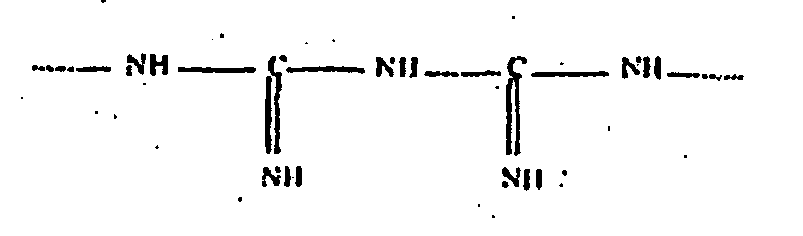
 6) n ist eine ganze Zahl im Bereich von 2 bis 500 und vorzugsweise 2 bis 200, und m ist eine ganze Zahl von 1 bis 1 000, vorzugsweise 1 bis 700 und noch besser 6 bis 200,wobei das Polymer bei Raumtemperatur fest und bei einer Temperatur von 25 bis 250 °C in der flüssigen Fettphase löslich ist,
einer ausreichenden Menge einer Verbindung, die befähigt ist, die Schmelzenthalpie und gegebenenfalls die Schmelztemperatur des Polymers zu senken und die unter den Monoalkoholen ausgewählt ist, um die Eigenschaften des Nichtübertragens bereitzustellen.
Applications Claiming Priority (5)
| Application Number | Priority Date | Filing Date | Title |
|---|---|---|---|
| FR0216040 | 2002-12-17 | ||
| FR0216040A FR2848449B1 (fr) | 2002-12-17 | 2002-12-17 | Composition cosmetique de soin et/ou de maquillage, structuree par des polymeres silicones |
| US43878203P | 2003-01-09 | 2003-01-09 | |
| US438782P | 2003-01-09 | ||
| PCT/EP2003/015006 WO2004054523A1 (en) | 2002-12-17 | 2003-12-08 | Care and/or make-up cosmetic composition structured with silicone polymers |
Publications (2)
| Publication Number | Publication Date |
|---|---|
| EP1575535A1 EP1575535A1 (de) | 2005-09-21 |
| EP1575535B1 true EP1575535B1 (de) | 2008-12-17 |
Family
ID=32598902
Family Applications (1)
| Application Number | Title | Priority Date | Filing Date |
|---|---|---|---|
| EP03782490A Expired - Lifetime EP1575535B1 (de) | 2002-12-17 | 2003-12-08 | Zusammensetzung für kosmetik oder zum schminken strukturiert mit silikonpolymeren |
Country Status (7)
| Country | Link |
|---|---|
| US (1) | US7887786B2 (de) |
| EP (1) | EP1575535B1 (de) |
| AT (1) | ATE417598T1 (de) |
| AU (1) | AU2003290128A1 (de) |
| DE (1) | DE60325417D1 (de) |
| ES (1) | ES2319762T3 (de) |
| WO (1) | WO2004054523A1 (de) |
Families Citing this family (59)
| Publication number | Priority date | Publication date | Assignee | Title |
|---|---|---|---|---|
| FR2840807B1 (fr) | 2002-06-12 | 2005-03-11 | Composition cosmetique de soin et/ou de maquillage, structuree par des polymeres silicones et des organogelateurs, sous forme rigide | |
| US7329699B2 (en) | 2003-07-11 | 2008-02-12 | L'oreal | Composition containing oil, structuring polymer, and coated silicone elastomer, and methods of making and using the same |
| WO2006060295A1 (en) | 2004-12-01 | 2006-06-08 | Dow Corning Corporation | Silicone polyether-amide block copolymers |
| US8241617B2 (en) | 2005-08-01 | 2012-08-14 | L'oréal | Methods for removing make-up compositions from keratin materials |
| US7790148B2 (en) | 2005-09-02 | 2010-09-07 | L'oreal | Compositions containing silicone polymer, wax and volatile solvent |
| EP2860213B1 (de) | 2005-12-23 | 2016-09-07 | 3M Innovative Properties Company | Mehrschichtfolien mit thermoplastischen Silikon-Blockcopolymeren |
| US7501184B2 (en) | 2005-12-23 | 2009-03-10 | 3M Innovative Properties Company | Polydiorganosiloxane polyoxamide copolymers |
| US7371464B2 (en) | 2005-12-23 | 2008-05-13 | 3M Innovative Properties Company | Adhesive compositions |
| KR101298355B1 (ko) | 2005-12-23 | 2013-08-20 | 쓰리엠 이노베이티브 프로퍼티즈 컴파니 | 열가소성 실리콘 블록 공중합체를 포함하는 필름 |
| WO2007109282A2 (en) | 2006-03-21 | 2007-09-27 | Dow Corning Corporation | Silicone-organic elastomer gels |
| JP5424866B2 (ja) | 2006-03-21 | 2014-02-26 | ダウ・コーニング・コーポレイション | シリコーンポリエーテルエラストマーゲル |
| US8557230B2 (en) | 2006-05-03 | 2013-10-15 | L'oreal | Cosmetic compositions containing block copolymers, tackifiers and shine enhancing agents |
| US8673284B2 (en) | 2006-05-03 | 2014-03-18 | L'oreal | Cosmetic compositions containing block copolymers, tackifiers and a selective solvent for hard blocks |
| US8758739B2 (en) | 2006-05-03 | 2014-06-24 | L'oreal | Cosmetic compositions containing block copolymers, tackifiers and gelling agents |
| US8778323B2 (en) | 2006-05-03 | 2014-07-15 | L'oréal | Cosmetic compositions containing block copolymers, tackifiers and modified silicones |
| US8673283B2 (en) | 2006-05-03 | 2014-03-18 | L'oreal | Cosmetic compositions containing block copolymers, tackifiers and a solvent mixture |
| US8673282B2 (en) | 2006-05-03 | 2014-03-18 | L'oreal | Cosmetic compositions containing block copolymers, tackifiers and a selective solvent for soft blocks |
| US8603444B2 (en) | 2007-01-12 | 2013-12-10 | L'oréal | Cosmetic compositions containing a block copolymer, a tackifier and a high viscosity ester |
| US8658141B2 (en) | 2007-01-12 | 2014-02-25 | L'oreal | Cosmetic composition containing a block copolymer, a tackifier, a silsesquioxane wax and/or resin |
| US20080171008A1 (en) * | 2007-01-17 | 2008-07-17 | L'oreal S.A. | Composition containing a polyorganosiloxane polymer, a tackifier, a wax and a block copolymer |
| DE102007038452A1 (de) * | 2007-08-14 | 2009-02-19 | Henkel Ag & Co. Kgaa | Mittel zur Behandlung harter Oberflächen |
| DE102007038450A1 (de) * | 2007-08-14 | 2009-02-19 | Henkel Ag & Co. Kgaa | Farbschützendes Wasch- oder Reinigungsmittel |
| DE102007038453A1 (de) * | 2007-08-14 | 2009-02-19 | Henkel Ag & Co. Kgaa | Fixierung von Duftstoffen aus Wasch- und Reinigungsmitteln an harten und weichen Oberflächen |
| US7705103B2 (en) | 2007-06-22 | 2010-04-27 | 3M Innovative Properties Company | Polydiorganosiloxane polyoxamide copolymers |
| US7705101B2 (en) | 2007-06-22 | 2010-04-27 | 3M Innovative Properties Company | Branched polydiorganosiloxane polyamide copolymers |
| US8063166B2 (en) | 2007-06-22 | 2011-11-22 | 3M Innovative Properties Company | Polydiorganosiloxane polyamide copolymers having organic soft segments |
| US20080318065A1 (en) | 2007-06-22 | 2008-12-25 | Sherman Audrey A | Mixtures of polydiorganosiloxane polyamide-containing components and organic polymers |
| US7507849B2 (en) | 2007-06-22 | 2009-03-24 | 3M Innovative Properties Company | Cyclic silazanes containing an oxamido ester group and methods of making these compounds |
| US8222363B2 (en) | 2007-09-26 | 2012-07-17 | Dow Corning Corporation | Silicone organic elastomer gels from organopolysiloxane resins |
| US8431671B2 (en) | 2008-03-26 | 2013-04-30 | 3M Innovative Properties Company | Structured polydiorganosiloxane polyamide containing devices and methods |
| CN102027082B (zh) | 2008-04-14 | 2013-09-18 | 陶氏康宁公司 | 硼交联的有机基聚硅氧烷的乳液 |
| EP2337555B1 (de) | 2008-10-22 | 2016-07-13 | Dow Corning Corporation | Aminofunktionale end-blockierte silikon-polyether-copolymere in körperpflegezusammensetzungen |
| EP2473561B1 (de) | 2009-09-03 | 2016-11-16 | Dow Corning Corporation | Körperpflegezusammensetzungen mit weichen silikonfluiden |
| KR20120059599A (ko) | 2009-09-03 | 2012-06-08 | 다우 코닝 코포레이션 | 점액성 실리콘 유체 |
| KR20120101015A (ko) | 2009-10-23 | 2012-09-12 | 다우 코닝 코포레이션 | 친수성-개질된 실리콘 조성물 |
| CN102666665B (zh) | 2009-10-23 | 2015-07-22 | 道康宁公司 | 包含溶胀的硅酮凝胶的硅酮组合物 |
| JP5744046B2 (ja) | 2009-11-25 | 2015-07-01 | ダウ コーニング コーポレーションDow Corning Corporation | 揮発性環状シロキサン |
| US20120219516A1 (en) | 2011-02-25 | 2012-08-30 | L'oreal S.A. | Cosmetic compositions having long lasting shine |
| US20140308229A1 (en) | 2011-11-29 | 2014-10-16 | Dow Corning Corporation | Aminofunctional Silicone Emulsions For Fiber Treatments |
| US9610239B2 (en) | 2012-10-11 | 2017-04-04 | Dow Corning Corporation | Aqueous silicone polyether microemulsions |
| WO2015167963A1 (en) | 2014-04-28 | 2015-11-05 | Dow Corning Corporation | Cross-linked composition and cosmetic composition comprising the same |
| JP6340437B2 (ja) | 2014-05-21 | 2018-06-06 | ダウ シリコーンズ コーポレーション | 架橋アミノシロキサンポリマー及び生成方法 |
| US9872828B2 (en) | 2014-05-21 | 2018-01-23 | Dow Corning Corporation | Emulsion of cross-linked aminosiloxane polymer |
| JP6334807B2 (ja) | 2014-07-23 | 2018-05-30 | ダウ シリコーンズ コーポレーション | 粘液性シリコーン流体 |
| WO2016100830A1 (en) | 2014-12-19 | 2016-06-23 | Dow Corning Corporation | Method of preparing functionalized particles |
| US10441527B2 (en) | 2015-04-08 | 2019-10-15 | Dow Silicones Corporation | Fluid compositions and personal care |
| EP3280770A1 (de) | 2015-04-08 | 2018-02-14 | Dow Corning Corporation | Weiche silikonfluidzusammensetzung |
| KR101987005B1 (ko) | 2015-04-08 | 2019-06-10 | 다우 실리콘즈 코포레이션 | 점액성 실리콘 에멀젼 |
| CN109069368A (zh) | 2016-04-27 | 2018-12-21 | 美国陶氏有机硅公司 | 亲水性硅烷 |
| EP3455283B1 (de) | 2016-05-10 | 2020-06-10 | Dow Silicones Corporation | Silikonblockcopolymer mit einer aminofunktionellen endblockierenden gruppe und verfahren zu dessen herstellung und verwendung |
| WO2018052648A1 (en) | 2016-09-19 | 2018-03-22 | Dow Corning Corporation | Copolymer composition for personal care |
| US11672768B2 (en) | 2016-09-19 | 2023-06-13 | Dow Silicones Corporation | Skin contact adhesive and methods for its preparation and use |
| US11142639B2 (en) | 2016-09-19 | 2021-10-12 | Dow Silicones Corporation | Polyurethane-polyorganosiloxane copolymer and method for its preparation |
| US20210177726A1 (en) | 2017-02-15 | 2021-06-17 | Dow Silicones Corporation | Personal care compositions including a polyurethane - polyorganosiloxane copolymer |
| JP7311505B2 (ja) | 2017-11-20 | 2023-07-19 | ダウ シリコーンズ コーポレーション | 架橋アミノシリコーンポリマー並びにその調製方法及び使用 |
| EP4061854B1 (de) | 2019-11-19 | 2024-11-27 | Dow Silicones Corporation | Silikonglykan und methoden zur herstellung |
| US20220363783A1 (en) | 2019-11-19 | 2022-11-17 | Dow Silicones Corporation | Method of preparing a silicon glycan |
| CN114630857A (zh) | 2019-11-26 | 2022-06-14 | 美国陶氏有机硅公司 | 用于制备聚环氧硅氮烷和使用聚环氧硅氮烷生成氨基官能化聚有机硅氧烷的方法 |
| JP2024518988A (ja) | 2021-05-18 | 2024-05-08 | ダウ シリコーンズ コーポレーション | 環状シロキサザンの作製プロセス及びアミノ官能性ポリオルガノシロキサンの製造のためのその使用 |
Family Cites Families (80)
| Publication number | Priority date | Publication date | Assignee | Title |
|---|---|---|---|---|
| US2823195A (en) * | 1955-02-21 | 1958-02-11 | Dow Corning | Organosilicon polyamide compositions and method of making same |
| BE553159A (de) * | 1955-12-05 | |||
| CA937698A (en) | 1970-05-04 | 1973-11-27 | Dow Corning Limited | Organosiloxane polyamide block copolymers |
| US3723566A (en) * | 1970-05-04 | 1973-03-27 | Midland Silicones Ltd | Organosiloxane polyamide block copolymers |
| US4322400A (en) * | 1978-12-19 | 1982-03-30 | Dragoco Inc. | Cosmetic stick composition |
| US4226889A (en) | 1978-12-19 | 1980-10-07 | Dragoco, Inc. | Cosmetic stick composition |
| DE3637677A1 (de) * | 1986-11-05 | 1988-05-19 | Bayer Ag | Schlagzaehe, dimensionsstabile polyamid-formmassen |
| JP2704730B2 (ja) | 1988-07-12 | 1998-01-26 | 株式会社コーセー | 化粧料 |
| CA2005161A1 (en) | 1989-01-03 | 1990-07-03 | Gary T. Decker | Polysiloxane-polyamide block copolymers |
| JP2660884B2 (ja) * | 1991-07-30 | 1997-10-08 | 東レ・ダウコーニング・シリコーン株式会社 | シリコーン変性ポリイミド樹脂およびその製造方法 |
| EP0545002A1 (de) * | 1991-11-21 | 1993-06-09 | Kose Corporation | Siliconpolymer und dieses enthaltende pastöse Zusammensetzung sowie kosmetische Zubereitung des Typs Wasser-in-Öl |
| US5468477A (en) * | 1992-05-12 | 1995-11-21 | Minnesota Mining And Manufacturing Company | Vinyl-silicone polymers in cosmetics and personal care products |
| JP3302729B2 (ja) * | 1992-07-30 | 2002-07-15 | 東レ・ダウコーニング・シリコーン株式会社 | ポリアミド樹脂組成物 |
| US5272241A (en) * | 1992-08-21 | 1993-12-21 | General Electric Company | Amino acid functionalized silicones and method for preparation |
| US5399342A (en) | 1993-02-03 | 1995-03-21 | Dow Corning Corporation | Cosmetics with enhanced durability |
| US5473041A (en) * | 1993-05-25 | 1995-12-05 | Dow Corning Corporation | Polyimide having organopolysiloxane side chain |
| DE69415678T2 (de) * | 1993-08-27 | 1999-07-22 | Procter & Gamble | Polysiloxan gepfropftes klebstoffpolymer und trocknungshilfeagent enthaltende pflegemittel |
| JPH0834852A (ja) | 1994-07-21 | 1996-02-06 | Toray Dow Corning Silicone Co Ltd | シリコーン変性ポリアミド溶液組成物 |
| FR2725129B1 (fr) * | 1994-09-30 | 1997-06-13 | Oreal | Composition cosmetique anhydre resistante a l'eau |
| IL115693A (en) | 1994-10-25 | 2000-08-13 | Revlon Consumer Prod Corp | Cosmetic compositions with improved transfer resistance |
| FR2735689B1 (fr) * | 1995-06-21 | 1997-08-01 | Oreal | Composition comprenant une dispersion de particules de polymeres dans un milieu non aqueux |
| CA2197498C (fr) * | 1995-06-21 | 2002-12-17 | Nathalie Mougin | Composition cosmetique comprenant une dispersion de particules de polymere |
| AU6286296A (en) * | 1995-06-26 | 1997-01-30 | Revlon Consumer Products Corporation | Glossy transfer resistant cosmetic compositions |
| JPH0971505A (ja) | 1995-06-27 | 1997-03-18 | Pola Chem Ind Inc | 架橋型シリコーン含有化粧料 |
| US5725845A (en) * | 1995-11-03 | 1998-03-10 | Revlon Consumer Products Corporation | Transfer resistant cosmetic stick compositions with semi-matte finish |
| US5919441A (en) * | 1996-04-01 | 1999-07-06 | Colgate-Palmolive Company | Cosmetic composition containing thickening agent of siloxane polymer with hydrogen-bonding groups |
| US5874069A (en) * | 1997-01-24 | 1999-02-23 | Colgate-Palmolive Company | Cosmetic composition containing silicon-modified amides as thickening agents and method of forming same |
| US5837223A (en) * | 1996-08-12 | 1998-11-17 | Revlon Consumer Products Corporation | Transfer resistant high lustre cosmetic stick compositions |
| FR2757381B1 (fr) * | 1996-12-24 | 1999-01-15 | Oreal | Composition de maquillage ou de soin ne migrant pas, contenant un organopolysiloxane et une phase grasse |
| FR2765800B1 (fr) | 1997-07-11 | 2003-04-25 | Oreal | Produit cosmetique coule comprenant des huiles volatiles hydrocarbonees |
| US6051216A (en) * | 1997-08-01 | 2000-04-18 | Colgate-Palmolive Company | Cosmetic composition containing siloxane based polyamides as thickening agents |
| EP0966263B1 (de) | 1997-10-31 | 2005-03-02 | Color Access, Inc. | Farbübertragungsbeständige kosmetische zusammensetzung |
| US5959009A (en) * | 1997-10-31 | 1999-09-28 | E-L Management Corp | Mascara waterproofing composition |
| FR2772602B1 (fr) * | 1997-12-22 | 2000-01-28 | Oreal | Composition cosmetique sans transfert comprenant une dispersion de particules de polymere dans une phase grasse liquide et un polymere liposoluble |
| US5969172C1 (en) * | 1998-06-12 | 2002-06-18 | Gen Electric | Silicone solvents for antiperspirant salts |
| FR2780282B1 (fr) * | 1998-06-25 | 2001-04-13 | Oreal | Composition anhydre, utilisation en cosmetique, pharmacie ou hygiene |
| US5981680A (en) * | 1998-07-13 | 1999-11-09 | Dow Corning Corporation | Method of making siloxane-based polyamides |
| US6503632B1 (en) * | 1998-08-14 | 2003-01-07 | Nof Corporation | Polydialkylsiloxane/polyamide copolymer, process for producing the same, and various materials |
| US6200581B1 (en) | 1999-04-28 | 2001-03-13 | Dow Corning Corporation | Elastomeric silicone terpolymer |
| JP3932155B2 (ja) * | 1999-06-03 | 2007-06-20 | 信越化学工業株式会社 | 球状シリコーン樹脂微粒子 |
| US6103250A (en) * | 1999-07-06 | 2000-08-15 | Revlon Consumer Products Corporation | Anhydrous cosmetic compositions containing emulsifying siloxane elastomer |
| FR2796272B1 (fr) | 1999-07-15 | 2003-09-19 | Oreal | Composition sans cire structuree sous forme rigide par un polymere |
| MY133783A (en) | 1999-07-28 | 2007-11-30 | Dow Global Technologies Inc | Hydrogenated block polymers having elasticity and articles made therefrom |
| JP2001081009A (ja) | 1999-09-10 | 2001-03-27 | Nof Corp | シリコーン共重合体を含有してなる化粧料 |
| ATE293425T1 (de) | 1999-12-28 | 2005-05-15 | Oreal | Strukturierte langhaltige zubereitung enthaltend ein polymer und pastöse fettstoffe |
| US6362287B1 (en) * | 2000-03-27 | 2002-03-26 | Dow Corning Corportion | Thermoplastic silicone elastomers formed from nylon resins |
| FR2808678B1 (fr) * | 2000-05-09 | 2003-06-20 | Oreal | Utilisation en cosmetique d'au moins un organopolysiloxane en tant que gelifiant et composition cosmetique le contenant |
| FR2808679B1 (fr) | 2000-05-09 | 2006-09-22 | Oreal | Procede pour accroitre la persistance d'au moins un effet cosmetique et/ou de soin d'une composition cosmetique, composition cosmetique et son utilisation |
| US6423324B1 (en) | 2000-06-20 | 2002-07-23 | Cosmolab, Inc. | Temperature-stable polyamide resin-based composition, and products |
| US6524598B2 (en) * | 2000-07-10 | 2003-02-25 | The Procter & Gamble Company | Cosmetic compositions |
| US6475500B2 (en) * | 2000-07-10 | 2002-11-05 | The Procter & Gamble Company | Anhydrous cosmetic compositions |
| US6362288B1 (en) * | 2000-07-26 | 2002-03-26 | Dow Corning Corporation | Thermoplastic silicone elastomers from compatibilized polyamide resins |
| US6451295B1 (en) * | 2000-08-31 | 2002-09-17 | Colgate-Palmolive Company | Clear antiperspirants and deodorants made with siloxane-based polyamides |
| US20020048557A1 (en) * | 2000-08-31 | 2002-04-25 | Heng Cai | Antiperspirants and deodorants with low white residue on skin and fabric |
| JP2002173459A (ja) | 2000-09-28 | 2002-06-21 | Nippon Shokubai Co Ltd | 2,4,5−トリアルキルベンズアルデヒドの製造方法 |
| JP2002173464A (ja) | 2000-12-05 | 2002-06-21 | Nippon Shokubai Co Ltd | メタクリル酸の製造方法 |
| JP4447152B2 (ja) | 2000-12-07 | 2010-04-07 | 協和発酵ケミカル株式会社 | ケトン類の製造法 |
| US20030039620A1 (en) | 2001-05-04 | 2003-02-27 | Rodriguez Victor Ruben | Transfer resistant, non-tacky, liquid cosmetic compositions for covering skin discolorations and imperfections |
| FR2825915B1 (fr) | 2001-06-14 | 2006-02-03 | Oreal | Composition a base d'huile siliconee structuree sous forme rigide, notamment pour une utilisation cosmetique |
| FR2825916B1 (fr) | 2001-06-14 | 2004-07-23 | Oreal | Composition a base d'huile siliconee structuree sous forme rigide, notamment pour une utilisation cosmetique |
| FR2825914B1 (fr) | 2001-06-14 | 2003-09-19 | Oreal | Composition a base d'huile siliconee structuree sous forme rigide, notamment pour une utilisation cosmetique |
| US20030082129A1 (en) * | 2001-08-07 | 2003-05-01 | Buckingham Anne Marie | Hair and skin care compositions containing siloxane-based polyamide copolymers |
| US6426062B1 (en) * | 2001-10-05 | 2002-07-30 | Colgate-Palmolive Company | Underarm gel products with water lock component |
| US6569955B1 (en) * | 2001-10-19 | 2003-05-27 | Dow Corning Corporation | Thermoplastic silicone elastomers from compatibilized polyamide resins |
| US20030228333A1 (en) | 2002-05-28 | 2003-12-11 | Fecht Cassandre Michelle | Substituted hydrocarbyl functional siloxanes for household, health, and personal care applications |
| US6958155B2 (en) * | 2002-06-12 | 2005-10-25 | L'oreal | Cosmetic compositions comprising at least one polysiloxane based polyamide |
| US20040115153A1 (en) * | 2002-12-17 | 2004-06-17 | L'oreal | Compositions containing at least one oil structured with at least one silicone-polyamide polymer, and at least one silicone gum and methods of using the same |
| US7879316B2 (en) * | 2002-06-12 | 2011-02-01 | L'oreal | Cosmetic composition containing a polyorganosiloxane polymer |
| US6916464B2 (en) * | 2002-12-20 | 2005-07-12 | L'oreal | Sunscreen compositions |
| US20030232030A1 (en) * | 2002-06-12 | 2003-12-18 | L'oreal | Compositions containing at least one oil structured with at least one silicone-polyamide polymer, and at least one gelling agent and methods of using the same |
| US20040115154A1 (en) * | 2002-12-17 | 2004-06-17 | L'oreal | Compositions containing at least one oil structured with at least one silicone-polyamide polymer, and at least one short chain ester and methods of using the same |
| US7329699B2 (en) * | 2003-07-11 | 2008-02-12 | L'oreal | Composition containing oil, structuring polymer, and coated silicone elastomer, and methods of making and using the same |
| US20030235553A1 (en) * | 2002-06-12 | 2003-12-25 | L'oreal | Cosmetic compositions containing at least one silicone-polyamide polymer, at least one oil and at least one film-forming agent and methods of using the same |
| US20040120912A1 (en) * | 2002-12-17 | 2004-06-24 | L'oreal | Compositions containing at least one oil structured with at least one silicone-polyamide polymer, and at least one crystalline silicone compound and methods of using the same |
| US20030235548A1 (en) * | 2002-06-12 | 2003-12-25 | L'oreal | Cosmetic composition for care and/or treatment and/or makeup of the emulsion type structured with silicone polymers |
| US20030235552A1 (en) * | 2002-06-12 | 2003-12-25 | L'oreal | Cosmetic composition for care and/or makeup, structured with silicone polymers and film-forming silicone resins |
| FR2840807B1 (fr) | 2002-06-12 | 2005-03-11 | Composition cosmetique de soin et/ou de maquillage, structuree par des polymeres silicones et des organogelateurs, sous forme rigide | |
| US20040180032A1 (en) * | 2003-03-15 | 2004-09-16 | Manelski Jean Marie | Long wearing cosmetic composition |
| US20050158260A1 (en) * | 2003-12-12 | 2005-07-21 | L'oreal | Cosmetic composition containing a polyorganosiloxane polymer |
| US20080171008A1 (en) | 2007-01-17 | 2008-07-17 | L'oreal S.A. | Composition containing a polyorganosiloxane polymer, a tackifier, a wax and a block copolymer |
-
2003
- 2003-12-08 EP EP03782490A patent/EP1575535B1/de not_active Expired - Lifetime
- 2003-12-08 AU AU2003290128A patent/AU2003290128A1/en not_active Abandoned
- 2003-12-08 DE DE60325417T patent/DE60325417D1/de not_active Expired - Lifetime
- 2003-12-08 ES ES03782490T patent/ES2319762T3/es not_active Expired - Lifetime
- 2003-12-08 WO PCT/EP2003/015006 patent/WO2004054523A1/en not_active Ceased
- 2003-12-08 AT AT03782490T patent/ATE417598T1/de not_active IP Right Cessation
- 2003-12-08 US US10/538,924 patent/US7887786B2/en not_active Expired - Lifetime
Also Published As
| Publication number | Publication date |
|---|---|
| AU2003290128A1 (en) | 2004-07-09 |
| US20060204470A1 (en) | 2006-09-14 |
| ATE417598T1 (de) | 2009-01-15 |
| ES2319762T3 (es) | 2009-05-12 |
| EP1575535A1 (de) | 2005-09-21 |
| WO2004054523A1 (en) | 2004-07-01 |
| US7887786B2 (en) | 2011-02-15 |
| DE60325417D1 (de) | 2009-01-29 |
Similar Documents
| Publication | Publication Date | Title |
|---|---|---|
| EP1515684B1 (de) | Mit silikonpolymeren und organischen geliermitteln strukturierte pflege- und/oder- makeup-zusammensetzung in starrer form | |
| EP1578387B1 (de) | Durchsichtige oder durchscheinende kosmetische zusammensetzung strukturiert mit silikonpolymeren | |
| US7887786B2 (en) | Care and/or make-up cosmetic composition structured with silicone polymers | |
| US7820146B2 (en) | Care and/or make-up cosmetic composition structured with silicone polymers and organogelling agents, in rigid form | |
| EP1531790B1 (de) | Mit silikonpolymeren und filmbildenden harzen strukturierte kosmetische zusammensetzung | |
| EP1524961B1 (de) | Kosmetische zusammensetzung für pflege und/oder behandlung und/oder makeup vom emulsionstyp, strukturiert mit silikonpolymeren | |
| EP1515685B1 (de) | Zusammensetzungen, die mindestens ein öl, das mit mindestens einem silicon-polyamid-polymer strukturiert ist, und mindestens ein filmbildendes polymer enthalten, und verfahren dafür | |
| US20030072730A1 (en) | Composition based on silicone oil structured in rigid form, especially for cosmetic use | |
| US7078026B2 (en) | Structured composition based on silicone oil, especially for cosmetic use | |
| US20040120912A1 (en) | Compositions containing at least one oil structured with at least one silicone-polyamide polymer, and at least one crystalline silicone compound and methods of using the same | |
| US20030170188A1 (en) | Composition based on silicone oil structured in rigid form, especially for cosmetic use | |
| US20040115154A1 (en) | Compositions containing at least one oil structured with at least one silicone-polyamide polymer, and at least one short chain ester and methods of using the same | |
| US20040115153A1 (en) | Compositions containing at least one oil structured with at least one silicone-polyamide polymer, and at least one silicone gum and methods of using the same | |
| US20010031280A1 (en) | Composition comprising at least one hetero polymer and at least one pasty fatty substance and methods for use | |
| JP4907989B2 (ja) | シリコーンポリマーで構造化されたケアおよび/またはメーキャップ用化粧品組成物 |
Legal Events
| Date | Code | Title | Description |
|---|---|---|---|
| PUAI | Public reference made under article 153(3) epc to a published international application that has entered the european phase |
Free format text: ORIGINAL CODE: 0009012 |
|
| 17P | Request for examination filed |
Effective date: 20050718 |
|
| AK | Designated contracting states |
Kind code of ref document: A1 Designated state(s): AT BE BG CH CY CZ DE DK EE ES FI FR GB GR HU IE IT LI LU MC NL PT RO SE SI SK TR |
|
| AX | Request for extension of the european patent |
Extension state: AL LT LV MK |
|
| DAX | Request for extension of the european patent (deleted) | ||
| 17Q | First examination report despatched |
Effective date: 20060921 |
|
| RIC1 | Information provided on ipc code assigned before grant |
Ipc: A61Q 1/00 20060101ALI20080619BHEP Ipc: A61K 8/34 20060101ALI20080619BHEP Ipc: A61K 8/898 20060101AFI20080619BHEP |
|
| GRAP | Despatch of communication of intention to grant a patent |
Free format text: ORIGINAL CODE: EPIDOSNIGR1 |
|
| GRAS | Grant fee paid |
Free format text: ORIGINAL CODE: EPIDOSNIGR3 |
|
| GRAS | Grant fee paid |
Free format text: ORIGINAL CODE: EPIDOSNIGR3 |
|
| GRAA | (expected) grant |
Free format text: ORIGINAL CODE: 0009210 |
|
| AK | Designated contracting states |
Kind code of ref document: B1 Designated state(s): AT BE BG CH CY CZ DE DK EE ES FI FR GB GR HU IE IT LI LU MC NL PT RO SE SI SK TR |
|
| REG | Reference to a national code |
Ref country code: GB Ref legal event code: FG4D |
|
| REG | Reference to a national code |
Ref country code: CH Ref legal event code: EP |
|
| REG | Reference to a national code |
Ref country code: IE Ref legal event code: FG4D |
|
| REF | Corresponds to: |
Ref document number: 60325417 Country of ref document: DE Date of ref document: 20090129 Kind code of ref document: P |
|
| REG | Reference to a national code |
Ref country code: ES Ref legal event code: FG2A Ref document number: 2319762 Country of ref document: ES Kind code of ref document: T3 |
|
| PG25 | Lapsed in a contracting state [announced via postgrant information from national office to epo] |
Ref country code: NL Free format text: LAPSE BECAUSE OF FAILURE TO SUBMIT A TRANSLATION OF THE DESCRIPTION OR TO PAY THE FEE WITHIN THE PRESCRIBED TIME-LIMIT Effective date: 20081217 Ref country code: FI Free format text: LAPSE BECAUSE OF FAILURE TO SUBMIT A TRANSLATION OF THE DESCRIPTION OR TO PAY THE FEE WITHIN THE PRESCRIBED TIME-LIMIT Effective date: 20081217 Ref country code: SI Free format text: LAPSE BECAUSE OF FAILURE TO SUBMIT A TRANSLATION OF THE DESCRIPTION OR TO PAY THE FEE WITHIN THE PRESCRIBED TIME-LIMIT Effective date: 20081217 |
|
| NLV1 | Nl: lapsed or annulled due to failure to fulfill the requirements of art. 29p and 29m of the patents act | ||
| PG25 | Lapsed in a contracting state [announced via postgrant information from national office to epo] |
Ref country code: EE Free format text: LAPSE BECAUSE OF FAILURE TO SUBMIT A TRANSLATION OF THE DESCRIPTION OR TO PAY THE FEE WITHIN THE PRESCRIBED TIME-LIMIT Effective date: 20081217 Ref country code: BG Free format text: LAPSE BECAUSE OF FAILURE TO SUBMIT A TRANSLATION OF THE DESCRIPTION OR TO PAY THE FEE WITHIN THE PRESCRIBED TIME-LIMIT Effective date: 20090317 Ref country code: BE Free format text: LAPSE BECAUSE OF FAILURE TO SUBMIT A TRANSLATION OF THE DESCRIPTION OR TO PAY THE FEE WITHIN THE PRESCRIBED TIME-LIMIT Effective date: 20081217 Ref country code: RO Free format text: LAPSE BECAUSE OF FAILURE TO SUBMIT A TRANSLATION OF THE DESCRIPTION OR TO PAY THE FEE WITHIN THE PRESCRIBED TIME-LIMIT Effective date: 20081217 |
|
| PG25 | Lapsed in a contracting state [announced via postgrant information from national office to epo] |
Ref country code: SE Free format text: LAPSE BECAUSE OF FAILURE TO SUBMIT A TRANSLATION OF THE DESCRIPTION OR TO PAY THE FEE WITHIN THE PRESCRIBED TIME-LIMIT Effective date: 20090317 Ref country code: PT Free format text: LAPSE BECAUSE OF FAILURE TO SUBMIT A TRANSLATION OF THE DESCRIPTION OR TO PAY THE FEE WITHIN THE PRESCRIBED TIME-LIMIT Effective date: 20090518 Ref country code: AT Free format text: LAPSE BECAUSE OF FAILURE TO SUBMIT A TRANSLATION OF THE DESCRIPTION OR TO PAY THE FEE WITHIN THE PRESCRIBED TIME-LIMIT Effective date: 20081217 Ref country code: CZ Free format text: LAPSE BECAUSE OF FAILURE TO SUBMIT A TRANSLATION OF THE DESCRIPTION OR TO PAY THE FEE WITHIN THE PRESCRIBED TIME-LIMIT Effective date: 20081217 |
|
| PG25 | Lapsed in a contracting state [announced via postgrant information from national office to epo] |
Ref country code: SK Free format text: LAPSE BECAUSE OF FAILURE TO SUBMIT A TRANSLATION OF THE DESCRIPTION OR TO PAY THE FEE WITHIN THE PRESCRIBED TIME-LIMIT Effective date: 20081217 |
|
| PLBE | No opposition filed within time limit |
Free format text: ORIGINAL CODE: 0009261 |
|
| STAA | Information on the status of an ep patent application or granted ep patent |
Free format text: STATUS: NO OPPOSITION FILED WITHIN TIME LIMIT |
|
| PG25 | Lapsed in a contracting state [announced via postgrant information from national office to epo] |
Ref country code: DK Free format text: LAPSE BECAUSE OF FAILURE TO SUBMIT A TRANSLATION OF THE DESCRIPTION OR TO PAY THE FEE WITHIN THE PRESCRIBED TIME-LIMIT Effective date: 20081217 |
|
| 26N | No opposition filed |
Effective date: 20090918 |
|
| PG25 | Lapsed in a contracting state [announced via postgrant information from national office to epo] |
Ref country code: MC Free format text: LAPSE BECAUSE OF NON-PAYMENT OF DUE FEES Effective date: 20100701 |
|
| REG | Reference to a national code |
Ref country code: CH Ref legal event code: PL |
|
| REG | Reference to a national code |
Ref country code: IE Ref legal event code: MM4A |
|
| PG25 | Lapsed in a contracting state [announced via postgrant information from national office to epo] |
Ref country code: IE Free format text: LAPSE BECAUSE OF NON-PAYMENT OF DUE FEES Effective date: 20091208 Ref country code: LI Free format text: LAPSE BECAUSE OF NON-PAYMENT OF DUE FEES Effective date: 20091231 Ref country code: GR Free format text: LAPSE BECAUSE OF FAILURE TO SUBMIT A TRANSLATION OF THE DESCRIPTION OR TO PAY THE FEE WITHIN THE PRESCRIBED TIME-LIMIT Effective date: 20090318 Ref country code: CH Free format text: LAPSE BECAUSE OF NON-PAYMENT OF DUE FEES Effective date: 20091231 |
|
| PG25 | Lapsed in a contracting state [announced via postgrant information from national office to epo] |
Ref country code: LU Free format text: LAPSE BECAUSE OF NON-PAYMENT OF DUE FEES Effective date: 20091208 |
|
| PG25 | Lapsed in a contracting state [announced via postgrant information from national office to epo] |
Ref country code: HU Free format text: LAPSE BECAUSE OF FAILURE TO SUBMIT A TRANSLATION OF THE DESCRIPTION OR TO PAY THE FEE WITHIN THE PRESCRIBED TIME-LIMIT Effective date: 20090618 |
|
| PG25 | Lapsed in a contracting state [announced via postgrant information from national office to epo] |
Ref country code: TR Free format text: LAPSE BECAUSE OF FAILURE TO SUBMIT A TRANSLATION OF THE DESCRIPTION OR TO PAY THE FEE WITHIN THE PRESCRIBED TIME-LIMIT Effective date: 20081217 |
|
| PG25 | Lapsed in a contracting state [announced via postgrant information from national office to epo] |
Ref country code: CY Free format text: LAPSE BECAUSE OF FAILURE TO SUBMIT A TRANSLATION OF THE DESCRIPTION OR TO PAY THE FEE WITHIN THE PRESCRIBED TIME-LIMIT Effective date: 20081217 |
|
| REG | Reference to a national code |
Ref country code: FR Ref legal event code: PLFP Year of fee payment: 13 |
|
| REG | Reference to a national code |
Ref country code: FR Ref legal event code: PLFP Year of fee payment: 14 |
|
| REG | Reference to a national code |
Ref country code: FR Ref legal event code: PLFP Year of fee payment: 15 |
|
| PGFP | Annual fee paid to national office [announced via postgrant information from national office to epo] |
Ref country code: FR Payment date: 20221010 Year of fee payment: 20 |
|
| PGFP | Annual fee paid to national office [announced via postgrant information from national office to epo] |
Ref country code: IT Payment date: 20221111 Year of fee payment: 20 Ref country code: GB Payment date: 20221020 Year of fee payment: 20 Ref country code: DE Payment date: 20221011 Year of fee payment: 20 |
|
| PGFP | Annual fee paid to national office [announced via postgrant information from national office to epo] |
Ref country code: ES Payment date: 20230110 Year of fee payment: 20 |
|
| REG | Reference to a national code |
Ref country code: DE Ref legal event code: R071 Ref document number: 60325417 Country of ref document: DE |
|
| REG | Reference to a national code |
Ref country code: GB Ref legal event code: PE20 Expiry date: 20231207 Ref country code: ES Ref legal event code: FD2A Effective date: 20231227 |
|
| PG25 | Lapsed in a contracting state [announced via postgrant information from national office to epo] |
Ref country code: GB Free format text: LAPSE BECAUSE OF EXPIRATION OF PROTECTION Effective date: 20231207 |
|
| PG25 | Lapsed in a contracting state [announced via postgrant information from national office to epo] |
Ref country code: ES Free format text: LAPSE BECAUSE OF EXPIRATION OF PROTECTION Effective date: 20231209 |
|
| PG25 | Lapsed in a contracting state [announced via postgrant information from national office to epo] |
Ref country code: GB Free format text: LAPSE BECAUSE OF EXPIRATION OF PROTECTION Effective date: 20231207 Ref country code: ES Free format text: LAPSE BECAUSE OF EXPIRATION OF PROTECTION Effective date: 20231209 |