EP1575243A2 - Passagierpositions-Informationssystem, bewegliches Informationsendgerät und Server - Google Patents
Passagierpositions-Informationssystem, bewegliches Informationsendgerät und Server Download PDFInfo
- Publication number
- EP1575243A2 EP1575243A2 EP05100505A EP05100505A EP1575243A2 EP 1575243 A2 EP1575243 A2 EP 1575243A2 EP 05100505 A EP05100505 A EP 05100505A EP 05100505 A EP05100505 A EP 05100505A EP 1575243 A2 EP1575243 A2 EP 1575243A2
- Authority
- EP
- European Patent Office
- Prior art keywords
- information
- information terminal
- location information
- portable information
- passenger
- Prior art date
- Legal status (The legal status is an assumption and is not a legal conclusion. Google has not performed a legal analysis and makes no representation as to the accuracy of the status listed.)
- Withdrawn
Links
Images




Classifications
-
- H—ELECTRICITY
- H04—ELECTRIC COMMUNICATION TECHNIQUE
- H04L—TRANSMISSION OF DIGITAL INFORMATION, e.g. TELEGRAPHIC COMMUNICATION
- H04L67/00—Network arrangements or protocols for supporting network services or applications
- H04L67/01—Protocols
- H04L67/04—Protocols specially adapted for terminals or networks with limited capabilities; specially adapted for terminal portability
-
- H—ELECTRICITY
- H04—ELECTRIC COMMUNICATION TECHNIQUE
- H04L—TRANSMISSION OF DIGITAL INFORMATION, e.g. TELEGRAPHIC COMMUNICATION
- H04L67/00—Network arrangements or protocols for supporting network services or applications
- H04L67/50—Network services
- H04L67/52—Network services specially adapted for the location of the user terminal
-
- H—ELECTRICITY
- H04—ELECTRIC COMMUNICATION TECHNIQUE
- H04L—TRANSMISSION OF DIGITAL INFORMATION, e.g. TELEGRAPHIC COMMUNICATION
- H04L67/00—Network arrangements or protocols for supporting network services or applications
- H04L67/50—Network services
- H04L67/53—Network services using third party service providers
-
- H—ELECTRICITY
- H04—ELECTRIC COMMUNICATION TECHNIQUE
- H04L—TRANSMISSION OF DIGITAL INFORMATION, e.g. TELEGRAPHIC COMMUNICATION
- H04L67/00—Network arrangements or protocols for supporting network services or applications
- H04L67/50—Network services
- H04L67/75—Indicating network or usage conditions on the user display
-
- H—ELECTRICITY
- H04—ELECTRIC COMMUNICATION TECHNIQUE
- H04L—TRANSMISSION OF DIGITAL INFORMATION, e.g. TELEGRAPHIC COMMUNICATION
- H04L69/00—Network arrangements, protocols or services independent of the application payload and not provided for in the other groups of this subclass
- H04L69/30—Definitions, standards or architectural aspects of layered protocol stacks
- H04L69/32—Architecture of open systems interconnection [OSI] 7-layer type protocol stacks, e.g. the interfaces between the data link level and the physical level
- H04L69/322—Intralayer communication protocols among peer entities or protocol data unit [PDU] definitions
- H04L69/329—Intralayer communication protocols among peer entities or protocol data unit [PDU] definitions in the application layer [OSI layer 7]
Definitions
- the present invention relates to a passenger location information system and a portable information terminal and server used in this system.
- Guidance services for transportation passengers include a conventional in-car announcement and color-based guidance information, provided in a station and a stop, that helps passengers to identify the number of a station or a stop displayed in a graphic, whose color is predetermined for each line, so that they can instantly know where they are.
- Another service widely used today is an electric bulletin board installed in a car for guidance.
- the widespread use of a wide-field, low profile display enables rich content to be provided. Because this display is effective especially in a crowded car or for hearing-impaired persons, the passenger transportation companies compete for introducing this type of display to provide better services than those of others.
- Japanese Patent Kokai Publication No. JP-P2002-300634A discloses a mobile communication terminal notification system for railway passengers.
- the user uses a communication terminal, in advance, to send a message reception condition and registers it with a communication network server via the information processing system of the train.
- the user receives the message notification signal.
- Japanese Patent Kokai Publication No. JP-P2002-114149A also discloses a device that combines the transportation line network database, the transportation route search server, and the transportation route derivation server to provide guidance information to the transportation users.
- the method using a personal mobile information terminal described above requires the user to set a message reception condition each time the user uses it.
- the user is required to set a message reception condition only once; however, once the condition is set, the message reception operation is started or the guidance message is notified automatically and, as the user uses this system repeatedly, it is likely that the effect will be reduced significantly.
- the message reception sound which notifies that the message is received, is turned off or when the user fails to hear the guidance information, the user feels uneasy or rides past the destination.
- a passenger location information system using a portable information terminal and an apparatus such as a portable information terminal used in the system.
- a server accessible from the portable information terminal comprises means for determining a transportation line interval, in which the portable information terminal is located, from location information on the portable information terminal.
- the portable information terminal comprises location information acquisition means for acquiring location information on the portable information terminal from the GPS, station information, and so on.
- a predetermined input operation is performed (operation on predetermined buttons, input from external source)
- the portable information terminal moves to a passenger location information providing mode and sends the location information on the portable information terminal, acquired from the location information acquisition means at a predetermined time interval, and the destination information to the passenger information server.
- the passenger information server sends the determination result of the transportation line interval in which the user terminal that sent the location information is located.
- the portable information terminal outputs passenger location information, which at least includes information on the names of the locations constituting the interval, at a predetermined time defined as necessary, for example, at a movement interval of the portable information terminal or after a predetermined time has elapsed, based at least on the determined interval information and on the location information of the portable information terminal that is acquired repeatedly.
- a passenger location information system and an apparatus such as a portable information terminal used in the system, in which the network side, not the location information acquisition means in the portable information terminal side, acquires the location information and the server determines the location of transportation line interval in which each portable information terminal is located and delivers the passenger location information.
- the passenger location information system, the portable information terminal, and the server according to the present invention provide a user with information on the current location of the user during a trip in real time and in a suitable mode.
- a passenger location information system comprises a portable user terminal (1 in FIG. 1) such as a mobile phone or a PDA (Personal Digital Assistant), a passenger information providing server (2 in FIG. 1) that functions as a presence server, a location information server (3 in FIG. 1) that provides location information on the user terminal (1 in FIG. 1), and a distributing server (4 in FIG. 1) that delivers an application.
- a portable user terminal such as a mobile phone or a PDA (Personal Digital Assistant)
- a passenger information providing server (2 in FIG. 1) that functions as a presence server
- a location information server (3 in FIG. 1) that provides location information on the user terminal (1 in FIG. 1)
- a distributing server (4 in FIG. 1) that delivers an application.
- the user terminal (1 in FIG. 1) is a portable information terminal with the function to execute an application coded in Java (TM) or other language and the function to connect to a communication network (5 in FIG. 1) such as the Internet.
- the passenger information providing server (2 in FIG. 1) comprises an interval determination processing unit that determines the interval of a transportation line, in which the user terminal is located, from the location information on the user terminal (1 in FIG. 1); and a passenger location information delivery unit that delivers passenger location information on a portable information terminal, at least including information on the names of the locations (station names, stop names, landmarks, and so on) of an interval, to the user terminal (1 in FIG. 1) in a predetermined time described below.
- the location information server (3 in FIG. 1) comprises a location information acquisition unit that sends location information on each user terminal (1 in FIG. 1) to the passenger information providing server (2 in FIG. 1) based on the information on the base station or the information from the GPS (Global Positioning Satellite/System).
- GPS Global Positioning Satellite/System
- the distributing server (4 in FIG. 1) is a server comprising a distributing unit that distributes various applications and files in response to a request from the user terminal (1 in FIG. 1).
- the distributing server (4 in FIG. 1) in this embodiment refers to a server that distributes an application (the so-called standby application that is called a standby application in the description below) to the user terminal (1 in FIG. 1).
- This application program coded in a programming language such as JAVA (TM), acts as a client program for the passenger information providing server (2 in FIG. 1) and runs at a call/message waiting time.
- the user terminal (1 in FIG. 1) accesses the distributing server (4 in FIG. 1) via the function to connect to the network (5 in FIG. 1) and downloads the standby application that provides passenger location information.
- the user terminal (1 in FIG. 1) starts the standby application, moves to the passenger location information providing mode, and accepts the entry of a destination.
- the standby application starts accessing the passenger information providing server (2 in FIG. 1) at an interval of a predetermined time, for example, at an interval of a few seconds or a few minutes.
- the passenger information providing server (2 in FIG. 1) asks the location information server (3 in FIG. 1) about the location information (latitude and longitude information from the GPS, base station information in Personal Handyphone System network, area code of the mobile telephone network, sector information on the mobile packet communication network, and so on) on the user terminal (1 in FIG. 1) from which the access request was received.
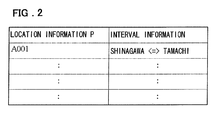
- the passenger information providing server (2 in FIG. 1) uses the interval determination processing unit to reference a coordinate table or a coordinate map, which stores information on the correspondence between the location information and the interval information on the transportation line in which the user terminal (1 in FIG. 1) is located, and determines the interval of the transportation line.
- the passenger information providing server (2 in FIG. 1) sends the determined interval information and the location information, received from the location information server (3 in FIG. 1), to the user terminal (1 in FIG. 1).
- the user terminal (1 in FIG. 1) uses the standby application to generate passenger location information (1a in FIG. 1), which includes at least the names of the locations constituting the interval, based on received interval information and the location information and displays the generated result on the display. At this time, it is also possible that the user terminal (1 in FIG. 1) notifies the result via a vibrator or some other means based on the definition of a user's pre-specified operation that is executed when passenger location information is received.
- the user terminal (1 in FIG. 1) performs the above-described operation repeatedly until it approaches the destination while updating the passenger location information at a predetermined interval of time.
- the user terminal approaches the destination registered at standby application start time, that is, when the relation between the current location of the user terminal (1 in FIG. 1) and the destination satisfies a predetermined relation, the user terminal (1 in FIG. 1) displays a video on the display, starts the vibrator, or outputs a voice to notify the user.
- An additional function can also be provided that causes the standby application executed in the user terminal (1 in FIG. 1) to sense a change in the location (information) and calculate the traveling acceleration.
- the user terminal (1 in FIG. 1) can display a video on the display, start the vibrator, or output a voice to notify the user at a more appropriate time by sensing a change in the acceleration, for example, when the train pulls in a station (station at which the user arrives).
- FIG. 1 is a diagram showing the configuration of a system in this embodiment.
- a user terminal 1 that functions as a portable information terminal, a passenger information providing server 2, a location information server 3, and a distributing server 4 are connected via a network 5.
- the user terminal 1 is a mobile phone terminal comprising a control unit including the CPU not shown; a wireless communication unit used to perform voice communication, to send and receive data, or to connect to a network 5; an input/output unit such as buttons, a display, a speaker, or a vibrator; and a memory unit in which programs executed in the control unit and data are stored.
- the user terminal 1 has the function to execute a Java (TM) coded application.
- TM Java
- the passenger information providing server 2 is a server comprising a location information acquisition unit that asks the location information server 3 about the location information on the user terminal 1 to acquire it; an interval determination processing unit that determines an interval of the transportation line, in which the user is located, from the location information on the user terminal 1; and a passenger location information delivery unit that delivers passenger location information to the user terminal 1.
- the location information acquisition unit, the interval determination processing unit, and the passenger location information delivery unit, not shown, are composed of programs that are stored in the storage means of the server and are read for execution. In this embodiment in which the programs are always in execution in the server, the passenger information providing server 2 functions as a presence server that always provides each user terminal 1 with the resources.
- the interval determination processing unit references the table stored in the storage unit, not shown, of the passenger information providing server 2 to determine an interval in which the user terminal is located.
- FIG. 2 is a diagram showing an example of the table. In this table, the interval information corresponding to the location information sent from the location information server 3 is stored.
- the location information server 3 is a server comprising a location information acquisition unit that acquires the location information on each user terminal 1, based on the information acquired from the GPS or the base station information on the user terminal 1 from the network, and sends the acquired information to the passenger information providing server 2.
- the location information acquisition unit, not shown, of the location information server 3 is composed of the programs that are stored in the storage means of the server and are read for execution.
- the distributing server 4 is a server that performs accounting processing as necessary and distributes a Java (TM) coded application in response to a request from the user terminal 1.
- TM Java
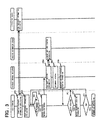
- FIG. 3 is a flowchart showing the operation of this embodiment.
- the user terminal 1 accesses the distributing server 4 to download the standby application, which functions as a client to the passenger information providing server 2, according to the menu screen provided by the distributing server 4 (step S001).
- the user terminal 1 starts the passenger information application (step S002).
- the passenger information application started on the user terminal 1 starts accessing the passenger information providing server 2 at a predetermined time interval determined according to the need to update the passenger information based on the type of transportation for which passenger information is provided or according to the communication traffic or the processing capability of the user terminal and the servers (step S003).
- the passenger information providing server 2 which is accessed by the user terminal 1, identifies the user terminal 1 using the ID and asks the location information server 3 about the location information (step S004). Upon receiving the location information from the location information server 3, the passenger information providing server 2 uses the interval determination processing unit to find the interval information corresponding to the received location information (step S005). Next, the passenger information providing server 2 sends the interval information to the user terminal 1 as the passenger location information for the user terminal 1 (step S006).
- the user terminal 1 which receives the passenger location information, checks the received information to see if the received information is the same as the information that is displayed. If so, the user terminal 1 determines that the information need not be updated, returns control back to step S003, and waits there for a predetermined time. On the other hand, if the currently displayed passenger location information is required to be updated, for example, when the interval in which the user terminal is located is changed, the user terminal 1 outputs the received passenger location information on the display (step S007).
- step S007 described above it is also possible to alert the user by outputting a ringing tone, turning on the LED lamp, or activating the vibrator at the same time the passenger location information is output.
- the user terminal 1, the passenger information providing server 2, and the location information server 3 repeatedly perform the operation described above in the user terminal 1 until the standby application is terminated. If the standby application is kept stored in the user terminal 1 after terminated, step S001 described above can be omitted the next time the service is used.
- the user can confirm the location interval (currently Shinagawa station >> Tamachi station in FIG. 1), which is displayed as the passenger location information, on the portable information terminal.
- Another advantage is the ability to check the location with the terminal always at hand and to reduce the stress that the user might ride past the destination.
- the portable information terminal is used not only in daily commuting but also in a private or business trip to an unfamiliar area to soften the resistance to the use of unfamiliar transportation.
- the conventional in-car announcement or display service has problems; for example, the announcement or the display is difficult to see or hear or the announcement time is too late.
- the present invention can complement an insufficient part of the conventional service. Those users can specify the output setting by combining the ringing tone generation, the character size change, and the vibrator activation according to the degree of the impairment so that they can receive the stress-free guidance information service that informs them where they are now and where they should leaves the train.
- FIG. 4 is a diagram showing the configuration of a system in this embodiment.
- a user terminal 1 that functions as a portable information terminal, a passenger information providing server 2, and a location information server 3 are connected via a network 5.
- a network 5 In the description below, the description of a part also included in the first embodiment of the present invention described above is omitted.
- the user terminal 1 is a mobile phone terminal comprising a control unit including the CPU not shown; a wireless communication unit used to perform voice communication, to send and receive data, or to connect to a network 5; an input/output unit such as buttons, a display, a speaker, or a vibrator; a memory unit in which programs executed in the control unit and data are stored; and a location information acquisition unit that asks the location information server 3 about the location information on the user terminal.
- the user terminal 1 is assumed to have the access function (corresponding to the position information acquisition unit described above) included in advance as a built-in program, wherein this access function accesses the passenger information providing server that will be described later.
- the passenger information providing server 2 is a server comprising an interval determination processing unit that determines an interval of the transportation line, in which the user is located, from the location information on the user terminal 1; a passenger location information delivery unit that delivers passenger location information to the user terminal 1; and a transportation line information storage unit that stores transportation line information including the required traveling time of each transportation line interval.
- the interval determination processing unit and the passenger location information delivery unit are composed of programs that are stored in the storage means of the server and are read for execution.
- the passenger information providing server 2 which stores advertisement contents in its storage unit, also works as an advertisement delivery server.
- the interval determination processing unit of the passenger information providing server 2 references the table stored in the storage unit, not shown, of the passenger information providing server 2 to determine an interval in which the user terminal is located as well as the traveling direction.
- the location information server 3 is a server comprising a location information acquisition unit that acquires the location information on each user terminal 1 from the GPS or the base station information on the user terminal 1 received from the network and sends the acquired information to the user terminal 1.
- FIG. 6 is a flowchart showing the operation of this embodiment.
- the user of the user terminal 1 selects and starts the passenger location information output function according to the menu screen provided as an additional function of a mobile phone terminal (step S101).
- the user terminal 1 When the passenger location information output function is started, the user terminal 1 displays the destination input screen to the user and requests the user to input the destination and notification trigger(time; notification condition) such as the station two stations before the destination station or a time 10 minutes before the estimated time of arrival (step S102). Next, the user terminal 1 accesses the location information server 3 at a predetermined time interval and starts monitoring its own location information (step S103).
- the user terminal 1 As the user terminal travels, the user terminal 1, which receives the location information, checks the difference between the current location information and the previously acquired location information and, if the difference satisfies a predetermined condition, determines that updating is required. Then, the user terminal 1 starts accessing the passenger information providing server 2 and sends the destination information and the location information to it (step S104).
- the passenger information providing server 2 uses the interval determination processing unit to find the interval information corresponding to the location information received from the user terminal 1 and the previously received location information (step S105). Next, the passenger information providing server 2 references the transportation line information and calculates the traveling time required to arrive at the destination identified by the destination information received from the user terminal 1. In addition, the passenger information providing server 2 generates the passenger location information for the user terminal 1, including an advertisement content 1b to be displayed in conjunction with the passenger location information, and sends the passenger location information to the user terminal 1 (step S106).
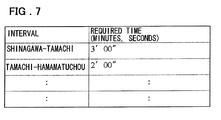
- FIG. 7 is a diagram showing an example of a transportation line information table in which the required traveling times of the transportation intervals are stored.
- the transportation line information table stores information indicating that the required time for the interval "Shinagawa - Tamachi” is three minutes and that the required time for the interval "Tamachi - Hamamatuchou” is two minutes.
- the passenger information providing server 2 adds up (calculates the total of) the required times of the intervals and finds the required time of five minutes.
- the passenger information providing server 2 calculates the required time of four minutes. For more strict calculation, it is also possible to calculate a more accurate required time considering a transportation delay by checking the location (information) corresponding to the current location against the location (information) corresponding to one minute of elapsed time calculated by interpolation. If the transportation line information table stores required times in the time format used in the timetable of transportation, the time may also be checked against the time of the built-in clock of the user terminal for correcting the time. In addition, it is also possible to output the estimated time of arrival by adding up the times of the built-in clock of the user terminal.
- the user terminal 1 that receives the passenger location information outputs the passenger location information on the display (step S107).
- the passenger location information contains not only the interval information but also information on the traveling direction of the user as well as the advertisement content 1b. As shown in FIG. 4, all the information need not be output on one screen at a time but may be displayed as one unit of information through scrolling or screen switching.
- the user terminal 1 When the location information indicates that the terminal approaches the destination entered in step S102 and the notification time (timing) has arrived (the notification condition is satisfied), the user terminal 1 performs the advance-notice operation, for example, activates the vibrator or sounds the ringing tone, to notify the user (step S108).
- this embodiment provides the user with an additional function, that is, the station-passing prevention function or doze-over prevention function, by allowing the user to register a destination and a notification time (condition), in advance, at which the user will be notified that the user is approaching the destination.
- the user is able to select whether the notification time (condition) described above is stored only once for a private or business trip or permanently for commuting.
- the user is able to set the notification time after the user rides into a car or goes through the ticket gate for non-daily use.
- the user terminal 1 determines a change in the speed (degree of deceleration) of the car, in which the user is riding, from the degree of change in the location information points at each point in time and, then, notifies a more accurate time (timing) either by combining it with the notification time (condition) described above or singly.
- the arrival advance-notice operation in this case should preferably be executed differently from the above-described arrival advance-notice operation activated when the terminal approaches the destination in order to alert the user more strongly, it is also possible to repeatedly perform the same arrival advance-notice operation as the one executed when the terminal approaches the destination.
- the operation executed in this embodiment is efficient not only for preventing the user from passing the station or dozing over but also for relieving the stress in a car.
- the user finds greater comfort in a car that would otherwise be decreased and, in addition, the service of the passenger transport companies to the customers is improved.
- passenger location information is output on the display of the user terminal 1.
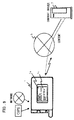
- the passenger location information can be transferred to some other user's terminal 6 via the passenger information server 2 or another information processing unit using electronic mail or SMS (Short Message Service).
- SMS Short Message Service
- the passenger location information is transferred to the other user's terminal 6 to accurately notify the parent or guardian of the location.
- the generated passenger location information is combined with advertisements, service notices, and area guidance messages in this embodiment. It is possible that the service provider can provide this service at a lower cost or free of charge if advertisement charges are collected from advertisers.
- the attribute information (age, sex, profession, location, time) on the users, if collected when or after the user becomes a member of the service, can also be used to deliver advertisements selected based on the attribute of each user.
- FIG. 9 is a diagram showing the configuration of the system in this embodiment.
- a user terminal 1 which functions as a portable information terminal, and a content server 7 are connected via a network 5.
- a network 5 In the description below, the description of a part also included in the first embodiment of the present invention described above is omitted.
- the user terminal 1 is a mobile phone terminal comprising a control unit including the CPU not shown; a wireless communication unit used to perform voice communication, to send and receive data, or to connect to a network 5; an input/output unit such as buttons, a display, a speaker, or a vibrator; a memory unit in which programs executed in the control unit and data are stored; a location information acquisition unit that acquires coordinate information on the terminal from the GPS; and an interval determination processing unit that determines the transportation line interval in which the terminal is located.
- the memory unit of the user terminal 1 in this embodiment stores the table for determining interval information, similar to that in the first and second embodiments described above, as well as transportation line information including the information on transportation line interval fares.
- the location information acquisition unit and the interval determination processing unit are installed in the mobile phone terminal as built-in programs.
- the content server 7 is a server that stores service contents for passengers and sends them to the user terminal 1.
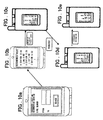
- FIGS. 10a-10e are diagrams showing the screen transition for describing the operation of this embodiment.
- the user of the user terminal 1 accesses the transportation line search engine, provided as a service of the mobile phone terminal network, enters the starting location and the destination according to the input screen, and searches for a route (see FIG. 10a).
- the user terminal 1 moves to the passenger location information providing mode, sets the search result as a scheduled route, and starts the location information acquisition unit and the interval determination processing unit.
- the route is established as "A station -> B station; abc line, B station -> C station; def line".
- the coordinates of the user terminal 1 are obtained by the GPS via the location information acquisition unit of the user terminal 1.
- the interval determination processing unit of the user terminal 1 checks the coordinates of the user terminal 1 against the location information in the table described above to determine if the user has arrived at the A station.
- the user terminal 1 uses a predetermined area in the back-side display of the user terminal as an area for displaying the passenger information and outputs the passenger location information in that area.
- FIG. 10c shows a user terminal on which passenger location information is output, wherein the information includes the interval information as well as the information on the fare calculated from the transportation line information stored in the memory unit.
- the user terminal 1 uses the location information (coordinates) acquired by the location information acquisition unit and the table stored in the memory unit to determine the transportation line interval in which the terminal is located in the same way as described above and outputs the passenger location information in the area for displaying the passenger information (see FIG. 10d).
- the user terminal 1 When the terminal approaches the destination and the notification condition specified by the user in advance is satisfied, the user terminal 1 outputs an arrival advance-notice message such as the one shown in FIG. 10e.
- the user terminal 1 in this embodiment can generate and output passenger location information on its own. As compared with the system described in the first and second embodiments, the system in this embodiment reduces the communication cost and provides a better service without being affected by the network traffic or other system environments.
- the search engine is used first to set up a user's route automatically as described above to eliminate the need for the user to enter the destination or to select a route.
- the user can of course use an existing transportation line search engine or an operation information providing service to set up a route, or can enter route information from other information processing systems that are used when the user uses transportation. Examples of those other information processing systems are a terminal on which the user can get a ticket with an IC card or a mobile phone and a ticket vending terminal or a terminal installed in a station.
- the user terminal 1 obtains location information primarily from the GPS system.
- the location information can of course be entered secondarily from a wireless terminal installed in a station, a route, or a car with which the user terminal can communicate.
- this embodiment has a configuration that also allows the content server 7 to deliver a message 1c, received from the a passenger transport company, to a user terminal 1 and output the message in real time. For example, it is possible to deliver "Service Suspension Notice” as necessary as shown in FIG. 9. Also included in this type of message is information on a change in train schedule, instructions on manners in a car, and the transfer of passengers due to the suspension of services.
- the system according to the present invention is not limited by a means of transportation but is applicable to any means of transportation such as a railway, a bus, a ship, and an airplane that provides services for a transportation service line.
- the present invention can provide accurate location information and prompt the user to leave the bus at a correct stop (push the "stop" button).
Landscapes
- Engineering & Computer Science (AREA)
- Computer Networks & Wireless Communication (AREA)
- Signal Processing (AREA)
- Computer Security & Cryptography (AREA)
- Mobile Radio Communication Systems (AREA)
- Management, Administration, Business Operations System, And Electronic Commerce (AREA)
- Telephonic Communication Services (AREA)
- Telephone Function (AREA)
- Traffic Control Systems (AREA)
- Navigation (AREA)
- Train Traffic Observation, Control, And Security (AREA)
Applications Claiming Priority (2)
| Application Number | Priority Date | Filing Date | Title |
|---|---|---|---|
| JP2004020126 | 2004-01-28 | ||
| JP2004020126A JP2005215876A (ja) | 2004-01-28 | 2004-01-28 | 旅客位置情報システム及び携帯情報端末及びサーバ装置 |
Publications (2)
| Publication Number | Publication Date |
|---|---|
| EP1575243A2 true EP1575243A2 (de) | 2005-09-14 |
| EP1575243A3 EP1575243A3 (de) | 2010-06-09 |
Family
ID=34823742
Family Applications (1)
| Application Number | Title | Priority Date | Filing Date |
|---|---|---|---|
| EP05100505A Withdrawn EP1575243A3 (de) | 2004-01-28 | 2005-01-26 | Passagierpositions-Informationssystem, bewegliches Informationsendgerät und Server |
Country Status (4)
| Country | Link |
|---|---|
| US (1) | US7706970B2 (de) |
| EP (1) | EP1575243A3 (de) |
| JP (1) | JP2005215876A (de) |
| CN (1) | CN1649434A (de) |
Cited By (2)
| Publication number | Priority date | Publication date | Assignee | Title |
|---|---|---|---|---|
| WO2009141614A1 (en) * | 2008-05-20 | 2009-11-26 | Yourrail Limited | Electronic ticketing |
| CN104504928A (zh) * | 2014-12-29 | 2015-04-08 | 天津北方网新媒体集团股份有限公司 | 一种基于iBeacon技术的智能交通提醒系统 |
Families Citing this family (54)
| Publication number | Priority date | Publication date | Assignee | Title |
|---|---|---|---|---|
| US6456234B1 (en) * | 2000-06-07 | 2002-09-24 | William J. Johnson | System and method for proactive content delivery by situation location |
| JP3809171B2 (ja) * | 2004-04-22 | 2006-08-16 | 松下電器産業株式会社 | 道路交通情報通信システム及び道路交通情報通信方法 |
| US7908080B2 (en) | 2004-12-31 | 2011-03-15 | Google Inc. | Transportation routing |
| US7353034B2 (en) | 2005-04-04 | 2008-04-01 | X One, Inc. | Location sharing and tracking using mobile phones or other wireless devices |
| JP4481905B2 (ja) * | 2005-08-25 | 2010-06-16 | 株式会社エヌ・ティ・ティ・ドコモ | コンテンツ送信装置、通信装置及びコンテンツ送信方法 |
| CN1831910A (zh) * | 2006-03-28 | 2006-09-13 | 张雅婷 | 一种广告媒体及其系统和方法 |
| US7917285B2 (en) * | 2006-04-28 | 2011-03-29 | Reagan Inventions, Llc | Device, system and method for remotely entering, storing and sharing addresses for a positional information device |
| KR20090000609A (ko) * | 2007-03-07 | 2009-01-08 | 팅크웨어(주) | 사용자의 위치 정보를 이용한 스케줄 관리 방법 및 그시스템 |
| US9066199B2 (en) | 2007-06-28 | 2015-06-23 | Apple Inc. | Location-aware mobile device |
| US8385946B2 (en) | 2007-06-28 | 2013-02-26 | Apple Inc. | Disfavored route progressions or locations |
| US8175802B2 (en) | 2007-06-28 | 2012-05-08 | Apple Inc. | Adaptive route guidance based on preferences |
| US8774825B2 (en) | 2007-06-28 | 2014-07-08 | Apple Inc. | Integration of map services with user applications in a mobile device |
| US20090005964A1 (en) * | 2007-06-28 | 2009-01-01 | Apple Inc. | Intelligent Route Guidance |
| US8275352B2 (en) | 2007-06-28 | 2012-09-25 | Apple Inc. | Location-based emergency information |
| US8290513B2 (en) | 2007-06-28 | 2012-10-16 | Apple Inc. | Location-based services |
| US8204684B2 (en) | 2007-06-28 | 2012-06-19 | Apple Inc. | Adaptive mobile device navigation |
| US8108144B2 (en) | 2007-06-28 | 2012-01-31 | Apple Inc. | Location based tracking |
| US8332402B2 (en) * | 2007-06-28 | 2012-12-11 | Apple Inc. | Location based media items |
| US8762056B2 (en) * | 2007-06-28 | 2014-06-24 | Apple Inc. | Route reference |
| US8311526B2 (en) | 2007-06-28 | 2012-11-13 | Apple Inc. | Location-based categorical information services |
| US9109904B2 (en) * | 2007-06-28 | 2015-08-18 | Apple Inc. | Integration of map services and user applications in a mobile device |
| CN101354258B (zh) * | 2007-07-27 | 2013-01-09 | 佛山市顺德区顺达电脑厂有限公司 | 利用大众运输的导航装置与方法 |
| US8977294B2 (en) * | 2007-10-10 | 2015-03-10 | Apple Inc. | Securely locating a device |
| CN101187560B (zh) * | 2007-12-27 | 2011-07-06 | 深圳市凯立德欣软件技术有限公司 | 一种行进中周边信息检索方法、装置及导航设备 |
| US8355862B2 (en) | 2008-01-06 | 2013-01-15 | Apple Inc. | Graphical user interface for presenting location information |
| US20090326815A1 (en) * | 2008-05-02 | 2009-12-31 | Apple Inc. | Position Fix Indicator |
| US9250092B2 (en) | 2008-05-12 | 2016-02-02 | Apple Inc. | Map service with network-based query for search |
| US8644843B2 (en) | 2008-05-16 | 2014-02-04 | Apple Inc. | Location determination |
| JP2009286365A (ja) * | 2008-05-30 | 2009-12-10 | Fujitsu Ltd | 情報提供装置、情報提供方法、情報提供プログラム及び情報提供システム |
| US8369867B2 (en) | 2008-06-30 | 2013-02-05 | Apple Inc. | Location sharing |
| US8359643B2 (en) | 2008-09-18 | 2013-01-22 | Apple Inc. | Group formation using anonymous broadcast information |
| US8260320B2 (en) * | 2008-11-13 | 2012-09-04 | Apple Inc. | Location specific content |
| JP5304355B2 (ja) * | 2009-03-16 | 2013-10-02 | 日本電気株式会社 | 目的地への到着予告システム、目的地到着予告方法、携帯端末装置及びプログラム |
| US8660530B2 (en) | 2009-05-01 | 2014-02-25 | Apple Inc. | Remotely receiving and communicating commands to a mobile device for execution by the mobile device |
| US8670748B2 (en) | 2009-05-01 | 2014-03-11 | Apple Inc. | Remotely locating and commanding a mobile device |
| US8666367B2 (en) | 2009-05-01 | 2014-03-04 | Apple Inc. | Remotely locating and commanding a mobile device |
| KR20110074258A (ko) * | 2009-12-24 | 2011-06-30 | 삼성전자주식회사 | 이동통신 시스템에서 대중 교통 수단의 정류장 정보를 제공하기 위한 장치 및 방법 |
| US20120026008A1 (en) * | 2010-07-28 | 2012-02-02 | Coleman Brady W | Personnel monitoring system |
| CN102280041A (zh) * | 2011-04-19 | 2011-12-14 | 惠州Tcl移动通信有限公司 | 基于手机的交通站点提示方法及使用该方法的手机 |
| DE102011079328A1 (de) * | 2011-07-18 | 2013-01-24 | Siemens Aktiengesellschaft | Verfahren und Anordnung zur Bereitstellung von individuellen Reiseinformationen in Personenbeförderungssystemen |
| CN102298840A (zh) * | 2011-09-01 | 2011-12-28 | 福建工程学院 | 基于手机短信的动态公交信息服务方法 |
| WO2013069772A1 (ja) * | 2011-11-11 | 2013-05-16 | 株式会社エヌ・ティ・ティ・ドコモ | 情報処理装置、通信端末、情報処理方法及びプログラム |
| KR20140096705A (ko) * | 2013-01-29 | 2014-08-06 | 한국전자통신연구원 | 버스 승하차 알림 장치 및 방법 |
| US8744926B1 (en) | 2013-03-15 | 2014-06-03 | Kwivo, LLC | Pre-transit and post-transit facilitation of in-vehicle services |
| US8751646B1 (en) * | 2013-03-15 | 2014-06-10 | Kwivo, LLC | In-vehicle services through attendant devices, user-provided devices, and/or an in-vehicle computer system |
| CN104217608B (zh) * | 2013-05-29 | 2018-02-23 | 星贝瑞有限公司 | 基于公交工具的信息服务方法及系统 |
| WO2015011710A1 (en) * | 2013-07-26 | 2015-01-29 | Anagog Ltd. | Associating external devices to vehicles and usage of said association |
| JP6398874B2 (ja) * | 2015-05-28 | 2018-10-03 | 京セラドキュメントソリューションズ株式会社 | 情報提供プログラム及び乗降案内システム |
| WO2018132088A1 (en) * | 2017-01-10 | 2018-07-19 | Ford Global Technologies, Llc | Picking up and dropping off passengers at an airport using an autonomous vehicle |
| US11403572B2 (en) * | 2017-07-20 | 2022-08-02 | Mian Ahmed | Method and system for requesting service providers in real time |
| JP7003822B2 (ja) * | 2018-04-12 | 2022-01-21 | 富士通株式会社 | 情報処理装置、情報処理システム、及びプライバシ保護プログラム |
| CN108764978B (zh) * | 2018-05-15 | 2022-05-27 | 北京奇艺世纪科技有限公司 | 一种广告投放方法及装置 |
| CN110428631B (zh) * | 2019-09-30 | 2020-01-10 | 武汉元光科技有限公司 | 确定用户乘坐的公交车辆的方法及装置 |
| CN111242535B (zh) * | 2020-01-07 | 2023-04-07 | 贵阳货车帮科技有限公司 | 运输路线推送方法、装置、电子设备及可读存储介质 |
Family Cites Families (13)
| Publication number | Priority date | Publication date | Assignee | Title |
|---|---|---|---|---|
| US7313467B2 (en) * | 2000-09-08 | 2007-12-25 | Automotive Technologies International Inc. | System and method for in-vehicle communications |
| JP3206477B2 (ja) | 1997-02-19 | 2001-09-10 | トヨタ自動車株式会社 | 携帯端末装置 |
| CA2363556C (en) | 1999-03-01 | 2009-05-12 | Global Research Systems, Inc. | Base station system and method for monitoring travel of mobile vehicles and communicating notification messages |
| JP4066587B2 (ja) | 2000-02-28 | 2008-03-26 | 三菱電機株式会社 | 目的位置通知方法並びに目的位置通知システム、携帯型無線端末、位置情報送信端末 |
| US7116992B1 (en) | 2000-04-05 | 2006-10-03 | Hitachi, Ltd. | Mobile station using positional information |
| JP2002114149A (ja) * | 2000-10-05 | 2002-04-16 | Pioneer Electronic Corp | 交通機関ナビゲーションシステムおよび方法 |
| JP2004531710A (ja) * | 2001-03-20 | 2004-10-14 | コーニンクレッカ フィリップス エレクトロニクス エヌ ヴィ | 移動する人のための情報システム |
| JP2002300634A (ja) * | 2001-04-02 | 2002-10-11 | Nippon Telegr & Teleph Corp <Ntt> | 移動通信端末通知システム、方法及び通信網サーバ |
| JP2002357444A (ja) * | 2001-05-31 | 2002-12-13 | Nec Corp | 移動端末を使用したナビゲーションシステム |
| US20030054830A1 (en) | 2001-09-04 | 2003-03-20 | Zi Corporation | Navigation system for mobile communication devices |
| US6973384B2 (en) * | 2001-12-06 | 2005-12-06 | Bellsouth Intellectual Property Corporation | Automated location-intelligent traffic notification service systems and methods |
| JP2003217093A (ja) | 2002-01-22 | 2003-07-31 | Navit Co Ltd | バスナビゲーションシステム |
| CN1759588A (zh) * | 2003-01-30 | 2006-04-12 | 松下电器产业株式会社 | 携带信息终端和通信系统 |
-
2004
- 2004-01-28 JP JP2004020126A patent/JP2005215876A/ja active Pending
-
2005
- 2005-01-24 CN CNA2005100044994A patent/CN1649434A/zh active Pending
- 2005-01-26 EP EP05100505A patent/EP1575243A3/de not_active Withdrawn
- 2005-01-27 US US11/043,119 patent/US7706970B2/en active Active
Cited By (2)
| Publication number | Priority date | Publication date | Assignee | Title |
|---|---|---|---|---|
| WO2009141614A1 (en) * | 2008-05-20 | 2009-11-26 | Yourrail Limited | Electronic ticketing |
| CN104504928A (zh) * | 2014-12-29 | 2015-04-08 | 天津北方网新媒体集团股份有限公司 | 一种基于iBeacon技术的智能交通提醒系统 |
Also Published As
| Publication number | Publication date |
|---|---|
| US7706970B2 (en) | 2010-04-27 |
| EP1575243A3 (de) | 2010-06-09 |
| CN1649434A (zh) | 2005-08-03 |
| US20060041374A1 (en) | 2006-02-23 |
| JP2005215876A (ja) | 2005-08-11 |
Similar Documents
| Publication | Publication Date | Title |
|---|---|---|
| US7706970B2 (en) | Passenger location information system, portable information terminal, and server | |
| US7031832B2 (en) | Information presentation apparatus and information presentation method | |
| KR100936688B1 (ko) | 이동 계산 및 통신 방법 | |
| US6898569B1 (en) | Method and apparatus for advanced scheduling and messaging system | |
| US6675089B2 (en) | Mobile information processing system, mobile information processing method, and storage medium storing mobile information processing program | |
| US10156451B2 (en) | Method and device of establishing navigation route | |
| JP4274925B2 (ja) | 情報配信システムおよび情報配信サーバならびに携帯端末および情報配信方法 | |
| JP3383913B2 (ja) | 空間想起補助システム | |
| JP2014029580A (ja) | タクシー配車アプリケーションシステム及び配車プログラム | |
| WO2017155581A1 (en) | Verification of pickup times in real-time ride-sharing feeds | |
| US20190287075A1 (en) | Information processing method and information processor | |
| KR20030016277A (ko) | 운송 네트워크 상의 통지 서비스 | |
| US11109190B2 (en) | Information provision method and information provision device for providing guidance | |
| US20140330599A1 (en) | Identifying Partial User-Entered Data | |
| JP6746171B2 (ja) | 配車システム及び配車方法 | |
| JP7059774B2 (ja) | 情報提供装置、情報提供システム及び情報提供方法 | |
| JP2008183914A (ja) | ナビゲーションシステム | |
| JP4169191B2 (ja) | 携帯通信端末、時間情報通知システム、機器制御装置、時間情報通知方法、機器制御方法、時間情報通知プログラム、機器制御プログラム | |
| US20060258366A1 (en) | Drilling method | |
| US20050216286A1 (en) | Transmitting graphical representations | |
| KR101234793B1 (ko) | 이동통신 단말기를 이용한 대중교통 이용 방법 | |
| KR20100033259A (ko) | 도착시간 알림 서비스를 제공하는 이동통신단말기 및 그의 동작방법 | |
| JP2003281684A (ja) | 情報処理システム、プログラム、及び記録媒体 | |
| JP6956763B2 (ja) | 車両端末、経路提示方法及びプログラム | |
| US20220042811A1 (en) | Method and server |
Legal Events
| Date | Code | Title | Description |
|---|---|---|---|
| PUAI | Public reference made under article 153(3) epc to a published international application that has entered the european phase |
Free format text: ORIGINAL CODE: 0009012 |
|
| AK | Designated contracting states |
Kind code of ref document: A2 Designated state(s): AT BE BG CH CY CZ DE DK EE ES FI FR GB GR HU IE IS IT LI LT LU MC NL PL PT RO SE SI SK TR |
|
| AX | Request for extension of the european patent |
Extension state: AL BA HR LV MK YU |
|
| PUAL | Search report despatched |
Free format text: ORIGINAL CODE: 0009013 |
|
| AK | Designated contracting states |
Kind code of ref document: A3 Designated state(s): AT BE BG CH CY CZ DE DK EE ES FI FR GB GR HU IE IS IT LI LT LU MC NL PL PT RO SE SI SK TR |
|
| AX | Request for extension of the european patent |
Extension state: AL BA HR LV MK YU |
|
| AKY | No designation fees paid | ||
| STAA | Information on the status of an ep patent application or granted ep patent |
Free format text: STATUS: THE APPLICATION IS DEEMED TO BE WITHDRAWN |
|
| 18D | Application deemed to be withdrawn |
Effective date: 20101210 |