EP1575040A2 - Dispositif de lecture optique et unité de disque optique muni d'un tel dispositif de lecture optique - Google Patents
Dispositif de lecture optique et unité de disque optique muni d'un tel dispositif de lecture optique Download PDFInfo
- Publication number
- EP1575040A2 EP1575040A2 EP05251455A EP05251455A EP1575040A2 EP 1575040 A2 EP1575040 A2 EP 1575040A2 EP 05251455 A EP05251455 A EP 05251455A EP 05251455 A EP05251455 A EP 05251455A EP 1575040 A2 EP1575040 A2 EP 1575040A2
- Authority
- EP
- European Patent Office
- Prior art keywords
- lens
- optical
- lenses
- light
- pickup apparatus
- Prior art date
- Legal status (The legal status is an assumption and is not a legal conclusion. Google has not performed a legal analysis and makes no representation as to the accuracy of the status listed.)
- Withdrawn
Links
- 230000003287 optical effect Effects 0.000 title claims abstract description 475
- 230000008878 coupling Effects 0.000 claims abstract description 336
- 238000010168 coupling process Methods 0.000 claims abstract description 336
- 238000005859 coupling reaction Methods 0.000 claims abstract description 336
- 230000004075 alteration Effects 0.000 claims abstract description 170
- 230000007246 mechanism Effects 0.000 claims abstract description 49
- 230000002194 synthesizing effect Effects 0.000 claims description 24
- 230000008859 change Effects 0.000 claims description 18
- 238000007493 shaping process Methods 0.000 claims description 15
- 230000010355 oscillation Effects 0.000 claims description 14
- 230000002093 peripheral effect Effects 0.000 claims description 3
- 239000000758 substrate Substances 0.000 description 36
- 238000012937 correction Methods 0.000 description 12
- 239000004065 semiconductor Substances 0.000 description 11
- 238000000034 method Methods 0.000 description 10
- 238000013461 design Methods 0.000 description 9
- 230000005540 biological transmission Effects 0.000 description 8
- 230000003247 decreasing effect Effects 0.000 description 8
- 239000000463 material Substances 0.000 description 8
- 230000007423 decrease Effects 0.000 description 7
- 238000004519 manufacturing process Methods 0.000 description 6
- 241001025261 Neoraja caerulea Species 0.000 description 5
- 238000001514 detection method Methods 0.000 description 4
- 230000009467 reduction Effects 0.000 description 4
- 230000015572 biosynthetic process Effects 0.000 description 3
- 230000015556 catabolic process Effects 0.000 description 3
- 238000006731 degradation reaction Methods 0.000 description 3
- 230000000694 effects Effects 0.000 description 3
- 239000004417 polycarbonate Substances 0.000 description 3
- 230000001603 reducing effect Effects 0.000 description 3
- 230000004044 response Effects 0.000 description 3
- 238000003786 synthesis reaction Methods 0.000 description 3
- 238000002834 transmittance Methods 0.000 description 3
- 230000009471 action Effects 0.000 description 2
- 230000008901 benefit Effects 0.000 description 2
- 238000010586 diagram Methods 0.000 description 2
- 239000006185 dispersion Substances 0.000 description 2
- 238000009826 distribution Methods 0.000 description 2
- 239000011521 glass Substances 0.000 description 2
- 230000006872 improvement Effects 0.000 description 2
- 230000007480 spreading Effects 0.000 description 2
- 238000003892 spreading Methods 0.000 description 2
- 230000006641 stabilisation Effects 0.000 description 2
- 238000011105 stabilization Methods 0.000 description 2
- 235000010627 Phaseolus vulgaris Nutrition 0.000 description 1
- 244000046052 Phaseolus vulgaris Species 0.000 description 1
- 201000009310 astigmatism Diseases 0.000 description 1
- 238000007796 conventional method Methods 0.000 description 1
- 230000004048 modification Effects 0.000 description 1
- 238000012986 modification Methods 0.000 description 1
- 238000006396 nitration reaction Methods 0.000 description 1
- 230000000149 penetrating effect Effects 0.000 description 1
- 239000004033 plastic Substances 0.000 description 1
- 229920000515 polycarbonate Polymers 0.000 description 1
Images









Classifications
-
- G—PHYSICS
- G11—INFORMATION STORAGE
- G11B—INFORMATION STORAGE BASED ON RELATIVE MOVEMENT BETWEEN RECORD CARRIER AND TRANSDUCER
- G11B7/00—Recording or reproducing by optical means, e.g. recording using a thermal beam of optical radiation by modifying optical properties or the physical structure, reproducing using an optical beam at lower power by sensing optical properties; Record carriers therefor
- G11B7/12—Heads, e.g. forming of the optical beam spot or modulation of the optical beam
- G11B7/135—Means for guiding the beam from the source to the record carrier or from the record carrier to the detector
- G11B7/1372—Lenses
- G11B7/1376—Collimator lenses
-
- G—PHYSICS
- G11—INFORMATION STORAGE
- G11B—INFORMATION STORAGE BASED ON RELATIVE MOVEMENT BETWEEN RECORD CARRIER AND TRANSDUCER
- G11B7/00—Recording or reproducing by optical means, e.g. recording using a thermal beam of optical radiation by modifying optical properties or the physical structure, reproducing using an optical beam at lower power by sensing optical properties; Record carriers therefor
- G11B7/12—Heads, e.g. forming of the optical beam spot or modulation of the optical beam
- G11B7/123—Integrated head arrangements, e.g. with source and detectors mounted on the same substrate
-
- G—PHYSICS
- G11—INFORMATION STORAGE
- G11B—INFORMATION STORAGE BASED ON RELATIVE MOVEMENT BETWEEN RECORD CARRIER AND TRANSDUCER
- G11B7/00—Recording or reproducing by optical means, e.g. recording using a thermal beam of optical radiation by modifying optical properties or the physical structure, reproducing using an optical beam at lower power by sensing optical properties; Record carriers therefor
- G11B7/12—Heads, e.g. forming of the optical beam spot or modulation of the optical beam
- G11B7/125—Optical beam sources therefor, e.g. laser control circuitry specially adapted for optical storage devices; Modulators, e.g. means for controlling the size or intensity of optical spots or optical traces
- G11B7/127—Lasers; Multiple laser arrays
- G11B7/1275—Two or more lasers having different wavelengths
-
- G—PHYSICS
- G11—INFORMATION STORAGE
- G11B—INFORMATION STORAGE BASED ON RELATIVE MOVEMENT BETWEEN RECORD CARRIER AND TRANSDUCER
- G11B7/00—Recording or reproducing by optical means, e.g. recording using a thermal beam of optical radiation by modifying optical properties or the physical structure, reproducing using an optical beam at lower power by sensing optical properties; Record carriers therefor
- G11B7/12—Heads, e.g. forming of the optical beam spot or modulation of the optical beam
- G11B7/135—Means for guiding the beam from the source to the record carrier or from the record carrier to the detector
- G11B7/139—Numerical aperture control means
-
- G—PHYSICS
- G11—INFORMATION STORAGE
- G11B—INFORMATION STORAGE BASED ON RELATIVE MOVEMENT BETWEEN RECORD CARRIER AND TRANSDUCER
- G11B7/00—Recording or reproducing by optical means, e.g. recording using a thermal beam of optical radiation by modifying optical properties or the physical structure, reproducing using an optical beam at lower power by sensing optical properties; Record carriers therefor
- G11B7/12—Heads, e.g. forming of the optical beam spot or modulation of the optical beam
- G11B7/135—Means for guiding the beam from the source to the record carrier or from the record carrier to the detector
- G11B7/1392—Means for controlling the beam wavefront, e.g. for correction of aberration
- G11B7/13925—Means for controlling the beam wavefront, e.g. for correction of aberration active, e.g. controlled by electrical or mechanical means
- G11B7/13927—Means for controlling the beam wavefront, e.g. for correction of aberration active, e.g. controlled by electrical or mechanical means during transducing, e.g. to correct for variation of the spherical aberration due to disc tilt or irregularities in the cover layer thickness
-
- G—PHYSICS
- G11—INFORMATION STORAGE
- G11B—INFORMATION STORAGE BASED ON RELATIVE MOVEMENT BETWEEN RECORD CARRIER AND TRANSDUCER
- G11B7/00—Recording or reproducing by optical means, e.g. recording using a thermal beam of optical radiation by modifying optical properties or the physical structure, reproducing using an optical beam at lower power by sensing optical properties; Record carriers therefor
- G11B2007/0003—Recording, reproducing or erasing systems characterised by the structure or type of the carrier
- G11B2007/0006—Recording, reproducing or erasing systems characterised by the structure or type of the carrier adapted for scanning different types of carrier, e.g. CD & DVD
-
- G—PHYSICS
- G11—INFORMATION STORAGE
- G11B—INFORMATION STORAGE BASED ON RELATIVE MOVEMENT BETWEEN RECORD CARRIER AND TRANSDUCER
- G11B7/00—Recording or reproducing by optical means, e.g. recording using a thermal beam of optical radiation by modifying optical properties or the physical structure, reproducing using an optical beam at lower power by sensing optical properties; Record carriers therefor
- G11B2007/0003—Recording, reproducing or erasing systems characterised by the structure or type of the carrier
- G11B2007/0009—Recording, reproducing or erasing systems characterised by the structure or type of the carrier for carriers having data stored in three dimensions, e.g. volume storage
- G11B2007/0013—Recording, reproducing or erasing systems characterised by the structure or type of the carrier for carriers having data stored in three dimensions, e.g. volume storage for carriers having multiple discrete layers
Definitions
- the present invention generally relates to optical disc drive apparatuses and, more particularly, to an optical pickup apparatus for recording or reproducing information on or from an optical information recording medium by converging a light beam on a recording surface of the optical information recording medium and an optical disc drive apparatus equipped with such an optical pickup apparatus.
- NA numerical aperture
- a numerical aperture (NA) of an objective lens is 0.45 and a wavelength of is 780 nm
- a numerical aperture (NA) of an objective lens is 0.65 and a wavelength is 660 nm so that DVD has a higher recording density and a larger recording capacity than CD.
- an optical disc system which is referred to as a Blue-ray disc
- AOD optical disc system, which is referred to as AOD, having a numerical aperture (NA) of an objective lens of 0.65 and a wavelength of 405 nm
- AOD optical disc system
- a technique to share optical components such as an objective lens and a coupling lens has been developed so as to simplify a structure of an optical system.
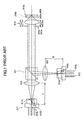
- FIG. 1 Shown in FIG. 1 is an outline of an optical system of an optical pickup apparatus of a conventional CD/DVD.
- the optical system of the optical pickup apparatus comprises a DVD hologram unit 311, a coupling lens 310, a beam splitter 321 and objective lenses 142a and 142b that are arranged along a main line in that order.
- a CD hologram unit 312, a coupling lens 320 and a beam splitter 121 are arranged along a line perpendicular to the main line in that order toward the beam spritter121.
- the optical system also comprises an actuator 314 that drives objective lenses 342a and 342b.
- the DVD hologram unit 311 integrally incorporates a light source 311L, a hologram 311h for separating a signal light from a light reflected by a disc and a light-receiving element 311p for detecting a signal.
- the CD hologram unit 312 integrally incorporates a light source 312L, a hologram 312h and a light-receiving element 312p.
- the objective lenses 342a and 342b differ from CD to DVD.
- an aperture 341a for DVD and an aperture 314b for CD are arranged with respect to the objective lenses 342a and 342b, respectively.
- the apertures 341a and 341b are shared by using an opening of an objective lens holder.
- the objective lenses 342a and 342b and the apertures 341a and 341b are integrally driven by the lens actuator 314 in a focusing direction and a tracking direction.
- a DVD disc 315a is indicated by solid lines and a CD disc 315b is indicated by dotted lines.
- the coupling lenses 310 and 320 are different in their aperture and a light taking angle of the light beam, and, thus, lenses having different focal distances are used for each light sources 311L and 312L.
- a focal distance of the coupling lens 310 is set to f1
- a focal distance of the coupling lens 320 is se to f2
- an optical path length of equal to or longer than f1 or f2 must be provided before incident on the beam splitter 321, which causes a problem that the optical system is increased in its size.
- the coupling lenses 310 and 320 are made common, a coupling efficiency of one of the light sources is decreased, which causes a problem in that a spot power on the discs 315a and 315b is decreased.
- a spot diameter is influenced by an optical amount ratio (RIM) at a periphery of the aperture with respect to the center of the optical axis, other than the above-mentioned wavelength and numerical aperture.
- RIM optical amount ratio
- the spot diameter decreases as the RIM increases, a coupling efficiency of effectively converging the light beam from the light source on a surface of the disc is decreased, which causes a problem in that a power is not sufficient and a recording and reproducing speed is decreased.
- a design target value of the RIM is determined as follows. minimum RIM CD 15% DVD 30% Blu-ray/AOD 50%
- a coupling lens is shared by DVD and AOD having the same NA, and if a focal distance of the coupling lens is set to 50% of RIM of AOD, the focal distance on the DVD side is also 50%, which decreases the coupling efficiency of DVD.
- the focal distance on the AOD side is also about 30%, which increases the spot diameter.
- a combination of different numerical apertures causes a problem that the above-mentioned problems become severer.
- the following patent document 1 discloses an optical disc drive apparatus which solves the above-mentioned problem by providing a condensing lens on one of the sides of the two light sources.
- the optical disc drive apparatus of the patent document 1 has a converging optical system between a dichroic prism and a second light source having a condensing lens on one of the sides of two light sources, the converging optical system converting a spreading angle of a diverging light beam into a smaller spreading angle and leading the light beam to the dichroic prism.
- the following patent document 2 discloses an example to drive a group of coupling lenses. Specifically, by configuring and arranging one of two lens elements movable along an optical axis by driving a group of coupling lenses, a fluctuation of spherical aberration generated on each optical surface in the converging optical system, especially, the optical surface of an objective lens can be corrected.
- the technique disclosed in the patent document 2 can correct in realtime a spherical aberration generated in an objective lens due t a variation in a thickness of a transparent substrate of an optical information recording medium, a small fluctuation in an oscillation wavelength of a laser light source or a change in temperature and humidity, an appropriate spot can be formed on an information recording surface of the optical information recording medium.
- the objective lens As for the objective lens, a multi-wavelength compatible lens having a diffraction grating on a lens surface has been put into practice, and a tree-wavelength compatible diffraction lens handling the Blue-ray or AOD has been developed.
- the coupling lens in order to optimize the coupling efficiency of each light source, it is necessary to use lenses having different distance for each light source since the numerical aperture and the light taking angle of the light beam differ for each light source, and, thereby, it is difficult to make the coupling lens common to a plurality of light sources.
- the following patent document 3 discloses an optical pickup apparatus solving the above-mentioned problem, which comprises: at least two laser light sources of a first laser light source oscillating at a wavelength in a range of 620 nm to 680 and having an auxiliary lens between an optical synthesis component and a light source to converge and diverge a light beam and a second laser light source oscillating at a wavelength in a range of 750 nm to 810 nm; a collimator lens provided for converting the light beams projected from the first and second laser light sources into substantially parallel light beams; and an optical component provided in an optical path between the first and second laser light sources and the collimator lens so as to synthesize optical paths of the light beams projected from the first and second laser light sources, wherein a first auxiliary lens diverging the light beam is located in an optical path between the optical synthesis component and the first laser light source, and a second auxiliary lens converging the light beam is located in an optical path between the optical synthesis component and the second laser light
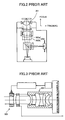
- the patent document 2 discloses an optical pickup apparatus that is capable of correcting a fluctuation of a spherical aberration generated on each optical surface in a light converging system, especially, on the optical surface of a lens 301, as shown in FIG. 2, by causing at least one of lenses 302a and 302b constituting a coupling lens 302 movable along a direction of the optical axis.
- the technique disclosed in the patent document 2 can correct in realtime a spherical aberration generated in an objective lens due t a variation in a thickness of a transparent substrate of an optical information recording medium, a small fluctuation in an oscillation wavelength of a laser light source or a change in temperature and humidity, an appropriate spot can be formed on an information recording surface of the optical information recording medium.
- a spherical aberration is generated due to variation in the thickness of layers, which causes a signal degradation due to enlargement of a converged light spot.
- means for correcting the spherical aberration generated due to a variation in the substrate thickness is provided.
- the following patent document 4 discloses a technique to correct the spherical aberration due to a variation in a substrate thickness by changing an interval of the lenses of a beam example located between an objective lens 304 and a coupling lens 305 along an optical axis of the beam expander as shown in FIG 3.
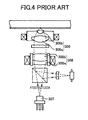
- the following patent document 5 discloses a technique to correct the spherical aberration due to a variation in a substrate thickness by moving a coupling lens 308 located between an objective lens 306 and a light source 7 as shown in FIG. 4.
- the technique disclosed in the above-mentioned patent document 2 has a problem in that only one light source is used and it is difficult to provide a plurality of optical information recording media.
- the above-mentioned problem is solved by providing a converging lens and a diverging lens to each of the two light sources.
- the number of lenses is increased as compared to a conventional example in which a coupling lens is provided to each light source, the optical pickup apparatus can be reduced in its size since the converging lens and the diverging lens are located in a diverging optical path of each light source.
- a correction of a chromatic aberration and a spherical aberration due to a variation in a substrate thickness of a disc, a multi-layer disc or a fluctuation in a wavelength cannot be achieved, which correction is needed with reduction in the wavelength and increase in numerical aperture.
- a more specific object of the present invention is to provide an optical pickup apparatus having a plurality of light sources, which can couple the light beams from the light sources efficiently with a simple structure, and is capable of correcting a chromatic aberration and a spherical aberration generated by a fluctuation in wavelength of the light sources or a variation in a thickness of a substrate of an optical disc.
- an optical pickup apparatus for recording/reproducing information on/from an optical information recording medium by converging a light beam from a light source onto a recording surface of the optical information recording medium
- the optical pickup apparatus comprising: a plurality of light sources corresponding to a plurality of optical information recording media, respectively; a coupling lens including a plurality of groups of lenses common to the plurality of light sources so as to converge a light beam from each of the light sources; an aperture capable of changing an aperture diameter for the light beam, which has been converged by the coupling lens, in accordance with one of the light sources from which the light beam is emitted; an objective lens converging the light beam, which has passed through the aperture, onto a recording surface of one of the optical information recording media corresponding to the one of the light sources that emits the light beam; and a lens moving mechanism moving at least one group of lenses from among the plurality of groups of lenses of the coupling lens in a direction of an optical
- the objective lens may be common to the plurality of light sources. Accordingly, even if the coupling lens and the objective lens are common to the light sources, an optimum coupling efficiency can be set for each light source and the optical system can be miniaturized.
- At least two of the plurality of light sources may be located with an light-emitting pint interval therebetween being equal to or smaller than several hundreds micrometers, and at least two groups of lenses of the coupling lens may be provided with the lens moving mechanisms that moves the at least two groups of lenses, respectively, in the direction of the optical axis in accordance with the aperture diameter corresponding to each of the at least two of the plurality of light sources. Accordingly, an optimum coupling efficiency can be set for each light source and the optical system can be miniaturized in this invention, unlike a conventional optical system in which two light sources are incorporated into one package but a decrease in a coupling efficiency of one of the light sources is not avoidable.
- the lens moving mechanism moves at least one group of lenses from among the plurality of groups of lenses in the direction of the optical axis in accordance with the aperture diameter of the aperture, the lens moving mechanism further moves the at least one group of lenses from among the plurality of groups of lenses in the direction of the optical axis in accordance with the wavelengths of the at least two of the plurality of light sources.
- At least one of the plurality of optical information recording media may have a plurality of recording surfaces in a layered structure, and after the lens moving mechanism moves at least one group of lenses from among the plurality of groups of lenses in the direction of the optical axis in accordance with the aperture diameter of the aperture, the lens moving mechanism may move the at least one group of lenses from among the plurality of groups of lenses in the direction of the optical axis in accordance with the plurality of recording surfaces. Accordingly, a spherical aberration generated in a multi-layer disc can be corrected, and an optimum beam spot can be obtained. Thus, it is possible to provide a high-speed and high-performance multi-wavelength optical pickup apparatus having a simple structure.
- At least one of the plurality of optical information recording media may have has a light-transmitting layer
- the lens moving mechanism may further move the at least one group of lenses from among the plurality of groups of lenses in the direction of the optical axis in accordance with a variation in thickness of the light-transmitting layer.
- the lens moving mechanism moves at least one group of lenses from among the plurality of groups of lenses in the direction of the optical axis in accordance with the aperture diameter of the aperture
- the lens moving mechanism further moves the at least one group of lenses from among the plurality of groups of lenses in the direction of the optical axis in accordance with a fluctuation in wavelength of one of the plurality of light sources that emits the light beam. Accordingly, it becomes possible to correct a chromatic aberration even in a case where a wavelength of each light source fluctuates due to a temperature change, which enables an optimum beam spot being obtained.
- the optical pickup apparatus may further comprise spherical aberration detecting means for detecting a spherical aberration with respect to at least one of the plurality of light sources. Accordingly, it becomes possible to comprehensively correct a chromatic aberration generated due to a variation in a wavelength of the light source or a wavelength fluctuation due to a temperature change and also a spherical aberration generated due to a multi-layer structure of an optical disc or a variation in thickness of a light-transmitting layer, which enables an optimum beam spot being obtained. Thus, it is possible to provide a high-speed and high-performance multi-wavelength optical pickup apparatus having a simple structure.
- the coupling lens may be an achromatic lens that corrects a chromatic aberration in a beam spot formed on the recording surface by converging the light beam emitted from at least one of the light sources. Accordingly, it becomes possible to correct a chromatic aberration generated due to instantaneous wavelength fluctuation caused by a change in an output power of each light source, which enables an optimum beam spot being obtained. Thus, it is possible to provide a high-speed and high-performance multi-wavelength optical pickup apparatus having a simple structure.
- the optical pickup apparatus may further comprise a lens located between one of the light sources and the coupling lens so as to change a degree of divergence of the light beam from the one of the light sources. Accordingly, by providing the additional lens, an amount of movement of the coupling lens can be reduced, which enables the optical system being miniaturized.
- an optical disc drive apparatus comprising: a drive mechanism that drives an optical information recording medium; and one of the optical pickup apparatus mentioned above.
- an optical pickup apparatus for recording/reproducing information on/from an optical information recording medium by converging a light beam from a light source onto a recording surface of the optical information recording medium
- the optical pickup apparatus comprising: a plurality of light sources corresponding to a plurality of optical information recording media, respectively; an optical path synthesizing and separating component that synthesizes and separates light beams from the plurality of light sources; a coupling lens including a plurality of groups of lenses common to the plurality of light sources so as to converge a light beam from each of the light sources; and an objective lens converging the light beam, which has passed through the aperture, onto a recording surface of one of the optical information recording media corresponding to the one of the light sources that emits the light beam, wherein the plurality of groups of lenses constituting the coupling lens is located in a direction of an optical axis of at least one of the light sources with the optical path synthesizing and separating component interposed therebetween; and a
- the optical system for coupling can be miniaturized. Additionally, with respect to the light source optical path requiring a spherical aberration and a chromatic aberration, there is no need to add other components to perform such a correction, thereby achieving miniaturization and high-speed recording.
- a spherical aberration can be corrected.
- lens moving mechanism has a function of a coupling lens, a number of optical components is reduced, which miniaturizes the entire optical system.
- the coupling lens is shared by the plurality of light sources, the number of optical components can be reduced further, which further miniaturizes the entire optical system. Since the optical beam synthesizing means is provided, a space for arranging other optical components can be reserved between the light sources and the coupling lens.
- a first light beam synthesizing component for a first light source and a second light source is located between at least one group of lenses of the coupling lens and the objective lens, and further at least one group of lenses of the coupling lens for a third light source is located between the third light source and a second light beam synthesizing component, an optical pickup in which such a third light source is integrally incorporated can be provided without increasing the number of optical beam transmitting components of the first and second light sources.
- an optical pickup apparatus which is capable of correcting a chromatic aberration and a spherical aberration generated due to a wavelength fluctuation of each light source, a multi-layered structure disc, a variation in a thickness of a disc substrate, while efficiently coupling an optical beam from each light source with a simple structure.
- the lens moving mechanism may be provided to the lens having a maximum absolute value of a focal distance from among the plurality of groups of lenses. Accordingly, an accuracy of driving lenses when correcting a spherical aberration can be relaxed.
- one of the optical information recording media may have a plurality of recording surfaces in a layered structure, and the lens moving mechanism may move at least one group of lenses of the coupling lens in the direction of the optical axis so as to converge each light beam onto a respective one of the recording surfaces. Accordingly, a degree of divergence of the light beam to be incident on the objective lens can be changed so as to correct a spherical aberration and a chromatic aberration, by moving at least one group of lenses of the coupling lens in the direction of the optical axis in response to a difference in substrate thickness of each layer, a manufacturing tolerance of substrate thickness, a wavelength fluctuation of each light source. Thus, an excellent beam spot can always be formed, which improves a recording and reproducing characteristic.
- one of the optical information recording media may have a light-transmitting layer
- the lens moving mechanism may move at least one group of lenses of the coupling lens in the direction of the optical axis in accordance with a variation in thickness of the light-transmitting layer. Accordingly, a degree of divergence of the light beam to be incident on the objective lens can be changed so as to correct a spherical aberration and a chromatic aberration, by moving at least one group of lenses of the coupling lens in the direction of the optical axis in response to a difference in substrate thickness of each layer, a manufacturing tolerance of substrate thickness, a wavelength fluctuation of each light source.
- an excellent beam spot can always be formed, which improves a recording and reproducing characteristic. Additionally, by moving the coupling lens based on information of a result of detection of a substrate thickness of an optical disc, a spherical aberration correction can be performed on an optical disc having a multi-layer structure.
- the lens moving mechanism may move at least one group of lenses of the coupling lens in the direction of the optical axis in accordance with a wavelength fluctuation of each of the light sources. Accordingly, a degree of divergence of the light beam to be incident on the objective lens can be changed so as to correct a spherical aberration and a chromatic aberration, by moving at least one group of lenses of the coupling lens in the direction of the optical axis in response to a difference in substrate thickness of each layer, a manufacturing tolerance of substrate thickness, a wavelength fluctuation of each light source.
- an excellent beam spot can always be formed, which improves a recording and reproducing characteristic.
- each of the coupling lens and the objective lens may be an achromatic lens system. Accordingly, a chromatic aberration can be eliminated even when a wavelength is instantaneously changed such as in a mode hop, thereby reducing errors during recording and reproduction. Additionally, when an anamorphic element such as a beam shaping prism is arranged between the coupling lens and the objective lens, it is required to achromatic function to cause a light incident on the anamorphic lens to be a parallel light. Thus, the above-mentioned structure is needed so as to prevent generation of astigmatism in the anamorphic element.
- an entire system including the coupling lens and the objective lens may be an achromatic lens system. Accordingly, a chromatic aberration can be corrected even when a refraction lens is used for the objective lens.
- an optical system having a good light use efficiency and no chromatic aberration can be realize, and it is possible to achieve high speed and high stabilization.
- the optical pickup apparatus may further comprise an aspheric aberration detecting means for detecting an aspheric aberration in a reflected light from one of the recording surfaces of one of the optical information recording media onto which a light beam from at least one of the light sources is converged. Accordingly, a chromatic aberration can be corrected even when a refraction lens is used for the objective lens. Thus, an optical system having a good light use efficiency and no chromatic aberration can be realize, and it is possible to achieve high speed and high stabilization. Moreover, it also becomes possible to reduce a chromatic aberration generated due to a short time wavelength fluctuation with respect to the optical system of each light source.
- the spherical aberration detection signal since the direction of movement and the amount of movement of the coupling lens can be recognized instantaneously by the spherical aberration detection signal, there is no need to seek for an optimum position. Thus, a spherical aberration and a chromatic aberration can always be corrected for any cause, thereby enabling a high speed and excellent recording and reproduction.
- one group of lenses located closest to the light sources may serve as a concave lens. Accordingly, since a rim light intensity (RIM) of a light beam incident on the objective lens can be increased by making a lens closer to a light source than the optical path synthesizing and separating mechanism as a concave lens so as to increase a diverging angle of a diverging light from the light source concerned, a beam spot diameter on a disc is decreased, which results an improvement in the recording and reproducing performance. Moreover, by combining with a convex lens closer to the objective lens than the optical path synthesizing and separating mechanism, an achromatic design can be made even if it is a single lens.
- RIM rim light intensity
- ⁇ A ⁇ B may be satisfied where ⁇ A is a wavelength of a light beam that transmits the concave lens, and ⁇ B is a wavelength of a light beam that does not transmit the concave lens. Accordingly, if the light source on the side of the concave lens is set to one having a shorter wavelength than the other light source, an effect of increasing the RIM becomes more remarkable due to a divergence action of the concave lens.
- one group of lenses located closest to the light sources may serve as a convex lens. Accordingly, by making the group of lenses of the coupling lens on the side of the objective lens as a convex lens, an optical path for coupling can be reduced, which miniaturizes the optical pickup apparatus. Additionally, since a light beam of the light source closest to the convex lens is coupled up to a smaller RIM, the coupling efficiency and a power on the disc surface are increased, which realizes high-speed recording.
- ⁇ B ⁇ A may be satisfied where ⁇ A is a wavelength of a light beam that transmits the convex lens, and ⁇ B is a wavelength of a light beam that does not transmit the convex lens. Accordingly, if the light source on the side of the convex lens is set to one having a longer wavelength than the other light source, the above-mentioned effect can be more remarkable due to a convergence action of the convex lens.
- the at least one group of lenses moved by the lens moving mechanism in the direction of the optical axis may be located between the light sources and the optical path synthesizing and separating component. Accordingly, since a degree of divergence can be changed only for a light beam of a light source that require an adjustment, other light sources can always be fixed in positions, which provides a stable performance.
- the at least one group of lenses moved by the lens moving mechanism in the direction of the optical axis may be located between the optical path synthesizing and separating component and the objective lens. Accordingly, if there are a plurality of light sources that emit light beams requiring an adjustment, the lens moving mechanism can be shared with the plurality of light sources, which enables miniaturization of the optical pickup apparatus.
- the optical pickup apparatus may further comprise beam shaping means provided between the light sources and one group of lenses arranged closest to the light sources. Accordingly, by arranging the beam shaping means utilizing the space between the coupling lens and the light source, a circular light beam of a semiconductor laser can be achieved, which increases a light use efficiency (a coupling efficiency).
- the optical pickup apparatus may further comprise discriminating means for discriminating a kind of each of the optical information recording media, and the lens moving mechanism may move at least one group of lenses that constitute the coupling lens in the direction of the optical axis in accordance with the king of each of the optical information recording media. Accordingly, by discriminating a kind of an optical disc through the discriminating means and moving the coupling lens based on information regarding the discrimination, a spherical aberration correction can be performed with respect to optical discs having various substrate thicknesses.
- a direction of the optical axis of the coupling lens or the objective lens may be set so that a spherical aberration generated in each optical surface is minimized in accordance with an oscillation wavelength of each of the light sources. Accordingly, a wavefront aberration in an optical system can be optimized by adjusting the positions of the group of lenses in the direction of the optical axis in accordance with a variation in oscillation wavelength of a light source. Additionally, for example, a wavefront aberration in the optical system of each light source can be optimized by changing positions of at least one group of lenses constituting the coupling lens between when a first light source is selected and when a second light source is selected.
- an optical disc drive apparatus comprising: a drive mechanism for driving an optical information recording medium; and an optical pickup apparatus according to the above mentioned invention that performs recording and reproducing operations on the optical information recording medium driven by the drive mechanism. Accordingly, an optical disc drive apparatus can be provided that can provide one of the above-mentioned effects. Additionally, an optical disc drive apparatus can be realized that can efficiently couple light beams from a plurality of light beams with a simple structure, and that can correct a chromatic aberration and a spherical aberration generated due to a variation in thickness of a disc substrate, a multi-layer structure of a disc and a wavelength fluctuation of a light surface. Further, a miniaturized optical disc drive apparatus can be provided.
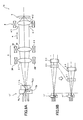
- FIGS. 5A and 5B show an optical system provided in the optical pickup apparatus according to the present invention.
- the optical system 1 shown in FIGS. 5A and 5B comprises a first hologram unit 11, a beam splitter 2, a coupling lens system 3 and an actuator 4 that are arranged on a straight line in that order.
- the optical system 1 also comprises a second hologram unit 12, which faces the beam splitter 2 and has an optical axis perpendicular to the straight line.
- the first coupling lens system 3 includes a first coupling lens (a group of lenses) 31, a second coupling lens (a group of lenses) 32, a single-axis actuator 33 for driving the second coupling lens 32 in a direction of the optical axis, etc.
- the actuator 4 is provided with apertures (opening parts) 41a and 41b, objective lenses 42a and 42b, a holder 43, etc., so as to drive the objective lenses 42a and 42b.
- the first hologram unit 11 is provided with a laser light source 11L, a hologram element 11h for acquiring a necessary signal by diffracting a light reflected by a disc, and a light-receiving element 11p for generating various signals.
- the second hologram unit 12 is provided with a laser light source 12L, a hologram element 12h for acquiring a necessary signal by diffracting a light reflected by a disc, and a light-receiving element 12p for generating various signals.
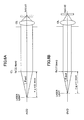
- FIG. 5A is an illustration showing a state where the first hologram unit 11 emits a light.
- the diverging light from the first hologram unit 11 transmits the beam splitter 2 and transmits the first coupling lens 31, and, then, transmits the coupling lens 32.
- the focal distance of the coupling lens system is fa and the light-emitting point (the laser light source 11L) is at a focal point, the transmitted light becomes a parallel light, and the parallel light is limited in its aperture diameter and is converged onto a recording surface of a DVD (optical information recording medium) 5a by the objective lens 42a.
- the light reflected by the DVD 5a passes through the objective lens 42a, the second coupling lens 32, the first coupling lens 31 and the beam splitter 2, and, then, the light is incident on the hologram unit 11 again.
- the light-receiving unit 11p of the hologram unit 11 generates a track signal, a focus signal, an information signal, etc., by the light incident on the hologram unit 11.
- the objective lens 42a is servo-controlled by the two-axis actuator 4 in accordance with the track signal and the focus signal so as to form a light spot of a diffraction limit on the DVD 5a by always following a movement of the disc.
- FIG. 5B is an illustration showing a state where the first hologram unit 12 emits a light.
- the diverging light from the second hologram unit 12 transmits the beam splitter 2 and transmits the first coupling lens, and, then, transmits the second coupling lens 32.
- the focal distance of the coupling lens system is fb and the light-emitting point (the laser light source 12L) is at a focal point, the transmitted light becomes a parallel light, and the parallel light is limited in its aperture diameter and is converged onto a recording surface of a CD (optical information recording medium) 5b by the objective lens 42b.
- the light reflected by the CD 5b passes through the objective lens 42b, the second coupling lens 32, the first coupling lens 31 and the beam splitter 2, and, then,'the light is incident on the hologram unit 12 again.
- the light-receiving unit 12p of the hologram unit 12 generates a track signal, a focus signal, an information signal, etc., by the light incident on the hologram unit 12.
- the objective lens 42b is servo-controlled by the two-axis actuator 4 in accordance with the track signal and the focus signal so as to form a light spot of a diffraction limit on the CD 5b by always following a movement of the disc.
- f is changeable by varying d.
- an optimum synthetic focal distance f is acquired from an optimum value of ⁇ with respect to each of the laser light sources 11A and 12L using the equations (1) and (2), and a value of the distance d between the first coupling lens and the second coupling lens is acquired in accordance with the synthetic focal distance. Finally, a value of the distance of the second coupling lens 32 to be moved can be acquired.
- the distance d between the first coupling lens and the second coupling lens can be acquired using the same equations.
- Table 1 shows an example of specific design in the cases of AOD and DVD.
- AOD DVD DIVERGING ANGLE OF LIGHT SOURCE (HALF VALUE) 10° 10° ⁇ // DIRECTION FOR SEMICONDUCTOR LASER MINIMUM VALUE OF RIM 50% 30% FOCAL DISTANCE (f) of OBJECTIVE LENS 3mm 3mm NUMERICAL APERTURE 0.65 0.65 APERTURE DIAMETER 3.9 3.9 ⁇ 2 ⁇ f ⁇ NA
- the light taking angle ⁇ dvd is given according to the following equation based on a general formula of Gaussian distribution.
- ⁇ dvd [ ⁇ ln(Ra)/ln(Rb) ⁇ aod 2 ] 1/2
- FIGS. 7A and 7B show the coupling lens system 3 which is designed practically from the above results.
- the thickness of the coupling lens L1 is set to 2.0 mm
- the thickness of the coupling lens L2 is set to 1.2 mm
- the minimum value of RIM to each aperture diameter can be acquired, which satisfies the conditions.
- the objective lenses 42a and 42b are mounted on the two-axis actuator 4 of a rotary switching type as shown in FIGS. 8A and 8B.
- the actuator 4 has a disk-shaped holder 43 having tow through holes formed in a direction of the thickness thereof, and the apertures 41a and 41b and the objective lenses 42a and 42b are provided in the through holes, respectively.
- the holder 43 is rotatable in a direction indicated by arrows B about a shaft 44 penetrating at the center of the holder 43.
- a coil 45 is provided in a peripheral portion of the holder 43.
- the coil 45 has a function of a track coil and a focus coil. Further, there is provided a magnet outside the coil 45 at a position close to the coil 45 with a predetermined gap therebetween.
- An upward-directing mirror 47 is provided under the holder 43.
- a light beam is reflected by the upward-directing mirror 47, and is incident on the objective lens 42 through the aperture 41a.
- the actuator 4 performs switching between the objective lenses 42a and 42b and a tracking servo operation by rotating in the direction B.
- the holder 43 moves in a direction indicated by arrows C by a magnetic force by the coil 45 and a magnet 46 so as to perform a focus servo operation.
- the optical pickup apparatus performs recording and reproduction on both the DVD 5a and the CD 5b by converging the light beams from the laser light sources 11L and 12L onto the DVD 5a and the CD 5b (both are optical information recording media), respectively, as shown in FIGS. 5A and 5B.
- the optical pickup apparatus comprises: the laser light sources 11L and 12L corresponding to the DVD 5a and the CD 5b; the coupling lens system (a coupling lens) 3 including the first coupling lens (a group of lenses) 31 and the second coupling lens (a group of lenses) 32 that are common to the laser light sources 11L and 12L so as to converge the light beams from the laser light sources 11L and 12L by the first coupling lens 31 and the second coupling lens 32; the apertures (opening parts) 41a and 41b that can change the aperture diameter in accordance with the laser light sources 11L and 12L; the objective lenses 42a and 42b that converge the light beams passed through the apertures 41a and 41b onto the recording surfaces of the DVD 5a and the CD 5b, respectively; and the actuator (lens moving means) 33 for moving at least one of the first coupling lens 31 and the second coupling lens 32 in accordance with the aperture diameters of the apertures 41a and 41b.
- the number of the laser light sources of the optical system is not limited to two. Additionally, the number of groups of the coupling lens system is not limited to two.
- FIG. 9A is an illustration showing an optical system 1a of an optical pickup apparatus provided with a hologram unit 11' having two laser light sources 11L1 and 11L2.
- the hologram 11h and the light-receiving elements 11p are common to the two laser light sources 11L1 and 11L2. It is configured and arranged so that an optimum RIM and coupling efficiency are acquired for each of the two laser light sources 11L1 and 11L2 by driving independently the first coupling lens 31 and the second coupling lens 32 by the single-axis actuators 34 and 33, respectively.
- a distance between the two laser light sources 11L1 and 11L2 is set to a value equal to or smaller than several hundreds ⁇ m.
- the objective lenses 42a and 42b shown in FIGS. 5A and 5B are made common as an objective lens 42 by causing one of the incident light beams to be diverging light or providing a diffraction grating on the lens surface to make a diffraction lens.
- the apertures 41a and 41b are also made common as an aperture 41 by using a wavelength filter having wavelength selectivity or diffraction grating.
- the objective lenses 42a and 42b are common to the laser light sources 11L and 12L.
- two laser light sources 11L and 12L are arranged so that a distance between the light - emitting points of both is set equal to or smaller several hundreds ⁇ m, and the single-axis actuators (lens moving means) 34 and 33 are provided for moving the first coupling lens 31 and the second coupling lens 32 of the coupling lens system 3 in the direction "a" of the optical axis in accordance with the aperture diameters of the two laser light sources 11L and 12L, respectively.
- FIG. 9B is an illustration showing a state where the first coupling lens 31 and the second coupling lens 32 are moved by driving the single-axis actuators 34 and 33 independently.
- the coupling lens system 3 can obtain the a good spot which always have no aberration by being driven in consideration of the chromatic aberration beforehand at the time of switching the light source.
- the wavelengths of the two laser light sources 11L and 12L are different from each other, and after moving at least one group of lenses of the first coupling lens 31 and the second coupling lens 32 by the single-axis actuator (lens moving means) 34 and 33 in accordance with the aperture diameters of the apertures (opening parts) 41a and 41b, at least one group of lenses of the first coupling lens 31 and the second coupling lens 32 is moved further in the direction "a" of the optical axis in accordance with the wavelengths of the two laser light sources 11L and 12L.
- the number of the laser light sources is not limited to two.
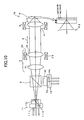
- a spherical aberration is generated in an optical system 1b of an optical pickup apparatus as shown in FIG. 10 since the thicknesses of the optical transmission layers are different from each other.
- the spherical aberration can be corrected by making the light beam from the coupling lens non-parallel. If a thickness t of a first layer Lay0 of the optical transmission layers is t0, the spherical aberration generated by the first layer Lay0 is corrected beforehand by the objective lens 42 when designing, and, thus, an the light beam from the coupling lens system 3 is a parallel light.
- the thickness t of the second layer Lay1 of the optical transmission layer is set to t1
- a spherical aberration corresponding to the difference between t1 and t0 is generated.
- the second coupling lens 32 is moved by the single-axis actuator 33 in the direction "a" of the optical axis and the light beam from the coupling lens system 3 is a non-parallel light, which causes the light beam canceling the spherical aberration is incident on the objective lens.
- At least one optical information recording medium 5 from among a plurality of information recording media is formed in a layer structure to have two recording layers Lay0 and Lay1, and after moving at least one group of lenses of the first coupling lens 31 and the second coupling lens 32 in accordance with the aperture diameter of the aperture (opening part) 41 by the single-axis actuator (lens moving means) 33, at least one group of lenses of the first coupling lens 31 and the second coupling lens 32 is moved further by the single-axis actuator 33 in accordance with the plurality of recording surfaces Lay0 and Lay1.
- the number of recording surfaces of the optical information recording media 5 is not limited to two.
- the thickness t of each of the optical transmission layers of the optical information recoding medium 5 varies from a design thickness due to manufacturing tolerance, temperature change, etc.
- a spherical aberration is generated due to such variation, but such a spherical aberration can be corrected by making the light beam from the coupling lens system 3 non-parallel. Therefore, a thickness measuring means (not shown in the figure) is provided in the optical system 1b so as to measure the thickness t of each optical transmission layer of the optical information recording medium 5, and the coupling lens system 3 is moved so as to correct the spherical aberration in accordance with the measured value so that a good beam spot having no aberration is always obtained.
- At least one optical information recording medium 5 from among a plurality of optical information recording media has two recording surfaces Lay0 and Lay1, and after moving at least one group of lenses of the first coupling lens 31 and the second coupling lens 32 in accordance with the aperture diameter of the aperture (opening part) 41 by the single-axis actuator 33, at least one group of lenses of the first coupling lens 31 and the second coupling lens 32 is moved further by the single-axis actuator 33 in accordance with the variation in the thickness of the optical transmission layers.
- the number of recording surfaces of the optical information recording medium 5 is not limited to two.
- the wavelengths of the laser light sources 11L and 12L fluctuate as design wavelengths as a center of fluctuation due to changes in temperature and output power. According to the wavelength fluctuation, a chromatic aberration is generated in the lens system or the substrate. The chromatic aberration can be corrected by making the light beam from the coupling lens system 3 non-parallel. Therefore, wavelength measuring means (not shown in the figure) is provided in the optical system 1b so as to measure the wavelength of each of the laser light sources 11L and 12L, and the coupling lens system 3 is moved so as to correct the chromatic aberration in accordance with the measured value so that a good beam spot having no aberration is always obtained.
- At least one group of lenses of the first coupling lens 31 and the second coupling lens 32 is moved further in the direction "a" of the optical axis by the single-axis actuator 33 in accordance with the fluctuations in the wavelengths of the laser light sources 11L and 12L.
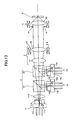
- FIG. 11 shows an example of the optical pickup apparatus in which spherical aberration detecting means 50 is added between the coupling lens system 3 and the actuator 4 of the optical system 1b shown in FIG. 10.
- the spherical aberration detecting means 50 comprised a beam splitter 6, a lens 7, a hologram 8, a light-receiving element 9, etc.
- the hologram 8 has two different diffraction areas 8a and 8b
- the light-receiving element 9 has two light-receiving elements 9a and 9b.
- Other structures are the same as that shown in FIGS. 5A and 5B, and descriptions thereof will be omitted.
- a part of the light beam reflected by the optical information recording medium 5 is reflected by the beam splitter 6, and is converged by the lens 7.
- the converged light beam is diffracted by the diffraction areas 8a and 8b toward the light-receiving elements 9a and 9b, respectively.
- an amount and a direction of the spherical aberration of the light reflected by the optical information recording medium 5 cab be detected by comparing amounts of light received by the light-receiving elements 9a and the light-receiving element 9b with each other. It should be noted that if there is a color aberration, the color aberration can also be detected by the same detecting means.
- a spherical aberration or a color aberration can be prevented from being generated in the disc surface spot by causing the detection signal to be zero by moving the first coupling lens 31 or the second coupling lens 32 of the coupling lens system 3.
- the optical pickup apparatus is provided with the spherical aberration detecting means 50 that corresponds to at least one of the laser light sources 11L and 12L.
- a semiconductor laser as a laser light source has a characteristic in that a wavelength changes immediately as an output power changes. Accordingly, a chromatic aberration is generated due to the slight difference in wavelength between reproduction time and recording time. Since this chromatic aberration is generated rapidly, there may be a time lag if it is corrected by moving a coupling lens system, which causes an error in reproduction or recording.
- achromatic lens As the coupling lens.
- a laminated lens is used as a first coupling lens 31', which is a fixed side of the coupling lens system 3. That is, the first coupling lens 31' of the coupling lens system 3 is an achromatic lens, which corrects the chromatic aberration of the spot formed by converging a light beam from at least one of the laser light sources 11L and 12L on the recording surface of the optical information recording medium 5.
- the number of the laser light sources in the optical system of the optical pickup apparatus of the present invention is not limited to two.
- a fixed lens 11S may be provided to the laser light source 11L so as to reduce the travel distance of the second coupling lens 32. That is, fixed lens 11S, which changes a degree of divergence of the light beam from the laser light source 11L, is provided in an optical path between at least one of the three laser light sources 11L, 12L, 13L and the coupling lens system (coupling lens) 3.
- the laser light source to which the fixed lens 11S is provided is not limited to the laser light source 11L.
- the number of the hologram units is not limited to three.
- Other structures shown in FIG. 13 are the same as that shown in FIGS. 5A and 5B, and descriptions thereof will be omitted.
- an optical pickup apparatus which can couple light beams from a plurality of light sources with a simple structure, and is capable of correcting a chromatic aberration and a spherical aberration generated due to fluctuation in wavelength, a multi-layer disc structure, and a variation in thickness of a disc substrate.
- optical pickup is preferably mounted in an optical disc drive apparatus.
- a light beam projected from a semiconductor laser is a radially expanding light beam, and a beam diameter parallel to the junction plane of the semiconductor laser is different from a beam diameter of perpendicular to the junction plane.
- the beam diameters in all directions are equalized by using a beam shaping prism so as to equalize a rim intensity of the light beam incident on an objective lens having a circular aperture, thereby suppressing reduction in an amount of light.
- a beam shaping prism cannot be provided in an optical system using a CL expander since an optical path is a diverging/converging optical path. For this reason, in order to perform beam shaping plastic using in the optical system using the CL expander, it is desirable to apply an optical system in which a beam shaping lens is arranged between an light source and a coupling lens capable of changing a magnification.
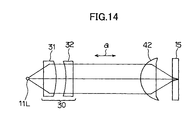
- a cupping lens system 30 is constituted by a first coupling lens 31 that changes a diverging light beam projected from the light source 11L into a light beam substantially parallel to the optical axis and a second coupling lens (first means) 32 that corrects a chromatic aberration of the entire optical system, so as to reduce a chromatic aberration of the optical system generated due to wavelength fluctuation of the light source 11 by a chromatic aberration correction of a diffracting part.
- a spherical aberration generated due to a variation in wavelength of the light source 11L is reduced by setting by a second means a distance between the light source 11L and a first surface on which the light beam from the light source 11L is incident.
- an aberration due to wavelength fluctuation is reduced by the second coupling lens (diffraction surface: first means) provided in the coupling lens system 30, and an aberration due to wavelength variation is reduced by the second means which adjusts the distance between the light source 11L and the coupling lens system 30 in the direction "a" of the optical axis within a wide range of a short wavelength.
- the second coupling lens diffiffraction surface: first means
- FIG. 15 is an illustration of an optical system of an optical pickup apparatus according to a second embodiment of the present invention.
- the optical system 10A shown in FIG. 15 comprises a first hologram unit 11, a first coupling lens (a group of lenses) 31, a beam splitter (optical path synthesizing and separating means) 20, a second coupling lens (a group of lenses) 32, an aperture 241 and an objective lens 242 that are arranged along a straight line in that order.
- the optical system 10A also comprises a second hologram unit 12, which faces the beam splitter 2 and has an optical axis perpendicular to the straight line.
- the first coupling lens system 30 includes the first coupling lens (a group of lenses) 31, a second coupling lens (a group of lenses) 32. Additionally the first coupling lens 31 is provided with a single-axis actuator 33 for driving the first coupling lens 31 in the direction "a" of the optical axis, etc.
- the objective lens 242 is moved by an actuator 243 in the direction "a" of the optical axis.
- a dichroic prism utilizing a difference in wavelength between the first hologram unit 11 and the second hologram unit 12 is used as the beam splitter 20
- a polarizing prism may be used instead.
- the first hologram unit 11 is provided with a laser light source 11L, a hologram element 11h for acquiring a necessary signal by diffracting a light reflected by an optical information recording medium, and a light-receiving element 11p for generating various signals.
- the first hologram unit 11 performs recording and reproduction on a DVD (optical information recording medium) 15a.
- the second hologram unit 12 is provided with a laser light source 12L, a hologram element 12h for acquiring a necessary signal by diffracting a light reflected by an optical information recording medium, and a light-receiving element 12p for generating various signals.
- the second hologram unit 12 performs recording and reproduction on a CD (optical information recording medium) 15b.
- the optical recording apparatus performs recording and reproduction on both the DVD 15a and the CD 15b by converging the light beams from the light sources 11L and 12L onto the DVD 15a and the CD 15b (both are optical information recording media), respectively.
- the optical pickup apparatus comprises: two light sources 11L and 12L corresponding to the DVD 15a and the CD 15b; the beam splitter (optical synthesizing and separating means) 20 for synthesizing and separating the light beams from the two light sources 11L and 12L; at least one group of lenses (first coupling lens 31) common to the light sources 11L and 12L; the coupling lens system (a coupling lens) 30 including a plurality of groups of lenses including the first coupling lens 31 so as to converge the light beams from the light sources 11L and 12L, the plurality of groups of lenses constituting the coupling lens system 30 being located in the direction of the optical axis of at least one light source 11L with the beam splitter interposed therebetween; the objective lenses 242 that converges the light beams
- the actuator (lens moving means) 33 is not limited to move the first coupling lens (one group of lenses) 31, and may move the second coupling lens (one group of lenses) 32. Further, the first coupling lens (one group of lenses) 31 moved by the actuator (lens moving means) in the direction "a" of the optic axis may be arranged between the light source 11L and the beam splitter (optical path synthesizing and separating means) 20, or may be arranged between the beam splitter (optical path synthesizing and separating means) 20 and the objective lens 242.
- a light beam emitted by the first hologram unit 11 is indicated by solid lines
- a light beam emitted by the second hologram unit 12 is indicated by dotted lines.
- the light beam from the first hologram unit 11 transmits the first coupling lens 31, which has been appropriately moved by the single-axis actuator 33, and the beam splitter 20, and further transmits the second coupling lens 32, which changes the light beam into a parallel light.
- the parallel light beam is then limited appropriately in its aperture diameter by the aperture 41, and is converged onto the recording surface of the DVD 15a by the objective lens 242.
- the light reflected by the DVD 15a is incident on the first hologram unit 11 again after passing through the objective lens 242, the second coupling lens 32, the beam splitter 20 and the first coupling lens 31.
- the light-receiving element 11p of the first hologram unit 11 generates a track signal, a focus signal, information signal, etc., in accordance with the light received by the light receiving unit 11p.
- the light beam from the second hologram unit 12 is reflected by the beam splitter 20 and transmits the second coupling lens 32, which changes the light beam into a parallel light.
- the parallel light beam is then limited appropriately in its aperture diameter by the aperture 41, and is converged onto the recording surface of the CD 15b by the objective lens 242.
- the light reflected by the CD 15b is incident on the second hologram unit 12 again after passing through the objective lens 242, the second coupling lens 32 and the beam splitter 20.
- the light-receiving element 12p of the second hologram unit 12 generates a track signal, a focus signal, information signal, etc., in accordance with the light received by the light receiving unit 12p.
- the objective lens 242 is servo-controlled by a two-axis actuator 243 in accordance with the track signal and the focus signal so s to always follow a movement of the disc so that a beam spot of a diffraction limit is formed on the DVD 15a or the CD 15b.
- the parallel light from the coupling lens is limited in its aperture to an aperture diameter corresponding to NA0.65 for the DVD 15a and NA0.50 for the CD 15b by the aperture (wavelength aperture limiting element) 41.
- the objective lens 242 is a DVD/CD compatible diffraction lens, and each beam is converged onto a recording surface of a disc having a substrate thickness of 0.6 mm for the DVD 15a or a recording surface of a disc having a substrate thickness of 1.2 mm for the CD 15b.
- the light reflected by the DVD 15a or the CD 15b is incident on the hologram unit 11 or 12 again, and the track signal, the focus signal, the information signal, etc., are generated by the light-receiving element 11p or 12p.
- DVD CD DIVERGING ANGLE OF LIGHT SOURCE (HALF VALUE) ⁇ LD 10° 10° ACTIVE LAYER PARALLEL DIRECTION IN SEMICONDUCTOR LASER MINIMUM VALUE OF RIM 30% 15% FOCAL DISTANCE OF OBJECTIVE LENS fol 3mm 3mm NUMERICAL APERTURE (NA) 0.65 0.50 APERTURE DIAMETER ⁇ dvd. ⁇ cd 3.9 3.0 ⁇ 2 ⁇ fol ⁇ NA LIGHT TAKING ANGLE ⁇ dvd, ⁇ cd 6.6° 8.3°
- an optimum coupling optical system can be acquired by arranging the coupling lens system 30 so that the focal distance between the laser light source 12L and the second coupling lens 32 is set to 10.4 mm and the synthesized focal distance between the laser light source 11L, the first coupling lens and the second coupling lens 32 is set to 17 mm.
- Z ch 2 / (1+ ⁇ 1-(1+k)c 2 h 2 ⁇ +A4h 4 +A6h 6 +A8h 8 +A10h 10
- Z is a coordinate of a surface configuration in an optical axis direction
- c is an inverse number (curvature) of a radius r of curvature of a surface
- h is a radius in a direction perpendicular to an optical axis
- k is a conic coefficient
- A4, A6, A8 and A10 are aspheric surface coefficients.
- the actuator (lens moving means) 33 is provided to the first coupling lens 31 so as to move the first coupling lens 31 in the direction "a" of the optical axis. Thereby, it is possible to correct a spherical aberration generated in each optical surface (recording surface) of the DVD (optical information recording medium) 15a with respect to the light beam of the light source 11L.
- ⁇ W 1 48 5 n 2 - 1 8n 3 (NA) 4 t 2
- the first coupling lens 31 corresponds to surfaces 6-7 and the second coupling lenses 32 corresponds to surfaces 10-11.
- the actuator 33 may be provided to the lens having a largest absolute value of the focal distance from among the tow groups of lenses (the first coupling lens 31 and the second coupling lens 32) that constitute the coupling lens system 30.
- An amount of divergence with respect to an amount of movement in the optical axis direction of a group of lenses decreases as an absolute value of a focal distance of the lens to be moved increases. That is, an amount of change in a spherical aberration with respect to a drive error decreases as an absolute value of a focal distance of the group of lenses to be moved increases. For this reason, in order to relax the drive accuracy of the group of lenses when correcting a spherical aberration of the light source 11L, one of the first coupling lens 31 and the second coupling lens 32 whichever having a longer focal distance is moved.
- the lens located between the light source 11L and the beam splitter 20 is not limited to only the first coupling lens 31, and a plurality of groups of lenses may be used.
- the optical information recording medium such as the DVD 15a may have a plurality of recording surfaces formed in a layer structure, and at least one group of lenses of the coupling lens system 30 (the first coupling lens 31 or the second coupling lens 32) may be moved in the direction "a" of the optical axis by the actuator (lens moving means) 33 so as to converge the light beam with respect to each recording surface.
- the spherical aberration With respect to the DVD, there is a specification of double-layer recording surface, in which a spherical aberration is generated since a thickness of each layer varies. Although the spherical aberration seldom causes a problem when reading data from a ROM disc or the like, it may give a remarkable degradation to a recording characteristic such as erasure of adjacent marks when writing data on an R disc, an RW disc or the like. Therefore, by correcting the spherical aberration by changing a degree of divergence of a light beam incident on an objective lens by moving the coupling lens 31 in the optical axis direction in accordance with each layer, the characteristic can be improved for both recording and reproduction.
- the optical information recording medium such as the DVD 15a or the CD 15b may have optical transmission layers, and at lease one group of lenses of the coupling lens system 30 (the first coupling lens 31 or the second coupling lens 32) may be moved by the actuator (lens moving means) 33 in accordance with a variation in the thickness of each optical transmission layer.
- the spherical aberration can be corrected by changing a degree of divergence of a light beam incident on the objective lens 242 by moving the first coupling lens 31 or the second coupling lens 32 in the direction "a" of the optical axis in accordance with variation in the thickness of the substrate.
- An amount of movement of the lens may be adjusted so as to, for example, maximize amplitude of an RF signal.
- At lease one group of lenses of the coupling lens system 30 may be moved by the actuator (lens moving means) 33 in the direction "a" of the optical axis in accordance with a wavelength fluctuation of the light sources 11L and 12L.
- the wavelength of the light sources 11L and 12L may fluctuate and a chromatic aberration may be generated in a disc surface spot, which may cause a degradation in the recording and reproducing performance.
- the color aberration can be corrected by changing a degree of divergence of a light beam incident on the objective lens 242 by moving the first coupling lens 31 or the second coupling lens 32 in the direction "a" of the optical axis in accordance with a wavelength fluctuation.
- An amount of movement of the lens may be adjusted so as to, for example, maximize amplitude of an RF signal.
- the coupling lens system 30 and the objective lens 242 through which the light beam passes may be an achromatic lens system.
- a color aberration can be eliminated even when a wavelength is instantaneously changed such as in a mode hop, which reduces an error in recording and reproduction.
- a wavelength of a semiconductor laser as a light source changes instantaneously when an output power thereof changes. Accordingly, the wavelength changes slightly between a time of reproduction and a time of recording, which may generate a chromatic aberration. Since the chromatic aberration is generated instantaneously, there is a time delay if a correction is performed by moving the coupling lens, which may be a cause of recording or reproducing error. Such a problem is remarkable particularly in the Blue-ray and AOD having a short wavelength. In order to solve this problem, it is effective to use an achromatic lens system.
- the entire system of the coupling lens system 30 and the objective lens 242 through which a light beam passes may be an achromatic lens system.
- a diffraction lens has a disadvantage, as compared to a refraction lens, that a transmittance is low while an aberration correcting function is high. If it is desired to make an optical system having a high transmittance, a refraction lens is used for the objective lens by making the DVD light beam of FIG. 17 as a diverging light. In such a case, in order to correct a chromatic aberration of the objective lens, a design is given to a coupling lens to have a chromatic aberration for correction. That is, achromatize is performed in a whole system of an optical system in which a coupling lens and an objective lens are combined.
- a third coupling lens 34 may be provided between the second hologram unit 12 and the beam splitter 20 so as to change magnification of the light beam of the light source 12L by the third coupling lens 34, and chromatic aberration correcting means may be provided to the third coupling lens (a group of lenses) 34 for correcting a chromatic aberration of the second coupling lens and the objective lens 242.
- a coupling lens system is constituted by the third coupling lens 34 and the second coupling lens 32.
- the third coupling lens 34 has the chromatic aberration correcting function to correct collectively the chromatic aberration of the third coupling lens 34, the second coupling lens 32 and the objective lens 242.
- the chromatic aberration correcting function of the third coupling lens 34 is realizable by any one of methods of a laminated lens in which a plurality of lenses made of a glass material having different refraction indices, a combination lens, a diffraction lens having a surface provided with a diffraction surface.
- the third coupling lens 34 is designed so as to satisfy the following conditions, where focal distances of lens elements 1 to n of the third coupling lens 34 are f31 to f3n, and partial dispersions are V31 to V3n.
- spherical aberration detecting means 25 may be provided for detecting a spherical aberration of a reflected light beam, which projected from the light source 11L or 12L and converged onto and reflected by a recording surface of the DVD (optical information recording medium) 15a or the CD (optical information recording medium) 15b.
- the spherical aberration detecting means 25 comprise a beam splitter 26, a lens 27, a hologram 28, the light-receiving element 29, etc. It should be noted that the hologram 28 has two different diffraction areas 28a and 28b, and the light-receiving element 29 has two light-receiving elements 29a and 29b. Other structures are the same as that shown in FIG. 15, and descriptions thereof will be omitted.
- the light beam incident on the hologram 28 is diffracted by the two different diffraction areas 28a and 28b toward the light-receiving elements 29a and 29b, respectively. Then, an amount and a direction of the spherical aberration of the light reflected by the disc can be detected by comparing amounts of light received by the light-receiving elements 29a and 29b. When there is a chromatic aberration, the chromatic aberration can also be detected by the detecting means.
- the first coupling lens (a group of lenses) located closest to the light source 11L may be a convex lens.
- a diverging angle of a diverging light beam from the light-source 11L can be enlarged so as to increase an intensity of a rim of the light beam (RIM) incident on the objective lens 242. If the RIM becomes large, the diameter of a spot diameter on a disc surface is decreased, which improves the recording and reproducing performance.
- the wavelength ⁇ A which is a wavelength of the optical beam passing through the first coupling lens (group of lenses) 31 which is a convex lens
- a wavelength ⁇ B which is a wavelength of the light beam not transmitting the convex lens
- the wavelength is decreased in the order of CD, DVD and Blue-ray, the recording density is increased even if the difference in NA is considered, and it is necessary to further reduce a spot diameter on a surface of a disc.
- the wavelength of the light source 11L which is on the side of the convex lens, shorter than the wavelength of the light source 12L, the RIM is increased, which realizes further reduction in the spot diameter on a surface of a disc.
- the first coupling lens (a group of lenses) 31 closest to the light source 11 or the third coupling lens (a group of lenses) 34 closest to the light source 12L may be a convex lens.
- each of the first coupling lens 31, the third coupling lens 34 and the second coupling lens 32 is a convex lens.
- the diverging light beam from the third hologram unit 13 transmits the beam splitters 20 and 21 and the second coupling lens 32, and is changed into a parallel light.
- a dichroic prism utilizing a difference in wavelength between the three hologram units 11, 12 and 13 is used for each of the bam splitters 20 and 21.
- the light beam from the coupling lens system 30 is limited in an aperture diameter corresponding to NA0.65 for DVD, NA0.50 for CD and NA0.65 for AOD by the aperture (wavelength aperture limiting element) 41, and is incident on the objective lens 242.
- the objective lens 242 is a three-wavelength compatible diffraction lens so as to converge each light beam onto the recording surface of the DVD 15a having a substrate thickness of 0.6 mm, the recording surface of the CD 15b having a substrate thickness of 1.2 mm or the recording surface of AOD 15c having a substrate thickness of 0.6 mm.
- the light beam incident on the objective lens 242 is a parallel light for DVD and AOD, and is a diverging light for CD.
- the reflected light from the discs are incident on the respective hologram units 11, 12 and 13, and the light-receiving elements 11h, 12h and 13h generate a track signal, a focus signal, an information signal, etc.
- the objective lens 242 converges a light beam to form a beam spot of a diffraction limit on the recording surface of each disc with respect to each wavelength by always following a movement of each disc by being servo-controlled in accordance with the track signal and the focus signal.
- the optical path for coupling can be shortened by using a convex lens for each of the first coupling lens 31, the second coupling lens 32 and the third coupling lens 34, there is an advantage that the size of the optical pickup apparatus can be reduced.
- the wavelength ⁇ A which is a wavelength of the optical beam passing through the first coupling lens 31 or the coupling lens 34 (both are convex lenses)
- a wavelength ⁇ B which is a wavelength of the light beam not transmitting the first coupling lens 31 or the third coupling lens 34, may be set so that a relationship ⁇ A ⁇ B is satisfied.
- the light sources 11L and 12L is set to a wavelength longer than the wavelength of the light source 13L, a smaller RIM can be coupled, which increases a coupling efficiency and a disc surface power, thereby achieving high speed recording.
- At least one group of lenses movable by the lens moving means in the optical axis direction may be located between the light source and the light path synthesizing and separating means, or at least one group of lenses movable by the lens moving means in the optical axis direction may be located between the light path synthesizing and separating means and the objective lens.
- the optical pickup apparatus shown in FIG. 20 comprises the first hologram unit 11, the second hologram unit 12 and the third hologram unit 13 that correspond to the respective three optical information recording media (DVD 15a, CD 15b and AOD 15c), and further comprises another beam splitter (another optical path synthesizing and separating means) 21 in addition to the beam splitter between the third hologram unit 13 and the second coupling lens 32.
- another beam splitter another optical path synthesizing and separating means
- the third hologram unit 13, the beam splitter 20, the beam splitter 21, the second coupling lens 32, and the objective lens 42 are aligned along a substantially straight line, and a first hologram unit 11 is positioned perpendicular to the optical axis of the beam splitter 20 with the first coupling lens 31 therebetween, and a second hologram unit 12 is positioned perpendicular to the optical axis of the beam splitter 21 with the third coupling lens 34 therebetween.
- the first coupling lens (a group of lenses) 31 of the coupling lens system 30 driven by the actuator 33 in FIG. 15 is located on the side of the light source 11L with respect to the beam splitter (optical path synthesizing and separating means) 20, while the second coupling lens (a group of lenses) 32 of the coupling lens system 30 driven by the actuator 33 in FIG. 20 is located on the side of the objective lens 242 with respect to the beam splitters (optical path synthesizing and separating means) 20 and 21.
- the driving mechanism can be shared by DVD and AOD by driving the second coupling lens located closer to the objective lens 242 than the beam splitter 21.
- the second coupling lens 32 is returned always to a fixed position.
- beam shaping means 35 may be provided between the light source 11 and the first coupling lens (a group of lenses) 31, which is closest to the light source 11L in the coupling lens system 30.
- the bean shaping means 35 corresponds to a diffraction surface or an anamorphic lens having different magnification in directions parallel and perpendicular to an active layer of the semiconductor laser of the light source 13L in a plane perpendicular to the direction "a" of the optical axis. It is desirable in the optical pickup, to set M ⁇ // / ⁇ ⁇ ⁇ 1.0 where ⁇ // is a divergence angle in a direction parallel to the active layer and theta ⁇ is a diverging angle in a direction perpendicular to the active layer. M is referred to as a shaping magnification.
- An anamorphic lens (beam shaping means 35) having different magnifications in the directions parallel to and perpendicular to the active layer of the semiconductor laser of the light source 11L.
- the beam shaping means 35 which is a lens having different magnifications in the two directions parallel to and perpendicular to the active layer, the diverging angle of the light beam is changed, which shapes the light beam. That is, the anamorphic lens as the beam shaping means 35 is capable of converting an elliptic converging light into a circular converging light, and, a light using efficiency (coupling efficiency) in the optical pickup can be increased.
- An anamorphic, aspheric equation is shown below.
- optical disc discriminating means may be provided in the optical pickup apparatus for discriminating a kind of each of a plurality of optical information recording media (DVD 15a, CD 15b, AOD 15c) such as shown in FIG. 20 so as to move at least one group of lenses from among the first coupling lens 31, the second coupling lens 32 and the third coupling lens 34 that constitute the coupling lens system 30 by the actuator (lens moving means) 33 in the direction "a" of the optical axis in accordance with kinds of the optical information recording media.
- DVD 15a, CD 15b, AOD 15c optical information recording media
- the optical disc discriminating means for discriminating a kind of an optical disc attached is provided in the optical pickup apparatus.
- the optical disc discriminating means comprises a light-receiving element and a signal operation circuit that perform a discrimination based on a signal output by a signal detecting system of the optical pickup apparatus.
- the signal output from the optical disc discriminating means is input to a controller of the lens moving means such as the actuator 33, and the lens moving means is controlled by a lens driving means driver.
- Optical discs are different in their substrate thickness and refraction index depending on kinds of the optical discs. For this reason, a spherical aberration may be generated for each optical disc.
- a wavefront aberration of the optical system can be reduced by changing the position of the coupling lens system 30 in accordance with information obtained from the optical disc discriminating means.
- the coupling lens system 30 or the objective lens 242 may be located at a position in the direction "a" of the optical axis so that an aspheric aberration generated in each optical surface is minimized.
- a general semiconductor laser has variation in oscillation wavelength de to the manufacture variation of an active layer structure.
- the position of each lens in the direction "a" of the optical axis is fixed in accordance with the oscillation wavelength of the light source 11A so that a spherical aberration generated in each optical surface is minimized.
- each lens is moved in the direction "a" of the optical axis with respect to the fixed position of the lens as a center.
- the position of the coupling lens 32 in the direction "a" of the optical axis is fixed in accordance with the oscillation wavelength of the light source 11L so that a spherical aberration generated in each optical surface is minimized.
- the coupling lens 32 is moved in the direction "a" of the optical axis with respect to the fixed position of the lens as a center.
- the position of the coupling lens 32 in the direction "a" of the optical axis is fixed in accordance with the oscillation wavelength of the light source 12L so that a spherical aberration generated in each optical surface is minimized.
- the coupling lens 32 is moved in the direction "a"" of the optical axis with respect to the fixed position of the lens as a center.
- a refraction index changes due to a dispersion characteristic of a material used for the lens, thereby generating a spherical aberration.
- the spherical aberration can be changed into an optimum wavefront aberration by shifting the position of the lens in the optical axis direction. Furthermore, when a spherical aberration is generated in an optical surface of the optical pickup, the spherical aberration can be changed into an optimum wavefront aberration by further moving the from the shifted position.
- the position of the coupling lens 32 in the direction "a" of the optical axis is fixed in accordance with the oscillation wavelength of the light source 11L so that a spherical aberration generated in each optical surface is minimized. Thereby, the spherical aberration generated due to variation in the oscillation wavelength of the light source 11L can be reduced.
- the position of the coupling lens 32 in the direction "a" of the optical axis is fixed in accordance with the oscillation wavelength of the light source 12L so that a spherical aberration generated in each optical surface is minimized. Thereby, the spherical aberration generated due to variation in the oscillation wavelength of the light source 12L can be reduced.
- the optical pickup apparatus may be mounted on an optical disc drive apparatus.
- a semiconductor laser serving as a light source of an optical pickup 245 is driven and controlled by a laser driver/laser controller of the optical disc drive apparatus.
- a signal output from the light-receiving element of the optical pickup 245 is sent to each controller through a signal operation circuit 246.
- Fo signal and Tr signal for enacting an objective lens are converted into control signals of the objective lens by an Fo controller 247a and a Tr controller 247b.
- the output signal from the signal operation circuit is converted into control signal by a lens moving means driver 249a so that lens moving means is driven by the lens moving means driver 49b.
- the lens moving means controller 49a and the lens moving means driver 49b are mounted in the optical disk drive apparatus.
- an optical pickup apparatus which can couple light beams from a plurality of light sources with a simple structure, and is capable of correcting a chromatic aberration and a spherical aberration generated due to fluctuation in wavelength, a multi-layer disc structure, and a variation in thickness of a disc substrate.
Landscapes
- Physics & Mathematics (AREA)
- Optics & Photonics (AREA)
- Optical Head (AREA)
Applications Claiming Priority (4)
| Application Number | Priority Date | Filing Date | Title |
|---|---|---|---|
| JP2004066698A JP4314133B2 (ja) | 2004-03-10 | 2004-03-10 | 光ピックアップ装置及びそれを搭載した光ディスクドライブ装置 |
| JP2004066698 | 2004-03-10 | ||
| JP2004092708 | 2004-03-26 | ||
| JP2004092708A JP2005285150A (ja) | 2004-03-26 | 2004-03-26 | 光ピックアップ装置及びそれを搭載した光ディスクドライブ装置 |
Publications (2)
| Publication Number | Publication Date |
|---|---|
| EP1575040A2 true EP1575040A2 (fr) | 2005-09-14 |
| EP1575040A3 EP1575040A3 (fr) | 2007-12-05 |
Family
ID=34829497
Family Applications (1)
| Application Number | Title | Priority Date | Filing Date |
|---|---|---|---|
| EP05251455A Withdrawn EP1575040A3 (fr) | 2004-03-10 | 2005-03-10 | Dispositif de lecture optique et unité de disque optique muni d'un tel dispositif de lecture optique |
Country Status (2)
| Country | Link |
|---|---|
| US (1) | US20050201248A1 (fr) |
| EP (1) | EP1575040A3 (fr) |
Cited By (1)
| Publication number | Priority date | Publication date | Assignee | Title |
|---|---|---|---|---|
| EP1632941A2 (fr) * | 2004-09-03 | 2006-03-08 | Sony Corporation | Tête de lecture optique et appareil de disque optique |
Families Citing this family (10)
| Publication number | Priority date | Publication date | Assignee | Title |
|---|---|---|---|---|
| JP2005293765A (ja) * | 2004-04-02 | 2005-10-20 | Konica Minolta Opto Inc | 光ピックアップ装置 |
| EP1854098B1 (fr) | 2005-03-02 | 2012-02-29 | Ricoh Company, Ltd. | Systeme optique, dispositif a tete de lecture optique et disque a disque optique |
| JP4557869B2 (ja) * | 2005-11-18 | 2010-10-06 | 株式会社日立製作所 | 光ディスク種別判別方法、光ディスク装置 |
| JP2008084452A (ja) * | 2006-09-28 | 2008-04-10 | Mitsumi Electric Co Ltd | 光ピックアップ |
| JP5040028B2 (ja) * | 2007-12-05 | 2012-10-03 | 株式会社リコー | 多層情報記録媒体・層判別方法 |
| WO2010047021A1 (fr) * | 2008-10-24 | 2010-04-29 | パナソニック株式会社 | Unité optique et dispositif électronique l'utilisant |
| KR101309704B1 (ko) * | 2009-08-19 | 2013-09-17 | 도시바삼성스토리지테크놀러지코리아 주식회사 | 광픽업 장치 |
| KR20110090648A (ko) * | 2010-02-04 | 2011-08-10 | 삼성전자주식회사 | 광 픽업장치 |
| JP5617561B2 (ja) | 2010-11-25 | 2014-11-05 | 株式会社リコー | 撮像装置 |
| US8787137B2 (en) * | 2011-01-20 | 2014-07-22 | Mitsubishi Electric Corporation | Optical pickup device and optical disc device |
Family Cites Families (16)
| Publication number | Priority date | Publication date | Assignee | Title |
|---|---|---|---|---|
| US5754513A (en) * | 1995-04-28 | 1998-05-19 | Konica Corporation | Information pick-up apparatus and optical disk apparatus |
| KR100239237B1 (ko) * | 1995-09-12 | 2000-01-15 | 가나이 쓰도무 | 광디스크장치 및 그의 광헤드 |
| JPH11259893A (ja) * | 1998-01-09 | 1999-09-24 | Sony Corp | 光学ヘッド、記録及び/又は再生装置並びに記録及び/又は再生方法、並びに厚み検出方法 |
| EP1154417B1 (fr) * | 2000-05-12 | 2012-05-09 | Konica Minolta Opto, Inc. | Dispositif de lecture optique |
| JP3861586B2 (ja) * | 2000-11-06 | 2006-12-20 | ソニー株式会社 | 光学ピックアップ装置及び記録再生装置 |
| JP3643030B2 (ja) * | 2000-12-05 | 2005-04-27 | シャープ株式会社 | 光ピックアップ装置 |
| JP2002279680A (ja) * | 2001-03-21 | 2002-09-27 | Konica Corp | 光ピックアップ装置、光ピックアップ装置の集光光学系及び光情報記録再生方法、 |
| KR20020081077A (ko) * | 2001-04-18 | 2002-10-26 | 코니카가부시끼가이샤 | 대물 렌즈, 집광 광학계, 광 픽업 장치 및 기록·재생 장치 |
| TWI237819B (en) * | 2001-05-17 | 2005-08-11 | Konica Corp | Optical pick-up device and objective lens used therein |
| JP4329539B2 (ja) * | 2001-07-26 | 2009-09-09 | ソニー株式会社 | 光ディスク記録再生装置とそのフォーカス処理方法および光ディスク記録媒体 |
| US7274646B2 (en) * | 2001-10-04 | 2007-09-25 | Ricoh Company, Ltd. | Object lens for an infinite-type optical pickup, optical pickup and optical information processing device |
| TWI239520B (en) * | 2001-10-12 | 2005-09-11 | Konica Corp | Objective lens, optical element, optical pick-up apparatus and optical information recording and/or reproducing apparatus equipped therewith |
| DE60321414D1 (de) * | 2002-02-27 | 2008-07-17 | Ricoh Kk | Optischer Abtastkopf für verschiedene Wellenlängen |
| US20030214898A1 (en) * | 2002-04-15 | 2003-11-20 | Tetsuya Ogata | Optical pickup device and optical disk drive using the same |
| JP2004185781A (ja) * | 2002-12-06 | 2004-07-02 | Pioneer Electronic Corp | 光学装置及び光ピックアップ |
| DE602005001407T2 (de) * | 2004-02-17 | 2008-02-21 | Matsushita Electric Industrial Co., Ltd., Kadoma | Optisches Plattenlaufwerk |
-
2005
- 2005-03-07 US US11/072,620 patent/US20050201248A1/en not_active Abandoned
- 2005-03-10 EP EP05251455A patent/EP1575040A3/fr not_active Withdrawn
Cited By (1)
| Publication number | Priority date | Publication date | Assignee | Title |
|---|---|---|---|---|
| EP1632941A2 (fr) * | 2004-09-03 | 2006-03-08 | Sony Corporation | Tête de lecture optique et appareil de disque optique |
Also Published As
| Publication number | Publication date |
|---|---|
| US20050201248A1 (en) | 2005-09-15 |
| EP1575040A3 (fr) | 2007-12-05 |
Similar Documents
| Publication | Publication Date | Title |
|---|---|---|
| US6043912A (en) | Optical pickup compatible with a digital versatile disk and a recordable compact disk using a holographic ring lens | |
| EP1184856A2 (fr) | Elément de correction d'abérration et tête optique avec un tel élément | |
| US8154962B2 (en) | Optical pickup and optical information recording and reproducing device | |
| US6084845A (en) | Optical head and an optical disk apparatus | |
| EP1174865B1 (fr) | Appareil de lecture optique compatible | |
| US6304540B1 (en) | Optical pickup compatible with a digital versatile disk and a recordable compact disk using a holographic ring lens | |
| EP1494226A2 (fr) | Lentille d'objectif, tête optique et dispositif optique de traitement d'informations utilisant une telle tête | |
| EP1575040A2 (fr) | Dispositif de lecture optique et unité de disque optique muni d'un tel dispositif de lecture optique | |
| US7848211B2 (en) | Objective lens apparatus, optical pickup apparatus, and optical disc driving apparatus | |
| US7557993B2 (en) | Optical pickup and optical disc device | |
| WO2007119410A1 (fr) | Tete optique et dispositif a disque optique | |
| KR100426355B1 (ko) | 광경로차 조절수단이 구비된 광픽업 장치 | |
| JPH1027373A (ja) | 光ヘッドおよび光ディスク装置 | |
| JP4252806B2 (ja) | 光ピックアップ及びこれを用いる光情報処理装置 | |
| JP2000028917A (ja) | 光情報記録媒体の記録再生用光ピックアップ装置、対物レンズ及び対物レンズの設計方法 | |
| JP4294460B2 (ja) | 対物レンズ,光ピックアップ装置及び光ディスク装置 | |
| WO2011033786A1 (fr) | Système optique capteur de lumière | |
| KR100782813B1 (ko) | 능동형 보정소자 및 이를 채용한 호환형 광픽업 및 광 기록및/또는 재생기기 | |
| JP2000082232A (ja) | 光ピックアップ装置 | |
| JP2010211842A (ja) | 光ピックアップ、光学的情報再生装置および光学的情報記録再生装置 | |
| JP2005285150A (ja) | 光ピックアップ装置及びそれを搭載した光ディスクドライブ装置 | |
| JP4377253B2 (ja) | 光ピックアップおよび光情報再生装置または光情報記録再生装置 | |
| KR20060053935A (ko) | 집광 광학계, 이것을 이용한 광학 픽업 장치 및 광 기록 및재생 장치, 및 집광 방법 | |
| JP3570139B2 (ja) | 光ピックアップ | |
| JP2006244656A (ja) | 対物レンズ、光ピックアップ装置、及び光ディスク装置 |
Legal Events
| Date | Code | Title | Description |
|---|---|---|---|
| PUAI | Public reference made under article 153(3) epc to a published international application that has entered the european phase |
Free format text: ORIGINAL CODE: 0009012 |
|
| 17P | Request for examination filed |
Effective date: 20050330 |
|
| AK | Designated contracting states |
Kind code of ref document: A2 Designated state(s): AT BE BG CH CY CZ DE DK EE ES FI FR GB GR HU IE IS IT LI LT LU MC NL PL PT RO SE SI SK TR |
|
| AX | Request for extension of the european patent |
Extension state: AL BA HR LV MK YU |
|
| PUAL | Search report despatched |
Free format text: ORIGINAL CODE: 0009013 |
|
| AK | Designated contracting states |
Kind code of ref document: A3 Designated state(s): AT BE BG CH CY CZ DE DK EE ES FI FR GB GR HU IE IS IT LI LT LU MC NL PL PT RO SE SI SK TR |
|
| AX | Request for extension of the european patent |
Extension state: AL BA HR LV MK YU |
|
| 17Q | First examination report despatched |
Effective date: 20080515 |
|
| AKX | Designation fees paid |
Designated state(s): DE ES FR GB IT NL |
|
| STAA | Information on the status of an ep patent application or granted ep patent |
Free format text: STATUS: THE APPLICATION IS DEEMED TO BE WITHDRAWN |
|
| 18D | Application deemed to be withdrawn |
Effective date: 20090729 |