EP1570806B1 - Flächiges Implantat, Verfahren zu seiner Herstellung und Verwendung in der Chirurgie - Google Patents
Flächiges Implantat, Verfahren zu seiner Herstellung und Verwendung in der Chirurgie Download PDFInfo
- Publication number
- EP1570806B1 EP1570806B1 EP05011897A EP05011897A EP1570806B1 EP 1570806 B1 EP1570806 B1 EP 1570806B1 EP 05011897 A EP05011897 A EP 05011897A EP 05011897 A EP05011897 A EP 05011897A EP 1570806 B1 EP1570806 B1 EP 1570806B1
- Authority
- EP
- European Patent Office
- Prior art keywords
- implant
- textile
- substantially closed
- fabric
- implant according
- Prior art date
- Legal status (The legal status is an assumption and is not a legal conclusion. Google has not performed a legal analysis and makes no representation as to the accuracy of the status listed.)
- Expired - Lifetime
Links
- 238000000034 method Methods 0.000 title claims description 20
- 238000001356 surgical procedure Methods 0.000 title claims description 14
- 238000004519 manufacturing process Methods 0.000 title claims description 8
- 239000007943 implant Substances 0.000 claims description 69
- 239000004753 textile Substances 0.000 claims description 36
- 239000004744 fabric Substances 0.000 claims description 33
- 239000000463 material Substances 0.000 claims description 15
- 229920002635 polyurethane Polymers 0.000 claims description 14
- 239000004814 polyurethane Substances 0.000 claims description 14
- 239000011248 coating agent Substances 0.000 claims description 7
- 238000000576 coating method Methods 0.000 claims description 7
- 238000004873 anchoring Methods 0.000 claims description 6
- 238000010348 incorporation Methods 0.000 claims description 6
- 239000002904 solvent Substances 0.000 claims description 6
- 238000005507 spraying Methods 0.000 claims description 6
- 239000002344 surface layer Substances 0.000 claims description 5
- 238000009835 boiling Methods 0.000 claims description 4
- 239000000126 substance Substances 0.000 claims description 3
- 230000035699 permeability Effects 0.000 claims description 2
- 230000002792 vascular Effects 0.000 claims description 2
- 239000002759 woven fabric Substances 0.000 claims description 2
- 229920000642 polymer Polymers 0.000 claims 1
- 239000000835 fiber Substances 0.000 description 12
- 210000003815 abdominal wall Anatomy 0.000 description 11
- 206010019909 Hernia Diseases 0.000 description 7
- 239000010410 layer Substances 0.000 description 7
- -1 Polypropylene Polymers 0.000 description 6
- 239000002657 fibrous material Substances 0.000 description 6
- 210000000683 abdominal cavity Anatomy 0.000 description 5
- 229920000728 polyester Polymers 0.000 description 5
- 238000007789 sealing Methods 0.000 description 5
- 238000011282 treatment Methods 0.000 description 5
- HEDRZPFGACZZDS-UHFFFAOYSA-N Chloroform Chemical compound ClC(Cl)Cl HEDRZPFGACZZDS-UHFFFAOYSA-N 0.000 description 4
- 210000000056 organ Anatomy 0.000 description 4
- YMWUJEATGCHHMB-UHFFFAOYSA-N Dichloromethane Chemical compound ClCCl YMWUJEATGCHHMB-UHFFFAOYSA-N 0.000 description 3
- 230000003187 abdominal effect Effects 0.000 description 3
- 239000003242 anti bacterial agent Substances 0.000 description 3
- 229920001343 polytetrafluoroethylene Polymers 0.000 description 3
- 239000004810 polytetrafluoroethylene Substances 0.000 description 3
- 238000012546 transfer Methods 0.000 description 3
- 239000004743 Polypropylene Substances 0.000 description 2
- 210000001015 abdomen Anatomy 0.000 description 2
- 229940088710 antibiotic agent Drugs 0.000 description 2
- 230000010261 cell growth Effects 0.000 description 2
- 239000003795 chemical substances by application Substances 0.000 description 2
- 238000010276 construction Methods 0.000 description 2
- 238000011161 development Methods 0.000 description 2
- 201000010099 disease Diseases 0.000 description 2
- 208000037265 diseases, disorders, signs and symptoms Diseases 0.000 description 2
- 238000001704 evaporation Methods 0.000 description 2
- 230000008020 evaporation Effects 0.000 description 2
- 230000035876 healing Effects 0.000 description 2
- 238000002513 implantation Methods 0.000 description 2
- 208000015181 infectious disease Diseases 0.000 description 2
- 238000009940 knitting Methods 0.000 description 2
- 230000004060 metabolic process Effects 0.000 description 2
- 229920001155 polypropylene Polymers 0.000 description 2
- 239000011148 porous material Substances 0.000 description 2
- 231100000241 scar Toxicity 0.000 description 2
- 230000001954 sterilising effect Effects 0.000 description 2
- 208000021970 Abdominal wall defect Diseases 0.000 description 1
- 206010010356 Congenital anomaly Diseases 0.000 description 1
- 229930182566 Gentamicin Natural products 0.000 description 1
- CEAZRRDELHUEMR-URQXQFDESA-N Gentamicin Chemical compound O1[C@H](C(C)NC)CC[C@@H](N)[C@H]1O[C@H]1[C@H](O)[C@@H](O[C@@H]2[C@@H]([C@@H](NC)[C@@](C)(O)CO2)O)[C@H](N)C[C@@H]1N CEAZRRDELHUEMR-URQXQFDESA-N 0.000 description 1
- 206010021620 Incisional hernias Diseases 0.000 description 1
- 208000029836 Inguinal Hernia Diseases 0.000 description 1
- 229930193140 Neomycin Natural products 0.000 description 1
- 229930182555 Penicillin Natural products 0.000 description 1
- 229920000954 Polyglycolide Polymers 0.000 description 1
- 239000004098 Tetracycline Substances 0.000 description 1
- 208000031737 Tissue Adhesions Diseases 0.000 description 1
- 239000004480 active ingredient Substances 0.000 description 1
- 239000013543 active substance Substances 0.000 description 1
- 229940126575 aminoglycoside Drugs 0.000 description 1
- 230000003115 biocidal effect Effects 0.000 description 1
- 210000001124 body fluid Anatomy 0.000 description 1
- 239000010839 body fluid Substances 0.000 description 1
- 238000009954 braiding Methods 0.000 description 1
- 230000015556 catabolic process Effects 0.000 description 1
- OLVCFLKTBJRLHI-AXAPSJFSSA-N cefamandole Chemical compound CN1N=NN=C1SCC1=C(C(O)=O)N2C(=O)[C@@H](NC(=O)[C@H](O)C=3C=CC=CC=3)[C@H]2SC1 OLVCFLKTBJRLHI-AXAPSJFSSA-N 0.000 description 1
- 229960003012 cefamandole Drugs 0.000 description 1
- MLYYVTUWGNIJIB-BXKDBHETSA-N cefazolin Chemical compound S1C(C)=NN=C1SCC1=C(C(O)=O)N2C(=O)[C@@H](NC(=O)CN3N=NN=C3)[C@H]2SC1 MLYYVTUWGNIJIB-BXKDBHETSA-N 0.000 description 1
- 229960001139 cefazolin Drugs 0.000 description 1
- 230000021164 cell adhesion Effects 0.000 description 1
- 238000004581 coalescence Methods 0.000 description 1
- 239000002131 composite material Substances 0.000 description 1
- 210000002808 connective tissue Anatomy 0.000 description 1
- 229920001577 copolymer Polymers 0.000 description 1
- 230000007547 defect Effects 0.000 description 1
- 238000006731 degradation reaction Methods 0.000 description 1
- 238000000280 densification Methods 0.000 description 1
- 238000013461 design Methods 0.000 description 1
- 239000003344 environmental pollutant Substances 0.000 description 1
- 238000002474 experimental method Methods 0.000 description 1
- 229960002518 gentamicin Drugs 0.000 description 1
- 230000012010 growth Effects 0.000 description 1
- 239000003102 growth factor Substances 0.000 description 1
- 230000001771 impaired effect Effects 0.000 description 1
- 230000000415 inactivating effect Effects 0.000 description 1
- 210000000936 intestine Anatomy 0.000 description 1
- 230000005865 ionizing radiation Effects 0.000 description 1
- 230000005923 long-lasting effect Effects 0.000 description 1
- 230000007774 longterm Effects 0.000 description 1
- 230000002503 metabolic effect Effects 0.000 description 1
- 229960000282 metronidazole Drugs 0.000 description 1
- VAOCPAMSLUNLGC-UHFFFAOYSA-N metronidazole Chemical compound CC1=NC=C([N+]([O-])=O)N1CCO VAOCPAMSLUNLGC-UHFFFAOYSA-N 0.000 description 1
- 229960000198 mezlocillin Drugs 0.000 description 1
- YPBATNHYBCGSSN-VWPFQQQWSA-N mezlocillin Chemical compound N([C@@H](C(=O)N[C@H]1[C@H]2SC([C@@H](N2C1=O)C(O)=O)(C)C)C=1C=CC=CC=1)C(=O)N1CCN(S(C)(=O)=O)C1=O YPBATNHYBCGSSN-VWPFQQQWSA-N 0.000 description 1
- 244000005700 microbiome Species 0.000 description 1
- 239000000203 mixture Substances 0.000 description 1
- 238000012986 modification Methods 0.000 description 1
- 230000004048 modification Effects 0.000 description 1
- 210000003205 muscle Anatomy 0.000 description 1
- 229960004927 neomycin Drugs 0.000 description 1
- 229960000808 netilmicin Drugs 0.000 description 1
- ZBGPYVZLYBDXKO-HILBYHGXSA-N netilmycin Chemical compound O([C@@H]1[C@@H](N)C[C@H]([C@@H]([C@H]1O)O[C@@H]1[C@]([C@H](NC)[C@@H](O)CO1)(C)O)NCC)[C@H]1OC(CN)=CC[C@H]1N ZBGPYVZLYBDXKO-HILBYHGXSA-N 0.000 description 1
- 235000015097 nutrients Nutrition 0.000 description 1
- 239000003960 organic solvent Substances 0.000 description 1
- 229960001019 oxacillin Drugs 0.000 description 1
- UWYHMGVUTGAWSP-JKIFEVAISA-N oxacillin Chemical compound N([C@@H]1C(N2[C@H](C(C)(C)S[C@@H]21)C(O)=O)=O)C(=O)C1=C(C)ON=C1C1=CC=CC=C1 UWYHMGVUTGAWSP-JKIFEVAISA-N 0.000 description 1
- 239000002245 particle Substances 0.000 description 1
- 150000002960 penicillins Chemical class 0.000 description 1
- 210000004303 peritoneum Anatomy 0.000 description 1
- 231100000719 pollutant Toxicity 0.000 description 1
- 229920000747 poly(lactic acid) Polymers 0.000 description 1
- 229920000139 polyethylene terephthalate Polymers 0.000 description 1
- 239000005020 polyethylene terephthalate Substances 0.000 description 1
- 239000002861 polymer material Substances 0.000 description 1
- 238000002360 preparation method Methods 0.000 description 1
- 230000002265 prevention Effects 0.000 description 1
- 238000012545 processing Methods 0.000 description 1
- 230000002035 prolonged effect Effects 0.000 description 1
- 238000011321 prophylaxis Methods 0.000 description 1
- 230000002787 reinforcement Effects 0.000 description 1
- 230000000717 retained effect Effects 0.000 description 1
- JQXXHWHPUNPDRT-WLSIYKJHSA-N rifampicin Chemical compound O([C@](C1=O)(C)O/C=C/[C@@H]([C@H]([C@@H](OC(C)=O)[C@H](C)[C@H](O)[C@H](C)[C@@H](O)[C@@H](C)\C=C\C=C(C)/C(=O)NC=2C(O)=C3C([O-])=C4C)C)OC)C4=C1C3=C(O)C=2\C=N\N1CC[NH+](C)CC1 JQXXHWHPUNPDRT-WLSIYKJHSA-N 0.000 description 1
- 229960001225 rifampicin Drugs 0.000 description 1
- 230000036573 scar formation Effects 0.000 description 1
- 239000000565 sealant Substances 0.000 description 1
- 210000004872 soft tissue Anatomy 0.000 description 1
- 239000007787 solid Substances 0.000 description 1
- 239000007921 spray Substances 0.000 description 1
- 230000006641 stabilisation Effects 0.000 description 1
- 238000011105 stabilization Methods 0.000 description 1
- 238000004659 sterilization and disinfection Methods 0.000 description 1
- 210000002784 stomach Anatomy 0.000 description 1
- 239000004616 structural foam Substances 0.000 description 1
- 229920001059 synthetic polymer Polymers 0.000 description 1
- 230000009897 systematic effect Effects 0.000 description 1
- 229960002180 tetracycline Drugs 0.000 description 1
- 229930101283 tetracycline Natural products 0.000 description 1
- 235000019364 tetracycline Nutrition 0.000 description 1
- 150000003522 tetracyclines Chemical class 0.000 description 1
- 238000002560 therapeutic procedure Methods 0.000 description 1
- 229920001169 thermoplastic Polymers 0.000 description 1
- 239000004416 thermosoftening plastic Substances 0.000 description 1
- 210000001519 tissue Anatomy 0.000 description 1
- 206010045458 umbilical hernia Diseases 0.000 description 1
- 210000001835 viscera Anatomy 0.000 description 1
- 239000002699 waste material Substances 0.000 description 1
- 230000003313 weakening effect Effects 0.000 description 1
- 238000009941 weaving Methods 0.000 description 1
- 238000003466 welding Methods 0.000 description 1
Images
Classifications
-
- D—TEXTILES; PAPER
- D04—BRAIDING; LACE-MAKING; KNITTING; TRIMMINGS; NON-WOVEN FABRICS
- D04B—KNITTING
- D04B21/00—Warp knitting processes for the production of fabrics or articles not dependent on the use of particular machines; Fabrics or articles defined by such processes
- D04B21/02—Pile fabrics or articles having similar surface features
- D04B21/04—Pile fabrics or articles having similar surface features characterised by thread material
-
- A—HUMAN NECESSITIES
- A61—MEDICAL OR VETERINARY SCIENCE; HYGIENE
- A61F—FILTERS IMPLANTABLE INTO BLOOD VESSELS; PROSTHESES; DEVICES PROVIDING PATENCY TO, OR PREVENTING COLLAPSING OF, TUBULAR STRUCTURES OF THE BODY, e.g. STENTS; ORTHOPAEDIC, NURSING OR CONTRACEPTIVE DEVICES; FOMENTATION; TREATMENT OR PROTECTION OF EYES OR EARS; BANDAGES, DRESSINGS OR ABSORBENT PADS; FIRST-AID KITS
- A61F2/00—Filters implantable into blood vessels; Prostheses, i.e. artificial substitutes or replacements for parts of the body; Appliances for connecting them with the body; Devices providing patency to, or preventing collapsing of, tubular structures of the body, e.g. stents
- A61F2/0063—Implantable repair or support meshes, e.g. hernia meshes
-
- D—TEXTILES; PAPER
- D10—INDEXING SCHEME ASSOCIATED WITH SUBLASSES OF SECTION D, RELATING TO TEXTILES
- D10B—INDEXING SCHEME ASSOCIATED WITH SUBLASSES OF SECTION D, RELATING TO TEXTILES
- D10B2403/00—Details of fabric structure established in the fabric forming process
- D10B2403/01—Surface features
- D10B2403/011—Dissimilar front and back faces
- D10B2403/0112—One smooth surface, e.g. laminated or coated
-
- D—TEXTILES; PAPER
- D10—INDEXING SCHEME ASSOCIATED WITH SUBLASSES OF SECTION D, RELATING TO TEXTILES
- D10B—INDEXING SCHEME ASSOCIATED WITH SUBLASSES OF SECTION D, RELATING TO TEXTILES
- D10B2509/00—Medical; Hygiene
- D10B2509/08—Hernia repair mesh
Definitions
- the present invention relates to a planar implant, and a method for its production.
- the hernia a common disease, is a common disease. It is generally a passage of organs or parts of organs from the natural body cavity through a preformed or acquired gap. Among the outer fractures, where the hernia sac is always surrounded by the peritoneum, inguinal, umbilical and incisional hernias are the most common forms.
- causes of the occurrence of hernias are mainly muscle or connective tissue weaknesses in connection with overloading, age-related relaxation, congenital weakening of the abdominal wall or insufficient scar formation after a cut (scar fracture).
- the previous implants are open textile structures that promote adherence of cells and cell growth. This is on the one hand advantageous because it forms a firm connection of the implant with the abdominal wall and thus ensures the desired support function. On the other hand, it may lead to difficult to resolve adhesions in the abdomen with hardening (scar coat), impaired bowel and internal organs and related discomfort in the patient.
- a planar implant for use in surgery according to the features of the preamble of claim 1 is known from the document FR 2145975 known.
- the implant according to the invention allows a good anchoring of body cells on the abdominal wall facing structured side and prevents unwanted coalescence with organs and body parts on the abdominal interior facing substantially closed side.
- the invention provides a planar implant having a flexible sheet having a substantially closed surface of polyurethane on one side and a three-dimensional microstructure on the other side allowing cell ingrowth.
- the substantially closed surface may be microporous, with the micropores being so small as to allow mass transfer but substantially prevent cell ingrowth.
- the substantially closed surface is smooth. Furthermore, the substantially closed surface is formed by a surface layer connected to the flexible sheet, in particular a coating of the sheet.
- the three-dimensional microstructure has tangible sites for ingrowth of cells.
- the flexible sheet may be formed of a porous flexible structural material, in particular a flexible carrier, and the three-dimensional microstructure may be formed by the exposed surface structure of the structural material.
- porous flexible structural material are open-cell structural foam or a lattice structure.
- the implant can be formed from at least one synthetic polymer material.
- the sheet of the implant according to the invention may be formed of polypropylene, polyester, polytetrafluoroethylene and / or polyester and polytetrafluoroethylene.
- a planar implant of polyester and polytetrafluoroethylene is particularly preferred.
- Resorbable materials such as polylactides, polyglycolides and copolymers thereof can also be used if resorbability or partial absorbability is desired.
- the flexible structural material may be a textile material, in particular a porous textile carrier.
- the flexible textile carrier may preferably have an open textile structure known from vascular implants, at least on the side with the three-dimensional microstructure, which is formed, in particular, by textured yarns, floats and / or velor loops, as described, for example, in the publications US 4047252 . US 3878565 . DE 2461370 and US 4517687 are known.
- Shrinkable fibers and yarns made therefrom can also be processed into textile structures by conventional processing techniques. Subsequently, the shrinkable fibers are shrunk by a shrinkage treatment, which at resulting textile structures leads to a densification of the structure. Through the systematic use of shrinkable fibers and non-shrinkable fibers in combination, specific modifications of the textile structure can be made.
- the fabric may be formed by a textile technique, in particular knitting, knitting, weaving or braiding.
- a textile technique in particular knitting, knitting, weaving or braiding.
- Such process techniques are known to those skilled in the art, so a detailed embodiment is omitted here. In this way, a simple and inexpensive production according to known and proven in practice process techniques and with conventional machines and tools is possible.
- the flexible textile fabric in particular the textile backing, can be a woven fabric or a knitted fabric, in particular, which has at least on the three-dimensionally structured side exposed fibers or threads serving as anchoring for cells.
- the sheet may be at least partially formed with multifilament yarns. These yarns can be smooth or textured.
- the yarns may be formed from only one type of fibrous material.
- the yarns may be formed from a plurality of fiber materials.
- the yarns may be formed at least in part from highly shrinkable fiber material. They may also be mixtures of nonabsorbable and resorbable fiber materials.
- the implant according to the invention can be characterized in particular by the fact that a surface is formed with a structured surface is.
- the structured surface may be formed as a suede.
- the fabric may be formed as a suede, especially as a single velor.
- the fabric may be formed as double velor.
- the double velor can be formed with different pile heights on both sides of the sheet.
- the flexible fabric, in particular the textured support may be a velor, in particular a double velor, wherein a double velor preferably has a greater pile height on the structured side than on the substantially closed side of the implant.
- the planar implant can be characterized in that the side opposite the structured surface is designed as a smooth surface.
- Smooth in this case means that the surface no structuring, z. B. by the textile construction, which allows anchoring of cell aggregates. Furthermore, smooth means that no fibers of the textile material used protrude from the surface.
- the implant may be formed by a three-dimensional nonwoven with fiber materials close to each other on the substantially closed surface side and forming an open composite on the microstructured side.
- the substantially closed surface can be completely leakproof. If it is microporous, which is preferred, then it is characterized by a porosity which is at least 10 times lower than that of the sheet. In particular, the spray layer preferred according to the invention has a deep porosity.
- the substantially closed surface and in particular the entire implant can have an air permeability of 5 to 100 ml of air / cm 2. Min, in particular 25 to 75 ml of air / cm 2. Min, at a pressure difference of 1.2 kPascal.
- air permeability 5 to 100 ml of air / cm 2.
- Min in particular 25 to 75 ml of air / cm 2.
- Min at a pressure difference of 1.2 kPascal.
- mass transfer in the molecular range is possible. This promotes metabolic processes in the area of the implant, promotes the supply of vital nutrients and builders and the removal of metabolic waste and pollutants. In this way, good compatibility and successful healing is advantageously possible.
- the microporosity of the substantially closed surface is not suitable for the passage or solid and continuous anchoring of large particles such as cells.
- the essentially closed surface according to the invention leads to a reduction in the structuring of the implant surface on one side. Elevations and depressions resulting, for example, from the manufacturing technique of the textile fabric are compensated by the substantially closed, in particular smooth surface. In addition, individual fibers that protrude from the fabric are included.
- the closing of the implant surface according to the invention can accordingly be regarded as a kind of surface seal.
- the substantially closed surface with its low porosity and low surface structure is unfavorable for cell adhesion.
- the cells do not find suitable anchoring sites necessary for their growth. In this way, a colonization of the substantially closed implant surface with cells is to be substantially prevented.
- the implant according to the invention may preferably have fringe-proof edges, which are processed in a fray-proof manner and / or bonded, in particular welded.
- the implant may have a total thickness of about 0.1 to 1.2 mm, the thickness of the substantially closed surface being 3 to 15% thereof.
- the textile backing may have a woven, knitted or knitted plain weave having a thickness of 0.05 to 0.4 mm and an at least one-sided open structure having a thickness of 0.05 to 0.8 mm.
- all components of the implant are biocompatible and long-term stability. In this way, there is no degradation of the surface after implantation in the physiological milieu of the body.
- the substantially closed surface of the implant thus retains its cell repellency, which prevents adhesion and ingrowth of cells, as provided according to the invention.
- the implant is made of flexible material according to the invention.
- the substantially closed surface in the form of a solution in a low-boiling solvent is applied on one side to a textile fabric, in particular, and the substantially closed surface of the planar implant is formed from uncrosslinked polyurethane.
- an antimicrobiotic active substance such as, for example, an antibiotic
- an antibiotic may be contained in the implant.
- the administration of antibiotics is used in particular for the prevention of infections.
- cefalosporins such as cefazolin or cefamandol, netilmicin, Penicillins such as oxacillin or mezlocillin, tetracycline, metronidazole or aminoglycosides such as gentamicin or neomycin and z.
- cefalosporins such as cefazolin or cefamandol
- netilmicin Penicillins such as oxacillin or mezlocillin, tetracycline, metronidazole or aminoglycosides
- metronidazole or aminoglycosides
- the present invention further relates to a method of making an implant for use in surgery, comprising forming a one-sided substantially closed surface of polyurethane on one side of a porous fabric to prevent ingrowth of cells.
- the invention in another embodiment, relates to a method for producing an implant for use in surgery by forming a substantially closed surface layer of polyurethane and unilateral, in particular constructive, forming a three-dimensional microstructure connected thereto.
- the substantially closed surface is formed by coating, in particular spray coating.
- polyurethane is sprayed from a solution in low-boiling organic solvent.
- suitable solvents are chloroform or methylene chloride.
- the coating film forms.
- fine pores may form in the surface coating, which is advantageous in the case of the implant according to the invention.
- the microporosity formed in this way allows mass transfer in a physiological environment. However, the pores are so small that cells are retained.
- the three-dimensionally structured surface of the textile fabric is open and suitable for ingrowth of cells.
- the porous or structured surface is suitable, which allows a cross-entrant cell ingrowth.
- the modified implant according to the invention can be suitably sterilized.
- a convenient sterilizing method may be selected from conventional physical or chemical methods for inactivating microorganisms or a combination of such methods.
- One possible method of sterilization involves treatment with ionizing radiation, such as irradiation with ⁇ -rays or ⁇ -rays, in the range of 0.1 Mrad to 10 Mrad, in particular 0.8 Mrad to 2.5 Mrad.
- the invention also relates to the use of an implant in surgery, in particular for the treatment of wall defects in body cavities, especially of abdominal wall defects.
- the modified implant material according to the invention can be cut to a desired size and shape.
- the surgical implant according to the invention can be cut to size in a suitably dimensioned ready-to-use package.
- planar implant according to the invention in the abdominal cavity is carried out in such a way that the side of the implant whose surface is modified to prevent the ingrowth of cells, towards the inside of the stomach, ie, the intestines used becomes.
- the opposite side of the planar implant, in which an ingrowth of cells is possible, is used facing the abdominal wall side.
- body cells can adhere to the surface of the implant from the abdominal wall, penetrate into the surface structure and, over time, cause the implant to coalesce with the abdominal wall.
- the substantially closed surface for preventing ingrowth of cells on the inside of the implant is impermeable to cells growing from the abdominal surface.
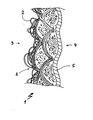
- the drawing shows a schematic section through an implant according to the invention.
- a textile fabric 1 is formed as a warp knit made of multifilament polyethylene terephthalate yarn in the form of a single velor, wherein velor loops 2 consist of textured yarn.
- the knit can be designed as a double velor fabric similar, as the knitted fabric after the U.S. Patents 4,047,252 and 4193397 , However, in contrast to the tubular chain active ingredients described there, it has a planar design. It can also be designed as a single velor.
- the knit is porous and flexible. It has on the velor side 3 an open three-dimensionally structured surface, which has numerous substantially uniformly distributed over the surface Hintergreifux for ingrowth of body cells due to the Veloursschlingen and the texturing of the fibers. The openings between the yarn loops or the individual fibers are large in relation to the size of body cells. This allows the ingrowth of a contiguous cell network.
- the opposite side 4 of the fabric 1 is due to the binding of the knitted fabric and rather flat.
- the knitted fabric 1 has, on this side, a spray coating 5 of uncrosslinked polyurethane, which is joined to the surface-exposed fibers of the knitted fabric 1 and closes the textile structure on this surface.
- the thickness of the spray coating is on the order of about 1/10 to 1/20 of the total fabric and sealant layer thickness, that is, the total thickness of the planar implant of about 0.8 mm.
- the layer 5 has a construction which is approximately comparable to a dense nonwoven, is microporous and is flexible due to the elastomeric properties of the polyurethane.
- Suitable polyurethane are, for example, known linear polyesters and polyurethanes. Due to the sealing layer 5, the textile fabric 1 of the velor fabric is substantially closed on the side facing away from the velor loops 2 in the manner of a depth filter.
- micropores whose size is approximately of the order of size of body cells or smaller, allow one Substance exchange of body fluids to maintain the metabolism, but do not allow the ingrowth of cells, at least not in such a form that an increase in body parts in the region of the abdominal cavity is to be feared.
- the sealing layer 5 penetrates only insignificantly into the textile surface of the textile carrier 1, so that the three-dimensional volume of the fabric is available for ingrowth of cells from the abdominal wall, while the substantially closed sealing layer 5 such ingrowth of cells on the side of the Prevents abdominal cavity.
- edges of the fabric are already ausfransfest by itself because of the knit.
- the sealing layer prevents curling of the fabric and additionally reduces the tendency to fringe.
- the edges can additionally be made ausfransfest by welding the thermoplastic fibers.
- pieces of about 8 x 2 cm to 30 x 30 are made. Depending on requirements, these pieces can be cut to size before implantation.
Landscapes
- Health & Medical Sciences (AREA)
- Engineering & Computer Science (AREA)
- Life Sciences & Earth Sciences (AREA)
- Animal Behavior & Ethology (AREA)
- Oral & Maxillofacial Surgery (AREA)
- Biomedical Technology (AREA)
- Heart & Thoracic Surgery (AREA)
- Vascular Medicine (AREA)
- Cardiology (AREA)
- Transplantation (AREA)
- General Health & Medical Sciences (AREA)
- Public Health (AREA)
- Veterinary Medicine (AREA)
- Textile Engineering (AREA)
- Prostheses (AREA)
- Materials For Medical Uses (AREA)
Description
- Die vorliegende Erfindung betrifft ein flächiges Implantat, und ein Verfahren zu seiner Herstellung.
- Der Eingeweidebruch, die sogenannte Hernie, stellt eine häufige Erkrankung dar. Hierbei handelt es sich im allgemeinen um ein Hindurchtreten von Organen oder Organteilen aus der natürlichen Körperhöhle durch eine vorgebildete oder erworbene Lücke. Unter den äußeren Brüchen, bei denen stets der Bruchsack vom Bauchfell umschlossen wird, sind Leisten-, Nabel- und Narbenbrüche die häufigsten Formen. Ursachen für das Auftreten von Hernien sind vor allem Muskel- oder Bindegewebsschwächen in Zusammenhang mit Überbelastungen, altersbedingter Erschlaffung, angeborener Schwächung der Bauchdecke oder ungenügende Narbenbildung nach einem Leibesschnitt (Narbenbruch).
- Eine effektive Behandlung ist in den meisten Fällen durch einen operativen Eingriff möglich, bei dem der Bruchinhalt aus dem Bruchsack in den Bauch zurückverlagert wird und die Bruchpforte verschlossen wird. Dieser Verschluss der Bruchpforte erfolgt konventionell durch eine Naht.
- Diese chirurgische Technik hat jedoch den Nachteil, dass es in bis zu 20 % der Fälle zum erneuten Bruch, dem sogenannten Bruchrezidiv kommen kann.
- Wegen dieser unbefriedigenden Rezidivrate nach der konventionellen Hernienoperation werden in der modernen Hernienchirurgie zunehmend künstliche Verstärkungsmaterialien zur Bauchwandrekonstruktion verwendet. Hier spielen besonders Polypropylen- aber auch Polyesternetze eine Rolle.
- Obwohl die Verwendung solcher Netze offensichtlich zu einer deutlichen Verringerung der Rezidivrate geführt hat, sind diese Implantate nicht unproblematisch wegen möglicher Infektionen oder Fistelbildungen, besonders aber wegen des Risikos von Weichteiladhäsionen.
- Bei den bisherigen Implantaten handelt es sich um offene textile Strukturen, die ein Anhaften von Zellen sowie ein Durchwachsen von Zellen begünstigen. Dies ist einerseits von Vorteil, da es eine feste Verbindung des Implantats mit der Bauchdecke ausbildet und somit die gewünschte Stützfunktion gewährleistet. Andererseits kann es zu schwer lösbaren Verwachsungen im Bauchraum mit Verhärtungen (Narbenpanzer), Beeinträchtigungen des Darms sowie der inneren Organe und damit verbundenen Beschwerden beim Patienten führen.
- Es sind auch flächige textile Implantate bekannt, die mit einem Imprägnierungsmittel versiegelt sind. Hier zeigen sich aber Probleme bei der Fixierung an der Bauchwand, insbesondere bei langandauerndem Verbleib im Körper.
- Ein flächiges implantat zur Verwendung in der Chirurgie gemäß den Merkmalen des Oberbegriffs des Anspruchs 1 ist aus dem Dokument
FR 2145975 - Es stellt sich die Aufgabe, ein Implantat zum Einsatz bei chirurgischen Eingriffen zur Verfügung zu stellen, das die Schwierigkeiten von Implantaten aus dem Stand der Technik überwindet, das einfach und kostengünstig herzustellen und nach üblichen chirurgischen Methoden einsetzbar ist.
- Diese Aufgabe wird gelöst durch ein flächiges Implantat nach Anspruch 1 und seine Herstellung nach den Ansprüchen 12 und 13. Das erfindungsgemäße Implantat erlaubt eine gute Verankerung von Körperzellen auf der der Bauchwand zugewandten strukturierten Seite und verhindert ein unerwünschtes Verwachsen mit Organen und Körperteilen auf der dem Bauchinnenraum zugewandten im wesentlichen geschlossenen Seite.
- Zur Verwendung in der Chirurgie stellt die Erfindung ein flächiges Implantat zur Verfügung mit einem flexiblen Flächengebilde, das auf einer Seite eine im wesentlichen geschlossene Oberfläche aus Polyurethan besitzt und auf der anderen Seite eine dreidimensionale Mikrostruktur, die ein Einwachsen von Zellen erlaubt. Insbesondere kann die im wesentlichen geschlossene Oberfläche mikroporös sein, wobei die Mikroporen so klein sind, dass sie einen Stoffaustausch erlauben, aber das Einwachsen von Zellen im wesentlichen verhindern.
- Die im wesentlichen geschlossene Oberfläche ist glatt ausgebildet. Ferner ist die im wesentlichen geschlossene Oberfläche von einer mit dem flexiblen Flächengebilde verbundenen Oberflächenschicht, insbesondere einer Beschichtung des Flächengebildes ausgebildet.
- Erfindungsgemäß besitzt die dreidimensionale Mikrostruktur hintergreifbare Stellen zum Einwachsen von Zellen. Mit Vorteil kann das flexible Flächengebilde von einem porösen flexiblen Strukturmaterial, insbesondere einem flexiblen Träger gebildet sein und die dreidimensionale Mikrostruktur von der freiliegenden Oberflächenstruktur des Strukturmaterials gebildet sein. Als Beispiele für poröses flexibles Strukturmaterial sind offenzelliger Strukturschaum oder eine Gitterstruktur zu nennen.
- Mit Vorteil kann das Implantat aus mindestens einem synthetischen Polymermaterial gebildet sein. Bevorzugt kann das Flächengebilde des Implantats gemäß der Erfindung aus Polypropylen, Polyester, Polytetrafluorethylen und/oder Polyester und Polytetrafluorethylen gebildet sein. Gemäß der Erfindung besonders bevorzugt ist ein flächiges Implantat aus Polyester und Polytetrafluorethylen. Es können auch resorbierbare Materialien, wie Polylactide, Polyglycolide und Copolymere davon Anwendung finden, wenn eine Resorbierbarkeit bzw. Teilresorbierbarkeit erwünscht ist.
- In einer Ausführungsform der Erfindung kann das flexible Strukturmaterial ein Textilmaterial, insbesondere ein poröser textiler Träger sein. Bevorzugt kann der flexible textile Träger mindestens auf der Seite mit der dreidimensionalen Mikrostruktur eine bei Gefäßimplantaten bekannte offene Textilstruktur aufweisen, die insbesondere von texturierten Garnen, Flottungen und/oder Veloursschlingen gebildet ist, wie sie beispielsweise aus den Veröffentlichungen
US 4047252 ,US 3878565 ,DE 2461370 undUS 4517687 bekannt sind. - Es können schrumpffähige Fasern und daraus hergestellte Garne wie andere Fasern und Garne auch nach üblichen Verfahrenstechniken zu textilen Gebilden verarbeitet werden. Anschließend werden durch eine Schrumpfbehandlung die schrumpffähigen Fasern geschrumpft, was bei daraus hergestellten Textilgebilden zu einer Verdichtung der Struktur führt. Durch den planmäßigen Einsatz von schrumpffähigen Fasern und nicht schrumpffähigen Fasern in Kombination können gezielt Modifikationen der Textilstruktur vorgenommen werden.
- Erfindungsgemäß kann das Flächengebilde nach einer textilen Technik, insbesondere Wirken, Stricken, Weben oder Flechten ausgebildet sein. Solche Verfahrenstechniken sind den Fachleuten bekannt, so dass auf eine detaillierte Ausführung hier verzichtet wird. Auf diese Weise ist eine einfache und kostengünstige Herstellung nach bekannten und in der Praxis bewährten Verfahrenstechniken und mit üblichen Maschinen und Werkzeugen möglich.
- Mit Vorteil kann das flexible textile Flächengebilde, insbesondere der textile Träger, eine Webware oder eine insbesondere gewirkte Maschenware sein, die mindestens auf der dreidimensional strukturierten Seite freiliegende, als Verankerung für Zellen dienende Faser oder Fäden aufweist.
- Es können textile Fasermaterialien wie synthetische Monofilamente, multifile Fäden oder multifile Garne verwendet werden. Gemäß der Erfindung bevorzugt kann das Flächengebilde mindestens teilweise mit multifilen Garnen ausgebildet sein. Diese Garne können glatt oder texturiert sein. In einer Ausführungsform der Erfindung können die Garne aus nur einer Art von Fasermaterial gebildet sein. In einer anderen Ausführungsform können die Garne aus mehreren Fasermaterialien gebildet sein. Die Garne können mindestens zum Teil aus hoch schrumpffähigem Fasermaterial gebildet sein. Sie können auch Mischungen aus nichtresorbierbaren und resorbierbaren Fasermaterialien sein.
- Das erfindungsgemäße Implantat kann sich insbesondere dadurch auszeichnen, dass eine Fläche mit einer strukturierten Oberfläche ausgebildet ist. In einer bevorzugten Ausführungsform kann die strukturierte Oberfläche als Velours ausgebildet sein. In einer besonders bevorzugten Ausführungsform der Erfindung kann das Flächengebilde als Velours, insbesondere als Einfachvelours ausgebildet sein. In Weiterbildung der besonders bevorzugten Ausführungsform kann das Flächengebilde als Doppelvelours ausgebildet sein. Insbesondere kann der Doppelvelours mit unterschiedlichen Polhöhen auf beiden Seiten des Flächengebildes ausgebildet sein.
- In einer bevorzugten Ausführungsform der Erfindung kann das flexible Flächengebilde, insbesondere der texturierte Träger ein Velours, insbesondere ein Doppelvelours sein, wobei ein Doppelvelours an der strukturierten Seite vorzugsweise eine größere Polhöhe aufweist als auf der im wesentlichen geschlossenen Seite des Implantats.
- Erfindungsgemäß kann sich das flächige Implantat dadurch auszeichnen, dass die der strukturierten Oberfläche gegenüberliegende Seite als glatte Oberfläche ausgebildet ist. Glatt bedeutet in diesem Fall, dass die Oberfläche keine Strukturierung, z. B. durch die Textilkonstruktion aufweist, die eine Verankerung von Zellverbänden ermöglicht. Ferner bedeutet glatt, dass keine Fasern des verwendeten Textilmaterials aus der Fläche herausragen.
- In einer anderen Ausführungsform der Erfindung kann das Implantat von einem dreidimensionalen Vlies gebildet sein, wobei Fasermaterialien auf der Seite mit im wesentlichen geschlossener Oberfläche dicht beieinander liegen und auf der Seite mit Mikrostruktur einen offenen Verbund bilden.
- Die im wesentlichen geschlossene Oberfläche kann vollständig dicht sein. Ist sie, was bevorzugt ist, mikroporös, dann zeichnet sie sich im Vergleich zu der Porosität des Flächengebildes durch eine um mindestens eine 10er Potenz geringere Porosität aus. Insbesondere die erfindungsgemäß bevorzugte Sprühschicht weist eine Tiefenporosität auf.
- Mit Vorteil kann die im wesentlichen geschlossene Oberfläche und insbesondere das gesamte Implantat eine Luftdurchlässigkeit von 5 bis 100 ml Luft/cm2.min, insbesondere 25 bis 75 ml Luft/cm2.min besitzen, bei einer Druckdifferenz von 1,2 kPascal. Bei einer solchen Mikroporosität ist ein Stoffaustausch im molekularen Bereich möglich. Dies begünstigt Stoffwechselvorgänge im Bereich des Implantats, fördert die Zufuhr von lebenswichtigen Nährstoffen und Aufbaustoffen sowie die Abfuhr von Stoffwechselschlacken und Schadstoffen. Auf diese Weise ist eine gute Verträglichkeit und erfolgreiches Heilen vorteilhaft möglich. Die Mikroporosität der im wesentlichen geschlossenen Oberfläche ist jedoch nicht geeignet für den Durchtritt bzw. die feste und durchgehende Verankerung von großen Partikeln wie Zellen.
- Die erfindungsgemäße im wesentlichen geschlossene Oberfläche führt zu einer Verminderung der Strukturierung der Implantatoberfläche auf einer Seite. Erhebungen und Vertiefungen, die sich beispielsweise aus der Herstellungstechnik des textilen Flächengebildes ergeben, werden durch die im wesentlichen geschlossene, insbesondere glatte Oberfläche ausgeglichen. Außerdem werden einzelne Fasern, die aus dem textilen Flächengebilde hervorstehen eingeschlossen. Das Schließen der Implantatoberfläche gemäß der Erfindung kann dementsprechend als eine Art Oberflächenversiegelung betrachtet werden.
- Auf diese Weise ist die im wesentlichen geschlossene Oberfläche mit ihrer geringen Porosität und geringen Oberflächenstruktur ungünstig für ein Anhaften von Zellen. Die Zellen finden keine geeigneten Verankerungsstellen, die für ihr Wachstum erforderlich sind. Auf diese Weise ist eine Besiedelung der im wesentlichen geschlossenen Implantatoberfläche mit Zellen im wesentlichen zu verhindern.
- Ferner kann das erfindungsgemäße Implantat bevorzugt ausfranssichere Ränder aufweisen, die ausfranssicher verarbeitet und/oder gebunden, insbesondere verschweißt sind.
- Mit Vorteil kann das Implantat eine Gesamtdicke von ca. 0,1 bis 1,2 mm besitzen, wobei die Dicke der im wesentlichen geschlossenen Oberfläche 3 bis 15 % davon beträgt. Außerdem kann der textile Träger eine gewebte, gewirkte oder gestrickte Grundbindung mit einer Dicke von 0,05 bis 0,4 mm besitzen und eine mindestens einseitige offene Struktur mit einer Dicke von 0,05 bis 0,8 mm.
- Es ist erfindungsgemäß vorgesehen, dass alle Komponenten des Implantats bioverträglich und langzeitstabil sind. Auf diese Weise kommt es nach der Implantation im physiologischen Milieu des Körpers nicht zu einem Abbau der Oberfläche. Die im wesentlichen geschlossene Oberfläche des Implantats behält somit ihre zellabweisende Eigenschaft, die ein Anhaften und Einwachsen von Zellen verhindert, wie es gemäß der Erfindung vorgesehen ist.
- Das Implantat ist gemäß der Erfindung aus flexiblem Material. Erfindungsgemäß ist die im wesentlichen geschlossene Oberfläche in Form einer Lösung in einem niedrigsiedenden Lösemittel auf ein insbesondere textiles Flächengebilde einseitig aufgetragen und die im wesentlichen geschlossene Oberfläche des flächigen Implantats ist aus unvernetztem Polyurethan gebildet.
- In Weiterbildung kann im Implantat ein antimikrobiotischer Wirkstoff, wie beispielsweise ein Antibiotikum enthalten sein. Die Verabreichung von Antibiotika dient insbesondere der Vorbeugung von Infektionen. Zur Prophylaxe und Therapie mit Antibiotika finden im Bereich der Chirurgie beispielsweise Cefalosporine wie Cefazolin oder Cefamandol, Netilmicin, Penicilline wie Oxacillin oder Mezlocillin, Tetracyclin, Metronidazol oder Aminoglykoside wie Gentamicin oder Neomycin sowie z. B. Rifampicin Anwendung. Die Fachleute können gemäß den jeweiligen Erfordernissen einen oder mehrere geeignete Wirkstoffe zur Anwendung auswählen. Auch Wachstumsfaktoren können im Implantat enthalten sein.
- Die vorliegende Erfindung betrifft ferner ein Verfahren zur Herstellung eines Implantats zur Verwendung in der Chirurgie, das umfasst Ausbilden einer einseitigen im wesentlichen geschlossenen Oberfläche aus Polyurethan auf einer Seite eines porösen, textilen Flächengebildes zur Verhinderung des Einwachsens von Zellen.
- In einer anderen Ausführungsform betrifft die Erfindung ein Verfahren zur Herstellung eines Implantats zur Verwendung in der Chirurgie durch Bilden einer im wesentlichen geschlossenen Oberflächenschicht aus Polyurethan und einseitiges, insbesondere aufbauendes Ausbilden einer mit dieser verbundenen dreidimensionalen Mikrostruktur.
- In das erfindungsgemäße Verfahren wird die im wesentlichen geschlossene Oberfläche durch Beschichten, insbesondere Sprühbeschichten ausgebildet. In das erfindungsgemäße Verfahren wird Polyurethan aus einer Lösung in niedrigsiedendem organischem Lösemittel aufgesprüht. Als Beispiele für geeignete Lösemittel sind Chloroform oder Methylenchlorid zu nennen. Durch Verdampfen des Lösemittels bildet sich der Beschichtungsfilm aus. Während der Lösemittelverdampfung können feine Poren in der Oberflächenbeschichtung entstehen, was beim Implantat gemäß der Erfindung von Vorteil ist. Die so ausgebildete Mikroporosität erlaubt den Stoffaustausch im physiologischen Milieu. Die Poren sind jedoch so klein, daß Zellen zurückgehalten werden.
- Gemäß der Erfindung ist ein Schließen der Oberfläche zur Verhinderung des Einwachsens von Zellen nur auf einer Seite des flächigen Implantats und nur auf der Oberfläche des Flächengebildes vorgesehen. Mit Vorteil ist die dreidimensional strukturierte Oberfläche des textilen Flächengebildes offen und für ein Einwachsen von Zellen geeignet. Für ein Anhaften und Anwachsen von Zellen ist die poröse bzw. strukturierte Oberfläche geeignet, die ein hintergreifendes Einwachsen der Zellen ermöglicht.
- Zur Verwendung in der Chirurgie kann das erfindungsgemäß modifizierte Implantat in geeigneter Weise sterilisiert werden. Ein zweckmäßiges Sterilisierverfahren kann aus üblichen physikalischen oder chemischen Methoden zum Inaktivieren von Mikroorganismen ausgewählt oder eine Kombination solcher Methoden sein. Ein mögliches Sterilisierungsverfahren umfasst die Behandlung mit ionisierender Strahlung wie beispielsweise Bestrahlung mit β-Strahlen oder γ -Strahlen, im Bereich von 0,1 Mrad bis 10 Mrad, insbesondere 0,8 Mrad bis 2,5 Mrad.
- Des weiteren betrifft die Erfindung auch die Verwendung eines Implantats in der Chirurgie, insbesondere zur Behandlung von Wanddefekten in Körperhöhlen, besonders von Bauchwanddefekten.
- Zu diesem Zweck kann das erfindungsgemäße modifizierte Implantatmaterial auf eine gewünschte Größe und Form zurechtgeschnitten werden. Mit Vorteil kann das chirurgische Implantat gemäß der Erfindung in zweckmäßiger Dimension zugeschnitten gebrauchsfertig in geeigneter Weise verpackt vorliegen.
- Das Einbringen des erfindungsgemäßen flächigen Implantats in den Bauchraum erfolgt in der Weise, dass die Seite des Implantats, deren Oberfläche zur Verhinderung des Einwachsens von Zellen modifiziert ist, zur Bauchinnenseite hin, d. h. den Eingeweiden zugewandt, eingesetzt wird. Die gegenüberliegende Seite des flächigen Implantats, bei der ein Einwachsen von Zellen möglich ist, wird der Bauchdeckenseite zugewandt eingesetzt.
- Auf diese Weise können während des Heilungsprozesses von der Bauchdecke her Körperzellen auf der Oberfläche des Implantats anhaften, in die Oberflächenstruktur eindringen und im Laufe der Zeit zu einem Verwachsen des Implantats mit der Bauchdecke führen. Dies führt zu einem sicheren Verbund von Bauchdecke und Implantat, was zur Stabilisierung der Bauchwand beiträgt und damit den Behandlungserfolg sichert.
- Die im wesentlichen geschlossene Oberfläche zur Verhinderung des Einwachsens von Zellen auf der Bauchinnenseite des Implantats ist für von der Bauchdeckenseite einwachsende Zellen nicht durchdringbar.
- Weitere Merkmale der Erfindung ergeben sich aus der nachfolgenden Beschreibung eines bevorzugten Beispiels in Verbindung mit den Unteransprüchen und der Zeichnung. Hierbei können die einzelnen Merkmale jeweils für sich alleine oder zu mehreren bei einer Ausführungsform der Erfindung verwirklicht sein. Das Beispiel dient jedoch nur zur Erläuterung und ist nicht als Einschränkung zu verstehen.
- Die Zeichnung zeigt eine schematischen Schnitt durch ein erfindungsgemäßes Implantat.
- Ein textiles Flächengebilde 1 ist als Kettengewirk aus multifilem Polyethylenterephthalatgarn in Form eines Einfachvelours ausgebildet, wobei Veloursschlingen 2 aus texturiertem Garn bestehen. Das Gewirk kann als Doppelveloursgewirk ähnlich ausgebildet sein, wie die Gewirke nach den
US-Patentschriften 4047252 und4193397 . Es ist jedoch im Gegensatz zu den dort beschriebenen rohrförmigen Kettenwirkstoffen flächig ausgebildet. Es kann auch als Einfachvelours ausgebildet sein. Das Gewirk ist porös und flexibel. Es besitzt auf der Veloursseite 3 eine offene dreidimensional strukturierte Oberfläche, die aufgrund der Veloursschlingen und der Texturierung der Fasern, zahlreiche im wesentlichen gleichmäßig über die Oberfläche verteilte Hintergreifmöglichkeiten zum Einwachsen von Körperzellen aufweist. Dabei sind die Öffnungen zwischen den Garnschlingen bzw. den einzelnen Fasern groß im Verhältnis zur Größe von Körperzellen. Dies ermöglicht das Einwachsen eines zusammenhängenden Zellverbundes. - Die gegenüberliegende Seite 4 des Gewirks 1 ist aufgrund der Bindung des Gewirks dichter und eher eben. Zusätzlich weist das Gewirk 1 an dieser Seite eine Sprühbeschichtung 5 aus unvernetztem Polyurethan auf, die mit den an der Oberfläche freiliegenden Fasern des Gewirks 1 verbunden ist und die textile Struktur an dieser Oberfläche verschließt. Die Dicke der Sprühbeschichtung liegt in der Größenordnung von etwa 1/10 bis 1/20 der Gesamtdicke von textilem Flächengebilde und Versiegelungsschicht, das heißt, der Gesamtdicke des flächigen Implantats von ca. 0,8 mm.
- Durch die Technik der Sprühbeschichtung, das heißt durch Aufsprühen einer Lösung des Polyurethans in Chloroform hat die Schicht 5 einen Aufbau, der mit einem dichten Vlies in etwa vergleichbar ist, mikroporös ist und aufgrund der elastomeren Eigenschaften des Polyurethans flexibel ist. Als Polyurethan eignen sich beispielsweise bekannte lineare Polyester und Polyurethane. Durch die Versiegelungsschicht 5 ist das textile Flächengebilde 1 aus dem Veloursgewirk an der von den Veloursschlingen 2 abweisenden Seite nach Art eines Tiefenfilters im wesentlichen verschlossen. Die Mikroporen, deren Größe in etwa in der Gröβenordnung der Größe von Körperzellen oder kleiner ist, erlauben einen Stoffaustausch von Körperflüssigkeiten zur Aufrechterhaltung des Stoffwechsels, erlauben jedoch nicht das Einwachsen von Zellen, zumindest nicht in solcher Form, dass ein Anwachsen an Körperteile im Bereich der Bauchhöhle zu befürchten ist.
- Die Versiegelungsschicht 5 dringt nur unwesentlich in die textile Oberfläche des textilen Trägers 1 ein, so dass das dreidimensionale Volumen des Flächengebildes zum Einwachsen von Zellen aus der Bauchwand zur Verfügung steht, während die im wesentlichen geschlossene Versiegelungsschicht 5 ein solches Einwachsen von Zellen auf der Seite des Bauchraumes verhindert.
- Die Ränder des Flächengebildes sind aufgrund der Wirkart an sich schon ausfransfest. Die Versiegelungsschicht verhindert ein Einrollen des Gewirks und vermindert zusätzlich die Neigung zur Fransenbildung. Falls gewünscht, können die Ränder zusätzlich noch durch Verschweißen der thermoplastischen Fasern ausfransfest gemacht werden. Zur Verwendung in der Chirurgie werden Stücke von etwa 8 x 2 cm bis 30 x 30 hergestellt. Je nach Bedarf können diese Stücke vor dem Implantieren noch zurechtgeschnitten werden.
- Mit dem erfindungsgemäßen Implantat durchgeführte Tierversuche ergaben gute Ergebnisse. Auf der unbeschichteten, offenen Seite der Implantate erfolgte ein sehr guter Einbau in das Gewebe mit kräftiger Vaskularisation in den Implantatmaschen und völlig fehlenden Abstoßungserscheinungen. Durch die Versiegelung der bauchhöhlenseitigen Fläche zeigten sich an dieser Seite keine Verwachsungen. Auch nach längerer Verweildauer des Implantats im Bauchraum war eine freie Beweglichkeit der Bauchorgane relativ zum Implantat gewährleistet.
Claims (13)
- Flächiges Implantat (1) zur Verwendung in der Chirurgie mit einem flexiblen textilen Flächengebilde, das auf einer Seite eine zur Verhinderung des Einwachsens von Zellen im wesentlichen geschlossene glatte Oberfläche (5) aus einem Polymer besitzt und auf der anderen Seite eine dreidimensionale Mikrostruktur (3), die ein Einwachsen von Zellen erlaubt und hintergreifbare Stellen zum Einwachsen von Zellen besitzt, dadurch gekennzeichnet, dass die im wesentlichen geschlossene Oberflächenschicht (5) aus Polyurethan durch einseitiges Auftragen einer Lösung von unvernetztem Polyurethan in einem niedrig siedenden Lösungsmittel auf das textile Flächengebilde als Beschichtung ausgebildet ist.
- Implantat nach Anspruch 1, dadurch gekennzeichnet, dass die im wesentlichen geschlossene Oberfläche (5) mikroporös ist, wobei die Mikroporen so klein sind, dass sie einen Stoffaustausch erlauben, aber das Einwachsen von Zellen im wesentlichen verhindern.
- Implantat nach einem der vorhergehenden Ansprüche, dadurch gekennzeichnet, dass die im wesentlichen geschlossene Oberfläche (5) von einer mit dem flexiblen Flächengebilde verbundenen Oberflächenschicht, insbesondere einer Beschichtung des Flächengebildes, gebildet ist.
- Implantat nach einem der vorhergehenden Ansprüche, dadurch gekennzeichnet, dass das flexible textile Flächengebilde von einem porösen flexiblen Strukturmaterial, insbesondere einem flexiblen Träger, gebildet ist und die dreidimensionale Mikrostruktur (3) von der
- Implantat nach Anspruch 4, dadurch gekennzeichnet, dass das flexible Strukturmaterial ein Textilmaterial, insbesondere ein poröser textiler Träger ist, wobei das flexible Textilmaterial, insbesondere der textile Träger mindestens auf der Seite mit der dreidimensionalen Mikrostruktur (3) eine bei Gefäßimplantaten bekannte offene Textilstruktur aufweist, die insbesondere von texturierten Garnen, Flottungen und/oder Velourschlingen gebildet ist. freiliegenden Oberflächenstruktur des Strukturmaterials gebildet ist.
- Implantat nach einem der vorhergehenden Ansprüche, dadurch gekennzeichnet, dass das flexbile Flächengebilde, insbesondere der textile Träger, eine Webware oder eine insbesondere gewirkte Maschenware ist, die mindestens auf der dreidimensional strukturierten Seite freiliegende, als Verankerung für Zellen dienende Fasern oder Fäden aufweist.
- Implantat nach einem der vorhergehenden Ansprüche, dadurch gekennzeichnet, dass das flexible textile Flächengebilde, insbesondere der texturierte Träger ein Velours, insbesondere ein Doppelvelours ist, wobei ein Doppelvelours an der strukturierten Seite vorzugsweise eine größere Polhöhe aufweist als auf der im wesentlichen geschlossenen Seite des Implantats.
- Implantat nach einem der vorhergehenden Ansprüche, dadurch gekennzeichnet, dass die im wesentlichen geschlossene Oberfläche und insbesondere das gesamte Implantat eine Luftdurchlässigkeit von 5 bis 100 ml Luft/cm2.min, insbesondere 25 bis 75 ml Luft/cm2.min besitzt, bei einer Druckdifferenz von 1,2 kPascal.
- Implantat nach einem der vorhergehenden Ansprüche, dadurch gekennzeichnet, dass es ausfranssichere Ränder aufweist, die ausfranssicher verarbeitet und/oder gebunden, insbesondere verschweißt sind.
- Implantat nach einem der vorhergehenden Ansprüche, dadurch gekennzeichnet, dass es eine Gesamtdicke von ca. 0,1 bis 1,2 mm besitzt, wobei die Dicke der im wesentlichen geschlossenen Oberfläche 3 bis 15 % davon beträgt.
- Implantat nach einem der vorhergehenden Ansprüche, dadurch gekennzeichnet, dass der textile Träger eine gewebte, gewirkte oder gestrickte Grundbindung mit einer Dicke von 0,05 bis 0,4 mm besitzt und eine mindestens einseitige offene Struktur mit einer Dicke von 0,05 bis 0,8 mm, besitzt.
- Verfahren zur Herstellung des Implantats nach einem der vorhergehenden Ansprüche, dadurch gekennzeichnet, dass auf einer Seite eines porösen textilen Flächengebildes (3) zur Verhinderung des Einwachsens von Zellen durch Auftragen einer Lösung von unvernetztem Polyurethan in einem niedrig siedenden Lösungsmittel eine einseitige im wesentlichen geschlossene Oberflächenschicht (5) aus Polyurethan ausgebildet wird.
- Verfahren nach Anspruch 12, dadurch gekennzeichnet, dass die im wesentlichen geschlossene Oberfläche durch Schichtbildung, bevorzugt Beschichten, insbesondere Sprühbeschichten ausgebildet wird.
Applications Claiming Priority (3)
| Application Number | Priority Date | Filing Date | Title |
|---|---|---|---|
| DE19912648 | 1999-03-20 | ||
| DE19912648A DE19912648A1 (de) | 1999-03-20 | 1999-03-20 | Flächiges Implantat, Verfahren zu seiner Herstellung und Verwendung in der Chirurgie |
| EP00105616A EP1038508B1 (de) | 1999-03-20 | 2000-03-16 | Flächiges Implantat |
Related Parent Applications (2)
| Application Number | Title | Priority Date | Filing Date |
|---|---|---|---|
| EP00105616A Division EP1038508B1 (de) | 1999-03-20 | 2000-03-16 | Flächiges Implantat |
| EP00105616.7 Division | 2000-03-16 |
Publications (3)
| Publication Number | Publication Date |
|---|---|
| EP1570806A2 EP1570806A2 (de) | 2005-09-07 |
| EP1570806A3 EP1570806A3 (de) | 2006-09-27 |
| EP1570806B1 true EP1570806B1 (de) | 2010-03-03 |
Family
ID=7901804
Family Applications (2)
| Application Number | Title | Priority Date | Filing Date |
|---|---|---|---|
| EP05011897A Expired - Lifetime EP1570806B1 (de) | 1999-03-20 | 2000-03-16 | Flächiges Implantat, Verfahren zu seiner Herstellung und Verwendung in der Chirurgie |
| EP00105616A Expired - Lifetime EP1038508B1 (de) | 1999-03-20 | 2000-03-16 | Flächiges Implantat |
Family Applications After (1)
| Application Number | Title | Priority Date | Filing Date |
|---|---|---|---|
| EP00105616A Expired - Lifetime EP1038508B1 (de) | 1999-03-20 | 2000-03-16 | Flächiges Implantat |
Country Status (5)
| Country | Link |
|---|---|
| US (1) | US6447551B1 (de) |
| EP (2) | EP1570806B1 (de) |
| JP (1) | JP2000279433A (de) |
| DE (3) | DE19912648A1 (de) |
| ES (2) | ES2342076T3 (de) |
Families Citing this family (76)
| Publication number | Priority date | Publication date | Assignee | Title |
|---|---|---|---|---|
| US20030040809A1 (en) * | 1999-03-20 | 2003-02-27 | Helmut Goldmann | Flat implant for use in surgery |
| US7592017B2 (en) | 2000-03-10 | 2009-09-22 | Mast Biosurgery Ag | Resorbable thin membranes |
| ES2173796B1 (es) * | 2000-06-20 | 2003-12-16 | Caneiro Juan Manuel Bellon | Protesis de pared que estimula y modula el tejido conjuntivo, se integra al tejido y permite el deposito mesotelial, evitando adherencias y erosiones viscerales. |
| DE10046119A1 (de) | 2000-09-15 | 2002-03-28 | Inst Textil & Faserforschung | Medizintechnisches bioresorbierbares Implantat, Verfahren zur Herstellung und Verwendung |
| DE10050199A1 (de) * | 2000-10-11 | 2002-04-25 | Ethicon Gmbh | Flächiges Implantat mit im Ultraschall detektierbaren Elementen |
| ES2192436B1 (es) * | 2000-11-24 | 2005-02-16 | Juan Manuel Bellon Caneiro | Protesis de pared de integracion al tejido con alta capacidad de estimulacion conjuntiva y mayor resistencia tensional. |
| US6783554B2 (en) * | 2001-02-20 | 2004-08-31 | Atrium Medical Corporation | Pile mesh prosthesis |
| DE10125712B4 (de) | 2001-05-21 | 2012-06-06 | Aesculap Ag | Implantat für die Chirurgie |
| US7060023B2 (en) * | 2001-09-25 | 2006-06-13 | The Foundry Inc. | Pericardium reinforcing devices and methods of using them |
| US7641958B2 (en) * | 2002-04-25 | 2010-01-05 | Gore Enterprise Holdings, Inc. | Membrane for use in sutured or sutureless surgical procedures |
| US8048444B2 (en) | 2002-07-31 | 2011-11-01 | Mast Biosurgery Ag | Apparatus and method for preventing adhesions between an implant and surrounding tissues |
| AU2003259832A1 (en) * | 2003-08-14 | 2005-03-10 | Boston Scientific Limited | Medical slings |
| US20050113849A1 (en) * | 2003-11-26 | 2005-05-26 | Nicholas Popadiuk | Prosthetic repair device |
| BRPI0510042B8 (pt) | 2004-04-20 | 2021-06-22 | Genzyme Corp | implante semelhante à malha cirúrgica |
| WO2006020922A2 (en) * | 2004-08-13 | 2006-02-23 | Mast Biosurgery Ag | Surgical prosthesis having biodegradable and nonbiodegradable regions |
| DE102004047568A1 (de) * | 2004-09-24 | 2006-04-13 | Aesculap Ag & Co. Kg | Antimikrobielles Implantat mit einer flexiblen porösen Struktur |
| DE102004062798A1 (de) * | 2004-12-20 | 2006-06-29 | Aesculap Ag & Co. Kg | Flächiges Implantat und Verfahren zu seiner Herstellung |
| JP5280839B2 (ja) * | 2005-04-26 | 2013-09-04 | ポリ−メド インコーポレイテッド | 吸収性/生分解性複合糸及びこれから形成された特性調節外科用インプラント |
| US8709023B2 (en) | 2007-07-17 | 2014-04-29 | Poly-Med, Inc. | Absorbable / biodegradable composite yarn constructs and applications thereof |
| FR2898502B1 (fr) * | 2006-03-16 | 2012-06-15 | Sofradim Production | Tissu prothetique tridimensionnel a face dense resorbable |
| DE102005050560A1 (de) * | 2005-10-17 | 2007-04-19 | Technische Universität Dresden | Trägermaterial aus Fasern und Verfahren zu seiner Herstellung |
| WO2007051221A1 (en) * | 2005-11-04 | 2007-05-10 | Craig Mclachlan | Substrate for tissue growth |
| US7614258B2 (en) | 2006-10-19 | 2009-11-10 | C.R. Bard, Inc. | Prosthetic repair fabric |
| CN101854961A (zh) * | 2007-08-03 | 2010-10-06 | 尼卡斯特有限公司 | 可手术植入的网 |
| DE102007058256A1 (de) * | 2007-11-26 | 2009-05-28 | Aesculap Ag | Chirurgische Fadengeflecht |
| US9308068B2 (en) | 2007-12-03 | 2016-04-12 | Sofradim Production | Implant for parastomal hernia |
| DE102007061301A1 (de) | 2007-12-10 | 2009-06-18 | Aesculap Ag | Ummantelung zur Wiederherstellung der Klappenfunktion variköser Venen und Verwendung der Ummantelung in der Chirurgie |
| DE102007062273A1 (de) | 2007-12-14 | 2009-06-18 | Aesculap Ag | Fluoriertes Implantat |
| US8206632B2 (en) * | 2007-12-18 | 2012-06-26 | Ethicon, Inc. | Methods of making composite prosthetic devices having improved bond strength |
| DE102007063214B4 (de) | 2007-12-20 | 2019-06-27 | Aesculap Ag | Flächiges Implantat, insbesondere zur Hernienversorgung |
| US9242026B2 (en) | 2008-06-27 | 2016-01-26 | Sofradim Production | Biosynthetic implant for soft tissue repair |
| DE102009015302A1 (de) * | 2009-03-19 | 2010-09-23 | Aesculap Ag | Chirurgisches Implantat, insbesondere zur Versorgung von Hernien |
| FR2949688B1 (fr) | 2009-09-04 | 2012-08-24 | Sofradim Production | Tissu avec picots revetu d'une couche microporeuse bioresorbable |
| US9152883B2 (en) * | 2009-11-02 | 2015-10-06 | Harry Urbschat | System and method for increasing the accuracy of optical character recognition (OCR) |
| DE102009060799A1 (de) * | 2009-12-31 | 2011-07-07 | Aesculap AG, 78532 | Textiles Netz, insbesondere zur Prolapsversorgung bzw. -behandlung oder zur Vermeidung von Dyspareunia |
| FR2962646B1 (fr) | 2010-07-16 | 2012-06-22 | Sofradim Production | Prothese avec element radio-opaque |
| US9370418B2 (en) * | 2010-09-10 | 2016-06-21 | Edwards Lifesciences Corporation | Rapidly deployable surgical heart valves |
| US9861590B2 (en) | 2010-10-19 | 2018-01-09 | Covidien Lp | Self-supporting films for delivery of therapeutic agents |
| FR2972626B1 (fr) | 2011-03-16 | 2014-04-11 | Sofradim Production | Prothese comprenant un tricot tridimensionnel et ajoure |
| DE102011007844A1 (de) | 2011-04-21 | 2012-10-25 | Aesculap Ag | Medizinisches Produkt und Verfahren zu seiner Herstellung |
| FR2975584B1 (fr) * | 2011-05-23 | 2013-05-31 | Mdb Texinov Sa | Structure textile tricotee pour la realisation d'implants |
| FR2977789B1 (fr) | 2011-07-13 | 2013-07-19 | Sofradim Production | Prothese pour hernie ombilicale |
| FR2977790B1 (fr) | 2011-07-13 | 2013-07-19 | Sofradim Production | Prothese pour hernie ombilicale |
| US8579924B2 (en) | 2011-07-26 | 2013-11-12 | Covidien Lp | Implantable devices including a mesh and a pivotable film |
| US9782957B2 (en) | 2011-08-24 | 2017-10-10 | Covidien Lp | Medical device films |
| CN103781499B (zh) | 2011-09-30 | 2016-09-28 | 索弗拉狄姆产品公司 | 轻质网的可逆硬化 |
| US8932621B2 (en) | 2011-10-25 | 2015-01-13 | Covidien Lp | Implantable film/mesh composite |
| US9179994B2 (en) | 2011-10-25 | 2015-11-10 | Covidien Lp | Implantable film/mesh composite |
| US9005308B2 (en) | 2011-10-25 | 2015-04-14 | Covidien Lp | Implantable film/mesh composite for passage of tissue therebetween |
| FR2985170B1 (fr) | 2011-12-29 | 2014-01-24 | Sofradim Production | Prothese pour hernie inguinale |
| FR2985271B1 (fr) | 2011-12-29 | 2014-01-24 | Sofradim Production | Tricot a picots |
| US10206769B2 (en) | 2012-03-30 | 2019-02-19 | Covidien Lp | Implantable devices including a film providing folding characteristics |
| FR2992662B1 (fr) | 2012-06-28 | 2014-08-08 | Sofradim Production | Tricot avec picots |
| FR2992547B1 (fr) | 2012-06-29 | 2015-04-24 | Sofradim Production | Prothese pour hernie |
| FR2994185B1 (fr) | 2012-08-02 | 2015-07-31 | Sofradim Production | Procede de preparation d’une couche poreuse a base de chitosane |
| CN102783976B (zh) * | 2012-08-21 | 2014-12-10 | 万平 | 一种用静电纺制成的十二指肠内覆膜 |
| FR2995778B1 (fr) | 2012-09-25 | 2015-06-26 | Sofradim Production | Prothese de renfort de la paroi abdominale et procede de fabrication |
| FR2995779B1 (fr) | 2012-09-25 | 2015-09-25 | Sofradim Production | Prothese comprenant un treillis et un moyen de consolidation |
| FR2995788B1 (fr) | 2012-09-25 | 2014-09-26 | Sofradim Production | Patch hemostatique et procede de preparation |
| WO2014049446A2 (en) | 2012-09-28 | 2014-04-03 | Sofradim Production | Packaging for a hernia repair device |
| DE102013208924A1 (de) * | 2013-05-14 | 2014-12-04 | Johnson & Johnson Medical Gmbh | Chirurgisches Implantat umfassend einer Lage mit Öffnungen |
| FR3006578B1 (fr) | 2013-06-07 | 2015-05-29 | Sofradim Production | Prothese a base d’un textile pour voie laparoscopique |
| FR3006581B1 (fr) | 2013-06-07 | 2016-07-22 | Sofradim Production | Prothese a base d’un textile pour voie laparoscopique |
| EP3000489B1 (de) | 2014-09-24 | 2017-04-05 | Sofradim Production | Verfahren zur Herstellung einer Antihaft-Sperrschicht |
| EP3000433B1 (de) | 2014-09-29 | 2022-09-21 | Sofradim Production | Vorrichtung zur Einführung einer Prothese zur Hernie-Behandlung in einen Einschnitt und flexible textile Prothese |
| EP3000432B1 (de) | 2014-09-29 | 2022-05-04 | Sofradim Production | Textilbasierte Prothese für die Behandlung von Leistenbruch |
| EP3029189B1 (de) | 2014-12-05 | 2021-08-11 | Sofradim Production | Prothetisches poröses Netz, sein Herstellungsverfahren und Hernienprothese |
| EP3059255B1 (de) | 2015-02-17 | 2020-05-13 | Sofradim Production | Verfahren zur Herstellung einer Matrix auf Chitosanbasis mit faseroptischem Verstärkungselement |
| EP3085337B1 (de) | 2015-04-24 | 2022-09-14 | Sofradim Production | Prothese zur unterstützung einer bruststruktur |
| EP3106185B1 (de) | 2015-06-19 | 2018-04-25 | Sofradim Production | Synthetische prothese mit einem gewirk und einem nichtporösen film und verfahren zur formung davon |
| EP3195830B1 (de) | 2016-01-25 | 2020-11-18 | Sofradim Production | Prothese zur hernienreparatur |
| EP3312325B1 (de) | 2016-10-21 | 2021-09-22 | Sofradim Production | Verfahren zur herstellung eines netzes mit einem daran befestigten nahtmaterial mit widerhaken und dadurch erhaltenes netz |
| EP3398554B1 (de) | 2017-05-02 | 2025-06-25 | Sofradim Production | Prothese zur leistenbruch reparatur |
| CA3074733C (en) * | 2017-09-06 | 2022-06-21 | Tepha, Inc. | Calendered surgical meshes comprising polyhydroxyalkanoates |
| EP3653171B1 (de) | 2018-11-16 | 2024-08-21 | Sofradim Production | Implantate zur weichgewebereparatur |
| US12064330B2 (en) | 2020-04-28 | 2024-08-20 | Covidien Lp | Implantable prothesis for minimally invasive hernia repair |
Family Cites Families (23)
| Publication number | Priority date | Publication date | Assignee | Title |
|---|---|---|---|---|
| IT964474B (it) * | 1971-07-09 | 1974-01-21 | Cutter Lab | Sostegno protesico per parti del corpo umano scorrevoli tra loro |
| US3878565A (en) * | 1971-07-14 | 1975-04-22 | Providence Hospital | Vascular prosthesis with external pile surface |
| DE2461370A1 (de) * | 1974-01-02 | 1975-07-03 | Sauvage Lester R | Poroese vaskulaere prothese |
| US4340091A (en) * | 1975-05-07 | 1982-07-20 | Albany International Corp. | Elastomeric sheet materials for heart valve and other prosthetic implants |
| US4047252A (en) * | 1976-01-29 | 1977-09-13 | Meadox Medicals, Inc. | Double-velour synthetic vascular graft |
| CA1155591A (en) * | 1977-06-23 | 1983-10-18 | Francis E. Gould | Polyurethane polymers characterized by lactone groups and hydroxyl groups in the polymer backbone |
| US4193397A (en) | 1977-12-01 | 1980-03-18 | Metal Bellows Corporation | Infusion apparatus and method |
| CS216992B1 (en) * | 1980-07-21 | 1982-12-31 | Miroslav Stol | Composite polymere material for the biological and medicinal utilitation and method of preparation thereof |
| FR2524304B1 (fr) * | 1982-03-31 | 1985-06-14 | Delalande Sa | Peau artificielle |
| US4517687A (en) * | 1982-09-15 | 1985-05-21 | Meadox Medicals, Inc. | Synthetic woven double-velour graft |
| US5002582A (en) * | 1982-09-29 | 1991-03-26 | Bio-Metric Systems, Inc. | Preparation of polymeric surfaces via covalently attaching polymers |
| DE3324256A1 (de) * | 1983-07-06 | 1985-01-17 | Robert Bosch Gmbh, 7000 Stuttgart | Endoprothese aus faserverstaerktem duroplastischem kunstharz und verfahren zur herstellung |
| DE3689650T2 (de) * | 1985-12-17 | 1994-05-26 | United States Surgical Corp | Bioresorbierbare Polymere von hohem Molekulargewicht und Implantate davon. |
| DE3801426A1 (de) * | 1988-01-20 | 1989-08-03 | Ethicon Gmbh | Filzartiges implantat |
| FR2628634B1 (fr) * | 1988-03-15 | 1990-07-13 | Imedex | Patch de chirurgie viscerale |
| US5100422A (en) * | 1989-05-26 | 1992-03-31 | Impra, Inc. | Blood vessel patch |
| EP0560934B2 (de) * | 1990-12-06 | 1999-11-10 | W.L. Gore & Associates, Inc. | Implantierbare bioresorbierbare artikel |
| CA2114282A1 (en) * | 1993-01-28 | 1994-07-29 | Lothar Schilder | Multi-layered implant |
| US6120539A (en) * | 1997-05-01 | 2000-09-19 | C. R. Bard Inc. | Prosthetic repair fabric |
| DE19809054A1 (de) * | 1997-06-28 | 1999-01-07 | Huels Chemische Werke Ag | Bioaktive Beschichtung von Oberflächen unter Mitverwendung von Vernetzern |
| FR2766716B1 (fr) | 1997-08-01 | 2000-02-18 | Cogent Sarl | Prothese composite pour la prevention des adherences post-chirurgicales et son procede d'obtention |
| US6319264B1 (en) * | 1998-04-03 | 2001-11-20 | Bionx Implants Oy | Hernia mesh |
| US6166286A (en) * | 1998-09-16 | 2000-12-26 | Arcilius Consultadoria E Servicos Lda | Mesh plug kit for the inguinal box surgical technique for hernioplasty |
-
1999
- 1999-03-20 DE DE19912648A patent/DE19912648A1/de not_active Withdrawn
-
2000
- 2000-03-16 DE DE50015883T patent/DE50015883D1/de not_active Expired - Lifetime
- 2000-03-16 ES ES05011897T patent/ES2342076T3/es not_active Expired - Lifetime
- 2000-03-16 EP EP05011897A patent/EP1570806B1/de not_active Expired - Lifetime
- 2000-03-16 EP EP00105616A patent/EP1038508B1/de not_active Expired - Lifetime
- 2000-03-16 DE DE50010727T patent/DE50010727D1/de not_active Expired - Lifetime
- 2000-03-16 ES ES00105616T patent/ES2246200T3/es not_active Expired - Lifetime
- 2000-03-17 JP JP2000076028A patent/JP2000279433A/ja active Pending
- 2000-03-20 US US09/531,842 patent/US6447551B1/en not_active Expired - Lifetime
Also Published As
| Publication number | Publication date |
|---|---|
| ES2246200T3 (es) | 2006-02-16 |
| EP1038508A1 (de) | 2000-09-27 |
| EP1570806A3 (de) | 2006-09-27 |
| EP1038508B1 (de) | 2005-07-20 |
| DE50010727D1 (de) | 2005-08-25 |
| JP2000279433A (ja) | 2000-10-10 |
| DE50015883D1 (de) | 2010-04-15 |
| US6447551B1 (en) | 2002-09-10 |
| DE19912648A1 (de) | 2000-09-21 |
| ES2342076T3 (es) | 2010-07-01 |
| EP1570806A2 (de) | 2005-09-07 |
Similar Documents
| Publication | Publication Date | Title |
|---|---|---|
| EP1038508B1 (de) | Flächiges Implantat | |
| EP1615589B1 (de) | Flächiges implantat | |
| EP1099421B1 (de) | Flächiges Implantat und Verfahren zu seiner Herstellung | |
| DE3718963C2 (de) | ||
| DE60211176T2 (de) | Film mit hochporösen Gefäßtransplantatprothesen | |
| EP2183000B1 (de) | Bioresorbierbres implantat | |
| EP2070555B1 (de) | Fluorirtes Implantat | |
| DE69121587T3 (de) | Implantierbare bioresorbierbare artikel | |
| DE102004051487A1 (de) | Chirurgisches Implantat | |
| WO2004101010A1 (de) | Implantat mit antibiotischer langzeitwirkung | |
| DE102007063214B4 (de) | Flächiges Implantat, insbesondere zur Hernienversorgung | |
| DE102009037134A1 (de) | Tubuläres Implantat zum Ersatz von natürlichen Blutgefäßen | |
| WO2003011190A2 (de) | Ummantelung für venen, verfahren zu ihrer herstellung und verwendung in der chirurgie | |
| WO2006032497A1 (de) | Antimikrobielles implantat mit einer flexiblen porösen struktur | |
| DE60319258T2 (de) | Stützprothese für Gewebestrukturen | |
| WO2006066882A2 (de) | Flächiges implantat und verfahren zu seiner herstellung | |
| DE69007999T2 (de) | Prothese für ein lebendes Organ. | |
| DE10353930A1 (de) | Textiles Intraperitoneal-Mesh | |
| EP1905464B1 (de) | Implantat und Verfahren zu seiner Herstellung | |
| DE60319257T2 (de) | Zusammengesetztes zwischenstück zur herstellung einer prothese | |
| EP4045097B1 (de) | Dichtungsmaterial für ein medizinisches implantat | |
| DE102012204667A1 (de) | Imprägnierte Gefäßprothese und Verfahren zu ihrer Herstellung | |
| DE202013006004U1 (de) | Schlauchförmiges Kunststoff-Hohlprofil | |
| DE102014201889A1 (de) | Medizinisches Produkt zur Anwendung bei der Behandlung von Hernien |
Legal Events
| Date | Code | Title | Description |
|---|---|---|---|
| PUAI | Public reference made under article 153(3) epc to a published international application that has entered the european phase |
Free format text: ORIGINAL CODE: 0009012 |
|
| 17P | Request for examination filed |
Effective date: 20050602 |
|
| AC | Divisional application: reference to earlier application |
Ref document number: 1038508 Country of ref document: EP Kind code of ref document: P |
|
| AK | Designated contracting states |
Kind code of ref document: A2 Designated state(s): DE ES FR GB IT |
|
| RIN1 | Information on inventor provided before grant (corrected) |
Inventor name: GOLDMANN, HELMUT, DR. |
|
| PUAL | Search report despatched |
Free format text: ORIGINAL CODE: 0009013 |
|
| AK | Designated contracting states |
Kind code of ref document: A3 Designated state(s): DE ES FR GB IT |
|
| AKX | Designation fees paid |
Designated state(s): DE ES FR GB IT |
|
| 17Q | First examination report despatched |
Effective date: 20070508 |
|
| RAP1 | Party data changed (applicant data changed or rights of an application transferred) |
Owner name: AESCULAP AG & CO. KG |
|
| RAP1 | Party data changed (applicant data changed or rights of an application transferred) |
Owner name: AESCULAP AG |
|
| GRAP | Despatch of communication of intention to grant a patent |
Free format text: ORIGINAL CODE: EPIDOSNIGR1 |
|
| GRAS | Grant fee paid |
Free format text: ORIGINAL CODE: EPIDOSNIGR3 |
|
| GRAA | (expected) grant |
Free format text: ORIGINAL CODE: 0009210 |
|
| AC | Divisional application: reference to earlier application |
Ref document number: 1038508 Country of ref document: EP Kind code of ref document: P |
|
| AK | Designated contracting states |
Kind code of ref document: B1 Designated state(s): DE ES FR GB IT |
|
| REG | Reference to a national code |
Ref country code: GB Ref legal event code: FG4D Free format text: NOT ENGLISH |
|
| REF | Corresponds to: |
Ref document number: 50015883 Country of ref document: DE Date of ref document: 20100415 Kind code of ref document: P |
|
| REG | Reference to a national code |
Ref country code: ES Ref legal event code: FG2A Ref document number: 2342076 Country of ref document: ES Kind code of ref document: T3 |
|
| PGFP | Annual fee paid to national office [announced via postgrant information from national office to epo] |
Ref country code: FR Payment date: 20100608 Year of fee payment: 11 Ref country code: ES Payment date: 20100527 Year of fee payment: 11 |
|
| PGFP | Annual fee paid to national office [announced via postgrant information from national office to epo] |
Ref country code: IT Payment date: 20100626 Year of fee payment: 11 |
|
| PGFP | Annual fee paid to national office [announced via postgrant information from national office to epo] |
Ref country code: GB Payment date: 20100527 Year of fee payment: 11 |
|
| PLBE | No opposition filed within time limit |
Free format text: ORIGINAL CODE: 0009261 |
|
| STAA | Information on the status of an ep patent application or granted ep patent |
Free format text: STATUS: NO OPPOSITION FILED WITHIN TIME LIMIT |
|
| 26N | No opposition filed |
Effective date: 20101206 |
|
| GBPC | Gb: european patent ceased through non-payment of renewal fee |
Effective date: 20110316 |
|
| REG | Reference to a national code |
Ref country code: FR Ref legal event code: ST Effective date: 20111130 |
|
| PG25 | Lapsed in a contracting state [announced via postgrant information from national office to epo] |
Ref country code: FR Free format text: LAPSE BECAUSE OF NON-PAYMENT OF DUE FEES Effective date: 20110331 |
|
| PG25 | Lapsed in a contracting state [announced via postgrant information from national office to epo] |
Ref country code: IT Free format text: LAPSE BECAUSE OF NON-PAYMENT OF DUE FEES Effective date: 20110316 Ref country code: GB Free format text: LAPSE BECAUSE OF NON-PAYMENT OF DUE FEES Effective date: 20110316 |
|
| REG | Reference to a national code |
Ref country code: ES Ref legal event code: FD2A Effective date: 20120424 |
|
| PG25 | Lapsed in a contracting state [announced via postgrant information from national office to epo] |
Ref country code: ES Free format text: LAPSE BECAUSE OF NON-PAYMENT OF DUE FEES Effective date: 20110317 |
|
| PGFP | Annual fee paid to national office [announced via postgrant information from national office to epo] |
Ref country code: DE Payment date: 20150324 Year of fee payment: 16 |
|
| REG | Reference to a national code |
Ref country code: DE Ref legal event code: R119 Ref document number: 50015883 Country of ref document: DE |
|
| PG25 | Lapsed in a contracting state [announced via postgrant information from national office to epo] |
Ref country code: DE Free format text: LAPSE BECAUSE OF NON-PAYMENT OF DUE FEES Effective date: 20161001 |