EP1569185A2 - Gerät und Programm zur Fingersatzübung - Google Patents
Gerät und Programm zur Fingersatzübung Download PDFInfo
- Publication number
- EP1569185A2 EP1569185A2 EP05101278A EP05101278A EP1569185A2 EP 1569185 A2 EP1569185 A2 EP 1569185A2 EP 05101278 A EP05101278 A EP 05101278A EP 05101278 A EP05101278 A EP 05101278A EP 1569185 A2 EP1569185 A2 EP 1569185A2
- Authority
- EP
- European Patent Office
- Prior art keywords
- chord
- image
- fingering
- fingering guidance
- musical instrument
- Prior art date
- Legal status (The legal status is an assumption and is not a legal conclusion. Google has not performed a legal analysis and makes no representation as to the accuracy of the status listed.)
- Withdrawn
Links
Images




Classifications
-
- G—PHYSICS
- G09—EDUCATION; CRYPTOGRAPHY; DISPLAY; ADVERTISING; SEALS
- G09B—EDUCATIONAL OR DEMONSTRATION APPLIANCES; APPLIANCES FOR TEACHING, OR COMMUNICATING WITH, THE BLIND, DEAF OR MUTE; MODELS; PLANETARIA; GLOBES; MAPS; DIAGRAMS
- G09B15/00—Teaching music
- G09B15/001—Boards or like means for providing an indication of chords
-
- G—PHYSICS
- G09—EDUCATION; CRYPTOGRAPHY; DISPLAY; ADVERTISING; SEALS
- G09B—EDUCATIONAL OR DEMONSTRATION APPLIANCES; APPLIANCES FOR TEACHING, OR COMMUNICATING WITH, THE BLIND, DEAF OR MUTE; MODELS; PLANETARIA; GLOBES; MAPS; DIAGRAMS
- G09B5/00—Electrically-operated educational appliances
- G09B5/06—Electrically-operated educational appliances with both visual and audible presentation of the material to be studied
Definitions
- the present invention relates to a technique for presenting to a user a fingering upon performing a musical instrument.
- Japanese Unexamined Patent Application No. HEI10-39739 discloses a technique for sequentially displaying a fingering upon performing a musical instrument in synchronism with the reproduction of a music piece. This technique allows the user to play a musical instrument, confirming the displayed fingering.
- this technique entails a problem that the relationship between each performance operation element operated upon the performance (e.g., a key of keyboard instrument or a string in stringed instrument) and each finger cannot necessarily be easily confirmed.
- the image of the fingers are displayed as superposed on the image indicating the performance operation element of the musical instrument, for example, the image of the performance operation element is hidden behind the image of the fingers, resulting in that the user cannot visually confirm the performance operation element.
- a fingering upon playing a chord of a stringed instrument is displayed, in particular, the image of each finger that depresses a string is inevitably displayed over the image of the string that is the performance operation element, so that it is difficult to accurately confirm the depressed position of each string.
- the present invention is accomplished in view of the above-mentioned circumstances, and aims to provide a fingering guidance apparatus by which a user can easily confirm a fingering upon performing a musical instrument and a program that causes a computer to function as a fingering display device.
- a fingering guidance apparatus has image forming means for forming a fingering guidance image including a musical instrument image indicating a musical instrument and a transmitting image indicating fingers in the form of performing the musical instrument and display control means for causing the fingering guidance image formed by the image forming means to be displayed on a display device.
- image indicating fingers in the form of performing the musical instrument hereinafter referred to as "fingering image”
- fingering image an image indicating fingers in the form of performing the musical instrument
- the "transmitting image” in this application is a visible image whose display manner is selected in order that the user can recognize the image displayed behind.
- a translucent image wherein an alpha value representing tranceparency is determined to a numerical value corresponding to translucent, or an image indicating only the outline of an object such as fingers performing the musical instrument (i.e., the background image is visibly displayed in the outline), corresponds to the "transmitting image” in the present invention.
- the other embodiment of the present invention has designating means for designating a manner of fingers upon performing a musical instrument or designating means for designating a performance operation element that should be operated by a user, wherein the image forming means forms the fingering guidance image based upon the designated content by the designating means.
- the image forming means forms a fingering guidance image further including a pointer arranged at the performance operation element, that should be operated, in the musical instrument image.
- the user can more accurately confirm the performance operation element that should be operated by the user by visually recognizing the performance operation element and the pointer.
- the fingering image is made to be the transmitting image even in this embodiment, so that, even if the fingering guidance image is formed so as to be superposed over the pointer, the user can accurately confirm the position of the pointer (or the position of the performance operation element to which the pointer is arranged) through the fingering image.
- the "performance operation element" in this application is an operation element that is operated by the user upon the performance, examples of which include a key of a keyboard instrument and a string in a stringed instrument.
- a fingering guidance apparatus has chord designating means for designating any one of plural chords of a stringed instrument, image forming means for forming a fingering guidance image including a musical instrument image indicating a stringed instrument, a depressed pointer arranged at the position to be depressed upon performing the chord designated by the chord designating means and a transmitting image indicating fingers in the form of performing the chord designated by the chord designating means and display control means for causing the fingering guidance image formed by the image forming means to be displayed on a display device.
- an image indicating fingers in the form of performing the musical instrument is made to be a transmitting image. Accordingly, even if the fingering guidance image is formed so as to be superposed over the musical instrument image and the depressed string pointer, the user can precisely confirm the musical instrument image and the depressed string pointer through the fingering guidance image.
- this invention can adopt a configuration wherein obtaining means for obtaining chord sequence data indicating a sequence order of a chord in a music piece is provided, wherein the chord designating means sequentially designates a chord in the order indicated by the chord sequence data obtained by the obtaining means.
- the chord whose fingering is to be guided is sequentially changed in the fingering guidance image in the order of performing the music piece, whereby the user can efficiently practice the chord performance of the music piece.
- the embodiment wherein the order of the chord is designated by the chord sequence data may be provided with capo position designating means for designating the position of the stringed instrument where a capotasto should be attached, wherein the chord designating means may have transposition control means that designates a chord obtained by transposing the chord indicated by the chord sequence data according to the position of the capotasto designated by the capo position designating means.
- the chord is transposed according to the position of the capotasto, whereby the fingering guidance image dealing with various performances is provided to the user.
- the chord designating means designates one chord in the music piece and the other chord next to the one chord in the sequence indicated by the chord sequence data
- the image forming means forms a fingering guidance image corresponding to the one chord and a fingering guidance image corresponding to the other chord
- the display control means causes each fingering guidance image formed by the image forming means to be displayed on the display device.
- tone generating means for outputting a tone signal based upon the music piece data
- the chord designating means may have timing control means that sequentially designates a chord in synchronism with the output of the tone signal by the tone generating means. According to this embodiment, the chord to be guided in the fingering guidance image is renewed in synchronism with the reproduction of the music piece, thus convenient for the user practicing the chord performance of the music piece.
- the image forming means has means for changing the transmitting image indicating the fingers into a non-transmitting image.
- the fingering image indicating the fingers is displayed not only as the transmitting image but also as the non-transmitting image, resulting in that the user can clearly confirm the form of the fingers.
- the fingering can be confirmed from various viewpoints by the configuration provided with viewpoint designating means for designating a viewpoint in the fingering guidance image, wherein the image forming means forms the fingering guidance image that the stringed instrument and fingers are seen from the viewpoint designated by the viewpoint designating means.
- the image forming means forms the fingering guidance image including subinformation relating to the chord designated by the chord designating means.
- This embodiment allows the user to confirm not only the fingering of the stringed instrument but also the subinformation relating to the chord, whereby the user can more efficiently learn the chord performance.
- the adoptable subinformation includes various information such as a chord name, an open string pointer indicating an open string upon performing a chord, a mute string pointer indicating a mute string upon performing a chord or a fret number depressed upon performing a chord.
- a desirable embodiment of the present invention is provided with position designating means for designating either one of high-position and low-position as a position upon performing a chord, wherein the image forming means forms the transmitting image indicating the fingers in the form of performing the chord designated by the chord designating means at the position designated by the position designating means.
- This embodiment provides the fingering guidance image dealing with various performance manners to the user.
- the present invention can be specified as a program for causing a computer to function as the fingering guidance apparatus according to the present invention.
- this program causes the computer to function as image forming means for forming a fingering guidance image including a musical instrument image indicating a musical instrument and a transmitting image indicating fingers in the form of performing the musical instrument and display control means for causing the fingering guidance image formed by the image forming means to be displayed on a display device.
- this program causes the computer to function as chord designating means for designating any one of plural chords of a stringed instrument, image forming means for forming a fingering guidance image including a musical instrument image indicating a stringed instrument, a depressed pointer arranged at the position to be depressed upon performing the chord designated by the chord designating means and a transmitting image indicating fingers in the form of performing the chord designated by the chord designating means and display control means for causing the fingering guidance image formed by the image forming means to be displayed on a display device.
- the user can easily confirm the fingering upon performing a music instrument.
- a control device 10 shown in this figure is for centrally controlling each section of the fingering guidance apparatus 100 and has a CPU (Central Processing Unit) that realizes various functions by the execution of a program, a ROM (Read Only Memory) that stores the program executed by the CPU and a RAM (Random Access Memory) used as a working area by the CPU.
- An input device 20, tone generator 30, display device 40 and memory device 50 are connected to the control device 10 via a bus B. Further, connected to the tone generator 30 are speakers 31.
- the fingering guidance apparatus 100 according to this embodiment has a hardware configuration same as that of a general-purpose computer represented by a personal computer.
- the input device 20 has a pointing device such as a mouse and a keyboard provided with plural operation elements. It outputs a signal according to the operation by a user.
- the tone generator 30 generates tone signals based upon performance data instructing sound reproduction of a music piece.
- the speakers 31 sound out tones based upon the tone signal generated by the tone generator 30.
- the display device 40 has a CRT (Cathode Ray Tube) or liquid crystal display panel for displaying various images under the control of the control device 10.
- the fingering display window W includes a fingering guidance image 81.
- This fingering guidance image 81 is for presenting to the user the fingering for playing a chord of a guitar, and includes an image (hereinafter referred to as "musical instrument image) 811 indicating a guitar and an image (hereinafter referred to as "fingering image”) 812 indicating fingers for playing this (almost from a wrist to fingertips).
- Fig. 2 shows the case where a neck section 811 a having a fingerboard 811 b with plural frets 811 c arranged is displayed as the musical instrument image 811.
- the fingering image 812 is an image indicating fingers in a form for playing the chord of the guitar.
- the form of the fingers indicated by the fingering image 812 is changed as occasion demands according to a chord that is a subject to be guided to the user (hereinafter referred to as to-be-guided chord).
- the chord that should be played at each section of the music piece is sequentially designated as the to-be-guided chord in synchronism with the sound reproduction of the music piece.
- the content of the fingering image 812 i.e., the form of the fingers upon playing the to-be-guided chord
- the content of the fingering image 812 is sequentially renewed with the sound reproduction of the music piece.
- a high-position and low-position as a position (form of fingers) upon playing one chord.
- which position for the form of fingers is displayed i.e., the fingering for a high-position or the fingering for a low-position
- position changing button a command button 871 arranged on the fingering display window W
- a flag Fp indicating which is selected of the high-position and low-position (hereinafter referred to as "position flag") is set in the RAM of the control device 10.
- the fingering guidance image 81 includes various subinformation about the to-be-guided chord.
- the fingering guidance image 81 includes, as subinformation, chord name 831, fret number 832, open string pointer 833 (see fingering guidance image 81 b in Fig. 13), mute string pointer 834 and depressed string pointer 813.
- the chord name 831 is a symbol such as "C7aug" or "D#7" representing the name of the to-be-guided chord and the fret number 832 is a number allocated to each fret 811c.
- the fret number 832 displayed as the fret number 832 is the fret nearest to the leading end of the neck section (hereinafter referred to as "guided fret") among the frets depressed upon the performance of the to-be-guided chord.
- guided fret the fret nearest to the leading end of the neck section
- the second fret at the third string becomes the guided fret, so that "2" is included in the fingering guidance image 81 as the fret number 832.
- the fret number 832 is arranged in the vicinity of the guided fret in the musical instrument image 811 (i.e., at the position by which the user can discriminate which fret 811 c the fret number 832 indicates).
- the open string pointer 833 is a mark indicating the string (open string) that should be opened when the to-be-guided chord is played. It is arranged at the position corresponding to the edge section of the open string in the musical instrument image 811. It should be noted that the open string pointer 833 is not displayed since the chord shown in Fig. 2 does not include the open string (see Fig. 13).
- the mute string pointer 834 is a mark indicating the string that should be deadened (mute string) when the to-be-guided chord is played, and is arranged at the position corresponding to the edge section of the mute string in the musical instrument image 811.
- the depressed string pointer 813 is a mark indicating the position that should be depressed when the to-be-guided chord is played, and is arranged at the position that should be depressed in the fingerboard 811b of the musical instrument image 811. The user can easily confirm the form of the hand and fingers upon playing the to-be-guided chord by a visual confirmation of the subinformation. It should be noted that each section (musical instrument image 811, fingering image 812 and subinformation) included in the fingering guidance image 81 is generically described as "object”.
- the fingering image 812 is displayed so as to be superposed on the musical instrument image 811 depending upon the to-be-guided chord as shown in Fig. 2.
- the depressed string pointer 813 or each fret 811c of the musical instrument image 811 is hidden behind the fingering image 812, with the result that the user cannot accurately confirm which position of the guitar he/she should depress.
- the user can select a transmitting display mode wherein the fingering image 812 is displayed as a transmitting image as shown in Fig. 3, in addition to a non-transmitting display mode wherein the fingering image 812 is displayed as a non-transmitting image as shown in Fig. 2.
- the transmitting image means here an image whose display manner is determined in order that the user can visually confirm the image hidden behind.
- Fig. 3 illustrates the case where the fingering image 812 is a semi-transparent image.
- the user can confirm the musical instrument image 811 and the depressed string pointer 813 via the fingering image 812, even if the fingering image 812 is superposed on the musical instrument image 811 or the subinformation (especially, the depressed string pointer 813).
- the non-transmitting image is an image Whose display manner is determined in order that the user cannot visually confirm the image hidden behind.
- the user can visually confirm only the section of the musical instrument image 811 or subinformation that is not overlapped with the fingering image 812.
- a command button hereinafter referred to as "transmitting/non-transmitting button” 872 arranged on the fingering display window W is operated by the input device 20
- the changeover from one to another of the transmitting display mode and the non-transmitting display mode is performed.
- a flag hereinafter referred to as "transmitting display flag” Ft indicating which one is selected of the transmitting display mode and the non-transmitting display mode.
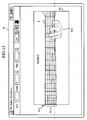
- the viewpoint to each object of the fingering guidance image 81 is suitably changed according to the operation the user gives to the input device 20. More specifically, in this embodiment, the user can optionally select either one of a front viewpoint mode wherein the viewpoint directs toward the front of the fingerboard 811b in the musical instrument image 811 as shown in Fig. 2 and a performer viewpoint mode wherein the viewpoint directs toward the neck section 811a of the guitar from the performer as shown in Fig. 4 (illustrating the case where the transmitting display mode is selected). In the performer viewpoint mode, the image that the fingerboard 811b of the neck section 811a is seen from the diagonal upper section is displayed as the fingering guidance image 81.
- a command button hereinafter referred to as “viewpoint changing button” 873 arranged on the fingering display window W is operated by the input device 20
- the changeover from one to another of the front viewpoint mode and the performer viewpoint mode is performed.
- a flag hereinafter referred to as "viewpoint flag" Fv indicating which one is selected of the front viewpoint mode and the performer viewpoint mode.
- dragging a mouse of the input device 20 by a left-click with a mouse pointer positioned on the fingering guidance image 81 changes the viewpoint to each object according to the drag distance and drag direction
- dragging by a right-click changes the angle of each object according to the drag distance and drag direction
- the fingering display window W includes a key display section 851 showing a key of the reproduced music piece, a capo position display section 852 showing the fret number to which a capotasto is set and a play key display section 853 showing a play key.
- the user can optionally select a fret to which a capotasto is set by suitably operating the up/down button 852a arranged at the capo position display section 852.
- the chord root of the to-be-guided chord is changed according to the position of the capotasto designated here. For example, the key of the music piece is "C" and the position of the capotasto is "0" (that means the capotasto is not set) in Fig.
- the memory device 50 shown in Fig. 1 is means for storing a program executed by the control device 10 and various data utilized upon the execution of this program.
- Examples of usable memory device 50 include a hard disk device having a magnetic disk incorporated therein or a device that drives a portable recording medium represented by a CD-ROM.
- Stored in this memory device 50 are a program (hereinafter referred to as "fingering guidance program") 511 that causes the fingering guidance image 81 to be displayed onto the display device 40 as illustrated in Figs. 2 to 4 and a program (hereinafter referred to as "music piece reproduction program”) 512 that reproduces a music piece by controlling the tone generator 30, besides an OS for managing the general operation of the fingering guidance apparatus 100.
- music piece data 53 indicative of the content of the music piece is stored in the memory device 50 every music piece.
- Each music piece data 53 has data structure in conformity to MIDI (Musical Instrument Digital Interface) standard, including performance data 531 indicative of a performed note of the music piece and chord sequence data 532 indicative of the sequence of each chord.
- the performance data 531 is data array in which a great number of sets composed of time stamp data and event data are sequentially arranged.
- the event data is for instructing tone generation start (a note on-event) and tone generation stop (note off-event) to the tone generator 30.
- the time stamp data is for indicating the timing when the event data is outputted to the tone generator 30.
- the time stamp data in this embodiment designates an output timing of each event data by a clock number counted from the start of the reproduction of the music piece.
- the control device 10 sequentially outputs to the tone generator 30 the event data included in the performance data 531 at the timing designated by the time stamp data by executing the music piece reproduction program 512. More specifically, the control device 10 counts a clock (hereinafter referred to as "MIDI clock") supplied from a clock generator not shown from a point when the reproduction of the music piece is started, and outputs the event data to the tone generator 30 at the timing when this counted value reaches the clock number of each time stamp data
- MIDI clock a clock supplied from a clock generator not shown from a point when the reproduction of the music piece is started
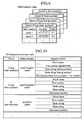
- the chord sequence data 532 is data array wherein a great number of sets composed of the time stamp data Dt and the chord data Dc are sequentially arranged as shown in Fig. 5.
- the chord data Dc is data indicative of a chord that should be performed with the reproduction of the music piece.
- the time stamp data Dt is data for designating the timing when the chord designated by each chord data Dc should be started to be performed. Like the time stamp data Dt of the performance data 531, it designates the timing by a clock number counted from the point when the reproduction of the music piece is started. In the example of Fig.
- a chord CD1 is designated at the timing when the count number of the MIDI clock reaches CNT1 from the start of the reproduction of the music piece
- a chord CD2 is designated at the timing when the count number reaches CNT2.
- the thus designated chord is defined as the to-be-guided chord in the fingering guidance image 81.
- the above-mentioned configuration sequentially changes the to-be-guided chord of the fingering guidance image 81 in synchronism with the reproduction of the music piece.
- data indicative of a time interval of each event data and each chord data Dc may be applied as the time stamp data of the performance data 531 and the chord sequence data 532.
- Structure data 551 (551a, 551b), model data 552 and structure referring table 553 shown in Fig. 1 are for specifying the structure of the guitar displayed as the musical instrument image 811 or structure of fingers displayed as the fingering image 812 in the fingering guidance image 81.
- animation data 556 and animation referring table 557 shown in the same figure are for processing the fingers whose structure is specified as described above into a form according to the to-be-guided chord (i.e., transforming the fingers into a form upon performing the to-be-guided chord). The specific content of these pieces of data is described as follows.
- the structure data 551 is roughly divided into guitar structure data 551 a and finger structure data 551b.
- the guitar structure data 551a is for specifying a framework of a guitar in a virtual three-dimensional space.
- the guitar structure data 551a in this embodiment includes data that designates the position of each fret 811c arranged at the neck section 811a of the guitar (i.e., the position where each section obtained by dividing the neck section 811a by a fret 811c is joined to each other) as coordinates in the three-dimensional space. Accordingly, a straight line connecting these coordinates corresponds to the framework of the neck section 811a and the distance between the adjacent coordinates corresponds to the distance between each fret 811c.
- the guitar structure data 551a includes data that designates the position at the edge section of each string as coordinates in the three-dimensional space.
- the above-mentioned pieces of data specify the structure of the guitar composed of the neck section 811a having plural frets 811c arranged and six strings bridged over the fingerboard 811b.
- the finger structure data 551b is for specifying the framework of fingers in the virtual three-dimensional space.
- the finger structure data 551b in this embodiment designates the position of each joint of fingers as coordinates in the three-dimensional space as shown in Fig. 7. Accordingly, a straight line connecting these coordinates corresponds to the framework of the fingers and the distance between the adjacent coordinates corresponds to the distance between each joint.
- a section between each joint whose position is designated by the finger structure data 551b is described as "bone” hereinafter. Specifically, fingers are grasped as the one obtained by joining plural bones to each other.
- model data 552 is for representing a manner of the surface of the guitar and fingers (more specifically, a shape, color and design of each region composing the surface).
- model data 552 indicative of the manner of each surface of the neck section 811a, fret 811c and strings is stored in the memory device 50 with respect to the guitar.
- the three-dimensional image of the guitar and fingers in the three-dimensional space is specified based upon the framework of the guitar and fingers specified by each structure data 551 and the manner of the surface of each section indicated by the model data 552.
- the structure referring table 553 is for associating each structure data 551 and each model data 552 with each other in order to specify the three-dimensional image. Specifically, a file name of each structure data 551 of the guitar or fingers and a file name of the model data 552 indicating the manner of the surface of this section are associated with each other in this structure referring table 553 as shown in Fig. 8. For example, Fig. 8 shows the case where the three-dimensional image of the guitar is specified by the guitar structure data 551a having a file name of "guitar.skl" and the model data 552 having a file name of "guitar.bmdl".
- the animation data 556 is for defining the form of fingers upon performing a chord every chord. Specifically, the animation data 556 corresponding to one chord designates, every joint of fingers indicated by the finger structure data 551b, the position (coordinates) of the joint and the angle made by a pair of bones joined via the joint as shown in Fig. 9. This embodiment prepares animation data 556 defining the high-position fingering and animation data 556 defining the low-position fingering every combination (every chord) of each chord root such as "C” or "C#” and a chord type such as "M", "7" and "aug".
- Transforming the three-dimensional image of the fingers specified by the finger structure data 551b based upon the animation data 556 generates the three-dimensional image of fingers in the form of performing each chord at the position designated by the user.
- the animation referring table 557 includes plural records each corresponding to the high-position and low-position of each chord as shown in Fig. 10.
- the record of each chord includes data (hereinafter referred to as "referred data") for specifying a section where the animation data 556 corresponding to this chord is stored and the subinformation relating to this chord.
- the referred data indicates, for example, a file name or pass name of the animation data 556.
- a chord name, fret number, a symbol for discriminating an open string, a symbol for discriminating a mute string and a depressed position of a string are included in the animation referring table 557 as the subinformation in this embodiment.
- the symbol for discriminating the open string or mute string is the number allocated to each string.
- the depressed position is specified as a set of the number of each depressed string and the depressed fret number in the string. It should be noted that the configuration can be applied wherein the subinformation is individually prepared every chord separate from the animation referring table 557.
- Fig. 11 is a block diagram showing a functional configuration for generating the fingering guidance image 81 from each data explained above. Each section shown in this figure is realized by the execution of the fingering guidance program 511 by the CPU of the control device 10. It should be noted that the explanation proceeds with attention particularly directed to the content of the process for generating the fingering guidance image 81, so that the process for displaying other information (e.g., each command button or the like) included in the fingering display window W is suitably omitted from the explanation.
- other information e.g., each command button or the like
- a chord designating portion 11 shown in Fig. 11 designates the to-be-guided chord and has a chord data obtaining section 111, a timing control section 112 and a transposition control section 113.
- the chord data obtaining section 111 sequentially extracts the set of the time stamp data Dt and the chord data Dc included in the chord sequence data 532 in the music piece data 53 stored in the memory device 50.
- the timing control section 112 sequentially obtains the time stamp data Dt and the chord data Dc extracted by the chord data obtaining section 111 and sequentially outputs the chord data Dc at the timing designated by this time stamp data Dt.
- the timing control section 112 starts to count the MIDI clock at the time when the reproduction of the music piece is started, and outputs the chord data Dc at the timing when the counted result agrees with the clock number designated by the time stamp data Dt.
- the event data of the performance data 531 used for the reproduction of the music piece is outputted to the tone generator 30 at the timing according to the MIDI clock like the chord sequence data 532. Therefore, the output operation of the chord data Dc by the timing control section 112 and the output operation of the event data to the tone generator 30 are synchronized. Accordingly, the timing control section 112 is grasped also as means for outputting the chord data Dc in synchronism with the reproduction of the music piece.
- the transposition control section 113 transposes the chord indicated by the chord data Dc supplied from the timing control section 112 based upon the capo position designated by the capo position display section 852 and the play key designated by the play key display section 853, and outputs the chord data Dc indicative of the chord after the transposition.
- the transposition control section 113 outputs the chord data Dc indicating "C#m” whose chord type is common at the chord root (C#) that is flatted by a half tone than "Dm".
- the chord outputted from the transposition control section 113 is defined as the to-be-guided chord.
- an image forming portion 15 forms the fingering guidance image 81 of the to-be-guided chord designated by the chord designating portion 11. It has an animation data reading section 151, a structure data reading section 152, a three-dimensional image forming section 153 and an image processing section 154.
- the animation data reading section 151 reads the animation data 556 and subinformation corresponding to the to-be-guided chord designated by the chord designating portion 11 from the memory device 50.
- the animation data reading section 151 firstly specifies the to-be-guided chord and its position based upon the chord data Dc outputted from the transposition control section 113 and the content of the position flag Fp set according to the operation by the user, and searches and reads the record corresponding to the to-be-guided chord at this position from the animation referring table 557. This record includes the referred data and subinformation corresponding to the to-be-guided chord. Subsequently, the animation data reading section 151 specifies the location of the animation data indicated by the referred data and reads the animation data 556 stored at the specified location.
- the animation reading section 151 outputs the animation data 556 and the subinformation read from the memory device 50 to the three-dimensional image forming section 153 as data relating to the to-be-guided chord.
- the structure reading section 152 reads the guitar structure data 551 a and the finger structure data 551b from the memory device 50 as well as reads from the memory device 50 the model data 552 associated with the guitar structure data 551a and the finger structure data 551b in the structure referring table 553. Each structure data 551 and model data 552 read as described above are outputted to the three-dimensional image forming section 153.
- the three-dimensional image forming section 153 forms a three-dimensional image wherein each object that should be included in the fingering guidance image 81 is arranged in the three-dimensional space. Specifically, the three-dimensional image forming section 153 firstly forms the three-dimensional image of the guitar based upon the guitar structure data 551 a and the model data 552 read by the structure data reading section 152. Secondly, the three-dimensional image forming section 153 forms the three-dimensional image of the fingers based upon the finger structure data 551b and the model data 552 read by the structure data reading section 152 as well as processes the three-dimensional image of the fingers into a form upon performing the to-be-guided chord based upon the animation data 556 read by the animation data reading section 151.
- Examples of the process executed for transforming the three-dimensional image of the fingers based upon the animation data 556 include a process for moving the position of each joint of the fingers to the position indicated by the animation data 556 and a process for changing the angle made by the joined bones via each joint to the angle indicated by the animation data 556.
- the three-dimensional image forming section 153 adds the subinformation to the three-dimensional image of the guitar and fingers.
- the three-dimensional image forming section 153 positions the depressed string pointer 813 at the position in the three-dimensional image of the guitar designated by the subinformation (i.e., the position that should be depressed upon the performance of the to-be-guided chord), positions the open string pointer 833 at the position corresponding to the edge section of the open string designated by the subinformation and positions the mute string pointer 834 at the position corresponding to the edge section of the mute string designated by the subinformation. Further, the three-dimensional image forming section 153 positions the other subinformation such as the fret number 832 and chord name 831 at the predetermined position.
- the above-mentioned process forms the three-dimensional image that is a basis of the fingering guidance image 81 (i.e., that becomes the fingering guidance image 81 by an expansion in the two-dimensional coordinate system).
- the image processing section 154 performs, with respect to the three-dimensional image formed by the three-dimensional image forming section 153, a process for changing the viewpoint to each object or a process for making the fingering image 812 the transmitting image. Specifically, the image processing section 154 firstly specifies the viewpoint to each object included in the three-dimensional image based upon the viewpoint flag Fv set according to the operation by the user or the operation given to the mouse of the input device 20.
- the viewpoint flag Fv indicates the front viewpoint mode
- the viewpoint flag Fv indicates the performer viewpoint mode
- the image processing section 154 selects the enlargement ratio such that the section of four or five frets centering about the section of the neck section 811a of the guitar where the depressed pointer 813 is arranged becomes the subject to be displayed. The reason why the four or five frets are taken as the subject to be displayed is that the guitar chord has the depressed position within the range of five frets at a maximum.
- the image processing section 154 executes a rendering for generating a two-dimensional image from the three-dimensional image whose viewpoint and enlargement ratio are specified through the above-mentioned procedure.
- the image processing section 154 executes a translucent process for turning the fingering image 812 into a transmitting image. For example, alpha blend is applied to the method for this translucent process.
- the image processing section 154 replaces the display color of the two-dimensional image (i.e., the fingering image 812) generated from the three-dimensional image of the fingers into an intermediate color between the display color and a display color of the background (e.g., musical instrument image 811 or depressed pointer 813).
- the display color Cnew of each pixel composing the fingering image 812 of the fingering guidance image 81 is expressed by the following equation by using alpha value ⁇ representing the transparency of the fingering image 812.
- Cnew Csource • a + Cbackground • (1 - ⁇ )
- Csource is the display color of each pixel of the fingering image 812 that is in the stage before the translucent process is performed
- Cbackground is the display color of each pixel of the background image overlapped behind the fingers.
- the value from "0" to "1" e.g., "0.5" is selected beforehand as the alpha value ⁇ .
- the fingering guidance image 81 generated by the above-mentioned process is recognized by the user as if the musical instrument image 811 and the depressed pointer 813 are displayed as transmitted through the translucent fingering image 812.
- the transmitting display flag Ft indicates the non-transmitting display mode
- the image processing section 154 does not execute the translucent process.
- the display control section 16 shown in Fig. 11 causes the fingering guidance image 81 generated by the image forming portion 15 to be displayed on the display device 40.
- the control device 10 operates as the aforesaid each section, whereby the fingering guidance image 81 shown in Figs. 2 to 4 is displayed on the display device 40.
- the user suitably operates the input device 20 to select any one of the plural pieces of music piece data 53 stored in the memory device 50 and instruct the start of its reproduction.
- the control device 10 executes at the same time the process for sequentially outputting to the tone generator 30 the event data included in the performance data 531 in the music piece data 53 selected by the user at the timing designated by the time stamp data and the process for displaying the fingering guidance image 81 onto the display device 40.
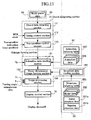
- Fig. 12 is a flowchart showing a flow of the process for displaying the fingering guidance image 81. This process is executed with a timer interruption generated every predetermined time.
- the control device 10 When the timer interruption occurs, the control device 10 firstly determines whether the timing for changing the to-be-guided chord is arrived or not based upon the time stamp data Dt included in the chord sequence data 532 in the music piece data 53 selected by the user as the subject to be performed (step S1). If the result of the determination is YES, the control device 10 designates the chord indicated by the chord data Dc corresponding to the time stamp data Dt as the to-be-guided chord (step S2). The processes at the step S1 and step S2 are repeatedly performed every timer interruption, whereby the to-be-guided chord is sequentially renewed in synchronism with the reproduction of the music piece.
- control device 10 designates the chord according to the instruction after the transposition as the to-be-guided chord at the step S2, as explained in Fig. 11 as the chord designating portion 11.
- the control device 10 determines whether the input device 20 is operated or not by the user (step S3). If the result of this determination is YES, the control device 10 changes the flag and parameter relating to the display manner of the fingering guidance image 81 according to the content of the operation (step S4). For example, when the transmitting/non-transmitting button 872, viewpoint changing button 873 and position changing button 871 on the fingering display window W are operated by the user, the control device 10 renews respectively the transmitting display flag Ft, viewpoint flag Fv and position flag Fp.
- the control device 10 changes the parameter showing the viewpoint and enlargement ratio according to the content of the operation.
- the control device 10 ends the timer interruption process without going through the step S5 and step S6.
- the control device 10 executes the process for forming the fingering guidance image 81 (step S5).
- the specific process executed at the step S5 is as stated above as the operation of the image forming portion 15 shown in Fig. 11.
- the fingering guidance image 81 formed here displays the to-be-guided chord designated at the step S2 in the manner designated at the step S4.
- the control device 10 outputs the fingering guidance image 81 formed at the step S5 to the display device 40 (step S6) as explained as the operation of the display control section 16 in Fig. 11.
- the above-mentioned operation is repeatedly performed every timer interruption, whereby the fingering guidance image 81 shown in Fig. 2 or Fig. 3 is displayed on the display device 40.
- the user can successively confirm the fingering of each chord composing the music piece by visually confirming the fingering guidance image 81.
- the fingering image 812 is made to be the transmitting image in this embodiment when the transmitting display mode is selected, so that the user can correctly confirm the music instrument image 811 and depressed string pointer 813 arranged behind the fingering image 812.
- the fingering image 812 is made to be the non-transmitting image in the non-transmitting display mode, so that the user who intends to confirm only the form of the fingers upon performing each chord (i.e., the user who does not require to correctly confirm the positional relationship between the music instrument and fingers and depressed position) can clearly confirm the form of the fingers by selecting the non-transmitting display mode.
- the viewpoint and enlargement ratio in the fingering guidance image 81 can be changed according to need by the user, thereby providing the fingering guidance image 81 according to the need of the user by performing the operation such as displaying the section that is intended to be more carefully confirmed in particular as enlarged.
- the viewpoint of seeing the fingerboard 811b from the front and the viewpoint of seeing the fingerboard 811b from the performer can be changed over only by an extremely simple operation of manipulating the viewpoint button in this embodiment, thus convenient for the user.
- various subinformation relating to a chord e.g., open string pointer 833, mute string pointer 834, fret number 832 or the like
- the user can more properly confirm the fingering upon performing the chord.
- the position of the open string and mute string cannot clearly be confirmed by the display of only the musical instrument image 811, fingering image 812 and depressed pointer 813, the position of the open string and mute string can clearly be confirmed according to this embodiment.
- chord on which the instruction by the user about the transposition or attachment of the capotasto is reflected is designated as the to-be-guided chord, and further the position of the chord can suitably be changed, thereby providing the fingering guidance image 81 that can deal with the various performance of the user.
- the configuration for displaying the fingering image 812 corresponding to each chord such configuration can be adopted that images of the fingering in the form of performing each chord are prepared in advance every chord and any one of them is selected and displayed on the display device 40.
- the data amount of the image showing the fingers is increased.
- the three-dimensional image indicating the basic framework of the fingers is specified from the finger structure data 551 b and model data 552 and the fingering image 812 is generated by transforming this three-dimensional image based upon the animation data 556 prepared for every chord. Therefore, the data amount can be decreased compared to the configuration wherein an image of fingers is prepared every chord.
- the present embodiment also has an advantage of being capable of adding a new chord by a simple process of renewing the animation data 556.
- the above-mentioned first embodiment illustrates the configuration wherein only the fingering of one chord that should be performed with the reproduction of the music piece (hereinafter sometimes referred to as "current chord”) is displayed as the fingering guidance image 81.
- the fingering guidance image showing the fingering of a chord that should be performed next to the current chord in the currently-reproduced music piece (hereinafter sometimes referred to as "next chord”) is displayed with the fingering guidance image of the current chord in this embodiment.
- Fig. 13 is a view showing the content of the fingering display window W in this embodiment.
- the fingering display window W shown in this figure includes a fingering guidance image 81b indicating the fingering of the next chord in addition to a fingering guidance image 81a indicating the fingering of the current chord.
- the objects composing this fingering guidance image 81b are the same as those of the fingering guidance image 81a showing the current chord, except that characters "NEXT" indicating the next chord are included. Further, the fingering guidance image 81 b of the next chord is displayed with the manner common to the fingering guidance image 81a of the current chord.
- the fingering image 812 in the fingering guidance image 81b of the next chord is made to be the transmitting image
- the fingering guidance image 81b of the next chord is made to be an image seen from the front.
- the fingering display window W described above is realized by the configuration same as the first embodiment.
- the chord designating portion 11 shown in Fig. 11 also designates the next chord as the to-be-guided chord at the timing of designating the current chord as the to-be-guided chord
- the image forming portion 15 also forms the fingering guidance image 81b of the next chord with the fingering guidance image 81a of the current chord.
- the configuration can be applied wherein each display manner is independently designated.
- the fingering guidance image 81a of the current chord is displayed in the transmitting display mode, while the fingering guidance image 81b of the next chord is displayed in the non-transmitting mode, or the fingering guidance image 81a of the current chord is displayed in the front viewpoint mode, while the fingering guidance image 81b of the next chord is displayed in the performer viewpoint mode.
- the configuration may be adopted wherein the viewpoint or enlargement ratio of each fingering guidance image 81 can independently be designated, or the configuration may be adopted wherein the viewpoint or enlargement ratio designated for one fingering guidance image 81 is applied to the other fingering guidance image 81.
- the fingering guidance image 81a of the current chord and the fingering guidance image 81b of the next chord are simultaneously displayed in this embodiment, thereby obtaining an effect that the user can confirm not only the fingering of the current chord but also the fingering of the next chord for the performance, in addition to the effect same as the first embodiment.
- a fingering guidance apparatus displays the score of the music piece on the display device in addition to the fingering display window W shown in the above-mentioned each embodiment.
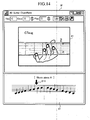
- Fig. 14 is a view showing the image displayed on the display device 40 in this embodiment. As shown in this figure, displayed on the display device 40 are the fingering display window W (the one showing in the first embodiment here) and also the image showing the score of the music piece selected to be reproduced by the user (hereinafter referred to as "score image 91").
- the score image 91 includes a pointer 911 indicating the currently performed point. The position of the pointer 911 is successively moved as the reproduction of the music piece proceeds.
- the to-be-guided chord of the fingering guidance image 81 is sequentially renewed in synchronism with the reproduction of the music piece, like the above-mentioned embodiment. Accordingly, the to-be-guided chord guided by the fingering guidance image 81 is the chord in the music piece at the position indicated by the pointer 911. Further, the user can optionally change the position of the pointer 911 by suitably operating the input device 20 when the reproduction of the music piece is stopped.
- the control device 10 specifies the chord at the position indicated by the pointer 911 after the change based upon the chord sequence data 532 of the music piece data 53 and designates this chord as the to-be-guided chord to thereby generate the fingering guidance image 81. Accordingly, the user can confirm the fingering of the chord in the music piece at the optional position by suitably moving the pointer 911.
- This embodiment can afford the same effect as the first embodiment. Additionally, the fingering of the chord in the music piece at the position optionally selected by the user is guided to the user according to this embodiment, whereby the user can efficiently practice the performance of the music piece (especially the chord change).
Landscapes
- Engineering & Computer Science (AREA)
- Business, Economics & Management (AREA)
- Physics & Mathematics (AREA)
- Educational Administration (AREA)
- Educational Technology (AREA)
- General Physics & Mathematics (AREA)
- Theoretical Computer Science (AREA)
- Multimedia (AREA)
- Auxiliary Devices For Music (AREA)
- Electrophonic Musical Instruments (AREA)
- Electrically Operated Instructional Devices (AREA)
Applications Claiming Priority (2)
| Application Number | Priority Date | Filing Date | Title |
|---|---|---|---|
| JP2004050318A JP2005241877A (ja) | 2004-02-25 | 2004-02-25 | 運指指示装置およびプログラム |
| JP2004050318 | 2004-02-25 |
Publications (2)
| Publication Number | Publication Date |
|---|---|
| EP1569185A2 true EP1569185A2 (de) | 2005-08-31 |
| EP1569185A3 EP1569185A3 (de) | 2006-12-13 |
Family
ID=34747483
Family Applications (1)
| Application Number | Title | Priority Date | Filing Date |
|---|---|---|---|
| EP05101278A Withdrawn EP1569185A3 (de) | 2004-02-25 | 2005-02-21 | Gerät und Programm zur Fingersatzübung |
Country Status (3)
| Country | Link |
|---|---|
| US (1) | US20060191399A1 (de) |
| EP (1) | EP1569185A3 (de) |
| JP (1) | JP2005241877A (de) |
Cited By (2)
| Publication number | Priority date | Publication date | Assignee | Title |
|---|---|---|---|---|
| US7521619B2 (en) | 2006-04-19 | 2009-04-21 | Allegro Multimedia, Inc. | System and method of instructing musical notation for a stringed instrument |
| WO2022052941A1 (zh) * | 2020-09-09 | 2022-03-17 | 桂林智神信息技术股份有限公司 | 用于辅助钢琴教学的智能识别方法及系统、智能钢琴训练方法及系统 |
Families Citing this family (15)
| Publication number | Priority date | Publication date | Assignee | Title |
|---|---|---|---|---|
| US7777117B2 (en) * | 2007-04-19 | 2010-08-17 | Hal Christopher Salter | System and method of instructing musical notation for a stringed instrument |
| RU2367028C2 (ru) * | 2007-09-10 | 2009-09-10 | Владилен Иванович Плотников | Способ игры на балалайке (переборы плотникова) |
| US7910818B2 (en) * | 2008-12-03 | 2011-03-22 | Disney Enterprises, Inc. | System and method for providing an edutainment interface for musical instruments |
| US7906720B2 (en) * | 2009-05-05 | 2011-03-15 | At&T Intellectual Property I, Lp | Method and system for presenting a musical instrument |
| US8269094B2 (en) * | 2009-07-20 | 2012-09-18 | Apple Inc. | System and method to generate and manipulate string-instrument chord grids in a digital audio workstation |
| US8609966B2 (en) | 2010-04-20 | 2013-12-17 | Richard C. Lucas | Transposable capo system and method |
| JP5403282B2 (ja) * | 2010-09-30 | 2014-01-29 | ブラザー工業株式会社 | 楽曲検索装置、楽曲演奏装置及び楽曲検索プログラム |
| WO2013130034A1 (en) * | 2012-02-27 | 2013-09-06 | Lucas Richard D | Transposable capo system and method |
| JP5590350B2 (ja) * | 2012-09-24 | 2014-09-17 | ブラザー工業株式会社 | 楽曲演奏装置及び楽曲演奏用プログラム |
| JP5884987B2 (ja) * | 2012-12-28 | 2016-03-15 | ブラザー工業株式会社 | 楽曲演奏装置 |
| JP5754449B2 (ja) * | 2013-02-08 | 2015-07-29 | ブラザー工業株式会社 | 楽曲コード譜生成装置 |
| US9830895B2 (en) * | 2014-03-14 | 2017-11-28 | Berggram Development Oy | Method for offsetting pitch data in an audio file |
| CN109493683B (zh) * | 2018-11-15 | 2021-06-01 | 深圳市象形字科技股份有限公司 | 一种基于计算机视觉技术的辅助钢琴练习者指法检测方法 |
| CN109256010A (zh) * | 2018-12-03 | 2019-01-22 | 上和弦(北京)音乐科技有限公司 | 一种音乐教学演示系统 |
| JP7528971B2 (ja) * | 2022-03-25 | 2024-08-06 | ヤマハ株式会社 | 情報処理方法、情報処理システムおよびプログラム |
Family Cites Families (18)
| Publication number | Priority date | Publication date | Assignee | Title |
|---|---|---|---|---|
| US5215468A (en) * | 1991-03-11 | 1993-06-01 | Lauffer Martha A | Method and apparatus for introducing subliminal changes to audio stimuli |
| US5690496A (en) * | 1994-06-06 | 1997-11-25 | Red Ant, Inc. | Multimedia product for use in a computer for music instruction and use |
| JPH08202256A (ja) * | 1995-01-31 | 1996-08-09 | Kawai Musical Instr Mfg Co Ltd | 音楽教育システム |
| JP3058051B2 (ja) * | 1995-04-27 | 2000-07-04 | ヤマハ株式会社 | 音楽的アミューズメントシステム |
| JPH09274427A (ja) * | 1996-04-05 | 1997-10-21 | Casio Comput Co Ltd | 楽音発生装置 |
| US5745109A (en) * | 1996-04-30 | 1998-04-28 | Sony Corporation | Menu display interface with miniature windows corresponding to each page |
| JP3728942B2 (ja) * | 1998-03-24 | 2005-12-21 | ヤマハ株式会社 | 楽音および画像生成装置 |
| JP3541689B2 (ja) * | 1998-08-31 | 2004-07-14 | ヤマハ株式会社 | 和音表示装置および記憶媒体 |
| JP3601350B2 (ja) * | 1998-09-29 | 2004-12-15 | ヤマハ株式会社 | 演奏画像情報作成装置および再生装置 |
| JP3684892B2 (ja) * | 1999-01-25 | 2005-08-17 | ヤマハ株式会社 | 和音提示装置および記憶媒体 |
| JP2000293172A (ja) * | 1999-04-05 | 2000-10-20 | Casio Comput Co Ltd | 管楽器演奏練習装置及び管楽器演奏練習処理プログラムを記録した記録媒体。 |
| JP3968975B2 (ja) * | 2000-09-06 | 2007-08-29 | ヤマハ株式会社 | 運指生成表示方法、運指生成表示装置および記録媒体 |
| JP2002366142A (ja) * | 2001-06-08 | 2002-12-20 | Yamaha Corp | 演奏支援装置 |
| US6995310B1 (en) * | 2001-07-18 | 2006-02-07 | Emusicsystem | Method and apparatus for sensing and displaying tablature associated with a stringed musical instrument |
| JP3890936B2 (ja) * | 2001-08-13 | 2007-03-07 | カシオ計算機株式会社 | 演奏教習装置及び演奏教習処理のプログラム |
| JP3998461B2 (ja) * | 2001-11-16 | 2007-10-24 | 株式会社河合楽器製作所 | 演奏練習装置、演奏練習方法、プログラム及び記録媒体 |
| US6987221B2 (en) * | 2002-05-30 | 2006-01-17 | Microsoft Corporation | Auto playlist generation with multiple seed songs |
| US7521623B2 (en) * | 2004-11-24 | 2009-04-21 | Apple Inc. | Music synchronization arrangement |
-
2004
- 2004-02-25 JP JP2004050318A patent/JP2005241877A/ja active Pending
-
2005
- 2005-02-21 EP EP05101278A patent/EP1569185A3/de not_active Withdrawn
- 2005-02-25 US US11/066,686 patent/US20060191399A1/en not_active Abandoned
Non-Patent Citations (1)
| Title |
|---|
| No Search * |
Cited By (2)
| Publication number | Priority date | Publication date | Assignee | Title |
|---|---|---|---|---|
| US7521619B2 (en) | 2006-04-19 | 2009-04-21 | Allegro Multimedia, Inc. | System and method of instructing musical notation for a stringed instrument |
| WO2022052941A1 (zh) * | 2020-09-09 | 2022-03-17 | 桂林智神信息技术股份有限公司 | 用于辅助钢琴教学的智能识别方法及系统、智能钢琴训练方法及系统 |
Also Published As
| Publication number | Publication date |
|---|---|
| JP2005241877A (ja) | 2005-09-08 |
| US20060191399A1 (en) | 2006-08-31 |
| EP1569185A3 (de) | 2006-12-13 |
Similar Documents
| Publication | Publication Date | Title |
|---|---|---|
| US20060191399A1 (en) | Fingering guidance apparatus and program | |
| US6486388B2 (en) | Apparatus and method for creating fingering guidance in playing musical instrument from performance data | |
| JP3601350B2 (ja) | 演奏画像情報作成装置および再生装置 | |
| US7514622B2 (en) | Musical sound production apparatus and musical | |
| EP0829847B1 (de) | System zum Simulieren von Dirigieren | |
| US20090223348A1 (en) | Apparatus and method for visualization of music using note extraction | |
| JP2005316207A (ja) | 演奏データ作成装置及びプログラム | |
| WO2008130661A1 (en) | Method and apparatus for comparing musical works | |
| JP3538242B2 (ja) | 楽譜表示装置 | |
| US6646644B1 (en) | Tone and picture generator device | |
| CN110322861A (zh) | 运指显示装置以及存储介质 | |
| Cakmakci et al. | An augmented reality based learning assistant for electric bass guitar | |
| US20140026738A1 (en) | Music Wormhole, A Music Education and Entertainment System | |
| US7038120B2 (en) | Method and apparatus for designating performance notes based on synchronization information | |
| CN110689866A (zh) | 基于增强现实的小提琴辅助教学方法及系统 | |
| JP7810053B2 (ja) | 情報処理システム、情報処理方法およびプログラム | |
| US7238876B1 (en) | Method of automated musical instrument finger finding | |
| JP2000242267A (ja) | 音楽学習支援装置及び音楽学習支援プログラムを記録したコンピュータ読み取り可能な記録媒体 | |
| US7504572B2 (en) | Sound generating method | |
| JP3753798B2 (ja) | 演奏再現装置 | |
| JP7219559B2 (ja) | 楽器演奏練習装置及び楽器演奏練習用プログラム | |
| JP2000338965A (ja) | Midiデータの表示方法および表示装置ならびにmidiデータを表示した楽譜 | |
| JP2003114674A (ja) | 演奏情報表示装置、及びプログラム | |
| JP2000098866A (ja) | 漢字学習システム | |
| JP2010122616A (ja) | 楽譜表示装置、楽譜表示方法及びプログラム |
Legal Events
| Date | Code | Title | Description |
|---|---|---|---|
| PUAI | Public reference made under article 153(3) epc to a published international application that has entered the european phase |
Free format text: ORIGINAL CODE: 0009012 |
|
| 17P | Request for examination filed |
Effective date: 20050225 |
|
| AK | Designated contracting states |
Kind code of ref document: A2 Designated state(s): AT BE BG CH CY CZ DE DK EE ES FI FR GB GR HU IE IS IT LI LT LU MC NL PL PT RO SE SI SK TR |
|
| AX | Request for extension of the european patent |
Extension state: AL BA HR LV MK YU |
|
| PUAL | Search report despatched |
Free format text: ORIGINAL CODE: 0009013 |
|
| AK | Designated contracting states |
Kind code of ref document: A3 Designated state(s): AT BE BG CH CY CZ DE DK EE ES FI FR GB GR HU IE IS IT LI LT LU MC NL PL PT RO SE SI SK TR |
|
| AX | Request for extension of the european patent |
Extension state: AL BA HR LV MK YU |
|
| RAP1 | Party data changed (applicant data changed or rights of an application transferred) |
Owner name: YAMAHA CORPORATION |
|
| AKX | Designation fees paid |
Designated state(s): DE FR GB |
|
| STAA | Information on the status of an ep patent application or granted ep patent |
Free format text: STATUS: THE APPLICATION HAS BEEN WITHDRAWN |
|
| 18W | Application withdrawn |
Effective date: 20130424 |