EP1568709A2 - Reinigung von Fibrinogen - Google Patents
Reinigung von Fibrinogen Download PDFInfo
- Publication number
- EP1568709A2 EP1568709A2 EP05003017A EP05003017A EP1568709A2 EP 1568709 A2 EP1568709 A2 EP 1568709A2 EP 05003017 A EP05003017 A EP 05003017A EP 05003017 A EP05003017 A EP 05003017A EP 1568709 A2 EP1568709 A2 EP 1568709A2
- Authority
- EP
- European Patent Office
- Prior art keywords
- fibrinogen
- gel
- negative
- nacl
- blue
- Prior art date
- Legal status (The legal status is an assumption and is not a legal conclusion. Google has not performed a legal analysis and makes no representation as to the accuracy of the status listed.)
- Granted
Links
Images


Classifications
-
- C—CHEMISTRY; METALLURGY
- C07—ORGANIC CHEMISTRY
- C07K—PEPTIDES
- C07K14/00—Peptides having more than 20 amino acids; Gastrins; Somatostatins; Melanotropins; Derivatives thereof
- C07K14/435—Peptides having more than 20 amino acids; Gastrins; Somatostatins; Melanotropins; Derivatives thereof from animals; from humans
- C07K14/745—Blood coagulation or fibrinolysis factors
- C07K14/75—Fibrinogen
-
- A—HUMAN NECESSITIES
- A61—MEDICAL OR VETERINARY SCIENCE; HYGIENE
- A61C—DENTISTRY; APPARATUS OR METHODS FOR ORAL OR DENTAL HYGIENE
- A61C3/00—Dental tools or instruments
- A61C3/06—Tooth grinding or polishing discs; Holders therefor
-
- A—HUMAN NECESSITIES
- A46—BRUSHWARE
- A46B—BRUSHES
- A46B15/00—Other brushes; Brushes with additional arrangements
- A46B15/0002—Arrangements for enhancing monitoring or controlling the brushing process
- A46B15/0016—Arrangements for enhancing monitoring or controlling the brushing process with enhancing means
- A46B15/0032—Arrangements for enhancing monitoring or controlling the brushing process with enhancing means with protrusion for polishing teeth
-
- A—HUMAN NECESSITIES
- A46—BRUSHWARE
- A46B—BRUSHES
- A46B7/00—Bristle carriers arranged in the brush body
- A46B7/04—Bristle carriers arranged in the brush body interchangeably removable bristle carriers
-
- A—HUMAN NECESSITIES
- A46—BRUSHWARE
- A46B—BRUSHES
- A46B9/00—Arrangements of the bristles in the brush body
- A46B9/02—Position or arrangement of bristles in relation to surface of the brush body, e.g. inclined, in rows, in groups
- A46B9/04—Arranged like in or for toothbrushes
-
- A—HUMAN NECESSITIES
- A61—MEDICAL OR VETERINARY SCIENCE; HYGIENE
- A61P—SPECIFIC THERAPEUTIC ACTIVITY OF CHEMICAL COMPOUNDS OR MEDICINAL PREPARATIONS
- A61P7/00—Drugs for disorders of the blood or the extracellular fluid
-
- A—HUMAN NECESSITIES
- A61—MEDICAL OR VETERINARY SCIENCE; HYGIENE
- A61P—SPECIFIC THERAPEUTIC ACTIVITY OF CHEMICAL COMPOUNDS OR MEDICINAL PREPARATIONS
- A61P7/00—Drugs for disorders of the blood or the extracellular fluid
- A61P7/04—Antihaemorrhagics; Procoagulants; Haemostatic agents; Antifibrinolytic agents
-
- A—HUMAN NECESSITIES
- A46—BRUSHWARE
- A46B—BRUSHES
- A46B2200/00—Brushes characterized by their functions, uses or applications
- A46B2200/10—For human or animal care
- A46B2200/1066—Toothbrush for cleaning the teeth or dentures
Definitions
- the present invention relates to a process for purifying fibrinogen thereby characterized in that it contains one or more method steps in which one or more several contaminating proteins by negative chromatography and / or negative Adsorption, using cation exchanger, hydrophobic gel and / or Dye gel are depleted. Furthermore, the invention relates to the after According to the invention obtained fibrinogen, which is improved by an Stability distinguishes, as well as the production and use of pharmaceutical Preparations containing this fibrinogen.
- Fibrinogen plays a key role in blood clotting. In case of injury or Surgery almost always damages blood vessels and causes bleeding. By the Blood clotting, the blood is solidified in the area of smaller wounds and the bleeding comes to a halt. The coagulation system thus protects the body against high blood losses. at The blood coagulation is the soluble fibrinogen contained in the blood plasma in the presence of Thrombin converted to the fibrous, insoluble fibrin. If there is a lack of fibrinogen, so Blood clotting does not work properly. One can compensate for the lack by one Fibrinogen isolated from e.g. human blood plasma. Because of its meaning For haemostasis and wound healing, fibrinogen has high clinical significance Application.
- fibrinogen Because of this high clinical significance of fibrinogen, there are many in the literature Hints that deal with various methods for the purification of this important protein employ. The purification of fibrinogen takes place predominantly from human, more rarely also from animal plasma. Also possible is a purification of recombinant fibrinogen, z. B. from the cell culture after recombinant expression, or from the milk of transgenic animals.
- the human plasma contains a complex mixture of more than 100 proteins, wherein Fibrinogen accounts for about 2% of the total protein.
- Fibrinogen accounts for about 2% of the total protein.
- the cleaning and isolation of As a rule, fibrinogen therefore requires several steps and the possible combinations These individual process steps are manifold.
- the cation exchange chromatography finds application for example in the Purification of fibrinogen from the milk of transgenic animals described in WO 00/17234. In this case as well, conditions are chosen which limit the binding of fibrinogen to the Column material result and thus the separation of e.g. Casein enable.
- fibrinogen is in a process step by a heparin-Sepharose Pillar cleaned up.
- the conditions are chosen so that fibrinogen to the column material Adsorbed and so especially albumins, immunoglobulins and virus inactivation substances can be separated.
- EP 0 789 030, US 5,723,579 and US 5,783,663 describe peptides which bind fibrinogen and can accordingly be used as ligands in affinity columns for the purification of fibrinogen.
- Immobilized ristocetin was also used to bind fibrinogen and this eluted again with 8 M urea (Suzuki et al., Thrombosis Research 18 (1980) 707-715).
- inactivated thrombin is used as a ligand for thrombin substrates, which also includes fibrinogen.
- IMAC Immobilized Metal Affinity Chromatography
- Fibrinogen is also listed as a potential protein that binds to the metal chelate matrix. Fibrinogen also binds to protamine-agarose and can then be eluted in acidic pH, see for example US 6,037,457 or Dempfle & Heene (Thrombosis Research 46 (1987) 19-27).
- Plasma or cryoprecipitate contains in addition to fibrinogen also large amounts of others clinically meaningful plasma proteins, making it also a starting material for Fractionation and recovery of factor VIII (F VIII), fibronectin and von Willebrand factor is used. For this reason, chromatographic process steps for Application brought to separate all four or at least two of the main proteins capital.
- anion exchangers are used under conditions which are fibrinogen do not bind, but for example F VIII, von Willebrand factor and fibronectin, the subsequently selectively eluted by different ionic strengths. Reference is made to this for example, to WO 89/12065, EP 0 359 593 or US 5,252,709.
- EP 0 383 2344 conditions are chosen for the anion exchanger in which only F VIII binds, von Willebrand factor, fibronectin and fibrinogen on the other hand pass through the column or remain in the Supernatant (batch process).
- EP 0 408 029 and US 5,138,034 include i.a. a fractionation process in which by a freeze / thaw treatment first F VIII and fibonectin are separated by precipitation, Factor IX (F IX) to a adsorbed subsequent anion exchange column and the fibrinogen from the passage of the Column is precipitated over ethanol. In all these cases it is about the separation of the clinical meaningful major proteins, which then individually before their pharmaceutical use can be supplied to further purification steps.
- US 4,210,580 describes a process for the purification of fibronectin, in the fibrinogen after heparin precipitation, by washing a subsequent Anion exchange column can be separated. Also US 5,099,003 uses one Anion exchanger, but in this case to remove the factors II, VII, IX and X, the otherwise after virus inactivation treatment with ⁇ -propiolactone and UV irradiation, would cause gelling and clumping of the fibrinogen-containing solution.
- the process for the preparation of fibrinogen, prothrombin complex Describes antithrombin III and a solution of storage stable serum proteins, i.a.
- a Variant described in the first of the prothrombin complex (F II, F VII, F IX and F X) by Adsorption is obtained on anion exchangers and then from the run Still fibrinogen is isolated by adsorption with colloidal silica.
- the variant is preferred, at first fibrinogen separated by adsorption on silica and then the prothrombin complex with Help of anion exchangers is isolated. In this case, the use of a AnionenSers so rather detrimental to the quality of the same time from the run to gaining fibrinogens.
- WO 99/51724 describes a "negative" chromatography process. for purification of heterologous proteins, i.a. also fibrinogen, from the milk of transgenic animals.
- heterologous proteins i.a. also fibrinogen
- hydroxyapatite is used as the gel material to contaminate To bind milk proteins.
- fibronectin is one Structural protein that does not affect the stability of fibrinogen.
- lysine or analogous compounds are very specific to plasminogen can bind and this ability via an affinity chromatography with L-lysine substituted sepharose can be used for the purification of plasminogen (German Mertz, Science 170 (1970) 1095-1096; Matsuda et al., Thrombosis Research 1 (1972) 619-630).
- This ability of lysine ligands is considered in some fibrinogen purification methods
- Process step used to deplete contaminating plasminogen Reference is made in this regard, e.g. to WO 95/25748 or WO 93/05067. In this case, however, will be very Specifically, only one protein, the plasminogen, depleted because the lysine is very specific to one certain epitope (kringle domains) of plasminogen binds.
- a method such as isoagglutinins (blood group antibodies) from blood or blood components, e.g. Fibrinogen, can be removed.
- antigens e.g., oligosaccharides
- a removal of isoagglutinins is beneficial for avoiding complications when the blood types of donor blood or the donor blood components differ from the blood type of the recipient.
- Isoagglutinins have no effect on the stability of fibrinogen to proteolysis.
- ion exchange plasma can then u.a. Fibrinogen by adsorption on Silica be isolated.
- the cation exchanger used in this case is used merely an exchange of calcium ions for the onset of a coagulation reaction Avoid cleaning with this step.
- Adsorptionsen are also used in the purification of plasma proteins.
- a tricalcium phosphate (TCP) adsorption is used for purifying the prothrombin complex.
- TCP tricalcium phosphate
- WO 95/25748 it is used to remove the prothombin complex as a process step for the purification of fibrinogen.
- Al (OH) 3 aluminum hydroxide
- Al (OH) 3 is used, for example, in EP 0 383 234 or WO 01/48016.
- barium sulfate (BaSO 4 ) would be mentioned.
- Fibrinogen is a very large protein with a complex structure. It is a glycoprotein of approximately 340 kDa consisting of two symmetrical halves. Two alpha (A ⁇ ) ⁇ , beta (B ⁇ ) and gamma ( ⁇ ) chains form an elongated molecular structure (about 47 nm), the forms three domains (one central E domain and two identical D domains). These complex structure is indispensable for the efficient formation of a stable fibrin matrix.
- the alpha chain is characterized by incipient proteolytic degradation affected fibrinogen-degrading proteases.
- the three-dimensional structure of the fibrin clot is also affected by a damaged alpha Influenced chain. It comes to a finer fibrin network with thinner fibrils and a lower mechanical stability.
- the C-terminal ends of the alpha chains contain Amino acid sequences involving bonds between adjacent fibrin molecules, catalyzed by activated F XIII. Reduce missing cross-links the stability of the fibrin matrix. This all shows that fibrinogen with severely damaged alpha Chains has a reduced quality and in pharmaceutical use, e.g. at Fibrin glue is not desirable.
- the advantage of the method steps according to the invention lies in the depletion of fibrinogen degrading proteins with the result of increased stability of the fibrinogen in aqueous solution.
- fibrinogen is in liquid form.
- the one component includes fibrinogen, often together with factor XIII and a fibrinolysis inhibitor such as Aprotinin, and the other component includes thrombin, often along with Calcium ions. Reconstitution to make the glue ready for use is relatively necessary a lot of time, especially since fibrinogen is present in high concentrations.
- fibrinogen Another great advantage of fibrinogen, the method of the invention
- the possibility of a liquid storage for a certain time is also at Room temperature, whereby e.g. the application properties in emergency situations can improve.
- the stability is also at Room temperature is to ensure during this phase.
- Stable storage of fibrinogen in solution thus facilitates in many respects the manufacture, the use, transport and the Administration to the patient. Due to the advantageously increased stability of the fibrinogen, the is produced by the process according to the invention, it is also possible in many pharmaceutical preparations for the addition of fibrinolysis or Fibrinogenolyseinhibitoren, which may lead to undesirable side effects can be avoided or avoided to reduce potential risks.
- the present invention is therefore based on the object, a method for cleaning of fibrinogen providing a high stability fibrinogen in good yield. Surprisingly, cleaning processes have been found which are also used on an industrial scale Scale are economically feasible and lead to a fibrinogen whose stability in Solution is significantly increased.
- the invention therefore provides a process for the purification of fibrinogen, characterized characterized in that it contains one or more method steps in which one or more several contaminating proteins by negative chromatography (s) and / or negative Adsorption (s) using organic cation exchanger, hydrophobic gel and / or dye gel are depleted.
- the subject of the invention is a Fibrinogen preparation which is obtainable by the process steps described and which characterized by improved stability after storage at room temperature and / or by a reduced content of fibrinogen-degrading proteases or their proenzymes.
- the different dye gels proposed in this invention which are various Dye ligands are able to deplete different proteins, which is what makes the proteins Production of a fibrinogen-containing solution with high stability of the fibrinogen possible.
- the use of inorganic, sparingly soluble salts such as TCP, Ba (SO 4 ) and Al (OH) 3 does not lead to a fibrinogen preparation according to the invention.
- the gel materials according to the invention can also be used in combination with inorganic, sparingly soluble salts such as TCP, Ba (SO 4 ) and Al (OH) 3 .
- fibrinogen stability As a measure of fibrinogen stability, the proportion of low molecular weight fibrinogen degradation fragments when stored at 30 ° C considered. These degradation fragments will be by size exclusion chromatography as peaks of smaller molecular weight than the main fibrinogen peak is determined (peak 4 or ⁇ peak 4). As stable in the context of the invention A fibrinogen preparation then applies if the absolute proportion of fibrinogen degradation fragments (Peak 4 or ⁇ peak 4) when stored at 30 ° C after one month in liquid state is below 3%, preferably below 2.5%.
- Purification in the sense of the present invention may be a chromatographic Purification process or a batch adsorption process.
- the methods of the prior art differ fundamentally from the inventive step of the negative chromatography or negative Adsorption, in which the conditions are chosen so that fibrinogen is not or only too binds a smaller proportion and thus passes through the column in chromatographic separation. The predominant proportion of fibrinogen is thus in the run or in the Adsorption in the supernatant.
- the advantage of the method step according to the invention lies i.a. in that conditions can be chosen, the structure and functionality of the Do not interfere with fibrinogen and also lead to high yields.
- the inventive method step in particular after prior cleaning by Precipitates, essentially only secondary components bound and separated It is necessary, due to small column dimensions and a simple technical Equipment, a cost-effective large-scale implementation possible.
- S types sulfomethyl groups
- SP types sulfopropyl groups
- CM types carboxymethyl groups
- other suitable negatively charged functional groups are used as the functional group of the cation exchanger.
- the cation exchanger is Fractogel EMD SO 3 - 650, Macro-Prep 50 S, CM-Sepharose CL-6B, Fractogel EMD CM-650, Fractogel TSK CM 650, Fractogel EMD CM, SP Sepharose, Heparin Fractogel and / or heparin Sepharose CL 6B is.
- hydrophobic gel is functional groups Contains alkyl groups.
- hydrophobic gel is functional groups Phenyl groups or derivatized phenyl groups.
- hydrophobic gel is functional groups Propyl, butyl, pentyl, hexyl or octyl groups.
- hydrophobic gel Macro Prep methyl
- Fractogel EMD Propyl 650 Fractogel EMD Butyl 650, Fractogel TSK Butyl 650, Macro Prep t Butyl, Butyl Cellufine, Butyl Sepharose 4 Fast Flow, Butyl S-Sepharose 6 Fast Flow, HIC Fractogel Pentyl, Hexyl S-Sepharose 6 Fast Flow, Octyl Sepharose CL 4B, HIC-Fractogel HW 65 Propyltentacle, Fractogel HW 65 Butyltentakel, Fractogel TA 650, Phenyl Sepharose HP, Phenyl Sepharose Fast Flow, Phenylalanine Sepharose, Thiopropyl Sepharose 6B and / or Pyridyl S-Sepharose 6 Fast Flow is used.
- the dye gel is Blue Hyper D, Mimetic Blue Agarose, Mimetic Blue SA P6XL, Mimetic Blue 1 P6XL, Blue Trisacryl Plus LS, Blue Uniflow, Blue Sepharose 6FF, Blue Sepharose CL 6B, Red Sepharose CL 6B, Fractogel TSK AF Green and / or Matrex gel Green A is.
- Plasma fraction or cryoprecipitate is used as starting material human plasma.
- a process as described above wherein one or more process steps comprise an aluminum hydroxide treatment.
- a method as described above, wherein one or more method steps are included are those in which plasminogen via gel material with lysine or lysine analogues as functional Group is removed.
- a method step is a Pasteurization and / or UV irradiation and / or nanofiltration is.
- Fibrinogen preparation obtainable by any of the methods described above is.
- Production of a pharmaceutical preparation characterized in that it comprises Contains fibrinogen according to one of the methods described above.
- composition characterized in that it contains a fibrinogen contains the method described above.
- composition characterized in that the content of F XI at ⁇ 1, preferably ⁇ 0.2 ng per OD is 280,320 .
- composition characterized in that the content of F XII is ⁇ 20, preferably ⁇ 10 ng per OD 280-320 .
- composition characterized in that the content of t-PA is ⁇ 0.02, preferably ⁇ 0.01 ng per OD 280-320 .
- Fibrinogen preparation according to one of the previously described methods as a component of a multicomponent adhesive.
- Fibrinogen preparation according to one of the previously described methods containing the formulation component arginine as a component of a multicomponent adhesive.
- Fibrinogen preparation according to one of the previously described methods comprising the formulation constituents NaCl, Na 3 citrate, ArgxHCl and CaCl 2 as a component of a multicomponent adhesive.
- Fibrinogen preparation containing the formulation components NaCl (0-500 mM), Na 3 citrate (0-50 mM), Arg or Arg x HCl (0.05-2.0 mol / l) and CaCl 2 (0.1-5 mM) or mixtures thereof as a component of a multicomponent adhesive.
- Fibrin glue characterized in that it contains a fibrinogen component according to one of the previously described methods, a F XIII and a thrombin component as separate components.
- Fibrin glue characterized in that it corresponds to a fibrinogen component one of the previously described methods, the F XIII is added, and a Contains thrombin component as separate components.
- fibrinogen is preferably to be understood as meaning human fibrinogen, e.g. out of a human blood derived mixture containing fibrinogen can.
- blood-derived mixture is, for example, whole blood, Blood plasma, plasma fractions or plasma precipitates to understand.
- Fibrinogen may be isolated from both pooled plasma donations and individual donations.
- human Fibrinogen can also be obtained from the milk of transgenic animals, see for example US 5,639,940. Also fibrinogen, obtained by recombinant expression from cell culture see, for example, US 6,037,457 is included.
- fibrinogen out of the isolate corresponding fermentation supernatants or fractions produced therefrom.
- fibrinogen isolated from a mixture obtained from animal blood the Containing fibrinogen, preferably from animals such as mammals (e.g., pig, horse, bovine, goat, Sheep and dog).
- fibrinogen-degrading proteins that can proteolytically degrade fibrinogen or vice versa
- Precursors of fibrinogen-degrading proteins which are responsible for a proteolytic Degradation of fibrinogen must be previously activated, or activators of fibrinogen degrading proteases.
- fibrinogen degradation fragments arise, which are smaller than fibrinogen and may be low molecular weight.
- the alpha and / or beta and / or gamma chains of fibrinogen may be derived from proteolytic Degradation affected.
- Possible fibrinogen-degrading or degradation-promoting Proteins or their precursors, which are considered to be potential contaminants in the purification of Plasma fibrinogens may occur, for example, plasmin, F XIa, kallikrein, factor VII activating protease (FSAP), F Xlla, plasminogen activators such as t-PA and u-PA, thrombin, Metalloproteases (MMP's) or the corresponding precursors such.
- MMP's Metalloproteases
- sct-PA and scu-PA single-chain plasminogen activators
- Prothrombin single-chain plasminogen activators
- the process according to the invention preferably permits depletion of fibrinogen-degrading proteases or their proenzymes and activators by the process (s) according to the invention.
- These may be, for example, plasminogen, F XI, prekallikrein, F XII, pro-MMPs and / or plasminogen activators sct-PA and scu-PA.
- the depletion factor (AF) is above 1, preferably above 2.
- the proportion of F XII can be particularly preferably minimized to ⁇ 20 ng per OD 280-320 .
- the proportion of F XI can be minimized to ⁇ 1ng per OD 280-320 , most preferably to ⁇ 0.2ng per OD 280-320 .
- the proportion of plasminogen can be reduced particularly preferably to values of ⁇ 5 ng per OD 280-320 .
- the stability of fibrinogen in solution and in particular the proteolytic stability of the fibrinogen chains is particularly preferably increased by the method step according to the invention.
- the degradation fragments resulting from the proteolysis of fibrinogen by fibrinogen-degrading proteins can be detected by different methods. By way of example, mention here is the separation into SDS-polyacrylamide gels under reducing or non-reducing conditions, HPLC methods such as SEC (Size Exclusion Chromatography) HPLC or immunological methods.
- the activity of remaining fibrinogen can furthermore be determined by customary methods as described in Clauss (Acta-Haematol 17 (1957) 237-246).
- Detection of depletion of fibrinogen-degrading proteins can be carried out, for example, specifically with the aid of antibodies, such as in the known enzyme-linked immunosorbent assay (ELISA) or RIA (radioimmunoassay) method.
- the antibodies are, for example, antibodies that are directed, inter alia, against the above-mentioned or other known fibrinogen-degrading proteases.
- the depletion can also be detected nonspecifically by storing the fibrinogen solution in the liquid state and determining the degree of a possible degradation reaction after storage in comparison with a likewise stored, non-depleted control.
- Chromatography in the sense of this invention is to be understood as a separation method in which a fibrinogen-containing solution by means of a liquid flow over a stationary phase and components of the mixture separate.
- the stationary phase it is preferably the filling material of a chromatographic column.
- the Filling material also called gel material below, consists of a solid carrier material preferably of approximately the same size, porous or non-porous particles to which covalently bonded functional groups that define the separation mode.
- the carrier material may be, for example, biopolymers such as agarose, cellulose and Dextran (preferably Sepharose and Sephadex), or synthetic polymers such as. B.
- the solution in which to cleanse Fibrinogen is dissolved with contaminating proteins, as well as possible wash buffer and Equilibration buffers are considered to be mobile phases.
- the stationary and the mobile phase so too choose, on the one hand fibrinogen as weak as possible or no interaction with the stationary phase, while on the other hand one or more contaminating Proteins interact more strongly with the stationary phase than fibrinogen.
- the Fibrinogen thus predominantly passes through the column and is predominantly in the passage (> 50%), while one or more contaminating proteins are predominantly at the stationary Phase bound.
- the column is pre-loaded with the fibrinogen-containing solution pretreated and equilibrated according to the requirements of the gel material.
- the Equilibration buffer preferably corresponds to the solution in which fibrinogen and the contaminating proteins are dissolved.
- the Volume of the wash buffer preferably corresponds approximately to the column volume.
- the Wash buffer preferably corresponds to the solution in which the fibrinogen and the contaminating proteins are dissolved.
- the washing buffer can optionally with the Pass.
- the contaminating bound to the stationary phase Proteins can be eluted with appropriate solutions and the stationary phase through Regeneration for cost saving reasons, if necessary several times for a negative chromatographic purification step can be used.
- negative chromatography in the sense of this invention can basically for the stationary phase of any material used under the selected conditions,
- the choice of mobile phase capable of having one or more Contaminating proteins stronger interactions than with the fibrinogen.
- gel materials stationary phases
- the mobile phases are the respective gel materials adapt. In general, however, pH values in the range between 5 and 9 are preferred. Accordingly, buffer systems should be chosen that buffer this area well. Examples would be Citrate, phosphate and Tris buffer.
- the process step of the negative chromatography is preferably at a temperature carried out between 2 and 30 ° C.
- Cation exchangers are gel materials of ion exchange chromatography in which proteins with mobile phase salt ions compete for the charged positions on a stationary phase, the ion exchange matrix. Cation exchangers contain negatively charged groups and therefore can interact with positively charged groups of proteins. The interaction is dependent on the strength of the positive charge and the charge density on the surface of the cation exchanger as well as the protein. Proteins carry positive or negative charges due to basic and acidic side groups of certain amino acids, the total charge state depending on the pH of the solution. In addition to amino acid composition, posttranslational modifications (such as phosphorylation) contribute to the isoelectric point (pI) of a protein, which neutralizes positive and negative charges.
- pI isoelectric point
- Fibrinogen is one of the more acidic proteins with a pI of approx. 5.1 - 5.5.
- Preferred cation exchangers contain, as an exchange function (functional group, ligands), sulfomethyl groups (S types), sulfopropyl groups (SP types) or carboxymethyl groups (CM types).
- S types sulfomethyl groups
- SP types sulfopropyl groups
- CM types carboxymethyl groups
- the range of cation exchangers also includes those with other, suitable negatively charged functional groups, such as, for example, heparin.
- Cation exchangers are described and commercially available from companies such as Amersham, Bio-Rad, Biosepra, Merck, Perseptive Biosystems, Pharmacia, Prometic or Toso Haas.
- Preferred cation exchangers are in situ sanitizable gels such as Fractogel EMD SO 3 - 650 (Merck), Macro-Prep 50 S (Bio-Rad), CM-Sepharose CL-6B (Pharmacia), Fractogel TSK CM 650 (Merck), Fractogel EMD CM, SP Sepharose, Heparin Fractogel (Merck) or Heparin Sepharose CL 6B (Pharmacia).
- the mobile phase in the cation exchanger should preferably be chosen so that the Fibrinogen at the selected pH has a negative total charge and / or in the selected ionic strength little or no interaction with the negatively charged Groups of stationary phase occur while between the stationary phase and a or multiple contaminating proteins nor interactions.
- the pH should be above pH 5.5 and more preferably above 6.0 and up to about 9 lie.
- salts salts known to the person skilled in the art for cation exchangers can be used are used, particularly preferred is NaCl.
- the salt concentration is preferred within 0 and 400 mM, more preferably within 0 and 100 mM.
- a hydrophobic chromatography is characterized in that the nonpolar Surface regions of a protein at mostly higher salt concentrations with hydrophobic functional groups (ligands) of the stationary phase interact.
- the hydrophobic gel as a stationary phase is preferably a synthetic polymer, silicate or a biopolymer such as e.g. Sepharose, whose surfaces are characterized by hydrophobic ligands functional group are modified.
- the hydrophobic ligands are preferably to alkyl groups having 1 to more than 24 carbon atoms (C), which are linear or may be branched or aromatic ligands.
- C1 (Methyl), C3 (propyl), C4 (butyl), C5 (pentyl), C6 (hexyl) and C8 (octyl) groups especially preferred are propyl, butyl, pentyl, hexyl and octyl groups.
- the alkyl groups can be derivatized, such as thiopropyl groups.
- phenyl groups can also be used or aromatic compounds containing a phenyl derivative, such as.
- B. Phenylalanine groups can be used.
- phenyl groups can also be used with Be linked to alkyl chains.
- pyridyl groups can also be used or their derivatives.
- Hydrophobic materials are well known to those skilled in the art and commercially available, for example, from the companies Amersham, Bio-Rad, Biosepra, Merck, Perseptive Biosystems, Pharmacia, Prometic and Toso Haas.
- a stationary phase in particular preferred are e.g.
- the hydrophobic interaction of the proteins with the stationary phase is not only influenced by the functional groups (eg increasing the chain length of alkyl groups increases the hydrophobic character), but also very strong by ionic strength and pH of the solution that forms the mobile phase.
- the mobile phase should be selected so that one or more contaminating proteins undergo hydrophobic interactions with the stationary phase, while fibrinogen preferably passes more than 50% through the column.
- the skilled person is aware of possible mobile phases and adjustments to the respective stationary phase.
- the pH should preferably be in the range above about 5 and up to about 9.
- Salts known for hydrophobic interaction chromatography can be used, particularly preferred are, for example, NaCl, Na 2 SO 4 and (NH 4 ) 2 SO 4 .
- the salt concentration is, depending on the stationary phase, preferably in the range of 0.01 to 2 M.
- Affinity chromatography is characterized in that it belongs to the specific, reversible adsorption of a protein (or a protein group) to an individual Ligand bound to the support matrix comes.
- a suitable carrier matrix is z.
- Other suitable carriers are known polymers such as B. Fractogel, Sephacryl, Cellufine or similar. Possible monospecific ligands are, for. B.
- Antibodies which are resistant to fibrinogen-degrading proteins such as Plasminogen, F XI, prekallikrein or others are addressed. Affinity columns with antibodies are on an industrial scale but expensive and economically only partially effective use. So are in the context of this Invention comprises dyes as group-specific ligands containing one or more contaminating proteins, in particular bind fibrinogen-degrading proteins. especially preferred are blue, red and green dye gels. Corresponding materials are z. B.
- Blue Sepharose 6FF (Pharmacia), Blue Sepharose CL 6B (Pharmacia), Blue Trisacryl Plus LS (Biosepra / Ciphergen), Blue Hyper D (Biosepra / Ciphergen), Mimetic Blue Agarose (Prometic), Mimetic Blue SA P6XL (Prometic), Mimetic Blue 1 P6XL (Prometic), Red Sepharose CL 6B (Pharmacia), Fractogel TSK AF Green (Merck) and / or Matrex gel Green A (Amicon). Further Dye gels are well known to those skilled in the art and commercially available from the available or manufacturable by relevant manufacturers.
- the pH of the mobile phase is preferably in the range of about 5 to about 9.
- a fibrinogen-containing solution in a suitable container with an adsorption material is mixed under the chosen conditions fibrinogen not or only too small Adsorbed amounts, one or more contaminating proteins, however, be adsorbed. Fibrinogen thus remains predominantly in the solution.
- This procedure is also called batch or batch process known.
- the conditions of adsorption are so too choose that the contaminating proteins have enough time and opportunity to Bind adsorption material. For example, a mixture z. B. by careful Stirring takes place at suitable temperatures. Suitable temperatures are, for example between 2 and 30 ° C.
- any material can be used as adsorption material which, under the chosen conditions, is capable of one or more to bind contaminating proteins and fibrinogen not or only to small proportions tie. Included materials are gel materials that are already under chromatography and thus to the groups of cation exchangers, dye gels and counting hydrophobic gels. Preferred solutions correspond to preferred mobile phases in of chromatography.
- the adsorption material with the bound, contaminating Proteins may be obtained by methods known to those skilled in the art from the fibrinogen-containing solution be separated. Preferably mentioned here are the method of filtration, the Centrifugation and / or sedimentation.
- the adsorption material may preferably by Elution of contaminants and rebuffers are regenerated, making it multiple times can be used.
- the proteins eluted from the adsorbent material may be used Need also be used as a starting point for the isolation of these protein components. By optionally further cleaning or process steps can so Protein concentrates are obtained. In this way, e.g. Plasminogen, F XII, F XI and the like. Concentrates are produced.
- the negative adsorption in batch format is a technique that, in addition to or instead of the negative chromatography can be used.
- the method steps according to the invention generally allow a step yield of ⁇ 50% fibrinogen in the run or in the supernatant, preferably of ⁇ 70%.
- the weaken the binding of plasminogen to fibrinogen tends to bind other proteins such as plasminogen. This always leads for partial co-purification of contaminants such as plasminogen.
- binding debilitating substances can be minimized Coaufgraphyen.
- these substances preferably include ⁇ -amino acids such as ⁇ -aminocaproic acid, furthermore tranexamic acid, PAMBA (p-aminomethylbenzoic acid), lysine and other lysine analogues.
- the process of the invention may be in addition to one or more Method step (s) according to the invention thus contain additional method steps which Basically the state of the art for the purification of fibrinogen are to be taken and are hereby included.
- the state of the art for the purification of fibrinogen was already in the Essentially set forth and the corresponding cited patents and publications are hereby includes.
- Preference is given to process steps which do not require chromatography or Adsorption include in which fibrinogen binds to a large extent and thus elution with all its disadvantages would be required.
- the process according to the invention comprises one or more process steps in which aluminum hydroxide (Al (OH) 3 ) is added to the fibrinogen-containing solution to be purified.
- Al (OH) 3 primarily adsorbs the factors of the prothrombin complex and can be removed, for example, by centrifugation and / or filtration.
- the method includes one or more Process steps in which the fibrinogen is precipitated.
- Particularly preferred is the Addition of glycine or other amino acids for precipitation.
- the glycine concentration is chosen in a first step, that fibrinogen remains substantially in the supernatant and precipitated proteins by e.g. Centrifugation be separated and only in a second step, the main amount of Fibrinogen by increasing the glycine concentration, as shown in the examples, is precipitated.
- amino acids can be used besides glycine Amino acids.
- examples include alanine, glutamine or glutamic acid called.
- precipitating agents such as sodium chloride, Ammonium sulfate or polyethylene glycol
- the method contains one or more Process steps in which plasminogen via a gel material with lysine ligands or depleted of analog ligand.
- lysine-Sepharose Lys-Hyper D, Lys-Fractogel, Aminohexyl-Sepharose or the like.
- depletion of plasminogen is also beneficial when the fibrinogen concentrate is to be used as a component of a fibrin glue.
- the method includes one or more Process steps in which potentially present infectious particles such as e.g. Viruses inactivated or depleted as much as possible. Is the fibrinogen from human plasma isolated, this is a particularly preferred component of the method according to the invention. Inactivation or depletion of infectious particles may occur according to the skilled person known techniques, which are hereby included, take place. These are procedures such as pasteurization, dry heating, nanofiltration, chemical Additives (for example detergents), irradiations or combinations thereof.
- infectious particles such as e.g. Viruses inactivated or depleted as much as possible.
- Is the fibrinogen from human plasma isolated this is a particularly preferred component of the method according to the invention. Inactivation or depletion of infectious particles may occur according to the skilled person known techniques, which are hereby included, take place. These are procedures such as pasteurization, dry heating, nanofiltration, chemical Additives (for example detergents), irradiations or combinations thereof.
- the method contains one or more Process steps involving ultrafiltration and / or dialysis. These methods are advantageously used to replenish the fibrinogen-containing solution, i. To change solution components or to concentrate the protein solution. This is particularly preferably in preparation for a purification step or at the end of the process according to the invention, to select formulation ingredients which are suitable for the Storage and use are suitable as a pharmaceutical preparation.
- Ultrafiltration also offers the possibility of additionally contaminating proteins deplete by choosing filters that allow contaminating proteins to pass through, But retain fibrinogen, as described for example in WO 93/17776. in the In the course of this invention, it has been shown that when selecting suitable filters with a Molecular weight cutoff of e.g. 300 kDa also a depletion of fibrinogen-degrading proteins is possible. In a particularly preferred Embodiment are therefore for ultrafiltration filter with a molecular weight limit (cut off) of 50 to 500 kDa used.
- the method contains a sterile filtration. This is particularly useful for completing the process for producing a pharmaceutical preparation.
- the further purification steps include an affinity column with lysine ligands, such as Lys-Sepharose.
- lysine ligands such as Lys-Sepharose.
- Both the number and the order of individual process steps can be varied.
- one or more negative adsorptions or chromatography steps could take place directly after the Al (OH) 3 adsorption. This would have the advantage that already at an early stage possible fibrinogen-degrading proteins are depleted, which thus can no longer adversely affect the stability of the fibrinogen in the further course of purification.
- the fibrinogen degradation when storing fibrinogen in liquid form for 1 month at 30 ° C in the absence added fibrinolysis inhibitors are significantly reduced, i. be in this storage time significantly less low-molecular degradation fragments generated.
- the subject of this application is therefore also a fibrinogen concentrate or a corresponding pharmaceutical preparation with Fibrinogen after liquid storage at 30 ° C for 1 month less than 2.5-3% fibrinogen Abbaufragmente, determined by SEC-HPLC, or less than about 1.5-2.5% Abbaufragmenten based on the entire peak area increases.
- fibrinogen which has been purified by the process according to the invention.
- the fibrinogen or a corresponding pharmaceutical preparation thus obtained preferably contains only ⁇ 0.2 ng per OD 280-320 at F XI and / or ⁇ 20 ng per OD 280-320 at F XII and / or ⁇ 5 ng per OD 280 -320 at plasminogen and / or ⁇ 0.02ng, preferably ⁇ 0.01ng per OD 280-320 at t-PA.
- this application includes a method for isolating or several plasma proteins and preparation of corresponding pharmaceutical preparations using a gel material that binds one or more plasma proteins, Fibrinogen does not bind under the chosen conditions and is suitable for the Cation exchange, hydrophobic interaction or affinity chromatography Dye columns.
- Another object of the application is the preparation of a pharmaceutical Preparation containing fibrinogen, which is purified by the method according to the invention has been.
- Possible pharmaceutical preparations are known to the person skilled in the art and the Additives depend on the intended use.
- For intravenous administration of Fibrinogen may be advised by other formulation ingredients known to those skilled in the art than for use as a fibrin sealant.
- Certain additions are also to be considered a planned intermediate storage as lyophilisate, in the liquid or in the frozen state.
- Known lyophilization aids for proteins are, for example, saccharides, such as sucrose, Mannose, galactose and glucose, sugar alcohols such as e.g. Mannitol and sorbitol or Amino acids.
- Possible formulation constituents for the mentioned storage forms are monovalent metal salts (for example, sodium or potassium chloride), divalent metal salts (for example, magnesium or calcium chloride), amino acids (for example, glycine, Arginine, aspartic acid, glutamic acid, histidine, lysine, isoleucine), carbohydrates (For example, glucose, sucrose, trehalose, lactose, cellulose, sorbitol, mannitol and Glycosaminoglycans), detergents (eg poloxamers or polysorbates), chaotropic Agents (for example, urea and guanidine or derivatives thereof), inhibitors such as for example, aprotinin, alpha-2-antiplasmin, alpha-2-macroglobulin, alpha-1-antiplasmin, C1 inhibitor, antithrombin, plasminogen activator inhibitors (PAI), thrombin-activatable fibrinolysis inhibitor (TAFI) and lysine analogues such
- the following additives are suitable for the preparation of the fibrinogen solution as a constituent of a liquid fibrin glue: NaCl (0-400 mM), Na 3 citrate (0-50 mM), L-Arg ⁇ HCl (0.1-1 M), CaCl 2 (0-10 mM), and optionally other stabilizing agents such as amino acids, carbohydrates or detergents.
- Another object of the invention is the use of fibrinogen or a pharmaceutical preparation containing fibrinogen, purified by a process was, which contains one or more of the method steps according to the invention.
- Possible Applications are known to the person skilled in the art and according to the method of the invention fibrinogen prepared can be used for all known uses of fibrinogen become.
- the medical application preferably relates to humans, but Applications are also included in veterinary medicine.
- the invention Fibrinogen preparation suitable for the treatment of fibrinogen deficiency states.
- Deficiencies can occur, for example, in large wounds, heavy bleeding, in large burns, pathological activation of blood clotting (Consumption coagulopathy also called DIC (disseminated intravascular coagulation)) Medication or severe liver disease (eg in case of synthesis disorder by Liver parenchymal damage).
- Consumption coagulopathy also called DIC (disseminated intravascular coagulation)
- Medication or severe liver disease eg in case of synthesis disorder by Liver parenchymal damage.
- DIC dissminated intravascular coagulation
- severe liver disease eg in case of synthesis disorder by Liver parenchymal damage.
- congenital afibrinogenemia or hypofibrinogenemia caused by absent or diminished Fibrinogen synthesis in the liver may be caused.
- the fibrinogen preparation according to the invention is preferably injected intravenously to appropriate To compensate for deficiencies of fibrinogen. Dosages are based on the height the occurring defect.
- Fibrinogen plays an important role in fibrin therapy as an important component called fibrin glue too.
- a fibrin glue simulates the last step of blood clotting, by combining fibrinogen with thrombin and excipients such as calcium and F XIII comes to the formation of stabilized fibrin.
- Fibrin glue used for the closure and fixation of skin wounds (including Skin grafts), for the sealing of sutures (e.g., at the duodenal stump) Fibrin glue used.
- the use in the sealing is also mentioned a plastic Duraersatzes and for cavity sealing and bonding of the Pleural leaves for the palliative treatment of pleural effusions.
- the fibrin glue also be used to advantage in connective tissues such as bones, cartilage and tendons.
- a Fibrinogen component free of synthetic Fibrinolyseinhibitoren has z. B. especially in the Application for Dura seal their advantages, since substances such as tranexamic acid as have proven neurotoxic (Ref: M.G. Schlag, R. Hopf, U. Zifko and H. Redl, Acta Neurochir 144: 63-69 (2002)). But fibrin sealants can also help prevent postoperative Adhesions find use.
- Fibrinogen can also be used as a component to make a fibrin matrix become.
- a carrier material may be used for the slow release of active ingredients, such as for example, growth factors (eg also together with osteoinductive proteins as Matrix for bone and / or cartilage regeneration), antibiotics, cytostatics, anti-inflammatory additives and / or wound healing additives used become.
- active ingredients such as for example, growth factors (eg also together with osteoinductive proteins as Matrix for bone and / or cartilage regeneration), antibiotics, cytostatics, anti-inflammatory additives and / or wound healing additives used become.
- the carrier may also be made from a mixture of fibrin with other materials consist.
- a fibrin matrix finds extensive uses in the Biotechnology, such as as a carrier material and culture medium for cells and Tissues in tissue engineering or for wrapping implants such as Biosensors.
- Fibrinogen according to the invention can also be used as a component of a Diagnostic.
- the fibrinogen-rich precipitate was first dissolved in a suitable aqueous solvent (50 mM NaCl, 20 mM trisodium citrate dihydrate, 0.05% NaN 3 pH 7.3) and served as starting material for the further purification steps using negative chromatography.
- a suitable aqueous solvent 50 mM NaCl, 20 mM trisodium citrate dihydrate, 0.05% NaN 3 pH 7.3
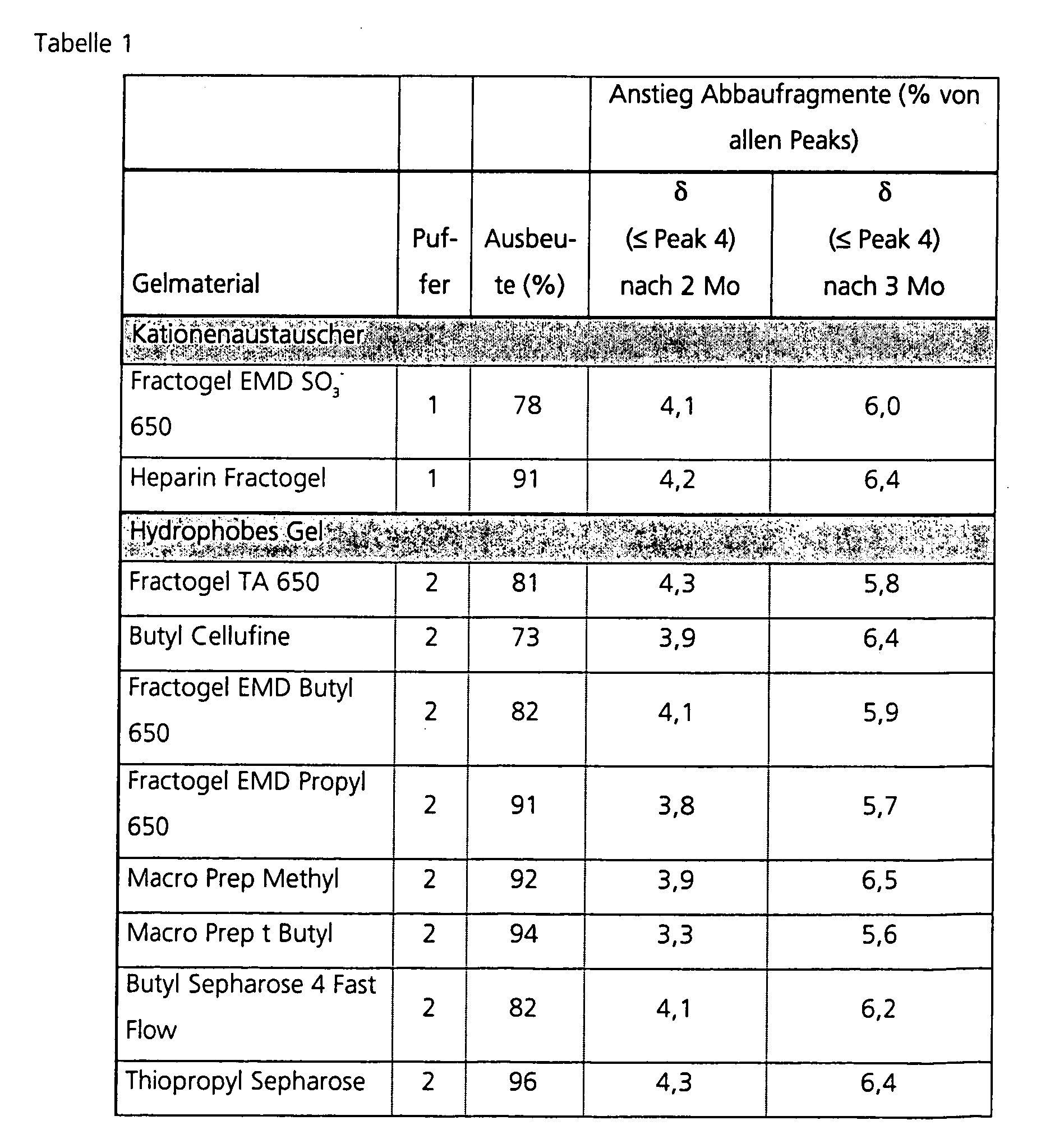
- Each 30-40 ml of fibrinogen-containing solution was dialyzed against the corresponding buffers (1-3) (see Table 1) and diluted with the appropriate buffers to an OD 280-320 of 10. 15 ml of this fibrinogen solution was applied per column and the columns were washed with 1.0 ml each of the respective buffer (1-3). The column pass and wash were combined. First, the optical density at the photometer was measured at 280 and 320 nm (OD 280-320 ) to determine the yield (in%) compared to the starting material. An aliquot of this material was retained for analysis to determine the 0 value of the subsequent storage trial.
- the runs of the columns combined with the respective wash solutions and the starting material were dialyzed against a buffer containing 100 mM NaCl, 20 mM Na 3 citrate, 5% L-Arg pH 7.2, and 1 ml of each with sodium azide (0, 05% w / v final concentration).
- the storage of these differently purified fibrinogen preparations and the starting material as a control was carried out at + 30 ° C for storage periods up to 3 months.
- the stability of fibrinogen was determined after each storage period by SEC-HPLC. This is a size exclusion chromatography (SEC) which separates the present proteins and cleavage products according to their molecular weight.
- SEC size exclusion chromatography
- fragment peak 4 Low-molecular-weight fragments, which were formed as a result of proteolytic degradation of fibrinogen, are found as a new peak (fragment peak 4) and, if appropriate, further new peaks with increased retention time.
- the area of the fragment peaks ( ⁇ peak 4) was determined and calculated as a percentage of all peaks. The value was adjusted by the small amount before the start of storage (zero value) and the values obtained are shown as the result in Table 1. They reflect the increase in degradation fragments during storage under accelerated conditions.
- the main peak at a retention time of about 15-16 min corresponds to fibrinogen.
- the peak with a retention time of about 24 minutes and peaks with higher retention times are the degradation fragments of fibrinogen.
- Table 1 shows that the proportion of degradation fragments with increased retention time after Purification of the fibrinogen used over one of the listed gel materials significantly less than in the control (starting material). The thus proved increased stability of fibrinogen over the control (starting material before negative Chromatography) is evident after only 1 month, but then increases with longer storage times still. After longer storage times of 3 months, but tends to already after 2 months, is also partly a discriminating of the different good ones Column materials possible. Even compared to those known in the art Affinity chromatography using lysine Sepharose 4B depleting plasminogen is still ongoing To achieve improvements. Throughout are also very good yield results, in the Usually about 70% achieved.
- the example further illustrates that with a large number different cation exchangers, hydrophobic gels and dye gels an essential Stabilization of fibrinogen and thus reduction of the formation of degradation fragments can be achieved, so it can be assumed that is generally with carrier materials from the group of said chromatographic separation principles improved Stability results can be achieved.
- the starting material used was fibrinogen, in addition to the analogous purification of Example 1, after uptake in a suitable aqueous solvent (50 mM NaCl, 20 mM trisodium citrate, 0.05% NaN 3 pH 7.4, buffer AM in Table 2 ) and preferably after dialysis against the solvent, was still purified on lysine Sepharose.
- a suitable aqueous solvent 50 mM NaCl, 20 mM trisodium citrate, 0.05% NaN 3 pH 7.4, buffer AM in Table 2
- equilibration buffer 1a 50 mM NaCl, 20 mM Na 3 citrate, 0.05% NaN 3 pH 7.5 1b 50 mM NaCl, 20 mM Na 3 citrate, 0.05% NaN 3 pH 6.5 2a 50 mM NaCl, 20 mM Na 3 citrate, 0.05% NaN 3 pH 6.5 2 B 50 mM NaCl, 20 mM Na 3 citrate, 0.05% NaN 3 pH 7.0 2c 50 mM NaCl, 20 mM Na 3 citrate, 0.05% NaN 3 pH 7.5 2f 150 mM NaCl, 20 mM Na 3 citrate, 0.05% NaN 3 pH 7.5 3a 50 mM NaCl, 20 mM Na 3 citrate, 0.05% NaN 3 pH 7.5 3a 50 mM NaCl, 20 mM Na 3 citrate, 0.05% NaN 3 citrate, 0.05% NaN 3 citrate, 0.05% NaN 3 pH 7.5 2f 150 mM
- the fibrinogen-containing application solution was optionally adjusted by NaCl addition and adjustment of the pH to the above buffer conditions and a solution volume corresponding to a protein amount of 150 or 300 OD 280-320 per ml gel (see Table 2) applied at free dropping rate.
- the columns were washed with 1 ml each of the appropriate buffer.
- the wash solution was combined with the respective run and dialyzed against 50 mM NaCl, 20 mM Na 3 citrate, 0.05% NaN 3 pH 7.4 overnight at 4 ° C. Storage took place at 30 ° C. for storage times of different lengths (0-2 months (Mo)).
- Plasminogen was first polyclonal in a sandwich ELISA Rabbit antibody (IgG preparation from Dade Behring), which was used as catcher antibody a microtiter plate were immobilized bound. The detection took place with the help of same polyclonal antibody preparation, but which was labeled with peroxidase.
- F XII was determined using the F XII ELISA kit from Kordia Life Sciences (Netherlands) according to the Manufacturer's information determined. Similarly, F XI was used with the F XI ELISA Kit from Kordia Life Sciences (Netherlands) according to the manufacturer's instructions.
- the depletion factor (AF) is the quotient of the amount of the particular protein (eg plasminogen, F XI or F XII) per OD 280-320 in the starting material and the amount of the particular protein per OD 280-320 in the fibrinogen-containing solution after the respective negative one chromatography.
- the particular protein eg plasminogen, F XI or F XII
- the application is also the other tested blue Dye gels suitable to reduce the formation of degradation fragments, i. an increased To achieve stability of fibrinogen.
- the negative chromatographies used with appropriate choice of Separation parameters, plasminogen, F XII and F XI -if also depleted to varying degrees can be.
- the efficiency of the cation exchanger shows a dependence on the mobile phase (buffer composition).
- a pH of about 6.5-7.5 of the mobile phase a good depletion of plasminogen and F XII is detectable.
- Increasing the pH of the separation decreases the stability of the fibrinogen in liquid storage, but is still significantly better than the starting material.
- the yield of fibrinogen decreases at low pH values, since the interactions of fibrinogen with the functional groups increase and it partly already adsorbs to the column material, in the case of the cation exchanger Fractogel EMD SO 3 - 650 (M) best conditions for the mobile phase in the pH range around 7.0.
- Hydrophobic gels also show a dependence on the mobile phase, in particular of the salt concentration of the buffer.
- the phenyl Sepharose HP about is over a wide Range of NaCl, for example, a depletion of plasminogen and an increased To achieve stability of the fibrinogen, with a good yield of fibrinogen. All selected Conditions lead to increased stability compared to the starting material, so that basically several conditions can be used advantageously.
- Other hydrophobic gels and / or other buffer conditions can be similarly optimized.
- the starting material was obtained according to the same purification scheme as described in Example 2.
- the columns were, as already described in Example 2, equilibrated with the respective buffer listed below. 1 50 mM NaCl, 20 mM Na 3 citrate, 0.05% NaN 3 pH 7.5 2 50 mM NaCl, 20 mM Na 3 citrate, 0.05% NaN 3 pH 7.0 3a 1000 mM NaCl, 20 mM Na 3 citrate, 0.05% NaN 3 pH 7.5 3b 2000 mM NaCl, 20 mM Na 3 citrate, 0.05% NaN 3 pH 7.5
- the starting material was dialyzed against the appropriate buffer.
- the chromatographic columns were each loaded with an OD 280-320 of 150 or 300 (corresponding to 15 ml or 30 ml) per ml gel at free drop rate.
- the first 0.5 ml of column runs were discarded.
- the columns were washed with 1 ml of the respective buffer.
- the wash solution was combined with the respective run and dialyzed against 50 mM NaCl, 20 mM Na 3 citrate, 0.05% NaN 3 pH 7.4 overnight at 4 ° C. Storage took place at 30 ° C for a storage period of 2 months.
- Table 3 shows that the other gels or conditions tested are also suitable, the To reduce the formation of degradation fragments. An increase in the order quantity (Loading of the column), leads to an improved yield.
- the now pasteurized fibrinogen solution was three times the volume Diluting solution (3.5 g / l NaCl, 5.88 g / l trisodium citrate dihydrate in water, pH 7.5) added. Per liter of dilute solution, 90 g of glycine were added with stirring. The precipitate formed was separated by centrifugation or filtration and discarded.
- the supernatant was optionally added to 200mM L-Lys x HCl or EACA by addition of solid L-Lys x HCl or EACA brought. An additional 75 g of glycine was added per liter. The Fibrinogen-rich precipitate was recovered by centrifugation and until further Processing stored at -25 ° C.
- the fibrinogen-rich precipitate was dissolved and preferably after dialysis against buffer solution (20 mM trisodium citrate, 50 mM NaCl pH 7.4, optionally containing 0.05% NaN 3 as a preservative), with a chromatography a matrix which carries as ligands L-lysyl radicals, pumped.
- buffer solution (20 mM trisodium citrate, 50 mM NaCl pH 7.4, optionally containing 0.05% NaN 3 as a preservative
- fibrinogen preparations were obtained, which were tested for the content of fibrinogen degradation fragments by SEC-HPLC (see Example 1) after storage for 1 month at 30 ° C. (see Table 4).
- cryoprecipitate was adsorbed twice as starting material as described in EP 0 103 196 with Al (OH) 3 suspension.
- the fibrinogen-containing supernatant was subjected to further negative adsorption.
- phenyl Sepharose HP was used.
- the gel material was also in proportion 0.5 g per 10 g fibrinogen restroomr solution used (stirring time: 90 min). In connection to the adsorption became the gel material with the bound contaminating proteins removed by centrifugation.
- the fibrinogen-rich precipitate was first dissolved in a suitable aqueous solvent, filtered and preferably after dialysis against buffer solution (20 mM trisodium citrate dihydrate, 50 mM NaCl, pH 7.4, optionally containing 0.05% NaN 3 as a preservative) and setting an optical density of about 10 on a chromatography column with a gel material carrying ligands L-lysyl residues pumped.
- buffer solution (20 mM trisodium citrate dihydrate, 50 mM NaCl, pH 7.4, optionally containing 0.05% NaN 3 as a preservative
- the fibrinogen-rich precipitate was first dissolved in a suitable aqueous solvent and intensively applied to buffer solution (20 mM trisodium citrate dihydrate, 50 mM NaCl, pH 7) using ultrafiltration membranes with a cut-off of 300 kDa. 4, optionally containing 0.05% NaN 3 as a preservative) diafiltered.
- the plasminogen removal solution was passed through a chromatographic column with a gel material, which carries as ligands L-lysyl remainders, pumped.
- fibrinogen preparations were obtained, by SEC-HPLC (see Example 1) before starting storage and after 1 month storage at 30 ° C on the content of fibrinogen degradation fragments tested were. Thereafter, after deduction of the zero value, a reduced share was found Abbaufragmenten compared to a control with conventional ultrafiltration.
- a fibrinogen precipitate was prepared and additionally purified by negative chromatography on Lys-Sepharose. After increasing to 1 mol of sodium chloride per liter of fibrinogen solution, this was added to a filled with Butyl Sepharose chromatography column and rinsed with buffer. The passage of the column was concentrated, dialyzed and assayed for the content of t-PA, plasminogen and F XI. As a control, a comparative work-up was carried out in which the negative chromatography on butyl-Sepharose was not performed.
- the stability of the listed formulations is very good and fragment formation only becomes observed to a very small extent (less than 2% fragments are formed ( ⁇ ( ⁇ peak 4)) during one month storage at 30 ° C).
- the solutions are suitable, as a component a storable in the liquid state Fibrinklebers consisting of two or more To serve components.
Landscapes
- Health & Medical Sciences (AREA)
- Chemical & Material Sciences (AREA)
- Life Sciences & Earth Sciences (AREA)
- Organic Chemistry (AREA)
- General Health & Medical Sciences (AREA)
- Medicinal Chemistry (AREA)
- Hematology (AREA)
- Veterinary Medicine (AREA)
- Animal Behavior & Ethology (AREA)
- Public Health (AREA)
- Toxicology (AREA)
- Molecular Biology (AREA)
- Bioinformatics & Cheminformatics (AREA)
- Proteomics, Peptides & Aminoacids (AREA)
- Chemical Kinetics & Catalysis (AREA)
- General Chemical & Material Sciences (AREA)
- Engineering & Computer Science (AREA)
- Nuclear Medicine, Radiotherapy & Molecular Imaging (AREA)
- Genetics & Genomics (AREA)
- Gastroenterology & Hepatology (AREA)
- Diabetes (AREA)
- Zoology (AREA)
- Pharmacology & Pharmacy (AREA)
- Biochemistry (AREA)
- Biophysics (AREA)
- Oral & Maxillofacial Surgery (AREA)
- Dentistry (AREA)
- Epidemiology (AREA)
- Medicines That Contain Protein Lipid Enzymes And Other Medicines (AREA)
- Peptides Or Proteins (AREA)
- Medicines Containing Material From Animals Or Micro-Organisms (AREA)
- Medicinal Preparation (AREA)
Abstract
Description
Beschrieben sind auch verschiedene Affinitätschromatographien, die über unterschiedliche Liganden verfügen, die selektiv Fibrinogen zu binden vermögen. Hingewiesen sei in diesem Zusammenhang z.B. auf die US 6,037,457 oder die WO 99/05176, die Antikörper beschreiben, die spezifisch Fibrinogen oder Fibrinogenpeptide binden und u.a. zur Reinigung von Fibrinogen eingesetzt werden können. Die EP 0 789 030, US 5,723,579 und US 5,783,663 beschreiben Peptide, die Fibrinogen binden und entsprechend als Liganden in Affinitätssäulen zur Reinigung von Fibrinogen verwendet werden können. Immobilisiertes Ristocetin wurde ebenfalls zum Binden von Fibrinogen eingesetzt und dieses mit 8 M Harnstoff wieder eluiert (Suzuki et al., Thrombosis Research 18 (1980) 707-715). In der WO 99/20655 schließlich wird inaktiviertes Thrombin als Ligand für Thrombin Substrate, zu denen auch Fibrinogen zählt, verwendet. In der WO 90/12803 wird die so genannte IMAC (Immobilized Metal Affinity Chromatography) zur Aufreinigung bestimmter Proteine beschrieben. Auch humanes Fibrinogen ist als mögliches Protein aufgeführt, das an die Metallchelat-Matrix bindet. Fibrinogen bindet auch an Protamin-Agarose und kann anschließend im sauren pH eluiert werden, siehe beispielsweise die US 6,037,457 oder Dempfle & Heene (Thrombosis Research 46 (1987) 19-27).
Verfahren wie oben beschrieben wobei als funktionelle Gruppe des Kationenaustauschers Sulfomethylgruppen (S-Typen), Sulfopropylgruppen (SP-Typen), Carboxymethylgruppen (CM Typen) oder andere geeignete, negativ geladene funktionelle Gruppen verwendet werden.
Verfahren wie vorangehend beschrieben wobei ein oder mehrere Verfahrensschritte enthalten sind, bei denen Fibrinogen präzipitiert wird.
- Herstellung einer Plasmafraktion
- Adsorption an Aluminiumhydroxid
- Inaktivierung infektiöser Partikel wie beispielsweise Viren
- Präzipitation
- Weitere Reinigungs- und/oder Inaktivierungsschritte
- negative Chromatographie(n) und/oder negative Adsorption(en)
- Ultrafiltration / Diafiltation
- Sterilfiltration
- Puffer 1:
- 50 mM NaCl, 50 mM Natriumphosphat pH 7,4 für Kationenaustauscher und Vergleichssäule
- Puffer 2:
- 1000 mM NaCl, 50 mM Natriumphosphat pH 6,5 für hydrophobe Gele
- Puffer 3:
- 50 mM Natriumphosphat pH 7,4 für Farbstoffgele

| Äquilibrierungspuffer: | |||
| 1a | 50 mM NaCl, | 20 mM Na3-Citrat, | 0,05% NaN3 pH 7,5 |
| 1b | 50 mM NaCl, | 20 mM Na3-Citrat, | 0,05% NaN3 pH 6,5 |
| 2a | 50 mM NaCl, | 20 mM Na3-Citrat, | 0,05% NaN3 pH 6,5 |
| 2b | 50 mM NaCl, | 20 mM Na3-Citrat, | 0,05% NaN3 pH 7,0 |
| 2c | 50 mM NaCl, | 20 mM Na3-Citrat , | 0,05% NaN3 pH 7,5 |
| 2f | 150 mM NaCl, | 20 mM Na3-Citrat, | 0,05% NaN3 pH 7,5 |
| 3a | 50 mM NaCl, | 20 mM Na3-Citrat, | 0,05% NaN3 pH 6,5 |
| 3b | 50 mM NaCl, | 20 mM Na3-Citrat, | 0,05% NaN3 pH 7,5 |
| 3c | 500 mM NaCl, | 20 mM Na3-Citrat, | 0,05% NaN3 pH 7,5 |
| 3d | 1000 mM NaCl, | 20 mM Na3-Citrat, | 0,05% NaN3 pH 7,5 |
| Gel-material | Puffer | Beladung der Säule OD280-320 | Ausbeute (%) | δ Peak 4 nach 1 Mo/ 30°C | δ Peak 4 nach 2 Mo/ 30°C | AF Plasminogen | AF F XII | AF F XI |
| Blue Hyper D | 1a | 150 | 61 | 1,03 | 2,25 | 3,7 | 21,5 | 2,0 |
| Mimetic Blue SA P6XL | 1a | 150 | 94 | 1,18 | 2,68 | 1,6 | 1,3 | ≥ 2,2 |
| Blue Trisacryl Plus LS | 1a | 150 | 74 | 1,13 | 2,42 | 2,4 | 22,1 | ≥ 2,2 |
| Blue Sepharose 6FF | 1a | 150 | 74 | 1,13 | 2,47 | 4,0 | 9,5 | ≥ 2,2 |
| 1 b | 150 | 61 | 1,12 | 2,75 | 2,4 | 12,6 | ≥ 2,2 | |
| Fractogel EMD SO3 - 650 | 2a | 150 | 45 | 1,57 | 2,63 | 3,8 | 12,4 | ≥ 2,2 |
| 2b | 150 | 56 | 1,51 | 2,64 | 3,2 | 15,1 | ≥ 2,2 | |
| 2c | 150 | 80 | 1,06 | 2,68 | 1,8 | 1,6 | ≥ 2,2 | |
| 2f | 150 | 94 | 1,58 | 3,52 | 2,1 | 1,2 | ≥ 2,2 | |
| Phenyl Sepharose High Performance | 3a | 150 | 87 | 1,32 | 3,03 | 2,4 | 1,8 | 1,3 |
| 3b | 150 | 91 | 1,30 | 3,10 | 2,0 | 1,1 | 1,3 | |
| 3c | 150 | 76 | 1,17 | 2,81 | 1,7 | 0,9 | 1,7 | |
| 3d | 150 | 66 | 1,09 | 2,69 | 1,8 | 0,9 | ≥ 2,2 | |
| 3b | 300 | 96 | 1,43 | 3,27 | 2,0 | 1,2 | 1,5 | |
| Ausgangsmaterial | AM | - | - | 1,85 | 4,33 | - | - | - |
| AF: Abreicherungsfaktor |
| 1 | 50 mM NaCl, | 20 mM Na3-Citrat, | 0,05% NaN3 pH 7,5 |
| 2 | 50 mM NaCl, | 20 mM Na3-Citrat, | 0,05% NaN3 pH 7,0 |
| 3a | 1000 mM NaCl, | 20 mM Na3-Citrat, | 0,05% NaN3 pH 7,5 |
| 3b | 2000 mM NaCl, | 20 mM Na3-Citrat, | 0,05% NaN3 pH 7,5 |
| Gelmaterial | Puffer | Beladung der Säule OD280-320 | Gelvolumen (ml) | Ausbeute (%) | AF Plasminogen | AF F XII | AF F XI | δ Peak 4 nach 2Mo/ 30°C |
| Blue Uniflow | 1 | 150 | 1,0 | 85 | 1,5 | 15,4 | 2,7 | 1,63 |
| Blue Trisacryl Plus LS | 1 | 150 | 1,0 | 77 | 4,8 | >45,3 | > 4,3 | 1,55 |
| Fractogel EMD SO3 - 650 (M) | 2 | 150 | 1,0 | 72 | 1,1 | 29,2 | > 4,3 | 1,64 |
| 2 | 300 | 1,0 | 82 | 1,5 | 7,7 | > 4,3 | 2,02 | |
| Macro Prep t Butyl HlC Support | 3a | 150 | 1,0 | 100 | 0,8 | 1,1 | 1,4 | 2,11 |
| 3b | 150 | 1,0 | 89 | 1,1 | 1,3 | 1,6 | 2,08 | |
| Fractogel EMD Butyl 650 (S) | 3a | 150 | 1,0 | 91 | 1,4 | 1,5 | 1,8 | 1,63 |
| Ausgangsmaterial | AM | - | - | - | - | - | - | 2,32 |
| Gelmaterial | Puffer | δ (≤ Peak 4) nach 1 Mo/30°C |
| Blue Agarose | 20 mM Na3Citrat, 100 mM NaCl, 50 g/l L-ArgxHCl, 2,5 mM CaCl2 pH 7,2 | 0,9 |
| Fractogel EMD SO3 - 650 (M) | 20 mM Na3Citrat, 100 mM NaCl, 50 g/l L-ArgxHCl, 2,5 mM CaCl2 pH 7,2 | 1,0 |
| Phenyl Sepharose High Performance | 20 mM Na3Citrat, 100 mM NaCl, 50 g/l L-ArgxHCl, 2,5 mM CaCl2 pH 7,2 | 1,2 |
| Macroprep-t Butyl HIC Support | 20 mM Na3Citrat, 100 mM NaCl, 50 g/l L-ArgxHCl, 2,5 mM CaCl2 pH 7,2 | 1,1 |
| Ohne zusätzliche negative Chromatographie | 20 mM Na3Citrat, 100 mM NaCl, 50 g/l L-ArgxHCl, 2,5 mM CaCl2 pH 7,2 | 2,6 |
| t-PA (ng/OD280-320) | Plasminogen (ng/OD280-320) | F XI (ng/OD280-320) | Fibrinogenfragmente nach 1 Monat bei 30°C (Aufarbeitung ohne HIC = 100%) | |
| Aufarbeitung ohne HIC | 0,046 | 2,47 | 0,069 | 100 % |
| Aufarbeitung inkl. HIC | 0,003 | 2,04 | 0,038 | 79 % |
Claims (26)
- Verfahren zur Reinigung von Fibrinogen-haltigen Lösungen, dadurch gekennzeichnet, dass es einen oder mehrere Verfahrensschritte enthält, bei denen ein oder mehrere kontaminierende Proteine durch eine oder mehrere negative Chromatographien und/oder eine oder mehrere negative Adsorptionen unter Verwendung von Kationenaustauscher, hydrophobem Gel und/oder Farbstoffgel abgereichert werden.
- Verfahren nach Anspruch 1, dadurch gekennzeichnet, dass als funktionelle Gruppe des Kationenaustauschers Sulfomethylgruppen (S-Typen), Sulfopropylgruppen (SP-Typen), Carboxymethylgruppen (CM Typen) oder andere geeignete, negativ geladene funktionelle Gruppen verwendet werden.
- Verfahren nach Anspruch 1, dadurch gekennzeichnet, dass das hydrophobe Gel als funktionelle Gruppen Alkyl-Gruppen enthält.
- Verfahren nach Anspruch 1, dadurch gekennzeichnet, dass das hydrophobe Gel als funktionelle Gruppen Phenyl-Gruppen oder derivatisierte Phenyl-Gruppen enthält.
- Verfahren nach Anspruch 3, dadurch gekennzeichnet, dass das hydrophobe Gel als funktionelle Gruppen Propyl-, Butyl-, Pentyl-, Hexyl- oder Octyl-Gruppen enthält.
- Verfahren nach Anspruch 1, dadurch gekennzeichnet, dass als Farbstoffgel ein blaues Farbstoffgel verwendet wird.
- Verfahren nach Anspruch 1, dadurch gekennzeichnet, dass als Farbstoffgel ein rotes oder grünes Farbstoffgel verwendet wird.
- Verfahren nach einem der Ansprüche 1, 6 oder 7, dadurch gekennzeichnet, dass es sich bei dem Farbstoffgel um Blue Hyper D, Mimetic Blue Agarose, Mimetic Blue SA P6XL, Mimetic Blue 1 P6XL, Blue Trisacryl Plus LS, Blue Uniflow, Blue Sepharose 6FF, Blue Sepharose CL 6B, Red Sepharose CL 6B, Fractogel TSK AF Green und/oder Matrex gel Green A handelt.
- Verfahren nach einem der Ansprüche 1 bis 8, dadurch gekennzeichnet, dass die negative Chromatographie und/oder die negative Adsorption bei einem pH-Wert zwischen 5,5 und 9 durchgeführt wird.
- Verfahren nach einem der Ansprüche 1 bis 9, dadurch gekennzeichnet, dass die Ausbeute von Fibrinogen im Durchlauf der negativen Chromatographie oder im Überstand der negativen Adsorption ≥ 50%, bevorzugt ≥ 70% ist.
- Verfahren nach einem der Ansprüche 1 bis 10, dadurch gekennzeichnet, dass der Verfahrensschritt, der die negative Adsorption oder Chromatographie beinhaltet, in Anwesenheit von Substanzen, die die Bindung von Plasminogen an Fibrinogen schwächen, durchgeführt wird.
- Verfahren nach einen der Ansprüche 1 bis 11, dadurch gekennzeichnet, dass als Ausgangsmaterial eine aus Blut gewonnene Mischung, Milch von transgenen Tieren oder ein Fermentationsüberstand oder eine daraus hergstellte Fraktion verwendet wird.
- Verfahren nach Anspruch 12, dadurch gekennzeichnet, dass als Ausgangsmaterial humanes Plasma, eine Plasmafraktion oder Kryopräzipitat verwendet wird.
- Verfahren nach einem der Ansprüche 1-13, dadurch gekennzeichnet, dass ein oder mehrere Verfahrensschritte enthalten sind, bei denen Fibrinogen präzipitiert wird.
- Verfahren nach Anspruch 14, dadurch gekennzeichnet, dass ein oder mehrere Präzipitationen mit Glycin oder anderen Aminosäuren enthalten sind.
- Verfahren nach einem der Ansprüche 1-15, dadurch gekennzeichnet, dass ein oder mehrere Verfahrensschritte enthalten sind, bei denen Plasminogen über Gelmaterial mit Lysin oder Lysin-Analoga als funktionelle Gruppe entfernt wird.
- Verfahren nach einem der Ansprüche 1-16, dadurch gekennzeichnet, dass ein oder mehrere Verfahrensschritte zur Abreicherung und/oder Entfernung infektiöser Partikel enthalten sind.
- Verfahren nach einem der Ansprüche 1-17, bei dem folgende Verfahrensschritte kombiniert werden: Herstellung einer Plasmafraktion, Adsorption an Aluminiumhydroxid, Inaktivierung infektiöser Partikel wie beispielsweise Viren, Präzipitation, weitere Reinigungs- und/oder Inaktivierungsschritte, negative Chromatographie und/oder negative Adsorption, Ultrafiltration, Sterilfiltration.
- Fibrinogenpräparation, hergestellt nach mindestens einem der Ansprüche 1 bis 18.
- Fibrinogenpräparation nach Anspruch 19, , dadurch gekennzeichnet, dass der Gehalt an F XI bei ≤ 1, bevorzugt ≤ 0,2 ng pro OD280-320 liegt.
- Fibrinogenpräparation nach Anspruch 19 , dadurch gekennzeichnet, dass der Gehalt an F XII bei ≤ 20, bevorzugt ≤ 10 ng pro OD280-320 liegt.
- Fibrinogenpräparation nach Anspruch 19 , dadurch gekennzeichnet, dass der Gehalt an t-PA bei ≤ 0,02, bevorzugt ≤ 0,01 ng pro OD280-320 liegt.
- Fibrinogenpräparation nach Anspruch 19 dadurch gekennzeichnet, dass der Anteil an niedermolekularen Fibrinogen-Abbaufragmenten nach einer Lagerung bei 30°C für einen Monat im flüssigen Zustand unterhalb von 3 % liegt.
- Verwendung der Fibrinogenpräparation nach Anspruch 19 für die Herstellung eines Fibrinklebers.
- Verwendung der Fibrinogenpräparation nach Anspruch 19 für die Herstellung einer Fibrin-Matrix.
- Fibrinogenpräparation nach einem der Ansprüche 19 bis 25, dadurch gekennzeichnet, dass sie die Formulierungsbestandteile NaCl, Na3-Citrat, Arg oder Arg x HCl und CaCl2 oder Mischungen davon mit anderen Formulierungsbestandteilen wie Aminosäuren und Amino-Gruppen-haltigen Aromaten, enthält.
Priority Applications (6)
| Application Number | Priority Date | Filing Date | Title |
|---|---|---|---|
| EP20100183940 EP2267025B1 (de) | 2004-02-24 | 2005-02-12 | Reinigung von Fibrinogen |
| EP10182320.1A EP2264069B1 (de) | 2004-02-24 | 2005-02-12 | Reinigung von Fibrinogen |
| PL10183940T PL2267025T3 (pl) | 2004-02-24 | 2005-02-12 | Oczyszczanie fibrynogenu |
| DK10183940.5T DK2267025T3 (en) | 2004-02-24 | 2005-02-12 | Purification of fibrinogen |
| DK10182320.1T DK2264069T3 (da) | 2004-02-24 | 2005-02-12 | Rensning af fibrinogen |
| PL05003017T PL1568709T3 (pl) | 2004-02-24 | 2005-02-12 | Oczyszczanie fibrynogenu |
Applications Claiming Priority (2)
| Application Number | Priority Date | Filing Date | Title |
|---|---|---|---|
| DE102004009400 | 2004-02-24 | ||
| DE102004009400A DE102004009400A1 (de) | 2004-02-24 | 2004-02-24 | Fibrinogen Reinigung |
Related Child Applications (3)
| Application Number | Title | Priority Date | Filing Date |
|---|---|---|---|
| EP20100183940 Division EP2267025B1 (de) | 2004-02-24 | 2005-02-12 | Reinigung von Fibrinogen |
| EP10182320.1 Division-Into | 2010-09-29 | ||
| EP10183940.5 Division-Into | 2010-09-30 |
Publications (3)
| Publication Number | Publication Date |
|---|---|
| EP1568709A2 true EP1568709A2 (de) | 2005-08-31 |
| EP1568709A3 EP1568709A3 (de) | 2005-11-02 |
| EP1568709B1 EP1568709B1 (de) | 2011-05-11 |
Family
ID=34745287
Family Applications (3)
| Application Number | Title | Priority Date | Filing Date |
|---|---|---|---|
| EP05003017A Expired - Lifetime EP1568709B1 (de) | 2004-02-24 | 2005-02-12 | Reinigung von Fibrinogen |
| EP10182320.1A Expired - Lifetime EP2264069B1 (de) | 2004-02-24 | 2005-02-12 | Reinigung von Fibrinogen |
| EP20100183940 Expired - Lifetime EP2267025B1 (de) | 2004-02-24 | 2005-02-12 | Reinigung von Fibrinogen |
Family Applications After (2)
| Application Number | Title | Priority Date | Filing Date |
|---|---|---|---|
| EP10182320.1A Expired - Lifetime EP2264069B1 (de) | 2004-02-24 | 2005-02-12 | Reinigung von Fibrinogen |
| EP20100183940 Expired - Lifetime EP2267025B1 (de) | 2004-02-24 | 2005-02-12 | Reinigung von Fibrinogen |
Country Status (11)
| Country | Link |
|---|---|
| US (1) | US7550567B2 (de) |
| EP (3) | EP1568709B1 (de) |
| JP (2) | JP4965805B2 (de) |
| KR (1) | KR101195777B1 (de) |
| AT (1) | ATE509030T1 (de) |
| AU (1) | AU2005200635B2 (de) |
| CA (1) | CA2497796C (de) |
| DE (1) | DE102004009400A1 (de) |
| DK (3) | DK2264069T3 (de) |
| ES (3) | ES2409888T3 (de) |
| PL (2) | PL1568709T3 (de) |
Cited By (3)
| Publication number | Priority date | Publication date | Assignee | Title |
|---|---|---|---|---|
| WO2009155626A3 (de) * | 2008-06-23 | 2010-02-25 | Bio-Products & Bio-Engineering Ag | Lagerstabiles, funktionell intaktes virus- inaktiviertes fibrinogen |
| EP3481415B1 (de) * | 2016-07-06 | 2023-09-06 | Laboratoire Français du Fractionnement et des Biotechnologies | Stabiles flüssiges fibrinogen |
| EP3506915B1 (de) | 2016-09-01 | 2024-03-06 | Plas-Free Ltd | Aus menschlichem blut gewonnene produkte mit verringerter fibrinolytischer aktivität und verwendungen davon in hämostatischen störungen |
Families Citing this family (22)
| Publication number | Priority date | Publication date | Assignee | Title |
|---|---|---|---|---|
| FR2887883B1 (fr) | 2005-06-29 | 2007-08-31 | Lab Francais Du Fractionnement | Procede de separation des proteines fibrinogene, facteur xiii et colle biologique d'une fraction plasmatique solubilisee et de preparation de concentres lyophilises desdites proteines |
| EP1950225A1 (de) * | 2007-01-25 | 2008-07-30 | Octapharma AG | Verfahren zur Steigerung von Proteinausbeuten |
| US8367412B2 (en) * | 2007-02-23 | 2013-02-05 | Kwansei Gakuin Educational Foundation | Protein crystallizing agent and method of crystallizing protein therewith |
| CA2682173C (en) * | 2007-03-22 | 2015-10-27 | Km Biologics Co., Ltd. | Solid fibrinogen preparation |
| FR2920429B1 (fr) * | 2007-08-30 | 2012-10-05 | Lfb Biotechnologies | Procede de purification du facteur viii et du facteur von willebrand |
| EP2077118A1 (de) * | 2008-01-07 | 2009-07-08 | Gwo Rei Biomedical Technology Corp. | Gerinnungsfähiges Konzentrat von Plättchenwachstumsfaktoren und Herstellungsverfahren dafür |
| CA2740079A1 (en) * | 2008-10-08 | 2010-04-15 | Thrombodyne, Inc. | Methods of making concentrated fibrinogen- and platelet-containing compositions |
| US8314211B2 (en) * | 2009-04-07 | 2012-11-20 | George Falus | Tissue sealant for use in non compressible hemorrhage |
| IL213864A0 (en) * | 2011-06-30 | 2011-08-31 | Omrix Biopharmaceuticals Ltd | Method for removing a lytic enzyme from a heterogeneous mixture |
| AU2013231321B2 (en) | 2012-03-13 | 2017-05-25 | Octapharma Ag | Improved process for production of fibrinogen and fibrinogen produced thereby |
| US10188965B2 (en) | 2012-12-05 | 2019-01-29 | Csl Behring Gmbh | Hydrophobic charge induction chromatographic depletion of a protein from a solution |
| US20140154233A1 (en) * | 2012-12-05 | 2014-06-05 | Csl Limited | Method of purifying therapeutic proteins |
| CN104148037A (zh) * | 2014-08-08 | 2014-11-19 | 华东理工大学 | 一种精氨酸键合型亲水色谱固定相及制备方法 |
| US9932388B2 (en) | 2014-11-13 | 2018-04-03 | Hemarus Therapeutics Limited | Chromatographic process for producing high purity fibrinogen and thrombin |
| KR101841587B1 (ko) * | 2016-01-12 | 2018-05-14 | 주식회사 녹십자홀딩스 | 피브리노겐의 정제방법 |
| EP3430160A1 (de) | 2016-03-17 | 2019-01-23 | Delta Instruments B.V. | Nachweis von zellen in einer flüssigen probe |
| FR3053592B1 (fr) * | 2016-07-06 | 2020-05-29 | Laboratoire Francais Du Fractionnement Et Des Biotechnologies | Fibrinogene liquide stable |
| JP2018168082A (ja) * | 2017-03-29 | 2018-11-01 | フジッコ株式会社 | 皮膚修復機能促進用組成物 |
| EP3556728A1 (de) | 2018-04-16 | 2019-10-23 | Croda Denmark A/S | Organisch modifizierte mineralische mikropartikel, verfahren zu deren herstellung und verwendungen davon |
| CN114901685A (zh) | 2019-12-10 | 2022-08-12 | 生物测试股份公司 | 用于制备纤维蛋白原制剂的方法 |
| CN111848783B (zh) * | 2020-07-29 | 2023-07-04 | 同路生物制药有限公司 | 一种人纤维蛋白原的制备方法 |
| EP4456935A1 (de) | 2021-12-30 | 2024-11-06 | Baxter International Inc. | Fibrinogen- und thrombinlösungen für ein fibrinkleber und fibrinkleberkit |
Citations (33)
| Publication number | Priority date | Publication date | Assignee | Title |
|---|---|---|---|---|
| DE2636757A1 (de) | 1976-08-14 | 1978-02-16 | Recherches Hematologiques | Verfahren zum aufkonzentrieren und reinigen des antihaemophiliefaktors |
| DE2903131A1 (de) | 1978-02-06 | 1979-08-09 | Biotest Serum Institut Gmbh | Verfahren zur herstellung eines antihaemophilen globulin a enthaltenden konzentrats neben einem prothrombin-komplex und einer loesung von lagerstabilen serumproteinen |
| US4188318A (en) | 1975-06-16 | 1980-02-12 | Edward Shanbrom | Simplified method for preparation of high yield, high purity Factor VIII concentrate |
| US4210580A (en) | 1979-06-19 | 1980-07-01 | David Amrani | Process for separation and isolation of AHF and fibronectin from blood plasma |
| DE2902158A1 (de) | 1979-01-20 | 1980-07-31 | Biotest Serum Institut Gmbh | Verfahren zur herstellung von fibrinogen, einem die gerinnungsfaktoren ii, vii, ix und x enthaltenden prothrombinkomplex, antithrombin iii und einer loesung von lagerstabilen serumproteinen |
| EP0103196A2 (de) | 1982-08-19 | 1984-03-21 | BEHRINGWERKE Aktiengesellschaft | Pasteurisiertes Human-Fibrinogen (HF), Verfahren zu dessen Herstellung und dessen Verwendung |
| EP0173242A2 (de) | 1984-08-31 | 1986-03-05 | BEHRINGWERKE Aktiengesellschaft | Verfahren zur Herstellung einer pasteurisierten, isoagglutininfreien Faktor VIII Präparation aus einem Kryopräzipitat |
| WO1989012065A1 (fr) | 1988-06-07 | 1989-12-14 | Centre Regional De Transfusion Sanguine De Lille | Separation chromatographique des proteines du plasma |
| EP0366946A1 (de) | 1988-10-07 | 1990-05-09 | New York Blood Center, Inc. | Entfernen von Verfahrenschemikalien aus labilen biologischen Gemischen durch hydrophobe Austauschchromatographie |
| EP0383234A2 (de) | 1989-02-14 | 1990-08-22 | BEHRINGWERKE Aktiengesellschaft | Pasteurisiertes, gereinigtes von Willebrand-Faktor-Konzentrat und Verfahren zu seiner Herstellung |
| WO1990012803A1 (en) | 1989-04-14 | 1990-11-01 | Biogen, Inc. | Process for purifying a protein |
| EP0408029A1 (de) | 1989-07-12 | 1991-01-16 | The Green Cross Corporation | Verfahren zur Fraktionierung von Plasmaproteinen |
| WO1991001808A1 (de) | 1989-08-11 | 1991-02-21 | B. Braun Melsungen Aktiengesellschaft | Verwendung von tentakel-kationenaustauschern zur selektiven eliminierung von low-density-lipoproteinen (ldl), fibrinogen und/oder harnstoff aus flüssigkeiten |
| US5043428A (en) | 1984-08-31 | 1991-08-27 | Behringwerke Aktiengesellschaft | Pasteurized, isoagglutinin-free factor VIII preparation and a process for its production |
| US5099003A (en) | 1987-10-15 | 1992-03-24 | Biotest Pharma Gmbh | Method of preparing a sterile plasma-protein solution containing fibrinogen and factor xiii |
| WO1993005067A1 (en) | 1991-09-05 | 1993-03-18 | Baxter International, Inc. | Topical fibrinogen complex |
| EP0555135A1 (de) | 1992-02-04 | 1993-08-11 | Association D'aquitaine Pour Le Developpement De La Transfusion Sanguine Et Des Recherches Hematologiques | Verfahren zur Herstellung von hochreinem Fibrinogen |
| WO1993017776A1 (en) | 1992-03-02 | 1993-09-16 | Cryolife, Inc. | Method of preparing fibrinogen |
| WO1995025748A1 (en) | 1994-03-18 | 1995-09-28 | Baxter International Inc. | Topical fibrinogen complex |
| WO1996002571A1 (fr) | 1994-07-14 | 1996-02-01 | Croix-Rouge De Belgique | Concentre de fibrinogene issu de plasma sanguin, procede et installation pour sa preparation |
| US5639940A (en) | 1994-03-03 | 1997-06-17 | Pharmaceutical Proteins Ltd. | Production of fibrinogen in transgenic animals |
| EP0789030A1 (de) | 1996-02-02 | 1997-08-13 | Bayer Corporation | Fibrinogen bindende Peptide |
| US5773033A (en) | 1995-01-23 | 1998-06-30 | The Regents Of The University Of California | Fibrinogen/chitosan hemostatic agents |
| US5783663A (en) | 1998-01-23 | 1998-07-21 | Bayer Corporation | Peptide ligands for affinity purification of fibrinogen |
| WO1999005176A1 (en) | 1997-07-25 | 1999-02-04 | The New York Blood Center, Inc. | Monospecific antibody reactive with fibrinogen and fibrinopeptide b |
| WO1999020655A1 (en) | 1997-10-23 | 1999-04-29 | Fujimori Kogyo Co., Ltd. | Method for purifying thrombin substrates and/or inhibitors or method for eliminating the same |
| WO1999037680A1 (en) | 1998-01-23 | 1999-07-29 | Csl Limited | Purification of fibrinogen |
| WO1999051724A1 (en) | 1998-04-07 | 1999-10-14 | Pharming Intellectual Property B.V. | PURIFICATION OF HUMAN ACID α-GLUCOSIDASE |
| US6037457A (en) | 1997-01-31 | 2000-03-14 | The University Of North Carolina At Chapel Hill | Method for recombinant fibrinogen production |
| WO2000017239A1 (en) | 1998-09-24 | 2000-03-30 | Ppl Therapeutics (Scotland) Limited | Purification of fibrinogen from fluids by precipitation and hydrophobic chromatography |
| WO2000017234A1 (en) | 1998-09-24 | 2000-03-30 | Ppl Therapeutics (Scotland) Limited | Purification of fibrinogen from milk by use of cation exchange chromatography |
| WO2001027623A2 (en) | 1999-10-08 | 2001-04-19 | V.I. Technologies, Inc. | Isoagglutinin-depleted blood compositions and methods of making same |
| WO2001048016A1 (en) | 1999-12-23 | 2001-07-05 | Csl Limited | Separation of fibrinogen from plasma proteases |
Family Cites Families (6)
| Publication number | Priority date | Publication date | Assignee | Title |
|---|---|---|---|---|
| US4170590A (en) | 1974-12-14 | 1979-10-09 | Biotest-Serum-Institut Gmbh | Ion exchanger treatment of citrate-stabilized plasma |
| NZ180199A (en) * | 1976-03-04 | 1978-11-13 | New Zealand Dev Finance | Method of testing for the presence of elevated plasma liprotein concentration |
| ATE52425T1 (de) * | 1985-02-04 | 1990-05-15 | Hoffmann La Roche | Adsorbens fuer die reinigung von proteinen. |
| IL158754A0 (en) | 2001-05-21 | 2004-05-12 | Omrix Biopharm Sa | Removal of plasmin(ogen) from protein solutions |
| KR20040055782A (ko) * | 2001-10-03 | 2004-06-26 | 크리스토퍼 제이 울버튼 | 보관-안정한 인간 피브리노겐 용액 |
| GB0216001D0 (en) * | 2002-07-10 | 2002-08-21 | Nat Blood Authority | Process and composition |
-
2004
- 2004-02-24 DE DE102004009400A patent/DE102004009400A1/de not_active Withdrawn
-
2005
- 2005-02-12 PL PL05003017T patent/PL1568709T3/pl unknown
- 2005-02-12 EP EP05003017A patent/EP1568709B1/de not_active Expired - Lifetime
- 2005-02-12 DK DK10182320.1T patent/DK2264069T3/da active
- 2005-02-12 EP EP10182320.1A patent/EP2264069B1/de not_active Expired - Lifetime
- 2005-02-12 ES ES10182320T patent/ES2409888T3/es not_active Expired - Lifetime
- 2005-02-12 AT AT05003017T patent/ATE509030T1/de active
- 2005-02-12 ES ES05003017T patent/ES2365241T3/es not_active Expired - Lifetime
- 2005-02-12 ES ES10183940.5T patent/ES2544456T3/es not_active Expired - Lifetime
- 2005-02-12 DK DK05003017.0T patent/DK1568709T3/da active
- 2005-02-12 DK DK10183940.5T patent/DK2267025T3/en active
- 2005-02-12 EP EP20100183940 patent/EP2267025B1/de not_active Expired - Lifetime
- 2005-02-12 PL PL10183940T patent/PL2267025T3/pl unknown
- 2005-02-14 AU AU2005200635A patent/AU2005200635B2/en not_active Ceased
- 2005-02-22 CA CA2497796A patent/CA2497796C/en not_active Expired - Fee Related
- 2005-02-23 US US11/062,432 patent/US7550567B2/en not_active Expired - Lifetime
- 2005-02-23 JP JP2005046452A patent/JP4965805B2/ja not_active Expired - Lifetime
- 2005-02-23 KR KR1020050014945A patent/KR101195777B1/ko not_active Expired - Fee Related
-
2011
- 2011-12-09 JP JP2011269603A patent/JP5713880B2/ja not_active Expired - Fee Related
Patent Citations (39)
| Publication number | Priority date | Publication date | Assignee | Title |
|---|---|---|---|---|
| US4188318A (en) | 1975-06-16 | 1980-02-12 | Edward Shanbrom | Simplified method for preparation of high yield, high purity Factor VIII concentrate |
| DE2636757A1 (de) | 1976-08-14 | 1978-02-16 | Recherches Hematologiques | Verfahren zum aufkonzentrieren und reinigen des antihaemophiliefaktors |
| DE2903131A1 (de) | 1978-02-06 | 1979-08-09 | Biotest Serum Institut Gmbh | Verfahren zur herstellung eines antihaemophilen globulin a enthaltenden konzentrats neben einem prothrombin-komplex und einer loesung von lagerstabilen serumproteinen |
| DE2902158A1 (de) | 1979-01-20 | 1980-07-31 | Biotest Serum Institut Gmbh | Verfahren zur herstellung von fibrinogen, einem die gerinnungsfaktoren ii, vii, ix und x enthaltenden prothrombinkomplex, antithrombin iii und einer loesung von lagerstabilen serumproteinen |
| US4210580A (en) | 1979-06-19 | 1980-07-01 | David Amrani | Process for separation and isolation of AHF and fibronectin from blood plasma |
| EP0103196A2 (de) | 1982-08-19 | 1984-03-21 | BEHRINGWERKE Aktiengesellschaft | Pasteurisiertes Human-Fibrinogen (HF), Verfahren zu dessen Herstellung und dessen Verwendung |
| US5043428A (en) | 1984-08-31 | 1991-08-27 | Behringwerke Aktiengesellschaft | Pasteurized, isoagglutinin-free factor VIII preparation and a process for its production |
| EP0173242A2 (de) | 1984-08-31 | 1986-03-05 | BEHRINGWERKE Aktiengesellschaft | Verfahren zur Herstellung einer pasteurisierten, isoagglutininfreien Faktor VIII Präparation aus einem Kryopräzipitat |
| US5099003A (en) | 1987-10-15 | 1992-03-24 | Biotest Pharma Gmbh | Method of preparing a sterile plasma-protein solution containing fibrinogen and factor xiii |
| EP0359593A1 (de) | 1988-06-07 | 1990-03-21 | Centre Regional De Transfusion Sanguine De Lille | Chromatographische Trennung von Plasmaproteinen, insbesondere von Faktor VIII, von Willebrand Faktor, von Fibronectin und von Fibrinogen |
| US5252709A (en) | 1988-06-07 | 1993-10-12 | Centre Regional De Transfusion Sanguine De Lille | Chromatographic separation of plasma proteins |
| WO1989012065A1 (fr) | 1988-06-07 | 1989-12-14 | Centre Regional De Transfusion Sanguine De Lille | Separation chromatographique des proteines du plasma |
| EP0366946A1 (de) | 1988-10-07 | 1990-05-09 | New York Blood Center, Inc. | Entfernen von Verfahrenschemikalien aus labilen biologischen Gemischen durch hydrophobe Austauschchromatographie |
| US5094960A (en) | 1988-10-07 | 1992-03-10 | New York Blood Center, Inc. | Removal of process chemicals from labile biological mixtures by hydrophobic interaction chromatography |
| EP0383234A2 (de) | 1989-02-14 | 1990-08-22 | BEHRINGWERKE Aktiengesellschaft | Pasteurisiertes, gereinigtes von Willebrand-Faktor-Konzentrat und Verfahren zu seiner Herstellung |
| WO1990012803A1 (en) | 1989-04-14 | 1990-11-01 | Biogen, Inc. | Process for purifying a protein |
| EP0408029A1 (de) | 1989-07-12 | 1991-01-16 | The Green Cross Corporation | Verfahren zur Fraktionierung von Plasmaproteinen |
| US5138034A (en) | 1989-07-12 | 1992-08-11 | The Green Cross Corporation | Method of fractionating plasma proteins |
| WO1991001808A1 (de) | 1989-08-11 | 1991-02-21 | B. Braun Melsungen Aktiengesellschaft | Verwendung von tentakel-kationenaustauschern zur selektiven eliminierung von low-density-lipoproteinen (ldl), fibrinogen und/oder harnstoff aus flüssigkeiten |
| WO1993005067A1 (en) | 1991-09-05 | 1993-03-18 | Baxter International, Inc. | Topical fibrinogen complex |
| EP0555135A1 (de) | 1992-02-04 | 1993-08-11 | Association D'aquitaine Pour Le Developpement De La Transfusion Sanguine Et Des Recherches Hematologiques | Verfahren zur Herstellung von hochreinem Fibrinogen |
| WO1993017776A1 (en) | 1992-03-02 | 1993-09-16 | Cryolife, Inc. | Method of preparing fibrinogen |
| US5639940A (en) | 1994-03-03 | 1997-06-17 | Pharmaceutical Proteins Ltd. | Production of fibrinogen in transgenic animals |
| WO1995025748A1 (en) | 1994-03-18 | 1995-09-28 | Baxter International Inc. | Topical fibrinogen complex |
| WO1996002571A1 (fr) | 1994-07-14 | 1996-02-01 | Croix-Rouge De Belgique | Concentre de fibrinogene issu de plasma sanguin, procede et installation pour sa preparation |
| US5834420A (en) | 1994-07-14 | 1998-11-10 | Croix-Rouge De Belgique | Fibrinogen concentrate obtained from blood plasma, process and plant for its preparation |
| US5773033A (en) | 1995-01-23 | 1998-06-30 | The Regents Of The University Of California | Fibrinogen/chitosan hemostatic agents |
| EP0789030A1 (de) | 1996-02-02 | 1997-08-13 | Bayer Corporation | Fibrinogen bindende Peptide |
| US5723579A (en) | 1996-02-02 | 1998-03-03 | Bayer Corporation | Fibrinogen binding peptides |
| US6037457A (en) | 1997-01-31 | 2000-03-14 | The University Of North Carolina At Chapel Hill | Method for recombinant fibrinogen production |
| WO1999005176A1 (en) | 1997-07-25 | 1999-02-04 | The New York Blood Center, Inc. | Monospecific antibody reactive with fibrinogen and fibrinopeptide b |
| WO1999020655A1 (en) | 1997-10-23 | 1999-04-29 | Fujimori Kogyo Co., Ltd. | Method for purifying thrombin substrates and/or inhibitors or method for eliminating the same |
| US5783663A (en) | 1998-01-23 | 1998-07-21 | Bayer Corporation | Peptide ligands for affinity purification of fibrinogen |
| WO1999037680A1 (en) | 1998-01-23 | 1999-07-29 | Csl Limited | Purification of fibrinogen |
| WO1999051724A1 (en) | 1998-04-07 | 1999-10-14 | Pharming Intellectual Property B.V. | PURIFICATION OF HUMAN ACID α-GLUCOSIDASE |
| WO2000017239A1 (en) | 1998-09-24 | 2000-03-30 | Ppl Therapeutics (Scotland) Limited | Purification of fibrinogen from fluids by precipitation and hydrophobic chromatography |
| WO2000017234A1 (en) | 1998-09-24 | 2000-03-30 | Ppl Therapeutics (Scotland) Limited | Purification of fibrinogen from milk by use of cation exchange chromatography |
| WO2001027623A2 (en) | 1999-10-08 | 2001-04-19 | V.I. Technologies, Inc. | Isoagglutinin-depleted blood compositions and methods of making same |
| WO2001048016A1 (en) | 1999-12-23 | 2001-07-05 | Csl Limited | Separation of fibrinogen from plasma proteases |
Non-Patent Citations (15)
| Title |
|---|
| ACTA-HAEMATOL., vol. 17, 1957, pages 237 - 246 |
| BLOMBÄCK; BLOMBÄCK, ARKIV FÖR KEMI, vol. 10, 1956, pages 415 - 443 |
| DEMPFLE; HEENE, THROMBOSIS RESEARCH, vol. 46, 1987, pages 19 - 27 |
| DEUTSCH; MERTZ, SCIENCE, vol. 170, 1970, pages 1095 - 1096 |
| JAKOBSEN; KIERULF, THROMBOSIS RESEARCH, vol. 3, 1973, pages 145 - 159 |
| M.G. SCHLAG; R. HOPF; U. ZIFKO; H. REDL, ACTA NEUROCHIR, vol. 144, 2002, pages 63 - 69 |
| MARTINOWITZ; SPOTNITZ, THROMBOSIS AND HAEMOSTASIS, vol. 78, 1997, pages 661 - 666 |
| MATSUDA ET AL., THROMBOSIS RESEARCH, vol. 1, 1972, pages 619 - 630 |
| RADOSEVICH ET AL., VOX SANGUINIS, vol. 72, 1997, pages 133 - 143 |
| SCOTT ET AL., ARCH BIOCHEM BIOPHYS, vol. 249, 1986, pages 480 - 488 |
| SIERRA, JOURNAL OF BIOMATERIALS APPLICATIONS, vol. 7, 1993, pages 309 - 352 |
| SUZUKI ET AL., THROMBOSIS RESEARCH, vol. 18, 1980, pages 707 - 715 |
| TAKEDA, JOURNAL OF CLINICAL INVESTIGATION, vol. 45, 1966, pages 103 - 111 |
| VILA ET AL., THROMBOSIS RESEARCH, vol. 39, 1985, pages 651 - 656 |
| VUENTO; VAHERI, BIOCHEM. J., vol. 183, 1979, pages 331 - 337 |
Cited By (4)
| Publication number | Priority date | Publication date | Assignee | Title |
|---|---|---|---|---|
| WO2009155626A3 (de) * | 2008-06-23 | 2010-02-25 | Bio-Products & Bio-Engineering Ag | Lagerstabiles, funktionell intaktes virus- inaktiviertes fibrinogen |
| US8741846B2 (en) | 2008-06-23 | 2014-06-03 | Bio-Products & Bio-Engineering Ag | Storage-stable, functionally intact fibrinogen |
| EP3481415B1 (de) * | 2016-07-06 | 2023-09-06 | Laboratoire Français du Fractionnement et des Biotechnologies | Stabiles flüssiges fibrinogen |
| EP3506915B1 (de) | 2016-09-01 | 2024-03-06 | Plas-Free Ltd | Aus menschlichem blut gewonnene produkte mit verringerter fibrinolytischer aktivität und verwendungen davon in hämostatischen störungen |
Also Published As
| Publication number | Publication date |
|---|---|
| EP2264069A2 (de) | 2010-12-22 |
| EP2267025A2 (de) | 2010-12-29 |
| ES2409888T3 (es) | 2013-06-28 |
| JP2012051947A (ja) | 2012-03-15 |
| KR101195777B1 (ko) | 2012-11-05 |
| EP2267025A3 (de) | 2011-05-04 |
| PL1568709T3 (pl) | 2011-09-30 |
| DE102004009400A1 (de) | 2005-09-08 |
| PL2267025T3 (pl) | 2015-10-30 |
| JP5713880B2 (ja) | 2015-05-07 |
| KR20060043134A (ko) | 2006-05-15 |
| DK1568709T3 (da) | 2011-08-22 |
| US20050197493A1 (en) | 2005-09-08 |
| ATE509030T1 (de) | 2011-05-15 |
| US7550567B2 (en) | 2009-06-23 |
| AU2005200635B2 (en) | 2011-11-10 |
| EP2267025B1 (de) | 2015-05-13 |
| EP2264069A3 (de) | 2011-05-04 |
| EP1568709A3 (de) | 2005-11-02 |
| JP4965805B2 (ja) | 2012-07-04 |
| ES2544456T3 (es) | 2015-08-31 |
| EP1568709B1 (de) | 2011-05-11 |
| DK2267025T3 (en) | 2015-07-20 |
| CA2497796C (en) | 2016-03-29 |
| JP2005239719A (ja) | 2005-09-08 |
| ES2365241T3 (es) | 2011-09-27 |
| DK2264069T3 (da) | 2013-07-15 |
| EP2264069B1 (de) | 2013-04-17 |
| CA2497796A1 (en) | 2005-08-24 |
| AU2005200635A1 (en) | 2005-09-08 |
Similar Documents
| Publication | Publication Date | Title |
|---|---|---|
| EP1568709B1 (de) | Reinigung von Fibrinogen | |
| EP0784632B1 (de) | Verfahren zur gewinnung von hochreinem von willebrand-faktor | |
| EP1393741B1 (de) | Lagerungsstabile, flüssige Fibrinogen-Formulierung | |
| DE69333080T2 (de) | Fibrindichtungsmittelzusammensetzungen und Verfahren zu deren Verwendung | |
| CA1168982A (en) | Tissue adhesive | |
| AT403764B (de) | Stabiler faktor viii/vwf-komplex | |
| DE60027695T2 (de) | Verfahren zur herstellung von fibrinogen und fibronectin sowie proteinzusammesetzungen, welche damit herstellbar sind | |
| US11401300B2 (en) | Process for production of fibrinogen and fibrinogen produced thereby | |
| DE69930653T2 (de) | Reinigung von fibrinogen aus milch durch den einsatz von kationenaustauschchromatographie | |
| AU2003244850B2 (en) | Processes for the preparation of fibrinogen | |
| SK279533B6 (sk) | Spôsob prípravy štandardizovaného vysoko čistého k | |
| CN103328503A (zh) | 纤维蛋白原生产方法 | |
| AT406867B (de) | Verfahren zur gewinnung von hochreinem vwf oder faktor viii/vwf-komplex | |
| DE69931645T2 (de) | Reinigung von fibrinogen aus flüssigkeiten mittels ausfällung und hydrophobischer-interaktion-chromatographie | |
| AT405740B (de) | Von willebrand-faktor-derivat sowie ein verfahren zur isolierung von proteinen | |
| WO2000049047A1 (de) | VERFAHREN ZUR HERSTELLUNG EINER vWF-PRÄPARATION |
Legal Events
| Date | Code | Title | Description |
|---|---|---|---|
| PUAI | Public reference made under article 153(3) epc to a published international application that has entered the european phase |
Free format text: ORIGINAL CODE: 0009012 |
|
| AK | Designated contracting states |
Kind code of ref document: A2 Designated state(s): AT BE BG CH CY CZ DE DK EE ES FI FR GB GR HU IE IS IT LI LT LU MC NL PL PT RO SE SI SK TR |
|
| AX | Request for extension of the european patent |
Extension state: AL BA HR LV MK YU |
|
| PUAL | Search report despatched |
Free format text: ORIGINAL CODE: 0009013 |
|
| AK | Designated contracting states |
Kind code of ref document: A3 Designated state(s): AT BE BG CH CY CZ DE DK EE ES FI FR GB GR HU IE IS IT LI LT LU MC NL PL PT RO SE SI SK TR |
|
| AX | Request for extension of the european patent |
Extension state: AL BA HR LV MK YU |
|
| 17P | Request for examination filed |
Effective date: 20060502 |
|
| AKX | Designation fees paid |
Designated state(s): AT BE BG CH CY CZ DE DK EE ES FI FR GB GR HU IE IS IT LI LT LU MC NL PL PT RO SE SI SK TR |
|
| 17Q | First examination report despatched |
Effective date: 20060928 |
|
| RAP1 | Party data changed (applicant data changed or rights of an application transferred) |
Owner name: CSL BEHRING GMBH |
|
| GRAP | Despatch of communication of intention to grant a patent |
Free format text: ORIGINAL CODE: EPIDOSNIGR1 |
|
| GRAS | Grant fee paid |
Free format text: ORIGINAL CODE: EPIDOSNIGR3 |
|
| GRAA | (expected) grant |
Free format text: ORIGINAL CODE: 0009210 |
|
| AK | Designated contracting states |
Kind code of ref document: B1 Designated state(s): AT BE BG CH CY CZ DE DK EE ES FI FR GB GR HU IE IS IT LI LT LU MC NL PL PT RO SE SI SK TR |
|
| REG | Reference to a national code |
Ref country code: GB Ref legal event code: FG4D Free format text: NOT ENGLISH |
|
| REG | Reference to a national code |
Ref country code: CH Ref legal event code: EP |
|
| REG | Reference to a national code |
Ref country code: IE Ref legal event code: FG4D |
|
| REG | Reference to a national code |
Ref country code: DE Ref legal event code: R096 Ref document number: 502005011352 Country of ref document: DE Effective date: 20110622 |
|
| REG | Reference to a national code |
Ref country code: NL Ref legal event code: T3 |
|
| REG | Reference to a national code |
Ref country code: DK Ref legal event code: T3 |
|
| REG | Reference to a national code |
Ref country code: SE Ref legal event code: TRGR |
|
| REG | Reference to a national code |
Ref country code: ES Ref legal event code: FG2A Ref document number: 2365241 Country of ref document: ES Kind code of ref document: T3 Effective date: 20110927 |
|
| REG | Reference to a national code |
Ref country code: PL Ref legal event code: T3 |
|
| PG25 | Lapsed in a contracting state [announced via postgrant information from national office to epo] |
Ref country code: LT Free format text: LAPSE BECAUSE OF FAILURE TO SUBMIT A TRANSLATION OF THE DESCRIPTION OR TO PAY THE FEE WITHIN THE PRESCRIBED TIME-LIMIT Effective date: 20110511 Ref country code: PT Free format text: LAPSE BECAUSE OF FAILURE TO SUBMIT A TRANSLATION OF THE DESCRIPTION OR TO PAY THE FEE WITHIN THE PRESCRIBED TIME-LIMIT Effective date: 20110912 |
|
| PG25 | Lapsed in a contracting state [announced via postgrant information from national office to epo] |
Ref country code: GR Free format text: LAPSE BECAUSE OF FAILURE TO SUBMIT A TRANSLATION OF THE DESCRIPTION OR TO PAY THE FEE WITHIN THE PRESCRIBED TIME-LIMIT Effective date: 20110812 Ref country code: FI Free format text: LAPSE BECAUSE OF FAILURE TO SUBMIT A TRANSLATION OF THE DESCRIPTION OR TO PAY THE FEE WITHIN THE PRESCRIBED TIME-LIMIT Effective date: 20110511 Ref country code: CY Free format text: LAPSE BECAUSE OF FAILURE TO SUBMIT A TRANSLATION OF THE DESCRIPTION OR TO PAY THE FEE WITHIN THE PRESCRIBED TIME-LIMIT Effective date: 20110511 Ref country code: IS Free format text: LAPSE BECAUSE OF FAILURE TO SUBMIT A TRANSLATION OF THE DESCRIPTION OR TO PAY THE FEE WITHIN THE PRESCRIBED TIME-LIMIT Effective date: 20110911 Ref country code: SI Free format text: LAPSE BECAUSE OF FAILURE TO SUBMIT A TRANSLATION OF THE DESCRIPTION OR TO PAY THE FEE WITHIN THE PRESCRIBED TIME-LIMIT Effective date: 20110511 |
|
| PG25 | Lapsed in a contracting state [announced via postgrant information from national office to epo] |
Ref country code: EE Free format text: LAPSE BECAUSE OF FAILURE TO SUBMIT A TRANSLATION OF THE DESCRIPTION OR TO PAY THE FEE WITHIN THE PRESCRIBED TIME-LIMIT Effective date: 20110511 Ref country code: CZ Free format text: LAPSE BECAUSE OF FAILURE TO SUBMIT A TRANSLATION OF THE DESCRIPTION OR TO PAY THE FEE WITHIN THE PRESCRIBED TIME-LIMIT Effective date: 20110511 |
|
| PG25 | Lapsed in a contracting state [announced via postgrant information from national office to epo] |
Ref country code: RO Free format text: LAPSE BECAUSE OF FAILURE TO SUBMIT A TRANSLATION OF THE DESCRIPTION OR TO PAY THE FEE WITHIN THE PRESCRIBED TIME-LIMIT Effective date: 20110511 Ref country code: SK Free format text: LAPSE BECAUSE OF FAILURE TO SUBMIT A TRANSLATION OF THE DESCRIPTION OR TO PAY THE FEE WITHIN THE PRESCRIBED TIME-LIMIT Effective date: 20110511 |
|
| PLBE | No opposition filed within time limit |
Free format text: ORIGINAL CODE: 0009261 |
|
| STAA | Information on the status of an ep patent application or granted ep patent |
Free format text: STATUS: NO OPPOSITION FILED WITHIN TIME LIMIT |
|
| 26N | No opposition filed |
Effective date: 20120214 |
|
| REG | Reference to a national code |
Ref country code: DE Ref legal event code: R097 Ref document number: 502005011352 Country of ref document: DE Effective date: 20120214 |
|
| PG25 | Lapsed in a contracting state [announced via postgrant information from national office to epo] |
Ref country code: MC Free format text: LAPSE BECAUSE OF NON-PAYMENT OF DUE FEES Effective date: 20120229 |
|
| PG25 | Lapsed in a contracting state [announced via postgrant information from national office to epo] |
Ref country code: BG Free format text: LAPSE BECAUSE OF FAILURE TO SUBMIT A TRANSLATION OF THE DESCRIPTION OR TO PAY THE FEE WITHIN THE PRESCRIBED TIME-LIMIT Effective date: 20110811 |
|
| PG25 | Lapsed in a contracting state [announced via postgrant information from national office to epo] |
Ref country code: HU Free format text: LAPSE BECAUSE OF FAILURE TO SUBMIT A TRANSLATION OF THE DESCRIPTION OR TO PAY THE FEE WITHIN THE PRESCRIBED TIME-LIMIT Effective date: 20050212 |
|
| REG | Reference to a national code |
Ref country code: FR Ref legal event code: PLFP Year of fee payment: 12 |
|
| REG | Reference to a national code |
Ref country code: FR Ref legal event code: PLFP Year of fee payment: 13 |
|
| REG | Reference to a national code |
Ref country code: FR Ref legal event code: PLFP Year of fee payment: 14 |
|
| P01 | Opt-out of the competence of the unified patent court (upc) registered |
Effective date: 20230428 |
|
| PGFP | Annual fee paid to national office [announced via postgrant information from national office to epo] |
Ref country code: GB Payment date: 20231221 Year of fee payment: 20 |
|
| PGFP | Annual fee paid to national office [announced via postgrant information from national office to epo] |
Ref country code: SE Payment date: 20231213 Year of fee payment: 20 Ref country code: NL Payment date: 20231215 Year of fee payment: 20 Ref country code: IE Payment date: 20231211 Year of fee payment: 20 Ref country code: FR Payment date: 20231212 Year of fee payment: 20 |
|
| PGFP | Annual fee paid to national office [announced via postgrant information from national office to epo] |
Ref country code: PL Payment date: 20231213 Year of fee payment: 20 |
|
| PGFP | Annual fee paid to national office [announced via postgrant information from national office to epo] |
Ref country code: LU Payment date: 20240129 Year of fee payment: 20 |
|
| PGFP | Annual fee paid to national office [announced via postgrant information from national office to epo] |
Ref country code: ES Payment date: 20240305 Year of fee payment: 20 |
|
| PGFP | Annual fee paid to national office [announced via postgrant information from national office to epo] |
Ref country code: AT Payment date: 20240125 Year of fee payment: 20 |
|
| PGFP | Annual fee paid to national office [announced via postgrant information from national office to epo] |
Ref country code: DE Payment date: 20231220 Year of fee payment: 20 Ref country code: CH Payment date: 20240301 Year of fee payment: 20 |
|
| PGFP | Annual fee paid to national office [announced via postgrant information from national office to epo] |
Ref country code: TR Payment date: 20240209 Year of fee payment: 20 Ref country code: IT Payment date: 20240111 Year of fee payment: 20 Ref country code: DK Payment date: 20240214 Year of fee payment: 20 Ref country code: BE Payment date: 20240105 Year of fee payment: 20 |
|
| REG | Reference to a national code |
Ref country code: DE Ref legal event code: R071 Ref document number: 502005011352 Country of ref document: DE Ref country code: NL Ref legal event code: MK Effective date: 20250211 |
|
| REG | Reference to a national code |
Ref country code: CH Ref legal event code: PL |
|
| REG | Reference to a national code |
Ref country code: DK Ref legal event code: EUP Expiry date: 20250212 |
|
| REG | Reference to a national code |
Ref country code: ES Ref legal event code: FD2A Effective date: 20250226 |
|
| REG | Reference to a national code |
Ref country code: GB Ref legal event code: PE20 Expiry date: 20250211 |
|
| REG | Reference to a national code |
Ref country code: AT Ref legal event code: MK07 Ref document number: 509030 Country of ref document: AT Kind code of ref document: T Effective date: 20250212 |
|
| REG | Reference to a national code |
Ref country code: IE Ref legal event code: MK9A |
|
| REG | Reference to a national code |
Ref country code: SE Ref legal event code: EUG |
|
| PG25 | Lapsed in a contracting state [announced via postgrant information from national office to epo] |
Ref country code: ES Free format text: LAPSE BECAUSE OF EXPIRATION OF PROTECTION Effective date: 20250213 |
|
| PG25 | Lapsed in a contracting state [announced via postgrant information from national office to epo] |
Ref country code: IE Free format text: LAPSE BECAUSE OF EXPIRATION OF PROTECTION Effective date: 20250212 |
|
| PG25 | Lapsed in a contracting state [announced via postgrant information from national office to epo] |
Ref country code: GB Free format text: LAPSE BECAUSE OF EXPIRATION OF PROTECTION Effective date: 20250211 |
|
| REG | Reference to a national code |
Ref country code: BE Ref legal event code: MK Effective date: 20250212 |