EP1564648A2 - Verfahren zur Überwachung von Laborproben - Google Patents
Verfahren zur Überwachung von Laborproben Download PDFInfo
- Publication number
- EP1564648A2 EP1564648A2 EP05002808A EP05002808A EP1564648A2 EP 1564648 A2 EP1564648 A2 EP 1564648A2 EP 05002808 A EP05002808 A EP 05002808A EP 05002808 A EP05002808 A EP 05002808A EP 1564648 A2 EP1564648 A2 EP 1564648A2
- Authority
- EP
- European Patent Office
- Prior art keywords
- sample
- data
- samples
- laboratory
- der
- Prior art date
- Legal status (The legal status is an assumption and is not a legal conclusion. Google has not performed a legal analysis and makes no representation as to the accuracy of the status listed.)
- Withdrawn
Links
Images
Classifications
-
- G—PHYSICS
- G01—MEASURING; TESTING
- G01N—INVESTIGATING OR ANALYSING MATERIALS BY DETERMINING THEIR CHEMICAL OR PHYSICAL PROPERTIES
- G01N35/00—Automatic analysis not limited to methods or materials provided for in any single one of groups G01N1/00 - G01N33/00; Handling materials therefor
- G01N35/00584—Control arrangements for automatic analysers
- G01N35/00722—Communications; Identification
- G01N35/00732—Identification of carriers, materials or components in automatic analysers
-
- G—PHYSICS
- G01—MEASURING; TESTING
- G01N—INVESTIGATING OR ANALYSING MATERIALS BY DETERMINING THEIR CHEMICAL OR PHYSICAL PROPERTIES
- G01N35/00—Automatic analysis not limited to methods or materials provided for in any single one of groups G01N1/00 - G01N33/00; Handling materials therefor
- G01N35/00584—Control arrangements for automatic analysers
- G01N35/0092—Scheduling
- G01N35/0095—Scheduling introducing urgent samples with priority, e.g. Short Turn Around Time Samples [STATS]
-
- G—PHYSICS
- G16—INFORMATION AND COMMUNICATION TECHNOLOGY [ICT] SPECIALLY ADAPTED FOR SPECIFIC APPLICATION FIELDS
- G16H—HEALTHCARE INFORMATICS, i.e. INFORMATION AND COMMUNICATION TECHNOLOGY [ICT] SPECIALLY ADAPTED FOR THE HANDLING OR PROCESSING OF MEDICAL OR HEALTHCARE DATA
- G16H10/00—ICT specially adapted for the handling or processing of patient-related medical or healthcare data
- G16H10/40—ICT specially adapted for the handling or processing of patient-related medical or healthcare data for data related to laboratory analysis, e.g. patient specimen analysis
-
- G—PHYSICS
- G01—MEASURING; TESTING
- G01N—INVESTIGATING OR ANALYSING MATERIALS BY DETERMINING THEIR CHEMICAL OR PHYSICAL PROPERTIES
- G01N1/00—Sampling; Preparing specimens for investigation
- G01N2001/002—Devices for supplying or distributing samples to an analysing apparatus
- G01N2001/007—Devices specially adapted for forensic samples, e.g. tamper-proofing, sample tracking
-
- G—PHYSICS
- G01—MEASURING; TESTING
- G01N—INVESTIGATING OR ANALYSING MATERIALS BY DETERMINING THEIR CHEMICAL OR PHYSICAL PROPERTIES
- G01N35/00—Automatic analysis not limited to methods or materials provided for in any single one of groups G01N1/00 - G01N33/00; Handling materials therefor
- G01N35/00584—Control arrangements for automatic analysers
- G01N35/00722—Communications; Identification
- G01N35/00732—Identification of carriers, materials or components in automatic analysers
- G01N2035/00742—Type of codes
- G01N2035/00782—Type of codes reprogrammmable code
-
- G—PHYSICS
- G01—MEASURING; TESTING
- G01N—INVESTIGATING OR ANALYSING MATERIALS BY DETERMINING THEIR CHEMICAL OR PHYSICAL PROPERTIES
- G01N35/00—Automatic analysis not limited to methods or materials provided for in any single one of groups G01N1/00 - G01N33/00; Handling materials therefor
- G01N35/00584—Control arrangements for automatic analysers
- G01N35/00722—Communications; Identification
- G01N35/00871—Communications between instruments or with remote terminals
- G01N2035/00881—Communications between instruments or with remote terminals network configurations
Definitions
- the present invention relates to a method for monitoring samples to be examined, after sampling at a place other than the place of sampling to be examined.
- the examinations of blood, urine etc. are necessary to check the condition of the patient To be able to diagnose patients and then to initiate a concrete treatment.
- the Samples required for the examination are sent to the patient by the ward staff removed (taken) and in designated test tubes or other suitable Sample container filled. Subsequently, the samples are sent to the laboratory.
- the sample transport is usually done by a separate transport service. In the laboratory, the corresponding Investigations carried out, this the samples are the respective analyzers assigned to determine the requested parameters. After completion of the analysis and after release of the results they will be requested to the client, in the hospital Station, transmitted.
- the identification of the samples is usually carried out by a so-called barcode, which as Information client, the content of the sample, the nature of the investigation and possibly other data contains.
- Routine tags can be determined, if any results are missing.
- the present invention has for its object to provide a method for monitoring of to provide investigational samples which are as described above Disadvantages not.
- it is desirable Provide method which after the sampling, preferably already from the decision to carry out a laboratory test and to include the data in a Data system, monitoring of samples allows.
- the time between sampling and arrival The sample in the laboratory should be short and free of logistical delays. It is better desirable if the client and possibly the already commissioned laboratory knowledge has, where in the usual sequencer the sample is or promptly about disturbances in the process is informed.
- the monitoring system according to the invention for laboratory samples has the advantage that with the Sampling and inclusion of the sample in a data system immediately the assignment the sample to laboratory orders and also made a sample completeness check can be. At the same time there is the possibility of removing a sample or more Optimize samples and also by the early placing of orders to the laboratory to prepare the investigation there. This also applies to the analysis of samples whose Urgency was subsequently raised to "emergency". A constant comparison of Data sets of a sample in the system of the client and in the laboratory system is therefore possible.
- the term data system comprises the system in which the data of the sample for the detection and monitoring of the sample are entered, This can be the laboratory system or the sample monitoring system itself, as well be any other electronic request system that interfaces communicates with the IT system of a central service provider.
- the data system may e.g. an order mask of the laboratory system, a practice system, a hospital information system or the input mask of the sample monitoring system.
- the sample monitoring system and the laboratory system can be configured as a common data system or it can be two separate but working together act in the data exchange systems.
- the individual systems are linked together in such a way that the Client can recognize via the sample monitoring system, if and when the sample was detected by the laboratory system and particularly preferred when the test result is expected to be available. It is also preferable if the laboratory system of Status and the location where the sample is currently located, can be checked.
- the client decides that whether and in what form the sample is taken and which examination is to perform.
- Client in the sense of the present invention is the investigation patient samples in a hospital of the examining and treating doctor be, in the study of food samples the person, the nature and extent the investigation has to decide, the same applies to the investigation in the context environmental analysis.
- the person who is a client in the context of the present invention may at the same time be the person who takes the samples and / or the person who decides which examinations are to be carried out.
- a laboratory order will be issued.
- step c) a sample-related data record in the data system (DS) of the client created and this with the appropriate order on analyzes / investigations to the laboratory system (LS) of the commissioned laboratory and to the sample monitoring system transmitted.
- the order including To report the type, extent and urgency of the investigation to the laboratory.
- This step can but also after sampling. Whether the process steps b) and c) completely or in Sub-steps before, after or parallel to the sampling takes place, z. B. of the organizational procedures depend on placing an order etc.
- sample The sampling itself takes place in a manner known per se. Unless it is liquid Test materials traded, they are filled into a suitable sample container. Provided in the present application the term "sample” is used, thus the sample possibly bottled in a corresponding sample container meant. Is the sample material in solid and toxicologically harmless to the environment, it is also possible that the sample is filled as a sample without in a corresponding sample container to be present, or placed in special sample containers of the size and shape of may deviate from the commonly used standardized sample containers.
- the data system should preferably all data related to the examination of the sample is entered as the client, origin of the sample (patient, water, soil, etc.), occasion the sampling and the nature and extent of the investigations to be carried out, and also date and time of sampling.
- the data system also provides information about the desired degree contains the investigations.
- the inclusion of this data has the advantage that if the test order according to step b) is sent to the laboratory, the laboratory at the same time a message will be sent indicating how fast the investigation is to be completed.
- the Classify sample with a so-called priority level. From this classification The examining laboratory takes the information, how fast or until which date the examination result should be available.
- the laboratory confirms after the Order placement the order.
- the laboratory can also give the client instructions in which shape and quantity the sample should have for analysis and whether after sampling a special treatment of the sample material is required, for example the Addition of reagents to the sample material to change the material between sampling and analysis to avoid or cooling the material.
- the samples each with a machine-readable identification code, preferably a so-called barcode to provide.
- a sample identification code is preferably from the in the data system, for example in the Laboratory system, created record created. Particularly preferred is this identification code also readable by such electronic readers as they are by the transport service and used by the commissioned laboratory. In this way it is possible during the the entire duration of the sample to record the individual stations electronically and the respective Query location or status of the sample.
- the accepted, commissioned and possibly marked with an identification code Sample will be prepared for transport to the laboratory in a next step.
- the sample marked with the barcode is placed in a sample collector.
- This sample collector according to step d) one or more for the commissioned laboratory certain samples have been put together for at least one batch.
- the customer In the data system (DS) the customer generates a batch specific identification code for the batch, furthermore, the assignment of the data records, or if present the identification codes, takes place the individual samples of the batch to the batch identification code.
- the batch identification code are preferably the records of all located in the sample collector Samples summarized. It is preferred that the sample collector located in the Sample (s) are automatically passed to a reading unit for the identification code, to record the samples.
- the transport container is preferably also with an electronic provided readable marking.
- Step e By recording the individual data records of the recorded samples in the sample monitoring system, be depending on the given conditions and rules in Step e) generates the corresponding transport requests.
- the transport orders are with linked to the batch identification codes of the batches to be transported.
- the sample can now be transported to the laboratory according to step f).
- Examples of a so-called emptying or transfer order may be For example, if an emergency job is issued and emergency sample (s) completely in the data system the oldest sample has been recorded in the data system for xx minutes, with the Time xx is configurable according to eg collection point, time of day and calendar date, the transport container is filled to yy percent, where yy is configurable after for example Collection point, time of day and calendar date, or the emptying order due to a particular emergency situation is actively triggered by the client.
- the procedure allows but also a spontaneous pickup by the transport service and the provision of the appropriate Information and sample status in the sample monitoring system.
- a container or a tray for so-called "bad samples" set up.
- the unreadable sample is stored in this compartment and preferably a message is sent the data system.
- a comparison between date and time takes place regularly the sampling or release of the analytical order and the detection of the sample in the transport system and subsequently in the laboratory. Will the receipt of the sample after a waiting period zz, which can be configured as desired, not detected by the transport system or in the laboratory, the system issues an error message or a warning signal. This will avoid missing or unreadable samples are forgotten.
- the error message can be thrown if the number of these Bad specs exceed a certain number or after the last throw an unreadable sample has been exceeded for a certain time. Also, it is preferable if the clients have the possibility for the samples that are intended for non-readable samples To be able to empty the container itself, if necessary, the unreadable sample by a new Replace sample or provide it with a new readable identification code, so that the sample can then go through the proper sample expiration.
- the samples that have been placed in the sample collector should at the latest after a predetermined time T are transported to the laboratory, wherein the predetermined Time T can also depend on the level of urgency.
- the Transport service emptied emptying orders from the monitoring data system one ongoing updated abstract list generated. It is also possible that the emptying orders of one from the monitoring data system separate module, e.g. a transportation planning software, be processed (data transfer, data transfer). It is preferred that the transport orders and the status of the orders also from the data system containing the samples can be detected, displayed and thus monitored.
- a transportation planning software e.g. a transportation planning software
- the contracted transport service with corresponding authorization codes.
- the Transport service only on the basis of the authorization code be able to transport container to pick up with the appropriate samples.
- the identification opposite the transport container and the removal of this container can simultaneously a corresponding message go to the monitoring system that the locked at the time of removal container and so that the samples collected in it were sent to the laboratory.
- the pickup by the transport service is preferably a message about this process to the data system of the client and, if this is independent of the system of the laboratory is operated, also a message to the laboratory.
- the transport container used is on arrival in the laboratory, preferably also over appropriate reading systems, identified and the samples obtained are registered or provided the laboratory orders have already arrived, the received samples with the corresponding orders.
- step g) takes place by the Laboratories via data transfer to the data system DS of the client a confirmation of the receipt of the sample in the commissioned laboratory on the basis of the batch identification code and / or identification codes of the individual samples to the client and preferably also to the transport service.
- the samples obtained can be collected using a standard sorter and in combination with the orders received are sorted by sample materials.
- a possible and in the present invention employable apparatus for automatically sorting Barcodes provided with sample tubes, for example, in the German utility model 296 22 078 U1.
- test results will be, if necessary, after your separate approval by the laboratory manager etc., transmitted by data transfer to the data system (DS) of the client, the respective results being linked to the respective sample identification code are (step i).
- the order for sampling includes, for example, a temporal The date by which the samples should be taken, this temporal For example, the work order for the next day may be for employees be in a hospital for example the order of the doctor to the nursing staff etc.
- the laboratory confirms the announced investigation request and gives as feedback, preferably calculated via the laboratory system and via data line, in what form and amount of samples needed. From this information, the data system of the The customer already has the appropriate labels for mounting on the test tube.
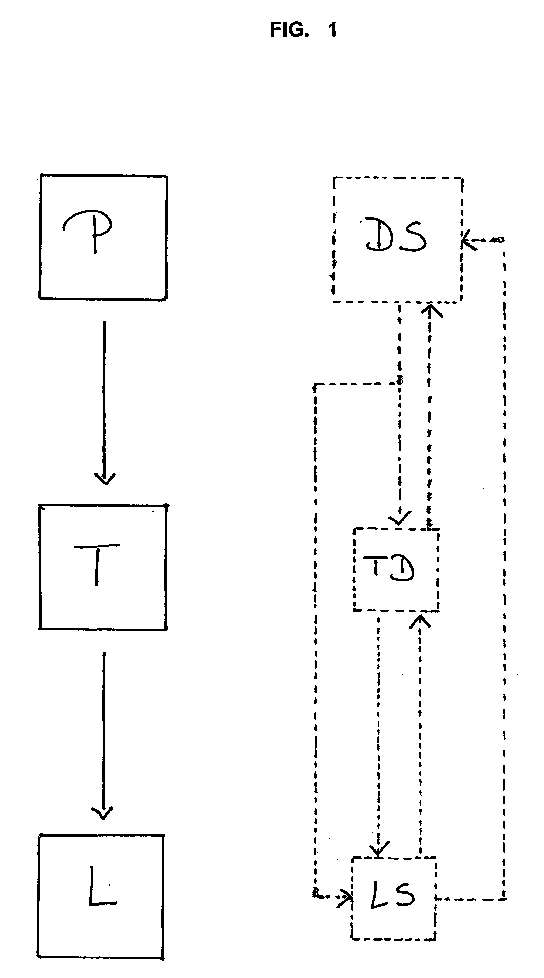
- the sample After the sample has been taken, the sample, labeled with the corresponding marking, placed in a sample collector. If the data system already all for the to be performed Containing required data, it is possible to use the in the sample collector to check if sufficient sample material has been taken. Also the status that the sample P is in the meantime in the sample collector, can over the Data system to be queried.
- the sample monitoring system PS is, for example, in a hospital by the station staff operated, appropriate input stations should be easily accessible, for example in a central position within the station. In environmental analysis is preferred To use a portable data system and the corresponding data directly before Place to enter.
- the flush job itself is determined by the data system or given conditions imposed by the transport system, namely when an emergency order present and / or emergency samples are completely recorded in the data system and already in the transport container are stored, the oldest sample is recorded over a period of xx minutes, where xx is configured according to the collection point, time of day and calendar date, or the Transport container is filled to a predetermined proportion yy percent, with yy turn is configurable by collection point, time of day and calendar date. It is also possible in Occasionally trigger the emptying order manually or a spontaneous emptying electronically to document.
- the sample is re-identified, i. both the transport container and the Samples themselves are recorded and preferably checked for their integrity.
- the transport service acts in such a way that it faces the sample, i. the transport container identified as an authorized collector.
- the fetched Transport container replaced by an empty one.
- the laboratory system LS Upon arrival of the sample in laboratory L, it is recorded by the laboratory system LS.
- the received Samples are taken with the data reported by the data system DS or by the transport service TD Matched samples.
- the arrival of the samples in the laboratory L is made by the laboratory system LS the Transport service TD and the data system DS of the client reported. Be in the lab the samples are subsequently prepared and the examination is carried out. The examination results after your release to the data system DS of the client reported.
Landscapes
- General Health & Medical Sciences (AREA)
- Health & Medical Sciences (AREA)
- Immunology (AREA)
- Pathology (AREA)
- Analytical Chemistry (AREA)
- Biochemistry (AREA)
- Life Sciences & Earth Sciences (AREA)
- General Physics & Mathematics (AREA)
- Physics & Mathematics (AREA)
- Chemical & Material Sciences (AREA)
- Engineering & Computer Science (AREA)
- Epidemiology (AREA)
- Medical Informatics (AREA)
- Primary Health Care (AREA)
- Public Health (AREA)
- Automatic Analysis And Handling Materials Therefor (AREA)
Abstract
Description
Claims (10)
- Verfahren zur Überwachung von zu untersuchenden Proben, die nach der Probenentnahme an einen vom Ort der Probenentnahme verschiedenen Ort untersucht werden, welches die folgenden Schritte umfasst:a) Erfassen der Probe in dem Datensystem (DS) des Auftraggebers,b) Generierung eines Laborauftrages aus den Daten über vorzunehmende Analysen/Untersuchungen,c) Erstellung eines probenbezogenen Datensatzes im Datensystem (DS) des Auftraggebers und Übermittlung des Datensatzes an das Laborsystem (LS) des beauftragten Labors sowie an das Probenüberwachungssystem,d) Zusammenstellen der für das beauftragte Labor bestimmten Proben zu mindestens einer Charge, im Datensystem (DS) des Auftraggebers Generierung eines für die Charge spezifischen Chargen-Identifizierungscodes, z.B. einer Fallnummer, sowie Zuordnung der Datensätze der einzelnen Proben der Charge zu dem Chargen-Identifizierungscode,e) i. ggf. Generierung eines Transportauftrags an einen Transportdienst, ii. Erfassung der Abholung der Probe(n) bzw. Charge(n) im Probenüberwachungssystem durch einen Transportdienst und Verknüpfung des Auftrages mit den Chargen-Identifizierungscodes der zu transportierenden Chargen,f) Transport der Proben an das beauftragte Labor,g) per Datentransfer an das Datensystem (DS) des Auftraggebers Bestätigung über den Probeneingang im beauftragten Labor anhand des Chargen-Identifizierungscodes und/oder der Datensätze der einzelnen Proben,h) Durchführung der Untersuchung,i) per Datentransfer an das Datensystem (DS) des Auftraggebers Übermittlung der mit dem jeweiligen Datensatz verknüpften Untersuchungsergebnisse.
- Verfahren nach Anspruch 1,
gekennzeichnet durch
dass die Probe mit einem Probenidentifizierungscode versehen wird. - Verfahren nach Anspruch 1 oder 2,
gekennzeichnet durch
datenmäßige Verknüpfung des Datensatzes und/oder des Proben-Identifizierungscodes mit einer Dringlichkeitsstufe. - Verfahren nach einem der Ansprüche 1 bis 3,
dadurch gekennzeichnet, dass die Probe mit einer Dringlichkeitsstufe klassifiziert wird. Verfahren nach einem der Ansprüche 1 bis 3, dadurch gekennzeichnet, dass die Proben in einem Probensammler abgelegt, identifiziert und spätestens nach einer vorbestimmten Zeit xx zum Labor gebracht werden. - Verfahren nach Anspruch 4, dadurch gekennzeichnet, dass die Zeit xx von der Dringlichkeitsstufe der Probe abhängt.
- Verfahren nach einem der Ansprüche 1 bis 5, dadurch gekennzeichnet, dass der aktuelle Aufenthaltsort der Probe und der Status der Probe vom Probenüberwachungssystem erfasst wird.
- Verfahren nach einem der Ansprüche 1 bis 6, dadurch gekennzeichnet, dass vom Datensystem nicht erfassbare Proben in eine für diese Proben vorgesehene Vorrichtung gegeben werden.
- Verfahren nach einem der Ansprüche 1 bis 7, dadurch gekennzeichnet, dass der Probensammler (Transportbehälter) mit einem Identifizierungscode versehen ist, welcher als Anzeige bzw. zur Identifizierung für den Transportdienst dient.
- Verfahren nach einem der Ansprüche 1 bis 8, dadurch gekennzeichnet, dass vom Transportdienst beim Abholen der Probe eine Meldung an das Datensystem DS sowie an das Labor ergeht.
- Verfahren nach einem der Ansprüche 1 bis 8, dadurch gekennzeichnet, dass die Proben Patientenproben eines Krankenhauses sind.
Applications Claiming Priority (2)
| Application Number | Priority Date | Filing Date | Title |
|---|---|---|---|
| DE102004007298A DE102004007298A1 (de) | 2004-02-14 | 2004-02-14 | Verfahren zur Überwachung von Laborproben |
| DE102004007298 | 2004-02-14 |
Publications (2)
| Publication Number | Publication Date |
|---|---|
| EP1564648A2 true EP1564648A2 (de) | 2005-08-17 |
| EP1564648A3 EP1564648A3 (de) | 2006-05-24 |
Family
ID=34684058
Family Applications (1)
| Application Number | Title | Priority Date | Filing Date |
|---|---|---|---|
| EP05002808A Withdrawn EP1564648A3 (de) | 2004-02-14 | 2005-02-10 | Verfahren zur Überwachung von Laborproben |
Country Status (3)
| Country | Link |
|---|---|
| US (1) | US20060229844A1 (de) |
| EP (1) | EP1564648A3 (de) |
| DE (1) | DE102004007298A1 (de) |
Families Citing this family (4)
| Publication number | Priority date | Publication date | Assignee | Title |
|---|---|---|---|---|
| JP5171368B2 (ja) * | 2008-04-17 | 2013-03-27 | 株式会社日立ハイテクノロジーズ | 自動分析装置 |
| US20150006212A1 (en) * | 2010-04-01 | 2015-01-01 | Tony W. Covely | Soil Sample Tracking System and Method |
| CN116504368A (zh) * | 2023-04-24 | 2023-07-28 | 北京大学第六医院 | 一种跨队列样本数据信息核验系统 |
| CN116502979A (zh) * | 2023-04-26 | 2023-07-28 | 巴斯夫一体化基地(广东)有限公司 | 用于生成测试样品的派送计划的方法和装置 |
Family Cites Families (10)
| Publication number | Priority date | Publication date | Assignee | Title |
|---|---|---|---|---|
| US5314825A (en) * | 1992-07-16 | 1994-05-24 | Schiapparelli Biosystems, Inc. | Chemical analyzer |
| DE19621179C2 (de) * | 1996-05-25 | 2000-09-07 | Nonnenmacher Klaus | Transporteinheit für Proben |
| JP3493910B2 (ja) * | 1996-08-23 | 2004-02-03 | 株式会社日立製作所 | 自動化処理システム |
| US5841975A (en) * | 1996-12-10 | 1998-11-24 | The Regents Of The University Of California | Method and apparatus for globally-accessible automated testing |
| US6018713A (en) * | 1997-04-09 | 2000-01-25 | Coli; Robert D. | Integrated system and method for ordering and cumulative results reporting of medical tests |
| DE19955729A1 (de) * | 1999-11-15 | 2001-05-23 | Hospitalia Dienstleistungs & B | Kommunikationssystem für das Zusammenwirken von medizinischen Laboratorien und ärztlichen Behandlungseinrichtungen |
| WO2001055931A1 (en) * | 2000-01-28 | 2001-08-02 | Trafficop, Inc. | System and method for providing comprehensive logistics services |
| GB0030809D0 (en) * | 2000-12-16 | 2001-01-31 | Schmidt Paul | Sample tracking systems |
| US20020165673A1 (en) * | 2001-01-19 | 2002-11-07 | Allen Morgan | Method of self-sampling and analyzing a semen sample |
| US8676509B2 (en) * | 2001-11-13 | 2014-03-18 | Dako Denmark A/S | System for tracking biological samples |
-
2004
- 2004-02-14 DE DE102004007298A patent/DE102004007298A1/de not_active Withdrawn
-
2005
- 2005-02-10 EP EP05002808A patent/EP1564648A3/de not_active Withdrawn
- 2005-02-14 US US10/906,299 patent/US20060229844A1/en not_active Abandoned
Also Published As
| Publication number | Publication date |
|---|---|
| DE102004007298A1 (de) | 2005-09-01 |
| EP1564648A3 (de) | 2006-05-24 |
| US20060229844A1 (en) | 2006-10-12 |
Similar Documents
| Publication | Publication Date | Title |
|---|---|---|
| AT413640B (de) | Verfahren zur entnahme einer probe aus einem system | |
| DE69815814T2 (de) | Verfahren und System zum Zuordnen von belichteten Röntgenfilmen zu zugehörigen Patienteninformationen | |
| DE69522654T2 (de) | Verfahren zum überwachen und regeln der milchleistung in einer milchfarm | |
| DE19621179A1 (de) | Verfahren zur Identifikation und labordiagnostischen Untersuchung von Proben und Identifikationsmittel für Probenbehälter | |
| EP1233363A2 (de) | Vernetztes Expertensystem zur automatisierten Befundung und Qualitätskontrolle von medizinischen point-of-care Labormessdaten | |
| DE102004045743A1 (de) | Vorrichtung und Verfahren für die Fernwartung | |
| DE102021114970A1 (de) | Medizintechnische Vorrichtung zur automatischen Probenanalyse | |
| DE112019005958T5 (de) | Informationsverarbeitungsverfahren, informationsverarbeitungsvorrichtung und informationsverarbeitungssystem | |
| DE60032165T2 (de) | Verfahren und anlage zur datenverwaltung in einem labor | |
| EP1136087A2 (de) | Vorrichtung und Verfahren zum Überwachen und Verwalten von Produkten | |
| DE112006000937T5 (de) | Verfahren und System zur Prüfung von Proben | |
| DE10300545A1 (de) | Vorrichtung, Verfahren, Speichermedium und Datenstruktur zur Kennzeichnung und Speicherung von Daten | |
| DE10109863A1 (de) | Verfahren zur systematischen beurteilung der Qualität von im Betrieb befindlichen medizintechnischen Geräten | |
| DE112016005707T5 (de) | Sterilisationsverfahren in einer medizinischen Praxis, vorzugsweise in einer zahnärztlichen Praxis | |
| DE102012212265A1 (de) | Verfahren zur Terminplanung bei medizinischen Untersuchungen | |
| DE2733074A1 (de) | Geraet zur identifikation von behaeltern | |
| DE102004007298A1 (de) | Verfahren zur Überwachung von Laborproben | |
| DE102021120340A1 (de) | Smart Port - Multifunktionales Lese/Erkennungsgerät im Sterilgutkreislauf | |
| EP2081136A1 (de) | Einsatzplanungssystem für Serviceeinsätze an Objekten | |
| EP1232467A2 (de) | Kommunikationssystem für das zusammenwirken von medizinischen laboratorien und ärztlichen behandlungseinrichtungen | |
| DE102005009056A1 (de) | Verfahren zum Betrieb eines medizinischen Informationssystems | |
| AT413791B (de) | Verfahren zur erstellung eines auftragsdatensatzes für eine zu analysierende probe | |
| JP2004030143A (ja) | 治験情報処理管理システム,治験情報処理管理装置及び治験情報処理方法 | |
| DE102021107405A1 (de) | Verfahren zur Erfassung und Dokumentation eines Arbeitszyklus eines sterilisierbaren Medizinprodukts | |
| EP4307188B1 (de) | Behälterbereitstellung |
Legal Events
| Date | Code | Title | Description |
|---|---|---|---|
| PUAI | Public reference made under article 153(3) epc to a published international application that has entered the european phase |
Free format text: ORIGINAL CODE: 0009012 |
|
| AK | Designated contracting states |
Kind code of ref document: A2 Designated state(s): AT BE BG CH CY CZ DE DK EE ES FI FR GB GR HU IE IS IT LI LT LU MC NL PL PT RO SE SI SK TR |
|
| AX | Request for extension of the european patent |
Extension state: AL BA HR LV MK YU |
|
| PUAL | Search report despatched |
Free format text: ORIGINAL CODE: 0009013 |
|
| AK | Designated contracting states |
Kind code of ref document: A3 Designated state(s): AT BE BG CH CY CZ DE DK EE ES FI FR GB GR HU IE IS IT LI LT LU MC NL PL PT RO SE SI SK TR |
|
| AX | Request for extension of the european patent |
Extension state: AL BA HR LV MK YU |
|
| 17P | Request for examination filed |
Effective date: 20061024 |
|
| 17Q | First examination report despatched |
Effective date: 20061222 |
|
| AKX | Designation fees paid |
Designated state(s): DE ES GB IT |
|
| STAA | Information on the status of an ep patent application or granted ep patent |
Free format text: STATUS: THE APPLICATION IS DEEMED TO BE WITHDRAWN |
|
| 18D | Application deemed to be withdrawn |
Effective date: 20120901 |