EP1564451B1 - Verfahren zur Herstellung eines Abdichtungselements - Google Patents
Verfahren zur Herstellung eines Abdichtungselements Download PDFInfo
- Publication number
- EP1564451B1 EP1564451B1 EP05002786A EP05002786A EP1564451B1 EP 1564451 B1 EP1564451 B1 EP 1564451B1 EP 05002786 A EP05002786 A EP 05002786A EP 05002786 A EP05002786 A EP 05002786A EP 1564451 B1 EP1564451 B1 EP 1564451B1
- Authority
- EP
- European Patent Office
- Prior art keywords
- raw material
- foam
- sealing member
- range
- polyurethane
- Prior art date
- Legal status (The legal status is an assumption and is not a legal conclusion. Google has not performed a legal analysis and makes no representation as to the accuracy of the status listed.)
- Ceased
Links
- 238000007789 sealing Methods 0.000 title claims description 100
- 238000000034 method Methods 0.000 title claims description 36
- 239000002994 raw material Substances 0.000 claims description 96
- 239000000758 substrate Substances 0.000 claims description 41
- 229920005830 Polyurethane Foam Polymers 0.000 claims description 29
- 239000011496 polyurethane foam Substances 0.000 claims description 29
- 230000006835 compression Effects 0.000 claims description 26
- 238000007906 compression Methods 0.000 claims description 26
- 239000006260 foam Substances 0.000 claims description 23
- 239000000463 material Substances 0.000 claims description 20
- 239000011347 resin Substances 0.000 claims description 19
- 229920005989 resin Polymers 0.000 claims description 19
- 238000010438 heat treatment Methods 0.000 claims description 16
- 229920005862 polyol Polymers 0.000 claims description 15
- 150000003077 polyols Chemical class 0.000 claims description 15
- 239000012948 isocyanate Substances 0.000 claims description 7
- 150000002513 isocyanates Chemical class 0.000 claims description 7
- 239000003381 stabilizer Substances 0.000 claims description 7
- 238000006243 chemical reaction Methods 0.000 claims description 4
- IAYPIBMASNFSPL-UHFFFAOYSA-N Ethylene oxide Chemical compound C1CO1 IAYPIBMASNFSPL-UHFFFAOYSA-N 0.000 claims description 3
- 238000010030 laminating Methods 0.000 claims description 3
- 230000001681 protective effect Effects 0.000 claims description 3
- 230000001737 promoting effect Effects 0.000 claims description 2
- 238000004519 manufacturing process Methods 0.000 description 22
- 239000007789 gas Substances 0.000 description 16
- 230000001965 increasing effect Effects 0.000 description 8
- 239000004721 Polyphenylene oxide Substances 0.000 description 7
- 230000007246 mechanism Effects 0.000 description 7
- 239000000203 mixture Substances 0.000 description 7
- 229920000570 polyether Polymers 0.000 description 7
- IJGRMHOSHXDMSA-UHFFFAOYSA-N Atomic nitrogen Chemical compound N#N IJGRMHOSHXDMSA-UHFFFAOYSA-N 0.000 description 6
- 230000001413 cellular effect Effects 0.000 description 6
- 230000003247 decreasing effect Effects 0.000 description 6
- 229920000139 polyethylene terephthalate Polymers 0.000 description 5
- 239000005020 polyethylene terephthalate Substances 0.000 description 5
- 238000007788 roughening Methods 0.000 description 5
- 238000012545 processing Methods 0.000 description 4
- 238000012360 testing method Methods 0.000 description 4
- GOOHAUXETOMSMM-UHFFFAOYSA-N Propylene oxide Chemical compound CC1CO1 GOOHAUXETOMSMM-UHFFFAOYSA-N 0.000 description 3
- 230000000694 effects Effects 0.000 description 3
- 238000011156 evaluation Methods 0.000 description 3
- 239000004973 liquid crystal related substance Substances 0.000 description 3
- 229910052757 nitrogen Inorganic materials 0.000 description 3
- -1 polyethylene Polymers 0.000 description 3
- 229920001296 polysiloxane Polymers 0.000 description 3
- 238000007493 shaping process Methods 0.000 description 3
- 238000012546 transfer Methods 0.000 description 3
- UPMLOUAZCHDJJD-UHFFFAOYSA-N 4,4'-Diphenylmethane Diisocyanate Chemical compound C1=CC(N=C=O)=CC=C1CC1=CC=C(N=C=O)C=C1 UPMLOUAZCHDJJD-UHFFFAOYSA-N 0.000 description 2
- 229920002799 BoPET Polymers 0.000 description 2
- JOYRKODLDBILNP-UHFFFAOYSA-N Ethyl urethane Chemical compound CCOC(N)=O JOYRKODLDBILNP-UHFFFAOYSA-N 0.000 description 2
- WYURNTSHIVDZCO-UHFFFAOYSA-N Tetrahydrofuran Chemical compound C1CCOC1 WYURNTSHIVDZCO-UHFFFAOYSA-N 0.000 description 2
- 230000001070 adhesive effect Effects 0.000 description 2
- 150000001336 alkenes Chemical class 0.000 description 2
- WNROFYMDJYEPJX-UHFFFAOYSA-K aluminium hydroxide Chemical compound [OH-].[OH-].[OH-].[Al+3] WNROFYMDJYEPJX-UHFFFAOYSA-K 0.000 description 2
- 230000008901 benefit Effects 0.000 description 2
- 239000003795 chemical substances by application Substances 0.000 description 2
- 230000000052 comparative effect Effects 0.000 description 2
- 239000003431 cross linking reagent Substances 0.000 description 2
- 238000011161 development Methods 0.000 description 2
- 238000007865 diluting Methods 0.000 description 2
- 239000012467 final product Substances 0.000 description 2
- 125000002887 hydroxy group Chemical group [H]O* 0.000 description 2
- 238000010348 incorporation Methods 0.000 description 2
- 238000007689 inspection Methods 0.000 description 2
- 230000010354 integration Effects 0.000 description 2
- 239000003863 metallic catalyst Substances 0.000 description 2
- JRZJOMJEPLMPRA-UHFFFAOYSA-N olefin Natural products CCCCCCCC=C JRZJOMJEPLMPRA-UHFFFAOYSA-N 0.000 description 2
- 230000000704 physical effect Effects 0.000 description 2
- 229920001228 polyisocyanate Polymers 0.000 description 2
- 239000005056 polyisocyanate Substances 0.000 description 2
- 230000002265 prevention Effects 0.000 description 2
- 238000004080 punching Methods 0.000 description 2
- 230000009467 reduction Effects 0.000 description 2
- 239000002904 solvent Substances 0.000 description 2
- 239000000126 substance Substances 0.000 description 2
- 239000002562 thickening agent Substances 0.000 description 2
- KSBAEPSJVUENNK-UHFFFAOYSA-L tin(ii) 2-ethylhexanoate Chemical compound [Sn+2].CCCCC(CC)C([O-])=O.CCCCC(CC)C([O-])=O KSBAEPSJVUENNK-UHFFFAOYSA-L 0.000 description 2
- BJZYYSAMLOBSDY-QMMMGPOBSA-N (2s)-2-butoxybutan-1-ol Chemical compound CCCCO[C@@H](CC)CO BJZYYSAMLOBSDY-QMMMGPOBSA-N 0.000 description 1
- RNFJDJUURJAICM-UHFFFAOYSA-N 2,2,4,4,6,6-hexaphenoxy-1,3,5-triaza-2$l^{5},4$l^{5},6$l^{5}-triphosphacyclohexa-1,3,5-triene Chemical compound N=1P(OC=2C=CC=CC=2)(OC=2C=CC=CC=2)=NP(OC=2C=CC=CC=2)(OC=2C=CC=CC=2)=NP=1(OC=1C=CC=CC=1)OC1=CC=CC=C1 RNFJDJUURJAICM-UHFFFAOYSA-N 0.000 description 1
- VZSRBBMJRBPUNF-UHFFFAOYSA-N 2-(2,3-dihydro-1H-inden-2-ylamino)-N-[3-oxo-3-(2,4,6,7-tetrahydrotriazolo[4,5-c]pyridin-5-yl)propyl]pyrimidine-5-carboxamide Chemical compound C1C(CC2=CC=CC=C12)NC1=NC=C(C=N1)C(=O)NCCC(N1CC2=C(CC1)NN=N2)=O VZSRBBMJRBPUNF-UHFFFAOYSA-N 0.000 description 1
- 229910000861 Mg alloy Inorganic materials 0.000 description 1
- NIPNSKYNPDTRPC-UHFFFAOYSA-N N-[2-oxo-2-(2,4,6,7-tetrahydrotriazolo[4,5-c]pyridin-5-yl)ethyl]-2-[[3-(trifluoromethoxy)phenyl]methylamino]pyrimidine-5-carboxamide Chemical compound O=C(CNC(=O)C=1C=NC(=NC=1)NCC1=CC(=CC=C1)OC(F)(F)F)N1CC2=C(CC1)NN=N2 NIPNSKYNPDTRPC-UHFFFAOYSA-N 0.000 description 1
- AFCARXCZXQIEQB-UHFFFAOYSA-N N-[3-oxo-3-(2,4,6,7-tetrahydrotriazolo[4,5-c]pyridin-5-yl)propyl]-2-[[3-(trifluoromethoxy)phenyl]methylamino]pyrimidine-5-carboxamide Chemical compound O=C(CCNC(=O)C=1C=NC(=NC=1)NCC1=CC(=CC=C1)OC(F)(F)F)N1CC2=C(CC1)NN=N2 AFCARXCZXQIEQB-UHFFFAOYSA-N 0.000 description 1
- 239000004952 Polyamide Substances 0.000 description 1
- 239000004698 Polyethylene Substances 0.000 description 1
- 239000004743 Polypropylene Substances 0.000 description 1
- 230000002411 adverse Effects 0.000 description 1
- 230000007547 defect Effects 0.000 description 1
- 239000000428 dust Substances 0.000 description 1
- 229920001971 elastomer Polymers 0.000 description 1
- 239000000806 elastomer Substances 0.000 description 1
- 230000005684 electric field Effects 0.000 description 1
- 230000002708 enhancing effect Effects 0.000 description 1
- 239000003063 flame retardant Substances 0.000 description 1
- 230000004907 flux Effects 0.000 description 1
- 229920001821 foam rubber Polymers 0.000 description 1
- 239000004619 high density foam Substances 0.000 description 1
- 230000006872 improvement Effects 0.000 description 1
- 239000011261 inert gas Substances 0.000 description 1
- 239000011344 liquid material Substances 0.000 description 1
- 239000002985 plastic film Substances 0.000 description 1
- 229920006255 plastic film Polymers 0.000 description 1
- 229920002647 polyamide Polymers 0.000 description 1
- 229920000728 polyester Polymers 0.000 description 1
- 229920000573 polyethylene Polymers 0.000 description 1
- 229920000098 polyolefin Polymers 0.000 description 1
- 229920001155 polypropylene Polymers 0.000 description 1
- 229920002635 polyurethane Polymers 0.000 description 1
- 239000004814 polyurethane Substances 0.000 description 1
- 229920003225 polyurethane elastomer Polymers 0.000 description 1
- 229920000915 polyvinyl chloride Polymers 0.000 description 1
- 239000004800 polyvinyl chloride Substances 0.000 description 1
- 239000000047 product Substances 0.000 description 1
- 230000000717 retained effect Effects 0.000 description 1
- 238000007151 ring opening polymerisation reaction Methods 0.000 description 1
- 239000005060 rubber Substances 0.000 description 1
- 239000007787 solid Substances 0.000 description 1
- YLQBMQCUIZJEEH-UHFFFAOYSA-N tetrahydrofuran Natural products C=1C=COC=1 YLQBMQCUIZJEEH-UHFFFAOYSA-N 0.000 description 1
Images

Classifications
-
- F—MECHANICAL ENGINEERING; LIGHTING; HEATING; WEAPONS; BLASTING
- F16—ENGINEERING ELEMENTS AND UNITS; GENERAL MEASURES FOR PRODUCING AND MAINTAINING EFFECTIVE FUNCTIONING OF MACHINES OR INSTALLATIONS; THERMAL INSULATION IN GENERAL
- F16J—PISTONS; CYLINDERS; SEALINGS
- F16J15/00—Sealings
- F16J15/02—Sealings between relatively-stationary surfaces
- F16J15/06—Sealings between relatively-stationary surfaces with solid packing compressed between sealing surfaces
- F16J15/10—Sealings between relatively-stationary surfaces with solid packing compressed between sealing surfaces with non-metallic packing
- F16J15/108—Special methods for making a non-metallic packing
-
- C—CHEMISTRY; METALLURGY
- C08—ORGANIC MACROMOLECULAR COMPOUNDS; THEIR PREPARATION OR CHEMICAL WORKING-UP; COMPOSITIONS BASED THEREON
- C08J—WORKING-UP; GENERAL PROCESSES OF COMPOUNDING; AFTER-TREATMENT NOT COVERED BY SUBCLASSES C08B, C08C, C08F, C08G or C08H
- C08J5/00—Manufacture of articles or shaped materials containing macromolecular substances
- C08J5/18—Manufacture of films or sheets
-
- C—CHEMISTRY; METALLURGY
- C08—ORGANIC MACROMOLECULAR COMPOUNDS; THEIR PREPARATION OR CHEMICAL WORKING-UP; COMPOSITIONS BASED THEREON
- C08G—MACROMOLECULAR COMPOUNDS OBTAINED OTHERWISE THAN BY REACTIONS ONLY INVOLVING UNSATURATED CARBON-TO-CARBON BONDS
- C08G18/00—Polymeric products of isocyanates or isothiocyanates
- C08G18/06—Polymeric products of isocyanates or isothiocyanates with compounds having active hydrogen
- C08G18/28—Polymeric products of isocyanates or isothiocyanates with compounds having active hydrogen characterised by the compounds used containing active hydrogen
- C08G18/65—Low-molecular-weight compounds having active hydrogen with high-molecular-weight compounds having active hydrogen
- C08G18/66—Compounds of groups C08G18/42, C08G18/48, or C08G18/52
- C08G18/6666—Compounds of group C08G18/48 or C08G18/52
- C08G18/667—Compounds of group C08G18/48 or C08G18/52 with compounds of group C08G18/32 or polyamines of C08G18/38
- C08G18/6674—Compounds of group C08G18/48 or C08G18/52 with compounds of group C08G18/32 or polyamines of C08G18/38 with compounds of group C08G18/3203
-
- C—CHEMISTRY; METALLURGY
- C08—ORGANIC MACROMOLECULAR COMPOUNDS; THEIR PREPARATION OR CHEMICAL WORKING-UP; COMPOSITIONS BASED THEREON
- C08J—WORKING-UP; GENERAL PROCESSES OF COMPOUNDING; AFTER-TREATMENT NOT COVERED BY SUBCLASSES C08B, C08C, C08F, C08G or C08H
- C08J9/00—Working-up of macromolecular substances to porous or cellular articles or materials; After-treatment thereof
-
- C—CHEMISTRY; METALLURGY
- C08—ORGANIC MACROMOLECULAR COMPOUNDS; THEIR PREPARATION OR CHEMICAL WORKING-UP; COMPOSITIONS BASED THEREON
- C08J—WORKING-UP; GENERAL PROCESSES OF COMPOUNDING; AFTER-TREATMENT NOT COVERED BY SUBCLASSES C08B, C08C, C08F, C08G or C08H
- C08J9/00—Working-up of macromolecular substances to porous or cellular articles or materials; After-treatment thereof
- C08J9/04—Working-up of macromolecular substances to porous or cellular articles or materials; After-treatment thereof using blowing gases generated by a previously added blowing agent
- C08J9/12—Working-up of macromolecular substances to porous or cellular articles or materials; After-treatment thereof using blowing gases generated by a previously added blowing agent by a physical blowing agent
-
- C—CHEMISTRY; METALLURGY
- C09—DYES; PAINTS; POLISHES; NATURAL RESINS; ADHESIVES; COMPOSITIONS NOT OTHERWISE PROVIDED FOR; APPLICATIONS OF MATERIALS NOT OTHERWISE PROVIDED FOR
- C09K—MATERIALS FOR MISCELLANEOUS APPLICATIONS, NOT PROVIDED FOR ELSEWHERE
- C09K3/00—Materials not provided for elsewhere
- C09K3/10—Materials in mouldable or extrudable form for sealing or packing joints or covers
- C09K3/1006—Materials in mouldable or extrudable form for sealing or packing joints or covers characterised by the chemical nature of one of its constituents
- C09K3/1021—Polyurethanes or derivatives thereof
-
- F—MECHANICAL ENGINEERING; LIGHTING; HEATING; WEAPONS; BLASTING
- F16—ENGINEERING ELEMENTS AND UNITS; GENERAL MEASURES FOR PRODUCING AND MAINTAINING EFFECTIVE FUNCTIONING OF MACHINES OR INSTALLATIONS; THERMAL INSULATION IN GENERAL
- F16J—PISTONS; CYLINDERS; SEALINGS
- F16J15/00—Sealings
- F16J15/02—Sealings between relatively-stationary surfaces
- F16J15/06—Sealings between relatively-stationary surfaces with solid packing compressed between sealing surfaces
- F16J15/10—Sealings between relatively-stationary surfaces with solid packing compressed between sealing surfaces with non-metallic packing
- F16J15/102—Sealings between relatively-stationary surfaces with solid packing compressed between sealing surfaces with non-metallic packing characterised by material
-
- C—CHEMISTRY; METALLURGY
- C08—ORGANIC MACROMOLECULAR COMPOUNDS; THEIR PREPARATION OR CHEMICAL WORKING-UP; COMPOSITIONS BASED THEREON
- C08G—MACROMOLECULAR COMPOUNDS OBTAINED OTHERWISE THAN BY REACTIONS ONLY INVOLVING UNSATURATED CARBON-TO-CARBON BONDS
- C08G2110/00—Foam properties
- C08G2110/0008—Foam properties flexible
-
- C—CHEMISTRY; METALLURGY
- C08—ORGANIC MACROMOLECULAR COMPOUNDS; THEIR PREPARATION OR CHEMICAL WORKING-UP; COMPOSITIONS BASED THEREON
- C08G—MACROMOLECULAR COMPOUNDS OBTAINED OTHERWISE THAN BY REACTIONS ONLY INVOLVING UNSATURATED CARBON-TO-CARBON BONDS
- C08G2190/00—Compositions for sealing or packing joints
Definitions
- the present invention relates to a sealing member and a method of producing the same, and more particularly to a sealing member suitable for being disposed between the margin of a liquid crystal display screen in the display of portable telecommunication equipment such as a portable telephone or the margin of a microphone or the like and the internal surface of a case thereof, and a method of producing the same.
- an internal apparatus such as a liquid crystal display, a microphone or a speaker is generally arranged such that the internal apparatus faces the outside of its casing.
- Electrical machinery and apparatus having such a structure achieves dust control, the prevention of light leak from a backlight and the like, and the prevention of backlash, for example, by laying a sealing member between the margin of an internal apparatus such as a liquid crystal display and its casing.
- Japanese Laid-Open Patent Publication No. 2001-100216 discloses a polyurethane foam as the sealing member above. This polyurethane foam is formed according to a mechanical froth method, and easily deformed with a low load at a 25% compression, and a plastic film as a back-up material is integrally formed on a single side of the foam.
- WO 02/062863 discloses a flame retardant polyurethane foam or elastomer which can be used for sealing purposes.
- JP 2003-40958 describes an antistatic urethane sealing sheet formed by the hardening of urethane foam raw material.
- the sealing member is arranged between the internal apparatuses and the casing, and develops predetermined or more sealing properties under compression.
- a sealing member which maintains a predetermined thickness before incorporation, and sufficiently develops sealing properties to a wide range of compression ratio from low compression to high compression corresponding to variation of the gap size after incorporation has been required.
- the sealing properties of a sealing member are evaluated as to whether the sealing member is easily deformed by a load or not. Therefore, in order to sufficiently develop the sealing properties when the sealing member is highly compressed, not a high-density foam which easily achieves a solid state due to a high load, but a low-density soft polyurethane foam, an olefin foam such as polyethylene foam or polypropylene foam, or a rubber foam, or the like is used.
- a soft polyurethane foam is processed into a sheet having a required thickness by slicing after the polyurethane foam has been foamed in the form of a slab, and thus it has no skin layer and is poor in adhesive properties.
- a soft polyurethane foam does not excellence in dust-proof performance and light-blocking performance.
- an olefin foam or a rubber sponge is also generally provided with a predetermined thickness by slicing, as well as a soft polyurethane foam. Therefore, there a problem is caused similar to that of the above soft polyurethane foam.
- a sealing member having a skin layer can be also produced from the above raw material, though the compression set of the produced sealing member is large, and thus it is difficult for the sealing member to retain stable sealing properties for a long period of time. Furthermore, since the sealing member has a large cellular diameter, it causes problems in dust-proof performance and light-blocking performance.
- a light-weight and high-strength material for example, a magnesium alloy or the like has been positively employed. Since such material has generally high electric conductivity, an electric current easily flows through the casing.
- a material having a low relative dielectric constant i.e., a material having high insulating properties should be employed.
- the above relative dielectric constant is essentially a material-intrinsic value, and thus it was difficult to select a material having both sealing properties and a low relative dielectric constant together.
- a sealing member made according to the present invention is a sealing member that comprises an elastic sheet having a density in a range of 100 to 250 kg/m 3 in which the sheet was formed by reacting and curing a polyurethane-foam raw material having 100% by volume of a resin raw material and 300% by volume or more of a foam-forming gas mixed therewith, the elastic sheet having a compression load deflection at 50% in the range of 0.003 to 0.025 MPa, and the compression load deflection at 75% thereof being in the range of 0.02 to 0.40 MPa, wherein the resin raw material contains polyol and isocyanate as a main raw material and a foam stabilizer as an auxiliary material.
- the method of producing a sealing member is a method of producing a sealing member as disclosed in claim 1 which comprises supplying a resin raw material containing polyol and isocyanate as a main raw material and a foam stabilizer as an auxiliary material; feeding a polyurethane-foam raw material having 100% by volume of the resin raw material and 300% by volume or more of a foam-forming gas mixed, onto a substrate film; controlling the thickness of the polyurethane-foam raw material to be within a range of 0.3 to 3.0 mm; and promoting the reaction and curing of the fed polyurethane-foam raw material so as to produce an elastic sheet comprising a polyurethane-foam having a thickness in the range of 0.3 to 3.0 mm, a density set a range of 100 to 250 kg/m 3 , a compression load deflection at 50% in a range of 0.003 to 0.025 MPa, and a compression
- a a method of producing a sealing member according to the present invention will be now hereinafter explained with preferred examples enumerated with reference to attached drawings.
- the inventor of the present application found the following: when an elastic sheet for use as a sealing member is produced according to a mechanical froth method, the density of the sealing member is decreased by increasing the amount of a foam-forming gas for forming a cell; and by using such a sealing member whose density was decreased, the sufficiently low hardness of the sealing member can be attained at such a high compressed state such that the sealing member could not have been accommodated there to, and sufficient sealing properties can be ensured for a small gap at an interlocking portion of a casing such as in a portable telephone.
- the present inventor tried to use a sheet of material having a smooth surface for controlling the thickness of a polyurethane-foam raw material to find that a sealing member on which the surface of the resultant polyurethane-foam is prevented from roughening and a good surface profile can be obtained.
- the sealing properties of a sealing member which are part of its characteristic physical properties are prescribed by the compression load deflection at 50% (hereinafter referred to as "50% CLD") and the compression load deflection at 75% (hereinafter referred to as "75% CLD").
- a sealing member 10 essentially comprises a foamed elastic sheet 12 and a substrate film 14, the elastic sheet 12 providing required cushioning properties, flexibility, and the sealing properties mentioned above, the substrate film 14 being laminated on one side of this elastic sheet 12 and enhancing the structural strength of the sealing member 10.
- This elastic sheet 12 is produced according to a mechanical froth method, which is publicly known.
- a polyurethane-foam raw material hereinafter simply referred to as "a raw material” M is prepared by mixing a resin raw material and a foam-forming gas in a predetermined amount, the resin raw material comprising polyol and isocyanate as a main raw material and a foam stabilizer as an auxiliary material.
- a mechanical froth method as used herein means a method of obtaining a foam, comprising introducing a gas into a liquid material, and mechanically mixing them.
- the density of the elastic sheet 12 thus derived is set to 100 to 250 kg/m 3 , and the thickness is set to 0.3 to 3.0 mm.
- the 50% CLD is set to the range of 0.003 to 0.025 MPa and the 75% CLD is set to the range of 0.02 to 0.40 MPa.
- the relative dielectric constant when the each frequency is 10 kHz, 100 kHz and 1 MHz is set to the range of 1 to 2.0, wherein the term "50% CLD” indicates a load which is required when the elastic sheet 12 is physically compressed by 50%, that is, the hardness of the elastic sheet 12 when physically compressed by 50%, while the term “75% CLD” indicates a load which is required when the elastic sheet 12 is physically compressed by 75%, that is, the hardness of the elastic sheet 12 when physically compressed by 75%. If these two values are higher than the preferred range mentioned above, the elastic sheet 12 is excessively hard when physically compressed by 50% or 75%, and thus poor in flexibility, whereby the elastic sheet 12 can not sufficiently attain sealing properties.
- the density is less than 100 kg/m 3 , it is difficult to homogeneously mix a foam-forming gas with a resin raw material in the production process according to a mechanical froth method. Therefore, bubbles for forming cells are not stably retained, whereby problems such as a cellular roughening to make the shape and/or size of the cell uneven, and the occurrence of voids will be caused. As a result, the development of satisfactory sealing properties will be inhibited.
- the density is larger than 250 kg/m 3 , a preferred value of each of the 50% CLD, the 75% CLD, and the relative dielectric constant as described above will not be provided.
- the thickness is less than 0.3 mm, it is difficult to derive the elasticity, the satisfactory sealing properties may not be attained.
- the upper limit of the thickness is 3 mm, when use in an apparatus such as a portable telephone, wherein space-saving properties are required, is taken into consideration.
- a sealing member of the present invention whose thickness is set to about 1 mm, is compressed to 0.5 mm with sealing properties maintained when physically compressed by 50%, while it is compressed to 0.25 mm with sealing properties maintained when physically compressed by 75%, and thus it is a preferable sealing member.
- relative dielectric constant means the value of a ratio of an electric flux density to an electric field density, divided by the vacuum dielectric constant, wherein the minimum of a relative dielectric constant is theoretically 1. That is, the sparser an object to be determined is (e.g., the structure of foam constituting an elastic sheet 12 in the present invention), the lower its relative dielectric constant.
- the density of a sealing member 10 is lowered so as to increase its porosity, whereby the relative dielectric constant when each frequency is 10 kHz, 100 kHz and 1 MHz is set in the range of 1 to 2.0.
- the density of the structure of a polyurethane foam constituting an elastic sheet 12 can be essentially represented by the porosity.
- This porosity can be increased by decreasing the density of the foam.
- the porosity is increased by increasing the mixing ratio of a foam-forming gas, for example, an inert gas such as nitrogen, as mixed into a raw material M.
- the porosity is preferably set to 76% by volume or more.
- the cellular diameter of foam constituting the sealing member 10 is set to the range of 20 to 500 ⁇ m, preferably 20 to 300 ⁇ m.
- this value is larger than 500 ⁇ m, the sealing member 10 is decreased in dust-proof performance and/or light-blocking effect.
- the smaller the cellular diameter of foam is the higher the sealing properties of the sealing member 10.
- the control of the cellular diameter is complicated, whereby the production of the foam is difficult, and thus it is not practicable.
- the surface of a sealing member 10 of the present invention is provided with a skin layer, provided that otherwise any after-processing or the like is not carried out, since a sealing member 10 is produced according to a mechanical froth method. This is preferable in the light of the enhancement of sealing properties, because adhesive properties to an object to be sealed can be structurally enhanced thereby.
- a raw material M for producing an elastic sheet 12 of a sealing member 12 having such physical properties is essentially in accordance with the contents disclosed in Japanese Examined Patent Publication No. 53-8735 .
- the mixing ratio of a foam-forming gas to a resin raw material, the resin raw material comprising polyol and isocyanate as a main raw material and a foam stabilizer as an auxiliary material, and the kind of the polyol as a main raw material are specified. That is, the mixing ratio of the foam-forming gas is set to be 300% by volume or more to 100% by volume of the resin raw material.
- the density of the resultant elastic sheet 12 does not attain 250 kg/m 3 or less, whereby the sealing properties at the higher compression ratio of the sealing member 10 can not be secured.
- the polyol is desirably used as a repeated unit (referred to as "Unit") of each of PO (propylene oxide) and/or PTMG (tetrahydrofuran subjected to ring-opening polymerization) or the like, except EO (ethylene oxide; (CH 2 CH 2 O) n ).
- the prescribed relative dielectric constant described above can be attained by setting the percentage of an EO Unit (or an EO Unit ratio) in a polyol to 20% or less.
- the percentage of an EO Unit is referred to as "EO content”.
- a substrate film 14 is monolithically laminated to an elastic sheet 12. As hereinafter described with respect to a production method, this substrate film 14 also serves as a transfer means for a raw material M in a production apparatus 30. Therefore, the substrate film 14 preferably comprises any resin having low heat-shrinkable properties, such as polyethylene terephthalate (PET), the resin having a physical strength resistible to a tensile force applied by a roller machine 32, and resistance properties to heat applied by a heating means 38.
- PET polyethylene terephthalate
- a film comprising a resin such as polyolefin, polyester, polyamide, polyvinyl chloride can be also employed, though it is preferred to employ PET also in terms of cost in particular.
- the thickness of a substrate film 14 is set to the range of several decades to 500 ⁇ m, and preferably about 25 to 125 ⁇ m. The thickness of this extent will not adversely affect the sealing properties of the sealing member 10 even when the substrate film 14 is laminated to an elastic sheet 12.
- the production method of the sealing member 10 comprises the step S1 of providing and preparing a raw material, the step S2 of feeding and shaping the raw material, the heating step S3, and the final step S4.
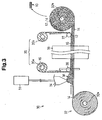
- the sealing member 10 is preferably produced by means of a production apparatus 30 as shown in Fig. 3 .
- This production apparatus 30 comprises a mixing section 31, a roller mechanism 32, a discharge nozzle 34, a surface-protecting mechanism 35, thickness-controlling means 36 such as a roller, and heating means 38 such as a tunnel-type of heating furnace.
- the roller mechanism 32 comprises a supply roll 32a and a product-collecting roll 32b.
- the supply roll 32a serves as transfer means for the raw material M, by which a substrate film 14 comprising a PET film is driven from a driving source (not shown).
- the discharge nozzle 34 feeds the raw material M onto the substrate film 14.
- the surface-protecting mechanism 35 comprises a supply roll 35a and a collecting roll 35b.
- the roller of the thickness-controlling means 36 is positioned near the substrate film 14 at the site downstream of the supply roll 35a.
- the supply roll 35a and the collecting roll 35b are driven by driving means (not shown), whereby a surface-protecting film 16 is removed along the upper surface of the substrate film 14, and rewound by the collecting roll 35b via the roller of the thickness-controlling means 36 and a guide roll 37.
- the surface-protecting film 16 comprises a PET film, and passes between the raw material M fed onto the substrate film 14 and the thickness-controlling means 36, whereby the thickness-controlling means 36 is prevented from directly coming into contact with the raw material M in the side downstream of the discharge nozzle 34.
- the thickness-controlling means 36 controls the raw material M to be a predetermined thickness on the side downstream of the discharge nozzle 34.
- the heating means 38 is provided at the side downstream of the thickness-controlling means 36.
- the raw material M is reacted and cured on a flat surface, though it may be reacted and cured as required in a shaping die or on a releasing paper or the like.
- the roller mechanism 32 is a mechanism which feeds the substrate film 14 to a production line while applying a tensile force to the substrate film 14, and collects the resultant sealing member 10.
- the supply roll 32a is wound with the substrate film 14, and delivers the substrate film 14 under control.
- the discharge nozzle 34 feeds the raw material M onto the substrate film 14 transferred under control, the upper end of which is connected with the mixing section 31.
- the step S1 of providing and preparing a raw material as carried out in the mixing section 31 is a step wherein the raw material M for the elastic sheet 12 is provided from a main raw material and various auxiliary materials and mixed.
- the thickness-controlling means 36 is prevented from coming into contact with the raw material M fed onto the substrate film 14.
- the surface-protecting film 16 preferably comprises any resin having low heat-shrinkable properties, such as PET, the resin having a smooth surface, having a physical strength resistant to a tensile force applied by the surface-protecting mechanism 35, and having resistance properties to heat applied by the heating means 38.
- the surface-protecting film 16 is released from the surface of the elastic sheet 12 which has been produced by heating and curing the raw material M. Therefore, a releasing agent such as a silicone material is previously applied to the contact area of the surface-protecting film 16 with the raw material M.
- the thickness-controlling means 36 shapes the raw material M discharged onto the substrate film 14 into a sheet material having a required thickness, and thus uses a roller in this example.
- the step S2 of feeding and shaping the raw material is completed.
- the thickness of the sealing member 10 produced by heating and curing the raw material M is set.
- the raw material M before heating, which is prepared according to the mechanical froth method, is not essentially different in thickness from the sealing member 10 after heating, which is produced from this raw material M, and thus even if a target thickness is set by means of the thickness-controlling means 36, no problem is caused.
- the heating means 38 applies heat to the raw material M with a thickness predetermined under control so as to develop the reaction and curing to obtain the elastic sheet 12.
- the heating step S3 is completed.
- the elastic sheet 12 and the substrate film 14 effectively utilize the adhesion effect of the raw material M, whereby the elastic sheet 12 is firmly bonded to the substrate film 14 and integrally laminated thereon.
- the final step S4 a long elastic sheet 12 produced by the individual steps S1 to S3 is obtained, and if necessary, it is punched out in the shape of a sealing member 10 which is a final product, and furthermore, a final inspection is carried out.
- the long elastic sheet 12 may be rewound for collection by means of the product-collecting roll 32b, while a final inspection is carried out, so as to be shipped in the shape as it is.
- the length of the elastic sheet 12 is preferably 5 m or more.
- the processing for providing a required shape for the long elastic sheet 12 and processing such as taping and punching can be continuously carried out, whereby it can be expected that the cost of production is lowered due to an improvement in productivity.
- a long substrate film 14 which constitutes a part of the sealing member 10 is directly fed into the production process, whereby the substrate film 14 is utilized also as a carrier film.
- the present invention is not limited thereto.
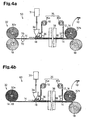
- a sealing member 10 can be produced by a method comprising the steps of separately preparing a carrier film 18, and laminating a substrate film 14 thereto by using pressure rolls 70 or the like (see Fig. 4a ) or otherwise previously laminating the substrate film 14 to the carrier film 18 such that the carrier film 18 can be easily released (see Fig. 4b ).
- the role as a carrier of transferring a raw material M with a tensile force applied can be separated, whereby the thickness of the substrate film 14 can be rendered thinner, and a reduction in cost can be expected due to the employment of a more inexpensive material.
- the thickness of the raw material M is controlled by means of the thickness-controlling means 36 through the surface-protecting film 16, whereby the thickness of the sealing member 10 is controlled, while it is intended to be able to protect the surface of the raw material M from roughening with the surface profile leveled.
- the surface-protecting film 16 is not indispensable.
- a releasing agent is continuously provided on the surface of the roller of a thickness-controlling means 36 so as to enhance release properties between the roller and the raw material M, whereby the surface of the raw material M can be also protected from roughening.
- the surface-protecting film 16 is not necessary, whereby trouble during production is decreased, and thus a reduction in cost can be expected.
- sealing members of the present invention were produced from foam-raw materials under conditions described in Tables 1 and 2, and the sealing properties and the like were evaluated.
- polyether polyol-A One hundred parts by weight of polyether polyol-A were mixed with 3 parts by weight of a cross-linking agent (1,4-butanol), 20 parts by weight of a thickening agent (aluminum hydroxide), 0.1 part by weight of a metallic catalyst (Stannous Octoate), and 3 parts by weight of a foam stabilizer (a silicone material; including a diluting solvent) so as to obtain a mixture.
- a cross-linking agent (1,4-butanol)
- a thickening agent aluminum hydroxide
- a metallic catalyst Tinnous Octoate
- foam stabilizer a silicone material; including a diluting solvent
- This foam raw material M was fed from a discharge nozzle 34 onto a substrate film (made from PET) having a required thickness, which is continuously provided from a supply roll 32a in a state in which a tensile force is applied onto a roller machine 32, and the foam raw material M was set to a predetermined thickness by thickness-controlling means 36. Thereafter, the raw material M was heated by heating means 38 at a temperature of 150°C to 200°C for 1 to 3 minutes, whereby the reaction and curing of the raw material M was developed so as to obtain an elastic sheet 12, and it was collected by means of a product-collecting roll 32b. Punching and other processing were applied to the resultant elastic sheet 12 into a predetermined shape so as to obtain a sealing member 10.
- each of the 50% CLD and the 75% CLD is a value which sufficiently satisfies sealing properties. Furthermore, it was confirmed that by setting the EO content to the range prescribed in a preferred embodiment of the present invention, the relative dielectric constant at each frequency of 10 kHz, 100 kHz and 1 MHz is a low value in the range of 1 to 2.0.
- Example 1-1 Example 1-2
- Example 1-3 Comp. Ex. 1-1 Comp. Ex.
- polyether polyol-A and polyether polyol-B at a percentage listed in Table 2 were mixed with 3 parts by weight of a cross-linking agent (1,4-butanol), 20 parts by weight of a thickening agent (aluminum hydroxide), 0.1 part by weight of a metallic catalyst (Stannous Octoate), and 3 parts by weight of a foam stabilizer (a silicone material; including a diluting solvent) so as to obtain a mixture.
- a cross-linking agent (1,4-butanol)
- a thickening agent aluminum hydroxide
- a metallic catalyst Tinannous Octoate
- foam stabilizer a silicone material; including a diluting solvent
- Example 1 nitrogen (a foam-forming gas), and polyisocyanate (crude MDI, NCO content: 31%) whose isocyanate index was set to 0.9 to 1.1 were blended at a flow rate of 0.1 NL/min so that the percentage described in Table 2 could be provided, and the blend was sheared to obtain a raw material M. Thereafter, according to Example 1, test specimens for Example 2-1 and Comparative Examples 2-1 to 2-3 were produced, and the relative dielectric constant, the 50% CLD and the 75% CLD were determined. Individual measuring methods and evaluation method were based on the ones in Example 1.
- a polyurethane-foam raw material as prepared by mixing a resin raw material and a foam-forming gas in a predetermined amount is used, and the density of the elastic sheet is set in the range of 100 to 250 kg/m 3 , whereby the compression load deflection at 50% of the elastic sheet is in the range of 0.003 to 0.025 MPa, and the compression load deflection at 75% thereof is in the range of 0.02 to 0.40 MPa. Consequently, a sealing member is achieved having sufficient sealing properties at a high compression ratio can be produced. Furthermore, the setting of the density to the above range provides the advantage effect that the relative dielectric constant of the sealing member can be decreased. Accordingly, a casing is high in electric conductivity, and easily carries an electric current, and thus the sealing member can be suitably employed even for a casing wherein a disadvantage such as the occurrence of electromagnetic waves may be caused.
Landscapes
- Chemical & Material Sciences (AREA)
- Engineering & Computer Science (AREA)
- General Engineering & Computer Science (AREA)
- Organic Chemistry (AREA)
- Materials Engineering (AREA)
- Health & Medical Sciences (AREA)
- Chemical Kinetics & Catalysis (AREA)
- Medicinal Chemistry (AREA)
- Polymers & Plastics (AREA)
- Mechanical Engineering (AREA)
- Manufacturing & Machinery (AREA)
- Polyurethanes Or Polyureas (AREA)
- Manufacture Of Porous Articles, And Recovery And Treatment Of Waste Products (AREA)
- Sealing Material Composition (AREA)
- Devices For Indicating Variable Information By Combining Individual Elements (AREA)
- Liquid Crystal (AREA)
Claims (8)
- Verfahren zur Herstellung eines Dichtungselements durch Bereitstellen eines Harz-Rohmaterials enthaltend Polyol und Isocyanat als Hauptrohmaterial und einen Schaumstabilisierer als Hilfsmaterial, wobei das Verfahren gekennzeichnet ist durch:Zuführen eines Polyurethan-Schaumrohmaterials umfassend 100 Volumen-% des Harz-Rohmaterials und 300 Volumen-% oder mehr eines schaumbildenden Gases gemischt auf einen Substratfilm und Bereitstellen eines Oberflächenschutzfilms an einer oberen Seite des Substratfilms, um das Rohmaterial in eine Folie zu formen;Kontrollieren der Dicke des Polyurethan-Schaumrohmaterials, damit es im Bereich von 0,3 bis 3,0 mm ist, indem das Rohmaterial zwischen dem Substratfilm und dem Oberflächenschutzfilm eingeschlossen wird; undStarten der Reaktion und Aushärten des zugeführten Polyurethan-Schaumrohmaterials, so dass ein Dichtungselement hergestellt wird, das einen Polyurethan-Schaum umfasst, der eine Dicke im Bereich von 0,3 bis 3,0 mm, eine Dichte im Bereich von 100 bis 250 kg/m3, eine Stauchhärte bei 50% im Bereich von 0,003 bis 0,025 MPa und eine Stauchhärte bei 75% im Bereich von 0,02 bis 0,40 MPa aufweist.
- Verfahren gemäß Anspruch 1, dadurch gekennzeichnet, dass das Verfahren ferner die Schritte des getrennten Herstellens eines Trägerfilms und des Laminierens des Substratfilms daran einschließt, wobei der Trägerfilm vom Substratfilm abgelöst werden kann.
- Verfahren gemäß Anspruch 1 oder 2, dadurch gekennzeichnet, dass das Polyurethan-Schaum-Rohmaterial Polyol einen EO (Ethylenoxid (CH2CH2O)n)-Anteil umfasst und der EO (Ethylenoxid (CH2CH2O)n-Anteil in dem Polyol 20% oder weniger ausmacht.
- Verfahren gemäß einem der Ansprüche 1 bis 3, dadurch gekennzeichnet, dass das Mischverhältnis des schaumbildenden Gases auf 300 Volumen-% oder mehr zu 100 Volumen-% des Harz-Rohmaterials festgesetzt ist, um eine Porosität des Dichtungselements von 76 Volumen-% oder mehr zu erhalten.
- Verfahren gemäß Anspruch 1, dadurch gekennzeichnet, dass das Polyurethan-schaum-Rohmaterial eine Zuführrichtung einschließt, und es in einem Zustand reagiert und ausgehärtet wird, in dem seine Dicke entlang der Zuführrichtung eingeschränkt ist.
- Verfahren gemäß Anspruch 1, dadurch gekennzeichnet, dass eine relative dielektrische Konstante des Dichtungselements bei jeder der Frequenzen von 10 kHz, 100 kHz und 1 MHz in dem Bereich von 1 bis 2,0 ist.
- Verfahren gemäß Anspruch 1, dadurch gekennzeichnet, dass der Schaum, der das Dichtungselement darstellt, Zellen mit einem Zelldurchmesser im Bereich von 20 bis 500 µm einschließt.
- Verfahren gemäß Anspruch 1, dadurch gekennzeichnet, dass der Aushärtungsschritt einen Schritt des Erhitzens des Dichtungselements auf eine Temperatur von 150°C bis 200°C einschließt.
Applications Claiming Priority (2)
| Application Number | Priority Date | Filing Date | Title |
|---|---|---|---|
| JP2004034059 | 2004-02-10 | ||
| JP2004034059A JP4378624B2 (ja) | 2004-02-10 | 2004-02-10 | シール部材の製造方法 |
Publications (3)
| Publication Number | Publication Date |
|---|---|
| EP1564451A2 EP1564451A2 (de) | 2005-08-17 |
| EP1564451A3 EP1564451A3 (de) | 2008-06-25 |
| EP1564451B1 true EP1564451B1 (de) | 2013-04-03 |
Family
ID=34697887
Family Applications (1)
| Application Number | Title | Priority Date | Filing Date |
|---|---|---|---|
| EP05002786A Ceased EP1564451B1 (de) | 2004-02-10 | 2005-02-10 | Verfahren zur Herstellung eines Abdichtungselements |
Country Status (6)
| Country | Link |
|---|---|
| US (1) | US20050248102A1 (de) |
| EP (1) | EP1564451B1 (de) |
| JP (1) | JP4378624B2 (de) |
| KR (1) | KR101149013B1 (de) |
| CN (1) | CN100390643C (de) |
| TW (1) | TWI360701B (de) |
Families Citing this family (27)
| Publication number | Priority date | Publication date | Assignee | Title |
|---|---|---|---|---|
| US7338983B2 (en) | 2004-02-10 | 2008-03-04 | World Properties, Inc. | Low density polyurethane foam, method of producing, and articles comprising the same |
| ATE417890T1 (de) * | 2005-02-09 | 2009-01-15 | World Properties Inc | Herstellungsverfahren für polyurethanschaum niedriger dichte und sie enthaltende artikel |
| JP4862189B2 (ja) * | 2005-02-14 | 2012-01-25 | 日本発條株式会社 | 研磨パッド用クッション材 |
| CN1949568B (zh) * | 2005-10-13 | 2010-09-29 | 比亚迪股份有限公司 | 燃料电池膜电极的制备方法 |
| WO2008012908A1 (en) * | 2006-07-28 | 2008-01-31 | Nippon Polyurethane Industry Co., Ltd | Process for production of polyurethane foam |
| JPWO2008047402A1 (ja) * | 2006-10-16 | 2010-02-18 | 株式会社イノアックコーポレーション | シート状弾性体 |
| TWI449263B (zh) * | 2006-12-14 | 2014-08-11 | Murata Manufacturing Co | 天線線圈 |
| JP4954762B2 (ja) | 2007-03-27 | 2012-06-20 | 東洋ゴム工業株式会社 | ポリウレタン発泡体の製造方法 |
| JP5491740B2 (ja) * | 2009-01-29 | 2014-05-14 | 株式会社イノアックコーポレーション | ガスケット用基材の製造方法、このガスケット用基材を用いたガスケット、及びガスケットの使用方法 |
| JP5758892B2 (ja) | 2009-07-24 | 2015-08-05 | サン−ゴバン ペルフォルマンス プラスティク シェヌー | ポリウレタンガスケットおよびそれを形成する方法 |
| US9156227B2 (en) | 2010-07-09 | 2015-10-13 | Saint-Gobain Performance Plastics Corporation | Foam sealing gasket |
| JP5856448B2 (ja) | 2010-12-14 | 2016-02-09 | 日東電工株式会社 | 樹脂発泡体及び発泡シール材 |
| JP2012201872A (ja) * | 2011-03-28 | 2012-10-22 | Shikoku Kako Kk | 表面保護フィルムの製造方法 |
| JP5660975B2 (ja) * | 2011-05-27 | 2015-01-28 | 株式会社イノアックコーポレーション | シール材およびその製造方法 |
| JP5969260B2 (ja) * | 2011-07-14 | 2016-08-17 | 日東電工株式会社 | 樹脂発泡体、その製造方法、及び発泡シール材 |
| WO2013015245A1 (ja) | 2011-07-25 | 2013-01-31 | 株式会社イノアックコーポレーション | ポリウレタンフォーム |
| JP5990435B2 (ja) * | 2011-10-11 | 2016-09-14 | 日東電工株式会社 | 樹脂発泡体シート及び樹脂発泡複合体 |
| WO2013168798A1 (ja) * | 2012-05-11 | 2013-11-14 | 日東電工株式会社 | 樹脂発泡体及び発泡シール材 |
| JP6039505B2 (ja) | 2012-05-31 | 2016-12-07 | 日東電工株式会社 | 熱可塑性樹脂発泡体及びその製造方法並びに発泡シール材 |
| US9643840B2 (en) * | 2012-06-27 | 2017-05-09 | Covestro Deutschland Ag | Dielectric polyurethane film |
| CN104228246A (zh) * | 2013-06-13 | 2014-12-24 | 美国圣戈班性能塑料公司 | 基于聚氨酯分散液的泡棉密封垫片和粘合胶带 |
| KR20160069446A (ko) | 2015-02-27 | 2016-06-16 | 이상호 | 미소 중공구체를 이용한 박막 폴리우레탄 폼 적층체 및 그 제조방법 |
| CN104829806B (zh) * | 2015-04-28 | 2019-01-04 | 广州市诚臻电子科技有限公司 | 一种用于电磁兼容和无线产品测试的支撑材料及制备方法 |
| WO2017068967A1 (ja) * | 2015-10-22 | 2017-04-27 | 株式会社ブリヂストン | 照明器具用パッキン材 |
| WO2017203832A1 (ja) | 2016-05-24 | 2017-11-30 | Nok株式会社 | ガスケットの取り扱い方法 |
| CN109138184B (zh) * | 2018-10-16 | 2020-12-11 | 河北光特橡胶制品有限公司 | 海绵硅胶复合密封条及其制备方法 |
| KR102763547B1 (ko) * | 2019-10-10 | 2025-02-07 | 이노악 코포레이션 | 폴리우레탄 발포체, 그 성형체 및 성형체의 제조 방법 |
Citations (1)
| Publication number | Priority date | Publication date | Assignee | Title |
|---|---|---|---|---|
| WO2002062863A2 (en) * | 2000-12-29 | 2002-08-15 | World Properties Inc. | Flame retardant polyurethane composition and method of manufacture thereof |
Family Cites Families (55)
| Publication number | Priority date | Publication date | Assignee | Title |
|---|---|---|---|---|
| US2602783A (en) * | 1949-01-14 | 1952-07-08 | Lockheed Aircraft Corp | Cellular foamed alkyd-diisocyanate resins |
| US2591884A (en) * | 1949-02-17 | 1952-04-08 | Lockheed Aircraft Corp | Alkyd resin-diisocyanate cellular foamed plastics |
| US2621166A (en) * | 1949-02-23 | 1952-12-09 | Bayer Ag | Synthetic polymers |
| US2698838A (en) * | 1950-09-23 | 1955-01-04 | Lockheed Aircraft Corp | Heat resistant oxalate-alkyd-isocyanate cellular plastics |
| DE831772C (de) * | 1952-11-18 | 1952-02-18 | Bayer Ag | Verfahren zur Herstellung hochmolekularer vernetzter Kunststoffe |
| US2811493A (en) * | 1953-05-11 | 1957-10-29 | Lockheed Aircraft Corp | Elastomeric cellular products obtained from alkyd resin-diisocyanate mixture |
| GB760782A (en) * | 1953-08-19 | 1956-11-07 | Bayer Ag | Process for the production of foamed products based on polyisocyanates |
| US2866762A (en) * | 1953-08-19 | 1958-12-30 | Bayer Ag | Process for preparing polyurethane foams employing tertiary amine catalysts |
| US2866774A (en) * | 1953-09-23 | 1958-12-30 | Univ Notre Dame | Polyether polyurethane rubber |
| US2833730A (en) * | 1953-09-30 | 1958-05-06 | Du Pont | Arylene diisocyanate-fatty acid triglyceride-polyol cellular materials and process of producing same |
| US2878601A (en) * | 1954-02-12 | 1959-03-24 | Gen Mills Inc | Push button steam iron |
| BE536296A (de) * | 1954-03-22 | |||
| BE538608A (de) * | 1954-06-10 | |||
| US2877212A (en) * | 1954-10-11 | 1959-03-10 | Du Pont | Polyurethanes from difunctional polymers of conjugated dienes |
| US2870097A (en) * | 1955-07-01 | 1959-01-20 | Du Pont | Process for the preparation of polymeric acetals |
| US2779689A (en) * | 1955-07-19 | 1957-01-29 | Pittsburgh Plate Glass Co | Forming foamed polyurethane resins |
| BE550103A (de) * | 1955-08-04 | |||
| US2850476A (en) * | 1955-09-26 | 1958-09-02 | Goodyear Tire & Rubber | Accelerators |
| US3169945A (en) * | 1956-04-13 | 1965-02-16 | Union Carbide Corp | Lactone polyesters |
| US2902473A (en) * | 1956-05-17 | 1959-09-01 | Dow Corning | Polyesters of fluorinated glycols and phthalic acids |
| US2911390A (en) * | 1956-05-17 | 1959-11-03 | Dow Corning | Fluorinated polyurethane resins |
| US2846458A (en) * | 1956-05-23 | 1958-08-05 | Dow Corning | Organosiloxane ethers |
| US2868824A (en) * | 1956-08-09 | 1959-01-13 | Dow Corning | Polymeric organosiloxanes |
| US2962524A (en) * | 1957-04-18 | 1960-11-29 | Chich | |
| US3021317A (en) * | 1959-12-03 | 1962-02-13 | Union Carbide Corp | Polymerization of cyclic esters |
| US3021309A (en) * | 1959-12-03 | 1962-02-13 | Union Carbide Corp | Polymerization of cyclic esters |
| US3057901A (en) * | 1960-05-13 | 1962-10-09 | Dow Corning | Hydroxyether organosilicon compounds |
| GB1022434A (en) * | 1961-11-28 | 1966-03-16 | Union Carbide Corp | Improvements in and relating to polymers |
| US3772224A (en) * | 1969-01-31 | 1973-11-13 | Union Carbide Corp | Process for production of a polyurethane foam from a heat curable froth |
| US3849156A (en) * | 1969-01-31 | 1974-11-19 | Union Carbide Corp | Process for providing a backing on carpets |
| US3836560A (en) * | 1971-03-08 | 1974-09-17 | Union Carbide Corp | Organosilicone polymers |
| US3821130A (en) * | 1972-04-26 | 1974-06-28 | Dow Chemical Co | Air frothed polyurethane foams |
| US3862879A (en) * | 1973-03-12 | 1975-01-28 | Dow Chemical Co | Articles coated with air frothed polyurethane foams |
| US4022722A (en) * | 1974-06-27 | 1977-05-10 | Union Carbide Corporation | Process for preparing shaped, foamed polyurethane articles |
| US4087389A (en) * | 1976-04-19 | 1978-05-02 | Olin Corporation | Semi-rigid polyurethane foam used in packaging |
| US4275172A (en) * | 1980-01-28 | 1981-06-23 | Union Carbide Corporation | Frothable polyurethane composition and a cellular foam produced therefrom suitable for use in joints between wallboards |
| US4412962A (en) * | 1980-08-04 | 1983-11-01 | Rogers Corporation | Method of molding a mechanically frothed urethane resin foam and an open-top injection mold therefore |
| US4374209A (en) * | 1980-10-01 | 1983-02-15 | Interchem International S.A. | Polymer-modified polyols useful in polyurethane manufacture |
| BE1004588A3 (nl) * | 1990-09-14 | 1992-12-15 | Recticel | Werkwijze voor het vervaardigen van soepel polyurethaanschuim. |
| US5491174A (en) * | 1992-10-09 | 1996-02-13 | The Dow Chemical Company | Process for preparation of polyurethanes utilizing novel catalysts |
| US5234965A (en) * | 1992-12-04 | 1993-08-10 | Eastman Kodak Company | Process for the production of polyurethane foams |
| CA2132595C (en) * | 1993-09-22 | 1999-03-16 | Thomas L. Fishback | Polyol composition having good flow and water blown rigid polyurethane foams made thereby having good dimensional stability |
| US5478494A (en) * | 1993-09-22 | 1995-12-26 | Basf Corporation | Polyol composition having good flow and formic acid blown rigid polyurethane foams made thereby having good dimensional stability |
| EP0740682A4 (de) * | 1993-09-24 | 1997-08-20 | Urethane Tech Inc | Verfahren zur herstellung von mikrozellularen strukturen mit integraler haut |
| US5670601A (en) * | 1995-06-15 | 1997-09-23 | Arco Chemical Technology, L.P. | Polyurethane elastomers having improved green strength and demold time and polyoxyalkylene polyols suitable for their preparation |
| EP0753389B1 (de) * | 1995-07-14 | 2001-10-24 | Hennecke GmbH | Verfahren zur Herstellung von Polyurethanschaumformkörpern |
| US5733945A (en) * | 1995-07-20 | 1998-03-31 | Rogers Corporation | Process for manufacturing polyurethane using a metal acetyl acetonate/acetyl acetone catalyst system and the product made therefrom |
| US5604267A (en) * | 1995-08-30 | 1997-02-18 | Arco Chemical Technology, L.P. | Process for producing froth polyurethane foam |
| US6372810B2 (en) * | 1996-01-19 | 2002-04-16 | The Dow Chemical Company | Mechanically frothed and chemically blown polyurethane foam |
| US6100307A (en) * | 1998-03-17 | 2000-08-08 | Shell Oil Company | Compositions of polycondensed branched polyester polymers and aromatic polycarbonates, and the closed cell polymer foams made therefrom |
| US5817860A (en) * | 1998-03-20 | 1998-10-06 | Essex Specialty Products, Inc. | Polyurethane prepolymer compositions, foams made therefrom and methods of making each thereof |
| JP2002031717A (ja) * | 2000-07-14 | 2002-01-31 | Nippon Mitsubishi Oil Corp | 円偏光板および液晶表示装置 |
| JP4677134B2 (ja) * | 2001-07-27 | 2011-04-27 | 株式会社イノアックコーポレーション | 帯電防止シート |
| JP2003042296A (ja) * | 2001-07-27 | 2003-02-13 | Suzutora:Kk | 帯電防止パッキン材 |
| DE10150737A1 (de) * | 2001-10-15 | 2003-04-30 | Hilti Ag | Mehrkomponenten-Ortschaumsystem und dessen Verwendung |
-
2004
- 2004-02-10 JP JP2004034059A patent/JP4378624B2/ja not_active Expired - Fee Related
-
2005
- 2005-01-03 TW TW094100004A patent/TWI360701B/zh not_active IP Right Cessation
- 2005-01-17 CN CNB2005100043760A patent/CN100390643C/zh not_active Expired - Lifetime
- 2005-01-19 KR KR1020050004954A patent/KR101149013B1/ko not_active Expired - Lifetime
- 2005-02-09 US US11/054,620 patent/US20050248102A1/en not_active Abandoned
- 2005-02-10 EP EP05002786A patent/EP1564451B1/de not_active Ceased
Patent Citations (1)
| Publication number | Priority date | Publication date | Assignee | Title |
|---|---|---|---|---|
| WO2002062863A2 (en) * | 2000-12-29 | 2002-08-15 | World Properties Inc. | Flame retardant polyurethane composition and method of manufacture thereof |
Also Published As
| Publication number | Publication date |
|---|---|
| CN100390643C (zh) | 2008-05-28 |
| TW200527085A (en) | 2005-08-16 |
| KR20050080733A (ko) | 2005-08-17 |
| EP1564451A3 (de) | 2008-06-25 |
| JP2005227392A (ja) | 2005-08-25 |
| US20050248102A1 (en) | 2005-11-10 |
| EP1564451A2 (de) | 2005-08-17 |
| CN1655034A (zh) | 2005-08-17 |
| JP4378624B2 (ja) | 2009-12-09 |
| TWI360701B (en) | 2012-03-21 |
| KR101149013B1 (ko) | 2012-05-24 |
| HK1075497A1 (zh) | 2005-12-16 |
Similar Documents
| Publication | Publication Date | Title |
|---|---|---|
| EP1564451A2 (de) | Abdichtungselement und Verfahren zu seiner Herstellung | |
| CN101941317B (zh) | 树脂发泡体 | |
| CN102234388B (zh) | 树脂发泡体和发泡构件 | |
| CN102341443B (zh) | 具有导电性的树脂发泡体 | |
| KR101002454B1 (ko) | 발포 부재, 발포 부재 적층체 및 발포 부재가 사용된 전기전자 기기류 | |
| KR101078879B1 (ko) | 도전성 롤러 및 그의 제조방법 | |
| CN101796112A (zh) | 具有细小单元结构的发泡防尘材料 | |
| US7338983B2 (en) | Low density polyurethane foam, method of producing, and articles comprising the same | |
| CN106113128B (zh) | 一种聚合物薄片、制造方法及应用 | |
| KR20200004919A (ko) | 수지 발포체 시트 및 수지 발포 복합체 | |
| JP5660975B2 (ja) | シール材およびその製造方法 | |
| JP5918586B2 (ja) | 巻芯 | |
| JP7431590B2 (ja) | 粘着テープ及び表示部材の固定・接合方法 | |
| JP5427972B2 (ja) | 樹脂発泡体 | |
| KR100526042B1 (ko) | 대전방지 시트 | |
| HK1075497B (en) | Seal member and method for manufacturing the same | |
| KR101771663B1 (ko) | 도전성 폴리우레탄폼의 연속 제조방법 및 그 도전성 폴리우레탄폼 | |
| JP7215932B2 (ja) | 発泡複合シート及び粘着テープ | |
| EP1690893B1 (de) | Herstellungsverfahren für Polyurethanschaum niedriger Dichte und sie enthaltende Artikel | |
| CN121816264A (zh) | 发泡叠层体和胶粘带 | |
| CN118871517A (zh) | 发泡体片及粘合胶带 | |
| CN1911979B (zh) | 低密度聚氨酯泡沫、生产方法和产品组成 | |
| JP5872524B2 (ja) | 発泡部材 | |
| CN120826315A (zh) | 发泡体片及胶粘带 |
Legal Events
| Date | Code | Title | Description |
|---|---|---|---|
| PUAI | Public reference made under article 153(3) epc to a published international application that has entered the european phase |
Free format text: ORIGINAL CODE: 0009012 |
|
| AK | Designated contracting states |
Kind code of ref document: A2 Designated state(s): AT BE BG CH CY CZ DE DK EE ES FI FR GB GR HU IE IS IT LI LT LU MC NL PL PT RO SE SI SK TR |
|
| AX | Request for extension of the european patent |
Extension state: AL BA HR LV MK YU |
|
| PUAL | Search report despatched |
Free format text: ORIGINAL CODE: 0009013 |
|
| AK | Designated contracting states |
Kind code of ref document: A3 Designated state(s): AT BE BG CH CY CZ DE DK EE ES FI FR GB GR HU IE IS IT LI LT LU MC NL PL PT RO SE SI SK TR |
|
| AX | Request for extension of the european patent |
Extension state: AL BA HR LV MK YU |
|
| 17P | Request for examination filed |
Effective date: 20081212 |
|
| AKX | Designation fees paid |
Designated state(s): DE GB |
|
| 17Q | First examination report despatched |
Effective date: 20090921 |
|
| REG | Reference to a national code |
Ref country code: DE Ref legal event code: R079 Ref document number: 602005038849 Country of ref document: DE Free format text: PREVIOUS MAIN CLASS: F16J0015000000 Ipc: C08G0018660000 |
|
| RIC1 | Information provided on ipc code assigned before grant |
Ipc: C08G 18/66 20060101AFI20120716BHEP Ipc: C09K 3/10 20060101ALI20120716BHEP Ipc: F16J 15/10 20060101ALI20120716BHEP |
|
| GRAP | Despatch of communication of intention to grant a patent |
Free format text: ORIGINAL CODE: EPIDOSNIGR1 |
|
| GRAS | Grant fee paid |
Free format text: ORIGINAL CODE: EPIDOSNIGR3 |
|
| GRAA | (expected) grant |
Free format text: ORIGINAL CODE: 0009210 |
|
| AK | Designated contracting states |
Kind code of ref document: B1 Designated state(s): DE GB |
|
| REG | Reference to a national code |
Ref country code: GB Ref legal event code: FG4D |
|
| REG | Reference to a national code |
Ref country code: DE Ref legal event code: R096 Ref document number: 602005038849 Country of ref document: DE Effective date: 20130529 |
|
| PLBE | No opposition filed within time limit |
Free format text: ORIGINAL CODE: 0009261 |
|
| STAA | Information on the status of an ep patent application or granted ep patent |
Free format text: STATUS: NO OPPOSITION FILED WITHIN TIME LIMIT |
|
| 26N | No opposition filed |
Effective date: 20140106 |
|
| REG | Reference to a national code |
Ref country code: DE Ref legal event code: R097 Ref document number: 602005038849 Country of ref document: DE Effective date: 20140106 |
|
| PGFP | Annual fee paid to national office [announced via postgrant information from national office to epo] |
Ref country code: DE Payment date: 20200129 Year of fee payment: 16 Ref country code: GB Payment date: 20200129 Year of fee payment: 16 |
|
| REG | Reference to a national code |
Ref country code: DE Ref legal event code: R119 Ref document number: 602005038849 Country of ref document: DE |
|
| GBPC | Gb: european patent ceased through non-payment of renewal fee |
Effective date: 20210210 |
|
| PG25 | Lapsed in a contracting state [announced via postgrant information from national office to epo] |
Ref country code: GB Free format text: LAPSE BECAUSE OF NON-PAYMENT OF DUE FEES Effective date: 20210210 Ref country code: DE Free format text: LAPSE BECAUSE OF NON-PAYMENT OF DUE FEES Effective date: 20210901 |