EP1563136B1 - Copolymeres polysiloxane polyamino et/ou polyammonium ii lineaires - Google Patents
Copolymeres polysiloxane polyamino et/ou polyammonium ii lineaires Download PDFInfo
- Publication number
- EP1563136B1 EP1563136B1 EP03810454A EP03810454A EP1563136B1 EP 1563136 B1 EP1563136 B1 EP 1563136B1 EP 03810454 A EP03810454 A EP 03810454A EP 03810454 A EP03810454 A EP 03810454A EP 1563136 B1 EP1563136 B1 EP 1563136B1
- Authority
- EP
- European Patent Office
- Prior art keywords
- group
- groups
- compound
- reacting
- amino functions
- Prior art date
- Legal status (The legal status is an assumption and is not a legal conclusion. Google has not performed a legal analysis and makes no representation as to the accuracy of the status listed.)
- Expired - Lifetime
Links
- -1 polysiloxane copolymers Polymers 0.000 title claims abstract description 111
- 229920001296 polysiloxane Polymers 0.000 title claims abstract description 54
- 239000000203 mixture Substances 0.000 claims abstract description 32
- 238000009472 formulation Methods 0.000 claims abstract description 12
- 239000003599 detergent Substances 0.000 claims abstract description 10
- 239000002537 cosmetic Substances 0.000 claims abstract description 9
- 239000000758 substrate Substances 0.000 claims abstract description 3
- 150000001875 compounds Chemical class 0.000 claims description 35
- 125000002924 primary amino group Chemical group [H]N([H])* 0.000 claims description 34
- 239000000178 monomer Substances 0.000 claims description 21
- 238000006243 chemical reaction Methods 0.000 claims description 19
- 125000002887 hydroxy group Chemical group [H]O* 0.000 claims description 15
- 150000002894 organic compounds Chemical class 0.000 claims description 15
- 125000004122 cyclic group Chemical group 0.000 claims description 12
- 125000004193 piperazinyl group Chemical group 0.000 claims description 12
- 125000003118 aryl group Chemical group 0.000 claims description 11
- 125000004432 carbon atom Chemical group C* 0.000 claims description 11
- 229920006395 saturated elastomer Polymers 0.000 claims description 11
- 125000003700 epoxy group Chemical group 0.000 claims description 9
- 239000000835 fiber Substances 0.000 claims description 9
- 125000004433 nitrogen atom Chemical group N* 0.000 claims description 8
- 238000000034 method Methods 0.000 claims description 7
- 229910052757 nitrogen Inorganic materials 0.000 claims description 7
- QGZKDVFQNNGYKY-UHFFFAOYSA-O Ammonium Chemical compound [NH4+] QGZKDVFQNNGYKY-UHFFFAOYSA-O 0.000 claims description 6
- 125000000217 alkyl group Chemical group 0.000 claims description 6
- 229920000570 polyether Polymers 0.000 claims description 6
- 239000004721 Polyphenylene oxide Substances 0.000 claims description 5
- 125000000623 heterocyclic group Chemical group 0.000 claims description 5
- 125000002883 imidazolyl group Chemical group 0.000 claims description 5
- 238000004519 manufacturing process Methods 0.000 claims description 5
- 230000008569 process Effects 0.000 claims description 5
- IJGRMHOSHXDMSA-UHFFFAOYSA-N Atomic nitrogen Chemical compound N#N IJGRMHOSHXDMSA-UHFFFAOYSA-N 0.000 claims description 4
- 239000002253 acid Substances 0.000 claims description 4
- 125000000524 functional group Chemical group 0.000 claims description 4
- 125000001188 haloalkyl group Chemical group 0.000 claims description 4
- 229910052739 hydrogen Inorganic materials 0.000 claims description 4
- 239000001257 hydrogen Substances 0.000 claims description 4
- 125000002877 alkyl aryl group Chemical group 0.000 claims description 3
- 125000004185 ester group Chemical group 0.000 claims description 3
- 229910052736 halogen Inorganic materials 0.000 claims description 3
- 150000002367 halogens Chemical class 0.000 claims description 3
- 125000004435 hydrogen atom Chemical class [H]* 0.000 claims description 3
- 125000003226 pyrazolyl group Chemical group 0.000 claims description 3
- 125000003396 thiol group Chemical group [H]S* 0.000 claims description 3
- 125000002777 acetyl group Chemical group [H]C([H])([H])C(*)=O 0.000 claims description 2
- 125000003668 acetyloxy group Chemical group [H]C([H])([H])C(=O)O[*] 0.000 claims description 2
- 125000002252 acyl group Chemical group 0.000 claims description 2
- 125000003545 alkoxy group Chemical group 0.000 claims description 2
- QVGXLLKOCUKJST-UHFFFAOYSA-N atomic oxygen Chemical compound [O] QVGXLLKOCUKJST-UHFFFAOYSA-N 0.000 claims description 2
- 125000001951 carbamoylamino group Chemical group C(N)(=O)N* 0.000 claims description 2
- 125000003178 carboxy group Chemical group [H]OC(*)=O 0.000 claims description 2
- 125000004093 cyano group Chemical group *C#N 0.000 claims description 2
- 125000004966 cyanoalkyl group Chemical group 0.000 claims description 2
- 125000000753 cycloalkyl group Chemical group 0.000 claims description 2
- 239000004615 ingredient Substances 0.000 claims description 2
- 125000000449 nitro group Chemical group [O-][N+](*)=O 0.000 claims description 2
- 229910052760 oxygen Inorganic materials 0.000 claims description 2
- 239000001301 oxygen Substances 0.000 claims description 2
- 150000003839 salts Chemical class 0.000 claims description 2
- 125000004434 sulfur atom Chemical group 0.000 claims description 2
- 125000004001 thioalkyl group Chemical group 0.000 claims description 2
- 125000001153 fluoro group Chemical group F* 0.000 claims 2
- 125000000008 (C1-C10) alkyl group Chemical group 0.000 claims 1
- 125000006529 (C3-C6) alkyl group Chemical group 0.000 claims 1
- 125000000041 C6-C10 aryl group Chemical group 0.000 claims 1
- 125000003282 alkyl amino group Chemical group 0.000 claims 1
- 125000004663 dialkyl amino group Chemical group 0.000 claims 1
- VILAVOFMIJHSJA-UHFFFAOYSA-N dicarbon monoxide Chemical group [C]=C=O VILAVOFMIJHSJA-UHFFFAOYSA-N 0.000 claims 1
- 150000007524 organic acids Chemical class 0.000 claims 1
- 238000009738 saturating Methods 0.000 claims 1
- 125000001424 substituent group Chemical group 0.000 claims 1
- RAXXELZNTBOGNW-UHFFFAOYSA-N imidazole Natural products C1=CNC=N1 RAXXELZNTBOGNW-UHFFFAOYSA-N 0.000 description 18
- KPUWHANPEXNPJT-UHFFFAOYSA-N disiloxane Chemical class [SiH3]O[SiH3] KPUWHANPEXNPJT-UHFFFAOYSA-N 0.000 description 14
- 125000001453 quaternary ammonium group Chemical group 0.000 description 14
- 239000004753 textile Substances 0.000 description 14
- 125000003277 amino group Chemical group 0.000 description 12
- 150000004985 diamines Chemical class 0.000 description 12
- KFZMGEQAYNKOFK-UHFFFAOYSA-N Isopropanol Chemical compound CC(C)O KFZMGEQAYNKOFK-UHFFFAOYSA-N 0.000 description 10
- QTBSBXVTEAMEQO-UHFFFAOYSA-N Acetic acid Chemical compound CC(O)=O QTBSBXVTEAMEQO-UHFFFAOYSA-N 0.000 description 9
- 125000002947 alkylene group Chemical group 0.000 description 9
- 239000000243 solution Substances 0.000 description 9
- 238000005956 quaternization reaction Methods 0.000 description 8
- 239000012048 reactive intermediate Substances 0.000 description 8
- GVNVAWHJIKLAGL-UHFFFAOYSA-N 2-(cyclohexen-1-yl)cyclohexan-1-one Chemical compound O=C1CCCCC1C1=CCCCC1 GVNVAWHJIKLAGL-UHFFFAOYSA-N 0.000 description 7
- 239000004215 Carbon black (E152) Substances 0.000 description 7
- 101150065749 Churc1 gene Proteins 0.000 description 7
- 102100038239 Protein Churchill Human genes 0.000 description 7
- 150000001412 amines Chemical class 0.000 description 7
- 150000002118 epoxides Chemical class 0.000 description 7
- 229930195733 hydrocarbon Natural products 0.000 description 7
- 239000000047 product Substances 0.000 description 7
- XLYOFNOQVPJJNP-UHFFFAOYSA-N water Substances O XLYOFNOQVPJJNP-UHFFFAOYSA-N 0.000 description 7
- BRLQWZUYTZBJKN-UHFFFAOYSA-N Epichlorohydrin Chemical compound ClCC1CO1 BRLQWZUYTZBJKN-UHFFFAOYSA-N 0.000 description 6
- 239000003945 anionic surfactant Substances 0.000 description 6
- 230000015572 biosynthetic process Effects 0.000 description 6
- 229920001577 copolymer Polymers 0.000 description 6
- 229920000642 polymer Polymers 0.000 description 6
- 230000029936 alkylation Effects 0.000 description 5
- 238000005804 alkylation reaction Methods 0.000 description 5
- 238000010276 construction Methods 0.000 description 5
- 238000006459 hydrosilylation reaction Methods 0.000 description 5
- 239000000123 paper Substances 0.000 description 5
- 125000001302 tertiary amino group Chemical group 0.000 description 5
- ROSDSFDQCJNGOL-UHFFFAOYSA-N Dimethylamine Chemical compound CNC ROSDSFDQCJNGOL-UHFFFAOYSA-N 0.000 description 4
- GLUUGHFHXGJENI-UHFFFAOYSA-N Piperazine Chemical compound C1CNCCN1 GLUUGHFHXGJENI-UHFFFAOYSA-N 0.000 description 4
- 239000004902 Softening Agent Substances 0.000 description 4
- POULHZVOKOAJMA-UHFFFAOYSA-N dodecanoic acid Chemical compound CCCCCCCCCCCC(O)=O POULHZVOKOAJMA-UHFFFAOYSA-N 0.000 description 4
- TXXWBTOATXBWDR-UHFFFAOYSA-N n,n,n',n'-tetramethylhexane-1,6-diamine Chemical compound CN(C)CCCCCCN(C)C TXXWBTOATXBWDR-UHFFFAOYSA-N 0.000 description 4
- 239000004014 plasticizer Substances 0.000 description 4
- 238000006116 polymerization reaction Methods 0.000 description 4
- 238000002360 preparation method Methods 0.000 description 4
- 125000000467 secondary amino group Chemical group [H]N([*:1])[*:2] 0.000 description 4
- 239000007858 starting material Substances 0.000 description 4
- 150000003512 tertiary amines Chemical class 0.000 description 4
- GETQZCLCWQTVFV-UHFFFAOYSA-N trimethylamine Chemical compound CN(C)C GETQZCLCWQTVFV-UHFFFAOYSA-N 0.000 description 4
- 238000005406 washing Methods 0.000 description 4
- ZWEHNKRNPOVVGH-UHFFFAOYSA-N 2-Butanone Chemical compound CCC(C)=O ZWEHNKRNPOVVGH-UHFFFAOYSA-N 0.000 description 3
- 0 C(C1)CC2C1CC*2 Chemical compound C(C1)CC2C1CC*2 0.000 description 3
- LFQSCWFLJHTTHZ-UHFFFAOYSA-N Ethanol Chemical compound CCO LFQSCWFLJHTTHZ-UHFFFAOYSA-N 0.000 description 3
- XEKOWRVHYACXOJ-UHFFFAOYSA-N Ethyl acetate Chemical compound CCOC(C)=O XEKOWRVHYACXOJ-UHFFFAOYSA-N 0.000 description 3
- LYCAIKOWRPUZTN-UHFFFAOYSA-N Ethylene glycol Chemical compound OCCO LYCAIKOWRPUZTN-UHFFFAOYSA-N 0.000 description 3
- OKKJLVBELUTLKV-UHFFFAOYSA-N Methanol Chemical compound OC OKKJLVBELUTLKV-UHFFFAOYSA-N 0.000 description 3
- 125000000129 anionic group Chemical group 0.000 description 3
- MTHSVFCYNBDYFN-UHFFFAOYSA-N diethylene glycol Chemical compound OCCOCCO MTHSVFCYNBDYFN-UHFFFAOYSA-N 0.000 description 3
- VAYGXNSJCAHWJZ-UHFFFAOYSA-N dimethyl sulfate Chemical compound COS(=O)(=O)OC VAYGXNSJCAHWJZ-UHFFFAOYSA-N 0.000 description 3
- 125000001495 ethyl group Chemical group [H]C([H])([H])C([H])([H])* 0.000 description 3
- 125000002496 methyl group Chemical group [H]C([H])([H])* 0.000 description 3
- RXYPXQSKLGGKOL-UHFFFAOYSA-N 1,4-dimethylpiperazine Chemical compound CN1CCN(C)CC1 RXYPXQSKLGGKOL-UHFFFAOYSA-N 0.000 description 2
- PVOAHINGSUIXLS-UHFFFAOYSA-N 1-Methylpiperazine Chemical compound CN1CCNCC1 PVOAHINGSUIXLS-UHFFFAOYSA-N 0.000 description 2
- KDHWOCLBMVSZPG-UHFFFAOYSA-N 3-imidazol-1-ylpropan-1-amine Chemical compound NCCCN1C=CN=C1 KDHWOCLBMVSZPG-UHFFFAOYSA-N 0.000 description 2
- YEJRWHAVMIAJKC-UHFFFAOYSA-N 4-Butyrolactone Chemical compound O=C1CCCO1 YEJRWHAVMIAJKC-UHFFFAOYSA-N 0.000 description 2
- CSCPPACGZOOCGX-UHFFFAOYSA-N Acetone Chemical compound CC(C)=O CSCPPACGZOOCGX-UHFFFAOYSA-N 0.000 description 2
- XTHFKEDIFFGKHM-UHFFFAOYSA-N Dimethoxyethane Chemical compound COCCOC XTHFKEDIFFGKHM-UHFFFAOYSA-N 0.000 description 2
- 239000004593 Epoxy Substances 0.000 description 2
- IAYPIBMASNFSPL-UHFFFAOYSA-N Ethylene oxide Chemical compound C1CO1 IAYPIBMASNFSPL-UHFFFAOYSA-N 0.000 description 2
- UFHFLCQGNIYNRP-UHFFFAOYSA-N Hydrogen Chemical group [H][H] UFHFLCQGNIYNRP-UHFFFAOYSA-N 0.000 description 2
- YNAVUWVOSKDBBP-UHFFFAOYSA-N Morpholine Chemical compound C1COCCN1 YNAVUWVOSKDBBP-UHFFFAOYSA-N 0.000 description 2
- LRHPLDYGYMQRHN-UHFFFAOYSA-N N-Butanol Chemical compound CCCCO LRHPLDYGYMQRHN-UHFFFAOYSA-N 0.000 description 2
- NQRYJNQNLNOLGT-UHFFFAOYSA-N Piperidine Chemical compound C1CCNCC1 NQRYJNQNLNOLGT-UHFFFAOYSA-N 0.000 description 2
- DNIAPMSPPWPWGF-UHFFFAOYSA-N Propylene glycol Chemical compound CC(O)CO DNIAPMSPPWPWGF-UHFFFAOYSA-N 0.000 description 2
- WTKZEGDFNFYCGP-UHFFFAOYSA-N Pyrazole Chemical compound C=1C=NNC=1 WTKZEGDFNFYCGP-UHFFFAOYSA-N 0.000 description 2
- WYURNTSHIVDZCO-UHFFFAOYSA-N Tetrahydrofuran Chemical compound C1CCOC1 WYURNTSHIVDZCO-UHFFFAOYSA-N 0.000 description 2
- 150000007513 acids Chemical class 0.000 description 2
- 150000001336 alkenes Chemical class 0.000 description 2
- 125000004450 alkenylene group Chemical group 0.000 description 2
- 125000004419 alkynylene group Chemical group 0.000 description 2
- 150000001450 anions Chemical class 0.000 description 2
- 150000007942 carboxylates Chemical class 0.000 description 2
- 239000007795 chemical reaction product Substances 0.000 description 2
- 239000000470 constituent Substances 0.000 description 2
- 239000008367 deionised water Substances 0.000 description 2
- 229910021641 deionized water Inorganic materials 0.000 description 2
- 125000004427 diamine group Chemical group 0.000 description 2
- JQVDAXLFBXTEQA-UHFFFAOYSA-N dibutylamine Chemical compound CCCCNCCCC JQVDAXLFBXTEQA-UHFFFAOYSA-N 0.000 description 2
- 150000002148 esters Chemical class 0.000 description 2
- 150000002334 glycols Chemical class 0.000 description 2
- NAQMVNRVTILPCV-UHFFFAOYSA-N hexane-1,6-diamine Chemical compound NCCCCCCN NAQMVNRVTILPCV-UHFFFAOYSA-N 0.000 description 2
- 239000004661 hydrophilic softener Substances 0.000 description 2
- 238000010348 incorporation Methods 0.000 description 2
- 238000010409 ironing Methods 0.000 description 2
- 150000002596 lactones Chemical class 0.000 description 2
- 238000004900 laundering Methods 0.000 description 2
- 239000000463 material Substances 0.000 description 2
- 239000002736 nonionic surfactant Substances 0.000 description 2
- 125000001997 phenyl group Chemical group [H]C1=C([H])C([H])=C(*)C([H])=C1[H] 0.000 description 2
- 229920000233 poly(alkylene oxides) Polymers 0.000 description 2
- 150000003141 primary amines Chemical class 0.000 description 2
- YPFDHNVEDLHUCE-UHFFFAOYSA-N propane-1,3-diol Chemical compound OCCCO YPFDHNVEDLHUCE-UHFFFAOYSA-N 0.000 description 2
- 150000003335 secondary amines Chemical class 0.000 description 2
- 239000007787 solid Substances 0.000 description 2
- 239000000126 substance Substances 0.000 description 2
- 239000004094 surface-active agent Substances 0.000 description 2
- 238000003786 synthesis reaction Methods 0.000 description 2
- 125000005270 trialkylamine group Chemical group 0.000 description 2
- 239000003039 volatile agent Substances 0.000 description 2
- QLAJNZSPVITUCQ-UHFFFAOYSA-N 1,3,2-dioxathietane 2,2-dioxide Chemical compound O=S1(=O)OCO1 QLAJNZSPVITUCQ-UHFFFAOYSA-N 0.000 description 1
- ZZHIDJWUJRKHGX-UHFFFAOYSA-N 1,4-bis(chloromethyl)benzene Chemical compound ClCC1=CC=C(CCl)C=C1 ZZHIDJWUJRKHGX-UHFFFAOYSA-N 0.000 description 1
- OVISMSJCKCDOPU-UHFFFAOYSA-N 1,6-dichlorohexane Chemical compound ClCCCCCCCl OVISMSJCKCDOPU-UHFFFAOYSA-N 0.000 description 1
- UWFRVQVNYNPBEF-UHFFFAOYSA-N 1-(2,4-dimethylphenyl)propan-1-one Chemical compound CCC(=O)C1=CC=C(C)C=C1C UWFRVQVNYNPBEF-UHFFFAOYSA-N 0.000 description 1
- YSBMERLGBOUDLD-UHFFFAOYSA-N 1-[6-(2-hydroxypropylamino)hexylamino]propan-2-ol Chemical compound CC(O)CNCCCCCCNCC(C)O YSBMERLGBOUDLD-UHFFFAOYSA-N 0.000 description 1
- DURPTKYDGMDSBL-UHFFFAOYSA-N 1-butoxybutane Chemical class CCCCOCCCC DURPTKYDGMDSBL-UHFFFAOYSA-N 0.000 description 1
- OMNGRPHPKWAMSY-UHFFFAOYSA-N 1-chloroprop-1-yne Chemical compound CC#CCl OMNGRPHPKWAMSY-UHFFFAOYSA-N 0.000 description 1
- STMDPCBYJCIZOD-UHFFFAOYSA-N 2-(2,4-dinitroanilino)-4-methylpentanoic acid Chemical compound CC(C)CC(C(O)=O)NC1=CC=C([N+]([O-])=O)C=C1[N+]([O-])=O STMDPCBYJCIZOD-UHFFFAOYSA-N 0.000 description 1
- SEFYJVFBMNOLBK-UHFFFAOYSA-N 2-[2-[2-(oxiran-2-ylmethoxy)ethoxy]ethoxymethyl]oxirane Chemical compound C1OC1COCCOCCOCC1CO1 SEFYJVFBMNOLBK-UHFFFAOYSA-N 0.000 description 1
- LRKJBUYVTSALAA-UHFFFAOYSA-N 2-[6-(2-hydroxyethylamino)hexylamino]ethanol Chemical compound OCCNCCCCCCNCCO LRKJBUYVTSALAA-UHFFFAOYSA-N 0.000 description 1
- KUAUJXBLDYVELT-UHFFFAOYSA-N 2-[[2,2-dimethyl-3-(oxiran-2-ylmethoxy)propoxy]methyl]oxirane Chemical compound C1OC1COCC(C)(C)COCC1CO1 KUAUJXBLDYVELT-UHFFFAOYSA-N 0.000 description 1
- WOYWLLHHWAMFCB-UHFFFAOYSA-N 2-ethylhexyl acetate Chemical compound CCCCC(CC)COC(C)=O WOYWLLHHWAMFCB-UHFFFAOYSA-N 0.000 description 1
- LBLYYCQCTBFVLH-UHFFFAOYSA-M 2-methylbenzenesulfonate Chemical compound CC1=CC=CC=C1S([O-])(=O)=O LBLYYCQCTBFVLH-UHFFFAOYSA-M 0.000 description 1
- XAYDWGMOPRHLEP-UHFFFAOYSA-N 6-ethenyl-7-oxabicyclo[4.1.0]heptane Chemical compound C1CCCC2OC21C=C XAYDWGMOPRHLEP-UHFFFAOYSA-N 0.000 description 1
- QTBSBXVTEAMEQO-UHFFFAOYSA-M Acetate Chemical compound CC([O-])=O QTBSBXVTEAMEQO-UHFFFAOYSA-M 0.000 description 1
- OSDWBNJEKMUWAV-UHFFFAOYSA-N Allyl chloride Chemical compound ClCC=C OSDWBNJEKMUWAV-UHFFFAOYSA-N 0.000 description 1
- 238000012935 Averaging Methods 0.000 description 1
- CPELXLSAUQHCOX-UHFFFAOYSA-M Bromide Chemical compound [Br-] CPELXLSAUQHCOX-UHFFFAOYSA-M 0.000 description 1
- DKPFZGUDAPQIHT-UHFFFAOYSA-N Butyl acetate Natural products CCCCOC(C)=O DKPFZGUDAPQIHT-UHFFFAOYSA-N 0.000 description 1
- VEXZGXHMUGYJMC-UHFFFAOYSA-M Chloride anion Chemical compound [Cl-] VEXZGXHMUGYJMC-UHFFFAOYSA-M 0.000 description 1
- 229920000742 Cotton Polymers 0.000 description 1
- PHOQVHQSTUBQQK-SQOUGZDYSA-N D-glucono-1,5-lactone Chemical compound OC[C@H]1OC(=O)[C@H](O)[C@@H](O)[C@@H]1O PHOQVHQSTUBQQK-SQOUGZDYSA-N 0.000 description 1
- RPNUMPOLZDHAAY-UHFFFAOYSA-N Diethylenetriamine Chemical compound NCCNCCN RPNUMPOLZDHAAY-UHFFFAOYSA-N 0.000 description 1
- 102000004190 Enzymes Human genes 0.000 description 1
- 108090000790 Enzymes Proteins 0.000 description 1
- WSFSSNUMVMOOMR-UHFFFAOYSA-N Formaldehyde Chemical compound O=C WSFSSNUMVMOOMR-UHFFFAOYSA-N 0.000 description 1
- OAKJQQAXSVQMHS-UHFFFAOYSA-N Hydrazine Chemical class NN OAKJQQAXSVQMHS-UHFFFAOYSA-N 0.000 description 1
- KWYHDKDOAIKMQN-UHFFFAOYSA-N N,N,N',N'-tetramethylethylenediamine Chemical compound CN(C)CCN(C)C KWYHDKDOAIKMQN-UHFFFAOYSA-N 0.000 description 1
- MBBZMMPHUWSWHV-BDVNFPICSA-N N-methylglucamine Chemical compound CNC[C@H](O)[C@@H](O)[C@H](O)[C@H](O)CO MBBZMMPHUWSWHV-BDVNFPICSA-N 0.000 description 1
- XBDQKXXYIPTUBI-UHFFFAOYSA-M Propionate Chemical compound CCC([O-])=O XBDQKXXYIPTUBI-UHFFFAOYSA-M 0.000 description 1
- GOOHAUXETOMSMM-UHFFFAOYSA-N Propylene oxide Chemical compound CC1CO1 GOOHAUXETOMSMM-UHFFFAOYSA-N 0.000 description 1
- BLRPTPMANUNPDV-UHFFFAOYSA-N Silane Chemical compound [SiH4] BLRPTPMANUNPDV-UHFFFAOYSA-N 0.000 description 1
- 230000009471 action Effects 0.000 description 1
- 230000004913 activation Effects 0.000 description 1
- 150000001298 alcohols Chemical class 0.000 description 1
- 150000001345 alkine derivatives Chemical class 0.000 description 1
- 150000001350 alkyl halides Chemical class 0.000 description 1
- 150000008051 alkyl sulfates Chemical class 0.000 description 1
- 239000002168 alkylating agent Substances 0.000 description 1
- 229940100198 alkylating agent Drugs 0.000 description 1
- 230000002152 alkylating effect Effects 0.000 description 1
- BHELZAPQIKSEDF-UHFFFAOYSA-N allyl bromide Chemical compound BrCC=C BHELZAPQIKSEDF-UHFFFAOYSA-N 0.000 description 1
- 150000001414 amino alcohols Chemical class 0.000 description 1
- 239000007864 aqueous solution Substances 0.000 description 1
- 150000004982 aromatic amines Chemical class 0.000 description 1
- 230000008901 benefit Effects 0.000 description 1
- 230000033228 biological regulation Effects 0.000 description 1
- 239000007844 bleaching agent Substances 0.000 description 1
- 238000009835 boiling Methods 0.000 description 1
- 150000001649 bromium compounds Chemical class 0.000 description 1
- 125000002915 carbonyl group Chemical group [*:2]C([*:1])=O 0.000 description 1
- 125000002843 carboxylic acid group Chemical group 0.000 description 1
- 150000001735 carboxylic acids Chemical class 0.000 description 1
- 150000001767 cationic compounds Chemical class 0.000 description 1
- 239000003093 cationic surfactant Substances 0.000 description 1
- 239000003795 chemical substances by application Substances 0.000 description 1
- JCKYGMPEJWAADB-UHFFFAOYSA-N chlorambucil Chemical compound OC(=O)CCCC1=CC=C(N(CCCl)CCCl)C=C1 JCKYGMPEJWAADB-UHFFFAOYSA-N 0.000 description 1
- 229960004630 chlorambucil Drugs 0.000 description 1
- 238000005660 chlorination reaction Methods 0.000 description 1
- 150000001805 chlorine compounds Chemical class 0.000 description 1
- FOCAUTSVDIKZOP-UHFFFAOYSA-N chloroacetic acid Chemical compound OC(=O)CCl FOCAUTSVDIKZOP-UHFFFAOYSA-N 0.000 description 1
- 229940106681 chloroacetic acid Drugs 0.000 description 1
- 150000003945 chlorohydrins Chemical class 0.000 description 1
- 239000000084 colloidal system Substances 0.000 description 1
- 230000003766 combability Effects 0.000 description 1
- 239000008139 complexing agent Substances 0.000 description 1
- 238000009833 condensation Methods 0.000 description 1
- 230000005494 condensation Effects 0.000 description 1
- 238000004132 cross linking Methods 0.000 description 1
- 239000003431 cross linking reagent Substances 0.000 description 1
- GHVNFZFCNZKVNT-UHFFFAOYSA-N decanoic acid Chemical compound CCCCCCCCCC(O)=O GHVNFZFCNZKVNT-UHFFFAOYSA-N 0.000 description 1
- 230000008021 deposition Effects 0.000 description 1
- 150000008050 dialkyl sulfates Chemical class 0.000 description 1
- 235000014113 dietary fatty acids Nutrition 0.000 description 1
- ZBCBWPMODOFKDW-UHFFFAOYSA-N diethanolamine Chemical compound OCCNCCO ZBCBWPMODOFKDW-UHFFFAOYSA-N 0.000 description 1
- HPNMFZURTQLUMO-UHFFFAOYSA-N diethylamine Chemical compound CCNCC HPNMFZURTQLUMO-UHFFFAOYSA-N 0.000 description 1
- 235000013870 dimethyl polysiloxane Nutrition 0.000 description 1
- IUNMPGNGSSIWFP-UHFFFAOYSA-N dimethylaminopropylamine Chemical compound CN(C)CCCN IUNMPGNGSSIWFP-UHFFFAOYSA-N 0.000 description 1
- 150000002009 diols Chemical class 0.000 description 1
- POULHZVOKOAJMA-UHFFFAOYSA-M dodecanoate Chemical compound CCCCCCCCCCCC([O-])=O POULHZVOKOAJMA-UHFFFAOYSA-M 0.000 description 1
- 238000001035 drying Methods 0.000 description 1
- 230000000694 effects Effects 0.000 description 1
- 238000005516 engineering process Methods 0.000 description 1
- 230000007613 environmental effect Effects 0.000 description 1
- 238000011067 equilibration Methods 0.000 description 1
- 230000032050 esterification Effects 0.000 description 1
- 238000005886 esterification reaction Methods 0.000 description 1
- 150000002170 ethers Chemical class 0.000 description 1
- 229930195729 fatty acid Natural products 0.000 description 1
- 239000000194 fatty acid Substances 0.000 description 1
- 150000004665 fatty acids Chemical class 0.000 description 1
- 230000002349 favourable effect Effects 0.000 description 1
- 235000012209 glucono delta-lactone Nutrition 0.000 description 1
- 239000000182 glucono-delta-lactone Substances 0.000 description 1
- 229960003681 gluconolactone Drugs 0.000 description 1
- 239000003676 hair preparation Substances 0.000 description 1
- 150000004820 halides Chemical class 0.000 description 1
- IPCSVZSSVZVIGE-UHFFFAOYSA-N hexadecanoic acid Chemical compound CCCCCCCCCCCCCCCC(O)=O IPCSVZSSVZVIGE-UHFFFAOYSA-N 0.000 description 1
- FUZZWVXGSFPDMH-UHFFFAOYSA-M hexanoate Chemical compound CCCCCC([O-])=O FUZZWVXGSFPDMH-UHFFFAOYSA-M 0.000 description 1
- 150000002431 hydrogen Chemical class 0.000 description 1
- 230000007062 hydrolysis Effects 0.000 description 1
- 238000006460 hydrolysis reaction Methods 0.000 description 1
- 230000006872 improvement Effects 0.000 description 1
- 239000000543 intermediate Substances 0.000 description 1
- 238000005342 ion exchange Methods 0.000 description 1
- 150000002500 ions Chemical class 0.000 description 1
- 230000001788 irregular Effects 0.000 description 1
- 150000002576 ketones Chemical class 0.000 description 1
- GKQPCPXONLDCMU-CCEZHUSRSA-N lacidipine Chemical compound CCOC(=O)C1=C(C)NC(C)=C(C(=O)OCC)C1C1=CC=CC=C1\C=C\C(=O)OC(C)(C)C GKQPCPXONLDCMU-CCEZHUSRSA-N 0.000 description 1
- KBUZAJFRQCPULI-UHFFFAOYSA-N lead;1h-pyrazole Chemical compound [Pb].C=1C=NNC=1 KBUZAJFRQCPULI-UHFFFAOYSA-N 0.000 description 1
- 125000005647 linker group Chemical group 0.000 description 1
- 230000014759 maintenance of location Effects 0.000 description 1
- VEAZEPMQWHPHAG-UHFFFAOYSA-N n,n,n',n'-tetramethylbutane-1,4-diamine Chemical compound CN(C)CCCCN(C)C VEAZEPMQWHPHAG-UHFFFAOYSA-N 0.000 description 1
- GBCKRQRXNXQQPW-UHFFFAOYSA-N n,n-dimethylprop-2-en-1-amine Chemical compound CN(C)CC=C GBCKRQRXNXQQPW-UHFFFAOYSA-N 0.000 description 1
- 230000003472 neutralizing effect Effects 0.000 description 1
- 150000002828 nitro derivatives Chemical class 0.000 description 1
- LYGJENNIWJXYER-UHFFFAOYSA-N nitromethane Chemical compound C[N+]([O-])=O LYGJENNIWJXYER-UHFFFAOYSA-N 0.000 description 1
- 231100000344 non-irritating Toxicity 0.000 description 1
- SBOJXQVPLKSXOG-UHFFFAOYSA-N o-amino-hydroxylamine Chemical group NON SBOJXQVPLKSXOG-UHFFFAOYSA-N 0.000 description 1
- WWZKQHOCKIZLMA-UHFFFAOYSA-M octanoate Chemical compound CCCCCCCC([O-])=O WWZKQHOCKIZLMA-UHFFFAOYSA-M 0.000 description 1
- ZQPPMHVWECSIRJ-KTKRTIGZSA-M oleate Chemical compound CCCCCCCC\C=C/CCCCCCCC([O-])=O ZQPPMHVWECSIRJ-KTKRTIGZSA-M 0.000 description 1
- 229940049964 oleate Drugs 0.000 description 1
- 150000002891 organic anions Chemical class 0.000 description 1
- 238000009896 oxidative bleaching Methods 0.000 description 1
- 230000037361 pathway Effects 0.000 description 1
- 239000003495 polar organic solvent Substances 0.000 description 1
- 229920000435 poly(dimethylsiloxane) Polymers 0.000 description 1
- 229920006294 polydialkylsiloxane Polymers 0.000 description 1
- 229920000728 polyester Polymers 0.000 description 1
- 229920001282 polysaccharide Polymers 0.000 description 1
- 239000005017 polysaccharide Substances 0.000 description 1
- VMBJJCDVORDOCF-UHFFFAOYSA-N prop-2-enyl 2-chloroacetate Chemical compound ClCC(=O)OCC=C VMBJJCDVORDOCF-UHFFFAOYSA-N 0.000 description 1
- CTPKUPQTROHREC-UHFFFAOYSA-N prop-2-enyl 3-chloropropanoate Chemical compound ClCCC(=O)OCC=C CTPKUPQTROHREC-UHFFFAOYSA-N 0.000 description 1
- YDELXAFUTFIRRH-UHFFFAOYSA-N prop-2-ynyl 3-chloropropanoate Chemical compound ClCCC(=O)OCC#C YDELXAFUTFIRRH-UHFFFAOYSA-N 0.000 description 1
- QJZNRCWAXUGABH-UHFFFAOYSA-N propyl 2-chloroacetate Chemical compound CCCOC(=O)CCl QJZNRCWAXUGABH-UHFFFAOYSA-N 0.000 description 1
- 150000003217 pyrazoles Chemical class 0.000 description 1
- 239000000376 reactant Substances 0.000 description 1
- 239000011541 reaction mixture Substances 0.000 description 1
- 230000035484 reaction time Effects 0.000 description 1
- 230000009257 reactivity Effects 0.000 description 1
- 230000009467 reduction Effects 0.000 description 1
- 238000007142 ring opening reaction Methods 0.000 description 1
- 239000002453 shampoo Substances 0.000 description 1
- 229910000077 silane Inorganic materials 0.000 description 1
- 239000002689 soil Substances 0.000 description 1
- 239000002904 solvent Substances 0.000 description 1
- 150000003467 sulfuric acid derivatives Chemical class 0.000 description 1
- 238000004381 surface treatment Methods 0.000 description 1
- TUNFSRHWOTWDNC-UHFFFAOYSA-N tetradecanoic acid Chemical compound CCCCCCCCCCCCCC(O)=O TUNFSRHWOTWDNC-UHFFFAOYSA-N 0.000 description 1
- YLQBMQCUIZJEEH-UHFFFAOYSA-N tetrahydrofuran Natural products C=1C=COC=1 YLQBMQCUIZJEEH-UHFFFAOYSA-N 0.000 description 1
- ZIBGPFATKBEMQZ-UHFFFAOYSA-N triethylene glycol Chemical compound OCCOCCOCCO ZIBGPFATKBEMQZ-UHFFFAOYSA-N 0.000 description 1
- 125000000725 trifluoropropyl group Chemical group [H]C([H])(*)C([H])([H])C(F)(F)F 0.000 description 1
- 238000011144 upstream manufacturing Methods 0.000 description 1
Classifications
-
- D—TEXTILES; PAPER
- D06—TREATMENT OF TEXTILES OR THE LIKE; LAUNDERING; FLEXIBLE MATERIALS NOT OTHERWISE PROVIDED FOR
- D06M—TREATMENT, NOT PROVIDED FOR ELSEWHERE IN CLASS D06, OF FIBRES, THREADS, YARNS, FABRICS, FEATHERS OR FIBROUS GOODS MADE FROM SUCH MATERIALS
- D06M15/00—Treating fibres, threads, yarns, fabrics, or fibrous goods made from such materials, with macromolecular compounds; Such treatment combined with mechanical treatment
- D06M15/19—Treating fibres, threads, yarns, fabrics, or fibrous goods made from such materials, with macromolecular compounds; Such treatment combined with mechanical treatment with synthetic macromolecular compounds
- D06M15/37—Macromolecular compounds obtained otherwise than by reactions only involving carbon-to-carbon unsaturated bonds
- D06M15/643—Macromolecular compounds obtained otherwise than by reactions only involving carbon-to-carbon unsaturated bonds containing silicon in the main chain
-
- A—HUMAN NECESSITIES
- A61—MEDICAL OR VETERINARY SCIENCE; HYGIENE
- A61K—PREPARATIONS FOR MEDICAL, DENTAL OR TOILETRY PURPOSES
- A61K8/00—Cosmetics or similar toiletry preparations
- A61K8/18—Cosmetics or similar toiletry preparations characterised by the composition
- A61K8/72—Cosmetics or similar toiletry preparations characterised by the composition containing organic macromolecular compounds
- A61K8/84—Cosmetics or similar toiletry preparations characterised by the composition containing organic macromolecular compounds obtained by reactions otherwise than those involving only carbon-carbon unsaturated bonds
- A61K8/89—Polysiloxanes
- A61K8/896—Polysiloxanes containing atoms other than silicon, carbon, oxygen and hydrogen, e.g. dimethicone copolyol phosphate
- A61K8/898—Polysiloxanes containing atoms other than silicon, carbon, oxygen and hydrogen, e.g. dimethicone copolyol phosphate containing nitrogen, e.g. amodimethicone, trimethyl silyl amodimethicone or dimethicone propyl PG-betaine
-
- A—HUMAN NECESSITIES
- A61—MEDICAL OR VETERINARY SCIENCE; HYGIENE
- A61Q—SPECIFIC USE OF COSMETICS OR SIMILAR TOILETRY PREPARATIONS
- A61Q19/00—Preparations for care of the skin
-
- A—HUMAN NECESSITIES
- A61—MEDICAL OR VETERINARY SCIENCE; HYGIENE
- A61Q—SPECIFIC USE OF COSMETICS OR SIMILAR TOILETRY PREPARATIONS
- A61Q5/00—Preparations for care of the hair
-
- C—CHEMISTRY; METALLURGY
- C08—ORGANIC MACROMOLECULAR COMPOUNDS; THEIR PREPARATION OR CHEMICAL WORKING-UP; COMPOSITIONS BASED THEREON
- C08G—MACROMOLECULAR COMPOUNDS OBTAINED OTHERWISE THAN BY REACTIONS ONLY INVOLVING UNSATURATED CARBON-TO-CARBON BONDS
- C08G77/00—Macromolecular compounds obtained by reactions forming a linkage containing silicon with or without sulfur, nitrogen, oxygen or carbon in the main chain of the macromolecule
- C08G77/04—Polysiloxanes
- C08G77/38—Polysiloxanes modified by chemical after-treatment
- C08G77/382—Polysiloxanes modified by chemical after-treatment containing atoms other than carbon, hydrogen, oxygen or silicon
- C08G77/388—Polysiloxanes modified by chemical after-treatment containing atoms other than carbon, hydrogen, oxygen or silicon containing nitrogen
-
- C—CHEMISTRY; METALLURGY
- C08—ORGANIC MACROMOLECULAR COMPOUNDS; THEIR PREPARATION OR CHEMICAL WORKING-UP; COMPOSITIONS BASED THEREON
- C08G—MACROMOLECULAR COMPOUNDS OBTAINED OTHERWISE THAN BY REACTIONS ONLY INVOLVING UNSATURATED CARBON-TO-CARBON BONDS
- C08G77/00—Macromolecular compounds obtained by reactions forming a linkage containing silicon with or without sulfur, nitrogen, oxygen or carbon in the main chain of the macromolecule
- C08G77/42—Block-or graft-polymers containing polysiloxane sequences
- C08G77/452—Block-or graft-polymers containing polysiloxane sequences containing nitrogen-containing sequences
-
- C—CHEMISTRY; METALLURGY
- C11—ANIMAL OR VEGETABLE OILS, FATS, FATTY SUBSTANCES OR WAXES; FATTY ACIDS THEREFROM; DETERGENTS; CANDLES
- C11D—DETERGENT COMPOSITIONS; USE OF SINGLE SUBSTANCES AS DETERGENTS; SOAP OR SOAP-MAKING; RESIN SOAPS; RECOVERY OF GLYCEROL
- C11D3/00—Other compounding ingredients of detergent compositions covered in group C11D1/00
- C11D3/16—Organic compounds
- C11D3/37—Polymers
- C11D3/3703—Macromolecular compounds obtained otherwise than by reactions only involving carbon-to-carbon unsaturated bonds
- C11D3/373—Macromolecular compounds obtained otherwise than by reactions only involving carbon-to-carbon unsaturated bonds containing silicones
- C11D3/3742—Nitrogen containing silicones
-
- A—HUMAN NECESSITIES
- A61—MEDICAL OR VETERINARY SCIENCE; HYGIENE
- A61Q—SPECIFIC USE OF COSMETICS OR SIMILAR TOILETRY PREPARATIONS
- A61Q5/00—Preparations for care of the hair
- A61Q5/02—Preparations for cleaning the hair
Definitions
- the invention relates to linear polyamino and / or polyammonium polysiloxane copolymers, in particular hydrophilic polyquaternary polysiloxane copolymers and their use as wash-resistant hydrophilic plasticizers.
- Amino-containing polysiloxanes are known as textile plasticizers (EP 441530 ).
- the introduction of ethylene oxide / propylene oxide modified amino structures as side chains causes an improvement of the effect ( US 5,591,880 . US 5,650,529 ).
- the alkylene oxide units allow the targeted adjustment of the hydrophilic-hydrophobic balance.
- the difficult esterification of aminoalcohols with siloxane-bonded carboxylic acid groups which is included in the synthesis strategy, and the general comb structure of the products with respect to the softening properties.
- polysiloxane quats are polydiorganosiloxane polyalkylammonium compounds
- Branched alkylene oxide modified polysiloxane quats (“polysiloxane quats" are polydiorganosiloxane polyalkylammonium compounds) have been synthesized from ⁇ , ⁇ -OH terminated polysiloxanes and trialkoxysilanes by condensation.
- the quaternary ammonium structure is introduced via the silane, the quaternary nitrogen atom being substituted by alkylene oxide units ( US 5,602,224 ).
- a reduction in hair washability can be achieved when the ⁇ , ⁇ diepoxides are reacted with di-tertiary amines in the presence of acids to form long-chain polyquaternary polysiloxanes (EP 282720 ).
- Aromatic quaternary ammonium structures are not disclosed. Such derivatives are disclosed in US 6240929 treated.
- diamines comprising two imidazole units are synthesized from imidazole and suitable difunctional alkylating agents EP 282720 analogous manner be converted into polyquaternary polysiloxanes.
- Cationic compounds prepared in this way should have a further increased compatibility with respect to the anionic surfactants present in cosmetic formulations.
- hair washout refers to the brief attack of primarily water and very mild non-irritating skin surfactants
- wash resistant, hydrophilic softeners for textiles have to withstand the attack of concentrated surfactant solutions having high fat and soil release properties.
- modern detergents contain strong alkaline complexing agents, oxidative bleaching agents and complex enzyme systems and the fibers are often exposed to exposure for hours at elevated temperatures.
- polyquaternary polysiloxane compounds are known in which additional hydrophilic units (EO units) are incorporated and the arrangement and sequence sequence of the quaternary units can be changed to hydrophilic units such that in consequence a better hydrophilic softness without loss of substantivity on eg textiles (cotton, Polyester) is achieved.
- EO units additional hydrophilic units
- polysiloxane compounds having quaternary ammonium groups composed of diamines, polydiorganosiloxane group-containing diepoxides, and di (haloalkyl) ester polyether compounds are known.
- the polysiloxane compounds described therein have a rigid relationship between polydiorganosiloxane softening blocks and hydrophilic blocks. The properties of these polysiloxane compounds can thus not always tailor to specific requirements. Such is the hydrophilicity for certain applications These polysiloxane compounds are not always satisfactory while in others
- the invention provides linear polysiloxane copolymers, their preparation and their use as wash-resistant hydrophilic softeners, where the linear polysiloxane copolymers give the textiles, after appropriate application, a silicone-like soft feel and pronounced hydrophilicity and do not give this property pattern even after action of detergent formulations during repeated washing processes at optionally elevated temperature get lost. It is a further object of the invention to provide the use of these linear polysiloxane copolymers as separate softening agents after washing of fibers and / or textiles or as plasticizers in the laundry with formulations based on nonionic or anionic / nonionic surfactants.
- linear polysiloxane copolymers are intended to prevent or reverse textile creasing.
- the object of the present invention is to provide a linear polysiloxane copolymer whose properties in terms of softness, substantivity, hydrophilicity or the like can be tailor-made for a particular application in a simple manner.
- the present invention thus provides linear polyamino and / or polyammonium polysiloxane copolymers having the repeating unit: - [QV] - (I) ready as defined in claim 1.
- V 2 represents a group of the formula -V 2 * -Z 2 -V 2 * - in which Z 2 is as defined above and V 2 * represents a divalent straight-chain, cyclic or branched, saturated, unsaturated or aromatic hydrocarbon radical having up to 40 carbon atoms which may optionally have one or more groups selected from -O-, -CONH- , -CONR 2 -, wherein R 2 is as defined above, -C (O) - and -C (S) - may contain, and the radical V 2 * may optionally be substituted by one or more hydroxyl groups.
- V 2 or V 2 * preferably also contains no ester groups -C (O) -O- or -OC (O) -.
- the linear polysiloxane copolymer of the present invention has the following repeating units: - [V 2 * -Z 2 -V 2 * -Q] - and - [V 1 -Q] -.
- the molar ratio of repeating units - [V 2 * -Z 2 -V 2 * -Q] - to - [V'-Q] - corresponds to the ratio V 2 / V 1 ⁇ 1.
- linear polysiloxane according to the invention necessarily contain more than one blocks - contain [V 1 -Q] unit and [V 2 -Q] moiety linked.
- the block-like sequences which have more than one - [V 1 -Q] unit linked to each other in which V 2 / V 1 ⁇ 1, depending on the method of manufacture regularly with the V 2 -Q units or irregularly connected to the V 2 -Q units.
- the linear polysiloxane copolymers can be prepared as follows: - ⁇ V 2 -Q- [V 1 -Q] x - ⁇ -. x can be preferably 1.01 to 2000 and is the mean.
- linear polysiloxane copolymers represented by the formula - ⁇ V 2 -Q- [V 1 -Q] x -) are characterized by having substantially no interlinked -V 2 -Q units, or in other words two -V 2 -Q units are always interrupted by at least one -V 1 -Q unit.
- x in the above formula is preferably about 0.001 to 0.99.
- the linear polysiloxane copolymers contain at least one linked together -V 2 -Q unit, or in other words, two V 1 -Q units are always interrupted by at least one V 2 -Q unit.
- Q units are monomers corresponding to monomer units corresponding to V 1 and monomer units corresponding to V 2 in the ratio Q / (V 1 + V 2 ), where V 2 / V 1 ⁇ 1, of 1 1,
- the linear polysiloxane copolymers can be prepared as follows: -Q- (V 1 , V 2 ) -, wherein the ratio V 2 / V 1 ⁇ 1.
- the groups V 1 and V 2 are statistically distributed over the copolymer chain.
- this copolymer may also have adjacent -QV 2 and -QV 1 units, respectively.
- the molar ratio V 2 / V 1 complies with the relationship V 2 / V 1 ⁇ 1 more preferable the relationship 0 . 0005 ⁇ V 2 / V 1 ⁇ 0 . 9 more preferably the relationship 0 . 005 ⁇ V 2 / V 1 ⁇ 0 . 8th . more preferably the relationship 0 . 01 ⁇ V 2 / V 1 ⁇ 0 . 5th
- the molar ratio V 2 / V 1 preferably fulfills the relationship V 2 / V 1 > 1 more preferable the relationship 1 ⁇ V 2 / V 1 ⁇ 1000 . more preferably the relationship 1 . 1 ⁇ V 2 / V 1 ⁇ 100 . more preferably the relationship 2 ⁇ V 2 / V 1 ⁇ 20th
- V 2 * is a divalent straight, cyclic or branched, saturated, unsaturated or aromatic hydrocarbon radical having up to 16 carbon atoms and having one or more groups selected from -O-, -CONH-, -CONR 2 -, wherein R 2 is as above is defined, -C (O) -, -C (S) - may contain and may be substituted with one or more hydroxyl groups.
- Polyalkylene oxide units especially the structures - [CH 2 CH 2 O] q - [CH 2 CH (CH 3 ) O] r -CH 2 CH 2 -, -CH (CH 3) CH 2 O [CH 2 CH 2 O] q - [CH 2 CH (CH 3) O] r -CH 2 CH (CH 3) -
- q 1 to 50, in particular 2 to 50, especially 1 to 20, very particularly 1 to 10, and 1 or 2
- r 0 to 100, in particular 0 to 50, especially 0 to 20, especially 0 to 10 , as well as 0 or 1 or 2.
- Variant a wherein at least one diamine compound selected from a diamine compound and / or a primary or secondary monoamine compound, with at least two difunctional, capable of reacting with the amino functions of the amine compound capable of organic compounds are reacted, wherein the molar ratio of the organic Compounds selected so that the condition V 2 / V 1 ⁇ 1 is met, thus can be schematically represented, for example, as follows: - [NN] - + - [V 1 ] - + - [V 2 ] - ⁇ - [Q- (V 1 , V 2 )] - or - [N] - + - [V 1 ] - + - [V 2 ] - ⁇ - [Q- (V 1 , V 2 )] - where - [NN] - is a cyclic diamine corresponding to the definition of Q or a diamine containing V 1 - [NV 1 -N] - or a V 2 -containing diamine - [NV
- At least one higher alkylated amine or one quaternary ammonium unit Q is formed from the - [NN] and / or - [N] units, secondary or tertiary amino functions formed during the polymerization optionally protonating in a separate step after the polymerization or can be quaternized. Preference is given to the formation of quaternary ammonium units.
- Preferred examples of - [NN] - are as further described below: piperazine and imidazole, preferred diamine units - [NV 1 -N] - include, for example, polymethylenediamines such as tetramethyl-hexamethylenediamine, ⁇ , ⁇ -diaminoterminated polyethers such as Jeffamine, etc.
- Preferred diamine units - [NV 2 * -Z 2 -V 2 * -N] - include, for example, reaction products of ⁇ , ⁇ -dihydrogenpolydialkylsiloxanes with allylamines.
- Preferred examples of - [N] - are as described in more detail below, for example, dimethylamine.
- the use of diamines - [NN] - is preferred per se.
- Preferred - [V 1 ] monomers include, for example, epichlorohydrin, bisepoxides or bisacrylates. It is also possible to react mixtures of said - [V 1 ] monomers, for example mixtures of epichlorohydrin, bis-chloroalkyl esters or bisepoxides.
- Preferred - [V 2 ] monomers are monomers of the formula - [V 2 * -Z 2 -V 2 *] -, wherein Z 2 is as defined above, and - [V 2 *] is a functionalized one of the repeat unit V 2 * Group represents.
- Preferred - [V 2 ] monomers for forming the V 2 repeating units are, in particular, ⁇ , ⁇ -diepoxy-terminated polydialkylsiloxanes.
- mixtures of monoamines - [N] - and diamines - [N-N] - can also be used.
- the functional groups of the difunctional compounds capable of reacting with amino functions are particularly preferably selected from the group consisting of epoxy groups and haloalkyl groups.
- ⁇ , ⁇ Si-H are functionalized siloxanes of the general structure
- siloxanes in which R 1 has the abovementioned meaning and n is, depending on the desired repeat unit, V 1 or V 2 , n 2 or n 1 , which are as defined above.
- these siloxanes can be prepared by known methods, for example by equilibration ( Silicone, Chemistry and Technology, Vulkan-Verlag, Essen 1989, pp. 82-84 ).
- Suitable starting materials for generating reactive intermediates are, for example, halogenated alkenes or alkynes, especially allyl chloride, allyl bromide, chloropropyne and chlorobutine, unsaturated halocarboxylic acid esters, especially allyl chloroacetate, propyl chloroacetate, allyl 3-chloropropionate and propargyl 3-chloropropionate and epoxy-functional alkenes, for example, vinylcyclohexene oxide and allyl glycidyl ether.
- halogenated alkenes or alkynes especially allyl chloride, allyl bromide, chloropropyne and chlorobutine
- unsaturated halocarboxylic acid esters especially allyl chloroacetate, propyl chloroacetate, allyl 3-chloropropionate and propargyl 3-chloropropionate and epoxy-functional alkenes, for example, vinylcyclohexene oxide and
- the reactive intermediates can then be reacted with compounds carrying secondary amino functions.
- Suitable representatives are N, N-dialkylamines, for example dimethylamine, diethylamine, dibutylamine, diethanolamine and N-methylglucamine, cyclic secondary amines, for example morpholine and piperidine, aminoamines carrying secondary amino functions, for example the reaction products of diethylenetriamine or dipropylenetriamine with lactones, such as ⁇ -butyrolactone , Glucono- ⁇ -lactone and glucopyranosylaraboxylic acid lactone ( DE-OS 4318536 Examples 11a, 12a, 13a), or secondary tertiary diamines such as N-methylpiperazine.
- corresponding imidazole or pyrazole derivatives especially imidazole and pyrazole
- Particularly suitable as partners for the epoxide derivatives preferably used in one embodiment are the aforementioned secondary-tertiary diamines, as well as imidazole and pyrazole.
- the alkylations can be directed regioselectively and without additional expense to the nitrogen atoms carrying hydrogen atoms.
- the amines are used in a ratio of 1 ⁇ ⁇ secondary amino groups: reactive groups ⁇ 10, preferably 1 to 3, especially 1 to 2, very specifically 1. Amine excesses may need to be removed.
- An upstream provision of prepolymers terminated by amino groups offers the possibility of carrying out the copolymer formation directly with suitable reactive intermediates, for example epoxy derivatives.
- the overall stoichiometry is chosen such that the sum of the amino functions and the groups reactive therewith is about 1: 1.
- alkylene, alkenylene, alkynylene and aryl units is preferably carried out starting from the corresponding halides, especially chlorides and bromides.
- exemplary species are 1,6-dichlorohexane, 1,4-dichlorobut (2-), 1,4-dichlorobut (2-) in, and 1,4-bis (chloromethyl) benzene.
- Polyalkylene oxide units can also be introduced via the ⁇ , ⁇ -dihalogen compounds.
- These are of the oligomeric and polymeric alkylene oxides of the general composition HO [CH 2 CH 2 O] q - [CH 2 CH (CH 3 ) O] r H where q and r have the meanings given above, for example by chlorination of the hydroxyl groups with SOCl 2 accessible ( Organikum, Organic Chemistry Grundpraktikum, 17th edition, VEB German publishing house of the sciences, Berlin 1988, P. 189-190 ).
- Mono-, di- or polyhydroxy-functional units as group V 1 can be introduced starting from epoxide derivatives.
- the desired diepoxides can be synthesized, for example, by reaction of the corresponding diols with 1-chloro-2,3-epoxypropane under alkaline conditions.
- secondary tertiary diamines for example N-methylpiperazine
- N-methylpiperazine opens the way to repeat units - [V 1 - (QV 1 ) x ] - in which tertiary and quaternary amine or ammonium structures are present in the ratio 1: 1.
- a partial or complete subsequent quaternization of remaining tertiary Aminostructures represent a preferred variant for setting a desired high density of the quaternary ammonium groups.
- the corresponding aromatic amines imidazole or pyrazole lead to products with a delocalized charge.
- comb-like structures can be built up for which the degree of quaternization during a final alkylation is selectable.
- the alkylations can also be set to quaternization levels averaging less than one quaternary ammonium group per repeating unit - [V 1 - (QV 1 ) x ] -.
- disecondary amines for example piperazine, N, N'-bis (2-hydroxyethyl) hexamethylenediamine, N, N'-bis (2-hydroxypropyl) hexamethylenediamine
- repeating units - [V 1 - (QV 1 ) x ] - be synthesized with an average content of less than one quaternary ammonium group.
- the disecondary amines initially provide polytertiary amino-modified siloxane copolymers or prepolymers which can be partially or completely quaternized in a final reaction to give - [V 1 - (QV 1 ) x ] -.
- Suitable quaternizing agents are the well-known substance groups such as alkyl halides, halocarboxylic acid esters, epoxide derivatives in the presence of H + and dialkyl sulfates, especially dimethyl sulfate, into consideration.
- disecondary amines for example hexamethylenediamine
- epoxides e.g. Ethylene oxide, propylene oxide, Isopropylglycidether taking advantage of the different reaction rates of primary and secondary amines.
- neutralizing anions A - come preferably formed during quaternization ions such as halide ions, especially chloride and bromide, alkyl sulfates, especially methosulfate, carboxylates, especially acetate, propionate, octanoate, decanoate, dodecanoate, tetradecanoate, hexadecanoate , Octadecanoat, oleate, Sufonate, especially toluene sulfonate into consideration.
- quaternization ions such as halide ions, especially chloride and bromide, alkyl sulfates, especially methosulfate, carboxylates, especially acetate, propionate, octanoate, decanoate, dodecanoate, tetradecanoate, hexadecanoate , Octadecanoat, oleate, Sufonate, especially toluene sulfon
- the quaternization reactions are preferably carried out in water, polar organic solvents or mixtures of both said components.
- Suitable are e.g. Alcohols, especially methanol, ethanol, i-propanol and n-butanol, glycols, such as ethylene glycol, diethylene glycol, triethylene glycol, the methyl, ethyl and butyl ethers of said glycols, 1,2-propylene glycol and 1,3-propylene glycol, ketones, such as acetone and methyl ethyl ketone, esters such as ethyl acetate, butyl acetate and 2-ethyl-hexyl acetate, ethers such as tetrahydrofuran and nitro compounds such as nitromethane.
- the choice of solvent depends essentially on the solubility of the reactants, the desired reaction temperature and a gegeality existing, the reaction disturbing reactivity.
- the reactions are carried out in the range of 20 ° C to 130 ° C, preferably 40 ° C to 100 ° C.
- the molecular weight is expediently limited to the top.
- Limiting the molecular weight is caused by the end-stop resulting from the reaction between epoxides and any water or alcohol present in the reaction system, or alternatively by the additional use of tertiary amines such as trialkylamines or monofunctional amino-reactive compounds.
- linear polyorganosiloxane polymers in addition to the naturally resulting from the reaction of the monomeric starting materials terminal groups from monofunctional chain terminators, such as trialkylamines, etc. and, for example have resulting ammonium, amino, ether or hydroxy end groups.
- the present invention furthermore relates to the use of the linear polyorganosiloxane polymers according to the invention or the linear polyorganosiloxane polymers obtained by the process of the invention in cosmetic formulations, in detergents or for the surface treatment of substrates.
- the linear polyorganosiloxane polymers of this invention which combine the plasticizing properties of siloxane structures and the tendency of quaternary ammonium groups to adsorb to negatively charged solid surfaces, can be successfully used in cosmetic formulations for skin and hair care, in treatment and finishing polishes hard surfaces, in formulations for drying automobiles and other hard surfaces after machine laundering, for finishing textiles, textile fibers, paper, paper fibers, paper webs, including fiber, textile and paper pre- and final treatment, finishing of paper for cosmetics and Sanitary ware, especially permanent hydrophilic softening agents, as separate softening agents after washing textiles with anionic / nonionic detergent formulations, as softening agents in anionic / nonionic surfactant based textile laundering formulations, as well as as an ironing aid and as a means of preventing or reversing Textilverknitterept.
- the invention further relates to compositions comprising at least one of the linear polyorganosiloxane polymers according to the invention together with at least one other ingredient common to the composition, such as cosmetic compositions, detergent compositions, polishes, shampoos, ironing aids, crease-resistant equipment.
- the use of the polysiloxane derivatives according to the invention leads to favorable effects with regard to gloss, fixation, body, volume, moisture regulation, color retention, protection against environmental influences (UV, salt water, etc.), reformability, antistatic properties, dyeability, combability etc. That is, the quaternary polysiloxane compounds may preferably be used in the cosmetic and hair care formulations according to the WO 02-10257 be used.
- the ratio V 2 / V 1 in this example is about 0.058.
- the ratio V 2 / V 1 is about 0.12 in this example.
- the reaction mixture is heated to 84 ° C and maintained this temperature for 14.5 hours. After 15 minutes, incipient cloudiness was observed. After completion of the reaction, the approach is shared. From one half of the batch are withdrawn at 20hPa / 80 ° C, all volatiles. It will receive 54g of a viscous-viscous, almost white mass. From the other half of the mixture, the volatile components are removed at 20 hPa / 25 ° C. It is obtained 58g of a slightly yellowish, viscous oil. The following formula shows the quantitative composition:
- the ratio V 2 / V 1 in this example is about 0.058.
Landscapes
- Chemical & Material Sciences (AREA)
- Health & Medical Sciences (AREA)
- Life Sciences & Earth Sciences (AREA)
- Chemical Kinetics & Catalysis (AREA)
- Organic Chemistry (AREA)
- Animal Behavior & Ethology (AREA)
- General Health & Medical Sciences (AREA)
- Public Health (AREA)
- Veterinary Medicine (AREA)
- Engineering & Computer Science (AREA)
- Polymers & Plastics (AREA)
- Medicinal Chemistry (AREA)
- Dermatology (AREA)
- General Chemical & Material Sciences (AREA)
- Epidemiology (AREA)
- Birds (AREA)
- Textile Engineering (AREA)
- Oil, Petroleum & Natural Gas (AREA)
- Wood Science & Technology (AREA)
- Silicon Polymers (AREA)
- Cosmetics (AREA)
- Detergent Compositions (AREA)
- Macromolecular Compounds Obtained By Forming Nitrogen-Containing Linkages In General (AREA)
- Treatments For Attaching Organic Compounds To Fibrous Goods (AREA)
- Polymers With Sulfur, Phosphorus Or Metals In The Main Chain (AREA)
- Addition Polymer Or Copolymer, Post-Treatments, Or Chemical Modifications (AREA)
- Compositions Of Macromolecular Compounds (AREA)
Claims (11)
- Copolymères linéaires de polyammonium et de polysiloxane comprenant le motif répétitif :
-[Q-V] (1)
dans lequel Q est choisi dans le groupe constitué par: un motif imidazole quaternisé de structure
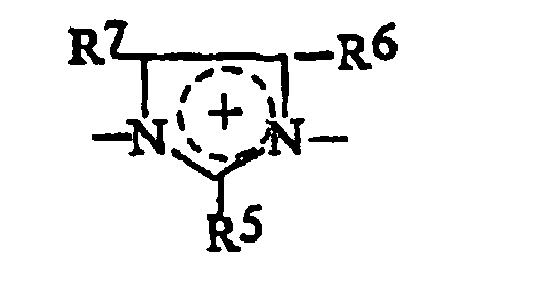 un motif pyrazole quaternisé de structure
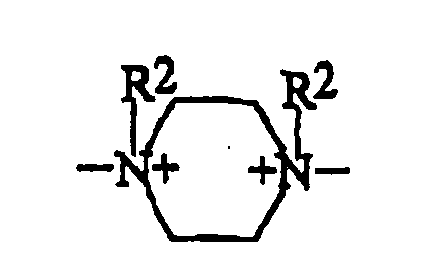
 un motif pipérazine diquaternisé de structure
 un motif pipérazine monoquaternisé de structure
 un motif pipérazine monoquaternisé de structure
 un motif monoquaternisé de structuredans laquelle

R2 représente un reste hydrocarboné monovalent, à chaîne droite, cyclique ou ramifiée, saturé, insaturé ou aromatique comprenant jusqu'à 100 atomes de carbone, qui peut contenir un ou plusieurs groupes choisis parmi -O-, -NH-, -C(O)- et -C(S)- et qui peut être substitué le cas échéant par un ou plusieurs substituants choisis dans le groupe constitué par un groupe hydroxyle, un groupe hétérocyclique le cas échéant substitué et de préférence contenant un ou plusieurs atomes d'azote, des restes amino, alkylamino, dialkylamino, ammonio, polyéther et polyéther ester et, lorsque plusieurs groupes -CONR2- sont présents, ils peuvent être identiques ou différents,
R3 a la même signification que R2, R2 et R3 pouvant être identiques ou différents,
R2 et R3 pris ensemble avec l'atome d'azote chargé positivement forment un hétérocycle de cinq à sept termes qui peut le cas échéant contenir en plus un ou plusieurs atomes d'azote, d'oxygène et/ou de soufre,
R5, R6, R7 peuvent être identiques ou différents et sont choisis dans le groupe constitué par l'hydrogène, un halogène, un groupe hydroxyle, un groupe nitro, un groupe cyano, un groupe thiol, un groupe carboxyle, un groupe alkyle, un groupe monohydroxyalkyle, un groupe polyhydroxyalkyle, un groupe thioalkyle, un groupe cyanoalkyle, un groupe alcoxy, un groupe acyle, un groupe acétyloxy, un groupe cycloalkyle, un groupe aryle, un groupe alkylaryle, et des groupes de type -NHRW dans lesquels RW représente l'hydrogène, un groupe alkyle, un groupe monohydroxyalkyle, un groupe polyhydroxyalkyle, un groupe acétyle, un groupe uréido, et deux restes voisins parmi R5, R6 et R7 peuvent former des noyaux cycliques de cinq à sept termes avec les atomes de carbone aromatiques qui les relient à l'hétérocycle, et
R8 la signification de R2, R8 et R2 pouvant être identiques ou différents,
et dans lequel
Q n'est pas relié à un atome de carbone d'un carbonyle,
V représente au moins un groupe V1 et au moins un groupe V2, dans lequel
V2 est choisi parmi des restes hydrocarbonés divalents ou trivalents, à chaîne droite, cyclique ou ramifiée, saturés, insaturés ou aromatiques comprenant jusqu'à 1000 atomes de carbone (les atomes de carbone du reste polysiloxane Z2 défini ci-dessous n'étant pas inclus dans le décompte) qui peuvent contenir le cas échéant un ou plusieurs groupes choisis parmi
-O-, -CONH-,
-CONR2-, où R2 est tel que défini ci-dessus,
-C(O)- et -C(S)-, et
le reste V2 peut être substitué le cas échéant par un ou plusieurs groupes hydroxyle, et
le reste V2 contient au moins un groupe -Z2- de formule
les R1 peuvent être identiques ou différents et sont choisis dans le groupe constitué par un alkyle en C1 à C22, un fluoroalkyle en C1 à C10 et un aryle en C6 à C10, et
n1 vaut de 20 à 1000,
V1 est choisi parmi des restes hydrocarbonés divalents ou trivalents, à chaîne droite, cyclique ou ramifiée, saturés, insaturés ou aromatiques comprenant jusqu'à 1000 atomes de carbone, qui peuvent contenir le cas échéant un ou plusieurs groupes choisis parmi
-O-, -CONH-,
-CONR2-, où R2 est tel que défini ci-dessus, les groupes R2 dans les groupes V1 et V2 pouvant être identiques ou différents,
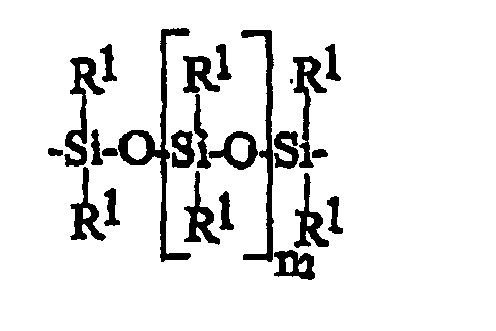
-C(O)-, -C(S)- et -Z1-, où -Z1- est un groupe de formule
R1 est tel que défini ci-dessus, les groupes R1 dans les groupes V1 et V2 pouvant être identiques ou différents, et
n2 vaut de 0 à 19,
et le reste V1 peut être substitué le cas échéant par un ou plusieurs groupes hydroxyle,
étant précisé que- le reste V1 ne peut pas présenter de groupe(s) ester -C(O)-O- ou -O-C(O)-,- les restes Q trivalents et les restes V1 ou V2 trivalents servent exclusivement à la saturation réciproque à l'intérieur de la chaîne principale linéaire des copolymères de polysiloxane précités, et- dans le copolymère de polysiloxane précité, le rapport molaire V2/V1 est ≠ 1,et dans lequel les charges positives résultant des groupes ammonio sont neutralisées par des anions d'acides organiques ou inorganiques,
ainsi que leurs sels d'addition acide. - Copolymères linéaires de polyammonium et de polysiloxane selon la revendication 1, dans lesquels V2 est un groupe de formule
-V2*-Z2-V2*-
dans laquelle Z2 est tel que défini ci-dessus et V2* représente un reste hydrocarboné divalent à chaîne droite, cyclique ou ramifiée, saturé, insaturé ou aromatique comprenant jusqu'à 40 atomes de carbone, qui peut contenir le cas échéant un ou plusieurs groupes choisis parmi -O-, - CONH-, -CONR2-, où R2 est tel que défini ci-dessus, -C(O)- et -C(S)-, et le reste V2* peut être substitué le cas échéant par un ou plusieurs groupes hydroxyle. - Copolymères linéaires de polyammonium et de polysiloxane selon la revendication 1 ou la revendication 2, dans lesquels le groupe V1 est choisi parmi des restes hydrocarbonés divalents, à chaîne droite, cyclique ou ramifiée, saturés, insaturés ou aromatiques comprenant jusqu'à 600 atomes de carbone, qui peuvent contenir le cas échéant un ou plusieurs groupes choisis parmi - O-, -CONH-, -CONR2-, où R2 est tel que défini ci-dessus, -C(O)-, -C(S)- et -Z1-, où -Z1- est un groupe de formule
- Copolymères linéaires de polyammonium et de polysiloxane selon l'une des revendications 1 à 3, dans lesquels le rapport molaire V2/V1 satisfait la relation
V2/V1<1.
- Copolymères linéaires de polyammonium et de polysiloxane selon l'une des revendications 1 à 4, dans lequel le rapport molaire V2/V1 satisfait la relation
0,0005 < V2/V1 < 0,9
- Procédé de production des copolymères linéaires de polyammonium et de polysiloxane selon l'une des revendications 1 à 5, dans lequela) au moins un composé amine, choisi parmi un composé diamine et/ou un composé monoamine primaire ou secondaire, est mis à réagir avec au moins deux composés organiques difonctionnels aptes à réagir avec les fonctions amino du composé amine, le rapport molaire des composés organiques étant choisi de manière à satisfaire la condition V2/V1 ≠ 1,b) au moins deux moles d'un composé amine, choisi parmi un composé diamine et/ou un composé monoamine primaire ou secondaire, sont mises à réagir avec une mole d'un composé organique difonctionnel apte à réagir avec les fonctions amino du composé amine en formant un composé diamine (monomère) qui est ensuite mis à réagir avec au moins un composé amine, choisi parmi un composé diamine et/ou un composé monoamine primaire ou secondaire, et avec au moins un autre composé organique difonctionnel apte à réagir avec les fonctions amino des composés amines,c) un composé amine, choisi parmi un composé diamine et/ou un composé monoamine primaire ou secondaire, est mis à réagir avec un composé organique difonctionnel apte à réagir avec les fonctions amino des composés amines en formant un composé diamine (oligomère aminoterminé) qui est ensuite mis à réagir avec au moins un composé organique difonctionnel apte à réagir avec les fonctions amino des composés diamines,d) un composé amine, choisi parmi un composé diamine et/ou un composé monoamine primaire ou secondaire, est mis à réagir avec un composé organique difonctionnel apte à réagir avec les fonctions amino des composés amines en formant un composé difonctionnel apte à réagir avec des fonctions amino (oligomère difonctionnel) qui est ensuite mis à réagir avec au moins un composé amine, choisi parmi un composé diamine et/ou un composé monoamine primaire ou secondaire, et au moins un autre composé apte à réagir avec des fonctions amino,dans lequel des monoamines monofonctionnelles, de préférence tertiaires, ou des monoamines appropriées inaptes à prolonger la chaîne et/ou des composés monofonctionnels aptes à réagir avec des fonctions amino peuvent le cas échéant être ajoutés à la réaction comme agents de rupture de chaîne et la stoechiométrie des fonctions amino et des groupes fonctionnels aptes à réagir avec des fonctions amino dans la dernière étape de la réaction est toujours sensiblement égale à 1:1, et
dans lequel les fonctions amino éventuellement présentes peuvent être protonées, alkylées ou quaternisées. - Procédé selon la revendication 6, dans lequel les groupes fonctionnels des composés difonctionnels aptes à réagir avec des fonctions amino sont choisis dans le groupe constitué par des groupes époxy et des groupes haloalkyle.
- Utilisation des copolymères linéaires de polyammonium et de polysiloxane selon l'une des revendications 1 à 5 ainsi que des copolymères linéaires de polyammonium et de polysiloxane obtenus suivant la revendication 6 ou la revendication 7 dans des formulations cosmétiques, dans des détergents ou pour le traitement de surface de substrats.
- Utilisation selon la revendication 8 pour traiter ou apprêter des fibres.
- Compositions contenant au moins un copolymère linéaire de polyammonium et de polysiloxane selon l'une quelconque des revendications 1 à 5 ou l'un au moins des copolymères linéaires de polyammonium et de polysiloxane obtenus suivants l'une des revendications 6 ou 7 ensemble avec au moins un autre constituant habituel pour la composition.
- Composition selon la revendication 10, qui est une composition de détergent ou une composition cosmétique.
Applications Claiming Priority (3)
| Application Number | Priority Date | Filing Date | Title |
|---|---|---|---|
| DE10251524 | 2002-11-04 | ||
| DE10251524 | 2002-11-04 | ||
| PCT/EP2003/050773 WO2004042136A1 (fr) | 2002-11-04 | 2003-10-31 | Copolymeres polysiloxane polyamino et/ou polyammonium ii lineaires |
Publications (2)
| Publication Number | Publication Date |
|---|---|
| EP1563136A1 EP1563136A1 (fr) | 2005-08-17 |
| EP1563136B1 true EP1563136B1 (fr) | 2008-05-14 |
Family
ID=32308479
Family Applications (1)
| Application Number | Title | Priority Date | Filing Date |
|---|---|---|---|
| EP03810454A Expired - Lifetime EP1563136B1 (fr) | 2002-11-04 | 2003-10-31 | Copolymeres polysiloxane polyamino et/ou polyammonium ii lineaires |
Country Status (12)
| Country | Link |
|---|---|
| US (1) | US7563856B2 (fr) |
| EP (1) | EP1563136B1 (fr) |
| JP (1) | JP2006505643A (fr) |
| CN (1) | CN100487025C (fr) |
| AT (1) | ATE395458T1 (fr) |
| AU (1) | AU2003301831A1 (fr) |
| BR (1) | BRPI0315973A8 (fr) |
| CA (1) | CA2504981A1 (fr) |
| DE (1) | DE50309853D1 (fr) |
| ES (1) | ES2308036T3 (fr) |
| MX (1) | MXPA05004751A (fr) |
| WO (1) | WO2004042136A1 (fr) |
Families Citing this family (45)
| Publication number | Priority date | Publication date | Assignee | Title |
|---|---|---|---|---|
| CA2504910A1 (fr) * | 2002-11-04 | 2004-05-21 | Ge Bayer Silicones Gmbh & Co. Kg | Copolymeres polyamino-polysiloxane et/ou polyammonium-polysiloxane lineaires i |
| WO2004069137A2 (fr) * | 2003-02-07 | 2004-08-19 | Ge Bayer Silicones Gmbh & Co. Kg | Utilisation de copolymeres de polyamino- et/ou polyammonium-polysiloxane |
| DE102005014311A1 (de) * | 2005-03-30 | 2006-10-12 | Ge Bayer Silicones Gmbh & Co. Kg | Polyamino- und/oder Polyammonium-Polysiloxan-Colpolymer-Verbindungen mit kammartig angeordneten Polyalkylenonideinheiten |
| DE102005036602A1 (de) | 2005-08-01 | 2007-02-08 | Ge Bayer Silicones Gmbh & Co. Kg | Polyammonium-Polysiloxancopolymere |
| DE102007012908A1 (de) | 2007-03-19 | 2008-09-25 | Momentive Performance Materials Gmbh | Neue Polyamid-Polysiloxan-Verbindungen |
| CN101675095B (zh) | 2007-04-11 | 2012-11-28 | 陶氏康宁公司 | 具有有机基官能的封端基的硅氧烷聚醚嵌段共聚物 |
| WO2008138363A1 (fr) * | 2007-05-10 | 2008-11-20 | Evonik Goldschmidt Gmbh | Copolymères séquencés de polyéthers et de polysiloxanes contenant de l'azote, procédé pour leur préparation et leur utilisation pour améliorer les propriétés de surface de tissus et de fibres |
| DE102007023869A1 (de) | 2007-05-21 | 2008-12-18 | Momentive Performance Materials Gmbh & Co. Kg | Neue Polycarbonat- und/oder Polyurethan-Polyorganosiloxan-Verbindungen |
| DE102007027027A1 (de) | 2007-06-08 | 2008-12-11 | Momentive Performance Materials Gmbh & Co. Kg | Neue Polyharnstoff- und/oder Polyurethan-Polyorganosiloxan-Verbindungen |
| DE102007044148A1 (de) * | 2007-09-15 | 2009-03-26 | Evonik Goldschmidt Gmbh | Neuartige siloxanhaltige Blockcopolymere, Verfahren zu deren Herstellung und deren Verwendung für Schmiermittel |
| JP2010540789A (ja) * | 2007-09-25 | 2010-12-24 | モメンティブ パフォーマンス マテリアルズ インコーポレイテッド | 合成繊維の表面を改質する方法 |
| DE102008013584A1 (de) | 2008-03-11 | 2009-09-17 | Momentive Performance Materials Gmbh | Neue Polycarbonat-Polyorganosiloxan- und/oder Polyurethan-Polyorganosiloxan-Verbindungen |
| US20090233836A1 (en) * | 2008-03-11 | 2009-09-17 | The Procter & Gamble Company | Perfuming method and product |
| DE102008014761A1 (de) * | 2008-03-18 | 2009-12-10 | Momentive Performance Materials Gmbh | Verwendung von Polyamino- und/oder Polyammonium-Polysiloxan-Copolymer-Verbindungen |
| DE102008001867A1 (de) * | 2008-05-19 | 2009-11-26 | Wacker Chemie Ag | Verfahren zur Herstellung von quartäre Ammoniumgruppen aufweisenden Organopolysiloxanen |
| US20110112328A1 (en) * | 2009-11-06 | 2011-05-12 | Drovetskaya Tatiana V | Difunctional, Amine-Based Surfactants, and Their Precursors, Preparation, Compositions and Use |
| EP2529001B1 (fr) * | 2010-01-29 | 2018-09-19 | The Procter and Gamble Company | Nouveaux copolymères de polydiméthylsiloxane linéaire-polyéther avec des groupes amino et/ou ammonium quaternaire et utilisation de ceux-ci |
| WO2011131668A1 (fr) | 2010-04-19 | 2011-10-27 | Georg-August-Universität Göttingen Stiftung Öffentlichen Rechts | Composés de polyorganosiloxane pour protéger le bois contre les termites |
| WO2012058657A2 (fr) * | 2010-10-29 | 2012-05-03 | Hardcoat Surfaces Llc | Revêtement très dur à faible énergie de surface |
| CN104508012B (zh) * | 2012-07-27 | 2017-05-24 | 宝洁公司 | 有机聚硅氧烷聚合物 |
| CN103396551B (zh) * | 2012-09-14 | 2015-09-30 | 深圳市泰康新材料科技有限公司 | 一种咪唑基改性硅油及其制备与应用 |
| US9198849B2 (en) | 2013-07-03 | 2015-12-01 | The Procter & Gamble Company | Shampoo composition comprising low viscosity emulsified silicone polymers |
| US10414873B2 (en) | 2013-07-29 | 2019-09-17 | The Procter & Gamble Company | Organopolysiloxane polymers |
| US10081910B2 (en) | 2013-07-29 | 2018-09-25 | The Procter & Gamble Company | Absorbent articles comprising organopolysiloxane conditioning polymers |
| US9540489B2 (en) | 2013-07-29 | 2017-01-10 | The Procter & Gamble Company | Blocky cationic organopolysiloxane |
| US9611362B2 (en) | 2013-07-29 | 2017-04-04 | The Procter & Gamble Company | Cationic organopolysiloxanes |
| US9993418B2 (en) | 2013-07-29 | 2018-06-12 | The Procter & Gamble Company | Benefit agent emulsions and consumer products containing such emulsions |
| US9963470B2 (en) | 2013-07-29 | 2018-05-08 | The Procter & Gamble Company | Branched blocky cationic organopolysiloxane |
| US9580670B2 (en) | 2013-07-29 | 2017-02-28 | The Procter & Gamble Company | Consumer product compositions comprising organopolysiloxane conditioning polymers |
| US9701929B2 (en) | 2013-07-29 | 2017-07-11 | The Procter & Gamble Company | Consumer product compositions comprising organopolysiloxane emulsions |
| DE102013219046A1 (de) | 2013-09-23 | 2015-03-26 | Rudolf Gmbh | Polysiloxane mit quaternierten heterocyclischen Gruppen |
| EP3049050B1 (fr) | 2013-09-27 | 2018-10-24 | The Procter and Gamble Company | Compositions capillaires conditionnantes comprenant des polymeres de silicone emulsifies de basse viscosite |
| CN103709412B (zh) * | 2013-12-27 | 2016-04-20 | 成都硅宝科技股份有限公司 | 杂化有机硅热塑性弹性体及其制备方法 |
| CN104800102A (zh) * | 2014-01-29 | 2015-07-29 | 道康宁公司 | 包含弹性体的化妆品组合物 |
| JP2017014408A (ja) | 2015-07-02 | 2017-01-19 | 信越化学工業株式会社 | オルガノポリシロキサン並びに毛髪化粧料及びその製造方法 |
| CN105886148A (zh) * | 2016-06-21 | 2016-08-24 | 南雄鼎成新材料科技有限公司 | 一种多功能洗车浓缩液 |
| US10160834B2 (en) | 2016-07-13 | 2018-12-25 | Momentive Performance Materials Inc. | Low viscosity polyorganosiloxanes comprising quaternary ammonium groups, methods for the production and the use thereof |
| US10982051B2 (en) | 2017-06-05 | 2021-04-20 | Momentive Performance Materials Inc. | Aqueous compositions for hair treatment comprising polyorganosiloxanes with polyhydroxyaromatic moieties |
| US11179312B2 (en) | 2017-06-05 | 2021-11-23 | Momentive Performance Materials Inc. | Aqueous compositions for the treatment of hair |
| EP3501488B1 (fr) | 2017-12-21 | 2021-04-14 | Momentive Performance Materials GmbH | Compositions aqueuses de polymère de silicone |
| US20200163850A1 (en) | 2018-11-24 | 2020-05-28 | Momentive Performance Materials Gmbh | Use of polyhydroxyaromatic compounds for the treatment of fibrous amino acid based substrates |
| US10617617B1 (en) | 2018-12-04 | 2020-04-14 | Momentive Performance Materials Inc. | Polycarboxylic acid compounds for the treatment of fibrious amino acid based substrates, especially hair |
| US11090255B2 (en) | 2018-12-04 | 2021-08-17 | Momentive Performance Materials Inc. | Use of polycarboxylic acid compounds for the treatment of fibrious amino acid based substrates, especially hair |
| WO2025014642A2 (fr) * | 2023-07-12 | 2025-01-16 | The Regents Of The University Of Colorado, A Body Corporate | Compositions, procédés de fabrication et procédés d'utilisation de polymères antimicrobiens multifonctionnels |
| CN118994594B (zh) * | 2024-09-03 | 2025-05-16 | 宁波润禾高新材料科技股份有限公司 | 毛巾用的有机硅柔软剂材料、制备方法及其应用 |
Family Cites Families (18)
| Publication number | Priority date | Publication date | Assignee | Title |
|---|---|---|---|---|
| LU84463A1 (fr) * | 1982-11-10 | 1984-06-13 | Oreal | Polymeres polysiloxanes polyquaternaires |
| DE3705121A1 (de) | 1987-02-18 | 1988-09-01 | Goldschmidt Ag Th | Polyquaternaere polysiloxan-polymere, deren herstellung und verwendung in kosmetischen zubereitungen |
| EP0824563B1 (fr) * | 1996-03-04 | 2005-06-15 | General Electric Company | Copolymeres blocs de silicone et d'aminopolyalkyleneoxyde |
| FR2777010B1 (fr) * | 1998-04-01 | 2000-06-16 | Oreal | Polymeres silicies de polyammonium quaternaire heterocyclique et leur utilisation dans les compositions cosmetiques |
| JP2001158792A (ja) * | 1999-12-03 | 2001-06-12 | Asahi Kasei Corp | エポキシ化合物 |
| EP1309648B1 (fr) * | 2000-07-27 | 2006-09-20 | GE Bayer Silicones GmbH & Co. KG | Polysiloxanes mono ou poly-quaternaires |
| AU2001291687A1 (en) * | 2000-07-27 | 2002-02-13 | Ge Bayer Silicones Gmbh And Co. Kg | Polyammonium-polysiloxane compounds, methods for the production and use thereof |
| DE10036699A1 (de) | 2000-07-27 | 2002-02-07 | Wacker Chemie Gmbh | Aminogruppen aufweisende Organosiliciumverbindungen |
| US7041767B2 (en) * | 2000-07-27 | 2006-05-09 | Ge Bayer Silicones Gmbh & Co. Kg | Polysiloxane polymers, method for their production and the use thereof |
| US6903061B2 (en) * | 2000-08-28 | 2005-06-07 | The Procter & Gamble Company | Fabric care and perfume compositions and systems comprising cationic silicones and methods employing same |
| DE10051258A1 (de) * | 2000-10-16 | 2002-04-25 | Goldschmidt Rewo Gmbh & Co Kg | Verwendung von quaternären Polysiloxanen in Waschmittelformulierungen |
| JP4539805B2 (ja) * | 2001-04-12 | 2010-09-08 | ライオン株式会社 | 外用剤 |
| JP2003002948A (ja) * | 2001-06-20 | 2003-01-08 | Toray Ind Inc | コンクリート構造物の補修・補強用エポキシ樹脂組成物、およびそれを用いてなる補修・補強方法 |
| US6818610B2 (en) * | 2001-07-27 | 2004-11-16 | Procter & Gamble Company | Fabric care systems for providing anti-wrinkle benefits to fabric |
| JP4801322B2 (ja) * | 2002-03-20 | 2011-10-26 | モーメンテイブ・パーフオーマンス・マテリアルズ・ゲゼルシヤフト・ミツト・ベシユレンクテル・ハフツング | 分枝ポリオルガノシロキサン重合体 |
| JP3866676B2 (ja) * | 2002-04-25 | 2007-01-10 | 三洋化成工業株式会社 | グラウト材組成物 |
| CA2504910A1 (fr) * | 2002-11-04 | 2004-05-21 | Ge Bayer Silicones Gmbh & Co. Kg | Copolymeres polyamino-polysiloxane et/ou polyammonium-polysiloxane lineaires i |
| DE102004002208B4 (de) * | 2004-01-15 | 2011-03-17 | Rudolf Gmbh & Co. Kg Chemische Fabrik | Zubereitungen auf Basis von Organopolysiloxan-Polyammonium-Blockcopolymeren und deren Anwendung auf textilen Substraten |
-
2003
- 2003-10-31 JP JP2004549174A patent/JP2006505643A/ja active Pending
- 2003-10-31 EP EP03810454A patent/EP1563136B1/fr not_active Expired - Lifetime
- 2003-10-31 BR BRPI0315973A patent/BRPI0315973A8/pt not_active IP Right Cessation
- 2003-10-31 DE DE50309853T patent/DE50309853D1/de not_active Expired - Lifetime
- 2003-10-31 AT AT03810454T patent/ATE395458T1/de not_active IP Right Cessation
- 2003-10-31 CA CA002504981A patent/CA2504981A1/fr not_active Abandoned
- 2003-10-31 WO PCT/EP2003/050773 patent/WO2004042136A1/fr not_active Ceased
- 2003-10-31 AU AU2003301831A patent/AU2003301831A1/en not_active Abandoned
- 2003-10-31 ES ES03810454T patent/ES2308036T3/es not_active Expired - Lifetime
- 2003-10-31 US US10/533,837 patent/US7563856B2/en not_active Expired - Lifetime
- 2003-10-31 CN CNB2003801082329A patent/CN100487025C/zh not_active Expired - Lifetime
- 2003-10-31 MX MXPA05004751A patent/MXPA05004751A/es active IP Right Grant
Also Published As
| Publication number | Publication date |
|---|---|
| US20060235181A1 (en) | 2006-10-19 |
| BR0315973B1 (pt) | 2013-03-19 |
| MXPA05004751A (es) | 2005-08-03 |
| US7563856B2 (en) | 2009-07-21 |
| DE50309853D1 (de) | 2008-06-26 |
| AU2003301831A1 (en) | 2004-06-07 |
| WO2004042136A1 (fr) | 2004-05-21 |
| ATE395458T1 (de) | 2008-05-15 |
| CN100487025C (zh) | 2009-05-13 |
| CN1735728A (zh) | 2006-02-15 |
| EP1563136A1 (fr) | 2005-08-17 |
| ES2308036T3 (es) | 2008-12-01 |
| BR0315973A (pt) | 2005-09-27 |
| CA2504981A1 (fr) | 2004-05-21 |
| BRPI0315973A8 (pt) | 2018-05-15 |
| JP2006505643A (ja) | 2006-02-16 |
Similar Documents
| Publication | Publication Date | Title |
|---|---|---|
| EP1565512B1 (fr) | Copolymères polyamino-polysiloxane et/ou polyammonium-polysiloxane linéaires i | |
| WO2004042136A1 (fr) | Copolymeres polysiloxane polyamino et/ou polyammonium ii lineaires | |
| EP1627008B1 (fr) | Compos s de polysiloxane amino et/ou ammonium r actifs | |
| WO2003078504A1 (fr) | Polymères de polyorganosiloxanes ramifiés | |
| EP2444447B1 (fr) | Polysiloxane doté de groupes contenant de l'azote | |
| EP2528660B1 (fr) | Nouveaux copolymères linéaires de polyéther polydiméthylsiloxane comportant des groupes amino et/ou ammonium quaternaire et leur utilisation | |
| EP1887023B1 (fr) | Polysiloxane d'un nouveau type doté de groupes d'ammonium quaternaires, son procédé de fabrication et son utilisation en tant qu'adoucissant pour textiles | |
| EP1309649B1 (fr) | Composes de polyammonium-polysiloxane et procedes de preparation et d'utilisation desdits composes | |
| EP1917290B1 (fr) | Copolymeres de polyammonium-polysiloxane | |
| WO2004046452A2 (fr) | Formulations pour traiter la surface de substrats | |
| DE102013206175A1 (de) | Polysiloxan-Polyether-Copolymere mit Amino- und/oder quaternären Ammoniumgruppen im Polyetherteil und Verfahren zu deren Herstellung | |
| DE3705121A1 (de) | Polyquaternaere polysiloxan-polymere, deren herstellung und verwendung in kosmetischen zubereitungen | |
| WO2006103075A1 (fr) | Composés copolymères de polyamino et / ou polyammonium / polysiloxane à unités oxyde de polyalkylène disposées en forme de peigne | |
| DE102007015372A1 (de) | Polysiloxan und Textilhilfsmittel enthaltend ein Polysiloxan | |
| DE102004034266A1 (de) | Schichtsilikat-enthaltende Polysiloxan-Zusammensetzungen | |
| EP1625180B1 (fr) | Compositions du type polyorganosiloxane pour le traitement de substrats | |
| EP2260140B1 (fr) | Utilisation de composés à base de composés à base de copolymères polyamine- et/ou polyammonium-polysiloxane |
Legal Events
| Date | Code | Title | Description |
|---|---|---|---|
| PUAI | Public reference made under article 153(3) epc to a published international application that has entered the european phase |
Free format text: ORIGINAL CODE: 0009012 |
|
| 17P | Request for examination filed |
Effective date: 20050606 |
|
| AK | Designated contracting states |
Kind code of ref document: A1 Designated state(s): AT BE BG CH CY CZ DE DK EE ES FI FR GB GR HU IE IT LI LU MC NL PT RO SE SI SK TR |
|
| AX | Request for extension of the european patent |
Extension state: AL LT LV MK |
|
| DAX | Request for extension of the european patent (deleted) | ||
| 17Q | First examination report despatched |
Effective date: 20070115 |
|
| GRAP | Despatch of communication of intention to grant a patent |
Free format text: ORIGINAL CODE: EPIDOSNIGR1 |
|
| RAP1 | Party data changed (applicant data changed or rights of an application transferred) |
Owner name: MOMENTIVE PERFORMANCE MATERIALS GMBH |
|
| GRAS | Grant fee paid |
Free format text: ORIGINAL CODE: EPIDOSNIGR3 |
|
| GRAA | (expected) grant |
Free format text: ORIGINAL CODE: 0009210 |
|
| AK | Designated contracting states |
Kind code of ref document: B1 Designated state(s): AT BE BG CH CY CZ DE DK EE ES FI FR GB GR HU IE IT LI LU MC NL PT RO SE SI SK TR |
|
| REG | Reference to a national code |
Ref country code: GB Ref legal event code: FG4D Free format text: NOT ENGLISH |
|
| REG | Reference to a national code |
Ref country code: CH Ref legal event code: EP |
|
| REG | Reference to a national code |
Ref country code: IE Ref legal event code: FG4D Free format text: LANGUAGE OF EP DOCUMENT: GERMAN |
|
| REF | Corresponds to: |
Ref document number: 50309853 Country of ref document: DE Date of ref document: 20080626 Kind code of ref document: P |
|
| PG25 | Lapsed in a contracting state [announced via postgrant information from national office to epo] |
Ref country code: SI Free format text: LAPSE BECAUSE OF FAILURE TO SUBMIT A TRANSLATION OF THE DESCRIPTION OR TO PAY THE FEE WITHIN THE PRESCRIBED TIME-LIMIT Effective date: 20080514 |
|
| PG25 | Lapsed in a contracting state [announced via postgrant information from national office to epo] |
Ref country code: FI Free format text: LAPSE BECAUSE OF FAILURE TO SUBMIT A TRANSLATION OF THE DESCRIPTION OR TO PAY THE FEE WITHIN THE PRESCRIBED TIME-LIMIT Effective date: 20080514 |
|
| REG | Reference to a national code |
Ref country code: ES Ref legal event code: FG2A Ref document number: 2308036 Country of ref document: ES Kind code of ref document: T3 |
|
| REG | Reference to a national code |
Ref country code: IE Ref legal event code: FD4D |
|
| PG25 | Lapsed in a contracting state [announced via postgrant information from national office to epo] |
Ref country code: SE Free format text: LAPSE BECAUSE OF FAILURE TO SUBMIT A TRANSLATION OF THE DESCRIPTION OR TO PAY THE FEE WITHIN THE PRESCRIBED TIME-LIMIT Effective date: 20080814 Ref country code: IE Free format text: LAPSE BECAUSE OF FAILURE TO SUBMIT A TRANSLATION OF THE DESCRIPTION OR TO PAY THE FEE WITHIN THE PRESCRIBED TIME-LIMIT Effective date: 20080514 Ref country code: PT Free format text: LAPSE BECAUSE OF FAILURE TO SUBMIT A TRANSLATION OF THE DESCRIPTION OR TO PAY THE FEE WITHIN THE PRESCRIBED TIME-LIMIT Effective date: 20081014 Ref country code: CZ Free format text: LAPSE BECAUSE OF FAILURE TO SUBMIT A TRANSLATION OF THE DESCRIPTION OR TO PAY THE FEE WITHIN THE PRESCRIBED TIME-LIMIT Effective date: 20080514 Ref country code: DK Free format text: LAPSE BECAUSE OF FAILURE TO SUBMIT A TRANSLATION OF THE DESCRIPTION OR TO PAY THE FEE WITHIN THE PRESCRIBED TIME-LIMIT Effective date: 20080514 |
|
| PG25 | Lapsed in a contracting state [announced via postgrant information from national office to epo] |
Ref country code: SK Free format text: LAPSE BECAUSE OF FAILURE TO SUBMIT A TRANSLATION OF THE DESCRIPTION OR TO PAY THE FEE WITHIN THE PRESCRIBED TIME-LIMIT Effective date: 20080514 Ref country code: RO Free format text: LAPSE BECAUSE OF FAILURE TO SUBMIT A TRANSLATION OF THE DESCRIPTION OR TO PAY THE FEE WITHIN THE PRESCRIBED TIME-LIMIT Effective date: 20080514 |
|
| PLBE | No opposition filed within time limit |
Free format text: ORIGINAL CODE: 0009261 |
|
| STAA | Information on the status of an ep patent application or granted ep patent |
Free format text: STATUS: NO OPPOSITION FILED WITHIN TIME LIMIT |
|
| 26N | No opposition filed |
Effective date: 20090217 |
|
| PG25 | Lapsed in a contracting state [announced via postgrant information from national office to epo] |
Ref country code: BG Free format text: LAPSE BECAUSE OF FAILURE TO SUBMIT A TRANSLATION OF THE DESCRIPTION OR TO PAY THE FEE WITHIN THE PRESCRIBED TIME-LIMIT Effective date: 20080814 Ref country code: EE Free format text: LAPSE BECAUSE OF FAILURE TO SUBMIT A TRANSLATION OF THE DESCRIPTION OR TO PAY THE FEE WITHIN THE PRESCRIBED TIME-LIMIT Effective date: 20080514 |
|
| PG25 | Lapsed in a contracting state [announced via postgrant information from national office to epo] |
Ref country code: MC Free format text: LAPSE BECAUSE OF NON-PAYMENT OF DUE FEES Effective date: 20081031 |
|
| REG | Reference to a national code |
Ref country code: CH Ref legal event code: PL |
|
| PG25 | Lapsed in a contracting state [announced via postgrant information from national office to epo] |
Ref country code: CH Free format text: LAPSE BECAUSE OF NON-PAYMENT OF DUE FEES Effective date: 20081031 Ref country code: LI Free format text: LAPSE BECAUSE OF NON-PAYMENT OF DUE FEES Effective date: 20081031 |
|
| PG25 | Lapsed in a contracting state [announced via postgrant information from national office to epo] |
Ref country code: AT Free format text: LAPSE BECAUSE OF NON-PAYMENT OF DUE FEES Effective date: 20081031 |
|
| PG25 | Lapsed in a contracting state [announced via postgrant information from national office to epo] |
Ref country code: HU Free format text: LAPSE BECAUSE OF FAILURE TO SUBMIT A TRANSLATION OF THE DESCRIPTION OR TO PAY THE FEE WITHIN THE PRESCRIBED TIME-LIMIT Effective date: 20081115 Ref country code: CY Free format text: LAPSE BECAUSE OF FAILURE TO SUBMIT A TRANSLATION OF THE DESCRIPTION OR TO PAY THE FEE WITHIN THE PRESCRIBED TIME-LIMIT Effective date: 20080514 Ref country code: LU Free format text: LAPSE BECAUSE OF NON-PAYMENT OF DUE FEES Effective date: 20081031 |
|
| PG25 | Lapsed in a contracting state [announced via postgrant information from national office to epo] |
Ref country code: GR Free format text: LAPSE BECAUSE OF FAILURE TO SUBMIT A TRANSLATION OF THE DESCRIPTION OR TO PAY THE FEE WITHIN THE PRESCRIBED TIME-LIMIT Effective date: 20080815 |
|
| PGFP | Annual fee paid to national office [announced via postgrant information from national office to epo] |
Ref country code: BE Payment date: 20131028 Year of fee payment: 11 |
|
| PGFP | Annual fee paid to national office [announced via postgrant information from national office to epo] |
Ref country code: IT Payment date: 20131024 Year of fee payment: 11 Ref country code: TR Payment date: 20131004 Year of fee payment: 11 Ref country code: ES Payment date: 20131028 Year of fee payment: 11 |
|
| PGFP | Annual fee paid to national office [announced via postgrant information from national office to epo] |
Ref country code: GB Payment date: 20141027 Year of fee payment: 12 |
|
| PGFP | Annual fee paid to national office [announced via postgrant information from national office to epo] |
Ref country code: NL Payment date: 20141026 Year of fee payment: 12 |
|
| PG25 | Lapsed in a contracting state [announced via postgrant information from national office to epo] |
Ref country code: BE Free format text: LAPSE BECAUSE OF NON-PAYMENT OF DUE FEES Effective date: 20141031 |
|
| PG25 | Lapsed in a contracting state [announced via postgrant information from national office to epo] |
Ref country code: IT Free format text: LAPSE BECAUSE OF NON-PAYMENT OF DUE FEES Effective date: 20141031 |
|
| REG | Reference to a national code |
Ref country code: FR Ref legal event code: PLFP Year of fee payment: 13 |
|
| REG | Reference to a national code |
Ref country code: ES Ref legal event code: FD2A Effective date: 20151126 |
|
| PG25 | Lapsed in a contracting state [announced via postgrant information from national office to epo] |
Ref country code: ES Free format text: LAPSE BECAUSE OF NON-PAYMENT OF DUE FEES Effective date: 20141101 |
|
| GBPC | Gb: european patent ceased through non-payment of renewal fee |
Effective date: 20151031 |
|
| REG | Reference to a national code |
Ref country code: NL Ref legal event code: MM Effective date: 20151101 |
|
| PG25 | Lapsed in a contracting state [announced via postgrant information from national office to epo] |
Ref country code: GB Free format text: LAPSE BECAUSE OF NON-PAYMENT OF DUE FEES Effective date: 20151031 |
|
| PG25 | Lapsed in a contracting state [announced via postgrant information from national office to epo] |
Ref country code: NL Free format text: LAPSE BECAUSE OF NON-PAYMENT OF DUE FEES Effective date: 20151101 |
|
| REG | Reference to a national code |
Ref country code: FR Ref legal event code: PLFP Year of fee payment: 14 |
|
| PG25 | Lapsed in a contracting state [announced via postgrant information from national office to epo] |
Ref country code: TR Free format text: LAPSE BECAUSE OF NON-PAYMENT OF DUE FEES Effective date: 20141031 |
|
| REG | Reference to a national code |
Ref country code: FR Ref legal event code: PLFP Year of fee payment: 15 |
|
| REG | Reference to a national code |
Ref country code: FR Ref legal event code: PLFP Year of fee payment: 16 |
|
| PGFP | Annual fee paid to national office [announced via postgrant information from national office to epo] |
Ref country code: FR Payment date: 20221025 Year of fee payment: 20 |
|
| PGFP | Annual fee paid to national office [announced via postgrant information from national office to epo] |
Ref country code: DE Payment date: 20221027 Year of fee payment: 20 |
|
| REG | Reference to a national code |
Ref country code: DE Ref legal event code: R071 Ref document number: 50309853 Country of ref document: DE |