EP1562242B1 - Dünne Sekundärbatterie und deren Herstellungsmethode, Sekundärbatteriemodul - Google Patents
Dünne Sekundärbatterie und deren Herstellungsmethode, Sekundärbatteriemodul Download PDFInfo
- Publication number
- EP1562242B1 EP1562242B1 EP05000814.3A EP05000814A EP1562242B1 EP 1562242 B1 EP1562242 B1 EP 1562242B1 EP 05000814 A EP05000814 A EP 05000814A EP 1562242 B1 EP1562242 B1 EP 1562242B1
- Authority
- EP
- European Patent Office
- Prior art keywords
- separator
- thin
- electrolytic solution
- sheet
- outer wrapper
- Prior art date
- Legal status (The legal status is an assumption and is not a legal conclusion. Google has not performed a legal analysis and makes no representation as to the accuracy of the status listed.)
- Expired - Lifetime
Links
- 238000000034 method Methods 0.000 title claims description 50
- 239000008151 electrolyte solution Substances 0.000 claims description 125
- 230000000149 penetrating effect Effects 0.000 claims description 31
- 230000035515 penetration Effects 0.000 claims description 25
- 238000002347 injection Methods 0.000 claims description 11
- 239000007924 injection Substances 0.000 claims description 11
- 238000007789 sealing Methods 0.000 claims description 9
- 230000032683 aging Effects 0.000 claims description 6
- 239000005001 laminate film Substances 0.000 claims description 6
- 238000003780 insertion Methods 0.000 claims description 3
- 230000037431 insertion Effects 0.000 claims description 3
- 230000037303 wrinkles Effects 0.000 description 17
- 239000010410 layer Substances 0.000 description 15
- 230000005855 radiation Effects 0.000 description 12
- 229910052782 aluminium Inorganic materials 0.000 description 10
- XAGFODPZIPBFFR-UHFFFAOYSA-N aluminium Chemical compound [Al] XAGFODPZIPBFFR-UHFFFAOYSA-N 0.000 description 10
- -1 polyethylene Polymers 0.000 description 9
- PXHVJJICTQNCMI-UHFFFAOYSA-N Nickel Chemical compound [Ni] PXHVJJICTQNCMI-UHFFFAOYSA-N 0.000 description 8
- 238000010030 laminating Methods 0.000 description 8
- 238000004519 manufacturing process Methods 0.000 description 8
- 239000002904 solvent Substances 0.000 description 8
- RYGMFSIKBFXOCR-UHFFFAOYSA-N Copper Chemical compound [Cu] RYGMFSIKBFXOCR-UHFFFAOYSA-N 0.000 description 7
- HBBGRARXTFLTSG-UHFFFAOYSA-N Lithium ion Chemical compound [Li+] HBBGRARXTFLTSG-UHFFFAOYSA-N 0.000 description 7
- 239000011888 foil Substances 0.000 description 7
- 229910001416 lithium ion Inorganic materials 0.000 description 7
- 229910052802 copper Inorganic materials 0.000 description 6
- 239000010949 copper Substances 0.000 description 6
- 238000012545 processing Methods 0.000 description 6
- 239000002344 surface layer Substances 0.000 description 6
- RTZKZFJDLAIYFH-UHFFFAOYSA-N Diethyl ether Chemical compound CCOCC RTZKZFJDLAIYFH-UHFFFAOYSA-N 0.000 description 5
- 230000015572 biosynthetic process Effects 0.000 description 5
- 239000000463 material Substances 0.000 description 5
- 238000003466 welding Methods 0.000 description 5
- KMTRUDSVKNLOMY-UHFFFAOYSA-N Ethylene carbonate Chemical compound O=C1OCCO1 KMTRUDSVKNLOMY-UHFFFAOYSA-N 0.000 description 4
- 239000004698 Polyethylene Substances 0.000 description 4
- 239000004743 Polypropylene Substances 0.000 description 4
- 230000005611 electricity Effects 0.000 description 4
- 239000000203 mixture Substances 0.000 description 4
- 239000007773 negative electrode material Substances 0.000 description 4
- 229920000573 polyethylene Polymers 0.000 description 4
- 229920001155 polypropylene Polymers 0.000 description 4
- 239000007774 positive electrode material Substances 0.000 description 4
- 229920005989 resin Polymers 0.000 description 4
- 239000011347 resin Substances 0.000 description 4
- 230000037373 wrinkle formation Effects 0.000 description 4
- 229910001290 LiPF6 Inorganic materials 0.000 description 3
- 238000010438 heat treatment Methods 0.000 description 3
- 239000007769 metal material Substances 0.000 description 3
- 229910052759 nickel Inorganic materials 0.000 description 3
- 238000002360 preparation method Methods 0.000 description 3
- 150000003839 salts Chemical class 0.000 description 3
- XLYOFNOQVPJJNP-UHFFFAOYSA-N water Substances O XLYOFNOQVPJJNP-UHFFFAOYSA-N 0.000 description 3
- DHKHKXVYLBGOIT-UHFFFAOYSA-N 1,1-Diethoxyethane Chemical compound CCOC(C)OCC DHKHKXVYLBGOIT-UHFFFAOYSA-N 0.000 description 2
- OKTJSMMVPCPJKN-UHFFFAOYSA-N Carbon Chemical compound [C] OKTJSMMVPCPJKN-UHFFFAOYSA-N 0.000 description 2
- OIFBSDVPJOWBCH-UHFFFAOYSA-N Diethyl carbonate Chemical compound CCOC(=O)OCC OIFBSDVPJOWBCH-UHFFFAOYSA-N 0.000 description 2
- LCGLNKUTAGEVQW-UHFFFAOYSA-N Dimethyl ether Chemical compound COC LCGLNKUTAGEVQW-UHFFFAOYSA-N 0.000 description 2
- WHXSMMKQMYFTQS-UHFFFAOYSA-N Lithium Chemical compound [Li] WHXSMMKQMYFTQS-UHFFFAOYSA-N 0.000 description 2
- SECXISVLQFMRJM-UHFFFAOYSA-N N-Methylpyrrolidone Chemical compound CN1CCCC1=O SECXISVLQFMRJM-UHFFFAOYSA-N 0.000 description 2
- 239000002033 PVDF binder Substances 0.000 description 2
- 239000011230 binding agent Substances 0.000 description 2
- 239000004020 conductor Substances 0.000 description 2
- 238000010586 diagram Methods 0.000 description 2
- IEJIGPNLZYLLBP-UHFFFAOYSA-N dimethyl carbonate Chemical compound COC(=O)OC IEJIGPNLZYLLBP-UHFFFAOYSA-N 0.000 description 2
- 230000000694 effects Effects 0.000 description 2
- 238000010292 electrical insulation Methods 0.000 description 2
- 150000002500 ions Chemical group 0.000 description 2
- 229910052744 lithium Inorganic materials 0.000 description 2
- 239000012046 mixed solvent Substances 0.000 description 2
- 239000002245 particle Substances 0.000 description 2
- 238000005192 partition Methods 0.000 description 2
- 229920006122 polyamide resin Polymers 0.000 description 2
- 229920000139 polyethylene terephthalate Polymers 0.000 description 2
- 239000005020 polyethylene terephthalate Substances 0.000 description 2
- 229920002981 polyvinylidene fluoride Polymers 0.000 description 2
- 238000001291 vacuum drying Methods 0.000 description 2
- 229910000838 Al alloy Inorganic materials 0.000 description 1
- 229910000552 LiCF3SO3 Inorganic materials 0.000 description 1
- 229910002097 Lithium manganese(III,IV) oxide Inorganic materials 0.000 description 1
- 239000004677 Nylon Substances 0.000 description 1
- 239000004952 Polyamide Substances 0.000 description 1
- 238000010521 absorption reaction Methods 0.000 description 1
- 239000006230 acetylene black Substances 0.000 description 1
- 230000002411 adverse Effects 0.000 description 1
- 238000004891 communication Methods 0.000 description 1
- 239000011889 copper foil Substances 0.000 description 1
- 238000005520 cutting process Methods 0.000 description 1
- JHIVVAPYMSGYDF-UHFFFAOYSA-N cyclohexanone Chemical compound O=C1CCCCC1 JHIVVAPYMSGYDF-UHFFFAOYSA-N 0.000 description 1
- 238000007872 degassing Methods 0.000 description 1
- 230000001419 dependent effect Effects 0.000 description 1
- 238000013461 design Methods 0.000 description 1
- 230000006866 deterioration Effects 0.000 description 1
- QHGJSLXSVXVKHZ-UHFFFAOYSA-N dilithium;dioxido(dioxo)manganese Chemical compound [Li+].[Li+].[O-][Mn]([O-])(=O)=O QHGJSLXSVXVKHZ-UHFFFAOYSA-N 0.000 description 1
- 238000001035 drying Methods 0.000 description 1
- 239000007772 electrode material Substances 0.000 description 1
- 239000003792 electrolyte Substances 0.000 description 1
- 230000008030 elimination Effects 0.000 description 1
- 238000003379 elimination reaction Methods 0.000 description 1
- 230000007613 environmental effect Effects 0.000 description 1
- 239000003759 ester based solvent Substances 0.000 description 1
- JBTWLSYIZRCDFO-UHFFFAOYSA-N ethyl methyl carbonate Chemical compound CCOC(=O)OC JBTWLSYIZRCDFO-UHFFFAOYSA-N 0.000 description 1
- 238000002474 experimental method Methods 0.000 description 1
- 239000000446 fuel Substances 0.000 description 1
- 230000020169 heat generation Effects 0.000 description 1
- 238000009434 installation Methods 0.000 description 1
- 229920000554 ionomer Polymers 0.000 description 1
- 229910001540 lithium hexafluoroarsenate(V) Inorganic materials 0.000 description 1
- MHCFAGZWMAWTNR-UHFFFAOYSA-M lithium perchlorate Chemical compound [Li+].[O-]Cl(=O)(=O)=O MHCFAGZWMAWTNR-UHFFFAOYSA-M 0.000 description 1
- 229910001486 lithium perchlorate Inorganic materials 0.000 description 1
- 229910001496 lithium tetrafluoroborate Inorganic materials 0.000 description 1
- ACFSQHQYDZIPRL-UHFFFAOYSA-N lithium;bis(1,1,2,2,2-pentafluoroethylsulfonyl)azanide Chemical compound [Li+].FC(F)(F)C(F)(F)S(=O)(=O)[N-]S(=O)(=O)C(F)(F)C(F)(F)F ACFSQHQYDZIPRL-UHFFFAOYSA-N 0.000 description 1
- QSZMZKBZAYQGRS-UHFFFAOYSA-N lithium;bis(trifluoromethylsulfonyl)azanide Chemical compound [Li+].FC(F)(F)S(=O)(=O)[N-]S(=O)(=O)C(F)(F)F QSZMZKBZAYQGRS-UHFFFAOYSA-N 0.000 description 1
- 229910052751 metal Inorganic materials 0.000 description 1
- 239000002184 metal Substances 0.000 description 1
- 238000002156 mixing Methods 0.000 description 1
- 239000011255 nonaqueous electrolyte Substances 0.000 description 1
- 239000004745 nonwoven fabric Substances 0.000 description 1
- 229920001778 nylon Polymers 0.000 description 1
- 230000003287 optical effect Effects 0.000 description 1
- 230000003647 oxidation Effects 0.000 description 1
- 238000007254 oxidation reaction Methods 0.000 description 1
- 229920002647 polyamide Polymers 0.000 description 1
- 229920001225 polyester resin Polymers 0.000 description 1
- 239000004645 polyester resin Substances 0.000 description 1
- 229920000098 polyolefin Polymers 0.000 description 1
- RUOJZAUFBMNUDX-UHFFFAOYSA-N propylene carbonate Chemical compound CC1COC(=O)O1 RUOJZAUFBMNUDX-UHFFFAOYSA-N 0.000 description 1
- 230000000191 radiation effect Effects 0.000 description 1
- 238000000926 separation method Methods 0.000 description 1
- 239000002356 single layer Substances 0.000 description 1
- 229920005992 thermoplastic resin Polymers 0.000 description 1
- 238000012546 transfer Methods 0.000 description 1
- 238000004804 winding Methods 0.000 description 1
Images



Classifications
-
- H—ELECTRICITY
- H01—ELECTRIC ELEMENTS
- H01M—PROCESSES OR MEANS, e.g. BATTERIES, FOR THE DIRECT CONVERSION OF CHEMICAL ENERGY INTO ELECTRICAL ENERGY
- H01M10/00—Secondary cells; Manufacture thereof
- H01M10/02—Details
-
- H—ELECTRICITY
- H01—ELECTRIC ELEMENTS
- H01M—PROCESSES OR MEANS, e.g. BATTERIES, FOR THE DIRECT CONVERSION OF CHEMICAL ENERGY INTO ELECTRICAL ENERGY
- H01M6/00—Primary cells; Manufacture thereof
- H01M6/40—Printed batteries, e.g. thin film batteries
-
- H—ELECTRICITY
- H01—ELECTRIC ELEMENTS
- H01M—PROCESSES OR MEANS, e.g. BATTERIES, FOR THE DIRECT CONVERSION OF CHEMICAL ENERGY INTO ELECTRICAL ENERGY
- H01M6/00—Primary cells; Manufacture thereof
- H01M6/42—Grouping of primary cells into batteries
- H01M6/46—Grouping of primary cells into batteries of flat cells
-
- H—ELECTRICITY
- H01—ELECTRIC ELEMENTS
- H01M—PROCESSES OR MEANS, e.g. BATTERIES, FOR THE DIRECT CONVERSION OF CHEMICAL ENERGY INTO ELECTRICAL ENERGY
- H01M10/00—Secondary cells; Manufacture thereof
- H01M10/04—Construction or manufacture in general
- H01M10/0436—Small-sized flat cells or batteries for portable equipment
-
- H—ELECTRICITY
- H01—ELECTRIC ELEMENTS
- H01M—PROCESSES OR MEANS, e.g. BATTERIES, FOR THE DIRECT CONVERSION OF CHEMICAL ENERGY INTO ELECTRICAL ENERGY
- H01M10/00—Secondary cells; Manufacture thereof
- H01M10/36—Accumulators not provided for in groups H01M10/05-H01M10/34
- H01M10/38—Construction or manufacture
-
- H—ELECTRICITY
- H01—ELECTRIC ELEMENTS
- H01M—PROCESSES OR MEANS, e.g. BATTERIES, FOR THE DIRECT CONVERSION OF CHEMICAL ENERGY INTO ELECTRICAL ENERGY
- H01M4/00—Electrodes
- H01M4/02—Electrodes composed of, or comprising, active material
-
- H—ELECTRICITY
- H01—ELECTRIC ELEMENTS
- H01M—PROCESSES OR MEANS, e.g. BATTERIES, FOR THE DIRECT CONVERSION OF CHEMICAL ENERGY INTO ELECTRICAL ENERGY
- H01M50/00—Constructional details or processes of manufacture of the non-active parts of electrochemical cells other than fuel cells, e.g. hybrid cells
- H01M50/10—Primary casings; Jackets or wrappings
- H01M50/116—Primary casings; Jackets or wrappings characterised by the material
- H01M50/117—Inorganic material
- H01M50/119—Metals
-
- H—ELECTRICITY
- H01—ELECTRIC ELEMENTS
- H01M—PROCESSES OR MEANS, e.g. BATTERIES, FOR THE DIRECT CONVERSION OF CHEMICAL ENERGY INTO ELECTRICAL ENERGY
- H01M50/00—Constructional details or processes of manufacture of the non-active parts of electrochemical cells other than fuel cells, e.g. hybrid cells
- H01M50/10—Primary casings; Jackets or wrappings
- H01M50/116—Primary casings; Jackets or wrappings characterised by the material
- H01M50/121—Organic material
-
- H—ELECTRICITY
- H01—ELECTRIC ELEMENTS
- H01M—PROCESSES OR MEANS, e.g. BATTERIES, FOR THE DIRECT CONVERSION OF CHEMICAL ENERGY INTO ELECTRICAL ENERGY
- H01M50/00—Constructional details or processes of manufacture of the non-active parts of electrochemical cells other than fuel cells, e.g. hybrid cells
- H01M50/10—Primary casings; Jackets or wrappings
- H01M50/116—Primary casings; Jackets or wrappings characterised by the material
- H01M50/124—Primary casings; Jackets or wrappings characterised by the material having a layered structure
- H01M50/126—Primary casings; Jackets or wrappings characterised by the material having a layered structure comprising three or more layers
- H01M50/129—Primary casings; Jackets or wrappings characterised by the material having a layered structure comprising three or more layers with two or more layers of only organic material
-
- H—ELECTRICITY
- H01—ELECTRIC ELEMENTS
- H01M—PROCESSES OR MEANS, e.g. BATTERIES, FOR THE DIRECT CONVERSION OF CHEMICAL ENERGY INTO ELECTRICAL ENERGY
- H01M50/00—Constructional details or processes of manufacture of the non-active parts of electrochemical cells other than fuel cells, e.g. hybrid cells
- H01M50/10—Primary casings; Jackets or wrappings
- H01M50/131—Primary casings; Jackets or wrappings characterised by physical properties, e.g. gas permeability, size or heat resistance
- H01M50/136—Flexibility or foldability
-
- H—ELECTRICITY
- H01—ELECTRIC ELEMENTS
- H01M—PROCESSES OR MEANS, e.g. BATTERIES, FOR THE DIRECT CONVERSION OF CHEMICAL ENERGY INTO ELECTRICAL ENERGY
- H01M50/00—Constructional details or processes of manufacture of the non-active parts of electrochemical cells other than fuel cells, e.g. hybrid cells
- H01M50/10—Primary casings; Jackets or wrappings
- H01M50/172—Arrangements of electric connectors penetrating the casing
- H01M50/174—Arrangements of electric connectors penetrating the casing adapted for the shape of the cells
- H01M50/178—Arrangements of electric connectors penetrating the casing adapted for the shape of the cells for pouch or flexible bag cells
-
- H—ELECTRICITY
- H01—ELECTRIC ELEMENTS
- H01M—PROCESSES OR MEANS, e.g. BATTERIES, FOR THE DIRECT CONVERSION OF CHEMICAL ENERGY INTO ELECTRICAL ENERGY
- H01M50/00—Constructional details or processes of manufacture of the non-active parts of electrochemical cells other than fuel cells, e.g. hybrid cells
- H01M50/20—Mountings; Secondary casings or frames; Racks, modules or packs; Suspension devices; Shock absorbers; Transport or carrying devices; Holders
- H01M50/204—Racks, modules or packs for multiple batteries or multiple cells
- H01M50/207—Racks, modules or packs for multiple batteries or multiple cells characterised by their shape
- H01M50/211—Racks, modules or packs for multiple batteries or multiple cells characterised by their shape adapted for pouch cells
-
- H—ELECTRICITY
- H01—ELECTRIC ELEMENTS
- H01M—PROCESSES OR MEANS, e.g. BATTERIES, FOR THE DIRECT CONVERSION OF CHEMICAL ENERGY INTO ELECTRICAL ENERGY
- H01M50/00—Constructional details or processes of manufacture of the non-active parts of electrochemical cells other than fuel cells, e.g. hybrid cells
- H01M50/50—Current conducting connections for cells or batteries
- H01M50/543—Terminals
- H01M50/547—Terminals characterised by the disposition of the terminals on the cells
- H01M50/548—Terminals characterised by the disposition of the terminals on the cells on opposite sides of the cell
-
- H—ELECTRICITY
- H01—ELECTRIC ELEMENTS
- H01M—PROCESSES OR MEANS, e.g. BATTERIES, FOR THE DIRECT CONVERSION OF CHEMICAL ENERGY INTO ELECTRICAL ENERGY
- H01M50/00—Constructional details or processes of manufacture of the non-active parts of electrochemical cells other than fuel cells, e.g. hybrid cells
- H01M50/50—Current conducting connections for cells or batteries
- H01M50/543—Terminals
- H01M50/547—Terminals characterised by the disposition of the terminals on the cells
- H01M50/55—Terminals characterised by the disposition of the terminals on the cells on the same side of the cell
-
- H—ELECTRICITY
- H01—ELECTRIC ELEMENTS
- H01M—PROCESSES OR MEANS, e.g. BATTERIES, FOR THE DIRECT CONVERSION OF CHEMICAL ENERGY INTO ELECTRICAL ENERGY
- H01M50/00—Constructional details or processes of manufacture of the non-active parts of electrochemical cells other than fuel cells, e.g. hybrid cells
- H01M50/50—Current conducting connections for cells or batteries
- H01M50/543—Terminals
- H01M50/552—Terminals characterised by their shape
- H01M50/553—Terminals adapted for prismatic, pouch or rectangular cells
- H01M50/557—Plate-shaped terminals
-
- H—ELECTRICITY
- H01—ELECTRIC ELEMENTS
- H01M—PROCESSES OR MEANS, e.g. BATTERIES, FOR THE DIRECT CONVERSION OF CHEMICAL ENERGY INTO ELECTRICAL ENERGY
- H01M4/00—Electrodes
- H01M4/02—Electrodes composed of, or comprising, active material
- H01M2004/024—Insertable electrodes
-
- H—ELECTRICITY
- H01—ELECTRIC ELEMENTS
- H01M—PROCESSES OR MEANS, e.g. BATTERIES, FOR THE DIRECT CONVERSION OF CHEMICAL ENERGY INTO ELECTRICAL ENERGY
- H01M4/00—Electrodes
- H01M4/02—Electrodes composed of, or comprising, active material
- H01M4/36—Selection of substances as active materials, active masses, active liquids
- H01M4/48—Selection of substances as active materials, active masses, active liquids of inorganic oxides or hydroxides
- H01M4/50—Selection of substances as active materials, active masses, active liquids of inorganic oxides or hydroxides of manganese
- H01M4/505—Selection of substances as active materials, active masses, active liquids of inorganic oxides or hydroxides of manganese of mixed oxides or hydroxides containing manganese for inserting or intercalating light metals, e.g. LiMn2O4 or LiMn2OxFy
-
- H—ELECTRICITY
- H01—ELECTRIC ELEMENTS
- H01M—PROCESSES OR MEANS, e.g. BATTERIES, FOR THE DIRECT CONVERSION OF CHEMICAL ENERGY INTO ELECTRICAL ENERGY
- H01M4/00—Electrodes
- H01M4/02—Electrodes composed of, or comprising, active material
- H01M4/36—Selection of substances as active materials, active masses, active liquids
- H01M4/58—Selection of substances as active materials, active masses, active liquids of inorganic compounds other than oxides or hydroxides, e.g. sulfides, selenides, tellurides, halogenides or LiCoFy; of polyanionic structures, e.g. phosphates, silicates or borates
- H01M4/583—Carbonaceous material, e.g. graphite-intercalation compounds or CFx
-
- Y—GENERAL TAGGING OF NEW TECHNOLOGICAL DEVELOPMENTS; GENERAL TAGGING OF CROSS-SECTIONAL TECHNOLOGIES SPANNING OVER SEVERAL SECTIONS OF THE IPC; TECHNICAL SUBJECTS COVERED BY FORMER USPC CROSS-REFERENCE ART COLLECTIONS [XRACs] AND DIGESTS
- Y02—TECHNOLOGIES OR APPLICATIONS FOR MITIGATION OR ADAPTATION AGAINST CLIMATE CHANGE
- Y02E—REDUCTION OF GREENHOUSE GAS [GHG] EMISSIONS, RELATED TO ENERGY GENERATION, TRANSMISSION OR DISTRIBUTION
- Y02E60/00—Enabling technologies; Technologies with a potential or indirect contribution to GHG emissions mitigation
- Y02E60/10—Energy storage using batteries
-
- Y—GENERAL TAGGING OF NEW TECHNOLOGICAL DEVELOPMENTS; GENERAL TAGGING OF CROSS-SECTIONAL TECHNOLOGIES SPANNING OVER SEVERAL SECTIONS OF THE IPC; TECHNICAL SUBJECTS COVERED BY FORMER USPC CROSS-REFERENCE ART COLLECTIONS [XRACs] AND DIGESTS
- Y02—TECHNOLOGIES OR APPLICATIONS FOR MITIGATION OR ADAPTATION AGAINST CLIMATE CHANGE
- Y02P—CLIMATE CHANGE MITIGATION TECHNOLOGIES IN THE PRODUCTION OR PROCESSING OF GOODS
- Y02P70/00—Climate change mitigation technologies in the production process for final industrial or consumer products
- Y02P70/50—Manufacturing or production processes characterised by the final manufactured product
-
- Y—GENERAL TAGGING OF NEW TECHNOLOGICAL DEVELOPMENTS; GENERAL TAGGING OF CROSS-SECTIONAL TECHNOLOGIES SPANNING OVER SEVERAL SECTIONS OF THE IPC; TECHNICAL SUBJECTS COVERED BY FORMER USPC CROSS-REFERENCE ART COLLECTIONS [XRACs] AND DIGESTS
- Y10—TECHNICAL SUBJECTS COVERED BY FORMER USPC
- Y10T—TECHNICAL SUBJECTS COVERED BY FORMER US CLASSIFICATION
- Y10T29/00—Metal working
- Y10T29/49—Method of mechanical manufacture
- Y10T29/49002—Electrical device making
- Y10T29/49108—Electric battery cell making
- Y10T29/4911—Electric battery cell making including sealing
-
- Y—GENERAL TAGGING OF NEW TECHNOLOGICAL DEVELOPMENTS; GENERAL TAGGING OF CROSS-SECTIONAL TECHNOLOGIES SPANNING OVER SEVERAL SECTIONS OF THE IPC; TECHNICAL SUBJECTS COVERED BY FORMER USPC CROSS-REFERENCE ART COLLECTIONS [XRACs] AND DIGESTS
- Y10—TECHNICAL SUBJECTS COVERED BY FORMER USPC
- Y10T—TECHNICAL SUBJECTS COVERED BY FORMER US CLASSIFICATION
- Y10T29/00—Metal working
- Y10T29/49—Method of mechanical manufacture
- Y10T29/49002—Electrical device making
- Y10T29/49108—Electric battery cell making
- Y10T29/49115—Electric battery cell making including coating or impregnating
Definitions
- the present invention relates to a method of producing a secondary battery preferably used for high capacity applications such as electric automobiles, UPS (uninterruptible power supply), and load leveling of electricity.
- UPS uninterruptible power supply
- Electric automobiles have attracted attention in recent years for reasons of environmental problems and the like. Further, there is an increasing demand for a high capacity, low cost, maintenance- free, thin-type secondary battery having excellent heat radiation properties for the purposes of securing electricity at times of disasters such as earthquakes, of efficiently using night electricity, and the like.
- a lithium ion secondary battery is excellent in providing high energy density, and there has been proposed a high capacity secondary battery module which has a plurality of lithium ion secondary batteries (unit batteries) connected in series with each other to form a battery pack which is incorporated into a casing to form a module ( JP 07-282841 A , for example).
- the high capacity secondary battery module has problems in that: a container main body of the module inevitably has a relatively large block-shaped contour because the container main body must contain a plurality of unit batteries of block shape, which greatly limits the degree of freedom in designing the shape of the container main body; and the container main body inevitably becomes large because the container main body must have partition walls for insulating unit batteries forming a battery pack, which thus increases the weight of the container main body.
- a lightweight thin-type lithium ion secondary battery obtained by forming a bag-like outer wrapper using a laminate film as a battery case and sealing a sheet-like internal electrode pair and an electrolytic solution in the bag-like outer wrapper (republished WO 98/42036 , JP 2000-133220 A , and JP 2001-176546 A , for example).
- JP 2003-082139 A and JP 2003-103624 A have been proposed a porous polyolefin sheet subjected to stretch processing as a separator used for the above-mentioned secondary batteries ( JP 2003-082139 A and JP 2003-103624 A , for example).
- EP0973212 discloses a method of manufacturing anon aqueous thin battery with a pouch casing
- US2003064286 discloses a method of manufacturing a nonaqueous electrolyte battery
- JP2002298833 discloses an electrolyte injection method to produce a secondary battery
- JP2002151052 discloses an apparatus and a method to manufacture a battery.
- a very large-size secondary battery requires drastic changes in arrangements of other components for installing the secondary battery and considerably limits an installation space for the secondary battery module. Further, an increased weight of the secondary battery module thus deteriorates fuel efficiency of the automobiles. Therefore, a secondary battery which is as small-size and lightweight as possible and has a high degree of freedom in designing the shape thereof has been demanded.
- a separator subjected to stretch processing is applied to a sheet-like lithium ion secondary battery (unit battery) for forming a battery pack, to thereby form an expected secondary battery which is space-saving, excellent in heat radiation properties,lightweight, and of high capacity, used in a field of electric automobiles and the like, for example.
- the inventors of the present invention have found that wrinkles on a separator greatly affect thickness fluctuation or quality stability of a thin-type secondary battery, and have intensively studied a wrinkle formation mechanism of a sheet-like separator subjected to stretch processing.
- the wrinkles are formed by relaxation shrinkage through heat treatment or the like of the sheet-like separator subjected to stretch processing and by subsequent penetration of an electrolytic solution to be swelled.
- a separator expands greatly in a maximum stretching direction.
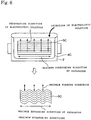
- the separator is curved, and tunnel-like linear wrinkles are formed perpendicular to the stretching direction of the separator ( Fig. 6 ).
- the wrinkles formed on the separator grow due to formation of tunnel-like air layers from a side of an edge where an electrolytic solution starts to penetrate as an origin in the same direction (parallel to) as a penetrating direction of the electrolytic solution.
- the layers of air are independent in layers of the separator having the electrolytic solution penetrated, and wrinkles are formed as remained layers of air ( Fig. 6 ).
- This phenomenon is particularly significant when the penetrating direction of the electrolytic solution and a maximum stretching direction of the separator are perpendicular to each other, or when the separator has electrolytic solution penetration rate anisotropy and a direction of a maximum electrolytic solution penetration rate of the separator and the penetrating direction of the electrolytic solution are substantially parallel to each other.
- Wrinkle formation can be physically suppressed through a method of injecting an electrolytic solution while applying a contact pressure on a sheath of the sheet-like secondary battery, even if the maximum stretching direction of the separator is perpendicular to the penetrating direction of the electrolytic solution.
- a contact pressure is applied to the sheath, an amount of the electrolytic solution is hardly controlled because the electrolytic solution hardly penetrates into a three-way sealed body, the penetration takes time, the electrolytic solution bursts out in four-way sealing, and the like.
- the penetration of the electrolytic solution can be accelerated by maintaining the three-way sealed body in vacuum or under reduced pressure for a certain time period and degassing air therefrom.
- the inventors of the present invention have devised a separator so that the electrolytic solution penetrates into the separator without fixing motion of the separator in a maximum expanding direction and in a state where the maximum expanding direction of the separator and the penetrating direction of the electrolytic solution are substantially parallel to each other, to thereby form a separator without wrinkle formation.
- the inventors of the present invention have applied the separator to a high capacity thin-type secondary battery having excellent heat radiation properties, to thereby complete the present invention.
- the present invention is a method of producing a thin-type secondary battery according to claim 1. Further aspects of the present invention are in the dependent claims 2 to 16.
- Another aspect of the present invention relates to a method of producing a thin-type secondary battery, in which the electrolytic solution is penetrated into the separator by aging the separator for 10 to 60 minutes in a state where the maximum expanding direction of the separator is substantially vertical, after insertion of the separator and injection of the electrolytic solution.
- Still another aspect of the present invention relates to a method of producing a thin-type secondary battery, in which the electrolytic solution is penetrated into the separator by inserting the separator sandwiched by the electrode pair into the thin-type outer wrapper and injecting the electrolytic solution into the thin-type outer wrapper without fixing motion of the separator in the maximum expanding direction and in a state where the maximum expanding direction of the separator and the penetrating direction of the electrolytic solution are substantially parallel to each other.
- Yet another aspect of the present invention relates to a method of producing a thin-type secondary battery, in which the electrolytic solution is penetrated into the separator by injecting the electrolytic solution into the thin-type outer wrapper and inserting the separator sandwiched by the electrode pair into the thin-type outer wrapper having the electrolytic solution injected without fixing motion of the separator in the maximum expanding direction and in a state where the maximum expanding direction of the separator and the penetrating direction of the electrolytic solution are substantially parallel to each other.
- Still yet another aspect of the present invention relates to a method of producing a thin-type secondary battery, in which an angle between the maximum expanding direction of the separator and the penetrating direction of the electrolytic solution is 0 to 30° during penetration of the electrolytic solution.
- Yet another aspect of the present invention relates to a method of producing a thin-type secondary battery, in which a plurality of the separators each sandwiched by the electrode pair are laminated and inserted into the thin-type outer wrapper.
- Still yet another aspect of the present invention relates to a method of producing a thin-type secondary battery, in which the thin-type outer wrapper is a flexible sheet-like outer wrapper.
- An aspect of the present invention relates to a method of producing a thin-type secondary battery, in which the sheet-like outer wrapper has a substantially rectangular shape.
- Another aspect of the present invention relates to a method of producing a thin-type secondary battery, in which: the sheet-like outer wrapper has a bag-like shape with one unsealed side; the electrolytic solution is injected to penetrate into the separator; and the unsealed side is sealed into a tightly sealed state.
- Still another aspect of the present invention relates to a method of producing a thin-type secondary battery, in which: the separator sandwiched by the electrode pair is sandwiched by a substantially rectangular sheet-like outer wrapper pair formed of a laminate film; an edge portion of the sheet-like outer wrapper pair is sealed with one side remained unsealed; the electrolytic solution is injected to penetrate into the separator; and the unsealed side is sealed into a tightly sealed state.
- Yet another aspect of the present invention relates to a method of producing a thin-type secondary battery, in which: the electrode pair is connected to a positive electrode terminal and a negative electrode terminal; and the separator sandwiched by the electrode pair is sandwiched by the sheet-like outer wrapper pair with both the terminals pulled out.
- Still yet another aspect of the present invention relates to a method of producing a thin-type secondary battery, in which both the terminals are sandwiched by the sheet-like outer wrapper pair with both the terminals pulled out from one side of the sheet-like outer wrapper pair.
- An aspect of the present invention relates to a method of producing a thin-type secondary battery, in which the one side of the sheet-like outer wrapper pair and the maximum expanding direction of the separator are substantially parallel to each other.
- Another aspect of the present invention relates to a method of producing a thin-type secondary battery, in which the one side of the sheet-like outer wrapper pair and the maximum expanding direction of the separator are substantially perpendicular to each other.
- Still another aspect of the present invention relates to a method of producing a thin-type secondary battery, in which both the terminals are sandwiched by the sheet-like outer wrapper pair with both the terminals pulled out from two corresponding sides of the sheet-like outer wrapper pair.
- Yet another aspect of the present invention relates to a method of producing a thin-type secondary battery, in which the two sides of the sheet-like outer wrapper pair and the maximum expanding direction of the separator are substantially parallel to each other.
- an aspect not forming part of the present invention relates to a thin-type secondary battery, including: a sheet-like separator having expansion anisotropy due to penetration of an electrolytic solution and having the electrolytic solution penetrated; a sheet-like electrode pair sandwiching the separator; and a thin-type outer wrapper containing the separator and the electrode pair in a tightly sealed state, in which: the separator is sandwiched between the electrode pair without fixing motion of the separator in a maximum expanding direction; and the maximum expanding direction of the separator and a penetrating direction of the electrolytic solution are substantially parallel to each other during penetration of the electrolytic solution in a production process.
- Another aspect not forming part of the present invention relates to a thin-type secondary battery, in which a plurality of the separators each sandwiched by the electrode pair are laminated and contained in the thin-type outer wrapper in a tightly sealed state.
- Still another aspect not forming part of the present invention relates to a thin-type secondary battery, in which the thin-type outer wrapper is a flexible sheet-like outer wrapper.
- Yet another aspect not forming part of the present invention relates to a thin-type secondary battery, in which the sheet-like outer wrapper has a substantially rectangular shape and is provided with a positive electrode terminal and a negative electrode terminal connected to the electrode pair and pulled out from the sheet-like outer wrapper.
- Still yet another aspect not forming part of the present invention relates to a thin-type secondary battery, in which: both the terminals are pulled out from one side of the sheet-like outer wrapper; and the maximum expanding direction of the separator and the one side of the sheet-like outer wrapper are substantially parallel to each other.
- An aspect not forming part of the invention relates to a thin-type secondary battery, in which: both the terminals are pulled out from one side of the sheet-like outer wrapper; and the maximum expanding direction of the separator and the one side of the sheet-like outer wrapper are substantially perpendicular to each other.
- Another aspect not forming part of the present invention relates to a thin-type secondary battery, in which: both the terminals are pulled out from two corresponding sides of the sheet-like outer wrapper; and the maximum expanding direction of the separator and the two sides of the sheet-like outer wrapper are substantially parallel to each other.
- Still another aspect not forming part of the present invention relates to a thin-type secondary battery, in which both the terminals each have a shape folded back on a line parallel to the side of the sheet-like outer wrapper.
- an aspect not forming part of the present invention relates to a secondary battery module, including: a battery pack formed by connecting the thin-type secondary batteries in series and/or parallel with each other; and a casing containing the battery pack.
- a maximum expanding direction of a separator refers to a direction of maximum expansion of a sheet-like separator having expansion anisotropy due to penetration of an electrolytic solution.
- the sheet-like separator usually has reduced surface energy and expands due to penetration of an electrolytic solution.
- the sheet-like separator having expansion anisotropy due to penetration of an electrolytic solution has wrinkles easily formed thereon in a direction perpendicular to the maximum expanding direction.
- a stretched sheet-like separator is subjected to relaxation shrinkage through heat treatment and then expands due to penetration of the electrolytic solution. Wrinkles are easily formed in a direction perpendicular to the maximum expanding direction of the separator ( Fig. 6 ).
- the maximum expanding direction of the separator and the penetrating direction of the electrolytic solution are maintained substantially parallel to each other during penetration of the electrolytic solution into the separator.
- the electrolytic solution penetrates from an edge of the separator so as to be attached to electrodes, and wrinkles are hardly formed on the separator although motion of the separator is not fixed ( Fig. 7 ).
- the penetrating direction of the electrolytic solution is determined by an injection method and an injecting direction of an electrolytic solution.
- the simplest example of battery design and injection method is a method involving: sealing three sides with one side having neither positive electrode terminal nor negative electrode terminal pulled out, remained unsealed; and opening the unsealed side to inject an electrolytic solution. In this case, the electrolytic solution is injected from an opened side of a thin-type outer wrapper (opened side).
- an opened direction of the thin-type outer wrapper and the maximum stretching direction of the separator are adjusted to be substantially parallel to each other (that is, the opened side and the maximum stretching direction of the separator are adjusted to be substantially perpendicular to each other), to thereby bring about a state in which the maximum expanding direction of the separator and the penetrating direction of the electrolytic solution are substantially parallel to each other.
- an opened portion can be narrowed by sealing part of the opened side.
- the production method of the present invention can be realized in production of a sheet-like battery in which a stretching direction of the separator is directed toward a sealed side of the four sides of a rectangular thin-type outer wrapper through a technique of injecting an electrolytic solution by inserting an injector or the like, for example.
- the battery can be designed so that the maximum expanding direction of the separator and the penetrating direction of the electrolytic solution are substantially parallel to each other.
- An injecting position of the electrolytic solution is not particularly limited to a position such as the center or an edge of an opened side of a thin-type secondary battery, designed to seal the opened side of the thin-type outer wrapper of a three-way sealed body at last.
- penetration of the electrolytic solution after injection if the electrolytic solution is injected with the opened portion facing upward, the electrolytic solution penetrates downward.
- the maximum expanding direction of the separator and the penetrating direction of the electrolytic solution may be substantially parallel to each other.
- the stretching direction of the separator is directed toward an opened direction and the electrolytic solution is injected to a bottom side of the thin-type outer wrapper at once so that the electrolytic solution does not touch a laminate consisting of a sheet-like separator and a sheet-like electrode pair
- the maximum expanding direction of the separator and the penetrating direction of the electrolytic solution can be substantially parallel to each other by penetrating the electrolytic solution from the bottom side of the thin-type outer wrapper upward to the opened portion through the principle of capillary phenomenon.
- the motion of the separator in a maximum expanding direction is not fixed during penetration of the electrolytic solution into the separator.
- no jig for fixing the separator is required in an inner structure of the thin-type secondary battery.
- a production facility investment cost can be reduced and a small-size and lightweight thin-type secondary battery having a high degree of freedom in designing the shape thereof can be provided.
- a laminate consisting of a sheet-like separator having expansion anisotropy and a sheet-like electrode pair is formed by sandwiching the sheet-like separator, by the sheet-like electrode pair.
- the laminate may be inserted into a thin-type outer wrapper having an opened portion, and then an electrolytic solution can be injected thereinto.
- the electrolytic solution is penetrated into the separator by: inserting the separator sandwiched by the electrode pair into the thin-type outer wrapper; and injecting the electrolytic solution into the thin-type outer wrapper without fixing motion of the separator in a maximum expanding direction and in a state where the maximum expanding direction of the separator and a penetrating direction of the electrolytic solution are substantially parallel to each other.
- the laminate is inserted into the thin-type outer wrapper having an opened portion, and the resultant is preferably dried in vacuum.
- the electrolytic solution is then injected thereinto.
- the electrolytic solution may be injected into the thin- type outer wrapper, and then the laminate may be injected into the thin-type outer wrapper.
- the electrolytic solution is penetrated into the separator by: injecting the electrolytic solution into the thin-type outer wrapper; and inserting the separator sandwiched by the electrode pair into the thin-type outer wrapper having the electrolytic solution injected without fixing motion of the separator in a maximum expanding direction and in a state where the maximum expanding direction of the separator and a penetrating direction of the electrolytic solution are substantially parallel to each other.
- the electrolytic solution is preferably accumulated at the bottom of a three-way sealed thin-type outer wrapper so that the electrolytic solution penetrates upward through the laminate from the bottom. This is because when the electrolytic solution is poured from the top of the laminate, bubbles are liable to remain in the laminate and penetration is not uniform in some cases.
- the step of penetrating the electrolytic solution into the separator is carried out without fixing motion of the separator in a maximum expanding direction and in a state where the maximum expanding direction of the separator and the penetrating direction of the electrolytic solution are substantially parallel to each other.
- this step (aging) is not carried out or when the step is not sufficient, the electrolytic solution bursts out.
- too long an aging time leads to an opened battery.
- the aging time is preferably 10 to 60 minutes, more preferably 15 to 50 minutes, particularly preferably 20 to 40 minutes, before the opened portion is sealed into a tightly sealed state.
- the progress of penetration of the electrolytic solution in a three-way sealed body without a contact pressure applied may accelerate localized penetration thereof in the laminate.
- entire and sufficient penetration of the electrolytic solution between electrodes and into the separator is preferably carried out after four-way sealing.
- a sheet-like separator and a sheet-like electrode pair preferably form a laminate.
- the laminate can be formed by laminating a sheet-like internal electrode pair through a separator.
- the sheet-like internal electrode pair includes: a sheet-like positive electrode consisting of a sheet-like positive electrode current collector and a positive electrode active material applied on a surface thereof; and a sheet-like negative electrode consisting of a sheet-like negative electrode current collector and a negative electrode active material applied on a surface thereof.
- the thin-type outer wrapper containing the sheet-like internal electrode pair and the electrolytic solution in a tightly sealed state is preferably a flexible bag-like outer wrapper.
- the flexible bag-like outer wrapper preferably has a strength allowing use as a unit battery case for the sheet- like secondary battery and excellent resistance to an electrolytic solution to be contained.
- a specific example thereof is a flexible bag-like outer wrapper formed using a laminate film of a three layer structure having: an inner surface layer made of a thermoplastic resin having excellent resistance to an electrolytic solution and thermocompression bonding properties such as polyethylene, polypropylene, polyethylene terephthalate (PET), polyamide, or ionomer on an inner surface side; a middle layer made of a metal foil having excellent flexibility and strength such as an aluminum foil or a SUS foil in a middle; and an outer surface layer made of an electrically insulated resin having excellent electrical insulation such as a polyamide resin or a polyester resin on an outer surface side.
- a thermoplastic resin having excellent resistance to an electrolytic solution and thermocompression bonding properties such as polyethylene, polypropylene, polyethylene terephthalate (PET), polyamide, or ionomer on an inner surface side
- PET polyethylene terephthalate
- polyamide polyamide
- ionomer ionomer
- middle layer made of a metal foil having excellent flexibility
- the thin-type secondary batteries may be connected in series and/or parallel to form a battery pack and the battery pack may be contained in a casing, to thereby form a secondary battery module.
- a positive electrode terminal and a negative electrode are preferably formed as sheets.
- the positive electrode terminal and the negative electrode terminal of each of the secondary batteries may be provided at any position of the thin-type outer wrapper, but in order to form a battery pack by efficiently connecting a plurality of secondary batteries in series, the positive electrode terminal and the negative electrode terminal are preferably provided on the thin-type outer wrapper so as to extend toward opposite directions from each other.
- the secondary batteries forming the battery pack are more preferably formed in substantially the same shape and size.
- the positive electrode terminal and the negative electrode terminal of the thin-type secondary battery are formed as sheets, and are usually made of relatively thin aluminum sheets, copper sheets, nickel sheets, or the like each having a thickness of about 50 to 200 ⁇ m.
- a battery laminated pair is formed by vertically laminating the batteries and/or a battery adjacent pair is formed by horizontally positioning the batteries, so that thermal environments of the thin-type secondary batteries are substantially the same with each other.
- a thermal balance in the battery laminated pair as a whole can be maintained although the temperature rises (heat generation) on the side of insertion (dope) and the temperature drops (heat absorption) on the side of separation (de-dope) during charge and discharge of the secondary batteries.
- formation of areas having partly high temperatures are avoided during charge and discharge of the battery pack contained in the casing.
- all the secondary batteries forming a battery pack can be maintained at low temperatures and heat radiation of the battery pack can be more efficiently carried out by heat radiation means such as filling of a resin.
- a battery pack may be formed by: laminating one or more than two thin-type secondary batteries so that the terminals of the same electrode face each other; forming a battery unit by connecting these terminals in parallel with each other; and using the battery unit as a base.
- efficient heat radiation can be maintained by forming a battery unit in which a plurality of thin-type secondary batteries are connected in parallel with each other and forming a battery pack using the battery unit, to thereby allow assembly of a secondary battery module of higher capacity.
- the battery pack formed as described above usually has a cuboid-shaped contour with a thin wall (thin-walled cuboid) and the battery pack of this thin-walled cuboid shape is used as a base.
- a plurality of battery packs may be positioned horizontally and connected in series with each other, or a plurality of battery packs may be treated as a unit (battery pack unit), where the battery pack units are laminated vertically and/or positioned horizontally so that the thermal environments of all battery pack units are the same, to thereby form a larger-size battery pack.
- the number of the thin-type secondary batteries used to form a battery pack or the number of battery laminated pairs to be formed is not particularly limited, and is arbitrarily selected depending on the conditions for designing the secondary battery module such as: a capacity (Ah), energy (Wh), power (W), or the like of the thin-type secondary battery to be used; a required capacity, allowable size and weight, or the likeof the secondary battery module to be produced; and a position of an external terminal on the casing for drawing electricity out of the secondary battery module to be produced through the casing to the outside.
- the number of thin-type secondary batteries to be used is an odd number, one of the thin-type secondary batteries is used without forming a battery laminated pair.
- pressure bonded portions of the thin-type outer wrapper are preferably overlapped on each other, to thereby preferably form a more compact battery pack.
- lithium manganate LiMn 2 O 4 positive electrode active material, average particle size of 10 ⁇ m
- acetylene black conductor
- polyvinylidene fluoride binder
- the mixture was applied onto each surface of an aluminum sheet (positive electrode current collector) having a thickness of 15 ⁇ m, at a thickness of about 130 ⁇ m and the resultant was dried, to thereby prepare a sheet-like positive electrode.
- the positive electrode was cut out into a size of 14.3 cm ⁇ 12.9 cm.
- LiPF 6 was dissolved in a concentration of 1 mol/L, to thereby prepare an organic electrolytic solution.
- a commercially available porous stretched polypropylene sheet (UP3025, available from Ube Industries, Ltd.) was used as a separator.
- the separator was cut out into a size of 14.8 cm ⁇ 12.8 cm.
- the separator has expansion anisotropy due to penetration of the nonaqueous electrolytic solution.
- a maximum expanding direction of the separator and a maximum stretching direction of the sheet are substantially parallel to each other, and the directions are also substantially parallel to sides of 14.8 cm.
- the separators (4 sheets), the sheet-like positive electrodes (2 sheets), and the sheet-like negative electrodes (3 sheets) were alternately laminated so that both the outermost layers were the negative electrodes and that the separators were sandwiched by both the positive and negative electrodes, to thereby prepare a laminate consisting of the sheet-like separators and sheet-like electrode pairs.
- Positive electrode terminals were laminated to overlap on each other at a corresponding side
- negative electrode terminals were laminated to overlap on each other at a corresponding side.
- a positive electrode terminal of an aluminum foil of width 3 cm ⁇ length 4 cm ⁇ thickness 0.15 mm was bonded to the positive electrode through ultrasonic welding in a form pulled out from the side of 14.3 cm of the positive electrode so that the center of the positive electrode terminal was provided at a position of 7.15 cm from edges of the side of the positive electrode.
- a negative electrode terminal of a nickel foil of width 3 cm ⁇ length 4 cm ⁇ thickness 0.15 mm was bonded to the negative electrode through ultrasonic welding in a form pulled out from the side of 14.8 cm of the negative electrode so that the center of the negative electrode terminal was provided at a position of 7.4 cm from edges of the side of the negative electrode.
- a flexible laminate film of a three layer structure having an inner surface layer made of polyethylene on an inner surface side, a middle layer made of an aluminum foil in a middle, and an outer surface layer made of a polyamide resin on an outer surface side was prepared. Two films each obtained by cutting out the film into a size of 17 cm ⁇ 16 cm were collectively used as an outer wrapper pair.
- the laminate and the outer wrapper were laminated into a structure, in which both the inner surface sides of the outer wrapper pair faced each other and both the terminals were pulled out from the two corresponding sides of 17 cm each of the outer wrapper pair. Then, the two sides of 17 cm each were subjected to thermocompression bonding to attach resin layers of the laminate together. Next, one side of the remaining two sides having no terminals pulled out was subjected to thermocompression bonding, to thereby form a bag-like thin-type outer wrapper 4c having the separators sandwiched by the electrode pairs inserted thereinto and a side with an unsealed opened portion. The separators were each sandwiched between the electrode pair at a level in which the separators did not fall and the motion of the separators in a maximum expanding direction was not fixed.
- the thin-type outer wrapper 4c (cell) having the electrode pairs and the separators inserted thereinto was dried at 20 torr and 80°C, for 8 hours in a vacuum dryer because water remained in a secondary battery would adversely affect battery characteristics.
- the outer wrapper was dried in vacuum under heating to simultaneously remove water and prevent oxidation of electrode materials, the copper foil, and the like.
- a predetermined amount of the electrolytic solution was injected into the cell dried in vacuum ( Fig. 6 ).
- the cell was placed in a substantially vertical direction to the maximum expanding direction (maximum stretching direction) of the separators and was left to stand (subjected to aging) for 30 minutes.
- the electrolytic solution was accumulated at the bottom once so that the electrolytic solution penetrated upward in the separators from the bottom. That is, the cell was left to stand so that the maximum expanding direction of the separators and the penetrating direction of the electrolytic solution were substantially parallel to eachother.
- defoaming was carried out in a vacuum chamber for removing air bubbles remained in the electrolytic solution.
- the vacuum defoaming required about 5 minutes, and the defoaming step hardly had an effect on wrinkle formation.
- the side of the opened portion was subjected to thermocompression bonding using a vacuum sealer and was sealed into a tightly sealed state, to thereby produce a sheet-like secondary battery 3 of the present invention.
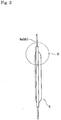
- Fig. 1 shows a perspective view of the sheet-like secondary battery
- Fig. 2 shows a left side view thereof
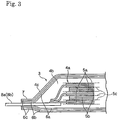
- Fig. 3 is a sectional view taken along the line III-III of Fig. 1 , showing an enlarged view of a portion circled by the circle III of Fig. 2 .
- reference numeral 3 denotes a sheet- like lithium ionsecondarybattery.
- a flexible bag-like outer wrapper 4c contains an internal electrode pair 4a and an electrolytic solution 4b in a tightly sealed state.
- the internal electrode pair 4a is formed by alternately laminating: a sheet-like positive electrode 5b formed by laminating a positive electrode active material on both surfaces of an aluminum positive electrode current collector; and a sheet-like negative electrode 5a formed by laminating a negative electrode active material on both surfaces of a copper negative electrode current collector; through a separator 5c.
- a negative electrode terminal 8a individually connected to the negative electrode 5a of the internal electrode pair 4a passes through the thermocompression bonded portion 7 of the bag-like outer wrapper 4c airtightly, is fixed to the thermocompression bonded portion 7, and projects outward through the thermocompress ion bonded portion 7.
- a pulled out portion is used as an external terminal.
- a positive electrode terminal 8b is individually connected to the positive electrode 5b, and the positive electrode terminal 8b is pulled out from the bag-like outer wrapper 4c airtightly (though not shown).
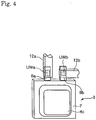
- Sheet-like bus-bars 12a and 12b made of copper are connected with the positive electrode terminal 8b and the negative electrode terminal 8a, respectively.
- the connection between the negative electrode terminal 8a and the bus-bar 12a and the connection between the positive electrode terminal 8b and the bus-bar 12b are made through ultrasonic welding.
- the positive electrode terminal 8b is made of aluminum as with the positive electrode current collector
- the negative electrode terminal 8a is made of copper or nickel as with the negative electrode current collector. Materials for the terminals are not particularly limited, but electrochemically stable metal materials are desirably used.
- the same material as that used for forming the positive electrode current collector such as aluminum or an aluminum alloy is preferably used as a material for the positive electrode terminal 8b, and at least one of copper and nickel is preferably used as a material for the negative electrode terminal 8a.
- Embodiment 1 employs the terminals 8a and 8b each having a thickness of 150 ⁇ m, but the terminals may be formed into a strip having a thickness of about 50 ⁇ m or more, preferably 100 to 200 ⁇ m, for example.
- the bag-like outer wrapper 4c is formed of a laminate film of a three layer structure having: an inner surface layer 6a made of polyethylene on an inner surface side; a middle layer 6b made of an aluminum foil in a middle; and an outer surface layer 6c made of nylon on an outer surface side.
- the separator 5c may be formed of any material such as a porous film of a single layer or multi layers, nonwoven fabric, or mesh made of polyethylene, polypropylene, or the like as long as the separator has electrical insulation and sufficient strength to ensure close contact with the negative electrode 5a and the positive electrode 5b.
- polypropylene is used from the viewpoints of adhesiveness, safety, and the like.
- a nonaqueous solvent and an electrolytic salt containing lithium used in conventional cells can be used as a solvent and an electrolytic salt used for the electrolytic solution 4b used as an ion conducting material.
- the solvent that can be used include: an ester-based solvent such as ethylene carbonate, propylene carbonate, dimethyl carbonate, diethyl carbonate, or methylethyl carbonate; an ether-based single solvent suchasdimethoxyethane, diethoxyethane, diethyl ether, or dimethyl ether; and a mixed solvent of two kinds of solvents from the same group or from the different groups.
- an ester-based solvent such as ethylene carbonate, propylene carbonate, dimethyl carbonate, diethyl carbonate, or methylethyl carbonate
- an ether-based single solvent suchasdimethoxyethane, diethoxyethane, diethyl ether, or dimethyl ether
- electrolytic salt examples include LiPF 6 , LiAsF 6 , LiClO 4 , LiBF 4 , LiCF 3 SO 3 , LiN(CF 3 SO 2 ) 2 , LiC(CF 3 SO 2 ) 3 , and LiN(C 2 F 5 SO 2 ) 2 .
- LiPF 6 is used.
- the method of producing the sheet-like secondary battery 3 of Embodiment 1 can provide a thin-type secondary battery 3 suitably formed into a module and having no thickness fluctuation, excellent quality stability, and excellent heat radiation properties.
- a high capacity secondary battery can be easily produced, and the secondary battery has advantages of a high degree of freedom in designing the shape thereof and excellent productivity.
- the method of producing the sheet-like secondary battery 3 of Embodiment 1 can provide a high capacity laminated sheet-like secondary battery having excellent heat radiation properties with reduced facility investment cost compared with a secondary battery having the separator 5c fixed under tension in a maximum expanding direction thereof or having the separator 5c fixed by ends such as a wound secondary battery.
- the separators (4 sheets), the sheet-like positive electrodes (2 sheets), and the sheet-like negative electrodes (3 sheets) were alternately laminated in the same manner as in the methodof producing the sheet-like secondary battery 3 of Embodiment 1.
- a positive electrode terminal of an aluminum foil of width 3 cm ⁇ length 4 cm ⁇ thickness 0.15 mm was bonded to the positive electrode through ultrasonic welding in a form pulled out from the side of 14.3 cm of the positive electrode so that the center of the positive electrode terminal was provided at a position of 7.15 cm from edges of the side of the positive electrode.
- a negative electrode terminal of a nickel foil of the same size as that of the positive electrode terminal was bonded to the negative electrode through ultrasonic welding in a form pulled out from the side of 14.8 cm of the negative electrode so that the center of the negative electrode terminal was provided at a position of 7.4 cm from edges of the side of the negative electrode.
- the laminate and the same outer wrapper as that of Embodiment 1 were laminated into a structure in which both the inner surface sides of the outer wrapper pair faced each other, both the terminals were not overlapped on each other, and both the terminals were pulled out from the two corresponding sides of 17 cm each of the outer wrapper pair. Then, the two sides of 17 cm each were subjected to thermocompression bonding to attach resin layers of the laminate together. Next, one side of the remaining two sides having no terminals pulled out was subjected to thermocompression bonding, to thereby form a bag-like thin-type outer wrapper 4c having the separator sandwiched by the electrode pair inserted thereinto and a side with an unsealed opened portion. The separators were each sandwiched between the electrode pair at a level in which the separators did not fall and the motion of the separators in a maximum expanding direction was not fixed.
- Fig. 5 shows a sectional view of the secondary battery module.
- each lithium ion secondary battery (unit battery) forming the battery pack is formed to have a substantially block-shaped contour by alternately laminating a positive electrode having a positive electrode active material applied onto a metal material and a negative electrode having a negative electrode active material applied onto a metal material through a separator.
- the battery pack is formed by connecting two or more of the unit batteries in parallel.
- Unit batteries of the battery pack contained in a container main body (casing) are divided by partition walls provided in the container main body to insulate each unit battery, and are suitable for forming a high capacity secondary battery module.
- the terminal 8a (8b) can efficiently transfer heat of each electrode 4a (4b) to the bus-bar 12a (12b), and the terminal 8a (8b) itself may have a heat radiation effect.
- the secondary battery module of Embodiment 3 has a mode prepared by laminating three sheet-like secondary batteries 3 and connecting them in parallel with each other, for example.
- the number of the sheet-like secondary batteries 3 to be laminated is not limited to three, and may be two, or four or more.
- the connection is not limited to parallel connection, and may be series connection involving connecting the positive electrode and the negative electrode of each sheet-like secondary battery 3 in series, or a combination of series connection and parallel connection.
- the secondary battery module of Embodiment 3 has a simple structure and miniaturization or weight saving thereof is possible. Further, the module can be formed to be thin as required to allow efficient dissipation of heat generated inside the cell to the outside.
- the secondary battery module of Embodiment 3 is expected to be suitably applied to: a relatively small capacity secondary battery used in fields of electrical or electronic devices, communication devices, optical devices, audio equipment, and the like; and a relatively large capacity secondary battery used in fields of electric automobiles and the like, utilizing characteristics of being small-size, lightweight, thin, and having a high degree of freedom in shape.
- the present invention can provide a high capacity thin-type secondary battery suitably formed into a module and having no thickness fluctuation, excellent quality stability, and excellent heat radiation properties.
- the present invention can provide a high capacity thin-type with reduced facility investment cost compared with a secondary battery having the separator fixed under tension in a maximum expanding direction thereof or having the separator fixed by ends such as a wound secondary battery.
Landscapes
- Chemical & Material Sciences (AREA)
- Chemical Kinetics & Catalysis (AREA)
- Electrochemistry (AREA)
- General Chemical & Material Sciences (AREA)
- Engineering & Computer Science (AREA)
- Manufacturing & Machinery (AREA)
- Inorganic Chemistry (AREA)
- Secondary Cells (AREA)
- Cell Separators (AREA)
- Sealing Battery Cases Or Jackets (AREA)
- Connection Of Batteries Or Terminals (AREA)
Claims (16)
- Verfahren zum Herstellen einer dünnen Sekundärbatterie (3), mit den Schritten:(a) sandwichartiges Anordnen eines plattenförmigen Separators (5c) mit einer aufgrund des Eindringens einer Elektrolytlösung (4b) erhaltenen Ausdehnungsanisotropie zwischen einem Paar plattenförmigen Elektroden (4a), wobei der Separator (5c) aus einer porösen gestreckten Platte ausgebildet ist, und wobei eine Richtung maximaler Streckung des Separators (5c) als Richtung maximaler Ausdehnung bezeichnet wird;(b) Einsetzen des zwischen dem Elektrodenpaar (4a) sandwichartig angeordneten Separators und Einspritzen der Elektrolytlösung in eine dünne Außenhülle (4c) mit einem offenen Abschnitt;(c) Veranlassen, dass die Elektrolytlösung (4b) in den Separator (5c) eindringt, ohne die Bewegung des Separators in der Richtung maximaler Ausdehnung zu fixieren, und in einem Zustand, in dem die Richtung maximaler Ausdehnung des Separators und eine Eindringrichtung der Elektrolytlösung sich im Wesentlichen parallel zueinander erstrecken; und(d) Verschließen des offenen Abschnitts in einen dicht verschlossenen Zustand.
- Verfahren zum Herstellen einer dünnen Sekundärbatterie nach Anspruch 1, wobei veranlasst wird, dass die Elektrolytlösung (4b) nach dem Einsetzen des Separators (5c) und nach dem Einspritzen der Elektrolytlösung (4b) in den Separator (5c) eindringt, indem der Separator für 10 bis 60 Minuten in einem Zustand gealtert wird, in dem die Richtung maximaler Ausdehnung des Separators sich im Wesentlichen vertikal erstreckt.
- Verfahren zum Herstellen einer dünnen Sekundärbatterie nach Anspruch 1 oder 2, wobei veranlasst wird, das die Elektrolytlösung (4b) in den Separator eindringt, indem der zwischen dem Elektrodenpaar sandwichartig angeordnete Separator (5c) in die dünne Außenhülle eingesetzt und die Elektrolytlösung in die Richtung maximaler Ausdehnung eingespritzt wird, ohne die Bewegung des Separators in der Richtung maximaler Ausdehnung zu fixieren, und in einem Zustand, in dem die Richtung maximaler Ausdehnung des Separators und die Eindringrichtung der Elektrolytlösung sich im Wesentlichen parallel zueinander erstrecken.
- Verfahren nach Anspruch 1 oder 2,wobei veranlasst wird, dass die Elektrolytlösung (4b) in den Separator (5c) eindringt, indem die Elektrolytlösung in die dünne Außenhülle eingespritzt und der zwischen dem Elektrodenpaar sandwichartig angeordnete Separator in die dünne Außenhülle eingesetzt wird, wobei die Elektrolytlösung eingespritzt wird, ohne die Bewegung des Separators in der Richtung maximaler Ausdehnung zu fixieren, und in einem Zustand, in dem die Richtung maximaler Ausdehnung des Separators und die Eindringrichtung der Elektrolytlösung sich im Wesentlichen parallel zueinander erstrecken.
- Verfahren nach Anspruch 1, 2, 3 oder 4, wobeiein Winkel zwischen der Richtung maximaler Ausdehnung des Separators und der Eindringrichtung der Elektrolytlösung während des Eindringens der Elektrolytlösung 0 bis 30° beträgt.
- Verfahren nach einem der Ansprüche 1 bis 5, wobei mehrere der Separatoren, die jeweils zwischen dem Elektrodenpaar sandwichartig angeordnet sind, laminiert und in die dünne Außenhülle eingesetzt werden.
- Verfahren nach einem der Ansprüche 1 bis 6, wobei die dünne Außenhülle eine flexible, plattenförmige Außenhülle aufweist.
- Verfahren zum Herstellen einer dünnen Sekundärbatterie nach Anspruch 7, wobei die plattenförmige Außenhülle eine im Wesentlichen rechteckige Form hat.
- Verfahren zum Herstellen einer dünnen Sekundärbatterie nach Anspruch 8, wobei die plattenförmige Außenhülle eine taschenähnliche Form mit einer unverschlossenen Seite aufweist, die Elektrolytlösung derart eingespritzt wird, dass sie in den Separator eindringt, und die unverschlossene Seite in einen dicht abgeschlossenen Zustand verschlossen wird.
- Verfahren zum Herstellen einer dünnen Sekundärbatterie nach Anspruch 8 oder 9, wobei der zwischen dem Elektrodenpaar sandwichartig angeordnete Separator zwischen einem Paar im Wesentlichen rechteckiger plattenförmiger Außenhüllen sandwichartig angeordnet wird, die aus einem Laminatfilm hergestellt sind, ein Randabschnitt des Paars plattenförmiger Außenhüllen verschlossen wird, wobei eine Seite unverschlossen bleibt, die Elektrolytlösung eingespritzt wird, so dass sie in den Separator eindringt, und die unverschlossene Seite in einen dicht abgeschlossenen Zustand verschlossen wird.
- Verfahren zum Herstellen einer dünnen Sekundärbatterie nach Anspruch 10, wobei das Elektrodenpaar mit einem positiven Elektrodenanschluss und mit einem negativen Elektrodenanschluss verbunden wird, und wobei der zwischen dem Elektrodenpaar sandwichartig angeordnete Separator zwischen dem Paar plattenförmiger Außenhüllen angeordnet wird, wobei beide Anschlüsse herausgeführt sind.
- Verfahren zum Herstellen einer dünnen Sekundärbatterie nach Anspruch 11, wobei beide Anschlüsse zwischen dem Paar plattenförmiger Außenhüllen sandwichartig angeordnet sind, und wobei beide Anschlüsse von einer Seite des Paars plattenförmiger Außenhüllen herausgeführt sind.
- Verfahren zum Herstellen einer dünnen Sekundärbatterie nach Anspruch 12, wobei die eine Seite des Paar plattenförmiger Außenhüllen und die Richtung maximaler Ausdehnung des Separators sich im Wesentlichen parallel zueinander erstrecken.
- Verfahren zum Herstellen einer dünnen Sekundärbatterie nach Anspruch 12, wobei die eine Seite des Paars plattenförmiger Außenhüllen und die Richtung maximaler Ausdehnung des Separators sich im Wesentlichen senkrecht zueinander erstrecken.
- Verfahren nach Anspruch 11, 12, 13 oder 14, wobei beide Anschlüsse zwischen dem Paar plattenförmiger Außenhüllen sandwichartig angeordnet sind und beide Anschlüsse von zwei entsprechenden Seiten des Paars plattenförmiger Außenhüllen herausgeführt sind.
- Verfahren zum Herstellen einer dünnen Sekundärbatterie nach Anspruch 15, wobei die zwei Seiten des Paars plattenförmiger Außenhüllen und die Richtung maximaler Ausdehnung des Separators sich im Wesentlichen parallel zueinander erstrecken.
Applications Claiming Priority (2)
| Application Number | Priority Date | Filing Date | Title |
|---|---|---|---|
| JP2004028564 | 2004-02-04 | ||
| JP2004028564A JP4426861B2 (ja) | 2004-02-04 | 2004-02-04 | 薄型二次電池セル及びその製造方法、並びに二次電池モジュール |
Publications (3)
| Publication Number | Publication Date |
|---|---|
| EP1562242A2 EP1562242A2 (de) | 2005-08-10 |
| EP1562242A3 EP1562242A3 (de) | 2010-07-14 |
| EP1562242B1 true EP1562242B1 (de) | 2017-10-25 |
Family
ID=34675511
Family Applications (1)
| Application Number | Title | Priority Date | Filing Date |
|---|---|---|---|
| EP05000814.3A Expired - Lifetime EP1562242B1 (de) | 2004-02-04 | 2005-01-17 | Dünne Sekundärbatterie und deren Herstellungsmethode, Sekundärbatteriemodul |
Country Status (5)
| Country | Link |
|---|---|
| US (1) | US7914925B2 (de) |
| EP (1) | EP1562242B1 (de) |
| JP (1) | JP4426861B2 (de) |
| KR (1) | KR101144879B1 (de) |
| CN (1) | CN100340027C (de) |
Families Citing this family (22)
| Publication number | Priority date | Publication date | Assignee | Title |
|---|---|---|---|---|
| KR100906253B1 (ko) * | 2006-05-01 | 2009-07-07 | 주식회사 엘지화학 | 과전류의 인가시 파괴되는 파단부가 형성되어 있는전극단자를 포함하고 있는 이차전지 |
| WO2007135790A1 (ja) | 2006-05-23 | 2007-11-29 | Incorporated National University Iwate University | 全固体二次電池 |
| JP5078282B2 (ja) * | 2006-05-31 | 2012-11-21 | 三洋電機株式会社 | 組電池 |
| KR100876455B1 (ko) * | 2006-07-31 | 2008-12-29 | 주식회사 엘지화학 | 미실링 잉여부를 포함하고 있는 파우치형 이차전지 |
| US8734986B2 (en) * | 2007-07-11 | 2014-05-27 | Nissan Motor Co., Ltd. | Laminate type battery |
| DE102009006117A1 (de) | 2009-01-26 | 2010-07-29 | Li-Tec Battery Gmbh | Elektrochemische Energiespeicherzelle |
| DE102009011524A1 (de) | 2009-03-03 | 2010-09-09 | Li-Tec Battery Gmbh | Elektroenergie-Speicherzelle und Zellblock, Elektroenergie-Speichervorrichtung und Fahrzeug damit |
| US8835058B2 (en) * | 2010-12-21 | 2014-09-16 | GM Global Technology Operations LLC | Battery separators with variable porosity |
| US9172075B2 (en) | 2010-12-21 | 2015-10-27 | GM Global Technology Operations LLC | Battery separators with variable porosity |
| JP5558338B2 (ja) * | 2010-12-27 | 2014-07-23 | 株式会社東芝 | 接合体、接合体の製造方法および電池パック |
| JP2013235713A (ja) * | 2012-05-09 | 2013-11-21 | Sh Copper Products Corp | リチウムイオン二次電池に使用される集電用銅箔およびそれを使用したリチウムイオン二次電池 |
| EP2882018B1 (de) * | 2012-07-30 | 2016-12-21 | Nissan Motor Company, Limited | Vorrichtung zur beschichtung eines filmelements und verfahren dafür |
| JP2014035954A (ja) * | 2012-08-09 | 2014-02-24 | Sanyo Electric Co Ltd | 非水電解質二次電池 |
| US20140370347A1 (en) * | 2013-06-14 | 2014-12-18 | Samsung Sdi Co., Ltd. | Flexible battery |
| DE102014008740A1 (de) | 2014-06-12 | 2015-12-17 | Daimler Ag | Elektrochemischer Energiespeicher und Batterie |
| CN106716671B (zh) * | 2014-07-31 | 2021-06-18 | 达纳加拿大公司 | 带有分级传热表面的电池单体热交换器 |
| CN105720292B (zh) * | 2014-12-17 | 2020-07-07 | 精工电子有限公司 | 电化学电池及便携设备 |
| JP6319332B2 (ja) * | 2016-01-12 | 2018-05-09 | トヨタ自動車株式会社 | 組電池 |
| CN108878734B (zh) * | 2017-05-12 | 2022-03-22 | 住友化学株式会社 | 非水电解液二次电池用绝缘性多孔层 |
| KR20190032843A (ko) * | 2017-09-20 | 2019-03-28 | 에스케이이노베이션 주식회사 | 이차 전지용 배터리 모듈 및 이를 포함하는 배터리 팩 |
| US20220085449A1 (en) * | 2019-01-18 | 2022-03-17 | Dai Nippon Printing Co., Ltd. | Electricity storage device, electric-powered vehicle, and mehtod of manufacturing an electricity storage device |
| JP7600928B2 (ja) | 2021-08-10 | 2024-12-17 | トヨタ自動車株式会社 | 電池の製造方法 |
Family Cites Families (14)
| Publication number | Priority date | Publication date | Assignee | Title |
|---|---|---|---|---|
| JPH07282841A (ja) * | 1994-04-05 | 1995-10-27 | Mitsubishi Chem Corp | リチウムイオン二次電池 |
| JP3363910B2 (ja) * | 1997-03-19 | 2003-01-08 | 旭化成株式会社 | 非水系薄型電池 |
| JPH11185815A (ja) * | 1997-12-16 | 1999-07-09 | Fujitsu Ltd | 電池及び電池の製造方法 |
| JP2000123858A (ja) | 1998-10-16 | 2000-04-28 | Japan Storage Battery Co Ltd | 気密性の良い電池の製造方法 |
| JP2000133244A (ja) | 1998-10-26 | 2000-05-12 | Japan Storage Battery Co Ltd | 電池とその製造方法 |
| JP4281129B2 (ja) * | 1998-10-28 | 2009-06-17 | 三菱電機株式会社 | リチウムイオン二次電池 |
| JP3683144B2 (ja) | 1999-12-16 | 2005-08-17 | 日本電気株式会社 | フィルム外装非水電解液二次電池 |
| JP4295908B2 (ja) * | 2000-11-06 | 2009-07-15 | 株式会社東芝 | 電池の製造装置および製造方法 |
| JP2002298833A (ja) * | 2001-03-30 | 2002-10-11 | Shibaura Mechatronics Corp | 二次電池の製造方法、及び液体注入方法 |
| JP2003045495A (ja) | 2001-07-27 | 2003-02-14 | Matsushita Electric Ind Co Ltd | 非水電解液二次電池およびその製造方法 |
| JP3965954B2 (ja) * | 2001-09-12 | 2007-08-29 | 三菱化学株式会社 | 多孔性フィルム |
| JP4794099B2 (ja) | 2001-09-28 | 2011-10-12 | 東レ東燃機能膜合同会社 | ポリオレフィン微多孔膜の製造方法 |
| JP2003109557A (ja) * | 2001-09-28 | 2003-04-11 | Mitsubishi Electric Corp | 非水電解質電池及びその製造方法 |
| JP3687632B2 (ja) * | 2002-06-26 | 2005-08-24 | 日産自動車株式会社 | 薄型電池 |
-
2004
- 2004-02-04 JP JP2004028564A patent/JP4426861B2/ja not_active Expired - Lifetime
-
2005
- 2005-01-17 EP EP05000814.3A patent/EP1562242B1/de not_active Expired - Lifetime
- 2005-01-20 CN CNB2005100043883A patent/CN100340027C/zh not_active Expired - Lifetime
- 2005-01-21 US US11/038,141 patent/US7914925B2/en active Active
- 2005-02-03 KR KR1020050009955A patent/KR101144879B1/ko not_active Expired - Lifetime
Non-Patent Citations (1)
| Title |
|---|
| None * |
Also Published As
| Publication number | Publication date |
|---|---|
| KR20060041641A (ko) | 2006-05-12 |
| JP2005222787A (ja) | 2005-08-18 |
| JP4426861B2 (ja) | 2010-03-03 |
| US7914925B2 (en) | 2011-03-29 |
| CN1652381A (zh) | 2005-08-10 |
| CN100340027C (zh) | 2007-09-26 |
| KR101144879B1 (ko) | 2012-05-14 |
| EP1562242A2 (de) | 2005-08-10 |
| EP1562242A3 (de) | 2010-07-14 |
| US20050170243A1 (en) | 2005-08-04 |
Similar Documents
| Publication | Publication Date | Title |
|---|---|---|
| EP1562242B1 (de) | Dünne Sekundärbatterie und deren Herstellungsmethode, Sekundärbatteriemodul | |
| CN100359746C (zh) | 层积型锂二次电池及其制造方法 | |
| KR101501337B1 (ko) | 바이폴라 전극쌍/분리막 어셈블리, 이를 포함하는 바이폴라 전지, 및 이들의 제조방법 | |
| KR100443250B1 (ko) | 전기화학전지의 개량된 제조방법 | |
| EP4057438A1 (de) | Biegevorrichtung und -verfahren für elektrodenzungen | |
| US20130177787A1 (en) | Current collector and nonaqueous secondary battery | |
| KR20030095266A (ko) | 전기화학적 전지 | |
| WO2005018038A2 (en) | Rechargeable bipolar high power electrochemical device with reduced monitoring requirement | |
| CN102047489A (zh) | 二次电池及电池系统 | |
| JP5855893B2 (ja) | 非水系リチウム型蓄電素子の製造方法 | |
| KR20140026504A (ko) | 증가된 용량을 가지는 바이폴라 전기화학 리튬 이온 배터리 | |
| KR20130097881A (ko) | 이차전지의 제조방법 및 이를 이용하여 생산되는 이차전지 | |
| WO2013122448A1 (en) | Lithium-ion battery | |
| KR100719713B1 (ko) | 리튬 이온 전지 | |
| JP4218792B2 (ja) | 非水二次電池 | |
| JP2004014528A (ja) | 電池装置 | |
| JPH11154534A (ja) | リチウムイオン二次電池要素 | |
| JP2001273930A (ja) | ポリマー電池の製造方法 | |
| KR101593268B1 (ko) | 복수개의 전극 리드를 포함하는 이차 전지 및 그 제조방법 | |
| JP4433783B2 (ja) | バイポーラ電池 | |
| KR101416805B1 (ko) | 폴딩 셀 및 그를 갖는 폴딩형 슈퍼 커패시터 | |
| KR20120123851A (ko) | 2 이상의 양극 및 음극을 포함하는 전극 조립체 및 이에 의한 전기 화학 소자 | |
| JP2004071438A (ja) | 非水二次電池 | |
| JP2003272710A (ja) | 非水系二次電池 | |
| CN113454833A (zh) | 电化学装置及电子装置 |
Legal Events
| Date | Code | Title | Description |
|---|---|---|---|
| PUAI | Public reference made under article 153(3) epc to a published international application that has entered the european phase |
Free format text: ORIGINAL CODE: 0009012 |
|
| AK | Designated contracting states |
Kind code of ref document: A2 Designated state(s): AT BE BG CH CY CZ DE DK EE ES FI FR GB GR HU IE IS IT LI LT LU MC NL PL PT RO SE SI SK TR |
|
| AX | Request for extension of the european patent |
Extension state: AL BA HR LV MK YU |
|
| PUAL | Search report despatched |
Free format text: ORIGINAL CODE: 0009013 |
|
| AK | Designated contracting states |
Kind code of ref document: A3 Designated state(s): AT BE BG CH CY CZ DE DK EE ES FI FR GB GR HU IE IS IT LI LT LU MC NL PL PT RO SE SI SK TR |
|
| AX | Request for extension of the european patent |
Extension state: AL BA HR LV MK YU |
|
| RIC1 | Information provided on ipc code assigned before grant |
Ipc: H01M 10/04 20060101ALI20100608BHEP Ipc: H01M 4/26 20060101ALI20100608BHEP Ipc: H01M 4/04 20060101AFI20050617BHEP |
|
| 17P | Request for examination filed |
Effective date: 20101229 |
|
| AKX | Designation fees paid |
Designated state(s): ES PT |
|
| REG | Reference to a national code |
Ref country code: DE Ref legal event code: R108 Effective date: 20110222 Ref country code: DE Ref legal event code: 8566 |
|
| 17Q | First examination report despatched |
Effective date: 20110408 |
|
| RIC1 | Information provided on ipc code assigned before grant |
Ipc: H01M 6/40 20060101ALI20170328BHEP Ipc: H01M 4/583 20100101ALI20170328BHEP Ipc: H01M 2/06 20060101ALI20170328BHEP Ipc: H01M 2/02 20060101ALI20170328BHEP Ipc: H01M 2/16 20060101ALI20170328BHEP Ipc: H01M 10/04 20060101ALI20170328BHEP Ipc: H01M 4/04 20060101AFI20170328BHEP Ipc: H01M 6/46 20060101ALI20170328BHEP Ipc: H01M 4/505 20100101ALI20170328BHEP Ipc: H01M 2/10 20060101ALI20170328BHEP Ipc: H01M 4/26 20060101ALI20170328BHEP |
|
| GRAP | Despatch of communication of intention to grant a patent |
Free format text: ORIGINAL CODE: EPIDOSNIGR1 |
|
| INTG | Intention to grant announced |
Effective date: 20170511 |
|
| RBV | Designated contracting states (corrected) |
Designated state(s): DE ES FR GB PT |
|
| RIN1 | Information on inventor provided before grant (corrected) |
Inventor name: MIYAMOTO, TAKESHI Inventor name: TAKAHASHI, KAZUHIRO Inventor name: OZAWA, KAZUNORI Inventor name: TANJOU, YUUJI |
|
| RAP1 | Party data changed (applicant data changed or rights of an application transferred) |
Owner name: NISSAN MOTOR CO., LTD. Owner name: ENAX, INC. |
|
| GRAS | Grant fee paid |
Free format text: ORIGINAL CODE: EPIDOSNIGR3 |
|
| GRAA | (expected) grant |
Free format text: ORIGINAL CODE: 0009210 |
|
| AK | Designated contracting states |
Kind code of ref document: B1 Designated state(s): DE ES FR GB PT |
|
| REG | Reference to a national code |
Ref country code: GB Ref legal event code: FG4D |
|
| REG | Reference to a national code |
Ref country code: DE Ref legal event code: R096 Ref document number: 602005052927 Country of ref document: DE |
|
| REG | Reference to a national code |
Ref country code: FR Ref legal event code: PLFP Year of fee payment: 14 |
|
| PG25 | Lapsed in a contracting state [announced via postgrant information from national office to epo] |
Ref country code: ES Free format text: LAPSE BECAUSE OF FAILURE TO SUBMIT A TRANSLATION OF THE DESCRIPTION OR TO PAY THE FEE WITHIN THE PRESCRIBED TIME-LIMIT Effective date: 20171025 |
|
| REG | Reference to a national code |
Ref country code: DE Ref legal event code: R097 Ref document number: 602005052927 Country of ref document: DE |
|
| PLBE | No opposition filed within time limit |
Free format text: ORIGINAL CODE: 0009261 |
|
| STAA | Information on the status of an ep patent application or granted ep patent |
Free format text: STATUS: NO OPPOSITION FILED WITHIN TIME LIMIT |
|
| 26N | No opposition filed |
Effective date: 20180726 |
|
| REG | Reference to a national code |
Ref country code: DE Ref legal event code: R082 Ref document number: 602005052927 Country of ref document: DE Representative=s name: VOSSIUS & PARTNER PATENTANWAELTE RECHTSANWAELT, DE Ref country code: DE Ref legal event code: R081 Ref document number: 602005052927 Country of ref document: DE Owner name: ENAX, INC., BUNKYO, JP Free format text: FORMER OWNERS: NISSAN MOTOR CO., LTD., YOKOHAMA-SHI, KANAGAWA-KEN, JP; ENAX, INC., BUNKYO, TOKYO, JP Ref country code: DE Ref legal event code: R081 Ref document number: 602005052927 Country of ref document: DE Owner name: ENVISION AESC JAPAN LTD., ZAMA-SHI, JP Free format text: FORMER OWNERS: NISSAN MOTOR CO., LTD., YOKOHAMA-SHI, KANAGAWA-KEN, JP; ENAX, INC., BUNKYO, TOKYO, JP |
|
| PG25 | Lapsed in a contracting state [announced via postgrant information from national office to epo] |
Ref country code: PT Free format text: LAPSE BECAUSE OF FAILURE TO SUBMIT A TRANSLATION OF THE DESCRIPTION OR TO PAY THE FEE WITHIN THE PRESCRIBED TIME-LIMIT Effective date: 20171025 |
|
| REG | Reference to a national code |
Ref country code: DE Ref legal event code: R081 Ref document number: 602005052927 Country of ref document: DE Owner name: ENVISION AESC JAPAN LTD., ZAMA-SHI, JP Free format text: FORMER OWNERS: ENAX, INC., BUNKYO, TOKYO, JP; ENVISION AESC JAPAN LTD., ZAMA-SHI, KANAGAWA, JP Ref country code: DE Ref legal event code: R081 Ref document number: 602005052927 Country of ref document: DE Owner name: ENAX, INC., BUNKYO, JP Free format text: FORMER OWNERS: ENAX, INC., BUNKYO, TOKYO, JP; ENVISION AESC JAPAN LTD., ZAMA-SHI, KANAGAWA, JP |
|
| REG | Reference to a national code |
Ref country code: DE Ref legal event code: R081 Ref document number: 602005052927 Country of ref document: DE Owner name: ENVISION AESC JAPAN LTD., ZAMA-SHI, JP Free format text: FORMER OWNERS: ENVISION AESC JAPAN LTD., ZAMA-SHI, KANAGAWA, JP; KASUGA PARTNERS CO. LTD., TOKYO, JP Ref country code: DE Ref legal event code: R081 Ref document number: 602005052927 Country of ref document: DE Owner name: ENAX, INC., BUNKYO, JP Free format text: FORMER OWNERS: ENVISION AESC JAPAN LTD., ZAMA-SHI, KANAGAWA, JP; KASUGA PARTNERS CO. LTD., TOKYO, JP Ref country code: DE Ref legal event code: R082 Ref document number: 602005052927 Country of ref document: DE |
|
| REG | Reference to a national code |
Ref country code: GB Ref legal event code: 732E Free format text: REGISTERED BETWEEN 20210902 AND 20210908 |
|
| REG | Reference to a national code |
Ref country code: DE Ref legal event code: R081 Ref document number: 602005052927 Country of ref document: DE Owner name: ENVISION AESC JAPAN LTD., ZAMA-SHI, JP Free format text: FORMER OWNERS: ENAX, INC., BUNKYO, TOKYO, JP; ENVISION AESC JAPAN LTD., ZAMA-SHI, KANAGAWA, JP |
|
| REG | Reference to a national code |
Ref country code: GB Ref legal event code: 732E Free format text: REGISTERED BETWEEN 20230105 AND 20230111 |
|
| P01 | Opt-out of the competence of the unified patent court (upc) registered |
Effective date: 20230331 |
|
| PGFP | Annual fee paid to national office [announced via postgrant information from national office to epo] |
Ref country code: GB Payment date: 20231123 Year of fee payment: 20 |
|
| PGFP | Annual fee paid to national office [announced via postgrant information from national office to epo] |
Ref country code: FR Payment date: 20231122 Year of fee payment: 20 |
|
| PGFP | Annual fee paid to national office [announced via postgrant information from national office to epo] |
Ref country code: DE Payment date: 20231121 Year of fee payment: 20 |
|
| REG | Reference to a national code |
Ref country code: DE Ref legal event code: R071 Ref document number: 602005052927 Country of ref document: DE |
|
| REG | Reference to a national code |
Ref country code: GB Ref legal event code: PE20 Expiry date: 20250116 |
|
| PG25 | Lapsed in a contracting state [announced via postgrant information from national office to epo] |
Ref country code: GB Free format text: LAPSE BECAUSE OF EXPIRATION OF PROTECTION Effective date: 20250116 |