EP1558367B1 - Reduktion von gasphasenreduziertem stickstoffarten inteilverbrennungs-fcc-prozessen - Google Patents
Reduktion von gasphasenreduziertem stickstoffarten inteilverbrennungs-fcc-prozessen Download PDFInfo
- Publication number
- EP1558367B1 EP1558367B1 EP03809611A EP03809611A EP1558367B1 EP 1558367 B1 EP1558367 B1 EP 1558367B1 EP 03809611 A EP03809611 A EP 03809611A EP 03809611 A EP03809611 A EP 03809611A EP 1558367 B1 EP1558367 B1 EP 1558367B1
- Authority
- EP
- European Patent Office
- Prior art keywords
- catalyst
- metal
- gas phase
- additive
- nitrogen species
- Prior art date
- Legal status (The legal status is an assumption and is not a legal conclusion. Google has not performed a legal analysis and makes no representation as to the accuracy of the status listed.)
- Expired - Lifetime
Links
- IJGRMHOSHXDMSA-UHFFFAOYSA-N Atomic nitrogen Chemical compound N#N IJGRMHOSHXDMSA-UHFFFAOYSA-N 0.000 title claims abstract description 195
- 239000007789 gas Substances 0.000 title claims abstract description 124
- 229910052757 nitrogen Inorganic materials 0.000 title claims abstract description 89
- 238000000034 method Methods 0.000 title claims description 95
- 230000008569 process Effects 0.000 title claims description 92
- 230000009467 reduction Effects 0.000 title abstract description 27
- 239000003054 catalyst Substances 0.000 claims abstract description 151
- 239000000654 additive Substances 0.000 claims abstract description 100
- 230000000996 additive effect Effects 0.000 claims abstract description 61
- 230000001590 oxidative effect Effects 0.000 claims abstract description 52
- 239000000203 mixture Substances 0.000 claims abstract description 48
- 238000002485 combustion reaction Methods 0.000 claims abstract description 44
- 239000002245 particle Substances 0.000 claims abstract description 29
- QGZKDVFQNNGYKY-UHFFFAOYSA-N Ammonia Chemical compound N QGZKDVFQNNGYKY-UHFFFAOYSA-N 0.000 claims description 77
- 238000004231 fluid catalytic cracking Methods 0.000 claims description 63
- 229910052751 metal Inorganic materials 0.000 claims description 59
- 239000002184 metal Substances 0.000 claims description 59
- 238000005336 cracking Methods 0.000 claims description 48
- QVGXLLKOCUKJST-UHFFFAOYSA-N atomic oxygen Chemical compound [O] QVGXLLKOCUKJST-UHFFFAOYSA-N 0.000 claims description 38
- 239000001301 oxygen Substances 0.000 claims description 38
- 229910052760 oxygen Inorganic materials 0.000 claims description 38
- BASFCYQUMIYNBI-UHFFFAOYSA-N platinum Substances [Pt] BASFCYQUMIYNBI-UHFFFAOYSA-N 0.000 claims description 34
- LELOWRISYMNNSU-UHFFFAOYSA-N hydrogen cyanide Chemical compound N#C LELOWRISYMNNSU-UHFFFAOYSA-N 0.000 claims description 30
- 230000008929 regeneration Effects 0.000 claims description 28
- 238000011069 regeneration method Methods 0.000 claims description 28
- 229910021529 ammonia Inorganic materials 0.000 claims description 26
- PNEYBMLMFCGWSK-UHFFFAOYSA-N aluminium oxide Inorganic materials [O-2].[O-2].[O-2].[Al+3].[Al+3] PNEYBMLMFCGWSK-UHFFFAOYSA-N 0.000 claims description 21
- 238000004523 catalytic cracking Methods 0.000 claims description 21
- 239000000463 material Substances 0.000 claims description 21
- 150000002739 metals Chemical class 0.000 claims description 19
- 230000002378 acidificating effect Effects 0.000 claims description 16
- 229910052784 alkaline earth metal Inorganic materials 0.000 claims description 14
- 229910052697 platinum Inorganic materials 0.000 claims description 14
- 229910044991 metal oxide Inorganic materials 0.000 claims description 13
- 150000004706 metal oxides Chemical class 0.000 claims description 13
- CETPSERCERDGAM-UHFFFAOYSA-N ceric oxide Chemical compound O=[Ce]=O CETPSERCERDGAM-UHFFFAOYSA-N 0.000 claims description 12
- 229910000422 cerium(IV) oxide Inorganic materials 0.000 claims description 12
- 150000001342 alkaline earth metals Chemical class 0.000 claims description 11
- -1 Platinum group metals Chemical class 0.000 claims description 10
- KDLHZDBZIXYQEI-UHFFFAOYSA-N palladium Substances [Pd] KDLHZDBZIXYQEI-UHFFFAOYSA-N 0.000 claims description 10
- 229910052596 spinel Inorganic materials 0.000 claims description 9
- 239000011029 spinel Substances 0.000 claims description 9
- 229910052783 alkali metal Inorganic materials 0.000 claims description 8
- 150000001340 alkali metals Chemical class 0.000 claims description 8
- 229910052761 rare earth metal Inorganic materials 0.000 claims description 8
- 150000002910 rare earth metals Chemical class 0.000 claims description 8
- 229910052723 transition metal Inorganic materials 0.000 claims description 8
- 150000003624 transition metals Chemical class 0.000 claims description 8
- 229910021536 Zeolite Inorganic materials 0.000 claims description 7
- HNPSIPDUKPIQMN-UHFFFAOYSA-N dioxosilane;oxo(oxoalumanyloxy)alumane Chemical compound O=[Si]=O.O=[Al]O[Al]=O HNPSIPDUKPIQMN-UHFFFAOYSA-N 0.000 claims description 7
- 230000003647 oxidation Effects 0.000 claims description 7
- 238000007254 oxidation reaction Methods 0.000 claims description 7
- 238000003860 storage Methods 0.000 claims description 7
- 239000010457 zeolite Substances 0.000 claims description 7
- ATJFFYVFTNAWJD-UHFFFAOYSA-N Tin Chemical compound [Sn] ATJFFYVFTNAWJD-UHFFFAOYSA-N 0.000 claims description 5
- 229910052787 antimony Inorganic materials 0.000 claims description 5
- WATWJIUSRGPENY-UHFFFAOYSA-N antimony atom Chemical compound [Sb] WATWJIUSRGPENY-UHFFFAOYSA-N 0.000 claims description 5
- 229910052797 bismuth Inorganic materials 0.000 claims description 5
- JCXGWMGPZLAOME-UHFFFAOYSA-N bismuth atom Chemical compound [Bi] JCXGWMGPZLAOME-UHFFFAOYSA-N 0.000 claims description 5
- 229910052732 germanium Inorganic materials 0.000 claims description 5
- GNPVGFCGXDBREM-UHFFFAOYSA-N germanium atom Chemical compound [Ge] GNPVGFCGXDBREM-UHFFFAOYSA-N 0.000 claims description 5
- 229910052763 palladium Inorganic materials 0.000 claims description 5
- 229910052718 tin Inorganic materials 0.000 claims description 5
- XEEYBQQBJWHFJM-UHFFFAOYSA-N Iron Chemical compound [Fe] XEEYBQQBJWHFJM-UHFFFAOYSA-N 0.000 claims description 4
- PXHVJJICTQNCMI-UHFFFAOYSA-N Nickel Chemical compound [Ni] PXHVJJICTQNCMI-UHFFFAOYSA-N 0.000 claims description 4
- 229910000510 noble metal Inorganic materials 0.000 claims description 4
- 239000003513 alkali Substances 0.000 claims description 3
- 229910052741 iridium Inorganic materials 0.000 claims description 3
- 229910052703 rhodium Inorganic materials 0.000 claims description 3
- 239000010948 rhodium Substances 0.000 claims description 3
- 229910052720 vanadium Inorganic materials 0.000 claims description 3
- LEONUFNNVUYDNQ-UHFFFAOYSA-N vanadium atom Chemical compound [V] LEONUFNNVUYDNQ-UHFFFAOYSA-N 0.000 claims description 3
- VYZAMTAEIAYCRO-UHFFFAOYSA-N Chromium Chemical compound [Cr] VYZAMTAEIAYCRO-UHFFFAOYSA-N 0.000 claims description 2
- ZOKXTWBITQBERF-UHFFFAOYSA-N Molybdenum Chemical compound [Mo] ZOKXTWBITQBERF-UHFFFAOYSA-N 0.000 claims description 2
- RTAQQCXQSZGOHL-UHFFFAOYSA-N Titanium Chemical compound [Ti] RTAQQCXQSZGOHL-UHFFFAOYSA-N 0.000 claims description 2
- 229910052804 chromium Inorganic materials 0.000 claims description 2
- 239000011651 chromium Substances 0.000 claims description 2
- 229910017052 cobalt Inorganic materials 0.000 claims description 2
- 239000010941 cobalt Substances 0.000 claims description 2
- GUTLYIVDDKVIGB-UHFFFAOYSA-N cobalt atom Chemical compound [Co] GUTLYIVDDKVIGB-UHFFFAOYSA-N 0.000 claims description 2
- 229910052802 copper Inorganic materials 0.000 claims description 2
- 239000010949 copper Substances 0.000 claims description 2
- GDVKFRBCXAPAQJ-UHFFFAOYSA-A dialuminum;hexamagnesium;carbonate;hexadecahydroxide Chemical compound [OH-].[OH-].[OH-].[OH-].[OH-].[OH-].[OH-].[OH-].[OH-].[OH-].[OH-].[OH-].[OH-].[OH-].[OH-].[OH-].[Mg+2].[Mg+2].[Mg+2].[Mg+2].[Mg+2].[Mg+2].[Al+3].[Al+3].[O-]C([O-])=O GDVKFRBCXAPAQJ-UHFFFAOYSA-A 0.000 claims description 2
- 229910001701 hydrotalcite Inorganic materials 0.000 claims description 2
- 229960001545 hydrotalcite Drugs 0.000 claims description 2
- 229910052742 iron Inorganic materials 0.000 claims description 2
- WPBNNNQJVZRUHP-UHFFFAOYSA-L manganese(2+);methyl n-[[2-(methoxycarbonylcarbamothioylamino)phenyl]carbamothioyl]carbamate;n-[2-(sulfidocarbothioylamino)ethyl]carbamodithioate Chemical compound [Mn+2].[S-]C(=S)NCCNC([S-])=S.COC(=O)NC(=S)NC1=CC=CC=C1NC(=S)NC(=O)OC WPBNNNQJVZRUHP-UHFFFAOYSA-L 0.000 claims description 2
- 229910052750 molybdenum Inorganic materials 0.000 claims description 2
- 239000011733 molybdenum Substances 0.000 claims description 2
- 229910052759 nickel Inorganic materials 0.000 claims description 2
- 229910052762 osmium Inorganic materials 0.000 claims description 2
- 229910052702 rhenium Inorganic materials 0.000 claims description 2
- 229910052707 ruthenium Inorganic materials 0.000 claims description 2
- 229910052719 titanium Inorganic materials 0.000 claims description 2
- 239000010936 titanium Substances 0.000 claims description 2
- 230000010718 Oxidation Activity Effects 0.000 claims 1
- 229910052709 silver Inorganic materials 0.000 claims 1
- UGFAIRIUMAVXCW-UHFFFAOYSA-N Carbon monoxide Chemical compound [O+]#[C-] UGFAIRIUMAVXCW-UHFFFAOYSA-N 0.000 abstract description 83
- 239000003546 flue gas Substances 0.000 abstract description 12
- 229910002089 NOx Inorganic materials 0.000 description 92
- 229910002091 carbon monoxide Inorganic materials 0.000 description 71
- 239000012071 phase Substances 0.000 description 52
- 238000006243 chemical reaction Methods 0.000 description 33
- 229910000069 nitrogen hydride Inorganic materials 0.000 description 25
- VYPSYNLAJGMNEJ-UHFFFAOYSA-N Silicium dioxide Chemical compound O=[Si]=O VYPSYNLAJGMNEJ-UHFFFAOYSA-N 0.000 description 21
- 239000000571 coke Substances 0.000 description 21
- CURLTUGMZLYLDI-UHFFFAOYSA-N Carbon dioxide Chemical compound O=C=O CURLTUGMZLYLDI-UHFFFAOYSA-N 0.000 description 20
- MWUXSHHQAYIFBG-UHFFFAOYSA-N Nitric oxide Chemical compound O=[N] MWUXSHHQAYIFBG-UHFFFAOYSA-N 0.000 description 17
- 229910002092 carbon dioxide Inorganic materials 0.000 description 17
- 230000000694 effects Effects 0.000 description 14
- 230000008901 benefit Effects 0.000 description 12
- 229930195733 hydrocarbon Natural products 0.000 description 12
- 150000002430 hydrocarbons Chemical class 0.000 description 12
- 239000000377 silicon dioxide Substances 0.000 description 10
- 238000002474 experimental method Methods 0.000 description 9
- GQPLMRYTRLFLPF-UHFFFAOYSA-N Nitrous Oxide Chemical compound [O-][N+]#N GQPLMRYTRLFLPF-UHFFFAOYSA-N 0.000 description 8
- 239000003638 chemical reducing agent Substances 0.000 description 8
- 239000002002 slurry Substances 0.000 description 8
- XLYOFNOQVPJJNP-UHFFFAOYSA-N water Chemical compound O XLYOFNOQVPJJNP-UHFFFAOYSA-N 0.000 description 8
- 239000002585 base Substances 0.000 description 7
- HEMHJVSKTPXQMS-UHFFFAOYSA-M Sodium hydroxide Chemical compound [OH-].[Na+] HEMHJVSKTPXQMS-UHFFFAOYSA-M 0.000 description 6
- 238000013461 design Methods 0.000 description 6
- 239000000446 fuel Substances 0.000 description 6
- 229910001868 water Inorganic materials 0.000 description 6
- 229910052593 corundum Inorganic materials 0.000 description 5
- 238000000354 decomposition reaction Methods 0.000 description 5
- 239000000243 solution Substances 0.000 description 5
- 229910001845 yogo sapphire Inorganic materials 0.000 description 5
- MGWGWNFMUOTEHG-UHFFFAOYSA-N 4-(3,5-dimethylphenyl)-1,3-thiazol-2-amine Chemical compound CC1=CC(C)=CC(C=2N=C(N)SC=2)=C1 MGWGWNFMUOTEHG-UHFFFAOYSA-N 0.000 description 4
- OKTJSMMVPCPJKN-UHFFFAOYSA-N Carbon Chemical compound [C] OKTJSMMVPCPJKN-UHFFFAOYSA-N 0.000 description 4
- 239000004215 Carbon black (E152) Substances 0.000 description 4
- KKCBUQHMOMHUOY-UHFFFAOYSA-N Na2O Inorganic materials [O-2].[Na+].[Na+] KKCBUQHMOMHUOY-UHFFFAOYSA-N 0.000 description 4
- 229910052799 carbon Inorganic materials 0.000 description 4
- 230000003197 catalytic effect Effects 0.000 description 4
- 229910052681 coesite Inorganic materials 0.000 description 4
- 229910052906 cristobalite Inorganic materials 0.000 description 4
- 230000007246 mechanism Effects 0.000 description 4
- 238000002156 mixing Methods 0.000 description 4
- JCXJVPUVTGWSNB-UHFFFAOYSA-N nitrogen dioxide Inorganic materials O=[N]=O JCXJVPUVTGWSNB-UHFFFAOYSA-N 0.000 description 4
- 239000007787 solid Substances 0.000 description 4
- 229910052682 stishovite Inorganic materials 0.000 description 4
- 229910052905 tridymite Inorganic materials 0.000 description 4
- 239000003039 volatile agent Substances 0.000 description 4
- 238000013459 approach Methods 0.000 description 3
- 238000001354 calcination Methods 0.000 description 3
- 238000005516 engineering process Methods 0.000 description 3
- 238000000926 separation method Methods 0.000 description 3
- 239000007921 spray Substances 0.000 description 3
- FYYHWMGAXLPEAU-UHFFFAOYSA-N Magnesium Chemical compound [Mg] FYYHWMGAXLPEAU-UHFFFAOYSA-N 0.000 description 2
- NINIDFKCEFEMDL-UHFFFAOYSA-N Sulfur Chemical compound [S] NINIDFKCEFEMDL-UHFFFAOYSA-N 0.000 description 2
- RAHZWNYVWXNFOC-UHFFFAOYSA-N Sulphur dioxide Chemical compound O=S=O RAHZWNYVWXNFOC-UHFFFAOYSA-N 0.000 description 2
- 229910052782 aluminium Inorganic materials 0.000 description 2
- XAGFODPZIPBFFR-UHFFFAOYSA-N aluminium Chemical compound [Al] XAGFODPZIPBFFR-UHFFFAOYSA-N 0.000 description 2
- SNAAJJQQZSMGQD-UHFFFAOYSA-N aluminum magnesium Chemical compound [Mg].[Al] SNAAJJQQZSMGQD-UHFFFAOYSA-N 0.000 description 2
- 238000004458 analytical method Methods 0.000 description 2
- 239000001569 carbon dioxide Substances 0.000 description 2
- 125000004122 cyclic group Chemical group 0.000 description 2
- 230000002708 enhancing effect Effects 0.000 description 2
- 239000003344 environmental pollutant Substances 0.000 description 2
- 239000003502 gasoline Substances 0.000 description 2
- 238000005470 impregnation Methods 0.000 description 2
- 229910052749 magnesium Inorganic materials 0.000 description 2
- 239000011777 magnesium Substances 0.000 description 2
- 238000005259 measurement Methods 0.000 description 2
- 239000003595 mist Substances 0.000 description 2
- 230000001473 noxious effect Effects 0.000 description 2
- TVMXDCGIABBOFY-UHFFFAOYSA-N octane Chemical compound CCCCCCCC TVMXDCGIABBOFY-UHFFFAOYSA-N 0.000 description 2
- 239000003921 oil Substances 0.000 description 2
- 230000000737 periodic effect Effects 0.000 description 2
- 231100000719 pollutant Toxicity 0.000 description 2
- 239000000843 powder Substances 0.000 description 2
- 238000002360 preparation method Methods 0.000 description 2
- 238000012545 processing Methods 0.000 description 2
- 238000005507 spraying Methods 0.000 description 2
- 239000011593 sulfur Substances 0.000 description 2
- 229910052717 sulfur Inorganic materials 0.000 description 2
- 238000012360 testing method Methods 0.000 description 2
- 229910000314 transition metal oxide Inorganic materials 0.000 description 2
- 239000012808 vapor phase Substances 0.000 description 2
- 239000005995 Aluminium silicate Substances 0.000 description 1
- RYGMFSIKBFXOCR-UHFFFAOYSA-N Copper Chemical compound [Cu] RYGMFSIKBFXOCR-UHFFFAOYSA-N 0.000 description 1
- 238000004566 IR spectroscopy Methods 0.000 description 1
- 238000003915 air pollution Methods 0.000 description 1
- 229910000272 alkali metal oxide Inorganic materials 0.000 description 1
- 235000012211 aluminium silicate Nutrition 0.000 description 1
- VXAUWWUXCIMFIM-UHFFFAOYSA-M aluminum;oxygen(2-);hydroxide Chemical compound [OH-].[O-2].[Al+3] VXAUWWUXCIMFIM-UHFFFAOYSA-M 0.000 description 1
- 239000007864 aqueous solution Substances 0.000 description 1
- 239000011230 binding agent Substances 0.000 description 1
- 230000015572 biosynthetic process Effects 0.000 description 1
- 238000009835 boiling Methods 0.000 description 1
- 238000006555 catalytic reaction Methods 0.000 description 1
- 150000001768 cations Chemical class 0.000 description 1
- GHLITDDQOMIBFS-UHFFFAOYSA-H cerium(3+);tricarbonate Chemical compound [Ce+3].[Ce+3].[O-]C([O-])=O.[O-]C([O-])=O.[O-]C([O-])=O GHLITDDQOMIBFS-UHFFFAOYSA-H 0.000 description 1
- 239000004927 clay Substances 0.000 description 1
- 239000003245 coal Substances 0.000 description 1
- 239000000356 contaminant Substances 0.000 description 1
- 239000010779 crude oil Substances 0.000 description 1
- 239000013078 crystal Substances 0.000 description 1
- 238000006477 desulfuration reaction Methods 0.000 description 1
- 230000023556 desulfurization Effects 0.000 description 1
- 238000007865 diluting Methods 0.000 description 1
- 229910001873 dinitrogen Inorganic materials 0.000 description 1
- 238000009826 distribution Methods 0.000 description 1
- 239000000428 dust Substances 0.000 description 1
- 239000012717 electrostatic precipitator Substances 0.000 description 1
- 238000011156 evaluation Methods 0.000 description 1
- 239000012013 faujasite Substances 0.000 description 1
- 239000000945 filler Substances 0.000 description 1
- 238000004868 gas analysis Methods 0.000 description 1
- 239000001257 hydrogen Substances 0.000 description 1
- 229910052739 hydrogen Inorganic materials 0.000 description 1
- 125000004435 hydrogen atom Chemical class [H]* 0.000 description 1
- 239000011261 inert gas Substances 0.000 description 1
- 238000002347 injection Methods 0.000 description 1
- 239000007924 injection Substances 0.000 description 1
- 150000002500 ions Chemical group 0.000 description 1
- GKOZUEZYRPOHIO-UHFFFAOYSA-N iridium atom Chemical compound [Ir] GKOZUEZYRPOHIO-UHFFFAOYSA-N 0.000 description 1
- NLYAJNPCOHFWQQ-UHFFFAOYSA-N kaolin Chemical compound O.O.O=[Al]O[Si](=O)O[Si](=O)O[Al]=O NLYAJNPCOHFWQQ-UHFFFAOYSA-N 0.000 description 1
- MRELNEQAGSRDBK-UHFFFAOYSA-N lanthanum oxide Inorganic materials [O-2].[O-2].[O-2].[La+3].[La+3] MRELNEQAGSRDBK-UHFFFAOYSA-N 0.000 description 1
- 239000007788 liquid Substances 0.000 description 1
- 239000011159 matrix material Substances 0.000 description 1
- VUZPPFZMUPKLLV-UHFFFAOYSA-N methane;hydrate Chemical compound C.O VUZPPFZMUPKLLV-UHFFFAOYSA-N 0.000 description 1
- 239000004005 microsphere Substances 0.000 description 1
- 150000002823 nitrates Chemical class 0.000 description 1
- 229910017464 nitrogen compound Inorganic materials 0.000 description 1
- 150000002830 nitrogen compounds Chemical class 0.000 description 1
- QJGQUHMNIGDVPM-UHFFFAOYSA-N nitrogen group Chemical group [N] QJGQUHMNIGDVPM-UHFFFAOYSA-N 0.000 description 1
- KTUFCUMIWABKDW-UHFFFAOYSA-N oxo(oxolanthaniooxy)lanthanum Chemical compound O=[La]O[La]=O KTUFCUMIWABKDW-UHFFFAOYSA-N 0.000 description 1
- 239000003209 petroleum derivative Substances 0.000 description 1
- JTJMJGYZQZDUJJ-UHFFFAOYSA-N phencyclidine Chemical class C1CCCCN1C1(C=2C=CC=CC=2)CCCCC1 JTJMJGYZQZDUJJ-UHFFFAOYSA-N 0.000 description 1
- 239000002243 precursor Substances 0.000 description 1
- 238000011027 product recovery Methods 0.000 description 1
- 238000007670 refining Methods 0.000 description 1
- 230000004044 response Effects 0.000 description 1
- 238000012552 review Methods 0.000 description 1
- MHOVAHRLVXNVSD-UHFFFAOYSA-N rhodium atom Chemical compound [Rh] MHOVAHRLVXNVSD-UHFFFAOYSA-N 0.000 description 1
- 239000003079 shale oil Substances 0.000 description 1
- RMAQACBXLXPBSY-UHFFFAOYSA-N silicic acid Chemical compound O[Si](O)(O)O RMAQACBXLXPBSY-UHFFFAOYSA-N 0.000 description 1
- 239000011949 solid catalyst Substances 0.000 description 1
- 239000011343 solid material Substances 0.000 description 1
- 230000000087 stabilizing effect Effects 0.000 description 1
- 239000000126 substance Substances 0.000 description 1
- AGGKEGLBGGJEBZ-UHFFFAOYSA-N tetramethylenedisulfotetramine Chemical compound C1N(S2(=O)=O)CN3S(=O)(=O)N1CN2C3 AGGKEGLBGGJEBZ-UHFFFAOYSA-N 0.000 description 1
- 238000000870 ultraviolet spectroscopy Methods 0.000 description 1
- 238000011144 upstream manufacturing Methods 0.000 description 1
- 238000005303 weighing Methods 0.000 description 1
Images


Classifications
-
- B—PERFORMING OPERATIONS; TRANSPORTING
- B01—PHYSICAL OR CHEMICAL PROCESSES OR APPARATUS IN GENERAL
- B01D—SEPARATION
- B01D53/00—Separation of gases or vapours; Recovering vapours of volatile solvents from gases; Chemical or biological purification of waste gases, e.g. engine exhaust gases, smoke, fumes, flue gases, aerosols
- B01D53/34—Chemical or biological purification of waste gases
- B01D53/74—General processes for purification of waste gases; Apparatus or devices specially adapted therefor
- B01D53/86—Catalytic processes
- B01D53/8621—Removing nitrogen compounds
-
- B—PERFORMING OPERATIONS; TRANSPORTING
- B01—PHYSICAL OR CHEMICAL PROCESSES OR APPARATUS IN GENERAL
- B01D—SEPARATION
- B01D53/00—Separation of gases or vapours; Recovering vapours of volatile solvents from gases; Chemical or biological purification of waste gases, e.g. engine exhaust gases, smoke, fumes, flue gases, aerosols
- B01D53/34—Chemical or biological purification of waste gases
- B01D53/74—General processes for purification of waste gases; Apparatus or devices specially adapted therefor
- B01D53/86—Catalytic processes
-
- B—PERFORMING OPERATIONS; TRANSPORTING
- B01—PHYSICAL OR CHEMICAL PROCESSES OR APPARATUS IN GENERAL
- B01D—SEPARATION
- B01D53/00—Separation of gases or vapours; Recovering vapours of volatile solvents from gases; Chemical or biological purification of waste gases, e.g. engine exhaust gases, smoke, fumes, flue gases, aerosols
- B01D53/34—Chemical or biological purification of waste gases
- B01D53/96—Regeneration, reactivation or recycling of reactants
-
- Y—GENERAL TAGGING OF NEW TECHNOLOGICAL DEVELOPMENTS; GENERAL TAGGING OF CROSS-SECTIONAL TECHNOLOGIES SPANNING OVER SEVERAL SECTIONS OF THE IPC; TECHNICAL SUBJECTS COVERED BY FORMER USPC CROSS-REFERENCE ART COLLECTIONS [XRACs] AND DIGESTS
- Y02—TECHNOLOGIES OR APPLICATIONS FOR MITIGATION OR ADAPTATION AGAINST CLIMATE CHANGE
- Y02P—CLIMATE CHANGE MITIGATION TECHNOLOGIES IN THE PRODUCTION OR PROCESSING OF GOODS
- Y02P30/00—Technologies relating to oil refining and petrochemical industry
- Y02P30/40—Ethylene production
Definitions
- the present invention relates to a process for the reduction of NO x emissions in refinery processes, and specifically in a fluid catalytic cracking (FCC) process.
- FCC fluid catalytic cracking
- the present invention relates to a process for the reduction of gas phase reduced nitrogen species (e.g. NH 3 , HCN) in the off gas from a fluid catalytic cracking unit (FCCU) regenerator operating in a partial or incomplete combustion mode.
- gas phase reduced nitrogen species e.g. NH 3 , HCN
- FCCU Fluid catalytic cracking units
- catalyst particles are repeatedly circulated between a catalytic cracking zone and a catalyst regeneration zone.
- coke from the cracking reaction
- deposits on the catalyst particles are removed at elevated temperatures by oxidation with oxygen containing gases such as air.
- oxygen containing gases such as air.
- the removal of coke deposits restores the activity of the catalyst particles to the point where they can be reused in the cracking reaction.
- the coke removal step is performed over a wide range of oxygen availability conditions. At the minimum, there is typically at least enough oxygen to convert all the coke made to CO and H 2 O. At the maximum, the amount of oxygen available is equal to or greater than the amount necessary to oxidize all the coke to CO 2 and H 2 O.
- the gas effluent exiting the regenerator will contain "excess oxygen” (typically 0.5 to 4% of total off gas).
- This combustion mode of operation is usually called “full burn”.
- FCCU fluid catalytic cracking unit
- the conditions in the regenerator are for the most part oxidizing. That is, there is at least enough oxygen to convert (burn) all reducing gas phase species (e.g., CO, ammonia, HCN) regardless of whether this actually happens during the residence time of these species in the regenerator.
- FCCU regenerator when the amount of air added to the FCCU regenerator is insufficient to fully oxidize the coke on the cracking catalyst to CO 2 and H 2 O, some of the coke remains on the catalyst, while a significant portion of the burnt coke carbon is oxidized only to CO. In FCCUs operating in this fashion, oxygen may or may not be present in the regenerator off gas.
- FCCU regenerators may also be designed and operated in a "incomplete bum" mode intermediate between full bum and partial burn modes.
- An example of such an intermediate regime occurs when enough CO is generated in the FCCU regenerator to require the use of a CO boiler, but because the amounts of air added are large enough to bring the unit close to full burn operation mode, significant amounts of oxygen can be found in the off gas and large sections of the regenerator are actually operating under overall oxidizing conditions. In such case, while gas phase reduced nitrogen species can still be found in the off gas, significant amounts of NO x are also present. In most cases a majority of this NO x is not converted in the CO boiler and ends up being emitted to the atmosphere.
- Yet another combustion mode of operating an FCCU is nominally in full bum with relatively low amounts of excess oxygen and/or inefficient mixing of air with coked catalyst.
- large sections of the regenerator may be under reducing conditions even if the overall regenerator is nominally oxidizing. Under these conditions reduced nitrogen species may be found in the regenerator off gas along with NO x .
- U.S. Patents 6,280,607 , 6,129,834 and 6,143,167 have proposed the use of NO x removal compositions for reducing NO x emissions from an FCCU regenerator.
- U.S. Patent 6,165,933 also discloses a NO x reduction composition, which promotes CO combustion during an FCC catalyst regeneration process step while simultaneously reducing the level of NO x emitted during the regeneration step.
- NO x compositions disclosed by these patents may be used as an additive, which is circulated along with the FCC catalyst inventory or incorporated as an integral part of the FCC catalyst.
- U.S. Patent 4,973,399 discloses copper-loaded zeolite additives useful for reducing emissions of NO x from the regenerator of an FCCU unit operating in full CO-burning mode.
- U.S. Patent 5,021,144 discloses reducing ammonia in an FCC regenerator operating in a partial bum combustion mode by adding a significant excess of the amount of a carbon monoxide (CO) oxidative promoter sufficient to prevent afterburn combustion in the dilute phase of the regenerator.
- CO carbon monoxide
- U.S. Patent 4,755,282 discloses a process for reducing the content of ammonia in a regeneration zone off gas of an FCCU regenerator operating in a partial or incomplete combustion mode.
- the process requires passing a fine sized, i.e. 10 to 40 microns, ammonia decomposition catalyst to either the regeneration zone of an FCCU, or an admixture with the off gas from the regeneration zone of the FCCU, at a predetermined make-up rate such that the residence time of the decomposition catalyst relative to the larger FCC catalyst particles will be short in the dense bed of the regenerator due to rapid elutriation of the fine sized ammonia decomposition catalyst particles.
- the fine sized elutriated decomposition catalyst particles are captured by a third stage cyclone separator and recycled to the regenerator of the FCCU.
- the decomposition catalyst may be a noble group metal dispersed on an inorganic support.
- U.S. 4,744,962 is illustrative of a post-treatment process to reduce ammonia in the FCCU regenerator flue gas.
- the post-treatment involves treating the regenerator flue gas to lessen the ammonia content after the gas has exited the FCCU regenerator but before passage to the CO boiler.
- a catalytic cracking process has been developed which reduces the content of gas phase reduced nitrogen species, e.g. NH 3 and HCN, in the flue gas released from a partial or incomplete bum regeneration zone of the catalytic cracking unit prior to exiting the regenerator and before passage to a CO boiler.
- gas phase reduced nitrogen species e.g. NH 3 and HCN
- the process of the invention converts gas phase reduced nitrogen species to molecular nitrogen during the catalytic cracking process in the presence of CO and other reductants and oxidizers typically found in the regeneration zone operated in partial bum, thereby preventing the conversion of the reduced nitrogen species to NO x in the CO boiler.
- the process of the invention Despite the reducing environment in an FCCU regenerator operated in a partial burn or incomplete bum mode, some NO x may form in the regenerator.
- the process of the invention also enhances the reduction of any NO x formed in the partial or incomplete burn regenerator during an FCC process.
- Particulate compositions used in the invention process catalyze the reaction of NO x with reductants typically found in the FCCU regenerator, e.g. CO, hydrocarbons and gas phase reduced nitrogen species, to form molecular nitrogen.
- the process of the invention provides a reduction in NO x in the regenerator prior to the NO x exiting the regenerator and being passed through the CO boiler and into the environment.
- the process of the invention comprises providing a circulating inventory of cracking catalyst in a catalytic cracking vessel having a regeneration zone operated in a partial or incomplete combustion mode, with an oxidative catalyst/additive composition having the ability to oxidize gas phase reduced nitrogen species emissions to molecular nitrogen under catalytic cracking conditions, and circulating the oxidative catalyst/additive composition throughout the cracking vessel simultaneously with the cracking catalyst inventory during the catalytic cracking process.
- the process is a fluid catalytic cracking (FCC) process wherein the fluid catalytic cracking unit (FCCU) regenerator is operated in a partial or incomplete combustion mode.
- FCC fluid catalytic cracking
- the oxidative catalyst/additive is circulated throughout the FCCU along with the FCC catalyst inventory in a manner such that the residence time of the catalyst/additive composition in the FCCU regenerator relative to the residence time of the FCC cracking catalyst is the same or substantially the same.
- the process of the invention provides for a decrease in the content of gas phase reduced nitrogen species in the flue gas released from an FCCU regenerator operating in a partial or incomplete burn mode.
- the flue gas having the reduced content of reduced nitrogen species is passed to a CO boiler.
- a CO boiler As CO is oxidized to CO 2 , a lower amount of the gas phase reduced nitrogen species is oxidized to NO x , thereby providing an increase in the overall reduction of NO x emissions from the FCCU.
- gas phase reduced nitrogen species e.g. NH 3 and HCN
- Another advantage of this invention is to provide a process for reducing the gas phase reduced nitrogen species, e.g. NH 3 and HCN, in the off gas of a partial or incomplete combustion FCCU regenerator wherein the gas phase reduced nitrogen species is reduced to molecular nitrogen thereby preventing their conversion to NOx.
- gas phase reduced nitrogen species e.g. NH 3 and HCN
- Another advantage of this invention is to provide improved FCC processes characterized by a reduction of gas phase reduced nitrogen species in the effluent gas stream passed from the FCC regenerator to a CO boiler, which process eliminates the need and expense of additional processing equipment and steps hereto proposed in the post-treatment of the regenerator flue gas after exiting the FCCU regenerator.
- Another advantage of this invention is to provide improved FCC processes characterized by a reduction in the overall NO x emissions due to the reduction of gas phase reduced nitrogen species in the effluent gas stream passed from the FCC regenerator to a CO boiler.
- Another advantage of the present invention is to provide improved FCC processes characterized by a reduction in the overall NO x emissions due to the use of additives for reduction of gas phase reduced nitrogen species in the effluent gas stream passed from the FCC regenerator to a CO boiler, in combination with a "low NO x " CO boiler (that is one designed for low thermal NO x generation), thereby resulting in even lower overall NO x emissions than achievable with the use of the additive alone.
- Another advantage of this invention is to provide improved FCC processes characterized by a reduction in the overall NO x emissions from an FCCU regenerator operating in partial or incomplete combustion modes by catalyzing the reaction of NO x with CO and other reductants typically present in a partial or incomplete burn FCCU regenerator.
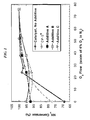
- FIG. 1 is a graphic representation of the comparison of ammonia conversion reduction in an RTU where ammonia reacts with CO at various levels of oxygen in a reactor feed in the presence of additives A, B and C, the FCC catalyst alone, and a commercial combustion promoter, CP-3 R .
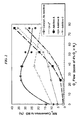
- FIG. 2 is a graphic representation of the comparison of ammonia conversion to NO x in an RTU where ammonia reacts with CO at various levels of oxygen in a reactor feed in the presence of the additives A, B and C, the FCC catalyst alone, and a commercial combustion promoter, CP-3 R .
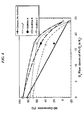
- FIG. 3 is a graphic representation of the comparison of ammonia conversion in an RTU where ammonia reacts with NO x at various levels of O 2 in a reactor feed in the presence of additives A, B and C, the FCC catalyst alone, and a commercial combustion promoter, CP-3 R .
- FIG. 4 is a graphic representation of the comparison of NO x conversion in an RTU where ammonia reacts with NO at various levels of O 2 in a reactor feed in the presence of additives A, B and C, the FCC catalyst alone, and a commercial combustion promoter, CP-3 R .
- FIG. 5 is a graphic representation of the comparison of NO x conversion to molecular nitrogen in an RTU where ammonia reacts with CO at various levels of O 2 in a reactor feed in the presence of additives A, B and C, the FCC catalyst alone, and a commercial combustion promoter, CP-3 R .
- NO x will be used herein to represent oxides of nitrogen, e.g. nitric oxide, (NO) and nitrogen dioxide (NO 2 ) the principal noxious oxides of nitrogen, as well as N 2 O 4 , N 2 O 5 , and mixtures thereof.
- NO nitric oxide
- NO 2 nitrogen dioxide
- gas phase reduced nitrogen species is used herein to indicate any gas phase species formed in the regenerator of a fluid catalytic cracking unit during a fluid catalytic cracking process which gas species contain a nitrogen having a nominal charge of less than zero.
- gas phase reduced nitrogen species include, but are not limited to, ammonia (NH 3 ), hydrogen cyanide (HCN), and the like.
- the content of NO x emitted during an FCC process operating in a partial or incomplete combustion mode is effectively brought to a lower and more acceptable level by reducing the amount of gas phase reduced nitrogen species present in the flue gas of the FCCU regenerator prior to passage of the gas to the CO boiler, where as CO is oxidized to CO 2 a lesser amount of the reduced nitrogen species, e.g. NH 3 and HCN, is oxidized to NO x and emitted into the atmosphere.
- a lesser amount of the reduced nitrogen species e.g. NH 3 and HCN
- the reduction of the gas phase reduced nitrogen species is accomplished by contacting the circulating cracking catalyst inventory with an amount of an oxidative catalyst/additive sufficient to reduce the content of the reduced nitrogen species in the regenerator off gas while the additive is circulated throughout the FCCU simultaneously with the circulating catalyst inventory.
- the process of the invention works to remove or minimize gas phase reduced nitrogen species via two distinct mechanisms, either of which results in the conversion of reduced nitrogen species to molecular nitrogen.
- the gas phase reduced nitrogen species is partially oxidized to molecular N 2 , according to a reaction that for NH 3 is: 2NH 3 + 3/2O 2 ⁇ N 2 + 3H 2 O
- the gas phase reduced nitrogen species can be oxidized to a nitrogen oxide, most likely NO.
- the catalyst/additive then catalyzes the reduction of the resulting nitrogen oxide by reacting it with one of the reductants present in the regenerator, e.g. CO or unconverted ammonia.
- the resultant NO x can be reduced by reacting with the coke on the cracking catalyst being regenerated.
- this mechanism proceeds according to the following reaction scheme: 2NH 3 + 5/2O 2 ⁇ 2NO + 3H 2 O 2NO + CO ⁇ N 2 + CO 2 2NO +2C ⁇ N 2 + 2CO 2NO + C ⁇ 2N 2 + CO 2 2NH 3 + 3NO ⁇ 5/2N 2 + 3H 2 O
- the invention process involves circulating an inventory of cracking catalyst and the gas phase reduced nitrogen species oxidative catalyst/additive in a catalytic cracking process, which presently is almost invariably the FCC process.
- FCC moving bed type
- the invention will be described with reference to the FCC process although the present cracking process could be used in the older moving bed type (TCC) cracking process with appropriate adjustments in particle size to suit the requirements of the process.
- TCC moving bed type
- conventional FCC catalysts may be used, for example, zeolite based catalysts with a faujasite cracking component as described in the seminal review by Venuto and Habib, Fluid Catalytic Cracking with Zeolite Catalysts, Marcel Dekker, New York 1979, ISBN 0-8247-6870-1 as well as in numerous other sources such as Sadeghbeigi, Fluid Catalytic Cracking Handbook, Gulf Publ. Co. Houston, 1995, ISBN 0-88415-290-1 .
- the FCC catalysts consist of a binder, usually silica, alumina, or silica alumina, a Y type acidic zeolitic active component, one or more matrix aluminas and/or silica aluminas, and fillers such as kaolin clay.
- the Y zeolite may be present in one or more forms and may have been ultra-stabilized and/or treated with stabilizing cations such as any of the rare earths.
- the fluid catalytic cracking process in which a heavy hydrocarbon feedstock will be cracked to lighter products takes place by contact of the feed in a cyclic catalyst recirculation cracking process with a circulating fluidizable catalytic cracking catalyst inventory consisting of particles having a mean particle size of from about 50 to about 150 ⁇ m, preferably about 60 to about 100 ⁇ m.
- the significant steps in the cyclic process are:
- Suitable feedstocks include petroleum distillates or residuals of crude oils which, when catalytically cracked, provide either a gasoline or a gas oil product.
- Cracking conditions employed during the conversion of higher molecular weight hydrocarbons to lower molecular weight hydrocarbons include a temperature of 480 to about 600 °C.
- a catalyst to hydrocarbon weight ratio of about 1 to 100, preferably about 3 to 20 is contemplated for the hydrocarbons conversion.
- the average amount of coke deposited on the surface of the catalyst is between 0.5 weight percent and 3.0 weight percent depending on of the quality of the feed, the catalyst used, and the unit design and operation. Rapid disengagement of the hydrocarbons from the catalyst is accomplished in a quick-stripping zone either intrinsic within the reactor or located in an external vessel. This stripping function is performed in the presence of steam or another inert gas at a temperature of about 480 °C to about 600 °C.
- the catalyst regeneration zone of the FCC process includes a lower dense bed of catalyst having a temperature of about 600 °C to about 800 °C and a surmounted dilute phase of catalyst having a temperature of from 600 °C to about 800 °C.
- the catalyst regeneration zone may consist of a single or multiple reactor vessels.
- oxygen is added to the regeneration zone. This is performed by conventional means, such as for example, using a suitable sparging device in the bottom of the regeneration zone or, if desired, additional oxygen is added to other sections of the dense bed or the dilute phase of the regeneration zone.
- the regeneration zone is operated in a partial or incomplete combustion mode, when any one the following conditions is satisfied: (1) there is not sufficient air or oxygen added to the regenerator to convert all the carbon in the coke on the spent cracking catalyst to CO 2 ; (2) the effluent from the regenerator does not contain enough oxygen to convert all CO in the regenerator effluent to CO 2 ; and/or (3) sufficient amount of CO is present in the regenerator effluent to require the use of a CO boiler to treat the regenerator effluent and convert the CO contained in the effluent to CO 2 before having said FCCU regenerator effluent discharged to the atmosphere.
- the solid catalyst and oxidative catalyst/additive particles and spent regeneration gas comprising a small quantity of oxygen, as well as carbon monoxide plus carbon dioxide, water, and nitrogen oxides, and gas phase reduced nitrogen species are passed to a separation means.
- the separation means comprises a series of cyclone separators wherein the particles will drop out of the bottom of the cyclone separators while the regeneration gas will be discharged in the overhead of the cyclone separator.
- the gas is passed to a CO boiler where added oxygen is provided to oxidize CO to CO 2 .
- the CO boiler or combustion zone is typically operated with auxiliary fuel in order to insure complete conversion of CO to carbon dioxide.
- an electrostatic precipitator may be utilized to remove dust particles which are entrained in the regeneration off gas.
- a scrubber may also be used to reduce both particulates and SO x emissions from the unit.
- the oxidative catalyst/additives useful in the process of the invention may be any fluidizable material having the activity to oxidize gas phase reduced nitrogen species present in the off gas emitted from the regenerator zone of an FCCU operated in partial or incomplete combustion mode to molecular nitrogen under catalytic cracking conditions as the catalyst/additive is being circulated throughout the cracking unit along with the inventory of cracking catalyst.
- the catalyst/additives comprise a porous, amorphous or crystalline, refractory support material, e.g. an acidic metal oxide, a spinel, a hydrotalcite or the like, promoted with at least one metal component.
- Suitable metal promoters include, but are not limited, to alkali and/or alkaline earth metals, transition metals, rare earth metals, Platinum group metals, Group Ib metals, Group IIb metals, Group VIA metals, germanium, tin, bismuth, antimony and mixtures thereof. Platinum group metals are particularly preferred. Also preferred are transition metals and rare earth metals having oxygen storage capacity.
- the metal promoters are used in amounts sufficient to promote, under catalytic cracking conditions, ammonia oxidation and NO x reduction via the reaction of NOx with gas phase reductants, such as CO, hydrocarbons and the like, typically found in the regenerator of an FCCU operated at partial or incomplete burn.
- Oxidative catalyst/additive compositions in this class will typically comprise a particulate mixture of (a) an acidic metal oxide containing substantially no zeolite (preferably containing silica and alumina, most preferably containing at least 50 wt % alumina); (b) an alkali metal (at least 0.5 wt %, preferably about 1 to about 20 wt %), an alkaline earth metal (at least 0.5 wt %, preferably about 0.5 to about 60 wt %) and mixtures thereof; (c) at least 0.1 wt % of a rare earth or transition metal oxygen storage metal oxide component (preferably ceria); and (d) at least 0.1 ppm of a noble metal component (preferably Pt, Pd, Rh, Ir, Os, Ru, Re and mixtures thereof). All percentages expressed being based on
- a second class of materials useful as oxidative catalyst/additives in the process of the invention include low NO x , CO combustion promoter as disclosed and described in U.S. Patent Nos.6,165,933 and 6,358,881 .
- the low NO x CO combustion promoter compositions comprise (1) an acidic oxide support; (2) an alkali metal and/or alkaline earth metal or mixtures thereof; (3) a transition metal oxide having oxygen storage capability; and (4) palladium.
- the acidic oxide support preferably contains silica alumina. Ceria is the preferred oxygen storage oxide.
- the oxidative catalyst/additives comprise (1) an acidic metal oxide support containing at least 50 wt % alumina; (2) about 1-10 parts by weight, measured as alkali metal oxide, of at least one alkali metal, alkaline earth metal or mixtures thereof; (3) at least 1 part by weight of CeO 2 ; and (4) about 0.01-5.0 parts by weight of Pd, all of said parts by weight of components (2)-(4) being per 100 parts by weight of said acidic metal oxide support material.
- a third class of materials useful as oxidative catalyst/additives in the process of the invention include NO x reduction compositions as disclosed and described in U.S. Patent Nos. 6,280,607 B1 , 6,143,167 and 6,129,834 ,
- the NO x reduction compositions comprise (1) an acidic oxide support; (2) an alkali metal and/or alkaline earth metal or mixtures thereof; (3) a transition metal oxide having oxygen storage capability; and (4) a transition metal selected from the Groups Ib and IIb of the Periodic Table.
- the acidic oxide support contains at least 50 wt % alumina and preferably contains silica alumina.
- Ceria is the preferred oxygen storage oxide.
- the oxidative catalyst/additives comprise (1) an acidic oxide support containing at least 50 wt % alumina; (2) 1-10 wt %, measured as the metal oxide, of an alkali metal, an alkaline earth metal or mixtures thereof; (3) at least 1 wt % CeO 2 ; and (4) 0.01-5.0 parts wt % of a transition metal, measured as metal oxide, selected from Group Ib of the Periodic Table, all weight percentages of components (2) ⁇ (4) being based on the total weight of the acidic oxide support material.
- compositions in this class comprise at least one metal-containing spinel which includes a first metal and a second metal having a valence higher than the valence of said first metal, at least one component of a third metal other than said first and second metals and at least one component of a fourth metal other than said first, second and third metals, wherein said third metal is selected from the group consisting of Group Ib metals, Group IIb metals, Group VIA metals, the rare earth metals, the Platinum Group metals and mixtures thereof, and said fourth metal is selected from the group consisting of iron, nickel, titanium, chromium, manganese, cobalt, germanium, tin, bismuth, molybdenum, antimony, vanadium and mixtures thereof.
- the metal containing spinel comprises magnesium as said first metal and aluminum as said second metal, and the atomic ratio of magnesium to aluminum in said spinel is at least about 0.17.
- the third metal in the spinel preferably comprise a metal of the Platinum Group metals.
- the third metal component is preferably present in an amount in the range of about 0.001% to about 20% by weight, calculated as elemental third metal, and said fourth metal component is present in an amount in the range of about 0.001% to about 10% by weight, calculated as elemental fourth metal.
- Oxidative catalyst/additive compositions used in the process of the invention will typically be in the form of particles and will have a particle size sufficient to permit the compositions to be circulated throughout the catalytic cracking unit simultaneously with the cracking catalyst.
- the catalyst/additives will have a mean particle size of greater than 45 ⁇ m.
- the mean particle size is from about 50 to 200 ⁇ m, most preferably about 55 to 150, and even more preferred about 60 to 120 ⁇ m.
- the catalyst/additives have a surface area of at least 5 m 2 /g, preferably at least 10 m 2 /g, most preferably at least 30 m 2 /g, and a Davison Attrition Index (DI) of 50 or less, preferably 20 or less, most preferably, 15 or less.
- DI Davison Attrition Index
- the oxidative catalyst/additive may be used as separate catalyst/additive particles along with the cracking catalyst or may be incorporated into the cracking catalyst as a component of the catalyst.
- the oxidative catalyst/additives are used as separate particles along with the cracking catalyst inventory to permit optimal conversion of the gas phase reduced nitrogen species to nitrogen while maintaining acceptable product yields of the cracking catalysts.
- the oxidative catalyst/additives are used in any amount sufficient to reduce the content of gas phase reduced nitrogen species present in the FCCU regenerator relative to the amount of said nitrogen species present without the use of the catalyst/additives, as measured by conventional gas analysis methodology, including but not limited to chemiluminescence, UV spectroscopy and IR spectroscopy, for example.
- the catalyst/additives are used in an amount of at least 0.01 wt %.
- the catalyst/additives are used in an amount ranging from about 0.01 to about 50 wt %, most preferably from about 0.1 to about 20 wt % of the cracking catalyst inventory.
- the amount of the catalyst/additives used is preferably an amount necessary to prevent afterburning in the catalytic cracking unit.
- Separate particles of the oxidative catalyst/additive may be added in the conventional manner, e.g. with make-up catalyst to the regenerator or by any other convenient method.
- the catalyst/additive When the oxidative catalyst/additive composition is incorporated into or onto the cracking catalyst as a separate component thereof, the catalyst/additive will typically be used in an amount of at least 0.01 weight percent of the cracking catalyst. Preferably, catalyst/additive will be used in an amount ranging from about 0.01 to 50 weight percent of the cracking catalyst; most preferably from about 0.1 to about 20 weight percent of the cracking catalyst.
- catalytically active components may be present in the circulating inventory of catalytic material in addition to the cracking catalyst and the ammonia removal additive.
- examples of such other materials include the octane enhancing catalysts based on zeolite ZSM-5, CO combustion promoters based on a supported noble metal such as platinum, stack gas desulfurization additives such as DESOX R (magnesium aluminum spinel), vanadium traps and bottom cracking additives, such as those described in Krishna, Sadeghbeigi, op cit and Scherzer, Octane Enhancing Zeolitic FCC Catalysts, Marcel Dekker, New York, 1990, ISBN 0-8247-8399-9 . These other components may be used in their conventional amounts.
- the effect of the present process to minimize the content of gas phase reduced nitrogen species is the reduction of the overall content of NO x emissions from an FCC process operating in a partial or incomplete bum mode.
- Very significant reduction in NO x emissions may be achieved by the use of the present process, in some cases up to about 90% relative to the base case using a conventional cracking catalyst, at constant conversion, using the preferred form of the catalyst described above.
- NO x reduction of 10 to 90% is readily achievable with the process according to the invention, as shown by the Examples below.
- the extent of NO x reduction will depend on such factors as, e.g., the composition and amount of the additive utilized; the design and the manner in which the FCCU is operated, including but not limited to oxygen level and distribution of air in the regenerator, catalyst bed depth in the regenerator, stripper operation and regenerator temperature; the properties of the hydrocarbon feedstock cracked; and the presence of other catalytic additives that may affect the chemistry and operation of the regenerator.
- the effectiveness of the process of the invention may be expected to vary from unit to unit.
- the formation of NO x is minimized by avoiding both high temperature and high excess oxygen zones using flame back mixing, exhaust gas recycle to the burner make-up air, staged fuel injection, intense swirl mixing of air and fuel, longer cooler flames, and various combinations of any or all of these design strategies.
- the present invention enables the benefits of low NO x burner technology to be realized from an FCC CO boiler so modified, by minimizing the reduced nitrogen species available to be oxidized therein to NO x .
- the result is a new low NO x partial bum FCC system that can eliminate the need for capital and operating cost-intensive systems like SCR, SNCR, scrubbers, and other approaches known in the art.
- the scope of the invention is not in any way intended to be limited by the examples set forth below.
- the examples include the preparation of oxidative additives useful in the process of the invention and the evaluation of the invention process to reduce NO x and gas phase reduced nitrogen species in a catalytic cracking environment.
- the efficiency of the process of the invention for converting gas phase reduced nitrogen species released from an FCCU regenerator operating in a partial or incomplete burn mode to molecular nitrogen was evaluated in the Examples using a Regenerator Test Unit (RTU) and model reactions.
- the RTU is an apparatus specifically designed to simulate the operation of an FCCU regenerator.
- the RTU is described in detail in G. Yaluris and A.W. Peters "Studying the Chemistry of the FCCU Regenerator Under Realistic Conditions," Designing Transportation Fuels for a Cleaner Environment, J.G. Reynolds and M.R. Khan, eds., p. 151, Taylor & Francis, 1999, ISBN: 1-56032-813-4 .
- the model reaction in the RTU for determining the efficiency of the invention process for converting gas phase reduced nitrogen species without converting the species to NO x was the reaction of NH 3 over a cracking catalyst inventory containing the additive tested in the presence of CO and various amounts of O 2 .
- NH 3 represents the gas phase reduced nitrogen species
- CO and O 2 represent the other reductants and oxidizers typically found in a FCC unit regenerator operating in partial burn.
- the key measurement in this experiment in addition to NH 3 conversion is how much of the NH 3 is converted to NO x if any. It is desirable that the latter conversion is as low as possible for a wide range of O 2 amounts in the reactor.
- the efficiency of the process of the invention to convert NO x after it is formed in a FCCU regenerator operating in partial burn was determined in the RTU by measuring the activity of an additive to reduce NO x with CO, a common reductant in every FCCU regenerator.
- the key performance measurement in this test is the NO x conversion. It is desirable to have high NO x conversion to nitrogen for a wide range of O 2 amounts.
- Gas phase reduced nitrogen species are a reductant for reducing NO x after it is formed.
- the ability of an additive to catalyze this reaction while simultaneously converting the reduced nitrogen species to molecular nitrogen was determined by measuring in the RTU its activity for converting NH 3 with NO x under various O 2 levels simulating the reducing/oxidizing conditions possible in a regenerator operating in partial burn. It is desirable in this experiment to have high NO x conversion to nitrogen.
- a microspheriodal particulate support material having the following analysis: 2.3% total volatiles, and approximately 4.5% SiO 2 , 5% Na 2 O, 16.8% CeO 2 , and 73% Al 2 O 3 , and BET surface area of 140 m 2 /g was prepared as a base material for the preparation of a NO x composition of the invention.
- a slurry was prepared from an aqueous alumina slurry having 20% solids of a peptizable alumina (Versal 700 alumina powder, obtained from La Roche Industries Inc., 99% Al 2 O 3 , 30% moisture). The alumina slurry was prepared using 31.6 lbs of the alumina powder.
- the mixture was agitated to assure good mixing and then milled in a stirred media mill to reduce agglomerates to substantially less than 10 ⁇ m.
- the milled mixture was then spray dried to form approximately 70 ⁇ m microspheres and thereafter calcined at approximately 650°C to remove volatiles.
- An Additive A was prepared using the base material prepared in Example 1. 80g of the base material was placed in an inclined beaker on a mechanical rotator. A platinum impregnation solution was prepared by weighing out 0.1715g of a platinum tetramine dihydroxide aqueous solution containing 22.79% platinum and diluting with DI water to 100g total. The base material was then impregnated by gradually spraying with 50g of the dilute Pt solution through an air mist spray nozzle system. The wet impregnated base material was dried in an oven at 120°C over night.
- the dried cake was in the form of large chunks and was first ground in a blender and screened before calcining at 650°C for two hours to decompose the nitrates and remove volatiles.
- the resulting material contained: 72.5% Al 2 O 3 , 4.4% SiO 2 , 5% Na 2 O, 18.8% CeO 2 , 331 ppm Pt, and had a BET surface area of 135 m 2 /g and a mean particle size of 58 ⁇ m.
- An Additive B was prepared as described in Example 2 with the exception that the platinum impregnation solution prepared was diluted with DI water to 50g total and the base material was then impregnated by gradually spraying with all of the latter dilute Pt solution through an air mist spray nozzle system.
- the resulting material contained: 72.8% Al 2 O 3 , 4.4% SiO 2 , 5.1% Na 2 O, 17% CeO 2 , 688 ppm Pt, and had a BET surface area of 141 m 2 /g and a mean particle size of 58 ⁇ m.
- Additive C was prepared in accordance with U.S. Patent 6,280,601 B1 .
- the additive had the following analyses: 5.8% total volatiles, and approximately SiO 2 4.9%, Na 2 O 4.9%, CeO 2 21.2%, Al 2 O 3 68.7%, 970 ppm Pd, and BET surface area of 167 m 2 /g and a mean particle size of 90 ⁇ m.
- Additives A, B and C, prepared in Examples 2, 3, and 4 respectively, to remove gas phase reduced nitrogen species other than N 2 from an FCCU regenerator operating in partial burn was compared at various oxygen levels with that of a cracking catalyst alone and a commercial platinum-containing combustion promoter, CP-3 R (platinum on alumina) sold by Grace Davison, Columbia, MD.
- CP-3 R platinum on alumina
- the experiments were conducted by calcining the additives for 2 hrs at 595 °C. Following calcination, the additives were blended at 0.5% level with FCC catalyst which had been deactivated for 4hrs at 816 °C in a fluidized bed reactor with 100% steam. The cracking catalyst alone or blended with an additive was then fed to the RTU reactor operating at 700 °C.
- the gas feed to the reactor was a mixture of NH 3 and CO containing 5000 to 5500 ppm CO, approximately 600 ppm NH 3 , various amounts of O 2 added as 4% O 2 in N 2 , and the balance N 2 .
- the total gas feed rate excluding the O 2 containing gas feed was 1000-1100 sccm.
- the platinum on alumina CO combustion promoter, CP-3 R was tested at 0.25 % additive level. Results are recorded in FIG. 1 and FIG. 2 below.
- FIG. 1 shows that at low levels of oxygen, which simulates partial burn, the use of platinum and palladium containing additives, Additives A, B, and C, were highly effective in reducing ammonia when compared to the activity of the cracking catalyst alone or the platinum-containing combustion promoter, CP-3 R .
- FIG. 2 shows that under partial bum conditions the additives exhibited increased activity to reduce the ammonia to molecular nitrogen thereby preventing the conversion of the ammonia to NO x . No other nitrogen oxides, e.g., NO 2 or N 2 O were detected, indicating the conversion of NH 3 to molecular nitrogen.
- Additives A, B and C prepared in Examples 2, 3 and 4, respectively, for reducing NO x emissions from an FCCU regenerator operating in partial bum mode by reacting NH 3 with NO x at various levels of oxygen was compared to that of the cracking catalyst alone and a commercial platinum-containing combustion promoter, CP-3 R .
- Example 5 The experiment was conducted as in Example 5 except that the gas mixture fed to the reactor contained approximately 1000 ppm NH 3 and 500-550 ppm NO x as well as various amounts of oxygen with the balance N 2 . Results were recorded in FIG. 3 and FIG. 4 below.
- NH 3 reacts with O 2 to form N 2 or NO x .
- NH 3 can also react in the gas phase with NO x in a non-catalytic process that is often used for NO x abatement.
- FIG. 3 and FIG. 4 show, that in accordance with the process of the invention, Additives A, B, and to a lesser extent, C showed enhanced conversion of ammonia and NO x to molecular nitrogen at low oxygen levels. No other nitrogen oxides, e.g., NO 2 or N 2 O were detected, indicating the conversion of NH 3 to molecular nitrogen.
- Additives A, B and C to decrease NO x after it is formed in an FCC unit regenerator operating in partial bum was compared to the activity of the cracking catalyst alone and a commercial platinum-containing combustion promoter, CP-3 R , by measuring the activity of the catalyst and additives to convert NO x to N 2 in the presence of CO at various oxygen levels.
- Figure V show that at low oxygen levels simulating partial burn, the Additives A, B and C are more effective than catalyst alone or the platinum based combustion promoter, CP-3 R , to remove NO x .
- the activity of the Additive C for removal of HCN from an FCCU regenerator was compared to the activity of the cracking catalyst alone and a commercial platinum-containing combustion promoter, CP-5 R (platinum on alumina) sold by Grace Davison, a business unit of W.R. Grace & Co.-Conn., Columbia, MD.
- CP-5 R platinum on alumina
- the cracking catalyst was deactivated for 4 hrs at 816°C in a fluidized bed reactor with 100% steam, and coked in a DCR.
- the description of the DCR is described in detail in the G.W. Young, "Realistic Assessment of FCC Catalyst Performance in the Laboratory,” in Fluid Catalytic Cracking: Science and Technology, J. S. Magee and M. M. Mitchell, Jr. Eds., Studies in Surface Science and Catalysis Volume 76, p. 257, Elsevier Science Publishers B.V., Amsterdam 1993, ISBN 0-444-89037-8 .
- the catalyst After being coked in the DCR the catalyst had about 1.2 ⁇ 1.5 wt % coke. About 20 g of the coked cracking catalyst alone or with the Additive C or the combustion promoter added at 0.5 wt % was loaded in the RTU. The gas flow to the RTU reactor was about 800 sccm, containing about 5% O 2 with the balance N 2 . Following an experimental procedure commonly known to those skilled in the art as Temperature-Programmed Oxidation or TPO, and starting from room temperature, the reactor was heated up to about 780°C by raising the temperature at a rate of about 9°C/min, while continuously flowing the aforementioned gas into the RTU reactor.
- TPO Temperature-Programmed Oxidation
Landscapes
- Engineering & Computer Science (AREA)
- Chemical & Material Sciences (AREA)
- Environmental & Geological Engineering (AREA)
- General Chemical & Material Sciences (AREA)
- Biomedical Technology (AREA)
- Analytical Chemistry (AREA)
- Health & Medical Sciences (AREA)
- Oil, Petroleum & Natural Gas (AREA)
- Chemical Kinetics & Catalysis (AREA)
- Life Sciences & Earth Sciences (AREA)
- Sustainable Development (AREA)
- Production Of Liquid Hydrocarbon Mixture For Refining Petroleum (AREA)
- Catalysts (AREA)
- Exhaust Gas Treatment By Means Of Catalyst (AREA)
Claims (16)
- Verfahren zur Verringerung des Gehalts an gasphase-reduzierten Stickstoffspezies in dem Abgas aus einer Regenerationszone einer Fließbettcrackanlage (FCCU), bei dem unter katalytischen Crackbedingungen gasphase-reduzierte Stickstoffspezies, die im Regenerationszoneabgas aus der Regenerationszone einer Fließbettcrackanlage enthalten sind, die während eines FCC Verfahrens in einem Modus der teilweisen oder unvollständigen Verbrennung betrieben wird, mit einem Oxidationskatalysator/-additiv für gasphase-reduzierte Stickstoffspezies mit einer mittleren Teilchengröße von 50 bis 200 µm kontaktiert werden, wobei der bzw. das Oxidationsktalysator/-additiv in der Lage ist, die gasphase-reduzierten Stickstoffspezies in dem Abgas unter katalytischen Crackbedingungen in molekularen Stickstoff umzuwandeln, und gegebenenfalls in der Lage ist, die CO-Oxidation zu fördern, wobei der bzw. das Oxidationskatalysator/-additiv in einer ausreichenden Menge verwendet wird, um den Gehalt der gasphase-reduzierten Stickstoffspezies in dem Abgas im Vergleich zu dem Gehalt an gasphase-reduzierten Stickstoffspezies in dem Abgas ohne Oxidationskatalysator/-additiv zu verringern, oder wobei der bzw. das Oxidationskatalysator/-additiv in der Lage ist, die CO-Oxidation in einem solchen Umfang zu fördern, der zur Verhinderung von Nachbrennen der Fließbettcrackanlage erforderlich ist.
- Verfahren nach Anspruch 1, bei dem der bzw. das Oxidationskatalysator/-additiv zusammen mit einer zirkulierenden Beschickung von katalytischem Crackkatalysator durch die Fließbettcrackanlage zirkuliert wird.
- Verfahren nach Anspruch 2, bei dem die Verweilzeit des Oxidationskatalysators/-additivs in der Regenerationszone der Fließbettcrackanlage im Wesentlichen die gleiche wie die Verweilzeit der Crackkatalysatorbeschickung ist.
- Verfahren nach Anspruch 2, bei dem der bzw. das Oxidationskatalysator/-additiv eine Teilchengröße im Bereich von 50 bis 200 µm aufweist.
- Verfahren nach Anspruch 1 oder 4, bei dem der bzw. das Oxidationskatalysator/-additiv eine mittlere Teilchengröße im Bereich von 55 bis 150 µm aufweist.
- Verfahren nach Anspruch 1, bei dem außerdem das Regenerationszoneabgas mit einem verringerten Gehalt an gasphase-reduzierten Stickstoffspezies zu einem CO-Boiler geleitet und ein Abgas mit einem reduzierten Gehalt an NOx-Emissionen in die Atmosphäre abgelassen wird.
- Verfahren nach Anspruch 1, bei dem die gasphase-reduzierten Stickstoffspezies Ammoniak oder Cyanwasserstoff umfassen.
- Verfahren nach Anspruch 6, bei dem der CO-Boiler ein niedriger NOx CO-Boiler ist.
- Verfahren nach Anspruch 1, bei dem der bzw. das Oxidationskatalysator/-additiv für die gasphase-reduzierten Stickstoffspezies (a) mindestens 1 Gew.%, gemessen als Oxid, von einem Säuremetalloxid, das im Wesentlichen keinen Zeolith enthält, (b) mindestens 0,5 Gew.% Metallkomponente, gemessen als Oxid, ausgewählt aus Alkalimetall, Erdalkalimetall und Mischungen davon, (c) mindestens 0,1 Gew.%, gemessen als Oxid, einer Seltenerd- oder Übergangsmetall-Sauerstoffspeichermetalloxidkomponente und (d) mindestens 0,1 ppm, gemessen als Metall, einer Edelmetallkomponente ausgewählt aus Pt, Pd, Rh, Ir, Os, Ru, Re und Mischungen davon umfasst, wobei alle angegebenen Prozentsätze auf dem Gesamtgewicht des Oxidationskatalysators/-additivs basieren.
- Verfahren nach Anspruch 1, bei dem der bzw. das Oxidationskatalysator/-additiv für die gasphase-reduzierten Stickstoffspezies (1) einen Säuremetalloxidträger, (2) 1 bis 10 Gewichtsteile, gemessen als Metalloxid, von mindestens einem Alkalimetall, Erdalkalimetall oder Mischungen davon, (3) mindestens ein Gewichtsteil CeO2 und (4) 0,01 bis 5,0 Gewichtsteile, gemessen als Metalloxid, Cu oder Ag umfasst, wobei alle Gewichtsteile der Komponenten (2)-(4) auf 100 Gewichtsteile des Säureoxidträgermaterials bezogen sind.
- Verfahren nach Anspruch 1, bei dem der bzw. das Oxidationskatalysator/-additiv für die gasphase-reduzierten Stickstoffspezies einen mit einem Metallpromotor ausgewählt aus Alkali- und/oder Erdalkalimetallen, Übergangsmetallen, Seltenerdmetallen, Platingruppemetallen, Gruppe Ib Metallen, Gruppe IIb Metallen, Gruppe VIA Metallen, Germanium, Zinn, Wismut, Antimon und Mischungen davon aktivierten Spinell umfasst.
- Verfahren nach Anspruch 1, bei dem der bzw. das Oxidationskatalysator/-additiv für die gasphase-reduzierten Stickstoffspezies einen mit einem Metallpromotor ausgewählt aus Alkalki- und/oder Erdalkalimetallen, Übergangsmetallen, Seltenerdmetallen, Platingruppemetallen, Gruppe Ib Metallen, Gruppe IIb Metallen, Gruppe VIA Metallen, Germanium, Zinn, Wismut, Antimon und Mischungen davon aktivierten Hydrotalkit umfasst.
- Verfahren nach Anspruch 1, bei dem der bzw. das Oxidationskatalysator/-additiv für die gasphase-reduzierten Stickstoffspezies ein vom katalytischen Crackkatalysator getrenntes, teilchenförmiges Additiv ist.
- Verfahren nach Anspruch 1, bei dem der bzw. das Oxidationskatalysator/-additiv für die gasphase-reduzierten Stickstoffspezies als Komponente in den katalytischen Crackkatalysator integriert ist.
- Verfahren nach Anspruch 11, bei dem der bzw. das Oxidationskatalysator/-additiv für die gasphase-reduzierten Stickstoffspezies mindestens ein Metall enthaltenden Spinell umfasst, der ein erstes Metall und ein zweites Metall mit einer höheren Valenz als die Valenz des ersten Metalls, mindestens eine Komponente eines dritten Metalls, das ein anderes Metall als das erste und das zweite Metall ist, und mindestens eine Komponente eines vierten Metalls, das ein anderes Metall als das erste, das zweite und das dritte Metall ist, umfasst, wobei das dritte Metall ausgewählt ist aus Gruppe Ib Metallen, Gruppe IIb Metallen, Gruppe VIA Metallen, Seltenerdmetallen, Platingruppemetallen und Mischungen davon und das vierte Metall ausgewählt ist aus Eisen, Nickel, Titan, Chrom, Mangan, Kobalt, Germanium, Zinn, Wismut, Molybdän, Antimon, Vanadin und Mischungen davon.
- Verfahren nach Anspruch 1, bei dem der bzw. das Oxidationskatalysator/-additiv für die gasphase-reduzierten Stickstoffspezies eine CO-Oxidationsaktivität aufweist und (1) einen mindestens 50 Gew.% Aluminiumoxid enthaltenden Säureoxidträger, (2) 1 bis 10 Gew.%, gemessen als Metalloxid, Alkalimetall, Erdalkalimetall oder Mischungen davon, (3) mindestens 1 Gew.% CeO2 und (4) 0,01 bis 5,0 Gew.% Palladium umfasst, wobei alle Prozentangaben für die Komponenten (2) - (4) auf das Gesamtgewicht des Säureoxidträgermaterials bezogen sind.
Applications Claiming Priority (3)
| Application Number | Priority Date | Filing Date | Title |
|---|---|---|---|
| US274621 | 1999-03-23 | ||
| US10/274,621 US20040074809A1 (en) | 2002-10-21 | 2002-10-21 | Reduction of gas phase reduced nitrogen species in partial burn FCC processes |
| PCT/US2003/033479 WO2004037392A1 (en) | 2002-10-21 | 2003-10-21 | Reduction of gas phase reduced nitrogen species in partial burn fcc processes |
Publications (2)
| Publication Number | Publication Date |
|---|---|
| EP1558367A1 EP1558367A1 (de) | 2005-08-03 |
| EP1558367B1 true EP1558367B1 (de) | 2012-06-27 |
Family
ID=32093084
Family Applications (1)
| Application Number | Title | Priority Date | Filing Date |
|---|---|---|---|
| EP03809611A Expired - Lifetime EP1558367B1 (de) | 2002-10-21 | 2003-10-21 | Reduktion von gasphasenreduziertem stickstoffarten inteilverbrennungs-fcc-prozessen |
Country Status (11)
| Country | Link |
|---|---|
| US (4) | US20040074809A1 (de) |
| EP (1) | EP1558367B1 (de) |
| JP (1) | JP2006503700A (de) |
| KR (1) | KR20050060100A (de) |
| CN (1) | CN100377765C (de) |
| AU (1) | AU2003277459B2 (de) |
| CA (1) | CA2502985C (de) |
| MX (1) | MXPA05004181A (de) |
| NO (1) | NO20052448L (de) |
| TW (1) | TWI345482B (de) |
| WO (1) | WO2004037392A1 (de) |
Cited By (2)
| Publication number | Priority date | Publication date | Assignee | Title |
|---|---|---|---|---|
| WO2024149668A1 (en) | 2023-01-09 | 2024-07-18 | Basf Se | Process for removing nitric oxide, nitrous oxide and carbon monoxide from a gas stream |
| WO2025125207A1 (en) | 2023-12-11 | 2025-06-19 | Basf Se | Process for removing nitrogen monoxide, nitrogen dioxide and nitrous oxide from an exhaust gas stream |
Families Citing this family (25)
| Publication number | Priority date | Publication date | Assignee | Title |
|---|---|---|---|---|
| JP4578048B2 (ja) * | 2002-06-21 | 2010-11-10 | 中国電力株式会社 | 脱硝触媒再生方法 |
| US6660683B1 (en) * | 2002-10-21 | 2003-12-09 | W.R. Grace & Co.-Conn. | NOx reduction compositions for use in FCC processes |
| RU2394065C2 (ru) * | 2004-11-02 | 2010-07-10 | В.Р.Грейс Энд Ко.-Конн. | СПОСОБ СОКРАЩЕНИЯ ВЫБРОСОВ NOx В ПРОЦЕССАХ ПОЛНОГО СЖИГАНИЯ ПРОДУКТОВ КРЕКИНГА |
| RU2007139330A (ru) * | 2005-03-24 | 2009-04-27 | В.Р.Грейс Энд Ко.-Конн. (Us) | СПОСОБ РЕГУЛИРОВАНИЯ ВЫБРОСОВ NOx В УСТАНОВКАХ КАТАЛИТИЧЕСКОГО КРЕКИНГА В ПСЕВДООЖИЖЕННОМ СЛОЕ |
| BRPI0608350B1 (pt) | 2005-04-29 | 2015-07-21 | Grace W R & Co | Composições de redução de nox para uso em processos de craqueamento catalítico fluido (fcc) com queima parcial |
| FR2887467B1 (fr) * | 2005-06-22 | 2007-08-03 | Air Liquide | Procede de traitement des fumees issues du regenerateur catalytique d'une unite de craquage catalytique |
| WO2007005795A1 (en) * | 2005-07-01 | 2007-01-11 | Albemarle Netherlands Bv | Use of anionic clay in an fcc process |
| US20070129234A1 (en) * | 2005-12-02 | 2007-06-07 | Stockwell David M | Lower temperature CO promoters for FCC with low NOx |
| US7470412B2 (en) * | 2005-12-21 | 2008-12-30 | Praxair Technology, Inc. | Reduction of CO and NOx in regenerator flue gas |
| TR201909630T4 (tr) | 2006-11-22 | 2019-07-22 | Orica Explosives Tech Pty Ltd | Entegre kimyasal proses. |
| US7767175B2 (en) * | 2007-01-09 | 2010-08-03 | Catalytic Solutions, Inc. | Ammonia SCR catalyst and method of using the catalyst |
| US7527776B2 (en) * | 2007-01-09 | 2009-05-05 | Catalytic Solutions, Inc. | Ammonia SCR catalyst and method of using the catalyst |
| US7943097B2 (en) * | 2007-01-09 | 2011-05-17 | Catalytic Solutions, Inc. | Reactor system for reducing NOx emissions from boilers |
| US8802582B2 (en) * | 2007-01-09 | 2014-08-12 | Catalytic Solutions, Inc. | High temperature ammonia SCR catalyst and method of using the catalyst |
| WO2008148683A1 (en) * | 2007-06-08 | 2008-12-11 | Albemarle Netherlands, B.V. | Fcc co oxidation promoters |
| US8114272B2 (en) * | 2008-09-26 | 2012-02-14 | Exxonmobil Research & Engineering Company | Method for treating refinery waste streams in a fluid catalytic cracking unit and an improved catalytic cracking unit for processing refinery waste streams |
| CN103768933B (zh) * | 2012-10-23 | 2015-10-21 | 中国石油化工股份有限公司 | 一种fcc装置co余热锅炉的烟气脱硝工艺 |
| US8926928B2 (en) | 2013-02-22 | 2015-01-06 | Johnson Matthey Process Technologies, Inc. | Process of removing HCN from flue gas |
| CN105701267A (zh) * | 2015-05-13 | 2016-06-22 | 青岛科技大学 | 一种石油催化裂化反应再生部分的建模方法 |
| CN105126841A (zh) * | 2015-07-29 | 2015-12-09 | 张冰童 | 用于降低贫氧再生fcc烟气hn3和hcn排放组合物及其制备方法 |
| BR112018002339B1 (pt) * | 2015-08-14 | 2022-10-25 | Orion Engineered Carbons Gmbh | Método e sistema para reduzir matéria particulada em um gás de escape |
| EP3248784B1 (de) * | 2016-05-26 | 2020-02-19 | Canon Kabushiki Kaisha | Flüssigkeitsausstosskopf, verfahren zur herstellung davon und druckverfahren |
| CN106807372B (zh) * | 2017-03-13 | 2019-04-23 | 河北鑫鹏新材料科技有限公司 | 一种降低催化裂化再生烟气污染物排放的催化剂及其应用 |
| CN111346502B (zh) * | 2018-12-20 | 2022-03-11 | 中国石油化工股份有限公司 | 一种不完全再生烟气的处理方法 |
| TW202224767A (zh) * | 2020-10-01 | 2022-07-01 | 美商W R 康格雷氏公司 | 用於流體催化裂解的催化劑組成物及其製備方法 |
Family Cites Families (72)
| Publication number | Priority date | Publication date | Assignee | Title |
|---|---|---|---|---|
| US472863A (en) * | 1892-04-12 | Harness-hook | ||
| US3547648A (en) * | 1968-01-26 | 1970-12-15 | Minnesota Mining & Mfg | Copy-sheet |
| US4153535A (en) * | 1975-12-19 | 1979-05-08 | Standard Oil Company (Indiana) | Catalytic cracking with reduced emission of noxious gases |
| US4199435A (en) * | 1978-12-04 | 1980-04-22 | Chevron Research Company | NOx Control in cracking catalyst regeneration |
| US4290878A (en) * | 1978-12-08 | 1981-09-22 | Chevron Research Company | NOx control in platinum-promoted complete combustion cracking catalyst regeneration |
| US4495305A (en) * | 1980-07-29 | 1985-01-22 | Atlantic Richfield Company | Catalyst for conversion of hydrocarbons |
| US4642178A (en) * | 1980-07-29 | 1987-02-10 | Katalistiks, Inc. | Process for conversion of hydrocarbons |
| US4472267A (en) * | 1980-07-29 | 1984-09-18 | Atlantic Richfield Company | Catalyst and process for conversion of hydrocarbons |
| US4758418A (en) * | 1980-07-29 | 1988-07-19 | Union Carbide Corporation | Process for combusting solid sulfur-containing material |
| US4957892A (en) * | 1980-07-29 | 1990-09-18 | Uop | Process for combusting solid sulfur containing material |
| US4495304A (en) * | 1980-07-29 | 1985-01-22 | Atlantic Richfield Company | Catalyst for conversion of hydrocarbons |
| JPS5761085A (en) * | 1980-07-29 | 1982-04-13 | Atlantic Richfield Co | Conversion of hydrocarbon |
| US4368057A (en) * | 1980-10-14 | 1983-01-11 | Matthews Ronald D | Method for reducing ammonia concentration in pre-combusted fuel gas using nitric oxide |
| GB2100075B (en) * | 1981-05-19 | 1984-07-18 | Tokyo Shibaura Electric Co | Rectifier circuit |
| US4434147A (en) * | 1981-10-05 | 1984-02-28 | Chevron Research Company | Simultaneous sulfur oxide and nitrogen oxide control in FCC units using cracking catalyst fines with ammonia injection |
| US4522937A (en) * | 1982-11-29 | 1985-06-11 | Atlantic Richfield Company | Preparative process for alkaline earth metal, aluminum-containing spinels |
| US4471070A (en) * | 1982-11-29 | 1984-09-11 | Atlantic Richfield Company | Preparative process for alkaline earth metal, aluminum-containing spinels |
| US4472532A (en) * | 1982-11-29 | 1984-09-18 | Atlantic Richfield Company | Preparative process for alkaline earth metal, aluminum-containing spinels |
| US4476245A (en) * | 1982-11-29 | 1984-10-09 | Atlantic Richfield Company | Preparative process for alkaline earth metal, aluminum-containing spinels |
| US4428827A (en) * | 1983-01-24 | 1984-01-31 | Uop Inc. | FCC Sulfur oxide acceptor |
| DE3308392A1 (de) * | 1983-03-09 | 1984-09-13 | Linde Ag, 6200 Wiesbaden | Verfahren zur verhinderung der verlegung von apparaten mit metallsulfiden |
| US4613428A (en) * | 1983-07-13 | 1986-09-23 | Katalistiks, Inc. | Hydrocarbon cracking process |
| US4529502A (en) * | 1984-02-27 | 1985-07-16 | Uop Inc. | Sulfur oxide acceptance from a flue gas |
| US4529574A (en) * | 1984-01-30 | 1985-07-16 | Uop Inc. | Process for the removal of sulfur oxide from a gas |
| US4492678A (en) | 1984-05-17 | 1985-01-08 | Atlantic Richfield Company | Preparative process for alkaline earth metal, aluminum-containing spinels and their use for reducing sulfur oxide content in gases |
| US4492677A (en) * | 1984-05-17 | 1985-01-08 | Atlantic Richfield Company | Preparative process for alkaline earth metal, aluminum-containing spinels and their use for reducing the sulfur oxide content of gases |
| US4883783A (en) * | 1984-05-30 | 1989-11-28 | Uop | Composition of matter for conversion of hydrocarbons |
| US4626419A (en) * | 1985-07-01 | 1986-12-02 | Texaco Inc. | Control of SOx emission |
| US4728635A (en) * | 1986-04-07 | 1988-03-01 | Katalistiks International Inc. | Alkaline earth metal spinels and processes for making |
| US4790982A (en) * | 1986-04-07 | 1988-12-13 | Katalistiks International, Inc. | Metal-containing spinel composition and process of using same |
| US4778665A (en) * | 1986-09-09 | 1988-10-18 | Mobil Oil Corporation | Abatement of NOx in exhaust gases |
| US4904627A (en) * | 1987-03-13 | 1990-02-27 | Uop | Alkaline earth metal spinel/kaolin clays and processes for making |
| US4830840A (en) * | 1987-03-13 | 1989-05-16 | Uop | Process for removing sulfur oxide and nitrogen oxide |
| US4851374A (en) * | 1987-05-29 | 1989-07-25 | Mobil Oil Corporation | Apparatus and method for regenerating coked fluid cracking catalyst |
| US4744962A (en) * | 1987-07-22 | 1988-05-17 | Shell Oil Company | Process for the reduction of ammonia in regeneration zone off gas by select addition of NOx to the regeneration zone or to the regeneration zone off gas |
| US4755282A (en) * | 1987-07-22 | 1988-07-05 | Shell Oil Company | Process for the reduction of NH3 in regeneration zone off gas by select recycle of certain-sized NH3 decomposition catalysts |
| US4812430A (en) * | 1987-08-12 | 1989-03-14 | Mobil Oil Corporation | NOx control during multistage combustion |
| US4812431A (en) * | 1987-08-12 | 1989-03-14 | Mobil Oil Corporation | NOx control in fluidized bed combustion |
| US4957718A (en) * | 1987-11-24 | 1990-09-18 | Uop | Process for reducing emissions of sulfur oxides and composition useful in same |
| US5057205A (en) * | 1988-06-10 | 1991-10-15 | Mobil Oil Corporation | Additive for vanadium and sulfur oxide capture in catalytic cracking |
| US4980052A (en) * | 1988-12-05 | 1990-12-25 | Mobil Oil Corporation | Catalytic cracking of hydrocarbons |
| US5021144A (en) * | 1989-02-28 | 1991-06-04 | Shell Oil Company | Process for the reduction of NOX in an FCC regeneration system by select control of CO oxidation promoter in the regeneration zone |
| US4973399A (en) * | 1989-11-03 | 1990-11-27 | Mobil Oil Corporation | Catalytic cracking of hydrocarbons |
| US5002654A (en) * | 1989-12-28 | 1991-03-26 | Mobil Oil Corporation | Reducing NOx emissions with zinc catalyst |
| US5037538A (en) * | 1990-02-26 | 1991-08-06 | Mobil Oil Corporation | Catalytic cracking process with isolated catalyst for conversion of NO.sub.x |
| US5011592A (en) * | 1990-07-17 | 1991-04-30 | Mobil Oil Corporation | Process for control of multistage catalyst regeneration with full then partial CO combustion |
| US5077252A (en) * | 1990-07-17 | 1991-12-31 | Mobil Oil Corporation | Process for control of multistage catalyst regeneration with partial co combustion |
| CN1022542C (zh) * | 1990-07-26 | 1993-10-27 | 北京大学 | 钙钛矿型稀土复合氧化物燃烧催化剂 |
| US5173278A (en) * | 1991-03-15 | 1992-12-22 | Mobil Oil Corporation | Denitrification of flue gas from catalytic cracking |
| US5547648A (en) | 1992-04-15 | 1996-08-20 | Mobil Oil Corporation | Removing SOx, NOX and CO from flue gases |
| US5240690A (en) * | 1992-04-24 | 1993-08-31 | Shell Oil Company | Method of removing NH3 and HCN from and FCC regenerator off gas |
| US5268089A (en) * | 1992-06-24 | 1993-12-07 | Mobil Oil Corporation | FCC of nitrogen containing hydrocarbons and catalyst regeneration |
| US5382352A (en) * | 1992-10-20 | 1995-01-17 | Mobil Oil Corporation | Conversion of NOx in FCC bubbling bed regenerator |
| US5364517A (en) * | 1993-02-19 | 1994-11-15 | Chevron Research And Technology Company | Perovskite-spinel FCC NOx reduction additive |
| US5372706A (en) * | 1993-03-01 | 1994-12-13 | Mobil Oil Corporation | FCC regeneration process with low NOx CO boiler |
| ES2092429B1 (es) | 1993-07-29 | 1997-08-01 | Univ Valencia Politecnica | Catalizador para la eliminacion de sox y nox de gases, especialmente de unidades fcc, y manera de prepararlo. |
| US5565399A (en) * | 1994-06-29 | 1996-10-15 | Engelhard Corp | Co oxidation promoter and use thereof for catalytic cracking |
| CA2156464C (en) * | 1994-09-30 | 1999-07-20 | Raghu K. Menon | Reduction of emissions from fcc regenerators |
| DE19505579A1 (de) * | 1995-02-18 | 1996-08-22 | Sued Chemie Ag | Adsorbens zur Behandlung von Ölen und/oder Fetten |
| AU5721996A (en) | 1995-05-02 | 1996-11-21 | Tricat Industries Inc. | Catalyst and process for preparing same |
| AU718321B2 (en) * | 1995-05-05 | 2000-04-13 | W.R. Grace & Co.-Conn. | Compositions for reduced NOx and combustion promotion in FCC processes |
| US6129834A (en) * | 1995-05-05 | 2000-10-10 | W. R. Grace & Co. -Conn. | NOx reduction compositions for use in FCC processes |
| US6165933A (en) * | 1995-05-05 | 2000-12-26 | W. R. Grace & Co.-Conn. | Reduced NOx combustion promoter for use in FCC processes |
| US5830346A (en) * | 1995-08-30 | 1998-11-03 | Mobil Oil Corporation | FCC regenerator in partial CO burn with downstream air addition |
| US5705053A (en) * | 1995-08-30 | 1998-01-06 | Mobil Oil Corporation | FCC regenerator NOx reduction by homogeneous and catalytic conversion |
| US5716514A (en) * | 1995-08-30 | 1998-02-10 | Mobil Oil Corporation | FCC NOx reduction by turbulent/laminar thermal conversion |
| US5827793A (en) * | 1996-04-11 | 1998-10-27 | Exxon Research And Engineering Company | Controlled FCC catalyst regeneration using a distributed air system |
| US5928496A (en) | 1996-06-20 | 1999-07-27 | Contract Materials Processing, Inc. | Hydrotalcite sulfer oxide sorption |
| US6021144A (en) * | 1999-02-24 | 2000-02-01 | Nvision, Inc. | Automatic power control circuit for a laser driver |
| RU2336935C2 (ru) * | 2002-08-13 | 2008-10-27 | Интеркэт, Инк. | Обработка дымовых газов для снижения выбросов nox и со |
| US6660683B1 (en) * | 2002-10-21 | 2003-12-09 | W.R. Grace & Co.-Conn. | NOx reduction compositions for use in FCC processes |
| US7030055B2 (en) * | 2003-08-18 | 2006-04-18 | W.R. Grace & Co.-Conn. | NOx reduction compositions for use in FCC processes |
-
2002
- 2002-10-21 US US10/274,621 patent/US20040074809A1/en not_active Abandoned
-
2003
- 2003-10-20 TW TW092129005A patent/TWI345482B/zh not_active IP Right Cessation
- 2003-10-21 CA CA2502985A patent/CA2502985C/en not_active Expired - Fee Related
- 2003-10-21 WO PCT/US2003/033479 patent/WO2004037392A1/en not_active Ceased
- 2003-10-21 JP JP2004547027A patent/JP2006503700A/ja active Pending
- 2003-10-21 EP EP03809611A patent/EP1558367B1/de not_active Expired - Lifetime
- 2003-10-21 AU AU2003277459A patent/AU2003277459B2/en not_active Ceased
- 2003-10-21 MX MXPA05004181A patent/MXPA05004181A/es active IP Right Grant
- 2003-10-21 CN CNB2003801071644A patent/CN100377765C/zh not_active Expired - Fee Related
- 2003-10-21 KR KR1020057006885A patent/KR20050060100A/ko not_active Ceased
-
2005
- 2005-05-20 NO NO20052448A patent/NO20052448L/no not_active Application Discontinuation
- 2005-09-14 US US11/226,024 patent/US20060006100A1/en not_active Abandoned
- 2005-09-29 US US11/238,745 patent/US7906015B2/en not_active Expired - Fee Related
-
2009
- 2009-05-06 US US12/387,662 patent/US7909986B2/en not_active Expired - Fee Related
Cited By (2)
| Publication number | Priority date | Publication date | Assignee | Title |
|---|---|---|---|---|
| WO2024149668A1 (en) | 2023-01-09 | 2024-07-18 | Basf Se | Process for removing nitric oxide, nitrous oxide and carbon monoxide from a gas stream |
| WO2025125207A1 (en) | 2023-12-11 | 2025-06-19 | Basf Se | Process for removing nitrogen monoxide, nitrogen dioxide and nitrous oxide from an exhaust gas stream |
Also Published As
| Publication number | Publication date |
|---|---|
| NO20052448D0 (no) | 2005-05-20 |
| EP1558367A1 (de) | 2005-08-03 |
| NO20052448L (no) | 2005-07-20 |
| CN100377765C (zh) | 2008-04-02 |
| US20060021910A1 (en) | 2006-02-02 |
| CA2502985A1 (en) | 2004-05-06 |
| AU2003277459B2 (en) | 2010-03-04 |
| CN1729041A (zh) | 2006-02-01 |
| WO2004037392A1 (en) | 2004-05-06 |
| US7909986B2 (en) | 2011-03-22 |
| AU2003277459A1 (en) | 2004-05-13 |
| JP2006503700A (ja) | 2006-02-02 |
| US20040074809A1 (en) | 2004-04-22 |
| TWI345482B (en) | 2011-07-21 |
| US7906015B2 (en) | 2011-03-15 |
| KR20050060100A (ko) | 2005-06-21 |
| CA2502985C (en) | 2012-07-10 |
| MXPA05004181A (es) | 2005-06-08 |
| TW200418565A (en) | 2004-10-01 |
| US20090223860A1 (en) | 2009-09-10 |
| US20060006100A1 (en) | 2006-01-12 |
Similar Documents
| Publication | Publication Date | Title |
|---|---|---|
| US7909986B2 (en) | Reduction of gas phase reduced nitrogen species in partial burn FCC processes | |
| CA2502990C (en) | Nox reduction compositions for use in fcc processes | |
| US7780935B2 (en) | Method for controlling NOx emissions in the FCCU | |
| EP1558387B1 (de) | Verfahren zur herstellung von nox-reduktionszusammensetzungen zur verwendung bei fcc-verfahren | |
| US7030055B2 (en) | NOx reduction compositions for use in FCC processes | |
| AU2005302455B2 (en) | Reduction of NOx emissions in full burn FCC processes |
Legal Events
| Date | Code | Title | Description |
|---|---|---|---|
| PUAI | Public reference made under article 153(3) epc to a published international application that has entered the european phase |
Free format text: ORIGINAL CODE: 0009012 |
|
| 17P | Request for examination filed |
Effective date: 20050518 |
|
| AK | Designated contracting states |
Kind code of ref document: A1 Designated state(s): AT BE BG CH CY CZ DE DK EE ES FI FR GB GR HU IE IT LI LU MC NL PT RO SE SI SK TR |
|
| AX | Request for extension of the european patent |
Extension state: AL LT LV MK |
|
| DAX | Request for extension of the european patent (deleted) | ||
| 17Q | First examination report despatched |
Effective date: 20070228 |
|
| GRAP | Despatch of communication of intention to grant a patent |
Free format text: ORIGINAL CODE: EPIDOSNIGR1 |
|
| RAP1 | Party data changed (applicant data changed or rights of an application transferred) |
Owner name: W.R. GRACE & CO.-CONN. |
|
| GRAS | Grant fee paid |
Free format text: ORIGINAL CODE: EPIDOSNIGR3 |
|
| GRAA | (expected) grant |
Free format text: ORIGINAL CODE: 0009210 |
|
| AK | Designated contracting states |
Kind code of ref document: B1 Designated state(s): AT BE BG CH CY CZ DE DK EE ES FI FR GB GR HU IE IT LI LU MC NL PT RO SE SI SK TR |
|
| REG | Reference to a national code |
Ref country code: GB Ref legal event code: FG4D |
|
| REG | Reference to a national code |
Ref country code: CH Ref legal event code: EP |
|
| REG | Reference to a national code |
Ref country code: AT Ref legal event code: REF Ref document number: 563836 Country of ref document: AT Kind code of ref document: T Effective date: 20120715 |
|
| REG | Reference to a national code |
Ref country code: IE Ref legal event code: FG4D |
|
| REG | Reference to a national code |
Ref country code: DE Ref legal event code: R096 Ref document number: 60341419 Country of ref document: DE Effective date: 20120823 |
|
| REG | Reference to a national code |
Ref country code: NL Ref legal event code: T3 |
|
| PG25 | Lapsed in a contracting state [announced via postgrant information from national office to epo] |
Ref country code: SE Free format text: LAPSE BECAUSE OF FAILURE TO SUBMIT A TRANSLATION OF THE DESCRIPTION OR TO PAY THE FEE WITHIN THE PRESCRIBED TIME-LIMIT Effective date: 20120627 Ref country code: FI Free format text: LAPSE BECAUSE OF FAILURE TO SUBMIT A TRANSLATION OF THE DESCRIPTION OR TO PAY THE FEE WITHIN THE PRESCRIBED TIME-LIMIT Effective date: 20120627 |
|
| REG | Reference to a national code |
Ref country code: AT Ref legal event code: MK05 Ref document number: 563836 Country of ref document: AT Kind code of ref document: T Effective date: 20120627 |
|
| PG25 | Lapsed in a contracting state [announced via postgrant information from national office to epo] |
Ref country code: SI Free format text: LAPSE BECAUSE OF FAILURE TO SUBMIT A TRANSLATION OF THE DESCRIPTION OR TO PAY THE FEE WITHIN THE PRESCRIBED TIME-LIMIT Effective date: 20120627 Ref country code: GR Free format text: LAPSE BECAUSE OF FAILURE TO SUBMIT A TRANSLATION OF THE DESCRIPTION OR TO PAY THE FEE WITHIN THE PRESCRIBED TIME-LIMIT Effective date: 20120928 |
|
| PG25 | Lapsed in a contracting state [announced via postgrant information from national office to epo] |
Ref country code: AT Free format text: LAPSE BECAUSE OF FAILURE TO SUBMIT A TRANSLATION OF THE DESCRIPTION OR TO PAY THE FEE WITHIN THE PRESCRIBED TIME-LIMIT Effective date: 20120627 Ref country code: SK Free format text: LAPSE BECAUSE OF FAILURE TO SUBMIT A TRANSLATION OF THE DESCRIPTION OR TO PAY THE FEE WITHIN THE PRESCRIBED TIME-LIMIT Effective date: 20120627 Ref country code: CZ Free format text: LAPSE BECAUSE OF FAILURE TO SUBMIT A TRANSLATION OF THE DESCRIPTION OR TO PAY THE FEE WITHIN THE PRESCRIBED TIME-LIMIT Effective date: 20120627 Ref country code: RO Free format text: LAPSE BECAUSE OF FAILURE TO SUBMIT A TRANSLATION OF THE DESCRIPTION OR TO PAY THE FEE WITHIN THE PRESCRIBED TIME-LIMIT Effective date: 20120627 Ref country code: EE Free format text: LAPSE BECAUSE OF FAILURE TO SUBMIT A TRANSLATION OF THE DESCRIPTION OR TO PAY THE FEE WITHIN THE PRESCRIBED TIME-LIMIT Effective date: 20120627 Ref country code: CY Free format text: LAPSE BECAUSE OF FAILURE TO SUBMIT A TRANSLATION OF THE DESCRIPTION OR TO PAY THE FEE WITHIN THE PRESCRIBED TIME-LIMIT Effective date: 20120627 Ref country code: BE Free format text: LAPSE BECAUSE OF FAILURE TO SUBMIT A TRANSLATION OF THE DESCRIPTION OR TO PAY THE FEE WITHIN THE PRESCRIBED TIME-LIMIT Effective date: 20120627 |
|
| PG25 | Lapsed in a contracting state [announced via postgrant information from national office to epo] |
Ref country code: PT Free format text: LAPSE BECAUSE OF FAILURE TO SUBMIT A TRANSLATION OF THE DESCRIPTION OR TO PAY THE FEE WITHIN THE PRESCRIBED TIME-LIMIT Effective date: 20121029 |
|
| PG25 | Lapsed in a contracting state [announced via postgrant information from national office to epo] |
Ref country code: DK Free format text: LAPSE BECAUSE OF FAILURE TO SUBMIT A TRANSLATION OF THE DESCRIPTION OR TO PAY THE FEE WITHIN THE PRESCRIBED TIME-LIMIT Effective date: 20120627 Ref country code: ES Free format text: LAPSE BECAUSE OF FAILURE TO SUBMIT A TRANSLATION OF THE DESCRIPTION OR TO PAY THE FEE WITHIN THE PRESCRIBED TIME-LIMIT Effective date: 20121008 |
|
| PLBE | No opposition filed within time limit |
Free format text: ORIGINAL CODE: 0009261 |
|
| STAA | Information on the status of an ep patent application or granted ep patent |
Free format text: STATUS: NO OPPOSITION FILED WITHIN TIME LIMIT |
|
| REG | Reference to a national code |
Ref country code: NL Ref legal event code: V1 Effective date: 20130501 |
|
| PG25 | Lapsed in a contracting state [announced via postgrant information from national office to epo] |
Ref country code: MC Free format text: LAPSE BECAUSE OF NON-PAYMENT OF DUE FEES Effective date: 20121031 |
|
| REG | Reference to a national code |
Ref country code: CH Ref legal event code: PL |
|
| 26N | No opposition filed |
Effective date: 20130328 |
|
| GBPC | Gb: european patent ceased through non-payment of renewal fee |
Effective date: 20121021 |
|
| REG | Reference to a national code |
Ref country code: IE Ref legal event code: MM4A |
|
| REG | Reference to a national code |
Ref country code: DE Ref legal event code: R097 Ref document number: 60341419 Country of ref document: DE Effective date: 20130328 |
|
| REG | Reference to a national code |
Ref country code: FR Ref legal event code: ST Effective date: 20130628 |
|
| PG25 | Lapsed in a contracting state [announced via postgrant information from national office to epo] |
Ref country code: IE Free format text: LAPSE BECAUSE OF NON-PAYMENT OF DUE FEES Effective date: 20121021 Ref country code: GB Free format text: LAPSE BECAUSE OF NON-PAYMENT OF DUE FEES Effective date: 20121021 Ref country code: CH Free format text: LAPSE BECAUSE OF NON-PAYMENT OF DUE FEES Effective date: 20121031 Ref country code: BG Free format text: LAPSE BECAUSE OF FAILURE TO SUBMIT A TRANSLATION OF THE DESCRIPTION OR TO PAY THE FEE WITHIN THE PRESCRIBED TIME-LIMIT Effective date: 20120927 Ref country code: DE Free format text: LAPSE BECAUSE OF NON-PAYMENT OF DUE FEES Effective date: 20130501 Ref country code: LI Free format text: LAPSE BECAUSE OF NON-PAYMENT OF DUE FEES Effective date: 20121031 |
|
| REG | Reference to a national code |
Ref country code: DE Ref legal event code: R119 Ref document number: 60341419 Country of ref document: DE Effective date: 20130501 |
|
| PG25 | Lapsed in a contracting state [announced via postgrant information from national office to epo] |
Ref country code: NL Free format text: LAPSE BECAUSE OF NON-PAYMENT OF DUE FEES Effective date: 20130501 Ref country code: FR Free format text: LAPSE BECAUSE OF NON-PAYMENT OF DUE FEES Effective date: 20121031 Ref country code: IT Free format text: LAPSE BECAUSE OF NON-PAYMENT OF DUE FEES Effective date: 20121021 |
|
| PG25 | Lapsed in a contracting state [announced via postgrant information from national office to epo] |
Ref country code: TR Free format text: LAPSE BECAUSE OF FAILURE TO SUBMIT A TRANSLATION OF THE DESCRIPTION OR TO PAY THE FEE WITHIN THE PRESCRIBED TIME-LIMIT Effective date: 20120627 |
|
| PG25 | Lapsed in a contracting state [announced via postgrant information from national office to epo] |
Ref country code: LU Free format text: LAPSE BECAUSE OF NON-PAYMENT OF DUE FEES Effective date: 20121021 |
|
| PG25 | Lapsed in a contracting state [announced via postgrant information from national office to epo] |
Ref country code: HU Free format text: LAPSE BECAUSE OF FAILURE TO SUBMIT A TRANSLATION OF THE DESCRIPTION OR TO PAY THE FEE WITHIN THE PRESCRIBED TIME-LIMIT Effective date: 20031021 |