EP1557210A1 - Spielvorrichtung, spielverfahren, programm und informationsaufzeichnungsmedium - Google Patents
Spielvorrichtung, spielverfahren, programm und informationsaufzeichnungsmedium Download PDFInfo
- Publication number
- EP1557210A1 EP1557210A1 EP04720174A EP04720174A EP1557210A1 EP 1557210 A1 EP1557210 A1 EP 1557210A1 EP 04720174 A EP04720174 A EP 04720174A EP 04720174 A EP04720174 A EP 04720174A EP 1557210 A1 EP1557210 A1 EP 1557210A1
- Authority
- EP
- European Patent Office
- Prior art keywords
- lever
- repulsive force
- unit
- information
- status
- Prior art date
- Legal status (The legal status is an assumption and is not a legal conclusion. Google has not performed a legal analysis and makes no representation as to the accuracy of the status listed.)
- Withdrawn
Links
Images




Classifications
-
- A—HUMAN NECESSITIES
- A63—SPORTS; GAMES; AMUSEMENTS
- A63F—CARD, BOARD, OR ROULETTE GAMES; INDOOR GAMES USING SMALL MOVING PLAYING BODIES; VIDEO GAMES; GAMES NOT OTHERWISE PROVIDED FOR
- A63F13/00—Video games, i.e. games using an electronically generated display having two or more dimensions
- A63F13/40—Processing input control signals of video game devices, e.g. signals generated by the player or derived from the environment
- A63F13/42—Processing input control signals of video game devices, e.g. signals generated by the player or derived from the environment by mapping the input signals into game commands, e.g. mapping the displacement of a stylus on a touch screen to the steering angle of a virtual vehicle
- A63F13/428—Processing input control signals of video game devices, e.g. signals generated by the player or derived from the environment by mapping the input signals into game commands, e.g. mapping the displacement of a stylus on a touch screen to the steering angle of a virtual vehicle involving motion or position input signals, e.g. signals representing the rotation of an input controller or a player's arm motions sensed by accelerometers or gyroscopes
-
- A—HUMAN NECESSITIES
- A63—SPORTS; GAMES; AMUSEMENTS
- A63F—CARD, BOARD, OR ROULETTE GAMES; INDOOR GAMES USING SMALL MOVING PLAYING BODIES; VIDEO GAMES; GAMES NOT OTHERWISE PROVIDED FOR
- A63F13/00—Video games, i.e. games using an electronically generated display having two or more dimensions
- A63F13/20—Input arrangements for video game devices
- A63F13/24—Constructional details thereof, e.g. game controllers with detachable joystick handles
-
- A—HUMAN NECESSITIES
- A63—SPORTS; GAMES; AMUSEMENTS
- A63F—CARD, BOARD, OR ROULETTE GAMES; INDOOR GAMES USING SMALL MOVING PLAYING BODIES; VIDEO GAMES; GAMES NOT OTHERWISE PROVIDED FOR
- A63F13/00—Video games, i.e. games using an electronically generated display having two or more dimensions
- A63F13/25—Output arrangements for video game devices
- A63F13/28—Output arrangements for video game devices responding to control signals received from the game device for affecting ambient conditions, e.g. for vibrating players' seats, activating scent dispensers or affecting temperature or light
- A63F13/285—Generating tactile feedback signals via the game input device, e.g. force feedback
-
- A—HUMAN NECESSITIES
- A63—SPORTS; GAMES; AMUSEMENTS
- A63F—CARD, BOARD, OR ROULETTE GAMES; INDOOR GAMES USING SMALL MOVING PLAYING BODIES; VIDEO GAMES; GAMES NOT OTHERWISE PROVIDED FOR
- A63F13/00—Video games, i.e. games using an electronically generated display having two or more dimensions
- A63F13/80—Special adaptations for executing a specific game genre or game mode
- A63F13/803—Driving vehicles or craft, e.g. cars, airplanes, ships, robots or tanks
-
- G—PHYSICS
- G09—EDUCATION; CRYPTOGRAPHY; DISPLAY; ADVERTISING; SEALS
- G09B—EDUCATIONAL OR DEMONSTRATION APPLIANCES; APPLIANCES FOR TEACHING, OR COMMUNICATING WITH, THE BLIND, DEAF OR MUTE; MODELS; PLANETARIA; GLOBES; MAPS; DIAGRAMS
- G09B9/00—Simulators for teaching or training purposes
- G09B9/02—Simulators for teaching or training purposes for teaching control of vehicles or other craft
- G09B9/04—Simulators for teaching or training purposes for teaching control of vehicles or other craft for teaching control of land vehicles
- G09B9/05—Simulators for teaching or training purposes for teaching control of vehicles or other craft for teaching control of land vehicles the view from a vehicle being simulated
-
- A—HUMAN NECESSITIES
- A63—SPORTS; GAMES; AMUSEMENTS
- A63F—CARD, BOARD, OR ROULETTE GAMES; INDOOR GAMES USING SMALL MOVING PLAYING BODIES; VIDEO GAMES; GAMES NOT OTHERWISE PROVIDED FOR
- A63F13/00—Video games, i.e. games using an electronically generated display having two or more dimensions
- A63F13/20—Input arrangements for video game devices
- A63F13/21—Input arrangements for video game devices characterised by their sensors, purposes or types
- A63F13/213—Input arrangements for video game devices characterised by their sensors, purposes or types comprising photodetecting means, e.g. cameras, photodiodes or infrared cells
-
- A—HUMAN NECESSITIES
- A63—SPORTS; GAMES; AMUSEMENTS
- A63F—CARD, BOARD, OR ROULETTE GAMES; INDOOR GAMES USING SMALL MOVING PLAYING BODIES; VIDEO GAMES; GAMES NOT OTHERWISE PROVIDED FOR
- A63F2300/00—Features of games using an electronically generated display having two or more dimensions, e.g. on a television screen, showing representations related to the game
- A63F2300/10—Features of games using an electronically generated display having two or more dimensions, e.g. on a television screen, showing representations related to the game characterized by input arrangements for converting player-generated signals into game device control signals
- A63F2300/1037—Features of games using an electronically generated display having two or more dimensions, e.g. on a television screen, showing representations related to the game characterized by input arrangements for converting player-generated signals into game device control signals being specially adapted for converting control signals received from the game device into a haptic signal, e.g. using force feedback
-
- A—HUMAN NECESSITIES
- A63—SPORTS; GAMES; AMUSEMENTS
- A63F—CARD, BOARD, OR ROULETTE GAMES; INDOOR GAMES USING SMALL MOVING PLAYING BODIES; VIDEO GAMES; GAMES NOT OTHERWISE PROVIDED FOR
- A63F2300/00—Features of games using an electronically generated display having two or more dimensions, e.g. on a television screen, showing representations related to the game
- A63F2300/10—Features of games using an electronically generated display having two or more dimensions, e.g. on a television screen, showing representations related to the game characterized by input arrangements for converting player-generated signals into game device control signals
- A63F2300/1043—Features of games using an electronically generated display having two or more dimensions, e.g. on a television screen, showing representations related to the game characterized by input arrangements for converting player-generated signals into game device control signals being characterized by constructional details
-
- A—HUMAN NECESSITIES
- A63—SPORTS; GAMES; AMUSEMENTS
- A63F—CARD, BOARD, OR ROULETTE GAMES; INDOOR GAMES USING SMALL MOVING PLAYING BODIES; VIDEO GAMES; GAMES NOT OTHERWISE PROVIDED FOR
- A63F2300/00—Features of games using an electronically generated display having two or more dimensions, e.g. on a television screen, showing representations related to the game
- A63F2300/30—Features of games using an electronically generated display having two or more dimensions, e.g. on a television screen, showing representations related to the game characterized by output arrangements for receiving control signals generated by the game device
- A63F2300/302—Features of games using an electronically generated display having two or more dimensions, e.g. on a television screen, showing representations related to the game characterized by output arrangements for receiving control signals generated by the game device specially adapted for receiving control signals not targeted to a display device or game input means, e.g. vibrating driver's seat, scent dispenser
-
- A—HUMAN NECESSITIES
- A63—SPORTS; GAMES; AMUSEMENTS
- A63F—CARD, BOARD, OR ROULETTE GAMES; INDOOR GAMES USING SMALL MOVING PLAYING BODIES; VIDEO GAMES; GAMES NOT OTHERWISE PROVIDED FOR
- A63F2300/00—Features of games using an electronically generated display having two or more dimensions, e.g. on a television screen, showing representations related to the game
- A63F2300/80—Features of games using an electronically generated display having two or more dimensions, e.g. on a television screen, showing representations related to the game specially adapted for executing a specific type of game
- A63F2300/8017—Driving on land or water; Flying
Definitions
- the present invention relates to a game device and game method for controlling a repulsive force against a lever by using information regarding the position of the lever, and a program for realizing these on a computer.
- a player determines the direction in which the vehicle advances by operating a controller shaped like a steering wheel, issues instructions for acceleration and deceleration by operating controllers shaped like an accelerator and a brake, and adjusts a simulative gear rate of the vehicle by operating a controller shaped like a gearlever.
- the present invention was made for solving the above-described problem, and an object of the present invention is to provide a game device and game method suitable for making it possible to give a player the same operational touch as felt when operating the gearlever of a real vehicle, and a program for realizing these on a computer.
- a game device comprises a connection unit, a storage unit, a reception unit, a generation unit, and a sending unit, which are structured as follows.
- the connection unit can be communicably connected to a "controller which has a lever that can be moved along a predetermined route, and which sends status information specifying a current position of the lever and receives instruction information specifying a repulsive force to be applied to the lever".
- the gear rate of an ordinary vehicle can be changed by shifting a gearlever to positions such as low, second, third, top, etc. Other than these, there is a position called “back” (also called “rear”) for connecting the gear in reverse to these positions. It is necessary to pass through a position called “neutral” in order to shift from one position to another position among the those positions.
- the controller connected to the present game device be an imitation of such a gearlever of a real vehicle as described above.
- the controller sends information indicating the current position of a lever to the present game device as status information.
- the present game device sends instruction information specifying a repulsive force to be applied to the lever to the controller.
- the storage unit pre-stores repulsive force information specifying a repulsive force to be applied to the lever, in association with a game status and a position of the lever.
- vibration corresponding to this move is often caused to the gearlever. This vibration also corresponds to a repulsive force to the gearlever.
- the reception unit receives status information from the controller via the connection unit.
- the received status information specifies information representing the position of the lever.
- the generation unit acquires the repulsive force information pre-stored in association with a current game status and a position of the lever specified by the received status information, and generates instruction information specifying a repulsive force specified by the acquired repulsive force information.
- the rotation number of the engine of a virtual vehicle moving in the game and controlled by the player, temperature, pressure, velocity of the vehicle, condition of the clutch, etc. can be considered as the current game status.
- the sending unit sends the instruction information generated by the generation unit to the controller via the connection unit.
- the controller Upon receiving the repulsive force information, the controller acts to apply the repulsive force specified by the information to the gearlever.
- the present invention it is possible to give the player operating the gearlever-shaped controller connected to the present game device, the same operational touch as the touch of operating the gearlever of a real vehicle.
- the generation unit may designate as the instruction information, a value obtained by increasing or decreasing the repulsive force specified by the acquired repulsive force information in a predetermined cycle or randomly. That is, the pre-stored repulsive force corresponds to the average value of the repulsive forces to be felt by the player.
- the heightening or lowering range, the cycle, and characteristics of a random number of this case may be changed in accordance with the game status and the position of the lever.
- the game device of the present invention further comprises a calculation unit and a display unit which may be structured as follows.
- the storage unit further pre-stores driving force information specifying a driving force, in association with a game status and a position of the lever.
- the game status includes information such as current rotation number and output of the engine of the vehicle, temperature, pressure, etc.
- the driving force for moving the vehicle is prepared in association with the game status, and the position of the lever (i.e. a selected gear rate).
- the calculation unit calculates the acceleration of the object moving in a simulative world, based on a driving force specified by the driving force information pre-stored in association with the current game status and the position of the lever specified by the received status information.
- the acceleration of the vehicle in a racing game can be obtained by subtracting the frictional force of the road and the braking force of the brake from the acquired driving force, and dividing the subtraction result by the mass of the vehicle.
- the display unit moves the object in the simulative world at the calculated acceleration, and displays the object on a screen at a position reached by the moving. For example, in a case where the movement of the object in the simulative world is two-dimensional, the object is displayed at a position of the object obtained by time integration, upon the display of the scenery of the simulative world. Accordingly, by applying the present invention, it is possible to allow the player to see how the object moves.
- the display unit may display on the screen, the simulative world as viewed from the position of the object reached by the moving.
- a three-dimensional graphic image of the simulative world constituted by various polygons, as viewed from the object is displayed on the screen.
- the present invention is applied to a racing game, it is possible to make the player feel as if he/she drove a vehicle and viewed an external world such as a racing circuit, etc.
- the game device of the present invention further comprises an audio unit.
- the storage unit may further pre-store audio information in association with a game status and a position of a lever, and the audio unit may reproduce audio information pre-stored in association with the current game status and the position of the lever specified by the received status information.
- a game method comprises a receiving step, a generating step, and a sending step, and is intended for communications with a "controller which has a lever that can be moved along a predetermined route, and which sends status information specifying a current position of the lever and receives instruction information specifying a repulsive force to be applied to the lever".
- repulsive force information which is pre-stored in association with a current game status and a position of a lever specified by the received status information is acquired, and instruction information specifying a repulsive force specified by the acquired repulsive force information is generated.
- the generated instruction information is sent to the controller.
- a program according to a yet another aspect of the present invention is for controlling a computer, having a connection unit communicably connected to a "controller which has a lever that can be moved along a predetermined route, and which sends status information specifying a current position of the lever and an external force and receives instruction information", to function as the above-described game device, or for controlling the computer to execute the above-described game method.
- the program of the present invention can be stored on a computer-readable information recording medium such as a compact disk, a flexible disk, a hard disk, a magneto-optical disk, a digital video disk, a magnetic tape, a semiconductor memory, etc.
- a computer-readable information recording medium such as a compact disk, a flexible disk, a hard disk, a magneto-optical disk, a digital video disk, a magnetic tape, a semiconductor memory, etc.
- This program can be distributed or sold through a computer communication network, separately from a computer for executing this program. Further, the information recording medium can be distributed or sold separately from a computer.
- FIG. 1 is an exemplary diagram showing a schematic structure of a typical information processing apparatus by which a game device according to an embodiment of the present invention is realized. The following explanation will be made with reference to FIG. 1.
- An information processing apparatus 100 comprises a CPU (Central Processing Unit) 101, a ROM (Read Only Memory) 102, a RAM (Random Access Memory) 103, an interface 104, a controller 105, an external memory 106, an image processing unit 107, a DVD (Digital Versatile Disk) -ROM drive 108, and a NIC (Network Interface Card) 109.
- CPU Central Processing Unit
- ROM Read Only Memory
- RAM Random Access Memory
- the game device is realized by installing a DVD-ROM storing a program and data for a game on the DVD-ROM drive 108 and switching on the information processing apparatus 100 to execute the program.
- the CPU 101 controls the entire operation of the information processing apparatus 100, and is connected to each component and transmits control signals and data therewith.
- the CPU 101 receives data from each component, processes the received data by various calculations and supplies the processed data to each component as data or control signals.
- various data are once stored in a cache of the CPU 101 and then acquired by a register of the CPU 101, and thereafter applied various calculations such as four arithmetic calculations, bit calculations, logic calculations, etc.
- ROM 102 In the ROM 102, an IPL (Initial Program Loader) to be executed immediately after the power is on is stored, execution of which causes the program stored in the DVD-ROM to be read into the RAM 103 and executed by the CPU 101.
- IPL Initial Program Loader
- a program and various data for an operating system necessary for controlling the entire operation of the information processing apparatus 100 are also stored.
- the RAM 103 is for temporarily storing data and programs. A program and data read from the DVD-ROM and other data necessary for progression of the game or communications are stored in the RAM 103. Other than these, various information transmitted from devices connected to the information processing apparatus 100 such as a later-described gearlever-shaped controller, etc., and information to be transmitted to the devices are temporarily stored in the RAM 103.
- the controller 105 connected to the information processing apparatus 100 via the interface 104 receives operational inputs entered by a user when playing the game.
- a gearlever-shaped controller can also be connected to the interface 104.
- FIG. 2 is an exemplary diagram showing one schematic structure of the embodiment of such a gearlever-shaped controller. The following explanation will be made with reference to FIG. 2.
- the gearlever-shaped controller 201 is roughly separated into a base portion 202, a guide portion 203, a lever portion 204, a sensor portion 205, and force application portions 206.
- the base portion 202 forms a base for putting the gearlever-shaped controller 201 on a floor.
- the base portion 202 and the guide portion 203 are shown as separate members. However, there actually is a member connecting both of them. That is, the both are structured as a box shape where the base portion 202 is the bottom and the guide portion 203 is the ceiling.
- the gearlever-shaped controller 201 In a racing game play, the player usually pours much power when he/she gets excited. Therefore, the gearlever-shaped controller 201 must have weight heavy enough not to fall down or slide even when it is treated a bit roughly. Or, the entire gearlever-shaped controller 201 needs to be fixed to the floor by providing the bottom of the base portion 202 with a sucker or other such members.
- the lever portion 204 having a bar shape has its one end connected to the base portion 202 by a universal joint and penetrates through a groove of the guide portion 203. Therefore, when the player operates the lever portion 204, the player has to move the lever portion 204 along the groove of the guide portion 203.
- the groove is formed into the shape shown in FIG.2.
- the vertical bar of this shape corresponds to "neutral”, and the vertexes correspond to "low", "second", “third”, “top” “over top”, and “rear”, respectively.
- the sensor portion 205 irradiates a light beam onto a reflector of the lever portion 204, and detects the posture of the lever portion 204 by the reflected light.
- the lever portion 204 moves along the groove of the guide portion 203 on the universal joint as a fulcrum. Therefore, if it is possible to represent by two inclination parameters in which direction the lever portion 204 is inclined, the position of the lever portion 204 when it is seen as a gearlever can be known.
- the sensor unit 205 can be employed as the sensor unit 205.
- One such embodiment may be that the lever portion 204 and the external wall of the box shape (the box shape including the base portion 202 and the guide portion 203) are connected by springs. When in a free state, the lever portion 204 is structured such that it automatically comes to the center of the neutral position (the center of the shape). The inclination of the lever portion 204 is detected by sensing the force applied to the springs by a force sensor or a distortion gauge.
- lever portion 204 and the base portion 202 are connected not by the universal joint but by a flexible body that can be bent in an arbitrary direction.
- a distortion gauge is attached to this flexible body, and the posture of the lever portion 204 is detected by the distortion gauge. This is the same structure as an analog joystick which is widely used as a controller for game devices.
- the force application portions 206 are provided around the lever portion 204, such that they can apply reverse forces to the lever portion 204 in the vertical direction and horizontal direction with respect to the shape. Therefore, external forces such as a pushing force and a pulling force can be applied to the lever portion 204 from around. It is also possible not to allow the force application portions 206 to apply any forces to the lever portion 204 (so that the lever portion 204 can change its posture freely) by issuing an appropriate instruction signal to the force application portions 206.
- Various forces such as a magnetic force caused by using a solenoid, etc. can be used other than an oil pressure, an air pressure, etc. as the forces to be applied by the force application portions 206.
- the force application portions 206 In order to apply an oil pressure and an air pressure, the force application portions 206 have a built-in pump and a built-in electromagnet. The forces to be applied to the lever portion 204 are adjusted by increasing or decreasing the electricity to be applied to the pump and electromagnet.
- the sensor portion 205 senses how the lever portion 204 is moved. Accordingly, the position, moving velocity, moving angle acceleration, acceleration, and angle acceleration of the lever portion 204 can be obtained from the output of the sensor portion 205. Based on these information pieces and a repulsive force applied by each force application portion 206 (known from the electricity supplied to the pump and electromagnet), the external force applied by the player to the lever portion 204 can be calculated backwards.
- each force application portion 206 to the lever portion 204 is a repulsive force against the external force applied by the player to the lever portion 204.
- the external force and its repulsive force have the same magnitude and are reverse to each other (law of action and reaction).
- the gearlever-shaped controller 201 comprises an interface 207 for connecting to the information processing apparatus 100, a cable 208 to be connected to the interface 207, and a connector 209 for connecting to the interface 104 of the information processing apparatus 100.
- the gearlever-shaped controller 201 sends status information specifying the current position (posture and angle) of the lever and an external force to the information processing apparatus 100, and through these portions receives instruction information specifying the repulsive force of the lever from the information processing apparatus 100.
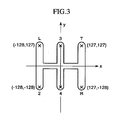
- the position of the lever portion 204 is expressed by appropriately converting an output from the sensor portion 205 to correspond to a coordinate system shown in FIG. 3.
- the center of the neutral position corresponds to (0, 0)
- the directions in which the gearlever can move freely in the neutral state correspond to the horizontal axis
- the directions in which the gearlever is moved to be set to each gear rate correspond to the vertical axis.
- Coordinate values are represented by integers of one byte (-128 to 127).
- the position of the lever portion 204 is represented by two-byte data.
- the force to be applied to the lever portion 204 by the four force application portions 206 in cooperation is specified as a vector representation made up of a pair of signed integers in accordance with the coordinate system of the shape.
- each vector component is represented by an integer of two bytes (-32768 to 32767). If (0, -32768) is specified as a repulsive force in a case where the gearlever is positioned at (-128, 1) to (-128, 127), a reaction for making the player feel that it is hard to shift the gearlever to the low position can be expressed.
- the gearlever-shaped controller 201 When the information processing apparatus 100 notifies the gearlever-shaped controller 201 of such a vector representation of a repulsive force as described above, the gearlever-shaped controller 201 appropriately converts the values of electricity, a current, and a voltage to be supplied to each of the four force application portions 206 and reacts in response to the conversion.
- the external memory 106 detachably connected via the interface 104 rewritably stores data representing a progressing status of a game.
- the user can store such data in the external memory 106 in accordance with his/her necessity.
- a DVD-ROM to be installed in the DVD-ROM drive 108 stores a program for realizing a game, and image data and audio data accompanying the program. Under the control of the CPU 101, the DVD-ROM drive 108 performs a reading process on the DVD-ROM installed thereon to read a necessary program and necessary data. The read program and data are temporarily stored in the RAM 103, etc.
- the image processing unit 107 processes the data read from the DVD-ROM by an image calculation processor (not shown) comprised in the CPU 101 or the image processing unit 107, and after this, stores the processed data in a frame memory (not shown) comprised in the image processing unit 107.
- Image information stored in the frame memory is converted into a video signal at a predetermined synchronization timing and output to a monitor (not shown) connected to the image processing unit 107. Due to this, image display in various manners is available.
- the image calculation processor can perform a calculation for superposing a two-dimensional image, a transparency calculation such as ⁇ blending, and various saturation calculations at a high speed. Further, the image calculation processor can perform at a high speed, a calculation for rendering by a Z-buffering method, polygon information which is arranged in a virtual three-dimensional space and to which various texture information pieces are attached to obtain a rendering image in which the polygon arranged in the virtual three-dimensional space is overlooked from a predetermined viewing position.
- the image calculation processor has as a library or hardware, a function for calculating the degree to which the polygon is irradiated by a typical (positive) light source such as a dot light source, a parallel light source, a conic light source, etc., and can therefore perform such a calculation at a high speed.
- a typical (positive) light source such as a dot light source, a parallel light source, a conic light source, etc.
- a letter string can be depicted in a frame memory or on a polygon surface as a two-dimensional image in accordance with font information defining the shape of letters.
- the font information is stored in the ROM 102.
- dedicated font information stored in the DVD-ROM may also be used.
- the NIC 109 is for connecting the information processing apparatus 100 to a computer communication network (not shown) such as the Internet, etc.
- the NIC 109 is constituted by a modem meeting the 10BASE-T/100BASE-T standard used for building a LAN (Local Area Network), or an analog modem, ISDN (Integrated Services Digital Network) modem, and ADSL (Asymmetric Digital Subscriber Line) modem for connecting to the Internet using a telephone line, or a cable mode for connecting to the Internet using a cable television line, or the like and an interface (not shown) for intermediating between the modem and the CPU 101.
- LAN Local Area Network
- ISDN Integrated Services Digital Network
- ADSL Asymmetric Digital Subscriber Line
- the audio processing unit 110 converts audio data read from the DVD-ROM into an analog audio signal, and causes the analog audio signal to be output from a speaker (not shown) connected to the audio processing unit 110. Further, under the control of the CPU 101, the audio processing unit 110 generates sound effects and music data that should be sounded during the progress of the game, and causes audios corresponding to the sound effects and music data to be output from the speaker. Sound effects and music data include, for example, a running noise of a vehicle, a vibration sound, a noise caused when a tire is locked, an abnormal noise caused when the gearlever is shifted to an unmatched gear rate, a sound caused when the clutch is let in, etc.
- the information processing apparatus 100 may use a large capacity external storage device such as a hard disk, etc. to allow the large capacity external storage device to perform the functions of the ROM 102, the RAM 103, the external memory 106, the DVD-ROM installed on the DVD-ROM drive 108, etc.
- a large capacity external storage device such as a hard disk, etc.
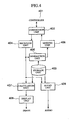
- FIG. 4 is an explanatory diagram showing the schematic structure of each function of the game device according to the present embodiment.
- FIG. 5 is a flowchart showing the flow of the process of a game method realized by the game device according to the present embodiment. The following explanation will be made with reference to FIG. 4 and FIG. 5.
- the game device 401 comprises a connection unit 402, a storage unit 403, a reception unit 404, a generation unit 405, a sending unit 406, a calculation unit 407, a display unit 408, and an audio unit 409, and is structured as described below.
- connection unit 402 can be communicably connected to a "controller which has a lever that can be moved along a predetermined route, and which sends status information specifying the current position of the lever and receives instruction information specifying a repulsive force to be applied to the lever". That is, since the interface 104 of the information processing apparatus 100 is connected to the gearlever-shaped controller 201, the interface 104 functions as the connection unit 402.
- the storage unit 403 pre-stores repulsive force information specifying repulsive forces to be applied to the lever in association with the statuses of the game and the positions of the lever. Accordingly, the DVD-ROM to be installed on the DVD-ROM drive 108, the RAM 103 which stores data read from the DVD-ROM, etc. function as the storage unit 403.
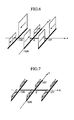
- FIG. 6 and FIG. 7 are explanatory diagrams showing the position of the lever, the level of the repulsive force to be applied to the lever, and the direction of the repulsive force to be applied to the lever in a given game status.
- FIG. 6 three-dimensionally shows the position of the lever and the level of the repulsive force. The direction of the repulsive force is shown by arrows in FIG. 6.
- FIG. 6 shows a case where the vehicle gains some speed, the gear rate should therefore be shifted from the second to the third, and the clutch is not released.
- the repulsive force is small near the second since the lever is already put in the second, but a repulsive force is caused if the player tries to shift the lever to the neutral without releasing the clutch. If the lever is continuously moved without releasing the clutch and then if a certain limit is exceeded, a force in such a direction as to draw the lever to the neutral is caused. This also happens in case of the third gear.
- FIG. 7 shows the same situation as shown by FIG. 6, except that the clutch is released.
- the clutch is released, the player can easily shift to any gear rate.
- the lever is moved to the end of each gear rate, the player feels a reaction when trying to move the lever to other positions.
- the game device of the present invention is designed such that the same operational touch as felt in a real vehicle can be obtained by setting the levels and directions of repulsive forces in accordance with statuses of the game.
- Basic data about repulsive forces can be obtained by measuring repulsive forces applied to the gearlever by putting a real vehicle in various statuses. In case of a racing game, the followings can be considered as statuses of the game.
- the reception unit 404 receives status information from the controller via the connection unit 402 (step S501).
- the received status information specifies information representing the position of the lever. Accordingly, the CPU 101 functions as the reception unit 404 in cooperation with the interface 104.
- the generation unit 405 acquires the pre-stored repulsive force information that is associated with the current game status and the position of the lever specified by the received status information (step S502). As described above, if the game status and the current position of the lever are determined, the level and direction (or a two-dimensional vector representation for the level and direction) of the repulsive force can be acquired from the storage unit 403.
- the generation unit 405 generates instruction information specifying a repulsive force designated by the acquired level and direction (step S503).
- the instruction information is represented by a four-byte value corresponding to a two-dimensional vector representing the level and direction of the repulsive force. Accordingly, the CPU 101 functions as the generation unit 405 in cooperation with the RAM 103, etc.
- a value acquired from the storage device 403 may not be directly specified as the value of the repulsive force. However, a manner in which the level of the repulsive force is heightened or lowered cyclically or by generating a random number and then instruction information is generated, may be employed.
- the heightening or lowering degree is determined not by vibration as described above but by a random number. In this case, not vibration in a unique vibration number, but random vibration is transmitted to the player.
- the unique vibration number may be changed, a manner in which a random number is generated may be changed, or the heightening or lowering range may be changed in accordance with the game status.
- the value acquired from the storage unit 403 has a meaning as the average value of the repulsive force specified by the repulsive force information.
- the sending unit 406 sends the generated instruction information to the controller via the connection unit 402 (step S504). Accordingly, the CPU 101 functions as the sending unit 406 in cooperation with the interface 104.
- the gearlever-shaped controller 201 Upon reception of the instruction information, the gearlever-shaped controller 201 controls the repulsive force to be applied to the lever portion 203 by the specified value. In this manner, the same operational touch as the touch of operating the gearlever of a real vehicle can be given to the player who operates the gearlever-shaped controller connected to the game device.
- the calculation unit 407 acquires driving force information specifying a driving force associated with the current game status and the position of the lever specified by the received status information, by referring to the storage unit 403 (step S505).
- the storage unit 403 further pre-stores driving force information specifying driving forces in association with game statuses and positions of the lever. Particularly, the position of the gearlever and the rotation number of the engine are closely related with each other. Therefore, unless a suitable gear rate is selected, a so-called "engine stop” is caused and the driving force downs to zero. If an engine stop is not caused, the driving force is changed by the gear rate (the position of the gearlever). Hence, by preparing such driving force information likewise the repulsive force information, vehicle driving is simulated.
- the calculation unit 407 calculates the acceleration of an object moving in the simulative world based on the acquired driving force (step S506). Specifically, by subtracting a frictional force of the road and a braking force of the brake from the acquired driving force and dividing the subtraction result by the mass of the vehicle, the acceleration of the vehicle in the racing game can be obtained. Accordingly, the CPU 101 functions as the calculation unit 407.
- the display unit 408 moves the object in the simulative world at the calculated acceleration (step S507), and displays the object on a screen at a position reached by the moving (step S508). Accordingly, the CPU 101 functions as the display unit 408 in cooperation with the image processing unit 107.
- FIG. 8 is an explanatory diagram showing one example of a screen display of such a racing game. The following explanation will be made with reference to FIG. 8.
- map information 702 indicating the position of the vehicle in a course is displayed in an overlaid manner on a background 703 showing how an external world 704 looks from the driver's seat of the vehicle.
- the map information 702 two-dimensionally illustrates the shape of a course which is pre-set in the simulative world and the position of the vehicle in this course. By viewing this, the player can know where in the course the vehicle driven by him/herself is.
- the background 703 shows how the external world 704 looks when it is seen from the driver's seat of the vehicle.
- the external world 704 is a three-dimensional graphic bird's-eye view of the road in the course and various objects provided around the road in the simulative world, wherein the road and the various objects provided around the road are constituted by polygons and the polygons are viewed with the position of the vehicle set as the viewpoint and preferably with the velocity of the vehicle set as the viewing direction.
- various techniques can be applied to image generation by such three-dimensional graphics.
- a speedometer 705 indicating the velocity of the vehicle and a lever indicator 706 indicating the current position of the gearlever are displayed.
- different colors may be assigned to respective ranges of values, so that the display color may be changed as the value increases.
- Value indication is provided to the player by using numerals on the screen 701. However, value indication may be provided by using a bar graph, a pie graph, or a meter graph as employed in a real vehicle.
- the audio unit 409 acquires audio information which is pre-stored in association with the game status and the position of the lever by referring to the storage unit 403 (step S509), reproduces the acquired audio information (step S510), performs other game processes (step S511), and returns to step S501. Accordingly, the CPU 101 functions as the audio unit 409 in cooperation with the audio processing unit 110.
- the present embodiment it is possible to give the player a feeling that the player drives a real vehicle, by using the gearlever-shaped controller and by controlling the repulsive force applied to the lever based on information sent from the gearlever-shaped controller regarding the position of the lever and an external force.
Landscapes
- Engineering & Computer Science (AREA)
- Multimedia (AREA)
- Human Computer Interaction (AREA)
- Theoretical Computer Science (AREA)
- Aviation & Aerospace Engineering (AREA)
- Business, Economics & Management (AREA)
- Physics & Mathematics (AREA)
- Educational Administration (AREA)
- Educational Technology (AREA)
- General Physics & Mathematics (AREA)
- Position Input By Displaying (AREA)
- Mechanical Control Devices (AREA)
Applications Claiming Priority (3)
| Application Number | Priority Date | Filing Date | Title |
|---|---|---|---|
| JP2003067828A JP3579041B2 (ja) | 2003-03-13 | 2003-03-13 | ゲームシステム、ゲーム装置、ゲーム制御方法、ならびに、プログラム |
| JP2003067828 | 2003-03-13 | ||
| PCT/JP2004/003296 WO2004080554A1 (ja) | 2003-03-13 | 2004-03-12 | ゲーム装置、ゲーム方法、プログラム、ならびに、情報記録媒体 |
Publications (2)
| Publication Number | Publication Date |
|---|---|
| EP1557210A1 true EP1557210A1 (de) | 2005-07-27 |
| EP1557210A4 EP1557210A4 (de) | 2008-05-07 |
Family
ID=32984570
Family Applications (1)
| Application Number | Title | Priority Date | Filing Date |
|---|---|---|---|
| EP04720174A Withdrawn EP1557210A4 (de) | 2003-03-13 | 2004-03-12 | Spielvorrichtung, spielverfahren, programm und informationsaufzeichnungsmedium |
Country Status (4)
| Country | Link |
|---|---|
| US (1) | US7601064B2 (de) |
| EP (1) | EP1557210A4 (de) |
| JP (1) | JP3579041B2 (de) |
| WO (1) | WO2004080554A1 (de) |
Families Citing this family (10)
| Publication number | Priority date | Publication date | Assignee | Title |
|---|---|---|---|---|
| JP3765422B2 (ja) * | 2004-04-28 | 2006-04-12 | コナミ株式会社 | 画像生成装置、加速度表示方法、および、プログラム |
| WO2006088182A1 (ja) * | 2005-02-21 | 2006-08-24 | Fujiwork Co., Ltd. | ハンドル装置、その操作方法およびそのハンドル装置を用いたコントローラ |
| US8145382B2 (en) * | 2005-06-17 | 2012-03-27 | Greycell, Llc | Entertainment system including a vehicle |
| US20080060861A1 (en) * | 2006-09-12 | 2008-03-13 | Andrew Baur | Entertainment vehicle that simulates a vehicle with an internal combustion engine and multiple gear ratios |
| JP2008200140A (ja) * | 2007-02-16 | 2008-09-04 | Taito Corp | 操作入力装置用プログラム及び操作入力装置 |
| US9177486B2 (en) * | 2009-09-29 | 2015-11-03 | Advanced Training System Llc | Shifter force detection |
| FR2960983B1 (fr) * | 2010-06-03 | 2012-06-15 | Guillemot Corp | Boite de vitesses a mode sequentiel et mode manuel pour jeu video |
| JP6374904B2 (ja) * | 2016-04-13 | 2018-08-15 | 任天堂株式会社 | 振動制御システム、振動出力装置、振動出力プログラム、および振動出力方法 |
| JP6382880B2 (ja) * | 2016-04-13 | 2018-08-29 | 任天堂株式会社 | 振動制御システム、振動制御方法、振動出力装置、ゲームコントローラ、振動出力プログラム、および振動出力方法 |
| JP6717553B2 (ja) * | 2018-08-02 | 2020-07-01 | 任天堂株式会社 | 振動制御システム、振動制御方法、振動出力装置、ゲームコントローラ、振動出力プログラム、および振動出力方法 |
Family Cites Families (13)
| Publication number | Priority date | Publication date | Assignee | Title |
|---|---|---|---|---|
| US4817948A (en) * | 1983-09-06 | 1989-04-04 | Louise Simonelli | Reduced-scale racing system |
| US4949119A (en) * | 1989-01-12 | 1990-08-14 | Atari Games Corporation | Gearshift for a vehicle simulator using computer controlled realistic real world forces |
| US5197003A (en) | 1990-08-01 | 1993-03-23 | Atari Games Corporation | Gearshift for a vehicle simulator having a solenoid for imposing a resistance force |
| US5734373A (en) * | 1993-07-16 | 1998-03-31 | Immersion Human Interface Corporation | Method and apparatus for controlling force feedback interface systems utilizing a host computer |
| JP2564093B2 (ja) * | 1993-10-29 | 1996-12-18 | コナミ株式会社 | ドライビングテレビゲーム機のブレーキ部機構 |
| JPH07213740A (ja) * | 1994-01-28 | 1995-08-15 | Namco Ltd | 操作体を用いたゲーム機械 |
| US5749268A (en) | 1994-02-21 | 1998-05-12 | Sega Enterprises, Ltd. | Simulating multi-stage speed change shift lever operating device |
| US6422941B1 (en) * | 1994-09-21 | 2002-07-23 | Craig Thorner | Universal tactile feedback system for computer video games and simulations |
| JP2828953B2 (ja) | 1996-05-31 | 1998-11-25 | コナミ株式会社 | 遊技機の手動操作装置 |
| JP3167958B2 (ja) | 1997-05-08 | 2001-05-21 | コナミ株式会社 | 多方向切替操作装置 |
| US6088019A (en) | 1998-06-23 | 2000-07-11 | Immersion Corporation | Low cost force feedback device with actuator for non-primary axis |
| JP2001187268A (ja) * | 2000-11-06 | 2001-07-10 | Mitsui Eng & Shipbuild Co Ltd | ジョイスティックコントロール方法および装置 |
| JP3813816B2 (ja) * | 2000-12-28 | 2006-08-23 | 川田工業株式会社 | 反力制御システム |
-
2003
- 2003-03-13 JP JP2003067828A patent/JP3579041B2/ja not_active Expired - Fee Related
-
2004
- 2004-03-12 EP EP04720174A patent/EP1557210A4/de not_active Withdrawn
- 2004-03-12 WO PCT/JP2004/003296 patent/WO2004080554A1/ja not_active Ceased
- 2004-03-12 US US10/799,452 patent/US7601064B2/en not_active Expired - Fee Related
Also Published As
| Publication number | Publication date |
|---|---|
| US20040198492A1 (en) | 2004-10-07 |
| JP3579041B2 (ja) | 2004-10-20 |
| JP2004275253A (ja) | 2004-10-07 |
| WO2004080554A1 (ja) | 2004-09-23 |
| EP1557210A4 (de) | 2008-05-07 |
| US7601064B2 (en) | 2009-10-13 |
Similar Documents
| Publication | Publication Date | Title |
|---|---|---|
| JP3553563B1 (ja) | ゲームシステム、ゲーム装置、ゲーム方法、ならびに、プログラム | |
| US6645076B1 (en) | Game apparatus with game player physical strength recognition | |
| JP5507893B2 (ja) | プログラム、情報記憶媒体及び画像生成システム | |
| US8915784B2 (en) | Program, information storage medium, and image generation system | |
| US7330769B2 (en) | Parameterized interactive control of multiple wave table sound generation for video games and other applications | |
| CN1984701B (zh) | 游戏装置和游戏控制方法 | |
| US7601064B2 (en) | Game apparatus, game method, and program | |
| JP2009213559A (ja) | ゲーム装置 | |
| EP3482806A2 (de) | Bedienungseingabesystem, bedienungseingabevorrichtung und spielesystem | |
| CN1976743B (zh) | 图像生成装置、加速度显示方法及程序 | |
| US7602397B2 (en) | Image creating device, load display method, recording medium, and program | |
| JP3769287B2 (ja) | 画像生成装置、荷重表示方法、ならびに、プログラム | |
| US7843453B2 (en) | Video generation device, load display method, recording medium, and program | |
| EP1744283A1 (de) | Bilderzeugungseinrichtung, geschwindigkeits-express-verfahren und programm | |
| JP3919190B2 (ja) | ゲーム装置及びゲームプログラム | |
| JP5377868B2 (ja) | プログラム、情報記憶媒体、およびゲームシステム | |
| JP2010284258A (ja) | ゲーム装置、ゲームプログラム | |
| JP2001034784A (ja) | 動画画面の生成方法および動画画面の生成時の評価方法 | |
| HK1082218B (en) | Game device and game method |
Legal Events
| Date | Code | Title | Description |
|---|---|---|---|
| PUAI | Public reference made under article 153(3) epc to a published international application that has entered the european phase |
Free format text: ORIGINAL CODE: 0009012 |
|
| 17P | Request for examination filed |
Effective date: 20041227 |
|
| AK | Designated contracting states |
Kind code of ref document: A1 Designated state(s): AT BE BG CH CY CZ DE DK EE ES FI FR GB GR HU IE IT LI LU MC NL PL PT RO SE SI SK TR |
|
| AX | Request for extension of the european patent |
Extension state: AL LT LV MK |
|
| DAX | Request for extension of the european patent (deleted) | ||
| RBV | Designated contracting states (corrected) |
Designated state(s): DE FR GB |
|
| RAP1 | Party data changed (applicant data changed or rights of an application transferred) |
Owner name: KONAMI DIGITAL ENTERTAINMENT CO., LTD. |
|
| A4 | Supplementary search report drawn up and despatched |
Effective date: 20080407 |
|
| RIC1 | Information provided on ipc code assigned before grant |
Ipc: G09B 9/04 20060101ALI20080401BHEP Ipc: A63F 13/00 20060101ALI20080401BHEP Ipc: A63F 13/06 20060101AFI20040929BHEP |
|
| 17Q | First examination report despatched |
Effective date: 20080630 |
|
| STAA | Information on the status of an ep patent application or granted ep patent |
Free format text: STATUS: THE APPLICATION IS DEEMED TO BE WITHDRAWN |
|
| 18D | Application deemed to be withdrawn |
Effective date: 20111001 |