EP1549599B1 - Chirales phenolderivat, dieses enthaltendes flüssigkristallmedium - Google Patents
Chirales phenolderivat, dieses enthaltendes flüssigkristallmedium Download PDFInfo
- Publication number
- EP1549599B1 EP1549599B1 EP03775161A EP03775161A EP1549599B1 EP 1549599 B1 EP1549599 B1 EP 1549599B1 EP 03775161 A EP03775161 A EP 03775161A EP 03775161 A EP03775161 A EP 03775161A EP 1549599 B1 EP1549599 B1 EP 1549599B1
- Authority
- EP
- European Patent Office
- Prior art keywords
- atoms
- another
- denotes
- group
- liquid
- Prior art date
- Legal status (The legal status is an assumption and is not a legal conclusion. Google has not performed a legal analysis and makes no representation as to the accuracy of the status listed.)
- Expired - Lifetime
Links
- 239000004973 liquid crystal related substance Substances 0.000 title claims abstract description 66
- 150000002989 phenols Chemical class 0.000 title abstract description 6
- 239000000203 mixture Substances 0.000 claims abstract description 58
- 230000003098 cholesteric effect Effects 0.000 claims abstract description 18
- 239000003381 stabilizer Substances 0.000 claims abstract description 9
- 239000004988 Nematic liquid crystal Substances 0.000 claims abstract description 8
- ISWSIDIOOBJBQZ-UHFFFAOYSA-N Phenol Chemical compound OC1=CC=CC=C1 ISWSIDIOOBJBQZ-UHFFFAOYSA-N 0.000 claims abstract description 6
- 238000000034 method Methods 0.000 claims abstract description 6
- 230000008569 process Effects 0.000 claims abstract description 5
- 150000001875 compounds Chemical class 0.000 claims description 79
- 125000004432 carbon atom Chemical group C* 0.000 claims description 26
- 229910052731 fluorine Inorganic materials 0.000 claims description 26
- 125000003342 alkenyl group Chemical group 0.000 claims description 24
- 125000000217 alkyl group Chemical group 0.000 claims description 22
- -1 piperidine-1,4-diyl Chemical group 0.000 claims description 19
- 125000003545 alkoxy group Chemical group 0.000 claims description 14
- 229910052801 chlorine Inorganic materials 0.000 claims description 14
- 229910052736 halogen Inorganic materials 0.000 claims description 14
- 229910052739 hydrogen Inorganic materials 0.000 claims description 13
- 239000002019 doping agent Substances 0.000 claims description 12
- 150000002367 halogens Chemical class 0.000 claims description 12
- 229910052757 nitrogen Inorganic materials 0.000 claims description 9
- 125000003302 alkenyloxy group Chemical group 0.000 claims description 8
- 125000004430 oxygen atom Chemical group O* 0.000 claims description 7
- 239000011737 fluorine Substances 0.000 claims description 5
- 125000001153 fluoro group Chemical group F* 0.000 claims description 5
- 238000002360 preparation method Methods 0.000 claims description 5
- 125000000304 alkynyl group Chemical group 0.000 claims description 4
- 125000003118 aryl group Chemical group 0.000 claims description 4
- 125000000753 cycloalkyl group Chemical group 0.000 claims description 4
- 125000001997 phenyl group Chemical group [H]C1=C([H])C([H])=C(*)C([H])=C1[H] 0.000 claims description 4
- 125000004450 alkenylene group Chemical group 0.000 claims description 3
- 125000002947 alkylene group Chemical group 0.000 claims description 3
- 125000004419 alkynylene group Chemical group 0.000 claims description 3
- 125000005133 alkynyloxy group Chemical group 0.000 claims description 3
- 239000001257 hydrogen Substances 0.000 claims description 3
- KWKAKUADMBZCLK-UHFFFAOYSA-N 1-octene Chemical group CCCCCCC=C KWKAKUADMBZCLK-UHFFFAOYSA-N 0.000 claims description 2
- 125000005843 halogen group Chemical group 0.000 claims 2
- 125000004435 hydrogen atom Chemical class [H]* 0.000 claims 2
- 238000004519 manufacturing process Methods 0.000 abstract description 2
- 239000012071 phase Substances 0.000 description 13
- 0 *Cc1cc(O*c(c(F)cc(-c2ccc(*)cc2)c2)c2F)cc(*)c1* Chemical compound *Cc1cc(O*c(c(F)cc(-c2ccc(*)cc2)c2)c2F)cc(*)c1* 0.000 description 11
- 230000000694 effects Effects 0.000 description 9
- RTZKZFJDLAIYFH-UHFFFAOYSA-N Diethyl ether Chemical compound CCOCC RTZKZFJDLAIYFH-UHFFFAOYSA-N 0.000 description 7
- 150000003254 radicals Chemical class 0.000 description 7
- LFQSCWFLJHTTHZ-UHFFFAOYSA-N Ethanol Chemical compound CCO LFQSCWFLJHTTHZ-UHFFFAOYSA-N 0.000 description 6
- 230000007935 neutral effect Effects 0.000 description 6
- 230000005693 optoelectronics Effects 0.000 description 6
- 230000000704 physical effect Effects 0.000 description 6
- 239000000126 substance Substances 0.000 description 6
- 239000004986 Cholesteric liquid crystals (ChLC) Substances 0.000 description 5
- 229910052740 iodine Inorganic materials 0.000 description 5
- PXGOKWXKJXAPGV-UHFFFAOYSA-N Fluorine Chemical compound FF PXGOKWXKJXAPGV-UHFFFAOYSA-N 0.000 description 4
- 239000000654 additive Substances 0.000 description 4
- QVGXLLKOCUKJST-UHFFFAOYSA-N atomic oxygen Chemical compound [O] QVGXLLKOCUKJST-UHFFFAOYSA-N 0.000 description 4
- 230000008859 change Effects 0.000 description 4
- 239000007788 liquid Substances 0.000 description 4
- 230000003287 optical effect Effects 0.000 description 4
- 229910052760 oxygen Inorganic materials 0.000 description 4
- 239000001301 oxygen Substances 0.000 description 4
- 239000000758 substrate Substances 0.000 description 4
- 238000012360 testing method Methods 0.000 description 4
- RIOQSEWOXXDEQQ-UHFFFAOYSA-N triphenylphosphine Chemical compound C1=CC=CC=C1P(C=1C=CC=CC=1)C1=CC=CC=C1 RIOQSEWOXXDEQQ-UHFFFAOYSA-N 0.000 description 4
- LCOCAXHKNKUUGN-UHFFFAOYSA-N (3,5-difluoro-4-octan-2-yloxyphenyl)boronic acid Chemical compound CCCCCCC(C)OC1=C(F)C=C(B(O)O)C=C1F LCOCAXHKNKUUGN-UHFFFAOYSA-N 0.000 description 3
- MTYWIFPSDRJOOT-UHFFFAOYSA-N 2,6-ditert-butyl-4-(3,5-difluoro-4-octan-2-yloxyphenyl)phenol Chemical compound C1=C(F)C(OC(C)CCCCCC)=C(F)C=C1C1=CC(C(C)(C)C)=C(O)C(C(C)(C)C)=C1 MTYWIFPSDRJOOT-UHFFFAOYSA-N 0.000 description 3
- FWJBXJQTDBYSAV-UHFFFAOYSA-N 5-bromo-1,3-difluoro-2-octan-2-yloxybenzene Chemical compound CCCCCCC(C)OC1=C(F)C=C(Br)C=C1F FWJBXJQTDBYSAV-UHFFFAOYSA-N 0.000 description 3
- KFZMGEQAYNKOFK-UHFFFAOYSA-N Isopropanol Chemical compound CC(C)O KFZMGEQAYNKOFK-UHFFFAOYSA-N 0.000 description 3
- 125000004183 alkoxy alkyl group Chemical group 0.000 description 3
- 230000000052 comparative effect Effects 0.000 description 3
- 239000000047 product Substances 0.000 description 3
- XLYOFNOQVPJJNP-UHFFFAOYSA-N water Chemical compound O XLYOFNOQVPJJNP-UHFFFAOYSA-N 0.000 description 3
- 125000004975 3-butenyl group Chemical group C(CC=C)* 0.000 description 2
- 125000006043 5-hexenyl group Chemical group 0.000 description 2
- 241001136792 Alle Species 0.000 description 2
- 241000766026 Coregonus nasus Species 0.000 description 2
- VEXZGXHMUGYJMC-UHFFFAOYSA-N Hydrochloric acid Chemical compound Cl VEXZGXHMUGYJMC-UHFFFAOYSA-N 0.000 description 2
- MZRVEZGGRBJDDB-UHFFFAOYSA-N N-Butyllithium Chemical compound [Li]CCCC MZRVEZGGRBJDDB-UHFFFAOYSA-N 0.000 description 2
- IMNFDUFMRHMDMM-UHFFFAOYSA-N N-Heptane Chemical compound CCCCCCC IMNFDUFMRHMDMM-UHFFFAOYSA-N 0.000 description 2
- 239000004990 Smectic liquid crystal Substances 0.000 description 2
- CDBYLPFSWZWCQE-UHFFFAOYSA-L Sodium Carbonate Chemical compound [Na+].[Na+].[O-]C([O-])=O CDBYLPFSWZWCQE-UHFFFAOYSA-L 0.000 description 2
- WYURNTSHIVDZCO-UHFFFAOYSA-N Tetrahydrofuran Chemical compound C1CCOC1 WYURNTSHIVDZCO-UHFFFAOYSA-N 0.000 description 2
- 125000006193 alkinyl group Chemical group 0.000 description 2
- 125000000484 butyl group Chemical group [H]C([*])([H])C([H])([H])C([H])([H])C([H])([H])[H] 0.000 description 2
- 230000007423 decrease Effects 0.000 description 2
- ZUOUZKKEUPVFJK-UHFFFAOYSA-N diphenyl Chemical group C1=CC=CC=C1C1=CC=CC=C1 ZUOUZKKEUPVFJK-UHFFFAOYSA-N 0.000 description 2
- 239000012153 distilled water Substances 0.000 description 2
- 125000001495 ethyl group Chemical group [H]C([H])([H])C([H])([H])* 0.000 description 2
- 125000003187 heptyl group Chemical group [H]C([*])([H])C([H])([H])C([H])([H])C([H])([H])C([H])([H])C([H])([H])C([H])([H])[H] 0.000 description 2
- 125000004051 hexyl group Chemical group [H]C([H])([H])C([H])([H])C([H])([H])C([H])([H])C([H])([H])C([H])([H])* 0.000 description 2
- 238000002844 melting Methods 0.000 description 2
- 230000008018 melting Effects 0.000 description 2
- 125000002496 methyl group Chemical group [H]C([H])([H])* 0.000 description 2
- VLKZOEOYAKHREP-UHFFFAOYSA-N n-Hexane Chemical compound CCCCCC VLKZOEOYAKHREP-UHFFFAOYSA-N 0.000 description 2
- 239000012074 organic phase Substances 0.000 description 2
- 125000001147 pentyl group Chemical group C(CCCC)* 0.000 description 2
- 125000001436 propyl group Chemical group [H]C([*])([H])C([H])([H])C([H])([H])[H] 0.000 description 2
- 230000008646 thermal stress Effects 0.000 description 2
- 125000000876 trifluoromethoxy group Chemical group FC(F)(F)O* 0.000 description 2
- 125000000391 vinyl group Chemical group [H]C([*])=C([H])[H] 0.000 description 2
- 229920002554 vinyl polymer Polymers 0.000 description 2
- SJWFXCIHNDVPSH-QMMMGPOBSA-N (2S)-octan-2-ol Chemical compound CCCCCC[C@H](C)O SJWFXCIHNDVPSH-QMMMGPOBSA-N 0.000 description 1
- VFWCMGCRMGJXDK-UHFFFAOYSA-N 1-chlorobutane Chemical compound CCCCCl VFWCMGCRMGJXDK-UHFFFAOYSA-N 0.000 description 1
- HNEGJTWNOOWEMH-UHFFFAOYSA-N 1-fluoropropane Chemical group [CH2]CCF HNEGJTWNOOWEMH-UHFFFAOYSA-N 0.000 description 1
- IIZPXYDJLKNOIY-JXPKJXOSSA-N 1-palmitoyl-2-arachidonoyl-sn-glycero-3-phosphocholine Chemical compound CCCCCCCCCCCCCCCC(=O)OC[C@H](COP([O-])(=O)OCC[N+](C)(C)C)OC(=O)CCC\C=C/C\C=C/C\C=C/C\C=C/CCCCC IIZPXYDJLKNOIY-JXPKJXOSSA-N 0.000 description 1
- 125000004777 2-fluoroethyl group Chemical group [H]C([H])(F)C([H])([H])* 0.000 description 1
- GPRPSJPFAAGLCA-UHFFFAOYSA-N 4-bromo-2,6-difluorophenol Chemical compound OC1=C(F)C=C(Br)C=C1F GPRPSJPFAAGLCA-UHFFFAOYSA-N 0.000 description 1
- SSQQUEKFNSJLKX-UHFFFAOYSA-N 4-bromo-2,6-ditert-butylphenol Chemical compound CC(C)(C)C1=CC(Br)=CC(C(C)(C)C)=C1O SSQQUEKFNSJLKX-UHFFFAOYSA-N 0.000 description 1
- QTBSBXVTEAMEQO-UHFFFAOYSA-M Acetate Chemical compound CC([O-])=O QTBSBXVTEAMEQO-UHFFFAOYSA-M 0.000 description 1
- CGRKJGAKPDOBRB-UHFFFAOYSA-N Cc(cc1)ccc1-c(ccc(-c(cc1)ccc1C#N)c1)c1F Chemical compound Cc(cc1)ccc1-c(ccc(-c(cc1)ccc1C#N)c1)c1F CGRKJGAKPDOBRB-UHFFFAOYSA-N 0.000 description 1
- YMEJPJZSNPNCOW-UHFFFAOYSA-N Cc(cc1)ccc1-c1ccc(C2CCC(CCC=C)CC2)cc1 Chemical compound Cc(cc1)ccc1-c1ccc(C2CCC(CCC=C)CC2)cc1 YMEJPJZSNPNCOW-UHFFFAOYSA-N 0.000 description 1
- 102100024873 Ceramide-1-phosphate transfer protein Human genes 0.000 description 1
- 101710189399 Ceramide-1-phosphate transfer protein Proteins 0.000 description 1
- UFHFLCQGNIYNRP-UHFFFAOYSA-N Hydrogen Chemical compound [H][H] UFHFLCQGNIYNRP-UHFFFAOYSA-N 0.000 description 1
- 241000283986 Lepus Species 0.000 description 1
- VYPSYNLAJGMNEJ-UHFFFAOYSA-N Silicium dioxide Chemical compound O=[Si]=O VYPSYNLAJGMNEJ-UHFFFAOYSA-N 0.000 description 1
- 229910021417 amorphous silicon Inorganic materials 0.000 description 1
- 239000008346 aqueous phase Substances 0.000 description 1
- 230000015572 biosynthetic process Effects 0.000 description 1
- 235000010290 biphenyl Nutrition 0.000 description 1
- 239000004305 biphenyl Substances 0.000 description 1
- UHYPYGJEEGLRJD-UHFFFAOYSA-N cadmium(2+);selenium(2-) Chemical compound [Se-2].[Cd+2] UHYPYGJEEGLRJD-UHFFFAOYSA-N 0.000 description 1
- 229910052799 carbon Inorganic materials 0.000 description 1
- 150000001735 carboxylic acids Chemical class 0.000 description 1
- 238000005352 clarification Methods 0.000 description 1
- 239000012230 colorless oil Substances 0.000 description 1
- 239000000470 constituent Substances 0.000 description 1
- 238000007796 conventional method Methods 0.000 description 1
- 238000001816 cooling Methods 0.000 description 1
- 239000013256 coordination polymer Substances 0.000 description 1
- 239000012043 crude product Substances 0.000 description 1
- 238000002425 crystallisation Methods 0.000 description 1
- 230000008025 crystallization Effects 0.000 description 1
- 239000003989 dielectric material Substances 0.000 description 1
- 125000004786 difluoromethoxy group Chemical group [H]C(F)(F)O* 0.000 description 1
- 238000004090 dissolution Methods 0.000 description 1
- 239000000975 dye Substances 0.000 description 1
- 238000013213 extrapolation Methods 0.000 description 1
- 230000002349 favourable effect Effects 0.000 description 1
- 238000011049 filling Methods 0.000 description 1
- 125000003709 fluoroalkyl group Chemical group 0.000 description 1
- 125000004216 fluoromethyl group Chemical group [H]C([H])(F)* 0.000 description 1
- 230000009477 glass transition Effects 0.000 description 1
- 238000010438 heat treatment Methods 0.000 description 1
- 150000002431 hydrogen Chemical class 0.000 description 1
- 230000001939 inductive effect Effects 0.000 description 1
- 238000011835 investigation Methods 0.000 description 1
- 239000000787 lecithin Substances 0.000 description 1
- 229940067606 lecithin Drugs 0.000 description 1
- 235000010445 lecithin Nutrition 0.000 description 1
- 239000000463 material Substances 0.000 description 1
- 239000011159 matrix material Substances 0.000 description 1
- 238000005259 measurement Methods 0.000 description 1
- 239000012299 nitrogen atmosphere Substances 0.000 description 1
- MUJIDPITZJWBSW-UHFFFAOYSA-N palladium(2+) Chemical compound [Pd+2] MUJIDPITZJWBSW-UHFFFAOYSA-N 0.000 description 1
- 229910021420 polycrystalline silicon Inorganic materials 0.000 description 1
- 239000002861 polymer material Substances 0.000 description 1
- VVWRJUBEIPHGQF-UHFFFAOYSA-N propan-2-yl n-propan-2-yloxycarbonyliminocarbamate Chemical compound CC(C)OC(=O)N=NC(=O)OC(C)C VVWRJUBEIPHGQF-UHFFFAOYSA-N 0.000 description 1
- 230000005855 radiation Effects 0.000 description 1
- 239000011541 reaction mixture Substances 0.000 description 1
- 230000009467 reduction Effects 0.000 description 1
- 238000010992 reflux Methods 0.000 description 1
- 239000004065 semiconductor Substances 0.000 description 1
- 239000000741 silica gel Substances 0.000 description 1
- 229910002027 silica gel Inorganic materials 0.000 description 1
- 229910052710 silicon Inorganic materials 0.000 description 1
- 239000010703 silicon Substances 0.000 description 1
- 239000011734 sodium Substances 0.000 description 1
- 229910000029 sodium carbonate Inorganic materials 0.000 description 1
- 239000002904 solvent Substances 0.000 description 1
- 230000006641 stabilisation Effects 0.000 description 1
- 238000013112 stability test Methods 0.000 description 1
- 238000011105 stabilization Methods 0.000 description 1
- 238000003860 storage Methods 0.000 description 1
- 230000035882 stress Effects 0.000 description 1
- 125000001424 substituent group Chemical group 0.000 description 1
- 229910052717 sulfur Inorganic materials 0.000 description 1
- 230000008961 swelling Effects 0.000 description 1
- YLQBMQCUIZJEEH-UHFFFAOYSA-N tetrahydrofuran Natural products C=1C=COC=1 YLQBMQCUIZJEEH-UHFFFAOYSA-N 0.000 description 1
- 239000010409 thin film Substances 0.000 description 1
- 230000009466 transformation Effects 0.000 description 1
- 230000007704 transition Effects 0.000 description 1
- WRECIMRULFAWHA-UHFFFAOYSA-N trimethyl borate Chemical compound COB(OC)OC WRECIMRULFAWHA-UHFFFAOYSA-N 0.000 description 1
Classifications
-
- C—CHEMISTRY; METALLURGY
- C07—ORGANIC CHEMISTRY
- C07C—ACYCLIC OR CARBOCYCLIC COMPOUNDS
- C07C39/00—Compounds having at least one hydroxy or O-metal group bound to a carbon atom of a six-membered aromatic ring
- C07C39/02—Compounds having at least one hydroxy or O-metal group bound to a carbon atom of a six-membered aromatic ring monocyclic with no unsaturation outside the aromatic ring
- C07C39/06—Alkylated phenols
-
- C—CHEMISTRY; METALLURGY
- C07—ORGANIC CHEMISTRY
- C07C—ACYCLIC OR CARBOCYCLIC COMPOUNDS
- C07C39/00—Compounds having at least one hydroxy or O-metal group bound to a carbon atom of a six-membered aromatic ring
- C07C39/12—Compounds having at least one hydroxy or O-metal group bound to a carbon atom of a six-membered aromatic ring polycyclic with no unsaturation outside the aromatic rings
- C07C39/15—Compounds having at least one hydroxy or O-metal group bound to a carbon atom of a six-membered aromatic ring polycyclic with no unsaturation outside the aromatic rings with all hydroxy groups on non-condensed rings, e.g. phenylphenol
-
- C—CHEMISTRY; METALLURGY
- C07—ORGANIC CHEMISTRY
- C07C—ACYCLIC OR CARBOCYCLIC COMPOUNDS
- C07C39/00—Compounds having at least one hydroxy or O-metal group bound to a carbon atom of a six-membered aromatic ring
- C07C39/24—Halogenated derivatives
- C07C39/367—Halogenated derivatives polycyclic non-condensed, containing only six-membered aromatic rings as cyclic parts, e.g. halogenated poly-hydroxyphenylalkanes
-
- C—CHEMISTRY; METALLURGY
- C09—DYES; PAINTS; POLISHES; NATURAL RESINS; ADHESIVES; COMPOSITIONS NOT OTHERWISE PROVIDED FOR; APPLICATIONS OF MATERIALS NOT OTHERWISE PROVIDED FOR
- C09K—MATERIALS FOR MISCELLANEOUS APPLICATIONS, NOT PROVIDED FOR ELSEWHERE
- C09K19/00—Liquid crystal materials
- C09K19/04—Liquid crystal materials characterised by the chemical structure of the liquid crystal components, e.g. by a specific unit
- C09K19/0403—Liquid crystal materials characterised by the chemical structure of the liquid crystal components, e.g. by a specific unit the structure containing one or more specific, optionally substituted ring or ring systems
-
- C—CHEMISTRY; METALLURGY
- C09—DYES; PAINTS; POLISHES; NATURAL RESINS; ADHESIVES; COMPOSITIONS NOT OTHERWISE PROVIDED FOR; APPLICATIONS OF MATERIALS NOT OTHERWISE PROVIDED FOR
- C09K—MATERIALS FOR MISCELLANEOUS APPLICATIONS, NOT PROVIDED FOR ELSEWHERE
- C09K19/00—Liquid crystal materials
- C09K19/52—Liquid crystal materials characterised by components which are not liquid crystals, e.g. additives with special physical aspect: solvents, solid particles
- C09K19/58—Dopants or charge transfer agents
- C09K19/586—Optically active dopants; chiral dopants
Definitions
- the present invention relates to chiral phenol derivatives, as well as liquid crystalline media containing these compounds.
- the present invention also relates to a process for the chiral doping and simultaneous stabilization of liquid-crystal mixtures.
- the present invention relates to liquid crystal displays containing the liquid crystal mixtures of the invention.
- the liquid crystals are used as dielectrics whose optical properties change reversibly when an electrical voltage is applied.
- These liquid crystal displays use various electro-optical effects.
- the most commonly used of these are the TN effect (English “ t wisted n ematic”), with a homogeneous, almost planar initial orientation of the liquid crystals and a nematic structure twisted by about 90 °), the STN effect (English “s uper t wisted n ematic ”) and the SBE effect (English” s uper t wisted b irefringence e ffect "), which both use a twisted, homogeneous initial orientation of the liquid crystals, as does the TN effect, but here the molecules have a significant angle of incidence on the surface of the substrates (English “surface tilt angle” short “tilt angle”) have and the twisting (English “twist”) between the substrates is significantly greater than 90 °.
- the STN effect and the SBE effect are collectively referred to as the STN effect.
- the angle of attack on the surface is typically between 2 ° and 10 ° for the STN displays. It is higher, the larger the twist angle.
- the twist angles are usually about 180 ° to 240 °, sometimes up to 260 ° or 270 ° and in some cases even more.
- the twist of the liquid crystal medium of more than 90 ° is achieved by the use of chiral liquid-crystal mixtures whose natural twist is selected according to the layer thickness of the liquid crystal layer.
- the expert has two options. The first is the use of liquid crystals, which are themselves chiral, that is, cholesteric liquid crystals. Such liquid crystals themselves have a twisted structure. In a homogeneously oriented arrangement between two substrates, called the Grand-Jean texture, the director of the molecules is twisted helically in the vertical direction, ie across the thickness of the layer.
- the characteristic length for a complete 360 ° turn is called the cholesteric pitch (P).
- P The characteristic length for a complete 360 ° turn.
- the use of cholesteric liquid crystals is often not particularly advantageous since the cholesteric pitch of cholesteric liquid crystals does not readily adapt to the layer thicknesses of the commonly used cells of the displays.
- the cholesteric pitch of these liquid crystals often depends unfavorably and in many cases greatly on the temperature. Also, a change in the composition of the mixtures usually leads to strong changes in the cholesteric pitch.
- a nematic liquid-crystal mixture is added with a chiral substance which induces the desired twist. It is not particularly important here whether this compound itself has a mesophase. Rather, it is more important that it has a high twisting power for the nematic base mixture (also called "host mixture”) and that it does not change the properties of the base mixture, in particular its clearing point, in the concentrations usually used.
- nematic base mixture also called "host mixture”
- compounds are preferably used which themselves have a mesogenic structure or are even cholesteric.
- cholesteric phases which are induced by the addition of chiral substances to nematic liquid crystals, are often referred to as chiral nematic phases. In the present application however, these are also referred to as cholesteric phases, unless explicitly stated otherwise.
- the cholesteric pitch which is induced by adding chiral substances (dopants) to nematic liquid crystals, depends at a given temperature, in addition to the enantiomeric purity of the chiral dopant, in particular on the concentration of the dopant used (c) and its twisting power.
- This twisting power is called HTP (English “ h elical t wisting p ower").
- HTP Harmonic h elical t wisting p ower
- STN displays typically use liquid crystal mixtures having a cholesteric pitch to layer thickness ratio (d / P) in the range of 0.4 to 0.8, often about 0.5.
- TN displays typically use cholesteric liquid crystal mixtures with a much smaller d / P ratio than STN displays, as larger d / P values tend to increase the threshold voltage in most cases. Typically, the values here are about 0.01 to 0.3, often about 0.1.
- chiral dopants for example, the compounds C15, CB15, R-811 and S-811, R-1011 and S-1011, and R-2011 and S-2011, all Merck KGaA known.
- liquid-crystalline media with positive dielectric anisotropy ( ⁇ ) are used.
- An electro-optical effect having excellent, low viewing-angle dependence of the contrast uses axially symmetrical Micro pixels (ASM of English "A xially S icro ymmetric M pixels").
- ASM axially symmetrical Micro pixels
- the liquid crystal of each pixel is cylindrically surrounded by a polymer material.
- This mode is particularly suitable for combination with the addressing by plasma channels.
- large-area PA LCDs with good viewing angle dependence of the contrast can be realized.
- the recently used IPS effect (“ I n P lane S witching") can use both dielectrically positive and dielectrically negative liquid-crystal media, similar to "guest host” displays so guest / host ads, the dyes depending on related display mode in either dielectrically positive or dielectrically negative media.
- the pixels of the liquid crystal displays can be controlled directly, time-sequentially, ie in the time-division multiplex method or controlled by means of a matrix of active, electrically non-linear elements.
- AMDs (English “ A ctive m atrix d isplays") use discrete active electronic switching elements such.
- B. three-pole Switching elements such as MOS (English “m etal o xide s ilicon”) transistors or thin film transistors (TFTs of English "t toward f ilm t ransistors”) or varistors, or 2-pole switching elements, such as MIMs (English “m etal i nsulator m etal” ) Diodes, ring diodes or “back to back” diodes.
- MOS International “m etal o xide s ilicon”
- TFTs thin film transistors
- MIMs English “m etal i nsulator m etal”
- Diodes mainly silicon or cadmium selenide
- amorphous silicon or polycrystalline silicon is used.
- Some liquid crystalline compounds and some mesogenic compounds with otherwise favorable performance properties are not sufficiently stable for use in practical liquid crystal displays. There are various reasons for the inadequate stability of the various compounds. These may be in insufficient stability of the compounds against UV radiation and / or visible light or in their insufficient stability to thermal stress.
- liquid crystal mixtures that use relatively low thermal stability compounds in the presence of oxygen in displays that require cholesteric liquid crystals are required, the nematic base mixtures must be treated with both a chiral dopant and a stabilizer. This means at least two additional steps in the production of such mixtures.
- liquid-crystal media according to the invention contain one or more compounds of the formula I.
- the liquid-crystal media according to the present invention preferably contain one or more compounds which have at least one olefinic double bond and / or which contain at least one -CF 2 -O group. Preference is given to the compounds which have at least one olefinic double bond, dielectrically positive or dielectrically neutral.
- the liquid-crystal media preferably contain one or more compounds of the formula II which contain no biphenyl unit.
- liquid-crystal media particularly preferably contain one or more compounds of the formula II wherein two adjacent rings directly are linked and preferred or mean.
- the liquid-crystal medium preferably comprises one or more compounds selected from the group of the compounds of the formulas II1 to II4, wherein R 21 and R 22 each have the meaning given above in formula II and in formula II1 preferably at least one of the groups R 21 and R 22 .
- Alkenyl mean.
- R 21 is alkyl or alkoxy having 1-5 C atoms and R 22 is alkenyl.
- compounds also referred to as compound (s) for clarity, means both one compound and a plurality of compounds.
- nematic or nematogenic compounds in particular in the compounds of the formulas II and III are, as a rule, the individual compounds in concentrations of 1% to 30%, preferably from 2% to 20% and particularly preferably from 4% to 16 % used.
- the liquid-crystal media according to the invention preferably have nematic phases of at least from -10.degree. C. to 70.degree. C., preferably from -30.degree. C. to 80.degree. C. and very particularly preferably from -40.degree. C. to 90.degree.
- nematic phase means, on the one hand, that no smectic phase and no crystallization are observed at low temperatures at the corresponding temperature and, on the other hand, that clarification does not yet occur on heating from the nematic phase.
- the investigation at low temperatures is carried out in a flow viscometer at the appropriate temperature and checked by storage in test cells, a layer corresponding to the electro-optical application, for at least 100 hours. At high temperatures, the clearing point is measured in capillaries by conventional methods. '
- liquid-crystal media according to the invention have relatively low values for the Freedericksz threshold voltage of less than or equal to 3.0 V, preferably less than or equal to 2.0 V, more preferably less than or equal to 1.5 V, and most preferably less than or equal to 1.0 V up.
- fluoroalkyl preferably includes straight-chain fluoro-end-capped groups, i. Fluoromethyl, 2-fluoroethyl, 3-fluoropropyl, 4-fluorobutyl, 5-fluoropentyl, 6-fluorohexyl and 7-fluoroheptyl. Other positions of the fluorine are not excluded.
- oxaalkyl or alkoxyalkyl preferably comprises straight-chain radicals of the formula C n H 2n + 1 -O- (CH 2 ) m , in which n and m are each independently of one another from 1 to 6.
- dielectrically positive compounds mean those compounds with a ⁇ > 1.5, dielectrically neutral compounds those with -1.5 ⁇ ⁇ ⁇ 1.5 and dielectrically negative compounds those with ⁇ ⁇ -1.5.
- the dielectric anisotropy of the compounds is determined by 10% of the compounds are dissolved in a liquid crystalline host and the capacity of at least one test cell of 10 .mu.m density with homeotropic and homogeneous surface orientation at 1 kHz is determined by this mixture.
- the measuring voltage is typically 0.5 V to 1.0 V, but always less than the capacitive threshold of the respective liquid-crystal mixture.
- the host mixture used is for dielectrically positive compounds ZLI-4792 and for dielectrically neutral and dielectrically negative compounds ZLI-3086, both from Merck KGaA, Germany. From the change in the dielectric susceptibilities of the host mixture after addition of the compound to be tested and extrapolation to 100% of the compound used, the values for the respective compounds to be investigated are obtained.
- threshold voltage usually refers to the optical threshold for 10% relative contrast (V 10 ).
- threshold voltage in the present application is used for the capacitive threshold voltage (V 0 ), also called the Freedericksz threshold, unless explicitly stated otherwise.
- cells were selected according to ⁇ n of the liquid crystals with a thickness corresponding to an optical delay d ⁇ ⁇ n of the cells of about 0.50 ⁇ m.
- the cells were operated in the so-called "normally white mode" with polarizers parallel to the rubbing directions on the adjacent substrates.
- the characteristic stresses were all determined by vertical observation.
- the threshold voltage was considered V 10 for 10% relative Contrast indicated, the mid-gray voltage V 50 for 50% relative contrast and the saturation voltage V 90 for 90% relative contrast.
- the threshold voltage was determined as capacitive swelling V 0 (also called the Freedericksz threshold) in cells having a lecithin homeotropically oriented liquid-crystal layer.
- the liquid-crystal media according to the invention may also contain further additives and optionally also other chiral dopants in the usual amounts.
- the amount of these additives used is in total 0% to 10%, based on the amount of the total mixture, preferably 0.1% to 6%.
- the concentration of the individual compounds used is preferably 0.1 to 3%. The concentration of these and similar additives is not taken into account in the indication of the concentrations and the concentration ranges of the liquid crystal compounds in the liquid-crystal media.
- compositions consist of several compounds, preferably from 3 to 30, more preferably from 6 to 20 and most preferably from 10 to 16 compounds which are mixed in a conventional manner.
- the desired amount of the components used in lesser amount is dissolved in the components, constituting the main component, expediently at elevated temperature. If the selected temperature is above the clearing point of the main constituent, the completion of the dissolution process is particularly easy to observe.
- liquid crystal phases according to the invention can be modified such that they can be used in every type of LCDs known hitherto, and in particular in ECB displays, VA displays, PA LCDs, ASM LCDs and IPS displays.
- a code for the substituents R 1 , R 2 , L 1 and L 2 follows separately from the acronym for the main body with a dash: Code for R 1 , R 1 R 2 L 1 L 2 R 2 , L 1 , L 2 nm C n H 2n + 1 C m H 2m + 1 H H n Om C n H 2n + 1 OC m H 2m + 1 H H nO.m OC n H 2n + 1 C m H 2m + 1 H H n C n H 2n + 1 CN H H nN.F C n H 2n + 1 CN H F nN.FF C n H 2n + 1 CN F F nF C n H 2n + 1 F H H nOF OC n H 2n + 1 F H H nF.F C n H 2n + 1 F H F nF.F C n H 2n + 1 F H F nF.F C n H 2n + 1 F H F
- ⁇ n means optical anisotropy (589 nm, 20 ° C), ⁇ the dielectric anisotropy (1 kHz, 20 ° C), HR the voltage holding ratio (at 100 ° C, after 5 minutes in the oven, 1 V), V 10 , V 50 and V 90, the threshold voltage, mid-gray voltage and saturation voltage, and the capacitive threshold voltage V 0 were determined at 20 ° C.
- Step 3 Preparation of 3,5-di-tert-butyl-3 ', 5'-difluoro-4' - (1-methyl-heptyloxy) -biphenyl-4-ol
- Step 2 3,5-Difluoro-4- (1-methyl-heptyloxy) -phenylboronic acid was treated with 12.0 g of 2,6-di-tert-butyl-4-bromo-phenol, 30 mg of palladium (II). acetate and 100 mg of triphenylphosphine dissolved in 100 ml of 2-propanol and added to 30 ml of 2 molar aqueous sodium carbonate solution and 20 ml of distilled water. The mixture was then heated at 80 ° C under reflux for 15 h. Then, the reaction mixture was cooled to about 20 ° C and diluted with water. MBT ether was added and the organic phase separated. The product was purified as usual.
- Example 1 Analogously to Example 1 are prepared: with W and Z equal to H. No. Conf. ⁇ R 11 R 12 X Y properties 2 S C 2 H 5 CH 3 H H 3 S n -C 3 H 7 CH 3 H H 4 S n -C 4 H 9 CH 3 H H 5 S n -C 5 H 11 CH 3 H H 6 S n - C 6 H 13 CH 3 H H 7 S n -C 3 H 7 C 2 H 5 H H 8th S n -C 4 H 9 C 2 H 5 H H 9 S n -C 5 H 11 C 2 H 5 H H 10 S n - C 6 H 13 C 2 H 5 H H 11 S C 2 H 5 CH 3 F H 12 S n -C 3 H 7 CH 3 F H 13 S n -C 4 H 9 CH 3 F H 14 S n -C 5 H 11 CH 3 F H 15 S n - C 6 H 13 CH 3 F H 16 S n -C 3 H 7 C 2 H 5 F H 17 S n -C
- Example 1 Analogously to Example 1 are prepared: with W and Z equal to H. No. Conf. ⁇ R 11 R 12 X Y 73 S C 2 H 5 CH 3 H H 74 S n -C 3 H 7 CH 3 H H 75 S n -C 4 H 9 CH 3 H H 76 S n -C 5 H 11 CH 3 H H 77 S n - C 6 H 13 CH 3 H H 78 S n -C 3 H 7 C 2 H 5 H H 79 S n -C 4 H 9 C 2 H 5 H H 80 S n -C 5 H 11 C 2 H 5 H H 81 S n - C 6 H 13 C 2 H 5 H H H 82 S C 2 H 5 CH 3 F H 83 S n -C 3 H 7 CH 3 F H 84 S n -C 4 H 9 CH 3 F H 85 S n -C 5 H 11 CH 3 F H 86 S n - C 6 H 13 CH 3 F H 87 S n -C 3 H 7 C 2
- Example 1 Analogously to Example 1 are prepared: with W and Z equal to H. No. Conf. ⁇ R 11 R 12 X Y 127 S C 2 H 5 CH 3 H H 128 S n -C 3 H 7 CH 3 H H 129 S n -C 4 H 9 CH 3 H H 130 S n -C 5 H 11 CH 3 H H 131 S n - C 6 H 13 CH 3 H H 132 S n -C 3 H 7 C 2 H 5 H H 133 S n -C 4 H 9 C 2 H 5 H H 134 S n -C 5 H 11 C 2 H 5 H 135 S n - C 6 H 13 C 2 H 5 H H 136 S C 2 H 5 CH 3 F H 137 S n -C 3 H 7 CH 3 F H 138 S n -C 4 H 9 CH 3 F H 139 S n -C 5 H 11 CH 3 F H 140 S n - C 6 H 13 CH 3 F H 141 S n -C 3 H 7 C 2 H
- liquid crystal mixtures are prepared and mixed with the appropriate compounds.
- a nematic liquid crystal mixture (M0) of the following composition is prepared which has the following physical properties.
- the measurement accuracy in the determination of the clearing point was +/- 0.3 degrees.
- the mixture M1 has excellent performance properties and is characterized in particular by a very good thermal stability, especially in the presence of atmospheric oxygen.
- the clearing point in the above-described stability test decreases by more than twenty degrees of difference within a little over four days.
- the clearing point of the mixture according to the invention drops only insignificantly by 0.2 degrees of difference.
- V1 clearly within 60 h to 60.0 ° C from.
- the mixture described under Use Example 1, M0, is 0.5% of the achiral phenol AP of the DE 195 391 41 added with a melting point of 91 ° C.
- the resulting mixture, V2 has a clearing point of 78.2 ° C.
- the clearing point of the mixture V2 drops only insignificantly to 78.0 ° C. Since the added compound is achiral, the mixture V2 is not chiral and thus has no cholesteric pitch.
Landscapes
- Chemical & Material Sciences (AREA)
- Organic Chemistry (AREA)
- Crystallography & Structural Chemistry (AREA)
- Engineering & Computer Science (AREA)
- Materials Engineering (AREA)
- Liquid Crystal Substances (AREA)
- Organic Low-Molecular-Weight Compounds And Preparation Thereof (AREA)
- Anti-Oxidant Or Stabilizer Compositions (AREA)
- Liquid Crystal (AREA)
Description
- Die vorliegende Erfindung betrifft chirale Phenolderivate, sowie flüssigkristalline Medien, die diese Verbindungen enthalten. Die vorliegende Erfindung betrifft auch ein Verfahren zur chiralen Dotierung und gleichzeitigen Stabilisierung von Flüssigkristallmischungen. Ferner betrifft die vorliegende Erfindung Flüssigkristallanzeigen, die die erfindungsgemäßen Flüssigkristallmischungen enthalten.
- In den bekannten Flüssigkristallanzeigen werden die Flüssigkristalle, in der Regel flüssigkristalline Gemische, als Dielektrika verwendet, deren optische Eigenschaften sich bei Anlegen einer elektrischen Spannung reversibel ändern. Diese Flüssigkristallanzeigen verwenden verschiedene elektrooptische Effekte. Die gebräuchlichsten hiervon sind der TN-Effekt (Englisch "twisted nematic"), mit einer homogenen, nahezu planaren Ausgangsorientierung der Flüssigkristalle und einer um ca. 90° verdrillten nematischen Struktur), der STN-Effekt (Englisch "supertwisted nematic") und der SBE-Effekt (Englisch "supertwisted birefringence effect"), die beide, wie auch der TN-Effekt, eine verdrillte, homogene Ausgangsorientierung der Flüssigkristalle verwendet, wobei hier jedoch die Moleküle einen signifikanten Anstellwinkel an der Oberfläche der Substrate (Englisch "surface tilt angle" kurz "tilt angle") haben und die Verdrillung (Englisch "twist") zwischen den Substraten deutlich größer als 90° ist. In dieser Anmeldung werden im folgenden, wenn nicht explizit anders angegeben, der STN-Effekt und der SBE-Effekt beide gemeinsam als STN-Effekt bezeichnet. Der Anstellwinkel an der Oberfläche beträgt bei den STN-Anzeigen typischer Weise zwischen 2° und 10°. Er ist um so höher, je größer der Verdrillungswinkel ist. Die Verdrillungswinkel betragen in der Regel ca. 180° bis 240°, manchmal auch bis 260° oder 270° und in einigen Fällen sogar noch mehr.
- Die Verdrillung des Flüssigkristallmediums von mehr als 90° wird durch den Einsatz von chiralen Flüssigkristallmischungen erreicht, deren natürliche Verdrillung entsprechend der Schichtdicke der Flüssigkristallschicht gewählt wird. Hierzu stehen dem Fachmann zwei Möglichkeiten zur Verfügung. Die erste beseht in der Verwendung von Flüssigkristallen, die selbst chiral sind, also von cholesterischen Flüssigkristallen. Solche Flüssigkristalle besitzen selbst eine verdrillte Struktur. In einer homogen orientierten Anordnung zwischen zwei Substraten, die Grand-Jean Textur genannt wird, ist der Direktor der Moleküle in vertikaler Richtung, also über die Dicke der Schicht, schraubenförmig verdrillt.
- Die charakteristische Länge für eine komplette Drehung um 360° wird der cholesterische Pitch (P) genannt. Die Verwendung cholesterischer Flüssigkristalle ist jedoch oft nicht besonders vorteilhaft, da der cholesterische Pitch cholesterischer Flüssigkristalle sich nicht einfach an die Schichtdicken der üblicherweise verwendeten Zellen der Anzeigen anpassen läßt. Zusätzlich hängt der cholesterische Pitch dieser Flüssigkristalle oft in unvorteilhafter Weise und in vielen Fällen stark von der Temperatur ab. Auch führt eine Veränderung der Zusammensetzung der Mischungen meist zu starken Änderungen des cholesterischen Pitches.
- Aus diesem Grunde wird in den meisten praktischen Fällen eine nematische Flüssigkristallmischung mit einer chiralen Substanz versetzt, die die gewünschte Verdrillung induziert. Hierbei ist es nicht besonders wesentlich, ob diese Verbindung selbst eine Mesophase aufweist. Wichtiger ist vielmehr, dass sie ein hohes Verdrillungsvermögen für die nematische Basismischung (auch Wirtsmischung, Englisch "host mixture" genannt) besitzt und dass sie in den üblicherweise eingesetzten Konzentrationen die Eigenschaften der Basismischung, insbesondere deren Klärpunkt, nicht zu stark verändert. Somit werden in der Regel bevorzugt Verbindungen eingesetzt, die selbst eine mesogene Struktur aufweisen oder sogar cholesterisch sind.
- Die cholesterischen Phasen, die durch Zugabe chiraler Substanzen zu nematischen Flüssigkristallen induzierten werden, werden oft als chiral nematische Phasen bezeichnet. In der vorliegenden Anmeldung werden jedoch auch diese als cholesterische Phasen bezeichnet, wenn nicht explizit anders angegeben.
- Der cholesterische Pitch, der durch Zugabe chiraler Substanzen (Dotierstoffe) zu nematischen Flüssigkristallen induziert wird, hängt bei gegebener Temperatur, neben der Enantiomerenreinheit des chiralen Dotierstoffs, insbesondere von der eingesetzten Konzentration des Dotierstoffs (c) und von dessen Verdrillungsvermögen ab. Dieses Verdrillungsvermögen wird HTP (von Englisch "helical twisting power") genannt. In erster Näherung ist der induzierte cholesterische Pitch (P) umgekehrt proportional zum Produkt aus HTP und eingesetzter Konzentration des Dotierstoffs, wie in Gleichung (1) gezeigt.

- Bei STN-Anzeigen werden typischerweise Flüssigkristallmischungen mit einem Verhältnis des cholestrischen Pitchs zur Schichtdicke (d/P) im Bereich von 0,4 bis 0,8, oft von ca. 0,5 verwendet.
- Aber auch in TN-Anzeigen werden chirale Flüssigkristallmischungen verwendet, hier zur Vermeidung der Verdrillung mit dem umgekehrten Drehsinn (Englisch "reverse twist"). Deren Auftreten würde zur Bildung von Domänen und damit zu einer Verringerung des Kontrasts führen. Bei TN-Anzeigen werden in der Regel cholesterische Flüssigkristallmischungen mit einem deutlich kleineren d/P-Verhältnis verwendet, als in STN-Anzeigen, da größere d/P-Werte in den meisten Fällen zu einer Erhöhung der Schwellenspannung führen. Typischer Weise betragen die Werte hier ca. 0,01 bis 0,3, oft ca. 0,1.
- Neben diesen Anzeigetypen gibt es weitere Flüssigkristallanzeigen, die mit chiralen Verbindungen dotierte Flüssigkristallmischungen verwenden.
- Als chirale Dotierstoffe sind z.B. die Verbindungen C15, CB15, R-811 und S-811, R-1011 und S-1011, sowie R-2011 und S-2011, alle Merck KGaA bekannt.
- Bei diesen und ähnlichen elektrooptischen Effekten werden flüssigkristalline Medien mit positiver dielektrischer Anisotropie (Δε) verwendet.
- Neben den genannten elektrooptischen Effekten, welche Flüssigkristallmedien mit positiver dielektrischer Anisotropie benötigen, gibt es andere elektrooptische Effekte welche Flüssigkristallmedien mit negativer dielektrischer Anisotropie verwenden, wie z.B. der ECB-Effekt ("Electrically Controlled Birefringence") und seine Unterformen DAP ("Deformation of Aligned Phases"), VAN ("Vertically Aligned Nematics") und CSH ("Colour Super Homeotropics"). Bei diesen und ähnlichen elektrooptischen Effekten werden flüssigkristalline Medien mit negativer dielektrischer Anisotropie (Δε) verwendet.
- Ein elektrooptischer Effekt mit hervorragender, kleiner Blickwinkelabhängigkeit des Kontrasts verwendet axial symmetrische Micropixel (ASM von Englisch "Axially Symmetric Micro Pixel"). Bei diesem Effekt ist der Flüssigkristall jedes Pixels zylinderförmig von einem Polymermaterial umgeben. Dieser Mode eignet sich besonders zur Kombination mit der Adressierung durch Plasmakanäle. So lassen sich insbesondere großflächige PA LCDs mit guter Blickwinkelabhängigkeit des Kontrasts realisieren.
- Der in letzter Zeit verstärkt eingesetzte IPS-Effekt ("In Plane Switching") kann sowohl dielektrisch positive wie auch dielektrisch negative Flüssigkristallmedien verwenden, ähnlich wie auch "guest host"-Anzeigen also Gast/Wirt-Anzeigen, die Farbstoffe je nach verwandtem Anzeigemodus entweder in dielektrisch positiven oder in dielektrisch negativen Medien einsetzen können.
- Die Bildpunkte der Flüssigkristallanzeigen können direkt angesteuert werden, zeitsequentiell, also im Zeitmultiplexverfahren oder mittels einer Matrix von aktiven, elektrisch nichtlinearen Elementen angesteuert werden.
- Die bislang gebräuchlichsten AMDs (Englisch "active matrix displays") verwenden diskrete aktive elektronische Schaltelemente, wie z. B. dreipolige Schaltelemente wie MOS (Englisch "metal oxide silicon") Transistoren oder Dünnfilmtransistoren (TFTs von Englisch "thin film transistors") oder Varistoren oder 2-polige Schaltelemente wie z.B. MIMs (Englisch "metall insulator metal") Dioden, Ringdioden oder "back to back"-Dioden. Bei den TFTs werden verschiedene Halbleitermaterialien, überwiegend Silizium oder auch Cadmiumselenid, verwendet. Insbesondere wird amorphes Silizium oder polykristallines Silizium verwendet.
- Einige flüssigkristalline Verbindungen und einige mesogene Verbindungen mit ansonsten anwendungstechnisch günstigen Eigenschaften sind nicht ausreichend stabil für den Einsatz in praktischen Flüssigkristallanzeigen. Für die unzureichende Stabilität der verschiedenen Verbindungen gibt es unterschiedliche Gründe. Diese können in ungenügender Stabilität der Verbindungen gegen UV-Strahlung und/oder sichtbares Licht oder in ihrer ungenügenden Stabilität gegen thermische Belastung liegen.
- Einige Verbindungen reagieren bereits mit Spuren von Sauerstoff. Dies geschieht beschleunigt bei höheren Temperaturen. Bei Flüssigkristallmischungen, die derartige Verbindungen enthalten, läßt sich die Stabilität gegenüber thermischer Belastung, und damit die Lebensdauer der Anzeigen, deutlich erhöhen, indem entsprechende Stabilisatoren zugesetzt werden.
- So wird in
DE 195 391 41 undDE 101 172 24 ein Phenol der Formel
EP 0 217 239 offenbart chirale Phenolester mesogener Carbonsäuren und deren Verwendung als Dotierstoff in Flüssigkristall-Phasen. - Sollen Flüssigkristallmischungen, die Verbindungen mit relativ geringer Stabilität gegen thermische Belastung in Gegenwart von Sauerstoff in Anzeigen verwendet werden, die cholesterische Flüssigkristalle benötigen, müssen die nematischen Basismischungen sowohl mit einem chiralen Dotierstoff, als auch mit einem Stabilisator versetzt werden. Dies bedeutet mindestens zwei zusätzliche Schritte in der Produktion derartiger Mischungen.
- Somit besteht der Bedarf nach Verbindungen, die es erlauben den gewünschten cholesterischen Pitch in nematischen Basismischungen zu induzieren und diese Mischungen gleichzeitig zu stabilisieren.
- Es wurde gefunden, dass diese Anforderung durch Verwendung entsprechender Verbindungen gelöst werden kann.
- Als geeignet haben sich chirale Verbindungen der Formel I

- R*1
- einen chiralen Rest der Formel I*, mit I*, K, L, M und N wie in Anspruch 1 definiert,
- Z1,
- wenn mehrfach vorhanden jeweils unabhängig voneinander, -CH2-CH2-, -CH=CH-, -C≡C-, -COO-, -OCO-, -CH2O-, -OCH2-, -CF2O-, -OCF2-, -(CH2)4-, -CF=CF-, -CH=CF-, -CF=CH-, -CH2-, -CF2-, -CF-, -O-, -S- oder eine Einfachbindung,

- (a) einen trans-1,4-Cyclohexylenrest, worin auch eine oder mehrere nicht benachbarte CH2-Gruppen durch -O- und/oder -S- ersetzt sein können,
- (b) einen 1,4-Cyclohexenylenrest,
- (c) einen 1,4-Phenylenrest, worin auch eine oder zwei CH-Gruppen durch N ersetzt sein können oder
- (d) einen Rest ausgewählt aus der Gruppe
1,4-Bicyclo-(2,2,2)-octylen,
Piperidin-1,4-diyl, Naphtalin-2,6-diyl,
Decahydronaphthalin-2,6-diyl und
1,2,3,4-Tetrahydronaphthalin-2,6-diyl, - n1
- 0, 1, 2 oder 3
- Bevorzugt bedeuten in Formel I


- Z1,
- wenn mehrfach vorhanden, jeweils unabhängig voneinander, -CH2-CH2-, -CH=CH-, -C≡C-, -COO-oder eine Einfachbindung, besonders bevorzugt -CH2-CH2- oder eine Einfachbindung, insbesondere bevorzugt eine Einfachbindung und
- n1
- 0, 1 oder 2, bevorzugt 0 oder 1.
- Bevorzugt sind ferner Verbindungen der Formel la

- R*1
- und
- Z11 und Z12,
- jeweils unabhängig voneinander, die oben bei Formel I für Z1 gegebene Bedeutung
- n11
- 0, 1 oder 2, bevorzugt 0 oder 1 und
- W, X, Y und Z,
- jeweils unabhängig voneinander, H, F, Cl, Alkyl, oder Alkoxy, bevorzugt mit 1 bis 7 C-Atomen
- Des weiteren sind bevorzugt Verbindungen der Formel I, bevorzugt der Formel la, dadurch gekennzeichnet, dass
- R*1
- einen chiralen Rest der Formel

- K
- eine Einfachbindung, Alkylen mit 1 bis 5 C-Atomen, Alkenylen oder Alkinylen mit 2 bis 9, bevorzugt mit 2 bis 5 C-Atomen, wobei bei allen drei Arten von Gruppen jeweils eine, zwei oder mehr der vorhandenen -CH2- Gruppen durch -O-, -C=O- oder -S- ersetzt sein können, wobei jedoch keine zwei O-Atome direkt miteinander verbunden sind und alle drei Arten von Gruppen optional durch Halogen, bevorzugt durch Fluor substituiert sein können, bevorzugt eine Einfachbindung, -CH2-, -O-, -CO-O-, -CO-O-CH2-, -O-CO-, -CH2-CH2-, -CH=CH- oder -C≡C- und
- L, M und N,
- jeweils unabhängig voneinander, aber verschieden voneinander und vom Rest des Moleküls inklusive der Gruppe K, Wasserstoff, Halogen, bevorzugt F, Aryl oder Cycloalkyl, Alkyl oder Alkoxy mit 1 bis 7 C-Atomen, Alkenyl, Alkenyloxy, Alkinyl oder Alkinyloxy mit 2 bis 7 C-Atomen, wobei bei allen sechs Arten von Gruppen jeweils eine, zwei oder mehr der vorhandenen -CH2-Gruppen durch -O-, -C=O- oder -S- ersetzt sein können, wobei jedoch keine zwei O-Atome direkt miteinander verbunden sind und alle sechs Arten von Gruppen optional durch Halogen, bevorzugt durch Fluor substituiert sein können, bevorzugt Phenyl, Alkyl, Alkoxy, Alkenyl oder Alkinyl,
- Insbesondere bedeutet bei diesen Verbindungen
- R*1
- einen chiralen Rest ausgewählt aus der Gruppe der Reste der Formeln
- Q
- H oder Halogen, bevorzugt H oder F, bevorzugt H,
- n und m
- voneinander verschieden sind und ansonsten voneinander unabhängig 1 bis 11,
- p
- 0 oder 1 und
- r
- 0 bis 4, bevorzugt 0 bis 2
- Bevorzugt bedeutet


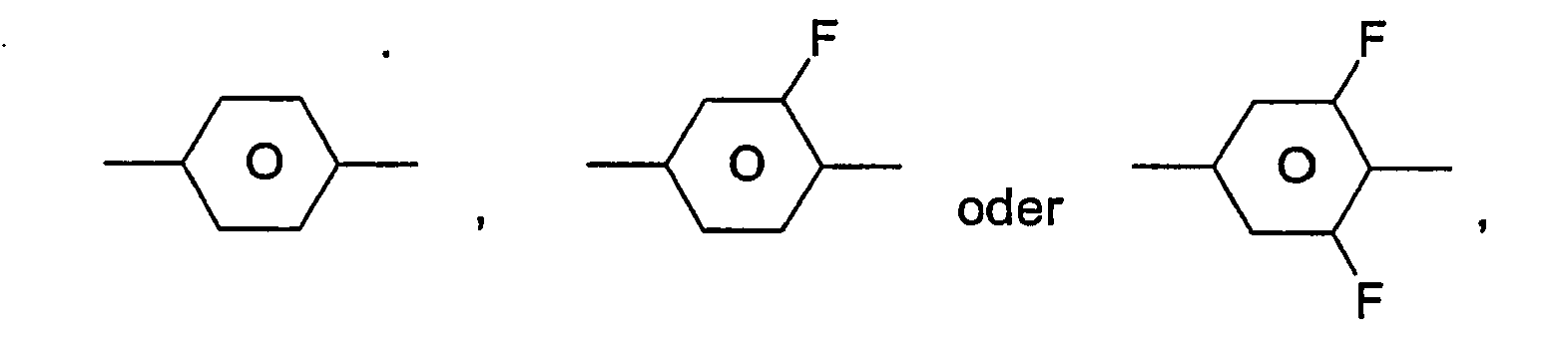
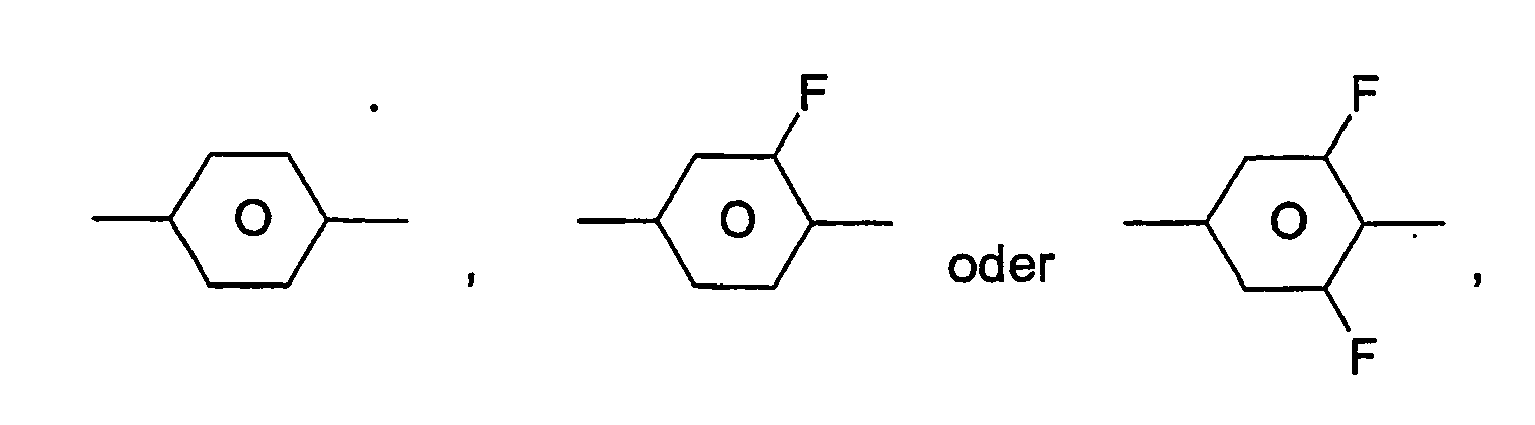
worin die Parameter die oben gegebene Bedeutung haben. - Besonders bevorzugt sind Verbindung der Formel Ia, ausgewählt aus der Gruppe der Verbindungen der Formeln la-1 bis la-9


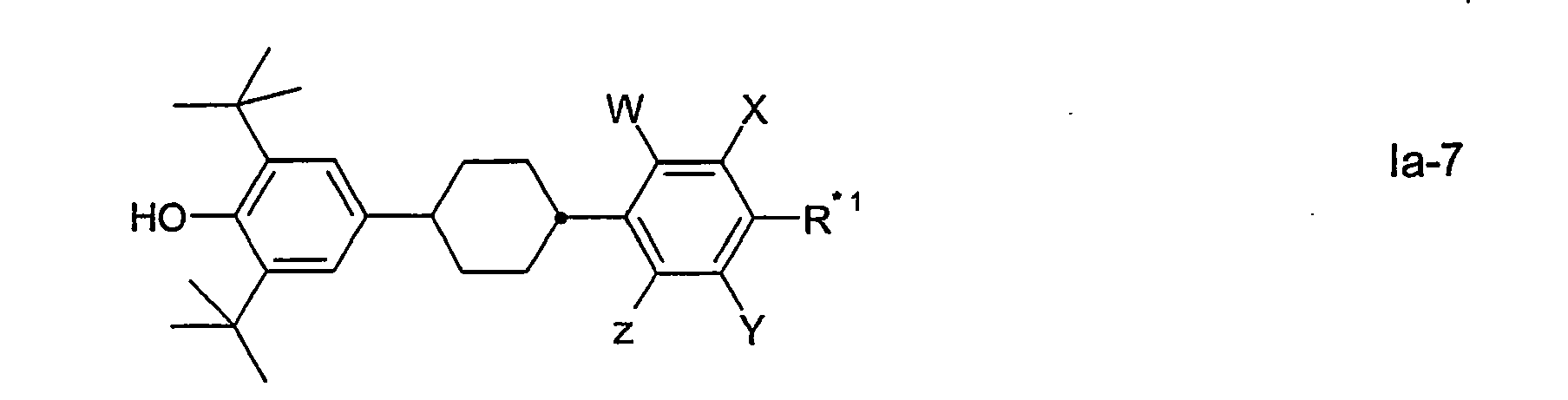


- W und Z
- bevorzugt H bedeuten.
- Die Verbindungen der Formel 1 werden gemäß Schema I und II hergestellt.


- Die erfindungsgemäßen Flüssigkristallmedien enthalten eine oder mehrere Verbindungen der Formel I.
- In einer bevorzugten Ausführungsform enthalten die Flüssigkristallmedien gemäß der vorliegenden Erfindung
- a) eine oder mehrere chirale Verbindungen der Formel I
- b) eine oder mehrere dielektrisch neutrale Verbindungen der Formel II

- R21 und R22
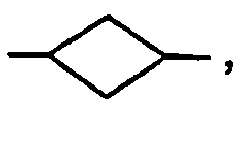
- jeweils unabhängig voneinander, H, eine einfach durch CN oder CF3 oder mindestens einfach durch Halogen substituierte Alkylgruppe mit 1 bis 15 C-Atomen, wobei auch eine oder mehrere CH2-Gruppen, jeweils unabhängig voneinander, durch -O-, -S-, -CH=CH-, -CF=CF-, -CF=CH-, -CH=CF-,
- Z21 und Z22
- jeweils unabhängig voneinander die oben bei Formel I für Z11 gegebene Bedeutung haben,





0 oder 1
bedeuten,
und - c) eine oder mehrere dielektrisch positive Verbindungen oder
- d) eine oder mehrere dielektrisch negative Verbindungen
und optional - e) eine oder mehrere dielektrisch neutrale Verbindung(en).
- Die Flüssigkristallmedien gemäß der vorliegenden Erfindung enthalten bevorzugt eine oder mehrere Verbindungen, die mindestens eine olefinische Doppelbindung aufweisen und/oder die mindestens eine -CF2-O-Gruppe enthalten. Bevorzugt sind die Verbindungen, die mindestens eine olefinische Doppelbindung aufweisen, dielektrisch positiv oder dielktrisch neutral.
- Besonders bevorzugt sind dielektrisch neutrale Verbindungen der Formel II, bei denen bevorzugt mindestens eine der folgenden Bedingungen erfüllt ist
- a) R21 ist Alkenyl,
- b) R22 ist Alkenyl und
- c) mindestens eine der vorhandenen Brücken Z21 und Z22 ist -CH=CH-.
- Bevorzugt enthalten die Flüssigkristallmedien eine oder mehrere Verbindungen der Formel II die keine Biphenyleinheit enthalten.
- Besonders bevorzugt enthalten die Flüssigkristallmedien eine oder mehrere Verbindungen der Formel II
worin zwei benachbarte Ringe direkt
verknüpft sind und zwar bevorzugt

- Bevorzugt enthält das Flüssigkristallmedium eine oder mehrere Verbindungen ausgewählt aus der Gruppe der Verbindungen der Formeln II1 bis II4,




R21 und R22 jeweils die oben bei Formel II gegebene Bedeutung besitzen und in Formel II1 bevorzugt mindestens eine der Gruppen R21 und R22.Alkenyl bedeuten. Bevorzugt ist R21 Alkyl oder Alkoxy mit 1-5 C-Atomen und R22 Alkenyl. - Hier, wie in der gesamten vorliegenden Anmeldung, bedeutet, wenn nicht ausdrücklich anders angegeben, der Begriff Verbindungen, zur Verdeutlichung auch als Verbindung(en) geschrieben, sowohl eine Verbindung, als auch mehrere Verbindungen.
- Bevorzugt enthält das Flüssigkristallmedium eine oder mehrere Verbindungen der Formel III

- R3
- Alkyl oder Alkoxy mit 1 bis 7 C-Atomen, Alkenyl, Alkenyloxy oder Oxaalkyl mit 2 bis 7 C-Atomen, bevortzugt Alkyl oder Alkenyl, bevorzugt mit 1 bis 5, bzw. 2 bis 5 C-Atomen,
- X3
- F, Cl, -OCF2H, -OCF3 oder -CF3, bevorzugt F, Cl oder -CF3 und
- Y31 und Y32,
- jeweils unabhängig voneoinander, H oder F bedeuten
- Bevorzugt enthält das Flüssigkristallmedium eine oder mehrere Verbindungen der Formel III ausgewählt aus der Gruppe der Verbindungen der Formeln III1 bis III5, bevorzugt III1, III4 und III5, besonders bevorzugt III1 und III5,
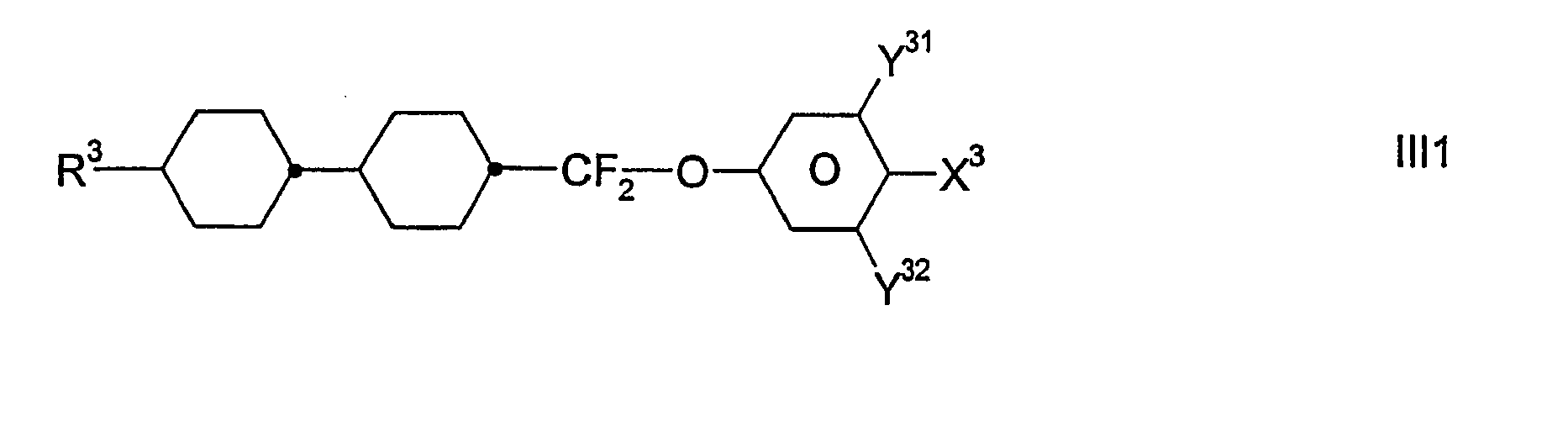


- R3
- Alkyl oder Alkennyl und
- X3 und Y31
- beide F und Y32 H oder F, bevorzugt F oder
- X3
- -OCF3 und Y31 F und Y32 H oder F, bevorzugt H
- Bei den nematischen oder nematogenen Verbindungen, insbesondere bei den Verbindungen der Formeln II und III werden, werden in der Regel, die einzelnen Verbindungen in Konzentrationen von 1 % bis 30 %, bevorzugt von 2 % bis 20 % und besonders bevorzugt von 4 % bis 16 % eingesetzt.
- In einer besonders bevorzugten Ausführungsform die mit den oben beschriebenen bevorzugten Ausführungsformen für die bevorzugten Konzentrationsbereiche identisch sein kann und bevorzugt identisch ist, enthalten die Flüssigkristallmedien
- • eine oder mehrere Verbindungen der Formel Ia und
- • eine oder mehrere Verbindungen der Formel II, bevorzugt ausgewählt aus der Gruppe der Verbindungen der Formeln II2 bis II4 und/oder
- • eine oder mehrere Verbindungen der Formel III, bevorzugt ausgewählt ausgewählt aus der Gruppe der Verbindungen der Formeln III1 und III5.
- Die erfindungsgemäßen Flüssigkristallmedien weisen bevorzugt nematische Phasen von jeweils mindestens von -10°C bis 70 °C, bevorzugt von -30 °C bis 80 °C und ganz besonders bevorzugt von -40 °C bis 90 °C auf. Hierbei bedeutet der Begriff eine nematische Phase aufweisen einerseits, dass bei tiefen Temperaturen bei der entsprechenden Temperatur keine smektische Phase und keine Kristallisation beobachtet wird und andererseits, dass beim Aufheizen aus der nematischen Phase noch keine Klärung auftritt. Die Untersuchung bei tiefen Temperaturen wird in einem Fließviskosimeter bei der entsprechenden Temperatur durchgeführt sowie durch Lagerung in Testzellen, einer der elektrooptischen Anwendung entsprechenden Schichtdicke, für mindestens 100 Stunden überprüft. Bei hohen Temperaturen wird der Klärpunkt nach üblichen Methoden in Kapillaren gemessen. '
- Außerdem weisen die erfindungsgemäßen Flüssigkristallmedien relativ kleine Werte für die Freedericksz-Schwellenspannung von kleiner oder gleich 3,0 V, bevorzugt kleiner oder gleich 2,0 V, besonders bevorzugt kleiner oder gleich 1,5 V und ganz besonders bevorzugt kleiner oder gleich 1,0 V auf.
- Diese bevorzugten Werte für die einzelnen physikalischen Eigenschaften werden auch jeweils miteinander kombiniert eingehalten. So weisen erfindungsgemäße Medien insbesondere die folgenden Eigenschaftskombinationen auf:
- Der Ausdruck "Alkyl" umfaßt vorzugsweise geradkettige und verzweigte Alkylgruppen mit 1-7 Kohlenstoffatomen, insbesondere die geradkettigen Gruppen Methyl, Ethyl, Propyl, Butyl, Pentyl, Hexyl und Heptyl. Gruppen mit 2-5 Kohlenstoffatomen sind im allgemeinen bevorzugt.
- Der Ausdruck "Alkenyl" umfaßt vorzugsweise geradkettige und verzweigte Alkenylgruppen mit 2-7 Kohlenstoffatomen, insbesondere die geradkettigen Gruppen. Besonders bevorzugte Alkenylgruppen sind C2-C7-1 E-Alkenyl, C4-C7-3E-Alkenyl, C5-C7-4-Alkenyl, C6-C7-5-Alkenyl und C7-6-Alkenyl, insbesondere C2-C7-1E-Alkenyl, C4-C7-3E-Alkenyl und C5-C7-4-Alkenyl. Beispiele weiterer bevorzugter Alkenylgruppen sind Vinyl, 1E-Propenyl, 1E-Butenyl, 1E-Pentenyl, 1E-Hexenyl, 1E-Heptenyl, 3-Butenyl, 3E-Pentenyl, 3E-Hexenyl, 3E-Heptenyl, 4-Pentenyl, 4Z-Hexenyl, 4E-Hexenyl, 4Z-Heptenyl, 5-Hexenyl, 6-Heptenyl und dergleichen. Gruppen mit bis zu 5 Kohlenstoffatomen sind im allgemeinen bevorzugt.
- Der Ausdruck "Fluoralkyl" umfaßt vorzugsweise geradkettige Gruppen mit endständigem Fluor, d.h. Fluormethyl, 2-Fluorethyl, 3-Fluorpropyl, 4-Fluorbutyl, 5-Fluorpentyl, 6-Fluorhexyl und 7-Fluorheptyl. Andere Positionen des Fluors sind jedoch nicht ausgeschlossen.
- Der Ausdruck "Oxaalkyl", bzw. Alkoxyalkyl umfaßt vorzugsweise geradkettige Reste der Formel CnH2n+1-O-(CH2)m, worin n und m jeweils unabhängig voneinander 1 bis 6 bedeuten. Vorzugsweise ist n = 1 und m 1 bis 6.
- In der vorliegenden Anmeldung bedeuten die Begriffe dielektrisch positive Verbindungen solche Verbindungen mit einem Δε > 1,5, dielektrisch neutrale Verbindungen solche mit -1,5 ≤ Δε ≤ 1,5 und dielektrisch negative Verbindungen solche mit Δε < -1,5. Hierbei wird die dielektrische Anisotropie der Verbindungen bestimmt indem 10 % der Verbindungen in einem flüssigkristallinen Host gelöst werden und von dieser Mischung die Kapazität in mindestens jeweils einer Testzelle mit 10 µm Dichte mit homeotroper und mit homogener Oberflächenorientierung bei 1 kHz bestimmt wird. Die Meßspannung beträgt typischerweise 0,5 V bis 1,0 V, jedoch stets weniger als die kapazitive Schwelle der jeweiligen Flüssigkristallmischung.
- Als Hostmischung wird für dielektrisch positive Verbindungen ZLI-4792 und für dielektrisch neutrale sowie dielektrisch negative Verbindungen ZLI-3086, beide von Merck KGaA, Deutschland, verwendet. Aus der Änderung der dielektrischen Suszeptibilitäten der Hostmischung nach Zugabe der zu untersuchenden Verbindung und Extrapolartion auf 100 % der eingesetzten Verbindung werden die Werte für die jeweiligen zu untersuchenden Verbindungen erhalten.
- Der Begriff Schwellenspannung bezieht sich üblicherweise auf die optische Schwelle für 10 % relativen Kontrast (V10).
- In Bezug auf die Flüssigkristallmischungen mit negativer dielektrischer Anisotropie wird der Begriff Schwellenspannung in der vorliegenden Anmeldung jedoch für die kapazitive Schwellenspannung (V0), auch Freedericksz-Schwelle genannt, verwendet, sofern nicht explizit anders angegeben.
- Alle Konzentrationen in dieser Anmeldung, soweit nicht explizit anders vermerkt, sind in Massenprozent angegeben und beziehen sich auf die entsprechende Gesamtmischung. Alle physikalischen Eigenschaften werden und wurden nach "Merck Liquid Crystals, Physical Properties of Liquid Crystals", Status Nov. 1997, Merck KGaA, Deutschland bestimmt und gelten für eine Temperatur von 20 °C, sofern nicht explizit anders angegeben. Δn wird bei 589 nm und Δε bei 1 kHz bestimmt. Die Schwellenspannungen sowie die anderen elektrooptischen Eigenschaften wurden in bei Merck KGaA, Deutschland, hergestellten Testzellen unter Verwendung von weißem Licht mit einem kommerziellen Meßgerät der Fa. Otsuka, Japan, bestimmt. Hierzu wurden Zellen je nach Δn der Flüssigkristalle mit einer Dicke entsprechend einer optische Verzögerung d·Δn der Zellen von ca. 0,50 µm gewählt. Die Zellen wurden im sogenannten "normal hellen Modus" (Englisch "normally white mode") mit zu den Reiberichtungen an den benachbarten Substraten parallelen Polarisatoren betrieben. Die charakteristischen Spannungen wurden alle bei senkrechter Beobachtung bestimmt. Die Schwellenspannung wurde als V10 für 10 % relativen Kontrast angegeben, die Mittgrau-spannung V50 für 50 % relativen Kontrast und die Sättigungsspannung V90 für 90 % relativen Kontrast.
- Bei den Flüssigkristallmedien mit negativer dielektrischer Anisotropie wurde die Schwellenspannung als kapazitive Schwellung V0 (auch Freedericksz-Schwelle genannt) in Zellen mit durch Lecithin homeotrop orientierter Flüssigkristallschicht bestimmt.
- Die erfindungsgemäßen Flüssigkristallmedien können bei Bedarf auch weitere Zusatzstoffe und gegebenenfalls auch weitere chirale Dotierstoffe in den üblichen Mengen enthalten. Die eingesetzte Menge dieser Zusatzstoffe beträgt insgesamt 0 % bis 10 % bezogen auf die Menge der gesamten Mischung bevorzugt 0,1 % bis 6 %. Die Konzentration der einzelnen eingesetzten Verbindungen beträgt bevorzugt 0,1 bis 3 %. Die Konzentration dieser und ähnlicher Zusatzstoffe wird bei der Angabe der Konzentrationen sowie der Konzentrationsbereiche der Flüssigkristallverbindungen in den Flüssigkristallmedien nicht berücksichtigt.
- Die Zusammensetzungen bestehen aus mehreren Verbindungen, bevorzugt aus 3 bis 30, besonders bevorzugt aus 6 bis 20 und ganz besonders bevorzugt aus 10 bis 16 Verbindungen, die auf herkömmliche Weise gemischt werden. In der Regel wird die gewünschte Menge der in geringerer Menge verwendeten Komponenten in den Komponenten gelöst, den Hauptbestandteil ausmachenden, zweckmäßigerweise bei erhöhter Temperatur. Liegt die gewählte Temperatur über dem Klärpunkt des Hauptbestandteils, so ist die Vervollständigung des Lösungsvorgangs besonders leicht zu beobachten. Es ist jedoch auch möglich, die Flüssigkristallmischungen auf anderen üblichen Wegen, z.B. unter Verwendung von Vormischungen oder aus einem sogenannten "Multi Bottle Sytemen" herzustellen.
- Mittels geeigneter Zusatzstoffe können die erfindungsgemäßen Flüssigkristallphasen derart modifiziert werden, daß sie in jeder bisher bekannt gewordenen Art von LCDs und insbesondere in ECB-Anzeigen, VA-Anzeigen, PA LCDs, ASM LCDs, sowie IPS-Anzeigen einsetzbar sind.
- Die nachstehenden Beispiele dienen zur Veranschaulichung der Erfindung, ohne sie zu beschränken. In den Beispielen sind der Schmelzpunkt T (C,N), der Übergang von der smektischen (S) zur nematischen (N) Phase T(S,N) und Klärpunkt T (N,I) einer Flüssigkristallsubstanz in Grad Celsius angegeben. Die Prozentangaben sind, soweit nicht explizit anders gekennzeichnet, vor- und nachstehend Massenprozente und die physikalischen Eigenschaften sind die Werte bei 20 °C, sofern nicht explizit anders angegeben.
- Alle angegebenen Werte für Temperaturen in dieser Anmeldung sind °C und alle Temperaturdifferenzen entsprechend Differenzgrad, sofern nicht explizit anders angegeben.
- In der vorliegenden Anmeldung und in den folgenden Beispielen sind die Strukturen der Flüssigkristallverbindungen durch Acronyme angegeben, wobei die Transformation in chemische Formeln gemäß folgender Tabellen A und B erfolgt. Alle Reste CnH2n+1 und CmH2m+1 sind geradkettige Alkylreste mit n bzw. m C-Atomen. Die Codierung gemäß Tabelle B versteht sich von selbst. In Tabelle A ist nur das Acronym für den Grundkörper angegeben. Im Einzelfall folgt getrennt vom Acronym für den Grundkörper mit einem Strich ein Code für die Substituenten R1, R2, L1 und L2:
Code für R1, R1 R2 L1 L2 R2, L1, L2 nm CnH2n+1 CmH2m+1 H H nOm CnH2n+1 OCmH2m+1 H H nO.m OCnH2n+1 CmH2m+1 H H n CnH2n+1 CN H H nN.F CnH2n+1 CN H F nN.F.F CnH2n+1 CN F F nF CnH2n+1 F H H nOF OCnH2n+1 F H H nF.F CnH2n+1 F H F nF.F.F CnH2n+1 F F F nmF CnH2n+1 CmH2m+1 F H nCF3 CnH2n+1 CF3 H H nOCF3 CnH2n+1 OCF3 H H nOCF3.F CnH2n+1 OCF3 H F nOCF3.F.F CnH2n+1 OCF3 F F nOCF2.F CnH2n+1 OCHF2 H H nOCF2.F CnH2n+1 OCHF2 H F nOCF2.F.F CnH2n+1 OCHF2 F F nS CnH2n+1 NCS H H rVsN CrH2r+1-CH=CH-CsH2s- CN H H nEsN CrH2r+1-O-CsH2s- CN H H nAm CnH2n+1 COOCmH2m+1 H H nCl CnH2n+1 Cl H H nCl.F CnH2n+1 Cl H F nCl.F.F CnH2n+1 Cl F F Tabelle A: 
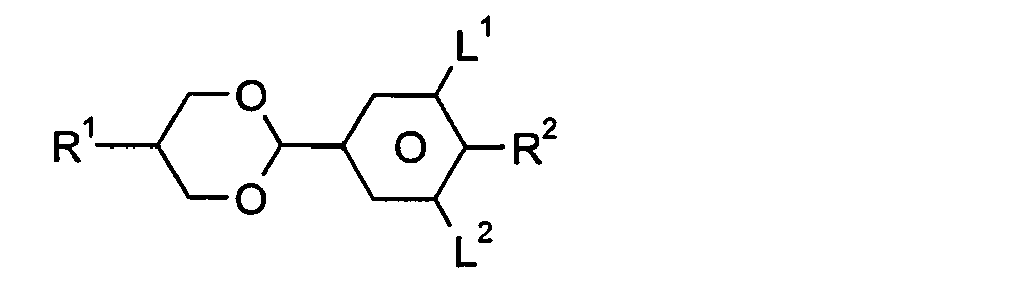
PCH PDX 

BCH CBC 
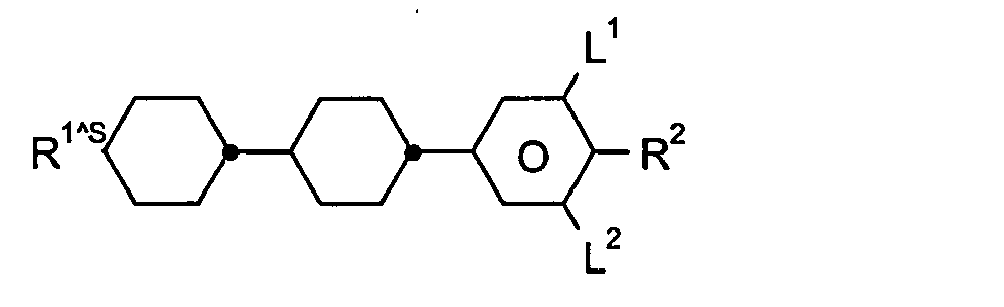
CCH CCP 

CP CPTP 
CEPTP 

D ECCP 
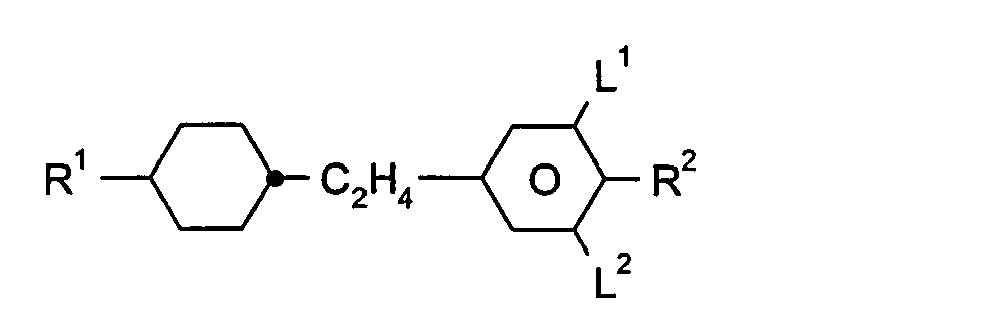
CECP EPCH 

HP ME 

PYP PYRP 

PTP BECH 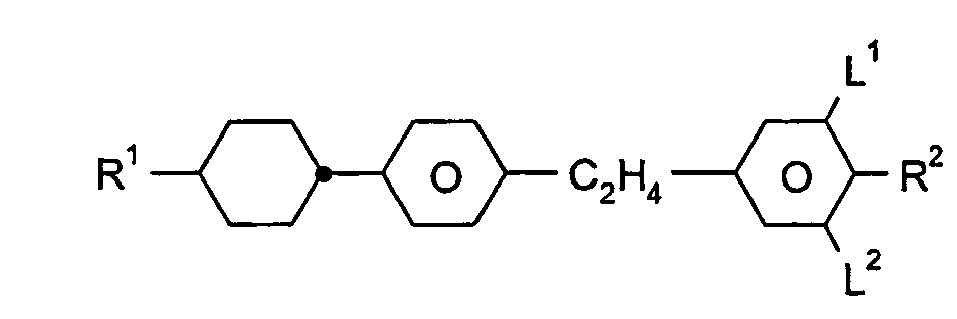

EBCH CPC 
EHP 
BEP 
ET Tabelle B: 

CCZU-n-X
(X=F, Cl, -OCF2H, -OCF3)CDU-n-X
(X=F, Cl, -OCF2H, - OCF3)
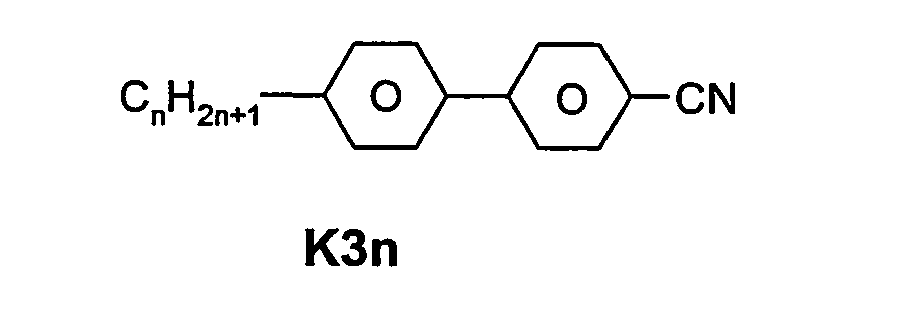


M3n CGP-n-X
(X=F, Cl, -OCF2H, -OCF3)
Inm 

CGU-n-X PGU-n-X (X=F, Cl, -OCF2H, -OCF3) (X=F, Cl, -OCF2H, -OCF3) 
C-nm C15 
CB15 
S-811 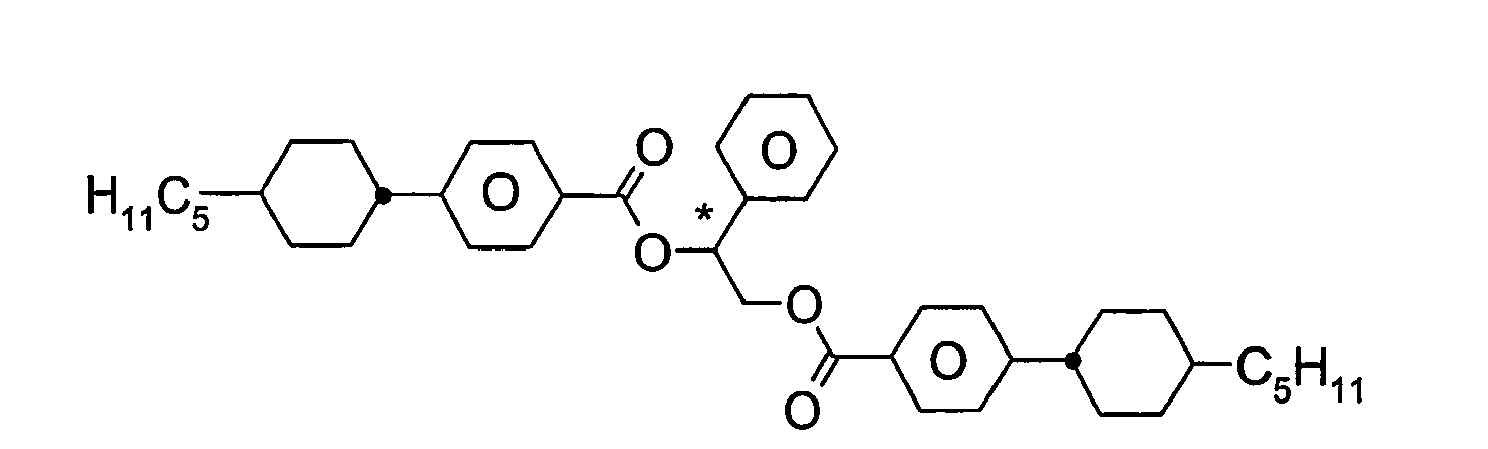
S-1011 
S-2011 
CBC-nmF 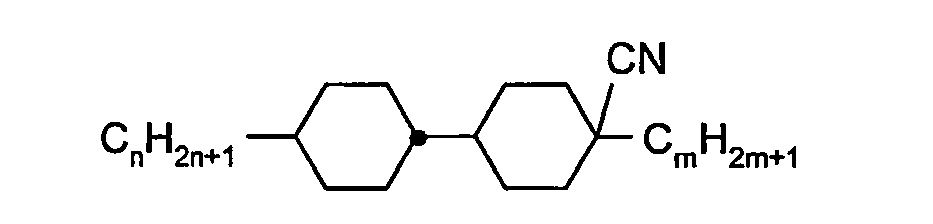

CCN-nm G3n 
CCEPC-nm 
CCPC-nm 

HD-nm 
HH-nm 
NCB-nm 
OS-nm 
CHE 
CBC-nmF 
ECBC-nm 

ECCH-nm CCH-n1EM 

T-nFN B-nO.FN 
CVCC-n-m 
CVCP-n-m 
CP-V-N 
CVCVC-n-m 
CC-n-V 
CCG-V-F 
CPP-nV2-m 
CCP-V-m 
CCP-V2-m 
CPP-V-m 
CPP-nV-m 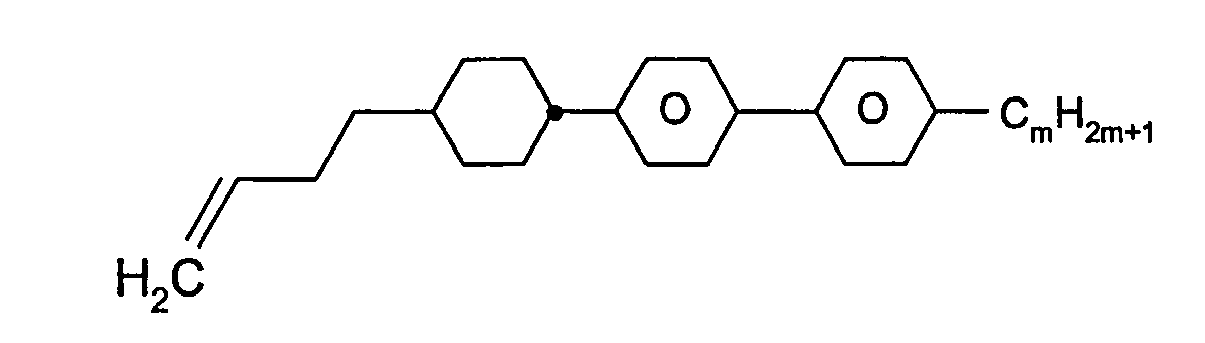
CPP-V2-m 
CC-V-V 
CC-1V-V 
CC-1V-V1 
CC-2V-V 
CC-2V-V2 
CC-2V-V1 
CC-V1-V 
CC-V1-1V 
CC-V2-1V 
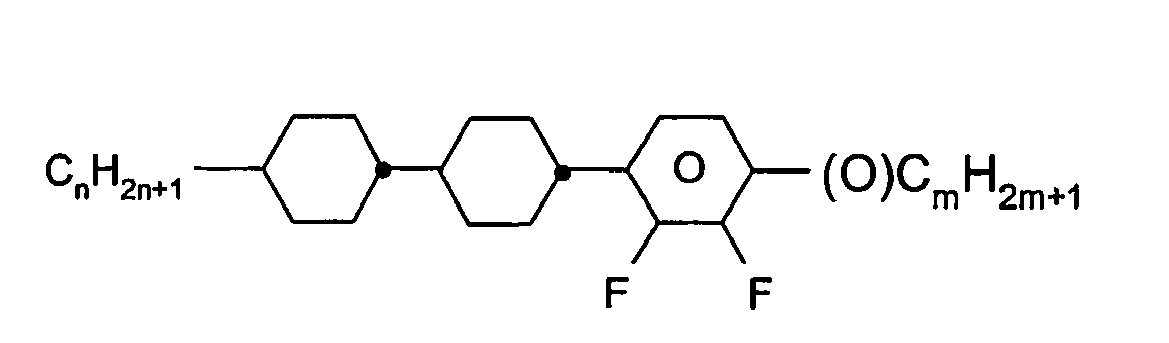
CCP-n(O)mFF 
CCQU-n-X (X=F, Cl, -OCF2H, -OCF3) 
PUQU-n-X (X=F, Cl, -OCF2H, -OCF3) - Die folgenden Beispiele sollen die Erfindung erläutern, ohne sie zu begrenzen. Vor- und nachstehend bedeuten Prozentangaben Gewichtsprozent. Alle Temperaturen sind in Grad Celsius angegeben. Δn bedeutet optische Anisotropie (589 nm, 20 °C), Δε die dielektrische Anisotropie (1 kHz, 20 °C), H.R. die "Voltage Holding Ratio" (bei 100 °C, nach 5 Minuten im Ofen, 1 V), V10, V50 und V90 die Schwellenspannung, Mittgrau-spannung bzw. Sättigungsspannung, sowie die kapazitive Schwellenspannung V0 wurden bei 20 °C bestimmt.
-

- 14,5 g 1-Brom-3,5-difluoro-4-(1-methyl-heptyloxy)-benzol aus Stufe 1 wurden in 150 ml Diethylether gelöst und auf -70°C gekühlt. Bei dieser Temperatur wurden unter Kühlung zunächst 31,0 ml einer 15%-igen Lösung von Butyllithium in n-Hexan langsam zugetropft, 1 h bei der selben Temperatur gerührt und dann mit 5,6 ml Trimethylborat langsam zugetropft und wieder h gerührt. Die Temperatur der Reaktionslösung wurde langsam auf -10°C ansteigen lassen. Dann wurde mit destilliertem Wasser hydrolysiert und der pH-Wert mit Salzsäure auf 2 eingestellt. Die organische Phase wurde abgetrennt und die wäßrige Phase mit MTB-Ether extrahiert. Das Produkt wurde wie üblich aufgereinigt und über Na2SO4 getrocknet. Es wurden 13,9 g 3,5-Difluoro-4-(1-methyl-heptyloxy)-phenylboronsäure erhalten.
- 3,5-Difluoro-4-(1-methyl-heptyloxy)-phenylboronsäure aus Stufe 2 wurden mit 12,0 g 2,6-Di-tert.-butyl-4-brom-phenol, 30 mg Palladium(II)-acetat und 100 mg Triphenylphosphin in 100 ml 2-Propanol gelöst und 30 ml 2-molarer wäßriger Natriumcarbonatlösung und 20 ml destilliertes Wasser zugesetzt. Dann wurde 15 h unter Rückfluß auf 80°C erhitzt. Dann wurde das Reaktionsgemisch auf ca. 20°C abgekühlt und mit Wasser verdünnt. Es wurde MBT-Ether zugegeben und die organische Phase abgetrennt. Das Produkt wurde wie üblich aufgereinigt.
- Es wurden 8,4 g 3,5-Di-tert.-butyl-3',5'-difluoro-4'-(1-methyl-heptyloxy)-biphenyl-4-ol als farbloses Öl mit einer Glastemperatur von -21°C erhalten.
- Analog zu Beispiel 1 werden hergestellt:

Nr. Konf.§ R11 R12 X Y Eigenschaften 2 S C2H5 CH3 H H 3 S n-C3H7 CH3 H H 4 S n-C4H9 CH3 H H 5 S n-C5H11 CH3 H H 6 S n- C6H13 CH3 H H 7 S n-C3H7 C2H5 H H 8 S n-C4H9 C2H5 H H 9 S n-C5H11 C2H5 H H 10 S n- C6H13 C2H5 H H 11 S C2H5 CH3 F H 12 S n-C3H7 CH3 F H 13 S n-C4H9 CH3 F H 14 S n-C5H11 CH3 F H 15 S n- C6H13 CH3 F H 16 S n-C3H7 C2H5 F H 17 S n-C4H9 C2H5 F H 18 S n-C5H11 C2H5 F H 19 S n- C6H13 C2H5 F H 20 S C2H5 CH3 F F 21 S n-C3H7 CH3 F F 22 S n-C4H9 CH3 F F 23 S n-C5H11 CH3 F F 1 S n- C6H13 CH3 F F 24 S n-C3H7 C2H5 F F 25 S n-C4H9 C2H5 F F 26 S n-C5H11 C2H5 F F 27 S n- C6H13 C2H5 F F 28 R C2H5 CH3 H H 29 R n-C3H7 CH3 H H 30 R n-C4H9 CH3 H H 31 R n-C5H11 CH3 H H 32 R n- C6H13 CH3 H H 33 R n-C3H7 C2H5 H H 34 R n-C4H9 C2H5 H H 35 R n-C5H11 C2H5 H H 36 R n-C6H13 C2H5 H H 37 R C2H5 CH3 F H 38 R n-C3H7 CH3 F H 39 R n-C4H9 CH3 F H 40 R n-C5H11 CH3 F H 41 R n- C6H13 CH3 F H 42 R n-C3H7 C2H5 F H 43 R n-C4H9 C2H5 F H 44 R n-C5H11 C2H5 F H 45 R n- C6H13 C2H5 F H 46 R C2H5 CH3 F F 47 R n-C3H7 CH3 F F 48 R n-C4H9 CH3 F F 49 R n-C5H11 CH3 F F 50 R n- C6H13 CH3 F F 51 R n-C3H7 C2H5 F F 52 R n-C4H9 C2H5 F F 53 R n-C5H11 C2H5 F F 54 R n- C6H13 C2H5 F F Bemerkung:§ Konfiguration des eingesetzten Alkohols.
Bemerkung:§ Konfiguration des eingesetzten Alkohols. - Analog zu Beispiel 1 werden hergestellt:

Nr. Konf.§ R11 R12 55 S C2H5 CH3 56 S n-C3H7 CH3 57 S n-C4H9 CH3 58 S n-C5H11 CH3 59 S n- C6H13 CH3 60 S n-C3H7 C2H5 61 S n-C4H9 C2H5 62 S n-C5H11 C2H5 63 S n- C6H13 C2H5 64 R C2H5 CH3 65 R n-C3H7 CH3 66 R n-C4H9 CH3 67 R n-C5H11 CH3 68 R n- C6H13 CH3 69 R n-C3H7 C2H5 70 R n-C4H9 C2H5 71 R n-C5H11 C2H5 72 R n- C6H13 C2H5 Bemerkung: § Konfiguration des eingesetzten Alkohols. - Analog zu Beispiel 1 werden hergestellt:
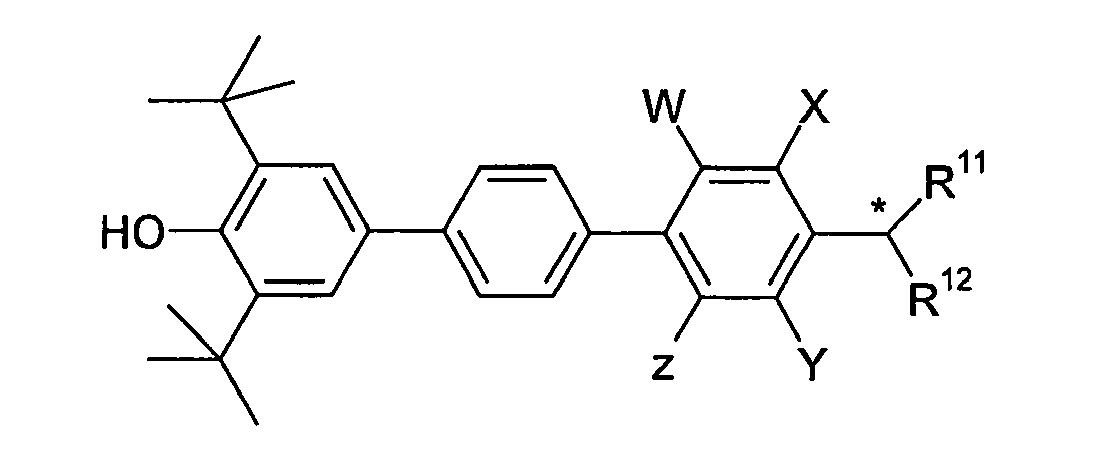
Nr. Konf.§ R11 R12 X Y 73 S C2H5 CH3 H H 74 S n-C3H7 CH3 H H 75 S n-C4H9 CH3 H H 76 S n-C5H11 CH3 H H 77 S n- C6H13 CH3 H H 78 S n-C3H7 C2H5 H H 79 S n-C4H9 C2H5 H H 80 S n-C5H11 C2H5 H H 81 S n- C6H13 C2H5 H H 82 S C2H5 CH3 F H 83 S n-C3H7 CH3 F H 84 S n-C4H9 CH3 F H 85 S n-C5H11 CH3 F H 86 S n- C6H13 CH3 F H 87 S n-C3H7 C2H5 F H 88 S n-C4H9 C2H5 F H 89 S n-C5H11 C2H5 F H 90 S n- C6H13 C2H5 F H 91 S C2H5 CH3 F F 92 S n-C3H7 CH3 F F 92 S n-C4H9 CH3 F F 94 S n-C5H11 CH3 F F 95 S n- C6H13 CH3 F F 96 S n-C3H7 C2H5 F F 97 S n-C4H9 C2H5 F F 98 S n-C5H11 C2H5 F F 99 S n- C6H13 C2H5 F F 100 R C2H5 CH3 H H 101 R n-C3H7 CH3 H H 102 R n-C4H9 CH3 H H 103 R n-C5H11 CH3 H H 104 R n- C6H13 CH3 H H 105 R n-C3H7 C2H5 H H 106 R n-C4H9 C2H5 H H 107 R n-C5H11 C2H5 H H 108 R n- C6H13 C2H5 H H 109 R C2H5 CH3 F H 110 R n-C3H7 CH3 F H 111 R n-C4H9 CH3 F H 112 R n-C5H11 CH3 F H 113 R n- C6H13 CH3 F H 114 R n-C3H7 C2H5 F H 115 R n-C4H9 C2H5 F H 116 R n-C5H11 C2H5 F H 117 R n- C6H13 C2H5 F H 118 R C2H5 CH3 F F 119 R n-C3H7 CH3 F F 129 R n-C4H9 CH3 F F 121 R n-C5H11 CH3 F F 122 R n- C6H13 CH3 F F 123 R n-C3H7 C2H5 F F 124 R n-C4H9 C2H5 F F 125 R n-C5H11 C2H5 F F 126 R n- C6H13 C2H5 F F Bemerkung: § Konfiguration des eingesetzten Alkohols. - Analog zu Beispiel 1 werden hergestellt:

Nr. Konf.§ R11 R12 X Y 127 S C2H5 CH3 H H 128 S n-C3H7 CH3 H H 129 S n-C4H9 CH3 H H 130 S n-C5H11 CH3 H H 131 S n- C6H13 CH3 H H 132 S n-C3H7 C2H5 H H 133 S n-C4H9 C2H5 H H 134 S n-C5H11 C2H5 H H 135 S n- C6H13 C2H5 H H 136 S C2H5 CH3 F H 137 S n-C3H7 CH3 F H 138 S n-C4H9 CH3 F H 139 S n-C5H11 CH3 F H 140 S n- C6H13 CH3 F H 141 S n-C3H7 C2H5 F H 142 S n-C4H9 C2H5 F H 143 S n-C5H11 C2H5 F H 144 S n- C6H13 C2H5 F H 145 S C2H5 CH3 F F 146 S n-C3H7 CH3 F F 147 S n-C4H9 CH3 F F 148 S n-C5H11 CH3 F F 149 S n- C6H13 CH3 F F 150 S n-C3H7 C2H5 F F 151 S n-C4H9 C2H5 F F 152 S n-C5H11 C2H5 F F 153 S n- C6H13 C2H5 F F 154 R C2H5 CH3 H H 155 R n-C3H7 CH3 H H 156 R n-C4H9 CH3 H H 157 R n-C5H11 CH3 H H 158 R n- C6H13 CH3 H H 159 R n-C3H7 C2H5 H H 160 R n-C4H9 C2H5 H H 161 R n-C5H11 C2H5 H H 162 R n- C6H13 C2H5 H H 163 R C2H5 CH3 F H 164 R n-C3H7 CH3 F H 165 R n-C4H9 CH3 F H 166 R n-C5H11 CH3 F H 167 R n- C6H13 CH3 F H 168 R n-C3H7 C2H5 F H 169 R n-C4H9 C2H5 F H 170 R n-C5H11 C2H5 F H 171 R n- C6H13 C2H5 F H 172 R C2H5 CH3 F F 173 R n-C3H7 CH3 F F 174 R n-C4H9 CH3 F F 175 R n-C5H11 CH3 F F 176 R n- C6H13 CH3 F F 177 R n-C3H7 C2H5 F F 178 R n-C4H9 C2H5 F F 179 R n-C5H11 C2H5 F F 180 R n- C6H13 C2H5 F F Bemerkung: § Konfiguration des eingesetzten Alkohols.
Bemerkung: § Konfiguration des eingesetzten Alkohols. - Die Eigenschaften der erfindungsgemäßen Verbindungen werden untersucht. Dazu werden Flüssigkristallmischungen hergestellt und mit den entsprechenden Verbindungen versetzt.
- Es wird eine nematische Flüssigkristallmischung (M0) der folgenden Zusammensetzung hergestellt, die die folgenden physikalischen Eigenschaften aufweist.
Verbindung / Konzentration / Physikalische Eigenschaften Abkürzung Massen-% PCH-5F 8,0 Klärpunkt (N,I) = 80,5 °C PCH-6F 6,4 PCH-7F 4,8 CCP-2OCF3 6,4 CCP-3OCF3 9,6 CCP-4OCF3 5,6 CCP-5OCF3 8,8 BCH-3F.F 9,6 BCH-5F.F 8,0 ECCP-3OCF3 4,0 ECCP-3OCF3 4,0 CC-4-V 20,0 CBC-33F 1,6 CBC-53F 1,6 CBC-55F 1,6 Σ 100,0 - Dieser Flüssigkristallmischung (M0) werden 0,5 % der Verbindung des Beispiels 1 zugesetzt. Dabei sinkt der Klärpunkt der Mischung (M1) auf 78,6°C. Diese dotierte Mischung, M1 wird in einem offenen Kapillarrohr (ME-18 552 der Firma Mettler) bei einer Füllhöhe von 1 cm, in Gegenwart von Luftsauerstoff auf 150°C erhitzt. Nach vorgegebenen Zeiten wird der Klärpunkt der Probe im Kapillarrohr bestimmt. Danach wird das Kapillarruhr wieder auf 150°C erhitzt. Zum Vergleich wird die selbe Untersuchung an der nicht dotierten Mischung, M0 ausgeführt. Die Ergebnisse dieser Untersuchung sind in der folgenden Tabelle zusammengestellt.
Mischung M0 M1 c(B1) / % 0 0,5 |P| / µ m ∞* 74 HTP / µm-1 n.a. 2,7 t / h T(N,I) / °C 0 80,5 78,6 1 79,4 78,9 2 79,5 78,8 5 76,8 78,8 10 74,0 78,9 30 63,7 78,7 50 59,9 78,4 Bemerkungen: * nicht bestimmbar
n.a. nicht anwendbar. - Die Meßgenauigkeit bei der Bestimmung des Klärpunkts betrug +/-0,3 Grad.
- Die Mischung M1 hat hervorragende anwendungstechnische Eigenschaften und zeichnet sich insbesondere durch eine sehr gute thermische Stabilität, insbesondere bei Gegenwart von Luftsauerstoff aus.
- Bei der undotierten Mischung (M0) sinkt der Klärpunkt in dem oben beschriebenen Stabilitätstest innerhalb von etwas mehr als vier Tagen um mehr als zwanzig Differenzgrad. Im Gegensatz dazu sinkt der Klärpunkt der erfindungsgemäßen Mischung nur unwesentlich, um 0,2 Differenzgrad.
- Der unter Anwendungsbeispiel 1 beschrieben Mischung, M0 werden 0,5 % des chiralen Dotierstoffs S-811 der Firma Merck KGaA zugesetzt. Die resultierende Mischung, V1 hat einen Klärpunkt von 79,0°C und einen cholesterischen Pitch von 17 µm. Bei der unter Anwendungsbeispiel 1 beschriebenen, thermischen Belastung sinkt der Klärpunkt der Mischung
- Der unter Anwendungsbeispiel 1 beschriebenen Mischung, M0 werden 0,5 % des achiralen Phenols AP

DE 195 391 41 mit einem Schmelzpunkt von 91 °C zugesetzt. Die resultierende Mischung, V2 hat einen Klärpunkt von 78,2°C. Bei der unter Anwendungsbeispiel 1 beschriebenen, thermischen Belastung sinkt der Klärpunkt der Mischung V2 nur unwesentlich, auf 78,0°C, ab. Da die zugesetzte Verbindung achiral ist, ist auch die Mischung V2 nicht chiral und hat somit keinen cholesterischen Pitch. - Diese Ergebnisse sind in der folgenden Tabelle zusammengestellt.
Beispiel -/- Vergleichsbeispiele 1 und 2 Anwendungsbeispiel 1 Mischung M0 V1 V2 M1 Dotierstoff -/- S-811 AP B1 |P| / µm ∞* 17 ∞* 74 ΔT§ / ° 20,6 19,0 0,2 0,2 Bemerkungen: * nicht bestimmbar,
§ ΔT ≡ T(N,I),(50 h) - T(N,I),(0 h)
dadurch gekennzeichnet, dass sie in einem nematischen Flüssigkristall eine cholesterische Phase induzieren und gleichzeitig als Stabilisator wirken,
erwiesen.




Claims (13)
- Chirale Verbindung der Formel I
 R*1 einen chiralen Rest der Formel I*,
 K eine Einfachbindung, Alkylen mit 1 bis 9, bevorzugt mit 1 bis 5 C-Atomen, Alkenylen oder Alkinylen mit 2 bis 9, bevorzugt mit 2 bis 5 C-Atomen, wobei bei allen drei Arten von Gruppen jeweils eine, zwei oder mehr der vorhandenen -CH2- Gruppen durch -O-, -C=O- oder -S- ersetzt sein können, wobei jedoch keine zwei O-Atome direkt miteinander verbunden sind und alle drei Arten von Gruppen optional durch Halogen substituiert sein können, undL, M und N, jeweils unabhängig voneinander, aber verschieden voneinander und vom Rest des Moleküls inklusive der Gruppe K, Wasserstoff, Halogen, bevorzugt F, Aryl oder Cycloalkyl, Alkyl oder Alkoxy mit 1 bis 11 C-Atomen, Alkenyl, Alkenyloxy, Alkinyl oder Alkinyloxy mit 2 bis 11 C-Atomen, wobei bei allen sechs Arten von Gruppen jeweils eine, zwei oder mehr der vorhandenen -CH2- Gruppen durch -O-, -C=O- oder -S- ersetzt sein können, wobei jedoch keine zwei O-Atome direkt miteinander verbunden sind und alle sechs Arten von Gruppen optional durch Halogen substituiert sein können,Z1, wenn mehrfach vorhanden jeweils unabhängig voneinander, -CH2-CH2-, -CH=CH-, -C≡C-, -COO-, -OCO-, -CH2O-, -OCH2-, -CF2O-, -OCF2-, -(CH2)4-, -CF=CF-, -CH=CF-, -CF=CH-, -CH2-, -CF2-, -CHF-, -O-, -S- oder eine Einfachbindung,
 (a) einen trans-1,4-Cyclohexylenrest, worin auch eine oder mehrere nicht benachbarte CH2-Gruppen durch -O- und/oder -S- ersetzt sein können,(b) einen 1,4-Cyclohexenylenrest,(c) einen 1,4-Phenylenrest, worin auch eine oder zwei CH-Gruppen durch N ersetzt sein können oder(d) einen Rest ausgewählt aus der Gruppewobei diese Reste (a) bis (d) und der phenolische Benzolring optional einfach oder mehrfach durch F-Atome substituiert sein können, und
1,4-Bicyclo-(2,2,2)-octylen,
Piperidin-1,4-diyl, Naphtalin-2,6-diyl,
Decahydronaphthalin-2,6-diyl und
1,2,3,4-Tetrahydronaphthalin-2,6-diyl,n1 0, 1, 2 oder 3bedeuten,
dadurch gekennzeichnet, dass sie in einem nematischen Flüssigkristall eine cholesterische Phase induziert und gleichzeitig als Stabilisator wirkt. - Verbindung nach Anspruch 1, der Formel Ia
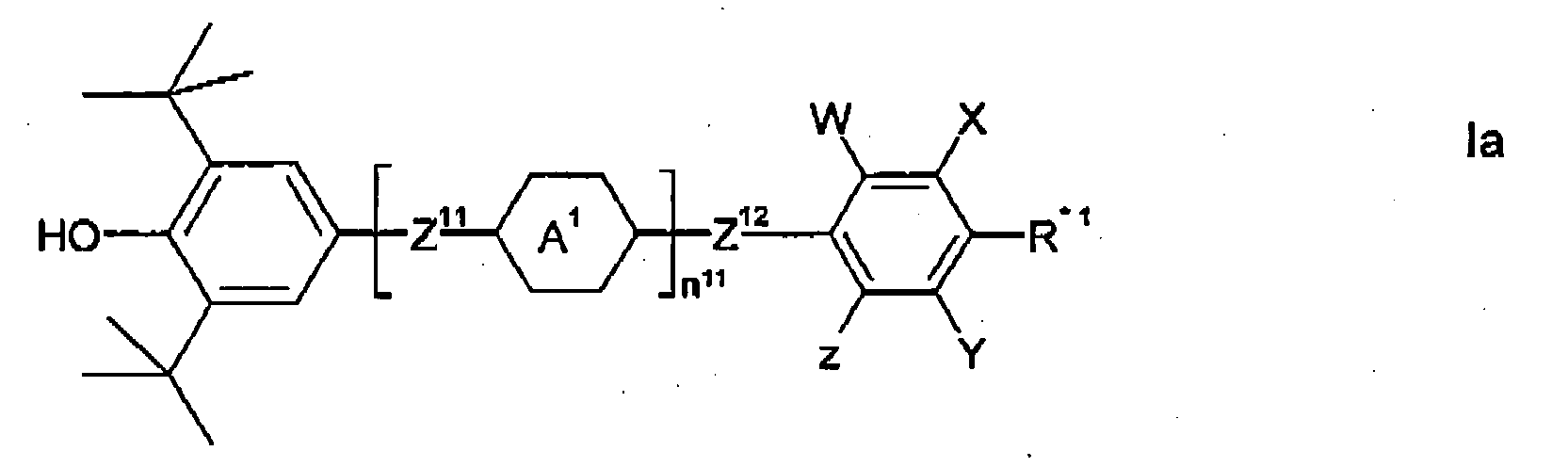
 und R*1 die in Anspruch 1 gegebene Bedeutung undZ11 und Z12; jeweils unabhängig voneinander, die in Anspruch 1 für Z1 gegebene Bedeutunghaben,undn11 0, 1 oder 2 undW, X, Y und Z, jeweils unabhängig voneinander, H, F, Cl, Alkyl, oder Alkoxy, bevorzugt mit 1 bis 7 C-Atomenbedeuten.
- Verbindung nach einem der Ansprüche 1 und 2, dadurch gekennzeichnet, dassR*1 einen chiralen Rest der Formel I*
 K eine Einfachbindung, Alkylen mit 1 bis 5 C-Atomen, Alkenylen oder Alkinylen mit 2 bis 5 C-Atomen, wobei bei allen drei Arten von Gruppen jeweils eine, zwei oder mehr der vorhandenen -CH2- Gruppen durch -O-, -C=O- oder -S- ersetzt sein können, wobei jedoch keine zwei O-Atome direkt miteinander verbunden sind und alle drei Arten von Gruppen optional durch Fluor substituiert sein können, undL, M und N, jeweils unabhängig voneinander, aber verschieden voneinander und vom Rest des Moleküls inklusive der Gruppe K, Wasserstoff, F, Aryl oder Cycloalkyl, Alkyl oder Alkoxy 1 bis 7 C-Atomen, Alkenyl, Alkenyloxy, Alkinyl oder Alkinyloxy mit 2 bis 7 C-Atomen, wobei bei allen sechs Arten von Gruppen jeweils eine, zwei oder mehr der vorhandenen -CH2-Gruppen durch -O-, -C=O- oder -S- ersetzt sein können, wobei jedoch keine zwei O-Atome direkt miteinander verbunden sind und alle sechs Arten von Gruppen optional durch Fluor substituiert sein können,bedeuten.
- Verbindung nach mindestens einem der Ansprüche 1 bis 3, dadurch gekennzeichnet, dassR*1 einen chiralen Rest ausgewählt aus der Gruppe der Reste der Formeln
 Q H oder Halogen, bevorzugt H oder F, bevorzugt H,n und m voneinander verschieden sind und ansonsten voneinander unabhängig 1 bis 11,p 0 oder 1 undr 0 bis 4bedeuten.
- Verbindung nach Anspruch 4, dadurch gekennzeichnet, dassr 0 bis 2bedeutet.
- Verbindung nach mindestens einem der Ansprüche 1 bis 5, ausgewählt aus der Gruppe der Verbindungen der Formeln la-1 bis Ia-9


- Verbindung nach Anspruch 6, dadurch gekennzeichnet, dass
W und Z H bedeuten. - Verwendung einer oder mehrerer Verbindungen nach mindestens einem der Ansprüche 1 bis 7 in einer Flüssigkristallmischung als chiraler Dotierstoff, als Stabilisator oder als chiraler Dotierstoff und gleichzeitig als Stabilisator.
- Flüssigkristallmedium, dadurch gekennzeichnet, dass es eine oder mehrere Verbindungen nach mindestens einem der Ansprüche 1 bis 7 enthält.
- Verwendung eines Flüssigkristallmediums nach Anspruch 9 in einer elektrooptischen Anzeige.
- Elektrooptischen Anzeige enthaltend ein Flüssigkristallmedium nach Anspruch 9.
- Verfahren zur Herstellung einer Flüssigkristallmischurtg, dadurch gekennzeichnet, dass der Flüssigkristallmischung eine Verbindung zugegeben wird, die eine cholesterische Phase induzieren und gleichzeitig als Stabilisator wirken.
- Flüssigkristallmischung, dadurch gekennzeichnet, dass sie nach dem Verfahren nach Anspruch 12 hergestellt wurde.
Applications Claiming Priority (3)
| Application Number | Priority Date | Filing Date | Title |
|---|---|---|---|
| DE2002146657 DE10246657A1 (de) | 2002-10-07 | 2002-10-07 | Chirales Phenolderivat, dieses enthaltendes Flüssigkristallmedium, Verfahren zur Herstellung eines Flüssigkristallmediums und elektrooptische Flüssigkristallanzeige |
| DE10246657 | 2002-10-07 | ||
| PCT/EP2003/010398 WO2004033406A1 (de) | 2002-10-07 | 2003-09-18 | Chirales phenolderivat, dieses enthaltendes flüssigkristallmedium |
Publications (2)
| Publication Number | Publication Date |
|---|---|
| EP1549599A1 EP1549599A1 (de) | 2005-07-06 |
| EP1549599B1 true EP1549599B1 (de) | 2009-07-08 |
Family
ID=32010322
Family Applications (1)
| Application Number | Title | Priority Date | Filing Date |
|---|---|---|---|
| EP03775161A Expired - Lifetime EP1549599B1 (de) | 2002-10-07 | 2003-09-18 | Chirales phenolderivat, dieses enthaltendes flüssigkristallmedium |
Country Status (8)
| Country | Link |
|---|---|
| US (1) | US7790929B2 (de) |
| EP (1) | EP1549599B1 (de) |
| JP (1) | JP4593279B2 (de) |
| AT (1) | ATE435849T1 (de) |
| AU (1) | AU2003283251A1 (de) |
| DE (3) | DE10246657A1 (de) |
| TW (1) | TW200422385A (de) |
| WO (1) | WO2004033406A1 (de) |
Cited By (1)
| Publication number | Priority date | Publication date | Assignee | Title |
|---|---|---|---|---|
| CN104168971A (zh) * | 2013-03-25 | 2014-11-26 | Dic株式会社 | 液晶组合物、液晶显示元件以及液晶显示器 |
Families Citing this family (16)
| Publication number | Priority date | Publication date | Assignee | Title |
|---|---|---|---|---|
| CN103110635A (zh) * | 2005-07-04 | 2013-05-22 | 海波因特制药有限责任公司 | 组胺h3受体拮抗剂 |
| TWI475099B (zh) * | 2009-09-30 | 2015-03-01 | Jnc Corp | 液晶組成物及液晶顯示元件 |
| US20120194755A1 (en) * | 2011-01-27 | 2012-08-02 | Reald Inc. | Ultrafast twisted nematic liquid crystal display |
| JP6186974B2 (ja) * | 2012-07-30 | 2017-08-30 | Jnc株式会社 | 液晶組成物、酸化防止剤および液晶表示素子 |
| US20150275086A1 (en) * | 2012-10-24 | 2015-10-01 | Dic Corporation | Nematic liquid crystal composition and liquid crystal display device using same |
| TWI597352B (zh) | 2012-11-08 | 2017-09-01 | Dainippon Ink & Chemicals | Nematic liquid crystal composition and liquid crystal display device using the same |
| KR102017601B1 (ko) | 2013-03-06 | 2019-09-09 | 디아이씨 가부시끼가이샤 | 네마틱 액정 조성물 및 이를 사용한 액정 표시 소자 |
| TWI568837B (zh) * | 2013-03-26 | 2017-02-01 | 迪愛生股份有限公司 | 液晶組成物、液晶顯示元件及液晶顯示器 |
| KR20150070027A (ko) * | 2013-12-16 | 2015-06-24 | 메르크 파텐트 게엠베하 | 액정 매질 |
| US10400168B2 (en) * | 2014-10-09 | 2019-09-03 | Dic Corporation | Composition and liquid crystal display device using the same |
| US10584284B2 (en) * | 2014-11-10 | 2020-03-10 | Jnc Corporation | Antioxidant having difluoromethoxy group, liquid crystal composition, and liquid crystal display device |
| KR102218333B1 (ko) | 2016-06-07 | 2021-02-22 | 자코바이오 파마슈티칼스 컴퍼니 리미티드 | Shp2 억제제로서 유용한 신규한 헤테로환형 유도체 |
| JPWO2018003653A1 (ja) * | 2016-06-27 | 2019-04-18 | Dic株式会社 | 重合性液晶組成物、それを用いた光学異方体及び液晶表示素子 |
| SG11201908820VA (en) | 2017-03-23 | 2019-10-30 | Jacobio Pharmaceuticals Co Ltd | Novel heterocyclic derivatives useful as shp2 inhibitors |
| CN108822550B (zh) * | 2018-07-01 | 2021-06-04 | 浙江鑫都文化用品股份有限公司 | 一种液晶弹性体新材料的制备方法 |
| CN112839935A (zh) | 2018-09-26 | 2021-05-25 | 北京加科思新药研发有限公司 | 可用作shp2抑制剂的新型杂环衍生物 |
Family Cites Families (11)
| Publication number | Priority date | Publication date | Assignee | Title |
|---|---|---|---|---|
| US4038250A (en) * | 1971-08-25 | 1977-07-26 | Ciba-Geigy Corporation | Light protecting agents |
| US4067895A (en) * | 1972-04-28 | 1978-01-10 | Sandoz Ltd | N-(para-hydroxybiphenyl)amides |
| US4032547A (en) * | 1976-02-23 | 1977-06-28 | Gulf Research & Development Company | Quinone alkide synthesis system |
| EP0217239B1 (de) | 1985-09-30 | 1990-10-24 | Hoechst Aktiengesellschaft | Chirale Phenolester mesogener Carbonsäuren und ihre Verwendung als Dotierstoff in Flüssigkristal-Phasen |
| GB8614213D0 (en) * | 1986-06-11 | 1986-07-16 | Kodak Ltd | Photographic acetanilide couplers |
| WO1992008450A2 (fr) * | 1990-11-12 | 1992-05-29 | Fileco | UTILISATION ANTIVIRALE DE COMPOSE 2,6-DI-t-BUTYLPHENOL SUBSTITUE EN POSITION 4, NOTAMMENT VIS-A-VIS DES VIRUS DE L'HERPES ET DES PAPILLOMAVIRUS |
| JPH06107584A (ja) * | 1992-09-29 | 1994-04-19 | Yamakawa Yakuhin Kogyo Kk | 光学活性化合物、その製造方法およびそれを含有する液晶組成物並びに液晶素子 |
| DE19539141B4 (de) * | 1995-10-20 | 2016-07-07 | Merck Patent Gmbh | 2,6-Di-tert.-butylphenole |
| DE19816268A1 (de) * | 1998-04-11 | 1999-10-14 | Clariant Gmbh | Cholesterische Flüssigkristallpolymere mit erhöhter Wetterstabilität |
| DE10117224B4 (de) * | 2000-04-19 | 2015-12-31 | Merck Patent Gmbh | Verfahren zur Stabilisierung von Halogenaromaten |
| JP2002256267A (ja) * | 2000-12-27 | 2002-09-11 | Dainippon Ink & Chem Inc | 抗酸化性液晶組成物 |
-
2002
- 2002-10-07 DE DE2002146657 patent/DE10246657A1/de not_active Withdrawn
-
2003
- 2003-09-18 AU AU2003283251A patent/AU2003283251A1/en not_active Abandoned
- 2003-09-18 EP EP03775161A patent/EP1549599B1/de not_active Expired - Lifetime
- 2003-09-18 WO PCT/EP2003/010398 patent/WO2004033406A1/de not_active Ceased
- 2003-09-18 AT AT03775161T patent/ATE435849T1/de not_active IP Right Cessation
- 2003-09-18 DE DE10393154T patent/DE10393154D2/de not_active Ceased
- 2003-09-18 US US10/530,572 patent/US7790929B2/en not_active Expired - Fee Related
- 2003-09-18 DE DE50311691T patent/DE50311691D1/de not_active Expired - Lifetime
- 2003-09-18 JP JP2004542358A patent/JP4593279B2/ja not_active Expired - Fee Related
- 2003-10-06 TW TW92127688A patent/TW200422385A/zh unknown
Cited By (2)
| Publication number | Priority date | Publication date | Assignee | Title |
|---|---|---|---|---|
| CN104168971A (zh) * | 2013-03-25 | 2014-11-26 | Dic株式会社 | 液晶组合物、液晶显示元件以及液晶显示器 |
| CN104168971B (zh) * | 2013-03-25 | 2018-02-02 | Dic株式会社 | 液晶组合物、液晶显示元件以及液晶显示器 |
Also Published As
| Publication number | Publication date |
|---|---|
| US20060011888A1 (en) | 2006-01-19 |
| WO2004033406A1 (de) | 2004-04-22 |
| DE50311691D1 (de) | 2009-08-20 |
| DE10246657A1 (de) | 2004-04-15 |
| TW200422385A (en) | 2004-11-01 |
| US7790929B2 (en) | 2010-09-07 |
| JP4593279B2 (ja) | 2010-12-08 |
| AU2003283251A1 (en) | 2004-05-04 |
| JP2006502205A (ja) | 2006-01-19 |
| DE10393154D2 (de) | 2005-08-25 |
| ATE435849T1 (de) | 2009-07-15 |
| EP1549599A1 (de) | 2005-07-06 |
Similar Documents
| Publication | Publication Date | Title |
|---|---|---|
| EP1302523B1 (de) | Flüssigkristallines Medium | |
| DE10243776B4 (de) | Flüssigkristalline Verbindungen | |
| EP2338951B1 (de) | Flüssigkristallines Medium | |
| EP1646703B1 (de) | Flüssigkristallines medium mit monofluor-terphenylverbindungen | |
| EP1891181B1 (de) | Flüssigkristallines medium und flüssigkristallanzeige mit 1,2-difluorethenverbindungen | |
| EP1436358B1 (de) | Flüssigkristalline verbindungen | |
| EP0807153A1 (de) | Elektrooptische flüssigkristallanzeige | |
| EP2542648B1 (de) | Flüssigkristallines medium | |
| EP1549599A1 (de) | Chirales phenolderivat, dieses enthaltendes flüssigkristallmedium | |
| WO2004106460A1 (de) | Flüssigkristalline verbindungen mit tetrahydropyranring | |
| DE10061790A1 (de) | Flüssigkristalline Verbindungen | |
| EP1746079B1 (de) | Fluorierte Biphenylverbindungen zur Verwendung in Flüssigkristallmischungen | |
| DE19707941B4 (de) | Flüssigkristallines Medium | |
| DE10111572B4 (de) | Flüssigkristallines Medium und seine Verwendung | |
| EP2248872A2 (de) | Flüssigkristallines Medium | |
| DE19949333A1 (de) | Esterverbindungen und deren Verwendung in flüssigkristallinen Medien | |
| DE19943649B4 (de) | Flüssigkristallines Medium und seine Verwendung in Flüssigkristallanzeigen | |
| DE112007000676B4 (de) | Flüssigkristallines Medium und seine Verwendung | |
| EP0768359A1 (de) | Elektrooptische Flüssigkristallanzeige | |
| EP1341871A1 (de) | Flüssigkristallines medium | |
| DE10136751B4 (de) | Vierkern-und Fünfkernverbindungen und deren Verwendung in flüssigkristallinen Medien | |
| EP1201727B1 (de) | Flüssigkristallmedium und elektrooptische Flüssigkristallanzeige | |
| DE10008712B4 (de) | Flüssigkristallines Medium und seine Verwendung | |
| DE102006052123B4 (de) | Flüssigkristallines Medium und seine Verwendung für elektrooptische Zwecke | |
| DE19958794B4 (de) | Flüssigkristallines Medium und seine Verwendung in Flüssigkristallanzeigen |
Legal Events
| Date | Code | Title | Description |
|---|---|---|---|
| PUAI | Public reference made under article 153(3) epc to a published international application that has entered the european phase |
Free format text: ORIGINAL CODE: 0009012 |
|
| 17P | Request for examination filed |
Effective date: 20050216 |
|
| AK | Designated contracting states |
Kind code of ref document: A1 Designated state(s): AT BE BG CH CY CZ DE DK EE ES FI FR GB GR HU IE IT LI LU MC NL PT RO SE SI SK TR |
|
| AX | Request for extension of the european patent |
Extension state: AL LT LV MK |
|
| DAX | Request for extension of the european patent (deleted) | ||
| 17Q | First examination report despatched |
Effective date: 20070823 |
|
| GRAP | Despatch of communication of intention to grant a patent |
Free format text: ORIGINAL CODE: EPIDOSNIGR1 |
|
| GRAS | Grant fee paid |
Free format text: ORIGINAL CODE: EPIDOSNIGR3 |
|
| GRAA | (expected) grant |
Free format text: ORIGINAL CODE: 0009210 |
|
| AK | Designated contracting states |
Kind code of ref document: B1 Designated state(s): AT BE BG CH CY CZ DE DK EE ES FI FR GB GR HU IE IT LI LU MC NL PT RO SE SI SK TR |
|
| REG | Reference to a national code |
Ref country code: GB Ref legal event code: FG4D Free format text: NOT ENGLISH |
|
| REG | Reference to a national code |
Ref country code: CH Ref legal event code: EP |
|
| REG | Reference to a national code |
Ref country code: IE Ref legal event code: FG4D |
|
| REF | Corresponds to: |
Ref document number: 50311691 Country of ref document: DE Date of ref document: 20090820 Kind code of ref document: P |
|
| PG25 | Lapsed in a contracting state [announced via postgrant information from national office to epo] |
Ref country code: SI Free format text: LAPSE BECAUSE OF FAILURE TO SUBMIT A TRANSLATION OF THE DESCRIPTION OR TO PAY THE FEE WITHIN THE PRESCRIBED TIME-LIMIT Effective date: 20090708 |
|
| PGFP | Annual fee paid to national office [announced via postgrant information from national office to epo] |
Ref country code: GB Payment date: 20090916 Year of fee payment: 7 |
|
| NLV1 | Nl: lapsed or annulled due to failure to fulfill the requirements of art. 29p and 29m of the patents act | ||
| PG25 | Lapsed in a contracting state [announced via postgrant information from national office to epo] |
Ref country code: FI Free format text: LAPSE BECAUSE OF FAILURE TO SUBMIT A TRANSLATION OF THE DESCRIPTION OR TO PAY THE FEE WITHIN THE PRESCRIBED TIME-LIMIT Effective date: 20090708 Ref country code: ES Free format text: LAPSE BECAUSE OF FAILURE TO SUBMIT A TRANSLATION OF THE DESCRIPTION OR TO PAY THE FEE WITHIN THE PRESCRIBED TIME-LIMIT Effective date: 20091019 |
|
| REG | Reference to a national code |
Ref country code: IE Ref legal event code: FD4D |
|
| PG25 | Lapsed in a contracting state [announced via postgrant information from national office to epo] |
Ref country code: NL Free format text: LAPSE BECAUSE OF FAILURE TO SUBMIT A TRANSLATION OF THE DESCRIPTION OR TO PAY THE FEE WITHIN THE PRESCRIBED TIME-LIMIT Effective date: 20090708 |
|
| BERE | Be: lapsed |
Owner name: MERCK PATENT G.M.B.H. Effective date: 20090930 |
|
| PG25 | Lapsed in a contracting state [announced via postgrant information from national office to epo] |
Ref country code: PT Free format text: LAPSE BECAUSE OF FAILURE TO SUBMIT A TRANSLATION OF THE DESCRIPTION OR TO PAY THE FEE WITHIN THE PRESCRIBED TIME-LIMIT Effective date: 20091109 Ref country code: BG Free format text: LAPSE BECAUSE OF FAILURE TO SUBMIT A TRANSLATION OF THE DESCRIPTION OR TO PAY THE FEE WITHIN THE PRESCRIBED TIME-LIMIT Effective date: 20091008 |
|
| PG25 | Lapsed in a contracting state [announced via postgrant information from national office to epo] |
Ref country code: MC Free format text: LAPSE BECAUSE OF NON-PAYMENT OF DUE FEES Effective date: 20090930 Ref country code: IE Free format text: LAPSE BECAUSE OF FAILURE TO SUBMIT A TRANSLATION OF THE DESCRIPTION OR TO PAY THE FEE WITHIN THE PRESCRIBED TIME-LIMIT Effective date: 20090708 Ref country code: EE Free format text: LAPSE BECAUSE OF FAILURE TO SUBMIT A TRANSLATION OF THE DESCRIPTION OR TO PAY THE FEE WITHIN THE PRESCRIBED TIME-LIMIT Effective date: 20090708 Ref country code: DK Free format text: LAPSE BECAUSE OF FAILURE TO SUBMIT A TRANSLATION OF THE DESCRIPTION OR TO PAY THE FEE WITHIN THE PRESCRIBED TIME-LIMIT Effective date: 20090708 Ref country code: CZ Free format text: LAPSE BECAUSE OF FAILURE TO SUBMIT A TRANSLATION OF THE DESCRIPTION OR TO PAY THE FEE WITHIN THE PRESCRIBED TIME-LIMIT Effective date: 20090708 Ref country code: RO Free format text: LAPSE BECAUSE OF FAILURE TO SUBMIT A TRANSLATION OF THE DESCRIPTION OR TO PAY THE FEE WITHIN THE PRESCRIBED TIME-LIMIT Effective date: 20090708 |
|
| REG | Reference to a national code |
Ref country code: CH Ref legal event code: PL |
|
| PLBE | No opposition filed within time limit |
Free format text: ORIGINAL CODE: 0009261 |
|
| STAA | Information on the status of an ep patent application or granted ep patent |
Free format text: STATUS: NO OPPOSITION FILED WITHIN TIME LIMIT |
|
| PG25 | Lapsed in a contracting state [announced via postgrant information from national office to epo] |
Ref country code: SK Free format text: LAPSE BECAUSE OF FAILURE TO SUBMIT A TRANSLATION OF THE DESCRIPTION OR TO PAY THE FEE WITHIN THE PRESCRIBED TIME-LIMIT Effective date: 20090708 |
|
| 26N | No opposition filed |
Effective date: 20100409 |
|
| REG | Reference to a national code |
Ref country code: FR Ref legal event code: ST Effective date: 20100531 |
|
| PG25 | Lapsed in a contracting state [announced via postgrant information from national office to epo] |
Ref country code: FR Free format text: LAPSE BECAUSE OF NON-PAYMENT OF DUE FEES Effective date: 20090930 |
|
| PG25 | Lapsed in a contracting state [announced via postgrant information from national office to epo] |
Ref country code: BE Free format text: LAPSE BECAUSE OF NON-PAYMENT OF DUE FEES Effective date: 20090930 |
|
| PG25 | Lapsed in a contracting state [announced via postgrant information from national office to epo] |
Ref country code: LI Free format text: LAPSE BECAUSE OF NON-PAYMENT OF DUE FEES Effective date: 20090930 Ref country code: GR Free format text: LAPSE BECAUSE OF FAILURE TO SUBMIT A TRANSLATION OF THE DESCRIPTION OR TO PAY THE FEE WITHIN THE PRESCRIBED TIME-LIMIT Effective date: 20091009 Ref country code: CH Free format text: LAPSE BECAUSE OF NON-PAYMENT OF DUE FEES Effective date: 20090930 |
|
| PG25 | Lapsed in a contracting state [announced via postgrant information from national office to epo] |
Ref country code: AT Free format text: LAPSE BECAUSE OF NON-PAYMENT OF DUE FEES Effective date: 20090918 |
|
| PG25 | Lapsed in a contracting state [announced via postgrant information from national office to epo] |
Ref country code: IT Free format text: LAPSE BECAUSE OF FAILURE TO SUBMIT A TRANSLATION OF THE DESCRIPTION OR TO PAY THE FEE WITHIN THE PRESCRIBED TIME-LIMIT Effective date: 20090708 |
|
| PG25 | Lapsed in a contracting state [announced via postgrant information from national office to epo] |
Ref country code: LU Free format text: LAPSE BECAUSE OF NON-PAYMENT OF DUE FEES Effective date: 20090918 |
|
| GBPC | Gb: european patent ceased through non-payment of renewal fee |
Effective date: 20100918 |
|
| PG25 | Lapsed in a contracting state [announced via postgrant information from national office to epo] |
Ref country code: HU Free format text: LAPSE BECAUSE OF FAILURE TO SUBMIT A TRANSLATION OF THE DESCRIPTION OR TO PAY THE FEE WITHIN THE PRESCRIBED TIME-LIMIT Effective date: 20100109 |
|
| PG25 | Lapsed in a contracting state [announced via postgrant information from national office to epo] |
Ref country code: TR Free format text: LAPSE BECAUSE OF FAILURE TO SUBMIT A TRANSLATION OF THE DESCRIPTION OR TO PAY THE FEE WITHIN THE PRESCRIBED TIME-LIMIT Effective date: 20090708 Ref country code: GB Free format text: LAPSE BECAUSE OF NON-PAYMENT OF DUE FEES Effective date: 20100918 |
|
| PG25 | Lapsed in a contracting state [announced via postgrant information from national office to epo] |
Ref country code: CY Free format text: LAPSE BECAUSE OF FAILURE TO SUBMIT A TRANSLATION OF THE DESCRIPTION OR TO PAY THE FEE WITHIN THE PRESCRIBED TIME-LIMIT Effective date: 20090708 |
|
| PG25 | Lapsed in a contracting state [announced via postgrant information from national office to epo] |
Ref country code: SE Free format text: LAPSE BECAUSE OF FAILURE TO SUBMIT A TRANSLATION OF THE DESCRIPTION OR TO PAY THE FEE WITHIN THE PRESCRIBED TIME-LIMIT Effective date: 20090708 |
|
| PGFP | Annual fee paid to national office [announced via postgrant information from national office to epo] |
Ref country code: DE Payment date: 20180904 Year of fee payment: 16 |
|
| REG | Reference to a national code |
Ref country code: DE Ref legal event code: R119 Ref document number: 50311691 Country of ref document: DE |
|
| PG25 | Lapsed in a contracting state [announced via postgrant information from national office to epo] |
Ref country code: DE Free format text: LAPSE BECAUSE OF NON-PAYMENT OF DUE FEES Effective date: 20200401 |