EP1539411B1 - Verwendung eines zinkpulvers in elektrochemischen zellen - Google Patents
Verwendung eines zinkpulvers in elektrochemischen zellen Download PDFInfo
- Publication number
- EP1539411B1 EP1539411B1 EP03766094A EP03766094A EP1539411B1 EP 1539411 B1 EP1539411 B1 EP 1539411B1 EP 03766094 A EP03766094 A EP 03766094A EP 03766094 A EP03766094 A EP 03766094A EP 1539411 B1 EP1539411 B1 EP 1539411B1
- Authority
- EP
- European Patent Office
- Prior art keywords
- zinc
- zinc alloy
- particles
- atomisation
- powder
- Prior art date
- Legal status (The legal status is an assumption and is not a legal conclusion. Google has not performed a legal analysis and makes no representation as to the accuracy of the status listed.)
- Expired - Lifetime
Links
Images




Classifications
-
- B—PERFORMING OPERATIONS; TRANSPORTING
- B22—CASTING; POWDER METALLURGY
- B22F—WORKING METALLIC POWDER; MANUFACTURE OF ARTICLES FROM METALLIC POWDER; MAKING METALLIC POWDER; APPARATUS OR DEVICES SPECIALLY ADAPTED FOR METALLIC POWDER
- B22F9/00—Making metallic powder or suspensions thereof
- B22F9/02—Making metallic powder or suspensions thereof using physical processes
- B22F9/06—Making metallic powder or suspensions thereof using physical processes starting from liquid material
- B22F9/08—Making metallic powder or suspensions thereof using physical processes starting from liquid material by casting, e.g. through sieves or in water, by atomising or spraying
-
- B—PERFORMING OPERATIONS; TRANSPORTING
- B22—CASTING; POWDER METALLURGY
- B22F—WORKING METALLIC POWDER; MANUFACTURE OF ARTICLES FROM METALLIC POWDER; MAKING METALLIC POWDER; APPARATUS OR DEVICES SPECIALLY ADAPTED FOR METALLIC POWDER
- B22F1/00—Metallic powder; Treatment of metallic powder, e.g. to facilitate working or to improve properties
- B22F1/05—Metallic powder characterised by the size or surface area of the particles
- B22F1/052—Metallic powder characterised by the size or surface area of the particles characterised by a mixture of particles of different sizes or by the particle size distribution
-
- B—PERFORMING OPERATIONS; TRANSPORTING
- B22—CASTING; POWDER METALLURGY
- B22F—WORKING METALLIC POWDER; MANUFACTURE OF ARTICLES FROM METALLIC POWDER; MAKING METALLIC POWDER; APPARATUS OR DEVICES SPECIALLY ADAPTED FOR METALLIC POWDER
- B22F1/00—Metallic powder; Treatment of metallic powder, e.g. to facilitate working or to improve properties
- B22F1/06—Metallic powder characterised by the shape of the particles
-
- H—ELECTRICITY
- H01—ELECTRIC ELEMENTS
- H01M—PROCESSES OR MEANS, e.g. BATTERIES, FOR THE DIRECT CONVERSION OF CHEMICAL ENERGY INTO ELECTRICAL ENERGY
- H01M4/00—Electrodes
- H01M4/02—Electrodes composed of, or comprising, active material
- H01M4/24—Electrodes for alkaline accumulators
- H01M4/244—Zinc electrodes
-
- H—ELECTRICITY
- H01—ELECTRIC ELEMENTS
- H01M—PROCESSES OR MEANS, e.g. BATTERIES, FOR THE DIRECT CONVERSION OF CHEMICAL ENERGY INTO ELECTRICAL ENERGY
- H01M4/00—Electrodes
- H01M4/02—Electrodes composed of, or comprising, active material
- H01M4/36—Selection of substances as active materials, active masses, active liquids
- H01M4/38—Selection of substances as active materials, active masses, active liquids of elements or alloys
-
- H—ELECTRICITY
- H01—ELECTRIC ELEMENTS
- H01M—PROCESSES OR MEANS, e.g. BATTERIES, FOR THE DIRECT CONVERSION OF CHEMICAL ENERGY INTO ELECTRICAL ENERGY
- H01M4/00—Electrodes
- H01M4/02—Electrodes composed of, or comprising, active material
- H01M4/36—Selection of substances as active materials, active masses, active liquids
- H01M4/38—Selection of substances as active materials, active masses, active liquids of elements or alloys
- H01M4/42—Alloys based on zinc
-
- H—ELECTRICITY
- H01—ELECTRIC ELEMENTS
- H01M—PROCESSES OR MEANS, e.g. BATTERIES, FOR THE DIRECT CONVERSION OF CHEMICAL ENERGY INTO ELECTRICAL ENERGY
- H01M4/00—Electrodes
- H01M4/02—Electrodes composed of, or comprising, active material
- H01M4/62—Selection of inactive substances as ingredients for active masses, e.g. binders, fillers
- H01M4/621—Binders
-
- H—ELECTRICITY
- H01—ELECTRIC ELEMENTS
- H01M—PROCESSES OR MEANS, e.g. BATTERIES, FOR THE DIRECT CONVERSION OF CHEMICAL ENERGY INTO ELECTRICAL ENERGY
- H01M50/00—Constructional details or processes of manufacture of the non-active parts of electrochemical cells other than fuel cells, e.g. hybrid cells
- H01M50/40—Separators; Membranes; Diaphragms; Spacing elements inside cells
- H01M50/409—Separators, membranes or diaphragms characterised by the material
- H01M50/411—Organic material
- H01M50/414—Synthetic resins, e.g. thermoplastics or thermosetting resins
-
- H—ELECTRICITY
- H01—ELECTRIC ELEMENTS
- H01M—PROCESSES OR MEANS, e.g. BATTERIES, FOR THE DIRECT CONVERSION OF CHEMICAL ENERGY INTO ELECTRICAL ENERGY
- H01M50/00—Constructional details or processes of manufacture of the non-active parts of electrochemical cells other than fuel cells, e.g. hybrid cells
- H01M50/40—Separators; Membranes; Diaphragms; Spacing elements inside cells
- H01M50/409—Separators, membranes or diaphragms characterised by the material
- H01M50/411—Organic material
- H01M50/429—Natural polymers
-
- B—PERFORMING OPERATIONS; TRANSPORTING
- B22—CASTING; POWDER METALLURGY
- B22F—WORKING METALLIC POWDER; MANUFACTURE OF ARTICLES FROM METALLIC POWDER; MAKING METALLIC POWDER; APPARATUS OR DEVICES SPECIALLY ADAPTED FOR METALLIC POWDER
- B22F9/00—Making metallic powder or suspensions thereof
- B22F9/02—Making metallic powder or suspensions thereof using physical processes
- B22F9/06—Making metallic powder or suspensions thereof using physical processes starting from liquid material
- B22F9/08—Making metallic powder or suspensions thereof using physical processes starting from liquid material by casting, e.g. through sieves or in water, by atomising or spraying
- B22F2009/0816—Making metallic powder or suspensions thereof using physical processes starting from liquid material by casting, e.g. through sieves or in water, by atomising or spraying by casting with pressure or pulsating pressure on the metal bath
-
- B—PERFORMING OPERATIONS; TRANSPORTING
- B22—CASTING; POWDER METALLURGY
- B22F—WORKING METALLIC POWDER; MANUFACTURE OF ARTICLES FROM METALLIC POWDER; MAKING METALLIC POWDER; APPARATUS OR DEVICES SPECIALLY ADAPTED FOR METALLIC POWDER
- B22F9/00—Making metallic powder or suspensions thereof
- B22F9/02—Making metallic powder or suspensions thereof using physical processes
- B22F9/06—Making metallic powder or suspensions thereof using physical processes starting from liquid material
- B22F9/08—Making metallic powder or suspensions thereof using physical processes starting from liquid material by casting, e.g. through sieves or in water, by atomising or spraying
- B22F9/082—Making metallic powder or suspensions thereof using physical processes starting from liquid material by casting, e.g. through sieves or in water, by atomising or spraying atomising using a fluid
- B22F2009/086—Cooling after atomisation
-
- B—PERFORMING OPERATIONS; TRANSPORTING
- B22—CASTING; POWDER METALLURGY
- B22F—WORKING METALLIC POWDER; MANUFACTURE OF ARTICLES FROM METALLIC POWDER; MAKING METALLIC POWDER; APPARATUS OR DEVICES SPECIALLY ADAPTED FOR METALLIC POWDER
- B22F2999/00—Aspects linked to processes or compositions used in powder metallurgy
-
- H—ELECTRICITY
- H01—ELECTRIC ELEMENTS
- H01M—PROCESSES OR MEANS, e.g. BATTERIES, FOR THE DIRECT CONVERSION OF CHEMICAL ENERGY INTO ELECTRICAL ENERGY
- H01M4/00—Electrodes
- H01M4/02—Electrodes composed of, or comprising, active material
- H01M2004/021—Physical characteristics, e.g. porosity, surface area
-
- H—ELECTRICITY
- H01—ELECTRIC ELEMENTS
- H01M—PROCESSES OR MEANS, e.g. BATTERIES, FOR THE DIRECT CONVERSION OF CHEMICAL ENERGY INTO ELECTRICAL ENERGY
- H01M4/00—Electrodes
- H01M4/02—Electrodes composed of, or comprising, active material
- H01M2004/023—Gel electrode
-
- H—ELECTRICITY
- H01—ELECTRIC ELEMENTS
- H01M—PROCESSES OR MEANS, e.g. BATTERIES, FOR THE DIRECT CONVERSION OF CHEMICAL ENERGY INTO ELECTRICAL ENERGY
- H01M4/00—Electrodes
- H01M4/02—Electrodes composed of, or comprising, active material
-
- H—ELECTRICITY
- H01—ELECTRIC ELEMENTS
- H01M—PROCESSES OR MEANS, e.g. BATTERIES, FOR THE DIRECT CONVERSION OF CHEMICAL ENERGY INTO ELECTRICAL ENERGY
- H01M50/00—Constructional details or processes of manufacture of the non-active parts of electrochemical cells other than fuel cells, e.g. hybrid cells
- H01M50/40—Separators; Membranes; Diaphragms; Spacing elements inside cells
- H01M50/409—Separators, membranes or diaphragms characterised by the material
- H01M50/44—Fibrous material
-
- Y—GENERAL TAGGING OF NEW TECHNOLOGICAL DEVELOPMENTS; GENERAL TAGGING OF CROSS-SECTIONAL TECHNOLOGIES SPANNING OVER SEVERAL SECTIONS OF THE IPC; TECHNICAL SUBJECTS COVERED BY FORMER USPC CROSS-REFERENCE ART COLLECTIONS [XRACs] AND DIGESTS
- Y02—TECHNOLOGIES OR APPLICATIONS FOR MITIGATION OR ADAPTATION AGAINST CLIMATE CHANGE
- Y02E—REDUCTION OF GREENHOUSE GAS [GHG] EMISSIONS, RELATED TO ENERGY GENERATION, TRANSMISSION OR DISTRIBUTION
- Y02E60/00—Enabling technologies; Technologies with a potential or indirect contribution to GHG emissions mitigation
- Y02E60/10—Energy storage using batteries
Definitions
- the present invention relates to a method for fabricating an anode of an electrochemical cell and the use of zinc alloy particles in a method for fabricating such an anode.
- the present invention relates to zinc powders which provide enhanced performance in alkaline and zinc-air cells.
- alkaline cells are often used in applications where long lasting, high-energy output is needed, such as electronic portable devices and camera flashes.
- the alkaline cell technology has evolved significantly over the past 10 years or so. For instance, lower mercury and mercury-free cells were introduced in the 90's. Additionally, the high-rate performance of alkaline cells is consistently improving for both manganese dioxide cathodes and zinc anodes.
- Zinc alkaline cells can also be used in similar applications as well as zinc-air cells. Those negative zinc electrodes are often similar to the zinc anodes of primary alkaline cells.
- Alkaline cells typically use, and derive their name from, an aqueous solution of an alkaline electrolyte such as potassium hydroxide. In their initial state these electrolytes are typically in a liquid form and, as the majority of commercially available off-the-shelf alkaline batteries are dry cells having an immobilised electrolyte, a gelling agent is typically added to the electrolyte during fabrication. Common gelling agents include carboxymethylcellulose, polyacrylic acid, sodium polyacrylate and salts. Trace amounts of other additives, such as anti-gassing agents including indium compounds or organics may in some cases be added to the electrolyte to inhibit the evolution of hydrogen gas, an unwanted by-product of the cell self-discharge process associated with the corrosion of the zinc.
- an alkaline electrolyte such as potassium hydroxide.
- a predominant source of anodes, or negative electrodes, for household varieties of alkaline cells is zinc alloy powders mixed with a gelled potassium hydroxide/zinc oxide/water electrolyte.
- zinc has a number of attributes which favour its use in the fabrication of anodes for disposable batteries including: a readily available supply of raw materials; low toxicity and a suitable electro-negativity or position in the galvanic series.
- zinc-alkaline dry-cells typically have a low self discharge rate, good leakage resistance, good low temperature performance, relatively high capacity and relatively high energy density.
- the fabrication of battery-grade zinc alloy powder is carried out using the well known processes of gas atomisation or centrifugal atomisation, and as such these technologies are in current use by most zinc powder producers throughout the world.
- gas or centrifugal atomisation a melt of zinc alloy is first prepared by melting metallic zinc and adding alloying elements to molten zinc, then atomising the melt and finally classifying the produced powders according to the size of particles produced and desired.
- conventional air atomisation for example, the molten zinc alloy is forced through a narrow nozzle at the output of which jets of air collide with the molten zinc alloy, thereby forming the zinc particles.
- the size distribution of the particles produced by the atomisation process may be controlled to some degree in the gas atomisation process, (i) by adjusting the metal to air ratio and, (ii) by classifying the produced powder, typically using mesh screens or the like, to remove particles which are either too fine or too coarse.
- the zinc powder must be of high-purity metallic zinc, have precise zinc alloying, and a narrow particle size distribution.
- US-A-5 609 919 discloses a method an an apparatus for producing discontinuous streams of an inorganic substance, such as a metal, an alloy, a molten salt, slag or matte, or a slurry of ceramic particles, wherein the substance, in the form of a melt or slurry, is maintained in a container at the bottom of which at least one nozzle is provided containing at least one opening having a thickness that is large enough to withstand mechanical and thermal stresses and the melt or slurry is pushed through such opening(s) by means of an impulse applicator positioned over the opening(s) and operating in a periodic manner.
- an inorganic substance such as a metal, an alloy, a molten salt, slag or matte, or a slurry of ceramic particles
- US-A-6 344 295 disclose rechargeable cells employing mercury-and lead-free zinc-bismuth alloys as negative active materials. Such cells demonstrate low after-cycle gassing, improved cumulative discharge capacities and initial discharge performances comparable to that of rechargeable cells that employ leaded zinc powders as negative anode materials.
- the present invention actresses the above and other drawbacks by providing for a method for fabricating an anode of an electrochemical cell as claimed in claim 1 and the use of zinc alloy particles in such a method as claimed in claim 7.
- the electrochemical cell is comprised of a gelled zinc anode 12 separated from a Manganese dioxide cathode 14 by a paper separator 16.
- a casing 18 typically fabricated from a conductive material such as steel (or PVC with a conductive lining) encases the cathode 14 and acts as the cathode current collector. The casing 18 is in electrical contact with the positive cap 20.
- An anode current collector 22 fabricated from a highly conductive material such as copper is inserted into the a gelled zinc anode 12 from the end opposite to that of the positive cap 20.
- the anode current collector 22 is in electrical contact with the negative cap 24.
- a layer of insulating material 26 separates the cathode 14 and casing 18 from coming into contact with the negative cap 24. Additionally, air vents 28 are provided for to allow any hydrogen gas which may evolve due to the corrosion of zinc to escape.
- the gelled zinc anode 12 is comprised of zinc alloy powder suspended in a potassium hydroxide (KOH) electrolyte treated with a gelling agent.
- KOH potassium hydroxide
- impulse atomisation allows the atomisation of zinc and zinc alloys into zinc powders with unique physical characteristics including, for example, the shape of the particles and the particle size distribution. Other unique properties are directly associated with the above characteristics, for example a variety of particle packing and densities varying between 0.5 and 4.6 g/cc can be achieved. Therefore, zinc and zinc alloys powder produced using impulse atomisation lend themselves exceptionally well to the fabrication of anodes and negative electrodes for electrochemical cells.
- the assembly comprises a tundish 32 of molten zinc metal 34 into which is placed a plunger 36.
- the tundish 32 is manufactured from refractory or metal capable of withstanding the temperature of the molten zinc alloy.
- the upper end 38 of the piston is attached to a source of vibration 40.
- Application of the vibrations to the plunger 36 causes the lower end 42 of the plunger 36 to move relative to the tundish 32 and an atomising plate 44 attached to the bottom of the tundish 32.
- the molten zinc metal 34 flows freely between the lower end 42 of the plunger 36 and the atomising plate 44.
- Movement of the lower end 42 of the plunger 36 relative to the atomising plate 44 causes the molten zinc metal 34 to be forced through small orifices as in 45 in the atomising plate 44 thereby forming zinc droplets of molten zinc 46.
- the molten zinc droplets pass through a particle formation chamber 48 into a cooling chamber 50 where they are cooled in air or another gas, collected, classified and packaged.
- Impulse atomisation allows the dimensions of the particles to be accurately controlled using the orifices 45 in the atomisation plate 44, the position of the plunger 36, the frequency and amplitude of the vibrations applied to the plunger 36 and the atmosphere of the formation chamber 48.
- the length of travel of the plunger 36 (i.e. the amplitude of the vibrations applied to the plunger 36) in large measure dictates the length of segments of molten zinc alloy which are ejected into the formation chamber 48.
- selection of an appropriate shape for the orifices 46 also allows for the shape of the particles to be controlled.
- the elongate segment In the case of elongate segments produced through a round or similar convex polyhedral shaped opening, the elongate segment will be thread-like or acicular.
- the elongate segments In the case of elongate segments produced through a slit, the elongate segments will be laminar, forming sheets, flat or curved, whose smallest lateral dimension is the thickness of the segment. In the case of more complicated aperture shapes, such as a cross, the smallest lateral dimension will be the thickness of one of the arms of the cross, but the length of the fluid segment may also be several times the width of the arms of the cross.
- parameters such as rate of cooling can be varied to promote the solidification of the elongated segments of molten zinc alloy solidify prior to their breaking up into spherical droplets.
- the rate of cooling depends on the surface tension of the zinc alloy, heat transfer from the zinc alloy and the gas through which the zinc alloy passes. For example, an acicular segment will produce an acicular powder if solidified before break up occurs.
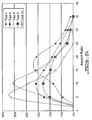
- the dimensions of the particles which can be produced using impulse atomisation can typically vary between 10 ⁇ m and 10mm and is dependent on a number of input control parameters. Referring to Figure 3, the size distribution typically obeys that of a log normal distribution and the slope of the distribution is proportional to the width of the distribution. It is evident from Figure 3 that the width of the particle size distribution for particles formed using impulse atomisation is significantly narrower than the particle size distribution for particles formed using conventional atomisation techniques.
- Narrower particle size distribution means that a significantly smaller portion of the produced powders are very fine (for example -325 mesh or smaller) or coarse (for example +40 mesh or greater) which in turn significantly reduces or eliminates the need for screening. As a consequence the amount of powder which is discarded is reduced which in turn improves production yield.
- Log-normal slope ( ⁇ ) of un-classified conventional air atomised zinc powder is typically above 2, more closely 2.4.
- Un-classified zinc powder produced by impulse atomisation has typically narrow size distribution and a log-normal slope ( ⁇ ) below 2 and typically below 1.6.
- typical parameters of the process are the frequency and the force applied to the plunger, the size of the aperture in the atomising plate, the distance between the plunger and the atomising plate and the atmospheric conditions in which the metal droplets are cooled and solidify.
- Table 1 provides examples of typical ranges for these parameters.
- Table 2 provides examples of how variation in these parameters may affect the powders obtained.
- Shapes which can be formed using the impulse atomisation technique include spherical 52 (Figure 5A), oblong 54 (not shown), teardrop as in 56, 58 and 60 ( Figures 5B and 5C) and strands 62 ( Figure 5D). As confirmed by the samples tabled in Table 3 hereinbelow, these shapes greatly effect the packing and densities of the resulting powder. This is distinct from the shape of particles formed using conventional air atomisation which, referring to the example in Figure 5E, are typically of an irregular shape (bone shape).
- impulse atomisation allows spherical powders to be obtained where the packing is optimal and the density is very high which in turn provides for an increased connectivity between the metallic particles.
- impulse atomisation also allows powders comprised of strands (i.e. particles which are acicular, very elongated and having a high aspect ratio) of zinc to be formed. Packing of the strands is achieved by intertwining the strands.
- Apparent density is a measure of the free packing of the powder and was measured according to ASTM #B212-99.
- the apparent density is measured using a hall flowmeter. Note that in order for the hall flowmeter to measure the apparent density the material must flow through an aperture at the lower end of a funnel which forms part of the flowmeter, which the high and very high aspect ratio (AR) strands are unable to do.
- Tap density is related to the packed density of the powder and was measured according to ASTM #B527-93.
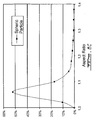
- FIG. 6A some typical distributions of the aspect ratios of stranded zinc alloy powders produced using impulse atomisation are shown. It is apparent from the graph that some very high aspect ratios are attainable using impulse atomisation.
- impulse atomisation One other benefit of impulse atomisation is that oxidation of the surface is greatly decreased due to the absence of atomising air jets, the corresponding reduction of air-zinc interactions and by the greatly increased rate of cooling.
- a variety of zinc alloy powders were prepared using impulse atomisation and conventional air atomisation and the amount of surface oxidation measured. The results are tabled in Table 4.
- Zinc alloying with some aluminum improves gassing, especially gassing after partial discharge. This effect is associated with the presence of aluminum in a metallic form, the amount of which is reduced when aluminum is oxidised.
- a controlled oxidation rate of the zinc droplets is demonstrated by the absence of dispersed nano-crystalline surface ZnO and by a significant drop in alkaline aluminum loss from the ABI alloy.
- the unit ⁇ l/g-d indicates the amount of hydrogen gas generated in micro litres per gram of zinc evolving from the anode per day.
- the fresh anode mix gassing is a measure of the hydrogen gas produced by fresh zinc within the anode kept at 71°C for 24 hours
- partially discharged anode mix gassing is a measure of the hydrogen gas evolving from the residual mixture within the anode once the fresh zinc has been partially discharged and subsequently kept at 71°C for 24 hours.
- test cells were assembled using identical manganese dioxide cathodes, current collectors and casings.
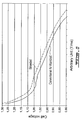
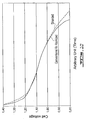
- FIG. 7 shows under a sustained load of 1 ohm the discharge voltage remains significantly higher for batteries having anodes or negative electrodes constructed using zinc alloys powders fabricated using impulse atomisation relative to the reference cells having anodes constructed of powders formed using conventional air atomisation. This is of course a benefit, in that many devices which operate such load conditions will indicate that the power source is depleted if the voltage drops below a threshold value.
- anodes fabricated with a zinc alloy powder comprised of 100% zinc strands revealed significantly improved performance characteristics.
- reduction of the amount of zinc by weight used to fabricate the anodes or negative electrodes of an alkaline cell from 67% to 62% was achieved while using a powder comprised of zinc strands fabricated using impulse atomisation.
- the high rate performance with a load of 1 ohm also improved up to 20% when compared with the reference batteries.
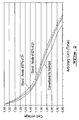
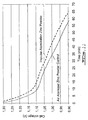
- Figure 9 shows that under high current drain conditions (i.e. a sustained current drain of 1 ampere) with varying amounts of zinc by weight in the cells (67% and 62%), the discharge voltage remains significantly higher for batteries having anodes or negative electrodes constructed using zinc alloy powders such as ABI fabricated according to impulse atomisation relative to the reference batteries.
- two LR-06 cells were assembled: the first LR-06 having an anode from zinc powder fabricated using conventional air atomisation; and the second having an anode from a stranded zinc powder fabricated using impulse atomisation.
- the LR-06 cells were otherwise the same using the same magnesium dioxide cathode, separator, current collector and casing.
- the anode included a zinc powder suspended in a gelled electrolyte comprising 98% by weight of KOH 40%/ZnO 3% and 2% by weight of polyacrylic acid (Carbopol TM 940) as gelling agent.
- electrochemical cells with anodes fabricated from stranded powders exhibit superior performance characteristics over those fabricated using conventional air atomised powders.
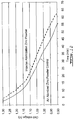
- the 1.0V cut-off which is typically used as an indicator to the electronics being supplied by the cell that the cell is depleted, was increased to 42 minutes from 34 minutes under the 1.0 ohm load (see Figure 11) and to 45 minutes from 36 minutes given load conditions drawing a continuous current of 1 ampere (see Figure 12).
- a melt of zinc alloy was prepared by melting electrolytic 99.995% zinc metal.
- Pure zinc and a variety of zinc alloys including zinc-bismuth (B alloy), zinc-bismuth-indium (Bl alloy), zinc-aluminum-bismuth-indium (ABI alloy), zinc-bismuth-indium-calcium (BIC alloy) and zinc-bismuth-indium-lead (BIP alloy) were prepared and then atomised using both conventional air-atomisation techniques and impulse atomisation. Following atomisation the zinc metal powders were classified and tested.
- a series of LR-06 cells were fabricated from powders derived from both the impulse atomisation process and conventional air atomisation process.
- the zinc anodes were fabricated from a zinc powder blended with a gelled electrolyte.
- the gelled electrolyte comprised 98% by weight of KOH 40%/ZnO 3% and 2% by weight of polyacrylic acid (Carbopol TM 940) as gelling agent.
- the zinc alloy powders were characterised and evaluated in terms LR06-cell performance at different zinc loads and the results tabled in Table 7 and Table 8. Note that the D50 column indicates the value below which 50% of the particles of zinc alloy powder produced were found. D50 was measured according to ASTM #214-99. Tap density, on the other hand, as stated above in reference to Table 4, is related to the packed density of the powder and was measured according to ASTM #B527-93.
- improved performance characteristics may also be derived from mixtures of the above produced zinc alloy powders.
- a given mixture is comprised of two or more types of zinc powders made by impulse atomisation or by impulse atomisation and conventional techniques and having different particle shapes and/or particle sizes distributed around different mean particle sizes which are then combined to form a hybrid powder.
- the powder mix in terms of both particle size and shape the performance characteristics of a given electrochemical cell can be optimised.
- powder fabricated using impulse atomisation was mixed with fine air atomised powder or conventional air atomised powder and tests performed in LR06 cells under two different regimes.
- the fine air atomised powder has a particle size distribution were 100% of the particles are less than 75 ⁇ m and the conventional air atomised powder has a particle size distribution within 425 ⁇ m and 54 ⁇ m.
Landscapes
- Chemical & Material Sciences (AREA)
- Chemical Kinetics & Catalysis (AREA)
- Electrochemistry (AREA)
- General Chemical & Material Sciences (AREA)
- Engineering & Computer Science (AREA)
- Nanotechnology (AREA)
- Battery Electrode And Active Subsutance (AREA)
- Powder Metallurgy (AREA)
- Manufacture Of Metal Powder And Suspensions Thereof (AREA)
Claims (29)
- Verfahren zur Herstellung eines Pulvers zur Verwendung in einer Anode einer elektrochemischen Zelle, wobei das Verfahren die Stufen:(a) Bereitstellen einer Zinklegierungsschmelze;(b) Zerstäuben der Zinklegierungsschmelze durch Impulszerstäubung zur Bildung von Zinklegierungsteilchen;(c) Gewinnen der Teilchen, wobei die gewonnenen Teilchen eine Teilchengrößenverteilung mit einer Steigung der logarithmischen Normalverteilung von weniger als 2, vorzugsweise weniger als 1,6 aufweisen, ein durchschnittliches Seitenverhältnis zwischen 8 und 22 zeigen und wobei der Hauptteil der gewonnenen Teilchen von tropfenförmiger, nadelförmiger oder fadenförmiger Gestalt ist; und(d) Herstellen einer Anode aus den gewonnenen Teilchen, wobei die gewonnenen Teilchen in einem fluiden Medium suspendiert werden, umfasst.
- Verfahren nach Anspruch 1, wobei die Impulszerstäubung die Merkmale einer Frequenz von zwischen 20 und 1000 Hz, einer auf den Kolben ausgeübten Kraft von zwischen 44,5 und 40 Newton, eines Kolbenabstands von zwischen 1 und 7 mm und von Zerstäubungsöffnungen von zwischen 40 und 500 µm aufweist.
- Verfahren nach Anspruch 1 oder 2, wobei die Zerstäubungsstufe ferner das Kühlen der Teilchen in einer Atmosphäre, die ein Gas umfasst, das aus der Gruppe von Luft, einem Inertgas, Sauerstoff und einem Gemisch von 0 bis 20 % Sauerstoff und dem Rest aus einem Inertgas ausgewählt ist, umfasst.
- Verfahren nach Anspruch 3, wobei das Inertgas aus der Gruppe von Stickstoff, Helium, Argon und einem beliebigen Gemisch von Stickstoff, Helium und Argon ausgewählt ist.
- Verfahren nach Anspruch 1, wobei der Hauptteil der gewonnenen Teilchen tropfenförmige Teilchen sind.
- Verfahren nach Anspruch 1, wobei der Hauptteil der gewonnenen Teilchen nadelförmige oder fadenförmige Teilchen sind.
- Verwendung von Zinklegierungsteilchen, die eine Teilchengrößenverteilung mit einer Steigung der logarithmischen Normalverteilung von weniger als 2, vorzugsweise weniger als 1,6 und ein durchschnittliches Seitenverhältnis von zwischen 8 und 22 aufweisen, wobei der Hauptteil der Zinklegierungsteilchen von tropfenförmiger, nadelförmiger oder fadenförmiger Gestalt ist, bei einem Verfahren zur Herstellung einer Anode einer elektrochemischen Zelle, wobei die Zinklegierungsteilchen in einem fluiden Medium suspendiert werden.
- Verwendung nach Anspruch 7, wobei die Zinklegierung aus mit Bismut und Indium legiertem reinem Zink besteht.
- Verwendung nach Anspruch 7, wobei die Zinklegierungsteilchen eine durchschnittliche Länge zwischen 100 µm und 3000 µm, vorzugsweise zwischen 500 µm und 2000 µm aufweisen.
- Verwendung nach Anspruch 7, wobei die Zinklegierungsteilchen eine durchschnittliche Breite zwischen 40 µm und 1000 µm, vorzugsweise zwischen 40 µm und 200 µm aufweisen.
- Verwendung nach den Ansprüchen 7 bis 10, wobei ferner bis zu 50 % und vorzugsweise bis zu 20 % an einem zweiten Zinkmetall- oder Zinklegierungspulver mit einem durchschnittlichen Seitenverhältnis von 2 und einer durchschnittlichen Teilchengröße von zwischen 54 µm und 425 µm enthalten sind.
- Verwendung nach den Ansprüchen 7 bis 10, wobei ferner bis zu 50 % und vorzugsweise bis zu 20 % an einem zweiten Zinkmetallpulver mit einer durchschnittlichen Teilchengröße von weniger als 75 µm enthalten sind.
- Verwendung nach Anspruch 11 oder 12, wobei die Teilchen und das zweite Pulver aus der gleichen Zinklegierung in Bezug auf Legierungselemente und Mengen der Legierungselemente gebildet werden.
- Verwendung nach Anspruch 8, wobei die Zinklegierung zwischen 50 und 1000 ppm Bismut, vorzugsweise zwischen 100 und 500 ppm Bismut umfasst.
- Verwendung nach Anspruch 8, wobei die Zinklegierung zwischen 50 und 1000 ppm Indium, vorzugsweise zwischen 100 und 500 ppm Indium umfasst.
- Verwendung nach Anspruch 8, wobei die Zinklegierung ferner Aluminium umfasst.
- Verwendung nach Anspruch 16, wobei die Zinklegierung ferner zwischen 20 und 1000 ppm Aluminium, vorzugsweise zwischen 50 und 200 ppm Aluminium umfasst.
- Verwendung nach den Ansprüchen 8 bis 17, wobei die Zinklegierung ferner Calcium umfasst.
- Verwendung nach Anspruch 18, wobei die Zinklegierung ferner zwischen 20 und 1000 ppm Calcium, vorzugsweise zwischen 50 und 200 ppm Calcium umfasst.
- Verwendung nach den Ansprüchen 8 bis 17, wobei die Zinklegierung ferner Blei umfasst.
- Verwendung nach Anspruch 20, wobei die Zinklegierung ferner zwischen 50 und 1000 ppm Blei, vorzugsweise zwischen 50 und 500 ppm Blei umfasst.
- Verfahren nach den Ansprüchen 1 bis 6, wobei das fluide Medium ein gelierter KOH-Elektrolyt ist.
- Verfahren nach Anspruch 22, wobei der gelierte KOH-Elektrolyt 98 Gew.-% an KOH 40 %/ZnO 3 % und 2 Gew.-% an einem Geliermittel umfasst.
- Verfahren nach Anspruch 23, wobei das Geliermittel Polyacrylsäure ist.
- Verfahren nach Anspruch 24, wobei die Polyacrylsäure Carbopol™ 940 ist.
- Verwendung nach den Ansprüchen 7 bis 21, wobei das fluide Medium ein gelierter KOH-Elektrolyt ist.
- Verwendung nach Anspruch 26, wobei der gelierte KOH-Elektrolyt 98 Gew.-% an KOH 40 %/ZnO 3 % und 2 Gew.-% an einem Geliermittel umfasst.
- Verwendung nach Anspruch 27, wobei das Geliermittel Polyacrylsäure ist.
- Verwendung nach Anspruch 28, wobei die Polyacrylsäure Carbopol™ 940 ist.
Applications Claiming Priority (3)
| Application Number | Priority Date | Filing Date | Title |
|---|---|---|---|
| US40078702P | 2002-08-05 | 2002-08-05 | |
| US400787P | 2002-08-05 | ||
| PCT/CA2003/001170 WO2004012886A2 (en) | 2002-08-05 | 2003-08-05 | Zinc powders for use in electrochemical cells |
Publications (2)
| Publication Number | Publication Date |
|---|---|
| EP1539411A2 EP1539411A2 (de) | 2005-06-15 |
| EP1539411B1 true EP1539411B1 (de) | 2007-04-18 |
Family
ID=31495879
Family Applications (1)
| Application Number | Title | Priority Date | Filing Date |
|---|---|---|---|
| EP03766094A Expired - Lifetime EP1539411B1 (de) | 2002-08-05 | 2003-08-05 | Verwendung eines zinkpulvers in elektrochemischen zellen |
Country Status (8)
| Country | Link |
|---|---|
| US (1) | US20040115532A1 (de) |
| EP (1) | EP1539411B1 (de) |
| AT (1) | ATE359890T1 (de) |
| AU (1) | AU2003257294A1 (de) |
| CA (1) | CA2495032A1 (de) |
| DE (1) | DE60313334T2 (de) |
| ES (1) | ES2285193T3 (de) |
| WO (1) | WO2004012886A2 (de) |
Families Citing this family (11)
| Publication number | Priority date | Publication date | Assignee | Title |
|---|---|---|---|---|
| US7323031B2 (en) * | 2003-01-09 | 2008-01-29 | Grillo-Werke Ag | Zinc powder or zinc alloy powder with inhomogeneous bulk density for alkaline batteries |
| US7947393B2 (en) * | 2003-11-14 | 2011-05-24 | Eveready Battery Company, Inc. | Alkaline electrochemical cell |
| US7364819B2 (en) | 2004-06-28 | 2008-04-29 | Eveready Battery Company, Inc. | Alkaline electrochemical cell with a blended zinc powder |
| WO2006045470A1 (en) * | 2004-10-20 | 2006-05-04 | Umicore | Alloyed zinc powders for alkaline batteries with high pyknometer density |
| US7291186B2 (en) * | 2004-11-01 | 2007-11-06 | Teck Cominco Metals Ltd. | Solid porous zinc electrodes and methods of making same |
| EP1889312B1 (de) | 2005-05-19 | 2008-11-26 | Umicore | Legierungs-zinkpulver für alkalibatterien mit partikeln, welche mit mindestens einem loch durchbohrt sind |
| EP1912755A1 (de) | 2005-08-12 | 2008-04-23 | Dunwilco (1198) Limited | Verfahren zur herstellung von metallplättchen |
| US20070264572A1 (en) * | 2006-05-09 | 2007-11-15 | Zuraw Michael J | Battery Anodes |
| JP4435801B2 (ja) * | 2007-04-10 | 2010-03-24 | パナソニック株式会社 | アルカリ乾電池 |
| EP2323205A1 (de) * | 2008-09-12 | 2011-05-18 | Panasonic Corporation | Quecksilberfreie alkaline-trockenbatterie |
| US8900761B2 (en) * | 2010-05-24 | 2014-12-02 | The Regents Of The University Of Colorado, A Body Corporate | Zinc anode battery with boron nitride coated zinc particles |
Family Cites Families (14)
| Publication number | Priority date | Publication date | Assignee | Title |
|---|---|---|---|---|
| BE1003415A6 (nl) * | 1989-11-10 | 1992-03-17 | Acec Union Miniere | Zinkpoeder voor alkalische batterijen. |
| CA2077796A1 (en) * | 1992-09-09 | 1994-03-10 | Jean-Yves Huot | Low-lead zinc alloy powders for zero-mercury alkaline batteries |
| US5609919A (en) * | 1994-04-21 | 1997-03-11 | Altamat Inc. | Method for producing droplets |
| BE1008626A3 (nl) * | 1994-08-23 | 1996-06-04 | Union Miniere Sa | Zinkpoeder voor alkalische batterijen. |
| US6022639A (en) * | 1996-11-01 | 2000-02-08 | Eveready Battery Company, Inc. | Zinc anode for an electochemical cell |
| US6521378B2 (en) * | 1997-08-01 | 2003-02-18 | Duracell Inc. | Electrode having multi-modal distribution of zinc-based particles |
| US6284410B1 (en) * | 1997-08-01 | 2001-09-04 | Duracell Inc. | Zinc electrode particle form |
| US6015636A (en) * | 1998-06-01 | 2000-01-18 | Electric Fuel Ltd. | Enhanced performance zinc |
| US6344295B1 (en) * | 1999-04-30 | 2002-02-05 | Noranda, Inc. | Zinc alloy powder for use in rechargeable cells |
| US6333127B1 (en) * | 1999-09-30 | 2001-12-25 | Eveready Battery Company, Inc. | Electrochemical cell and cell assembly process |
| US6479188B1 (en) * | 1999-10-13 | 2002-11-12 | The Gillette Company | Cathode tube and method of making the same |
| US6602629B1 (en) * | 2000-05-24 | 2003-08-05 | Eveready Battery Company, Inc. | Zero mercury air cell |
| US6627349B2 (en) * | 2001-04-26 | 2003-09-30 | Eveready Battery Company, Inc. | Electrode for an electrochemical cell |
| US7008723B2 (en) * | 2001-08-21 | 2006-03-07 | Ecosol Solar Technologies Inc. | Method of manufacture of an anode composition for use in a rechargeable electrochemical cell |
-
2003
- 2003-08-05 ES ES03766094T patent/ES2285193T3/es not_active Expired - Lifetime
- 2003-08-05 CA CA002495032A patent/CA2495032A1/en not_active Abandoned
- 2003-08-05 US US10/634,651 patent/US20040115532A1/en not_active Abandoned
- 2003-08-05 DE DE60313334T patent/DE60313334T2/de not_active Expired - Lifetime
- 2003-08-05 AU AU2003257294A patent/AU2003257294A1/en not_active Abandoned
- 2003-08-05 AT AT03766094T patent/ATE359890T1/de not_active IP Right Cessation
- 2003-08-05 WO PCT/CA2003/001170 patent/WO2004012886A2/en not_active Ceased
- 2003-08-05 EP EP03766094A patent/EP1539411B1/de not_active Expired - Lifetime
Non-Patent Citations (1)
| Title |
|---|
| None * |
Also Published As
| Publication number | Publication date |
|---|---|
| WO2004012886B1 (en) | 2004-07-08 |
| DE60313334D1 (de) | 2007-05-31 |
| AU2003257294A1 (en) | 2004-02-23 |
| WO2004012886A3 (en) | 2004-05-13 |
| DE60313334T2 (de) | 2008-01-03 |
| WO2004012886A2 (en) | 2004-02-12 |
| EP1539411A2 (de) | 2005-06-15 |
| ATE359890T1 (de) | 2007-05-15 |
| US20040115532A1 (en) | 2004-06-17 |
| ES2285193T3 (es) | 2007-11-16 |
| CA2495032A1 (en) | 2004-02-12 |
Similar Documents
| Publication | Publication Date | Title |
|---|---|---|
| EP0882309B1 (de) | Zinkanode für elektrochemische zelle | |
| JP5143852B2 (ja) | 非水電解質二次電池 | |
| EP1539411B1 (de) | Verwendung eines zinkpulvers in elektrochemischen zellen | |
| CA2484458C (en) | Zinc powder or zinc alloy powder for alkaline batteries | |
| EP2022117B1 (de) | Batterieanoden | |
| EP1645000B1 (de) | Anode für eine batterie | |
| EP1285470B1 (de) | Zink enthaltende elektrode für alkalische elektrochemische zelle | |
| JP4565222B2 (ja) | アルカリ電池用亜鉛合金粉末とそれを用いたアルカリ電池 | |
| US20030211394A1 (en) | Zinc-based electrode for alkaline electrochemical cell | |
| US6472102B2 (en) | Hydridable alloy | |
| JP3191270B2 (ja) | 水素吸蔵電極の製造方法 | |
| WO2023228802A1 (ja) | アルカリ乾電池 | |
| JP2003317796A (ja) | 蓄電池 | |
| WO2023228800A1 (ja) | アルカリ乾電池 | |
| WO2023228801A1 (ja) | アルカリ乾電池 | |
| HK1017150B (en) | Zinc anode for an electrochemical cell | |
| JP2001107112A (ja) | 水素吸蔵合金粉末の製造方法 | |
| WO2004021482A1 (en) | Zinc alloy for alkaline batteries | |
| JPH06140032A (ja) | 金属・水素化物二次電池用の水素吸蔵合金電極 | |
| JPH06140039A (ja) | 金属・水素化物二次電池用の水素吸蔵合金電極 | |
| JPH0737583A (ja) | アルカリ蓄電池用の水素吸蔵合金電極 |
Legal Events
| Date | Code | Title | Description |
|---|---|---|---|
| PUAI | Public reference made under article 153(3) epc to a published international application that has entered the european phase |
Free format text: ORIGINAL CODE: 0009012 |
|
| 17P | Request for examination filed |
Effective date: 20050304 |
|
| AK | Designated contracting states |
Kind code of ref document: A2 Designated state(s): AT BE BG CH CY CZ DE DK EE ES FI FR GB GR HU IE IT LI LU MC NL PT RO SE SI SK TR |
|
| AX | Request for extension of the european patent |
Extension state: AL LT LV MK |
|
| DAX | Request for extension of the european patent (deleted) | ||
| GRAP | Despatch of communication of intention to grant a patent |
Free format text: ORIGINAL CODE: EPIDOSNIGR1 |
|
| RTI1 | Title (correction) |
Free format text: USE IN ELECTROCHEMICAL CELLS OF A ZINC POWDER |
|
| GRAS | Grant fee paid |
Free format text: ORIGINAL CODE: EPIDOSNIGR3 |
|
| GRAA | (expected) grant |
Free format text: ORIGINAL CODE: 0009210 |
|
| AK | Designated contracting states |
Kind code of ref document: B1 Designated state(s): AT BE BG CH CY CZ DE DK EE ES FI FR GB GR HU IE IT LI LU MC NL PT RO SE SI SK TR |
|
| PG25 | Lapsed in a contracting state [announced via postgrant information from national office to epo] |
Ref country code: FI Free format text: LAPSE BECAUSE OF FAILURE TO SUBMIT A TRANSLATION OF THE DESCRIPTION OR TO PAY THE FEE WITHIN THE PRESCRIBED TIME-LIMIT Effective date: 20070418 Ref country code: SI Free format text: LAPSE BECAUSE OF FAILURE TO SUBMIT A TRANSLATION OF THE DESCRIPTION OR TO PAY THE FEE WITHIN THE PRESCRIBED TIME-LIMIT Effective date: 20070418 |
|
| REG | Reference to a national code |
Ref country code: CH Ref legal event code: EP |
|
| REG | Reference to a national code |
Ref country code: IE Ref legal event code: FG4D |
|
| REF | Corresponds to: |
Ref document number: 60313334 Country of ref document: DE Date of ref document: 20070531 Kind code of ref document: P |
|
| PG25 | Lapsed in a contracting state [announced via postgrant information from national office to epo] |
Ref country code: SE Free format text: LAPSE BECAUSE OF FAILURE TO SUBMIT A TRANSLATION OF THE DESCRIPTION OR TO PAY THE FEE WITHIN THE PRESCRIBED TIME-LIMIT Effective date: 20070718 |
|
| REG | Reference to a national code |
Ref country code: CH Ref legal event code: NV Representative=s name: E. BLUM & CO. AG PATENT- UND MARKENANWAELTE VSP |
|
| PG25 | Lapsed in a contracting state [announced via postgrant information from national office to epo] |
Ref country code: PT Free format text: LAPSE BECAUSE OF FAILURE TO SUBMIT A TRANSLATION OF THE DESCRIPTION OR TO PAY THE FEE WITHIN THE PRESCRIBED TIME-LIMIT Effective date: 20070918 |
|
| NLV1 | Nl: lapsed or annulled due to failure to fulfill the requirements of art. 29p and 29m of the patents act | ||
| REG | Reference to a national code |
Ref country code: ES Ref legal event code: FG2A Ref document number: 2285193 Country of ref document: ES Kind code of ref document: T3 |
|
| PG25 | Lapsed in a contracting state [announced via postgrant information from national office to epo] |
Ref country code: AT Free format text: LAPSE BECAUSE OF FAILURE TO SUBMIT A TRANSLATION OF THE DESCRIPTION OR TO PAY THE FEE WITHIN THE PRESCRIBED TIME-LIMIT Effective date: 20070418 |
|
| EN | Fr: translation not filed | ||
| PG25 | Lapsed in a contracting state [announced via postgrant information from national office to epo] |
Ref country code: DK Free format text: LAPSE BECAUSE OF FAILURE TO SUBMIT A TRANSLATION OF THE DESCRIPTION OR TO PAY THE FEE WITHIN THE PRESCRIBED TIME-LIMIT Effective date: 20070418 Ref country code: BG Free format text: LAPSE BECAUSE OF FAILURE TO SUBMIT A TRANSLATION OF THE DESCRIPTION OR TO PAY THE FEE WITHIN THE PRESCRIBED TIME-LIMIT Effective date: 20070718 Ref country code: CZ Free format text: LAPSE BECAUSE OF FAILURE TO SUBMIT A TRANSLATION OF THE DESCRIPTION OR TO PAY THE FEE WITHIN THE PRESCRIBED TIME-LIMIT Effective date: 20070418 Ref country code: NL Free format text: LAPSE BECAUSE OF FAILURE TO SUBMIT A TRANSLATION OF THE DESCRIPTION OR TO PAY THE FEE WITHIN THE PRESCRIBED TIME-LIMIT Effective date: 20070418 |
|
| PLBE | No opposition filed within time limit |
Free format text: ORIGINAL CODE: 0009261 |
|
| STAA | Information on the status of an ep patent application or granted ep patent |
Free format text: STATUS: NO OPPOSITION FILED WITHIN TIME LIMIT |
|
| PG25 | Lapsed in a contracting state [announced via postgrant information from national office to epo] |
Ref country code: SK Free format text: LAPSE BECAUSE OF FAILURE TO SUBMIT A TRANSLATION OF THE DESCRIPTION OR TO PAY THE FEE WITHIN THE PRESCRIBED TIME-LIMIT Effective date: 20070418 |
|
| 26N | No opposition filed |
Effective date: 20080121 |
|
| PG25 | Lapsed in a contracting state [announced via postgrant information from national office to epo] |
Ref country code: MC Free format text: LAPSE BECAUSE OF NON-PAYMENT OF DUE FEES Effective date: 20070831 Ref country code: IT Free format text: LAPSE BECAUSE OF FAILURE TO SUBMIT A TRANSLATION OF THE DESCRIPTION OR TO PAY THE FEE WITHIN THE PRESCRIBED TIME-LIMIT Effective date: 20070418 Ref country code: FR Free format text: LAPSE BECAUSE OF FAILURE TO SUBMIT A TRANSLATION OF THE DESCRIPTION OR TO PAY THE FEE WITHIN THE PRESCRIBED TIME-LIMIT Effective date: 20071214 Ref country code: GR Free format text: LAPSE BECAUSE OF FAILURE TO SUBMIT A TRANSLATION OF THE DESCRIPTION OR TO PAY THE FEE WITHIN THE PRESCRIBED TIME-LIMIT Effective date: 20070719 |
|
| PG25 | Lapsed in a contracting state [announced via postgrant information from national office to epo] |
Ref country code: RO Free format text: LAPSE BECAUSE OF FAILURE TO SUBMIT A TRANSLATION OF THE DESCRIPTION OR TO PAY THE FEE WITHIN THE PRESCRIBED TIME-LIMIT Effective date: 20070418 |
|
| PG25 | Lapsed in a contracting state [announced via postgrant information from national office to epo] |
Ref country code: IE Free format text: LAPSE BECAUSE OF NON-PAYMENT OF DUE FEES Effective date: 20070807 |
|
| PG25 | Lapsed in a contracting state [announced via postgrant information from national office to epo] |
Ref country code: FR Free format text: LAPSE BECAUSE OF FAILURE TO SUBMIT A TRANSLATION OF THE DESCRIPTION OR TO PAY THE FEE WITHIN THE PRESCRIBED TIME-LIMIT Effective date: 20070418 |
|
| PG25 | Lapsed in a contracting state [announced via postgrant information from national office to epo] |
Ref country code: EE Free format text: LAPSE BECAUSE OF FAILURE TO SUBMIT A TRANSLATION OF THE DESCRIPTION OR TO PAY THE FEE WITHIN THE PRESCRIBED TIME-LIMIT Effective date: 20070418 |
|
| PG25 | Lapsed in a contracting state [announced via postgrant information from national office to epo] |
Ref country code: CY Free format text: LAPSE BECAUSE OF FAILURE TO SUBMIT A TRANSLATION OF THE DESCRIPTION OR TO PAY THE FEE WITHIN THE PRESCRIBED TIME-LIMIT Effective date: 20070418 |
|
| PG25 | Lapsed in a contracting state [announced via postgrant information from national office to epo] |
Ref country code: LU Free format text: LAPSE BECAUSE OF NON-PAYMENT OF DUE FEES Effective date: 20070805 |
|
| PG25 | Lapsed in a contracting state [announced via postgrant information from national office to epo] |
Ref country code: HU Free format text: LAPSE BECAUSE OF FAILURE TO SUBMIT A TRANSLATION OF THE DESCRIPTION OR TO PAY THE FEE WITHIN THE PRESCRIBED TIME-LIMIT Effective date: 20071019 Ref country code: TR Free format text: LAPSE BECAUSE OF FAILURE TO SUBMIT A TRANSLATION OF THE DESCRIPTION OR TO PAY THE FEE WITHIN THE PRESCRIBED TIME-LIMIT Effective date: 20070418 |
|
| PGFP | Annual fee paid to national office [announced via postgrant information from national office to epo] |
Ref country code: CH Payment date: 20150824 Year of fee payment: 13 Ref country code: GB Payment date: 20150824 Year of fee payment: 13 Ref country code: DE Payment date: 20150828 Year of fee payment: 13 Ref country code: ES Payment date: 20150825 Year of fee payment: 13 |
|
| PGFP | Annual fee paid to national office [announced via postgrant information from national office to epo] |
Ref country code: BE Payment date: 20150820 Year of fee payment: 13 |
|
| PG25 | Lapsed in a contracting state [announced via postgrant information from national office to epo] |
Ref country code: BE Free format text: LAPSE BECAUSE OF NON-PAYMENT OF DUE FEES Effective date: 20160831 |
|
| REG | Reference to a national code |
Ref country code: DE Ref legal event code: R119 Ref document number: 60313334 Country of ref document: DE |
|
| REG | Reference to a national code |
Ref country code: CH Ref legal event code: PL |
|
| GBPC | Gb: european patent ceased through non-payment of renewal fee |
Effective date: 20160805 |
|
| PG25 | Lapsed in a contracting state [announced via postgrant information from national office to epo] |
Ref country code: LI Free format text: LAPSE BECAUSE OF NON-PAYMENT OF DUE FEES Effective date: 20160831 Ref country code: CH Free format text: LAPSE BECAUSE OF NON-PAYMENT OF DUE FEES Effective date: 20160831 |
|
| PG25 | Lapsed in a contracting state [announced via postgrant information from national office to epo] |
Ref country code: GB Free format text: LAPSE BECAUSE OF NON-PAYMENT OF DUE FEES Effective date: 20160805 Ref country code: DE Free format text: LAPSE BECAUSE OF NON-PAYMENT OF DUE FEES Effective date: 20170301 |
|
| PG25 | Lapsed in a contracting state [announced via postgrant information from national office to epo] |
Ref country code: ES Free format text: LAPSE BECAUSE OF NON-PAYMENT OF DUE FEES Effective date: 20160806 |
|
| REG | Reference to a national code |
Ref country code: ES Ref legal event code: FD2A Effective date: 20181128 |