EP1536770B1 - Thermolabiles liposom mit geregelter freigabetemperatur - Google Patents
Thermolabiles liposom mit geregelter freigabetemperatur Download PDFInfo
- Publication number
- EP1536770B1 EP1536770B1 EP03753411.2A EP03753411A EP1536770B1 EP 1536770 B1 EP1536770 B1 EP 1536770B1 EP 03753411 A EP03753411 A EP 03753411A EP 1536770 B1 EP1536770 B1 EP 1536770B1
- Authority
- EP
- European Patent Office
- Prior art keywords
- phosphocholine
- dppc
- liposome
- liposomes
- dspc
- Prior art date
- Legal status (The legal status is an assumption and is not a legal conclusion. Google has not performed a legal analysis and makes no representation as to the accuracy of the status listed.)
- Expired - Lifetime
Links
Images

Classifications
-
- A—HUMAN NECESSITIES
- A61—MEDICAL OR VETERINARY SCIENCE; HYGIENE
- A61K—PREPARATIONS FOR MEDICAL, DENTAL OR TOILETRY PURPOSES
- A61K9/00—Medicinal preparations characterised by special physical form
- A61K9/10—Dispersions; Emulsions
- A61K9/127—Synthetic bilayered vehicles, e.g. liposomes or liposomes with cholesterol as the only non-phosphatidyl surfactant
-
- A—HUMAN NECESSITIES
- A61—MEDICAL OR VETERINARY SCIENCE; HYGIENE
- A61P—SPECIFIC THERAPEUTIC ACTIVITY OF CHEMICAL COMPOUNDS OR MEDICINAL PREPARATIONS
- A61P35/00—Antineoplastic agents
Definitions
- thermolabile liposome having a controlled release temperature for the liposome content, in particular a liposome stable at 37 ° C in serum with a controlled release temperature between 40 and 80 ° C.
- liposomes are mainly taken up in cells of the reticuloendothelial system (RES) of the liver and spleen (Gregoriadis and Nerunhun, 1974).
- RES reticuloendothelial system
- tumors that are often very well vascularized (Jain, 1996) and whose vessels are particularly permeable through dilated interendothelial connections, a large number of fenestrations, and discontinuous basement membranes (Murray and Carmichael, 1995), the uptake probability of liposomes would thereby increase increase massively.
- the invention is therefore based on the object to provide a liposome, which has a significantly improved serum half-life, compared with the usual half-life of known liposomes in the order of 4 hours, and which is such that the content of the liposomes at a certain temperature released quickly.
- the liposomes according to the invention additionally contain lower amounts Alkylphosphocholinen, preferably 10 to 15 wt .-%.
- Suitable substances include Hexadecylphosphocholine, Oleylphosphocholin and Etherlysolecithine.
- the hydroxyl group in position 2 of the glycerol can be methylated or free.
- the alkylphosphocholines have an antitumoral effect by temperature-dependent release from the liposomes.
- Liposomes constructed in accordance with the present invention have significantly improved half lives of up to more than 25 hours in serum and can rapidly and completely release the ingredient (s) at a predetermined temperature by appropriate choice of components and amounts of the components, depending on their major conversion temperature ,
- the liposome of the invention is from about 20 to 75% by weight of dipalmitoyllecithin (1,2-dipalmitoylglycero-3-phosphocholine), about 10 to 25% by weight of distearoyllecithin (1,2-distearoylglycero-3-phosphocholine), and more 15 to about 50 wt .-% dipalmitoylphosphoglyceroglycerol composed.
- dipalmitoyllecithin 1,2-dipalmitoylglycero-3-phosphocholine
- distearoyllecithin 1,2-distearoylglycero-3-phosphocholine
- dipalmitoylphosphoglyceroglycerol composed.
- Such a preferred composition is stable at 37 ° C in serum but rapidly releases the contents when it exceeds 40 ° C.
- composition with improved release of the liposome-entrapped substances consists of about 15 to 70 weight percent dipalmitoyl lecithin, about 10 to 25 weight percent distearoyl lecithin, and more than 15 to about 45 weight percent dipalmitoylphosphoglyceroglycerol.
- the abovementioned preferred composition of the liposome according to the invention can be tailor-made for other temperature ranges by selecting components having the respectively suitable main conversion temperature.
- Table 1 shows the main transformation temperatures (T M ) of phosphatidylcholines whose main transformation temperatures are in the range of 0 to 80 ° C.
- the main conversion temperatures are as apparent from the table, depending on the chain length and the distribution over the positions 1 and 2 of glycero-3-phosphocholine or positions 1 and 3 of glycero-2-phosphocholine.
- phosphatidyloligoglycerols in the liposome according to the invention is essential for the required long circulation time in the serum.
- Phosphatidyloligoglycerols and their preparation are known from the DE 196 22 224 , Preference is given to using dipalmitoylphosphoglyceroglycerol (DPPG2).
- thermolabile liposomes according to the invention are outstandingly suitable for use in various fields, but especially in the context of regional deep hyperthermia.
- Regional deep hyperthermia used in combination with systemic chemotherapy at specialized clinical centers, is an ideal technique for tumor-specific liposomal transport and subsequent release of a drug from the liposomal envelope.
- hyperthermia promotes the extravasation of liposomes from tumor capillaries into the interstitium (Gaber et al., 1996).
- heating may induce release of the drug from special thermosensitive liposomes (Magin and Niesman, 1984).
- thermolability of the liposomes according to the invention is due to the phase transformation of the phospholipids within the liposome membrane. If the phase transition temperature is run through, there is a short-term membrane instability and subsequent release of the liposomal content.
- the tumor is regionally specifically overheated so that the temperature rises above the threshold temperature for releasing the liposome contents.
- liposome content here come in particular in oncology applicable drugs, such as Cytostatics, into consideration.
- contrast agents such as gadolinium, for example Magnevist ®, MultiHance ® or Omniscan ®, carboxyfluorescein, iodine-containing contrast agents, which are derived from pyridines or aromatic carboxylic acids, or the like. be brought alone or together with an active ingredient for release. Diet temperature-dependent release of gadolinium from the liposomes can be demonstrated by an altered T1 time with the aid of an MRI (0.2 or 1.5 Teslar).
- thermometry By using contrast agents such as gadolinium, a non-invasive thermometry is made possible in which the temperature reached can be determined by MRC, which measures the released gadolinium.
- MRC which measures the released gadolinium.
- liposomes with iodine-containing contrast agent for imaging in computed tomography for example for the thermal ablation of liver metastases.
- liposomes according to the invention Another type of application for the liposomes according to the invention is found in ophthalmology.
- a fluorescent label substance e.g. in a laser treatment by release of the fluorescent agent, e.g. Carboxyfluorescein, demonstrate where the targeted overheating actually occurred.
- the fluorescent agent e.g. Carboxyfluorescein
- liposomes according to the invention can generally be used to subsequently determine temperatures reached, e.g. if certain heating temperatures or the like. to be determined.
- the liposomes according to the invention consist essentially of the abovementioned substances, which are preferably present in pure form. Impurities should be kept as low as possible, in particular the lowest possible cholesterol content should be present. To be favoured Liposomes that are completely free of cholesterol, since cholesterol leads to a smearing of the phase transition temperature and thus to a too wide thermal transition region.
- thermolabile liposomes according to the invention is carried out in a conventional manner by dissolving the lipids, for example in chloroform or chloroform / water / isopropanol, stripping off the solvent, expediently in vacuo in a rotary evaporator, annealing the lipids with aqueous solutions of the ingredients to be encapsulated at temperatures above Phase change temperature lie.
- the duration of this tempering treatment is suitably 30 to 60 minutes, but may be shorter or longer.
- lipid suspension is extruded through a membrane of defined pore size at a temperature above the phase transition temperature to achieve the desired liposome size.
- Suitable membranes are, for example, polycarbonate membranes of defined pore size, such as 100 to 200 nm.
- optionally non-encapsulated ingredient may be separated, for example by column chromatography or the like.
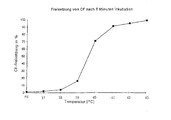
- illustration 1 shows the obtained values of in vitro CF release from thermolabile liposomes.
- Liposome composition :
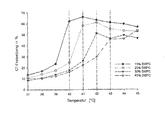
- Figure 2 shows the influence on the release temperature of DDPG 2 / DSPC / DPPC liposomes by varying the proportion of DSPC at the expense of DPPC.
- Figure 3 shows the enhancement of CF release from DPDG 2 / DSPC / DPPC liposomes by increasing the level of DPPG 2 at the expense of DPPC (constant level of DSPC at 20%).
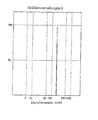
- Figure 4 shows the photon correlation spectroscopy (PCS) of liposomes of 30 wt% DPPG 2 , 20 wt% DSPC, and 50 wt% DPPC (mean size: 175 nm).
- PCS photon correlation spectroscopy
- CF caroxyfluorescein
- the microcirculation and the fluorescence accumulation within the tumor can be observed with a modified vital microscope.
- the animals additionally receive a central venous catheter.
- a heat exchanger located under the skin chamber, a local warming of the tumor to 42 ° C can be achieved.
- the tumor temperature can be measured directly using a temperature probe (Endrich, 1988).
Landscapes
- Health & Medical Sciences (AREA)
- Chemical & Material Sciences (AREA)
- General Health & Medical Sciences (AREA)
- Public Health (AREA)
- Pharmacology & Pharmacy (AREA)
- Veterinary Medicine (AREA)
- Life Sciences & Earth Sciences (AREA)
- Animal Behavior & Ethology (AREA)
- Medicinal Chemistry (AREA)
- Dispersion Chemistry (AREA)
- Epidemiology (AREA)
- Chemical Kinetics & Catalysis (AREA)
- General Chemical & Material Sciences (AREA)
- Nuclear Medicine, Radiotherapy & Molecular Imaging (AREA)
- Organic Chemistry (AREA)
- Medicinal Preparation (AREA)
- Medicines Containing Antibodies Or Antigens For Use As Internal Diagnostic Agents (AREA)
Description
- Die Erfindung betrifft ein thermolabiles Liposom mit geregelter Freigabetemperatur für den Liposomeninhalt, insbesondere ein bei 37 °C in Serum stabiles Liposom mit einer geregelten Freigabetemperatur zwischen 40 und 80 °C.
- Liposomen sind künstlich gebildete Vesikel aus Lipiddoppelschichten, welche ein wässriges Kompartiment einschließen (Bangham et al., 1965). Ursprünglich noch als Modellsystem für eine Zellmembran genutzt, wurden Liposomen in jüngster Zeit vor allem für den Arzneistofftransport weiterentwickelt. Liposomen können dabei die Verträglichkeit von Wirkstoffen steigern (Senkung der aktiven Toxizität von Amphothericin B durch liposomale Formulierung (AmBisome®) um den Faktor 75 (Proffitt et al., 1991)). Sie eröffnen aber auch die Möglichkeit, Arzneistoffe gezielt in erkranktes Gewebe zu transportieren (Forssen et al., 1992). Nach intravenöser Applikation werden Liposomen hauptsächlich in Zellen des retikuloendothelialen Systems (RES) der Leber und Milz aufgenommen (Gregoriadis und Nerunhun, 1974). Um Liposomen als Arzneistoffträger für Zellen außerhalb des RES nutzen zu können, versuchte man die Zirkulationszeit der Liposomen im Blut zu erhöhen. Vor allem in Tumoren, die häufig sehr gut vaskularisiert sind (Jain, 1996) und deren Gefäße durch geweitete interendotheliale Verbindungen, eine große Anzahl von Fenestrierungen sowie diskontinuierliche Basalmembranen (Murray and Carmichael, 1995) besonders durchlässig sind, würde sich die Aufnahmewahrscheinlichkeit von Liposomen dadurch massiv erhöhen.
-
WO 02/064116 A2 -
DE 196 22 224 A1 beschreibt Liposomen mit verlängerter Halbwertszeit im Blut, welche Phosphatidyloligoglycerine enthalten. - K. Maruyama et al., International Journal of Pharmaceutics 111 (194) 103-107 beschreibt Liposomen, umfassend Distearoylphosphatidylcholin, Cholesterin und verschiedene Mengen an Dipalmitoylphosphatidyloligoglycerin.
- K. Whiteman et al., Proceed. Int'l. Symp. Control. Rel. Bioact. Mater., 28 (2001), 166 beschreibt Liposomen, umfassend Phosphatidylcholin und Cholesterin sowie Distearoylphosphatidyl-diglycerin oder Distearoylphosphatidyl-triglycerin.
- Ein erstes Problem bei der Verwendung von Liposomen zum Transport von Wirkstoffen oder Markierungsstoffen in Körperflüssigkeiten liegt in der Erhöhung der Zirkulationszeit im Serum. Man hat zwar bereits gefunden, dass durch kovalente Bindung von Methoxypolyethylenglykolen an die Liposomenmembran die frühzeitige Erkennung der Liposomen durch das RES verhindert wird und damit die Zirkulationszeit der Liposomen verbessert werden kann. Neben einer Verbesserung der Zirkulationszeit besteht jedoch auch ein großes Interesse an einer Möglichkeit, durch Temperatureinwirkung eine gezielte Freigabe der Liposomeninhaltsstoffe bei bestimmter Temperatur zu erreichen.
- Der Erfindung liegt daher die Aufgabe zugrunde, ein Liposom bereitzustellen, welches eine wesentlich verbesserte Halbwertszeit im Serum aufweist, verglichen mit der üblichen Halbwertszeit bekannter Liposomen in der Größenordnung um 4 Stunden, und welches so beschaffen ist, dass der Inhalt der Liposomen bei einer bestimmten Temperatur rasch freigesetzt wird.
- Gelöst wird diese Aufgabe gemäß der vorliegenden Erfindung durch ein Liposom mit geregelter Freigabetemperatur für den Liposomeninhalt, welches dadurch gekennzeichnet ist, dass es im Wesentlichen aus mindestens einem Phosphatidylcholin mit einer Hauptumwandlungstemperatur im Bereich von 0 bis 80 °C und mehr als 15 bis 70 Gew.-% Phosphatidyloligoglycerin gebildet ist und dass es kein Cholesterin enthält. Gemäß einem älteren Vorschlag war es lediglich möglich, Liposomen mit einem maximalen Phosphatidyloligoglycerin-Gehlt von 15 Gew.-% zu erhalten. Nunmehr wurde jedoch überrschenderweise gefunden, dass es möglich ist, den Phosphatidyloligoglyceringehalt bis zu 70 % zu erhöhen, sodass der Bereich der erzielbaren Freigabetemperaturen der Liposomen noch mehr erweitert wird, aber vor allem die Halbwertszeiten nochmals verbessert werden.
- Gemäß einer bevorzugten Ausführungsform enthalten die erfindungsgemäßen Liposomen zusätzlich geringere Mengen an Alkylphosphocholinen, vorzugsweise 10 bis 15 Gew.-%. Geeignete Substanzen sind z.B. Hexadecylphosphocholin, Oleylphosphocholin sowie Etherlysolecithine. Bei den Etherlysolecithinen kann die Hydroxylgruppe in Position 2 des Glycerins methyliert oder frei vorliegen. Bei dieser Ausführungsform gelingt es, die Freisetzung der im Liposom eingeschlossenen Substanzen von etwa 70 % ohne den Gehalt an Alkylphosphocholin auf praktisch 100 % zu erhöhen, was auf eine Beschleunigung der Liposomenöffnung zurückzuführen ist. Des Weiteren weisen die Alkylphosphocholine einen antitumoralen Effekt durch temperaturabhängige Freisetzung aus den Liposomen auf.
- Erfindungsgemäß aufgebaute Liposomen weisen wesentlich verbesserte Halbwertszeiten von bis zu mehr als 25 Stunden im Serum auf und können durch geeignete Wahl der Komponenten und Mengen der Komponenten in Abhängigkeit von deren Hauptumwandlungstemperatur den (oder die) Inhaltsstoff(e) bei einer vorbestimmten Temperatur rasch und vollständig freigeben.
- Bevorzugt ist das erfindungsgemäße Liposom aus etwa 20 bis 75 Gew.-% Dipalmitoyllecithin (1,2-Dipalmitoylglycero-3-phosphocholin), etwa 10 bis 25 Gew.-% Distearoyllecithin (1,2-Distearoylglycero-3-phosphocholin) und mehr als 15 bis etwa 50 Gew.-% Dipalmitoylphosphoglyceroglycerin zusammengesetzt. Eine solche bevorzugte Zusammensetzung ist bei 37 °C im Serum stabil, gibt jedoch den Inhalt bei Überschreiten einer Temperatur von 40 °C rasch frei.
- Eine weitere bevorzugte Zusammensetzung mit verbesserter Freigabe der im Liposom eingeschlossenen Substanzen besteht aus etwa 15 bis 70 Gew.-% Dipalmitoyllecithin, etwa 10 bis 25 Gew.-% Distearoyllecithin und mehr als 15 bis etwa 45 Gew.-% Dipalmitoylphosphoglyceroglycerin.
- Die vorstehend genannte bevorzugte Zusammensetzung des erfindungsgemäßen Liposoms lässt sich für andere Temperaturbereiche maßschneidern durch Wahl von Komponenten mit der jeweils geeigneten Hauptumwandlungstemperatur. In Tabelle 1 sind die Hauptumwandlungstemperaturen (TM) von Phosphatidylcholinen angegeben, deren Hauptumwandlungstemperaturen im Bereich von 0 bis 80 °C liegen. Die Hauptumwandlungstemperaturen sind wie aus der Tabelle erkennbar, abhängig von der Kettenlänge und der Verteilung über die Positionen 1 und 2 von Glycero-3-phosphocholin oder über die Positionen 1 und 3 von Glycero-2-phosphocholin.
Tabelle 1 TM Phosphatidylcholin 5 °C 1-Palmitoyl-2-oleoyl- 7 °C 1-Stearoyl-2-oleoyl- 11 °C 1-Palmitoyl-2-lauroyl- 14 °C 1-Behenoyl-2-oleoyl- 17 °C 1-Stearoyl-2-lauroyl- 19 °C 1,3-Dimyristoyl- 23 °C 1,2-Dimyristoyl- 27 °C 1-Palmitoyl-2-myristoyl- 33 °C 1-Stearoyl-2-myristoyl- 37 °C 1-Myristoyl-2-palmitoyl- 39 °C 1,3-Dipalmitoyl- 41 °C 1,2-Dipalmitoyl- 42 °C 1-Myristoyl-2-stearoyl- 46 °C 1-Stearoyl-3-myristoyl- 48 °C 1-Stearoyl-2-palmitoyl- 52 °C 1-Palmitoyl-2-stearoyl- 53 °C 1,3-Distearoyl- 56 °C 1,2-Distearoyl- 66 °C 1,2-Diarachinoyl- 75 °C 1,2-Dibehenoyl- 80 °C 1,2-Dilignoceroyl- - Die in der Tabelle 1 aufgeführten Werte zeigen, dass durch Verwendung von Fettsäuren mit ungerader Kettenlänge und geeigneter Verteilung über das Glyceringrundgerüst praktisch jede gewünschte Temperatur im angegebenen Bereich von 0 bis 80 °C eingestellt werden kann.
- Der Gehalt an Phosphatidyloligoglycerinen im erfindungsgemäßen Liposom ist essenziell für die erforderliche lange Zirkulationszeit im Serum. Phosphatidyloligoglycerine und ihre Herstellung sind bekannt aus der
DE 196 22 224 . Bevorzugt wird Dipalmitoylphosphoglyceroglycerin (DPPG2) verwendet. - Die erfindungsgemäßen thermolabilen Liposomen eignen sich hervorragend für die Anwendung auf verschiedenen Gebieten, insbesondere aber im Rahmen der regionalen Tiefenhyperthermie. Die regionale Tiefenhyperthermie, die in Kombination mit systemischer Chemotherapie an spezialisierten klinischen Zentren angewendet wird, bietet sich als ideale Technik für den tumorspezifischen liposomalen Transport und die anschließende Freisetzung eines Arzneistoffs aus der liposomalen Hülle an. So fördert die Hyperthermie zum einen die Extravasation von Liposomen aus Tumorkapillaren in das Interstitium (Gaber et al., 1996). Zum anderen kann durch die Erwärmung eine Freisetzung des Arzneistoffs aus speziellen thermosensitiven Liposomen induziert werden (Magin und Niesman, 1984). Zusätzlich gibt es zahlreiche Hinweise für einen gesteigerten zytotoxischen Effekt von Zytostatika (Hahn et al., 1975) sowie einer Immunmodulation (Aktivierung von NK-Zellen; Multhoff et al., 1999) durch regionale Tiefenhyperthermie.
- Die Thermolabilität der erfindungsgemäßen Liposomen wird durch die Phasenumwandlung der Phospholipide innerhalb der Liposomenmembran bedingt. Wird die Phasenumwandlungstemperatur durchlaufen, so kommt es zu einer kurzzeitigen Membraninstabilität und anschließenden Freisetzung des liposomalen Inhalts.
- Bei der oben erwähnten regionalen Hyperthermie wird der Tumor regional spezifisch überwärmt, sodass die Temperatur über der Grenztemperatur zur Freisetzung des Liposomeninhalts ansteigt. Als Liposomeninhalt kommen hierbei insbesondere in der Onkologie anwendbare Wirkstoffe, wie z.B. Zytostatika, in Betracht. Jedoch können auch Kontrastmittel, beispielsweise Gadolinium, z.B. Magnevist®, Multihance® oder Omniscan®, Carboxyfluorescein, jodhaltige Kontrastmittel, die sich von Pyridinen oder aromatischen Carbonsäuren ableiten, o.dgl. allein oder zusammen mit einem Wirkstoff zur Freisetzung gebracht werden. Dietemperaturabhängige Freisetzung von Gadolinium aus den Liposomen lässt sich durch eine veränderte T1-Zeit mit Hilfe eines MRT darstellen (0,2 bzw. 1,5 Teslar). Durch Verwendung von Kontrastmitteln, wie Gadolinium, wird eine nicht invasive Thermometrie möglich gemacht, bei der die erreichte Temperatur durch MRC bestimmt werden kann, die das freigesetzte Gadolinium misst. Bei dieser Anwendung der erfindungsgemäßen Liposomen wird zweckmäßig ein Hyperthermiegerät mit einem MRC-Gerät gekoppelt angewendet. Eine Verwendung von Liposomen mit jodhaltigem Kontrastmittel für die Darstellung in der Computertomographie (beispielsweise für die Thermoablation von Lebermetastasen) ist auch denkbar.
- Eine weitere Anwendungsart für die erfindungsgemäßen Liposomen findet sich in der Augenheilkunde. Bei Einkapselung einer fluoreszierenden Markierungssubstanz lässt sich z.B. bei einer Laserbehandlung durch Freisetzung des fluoreszierenden Wirkstoffes, wie z.B. Carboxyfluorescein, nachweisen, wo die angestrebte Überwärmung tatsächlich aufgetreten ist.
- Analog zu der am Auge erläuterten Einsatzmöglichkeit können daher erfindungsgemäße Liposomen generell dazu verwendet werden, erreichte Temperaturen nachträglich bestimmbar zu machen, z.B. wenn bestimmte Erhitzungstemperaturen o.dgl. festgestellt werden sollen.
- Die erfindungsgemäßen Liposomen bestehen im Wesentlichen aus den oben angegebenen Substanzen, die bevorzugt in reiner Form vorliegen. Verunreinigungen sollten möglichst gering gehalten werden, insbesondere sollte ein möglichst geringer Cholesteringehalt vorliegen. Bevorzugt werden Liposomen, die völlig frei von Cholesterin sind, da Cholesterin zu einer Verschmierung der Phasenumwandlungstemperatur führt und damit zu einem zu breiten thermischen Übergangsbereich.
- Die Herstellung der erfindungsgemäßen thermolabilen Liposomen erfolgt in üblicher Weise durch Auflösen der Lipide, z.B. in Chloroform oder Chloroform/Wasser/Isopropanol, Abziehen des Lösungsmittels, zweckmäßig im Vakuum im Rotationsverdampfer, Tempern der Lipide mit wässrigen Lösungen der einzukapselnden Inhaltsstoffe bei Temperaturen, die über der Phasenumwandlungstemperatur liegen. Die Dauer dieser Temperungsbehandlung beträgt zweckmäßig 30 bis 60 Minuten, kann jedoch aber auch kürzer oder länger sein. Durch mehrfach wiederholte Einfrier-Auftau-Vorgänge, beispielsweise 2- bis 5-faches Einfrieren und wieder Auftauen, erfolgt eine Homogenisierung. Schließlich wird die erhaltene Lipidsuspension durch eine Membran definierter Porengröße bei einer Temperatur über der Phasenumwandlungstemperatur extrudiert, um die angestrebte Liposomengröße zu erreichen. Als Membran eignen sich beispielsweise Polycarbonatmembranen definierter Porengröße, wie 100 bis 200 nm. Schließlich kann gegebenenfalls nicht eingekapselter Inhaltsstoff abgetrennt werden, beispielsweise durch Säulenchromatographie o.dgl.
- Die folgenden Abbildungen und Beispiele erläutern die Erfindung weiter.
-
Abbildung 1 zeigt die erhaltenen Werte der in vitro CF-Freisetzung aus thermolabilen Liposomen. - DPPG:DSOC:DPPG2 = 3:2:5
- Große Stabilität in Gegenwart von Serum bei 37 C (CF-Freisetzung nach 18 Stunden < 7 %).
-
Abbildung 2 zeigt die Beeinflussung der Freisetzungstemperatur von DDPG2/DSPC/DPPC-Liposomen durch Variation des Anteils des DSPC auf Kosten von DPPC. -
Abbildung 3 zeigt die Verbesserung der CF-Freisetzung aus DPDG2/DSPC/DPPC-Liposomen durch Erhöhung des Anteils an DPPG2 auf Kosten von DPPC (konstanter Anteil an DSPC mit 20 %). -
Abbildung 4 zeigt die Photonenkorrelationsspektroskopie (PCS) von Liposomen aus 30 Gew.-% DPPG2, 20 Gew.-% DSPC und 50 Gew.-% DPPC (mittlere Größe: 175 nm). -
a) In der oben beschriebenen Weise werden die in der Tabelle 2 aufgeführten Liposomen hergestellt.Tabelle 2 DPPG2 30 % DSPC 0 % DPPC 70 % DPPG2 30 % DSPC 10 % DPPC 60 % DPPG2 30 % DSPC 20 % DPPC 50 % DPPG2 30 % DSPC 30 % DPPC 40 % DPPG2 10 % DSPC 0 % DPPC 90 % DPPG2 10 % DSPC 10 % DPPC 80 % DPPG2 10 % DSPC 20 % DPPC 70 % DPPG2 10 % DSPC 30 % DPPC 60 % DPPG2 0 % DSPC 20 % DPPC 80 % DPPG2 10 % DSPC 20 % DPPC 70 % DPPG2 20% DSPC 20 % DPPC 60 % DPPG2 30 % DSPC 20 % DPPC 50 % DPPG2 40 % DSPC 20 % DPPC 40 % DPPG2 50 % DSPC 20 % DPPC 30 % DPPG2 80 % DSPC 20 % DPPC 0 % DSPG2 10 % DPPC 90 % DSPG2 20 % DPPC 80 % DSPG2 30 % DPPC 70 % DSPG3 10 % DPPC 90 % DSPG3 20 % DPPC 80 % DPPG2 30 % DSPC 20 % DPPC 40 % 1PPC 10 % DPPG2 30 % DSPC 20 % DPPC 30 % 1PPC 20 % DSPG2 20 % DPPC 70 % 1SPC 10 % DSPG2 20 % DPPC 60 % 1SPC 20 % DSPG2 20 % DPPC 70 % Hexadecyl-PC 10 % DSPG2 20 % DPPC 60 % Hexadecyl-PC 20 % DSPG2 20 % DPPC 70 % Octadecyl-PC 10 % DSPG2 20 % DPPC 60 % Octadecyl-PC 20 % DSPG2 10 % DPPC 80 % Et-18 OCH3PC 10 % DSPG2 10 % DPPC 70 % Et-18 OCH3PC 20 % DSPG2 10 % DPPC 60 % Et-18 OCH3PC 30 % Abkürzungen: DDPC = 1,2-Dipalmitoyl-sn-glycero-3-phosphocholin DSPC = 1,2-Distearoyl-sn-glycero-3-phosphocholin DPPG2 = 1,2-Dipalmitoyl-sn-glycero-3-phospho-diglycerin DSPG2 = 1,2-Distearoyl-sn-glycero-3-phospho-diglycerin DSPG3 = 1,2-Distearoyl-sn-glycero-3-phospho-trig lycerin 1 PPC = 1-Palmitoyl-sn-glycero-3-phosphocholin 1 SPC = 1-Stearoyl-sn-glycero-3-phosphocholin Et-18 OCH3PC = 1-Octadecyl-2-methyl-glycero-3-phosphocholin
Sie enthalten eingekapseltes Carboxyfluorescein. Freies Carboxyfluorescein wurde vorher durch Säulenchromatographie mit Sephadex G75 abgetrennt.
b) Chamber Modell:
Zur intravitalmikroskopischen Detektion der Caroxyfluorescein (CF)-Freisetzung aus thermolabilen Liposomen im Hyperthermiefeld eignet sich das Chambermodell des syrischen Hamsters (A-Mel-3-Melanom des syrischen Hamsters). Hierbei wird einem syrischen Goldhamster eine transparente, dorsale Hautkammer implantiert. Nach Implantation der Hautkammer erfolgt die Implantation von Zellen des A-Mel-3-Melanoms des Hamsters auf das in der Kammer befindliche Subkutangewebe. Innerhalb von wenigen Tagen wächst innerhalb der Rückenhaut des Hamsters ein Tumor von mehreren Millimeter Größe. Die Mikrozirkulation sowie die Fluoreszenzanreicherung innerhalb des Tumors kann mit einem modifizierten Vitalmikroskop beobachtet werden. Die Tiere erhalten zusätzlich einen zentralen Venenkatheter. Mit Hilfe eines unter der Hautkammer befindlichen Wärmetauschers kann lokal eine Erwärmung des Tumors auf 42 °C erreicht werden. Die Tumortemperatur kann mit Hilfe einer Temperatursonde direkt gemessen werden (Endrich, 1988). - Neben der Vitalmikroskopie ist auch das Verfahren der MRT-Messung am Chamber-Modell etabliert (Pahernik et al., 1999). Hierbei können analog zur Mikroskopie MRT-Bilder aufgenommen werden.
- Die erhaltenen Werte der in vitro CF-Freisetzung sind in
Abbildung 1 gezeigt. Ferner ist die Beeinflussung der Freisetzungstemperatur von DPPG2/DSPC/DPPC-Liposomen durch Variation des Anteils an DSPC auf Kosten von DPPC inAbbildung 2 gezeigt. Die Verbesserung der CF-Freisetzung aus DPPG2/DSPC/DPPC-Liposomen durch Erhöhung des Anteils an DPPG2 auf Kosten von DPPC (konstanter Anteil an DSPC mit 20 %) ist inAbbildung 3 gezeigt. Überdies ist eine Photonenkorrelationsspektroskopie von DPPG2/DSPC/DPPC-Liposomen inAbbildung 4 gezeigt.
Claims (7)
- Thermolabiles Liposom mit geregelter Freigabetemperatur für den Liposomeninhalt,
dadurch gekennzeichnet,
dass es im Wesentlichen aus mindestens einem Phosphatidylcholin mit einer Hauptumwandlungstemperatur im Bereich von 0 bis 80 °C und mehr als 15 bis 70 Gew.-% Phosphatidyloligoglycerin gebildet ist und dass es kein Cholesterin enthält. - Liposom nach Anspruch 1,
dadurch gekennzeichnet,
dass es mindestens ein Phosphatidylcholin, ausgewählt aus der Gruppe, bestehend aus 1-Palmitoyl-2-olioylglycero-3-phosphocholin, 1-Stearoyl-2-olioyl-3-phosphocholin, 1-Palmitoyl-2-lauroylglycero-3-phosphocholin, 1-Behenoyl-2-olioylglycero-3-phosphocholin, 1-Stearoyl-2-lauroylglycero-3-phosphocholin, 1,3-Dimyristoylglycero-2-phosphocholin, 1,2-Dimyristoylglycero-3-phosphocholin, 1-Palmitoyl-2-myristoylglycero-3-phosphocholin, 1-Stearoyl-2-myristoylglycero-3-phosphocholin, 1-Myristoyl-2-palmitoylglycero-3-phosphocholin, 1,3-Palmitoylglycero-2-phosphocholin, 1,2-Dipalmitoylglycero-3-phosphocholin, 1-Myristoyl-2-stearoylglycero-3-phosphocholin, 1-Stearoyl-3-myristoylglycero-2-phosphocholin, 1-Stearoyl-2-palmitoylglycero-3-phosphocholin, 1-Palmitoyl-2-stearoylglycero-3-phosphocholin, 1,3-Distearoylglycero-2-phoshocholin, 1,2-Distearoylglycero-3-phosphocholin, 1,2-Diarachinoylglycero-3-phosphocholin, 1,2-Dibehenoylglycero-3-phosphocholin und 1,2-Dilignoceroylglycero-3-phosphocholin, enthält. - Liposom nach Anspruch 1 oder 2,
dadurch gekennzeichnet,
dass es als Phosphatidyloligoglycerin Dipalmitoylphosphoglyceroglycerin enthält. - Liposom nach einem der vorhergehenden Ansprüche,
dadurch gekennzeichnet,
dass es im Wesentlichen aus 20 bis 75 % Dipalmitoyllecithin (DPPC), 10 bis 25 % Distearoyllecithin (DSPC) und mehr als 15 bis 50 % Dipalmitoylphosphoglyceroglycerin (DPPG2) besteht. - Liposom nach einem der vorhergehenden Ansprüche,
dadurch gekennzeichnet,
dass es zusätzlich bis 15 % mindestens eines Alkylphosphocholins enthält. - Liposom nach Anspruch 5,
dadurch gekennzeichnet,
dass es 10 bis 15 % mindestens einer der Verbindungen Hexadecylphosphocholin, Oleoylphosphocholin oder Etherlysolecithin enthält. - Liposom nach einem der vorhergehenden Ansprüche,
dadurch gekennzeichnet,
dass es einen Wirkstoff oder/und eine Markierungssubstanz enthält.
Applications Claiming Priority (3)
| Application Number | Priority Date | Filing Date | Title |
|---|---|---|---|
| DE10242367 | 2002-09-12 | ||
| DE10242367A DE10242367A1 (de) | 2002-09-12 | 2002-09-12 | Thermolabiles Liposom mit geregelter Freigabetemperatur |
| PCT/EP2003/010163 WO2004026282A1 (de) | 2002-09-12 | 2003-09-12 | Thermolabiles liposom mit geregelter freigabetemperatur |
Publications (2)
| Publication Number | Publication Date |
|---|---|
| EP1536770A1 EP1536770A1 (de) | 2005-06-08 |
| EP1536770B1 true EP1536770B1 (de) | 2015-07-29 |
Family
ID=31724704
Family Applications (1)
| Application Number | Title | Priority Date | Filing Date |
|---|---|---|---|
| EP03753411.2A Expired - Lifetime EP1536770B1 (de) | 2002-09-12 | 2003-09-12 | Thermolabiles liposom mit geregelter freigabetemperatur |
Country Status (7)
| Country | Link |
|---|---|
| US (2) | US20060165767A1 (de) |
| EP (1) | EP1536770B1 (de) |
| AU (1) | AU2003271604A1 (de) |
| CA (1) | CA2498891C (de) |
| DE (1) | DE10242367A1 (de) |
| ES (1) | ES2550351T3 (de) |
| WO (1) | WO2004026282A1 (de) |
Cited By (1)
| Publication number | Priority date | Publication date | Assignee | Title |
|---|---|---|---|---|
| WO2019219832A1 (de) | 2018-05-17 | 2019-11-21 | Technische Hochschule Mittelhessen | Vorrichtung zur lokalen freisetzung einer wirksubstanz mittels magnetresonanztomografie |
Families Citing this family (9)
| Publication number | Priority date | Publication date | Assignee | Title |
|---|---|---|---|---|
| KR101462825B1 (ko) | 2004-05-03 | 2014-11-21 | 헤르메스 바이오사이언스, 인코포레이티드 | 약물 전달에 유용한 리포좀 |
| JP2008517023A (ja) * | 2004-10-19 | 2008-05-22 | マックス−プランク−ゲゼルシャフト・ツア・フェルデルング・デア・ヴィッセンシャフテン・エー・ファオ | アルキルホスホコリンを含有する新規の負電荷担体を使用した配合物 |
| FI20070162L (fi) * | 2007-02-27 | 2008-08-28 | Teknillinen Korkeakoulu | Menetelmä materiaalin vapauttamiseksi ohjatusti amfifiilisistä yhdisteistä ja menetelmän käyttö |
| EP2143442A1 (de) | 2008-07-11 | 2010-01-13 | Peter Jon Nelson | Behandlung fester Tumore mit Metallproteinase-Gewebehemmern |
| CN102920659B (zh) * | 2012-11-13 | 2014-02-26 | 东华大学 | 一种温敏自组装脂质体及其制备方法 |
| EA033891B1 (ru) * | 2013-06-18 | 2019-12-05 | Термозоме Гмбх | Стереоспецифические липиды для локорегионарной терапии с помощью долговременной циркуляции чувствительных к раздражителям нанотранспортных систем |
| ES3036518T3 (en) | 2015-10-16 | 2025-09-19 | Ipsen Biopharm Ltd | Stabilizing camptothecin pharmaceutical compositions |
| CA3185118A1 (en) * | 2020-07-07 | 2022-01-13 | Martin HOSSANN | Liposome formulations |
| US12433874B2 (en) * | 2022-04-28 | 2025-10-07 | Prescience Biotechnology Inc. | Liposome comprising rapamycin or a derivative thereof and use thereof in therapy |
Family Cites Families (11)
| Publication number | Priority date | Publication date | Assignee | Title |
|---|---|---|---|---|
| DE4111105A1 (de) * | 1991-04-05 | 1992-10-08 | Max Planck Gesellschaft | Neue erucyl-, brassidyl- und nervonylderivate |
| JPH06227966A (ja) * | 1993-01-29 | 1994-08-16 | Advanced Sukin Res Kenkyusho:Kk | 温度感受性リポソーム製剤 |
| IL108556A (en) * | 1993-02-15 | 1996-12-05 | Mackrle Svatopluk | Reactor for biological sewage purification |
| DE19622224A1 (de) | 1996-02-16 | 1997-08-21 | Max Planck Gesellschaft | Phosphatidyloligoglycerine |
| ATE244254T1 (de) | 1996-02-16 | 2003-07-15 | Max Planck Gesellschaft | Phosphatidyloligoglycerine |
| US6284267B1 (en) * | 1996-08-14 | 2001-09-04 | Nutrimed Biotech | Amphiphilic materials and liposome formulations thereof |
| ATE276745T1 (de) | 1998-04-09 | 2004-10-15 | Amersham Health As | Verwendung von teilchenförmigen kontrastmitteln in der diagnostischen bilderzeugung zur untersuchung physiologischer parameter |
| US6726925B1 (en) * | 1998-06-18 | 2004-04-27 | Duke University | Temperature-sensitive liposomal formulation |
| DE10107165A1 (de) | 2001-02-15 | 2002-08-29 | Max Planck Gesellschaft | Thermolabiles Liposom mit geregelter Freigabetemperatur |
| DE10148065A1 (de) | 2001-09-28 | 2003-04-17 | Max Planck Gesellschaft | (Ester)-Lysolecithine in Liposomen |
| US20090004258A1 (en) * | 2007-06-27 | 2009-01-01 | National Health Research Institutes | Drug Release from Thermosensitive Liposomes by Applying an Alternative Magnetic Field |
-
2002
- 2002-09-12 DE DE10242367A patent/DE10242367A1/de not_active Withdrawn
-
2003
- 2003-09-12 WO PCT/EP2003/010163 patent/WO2004026282A1/de not_active Ceased
- 2003-09-12 EP EP03753411.2A patent/EP1536770B1/de not_active Expired - Lifetime
- 2003-09-12 ES ES03753411.2T patent/ES2550351T3/es not_active Expired - Lifetime
- 2003-09-12 US US10/527,222 patent/US20060165767A1/en not_active Abandoned
- 2003-09-12 CA CA2498891A patent/CA2498891C/en not_active Expired - Fee Related
- 2003-09-12 AU AU2003271604A patent/AU2003271604A1/en not_active Abandoned
-
2010
- 2010-06-17 US US12/817,229 patent/US9980907B2/en not_active Expired - Fee Related
Cited By (1)
| Publication number | Priority date | Publication date | Assignee | Title |
|---|---|---|---|---|
| WO2019219832A1 (de) | 2018-05-17 | 2019-11-21 | Technische Hochschule Mittelhessen | Vorrichtung zur lokalen freisetzung einer wirksubstanz mittels magnetresonanztomografie |
Also Published As
| Publication number | Publication date |
|---|---|
| WO2004026282A1 (de) | 2004-04-01 |
| US20060165767A1 (en) | 2006-07-27 |
| AU2003271604A1 (en) | 2004-04-08 |
| CA2498891A1 (en) | 2004-04-01 |
| DE10242367A1 (de) | 2004-03-18 |
| ES2550351T3 (es) | 2015-11-06 |
| US9980907B2 (en) | 2018-05-29 |
| EP1536770A1 (de) | 2005-06-08 |
| US20100254909A1 (en) | 2010-10-07 |
| CA2498891C (en) | 2011-03-29 |
Similar Documents
| Publication | Publication Date | Title |
|---|---|---|
| DE2629100C3 (de) | Dispersion von Kügelchen und Verfahren zu ihrer Herstellung | |
| DE69923181T2 (de) | Temperatursensitive liposomale formulierung | |
| DE69630610T2 (de) | Stimulierung der haarfollikel | |
| DE69633669T2 (de) | Verfahren zur zelltransfektion mit liposomal-verkapselten nukleinsäuren | |
| DE69019366T2 (de) | Methode und zusammensetzung zur behandlung solider tumoren. | |
| DE69115682T2 (de) | Verfahren zur herstellung von liposomen mit erhöhtem einschlussvermögen bezüglich zu verkapselnder fremdsubstanzen | |
| DE68901733T2 (de) | Liposom-zusammensetzung. | |
| DE69426418T2 (de) | Feste fettnanoemulsionen als wirkstoffabgabevehikel | |
| DE69111719T2 (de) | Stabile mikroblasensuspensionen zur injektion in lebewesen. | |
| DE69923315T2 (de) | Verfahren zur herstellung von liposomen | |
| DE69432320T2 (de) | Fusogene liposomen und verfahren zu deren herstellung und verwendung | |
| DE3335701A1 (de) | Verfahren zur herstellung grosser multilamellarer lipidblaeschen | |
| US9980907B2 (en) | Thermolabile liposome with a controlled release temperature | |
| DE69530368T2 (de) | Vinca-alkaloid vesikel mit erhöhter wirksamkeit und tumor-zielausrichtung | |
| EP0776194B1 (de) | Unilamellare liposomenzubereitungen mit hohem wirkstoffanteil | |
| DE69925705T2 (de) | Nanokapseln auf der Basis von Polyalkylenadipat, Verfahren zu ihrer Herstellungsowie diese Nanokapseln enthaltende kosmetische oder dermatologische Zusammensetzungen | |
| DE3852409T2 (de) | Aus Phospholipiden bestehende Darreichungsform für wasserunlösliche Wirksubstanzen. | |
| DE69431163T2 (de) | Liposom umfassend eine aus einem trehalosefettsäureester aufgebaute membranwand | |
| EP3010488B1 (de) | Stereospezifische lipide zur lokoregionären therapie mit langzeitzirkulierenden stimuli-sensitiven nanocarriersystemen | |
| EP1359901B1 (de) | Thermolabiles liposom mit geregelter freigabetemperatur | |
| EP0630231B1 (de) | Liposomen mit negativer überschussladung | |
| EP0461559A2 (de) | Wirkstofffreie Liposomen zur Behandlung von Atherosklerose | |
| EP0488142B1 (de) | Verfahren zur Verkapselung fester oder flüssiger, lipophiler Wirkstoffe zu diesen Wirkstoff enthaltenden Phospholipid-Liposomen sowie Arzneimittel diese Liposomen enthaltend | |
| DE4310935A1 (de) | Mikroemulsionen, deren Herstellung sowie Verwendung bei der Behandlung von Krebserkrankungen | |
| DE69122810T2 (de) | Liposomen |
Legal Events
| Date | Code | Title | Description |
|---|---|---|---|
| PUAI | Public reference made under article 153(3) epc to a published international application that has entered the european phase |
Free format text: ORIGINAL CODE: 0009012 |
|
| 17P | Request for examination filed |
Effective date: 20050309 |
|
| AK | Designated contracting states |
Kind code of ref document: A1 Designated state(s): AT BE BG CH CY CZ DE DK EE ES FI FR GB GR HU IE IT LI LU MC NL PT RO SE SI SK TR |
|
| AX | Request for extension of the european patent |
Extension state: AL LT LV MK |
|
| DAX | Request for extension of the european patent (deleted) | ||
| RAP3 | Party data changed (applicant data changed or rights of an application transferred) |
Owner name: MAX-PLANCK-GESELLSCHAFT ZUR FOERDERUNG DER WISSENS |
|
| 17Q | First examination report despatched |
Effective date: 20100929 |
|
| GRAP | Despatch of communication of intention to grant a patent |
Free format text: ORIGINAL CODE: EPIDOSNIGR1 |
|
| INTG | Intention to grant announced |
Effective date: 20150212 |
|
| GRAS | Grant fee paid |
Free format text: ORIGINAL CODE: EPIDOSNIGR3 |
|
| GRAA | (expected) grant |
Free format text: ORIGINAL CODE: 0009210 |
|
| AK | Designated contracting states |
Kind code of ref document: B1 Designated state(s): AT BE BG CH CY CZ DE DK EE ES FI FR GB GR HU IE IT LI LU MC NL PT RO SE SI SK TR |
|
| REG | Reference to a national code |
Ref country code: GB Ref legal event code: FG4D Free format text: NOT ENGLISH |
|
| REG | Reference to a national code |
Ref country code: CH Ref legal event code: EP |
|
| REG | Reference to a national code |
Ref country code: AT Ref legal event code: REF Ref document number: 738712 Country of ref document: AT Kind code of ref document: T Effective date: 20150815 |
|
| REG | Reference to a national code |
Ref country code: IE Ref legal event code: FG4D Free format text: LANGUAGE OF EP DOCUMENT: GERMAN |
|
| REG | Reference to a national code |
Ref country code: DE Ref legal event code: R096 Ref document number: 50315316 Country of ref document: DE |
|
| REG | Reference to a national code |
Ref country code: CH Ref legal event code: NV Representative=s name: E. BLUM AND CO. AG PATENT- UND MARKENANWAELTE , CH |
|
| REG | Reference to a national code |
Ref country code: FR Ref legal event code: PLFP Year of fee payment: 13 |
|
| REG | Reference to a national code |
Ref country code: ES Ref legal event code: FG2A Ref document number: 2550351 Country of ref document: ES Kind code of ref document: T3 Effective date: 20151106 |
|
| REG | Reference to a national code |
Ref country code: NL Ref legal event code: FP |
|
| PG25 | Lapsed in a contracting state [announced via postgrant information from national office to epo] |
Ref country code: GR Free format text: LAPSE BECAUSE OF FAILURE TO SUBMIT A TRANSLATION OF THE DESCRIPTION OR TO PAY THE FEE WITHIN THE PRESCRIBED TIME-LIMIT Effective date: 20151030 Ref country code: FI Free format text: LAPSE BECAUSE OF FAILURE TO SUBMIT A TRANSLATION OF THE DESCRIPTION OR TO PAY THE FEE WITHIN THE PRESCRIBED TIME-LIMIT Effective date: 20150729 |
|
| PG25 | Lapsed in a contracting state [announced via postgrant information from national office to epo] |
Ref country code: PT Free format text: LAPSE BECAUSE OF FAILURE TO SUBMIT A TRANSLATION OF THE DESCRIPTION OR TO PAY THE FEE WITHIN THE PRESCRIBED TIME-LIMIT Effective date: 20151130 Ref country code: SE Free format text: LAPSE BECAUSE OF FAILURE TO SUBMIT A TRANSLATION OF THE DESCRIPTION OR TO PAY THE FEE WITHIN THE PRESCRIBED TIME-LIMIT Effective date: 20150729 |
|
| PG25 | Lapsed in a contracting state [announced via postgrant information from national office to epo] |
Ref country code: CZ Free format text: LAPSE BECAUSE OF FAILURE TO SUBMIT A TRANSLATION OF THE DESCRIPTION OR TO PAY THE FEE WITHIN THE PRESCRIBED TIME-LIMIT Effective date: 20150729 Ref country code: LU Free format text: LAPSE BECAUSE OF FAILURE TO SUBMIT A TRANSLATION OF THE DESCRIPTION OR TO PAY THE FEE WITHIN THE PRESCRIBED TIME-LIMIT Effective date: 20150912 Ref country code: DK Free format text: LAPSE BECAUSE OF FAILURE TO SUBMIT A TRANSLATION OF THE DESCRIPTION OR TO PAY THE FEE WITHIN THE PRESCRIBED TIME-LIMIT Effective date: 20150729 Ref country code: SK Free format text: LAPSE BECAUSE OF FAILURE TO SUBMIT A TRANSLATION OF THE DESCRIPTION OR TO PAY THE FEE WITHIN THE PRESCRIBED TIME-LIMIT Effective date: 20150729 Ref country code: EE Free format text: LAPSE BECAUSE OF FAILURE TO SUBMIT A TRANSLATION OF THE DESCRIPTION OR TO PAY THE FEE WITHIN THE PRESCRIBED TIME-LIMIT Effective date: 20150729 Ref country code: MC Free format text: LAPSE BECAUSE OF FAILURE TO SUBMIT A TRANSLATION OF THE DESCRIPTION OR TO PAY THE FEE WITHIN THE PRESCRIBED TIME-LIMIT Effective date: 20150729 |
|
| REG | Reference to a national code |
Ref country code: DE Ref legal event code: R097 Ref document number: 50315316 Country of ref document: DE |
|
| PG25 | Lapsed in a contracting state [announced via postgrant information from national office to epo] |
Ref country code: RO Free format text: LAPSE BECAUSE OF FAILURE TO SUBMIT A TRANSLATION OF THE DESCRIPTION OR TO PAY THE FEE WITHIN THE PRESCRIBED TIME-LIMIT Effective date: 20150729 |
|
| PLBE | No opposition filed within time limit |
Free format text: ORIGINAL CODE: 0009261 |
|
| STAA | Information on the status of an ep patent application or granted ep patent |
Free format text: STATUS: NO OPPOSITION FILED WITHIN TIME LIMIT |
|
| REG | Reference to a national code |
Ref country code: IE Ref legal event code: MM4A |
|
| 26N | No opposition filed |
Effective date: 20160502 |
|
| PG25 | Lapsed in a contracting state [announced via postgrant information from national office to epo] |
Ref country code: IE Free format text: LAPSE BECAUSE OF NON-PAYMENT OF DUE FEES Effective date: 20150912 |
|
| PG25 | Lapsed in a contracting state [announced via postgrant information from national office to epo] |
Ref country code: SI Free format text: LAPSE BECAUSE OF FAILURE TO SUBMIT A TRANSLATION OF THE DESCRIPTION OR TO PAY THE FEE WITHIN THE PRESCRIBED TIME-LIMIT Effective date: 20150729 |
|
| REG | Reference to a national code |
Ref country code: FR Ref legal event code: PLFP Year of fee payment: 14 |
|
| REG | Reference to a national code |
Ref country code: AT Ref legal event code: MM01 Ref document number: 738712 Country of ref document: AT Kind code of ref document: T Effective date: 20150912 |
|
| PG25 | Lapsed in a contracting state [announced via postgrant information from national office to epo] |
Ref country code: AT Free format text: LAPSE BECAUSE OF NON-PAYMENT OF DUE FEES Effective date: 20150912 |
|
| PG25 | Lapsed in a contracting state [announced via postgrant information from national office to epo] |
Ref country code: BG Free format text: LAPSE BECAUSE OF FAILURE TO SUBMIT A TRANSLATION OF THE DESCRIPTION OR TO PAY THE FEE WITHIN THE PRESCRIBED TIME-LIMIT Effective date: 20150729 Ref country code: HU Free format text: LAPSE BECAUSE OF FAILURE TO SUBMIT A TRANSLATION OF THE DESCRIPTION OR TO PAY THE FEE WITHIN THE PRESCRIBED TIME-LIMIT; INVALID AB INITIO Effective date: 20030912 |
|
| PG25 | Lapsed in a contracting state [announced via postgrant information from national office to epo] |
Ref country code: CY Free format text: LAPSE BECAUSE OF FAILURE TO SUBMIT A TRANSLATION OF THE DESCRIPTION OR TO PAY THE FEE WITHIN THE PRESCRIBED TIME-LIMIT Effective date: 20150729 |
|
| PG25 | Lapsed in a contracting state [announced via postgrant information from national office to epo] |
Ref country code: BE Free format text: LAPSE BECAUSE OF NON-PAYMENT OF DUE FEES Effective date: 20150930 |
|
| PG25 | Lapsed in a contracting state [announced via postgrant information from national office to epo] |
Ref country code: TR Free format text: LAPSE BECAUSE OF FAILURE TO SUBMIT A TRANSLATION OF THE DESCRIPTION OR TO PAY THE FEE WITHIN THE PRESCRIBED TIME-LIMIT Effective date: 20150729 |
|
| REG | Reference to a national code |
Ref country code: FR Ref legal event code: PLFP Year of fee payment: 15 |
|
| REG | Reference to a national code |
Ref country code: FR Ref legal event code: PLFP Year of fee payment: 16 |
|
| PGFP | Annual fee paid to national office [announced via postgrant information from national office to epo] |
Ref country code: FR Payment date: 20190925 Year of fee payment: 17 Ref country code: IT Payment date: 20190925 Year of fee payment: 17 Ref country code: NL Payment date: 20190918 Year of fee payment: 17 Ref country code: DE Payment date: 20190912 Year of fee payment: 17 |
|
| PGFP | Annual fee paid to national office [announced via postgrant information from national office to epo] |
Ref country code: GB Payment date: 20190920 Year of fee payment: 17 |
|
| PGFP | Annual fee paid to national office [announced via postgrant information from national office to epo] |
Ref country code: CH Payment date: 20190919 Year of fee payment: 17 |
|
| PGFP | Annual fee paid to national office [announced via postgrant information from national office to epo] |
Ref country code: ES Payment date: 20191022 Year of fee payment: 17 |
|
| REG | Reference to a national code |
Ref country code: DE Ref legal event code: R119 Ref document number: 50315316 Country of ref document: DE |
|
| REG | Reference to a national code |
Ref country code: CH Ref legal event code: PL |
|
| REG | Reference to a national code |
Ref country code: NL Ref legal event code: MM Effective date: 20201001 |
|
| GBPC | Gb: european patent ceased through non-payment of renewal fee |
Effective date: 20200912 |
|
| PG25 | Lapsed in a contracting state [announced via postgrant information from national office to epo] |
Ref country code: NL Free format text: LAPSE BECAUSE OF NON-PAYMENT OF DUE FEES Effective date: 20201001 |
|
| PG25 | Lapsed in a contracting state [announced via postgrant information from national office to epo] |
Ref country code: FR Free format text: LAPSE BECAUSE OF NON-PAYMENT OF DUE FEES Effective date: 20200930 Ref country code: DE Free format text: LAPSE BECAUSE OF NON-PAYMENT OF DUE FEES Effective date: 20210401 |
|
| PG25 | Lapsed in a contracting state [announced via postgrant information from national office to epo] |
Ref country code: CH Free format text: LAPSE BECAUSE OF NON-PAYMENT OF DUE FEES Effective date: 20200930 Ref country code: GB Free format text: LAPSE BECAUSE OF NON-PAYMENT OF DUE FEES Effective date: 20200912 Ref country code: LI Free format text: LAPSE BECAUSE OF NON-PAYMENT OF DUE FEES Effective date: 20200930 |
|
| PG25 | Lapsed in a contracting state [announced via postgrant information from national office to epo] |
Ref country code: IT Free format text: LAPSE BECAUSE OF NON-PAYMENT OF DUE FEES Effective date: 20200912 |
|
| REG | Reference to a national code |
Ref country code: ES Ref legal event code: FD2A Effective date: 20220117 |
|
| PG25 | Lapsed in a contracting state [announced via postgrant information from national office to epo] |
Ref country code: ES Free format text: LAPSE BECAUSE OF NON-PAYMENT OF DUE FEES Effective date: 20200913 |