EP1534713B1 - Alkyl-substituierte pyrazolopyrimidine - Google Patents
Alkyl-substituierte pyrazolopyrimidine Download PDFInfo
- Publication number
- EP1534713B1 EP1534713B1 EP03797239A EP03797239A EP1534713B1 EP 1534713 B1 EP1534713 B1 EP 1534713B1 EP 03797239 A EP03797239 A EP 03797239A EP 03797239 A EP03797239 A EP 03797239A EP 1534713 B1 EP1534713 B1 EP 1534713B1
- Authority
- EP
- European Patent Office
- Prior art keywords
- alkyl
- compounds
- hydrogen
- salts
- formula
- Prior art date
- Legal status (The legal status is an assumption and is not a legal conclusion. Google has not performed a legal analysis and makes no representation as to the accuracy of the status listed.)
- Expired - Lifetime
Links
- APXRHPDHORGIEB-UHFFFAOYSA-N 1H-pyrazolo[4,3-d]pyrimidine Chemical class N1=CN=C2C=NNC2=C1 APXRHPDHORGIEB-UHFFFAOYSA-N 0.000 title abstract description 7
- 239000003814 drug Substances 0.000 claims abstract description 10
- 230000013016 learning Effects 0.000 claims abstract description 9
- 238000004519 manufacturing process Methods 0.000 claims abstract 2
- 150000001875 compounds Chemical class 0.000 claims description 85
- 239000012453 solvate Substances 0.000 claims description 44
- 150000003839 salts Chemical class 0.000 claims description 40
- 125000004169 (C1-C6) alkyl group Chemical group 0.000 claims description 32
- 239000001257 hydrogen Substances 0.000 claims description 30
- 229910052739 hydrogen Inorganic materials 0.000 claims description 30
- 125000002496 methyl group Chemical group [H]C([H])([H])* 0.000 claims description 29
- 125000002887 hydroxy group Chemical group [H]O* 0.000 claims description 27
- 125000000623 heterocyclic group Chemical group 0.000 claims description 24
- 125000002023 trifluoromethyl group Chemical group FC(F)(F)* 0.000 claims description 23
- 229910052760 oxygen Inorganic materials 0.000 claims description 19
- 239000002904 solvent Substances 0.000 claims description 17
- 125000004191 (C1-C6) alkoxy group Chemical group 0.000 claims description 16
- 125000000113 cyclohexyl group Chemical group [H]C1([H])C([H])([H])C([H])([H])C([H])(*)C([H])([H])C1([H])[H] 0.000 claims description 16
- 239000001301 oxygen Substances 0.000 claims description 15
- 125000003538 pentan-3-yl group Chemical group [H]C([H])([H])C([H])([H])C([H])(*)C([H])([H])C([H])([H])[H] 0.000 claims description 15
- 125000004178 (C1-C4) alkyl group Chemical group 0.000 claims description 14
- 238000006243 chemical reaction Methods 0.000 claims description 14
- NINIDFKCEFEMDL-UHFFFAOYSA-N Sulfur Chemical group [S] NINIDFKCEFEMDL-UHFFFAOYSA-N 0.000 claims description 12
- 125000003754 ethoxycarbonyl group Chemical group C(=O)(OCC)* 0.000 claims description 12
- 125000001495 ethyl group Chemical group [H]C([H])([H])C([H])([H])* 0.000 claims description 12
- 125000001160 methoxycarbonyl group Chemical group [H]C([H])([H])OC(*)=O 0.000 claims description 12
- 229910052799 carbon Inorganic materials 0.000 claims description 11
- 239000012442 inert solvent Substances 0.000 claims description 11
- 125000001997 phenyl group Chemical group [H]C1=C([H])C([H])=C(*)C([H])=C1[H] 0.000 claims description 11
- QVGXLLKOCUKJST-UHFFFAOYSA-N atomic oxygen Chemical group [O] QVGXLLKOCUKJST-UHFFFAOYSA-N 0.000 claims description 10
- 125000001511 cyclopentyl group Chemical group [H]C1([H])C([H])([H])C([H])([H])C([H])(*)C1([H])[H] 0.000 claims description 10
- 238000011282 treatment Methods 0.000 claims description 10
- 125000001797 benzyl group Chemical group [H]C1=C([H])C([H])=C(C([H])=C1[H])C([H])([H])* 0.000 claims description 9
- 208000037265 diseases, disorders, signs and symptoms Diseases 0.000 claims description 9
- 125000004043 oxo group Chemical group O=* 0.000 claims description 9
- 238000007363 ring formation reaction Methods 0.000 claims description 9
- 125000000229 (C1-C4)alkoxy group Chemical group 0.000 claims description 8
- 125000006552 (C3-C8) cycloalkyl group Chemical group 0.000 claims description 8
- 125000002433 cyclopentenyl group Chemical group C1(=CCCC1)* 0.000 claims description 8
- 125000001449 isopropyl group Chemical group [H]C([H])([H])C([H])(*)C([H])([H])[H] 0.000 claims description 8
- 229910052757 nitrogen Inorganic materials 0.000 claims description 8
- 125000001424 substituent group Chemical group 0.000 claims description 8
- 125000003718 tetrahydrofuranyl group Chemical group 0.000 claims description 8
- ZAMOUSCENKQFHK-UHFFFAOYSA-N Chlorine atom Chemical compound [Cl] ZAMOUSCENKQFHK-UHFFFAOYSA-N 0.000 claims description 7
- 201000010099 disease Diseases 0.000 claims description 7
- 230000015654 memory Effects 0.000 claims description 7
- 125000004433 nitrogen atom Chemical group N* 0.000 claims description 6
- 230000008447 perception Effects 0.000 claims description 6
- 238000011321 prophylaxis Methods 0.000 claims description 6
- WKBOTKDWSSQWDR-UHFFFAOYSA-N Bromine atom Chemical compound [Br] WKBOTKDWSSQWDR-UHFFFAOYSA-N 0.000 claims description 5
- 239000000460 chlorine Substances 0.000 claims description 5
- 229910052801 chlorine Inorganic materials 0.000 claims description 5
- 229910052736 halogen Inorganic materials 0.000 claims description 5
- 150000002367 halogens Chemical class 0.000 claims description 5
- 239000000546 pharmaceutical excipient Substances 0.000 claims description 5
- 125000000041 C6-C10 aryl group Chemical group 0.000 claims description 4
- 239000002253 acid Substances 0.000 claims description 4
- GDTBXPJZTBHREO-UHFFFAOYSA-N bromine Substances BrBr GDTBXPJZTBHREO-UHFFFAOYSA-N 0.000 claims description 4
- 229910052794 bromium Inorganic materials 0.000 claims description 4
- 239000003795 chemical substances by application Substances 0.000 claims description 4
- 239000007800 oxidant agent Substances 0.000 claims description 4
- 125000005913 (C3-C6) cycloalkyl group Chemical group 0.000 claims description 3
- 150000007513 acids Chemical class 0.000 claims description 3
- 231100000252 nontoxic Toxicity 0.000 claims description 3
- 230000003000 nontoxic effect Effects 0.000 claims description 3
- 125000000876 trifluoromethoxy group Chemical group FC(F)(F)O* 0.000 claims description 3
- 208000024827 Alzheimer disease Diseases 0.000 claims description 2
- CYQAYERJWZKYML-UHFFFAOYSA-N phosphorus pentasulfide Chemical compound S1P(S2)(=S)SP3(=S)SP1(=S)SP2(=S)S3 CYQAYERJWZKYML-UHFFFAOYSA-N 0.000 claims description 2
- 125000004435 hydrogen atom Chemical class [H]* 0.000 claims 15
- 150000001721 carbon Chemical group 0.000 claims 5
- 239000005864 Sulphur Chemical group 0.000 claims 4
- 230000006735 deficit Effects 0.000 claims 2
- 238000000034 method Methods 0.000 abstract description 24
- 230000007334 memory performance Effects 0.000 abstract description 6
- 238000005160 1H NMR spectroscopy Methods 0.000 description 29
- ZOOGRGPOEVQQDX-UUOKFMHZSA-N 3',5'-cyclic GMP Chemical compound C([C@H]1O2)OP(O)(=O)O[C@H]1[C@@H](O)[C@@H]2N1C(N=C(NC2=O)N)=C2N=C1 ZOOGRGPOEVQQDX-UUOKFMHZSA-N 0.000 description 25
- LFQSCWFLJHTTHZ-UHFFFAOYSA-N Ethanol Chemical compound CCO LFQSCWFLJHTTHZ-UHFFFAOYSA-N 0.000 description 25
- -1 cyclic monophosphates Chemical class 0.000 description 23
- 239000000047 product Substances 0.000 description 23
- 239000000243 solution Substances 0.000 description 21
- 101001117259 Homo sapiens High affinity cGMP-specific 3',5'-cyclic phosphodiesterase 9A Proteins 0.000 description 20
- 238000012360 testing method Methods 0.000 description 20
- 239000002585 base Substances 0.000 description 18
- 238000002360 preparation method Methods 0.000 description 18
- UFHFLCQGNIYNRP-UHFFFAOYSA-N Hydrogen Chemical compound [H][H] UFHFLCQGNIYNRP-UHFFFAOYSA-N 0.000 description 17
- 230000008569 process Effects 0.000 description 17
- 239000000203 mixture Substances 0.000 description 16
- 102100024227 High affinity cGMP-specific 3',5'-cyclic phosphodiesterase 9A Human genes 0.000 description 15
- OKKJLVBELUTLKV-UHFFFAOYSA-N Methanol Chemical compound OC OKKJLVBELUTLKV-UHFFFAOYSA-N 0.000 description 15
- OJCSWEISADJINK-UHFFFAOYSA-N 5-amino-1-pentan-3-ylpyrazole-4-carboxamide Chemical compound CCC(CC)N1N=CC(C(N)=O)=C1N OJCSWEISADJINK-UHFFFAOYSA-N 0.000 description 14
- 108090001050 Phosphoric Diester Hydrolases Proteins 0.000 description 13
- 150000002431 hydrogen Chemical class 0.000 description 13
- JUJWROOIHBZHMG-UHFFFAOYSA-N Pyridine Chemical compound C1=CC=NC=C1 JUJWROOIHBZHMG-UHFFFAOYSA-N 0.000 description 12
- 102000004861 Phosphoric Diester Hydrolases Human genes 0.000 description 10
- 230000000694 effects Effects 0.000 description 10
- FDWHOJIUCDZERN-UHFFFAOYSA-N 5-amino-1-cyclopentylpyrazole-4-carboxamide Chemical compound NC1=C(C(=O)N)C=NN1C1CCCC1 FDWHOJIUCDZERN-UHFFFAOYSA-N 0.000 description 9
- 101001098858 Homo sapiens cGMP-dependent 3',5'-cyclic phosphodiesterase Proteins 0.000 description 9
- HEMHJVSKTPXQMS-UHFFFAOYSA-M Sodium hydroxide Chemical compound [OH-].[Na+] HEMHJVSKTPXQMS-UHFFFAOYSA-M 0.000 description 9
- YXFVVABEGXRONW-UHFFFAOYSA-N Toluene Chemical compound CC1=CC=CC=C1 YXFVVABEGXRONW-UHFFFAOYSA-N 0.000 description 9
- ZMANZCXQSJIPKH-UHFFFAOYSA-N Triethylamine Chemical compound CCN(CC)CC ZMANZCXQSJIPKH-UHFFFAOYSA-N 0.000 description 9
- 206010012289 Dementia Diseases 0.000 description 8
- YMWUJEATGCHHMB-UHFFFAOYSA-N Dichloromethane Chemical compound ClCCl YMWUJEATGCHHMB-UHFFFAOYSA-N 0.000 description 8
- IAZDPXIOMUYVGZ-UHFFFAOYSA-N Dimethylsulphoxide Chemical compound CS(C)=O IAZDPXIOMUYVGZ-UHFFFAOYSA-N 0.000 description 8
- 241001465754 Metazoa Species 0.000 description 8
- 241000700159 Rattus Species 0.000 description 8
- 102100038953 cGMP-dependent 3',5'-cyclic phosphodiesterase Human genes 0.000 description 8
- 125000004432 carbon atom Chemical group C* 0.000 description 8
- 101001117094 Homo sapiens Calcium/calmodulin-dependent 3',5'-cyclic nucleotide phosphodiesterase 1C Proteins 0.000 description 7
- MHAJPDPJQMAIIY-UHFFFAOYSA-N Hydrogen peroxide Chemical compound OO MHAJPDPJQMAIIY-UHFFFAOYSA-N 0.000 description 7
- 229940122229 Phosphodiesterase 9A inhibitor Drugs 0.000 description 7
- 229910052717 sulfur Inorganic materials 0.000 description 7
- 0 *C(*)(*)CC(N1)=Nc([n](*)nc2)c2C1=* Chemical compound *C(*)(*)CC(N1)=Nc([n](*)nc2)c2C1=* 0.000 description 6
- 102100024317 Calcium/calmodulin-dependent 3',5'-cyclic nucleotide phosphodiesterase 1C Human genes 0.000 description 6
- XEKOWRVHYACXOJ-UHFFFAOYSA-N Ethyl acetate Chemical compound CCOC(C)=O XEKOWRVHYACXOJ-UHFFFAOYSA-N 0.000 description 6
- PXGOKWXKJXAPGV-UHFFFAOYSA-N Fluorine Chemical compound FF PXGOKWXKJXAPGV-UHFFFAOYSA-N 0.000 description 6
- WYURNTSHIVDZCO-UHFFFAOYSA-N Tetrahydrofuran Chemical compound C1CCOC1 WYURNTSHIVDZCO-UHFFFAOYSA-N 0.000 description 6
- 210000004556 brain Anatomy 0.000 description 6
- 210000004027 cell Anatomy 0.000 description 6
- 125000005842 heteroatom Chemical group 0.000 description 6
- 108090000623 proteins and genes Proteins 0.000 description 6
- UMJSCPRVCHMLSP-UHFFFAOYSA-N pyridine Natural products COC1=CC=CN=C1 UMJSCPRVCHMLSP-UHFFFAOYSA-N 0.000 description 6
- 239000000758 substrate Substances 0.000 description 6
- QGZKDVFQNNGYKY-UHFFFAOYSA-N Ammonia Chemical compound N QGZKDVFQNNGYKY-UHFFFAOYSA-N 0.000 description 5
- MYMOFIZGZYHOMD-UHFFFAOYSA-N Dioxygen Chemical compound O=O MYMOFIZGZYHOMD-UHFFFAOYSA-N 0.000 description 5
- 101001072037 Homo sapiens cAMP and cAMP-inhibited cGMP 3',5'-cyclic phosphodiesterase 10A Proteins 0.000 description 5
- 101000988424 Homo sapiens cAMP-specific 3',5'-cyclic phosphodiesterase 4B Proteins 0.000 description 5
- 101001117266 Homo sapiens cAMP-specific 3',5'-cyclic phosphodiesterase 7B Proteins 0.000 description 5
- 101001098812 Homo sapiens cGMP-inhibited 3',5'-cyclic phosphodiesterase B Proteins 0.000 description 5
- DGAQECJNVWCQMB-PUAWFVPOSA-M Ilexoside XXIX Chemical compound C[C@@H]1CC[C@@]2(CC[C@@]3(C(=CC[C@H]4[C@]3(CC[C@@H]5[C@@]4(CC[C@@H](C5(C)C)OS(=O)(=O)[O-])C)C)[C@@H]2[C@]1(C)O)C)C(=O)O[C@H]6[C@@H]([C@H]([C@@H]([C@H](O6)CO)O)O)O.[Na+] DGAQECJNVWCQMB-PUAWFVPOSA-M 0.000 description 5
- UIIMBOGNXHQVGW-UHFFFAOYSA-M Sodium bicarbonate Chemical compound [Na+].OC([O-])=O UIIMBOGNXHQVGW-UHFFFAOYSA-M 0.000 description 5
- 239000012043 crude product Substances 0.000 description 5
- 210000001320 hippocampus Anatomy 0.000 description 5
- 102000053871 human PDE9A Human genes 0.000 description 5
- 230000007786 learning performance Effects 0.000 description 5
- 229910000104 sodium hydride Inorganic materials 0.000 description 5
- 239000000126 substance Substances 0.000 description 5
- XKRFYHLGVUSROY-UHFFFAOYSA-N Argon Chemical compound [Ar] XKRFYHLGVUSROY-UHFFFAOYSA-N 0.000 description 4
- VEXZGXHMUGYJMC-UHFFFAOYSA-N Hydrochloric acid Chemical compound Cl VEXZGXHMUGYJMC-UHFFFAOYSA-N 0.000 description 4
- KFZMGEQAYNKOFK-UHFFFAOYSA-N Isopropanol Chemical compound CC(C)O KFZMGEQAYNKOFK-UHFFFAOYSA-N 0.000 description 4
- KEAYESYHFKHZAL-UHFFFAOYSA-N Sodium Chemical compound [Na] KEAYESYHFKHZAL-UHFFFAOYSA-N 0.000 description 4
- PMZURENOXWZQFD-UHFFFAOYSA-L Sodium Sulfate Chemical compound [Na+].[Na+].[O-]S([O-])(=O)=O PMZURENOXWZQFD-UHFFFAOYSA-L 0.000 description 4
- DKGAVHZHDRPRBM-UHFFFAOYSA-N Tert-Butanol Chemical compound CC(C)(C)O DKGAVHZHDRPRBM-UHFFFAOYSA-N 0.000 description 4
- 102100036377 cAMP and cAMP-inhibited cGMP 3',5'-cyclic phosphodiesterase 10A Human genes 0.000 description 4
- 102100029168 cAMP-specific 3',5'-cyclic phosphodiesterase 4B Human genes 0.000 description 4
- 102100024232 cAMP-specific 3',5'-cyclic phosphodiesterase 7B Human genes 0.000 description 4
- 102100037094 cGMP-inhibited 3',5'-cyclic phosphodiesterase B Human genes 0.000 description 4
- 230000001413 cellular effect Effects 0.000 description 4
- 230000000875 corresponding effect Effects 0.000 description 4
- 125000001559 cyclopropyl group Chemical group [H]C1([H])C([H])([H])C1([H])* 0.000 description 4
- 238000010790 dilution Methods 0.000 description 4
- 239000012895 dilution Substances 0.000 description 4
- 230000036749 excitatory postsynaptic potential Effects 0.000 description 4
- 239000003112 inhibitor Substances 0.000 description 4
- 230000005764 inhibitory process Effects 0.000 description 4
- 230000000366 juvenile effect Effects 0.000 description 4
- 239000007788 liquid Substances 0.000 description 4
- 239000002609 medium Substances 0.000 description 4
- PSHKMPUSSFXUIA-UHFFFAOYSA-N n,n-dimethylpyridin-2-amine Chemical compound CN(C)C1=CC=CC=N1 PSHKMPUSSFXUIA-UHFFFAOYSA-N 0.000 description 4
- BWHMMNNQKKPAPP-UHFFFAOYSA-L potassium carbonate Chemical compound [K+].[K+].[O-]C([O-])=O BWHMMNNQKKPAPP-UHFFFAOYSA-L 0.000 description 4
- 239000000843 powder Substances 0.000 description 4
- 239000011734 sodium Substances 0.000 description 4
- 239000012312 sodium hydride Substances 0.000 description 4
- 229910052938 sodium sulfate Inorganic materials 0.000 description 4
- 235000011152 sodium sulphate Nutrition 0.000 description 4
- UCSJYZPVAKXKNQ-HZYVHMACSA-N streptomycin Chemical compound CN[C@H]1[C@H](O)[C@@H](O)[C@H](CO)O[C@H]1O[C@@H]1[C@](C=O)(O)[C@H](C)O[C@H]1O[C@@H]1[C@@H](NC(N)=N)[C@H](O)[C@@H](NC(N)=N)[C@H](O)[C@H]1O UCSJYZPVAKXKNQ-HZYVHMACSA-N 0.000 description 4
- 239000011593 sulfur Substances 0.000 description 4
- 239000000725 suspension Substances 0.000 description 4
- XLYOFNOQVPJJNP-UHFFFAOYSA-N water Substances O XLYOFNOQVPJJNP-UHFFFAOYSA-N 0.000 description 4
- HBAQYPYDRFILMT-UHFFFAOYSA-N 8-[3-(1-cyclopropylpyrazol-4-yl)-1H-pyrazolo[4,3-d]pyrimidin-5-yl]-3-methyl-3,8-diazabicyclo[3.2.1]octan-2-one Chemical class C1(CC1)N1N=CC(=C1)C1=NNC2=C1N=C(N=C2)N1C2C(N(CC1CC2)C)=O HBAQYPYDRFILMT-UHFFFAOYSA-N 0.000 description 3
- 102000008130 Cyclic AMP-Dependent Protein Kinases Human genes 0.000 description 3
- 108010049894 Cyclic AMP-Dependent Protein Kinases Proteins 0.000 description 3
- 102000004654 Cyclic GMP-Dependent Protein Kinases Human genes 0.000 description 3
- 108010003591 Cyclic GMP-Dependent Protein Kinases Proteins 0.000 description 3
- RTZKZFJDLAIYFH-UHFFFAOYSA-N Diethyl ether Chemical compound CCOCC RTZKZFJDLAIYFH-UHFFFAOYSA-N 0.000 description 3
- 102100036367 Dual 3',5'-cyclic-AMP and -GMP phosphodiesterase 11A Human genes 0.000 description 3
- KCXVZYZYPLLWCC-UHFFFAOYSA-N EDTA Chemical compound OC(=O)CN(CC(O)=O)CCN(CC(O)=O)CC(O)=O KCXVZYZYPLLWCC-UHFFFAOYSA-N 0.000 description 3
- 239000012981 Hank's balanced salt solution Substances 0.000 description 3
- 101001072029 Homo sapiens Dual 3',5'-cyclic-AMP and -GMP phosphodiesterase 11A Proteins 0.000 description 3
- ZMXDDKWLCZADIW-UHFFFAOYSA-N N,N-Dimethylformamide Chemical compound CN(C)C=O ZMXDDKWLCZADIW-UHFFFAOYSA-N 0.000 description 3
- SJRJJKPEHAURKC-UHFFFAOYSA-N N-Methylmorpholine Chemical compound CN1CCOCC1 SJRJJKPEHAURKC-UHFFFAOYSA-N 0.000 description 3
- KWYUFKZDYYNOTN-UHFFFAOYSA-M Potassium hydroxide Chemical compound [OH-].[K+] KWYUFKZDYYNOTN-UHFFFAOYSA-M 0.000 description 3
- 102000001253 Protein Kinase Human genes 0.000 description 3
- FAPWRFPIFSIZLT-UHFFFAOYSA-M Sodium chloride Chemical compound [Na+].[Cl-] FAPWRFPIFSIZLT-UHFFFAOYSA-M 0.000 description 3
- 150000001298 alcohols Chemical class 0.000 description 3
- 229910052783 alkali metal Inorganic materials 0.000 description 3
- 125000003118 aryl group Chemical group 0.000 description 3
- 230000037396 body weight Effects 0.000 description 3
- 239000000872 buffer Substances 0.000 description 3
- 239000002775 capsule Substances 0.000 description 3
- 210000003618 cortical neuron Anatomy 0.000 description 3
- 125000000392 cycloalkenyl group Chemical group 0.000 description 3
- 239000010408 film Substances 0.000 description 3
- 229910052731 fluorine Inorganic materials 0.000 description 3
- 239000011737 fluorine Substances 0.000 description 3
- 210000002216 heart Anatomy 0.000 description 3
- 238000000338 in vitro Methods 0.000 description 3
- 238000011534 incubation Methods 0.000 description 3
- 230000027928 long-term synaptic potentiation Effects 0.000 description 3
- 238000005259 measurement Methods 0.000 description 3
- 239000012074 organic phase Substances 0.000 description 3
- 239000003960 organic solvent Substances 0.000 description 3
- 238000007911 parenteral administration Methods 0.000 description 3
- LPNYRYFBWFDTMA-UHFFFAOYSA-N potassium tert-butoxide Chemical compound [K+].CC(C)(C)[O-] LPNYRYFBWFDTMA-UHFFFAOYSA-N 0.000 description 3
- 238000002953 preparative HPLC Methods 0.000 description 3
- 108060006633 protein kinase Proteins 0.000 description 3
- 230000003997 social interaction Effects 0.000 description 3
- 229910052708 sodium Inorganic materials 0.000 description 3
- YLQBMQCUIZJEEH-UHFFFAOYSA-N tetrahydrofuran Natural products C=1C=COC=1 YLQBMQCUIZJEEH-UHFFFAOYSA-N 0.000 description 3
- RYHBNJHYFVUHQT-UHFFFAOYSA-N 1,4-Dioxane Chemical compound C1COCCO1 RYHBNJHYFVUHQT-UHFFFAOYSA-N 0.000 description 2
- PXFBZOLANLWPMH-UHFFFAOYSA-N 16-Epiaffinine Natural products C1C(C2=CC=CC=C2N2)=C2C(=O)CC2C(=CC)CN(C)C1C2CO PXFBZOLANLWPMH-UHFFFAOYSA-N 0.000 description 2
- ADVAECBMTXWMNM-UHFFFAOYSA-N 2-(aminomethyl)-6-methylphenol Chemical compound CC1=CC=CC(CN)=C1O ADVAECBMTXWMNM-UHFFFAOYSA-N 0.000 description 2
- OEICGMPRFOJHKO-UHFFFAOYSA-N 2-(ethoxymethylidene)propanedinitrile Chemical compound CCOC=C(C#N)C#N OEICGMPRFOJHKO-UHFFFAOYSA-N 0.000 description 2
- DEBMDJHNGBFEGW-UHFFFAOYSA-N 2-(oxolan-2-yl)ethyl acetate Chemical compound C(C)(=O)OCCC1OCCC1 DEBMDJHNGBFEGW-UHFFFAOYSA-N 0.000 description 2
- 125000004485 2-pyrrolidinyl group Chemical group [H]N1C([H])([H])C([H])([H])C([H])([H])C1([H])* 0.000 description 2
- 125000004575 3-pyrrolidinyl group Chemical group [H]N1C([H])([H])C([H])([H])C([H])(*)C1([H])[H] 0.000 description 2
- PTAATKSPVKTECF-UHFFFAOYSA-N 5-amino-1-cyclohexylpyrazole-4-carbonitrile Chemical compound NC1=C(C#N)C=NN1C1CCCCC1 PTAATKSPVKTECF-UHFFFAOYSA-N 0.000 description 2
- GXWSVMJGLJNVHK-UHFFFAOYSA-N 6-(cyclohexylmethyl)-1-pentan-3-yl-5H-pyrazolo[3,4-d]pyrimidin-4-one Chemical compound CCC(CC)N1N=CC(C(N2)=O)=C1N=C2CC1CCCCC1 GXWSVMJGLJNVHK-UHFFFAOYSA-N 0.000 description 2
- JMIAOVLEUVGHQN-UHFFFAOYSA-N 6-[(4-methylcyclohexyl)methyl]-1-pentan-3-yl-5H-pyrazolo[3,4-d]pyrimidin-4-one Chemical compound CCC(CC)N1N=CC(C(N2)=O)=C1N=C2CC1CCC(C)CC1 JMIAOVLEUVGHQN-UHFFFAOYSA-N 0.000 description 2
- PAYRUJLWNCNPSJ-UHFFFAOYSA-N Aniline Chemical compound NC1=CC=CC=C1 PAYRUJLWNCNPSJ-UHFFFAOYSA-N 0.000 description 2
- CIWBSHSKHKDKBQ-JLAZNSOCSA-N Ascorbic acid Chemical compound OC[C@H](O)[C@H]1OC(=O)C(O)=C1O CIWBSHSKHKDKBQ-JLAZNSOCSA-N 0.000 description 2
- DKMROQRQHGEIOW-UHFFFAOYSA-N Diethyl succinate Chemical compound CCOC(=O)CCC(=O)OCC DKMROQRQHGEIOW-UHFFFAOYSA-N 0.000 description 2
- 102000004190 Enzymes Human genes 0.000 description 2
- 108090000790 Enzymes Proteins 0.000 description 2
- TXAWGHYFBQBVNK-UHFFFAOYSA-N Ethyl 3-methylpentanoate Chemical compound CCOC(=O)CC(C)CC TXAWGHYFBQBVNK-UHFFFAOYSA-N 0.000 description 2
- QUSNBJAOOMFDIB-UHFFFAOYSA-N Ethylamine Chemical compound CCN QUSNBJAOOMFDIB-UHFFFAOYSA-N 0.000 description 2
- 239000007821 HATU Substances 0.000 description 2
- 102000004310 Ion Channels Human genes 0.000 description 2
- 108010044467 Isoenzymes Proteins 0.000 description 2
- 208000026139 Memory disease Diseases 0.000 description 2
- 101100407343 Mus musculus Pde9a gene Proteins 0.000 description 2
- JGFZNNIVVJXRND-UHFFFAOYSA-N N,N-Diisopropylethylamine (DIPEA) Chemical compound CCN(C(C)C)C(C)C JGFZNNIVVJXRND-UHFFFAOYSA-N 0.000 description 2
- LRHPLDYGYMQRHN-UHFFFAOYSA-N N-Butanol Chemical compound CCCCO LRHPLDYGYMQRHN-UHFFFAOYSA-N 0.000 description 2
- 238000005481 NMR spectroscopy Methods 0.000 description 2
- 229930182555 Penicillin Natural products 0.000 description 2
- JGSARLDLIJGVTE-MBNYWOFBSA-N Penicillin G Chemical compound N([C@H]1[C@H]2SC([C@@H](N2C1=O)C(O)=O)(C)C)C(=O)CC1=CC=CC=C1 JGSARLDLIJGVTE-MBNYWOFBSA-N 0.000 description 2
- NQRYJNQNLNOLGT-UHFFFAOYSA-N Piperidine Chemical compound C1CCNCC1 NQRYJNQNLNOLGT-UHFFFAOYSA-N 0.000 description 2
- ZLMJMSJWJFRBEC-UHFFFAOYSA-N Potassium Chemical compound [K] ZLMJMSJWJFRBEC-UHFFFAOYSA-N 0.000 description 2
- WQDUMFSSJAZKTM-UHFFFAOYSA-N Sodium methoxide Chemical compound [Na+].[O-]C WQDUMFSSJAZKTM-UHFFFAOYSA-N 0.000 description 2
- 239000007983 Tris buffer Substances 0.000 description 2
- OIRDTQYFTABQOQ-KWTFZUJISA-N [C@@H]1([C@H](O)[C@H](O)[C@@H](C(O)[3H])O1)N1C(=NC=2C(N)=NC=NC12)[3H] Chemical compound [C@@H]1([C@H](O)[C@H](O)[C@@H](C(O)[3H])O1)N1C(=NC=2C(N)=NC=NC12)[3H] OIRDTQYFTABQOQ-KWTFZUJISA-N 0.000 description 2
- 239000004480 active ingredient Substances 0.000 description 2
- 230000006978 adaptation Effects 0.000 description 2
- UDMBCSSLTHHNCD-KQYNXXCUSA-N adenosine 5'-monophosphate Chemical compound C1=NC=2C(N)=NC=NC=2N1[C@@H]1O[C@H](COP(O)(O)=O)[C@@H](O)[C@H]1O UDMBCSSLTHHNCD-KQYNXXCUSA-N 0.000 description 2
- 229910000102 alkali metal hydride Inorganic materials 0.000 description 2
- 150000008046 alkali metal hydrides Chemical class 0.000 description 2
- 230000003281 allosteric effect Effects 0.000 description 2
- 229910021529 ammonia Inorganic materials 0.000 description 2
- 206010002026 amyotrophic lateral sclerosis Diseases 0.000 description 2
- 229910052786 argon Inorganic materials 0.000 description 2
- 239000012131 assay buffer Substances 0.000 description 2
- 239000011324 bead Substances 0.000 description 2
- 230000006399 behavior Effects 0.000 description 2
- CODNYICXDISAEA-UHFFFAOYSA-N bromine monochloride Chemical compound BrCl CODNYICXDISAEA-UHFFFAOYSA-N 0.000 description 2
- 150000001732 carboxylic acid derivatives Chemical class 0.000 description 2
- 230000003197 catalytic effect Effects 0.000 description 2
- 208000010877 cognitive disease Diseases 0.000 description 2
- 125000004122 cyclic group Chemical group 0.000 description 2
- 125000001995 cyclobutyl group Chemical group [H]C1([H])C([H])([H])C([H])(*)C1([H])[H] 0.000 description 2
- 125000001162 cycloheptenyl group Chemical group C1(=CCCCCC1)* 0.000 description 2
- 125000000582 cycloheptyl group Chemical group [H]C1([H])C([H])([H])C([H])([H])C([H])([H])C([H])(*)C([H])([H])C1([H])[H] 0.000 description 2
- 125000000596 cyclohexenyl group Chemical group C1(=CCCCC1)* 0.000 description 2
- 125000000640 cyclooctyl group Chemical group [H]C1([H])C([H])([H])C([H])([H])C([H])([H])C([H])(*)C([H])([H])C([H])([H])C1([H])[H] 0.000 description 2
- 230000007850 degeneration Effects 0.000 description 2
- 208000035475 disorder Diseases 0.000 description 2
- 229940079593 drug Drugs 0.000 description 2
- 239000012636 effector Substances 0.000 description 2
- 239000000839 emulsion Substances 0.000 description 2
- 229940088598 enzyme Drugs 0.000 description 2
- 150000002170 ethers Chemical class 0.000 description 2
- 239000001084 ethyl (3R)-3-methylpentanoate Substances 0.000 description 2
- IOJBKMOCKWBVJQ-UHFFFAOYSA-N ethyl 2-(4-methylcyclohexyl)acetate Chemical compound CCOC(=O)CC1CCC(C)CC1 IOJBKMOCKWBVJQ-UHFFFAOYSA-N 0.000 description 2
- 238000002474 experimental method Methods 0.000 description 2
- 239000011521 glass Substances 0.000 description 2
- 239000007943 implant Substances 0.000 description 2
- 230000002401 inhibitory effect Effects 0.000 description 2
- 230000003834 intracellular effect Effects 0.000 description 2
- 210000004072 lung Anatomy 0.000 description 2
- IMXBRVLCKXGWSS-UHFFFAOYSA-N methyl 2-cyclohexylacetate Chemical compound COC(=O)CC1CCCCC1 IMXBRVLCKXGWSS-UHFFFAOYSA-N 0.000 description 2
- 125000002950 monocyclic group Chemical group 0.000 description 2
- 125000002757 morpholinyl group Chemical group 0.000 description 2
- 125000001298 n-hexoxy group Chemical group [H]C([H])([H])C([H])([H])C([H])([H])C([H])([H])C([H])([H])C([H])([H])O* 0.000 description 2
- 125000004123 n-propyl group Chemical group [H]C([H])([H])C([H])([H])C([H])([H])* 0.000 description 2
- 125000001624 naphthyl group Chemical group 0.000 description 2
- 230000001537 neural effect Effects 0.000 description 2
- 235000015097 nutrients Nutrition 0.000 description 2
- 125000006299 oxetan-3-yl group Chemical group [H]C1([H])OC([H])([H])C1([H])* 0.000 description 2
- UUEVFMOUBSLVJW-UHFFFAOYSA-N oxo-[[1-[2-[2-[2-[4-(oxoazaniumylmethylidene)pyridin-1-yl]ethoxy]ethoxy]ethyl]pyridin-4-ylidene]methyl]azanium;dibromide Chemical group [Br-].[Br-].C1=CC(=C[NH+]=O)C=CN1CCOCCOCCN1C=CC(=C[NH+]=O)C=C1 UUEVFMOUBSLVJW-UHFFFAOYSA-N 0.000 description 2
- 229940049954 penicillin Drugs 0.000 description 2
- 239000008194 pharmaceutical composition Substances 0.000 description 2
- 230000000144 pharmacologic effect Effects 0.000 description 2
- 230000035790 physiological processes and functions Effects 0.000 description 2
- 125000003386 piperidinyl group Chemical group 0.000 description 2
- 239000011591 potassium Substances 0.000 description 2
- 229910052700 potassium Inorganic materials 0.000 description 2
- 229910000027 potassium carbonate Inorganic materials 0.000 description 2
- 229940002612 prodrug Drugs 0.000 description 2
- 239000000651 prodrug Substances 0.000 description 2
- BDERNNFJNOPAEC-UHFFFAOYSA-N propan-1-ol Chemical compound CCCO BDERNNFJNOPAEC-UHFFFAOYSA-N 0.000 description 2
- 210000004129 prosencephalon Anatomy 0.000 description 2
- 125000004309 pyranyl group Chemical group O1C(C=CC=C1)* 0.000 description 2
- 125000001422 pyrrolinyl group Chemical group 0.000 description 2
- 238000010992 reflux Methods 0.000 description 2
- 210000000813 small intestine Anatomy 0.000 description 2
- 229910000030 sodium bicarbonate Inorganic materials 0.000 description 2
- 235000017557 sodium bicarbonate Nutrition 0.000 description 2
- 239000011780 sodium chloride Substances 0.000 description 2
- 239000007787 solid Substances 0.000 description 2
- 210000000952 spleen Anatomy 0.000 description 2
- 229960005322 streptomycin Drugs 0.000 description 2
- 208000011580 syndromic disease Diseases 0.000 description 2
- 239000003826 tablet Substances 0.000 description 2
- 125000005958 tetrahydrothienyl group Chemical group 0.000 description 2
- LENZDBCJOHFCAS-UHFFFAOYSA-N tris Chemical compound OCC(N)(CO)CO LENZDBCJOHFCAS-UHFFFAOYSA-N 0.000 description 2
- 235000012431 wafers Nutrition 0.000 description 2
- 238000010626 work up procedure Methods 0.000 description 2
- 229910052727 yttrium Inorganic materials 0.000 description 2
- VWQVUPCCIRVNHF-UHFFFAOYSA-N yttrium atom Chemical compound [Y] VWQVUPCCIRVNHF-UHFFFAOYSA-N 0.000 description 2
- REZGGXNDEMKIQB-UHFFFAOYSA-N zaprinast Chemical compound CCCOC1=CC=CC=C1C1=NC(=O)C2=NNNC2=N1 REZGGXNDEMKIQB-UHFFFAOYSA-N 0.000 description 2
- 229950005371 zaprinast Drugs 0.000 description 2
- HNAGHMKIPMKKBB-UHFFFAOYSA-N 1-benzylpyrrolidine-3-carboxamide Chemical compound C1C(C(=O)N)CCN1CC1=CC=CC=C1 HNAGHMKIPMKKBB-UHFFFAOYSA-N 0.000 description 1
- CMRWPJDNENEYTL-UHFFFAOYSA-N 1-cyclopentyl-6-(2-methylbutyl)-5H-pyrazolo[3,4-d]pyrimidin-4-one Chemical compound N1=CC=2C(=O)NC(CC(C)CC)=NC=2N1C1CCCC1 CMRWPJDNENEYTL-UHFFFAOYSA-N 0.000 description 1
- AMSHLYUUOWGTPS-UHFFFAOYSA-N 1-cyclopentyl-6-(3,3,3-trifluoro-2-methylpropyl)-5H-pyrazolo[3,4-d]pyrimidin-4-one Chemical compound N1=CC=2C(=O)NC(CC(C)C(F)(F)F)=NC=2N1C1CCCC1 AMSHLYUUOWGTPS-UHFFFAOYSA-N 0.000 description 1
- NWKCUYWYTYZXOS-UHFFFAOYSA-N 1-cyclopentyl-6-(3-hydroxypropyl)-5H-pyrazolo[3,4-d]pyrimidin-4-one Chemical compound N1=CC=2C(=O)NC(CCCO)=NC=2N1C1CCCC1 NWKCUYWYTYZXOS-UHFFFAOYSA-N 0.000 description 1
- KPYJJGGLUGAUPN-UHFFFAOYSA-N 1-cyclopentyl-6-(3-methylbutyl)-5H-pyrazolo[3,4-d]pyrimidin-4-one Chemical compound N1=CC=2C(=O)NC(CCC(C)C)=NC=2N1C1CCCC1 KPYJJGGLUGAUPN-UHFFFAOYSA-N 0.000 description 1
- XRSRRHPUNLFRMH-UHFFFAOYSA-N 1-cyclopentyl-6-(oxolan-2-ylmethyl)-5H-pyrazolo[3,4-d]pyrimidin-4-one Chemical compound N=1C=2N(C3CCCC3)N=CC=2C(=O)NC=1CC1CCCO1 XRSRRHPUNLFRMH-UHFFFAOYSA-N 0.000 description 1
- IJEZNSKUTNZBNV-UHFFFAOYSA-N 1-cyclopentyl-6-[(4-methylcyclohexyl)methyl]-5H-pyrazolo[3,4-d]pyrimidin-4-one Chemical compound C1CC(C)CCC1CC(NC1=O)=NC2=C1C=NN2C1CCCC1 IJEZNSKUTNZBNV-UHFFFAOYSA-N 0.000 description 1
- PAMIQIKDUOTOBW-UHFFFAOYSA-N 1-methylpiperidine Chemical compound CN1CCCCC1 PAMIQIKDUOTOBW-UHFFFAOYSA-N 0.000 description 1
- FGUCTVZWICAZRK-UHFFFAOYSA-N 1-pentan-3-yl-6-(3,3,3-trifluoro-2-methylpropyl)-5H-pyrazolo[3,4-d]pyrimidin-4-one Chemical compound N1=C(CC(C)C(F)(F)F)NC(=O)C2=C1N(C(CC)CC)N=C2 FGUCTVZWICAZRK-UHFFFAOYSA-N 0.000 description 1
- IZQIBHHXJHYSNS-UHFFFAOYSA-N 1-pentan-3-yl-6-propyl-5H-pyrazolo[3,4-d]pyrimidin-4-one Chemical compound O=C1NC(CCC)=NC2=C1C=NN2C(CC)CC IZQIBHHXJHYSNS-UHFFFAOYSA-N 0.000 description 1
- HZAXFHJVJLSVMW-UHFFFAOYSA-N 2-Aminoethan-1-ol Chemical compound NCCO HZAXFHJVJLSVMW-UHFFFAOYSA-N 0.000 description 1
- MLONYBFKXHEPCD-UHFFFAOYSA-N 2-amino-2-(hydroxymethyl)propane-1,3-diol Chemical compound OCC(N)(CO)CO.OCC(N)(CO)CO MLONYBFKXHEPCD-UHFFFAOYSA-N 0.000 description 1
- TXTRCGYJJZDBGW-UHFFFAOYSA-N 3-(1-cyclopentyl-4-oxo-5H-pyrazolo[3,4-d]pyrimidin-6-yl)-N-phenylpropanamide Chemical compound C=1C=CC=CC=1NC(=O)CCC(NC(=O)C=1C=N2)=NC=1N2C1CCCC1 TXTRCGYJJZDBGW-UHFFFAOYSA-N 0.000 description 1
- OCKGFTQIICXDQW-ZEQRLZLVSA-N 5-[(1r)-1-hydroxy-2-[4-[(2r)-2-hydroxy-2-(4-methyl-1-oxo-3h-2-benzofuran-5-yl)ethyl]piperazin-1-yl]ethyl]-4-methyl-3h-2-benzofuran-1-one Chemical compound C1=C2C(=O)OCC2=C(C)C([C@@H](O)CN2CCN(CC2)C[C@H](O)C2=CC=C3C(=O)OCC3=C2C)=C1 OCKGFTQIICXDQW-ZEQRLZLVSA-N 0.000 description 1
- NEMOBXGSUJGZAF-UHFFFAOYSA-N 5-amino-1-cyclohexylpyrazole-4-carboxamide Chemical compound NC1=C(C(=O)N)C=NN1C1CCCCC1 NEMOBXGSUJGZAF-UHFFFAOYSA-N 0.000 description 1
- SSDLXWBYRZAWIP-UHFFFAOYSA-N 5-amino-1-cyclopentylpyrazole-4-carbonitrile Chemical compound NC1=C(C#N)C=NN1C1CCCC1 SSDLXWBYRZAWIP-UHFFFAOYSA-N 0.000 description 1
- ITGWGCCXQNLBDZ-UHFFFAOYSA-N 5-amino-1-pentan-3-ylpyrazole-4-carbonitrile Chemical compound CCC(CC)N1N=CC(C#N)=C1N ITGWGCCXQNLBDZ-UHFFFAOYSA-N 0.000 description 1
- MESOMIKAZNBJBL-UHFFFAOYSA-N 6-(2-methylbutyl)-1-pentan-3-yl-5H-pyrazolo[3,4-d]pyrimidin-4-one Chemical compound O=C1NC(CC(C)CC)=NC2=C1C=NN2C(CC)CC MESOMIKAZNBJBL-UHFFFAOYSA-N 0.000 description 1
- VBFZKTFVQPYCAM-UHFFFAOYSA-N 6-(2-methylpropyl)-1-pentan-3-yl-5H-pyrazolo[3,4-d]pyrimidin-4-one Chemical compound N1=C(CC(C)C)NC(=O)C2=C1N(C(CC)CC)N=C2 VBFZKTFVQPYCAM-UHFFFAOYSA-N 0.000 description 1
- MBRKSPZUWIVXKO-UHFFFAOYSA-N 6-(3-methylbutyl)-1-pentan-3-yl-5H-pyrazolo[3,4-d]pyrimidin-4-one Chemical compound N1=C(CCC(C)C)NC(=O)C2=C1N(C(CC)CC)N=C2 MBRKSPZUWIVXKO-UHFFFAOYSA-N 0.000 description 1
- VWQYGWICBIKZQO-UHFFFAOYSA-N 6-(cyclohexylmethyl)-1-cyclopentyl-5H-pyrazolo[3,4-d]pyrimidin-4-one Chemical compound N=1C=2N(C3CCCC3)N=CC=2C(=O)NC=1CC1CCCCC1 VWQYGWICBIKZQO-UHFFFAOYSA-N 0.000 description 1
- PHBFLKWXWNOHHC-UHFFFAOYSA-N 6-(cyclohexylmethyl)-1-pentan-3-yl-7H-pyrazolo[3,4-d]pyrimidine-4-thione Chemical compound CCC(CC)N1N=CC(C(N2)=S)=C1N=C2CC1CCCCC1 PHBFLKWXWNOHHC-UHFFFAOYSA-N 0.000 description 1
- KIDQOAJBNXNQBE-UHFFFAOYSA-N 6-(cyclopent-2-en-1-ylmethyl)-1-cyclopentyl-5H-pyrazolo[3,4-d]pyrimidin-4-one Chemical compound N=1C=2N(C3CCCC3)N=CC=2C(=O)NC=1CC1CCC=C1 KIDQOAJBNXNQBE-UHFFFAOYSA-N 0.000 description 1
- KJPOHYCINXMVCC-UHFFFAOYSA-N 6-(cyclopent-2-en-1-ylmethyl)-1-pentan-3-yl-5H-pyrazolo[3,4-d]pyrimidin-4-one Chemical compound CCC(CC)N1N=CC(C(N2)=O)=C1N=C2CC1CCC=C1 KJPOHYCINXMVCC-UHFFFAOYSA-N 0.000 description 1
- ACEIODKNNGFCBF-UHFFFAOYSA-N 6-(cyclopentylmethyl)-1-pentan-3-yl-5H-pyrazolo[3,4-d]pyrimidin-4-one Chemical compound CCC(CC)N1N=CC(C(N2)=O)=C1N=C2CC1CCCC1 ACEIODKNNGFCBF-UHFFFAOYSA-N 0.000 description 1
- KILDDMXIOJDMEM-UHFFFAOYSA-N 6-(oxolan-2-ylmethyl)-1-pentan-3-yl-5H-pyrazolo[3,4-d]pyrimidin-4-one Chemical compound CCC(CC)N1N=CC(C(N2)=O)=C1N=C2CC1CCCO1 KILDDMXIOJDMEM-UHFFFAOYSA-N 0.000 description 1
- ZCYVEMRRCGMTRW-UHFFFAOYSA-N 7553-56-2 Chemical compound [I] ZCYVEMRRCGMTRW-UHFFFAOYSA-N 0.000 description 1
- 108010088751 Albumins Proteins 0.000 description 1
- 102000009027 Albumins Human genes 0.000 description 1
- GUBGYTABKSRVRQ-XLOQQCSPSA-N Alpha-Lactose Chemical compound O[C@@H]1[C@@H](O)[C@@H](O)[C@@H](CO)O[C@H]1O[C@@H]1[C@@H](CO)O[C@H](O)[C@H](O)[C@H]1O GUBGYTABKSRVRQ-XLOQQCSPSA-N 0.000 description 1
- NLXLAEXVIDQMFP-UHFFFAOYSA-N Ammonium chloride Substances [NH4+].[Cl-] NLXLAEXVIDQMFP-UHFFFAOYSA-N 0.000 description 1
- VHUUQVKOLVNVRT-UHFFFAOYSA-N Ammonium hydroxide Chemical compound [NH4+].[OH-] VHUUQVKOLVNVRT-UHFFFAOYSA-N 0.000 description 1
- 208000000044 Amnesia Diseases 0.000 description 1
- 239000004475 Arginine Substances 0.000 description 1
- 238000012935 Averaging Methods 0.000 description 1
- 239000012583 B-27 Supplement Substances 0.000 description 1
- 108091003079 Bovine Serum Albumin Proteins 0.000 description 1
- COVZYZSDYWQREU-UHFFFAOYSA-N Busulfan Chemical compound CS(=O)(=O)OCCCCOS(C)(=O)=O COVZYZSDYWQREU-UHFFFAOYSA-N 0.000 description 1
- OYPRJOBELJOOCE-UHFFFAOYSA-N Calcium Chemical compound [Ca] OYPRJOBELJOOCE-UHFFFAOYSA-N 0.000 description 1
- 102100024316 Calcium/calmodulin-dependent 3',5'-cyclic nucleotide phosphodiesterase 1A Human genes 0.000 description 1
- 102100024318 Calcium/calmodulin-dependent 3',5'-cyclic nucleotide phosphodiesterase 1B Human genes 0.000 description 1
- 102000000584 Calmodulin Human genes 0.000 description 1
- 108010041952 Calmodulin Proteins 0.000 description 1
- 208000024172 Cardiovascular disease Diseases 0.000 description 1
- 241000050051 Chelone glabra Species 0.000 description 1
- 208000011990 Corticobasal Degeneration Diseases 0.000 description 1
- IVOMOUWHDPKRLL-KQYNXXCUSA-N Cyclic adenosine monophosphate Chemical compound C([C@H]1O2)OP(O)(=O)O[C@H]1[C@@H](O)[C@@H]2N1C(N=CN=C2N)=C2N=C1 IVOMOUWHDPKRLL-KQYNXXCUSA-N 0.000 description 1
- FBPFZTCFMRRESA-KVTDHHQDSA-N D-Mannitol Chemical compound OC[C@@H](O)[C@@H](O)[C@H](O)[C@H](O)CO FBPFZTCFMRRESA-KVTDHHQDSA-N 0.000 description 1
- KDXKERNSBIXSRK-RXMQYKEDSA-N D-lysine Chemical compound NCCCC[C@@H](N)C(O)=O KDXKERNSBIXSRK-RXMQYKEDSA-N 0.000 description 1
- 206010067889 Dementia with Lewy bodies Diseases 0.000 description 1
- BWLUMTFWVZZZND-UHFFFAOYSA-N Dibenzylamine Chemical compound C=1C=CC=CC=1CNCC1=CC=CC=C1 BWLUMTFWVZZZND-UHFFFAOYSA-N 0.000 description 1
- XBPCUCUWBYBCDP-UHFFFAOYSA-N Dicyclohexylamine Chemical compound C1CCCCC1NC1CCCCC1 XBPCUCUWBYBCDP-UHFFFAOYSA-N 0.000 description 1
- XTHFKEDIFFGKHM-UHFFFAOYSA-N Dimethoxyethane Chemical compound COCCOC XTHFKEDIFFGKHM-UHFFFAOYSA-N 0.000 description 1
- 101001117089 Drosophila melanogaster Calcium/calmodulin-dependent 3',5'-cyclic nucleotide phosphodiesterase 1 Proteins 0.000 description 1
- 101001072031 Drosophila melanogaster Dual 3',5'-cyclic-AMP and -GMP phosphodiesterase 11 Proteins 0.000 description 1
- 101100407341 Drosophila melanogaster Pde9 gene Proteins 0.000 description 1
- 239000006144 Dulbecco’s modified Eagle's medium Substances 0.000 description 1
- PIICEJLVQHRZGT-UHFFFAOYSA-N Ethylenediamine Chemical compound NCCN PIICEJLVQHRZGT-UHFFFAOYSA-N 0.000 description 1
- 108700024394 Exon Proteins 0.000 description 1
- 102000003688 G-Protein-Coupled Receptors Human genes 0.000 description 1
- 108090000045 G-Protein-Coupled Receptors Proteins 0.000 description 1
- 102000012074 GAF domains Human genes 0.000 description 1
- 108050002598 GAF domains Proteins 0.000 description 1
- WQZGKKKJIJFFOK-GASJEMHNSA-N Glucose Natural products OC[C@H]1OC(O)[C@H](O)[C@@H](O)[C@@H]1O WQZGKKKJIJFFOK-GASJEMHNSA-N 0.000 description 1
- 108010078321 Guanylate Cyclase Proteins 0.000 description 1
- 102000014469 Guanylate cyclase Human genes 0.000 description 1
- 241000282412 Homo Species 0.000 description 1
- 101001117044 Homo sapiens Calcium/calmodulin-dependent 3',5'-cyclic nucleotide phosphodiesterase 1A Proteins 0.000 description 1
- 101001117099 Homo sapiens Calcium/calmodulin-dependent 3',5'-cyclic nucleotide phosphodiesterase 1B Proteins 0.000 description 1
- 101001117261 Homo sapiens High affinity cAMP-specific and IBMX-insensitive 3',5'-cyclic phosphodiesterase 8A Proteins 0.000 description 1
- 101000609947 Homo sapiens Rod cGMP-specific 3',5'-cyclic phosphodiesterase subunit alpha Proteins 0.000 description 1
- 101000988412 Homo sapiens cGMP-specific 3',5'-cyclic phosphodiesterase Proteins 0.000 description 1
- 208000023105 Huntington disease Diseases 0.000 description 1
- 108090000862 Ion Channels Proteins 0.000 description 1
- ODKSFYDXXFIFQN-BYPYZUCNSA-P L-argininium(2+) Chemical compound NC(=[NH2+])NCCC[C@H]([NH3+])C(O)=O ODKSFYDXXFIFQN-BYPYZUCNSA-P 0.000 description 1
- ZDXPYRJPNDTMRX-VKHMYHEASA-N L-glutamine Chemical compound OC(=O)[C@@H](N)CCC(N)=O ZDXPYRJPNDTMRX-VKHMYHEASA-N 0.000 description 1
- 229930182816 L-glutamine Natural products 0.000 description 1
- KDXKERNSBIXSRK-YFKPBYRVSA-N L-lysine Chemical compound NCCCC[C@H](N)C(O)=O KDXKERNSBIXSRK-YFKPBYRVSA-N 0.000 description 1
- GUBGYTABKSRVRQ-QKKXKWKRSA-N Lactose Natural products OC[C@H]1O[C@@H](O[C@H]2[C@H](O)[C@@H](O)C(O)O[C@@H]2CO)[C@H](O)[C@@H](O)[C@H]1O GUBGYTABKSRVRQ-QKKXKWKRSA-N 0.000 description 1
- 208000020358 Learning disease Diseases 0.000 description 1
- 201000002832 Lewy body dementia Diseases 0.000 description 1
- KDXKERNSBIXSRK-UHFFFAOYSA-N Lysine Natural products NCCCCC(N)C(O)=O KDXKERNSBIXSRK-UHFFFAOYSA-N 0.000 description 1
- 239000004472 Lysine Substances 0.000 description 1
- 229930195725 Mannitol Natural products 0.000 description 1
- 241000282342 Martes americana Species 0.000 description 1
- 229920000168 Microcrystalline cellulose Polymers 0.000 description 1
- UEEJHVSXFDXPFK-UHFFFAOYSA-N N-dimethylaminoethanol Chemical compound CN(C)CCO UEEJHVSXFDXPFK-UHFFFAOYSA-N 0.000 description 1
- 206010030113 Oedema Diseases 0.000 description 1
- 229910019142 PO4 Inorganic materials 0.000 description 1
- 108090000526 Papain Proteins 0.000 description 1
- 206010033799 Paralysis Diseases 0.000 description 1
- 208000018737 Parkinson disease Diseases 0.000 description 1
- 239000004365 Protease Substances 0.000 description 1
- 102100039177 Rod cGMP-specific 3',5'-cyclic phosphodiesterase subunit alpha Human genes 0.000 description 1
- VYPSYNLAJGMNEJ-UHFFFAOYSA-N Silicium dioxide Chemical compound O=[Si]=O VYPSYNLAJGMNEJ-UHFFFAOYSA-N 0.000 description 1
- UIIMBOGNXHQVGW-DEQYMQKBSA-M Sodium bicarbonate-14C Chemical compound [Na+].O[14C]([O-])=O UIIMBOGNXHQVGW-DEQYMQKBSA-M 0.000 description 1
- DBMJMQXJHONAFJ-UHFFFAOYSA-M Sodium laurylsulphate Chemical compound [Na+].CCCCCCCCCCCCOS([O-])(=O)=O DBMJMQXJHONAFJ-UHFFFAOYSA-M 0.000 description 1
- 208000006011 Stroke Diseases 0.000 description 1
- 101710172711 Structural protein Proteins 0.000 description 1
- 208000030886 Traumatic Brain injury Diseases 0.000 description 1
- GSEJCLTVZPLZKY-UHFFFAOYSA-N Triethanolamine Chemical compound OCCN(CCO)CCO GSEJCLTVZPLZKY-UHFFFAOYSA-N 0.000 description 1
- IVOMOUWHDPKRLL-UHFFFAOYSA-N UNPD107823 Natural products O1C2COP(O)(=O)OC2C(O)C1N1C(N=CN=C2N)=C2N=C1 IVOMOUWHDPKRLL-UHFFFAOYSA-N 0.000 description 1
- DDNCQMVWWZOMLN-IRLDBZIGSA-N Vinpocetine Chemical compound C1=CC=C2C(CCN3CCC4)=C5[C@@H]3[C@]4(CC)C=C(C(=O)OCC)N5C2=C1 DDNCQMVWWZOMLN-IRLDBZIGSA-N 0.000 description 1
- FZNCGRZWXLXZSZ-CIQUZCHMSA-N Voglibose Chemical compound OCC(CO)N[C@H]1C[C@](O)(CO)[C@@H](O)[C@H](O)[C@H]1O FZNCGRZWXLXZSZ-CIQUZCHMSA-N 0.000 description 1
- 201000008485 Wernicke-Korsakoff syndrome Diseases 0.000 description 1
- JVVXZOOGOGPDRZ-SLFFLAALSA-N [(1R,4aS,10aR)-1,4a-dimethyl-7-propan-2-yl-2,3,4,9,10,10a-hexahydrophenanthren-1-yl]methanamine Chemical compound NC[C@]1(C)CCC[C@]2(C)C3=CC=C(C(C)C)C=C3CC[C@H]21 JVVXZOOGOGPDRZ-SLFFLAALSA-N 0.000 description 1
- 238000010521 absorption reaction Methods 0.000 description 1
- 230000004913 activation Effects 0.000 description 1
- 102000030621 adenylate cyclase Human genes 0.000 description 1
- 108060000200 adenylate cyclase Proteins 0.000 description 1
- 239000000443 aerosol Substances 0.000 description 1
- 229910000288 alkali metal carbonate Inorganic materials 0.000 description 1
- 150000008041 alkali metal carbonates Chemical class 0.000 description 1
- 150000008044 alkali metal hydroxides Chemical class 0.000 description 1
- 150000001340 alkali metals Chemical class 0.000 description 1
- 229910001860 alkaline earth metal hydroxide Inorganic materials 0.000 description 1
- 150000001412 amines Chemical class 0.000 description 1
- 150000001413 amino acids Chemical class 0.000 description 1
- 235000011114 ammonium hydroxide Nutrition 0.000 description 1
- 150000003863 ammonium salts Chemical class 0.000 description 1
- 238000004458 analytical method Methods 0.000 description 1
- 239000002260 anti-inflammatory agent Substances 0.000 description 1
- 229940121363 anti-inflammatory agent Drugs 0.000 description 1
- 230000003110 anti-inflammatory effect Effects 0.000 description 1
- 230000000845 anti-microbial effect Effects 0.000 description 1
- 239000004599 antimicrobial Substances 0.000 description 1
- 239000003963 antioxidant agent Substances 0.000 description 1
- 235000006708 antioxidants Nutrition 0.000 description 1
- 239000007900 aqueous suspension Substances 0.000 description 1
- ODKSFYDXXFIFQN-UHFFFAOYSA-N arginine Natural products OC(=O)C(N)CCCNC(N)=N ODKSFYDXXFIFQN-UHFFFAOYSA-N 0.000 description 1
- 235000010323 ascorbic acid Nutrition 0.000 description 1
- 229960005070 ascorbic acid Drugs 0.000 description 1
- 239000011668 ascorbic acid Substances 0.000 description 1
- 238000003556 assay Methods 0.000 description 1
- 125000004429 atom Chemical group 0.000 description 1
- RQPZNWPYLFFXCP-UHFFFAOYSA-L barium dihydroxide Chemical compound [OH-].[OH-].[Ba+2] RQPZNWPYLFFXCP-UHFFFAOYSA-L 0.000 description 1
- 229910001863 barium hydroxide Inorganic materials 0.000 description 1
- 210000004227 basal ganglia Anatomy 0.000 description 1
- 230000009286 beneficial effect Effects 0.000 description 1
- 235000010233 benzoic acid Nutrition 0.000 description 1
- 150000001559 benzoic acids Chemical class 0.000 description 1
- 125000002618 bicyclic heterocycle group Chemical group 0.000 description 1
- 239000011230 binding agent Substances 0.000 description 1
- 238000004166 bioassay Methods 0.000 description 1
- 230000033228 biological regulation Effects 0.000 description 1
- 230000015572 biosynthetic process Effects 0.000 description 1
- 230000002051 biphasic effect Effects 0.000 description 1
- 239000008280 blood Substances 0.000 description 1
- 210000004369 blood Anatomy 0.000 description 1
- 238000009835 boiling Methods 0.000 description 1
- 229910021538 borax Inorganic materials 0.000 description 1
- 239000005388 borosilicate glass Substances 0.000 description 1
- 229940098773 bovine serum albumin Drugs 0.000 description 1
- 239000006189 buccal tablet Substances 0.000 description 1
- OBNCKNCVKJNDBV-UHFFFAOYSA-N butanoic acid ethyl ester Natural products CCCC(=O)OCC OBNCKNCVKJNDBV-UHFFFAOYSA-N 0.000 description 1
- 239000011575 calcium Substances 0.000 description 1
- 229910052791 calcium Inorganic materials 0.000 description 1
- UBAZGMLMVVQSCD-UHFFFAOYSA-N carbon dioxide;molecular oxygen Chemical compound O=O.O=C=O UBAZGMLMVVQSCD-UHFFFAOYSA-N 0.000 description 1
- 229910002091 carbon monoxide Inorganic materials 0.000 description 1
- 150000001735 carboxylic acids Chemical class 0.000 description 1
- 238000004113 cell culture Methods 0.000 description 1
- 230000004715 cellular signal transduction Effects 0.000 description 1
- 208000026106 cerebrovascular disease Diseases 0.000 description 1
- 210000004720 cerebrum Anatomy 0.000 description 1
- 230000008859 change Effects 0.000 description 1
- 238000000451 chemical ionisation Methods 0.000 description 1
- 210000000349 chromosome Anatomy 0.000 description 1
- KRKNYBCHXYNGOX-UHFFFAOYSA-N citric acid group Chemical group C(CC(O)(C(=O)O)CC(=O)O)(=O)O KRKNYBCHXYNGOX-UHFFFAOYSA-N 0.000 description 1
- 238000000576 coating method Methods 0.000 description 1
- 238000010276 construction Methods 0.000 description 1
- 238000001816 cooling Methods 0.000 description 1
- 239000006071 cream Substances 0.000 description 1
- JZRHODNPRNTXKO-UHFFFAOYSA-N cyclohexylhydrazine;hydrochloride Chemical compound Cl.NNC1CCCCC1 JZRHODNPRNTXKO-UHFFFAOYSA-N 0.000 description 1
- 229960002887 deanol Drugs 0.000 description 1
- 230000003111 delayed effect Effects 0.000 description 1
- 238000010586 diagram Methods 0.000 description 1
- ZBCBWPMODOFKDW-UHFFFAOYSA-N diethanolamine Chemical compound OCCNCCO ZBCBWPMODOFKDW-UHFFFAOYSA-N 0.000 description 1
- OUWSNHWQZPEFEX-UHFFFAOYSA-N diethyl glutarate Chemical compound CCOC(=O)CCCC(=O)OCC OUWSNHWQZPEFEX-UHFFFAOYSA-N 0.000 description 1
- HPNMFZURTQLUMO-UHFFFAOYSA-N diethylamine Chemical compound CCNCC HPNMFZURTQLUMO-UHFFFAOYSA-N 0.000 description 1
- 230000000916 dilatatory effect Effects 0.000 description 1
- 239000013024 dilution buffer Substances 0.000 description 1
- IZEKFCXSFNUWAM-UHFFFAOYSA-N dipyridamole Chemical compound C=12N=C(N(CCO)CCO)N=C(N3CCCCC3)C2=NC(N(CCO)CCO)=NC=1N1CCCCC1 IZEKFCXSFNUWAM-UHFFFAOYSA-N 0.000 description 1
- 229960002768 dipyridamole Drugs 0.000 description 1
- 239000002270 dispersing agent Substances 0.000 description 1
- 239000006185 dispersion Substances 0.000 description 1
- 238000002224 dissection Methods 0.000 description 1
- CETRZFQIITUQQL-UHFFFAOYSA-N dmso dimethylsulfoxide Chemical compound CS(C)=O.CS(C)=O CETRZFQIITUQQL-UHFFFAOYSA-N 0.000 description 1
- 239000008298 dragée Substances 0.000 description 1
- 239000000975 dye Substances 0.000 description 1
- 230000002526 effect on cardiovascular system Effects 0.000 description 1
- 238000000132 electrospray ionisation Methods 0.000 description 1
- 239000003480 eluent Substances 0.000 description 1
- 210000002257 embryonic structure Anatomy 0.000 description 1
- 239000003995 emulsifying agent Substances 0.000 description 1
- 238000006911 enzymatic reaction Methods 0.000 description 1
- HHFAWKCIHAUFRX-UHFFFAOYSA-N ethoxide Chemical compound CC[O-] HHFAWKCIHAUFRX-UHFFFAOYSA-N 0.000 description 1
- DBSADESEDBCPFO-UHFFFAOYSA-N ethyl 2-cyclopentylacetate Chemical compound CCOC(=O)CC1CCCC1 DBSADESEDBCPFO-UHFFFAOYSA-N 0.000 description 1
- PPXUHEORWJQRHJ-UHFFFAOYSA-N ethyl isovalerate Chemical compound CCOC(=O)CC(C)C PPXUHEORWJQRHJ-UHFFFAOYSA-N 0.000 description 1
- 238000001914 filtration Methods 0.000 description 1
- 239000000796 flavoring agent Substances 0.000 description 1
- 235000019634 flavors Nutrition 0.000 description 1
- 239000006260 foam Substances 0.000 description 1
- 239000011888 foil Substances 0.000 description 1
- 210000001652 frontal lobe Anatomy 0.000 description 1
- 150000002238 fumaric acids Chemical class 0.000 description 1
- 239000007903 gelatin capsule Substances 0.000 description 1
- 239000008103 glucose Substances 0.000 description 1
- 239000008187 granular material Substances 0.000 description 1
- 230000003370 grooming effect Effects 0.000 description 1
- RQFCJASXJCIDSX-UUOKFMHZSA-N guanosine 5'-monophosphate Chemical compound C1=2NC(N)=NC(=O)C=2N=CN1[C@@H]1O[C@H](COP(O)(O)=O)[C@@H](O)[C@H]1O RQFCJASXJCIDSX-UUOKFMHZSA-N 0.000 description 1
- 235000013928 guanylic acid Nutrition 0.000 description 1
- 210000003128 head Anatomy 0.000 description 1
- 102000054918 human PDE10A Human genes 0.000 description 1
- 102000055048 human PDE1C Human genes 0.000 description 1
- 102000055063 human PDE2A Human genes 0.000 description 1
- 102000055049 human PDE3B Human genes 0.000 description 1
- 102000048114 human PDE4B Human genes 0.000 description 1
- 102000048107 human PDE5A Human genes 0.000 description 1
- 102000050549 human PDE7B Human genes 0.000 description 1
- 102000049886 human PDE8A Human genes 0.000 description 1
- 150000004677 hydrates Chemical class 0.000 description 1
- 150000002429 hydrazines Chemical class 0.000 description 1
- 230000006872 improvement Effects 0.000 description 1
- 238000001802 infusion Methods 0.000 description 1
- 238000002347 injection Methods 0.000 description 1
- 239000007924 injection Substances 0.000 description 1
- 150000007529 inorganic bases Chemical class 0.000 description 1
- 229910052500 inorganic mineral Inorganic materials 0.000 description 1
- 239000001023 inorganic pigment Substances 0.000 description 1
- 238000007689 inspection Methods 0.000 description 1
- 239000011630 iodine Substances 0.000 description 1
- PNDPGZBMCMUPRI-UHFFFAOYSA-N iodine Chemical compound II PNDPGZBMCMUPRI-UHFFFAOYSA-N 0.000 description 1
- 229910052740 iodine Inorganic materials 0.000 description 1
- 150000002500 ions Chemical class 0.000 description 1
- UQSXHKLRYXJYBZ-UHFFFAOYSA-N iron oxide Inorganic materials [Fe]=O UQSXHKLRYXJYBZ-UHFFFAOYSA-N 0.000 description 1
- 235000013980 iron oxide Nutrition 0.000 description 1
- VBMVTYDPPZVILR-UHFFFAOYSA-N iron(2+);oxygen(2-) Chemical class [O-2].[Fe+2] VBMVTYDPPZVILR-UHFFFAOYSA-N 0.000 description 1
- 210000003734 kidney Anatomy 0.000 description 1
- 239000008101 lactose Substances 0.000 description 1
- 201000003723 learning disability Diseases 0.000 description 1
- 230000028252 learning or memory Effects 0.000 description 1
- 239000006193 liquid solution Substances 0.000 description 1
- 239000006210 lotion Substances 0.000 description 1
- 239000012139 lysis buffer Substances 0.000 description 1
- 159000000003 magnesium salts Chemical class 0.000 description 1
- 230000014759 maintenance of location Effects 0.000 description 1
- 150000002689 maleic acids Chemical class 0.000 description 1
- 239000000594 mannitol Substances 0.000 description 1
- 235000010355 mannitol Nutrition 0.000 description 1
- 238000004949 mass spectrometry Methods 0.000 description 1
- 230000007246 mechanism Effects 0.000 description 1
- 238000002844 melting Methods 0.000 description 1
- 230000008018 melting Effects 0.000 description 1
- 230000006984 memory degeneration Effects 0.000 description 1
- 208000023060 memory loss Diseases 0.000 description 1
- PTVJOSBDUWCCNT-UHFFFAOYSA-N methyl 2-(cyclopenten-1-yl)acetate Chemical compound COC(=O)CC1=CCCC1 PTVJOSBDUWCCNT-UHFFFAOYSA-N 0.000 description 1
- JUYVXCGKMCYNBN-UHFFFAOYSA-N methyl 4-hydroxybutanoate Chemical compound COC(=O)CCCO JUYVXCGKMCYNBN-UHFFFAOYSA-N 0.000 description 1
- 239000008108 microcrystalline cellulose Substances 0.000 description 1
- 235000019813 microcrystalline cellulose Nutrition 0.000 description 1
- 229940016286 microcrystalline cellulose Drugs 0.000 description 1
- 208000027061 mild cognitive impairment Diseases 0.000 description 1
- 239000008267 milk Substances 0.000 description 1
- 210000004080 milk Anatomy 0.000 description 1
- 235000013336 milk Nutrition 0.000 description 1
- 235000010755 mineral Nutrition 0.000 description 1
- 239000011707 mineral Substances 0.000 description 1
- 239000002480 mineral oil Substances 0.000 description 1
- 235000010446 mineral oil Nutrition 0.000 description 1
- 238000002156 mixing Methods 0.000 description 1
- 150000004712 monophosphates Chemical class 0.000 description 1
- 201000006417 multiple sclerosis Diseases 0.000 description 1
- 210000004165 myocardium Anatomy 0.000 description 1
- 125000001280 n-hexyl group Chemical group C(CCCCC)* 0.000 description 1
- 125000003935 n-pentoxy group Chemical group [H]C([H])([H])C([H])([H])C([H])([H])C([H])([H])C([H])([H])O* 0.000 description 1
- 125000000740 n-pentyl group Chemical group [H]C([H])([H])C([H])([H])C([H])([H])C([H])([H])C([H])([H])* 0.000 description 1
- 239000007923 nasal drop Substances 0.000 description 1
- 229940100662 nasal drops Drugs 0.000 description 1
- 229920005615 natural polymer Polymers 0.000 description 1
- 230000036403 neuro physiology Effects 0.000 description 1
- 239000002674 ointment Substances 0.000 description 1
- 210000000956 olfactory bulb Anatomy 0.000 description 1
- 239000006191 orally-disintegrating tablet Substances 0.000 description 1
- 210000000056 organ Anatomy 0.000 description 1
- 208000021090 palsy Diseases 0.000 description 1
- 229940055729 papain Drugs 0.000 description 1
- 235000019834 papain Nutrition 0.000 description 1
- 239000006072 paste Substances 0.000 description 1
- 239000008188 pellet Substances 0.000 description 1
- 235000021317 phosphate Nutrition 0.000 description 1
- 239000002504 physiological saline solution Substances 0.000 description 1
- 239000004417 polycarbonate Substances 0.000 description 1
- 229920000515 polycarbonate Polymers 0.000 description 1
- 125000003367 polycyclic group Chemical group 0.000 description 1
- 229920001223 polyethylene glycol Polymers 0.000 description 1
- 239000001267 polyvinylpyrrolidone Substances 0.000 description 1
- 229920000036 polyvinylpyrrolidone Polymers 0.000 description 1
- 235000013855 polyvinylpyrrolidone Nutrition 0.000 description 1
- 229910000105 potassium hydride Inorganic materials 0.000 description 1
- NTTOTNSKUYCDAV-UHFFFAOYSA-N potassium hydride Chemical compound [KH] NTTOTNSKUYCDAV-UHFFFAOYSA-N 0.000 description 1
- 159000000001 potassium salts Chemical class 0.000 description 1
- 239000002244 precipitate Substances 0.000 description 1
- 210000002243 primary neuron Anatomy 0.000 description 1
- MFDFERRIHVXMIY-UHFFFAOYSA-N procaine Chemical compound CCN(CC)CCOC(=O)C1=CC=C(N)C=C1 MFDFERRIHVXMIY-UHFFFAOYSA-N 0.000 description 1
- 229960004919 procaine Drugs 0.000 description 1
- 230000000750 progressive effect Effects 0.000 description 1
- 102000004169 proteins and genes Human genes 0.000 description 1
- IUYQIJQHYDZUDF-UHFFFAOYSA-N pyrazolo[3,4-d]pyrimidin-4-one Chemical class O=C1N=CN=C2N=NC=C12 IUYQIJQHYDZUDF-UHFFFAOYSA-N 0.000 description 1
- 239000011541 reaction mixture Substances 0.000 description 1
- 230000009467 reduction Effects 0.000 description 1
- 125000006413 ring segment Chemical group 0.000 description 1
- HJORMJIFDVBMOB-UHFFFAOYSA-N rolipram Chemical compound COC1=CC=C(C2CC(=O)NC2)C=C1OC1CCCC1 HJORMJIFDVBMOB-UHFFFAOYSA-N 0.000 description 1
- 229950005741 rolipram Drugs 0.000 description 1
- LMHHRCOWPQNFTF-UHFFFAOYSA-N s-propan-2-yl azepane-1-carbothioate Chemical compound CC(C)SC(=O)N1CCCCCC1 LMHHRCOWPQNFTF-UHFFFAOYSA-N 0.000 description 1
- 229920006395 saturated elastomer Polymers 0.000 description 1
- 210000004761 scalp Anatomy 0.000 description 1
- 201000000980 schizophrenia Diseases 0.000 description 1
- 238000000926 separation method Methods 0.000 description 1
- 238000013207 serial dilution Methods 0.000 description 1
- 239000000741 silica gel Substances 0.000 description 1
- 229910002027 silica gel Inorganic materials 0.000 description 1
- 229910052709 silver Inorganic materials 0.000 description 1
- 239000004332 silver Substances 0.000 description 1
- 210000002027 skeletal muscle Anatomy 0.000 description 1
- CDBYLPFSWZWCQE-UHFFFAOYSA-L sodium carbonate Substances [Na+].[Na+].[O-]C([O-])=O CDBYLPFSWZWCQE-UHFFFAOYSA-L 0.000 description 1
- 229910000029 sodium carbonate Inorganic materials 0.000 description 1
- 235000010339 sodium tetraborate Nutrition 0.000 description 1
- HPALAKNZSZLMCH-UHFFFAOYSA-M sodium;chloride;hydrate Chemical class O.[Na+].[Cl-] HPALAKNZSZLMCH-UHFFFAOYSA-M 0.000 description 1
- 241000894007 species Species 0.000 description 1
- 238000001228 spectrum Methods 0.000 description 1
- 239000007921 spray Substances 0.000 description 1
- 239000003381 stabilizer Substances 0.000 description 1
- 229910001220 stainless steel Inorganic materials 0.000 description 1
- 239000010935 stainless steel Substances 0.000 description 1
- 238000010561 standard procedure Methods 0.000 description 1
- 239000007858 starting material Substances 0.000 description 1
- 238000010972 statistical evaluation Methods 0.000 description 1
- 238000007619 statistical method Methods 0.000 description 1
- 230000000638 stimulation Effects 0.000 description 1
- 239000006190 sub-lingual tablet Substances 0.000 description 1
- 238000006467 substitution reaction Methods 0.000 description 1
- 150000003460 sulfonic acids Chemical class 0.000 description 1
- 239000000829 suppository Substances 0.000 description 1
- 238000003786 synthesis reaction Methods 0.000 description 1
- 229920001059 synthetic polymer Polymers 0.000 description 1
- 125000000999 tert-butyl group Chemical group [H]C([H])([H])C(*)(C([H])([H])[H])C([H])([H])[H] 0.000 description 1
- 210000001550 testis Anatomy 0.000 description 1
- 230000000542 thalamic effect Effects 0.000 description 1
- 230000001225 therapeutic effect Effects 0.000 description 1
- 210000001541 thymus gland Anatomy 0.000 description 1
- 230000009529 traumatic brain injury Effects 0.000 description 1
- 208000018726 traumatic encephalopathy Diseases 0.000 description 1
- BSVBQGMMJUBVOD-UHFFFAOYSA-N trisodium borate Chemical compound [Na+].[Na+].[Na+].[O-]B([O-])[O-] BSVBQGMMJUBVOD-UHFFFAOYSA-N 0.000 description 1
- 241000701447 unidentified baculovirus Species 0.000 description 1
- 208000019553 vascular disease Diseases 0.000 description 1
- 229960000744 vinpocetine Drugs 0.000 description 1
- 238000001262 western blot Methods 0.000 description 1
- 239000000080 wetting agent Substances 0.000 description 1
Classifications
-
- C—CHEMISTRY; METALLURGY
- C07—ORGANIC CHEMISTRY
- C07D—HETEROCYCLIC COMPOUNDS
- C07D487/00—Heterocyclic compounds containing nitrogen atoms as the only ring hetero atoms in the condensed system, not provided for by groups C07D451/00 - C07D477/00
- C07D487/02—Heterocyclic compounds containing nitrogen atoms as the only ring hetero atoms in the condensed system, not provided for by groups C07D451/00 - C07D477/00 in which the condensed system contains two hetero rings
- C07D487/04—Ortho-condensed systems
-
- A—HUMAN NECESSITIES
- A61—MEDICAL OR VETERINARY SCIENCE; HYGIENE
- A61P—SPECIFIC THERAPEUTIC ACTIVITY OF CHEMICAL COMPOUNDS OR MEDICINAL PREPARATIONS
- A61P21/00—Drugs for disorders of the muscular or neuromuscular system
- A61P21/02—Muscle relaxants, e.g. for tetanus or cramps
-
- A—HUMAN NECESSITIES
- A61—MEDICAL OR VETERINARY SCIENCE; HYGIENE
- A61P—SPECIFIC THERAPEUTIC ACTIVITY OF CHEMICAL COMPOUNDS OR MEDICINAL PREPARATIONS
- A61P25/00—Drugs for disorders of the nervous system
-
- A—HUMAN NECESSITIES
- A61—MEDICAL OR VETERINARY SCIENCE; HYGIENE
- A61P—SPECIFIC THERAPEUTIC ACTIVITY OF CHEMICAL COMPOUNDS OR MEDICINAL PREPARATIONS
- A61P25/00—Drugs for disorders of the nervous system
- A61P25/14—Drugs for disorders of the nervous system for treating abnormal movements, e.g. chorea, dyskinesia
-
- A—HUMAN NECESSITIES
- A61—MEDICAL OR VETERINARY SCIENCE; HYGIENE
- A61P—SPECIFIC THERAPEUTIC ACTIVITY OF CHEMICAL COMPOUNDS OR MEDICINAL PREPARATIONS
- A61P25/00—Drugs for disorders of the nervous system
- A61P25/14—Drugs for disorders of the nervous system for treating abnormal movements, e.g. chorea, dyskinesia
- A61P25/16—Anti-Parkinson drugs
-
- A—HUMAN NECESSITIES
- A61—MEDICAL OR VETERINARY SCIENCE; HYGIENE
- A61P—SPECIFIC THERAPEUTIC ACTIVITY OF CHEMICAL COMPOUNDS OR MEDICINAL PREPARATIONS
- A61P25/00—Drugs for disorders of the nervous system
- A61P25/18—Antipsychotics, i.e. neuroleptics; Drugs for mania or schizophrenia
-
- A—HUMAN NECESSITIES
- A61—MEDICAL OR VETERINARY SCIENCE; HYGIENE
- A61P—SPECIFIC THERAPEUTIC ACTIVITY OF CHEMICAL COMPOUNDS OR MEDICINAL PREPARATIONS
- A61P25/00—Drugs for disorders of the nervous system
- A61P25/28—Drugs for disorders of the nervous system for treating neurodegenerative disorders of the central nervous system, e.g. nootropic agents, cognition enhancers, drugs for treating Alzheimer's disease or other forms of dementia
-
- A—HUMAN NECESSITIES
- A61—MEDICAL OR VETERINARY SCIENCE; HYGIENE
- A61P—SPECIFIC THERAPEUTIC ACTIVITY OF CHEMICAL COMPOUNDS OR MEDICINAL PREPARATIONS
- A61P27/00—Drugs for disorders of the senses
- A61P27/02—Ophthalmic agents
-
- A—HUMAN NECESSITIES
- A61—MEDICAL OR VETERINARY SCIENCE; HYGIENE
- A61P—SPECIFIC THERAPEUTIC ACTIVITY OF CHEMICAL COMPOUNDS OR MEDICINAL PREPARATIONS
- A61P31/00—Antiinfectives, i.e. antibiotics, antiseptics, chemotherapeutics
- A61P31/12—Antivirals
- A61P31/14—Antivirals for RNA viruses
- A61P31/18—Antivirals for RNA viruses for HIV
-
- A—HUMAN NECESSITIES
- A61—MEDICAL OR VETERINARY SCIENCE; HYGIENE
- A61P—SPECIFIC THERAPEUTIC ACTIVITY OF CHEMICAL COMPOUNDS OR MEDICINAL PREPARATIONS
- A61P43/00—Drugs for specific purposes, not provided for in groups A61P1/00-A61P41/00
-
- A—HUMAN NECESSITIES
- A61—MEDICAL OR VETERINARY SCIENCE; HYGIENE
- A61P—SPECIFIC THERAPEUTIC ACTIVITY OF CHEMICAL COMPOUNDS OR MEDICINAL PREPARATIONS
- A61P9/00—Drugs for disorders of the cardiovascular system
- A61P9/10—Drugs for disorders of the cardiovascular system for treating ischaemic or atherosclerotic diseases, e.g. antianginal drugs, coronary vasodilators, drugs for myocardial infarction, retinopathy, cerebrovascula insufficiency, renal arteriosclerosis
Definitions
- the invention relates to novel alkyl-substituted pyrazolopyrimidines, processes for their preparation, and their use for the preparation of medicaments for improving perception, concentration performance, learning and / or memory performance.
- adenylate or guanylate cyclases causes the cyclization of ATP or GTP to 5'-3 'cyclic adenosine monophosphate (cAMP) or 5'-3' cyclic guanosine monophosphate (cGMP).
- cAMP and cGMP are important second messengers and therefore play a central role in the cellular signal transduction cascades. Both activate, inter alia, but not exclusively, again protein kinases.
- the cAMP-activated protein kinase is called protein kinase A (PKA), and the cGMP-activated protein kinase is called protein kinase G (PKG).
- PKA protein kinase A
- PKG protein kinase G
- Activated PKA or PKG can phosphorylate a number of cellular effector proteins (eg, ion channels, G-protein coupled receptors, structural proteins).
- the second messengers cAMP and cGMP can control the most diverse physiological processes in various organs.
- the cyclic nucleotides can also act directly on effector molecules.
- cGMP can act directly on ion channels and thereby influence the cellular ion concentration (reviewed in: Wei et al., Prog. Neurobiol., 1998, 56 : 37-64).
- a control mechanism to control the activity of cAMP and cGMP, and thus these physiological processes, are the phosphodiesterases (PDE).
- PDEs hydrolyze the cyclic monophosphates to the inactive monophosphates AMP and GMP.
- At least 21 PDE genes have now been described ( Exp Opin Investig Drugs 2000, 9, 1354-3784). These 21 PDE genes can be divided into 11 PDE families based on their sequence homology (for a nomenclature suggestion, see http://depts.washington.edu/pde/Nomenclature.html.). Individual PDE genes within a family are identified by letters differentiated (eg PDE1A and PDE1B). If there are still different splice variants within a gene, this is then indicated by an additional numbering after the letter (eg PDE1A1).
- the human PDE9A was cloned and sequenced in 1998.
- the amino acid identity to other PDEs is a maximum of 34% (PDE8A) and a minimum of 28% (PDE5A).
- Km value Michaelis-Menten constant
- PDE9A is highly affine for cGMP.
- PDE9A has no cGMP binding domain suggestive of allosteric enzyme regulation by cGMP.
- Western blot analysis has shown that PDE9A is expressed in human testes, brain, small intestine, skeletal muscle, heart, lung, thymus and spleen.
- Mouse PDE9A was described by Soderling et al. ( J. Biol. Chem ., 1998, 273 (19): 15553-15558) and sequenced. Like the human form, this is highly affine for cGMP with a Km of 70 nM. In the mouse, a particularly high expression in the kidney, brain, lung and heart was found. The mouse PDE9A is also not inhibited by IBMX in concentrations below 200 ⁇ M; the IC 50 value for zaprinast is 29 ⁇ M (Soderling et al., J. Biol. Chem., 1998, 273 (19): 15553-15558). In the rat brain it has been shown that PDE9A is strongly expressed in some brain regions.
- hippocampus hippocampus
- cortex basal ganglia
- basal forebrain Basal forebrain
- WO 98/40384 discloses pyrazolopyrimidines, which are distinguished as PDE1, 2 and 5 inhibitors and can be used for the treatment of cardiovascular and cerebrovascular diseases as well as diseases of the urogenital area.
- Other pyrazolopyrimidines with PDE inhibitory activity are disclosed in US 5,977,118 and EP 0 995 751.
- CH 396 924 CH 396 925, CH 396 926, CH 396 927, DE 1 147 234, DE 1 149 013, GB 937,726 pyrazolopyrimidines are described with coronary dilating action, which can be used for the treatment of circulatory disorders of the heart muscle.
- DE 2 408 906 describes styrenpyrazolopyrimidines which can be used as antimicrobial and antiinflammatory agents for the treatment of, for example, edema.
- Compounds of the invention are the compounds of formula (I) and their salts, solvates and solvates of the salts; the compounds of the formula (I) below and the salts, solvates and solvates of the salts thereof and the compounds of formula (I), hereinafter referred to as exemplary compounds and their salts, solvates and solvates of the salts, as far as the of formula (I), compounds mentioned below are not already salts, solvates and solvates of the salts.
- the compounds of the invention may exist in stereoisomeric forms (enantiomers, diastereomers).
- the invention therefore relates to the enantiomers or diastereomers and their respective mixtures. From such mixtures of enantiomers and / or diastereomers, the stereoisomerically uniform components can be isolated in a known manner.
- physiologically acceptable salts of the compounds according to the invention are preferred in the context of the invention.
- Physiologically acceptable salts of the compounds (I) include acid addition salts of mineral acids, carboxylic acids and sulfonic acids, e.g. Salts of hydrochloric, hydrobromic, sulfuric, phosphoric, methanesulfonic, ethanesulfonic, toluenesulfonic, benzenesulfonic, naphthalenedisulfonic, acetic, propionic, lactic, tartaric, malic, citric, fumaric, maleic and benzoic acids.
- Physiologically acceptable salts of the compounds (I) also include salts of conventional bases such as, by way of example and by way of example, alkali metal salts (eg sodium and potassium salts), alkaline earth salts (eg calcium and magnesium salts) and ammonium salts derived from ammonia or organic amines having 1 to 16C atoms , such as, by way of example and by way of illustration, ethylamine, diethylamine, triethylamine, ethyldiisopropylamine, monoethanolamine, diethanolamine, triethanolamine, dicyclohexylamine, dimethylaminoethanol, procaine, dibenzylamine, N-methylmorpholine, dehydroabietylamine, arginine, lysine, ethylenediamine and methylpiperidine.
- alkali metal salts eg sodium and potassium salts
- alkaline earth salts eg calcium and magnesium salts
- Solvates in the context of the invention are those forms of the compounds which form a complex in the solid or liquid state by coordination with solvent molecules. Hydrates are a special form of solvates that coordinate with water.
- prodrugs of the compounds of the invention.
- the term "prodrugs” includes compounds which may themselves be biologically active or inactive, but which are converted during their residence time in the body into compounds of the invention (for example metabolically or hydrolytically).
- radicals in the compounds of the invention are optionally substituted, unless otherwise specified, substitution with up to three identical or different substituents is preferred.
- the compounds according to the invention can also be present as tautomers, as shown by way of example below:
- inert organic solvents are suitable which do not change under the reaction conditions.
- ethers such as diethyl ether, dioxane, tetrahydrofuran or glycol dimethyl ether, or toluene or pyridine. It is also possible to use mixtures of said solvents. Particularly preferred are tetrahydrofuran, toluene or pyridine.
- Suitable bases are generally alkali metal hydrides, such as sodium hydride, or cyclic amines, such as piperidine, pyridine, dimethylaminopyridine (DMAP), or C 1 -C 4 -alkylamines, such as triethylamine. Preference is given to sodium hydride, pyridine and / or dimethylaminopyridine.
- the base is generally employed in an amount of from 1 mol to 4 mol, preferably from 1.2 mol to 3 mol, in each case based on 1 mol of the compounds of the general formula (II) or (V).
- reaction is carried out in pyridine to which a catalytic amount of DMAP is added.
- a catalytic amount of DMAP is added.
- toluene may be added.
- the reaction temperature can generally be varied within a substantial range. In general, one works in a range from -20 ° C to + 200 ° C, preferably from 0 ° C to + 100 ° C.
- Suitable solvents for the cyclization in the second step of the processes [A] and [C] are the customary organic solvents. These preferably include alcohols such as methanol, ethanol, propanol, isopropanol, n-butanol or tert-butanol, or ethers such as tetrahydrofuran or dioxane, or dimethylformamide or dimethyl sulfoxide. Alcohols such as methanol, ethanol, propanol, isopropanol or tert-butanol are particularly preferably used. It is also possible to use mixtures of said solvents.
- Suitable bases for the cyclization in the second step of the processes [A] and [C] are the customary inorganic bases. These include preferably alkali metal hydroxides or alkaline earth metal hydroxides such as sodium hydroxide, potassium hydroxide or barium hydroxide, or alkali metal carbonates such as sodium or potassium carbonate or sodium bicarbonate, or alkali metal such as sodium, sodium, potassium, potassium or potassium tert-butoxide. Particularly preferred are potassium carbonate, sodium hydroxide and potassium tert-butoxide.
- the base is generally used in an amount of from 2 mol to 6 mol, preferably from 3 mol to 5 mol, in each case based on 1 mol of the compounds of the general formula (IV) or (VI).
- oxidizing agent for the cyclization in the second step of the process [C] for example, hydrogen peroxide or sodium borate are suitable. Preference is given to hydrogen peroxide.
- the cyclization in the processes [A], [B] and [C] is generally carried out in a temperature range from 0 ° C to + 160 ° C, preferably at the boiling temperature of the respective solvent.
- the cyclization is generally carried out at atmospheric pressure. However, it is also possible to carry out the process at overpressure or under reduced pressure (for example in a range from 0.5 to 5 bar).
- Suitable solvents for process [B] are the alcohols listed above for the second step of processes [A] and [C], ethanol being preferred.
- Suitable bases for process [B] are alkali metal hydrides, such as, for example, sodium or potassium hydride, or alkali metal alkoxides, such as, for example, sodium methoxide, ethoxide, isopropylate or potassium tert-butoxide. Preference is given to sodium hydride.
- the base is used in an amount of from 2 mol to 8 mol, preferably from 3 mol to 6 mol, in each case based on 1 mol of the compounds of the formula (II).
- the compounds of the formula (II) are known or can be prepared, for example, by firstly ethoxymethylenemalononitrile with hydrazine derivatives of the formula (VII) R 4 -NH-NH 2 (VII), in which R 4 has the meanings given above, condensed in an inert solvent to the pyrazole nitriles of the formula (V) and then reacted with one of the abovementioned oxidizing agent, preferably hydrogen peroxide, in the presence of ammonia [see. eg A. Miyashita et al., Heterocycles 1990, 31, 1309ff].
- the compounds of the invention show an unpredictable, valuable pharmacological and pharmacokinetic activity spectrum.
- treatment in the context of the present invention includes the prophylaxis.
- selective PDE9A inhibitors are suitable for the preparation of medicaments for improving perception, concentration performance, learning performance or memory performance.
- the compounds according to the invention can be used alone or in combination with other medicaments to improve perception, concentration performance, learning and / or memory performance.
- Another object of the present disclosure is a method for the treatment and / or prophylaxis of diseases, in particular the aforementioned diseases, using an effective amount of the compounds of the invention.
- a PDE9A inhibitor according to the invention is a compound which inhibits human PDE9A under the conditions given below with an IC 50 value of less than 10 ⁇ M, preferably less than 1 ⁇ M.
- a selective PDE9A inhibitor according to the invention is a compound which inhibits human PDE9A more strongly than the human PDE1C, PDE2A, PDE3B, PDE4B, PDE5A, PDE7B, PDE8A, PDE10A and PDE11 under the conditions specified below.
- a ratio of IC 50 (PDE9A) / IC 50 (PDE1C, PDE2A, PDE3B, PDE4B, PDE5A, PDE7B and PDE10A) is less than 0.2.
- the selective PDE9A inhibitors are particularly suitable for improving perception, concentration performance, learning performance, or memory performance after cognitive disorders, such as those found in situations / diseases / syndromes such as mild cognitive impairment, age-associated learning and memory disorders, age-associated memory loss, vascular disorders Dementia, traumatic brain injury, stroke, post-stroke dementia, post-traumatic dementia, generalized concentration disorder, difficulty concentrating in children with learning and memory problems, Alzheimer's disease, dementia with Lewy bodies, dementia with degeneration of the frontal lobe including Pick's Syndrome, Parkinson's disease, Progressive nuclear palsy, dementia with corticobasal degeneration, Amyotrophic Lateral Sclerosis (ALS), Huntington's Disease, multiple sclerosis, thalamic degeneration, Creutzfeld-Jacob dementia, HIV dementia, schizophrenia with dementia or Korsakoff's psychosis.
- cognitive disorders such as those found in situations / diseases / syndromes such as mild cognitive impairment, age-associated learning and memory disorders, age-associated memory loss, vascular disorders Dementia,
- PDE1C GenBank / EMBL Accession Number: NM_005020, Loughney et al., J. Biol. Chem., 1996 271, 796-806
- PDE2A GenBank / EMBL Accession Number: NM_002599, Rosman et al., Gene 1997 191, 89-95
- PDE3B GenBank / EMBL Accession Number: NM_000922, Miki et al, Genomics 1996, 36, 476-485
- PDE4B GenBank / EMBL Accession Number: NM_002600, Obemolte et al., Gene., 1993, 129, 239-247).
- PDE5A GenBank / EMBL Accession Number: NM_001083, Loughney et al., Gene 1998, 216 , 139-147
- PDE7B GenBank / EMBL Accession Number: NM_018945, Hetman et al., Proc. Natl. Acad Sci., USA 2000, 97 , 472-476
- PDE8A GenBank / EMBL Accession Number: AF_056490, Fisher et al., Biochem Biophys Res. Commun. 1998 246, 570-577
- PDE9A Fisher et al., J. Biol.
- PDE10A GenBank / EMBL Accession Number: NM_06661, Fujishige et al J Biol Chem . 1999, 274 , 18438-45.
- PDE11A GenBank / EMBL Accession Number: NM_016953, Fawcett et al., Proc. Natl. Acad Sci ., 2000, 97 , 3702-3707
- pFASTBAC baculovirus expression system GibcoBRL
- test substances are dissolved in 100% DMSO and serially diluted to determine their in vitro effect on PDE 9A.
- serial dilutions 200 .mu.M to 1.6 .mu.M are prepared (resulting final concentrations in Test: 4 ⁇ M to 0.032 ⁇ M).
- 2 ⁇ L each of the diluted substance solutions are placed in the wells of microtiter plates (Isoplate, Wallac Inc., Atlanta, GA). Subsequently, 50 ⁇ L of a dilution of the PDE9A preparation described above is added.
- the dilution of the PDE9A preparation is chosen such that during the later incubation less than 70% of the substrate is reacted (typical dilution: 1: 10,000; dilution buffer: 50 mM Tris / HCl pH 7.5, 8.3 mM MgCl 2 , 1.7 mM EDTA, 0.2% BSA).
- the substrate, [8- 3 H] guanosine 3 ', 5'-cyclic phosphate (1 ⁇ Ci / ⁇ L; Amersham Pharmacia Biotech., Piscataway, NJ) is assayed 1: 2000 with assay buffer (50 mM Tris / HCl pH 7.5, 8.3 mM MgCl 2 , 1.7 mM EDTA) to a concentration of 0.0005 ⁇ Ci / ⁇ L.
- assay buffer 50 mM Tris / HCl pH 7.5, 8.3 mM MgCl 2 , 1.7 mM EDTA
- test mixtures are incubated for 60 min at room temperature and the reaction is stopped by addition of 25 ⁇ l of a PDE9A inhibitor dissolved in assay buffer (eg the inhibitor from Preparation Example 1, 10 ⁇ M final concentration). Immediately thereafter, 25 ⁇ l of a suspension containing 18 mg / ml of Yttrium Scintillation Proximity Beads (Amersham Pharmacia Biotech., Piscataway, NJ) is added. The microtiter plates are sealed with a foil and left for 60 min at room temperature. The plates are then measured for 30 seconds per well in a Microbeta scintillation counter (Wallac Inc., Atlanta, GA). IC 50 values are determined by plotting the concentration of the substance against the percent inhibition.
- a PDE9A inhibitor dissolved in assay buffer (eg the inhibitor from Preparation Example 1, 10 ⁇ M final concentration).
- the in vitro effect of test substances on recombinant PDE3B, PDE4B, PDE7B, PDE8A, PDE10A and PDE11A is determined according to the test protocol described above for PDE 9A with the following adaptations: As substrate, [5 ', 8- 3 H] adenosine 3', 5 Cyclic phosphates (1 ⁇ Ci / ⁇ L; Amersham Pharmacia Biotech., Piscataway, NJ). The addition of an inhibitor solution to stop the reaction is not necessary. Instead, following the incubation of substrate and PDE, the addition of the Yttrium Scintillation Proximity Beads is continued as described above, thereby stopping the reaction.
- PDE2A and PDE5A the protocol is additionally adjusted as follows: For PDE1C additionally calmodulin 10 -7 M and CaCl 2 3 mM are added to the reaction mixture. PDE2A is stimulated in the assay by addition of cGMP 1 ⁇ M and tested with a BSA concentration of 0.01%. For PDE1C and PDE2A as a substrate [5 ', 8- 3 H] adenosine 3', 5'-cyclic phosphate (1 uCi / ul;.
- the PDE9A inhibitory activity of the compounds of the invention can be demonstrated by the following examples in Tables 1 and 2: ⁇ u> Table 1 ⁇ / u>: Inhibition of PDE isoenzymes by Example 3 isoenzyme species IC 50 [nM] PDE1C humanely 720 PDE2A humanely > 4000 PDE3B humanely > 4000 PDE4B humanely > 4000 PDE5A humanely > 4000 PDE7B humanely > 4000 PDE8A humanely > 4000 PDE9A humanely 110 PDE10A humanely > 4000 example IC 50 [nM] 1 5 3 110 4 30 6 6 12 65 17 86 19 390
- PDE9A inhibitors increase intracellular neuronal cGMP in cultured primary cortical neurons.
- Rat embryos (embryonic day E17-E19) were decapitated and the heads were transferred to preparation dishes filled with preparation medium (DMEM, penicillin / streptomycin, both from Gibco). The scalp and skullcap were removed, and the dissected brains were transferred to another Petri dish with preparation medium. Using a binocular and two forceps, the cerebrum (cortex) was isolated and cooled to 4 ° C with ice. This dissection and cortical neuron separation were then performed according to a standard protocol with the Papain kit (Worthington Biochemical Corporation, Lakewood, New Jersey 08701, USA) (Huettner et al., J. Neurosci., 1986, 6 , 3044-3060).
- Papain kit Wood Biochemical Corporation, Lakewood, New Jersey 08701, USA
- the mechanically isolated cortical neurons were incubated at 150,000 cells / well in 200 ⁇ l neurobasal medium / well (Neurobasal, B27 Supplement, 2 mM L-glutamine, in the presence of penicillin / streptomycin, all Gibco agents) for 7 days in 96 well plates (with polycarbonate). D-lysine 100 ⁇ g / ml pretreated for 30 min) under standard conditions (37 ° C, 5% CO 2 ). After 7 days, the medium was removed and the cells were washed with Hank's balanced salt solution (Gibco / BRL).
- Hank's balanced salt solution Gibco / BRL
- HBSS buffer previously dissolved in 100% DMSO: 10 mM
- HBSS buffer previously dissolved in 100% DMSO: 10 mM
- another 100 ⁇ l of HBSS buffer are added so that the final concentration of the compounds according to the invention is, for example, in a range from 20 nM to 10 ⁇ M and incubated at 37 ° C. for 20 min.
- the test buffer is then completely removed.
- the cells are dissolved in 200 ⁇ l lysis buffer (cGMP Kit code RPN 226, from Amersham Pharmacia Biotech.) and cGMP concentration measured according to the manufacturer's instructions. All measurements are carried out in triplicates. Statistical evaluation is done with Prism Software Version 2.0 (GraphPad Software Inc., San Diego, CA USA).
- Rat hippocampi are placed at an angle of about 70 degrees relative to the cutting blade (chopper). At intervals of 400 ⁇ m, the hippocampus is cut.
- the sections are removed from the blade using a very soft, highly wetted brush (marten hair) and placed in a glass jar with carbogenized chilled nutrient solution (124 mM NaCl, 4.9 mM KCl, 1.3 mM MgSO 4 .7H 2 O, 2.5 mM CaCl 2 anhydrous, 1.2 mM KH 2 PO 4 , 25.6 mM NaHCO 3 , 10 mM glucose, pH 7.4). During the measurement, the sections are in a temperature-controlled chamber under a liquid level of 1-3 mm in height.
- the flow rate is 2.5 ml / min.
- the pre-gassing takes place under slight overpressure (about 1 atm) and via a microcannula in the antechamber.
- the cutting chamber is connected to the pre-chamber so that a mini-circulation can be maintained.
- the effluent through the microcannula Carbogen is used.
- the freshly prepared hippocampus slices are adapted for at least 1 hour at 33 ° C in the cutting chamber.
- the stimulus intensity is chosen such that the focal excitatory postsynaptic potentials (fEPSP) amount to 30% of the maximum excitatory postsynaptic potential (EPSP).
- fEPSP focal excitatory postsynaptic potentials
- AM-System 2100 a current-constant, biphasic stimulus generator
- the excitatory postsynaptic potentials are registered from the stratum radiatum.
- the measurement of the field potentials takes place with respect to a chlorinated reference electrode made of silver, which is located at the edge of the cutting chamber, with the aid of a DC voltage amplifier.
- the filtering of the field potentials takes place via a low-pass filter (5 kHz).
- the slope of the fEPSPs is determined.
- the recording, analysis and control of the experiment is carried out with the help of a software program (PWIN), which was developed in the Department of Neurophysiology.
- PWIN software program
- the averaging of the fEPSP slope values at the respective time points and the construction of the diagrams is carried out with the aid of the software EXCEL, whereby a corresponding macro automates the recording of the data.
- the social recognition test is a learning and memory test. It measures the ability of rats to distinguish between known and unknown conspecifics. Therefore, this test is suitable for testing the learning or memory improving effect of the compounds of the invention.
- the adult animals are immediately following Trial 1 either with vehicle (10% ethanol, 20% solutol, 70% saline) or 0.1 mg / kg, 0.3 mg / kg, 1.0 mg / kg or 3.0 mg / kg of the compound of the invention , dissolved in 10% ethanol, 20% Solutol, 70% physiological saline injected intraperitoneally.
- Vehicle-treated rats show no reduction in social interaction time in Trial 2 compared to Trial 1. They have thus forgotten that they have ever had contact with the young.
- the second-pass social interaction time after treatment with the compounds of the invention is significantly reduced compared to the vehicle treated. This means that the substance-treated rats have recollected the juvenile animal and thus the compounds according to the invention have an improving effect on learning and memory.
- Another object of the present invention are pharmaceutical compositions containing at least one compound of the invention and at least one or more other active ingredients, in particular for the treatment and / or prophylaxis of the aforementioned diseases.
- the compounds according to the invention can act systemically and / or locally.
- they may be applied in a suitable manner, such as, for example, orally, parenterally, pulmonarily, nasally, sublingually, lingually, buccally, rectally, dermally, transdermally, conjunctivally, otically or as an implant or stent.
- the compounds according to the invention can be administered in suitable administration forms.
- Parenteral administration can be accomplished by bypassing a resorption step (e.g., intravenously, intraarterially, intracardially, intraspinal, or intralumbar) or by resorting to absorption (e.g., intramuscularly, subcutaneously, intracutaneously, percutaneously, or intraperitoneally).
- a resorption step e.g., intravenously, intraarterially, intracardially, intraspinal, or intralumbar
- absorption e.g., intramuscularly, subcutaneously, intracutaneously, percutaneously, or intraperitoneally.
- parenteral administration are suitable as application forms u.a. Injection and infusion preparations in the form of solutions, suspensions, emulsions, lyophilisates or sterile powders.
- Inhalation medicines including powder inhalers, nebulizers
- nasal drops solutions, sprays
- lingual, sublingual or buccal tablets films / wafers or capsules
- suppositories ear or ophthalmic preparations
- vaginal capsules aqueous suspensions (lotions, shake mixtures)
- lipophilic suspensions ointments
- creams transdermal therapeutic systems (such as patches)
- milk Pastes, foams, scattering powders, implants or stents.
- excipients include, but are not limited to, excipients (e.g., microcrystalline cellulose, lactose, mannitol), solvents (eg, liquid polyethylene glycols), emulsifiers and dispersing or wetting agents (e.g., sodium dodecyl sulfate, polyoxysorbitanoleate), binders (e.g., polyvinylpyrrolidone), synthetic and natural polymers (e.g., albumin). , Stabilizers (eg antioxidants such as ascorbic acid), dyes (eg inorganic pigments such as iron oxides) and flavor and / or odoriferous agents.
- excipients e.g., microcrystalline cellulose, lactose, mannitol
- solvents eg, liquid polyethylene glycols
- emulsifiers and dispersing or wetting agents e.g., sodium dodecyl sulfate, polyoxysorbitanole
- compositions containing at least one compound of the invention usually together with one or more inert, non-toxic, pharmaceutically suitable excipients, and their use for the purposes mentioned above.
- parenteral administration per day amounts of about 0.001 to 10 mg / kg body weight to achieve effective results.
- the amount per day is about 0.005 to 3 mg / kg of body weight.
- Example 2 Analogously to Example 1, the product is obtained starting from 200 mg (1.02 mmol) of 5-amino-1- (1-ethylpropyl) -1H-pyrazole-4-carboxamide and 482 mg (3.06 mmol) of methyl cyclohexylacetate.
- Example 2 Analogously to Example 1, the product is obtained starting from 200 mg (1.01 mmol) of 5-amino-1-cyclopentyl-1H-pyrazole-4-carboxamide and 450 mg (3.03 mmol) of ethyl 3-methylvalerate.
- Example 2 Analogously to Example 1, the product is prepared starting from 200 mg (1.01 mmol) of 5-amino-1-cyclopentyl-1H-pyrazole-4-carboxamide and 446 mg (1.82 mmol, 95% pure). 2-Cyclopenten-1-yl-acetic acid methyl ester (Lit .: Roenn et al., Tetrahedron Lett. 1995, 36 , 7749).
- Example 2 Analogously to Example 1, the product is obtained starting from 200 mg (1.0 mmol) of 5-amino-1- (1-ethylpropyl) -1H-pyrazole-4-carboxamide and 445 mg (3.0 mmol) of ethyl 3-methylvalerate.
- Example 2 Analogously to Example 1, the product is obtained starting from 200 mg (1.0 mmol) of 5-amino-1- (1-ethylpropyl) -1H-pyrazole-4-carboxamide and 445 mg (3.0 mmol) of ethyl 4-methylvalerate.
- Example 2 Analogously to Example 1, the product is obtained starting from 200 mg (1.0 mmol) of 5-amino-1- (1-ethyl-propyl) -1H-pyrazole-4-carboxamide and 464 mg (3.5 mmol) of ethyl 3-methylbutyrate.
- Example 2 Analogously to Example 1, the product is obtained starting from 200 mg (1.0 mmol) of 5-amino-1- (1-ethylpropyl) -1H-pyrazole-4-carboxamide and 410 mg (3.5 mmol) of ethyl butyrate.
- Example 2 Analogously to Example 1, the product is obtained starting from 200 mg (1.0 mmol) of 5-amino-1- (1-ethylpropyl) -1H-pyrazole-4-carboxamide and 553 mg (3.5 mmol) of tetrahydrofuran-2-yl-ethyl acetate.
- Example 2 Analogously to Example 1, the product is starting from 200 mg (1.0 mmol) of 5-amino-1- (1-ethylpropyl) -1H-pyrazole-4-carboxamide and 490 mg (3.5 mmol) of 2-cyclopenten-1-ylessigklader (Ref: Roenn et al., Tetrahedron Lett. 1995, 36, 7749).
- Example 2 Analogously to Example 1, the product is obtained starting from 200 mg (1.0 mmol) of 5-amino-1- (1-ethylpropyl) -1H-pyrazole-4-carboxamide and 1.13 g (6.0 mmol) of diethyl glutarate.
- Example 2 Analogously to Example 1, the product is obtained starting from 200 mg (1.0 mmol) of 5-amino-1- (1-ethylpropyl) -1H-pyrazole-4-carboxamide and 1.04 g (6 mmol) of succinic acid diethyl ester.
- Example 2 Analogously to Example 1, the product is obtained starting from 200 mg (1.0 mmol) of 5-amino-1-cyclopentyl-1H-pyrazole-4-carboxamide and 664 mg (3.5 mmol) of (4-methylcyclohexyl) -acetic acid ethyl ester (cis / trans mixture). receive. The product is present as a mixture of the cis and trans isomers.
- Example 2 Analogously to Example 1, the product is prepared starting from 200 mg (1.0 mmol) of 5-amino-1- (1-ethylpropyl) -1H-pyrazole-4-carboxamide and 413 mg (2.2 mmol) of (4-methylcyclohexyl) -acetic acid ethyl ester (cis / trans mixture). The product is present as a mixture of the cis and trans isomers.
- Example 2 Analogously to Example 1, the product is obtained starting from 200 mg (1.0 mmol) of 5-amino-1- (1-ethylpropyl) -1H-pyrazole-4-carboxamide and 559 mg (3.5 mmol) of tetrahydrofuran-2-yl-ethyl acetate.
- Example 2 Analogously to Example 1, the product is obtained starting from 200 mg (1.0 mmol) of 5-amino-1-cyclopentyl-1H-pyrazole-4-carboxamide and 1.05 g (6.05 mmol) of succinic acid diethyl ester.
- the corresponding carboxylic acid is obtained as crude product (90 mg, quantitative).
- 87 mg (0.31 mmol) of the carboxylic acid thus obtained are introduced into 6 ml of dichloromethane and then with 119 mg (0.31 mmol, 1 equiv.) HATU and then with 29 mg (0.31 mmol, 1 equiv.) Aniline and 81 mg (0.63 mmol , 2 equiv.) Of N-ethyldiisopropylamine and stirred overnight.
- the reaction solution is washed twice with saturated sodium bicarbonate solution, the organic phase dried over sodium sulfate and concentrated in vacuo.
- the crude product is purified by preparative HPLC.
- Example 2 Analogously to Example 1, the product is obtained starting from 150 mg (0.75 mmol) of 5-amino-1- (1-ethylpropyl) -1H-pyrazole-4-carboxamide and 351 mg (2.25 mmol) of 2-cyclopentylacetic acid ethyl ester.
- Example 2 Analogously to Example 1, the product is starting from 100 mg (0.51 mmol) of 5-amino-1- (1-ethylpropyl) -1H-pyrazole-4-carboxamide and 469 mg (2.55 mmol) of 3-methyl-4,4,4 Trifluorbutterklathylester.
Landscapes
- Health & Medical Sciences (AREA)
- Chemical & Material Sciences (AREA)
- Organic Chemistry (AREA)
- Bioinformatics & Cheminformatics (AREA)
- Engineering & Computer Science (AREA)
- Life Sciences & Earth Sciences (AREA)
- Veterinary Medicine (AREA)
- Animal Behavior & Ethology (AREA)
- Public Health (AREA)
- Chemical Kinetics & Catalysis (AREA)
- General Chemical & Material Sciences (AREA)
- Medicinal Chemistry (AREA)
- Nuclear Medicine, Radiotherapy & Molecular Imaging (AREA)
- General Health & Medical Sciences (AREA)
- Pharmacology & Pharmacy (AREA)
- Neurology (AREA)
- Neurosurgery (AREA)
- Biomedical Technology (AREA)
- Virology (AREA)
- Psychiatry (AREA)
- Psychology (AREA)
- Urology & Nephrology (AREA)
- Oncology (AREA)
- Cardiology (AREA)
- Heart & Thoracic Surgery (AREA)
- Ophthalmology & Optometry (AREA)
- AIDS & HIV (AREA)
- Tropical Medicine & Parasitology (AREA)
- Vascular Medicine (AREA)
- Molecular Biology (AREA)
- Communicable Diseases (AREA)
- Hospice & Palliative Care (AREA)
- Pain & Pain Management (AREA)
- Orthopedic Medicine & Surgery (AREA)
- Physical Education & Sports Medicine (AREA)
- Pharmaceuticals Containing Other Organic And Inorganic Compounds (AREA)
- Nitrogen Condensed Heterocyclic Rings (AREA)
Abstract
Description
- Die Erfindung betrifft neue Alkyl-substituierte Pyrazolopyrimidine, Verfahren zu ihrer Herstellung, und ihre Verwendung zur Herstellung von Arzneimitteln zur Verbesserung von Wahrnehmung, Konzentrationsleistung, Lern- und/oder Gedächtnisleistung.
- Die zelluläre Aktivierung von Adenylat- bzw. Guanylatzyklasen bewirkt die Zyklisierung von ATP bzw. GTP zu 5'-3' zyklischem Adenosin-Monophosphat (cAMP) bzw. 5'-3' zyklischem Guanosin-Monophosphat (cGMP). Diese zyklischen Nukleotide (cAMP und cGMP) sind wichtige second messenger und spielen daher eine zentrale Rolle in den zellulären Signaltransduktionskaskaden. Beide aktivieren unter anderem, aber nicht ausschließlich, jeweils wieder Protein-Kinasen. Die von cAMP aktivierte Protein-Kinase wird Protein-Kinase A (PKA) genannt, die von cGMP aktivierte Protein-Kinase wird Protein-Kinase G (PKG) genannt. Aktivierte PKA bzw. PKG können wiederum eine Reihe zellulärer Effektorproteine phosphorylieren (z.B. Ionenkanäle, G-Protein gekoppelte Rezeptoren, Strukturproteine). Auf diese Weise können die second messengers cAMP und cGMP die unterschiedlichsten physiologischen Vorgänge in den verschiedensten Organen kontrollieren. Die zyklischen Nukleotide können aber auch direkt auf Effektormoleküle wirken. So ist z.B. bekannt, dass cGMP direkt auf Ionenkanäle wirken kann und hiermit die zelluläre Ionenkonzentration beeinflussen kann (Übersicht in: Wei et al., Prog. Neurobiol., 1998, 56: 37-64). Ein Kontrollmechanismus, um die Aktivität von cAMP und cGMP und damit diese physiologischen Vorgänge wiederum zu steuern, sind die Phosphodiesterasen (PDE). PDEs hydrolysieren die zyklischen Monophosphate zu den inaktiven Monophosphaten AMP und GMP. Es sind mittlerweile mindestens 21 PDE-Gene beschrieben (Exp. Opin. Investig. Drugs 2000, 9, 1354-3784). Diese 21 PDE-Gene lassen sich aufgrund ihrer Sequenzhomologie in 11 PDE-Familien einteilen (Nomenklatur Vorschlag siehe http://depts.washington.edu/pde/Nomenclature.html.). Einzelne PDE-Gene innerhalb einer Familie werden durch Buchstaben unterschieden (z.B. PDE1A und PDE1B). Falls noch unterschiedliche Splice Varianten innerhalb eines Genes vorkommen, wird dies dann durch eine zusätzliche Nummerierung nach dem Buchstaben angegeben (z.B. PDE1A1).
- Die humane PDE9A wurde 1998 kloniert und sequenziert. Die Aminosäurenidentität zu anderen PDEs liegt bei maximal 34 % (PDE8A) und minimal 28 % (PDE5A). Mit einer Michaelis-Menten-Konstante (Km-Wert) von 170 nM ist PDE9A hochaffin für cGMP. Darüber hinaus ist PDE9A selektiv für cGMP (Km-Wert für cAMP = 230 µM). PDE9A weist keine cGMP Bindungsdomäne auf, die auf eine allosterische Enzymregulation durch cGMP schließen ließe. In einer Western-Blot-Analyse wurde gezeigt, daß die PDE9A im Mensch in Hoden, Gehirn, Dünndarm, Skelettmuskulatur, Herz, Lunge, Thymus und Milz exprimiert wird. Die höchste Expression wurde in Gehirn, Dünndarm, Herz und Milz gefunden (Fisher et al., J. Biol. Chem., 1998, 273 (25): 15559-15564). Das Gen für die humane PDE9A liegt auf Chromosom 21q22.3 und enthält 21 Exons. Bislang wurden 4 alternative Spleißvarianten der PDE9A identifiziert (Guipponi et al., Hum. Genet., 1998, 103: 386-392). Klassische PDE-Inhibitoren hemmen die humane PDE9A nicht. So zeigen IBMX, Dipyridamole, SKF94120, Rolipram und Vinpocetin in Konzentrationen bis 100 µM keine Inhibition am isolierten Enzym. Für Zaprinast wurde ein IC50-Wert von 35 µM nachgewiesen (Fisher et al., J. Biol. Chem., 1998, 273 (25): 15559-15564).
- Die Maus-PDE9A wurde 1998 von Soderling et al. (J. Biol. Chem., 1998, 273 (19): 15553-15558) kloniert und sequenziert. Diese ist wie die humane Form hochaffin für cGMP mit einem Km von 70 nM. In der Maus wurde eine besonders hohe Expression in der Niere, Gehirn, Lunge und Herz gefunden. Auch die Maus-PDE9A wird von IBMX in Konzentrationen unter 200 µM nicht gehemmt; der IC50-Wert für Zaprinast liegt bei 29 µM (Soderling et al., J. Biol. Chem., 1998, 273 (19): 15553-15558). Im Rattengehirn wurde gezeigt, daß PDE9A in einigen Hirnregionen stark exprimiert wird. Dazu zählen der Bulbus olfactorius, Hippocampus, Cortex, Basalganglien und basales Vorderhirn (Andreeva et al., J. Neurosci., 2001, 21 (22): 9068-9076). Insbesondere Hippokampus, Cortex und basales Vorderhirn spielen eine wichtige Rolle an Lern- und Gedächtnisvorgängen.
- Wie oben bereits erwähnt, zeichnet sich PDE9A durch eine besonders hohe Affinität für cGMP aus. Deshalb ist PDE9A im Gegensatz zu PDE2A (Km = 10 µM; Martins et al., J. Biol. Chem., 1982, 257: 1973-1979), PDE5A (Km = 4 µM; Francis et al., J. Biol. Chem., 1980, 255: 620-626), PDE6A (Km = 17 µM; Gillespie and Beavo, J. Biol. Chem., 1988, 263 (17): 8133-8141) und PDE11A (Km = 0.52 µM; Fawcett et al., Proc. Nat. Acad. Sci., 2000, 97 (7): 3702-3707) schon bei niedrigen physiologischen Konzentrationen aktiv. Im Gegensatz zu PDE2A (Murashima et al., Biochemistry, 1990, 29: 5285-5292) wird die katalytische Aktvität von PDE9A nicht durch cGMP gesteigert, da es keine GAF-Domäne (cGMP-Bindedomäne, über die die PDE-Aktivität allosterisch gesteigert wird) aufweist (Beavo et al., Current Opinion in Cell Biology, 2000, 12: 174-179). PDE9A-Inhibitoren führen deshalb zu einer Erhöhung der basalen cGMP-Konzentration. Diese Erhöhung der basalen cGMP-Konzentration führte überraschenderweise zu einer Verbesserung der Lern- und Gedächtnisleistung im Social Recognition Test.
- Die WO 98/40384 offenbart Pyrazolopyrimidine, die sich als PDE1-, 2- und 5-Inhibitoren auszeichnen und für die Behandlung von cardiovasculären und cerebrovasculären Erkrankungen sowie Erkrankungen des Urogenitalbereiches eingesetzt werden können. Weitere Pyrazolopyrimidine mit PDE-inhibierender Wirkung sind in US 5,977,118 and EP 0 995 751 offenbart.
- In CH 396 924, CH 396 925, CH 396 926, CH 396 927, DE 1 147 234, DE 1 149 013, GB 937,726 werden Pyrazolopyrimidine mit coronarerweiternder Wirkung beschrieben, die zur Behandlung von Durchblutungsstörungen des Herzmuskels eingesetzt werden können.
- Im US 3,732,225 werden Pyrazolopyrimidine beschrieben, die eine entzündungshemmende und Blutzucker-senkende Wirkung haben.
- In DE 2 408 906 werden Styrolpyrazolpyrimidine beschrieben, die als antimikrobielle und entzündungshemmende Mittel für die Behandlung von beispielsweise Ödem eingesetzt werden können.
- Die vorliegende Erfindung betrifft Verbindungen der Formel
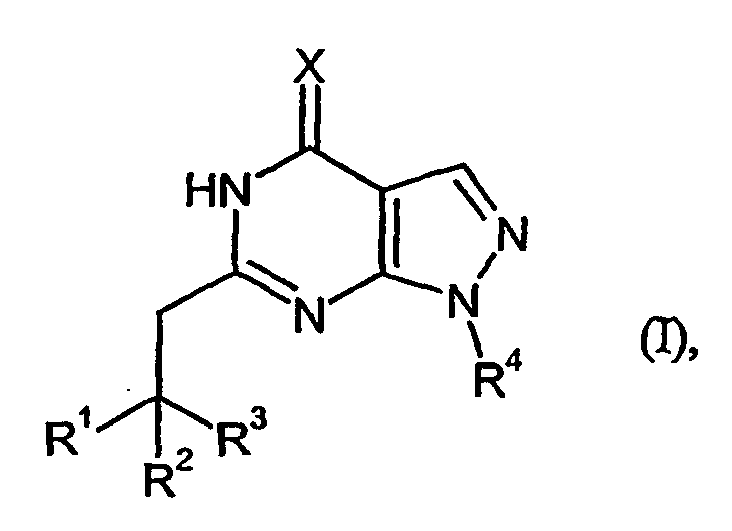
in welcher - R1
- C1-C6-Alkyl, Trifluormethyl, Hydroxy, C1-C6-Alkoxy, -C(=O)OR5 oder -C(=O)NR6R7, wobei C1-C6-Alkyl gegebenenfalls mit 1 bis 3 Resten unabhängig voneinander ausgewählt aus der Gruppe Hydroxy, C1-C6-Alkoxy, Halogen, Trifluormethyl, Trifluormethoxy, -C(=O)OR5 oder -C(=O)NR6R7 substituiert ist, und
R5 für C1-C6-Alkyl,
R6 und R7 unabhängig voneinander für Wasserstoff, C6-C10-Aryl, C1-C6-Alkyl stehen, oder
zusammen mit dem Stickstoffatom, an das sie gebunden sind, ein 4- bis 10-gliedriges Heterocyclyl bilden, - R2
- Wasserstoff, C1-C6-Alkyl, Trifluormethyl, C1-C6-Alkoxy,
- R1 und R2
- zusammen mit dem Kohlenstoffatom, an das sie gebunden sind, C3-C8-Cycloalkyl, C3-C8-Cycloalkenyl oder 4- bis 10-gliedriges Heterocyclyl bilden, die gegebenenfalls mit bis zu 2 Substituenten aus der Gruppe C1-C6-Alkyl, C1-C6-Alkoxy, Hydroxy, Oxo, -C(=O)OR8 substituiert sind, und
R8 für C1-C6-Alkyl oder Benzyl steht, - R3
- Wasserstoff oder C1-C6-Alkyl,
- R4
- Pentan-3-yl, C3-C6-Cycloalkyl,
- X
- Sauerstoff oder Schwefel,
- Erfindungsgemäße Verbindungen sind die Verbindungen der Formel (I) und deren Salze, Solvate und Solvate der Salze; die von Formel (I) umfassten Verbindungen der nachfolgend genannten Formeln und deren Salze, Solvate und Solvate der Salze sowie die von Formel (I) umfassten, nachfolgend als Ausführungsbeispiele genannten Verbindungen und deren Salze, Solvate und Solvate der Salze, soweit es sich bei den von Formel (I) umfassten, nachfolgend genannten Verbindungen nicht bereits um Salze, Solvate und Solvate der Salze handelt.
- Die erfindungsgemäßen Verbindungen können in Abhängigkeit von ihrer Struktur in stereoisomeren Formen (Enantiomere, Diastereomere) existieren. Die Erfindung betrifft deshalb die Enantiomeren oder Diastereomeren und ihre jeweiligen Mischungen. Aus solchen Mischungen von Enantiomeren und/oder Diastereomeren lassen sich die stereoisomer einheitlichen Bestandteile in bekannter Weise isolieren.
- Als Salze sind im Rahmen der Erfindung physiologisch unbedenkliche Salze der erfindungsgemäßen Verbindungen bevorzugt.
- Physiologisch unbedenkliche Salze der Verbindungen (I) umfassen Säureadditionssalze von Mineralsäuren, Carbonsäuren und Sulfonsäuren, z.B. Salze der Chlorwasserstoffsäure, Bromwasserstoffsäure, Schwefelsäure, Phosphorsäure, Methansulfonsäure, Ethansulfonsäure, Toluolsulfonsäure, Benzolsulfonsäure, Naphthalindisulfonsäure, Essigsäure, Propionsäure, Milchsäure, Weinsäure, Äpfelsäure, Zitronensäure, Fumarsäure, Maleinsäure und Benzoesäure.
- Physiologisch unbedenkliche Salze der Verbindungen (I) umfassen auch Salze üblicher Basen, wie beispielhaft und vorzugsweise Alkalimetallsalze (z.B. Natrium- und Kaliumsalze), Erdalkalisalze (z.B. Calcium- und Magnesiumsalze) und Ammoniumsalze, abgeleitet von Ammoniak oder organischen Aminen mit 1 bis 16C-Atomen, wie beispielhaft und vorzugsweise Ethylamin, Diethylamin, Triethylamin, Ethyldiisopropylamin, Monoethanolamin, Diethanolamin, Triethanolamin, Dicyclohexylamin, Dimethylaminoethanol, Prokain, Dibenzylamin, N-Methyhnorpholin, Dehydroabietylamin, Arginin, Lysin, Ethylendiamin und Methylpiperidin.
- Als Solvate werden im Rahmen der Erfindung solche Formen der Verbindungen bezeichnet, welche in festem oder flüssigem Zustand durch Koordination mit Lösungsmittelmolekülen einen Komplex bilden. Hydrate sind eine spezielle Form der Solvate, bei denen die Koordination mit Wasser erfolgt.
- Außerdem betrifft die vorliegende Offenbarung auch Prodrugs der erfindungsgemäßen Verbindungen. Der Begriff "Prodrugs" umfasst Verbindungen, welche selbst biologisch aktiv oder inaktiv sein können, jedoch während ihrer Verweilzeit im Körper zu erfindungsgemäßen Verbindungen umgesetzt werden (beispielsweise metabolisch oder hydrolytisch).
- Im Rahmen der vorliegenden Erfindung haben die Substituenten, soweit nicht anders spezifiziert, die folgende Bedeutung:
- C 1 -C 6 -Alkoxy steht für einen geradkettigen oder verzweigten Alkoxyrest mit 1 bis 6, bevorzugt 1 bis 4, besonders bevorzugt mit 1 bis 3 Kohlenstoffatomen. Nicht-limitierende Beispiele umfassen Methoxy, Ethoxy, n-Propoxy, Isopropoxy, tert.-Butoxy, n-Pentoxy und n-Hexoxy.
- C 1 -C 6 -Alkyl steht für einen geradkettigen oder verzweigten Alkylrest mit 1 bis 6, bevorzugt 1 bis 4, besonders bevorzugt 1 bis 3 Kohlenstoffatomen. Nicht-limitierende Beispiele umfassen Methyl, Ethyl, n-Propyl, Isopropyl, tert.-Butyl, n-Pentyl und n-Hexyl.
- C 6 -C 10 -Aryl steht für Phenyl oder Naphthyl.
- C 3 -C 8 -Cycloalkyl steht für Cyclopropyl, Cyclopentyl, Cyclobutyl, Cyclohexyl, Cycloheptyl oder Cyclooctyl. Bevorzugt seien Cyclopropyl, Cyclopentyl und Cyclohexyl genannt.
- C 3 -C 8 -Cycloalkenyl steht für teilweise ungesättigte, nicht-aromatische Cycloalkylreste, die eine oder mehrere Mehrfachbindungen, vorzugsweise Doppelbindungen enthalten.. Nicht-limitierende Beispiele umfassen Cyclopentenyl, Cyclohexenyl und Cycloheptenyl.
- Halogen steht für Fluor, Chlor, Brom und Iod. Bevorzugt sind Fluor, Chlor, Brom, besonders bevorzugt Fluor und Chlor.
- 4- bis 10-gliedriges Heterocyclyl steht für einen mono- oder polycyclischen, heterocyclischen Rest mit 4 bis 10 Ringatomen und bis zu 3, vorzugsweise 1 Heteroatomen bzw. Heterogruppen aus der Reihe N, O, S, SO, SO2. 4- bis 8-gliedriges Heterocyclyl ist bevorzugt. Mono- oder bicyclisches Heterocyclyl ist bevorzugt. Als Heteroatome sind N und O bevorzugt. Die Heterocyclyl-Reste können gesättigt oder teilweise ungesättigt sein. Gesättigte Heterocyclyl-Reste sind bevorzugt. Die Heterocyclyl-Reste können über ein Kohlenstoffatom oder ein Heteroatom gebunden sein. Besonders bevorzugt sind 5- bis 7-gliedrige, monocyclische gesättigte Heterocyclylreste mit bis zu zwei Heteroatomen aus der Reihe O, N und S. Beispielsweise und vorzugsweise seien genannt: Oxetan-3-yl, Pyrrolidin-2-yl, Pyrrolidin-3-yl, Pyrrolinyl, Tetrahydrofuranyl, Tetrahydrothienyl, Pyranyl, Piperidinyl, Thiopyranyl, Morpholinyl, Perhydroazepinyl.
- Wenn Reste in den erfindungsgemäßen Verbindungen gegebenenfalls substituiert sind, ist, soweit nicht anders spezifiziert, eine Substitution mit bis zu drei gleichen oder verschiedenen Substituenten bevorzugt.
- Die erfindungsgemäßen Verbindungen können auch als Tautomere vorliegen, wie im Folgenden beispielhaft gezeigt wird:

- Eine weitere Ausführungsform der Erfindung betrifft Verbindungen der Formel (I), wobei
- R1
- C1-C6-Alkyl, Hydroxy, C1-C6-Alkoxy, -C(=O)OR5 oder -C(=O)NR6R7, wobei C1-C6-Alkyl gegebenenfalls mit Hydroxy, C1-C6-Alkoxy, -C(=O)OR5 oder -C(=O)NR6R7 substituiert ist, und
R5 für C1-C6-Alkyl,
R6 und R7 unabhängig voneinander für Wasserstoff, C6-C10-Aryl, C1-C6-Alkyl stehen, oder
zusammen mit dem Stickstoffatom, an das sie gebunden sind, ein 4- bis 10-gliedriges Heterocyclyl bilden, - R2
- Wasserstoff, C1-C6-Alkyl, C1-C6-Alkoxy,
- R1 und R2
- zusammen mit dem Kohlenstoffatom, an das sie gebunden sind, C3-C8-Cycloalkyl, C3-C8-Cycloalkenyl oder 4- bis 10-gliedriges Heterocyclyl bilden, die gegebenenfalls mit bis zu 2 Substituenten aus der Gruppe C1-C6-Alkyl, C1-C6-Alkoxy, Hydroxy, Oxo, -C(=O)OR8 substituiert sind, und
R8 für C1-C6-Alkyl oder Benzyl steht, - R3
- Wasserstoff oder C1-C6-Alkyl,
- R4
- Pentan-3-yl, C4-C6-Cycloalkyl,
- X
- Sauerstoff oder Schwefel,
- Eine weitere Ausführungsform der Erfindung betrifft Verbindungen der Formel (I), wobei
- R1
- C1-C4-Alkyl, Trifluormethyl, Hydroxy, C1-C4-Alkoxy, -C(=O)OR5 oder -C(=O)NR6R7, wobei C1-C4-Alkyl gegebenenfalls mit Hydroxy, C1-C4-Alkoxy, Trifluormethyl, -C(=O)OR5 oder -C(=O)NR6R7 substituiert ist, und
R5 für C1-C4-Alkyl,
R6 und R7 unabhängig voneinander für Wasserstoff, Phenyl, C1-C4-Alkyl stehen, oder
zusammen mit dem Stickstoffatom, an das sie gebunden sind, ein 5- bis 6-gliedriges Heterocyclyl bilden, - R2
- Wasserstoff, C1-C4-Alkyl, C1-C4-Alkoxy, Trifluormethyl,
- R1 und R2
- zusammen mit dem Kohlenstoffatom, an das sie gebunden sind, C5-C6-Cycloalkyl, C5-C6-Cycloalkenyl oder 5- bis 6-gliedriges Heterocyclyl bilden, die gegebenenfalls mit bis zu 2 Substituenten aus der Gruppe C1-C4-Alkyl, C1-C4-Alkoxy, Hydroxy, Oxo, -C(=O)OR8 substituiert sind, und
- R8
- für C1-C4-Alkyl oder Benzyl steht,
- R3
- Wasserstoff,
- R4
- Pentan-3-yl, C5-C6-Cycloalkyl,
- X
- Sauerstoff oder Schwefel,
- Eine weitere Ausführungsform der Erfindung betrifft Verbindungen der Formel (I), wobei
- R1
- Methyl, Ethyl, Isopropyl, Trifluormethyl, Methoxycarbonyl, Ethoxycarbonyl oder -C(=O)NR6R7, wobei Methyl gegebenenfalls mit Methoxycarbonyl oder Ethoxycarbonyl substituiert ist, und
R6 für Phenyl steht und
R7 für Wasserstoff steht, - R2
- Wasserstoff, Methyl, Trifluormethyl, oder
- R1 und R2
- zusammen mit dem Kohlenstoffatom, an das sie gebunden sind, Cyclopentyl, Cyclohexyl, Cyclopentenyl oder Tetrahydrofuryl bilden, wobei Cyclohexyl gegebenenfalls mit Methyl substituiert ist, und
- R3
- Wasserstoff,
- R4
- Pentan-3-yl, C5-C6-Cycloalkyl,
- X
- Sauerstoff oder Schwefel,
- Eine weitere Ausführungsform der Erfindung betrifft Verbindungen der Formel (I), wobei
- R1
- Methyl, Ethyl, Isopropyl, Methoxycarbonyl, Ethoxycarbonyl oder -C(=O)NR6R7, wobei Methyl gegebenenfalls mit Methoxycarbonyl oder Ethoxycarbonyl substituiert ist, und
R6 für Phenyl steht und
R7 für Wasserstoff stehen, - R2
- Wasserstoff, Methyl, oder
- R1 und R2
- zusammen mit dem Kohlenstoffatom, an das sie gebunden sind, Cyclopentyl, Cyclohexyl, Cyclopentenyl oder Tetrahydrofuryl bilden, wobei Cyclohexyl gegebenenfalls mit Methyl substituiert ist, und
- R3
- Wasserstoff,
- R4
- Pentan-3-yl, C5-C6-Cycloalkyl,
- X
- Sauerstoff,
- Außerdem wurde ein Verfahren zur Herstellung der erfindungsgemäßen Verbindungen der Formel (I) gefunden, dadurch gekennzeichnet, dass man entweder
- [A] Verbindungen der Formel


in welcher R1, R2 und R3 die oben angegebenen Bedeutungen haben,
und- Z
- für Chlor oder Brom steht,
in einem inerten Lösemittel und in Anwesenheit einer Base zunächst in Verbindungen der Formel
in welcher R1, R2, R3 und R4 die oben angegebenen Bedeutungen haben,
überführt, dann in einem inerten Lösemittel in Gegenwart einer Base zu Verbindungen der Formel
in welcher R1, R2, R3 und R4 die oben angegebenen Bedeutungen haben,
cyclisiert,
oder - [B] Verbindungen der Formel (II) unter direkter Cyclisierung zu (IA) mit einer Verbindung der Formel

in welcher R1, R2 und R3 die oben angegebenen Bedeutungen haben
und- R9
- für Methyl oder Ethyl steht,
in einem inerten Lösemittel und in Anwesenheit einer Base umsetzt,
oder - [C] Verbindungen der Formel

in welcher R4 die oben angegebenen Bedeutungen hat,
zunächst durch Umsetzung mit einer Verbindung der Formel (IIIa) in einem inerten Lösemittel und in Anwesenheit einer Base in Verbindungen der Formel
in welcher R1, R2, R3 und R4 die oben angegebenen Bedeutungen haben,
überführt,
und diese in einem zweiten Schritt in einem inerten Lösemittel und in Anwesenheit einer Base und eines Oxidationsmittels zu (IA) cyclisiert, - Für den ersten Schritt des Verfahrens [A] und des Verfahrens [C] eignen sich inerte organische Lösemittel, die sich unter den Reaktionsbedingungen nicht verändern. Hierzu gehören bevorzugt Ether wie beispielsweise Diethylether, Dioxan, Tetrahydrofuran oder Glykoldimethylether, oder Toluol oder Pyridin. Ebenso ist es möglich, Gemische der genannten Lösemittel einzusetzen. Besonders bevorzugt sind Tetrahydrofuran, Toluol oder Pyridin.
- Als Basen eignen sich im allgemeinen Alkalihydride, wie beispielsweise Natriumhydrid, oder cyclische Amine, wie beispielsweise Piperidin, Pyridin, Dimethylaminopyridin (DMAP), oder C1-C4-Alkylamine, wie beispielsweise Triethylamin. Bevorzugt sind Natriumhydrid, Pyridin und/oder Dimethylaminopyridin.
- Die Base wird im allgemeinen in einer Menge von 1 mol bis 4 mol, bevorzugt von 1.2 mol bis 3 mol, jeweils bezogen auf 1 mol der Verbindungen der allgemeinen Formel (II) bzw. (V), eingesetzt.
- In einer Variante wird die Umsetzung in Pyridin, dem eine katalytische Menge DMAP zugesetzt wird, durchgeführt. Gegebenenfalls kann noch Toluol zugefügt werden.
- Die Reaktionstemperatur kann im allgemeinen in einem größeren Bereich variiert werden. Im allgemeinen arbeitet man in einem Bereich von -20°C bis +200°C, bevorzugt von 0°C bis +100°C.
- Als Lösemittel für die Cyclisierung im zweiten Schritt der Verfahren [A] und [C] eignen sich die üblichen organischen Lösemittel. Hierzu gehören bevorzugt Alkohole wie Methanol, Ethanol, Propanol, Isopropanol, n-Butanol oder tert.-Butanol, oder Ether wie Tetrahydrofuran oder Dioxan, oder Dimethylformamid oder Dimethylsulfoxid. Besonders bevorzugt werden Alkohole wie Methanol, Ethanol, Propanol, Isopropanol oder tert.-Butanol verwendet. Ebenso ist es möglich, Gemische der genannten Lösemittel einzusetzen.
- Als Basen für die Cyclisierung im zweiten Schritt der Verfahren [A] und [C] eignen sich die üblichen anorganischen Basen. Hierzu gehören bevorzugt Alkalihydroxide oder Erdalkalihydroxide wie beispielsweise Natriumhydroxid, Kaliumhydroxid oder Bariumhydroxid, oder Alkalicarbonate wie Natrium- oder Kaliumcarbonat oder Natriumhydrogencarbonat, oder Alkalialkoholate wie Natriummethanolat, Natriumethanolat, Kaliummethanolat, Kaliumethanolat oder Kalium-tert.-butanolat. Besonders bevorzugt sind Kaliumcarbonat, Natriumhydroxid und Kalium-tert.-butanolat.
- Bei der Durchführung der Cyclisierung wird die Base im allgemeinen in einer Menge von 2 mol bis 6 mol, bevorzugt von 3 mol bis 5 mol, jeweils bezogen auf 1 mol der Verbindungen der allgemeinen Formel (IV) bzw. (VI), eingesetzt.
- Als Oxidationsmittel für die Cyclisierung im zweiten Schritt des Verfahrens [C] eignen sich beispielsweise Wasserstoffperoxid oder Natriumborat. Bevorzugt ist Wasserstoffperoxid.
- Die Cyclisierung in den Verfahren [A], [B] und [C] wird im allgemeinen in einem Temperaturbereich von 0°C bis +160°C, bevorzugt bei der Siedetemperatur des jeweiligen Lösemittels durchgeführt.
- Die Cyclisierung wird im allgemeinen bei Normaldruck durchgeführt. Es ist aber auch möglich, das Verfahren bei Überdruck oder bei Unterdruck durchzuführen (z.B. in einem Bereich von 0.5 bis 5 bar).
- Als Lösemittel für das Verfahren [B] eignen sich die oben für den zweiten Schritt der Verfahren [A] und [C] aufgeführten Alkohole, wobei Ethanol bevorzugt ist.
- Als Basen für das Verfahren [B] eignen sich Alkalihydride, wie beispielsweise Natrium- oder Kaliumhydrid, oder Alkalialkoholate, wie beispielsweise Natriummethanolat, -ethanolat, -isopropylat oder Kalium-tert.-butylat. Bevorzugt ist Natriumhydrid.
- Die Base wird in einer Menge von 2 mol bis 8 mol, bevorzugt von 3 mol bis 6 mol, jeweils bezogen auf 1 mol der Verbindungen der Formel (II), eingesetzt.
- Die Verbindungen der Formel (II) sind bekannt oder können beispielsweise hergestellt werden, indem man zunächst Ethoxymethylenmalonsäuredinitril mit Hydrazin-Derivaten der Formel (VII)
R4-NH-NH2 (VII),
in welcher R4 die oben angegebenen Bedeutungen hat,
in einem inerten Lösemittel zu den Pyrazolnitrilen der Formel (V) kondensiert und diese dann mit einem der oben aufgeführten Oxidationsmittel, vorzugsweise Wasserstoffperoxid, in Anwesenheit von Ammoniak umsetzt [vgl. z.B. A. Miyashita et al., Heterocycles 1990, 31, 1309ff]. - Die Verbindungen der Formeln (IIIa), (IIIb) und (VII) sind kommerziell erhältlich, literaturbekannt oder können in Analogie zu literaturbekannten Verfahren hergestellt werden.
- Das erfindungsgemäße Verfahren kann durch das folgendes Formelschema beispielhaft erläutert werden:

- Verbindungen der Formel (IA) und (IB) können gegebenenfalls im Bedeutungsumfang von R1, R2, und R3 nach Standardverfahren weiter modifiziert werden.
- Weitere Verfahren zur Herstellung von Pyrazolo[3,4-d]pyrimidin-4-onen sind bekannt und können ebenfalls zur Synthese der erfindungsgemäßen Verbindungen eingesetzt werden (siehe zum Beispiel: P. Schmidt et al., Helvetica Chimica Acta 1962, 189, 1620ff.).
- Die erfindungsgemäßen Verbindungen zeigen ein nicht vorhersehbares, wertvolles pharmakologisches und pharmakokinetisches Wirkspektrum.
- Sie eignen sich daher zur Verwendung als Arzneimittel zur Behandlung und/oder Prophylaxe von Krankheiten bei Menschen und Tieren.
- Der Begriff "Behandlung" im Rahmen der vorliegenden Erfindung schließt die Prophylaxe ein.
- Überraschenderweise wurde gefunden, dass selektive PDE9A-Inhibitoren zur Herstellung von Arzneimitteln zur Verbesserung der Wahrnehmung, Konzentrationsleistung, Lernleistung oder Gedächtnisleistung geeignet sind.
- Die erfindungsgemäßen Verbindungen können aufgrund ihrer pharmakologischen Eigenschaften allein oder in Kombination mit anderen Arzneimitteln zur Verbesserung von Wahrnehmung, Konzentrationsleistung, Lern- und/oder Gedächtnisleistung eingesetzt werden.
- Weiterer Gegenstand der vorliegenden Offenbarung ist ein Verfahren zur Behandlung und/oder Prophylaxe von Erkrankungen, insbesondere der zuvor genannten Erkrankungen, unter Verwendung einer wirksamen Menge der erfindungsgemäßen Verbindungen.
- Ein PDE9A-Inhibitor im Sinne der Erfindung ist eine Verbindung, die humane PDE9A unter den unten angegebenen Bedingungen mit einem IC50-Wert von weniger als 10 µM, bevorzugt weniger als 1 µM hemmt.
- Ein selektiver PDE9A-Inhibitor im Sinne der Erfindung ist eine Verbindung, die humane PDE9A unter den unten angegebenen Bedingungen stärker hemmt als die humanen PDE1C, PDE2A, PDE3B, PDE4B, PDE5A, PDE7B, PDE8A, PDE10A und PDE11. Bevorzugt ist ein Verhältnis von IC50 (PDE9A) / IC50 (PDE1C, PDE2A, PDE3B, PDE4B, PDE5A, PDE7B und PDE10A) kleiner als 0.2.
- Besonders eignen sich die selektiven PDE9A-Inhibitoren zur Verbesserung der Wahrnehmung, Konzentrationsleistung, Lernleistung, oder Gedächtnisleistung nach Kognitiven Störungen, wie sie insbesondere bei Situationen/Krankheiten/Syndromen auftreten wie "Mild cognitive impairment", Altersassoziierte Lern- und Gedächtnisstörungen, Altersassoziierte Gedächtnisverluste, Vaskuläre Demenz, Schädel-Hirn-Trauma, Schlaganfall, Demenz, die nach Schlaganfällen auftritt ("post stroke dementia"), post-traumatische Demenz, allgemeine Konzentrationsstörungen, Konzentrationsstörungen in Kindern mit Lern- und Gedächtnisproblemen, Alzheimer'sche Krankheit, Demenz mit Lewy-Körperchen, Demenz mit Degeneration der Frontallappen einschließlich des Pick's Syndroms, Parkinson'sche Krankheit, Progressive nuclear palsy, Demenz mit corticobasaler Degeneration, Amyotrope Lateralsklerose (ALS), Huntingtonsche Krankheit, Multiple Sklerose, Thalamische Degeneration, Creutzfeld-Jacob-Demenz, HIV-Demenz, Schizophrenie mit Demenz oder Korsakoff-Psychose.
- Die in vitro-Wirkung der erfindungsgemäßen Verbindungen kann mit folgenden biologischen Assays gezeigt werden:
- Rekombinante PDE1C (GenBank/EMBL Accession Number: NM_005020, Loughney et al. J. Biol. Chem. 1996 271, 796-806), PDE2A (GenBank/EMBL Accession Number: NM_002599, Rosman et al. Gene 1997 191, 89-95), PDE3B (GenBank/EMBL Accession Number: NM_000922, Miki et al. Genomics 1996, 36, 476-485), PDE4B (GenBank/EMBL Accession Number: NM_002600, Obemolte et al. Gene. 1993, 129, 239-247), PDE5A (GenBank/EMBL Accession Number: NM_001083, Loughney et al. Gene 1998, 216, 139-147), PDE7B (GenBank/EMBL Accession Number: NM_018945, Hetman et al. Proc. Natl. Acad Sci. U.S.A. 2000, 97, 472-476), PDE8A (GenBank/EMBL Accession Number: AF_056490, Fisher et al. Biochem. Biophys. Res. Commun. 1998 246, 570-577), PDE9A (Fisher et al., J. Biol. Chem, 1998, 273 (25): 15559-15564), PDE10A (GenBank/EMBL Accession Number: NM_06661, Fujishige et al. J Biol Chem. 1999, 274, 18438-45.), PDE11A (GenBank/EMBL Accession Number: NM_016953, Fawcett et al. Proc. Natl. Acad. Sci. 2000, 97, 3702-3707) wurden mit Hilfe des pFASTBAC Baculovirus Expressionssystems (GibcoBRL) in Sf9-Zellen exprimiert.
- Die Testsubstanzen werden zur Bestimmung ihrer in vitro Wirkung an PDE 9A in 100% DMSO aufgelöst und seriell verdünnt. Typischerweise werden Verdünnungsreihen von 200 µM bis 1.6 µM hergestellt (resultierende Endkonzentrationen im Test: 4 µM bis 0.032 µM). Jeweils 2 µL der verdünnten Substanzlösungen werden in die Vertiefungen von Mikrotiterplatten (Isoplate; Wallac Inc., Atlanta, GA) vorgelegt. Anschließend werden 50 µL einer Verdünnung des oben beschriebenen PDE9A-Präparates hinzugefügt. Die Verdünnung des PDE9A-Präparates wird so gewählt, dass während der späteren Inkubation weniger als 70% des Substrates umgesetzt wird (typische Verdünnung: 1: 10000; Verdünnungspuffer: 50 mM Tris/HCl pH 7.5, 8.3 mM MgCl2, 1.7 mM EDTA, 0.2% BSA). Das Substrat, [8-3H] guanosine 3',5'-cyclic phosphate (1 µCi/µL; Amersham Pharmacia Biotech., Piscataway, NJ) wird 1:2000 mit Assaypuffer (50 mM Tris/HCl pH 7.5, 8.3 mM MgCl2, 1.7 mM EDTA) auf eine Konzentration von 0.0005 µCi/µL verdünnt. Durch Zugabe von 50 µL (0.025 µCi) des verdünnten Substrates wird die Enzymreaktion schließlich gestartet. Die Testansätze werden für 60 min bei Raumtemperatur inkubiert und die Reaktion durch Zugabe von 25 µl eines in Assaypuffer gelösten PDE9A-Inhibitors (z.B. der Inhibitor aus Herstellbeispiel 1, 10 µM Endkonzentration) gestoppt. Direkt im Anschluss werden 25 µL einer Suspension mit 18 mg/mL Yttrium Scintillation Proximity Beads (Amersham Pharmacia Biotech., Piscataway, NJ) hinzugefügt. Die Mikrotiterplatten werden mit einer Folie versiegelt und für 60 min bei Raumtemperatur stehengelassen. Anschließend werden die Platten für 30 s pro Vertiefung in einem Microbeta Szintillationzähler (Wallac Inc., Atlanta, GA) vermessen. IC50-Werte werden anhand der graphischen Auftragung der Substanzkonzentration gegen die prozentuale Inhibition bestimmt.
- Die in vitro Wirkung von Testsubstanzen an rekombinanter PDE3B, PDE4B, PDE7B, PDE8A, PDE10A und PDE11A wird nach dem oben für PDE 9A beschriebenen Testprotokoll mit folgenden Anpassungen bestimmt: Als Substrat wird [5',8-3H] adenosine 3',5'-cyclic phosphate (1 µCi/µL; Amersham Pharmacia Biotech., Piscataway, NJ) verwendet. Die Zugabe einer Inhibitorlösung zum Stoppen der Reaktion ist nicht notwendig. Stattdessen wird in Anschluß an die Inkubation von Substrat und PDE direkt mit der Zugabe der Yttrium Scintillation Proximity Beads wie oben beschrieben fortgefahren und dadurch die Reaktion gestoppt. Für die Bestimmung einer entsprechenden Wirkung an rekombinanter PDE1C, PDE2A und PDE5A wird das Protokoll zusätzlich wie folgt angepaßt: Bei PDE1C werden zusätzlich Calmodulin 10-7 M und CaCl2 3 mM zum Reaktionsansatz gegeben. PDE2A wird im Test durch Zugabe von cGMP 1 µM stimuliert und mit einer BSA-Konzentration von 0.01 % getestet. Für PDE1C und PDE2A wird als Substrat [5',8-3H] adenosine 3',5'-cyclic phosphate (1 µCi/µL; Amersham Pharmacia Biotech., Piscataway, NJ), für PDE5A [8-3H] guanosine 3',5'-cyclic phosphate (1 µCi/µL; Amersham Pharmacia Biotech., Piscataway, NJ) eingesetzt.
- Die PDE9A-inhibierende Wirkung der erfindungsgemäßen Verbindungen kann anhand der folgenden Beispiele in den Tabellen 1 und 2 gezeigt werden:
Tabelle 1: Inhibition von PDE-Isoenzymen durch Beispiel 3 Isoenzym Species IC 50 [nM] PDE1C human 720 PDE2A human > 4000 PDE3B human > 4000 PDE4B human > 4000 PDE5A human > 4000 PDE7B human > 4000 PDE8A human > 4000 PDE9A human 110 PDE10A human > 4000 Tabelle 2: PDE9A-inhibierende Wirkung der erfindungsgemäßen Verbindungen Beispiel IC 50 [nM] 1 5 3 110 4 30 6 6 12 65 17 86 19 390 - PDE9A-Inhibitoren erhöhen die intrazelluläre neuronale cGMP in kultivierten primären kortikalen Neuronen.
- Rattenembryonen (Embryonaltag E17 - E19) wurden dekapitiert, die Köpfe in mit Präparationsmedium (DMEM, Penicillin/Streptomycin; beides von Gibco) gefüllte Präparationsschalen überführt. Die Kopfhaut und Schädeldecke wurde entfernt, und die freipräparierten Gehirne wurden in eine weitere Petrischale mit Präparationsmedium überführt. Mithilfe eines Binokulars und zweier Pinzetten wurde das Großhirn (Kortex) isoliert und mit Eis auf 4°C gekühlt. Diese Präparation und die Vereinzelung der kortikalen Neuronen wurden dann nach einem Standardprotokoll mit dem Papain-Kit (Worthington Biochemical Corporation, Lakewood, New Jersey 08701, USA) durchgeführt (Huettner et al. J. Neurosci. 1986, 6, 3044-3060). Die mechanisch vereinzelten kortikalen Neurone wurden zu 150.000 Zellen/Loch in 200 µl Neurobasalmedium/Loch (Neurobasal; B27 Supplement; 2 mM L-Glutamin; in Anwesenheit von Penicillin/Streptomycin; alle Agenzien von Gibco) 7 Tage in 96 Lochplatten (mit Poly-D-Lysin 100 µg/ml für 30 min vorbehandelt) unter Standard-Bedingungen kultiviert (37°C, 5 % CO2). Nach 7 Tagen wurde das Medium abgenommen und die Zellen mit HBSS-Puffer (Hank's balanced salt solution, Gibco/BRL) gewaschen. Anschließend werden 100 µl erfindungsgemäße Verbindung in HBSS-Puffer gelöst (zuvor in 100% DMSO gelöst: 10 mM) auf die Zellen gegeben. Anschließend werden nochmals 100 µl HBSS-Puffer zugegeben, sodass die Endkonzentration der erfindungsgemäßen Verbindungen beispielsweise in einem Bereich von 20 nM bis 10 µM liegt, und bei 37°C für 20 min inkubiert. Der Testpuffer wird danach komplett abgenommen. Anschließend werden die Zellen in 200 µl Lysispuffer (cGMP Kit code RPN 226; von Amersham Pharmacia Biotech.) lysiert und die cGMP-Konzentration nach den Angaben des Herstellers gemessen. Alle Messungen werden in Triplikaten durchgeführt. Die statistische Auswertung erfolgt mit Prism Software Version 2.0 (GraphPad Software Inc., San Diego, CA USA).
- Inkubation der primären Neuronen mit den erfindungsgemäßen Verbindungen führte zu einer Steigerung des cGMP-Gehaltes.
- Langzeitpotenzierung wird als ein zelluläres Korrelat für Lern- und Gedächtnisvorgänge angesehen. Zur Bestimmung, ob PDE9-Inhibition einen Einfluss auf Langzeitpotenzierung hat, kann folgende Methode angewandt werden:
- Rattenhippokampi werden in einen Winkel von etwa 70 Grad im Verhältnis zur Schnittklinge platziert (Chopper). In Abständen von 400 µm wird der Hippokampus zerschnitten. Die Schnitte werden mit Hilfe eines sehr weichen, stark benetzten Pinsels (Marderhaar) von der Klinge genommen und in ein Glasgefäß mit carbogenisierter gekühlter Nährlösung (124 mM NaCl, 4.9 mM KCl, 1.3 mM MgSO4 x 7 H2O, 2.5 mM CaCl2 wasserfrei, 1.2 mM KH2PO4, 25.6 mM NaHCO3, 10 mM Glucose, pH 7.4) überführt. Während der Messung befinden sich die Schnitte in einer temperierten Kammer unter einem Flüssigkeitsspiegel von 1-3 mm Höhe. Die Durchflussrate beträgt 2.5 ml/min. Die Vorbegasung erfolgt unter geringen Überdruck (etwa 1 atm) sowie über eine Mikrokanüle in der Vorkammer. Die Schnittkammer ist mit der Vorkammer so verbunden, daß eine Minizirkulation aufrechterhalten werden kann. Als Antrieb der Minizirkulation wird das durch die Mikrokanüle ausströmende Carbogen eingesetzt. Die frisch präparierten Hippokampusschnitte werden mindestens 1 Stunde bei 33°C in der Schnittkammer adaptiert.
- Die Reizstärke wird so gewählt, dass die fokalen exzitatiorischen postsynaptischen Potentiale (fEPSP) 30 % des maximalen exzitatorischen postsynaptischen Potentials (EPSP) betragen. Mit Hilfe einer monopolaren Stimulationselektrode, die aus lackiertem Edelstahl besteht, und eines stromkonstanten, biphasischen Reizgenerators (AM-Systems 2100) werden lokal die Schaffer-Kollateralen erregt (Spannung: 1-5 V, Impulsbreite einer Polarität 0.1 ms, Gesamtimpuls 0.2 ms). Mit Hilfe von Glaselektroden (Borosilikatglas mit Filament, 1-5 MOhm, Durchmesser: 1.5 mm, Spitzendurchmesser: 3-20 µm), die mit normaler Nährlösung gefüllt sind, werden aus dem Stratum radiatum die exzitatorischen postsynaptischen Potentiale (fEPSP) registriert. Die Messung der Feldpotentiale geschieht gegenüber einer chlorierten Referenzelektrode aus Silber, die sich am Rande der Schnittkammer befindet, mit Hilfe eines Gleichspannungsverstärkers. Das Filtern der Feldpotentiale erfolgt über einen Low-Pass Filter (5 kHz). Für die statistische Analyse der Experimente wird der Anstieg (slope) der fEPSPs (fEPSP-Anstieg) ermittelt. Die Aufnahme, Analyse und Steuerung des Experimentes erfolgt mit Hilfe eines Softwareprogrammes (PWIN), welches in der Abteilung Neurophysiologie entwickelt worden ist. Die Mittelwertbildung der fEPSP-Anstiegswerte zu den jeweiligen Zeitpunkten und die Konstruktion der Diagramme erfolgt mit Hilfe der Software EXCEL, wobei ein entsprechendes Makro die Aufnahme der Daten automatisiert.
- Superfusion der Hippokampusschnitte mit einer 10 µM Lösung der erfindungsgemäßen Verbindungen führt zu einer signifikanten Steigerung der LTP.
- Der Soziale Wiedererkennungstest ist ein Lern- und Gedächtnistest. Er misst die Fähigkeit von Ratten, zwischen bekannten und unbekannten Artgenossen zu unterscheiden. Deshalb eignet sich dieser Test zur Prüfung der lern- oder gedächtnisverbessernden Wirkung der erfindungsgemäßen Verbindungen.
- Adulte Ratten, die in Gruppen gehalten werden, werden 30 min vor Testbeginn einzeln in Testkäfige gesetzt. Vier min vor Testbeginn wird das Testtier in eine Beobachtungsbox gebracht. Nach dieser Adaptationszeit wird ein juveniles Tier zu dem Testtier gesetzt und 2 min lang die absolute Zeit gemessen, die das adulte Tier das Junge inspiziert (Trial 1). Gemessen werden alle deutlich auf das Jungtier gerichteten Verhaltensweisen, d.h. ano-genitale Inspektion, Verfolgen sowie Fellpflege, bei denen das Alttier einen Abstand von höchstens 1 cm zu dem Jungtier hatte. Danach wird das Juvenile herausgenommen, das Adulte mit einer erfindungsgemäßen Verbindung oder Vehikel behandelt und anschließend in seinen Heimkäfig zurückgesetzt. Nach einer Retentionszeit von 24 Stunden wird der Test wiederholt (Trial 2). Eine verringerte Soziale Interaktionszeit im Vergleich zu Trial 1 zeigt an, dass die adulte Ratte sich an das Jungtier erinnert.
- Die adulten Tiere werden direkt im Anschluss an Trial 1 entweder mit Vehikel (10 % Ethanol, 20 % Solutol, 70 % physiologische Kochsalzlösung) oder 0.1 mg/kg, 0.3 mg/kg, 1.0 mg/kg bzw. 3.0 mg/kg erfindungsgemäßer Verbindung, gelöst in 10 % Ethanol, 20 % Solutol, 70 % physiologische Kochsalzlösung intraperitoneal injiziert. Vehikel behandelte Ratten zeigen keine Reduktion der sozialen Interaktionszeit in Trial 2 verglichen mit Trial 1. Sie haben folglich vergessen, dass sie schon einmal Kontakt mit dem Jungtier hatten. Überraschenderweise ist die soziale Interaktionszeit im zweiten Durchgang nach Behandlung mit den erfindungsgemäßen Verbindungen signifikant gegenüber den Vehikel behandelten reduziert. Dies bedeutet, dass die substanzbehandelten Ratten sich an das juvenile Tier erinnert haben und somit die erfindungsgemäßen Verbindungen eine verbessernde Wirkung auf Lernen und Gedächtnis aufweist.
- Weiterer Gegenstand der vorliegenden Erfindung sind Arzneimittel, enthaltend mindestens eine erfindungsgemäße Verbindung und mindestens einen oder mehrere weitere Wirkstoffe, insbesondere zur Behandlung und/oder Prophylaxe der zuvor genannten Erkrankungen.
- Die erfindungsgemäßen Verbindungen können systemisch und/oder lokal wirken. Zu diesem Zweck können sie auf geeignete Weise appliziert werden, wie z.B. oral, parenteral, pulmonal, nasal, sublingual, lingual, buccal, rectal, dermal, transdermal, conjunctival, otisch oder als Implantat bzw. Stent.
- Für diese Applikationswege können die erfindungsgemäßen Verbindungen in geeigneten Applikationsformen verabreicht werden.
- Für die orale Applikation eignen sich nach dem Stand der Technik funktionierende schnell und/oder modifiziert die erfindungsgemäßen Verbindungen abgebende Applikationsformen, die die erfindungsgemäßen Verbindungen in kristalliner und/oder amorphisierter und/oder gelöster Form enthalten, wie z.B. Tabletten (nicht-überzogene oder überzogene Tabletten, beispielsweise mit magensaftresistenten oder sich verzögert auflösenden oder unlöslichen Überzügen, die die Freisetzung der erfindungsgemäßen Verbindung kontrollieren), in der Mundhöhle schnell zerfallende Tabletten oder Filme/Oblaten, Filme/Lyophylisate, Kapseln (beispielsweise Hart- oder Weichgelatinekapseln), Dragees, Granulate, Pellets, Pulver, Emulsionen, Suspensionen, Aerosole oder Lösungen.
- Die parenterale Applikation kann unter Umgehung eines Resorptionsschrittes geschehen (z.B. intravenös, intraarteriell, intrakardial, intraspinal oder intralumbal) oder unter Einschaltung einer Resorption (z.B. intramuskulär, subcutan, intracutan, percutan oder intraperitoneal). Für die parenterale Applikation eignen sich als Applikationsformen u.a. Injektions- und Infusionszubereitungen in Form von Lösungen, Suspensionen, Emulsionen, Lyophilisaten oder sterilen Pulvern.
- Für die sonstigen Applikationswege eignen sich z.B. Inhalationsarzneiformen (u.a. Pulverinhalatoren, Nebulizer), Nasentropfen, -lösungen, -sprays; lingual, sublingual oder buccal zu applizierende Tabletten, Filme/Oblaten oder Kapseln, Suppositorien, Ohren- oder Augenpräparationen, Vaginalkapseln, wässrige Suspensionen (Lotionen, Schüttelmixturen), lipophile Suspensionen, Salben, Cremes, transdermale therapeutische Systeme (wie beispielsweise Pflaster), Milch, Pasten, Schäume, Streupuder, Implantate oder Stents.
- Die erfindungsgemäßen Verbindungen können in die angeführten Applikationsformen überführt werden. Dies kann in an sich bekannter Weise durch Mischen mit inerten, nichttoxischen, pharmazeutisch geeigneten Hilfsstoffen geschehen. Zu diesen Hilfsstoffen zählen u.a. Trägerstoffe (beispielsweise mikrokristalline Cellulose, Laktose, Mannitol), Lösungsmittel (z.B. flüssige Polyethylenglycole), Emulgatoren und Dispergier- oder Netzmittel (beispielsweise Natriumdodecylsulfat, Polyoxysorbitanoleat), Bindemittel (beispielsweise Polyvinylpyrrolidon), synthetische und natürliche Polymere (beispielsweise Albumin), Stabilisatoren (z.B. Antioxidantien wie beispielsweise Ascorbinsäure), Farbstoffe (z.B. anorganische Pigmente wie beispielsweise Eisenoxide) und Geschmacks- und / oder Geruchskorrigentien.
- Weiterer Gegenstand der vorliegenden Erfindung sind Arzneimittel, die mindestens eine erfindungsgemäße Verbindung, üblicherweise zusammen mit einem oder mehreren inerten, nichttoxischen, pharmazeutisch geeigneten Hilfsstoffen enthalten, sowie deren Verwendung zu den zuvor genannten Zwecken.
- Im allgemeinen hat es sich als vorteilhaft erwiesen, bei parenteraler Applikation pro Tag Mengen von etwa 0.001 bis 10 mg/kg Körpergewicht zur Erzielung wirksamer Ergebnisse zu verabreichen. Bei oraler Applikation beträgt die Menge pro Tag etwa 0.005 bis 3 mg/kg Körpergewicht.
- Trotzdem kann es gegebenenfalls erforderlich sein, von den genannten Mengen abzuweichen, und zwar in Abhängigkeit von Körpergewicht, Applikationsweg, individuellem Verhalten gegenüber dem Wirkstoff, Art der Zubereitung und Zeitpunkt bzw. Intervall, zu welchem die Applikation erfolgt. So kann es in einigen Fällen ausreichend sein, mit weniger als der vorgenannten Mindestmenge auszukommen, während in anderen Fällen die genannte obere Grenze überschritten werden muss. Im Falle der Applikation größerer Mengen kann es empfehlenswert sein, diese in mehreren Einzelgaben über den Tag zu verteilen.
- Die Prozentangaben in den folgenden Tests und Beispielen sind, sofern nicht anders angegeben, Gewichtsprozente; Teile sind Gewichtsteile. Lösungsmittelverhältnisse, Verdünnungsverhältnisse und Konzentrationsangaben von flüssig/flüssig-Lösungen beziehen sich jeweils auf das Volumen.
-
- BSA
- Rinderserum-Albumin
- DCI
- direkte chemische Ionisation (bei MS)
- DMSO
- Dimethylsulfoxid
- d.Th.
- der Theorie (bei Ausbeute)
- EDTA
- Ethylendiamintetraessigsäure
- equiv.
- Äquivalent(e)
- ESI
- Elektrospray-Ionisation (bei MS)
- HATU
- O-(7-Azabenzotriazol-1-yl)-N,N,N',N'-tetramethyluronium-Hexafluorophosphat
- Lit.
- Literatur(stelle)
- MS
- Massenspektroskopie
- NMR
- Kernresonanzspektroskopie
- Smp.
- Schmelzpunkt
- Tris
- Tris-(hydroxymethyl)-aminomethan
-

- Eine Lösung von Cyclohexylhydrazin-Hydrochlorid (3 g, 19.9 mmol) in 36 ml Ethanol wird bei Raumtemperatur zunächst mit Ethoxymethylenmalonsäuredinitril (2.43 g, 19.9 mmol) und anschließend mit 8 ml Triethylamin versetzt. Das Gemisch wird 20 min refluxiert und dann abgekühlt. Das Lösungsmittel wird am Rotationsverdampfer abgezogen und der Rückstand in DCM aufgenommen, mit wässriger Natriumhydrogencarbonat-Lösung gewaschen, über Natriumsulfat getrocknet, filtriert und im Vakuum eingeengt. Das Rohprodukt wird an Kieselgel chromatographiert (Laufmittel: Dichlormethan/Methanol 0-10 %).
Ausbeute: 1.95 g (51 % d.Th.)
MS (DCI): m/z =191 (M+H)+
1H-NMR (200 MHz, DMSO-d6): δ = 7.5 (s, 1H), 6.5 (s, 2H), 4.0 (m, 1H), 1.95-1.05 (m, 10H) ppm. -

- Die Herstellung erfolgt analog der Vorschrift für Beispiel 1A.
MS (ESI): m/z = 177 (M+H)+
1H-NMR (200 MHz, CDCl3): δ = 7.5 (s, 1H), 4.45 (br. s, 2H), 4.35 (m, 1H), 2.2-1.55 (m, 6H) ppm. -

- Die Herstellung erfolgt analog der Vorschrift für Beispiel 1A.
MS (ESI): m/z = 179 (M+H)+
1H-NMR (300 MHz, DMSO-d6): δ = 7.55 (s, 1H), 6.45 (s, 2H), 4.0 (m, 1H), 1.8-1.55 (m, 4H), 0.65 (t, 6H) ppm. -
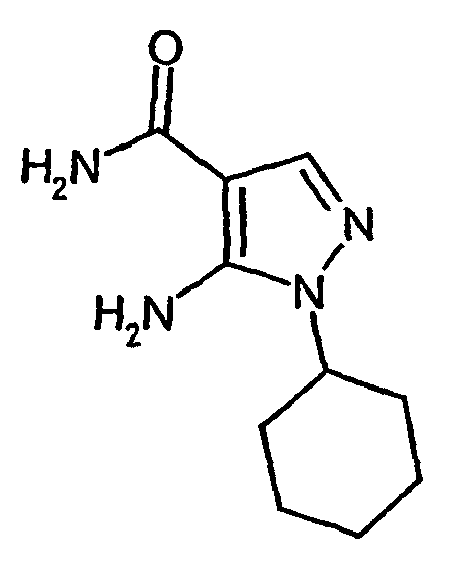
- Eine Lösung von 5-Amino-1-cyclohexyl-1H-pyrazol-4-carbonitril (1.86 g, 9.81 mmol) in einem Gemisch aus 73 ml Ethanol und 90 ml konzentrierter wässriger Ammoniaklösung wird bei Raumtemperatur mit 18 ml 30 %-iger Wasserstoffperoxidlösung versetzt und 1 h bei Raumtemperatur gerührt. Anschließend werden am Rotationsverdampfer die nichtwässrigen Lösemittel abgezogen. Aus der verbleibenden Mischung fällt das Produkt als Feststoff aus, der abgesaugt, mit wenig Wasser gewaschen und im Hochvakuum getrocknet wird.
Ausbeute: 1.77 g (86 % d.Th.)
MS (DCI): m/z = 209 (M+H)+
1H-NMR (300 MHz, DMSO-d6): δ = 7.6 (s, 1H), 7.3-6.4 (breit, 2H), 6.1 (s, 2H), 3.95 (m, 1H), 1.95-1.05 (m, 10H) ppm. -

- Die Herstellung erfolgt analog der Vorschrift für Beispiel 4A.
MS (ESI): m/z = 195 (M+H)+
1H-NMR (200 MHz, CDCl3): δ = 7.5 (s, 1H), 5.6-4.8 (breit, 4H), 4.35 (m, 1H), 2.2-1.55 (m, 8H) ppm. -

- Die Herstellung erfolgt analog der Vorschrift für Beispiel 4A.
MS (ESI): m/z = 197 (M+H)+
1H-NMR (300 MHz, DMSO-d6): δ = 7.65 (s, 1H), 6.9 (br. s, 2H), 6.1 (s, 2H), 3.9 (m, 1H), 1.85-1.6 (m, 4H), 0.7 (t, 6H) ppm. -

- Unter Argon werden 75 mg (0.39 mmol) 5-Amino-1-cyclopentyl-1H-pyrazol-4-carboxamid und 183 mg (1.16 mmol, 3 equiv.) Cyclohexylessigsäuremethylester in 1.5 ml absolutem Ethanol vorgelegt. Bei 0°C werden 54 mg Natriumhydrid (60 %-ige Dispersion in Mineralöl; 1.35 mmol, 3.5 equiv.) im Argon-Gegenstrom langsam zugegeben. Das entstandene Gemisch wird langsam erwärmt und für 18 h unter Rückfluss gerührt. Zur Aufarbeitung werden 20 ml Wasser zugegeben und das Gemisch mehrmals mit Essigsäureethylester extrahiert. Die vereinigten organischen Phasen werden über Natriumsulfat getrocknet und im Vakuum eingeengt. Das Rohprodukt wird mittels präparativer HPLC gereinigt.
Ausbeute: 36 mg (31% d.Th.)
MS (ESI): m/z = 301 (M+H)+
Smp.: 147°C
1H-NMR (300 MHz, DMSO-d6): δ = 11.95 (s, 1H), 8.0 (s, 1H), 5.1 (m, 1H), 2.5 (d, 2H), 2.15-1.75 (m, 7H), 1.75-1.55 (m, 7H), 1.3-0.9 (m, 5H) ppm. -

- Analog zu Beispiel 1 wird das Produkt ausgehend von 75 mg (0.39 mmol) 5-Amino-1-cyclopentyl-1H-pyrazol-4-carboxamid und 140 mg (1.16 mmol) 4-Hydroxybuttersäuremethylester erhalten.
Ausbeute: 85 mg (84 % d.Th.)
MS (DCI): m/z = 263 (M+H)+
Smp.: 138°C
1H-NMR (200 MHz, DMSO-d6): δ = 8.0 (s, 1H), 5.1 (m, 1H), 3.5 (t, 2H, J = 6.5 Hz), 2.65 (t, 2H, J = 7.5 Hz), 2.2-1.55 (m, 10H) ppm. -

- Analog zu Beispiel 1 wird das Produkt ausgehend von 200 mg (1.02 mmol) 5-Amino-1-(1-ethylpropyl)-1H-pyrazol-4-carboxamid und 482 mg (3.06 mmol) Cyclohexylessigsäuremethylester erhalten.
Ausbeute: 146 mg (47 % d.Th.)
MS (ESI): m/z = 303 (M+H)+
Smp.: 122°C
1H-NMR (200 MHz, DMSO-d6): δ = 12.0 (s, 1H), 8.0 (s, 1H), 4.45 (m, 1H), 2.5 (m, 2H), 2.0-1.5 (m, 10H), 1.4-0.9 (m, 5H), 0.6 (t, 6H, J = 7.5 Hz) ppm. -

- Analog zu Beispiel 1 wird das Produkt ausgehend von 200 mg (1.01 mmol) 5-Amino-1-cyclopentyl-1H-pyrazol-4-carboxamid und 450 mg (3.03 mmol) 3-Methylvaleriansäureethylester erhalten.
Ausbeute: 88 mg (32 % d.Th.)
MS (DCI): m/z = 275 (M+H)+
Smp.: 86°C
1H-NMR (300 MHz, DMSO-d6): δ = 12.0 (s, 1H), 8.0 (s, 1H), 5.1 (m, 1H), 2.65 (dd, 1H), 2.45 (dd, 1H), 2.15-1.8 (m, 7H), 1.7 (m, 2H), 1.45-1.15 (m, 2H), 0.9 (m, 6H) ppm. -

- Analog zu Beispiel 1 wird das Produkt ausgehend von 200 mg (1.01 mmol) 5-Amino-1-cyclopentyl-1H-pyrazol-4-carboxamid und 450 mg (3.03 mmol) 4-Methylvaleriansäureethylester erhalten.
Ausbeute: 165 mg (60 % d.Th.)
MS (ESI): m/z = 275 (M+H)+
Smp.: 133°C
1H-NMR (200 MHz, DMSO-d6): δ = 12.0 (s, 1H), 8.0 (s, 1H), 5.1 (m, 1H), 2.6 (m, 2H), 2.2-1.5 (m, 11H), 0.9 (d, 6H, J = 6.5 Hz) ppm. -

- Analog zu Beispiel 1 wird das Produkt ausgehend von 200 mg (1.01 mmol) 5-Amino-1-cyclopentyl-1H-pyrazol-4-carboxamid und 446 mg (1.82 mmol, 95 % rein) 2-Cyclopenten-1-yl-essigsäuremethylester (Lit.: Roenn et al., Tetrahedron Lett. 1995, 36, 7749) erhalten.
Ausbeute: 86 mg (30 % d.Th.)
MS (ESI): m/z = 285 (M+H)+
Smp.: 166°C
1H-NMR (200 MHz, DMSO-d6): δ = 12.0 (s, 1H), 8.0 (s, 1H), 5.75 (m, 2H), 5.1 (m, 1H), 3.15 (m, 1H), 2.8-2.5 (m, 2H), 2.45-1.45 (m, 12H) ppm. -

- Analog zu Beispiel 1 wird das Produkt ausgehend von 200 mg (1.0 mmol) 5-Amino-1-(1-ethylpropyl)-1H-pyrazol-4-carboxamid und 445 mg (3.0 mmol) 3-Methylvaleriansäureethylester erhalten.
Ausbeute: 99 mg (36 % d.Th.)
MS (ESI): m/z = 277 (M+H)+
Smp.: 121°C
1H-NMR (300 MHz, DMSO-d6): δ = 12.0 (s, 1H), 8.0 (s, 1H), 4.5 (m, 1H), 2.6 (dd, 1H), 2.45 (dd, 1H), 2.05-1.7 (m, 5H), 1.45-1.15 (m, 2H), 0.9 (m, 6H), 0.65 (t, 6H, J = 7.5 Hz) ppm. -

- Analog zu Beispiel 1 wird das Produkt ausgehend von 200 mg (1.0 mmol) 5-Amino-1-(1-ethylpropyl)-1H-pyrazol-4-carboxamid und 445 mg (3.0 mmol) 4-Methylvaleriansäureethylester erhalten.
Ausbeute: 127 mg (46 % d.Th.)
MS (ESI): m/z = 277 (M+H)+
Smp.: 127°C
1H-NMR (300 MHz, DMSO-d6): δ = 12.0 (s, 1H), 8.0 (s, 1H), 4.45 (m, 1H), 2.65 (m, 2H), 2.0-1.8 (m, 4H), 1.7-1.5 (m, 3H), 0.9 (d, 6H, J = 7 Hz), 0.6 (t, 6H, J = 6 Hz) ppm. -
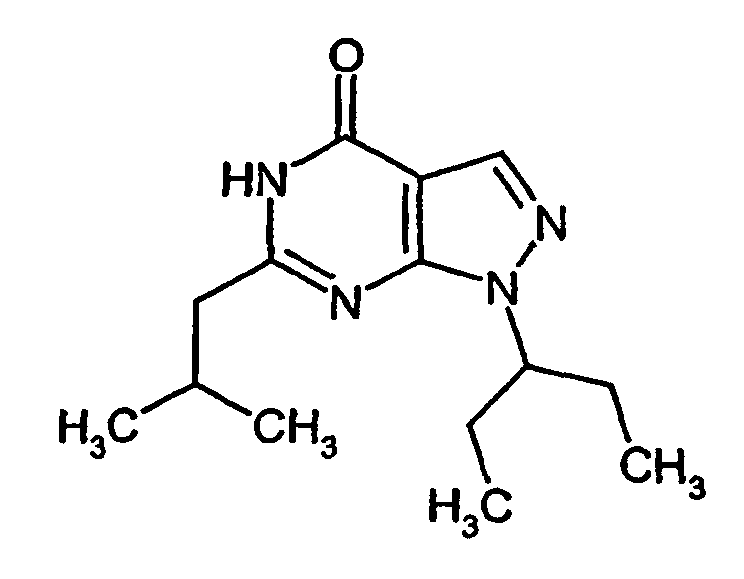
- Analog zu Beispiel 1 wird das Produkt ausgehend von 200 mg (1.0 mmol) 5-Amino-1-(1-ethylpropyl)-1H-pyrazol-4-carboxamid und 464 mg (3.5 mmol) 3-Methylbuttersäureethylester erhalten.
Ausbeute: 127 mg (48 % d.Th.)
MS (ESI): m/z = 263 (M+H)+
Smp.: 161°C
1H-NMR (300 MHz, DMSO-d6): δ = 12.0 (s, 1H), 8.0 (s, 1H), 4.45 (m, 1H), 2.5 (m, 2H), 2.15 (m, 1H), 1.95-1.75 (m, 4H), 0.9 (d, 6H, J = 7 Hz), 0.55 (t, 6H, J = 7.5 Hz) ppm. -

- Analog zu Beispiel 1 wird das Produkt ausgehend von 200 mg (1.0 mmol) 5-Amino-1-(1-ethylpropyl)-1H-pyrazol-4-carboxamid und 410 mg (3.5 mmol) Buttersäureethylester erhalten.
Ausbeute: 159 mg (64 % d.Th.)
MS (ESI): m/z = 249 (M+H)+
Smp.: 127°C
1H-NMR (300 MHz, DMSO-d6): δ = 11.95 (s, 1H), 8.0 (s, 1H), 4.5 (m, 1H), 2.6 (t, 2H, J = 7.5 Hz), 2.0-1.65 (m, 6H), 0.9 (t, 3H, J = 7.5 Hz), 0.6 (t, 6H, J = 7.5 Hz) ppm. -

- Analog zu Beispiel 1 wird das Produkt ausgehend von 200 mg (1.0 mmol) 5-Amino-1-(1-ethylpropyl)-1H-pyrazol-4-carboxamid und 553 mg (3.5 mmol) Tetrahydrofuran-2-ylessigsäureethylester erhalten.
Ausbeute: 202 mg (68 % d.Th.)
MS (ESI): m/z = 291 (M+H)+
Smp.: 136°C
1H-NMR (200 MHz, DMSO-d6): δ = 12.0 (s, 1H), 8.0 (s, 1H), 4.45 (m, 1H), 4.25 (m, 1H), 3.75 (m, 1H), 3.6 (m, 1H), 2.8 (m, 2H), 2.1-1.55 (m, 8H), 0.6 (t, 6H, J = 7.5 Hz) ppm. -
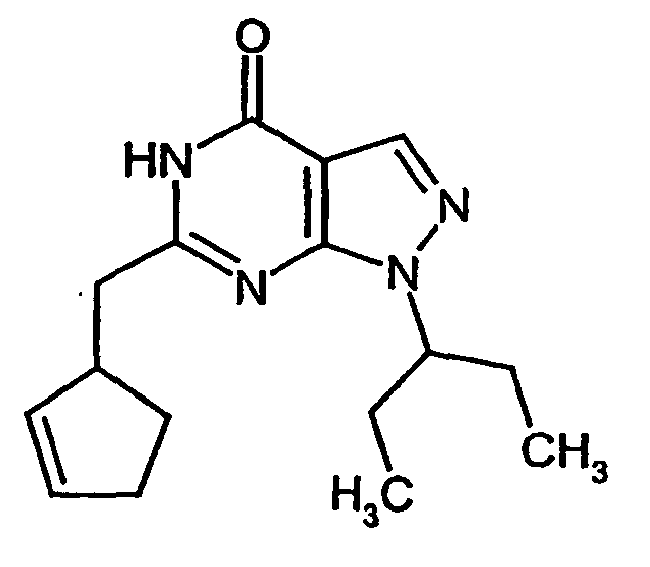
- Analog zu Beispiel 1 wird das Produkt ausgehend von 200 mg (1.0 mmol) 5-Amino-1-(1-ethylpropyl)-1H-pyrazol-4-carboxamid und 490 mg (3.5 mmol) 2-Cyclopenten-1-ylessigsäuremethylester (Lit.: Roenn et al., Tetrahedron Lett. 1995, 36, 7749) erhalten.
Ausbeute: 111 mg (39 % d.Th.)
MS (ESI): m/z = 287 (M+H)+
Smp.: 128°C
1H-NMR (200 MHz, DMSO-d6): δ = 12.0 (s, 1H), 8.0 (s, 1H), 5.8-5.65 (m, 2H), 4.5 (m, 1H), 3.2 (m, 1H), 2.8-2.55 (m, 2H), 2.3 (m, 2H), 2.15-1.8 (m, 5H), 1.55 (m, 1H), 0.65 (t, 6H, J = 7.5 Hz) ppm. -
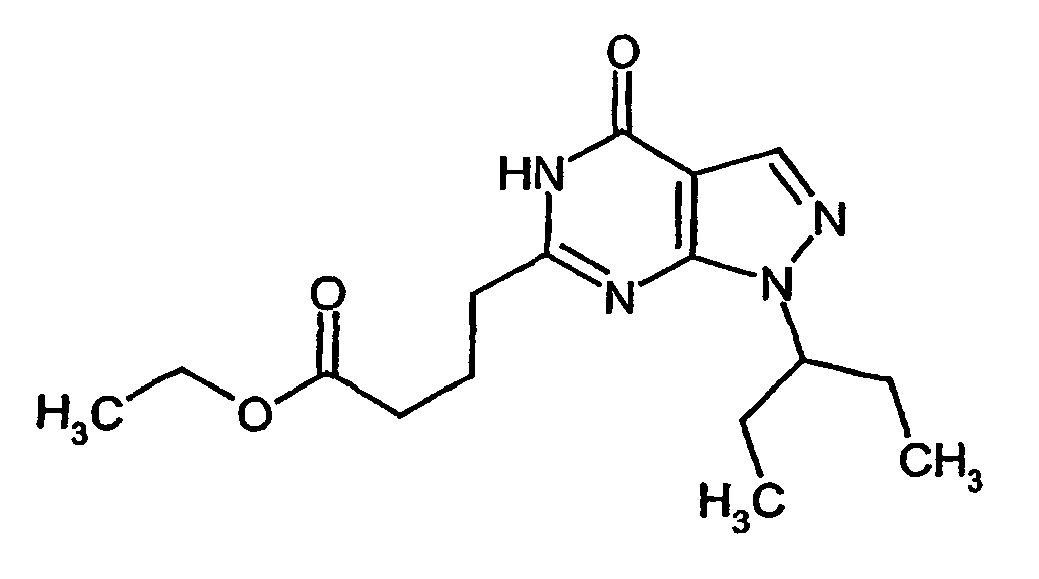
- Analog zu Beispiel 1 wird das Produkt ausgehend von 200 mg (1.0 mmol) 5-Amino-1-(1-ethylpropyl)-1H-pyrazol-4-carboxamid und 1.13 g (6.0 mmol) Glutarsäurediethylester erhalten.
Ausbeute: 46 mg (13 % d.Th.)
MS (ESI): m/z = 321 (M+H)+
1H-NMR (200 MHz, DMSO-d6): δ = 12.0 (s, 1H), 8.0 (s, 1H), 4.5 (m, 1H), 4.2 (q, 2H, J = 7 Hz), 2.7 (t, 2H, J = 7.5 Hz), 2.4 (t, 2H, J = 7 Hz), 2.1-1.75 (m, 6H), 1.2 (t, 3H, J = 7 Hz), 0.65 (t, 6H, J = 7.5 Hz) ppm. -
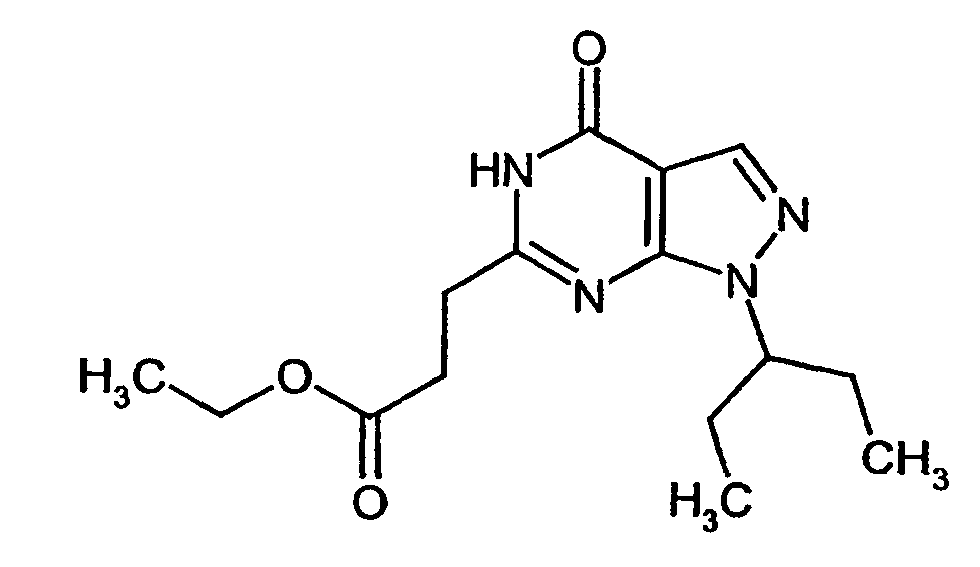
- Analog zu Beispiel 1 wird das Produkt ausgehend von 200 mg (1.0 mmol) 5-Amino-1-(1-ethylpropyl)-1H-pyrazol-4-carboxamid und 1.04 g (6 mmol) Bemsteinsäurediethylester erhalten.
Ausbeute: 176 mg (56 % d.Th.)
MS (ESI): m/z = 307 (M+H)+
Smp.: 118°C
1H-NMR (200 MHz, DMSO-d6): δ = 12.1 (s, 1H), 8.0 (s, 1H), 4.4 (m, 1H), 4.0 (q, 2H, J = 7 Hz), 2.9 (m, 2H), 2.8 (m, 2H), 2.0-1.7 (m, 4H), 1.2 (t, 3H, J = 7 Hz), 0.6 (t, 6H, J = 7.5 Hz) ppm. -

- Analog zu Beispiel 1 wird das Produkt ausgehend von 200 mg (1.0 mmol) 5-Amino-1-cyclopentyl-1H-pyrazol-4-carboxamid und 664 mg (3.5 mmol) (4-Methylcyclohexyl)essigsäureethylester (cis/trans-Gemisch) erhalten. Das Produkt liegt als Gemisch der cis- und trans-Isomere vor.
Ausbeute: 131 mg (41 % d.Th.)
MS (ESI): m/z = 315 (M+H)+
Smp.: 126°C
1H-NMR (200 MHz, DMSO-d6): δ = 12.0 (s, 1H), 8.0 (s, 1H), 5.1 (m, 1H), 2.6 (d, 2H, J = 7 Hz), 2.2-0.8 (m, 21H) ppm. -

- Analog zu Beispiel 1 wird das Produkt ausgehend von 200 mg (1.0 mmol) 5-Amino-1-(1-ethylpropyl)-1H-pyrazol-4-carboxamid und 413 mg (2.2 mmol) (4-Methylcyclohexyl)essigsäureethylester (cis/trans-Gemisch) erhalten. Das Produkt liegt als Gemisch der cis- und trans-Isomere vor.
Ausbeute: 60 mg (19 % d.Th.)
MS (ESI): m/z = 317 (M+H)+
1H-NMR (200 MHz, DMSO-d6): δ = 12.0 (s, 1H), 8.0 (s, 1H), 4.45 (m, 1H), 2.6 (d, 2H, J = 7 Hz), 2.2-0.8 (m, 17H), 0.6 (t, 6H, J = 7.5 Hz) ppm. -

- Analog zu Beispiel 1 wird das Produkt ausgehend von 200 mg (1.0 mmol) 5-Amino-1-(1-ethylpropyl)-1H-pyrazol-4-carboxamid und 559 mg (3.5 mmol) Tetrahydrofuran-2-ylessigsäureethylester erhalten.
Ausbeute: 175 mg (60 % d.Th.)
MS (ESI): m/z = 289 (M+H)+
Smp.: 179°C
1H-NMR (200 MHz, DMSO-d6): δ = 11.95 (s, 1H), 8.0 (s, 1H), 5.1 (m, 1H), 4.3 (m, 1H), 3.8 (m, 1H), 3.6 (m, 1H), 2.8 (m, 2H), 2.15-1.55 (m, 12H) ppm. -

- Analog zu Beispiel 1 wird das Produkt ausgehend von 200 mg (1.0 mmol) 5-Amino-1-cyclopentyl-1H-pyrazol-4-carboxamid und 1.05 g (6.05 mmol) Bemsteinsäurediethylester erhalten.
Ausbeute: 150 mg (49 % d.Th.)
MS (DCI): m/z = 305 (M+H)+
Smp.: 185°C
1H-NMR (200 MHz, DMSO-d6): δ = 12.1 (s, 1H), 8.0 (s, 1H), 5.05 (m, 1H), 4.05 (q, 2H, J = 7 Hz), 2.9 (m, 2H), 2.8 (m, 2H), 2.15-1.6 (m, 8H), 1.2 (t, 3H, J = 7 Hz) ppm. -

- Eine Lösung von 50 mg (0.17 mmol) 6-(Cyclohexylmethyl)-1-(1-ethylpropyl)-1,5-dihydro-4H-pyrazolo[3,4-d]pyrimidin-4-on (Beispiel 3) in 1 ml Pyridin wird bei Raumtemperatur mit 74 mg (0.33 mmol, 2 equiv.) Diphosphorpentasulfid versetzt und anschließend über Nacht unter Rückfluss gerührt. Nach dem Abkühlen wird die Reaktionslösung mit 20 ml eiskalter 2.5 %-iger Natriumhydrogencarbonat-Lösung versetzt und dreimal mit Essigsäureethylester extrahiert. Die vereinigten organischen Phasen werden mit gesättigter Kochsalzlösung gewaschen, über Natriumsulfat getrocknet und im Vakuum eingeengt. Das Rohprodukt wird über präparative HPLC gereinigt.
Ausbeute: 42 mg (80 % d.Th.)
MS (DCI): m/z = 319 (M+H)+
1H-NMR (200 MHz, DMSO-d6): δ = 13.4 (s, 1H), 8.2 (s, 1H), 4.45 (m, 1H), 2.7 (d, 2H, J = 7 Hz), 2.0-1.5 (m, 10H), 1.4-0.85 (m, 5H), 0.6 (t, 6H, J = 7.5 Hz) ppm. -

- Eine Lösung von 100 mg (0.33 mmol) 4-[1-Cyclopentyl-4-oxo-4,5-dihydro-1H-pyrazolo[3,4-d]pyrimidin-6-yl]propionsäureethylester (Beispiel 18) in einem Gemisch aus 1 ml Ethanol und 0.5 ml 20 %-iger Natronlauge wird 1 h bei 60°C gerührt. Der organische Lösemittelanteil wird am Rotationsverdampfer abgezogen und die Lösung mit 1 N Salzsäure auf pH 3 gestellt. Die Lösung wird danach bis zur Trockne eingedampft, der Rückstand mit 5 ml Methanol verrührt und die Lösung filtriert. Nach Abziehen des Methanols erhält man die entsprechende Carbonsäure als Rohprodukt (90 mg, quantitativ).
87 mg (0.31 mmol) der so erhaltenen Carbonsäure werden in 6 ml Dichlormethan vorgelegt und zunächst mit 119 mg (0.31 mmol, 1 equiv.) HATU und anschließend mit 29 mg (0.31 mmol, 1 equiv.) Anilin und 81 mg (0.63 mmol, 2 equiv.) N-Ethyldiisopropylamin versetzt und über Nacht gerührt. Zur Aufarbeitung wird die Reaktionslösung zweimal mit gesättigter Natriumhydrogencarbonat-Lösung gewaschen, die organische Phase über Natriumsulfat getrocknet und im Vakuum eingeengt. Das Rohprodukt wird mittels präparativer HPLC gereinigt.
Ausbeute: 25 mg (22 % d.Th.)
MS (ESI): m/z = 352 (M+H)+
1H-NMR (200 MHz, DMSO-d6): δ = 12.05 (s, 1H), 10.1 (s, 1H), 8.0 (s, 1H), 7.6 (d, 2H), 7.3 (t, 2H), 7.0 (t, 1H), 5.0 (m, 1H), 3.0 (m, 2H), 2.8 (m, 2H), 2.05-1.4 (m, 8H) ppm. -

- Analog zu Beispiel 1 wird das Produkt ausgehend von 150 mg (0.75 mmol) 5-Amino-1-(1-ethylpropyl)-1H-pyrazol-4-carboxamid und 351 mg (2.25 mmol) 2-Cyclopentylessigsäureethylester erhalten.
Ausbeute: 91 mg (42 % d.Th.)
MS (ESI): m/z = 289 (M+H)+
Smp.: 156°C
1H-NMR (200 MHz, DMSO-d6): δ = 12.0 (s, 1H), 8.0 (s, 1H), 4.45 (m, 1H), 2.7 (d, 2H, J = 7.5 Hz), 2.3 (m, 1H), 2.0-1.45 (m, 10H), 1.35-1.1 (m, 2H), 0.6 (t, 6H, J = 7.5 Hz) ppm. -

- Analog zu Beispiel 1 wird das Produkt ausgehend von 100 mg (0.51 mmol) 5-Amino-1-(1-ethylpropyl)-1H-pyrazol-4-carboxamid und 469 mg (2.55 mmol) 3-Methyl-4,4,4-trifluorbuttersäureethylester erhalten.
Ausbeute: 98 mg (61 % d.Th.)
MS (ESI): m/z = 317 (M+H)+
Smp.: 156°C
1H-NMR (200 MHz, DMSO-d6): δ = 12.2 (s, 1H), 8.05 (s, 1H), 4.45 (m, 1H), 3.2-2.9 (m, 2H), 2.7 (m, 1H), 2.0-1.7 (m, 4H), 1.1 (d, 3H), 0.6 (t, 6H) ppm. -

- Analog zu Beispiel 1 wird das Produkt ausgehend von 100 mg (0.51 mmol) 5-Amino-1-(1-cyclopentyl)-1H-pyrazol-4-carboxamid und 474 mg (2.57 mmol) 3-Methyl-4,4,4-trifluorbuttersäureethylester erhalten.
Ausbeute: 119 mg (73 % d.Th.)
MS (ESI): m/z = 315 (M+H)+
Smp.: 166°C
1H-NMR (300 MHz, DMSO-d6): δ = 12.1 (s, 1H), 8.0 (s, 1H), 5. 1 (m, 1H), 3.2-2.95 (m, 2H), 2.7 (m, 1H), 2.2-1.6 (m, 8H), 1.1 (d, 3H) ppm.
oder
oder
oder
und die Verbindungen der Formel (IA) gegebenenfalls dann durch Umsetzung mit einem Schwefelungsmittel wie beispielsweise Diphosphorpentasulfid in die Thiono-Derivate der Formel
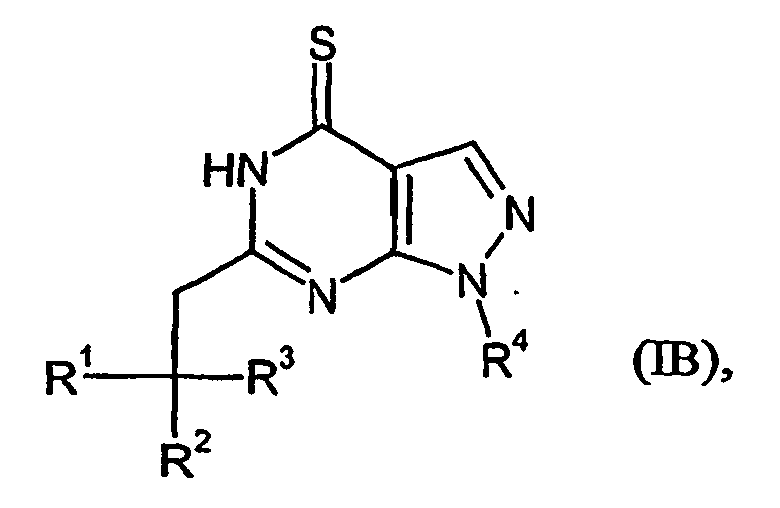
in welcher R1, R2, R3 und R4 die oben angegebenen Bedeutungen haben,
überführt,
und die resultierenden Verbindungen der Formel (I) gegebenenfalls mit den entsprechenden (i) Lösungsmitteln und/oder (ii) Basen oder Säuren zu ihren Solvaten, Salzen und/oder Solvaten der Salze umsetzt.
Claims (11)
- Verbindungen der Formel
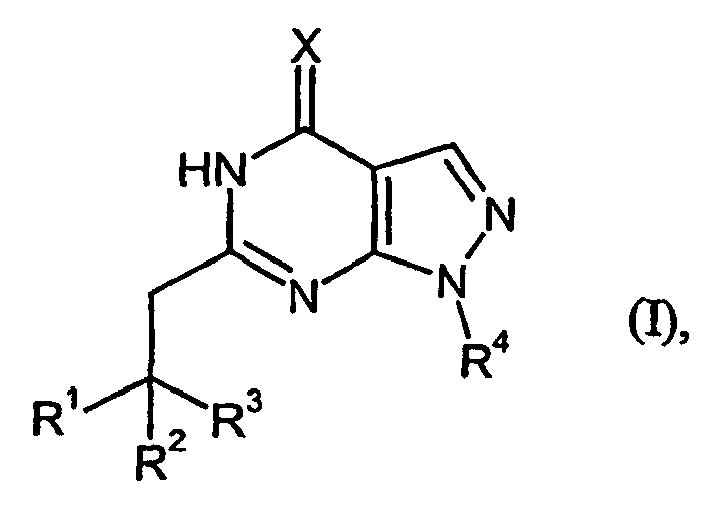
in welcherR1 C1-C6-Alkyl, Trifluormethyl, Hydroxy, C1-C6-Alkoxy, -C(=O)OR5 oder -C(=O)NR6R7, wobei C1-C6-Alkyl gegebenenfalls mit 1 bis 3 Resten unabhängig voneinander ausgewählt aus der Gruppe Hydroxy, C1-C6-Alkoxy, Halogen, Trifluormethyl, Trifluormethoxy, -C(=O)OR5 oder -C(=O)NR6R7 substituiert ist, undR5 für C1-C6-Alkyl,R6 und R7 unabhängig voneinander für Wasserstoff, C6-C10-Aryl, C1-C6-Alkyl stehen, oder
zusammen mit dem Stickstoffatom, an das sie gebunden sind, ein 4- bis 10-gliedriges Heterocyclyl bilden,R2 Wasserstoff, C1-C6-Alkyl, Trifluormethyl, C1-C6-Alkoxy,
oderR1 und R2 zusammen mit dem Kohlenstoffatom, an das sie gebunden sind, C3-C8-Cycloalkyl, C3-C8-Cycloalkenyl oder 4- bis 10-gliedriges Heterocyclyl bilden, die gegebenenfalls mit bis zu 2 Substituenten aus der Gruppe C1-C6-Alkyl, C1-C6-Alkoxy, Hydroxy, Oxo, -C(=O)OR8 substituiert sind, undR8 für C1-C6-Alkyl oder Benzyl steht,R3 Wasserstoff oder C1-C6-Alkyl,R4 Pentan-3-yl, C3-C6-Cycloalkyl,X Sauerstoff oder Schwefel,bedeuten, sowie deren Salze, Solvate und/oder Solvate der Salze. - Verbindungen nach Anspruch 1, wobeiR1 C1-C6-Alkyl, Hydroxy, C1-C6-Alkoxy, -C(=O)OR5 oder -C(=O)NR6R7, wobei C1-C6-Alkyl gegebenenfalls mit Hydroxy, C1-C6-Alkoxy, -C(=O)OR5 oder -C(=O)NR6R7 substituiert ist, undR5 für C1-C6-Alkyl,R6 und R7 unabhängig voneinander für Wasserstoff, C6-C10-Aryl, C1-C6-Alkyl stehen, oder
zusammen mit dem Stickstoffatom, an das sie gebunden sind, ein 4- bis 10-gliedriges Heterocyclyl bilden,R2 Wasserstoff, C1-C6-Alkyl, C1-C6-Alkoxy,
oderR1 und R2 zusammen mit dem Kohlenstoffatom, an das sie gebunden sind, C3-C8-Cycloalkyl, C3-C8-Cycloalkenyl oder 4- bis 10-gliedriges Heterocyclyl bilden, die gegebenenfalls mit bis zu 2 Substituenten aus der Gruppe C1-C6-Alkyl, C1-C6-Alkoxy, Hydroxy, Oxo, -C(=O)OR8 substituiert sind, undR8 für C1-C6-Alkyl oder Benzyl steht,R3 Wasserstoff oder C1-C6-Alkyl,R4 Pentan-3-yl, C4-C6-Cycloalkyl,X Sauerstoff oder Schwefel,
bedeuten,
sowie deren Salze, Solvate und/oder Solvate der Salze. - Verbindungen nach Ansprüchen 1 und 2, wobeiR1 C1-C4-Alkyl, Hydroxy, C1-C4-Alkoxy, -C(=O)OR5 oder -C(=O)NR6R7, wobei C1-C4-Alkyl gegebenenfalls mit Hydroxy, Trifluormethyl, C1-C4-Alkoxy, -C(=O)OR5 oder -C(=O)NR6R7 substituiert ist, undR5 für C1-C4-Alkyl,R6 und R7 unabhängig voneinander für Wasserstoff, Phenyl, C1-C4-Alkyl stehen, oder
zusammen mit dem Stickstoffatom, an das sie gebunden sind, ein 5- bis 6-gliedriges Heterocyclyl bilden,R2 Wasserstoff, C1-C4-Alkyl, Trifluormethyl, C1-C4-Alkoxy,
oderR1 und R2 zusammen mit dem Kohlenstoffatom, an das sie gebunden sind, C5-C6-Cycloalkyl, C5-C6-Cycloalkenyl oder 5- bis 6-gliedriges Heterocyclyl bilden, die gegebenenfalls mit bis zu 2 Substituenten aus der Gruppe C1-C4-Alkyl, C1-C4-Alkoxy, Hydroxy, Oxo, -C(=O)OR8 substituiert sind, undR8 für C1-C4-Alkyl oder Benzyl steht,R3 Wasserstoff,R4 Pentan-3-yl, C5-C6-Cycloalkyl,X Sauerstoff oder Schwefel,
bedeuten,
sowie deren Salze, Solvate und/oder Solvate der Salze. - Verbindungen nach Ansprüchen 1 bis 3, wobeiR1 Methyl, Ethyl, Isopropyl, Trifluormethyl, Methoxycarbonyl, Ethoxycarbonyl oder -C(=O)NR6R7, wobei Methyl gegebenenfalls mit Methoxycarbonyl oder Ethoxycarbonyl substituiert ist, undR6 für Phenyl steht undR7 für Wasserstoff steht,R2 Wasserstoff, Methyl, Trifluormethyl, oderR1 und R2 zusammen mit dem Kohlenstoffatom, an das sie gebunden sind, Cyclopentyl, Cyclohexyl, Cyclopentenyl oder Tetrahydrofuryl bilden, wobei Cyclohexyl gegebenenfalls mit Methyl substituiert ist, undR3 Wasserstoff,R4 Pentan-3-yl, C5-C6-Cycloalkyl,X Sauerstoff oder Schwefel,
bedeuten,
sowie deren Salze, Solvate und/oder Solvate der Salze. - Verbindungen nach Ansprüchen 1 bis 4, wobeiR1 Methyl, Ethyl, Isopropyl, Methoxycarbonyl, Ethoxycarbonyl oder -C(=O)NR6R7, wobei Methyl gegebenenfalls mit Methoxycarbonyl oder Ethoxycarbonyl substituiert ist, undR6 für Phenyl undR7 für Wasserstoff stehen,R2 Wasserstoff, Methyl, oderR1 und R2 zusammen mit dem Kohlenstoffatom, an das sie gebunden sind, Cyclopentyl, Cyclohexyl, Cyclopentenyl oder Tetrahydrofuryl bilden, wobei Cyclohexyl gegebenenfalls mit Methyl substituiert ist, undR3 Wasserstoff,R4 Pentan-3-yl, C5-C6-Cycloalkyl,X Sauerstoff,
bedeuten,
sowie deren Salze, Solvate und/oder Solvate der Salze. - Verfahren zur Herstellung von Verbindungen nach Ansprüchen 1 bis 5, dadurch gekennzeichnet, dass man[A] Verbindungen der Formel

in welcher R4 die oben angegebenen Bedeutungen hat,
durch Umsetzung mit einer Verbindung der Formel
in welcher R1, R2 und R3 die oben angegebenen Bedeutungen haben,
undZ für Chlor oder Brom steht,
in einem inerten Lösemittel und in Anwesenheit einer Base zunächst in Verbindungen der Formel
in welcher R1, R2, R3 und R4 die oben angegebenen Bedeutungen haben,
überführt,
dann in einem inerten Lösemittel in Gegenwart einer Base zu Verbindungen der Formel
in welcher R1, R2, R3 und R4 die oben angegebenen Bedeutungen haben,
cyclisiert,
oder[B] Verbindungen der Formel (II) unter direkter Cyclisierung zu (IA) mit einer Verbindung der Formel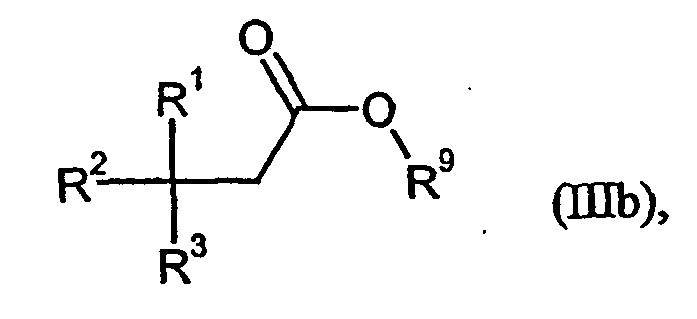
in welcher R1, R2 und R3 die oben angegebenen Bedeutungen haben
undR9 für Methyl oder Ethyl steht,
in einem inerten Lösemittel und in Anwesenheit einer Base umsetzt,
oder[C] Verbindungen der Formel
in welcher R4 die oben angegebenen Bedeutungen hat,
zunächst durch Umsetzung mit einer Verbindung der Formel (IIIa) in einem inerten Lösemittel und in Anwesenheit einer Base in Verbindungen der Formel
in welcher R1, R2, R3 und R4 die oben angegebenen Bedeutungen haben,
überführt,
und diese in einem zweiten Schritt in einem inerten Lösemittel und in Anwesenheit einer Base und eines Oxidationsmittels zu (IA) cyclisiert,
und die Verbindungen der Formel (IA) gegebenenfalls dann durch Umsetzung mit einem Schwefelungsmittel wie beispielsweise Diphosphorpentasulfid in die Thiono-Derivate der Formel
in welcher R1, R2, R3 und R4 die oben angegebenen Bedeutungen haben,
überführt,
und die resultierenden Verbindungen der Formel (I) gegebenenfalls mit den entsprechenden (i) Lösungsmitteln und/oder (ii) Basen oder Säuren zu ihren Solvaten, Salzen und/oder Solvaten der Salze umsetzt. - Verbindungen nach einem der Ansprüche 1 bis 5 zur Behandlung und/oder Prophylaxe von Krankheiten.
- Arzneimittel enthaltend mindestens eine der Verbindungen nach einem der Ansprüche 1 bis 5 und mindestens einen pharmazeutisch verträglichen, im wesentlichen nichtgiftigen Träger oder Exzipienten.
- Verwendung der Verbindungen nach einem der Ansprüche 1 bis 5 zur Herstellung eines Arzneimittels zur Prophylaxe und/oder Behandlung von Störungen der Wahrnehmung, Konzentrationsleistung, Lern- und/oder Gedächtnisleistung.
- Verwendung nach Anspruch 9, wobei die Störung eine Folge der Alzheimer'schen Krankheit ist.
- Verwendung der Verbindungen nach einem der Ansprüche 1 bis 5 zur Herstellung eines Arzneimittels zur Verbesserung der Wahrnehmung, Konzentrationsleistung, Lern- und/oder Gedächtnisleistung.
Applications Claiming Priority (3)
| Application Number | Priority Date | Filing Date | Title |
|---|---|---|---|
| DE10238724 | 2002-08-23 | ||
| DE10238724A DE10238724A1 (de) | 2002-08-23 | 2002-08-23 | Alkyl-substituierte Pyrazolpyrimidine |
| PCT/EP2003/008979 WO2004026876A1 (de) | 2002-08-23 | 2003-08-13 | Alkyl-substituierte pyrazolopyrimidine |
Publications (2)
| Publication Number | Publication Date |
|---|---|
| EP1534713A1 EP1534713A1 (de) | 2005-06-01 |
| EP1534713B1 true EP1534713B1 (de) | 2006-01-11 |
Family
ID=31197288
Family Applications (1)
| Application Number | Title | Priority Date | Filing Date |
|---|---|---|---|
| EP03797239A Expired - Lifetime EP1534713B1 (de) | 2002-08-23 | 2003-08-13 | Alkyl-substituierte pyrazolopyrimidine |
Country Status (8)
| Country | Link |
|---|---|
| US (2) | US8039477B2 (de) |
| EP (1) | EP1534713B1 (de) |
| JP (1) | JP4603885B2 (de) |
| AU (1) | AU2003251706A1 (de) |
| CA (1) | CA2496308C (de) |
| DE (2) | DE10238724A1 (de) |
| ES (1) | ES2256797T3 (de) |
| WO (1) | WO2004026876A1 (de) |
Families Citing this family (84)
| Publication number | Priority date | Publication date | Assignee | Title |
|---|---|---|---|---|
| US7407955B2 (en) | 2002-08-21 | 2008-08-05 | Boehringer Ingelheim Pharma Gmbh & Co., Kg | 8-[3-amino-piperidin-1-yl]-xanthines, the preparation thereof and their use as pharmaceutical compositions |
| DE10238724A1 (de) | 2002-08-23 | 2004-03-04 | Bayer Ag | Alkyl-substituierte Pyrazolpyrimidine |
| DE10238722A1 (de) | 2002-08-23 | 2004-03-11 | Bayer Ag | Selektive Phosphodiesterase 9A-Inhibitoren als Arzneimittel zur Verbesserung kognitiver Prozesse |
| DE10238723A1 (de) | 2002-08-23 | 2004-03-11 | Bayer Ag | Phenyl-substituierte Pyrazolyprimidine |
| DE10320785A1 (de) | 2003-05-09 | 2004-11-25 | Bayer Healthcare Ag | 6-Arylmethyl-substituierte Pyrazolopyrimidine |
| US8044060B2 (en) * | 2003-05-09 | 2011-10-25 | Boehringer Ingelheim International Gmbh | 6-cyclylmethyl- and 6-alkylmethyl pyrazolo[3,4-D]pyrimidines, methods for their preparation and methods for their use to treat impairments of perception, concentration learning and/or memory |
| DE10328479A1 (de) * | 2003-06-25 | 2005-01-13 | Bayer Ag | 6-Arylamino-5-cyano-4-pyrimidinone |
| DE102004001873A1 (de) | 2004-01-14 | 2005-09-29 | Bayer Healthcare Ag | Cyanopyrimidinone |
| US7501426B2 (en) | 2004-02-18 | 2009-03-10 | Boehringer Ingelheim International Gmbh | 8-[3-amino-piperidin-1-yl]-xanthines, their preparation and their use as pharmaceutical compositions |
| DE102004054054A1 (de) | 2004-11-05 | 2006-05-11 | Boehringer Ingelheim Pharma Gmbh & Co. Kg | Verfahren zur Herstellung chiraler 8-(3-Amino-piperidin-1-yl)-xanthine |
| DE102005024493A1 (de) * | 2005-05-27 | 2006-11-30 | Bayer Healthcare Ag | Verwendung von Pyrazolopyrimidinen |
| DE102005035891A1 (de) | 2005-07-30 | 2007-02-08 | Boehringer Ingelheim Pharma Gmbh & Co. Kg | 8-(3-Amino-piperidin-1-yl)-xanthine, deren Herstellung und deren Verwendung als Arzneimittel |
| PE20080251A1 (es) | 2006-05-04 | 2008-04-25 | Boehringer Ingelheim Int | Usos de inhibidores de dpp iv |
| BRPI0711558A2 (pt) | 2006-05-04 | 2011-11-08 | Boeringer Ingelheim Internat Gmbh | polimorfos |
| EP1852108A1 (de) | 2006-05-04 | 2007-11-07 | Boehringer Ingelheim Pharma GmbH & Co.KG | Zusammensetzungen von DPP-IV-Inhibitoren |
| US8648085B2 (en) | 2007-11-30 | 2014-02-11 | Boehringer Ingelheim International Gmbh | 1, 5-dihydro-pyrazolo (3, 4-D) pyrimidin-4-one derivatives and their use as PDE9A mudulators for the treatment of CNS disorders |
| UA105362C2 (en) * | 2008-04-02 | 2014-05-12 | Бьорингер Ингельхайм Интернациональ Гмбх | 1-heterocyclyl-1, 5-dihydro-pyrazolo [3, 4-d] pyrimidin-4-one derivatives and their use as pde9a modulators |
| PE20140960A1 (es) | 2008-04-03 | 2014-08-15 | Boehringer Ingelheim Int | Formulaciones que comprenden un inhibidor de dpp4 |
| BRPI0916997A2 (pt) | 2008-08-06 | 2020-12-15 | Boehringer Ingelheim International Gmbh | Inibidor de dpp-4 e seu uso |
| UY32030A (es) | 2008-08-06 | 2010-03-26 | Boehringer Ingelheim Int | "tratamiento para diabetes en pacientes inapropiados para terapia con metformina" |
| CN102143965A (zh) | 2008-09-08 | 2011-08-03 | 贝林格尔.英格海姆国际有限公司 | 吡唑并嘧啶酮及其在治疗中枢神经系统疾病中的用途 |
| AU2009290911A1 (en) | 2008-09-10 | 2010-03-18 | Boehringer Ingelheim International Gmbh | Combination therapy for the treatment of diabetes and related conditions |
| US20200155558A1 (en) | 2018-11-20 | 2020-05-21 | Boehringer Ingelheim International Gmbh | Treatment for diabetes in patients with insufficient glycemic control despite therapy with an oral antidiabetic drug |
| EP2382216A1 (de) | 2008-12-23 | 2011-11-02 | Boehringer Ingelheim International GmbH | Salzformen einer organischen verbindung |
| AR074990A1 (es) | 2009-01-07 | 2011-03-02 | Boehringer Ingelheim Int | Tratamiento de diabetes en pacientes con un control glucemico inadecuado a pesar de la terapia con metformina |
| UY32531A (es) | 2009-03-31 | 2010-10-29 | Boehringer Ingelheim Int | Nuevos compuestos para el tratamiento de trastornos del snc |
| AR077859A1 (es) | 2009-08-12 | 2011-09-28 | Boehringer Ingelheim Int | Compuestos para el tratamiento de trastornos del snc |
| EA034869B1 (ru) | 2009-11-27 | 2020-03-31 | Бёрингер Ингельхайм Интернациональ Гмбх | Лечение генотипированных пациентов с диабетом ингибиторами дпп-4, такими как линаглиптин |
| MX341025B (es) | 2010-05-05 | 2016-08-04 | Boehringer Ingelheim Int Gmbh * | Terapia de combinacion. |
| PH12012502524A1 (en) | 2010-06-24 | 2014-02-10 | Boehringer Ingelheim Int | Diabetes therapy |
| BR112013003097B1 (pt) | 2010-08-12 | 2021-03-16 | Boehringer Ingelheim International Gmbh | 6-cicloalquil-pirazolopirimidinonas e composição farmacêutica |
| US9034883B2 (en) | 2010-11-15 | 2015-05-19 | Boehringer Ingelheim International Gmbh | Vasoprotective and cardioprotective antidiabetic therapy |
| US20130040971A1 (en) | 2011-02-14 | 2013-02-14 | Boehringer Ingelheim International Gmbh | 6-cycloalkyl-pyrazolopyrimidinones for the treatment of cns disorders |
| US8809345B2 (en) | 2011-02-15 | 2014-08-19 | Boehringer Ingelheim International Gmbh | 6-cycloalkyl-pyrazolopyrimidinones for the treatment of CNS disorders |
| WO2012131539A1 (en) | 2011-03-31 | 2012-10-04 | Pfizer Inc. | Novel bicyclic pyridinones |
| WO2012172449A1 (en) | 2011-06-13 | 2012-12-20 | Pfizer Inc. | Lactams as beta secretase inhibitors |
| EP3517539B1 (de) | 2011-07-15 | 2022-12-14 | Boehringer Ingelheim International GmbH | Substituiertes dimeres chinazolinderivat, dessen herstellung und dessen verwendung in pharmazeutischen zusammensetzungen zur behandlung von diabetes typ i und ii |
| WO2013030713A1 (en) | 2011-08-31 | 2013-03-07 | Pfizer Inc. | Hexahydropyrano [3,4-d][1,3] thiazin-2-amine compounds |
| US9555001B2 (en) | 2012-03-07 | 2017-01-31 | Boehringer Ingelheim International Gmbh | Pharmaceutical composition and uses thereof |
| WO2013164730A1 (en) | 2012-05-04 | 2013-11-07 | Pfizer Inc. | Heterocyclic substituted hexahydropyrano [3,4-d] [1,3] thiazin- 2 -amine compounds as inhibitors of app, bace1 and bace 2. |
| US20130303554A1 (en) | 2012-05-14 | 2013-11-14 | Boehringer Ingelheim International Gmbh | Use of a dpp-4 inhibitor in sirs and/or sepsis |
| JP6224084B2 (ja) | 2012-05-14 | 2017-11-01 | ベーリンガー インゲルハイム インターナショナル ゲゼルシャフト ミット ベシュレンクテル ハフツング | 糸球体上皮細胞関連障害及び/又はネフローゼ症候群の治療に用いるdpp−4阻害薬としてのキサンチン誘導体 |
| WO2013174767A1 (en) | 2012-05-24 | 2013-11-28 | Boehringer Ingelheim International Gmbh | A xanthine derivative as dpp -4 inhibitor for use in modifying food intake and regulating food preference |
| EA025186B1 (ru) | 2012-06-29 | 2016-11-30 | Пфайзер Инк. | НОВЫЕ 4-(ЗАМЕЩЕННЫЙ АМИНО)-7Н-ПИРРОЛО[2,3-d]ПИРИМИДИНЫ В КАЧЕСТВЕ ИНГИБИТОРОВ LRRK2 |
| CN102786525B (zh) * | 2012-08-08 | 2014-12-17 | 中山大学 | N-取代吡唑并[3,4-d]嘧啶酮类化合物、其制备方法及其应用 |
| JP2015529239A (ja) | 2012-09-20 | 2015-10-05 | ファイザー・インク | アルキル置換ヘキサヒドロピラノ[3,4−d][1,3]チアジン−2−アミン化合物 |
| UA110688C2 (uk) | 2012-09-21 | 2016-01-25 | Пфайзер Інк. | Біциклічні піридинони |
| CA2893256A1 (en) | 2012-12-11 | 2014-06-19 | Pfizer Inc. | Hexahydropyrano [3,4-d][1,3]thiazin-2-amine compounds as inhibitors of bace1 |
| CA2893333C (en) | 2012-12-19 | 2017-10-24 | Pfizer Inc. | Carbocyclic-and heterocyclic-substituted hexahydropyrano[3,4-d][1,3]thiazin-2-amine compounds |
| WO2014125394A1 (en) | 2013-02-13 | 2014-08-21 | Pfizer Inc. | HETEROARYL-SUBSTITUTED HEXAHYDROPYRANO [3,4-d][1,3] THIAZIN-2-AMINE COMPOUNDS |
| US9233981B1 (en) | 2013-02-15 | 2016-01-12 | Pfizer Inc. | Substituted phenyl hexahydropyrano[3,4-d][1,3]thiazin-2-amine compounds |
| MD20150071A2 (ro) | 2013-02-19 | 2016-02-29 | Pfizer Inc. | Compuşi azabenzimidazolici ca inhibitori ai PDE4 izoenzimelor pentru tratamentul tulburărilor SNC şi altor afecţiuni |
| WO2015049616A1 (en) | 2013-10-04 | 2015-04-09 | Pfizer Inc. | Novel bicyclic pyridinones as gamma-secretase modulators |
| EP3083618B1 (de) | 2013-12-17 | 2018-02-21 | Pfizer Inc | Neuartige 3,4-disubstituierte-1h-pyrrolo[2,3-b]pyridine und 4,5-disubstituierte 7h-pyrrolo[2,3-c]pyridazine als lrrk2-hemmer |
| US9526728B2 (en) | 2014-02-28 | 2016-12-27 | Boehringer Ingelheim International Gmbh | Medical use of a DPP-4 inhibitor |
| BR112016022519A8 (pt) | 2014-04-01 | 2018-03-06 | Pfizer | cromeno e 1,1a,2,7b-tetra-hidrociclopropa[c]cromeno piridopirazinadionas como moduladores de gama-secretase |
| JP6111002B1 (ja) | 2014-04-10 | 2017-04-05 | ファイザー・インク | 2−アミノ−6−メチル−4,4a,5,6−テトラヒドロピラノ[3,4−d][1,3]チアジン−8a(8H)−イル−1,3−チアゾール−4−イルアミド |
| WO2016012896A1 (en) | 2014-07-24 | 2016-01-28 | Pfizer Inc. | Pyrazolopyrimidine compounds |
| EA031201B1 (ru) | 2014-08-06 | 2018-11-30 | Пфайзер Инк. | Соединения имидазопиридазина |
| TW201629064A (zh) | 2014-10-10 | 2016-08-16 | H 朗德貝克公司 | 作爲pde1抑制劑之三唑並吡酮 |
| EP3237401B1 (de) | 2014-12-22 | 2019-03-06 | Pfizer Inc | Antagonisten des prostaglandin-ep3-rezeptors |
| KR102000382B1 (ko) | 2015-02-03 | 2019-07-15 | 화이자 인코포레이티드 | 신규 시클로프로파벤조푸라닐 피리도피라진디온 |
| JO3627B1 (ar) | 2015-04-30 | 2020-08-27 | H Lundbeck As | إيميدازو بيرازينونات على هيئة مثبطات pde1 |
| DK3310784T3 (da) | 2015-06-17 | 2020-11-09 | Pfizer | Tricykliske forbindelser og deres anvendelse som phosphodiesterasehæmmere |
| RU2722149C1 (ru) | 2015-09-14 | 2020-05-27 | Пфайзер Инк. | Новые производные имидазо[4,5-c] хинолинов и имидазо[4,5-c][1,5] нафтиридинов в качестве ингибиторов LRRK2 |
| EP3353174A1 (de) | 2015-09-24 | 2018-08-01 | Pfizer Inc | N-[2-(3-amino-2,5-dimethyl-1,1-dioxid-5,6-dihydro-2h-1,2,4-thiadiazin-5-yl)]-1,3-thiazol-4-yl-amide als bace-hemmer |
| WO2017051303A1 (en) | 2015-09-24 | 2017-03-30 | Pfizer Inc. | Tetrahydropyrano[3,4-d][1,3]oxazin derivatives and their use as bace inhibitors |
| JP2018531923A (ja) | 2015-09-24 | 2018-11-01 | ファイザー・インク | N−[2−(2−アミノ−6,6−二置換−4,4a,5,6−テトラヒドロピラノ[3,4−d][1,3]チアジン−8a(8H)−イル)−1,3−チアゾール−4−イル]アミド |
| KR102148587B1 (ko) | 2016-02-23 | 2020-08-26 | 화이자 인코포레이티드 | 6,7-디히드로-5H-피라졸로[5,1-b][1,3]옥사진-2-카르복스아미드 화합물 |
| TWI729109B (zh) | 2016-04-12 | 2021-06-01 | 丹麥商H 朗德貝克公司 | 作爲PDE1抑制劑的1,5-二氫-4H-吡唑并[3,4-d]嘧啶-4-酮和1,5-二氫-4H-吡唑并[4,3-c]吡啶-4-酮 |
| CN109310697A (zh) | 2016-06-10 | 2019-02-05 | 勃林格殷格翰国际有限公司 | 利格列汀和二甲双胍的组合 |
| PL3478679T3 (pl) | 2016-07-01 | 2021-10-25 | Pfizer Inc. | Pochodne 5,7-dihydro-pirolopirydyny do leczenia chorób neurologicznych i neurodegeneracyjnych |
| US10633382B2 (en) | 2016-10-18 | 2020-04-28 | H. Lundbeck A/S | Imidazopyrazinones, pyrazolopyrimidinones and pyrazolopyridinones as PDE1 inhibitors |
| LT3532064T (lt) | 2016-10-28 | 2020-09-25 | H. Lundbeck A/S | Kompleksiniai gydymai, apimantys imidazopirazonus, skirti psichiatrinių ir (arba) kognityvinių sutrikimų gydymui |
| RU2019108717A (ru) | 2016-10-28 | 2020-11-30 | Х. Лундбекк А/С | Комбинированные средства для лечения, предусматривающего введение имидазопиразинонов |
| ES2910083T3 (es) | 2017-03-10 | 2022-05-11 | Pfizer | Derivados de imidazo[4,5-c]quinolina cíclicos sustituidos |
| SG10202110112TA (en) | 2017-03-10 | 2021-10-28 | Pfizer | Novel imidazo[4,5-c]quinoline derivatives as lrrk2 inhibitors |
| WO2018226992A1 (en) | 2017-06-07 | 2018-12-13 | Adrx, Inc. | Tau aggregation inhibitors |
| FI3642202T3 (fi) | 2017-06-22 | 2023-03-01 | Dihydro-pyrrolo-pyridiinijohdannaisia | |
| CA3073062A1 (en) | 2017-08-18 | 2019-02-21 | Adrx, Inc. | Tau aggregation peptide inhibitors |
| EP3768669B1 (de) | 2018-03-23 | 2023-01-25 | Pfizer Inc. | Piperazinazaspiroderivate |
| EP4297868A4 (de) | 2021-02-23 | 2025-01-08 | Hoth Therapeutics, Inc. | Verwendung von aprepitant zur behandlung von alzheimer |
| WO2024118524A1 (en) | 2022-11-28 | 2024-06-06 | Cerevel Therapeutics, Llc | Azaindole compounds and their use as phosphodiesterase inhibitors |
| AU2024413926A1 (en) | 2023-12-29 | 2026-07-09 | Pfizer Inc. | Crystalline forms of a muscarinic m4 receptor modulator and methods of treating diseases |
Family Cites Families (77)
| Publication number | Priority date | Publication date | Assignee | Title |
|---|---|---|---|---|
| US3169965A (en) | 1965-02-16 | New x-mercapto-pyrazolo | ||
| US3165520A (en) | 1965-01-12 | Certificate of correction | ||
| CH396926A (de) | 1960-05-11 | 1965-08-15 | Ciba Geigy | Verfahren zur Herstellung neuer Pyrazolopyrimidine |
| DE1153023B (de) * | 1960-05-11 | 1963-08-22 | Ciba Geigy | Verfahren zur Herstellung von 4-Hydroxy-pyrazolo[3,4-d] pyrimidinen |
| CH396927A (de) * | 1960-05-11 | 1965-08-15 | Ciba Geigy | Verfahren zur Herstellung neuer Pyrazolopyrimidine |
| DE1147234B (de) | 1960-05-11 | 1963-04-18 | Ciba Geigy | Verfahren zur Herstellung von 1-Isopropyl-4-hydroxy-6-benzyl-pyrazolo[3, 4-d]pyrimidin |
| ES267249A1 (es) | 1960-05-11 | 1961-11-01 | Ciba Geigy | Procedimiento para la obtencion de pirazolo-pirimidinas nuevas |
| DE1156415B (de) * | 1960-05-11 | 1963-10-31 | Ciba Geigy | Verfahren zur Herstellung von 1-Isopropyl-4-hydroxy-pyrazolo [3, 4-d]-pyrimidinen |
| GB973361A (en) * | 1960-05-11 | 1964-10-28 | Ciba Ltd | Pyrazolo-pyrimidines and process for their manufacture |
| GB937723A (en) | 1960-05-11 | 1963-09-25 | Ciba Ltd | Pyrazolo-pyrimidines and process for their manufacture |
| DE1149013B (de) * | 1960-05-11 | 1963-05-22 | Ciba Geigy | Verfahren zur Herstellung von 4-Oxo-4, 5-dihydro-pyrazolo-[3, 4-d]Pyrimidinen |
| DE1161281B (de) | 1960-05-11 | 1964-01-16 | Ciba Aktiengesellschaft, Basel (Schweiz) | Verfahren zur Herstellung von 1-Alkyl-6-aralkyl-pyrazoloÄ3,4-dÜ-pyrimidinen. |
| CH396923A (de) * | 1960-05-11 | 1965-08-15 | Ciba Geigy | Verfahren zur Herstellung von 4-Mercapto-pyrazolo(3,4-d)pyrimidinen |
| CH396925A (de) * | 1960-05-11 | 1965-08-15 | Ciba Geigy | Verfahren zur Herstellung neuer Pyrazolopyrimidine |
| CH398626A (de) | 1960-05-11 | 1966-03-15 | Ciba Geigy | Verfahren zur Herstellung neuer Pyrazolopyrimidine |
| CH396924A (de) * | 1960-05-11 | 1965-08-15 | Ciba Geigy | Verfahren zur Herstellung von 4-Mercapto-pyrazolo(3,4-d)pyrimidinen |
| US3732225A (en) | 1970-07-23 | 1973-05-08 | Squibb & Sons Inc | Pyrazolo(3,4-d)pyrimidine derivatives |
| US3847908A (en) | 1973-03-05 | 1974-11-12 | Squibb & Sons Inc | 6-styrylpyrazolo(3,4-d)pyrimidinones and pyrimidines |
| GR82004B (de) | 1983-06-30 | 1984-12-12 | American Home Prod | |
| US6211158B1 (en) | 1987-04-10 | 2001-04-03 | Roche Diagnostics Gmbh | Desazapurine-nucleotide derivatives, processes for the preparation thereof, pharmaceutical compositions containing them and the use thereof for nucleic acid sequencing and as antiviral agents |
| DE3739366A1 (de) | 1987-04-10 | 1988-10-27 | Boehringer Mannheim Gmbh | Desaza-purin-nucleosid-derivate, verfahren zu deren herstellung sowie deren verwendung bei der nucleinsaeure-sequenzierung sowie als antivirale mittel |
| US5047407A (en) | 1989-02-08 | 1991-09-10 | Iaf Biochem International, Inc. | 2-substituted-5-substituted-1,3-oxathiolanes with antiviral properties |
| US6175008B1 (en) | 1988-04-11 | 2001-01-16 | Biochem Pharma Inc. | Processes for preparing substituted 1,3-oxathiolanes with antiviral properties |
| US5270315A (en) | 1988-04-11 | 1993-12-14 | Biochem Pharma Inc. | 4-(purinyl bases)-substituted-1,3-dioxlanes |
| US5466806A (en) | 1989-02-08 | 1995-11-14 | Biochem Pharma Inc. | Processes for preparing substituted 1,3-oxathiolanes with antiviral properties |
| US7119202B1 (en) | 1989-02-08 | 2006-10-10 | Glaxo Wellcome Inc. | Substituted-1,3-oxathiolanes and substituted-1,3-dioxolanes with antiviral properties |
| US5041449A (en) | 1988-04-11 | 1991-08-20 | Iaf Biochem International, Inc. | 4-(nucleoside base)-substituted-1,3-dioxolanes useful for treatment of retroviral infections |
| US6350753B1 (en) | 1988-04-11 | 2002-02-26 | Biochem Pharma Inc. | 2-Substituted-4-substituted-1,3-dioxolanes and use thereof |
| US6903224B2 (en) | 1988-04-11 | 2005-06-07 | Biochem Pharma Inc. | Substituted 1,3-oxathiolanes |
| DK0674634T3 (da) | 1989-02-08 | 2003-08-04 | Iaf Biochem Int | Fremgangsmåde til fremstilling af substituerede 1,3-oxathiolaner med antivirale egenskaber |
| JP2619710B2 (ja) | 1989-02-27 | 1997-06-11 | 日本製紙 株式会社 | 2′,3′−ジデオキシプリンヌクレオシド類の製造方法 |
| US5002949A (en) | 1990-05-01 | 1991-03-26 | American Home Products Corporation | 5-substituted-6-aminopyrimidine derivatives |
| FI933303L (fi) | 1991-01-23 | 1993-08-31 | Gensia Inc | Adenosinkinasinhibitorer |
| US5294612A (en) | 1992-03-30 | 1994-03-15 | Sterling Winthrop Inc. | 6-heterocyclyl pyrazolo [3,4-d]pyrimidin-4-ones and compositions and method of use thereof |
| IL108523A0 (en) | 1993-02-03 | 1994-05-30 | Gensia Inc | Pharmaceutical compositions containing adenosine kinase inhibitors for preventing or treating conditions involving inflammatory responses and pain |
| US5256668A (en) | 1993-03-17 | 1993-10-26 | American Home Products Corporation | Aminopyrimidine derivatives as antiviral agents for respiratory syncytial virus |
| ES2128535T3 (es) | 1993-05-12 | 1999-05-16 | Novartis Ag | Nucleosidos y oligonucleotidos con grupos 2'-eter. |
| JP3398152B2 (ja) | 1993-10-12 | 2003-04-21 | ブリストル‐マイヤーズ・スクイブ・ファーマ・カンパニー | 1n−アルキル−n−アリールピリミジンアミンおよびその誘導体 |
| ES2203635T3 (es) | 1994-04-27 | 2004-04-16 | Novartis Ag | Nucleosidos y oligonucleotidos con grupos 2'-eter. |
| GB9423910D0 (en) | 1994-11-26 | 1995-01-11 | Pfizer Ltd | Therapeutic agents |
| US5656629A (en) * | 1995-03-10 | 1997-08-12 | Sanofi Winthrop, Inc. | 6-substituted pyrazolo (3,4-d)pyrimidin-4-ones and compositions and methods of use thereof |
| US6509320B1 (en) | 1996-10-16 | 2003-01-21 | Icn Pharmaceuticals, Inc. | Purine L-nucleosides, analogs and uses thereof |
| AU727177B2 (en) | 1996-10-16 | 2000-12-07 | Icn Pharmaceuticals, Inc. | Purine L-nucleosides, analogs and uses thereof |
| DE19709877A1 (de) | 1997-03-11 | 1998-09-17 | Bayer Ag | 1,5-Dihydro-pyrazolo[3,4-d]-pyrimidinon-derivate |
| US5948812A (en) | 1997-06-09 | 1999-09-07 | Givaudan Roure (International) Sa | 1,7-dioxacycloalkan-8-one compounds |
| DE19838705A1 (de) | 1998-08-26 | 2000-03-02 | Bayer Ag | Neue Dihydro-(1,2,3)-triazolo-[4,5-d]pyrimidin-7-one |
| GB9823103D0 (en) | 1998-10-23 | 1998-12-16 | Pfizer Ltd | Pharmaceutically active compounds |
| US6225315B1 (en) | 1998-11-30 | 2001-05-01 | Pfizer Inc | Method of treating nitrate-induced tolerance |
| US6100037A (en) | 1999-01-07 | 2000-08-08 | Incyte Pharmaceuticals, Inc. | Human cyclic nucleotide PDEs |
| US6369222B1 (en) | 2000-07-18 | 2002-04-09 | Hoffmann-La Roche Inc. | mGluR antagonists and a method for their synthesis |
| EP1307201B1 (de) | 2000-08-01 | 2004-11-24 | Bayer HealthCare AG | Selektive pde 2-inhibitoren als arzneimittel zur verbesserung der wahrnehmung |
| GB0100621D0 (en) * | 2001-01-10 | 2001-02-21 | Vernalis Res Ltd | Chemical compounds VI |
| DE10108752A1 (de) | 2001-02-23 | 2002-09-05 | Bayer Ag | Neue Substituierte Imidazotriazinone |
| WO2002086160A1 (en) | 2001-04-18 | 2002-10-31 | Mitsubishi Rayon Co., Ltd. | Hybridization probes |
| BR0210102A (pt) | 2001-06-01 | 2004-06-08 | Hoffmann La Roche | Derivados de pirimidina, triazina e pirazina como receptores de glutamato |
| EP1395257A1 (de) | 2001-06-12 | 2004-03-10 | Elan Pharmaceuticals, Inc. | Makrocyclische verbindungen zur behandlung der alzheimer-krankheit |
| WO2003011925A1 (en) | 2001-07-25 | 2003-02-13 | Ppg Industries Ohio, Inc. | High refractive index optical resin composition |
| KR20040053210A (ko) * | 2001-11-02 | 2004-06-23 | 화이자 프로덕츠 인크. | Pde9 억제제를 사용한 인슐린 저항 증후군 및 2형당뇨병의 치료 |
| HN2002000317A (es) * | 2001-11-02 | 2003-05-21 | Pfizer | Inhibidores de pde9 para tratamiento de trastornos cardiovasculares |
| DE10156249A1 (de) | 2001-11-15 | 2003-05-28 | Bayer Ag | Regulation der cGMP-spezifischen Phosphodiesterase 9A |
| DE10219435A1 (de) | 2002-05-02 | 2003-11-13 | Bayer Cropscience Ag | Substituierte Pyrazolo-pyrimidin-4-one |
| DE10238723A1 (de) | 2002-08-23 | 2004-03-11 | Bayer Ag | Phenyl-substituierte Pyrazolyprimidine |
| DE10238722A1 (de) | 2002-08-23 | 2004-03-11 | Bayer Ag | Selektive Phosphodiesterase 9A-Inhibitoren als Arzneimittel zur Verbesserung kognitiver Prozesse |
| AU2003257666A1 (en) | 2002-08-23 | 2004-03-11 | Kirin Beer Kabushiki Kaisha | COMPOUND HAVING TGFss INHIBITORY ACTIVITY AND MEDICINAL COMPOSITION CONTAINING THE SAME |
| DE10238724A1 (de) | 2002-08-23 | 2004-03-04 | Bayer Ag | Alkyl-substituierte Pyrazolpyrimidine |
| ATE368666T1 (de) | 2003-03-18 | 2007-08-15 | Jordanian Pharmaceutical Mfg | Pyrazolopyrimidinone und ihre verwendung als pde inhibitoren |
| US20040220186A1 (en) | 2003-04-30 | 2004-11-04 | Pfizer Inc. | PDE9 inhibitors for treating type 2 diabetes,metabolic syndrome, and cardiovascular disease |
| DE10320785A1 (de) | 2003-05-09 | 2004-11-25 | Bayer Healthcare Ag | 6-Arylmethyl-substituierte Pyrazolopyrimidine |
| WO2004099211A1 (de) | 2003-05-09 | 2004-11-18 | Bayer Healthcare Ag | 6-cyclylmethyl- und 6-alkylmethyl-substituierte pyrazolopyrimidine |
| US8044060B2 (en) | 2003-05-09 | 2011-10-25 | Boehringer Ingelheim International Gmbh | 6-cyclylmethyl- and 6-alkylmethyl pyrazolo[3,4-D]pyrimidines, methods for their preparation and methods for their use to treat impairments of perception, concentration learning and/or memory |
| CN101152185B (zh) | 2003-06-06 | 2010-12-08 | 阿里克斯股份公司 | 杂环化合物作为scce抑制剂的用途 |
| DE10328479A1 (de) | 2003-06-25 | 2005-01-13 | Bayer Ag | 6-Arylamino-5-cyano-4-pyrimidinone |
| AU2004293423A1 (en) | 2003-11-21 | 2005-06-09 | University Of Connecticut | Heterocyclyl-substituted oxetanes for the treatment of proliferative or infectious diseases |
| DE102004001873A1 (de) | 2004-01-14 | 2005-09-29 | Bayer Healthcare Ag | Cyanopyrimidinone |
| JP2006201272A (ja) | 2005-01-18 | 2006-08-03 | Tamura Seisakusho Co Ltd | Ip電話端末及びカラオケ配信サーバシステム |
| US8648085B2 (en) | 2007-11-30 | 2014-02-11 | Boehringer Ingelheim International Gmbh | 1, 5-dihydro-pyrazolo (3, 4-D) pyrimidin-4-one derivatives and their use as PDE9A mudulators for the treatment of CNS disorders |
| UY32531A (es) | 2009-03-31 | 2010-10-29 | Boehringer Ingelheim Int | Nuevos compuestos para el tratamiento de trastornos del snc |
-
2002
- 2002-08-23 DE DE10238724A patent/DE10238724A1/de not_active Withdrawn
-
2003
- 2003-08-13 US US10/524,956 patent/US8039477B2/en not_active Expired - Lifetime
- 2003-08-13 ES ES03797239T patent/ES2256797T3/es not_active Expired - Lifetime
- 2003-08-13 EP EP03797239A patent/EP1534713B1/de not_active Expired - Lifetime
- 2003-08-13 CA CA2496308A patent/CA2496308C/en not_active Expired - Lifetime
- 2003-08-13 AU AU2003251706A patent/AU2003251706A1/en not_active Abandoned
- 2003-08-13 DE DE50302207T patent/DE50302207D1/de not_active Expired - Lifetime
- 2003-08-13 JP JP2004536941A patent/JP4603885B2/ja not_active Expired - Lifetime
- 2003-08-13 WO PCT/EP2003/008979 patent/WO2004026876A1/de not_active Ceased
-
2011
- 2011-07-29 US US13/193,931 patent/US8741907B2/en not_active Expired - Fee Related
Also Published As
| Publication number | Publication date |
|---|---|
| CA2496308A1 (en) | 2004-04-01 |
| WO2004026876A1 (de) | 2004-04-01 |
| DE50302207D1 (de) | 2006-04-06 |
| US8741907B2 (en) | 2014-06-03 |
| EP1534713A1 (de) | 2005-06-01 |
| AU2003251706A1 (en) | 2004-04-08 |
| US20060111372A1 (en) | 2006-05-25 |
| CA2496308C (en) | 2011-07-26 |
| JP4603885B2 (ja) | 2010-12-22 |
| DE10238724A1 (de) | 2004-03-04 |
| JP2006503051A (ja) | 2006-01-26 |
| ES2256797T3 (es) | 2006-07-16 |
| US8039477B2 (en) | 2011-10-18 |
| US20110294834A1 (en) | 2011-12-01 |
Similar Documents
| Publication | Publication Date | Title |
|---|---|---|
| EP1534711B1 (de) | Phenyl-substituierte pyrazolopyrimidine | |
| US8741907B2 (en) | Alkyl-substituted pyrazolopyrimidines | |
| EP1534285B1 (de) | Selektive phosphodiesterase 9a-inhibitoren als arzneimittel zur verbesserung kognitiver prozesse | |
| EP1628980B1 (de) | 6-arylmethyl-substituierte pyrazolopyrimidine | |
| EP1626971B1 (de) | 6-cyclylmethyl- und 6-alkylmethyl-substituierte pyrazolopyrimidine | |
| EP1644339B1 (de) | 6-arylamino-5-cyano-4-pyrimidinone als pde9a-inhibitoren | |
| EP1709009B1 (de) | 6-amino-5-cyano-pyrimidin-4-one zur verbesserung von wahrnehmung, konzentrations-, lern- und/oder gedächtnisleistung | |
| EP2298773B1 (de) | 6-Cyclylmethyl- und 6-Alkylmethyl-substituierte Pyrazolopyrimidine |
Legal Events
| Date | Code | Title | Description |
|---|---|---|---|
| PUAI | Public reference made under article 153(3) epc to a published international application that has entered the european phase |
Free format text: ORIGINAL CODE: 0009012 |
|
| 17P | Request for examination filed |
Effective date: 20050323 |
|
| AK | Designated contracting states |
Kind code of ref document: A1 Designated state(s): AT BE BG CH CY CZ DE DK EE ES FI FR GB GR HU IE IT LI LU MC NL PT RO SE SI SK TR |
|
| AX | Request for extension of the european patent |
Extension state: AL LT LV MK |
|
| GRAP | Despatch of communication of intention to grant a patent |
Free format text: ORIGINAL CODE: EPIDOSNIGR1 |
|
| GRAS | Grant fee paid |
Free format text: ORIGINAL CODE: EPIDOSNIGR3 |
|
| GRAA | (expected) grant |
Free format text: ORIGINAL CODE: 0009210 |
|
| DAX | Request for extension of the european patent (deleted) | ||
| RBV | Designated contracting states (corrected) |
Designated state(s): DE ES FR GB IT |
|
| AK | Designated contracting states |
Kind code of ref document: B1 Designated state(s): DE ES FR GB IT |
|
| REF | Corresponds to: |
Ref document number: 50302207 Country of ref document: DE Date of ref document: 20060406 Kind code of ref document: P |
|
| GBT | Gb: translation of ep patent filed (gb section 77(6)(a)/1977) |
Effective date: 20060502 |
|
| REG | Reference to a national code |
Ref country code: ES Ref legal event code: FG2A Ref document number: 2256797 Country of ref document: ES Kind code of ref document: T3 |
|
| ET | Fr: translation filed | ||
| PLBE | No opposition filed within time limit |
Free format text: ORIGINAL CODE: 0009261 |
|
| STAA | Information on the status of an ep patent application or granted ep patent |
Free format text: STATUS: NO OPPOSITION FILED WITHIN TIME LIMIT |
|
| 26N | No opposition filed |
Effective date: 20061012 |
|
| REG | Reference to a national code |
Ref country code: GB Ref legal event code: 732E |
|
| REG | Reference to a national code |
Ref country code: FR Ref legal event code: TP |
|
| REG | Reference to a national code |
Ref country code: ES Ref legal event code: PC2A |
|
| REG | Reference to a national code |
Ref country code: FR Ref legal event code: PLFP Year of fee payment: 14 |
|
| REG | Reference to a national code |
Ref country code: FR Ref legal event code: PLFP Year of fee payment: 15 |
|
| REG | Reference to a national code |
Ref country code: FR Ref legal event code: PLFP Year of fee payment: 16 |
|
| PGFP | Annual fee paid to national office [announced via postgrant information from national office to epo] |
Ref country code: IT Payment date: 20220825 Year of fee payment: 20 Ref country code: GB Payment date: 20220822 Year of fee payment: 20 Ref country code: DE Payment date: 20220620 Year of fee payment: 20 |
|
| PGFP | Annual fee paid to national office [announced via postgrant information from national office to epo] |
Ref country code: FR Payment date: 20220823 Year of fee payment: 20 |
|
| PGFP | Annual fee paid to national office [announced via postgrant information from national office to epo] |
Ref country code: ES Payment date: 20221024 Year of fee payment: 20 |
|
| REG | Reference to a national code |
Ref country code: DE Ref legal event code: R071 Ref document number: 50302207 Country of ref document: DE |
|
| REG | Reference to a national code |
Ref country code: ES Ref legal event code: FD2A Effective date: 20230825 |
|
| REG | Reference to a national code |
Ref country code: GB Ref legal event code: PE20 Expiry date: 20230812 |
|
| PG25 | Lapsed in a contracting state [announced via postgrant information from national office to epo] |
Ref country code: GB Free format text: LAPSE BECAUSE OF EXPIRATION OF PROTECTION Effective date: 20230812 Ref country code: ES Free format text: LAPSE BECAUSE OF EXPIRATION OF PROTECTION Effective date: 20230814 |