EP1529782B1 - Verfahren zur Herstellung von (Mercaptoorganyl)-alkoxysilanen - Google Patents
Verfahren zur Herstellung von (Mercaptoorganyl)-alkoxysilanen Download PDFInfo
- Publication number
- EP1529782B1 EP1529782B1 EP04025248A EP04025248A EP1529782B1 EP 1529782 B1 EP1529782 B1 EP 1529782B1 EP 04025248 A EP04025248 A EP 04025248A EP 04025248 A EP04025248 A EP 04025248A EP 1529782 B1 EP1529782 B1 EP 1529782B1
- Authority
- EP
- European Patent Office
- Prior art keywords
- haloorganyl
- mercaptoorganyl
- preparation
- reaction
- mercaptopropyl
- Prior art date
- Legal status (The legal status is an assumption and is not a legal conclusion. Google has not performed a legal analysis and makes no representation as to the accuracy of the status listed.)
- Expired - Lifetime
Links
- -1 alkoxy silanes Chemical class 0.000 title description 119
- 238000004519 manufacturing process Methods 0.000 title 1
- LFQSCWFLJHTTHZ-UHFFFAOYSA-N Ethanol Chemical compound CCO LFQSCWFLJHTTHZ-UHFFFAOYSA-N 0.000 claims abstract description 61
- 239000000203 mixture Substances 0.000 claims abstract description 56
- 238000002360 preparation method Methods 0.000 claims abstract description 17
- 230000007717 exclusion Effects 0.000 claims abstract description 4
- 238000006243 chemical reaction Methods 0.000 claims description 63
- 238000000034 method Methods 0.000 claims description 35
- 150000001875 compounds Chemical class 0.000 claims description 13
- 125000003118 aryl group Chemical group 0.000 claims description 12
- 239000011541 reaction mixture Substances 0.000 claims description 12
- 125000001931 aliphatic group Chemical group 0.000 claims description 6
- 125000003342 alkenyl group Chemical group 0.000 claims description 6
- 125000000217 alkyl group Chemical group 0.000 claims description 6
- 125000003710 aryl alkyl group Chemical group 0.000 claims description 6
- 229910052794 bromium Inorganic materials 0.000 claims description 5
- 229910052801 chlorine Inorganic materials 0.000 claims description 5
- 239000000460 chlorine Substances 0.000 claims description 5
- 229910052731 fluorine Inorganic materials 0.000 claims description 5
- 229910052740 iodine Inorganic materials 0.000 claims description 5
- UCKMPCXJQFINFW-UHFFFAOYSA-N Sulphide Chemical compound [S-2] UCKMPCXJQFINFW-UHFFFAOYSA-N 0.000 claims description 4
- 229910052783 alkali metal Inorganic materials 0.000 claims description 4
- 229920006395 saturated elastomer Polymers 0.000 claims description 3
- 150000003333 secondary alcohols Chemical class 0.000 claims description 3
- 150000003509 tertiary alcohols Chemical class 0.000 claims description 3
- ZCYVEMRRCGMTRW-UHFFFAOYSA-N 7553-56-2 Chemical compound [I] ZCYVEMRRCGMTRW-UHFFFAOYSA-N 0.000 claims description 2
- WKBOTKDWSSQWDR-UHFFFAOYSA-N Bromine atom Chemical compound [Br] WKBOTKDWSSQWDR-UHFFFAOYSA-N 0.000 claims description 2
- ZAMOUSCENKQFHK-UHFFFAOYSA-N Chlorine atom Chemical compound [Cl] ZAMOUSCENKQFHK-UHFFFAOYSA-N 0.000 claims description 2
- PXGOKWXKJXAPGV-UHFFFAOYSA-N Fluorine Chemical compound FF PXGOKWXKJXAPGV-UHFFFAOYSA-N 0.000 claims description 2
- 230000002378 acidificating effect Effects 0.000 claims description 2
- 239000000654 additive Substances 0.000 claims description 2
- GDTBXPJZTBHREO-UHFFFAOYSA-N bromine Substances BrBr GDTBXPJZTBHREO-UHFFFAOYSA-N 0.000 claims description 2
- 125000004432 carbon atom Chemical group C* 0.000 claims description 2
- VDQVEACBQKUUSU-UHFFFAOYSA-M disodium;sulfanide Chemical compound [Na+].[Na+].[SH-] VDQVEACBQKUUSU-UHFFFAOYSA-M 0.000 claims description 2
- 239000011737 fluorine Substances 0.000 claims description 2
- 239000011630 iodine Substances 0.000 claims description 2
- GLNWILHOFOBOFD-UHFFFAOYSA-N lithium sulfide Chemical compound [Li+].[Li+].[S-2] GLNWILHOFOBOFD-UHFFFAOYSA-N 0.000 claims description 2
- DPLVEEXVKBWGHE-UHFFFAOYSA-N potassium sulfide Chemical compound [S-2].[K+].[K+] DPLVEEXVKBWGHE-UHFFFAOYSA-N 0.000 claims description 2
- 150000003138 primary alcohols Chemical class 0.000 claims description 2
- 229910052979 sodium sulfide Inorganic materials 0.000 claims description 2
- GRVFOGOEDUUMBP-UHFFFAOYSA-N sodium sulfide (anhydrous) Chemical compound [Na+].[Na+].[S-2] GRVFOGOEDUUMBP-UHFFFAOYSA-N 0.000 claims description 2
- 125000001424 substituent group Chemical group 0.000 claims 5
- 150000001340 alkali metals Chemical class 0.000 claims 3
- 229910003204 NH2 Inorganic materials 0.000 claims 2
- 125000001183 hydrocarbyl group Chemical group 0.000 claims 2
- 229910001216 Li2S Inorganic materials 0.000 claims 1
- 229910052977 alkali metal sulfide Inorganic materials 0.000 abstract description 10
- 239000000725 suspension Substances 0.000 description 33
- KSCAZPYHLGGNPZ-UHFFFAOYSA-N 3-chloropropyl(triethoxy)silane Chemical compound CCO[Si](OCC)(OCC)CCCCl KSCAZPYHLGGNPZ-UHFFFAOYSA-N 0.000 description 25
- OFBQJSOFQDEBGM-UHFFFAOYSA-N Pentane Chemical compound CCCCC OFBQJSOFQDEBGM-UHFFFAOYSA-N 0.000 description 24
- VLKZOEOYAKHREP-UHFFFAOYSA-N n-Hexane Chemical compound CCCCCC VLKZOEOYAKHREP-UHFFFAOYSA-N 0.000 description 22
- 238000004817 gas chromatography Methods 0.000 description 20
- DCQBZYNUSLHVJC-UHFFFAOYSA-N 3-triethoxysilylpropane-1-thiol Chemical compound CCO[Si](OCC)(OCC)CCCS DCQBZYNUSLHVJC-UHFFFAOYSA-N 0.000 description 16
- QQQSFSZALRVCSZ-UHFFFAOYSA-N triethoxysilane Chemical compound CCO[SiH](OCC)OCC QQQSFSZALRVCSZ-UHFFFAOYSA-N 0.000 description 15
- 239000007787 solid Substances 0.000 description 13
- YUYCVXFAYWRXLS-UHFFFAOYSA-N trimethoxysilane Chemical compound CO[SiH](OC)OC YUYCVXFAYWRXLS-UHFFFAOYSA-N 0.000 description 12
- 239000011521 glass Substances 0.000 description 11
- OOXSLJBUMMHDKW-UHFFFAOYSA-N trichloro(3-chloropropyl)silane Chemical compound ClCCC[Si](Cl)(Cl)Cl OOXSLJBUMMHDKW-UHFFFAOYSA-N 0.000 description 11
- ZMXDDKWLCZADIW-UHFFFAOYSA-N N,N-Dimethylformamide Chemical compound CN(C)C=O ZMXDDKWLCZADIW-UHFFFAOYSA-N 0.000 description 9
- RWSOTUBLDIXVET-UHFFFAOYSA-N Dihydrogen sulfide Chemical compound S RWSOTUBLDIXVET-UHFFFAOYSA-N 0.000 description 7
- 229910000856 hastalloy Inorganic materials 0.000 description 7
- 229910000037 hydrogen sulfide Inorganic materials 0.000 description 7
- 125000001340 2-chloroethyl group Chemical group [H]C([H])(Cl)C([H])([H])* 0.000 description 6
- OKKJLVBELUTLKV-UHFFFAOYSA-N Methanol Chemical compound OC OKKJLVBELUTLKV-UHFFFAOYSA-N 0.000 description 6
- NBBQQQJUOYRZCA-UHFFFAOYSA-N diethoxymethylsilane Chemical compound CCOC([SiH3])OCC NBBQQQJUOYRZCA-UHFFFAOYSA-N 0.000 description 6
- VJOOEHFQQLYDJI-UHFFFAOYSA-N methoxy(dimethyl)silane Chemical compound CO[SiH](C)C VJOOEHFQQLYDJI-UHFFFAOYSA-N 0.000 description 6
- 239000000047 product Substances 0.000 description 6
- 238000003756 stirring Methods 0.000 description 6
- 231100000331 toxic Toxicity 0.000 description 6
- 230000002588 toxic effect Effects 0.000 description 6
- OZWKZRFXJPGDFM-UHFFFAOYSA-N tripropoxysilane Chemical compound CCCO[SiH](OCCC)OCCC OZWKZRFXJPGDFM-UHFFFAOYSA-N 0.000 description 6
- 238000005160 1H NMR spectroscopy Methods 0.000 description 5
- 238000005481 NMR spectroscopy Methods 0.000 description 5
- 238000004458 analytical method Methods 0.000 description 5
- RECJVUVMDRZCPY-UHFFFAOYSA-N diethoxymethoxysilane Chemical compound C(C)OC(O[SiH3])OCC RECJVUVMDRZCPY-UHFFFAOYSA-N 0.000 description 5
- XYYQWMDBQFSCPB-UHFFFAOYSA-N dimethoxymethylsilane Chemical compound COC([SiH3])OC XYYQWMDBQFSCPB-UHFFFAOYSA-N 0.000 description 5
- 238000001914 filtration Methods 0.000 description 5
- 239000007788 liquid Substances 0.000 description 5
- ZDHXKXAHOVTTAH-UHFFFAOYSA-N trichlorosilane Chemical compound Cl[SiH](Cl)Cl ZDHXKXAHOVTTAH-UHFFFAOYSA-N 0.000 description 5
- 239000005052 trichlorosilane Substances 0.000 description 5
- QGZKDVFQNNGYKY-UHFFFAOYSA-N Ammonia Chemical compound N QGZKDVFQNNGYKY-UHFFFAOYSA-N 0.000 description 4
- BLRPTPMANUNPDV-UHFFFAOYSA-N Silane Chemical compound [SiH4] BLRPTPMANUNPDV-UHFFFAOYSA-N 0.000 description 4
- 239000006227 byproduct Substances 0.000 description 4
- 239000000470 constituent Substances 0.000 description 4
- OTGKPTHUMQTAFJ-UHFFFAOYSA-N dipropoxymethoxysilane Chemical compound C(CC)OC(O[SiH3])OCCC OTGKPTHUMQTAFJ-UHFFFAOYSA-N 0.000 description 4
- DRUOQOFQRYFQGB-UHFFFAOYSA-N ethoxy(dimethyl)silicon Chemical compound CCO[Si](C)C DRUOQOFQRYFQGB-UHFFFAOYSA-N 0.000 description 4
- 230000035484 reaction time Effects 0.000 description 4
- 229910000077 silane Inorganic materials 0.000 description 4
- 229910001220 stainless steel Inorganic materials 0.000 description 4
- 239000010935 stainless steel Substances 0.000 description 4
- QTBSBXVTEAMEQO-UHFFFAOYSA-N Acetic acid Chemical compound CC(O)=O QTBSBXVTEAMEQO-UHFFFAOYSA-N 0.000 description 3
- NINIDFKCEFEMDL-UHFFFAOYSA-N Sulfur Chemical compound [S] NINIDFKCEFEMDL-UHFFFAOYSA-N 0.000 description 3
- 239000003513 alkali Substances 0.000 description 3
- ZZRGHKUNLAYDTC-UHFFFAOYSA-N ethoxy(methyl)silane Chemical compound CCO[SiH2]C ZZRGHKUNLAYDTC-UHFFFAOYSA-N 0.000 description 3
- 125000001188 haloalkyl group Chemical group 0.000 description 3
- IYICSMKIBSQCKK-UHFFFAOYSA-N methoxy(methyl)silane Chemical compound CO[SiH2]C IYICSMKIBSQCKK-UHFFFAOYSA-N 0.000 description 3
- 239000002904 solvent Substances 0.000 description 3
- 239000000126 substance Substances 0.000 description 3
- TXDNPSYEJHXKMK-UHFFFAOYSA-N sulfanylsilane Chemical class S[SiH3] TXDNPSYEJHXKMK-UHFFFAOYSA-N 0.000 description 3
- LYYUHPFNBAOFJT-UHFFFAOYSA-N 2-(dodecoxy-hexadecoxy-tetradecoxysilyl)ethanethiol Chemical compound CCCCCCCCCCCCCCCCO[Si](CCS)(OCCCCCCCCCCCC)OCCCCCCCCCCCCCC LYYUHPFNBAOFJT-UHFFFAOYSA-N 0.000 description 2
- UBCVHDCZXILKKW-UHFFFAOYSA-N 3-(dodecoxy-hexadecoxy-tetradecoxysilyl)propane-1-thiol Chemical compound CCCCCCCCCCCCCCCCO[Si](CCCS)(OCCCCCCCCCCCC)OCCCCCCCCCCCCCC UBCVHDCZXILKKW-UHFFFAOYSA-N 0.000 description 2
- NRKGKZIJPYGVOK-UHFFFAOYSA-N 4-(dodecoxy-hexadecoxy-tetradecoxysilyl)butane-2-thiol Chemical compound CCCCCCCCCCCCCCCCO[Si](CCC(C)S)(OCCCCCCCCCCCC)OCCCCCCCCCCCCCC NRKGKZIJPYGVOK-UHFFFAOYSA-N 0.000 description 2
- LRHPLDYGYMQRHN-UHFFFAOYSA-N N-Butanol Chemical compound CCCCO LRHPLDYGYMQRHN-UHFFFAOYSA-N 0.000 description 2
- 229910021529 ammonia Inorganic materials 0.000 description 2
- 239000007789 gas Substances 0.000 description 2
- 238000005984 hydrogenation reaction Methods 0.000 description 2
- 125000005358 mercaptoalkyl group Chemical group 0.000 description 2
- 229910052976 metal sulfide Inorganic materials 0.000 description 2
- BDAGIHXWWSANSR-UHFFFAOYSA-N methanoic acid Natural products OC=O BDAGIHXWWSANSR-UHFFFAOYSA-N 0.000 description 2
- BDERNNFJNOPAEC-UHFFFAOYSA-N propan-1-ol Chemical compound CCCO BDERNNFJNOPAEC-UHFFFAOYSA-N 0.000 description 2
- 238000000926 separation method Methods 0.000 description 2
- SQGYOTSLMSWVJD-UHFFFAOYSA-N silver(1+) nitrate Chemical compound [Ag+].[O-]N(=O)=O SQGYOTSLMSWVJD-UHFFFAOYSA-N 0.000 description 2
- 229910052717 sulfur Inorganic materials 0.000 description 2
- 239000011593 sulfur Substances 0.000 description 2
- UMGDCJDMYOKAJW-UHFFFAOYSA-N thiourea Chemical compound NC(N)=S UMGDCJDMYOKAJW-UHFFFAOYSA-N 0.000 description 2
- QJOOZNCPHALTKK-UHFFFAOYSA-N trimethoxysilylmethanethiol Chemical compound CO[Si](CS)(OC)OC QJOOZNCPHALTKK-UHFFFAOYSA-N 0.000 description 2
- FLWIQLRQQIGXIH-UHFFFAOYSA-N 1-chloropropan-2-yloxy(dimethyl)silane Chemical compound ClCC(C)O[SiH](C)C FLWIQLRQQIGXIH-UHFFFAOYSA-N 0.000 description 1
- RQSQTYDITNIOSW-UHFFFAOYSA-N 1-tri(tetradecoxy)silylpropane-1,3-dithiol Chemical compound CCCCCCCCCCCCCCO[Si](OCCCCCCCCCCCCCC)(OCCCCCCCCCCCCCC)C(S)CCS RQSQTYDITNIOSW-UHFFFAOYSA-N 0.000 description 1
- ODSWTLUJSNFAHX-UHFFFAOYSA-N 1-tridodecoxysilylpropane-1,3-dithiol Chemical compound CCCCCCCCCCCCO[Si](OCCCCCCCCCCCC)(OCCCCCCCCCCCC)C(S)CCS ODSWTLUJSNFAHX-UHFFFAOYSA-N 0.000 description 1
- ZMVDPVCHTCPVLL-UHFFFAOYSA-N 1-triethoxysilylpropane-1,3-dithiol Chemical compound CCO[Si](OCC)(OCC)C(S)CCS ZMVDPVCHTCPVLL-UHFFFAOYSA-N 0.000 description 1
- BJHCCJFLGFKATR-UHFFFAOYSA-N 1-trihexadecoxysilylpropane-1,3-dithiol Chemical compound CCCCCCCCCCCCCCCCO[Si](OCCCCCCCCCCCCCCCC)(OCCCCCCCCCCCCCCCC)C(S)CCS BJHCCJFLGFKATR-UHFFFAOYSA-N 0.000 description 1
- LHKGQUWROOLGPY-UHFFFAOYSA-N 1-trimethoxysilylpropane-1,3-dithiol Chemical compound CO[Si](OC)(OC)C(S)CCS LHKGQUWROOLGPY-UHFFFAOYSA-N 0.000 description 1
- VVEUDNJMWFRBBX-UHFFFAOYSA-N 1-tripropoxysilylpropane-1,3-dithiol Chemical compound CCCO[Si](OCCC)(OCCC)C(S)CCS VVEUDNJMWFRBBX-UHFFFAOYSA-N 0.000 description 1
- KMTLSPDXJFDJQV-UHFFFAOYSA-N 2,2-dipropoxy-2-silyloxyethanethiol Chemical compound SCC(O[SiH3])(OCCC)OCCC KMTLSPDXJFDJQV-UHFFFAOYSA-N 0.000 description 1
- IENCECAPOZBERB-UHFFFAOYSA-N 2-(14,14-didodecoxytetradecoxysilyl)ethanethiol Chemical compound SCC[SiH2]OCCCCCCCCCCCCCC(OCCCCCCCCCCCC)OCCCCCCCCCCCC IENCECAPOZBERB-UHFFFAOYSA-N 0.000 description 1
- ZZUKYLKQZSNBRN-UHFFFAOYSA-N 2-(diethoxymethoxysilyl)ethanethiol Chemical compound CCOC(OCC)O[SiH2]CCS ZZUKYLKQZSNBRN-UHFFFAOYSA-N 0.000 description 1
- PMKKPOXYIBPAIB-UHFFFAOYSA-N 2-(diethoxymethylsilyl)ethanethiol Chemical compound CCOC(OCC)[SiH2]CCS PMKKPOXYIBPAIB-UHFFFAOYSA-N 0.000 description 1
- AGRUJXCILHBTRA-UHFFFAOYSA-N 2-(dimethoxymethylsilyl)ethanethiol Chemical compound COC(OC)[SiH2]CCS AGRUJXCILHBTRA-UHFFFAOYSA-N 0.000 description 1
- RAOHNLHOQQGPRU-UHFFFAOYSA-N 2-[didodecoxy(tetradecoxy)silyl]ethanethiol Chemical compound CCCCCCCCCCCCCCO[Si](CCS)(OCCCCCCCCCCCC)OCCCCCCCCCCCC RAOHNLHOQQGPRU-UHFFFAOYSA-N 0.000 description 1
- ULXRZLQVBYPMJI-UHFFFAOYSA-N 2-[ethoxy(dimethyl)silyl]ethanethiol Chemical compound CCO[Si](C)(C)CCS ULXRZLQVBYPMJI-UHFFFAOYSA-N 0.000 description 1
- JBXXZPJTBISVBR-UHFFFAOYSA-N 2-[methoxy(dimethyl)silyl]ethanethiol Chemical compound CO[Si](C)(C)CCS JBXXZPJTBISVBR-UHFFFAOYSA-N 0.000 description 1
- PMMUFUPUDGYQEL-UHFFFAOYSA-N 2-chloroethoxy(dimethyl)silane Chemical compound C[SiH](C)OCCCl PMMUFUPUDGYQEL-UHFFFAOYSA-N 0.000 description 1
- MGLQRAQKKGYLPA-UHFFFAOYSA-N 2-chloroethyl-ethoxy-dimethylsilane Chemical compound CCO[Si](C)(C)CCCl MGLQRAQKKGYLPA-UHFFFAOYSA-N 0.000 description 1
- HEOAZPQEJXEDMW-UHFFFAOYSA-N 2-dimethylsilyloxypropane-1-thiol Chemical compound SCC(C)O[SiH](C)C HEOAZPQEJXEDMW-UHFFFAOYSA-N 0.000 description 1
- LHPISUYYXWIHCZ-UHFFFAOYSA-N 2-tri(tetradecoxy)silylethanethiol Chemical compound CCCCCCCCCCCCCCO[Si](CCS)(OCCCCCCCCCCCCCC)OCCCCCCCCCCCCCC LHPISUYYXWIHCZ-UHFFFAOYSA-N 0.000 description 1
- OQFJIQSCXPQGJY-UHFFFAOYSA-N 2-tridodecoxysilylethanethiol Chemical compound CCCCCCCCCCCCO[Si](CCS)(OCCCCCCCCCCCC)OCCCCCCCCCCCC OQFJIQSCXPQGJY-UHFFFAOYSA-N 0.000 description 1
- DVNPFNZTPMWRAX-UHFFFAOYSA-N 2-triethoxysilylethanethiol Chemical compound CCO[Si](CCS)(OCC)OCC DVNPFNZTPMWRAX-UHFFFAOYSA-N 0.000 description 1
- FETDFERMZISTNW-UHFFFAOYSA-N 2-trihexadecoxysilylethanethiol Chemical compound CCCCCCCCCCCCCCCCO[Si](CCS)(OCCCCCCCCCCCCCCCC)OCCCCCCCCCCCCCCCC FETDFERMZISTNW-UHFFFAOYSA-N 0.000 description 1
- LOSLJXKHQKRRFN-UHFFFAOYSA-N 2-trimethoxysilylethanethiol Chemical compound CO[Si](OC)(OC)CCS LOSLJXKHQKRRFN-UHFFFAOYSA-N 0.000 description 1
- AUGHUAIYMZTXTO-UHFFFAOYSA-N 2-trioctadecoxysilylethanethiol Chemical compound CCCCCCCCCCCCCCCCCCO[Si](CCS)(OCCCCCCCCCCCCCCCCCC)OCCCCCCCCCCCCCCCCCC AUGHUAIYMZTXTO-UHFFFAOYSA-N 0.000 description 1
- UZEBPNPRXOYGRA-UHFFFAOYSA-N 2-tripropoxysilylethanethiol Chemical compound CCCO[Si](CCS)(OCCC)OCCC UZEBPNPRXOYGRA-UHFFFAOYSA-N 0.000 description 1
- PDGOVTJIUSHNNA-UHFFFAOYSA-N 3-(14,14-didodecoxytetradecoxysilyl)propane-1-thiol Chemical compound SCCC[SiH2]OCCCCCCCCCCCCCC(OCCCCCCCCCCCC)OCCCCCCCCCCCC PDGOVTJIUSHNNA-UHFFFAOYSA-N 0.000 description 1
- NBMWTKJVZWQCTL-UHFFFAOYSA-N 3-(dibutoxymethylsilyl)propane-1-thiol Chemical compound CCCCOC(OCCCC)[SiH2]CCCS NBMWTKJVZWQCTL-UHFFFAOYSA-N 0.000 description 1
- SNSHIUIWVZXHBL-UHFFFAOYSA-N 3-(didodecoxymethylsilyl)propane-1-thiol Chemical compound CCCCCCCCCCCCOC([SiH2]CCCS)OCCCCCCCCCCCC SNSHIUIWVZXHBL-UHFFFAOYSA-N 0.000 description 1
- DUNWXOUUFMHWAO-UHFFFAOYSA-N 3-(diethoxymethoxysilyl)propane-1-thiol Chemical compound CCOC(OCC)O[SiH2]CCCS DUNWXOUUFMHWAO-UHFFFAOYSA-N 0.000 description 1
- BDLNYQVUTQYAGX-UHFFFAOYSA-N 3-(diethoxymethylsilyl)propane-1-thiol Chemical compound CCOC(OCC)[SiH2]CCCS BDLNYQVUTQYAGX-UHFFFAOYSA-N 0.000 description 1
- LOOUJXUUGIUEBC-UHFFFAOYSA-N 3-(dimethoxymethylsilyl)propane-1-thiol Chemical compound COC(OC)[SiH2]CCCS LOOUJXUUGIUEBC-UHFFFAOYSA-N 0.000 description 1
- UYHLXTGEWHSEFS-UHFFFAOYSA-N 3-(dipropoxymethoxysilyl)propane-1-thiol Chemical compound CCCOC(OCCC)O[SiH2]CCCS UYHLXTGEWHSEFS-UHFFFAOYSA-N 0.000 description 1
- JTVCAQKRGJCKHB-UHFFFAOYSA-N 3-[bis(2-methylpropoxy)methylsilyl]propane-1-thiol Chemical compound CC(C)COC(OCC(C)C)[SiH2]CCCS JTVCAQKRGJCKHB-UHFFFAOYSA-N 0.000 description 1
- JWLLUGYJLJTQFH-UHFFFAOYSA-N 3-[butoxy(dimethyl)silyl]propane-1-thiol Chemical compound CCCCO[Si](C)(C)CCCS JWLLUGYJLJTQFH-UHFFFAOYSA-N 0.000 description 1
- RDZMIZFKVUQDQU-UHFFFAOYSA-N 3-[di(propan-2-yloxy)methylsilyl]propane-1-thiol Chemical compound CC(C)OC(OC(C)C)[SiH2]CCCS RDZMIZFKVUQDQU-UHFFFAOYSA-N 0.000 description 1
- UOUXRVKPKXBHKJ-UHFFFAOYSA-N 3-[di(tetradecoxy)methylsilyl]propane-1-thiol Chemical compound CCCCCCCCCCCCCCOC([SiH2]CCCS)OCCCCCCCCCCCCCC UOUXRVKPKXBHKJ-UHFFFAOYSA-N 0.000 description 1
- RDQMTCQRLHGPEN-UHFFFAOYSA-N 3-[didodecoxy(tetradecoxy)silyl]propane-1-thiol Chemical compound CCCCCCCCCCCCCCO[Si](CCCS)(OCCCCCCCCCCCC)OCCCCCCCCCCCC RDQMTCQRLHGPEN-UHFFFAOYSA-N 0.000 description 1
- SSLAIXWDLOOOIS-UHFFFAOYSA-N 3-[dimethyl(2-methylpropoxy)silyl]propane-1-thiol Chemical compound CC(C)CO[Si](C)(C)CCCS SSLAIXWDLOOOIS-UHFFFAOYSA-N 0.000 description 1
- TXONVHISPRQBNH-UHFFFAOYSA-N 3-[dimethyl(propan-2-yloxy)silyl]propane-1-thiol Chemical compound CC(C)O[Si](C)(C)CCCS TXONVHISPRQBNH-UHFFFAOYSA-N 0.000 description 1
- LIITWJYRWBQJSY-UHFFFAOYSA-N 3-[dimethyl(propoxy)silyl]propane-1-thiol Chemical compound CCCO[Si](C)(C)CCCS LIITWJYRWBQJSY-UHFFFAOYSA-N 0.000 description 1
- YHJHACVBZDKSHJ-UHFFFAOYSA-N 3-[dimethyl(tetradecoxy)silyl]propane-1-thiol Chemical compound CCCCCCCCCCCCCCO[Si](C)(C)CCCS YHJHACVBZDKSHJ-UHFFFAOYSA-N 0.000 description 1
- ATEVRGHEIUAPSC-UHFFFAOYSA-N 3-[dodecoxy(dimethyl)silyl]propane-1-thiol Chemical compound CCCCCCCCCCCCO[Si](C)(C)CCCS ATEVRGHEIUAPSC-UHFFFAOYSA-N 0.000 description 1
- FMRSVUHIKQTOFR-UHFFFAOYSA-N 3-[ethoxy(dimethyl)silyl]propane-1-thiol Chemical compound CCO[Si](C)(C)CCCS FMRSVUHIKQTOFR-UHFFFAOYSA-N 0.000 description 1
- DQMRXALBJIVORP-UHFFFAOYSA-N 3-[methoxy(dimethyl)silyl]propane-1-thiol Chemical compound CO[Si](C)(C)CCCS DQMRXALBJIVORP-UHFFFAOYSA-N 0.000 description 1
- FKYDXMGBRXFZAF-UHFFFAOYSA-N 3-chlorobutyl(diethoxymethoxy)silane Chemical compound CCOC(OCC)O[SiH2]CCC(C)Cl FKYDXMGBRXFZAF-UHFFFAOYSA-N 0.000 description 1
- SBPOFRFFAXFFKS-UHFFFAOYSA-N 3-chloropropyl(diethoxymethoxy)silane Chemical compound CCOC(OCC)O[SiH2]CCCCl SBPOFRFFAXFFKS-UHFFFAOYSA-N 0.000 description 1
- OXYZDRAJMHGSMW-UHFFFAOYSA-N 3-chloropropyl(trimethoxy)silane Chemical compound CO[Si](OC)(OC)CCCCl OXYZDRAJMHGSMW-UHFFFAOYSA-N 0.000 description 1
- KEZMLECYELSZDC-UHFFFAOYSA-N 3-chloropropyl-diethoxy-methylsilane Chemical compound CCO[Si](C)(OCC)CCCCl KEZMLECYELSZDC-UHFFFAOYSA-N 0.000 description 1
- KNTKCYKJRSMRMZ-UHFFFAOYSA-N 3-chloropropyl-dimethoxy-methylsilane Chemical compound CO[Si](C)(OC)CCCCl KNTKCYKJRSMRMZ-UHFFFAOYSA-N 0.000 description 1
- IIFBEYQLKOBDQH-UHFFFAOYSA-N 3-chloropropyl-ethoxy-dimethylsilane Chemical compound CCO[Si](C)(C)CCCCl IIFBEYQLKOBDQH-UHFFFAOYSA-N 0.000 description 1
- JTWDWVCNOLORBR-UHFFFAOYSA-N 3-chloropropyl-methoxy-dimethylsilane Chemical compound CO[Si](C)(C)CCCCl JTWDWVCNOLORBR-UHFFFAOYSA-N 0.000 description 1
- HWEANGJHWPHPEM-UHFFFAOYSA-N 3-tri(tetradecoxy)silylpropane-1,2-dithiol Chemical compound CCCCCCCCCCCCCCO[Si](CC(S)CS)(OCCCCCCCCCCCCCC)OCCCCCCCCCCCCCC HWEANGJHWPHPEM-UHFFFAOYSA-N 0.000 description 1
- OGNREQDLQWRRBW-UHFFFAOYSA-N 3-tri(tetradecoxy)silylpropane-1-thiol Chemical compound CCCCCCCCCCCCCCO[Si](CCCS)(OCCCCCCCCCCCCCC)OCCCCCCCCCCCCCC OGNREQDLQWRRBW-UHFFFAOYSA-N 0.000 description 1
- MMFPQOYLWXHAGJ-UHFFFAOYSA-N 3-tridodecoxysilylpropane-1,2-dithiol Chemical compound CCCCCCCCCCCCO[Si](CC(S)CS)(OCCCCCCCCCCCC)OCCCCCCCCCCCC MMFPQOYLWXHAGJ-UHFFFAOYSA-N 0.000 description 1
- QRUBIGNXTYMBCN-UHFFFAOYSA-N 3-tridodecoxysilylpropane-1-thiol Chemical compound CCCCCCCCCCCCO[Si](CCCS)(OCCCCCCCCCCCC)OCCCCCCCCCCCC QRUBIGNXTYMBCN-UHFFFAOYSA-N 0.000 description 1
- SLKGAQVXLLEQIP-UHFFFAOYSA-N 3-trihexadecoxysilylpropane-1,2-dithiol Chemical compound CCCCCCCCCCCCCCCCO[Si](CC(S)CS)(OCCCCCCCCCCCCCCCC)OCCCCCCCCCCCCCCCC SLKGAQVXLLEQIP-UHFFFAOYSA-N 0.000 description 1
- CNRYZCJUQUPISJ-UHFFFAOYSA-N 3-trihexadecoxysilylpropane-1-thiol Chemical compound CCCCCCCCCCCCCCCCO[Si](CCCS)(OCCCCCCCCCCCCCCCC)OCCCCCCCCCCCCCCCC CNRYZCJUQUPISJ-UHFFFAOYSA-N 0.000 description 1
- WTWBSTDHQHUCMH-UHFFFAOYSA-N 3-trimethoxysilylpropane-1,2-dithiol Chemical compound CO[Si](OC)(OC)CC(S)CS WTWBSTDHQHUCMH-UHFFFAOYSA-N 0.000 description 1
- UUEWCQRISZBELL-UHFFFAOYSA-N 3-trimethoxysilylpropane-1-thiol Chemical compound CO[Si](OC)(OC)CCCS UUEWCQRISZBELL-UHFFFAOYSA-N 0.000 description 1
- PJGOMDHPHULENF-UHFFFAOYSA-N 3-trioctadecoxysilylpropane-1-thiol Chemical compound CCCCCCCCCCCCCCCCCCO[Si](CCCS)(OCCCCCCCCCCCCCCCCCC)OCCCCCCCCCCCCCCCCCC PJGOMDHPHULENF-UHFFFAOYSA-N 0.000 description 1
- LIMAPPCJOMZXID-UHFFFAOYSA-N 3-tripropoxysilylpropane-1,2-dithiol Chemical compound CCCO[Si](CC(S)CS)(OCCC)OCCC LIMAPPCJOMZXID-UHFFFAOYSA-N 0.000 description 1
- DECHJJJXDGPZHY-UHFFFAOYSA-N 3-tripropoxysilylpropane-1-thiol Chemical compound CCCO[Si](CCCS)(OCCC)OCCC DECHJJJXDGPZHY-UHFFFAOYSA-N 0.000 description 1
- BFAPAQFVWPTSSJ-UHFFFAOYSA-N 4-(14,14-didodecoxytetradecoxysilyl)butane-2-thiol Chemical compound SC(CC[SiH2]OCCCCCCCCCCCCCC(OCCCCCCCCCCCC)OCCCCCCCCCCCC)C BFAPAQFVWPTSSJ-UHFFFAOYSA-N 0.000 description 1
- OSWFIVFLDKOXQC-UHFFFAOYSA-N 4-(3-methoxyphenyl)aniline Chemical compound COC1=CC=CC(C=2C=CC(N)=CC=2)=C1 OSWFIVFLDKOXQC-UHFFFAOYSA-N 0.000 description 1
- RBAKMJLNGUYJDC-UHFFFAOYSA-N 4-(dimethoxymethylsilyl)butane-2-thiol Chemical compound COC(OC)[SiH2]CCC(C)S RBAKMJLNGUYJDC-UHFFFAOYSA-N 0.000 description 1
- MSKLQBJCEPJTNK-UHFFFAOYSA-N 4-[didodecoxy(tetradecoxy)silyl]butane-2-thiol Chemical compound CCCCCCCCCCCCCCO[Si](CCC(C)S)(OCCCCCCCCCCCC)OCCCCCCCCCCCC MSKLQBJCEPJTNK-UHFFFAOYSA-N 0.000 description 1
- GBDAKKXCRQKRKA-UHFFFAOYSA-N 4-[ethoxy(dimethyl)silyl]butane-2-thiol Chemical compound CCO[Si](C)(C)CCC(C)S GBDAKKXCRQKRKA-UHFFFAOYSA-N 0.000 description 1
- DIXJKOKICQAOGC-UHFFFAOYSA-N 4-[methoxy(dimethyl)silyl]butane-2-thiol Chemical compound CO[Si](C)(C)CCC(C)S DIXJKOKICQAOGC-UHFFFAOYSA-N 0.000 description 1
- IFBDPYWZQBEYDK-UHFFFAOYSA-N 4-tri(tetradecoxy)silylbutane-2-thiol Chemical compound CCCCCCCCCCCCCCO[Si](CCC(C)S)(OCCCCCCCCCCCCCC)OCCCCCCCCCCCCCC IFBDPYWZQBEYDK-UHFFFAOYSA-N 0.000 description 1
- DKBKJTMZGSLVJL-UHFFFAOYSA-N 4-tridodecoxysilylbutane-2-thiol Chemical compound CCCCCCCCCCCCO[Si](CCC(C)S)(OCCCCCCCCCCCC)OCCCCCCCCCCCC DKBKJTMZGSLVJL-UHFFFAOYSA-N 0.000 description 1
- FVMGSPCSGIDYLO-UHFFFAOYSA-N 4-trihexadecoxysilylbutane-2-thiol Chemical compound CCCCCCCCCCCCCCCCO[Si](CCC(C)S)(OCCCCCCCCCCCCCCCC)OCCCCCCCCCCCCCCCC FVMGSPCSGIDYLO-UHFFFAOYSA-N 0.000 description 1
- 101710134784 Agnoprotein Proteins 0.000 description 1
- OQBXQSREXANNIS-UHFFFAOYSA-N C(C(C)C)O[SiH](C)C Chemical compound C(C(C)C)O[SiH](C)C OQBXQSREXANNIS-UHFFFAOYSA-N 0.000 description 1
- JZTYABBFHFUJSS-UHFFFAOYSA-N CC(C)OC([SiH3])OC(C)C Chemical compound CC(C)OC([SiH3])OC(C)C JZTYABBFHFUJSS-UHFFFAOYSA-N 0.000 description 1
- NNKOYNOPBDSEMX-UHFFFAOYSA-N CCCOC(OCCC)O[SiH2]CCC(C)S Chemical compound CCCOC(OCCC)O[SiH2]CCC(C)S NNKOYNOPBDSEMX-UHFFFAOYSA-N 0.000 description 1
- XPULFFUSXKLZJZ-UHFFFAOYSA-N CCCOC(OCCC)O[SiH2]CCS Chemical compound CCCOC(OCCC)O[SiH2]CCS XPULFFUSXKLZJZ-UHFFFAOYSA-N 0.000 description 1
- KJVPNGLOMDCJEO-UHFFFAOYSA-N CCCOC(OCCC)[SiH2]CCCS Chemical compound CCCOC(OCCC)[SiH2]CCCS KJVPNGLOMDCJEO-UHFFFAOYSA-N 0.000 description 1
- KEDZRPQZWZXFKE-UHFFFAOYSA-N CCCOC([SiH3])OCCC Chemical compound CCCOC([SiH3])OCCC KEDZRPQZWZXFKE-UHFFFAOYSA-N 0.000 description 1
- VUBDYQOOFSPFBC-UHFFFAOYSA-N CCOC(OCC)O[SiH2]CCC(C)S Chemical compound CCOC(OCC)O[SiH2]CCC(C)S VUBDYQOOFSPFBC-UHFFFAOYSA-N 0.000 description 1
- ZTXSQLNGWGYTEX-UHFFFAOYSA-N CCOC(OCC)O[SiH2]CCCl Chemical compound CCOC(OCC)O[SiH2]CCCl ZTXSQLNGWGYTEX-UHFFFAOYSA-N 0.000 description 1
- YZJMMABHAMTFPR-UHFFFAOYSA-N CCOC(OCC)[SiH2]CCC(C)S Chemical compound CCOC(OCC)[SiH2]CCC(C)S YZJMMABHAMTFPR-UHFFFAOYSA-N 0.000 description 1
- PIICEJLVQHRZGT-UHFFFAOYSA-N Ethylenediamine Chemical compound NCCN PIICEJLVQHRZGT-UHFFFAOYSA-N 0.000 description 1
- KFZMGEQAYNKOFK-UHFFFAOYSA-N Isopropanol Chemical compound CC(C)O KFZMGEQAYNKOFK-UHFFFAOYSA-N 0.000 description 1
- 229910018091 Li 2 S Inorganic materials 0.000 description 1
- 229910000831 Steel Inorganic materials 0.000 description 1
- 239000004809 Teflon Substances 0.000 description 1
- 229920006362 Teflon® Polymers 0.000 description 1
- XSQUKJJJFZCRTK-UHFFFAOYSA-N Urea Natural products NC(N)=O XSQUKJJJFZCRTK-UHFFFAOYSA-N 0.000 description 1
- GIIKMTRGMOKZKD-UHFFFAOYSA-N [SiH4].CCC(N)=S Chemical class [SiH4].CCC(N)=S GIIKMTRGMOKZKD-UHFFFAOYSA-N 0.000 description 1
- 239000000010 aprotic solvent Substances 0.000 description 1
- 230000015572 biosynthetic process Effects 0.000 description 1
- 238000009835 boiling Methods 0.000 description 1
- SOKKGFZWZZLHEK-UHFFFAOYSA-N butoxy(dimethyl)silane Chemical compound CCCCO[SiH](C)C SOKKGFZWZZLHEK-UHFFFAOYSA-N 0.000 description 1
- 239000007795 chemical reaction product Substances 0.000 description 1
- QABCGOSYZHCPGN-UHFFFAOYSA-N chloro(dimethyl)silicon Chemical compound C[Si](C)Cl QABCGOSYZHCPGN-UHFFFAOYSA-N 0.000 description 1
- XAZFTCOWAPEHJN-UHFFFAOYSA-N chloro-(3-chloropropyl)-diethoxysilane Chemical compound CCO[Si](Cl)(OCC)CCCCl XAZFTCOWAPEHJN-UHFFFAOYSA-N 0.000 description 1
- ITKVLPYNJQOCPW-UHFFFAOYSA-N chloro-(chloromethyl)-dimethylsilane Chemical compound C[Si](C)(Cl)CCl ITKVLPYNJQOCPW-UHFFFAOYSA-N 0.000 description 1
- 238000005260 corrosion Methods 0.000 description 1
- 230000007797 corrosion Effects 0.000 description 1
- 230000007423 decrease Effects 0.000 description 1
- 150000004985 diamines Chemical class 0.000 description 1
- QTNDMWXOEPGHBT-UHFFFAOYSA-N dicesium;sulfide Chemical compound [S-2].[Cs+].[Cs+] QTNDMWXOEPGHBT-UHFFFAOYSA-N 0.000 description 1
- PYELTDLAWKVWEU-UHFFFAOYSA-N dichloro-(3-chloropropyl)-ethoxysilane Chemical compound CCO[Si](Cl)(Cl)CCCCl PYELTDLAWKVWEU-UHFFFAOYSA-N 0.000 description 1
- UCJHMXXKIKBHQP-UHFFFAOYSA-N dichloro-(3-chloropropyl)-methylsilane Chemical compound C[Si](Cl)(Cl)CCCCl UCJHMXXKIKBHQP-UHFFFAOYSA-N 0.000 description 1
- OARYFQYHTWCNQO-UHFFFAOYSA-N dimethyl(propan-2-yloxy)silane Chemical compound CC(C)O[SiH](C)C OARYFQYHTWCNQO-UHFFFAOYSA-N 0.000 description 1
- BEHPKGIJAWBJMV-UHFFFAOYSA-N dimethyl(propoxy)silane Chemical compound CCCO[SiH](C)C BEHPKGIJAWBJMV-UHFFFAOYSA-N 0.000 description 1
- 238000004821 distillation Methods 0.000 description 1
- 230000000694 effects Effects 0.000 description 1
- 235000019253 formic acid Nutrition 0.000 description 1
- 229960000789 guanidine hydrochloride Drugs 0.000 description 1
- PJJJBBJSCAKJQF-UHFFFAOYSA-N guanidinium chloride Chemical compound [Cl-].NC(N)=[NH2+] PJJJBBJSCAKJQF-UHFFFAOYSA-N 0.000 description 1
- 150000004820 halides Chemical class 0.000 description 1
- 229910001385 heavy metal Inorganic materials 0.000 description 1
- 150000002430 hydrocarbons Chemical group 0.000 description 1
- 239000004615 ingredient Substances 0.000 description 1
- ZXEKIIBDNHEJCQ-UHFFFAOYSA-N isobutanol Chemical compound CC(C)CO ZXEKIIBDNHEJCQ-UHFFFAOYSA-N 0.000 description 1
- 230000014759 maintenance of location Effects 0.000 description 1
- 239000000463 material Substances 0.000 description 1
- MDLRQEHNDJOFQN-UHFFFAOYSA-N methoxy(dimethyl)silicon Chemical compound CO[Si](C)C MDLRQEHNDJOFQN-UHFFFAOYSA-N 0.000 description 1
- 238000005580 one pot reaction Methods 0.000 description 1
- 150000003141 primary amines Chemical class 0.000 description 1
- 230000001681 protective effect Effects 0.000 description 1
- 238000000746 purification Methods 0.000 description 1
- 239000002994 raw material Substances 0.000 description 1
- 239000000376 reactant Substances 0.000 description 1
- 150000003335 secondary amines Chemical class 0.000 description 1
- 150000004756 silanes Chemical class 0.000 description 1
- 229910001961 silver nitrate Inorganic materials 0.000 description 1
- 239000010959 steel Substances 0.000 description 1
- 150000004763 sulfides Chemical class 0.000 description 1
- 229910052715 tantalum Inorganic materials 0.000 description 1
- GUVRBAGPIYLISA-UHFFFAOYSA-N tantalum atom Chemical compound [Ta] GUVRBAGPIYLISA-UHFFFAOYSA-N 0.000 description 1
- 150000003512 tertiary amines Chemical class 0.000 description 1
- 238000010626 work up procedure Methods 0.000 description 1
Classifications
-
- C—CHEMISTRY; METALLURGY
- C07—ORGANIC CHEMISTRY
- C07F—ACYCLIC, CARBOCYCLIC OR HETEROCYCLIC COMPOUNDS CONTAINING ELEMENTS OTHER THAN CARBON, HYDROGEN, HALOGEN, OXYGEN, NITROGEN, SULFUR, SELENIUM OR TELLURIUM
- C07F7/00—Compounds containing elements of Groups 4 or 14 of the Periodic Table
- C07F7/02—Silicon compounds
- C07F7/08—Compounds having one or more C—Si linkages
- C07F7/18—Compounds having one or more C—Si linkages as well as one or more C—O—Si linkages
-
- C—CHEMISTRY; METALLURGY
- C07—ORGANIC CHEMISTRY
- C07F—ACYCLIC, CARBOCYCLIC OR HETEROCYCLIC COMPOUNDS CONTAINING ELEMENTS OTHER THAN CARBON, HYDROGEN, HALOGEN, OXYGEN, NITROGEN, SULFUR, SELENIUM OR TELLURIUM
- C07F7/00—Compounds containing elements of Groups 4 or 14 of the Periodic Table
- C07F7/02—Silicon compounds
- C07F7/08—Compounds having one or more C—Si linkages
- C07F7/18—Compounds having one or more C—Si linkages as well as one or more C—O—Si linkages
- C07F7/1804—Compounds having Si-O-C linkages
- C07F7/1872—Preparation; Treatments not provided for in C07F7/20
- C07F7/1892—Preparation; Treatments not provided for in C07F7/20 by reactions not provided for in C07F7/1876 - C07F7/1888
Definitions
- the invention relates to a process for the preparation of (mercaptoorganyl) alkoxysilanes.
- US Pat. No. 3,849,471 discloses the preparation of mercaptosilanes by reacting the corresponding (haloorganyl) alkoxysilane compounds with hydrogen sulfide in the presence of ethylene diamine and large amounts of heavy metal sulfides. Disadvantage of this method is the formation of various by-products and their separation.
- the disadvantage of the method is that large amounts, at least 50% by volume, of solvents are used and, for example, in the case of dimethylformamide this is toxic.
- the high boiling point of dimethylformamide complicates the subsequent work-up by distillation and purification of the reaction products.
- the object of the invention is to provide a process for the preparation of (mercaptoorganyl) alkoxysilanes available, in which no gaseous raw materials are used and especially while avoiding the dosage and handling of highly toxic hydrogen sulfide or toxic dimethylformamide to high space-time yields in the implementation the (haloorganyl) silane passes.
- the invention relates to a process for the preparation of (mercaptoorganyl) alkoxysilanes, which comprises reacting alkali metal sulfide with a mixture of (haloorganyl) alkoxysilane and (haloorganyl) halosilane in an alcohol with exclusion of air and an elevated pressure.
- (Mercaptoorganyl) alkoxysilanes can compounds of general formula I. be, being R is the same or different and is an alkyl, preferably CH 3 , alkenyl, aryl or aralkyl group with C 1 -C 8 or an OR 'group, R 'is identical or different and is a C 1 -C 24 , preferably C 1 -C 4 or C 12 -C 18 , branched or unbranched monovalent alkyl or alkenyl group, aryl group, aralkyl group, R '' is a branched or unbranched, saturated or unsaturated, aliphatic, aromatic or mixed aliphatic / aromatic C 1 -C 30 divalent hydrocarbon group optionally substituted with F, Cl, Br, I, NH 2 or NHR ' is is, x equals 1-3.
- R can be CH, -CH-CH 2 , -CH 2 -CH, -C-CH 3 , -CH-CH 2 -CH 2 , -CH-CH-CH 3 or -CH 2 -CH Mean -CH 2 .
- haloorganyl alkyoxysilanes compounds of general formula II where x, R, R 'and R "are as defined above and Hal is chlorine, bromine, fluorine or iodine.
- (haloorganyl) alkyoxysilanes 3-chlorobutyl (triethoxysilane), 3-chlorobutyl (trimethoxysilane), 3-chlorobutyl (diethoxymethoxysilan) 3-chloropropyl (triethoxysilane), 3-chloropropyl (trimethoxysilane), 3-chloropropyl (diethoxymethoxysilan) 2-chloroethyl (triethoxysilane), 2-chloroethyl (trimethoxysilane), 2-chloroethyl (diethoxymethoxysilan) 1-Chloromethyl (triethoxysilane), 1-Chloromethyl (trimethoxysilane), 1-Chlormethyldiethoxymethoxysilan) 3-chloropropyl (diethoxymethylsilane) 3-chloropropyl (dimethoxymethylsilane) 2-chloroethyl
- the (haloorganyl) alkoxysilane may be a (haloorganyl) alkoxysilane of the general formula II or a mixture of (haloorganyl) alkoxysilanes of the general formula II.
- (haloorganyl) halosilanes 3-chlorobutyl (trichlorosilane), 3-chloropropyl (trichlorosilane), 2-chloroethyl (trichlorosilane), 1-Chloromethyl (trichlorosilane), 3-chlorobutyl (dichloromethoxysilane) 3-chloropropyl (dichloromethoxysilane) 2-chloroethyl (dichloromethoxysilane) 1-Chloromethyl (dichloromethoxysilane) 3-chlorobutyl (dichlorethoxysilan) 3-chloropropyl (dichlorethoxysilan) 2-chloroethyl (dichlorethoxysilan) 1-Chloromethyl (dichlorethoxysilan) 3-chlorobutyl (chlordiethoxysilan) 3-chloropropyl (chlordiethoxysilan)
- the (haloorganyl) halosilane may be a (haloorganyl) halosilane of the general formula III or a mixture of (haloorganyl) halosilanes of the general formula III.
- (Mercaptoorganyl) alkoxysilanes of the general formula I can be prepared by reacting alkali metal sulfide with a mixture of (haloorganyl) alkoxysilane of the general formula II and (haloorganyl) halosilane of general formula III be prepared in an alcohol under exclusion of air and an elevated pressure.
- the quality and the nature of the composition of the mixture of (haloorganyl) alkyoxysilane and (haloorganyl) halosilane can be judged on the basis of the amount and kind of hydrolyzable Si-Hal bonds contained in the mixture.
- the amount of hydrolyzable Si-Hal bonds is determined by the following procedure:
- a maximum of 20 g of the sample are mixed in a 150 ml beaker with 80 ml of ethanol and 10 ml of acetic acid.
- the advantageous molar ratios of the mixtures of (haloorganyl) alkyoxysilanes and (halo-organyl) halosilanes may depend inter alia on the number of Si-halogen functions of the selected (haloorganyl) halosilanes.
- Halogenorganyl alkyoxysilane and (haloorganyl) -halosilane can be used in a molar ratio of 0.001: 1 to 2: 1.
- 3-chloropropyl (trimethoxysilane) or 3-chloropropyl (triethoxysilane) and 3-chloropropyl (trichlorosilane) preferably a molar ratio of 2: 1 to 2: 1.5, particularly preferably a molar ratio of 2: 1 to 2: 1.25.
- 3-chloropropyl methyldimethoxysilane
- 3-chloropropyl methyldiethoxysilane
- 3-chloropropyl methyldichlorosilane
- a molar ratio of 1: 1 to 1: 1.25 particularly preferably a molar ratio of 1: 1 to 1: 1.15.
- a molar ratio of 0.001: 1 to 0.05: 1 may preferably be used.
- the mixture of corresponding (haloorganyl) alkyoxysilane and (haloorganyl) halosilane used for the process may vary depending on the apparatus used and the desired effects, for example selectivity of the reaction, duration of the reaction, reactor composition, reactor material or Process sequence, be prepared before the addition of the alkali sulfide.
- Alkali metal sulfides may be dialkali metal sulfides Me 2 S.
- Dilithium sulfide (Li 2 S), disodium sulfide (Na 2 S), dipotassium sulfide (K 2 S) and dicesium sulfide (Cs 2 S) can be used as dialkali metal sulfides.
- the molar amount of alkali metal sulfide used can exceed the molar amount of the (haloorganyl) -halosilane used by 1% to 200%, preferably by 1% to 150%, particularly preferably by 1% to 110%.
- the molar ratio of hydrolyzable silicon-halogen functions, in the mixtures of (haloorganyl) alkoxysilane and (haloorganyl) halosilane, to alkali metal sulfide (Me 2 S) can be between 1: 0.51 and 1: 1.2, preferably between 1: 0, 6 and 1: 1.15, more preferably between 1: 0.75 and 1: 1.05.
- the (haloorganyl) alkoxysilane and (haloorganyl) halosilane can be mixed together in any order, manner, temperature and time, and then the alcohol and the alkali metal sulfide are added together or in succession.
- the (haloorganyl) halosilane, alkali metal sulfide and alcohol can be mixed with each other in any order, manner, temperature and time and only then the (haloorganyl) alkoxysilane be added.
- the (haloorganyl) alkoxysilane, alkali metal sulfide and alcohol can be mixed together in any order, manner, temperature and time and only then the (haloorganyl) halosilane be added.
- alcohol primary secondary or tertiary alcohols having 1 to 24, preferably 1 to 6, particularly preferably 1 to 4, carbon atoms can be used.
- n-propanol i-propanol
- i-butanol n-butanol
- the amount of alcohol can be at least 100% by volume, preferably 250 to 1000% by volume, particularly preferably 500 to 1000% by volume, of the silane components used.
- polar, protic, aprotic, basic or acidic additives can be added to the reaction mixture.
- an overpressure of 0.1 to 10 bar, preferably 1 to 7 bar, can be understood via normal pressure.
- the reaction can take place at temperatures between 0 and 180.degree. C., preferably between 50 and 150.degree. C., particularly preferably between 70 and 120.degree.
- the optimum reaction temperature with respect to the yield of target product and utilization of the reaction volume can vary depending on the structure of the (haloorganyl) alkyoxysilane, (haloorganyl) halosilane and alcohol used.
- reaction temperature between 60 and 95 ° C in terms of reaction times, by-product amount and pressure build-up may be advantageous.
- reaction temperature between 75 and 120 ° C in terms of reaction times, by-product amount and pressure build-up may be advantageous.
- the reaction can take place in a closed container under protective gas.
- the reaction can be carried out in corrosion-resistant autoclaves, for example made of glass, Teflon, enamelled or coated steel, Hastelloy or tantalum.
- the amount of by-product can be less than 20 mol% by choosing the reaction conditions.
- the inventive method has the advantages that can be dispensed with the use of highly toxic, gaseous substances such as hydrogen sulfide as a sulfur donor. Instead, alkali metal sulfides which are readily dosed solids (for example, dried disodium sulfide) are used as sulfur donors.
- Another advantage of the method according to the invention is that the selectivity of the reaction can be increased solely by the use of a closed reaction vessel (autoclave or the like).
- Another advantage of the process according to the invention over known processes is the high conversions with short batch times and with technically easily realizable temperatures.
- the silane mixture used is prepared by the reaction of 80 g of 3-chloropropyl (triethoxysilane) and 48.2 g of 3-chloropropyl (trichlorosilane). About the burette another 150 ml of ethanol to the suspension given. The mixture is heated with stirring to 97-102 ° C and held the temperature for 180 min. The mixture is then cooled to room temperature. A sample is taken and analyzed by gas chromatography.
- the reactor is emptied and rinsed with a little ethanol to remove any residuals.
- the resulting suspension is filtered.
- the separated solid is washed with 400 ml of n-pentane.
- the resulting solution is freed from the volatile constituents at 200-600 mbar and 60-80 ° C on a rotary evaporator.
- the suspension obtained is mixed well with 200 ml of pentane and stored for 10 h at 4-8 ° C.
- the precipitated solid is separated by filtration and washed with 150 ml of pentane. From the obtained, clear solution, the pentane is removed with a rotary evaporator at 200-600 mbar and 60-80 ° C. There are obtained 119.3 g of a colorless liquid.
- the reactor is emptied and rinsed with a little ethanol to remove any residuals.
- the resulting suspension is filtered.
- the separated solid is washed with 400 ml of n-pentane.
- the resulting solution is on the rotary evaporator of the volatile Ingredients at 200-600 mbar and 60-80 ° C freed.
- the suspension obtained is mixed well with 200 ml of pentane and stored for 10 h at 4-8 ° C.
- the precipitated solid is separated by filtration and washed with 150 ml of pentane. From the obtained, clear solution, the pentane is removed with a rotary evaporator at 200-600 mbar and 60-80 ° C. There are obtained 116.2 g of a colorless liquid.
- the reactor is emptied and rinsed with a little ethanol to remove any residuals.
- the resulting suspension is filtered.
- the separated solid is washed with 400 ml of n-hexane.
- the resulting solution is freed from the volatile constituents at 200-600 mbar and 60-80 ° C on a rotary evaporator.
- the resulting suspension is mixed well with 200 ml of hexane and stored at 4-8 ° C for 10 h.
- the precipitated solid is separated by filtration and washed with 150 ml of hexane. From the obtained, clear solution, the hexane is removed with a rotary evaporator at 20-600 mbar and 60-80 ° C. There are obtained 121.3 g of a colorless liquid.
- the reactor is emptied and rinsed with a little ethanol to remove any residuals.
- the resulting suspension is filtered.
- the separated solid is washed with 400 ml of n-hexane.
- the resulting solution is freed from the volatile constituents at 200-600 mbar and 60-80 ° C on a rotary evaporator.
- the resulting suspension is mixed well with 200 ml of hexane and stored at 4-8 ° C for 10 h.
- the precipitated solid is separated by filtration and washed with 150 ml of hexane. From the obtained, clear solution, the hexane is removed with a rotary evaporator at 20-600 mbar and 60-90 ° C. There are obtained 116.3 g of a colorless liquid.
- the reactor is emptied and rinsed with a little ethanol to remove any residuals.
- the resulting suspension is filtered.
- the separated solid is washed with 400 ml of n-pentane.
- the resulting solution is freed from the volatile constituents at 200-600 mbar and 60-80 ° C on a rotary evaporator.
- the suspension obtained is mixed well with 200 ml of pentane and stored for 10 h at 4-8 ° C.
- the precipitated solid is separated by filtration and washed with 150 ml of pentane. From the preserved, clear solution, the pentane is removed with a rotary evaporator at 20-600 mbar and 60-90 ° C. There are obtained 124.5 g of a colorless liquid.
Landscapes
- Chemical & Material Sciences (AREA)
- Organic Chemistry (AREA)
- Chemical Kinetics & Catalysis (AREA)
- Organic Low-Molecular-Weight Compounds And Preparation Thereof (AREA)
Description
- Die Erfindung betrifft ein Verfahren zur Herstellung von (Mercaptoorganyl)alkoxysilanen.
- Es ist bekannt Mercaptoalkylsilane in einer Einschrittreaktion durch Umsetzung geeigneter (Halogenorganyl)-alkoxysilan-Verbindungen mit Thioharnstoff und Ammoniak herzustellen (DE AS 2035619). Diese Methode hat den Nachteil, daß zur Erzielung wirtschaftlich akzeptabler Umsatzraten lange Batchzeiten (mehr als 24 h) benötigt werden. Die bei Anwendung dieser Verfahrensweise erzielbaren Ausbeuten sind schwankend und erreichen nur Werte zwischen 75 und 80%, bezogen auf den Umsatz an eingesetzter (Halogenorganyl)alkoxysilan-Verbindung. Außerdem fällt bei dieser Verfahrensweise Guanidin-Hydrochlorid an, dessen Abtrennung und Entsorgung zusätzlichen Aufwand erforderlich macht.
- Ferner sind Verfahren zur Herstellung von Mercaptoalkylsilanen bekannt, wobei durch Druck-Hydrierung von Thiopropionsäureamid-Silanen (EP 0018094) oder durch Hydrierung von Cyanoalkylsilan-Verbindungen in Gegenwart von elementarem Schwefel oder Schwefelwasserstoff die Umsetzung zu Mercaptosilanen erfolgt (US-PS 4012403). Beide Verfahren haben den Nachteil einer schlechten Ausbeute.
- Aus US 3,849,471 ist die Herstellung von Mercaptosilanen durch Umsetzung von den entsprechenden (Halogenorganyl)alkoxysilan-Verbindungen mit Schwefelwasserstoff in Gegenwart von Ethylendiamin und großen Mengen an Schwermetallsulfiden bekannt. Nachteil dieses Verfahrens ist die Bildung von diversen Nebenprodukten und deren Abtrennung.
- Ferner ist bekannt, daß das Verfahren aus US 3,849,471 durch Umsetzung der Ausgangssilane mit Schwefelwasserstoff nicht in Gegenwart von Diaminen, sondern in Gegenwart von Ammoniak, primären, sekundären oder tertiären Aminen, gegebenfalls zusätzlich in Gegenwart von polaren, protischen oder aprotischen Medien verbessert werden kann (US 4,082,790). Nachteilig bei dieser Verfahrensweise ist, daß zur Erreichung der für die Umsetzung der Reaktanden erforderlichen Reaktionstemperaturen die Reaktionen in Druckautoklaven durchgeführt werden müssen. Werden die Umsetzungen in Abwesenheit von polaren Medien vorgenommen, müssen zur Erzielung akzeptabler Umsatzraten unwirtschaftlich lange Reaktionszeiten in Kauf genommen werden. Zudem ist die Dosierung und Handhabung des hochgiftigen H2S im industriellen Maßstab unerwünscht, aufwändig und mit hohen Sicherheitsvorkehrungen verbunden.
- Aus GB 1 102 251 ist die Umsetzung von Alkalihydrogensulfiden mit (Halogenalkyl)alkoxysilanen in methanolischem Medium zu den entsprechenden Mercaptosilanen bekannt. Nachteilig bei dieser Verfahrensweise ist die zur Erzielung hoher Umsatzraten außergewöhnlich lange Reaktionszeit (96 h) und die dabei erzielte unbefriedigende Ausbeute.
- Es ist bekannt (Mercaptoalkyl)alkoxysilane durch die Umsetzung von Alkalihydrogensulfid mit geeigneten (Halogenalkyl)alkoxysilanen unter Anwesenheit von 10-100 % molarem Überschuss an H2S herzustellen (US 5,840,952). Dieses Verfahren hat im industriellen Maßstab den Nachteil, daß hochgiftiges H2S dosiert und gehandhabt werden muß. Das bekannte Verfahren muß in 2 Stufen durchgeführt werden, wodurch die Raum-Zeit- - Ausbeute des Verfahrens sinkt. Ferner ist bekannt (Mercaptoalkyl)alkoxysilane durch die Umsetzung von (Halogenalkyl)alkoxysilanen mit Alkalihydrogensulfid (NaSH) in polaren, aprotischen Lösungsmitteln herzustellen (EP 0 471 164). Der Nachteil des Verfahrens besteht darin, daß große Mengen, mindestens 50 Vol%, Lösungsmittel verwendet werden und beispielsweise im Falle von Dimethylformamid dieses giftig ist. Zudem erschwert der hohe Siedepunkt von Dimethylformamid die spätere destillative Aufarbeitung und Reinigung der Reaktionsprodukte.
- Aufgabe der Erfindung ist es, ein Verfahren zur Herstellung von (Mercaptoorganyl)alkoxysilanen zur Verfügung zu stellen, bei dem keine gasförmigen Rohstoffe eingesetzt werden und man speziell unter Vermeidung der Dosierung und Handhabung von hochgiftigem Schwefelwasserstoff oder giftigem Dimethylformamid zu hohen Raum-Zeitausbeuten bei der Umsetzung der (Halogenorganyl)silane gelangt.
- Gegenstand der Erfindung ist ein Verfahren zur Herstellung von (Mercaptoorganyl)alkoxysilanen, welches dadurch gekennzeichnet ist, daß man Alkalimetallsulfid mit einem Gemisch aus (Halogenorganyl)alkoxysilan und (Halogenorganyl)halogensilan in einem Alkohol unter Luftabschluß und einem erhöhten Druck umsetzt.
- (Mercaptoorganyl)alkoxysilane können Verbindungen der allgemeinen Formel I

R' gleich oder verschieden und eine C1-C24, vorzugsweise C1-C4 oder C12-C18, verzweigte oder unverzweigte einbindige Alkyl- oder Alkenyl-Gruppe, Arylgruppe, Aralkylgruppe ist,
R'' eine verzweigte oder unverzweigte, gesättigte oder ungesättigte, aliphatische, aromatische oder gemischt aliphatische /aromatische zweibindige C1-C30 Kohlenwasserstoffgruppe, die gegebenenfalls mit F-, Cl-, Br-, I-, NH2- oder NHR' substituiert ist, ist,
x gleich 1-3 ist. - Für x = 1 kann R'' -CH2-, -CH2CH2-, -CH2CH2CH2-, -CH2CH2CH2CH2-, -CH(CH3)-, -CH2CH(CH3)-, -CH(CH3)CH2-, -C(CH3)2-, -CH(C2H5)-, -CH2CH2CH(CH3)-, -CH2CH(CH3)CH2- oder

- (Mercaptoorganyl)alkoxysilane der allgemeinen Formel I können sein:
- 3-Mercaptopropyl(trimethoxysilan),
- 3-Mercaptopropyl(triethoxysilan),
- 3-Mercaptopropyl(diethoxymethoxysilan),
- 3-Mercaptopropyl(tripropoxysilan),
- 3-Mercaptopropyl(dipropoxymethoxysilan),
- 3-Mercaptopropyl(tridodecanoxysilan),
- 3-Mercaptopropyl(tritetradecanoxysilan), -
- 3-Mercaptopropyl(trihexadecanoxysilan),
- 3-Mercaptopropyl(trioctadecanoxysilan),
- 3-Mercaptopropyl(didodecanoxy)tetradecanoxysilan,
- 3-Mercaptopropyl(dodecanoxy)tetradecanoxy(hexadecanoxy) silan,
- 3-Mercaptopropyl(dimethoxymethylsilan),
- 3-Mercaptopropyl(methoxydimethylsilan),
- 3-Mercaptopropyl(diethoxymethylsilan),
- 3-Mercaptopropyl(ethoxydimethylsilan),
- 3-Mercaptopropyl(dipropoxymethylsilan),
- 3-Mercaptopropyl(propoxydimethylsilan),
- 3-Mercaptopropyl(diisopropoxymethylsilan),
- 3-Mercaptopropyl(isopropoxydimethylsilan),
- 3-Mercaptopropyl(dibutoxymethylsilan),
- 3-Mercaptopropyl(butoxydimethylsilan),
- 3-Mercaptopropyl(diisobutoxymethylsilan),
- 3-Mercaptopropyl(isobutoxydimethylsilan),
- 3-Mercaptopropyl(didodecanoxymethylsilan),
- 3-Mercaptopropyl(dodecanoxydimethylsilan),
- 3-Mercaptopropyl(ditetradecanoxymethylsilan),
- 3-Mercaptopropyl(tetradecanoxydimethylsilan),
- 2-Mercaptoethyl(trimethoxysilan),
- 2-Mercaptoethyl(triethoxysilan),
- 2-Mercaptoethyl(diethoxymethoxysilan),
- 2-Mercaptoethyl(tripropoxysilan),
- 2-Mercaptoethyl(dipropoxymethoxysilan),
- 2-Mercaptoethyl(tridodecanoxysilan),
- 2-Mercaptoethyl(tritetradecanoxysilan),
- 2-Mercaptoethyl(trihexadecanoxysilan),
- 2-Mercaptoethyl(trioctadecanoxysilan),
- 2-Mercaptoethyl(didodecanoxy)tetradecanoxysilan,
- 2-Mercaptoethyl(dodecanoxy)tetradecanoxy(hexadecanoxy) silan,
- 2-Mercaptoethyl(dimethoxymethylsilan),
- 2-Mercaptoethyl(methoxydimethylsilan),
- 2-Mercaptoethyl(diethoxymethylsilan),
- 2-Mercaptoethyl(ethoxydimethylsilan),
- 1-Mercaptomethyl(trimethoxysilan),
- 1-Mercaptomethyl (triethoxysilan),
- 1-Mercaptomethyl (diethoxymethoxysilan),
- 1-Mercaptomethyl(dipropoxymethoxysilan),
- 1-Mercaptomethyl (tripropoxysilan),
- 1-Mercaptomethyl(trimethoxysilan),
- 1-Mercaptomethyl (dimethoxymethylsilan),
- 1-Mercaptomethyl (methoxydimethylsilan),
- 1-Mercaptomethyl(diethoxymethylsilan),
- 1-Mercaptomethyl(ethoxydimethylsilan),
- 1,3-Dimercaptopropyl(trimethoxysilan),
- 1,3-Dimercaptopropyl(triethoxysilan),
- 1,3-Dimercaptopropyl(tripropoxysilan),
- 1,3-Dimercaptopropyl(tridodecanoxysilan),
- 1,3-Dimercaptopropyl(tritetradecanoxysilan),
- 1,3-Dimercaptopropyl(trihexadecanoxysilan),
- 2,3-Dimercaptopropyl(trimethoxysilan),
- 2,3-Dimercaptopropyl (triethoxysilan),
- 2,3-Dimercaptopropyl(tripropoxysilan),
- 2,3-Dimercaptopropyl(tridodecanoxysilan),
- 2,3-Dimercaptopropyl(tritetradecanoxysilan),
- 2,3-Dimercaptopropyl(trihexadecanoxysilan),
- 3-Mercaptobutyl (trimethoxysilan),
- 3-Mercaptobutyl (triethoxysilan),
- 3-Mercaptobutyl(diethoxymethoxysilan),
- 3-Mercaptobutyl (tripropoxysilan),
- 3-Mercaptobutyl(dipropoxymethoxysilan),
- 3-Mercaptobutyl(dimethoxymethylsilan),
- 3-Mercaptobutyl(diethoxymethylsilan),
- 3-Mercaptobutyl(dimethylmethoxysilan),
- 3-Mercaptobutyl(dimethylethoxysilan),
- 3-Mercaptobutyl(tridodecanoxysilan),
- 3-Mercaptobutyl(tritetradecanoxysilan),
- 3-Mercaptobutyl(trihexadecanoxysilan),
- 3-Mercaptobutyl(didodecanoxy)tetradecanoxysilan oder
- 3-Mercaptobutyl(dodecanoxy)tetradecanoxy(hexadecanoxy) silan.
- Es können bei dem Verfahren zur Herstellung von (Mercaptoorganyl)alkoxysilanen Verbindungen der allgemeinen Formel I oder auch Mischungen aus Verbindungen der allgemeine Formel I entstehen.
- Als (Halogenorganyl)alkyoxysilane können Verbindungen der allgemeinen Formel II

- Vorzugsweise können als (Halogenorganyl)alkyoxysilane
3-Chlorbutyl(triethoxysilan),
3-Chlorbutyl(trimethoxysilan),
3-Chlorbutyl(diethoxymethoxysilan),
3-Chlorpropyl(triethoxysilan),
3-Chlorpropyl(trimethoxysilan),
3-Chlorpropyl(diethoxymethoxysilan),
2-Chlorethyl(triethoxysilan),
2-Chlorethyl(trimethoxysilan),
2-Chlorethyl(diethoxymethoxysilan),
1-Chlormethyl(triethoxysilan),
1-Chlormethyl(trimethoxysilan),
1-Chlormethyldiethoxymethoxysilan),
3-Chlorpropyl(diethoxymethylsilan),
3-Chlorpropyl(dimethoxymethylsilan),
2-Chlorethyl(diethoxymethylsilan),
2-Chlorethyl(dimethoxymethylsilan),
1-Chlormethyl(diethoxymethylsilan),
1-Chlormethyl(dimethoxymethylsilan),
3-Chlorpropyl(ethoxydimethylsilan),
3-Chlorpropyl(methoxydimethylsilan),
2-Chlorethyl(ethoxydimethylsilan),
2-Chlorethyl(methoxydimethylsilan),
1-Chlormethyl(ethoxydimethylsilan) oder
1-Chlormethyl(methoxydimethylsilan) eingesetzt werden. - Das (Halogenorganyl)alkoxysilan kann ein (Halogenorganyl)alkoxysilan der allgemeinen Formel II oder eine Mischung aus (Halogenorganyl)alkoxysilanen der allgemeinen Formel II sein.
- Als (Halogenorganyl)halogensilane können Verbindungen der allgemeinen Formel III

- Vorzugsweise können als (Halogenorganyl)halogensilane
3-Chlorbutyl(trichlorsilan),
3-Chlorpropyl(trichlorsilan),
2-Chlorethyl(trichlorsilan),
1-Chlormethyl(trichlorsilan),
3-Chlorbutyl(dichlormethoxysilan),
3-Chlorpropyl(dichlormethoxysilan),
2-Chlorethyl(dichlormethoxysilan),
1-Chlormethyl(dichlormethoxysilan),
3-Chlorbutyl(dichlorethoxysilan),
3-Chlorpropyl(dichlorethoxysilan),
2-Chlorethyl(dichlorethoxysilan),
1-Chlormethyl(dichlorethoxysilan),
3-Chlorbutyl(chlordiethoxysilan),
3-Chlorpropyl(chlordiethoxysilan),
2-Chlorethyl(chlordiethoxysilan),
1-Chlormethyl(chlordiethoxysilan),
3-Chlorbutyl(chlordimethoxysilan),
3-Chlorpropyl(chlordimethoxysilan),
2-Chlorethyl(chlordimethoxysilan),
1-Chlormethyl(chlordimethoxysilan),
3-Chlorbutyl(dichlormethylsilan),
3-Chlorpropyl(dichlormethylsilan),
2-Chlorethyl(dichlormethylsilan),
1-Chlormethyl(dichlormethylsilan),
3-Chlorbutyl(chlor-)(methyl-)methoxysilan),
3-Chlorpropyl(chlor-)(methyl-)methoxysilan),
2-Chlorethyl(chlor-)(methyl-)methoxysilan),
1-Chlormethyl(chlor-)(methyl-)methoxysilan),
3-Chlorbutyl(chlor-)(methyl-)ethoxysilan),
3-Chlorpropyl(chlor-)(methyl-)ethoxysilan),
2-Chlorethyl(chlor-)(methyl-)ethoxysilan),
1-Chlormethyl-(chlor-)(methyl-)ethoxysilan),
3-Chlorbutyl(chlordimethylsilan),
3-Chlorpropyl(chlordimethylsilan),
2-Chlorethyl(chlordimethylsilan) oder
1-Chlormethyl(chlordimethylsilan) eingesetzt werden. - Das (Halogenorganyl)halogensilan kann ein (Halogenorganyl)halogensilan der allgemeinen Formel III oder eine Mischung aus (Halogenorganyl)halogensilanen der allgemeinen Formel III sein.
- (Mercaptoorganyl)alkoxysilane der allgemeinen Formel I
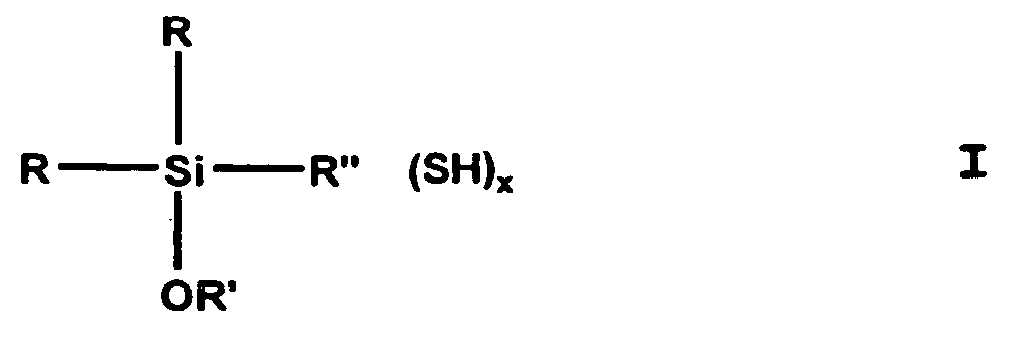


- Es kann durch die Wahl der (Halogenorganyl)alkyoxysilane und (Halogenorganyl)halogensilane aktiv und gezielt Einfluß auf die Zusammensetzung von Mischungen aus Verbindungen der allgemeinen Formel I genommen werden.
- Die Qualität und Art der Zusammensetzung der Mischung aus (Halogenorganyl)alkyoxysilan und (Halogenorganyl)-halogensilan kann auf Grundlage der Menge und Art der in der Mischung enthaltenen, hydrolisierbaren Si-Hal Bindungen beurteilt werden.
- Die Menge an hydrolisierbaren Si-Hal Bindungen wird durch das folgende Verfahren bestimmt:
- Maximal 20 g der Probe werden in einem 150 ml Becherglas mit 80 ml Ethanol und 10 ml Essigsäure versetzt. Der Halogenidgehalt wird potentiographisch mit Silbernitratlösung (c(AgNO3)=0,01 mol/l) titriert.
- Die vorteilhaften molaren Verhältnisse der Mischungen aus (Halogenorganyl)alkyoxysilanen und (Halogen-organyl)halogensilanen können unter anderem von der Anzahl der Si-Halogen-Funktionen der gewählten (Halogenorganyl)halogensilane abhängig sein.
- (Halogenorganyl)alkyoxysilan und (Halogenorganyl)-halogensilan können im molaren Verhältnis 0,001:1 bis 2:1 eingesetzt werden.
- Beispielsweise kann bei der Umsetzung von 3-Chlorpropyl(trimethoxysilan) oder 3-Chlorpropyl-(triethoxysilan) und 3-Chlorpropyl(trichlorsilan) bevorzugt ein molares Verhältnis von 2:1 bis 2:1,5, besonders bevorzugt ein molares Verhältnis von 2:1 bis 2:1,25, verwendet werden.
- Beispielsweise kann bei der Umsetzung von 3-Chlorpropyl(methyldimethoxysilan) oder 3-Chlorpropyl(methyldiethoxysilan) und 3-Chlorpropyl-(methyldichlorsilan) bevorzugt ein molares Verhälnis von 1:1 bis 1:1,25, besonders bevorzugt ein molares Verhälnis von 1:1 bis 1:1,15, verwendet werden.
- Beispielsweise kann bei der Umsetzung von 3-Chlorpropyl(dimethylmethoxysilan) oder von 3-Chlorpropyl(dimethylethoxysilan) und 3-Chlorpropyl-(dimethylchlorsilan) bevorzugt ein molares Verhälnis von 0,001:1 bis 0,05:1 verwendet werden.
- Die für das Verfahren verwendete Mischung aus entsprechendem (Halogenorganyl)alkyoxysilan und (Halogenorganyl)halogensilan kann in Abhängigkeit von der verwendeten Apparatur und den gewünschten Effekten, beispielsweise Selektivität der Reaktion, Dauer der Umsetzung, Reaktorbelegung, Reaktormaterial oder Prozeßabfolge, bereits vor der Zugabe des Alkalisulfides hergestellt werden.
- Alkalimetallsulfide können Dialkalimetallsulfide Me2S sein. Als Dialkalimetallsulfide können Dilithiumsulfid (Li2S), Dinatriumsulfid (Na2S), Dikaliumsulfid (K2S) und Dicäsiumsulfid (Cs2S) eingesetzt werden.
- Die verwendete, molare Menge an Alkalimetallsulfid kann die molare Menge des eingesetzten (Halogenorganyl)-halogensilans um 1% bis 200%, bevorzugt um 1% bis 150%, besonders bevorzugt um 1% bis 110%, übersteigen.
- Das molare Verhältnis von hydrolisierbaren Silizium-Halogen Funktionen, in den Mischungen aus (Halogenorganyl)alkoxysilan und (Halogenorganyl)halogensilan, zu Alkalimetallsulfid (Me2S) kann zwischen 1:0,51 und 1:1,2 vorzugsweise zwischen 1:0,6 und 1:1,15, besonders bevorzugt zwischen 1:0,75 und 1:1,05, betragen.
- Das (Halogenorganyl)alkoxysilan und (Halogenorganyl)-halogensilan können miteinander in beliebiger Reihenfolge, Weise, Temperatur und Zeitdauer vermischt werden und erst dann der Alkohol und das Alkalisulfid gemeinsam oder nacheinander zugegeben werden.
- Das (Halogenorganyl)halogensilan, Alkalisulfid und Alkohol können miteinander in beliebiger Reihenfolge, Weise, Temperatur und Zeitdauer vermischt werden und erst dann das (Halogenorganyl)alkoxysilan zugegeben werden.
- Das (Halogenorganyl)alkoxysilan, Alkalisulfid und Alkohol können miteinander in beliebiger Reihenfolge, Weise, Temperatur und Zeitdauer vermischt werden und erst dann das (Halogenorganyl)halogensilan zugegeben werden.
- Als Alkohol können primäre, sekundäre oder tertiäre Alkohole mit 1 bis 24, vorzugsweise 1 bis 6, besonders bevorzugt 1 bis 4, Kohlenstoffatomen eingesetzt werden.
- Als primäre, sekundäre oder tertiäre Alkohole können Methanol, Ethanol, n-Propanol, i-Propanol, i-Butanol oder n-Butanol eingesetzt werden.
- Die Menge an Alkohol kann mindestens 100 Vol.-%, bevorzugt 250 bis 1000 Vol.-%, besonders bevorzugt 500 bis 1000 Vol.-%, der eingesetzten Silankomponenten betragen.
- Zu Beginn der Umsetzung und/oder während der Umsetzung und/oder zum Ende der Umsetzung können polare, protische, aprotische, basische oder saure Additive zur Reaktionsmischung zugegeben werden.
- Unter erhöhtem Druck kann ein Überdruck von 0,1 bis 10 bar, bevorzugt 1 bis 7 bar, über Normaldruck verstanden werden.
- Die Umsetzung kann bei Temperaturen zwischen 0 und 180°C, bevorzugt zwischen 50 und 150°C, besonders bevorzugt zwischen 70 und 120°C, ablaufen.
- Die jeweils bezüglich der Ausbeute an Zielprodukt und Ausnutzung des Reaktionsvolumens optimale Reaktionstemperatur kann in Abhängigkeit von der Struktur des eingesetzten (Halogenorganyl)alkyoxysilans, (Halogenorganyl)halogensilans und Alkohols variieren.
- Beispielsweise kann bei Reaktionen in Methanol eine Reaktionstemperatur zwischen 60 und 95°C im Bezug auf Reaktionszeiten, Nebenproduktmenge und Druckaufbau vorteilhaft sein.
- Beispielsweise kann bei Reaktionen in Ethanol eine Reaktionstemperatur zwischen 75 und 120°C im Bezug auf Reaktionszeiten, Nebenproduktmenge und Druckaufbau vorteilhaft sein.
- Die Umsetzung kann in einem geschlossenen Behälter unter Schutzgas erfolgen.
- Die Umsetzung kann in korrosionsbeständigen Autoklaven, beispielsweise aus Glas, Teflon, emailliertem bzw. beschichteten Stahl, Hastelloy oder Tantal, erfolgen.
- Die Nebenproduktmenge kann durch Wahl der Reaktions-bedingungen kleiner als 20 Mol% betragen.
- Das erfindungsgemäße Verfahren hat die Vorteile, daß auf die Verwendung von hochtoxischen, gasförmigen Stoffen, wie Schwefelwasserstoff, als Schwefelspender verzichtet werden kann. Stattdessen werden Alkalimetallsulfide, die leicht dosierbare Feststoffe sind (zum Beispiel getrocknetes Dinatriumsulfid), als Schwefelspender verwendet.
- Ein weiterer Vorteil des erfindungsgemäßen Verfahrens besteht darin, daß allein durch die Verwendung eines geschlossenen Reaktionsgefäßes (Autoklav oder ähnlichem) die Selektivität der Reaktion erhöht werden kann.
- Ein weiterer Vorteil des erfindungsgemäßen Verfahrens gegenüber bekannten Verfahren sind die hohen Umsätze bei kurzen Batchzeiten und bei technisch einfach realisierbaren Temperaturen.
- Die GC-Analytik wird auf einem Gaschromatographen HP 6890 (WLD) mit einer DB5 Säule mit 0,53 mm Dicke und 1,5 µm Filmdicke durchgeführt. Als Detektor wird ein Wärmeleitfähigkeitsdetektor eingesetzt. Das verwendete Temperaturprogramm beinhaltete folgende Abläufe:
- Starttemperatur 100°C
- Initialzeit 1 Min.
- 20°C/Min auf 280°C
- 280°C 10 Min. halten
- Die Retentionszeiten für die folgenden Komponenten betragen:
bei 3,3 min = Cl-(CH2)3-Si(OEth)3 bei 5,7 min Si263 = HS-(CH2)3-Si(OEt)3 bei 11,0 min = (EtO)3Si-(CH2)3-S-(CH2)3-Si(OEt)3 bei 12,4 min = (EtO)3Si-(CH2)3-S2-(CH2)3-Si(OEt)3 - 29,6 g 3-Chlorpropyl(triethoxysilan) und 200 ml Ethanol werden in einem Autoklaven aus Edelstahl mit Glaseinsatz und magnetischer Rührvorrichtung bei -10°C gemeinsam vorgelegt. Es werden 17,6 g getrocknetes Na2S in mehreren Portionen zur Lösung zugegeben. Es werden 16,4 g Chlorpropyl(trichlorsilan) zugegeben und der Autoklav schnell verschlossen. Der Autoklav und die darin befindlichen Stoffe werden für 180 min auf 120°C erhitzt. Dabei steigt der Druck bis auf 3,2 bar über Normaldruck. Der Autoklav wird auf Normaltemperatur abgekühlt und die gebildete Suspension entnommen. Das enthaltene Lösungsmittel wird in einem Rotationsverdampfer reduziert und der ausgefallene Feststoff mit einer inertisierten Fritte entfernt. Es werden 38,4 g einer klaren, leicht bräunlichen Lösung erhalten. Die GC-Analyse der Reaktionsmischung ergibt folgende Zusammensetzung in Flächenprozent:
3-Chlorpropyl(triethoxysilan) 1,6 3-Mercaptopropyl(triethoxysilan) 77,0 (EtO)3Si-(CH2)3-S-(CH2)3-Si(OEt)3 7,3 (EtO)3Si-(CH2)3-S2-(CH2)3-Si(OEt) 3 3, 5 - 24 g 3-Chlorpropyl(triethoxysilan) und 150 ml Ethanol werden in einem Autoklaven aus Edelstahl mit Glaseinsatz und magnetischer Rührvorrichtung bei -10°C gemeinsam vorgelegt. Es werden 12 g getrocknetes Na2S in mehreren Portionen zur Lösung dazugegeben. Es werden 10,6 g 3-Chlorpropyl(trichlorsilan) zugegeben und der Autoklav schnell verschlossen. Der Autoklav und die darin befindlichen Stoffe werden für 180 min auf 80°C erhitzt. Der Autoklav wird auf Normaltemperatur abgekühlt und die gebildete Suspension entnommen. Das enthaltene Lösungsmittel wird in einem Rotationsverdampfer reduziert und der ausgefallene Feststoff mit einer inertisierten Fritte entfernt. Es werden 29,2 g einer klaren, leicht bräunlichen Lösung erhalten. Die GC-Analyse der Reaktionsmischung ergibt folgende Zusammensetzung in Flächenprozent:
3-Chlorpropyl(triethoxysilan) 5,8 3-Mercaptopropyl(triethoxysilan) 71,1 (EtO)3Si-(CH2)3-S-(CH2)3-Si(OEt) 3 8,4 (EtO)3Si-(CH2)3-S2-(CH2)3-Si(OEt) 3 4,4 - 40 g 3-Chlorpropyl(triethoxysilan), 23 g getrocknetes Na2S und 22 g 3-Chlorpropyl(trichlorsilan) werden in einem Autoklaven mit Glasdoppelmantel und Edelstahldeckel bei Raumtemperatur zusammen vorgelegt und der Autoklav verschlossen. Mit einer Hochdruckpumpe werden dann 400 ml Ethanol bei Raumtemperatur zu der Suspension gepumpt. Die Mischung wird auf 80°C erwärmt und für 5 h auf 80°C gehalten. Die Mischung wird anschließend auf Raumtemperatur abgekühlt und durch Gaschromatografie analysiert. Die GC-Analyse der Reaktionsmischung ergibt folgende Zusammensetzung in Gewichtsprozent:
3-Chlorpropyl(triethoxysilan) 1,3 3-Mercaptopropyl(triethoxysilan) 10,3 (EtO)3Si-(CH2)3-S-(CH2)3-Si(OEt)3 0,3 (EtO)3Si-(CH2)3-S2-(CH2)3-Si(OEt)3 0,9 Basierend auf den oben genannten Komponenten beträgt die Selektivität 89% und der Umsatz 90%. - 40 g 3-Chlorpropyl(triethoxysilan), 26,5 g getrocknetes Na2S und 24,1 g 3-Chlorpropyl(trichlorsilan) werden in einem Autoklaven mit Glasdoppelmantel und Edelstahldeckel bei Raumtemperatur zusammen vorgelegt und der Autoklav verschlossen. Die Mischung wird auf 60°C erhitzt. Mit einer Hochdruckpumpe werden dann 400 ml Ethanol bei 60°C zu der Suspension gepumpt. Die Mischung wird weiter auf 80°C erwärmt und für 5 h auf 80°C gehalten. Die Mischung wird anschließend auf Raumtemperatur abgekühlt und durch Gaschromatografie analysiert. Die GC-Analyse der Reaktionsmischung ergibt folgende Zusammensetzung in Gewichtsprozent:
3-Chlorpropyl(triethoxysilan) 0,4 3-Mercaptopropyl(triethoxysilan) 10,2 (EtO)3Si-(CH2)3-S-(CH2)3-Si(OEt)3 1,1 (EtO)3Si-(CH2)3-S2-(CH2)3-Si(OEt) 3 0,9 Basierend auf den oben genannten Komponenten beträgt die Selektivität 82% und der Umsatz 97%. - In einem Autoklaven mit Glasdoppelmantel und Hastelloy C22 Deckel + Armaturen (Buechi AG) werden bei Raumtemperatur 50 g getrocknetes Na2S und 650 ml trockenes Ethanol vorgelegt. Die Suspension wird erwärmt und für 20 min bei 50°C gerührt. Es werden 128,2 g einer Silan-Mischung aus 3-Chlorpropyl(diethoxy(chlor)silan), Chlorpropyl(ethoxy(dichlor)silan), Chlorpropyl(trichlorsilan) und 3-Chlorpropyl(triethoxysilan) mit einer mit Druckluft betriebenen Bürette zu der Suspension gegeben. Die verwendete Silan-Mischung wird hergestellt durch die Reaktion von 80 g 3-Chlorpropyl(triethoxysilan) und 48,2 g 3-Chlorpropyl(trichlorsilan). Über die Bürette werden weitere 150 ml Ethanol zu der Suspension gegeben. Die Mischung wird unter Rühren auf 97-102°C erwärmt und die Temperatur für 180 min gehalten. Die Mischung wird anschließend auf Raumtemperatur abgekühlt. Eine Probe wird entnommen und durch Gaschromatografie analysiert. Die GC-Analyse der Reaktionsmischung ergibt folgende Zusammensetzung in Flächenprozent:
3-Chlorpropyl(triethoxysilan) 0,007 3-Mercaptopropyl(triethoxysilan) 6,176 (EtO)3Si-(CH2)3-S-(CH2)3-Si(OEt) 3 0, 307 (EtO)3Si-(CH2)3-S2-(CH2)3-Si(OEt) 3 0,172 Basierend auf den oben genannten Werten beträgt der Umsatz >99 % und die Selektivität der Reaktion 93 %. - In einem Autoklaven mit Glasdoppelmantel und Hastelloy C22 Deckel + Armaturen (Buechi AG) werden bei Raumtemperatur 50 g getrocknetes Na2S und 650 ml trockenes Ethanol vorgelegt. Die Suspension wird erwärmt und für 20 min bei 50°C gerührt. Es wird eine Mischung aus 80 g 3-Chlorpropyl(triethoxysilan) und 48,2 g 3-Chlorpropyl(trichlorsilan) mit einer mit Druckluft betriebenen Bürette zu der Suspension gegeben. Über die Bürette werden weitere 150 ml Ethanol zu der Suspension gegeben. Die Mischung wird unter Rühren auf 95-100°C erwärmt und die Temperatur für 180 min gehalten. Die Mischung wird anschließend auf Raumtemperatur abgekühlt. Eine Probe wird entnommen und durch Gaschromatografie analysiert. Die GC-Analyse der Reaktionsmischung ergibt folgende Zusammensetzung in Flächenprozent:
3-Chlorpropyl(triethoxysilan) 0,166 3-Mercaptopropyl(triethoxysilan) 4,467 (EtO)3Si-(CH2)3-S-(CH2)3-Si(OEt)3 0, 27 6 (EtO)3Si-(CH2)3-S2-(CH2)3-Si(OEt) 3 0,245 Basierend auf den oben genannten Werten beträgt der Umsatz 97 % und die Selektivität der Reaktion 89,5%. - Der Reaktor wird geleert und mit wenig Ethanol gespült, um verbliebene Reste auszutragen. Die erhaltene Suspension wird filtriert. Der abgetrennte Feststoff wird mit 400 ml n-Pentan gewaschen. Die erhaltene Lösung wird am Rotationsverdampfer von den flüchtigen Bestandteilen bei 200-600 mbar und 60-80°C befreit. Die erhaltene Suspension wird mit 200 ml Pentan gut vermischt und für 10 h bei 4-8°C gelagert. Der ausgefallene Feststoff wird durch Filtration abgetrennt und mit 150 ml Pentan gewaschen. Von der erhaltenen, klaren Lösung wird das Pentan mit einem Rotationsverdampfer bei 200-600 mbar und 60-80°C entfernt. Es werden 119,3 g einer farblosen Flüssigkeit erhalten.
- Die kombinierte Analyse mit GC, 1H-NMR und 29Si-NMR ergibt folgende Zusammensetzung des erhaltenen Produktes in Gewichtsprozent:
3-Chlorpropyl(triethoxysilan) 2,6 3-Mercaptopropyl(triethoxysilan) 84,7 (EtO)3Si-(CH2)3-S-(CH2)3-Si(OEt) 3 3, 6 (EtO)3Si-(CH2)3-S2-(CH2)3-Si(OEt) 3 5 Basierend auf den oben genannten Werten beträgt der Umsatz 96 % und die Selektivität der Reaktion 91 %. - In einem Autoklaven mit Glasdoppelmantel und Hastelloy C22 Deckel + Armaturen (Buechi AG) werden bei Raumtemperatur 50 g getrocknetes Na2S und 800 ml trockenes Ethanol vorgelegt. Die Suspension wird erwärmt und für 20 min bei 50°C gerührt. Es wird eine Mischung aus 80 g 3-Chlorpropyl(triethoxysilan) und 48,2 g 3-Chlorpropyl(trichlorsilan) mit einer mit Druckluft betriebenen Bürette zu der Suspension gegeben. Über die Bürette werden weitere 200 ml Ethanol zu der Suspension gegeben. Die Mischung wird unter Rühren auf 95-100°C erwärmt und die Temperatur für 180 min gehalten. Die Mischung wird anschließend auf Raumtemperatur abgekühlt. Eine Probe wird entnommen und durch Gaschromatografie analysiert. Die GC-Analyse der Reaktionsmischung ergibt folgende Zusammensetzung in Flächenprozent:
3-Chlorpropyl(triethoxysilan) 0,070 3-Mercaptopropyl(triethoxysilan) 3,037 (EtO)3Si-(CH2)3-S-(CH2)3-Si(OEt) 3 0, 2 (EtO)3Si-(CH2)3-S2-(CH2)3-Si(OEt)3 0,105 Basierend auf den oben genannten Werten beträgt der Umsatz 98 % und die Selektivität der Reaktion 91 %. - Der Reaktor wird geleert und mit wenig Ethanol gespült, um verbliebene Reste auszutragen. Die erhaltene Suspension wird filtriert. Der abgetrennte Feststoff wird mit 400 ml n-Pentan gewaschen. Die erhaltene Lösung wird am Rotationsverdampfer von den flüchtigen Bestandteilen bei 200-600 mbar und 60-80°C befreit. Die erhaltene Suspension wird mit 200 ml Pentan gut vermischt und für 10 h bei 4-8°C gelagert. Der ausgefallene Feststoff wird durch Filtration abgetrennt und mit 150 ml Pentan gewaschen. Von der erhaltenen, klaren Lösung wird das Pentan mit einem Rotationsverdampfer bei 200-600 mbar und 60-80°C entfernt. Es werden 116,2 g einer farblosen Flüssigkeit erhalten.
- Die kombinierte Analyse mit GC, 1H-NMR und 29Si-NMR ergibt folgende Zusammensetzung des erhaltenen Produktes in Gewichtsprozent:
3-Chlorpropyl(triethoxysilan) 1 3-Mercaptopropyl(triethoxysilan) 81 (EtO)3Si-(CH2)3-S-(CH2)3-Si(OEt)3 4,2 (EtO)3Si-(CH2)3-S2-(CH2)3-Si(OEt) 3 7,1 Basierend auf den oben genannten Werten beträgt der Umsatz 99 % und die Selektivität der Reaktion 88 %. - In einem Autoklaven mit Glasdoppelmantel und Hastelloy C22 Deckel + Armaturen (Buechi AG) werden bei Raumtemperatur 57,8 g getrocknetes Na2S und 650 ml trockenes Ethanol vorgelegt. Die Suspension wird erwärmt und für 20 min bei 50°C gerührt. Es wird eine Mischung aus 80,5 g 3-Chlorpropyl(triethoxysilan) und 57,4 g 3-Chlorpropyl(trichlorsilan) mit einer mit Druckluft betriebenen Bürette zu der Suspension gegeben. Über die Bürette werden weitere 150 ml Ethanol zu der Suspension gegeben. Die Mischung wird unter Rühren auf 110-115°C erwärmt und die Temperatur für 120 min gehalten. Die Mischung wird anschließend auf Raumtemperatur abgekühlt. Eine Probe wird entnommen und durch Gaschromatografie analysiert. Die GC-Analyse der Reaktionsmischung ergibt folgende Zusammensetzung in Flächenprozent:
3-Chlorpropyl(triethoxysilan) 0,012 3-Mercaptopropyl(triethoxysilan) 4,204 (EtO)3Si-(CH2)3-S-(CH2)3-Si(OEt)3 0,262 (EtO)3Si-(CH2)3-S2-(CH2)3-Si(OEt)3 0,159 Basierend auf den oben genannten Werten beträgt der Umsatz >99 % und die Selektivität der Reaktion 91%. - Der Reaktor wird geleert und mit wenig Ethanol gespült, um verbliebene Reste auszutragen. Die erhaltene Suspension wird filtriert. Der abgetrennte Feststoff wird mit 400 ml n-Hexan gewaschen. Die erhaltene Lösung wird am Rotationsverdampfer von den flüchtigen Bestandteilen bei 200-600 mbar und 60-80°C befreit. Die erhaltene Suspension wird mit 200 ml Hexan gut vermischt und für 10 h bei 4-8°C gelagert. Der ausgefallene Feststoff wird durch Filtration abgetrennt und mit 150 ml Hexan gewaschen. Von der erhaltenen, klaren Lösung wird das Hexan mit einem Rotationsverdampfer bei 20-600 mbar und 60-80°C entfernt. Es werden 121,3 g einer farblosen Flüssigkeit erhalten.
- Die kombinierte Analyse mit GC, 1H-NMR und 29Si-NMR ergibt folgende Zusammensetzung des erhaltenen Produktes in Gewichtsprozent:
3-Chlorpropyl(triethoxysilan) 0,1 3-Mercaptopropyl(triethoxysilan) 82,1 (EtO)3Si-(CH2)3-S-(CH2)3-Si(OEt) 3 2,3 (EtO)3Si-(CH2)3-S2-(CH2)3-Si(OEt) 3 8,8 Basierend auf den oben genannten Werten beträgt der Umsatz >99 % und die Selektivität der Reaktion 88%. - In einem Autoklaven mit Glasdoppelmantel und Hastelloy C22 Deckel + Armaturen (Buechi AG) werden bei Raumtemperatur 57,7 g getrocknetes Na2S und 800 ml trockenes Ethanol vorgelegt. Die Suspension wird erwärmt und für 20 min bei 50°C gerührt. Es wird eine Mischung aus 80,5 g 3-Chlorpropyl(triethoxysilan) und 57,4 g 3-Chlorpropyl(trichlorsilan) mit einer mit Druckluft betriebenen Bürette zu der Suspension gegeben. Über die Bürette werden weitere 200 ml Ethanol zu der Suspension gegeben. Die Mischung wird unter Rühren auf 110-115°C erwärmt und die Temperatur für 120 min gehalten. Die Mischung wird anschließend auf Raumtemperatur abgekühlt. Eine Probe wird entnommen und durch Gaschromatografie analysiert. Die GC-Analyse der Reaktionsmischung ergibt folgende Zusammensetzung in Flächenprozent:
3-Chlorpropyl(triethoxysilan) 0,007 3-Mercaptopropyl(triethoxysilan) 3,123 (EtO)3Si-(CH2)3-S-(CH2)3-Si(OEt)3 0,273 (EtO)3Si-(CH2)3-S2-(CH2)3-Si(OEt)3 0,154 Basierend auf den oben genannten Werten beträgt der Umsatz >99 % und die Selektivität der Reaktion 88%. - Der Reaktor wird geleert und mit wenig Ethanol gespült, um verbliebene Reste auszutragen. Die erhaltene Suspension wird filtriert. Der abgetrennte Feststoff wird mit 400 ml n-Hexan gewaschen. Die erhaltene Lösung wird am Rotationsverdampfer von den flüchtigen Bestandteilen bei 200-600 mbar und 60-80°C befreit. Die erhaltene Suspension wird mit 200 ml Hexan gut vermischt und für 10 h bei 4-8°C gelagert. Der ausgefallene Feststoff wird durch Filtration abgetrennt und mit 150 ml Hexan gewaschen. Von der erhaltenen, klaren Lösung wird das Hexan mit einem Rotationsverdampfer bei 20-600 mbar und 60-90°C entfernt. Es werden 116,3 g einer farblosen Flüssigkeit erhalten.
- Die kombinierte Analyse mit GC, 1H-NMR und 29Si-NMR ergibt folgende Zusammensetzung des erhaltenen Produktes in Gewichtsprozent:
3-Chlorpropyl(triethoxysilan) 0,2 3-Mercaptopropyl(triethoxysilan) 82,1 (EtO)3Si-(CH2)3-S-(CH2)3-Si(OEt) 3 2,4 (EtO)3Si-(CH2)3-S2-(CH2)3-Si(OEt) 3 8,2 Basierend auf den oben genannten Werten beträgt der Umsatz >99 % und die Selektivität der Reaktion 89%. - In einem Autoklaven mit Glasdoppelmantel und Hastelloy C22 Deckel + Armaturen (Buechi AG) werden bei Raumtemperatur 50 g getrocknetes Na2S und 550 ml trockenes Ethanol vorgelegt. Die Suspension wird erwärmt und für 20 min bei 50°C gerührt. Es wird eine Mischung aus 80 g 3-Chlorpropyl(triethoxysilan) und 48,2 g 3-Chlorpropyl(trichlorsilan) mit einer mit Druckluft betriebenen Bürette zu der Suspension gegeben. Über die Bürette werden weitere 150 ml Ethanol zu der Suspension gegeben. Die Mischung wird unter Rühren auf 112-117°C erwärmt und die Temperatur für 180 min gehalten. Die Mischung wird anschließend auf Raumtemperatur abgekühlt. Bei 50°C werden zu der Reaktionslösung 1,8 g Ameisensäure in 50 ml Ethanol mit der Druckbürette gegeben. Die Suspension wird für 15 min bei 50°C gerührt. Eine Probe wird entnommen und durch Gaschromatografie analysiert. Die GC-Analyse der Reaktionsmischung ergibt folgende Zusammensetzung in Flächenprozent:
3-Chlorpropyl(triethoxysilan) 0,198 3-Mercaptopropyl(triethoxysilan) 7,948 (EtO)3Si-(CH2)3-S-(CH2)3-Si(OEt) 3 0,368 (EtO)3Si-(CH2)3-S2-(CH2)3-Si(OEt)3 0,766 Basierend auf den oben genannten Werten beträgt der Umsatz 98 % und die Selektivität der Reaktion 88 %. - Der Reaktor wird geleert und mit wenig Ethanol gespült, um verbliebene Reste auszutragen. Die erhaltene Suspension wird filtriert. Der abgetrennte Feststoff wird mit 400 ml n-Pentan gewaschen. Die erhaltene Lösung wird am Rotationsverdampfer von den flüchtigen Bestandteilen bei 200-600 mbar und 60-80°C befreit. Die erhaltene Suspension wird mit 200 ml Pentan gut vermischt und für 10 h bei 4-8°C gelagert. Der ausgefallene Feststoff wird durch Filtration abgetrennt und mit 150 ml Pentan gewaschen. Von der erhaltenen, klaren Lösung wird das Pentan mit einem Rotationsverdampfer bei 20-600 mbar und 60-90°C entfernt. Es werden 124,5 g einer farblosen Flüssigkeit erhalten.
- Die kombinierte Analyse mit GC, 1H-NMR und 29Si-NMR ergibt folgende Zusammensetzung des erhaltenen Produktes in Gewichtsprozent:
3-Chlorpropyl(triethoxysilan) 2,1 3-Mercaptopropyl(triethoxysilan) 81,5 (EtO)3Si-(CH2)3-S-(CH2)3-Si(OEt) 3 4,2 (EtO)3Si-(CH2)3-S2-(CH2)3-Si(OEt) 3 10,1 Basierend auf den oben genannten Werten beträgt der Umsatz 98 % und die Selektivität der Reaktion 85 %.
Claims (10)
- Verfahren zur Herstellung von (Mercaptoorganyl)-alkoxysilanen,
dadurch gekennzeichnet,
dass man Alkalimetallsulfid mit einem Gemisch aus (Halogenorganyl)alkoxysilan und (Halogenorganyl)-halogensilan in einem Alkohol unter Luftabschluß und einem erhöhten Druck umsetzt. - Verfahren zur Herstellung von (Mercaptoorganyl)-alkoxysilanen nach Anspruch 1,
dadurch gekennzeichnet,
dass man als (Mercaptoorganyl)alkoxysilan Verbindungen der allgemeinen Formel I
R' gleich oder verschieden und eine C1-C24, verzweigte oder unverzweigte einbindige Alkyl- oder Alkenyl-Gruppe, Arylgruppe oder Aralkylgruppe ist, R'' eine verzweigte oder unverzweigte, gesättigte oder ungesättigte, aliphatische, aromatische oder gemischt aliphatische /aromatische zweibindige C1-C30 Kohlenwasserstoffgruppe, die gegebenenfalls mit F-, Cl-, Br-, I-, NH2- oder NHR' substituiert ist, ist, x gleich 1-3 ist. - Verfahren zur Herstellung von (Mercaptoorganyl)-alkoxysilanen nach Anspruch 1,
dadurch gekennzeichnet,
dass man als (Halogenorganyl)alkoxysilan Verbindungen der allgemeinen Formel II
R' gleich oder verschieden und eine C1-C24 verzweigte oder unverzweigte einbindige Alkyl- oder Alkenyl-Gruppe, Arylgruppe oder Aralkylgruppe ist,
R'' eine verzweigte oder unverzweigte, gesättigte oder ungesättigte, aliphatische, aromatische oder gemischt aliphatische /aromatische zweibindige C1-C30 Kohlenwasserstoffgruppe ist, die gegebenenfalls mit F-, Cl-, Br-, I-, NH2-, oder NHR' substituiert ist,
x gleich 1-3 ist,
Hal Chlor, Brom, Fluor oder Iod ist. - Verfahren zur Herstellung von (Mercaptoorganyl)-alkoxysilanen nach Anspruch 1,
dadurch gekennzeichnet,
dass man daß man als (Halogenorganyl)halogensilan Verbindungen der allgemeinen Formel III
- Verfahren zur Herstellung von (Mercaptoorganyl)alkoxysilanen nach Anspruch 1,
dadurch gekennzeichnet,
dass das molare Verhältnis Halogenorganyl)alkyoxysilan und (Halogenorganyl)halogensilan 0,001:1 bis 2:1 beträgt. - Verfahren zur Herstellung von (Mercaptoorganyl)-alkoxysilanen nach Anspruch 1,
dadurch gekennzeichnet,
dass das molare Verhältnis von hydrolisierbaren Si-Halogen Funktionen in den Mischungen aus (Halogenorganyl)alkoxysilan und (Halogenorganyl)-halogensilan zu Alkalimetallsulfid zwischen 1:0,51 und 1:1,2 beträgt. - Verfahren zur Herstellung von (Mercaptoorganyl)-alkoxysilanen nach Anspruch 1,
dadurch gekennzeichnet,
dass man als Alkalimetallsulfid Dilithiumsulfid (Li2S), Dinatriumsulfid (Na2S) oder Dikaliumsulfid (K2S) einsetzt. - Verfahren zur Herstellung von (Mercaptoorganyl)-alkoxysilanen nach Anspruch 1,
dadurch gekennzeichnet,
dass man als Alkohol primäre, sekundäre, tertiäre Alkohole mit 1 bis 24 Kohlenstoffatomen einsetzt. - Verfahren zur Herstellung von (Mercaptoorganyl)-alkoxysilanen nach Anspruch 1,
dadurch gekennzeichnet,
dass man zu Beginn der Umsetzung und/oder während der Umsetzung und/oder zum Ende der Umsetzung polare, protische, aprotische, basische oder saure Additive zur Reaktionsmischung zugibt. - Verfahren zur Herstellung von (Mercaptoorganyl)-alkoxysilanen nach Anspruch 1,
dadurch gekennzeichnet,
dass man die Umsetzung bei Temperaturen zwischen 0 und 180°C durchführt.
Priority Applications (1)
| Application Number | Priority Date | Filing Date | Title |
|---|---|---|---|
| PL04025248T PL1529782T3 (pl) | 2003-11-06 | 2004-10-23 | Sposób wytwarzania (merkaptoorganylo)-alkoksysilanów |
Applications Claiming Priority (2)
| Application Number | Priority Date | Filing Date | Title |
|---|---|---|---|
| DE10351736 | 2003-11-06 | ||
| DE10351736A DE10351736B3 (de) | 2003-11-06 | 2003-11-06 | Verfahren zur Herstellung von (Mercaptoorganyl)-alkoxysilanen |
Publications (2)
| Publication Number | Publication Date |
|---|---|
| EP1529782A1 EP1529782A1 (de) | 2005-05-11 |
| EP1529782B1 true EP1529782B1 (de) | 2006-05-10 |
Family
ID=33521610
Family Applications (1)
| Application Number | Title | Priority Date | Filing Date |
|---|---|---|---|
| EP04025248A Expired - Lifetime EP1529782B1 (de) | 2003-11-06 | 2004-10-23 | Verfahren zur Herstellung von (Mercaptoorganyl)-alkoxysilanen |
Country Status (13)
| Country | Link |
|---|---|
| US (1) | US7019160B2 (de) |
| EP (1) | EP1529782B1 (de) |
| JP (1) | JP4589082B2 (de) |
| KR (1) | KR101121844B1 (de) |
| CN (1) | CN100406463C (de) |
| AT (1) | ATE325798T1 (de) |
| DE (2) | DE10351736B3 (de) |
| IL (1) | IL165023A0 (de) |
| MX (1) | MXPA04011012A (de) |
| MY (1) | MY131923A (de) |
| PL (1) | PL1529782T3 (de) |
| RU (1) | RU2360918C2 (de) |
| TW (1) | TWI325001B (de) |
Families Citing this family (15)
| Publication number | Priority date | Publication date | Assignee | Title |
|---|---|---|---|---|
| DE102004030737A1 (de) * | 2004-06-25 | 2006-01-12 | Degussa Ag | Verfahren und Vorrichtung zur Extraktion von Stoffen aus silanmodifizierten Füllstoffen |
| DE102005020535B3 (de) | 2005-05-03 | 2006-06-08 | Degussa Ag | Verfahren zur Herstellung von Mercaptoorganyl(alkoxysilanen) |
| DE102005038791A1 (de) | 2005-08-17 | 2007-02-22 | Degussa Ag | Organosiliciumverbindungen, ihre Herstellung und ihre Verwendung |
| US7151188B1 (en) * | 2005-11-16 | 2006-12-19 | General Electric Company | Process for the production of mercaptoalkylalkoxysilanes |
| DE102005060122A1 (de) * | 2005-12-16 | 2007-06-21 | Degussa Gmbh | Verfahren zur Herstellung von (Mercaptoorganyl)alkylpolyethersilanen |
| DE102006004062A1 (de) * | 2006-01-28 | 2007-08-09 | Degussa Gmbh | Kautschukmischungen |
| DE102006027235A1 (de) | 2006-06-09 | 2008-01-17 | Evonik Degussa Gmbh | Kautschukmischungen |
| EP1894938A1 (de) | 2006-08-31 | 2008-03-05 | Evonik Degussa GmbH | Neue cyclopentadienyl-, indenyl- und fluorenyl-substituierte Phosphanverbindungen und ihre Verwenduing in katalytischen Reaktionen |
| DE102007037556A1 (de) | 2007-08-09 | 2009-02-12 | Evonik Degussa Gmbh | Verfahren zur Herstellung von alkylpolyethersubstituierten Mercaptosilanen |
| WO2009039156A1 (en) * | 2007-09-19 | 2009-03-26 | The Regents Of The University Of Colorado | Polymer impression materials |
| CN101423528B (zh) * | 2007-11-02 | 2012-07-25 | 张家港市国泰华荣化工新材料有限公司 | 巯基烷基烷氧基硅烷的制备方法 |
| CN105017303B (zh) * | 2015-08-07 | 2017-11-10 | 荆州市江汉精细化工有限公司 | 一种双‑[γ‑(三乙氧基硅)‑丙基]一硫化物的制备方法 |
| CN106914146B (zh) * | 2017-03-14 | 2019-05-28 | 常州大学 | 一种巯基化改性tries分离膜及其制备方法和用途 |
| EP3915165B1 (de) * | 2019-01-25 | 2025-12-31 | Shell Internationale Research Maatschappij B.V. | Ein elektrischer energiespeicher |
| CN112968158B (zh) * | 2021-03-02 | 2023-01-06 | 欣旺达电动汽车电池有限公司 | 有机硅硫正极材料及其制备方法、正极极片和锂硫电池 |
Family Cites Families (13)
| Publication number | Priority date | Publication date | Assignee | Title |
|---|---|---|---|---|
| GB1102251A (en) * | 1964-02-04 | 1968-02-07 | Union Carbide Corp | Treatment of metal surfaces |
| US3590065A (en) | 1969-07-18 | 1971-06-29 | Dow Corning | Method of preparing mercaptoalkylalkoxy silanes |
| US4012403A (en) | 1972-01-10 | 1977-03-15 | Union Carbide Corporation | Synthesis of mercapto-substituted silicon compounds |
| US3849471A (en) | 1972-12-14 | 1974-11-19 | Union Carbide Corp | Process for reacting weak acids with chloroalkyl substituted silicon compounds |
| US4082790A (en) | 1974-12-11 | 1978-04-04 | Dow Corning Corporation | Method of preparing mercaptans |
| US4217294A (en) | 1979-03-30 | 1980-08-12 | Union Carbide Corporation | Method for producing mercaptan-containing organosilicon compounds |
| DE4025866A1 (de) | 1990-08-16 | 1992-02-20 | Huels Chemische Werke Ag | Verfahren zur herstellung von mercaptosilanen |
| JP3159638B2 (ja) * | 1994-11-04 | 2001-04-23 | 信越化学工業株式会社 | 3−メルカプトプロピルアルコキシシランの製造方法 |
| US5840952A (en) * | 1995-11-02 | 1998-11-24 | Shin-Etsu Chemical Co., Ltd. | Method of manufacturing 3-mercaptopropylalkoxy silane |
| DE10024037C1 (de) * | 2000-05-13 | 2001-08-09 | Degussa | Verfahren zur Herstellung von gelbem Bis(3-(triethoxysilyl)propyl)tetrasulfan |
| DE10045269A1 (de) * | 2000-09-13 | 2002-03-28 | Degussa | Verfahren zur Herstellung von gelbem Bis(3-[triethoxysilyl]propyl)polysulfan |
| JP4574034B2 (ja) * | 2001-02-27 | 2010-11-04 | 日本曹達株式会社 | メルカプト基を有するケイ素化合物の製造方法 |
| FR2830014B1 (fr) * | 2001-09-21 | 2005-02-18 | Rhodia Chimie Sa | Procede d'obtention de monoorganoxysilanes halogenes utilisables notamment en tant qu'intermediaires de synthese |
-
2003
- 2003-11-06 DE DE10351736A patent/DE10351736B3/de not_active Expired - Fee Related
-
2004
- 2004-10-23 AT AT04025248T patent/ATE325798T1/de not_active IP Right Cessation
- 2004-10-23 EP EP04025248A patent/EP1529782B1/de not_active Expired - Lifetime
- 2004-10-23 PL PL04025248T patent/PL1529782T3/pl unknown
- 2004-10-23 DE DE502004000533T patent/DE502004000533D1/de not_active Expired - Lifetime
- 2004-11-03 TW TW093133511A patent/TWI325001B/zh active
- 2004-11-04 IL IL16502304A patent/IL165023A0/xx unknown
- 2004-11-04 US US10/980,859 patent/US7019160B2/en not_active Expired - Lifetime
- 2004-11-05 KR KR1020040089710A patent/KR101121844B1/ko not_active Expired - Fee Related
- 2004-11-05 CN CNB2004100922814A patent/CN100406463C/zh not_active Expired - Fee Related
- 2004-11-05 RU RU2004132344/04A patent/RU2360918C2/ru not_active IP Right Cessation
- 2004-11-05 MY MYPI20044613A patent/MY131923A/en unknown
- 2004-11-05 MX MXPA04011012A patent/MXPA04011012A/es active IP Right Grant
- 2004-11-05 JP JP2004322758A patent/JP4589082B2/ja not_active Expired - Fee Related
Also Published As
| Publication number | Publication date |
|---|---|
| PL1529782T3 (pl) | 2006-09-29 |
| KR20050043693A (ko) | 2005-05-11 |
| MXPA04011012A (es) | 2005-05-11 |
| TW200526675A (en) | 2005-08-16 |
| MY131923A (en) | 2007-09-28 |
| EP1529782A1 (de) | 2005-05-11 |
| JP2005139187A (ja) | 2005-06-02 |
| US7019160B2 (en) | 2006-03-28 |
| DE502004000533D1 (de) | 2006-06-14 |
| CN1637007A (zh) | 2005-07-13 |
| CN100406463C (zh) | 2008-07-30 |
| IL165023A0 (en) | 2005-12-18 |
| RU2004132344A (ru) | 2006-04-20 |
| KR101121844B1 (ko) | 2012-03-21 |
| RU2360918C2 (ru) | 2009-07-10 |
| DE10351736B3 (de) | 2005-01-13 |
| JP4589082B2 (ja) | 2010-12-01 |
| TWI325001B (en) | 2010-05-21 |
| US20050124822A1 (en) | 2005-06-09 |
| ATE325798T1 (de) | 2006-06-15 |
Similar Documents
| Publication | Publication Date | Title |
|---|---|---|
| EP1538152B1 (de) | Verfahren zur Herstellung von (Mercaptoorganyl)-alkoxysilanen | |
| DE69521001T2 (de) | Verfahren zur Herstellung von Silanpolysulfiden | |
| EP0702017B1 (de) | Verfahren zur Herstellung von chloridarmen bzw. chloridfreien aminofunktionellen Organosilanen | |
| EP0471164B1 (de) | Verfahren zur Herstellung von Mercaptosilanen | |
| DE10351736B3 (de) | Verfahren zur Herstellung von (Mercaptoorganyl)-alkoxysilanen | |
| EP1700861B1 (de) | Verfahren zur Herstellung von Organosilanen | |
| EP0999214B1 (de) | Verfahren zur Herstellung von chloridarmen oder chloridfreien Alkoxysilanen | |
| EP0638575B1 (de) | Verfahren zur Herstellung von Diorganodialkoxysilanen | |
| EP2291385B1 (de) | Verfahren zur wässrigen aufarbeitung eines ammoniumhalogenide und/oder organische aminhydrohalogenide enthaltenden aminofunktionellen organosilans | |
| EP0483480A1 (de) | Verfahren zur Herstellung von Methacryloxy-oder Acryloxygruppen enthaltende Organosilanen | |
| EP1637535B1 (de) | Verfahren zur Herstellung von Mercaptooganyl (alkoxysilanen) | |
| DE3851243T2 (de) | Verfahren zur Herstellung von Trialkoxysilanen. | |
| DE60123034T2 (de) | Herstellung von sekundären aminoisobutylalkoxysilanen | |
| DE69022491T2 (de) | Herstellung von Tertiär-Kohlenwasserstoff-Silyl-Verbindungen. | |
| DE19860439C1 (de) | Verfahren zur Herstellung von Silylalkylthiolen | |
| DE60221995T2 (de) | Herstellung von halogenierten monoorganoxysilanen, verwendung als zwischenverbindungen | |
| DE1158071B (de) | Verfahren zur Herstellung von ª†-Aminoisobutylgruppen enthaltenden siliciumorganischen Verbindungen | |
| EP0004310B1 (de) | Verfahren zur Herstellung von Silanen | |
| DE3728801C2 (de) | (2-Phenylpropan-2-yl) silan-Verbindungen und ein Verfahren zu deren Herstellung | |
| DE69607943T2 (de) | Verfahren zur herstellung von organosilanen | |
| DE1154477B (de) | Verfahren zur Herstellung von Nitro- oder Nitritogruppen enthaltenden Silanen | |
| EP0567737B1 (de) | 2-Methyl-3-chlorpropyl-cyclohexyldialkoxysilane und Verfahren zu ihrer Herstellung |
Legal Events
| Date | Code | Title | Description |
|---|---|---|---|
| PUAI | Public reference made under article 153(3) epc to a published international application that has entered the european phase |
Free format text: ORIGINAL CODE: 0009012 |
|
| 17P | Request for examination filed |
Effective date: 20041023 |
|
| AK | Designated contracting states |
Kind code of ref document: A1 Designated state(s): AT BE BG CH CY CZ DE DK EE ES FI FR GB GR HU IE IT LI LU MC NL PL PT RO SE SI SK TR |
|
| AX | Request for extension of the european patent |
Extension state: AL HR LT LV MK |
|
| GRAP | Despatch of communication of intention to grant a patent |
Free format text: ORIGINAL CODE: EPIDOSNIGR1 |
|
| AKX | Designation fees paid |
Designated state(s): AT BE BG CH CY CZ DE DK EE ES FI FR GB GR HU IE IT LI LU MC NL PL PT RO SE SI SK TR |
|
| GRAS | Grant fee paid |
Free format text: ORIGINAL CODE: EPIDOSNIGR3 |
|
| GRAA | (expected) grant |
Free format text: ORIGINAL CODE: 0009210 |
|
| AK | Designated contracting states |
Kind code of ref document: B1 Designated state(s): AT BE BG CH CY CZ DE DK EE ES FI FR GB GR HU IE IT LI LU MC NL PL PT RO SE SI SK TR |
|
| PG25 | Lapsed in a contracting state [announced via postgrant information from national office to epo] |
Ref country code: SI Free format text: LAPSE BECAUSE OF FAILURE TO SUBMIT A TRANSLATION OF THE DESCRIPTION OR TO PAY THE FEE WITHIN THE PRESCRIBED TIME-LIMIT Effective date: 20060510 Ref country code: CZ Free format text: LAPSE BECAUSE OF FAILURE TO SUBMIT A TRANSLATION OF THE DESCRIPTION OR TO PAY THE FEE WITHIN THE PRESCRIBED TIME-LIMIT Effective date: 20060510 Ref country code: RO Free format text: LAPSE BECAUSE OF FAILURE TO SUBMIT A TRANSLATION OF THE DESCRIPTION OR TO PAY THE FEE WITHIN THE PRESCRIBED TIME-LIMIT Effective date: 20060510 Ref country code: SK Free format text: LAPSE BECAUSE OF FAILURE TO SUBMIT A TRANSLATION OF THE DESCRIPTION OR TO PAY THE FEE WITHIN THE PRESCRIBED TIME-LIMIT Effective date: 20060510 Ref country code: IE Free format text: LAPSE BECAUSE OF FAILURE TO SUBMIT A TRANSLATION OF THE DESCRIPTION OR TO PAY THE FEE WITHIN THE PRESCRIBED TIME-LIMIT Effective date: 20060510 Ref country code: FI Free format text: LAPSE BECAUSE OF FAILURE TO SUBMIT A TRANSLATION OF THE DESCRIPTION OR TO PAY THE FEE WITHIN THE PRESCRIBED TIME-LIMIT Effective date: 20060510 Ref country code: IT Free format text: LAPSE BECAUSE OF FAILURE TO SUBMIT A TRANSLATION OF THE DESCRIPTION OR TO PAY THE FEE WITHIN THE PRESCRIBED TIME-LIMIT;WARNING: LAPSES OF ITALIAN PATENTS WITH EFFECTIVE DATE BEFORE 2007 MAY HAVE OCCURRED AT ANY TIME BEFORE 2007. THE CORRECT EFFECTIVE DATE MAY BE DIFFERENT FROM THE ONE RECORDED. Effective date: 20060510 |
|
| REG | Reference to a national code |
Ref country code: GB Ref legal event code: FG4D Free format text: NOT ENGLISH |
|
| REG | Reference to a national code |
Ref country code: CH Ref legal event code: EP |
|
| REF | Corresponds to: |
Ref document number: 502004000533 Country of ref document: DE Date of ref document: 20060614 Kind code of ref document: P |
|
| REG | Reference to a national code |
Ref country code: IE Ref legal event code: FG4D Free format text: LANGUAGE OF EP DOCUMENT: GERMAN |
|
| PG25 | Lapsed in a contracting state [announced via postgrant information from national office to epo] |
Ref country code: DK Free format text: LAPSE BECAUSE OF FAILURE TO SUBMIT A TRANSLATION OF THE DESCRIPTION OR TO PAY THE FEE WITHIN THE PRESCRIBED TIME-LIMIT Effective date: 20060810 Ref country code: SE Free format text: LAPSE BECAUSE OF FAILURE TO SUBMIT A TRANSLATION OF THE DESCRIPTION OR TO PAY THE FEE WITHIN THE PRESCRIBED TIME-LIMIT Effective date: 20060810 |
|
| PG25 | Lapsed in a contracting state [announced via postgrant information from national office to epo] |
Ref country code: ES Free format text: LAPSE BECAUSE OF FAILURE TO SUBMIT A TRANSLATION OF THE DESCRIPTION OR TO PAY THE FEE WITHIN THE PRESCRIBED TIME-LIMIT Effective date: 20060821 |
|
| GBT | Gb: translation of ep patent filed (gb section 77(6)(a)/1977) |
Effective date: 20060830 |
|
| PG25 | Lapsed in a contracting state [announced via postgrant information from national office to epo] |
Ref country code: PT Free format text: LAPSE BECAUSE OF FAILURE TO SUBMIT A TRANSLATION OF THE DESCRIPTION OR TO PAY THE FEE WITHIN THE PRESCRIBED TIME-LIMIT Effective date: 20061010 |
|
| PG25 | Lapsed in a contracting state [announced via postgrant information from national office to epo] |
Ref country code: MC Free format text: LAPSE BECAUSE OF NON-PAYMENT OF DUE FEES Effective date: 20061031 |
|
| REG | Reference to a national code |
Ref country code: IE Ref legal event code: FD4D |
|
| PLBE | No opposition filed within time limit |
Free format text: ORIGINAL CODE: 0009261 |
|
| REG | Reference to a national code |
Ref country code: FR Ref legal event code: RN |
|
| STAA | Information on the status of an ep patent application or granted ep patent |
Free format text: STATUS: NO OPPOSITION FILED WITHIN TIME LIMIT |
|
| RAP2 | Party data changed (patent owner data changed or rights of a patent transferred) |
Owner name: DEGUSSA GMBH |
|
| 26N | No opposition filed |
Effective date: 20070213 |
|
| EN | Fr: translation not filed | ||
| REG | Reference to a national code |
Ref country code: FR Ref legal event code: FC |
|
| NLT2 | Nl: modifications (of names), taken from the european patent patent bulletin |
Owner name: DEGUSSA GMBH Effective date: 20070411 |
|
| ET | Fr: translation filed | ||
| PG25 | Lapsed in a contracting state [announced via postgrant information from national office to epo] |
Ref country code: AT Free format text: LAPSE BECAUSE OF NON-PAYMENT OF DUE FEES Effective date: 20061023 |
|
| PG25 | Lapsed in a contracting state [announced via postgrant information from national office to epo] |
Ref country code: GR Free format text: LAPSE BECAUSE OF FAILURE TO SUBMIT A TRANSLATION OF THE DESCRIPTION OR TO PAY THE FEE WITHIN THE PRESCRIBED TIME-LIMIT Effective date: 20060811 |
|
| PG25 | Lapsed in a contracting state [announced via postgrant information from national office to epo] |
Ref country code: EE Free format text: LAPSE BECAUSE OF FAILURE TO SUBMIT A TRANSLATION OF THE DESCRIPTION OR TO PAY THE FEE WITHIN THE PRESCRIBED TIME-LIMIT Effective date: 20060510 Ref country code: BG Free format text: LAPSE BECAUSE OF FAILURE TO SUBMIT A TRANSLATION OF THE DESCRIPTION OR TO PAY THE FEE WITHIN THE PRESCRIBED TIME-LIMIT Effective date: 20060810 |
|
| PG25 | Lapsed in a contracting state [announced via postgrant information from national office to epo] |
Ref country code: TR Free format text: LAPSE BECAUSE OF FAILURE TO SUBMIT A TRANSLATION OF THE DESCRIPTION OR TO PAY THE FEE WITHIN THE PRESCRIBED TIME-LIMIT Effective date: 20060510 Ref country code: LU Free format text: LAPSE BECAUSE OF NON-PAYMENT OF DUE FEES Effective date: 20061023 Ref country code: HU Free format text: LAPSE BECAUSE OF FAILURE TO SUBMIT A TRANSLATION OF THE DESCRIPTION OR TO PAY THE FEE WITHIN THE PRESCRIBED TIME-LIMIT Effective date: 20061111 |
|
| PG25 | Lapsed in a contracting state [announced via postgrant information from national office to epo] |
Ref country code: CY Free format text: LAPSE BECAUSE OF FAILURE TO SUBMIT A TRANSLATION OF THE DESCRIPTION OR TO PAY THE FEE WITHIN THE PRESCRIBED TIME-LIMIT Effective date: 20060510 |
|
| REG | Reference to a national code |
Ref country code: CH Ref legal event code: PL |
|
| NLV4 | Nl: lapsed or anulled due to non-payment of the annual fee |
Effective date: 20090501 |
|
| PG25 | Lapsed in a contracting state [announced via postgrant information from national office to epo] |
Ref country code: NL Free format text: LAPSE BECAUSE OF NON-PAYMENT OF DUE FEES Effective date: 20090501 |
|
| PG25 | Lapsed in a contracting state [announced via postgrant information from national office to epo] |
Ref country code: CH Free format text: LAPSE BECAUSE OF NON-PAYMENT OF DUE FEES Effective date: 20081031 Ref country code: LI Free format text: LAPSE BECAUSE OF NON-PAYMENT OF DUE FEES Effective date: 20081031 |
|
| REG | Reference to a national code |
Ref country code: FR Ref legal event code: CD Ref country code: FR Ref legal event code: CA |
|
| PGFP | Annual fee paid to national office [announced via postgrant information from national office to epo] |
Ref country code: DE Payment date: 20101022 Year of fee payment: 7 |
|
| PGFP | Annual fee paid to national office [announced via postgrant information from national office to epo] |
Ref country code: IT Payment date: 20101022 Year of fee payment: 7 Ref country code: GB Payment date: 20101021 Year of fee payment: 7 |
|
| PGFP | Annual fee paid to national office [announced via postgrant information from national office to epo] |
Ref country code: PL Payment date: 20110922 Year of fee payment: 8 |
|
| PGFP | Annual fee paid to national office [announced via postgrant information from national office to epo] |
Ref country code: FR Payment date: 20111103 Year of fee payment: 8 Ref country code: BE Payment date: 20111013 Year of fee payment: 8 |
|
| BERE | Be: lapsed |
Owner name: EVONIK *DEGUSSA G.M.B.H. Effective date: 20121031 |
|
| GBPC | Gb: european patent ceased through non-payment of renewal fee |
Effective date: 20121023 |
|
| REG | Reference to a national code |
Ref country code: FR Ref legal event code: ST Effective date: 20130628 |
|
| PG25 | Lapsed in a contracting state [announced via postgrant information from national office to epo] |
Ref country code: GB Free format text: LAPSE BECAUSE OF NON-PAYMENT OF DUE FEES Effective date: 20121023 Ref country code: BE Free format text: LAPSE BECAUSE OF NON-PAYMENT OF DUE FEES Effective date: 20121031 Ref country code: DE Free format text: LAPSE BECAUSE OF NON-PAYMENT OF DUE FEES Effective date: 20130501 |
|
| REG | Reference to a national code |
Ref country code: DE Ref legal event code: R119 Ref document number: 502004000533 Country of ref document: DE Effective date: 20130501 |
|
| PG25 | Lapsed in a contracting state [announced via postgrant information from national office to epo] |
Ref country code: IT Free format text: LAPSE BECAUSE OF NON-PAYMENT OF DUE FEES Effective date: 20121023 Ref country code: FR Free format text: LAPSE BECAUSE OF NON-PAYMENT OF DUE FEES Effective date: 20121031 |
|
| REG | Reference to a national code |
Ref country code: PL Ref legal event code: LAPE |
|
| PG25 | Lapsed in a contracting state [announced via postgrant information from national office to epo] |
Ref country code: PL Free format text: LAPSE BECAUSE OF NON-PAYMENT OF DUE FEES Effective date: 20121023 |