EP1528616A2 - Electrolyte pour batterie rechargeable au lithium et pile rechargeable au lithium comportant ladite électrode - Google Patents
Electrolyte pour batterie rechargeable au lithium et pile rechargeable au lithium comportant ladite électrode Download PDFInfo
- Publication number
- EP1528616A2 EP1528616A2 EP04090417A EP04090417A EP1528616A2 EP 1528616 A2 EP1528616 A2 EP 1528616A2 EP 04090417 A EP04090417 A EP 04090417A EP 04090417 A EP04090417 A EP 04090417A EP 1528616 A2 EP1528616 A2 EP 1528616A2
- Authority
- EP
- European Patent Office
- Prior art keywords
- lithium battery
- rechargeable lithium
- additive
- group
- battery according
- Prior art date
- Legal status (The legal status is an assumption and is not a legal conclusion. Google has not performed a legal analysis and makes no representation as to the accuracy of the status listed.)
- Granted
Links
Images

Classifications
-
- H—ELECTRICITY
- H01—ELECTRIC ELEMENTS
- H01M—PROCESSES OR MEANS, e.g. BATTERIES, FOR THE DIRECT CONVERSION OF CHEMICAL ENERGY INTO ELECTRICAL ENERGY
- H01M10/00—Secondary cells; Manufacture thereof
- H01M10/05—Accumulators with non-aqueous electrolyte
- H01M10/052—Li-accumulators
-
- H—ELECTRICITY
- H01—ELECTRIC ELEMENTS
- H01M—PROCESSES OR MEANS, e.g. BATTERIES, FOR THE DIRECT CONVERSION OF CHEMICAL ENERGY INTO ELECTRICAL ENERGY
- H01M10/00—Secondary cells; Manufacture thereof
- H01M10/05—Accumulators with non-aqueous electrolyte
- H01M10/052—Li-accumulators
- H01M10/0525—Rocking-chair batteries, i.e. batteries with lithium insertion or intercalation in both electrodes; Lithium-ion batteries
-
- H—ELECTRICITY
- H01—ELECTRIC ELEMENTS
- H01M—PROCESSES OR MEANS, e.g. BATTERIES, FOR THE DIRECT CONVERSION OF CHEMICAL ENERGY INTO ELECTRICAL ENERGY
- H01M10/00—Secondary cells; Manufacture thereof
- H01M10/05—Accumulators with non-aqueous electrolyte
- H01M10/056—Accumulators with non-aqueous electrolyte characterised by the materials used as electrolytes, e.g. mixed inorganic/organic electrolytes
- H01M10/0564—Accumulators with non-aqueous electrolyte characterised by the materials used as electrolytes, e.g. mixed inorganic/organic electrolytes the electrolyte being constituted of organic materials only
- H01M10/0566—Liquid materials
- H01M10/0567—Liquid materials characterised by the additives
-
- H—ELECTRICITY
- H01—ELECTRIC ELEMENTS
- H01M—PROCESSES OR MEANS, e.g. BATTERIES, FOR THE DIRECT CONVERSION OF CHEMICAL ENERGY INTO ELECTRICAL ENERGY
- H01M10/00—Secondary cells; Manufacture thereof
- H01M10/42—Methods or arrangements for servicing or maintenance of secondary cells or secondary half-cells
- H01M10/4235—Safety or regulating additives or arrangements in electrodes, separators or electrolyte
-
- H—ELECTRICITY
- H01—ELECTRIC ELEMENTS
- H01M—PROCESSES OR MEANS, e.g. BATTERIES, FOR THE DIRECT CONVERSION OF CHEMICAL ENERGY INTO ELECTRICAL ENERGY
- H01M6/00—Primary cells; Manufacture thereof
- H01M6/14—Cells with non-aqueous electrolyte
- H01M6/16—Cells with non-aqueous electrolyte with organic electrolyte
- H01M6/162—Cells with non-aqueous electrolyte with organic electrolyte characterised by the electrolyte
- H01M6/164—Cells with non-aqueous electrolyte with organic electrolyte characterised by the electrolyte by the solvent
-
- H—ELECTRICITY
- H01—ELECTRIC ELEMENTS
- H01M—PROCESSES OR MEANS, e.g. BATTERIES, FOR THE DIRECT CONVERSION OF CHEMICAL ENERGY INTO ELECTRICAL ENERGY
- H01M6/00—Primary cells; Manufacture thereof
- H01M6/14—Cells with non-aqueous electrolyte
- H01M6/16—Cells with non-aqueous electrolyte with organic electrolyte
- H01M6/162—Cells with non-aqueous electrolyte with organic electrolyte characterised by the electrolyte
- H01M6/168—Cells with non-aqueous electrolyte with organic electrolyte characterised by the electrolyte by additives
-
- H—ELECTRICITY
- H01—ELECTRIC ELEMENTS
- H01M—PROCESSES OR MEANS, e.g. BATTERIES, FOR THE DIRECT CONVERSION OF CHEMICAL ENERGY INTO ELECTRICAL ENERGY
- H01M10/00—Secondary cells; Manufacture thereof
- H01M10/05—Accumulators with non-aqueous electrolyte
- H01M10/056—Accumulators with non-aqueous electrolyte characterised by the materials used as electrolytes, e.g. mixed inorganic/organic electrolytes
- H01M10/0564—Accumulators with non-aqueous electrolyte characterised by the materials used as electrolytes, e.g. mixed inorganic/organic electrolytes the electrolyte being constituted of organic materials only
- H01M10/0566—Liquid materials
- H01M10/0569—Liquid materials characterised by the solvents
-
- H—ELECTRICITY
- H01—ELECTRIC ELEMENTS
- H01M—PROCESSES OR MEANS, e.g. BATTERIES, FOR THE DIRECT CONVERSION OF CHEMICAL ENERGY INTO ELECTRICAL ENERGY
- H01M2300/00—Electrolytes
- H01M2300/0017—Non-aqueous electrolytes
- H01M2300/0025—Organic electrolyte
-
- H—ELECTRICITY
- H01—ELECTRIC ELEMENTS
- H01M—PROCESSES OR MEANS, e.g. BATTERIES, FOR THE DIRECT CONVERSION OF CHEMICAL ENERGY INTO ELECTRICAL ENERGY
- H01M2300/00—Electrolytes
- H01M2300/0017—Non-aqueous electrolytes
- H01M2300/0025—Organic electrolyte
- H01M2300/0028—Organic electrolyte characterised by the solvent
- H01M2300/0034—Fluorinated solvents
-
- H—ELECTRICITY
- H01—ELECTRIC ELEMENTS
- H01M—PROCESSES OR MEANS, e.g. BATTERIES, FOR THE DIRECT CONVERSION OF CHEMICAL ENERGY INTO ELECTRICAL ENERGY
- H01M2300/00—Electrolytes
- H01M2300/0017—Non-aqueous electrolytes
- H01M2300/0025—Organic electrolyte
- H01M2300/0028—Organic electrolyte characterised by the solvent
- H01M2300/0037—Mixture of solvents
-
- H—ELECTRICITY
- H01—ELECTRIC ELEMENTS
- H01M—PROCESSES OR MEANS, e.g. BATTERIES, FOR THE DIRECT CONVERSION OF CHEMICAL ENERGY INTO ELECTRICAL ENERGY
- H01M4/00—Electrodes
- H01M4/02—Electrodes composed of, or comprising, active material
- H01M4/13—Electrodes for accumulators with non-aqueous electrolyte, e.g. for lithium-accumulators; Processes of manufacture thereof
-
- H—ELECTRICITY
- H01—ELECTRIC ELEMENTS
- H01M—PROCESSES OR MEANS, e.g. BATTERIES, FOR THE DIRECT CONVERSION OF CHEMICAL ENERGY INTO ELECTRICAL ENERGY
- H01M4/00—Electrodes
- H01M4/02—Electrodes composed of, or comprising, active material
- H01M4/36—Selection of substances as active materials, active masses, active liquids
- H01M4/58—Selection of substances as active materials, active masses, active liquids of inorganic compounds other than oxides or hydroxides, e.g. sulfides, selenides, tellurides, halogenides or LiCoFy; of polyanionic structures, e.g. phosphates, silicates or borates
- H01M4/583—Carbonaceous material, e.g. graphite-intercalation compounds or CFx
- H01M4/587—Carbonaceous material, e.g. graphite-intercalation compounds or CFx for inserting or intercalating light metals
-
- Y—GENERAL TAGGING OF NEW TECHNOLOGICAL DEVELOPMENTS; GENERAL TAGGING OF CROSS-SECTIONAL TECHNOLOGIES SPANNING OVER SEVERAL SECTIONS OF THE IPC; TECHNICAL SUBJECTS COVERED BY FORMER USPC CROSS-REFERENCE ART COLLECTIONS [XRACs] AND DIGESTS
- Y02—TECHNOLOGIES OR APPLICATIONS FOR MITIGATION OR ADAPTATION AGAINST CLIMATE CHANGE
- Y02E—REDUCTION OF GREENHOUSE GAS [GHG] EMISSIONS, RELATED TO ENERGY GENERATION, TRANSMISSION OR DISTRIBUTION
- Y02E60/00—Enabling technologies; Technologies with a potential or indirect contribution to GHG emissions mitigation
- Y02E60/10—Energy storage using batteries
Definitions
- the present invention relates to an electrolyte for a rechargeable lithium battery and a rechargeable lithium battery comprising the same. More particularly, it is directed to an electrolyte for a rechargeable lithium battery capable of preventing the battery from being overcharged, providing good cycle-life characteristics to the battery, and permitting safe storage of a battery when stored at high temperature. It is still further directed to a rechargeable lithium battery having such properties.
- the non-aqueous electrolyte for the rechargeable battery is required for safety.
- the lithium metal may be deposited on the surface of the negative electrode or the lithium may be occluded in the negative electrode at more than a desirable amount when the rechargeable lithium ion battery is overcharged, for example, where there are problems with the charge control circuit. In such a situation, too many lithium ions are transferred from the positive electrode to the negative electrode. This causes the internal resistance of the battery to increase as the battery continues to be charged and generates a large amount of heat. In the worst case, it may cause thermal runaway.
- thermo-sensitive current disconnect switch such as a PTC (positive temperature coefficient thermistor) outside of the battery in order to ensure disconnection of the current.
- PTC positive temperature coefficient thermistor
- Japanese Patent laid-open publication Nos. H01-206571, H06-338347, and H07-302614 disclose a method of self-consuming the electric energy with a redox shuttle by adding an additive causing a reversible redox reaction in an electrolyte.
- this method cannot ensure safety since the electric charge transferring reaction speed and the transferring speed of lithium ions are limited when the overcharge current increases.
- an additive such as biphenyl has shortcomings in that it may gradually decompose when the charge and discharge voltage is not uniform or when an increase in voltage occurs unexpectedly and quickly.
- the amount of the additive also tends to gradually decrease when the battery is discharged at a high temperature of more than 40°C.
- Such an additive is generally unable to ensure battery safety after 300 charge and discharge cycles and it also deteriorates the cycle-life characteristics.
- such an additive has poor high-temperature storage characteristics. Such problems are more severe as the amount of additive increases (Japanese Patent laid-open publication No. H11-162512).
- an electrolyte is provided for a rechargeable lithium battery exhibiting good safety without thermal runaway during overcharging and having good cycle-life characteristics, good high-temperature storage characteristics, and good stability.
- a rechargeable lithium battery that includes such an electrolyte.
- an electrolyte for a rechargeable lithium battery including a first additive having an oxidation potential of 4.1 to 4.6V, a second additive having an oxidation potential of 4.4 to 5.0V, a non-aqueous organic solvent, and a lithium salt.
- the first additive is preferably a compound represented by Formula 2 below
- the second additive is preferable a compound represented by Formula 5 below: wherein R5 is a C 1 -C 6 alkyl group or a C 2 -C 6 alkylene group. wherein X is Cl, Br or F, and R1 is hydrogen, a C 1 -C 6 alkyl group or an alkylene group.
- the oxidation potential for the electrolyte is preferably between 4.4 and 4.8V.
- the present invention also provides a rechargeable lithium battery including the electrolyte, a positive electrode, and a negative electrode.
- the positive electrode and the negative electrode include active materials capable of reversibly intercalating and deintercalating lithium ions.
- At least one of the positive electrode and the negative electrode includes a water-soluble binder and a water-soluble agent for increasing viscosity.
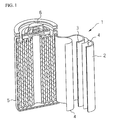
- FIG. 1 is a schematic view showing a rechargeable lithium battery according to the present invention
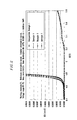
- FIG. 2 is a graph showing LSV decomposition start voltages of cells according to Examples 1 to 3 and Comparative Example 1;
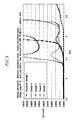
- FIG. 3 is a graph showing LSV decomposition start voltages of cells according to Examples 4 to 7 and Comparative Example 1;
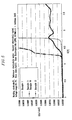
- FIG. 4 is a graph showing LSV decomposition start voltages of cells according to Examples 8 to 10 and Comparative Example 1;
- FIG. 5 is a graph showing LSV data when the additive represented by Formula 5 was mixed to the additive represented by Formula 2.
- the present invention relates to an electrolyte for a rechargeable lithium battery that is capable of providing the battery with improved safety upon an overcharge condition, and good high temperature storage and cycle-life characteristics.
- the electrolyte of the present invention includes at least two different kinds of organic compounds having HOMO (Highest Occupied Molecular Orbital) values higher than those of conventional carbonates.
- the at least two different organic compounds also have different oxidation potential values from each other.
- the electrolyte of the present invention includes a first additive having a low oxidation potential of 4.1 to 4.6V (referred to herein as a "lower potential-overcharge additive"), and a second additive having a high oxidation potential of 4.4 to 5.0V (referred to herein as a "higher potential-overcharge additive").
- the second additive has an oxidation potential higher than that of the first additive.
- the first additive is selected to have an oxidation potential of lower than 4.4V when the oxidation potential of the second additive is 4.4V
- the second additive is selected to have an oxidation potential of higher than 4.6V when the oxidation potential of the first additive is 4.6V.
- the higher potential-overcharge additive has an oxidation potential of 4.6 to 5.0V, and most preferably 4.7 to 4.9V.
- the lower potential-overcharge additive more preferably has an oxidation potential of 4.1V to 4.6V, and most preferably 4.2V to 4.4V.
- the potential difference between the higher potential-overcharge additive and the lower potential-overcharge additive is in a range of between 0.1 and 0.7V, and preferably between 0.3 and 0.7V.
- the electrolyte which includes the higher potential-overcharge additive and the lower potential-overcharge additive preferably has an oxidation potential of 4.4 to 4.9V, and more preferable 4.5 to 4.7V when the electrolyte includes a carbonate-based solvent as an organic solvent.
- an oxidation potential may be varied depending on the kind of organic solvents used in the electrolyte and thus, as the standard solvent, the present invention employs a carbonate-based solvent as an organic solvent used in the electrolyte.
- Oxidation potential is the potential at which an oxide reaction starts and a voltage at which decomposition begins.
- the voltage at which decomposition starts indicates a potential at which the current value variation of 0.00001A/cm2 begins at a room temperature of 20 to 25°C under an air atmosphere.
- the amount of the additive is 1% or more by weight based on the total weight of the electrolyte. If the amount is less than 1% by weight, the peak value changing the current value is difficult to monitor using the naked eye.
- the HOMO Highest Occupied Molecular Orbital
- the HOMO is the outermost (highest energy) orbital containing electrons. Accordingly, if any molecule is to lose an electron, it would most likely lose it from the outermost orbital.
- a material with a high HOMO value oxidizes easily, but a material with a low HOMO value is difficult to oxidize.
- All additives used in the present invention have a HOMO value of between -9 and -8eV, which is higher than that of between -12 and -11eV of the carbonate-based organic solvent. These values are determined according to PM3 (Parametric Method Number 3) of the semi-empirical molecular orbital calculating method.
- the lower potential-overcharge additive may include at least one compound represented by the following Formulae 1 and 2: wherein R1 is hydrogen, a C 1 -C 6 alkyl group, or a C 2 -C 6 alkylene group; R4 is a C 1 -C 6 alkyl group, -OOCR6 (wherein R6 is hydrogen, a C 1 -C 6 alkyl group, a C 2 -C 6 alkylene group), or -OR7 (wherein R7 is hydrogen, a C 1 -C 6 alkyl group or a C 2 -C 6 alkylene group); and R5 is a C 1 -C 6 alkyl group or a C 2 -C 6 alkylene group.
- R1 is hydrogen, a C 1 -C 6 alkyl group, or a C 2 -C 6 alkylene group
- R4 is a C 1 -C 6 alkyl group, -OOCR6 (wherein R6 is hydrogen, a C 1 -C 6 al
- Exemplary compounds represented by Formula 1 may include, for example, compounds represented by Formulae 3 and 4: where R1 is defined as for Formula 1; R6 is hydrogen, a C 1 -C 6 alkyl group or a C 2 -C 6 alkylene group; and R7 is hydrogen, a C 1 -C 6 alkyl group or a C 2 -C 6 alkylene group.
- the higher potential-overcharge additive may include at least one of compounds represented by one of Formulae 5 to 9:
- R1 is a C 1 -C 6 alkyl group or an alkylene group
- R2 is a C 1 -C 6 alkyl group, an alkoxy group, or an alkylene group
- R3 is R3 is a C 1 -C 6 alkyl group or a C 2 -C 6 alkylene group
- R4 is R4 is selected from the group consisting of C 1 -C 6 alkyl groups, -OOCR6 where R6 is selected from the group consisting of hydrogen, C 1 -C 6 alkyl groups, and C 2 -C 6 alkylene groups, and -OR7 where R7 is selected from the group consisting of hydrogen, C 1 -C 6 alkyl groups and C 2 -C 6 alkylene groups
- Exemplary compounds represented by the Formulae 6 to 8 includes, for example, compounds represented by Formulae 10 to 13:
- X is Cl, Br, or F; and R3 is a C 1 -C 6 alkyl group or a C 2 -C 6 alkylene group.
- the lower potential-overcharge additive is a compound represented by Formula 2
- the higher potential-overcharge additive is a compound represented by Formula 5.
- the electrolyte according to the present invention including both the first additive and the second additive at an appropriate ratio. This combination ensures safe operation during overcharge, while still providing good cycle-life and good high-temperature storage and stability characteristics.
- two or more overcharge additives having different oxidation potentials are used as the overcharge additive.
- the additive having the low oxidation potential is added in very small amounts to maintain good stability of storage at high temperatures.
- the additive having a relatively higher oxidation potential ensures safety by reacting earlier during overcharge. Therefore, both recovery on storage and safety during overcharge can be satisfied, which are not achieved when only one of the additives is used.
- the electrolyte preferably includes 0.01 to 20% by weight of the higher potential-overcharge additive and the lower potential-overcharge additive combined, more preferably 0.1 to 10% by weight, and most preferably 5 to 10% by weight.
- the combined amounts of the higher potential-overcharge additive and the lower potential-overcharge additive are less than 0.01% by weight, it is difficult to achieve satisfactory effects during overcharge.
- the combined amount is more than 20% by weight, the cycle-life characteristics deteriorate remarkably.
- the weight ratio of the higher potential-overcharge additive to the lower potential-overcharge additive is preferably in the range of 20 : 0.1 to 3 : 2, and more preferably 10 : 0.1 to 4 : 1.
- the amount of the lower potential-overcharge additive is 0.01 to 5% by weight in the electrolyte, and that of the higher potential-overcharge additive is 1 to 20% by weight.
- the compound represented by Formula 2 is preferably used for the lower potential-overcharge additive
- the compound represented by Formula 5 is preferably used for the higher potential-overcharge additive.
- the weight ratio of the higher potential-overcharge additive to the lower potential-overcharge additive is preferably between 10 : 0.1 to 0.2, more preferably between 7.5 : 0.1 to 0.2, and most preferably between 5 : 0.1 to 0.2.
- the electrolyte of the present invention further includes a non-aqueous organic solvent and a lithium salt.
- the non-aqueous organic solvent acts a medium capable of transmitting ions taking part in the electrochemical reaction of the battery.
- the non-aqueous organic solvent may include a carbonate, ester, ether, or ketone.
- the carbonate may include, but is not limited to, dimethyl carbonate, diethyl carbonate, dipropyl carbonate, methylpropyl carbonate, ethylpropyl carbonate, methylethyl carbonate, ethylene carbonate, propylene carbonate, butylene carbonate, and so on.
- the ester may include, but is not limited to, ⁇ -butyrolactone, n-methyl acetate, n-ethyl acetate, n-propyl acetate and so on.
- the ester may be dibutyl ether and the ketone may be polymethylvinyl ketone.
- the carbonate solvent of the non-aqueous organic solvent is preferably prepared by mixing a cyclic carbonate and a chain carbonate.
- the cyclic carbonate is mixed with the chain carbonate at a volume ratio of between 1 : 1 and 1 : 9.
- the electrolyte properties can be improved when the mixing ratio of the cyclic carbonate and the chain carbonate are within this range.
- the non-aqueous organic solvent may further include an aromatic hydrocarbon organic solvent.
- a carbonate organic solvent is preferred.
- the aromatic hydrocarbon organic solvent may include compounds represented by Formula 14: wherein, R9 is a halogen or a C 1 -C 10 alkyl group and n is an integer between 0 and 6.
- the aromatic hydrocarbon organic solvent may include, but is not limited to benzene, fluorobenzene, chlorobenzene, nitro benzene, toluene, fluorotoluene, trifluorotoluene, xylene, and so on.
- the electrolyte including the aromatic hydrocarbon organic solvent is preferably composed of a carbonate solvent/aromatic hydrocarbon solvent in a volume ratio of between 1 : 1 and 30 : 1.
- the properties of the electrolyte can be improved when the volume ratio is in this range.
- the lithium salt acts as a source for supplying lithium ions in the battery, and helps the battery operation.
- the non-aqueous organic solvent acts as a medium for the ions which take part in the electrochemical reaction.
- the lithium salts may include, but are not limited to, at least one of LiPF 6 , LiBF 4 , LiSbF 6 , LiAsF 6 , LiClO 4 , CF 3 SO 3 Li, LiN(SO 2 CF 3 ) 2 , LiC 4 F 9 SO 3 , LiAlO 4 , LiAlOCl 4 , LiN(SO 2 C 2 F 5 ) 2 ), LiN(C x F 2x+1 SO 2 )(C y F 2y+1 SO 2 ) (wherein x and y are natural numbers), LiCl, and Lil.
- the concentration of the lithium salt is preferably between 0.1 and 2.0M.
- concentration of the lithium salt is less than 0.1M, the conductivity of the electrolyte is decreased, deteriorating the electrolyte properties.
- concentration is more than 2.0M, the viscosity of the electrolyte may increase, decreasing the transmittance of lithium ions.
- the rechargeable lithium battery according to the present invention includes the electrolyte of the present invention, a negative electrode and a positive electrode.
- the positive electrode includes a positive active material capable of reversibly intercalating and deintercalating lithium ions.
- the positive active material may include lithiated intercalation oxides.
- the negative electrode may include a negative active material capable of intercalating and deintercalating lithium ions.
- the negative active material may include a carbonaceous negative active material of a crystalline or amorphous carbon, or a carbon complex (for example, thermally decomposed carbon, cokes, graphite), a fired organic polymer compound, carbon fiber, a zinc oxide compound, lithium metal or a lithium alloy.
- the preferred negative active material is a crystalline carbon, and more preferably a graphite having an Lc (crystallite size) of 150 ⁇ or more and preferably between 150 and 3000 ⁇ , a d(002) of between 3.35 and 3.38 ⁇ of X-ray diffraction plane distance at the (002) plane, a true density of 2.2g/cm 3 or more and preferably between 2.2 and 2.3g/cm 3 , a BET (specific surface area) of between 0.5 and 50m 2 /g, and an average particle diameter (D50) of between 1 and 30 ⁇ m.
- Lc crystallite size
- a d(002) of between 3.35 and 3.38 ⁇ of X-ray diffraction plane distance at the (002) plane
- a true density 2.2g/cm 3 or more and preferably between 2.2 and 2.3g/cm 3
- BET specific surface area
- D50 average particle diameter
- the negative active material preferably has an intensity ratio Ra I(I(1360cm -1 )/I(1580cm -1 )) of a Raman Spectroscopy peak intensity I(1360) at a (1360) plane to an Raman Spectroscopy peak intensity I(1590) at a (1590) plane of 0.05 or more, and more preferably, between 0.05 and 0.5.
- the negative active material of the present invention preferably has an X-ray diffraction peak intensity ratio I(110)/(002) of an X-ray diffraction peak intensity (110) at a (110) plane to an X-ray diffraction peak intensity I(002) at a (002) plane of 0.2 or less, and more preferably between 0.006 and 0.2.
- the battery according to the present invention may further include a binder.
- the binder both helps to bind the active material particles to one another and to bind the positive active material to a current collector.
- the binder may include any material used a the conventional rechargeable lithium battery. Examples include those soluble in organic solvents or in water. Binders soluble in organic solvents include, but are not limited to, polytetrafluoro ethylene polyvinylidene fluoride, polyethylene, polypropylene, polyvinyl chloride, polyvinyl pyrrolidone, and polyvinyl alcohol.
- Binders soluble in water include, but are not limited to, styrene-butadiene rubber, polysodium acrylate, propylene and C2-8 olefin copolymer and (meth)acrylic acid and (meth)acrylic alkyl ester copolymers.
- Binders soluble in water may further include a water-soluble agent for increasing viscosity in order to increase the binding property.
- the water-soluble agent for increasing viscosity may include a cellulose-based compound.
- the cellulose compound may include, but is not limited to, carboxyl methyl cellulose, hydroxyl propyl cellulose, hydroxyl propyl methyl cellulose, hydroxyl ethyl cellulose, hydroxyl propyl ethyl cellulose, or methyl cellulose.
- it may include an alkaline metal salt thereof.
- the alkaline metal salt may include an alkali metal such as Na, K, or Li.
- the rechargeable lithium battery of the present invention may further include a separator for preventing a short between the positive electrode and the negative electrode.
- the separator may include any conventional material such as a polymer membrane of polyolefin, polypropylene, polyethylene, or other polymer materials, or a multilayer polymer membrane, a micro-porous film, or a fabric or non-fabric membrane.
- the rechargeable lithium battery including the electrolyte, the positive electrode, the negative electrode, and the separator has a structure such as a unit cell of positive electrode-separator-negative electrode, a bicell of positive electrode-separator-negative electrode-separator-positive electrode, or a lamination cell such that the unit cell is repeated.
- FIG. 1 shows a cylindrical lithium ion battery 1 including a negative electrode 2; a positive electrode 3; a separator 4 interposed between the negative electrode 2 and the positive electrode 3.
- An electrolyte is injected around the negative electrode 2, the positive electrode 3, and the separator 4 which are placed within a battery container 5 with a sealing member 6 for sealing the battery container 5.
- the rechargeable lithium battery is not limited to the structure shown in FIG. 1, and can be varied to any shape such as a prismatic, or a pouch shaped battery.
- An electrolyte solution was prepared by dissolving 1M LiPF6 in a mixed solvent of ethylene carbonate and ethylmethyl carbonate (in a 1:1 volume ratio). To this was added 2% by weight of an additive represented Formulae 1 to 10 as shown in Table 1 to provide electrolyte solutions for Examples 1 to 10, respectively.
- Comparative Example 1 is an electrolyte solution including 1 M LiPF6 dissolved in the mixed solvent of ethylene carbonate and methylethyl carbonate (in a 1:1 volume ratio) without the additive.
- the resulting electrolyte solutions were measured for oxidation potential (Linear Sweep Voltametry : LSV) by an electrochemical analyzer (Potensiostat Model273A, EG&G) at room temperature (25°C).
- the working electrode was made of a platinum electrode having a diameter of 1 mm, and the reference electrode and the counter electrode were made of lithium.
- the voltage range was between 3 and 7V and the scan rate was 1mV/s.
- the values obtained were rounded to the three decimal places.
- the tests were carried out at room temperature of 25°C in a sealed dry room. The results show that compounds represented by Formulae 2 to 5 and 10 to 13 of Examples 1 to 10 are decomposed earlier than that of the carbonate organic solvent of Comparative Example 1.
- the decomposition voltages are defined as where the potential starting the change at 0.00001A/cm2, are shown in the following Table 1. Further, HOMOs of Examples 1 to 10 and Comparative Example 1 are shown in the following Table 1. The HOMOs were determined by PM3 (Parametric Method Number 3) of the semi-empirical molecular orbital calculation method.
- Examples 1 to 3 and Comparative Example 1 were measured for LSV decomposition start voltage, and the results are shown in FIG. 2.
- the results of LSV decomposition start voltage for Examples 4 to 7 and Comparative Example 1 are shown in FIG. 3, and those of Examples 8 to 10 and Comparative Example 1 are shown in FIG. 4.
- the electric current is remarkably increased at LSV decomposition start voltage.
- the figures also indicate that compounds of Examples 1 to 10, that is, compounds represented by Formulae 2 to 5 and 10 to 13 have LSV decomposition start voltages lower than that of Comparative Example 1.
- Artificial graphite negative active material was suspended in an aqueous solution of carboxyl methyl cellulose, and a styrene-butadiene rubber binder was added thereto to prepare a negative active material slurry.
- the obtained slurry was coated on a copper foil with a thickness of 10 ⁇ m, dried and compressed to produce a negative electrode.
- the artificial graphite negative active material had an Lc of 3540 ⁇ , a d(002) of 3.357 ⁇ , a true density of 2.22g/cm3, a BET (specific surface area) value of 2.5m 2 /g, and an average particle diameter (D50) of 18 ⁇ m.
- the negative active material had an intensity ratio Ra I(1360cm-1)/I(1580cm-1) of a Raman spectroscopy peak intensity I(1360) at a (1360) plane to an Raman spectroscopy peak intensity I(1590) at a I(1590) plane of 0.27, and an X-ray peak intensity ratio I(110)/(002), of 0.055.
- a LiCoO 2 positive active material, a polyvinylidene fluoride binder, and a carbon conductive agent were dispersed at a weight ratio of 92:4:4 in a solvent of N-methyl-2-pyrrolidone to prepare a positive active material slurry.
- the positive active material was coated on an aluminum foil with a thickness of 15 ⁇ m, dried and compressed to produce a positive electrode.
- the produced electrodes were wound and pressed, then placed into prismatic cans having the dimensions of 46 mm x 34 mm x 50 mm.
- An electrolyte was injected into the cans, thereby completing the fabrication of the rechargeable lithium battery cells.
- LiPF 6 was added to a mixed solvent of ethylene carbonate and ethylmethyl carbonate (in a 1:1 volume ratio) to be 1.0M to prepare a mixture, and 2.0% by weight of 4-chlorotoluene and 0.2% by weight of bisphenol A diacetate based on the total weight of the mixture were added to the mixture.
- a rechargeable lithium cell was fabricated by the same procedure as in Example 11, except that 2.0% by weight of 4-chlorotoluene and 0.2% by weight of bisphenol A based on the total weight of the mixture were added to the mixture.
- a rechargeable lithium cell was fabricated by the same procedure as in Example 11, except that 2.0% by weight of 4-chlorotoluene and 0.2% by weight of 1,1-diphenylethylene based on the total weight of the mixture were added.
- a rechargeable lithium cell was fabricated by the same procedure as in Example 11, except that 2.0% by weight of 4-bromotoluene and 0.2% by weight of bisphenol A diacetate based on the total weight of the mixture were added.
- a rechargeable lithium cell was fabricated by the same procedure as in Example 11, except that 2.0% by weight of 4-bromotoluene and 0.2% by weight of bisphenol A based on the total weight of the mixture were added.
- a rechargeable lithium cell was fabricated by the same procedure as in Example 11, except that 2.0% by weight of 4-bromotoluene and 0.2% by weight of 1,1-diphenylethylene based on the total weight of the mixture were added.
- a rechargeable lithium cell was fabricated by the same procedure as in Example 11, except that 2.0% by weight of 4-fluorotoluene and 0.2% by weight of bisphenol A diacetate based on the total weight of the mixture were added.
- a rechargeable lithium cell was fabricated by the same procedure as in Example 11, except that 2.0% by weight of 4-fluorotoluene and 0.2% by weight of bisphenol A based on the total weight of the mixture were added.
- a rechargeable lithium cell was fabricated by the same procedure as in Example 11, except that 2.0% by weight of 4-fluorotoluene and 0.2% by weight of 1,1-diphenylethylene based on the total weight of the mixture were added.
- a rechargeable lithium cell was fabricated by the same procedure as in Example 11, except that 2.0% by weight of 4,4'-(hexafluoroisopropylidene)diphenol and 0.2% by weight of bisphenol A diacetate based on the total weight of the mixture were added.
- a rechargeable lithium cell was fabricated by the same procedure as in Example 11, except that 2.0% by weight of 4,4'-(hexafluoroisopropylidene)diphenol and 0.2% by weight of bisphenol A based on the total weight of the mixture were added.
- a rechargeable lithium cell was fabricated by the same procedure as in Example 11, except that 2.0% by weight of 4,4'-(hexafluoroisopropylidene)diphenol and 0.2% by weight of 1,1-diphenylethylene based on the total weight of the mixture were added.
- a rechargeable lithium cell was fabricated by the same procedure as in Example 11, except that 2.0% by weight of 4-phenyl-1,3-dioxane and 0.2% by weight of bisphenol A diacetate based on the total weight of the mixture were added.
- a rechargeable lithium cell was fabricated by the same procedure as in Example 11, except that 2.0% by weight of 4-phenyl-1,3-dioxane and 0.2% by weight of bisphenol A based on the total weight of the mixture were added.
- a rechargeable lithium cell was fabricated by the same procedure as in Example 11, except that 2.0% by weight of 4-phenyl-1,3-dioxane and 0.2% by weight of 1,1-diphenylethylene based on the total weight of the mixture were added.
- a rechargeable lithium cell was fabricated by the same procedure as in Example 11, except that 2.0% by weight of 4,4-cyclohexylidene bisphenol and 0.2% by weight of bisphenol A diacetate based on the total weight of the mixture were added.
- a rechargeable lithium cell was fabricated by the same procedure as in Example 11, except that 2.0% by weight of 4,4-cyclohexylidene bisphenol and 0.2% by weight of bisphenol A based on the total weight of the mixture were added.
- a rechargeable lithium cell was fabricated by the same procedure as in Example 11, except that 2.0% by weight of 4,4-cyclohexylidene bisphenol and 0.2% by weight of 1,1-diphenylethylene based on the total weight of the mixture were added.
- a rechargeable lithium cell was fabricated by the same procedure as in Example 11, except that 2.0% by weight of bisphenol S (4,4'-sulfonyl diphenol) and 0.2% by weight of bisphenol A diacetate based on the total weight of the mixture were added.
- a rechargeable lithium cell was fabricated by the same procedure as in Example 11, except that 2.0% by weight of bisphenol S (4,4'-sulfonyl diphenol) and 0.2% by weight of bisphenol A based on the total weight of the mixture were added.
- a rechargeable lithium cell was fabricated by the same procedure as in Example 11, except that 2.0% by weight of bisphenol S (4,4'-sulfonyl diphenol) and 0.2% by weight of 1,1-diphenylethylene based on the total weight of the mixture were added.
- a rechargeable lithium cell was fabricated by the same procedure as in Example 11, except that 1.50% by weight of 4-chlorotoluene and 1.0% by weight of bisphenol A diacetate based on the total weight of the mixture were added.
- a rechargeable lithium cell was fabricated by the same procedure as in Example 11, except that 10.0% by weight of 4-chlorotoluene and 0.01% by weight of bisphenol A based on the total weight of the mixture were added.
- a rechargeable lithium cell was fabricated by the same procedure as in Example 11, except that 10.0% by weight of 4-chlorotoluene and 0.05% by weight of 1,1-diphenylethylene based on the total weight of the mixture were added.
- a rechargeable lithium cell was fabricated by the same procedure as in Example 11, except that 1.5% by weight of 4-bromotoluene and 1.0% by weight of bisphenol A diacetate based on the total weight of the mixture were added.
- a rechargeable lithium cell was fabricated by the same procedure as in Example 11, except that 10.0% by weight of 4-bromotoluene and 0.01% by weight of bisphenol A based on the total weight of the mixture were added.
- a rechargeable lithium cell was fabricated by the same procedure as in Example 11, except that 10.0% by weight of 4-bromotoluene and 0.05% by weight of 1,1-diphenylethylene based on the total weight of the mixture were added.
- a rechargeable lithium cell was fabricated by the same procedure as in Example 11, except that 1.5% by weight of 4-fluorotoluene and 1.0% by weight of bisphenol A diacetate based on the total weight of the mixture were added.
- a rechargeable lithium cell was fabricated by the same procedure as in Example 11, except that 10.0% by weight of 4-fluorotoluene and 0.01% by weight of bisphenol A based on the total weight of the mixture were added.
- a rechargeable lithium cell was fabricated by the same procedure as in Example 11, except that 10.0% by weight of 4-fluorotoluene and 0.05% by weight of 1,1-diphenyl ethylene based on the total weight of the mixture were added.
- a rechargeable lithium cell was fabricated by the same procedure as in Example 11, except that 1.5% by weight of 4,4'-(hexafluoro isopropylidene) diphenol and 1.0% by weight of bisphenol A diacetate based on the total weight of the mixture were added.
- a rechargeable lithium cell was fabricated by the same procedure as in Example 11, except that 10.0% by weight of 4,4'-(hexafluoro isopropylidene) diphenol and 0.01 % by weight of bisphenol A based on the total weight of the mixture were added.
- a rechargeable lithium cell was fabricated by the same procedure as in Example 11, except that 10.0% by weight of 4,4'-(hexafluoro isopropylidene) diphenol and 0.05% by weight of 1,1-diphenylethylene based on the total weight of the mixture were added.
- a rechargeable lithium cell was fabricated by the same procedure as in Example 11, except that 1.5% by weight of 4-phenyl-1,3-dioxane and 1.0% by weight of bisphenol A diacetate based on the total weight of the mixture were added.
- a rechargeable lithium cell was fabricated by the same procedure as in Example 11, except that 10.0% by weight of 4-phenyl-1,3-dioxane and 0.01 % by weight of bisphenol A based on the total weight of the mixture were added.
- a rechargeable lithium cell was fabricated by the same procedure as in Example 11, except that 10% by weight of 4-phenyl-1,3-dioxane and 0.05% by weight of 1,1-diphenylethylene based on the total weight of the mixture were added.
- a rechargeable lithium cell was fabricated by the same procedure as in Example 11, except that 1.5% by weight of 4,4-cyclohexylidene bisphenol and 1.0% by weight of bisphenol A diacetate based on the total weight of the mixture were added.
- a rechargeable lithium cell was fabricated by the same procedure as in Example 11, except that 10.0% by weight of 4,4-cyclohexylidene bisphenol and 0.01% by weight of bisphenol A based on the total weight of the mixture were added.
- a rechargeable lithium cell was fabricated by the same procedure as in Example 11, except that 10.0% by weight of 4,4-cyclohexylidene bisphenol and 0.05% by weight of 1,1-diphenylethylene based on the total weight of the mixture were added.
- a rechargeable lithium cell was fabricated by the same procedure as in Example 11, except that 1.5% by weight of bisphenol S(4,4'-sulphonyl diphenol) and 1.0% by weight of bisphenol A diacetate based on the total weight of the mixture were added.
- a rechargeable lithium cell was fabricated by the same procedure as in Example 11, except that 10.0% by weight of bisphenol S(4,4'-sulphonyl diphenol) and 0.01 % by weight of bisphenol A based on the total weight of the mixture were added.
- a rechargeable lithium cell was fabricated by the same procedure as in Example 11, except that 10.0% by weight of bisphenol S(4,4'-sulphonyl diphenol) and 0.05% by weight of 1.1-diphenyl ethylene based on the total weight of the mixture were added.
- a rechargeable lithium battery cell was fabricated by the same procedure as in Example 11, except that an additive was not added to the electrolyte.
- a rechargeable lithium battery cell was fabricated by the same procedure as in Example 11, except that 2.0% by weight of 4-chlorotoluene based on the total weight of the mixture was added.
- a rechargeable lithium battery cell was fabricated by the same procedure as in Example 11, except that 2.0% by weight of 4-bromotoluene based on the total weight of the mixture was added.
- a rechargeable lithium battery cell was fabricated by the same procedure as in Example 11, except that 2.0% by weight of 4-fluorotoluene based on the total weight of the mixture was added.
- a rechargeable lithium battery cell was fabricated by the same procedure as in Example 11, except that 2.0% by weight of 4,4'-(hexafluoro isopropylidene) diphenol based on the total weight of the mixture was added.
- a rechargeable lithium battery cell was fabricated by the same procedure as in Example 11, except that 2.0% by weight of 4-phenyl-1,3-dioxane was added based on the total weight of the mixture.
- a rechargeable lithium battery cell was fabricated by the same procedure as in Example 11, except that 2.0% by weight of 4,4-cyclohexylidene bisphenol was added based on the total weight of the mixture.
- a rechargeable lithium battery cell was fabricated by the same procedure as in Example 11, except that 2.0% by weight of bisphenol S(4,4'-sulphonyl diphenol) was added based on the total weight of the mixture.
- a rechargeable lithium battery cell was fabricated by the same procedure as in Example 11, except that 2.0% by weight of bisphenol A diacetate was added based on the total weight of the mixture.
- a rechargeable lithium battery cell was fabricated by the same procedure as in Example 11, except that 2.0% by weight of bisphenol A was added based on the total weight of the mixture.
- a rechargeable lithium battery cell was fabricated by the same procedure as in Example 11, except that 2.0% by weight of 1,1-diphenyl ethylene was added based on the total weight of the mixture.
- a rechargeable lithium battery cell was fabricated by the same procedure as in Example 11, except that 0.2% by weight of bisphenol A diacetate was added based on the total weight of the mixture.
- a rechargeable lithium battery cell was fabricated by the same procedure as in Example 11, except that 0.2% by weight of bisphenol A was added based on the total weight of the mixture.
- a rechargeable lithium battery cell was fabricated by the same procedure as in Example 11, except that 0.2% by weight of 1,1-diphenyl ethylene was added based on the total weight of the mixture.
- the high temperature storage characteristics were measured by allowing the charged battery cells to stand at 85°C for 4 days, and the discharge capacity at 0.5C was measured.
- the retention recovery ratio was expressed by comparing the discharge capacity at 0.5C after the 4 days at high temperature as a percentage of the discharge capacity at 0.5C before the 4 days at high temperature storage.
- the cells according to Examples 11 to 24 and Comparative Example 2 were constant current and constant voltage charged at 1 C/4.2V under a cut-off of 0.1C and a cut-off discharge of 1C/3.0V.
- the capacity retention ratio was expressed by comparing the discharge capacity after 300 cycles as a percentage of the discharge capacity for 1 cycle.
- 15L0, 5L4 means that among a total of 20 cells tested, 15 cells were indicated as good, and 5 cells were burning.
- First additive lower potential-overcharge additive
- Second additive higher potential-overcharge additive
- LSV decomposition starting voltage V
- Overcharge Retention recovery rate at high temperature Capacity retention at 45°C for 300 cycles (%) Capacity retention at room temperature for 300cycles (%)
- Example 11 bisphenol A diacetate 4-chlorotoluene 4.50 20L0 80 75 85
- Example 12 bisphenol A 4-chlorotoluene 4.43 20L0 77 74 86
- Example 13 1,1-diphenyl ethylene 4-chlorotoluene 4.47 20L0 79 76
- Example 14 bisphenol A diacetate 4-bromotoluene 4.56 20L0 76 74 87
- Example 16 1,1-diphenylethyl ene 4-bro
- Comparative Examples 3 to 9 with additives having relatively higher potentials than those of Comparative Examples 10, 11 and 12, the results on overcharge characteristics were improved compared to that of Comparative Example 2, but having L4 or more was not perfect prevention compared to those of Comparative Examples 10, 11 and 12 all having L0. However, they improved the retention recovery rate at high temperature and the cycle characteristics at 80% or more compared to those of Comparative Examples 10, 11 and 12.
- the cells of Examples 11 to 52 including both the first and the second additives had improved retention recovery rate at the high temperature, up to 70% or more, as shown in Tables 2 and 3, and the capacity retention at 300 cycles was 79% or more.
- the cells of Examples 13, 16, and 29 including the compounds represented by Formula 5 as the higher potential-overcharge additive and the compound represented by Formula 2 as the lower potential-overcharge additive improved the retention recovery rate at the high temperature.
- the additive having the lower Linear Sweep Voltametry and slightly reacting during overcharge increased the polarization during overcharge, so that the additive having the higher Linear Sweep Voltametry started the reaction at the early stage to improve the safety during overcharge enough to show that all cells were LO.
- batteries having good retention recovery rates at high temperature and good safety during the overcharge can be achieved.
- the LSV decomposition start voltage is between those of the higher additive and the lower additive when these additive are mixed.
- the LSV decomposition start voltage is 4.47V, which is between 4.26 of the lower additive (Formula 2) and 4.73 of the higher additive (Formula 5) when these additives are mixed.
- FIG. 5 shows LSV data when the additive represented by Formula 5 was mixed to the additive represented by Formula 2.
- the cells of Comparative Examples 10 to 12 including only the lower potential-overcharge additive at more than a predetermined amount have good safety during overcharge, but the cycle-life characteristics are remarkably deteriorated due to the side reaction of the lower potential-overcharge additive on the cycle-life at high temperature.
- the cells according to Comparative Examples 3 to 9 including only the higher potential-overcharge additive improved the cycle-life characteristics, but the overcharge property remarkably deteriorated.
- the cells according to Examples 11 to 52 including both the lower potential-overcharge additive and the higher potential-overcharge additive were satisfactory in terms of both the overcharge property and the cycle-life characteristics at high temperature.
- a rechargeable lithium battery cell was fabricated by the same procedure as in Example 11, except that a polyvinyl pyrrolidone binder was used, a 4-chlorotoluene higher potential-overcharge additive was added in an amount of 5% by weight and a bisphenol A diacetate lower potential-overcharge additive was added in an amount of 0.2% by weight of the total weight of the mixture.
- a rechargeable lithium battery cell was fabricated by the same procedure as in Example 12, except that a polyvinyl pyrrolidone binder was used, a 4-chlorotoluene higher potential-overcharge additive was added in an amount of 5% by weight, and a bisphenol A lower potential-overcharge additive was added in an amount of 0.2% by weight of the total weight of the mixture.
- a rechargeable lithium battery cell was fabricated by the same procedure as in Example 13, except that polyvinyl pyrrolidone was used for the binder of the negative electrode, 4-chlorotoluene for the higher potential-overcharge additive was added in an amount of 5% by weight and a 1,1-diphenyl ethylene lower potential-overcharge additive was added in an amount of 0.2% by weight of the total weight of the mixture.
- a rechargeable lithium battery cell was fabricated by the same procedure as in Example 14, except that a polyvinyl pyrrolidone binder, a 4-bromotoluene higher potential-overcharge additive was added in an amount of 5% by weight and a bisphenol A diacetate lower potential-overcharge additive was added in an amount of 0.2% by weight of the total weight of the mixture.
- a rechargeable lithium battery cell was fabricated by the same procedure as in Example 15, except that a polyvinyl pyrrolidone binder was used, a 4-bromotolene higher potential-overcharge additive was added in an amount of 5% by weight, and a bisphenol A lower potential-overcharge additive was added in an amount of 0.2% by weight of the total weight of the mixture.
- a rechargeable lithium battery cell was fabricated by the same procedure as in Example 16, except that a polyvinyl pyrrolidone binder was used, a 4-bromotoluene higher potential-overcharge additive was added in an amount of 5% by weight and a 1,1,-diphenyl ethylene lower potential-overcharge additive was added in an amount of 0.2% by weight of the total weight of the mixture.
- a rechargeable lithium battery cell was fabricated by the same procedure as in Example 17, except that a polyvinyl pyrrolidone binder was used, a 4-fluorotoluene higher potential-overcharge additive was added in amount of 5% by weight and a bisphenol A diacetate lower potential-overcharge additive was added in an amount of 0.2% by weight of the total weight of the mixture.
- a rechargeable lithium battery cell was fabricated by the same procedure as in Example 18, except that a polyvinyl pyrrolidone binder was used, a 4-fluorotoluene higher potential-overcharge additive was added in an amount of 5% by weight and a bisphenol A lower potential-overcharge additive was added in an amount of 0.2% by weight of the total weight of the mixture.
- a rechargeable lithium battery cell was fabricated by the same procedure as in Example 19, except that a polyvinyl pyrrolidone binder was used, a 4-fluorotoluene higher potential-overcharge additive was added in an amount of 5% by weight and a 1,1-diphenyl ethylene lower potential-overcharge additive was added in an amount of 0.2% by weight of the total weight of the mixture.
- a rechargeable lithium battery cell was fabricated by the same procedure as in Example 20, except that a polyvinyl pyrrolidone binder was used, a 4,4'-(hexafluoroisopropylene)dipheneol higher potential-overcharge additive was added in an amount of 5% by weight and a bisphenol A diacetate lower potential-overcharge additive was added in an amount of 0.2% by weight of the total weight of the mixture.
- a rechargeable lithium battery cell was fabricated by the same procedure as in Example 21, except that a polyvinyl pyrrolidone binder was used, a 4,4'-(hexafluoroisopropylene)dipheneol higher potential-overcharge additive was added in an amount of 5% by weight and a bisphenol A lower potential-overcharge additive was added in an amount of 0.2% by weight of the total weight of the mixture.
- a rechargeable lithium battery cell was fabricated by the same procedure as in Example 22, except that a polyvinyl pyrrolidone binder was used, a 4,4'-(hexafluoroisopropylene)dipheneol higher potential-overcharge additive was added in an amount of 5% by weight and a 1,1-diphenyl ethylene lower potential-overcharge additive was added in an amount of 0.2% by weight of the total weight of the mixture.
- a rechargeable lithium battery cell was fabricated by the same procedure as in Example 23, except that a polyvinyl pyrrolidone binder was used, a 4-phenyl-1,3-dioxane higher potential-overcharge additive was added in an amount of 5% by weight and a bisphenol A diacetate lower potential-overcharge additive was added in an amount of 0.2% by weight of the total weight of the mixture.
- a rechargeable lithium battery cell was fabricated by the same procedure as in Example 24, except that a polyvinyl pyrrolidone binder was used, a 4-phenyl-1,3-dioxane higher potential-overcharge additive was added in an amount of 5% by weight and a bisphenol A lower potential-overcharge additive was added in an amount of 0.2% by weight of the total weight of the mixture.
- a rechargeable lithium battery cell was fabricated by the same procedure as in Example 25, except that a polyvinyl pyrrolidone binder was used, a 4-phenyl-1,3-dioxane higher potential-overcharge additive was added in an amount of 5% by weight and a 1,1-diphenyl ethylene lower potential-overcharge additive was added in an amount of 0.2% by weight of the total weight of the mixture.
- a rechargeable lithium battery cell was fabricated by the same procedure as in Example 26, except that a polyvinyl pyrrolidone binder was used, a 4,4-cyclohexylidene bisphenol higher potential-overcharge additive was added in an amount of 5% by weight and a bisphenol A diacetate lower potential-overcharge additive was added in an amount of 0.2% by weight of the total weight of the mixture.
- a rechargeable lithium battery cell was fabricated by the same procedure as in Example 27, except that a polyvinyl pyrrolidone binder was used, a 4,4-cyclohexylidene bisphenol higher potential-overcharge additive was added in an amount of 5% by weight and a bisphenol A lower potential-overcharge additive was added in an amount of 0.2% by weight of the total weight of the mixture.
- a rechargeable lithium battery cell was fabricated by the same procedure as in Example 28, except that a polyvinyl pyrrolidone binder was used, a 4,4-cyclohexylidene bisphenol higher potential-overcharge additive was added in an amount of 5% by weight and a 1,1-diphenyl ethylene lower potential-overcharge additive was added in an amount of 0.2% by weight of the total weight of the mixture.
- a rechargeable lithium battery cell was fabricated by the same procedure as in Example 29, except that a polyvinyl pyrrolidone binder was used, a bisphenol S(4,4'-sulfonyl diphenol) higher potential-overcharge additive was added in an amount of 5% by weight and a bisphenol A diacetate lower potential-overcharge additive was added in an amount of 0.2% by weight of the total weight of the mixture.
- a rechargeable lithium battery cell was fabricated by the same procedure as in Example 30, except that a polyvinyl pyrrolidone binder was used, a bisphenol S(4,4'-sulfonyl diphenol) higher potential-overcharge additive was added in an amount of 5% by weight and a bisphenol A lower potential-overcharge additive was added in an amount of 0.2% by weight of the total weight of the mixture.
- a rechargeable lithium battery cell was fabricated by the same procedure as in Example 31, except that a polyvinyl pyrrolidone binder was used, a bisphenol S(4,4'-sulfonyl diphenol) higher potential-overcharge additive was added in an amount of 5% by weight and a 1,1-diphenyl ethylene lower potential-overcharge additive was added in an amount of 0.2% by weight of the total weight of the mixture.
- a rechargeable lithium battery cell was fabricated by the same procedure as in Example 32, except that a polyvinyl pyrrolidone binder was used, a 4-chlorotoluene higher potential-overcharge additive was added in an amount of 10% by weight and a bisphenol A diacetate lower potential-overcharge additive added in an amount of 0.5% by weight of the total weight of the mixture.
- a rechargeable lithium battery cell was fabricated by the same procedure as in Example 33, except that a polyvinyl pyrrolidone binder was used, a 4-chlorotoluene higher potential-overcharge additive was added in an amount of 10% by weight and a bisphenol A lower potential-overcharge additive was added in an amount of 0.5% by weight of the total weight of the mixture.
- a rechargeable lithium battery cell was fabricated by the same procedure as in Example 34, except that a polyvinyl pyrrolidone binder was used, a 4-chlorotoluene higher potential-overcharge additive was added in an amount of 10% by weight and a 1,1-diphenyl ethylene lower potential-overcharge additive was added in an amount of 0.5% by weight of the total weight of the mixture.
- a rechargeable lithium battery cell was fabricated by the same procedure as in Example 35, except that a polyvinyl pyrrolidone binder was used, a 4-bromoetoluene higher potential-overcharge additive was added in an amount of 10% by weight and a bisphenol A diacetate lower potential-overcharge additive was added in an amount of 0.5% by weight of the total weight of the mixture.
- a rechargeable lithium battery cell was fabricated by the same procedure as in Example 36, except that a polyvinyl pyrrolidone binder was used, a 4-bromotoluene higher potential-overcharge additive was added in an amount of 10% by weight and a bisphenol A lower potential-overcharge additive was added in an amount of 0.5% by weight of the total weight of the mixture.
- a rechargeable lithium battery cell was fabricated by the same procedure as in Example 37, except that a polyvinyl pyrrolidone binder was used, a 4-bromotoluene higher potential-overcharge additive was added in an amount of 10% by weight and a 1,1-diphenyl ethylene lower potential-overcharge additive was added in an amount of 0.5% by weight of the total weight of the mixture.
- a rechargeable lithium battery cell was fabricated by the same procedure as in Example 38, except that a polyvinyl pyrrolidone binder was used, a 4-fluorotoluene higher potential-overcharge additive was added in an amount of 10% by weight and a bisphenol A diacetate lower potential-overcharge-additive was added in an amount of 0.5% by weight of the total weight of the mixture.
- a rechargeable lithium battery cell was fabricated by the same procedure as in Example 39, except that a polyvinyl pyrrolidone binder was used, a 4-fluorotoluene higher potential-overcharge additive was added in an amount of 10% by weight and a bisphenol A lower potential-overcharge additive was added in an amount of 0.5% by weight of the total weight of the mixture.
- a rechargeable lithium battery cell was fabricated by the same procedure as in Example 40, except that a polyvinyl pyrrolidone binder was used, a 4-bromotoluene higher potential-overcharge additive was added in an amount of 10% by weight and a 1,1-diphenyl ethylene lower potential-overcharge additive was added in an amount of 0.5% by weight of the total weight of the mixture.
- a rechargeable lithium battery cell was fabricated by the same procedure as in Example 41, except that a polyvinyl pyrrolidone binder was used, a 4,4'-(hexafluoroisopropylidene) diphenol higher potential-overcharge additive was added in an amount of 10% by weight and a bisphenol A diacetate lower potential-overcharge additive was added in an amount of 0.5% by weight of the total weight of the mixture.
- a rechargeable lithium battery cell was fabricated by the same procedure as in Example 42, except that a polyvinyl pyrrolidone binder was used, a 4,4'-(hexafluoroisopropylidene) diphenol higher potential-overcharge additive was added in an amount of 10% by weight and a bisphenol A lower potential-overcharge additive was added in an amount of 0.5% by weight of the total weight of the mixture.
- a rechargeable lithium battery cell was fabricated by the same procedure as in Example 43, except that a polyvinyl pyrrolidone binder was used, a 4,4'-(hexafluoroisopropylidene) diphenol higher potential-overcharge additive was added in an amount of 10% by weight and a 1,1-diphenyl ethylene lower potential-overcharge additive was added in an amount of 0.5% by weight of the total weight of the mixture.
- a rechargeable lithium battery cell was fabricated by the same procedure as in Example 44, except that a polyvinyl pyrrolidone binder was used, a 4-phenyl-1,3-dioxane higher potential-overcharge additive was added in an amount of 10% by weight and a bisphenol A diacetate lower potential-overcharge additive was added in an amount of 0.5% by weight of the total weight of the mixture.
- a rechargeable lithium battery cell was fabricated by the same procedure as in Example 45, except that a polyvinyl pyrrolidone binder was used, a 4-phenyl-1,3-dioxane higher potential-overcharge additive was added in an amount of 10% by weight and a bisphenol A lower potential-overcharge additive was added in an amount of 0.5% by weight of the total weight of the mixture.
- a rechargeable lithium battery cell was fabricated by the same procedure as in Example 46, except that a polyvinyl pyrrolidone binder was used, a 4-phenyl-1,3-dioxane higher potential-overcharge additive was added in an amount of 10% by weight and a 1,1-diphenyl ethylene lower potential-overcharge additive was added in an amount of 0.5% by weight of the total weight of the mixture.
- a rechargeable lithium battery cell was fabricated by the same procedure as in Example 47, except that a polyvinyl pyrrolidone binder was used, a 4,4-cyclohexylidene bisphenol higher potential overcharge additive was added in an amount of 10% by weight and a bisphenol A diacetate lower potential-overcharge additive was added in an amount of 0.5% by weight of the total weight of the mixture.
- a rechargeable lithium battery cell was fabricated by the same procedure as in Example 48, except that a polyvinyl pyrrolidone binder was used, a 4,4-cyclohexylidene bisphenol higher potential-overcharge additive was added in an amount of 10% by weight and a bisphenol A lower potential-overcharge additive was added in an amount of 0.5% by weight of the total weight of the mixture.
- a rechargeable lithium battery cell was fabricated by the same procedure as in Example 49, except that a polyvinyl pyrrolidone binder was used, a 4,4-cyclohexylidene bisphenol higher potential-overcharge additive was added in an amount of 10% by weight and a 1,1-diphenyl ethylene lower potential-overcharge additive was added in an amount of 0.5% by weight of the total weight of the mixture.
- a rechargeable lithium battery cell was fabricated by the same procedure as in Example 50, except that a polyvinyl pyrrolidone binder was used, a bisphenol S(4,4'-sulfonyl diphenol) higher potential-overcharge additive was added in an amount of 10% by weight and a bisphenol A diacetate lower potential-overcharge additive was added in an amount of 0.5% by weight of the total weight of the mixture.
- a rechargeable lithium battery cell was fabricated by the same procedure as in Example 51, except that a polyvinyl pyrrolidone binder was used, a bisphenol S(4,4'-sulfonyl diphenol) higher potential-overcharge additive was added in an amount of 10% by weight and a bisphenol A lower potential-overcharge additive was added in an amount of 0.5% by weight of the total weight of the mixture.
- a rechargeable lithium battery cell was fabricated by the same procedure as in Example 52, except that a polyvinyl pyrrolidone binder was used, a bisphenol S(4,4'-sulfonyl diphenol) higher potential-overcharge additive was added in an amount of 10% by weight and a 1,1-diphenyl ethylene lower potential-overcharge additive was added in an amount of 0.5% by weight of the total weight of the mixture.
- the high temperature storage characteristics were measured by allowing the charged cells to stand at 85°C for 4 days, and the discharge capacity was measured.
- the retention recovery rate was expressed by comparing the discharge capacity at 0.5C after 4 days at high temperature as a percentage of the discharge capacity at 0.5C before the 4 days at high temperature.
- the cells were cut-off charged at 0.1C and cut-off discharged at 1C/4.2V under constant current and constant voltage.
- the capacity retention was expressed by comparing the discharge capacity after 300 cycles as a percentage of the discharge capacity at the first cycle.
- a rechargeable lithium battery cell was fabricated by the same procedure as in Example 11, except that a 4-chlorotoluene and a 4-bromotoluene higher potential-overcharge additive were respectively added in an amount of 1.0% by weight and 1.0% by weight and a lower potential-overcharge additive was not added.
- a rechargeable lithium battery cell was fabricated by the same procedure as in Example 11, except that a 4-fluorotoluene and a 4,4'-(hexafluoro isopropylidene)diphenol higher potential-overcharge additive were respectively added in an amount of 1.0% by weight and 1.0% by weight and the lower potential-overcharge additive was not added.
- a rechargeable lithium battery cell was fabricated by the same procedure as in Example 11, except that a 4-phenyl-1,3-dioxane and a 4,4'-(hexafluoro isopropylidene)diphenol higher potential-overcharge additive were respectively added in an amount of 1.0% by weight and 1.0% by weight and a lower potential-overcharge additive was not added.
- a rechargeable lithium battery cell was fabricated by the same procedure as in Example 11, except that a bisphenol A diacetate and bisphenol A lower potential-overcharge additive were respectively added in an amount of 1.0% by weight and 1.0% by weight and a higher potential-overcharge additive was not added.
- a rechargeable lithium battery cell was fabricated by the same procedure as in Example 11, except that a 1,1-diphenylethylene and bisphenol A lower potential-overcharge additive were respectively added in an amount of 1.0% by weight and 1.0% by weight and a higher potential-overcharge additive was not added.
- a rechargeable lithium battery cell was fabricated by the same procedure as in Example 11, except that a 4-chlorotoluene higher potential-overcharge additive was respectively added in an amount of 25% by weight and a lower potential-overcharge additive was not added.
- a rechargeable lithium battery cell was fabricated by the same procedure as in Example 11, except that a 1,1-diphenylethylene lower potential-overcharge additive was added in an amount of 25% by weight and a higher potential-overcharge additive was not added.
- a rechargeable lithium battery cell was fabricated by the same procedure as in Example 11, except that a 4-chlorotoluene higher potential-overcharge additive was added in an amount of 20% by weight and a 1,1-diphenylethylene lower potential-overcharge additive was added in an amount of 5% by weight.
- the cells fabricated by procedures according to comparative Examples 16 to 23 were constant current and constant voltage charged at 158mA and 4.2V, and then allowed to stand for 1 hour followed by discharging at 395mA and 2.75V and being allowed to stand for 1 hour. These procedures were repeated 3 times, and the resulting cells were then charged at 395mA and 4.2V for 3 hours.
- each set of 20 cells fabricated by procedures according to Examples 16 to 23 were constant current and constant voltage overcharged at 1 C (790mAh) by 12V at room temperature (25°C) for 2.5 hours. The cells were monitored, and the results are shown in Table 7.
- these charged cells were allowed to stand at 85°C for 4 days, and the discharge capacity was measured.
- the recovery rate was expressed by comparing the discharge capacity at 0.5C after the cell was allowed to stand at the high temperature for 4 days as a percentage of the discharge capacity at 0.5C before the 4 days of high temperature storage.
- the cycle life test was performed by constant current/constant voltage charging at 1 C at 4V under a cut-off of 0.1 C, and discharging at 1 C under a cut-off voltage of 3.0V, for 300cycles.
- the capacity retention was expressed by comparing the discharge capacity after 300 cycles as a percentage of the discharge capacity at 1 cycle.
- the cycle-life test was carried out under both a high temperature (45°C) and at room temperature (25°C).
- an electrolyte for a rechargeable lithium battery according to the present invention including a higher oxidation-potential additive and a lower oxidation-potential additive can provide a battery with improved safety during high temperature storage with good cycle-life characteristics.
Landscapes
- Chemical & Material Sciences (AREA)
- Engineering & Computer Science (AREA)
- Manufacturing & Machinery (AREA)
- Chemical Kinetics & Catalysis (AREA)
- Electrochemistry (AREA)
- General Chemical & Material Sciences (AREA)
- Materials Engineering (AREA)
- Physics & Mathematics (AREA)
- Condensed Matter Physics & Semiconductors (AREA)
- General Physics & Mathematics (AREA)
- Inorganic Chemistry (AREA)
- Secondary Cells (AREA)
- Battery Electrode And Active Subsutance (AREA)
Applications Claiming Priority (4)
| Application Number | Priority Date | Filing Date | Title |
|---|---|---|---|
| KR20030076913 | 2003-10-31 | ||
| KR2003076913 | 2003-10-31 | ||
| KR2004065773 | 2004-08-20 | ||
| KR1020040065773A KR100709206B1 (ko) | 2003-10-31 | 2004-08-20 | 리튬 이차 전지용 전해액 및 이를 포함하는 리튬 이차 전지 |
Publications (3)
| Publication Number | Publication Date |
|---|---|
| EP1528616A2 true EP1528616A2 (fr) | 2005-05-04 |
| EP1528616A3 EP1528616A3 (fr) | 2007-01-03 |
| EP1528616B1 EP1528616B1 (fr) | 2017-03-08 |
Family
ID=34425464
Family Applications (1)
| Application Number | Title | Priority Date | Filing Date |
|---|---|---|---|
| EP04090417.9A Expired - Lifetime EP1528616B1 (fr) | 2003-10-31 | 2004-11-01 | Electrolyte pour batterie rechargeable au lithium et pile rechargeable au lithium comportant ladite électrode |
Country Status (3)
| Country | Link |
|---|---|
| US (2) | US7745055B2 (fr) |
| EP (1) | EP1528616B1 (fr) |
| JP (1) | JP4428653B2 (fr) |
Cited By (5)
| Publication number | Priority date | Publication date | Assignee | Title |
|---|---|---|---|---|
| WO2006124389A3 (fr) * | 2005-05-17 | 2007-06-07 | 3M Innovative Properties Co | Navettes chimiques d'oxydoreduction de n-oxyde pour cellule a ion lithium rechargeable |
| EP1720211A4 (fr) * | 2004-01-16 | 2010-02-17 | Hitachi Chemical Co Ltd | Electrode negative pour accumulateur au lithium et accumulateur au lithium |
| US8101302B2 (en) | 2008-02-12 | 2012-01-24 | 3M Innovative Properties Company | Redox shuttles for high voltage cathodes |
| DE102014203707A1 (de) | 2014-02-28 | 2015-09-03 | Robert Bosch Gmbh | Additivkombination für Lithium-Zelle |
| US20220216521A1 (en) * | 2019-11-28 | 2022-07-07 | Huazhong University Of Science And Technology | Lithium metal battery electrolyte containing aromatic compound as diluent |
Families Citing this family (14)
| Publication number | Priority date | Publication date | Assignee | Title |
|---|---|---|---|---|
| WO2002089245A1 (fr) * | 2001-04-27 | 2002-11-07 | Kanebo, Limited | Accumulateur a electrolyte organique |
| US8142936B2 (en) | 2004-02-10 | 2012-03-27 | Lg Chem, Ltd. | Non-aqueous electrolyte and lithium secondary battery using the same |
| KR100898290B1 (ko) * | 2007-09-12 | 2009-05-18 | 삼성에스디아이 주식회사 | 리튬 이차 전지 |
| JP5234247B2 (ja) * | 2007-12-28 | 2013-07-10 | ソニー株式会社 | 負極、二次電池、スルホン化合物および電子機器 |
| JP2009272170A (ja) * | 2008-05-08 | 2009-11-19 | Sanyo Electric Co Ltd | 非水電解質二次電池 |
| KR101376414B1 (ko) | 2008-07-30 | 2014-03-20 | 다이킨 고교 가부시키가이샤 | 리튬 이차 전지의 전해질염 용해용 용매 |
| WO2013051636A1 (fr) * | 2011-10-03 | 2013-04-11 | ダイキン工業株式会社 | Agent de protection contre la surcharge, électrolyte non aqueux et batterie rechargeable au lithium-ion |
| US9142397B2 (en) * | 2011-10-25 | 2015-09-22 | General Electric Company | High color rendering index fluorescent lamp with multi-layer phosphor coating |
| US9419307B2 (en) | 2011-11-22 | 2016-08-16 | Jx Nippon Oil & Energy Corporation | Organic electrolyte and organic electrolyte storage battery |
| JP6130354B2 (ja) * | 2012-03-06 | 2017-05-17 | Jxtgエネルギー株式会社 | Li蓄電池用電解質およびLi蓄電池 |
| WO2013147094A1 (fr) | 2012-03-30 | 2013-10-03 | 三菱化学株式会社 | Electrolyte non aqueux et cellule à électrolyte non aqueux l'utilisant |
| JP2014102961A (ja) * | 2012-11-20 | 2014-06-05 | Jx Nippon Oil & Energy Corp | 有機系電解質および有機系電解質蓄電池 |
| JP6572565B2 (ja) * | 2015-03-11 | 2019-09-11 | 株式会社Gsユアサ | 非水電解質二次電池及び非水電解質二次電池の製造方法 |
| CN114914544B (zh) * | 2022-05-18 | 2023-03-10 | 湖南大学 | 一种钠金属电池电解液及其制备方法 |
Family Cites Families (36)
| Publication number | Priority date | Publication date | Assignee | Title |
|---|---|---|---|---|
| US4489145A (en) | 1983-10-18 | 1984-12-18 | Abraham Kuzhikalail M | Lithium battery |
| JPS61230276A (ja) | 1985-04-05 | 1986-10-14 | Nippon Telegr & Teleph Corp <Ntt> | リチウム二次電池用電解液 |
| EP0319182B1 (fr) | 1987-11-30 | 1993-09-29 | EIC Laboratories, Inc. | Protection contre une surcharge de batteries secondaires non aqueuses |
| CA2000873C (fr) | 1988-10-21 | 1999-12-14 | Shigeru Oishi | Cellule a dispositif de coupure automatique de courant |
| JP3182255B2 (ja) | 1993-05-25 | 2001-07-03 | 三洋電機株式会社 | 非水系電解質電池 |
| JP3259436B2 (ja) | 1993-05-31 | 2002-02-25 | ソニー株式会社 | 非水電解液二次電池 |
| JP3809657B2 (ja) | 1994-03-07 | 2006-08-16 | ソニー株式会社 | 非水電解液二次電池 |
| JPH07320779A (ja) | 1994-05-20 | 1995-12-08 | Sanyo Electric Co Ltd | 非水電解液電池 |
| JP3384625B2 (ja) | 1994-08-25 | 2003-03-10 | 三洋電機株式会社 | 非水電解液電池 |
| JPH08321312A (ja) | 1995-05-24 | 1996-12-03 | Sanyo Electric Co Ltd | 非水電解液電池 |
| JP3669024B2 (ja) | 1995-05-26 | 2005-07-06 | ソニー株式会社 | 非水電解液二次電池 |
| CA2156800C (fr) | 1995-08-23 | 2003-04-29 | Huanyu Mao | Additifs aromatiques polymerisables pour proteger les batteries rechargeables non aqueuses au lithium contre les surcharges |
| JPH0973918A (ja) | 1995-09-05 | 1997-03-18 | Fuji Elelctrochem Co Ltd | 電池用非水電解液 |
| CA2163187C (fr) | 1995-11-17 | 2003-04-15 | Huanyu Mao | Monomeres aromatiques gazeux protegeant les piles au lithium non aqueuses contre les surcharges |
| JP3669064B2 (ja) | 1996-08-01 | 2005-07-06 | ソニー株式会社 | 非水電解質二次電池 |
| JP3575735B2 (ja) | 1997-05-16 | 2004-10-13 | Necトーキン栃木株式会社 | 非水系の再充電可能なリチウム電池 |
| CA2216898C (fr) | 1997-09-26 | 2005-03-22 | Moli Energy (1990) Limited | Additifs ameliores pour la protection contre la surcharge des piles rechargeables au lithium, non aqueuses |
| JP2939469B1 (ja) | 1998-07-31 | 1999-08-25 | 三洋電機株式会社 | 非水系電池用電解液およびこの電解液を用いた二次電池 |
| JP2983205B1 (ja) | 1998-07-31 | 1999-11-29 | 三洋電機株式会社 | 非水系二次電池 |
| US6303250B1 (en) | 1999-04-09 | 2001-10-16 | Matsushita Electric Industrial Co., Ltd. | Secondary battery including an electrolytic solution with an organic additive |
| JP4211159B2 (ja) | 1999-10-27 | 2009-01-21 | 三菱化学株式会社 | 非水系電解液二次電池 |
| KR100325868B1 (ko) | 2000-03-06 | 2002-03-07 | 김순택 | 유기전해액 및 이를 채용한 리튬 2차전지 |
| JP3443773B2 (ja) * | 2000-07-25 | 2003-09-08 | 日本電池株式会社 | 非水電解質二次電池の製造方法 |
| JP2002075446A (ja) | 2000-08-02 | 2002-03-15 | Samsung Sdi Co Ltd | リチウム−硫黄電池 |
| JP4695748B2 (ja) | 2000-10-12 | 2011-06-08 | パナソニック株式会社 | 非水系電池用電解液および非水系二次電池 |
| DE60226951D1 (de) | 2001-01-24 | 2008-07-17 | Ube Industries | Wasserfreie elektrolytische lösung und lithium-sekundärbatterien |
| US7049029B2 (en) | 2001-10-20 | 2006-05-23 | Samsung Sdi Co., Ltd. | Nonaqueous electrolyte composition for improving overcharge safety and lithium battery using the same |
| KR100509968B1 (ko) | 2001-12-28 | 2005-08-24 | 미쓰이 가가쿠 가부시키가이샤 | 비수전해액 및 그것을 사용한 리튬 2차전지 |
| KR100766930B1 (ko) | 2002-01-11 | 2007-10-17 | 삼성에스디아이 주식회사 | 리튬 이차 전지용 전해액 및 이를 포함하는 리튬 이차 전지 |
| KR100804689B1 (ko) | 2002-01-11 | 2008-02-18 | 삼성에스디아이 주식회사 | 리튬 이차 전지용 전해액 및 이를 포함하는 리튬 이차 전지 |
| KR100440939B1 (ko) | 2002-02-16 | 2004-07-21 | 삼성에스디아이 주식회사 | 고분자 전해질 및 이를 채용한 리튬 전지 |
| US6942949B2 (en) | 2002-08-12 | 2005-09-13 | Lg Chem, Ltd. | Rechargeable lithium electrochemical cell |
| JP4313017B2 (ja) | 2002-10-11 | 2009-08-12 | パナソニック株式会社 | 非水電解液二次電池 |
| KR100515298B1 (ko) | 2003-03-24 | 2005-09-15 | 삼성에스디아이 주식회사 | 비수성 전해질 및 이를 포함하는 리튬 이차 전지 |
| KR100471973B1 (ko) * | 2003-04-03 | 2005-03-10 | 삼성에스디아이 주식회사 | 비수성 전해질 및 이를 포함하는 리튬 이차 전지 |
| US7316868B2 (en) * | 2004-02-11 | 2008-01-08 | Sion Power Corporation | Electrolytes for lithium-sulfur electrochemical cells |
-
2004
- 2004-11-01 JP JP2004318586A patent/JP4428653B2/ja not_active Expired - Lifetime
- 2004-11-01 US US10/980,116 patent/US7745055B2/en active Active
- 2004-11-01 EP EP04090417.9A patent/EP1528616B1/fr not_active Expired - Lifetime
-
2010
- 2010-05-18 US US12/782,561 patent/US8530098B2/en active Active
Cited By (9)
| Publication number | Priority date | Publication date | Assignee | Title |
|---|---|---|---|---|
| EP1720211A4 (fr) * | 2004-01-16 | 2010-02-17 | Hitachi Chemical Co Ltd | Electrode negative pour accumulateur au lithium et accumulateur au lithium |
| US7906240B2 (en) | 2004-01-16 | 2011-03-15 | Hitachi Chemical Co., Ltd. | Negative electrode for lithium secondary battery and lithium secondary battery |
| US10651458B2 (en) | 2004-01-16 | 2020-05-12 | Hitachi Chemical Company, Ltd. | Negative electrode for lithium secondary battery and lithium secondary battery |
| WO2006124389A3 (fr) * | 2005-05-17 | 2007-06-07 | 3M Innovative Properties Co | Navettes chimiques d'oxydoreduction de n-oxyde pour cellule a ion lithium rechargeable |
| US7615317B2 (en) | 2005-05-17 | 2009-11-10 | 3M Innovative Properties Company | N-oxide redox shuttles for rechargeable lithium-ion cell |
| US8101302B2 (en) | 2008-02-12 | 2012-01-24 | 3M Innovative Properties Company | Redox shuttles for high voltage cathodes |
| DE102014203707A1 (de) | 2014-02-28 | 2015-09-03 | Robert Bosch Gmbh | Additivkombination für Lithium-Zelle |
| US20220216521A1 (en) * | 2019-11-28 | 2022-07-07 | Huazhong University Of Science And Technology | Lithium metal battery electrolyte containing aromatic compound as diluent |
| US12159972B2 (en) * | 2019-11-28 | 2024-12-03 | Huazhong University Of Science And Technology | Lithium metal battery electrolyte containing aromatic compound as diluent |
Also Published As
| Publication number | Publication date |
|---|---|
| US8530098B2 (en) | 2013-09-10 |
| US20050142448A1 (en) | 2005-06-30 |
| JP2005142157A (ja) | 2005-06-02 |
| JP4428653B2 (ja) | 2010-03-10 |
| EP1528616A3 (fr) | 2007-01-03 |
| EP1528616B1 (fr) | 2017-03-08 |
| US7745055B2 (en) | 2010-06-29 |
| US20100227227A1 (en) | 2010-09-09 |
Similar Documents
| Publication | Publication Date | Title |
|---|---|---|
| US8530098B2 (en) | Electrolyte for rechargeable lithium battery and rechargeable lithium battery comprising same | |
| US7981551B2 (en) | Electrolyte for lithium ion rechargeable battery and lithium ion rechargeable battery comprising the same | |
| CN101461088B (zh) | 高电压充电型非水电解质二次电池 | |
| JP3669024B2 (ja) | 非水電解液二次電池 | |
| EP2237360B1 (fr) | Protection contre la surcharge par combinaison de produits chimiques de type navette redox avec des additifs de polymérisation radicalaire | |
| EP1923948B1 (fr) | Électrolyte pour batterie rechargeable au lithium à haute tension et batterie utilisant ce dernier | |
| CN101807715A (zh) | 非水电解液二次电池 | |
| CN100479257C (zh) | 锂离子二次电池用的电解液和包括它的锂离子二次电池 | |
| CN1938894A (zh) | 非水电解质溶液和锂二次电池 | |
| US5219684A (en) | Electrochemical cells containing a safety electrolyte solvent | |
| KR100709206B1 (ko) | 리튬 이차 전지용 전해액 및 이를 포함하는 리튬 이차 전지 | |
| CN100442592C (zh) | 锂离子二次电池用的电解液和包含它的锂离子二次电池 | |
| JP4701599B2 (ja) | 非水電解質二次電池 | |
| JP4765629B2 (ja) | 非水電解液およびリチウム二次電池 | |
| KR101310730B1 (ko) | 리튬 이차전지용 비수 전해액 및 이를 구비한 리튬 이차전지 | |
| KR20060083252A (ko) | 리튬 이차 전지용 전해액 및 이를 포함하는 리튬 이차 전지 | |
| KR100471984B1 (ko) | 비수성 전해질 및 이를 포함하는 리튬 이차 전지 | |
| CN118359802A (zh) | 用于非水电池电解液配方的组合物 | |
| CN100459274C (zh) | 非水电解液和锂二次电池 | |
| KR101318525B1 (ko) | 리튬 이온 이차 전지용 전해액 및 이를 포함하는 리튬 이온이차 전지 | |
| HK1146156B (en) | Overcharge protection by coupling redox shuttle chemistry with radical polymerization additives | |
| KR20070101987A (ko) | 리튬 이차 전지용 전해액 및 이를 포함하는 리튬 이차 전지 |
Legal Events
| Date | Code | Title | Description |
|---|---|---|---|
| PUAI | Public reference made under article 153(3) epc to a published international application that has entered the european phase |
Free format text: ORIGINAL CODE: 0009012 |
|
| AK | Designated contracting states |
Kind code of ref document: A2 Designated state(s): AT BE BG CH CY CZ DE DK EE ES FI FR GB GR HU IE IS IT LI LU MC NL PL PT RO SE SI SK TR |
|
| AX | Request for extension of the european patent |
Extension state: AL HR LT LV MK YU |
|
| RIN1 | Information on inventor provided before grant (corrected) |
Inventor name: KIM, JIN-HEE Inventor name: KIM, JIN-SUNG |
|
| PUAL | Search report despatched |
Free format text: ORIGINAL CODE: 0009013 |
|
| AK | Designated contracting states |
Kind code of ref document: A3 Designated state(s): AT BE BG CH CY CZ DE DK EE ES FI FR GB GR HU IE IS IT LI LU MC NL PL PT RO SE SI SK TR |
|
| AX | Request for extension of the european patent |
Extension state: AL HR LT LV MK YU |
|
| 17P | Request for examination filed |
Effective date: 20070308 |
|
| 17Q | First examination report despatched |
Effective date: 20070807 |
|
| AKX | Designation fees paid |
Designated state(s): DE FR GB |
|
| REG | Reference to a national code |
Ref country code: DE Ref legal event code: R079 Ref document number: 602004050867 Country of ref document: DE Free format text: PREVIOUS MAIN CLASS: H01M0010400000 Ipc: H01M0010052000 |
|
| GRAJ | Information related to disapproval of communication of intention to grant by the applicant or resumption of examination proceedings by the epo deleted |
Free format text: ORIGINAL CODE: EPIDOSDIGR1 |
|
| STAA | Information on the status of an ep patent application or granted ep patent |
Free format text: STATUS: GRANT OF PATENT IS INTENDED |
|
| GRAP | Despatch of communication of intention to grant a patent |
Free format text: ORIGINAL CODE: EPIDOSNIGR1 |
|
| RIC1 | Information provided on ipc code assigned before grant |
Ipc: H01M 10/052 20100101AFI20161031BHEP |
|
| INTG | Intention to grant announced |
Effective date: 20161125 |
|
| RIN1 | Information on inventor provided before grant (corrected) |
Inventor name: KIM, JIN-SUNG Inventor name: KIM, JIN-HEE |
|
| GRAS | Grant fee paid |
Free format text: ORIGINAL CODE: EPIDOSNIGR3 |
|
| GRAA | (expected) grant |
Free format text: ORIGINAL CODE: 0009210 |
|
| STAA | Information on the status of an ep patent application or granted ep patent |
Free format text: STATUS: THE PATENT HAS BEEN GRANTED |
|
| AK | Designated contracting states |
Kind code of ref document: B1 Designated state(s): DE FR GB |
|
| REG | Reference to a national code |
Ref country code: GB Ref legal event code: FG4D |
|
| REG | Reference to a national code |
Ref country code: DE Ref legal event code: R096 Ref document number: 602004050867 Country of ref document: DE |
|
| REG | Reference to a national code |
Ref country code: FR Ref legal event code: PLFP Year of fee payment: 14 |
|
| REG | Reference to a national code |
Ref country code: DE Ref legal event code: R097 Ref document number: 602004050867 Country of ref document: DE |
|
| PLBE | No opposition filed within time limit |
Free format text: ORIGINAL CODE: 0009261 |
|
| STAA | Information on the status of an ep patent application or granted ep patent |
Free format text: STATUS: NO OPPOSITION FILED WITHIN TIME LIMIT |
|
| 26N | No opposition filed |
Effective date: 20171211 |
|
| REG | Reference to a national code |
Ref country code: FR Ref legal event code: PLFP Year of fee payment: 15 |
|
| P01 | Opt-out of the competence of the unified patent court (upc) registered |
Effective date: 20230528 |
|
| PGFP | Annual fee paid to national office [announced via postgrant information from national office to epo] |
Ref country code: GB Payment date: 20231102 Year of fee payment: 20 |
|
| PGFP | Annual fee paid to national office [announced via postgrant information from national office to epo] |
Ref country code: FR Payment date: 20231108 Year of fee payment: 20 Ref country code: DE Payment date: 20231031 Year of fee payment: 20 |
|
| REG | Reference to a national code |
Ref country code: DE Ref legal event code: R071 Ref document number: 602004050867 Country of ref document: DE |
|
| REG | Reference to a national code |
Ref country code: GB Ref legal event code: PE20 Expiry date: 20241031 |
|
| PG25 | Lapsed in a contracting state [announced via postgrant information from national office to epo] |
Ref country code: GB Free format text: LAPSE BECAUSE OF EXPIRATION OF PROTECTION Effective date: 20241031 |
|
| PG25 | Lapsed in a contracting state [announced via postgrant information from national office to epo] |
Ref country code: GB Free format text: LAPSE BECAUSE OF EXPIRATION OF PROTECTION Effective date: 20241031 |