EP1528575A1 - Procede de production d'un materiau metallique supraconducteur - Google Patents
Procede de production d'un materiau metallique supraconducteur Download PDFInfo
- Publication number
- EP1528575A1 EP1528575A1 EP03766668A EP03766668A EP1528575A1 EP 1528575 A1 EP1528575 A1 EP 1528575A1 EP 03766668 A EP03766668 A EP 03766668A EP 03766668 A EP03766668 A EP 03766668A EP 1528575 A1 EP1528575 A1 EP 1528575A1
- Authority
- EP
- European Patent Office
- Prior art keywords
- metal pipe
- raw material
- material powder
- less
- percent
- Prior art date
- Legal status (The legal status is an assumption and is not a legal conclusion. Google has not performed a legal analysis and makes no representation as to the accuracy of the status listed.)
- Withdrawn
Links
Images

Classifications
-
- H—ELECTRICITY
- H10—SEMICONDUCTOR DEVICES; ELECTRIC SOLID-STATE DEVICES NOT OTHERWISE PROVIDED FOR
- H10N—ELECTRIC SOLID-STATE DEVICES NOT OTHERWISE PROVIDED FOR
- H10N60/00—Superconducting devices
- H10N60/01—Manufacture or treatment
- H10N60/0268—Manufacture or treatment of devices comprising copper oxide
- H10N60/0801—Manufacture or treatment of filaments or composite wires
-
- H—ELECTRICITY
- H01—ELECTRIC ELEMENTS
- H01B—CABLES; CONDUCTORS; INSULATORS; SELECTION OF MATERIALS FOR THEIR CONDUCTIVE, INSULATING OR DIELECTRIC PROPERTIES
- H01B13/00—Apparatus or processes specially adapted for manufacturing conductors or cables
-
- H—ELECTRICITY
- H01—ELECTRIC ELEMENTS
- H01B—CABLES; CONDUCTORS; INSULATORS; SELECTION OF MATERIALS FOR THEIR CONDUCTIVE, INSULATING OR DIELECTRIC PROPERTIES
- H01B12/00—Superconductive or hyperconductive conductors, cables, or transmission lines
-
- Y—GENERAL TAGGING OF NEW TECHNOLOGICAL DEVELOPMENTS; GENERAL TAGGING OF CROSS-SECTIONAL TECHNOLOGIES SPANNING OVER SEVERAL SECTIONS OF THE IPC; TECHNICAL SUBJECTS COVERED BY FORMER USPC CROSS-REFERENCE ART COLLECTIONS [XRACs] AND DIGESTS
- Y10—TECHNICAL SUBJECTS COVERED BY FORMER USPC
- Y10S—TECHNICAL SUBJECTS COVERED BY FORMER USPC CROSS-REFERENCE ART COLLECTIONS [XRACs] AND DIGESTS
- Y10S505/00—Superconductor technology: apparatus, material, process
- Y10S505/70—High TC, above 30 k, superconducting device, article, or structured stock
- Y10S505/704—Wire, fiber, or cable
-
- Y—GENERAL TAGGING OF NEW TECHNOLOGICAL DEVELOPMENTS; GENERAL TAGGING OF CROSS-SECTIONAL TECHNOLOGIES SPANNING OVER SEVERAL SECTIONS OF THE IPC; TECHNICAL SUBJECTS COVERED BY FORMER USPC CROSS-REFERENCE ART COLLECTIONS [XRACs] AND DIGESTS
- Y10—TECHNICAL SUBJECTS COVERED BY FORMER USPC
- Y10T—TECHNICAL SUBJECTS COVERED BY FORMER US CLASSIFICATION
- Y10T29/00—Metal working
- Y10T29/49—Method of mechanical manufacture
- Y10T29/49002—Electrical device making
- Y10T29/49014—Superconductor
Definitions
- the present invention relates to a method of manufacturing a superconducting wire.
- it relates to a manufacturing method, wherein even in the case of making a long length of wire, an expansion and a degradation of crystal grain connectivity during sintering can be suppressed, and thereby, the critical current density (Jc) can be increased.
- a long length of tape-shaped wire is formed from oxide superconductor, e.g., a Bi2223 phase, by a powder-in-tube method.
- a raw material powder of a superconducting phase is filled in a metal pipe made of silver or the like.
- the resulting metal pipe filled with the raw material powder is subjected to wire drawing, so that a clad wire is produced.
- a plurality of clad wires are bound and inserted into a metal pipe made of silver or the like, and the wire drawing is performed, so that a multifilament wire is produced.
- the resulting multifilament wire is subjected to rolling, so that a tape shaped wire is produced.
- the tape shaped wire is subjected to a first heat treatment, so that the desired superconducting phase is generated. Subsequently, the resulting tape shaped wire is rolled again and, thereafter, is subjected to a secondary heat treatment, so that crystal grains in the superconducting phase are mutually bound.
- These two-time plastic deformation and heat treatment are performed generally in an atmosphere containing oxygen by 7 to 21 volume percent, although these may simply be performed once. Consequently, a tape shaped wire including a plurality of superconducting filaments in a metal sheath is produced.
- Japanese Unexamined Patent Application Publication No. 6-342607 discloses that after wire drawing, heat treatment is performed at 550°C to 760°C in a depressurized atmosphere so that adsorbed gases are removed from a raw material powder.
- the gas permeability is poor, because the density of the raw material powder in the metal pipe increases as a result of the wire drawing. Consequently, it is difficult to adequately perform the degasification treatment. Since the end portion of the metal pipe is not sealed under depressurization, air and the like may enter into the metal pipe through the end of the metal pipe after the heat treatment is completed.
- Japanese Unexamined Patent Application Publication No. 6-176635 discloses that an oxide powder is filled in a metal pipe in a vacuum or in an atmosphere at a humidity of 30 percent or less.
- air may remain in the metal pipe. The residual air expands during the stages of the above-described first heat treatment and secondary heat treatment. Consequently, blisters occur, or connection between crystals is hindered, resulting in decrease of the critical current density.
- Japanese Unexamined Patent Application Publication No. 6-309967 discloses that a rod-shaped material made of an oxide superconductor powder is encapsulated under vacuum into a metal pipe under depressurization of 1/10 3 Torr (0.13 Pa) or less while heating in the range of 200°C to 800°C.
- degasification cannot be achieved adequately to the central portion of the metal pipe, because the gas permeability is poor, since the metal pipe is filled with the rod-shaped material, and not with a powder.
- the rod-shaped material may be abnormally deformed during a wire drawing step such that voids or the like are generated in the metal pipe, thereby decreasing the critical current density.
- the higher the heating temperature the more the gases can be exhausted.
- adequate degasification cannot be achieved because the maximum temperature of possible heating is only about 700°C to 750°C, since the powder may be decomposed if heated to 800°C in a depressurized atmosphere of 1/10 3 Torr or less.
- An object of the present invention is to provide a method of manufacturing a superconducting wire, according to which method the critical current density can be increased by adequately performing degasification of the inside of a metal pipe.
- a raw material powder for an oxide superconductor is filled in a metal pipe with a packing density of 10 percent or more and 40 percent or less, an end portion of the pipe is sealed under a depressurized condition and, thereafter, the sealed metal pipe containing the above-described raw material powder is subjected to wire drawing.
- a method of the present invention for manufacturing a superconducting wire comprises the steps of: filling a raw material powder in a metal pipe, the raw material powder being composed of an oxide superconductor or a precursor to become an oxide superconductor through heat treatment; heating the metal pipe filled with the raw material powder to 400°C or more and 800°C or less; depressurizing the inside of the heated metal pipe to 100 Pa or less; sealing an opening at an end portion of the metal pipe under such depressurized condition; and subjecting the sealed metal pipe containing the raw material powder to wire drawing.
- the packing density of the above-mentioned raw material powder is 10 percent or more and 40 percent or less.
- the step of heat-treating at 400°C or more and 800°C or less may be applied to the raw material powder before the step of filling in the metal pipe the raw material powder that is composed of an oxide superconductor or a precursor to become an oxide superconductor through heat treatment.
- the raw material powder for a superconductor contains gases, such as air, adsorbed gases (steam, carbon, hydrocarbons, and the like) adsorbed by the raw material powder during the manufacturing steps (in general, from the step of mixing to the step of sintering) of the raw material powder as described below, excess oxygen, and the like.
- gases such as air, adsorbed gases (steam, carbon, hydrocarbons, and the like) adsorbed by the raw material powder during the manufacturing steps (in general, from the step of mixing to the step of sintering) of the raw material powder as described below, excess oxygen, and the like.
- gases were liberated to the outside of the raw material powder during the final heat treatment step (first heat treatment, secondary heat treatment) after the processing into a wire was done, they caused voids between crystals of the superconductor, or some gases were combined with the raw material powder so as to generate amorphous phases. These voids and amorphous phases hindered connection between crystals, thereby decreasing the critical current density.
- a degasification treatment (depressurization) in the metal pipe is performed in order to discharge gases and vaporized water and the like, which become gases, all of which are included in the raw material powder.
- the packing density of the raw material powder is controlled in order to achieve good gas permeability so that the discharge of gases to the outside of the metal pipe may not hindered by the raw material powder.
- the raw material powder for the superconductor is filled in the metal pipe with the above-described filling factor, heating is performed and, thereafter, an end portion of the metal pipe is sealed under the condition in which the inside of the metal pipe is depressurized. Consequently, new water and carbon dioxide in air can be prevented from entering the pipe which has been subjected to the degasification treatment.
- gases and water or the like serving as a source of gases, which are included in the raw material powder can be removed more effectively by providing a process in which the raw material powder, which is composed of an oxide superconductor or a precursor to become an oxide superconductor through heat treatment, is subjected to heat-treatment at 400°C or more and 800°C or less before the raw material powder is filled in the metal pipe.
- the production of a multifilament wire is followed by the processes: production of a tape-shaped wire by a first rolling ⁇ a first heat treatment ⁇ a secondary rolling of the tape-shaped wire ⁇ a secondary heat treatment. If necessary, the rolling and the heat treatment are repeated plural times.
- the method of the present invention for manufacturing a superconducting wire specifies the condition of manufacturing a clad wire, comprising the steps of "filling a prepared raw material powder in a metal pipe ⁇ degasification treatment (heating) ⁇ degasification treatment (depressurization) ⁇ sealing of the metal pipe under a degassed condition ⁇ wire drawing".
- the method of the present invention for manufacturing a superconducting wire specifies the condition of manufacturing a clad wire, comprising the steps of "filling a prepared raw material powder in a metal pipe ⁇ degasification treatment (heating) ⁇ degasification treatment (depressurization) ⁇ sealing of the metal pipe under a degassed condition ⁇ wire drawing".
- the other steps may be performed as in the conventional manner.
- the raw material powder to be filled in the metal pipe is specified to be a raw material powder composed of an oxide superconductor or a precursor to become an oxide superconductor through heat treatment.
- specific examples of such powders are a powder prepared by mixing complex oxides so as to attain a predetermined compositional ratio (a powder composed of a precursor), and a powder prepared by sintering and pulverizing the resulting mixed powder (a powder composed of an oxide superconductor); for example, Bi2212, Bi2223, and the like.
- a precursor is used as the raw material powder because integration can be achieved more easily by sintering, and thereby the critical current density can be further increased.
- Bi2212 preferably, a powder composed of an oxide superconductor is used because the critical current density can thereby be increased.
- An example of methods of producing finally a Bi2223-based superconducting wire is a method in which Bi, Pb, Sr, Ca, and Cu are used as starting raw materials, and these powders are sintered at least once at 700°C to 870°C for 10 to 40 hours in the air atmosphere or in a depressurized atmosphere.
- conventional methods e.g., a nitrate solution spray pyrolysis method and a sol-gel method.
- Bi is about 1.8
- Pb is 0.3 to 0.4
- Sr is about 2 Ca is about 2.2
- Cu is about 3.0.
- the raw material powder may be heat-treated at 400°C or more and 800°C or less before the step of being filled in the metal pipe and, thereby, gases, water and the like serving as a source of gases, which are included in the raw material powder, can be removed more effectively.
- the material for the metal pipe is a metal selected from Ag, Cu, Fe, Ni, Cr, Ti, Mo, W, Pt, Pd, Rh, Ir, Ru, and Os or an alloy based on these metals.
- Ag or an Ag alloy is preferable from the viewpoint of the reactivity with the oxide superconductor and the workability.
- a suitable packing density is 10 percent or more and 40 percent or less. If the packing density is less than 10 percent, the amount of the raw material powder is too small and, therefore, uniform filling in the metal pipe is difficult. On the other hand, if the packing density exceeds 40 percent, the amount of the raw material powder is too large and, therefore, the following problems occur.
- a packing density means a proportion (percent) relative to a theoretical density of the raw material powder to be filled in, where the theoretical density is assumed to be 100 percent.
- the theoretical density of the raw material powder to be filled in is represented by the sum total of the individual products of the theoretical densities of individual constituent phases and the content ratios thereof with respect to all constituent phases of the material powders, that is, ⁇ i ⁇ f i ( ⁇ i : the theoretical density of a constituent phase i of the raw material powder, f i : the content ratio of the constituent phase i in the raw material powder).
- the ultimate pressure in the degasification treatment is controlled at 100 Pa or less. If the ultimate pressure exceeds 100 Pa, the amount of residual gases is large and, therefore, the effect of degasification is poor.
- the depressurization speed from normal pressure to the ultimate pressure is 2 kPa/min or less. If the speed exceeds 2 kPa/min, the pressure within the interstices of the raw material powder in the pipe cannot change in accordance with the depressurization speed, and therefore, the raw material powder may be blown up in the metal pipe and spout from the pipe.
- the metal pipe is heated to some extent and, thereafter, exhausting is performed gradually.
- the degasification treatment (heating) is performed by heating the metal pipe filled with the raw material powder to 400°C or more and 800°C or less.
- the temperature is 400°C or more, the effect of degasification can be produced effectively. Gases can be discharged more reliably as the temperature becomes high. However, if the temperature exceeds 800°C, the raw material powder may decompose. Consequently, the temperature is controlled at 800°C or less in the present invention.
- the degasification treatment (heating) may be performed at atmospheric pressure.
- the temperature preferably is raised to 400°C at atmospheric pressure, exhausting is performed gradually after the temperature exceeds 400°C, and heat treatment is performed at 400°C or more and 800°C or less in a depressurized state, more preferably in a vacuum, because thereby the effect of degasification becomes high.
- the temperature is raised to at least 400°C at atmospheric pressure (normal pressure) and, thereafter, depressurization is performed. This is because if the raising of temperature and the depressurization are performed simultaneously, the raw material powder may issue in a jet from the metal pipe in accordance with the discharge of gases.
- the time for keeping the temperature at 400°C or more and 800°C or less may be appropriately changed depending on the diameter, the length, and the like of the metal pipe.
- the time is 2 to 10 hours, and may also be appropriately changed depending on the state of the raw material powder filled in and the performance of a vacuum pump.
- the opening at the end portion of the metal pipe is sealed under the depressurized condition of 100 Pa or less. That is, the inside of the metal pipe is depressurized so that the infill of a new gas is suppressed, and in addition, the opening at the end portion of the metal pipe is sealed so that a new gas is prevented surely from entering into the pipe.
- a suitable sealing method is a joining method which enables the sealing to withstand to the wire drawing and which can be applied to vacuum sealing. Specific examples thereof include electron beam welding, brazing, and pressure welding of an exhaust nozzle welded to the metal pipe.
- the wire drawing is performed under the condition in which the end portion of the metal pipe filled with the raw material powder is sealed, as described above.
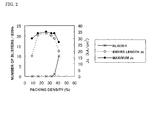
- the step of depressurizing the inside of the pipe and the step of sealing the metal pipe end portion under a depressurized condition were performed with varying packing densities of the raw material powder and, thereby, superconducting wires were produced. Subsequently, the presence or absence of any defects, e.g., blister, and the critical current density were examined.
- the superconducting wires produced in a manner as described above were examined with respect to the number of defects, e.g., blisters, caused in the wires after the first heat treatment. Furthermore, the critical current density (Jc) at 77 K in the self magnetic field was measured with respect to the wires which have been subjected to the additional heat treatment. The results thereof are shown in Fig. 2.
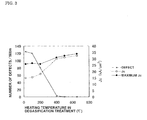
- the degasification treatment was performed with varying heating temperatures and, thereby, superconducting wires were produced. Subsequently, the presence or absence of any defects, e.g., blister, and the critical current density were examined.
- the superconducting wires were produced as described below.
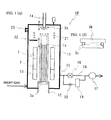
- the vacuum sealing apparatus which employed brazing was used.
- the metal pipe may be sealed by welding the lid through the use of electron beam, or the metal pipe may be sealed by pressure welding of the exhaust nozzle shown in Fig. 4 or 5.
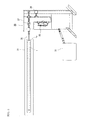
- the apparatuses shown in Figs. 4 and 5 are vacuum sealing apparatuses which employ the pressure welding of exhaust nozzles. Both apparatus have substantially the same basic configuration: Fig. 4 shows an apparatus of the type in which a metal pipe is supported in a vertical direction, and Fig. 5 shows an apparatus of the type in which a metal pipe is supported in a horizontal direction. The procedures for sealing the metal pipe with these apparatuses will be described with reference to Fig. 4.
- the apparatus 30 is provided with a heater 31 disposed to cover the perimeter of the metal pipe 1, an exhaust nozzle 32 attached to an opening 1a of the end portion of the pipe 1, and a vacuum pump 33 connected to the nozzle 32.
- the metal pipe 1 filled with a raw material powder is disposed on a frame 34, and the exhaust nozzle 32 is welded to the opening 1a of the end portion of the pipe 1.
- the metal pipe 1 is heated with the heater 31.
- gases present in the metal pipe 1 are exhausted with a vacuum pump 33 through the exhaust nozzle 32 so as to depressurize.
- the flow rate of exhausting is controlled with a flow rate control valve 35 during depressurization and, thereby, the depressurization speed can be controlled.
- the degree of vacuum can be checked with a vacuum gauge 36.
- the valve 37 is closed and the vacuum pump 33 is disconnected.
- the exhaust nozzle 32 is pressure-welded with a pressure welder (not shown in the drawing) and, thereby, the opening at the end portion of the metal pipe is sealed. After the pressure welding is completed, the metal pipe 1 is removed from the apparatus 30.
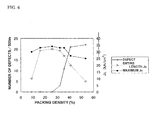
- Superconducting wires were produced, with varying packing densities of the raw material powder in the process of manufacturing clad wires, and, subsequently, the presence or absence of any defect, e.g., blister, and the critical current density were examined.
- the superconducting wires were produced as in Experimental example 2.
- the packing density indicates a proportion of an actual density relative to the theoretical density of the raw material powder to be filled in, where the theoretical density is assumed to be 100 percent.
- the packing density was varied as described below.
- the packing density of 30 percent or more and 40 percent or less was attained by filling a powder granulated from the raw material powder with a wet-type granulator.
- the packing density exceeding 40 percent was attained by filling a rod-shaped material produced by molding the raw material powder with a CIP (hydrostatic press).
- the heating temperature in the degasification treatment was controlled at 640°C. The temperature was raised to 400°C at atmospheric pressure, and when the temperature reached 400°C or more, heating was performed while exhausting was performed gradually so as to depressurize.
- the superconducting wires produced as in Experimental example 2 were examined with respect to the number of defects, e.g., blisters, after the first heat treatment as in Experimental example 2. Furthermore, with respect to the wires subjected to the additional heat treatment, the critical current densities (Jc) at 77 K in the self magnetic field were measured. The results thereof are shown in Fig. 6.
- the superconducting wires having a packing density in the range of 30 percent or more and 40 percent or less tended to be inferior in terms of workability as compared with the superconducting wires having a packing density in the range of 10 percent or more and 30 percent or less. This tendency became more remarkable as the packing density was increased.
- the critical current density is decreased, presumably because of the reasons that residual impurities precipitate as an amorphous phase between crystals in the superconducting phase and this amorphous phase tends to interrupt the path of an electrical current, and that sintering action becomes remarkable due to the residual impurities during the degasification treatment, thereby causing abnormal deformations, e.g., sausage-shaped deformations, during the subsequent wire drawing.
- the method of the present invention for manufacturing a superconducting wire an excellent effect can be achieved, that is, a high critical current density can be attained even in a long length of superconducting wire, as a result of manufacturing steps in which the metal pipe filled with the raw material powder is heated and subjected to a degasification treatment, followed by depressurization, whereby the occurrence of blisters, reduction of crystal grain connectivity, and the like, being suppressed during the sintering.
- the packing density of the raw material powder to be filled in is specified and, thereby, the raw material powder can be uniformly filled in the metal pipe, and variations in the critical current density can be reduced along a longitudinal direction of the superconducting wire.
- the degasification treatment is performed adequately and, thereby, the generation of an amorphous phase and abnormal deformation during wire drawing are suppressed. Consequently, the critical current density can be increased.
Landscapes
- Engineering & Computer Science (AREA)
- Manufacturing & Machinery (AREA)
- Superconductors And Manufacturing Methods Therefor (AREA)
Applications Claiming Priority (3)
| Application Number | Priority Date | Filing Date | Title |
|---|---|---|---|
| JP2002227040 | 2002-08-05 | ||
| JP2002227040 | 2002-08-05 | ||
| PCT/JP2003/009704 WO2004013871A1 (fr) | 2002-08-05 | 2003-07-30 | Procede de production d'un materiau metallique supraconducteur |
Publications (2)
| Publication Number | Publication Date |
|---|---|
| EP1528575A1 true EP1528575A1 (fr) | 2005-05-04 |
| EP1528575A4 EP1528575A4 (fr) | 2007-02-07 |
Family
ID=31492202
Family Applications (1)
| Application Number | Title | Priority Date | Filing Date |
|---|---|---|---|
| EP03766668A Withdrawn EP1528575A4 (fr) | 2002-08-05 | 2003-07-30 | Procede de production d'un materiau metallique supraconducteur |
Country Status (7)
| Country | Link |
|---|---|
| US (1) | US7293343B2 (fr) |
| EP (1) | EP1528575A4 (fr) |
| KR (1) | KR20050027141A (fr) |
| CN (1) | CN1307654C (fr) |
| AU (1) | AU2003252739B2 (fr) |
| TW (1) | TWI270896B (fr) |
| WO (1) | WO2004013871A1 (fr) |
Cited By (3)
| Publication number | Priority date | Publication date | Assignee | Title |
|---|---|---|---|---|
| EP1760728A4 (fr) * | 2004-06-22 | 2010-04-21 | Sumitomo Electric Industries | Procédé de fabrication de fil supraconducteur |
| CN101339828B (zh) * | 2007-09-14 | 2010-11-17 | 朱水良 | 电力电缆加工方法 |
| DE112007000096B4 (de) * | 2006-11-06 | 2013-04-18 | Sumitomo Electric Industries, Ltd. | Herstellungsverfahren für auf Bi-2223 basierenden supraleitenden Draht |
Families Citing this family (7)
| Publication number | Priority date | Publication date | Assignee | Title |
|---|---|---|---|---|
| US20060116292A1 (en) * | 2003-09-17 | 2006-06-01 | Sumitomo Electric Industries, Ltd. | Superconducting device and superconducting cable |
| JP2006331687A (ja) * | 2005-05-23 | 2006-12-07 | Sumitomo Electric Ind Ltd | 超電導線材の製造方法、超電導多芯線材の製造方法および超電導機器 |
| EP2303536A1 (fr) * | 2008-07-02 | 2011-04-06 | Dow Global Technologies Inc. | Procédé amélioré pour dégazer des câbles |
| CN105405957B (zh) * | 2015-12-29 | 2018-09-21 | 北京英纳超导技术有限公司 | 一种铋系氧化物超导导线的制造方法 |
| CN111014865A (zh) * | 2019-12-17 | 2020-04-17 | 西安聚能装备技术有限公司 | 一种粉末装管真空密封装置及密封方法 |
| CN111952009B (zh) * | 2020-08-24 | 2022-04-08 | 西部超导材料科技股份有限公司 | 一种用粉末冶金法制备NbTi/Cu单芯棒的方法 |
| CN115274212B (zh) * | 2022-08-03 | 2025-05-06 | 中国科学院合肥物质科学研究院 | 一种多股扭绞的Bi-2212导体高压热处理端部密封方法 |
Family Cites Families (13)
| Publication number | Priority date | Publication date | Assignee | Title |
|---|---|---|---|---|
| US3922769A (en) * | 1974-06-07 | 1975-12-02 | Gte Sylvania Inc | Method for making composite wire |
| DE3873447T2 (de) * | 1987-08-21 | 1993-03-18 | Mitsubishi Materials Corp | Verfahren zur darstellung von supraleitenden materialien. |
| US5004722A (en) | 1989-01-19 | 1991-04-02 | International Superconductor Corp. | Method of making superconductor wires by hot isostatic pressing after bending |
| JPH04292811A (ja) * | 1991-03-20 | 1992-10-16 | Sumitomo Electric Ind Ltd | 酸化物超電導線の製造方法 |
| JPH05234437A (ja) | 1992-02-20 | 1993-09-10 | Sumitomo Metal Ind Ltd | 酸化物超伝導線材の製造方法 |
| JPH05282936A (ja) | 1992-03-31 | 1993-10-29 | Nippon Steel Corp | 酸化物超電導線材・テープの製造方法 |
| JPH06176635A (ja) | 1992-09-14 | 1994-06-24 | Toshiba Corp | 酸化物超電導線の製造方法 |
| JPH06309967A (ja) | 1993-04-21 | 1994-11-04 | Mitsubishi Cable Ind Ltd | 酸化物超電導線の製造方法 |
| JP3574461B2 (ja) | 1993-06-01 | 2004-10-06 | 住友電気工業株式会社 | 酸化物超電導線材の製造方法 |
| JP3534428B2 (ja) * | 1993-06-11 | 2004-06-07 | 住友電気工業株式会社 | 酸化物高温超電導線材の製造方法 |
| JPH07105762A (ja) | 1993-10-05 | 1995-04-21 | Mitsubishi Heavy Ind Ltd | 粉体の真空シール方法 |
| JPH11185551A (ja) | 1997-12-18 | 1999-07-09 | Fujikura Ltd | 酸化物超電導線材の製造方法 |
| JP2001184956A (ja) | 1999-12-28 | 2001-07-06 | Sumitomo Electric Ind Ltd | 超電導線材の製造方法 |
-
2003
- 2003-07-30 KR KR1020057001969A patent/KR20050027141A/ko not_active Withdrawn
- 2003-07-30 WO PCT/JP2003/009704 patent/WO2004013871A1/fr not_active Ceased
- 2003-07-30 US US10/510,349 patent/US7293343B2/en not_active Expired - Lifetime
- 2003-07-30 AU AU2003252739A patent/AU2003252739B2/en not_active Ceased
- 2003-07-30 CN CNB038102226A patent/CN1307654C/zh not_active Expired - Fee Related
- 2003-07-30 EP EP03766668A patent/EP1528575A4/fr not_active Withdrawn
- 2003-08-01 TW TW092121120A patent/TWI270896B/zh not_active IP Right Cessation
Cited By (4)
| Publication number | Priority date | Publication date | Assignee | Title |
|---|---|---|---|---|
| EP1760728A4 (fr) * | 2004-06-22 | 2010-04-21 | Sumitomo Electric Industries | Procédé de fabrication de fil supraconducteur |
| US7749557B2 (en) | 2004-06-22 | 2010-07-06 | Sumitomo Electric Industries, Ltd. | Method of manufacturing superconducting wire |
| DE112007000096B4 (de) * | 2006-11-06 | 2013-04-18 | Sumitomo Electric Industries, Ltd. | Herstellungsverfahren für auf Bi-2223 basierenden supraleitenden Draht |
| CN101339828B (zh) * | 2007-09-14 | 2010-11-17 | 朱水良 | 电力电缆加工方法 |
Also Published As
| Publication number | Publication date |
|---|---|
| EP1528575A4 (fr) | 2007-02-07 |
| US7293343B2 (en) | 2007-11-13 |
| TW200406011A (en) | 2004-04-16 |
| CN1653563A (zh) | 2005-08-10 |
| CN1307654C (zh) | 2007-03-28 |
| WO2004013871A1 (fr) | 2004-02-12 |
| AU2003252739A1 (en) | 2004-02-23 |
| TWI270896B (en) | 2007-01-11 |
| HK1077916A1 (en) | 2006-02-24 |
| US20050172478A1 (en) | 2005-08-11 |
| KR20050027141A (ko) | 2005-03-17 |
| AU2003252739B2 (en) | 2008-08-21 |
Similar Documents
| Publication | Publication Date | Title |
|---|---|---|
| US7293343B2 (en) | Method of manufacturing superconducting wire | |
| KR100748008B1 (ko) | 산화물 초전도 선재의 제조방법 및 당해 제조방법에 사용되는 가압 열처리 장치 | |
| JP3877071B2 (ja) | 超電導線材の製造方法 | |
| EP2264718B1 (fr) | Procede de production et de modification d'un fil d'oxyde supraconducteur | |
| CN101375351B (zh) | Bi-2223基超导线的制造方法 | |
| EP1884961A1 (fr) | Procede de production de cable supraconducteur, procede de production de cable multiconducteur supraconducteur et dispositif supraconducteur | |
| US5319843A (en) | Method of manufacturing a superconductive cable | |
| EP1113508B1 (fr) | Procédé de fabrication d'un fil supraconducteur | |
| HK1077916B (en) | Method of manufacturing superconducting wire | |
| JP2004335355A (ja) | 酸化物超電導線材およびその製造方法 | |
| KR20090051148A (ko) | 개선된 기계적 강도를 갖는 높은 임계 온도 초전도 물품 | |
| EP1746607B1 (fr) | Procédé de fabrication d'un câble supraconducteur | |
| JPH06309967A (ja) | 酸化物超電導線の製造方法 | |
| JPH05101723A (ja) | 酸化物超電導線の製造方法 | |
| JPH03156811A (ja) | セラミックス超電導々体の製造方法 | |
| KR20010040471A (ko) | 고온 초전도 와이어 제조용 전구체 재료의 제조 방법 | |
| JPH04249812A (ja) | テープ状セラミックス超電導線材の製造方法 | |
| JPH06131927A (ja) | 酸化物超電導線材の製造方法 | |
| HK1112319A (en) | Method for producing superconducting wire, method for producing superconducting multicore wire, and superconducting device | |
| JPH06302236A (ja) | 酸化物超電導線の製造方法 | |
| JPH06309966A (ja) | 酸化物超電導線素材及び酸化物超電導線 |
Legal Events
| Date | Code | Title | Description |
|---|---|---|---|
| PUAI | Public reference made under article 153(3) epc to a published international application that has entered the european phase |
Free format text: ORIGINAL CODE: 0009012 |
|
| 17P | Request for examination filed |
Effective date: 20041015 |
|
| AK | Designated contracting states |
Kind code of ref document: A1 Designated state(s): AT BE BG CH CY CZ DE DK EE ES FI FR GB GR HU IE IT LI LU MC NL PT RO SE SI SK TR |
|
| AX | Request for extension of the european patent |
Extension state: AL LT LV MK |
|
| DAX | Request for extension of the european patent (deleted) | ||
| RBV | Designated contracting states (corrected) |
Designated state(s): DE DK FR GB IT |
|
| A4 | Supplementary search report drawn up and despatched |
Effective date: 20070109 |
|
| 17Q | First examination report despatched |
Effective date: 20130827 |
|
| STAA | Information on the status of an ep patent application or granted ep patent |
Free format text: STATUS: THE APPLICATION IS DEEMED TO BE WITHDRAWN |
|
| 18D | Application deemed to be withdrawn |
Effective date: 20140108 |