EP1528113A1 - Verfahren zur herstellung von mit dispergiertem oxid verstärktem ferritischem stahl mit grober kornstruktur und hervorragender hochtemperaturkriechfestigkeit - Google Patents
Verfahren zur herstellung von mit dispergiertem oxid verstärktem ferritischem stahl mit grober kornstruktur und hervorragender hochtemperaturkriechfestigkeit Download PDFInfo
- Publication number
- EP1528113A1 EP1528113A1 EP03795213A EP03795213A EP1528113A1 EP 1528113 A1 EP1528113 A1 EP 1528113A1 EP 03795213 A EP03795213 A EP 03795213A EP 03795213 A EP03795213 A EP 03795213A EP 1528113 A1 EP1528113 A1 EP 1528113A1
- Authority
- EP
- European Patent Office
- Prior art keywords
- powder
- steel
- heat treatment
- oxide dispersion
- dispersion strengthened
- Prior art date
- Legal status (The legal status is an assumption and is not a legal conclusion. Google has not performed a legal analysis and makes no representation as to the accuracy of the status listed.)
- Granted
Links
Images


Classifications
-
- C—CHEMISTRY; METALLURGY
- C22—METALLURGY; FERROUS OR NON-FERROUS ALLOYS; TREATMENT OF ALLOYS OR NON-FERROUS METALS
- C22C—ALLOYS
- C22C33/00—Making ferrous alloys
- C22C33/02—Making ferrous alloys by powder metallurgy
- C22C33/0207—Using a mixture of prealloyed powders or a master alloy
- C22C33/0228—Using a mixture of prealloyed powders or a master alloy comprising other non-metallic compounds or more than 5% of graphite
-
- C—CHEMISTRY; METALLURGY
- C22—METALLURGY; FERROUS OR NON-FERROUS ALLOYS; TREATMENT OF ALLOYS OR NON-FERROUS METALS
- C22C—ALLOYS
- C22C38/00—Ferrous alloys, e.g. steel alloys
- C22C38/002—Ferrous alloys, e.g. steel alloys containing In, Mg, or other elements not provided for in one single group C22C38/001 - C22C38/60
-
- C—CHEMISTRY; METALLURGY
- C22—METALLURGY; FERROUS OR NON-FERROUS ALLOYS; TREATMENT OF ALLOYS OR NON-FERROUS METALS
- C22C—ALLOYS
- C22C38/00—Ferrous alloys, e.g. steel alloys
- C22C38/005—Ferrous alloys, e.g. steel alloys containing rare earths, i.e. Sc, Y, Lanthanides
-
- C—CHEMISTRY; METALLURGY
- C22—METALLURGY; FERROUS OR NON-FERROUS ALLOYS; TREATMENT OF ALLOYS OR NON-FERROUS METALS
- C22C—ALLOYS
- C22C38/00—Ferrous alloys, e.g. steel alloys
- C22C38/18—Ferrous alloys, e.g. steel alloys containing chromium
- C22C38/22—Ferrous alloys, e.g. steel alloys containing chromium with molybdenum or tungsten
-
- C—CHEMISTRY; METALLURGY
- C22—METALLURGY; FERROUS OR NON-FERROUS ALLOYS; TREATMENT OF ALLOYS OR NON-FERROUS METALS
- C22C—ALLOYS
- C22C38/00—Ferrous alloys, e.g. steel alloys
- C22C38/18—Ferrous alloys, e.g. steel alloys containing chromium
- C22C38/28—Ferrous alloys, e.g. steel alloys containing chromium with titanium or zirconium
-
- B—PERFORMING OPERATIONS; TRANSPORTING
- B22—CASTING; POWDER METALLURGY
- B22F—WORKING METALLIC POWDER; MANUFACTURE OF ARTICLES FROM METALLIC POWDER; MAKING METALLIC POWDER; APPARATUS OR DEVICES SPECIALLY ADAPTED FOR METALLIC POWDER
- B22F9/00—Making metallic powder or suspensions thereof
- B22F9/02—Making metallic powder or suspensions thereof using physical processes
- B22F9/04—Making metallic powder or suspensions thereof using physical processes starting from solid material, e.g. by crushing, grinding or milling
- B22F2009/041—Making metallic powder or suspensions thereof using physical processes starting from solid material, e.g. by crushing, grinding or milling by mechanical alloying, e.g. blending, milling
-
- B—PERFORMING OPERATIONS; TRANSPORTING
- B22—CASTING; POWDER METALLURGY
- B22F—WORKING METALLIC POWDER; MANUFACTURE OF ARTICLES FROM METALLIC POWDER; MAKING METALLIC POWDER; APPARATUS OR DEVICES SPECIALLY ADAPTED FOR METALLIC POWDER
- B22F2998/00—Supplementary information concerning processes or compositions relating to powder metallurgy
- B22F2998/10—Processes characterised by the sequence of their steps
-
- C—CHEMISTRY; METALLURGY
- C21—METALLURGY OF IRON
- C21D—MODIFYING THE PHYSICAL STRUCTURE OF FERROUS METALS; GENERAL DEVICES FOR HEAT TREATMENT OF FERROUS OR NON-FERROUS METALS OR ALLOYS; MAKING METAL MALLEABLE, e.g. BY DECARBURISATION OR TEMPERING
- C21D2211/00—Microstructure comprising significant phases
- C21D2211/004—Dispersions; Precipitations
-
- C—CHEMISTRY; METALLURGY
- C21—METALLURGY OF IRON
- C21D—MODIFYING THE PHYSICAL STRUCTURE OF FERROUS METALS; GENERAL DEVICES FOR HEAT TREATMENT OF FERROUS OR NON-FERROUS METALS OR ALLOYS; MAKING METAL MALLEABLE, e.g. BY DECARBURISATION OR TEMPERING
- C21D6/00—Heat treatment of ferrous alloys
- C21D6/002—Heat treatment of ferrous alloys containing Cr
Definitions
- the present invention relates to a method of manufacturing an oxide dispersion strengthened ferritic steel excellent in high-temperature creep strength and, more particularly, to a method of manufacturing an oxide dispersion strengthened ferritic steel to which excellent high-temperature creep strength can be imparted by adjusting an excess oxygen content in steel, thereby to form a coarse grain structure.
- the oxide dispersion strengthened ferritic steel of the present invention can be advantageously used as a fuel cladding tube material of a fast breeder reactor, a first wall material of a nuclear fusion reactor, a material for thermal power generation, etc. in which strength at high temperatures is particularly required.
- austenitic stainless steels have hitherto been used in the components of nuclear reactors, especially fast reactors which are required to have excellent high-temperature strength and resistance to neutron irradiation, they have limitations on irradiation resistance such as swelling resistance.
- ferritic stainless steels have the disadvantage of low high-temperature strength although they are excellent in irradiation resistance.
- oxide dispersion strengthened ferritic steels in which fine oxide particles are dispersed have been proposed as materials excellent in irradiation resistance and high-temperature strength. It is also known that in order to improve the strength of the oxide dispersion strengthened ferritic steels, it is effective to further finely disperse the oxide particles by adding Ti to the steels.
- the heat treatment of an oxide dispersion strengthened ferritic steel to obtain a coarse grain structure involves slow cooling at a rate of not more than the ferrite-forming critical rate after obtaining ⁇ -phase by performing normalizing heat treatment which involves heating to a temperature of not less than the Ac 3 transformation point and holding at this temperature.
- Ti has a strong affinity for C which is a ⁇ -phase-forming element in the matrix
- Ti and C combine to form a carbide.
- the C concentration in the matrix decreases, and a single phase of ⁇ -phase is not formed even by the heat treatment at a temperature of not less than the Ac 3 transformation point and untransformed ⁇ -phase is retained.
- An object of the present invention is, therefore, to provide a method of manufacturing an oxide dispersion strengthened ferritic steel having a coarse grain structure effective in improving high-temperature creep strength in which sufficient ⁇ to ⁇ transformation during heat treatment is ensured by suppressing the bonding of Ti with C thereby to maintain the C concentration in the matrix even when Ti is added to the oxide dispersion strengthened ferritic steel.
- an oxide dispersion strengthened ferritic steel excellent in high-temperature creep strength having a coarse grain structure comprising mixing either element powders or alloy powders and a Y 2 O 3 powder, subjecting the mixed powder to mechanical alloying treatment, solidifying the resulting alloyed powder by hot extrusion, and subjecting the resulting extruded solidified material to final heat treatment involving heating to and holding at a temperature of not less than the Ac 3 transformation point and slow cooling at a rate of not more than a ferrite-forming critical rate to thereby manufacture an oxide dispersion strengthened ferritic steel which comprises, as expressed by % by weight, 0.05 to 0.25% C, 8.0 to 12.0% Cr, 0.1 to 4.0% W, 0.1 to 1.0% Ti, 0.1 to 0.5% Y 2 O 3 with the balance being Fe and unavoidable impurities and in which Y 2 O 3 particles are dispersed in the steel, wherein a TiO 2 powder is used as an element powder of a
- the present invention provides a method of manufacturing an oxide dispersion strengthened ferritic steel excellent in high-temperature creep strength having a coarse grain structure, said method comprising mixing either element powders or alloy powders and a Y 2 O 3 powder, subjecting the mixed powder to mechanical alloying treatment, solidifying the resulting alloyed powder by hot extrusion, and subjecting the resulting extruded solidified material to final heat treatment involving heating to and holding at a temperature of not less than the Ac 3 transformation point and slow cooling at a rate of not more than a ferrite-forming critical rate to thereby manufacture an oxide dispersion strengthened ferritic steel which comprises, as expressed by % by weight, 0.05 to 0.25% C, 8.0 to 12.0% Cr, 0.1 to 4.0% W, 0.1 to 1.0% Ti, 0.1 to 0.
- Cr (choromium) is an element important for ensuring corrosion resistance, and if the Cr content is less than 8.0%, the worsening of corrosion resistance becomes remarkable. If the Cr content exceeds 12.0%, a decrease in toughness and ductility is feared. For this reason, the Cr content should be 8.0 to 12.0%.
- the C (carbon) content is determined for the following reason.
- an equiaxed and coarse grain structure is obtained by causing ⁇ to ⁇ transformation to occur by heat treatment to a temperature of not less than the Ac 3 transformation point and succeeding slow cooling heat treatment. That is, in order to obtain an equiaxed and coarse grain structure, it is essential to cause ⁇ to ⁇ transformation to occur by heat treatment.
- W tungsten
- M 23 C 6 , M 6 C, etc. carbide precipitation
- intermetallic compound precipitation the strengthening by intermetallic compound precipitation.
- the W content should be 0.1 to 4.0%.
- Ti plays an important role in the dispersion strengthening of Y 2 O 3 and forms the complex oxide Y 2 Ti 2 O 7 or Y 2 TiO 5 by reacting with Y 2 O 3 , thereby functioning to finely disperse oxide particles. This action tends to reach a level of saturation when the Ti content exceeds 1.0%, and the finely dispersing action is small when the Ti content is less than 0.1% . For this reason, the Ti content should be 0.1 to 1.0%.
- Y 2 O 3 is an important additive which improves high-temperature strength due to dispersion strengthening.
- the Y 2 O 3 content is less than 0.1%, the effect of dispersion strengthening is small and strength is low.
- Y 2 O 3 is contained in an amount exceeding 0.5%, hardening occurs remarkably and a problem arises in workability. For this reason, the Y 2 O 3 content should be 0.1 to 0.5%.
- raw material powders such as metal element powders or alloy powders and oxide powders
- mechanical alloying treatment After the resulting alloyed powder is filled in an extrusion capsule, degassing, sealing and hot extrusion are performed, whereby the alloyed powder is solidified, for example, into an extruded rod-shaped material.
- the hot extruded rod-shaped material thus obtained is subjected to final heat treatment which involves heating to a temperature of not less than the Ac 3 transformation point and holding at this temperature, which is followed by slow cooling heat treatment at a rate of not more than the ferrite-forming critical rate.
- final heat treatment which involves heating to a temperature of not less than the Ac 3 transformation point and holding at this temperature, which is followed by slow cooling heat treatment at a rate of not more than the ferrite-forming critical rate.
- the slow cooling heat treatment it is usually possible to adopt furnace cooling heat treatment in which cooling is carried out slowly in a furnace.
- the cooling rate of not more than the ferrite-forming critical rate it is usually possible to adopt a rate not more than 100°C/hour, preferably not more than 50°C/hour.
- the Ac 3 transformation point is about 900 to 1200°C.
- the C content is 0.13%
- the Ac 3 transformation point is about 950°C.
- the present invention as means of preventing the Ti in steel from combining with C to form a carbide and lower the C concentration in the matrix, it is possible to adopt a method in which a TiO 2 powder is used in place of a metal Ti powder as a raw material powder to be mixed at the mechanical alloying treatment.
- TiO 2 does not combine with C, with the result that it is possible to suppress a decrease in the C concentration in the matrix.
- the amount of TiO 2 powder to be mixed may be within the range of 0.1 to 1.0% in terms of the Ti content.
- the present invention as means of preventing the Ti in steel from combining with C to form a carbide and lower the C concentration in the matrix, it is also possible to adopt a method in which an Fe 2 O 3 powder, which is an unstable oxide, is additionally added as a raw material powder to be mixed at the mechanical alloying treatment, thereby increasing the excess oxygen content in steel.
- an Fe 2 O 3 powder which is an unstable oxide
- the Ti since the Ti combines with the excess oxygen in steel derived from Fe 2 O 3 to form an oxide without combining with C to form a carbide, it is possible to suppress a decrease in the C concentration in the matrix.
- the amount of the Fe 2 O 3 powder to be mixed is determined so that an excess oxygen content in steel satisfies 0.67Ti - 2.7C + 0.45 > Ex.O > 0.67Ti - 2.7C + 0.35
- Table 1 collectively shows the target compositions of test materials of oxide dispersion strengthened ferritic steel and the features of the compositions.
- each test material either element powders or alloy powders and oxide powders were blended to obtain a target composition, charged into a high-energy attritor and thereafter subjected to mechanical alloying treatment by stirring in an Ar atmosphere of 99.99%.
- the number of revolutions of the attritor was about 220 rpm and the stirring time was about 48 hours.
- the resulting alloyed powder was filled in a capsule made of a mild steel, degassed at a high temperature in a vacuum, and then subjected to hot extrusion at about 1150 to 1200°C in an extrusion ratio of 7 to 8:1, to thereby obtain a hot extruded rod-shaped material.
- test materials MM13 and T14 have a basic composition
- T3 is a test material in which the excess oxygen content was increased by adding Fe 2 O 3 to the basic composition of T14
- T4 is a test material in which the amount of added Ti was increased
- T5 is a test material in which the amount of added Ti was increased and the excess oxygen content was increased by adding Fe 2 O 3
- T6 and T7 are test materials in which Ti was added in the form of a chemically stable oxide (TiO 2 ) in amounts of 0.125% and 0.25%, respectively, to increase excess oxygen content.
- Table 2 collectively shows the results of chemical analysis of each test material (hot extruded rod-shaped material) which was prepared as described above.
- An excess oxygen content is a value obtained by subtracting an oxygen content in a dispersed oxide (Y 2 O 3 ) from an oxygen content in a test material in the analysis results of the chemical components.
- test materials were subjected to final heat treatment involving normalizing heat treatment (heating to and holding at a temperature of not less than the Ac 3 transformation point: 1050°C ⁇ 1 hr), which is followed by furnace cooling heat treatment (slow cooling heat treatment at a rate of not more than a ferrite-forming critical rate: slow cooling from 1050°C to 600°C at a rate of 37°C/hr).
- normalizing heat treatment heating to and holding at a temperature of not less than the Ac 3 transformation point: 1050°C ⁇ 1 hr
- furnace cooling heat treatment slow cooling heat treatment at a rate of not more than a ferrite-forming critical rate: slow cooling from 1050°C to 600°C at a rate of 37°C/hr.
- FIG. 1 The optical microscopic photographs of metallographic structures of the test materials after the heat treatment are shown in FIG. 1 (T14, MM13, T3 and T4) and FIG. 2 (T5, T6 and T7).
- T3, T6 and T7 in which grain growth has occurred are a test material (T3) in which Fe 2 O 3 is added to the basic composition and test materials (T6 and T7) in which TiO 2 is added in place of Ti.
- T4 and T5 in which grain growth is slight are a test material (T4) in which the amount of added Ti is increased from the basic composition and a test material (T5) in which the amount of added Ti is also increased besides the addition of Fe 2 O 3 .
- T4 and T5 in which grain growth is slight are a test material (T4) in which the amount of added Ti is increased from the basic composition and a test material (T5) in which the amount of added Ti is also increased besides the addition of Fe 2 O 3 .
- T4 and T5 in which grain growth is slight are a test material (T4) in which the amount of added Ti is increased from the basic composition and a test material (T5) in which the amount of added Ti is also increased besides the addition of Fe 2 O 3 .
- both MM13 and T14 have the basic composition and are equivalent in terms of composition.
- grains have grown in MM13 (excess oxygen content: 0.137%), whereas grain growth is slight in T14 (excess oxygen content: 0.110%). It might be thought that this is because, even with the same composition, the amount of oxygen included in steel in the process of the mechanical alloying treatment, succeeding heat treatment, etc. differs delicately, with the result that in the case of MM13, there is an excess oxygen content high enough for the chemical bonding with the Ti in steel.
- the graph of FIG. 3 shows the relationship between the Ti content and excess oxygen content of each test material. From this graph, it is understood that the coarsening of grains occurs due to furnace cooling heat treatment in the test materials MM13, T3, T6 and T7 which satisfy the relationship Ex.O > 0.61Ti [Ex.O: excess oxygen content (%), Ti: Ti content in steel (%)].
- Ex.O > 0.61Ti can be converted to the unit of molar quantity as follows: Ex.O' (mol/g) > 1.86Ti' ⁇ 2Ti' (mol/g). It may be considered that the coarsening ⁇ of grains occurs when there is an excess oxygen content high enough for all Ti in steel to be able to form TiO 2 (i. e., when the C concentration remaining in the matrix is not less than 0.13%).
- Excess oxygen is an important element which combines with metal Ti and Y 2 O 3 to form fine complex oxides and simultaneously suppresses the bonding of the C with Ti in the matrix, thereby ensuring a sufficient C concentration in the matrix.
- excess oxygen of not less than 0.67Ti - 2.7C + 0.45 remarkably inhibits dispersed particles from being finely dispersed and highly densified.
- the higher excess oxygen causes a remarkable decrease in toughness and simultaneously enhances the formation of inclusions with small amounts of Si, Mn, etc. Therefore, the upper limit value of the excess oxygen content should be 0.67Ti - 2.7C + 0.45.
- the graph of FIG. 4 shows the range of the upper limit and lower limit to the above-described conditional expression of grain coarsening by a diagonally shaded portion in a plot of measured values of each test material.
- the conditional expression makes calculations on the basis of a C content of 0.13% and the test materials MM13, T3, T6 and T7 in which grains have grown are all in the diagonally shaded portion, whereas the test materials MM14, T5 and T4 in which grains have not grown are all outside the diagonally shaded portion. This demonstrates that this conditional equation is valid. Incidentally, it has been ascertained that, also in plots in the graph of FIG. 4 to which a test material number is not given, the coarsening of grains has occurred in test materials within the diagonally shaded portion and the coarsening of grains has not occurred in test materials outside the diagonally shaded portion.
- the Fe 2 O 3 powder when the excess oxygen content in steel is increased by additionally adding an Fe 2 O 3 powder as a raw material powder to be mixed at the mechanical alloying treatment, the Fe 2 O 3 powder is added so that the excess oxygen content in steel satisfies the following conditional expression of grain coarsening: 0.67Ti - 2.7C + 0.45 > Ex.O > 0.67Ti - 2.7C + 0.35
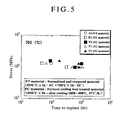
- Test materials in which grains were coarsened were prepared by subjecting the test materials T3 and T7 to the heat treatment according to the present invention, i.e., normalizing heat treatment (heating to a temperature of not less than the Ac 3 transformation point and holding at this temperature: 1050°C ⁇ 1 hr) and succeeding furnace cooling heat treatment (slow cooling heat treatment at a rate of not more than a ferrite-forming critical rate: slow cooling from 1050°C to 600°C at a rate of 37°C /hr).
- normalizing heat treatment heating to a temperature of not less than the Ac 3 transformation point and holding at this temperature: 1050°C ⁇ 1 hr
- furnace cooling heat treatment slow cooling heat treatment at a rate of not more than a ferrite-forming critical rate: slow cooling from 1050°C to 600°C at a rate of 37°C /hr.
- test materials in which grains were finely transformed were prepared by subjecting the test materials T14, T3 and T7 to normalizing heat treatment (1050°C ⁇ 1 hr, air cooling (AC)) and succeeding tempering heat treatment (780°C ⁇ 1 hr, air cooling (AC)).
- the graph of FIG. 5 shows the results of a uniaxial creep rupture test of these test materials which was conducted at a test temperature of 700°C. From the graph of FIG. 5, it is understood that high-temperature creep strength of T3 (FC material) in which the excess oxygen content was increased by additionally adding an Fe 2 O 3 powder and grains were coarsened by furnace cooling heat treatment and T7 (FC material) in which a TiO 2 powder was used in place of a metal Ti powder and grains were coarsened by furnace cooling heat treatment is improved in comparison with other test materials.
Landscapes
- Chemical & Material Sciences (AREA)
- Engineering & Computer Science (AREA)
- Materials Engineering (AREA)
- Mechanical Engineering (AREA)
- Metallurgy (AREA)
- Organic Chemistry (AREA)
- Powder Metallurgy (AREA)
- Treatment Of Steel In Its Molten State (AREA)
Applications Claiming Priority (3)
| Application Number | Priority Date | Filing Date | Title |
|---|---|---|---|
| JP2002231781 | 2002-08-08 | ||
| JP2002231781A JP3792624B2 (ja) | 2002-08-08 | 2002-08-08 | 粗大結晶粒組織を有する高温クリープ強度に優れたフェライト系酸化物分散強化型鋼の製造方法 |
| PCT/JP2003/010082 WO2004024968A1 (ja) | 2002-08-08 | 2003-08-07 | 粗大結晶粒組織を有する高温クリープ強度に優れたフェライト系酸化物分散強化型鋼の製造方法 |
Publications (3)
| Publication Number | Publication Date |
|---|---|
| EP1528113A1 true EP1528113A1 (de) | 2005-05-04 |
| EP1528113A4 EP1528113A4 (de) | 2006-09-27 |
| EP1528113B1 EP1528113B1 (de) | 2012-04-25 |
Family
ID=31986185
Family Applications (1)
| Application Number | Title | Priority Date | Filing Date |
|---|---|---|---|
| EP03795213A Expired - Lifetime EP1528113B1 (de) | 2002-08-08 | 2003-08-07 | Verfahren zur herstellung von mit dispergiertem oxid verstärktem ferritischem stahl mit grober kornstruktur und hervorragender hochtemperaturkriechfestigkeit |
Country Status (5)
| Country | Link |
|---|---|
| US (1) | US7361235B2 (de) |
| EP (1) | EP1528113B1 (de) |
| JP (1) | JP3792624B2 (de) |
| CN (1) | CN100385030C (de) |
| WO (1) | WO2004024968A1 (de) |
Cited By (1)
| Publication number | Priority date | Publication date | Assignee | Title |
|---|---|---|---|---|
| RU2560484C1 (ru) * | 2014-11-14 | 2015-08-20 | Федеральное государственное унитарное предприятие "Всероссийский научно-исследовательский институт авиационных материалов" (ФГУП "ВИАМ") | Способ получения композиционного материала на основе железа |
Families Citing this family (26)
| Publication number | Priority date | Publication date | Assignee | Title |
|---|---|---|---|---|
| US8172546B2 (en) * | 1998-11-23 | 2012-05-08 | Entegris, Inc. | System and method for correcting for pressure variations using a motor |
| JP3672903B2 (ja) * | 2002-10-11 | 2005-07-20 | 核燃料サイクル開発機構 | 酸化物分散強化型フェライト鋼管の製造方法 |
| KR101231945B1 (ko) | 2004-11-23 | 2013-02-08 | 엔테그리스, 아이엔씨. | 가변 홈 위치 토출 장치용 시스템 및 방법 |
| US8753097B2 (en) * | 2005-11-21 | 2014-06-17 | Entegris, Inc. | Method and system for high viscosity pump |
| EP1952022B1 (de) | 2005-11-21 | 2014-11-12 | Entegris, Inc. | System und verfahren für eine pumpe mit reduziertem formfaktor |
| CN102705213A (zh) * | 2005-12-02 | 2012-10-03 | 恩特格里公司 | 使用电机校正压力变化的系统和方法 |
| US7878765B2 (en) * | 2005-12-02 | 2011-02-01 | Entegris, Inc. | System and method for monitoring operation of a pump |
| US8083498B2 (en) | 2005-12-02 | 2011-12-27 | Entegris, Inc. | System and method for position control of a mechanical piston in a pump |
| CN102705209B (zh) | 2005-12-02 | 2015-09-30 | 恩特格里公司 | 用于泵中压力补偿的系统和方法 |
| TWI402423B (zh) * | 2006-02-28 | 2013-07-21 | Entegris Inc | 用於一幫浦操作之系統及方法 |
| US8357328B2 (en) | 2009-12-14 | 2013-01-22 | General Electric Company | Methods for processing nanostructured ferritic alloys, and articles produced thereby |
| US8727744B2 (en) | 2010-02-26 | 2014-05-20 | Entegris, Inc. | Method and system for optimizing operation of a pump |
| JP5636532B2 (ja) * | 2010-09-22 | 2014-12-10 | 国立大学法人北海道大学 | 酸化物分散強化型鋼およびその製造方法 |
| CN102828097A (zh) * | 2012-09-16 | 2012-12-19 | 北京科技大学 | 用机械合金化法制备含氮ods无镍奥氏体合金的方法 |
| CN104476842B (zh) * | 2014-11-18 | 2016-06-29 | 华中科技大学 | 一种层状增韧ods钢及其制备方法 |
| US9764384B2 (en) | 2015-04-14 | 2017-09-19 | Honeywell International Inc. | Methods of producing dispersoid hardened metallic materials |
| CN106756434B (zh) * | 2016-12-05 | 2018-08-03 | 东北大学 | 氧化物弥散强化低活化铁素体/马氏体钢及其冶炼方法 |
| CN106636933B (zh) * | 2016-12-05 | 2018-02-09 | 北京科技大学 | 一种制备多相强化铁素体合金的方法 |
| CN108950357B (zh) * | 2018-07-27 | 2020-03-27 | 中南大学 | 一种多尺度多相弥散强化铁基合金及其制备和表征方法 |
| JP2020056106A (ja) * | 2018-09-27 | 2020-04-09 | 株式会社アテクト | ニッケル基合金製または鉄基合金製の耐熱部材の製造方法 |
| CN111349842B (zh) * | 2020-02-27 | 2021-05-18 | 北京科技大学 | 一种高通量连续熔炼制备氧化物弥散强化钢的方法 |
| CN113477929A (zh) * | 2021-04-15 | 2021-10-08 | 中国工程物理研究院材料研究所 | 一种高强韧ods钢的高通量制备与成分工艺优选方法 |
| CN113215480B (zh) * | 2021-04-29 | 2021-12-14 | 西安建筑科技大学 | 一种多尺度粒子强化低活化钢及其制备方法 |
| CN113930656B (zh) * | 2021-09-16 | 2022-09-20 | 华中科技大学 | 一种聚变堆用n-ods钢及其制备方法 |
| CN115074600B (zh) * | 2022-07-17 | 2023-08-25 | 苏州匀晶金属科技有限公司 | 一种利用相变体积效应提高粉末冶金铁基合金烧结致密度的方法 |
| CN119843180B (zh) * | 2025-03-24 | 2025-06-06 | 中国核动力研究设计院 | 铅冷快堆包壳用氧化物弥散强化铁铬钨基铁素体马氏体合金及其制备方法 |
Family Cites Families (11)
| Publication number | Priority date | Publication date | Assignee | Title |
|---|---|---|---|---|
| US4075010A (en) * | 1976-02-05 | 1978-02-21 | The International Nickel Company, Inc. | Dispersion strengthened ferritic alloy for use in liquid-metal fast breeder reactors (LMFBRS) |
| US4464207A (en) * | 1978-08-14 | 1984-08-07 | The Garrett Corporation | Dispersion strengthened ferritic stainless steel |
| JPS5920730B2 (ja) * | 1979-09-14 | 1984-05-15 | 住友金属工業株式会社 | 鋼材の酸化防止剤 |
| JPS63210299A (ja) * | 1987-02-27 | 1988-08-31 | Nippon Steel Corp | 耐食性及び耐パウダリング性に優れた分散複合めつき鋼板 |
| US4963200A (en) | 1988-04-25 | 1990-10-16 | Doryokuro Kakunenryo Kaihatsu Jigyodan | Dispersion strengthened ferritic steel for high temperature structural use |
| US5167728A (en) * | 1991-04-24 | 1992-12-01 | Inco Alloys International, Inc. | Controlled grain size for ods iron-base alloys |
| JPH0551709A (ja) * | 1991-08-22 | 1993-03-02 | Toshiba Corp | 圧縮機用摺動部品材料 |
| US5310431A (en) * | 1992-10-07 | 1994-05-10 | Robert F. Buck | Creep resistant, precipitation-dispersion-strengthened, martensitic stainless steel and method thereof |
| EP0600421B1 (de) * | 1992-11-30 | 1997-10-08 | Sumitomo Electric Industries, Limited | Niedrig legierter Sinterstahl und Verfahren zu dessen Herstellung |
| JP3480061B2 (ja) * | 1994-09-20 | 2003-12-15 | 住友金属工業株式会社 | 高Crフェライト系耐熱鋼 |
| FR2777020B1 (fr) * | 1998-04-07 | 2000-05-05 | Commissariat Energie Atomique | Procede de fabrication d'un alliage ferritique - martensitique renforce par dispersion d'oxydes |
-
2002
- 2002-08-08 JP JP2002231781A patent/JP3792624B2/ja not_active Expired - Fee Related
-
2003
- 2003-08-07 EP EP03795213A patent/EP1528113B1/de not_active Expired - Lifetime
- 2003-08-07 US US10/501,673 patent/US7361235B2/en not_active Expired - Fee Related
- 2003-08-07 CN CNB038055813A patent/CN100385030C/zh not_active Expired - Fee Related
- 2003-08-07 WO PCT/JP2003/010082 patent/WO2004024968A1/ja not_active Ceased
Non-Patent Citations (3)
| Title |
|---|
| K. ASABE ET AL: "The Development of a Metal Matrix Composite by Mechanical Alloying" SUMITOMO SEARCH, vol. 45, 1991, pages 65-72, XP008067895 Japan * |
| See also references of WO2004024968A1 * |
| UKAI S ET AL: "DEVELOPMENT OF OXIDE DISPERSION STRENGTHENED STEELS FOR FBR CORE APPLICATION, (II) MORPHOLOGY IMPROVEMENT BY MARTENSITE TRANSFORMATION" JOURNAL OF NUCLEAR SCIENCE AND TECHNOLOGY, ATOMIC ENERGY SOCIETY OF JAPAN, JP, vol. 35, no. 4, April 1998 (1998-04), pages 294-300, XP008067501 ISSN: 0022-3131 * |
Cited By (1)
| Publication number | Priority date | Publication date | Assignee | Title |
|---|---|---|---|---|
| RU2560484C1 (ru) * | 2014-11-14 | 2015-08-20 | Федеральное государственное унитарное предприятие "Всероссийский научно-исследовательский институт авиационных материалов" (ФГУП "ВИАМ") | Способ получения композиционного материала на основе железа |
Also Published As
| Publication number | Publication date |
|---|---|
| CN1639370A (zh) | 2005-07-13 |
| WO2004024968A1 (ja) | 2004-03-25 |
| JP3792624B2 (ja) | 2006-07-05 |
| US20050042127A1 (en) | 2005-02-24 |
| EP1528113B1 (de) | 2012-04-25 |
| US7361235B2 (en) | 2008-04-22 |
| JP2004068121A (ja) | 2004-03-04 |
| CN100385030C (zh) | 2008-04-30 |
| EP1528113A4 (de) | 2006-09-27 |
Similar Documents
| Publication | Publication Date | Title |
|---|---|---|
| US7361235B2 (en) | Method for producing dispersed oxide reinforced ferritic steel having coarse grain structure and being excellent in high temperature creep strength | |
| US4963200A (en) | Dispersion strengthened ferritic steel for high temperature structural use | |
| EP2377960B2 (de) | Kugelgraphit-gusseisen | |
| JP3227734B2 (ja) | 高耐食二相ステンレス鋼とその製造方法 | |
| EP2610360A1 (de) | Co-basislegierung | |
| EP3208354B1 (de) | Ni-basierte superlegierung zum warmschmieden | |
| GB2311997A (en) | Oxide-dispersed powder metallurgically produced alloys. | |
| US7273584B2 (en) | Method of manufacturing oxide dispersion strengthened martensitic steel excellent in high-temperature strength having residual α-grains | |
| CN108026620B (zh) | 弥散强化型奥氏体系不锈钢钢材、该不锈钢钢材的制造方法和由该不锈钢钢材形成的制造物 | |
| US7037464B2 (en) | Dispersed oxide reinforced martensitic steel excellent in high temperature strength and method for production thereof | |
| JP4208689B2 (ja) | 高耐食性ステンレス焼結部材の製造方法 | |
| EP3095884B1 (de) | Martensitaushärtender stahl | |
| JPH07823B2 (ja) | 焼結分散強化型耐熱鋼成形部材 | |
| JP4192249B2 (ja) | 粗大結晶粒組織を有する高温クリープ強度に優れたフェライト系酸化物分散強化型鋼の製造方法 | |
| CN106715743A (zh) | 固体氧化物型燃料电池用钢和其制造方法 | |
| JP2970432B2 (ja) | 高温用ステンレス鋼とその製造方法 | |
| JP2692340B2 (ja) | 酸化物分散強化型フェライト鋼 | |
| JPH01272746A (ja) | 延性と靭性に優れた原子炉用分散強化フェライト鋼 | |
| JPH05263199A (ja) | 焼結ステンレス鋼 | |
| WO2023086005A1 (en) | A tube of a fe-cr-al alloy | |
| JPH0324247A (ja) | クロマイジング処理用酸化物分散強化型フェライト鋼 | |
| JPH05271853A (ja) | 金属間化合物析出強化型高強度粉末高Cr鋼 | |
| George et al. | Alloy design of ordered intermetallics | |
| JPS62267451A (ja) | 耐食性に優れたb含有焼結合金 |
Legal Events
| Date | Code | Title | Description |
|---|---|---|---|
| PUAI | Public reference made under article 153(3) epc to a published international application that has entered the european phase |
Free format text: ORIGINAL CODE: 0009012 |
|
| 17P | Request for examination filed |
Effective date: 20040902 |
|
| AK | Designated contracting states |
Kind code of ref document: A1 Designated state(s): AT BE BG CH CY CZ DE DK EE ES FI FR GB GR HU IE IT LI LU MC NL PT RO SE SI SK TR |
|
| RBV | Designated contracting states (corrected) |
Designated state(s): DE FR |
|
| A4 | Supplementary search report drawn up and despatched |
Effective date: 20060828 |
|
| 17Q | First examination report despatched |
Effective date: 20081118 |
|
| GRAP | Despatch of communication of intention to grant a patent |
Free format text: ORIGINAL CODE: EPIDOSNIGR1 |
|
| GRAS | Grant fee paid |
Free format text: ORIGINAL CODE: EPIDOSNIGR3 |
|
| GRAA | (expected) grant |
Free format text: ORIGINAL CODE: 0009210 |
|
| AK | Designated contracting states |
Kind code of ref document: B1 Designated state(s): DE FR |
|
| REG | Reference to a national code |
Ref country code: DE Ref legal event code: R096 Ref document number: 60340760 Country of ref document: DE Effective date: 20120621 |
|
| PLBE | No opposition filed within time limit |
Free format text: ORIGINAL CODE: 0009261 |
|
| STAA | Information on the status of an ep patent application or granted ep patent |
Free format text: STATUS: NO OPPOSITION FILED WITHIN TIME LIMIT |
|
| 26N | No opposition filed |
Effective date: 20130128 |
|
| REG | Reference to a national code |
Ref country code: DE Ref legal event code: R097 Ref document number: 60340760 Country of ref document: DE Effective date: 20130128 |
|
| REG | Reference to a national code |
Ref country code: DE Ref legal event code: R082 Ref document number: 60340760 Country of ref document: DE Representative=s name: PATENTANWAELTE WEICKMANN & WEICKMANN, DE Ref country code: DE Ref legal event code: R082 Ref document number: 60340760 Country of ref document: DE Representative=s name: WEICKMANN & WEICKMANN PATENTANWAELTE - RECHTSA, DE Ref country code: DE Ref legal event code: R082 Ref document number: 60340760 Country of ref document: DE Representative=s name: WEICKMANN & WEICKMANN PATENT- UND RECHTSANWAEL, DE |
|
| REG | Reference to a national code |
Ref country code: FR Ref legal event code: PLFP Year of fee payment: 14 |
|
| REG | Reference to a national code |
Ref country code: FR Ref legal event code: PLFP Year of fee payment: 15 |
|
| PGFP | Annual fee paid to national office [announced via postgrant information from national office to epo] |
Ref country code: DE Payment date: 20170801 Year of fee payment: 15 Ref country code: FR Payment date: 20170714 Year of fee payment: 15 |
|
| REG | Reference to a national code |
Ref country code: DE Ref legal event code: R119 Ref document number: 60340760 Country of ref document: DE |
|
| PG25 | Lapsed in a contracting state [announced via postgrant information from national office to epo] |
Ref country code: DE Free format text: LAPSE BECAUSE OF NON-PAYMENT OF DUE FEES Effective date: 20190301 |
|
| PG25 | Lapsed in a contracting state [announced via postgrant information from national office to epo] |
Ref country code: FR Free format text: LAPSE BECAUSE OF NON-PAYMENT OF DUE FEES Effective date: 20180831 |