EP1526164B1 - Ruban d'étanchéité auto-adhésif étanche à l'air - Google Patents
Ruban d'étanchéité auto-adhésif étanche à l'air Download PDFInfo
- Publication number
- EP1526164B1 EP1526164B1 EP04025053A EP04025053A EP1526164B1 EP 1526164 B1 EP1526164 B1 EP 1526164B1 EP 04025053 A EP04025053 A EP 04025053A EP 04025053 A EP04025053 A EP 04025053A EP 1526164 B1 EP1526164 B1 EP 1526164B1
- Authority
- EP
- European Patent Office
- Prior art keywords
- sensitive adhesive
- pressure
- rubber
- waterproofing
- adhesive tape
- Prior art date
- Legal status (The legal status is an assumption and is not a legal conclusion. Google has not performed a legal analysis and makes no representation as to the accuracy of the status listed.)
- Expired - Lifetime
Links
Images
Classifications
-
- B—PERFORMING OPERATIONS; TRANSPORTING
- B32—LAYERED PRODUCTS
- B32B—LAYERED PRODUCTS, i.e. PRODUCTS BUILT-UP OF STRATA OF FLAT OR NON-FLAT, e.g. CELLULAR OR HONEYCOMB, FORM
- B32B7/00—Layered products characterised by the relation between layers; Layered products characterised by the relative orientation of features between layers, or by the relative values of a measurable parameter between layers, i.e. products comprising layers having different physical, chemical or physicochemical properties; Layered products characterised by the interconnection of layers
- B32B7/04—Interconnection of layers
- B32B7/12—Interconnection of layers using interposed adhesives or interposed materials with bonding properties
-
- B—PERFORMING OPERATIONS; TRANSPORTING
- B32—LAYERED PRODUCTS
- B32B—LAYERED PRODUCTS, i.e. PRODUCTS BUILT-UP OF STRATA OF FLAT OR NON-FLAT, e.g. CELLULAR OR HONEYCOMB, FORM
- B32B25/00—Layered products comprising a layer of natural or synthetic rubber
-
- B—PERFORMING OPERATIONS; TRANSPORTING
- B32—LAYERED PRODUCTS
- B32B—LAYERED PRODUCTS, i.e. PRODUCTS BUILT-UP OF STRATA OF FLAT OR NON-FLAT, e.g. CELLULAR OR HONEYCOMB, FORM
- B32B25/00—Layered products comprising a layer of natural or synthetic rubber
- B32B25/04—Layered products comprising a layer of natural or synthetic rubber comprising rubber as the main or only constituent of a layer, which is next to another layer of the same or of a different material
- B32B25/08—Layered products comprising a layer of natural or synthetic rubber comprising rubber as the main or only constituent of a layer, which is next to another layer of the same or of a different material of synthetic resin
-
- B—PERFORMING OPERATIONS; TRANSPORTING
- B32—LAYERED PRODUCTS
- B32B—LAYERED PRODUCTS, i.e. PRODUCTS BUILT-UP OF STRATA OF FLAT OR NON-FLAT, e.g. CELLULAR OR HONEYCOMB, FORM
- B32B25/00—Layered products comprising a layer of natural or synthetic rubber
- B32B25/14—Layered products comprising a layer of natural or synthetic rubber comprising synthetic rubber copolymers
-
- B—PERFORMING OPERATIONS; TRANSPORTING
- B32—LAYERED PRODUCTS
- B32B—LAYERED PRODUCTS, i.e. PRODUCTS BUILT-UP OF STRATA OF FLAT OR NON-FLAT, e.g. CELLULAR OR HONEYCOMB, FORM
- B32B25/00—Layered products comprising a layer of natural or synthetic rubber
- B32B25/16—Layered products comprising a layer of natural or synthetic rubber comprising polydienes homopolymers or poly-halodienes homopolymers
-
- B—PERFORMING OPERATIONS; TRANSPORTING
- B32—LAYERED PRODUCTS
- B32B—LAYERED PRODUCTS, i.e. PRODUCTS BUILT-UP OF STRATA OF FLAT OR NON-FLAT, e.g. CELLULAR OR HONEYCOMB, FORM
- B32B25/00—Layered products comprising a layer of natural or synthetic rubber
- B32B25/18—Layered products comprising a layer of natural or synthetic rubber comprising butyl or halobutyl rubber
-
- B—PERFORMING OPERATIONS; TRANSPORTING
- B32—LAYERED PRODUCTS
- B32B—LAYERED PRODUCTS, i.e. PRODUCTS BUILT-UP OF STRATA OF FLAT OR NON-FLAT, e.g. CELLULAR OR HONEYCOMB, FORM
- B32B27/00—Layered products comprising a layer of synthetic resin
- B32B27/30—Layered products comprising a layer of synthetic resin comprising vinyl (co)polymers; comprising acrylic (co)polymers
- B32B27/308—Layered products comprising a layer of synthetic resin comprising vinyl (co)polymers; comprising acrylic (co)polymers comprising acrylic (co)polymers
-
- C—CHEMISTRY; METALLURGY
- C09—DYES; PAINTS; POLISHES; NATURAL RESINS; ADHESIVES; COMPOSITIONS NOT OTHERWISE PROVIDED FOR; APPLICATIONS OF MATERIALS NOT OTHERWISE PROVIDED FOR
- C09J—ADHESIVES; NON-MECHANICAL ASPECTS OF ADHESIVE PROCESSES IN GENERAL; ADHESIVE PROCESSES NOT PROVIDED FOR ELSEWHERE; USE OF MATERIALS AS ADHESIVES
- C09J123/00—Adhesives based on homopolymers or copolymers of unsaturated aliphatic hydrocarbons having only one carbon-to-carbon double bond; Adhesives based on derivatives of such polymers
- C09J123/02—Adhesives based on homopolymers or copolymers of unsaturated aliphatic hydrocarbons having only one carbon-to-carbon double bond; Adhesives based on derivatives of such polymers not modified by chemical after-treatment
- C09J123/16—Elastomeric ethylene-propylene or ethylene-propylene-diene copolymers, e.g. EPR and EPDM rubbers
-
- C—CHEMISTRY; METALLURGY
- C09—DYES; PAINTS; POLISHES; NATURAL RESINS; ADHESIVES; COMPOSITIONS NOT OTHERWISE PROVIDED FOR; APPLICATIONS OF MATERIALS NOT OTHERWISE PROVIDED FOR
- C09J—ADHESIVES; NON-MECHANICAL ASPECTS OF ADHESIVE PROCESSES IN GENERAL; ADHESIVE PROCESSES NOT PROVIDED FOR ELSEWHERE; USE OF MATERIALS AS ADHESIVES
- C09J7/00—Adhesives in the form of films or foils
- C09J7/20—Adhesives in the form of films or foils characterised by their carriers
- C09J7/29—Laminated material
-
- B—PERFORMING OPERATIONS; TRANSPORTING
- B32—LAYERED PRODUCTS
- B32B—LAYERED PRODUCTS, i.e. PRODUCTS BUILT-UP OF STRATA OF FLAT OR NON-FLAT, e.g. CELLULAR OR HONEYCOMB, FORM
- B32B2405/00—Adhesive articles, e.g. adhesive tapes
-
- C—CHEMISTRY; METALLURGY
- C08—ORGANIC MACROMOLECULAR COMPOUNDS; THEIR PREPARATION OR CHEMICAL WORKING-UP; COMPOSITIONS BASED THEREON
- C08K—Use of inorganic or non-macromolecular organic substances as compounding ingredients
- C08K3/00—Use of inorganic substances as compounding ingredients
- C08K3/02—Elements
- C08K3/04—Carbon
-
- C—CHEMISTRY; METALLURGY
- C08—ORGANIC MACROMOLECULAR COMPOUNDS; THEIR PREPARATION OR CHEMICAL WORKING-UP; COMPOSITIONS BASED THEREON
- C08K—Use of inorganic or non-macromolecular organic substances as compounding ingredients
- C08K3/00—Use of inorganic substances as compounding ingredients
- C08K3/18—Oxygen-containing compounds, e.g. metal carbonyls
- C08K3/24—Acids; Salts thereof
- C08K3/26—Carbonates; Bicarbonates
-
- C—CHEMISTRY; METALLURGY
- C08—ORGANIC MACROMOLECULAR COMPOUNDS; THEIR PREPARATION OR CHEMICAL WORKING-UP; COMPOSITIONS BASED THEREON
- C08L—COMPOSITIONS OF MACROMOLECULAR COMPOUNDS
- C08L23/00—Compositions of homopolymers or copolymers of unsaturated aliphatic hydrocarbons having only one carbon-to-carbon double bond; Compositions of derivatives of such polymers
- C08L23/02—Compositions of homopolymers or copolymers of unsaturated aliphatic hydrocarbons having only one carbon-to-carbon double bond; Compositions of derivatives of such polymers not modified by chemical after-treatment
- C08L23/18—Homopolymers or copolymers of hydrocarbons having four or more carbon atoms
- C08L23/20—Homopolymers or copolymers of hydrocarbons having four or more carbon atoms having four to nine carbon atoms
- C08L23/22—Copolymers of isobutene; Butyl rubber; Homopolymers or copolymers of other iso-olefins
-
- C—CHEMISTRY; METALLURGY
- C08—ORGANIC MACROMOLECULAR COMPOUNDS; THEIR PREPARATION OR CHEMICAL WORKING-UP; COMPOSITIONS BASED THEREON
- C08L—COMPOSITIONS OF MACROMOLECULAR COMPOUNDS
- C08L2666/00—Composition of polymers characterized by a further compound in the blend, being organic macromolecular compounds, natural resins, waxes or and bituminous materials, non-macromolecular organic substances, inorganic substances or characterized by their function in the composition
- C08L2666/02—Organic macromolecular compounds, natural resins, waxes or and bituminous materials
- C08L2666/04—Macromolecular compounds according to groups C08L7/00 - C08L49/00, or C08L55/00 - C08L57/00; Derivatives thereof
- C08L2666/06—Homopolymers or copolymers of unsaturated hydrocarbons; Derivatives thereof
-
- C—CHEMISTRY; METALLURGY
- C09—DYES; PAINTS; POLISHES; NATURAL RESINS; ADHESIVES; COMPOSITIONS NOT OTHERWISE PROVIDED FOR; APPLICATIONS OF MATERIALS NOT OTHERWISE PROVIDED FOR
- C09J—ADHESIVES; NON-MECHANICAL ASPECTS OF ADHESIVE PROCESSES IN GENERAL; ADHESIVE PROCESSES NOT PROVIDED FOR ELSEWHERE; USE OF MATERIALS AS ADHESIVES
- C09J2301/00—Additional features of adhesives in the form of films or foils
- C09J2301/10—Additional features of adhesives in the form of films or foils characterized by the structural features of the adhesive tape or sheet
- C09J2301/16—Additional features of adhesives in the form of films or foils characterized by the structural features of the adhesive tape or sheet by the structure of the carrier layer
- C09J2301/162—Additional features of adhesives in the form of films or foils characterized by the structural features of the adhesive tape or sheet by the structure of the carrier layer the carrier being a laminate constituted by plastic layers only
-
- C—CHEMISTRY; METALLURGY
- C09—DYES; PAINTS; POLISHES; NATURAL RESINS; ADHESIVES; COMPOSITIONS NOT OTHERWISE PROVIDED FOR; APPLICATIONS OF MATERIALS NOT OTHERWISE PROVIDED FOR
- C09J—ADHESIVES; NON-MECHANICAL ASPECTS OF ADHESIVE PROCESSES IN GENERAL; ADHESIVE PROCESSES NOT PROVIDED FOR ELSEWHERE; USE OF MATERIALS AS ADHESIVES
- C09J2421/00—Presence of unspecified rubber
- C09J2421/006—Presence of unspecified rubber in the substrate
-
- Y—GENERAL TAGGING OF NEW TECHNOLOGICAL DEVELOPMENTS; GENERAL TAGGING OF CROSS-SECTIONAL TECHNOLOGIES SPANNING OVER SEVERAL SECTIONS OF THE IPC; TECHNICAL SUBJECTS COVERED BY FORMER USPC CROSS-REFERENCE ART COLLECTIONS [XRACs] AND DIGESTS
- Y10—TECHNICAL SUBJECTS COVERED BY FORMER USPC
- Y10T—TECHNICAL SUBJECTS COVERED BY FORMER US CLASSIFICATION
- Y10T428/00—Stock material or miscellaneous articles
- Y10T428/28—Web or sheet containing structurally defined element or component and having an adhesive outermost layer
-
- Y—GENERAL TAGGING OF NEW TECHNOLOGICAL DEVELOPMENTS; GENERAL TAGGING OF CROSS-SECTIONAL TECHNOLOGIES SPANNING OVER SEVERAL SECTIONS OF THE IPC; TECHNICAL SUBJECTS COVERED BY FORMER USPC CROSS-REFERENCE ART COLLECTIONS [XRACs] AND DIGESTS
- Y10—TECHNICAL SUBJECTS COVERED BY FORMER USPC
- Y10T—TECHNICAL SUBJECTS COVERED BY FORMER US CLASSIFICATION
- Y10T428/00—Stock material or miscellaneous articles
- Y10T428/28—Web or sheet containing structurally defined element or component and having an adhesive outermost layer
- Y10T428/2835—Web or sheet containing structurally defined element or component and having an adhesive outermost layer including moisture or waterproof component
-
- Y—GENERAL TAGGING OF NEW TECHNOLOGICAL DEVELOPMENTS; GENERAL TAGGING OF CROSS-SECTIONAL TECHNOLOGIES SPANNING OVER SEVERAL SECTIONS OF THE IPC; TECHNICAL SUBJECTS COVERED BY FORMER USPC CROSS-REFERENCE ART COLLECTIONS [XRACs] AND DIGESTS
- Y10—TECHNICAL SUBJECTS COVERED BY FORMER USPC
- Y10T—TECHNICAL SUBJECTS COVERED BY FORMER US CLASSIFICATION
- Y10T428/00—Stock material or miscellaneous articles
- Y10T428/28—Web or sheet containing structurally defined element or component and having an adhesive outermost layer
- Y10T428/2848—Three or more layers
Definitions
- the present invention relates to a waterproofing and airtight pressure-sensitive adhesive tape which is used for enhancing waterproofing properties and airtightness of dwelling houses and so on.
- the invention relates to a waterproofing and airtight pressure-sensitive adhesive tape which is suitably used for fixing a structure of dwelling house to a member or fixing members to each other (mainly for fixing portions where the tape is required to have elongation properties at the time of sticking, such as openings and shaped portions), or the like.
- waterproofing and airtight pressure-sensitive adhesive tapes have been used in gaps between a structure of dwelling house and a member or between members (mainly surroundings of sash openings or joints such as overlaps of moisture-penetrating waterproofing sheets) for the purpose of realizing waterproofing properties and airtightness (see JP-A-2003-138227 , JP-A-2003-41233 and JP-A-9-209464 ).
- JP-A as used herein means an "unexamined published Japanese patent application”.
- Conventional waterproofing and airtight pressure-sensitive adhesive tapes are, for example, constructed such that a butyl rubber, a rubberized asphalt, an acrylic adhesive, etc. is coated on one side of a substrate (such as non-woven fabrics, woven fabrics, and plastic films). These conventional waterproofing and airtight pressure-sensitive adhesive tapes can follow the movement of structures of dwelling houses or various members and exhibit waterproofing properties and airtightness over a long period of time.
- the conventional waterproofing and airtight pressure-sensitive adhesive tapes were used in the planar portions in which no elongation of pressure-sensitive adhesive tape is required, such as the horizontal plane, the vertical plane, or a rectangular portion of member, and it was not assumed that the pressure-sensitive adhesive tape be applied in the elongated state. Accordingly, in almost all cases, the conventional waterproofing and airtight pressure-sensitive adhesive tapes usually had an elongation at break of from 20 to 70 % with the exception of a part thereof.
- a method of realizing waterproofing properties and airtightness of openings or shaped portions there are employed a method of using plastic moldings, a method of overlapping waterproofing and airtight pressure-sensitive adhesive tapes having been cut into a proper length, and a method of using a tape or sheet comprising a crepe-formed substrate having a pressure-sensitive adhesive coated thereon.
- a method of using plastic moldings for example, moldings having a number of shapes are required, and the application requires time and labor such that in installation, fixing is carried out using a pressure-sensitive adhesive tape.
- WO-A-91/15365 relates to a roll of an elastomeric laminate tape, comprising a laminate comprised of at least one elastomeric core layer capable of elastic elongation, and at least one outer skin layer, which is capable of forming a microtextured surface, wherein when said laminate is stretched past the elastic deformation limit of at least one skin layer, the laminate will form a microtextured surface on that layer upon recovery, and at least one substantially continuous adhesive layer on at least one face of said laminate.
- EP-A-1184436 discloses a pressure-sensitive adhesive tape comprising a backing bearing a pressure-sensitive adhesive layer, said backing comprising two or more layers, the exposed layer of the backing being a polymer layer wherein the polymer has a Vicat softening point of less than 65° C.
- EP-A-0325862 relates to a medical or sanitary adhesive tape comprising (a) a support composed of a first layer containing a thermoplastic elastomer and a second layer comprising a plastic film or non-woven fabric; and (b) an adhesive layer formed on at least one surface of said support.
- a waterproofing and airtight pressure-sensitive adhesive tape which, even in the case where the pressure-sensitive adhesive tape is applied to a portion where it is required to have elongation properties, can exhibit excellent waterproofing properties and airtightness over a long period of time while preventing the generation of wrinkle, cutting or peeling ; further to provide a waterproofing and airtight pressure-sensitive adhesive tape which, even when a site to which the pressure-sensitive adhesive tape is stuck has a curved shape or a three-dimensional shape, is easy in a sticking application work of pressure-sensitive adhesive tapes and good in adhesion of overlaps of pressure-sensitive adhesive tapes after application and can exhibit excellent waterproofing properties and airtightness over a long period of time, and to provide a waterproofing and airtight pressure-sensitive adhesive tape useful as a pressure-sensitive adhesive tape which can be used in fixing a structure of dwelling house to a member or fixing members to each other, prevent penetration of storm sewage into the inside of a dwelling house and prevent dew condensation
- a waterproofing and airtight pressure-sensitive adhesive tape comprising a substrate having a pressure-sensitive adhesive layer on one side thereof, wherein the substrate is a rubber-made sheet, which is constituted of a rubber composition containing a synthetic rubber selected from a butyl rubber, an ethylene-propylene rubber, and an ethylene-propylene-diene rubber; a film layer having non-self-adhesive properties and adhesive properties to the pressure-sensitive adhesive layer is formed on the substrate in the side opposite to the pressure-sensitive adhesive layer; and the waterproofing and airtight pressure-sensitive adhesive tape has an elongation at break under conditions of a distance between two gage marks of 40 mm and a drawing rate of 300 mm/min of from 200 to 1,200% in both the longitudinal direction and the cross direction and a stress under 100% elongation under conditions of a distance between two gage marks of 40 mm and a drawing rate of 50 mm/min of from 10 to 100 N/cm 2 in both the longitudinal direction and
- the film layer having non-self-adhesive properties and adhesive properties to the pressure-sensitive adhesive layer is formed of a film forming composition containing an acrylic polymer or a long chain alkyl based compound, which is the reaction product between polyvinyl alcohol and a long chain alkylene isocyanate having from 10 to 20 carbon atoms.
- the acrylic polymer capable of forming a film layer having non-self-adhesive properties and adhesive properties to the pressure-sensitive adhesive layer being an alkyl(meth)acrylate based polymer containing at least an alkyl(meth)acrylate as a monomer component.
- the rubber-made sheet being constituted of a rubber composition containing a synthetic rubber as the major component.
- the waterproofing and airtight pressure-sensitive adhesive tape of the invention contains a rubber-made sheet as defined above as a substrate and has a pressure-sensitive adhesive layer on one side of the rubber-made sheet; is provided with a film layer having non-self-adhesive properties and adhesive properties to the pressure-sensitive adhesive layer (hereinafter sometimes referred to as "non-self-adhesive and non-releasing film layer") on the substrate in the side opposite to the pressure-sensitive adhesive layer; and has such characteristic features that not only its elongation at break (distance between two gage marks: 40 mm, drawing rate: 300 mm/min) is from 200 to 1,200 % in both the longitudinal direction (MD direction) and the cross direction (TD direction), but also its stress under 100 % elongation (distance between two gage marks: 40 mm, drawing rate: 50 mm/min) is from 10 to 100 N/cm 2 in both the longitudinal direction (MD direction) and the cross direction (TD direction).
- the elongation at break (distance between two gage marks: 40 mm, drawing rate: 300 mm/min) is not particularly limited so far as it is from 200 to 1,200 % in both the longitudinal direction (lengthwise or machine direction, i.e., so-called MD direction) and the cross direction (transverse direction, i.e., so-called TD direction) ; and the elongation at break is preferably from 300 to 1,200 % (preferably from 500 to 1,200 %).
- the elongation at break may be the same size or a different size in both the MD direction and the TD direction. With respect to the elongation at break, in many cases, the elongation at break in the TD direction is larger than that in the MD direction.
- the elongation at break in the MD direction may be from 200 to 1,000 % (preferably from 300 to 900 %, and more preferably from 500 to 800 %), whereas the elongation at break in the TD direction may be from 300 to 1,200 % (preferably from 500 to 1,200 %, and more preferably from 700 to 1,200 %).
- the elongation at break can be determined in such a manner that a waterproofing and airtight pressure-sensitive adhesive tape is punched into a specimen of a dumbbell shape No. 1 as defined in JIS K6251 (test width: 10 mm, distance between two gage marks: 40 mm) in each of the longitudinal direction and the cross direction of the waterproofing and airtight pressure-sensitive adhesive tape; and using a tensile tester according to JIS Z0237, the crosshead side of the specimen is drawn at a rate of 300 mm/min under conditions of a distance between two gage marks of the specimen of 40 mm and a width of the specimen (test width) of 10 mm, thereby measuring an elongation at the time when the specimen is broken.
- the stress under 100 % elongation (distance between two gage marks: 40 mm, drawing rate: 50 mm/min; hereinafter sometimes referred to as "100 % tensile deforming stress”) is not particularly limited so far as it is from 10 to 100 N/cm 2 in both the longitudinal direction (lengthwise or machine direction, i.e., so-called MD direction) and the cross direction (transverse direction, i.e., so-called TD direction); and the 100 % tensile deforming stress is preferably from 10 to 80 N/cm 2 (more preferably from 10 to 70 N/cm 2 ).
- the 100 % tensile deforming stress of the waterproofing and airtight pressure-sensitive adhesive tape is less than 10 N/cm 2 in at least one direction of the MD direction and the TD direction, adhesion in sticking the waterproofing and airtight pressure-sensitive adhesive tape is lowered; and on the other hand, when it exceeds 100 N/cm 2 , the generation of wrinkle, cutting or peeling is liable to occur due to the deforming stress after elongating and sticking the waterproofing and airtight pressure-sensitive adhesive tape.
- the 100 % tensile deforming stress may be the same size or a different size in both the MD direction and the TD direction. With respect to the 100 % tensile deforming stress, in many cases, the 100 % tensile deforming stress in the MD direction is larger than that in the TD direction.
- the 100 % tensile deforming stress in the MD direction may be from 12 to 100 N/cm 2 (preferably from 15 to 80 N/cm 2 , and more preferably from 20 to 70 N/cm 2 ), whereas the 100 % tensile deforming stress in the TD direction may be from 10 to 80 N/cm 2 (preferably from 10 to 50 N/cm 2 , and more preferably from 10 to 30 N/cm 2 ).
- the 100 % tensile deforming stress is a value calculated in such a manner that a waterproofing and airtight pressure-sensitive adhesive tape is punched into a specimen of a dumbbell shape No.
- the elongation at break and the 100 % tensile deforming stress can be adjusted by controlling physical properties (for example, elongation at break and 100 % tensile deforming stress) of the rubber-made sheet as a substrate.
- the elongation at break and 100 % tensile deforming stress of the rubber-made sheet can be measured in the same manner as in the elongation at break and 100 % tensile deforming stress of the waterproofing and airtight pressure-sensitive adhesive tape.
- the waterproofing and airtight pressure-sensitive adhesive tape of the invention has a construction in which a pressure-sensitive adhesive layer is formed on one side of a rubber-made sheet as a substrate, and a film layer having non-self-adhesive properties and adhesive properties to the pressure-sensitive adhesive layer (non-self-adhesive and non-releasing film layer) is formed on the other side of the rubber-made sheet (the side opposite to the pressure-sensitive adhesive layer, i.e., the back side).
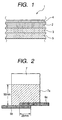
- Fig. 1 is a schematic cross-sectional view to show a part of an example of the waterproofing and airtight pressure-sensitive adhesive tape of the invention. In Fig.
- 1, 1 denotes a waterproofing and airtight pressure-sensitive adhesive tape
- 2 denotes a rubber-made sheet
- 3 denotes a pressure-sensitive adhesive layer
- 4 denotes a film layer having non-self-adhesive properties and adhesive properties to the pressure-sensitive adhesive layer (non-self-adhesive and non-releasing film layer);
- 5 denotes a separator.
- the waterproofing and airtight pressure-sensitive adhesive tape 1 illustrated in Fig. 1 has a construction in which the pressure-sensitive adhesive layer 3 is formed on one side of the rubber-made sheet 2, the non-self-adhesive and non-releasing film layer 4 is formed on the other side of the rubber-made sheet 2, and the pressure-sensitive adhesive layer 3 is protected by the separator 5.
- the substrate is formed of a rubber-made sheet.
- rubber compositions containing a synthetic rubber are used for the raw material or material of the rubber-made sheet. It is preferable that the rubber-made sheet is constituted of a rubber composition containing a synthetic rubber as the major component.
- a butyl rubber, an ethylene-propylene rubber, and an ethylene-propylene-diene rubber are used as the synthetic rubber. Of these, a butyl rubber is especially preferable.
- the rubber component for example, a synthetic rubber
- adequate additives such as a softener, a filler, a colorant, an ultraviolet absorber, an antioxidant, and an antistatic agent may be blended in proper amounts in the rubber composition.
- the rubber-made sheet can be prepared by applying known forming methods (for example, an extrusion molding method and a calender molding method) .
- a rubber-made sheet made of an unvulcanized rubber is suitable as the rubber-made sheet from the standpoint that the physical properties (for example, elongation at break and 100 % tensile deforming stress) of the pressure-sensitive adhesive tape fall within the foregoing respective ranges.
- the thickness of the rubber-made sheet as a substrate is not particularly limited and for example, can be selected within the range of 0.1 mm or more (for example, from 0.1 to 3.0 mm), and preferably from 0.4 to 2.0 mm (more preferably from 0.5 to 1.5 mm).
- the thickness of the rubber-made sheet is too thin, the resulting pressure-sensitive adhesive tape becomes weak against an impact; and on the other hand, when it is too thick, a force necessary for drawing the pressure-sensitive adhesive tape becomes large.
- the non-self-adhesive and non-releasing film layer is a film layer having non-self-adhesive properties and adhesive properties to the pressure-sensitive adhesive layer formed on the opposite side of the substrate [adhesive properties to the pressure-sensitive adhesive layer (non-releasing properties)], and the kind of its film forming composition (raw material or material) is not particularly limited so far as it can exhibit non-self-adhesive properties and non-releasing properties.
- the non-self-adhesive and non-releasing film layer can be formed of, for example, a film forming composition containing an acrylic polymer or a long chain alkyl based compound, or a film forming composition containing components (for example, monomer components) to be used in preparing an acrylic polymer or a long chain alkyl based compound.
- the film forming composition for forming a non-self-adhesive and non-releasing film layer can be used singly or in combinations of two or more thereof.
- alkyl (meth) acrylate based polymers containing at least an alkyl (meth) acrylate as a monomer component are suitable.
- the alkyl (meth)acrylate include C 1-20 -alkyl (meth)acrylates such as methyl (meth)acrylate, ethyl (meth) acrylate, propyl (meth) acrylate, isopropyl (meth) acrylate, n-butyl (meth) acrylate, isobutyl (meth)-acrylate, sec-butyl (meth) acrylate, t-butyl (meth) acrylate, pentyl (meth) acrylate, hexyl (meth) acrylate, heptyl (meth)acrylate, octyl (meth)acrylate, 2-ethylhexyl (meth)-acrylate, isooctyl (meth)acrylate, 2-ethylhe
- a monomer component having copolymerization properties against the alkyl (meth)acrylate may be used along with the alkyl (meth)acrylate as monomer components.
- a copolymerizable monomer component include carboxyl group-containing monomers such as (meth) acrylic acid (for example, acrylic acid and methacrylic acid), itaconic acid, maleic acid, fumaric acid, crotonic acid, and isocrotonic acid, and anhydrides thereof (for example, maleic anhydride and itaconic anhydride) ; maleic (mono- or di) esters such as monomethyl maleate, monoethyl maleate, and diethyl maleate; fumaric (mono- or di) esters such as monomethyl fumarate and monoethyl fumarate; aromatic vinyl compounds such as styrene and substituted styrenes; hydroxyl group-containing monomers such as
- polybutyl methacrylate and an octadecyl methacrylate-acrylonitrile copolymer are suitable as the acrylic polymer.
- the long chain alkyl based compound is not particularly limited, and for example, reaction products between polyvinyl alcohol and a long chain alkylene isocyanate having from 10 to 20 carbon atoms such as stearyl isocyanate can be used.
- materials that are used as a releasing agent are included in the material to be used in the non-self-adhesive and non-releasing film layer.
- a pressure-sensitive adhesive for example, a butyl rubber based pressure-sensitive adhesive exhibits adhesive properties to a film layer made of an octadecyl methacrylate-acrylonitrile copolymer
- a coating amount thin for example, a butyl rubber based pressure-sensitive adhesive exhibits adhesive properties to a film layer made of an octadecyl methacrylate-acrylonitrile copolymer
- what the foregoing film layer has adhesive properties to the pressure-sensitive adhesive layer formed on the opposite side of the substrate means that, for example, with respect to two specimens prepared from the same pressure-sensitive adhesive tape, in the case where a pressure-sensitive adhesive layer of one of the specimens is stuck onto the back side of a substrate of the other specimen (the film layer side) by reciprocating a 2-kg roll one time, and after elapsing for 30 minutes, a 180°-peel adhesive strength (width of specimen: 25 mm, drawing rate: 300 mm/min, temperature: 23 ⁇ 2 °C, humidity: 50 ⁇ 5 % RH) is measured, the 180°-peel adhesive strength is 3 N/25 mm or more (preferably 5 N/25 mm or more).
- the non-self-adhesive and non-releasing film layer besides the acrylic polymer or long chain alkyl based compound, or the components for preparing an acrylic polymer or a long chain alkyl based compound (for example, monomer components), adequate additives such as a filler, a colorant, an ultraviolet absorber, an antioxidant, and an antistatic agent may be blended in proper amounts in the film forming composition.
- the method of forming a non-self-adhesive and non-releasing film layer is not particularly limited.
- the non-self-adhesive and non-releasing film layer can be formed by coating the film forming composition on the back side of the substrate, followed by drying and curing, if desired.
- the foregoing film forming composition may be in the liquid state or molten state.
- the non-self-adhesive and non-releasing film layer can be formed by drying and curing upon heating of the film forming composition after coating.
- the thickness of the non-self-adhesive and non-releasing film layer is not particularly limited and for example, can be selected within the range of 0.5 to 10 ⁇ m, preferably from 1 to 5 ⁇ m, and about 3 ⁇ m in average.
- the pressure-sensitive adhesive that constitutes the pressure-sensitive adhesive layer is not particularly limited, and examples thereof include known pressure-sensitive adhesives such as rubber based pressure-sensitive adhesives, acrylic pressure-sensitive adhesives, polyester based pressure-sensitive adhesives, urethane based pressure-sensitive adhesives, polyamide based pressure-sensitive adhesives, epoxy based pressure-sensitive adhesives, vinyl alkyl ether based pressure-sensitive adhesives, silicone based pressure-sensitive adhesives, and fluorine based pressure-sensitive adhesives.
- the pressure-sensitive adhesive may be a hot melt type pressure-sensitive adhesive.
- the pressure-sensitive adhesive can be used singly or in combinations of two or more thereof.
- the pressure-sensitive adhesive may be in the form of any pressure-sensitive adhesive such as an emulsion based pressure-sensitive adhesive, a solvent based pressure-sensitive adhesive, an oligomer based pressure-sensitive adhesive, and a solid pressure-sensitive adhesive.
- the pressure-sensitive adhesive may contain proper additives such as a crosslinking agent (for example, a polyisocyanate based crosslinking agent and an alkyl etherified melamine compound based crosslinking agent), a tackifier (for example, a rosin derivative resin, a polyterpene resin, a petroleum resin, and a phenol resin), a plasticizer, a filler, and an anti-aging agent in addition to the polymer component such as the pressure-sensitive adhesive component (base polymer) depending upon the kind of the pressure-sensitive adhesive, etc.
- a crosslinking agent for example, a polyisocyanate based crosslinking agent and an alkyl etherified melamine compound based crosslinking agent
- a tackifier for example, a rosin derivative resin, a polyterpene resin, a petroleum resin, and a phenol resin
- plasticizer for example, a plasticizer, a filler, and an anti-aging agent in addition to the polymer component such as the
- a rubber based pressure-sensitive adhesive is suitable as the pressure-sensitive adhesive.
- the rubber based pressure-sensitive adhesive may be any of a natural rubber based pressure-sensitive adhesive containing a natural rubber as the base polymer or a synthetic rubber based pressure-sensitive adhesive containing a synthetic rubber as the base polymer. Of these, a synthetic rubber based pressure-sensitive adhesive is preferable.
- Examples of synthetic rubbers in such a synthetic rubber pressure-sensitive adhesive include a butyl rubber, a polyisoprene rubber, a polyisobutylene rubber, a styrene-butadiene (SB) rubber, a styrene-isoprene (SI) rubber, a styrene-isoprene-styrene block copolymer (SIS) rubber, a styrene-butadiene-styrene block copolymer (SBS) rubber, a styrene-ethylene-butylene-styrene block copolymer (SEBS) rubber, a styrene-ethylene-propylene-styrene block copolymer (SEPS) rubber, a styrene-ethylene-propylene block copolymer (SEP) rubber, a regenerated rubber, and modified materials thereof.
- a butyl rubber is especially preferable.
- a method of forming a pressure-sensitive adhesive layer known or customary forming methods can be employed, and a method of molding a pressure-sensitive adhesive into a sheet-like form by an extruder or a calender roll and sticking it onto a rubber-made sheet can be employed. Also, a method of coating a pressure-sensitive adhesive on the surface of a rubber-made sheet as the substrate (coating method) and a method of coating a pressure-sensitive adhesive on a release film such as a release liner to form a pressure-sensitive adhesive layer and then transferring the pressure-sensitive adhesive layer onto a rubber-made sheet as the substrate (a transfer method) can be employed.
- the thickness of the pressure-sensitive adhesive layer is not particularly limited and for example, can be selected within the range of from 0.1 to 3 mm (preferably from 0 . 2 to 2 mm, and more preferably from 0. 3 to 1 mm).
- the pressure-sensitive adhesive layer 3 is protected by the separator 5.
- the separator 5 is used as the need arises and therefore, can be arbitrarily provided.
- the separator (release liner) is not particularly limited, and known separators can be properly selected and used.
- the waterproofing and airtight pressure-sensitive adhesive tape has the pressure-sensitive adhesive layer on one side of the rubber-made sheet and the non-self-adhesive and non-releasing film layer on the other side of the rubber-made sheet.
- the waterproofing and airtight pressure-sensitive adhesive tape can be prepared by blending a rubber component such as a synthetic rubber with proper amounts of additives such as a softener and a filler; mixing the blend by a mixer such as a mixing roll, a kneader, and a Banbury mixer to prepare a rubber composition; molding the rubber composition into a sheet-like form using a calender roll, an extruder, etc.
- the non-self-adhesive and non-releasing film layer is formed of polybutyl methacrylate
- the non-self-adhesive and non-releasing film layer can be formed by coating a solution of polybutyl methacrylate obtained by dissolving polybutyl methacrylate in a solvent such as xylene on the back side of a substrate, followed by drying.
- the pressure-sensitive adhesive layer is a pressure-sensitive adhesive layer made of a rubber based pressure-sensitive adhesive
- the pressure-sensitive adhesive layer in the sheet-like form can be formed by adding proper amounts of additives such as a softener, a filler, and a tackifier to a rubber component such as a butyl rubber and mixing them in a mixer (for example, a mixing roll and a kneader) to prepare a rubber based pressure-sensitive adhesive (in particular, a butyl rubber based pressure-sensitive adhesive) and molding the rubber based pressure-sensitive adhesive using an extruder or a calender roll.
- additives such as a softener, a filler, and a tackifier
- a rubber component such as a butyl rubber
- a mixer for example, a mixing roll and a kneader
- the pressure-sensitive adhesive layer can be formed by coating a pressure-sensitive adhesive composition in the solution state or molten state on the prescribed surface of a rubber-made sheet, or by coating it on a release film and then transferring it onto the prescribed side of a rubber-made sheet.
- the rubber-made sheet a rubber-made sheet having physical properties (for example, elongation at break and 100 % tensile deforming stress) so as to enable the elongation at break and 100 % tensile deforming stress of the waterproofing and airtight pressure-sensitive adhesive tape to fall within the foregoing respective ranges.
- the non-self-adhesive and non-releasing film layer having non-adhesive properties and adhesive properties to the pressure-sensitive adhesive layer (non-releasing properties) is formed on the back side of the substrate. Accordingly, for example, when the pressure-sensitive adhesive tape is stuck, even in the case where the waterproofing and airtight pressure-sensitive adhesive tape of the invention is folded in such a manner that the back sides of the substrates come into contact with each other, adhesion of the back sides to each other or self adhesion thereof is prevented.
- the pressure-sensitive adhesive layer can adhere well to the non-self-adhesive and non-releasing film layer.
- the elongation at break and the 100 % tensile deforming stress become proper sizes, not only it is possible to stick the waterproofing and airtight pressure-sensitive adhesive tape by properly drawing it, but also even when the waterproofing and airtight pressure-sensitive adhesive tape is stuck in the elongated state, it is possible to effectively keep that state over a long period of time.
- the waterproofing and airtight pressure-sensitive adhesive tape is stuck to a curved shape or a three-dimensional shape such as openings and shaped portions (for example, external angles or convexes)
- the waterproofing and airtight pressure-sensitive adhesive tape can be folded in the sate that the back sides come into contact with each other or can be stuck while properly drawing, it can be easily stuck.
- the waterproofing and airtight pressure-sensitive adhesive tape is stuck in the drawn and elongated state, the generation of wrinkle, cutting or peeling due to a deforming stress is prevented so that the elongated state can be effectively kept.
- the pressure-sensitive adhesive layer of the pressure-sensitive adhesive tape is superimposed on the back side of the substrate and stuck thereto, it can be stuck with excellent adhesion properties. Also, in an overlap of a joint of the pressure-sensitive adhesive tape after sticking or an overlap of a terminal, adhesive properties of the pressure-sensitive adhesive tape can be ensured. For this reason, when the waterproofing and airtight pressure-sensitive adhesive tape of the invention is used, even if the sticking site has a curved shape or a three-dimensional shape, the sticking work can be carried out simply. For example, the waterproofing and airtight pressure-sensitive adhesive tape of the invention can be stuck beautifully in a cylindrical or fan form. Moreover, after sticking, it is possible to exhibit excellent waterproofing properties and airtightness over a long period of time.
- the waterproofing and airtight pressure-sensitive adhesive tape of the invention can be stuck in the state having excellent waterproofing properties and airtightness, it can be suitably used as a pressure-sensitive adhesive tape having waterproofing properties and/or airtightness depending upon the application.
- the waterproofing and airtight pressure-sensitive adhesive tape of the invention can be utilized as a waterproofing and airtight pressure-sensitive adhesive tape which is used for fixing a structure of dwelling house to a member or fixing members to each other.
- waterproofing and airtight pressure-sensitive adhesive tape it is useful as a waterproofing and airtight pressure-sensitive adhesive tape to be used in fixing of openings such as ventilating openings of external wall penetration portions of exterior backings, surroundings of conduits, penetration portions of water feed/discharge pipes, ventilation fans, and surroundings of sash openings (for example, surroundings of arch type or cylindrical sash openings) ; shaped portions such as external angles, internal angles, and convexes (in particular, not only a site in which the sticking portion is planar but also a site in which the sticking portion has a curved shape or a three-dimensional shape), and so on. Accordingly, by using the waterproofing and airtight pressure-sensitive adhesive tape of the invention, it is possible to enhance waterproofing properties and airtightness of dwelling houses. Also, it is possible to prevent penetration of storm sewage into the inside of a dwelling house and to prevent dew condensation and corrosion in the inside of a dwelling house.
- a sticking application method of a waterproofing and airtight pressure-sensitive adhesive tape in a portion where a body and a feed/discharge pipe intersect at right angles each other there is usually employed an application method in which the pressure-sensitive adhesive tape is folded in the state that it comes into contact with the back side in a 1/2 width (by this folding, the back sides come into contact with each other); the pressure-sensitive adhesive tape is wound up around the surrounding (circumference) of the feed/discharge pipe; and thereafter, the remaining 1/2-width part is stuck to the body.
- a rubber-made sheet made of a general unvulcanized rubber involved a problem that in folding in a 1/2 width, the back sides of the rubber-made sheet are liable to adhere to each other due to tackiness of the surface of the rubber-made sheet.
- a silicone based releasing agent was coated, there was encountered a problem that in sticking, in the case where the pressure-sensitive adhesive tape was superimposed and stuck on the back sides (own back sides) of the rubber-made sheet, adhesive properties are lost so that airtightness cannot be ensured in that portion.
- the waterproofing and airtight pressure-sensitive adhesive tape of the invention when used, by providing a film layer having a specified formulation (namely, a non-self-adhesive and non-releasing film layer) on the rear surface (back side) of a rubber-made sheet, it is possible to design to cope with both prevention of adhesion of the back sides to each other and revealment of adhesion properties of a pressure-sensitive adhesive layer.
- a film layer having a specified formulation namely, a non-self-adhesive and non-releasing film layer
- the waterproofing and airtight pressure-sensitive adhesive tape of the invention even in the case where the pressure-sensitive adhesive tape is applied to a portion where it is required to have elongation properties, excellent waterproofing properties and airtightness can be exhibited over a long period of time while preventing the generation of wrinkle, cutting or peeling. Also, even when a site to which the pressure-sensitive adhesive tape is stuck has a curved shape or a three-dimensional shape, the waterproofing and airtight pressure-sensitive adhesive tape of the invention is easy in a sticking application work of pressure-sensitive adhesive tapes and good in adhesion of overlaps of pressure-sensitive adhesive tapes after the application and can exhibit excellent waterproofing properties and airtightness over a long period of time.
- the waterproofing and airtight pressure-sensitive adhesive tape of the invention is useful as a pressure-sensitive adhesive tape which can be used in fixing a structure of dwelling house to a member or fixing members to each other, prevent penetration of storm sewage into the inside of a dwelling house and prevent dew condensation and corrosion in the inside of a dwelling house over a long period of time.
- Polyethylene was molded into a sheet-like form using an extruder at a die temperature of 200 °C. There was thus prepared a polyethylene-made sheet having a thickness of 0.025 mm.
- a mixture of 100 parts by weight of a butyl rubber, 50 parts by weight of a tackifier, 100 parts by weight of calcium carbonate heavy, 30 parts by weight of carbon black, and 100 parts by weight of a softener was introduced into an extruder and extrusion molded to prepare a pressure-sensitive adhesive layer in the sheet-like form having a thickness of 1.0 mm.
- a prescribed amount of the film forming composition obtained in Preparation Example 1 of Film Forming Composition was coated on one side of the rubber-made sheet having a thickness of 0.45 mm obtained in Preparation Example 1 of Substrate and dried at 100 °C for 0.5 minutes to form a film layer having a thickness of about 3 ⁇ m. Thereafter, the pressure-sensitive adhesive layer in the sheet-like form (thickness: 1.0 mm) obtained in Preparation Example 1 of Pressure-sensitive Adhesive Layer was stuck on the other side of the rubber-made sheet (the side opposite to the film layer), and a release liner in which one side thereof had been subjected to a silicone release treatment was stuck on the pressure-sensitive adhesive layer to obtain a pressure-sensitive adhesive tape.
- a pressure-sensitive adhesive tape was obtained in the same manner as in Example 1, except that the rubber-made sheet having a thickness of 2.0 mm obtained in Preparation Example 1 of Substrate was used as the substrate.
- a pressure-sensitive adhesive tape was obtained in the same manner as in Example 1, except that the rubber-made sheet having a thickness of 0.55 mm obtained in Preparation Example 1 of Substrate was used as the substrate.
- a pressure-sensitive adhesive tape was obtained in the same manner as in Example 1, except that the unvulcanized rubber-made sheet having a thickness of 0.6 mm obtained in Preparation Example 2 of Substrate was used as the substrate.
- a pressure-sensitive adhesive tape was obtained in the same manner as in Example 1, except that the vulcanized rubber-made sheet having a thickness of 0.7 mm obtained in Preparation Example 3 of Substrate was used as the substrate.
- a pressure-sensitive adhesive tape was obtained in the same manner as in Example 1, except that the polyethylene-made sheet having a thickness of 0.025 mm obtained in Preparation Example 4 of Substrate was used as the substrate.
- the pressure-sensitive adhesive tape obtained in Example 1 was cut into a width of 25 mm, and adhesive properties of the back side of the substrate (the side of the film layer made of the film forming composition obtained in Preparation Example 1 of Film Forming Composition) were confirmed through finger touch. Also, the back sides (film layer sides) were stuck to each other and laminated by reciprocating a 2-kg roll one time, and after elapsing for 30 minutes, the laminate was peeled apart from each other to confirm organoleptically adhesive properties between the back sides. Moreover, in this peeling, a 180°-peel adhesive strength (width of specimen: 25 mm, drawing rate: 300 mm/min, temperature: 23 ⁇ 2 °C, humidity: 50 ⁇ 5 % RH) was measured.
- the pressure-sensitive adhesive tape obtained in Example 1 was cut into a width of 25 mm to prepare two specimens.
- a pressure-sensitive adhesive layer of one of the specimens was stuck onto the surface of a substrate of the other specimen (the side of a film layer made of the film forming composition obtained in Preparation Example 1 of Film Forming Composition) by reciprocating a 2-kg roll one time and allowed to stand for a prescribed period of time (30 minutes and 24 hours).
- a 180°-peel adhesive strength (width of specimen: 25 mm, drawing rate: 300 mm/min, temperature: 23 ⁇ 2 °C, humidity: 50 ⁇ 5 % RH; the specimen in the side in which the back side of the substrate was stuck to the pressure-sensitive adhesive layer was peeled) was measured using a tensile tester (a trade name of device: Autograph, manufactured by Shimadzu Corporation) .
- a tensile tester a trade name of device: Autograph, manufactured by Shimadzu Corporation
- the pressure-sensitive adhesive tape obtained in Example 1 was cut into a width of 100 mm to prepare two specimens.
- a pressure-sensitive adhesive layer of one of the specimens was superimposed on the surface of a substrate of the other specimen (the side of a film layer made of the film forming composition obtained in Preparation Example 1 of Film Forming Composition) in a length of 25 mm as illustrated in Fig. 2 and stuck by reciprocating a 2-kg roll one time. Thereafter, a cylinder having a diameter of 70 mm was stood on the overlap, and a boundary thereof with the pressure-sensitive adhesive tape was subjected to a leak-prevention treatment with a sealing material.
- Fig. 2 is a schematic view to show a method of evaluating waterproofing properties in the evaluation of waterproofing properties in the Examples.
- 6a denotes a one-sided specimen (width: 100 mm); 6b denotes the other-sided specimen (width: 100 mm); 7 denotes a cylinder (external diameter: 70 mm, made of a plastic); and 7a denotes water.
- 6a denotes a one-sided specimen (width: 100 mm)
- 6b denotes the other-sided specimen (width: 100 mm)
- 7 denotes a cylinder (external diameter: 70 mm, made of a plastic); and 7a denotes water.
- Fig. 1 denotes a one-sided specimen (width: 100 mm)
- 6b denotes the other-sided specimen (width: 100 mm)
- 7 denotes a cylinder (external diameter: 70 mm, made of a plastic); and 7a denotes water.
- a pressure-sensitive adhesive layer in the one-sided specimen 6a is superimposed and adhered onto the surface of a substrate in the other-sided specimen 6b in an overlap length of 25 mm; the cylinder 7 is stood on the overlap; a boundary between the cylinder 7 and the specimens (6a, 6b) is subjected to a leak-prevention treatment with a sealing material; and water is then poured in the cylinder 7 in a height of 50 mm.
- the pressure-sensitive adhesive tape obtained in Example 1 has good adhesive properties to the back side of the pressure-sensitive adhesive layer (surface of the film layer) and excellent waterproofing properties.
- the pressure-sensitive adhesive tapes obtained in Examples 1 to 3 and Comparative Examples 1 to 3 were evaluated with respect to elongation at break, stress under 100 % elongation and sticking application properties by a method of measuring an elongation at break, a method of measuring a stress under 100 % elongation and a method of evaluating sticking application properties as described below.
- Each of the pressure-sensitive adhesive tapes obtained in Examples 1 to 3 and Comparative Examples 1 to 3 is punched into a specimen of a dumbbell shape No. 1 as defined in JIS K6251 (test width: 10 mm, distance between two gage marks: 40 mm) in each of the longitudinal direction (MD direction) and the cross direction (TD direction) of the specimen; and using a tensile tester, the crosshead side of the specimen is drawn at a rate of 300 mm/min under conditions of a distance between two gage marks of the specimen of 40 mm and a width of the specimen of 10 mm, thereby measuring an elongation (%) at the time when the specimen is broken.
- the elongation values in the MD direction side are shown in the "MD direction” row in the “Elongation (%) at break” of Table 1; and the elongation values in the TD direction side are shown in the "TD direction” row in the “Elongation (%) at break” of Table 1.
- Each of the pressure-sensitive adhesive tapes obtained in Examples 1 to 3 and Comparative Examples 1 to 3 is punched into a specimen of a dumbbell shape No. 1 as defined in JIS K6251 (test width: 10 mm, distance between two gage marks: 40 mm) in each of the longitudinal direction (MD direction) and the cross direction (TD direction) of the specimen; according to JIS K6254, by using a tensile tester, the crosshead side of the specimen is drawn at a rate of 50 mm/min under conditions of a distance between two gage marks of the specimen of 40 mm and a width of the specimen of 10 mm, and when the specimen is drawn with 100 %, the drawing is stopped at the time, thereby measuring a load (N) at this time; and the measured load value is divided by a cross-sectional area of the specimen [(thickness of specimen) ⁇ (width of specimen)] before drawing to calculate a load (N/cm 2 ) per unit cross-sectional area.
- This calculated value is designated as a stress under 100 % elongation.
- the values stress under 100 % elongation in the MD direction side are shown in the "MD direction” row in the “100 % elongation deforming stress (N/cm 2 )" of Table 1; and the values stress under 100 % elongation in the TD direction side are shown in the "TD direction” row in the “100 % elongation deforming stress (N/cm 2 )" of Table 1.
- Each of the pressure-sensitive adhesive tapes obtained in Examples 1 to 3 and Comparative Examples 1 to 3 is cut into a width of 50 mm and a length of 250 mm to prepare a pressure-sensitive adhesive tape-stuck specimen.
- the foregoing pressure-sensitive adhesive tape-stuck specimen is applied by sticking onto the circumference of a shaped portion of a water feed/discharge pipe (a cylindrical water feed/discharge pipe having an external diameter of 60 mm ⁇ ) adhered onto the surface of a body made of a plywood in the vertically standing state against the surface of the foregoing plywood (i.e., a joint between the body and the water feed/discharge pipe and its circumference) under a condition at a temperature of 23 ⁇ 2 °C and at a humidity of 50 ⁇ 5 % RH, and after standing for 24 hours under a condition at a temperature of 23 ⁇ 2 °C and at a humidity of 50 ⁇ 5 % RH, the appearance of the pressure-sensitive adhesive tape is visually observed
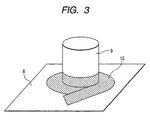
- Fig. 3 is a schematic view to show a method of subjecting a pressure-sensitive adhesive tape to sticking to a circumference of a shaped portion by a method of evaluating sticking application properties in the Examples.
- 8 denotes a body (plywood); 9 denotes a water feed/discharge pipe; and 10 denotes a pressure-sensitive adhesive tape.
- the water feed/discharge pipe 9 is adhered onto the surface of the body 8 made of a plywood in the vertically standing state against the surface of the foregoing body (plywood) 8.
- the foregoing water feed/discharge pipe 9 has a cylindrical shape having an external diameter of 60 mm ⁇ .
- the pressure-sensitive adhesive tape 10 is applied in such a shape portion and its circumference (a joint between the body 8 and the water feed/discharge pipe 9 and its circumference).
- Table 1 Example Comparative Example 1 2 3 1 2 3 Thickness of substrate (mm) 0.45 2.0 0.55 0.6 0.7 0.025 Elongation at break (%) MD direction 690 610 780 400 600 900 TD direction 970 900 970 500 800 1000 100 % tensile deforming stress (N/cm 2 ) MD direction 50 50 30 130 125 1730 TD direction 20 20 16 110 114 1200 Sticking application properties Peeling and/or lifting did not occur. Peeling and/or lifting occurred.
- the pressure-sensitive adhesive tapes according to Examples 1 to 3 are easy and good in sticking application workability in sites of pressure-sensitive adhesive tape, which are required to have elongation properties at the time of sticking, such as shaped portions and openings, and can exhibit excellent waterproofing properties and airtightness after the sticking application.
Landscapes
- Chemical & Material Sciences (AREA)
- Organic Chemistry (AREA)
- Adhesive Tapes (AREA)
- Adhesives Or Adhesive Processes (AREA)
- Laminated Bodies (AREA)
Claims (4)
- Bande adhésive autocollante d'hydrofugation et étanche à l'air comprenant un substrat comportant une couche adhésive autocollante sur un côté de celle-ci, où le substrat est une feuille constituée de caoutchouc, qui est constituée d'une composition de caoutchouc contenant un caoutchouc synthétique choisi parmi un caoutchouc de butyle, un caoutchouc d'éthylène-propylène et un caoutchouc d'éthylène-propylène-diène, une couche de film ayant des propriétés non auto-adhésives et des propriétés adhésives à la couche adhésive autocollante est formée sur le substrat sur le côté opposé à la couche adhésive autocollante ; et la bande adhésive autocollante d'hydrofugation et étanche à l'air a un allongement à la rupture dans des conditions d'une distance entre deux points de mesure de 40 mm et d'une vitesse d'étirage de 300 mm/min de 200 à 1 200 % à la fois dans la direction longitudinale et dans la direction transversale et une contrainte sous 100 % d'allongement dans des conditions d'une distance entre deux points de mesure de 40 mm et d'une vitesse d'étirage de 50 mm/min de 10 à 100 N/cm2 à la fois dans la direction longitudinale et dans la direction transversale.
- Bande adhésive autocollante d'hydrofugation et étanche à l'air selon la revendication 1, dans laquelle la couche de film ayant des propriétés non auto-adhésives et des propriétés adhésives à la couche adhésive autocollante est formée d'une composition de formation de film contenant un polymère acrylique ou un composé à base d'alkyle à longue chaîne, qui est le produit de réaction entre du poly(alcool vinylique) et un isocyanate d'alkylène à longue chaîne ayant de 10 à 20 atomes de carbone.
- Bande adhésive autocollante d'hydrofugation et étanche à l'air selon la revendication 2, dans laquelle le polymère acrylique capable de former une couche de film ayant des propriétés non auto-adhésives et des propriétés adhésives à la couche adhésive autocollante est un polymère à base de (méth)acrylate d'alkyle contenant au moins un (méth)acrylate d'alkyle comme composant de monomère.
- Bande adhésive autocollante d'hydrofugation et étanche à l'air selon l'une quelconque des revendications 1 à 3, dans laquelle la feuille constituée de caoutchouc est constituée d'une composition de caoutchouc contenant un caoutchouc synthétique comme composant majeur
Applications Claiming Priority (2)
| Application Number | Priority Date | Filing Date | Title |
|---|---|---|---|
| JP2003361996A JP4462892B2 (ja) | 2003-10-22 | 2003-10-22 | 防水気密用粘着テープ |
| JP2003361996 | 2003-10-22 |
Publications (2)
| Publication Number | Publication Date |
|---|---|
| EP1526164A1 EP1526164A1 (fr) | 2005-04-27 |
| EP1526164B1 true EP1526164B1 (fr) | 2008-01-02 |
Family
ID=34386504
Family Applications (1)
| Application Number | Title | Priority Date | Filing Date |
|---|---|---|---|
| EP04025053A Expired - Lifetime EP1526164B1 (fr) | 2003-10-22 | 2004-10-21 | Ruban d'étanchéité auto-adhésif étanche à l'air |
Country Status (6)
| Country | Link |
|---|---|
| US (1) | US7351472B2 (fr) |
| EP (1) | EP1526164B1 (fr) |
| JP (1) | JP4462892B2 (fr) |
| CN (1) | CN100371165C (fr) |
| CA (1) | CA2485358C (fr) |
| DE (1) | DE602004010983T2 (fr) |
Families Citing this family (20)
| Publication number | Priority date | Publication date | Assignee | Title |
|---|---|---|---|---|
| US20050252131A1 (en) * | 2004-04-28 | 2005-11-17 | Bushberger Todd E | Door and window sill gasket |
| JP4138717B2 (ja) * | 2004-08-31 | 2008-08-27 | 日東電工株式会社 | 展延性を有する防水気密用粘着シートによる3面交差構造物の防水施工方法 |
| JP4699076B2 (ja) * | 2005-04-20 | 2011-06-08 | 日東電工株式会社 | 防水気密用粘着テープ |
| JP4699075B2 (ja) * | 2005-04-20 | 2011-06-08 | 日東電工株式会社 | 防水気密用両面粘着テープ |
| US7754304B1 (en) * | 2005-12-27 | 2010-07-13 | Mitek Holdings, Inc. | Weatherproofing backer for window and door installation |
| US7722592B2 (en) * | 2006-01-03 | 2010-05-25 | The Procter & Gamble Company | Non-tacky adhesive fastening system for use in consumer products |
| US8006445B2 (en) * | 2006-06-29 | 2011-08-30 | Pella Corporation | Self-sealing window installation and method |
| CA2638468C (fr) * | 2007-08-09 | 2016-09-13 | Benjamin Obdyke Incorporated | Assemblage de toit ou de mur exterieur a barriere etanche et methode d'application de la barriere |
| US20110183100A1 (en) * | 2008-05-09 | 2011-07-28 | Lee Dae-Woo | Solvent-free adhesive for waterproof sheet, waterproof sheet and manufacturing method of waterproof sheet using the solvent-free adhesive and construction method using the waterproof sheet |
| US9308703B2 (en) | 2008-11-04 | 2016-04-12 | Shurtape Technologies, Llc | Device for making corrugated metallic foil tape |
| US20100112294A1 (en) * | 2008-11-04 | 2010-05-06 | Shurtape Technologies, Inc. | Corrugated metallic foil tape |
| CN101570667B (zh) * | 2009-06-10 | 2013-03-06 | 中科英华高技术股份有限公司 | 耐辐照、耐高温、防水密封胶带材料及制备方法 |
| JP5582873B2 (ja) | 2010-05-26 | 2014-09-03 | 日東電工株式会社 | シーリング方法およびシール部材 |
| CN104011158B (zh) * | 2011-12-21 | 2017-04-05 | 日东电工株式会社 | 防止水生生物附着的粘合带 |
| CN102676079B (zh) * | 2012-05-10 | 2014-06-04 | 深圳市卓宝科技股份有限公司 | 一种双面自粘防水胶带 |
| JP6060610B2 (ja) | 2012-10-15 | 2017-01-18 | 信越化学工業株式会社 | 屋外タンクの防水施工方法 |
| DE102013216778A1 (de) | 2013-08-23 | 2015-02-26 | Tesa Se | Stanzling insbesondere zum dauerhaften Verschließen von Löchern |
| CN104371580A (zh) * | 2014-05-27 | 2015-02-25 | 杨际梅 | 液体丁基橡胶交叉膜反应粘防水卷材 |
| CN104231975A (zh) * | 2014-08-21 | 2014-12-24 | 江苏华侃核电器材科技有限公司 | 第三代核电站用密封胶带材料及其制备方法 |
| CN109988365A (zh) * | 2019-04-04 | 2019-07-09 | 河北超达密封制品有限公司 | 一种超强防水橡胶带及其制备方法 |
Family Cites Families (12)
| Publication number | Priority date | Publication date | Assignee | Title |
|---|---|---|---|---|
| US4917926A (en) * | 1987-05-21 | 1990-04-17 | Waterford Research & Development Limited | Soluble tape and film |
| DE68917572T2 (de) | 1988-10-18 | 1994-12-15 | Nitto Denko Corp | Klebestreifen zum medizinalen oder hygienischen Gebrauch. |
| CA2076031C (fr) * | 1990-03-30 | 1999-12-21 | Karen M. Capik | Bandes elastomeres a couches de surface microtexturees |
| US5733652A (en) * | 1995-02-10 | 1998-03-31 | Minnesota Mining And Manufacturing Company | Banding system, banding tape and methods of using the same |
| US6001471A (en) * | 1995-08-11 | 1999-12-14 | 3M Innovative Properties Company | Removable adhesive tape with controlled sequential release |
| JPH09209464A (ja) | 1996-02-02 | 1997-08-12 | Nitto Denko Corp | 建材用防水テープもしくはシート、及びこれらのロール体 |
| CA2405251C (fr) | 2000-04-25 | 2006-09-12 | E.I. Du Pont De Nemours And Company | Materiaux extensibles de recouvrement etanche et processus de fabrication |
| JP2001323228A (ja) * | 2000-05-15 | 2001-11-22 | Nitto Denko Corp | 加熱剥離型粘着シート |
| US6569521B1 (en) * | 2000-07-06 | 2003-05-27 | 3M Innovative Properties Company | Stretch releasing pressure sensitive adhesive tape and articles |
| EP1184436A1 (fr) * | 2000-09-01 | 2002-03-06 | 3M Innovative Properties Company | Utilisation d'un ruban adhésif pour l'amélioration de la stabilité de produits empilés |
| JP2003041233A (ja) | 2001-07-31 | 2003-02-13 | Nitto Denko Corp | 架橋された固形タイプの粘着剤組成物とその粘着シートおよび防水気密用粘着シート |
| JP2003138227A (ja) | 2001-11-01 | 2003-05-14 | Nitto Denko Corp | 建材用透湿防水粘着テープ |
-
2003
- 2003-10-22 JP JP2003361996A patent/JP4462892B2/ja not_active Expired - Lifetime
-
2004
- 2004-10-19 CA CA002485358A patent/CA2485358C/fr not_active Expired - Fee Related
- 2004-10-21 DE DE602004010983T patent/DE602004010983T2/de not_active Expired - Lifetime
- 2004-10-21 US US10/969,070 patent/US7351472B2/en not_active Expired - Lifetime
- 2004-10-21 EP EP04025053A patent/EP1526164B1/fr not_active Expired - Lifetime
- 2004-10-22 CN CNB2004100857957A patent/CN100371165C/zh not_active Expired - Fee Related
Also Published As
| Publication number | Publication date |
|---|---|
| US20050106387A1 (en) | 2005-05-19 |
| CN100371165C (zh) | 2008-02-27 |
| CA2485358C (fr) | 2009-09-01 |
| JP4462892B2 (ja) | 2010-05-12 |
| DE602004010983T2 (de) | 2008-05-08 |
| JP2005126521A (ja) | 2005-05-19 |
| CN1618924A (zh) | 2005-05-25 |
| US7351472B2 (en) | 2008-04-01 |
| CA2485358A1 (fr) | 2005-04-22 |
| EP1526164A1 (fr) | 2005-04-27 |
| DE602004010983D1 (de) | 2008-02-14 |
Similar Documents
| Publication | Publication Date | Title |
|---|---|---|
| US7351472B2 (en) | Waterproofing and airtight pressure-sensitive adhesive tape | |
| EP1715013B1 (fr) | Feuille adhésive a double face sensible à la pression et étanche à l'eau et à l'air | |
| US8501306B2 (en) | Viscoelastic articles with polymer layer containing elastomer unevenly distributed | |
| EP2094801B2 (fr) | Adhésifs à mélange de copolymères blocs à agents collants multiples | |
| EP1721950A1 (fr) | Ruban d'étanchéité auto-adhésif étanche à l'air | |
| TWI691579B (zh) | 具粒狀高分子外保護層之預塗膜 | |
| CN110088222A (zh) | 粘合剂组合物、粘合剂层及粘合片材 | |
| US20060042744A1 (en) | Waterproofing execution method of three-plane crossing structure by means of extensible waterproofing and airtight pressure-sensitive adhesive sheet | |
| JP2017043651A (ja) | 密着層付き独立気泡発泡体止水シート | |
| US7677011B2 (en) | Crosslinked solid type pressure-sensitive adhesive composition, pressure-sensitive adhesive sheet comprising the composition, and pressure-sensitive adhesive sheet for waterproofing/airproofing comprising the sheet | |
| US20220186093A1 (en) | Adhesive composition, adhesive layer and adhesive sheet | |
| JP4920400B2 (ja) | 防水気密用粘着シート | |
| JP2003041233A (ja) | 架橋された固形タイプの粘着剤組成物とその粘着シートおよび防水気密用粘着シート | |
| US20230392050A1 (en) | Airtight pressure-sensitive adhesive tape for foundation | |
| JP5378484B2 (ja) | 架橋された固形タイプの粘着剤組成物とその粘着シートおよび防水気密用粘着シートの製造方法 | |
| DE60318690T2 (de) | Wässrige Haftkleberdispersion, Haftklebefolie sowie diese verwendende Kautschukschaumfolie | |
| CN119654378A (zh) | 稳定化的热熔压敏粘合剂 | |
| JP2006241769A (ja) | 展延性を有する防水気密用粘着シートによる防水施工方法 |
Legal Events
| Date | Code | Title | Description |
|---|---|---|---|
| PUAI | Public reference made under article 153(3) epc to a published international application that has entered the european phase |
Free format text: ORIGINAL CODE: 0009012 |
|
| AK | Designated contracting states |
Kind code of ref document: A1 Designated state(s): AT BE BG CH CY CZ DE DK EE ES FI FR GB GR HU IE IT LI LU MC NL PL PT RO SE SI SK TR |
|
| AX | Request for extension of the european patent |
Extension state: AL HR LT LV MK |
|
| 17P | Request for examination filed |
Effective date: 20050916 |
|
| AKX | Designation fees paid |
Designated state(s): BE DE FR GB IT |
|
| GRAP | Despatch of communication of intention to grant a patent |
Free format text: ORIGINAL CODE: EPIDOSNIGR1 |
|
| GRAS | Grant fee paid |
Free format text: ORIGINAL CODE: EPIDOSNIGR3 |
|
| GRAA | (expected) grant |
Free format text: ORIGINAL CODE: 0009210 |
|
| AK | Designated contracting states |
Kind code of ref document: B1 Designated state(s): BE DE FR GB IT |
|
| REG | Reference to a national code |
Ref country code: GB Ref legal event code: FG4D |
|
| REF | Corresponds to: |
Ref document number: 602004010983 Country of ref document: DE Date of ref document: 20080214 Kind code of ref document: P |
|
| ET | Fr: translation filed | ||
| PLBE | No opposition filed within time limit |
Free format text: ORIGINAL CODE: 0009261 |
|
| STAA | Information on the status of an ep patent application or granted ep patent |
Free format text: STATUS: NO OPPOSITION FILED WITHIN TIME LIMIT |
|
| 26N | No opposition filed |
Effective date: 20081003 |
|
| PGFP | Annual fee paid to national office [announced via postgrant information from national office to epo] |
Ref country code: BE Payment date: 20081010 Year of fee payment: 5 Ref country code: IT Payment date: 20081025 Year of fee payment: 5 |
|
| PGFP | Annual fee paid to national office [announced via postgrant information from national office to epo] |
Ref country code: GB Payment date: 20081015 Year of fee payment: 5 |
|
| BERE | Be: lapsed |
Owner name: NITTO DENKO CORP. Effective date: 20091031 |
|
| PG25 | Lapsed in a contracting state [announced via postgrant information from national office to epo] |
Ref country code: BE Free format text: LAPSE BECAUSE OF NON-PAYMENT OF DUE FEES Effective date: 20091031 |
|
| PG25 | Lapsed in a contracting state [announced via postgrant information from national office to epo] |
Ref country code: GB Free format text: LAPSE BECAUSE OF NON-PAYMENT OF DUE FEES Effective date: 20091021 |
|
| PGFP | Annual fee paid to national office [announced via postgrant information from national office to epo] |
Ref country code: FR Payment date: 20101020 Year of fee payment: 7 |
|
| PG25 | Lapsed in a contracting state [announced via postgrant information from national office to epo] |
Ref country code: IT Free format text: LAPSE BECAUSE OF NON-PAYMENT OF DUE FEES Effective date: 20091021 |
|
| REG | Reference to a national code |
Ref country code: FR Ref legal event code: ST Effective date: 20120629 |
|
| PG25 | Lapsed in a contracting state [announced via postgrant information from national office to epo] |
Ref country code: FR Free format text: LAPSE BECAUSE OF NON-PAYMENT OF DUE FEES Effective date: 20111102 |
|
| PGFP | Annual fee paid to national office [announced via postgrant information from national office to epo] |
Ref country code: DE Payment date: 20141014 Year of fee payment: 11 |
|
| REG | Reference to a national code |
Ref country code: DE Ref legal event code: R119 Ref document number: 602004010983 Country of ref document: DE |
|
| PG25 | Lapsed in a contracting state [announced via postgrant information from national office to epo] |
Ref country code: DE Free format text: LAPSE BECAUSE OF NON-PAYMENT OF DUE FEES Effective date: 20160503 |