EP1521791B1 - Nobonene-ester based addition polymer and method for preparing the same - Google Patents
Nobonene-ester based addition polymer and method for preparing the same Download PDFInfo
- Publication number
- EP1521791B1 EP1521791B1 EP03738767A EP03738767A EP1521791B1 EP 1521791 B1 EP1521791 B1 EP 1521791B1 EP 03738767 A EP03738767 A EP 03738767A EP 03738767 A EP03738767 A EP 03738767A EP 1521791 B1 EP1521791 B1 EP 1521791B1
- Authority
- EP
- European Patent Office
- Prior art keywords
- norbornene
- ester
- reaction
- unsubstituted
- hydrocarbon
- Prior art date
- Legal status (The legal status is an assumption and is not a legal conclusion. Google has not performed a legal analysis and makes no representation as to the accuracy of the status listed.)
- Expired - Lifetime
Links
- UEZBDOHGSRYOJU-UHFFFAOYSA-N CC1(C2CC1)C2C(F)(F)F Chemical compound CC1(C2CC1)C2C(F)(F)F UEZBDOHGSRYOJU-UHFFFAOYSA-N 0.000 description 1
Images
Classifications
-
- C—CHEMISTRY; METALLURGY
- C08—ORGANIC MACROMOLECULAR COMPOUNDS; THEIR PREPARATION OR CHEMICAL WORKING-UP; COMPOSITIONS BASED THEREON
- C08G—MACROMOLECULAR COMPOUNDS OBTAINED OTHERWISE THAN BY REACTIONS ONLY INVOLVING UNSATURATED CARBON-TO-CARBON BONDS
- C08G61/00—Macromolecular compounds obtained by reactions forming a carbon-to-carbon link in the main chain of the macromolecule
- C08G61/02—Macromolecular compounds containing only carbon atoms in the main chain of the macromolecule, e.g. polyxylylenes
- C08G61/04—Macromolecular compounds containing only carbon atoms in the main chain of the macromolecule, e.g. polyxylylenes only aliphatic carbon atoms
- C08G61/06—Macromolecular compounds containing only carbon atoms in the main chain of the macromolecule, e.g. polyxylylenes only aliphatic carbon atoms prepared by ring-opening of carbocyclic compounds
-
- C—CHEMISTRY; METALLURGY
- C08—ORGANIC MACROMOLECULAR COMPOUNDS; THEIR PREPARATION OR CHEMICAL WORKING-UP; COMPOSITIONS BASED THEREON
- C08F—MACROMOLECULAR COMPOUNDS OBTAINED BY REACTIONS ONLY INVOLVING CARBON-TO-CARBON UNSATURATED BONDS
- C08F32/00—Homopolymers and copolymers of cyclic compounds having no unsaturated aliphatic radicals in a side chain, and having one or more carbon-to-carbon double bonds in a carbocyclic ring system
- C08F32/08—Homopolymers and copolymers of cyclic compounds having no unsaturated aliphatic radicals in a side chain, and having one or more carbon-to-carbon double bonds in a carbocyclic ring system having two condensed rings
-
- G—PHYSICS
- G02—OPTICS
- G02F—OPTICAL DEVICES OR ARRANGEMENTS FOR THE CONTROL OF LIGHT BY MODIFICATION OF THE OPTICAL PROPERTIES OF THE MEDIA OF THE ELEMENTS INVOLVED THEREIN; NON-LINEAR OPTICS; FREQUENCY-CHANGING OF LIGHT; OPTICAL LOGIC ELEMENTS; OPTICAL ANALOGUE/DIGITAL CONVERTERS
- G02F1/00—Devices or arrangements for the control of the intensity, colour, phase, polarisation or direction of light arriving from an independent light source, e.g. switching, gating or modulating; Non-linear optics
- G02F1/01—Devices or arrangements for the control of the intensity, colour, phase, polarisation or direction of light arriving from an independent light source, e.g. switching, gating or modulating; Non-linear optics for the control of the intensity, phase, polarisation or colour
- G02F1/13—Devices or arrangements for the control of the intensity, colour, phase, polarisation or direction of light arriving from an independent light source, e.g. switching, gating or modulating; Non-linear optics for the control of the intensity, phase, polarisation or colour based on liquid crystals, e.g. single liquid crystal display cells
- G02F1/133—Constructional arrangements; Operation of liquid crystal cells; Circuit arrangements
- G02F1/136—Liquid crystal cells structurally associated with a semi-conducting layer or substrate, e.g. cells forming part of an integrated circuit
- G02F1/1362—Active matrix addressed cells
- G02F1/136227—Through-hole connection of the pixel electrode to the active element through an insulation layer
Definitions
- the present invention relates to a norbornene based addition polymer, and more particularly to an addition polymer of norbornene based monomers containing an ester group.
- PMMA polymethylmethacrylate
- PC polycarbonate
- polymers having low dielectric constants; low hygroscopicity; superior metal adhesivity, strength, thermal stability; and transparency; and high glass transition temperatures (T g > 250°C) attract a lot of attention.
- Such polymers may be used for insulation films of semiconductors or TFT-LCDs; protection films for polarizers, multichip modules, integrated circuits (ICs), and printed circuit boards; and molding compounds for electronic devices or optical materials for flat panel displays.
- polyimide, BCB (bis-benzocyclobutene), etc. are used as low dielectric materials for electronic devices.
- Polyimide has long been used for electronic devices due to its good thermal stability and oxidative stability, high glass transition temperature, and superior mechanical properties. However, it has problems of corrosion due to high hygroscopicity, an increase in dielectric constant, its anisotropic electric property, a need for pre-treatment to reduce reaction with copper wire, its metal adhesivity, and so forth.
- BCB has lower hygroscopicity and a lower dielectric constants than polyimide, its metal adhesivity is not good, and curing at a high temperature is required to obtain desired physical properties. Physical properties of BCB are affected by curing time and temperature.
- Cyclic monomers can be polymerized by ROMP (ring opening metathesis polymerization), HROMP (ring opening metathesis polymerization followed by hydrogenation), copolymerization with ethylene, and homogeneous polymerization, as shown in the following Scheme 1:
- thermosetting resin prepared by the above method can be used for a circuit board, by reaction injection molding.
- it has problems of thermal stability, oxidative stability, and low glass transition temperature.
- a zirconium based metallocene catalyst has been reported to give a polymer having a narrow molecular weight distribution and a large molecular weight ( Plastic News, Feb. 27, 1995, p.24).
- the activity of the catalyst decreases with an increase of cyclic monomer concentration, and the obtained copolymer has a low glass transition temperature (T g ⁇ 200°C).
- T g glass transition temperature
- the mechanical strength is still weak and its chemical resistance against solvents, such as halogenated hydrocarbon solvents, is poor.
- Kaminsky et al. reported homogeneous polymerization of norbornene using a zirconium based metallocene catalyst (Kaminsky, W.; Bark, A.; Drake, I. Stud. Surf. Catal. 1990, 56, 425).
- the polymer prepared by this method is very crystalline and is hardly soluble in organic solvents, and thermal decomposition occured without showing a glass transition temperature. Therefore, further studies could not be conducted.
- the cyclic polymers also have poor metal adhesivity.
- a polymer to be used for electronic devices it should have good adhesivity to a variety of surfaces, such as silicon, silicon oxide, silicon nitride, alumina, copper, aluminum, gold, silver, platinum, titanium, nickel, tantalum, chromium, the polymer itself, or other polymers.
- a substrate is treated with an organic silicon coupling agent having two functional groups, such as amino-propyltriethoxysilane or triethoxyvinylsilane, then the substrate is treated with a polymer or a polymer precursor.
- an organic silicon coupling agent having two functional groups, such as amino-propyltriethoxysilane or triethoxyvinylsilane
- the substrate is treated with a polymer or a polymer precursor.
- the hydrolyzed silyl group and the hydroxy group on the substrate surface form a covalent bond.
- a cyclic polymer can be used for insulating electronic devices, replacing inorganic materials such as silicon oxide or silicon nitride.
- a functional polymer to be used for electronic devices it should have a low dielectric constant; low hygroscopicity; superior metal adhesivity, strength, thermal stability, and transparency; and a high glass transition temperature (T g > 250°C).
- Such a polymer can be used for insulation films of semiconductor devices or TFT-LCDs.
- amino groups on the substrate surface react with functional groups of the polymer or the polymer precursor to form bridges linking the substrate and the polymer.
- This technique has been disclosed in US Patent No. 4,831,172. However, this method is a multi-step process and requires a coupling agent.
- Introduction of functional groups to a polymer comprising hydrocarbons is a useful method for the control of chemical and physical properties of the polymer.
- introduction of functional groups is not easy because unshared electron pairs of the functional groups tend to react with active catalytic sites.
- a polymer obtained by polymerizing cyclic monomers having functional groups has a low molecular weight (US Patent No. 3,330,815).
- a polycyclic compound having a silyl group When a polycyclic compound having a silyl group is used for an insulation film, it decomposes by moisture in the air. Furthermore, when the silyl group is reacted with metal, by-products such as water or ethanol are produced, which are not completely removed and increase the dielectric constant or cause corrosion of other metals.
- US Patent No. 3,330,815 discloses a polymer prepared from polymerization of norbornene based monomers having a polar group using a palladium based catalyst. However, the polymer obtained by this method has a molecular weight (Mn) lower than 10,000.
- Europe Patent No. 0445755A2 discloses a copolymer of a norbornene derivative containing halogen, oxygen, or nitrogen, and a nickel and palladium based catalyst for preparing the same.
- examples of this patent do not present polymerization of a norbornene derivative having a polar group, and just present polymerization of norbornene itself.
- the polar group is not directly connected to the norbornene based monomer, but rather through a methyl group.
- the polymerization yield and the molecular weight reduce even more if the polar group is directly connected to the norbornene ring ( Organometallics, 2001, Vol. 20, 2802-2812).
- the polymerization yield was lower than 40%, and the molecular weight (Mn) was below 10,000.
- the present invention provides a norbornene-ester based addition polymer that comprises a norbornene-ester based monomer having a molecular weight (Mn) larger than 20,000, and comprising more than 50 mol% of exo norbornene-ester monomer, as a repeating unit.
- Mn molecular weight
- the present invention also provides a method for preparing a norbornene-ester based addition polymer, which comprises:
- the present invention also provides an optically anisotropic film which comprises a norbornene-ester based addition polymer comprising a norbornene-ester based monomer having a molecular weight (Mn) larger than 20,000, and comprising more than 50 mol% of exo norbornene-ester monomer as a repeating unit.
- a norbornene-ester based addition polymer comprising a norbornene-ester based monomer having a molecular weight (Mn) larger than 20,000, and comprising more than 50 mol% of exo norbornene-ester monomer as a repeating unit.
- the present inventors realized that an exo-rich norbornene-ester based monomer comprising more than 50 mol% of exo norbornene-ester monomer can be obtained in high yield from a Diels-Alder reaction by controlling the reaction temperature and reaction time, and that a norbornene-ester based addition polymer with a large molecular weight can be obtained in high yield if the exo-rich norbornene-ester monomer is polymerized in the presence of a Group X transition metal catalyst with a specific ligand.
- the obtained norbornene-ester based addition polymer has superior optical properties so as to be used for a protection film of a polarizer, a retardation film, or a glass substrate, and that it has good adhesivity to a variety of substrates.
- the present invention provides an addition polymer of a norbornene based olefin having a polar group such as an ester group, which is polymerized from an exo-rich norbornene based monomer comprising more than 50 mol% of exo isomer, and a method for preparing the same.
- the norbornene-ester based monomer used for preparing norbornene-ester based addition polymer in the present invention is prepared by a Diels-Alder reaction of norbornene compound and ester compound. Since the Diels-Alder reaction is highly stereoselective, endo isomers are produced more easily than exo isomers.
- a transition metal catalyst which is usually used for polymerization of olefin, has better polymerization activity for exo isomers than for endo isomers. Accordingly, a monomer mixture comprising more than 50 mol% of endo isomer cannot offer a good polymerization activity.
- the present invention prepares a norbornene based monomer mixture having a polar group, such as norbornene-ester, which comprises more than 50 mol% of exo norbornene-ester monomer by controlling temperature and time of the Diels-Alder reaction.
- a norbornene based monomer mixture having a polar group such as norbornene-ester
- transition state energy is lower for the endo isomer than the exo isomer by about 0.7kcal/mol.
- the energy of the products is lower for the exo isomer than that of the endo isomer by about 2kcal/mol. This can also be identified from the DFT (density functional theory) calculation.
- the endo isomer is more stable at the transition state (kinetically), the endo isomer is easily generated from the Diels-Alder reaction. However, since the exo isomer is more stable as product (thermodynamically), an exo-rich monomer mixture can be obtained by controlling the reaction time and the reaction temperature.
- thermodynamically preferable exo isomer becomes dominant.
- the exo/endo was 55.8/44.2, which offered more thermodynamically stable exo isomers than at 200 °C.
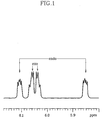
- the exo/endo ratio of the obtained monomer mixture can be identified by nuclear magnetic resonance (NMR) spectroscopy. From various kinds of NMR experiments and computer modeling calculations, the difference in chemical shift of olefinic protons of the two isomers is found, and from a relative integration of these signals, the exo/endo ratio can be easily determined.
- NMR nuclear magnetic resonance
- reaction temperature is below 180°C, an endo-rich norbornene-ester based monomer is obtained even when the reaction time is increased. Otherwise, if it exceeds 260°C, an unwanted monomer with a large molecular weight generated by continued Diels-Alder reaction even when the reaction time is decreased, and therefore the monomer yield decreases.
- reaction temperature is in the range of 180 to 260 °C, if the reaction time does not satisfy the reaction quotient of 82,000 to 155,000, the exo-rich norbornene-ester based monomer is not obtained, or the yield of the exo-rich norbornene-ester based monomer decreases.
- reaction temperature 160,902
- reaction time 160,902
- the present invention may use a polymerization inhibitor to prevent polymerization of the reactant or product.
- a polymerization inhibitor is hydroquinone.
- the content of polymerization inhibitor ranges from 0.005 to 3 parts by weight for 100 parts by weight of dicyclopentadiene and ester compound.
- the obtained norbornene-ester based monomer mixture can be represented by the following Chemical Formula 1: wherein
- R 1 , R 2 , R 3 , and R 4 are not radicals having an ester group, hydrogen, or halogen, R 1 and R 2 , or R 3 and R 4 may be connected to form a C 1 to C 10 alkylidene group, or R 1 or R 2 may be connected with one of R 3 and R 4 to form a C 4 to C 12 saturated or unsaturated cyclic group or a C 6 to C 17 aromatic group.
- the present invention prepares a norbornene-ester based addition polymer having a molecular weight (Mn) larger than 20,000 and comprising more than 50 mol% of exo norbornene-ester monomer by solution-phase polymerization of a norbornene-ester based monomer mixture comprising more than 50 mol% of exo norbornene-ester monomer as a repeating unit in the presence of a catalyst system comprising a Group X transition metal compound.
- Mn molecular weight
- the norbornene-ester based addition polymer of the present invention may have a variety of forms by selecting monomers.
- a norbornene-ester based monomer comprising more than 50 mol% of exo norbornene-ester monomer is used as the basic polymerization monomer. Even when other monomers (a norbornene monomer having at least one ester group, a norbornene based monomer not having an ester group, etc.) are added together, an addition polymer having a large molecular weight can be prepared at superior polymerization activity with a very small amount of catalyst.
- the forms of the polymer are as follows. Other than these, a variety of monomers may be added to prepare copolymers.
- the first is an addition homopolymer of a norbornene-ester monomer prepared from the norbornene-ester monomer only.
- the second is an addition copolymer prepared from two or more different norbornene-ester monomers.
- the third is an addition copolymer of a norbornene-ester monomer and a norbornene based monomer not having an ester group which is prepared from a norbornene-ester monomer and a norbornene based monomer not having an ester group.
- the norbornene based monomer not having an ester group of the third form is represented by the following Chemical Formula 2: wherein
- R 1 , R 2 , R 3 , and R 4 are not hydrogen, halogen, or a polar group
- R 1 and R 2 , or R 3 and R 4 may be connected to form a C 1 to C 10 alkylidene group, or R 1 or R 2 may be connected with one of R 3 and R 4 to form a C 4 to C 12 saturated or unsaturated cyclic group or a C 6 to C 24 aromatic group.
- the addition polymer of the present invention comprises a norbornene-ester based monomer comprising more than 50 mol% of exo norbornene-ester monomer as a repeating unit in 0.1 to 100 mol%. Even in copolymerization with a norbornene based monomer not having an ester group, a small amount of the norbornene-ester based monomer comprising more than 50 mol% of exo norbornene-ester monomer offers a good polymerization activity.
- the norbornene based monomer having an ester group is more advantageous in terms of polymerization activity and molecular weight than a monomer having more than one ester group.
- a copolymer prepared from a monomer having more than one ester group shows superior polymerization characteristics than monomer having one ester group.
- the norbornene-ester based addition polymer is polymerized in solution phase in the presence of a catalyst system comprising a Group X metal compound with an anionic ligand offering ⁇ - and ⁇ -bonds.
- a catalyst system comprising a Group X metal compound with an anionic ligand offering ⁇ - and ⁇ -bonds.
- the Group X transition metal compound with an anionic ligand offering ⁇ - and ⁇ -bonds is a compound represented by the following Chemical Formula 3 or Chemical Formula 4: [Chemical Formula 3] M(R) 2 wherein
- the present invention involves mixing of a monomer, a catalyst, and, if necessary, a cocatalyst in a solvent followed by polymerization, as in the conventional polymerization method.
- any compound that can activate the Group X transition metal can be used.
- a compound capable of offering H + a compound comprising a Group XV electron-donating ligand, or a salt capable of offering an anion that can be weakly coordinated to the transition metal is used to activate the Group X transition metal compound with an anionic ligand offering ⁇ - and ⁇ -bonds.
- the polymerization of the present invention is carried out in the temperature range of -100°C to 200°C, preferably -60 °C to 120 °C , and more preferably -10°C to 100°C.
- the polymerization temperature depends on the monomer used. In addition, if the temperature is below -100°C, the polymerization activity becomes very low, and if it exceeds 200°C, it is difficult to obtain a polymer having a large molecular weight due to decomposition of catalyst, and so forth.
- the polymerization solvent it is preferable to use one whose boiling point is higher than the polymerization temperature.
- the catalyst system of the present invention comprises a much smaller amount of catalyst than the conventional catalyst systems.
- the amount of catalyst used is 1/2,500 to 1/100,000 for the total moles of the monomer used. As such, a desired polymerization can be attained using a small amount of catalyst.
- the molecular weight (Mn) of a norbornene-ester based addition polymer prepared by the present invention is over 20,000. Under usual polymerization conditions, a molecular weight (Mn) of 20,000 to 1,000,000 is obtained.
- the conventional polycyclic compound having a silyl group generates byproducts, such as water and ethanol, when attached to a metal. These byproducts are not completely removed and may reduce the dielectric constant or corrode other metals.
- the ester group adheres to metal strongly and directly, and thus no byproduct is generated. Therefore, there is no concern about reduction of dielectric constant or corrosion of metals.
- the norbornene-ester based addition polymer of the present invention is transparent, has good adhesivity to metal or polymer having other polar groups, a low dielectric constant, low hygroscopicity, a high glass transition temperature, superior thermal stability and oxidative stability, superior chemical resistance and toughness, and good metal adhesivity.
- a transparent polymer such as an optical film, a plastic substrate material, POF (plastic optical fiber), a low dielectric coating agent or film such as integrated circuits and multichip modules, or insulating electronic materials such as a PCB (printed circuit board).
- a transparent polymer such as an optical film, a plastic substrate material, POF (plastic optical fiber), a low dielectric coating agent or film such as integrated circuits and multichip modules, or insulating electronic materials such as a PCB (printed circuit board).
- the norbornene-ester based addition polymer of the present invention has optical characteristics not known conventionally.
- an extended conformation can be formed, as in polyimide whose main chain is rigid phenyl rings.
- the present inventors found that when a polar group such as an ester is introduced to a norbornene based polymer having such an extended conformation, the intermolecular interaction increases, and the intermolecular packing has a directional order, and therefore the polymer can have optical and electrical anisotropy.
- an optically anisotropic film having a controllable birefringence can be prepared.
- the birefringence can be controlled by the kind and content of the ester polar group introduced to the addition polymer.
- control of the birefringence property in the film thickness direction is easy, it can be used for an optical film, an optically anisotropic film, an optical compensation film (retardation film) for LCDs (liquid crystal displays) of a variety of modes, a protection film of a polarizer, and so forth.
- the optically anisotropic film or sheet is prepared by dissolving the norbornene-ester based addition polymer of the present invention in a solvent by the casting method.
- the film can be prepared from a blend comprising more than one norbornene-ester based addition polymers.
- the film can be used for a negative C-plate type optical compensation film for LCDs of a variety of modes.
- the film has no hygroscopicity, has good adhesivity to the conventional polyvinyl alcohol polarization film, has superior chemical resistance, and is transparent, it can be used for a protection film of a polarizer.
- Toluene was purified by distillation in potassium/benzophenone, and CH 2 Cl 2 was purified by distillation in CaH 2 .
- DCPD dicyclopentadiene; Aldrich, 256.5mL, 1.9 mol
- methyl acrylate Aldrich, 405mL, 4.5 mol
- hydroquinone 3.2g, 0.03 mol
- Cyclopentadiene (Cp; DCPD was cracked at 180°C, 133mL, 1.6 mol), methyl acrylate (Aldrich, 66mL, 0.73 mol), and hydroquinone (0.17 g, 0.0015 mol) were put in a 300mL autoclave, and a pressure of 2 bar was applied. After heating to 180°C, reaction was carried out for 17 hours while stirring the autoclave at 300 rpm. After the reaction was completed, the remaining methyl acrylate was removed using a vacuum pump. The product was separated from the residue by column chromatography using an eluent comprising hexane/ethyl acetate 40/1 (yield: 31%). The molar ratio (mol%) of exo/endo isomers of the product was 55:45.
- Example 10 Preparation of norbornene carboxylic acid methyl ester/norbornene addition copolymer using Pd(acac) 2
- Example 11 Preparation of norbornene carboxylic acid methyl ester/norbornene addition copolymer using Pd(acac) 2
- Example 12 Preparation of norbornene carboxylic acid methyl ester/norbornene addition copolymer using Pd(acac) 2
- Example 13 Preparation of norbornene carboxylic acid methyl ester/butylnorbornene addition copolymer using Pd(acac) 2
- Example 14 Preparation of norbornene carboxylic acid methyl ester/butylnorbornene addition copolymer using Pd(acac) 2
- Example 15 Preparation of norbornene carboxylic acid methyl ester/butylnorbornene addition copolymer using Pd(acac) 2
- Example 16 Preparation of norbornene carboxylic acid methyl ester/butylnorbornene addition copolymer using Pd(acac) 2
- Example 17 Preparation of norbornene carboxylic acid methyl ester/butylnorbornene addition copolymer using Pd(acac) 2
- Example 18 Preparation of norbornene carboxylic acid methyl ester/butylnorbornene addition copolymer using Pd(acac) 2
- Example 19 Preparation of norbornene carboxylic acid methyl ester/hexylnorbornene addition copolymer using Pd(acac) 2
- Example 20 Preparation of norbornene carboxylic acid methyl ester/hexylnorbornene addition copolymer using Pd(acac) 2
- Example 21 Preparation of norbornene carboxylic acid methyl ester/hexylnorbornene addition copolymer using Pd(acac) 2
- Example 22 Preparation of norbornene carboxylic acid methyl ester/hexylnorbornene addition copolymer using Pd(acac) 2
- Example 23 Preparation of norbornene carboxylic acid methyl ester/octylnorbornene addition copolymer using Pd(acac) 2
- Example 24 Preparation of norbornene carboxylic acid methyl ester/octylnorbornene addition copolymer using Pd(acac) 2
- Example 25 Preparation of norbornene carboxylic acid methyl ester/octylnorbornene addition copolymer using Pd(acac) 2
- Example 26 Preparation of norbornene carboxylic acid methyl ester/octylnorbornene addition copolymer using Pd(acac) 2
- Example 27 Preparation of norbornene carboxylic acid methyl ester/octylnorbornene addition copolymer using Pd(acac) 2
- Example 28 Preparation of norbornene carboxylic acid methyl ester/octylnorbornene addition copolymer using Pd(acac) 2
- Example 29 Preparation of norbornene carboxylic acid methyl ester/octylnorbornene addition copolymer using Pd(acac) 2
- Example 30 Preparation of norbornene carboxylic acid methyl ester/octylnorbornene addition copolymer using Pd(acac) 2
- Example 31 Preparation of norbornene carboxylic acid butyl ester/butylnorbornene addition copolymer using Pd(acac) 2
- Example 32 Preparation of norbornene carboxylic acid butyl ester/butylnorbornene addition copolymer using Pd(acac) 2
- Example 33 Preparation of norbornene carboxylic acid butyl ester/butylnorbornene addition copolymer using Pd(acac) 2
- Example 34 Preparation of norbornene carboxylic acid butyl ester/butylnorbornene addition copolymer using Pd(acac) 2
- Example 35 Preparation of norbornene carboxylic acid butyl ester/butylnorbornene addition copolymer using Pd(acac) 2
- Example 36 Preparation of norbornene carboxylic acid methyl ester addition homopolymer using Pd(acac) 2
- Example 37 Preparation of norbornene carboxylic acid methyl ester addition homopolymer using Pd(acac) 2
- Example 38 Preparation of norbornene carboxylic acid methyl ester/norbornene carboxylic acid butyl ester addition copolymer using Pd(acac) 2
- Example 39 Preparation of norbornene carboxylic acid methyl ester/norbornene carboxylic acid butyl ester addition copolymer using Pd(acac) 2
- Example 48 Preparation of norbornene carboxylic acid butyl ester addition homopolymer using Pd(acac) 2
- Example 50 Preparation of norbornene carboxylic acid butyl ester addition homopolymer using Pd(acac) 2
- Example 51 Preparation of norbornene carboxylic acid butyl ester addition homopolymer using Pd(acac) 2
- Example 54 Preparation of norbornene carboxylic acid butyl ester addition homopolymer using Pd(acac) 2
- Example 55 Preparation of norbornene carboxylic acid butyl ester addition homopolymer using Pd(acac) 2
- Example 56 Preparation of norbornene carboxylic acid methyl ester addition homopolymer using Pd(acac) 2
- Example 57 Preparation of norbornene carboxylic acid methyl ester addition homopolymer using Pd(acac) 2
- Example 58 Preparation of norbornene carboxylic acid methyl ester addition homopolymer using Pd(acac) 2
- Example 59 Preparation of norbornene carboxylic acid methyl ester addition homopolymer using Pd(acac) 2
- Example 60 Preparation of norbornene carboxylic acid methyl ester addition homopolymer using Pd(acac) 2
- Example 61 Preparation of norbornene carboxylic acid methyl ester addition homopolymer using Pd(acac) 2
- Example 62 Preparation of norbornene carboxylic acid methyl ester addition homopolymer using unpurified HPLC level toluene and Pd(acac) 2
- Example 63 Preparation of norbornene carboxylic acid methyl ester addition homopolymer using Pd(acac) 2
- Example 64 Preparation of norbornene carboxylic acid butyl ester addition homopolymer using HPLC level toluene and Pd(acac) 2
- Example 65 Preparation of norbornene carboxylic acid butyl ester addition homopolymer using Pd(acac) 2
- Example 66 Preparation of norbornene carboxylic acid butyl ester/norbornene carboxylic acid methyl ester addition copolymer using unpurified HPLC level toluene and Pd(acac) 2
- Example 67 Preparation of norbornene carboxylic acid butyl ester/norbornene carboxylic acid methyl ester addition copolymer using Pd(acac) 2
- Example 68 Preparation of norbornene carboxylic acid butyl ester/norbornene carboxylic acid methyl ester addition copolymer using Pd(acac) 2
- Example 69 Preparation of tetracyclododecene methyl ester addition homopolymer using Pd(acac) 2
- Example 70 Preparation of norbornene carboxylic acid benzyl ester addition homopolymer using Pd(acac) 2
- Example 71 Preparation of phenyl norbornene/norbornene carboxylic acid butyl ester addition copolymer using Pd(acac) 2
- Example 72 Preparation of phenyl norbornene/norbornene carboxylic acid butyl ester addition copolymer using Pd(acac) 2
- Example 73 Preparation of phenyl norbornene/norbornene carboxylic acid butyl ester addition copolymer using Pd(acac) 2
- Example 74 Preparation of butyl norbornene/norbornene carboxylic acid butyl ester addition copolymer using Pd(acac) 2
- Example 75 Preparation of phenyl norbornene/norbornene carboxylic acid methyl ester addition copolymer using Pd(acac) 2
- Example 76 Preparation of phenyl norbornene/norbornene carboxylic acid methyl ester addition copolymer using Pd(acac) 2
- Example 77 Preparation of norbornene carboxylic acid benzyl ester addition homopolymer using Pd(acac) 2
- Example 78 Preparation of butyl norbornene/norbornene carboxylic acid butyl ester addition copolymer using Pd(acac) 2
- Example 79 Preparation of butyl norbornene/norbornene carboxylic acid butyl ester addition copolymer using Pd(acac) 2 and tricyclohexylphosphine dissolved in toluene
- Example 80 Preparation of butyl norbornene/norbornene carboxylic acid ethyl ester addition copolymer using Pd(acac) 2
- Example 81 Preparation of norbornene carboxylic acid methyl ester/norbornene allyl acetate addition copolymer using Pd(acac) 2
- Example 82 Preparation of norbornene carboxylic acid methyl ester/norbornene allyl acetate addition copolymer using Pd(acac) 2
- Example 83 Preparation of norbornene carboxylic acid methyl ester/norbornene allyl acetate addition copolymer using Pd(acac) 2
- Example 84 Preparation of norbornene carboxylic acid butyl ester/norbornene allyl acetate addition copolymer using Pd(acac) 2
- Example 85 Preparation of norbornene carboxylic acid butyl ester/norbornene allyl acetate addition copolymer using Pd(acac) 2
- Example 86 Preparation of norbornene carboxylic acid butyl ester/norbornene allyl acetate addition copolymer using Pd(acac) 2
- Example 88 Preparation of norbornene carboxylic acid butyl ester addition homopolymer using allyl palladium chloride dimer (using exo isomer only)
- the copolymer was dried in a vacuum oven at 65°C for 24 hours to obtain 1.1g of norbornene carboxylic acid butyl ester homopolymer (yield: 55 wt% of used monomer).
- the number-average molecular weight (Mn) of the polymer was 45,000, and the weight-average molecular weight (Mw) was 100,000.
- Example 89 Preparation of norbornene carboxylic acid methyl ester addition homopolymer using allyl palladium chloride dimer
- the copolymer was dried in a vacuum oven at 65 °C for 24 hours to obtain 4.08g of norbornene carboxylic acid methyl ester homopolymer (yield: 40.8 wt% of used monomer).
- the number-average molecular weight (Mn) of the polymer was 32,000, and the weight-average molecular weight (Mw) was 93,000.
- Example 90 Preparation of norbornene carboxylic acid butyl ester addition homopolymer using allyl palladium chloride dimer
- the copolymer was dried in a vacuum oven at 65°C for 24 hours to obtain 8.5g of norbornene carboxylic acid butyl ester homopolymer (yield: 85 wt% of used monomer).
- the number-average molecular weight (Mn) of the polymer was 40,000, and the weight-average molecular weight (Mw) was 30,000.
- Example 91 Preparation of norbornene carboxylic acid butyl ester addition homopolymer using allyl palladium chloride dimer
- the copolymer was dried in a vacuum oven at 65°C for 24 hours to obtain 36g of norbornene carboxylic acid butyl ester homopolymer (yield: 90 wt% of used monomer).
- the number-average molecular weight (Mn) of the polymer was 27,000, and the weight-average molecular weight (Mw) was 50,000.
- Example 92 Preparation of norbornene/norbornene carboxylic acid butyl ester addition copolymer using allyl palladium chloride dimer
- the copolymer was dried in a vacuum oven at 65°C for 24 hours to obtain 4.92g of norbornene/norbornene carboxylic acid butyl ester copolymer (yield: 81.5 wt% of used monomer).
- the number-average molecular weight (Mn) of the polymer was 29,000, and the weight-average molecular weight (Mw) was 78,000.
- Example 93 Preparation of norbornene/norbornene carboxylic acid butyl ester addition copolymer using allyl palladium chloride dimer
- the copolymer was dried in a vacuum oven at 65°C for 24 hours to obtain 1.20g of norbornene/norbornene carboxylic acid butyl ester copolymer (yield: 37.7 wt% of used monomer).
- the number-average molecular weight (Mn) of the polymer was 34,000, and the weight-average molecular weight (Mw) was 77,000.
- Example 2 The norbornene carboxylic acid butyl ester (3g, 0.0155 mol) prepared in Example 2 and AIBN (0.25g, 0.00155 mol) were dissolved in toluene (5mL). This mixture was reacted at 60°C for 40 hours while stirring. After the reaction was completed, the reaction mixture was added to excess ethanol, but no polymer was obtained.
- the butyl ester norbornene homopolymer prepared in Example 40 was dissolved in toluene solvent to 20wt%. The solution was cast on a glass plate and let alone at room temperature for 3 hours. Then, it was dried at 120°C for 6 hours to obtain a film with a thickness of 120 ⁇ m. Surface tension of the film was calculated using the following Equation 3, from the contact angle measurement of H 2 O and CH 2 l 2 (Wu, S. J. Polym. Sci. C Vol 34, p19, 1971).
- the butyl ester norbornene homopolymer prepared in Example 40 was dissolved in toluene to 10 wt%, and coated on a glass plate each having a pattern of chromium, aluminum, and tungsten to a thickness of about 2 ⁇ m.
- the obtained film was cut into a square lattice of 5mm ⁇ 5mm, and a 180° taping test was carried out. None of the three samples showed peeling of the pattern.
- Example 96 Adhesivity of butyl ester norbornene homopolymer film to PVA polarizing film
- the butyl ester norbornene homopolymer film prepared in Example 95 was corona-treated 3 times at a line speed of 6m/min with 80mA, and the contact angle was measured. For water, the contact angle was 20.7°, and for diiodomethane, it was 22°. The surface tension was calculated as 76.9m ⁇ N/m.
- the calculations were based on the density functional theory(DFT) at the generalized gradient approximation(GGA) level (Becke's 1988 functional for exchange and Perdew-Wang's 1991 functional for correlation; BPW91 [1,2]).
- DFT density functional theory
- GGA generalized gradient approximation
- DNP double numerical plus polarization
- Example 63 The polymers prepared in Example 63, Example 65, and Example 67 were mixed to prepare a coating solution as in the following Table 1.
- the coating solution was cast on a glass substrate using a knife coater or a bar coater. Then, the substrate was dried at room temperature for 1 hour, and further dried at 100°C for 18 hours.
- the glass plate was kept at -10°C for 10 seconds, and the film on the glass plate was peeled with a knife to obtain a transparent film whose thickness variation was below 2%.
- the optical transmittance and thicknesses of the films at 400 to 800nm are shown in Table 1.
- the refractive index (n) of each transparent film was measured with an Abbe refractometer.
- the phase difference inside the film (R e ) was measured with an automatic birefringence meter (Wang Ja Instruments; KOBRA-21 ADH).
- THF stands for tetrahydrofuran
- MC stands for methylene chloride
- a high yield can be obtained by controlling the reaction temperature and reaction time of Diels-Alder reaction of exo-rich norbornene-ester based monomer comprising more than 50 mol% of exo norbornene-ester monomers.
- exo-rich norbornene-ester monomer is polymerized in the presence of a Group X transition metal catalyst system with a specific ligand, a norbornene-ester based addition polymer having a large molecular weight can be obtained in high yield.
- the prepared norbornene-ester based addition polymer has superior optical characteristics so as to be used for a protection film of a polarizer, a retardation film, or a glass substrate, and has good adhesivity to a variety of substrates.
Landscapes
- Chemical & Material Sciences (AREA)
- Health & Medical Sciences (AREA)
- Chemical Kinetics & Catalysis (AREA)
- Medicinal Chemistry (AREA)
- Polymers & Plastics (AREA)
- Organic Chemistry (AREA)
- Addition Polymer Or Copolymer, Post-Treatments, Or Chemical Modifications (AREA)
- Transition And Organic Metals Composition Catalysts For Addition Polymerization (AREA)
- Polyoxymethylene Polymers And Polymers With Carbon-To-Carbon Bonds (AREA)
- Manufacture Of Macromolecular Shaped Articles (AREA)
- Organic Low-Molecular-Weight Compounds And Preparation Thereof (AREA)
- Polarising Elements (AREA)
Applications Claiming Priority (5)
| Application Number | Priority Date | Filing Date | Title |
|---|---|---|---|
| KR2002040044 | 2002-07-10 | ||
| KR20020040044 | 2002-07-10 | ||
| KR1020030041038A KR100561068B1 (ko) | 2002-07-10 | 2003-06-24 | 노보넨-에스테르계 부가중합체 및 이의 제조방법 |
| KR2003041038 | 2003-06-24 | ||
| PCT/KR2003/001349 WO2004007587A1 (en) | 2002-07-10 | 2003-07-07 | Nobonene-ester based addition polymer and method for preparing the same |
Publications (3)
| Publication Number | Publication Date |
|---|---|
| EP1521791A1 EP1521791A1 (en) | 2005-04-13 |
| EP1521791A4 EP1521791A4 (en) | 2006-05-31 |
| EP1521791B1 true EP1521791B1 (en) | 2007-01-10 |
Family
ID=30117538
Family Applications (1)
| Application Number | Title | Priority Date | Filing Date |
|---|---|---|---|
| EP03738767A Expired - Lifetime EP1521791B1 (en) | 2002-07-10 | 2003-07-07 | Nobonene-ester based addition polymer and method for preparing the same |
Country Status (6)
| Country | Link |
|---|---|
| EP (1) | EP1521791B1 (https=) |
| JP (2) | JP4018101B2 (https=) |
| CN (1) | CN1281653C (https=) |
| AU (1) | AU2003246159A1 (https=) |
| DE (1) | DE60311103T2 (https=) |
| WO (1) | WO2004007587A1 (https=) |
Families Citing this family (26)
| Publication number | Priority date | Publication date | Assignee | Title |
|---|---|---|---|---|
| KR100827903B1 (ko) | 2004-05-20 | 2008-05-07 | 미츠비시 레이온 가부시키가이샤 | (메트)아크릴산 에스테르, 중합체, 및 레지스트 조성물 |
| JP2006104378A (ja) * | 2004-10-07 | 2006-04-20 | Mitsubishi Rayon Co Ltd | レジスト用単量体およびレジスト用重合体 |
| US20080125556A1 (en) * | 2004-12-22 | 2008-05-29 | Jsr Corporation | Method For Producing Cyclic Olefin Addition Copolymer, Cyclic Olefin Addition Copolymer And Use Thereof |
| JP5017793B2 (ja) * | 2005-04-06 | 2012-09-05 | Jsr株式会社 | 環状オレフィン系付加重合体の製造方法 |
| JP2007131704A (ja) * | 2005-11-09 | 2007-05-31 | Fujifilm Corp | 環状オレフィン系重合体、およびそれを用いた光学材料、偏光板および液晶表示装置 |
| JP5034242B2 (ja) * | 2006-01-30 | 2012-09-26 | 日本ゼオン株式会社 | ノルボルネン化合物付加重合体及びそれからなる成形品 |
| JP4876596B2 (ja) * | 2006-01-30 | 2012-02-15 | 日本ゼオン株式会社 | ノルボルネン化合物付加重合体からなるフィルム |
| KR100867855B1 (ko) * | 2006-04-07 | 2008-11-07 | 주식회사 엘지화학 | 고분자 용액 내 잔류 촉매 제거 방법 |
| DE102006027238A1 (de) * | 2006-06-09 | 2007-12-13 | Beiersdorf Ag | Acyclische Merocyanine in kosmetischen Zubereitungen |
| EP2039708A4 (en) * | 2006-07-07 | 2010-02-24 | Jsr Corp | CYCLOOLEFIN ADDITIVE COPOLYMER, PREPARATION METHOD AND COPOLYMER RECEIVED DELAYING FILM |
| KR101414347B1 (ko) | 2006-07-28 | 2014-07-02 | 후지필름 가부시키가이샤 | 노르보르넨계 중합체, 필름, 편광판 및 액정 표시 장치 |
| JP4799320B2 (ja) * | 2006-08-25 | 2011-10-26 | Jx日鉱日石エネルギー株式会社 | ネガティブa位相差フィルム及びそれを用いた液晶表示装置 |
| JP2008106244A (ja) * | 2006-09-29 | 2008-05-08 | Sumitomo Bakelite Co Ltd | 環状オレフィン系付加共重合体 |
| JP5124027B2 (ja) * | 2008-01-18 | 2013-01-23 | エルジー・ケム・リミテッド | 光学フィルム、その製造方法、およびこれを含む液晶表示装置 |
| JP5588626B2 (ja) | 2008-08-04 | 2014-09-10 | 富士フイルム株式会社 | 光学フィルム、偏光板、光学補償フィルム、反射防止フィルムおよび液晶表示装置 |
| KR101079807B1 (ko) | 2008-08-18 | 2011-11-03 | 주식회사 엘지화학 | 노보넨계 단량체, 폴리노보넨 유도체, 이를 포함하는 액정배향막 및 이를 포함하는 액정표시소자 |
| JP4977678B2 (ja) * | 2008-10-23 | 2012-07-18 | Jx日鉱日石エネルギー株式会社 | 逆分散位相差フィルム及びそれを用いた液晶表示装置 |
| KR101100351B1 (ko) * | 2009-02-13 | 2011-12-30 | 삼성전기주식회사 | 저유전율 및 저손실 특성을 가진 노르보넨계 중합체 및 이를 이용한 절연재 |
| JP4997655B2 (ja) * | 2010-03-03 | 2012-08-08 | 学校法人日本大学 | ノルボルネン系付加重合用パラジウム触媒並びにノルボルネン系付加重合体の製造方法 |
| JP5738097B2 (ja) * | 2010-09-10 | 2015-06-17 | 昭和電工株式会社 | ノルボルネン系重合体の製造方法 |
| US8691915B2 (en) | 2012-04-23 | 2014-04-08 | Sabic Innovative Plastics Ip B.V. | Copolymers and polymer blends having improved refractive indices |
| WO2014099546A1 (en) | 2012-12-19 | 2014-06-26 | Promerus, Llc | Process for the preparation of high purity norbornene alkanols and derivatives thereof |
| RU2523321C1 (ru) * | 2013-05-15 | 2014-07-20 | Открытое акционерное общество "Нефтяная компания "Роснефть" | Материал для проппанта и способ его получения |
| JP6220880B2 (ja) * | 2013-09-06 | 2017-10-25 | 新日鐵住金株式会社 | 鋼管用ねじ継手 |
| KR20150037593A (ko) * | 2013-09-30 | 2015-04-08 | 주식회사 엘지화학 | 기재 필름, 이를 포함하는 적층 구조체 및 디스플레이 소자 |
| CN112625219A (zh) * | 2020-12-18 | 2021-04-09 | 宁波拓烯新材料科技有限公司 | 一种梯形低聚物的合成方法 |
Family Cites Families (10)
| Publication number | Priority date | Publication date | Assignee | Title |
|---|---|---|---|---|
| JPS56167640A (en) * | 1980-05-30 | 1981-12-23 | Denki Kagaku Kogyo Kk | Preparation of endo- and exo-5,5-dialkoxycarbonyl-2- norbornene |
| WO1997033198A1 (en) * | 1996-03-07 | 1997-09-12 | The B.F. Goodrich Company | Photoresist compositions comprising polycyclic polymers with acid labile pendant groups |
| WO1998046614A1 (de) * | 1997-04-11 | 1998-10-22 | Ticona Gmbh | Katalysator und verwendung des katalysators für die polymerisation |
| WO1999014635A1 (en) * | 1997-09-12 | 1999-03-25 | The B.F. Goodrich Company | Photoresist compositions comprising polycyclic polymers with acid labile pendant groups |
| EP1034196B1 (en) * | 1998-10-05 | 2005-01-12 | Promerus LLC | Catalyst and methods for polymerizing cycloolefins |
| JP4269119B2 (ja) * | 1999-10-25 | 2009-05-27 | 信越化学工業株式会社 | レジスト材料及びパターン形成方法 |
| KR100332463B1 (ko) * | 1999-12-20 | 2002-04-13 | 박찬구 | 노보난계 저분자 화합물 첨가제를 포함하는 화학증폭형레지스트 조성물 |
| US6403742B2 (en) * | 1999-12-27 | 2002-06-11 | Jsr Corporation | Olefin copolymer having functional group, production process thereof and rubber composition |
| KR100576200B1 (ko) * | 2000-03-06 | 2006-05-03 | 신에쓰 가가꾸 고교 가부시끼가이샤 | 고분자 화합물, 레지스트 재료 및 패턴 형성 방법 |
| US6534586B2 (en) * | 2000-09-20 | 2003-03-18 | Jsr Corporation | Flame-retardant rubber composition and flame-retardant elastomer |
-
2003
- 2003-07-07 WO PCT/KR2003/001349 patent/WO2004007587A1/en not_active Ceased
- 2003-07-07 DE DE60311103T patent/DE60311103T2/de not_active Expired - Lifetime
- 2003-07-07 JP JP2004521250A patent/JP4018101B2/ja not_active Expired - Lifetime
- 2003-07-07 CN CN 03801572 patent/CN1281653C/zh not_active Expired - Lifetime
- 2003-07-07 EP EP03738767A patent/EP1521791B1/en not_active Expired - Lifetime
- 2003-07-07 AU AU2003246159A patent/AU2003246159A1/en not_active Abandoned
-
2007
- 2007-05-02 JP JP2007121886A patent/JP4938544B2/ja not_active Expired - Lifetime
Also Published As
| Publication number | Publication date |
|---|---|
| JP4938544B2 (ja) | 2012-05-23 |
| DE60311103D1 (de) | 2007-02-22 |
| AU2003246159A1 (en) | 2004-02-02 |
| JP4018101B2 (ja) | 2007-12-05 |
| EP1521791A4 (en) | 2006-05-31 |
| CN1281653C (zh) | 2006-10-25 |
| EP1521791A1 (en) | 2005-04-13 |
| JP2005527696A (ja) | 2005-09-15 |
| JP2007246914A (ja) | 2007-09-27 |
| CN1592765A (zh) | 2005-03-09 |
| DE60311103T2 (de) | 2007-10-25 |
| WO2004007587A1 (en) | 2004-01-22 |
Similar Documents
| Publication | Publication Date | Title |
|---|---|---|
| EP1521791B1 (en) | Nobonene-ester based addition polymer and method for preparing the same | |
| US7442752B2 (en) | Nobonene-ester based addition polymer and method for preparing the same | |
| US8293674B2 (en) | Catalyst system for preparing cyclic olefin addition polymer, cyclic olefin addition polymer prepared by using the catalyst system and method for preparing the same | |
| US7786231B2 (en) | Method for polymerizing cycloolefin polymer containing polar functional groups and electronic devices employing the polymerized cycloolefins | |
| JP2007246914A5 (https=) | ||
| KR101544562B1 (ko) | 광반응기를 갖는 고리형 올레핀 화합물 및 광반응성 중합체 | |
| KR20060049922A (ko) | 극성 작용기를 갖는 고리형 올레핀 중합체 제조용 촉매시스템, 이를 이용한 중합체 제조방법과 이 방법에 의해제조된 올레핀 중합체 및 상기 중합체를 포함하는 광학이방성 필름 | |
| KR100477943B1 (ko) | 극성 작용기를 포함하는 고리형 올레핀 중합 방법 | |
| KR100515595B1 (ko) | 극성 작용기를 포함하는 고리형 올레핀 중합방법 및고리형 올레핀 중합체를 채용한 전자장치 | |
| EP3196236B1 (en) | Vertical alignment film comprising (co)polymer of cyclic olefin compound | |
| KR100762839B1 (ko) | 극성 작용기를 갖는 고리형 올레핀 중합체 제조용 촉매시스템, 이를 이용한 중합체 제조방법과 이 방법에 의해제조된 올레핀 중합체 및 상기 중합체를 포함하는 광학이방성 필름 |
Legal Events
| Date | Code | Title | Description |
|---|---|---|---|
| PUAI | Public reference made under article 153(3) epc to a published international application that has entered the european phase |
Free format text: ORIGINAL CODE: 0009012 |
|
| 17P | Request for examination filed |
Effective date: 20040517 |
|
| AK | Designated contracting states |
Kind code of ref document: A1 Designated state(s): AT BE BG CH CY CZ DE DK EE ES FI FR GB GR HU IE IT LI LU MC NL PT RO SE SI SK TR |
|
| AX | Request for extension of the european patent |
Extension state: AL LT LV MK |
|
| RIN1 | Information on inventor provided before grant (corrected) |
Inventor name: KIM, WON-KOOK Inventor name: CHUN, SUNG-HO Inventor name: LEE, JUNG-MIN Inventor name: LIM, TAE-SUN Inventor name: AHN, SANG-DOO Inventor name: YOON, SUNG-CHEOL Inventor name: KIM, HEON Inventor name: KIM, KYOUNG-HOON Inventor name: PAIK, KYUNG-LIM |
|
| DAX | Request for extension of the european patent (deleted) | ||
| A4 | Supplementary search report drawn up and despatched |
Effective date: 20060418 |
|
| GRAP | Despatch of communication of intention to grant a patent |
Free format text: ORIGINAL CODE: EPIDOSNIGR1 |
|
| GRAS | Grant fee paid |
Free format text: ORIGINAL CODE: EPIDOSNIGR3 |
|
| GRAA | (expected) grant |
Free format text: ORIGINAL CODE: 0009210 |
|
| AK | Designated contracting states |
Kind code of ref document: B1 Designated state(s): AT BE BG CH CY CZ DE DK EE ES FI FR GB GR HU IE IT LI LU MC NL PT RO SE SI SK TR |
|
| PG25 | Lapsed in a contracting state [announced via postgrant information from national office to epo] |
Ref country code: DK Free format text: LAPSE BECAUSE OF FAILURE TO SUBMIT A TRANSLATION OF THE DESCRIPTION OR TO PAY THE FEE WITHIN THE PRESCRIBED TIME-LIMIT Effective date: 20070110 Ref country code: AT Free format text: LAPSE BECAUSE OF FAILURE TO SUBMIT A TRANSLATION OF THE DESCRIPTION OR TO PAY THE FEE WITHIN THE PRESCRIBED TIME-LIMIT Effective date: 20070110 Ref country code: SI Free format text: LAPSE BECAUSE OF FAILURE TO SUBMIT A TRANSLATION OF THE DESCRIPTION OR TO PAY THE FEE WITHIN THE PRESCRIBED TIME-LIMIT Effective date: 20070110 Ref country code: FI Free format text: LAPSE BECAUSE OF FAILURE TO SUBMIT A TRANSLATION OF THE DESCRIPTION OR TO PAY THE FEE WITHIN THE PRESCRIBED TIME-LIMIT Effective date: 20070110 Ref country code: NL Free format text: LAPSE BECAUSE OF FAILURE TO SUBMIT A TRANSLATION OF THE DESCRIPTION OR TO PAY THE FEE WITHIN THE PRESCRIBED TIME-LIMIT Effective date: 20070110 Ref country code: LI Free format text: LAPSE BECAUSE OF FAILURE TO SUBMIT A TRANSLATION OF THE DESCRIPTION OR TO PAY THE FEE WITHIN THE PRESCRIBED TIME-LIMIT Effective date: 20070110 Ref country code: CH Free format text: LAPSE BECAUSE OF FAILURE TO SUBMIT A TRANSLATION OF THE DESCRIPTION OR TO PAY THE FEE WITHIN THE PRESCRIBED TIME-LIMIT Effective date: 20070110 |
|
| REG | Reference to a national code |
Ref country code: GB Ref legal event code: FG4D |
|
| REG | Reference to a national code |
Ref country code: IE Ref legal event code: FG4D |
|
| REF | Corresponds to: |
Ref document number: 60311103 Country of ref document: DE Date of ref document: 20070222 Kind code of ref document: P |
|
| REG | Reference to a national code |
Ref country code: DE Ref legal event code: R096 Ref document number: 60311103 Country of ref document: DE Effective date: 20070222 |
|
| PG25 | Lapsed in a contracting state [announced via postgrant information from national office to epo] |
Ref country code: SE Free format text: LAPSE BECAUSE OF FAILURE TO SUBMIT A TRANSLATION OF THE DESCRIPTION OR TO PAY THE FEE WITHIN THE PRESCRIBED TIME-LIMIT Effective date: 20070410 |
|
| PG25 | Lapsed in a contracting state [announced via postgrant information from national office to epo] |
Ref country code: BG Free format text: LAPSE BECAUSE OF EXPIRATION OF PROTECTION Effective date: 20070411 |
|
| PG25 | Lapsed in a contracting state [announced via postgrant information from national office to epo] |
Ref country code: ES Free format text: LAPSE BECAUSE OF FAILURE TO SUBMIT A TRANSLATION OF THE DESCRIPTION OR TO PAY THE FEE WITHIN THE PRESCRIBED TIME-LIMIT Effective date: 20070421 |
|
| ET | Fr: translation filed | ||
| PG25 | Lapsed in a contracting state [announced via postgrant information from national office to epo] |
Ref country code: PT Free format text: LAPSE BECAUSE OF FAILURE TO SUBMIT A TRANSLATION OF THE DESCRIPTION OR TO PAY THE FEE WITHIN THE PRESCRIBED TIME-LIMIT Effective date: 20070611 |
|
| NLV1 | Nl: lapsed or annulled due to failure to fulfill the requirements of art. 29p and 29m of the patents act | ||
| REG | Reference to a national code |
Ref country code: CH Ref legal event code: PL |
|
| PLBE | No opposition filed within time limit |
Free format text: ORIGINAL CODE: 0009261 |
|
| STAA | Information on the status of an ep patent application or granted ep patent |
Free format text: STATUS: NO OPPOSITION FILED WITHIN TIME LIMIT |
|
| PG25 | Lapsed in a contracting state [announced via postgrant information from national office to epo] |
Ref country code: SK Free format text: LAPSE BECAUSE OF FAILURE TO SUBMIT A TRANSLATION OF THE DESCRIPTION OR TO PAY THE FEE WITHIN THE PRESCRIBED TIME-LIMIT Effective date: 20070110 |
|
| 26N | No opposition filed |
Effective date: 20071011 |
|
| PG25 | Lapsed in a contracting state [announced via postgrant information from national office to epo] |
Ref country code: CZ Free format text: LAPSE BECAUSE OF FAILURE TO SUBMIT A TRANSLATION OF THE DESCRIPTION OR TO PAY THE FEE WITHIN THE PRESCRIBED TIME-LIMIT Effective date: 20070110 Ref country code: RO Free format text: LAPSE BECAUSE OF FAILURE TO SUBMIT A TRANSLATION OF THE DESCRIPTION OR TO PAY THE FEE WITHIN THE PRESCRIBED TIME-LIMIT Effective date: 20070110 Ref country code: BE Free format text: LAPSE BECAUSE OF FAILURE TO SUBMIT A TRANSLATION OF THE DESCRIPTION OR TO PAY THE FEE WITHIN THE PRESCRIBED TIME-LIMIT Effective date: 20070110 |
|
| REG | Reference to a national code |
Ref country code: DE Ref legal event code: R097 Ref document number: 60311103 Country of ref document: DE Effective date: 20071010 |
|
| PG25 | Lapsed in a contracting state [announced via postgrant information from national office to epo] |
Ref country code: MC Free format text: LAPSE BECAUSE OF NON-PAYMENT OF DUE FEES Effective date: 20070731 Ref country code: GR Free format text: LAPSE BECAUSE OF FAILURE TO SUBMIT A TRANSLATION OF THE DESCRIPTION OR TO PAY THE FEE WITHIN THE PRESCRIBED TIME-LIMIT Effective date: 20070411 |
|
| PG25 | Lapsed in a contracting state [announced via postgrant information from national office to epo] |
Ref country code: IE Free format text: LAPSE BECAUSE OF NON-PAYMENT OF DUE FEES Effective date: 20070709 |
|
| PG25 | Lapsed in a contracting state [announced via postgrant information from national office to epo] |
Ref country code: EE Free format text: LAPSE BECAUSE OF FAILURE TO SUBMIT A TRANSLATION OF THE DESCRIPTION OR TO PAY THE FEE WITHIN THE PRESCRIBED TIME-LIMIT Effective date: 20070110 |
|
| PG25 | Lapsed in a contracting state [announced via postgrant information from national office to epo] |
Ref country code: CY Free format text: LAPSE BECAUSE OF FAILURE TO SUBMIT A TRANSLATION OF THE DESCRIPTION OR TO PAY THE FEE WITHIN THE PRESCRIBED TIME-LIMIT Effective date: 20070110 |
|
| PG25 | Lapsed in a contracting state [announced via postgrant information from national office to epo] |
Ref country code: LU Free format text: LAPSE BECAUSE OF NON-PAYMENT OF DUE FEES Effective date: 20070707 |
|
| PG25 | Lapsed in a contracting state [announced via postgrant information from national office to epo] |
Ref country code: HU Free format text: LAPSE BECAUSE OF FAILURE TO SUBMIT A TRANSLATION OF THE DESCRIPTION OR TO PAY THE FEE WITHIN THE PRESCRIBED TIME-LIMIT Effective date: 20070711 Ref country code: TR Free format text: LAPSE BECAUSE OF FAILURE TO SUBMIT A TRANSLATION OF THE DESCRIPTION OR TO PAY THE FEE WITHIN THE PRESCRIBED TIME-LIMIT Effective date: 20070110 |
|
| REG | Reference to a national code |
Ref country code: FR Ref legal event code: PLFP Year of fee payment: 14 |
|
| REG | Reference to a national code |
Ref country code: FR Ref legal event code: PLFP Year of fee payment: 15 |
|
| REG | Reference to a national code |
Ref country code: FR Ref legal event code: PLFP Year of fee payment: 16 |
|
| PGFP | Annual fee paid to national office [announced via postgrant information from national office to epo] |
Ref country code: IT Payment date: 20220620 Year of fee payment: 20 Ref country code: GB Payment date: 20220620 Year of fee payment: 20 |
|
| PGFP | Annual fee paid to national office [announced via postgrant information from national office to epo] |
Ref country code: FR Payment date: 20220620 Year of fee payment: 20 |
|
| PGFP | Annual fee paid to national office [announced via postgrant information from national office to epo] |
Ref country code: DE Payment date: 20220620 Year of fee payment: 20 |
|
| REG | Reference to a national code |
Ref country code: DE Ref legal event code: R071 Ref document number: 60311103 Country of ref document: DE |
|
| REG | Reference to a national code |
Ref country code: GB Ref legal event code: PE20 Expiry date: 20230706 |
|
| PG25 | Lapsed in a contracting state [announced via postgrant information from national office to epo] |
Ref country code: GB Free format text: LAPSE BECAUSE OF EXPIRATION OF PROTECTION Effective date: 20230706 |