EP1514847A2 - Purification de solutions de métallate d'ammonium - Google Patents
Purification de solutions de métallate d'ammonium Download PDFInfo
- Publication number
- EP1514847A2 EP1514847A2 EP04020498A EP04020498A EP1514847A2 EP 1514847 A2 EP1514847 A2 EP 1514847A2 EP 04020498 A EP04020498 A EP 04020498A EP 04020498 A EP04020498 A EP 04020498A EP 1514847 A2 EP1514847 A2 EP 1514847A2
- Authority
- EP
- European Patent Office
- Prior art keywords
- membrane filtration
- ammonium
- permeate
- retentate
- purified
- Prior art date
- Legal status (The legal status is an assumption and is not a legal conclusion. Google has not performed a legal analysis and makes no representation as to the accuracy of the status listed.)
- Withdrawn
Links
Images


Classifications
-
- C—CHEMISTRY; METALLURGY
- C01—INORGANIC CHEMISTRY
- C01G—COMPOUNDS CONTAINING METALS NOT COVERED BY SUBCLASSES C01D OR C01F
- C01G39/00—Compounds of molybdenum
-
- C—CHEMISTRY; METALLURGY
- C01—INORGANIC CHEMISTRY
- C01G—COMPOUNDS CONTAINING METALS NOT COVERED BY SUBCLASSES C01D OR C01F
- C01G39/00—Compounds of molybdenum
- C01G39/02—Oxides; Hydroxides
-
- C—CHEMISTRY; METALLURGY
- C22—METALLURGY; FERROUS OR NON-FERROUS ALLOYS; TREATMENT OF ALLOYS OR NON-FERROUS METALS
- C22B—PRODUCTION AND REFINING OF METALS; PRETREATMENT OF RAW MATERIALS
- C22B3/00—Extraction of metal compounds from ores or concentrates by wet processes
- C22B3/20—Treatment or purification of solutions, e.g. obtained by leaching
- C22B3/42—Treatment or purification of solutions, e.g. obtained by leaching by ion-exchange extraction
-
- C—CHEMISTRY; METALLURGY
- C22—METALLURGY; FERROUS OR NON-FERROUS ALLOYS; TREATMENT OF ALLOYS OR NON-FERROUS METALS
- C22B—PRODUCTION AND REFINING OF METALS; PRETREATMENT OF RAW MATERIALS
- C22B34/00—Obtaining refractory metals
- C22B34/30—Obtaining chromium, molybdenum or tungsten
- C22B34/34—Obtaining molybdenum
-
- Y—GENERAL TAGGING OF NEW TECHNOLOGICAL DEVELOPMENTS; GENERAL TAGGING OF CROSS-SECTIONAL TECHNOLOGIES SPANNING OVER SEVERAL SECTIONS OF THE IPC; TECHNICAL SUBJECTS COVERED BY FORMER USPC CROSS-REFERENCE ART COLLECTIONS [XRACs] AND DIGESTS
- Y02—TECHNOLOGIES OR APPLICATIONS FOR MITIGATION OR ADAPTATION AGAINST CLIMATE CHANGE
- Y02P—CLIMATE CHANGE MITIGATION TECHNOLOGIES IN THE PRODUCTION OR PROCESSING OF GOODS
- Y02P10/00—Technologies related to metal processing
- Y02P10/20—Recycling
Definitions
- the invention relates to a method for producing high-purity ammonium metalate solutions, especially high purity ammonium molybdate solutions, by treatment of technical ammonium metalate solutions by membrane filtration.
- Ammonium metallates can usually be crystallized well and by thermal treatment convert into metal oxides. These can be reduced to the corresponding metals.
- Ammonium metalates of molybdenum for example, ammonium molybdate, ammonium dimolybdate and ammonium polymolybdate, but also other oxoanion-forming metals, such as For example, tungsten, rhenium, vanadium, niobium or tantalum, are therefore valuable compounds for obtaining corresponding metal oxides or metals.
- the element potassium can be separated from molybdenum only with considerable effort.
- the potassium content needs typically ⁇ 50-100 ppm to produce molybdenum powder, which is used to produce Wires, rods, films, sintered parts, and special alloys are suitable.
- the molybdenum insert in the field of catalysts or pigments often requires chemically pure, in particular Low-potassium molybdenum salts.
- US-A 4,612,172 describes a process for removal of potassium from MoO 3 by leaching with a mixture of mineral acid and the ammonium salt of the mineral acid, wherein the mixture to be used in a three-fold excess of molybdenum oxide. This process is also taken up in EP 191 148 A2, in which case leaching is carried out several times in order to lower the potassium content to a value of about 50 ppm.
- the purification of MoO 3 can be optimized by leaching with a mixture of mineral acid and the ammonium salt of a mineral acid by addition of the molybdenum trioxide with ammonium hydroxide after leaching Ammonium molybdate reacted, brought the ammonium molybdate solution with a cation exchanger in contact and finally the thus purified ammonium molybdate crystallized and calcined.
- the methods differ essentially by the choice of the acid / ammonium salt mixture.
- US-A 4,933,152 proposes a process before, in which a first leaching with nitric acid / ammonium nitrate and a second leaching with nitric acid, whereby the mother liquors are recycled. This way you can the process is conducted continuously and the molybdenum components remain in the system. Yet This method is also associated with the great disadvantage that technically complex leaching / filtration reactions repeatedly performed and large amounts of nitric acid solutions handled and circulated.
- impurities can be obtained from a roasted molybdenum oxide concentrate also remove by leaching with water, the leaching optionally in the presence a cation exchange resin is performed.
- the residue is made by adding from ammonium hydroxide to ammonium molybdate which is subsequently crystallized and can be further processed.
- the content of potassium in the product is in Example 2 with 150 ppm, which is still above the value tolerated by many applications can be.
- US-A 3,393,971 proposes a special temperature treatment of molybdenum oxide before.
- Another concept for removing impurities, especially potassium Molybdenum or its compounds is the solvent extraction.
- This is sodium molybdate first transferred by acid extraction in an organic phase, wherein the impurities to remain in the raffinate. Subsequently, the molybdate by stripping with ammonia in Form of ammonium molybdate removed from the organic phase. It can be so much pure ammonium molybdate solutions win, but the process is very complex and is expensive.
- a particular disadvantage is that large amounts of organic solvent must be used.
- Object of the present invention therefore, it was a simple and economical method for To provide, which allows alkali metal impurities, especially potassium, from Remove ammonium metalate solutions, not containing large amounts of acidic leachant or organic solvent.
- the invention thus provides a process for reducing the content of alkali metal impurities in ammonium metalate solutions, wherein the ammonium metalate solution of a Membrane filtration is subjected.
- the process of the invention allows the effective removal of alkali metal impurities from Ammoniummetallat solutions, wherein the inventively preferred Combination of membrane filtration and ion exchange, whereby the flow of the ion exchange column, containing the purified permeate, reunited with the membrane filtration retentate becomes a logarithmic relationship to again pass through the membrane filtration unit between depletion and wash volume and already after a 2.3-fold run through Membrane filtration and ion exchange achieves a depletion factor of 10.
- the inventive method is suitable for the purification of a variety of ammonium metalate solutions.
- ammonium metallates of molybdenum for example Ammonium molybdate, ammonium dimolybdate and ammonium polymolybdate, but also others metalating metals such as tungsten, rhenium, vanadium, niobium or tantalum called.
- the ammonium metalate solutions are in the form of aqueous, alkaline or neutral solutions and have a content of potassium of 200-5000 ppm, based on the metal, up.
- solutions are treated which include ammonium molybdate, ammonium dimolybdate and / or ammonium polymolybdate.
- alkali metal impurities can be effectively separated become.
- the alkali metal impurities are present in the ammonium metalate solutions dissolved form, wherein the alkali metals are naturally present in the form of their cations.
- the ammonium metalate solution to be purified becomes membrane filtration subjected.
- Conventional Membranfiltrationsvor-devices can be used, the membrane used being chosen to have a high permeability to alkali metals, but has the lowest possible permeability to the metal species.
- semipermeable polymer or ceramic based membranes such as perfluorinated polypropylene membranes, may be used by DuPont under the name Nafion® to be expelled.
- the type NFM 1121 more preferably type NFM 1120 is used.
- the ammonium metalate species is accumulated in the retentate, the alkali metal contaminant in the permeate.
- the content of alkali metal impurities in the retentate is already significantly reduced, so that this depending on the desired application already directly for the production of ammonium metal can be used. This is done in a known manner, such as by crystallization, for example by evaporation of the solution or specific change in the pH can be carried out. Alternatively, the retentate can also be reacted directly thermally to the metal oxide.
- the permeate formed in the membrane filtration also still valuable metalate shares
- the permeate is for removal of alkali metal impurities enriched therein treated with a cation exchanger and the permeate after the Treatment with the cation exchanger combined with the membrane filtration retentate.
- the purified Permeate reunited retentate preferably again subjected to membrane filtration
- the The resulting permeate is purified again and the thus purified permeate with the now resulting Retentate combined, so that a continuous cycle is formed.
- This process can be repeated until the amount of alkali metal impurities in the ammonium metalate solution has fallen below a predetermined value, i. until the desired degree of depletion is reached.
- the purified ammonium metalate solution may then, optionally after being carried out further cleaning operations, further processing, i. usually a concentration and crystallization are supplied.
- cation exchangers all cation exchangers can be used with which alkali metal cations can be removed from aqueous systems.
- Suitable cation exchangers make e.g. strong acid exchange resins or zeolites.
- Lewatit® MonoPlus TM S 100H, Lewatit® S110H from Bayer or Amberlit® IR-120 from Company Merck used.
- ammonium metalate solution may be treated monovalent anions, e.g. Add chloride or nitrate. Usually this is done by adding the appropriate ammonium salts or acids.
- the alkali metal impurities as salts in Remain sump.
- the distilled aqueous ammonia solution may be the ammonium metalate solution to be treated be fed again.
- the membrane filtration two stages is performed, wherein the two membrane filtration stages connected as countercurrent cascades and the permeate of the first membrane filtration of a second membrane filtration supplied, the resulting second permeate treated with a cation exchanger, and the thus purified second permeate is combined with the retentate of the first membrane filtration.
- the membrane filtration can also be carried out in 3 or more stages.
- the inventive method is preferably purified ammonium metalate solution made, based on the metal, less than 1000 ppm of potassium, particularly preferred less than 100 ppm of potassium.
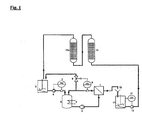
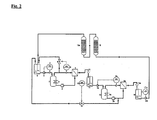
- FIGS. 1, 2 and 3 each schematically illustrate the sequence of particular embodiments of the invention inventive method again.
- Fig. 1 shows schematically an embodiment of the method according to the invention, in which the treating ammonium metalate solution by means of a membrane filtration cell (1) and two Cation exchange columns (13, 13a) is freed of alkali metal impurities.
- the ammonium metalate solution to be purified is by means of the circulation pump (2) through the Membrane filtration cell (1) promoted.
- In the circuit is a trained as a pressure vessel Pump template (3), which is equipped with a heat exchanger (4), which allows, during Dissipate the heat generated by the operation and maintain a constant temperature.
- the circulation is from a stirred reservoir (5) by means of a high-pressure pump (6) supplied to the ammonium metalate solution.
- the regulation takes place via the flow controller FIC (7).
- the ammonium metalate solution enters the pump reservoir (3) designed as a pressure vessel, from which they are pumped by means of the circulation pump (2) in the membrane filtration cell (1) and there in Retentate and permeate is split.
- the retentate flows via a control valve (9) in the reservoir (5), with the desired pressure set via the pressure regulator PIC (8) can be.
- the permeate which has significantly lower concentrations of metalate and ammonium, but has approximately the same concentration of potassium as that on the high-pressure pump (6) the membrane filtration cell (1) supplied solution passes through a free outlet (10) in the stirred container (11), from where it via the pump (12) the cation exchange columns (13) and (13a) is supplied.
- the level in the container (11) is thereby by means of the level controller LIC (17) set.
- the two cation exchange columns (13) and (13a) are with a Cation exchange resin charged, which receives the alkali metal ions from the permeate.
- Fig. 2 shows schematically a further embodiment of the method according to the invention, wherein the ammonium metalate solution to be treated by means of two membrane filtration cells (1, 1a) and two cation exchange columns (13, 13a) of alkali metal impurities.
- the ammonium metalate solution to be treated by means of two membrane filtration cells (1, 1a) and two cation exchange columns (13, 13a) of alkali metal impurities For units that are already used in the process control of FIG. 1 are used retain the reference numbers.
- FIG. 2 For the measurement and control technical interconnection, a variant of the method is shown in FIG. 2, which requires only one flow regulator FIC (7) in the first membrane filtration unit. But they are Of course, other alternatives conceivable, for example, the regulation by means of two Flow regulator.
- the ammonium metalate solution to be purified is introduced into the storage tank (5) and passes the first membrane filtration unit just as in the process variant according to FIG. 1 described.
- a membrane used the retention capacity of which compared to purifying metallate species is not as large as in the simpler, first variant, so that Noteworthy concentrations of metalate and associated with ammonium ions in the first permeate occur, wherein the ammonium ions the desired separation of the alkali ions in a downstream cation exchange column (13, 13a) complicate or even prevent.
- the perfluorinated membrane of the type Nafion NFM 1121 used become.
- the problem is solved in that the first permeate from the container (11) via a second High-pressure pump (6a) of a second designed as a pressure vessel pump template (3a) with a Heat exchanger (4a) and the circulation pump (2a) finally a second membrane filtration cell (1a), the membrane of which is such that it can be sufficiently interposed between the metal atoms and alkali metal ions can discriminate and still due to the first permeate now compared to the initial solution significantly reduced osmotic pressure, sufficient permeate flows allowed.
- a suitable membrane is, for example, the perfluorinated membrane of the type Nafion NFM 1120.
- the high pressure pump (6a) of the second membrane filtration unit is pressure-controlled by the second pressure regulator PIC (8a) operated.
- a constant level in the container (11) is ensured by the fact that the regulator LIC (15) acting on the valve (14), via which the retentate of the second membrane filtration unit through the circulation pump (2a) back into the reservoir (5) is conveyed. This results in a Counterflow cascade.
- the over the second free outlet (10a) running second permeate now has a comparable Quality, d. H. a sufficiently favorable alkali-to-ammonium ratio as after experimentation according to Fig. 1, so that it from the second container (16) with the pump (12a), regulated by means Level controller LIC (17a) according to the process variant shown in Fig. 1, the Cation exchanger columns (13) and (13a) can be supplied, wherein the flow in the Reservoir (5) closes the circuit again.
- FIG. 3 shows further embodiments of the method according to the invention, wherein other refurbishment possibilities for the won Permeate be sketched.
- FIG. 1 or FIG. 2 the reference numerals maintained.
- Fig. 1 and Fig. 2 preferred variants of the method are shown, which it by interconnection of membrane filtration cell (1, 1a) and cation exchange columns (13, 13a), in to work with respect to the metallate shares completely closed circuit.
- This procedure can also be modified depending on the conditions in the company. So, for example the flow from the cation exchanger columns (13) or (13a) is not returned to the reservoir (5) be presented but, for example, for the leaching of technical molybdenum trioxide become.
- the storage container (5) can then fresh wash water, in particular ammonia solution be added.
- the permeates can also before the separation of the alkali metal impurities means Cation exchanger of a separation of the metalate, e.g. by treatment of the permeate with be fed to an anion exchanger.
- the resulting column effluent containing the alkali metal impurities may, optionally after distilling off the ammonia of a Wastewater treatment be subjected.
- the distilling off of the ammonia may optionally also before the treatment of the permeate with an anion exchanger.
- the membrane filtration cell (1) used had a membrane area of 130 m 2 , wherein a Nafion® membrane NFM 1120 was used as the membrane.
- the permeate exiting the membrane filtration cell (1) flowed through the free outlet (10) in the vessel (11) and was passed by pump (12) through the cation exchange columns (13) and (13a) to remove the alkali metal impurities from the permeate to remove.
- the cation exchange columns (13) and (13a) were charged with the cation exchanger Lewatit® S 100 H.
- the purified permeate was fed back to the reservoir (5).
- the storage tank (5) was charged with 10 m 3 of an ammonium molybdate solution having a Mo concentration of 100 g / l, and alkali contents of 1000 mg / l Na and 600 mg / l K. From the previous experiment, there were still solutions with the following concentrations in the remaining parts of the plant:
- the circulation of the first membrane filtration unit had a Mo concentration of 200 g / l, the Na concentration was 30 mg / l, the K content at 17 mg / l.
- the total volume in the circulation of the first membrane filtration unit was 0.5 m 3 .
- the container (11) was 5 m 3 of an ammonium molybdate solution having a Mo content of 30 g / l and about the same alkali contents as the solution in the circulation of the first membrane filtration unit.
- the cycle of the second membrane filtration unit were also 0.5 m 3 of an ammonium molybdate solution.
- This solution had a Mo concentration of 60 g / l, the alkali metals again having the same contents as the solution in the circulation of the first membrane filtration unit.
- the second container (16) was finally filled with 3 m 3 of an ammonium molybdate solution with a Mo content of 2 g / l, the alkali concentrations again being 30 mg / l Na and 17 mg / l K.
- the system was started, wherein the first membrane filtration unit by means of high-pressure pump (6) flow-controlled 10 m 3 / h of the ammonium molybdate solution from the reservoir (5) were supplied.
- the stationary rivers were 4 m 3 / h via control valve (9) in the reservoir (5), 5.8 m 3 / h of permeate from the membrane filtration cell (1), 2.8 m 3 / h Retentat Weglauf via valve (14) in the storage container (5), and 3 m 3 / h permeate from the second membrane filtration cell (la).
- the alkali concentrations in the storage tank (5) were determined to be 33 mg / l for Na and 20 mg / l for K.
Landscapes
- Chemical & Material Sciences (AREA)
- Organic Chemistry (AREA)
- Engineering & Computer Science (AREA)
- Metallurgy (AREA)
- Manufacturing & Machinery (AREA)
- Inorganic Chemistry (AREA)
- Mechanical Engineering (AREA)
- Materials Engineering (AREA)
- Geology (AREA)
- Life Sciences & Earth Sciences (AREA)
- Environmental & Geological Engineering (AREA)
- Geochemistry & Mineralogy (AREA)
- General Life Sciences & Earth Sciences (AREA)
- Separation Using Semi-Permeable Membranes (AREA)
- Organic Low-Molecular-Weight Compounds And Preparation Thereof (AREA)
- Inorganic Compounds Of Heavy Metals (AREA)
- Treatment Of Water By Ion Exchange (AREA)
Applications Claiming Priority (2)
| Application Number | Priority Date | Filing Date | Title |
|---|---|---|---|
| DE10341727A DE10341727A1 (de) | 2003-09-10 | 2003-09-10 | Reinigung von Ammoniummetallat-Lösungen |
| DE10341727 | 2003-09-10 |
Publications (2)
| Publication Number | Publication Date |
|---|---|
| EP1514847A2 true EP1514847A2 (fr) | 2005-03-16 |
| EP1514847A3 EP1514847A3 (fr) | 2010-10-13 |
Family
ID=34129731
Family Applications (1)
| Application Number | Title | Priority Date | Filing Date |
|---|---|---|---|
| EP04020498A Withdrawn EP1514847A3 (fr) | 2003-09-10 | 2004-08-28 | Purification de solutions de métallate d'ammonium |
Country Status (11)
| Country | Link |
|---|---|
| US (1) | US7217366B2 (fr) |
| EP (1) | EP1514847A3 (fr) |
| JP (1) | JP2005082478A (fr) |
| KR (1) | KR20050026885A (fr) |
| CN (1) | CN1597518A (fr) |
| CA (1) | CA2480755A1 (fr) |
| DE (1) | DE10341727A1 (fr) |
| MX (1) | MXPA04008683A (fr) |
| PE (1) | PE20050743A1 (fr) |
| RU (1) | RU2004126990A (fr) |
| TW (1) | TW200519041A (fr) |
Families Citing this family (4)
| Publication number | Priority date | Publication date | Assignee | Title |
|---|---|---|---|---|
| US7326716B2 (en) * | 2003-06-06 | 2008-02-05 | Allergan, Inc. | Treatment of inflammatory bowel disease |
| DE10341727A1 (de) * | 2003-09-10 | 2005-04-28 | Starck H C Gmbh | Reinigung von Ammoniummetallat-Lösungen |
| WO2011063252A2 (fr) * | 2009-11-19 | 2011-05-26 | Uv Technologies, Llc | Système d'applicateur de lumière ultraviolette et procédé associé |
| DE102010006435B3 (de) * | 2010-02-01 | 2011-07-21 | Siemens Aktiengesellschaft, 80333 | Verfahren und Vorrichtung zur Produktion von 99mTc |
Family Cites Families (17)
| Publication number | Priority date | Publication date | Assignee | Title |
|---|---|---|---|---|
| US3393971A (en) | 1966-04-06 | 1968-07-23 | Sylvania Electric Prod | Process for purifying molybdenum trioxide |
| US3848048A (en) | 1973-07-12 | 1974-11-12 | Atomic Energy Commission | Recovery of fission-produced technetium,palladium,rhodium and ruthenium |
| SU479376A1 (ru) * | 1973-12-29 | 1985-10-23 | Московский Ордена Трудового Красного Знамени Институт Стали И Сплавов | Способ очистки молибден- и вольфрамсодержащих растворов электродиализом |
| US4207296A (en) | 1978-09-15 | 1980-06-10 | Amax Inc. | Process for producing purified ammonium molybdate solution |
| US4525331A (en) | 1984-02-24 | 1985-06-25 | Gte Products Corporation | Process for purifying molybdenum trioxide |
| US4601890A (en) | 1984-02-29 | 1986-07-22 | Gte Products Corporation | Process for purifying molybdenum trioxide |
| US4596701A (en) | 1984-02-29 | 1986-06-24 | Gte Products Corporation | Process for purifying molybdenum trioxide |
| US4643884A (en) | 1985-02-08 | 1987-02-17 | Gte Products Corporaton | Purification of molybdenum trioxide |
| US4612172A (en) * | 1985-02-22 | 1986-09-16 | Gte Products Corporation | Purification of molybdenum |
| US4604226A (en) | 1985-03-22 | 1986-08-05 | E. I. Du Pont De Nemours And Company | Aerosol corrosion inhibitors |
| US4933152A (en) * | 1989-02-16 | 1990-06-12 | Gte Products Corporation | Continuous process for purifying molybdenum |
| SU1723042A1 (ru) * | 1990-01-29 | 1992-03-30 | Всесоюзный научно-исследовательский институт химических реактивов и особо чистых химических веществ Научно-производственного объединения "ИРЕА" | Способ получени парамолибдата аммони |
| DE19500057C1 (de) * | 1995-01-03 | 1996-02-29 | Starck H C Gmbh Co Kg | Verfahren zur Herstellung von reinen Wolframat- und/oder Molybdat-Lösungen |
| US5891407A (en) * | 1996-05-30 | 1999-04-06 | H.C. Starck Gmbh & Co. Kg | Process for producing pure ammonium metallates |
| DE19724183C2 (de) * | 1996-07-05 | 1999-03-25 | Starck H C Gmbh Co Kg | Verfahren zur Herstellung reiner Alkali- und/oder Ammonium-Wolframat-Lösungen |
| US6117327A (en) * | 1997-08-22 | 2000-09-12 | Media And Process Technology Inc. | Deashing and demetallization of used oil using a membrane process |
| DE10341727A1 (de) * | 2003-09-10 | 2005-04-28 | Starck H C Gmbh | Reinigung von Ammoniummetallat-Lösungen |
-
2003
- 2003-09-10 DE DE10341727A patent/DE10341727A1/de not_active Withdrawn
-
2004
- 2004-08-28 EP EP04020498A patent/EP1514847A3/fr not_active Withdrawn
- 2004-09-03 JP JP2004257459A patent/JP2005082478A/ja active Pending
- 2004-09-07 MX MXPA04008683A patent/MXPA04008683A/es unknown
- 2004-09-07 CA CA002480755A patent/CA2480755A1/fr not_active Abandoned
- 2004-09-07 US US10/935,563 patent/US7217366B2/en not_active Expired - Fee Related
- 2004-09-09 PE PE2004000872A patent/PE20050743A1/es not_active Application Discontinuation
- 2004-09-09 KR KR1020040072067A patent/KR20050026885A/ko not_active Withdrawn
- 2004-09-09 TW TW093127222A patent/TW200519041A/zh unknown
- 2004-09-09 RU RU2004126990/15A patent/RU2004126990A/ru not_active Application Discontinuation
- 2004-09-10 CN CNA2004100770883A patent/CN1597518A/zh active Pending
Also Published As
| Publication number | Publication date |
|---|---|
| MXPA04008683A (es) | 2005-03-31 |
| EP1514847A3 (fr) | 2010-10-13 |
| DE10341727A1 (de) | 2005-04-28 |
| RU2004126990A (ru) | 2006-02-27 |
| US7217366B2 (en) | 2007-05-15 |
| CA2480755A1 (fr) | 2005-03-10 |
| JP2005082478A (ja) | 2005-03-31 |
| US20050072735A1 (en) | 2005-04-07 |
| CN1597518A (zh) | 2005-03-23 |
| KR20050026885A (ko) | 2005-03-16 |
| TW200519041A (en) | 2005-06-16 |
| PE20050743A1 (es) | 2005-10-28 |
Similar Documents
| Publication | Publication Date | Title |
|---|---|---|
| DE69614516T3 (de) | Nanofiltration von konzentrierten wässrigen salzlösungen | |
| DE69803471T2 (de) | Von chloridionen unterstüzte hydrometallurgische extraktion von kupfer aus sulfiderzrohstoffen | |
| DE69403968T2 (de) | Verfahren und einrichtung zur regenerierung von fluechtigen saeuren | |
| DE1642831A1 (de) | Verfahren und Vorrichtung zum Ausziehen eines Loesungsmittels aus einer Loesung | |
| DE3227240C2 (fr) | ||
| DE19724183A1 (de) | Verfahren zur Herstellung reiner Alkali- und/oder Ammonium-Wolframat-Lösungen | |
| DE68904070T2 (de) | Verfahren zur entfernung von nitrat und organischen verunreinigungen aus abwaessern. | |
| DE3854499T2 (de) | Trennung und gewinnung von nickel und kobalt in ammoniakalen systemen. | |
| DE2924657A1 (de) | Verbesserte methode zur gewinnung von metallischem kupfer | |
| DE10231308C5 (de) | Verfahren und Vorrichtung zum Recyceln von Edelstahl-Beizbädern | |
| DE2855231B2 (de) | Kontinuierliches Verfahren zur Herstellung von Glykolen | |
| EP0117986A2 (fr) | Procédé et dispositif pour concentrer et épiner de l'acide sulfurique contenant des impuretés organiques | |
| DE2353591A1 (de) | Verfahren zur herstellung von hochreinen, freifliessenden pyrolusitkristallen | |
| EP0968322A1 (fr) | Procede et dispositif pour l'exploitation de bains de fraisage | |
| DE60209109T2 (de) | Verfahren zur reinigung einer redox-mediator enthaltenden lösung vor dessen elektrolytischen regenerierung | |
| DE2843479A1 (de) | Verfahren zur elektrolyse von natriumchlorid in einer eine ionenaustauschermembran enthaltenden zelle | |
| EP1514847A2 (fr) | Purification de solutions de métallate d'ammonium | |
| WO2020127571A1 (fr) | Procédé de préparation de métatungstate d'ammonium | |
| DE1954707C3 (de) | Verfahren zur Wiedergewinnung von Metallkatalysatoren | |
| DE2401119A1 (de) | Verfahren und vorrichtung zur trennung von isotopen | |
| DE2830144C2 (de) | Verfahren zur Herstellung von Sebacinsäure aus Adipinsäure | |
| AT379582B (de) | Verfahren zur isolierung und/oder reinigung von hydroxycarbonsaeuren | |
| DE1906689C3 (de) | Verfahren und Vorrichtung zur Herstellung von Titankonzentraten aus eisenhaltigen Titanerzen | |
| AT406168B (de) | Verfahren zur gewinnung bzw. rückgewinnung von flusssäure und salpetersäure | |
| DE102004018143B4 (de) | Verfahren zum Aufbereiten von metallhaltigen, sauren Abwässern |
Legal Events
| Date | Code | Title | Description |
|---|---|---|---|
| PUAI | Public reference made under article 153(3) epc to a published international application that has entered the european phase |
Free format text: ORIGINAL CODE: 0009012 |
|
| AK | Designated contracting states |
Kind code of ref document: A2 Designated state(s): AT BE BG CH CY CZ DE DK EE ES FI FR GB GR HU IE IT LI LU MC NL PL PT RO SE SI SK TR |
|
| AX | Request for extension of the european patent |
Extension state: AL HR LT LV MK |
|
| RAP1 | Party data changed (applicant data changed or rights of an application transferred) |
Owner name: H.C. STARCK GMBH & CO. KG |
|
| RAP1 | Party data changed (applicant data changed or rights of an application transferred) |
Owner name: H.C. STARCK GMBH |
|
| PUAL | Search report despatched |
Free format text: ORIGINAL CODE: 0009013 |
|
| AK | Designated contracting states |
Kind code of ref document: A3 Designated state(s): AT BE BG CH CY CZ DE DK EE ES FI FR GB GR HU IE IT LI LU MC NL PL PT RO SE SI SK TR |
|
| AX | Request for extension of the european patent |
Extension state: AL HR LT LV MK |
|
| AKY | No designation fees paid | ||
| REG | Reference to a national code |
Ref country code: DE Ref legal event code: R108 Effective date: 20110607 |
|
| STAA | Information on the status of an ep patent application or granted ep patent |
Free format text: STATUS: THE APPLICATION IS DEEMED TO BE WITHDRAWN |
|
| 18D | Application deemed to be withdrawn |
Effective date: 20110414 |