EP1511684B1 - Dispositif de telereleve d'etats, et applications - Google Patents
Dispositif de telereleve d'etats, et applications Download PDFInfo
- Publication number
- EP1511684B1 EP1511684B1 EP03738114.2A EP03738114A EP1511684B1 EP 1511684 B1 EP1511684 B1 EP 1511684B1 EP 03738114 A EP03738114 A EP 03738114A EP 1511684 B1 EP1511684 B1 EP 1511684B1
- Authority
- EP
- European Patent Office
- Prior art keywords
- peripheral
- state
- stat
- controller
- kid
- Prior art date
- Legal status (The legal status is an assumption and is not a legal conclusion. Google has not performed a legal analysis and makes no representation as to the accuracy of the status listed.)
- Expired - Lifetime
Links
- 230000002093 peripheral effect Effects 0.000 claims description 53
- 238000004891 communication Methods 0.000 claims description 21
- 230000005540 biological transmission Effects 0.000 claims description 16
- 230000006698 induction Effects 0.000 claims description 13
- 230000015654 memory Effects 0.000 claims description 13
- 238000005192 partition Methods 0.000 claims description 5
- 101100182136 Neurospora crassa (strain ATCC 24698 / 74-OR23-1A / CBS 708.71 / DSM 1257 / FGSC 987) loc-1 gene Proteins 0.000 claims description 3
- 230000002596 correlated effect Effects 0.000 claims description 3
- 230000005674 electromagnetic induction Effects 0.000 claims description 3
- 230000004807 localization Effects 0.000 claims description 2
- 238000010276 construction Methods 0.000 claims 1
- 230000000875 corresponding effect Effects 0.000 description 6
- 238000000034 method Methods 0.000 description 3
- 230000006870 function Effects 0.000 description 2
- 239000000463 material Substances 0.000 description 2
- 101100536354 Drosophila melanogaster tant gene Proteins 0.000 description 1
- 238000005516 engineering process Methods 0.000 description 1
- 239000004744 fabric Substances 0.000 description 1
- 230000010365 information processing Effects 0.000 description 1
- 238000009434 installation Methods 0.000 description 1
Images


Classifications
-
- B—PERFORMING OPERATIONS; TRANSPORTING
- B66—HOISTING; LIFTING; HAULING
- B66B—ELEVATORS; ESCALATORS OR MOVING WALKWAYS
- B66B13/00—Doors, gates, or other apparatus controlling access to, or exit from, cages or lift well landings
- B66B13/02—Door or gate operation
- B66B13/14—Control systems or devices
- B66B13/143—Control systems or devices electrical
Definitions
- the present invention relates generally to the information technology sector.
- a remote metering device comprising a communication network, a central controller connected to the communication network, and a plurality of peripherals connected to the controller via of the network, each device adopting instantaneously an instantaneous state belonging to a plurality of possible states, and the controller periodically scanning the devices to record their instantaneous state.
- the invention aims to provide a technique for providing the same functionality as these known devices, but by the implementation of simple means and widespread today.
- the device of the invention which moreover conforms to the generic definition given in the preamble above, is essentially characterized in that the communication network connects the peripherals to the controller by electromagnetic means, and in that the peripherals are supplied with electrical energy via the communication network.
- the communication network may simply comprise a serial circuit powered by the controller and including a plurality of electromagnetic induction loops.
- the device of the invention can be adapted to localized read-only reports by providing that each device has an identification code of its own, that the controller has a configuration memory in which are stored correlatively, for each device, the identification code of this device and a location parameter identifying the location of this device in the network, and that the controller notes, for each device, the instantaneous state of this device and its identification code from which it follows that each instantaneous state recorded is correlated, by the controller, to a location of the network.
- each device may comprise, in addition to a transmission and reception circuit, at least one state encoder adopting an instantaneous state constituting or participating in constructing the instantaneous state of this peripheral, this encoder of state being connected to the transmit and receive circuitry to enable this device to transmit to the controller the instantaneous state of the encoder.
- each device comprises an electronic tag having a memory containing the identification code assigned to this device, a local antenna coupled to an induction loop of the communication network for receiving the electrical energy transmitted by this induction loop, and the transmitting and receiving circuit, this transmitting and receiving circuit being connected to the local antenna to at least receive from the controller a transmission order and for transmit to the controller, in addition to the instantaneous state of the encoder, the identification code of this label.
- Electronic tags also called “radio tags”, “smart tags”, or “smart cards”, equivalent to “smart tags”, are now widely used in many automatic identification applications, and particularly in anti-theft systems, protection against counterfeiting, management of handling materials, control of shipments or receptions, etc.
- the invention proposes in fact to extend to localization in space the widespread and proven technique of radio frequency identification known under the English acronym RFID (for "Radio Frequency Identification”), bypassing the complexities inherent in addressing techniques.
- RFID Radio Frequency Identification
- each device comprises, as a state encoder, at least one set member such as an electrical contact.
- each device can also include, as a state encoder, at least one sensor sensitive to the influence of a physical parameter to which this device is subjected.
- the utility of the device of the invention can be further strengthened by providing each device with a display member.
- This device is generally applicable to the management of remote commands, each device forming a control terminal adapted to transmit to the controller a determined order, encoded by the instantaneous state that adopts this device.
- this device When it is adapted to the localized remote reading of states, this device is applicable to the management of remote calls, each device forming a terminal of call.
- each device can be installed in a specific location, such as a floor of a building, and form a terminal for a means of transport, such as an elevator.
- each of these devices can identify a destination assigned to the transport means from a position of departure represented by the specific location.
- the user of an elevator can not only call the elevator to the floor where the user is, but he can also, by his call, indicate which floor he wants to go to.
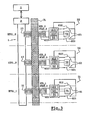
- the invention relates to figure 3 ) a remote reading device of the type of those which comprise a communication network 1, a central controller 2 connected to the network of communication 1, and a plurality of peripherals, such as 31 to 33, connected to the controller 2 via the network 1.
- each of the peripherals 31 to 33 takes, from among a set of states that are a priori possible, an instantaneous state STAT_1, STAT_2, and STAT_3, respectively, for the various devices 31 to 33, the controller 2 periodically scanning these peripherals 31 to 33. 33 to find the respective instantaneous states.
- the device of the invention differs first of all from known devices of this type in that the communication network 1 connects the peripherals, such as 31 to 33, to the controller 2 by electromagnetic means, and that the peripherals are powered. in electrical energy through this communication network 1.
- the mere presence of the communication network eliminates both the need to provide a separate power supply network, and the need to ensure the point-to-point electrical connection of each device.
- the communication network 1 comprises a series circuit which is itself powered by the controller 2 and which includes a plurality of electromagnetic induction loops such as 11, 12, and 13 ( figures 2 and 3 ), the electrical power signal flowing in this series circuit having a frequency typically less than 500 kHz, and being for example modulated at 125 kHz.
- Each device 31, 32, or 33 is furthermore equipped with a state encoder 61, 62, or 63 and a transmission and reception circuit 421, 422, or 423, the state encoder 61 , 62, or 63 being able to produce the instantaneous state STAT_1, STAT_2, or STAT_3 of this peripheral, and being connected to the transmission and reception circuit 421, 422, or 423 of this peripheral so as to enable it to transmit this state STAT_1, STAT_2, or STAT_3 to controller 2.
- each of the peripherals 31 to 33 can form a control terminal in the network 1, able to transmit to the controller 2 an order coded by the instantaneous state that adopts this device.
- each of the peripherals such as 31 to 33 also has an identification code of its own, and which is respectively noted KID_1 , KID_2, and KID_3 for the different devices 31 to 33.
- each device 31 to 33 preferably comprises an electronic tag such as 4 ( figure 1 ).
- An electronic tag is typically provided with a memory such as 411, a local antenna such as 401, and a transmission and reception circuit, such as 421, the latter being in this case likely to constitute the above-mentioned transmitting and receiving circuit of the device equipped with this tag.
- the labels of the different peripherals 31, 32 and 33 thus comprise, respectively, figure 3 ) memories 411, 412, and 413, local antennas 401, 402, and 403, and transmit and receive circuits 421, 422, and 423.
- Each memory 411, 412, or 413 contains the identification code KID_1, KID_2, or KID_3 assigned to the corresponding device, 31, 32, or 33.
- Each local antenna 401, 402, or 403 is coupled to one of the induction loops 11, 12, or 13 of the communication network 1 to receive the electrical energy transmitted by this induction loop.
- each transmission and reception circuit 421, 422, or 423 is connected to the corresponding local antenna 401, 402, or 403 to be able to receive from the corresponding induction loop the electrical energy required for power supply. of the device concerned, receive from the controller 2 a transmission order, and transmit to this controller 2 the instantaneous state STAT_1, STAT_2, or STAT_3 of the corresponding device, 31, 32, or 33, and the identification code KID_1, KID_2 , or KID_3 of the relevant label, in the advanced embodiment of the invention.
- each state encoder comprises two set members formed by manually operated electrical contacts by a user, namely the contacts 611 and 612 for the state encoder 61, 621 and 622 for the state encoder 62, and 631, 632 for state encoder 63.
- each state encoder could comprise, in addition to or instead of such deposit devices, a or more sensors that are sensitive to the influence of one or more physical parameters to which that device is subjected.
- Each device 31, 32, or 33 is provided with a processing unit 51, 52, or 53, external or internal to the electronic tag equipping this device, connected to the transmission and reception circuit 421, 422, or 423 of this device, and responsible for collecting, encoding and / or formatting the instantaneous state STAT_1, STAT_2, or STAT_3 for the consideration of this state by the transmitting and receiving circuit.
- a processing unit 51, 52, or 53 external or internal to the electronic tag equipping this device, connected to the transmission and reception circuit 421, 422, or 423 of this device, and responsible for collecting, encoding and / or formatting the instantaneous state STAT_1, STAT_2, or STAT_3 for the consideration of this state by the transmitting and receiving circuit.
- the controller 2 is provided with a configuration memory 21 in which are stored, for each peripheral 31, 32, or 33, the identification code KID_1, KID_2, or KID_3 of this device, and a location parameter, such as LOC_1, LOC_2, or LOC_3, which identifies the location of this device in the network 1, the location parameter of each device being correlated, that is to say, associated with the identification code of the same device.
- a configuration memory 21 in which are stored, for each peripheral 31, 32, or 33, the identification code KID_1, KID_2, or KID_3 of this device, and a location parameter, such as LOC_1, LOC_2, or LOC_3, which identifies the location of this device in the network 1, the location parameter of each device being correlated, that is to say, associated with the identification code of the same device.
- the association, in the configuration memory 21 of the controller 2, of the location parameter of each device with the identification code of the same device can be achieved, by the implementation of means known per se, during a phase of installation of the device of the invention.
- the controller 2 can therefore, by noting both the instant state STAT_1, STAT_2, or STAT_3 and the identification code KID_1, KID_2, or KID_3 of each peripheral 31, 32, or 33 that it scans, associating each of the instantaneous states recorded at a determined location of the network 1.
- each of the peripherals 31 to 33 can form a call terminal in the network 1, the controller 2 assuring the management of calls launched remotely via these devices or terminals 31 to 33.
- the Figures 3 to 5 illustrate an application of the device of the invention to the management of an elevator.
- the communication network 1 to which the controller 2 is connected comprises induction loops such as 11, 12 and 13 regularly arranged on one side of the vertical partition CL which closes the front face of the column.
- elevator for example on the right side of each elevator door, PT_1, PT_2, and PT_3.
- the peripherals 31, 32, and 33 are arranged on the other side of the partition CL, at the corresponding different stages, ETG_1, ETG_2, and ETG_3.
- these devices can for example be simply glued to the CL bulkhead near the corresponding PT_1, PT_2, or PT_3 door.
- the location parameters, such as LOC_1, LOC_2, and LOC_3 stored in the configuration memory 21 of the controller 2 are representative of the different stages, the identification code KID_1 of the device 31 being thus associated with the location parameter ETG_1 , representative of the first stage where this device is installed, the identification code KID_2 of the device 32 being associated with the location parameter ETG_2, representative of the second stage where this device is installed, etc.
- the controller 2 comprises a transmission and reception circuit 22 responsible for ensuring the transmission of electrical energy and the transmission of information on the network 1, a processing unit 23 ensuring set of information processing in this controller and having read and write access to the configuration memory 21, and an interface 24 driven by the processing unit 23 and ensuring the connection between the processing unit 23 and a control circuit 8 of the elevator.
- Each of the peripherals 31, 32, and 33 has an electrical contact 611, 621, and 631, which the user can control by a button to indicate his desire to descend to a lower stage, and an electrical contact 612, 622, and 632, that the user can command by a button to indicate his desire to go upstairs.
- the controller 2 will receive from this device the identification code KID_2, and the state STAT_2 of the state encoder 62, this state STAT_2 being representative of the actuation of the button of the contact 622.
- the controller 2 By reading its memory 21, the controller 2 will be informed that a user, located on the floor ETG_2, that is to say on the second floor, called the elevator, expressing more precisely his wish to access to an upper floor.
- This call can therefore be transmitted, via the interface 24 of the controller, to the control circuit 8 of the elevator, which will be responsible for bringing to the second floor the most accessible elevator car to get to an upper floor.
- each of the peripherals could have only one button, whose actuation would then be taken into account as a lift call for a destination a priori any, the user indicating its destination only one once installed in the elevator car, by pressing the button of the desired floor.
- each of the peripherals 31, 32, or 33 instead of having only one call button for access to an upper floor, and a call button for access to a lower floor, could having, as a state encoder 61, 62, or 63, a keyboard on which the user could specifically indicate his destination stage, which is to say that the state STAT_1, STAT_2 or STAT_3 of each
- the state encoder may be represented by any number of bits.
- each device such as 31, 32, or 33 may further comprise a display member such as 71, 72 or 73, this member being connected to the processing unit 51, 52, or 53, which retransmits the instructions display received from the controller 2 by the transmitting and receiving circuit 421, 422, or 423.
- a display member such as 71, 72 or 73, this member being connected to the processing unit 51, 52, or 53, which retransmits the instructions display received from the controller 2 by the transmitting and receiving circuit 421, 422, or 423.
- This display member 71, 72 or 73 makes it possible to make available, at the location of each of the peripherals, relevant information for all of these peripherals, such as the instantaneous direction of movement of the elevator car, or the number of the floor reached by this cabin.
- the partition CL of the illustrated embodiment serves the function of a support for the peripherals 31 to 33 and that of a dielectric separating the loops. induction 11 to 13 antennas 401 to 403.
- the wallpaper lining the walls of a room could both contain or cover a network of induction loops running through these walls, and serve as a support for a plurality of peripherals, taking for example the form of simple glued labels on its surface and making it possible to remotely control, selectively, lighting or respective electrical equipment distributed throughout the room.
- the fabric of a garment such as a jacket, could be traversed by a network of induction loops and serve as a support for a control member for electrical equipment, such as a magnetic tape drive or CD-ROM housed in the collar of this garment, this control member being for example applied to the garment by means of a simple velcro.
Landscapes
- Engineering & Computer Science (AREA)
- Automation & Control Theory (AREA)
- Selective Calling Equipment (AREA)
- Elevator Control (AREA)
- Indicating And Signalling Devices For Elevators (AREA)
- Near-Field Transmission Systems (AREA)
- Mobile Radio Communication Systems (AREA)
Description
- La présente invention concerne, de façon générale, le secteur des technologies d'information.
- Plus précisément, l'invention concerne, selon un premier de ses aspects, un dispositif de télérelevé d'états, comprenant un réseau de communication, un contrôleur central relié au réseau de communication, et une pluralité de périphériques reliés au contrôleur par l'intermédiaire du réseau, chaque périphérique adoptant à chaque instant un état instantané appartenant à une pluralité d'états possibles, et le contrôleur scrutant périodiquement les périphériques pour relever leur état instantané.
- Bien que de nombreux dispositifs connus répondent à cette définition, ces dispositifs mettent généralement en oeuvre des moyens sophistiqués, conduisant à une complexité structurelle relativement élevée.
- Dans ce contexte, l'invention a pour but de proposer une technique permettant d'offrir les mêmes fonctionnalités que ces dispositifs connus, mais par la mise en oeuvre de moyens simples et aujourd'hui répandus.
- A cette fin, le dispositif de l'invention, par ailleurs conforme à la définition générique qu'en donne le préambule ci-dessus, est essentiellement caractérisé en ce que le réseau de communication relie les périphériques au contrôleur par voie électromagnétique, et en ce que les périphériques sont alimentés en énergie électrique par l'intermédiaire du réseau de communication.
- Grâce à cet agencement, tous les problèmes de connectique se trouvent considérablement réduits.
- Par exemple, le réseau de communication peut simplement comprendre un circuit série alimenté par le contrôleur et incluant une pluralité de boucles d'induction électromagnétique.
- Le dispositif de l'invention peut être adapté au télérelevé localisé d'états en prévoyant que chaque périphérique dispose d'un code d'identification qui lui est propre, que le contrôleur dispose d'une mémoire de configuration dans laquelle sont stockés corrélativement, pour chaque périphérique, le code d'identification de ce périphérique et un paramètre de localisation identifiant l'emplacement de ce périphérique dans le réseau, et que le contrôleur relève, pour chaque périphérique, l'état instantané de ce périphérique et son code d'identification, ce dont il résulte que chaque état instantané relevé est corrélé, par le contrôleur, à un emplacement du réseau.
- Quelle que soit l'application envisagée, chaque périphérique peut comprendre, outre un circuit d'émission et de réception, au moins un encodeur d'état adoptant un état instantané constituant ou participant à construire l'état instantané de ce périphérique, cet encodeur d'état étant relié au circuit d'émission et de réception pour permettre à ce périphérique de transmettre au contrôleur l'état instantané de l'encodeur.
- Dans un mode de réalisation possible de l'invention, chaque périphérique comprend une étiquette électronique dotée d'une mémoire contenant le code d'identification attribué à ce périphérique, d'une antenne locale couplée à une boucle d'induction du réseau de communication pour recevoir l'énergie électrique transmise par cette boucle d'induction, et du circuit d'émission et de réception, ce circuit d'émission et de réception étant relié à l'antenne locale pour au moins recevoir du contrôleur un ordre de transmission et pour transmettre au contrôleur, outre l'état instantané de l'encodeur, le code d'identification de cette étiquette.
- Les étiquettes électroniques, encore appelées "étiquettes radio", "étiquettes intelligentes", ou encore "smart cards", appellation anglo-saxonne équivalente à "étiquettes intelligentes", sont aujourd'hui largement utilisées dans de nombreuses applications d'identification automatique, et notamment dans les systèmes antivol, la protection contre la contrefaçon, la gestion des supports de manutention, le contrôle des expéditions ou des réceptions, etc.
- En proposant l'utilisation de telles étiquettes pour obtenir un télérelevé d'états distribués en différents emplacements, l'invention propose en fait d'étendre à la localisation dans l'espace la technique répandue et éprouvée de l'identification par radio fréquence connue sous l'acronyme anglo-saxon RFID (pour "Radio Frequency Identification"), contournant ainsi les complexités inhérentes aux techniques d'adressage.
- Par exemple, chaque périphérique comprend, en tant qu'encodeur d'état, au moins un organe de consigne tel qu'un contact électrique.
- Cependant, chaque périphérique peut aussi comprendre, en tant qu'encodeur d'état, au moins un capteur sensible à l'influence d'un paramètre physique auquel est soumis ce périphérique.
- L'utilité du dispositif de l'invention peut encore être renforcé en dotant chaque périphérique d'un organe d'affichage.
- Ce dispositif est applicable, de façon générale, à la gestion de commandes à distance, chaque périphérique formant une borne de commande propre à transmettre au contrôleur un ordre déterminé, codé par l'état instantané qu'adopte ce périphérique.
- Lorsqu'il est adapté au télérelevé localisé d'états, ce dispositif est applicable à la gestion d'appels à distance, chaque périphérique formant une borne d'appel.
- En particulier, chaque périphérique peut être installé à un emplacement spécifique, tel qu'un étage d'un immeuble, et former une borne d'appel pour un moyen de transport, tel qu'un ascenseur.
- Enfin, dans le cas où l'encodeur d'état de chaque périphérique comporte une pluralité d'organes de consigne, tels que des contacts électriques, chacun de ces organes peut identifier une destination assignée au moyen de transport à partir d'une position de départ représentée par l'emplacement spécifique.
- Par exemple, l'utilisateur d'un ascenseur peut non seulement appeler ce dernier à l'étage où se trouve cet utilisateur, mais il peut en outre, par son appel, indiquer à quel étage il souhaite se rendre.
- Un example de l'art antérieur est le
US 4 872 532 . - D'autres caractéristiques et avantages de l'invention ressortiront clairement de la description qui en est faite ci-après, à titre indicatif et nullement limitatif, en référence aux dessins annexés, dans lesquels :
- la
figure 1 est une vue schématique d'un périphérique mis en oeuvre dans un dispositif conforme à l'invention, et utilisant une étiquette électronique en tant que composant principal; - la
figure 2 est une vue schématique d'un contrôleur central propre à coopérer avec le périphérique de lafigure 1 dans un dispositif conforme à l'invention; - la
figure 3 est une vue schématique globale d'un dispositif conforme à l'invention; - la
figure 4 est une vue schématique en perspective transparente d'un immeuble doté d'un ascenseur géré par un dispositif conforme à l'invention; et - la
figure 5 est une vue en coupe du même immeuble, observé suivant l'incidence définie par les flèches V-V de lafigure 4 . - Comme annoncé précédemment, l'invention concerne (
figure 3 ) un dispositif de télérelevé d'états du type de ceux qui comprennent un réseau de communication 1, un contrôleur central 2 relié au réseau de communication 1, et une pluralité de périphériques, tels que 31 à 33, reliés au contrôleur 2 par l'intermédiaire du réseau 1. - A chaque instant, chacun des périphériques 31 à 33 prend, parmi un ensemble d'états a priori possibles, un état instantané respectivement noté STAT_1, STAT_2, et STAT_3 pour les différents périphériques 31 à 33, le contrôleur 2 scrutant périodiquement ces périphériques 31 à 33 pour en relever les états instantanés respectifs.
- Le dispositif de l'invention se distingue tout d'abord des dispositifs connus de ce type par le fait que le réseau de communication 1 relie les périphériques, tels que 31 à 33, au contrôleur 2 par voie électromagnétique, et que les périphériques sont alimentés en énergie électrique par l'intermédiaire de ce réseau de communication 1.
- Grâce à cet agencement, la seule présence du réseau de communication permet d'éliminer à la fois la nécessité de prévoir un réseau d'alimentation électrique séparé, et la nécessité d'assurer le raccordement électrique point à point de chacun des périphériques.
- Par exemple, le réseau de communication 1 comprend un circuit série qui est alimenté lui-même par le contrôleur 2 et qui inclut une pluralité de boucles d'induction électromagnétique telles que 11, 12, et 13 (
figures 2 et3 ), le signal électrique de puissance circulant dans ce circuit série ayant une fréquence typiquement inférieure à 500 kHz, et étant par exemple modulé à 125 kHz. - Chaque périphérique 31, 32, ou 33 est par ailleurs doté d'un encodeur d'état 61, 62, ou 63 et d'un circuit d'émission et de réception 421, 422, ou 423, l'encodeur d'état 61, 62, ou 63 étant propre à produire l'état instantané STAT_1, STAT_2, ou STAT_3 de ce périphérique, et étant relié au circuit d'émission et de réception 421, 422, ou 423 de ce périphérique pour lui permettre de transmettre cet état instantané STAT_1, STAT_2, ou STAT_3 au contrôleur 2.
- Dans ces conditions, chacun des périphériques 31 à 33 peut former une borne de commande dans le réseau 1, propre à transmettre au contrôleur 2 un ordre codé par l'état instantané qu'adopte ce périphérique.
- Dans un mode de réalisation avancé du dispositif de l'invention, permettant un télérelevé localisé d'états, chacun des périphériques tels que 31 à 33 dispose en outre d'un code d'identification qui lui est propre, et qui est respectivement noté KID_1, KID_2, et KID_3 pour les différents périphériques 31 à 33.
- Pour ce faire, chaque périphérique 31 à 33 comprend de préférence une étiquette électronique telle que 4 (
figure 1 ). - Une étiquette électronique est typiquement dotée d'une mémoire telle que 411, d'une antenne locale telle que 401, et d'un circuit d'émission et de réception, tel que 421, ce dernier étant en l'occurrence susceptible de constituer le circuit d'émission et de réception précité du périphérique équipé de cette étiquette.
- Les étiquettes des différents périphériques 31, 32 et 33 comportent donc, respectivement, (
figure 3 ) des mémoires 411, 412, et 413, des antennes locales 401, 402, et 403, et des circuits d'émission et de réception 421, 422, et 423. - Chaque mémoire 411, 412, ou 413 contient le code d'identification KID_1, KID_2, ou KID_3 attribué au périphérique correspondant, 31, 32, ou 33.
- Chaque antenne locale 401, 402, ou 403 est couplée à l'une des boucles d'induction 11, 12, ou 13 du réseau de communication 1 pour recevoir l'énergie électrique transmise par cette boucle d'induction.
- Par ailleurs, chaque circuit d'émission et de réception 421, 422, ou 423 est relié à l'antenne locale correspondante 401, 402, ou 403 pour pouvoir recevoir de la boucle d'induction correspondante l'énergie électrique nécessaire à l'alimentation du périphérique concerné, recevoir du contrôleur 2 un ordre de transmission, et transmettre à ce contrôleur 2 l'état instantané STAT_1, STAT_2, ou STAT_3 du périphérique correspondant, 31, 32, ou 33, ainsi que le code d'identification KID_1, KID_2, ou KID_3 de l'étiquette concernée, dans le mode de réalisation avancé de l'invention.
- Les
figures 1 et3 illustrent un mode de réalisation dans lequel chaque encodeur d'état comprend deux organes de consigne formés par des contacts électriques actionnés manuellement par un utilisateur, à savoir les contacts 611 et 612 pour l'encodeur d'état 61, 621 et 622 pour l'encodeur d'état 62, et 631, 632 pour l'encodeur d'état 63.
Néanmoins, chaque encodeur d'état pourrait comprendre, en plus ou à la place de tels organes de consigne, un ou plusieurs capteurs sensibles à l'influence d'un ou plusieurs paramètres physiques auxquels ce périphérique est soumis. - Chaque périphérique 31, 32, ou 33, est doté d'une unité de traitement 51, 52, ou 53, externe ou interne à l'étiquette électronique équipant ce périphérique, reliée au circuit d'émission et de réception 421, 422, ou 423 de ce périphérique, et chargée de collecter, coder et / ou mettre en forme l'état instantané STAT_1, STAT_2, ou STAT_3 pour la prise en compte de cet état par le circuit d'émission et de réception.
- Selon un autre aspect de l'invention, essentiel dans le cas d'un télérelevé localisé d'états, le contrôleur 2 est doté d'une mémoire de configuration 21 dans laquelle sont stockés, pour chaque périphérique 31, 32, ou 33, le code d'identification KID_1, KID_2, ou KID_3 de ce périphérique, et un paramètres de localisation, tel que LOC_1, LOC_2, ou LOC_3, qui identifie l'emplacement de ce périphérique dans le réseau 1, le paramètre de localisation de chaque périphérique étant corrélé, c'est-à-dire associé, au code d'identification de ce même périphérique.
- Comme le comprendra aisément l'homme de l'art à la lecture de la présente description, l'association, dans la mémoire de configuration 21 du contrôleur 2, du paramètre de localisation de chaque périphérique avec le code d'identification de ce même périphérique peut être réalisée, par la mise en oeuvre de moyens connus en soi, au cours d'une phase d'installation du dispositif de l'invention.
- Grâce à cet agencement, le contrôleur 2 peut donc, en relevant à la fois l'état instantané STAT_1, STAT_2, ou STAT_3 et le code d'identification KID_1, KID_2, ou KID_3 de chaque périphérique 31, 32, ou 33 qu'il scrute, associer chacun des états instantanés relevés à un emplacement déterminé du réseau 1.
- Dans ces conditions, chacun des périphériques 31 à 33 peut former une borne d'appel dans le réseau 1, le contrôleur 2 assurant quant à lui la gestion des appels lancés à distance par l'intermédiaire de ces périphériques ou bornes d'appel 31 à 33.
- Les
figures 3 à 5 illustrent une application du dispositif de l'invention à la gestion d'un ascenseur. - Dans cette application, le réseau de communication 1 auquel est relié le contrôleur 2 comprend des boucles d'induction telles que 11, 12 et 13, régulièrement disposées d'un côté de la cloison verticale CL qui ferme la face avant de la colonne d'ascenseur, par exemple du côté droit de chaque porte d'ascenseur, PT_1, PT_2, et PT_3.
- Les périphériques 31, 32, et 33 sont disposés de l'autre côté de la cloison CL, aux différents étages correspondants, ETG_1, ETG_2, et ETG_3.
- Comme les différents périphériques 31, 32, et 33 communiquent avec le contrôleur 2 sur le réseau 1 grâce à l'influence électromagnétique que les boucles 11, 12, et 13 peuvent exercer au travers de la cloison CL, ces périphériques peuvent par exemple être simplement collés sur la cloison CL, à proximité de la porte PT_1, PT_2, ou PT_3 correspondante.
- Dans ce cas, les paramètres de localisation, tels que LOC_1, LOC_2, et LOC_3 stockés dans la mémoire de configuration 21 du contrôleur 2 sont représentatifs des différents étages, le code d'identification KID_1 du périphérique 31 étant ainsi associé au paramètre de localisation ETG_1, représentatif du premier étage où ce périphérique est installé, le code d'identification KID_2 du périphérique 32 étant associé au paramètre de localisation ETG_2, représentatif du deuxième étage où ce périphérique est installé, etc.
- En dehors de la mémoire de configuration 21, le contrôleur 2 comprend un circuit d'émission et de réception 22 chargé d'assurer la transmission d'énergie électrique et la transmission d'informations sur le réseau 1, une unité de traitement 23 assurant l'ensemble des traitements d'information dans ce contrôleur et ayant un accès en lecture et en écriture à la mémoire de configuration 21, et une interface 24 pilotée par l'unité de traitement 23 et assurant la liaison entre l'unité de traitement 23 et un circuit de commande 8 de l'ascenseur.
- Chacun des périphériques 31, 32, et 33 dispose d'un contact électrique 611, 621, et 631, que l'utilisateur peut commander par un bouton pour indiquer son souhait de descendre à un étage inférieur, et d'un contact électrique 612, 622, et 632, que l'utilisateur peut commander par un bouton pour indiquer son souhait de monter à un étage supérieur.
- Si par exemple un utilisateur appuie sur le bouton du contact 622 du périphérique 32 situé au deuxième étage référencé ETG_2, le contrôleur 2 recevra de ce périphérique le code d'identification KID_2, et l'état STAT_2 de l'encodeur d'état 62, cet état STAT_2 étant représentatif de l'actionnement du bouton du contact 622.
- Par lecture de sa mémoire 21, le contrôleur 2 sera donc informé qu'un utilisateur, situé à l'étage ETG_2, c'est-à-dire au deuxième étage, a appelé l'ascenseur, en manifestant plus précisément son souhait d'accéder à un étage supérieur.
- Cet appel pourra donc être transmis, par l'intermédiaire de l'interface 24 du contrôleur, au circuit de commande 8 de l'ascenseur, qui se chargera d'amener au deuxième étage la cabine d'ascenseur la plus disponible pour se rendre à un étage supérieur.
- Bien entendu, chacun des périphériques pourrait ne disposer que d'un seul bouton, dont l'actionnement serait alors pris en compte comme un appel de l'ascenseur pour une destination a priori quelconque, l'utilisateur n'indiquant sa destination qu'une fois installé dans la cabine d'ascenseur, par l'actionnement du bouton de l'étage désiré.
- Inversement, chacun des périphériques 31, 32, ou 33, au lieu de ne disposer que d'un bouton d'appel pour un accès à un étage supérieur, et d'un bouton d'appel pour un accès à un étage inférieur, pourrait disposer, en tant qu'encodeur d'état 61, 62, ou 63, d'un clavier sur lequel l'utilisateur pourrait spécifiquement indiquer son étage de destination, ce qui revient à dire que l'état STAT_1, STAT_2 ou STAT_3 de chaque encodeur d'état peut être représenté par un nombre de bits a priori quelconque.
- Comme le montrent les
figures 1 et3 , chaque périphérique tel que 31, 32, ou 33 peut en outre comprendre un organe d'affichage tel que 71, 72 ou 73, cet organe étant relié à l'unité de traitement 51, 52, ou 53, qui lui retransmet les instructions d'affichage reçues du contrôleur 2 par le circuit d'émission et de réception 421, 422, ou 423. - Cet organe d'affichage 71, 72 ou 73 permet ainsi de rendre disponibles, à l'emplacement de chacun des périphériques, des informations pertinentes pour l'ensemble de ces périphériques, telles que la direction instantanée de mouvement de la cabine d'ascenseur, ou le numéro de l'étage atteint par cette cabine.
- Comme l'homme de métier l'aura compris à la lecture de la présente description, la cloison CL du mode de réalisation illustré remplit la fonction d'un support pour les périphériques 31 à 33 et celle d'un diélectrique séparant les boucles d'induction 11 à 13 des antennes 401 à 403.
- Ces mêmes fonctions pourraient donc être remplies, dans d'autres applications de l'invention, par des matériaux tout à fait différents de ceux qui peuvent constituer une cloison d'immeuble.
- Par exemple, le papier peint tapissant les murs d'une pièce pourrait à la fois contenir ou recouvrir un réseau de boucles d'induction parcourant ces murs, et servir de support à une pluralité de périphériques, prenant par exemple la forme de simples étiquettes collées sur sa surface et permettant de commander à distance, de manière sélective, des éclairages ou équipements électriques respectifs distribués dans toute la pièce.
- De même, le tissu d'un vêtement, tel qu'un blouson, pourrait être parcouru par un réseau de boucles d'induction et servir de support à un organe de commande pour un équipement électrique, tel qu'un lecteur de bande magnétique ou de CD-ROM logé dans le col de ce vêtement, cet organe de commande étant par exemple appliqué sur le vêtement au moyen d'un simple velcro.
Claims (12)
- Système de télérelevé d'états, comprenant un réseau de communication (1), un contrôleur central (2) relié au réseau de communication (1), et une pluralité de périphériques (31 à 33) reliés au contrôleur (2) par l'intermédiaire du réseau (1), chaque périphérique (31 à 33) adoptant à chaque instant un état instantané (STAT_1 à STAT_3) appartenant à une pluralité d'états possibles, et le contrôleur (2) scrutant périodiquement les périphériques (31 à 33) pour relever leur état instantané (STAT_1 à STAT_3), le réseau de communication (1) reliant les périphériques (31 à 33) au contrôleur (2) par voie électromagnétique, et les périphériques (31 à 33) étant alimentés en énergie électrique par l'intermédiaire de ce réseau de communication (1), caractérisé en ce que chaque périphérique (31 à 33) comprend une antenne locale (401, 402, 403) couplée à une boucle d'induction (11, 12, 13) du réseau de communication (1), que le périphérique (31 à 33) est alimenté en énergie électrique par l'intermédiaire de cette boucle (11, 12, 13), et que la boucle d'induction (11 à 13) et que l'antenne (401, 402, 403) sont séparées par un support et que les périphériques sont alimentés en énergie électrique au travers du support, ce support étant formé par une cloison (CL).
- Système de télérelevé d'états suivant la revendication 1, caractérisé en ce que le réseau de communication (1) comprend un circuit série alimenté par le contrôleur (2) et incluant une pluralité de boucles d'induction électromagnétique (11, 12, 13).
- Système de télérelevé d'états suivant les revendications 1 ou 2, caractérisé en ce que chaque périphérique (31 à 33) dispose d'un code d'identification (KID_1 à KID_3) qui lui est propre, en ce que le contrôleur (2) dispose d'une mémoire de configuration (21) dans laquelle sont stockés corrélativement, pour un périphérique (31 à 33), le code d' identification (KID_1 à KID_3) de ce périphérique et un paramètre de localisation (LOC_1 à LOC_3) identifiant l'emplacement de ce périphérique (31 à 33) dans le réseau (1), et en ce que le contrôleur (2) relève, pour chaque périphérique (31 à 33), l'état instantané ( STAT_1 à STAT_3) de ce périphérique (31 à 33) et son code d'identification (KID_1 à KID_3), ce dont il résulte que chaque état instantané (STAT_1 à STAT_ 3) relevé est corrélé, par le contrôleur (2), à un l'emplacement du réseau (1).
- Système de télérelevé d'états suivant les revendications 1 à 3, caractérisé en ce que chaque périphérique (31 à 33) comprend, outre un circuit d'émission et de réception (421, 422, 423), au moins un encodeur d'état (61, 62, 63) adoptant un état instantané (STAT_1 à STAT_3) constituant ou participant à construire l'état instantané de ce périphérique, cet encodeur d'état (61, 62, 63) étant relié au circuit d'émission et de réception (421, 422, 423) pour permettre à ce périphérique (31 à 33) de transmettre au contrôleur (2) l'état instantané (STAT_1 à STAT 3) de l'encodeur (61, 62, 63).
- Système de télérelevé d'états suivant les revendications 2 à 4, caractérisé en ce que chaque périphérique (31 à 33) comprend une étiquette électronique (4) équipée d'une mémoire (411, 412, 413) contenant le code d'identification (KID_1 à KID_3) attribué à ce périphérique (31 à 33), d'une antenne locale (401, 402, 403) couplée à une boucle d'induction (11, 12, 13) du réseau de communication (1) pour recevoir l'énergie électrique transmise par cette boucle d'induction, et du circuit d'émission et de réception (421, 422, 423), ce circuit d'émission et de réception étant relié à l'antenne locale (401, 402, 403) pour au moins recevoir du contrôleur (2) un ordre de transmission et pour transmettre au contrôleur (2), outre l'état instantané (STAT_1 à STAT_3) de l'encodeur (61, 62, 63), le code d'identification (KID_1 à KID_3) de cette étiquette.
- Système de télérelevé d'états suivant la revendication 4 ou 5, caractérisé en ce que chaque périphérique (31 à 33) comprend, en tant qu'encodeur d'état (61, 62, 63), au moins un organe de consigne (611, 621, 631) tel qu'un contact électrique.
- Système de télérelevé d'états suivant l'une quelconque des revendications 4 à 6, caractérisé en ce que chaque périphérique (31 à 33) comprend, en tant qu'encodeur d'état, au moins un capteur sensible à l'influence d'un paramètre physique auquel est soumis ce périphérique.
- Système de télérelevé d'états suivant l'une quelconque des revendications 4 à 7, caractérisé en ce que chaque périphérique (31 à 33) comprend en outre un organe d'affichage (71, 72, 73).
- Système de télérelevé d'états suivant l'une quelconque des revendications précédentes, caractérisé en ce que chaque périphérique (31 à 33) forme une borne de commande pour la gestion de commandes à distance.
- Système de télérelevé d'états suivant l'une quelconque des revendications 1 à 8 caractérisé en ce que chaque périphérique (31 à 33) forme une borne d'appel pour la gestion d'appels à distance.
- Système de télérelevé d'états suivant la revendication 10, caractérisé en ce que chaque périphérique (31 à 33) est installé à un emplacement spécifique, tel qu'un étage (ETG_1 à ETG_3) d'un immeuble, et forme une borne d'appel pour un moyen de transport, tel qu'un ascenseur.
- Système de télérelevé d'états suivant la revendication 11, caractérisé en ce que l'encodeur d'état de chaque périphérique (31 à 33) comporte une pluralité d'organes de consigne (611, 612; 621, 622; 631, 632), tels que des contacts électriques, dont chacun identifie une destination assignée au moyen de transport à partir d'une position de départ représentée par l'emplacement spécifique.
Applications Claiming Priority (3)
| Application Number | Priority Date | Filing Date | Title |
|---|---|---|---|
| FR0207295A FR2841084B1 (fr) | 2002-06-13 | 2002-06-13 | Dispositif de telereleve d'etats, et applications |
| FR0207295 | 2002-06-13 | ||
| PCT/EP2003/007129 WO2003107295A2 (fr) | 2002-06-13 | 2003-06-12 | Dispositif de telereleve d’etats, et applications |
Publications (2)
| Publication Number | Publication Date |
|---|---|
| EP1511684A2 EP1511684A2 (fr) | 2005-03-09 |
| EP1511684B1 true EP1511684B1 (fr) | 2013-10-23 |
Family
ID=29595214
Family Applications (1)
| Application Number | Title | Priority Date | Filing Date |
|---|---|---|---|
| EP03738114.2A Expired - Lifetime EP1511684B1 (fr) | 2002-06-13 | 2003-06-12 | Dispositif de telereleve d'etats, et applications |
Country Status (8)
| Country | Link |
|---|---|
| US (1) | US8145744B2 (fr) |
| EP (1) | EP1511684B1 (fr) |
| JP (1) | JP2005536083A (fr) |
| CN (1) | CN1659095B (fr) |
| CA (1) | CA2487525C (fr) |
| FR (1) | FR2841084B1 (fr) |
| NZ (1) | NZ537059A (fr) |
| WO (1) | WO2003107295A2 (fr) |
Cited By (1)
| Publication number | Priority date | Publication date | Assignee | Title |
|---|---|---|---|---|
| DE112014006714B4 (de) | 2014-05-30 | 2019-12-24 | Mitsubishi Electric Corporation | Aufzugspositions-erfassungsvorrichtung |
Families Citing this family (13)
| Publication number | Priority date | Publication date | Assignee | Title |
|---|---|---|---|---|
| CN101746656B (zh) * | 2008-12-16 | 2014-06-11 | 中国建筑科学研究院建筑机械化研究分院 | 电梯再生电能利用系统 |
| SG173848A1 (en) | 2009-02-25 | 2011-09-29 | Inventio Ag | Elevator having a monitoring system |
| IT1397103B1 (it) * | 2009-11-23 | 2012-12-28 | Stem Srl | Procedimento di rilevamento della posizione di apparecchi in movimento, quali ascensori e simili, e relativo dispositivo |
| US20120279793A1 (en) * | 2010-01-22 | 2012-11-08 | Akira Kikuchi | Electrically driven vehicle |
| US20120203620A1 (en) | 2010-11-08 | 2012-08-09 | Douglas Howard Dobyns | Techniques For Wireless Communication Of Proximity Based Marketing |
| US8929809B2 (en) | 2011-03-22 | 2015-01-06 | Radeum, Inc. | Techniques for wireless communication of proximity based content |
| US8880100B2 (en) | 2011-03-23 | 2014-11-04 | Radium, Inc. | Proximity based social networking |
| US9705564B2 (en) | 2014-08-29 | 2017-07-11 | Freelinc Technologies | Spatially enabled secure communications |
| JP2016060617A (ja) * | 2014-09-19 | 2016-04-25 | 株式会社日立ビルシステム | テールコードレスエレベータの電力供給装置 |
| US10164685B2 (en) | 2014-12-31 | 2018-12-25 | Freelinc Technologies Inc. | Spatially aware wireless network |
| CN107207186A (zh) * | 2015-02-05 | 2017-09-26 | 奥的斯电梯公司 | 多轿厢电梯控制 |
| ES2783349T3 (es) | 2015-12-21 | 2020-09-17 | Inventio Ag | Dispositivo de supervisión para una instalación de transporte de personas, método de prueba e instalación de transporte de personas |
| CN110980451B (zh) * | 2019-11-08 | 2022-07-15 | 苏州汇川技术有限公司 | 电梯错层快速矫正方法、系统、设备及存储介质 |
Family Cites Families (43)
| Publication number | Priority date | Publication date | Assignee | Title |
|---|---|---|---|---|
| US1715701A (en) * | 1929-06-04 | Inghottse electric | ||
| US1526306A (en) * | 1924-04-19 | 1925-02-10 | Gen Electric | Damping mechanism for instruments |
| US4193478A (en) * | 1977-04-26 | 1980-03-18 | Elevator Industries | Elevator control system and method |
| US4252217A (en) * | 1978-02-28 | 1981-02-24 | Litton Systems, Inc. | Semi-automated warehousing system |
| CH644820A5 (de) * | 1978-12-12 | 1984-08-31 | Inventio Ag | Aufzugsanlage. |
| DE3688073T2 (de) * | 1986-04-03 | 1993-06-24 | Otis Elevator Co | Zweirichtungsringverbindungssystem fuer aufzugsgruppensteuerung. |
| JPS6369335A (ja) * | 1986-09-11 | 1988-03-29 | Nippon Denzai Kogyo Kenkyusho:Kk | 非接触伝送装置 |
| US4821291A (en) | 1986-09-22 | 1989-04-11 | Stevens John K | Improvements in or relating to signal communication systems |
| US4879756A (en) | 1986-09-22 | 1989-11-07 | Stevens John K | Radio broadcast communication systems |
| US4937586A (en) | 1986-09-22 | 1990-06-26 | Stevens John K | Radio broadcast communication systems with multiple loop antennas |
| JPH0620985B2 (ja) * | 1987-08-12 | 1994-03-23 | 株式会社日立製作所 | エレベーターの信号伝送方法及びエレベーター装置 |
| GB2208731B (en) * | 1987-08-12 | 1991-10-16 | Hitachi Ltd | Signal transmission method and system in elevator equipment |
| JPS6460586A (en) * | 1987-08-26 | 1989-03-07 | Mitsubishi Electric Corp | Controller for elevator |
| US5274203A (en) * | 1989-06-30 | 1993-12-28 | Otis Elevator Company | "Smart" position transducer system for elevators |
| US5028918A (en) | 1989-12-18 | 1991-07-02 | Dairy Equipment Company | Identification transponder circuit |
| US5260701A (en) * | 1990-01-19 | 1993-11-09 | Societe Bertin & Cie | Bidirectional inductive transmission of data with slave station supplied by the master |
| JP3278200B2 (ja) * | 1992-06-23 | 2002-04-30 | 三菱電機株式会社 | エレベータのデータ伝送装置 |
| US5535212A (en) * | 1992-12-21 | 1996-07-09 | Otis Elevator Company | Implicit token media access protocol without collision detection |
| US5532465A (en) * | 1993-03-15 | 1996-07-02 | Electronic Retailing Systems International, Inc. | Technique for locating electronic labels in an electronic price display system |
| US5850416A (en) * | 1993-06-30 | 1998-12-15 | Lucent Technologies, Inc. | Wireless transmitter-receiver information device |
| US5793360A (en) * | 1995-05-05 | 1998-08-11 | Wacom Co., Ltd. | Digitizer eraser system and method |
| US5975248A (en) * | 1995-08-11 | 1999-11-02 | Drucegrove Limited | Communications system |
| US5732795A (en) * | 1996-04-10 | 1998-03-31 | Otis Elevator Company | Power and communication for elevator car without traveling cable |
| US6209480B1 (en) * | 1996-07-10 | 2001-04-03 | Mehrdad M. Moslehi | Hermetically-sealed inductively-coupled plasma source structure and method of use |
| US5854454A (en) * | 1996-09-16 | 1998-12-29 | Otis Elevator Company | Message routing in control area network (CAN) protocol |
| NZ501864A (en) | 1997-06-12 | 2002-08-28 | Auckland Uniservices Ltd | Apparatus and method for transferring information or data in a wireless manner from point to point along the route of an inductively powered pathway |
| TW475919B (en) * | 1997-08-20 | 2002-02-11 | Lg Otis Elevator Co | An elevator control system |
| US6084513A (en) * | 1997-09-26 | 2000-07-04 | Innovative Control Systems | Method and apparatus for tracking a patient |
| JP3792913B2 (ja) * | 1997-11-17 | 2006-07-05 | 株式会社東芝 | 保守点検支援装置 |
| US6163270A (en) * | 1998-03-23 | 2000-12-19 | At&T Corp. | Apparatus and method for controlling communication in an electronic control and monitoring system |
| SG97809A1 (en) * | 1998-09-17 | 2003-08-20 | Inventio Ag | Remote control of lift installations |
| US5984051A (en) * | 1998-11-09 | 1999-11-16 | Otis Elevator Company | Remote elevator call requests with descriptor tags |
| JP2000150174A (ja) * | 1998-11-16 | 2000-05-30 | Hitachi Ltd | 空港灯火制御装置 |
| JP3857457B2 (ja) * | 1999-03-02 | 2006-12-13 | 株式会社東芝 | 灯火監視制御システム |
| AU6341200A (en) | 1999-07-02 | 2001-01-22 | Magnemotion, Inc. | System for inductive transfer of power, communication and position sensing to a guideway-operated vehicle |
| JP3864647B2 (ja) * | 1999-11-26 | 2007-01-10 | 株式会社日立製作所 | エレベータシステム |
| US6774764B2 (en) * | 2000-02-25 | 2004-08-10 | Delphi Technologies, Inc. | Securing system for motor vehicle |
| US6341668B1 (en) * | 2000-04-03 | 2002-01-29 | Televator One, Llc | Interactive elevator communication system |
| EP1307395B2 (fr) * | 2000-08-07 | 2009-11-18 | Inventio Ag | Dispositif de surveillance pour ascenseur |
| US6812594B2 (en) * | 2000-11-21 | 2004-11-02 | Face International Corp. | Self-powered trainable switching network |
| US6601679B2 (en) * | 2001-09-05 | 2003-08-05 | Otis Elevator Company | Two-part wireless communications system for elevator hallway fixtures |
| US6554107B2 (en) * | 2001-09-27 | 2003-04-29 | Mitsubishi Denki Kabushiki Kaisha | Elevator system |
| US20030191730A1 (en) * | 2002-04-05 | 2003-10-09 | Compaq Information Technologies Group, L.P. | Unobtrusive rule-based computer usage enhancement system |
-
2002
- 2002-06-13 FR FR0207295A patent/FR2841084B1/fr not_active Expired - Fee Related
-
2003
- 2003-06-12 CA CA2487525A patent/CA2487525C/fr not_active Expired - Fee Related
- 2003-06-12 EP EP03738114.2A patent/EP1511684B1/fr not_active Expired - Lifetime
- 2003-06-12 WO PCT/EP2003/007129 patent/WO2003107295A2/fr not_active Ceased
- 2003-06-12 JP JP2004514032A patent/JP2005536083A/ja active Pending
- 2003-06-12 US US10/517,797 patent/US8145744B2/en not_active Expired - Fee Related
- 2003-06-12 NZ NZ537059A patent/NZ537059A/en not_active IP Right Cessation
- 2003-06-12 CN CN038136325A patent/CN1659095B/zh not_active Expired - Fee Related
Cited By (1)
| Publication number | Priority date | Publication date | Assignee | Title |
|---|---|---|---|---|
| DE112014006714B4 (de) | 2014-05-30 | 2019-12-24 | Mitsubishi Electric Corporation | Aufzugspositions-erfassungsvorrichtung |
Also Published As
| Publication number | Publication date |
|---|---|
| WO2003107295A2 (fr) | 2003-12-24 |
| HK1074827A1 (en) | 2005-11-25 |
| US8145744B2 (en) | 2012-03-27 |
| CN1659095A (zh) | 2005-08-24 |
| CA2487525C (fr) | 2012-09-25 |
| US20060077033A1 (en) | 2006-04-13 |
| EP1511684A2 (fr) | 2005-03-09 |
| WO2003107295A3 (fr) | 2004-03-18 |
| NZ537059A (en) | 2006-11-30 |
| JP2005536083A (ja) | 2005-11-24 |
| FR2841084B1 (fr) | 2004-12-17 |
| CN1659095B (zh) | 2013-01-30 |
| FR2841084A1 (fr) | 2003-12-19 |
| AU2003244639A1 (en) | 2003-12-31 |
| CA2487525A1 (fr) | 2003-12-24 |
Similar Documents
| Publication | Publication Date | Title |
|---|---|---|
| EP1511684A2 (fr) | DISPOSITIF DE TELERELEVE D’ETATS, ET APPLICATIONS | |
| EP2341469B1 (fr) | Système électronique et gestion des communications sans contact concurrentes dans un tel système | |
| EP0722157B1 (fr) | Système de protection de biens contre le vol | |
| US10322761B2 (en) | Pile-free parking management system and method | |
| EP2633372B1 (fr) | Procédé de fonctionnement d'une installation domotique | |
| EP2633506B1 (fr) | Procede de fonctionnement d'une unite mobile de commande d'une installation domotique | |
| FR2806568A1 (fr) | Procede pour generer des donnees d'identification et d'authentification | |
| US9082244B2 (en) | Method of controlling access to an area | |
| EP2225704A1 (fr) | Systeme avertisseur pour signaler la presence d'une communication radiofrequence et procede de fabrication | |
| EP2333704B1 (fr) | Corps de carte à microcircuit formant support de deux étiquettes électroniques | |
| CN103081562A (zh) | 晶片机 | |
| EP2633507A1 (fr) | Procede de fonctionnement d'une unite mobile de commande d'une installation domotique | |
| FI115551B (fi) | Lukitusjärjestelmä ja menetelmä lukitusjärjestelmää varten | |
| US7820313B2 (en) | Fuel source recognition and gating apparatus and associated method | |
| EP2793197B1 (fr) | Procédé et système automatique de contrôle d'accès | |
| EP1514222B1 (fr) | Dispositif de controle et / ou de surveillance utilisant une etiquette electronique, un lecteur et un encodeur d'etat | |
| EP4040410B1 (fr) | Système de contrôle d'accès à un bâtiment | |
| EP2419865B1 (fr) | Dispositif de communication comportant deux puces a interface de communication commune | |
| JP4422495B2 (ja) | 建物用ドア錠制御装置 | |
| JP4443866B2 (ja) | 通知装置 | |
| CA2297797A1 (fr) | Objet portatif a communication sans contact suivant deux voies de communication, inductive et hertzienne | |
| CN1964535B (zh) | 终端代理登场决定方法及装置 | |
| JP5100697B2 (ja) | 通知装置の通知方法、通知装置、通知システム | |
| EP1514162A1 (fr) | Dispositif de controle et/ou de surveillance utilisant au moins un controleur de transmission | |
| EP4478691B1 (fr) | Interphone |
Legal Events
| Date | Code | Title | Description |
|---|---|---|---|
| PUAI | Public reference made under article 153(3) epc to a published international application that has entered the european phase |
Free format text: ORIGINAL CODE: 0009012 |
|
| 17P | Request for examination filed |
Effective date: 20041217 |
|
| AK | Designated contracting states |
Kind code of ref document: A2 Designated state(s): AT BE BG CH CY CZ DE DK EE ES FI FR GB GR HU IE IT LI LU MC NL PT RO SE SI SK TR |
|
| AX | Request for extension of the european patent |
Extension state: AL LT LV MK |
|
| DAX | Request for extension of the european patent (deleted) | ||
| REG | Reference to a national code |
Ref country code: HK Ref legal event code: DE Ref document number: 1074827 Country of ref document: HK |
|
| RIN1 | Information on inventor provided before grant (corrected) |
Inventor name: GIELIS, MICHEL |
|
| 17Q | First examination report despatched |
Effective date: 20071116 |
|
| GRAP | Despatch of communication of intention to grant a patent |
Free format text: ORIGINAL CODE: EPIDOSNIGR1 |
|
| INTG | Intention to grant announced |
Effective date: 20130802 |
|
| GRAS | Grant fee paid |
Free format text: ORIGINAL CODE: EPIDOSNIGR3 |
|
| GRAA | (expected) grant |
Free format text: ORIGINAL CODE: 0009210 |
|
| AK | Designated contracting states |
Kind code of ref document: B1 Designated state(s): AT BE BG CH CY CZ DE DK EE ES FI FR GB GR HU IE IT LI LU MC NL PT RO SE SI SK TR |
|
| REG | Reference to a national code |
Ref country code: GB Ref legal event code: FG4D Free format text: NOT ENGLISH |
|
| REG | Reference to a national code |
Ref country code: CH Ref legal event code: EP |
|
| REG | Reference to a national code |
Ref country code: AT Ref legal event code: REF Ref document number: 637463 Country of ref document: AT Kind code of ref document: T Effective date: 20131115 |
|
| REG | Reference to a national code |
Ref country code: IE Ref legal event code: FG4D Free format text: LANGUAGE OF EP DOCUMENT: FRENCH |
|
| REG | Reference to a national code |
Ref country code: DE Ref legal event code: R096 Ref document number: 60345146 Country of ref document: DE Effective date: 20131219 |
|
| REG | Reference to a national code |
Ref country code: NL Ref legal event code: VDEP Effective date: 20131023 |
|
| REG | Reference to a national code |
Ref country code: AT Ref legal event code: MK05 Ref document number: 637463 Country of ref document: AT Kind code of ref document: T Effective date: 20131023 |
|
| PG25 | Lapsed in a contracting state [announced via postgrant information from national office to epo] |
Ref country code: SE Free format text: LAPSE BECAUSE OF FAILURE TO SUBMIT A TRANSLATION OF THE DESCRIPTION OR TO PAY THE FEE WITHIN THE PRESCRIBED TIME-LIMIT Effective date: 20131023 Ref country code: NL Free format text: LAPSE BECAUSE OF FAILURE TO SUBMIT A TRANSLATION OF THE DESCRIPTION OR TO PAY THE FEE WITHIN THE PRESCRIBED TIME-LIMIT Effective date: 20131023 Ref country code: FI Free format text: LAPSE BECAUSE OF FAILURE TO SUBMIT A TRANSLATION OF THE DESCRIPTION OR TO PAY THE FEE WITHIN THE PRESCRIBED TIME-LIMIT Effective date: 20131023 |
|
| PG25 | Lapsed in a contracting state [announced via postgrant information from national office to epo] |
Ref country code: CY Free format text: LAPSE BECAUSE OF FAILURE TO SUBMIT A TRANSLATION OF THE DESCRIPTION OR TO PAY THE FEE WITHIN THE PRESCRIBED TIME-LIMIT Effective date: 20131023 Ref country code: AT Free format text: LAPSE BECAUSE OF FAILURE TO SUBMIT A TRANSLATION OF THE DESCRIPTION OR TO PAY THE FEE WITHIN THE PRESCRIBED TIME-LIMIT Effective date: 20131023 Ref country code: ES Free format text: LAPSE BECAUSE OF FAILURE TO SUBMIT A TRANSLATION OF THE DESCRIPTION OR TO PAY THE FEE WITHIN THE PRESCRIBED TIME-LIMIT Effective date: 20131023 |
|
| REG | Reference to a national code |
Ref country code: HK Ref legal event code: GR Ref document number: 1074827 Country of ref document: HK |
|
| PG25 | Lapsed in a contracting state [announced via postgrant information from national office to epo] |
Ref country code: PT Free format text: LAPSE BECAUSE OF FAILURE TO SUBMIT A TRANSLATION OF THE DESCRIPTION OR TO PAY THE FEE WITHIN THE PRESCRIBED TIME-LIMIT Effective date: 20140224 |
|
| REG | Reference to a national code |
Ref country code: DE Ref legal event code: R097 Ref document number: 60345146 Country of ref document: DE |
|
| PG25 | Lapsed in a contracting state [announced via postgrant information from national office to epo] |
Ref country code: EE Free format text: LAPSE BECAUSE OF FAILURE TO SUBMIT A TRANSLATION OF THE DESCRIPTION OR TO PAY THE FEE WITHIN THE PRESCRIBED TIME-LIMIT Effective date: 20131023 |
|
| PG25 | Lapsed in a contracting state [announced via postgrant information from national office to epo] |
Ref country code: SK Free format text: LAPSE BECAUSE OF FAILURE TO SUBMIT A TRANSLATION OF THE DESCRIPTION OR TO PAY THE FEE WITHIN THE PRESCRIBED TIME-LIMIT Effective date: 20131023 Ref country code: CZ Free format text: LAPSE BECAUSE OF FAILURE TO SUBMIT A TRANSLATION OF THE DESCRIPTION OR TO PAY THE FEE WITHIN THE PRESCRIBED TIME-LIMIT Effective date: 20131023 Ref country code: RO Free format text: LAPSE BECAUSE OF FAILURE TO SUBMIT A TRANSLATION OF THE DESCRIPTION OR TO PAY THE FEE WITHIN THE PRESCRIBED TIME-LIMIT Effective date: 20131023 Ref country code: IT Free format text: LAPSE BECAUSE OF FAILURE TO SUBMIT A TRANSLATION OF THE DESCRIPTION OR TO PAY THE FEE WITHIN THE PRESCRIBED TIME-LIMIT Effective date: 20131023 |
|
| PLBE | No opposition filed within time limit |
Free format text: ORIGINAL CODE: 0009261 |
|
| STAA | Information on the status of an ep patent application or granted ep patent |
Free format text: STATUS: NO OPPOSITION FILED WITHIN TIME LIMIT |
|
| PG25 | Lapsed in a contracting state [announced via postgrant information from national office to epo] |
Ref country code: DK Free format text: LAPSE BECAUSE OF FAILURE TO SUBMIT A TRANSLATION OF THE DESCRIPTION OR TO PAY THE FEE WITHIN THE PRESCRIBED TIME-LIMIT Effective date: 20131023 |
|
| 26N | No opposition filed |
Effective date: 20140724 |
|
| REG | Reference to a national code |
Ref country code: DE Ref legal event code: R097 Ref document number: 60345146 Country of ref document: DE Effective date: 20140724 |
|
| PG25 | Lapsed in a contracting state [announced via postgrant information from national office to epo] |
Ref country code: MC Free format text: LAPSE BECAUSE OF FAILURE TO SUBMIT A TRANSLATION OF THE DESCRIPTION OR TO PAY THE FEE WITHIN THE PRESCRIBED TIME-LIMIT Effective date: 20131023 Ref country code: LU Free format text: LAPSE BECAUSE OF FAILURE TO SUBMIT A TRANSLATION OF THE DESCRIPTION OR TO PAY THE FEE WITHIN THE PRESCRIBED TIME-LIMIT Effective date: 20140612 |
|
| GBPC | Gb: european patent ceased through non-payment of renewal fee |
Effective date: 20140612 |
|
| PG25 | Lapsed in a contracting state [announced via postgrant information from national office to epo] |
Ref country code: SI Free format text: LAPSE BECAUSE OF FAILURE TO SUBMIT A TRANSLATION OF THE DESCRIPTION OR TO PAY THE FEE WITHIN THE PRESCRIBED TIME-LIMIT Effective date: 20131023 |
|
| REG | Reference to a national code |
Ref country code: IE Ref legal event code: MM4A |
|
| PG25 | Lapsed in a contracting state [announced via postgrant information from national office to epo] |
Ref country code: IE Free format text: LAPSE BECAUSE OF NON-PAYMENT OF DUE FEES Effective date: 20140612 |
|
| PG25 | Lapsed in a contracting state [announced via postgrant information from national office to epo] |
Ref country code: GB Free format text: LAPSE BECAUSE OF NON-PAYMENT OF DUE FEES Effective date: 20140612 |
|
| PG25 | Lapsed in a contracting state [announced via postgrant information from national office to epo] |
Ref country code: BG Free format text: LAPSE BECAUSE OF FAILURE TO SUBMIT A TRANSLATION OF THE DESCRIPTION OR TO PAY THE FEE WITHIN THE PRESCRIBED TIME-LIMIT Effective date: 20131023 |
|
| REG | Reference to a national code |
Ref country code: FR Ref legal event code: PLFP Year of fee payment: 14 |
|
| PG25 | Lapsed in a contracting state [announced via postgrant information from national office to epo] |
Ref country code: GR Free format text: LAPSE BECAUSE OF FAILURE TO SUBMIT A TRANSLATION OF THE DESCRIPTION OR TO PAY THE FEE WITHIN THE PRESCRIBED TIME-LIMIT Effective date: 20140124 |
|
| PG25 | Lapsed in a contracting state [announced via postgrant information from national office to epo] |
Ref country code: HU Free format text: LAPSE BECAUSE OF FAILURE TO SUBMIT A TRANSLATION OF THE DESCRIPTION OR TO PAY THE FEE WITHIN THE PRESCRIBED TIME-LIMIT; INVALID AB INITIO Effective date: 20030612 Ref country code: TR Free format text: LAPSE BECAUSE OF FAILURE TO SUBMIT A TRANSLATION OF THE DESCRIPTION OR TO PAY THE FEE WITHIN THE PRESCRIBED TIME-LIMIT Effective date: 20131023 Ref country code: BE Free format text: LAPSE BECAUSE OF FAILURE TO SUBMIT A TRANSLATION OF THE DESCRIPTION OR TO PAY THE FEE WITHIN THE PRESCRIBED TIME-LIMIT Effective date: 20140630 |
|
| REG | Reference to a national code |
Ref country code: FR Ref legal event code: PLFP Year of fee payment: 15 |
|
| REG | Reference to a national code |
Ref country code: FR Ref legal event code: PLFP Year of fee payment: 16 |
|
| PGFP | Annual fee paid to national office [announced via postgrant information from national office to epo] |
Ref country code: DE Payment date: 20190619 Year of fee payment: 17 |
|
| PGFP | Annual fee paid to national office [announced via postgrant information from national office to epo] |
Ref country code: FR Payment date: 20190619 Year of fee payment: 17 |
|
| PGFP | Annual fee paid to national office [announced via postgrant information from national office to epo] |
Ref country code: CH Payment date: 20190619 Year of fee payment: 17 |
|
| REG | Reference to a national code |
Ref country code: DE Ref legal event code: R119 Ref document number: 60345146 Country of ref document: DE |
|
| REG | Reference to a national code |
Ref country code: CH Ref legal event code: PL |
|
| PG25 | Lapsed in a contracting state [announced via postgrant information from national office to epo] |
Ref country code: FR Free format text: LAPSE BECAUSE OF NON-PAYMENT OF DUE FEES Effective date: 20200630 Ref country code: LI Free format text: LAPSE BECAUSE OF NON-PAYMENT OF DUE FEES Effective date: 20200630 Ref country code: CH Free format text: LAPSE BECAUSE OF NON-PAYMENT OF DUE FEES Effective date: 20200630 |
|
| PG25 | Lapsed in a contracting state [announced via postgrant information from national office to epo] |
Ref country code: DE Free format text: LAPSE BECAUSE OF NON-PAYMENT OF DUE FEES Effective date: 20210101 |