EP1508398A1 - Verfahren zum Verbinden von Formteilen aus Kunststoff und Metall - Google Patents
Verfahren zum Verbinden von Formteilen aus Kunststoff und Metall Download PDFInfo
- Publication number
- EP1508398A1 EP1508398A1 EP20040018869 EP04018869A EP1508398A1 EP 1508398 A1 EP1508398 A1 EP 1508398A1 EP 20040018869 EP20040018869 EP 20040018869 EP 04018869 A EP04018869 A EP 04018869A EP 1508398 A1 EP1508398 A1 EP 1508398A1
- Authority
- EP
- European Patent Office
- Prior art keywords
- metal
- plastic
- laser
- molding
- molded part
- Prior art date
- Legal status (The legal status is an assumption and is not a legal conclusion. Google has not performed a legal analysis and makes no representation as to the accuracy of the status listed.)
- Withdrawn
Links
Images

Classifications
-
- B—PERFORMING OPERATIONS; TRANSPORTING
- B29—WORKING OF PLASTICS; WORKING OF SUBSTANCES IN A PLASTIC STATE IN GENERAL
- B29C—SHAPING OR JOINING OF PLASTICS; SHAPING OF MATERIAL IN A PLASTIC STATE, NOT OTHERWISE PROVIDED FOR; AFTER-TREATMENT OF THE SHAPED PRODUCTS, e.g. REPAIRING
- B29C66/00—General aspects of processes or apparatus for joining preformed parts
- B29C66/70—General aspects of processes or apparatus for joining preformed parts characterised by the composition, physical properties or the structure of the material of the parts to be joined; Joining with non-plastics material
- B29C66/74—Joining plastics material to non-plastics material
- B29C66/742—Joining plastics material to non-plastics material to metals or their alloys
-
- B—PERFORMING OPERATIONS; TRANSPORTING
- B23—MACHINE TOOLS; METAL-WORKING NOT OTHERWISE PROVIDED FOR
- B23K—SOLDERING OR UNSOLDERING; WELDING; CLADDING OR PLATING BY SOLDERING OR WELDING; CUTTING BY APPLYING HEAT LOCALLY, e.g. FLAME CUTTING; WORKING BY LASER BEAM
- B23K26/00—Working by laser beam, e.g. welding, cutting or boring
- B23K26/36—Removing material
- B23K26/40—Removing material taking account of the properties of the material involved
-
- B—PERFORMING OPERATIONS; TRANSPORTING
- B29—WORKING OF PLASTICS; WORKING OF SUBSTANCES IN A PLASTIC STATE IN GENERAL
- B29C—SHAPING OR JOINING OF PLASTICS; SHAPING OF MATERIAL IN A PLASTIC STATE, NOT OTHERWISE PROVIDED FOR; AFTER-TREATMENT OF THE SHAPED PRODUCTS, e.g. REPAIRING
- B29C37/00—Component parts, details, accessories or auxiliary operations, not covered by group B29C33/00 or B29C35/00
- B29C37/0078—Measures or configurations for obtaining anchoring effects in the contact areas between layers
- B29C37/0082—Mechanical anchoring
-
- B—PERFORMING OPERATIONS; TRANSPORTING
- B29—WORKING OF PLASTICS; WORKING OF SUBSTANCES IN A PLASTIC STATE IN GENERAL
- B29C—SHAPING OR JOINING OF PLASTICS; SHAPING OF MATERIAL IN A PLASTIC STATE, NOT OTHERWISE PROVIDED FOR; AFTER-TREATMENT OF THE SHAPED PRODUCTS, e.g. REPAIRING
- B29C65/00—Joining or sealing of preformed parts, e.g. welding of plastics materials; Apparatus therefor
- B29C65/02—Joining or sealing of preformed parts, e.g. welding of plastics materials; Apparatus therefor by heating, with or without pressure
- B29C65/14—Joining or sealing of preformed parts, e.g. welding of plastics materials; Apparatus therefor by heating, with or without pressure using wave energy, i.e. electromagnetic radiation, or particle radiation
- B29C65/16—Laser beams
- B29C65/1629—Laser beams characterised by the way of heating the interface
-
- B—PERFORMING OPERATIONS; TRANSPORTING
- B29—WORKING OF PLASTICS; WORKING OF SUBSTANCES IN A PLASTIC STATE IN GENERAL
- B29C—SHAPING OR JOINING OF PLASTICS; SHAPING OF MATERIAL IN A PLASTIC STATE, NOT OTHERWISE PROVIDED FOR; AFTER-TREATMENT OF THE SHAPED PRODUCTS, e.g. REPAIRING
- B29C65/00—Joining or sealing of preformed parts, e.g. welding of plastics materials; Apparatus therefor
- B29C65/02—Joining or sealing of preformed parts, e.g. welding of plastics materials; Apparatus therefor by heating, with or without pressure
- B29C65/14—Joining or sealing of preformed parts, e.g. welding of plastics materials; Apparatus therefor by heating, with or without pressure using wave energy, i.e. electromagnetic radiation, or particle radiation
- B29C65/16—Laser beams
- B29C65/1629—Laser beams characterised by the way of heating the interface
- B29C65/1635—Laser beams characterised by the way of heating the interface at least passing through one of the parts to be joined, i.e. laser transmission welding
-
- B—PERFORMING OPERATIONS; TRANSPORTING
- B29—WORKING OF PLASTICS; WORKING OF SUBSTANCES IN A PLASTIC STATE IN GENERAL
- B29C—SHAPING OR JOINING OF PLASTICS; SHAPING OF MATERIAL IN A PLASTIC STATE, NOT OTHERWISE PROVIDED FOR; AFTER-TREATMENT OF THE SHAPED PRODUCTS, e.g. REPAIRING
- B29C65/00—Joining or sealing of preformed parts, e.g. welding of plastics materials; Apparatus therefor
- B29C65/02—Joining or sealing of preformed parts, e.g. welding of plastics materials; Apparatus therefor by heating, with or without pressure
- B29C65/44—Joining a heated non plastics element to a plastics element
-
- B—PERFORMING OPERATIONS; TRANSPORTING
- B29—WORKING OF PLASTICS; WORKING OF SUBSTANCES IN A PLASTIC STATE IN GENERAL
- B29C—SHAPING OR JOINING OF PLASTICS; SHAPING OF MATERIAL IN A PLASTIC STATE, NOT OTHERWISE PROVIDED FOR; AFTER-TREATMENT OF THE SHAPED PRODUCTS, e.g. REPAIRING
- B29C66/00—General aspects of processes or apparatus for joining preformed parts
- B29C66/01—General aspects dealing with the joint area or with the area to be joined
- B29C66/05—Particular design of joint configurations
- B29C66/10—Particular design of joint configurations particular design of the joint cross-sections
- B29C66/11—Joint cross-sections comprising a single joint-segment, i.e. one of the parts to be joined comprising a single joint-segment in the joint cross-section
- B29C66/112—Single lapped joints
- B29C66/1122—Single lap to lap joints, i.e. overlap joints
-
- B—PERFORMING OPERATIONS; TRANSPORTING
- B29—WORKING OF PLASTICS; WORKING OF SUBSTANCES IN A PLASTIC STATE IN GENERAL
- B29C—SHAPING OR JOINING OF PLASTICS; SHAPING OF MATERIAL IN A PLASTIC STATE, NOT OTHERWISE PROVIDED FOR; AFTER-TREATMENT OF THE SHAPED PRODUCTS, e.g. REPAIRING
- B29C66/00—General aspects of processes or apparatus for joining preformed parts
- B29C66/01—General aspects dealing with the joint area or with the area to be joined
- B29C66/05—Particular design of joint configurations
- B29C66/303—Particular design of joint configurations the joint involving an anchoring effect
- B29C66/3032—Particular design of joint configurations the joint involving an anchoring effect making use of protrusions or cavities belonging to at least one of the parts to be joined
- B29C66/30321—Particular design of joint configurations the joint involving an anchoring effect making use of protrusions or cavities belonging to at least one of the parts to be joined making use of protrusions belonging to at least one of the parts to be joined
-
- B—PERFORMING OPERATIONS; TRANSPORTING
- B29—WORKING OF PLASTICS; WORKING OF SUBSTANCES IN A PLASTIC STATE IN GENERAL
- B29C—SHAPING OR JOINING OF PLASTICS; SHAPING OF MATERIAL IN A PLASTIC STATE, NOT OTHERWISE PROVIDED FOR; AFTER-TREATMENT OF THE SHAPED PRODUCTS, e.g. REPAIRING
- B29C66/00—General aspects of processes or apparatus for joining preformed parts
- B29C66/40—General aspects of joining substantially flat articles, e.g. plates, sheets or web-like materials; Making flat seams in tubular or hollow articles; Joining single elements to substantially flat surfaces
- B29C66/47—Joining single elements to sheets, plates or other substantially flat surfaces
- B29C66/472—Joining single elements to sheets, plates or other substantially flat surfaces said single elements being substantially flat
-
- B—PERFORMING OPERATIONS; TRANSPORTING
- B29—WORKING OF PLASTICS; WORKING OF SUBSTANCES IN A PLASTIC STATE IN GENERAL
- B29C—SHAPING OR JOINING OF PLASTICS; SHAPING OF MATERIAL IN A PLASTIC STATE, NOT OTHERWISE PROVIDED FOR; AFTER-TREATMENT OF THE SHAPED PRODUCTS, e.g. REPAIRING
- B29C66/00—General aspects of processes or apparatus for joining preformed parts
- B29C66/70—General aspects of processes or apparatus for joining preformed parts characterised by the composition, physical properties or the structure of the material of the parts to be joined; Joining with non-plastics material
- B29C66/73—General aspects of processes or apparatus for joining preformed parts characterised by the composition, physical properties or the structure of the material of the parts to be joined; Joining with non-plastics material characterised by the intensive physical properties of the material of the parts to be joined, by the optical properties of the material of the parts to be joined, by the extensive physical properties of the parts to be joined, by the state of the material of the parts to be joined or by the material of the parts to be joined being a thermoplastic or a thermoset
- B29C66/731—General aspects of processes or apparatus for joining preformed parts characterised by the composition, physical properties or the structure of the material of the parts to be joined; Joining with non-plastics material characterised by the intensive physical properties of the material of the parts to be joined, by the optical properties of the material of the parts to be joined, by the extensive physical properties of the parts to be joined, by the state of the material of the parts to be joined or by the material of the parts to be joined being a thermoplastic or a thermoset characterised by the intensive physical properties of the material of the parts to be joined
- B29C66/7316—Surface properties
- B29C66/73161—Roughness or rugosity
-
- B—PERFORMING OPERATIONS; TRANSPORTING
- B29—WORKING OF PLASTICS; WORKING OF SUBSTANCES IN A PLASTIC STATE IN GENERAL
- B29C—SHAPING OR JOINING OF PLASTICS; SHAPING OF MATERIAL IN A PLASTIC STATE, NOT OTHERWISE PROVIDED FOR; AFTER-TREATMENT OF THE SHAPED PRODUCTS, e.g. REPAIRING
- B29C66/00—General aspects of processes or apparatus for joining preformed parts
- B29C66/70—General aspects of processes or apparatus for joining preformed parts characterised by the composition, physical properties or the structure of the material of the parts to be joined; Joining with non-plastics material
- B29C66/73—General aspects of processes or apparatus for joining preformed parts characterised by the composition, physical properties or the structure of the material of the parts to be joined; Joining with non-plastics material characterised by the intensive physical properties of the material of the parts to be joined, by the optical properties of the material of the parts to be joined, by the extensive physical properties of the parts to be joined, by the state of the material of the parts to be joined or by the material of the parts to be joined being a thermoplastic or a thermoset
- B29C66/739—General aspects of processes or apparatus for joining preformed parts characterised by the composition, physical properties or the structure of the material of the parts to be joined; Joining with non-plastics material characterised by the intensive physical properties of the material of the parts to be joined, by the optical properties of the material of the parts to be joined, by the extensive physical properties of the parts to be joined, by the state of the material of the parts to be joined or by the material of the parts to be joined being a thermoplastic or a thermoset characterised by the material of the parts to be joined being a thermoplastic or a thermoset
- B29C66/7392—General aspects of processes or apparatus for joining preformed parts characterised by the composition, physical properties or the structure of the material of the parts to be joined; Joining with non-plastics material characterised by the intensive physical properties of the material of the parts to be joined, by the optical properties of the material of the parts to be joined, by the extensive physical properties of the parts to be joined, by the state of the material of the parts to be joined or by the material of the parts to be joined being a thermoplastic or a thermoset characterised by the material of the parts to be joined being a thermoplastic or a thermoset characterised by the material of at least one of the parts being a thermoplastic
-
- B—PERFORMING OPERATIONS; TRANSPORTING
- B23—MACHINE TOOLS; METAL-WORKING NOT OTHERWISE PROVIDED FOR
- B23K—SOLDERING OR UNSOLDERING; WELDING; CLADDING OR PLATING BY SOLDERING OR WELDING; CUTTING BY APPLYING HEAT LOCALLY, e.g. FLAME CUTTING; WORKING BY LASER BEAM
- B23K2103/00—Materials to be soldered, welded or cut
- B23K2103/02—Iron or ferrous alloys
-
- B—PERFORMING OPERATIONS; TRANSPORTING
- B23—MACHINE TOOLS; METAL-WORKING NOT OTHERWISE PROVIDED FOR
- B23K—SOLDERING OR UNSOLDERING; WELDING; CLADDING OR PLATING BY SOLDERING OR WELDING; CUTTING BY APPLYING HEAT LOCALLY, e.g. FLAME CUTTING; WORKING BY LASER BEAM
- B23K2103/00—Materials to be soldered, welded or cut
- B23K2103/02—Iron or ferrous alloys
- B23K2103/04—Steel or steel alloys
-
- B—PERFORMING OPERATIONS; TRANSPORTING
- B23—MACHINE TOOLS; METAL-WORKING NOT OTHERWISE PROVIDED FOR
- B23K—SOLDERING OR UNSOLDERING; WELDING; CLADDING OR PLATING BY SOLDERING OR WELDING; CUTTING BY APPLYING HEAT LOCALLY, e.g. FLAME CUTTING; WORKING BY LASER BEAM
- B23K2103/00—Materials to be soldered, welded or cut
- B23K2103/08—Non-ferrous metals or alloys
- B23K2103/10—Aluminium or alloys thereof
-
- B—PERFORMING OPERATIONS; TRANSPORTING
- B23—MACHINE TOOLS; METAL-WORKING NOT OTHERWISE PROVIDED FOR
- B23K—SOLDERING OR UNSOLDERING; WELDING; CLADDING OR PLATING BY SOLDERING OR WELDING; CUTTING BY APPLYING HEAT LOCALLY, e.g. FLAME CUTTING; WORKING BY LASER BEAM
- B23K2103/00—Materials to be soldered, welded or cut
- B23K2103/08—Non-ferrous metals or alloys
- B23K2103/12—Copper or alloys thereof
-
- B—PERFORMING OPERATIONS; TRANSPORTING
- B23—MACHINE TOOLS; METAL-WORKING NOT OTHERWISE PROVIDED FOR
- B23K—SOLDERING OR UNSOLDERING; WELDING; CLADDING OR PLATING BY SOLDERING OR WELDING; CUTTING BY APPLYING HEAT LOCALLY, e.g. FLAME CUTTING; WORKING BY LASER BEAM
- B23K2103/00—Materials to be soldered, welded or cut
- B23K2103/16—Composite materials
-
- B—PERFORMING OPERATIONS; TRANSPORTING
- B23—MACHINE TOOLS; METAL-WORKING NOT OTHERWISE PROVIDED FOR
- B23K—SOLDERING OR UNSOLDERING; WELDING; CLADDING OR PLATING BY SOLDERING OR WELDING; CUTTING BY APPLYING HEAT LOCALLY, e.g. FLAME CUTTING; WORKING BY LASER BEAM
- B23K2103/00—Materials to be soldered, welded or cut
- B23K2103/16—Composite materials
- B23K2103/166—Multilayered materials
- B23K2103/172—Multilayered materials wherein at least one of the layers is non-metallic
-
- B—PERFORMING OPERATIONS; TRANSPORTING
- B23—MACHINE TOOLS; METAL-WORKING NOT OTHERWISE PROVIDED FOR
- B23K—SOLDERING OR UNSOLDERING; WELDING; CLADDING OR PLATING BY SOLDERING OR WELDING; CUTTING BY APPLYING HEAT LOCALLY, e.g. FLAME CUTTING; WORKING BY LASER BEAM
- B23K2103/00—Materials to be soldered, welded or cut
- B23K2103/18—Dissimilar materials
-
- B—PERFORMING OPERATIONS; TRANSPORTING
- B23—MACHINE TOOLS; METAL-WORKING NOT OTHERWISE PROVIDED FOR
- B23K—SOLDERING OR UNSOLDERING; WELDING; CLADDING OR PLATING BY SOLDERING OR WELDING; CUTTING BY APPLYING HEAT LOCALLY, e.g. FLAME CUTTING; WORKING BY LASER BEAM
- B23K2103/00—Materials to be soldered, welded or cut
- B23K2103/30—Organic materials
- B23K2103/42—Plastics other than composite materials
-
- B—PERFORMING OPERATIONS; TRANSPORTING
- B23—MACHINE TOOLS; METAL-WORKING NOT OTHERWISE PROVIDED FOR
- B23K—SOLDERING OR UNSOLDERING; WELDING; CLADDING OR PLATING BY SOLDERING OR WELDING; CUTTING BY APPLYING HEAT LOCALLY, e.g. FLAME CUTTING; WORKING BY LASER BEAM
- B23K2103/00—Materials to be soldered, welded or cut
- B23K2103/50—Inorganic materials other than metals or composite materials
-
- B—PERFORMING OPERATIONS; TRANSPORTING
- B29—WORKING OF PLASTICS; WORKING OF SUBSTANCES IN A PLASTIC STATE IN GENERAL
- B29C—SHAPING OR JOINING OF PLASTICS; SHAPING OF MATERIAL IN A PLASTIC STATE, NOT OTHERWISE PROVIDED FOR; AFTER-TREATMENT OF THE SHAPED PRODUCTS, e.g. REPAIRING
- B29C2791/00—Shaping characteristics in general
- B29C2791/004—Shaping under special conditions
- B29C2791/009—Using laser
-
- B—PERFORMING OPERATIONS; TRANSPORTING
- B29—WORKING OF PLASTICS; WORKING OF SUBSTANCES IN A PLASTIC STATE IN GENERAL
- B29C—SHAPING OR JOINING OF PLASTICS; SHAPING OF MATERIAL IN A PLASTIC STATE, NOT OTHERWISE PROVIDED FOR; AFTER-TREATMENT OF THE SHAPED PRODUCTS, e.g. REPAIRING
- B29C65/00—Joining or sealing of preformed parts, e.g. welding of plastics materials; Apparatus therefor
- B29C65/02—Joining or sealing of preformed parts, e.g. welding of plastics materials; Apparatus therefor by heating, with or without pressure
- B29C65/14—Joining or sealing of preformed parts, e.g. welding of plastics materials; Apparatus therefor by heating, with or without pressure using wave energy, i.e. electromagnetic radiation, or particle radiation
- B29C65/16—Laser beams
- B29C65/1603—Laser beams characterised by the type of electromagnetic radiation
- B29C65/1612—Infrared [IR] radiation, e.g. by infrared lasers
-
- B—PERFORMING OPERATIONS; TRANSPORTING
- B29—WORKING OF PLASTICS; WORKING OF SUBSTANCES IN A PLASTIC STATE IN GENERAL
- B29C—SHAPING OR JOINING OF PLASTICS; SHAPING OF MATERIAL IN A PLASTIC STATE, NOT OTHERWISE PROVIDED FOR; AFTER-TREATMENT OF THE SHAPED PRODUCTS, e.g. REPAIRING
- B29C65/00—Joining or sealing of preformed parts, e.g. welding of plastics materials; Apparatus therefor
- B29C65/02—Joining or sealing of preformed parts, e.g. welding of plastics materials; Apparatus therefor by heating, with or without pressure
- B29C65/14—Joining or sealing of preformed parts, e.g. welding of plastics materials; Apparatus therefor by heating, with or without pressure using wave energy, i.e. electromagnetic radiation, or particle radiation
- B29C65/16—Laser beams
- B29C65/1603—Laser beams characterised by the type of electromagnetic radiation
- B29C65/1612—Infrared [IR] radiation, e.g. by infrared lasers
- B29C65/1616—Near infrared radiation [NIR], e.g. by YAG lasers
-
- B—PERFORMING OPERATIONS; TRANSPORTING
- B29—WORKING OF PLASTICS; WORKING OF SUBSTANCES IN A PLASTIC STATE IN GENERAL
- B29C—SHAPING OR JOINING OF PLASTICS; SHAPING OF MATERIAL IN A PLASTIC STATE, NOT OTHERWISE PROVIDED FOR; AFTER-TREATMENT OF THE SHAPED PRODUCTS, e.g. REPAIRING
- B29C65/00—Joining or sealing of preformed parts, e.g. welding of plastics materials; Apparatus therefor
- B29C65/02—Joining or sealing of preformed parts, e.g. welding of plastics materials; Apparatus therefor by heating, with or without pressure
- B29C65/14—Joining or sealing of preformed parts, e.g. welding of plastics materials; Apparatus therefor by heating, with or without pressure using wave energy, i.e. electromagnetic radiation, or particle radiation
- B29C65/16—Laser beams
- B29C65/1629—Laser beams characterised by the way of heating the interface
- B29C65/1674—Laser beams characterised by the way of heating the interface making use of laser diodes
-
- B—PERFORMING OPERATIONS; TRANSPORTING
- B29—WORKING OF PLASTICS; WORKING OF SUBSTANCES IN A PLASTIC STATE IN GENERAL
- B29C—SHAPING OR JOINING OF PLASTICS; SHAPING OF MATERIAL IN A PLASTIC STATE, NOT OTHERWISE PROVIDED FOR; AFTER-TREATMENT OF THE SHAPED PRODUCTS, e.g. REPAIRING
- B29C65/00—Joining or sealing of preformed parts, e.g. welding of plastics materials; Apparatus therefor
- B29C65/02—Joining or sealing of preformed parts, e.g. welding of plastics materials; Apparatus therefor by heating, with or without pressure
- B29C65/14—Joining or sealing of preformed parts, e.g. welding of plastics materials; Apparatus therefor by heating, with or without pressure using wave energy, i.e. electromagnetic radiation, or particle radiation
- B29C65/16—Laser beams
- B29C65/1677—Laser beams making use of an absorber or impact modifier
- B29C65/168—Laser beams making use of an absorber or impact modifier placed at the interface
-
- B—PERFORMING OPERATIONS; TRANSPORTING
- B29—WORKING OF PLASTICS; WORKING OF SUBSTANCES IN A PLASTIC STATE IN GENERAL
- B29C—SHAPING OR JOINING OF PLASTICS; SHAPING OF MATERIAL IN A PLASTIC STATE, NOT OTHERWISE PROVIDED FOR; AFTER-TREATMENT OF THE SHAPED PRODUCTS, e.g. REPAIRING
- B29C65/00—Joining or sealing of preformed parts, e.g. welding of plastics materials; Apparatus therefor
- B29C65/02—Joining or sealing of preformed parts, e.g. welding of plastics materials; Apparatus therefor by heating, with or without pressure
- B29C65/14—Joining or sealing of preformed parts, e.g. welding of plastics materials; Apparatus therefor by heating, with or without pressure using wave energy, i.e. electromagnetic radiation, or particle radiation
- B29C65/16—Laser beams
- B29C65/1677—Laser beams making use of an absorber or impact modifier
- B29C65/1683—Laser beams making use of an absorber or impact modifier coated on the article
-
- B—PERFORMING OPERATIONS; TRANSPORTING
- B29—WORKING OF PLASTICS; WORKING OF SUBSTANCES IN A PLASTIC STATE IN GENERAL
- B29C—SHAPING OR JOINING OF PLASTICS; SHAPING OF MATERIAL IN A PLASTIC STATE, NOT OTHERWISE PROVIDED FOR; AFTER-TREATMENT OF THE SHAPED PRODUCTS, e.g. REPAIRING
- B29C66/00—General aspects of processes or apparatus for joining preformed parts
- B29C66/01—General aspects dealing with the joint area or with the area to be joined
- B29C66/02—Preparation of the material, in the area to be joined, prior to joining or welding
- B29C66/022—Mechanical pre-treatments, e.g. reshaping
- B29C66/0224—Mechanical pre-treatments, e.g. reshaping with removal of material
- B29C66/02245—Abrading, e.g. grinding, sanding, sandblasting or scraping
-
- B—PERFORMING OPERATIONS; TRANSPORTING
- B29—WORKING OF PLASTICS; WORKING OF SUBSTANCES IN A PLASTIC STATE IN GENERAL
- B29C—SHAPING OR JOINING OF PLASTICS; SHAPING OF MATERIAL IN A PLASTIC STATE, NOT OTHERWISE PROVIDED FOR; AFTER-TREATMENT OF THE SHAPED PRODUCTS, e.g. REPAIRING
- B29C66/00—General aspects of processes or apparatus for joining preformed parts
- B29C66/70—General aspects of processes or apparatus for joining preformed parts characterised by the composition, physical properties or the structure of the material of the parts to be joined; Joining with non-plastics material
- B29C66/71—General aspects of processes or apparatus for joining preformed parts characterised by the composition, physical properties or the structure of the material of the parts to be joined; Joining with non-plastics material characterised by the composition of the plastics material of the parts to be joined
-
- B—PERFORMING OPERATIONS; TRANSPORTING
- B29—WORKING OF PLASTICS; WORKING OF SUBSTANCES IN A PLASTIC STATE IN GENERAL
- B29C—SHAPING OR JOINING OF PLASTICS; SHAPING OF MATERIAL IN A PLASTIC STATE, NOT OTHERWISE PROVIDED FOR; AFTER-TREATMENT OF THE SHAPED PRODUCTS, e.g. REPAIRING
- B29C66/00—General aspects of processes or apparatus for joining preformed parts
- B29C66/70—General aspects of processes or apparatus for joining preformed parts characterised by the composition, physical properties or the structure of the material of the parts to be joined; Joining with non-plastics material
- B29C66/72—General aspects of processes or apparatus for joining preformed parts characterised by the composition, physical properties or the structure of the material of the parts to be joined; Joining with non-plastics material characterised by the structure of the material of the parts to be joined
- B29C66/721—Fibre-reinforced materials
-
- B—PERFORMING OPERATIONS; TRANSPORTING
- B29—WORKING OF PLASTICS; WORKING OF SUBSTANCES IN A PLASTIC STATE IN GENERAL
- B29C—SHAPING OR JOINING OF PLASTICS; SHAPING OF MATERIAL IN A PLASTIC STATE, NOT OTHERWISE PROVIDED FOR; AFTER-TREATMENT OF THE SHAPED PRODUCTS, e.g. REPAIRING
- B29C66/00—General aspects of processes or apparatus for joining preformed parts
- B29C66/70—General aspects of processes or apparatus for joining preformed parts characterised by the composition, physical properties or the structure of the material of the parts to be joined; Joining with non-plastics material
- B29C66/72—General aspects of processes or apparatus for joining preformed parts characterised by the composition, physical properties or the structure of the material of the parts to be joined; Joining with non-plastics material characterised by the structure of the material of the parts to be joined
- B29C66/721—Fibre-reinforced materials
- B29C66/7212—Fibre-reinforced materials characterised by the composition of the fibres
-
- B—PERFORMING OPERATIONS; TRANSPORTING
- B29—WORKING OF PLASTICS; WORKING OF SUBSTANCES IN A PLASTIC STATE IN GENERAL
- B29C—SHAPING OR JOINING OF PLASTICS; SHAPING OF MATERIAL IN A PLASTIC STATE, NOT OTHERWISE PROVIDED FOR; AFTER-TREATMENT OF THE SHAPED PRODUCTS, e.g. REPAIRING
- B29C66/00—General aspects of processes or apparatus for joining preformed parts
- B29C66/70—General aspects of processes or apparatus for joining preformed parts characterised by the composition, physical properties or the structure of the material of the parts to be joined; Joining with non-plastics material
- B29C66/74—Joining plastics material to non-plastics material
- B29C66/742—Joining plastics material to non-plastics material to metals or their alloys
- B29C66/7422—Aluminium or alloys of aluminium
-
- B—PERFORMING OPERATIONS; TRANSPORTING
- B29—WORKING OF PLASTICS; WORKING OF SUBSTANCES IN A PLASTIC STATE IN GENERAL
- B29C—SHAPING OR JOINING OF PLASTICS; SHAPING OF MATERIAL IN A PLASTIC STATE, NOT OTHERWISE PROVIDED FOR; AFTER-TREATMENT OF THE SHAPED PRODUCTS, e.g. REPAIRING
- B29C66/00—General aspects of processes or apparatus for joining preformed parts
- B29C66/70—General aspects of processes or apparatus for joining preformed parts characterised by the composition, physical properties or the structure of the material of the parts to be joined; Joining with non-plastics material
- B29C66/74—Joining plastics material to non-plastics material
- B29C66/742—Joining plastics material to non-plastics material to metals or their alloys
- B29C66/7428—Transition metals or their alloys
- B29C66/74281—Copper or alloys of copper
-
- B—PERFORMING OPERATIONS; TRANSPORTING
- B29—WORKING OF PLASTICS; WORKING OF SUBSTANCES IN A PLASTIC STATE IN GENERAL
- B29C—SHAPING OR JOINING OF PLASTICS; SHAPING OF MATERIAL IN A PLASTIC STATE, NOT OTHERWISE PROVIDED FOR; AFTER-TREATMENT OF THE SHAPED PRODUCTS, e.g. REPAIRING
- B29C66/00—General aspects of processes or apparatus for joining preformed parts
- B29C66/70—General aspects of processes or apparatus for joining preformed parts characterised by the composition, physical properties or the structure of the material of the parts to be joined; Joining with non-plastics material
- B29C66/74—Joining plastics material to non-plastics material
- B29C66/742—Joining plastics material to non-plastics material to metals or their alloys
- B29C66/7428—Transition metals or their alloys
- B29C66/74283—Iron or alloys of iron, e.g. steel
-
- B—PERFORMING OPERATIONS; TRANSPORTING
- B29—WORKING OF PLASTICS; WORKING OF SUBSTANCES IN A PLASTIC STATE IN GENERAL
- B29L—INDEXING SCHEME ASSOCIATED WITH SUBCLASS B29C, RELATING TO PARTICULAR ARTICLES
- B29L2031/00—Other particular articles
- B29L2031/30—Vehicles, e.g. ships or aircraft, or body parts thereof
- B29L2031/3055—Cars
-
- Y—GENERAL TAGGING OF NEW TECHNOLOGICAL DEVELOPMENTS; GENERAL TAGGING OF CROSS-SECTIONAL TECHNOLOGIES SPANNING OVER SEVERAL SECTIONS OF THE IPC; TECHNICAL SUBJECTS COVERED BY FORMER USPC CROSS-REFERENCE ART COLLECTIONS [XRACs] AND DIGESTS
- Y10—TECHNICAL SUBJECTS COVERED BY FORMER USPC
- Y10T—TECHNICAL SUBJECTS COVERED BY FORMER US CLASSIFICATION
- Y10T156/00—Adhesive bonding and miscellaneous chemical manufacture
- Y10T156/10—Methods of surface bonding and/or assembly therefor
-
- Y—GENERAL TAGGING OF NEW TECHNOLOGICAL DEVELOPMENTS; GENERAL TAGGING OF CROSS-SECTIONAL TECHNOLOGIES SPANNING OVER SEVERAL SECTIONS OF THE IPC; TECHNICAL SUBJECTS COVERED BY FORMER USPC CROSS-REFERENCE ART COLLECTIONS [XRACs] AND DIGESTS
- Y10—TECHNICAL SUBJECTS COVERED BY FORMER USPC
- Y10T—TECHNICAL SUBJECTS COVERED BY FORMER US CLASSIFICATION
- Y10T29/00—Metal working
- Y10T29/49—Method of mechanical manufacture
- Y10T29/49826—Assembling or joining
- Y10T29/49906—Metal deforming with nonmetallic bonding
-
- Y—GENERAL TAGGING OF NEW TECHNOLOGICAL DEVELOPMENTS; GENERAL TAGGING OF CROSS-SECTIONAL TECHNOLOGIES SPANNING OVER SEVERAL SECTIONS OF THE IPC; TECHNICAL SUBJECTS COVERED BY FORMER USPC CROSS-REFERENCE ART COLLECTIONS [XRACs] AND DIGESTS
- Y10—TECHNICAL SUBJECTS COVERED BY FORMER USPC
- Y10T—TECHNICAL SUBJECTS COVERED BY FORMER US CLASSIFICATION
- Y10T29/00—Metal working
- Y10T29/49—Method of mechanical manufacture
- Y10T29/49826—Assembling or joining
- Y10T29/49947—Assembling or joining by applying separate fastener
- Y10T29/49966—Assembling or joining by applying separate fastener with supplemental joining
- Y10T29/49968—Metal fusion joining
-
- Y—GENERAL TAGGING OF NEW TECHNOLOGICAL DEVELOPMENTS; GENERAL TAGGING OF CROSS-SECTIONAL TECHNOLOGIES SPANNING OVER SEVERAL SECTIONS OF THE IPC; TECHNICAL SUBJECTS COVERED BY FORMER USPC CROSS-REFERENCE ART COLLECTIONS [XRACs] AND DIGESTS
- Y10—TECHNICAL SUBJECTS COVERED BY FORMER USPC
- Y10T—TECHNICAL SUBJECTS COVERED BY FORMER US CLASSIFICATION
- Y10T428/00—Stock material or miscellaneous articles
- Y10T428/31504—Composite [nonstructural laminate]
Definitions
- the invention relates to a method for joining at least one molded part made of metal and a molding made of plastic.
- thermoplastic plastic-metal composite components which are produced by overmolding of functional parts by means of thermoplastic Plastic have been widely used in recent years u.a. in found in the automotive and electrical industries.
- Components for electrical applications in which Contact bushings through a housing wall are required e.g. Automotive fuse boxes or sensor housing, are produced, inter alia, by the direct injection molding process.
- a thermoplastic e.g. Molding compositions containing polyamide (PA) or Polybutylene terephthalate (PBT) or PBT blend to form in a cavity of an injection mold sprayed fixed contact bushings around.
- the contact bushings can For example, be stamped sheets, which usually consist of copper or copper-containing alloys.
- Preheating the metal also improves the adhesion of the plastic to the metal.
- a tempering of the metal parts to one Temperature in the range of the melting temperature required. This is especially true for thin-walled Metal parts, e.g. for punching sheets as they are used for electrical applications, not practical.
- the temperature of corresponding injection molds is so low at 60 to 90 ° C that also well preheated thin-walled metal parts, which are inserted into the injection mold on cool down to low temperatures before they are overmolded with plastic melt.
- the object of the present invention is to provide a method with which Molded parts made of thermoplastic material are tightly connected to metal moldings can and a good adhesion of the plastic is effected on the metal.
- the invention relates to a method for joining at least one molded part made of metal and a thermoplastic molded article, wherein the molded articles are brought into contact be and in the contact area, the metal part is irradiated with a laser.
- the parts to be joined are made of metal and Plastic initially brought into contact with each other and held in position.
- the moldings For example, they are brought into contact with each other by being in contact with each other or on top of each other. In the contact area of the two moldings, they touch each other. Then is heated in the contact area by means of a laser, the metallic molding until the melting point of the thermoplastic material is reached and the plastic melts. It can do that Metallic molded part in the entire contact area or even in parts of the Contact area to be treated with a laser. By melting the plastic in the Area or in the areas in which the metallic molded part is irradiated with a laser, an adhesive bond between the two moldings is made.
- connection areas may be of any geometry, e.g. punctiform, linear or flat.
- a joining pressure on the moldings to be joined.
- the metallic molded part irradiated directly with the laser. This means that the surface of the metallic molding is irradiated, which is not in contact with the plastic molding.
- the metal molding becomes So irradiated on its opposite surface of the plastic molding.
- the thermoplastic material can be chosen freely.
- the metallic molded part is indirectly irradiated with the laser.
- the metal molding is so on his plastic molding irradiated facing surface, wherein the laser beam passes through the plastic molding.
- This embodiment requires that the thermoplastic material sufficient Transmission in the wavelength range of the laser has.
- an additional plastic molding on the irradiated surface be arranged of the metal molding opposite surface.
- the additional plastic molding can be chosen any thermoplastic plastic.
- the metal part on both surfaces by means of laser irradiation with a Plastic molding to be connected.
- a first molded part of a Any thermoplastic material by direct laser irradiation on a first surface of the metallic molded part are applied and then a second molded part of a for the wavelength of the laser transparent thermoplastic on the second, the first plastic molding opposite, surface applied by indirect laser irradiation become. In this way one obtains a plastic-metal-plastic sandwich structure.
- connection strength between the both moldings increased by the fact that the surface of the metallic molded part is structured.
- the metal surface may be roughened, for example.
- the average roughness Rz should be in the Order of magnitude of 20 to 300 microns. It can also indentations, depressions, grooves o. Like. Have.
- the surface may be provided with undercuts.
- an absorption layer contains Substances, particles or the like, e.g. Dyes or pigments which have the highest possible absorption of Have laser wavelength.
- a soot mixed with paint as Absorption layer are applied to the metal molding.
- the absorption of the absorption layer is preferably at least 50%, more preferably at least 80% and completely more preferably at least 95%.
- the absorption of the laser radiation by the metallic molded part can also be increased by oxidizing the metal surface prior to the irradiation. This can be done for example by a chemical oxidation or by the irradiation with a laser of high energy, in particular of at least 100 W / mm 2 .
- the absorbent layer may also be an absorbent film that is sandwiched between the thermoplastic Molded part and the metal molding is arranged.
- the absorbent sheet e.g. an extruded, extrusion blown, cast or pressed thermoplastic molding compound with serve a preferred layer thickness of 0.5 mm maximum.
- the moldings made of metal and plastic can be molded parts of any kind and Geometry, such as Plates, open or closed profiles, hollow bodies or half-shells. It can be both finished components and semi-finished products.
- metals which are heated by the laser beam according to the method of the invention can, are e.g. Steel, stainless steel, aluminum, copper and their alloys, e.g. Brass, suitable. It may be advantageous to clean the metal surface just before the laser irradiation and / or roughen or to use adhesives-coated metals.
- the wall thickness of the metal molding is usually, e.g. in the automotive sector, in the area from 0.1 to 3 mm, more preferably from 0.3 to 1.5 mm. However, it can also moldings Metal can be processed with a maximum thickness of 8 mm.
- thermoplastic polymers or Copolymers are polyalkylene terephthalates, aromatic polyesters, polyamide, polycarbonate, polyacrylate, Polymethacrylate, ABS graft polymers, polyolefins such as polyethylene or polypropylene, Polystyrene, polyvinyl chloride, polyoxymethylene, polyimide, polyethers and polyether ketones, individually or can be used as a blend of different polymers.
- thermoplastic may be unreinforced or reinforced and / or unfilled or filled. He can also arbitrary Additives such as e.g. Fire retardants, stabilizers, impact modifiers, nucleating agents and processing aids, e.g. Lubricant, included.
- Additives such as e.g. Fire retardants, stabilizers, impact modifiers, nucleating agents and processing aids, e.g. Lubricant, included.
- Preferred plastics are polyamides, Polyester and its blends with other polymers.
- the wall thickness of the plastic molding is usually in the range of 0.5 to 4 mm. It However, plastic films with a thickness of 10 to 500 microns can be used. In addition, plastic moldings with a thickness of more than 4 mm can be used. However, when the indirect irradiation of the laser beam through the plastic molding directed through the metal molding, the wall thickness of the plastic depends on its Transmission properties from. A sufficient transmission of the plastic for the laser wavelength must be guaranteed: this should be at least 15%.
- the preferred wavelength range of the laser is the infrared range of 800 to 1200 nm.
- laser beam source for the inventive method for example, diode lasers with wavelengths of 808 nm, 940 nm or 980 nm or Nd: Yag laser with a wavelength of 1064 nm can be used. Lasers with a longer wavelength are also suitable for the direct laser irradiation of the metal molding. For example, a CO 2 laser with a wavelength of 10.6 ⁇ m can be used.
- the energy or energy density of the laser depends on the particular application, i.a. of the selected metal and plastic as well as the surface finish of the metal and the Wall thickness of the molded parts, from.
- a laser power of 60 W is sufficient, with metal moldings with a large wall thickness, however, the required Laser power at 1000 W are.
- An advantage of the method according to the invention is the high adhesion between the metallic one and the plastic molding without additional adhesion promoter.
- the process allows a strong adhesion Connection between a thermoplastic and a metal without adhesion promoter or positive connection by means of encapsulation, injection, crimping o.
- Die Connection has a high density. It is especially liquid-tight, e.g. in terms of Water.
- the laser irradiation not only a relatively large area, but also allows a locally very limited connection between the two moldings.
- the handling of the process is easy.
- the Energy consumption in the process according to the invention significantly lower.
- areal show Plastic-metal composite components, which by connecting a metal and a plastic molding is produced by laser irradiation, a reduced buckling behavior, i. the Threshold for local failure of the composite component, e.g. due to bumps or kinks a force application or a load of the composite component to bending or torsion is elevated.
- Another object of the invention is a plastic-metal composite component, at least consisting of a molded part made of metal and a molded part made of thermoplastic material, which is characterized in that the molded parts connected to each other by means of laser irradiation are.
- the process is not based on the creation of a bond between a metal molding and a plastic molding in the original manufacturing process of a plastic-metal composite component limited. It can also be used for subsequent improvement of the plastic-metal compound can be used, e.g. to restore tightness during repairs.
- FIG. 1 shows a first embodiment of the method according to the invention, the direct laser irradiation of the metallic molding, shown schematically.
- the surface 12 of the metallic molded part 1 touches the plastic molding 2.
- a laser beam 3 is applied to the surface 11 of the metal molding 1, which faces the plastic molding 2.
- direct laser irradiation is So the laser beam 3 directed to the plastic molding 2 facing away from surface 11.
- an adhesive connection of the plastic molding 2 causes the metal molding 1.
- the heating of the metal surface 11 by the laser and the heat conduction through the metal molding 1 leads to melting of the plastic molding 2 at the connection area 6.
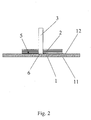
- FIG. An alternative embodiment, the indirect laser irradiation, is shown in FIG. in the Connecting region 6 between the two mold parts 1, 2, the laser beam 3 on the surface 12 of the metallic molded part 1, which contacts the plastic molded part 2.
- the molding 2 consists of a thermoplastic material that provides high transparency for the laser wavelength having.
- the laser beam 3 passes through the plastic molding 2 and brings the Plastic 2 in the connection region 6 due to the heating of the surface 12 of the metal molding 1 for melting, whereby the connection of the two mold parts 1, 2 takes place.
- the laser beam 3 is therefore on the with the indirect irradiation the plastic molding in contact surface 12 directed.
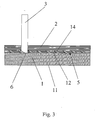
- the plastic molding 2 facing surface 12 of the metal molding 1 undercuts 14.
- the metallic molding 1 is indirectly, i. through the plastic molding 2 through, with a Laser beam 3 is heated.
- the molten plastic 2 is by the joining pressure in the undercuts 14 pressed.
- the irradiation of the metallic molding 1 done with the laser beam 3 directly on the surface 11.
- molded part 1 steel ST37 with a molded part 2 made of unreinforced nylon 6 (Durethan® B 30S from Bayer AG) by means of direct laser irradiation, as shown schematically in FIG shown, connected.
- the plastic molding 2 facing surface 12 of the metal molding 1 was phosphated.
- the thickness of the metallic molding 1 was 0.8 mm, the thickness of the plastic molding 2 was 1.2 mm.
- the laser used was a Nd: Yag with a wavelength of 1064 nm and a power of 60 W used.
Landscapes
- Engineering & Computer Science (AREA)
- Mechanical Engineering (AREA)
- Physics & Mathematics (AREA)
- Optics & Photonics (AREA)
- Health & Medical Sciences (AREA)
- Electromagnetism (AREA)
- Toxicology (AREA)
- Plasma & Fusion (AREA)
- Lining Or Joining Of Plastics Or The Like (AREA)
- Laser Beam Processing (AREA)
Abstract
Description
- Figur 1
- eine schematische Darstellung einer ersten Ausführungsform, bei der mittels direkter Laserbestrahlung die Verbindung des Metall-Formteils mit dem Kunststoff-Formteil bewirkt wird
- Figur 2
- eine schematische Darstellung einer zweiten Ausführungsform, bei der mittels indirekter Laserbestrahlung die Verbindung des Metall-Formteils mit dem Kunststoff-Formteil bewirkt wird
- Figur 3
- eine schematische Darstellung einer weiteren Ausführungsform, bei der die Oberfläche des Metall-Formteils Hinterschnitte aufweist
Claims (9)
- Verfahren zum Verbinden wenigstens eines Formteils aus Metall und eines Formteils aus thermoplastischem Kunststoff, dadurch gekennzeichnet, dass die Formteile in Kontakt gebracht werden und im Kontaktbereich das Formteil aus Metall mit einem Laser bestrahlt wird.
- Verfahren nach Anspruch 1, dadurch gekennzeichnet, dass das Formteil aus Metall auf seiner dem Formteil aus Kunststoff gegenüberliegenden Fläche bestrahlt wird.
- Verfahren nach einem der Ansprüche 1 oder 2, dadurch gekennzeichnet, dass das Formteil aus Metall auf seiner dem Formteil aus Kunststoff zugewandten Fläche bestrahlt wird.
- Verfahren nach einem der Ansprüche 1 bis 3, dadurch gekennzeichnet, dass das Formteil aus Metall im Kontaktbereich eine strukturierte Oberfläche, vorzugsweise eine Oberfläche mit Hinterschnitten, aufweist.
- Verfahren nach einem der Ansprüche 1 bis 4, dadurch gekennzeichnet, dass die Wellenlänge des Lasers von 800 bis 1200 nm beträgt.
- Verfahren nach einem der Ansprüche 1 bis 5, dadurch gekennzeichnet, dass das Metall Stahl, Edelstahl, Aluminium, Kupfer oder eine Legierung dieser Metalle ist.
- Verfahren nach einem der Ansprüche 1 bis 6, dadurch gekennzeichnet, dass das metallische Formteil mit einer Absorptionsschicht versehen ist, welche eine Absorption im Wellenlängenbereich von 800 bis 1200 nm aufweist.
- Verfahren nach einem der Ansprüche 1 bis 7, dadurch gekennzeichnet, dass der thermoplastische Kunststoff ein unverstärkter oder verstärkter und/oder ungefüllter oder gefüllter Kunststoff aus der Gruppe Polyalkylenterephthalat, Polyester, Polyamid, Polycarbonat, Polyacrylat, Polymethacrylat, ABS-Pfropfpolymerisat, Polyolefin, insbesondere Polyethylen oder Polypropylen, Polystyrol, Polyvinylchlorid, Polyoxymethylen, Polyimid, Polyether und Polyetherketon oder eine Mischung dieser Polymere ist.
- Kunststoff-Metall-Verbundbauteil, wenigstens bestehend aus einem Formteil aus Metall und einem Formteil aus thermoplastischem Kunststoff, dadurch gekennzeichnet, dass die Formteile mittels Laserbestrahlung miteinander verbunden sind.
Applications Claiming Priority (2)
| Application Number | Priority Date | Filing Date | Title |
|---|---|---|---|
| DE10338588 | 2003-08-22 | ||
| DE2003138588 DE10338588A1 (de) | 2003-08-22 | 2003-08-22 | Verfahren zum Verbinden von Formteilen aus Kunststoff und Metall |
Publications (1)
| Publication Number | Publication Date |
|---|---|
| EP1508398A1 true EP1508398A1 (de) | 2005-02-23 |
Family
ID=34042244
Family Applications (1)
| Application Number | Title | Priority Date | Filing Date |
|---|---|---|---|
| EP20040018869 Withdrawn EP1508398A1 (de) | 2003-08-22 | 2004-08-09 | Verfahren zum Verbinden von Formteilen aus Kunststoff und Metall |
Country Status (3)
| Country | Link |
|---|---|
| US (1) | US7225521B2 (de) |
| EP (1) | EP1508398A1 (de) |
| DE (1) | DE10338588A1 (de) |
Cited By (8)
| Publication number | Priority date | Publication date | Assignee | Title |
|---|---|---|---|---|
| WO2010020850A1 (en) | 2008-08-19 | 2010-02-25 | Toyota Jidosha Kabushiki Kaisha | Method and apparatus for joining resin and metal |
| EP1920906A4 (de) * | 2005-09-01 | 2010-10-06 | Univ Osaka | Verfahren zur verbindung von metall und harz und metall-harz-verbundwerkstoff, verfahren zur verbindung von glas und harz und glas-harz-verbundwerkstoff sowie verfahren zur verbindung von keramik und harz und keramik-harz-verbundwerkstoff |
| EP2828067A1 (de) * | 2012-03-21 | 2015-01-28 | Aarhus Universitet | Verbindung eines polymers und eines oberflächenmodifizierten metalls durch laserschweissen |
| WO2017071682A1 (de) * | 2015-10-30 | 2017-05-04 | Salzgitter Flachstahl Gmbh | Metall-kunststoff-verbundbauteil und verfahren zur herstellung eines solchen verbundbauteils |
| EP3228440A1 (de) | 2016-04-05 | 2017-10-11 | Leister Technologies AG | Metall-kunststoff-verbundteil |
| EP3403807A1 (de) * | 2017-05-18 | 2018-11-21 | BAE SYSTEMS plc | Befestigungslose strukturanordnung |
| WO2018211233A1 (en) * | 2017-05-18 | 2018-11-22 | Bae Systems Plc | Fastenerless structural assembly |
| EP3636054B1 (de) * | 2017-06-08 | 2022-02-16 | Robert Bosch GmbH | Gehäuse für ein elektrogerät mit einem dicht angeformten gehäuseteil |
Families Citing this family (29)
| Publication number | Priority date | Publication date | Assignee | Title |
|---|---|---|---|---|
| DE102004048625A1 (de) * | 2004-10-06 | 2006-04-20 | Forschungszentrum Karlsruhe Gmbh | Verfahren zum Verbinden von Kunststoff mit Metall |
| DE102005054502A1 (de) * | 2005-11-16 | 2007-05-24 | Conti Temic Microelectronic Gmbh | Verfahren zum Verbinden zweier Werkstücke |
| DE102005057891B4 (de) | 2005-12-02 | 2007-10-18 | Gkss-Forschungszentrum Geesthacht Gmbh | Verfahren und Vorrichtung zum Verbinden eines Kunstoff-Werkstücks mit einem weiteren Werkstück |
| PL1873521T3 (pl) * | 2006-06-27 | 2012-02-29 | Hoffmann La Roche | Diagnostyczna kaseta z taśmą |
| EP2061589A2 (de) * | 2006-08-31 | 2009-05-27 | Fraunhofer-Gesellschaft zur Förderung der Angewandten Forschung e.V. | Verfahren zur herstellung eines bioreaktors oder lab-on-a-chip-systems sowie damit hergestellte bioreaktoren oder lab-on-a-chip- systeme |
| JP4714948B2 (ja) * | 2006-10-05 | 2011-07-06 | 岡山県 | レーザー接合用中間部材及びそれを用いた接合方法 |
| WO2010056791A1 (en) * | 2008-11-14 | 2010-05-20 | Hunter Douglas Industries B.V. | Panel mounting components, systems, and methods |
| DE102009003803A1 (de) * | 2009-04-20 | 2010-10-21 | Benteler Maschinenbau Gmbh | Verfahren und Vorrichtung zur Herstellung eines Verbundbauteils aus einem Metallbauteil und einem Polymerformteil |
| JP5687801B2 (ja) * | 2012-04-09 | 2015-03-25 | 帝人株式会社 | 接合部材の製造方法、及び接合部材 |
| CA2877537A1 (en) | 2012-06-14 | 2013-12-19 | Woodwelding Ag | Method and device for reinforcing and/or lining material |
| DE102013008831B3 (de) * | 2013-05-24 | 2014-11-06 | Audi Ag | Batterie mit einer Mehrzahl von Batteriezellen und Verfahren zum Fertigen einer Batterie |
| US9787345B2 (en) * | 2014-03-31 | 2017-10-10 | Apple Inc. | Laser welding of transparent and opaque materials |
| US10200516B2 (en) | 2014-08-28 | 2019-02-05 | Apple Inc. | Interlocking ceramic and optical members |
| FR3042196B1 (fr) * | 2015-10-07 | 2019-04-19 | Centre Technique Des Industries Mecaniques | Procede de solidarisation d'un element composite et d'un element rigide |
| US20180326674A1 (en) * | 2015-12-17 | 2018-11-15 | GM Global Technology Operations LLC | Jointed member and method of joining |
| DE102016206612A1 (de) | 2016-04-19 | 2017-08-03 | Continental Automotive Gmbh | Verfahren zum Verbinden eines metallischen Formteils mit einem thermoplastischen Formteil |
| GB2564753B (en) * | 2017-05-18 | 2020-06-24 | Bae Systems Plc | Fastenerless structural assembly |
| DE102017210639A1 (de) * | 2017-06-23 | 2018-12-27 | Robert Bosch Gmbh | Verbundbauteil, Verfahren zur Herstellung desselben und dessen Verwendung |
| DE102017211670A1 (de) * | 2017-07-07 | 2019-01-10 | BSH Hausgeräte GmbH | Wasserführendes Haushaltsgerät und Verfahren |
| US11376392B2 (en) * | 2018-04-24 | 2022-07-05 | ResMed Pty Ltd | Tub for use in a humidifier |
| US20200070269A1 (en) * | 2018-08-30 | 2020-03-05 | GM Global Technology Operations LLC | Laser-induced anti-corrosion micro-anchor structural layer for metal-polymeric composite joint and methods of manufacturing thereof |
| KR102631904B1 (ko) * | 2018-09-28 | 2024-01-31 | 주식회사 엘지화학 | 이종 소재 접합체의 제조방법 및 이종 소재 접합체 |
| DE102019106260A1 (de) * | 2019-03-12 | 2020-09-17 | HELLA GmbH & Co. KGaA | Verfahren zur Herstellung einer Fügeverbindung zwischen einem lichttechnisch wirksamen Kunststoffbauteil und einer Metallkomponente |
| DE102019106284A1 (de) * | 2019-03-12 | 2020-09-17 | HELLA GmbH & Co. KGaA | Verfahren zur Herstellung einer Fügeverbindung zwischen einem Strukturbauteil aus einem Kunststoff und einer Metallkomponente |
| US20210186422A1 (en) * | 2019-12-20 | 2021-06-24 | Medtronic, Inc. | Implantable medical device with metal and polymer housing |
| US20230090894A1 (en) * | 2020-05-19 | 2023-03-23 | Basf Se | Method for Manufacturing a Metal-Polymer Hybrid Part and Metal-Polymer Hybrid Part |
| JP2023059627A (ja) * | 2021-10-15 | 2023-04-27 | 日本軽金属株式会社 | 金属部材及び金属樹脂接合体並びにそれらの製造方法 |
| JP7846301B2 (ja) * | 2022-07-14 | 2026-04-14 | オーモヴィオ・オートノモス・モビリティー・ジャーマニー・ゲゼルシャフト・ミト・ベシュレンクテル・ハフツング | センサモジュールの製造方法及びセンサモジュール |
| KR20240020978A (ko) * | 2022-08-09 | 2024-02-16 | 주식회사 에이치엘클레무브 | 이종재질의 접합장치 및 이의 작동방법 |
Citations (8)
| Publication number | Priority date | Publication date | Assignee | Title |
|---|---|---|---|---|
| DE1565794A1 (de) * | 1966-04-01 | 1970-02-19 | Siemens Ag | Verfahren zur Materialbearbeitung mittels einer fokussierten optischen Strahlung |
| JPS6264527A (ja) * | 1985-09-18 | 1987-03-23 | Toyota Motor Corp | 合成樹脂材料と異種材料の接合方法 |
| JPS6274629A (ja) * | 1985-09-30 | 1987-04-06 | Toyota Motor Corp | 合成樹脂材料の接合方法 |
| JPS6364729A (ja) * | 1986-09-05 | 1988-03-23 | Dainippon Printing Co Ltd | 端面被覆が施された積層体及びその製造方法 |
| JPH0699502A (ja) * | 1992-05-21 | 1994-04-12 | Nippon Steel Corp | 樹脂フィルム積層表面処理鋼板の製造方法 |
| US20020179234A1 (en) * | 2001-05-25 | 2002-12-05 | Reinhold Platz | Process for bonding conductor tracks to plastics surfaces |
| JP2003001455A (ja) * | 2001-06-15 | 2003-01-08 | Matsushita Electric Ind Co Ltd | 金属と樹脂との接合方法及び装置、制振鋼板の製造方法 |
| JP2003266543A (ja) * | 2002-03-18 | 2003-09-24 | Toyota Motor Corp | レーザ溶着された組立体 |
Family Cites Families (4)
| Publication number | Priority date | Publication date | Assignee | Title |
|---|---|---|---|---|
| US179234A (en) * | 1876-06-27 | Improvement in convertible chairs | ||
| US4449014A (en) * | 1981-01-19 | 1984-05-15 | The Dow Chemical Company | Plastic/metal laminates, cable shielding or armoring tapes, and electrical cables made therewith |
| DE3838895A1 (de) | 1988-11-17 | 1990-07-05 | Diehl Gmbh & Co | Fluegel fuer ein geschoss |
| US5190803A (en) * | 1988-11-25 | 1993-03-02 | Bayer Aktiengesellschaft | Structural shell with reinforcing ribs connected via perforations |
-
2003
- 2003-08-22 DE DE2003138588 patent/DE10338588A1/de not_active Withdrawn
-
2004
- 2004-08-09 EP EP20040018869 patent/EP1508398A1/de not_active Withdrawn
- 2004-08-18 US US10/920,543 patent/US7225521B2/en not_active Expired - Lifetime
Patent Citations (9)
| Publication number | Priority date | Publication date | Assignee | Title |
|---|---|---|---|---|
| DE1565794A1 (de) * | 1966-04-01 | 1970-02-19 | Siemens Ag | Verfahren zur Materialbearbeitung mittels einer fokussierten optischen Strahlung |
| JPS6264527A (ja) * | 1985-09-18 | 1987-03-23 | Toyota Motor Corp | 合成樹脂材料と異種材料の接合方法 |
| JPS6274629A (ja) * | 1985-09-30 | 1987-04-06 | Toyota Motor Corp | 合成樹脂材料の接合方法 |
| JPS6364729A (ja) * | 1986-09-05 | 1988-03-23 | Dainippon Printing Co Ltd | 端面被覆が施された積層体及びその製造方法 |
| JPH0699502A (ja) * | 1992-05-21 | 1994-04-12 | Nippon Steel Corp | 樹脂フィルム積層表面処理鋼板の製造方法 |
| US20020179234A1 (en) * | 2001-05-25 | 2002-12-05 | Reinhold Platz | Process for bonding conductor tracks to plastics surfaces |
| JP2003001455A (ja) * | 2001-06-15 | 2003-01-08 | Matsushita Electric Ind Co Ltd | 金属と樹脂との接合方法及び装置、制振鋼板の製造方法 |
| JP2003266543A (ja) * | 2002-03-18 | 2003-09-24 | Toyota Motor Corp | レーザ溶着された組立体 |
| WO2003078138A1 (fr) * | 2002-03-18 | 2003-09-25 | Toyota Jidosha Kabushiki Kaisha | Ensemble soude au laser |
Non-Patent Citations (6)
| Title |
|---|
| PATENT ABSTRACTS OF JAPAN vol. 0112, no. 58 (M - 618) 21 August 1987 (1987-08-21) * |
| PATENT ABSTRACTS OF JAPAN vol. 0112, no. 72 (M - 622) 4 September 1987 (1987-09-04) * |
| PATENT ABSTRACTS OF JAPAN vol. 0122, no. 89 (M - 728) 8 August 1988 (1988-08-08) * |
| PATENT ABSTRACTS OF JAPAN vol. 0183, no. 66 (M - 1636) 11 July 1994 (1994-07-11) * |
| PATENT ABSTRACTS OF JAPAN vol. 2003, no. 05 12 May 2003 (2003-05-12) * |
| PATENT ABSTRACTS OF JAPAN vol. 2003, no. 12 5 December 2003 (2003-12-05) * |
Cited By (11)
| Publication number | Priority date | Publication date | Assignee | Title |
|---|---|---|---|---|
| EP1920906A4 (de) * | 2005-09-01 | 2010-10-06 | Univ Osaka | Verfahren zur verbindung von metall und harz und metall-harz-verbundwerkstoff, verfahren zur verbindung von glas und harz und glas-harz-verbundwerkstoff sowie verfahren zur verbindung von keramik und harz und keramik-harz-verbundwerkstoff |
| WO2010020850A1 (en) | 2008-08-19 | 2010-02-25 | Toyota Jidosha Kabushiki Kaisha | Method and apparatus for joining resin and metal |
| CN102131632B (zh) * | 2008-08-19 | 2014-07-16 | 丰田自动车株式会社 | 用于使树脂和金属接合的方法和装置 |
| US9005388B2 (en) | 2008-08-19 | 2015-04-14 | Toyota Jidosha Kabushiki Kaisha | Method for joining resin and metal |
| US9789672B2 (en) | 2008-08-19 | 2017-10-17 | Toyota Jidosha Kabushiki Kaisha | System for joining resin and metal |
| EP2828067A1 (de) * | 2012-03-21 | 2015-01-28 | Aarhus Universitet | Verbindung eines polymers und eines oberflächenmodifizierten metalls durch laserschweissen |
| WO2017071682A1 (de) * | 2015-10-30 | 2017-05-04 | Salzgitter Flachstahl Gmbh | Metall-kunststoff-verbundbauteil und verfahren zur herstellung eines solchen verbundbauteils |
| EP3228440A1 (de) | 2016-04-05 | 2017-10-11 | Leister Technologies AG | Metall-kunststoff-verbundteil |
| EP3403807A1 (de) * | 2017-05-18 | 2018-11-21 | BAE SYSTEMS plc | Befestigungslose strukturanordnung |
| WO2018211233A1 (en) * | 2017-05-18 | 2018-11-22 | Bae Systems Plc | Fastenerless structural assembly |
| EP3636054B1 (de) * | 2017-06-08 | 2022-02-16 | Robert Bosch GmbH | Gehäuse für ein elektrogerät mit einem dicht angeformten gehäuseteil |
Also Published As
| Publication number | Publication date |
|---|---|
| US7225521B2 (en) | 2007-06-05 |
| DE10338588A1 (de) | 2005-03-24 |
| US20050042456A1 (en) | 2005-02-24 |
Similar Documents
| Publication | Publication Date | Title |
|---|---|---|
| DE10338588A1 (de) | Verfahren zum Verbinden von Formteilen aus Kunststoff und Metall | |
| EP2121304B1 (de) | Verfahren zur herstellung eines aus kunststoff und metall bestehenden hybrid-bauteiles sowie metall-kunststoff-verbundkörper | |
| EP1686147B1 (de) | Verfahren zur Herstellung eines Verbundes | |
| EP1160075B1 (de) | Halogenfreier Folienverbund, Verfahren zu seiner Herstellung und seine Verwendung | |
| WO2007060032A1 (de) | Schweissverfahren mittels elektromagnetischer strahlung | |
| DE102016212622B4 (de) | Verfahren zum Fügen von Bauteilen | |
| DE10125570B4 (de) | Verfahren zum Verbinden von Leiterbahnen mit Kunststoffoberflächen | |
| DE102020119413A1 (de) | Verfahren zur Herstellung eines Mehrkomponenten-Verbundbauteils | |
| DE4228283A1 (de) | Hinterspritztes Verkleidungsteil und Verfahren zu seiner Hestellung | |
| WO2007098869A1 (de) | Verbinden von faserverstärktem material mit einem spritzgussmaterial; bauteil nebst vorrichtung zur durchführung des verfahrens | |
| EP1198348B1 (de) | Verfahren zur herstellung eines werkstoffverbundes, danach hergestellter werkstoffverbund, formteil aus einem solchen werkstoffverbund und verfahren zu dessen herstellung | |
| DE4242059C1 (de) | Verfahren zum thermischen Verbinden von Kunststoff-Formkörpern mit weiteren Kunststoffkomponenten mittels einer durch Plasmapolymerisation aufgetragenen Zwischenschicht | |
| DE102007009384B4 (de) | Verfahren zum Hinterspritzen einer Folie | |
| EP1123203B1 (de) | Verfahren zum herstellen eines einbrennlackierten formbauteils | |
| DE202005010946U1 (de) | Dekoratives Zierteil | |
| EP4140691B1 (de) | Behälter bestehend aus einem steifen aussenbehälter und einem verformbaren innenbeutel sowie verfahren zur herstellung eines derartigen behälters | |
| WO2005016641A1 (de) | Verfahren zur herstellung von kunststoffformteilen mit funktionalen oberflächen | |
| DE102005032421A1 (de) | Dekoratives Zierteil und Verfahren zu dessen Herstellung | |
| DE1950662B2 (de) | Kraftstoffbehaelter aus thermoplastischem kunststoff | |
| WO2015022063A1 (de) | Verfahren zum herstellen eines selbsttragenden karosserieaussenteils | |
| EP0711615A1 (de) | Dauerform für Metall-, Kunststoff- und Glasguss | |
| DE102005046309B4 (de) | Verbundmaterial | |
| DE102008058324B4 (de) | Formbauteil aus Kunststoff und Verfahren zu dessen Herstellung | |
| EP2791917B1 (de) | Mobiler identifikationsgeber mit einem metallisch beschichteten betätigungselement | |
| DE102022206659A1 (de) | Wärmeübertragerplatte |
Legal Events
| Date | Code | Title | Description |
|---|---|---|---|
| PUAI | Public reference made under article 153(3) epc to a published international application that has entered the european phase |
Free format text: ORIGINAL CODE: 0009012 |
|
| AK | Designated contracting states |
Kind code of ref document: A1 Designated state(s): AT BE BG CH CY CZ DE DK EE ES FI FR GB GR HU IE IT LI LU MC NL PL PT RO SE SI SK TR |
|
| AX | Request for extension of the european patent |
Extension state: AL HR LT LV MK |
|
| 17P | Request for examination filed |
Effective date: 20050823 |
|
| AKX | Designation fees paid |
Designated state(s): DE ES FR IT |
|
| 17Q | First examination report despatched |
Effective date: 20090805 |
|
| STAA | Information on the status of an ep patent application or granted ep patent |
Free format text: STATUS: THE APPLICATION IS DEEMED TO BE WITHDRAWN |
|
| 18D | Application deemed to be withdrawn |
Effective date: 20100216 |