EP1506591B1 - Polymerelektrolytmembran, verfahren zu deren herstellung und deren anwendung in brennstoffzellen - Google Patents
Polymerelektrolytmembran, verfahren zu deren herstellung und deren anwendung in brennstoffzellen Download PDFInfo
- Publication number
- EP1506591B1 EP1506591B1 EP03727465A EP03727465A EP1506591B1 EP 1506591 B1 EP1506591 B1 EP 1506591B1 EP 03727465 A EP03727465 A EP 03727465A EP 03727465 A EP03727465 A EP 03727465A EP 1506591 B1 EP1506591 B1 EP 1506591B1
- Authority
- EP
- European Patent Office
- Prior art keywords
- group
- aryl
- halogen
- substituted
- acid
- Prior art date
- Legal status (The legal status is an assumption and is not a legal conclusion. Google has not performed a legal analysis and makes no representation as to the accuracy of the status listed.)
- Expired - Lifetime
Links
- 0 *CC(*)C(*1)=Nc2c1cccc2 Chemical compound *CC(*)C(*1)=Nc2c1cccc2 0.000 description 2
Classifications
-
- H—ELECTRICITY
- H01—ELECTRIC ELEMENTS
- H01M—PROCESSES OR MEANS, e.g. BATTERIES, FOR THE DIRECT CONVERSION OF CHEMICAL ENERGY INTO ELECTRICAL ENERGY
- H01M8/00—Fuel cells; Manufacture thereof
- H01M8/02—Details
-
- B—PERFORMING OPERATIONS; TRANSPORTING
- B01—PHYSICAL OR CHEMICAL PROCESSES OR APPARATUS IN GENERAL
- B01D—SEPARATION
- B01D67/00—Processes specially adapted for manufacturing semi-permeable membranes for separation processes or apparatus
- B01D67/0081—After-treatment of organic or inorganic membranes
- B01D67/0093—Chemical modification
-
- B—PERFORMING OPERATIONS; TRANSPORTING
- B01—PHYSICAL OR CHEMICAL PROCESSES OR APPARATUS IN GENERAL
- B01D—SEPARATION
- B01D71/00—Semi-permeable membranes for separation processes or apparatus characterised by the material; Manufacturing processes specially adapted therefor
- B01D71/06—Organic material
- B01D71/40—Polymers of unsaturated acids or derivatives thereof, e.g. salts, amides, imides, nitriles, anhydrides, esters
- B01D71/401—Polymers based on the polymerisation of acrylic acid, e.g. polyacrylate
-
- B—PERFORMING OPERATIONS; TRANSPORTING
- B01—PHYSICAL OR CHEMICAL PROCESSES OR APPARATUS IN GENERAL
- B01D—SEPARATION
- B01D71/00—Semi-permeable membranes for separation processes or apparatus characterised by the material; Manufacturing processes specially adapted therefor
- B01D71/06—Organic material
- B01D71/44—Polymers obtained by reactions only involving carbon-to-carbon unsaturated bonds, not provided for in a single one of groups B01D71/26-B01D71/42
- B01D71/441—Polyvinylpyrrolidone
-
- C—CHEMISTRY; METALLURGY
- C08—ORGANIC MACROMOLECULAR COMPOUNDS; THEIR PREPARATION OR CHEMICAL WORKING-UP; COMPOSITIONS BASED THEREON
- C08J—WORKING-UP; GENERAL PROCESSES OF COMPOUNDING; AFTER-TREATMENT NOT COVERED BY SUBCLASSES C08B, C08C, C08F, C08G or C08H
- C08J5/00—Manufacture of articles or shaped materials containing macromolecular substances
- C08J5/20—Manufacture of shaped structures of ion-exchange resins
- C08J5/22—Films, membranes or diaphragms
-
- C—CHEMISTRY; METALLURGY
- C08—ORGANIC MACROMOLECULAR COMPOUNDS; THEIR PREPARATION OR CHEMICAL WORKING-UP; COMPOSITIONS BASED THEREON
- C08J—WORKING-UP; GENERAL PROCESSES OF COMPOUNDING; AFTER-TREATMENT NOT COVERED BY SUBCLASSES C08B, C08C, C08F, C08G or C08H
- C08J5/00—Manufacture of articles or shaped materials containing macromolecular substances
- C08J5/20—Manufacture of shaped structures of ion-exchange resins
- C08J5/22—Films, membranes or diaphragms
- C08J5/2206—Films, membranes or diaphragms based on organic and/or inorganic macromolecular compounds
- C08J5/2218—Synthetic macromolecular compounds
- C08J5/2231—Synthetic macromolecular compounds based on macromolecular compounds obtained by reactions involving unsaturated carbon-to-carbon bonds
- C08J5/2243—Synthetic macromolecular compounds based on macromolecular compounds obtained by reactions involving unsaturated carbon-to-carbon bonds obtained by introduction of active groups capable of ion-exchange into compounds of the type C08J5/2231
-
- H—ELECTRICITY
- H01—ELECTRIC ELEMENTS
- H01M—PROCESSES OR MEANS, e.g. BATTERIES, FOR THE DIRECT CONVERSION OF CHEMICAL ENERGY INTO ELECTRICAL ENERGY
- H01M4/00—Electrodes
- H01M4/86—Inert electrodes with catalytic activity, e.g. for fuel cells
- H01M4/8605—Porous electrodes
-
- H—ELECTRICITY
- H01—ELECTRIC ELEMENTS
- H01M—PROCESSES OR MEANS, e.g. BATTERIES, FOR THE DIRECT CONVERSION OF CHEMICAL ENERGY INTO ELECTRICAL ENERGY
- H01M4/00—Electrodes
- H01M4/86—Inert electrodes with catalytic activity, e.g. for fuel cells
- H01M4/88—Processes of manufacture
- H01M4/8803—Supports for the deposition of the catalytic active composition
- H01M4/881—Electrolytic membranes
-
- H—ELECTRICITY
- H01—ELECTRIC ELEMENTS
- H01M—PROCESSES OR MEANS, e.g. BATTERIES, FOR THE DIRECT CONVERSION OF CHEMICAL ENERGY INTO ELECTRICAL ENERGY
- H01M4/00—Electrodes
- H01M4/86—Inert electrodes with catalytic activity, e.g. for fuel cells
- H01M4/90—Selection of catalytic material
- H01M4/92—Metals of platinum group
-
- H—ELECTRICITY
- H01—ELECTRIC ELEMENTS
- H01M—PROCESSES OR MEANS, e.g. BATTERIES, FOR THE DIRECT CONVERSION OF CHEMICAL ENERGY INTO ELECTRICAL ENERGY
- H01M8/00—Fuel cells; Manufacture thereof
- H01M8/10—Fuel cells with solid electrolytes
-
- H—ELECTRICITY
- H01—ELECTRIC ELEMENTS
- H01M—PROCESSES OR MEANS, e.g. BATTERIES, FOR THE DIRECT CONVERSION OF CHEMICAL ENERGY INTO ELECTRICAL ENERGY
- H01M8/00—Fuel cells; Manufacture thereof
- H01M8/10—Fuel cells with solid electrolytes
- H01M8/1004—Fuel cells with solid electrolytes characterised by membrane-electrode assemblies [MEA]
-
- H—ELECTRICITY
- H01—ELECTRIC ELEMENTS
- H01M—PROCESSES OR MEANS, e.g. BATTERIES, FOR THE DIRECT CONVERSION OF CHEMICAL ENERGY INTO ELECTRICAL ENERGY
- H01M8/00—Fuel cells; Manufacture thereof
- H01M8/10—Fuel cells with solid electrolytes
- H01M8/1016—Fuel cells with solid electrolytes characterised by the electrolyte material
- H01M8/1018—Polymeric electrolyte materials
- H01M8/1069—Polymeric electrolyte materials characterised by the manufacturing processes
- H01M8/1072—Polymeric electrolyte materials characterised by the manufacturing processes by chemical reactions, e.g. in situ polymerisation or in situ crosslinking
-
- B—PERFORMING OPERATIONS; TRANSPORTING
- B01—PHYSICAL OR CHEMICAL PROCESSES OR APPARATUS IN GENERAL
- B01D—SEPARATION
- B01D2323/00—Details relating to membrane preparation
- B01D2323/30—Cross-linking
-
- B—PERFORMING OPERATIONS; TRANSPORTING
- B01—PHYSICAL OR CHEMICAL PROCESSES OR APPARATUS IN GENERAL
- B01D—SEPARATION
- B01D2323/00—Details relating to membrane preparation
- B01D2323/38—Graft polymerization
- B01D2323/385—Graft polymerization involving radiation
-
- H—ELECTRICITY
- H01—ELECTRIC ELEMENTS
- H01M—PROCESSES OR MEANS, e.g. BATTERIES, FOR THE DIRECT CONVERSION OF CHEMICAL ENERGY INTO ELECTRICAL ENERGY
- H01M8/00—Fuel cells; Manufacture thereof
- H01M8/10—Fuel cells with solid electrolytes
- H01M2008/1095—Fuel cells with polymeric electrolytes
-
- H—ELECTRICITY
- H01—ELECTRIC ELEMENTS
- H01M—PROCESSES OR MEANS, e.g. BATTERIES, FOR THE DIRECT CONVERSION OF CHEMICAL ENERGY INTO ELECTRICAL ENERGY
- H01M4/00—Electrodes
- H01M4/86—Inert electrodes with catalytic activity, e.g. for fuel cells
- H01M4/90—Selection of catalytic material
- H01M4/92—Metals of platinum group
- H01M4/921—Alloys or mixtures with metallic elements
-
- Y—GENERAL TAGGING OF NEW TECHNOLOGICAL DEVELOPMENTS; GENERAL TAGGING OF CROSS-SECTIONAL TECHNOLOGIES SPANNING OVER SEVERAL SECTIONS OF THE IPC; TECHNICAL SUBJECTS COVERED BY FORMER USPC CROSS-REFERENCE ART COLLECTIONS [XRACs] AND DIGESTS
- Y02—TECHNOLOGIES OR APPLICATIONS FOR MITIGATION OR ADAPTATION AGAINST CLIMATE CHANGE
- Y02E—REDUCTION OF GREENHOUSE GAS [GHG] EMISSIONS, RELATED TO ENERGY GENERATION, TRANSMISSION OR DISTRIBUTION
- Y02E60/00—Enabling technologies; Technologies with a potential or indirect contribution to GHG emissions mitigation
- Y02E60/30—Hydrogen technology
- Y02E60/50—Fuel cells
-
- Y—GENERAL TAGGING OF NEW TECHNOLOGICAL DEVELOPMENTS; GENERAL TAGGING OF CROSS-SECTIONAL TECHNOLOGIES SPANNING OVER SEVERAL SECTIONS OF THE IPC; TECHNICAL SUBJECTS COVERED BY FORMER USPC CROSS-REFERENCE ART COLLECTIONS [XRACs] AND DIGESTS
- Y02—TECHNOLOGIES OR APPLICATIONS FOR MITIGATION OR ADAPTATION AGAINST CLIMATE CHANGE
- Y02P—CLIMATE CHANGE MITIGATION TECHNOLOGIES IN THE PRODUCTION OR PROCESSING OF GOODS
- Y02P70/00—Climate change mitigation technologies in the production process for final industrial or consumer products
- Y02P70/50—Manufacturing or production processes characterised by the final manufactured product
Definitions
- the present invention relates to a proton-conducting polymer electrolyte membrane based on organic polymers, which are pretreated by means of radiation treatment and then grafted with vinylphosphonic acid or with vinylphosphonic acid and vinylsulphonic acid and which can be used in many ways due to their excellent chemical and thermal properties, in particular as a polymer electrolyte membrane (PEM) in so-called PEM fuel cells.
- PEM polymer electrolyte membrane
- a fuel cell usually contains an electrolyte and two electrodes separated by the electrolyte.
- one of the two electrodes is supplied with a fuel such as hydrogen gas or a methanol-water mixture and the other electrode with an oxidant such as oxygen gas or air, thereby directly converting chemical energy from the fuel oxidation into electrical energy.
- an oxidant such as oxygen gas or air
- the electrolyte is for hydrogen ions, i. Protons, but not permeable to reactive fuels such as the hydrogen gas or methanol and the oxygen gas.
- a fuel cell has a plurality of individual cells, so-called MEE's (membrane-electrode unit), each containing an electrolyte and two electrodes separated by the electrolyte.
- MEE's membrane-electrode unit
- the electrolyte used for the fuel cell are solids such as polymer electrolyte membranes or liquids such as phosphoric acid.
- polymer electrolyte membranes have attracted attention as electrolytes for fuel cells. In principle, one can distinguish between 2 categories of polymer membranes.
- the first category includes cation exchange membranes consisting of a polymer backbone which contains covalently bound acid groups, preferably sulfonic acid groups.
- the sulfonic acid group changes into an anion with the release of a hydrogen ion and therefore conducts protons.
- the mobility of the proton and thus the proton conductivity is directly related to the water content connected. Due to the very good miscibility of methanol and water, such cation exchange membranes have a high methanol permeability and are therefore unsuitable for applications in a direct methanol fuel cell. If the membrane dries out, for example as a consequence of high temperature, the conductivity of the membrane and consequently the power of the fuel cell decrease drastically.
- the operating temperatures of fuel cells containing such cation exchange membranes is thus limited to the boiling point of the water.
- the humidification of fuels represents a major technical challenge for the use of polymer electrolyte membrane fuel cells (PEMBZ) using conventional, sulfonated membranes such as Nafion.
- perfluorosulfonic acid polymers are used as materials for polymer electrolyte membranes.
- the perfluorosulfonic acid polymer (such as Nafion) generally has a perfluorocarbon skeleton, such as a copolymer of tetrafluoroethylene and trifluorovinyl, and a side chain having a sulfonic acid group attached thereto, such as a side chain having a sulfonic acid group attached to a perfluoroalkylene group.
- the cation exchange membranes are preferably organic polymers with covalently bonded acid groups, in particular sulfonic acid. Methods for sulfonating polymers are described in F. Kucera et. al. Polymer Engineering and Science 1988, Vol. 38, No. 5, 783-792.
- cation exchange membranes Listed below are the major types of cation exchange membranes that have gained commercial significance for use in fuel cells. The most important representative is the Perfluorosulfonklapolymer Nafion ® (US-A-3692569) from DuPont. This polymer can be solubilized as described in US-A-4453991 and then used as an ionomer. Cation-exchange membranes are also obtained by filling a porous support material with such an ionomer. As a carrier material while expanded Teflon is preferred (US-A-5635041).
- Another perfluorinated cation exchange membrane can be prepared as described in US-A-5422411 by copolymerization of trifluorostyrene and sulfonyl-modified trifluorostyrene.
- Composite membranes consisting of a porous support material, in particular expanded Teflon, filled with ionomers consisting of such sulfonyl-modified trifluorostyrene copolymers are described in US-A-5834523.
- US-A-6110616 describes copolymers of butadiene and styrene and their subsequent sulfonation for the production of cation exchange membranes for fuel cells.
- membranes of sulfonated polyether ketones DE-A-4219077, WO-96/01177
- sulfonated polysulfone J. Membr. Sci., 83 (1993) p.211
- sulfonated polyphenylene sulfide DE-A-19527435
- Ionomers prepared from sulfonated polyether ketones are described in WO 00/15691.
- acid-base blend membranes are known, which are prepared as described in DE-A-19817374 or WO 01/18894 by mixtures of sulfonated polymers and basic polymers.
- a cation exchange membrane known in the art can be mixed with a high temperature stable polymer.
- the preparation and properties of cation exchange membranes consisting of blends of sulfonated polyether ketones and a) polysulfones (DE-A-4422158), b) aromatic polyamides (DE-A-42445264) or c) polybenzimidazole (DE-A-19851498) are known.
- Such membranes can also be obtained by methods in which polymers are grafted.
- a grafting reaction preferably with styrene, is carried out on a previously irradiated polymer film consisting of a fluorinated or partially fluorinated polymer.
- fluorinated aromatic monomers such as trifluorostyrene may alternatively be used (WO 2001/58576).
- sulfonating agent while chlorosulfonic acid or oleum are used.
- JP 2001/302721 discloses a styrene-grafted film containing 2-ketopentafluoropropanesulfonic acid reacts and so a membrane with a proton conductivity of 0.32 S / cm achieved in the humidified state.
- crosslinking can also be carried out and thus the mechanical properties and the fuel permeability can be changed.
- crosslinkers for example, divinylbenzene and / or triallyl cyanurate as described in EP-A-667983 or 1,4-butanediol diacrylate as described in JP2001 / 216837 can be used.
- the processes for making such radiation-grafted and sulfonated membranes are very complex and involve numerous process steps such as i) preparations of the polymer film; ii) irradiation of the polymer film preferably under inert gas and storage at low temperatures ( ⁇ -60 ° C); iii) grafting reaction under nitrogen in a solution of suitable monomer and solvent; iv) extraction of the solvent; v) drying the grafted film; vi) sulfonation reaction in the presence of aggressive reagents and chlorinated hydrocarbons such as chlorosulfonic acid in tetrachloroethane; vii) repeated washing to remove excess solvent and sulfonating agents; viii) Reaction with dilute alkalis, such as potassium hydroxide, to convert to salt form; ix) repeated washing to remove excess liquor; x) reaction with dilute acid such as hydrochloric acid; xi) final washing several times to remove excess acid.
- One way to increase the operating temperature is to pressurize the fuel cell system to increase the boiling point of the water.
- this method has a number of disadvantages, as the fuel cell system becomes more complicated, the efficiency decreases and instead of a desired weight reduction one Weight gain occurs.
- an increase in pressure leads to a higher mechanical stress on the thin polymer membrane and can lead to a failure of the membrane and thus system failure.
- WO96 / 13872 and the corresponding US-A-5525436 describe a process for producing a proton-conducting polymer electrolyte membrane in which a basic polymer such as polybenzimidazole is treated with a strong acid such as phosphoric acid, sulfuric acid, etc.
- the mineral acid usually concentrated phosphoric acid
- the basic polymer membrane directly from polyphosphoric acid as described in German patent application DE-A-10117686. DE-A-10144815 and DE-A-10117687.
- the polymer serves as a carrier for the electrolyte consisting of the highly concentrated phosphoric acid, respectively polyphosphoric acid.
- the polymer membrane fulfills further essential functions in particular, it must have a high mechanical stability and serve as a separator for the two fuels mentioned above.
- JP 2001-213987 One way of producing a radiation-grafted membrane for operation at temperatures above 100 ° C. is described in JP 2001-213987 (Toyota).
- a partially fluorinated polymer film of polyethylene tetrafluoroethylene or polyvinyl difluoride is irradiated and then reacted with a basic monomer such as vinylpyridine.
- a basic monomer such as vinylpyridine.
- these radiation grafted materials exhibit high swelling with phosphoric acid.
- proton-conducting membranes are prepared with a conductivity of 0.1 S / cm at 180 ° C without moistening.
- JP2000 / 331693 describes the preparation of an anion-exchanging membrane by radiation grafting.
- the grafting reaction is carried out with vinylbenzyltrimethylammonium salt or quaternary salts of vinylpyridine or vinylimidazole.
- anion-exchanging membranes are not suitable for use in fuel cells.
- a big advantage of fuel cells is the fact that in the electrochemical reaction the energy of the fuel is directly converted into electrical energy and heat.
- the reaction product is formed at the cathode water.
- the by-product of the electrochemical reaction is heat.
- the heat must be removed to avoid overheating the system.
- additional, energy-consuming devices are necessary, further reducing the overall electrical efficiency of the fuel cell.
- the heat can be efficiently utilized by existing technologies such as heat exchangers. To increase the efficiency of high temperatures are sought.
- the operating temperature is above 100 ° C and the temperature difference between the ambient temperature and the operating temperature is high, it becomes possible to cool the fuel cell system more efficiently or to use small cooling surfaces and to dispense with additional devices compared to Fuel cells that need to be operated at below 100 ° C due to membrane humidification.
- phosphoric acid or polyphosphoric acid is present as an electrolyte, which is not permanently bound to the basic polymer by ionic interactions and can be washed out by water.
- Water is formed at the cathode as described above in the electrochemical reaction. If the operating temperature above 100 ° C, the water is largely removed as a vapor through the gas diffusion electrode and the acid loss is very low. However, if the operating temperature falls below 100 ° C, e.g. when starting up and shutting down the cell or in part-load operation when a high current efficiency is sought, the water formed condenses and can lead to increased washing out of the electrolyte, highly concentrated phosphoric acid or polyphosphoric acid. This may lead to a steady loss of conductivity and cell performance in the driving manner of the fuel cell described above, which may reduce the life of the fuel cell.
- the known membranes doped with phosphoric acid can not be used in the so-called direct methanol fuel cell (DMBZ).
- DMBZ direct methanol fuel cell
- such cells are of particular interest since a methanol-water mixture is used as the fuel. If a known membrane based on phosphoric acid is used, the fuel cell fails after a fairly short time.
- the present invention is therefore based on the object to provide a novel polymer electrolyte membrane, in which a washing out of the electrolyte is prevented.
- the operating temperature of ⁇ 0 ° C to 200 ° C can be extended.
- a fuel cell containing a polymer electrolyte membrane according to the invention should be suitable for pure hydrogen as well as for numerous carbon-containing fuels, in particular natural gas, gasoline, methanol and biomass.
- a membrane according to the invention should be inexpensive and easy to manufacture. Moreover, it was therefore an object of the present invention to provide polymer electrolyte membranes which show high performance, in particular high conductivity.
- a polymer electrolyte membrane should be provided which has a high mechanical stability, for example, a high modulus of elasticity, a high tensile strength, a low creep and a high fracture toughness.
- Another object of the present invention is to simplify and reduce the process steps in the production of a membrane according to the invention by means of grafting, so that they can also be carried out on an industrial scale.
- This object is achieved by modifying a film based on technical polymers by means of radiation and subsequent treatment with vinylphosphonic or vinylphosphonic and vinylsulphonic acid containing monomers and their subsequent polymerization, resulting in a grafted Polymerlektrolytmembran, wherein the polyvinylphosphonic / Polyvinylsulfonklapolymer covalently bonded to the polymer backbone is.
- the polymeric polyvinyl phosphonic / polyvinyl sulfonic acid which can also be crosslinked by reactive groups, is covalently bound to the polymer chain as a result of the grafting reaction and is not washed out by product water formed or, in the case of a DMBZ, by the aqueous fuel.
- An inventive polymer electrolyte membrane has a very low methanol permeability and is particularly suitable for use in a DMBZ.
- the membranes allow a particularly high activity of these fuels. Due to the high temperatures, the methanol oxidation can take place here with high activity.
- these membranes are suitable for operation in a so-called vapor DMBZ, in particular at temperatures in the range of 100 to 200 ° C.
- CO arises as a by-product in the reforming of the hydrogen-rich gas from carbon-containing compounds, e.g. Natural gas, methanol or gasoline or as an intermediate in the direct oxidation of methanol.
- carbon-containing compounds e.g. Natural gas, methanol or gasoline or as an intermediate in the direct oxidation of methanol.
- the CO content of the fuel at temperatures above 120 ° C may be greater than 5000 ppm, without drastically reducing the catalytic activity of the Pt catalyst.
- 10000 ppm CO or more may be tolerated (N.J. Bjerrum et al., Journal of Applied Electrochemistry, 2001, 31, 773-779). This leads to significant simplifications of the upstream reforming process and thus to cost reductions of the entire fuel cell system.
- a membrane of the invention shows over a wide temperature range, a high conductivity, which is achieved without additional humidification. Furthermore, a fuel cell which is equipped with a membrane according to the invention, even at low temperatures, for example, be operated at 80 ° C or less, without thereby reducing the life of the fuel cell is greatly reduced.
- the sheet-like structure used in step A) is a film or a layer comprising at least one polymer.
- the polymer film used in step A) is a film which has a swelling of at least 3% in the liquid containing vinylphosphonic acid.
- Swelling is understood as meaning a weight increase of the film of at least 3% by weight.
- the swelling is at least 5%, more preferably at least 10%.
- Determination of Swelling Q is determined gravimetrically from the mass of the film before swelling m o and the mass of the film after the polymerization according to step B), m 2 .
- Q m 2 - m 0 / m 0 ⁇ 100
- the swelling is preferably carried out at a temperature above 0 ° C, in particular between room temperature (20 ° C) and 180 ° C in a vinylphosphonic containing liquid containing at least 5 wt .-% vinylphosphonic acid or vinylphosphonic acid and vinylsulphonic acid. Furthermore, the swelling can also be carried out at elevated pressure.
- a temperature above 0 ° C in particular between room temperature (20 ° C) and 180 ° C in a vinylphosphonic containing liquid containing at least 5 wt .-% vinylphosphonic acid or vinylphosphonic acid and vinylsulphonic acid.
- the swelling can also be carried out at elevated pressure.
- the polymer film used for swelling generally has a thickness in the range from 5 to 1000 .mu.m, preferably 10 to 500 .mu.m and particularly preferably 15 to 250 .mu.m.
- the preparation of such films of polymers is generally known, some of which are commercially available.
- the term polymeric film means that the film to be swollen comprises polymers, which film may contain other common additives.
- polystyrene such as poly (chloroprene), polyacetylene, polyphenylene, poly (p-xylylene), polyarylmethylene, polystyrene, polymethylstyrene, polyvinyl alcohol, polyvinyl acetate, polyvinyl ether, polyvinylamine, poly (N-vinylacetamide), polyvinylimidazole, polyvinylcarbazole , Polyvinyl pyrrolidone, polyvinyl pyridine, polyvinyl chloride, polyvinylidene chloride, polytetrafluoroethylene, polyvinyl difluoride, polyhexafluoropropylene, polyethylene tetrafluoroethylene, copolymers of PTFE with hexafluoropropylene, with perfluoropropyl vinyl ether, with trifluoronitrosomethane, with carbalkoxyperfluoroalkoxy vinyl ether, polyolefins such
- polymers are preferably used which contain at least one fluorine, nitrogen, oxygen and / or sulfur atom in one or in different repeating unit.
- high-temperature-stable polymers are preferably used.
- High-temperature stability in the context of the present invention is a polymer which can be operated as a polymer electrolyte in a fuel cell at temperatures above 120 ° C permanently. Permanently means that a membrane according to the invention can be operated for at least 100 hours, preferably for at least 500 hours, at at least 120 ° C., preferably at least 160 ° C., without the power, which can be measured according to the method described in WO 01/18894 A2, decreases by more than 50% in relation to the initial performance.
- the polymers used in step A) are preferably polymers which have a glass transition temperature or Vicat softening temperature VST / A / 50 of at least 100 ° C., preferably at least 150 ° C. and very particularly preferably at least 180 ° C.
- polymers containing at least one nitrogen atom in a repeat unit Particularly preferred are polymers containing at least one nitrogen atom in a repeat unit. Particular preference is given to polymers which contain at least one aromatic ring having at least one nitrogen heteroatom per repeat unit. Within this group, polymers based on polyazoles are particularly preferred. These basic polyazole polymers contain at least one aromatic ring having at least one nitrogen heteroatom per repeat unit.
- the aromatic ring is preferably a five- or six-membered ring having one to three nitrogen atoms which may be fused to another ring, especially another aromatic ring.
- Preferred aromatic or heteroaromatic groups according to the invention are derived from benzene, naphthalene, biphenyl, diphenyl ether, diphenylmethane, diphenyldimethylmethane, bisphenone, diphenylsulfone, thiophene, furan, pyrrole, thiazole, oxazole, imidazole, isothiazole, isoxazole, pyrazole, 1,3,4-oxadiazole , 2,5-diphenyl-1,3,4-oxadiazole, 1,3,4-thiadiazole, 1,3,4-triazole, 2,5-diphenyl-1,3,4-triazole, 1,2,5-triphenyl-1,3,4-triazole, 1,2,4-oxadiazole, 1,2,4-thiadiazole, 1,2,4-triazole, 1,2,3-triazole, 1, 2,3,4-tetrazole, benzo [b] thiophen
- the substitution pattern of Ar 1 , Ar 4 , Ar 6 , Ar 7 , Ar 8 , Ar 9 , Ar 10 , Ar 11 is arbitrary, in the case of phenylene, for example, Ar 1 , Ar 4 , Ar 6 , Ar 7 , Ar 8 , Ar 9 , Ar 10 , Ar 11 are ortho, meta and para-phenylene. Particularly preferred groups are derived from benzene and biphenylene, which may optionally also be substituted.
- Preferred alkyl groups are short chain alkyl groups of 1 to 4 carbon atoms, such as. For example, methyl, ethyl, n- or i-propyl and t-butyl groups.
- Preferred aromatic groups are phenyl or naphthyl groups.
- the alkyl groups and the aromatic groups may be substituted.
- Preferred substituents are halogen atoms such as. As fluorine, amino groups, hydroxy groups or short-chain alkyl groups such as. For example, methyl or ethyl groups.
- the polyazoles can also have different recurring units which differ, for example, in their radical X. Preferably, however, it has only the same X radicals in a repeating unit.
- the polymer containing recurring azole units is a copolymer or blend containing at least two units of the formulas (I) to (XXII) which are different from each other differ.
- the polymers can be present as block copolymers (diblock, triblock), random copolymers, periodic copolymers and / or alternating polymers.
- the number of repeating azole units in the polymer is preferably an integer greater than or equal to 10.
- Particularly preferred polymers contain at least 100 recurring azole units.
- polymers containing recurring benzimidazole units are preferred.
- Some examples of the most useful polymers containing benzimidazole recurring units are represented by the following formulas: where n and m is an integer greater than or equal to 10, preferably greater than or equal to 100.
- polyazole polymers are polyimidazoles, polybenzimidazole ether ketone, polybenzothiazoles, polybenzoxazoles, polytriazoles, polyoxadiazzoie, polythiadiazoles, polypyrazoles, polyquinoxalines, poly (pyridines), poly (pyrimidines), and poly (tetrazapyrene).
- blend component essentially has the task of improving the mechanical properties and reducing the material costs.
- a preferred blend component is polyethersulfone as described in German Patent Application DE-A-10052242.
- the polymer film may have further modifications, for example by crosslinking, as in German Patent Application DE-A-10110752 or in WO 00/44816.
- the polymer film used comprising a basic polymer and at least one blend component additionally contains a crosslinker as described in German Patent Application DE-A-10140147.
- the polyazoles used, but in particular the polybenzimidazoles are characterized by a high molecular weight. Measured as intrinsic viscosity, this is at least 0.2 dl / g, preferably 0.8 to 10 dl / g, in particular 1 to 10 dl / g.
- Preferred polymers include polysulfones, especially polysulfone having aromatic and / or heteroaromatic groups in the backbone.
- preferred polysulfones and polyether sulfones have a melt volume rate MVR 300 / 21.6 smaller or equal to 40 cm 3/10, in particular less than or equal to 30 cm 3/10 min min and particularly preferably less than or equal to 20 cm 3/10 min measured according to ISO 1133.
- polysulfones having a Vicat softening temperature VST / A / 50 of 180 ° C to 230 ° C are preferred.
- the number average molecular weight of the polysulfones is greater than 30,000 g / mol.
- the polymers based on polysulfone include, in particular, polymers which contain repeating units having linking sulfone groups corresponding to the general formulas A, B, C, D, E, F and / or G: -OR-SO 2 -R- (A) -OR-SO 2 -OR- (B) -OR-SO 2 -RORR- (C) -OR SO 2 -RR-SO 2 -R- (E) -OR-SO 2 -RR-SO 2 ROR-SO 2 -] (F) wherein the radicals R, independently of one another or different, represent an aromatic or heteroaromatic group, these radicals having been explained in more detail above. These include in particular 1,2-phenylene, 1,3-phenylene, 1,4-phenylene, 4,4'-biphenyl, pyridine, quinoline, naphthalene, phenanthrene.
- Preferred polysulfones for the purposes of the present invention include homopolymers and copolymers, for example random copolymers.
- Particularly preferred polysulfones comprise recurring units of the formulas H to N: mitn> o with n ⁇ o
- the polysulfones described above may under the trade names ® Victrex 200 P, ® Victrex 720 P, ® Ultrason E, ® Ultrason S, ® Mindel, ® Radel A, ® Radel R, ® Victrex HTA, ® Astrel and ® Udel be obtained commercially.
- polyether ketones polyether ketone ketones
- polyether ether ketones polyether ketone ketones
- polyaryl ketones are particularly preferred. These high-performance polymers are known per se and can under the trade names Victrex ® PEEK TM, ® Hostatec, ® Kadel be obtained commercially.
- Blends which contain polyazoles and / or polysulfones are particularly preferred.
- the use of blends can improve mechanical properties and reduce material costs.
- the film is treated in step A) one or more times with one or more radiations until a sufficient concentration of radicals is obtained.
- Radiations used are, for example, electromagnetic radiation, in particular ⁇ radiation and / or electron beams, for example ⁇ radiation.
- a sufficiently high concentration of radicals is achieved by a radiation dose of from 1 to 500 kGy, preferably from 3 to 300 kGy and most preferably from 5 to 200 kGy.
- the irradiation with electrons takes place in the range specified above.
- the irradiation can be carried out in air or inert gas. After irradiation, samples can be stored at temperatures below -50 ° C for weeks without significant loss of radical activity.
- Vinyl-containing phosphonic acids are known in the art. These are compounds which have at least one carbon-carbon double bond and at least one phosphonic acid group. Preferably, the two carbon atoms that form the carbon-carbon double bond have at least two, preferably three, bonds to groups that result in little steric hindrance of the double bond. These groups include, among others, hydrogen atoms and halogen atoms, especially fluorine atoms.
- the polyvinylphosphonic acid results from the polymerization product which is obtained by polymerization of the vinyl-containing phosphonic acid alone or with further monomers and / or crosslinkers.
- the vinyl-containing phosphonic acid may comprise one, two, three or more carbon-carbon double bonds. Furthermore, the vinyl-containing phosphonic acid may contain one, two, three or more phosphonic acid groups.
- the vinyl-containing phosphonic acid contains 2 to 20, preferably 2 to 10 carbon atoms.
- vinyl-containing phosphonic acids include alkenes having phosphonic acid groups, such as ethenephosphonic acid, propenphosphonic acid, butenophosphonic acid; Acrylic acid and / or methacrylic acid compounds having phosphonic acid groups such as 2-phosphonomethylacrylic acid, 2-phosphonomethylmethacrylic acid, 2-phosphonomethylacrylamide and 2-phosphonomethylmethacrylamide.
- vinylphosphonic acid ethenphosphonic acid
- ethenphosphonic acid such as is obtainable, for example, from Aldrich or Clariant GmbH
- a preferred vinylphosphonic acid has a purity of more than 70%, in particular 90% and particularly preferably more than 97% purity.
- the vinyl-containing phosphonic acids can also be used in the form of derivatives, which can then be converted into the acid, wherein the conversion to the acid can also take place in the polymerized state.
- derivatives include, in particular, the salts, the esters, the amides and the halides of the vinyl-containing phosphonic acids.
- Vinyl-containing sulfonic acids are known in the art. These are compounds which have at least one carbon-carbon double bond and at least one sulfonic acid group. Preferably, the two carbon atoms that form the carbon-carbon double bond have at least two, preferably three, bonds to groups that result in little steric hindrance of the double bond. These groups include, among others Hydrogen atoms and halogen atoms, in particular fluorine atoms.
- the polyvinyl sulfonic acid results from the polymerization product which is obtained by polymerization of the vinyl-containing sulfonic acid alone or with further monomers and / or crosslinkers.
- the vinyl-containing sulfonic acid may comprise one, two, three or more carbon-carbon double bonds. Furthermore, the vinyl-containing sulfonic acid may contain one, two, three or more sulfonic acid groups.
- the vinyl-containing sulfonic acid contains 2 to 20, preferably 2 to 10 carbon atoms.
- vinyl-containing sulfonic acids include alkenes having sulfonic acid groups, such as ethene sulfonic acid, propylene sulfonic acid, butene sulfonic acid; Acrylic acid and / or methacrylic acid compounds having sulfonic acid groups such as 2-sulfomethyl-acrylic acid, 2-sulfomethyl-methacrylic acid, 2-sulfomethyl-acrylic acid amide and 2-sulfomethylmethacrylamide.
- alkenes having sulfonic acid groups such as ethene sulfonic acid, propylene sulfonic acid, butene sulfonic acid
- Acrylic acid and / or methacrylic acid compounds having sulfonic acid groups such as 2-sulfomethyl-acrylic acid, 2-sulfomethyl-methacrylic acid, 2-sulfomethyl-acrylic acid amide and 2-sulfomethylmethacrylamide.
- vinyl sulfonic acid ethene sulfonic acid
- a preferred vinylsulfonic acid has a purity of more than 70%, in particular 90% and particularly preferably more than 97% purity.
- the vinyl-containing sulfonic acids can furthermore also be used in the form of derivatives, which can subsequently be converted into the acid, wherein the conversion to the acid can also take place in the polymerized state.
- derivatives include, in particular, the salts, the esters, the amides and the halides of the vinyl-containing sulfonic acids.
- the mixture used in step B) and step C) contains either vinyl-containing phosphonic acid monomers or vinyl-containing sulfonic acid monomers and vinyl-containing phosphonic acid monomers.
- the mixing ratio of vinyl-containing sulfonic acid monomers to vinyl-containing phosphonic acid monomers is preferably between 1:99 and 99: 1, preferably 1:50 and 50: 1, in particular 1:25 and 25: 1.
- the content of vinyl sulfonic acid monomers in compositions which are used for grafting is preferably at least 1% by weight, preferably at least 5% by weight, particularly preferably between 10 and 97% by weight.
- the content of vinylphosphonic acid monomers in compositions which are used for grafting is preferably at least 3% by weight, preferably at least 5% by weight, particularly preferably between 10 and 99% by weight.
- the vinyl-containing phosphonic acid-comprising liquid may be a solution, which liquid may also contain suspended and / or dispersed components.
- the viscosity of the vinyl-containing phosphonic acid comprising liquid can be within a wide range, with the addition of solvents or an increase in temperature can be carried out to adjust the viscosity.
- the dynamic viscosity is preferably in the range from 0.1 to 10000 mPa * s, in particular from 0.2 to 2000 mPa * s, where these values can be measured, for example, in accordance with DIN 53015.
- the vinyl-containing phosphonic acid composition used for grafting may additionally contain solvents, and any organic or inorganic solvent may be used.
- the organic solvents include in particular polar aprotic solvents, such as dimethyl sulfoxide (DMSO), esters, such as ethyl acetate, and polar protic solvents, such as alcohols, such as ethanol, propanol, isopropanol and / or butanol.
- the inorganic solvents include in particular water, phosphoric acid and Polyphosphoric acid. These can positively influence the processability. In particular, the incorporation of the vinyl-containing monomer into the polymer film can be improved by adding the organic solvent.
- the vinyl-containing phosphonic acid / sulfonic acid monomers contain further monomers capable of crosslinking. These are in particular compounds which have at least 2 carbon-carbon double bonds. Preference is given to dienes, trienes, tetraenes, dimethyl acrylates, trimethyl acrylates, tetramethyl acrylates, diacrylates, triacrylates, tetraacrylates.
- the substituents of the above radical R are preferably halogen, hydroxyl, carboxyl, carboxyl, carboxyl esters, nitriles, amines, silyl, siloxane radicals.
- crosslinkers are allyl methacrylate, ethylene glycol dimethacrylate, diethylene glycol dimethacrylate, triethylene glycol dimethacrylate, tetra- and polyethylene glycol dimethacrylate, 1,3-butanediol dimethacrylate, glycerol dimethacrylate, diurethane dimethacrylate, trimethylpropane trimethacrylate, N ', N-methylenebisacrylamide, carbinol, butadiene, isoprene, chloroprene, divinylbenzene and / or bisphenol A dimethacrylate.
- the crosslinkers are used between 0.5 to 30 wt .-% based on the vinyl-containing phosphonic acid or vinyl-containing sulfonic acid or their mixture.
- the application of the vinylphosphonic / vinylsulphonic acid-containing monomer liquid may be carried out by means known in the art (e.g., spraying, dipping, etc.) known in the art.
- the polymerization of the vinyl-containing phosphonic / sulfonic acid monomers in step B) takes place at temperatures above room temperature (20 ° C.) and below 200 ° C., preferably at temperatures between 40 ° C. and 150 ° C., in particular between 50 ° C. and 120 ° C. ,
- the polymerization is preferably carried out under normal pressure, but can also be effected under the action of pressure.
- the polymerization is preferably carried out under an inert gas such as nitrogen.
- the polymerization leads to an increase in volume and weight.
- the degree of grafting characterized by the increase in weight during grafting, is at least 10%, preferably greater than 20% and most preferably greater than 50%.
- steps A), B) and C After a single pass through steps A), B) and C), these can be repeated several times in the sequence described. The number of repetitions depends on the desired degree of grafting.
- the membrane obtained in step C) contains between 0.5 and 94% by weight of the organic polymer and between 99.5 and 6% by weight of polyvinylphosphonic acid or polyvinylsulfonic acid and polyvinylphosphonic acid.
- the membrane obtained in step C) contains between 3 and 90% by weight of the organic polymer and between 97 and 10% by weight of polyvinyl phosphonic acid or polyvinyl sulfonic acid and polyvinyl phosphonic acid.
- the grafted membrane produced according to the invention can be freed by washing with water or alcohols such as methanol, 1-propanol, isopropanol or butanol or mixtures of unreacted constituents.
- the washing takes place at temperatures from room temperature (20 ° C) to 100 ° C, especially at room temperature to 80 ° C and most preferably at room temperature to 60 ° C instead.
- the membrane comprises at least 3 wt .-%, preferably at least 5 wt .-% and particularly preferably at least 7 wt .-% phosphorus (as element), based on the total weight of the membrane.
- the proportion of phosphorus can be determined by elemental analysis.
- the membrane is dried at 110 ° C for 3 hours in vacuo (1 mbar). This proportion is particularly preferably determined after the optional step D).
- the membrane can still be crosslinked by the action of heat in the presence of atmospheric oxygen on the surface.
- This hardening of the membrane surface additionally improves the properties of the membrane.
- Another method is irradiation with ⁇ -rays.
- the radiation dose is between 5 and 200 kGy.
- polymer membrane of the invention may contain further fillers and / or auxiliaries.
- fillers in particular proton-conductive fillers, and additional acids.
- the addition can be made either at step A or after the polymerization.
- Non-limiting examples of proton-conductive fillers are Sulfates like: CsHSO 4 , Fe (SO 4 ) 2 , (NH 4 ) 3 H (SO 4 ) 2 , LiHSO 4 , NaHSO 4 , KHSO 4 , RbSO 4 , LiN 2 H 5 SO 4 , NH 4 HSO 4 , Phosphates like Zr 3 (PO 4 ) 4 , Zr (HPO 4 ) 2 , HZr 2 (PO 4 ) 3 , UO 2 PO 4 .3H 2 O, H 8 UO 2 PO 4 , Ce (HPO 4 ) 2 , Ti (HPO 4 ) 2 , KH 2 PO 4 , NaH 2 PO 4 , LiH 2 PO 4 , NH 4 H 2 PO 4 , CsH 2 PO 4 , CaHPO 4 , MgHPO 4 , HSbP 2 O 8 , HSb 3 P 2 O 14 , H 5 Sb 5 P 2 O 20 , Like polya
- the membrane after the polymerization according to step C) comprises at most 80% by weight, preferably at most 50% by weight and particularly preferably at most 20% by weight of additives.
- this membrane may also contain perfluorinated sulfonic acid additives (0.1-20 wt%, preferably 0.2-15 wt%, very preferably 0.2-10 wt%). These additives improve performance near the cathode to increase oxygen solubility and oxygen diffusion and reduce the adsorption of phosphoric acid and phosphate to platinum.
- perfluorinated sulfonic acid additives 0.1-20 wt%, preferably 0.2-15 wt%, very preferably 0.2-10 wt%.
- Non-limiting examples of persulfonated additives are: trifluoromethanesulfonic acid, potassium trifluoromethanesulfonate, sodium trifluoromethanesulfonate, lithium, Ammoniumtrifluormethansulfonat, Kaliumperfluorohexansulfonat, Natriumperfluorohexansulfonat perfluorohexanesulphonate, lithium, ammonium perfluorohexanesulphonate, perfluorohexanesulphonic acid, potassium nonafluorobutanesulphonate, Natriumnonafluorbutansulfonat, Lithiumnonafluorbutansulfonat, Ammoniumnonafluorbutansulfonat, Cäsiumnonafluorbutansulfonat, Triethylammoniumperfluorohexasulfonat, Perflurosulfoimide and Nafion.
- the membrane may also contain as additives which trap (primary antioxidants) or destroy (secondary antioxidants) the peroxide radicals generated in the oxygen reduction operation and thereby improve the life and stability of the membrane and membrane electrode assembly as described in JP2001118591 A2.
- additives which trap (primary antioxidants) or destroy (secondary antioxidants) the peroxide radicals generated in the oxygen reduction operation and thereby improve the life and stability of the membrane and membrane electrode assembly as described in JP2001118591 A2.
- the functionality and molecular structures of such additives are described in F. Gugumus in Plastics Additives, Hanser Verlag, 1990; NS Allen, M. Edge Fundamentals of Polymer Degradation and Stability, Elsevier, 1992; or H. Zweifel, Stabilization of Polymeric Materials, Springer, 1998.
- Non-limiting examples of such additives are: Bis (trifluoromethyl) nitroxide, 2,2-diphenyl-1-picrinylhydrazyl, phenols, alkylphenols, hindered alkylphenols such as Irganox, especially Irganox 1135 (Ciba Geigy), aromatic amines, hindered amines such as Chimassorb; sterically hindered hydroxylamines, sterically hindered alkylamines, sterically hindered hydroxylamines, sterically hindered hydroxylamine ethers, phosphites such as irgafos, nitrosobenzene, methyl. 2-nitroso-propane, benzophenone, benzaldehyde-tert-butylnitrone, cysteamine, melanines, lead oxides, manganese oxides, nickel oxides and cobalt oxides.
- the polymer membrane according to the invention has improved material properties compared to the hitherto known acid-doped polymer membranes. In particular, they already show an intrinsic conductivity at temperatures above 100 ° C and without humidification in comparison with known undoped polymer membranes. This is due in particular to a polymeric polyvinylphosphonic acid and polyvinylsulphonic acid covalently bonded to the polymer backbone.
- the intrinsic conductivity of the membrane of the invention is at temperatures of 80 ° C, optionally with humidification, generally at least 0.1 mS / cm, preferably at least 1 mS / cm, in particular at least 2 mS / cm and particularly preferably at least 5 mS / cm.
- the membranes At a weight proportion of polyvinylphosphonic acid greater than 10%, based on the total weight of the membrane, the membranes generally show a conductivity at temperatures of 160 ° C of at least 1 mS / cm, preferably at least 3 mS / cm, in particular at least 5 mS / cm and more preferably at least 10 mS / cm. These values are achieved without humidification.
- the specific conductivity is measured by means of impedance spectroscopy in a 4-pole arrangement in the potentiostatic mode and using platinum electrodes (wire, 0.25 mm diameter). The distance between the current-collecting electrodes is 2 cm.
- the obtained spectrum is evaluated with a simple model consisting of a parallel arrangement of an ohmic resistor and a capacitor.
- the sample cross-section of the phosphoric acid-doped membrane is measured immediately prior to sample assembly. To measure the temperature dependence, the measuring cell is brought to the desired temperature in an oven and controlled by a Pt-1 00 thermocouple placed in the immediate vicinity of the sample. After reaching the temperature, the sample is held at this temperature for 10 minutes before starting the measurement.
- the passage current density when operated with 0.5 M methanol solution and 90 ° C in a so-called liquid direct methanol fuel cell preferably less than 100 mA / cm 2 , in particular less than 70 mA / cm 2, more preferably less than 50 mA / cm 2 and most preferably less than 10 mA / cm 2 .
- the passage current density is preferably less than 100 mA / cm 2 , in particular less than 50 mA / cm 2, very particularly preferably less than 10 mA / cm 2 .
- the amount of carbon dioxide liberated at the cathode is measured by means of a CO 2 sensor. From the thus obtained value of the CO 2 amount, as described by P. Zelenay, SC Thomas, S. Gottesfeld in S. Gottesfeld, TF Fuller “Proton Conducting Membrane Fuel Cells II" ECS Proc. Vol. 98-27 pp. 300-308, which calculates the passage current density.
- the polymer membranes according to the invention include use in fuel cells, in electrolysis, in capacitors and in battery systems. Because of their property profile, the polymer membranes are preferably used in fuel cells, most preferably in direct methanol fuel cells.
- the present invention also relates to a membrane-electrode assembly comprising at least one polymer membrane according to the invention.
- the membrane-electrode assembly has a high performance even with a low content of catalytically active substances, such as platinum, ruthenium or palladium on.
- catalytically active substances such as platinum, ruthenium or palladium on.
- gas diffusion layers provided with a catalytically active layer can be used.
- the gas diffusion layer generally exhibits electronic conductivity.
- flat, electrically conductive and acid-resistant structures are used for this purpose. These include, for example, carbon fiber papers, graphitized carbon fiber papers, carbon fiber fabrics, graphitized carbon fiber fabrics and / or sheets rendered conductive by the addition of carbon black.
- the catalytically active layer contains a catalytically active substance.
- catalytically active substance include precious metals, in particular platinum, palladium, rhodium, iridium and / or ruthenium. These substances can also be used in the form of alloys with each other. Furthermore, these substances can also be used in alloys with base metals such as Cr, Zr, Ni, Co and / or Ti. In addition, it is also possible to use the oxides of the abovementioned noble metals and / or base metals.
- the catalytically active compounds are used in the form of particles, which preferably have a size in the range from 1 to 1000 nm, in particular 10 to 200 nm and preferably 20 to 100 nm.
- the catalytically active layer may contain conventional additives. These include, but are not limited to, fluoropolymers, e.g. Polytetrafluoroethylene (PTFE) and surface-active substances.
- fluoropolymers e.g. Polytetrafluoroethylene (PTFE)
- surface-active substances e.g. fluoropolymers, e.g. Polytetrafluoroethylene (PTFE) and surface-active substances.
- the weight ratio of fluoropolymer to catalyst material comprising at least one noble metal and optionally one or more support materials, greater than 0.1, wherein this ratio is preferably in the range of 0.2 to 0.6.
- the catalyst layer has a thickness in the range from 1 to 1000 .mu.m, in particular from 5 to 500, preferably from 10 to 300 .mu.m.
- This value represents an average value that can be determined by measuring the layer thickness in the cross-section of images that can be obtained with a scanning electron microscope (SEM).
- the noble metal content of the catalyst layer is 0.1 to 10.0 mg / cm 2 , preferably 0.2 to 6.0 mg / cm 2 and more preferably 0.3 to 3.0 mg / cm 2 , These values can be determined by elemental analysis of a flat sample.
- a catalytically active layer can be applied to the membrane according to the invention and these can be connected to a gas diffusion layer.
- a membrane-electrode assembly which contains at least one inventive polymer membrane, optionally in combination with another polymer membrane based on polyazoles or a polymer blend membrane.
Landscapes
- Chemical & Material Sciences (AREA)
- Chemical Kinetics & Catalysis (AREA)
- Engineering & Computer Science (AREA)
- Manufacturing & Machinery (AREA)
- General Chemical & Material Sciences (AREA)
- Electrochemistry (AREA)
- Life Sciences & Earth Sciences (AREA)
- Sustainable Development (AREA)
- Sustainable Energy (AREA)
- Materials Engineering (AREA)
- Inorganic Chemistry (AREA)
- Health & Medical Sciences (AREA)
- Medicinal Chemistry (AREA)
- Polymers & Plastics (AREA)
- Organic Chemistry (AREA)
- Fuel Cell (AREA)
- Conductive Materials (AREA)
- Manufacture Of Macromolecular Shaped Articles (AREA)
- Laminated Bodies (AREA)
- Treatments Of Macromolecular Shaped Articles (AREA)
Description
- Die vorliegende Erfindung betrifft eine protonenleitende Polymerelektrolytmembran auf Basis von organischen Polymeren, die mittels einer Strahlenbehandlung vorbehandelt und dann mit Vinylphosphonsäure oder mit Vinylphosphonsäure und Vinylsulfonsäure gepfropft sind und die aufgrund ihrer hervorragenden chemischen und thermischen Eigenschaften vielfältig eingesetzt werden können, insbesondere als Polymer-Elektrolyt-Membran (PEM) in sogenannten PEM-Brennstoffzellen.
- Eine Brennstoffzelle enthält üblicherweise einen Elektrolyten und zwei durch den Elektrolyten getrennte Elektroden. Im Fall einer Brennstoffzelle wird einer der beiden Elektroden ein Brennstoff, wie Wasserstoffgas oder ein Methanol-Wasser-Gemisch, und der anderen Elektrode ein Oxidationsmittel, wie Sauerstoffgas oder Luft, zugeführt und dadurch chemische Energie aus der Brennstoffoxidation direkt in elektrische Energie umgewandelt. Bei der Oxidationsreaktion werden Protonen und Elektronen gebildet.
- Der Elektrolyt ist für Wasserstoffionen, d.h. Protonen, aber nicht für reaktive Brennstoffe wie das Wasserstoffgas oder Methanol und das Sauerstoffgas durchlässig.
- Eine Brennstoffzelle weist in der Regel mehrere Einzelzellen sogenannte MEE's (Membran-Elektroden-Einheit) auf, die jeweils einen Elektrolyten und zwei durch den Elektrolyten getrennte Elektroden enthalten.
- Als Elektrolyt für die Brennstoffzelle kommen Feststoffe wie Polymerelektrolytmembranen oder Flüssigkeiten wie Phosphorsäure zur Anwendung. In jüngster Zeit haben Polymerelektrolytmembranen als Elektrolyte für Brennstoffzellen Aufmerksamkeit erregt. Prinzipiell kann man zwischen 2 Kategorien von Polymermembranen unterscheiden.
- Zu der ersten Kategorie gehören Kationenaustauschermembranen bestehend aus einem Polymergerüst, welches kovalent gebunden Säuregruppen, bevorzugt Sulfonsäuregruppen enthält. Die Sulfonsäuregruppe geht unter Abgabe eines Wasserstoffions in ein Anion über und leitet daher Protonen. Die Beweglichkeit des Protons und damit die Protonenleitfähigkeit ist dabei direkt an den Wassergehalt verknüpft. Durch die sehr gute Mischbarkeit von Methanol und Wasser weisen solche Kationenaustauschermembranen eine hohe Methanolpermeabilität auf und sind deshalb für Anwendungen in einer Direkt-Methanol-Brennstoffzelle ungeeignet. Trocknet die Membran, z.B. in Folge hoher Temperatur, aus, so nimmt die Leitfähigkeit der Membran und folglich die Leistung der Brennstoffzelle drastisch ab. Die Betriebstemperaturen von Brennstoffzellen enthaltend solche Kationenaustauschermembranen ist somit auf die Siedetemperatur des Wassers beschränkt. Die Befeuchtung der Brennstoffe stellt eine grosse technische Herausforderung für den Einsatz von Polymerelektrolytmembranbrennstoffzellen (PEMBZ) dar, bei denen konventielle, sulfonierte Membranen wie z.B. Nafion verwendet werden.
- So verwendet man als Materialien für Polymerelektrolytmembranen beispielsweise Perfluorsulfonsäurepolymere. Das Perfluorsulfonsäurepolymer (wie z.B. Nafion) weist im allgemeinen ein Perfluorkohlenwasserstoffgerüst auf, wie ein Copolymer aus Tetrafluorethylen und Trifluorvinyl, und eine daran gebundene Seitenkette mit einer Sulfonsäuregruppe, wie eine Seitenkette mit einer an eine Perfluoralkylengruppe gebundenen Sulfonsäuregruppe.
- Bei den Kationenaustauschermembranen handelt es sich vorzugsweise um organische Polymere mit kovalent gebundenen Säuregruppen, insbesondere Sulfonsäure. Verfahren zur Sulfonierung von Polymeren sind in F. Kucera et. al. Polymer Engineering and Science 1988, Vol. 38, No 5, 783-792 beschrieben.
- Im Folgenden sind die wichtigsten Typen von Kationenaustauschmembranen aufgeführt, die zum Einsatz in Brennstoffzellen kommerzielle Bedeutung erlangt haben.
Der wichtigste Vertreter ist das Perfluorosulfonsäurepolymer Nafion® (US-A-3692569) von DuPont. Dieses Polymer kann wie in US-A-4453991 beschrieben in Lösung gebracht und dann als lonomer eingesetzt werden. Kationenaustauschermembranen werden auch erhalten durch Füllen eines porösen Trägermaterials mit einem solchen lonomer. Als Trägermaterial wird dabei expandiertes Teflon bevorzugt (US-A-5635041). - Methoden zur Synthese von Membranen ausgehend von ähnlichen perfluorierten Polymeren enthaltend sulfonsäurehaltige Gruppen wurden auch von Dow Chemical, Asahi Glass oder 3M Innovative Properties (US-A-6268532, WO 2001/44314, WO 2001/094427) entwickelt.
- Eine weitere perfluorinierte Kationenaustauschermembran kann wie in US-A-5422411 beschrieben durch Copolymerisation aus Trifluorostyrol und sulfonylmodifiziertem Trifuorostyrol hergestellt werden. Kompositmembranen bestehend aus einem porösen Trägermaterial, insbesondere expandiertes Teflon, gefüllt mit lonomeren bestehend aus solchen sulfonylmodifizierten Trifluorostyrol-Copolymeren sind in US-A-5834523 beschrieben.
US-A-6110616 beschreibt Copolymere aus Butadien und Styrol und deren anschliesende Sulfonierung zur Herstellung von Kationenaustauschermembranen für Brennstoffzellen. - Neben obigen Membranen wurde eine weitere Klasse nichtfluorierter Membranen durch Sulfonierung von hochtemperaturstabilen Thermoplasten entwickelt. So sind Membranen aus sulfonierten Polyetherketonen (DE-A-4219077, WO-96/01177), sulfoniertem Polysulfon (J. Membr. Sci. 83 (1993) p.211) oder sulfoniertem Polyphenylensulfid (DE-A-19527435) bekannt.
lonomere hergestellt aus sulfonierten Polyetherketonen sind in WO 00/15691 beschrieben. - Desweiteren sind Säure-Base-Blendmembranen bekannt, die wie in DE-A-19817374 oder WO 01/18894 beschrieben, durch Mischungen von sulfonierten Polymeren und basischen Polymeren hergestellt werden.
- Zur weiteren Verbesserung der Membraneigenschaften kann eine aus dem Stand der Technik bekannte Kationenaustauschermembran mit einem hochtemperaturstabilen Polymer gemischt werden. Die Herstellung und Eigenschaften von Kationenaustauschermembranen bestehend aus Blends aus sulfonierten Polyetherketonen und a) Polysulfonen (DE-A-4422158), b) aromatischen Polyamiden (DE-A-42445264) oder c) Polybenzimidazol (DE-A-19851498) sind bekannt.
- Derartige Membranen können auch durch Verfahren erhalten werden, bei denen Polymere gepfropft werden. Dazu kann wie in EP-A-667983 oder DE-A-19844645 beschrieben an einem zuvor bestrahlten Polymerfilm bestehend aus einem fluorierten oder teilfluoriertem Polymeren eine Pfropfungsreaktion vorzugsweise mit Styrol durchgeführt. Als Pfropfkomponente können alternativ fluorierte aromatische Monomere wie Trifluorstyrol verwendet werden (WO 2001/58576). In einer nachfolgenden Sulfonierungsreaktion erfolgt dann die Sulfonierung der Seitenketten. Als Sulfonierungsmittel werden dabei Chlorsulfonsäure oder Oleum verwendet. In JP 2001/302721 wird ein mit Styrol gepfropfter Film mit 2-ketopentafluorpropansulfonsäure reagiert und so eine Membran mit einer Protonenleitfähigkeit von 0,32 S/cm im befeuchteten Zustand erzielt. Gleichzeitig mit der Pfropfung kann auch eine Vernetzung durchgeführt und somit die mechanischen Eigenschaften und die Brennstoffpermeabilität verändert werden. Als Vernetzer können beispielsweise wie in EP-A-667983 beschrieben Divinylbenzol und/oder Triallylcyanurat oder wie in JP2001/216837 beschrieben 1,4-Butandioldiacrylat verwendet werden.
- Die Verfahren zur Herstellung solcher strahlengepfropften und sulfonierten Membranen sind sehr komplex und umfassen zahlreiche Prozessschritte wie i) Herstellungen des Polymerfilmes; ii) Bestrahlung des Polymerfilmes vorzugsweise unter Inertgas und Lagerung bei tiefen Temperaturen (<-60°C); iii) Pfropfungsreaktion unter Stickstoff in einer Lösung aus geeignetem Monomeren und Lösungsmittel; iv) Extraktion des Lösungsmittels; v) Trocknung des gepfropften Filmes; vi) Sulfonierungsreaktion in Anwesenheit aggressiver Reagenzien und chlorierten Kohlenwasserstoffen wie Chlorsulfonsäure in Tetrachlorethan; vii) mehrmaliges Waschen zum Entfernen überschüssiger Lösungsmittel und Sulfonierungsagenzien; viii) Reaktion mit verdünnten Laugen wie Kalilauge zur Umwandlung in Salzform; ix) mehrmaliges Waschen zum Entfernen überschüssiger Lauge; x) Reaktion mit verdünnter Säure wie Salzsäure; xi) abschliessendes Waschen mehrmaliges Waschen zum Entfernen überschüssiger Säure.
- Die Dokumente US-A-4 012 303, US-A-5 656 386 beschreiben Strahlen gepfropfte Membranen, die Sulfonsäurehaltige Gruppen umfassen. Eine Leitfähigkeit ohne Befeuchtung wird im Zusammenhang mit diesen Membranen nicht dargelegt.
- K.D. Kreuer, Chem. Mater 1996, Vol 8. Seiten 610 - 641 beschreibt die Möglichkeit sulfonsäure - haltige Gruppen durch phosphonsäure- oder carboxylhaltige Gruppen in ersetzen, offenbart aber keine Membranen, die mit vinylphosphonsäure-haltigen Monomeren gepfropft sind.
- Nachteil all dieser Kationenaustauschermembranen ist die Tatsache, dass die Membran befeuchtet werden muss, die Betriebstemperatur auf 100°C beschränkt ist, und die Membranen eine hohe Methanolpermeabilität aufweisen. Ursache für diese Nachteile ist der Leitfähigkeitsmechanismus der Membran, wobei der Transport der Protonen an den Transport des Wassermoleküls gekoppelt ist. Dies bezeichnet man als "Vehicle-Mechanismus" (K.-D. Kreuer, Chem. Mater. 1996, 8, 610-641).
- Eine Möglichkeit die Betriebstemperatur zu erhöhen besteht darin, das Brennstoffzellensystem unter Druck zu betreiben, um den Siedepunkt des Wassers zu erhöhen. Es hat sich jedoch gezeigt, dass diese Methode eine Vielzahl von Nachteilen mit sich bringt, da das Brennstoffzellensystem komplizierter wird, der Wirkungsgrad abnimmt und anstatt einer gewünschten Gewichtsverringerung eine Gewichtszunahme erfolgt. Weiterhin führt eine Druckerhöhung zu einer höheren mechanischen Beanspruchung der dünnen Polymermembran und kann zu einem Versagen der Membran und somit Systemausfall führen.
- Als zweite Kategorie sind Polymerelektrolytmembranen mit Komplexen aus basischen Polymeren und starken Säuren entwickelt worden, die ohne Befeuchtung betrieben werden können. So beschreibt WO96/13872 und die korrespondierende US-A-5525436 ein Verfahren zur Herstellung einer protonenleitenden Polymerelektrolytmembranen, bei dem ein basisches Polymer, wie Polybenzimidazol, mit einer starken Säure, wie Phosphorsäure, Schwefelsäure usw., behandelt wird.
- In J. Electrochem. Soc., Band 142, Nr. 7, 1995, S. L121-L123 wird die Dotierung eines Polybenzimidazols in Phosphorsäure beschrieben.
- Bei den im Stand der Technik bekannten basischen Polymermembranen wird die - zum Erzielen der erforderlichen Protonenleitfähigkeit - eingesetzte Mineralsäure (meist konzentrierte Phosphorsäure) entweder nach der Formgebung eingesetzt oder alternativ dazu die basische Polymermembran direkt aus Polyphosphorsäure wie in der deutschen Patentanmeldung DE-A-10117686, DE-A-10144815 und DE-A-10117687 hergestellt. Das Polymer dient dabei als Träger für den Elektrolyten bestehend aus der hochkonzentrierten Phosphorsäure, respektive Polyphosphorsäure. Die Polymermembran erfüllt dabei weitere wesentliche Funktionen insbesondere muss sie eine hohe mechanische Stabilität aufweisen und als Separator für die beiden eingangs genannten Brennstoffe dienen.
- Eine Möglichkeit zur Herstellung einer strahlengepfropften Membran zum Betrieb bei Temperaturen oberhalb 100°C wird in JP 2001-213987 (Toyota) beschrieben. Hierzu wird ein teilfluorierter Polymerfilm aus Polyethylen-tetrafluorethylen oder Polyvinyldifluorid bestrahlt und anschliessend mit einem basischen Monomer wie Vinylpyridin reagiert. Durch den Einbau von gepfropften Seitenketten aus Polyvinylpyridin zeigen diese strahlengepfropften Materialien eine hohe Quellung mit Phosphorsäure. Durch Dotierung mit Phosphorsäure werden so protonenleitende Membranen mit einer Leitfähigkeit von 0,1 S/cm bei 180°C ohne Befeuchtung hergestellt.
- JP2000/331693 beschreibt die Herstellung einer anionenaustauschenden Membran durch Strahlenpfropfung. Dabei wird die Pfropfungsreaktion mit Vinylbenzyltrimethylammoniumsalz oder quaternären Salzen von Vinylpyridin oder Vinylimidazol durchgeführt. Solche anionenaustauschenden Membranen sind jedoch nicht für den Einsatz in Brennstoffzellen geeignet.
- Wesentliche Vorteile einer solchen Phosphorsäure oder Polyphosphorsäure dotierten Membran ist die Tatsache, dass eine Brennstoffzelle, bei der eine derartige Polymerelektrolytmembran eingesetzt wird, bei Temperaturen oberhalb 100°C ohne eine sonst notwendige Befeuchtung der Brennstoffe betrieben werden kann. Dies liegt in der Eigenschaft der Phosphorsäure begründet die Protonen ohne zusätzliches Wasser mittels des sog. Grotthus Mechanismus transportieren zu können (K.-D. Kreuer, Chem. Mater. 1996, 8, 610-641).
- Durch die Möglichkeit des Betriebes bei Temperaturen oberhalb 100°C ergeben sich weitere Vorteile für das Brennstoffzellensystem. Zum Einen wird die Empfindlichkeit des Pt-Katalysators gegenüber Gasverunreinigungen, insbesondere CO, stark verringert. CO entsteht als Nebenprodukt bei der Reformierung des wasserstoffreichen Gases aus Kohlenstoffhaltigen Verbindungen, wie z.B. Erdgas, Methanol oder Benzin oder auch als Zwischenprodukt bei der direkten Oxidation von Methanol. Typischerweise muss der CO-Gehalt des Brennstoffes bei Temperaturen <100°C kleiner als 100 ppm sein. Bei Temperaturen im Bereich 150-200° können jedoch auch 10000 ppm CO oder mehr toleriert werden (N. J. Bjerrum et. al. Journal of Applied Electrochemistry, 2001,31, 773-779). Dies führt zu wesentlichen Vereinfachungen des vorgeschalteten Reformierungsprozesses und somit zu Kostensenkungen des gesamten Brennstoffzellensystems.
- Ein grosser Vorteil von Brennstoffzellen ist die Tatsache, dass bei der elektrochemischen Reaktion die Energie des Brennstoffes direkt in elektrische Energie und Wärme umgewandelt wird. Als Reaktionsprodukt entsteht dabei an der Kathode Wasser. Als Nebenprodukt bei der elektrochemischen Reaktion entsteht also Wärme. Für Anwendungen bei denen nur der Strom zum Antrieb von Elektromotoren genutzt wird, wie z.B. für Automobilanwendungen, oder als vielfältiger Ersatz von Batteriesystemen muss die Wärme abgeführt werden, um ein Überhitzen des Systems zu vermeiden. Für die Kühlung werden dann zusätzliche, Energie verbrauchende Geräte notwendig, die den elektrischen Gesamt-Wirkungsgrad der Brennstoffzelle weiter verringern. Für stationäre Anwendungen wie zur zentralen oder dezentralen Erzeugung von Strom und Wärme lässt sich die Wärme effizient durch vorhandene Technologien wie z.B. Wärmetauscher nutzen. Zur Steigerung der Effizienz werden dabei hohe Temperaturen angestrebt. Liegt die Betriebstemperatur oberhalb 100°C und ist die Temperaturdifferenz zwischen der Umgebungstemperatur und der Betriebstemperatur groß, so wird es möglich das Brennstoffzellensystem effizienter zu kühlen beziehungsweise kleine Kühlflächen zu verwenden und auf zusätzliche Geräte zu verzichten im Vergleich zu Brennstoffzellen, die aufgrund der Membranbefeuchtung bei unter 100°C betrieben werden müssen.
- Neben diesen Vorteilen weist ein solches Brennstoffzellensystem einen entscheidenden Nachteil auf. So liegt Phosphorsäure oder Polyphosphorsäure als Elektrolyt vor, die durch ionische Wechselwirkungen nicht permanent an das basische Polymer gebunden ist und durch Wasser ausgewaschen werden kann. Wasser wird wie oben beschrieben bei der elektrochemischen Reaktion an der Kathode gebildet. Liegt die Betriebstemperatur oberhalb 100°C so wird das Wasser zum Grossteil als Dampf durch die Gasdiffusionselektrode abgeführt und der Säureverlust ist sehr gering. Fällt die Betriebstemperatur jedoch unter 100°C, z.B. beim An- und Abfahren der Zelle oder in Teillastbetrieb wenn eine hohe Stromausbeute angestrebt wird, so kondensiert das gebildete Wasser und kann zu einem verstärkten Auswaschen des Elektrolyten, hochkonzentrierte Phosphorsäure oder Polyphosphorsäure, führen. Dies kann bei der vorstehend beschriebenen Fahrweise der Brennstoffzelle zu einem stetigen Verlust der Leitfähigkeit und Zellleistung führen, welche die Lebensdauer der Brennstoffzelle vermindern kann.
- Weiterhin können die bekannten mit Phosphorsäure dotierten Membranen nicht in der sogenannten Direkt-Methanol-Brennstoffzelle (DMBZ) eingesetzt werden. Derartige Zellen sind jedoch von besonderem Interesse, da ein Methanol-Wasser-Gemisch als Brennstoff eingesetzt wird. Wird eine bekannte Membran auf Basis von Phosphorsäure verwendet, so versagt die Brennstoffzelle nach einer recht kurzen Zeit.
- Der vorliegenden Erfindung liegt daher die Aufgabe zugrunde, eine neuartige Polymerelektrolytmembran bereitzustellen, bei der ein Auswaschen des Elektrolyten verhindert wird. Insbesondere soll so die Betriebstemperatur von <0°C bis auf 200°C ausgeweitet werden können. Eine Brennstoffzelle enthaltend eine erfindungsgemässe Polymerelektrolytmembran soll sich eignen für reinen Wasserstoff sowie für zahlreiche kohlenstoffhaltige Brennstoffe insbesondere Erdgas, Benzin, Methanol und Biomasse.
- Des weiteren soll eine erfindungsgemäße Membran kostengünstig und einfach hergestellt werden können. Darüber hinaus war es mithin Aufgabe der vorliegenden Erfindung Polymerelektrolytmembranen zu schaffen, die eine hohe Leistungsfähigkeit, insbesondere eine hohe Leitfähigkeit zeigen.
- Des weiteren sollte eine Polymerelektrolytmembran geschaffen werden, die eine hohe mechanische Stabilität, beispielsweise einen hohen E-Modul, eine hohe Reißfestigkeit, ein geringes Kriechen und eine hohe Bruchzähigkeit aufweist.
- Darüber hinaus war es mithin Aufgabe der vorliegenden Erfindung eine Membran zur Verfügung zu stellen, die auch im Betrieb eine geringe Durchlässigkeit gegen die verschiedensten Brennstoffe, wie beispielsweise Wasserstoff oder Methanol aufweist, wobei diese Membran auch eine geringe Sauerstoffpermeabilität zeigen sollte.
- Eine weitere Aufgabe der vorliegenden Erfindung besteht in einer Vereinfachung und Reduktion der Prozessschritte bei der Herstellung einer erfindungsgemässen Membran mittels Strahlenpfropfen, so dass diese auch in technischem Massstab durchführbar sind.
- Gelöst wird diese Aufgabe durch die Modifizierung einer Folie auf Basis von technischen Polymeren mittels Strahlung und anschliessender Behandlung mit Vinylphosphonsäurehaltigen oder vinylphosphonsaüre- und Vinylsulfonsäurehaltigen Monomeren und deren nachfolgenden Polymerisation, die zu einer gepfropften Polymerlektrolytmembran führen, wobei das Polyvinylphosphonsäure-/Polyvinylsulfonsäurepolymer kovalent an das Polymerrückgrat gebunden ist.
- Bedingt durch die Konzentration an Polyvinylphosphonsäure-/Polyvinyisulfonsäurepolymer, seine hohe Kettenflexibilität und die hohe Säurestärke der Polyvinylphosphonsäure beruht die Leitfähigkeit auf dem Grotthus-Mechanismus und das System benötigt somit keine zusätzliche Befeuchtung bei Temperaturen oberhalb dem Siedepunkt des Wassers. Umgekehrt ist bei Temperaturen unterhalb des Siedepunktes des Wassers durch die Anwesenheit der Polyvinylsulfonsäure bei entsprechender Befeuchtung eine ausreichende Leitfähigkeit des Systems zu beobachten.
- Die polymere Polyvinylphosphon-/Polyvinylsulfonsäure, die durch reaktive Gruppen auch vernetzt werden kann, ist in Folge der Pfropfungsreaktion kovalent an die Polymerkette gebunden und wird durch gebildetes Produktwasser oder im Falle einer DMBZ durch den wässrigen Brennstoff nicht ausgewaschen. Eine erfindungsgemässe Polymerelektrolytmembran besitzt eine sehr geringe Methanolpermeabilität und eignet sich insbesondere für den Einsatz in einer DMBZ.
- Somit ist ein dauerhafter Betrieb einer Brennstoffzelle mit einer Vielzahl von Brennstoffen wie Wasserstoff, Erdgas, Benzin, Methanol oder Biomasse möglich. Hierbei ermöglichen die Membranen eine besonders hohe Aktivität dieser Brennstoffe. Bedingt durch die hohen Temperaturen kann die Methanoloxidation hierbei mit hoher Aktivität erfolgen. In einer besonderen Ausführungsform eignen sich diese Membranen für den Betrieb in einer sogenannten dampfförmigen DMBZ, insbesondere bei Temperaturen im Bereich von 100 bis 200°C.
- Durch die Möglichkeit des Betriebes bei Temperaturen oberhalb 100°C nimmt Empfindlichkeit des Pt-Katalysators gegenüber Gasverunreinigungen, insbesondere CO, stark ab. CO entsteht als Nebenprodukt bei der Reformierung des wasserstoffreichen Gases aus Kohlenstoffhaltigen Verbindungen, wie z.B. Erdgas, Methanol oder Benzin oder auch als Zwischenprodukt bei der direkten Oxidation von Methanol. Typischerweise kann der CO-Gehalt des Brennstoffes bei Temperaturen oberhalb 120°C größer als 5000 ppm sein, ohne dass die katalytische Wirkung des Pt-Katalysators drastisch reduziert wird. Bei Temperaturen im Bereich 150-200° können jedoch auch 10000 ppm CO oder mehr toleriert werden (N. J. Bjerrum et. al. Journal of Applied Electrochemistry, 2001,31, 773-779). Dies führt zu wesentlichen Vereinfachungen des vorgeschalteten Reformierungsprozesses und somit zu Kostensenkungen des gesamten Brennstoffzellensystems.
- Eine erfindungsgemäße Membran zeigt über einen großen Temperaturbereich eine hohe Leitfähigkeit, die auch ohne eine zusätzliche Befeuchtung erzielt wird. Des weiteren kann eine Brennstoffzelle, die mit einer erfindungsgemäßen Membran ausgestattet ist, auch bei tiefen Temperaturen, beispielsweise bei 80°C oder weniger betrieben werden, ohne dass hierdurch die Lebensdauer der Brennstoffzelle sehr stark herabgesetzt wird.
- Gegenstand der vorliegenden Erfindung ist daher eine protonenleitende Polymerelektrolytmembran erhältlich durch ein Verfahren umfassend die Schritte
- A. Bestrahlen eines flächigen Gebildes umfassend mindestens ein Polymer mit Strahlung unter Erzeugung von Radikalen,
- B. Aufbringen einer Flüssigkeit enthaltend Vinylphosphonsäurehaltige Monomere oder vinylphosphonsäure- und Vinylsulfonsäurehaltige Monomere auf mindestens eine Fläche der Folie,
- C. Polymerisation der in Schritt B) eingebrachten Vinylphosphonsäurehaltigen und/oder Vinylsulfonsäurehaltigen Monomeren.
- Bei den in Schritt A) eingesetzten flächigen Gebildes handelt es sich um eine Folie oder eine Schicht umfassend mindestens ein Polymer.
- Gemäß einem besonderen Aspekt der vorliegenden Erfindung handelt bei der in Schritt A) eingesetzten Polymerfolie es sich um eine Folie, die eine Quellung von mindestens 3 % in der Vinylphosphonsäurehaltigen Flüssigkeit aufweist. Als Quellung wird eine Gewichtszunahme der Folie von mindestens 3 Gew.-% verstanden. Bevorzugt beträgt die Quellung mindestens 5 %, besonders bevorzugt mindestens 10%.
- Bestimmung der Quellung Q wird gravimetrisch bestimmt aus der Masse des Filmes vor der Quellung mo und der Masse des Filmes nach der Polymerisation gemäß Schritt B), m2.

- Die Quellung erfolgt vorzugsweise bei einer Temperatur oberhalb 0°C, insbesondere zwischen Raumtemperatur (20°C) und 180°C in einer vinylphosphonsäurehaltigen Flüssigkeit die mindestens 5 Gew.-% Vinylphosphonsäure oder Vinylphosphonsäure und Vinylsulfonsäure enthält. Des weiteren kann die Quellung auch bei erhöhtem Druck durchgeführt werden. Hierbei ergeben sich die Grenzen aus wirtschaftlichen Überlegungen und technischen Möglichkeiten.
- Die zur Quellung eingesetzte Polymerfolie weist im allgemeinen eine Dicke im Bereich von 5 bis 1000 µm, vorzugsweise 10 bis 500 µm und besonders bevorzugt 15 bis 250 µm auf. Die Herstellung derartiger Folien aus Polymeren ist im allgemeinen bekannt, wobei diese teilweise kommerziell erhältlich sind. Der Begriff Polymerfolie bedeutet, dass die zum Quellen einzusetzende Folie Polymere umfasst, wobei diese Folie weitere allgemein übliche Additive enthalten kann.
- Zu den bevorzugten Polymeren gehören unter anderem Polyolefine, wie Poly(chloropren), Polyacetylen, Polyphenylen, Poly(p-xylylen), Polyarylmethylen, Polystyrol, Polymethylstyrol, Polyvinylalkohol, Polyvinylacetat, Polyvinylether, Polyvinylamin, Poly(N-vinylacetamid), Polyvinylimidazol, Polyvinylcarbazol, Polyvinylpyrrolidon, Polyvinylpyridin, Polyvinylchlorid, Polyvinylidenchlorid, Polytetrafluorethylen, Polyvinyldifluorid, Polyhexafluorpropylen, Polyethylen-tetrafluorethylen, Copolymere von PTFE mit Hexafluoropropylen, mit Perfluorpropylvinylether, mit Trifluoronitrosomethan, mit Carbalkoxyperfluoralkoxyvinylether, Polychlortrifluorethylen, Polyvinylfluorid, Polyvinylidenfluorid, Polyacrolein, Polyacrylamid, Polyacrylnitril, Polycyanacrylate, Polymethacrylimid, Cycloolefinische Copolymere, insbesondere aus Norbornen; Polymere mit C-O-Bindungen in der Hauptkette, beispielsweise Polyacetal, Polyoxymethylen, Polyether, Polypropylenoxid, Polyepichlorhydrin, Polytetrahydrofuran, Polyphenylenoxid, Polyetherketon, Polyetheretherketon, Polyetherketonketon, Polyetheretherketonketon, Polyetherketonetherketonketon, Polyester, insbesondere Polyhydroxyessigsäure, Polyethylenterephthalat, Polybutylenterephthalat, Polyhydroxybenzoat, Polyhydroxypropionsäure, Polypropionsäure, Polypivalolacton, Polycaprolacton, Furan-Harze, Phenol-Aryl-Harze, Polymalonsäure, Polycarbonat;
Polymere C-S-Bindungen in der Hauptkette, beispielsweise Polysulfidether, Polyphenylensulfid, Polyethersulfon, Polysulfon, Polyetherethersulfon, Polyarlyethersulfon, Polyphenylensulfon, Polyphenylensulfidsulfon, Poly(phenylsulfid-1,4-phenylen;
Polymere C-N-Bindungen in der Hauptkette, beispielsweise Polyimine, Polyisocyanide, Polyetherimin, Polyetherimide, Poly(trifluoro-methyl-bis(phthalimid)-phenyl, Polyanilin, Polyaramide, Polyamide, Polyhydrazide, Polyurethane, Polyimide, Polyazole, Polyazoletherketon, Polyharnstoffe, Polyazine; Flüssigkristalline Polymere, insbesondere Vectra sowie Anorganische Polymere, beispielsweise Polysilane, Polycarbosilane, Polysiloxane, Polykieselsäure, Polysilikate, Silicone, Polyphosphazene und Polythiazyl. - Gemäß einem besonderen Aspekt der vorliegenden Erfindung werden vorzugsweise Polymere eingesetzt, die mindestens ein Fluor-, Stickstoff-, Sauerstoff- und/oder Schwefelatom in einer oder in unterschiedlichen Wiederholungseinheit enthalten.
- Gemäß einer besonderen Ausführungsform werden bevorzugt hochtemperaturstabile Polymere eingesetzt. Hochtemperaturstabil im Sinne der vorliegenden Erfindung ist ein Polymer, welches als Polymerer Elektrolyt in einer Brennstoffzelle bei Temperaturen oberhalb 120°C dauerhaft betrieben werden kann. Dauerhaft bedeutet, dass eine erfindungsgemäße Membran mindestens 100 Stunden, vorzugsweise mindestens 500 Stunden bei mindestens 120°C, vorzugsweise mindestens 160°C betrieben werden kann, ohne dass die Leistung, die gemäß der in WO 01/18894 A2 beschriebenen Methode gemessen werden kann, um mehr als 50%, bezogen auf die Anfangsleistung abnimmt.
- Bei den in Schritt A) eingesetzten Polymeren handelt es sich vorzugsweise um Polymere, die eine Glasübergangstemperatur oder Vicat-Erweichungstemperatur VST/A/50 von mindestens 100°C, bevorzugt mindestens 150°C und ganz besonders bevorzugt mindestens 180°C haben.
- Besonders bevorzugt sind Polymere, die mindestens ein Stickstoffatom in einer Wiederholungseinheit enthalten. Insbesondere bevorzugt sind Polymere, die mindestens einen aromatischen Ring mit mindestens einem Stickstoffheteroatom pro Wiederholungseinheit enthalten. Innerhalb dieser Gruppe sind insbesondere Polymere auf Basis von Polyazolen bevorzugt. Diese basischen Polyazol-Polymere enthalten mindestens einen aromatischen Ring mit mindestens einem Stickstoffheteroatom pro Wiederholungseinheit.
- Bei dem aromatischen Ring handelt es sich vorzugsweise um einen fünf- oder sechsgliedrigen Ring mit eins bis drei Stickstoffatomen, der mit einem anderen Ring, insbesondere einem anderen aromatischen Ring, anelliert sein kann.
- Polymere auf Basis von Polyazol enthalten wiederkehrende Azoleinheiten der allgemeinen Formel (I) und/oder (II) und/oder (III) und/oder (IV) und/oder (V) und/oder (VI) und/oder (VII) und/oder (VIII) und/oder (IX) und/oder (X) un d/oder (XI) und/oder (XII) und/oder (XIII) und/oder (XIV) und/oder (XV) und/oder (XVI) und/oder (XVI) und/oder (XVII) und/oder (XVIII) und/oder (XIX) und/oder (XX) und/oder (XXI) und/oder (XXII)


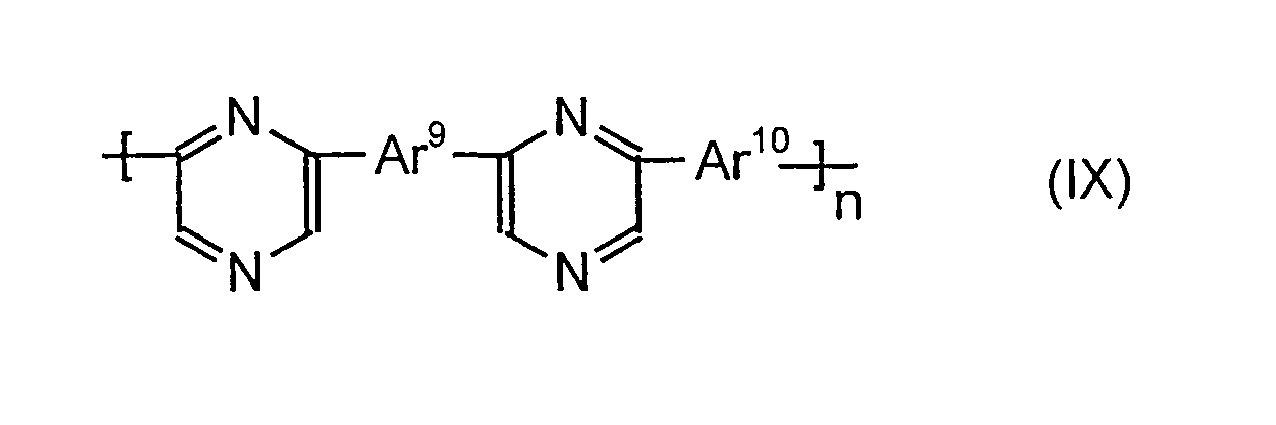


- Ar
- gleich oder verschieden sind und für eine vierbindige aromatische oder heteroaromatische Gruppe, die ein- oder mehrkernig sein kann,
- Ar1
- gleich oder verschieden sind und für eine zweibindige aromatische oder heteroaromatische Gruppe, die ein- oder mehrkernig sein kann,
- Ar2
- gleich oder verschieden sind und für eine zwei oder dreibindige aromatische oder heteroaromatische Gruppe, die ein- oder mehrkernig sein kann,
- Ar3
- gleich oder verschieden sind und für eine dreibindige aromatische oder heteroaromatische Gruppe, die ein- oder mehrkernig sein kann,
- Ar4
- gleich oder verschieden sind und für eine dreibindige aromatische oder heteroaromatische Gruppe, die ein- oder mehrkernig sein kann,
- Ar5
- gleich oder verschieden sind und für eine vierbindige aromatische oder heteroaromatische Gruppe, die ein- oder mehrkernig sein kann,
- Ar6
- gleich oder verschieden sind und für eine zweibindige aromatische oder heteroaromatische Gruppe, die ein- oder mehrkernig sein kann,
- Ar7
- gleich oder verschieden sind und für eine zweibindige aromatische oder heteroaromatische Gruppe, die ein- oder mehrkernig sein kann,
- Ar8
- gleich oder verschieden sind und für eine dreibindige aromatische oder heteroaromatische Gruppe, die ein- oder mehrkernig sein kann,
- Ar9
- gleich oder verschieden sind und für eine zwei- oder drei- oder vierbindige aromatische oder heteroaromatische Gruppe, die ein- oder mehrkernig sein kann,
- Ar10
- gleich oder verschieden sind und für eine zwei- oder dreibindige aromatische oder heteroaromatische Gruppe, die ein- oder mehrkernig sein kann,
- Ar11
- gleich oder verschieden sind und für eine zweibindige aromatische oder heteroaromatische Gruppe, die ein- oder mehrkernig sein kann,
- X
- gleich oder verschieden ist und für Sauerstoff, Schwefel oder eine Aminogruppe, die ein Wasserstoffatom, eine 1- 20 Kohlenstoffatome aufweisende Gruppe, vorzugsweise eine verzweigte oder nicht verzweigte Alkyl- oder Alkoxygruppe, oder eine Arylgruppe als weiteren Rest trägt
- R
- gleich oder verschieden für Wasserstoff, eine Alkylgruppe und eine aromatische Gruppe steht und
- n, m
- eine ganze Zahl größer gleich 10, bevorzugt größer gleich 100 ist.
- Erfindungsgemäß bevorzugte aromatische oder heteroaromatische Gruppen leiten sich von Benzol, Naphthalin, Biphenyl, Diphenylether, Diphenylmethan, Diphenyldimethylmethan, Bisphenon, Diphenylsulfon, Thiophen, Furan, Pyrrol, Thiazol, Oxazol, Imidazol, Isothiazol, Isoxazol, Pyrazol, 1,3,4-Oxadiazol, 2,5-Diphenyl-1,3,4-oxadiazol, 1,3,4-Thiadiazol, 1,3,4-Triazol, 2,5-Diphenyl-1,3,4-triazol, 1,2,5-Triphenyl-1,3,4-triazol, 1,2,4-Oxadiazol, 1,2,4-Thiadiazol, 1,2,4-Triazol, 1,2,3-Triazol, 1,2,3,4-Tetrazol, Benzo[b]thiophen, Benzo[b]furan, Indol, Benzo[c]thiophen, Benzo[c]furan, Isoindol, Benzoxazol, Benzothiazol, Benzimidazol, Benzisoxazol, Benzisothiazol, Benzopyrazol, Benzothiadiazol, Benzotriazol, Dibenzofuran, Dibenzothiophen, Carbazol, Pyridin, Bipyridin, Pyrazin, Pyrazol, Pyrimidin, Pyridazin, 1,3,5-Triazin, 1,2,4-Triazin, 1,2,4,5-Triazin, Tetrazin, Chinolin, Isochinolin, Chinoxalin, Chinazolin, Cinnolin, 1,8-Naphthyridin, 1,5-Naphthyridin, 1,6-Naphthyridin, 1,7-Naphthyridin, Phthalazin, Pyridopyrimidin, Purin, Pteridin oder Chinolizin, 4H-Chinolizin, Diphenylether, Anthracen, Benzopyrrol, Benzooxathiadiazol, Benzooxadiazol, Benzopyridin, Benzopyrazin, Benzopyrazidin, Benzopyrimidin, Benzotriazin, Indolizin, Pyridopyridin, Imidazopyrimidin, Pyrazinopyrimidin, Carbazol, Aciridin, Phenazin, Benzochinolin, Phenoxazin, Phenothiazin, Acridizin, Benzopteridin, Phenanthrolin und Phenanthren ab, die gegebenenfalls auch substituiert sein können.
- Dabei ist das Substitionsmuster von Ar1, Ar4, Ar6, Ar7, Ar8, Ar9, Ar10, Ar11 beliebig, im Falle vom Phenylen beispielsweise kann Ar1, Ar4, Ar6, Ar7, Ar8, Ar9, Ar10, Ar11 ortho-, meta- und para-Phenylen sein. Besonders bevorzugte Gruppen leiten sich von Benzol und Biphenylen, die gegebenenfalls auch substituiert sein können, ab.
- Bevorzugte Alkylgruppen sind kurzkettige Alkylgruppen mit 1 bis 4 Kohlenstoffatomen, wie z. B. Methyl-, Ethyl-, n- oder i-Propyl- und t-Butyl-Gruppen.
- Bevorzugte aromatische Gruppen sind Phenyl- oder Naphthyl-Gruppen. Die Alkylgruppen und die aromatischen Gruppen können substituiert sein.
- Bevorzugte Substituenten sind Halogenatome wie z. B. Fluor, Aminogruppen, Hydroxygruppen oder kurzkettige Alkylgruppen wie z. B. Methyl- oder Ethylgruppen.
- Bevorzugt sind Polyazole mit wiederkehrenden Einheiten der Formel (I) bei denen die Reste X innerhalb einer wiederkehrenden Einheit gleich sind.
- Die Polyazole können grundsätzlich auch unterschiedliche wiederkehrende Einheiten aufweisen, die sich beispielsweise in ihrem Rest X unterscheiden. Vorzugsweise jedoch weist es nur gleiche Reste X in einer wiederkehrenden Einheit auf.
- In einer weiteren Ausführungsform der vorliegenden Erfindung ist das Polymer enthaltend wiederkehrende Azoleinheiten ein Copolymer oder ein Blend, das mindestens zwei Einheiten der Formel (I) bis (XXII) enthält, die sich voneinander unterscheiden. Die Polymere können als Blockcopolymere (Diblock, Triblock), statistische Copolymere, periodische Copolymere und/oder alternierende Polymere vorliegen.
- Die Anzahl der wiederkehrende Azoleinheiten im Polymer ist vorzugsweise eine ganze Zahl größer gleich 10. Besonders bevorzugte Polymere enthalten mindestens 100 wiederkehrende Azoleinheiten.
- Im Rahmen der vorliegenden Erfindung sind Polymere enthaltend wiederkehrenden Benzimidazoleinheiten bevorzugt. Einige Beispiele der äußerst zweckmäßigen Polymere enthaltend wiederkehrende Benzimidazoleinheiten werden durch die nachfolgende Formeln wiedergegeben:


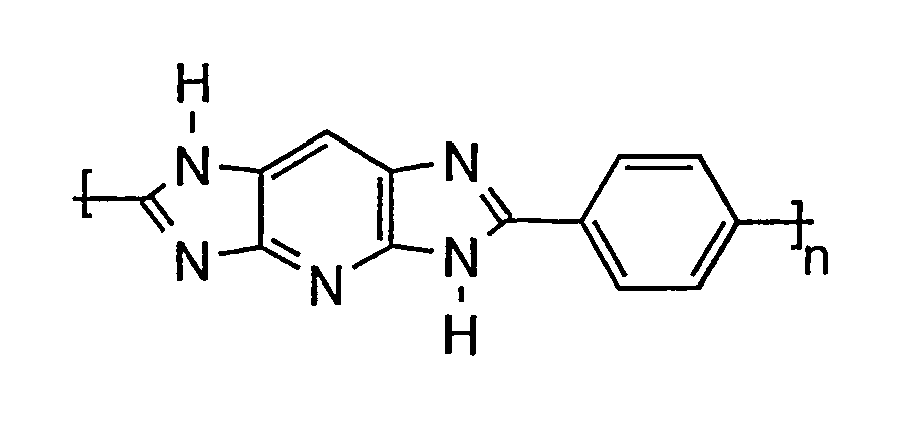


- Weitere bevorzugte Polyazol-Polymere sind Polyimidazole, Polybenzimidazoletherketon, Polybenzthiazole, Polybenzoxazole, Polytriazole, Polyoxadiazoie, Polythiadiazole, Polypyrazole, Polyquinoxalines, Poly(pyridine), Poly(pyrimidine), und Poly(tetrazapyrene).
- Besonders bevorzugt ist Celazole der Fa. Celanese, insbesondere ein solches bei dem das in der deutschen Patentanmeldung DE-A-10129458 beschriebene durch Sieben aufgearbeitete Polymer eingesetzt wird.
- Neben den vorstehend genannten Polymeren kann auch ein Blend das weitere Polymere enthält eingesetzt werden. Die Blendkomponente hat dabei im Wesentlichen die Aufgabe die mechanischen Eigenschaften zu verbessern und die Materialkosten zu verringern. Eine bevorzugte Blendkomponente ist dabei Polyethersulfon wie in der deutschen Patentanmeldung DE-A-10052242 beschrieben.
- Zusätzlich kann der Polymerfilm weitere Modifizierungen, beispielsweise durch Vernetzung wie in der deutschen Patentanmeldung DE-A-10110752 oder in WO 00/44816 aufweisen. In einer bevorzugten Ausführungsform enthält die eingesetzte Polymerfolie aus einem basischen Polymer und mindestens einer Blendkomponente zusätzlich einem Vernetzer wie in der deutschen Patentanmeldung DE-A-10140147 beschrieben.
- Zusätzlich ist es von Vorteil, wenn die eingesetzte Polymerfolie zuvor wie in der deutschen Patentanmeldung DE-A-10109829 beschrieben behandelt wird. Diese Variante ist vorteilhaft, um die Pfropfung der Polymerfolie zu erhöhen.
- Anstelle der mittels klassischer Verfahren hergestellten Polymerfolien können auch die polyazolhaltigen Polymermembranen, wie in den deutschen Patentanmeldungen DE-A-10117686, DE-A-10144815, DE-A-10117687 beschrieben, eingesetzt werden. Hierzu werden diese von der Polyphoshorsäure und/oder Phosphorsäure befreit und in Schritt A) eingesetzt.
- Die eingesetzten Polyazole, inbesondere jedoch die Polybenzimidazole zeichnen sich durch ein hohes Molekulargewicht aus. Gemessen als Intrinsische Viskosität beträgt diese mindestens 0,2 dl/g, vorzugsweise 0,8 bis 10 dl/g, insbesondere 1 bis 10 dl/g.
- Zu den bevorzugten Polymeren gehören Polysulfone, insbesondere Polysulfon mit aromatischen und/oder heteroaromatischen Gruppen in der Hauptkette. Gemäß einem besonderen Aspekt der vorliegenden Erfindung weisen bevorzugte Polysulfone und Polyethersulfone eine Schmelzvolumenrate MVR 300/21,6 kleiner oder gleich 40 cm3/ 10 min, insbesondere kleiner oder gleich 30 cm3/10 min und besonders bevorzugt kleiner oder gleich 20 cm3/ 10 min gemessen nach ISO 1133 auf. Hierbei sind Polysulfone mit einer Vicat-Erweichungstemperatur VST/A/50 von 180°C bis 230°C bevorzugt. In noch einer bevorzugten Ausführungsform der vorliegenden Erfindung ist das Zahlenmittel des Molekulargewichts von den Polysulfonen größer als 30.000 g/mol.
- Zu den Polymeren auf Basis von Polysulfon gehören insbesondere Polymere, welche wiederkehrende Einheiten mit verknüpfenden Sulfon-Gruppen entsprechend den allgemeinen Formeln A, B, C, D, E, F und/oder G aufweisen:
-O-R-SO2-R- (A)
-O-R-SO2-R-O-R- (B)
-O-R-SO2-R-O-R-R- (C)
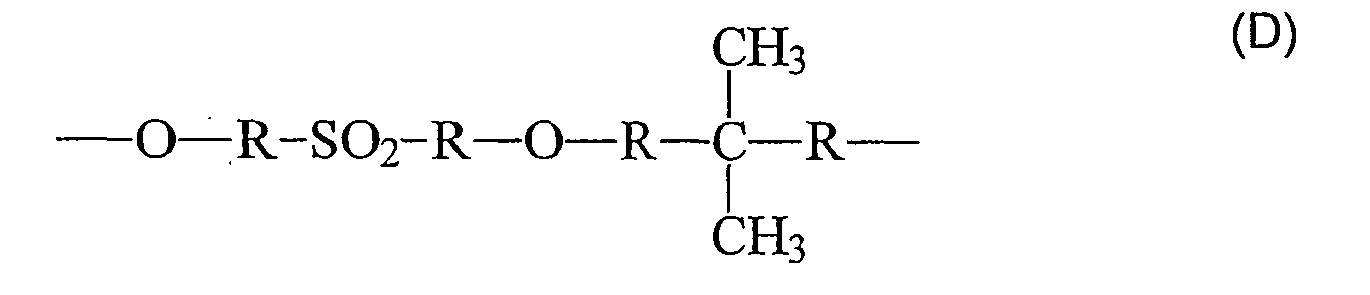
-O-R-SO2-R-R-SO2-R- (E)
-O-R-SO2-R-R-SO2R-O-R-SO2-] (F)

- Zu den im Rahmen der vorliegenden Erfindung bevorzugten Polysulfone gehören Homo- und Copolymere, beispielsweise statistische Copolymere. Besonders bevorzugte Polysulfone umfassen wiederkehrende Einheiten der Formeln H bis N:


- Die zuvor beschriebenen Polysulfone können unter den Handelsnamen ®Victrex 200 P, ®Victrex 720 P, ®Ultrason E, ®Ultrason S, ®Mindel, ®Radel A, ®Radel R, ®Victrex HTA, ®Astrel und ®Udel kommerziell erhalten werden.
- Darüber hinaus sind Polyetherketone, Polyetherketonketone, Polyetheretherketone, Polyetheretherketonketone und Polyarylketone besonders bevorzugt. Diese Hochleistungspolymere sind an sich bekannt und können unter den Handelsnamen Victrex® PEEK™, ®Hostatec, ®Kadel kommerziell erhalten werden.
- Die vorstehend genannten Polymeren können einzeln oder als Mischung (Blend) eingesetzt werden. Hierbei sind insbesondere Blends bevorzugt, die Polyazole und/oder Polysulfone enthalten. Durch die Verwendung von Blends können die mechanischen Eigenschaften verbessert und die Materialkosten verringert werden.
- Zur Erzeugung der Radikale wird die Folie in Schritt A) ein oder mehrmals mit einer oder verschiedenen Strahlungen behandelt bis eine ausreichende Konzentration an Radikalen erhalten wird. Als Strahlungen werden beispielsweise elektromagnetische Strahlung, insbesondere γ-Strahlung und/oder Elektronenstrahlen, beispielsweise β-Strahlung eingesetzt. Eine ausreichend hohe Konzentration an Radikalen wird durch eine Strahlungsdosis von 1 bis 500 kGy, bevorzugt von 3 bis 300 kGy und ganz besonders bevorzugt von 5 bis 200 kGy erreicht. Besonders bevorzugt erfolgt die Bestrahlung mit Elektronen im vorstehend angegebenen Bereich. Die Bestrahlung kann an Luft oder Inertgas erfolgen.
Nach der Bestrahlung können die Proben bei Temperaturen unterhalb -50°C über Wochen gelagert werden, ohne dass die Radikalaktivität nennenswert verloren geht. - Vinylhaltige Phosphonsäuren sind in der Fachwelt bekannt. Es handelt sich hierbei um Verbindungen, die mindestens eine Kohlenstoff-Kohlenstoff-Doppelbindung und mindestens eine Phosphonsäuregruppe aufweisen. Vorzugsweise weisen die zwei Kohlenstoffatome, die Kohlenstoff-Kohlenstoff-Doppelbindung bilden, mindestens zwei, vorzugsweise 3 Bindungen zu Gruppen auf, die zu einer geringen sterischen Hinderung der Doppelbindung führen. Zu diesen Gruppen gehören unter anderem Wasserstoffatome und Halogenatome, insbesondere Fluoratome. Im Rahmen der vorliegenden Erfindung ergibt sich die Polyvinylphosphonsäure aus dem Polymerisationsprodukt, das durch Polymerisation der Vinylhaltigen Phosphonsäure allein oder mit weiteren Monomeren und/oder Vernetzern erhalten wird.
- Die Vinylhaltige Phosphonsäure kann ein, zwei, drei oder mehr Kohlenstoff-Kohlenstoff-Doppelbindungen umfassen. Des weiteren kann die Vinylhaltige Phosphonsäure ein, zwei, drei oder mehr Phosphonsäuregruppen enthalten.
- Im allgemeinen enthält die Vinylhaltige Phosphonsäure 2 bis 20, vorzugsweise 2 bis 10 Kohlenstoffatome.
- Bei der in Schritt B) verwendeten vinylhaltigen Phosphonsäure handelt es sich vorzugsweise um Verbindungen der Formel

- R
- eine Bindung, eine C1-C15-Alkylgruppe, C1-C15-Alkoxygruppe, Ethylenoxygruppe oder C5-C20-Aryl oder Heteroarylgruppe bedeutet, wobei die vorstehenden Reste ihrerseits mit Halogen, -OH, COOZ, -CN, NZ2 substituiert sein können,
- Z
- unabhängig voneinander Wasserstoff, C1-C15-Alkylgruppe, C1-C15-Alkoxygruppe, Ethylenoxygruppe oder C5-C20-Aryl oder Heteroarylgruppe bedeutet, wobei die vorstehenden Reste ihrerseits mit Halogen, -OH, -CN, substituiert sein können und
- x
- eine ganze Zahl 1, 2, 3, 4, 5, 6, 7, 8, 9 oder 10 bedeutet
- y
- eine ganze Zahl 1, 2, 3, 4, 5, 6, 7, 8, 9 oder 10 bedeutet
- R
- eine Bindung, eine C1-C15-Alkylgruppe, C1-C15-Alkoxygruppe, Ethylenoxygruppe oder C5-C20-Aryl oder Heteroarylgruppe bedeutet, wobei die vorstehenden Reste ihrerseits mit Halogen, -OH, COOZ, -CN, NZ2 substituiert sein können,
- Z
- unabhängig voneinander Wasserstoff, C1-C15-Alkylgruppe, C1-C15-Alkoxygruppe, Ethylenoxygruppe oder C5-C20-Aryl oder Heteroarylgruppe bedeutet, wobei die vorstehenden Reste ihrerseits mit Halogen, -OH, -CN, substituiert sein können und
- x
- eine ganze Zahl 1, 2, 3, 4, 5, 6, 7, 8, 9 oder 10 bedeutet
- A
- eine Gruppe der Formeln COOR2, CN, CONR2 2, OR2 und/oder R2 darstellt,
worin R2 Wasserstoff, eine C1-C15-Alkylgruppe, C1-C15-Alkoxygruppe, Ethylenoxygruppe oder C5-C20-Aryl oder Heteroarylgruppe bedeutet, wobei die vorstehenden Reste ihrerseits mit Halogen, -OH, COOZ, -CN, NZ2 substituiert sein können - R
- eine Bindung, eine zweibindige C1-C15-Alkylengruppe, zweibindige C1-C15-Alkylenoxygruppe, beispielsweise Ethylenoxygruppe oder zweibindige C5-C20-Aryl- oder Heteroarylgruppe bedeutet, wobei die vorstehenden Reste ihrerseits mit Halogen, -OH, COOZ, -CN, NZ2 substituiert sein können,
- Z
- unabhängig voneinander Wasserstoff, C1-C15-Alkylgruppe, C1-C15-Alkoxygruppe, Ethylenoxygruppe oder C5-C20-Aryl oder Heteroarylgruppe bedeutet, wobei die vorstehenden Reste ihrerseits mit Halogen, -OH, -CN, substituiert sein können und
- x
- eine ganze Zahl 1, 2, 3, 4, 5, 6, 7, 8, 9 oder 10 bedeutet.
- Zu den bevorzugten Vinylhaltigen Phosphonsäuren gehören unter anderem Alkene, die Phosphonsäuregruppen aufweisen, wie Ethenphosphonsäure, Propenphosphonsäure, Butenphosphonsäure; Acrylsäure- und/oder Methacrylsäure-Verbindungen, die Phosphonsäuregruppen aufweisen, wie beispielsweise 2-Phosphonomethyl-acrylsäure, 2-Phosphonomethyl-methacrylsäure, 2-Phosphonomethyl-acrylsäureamid und 2-Phosphonomethyl-methacrylsäureamid.
- Besonders bevorzugt wird handelsübliche Vinylphosphonsäure (Ethenphosphonsäure), wie diese beispielsweise von der Firma Aldrich oder Clariant GmbH erhältlich ist, eingesetzt. Eine bevorzugte Vinylphosphonsäure weist eine Reinheit von mehr als 70%, insbesondere 90 % und besonders bevorzugt mehr als 97% Reinheit auf.
- Die Vinylhaltigen Phosphonsäuren können des weiteren auch in Form von Derivaten eingesetzt werden, die anschließend in die Säure überführt werden können, wobei die Überführung zur Säure auch in polymerisiertem Zustand erfolgen kann. Zu diesen Derivaten gehören insbesondere die Salze, die Ester, die Amide und die Halogenide der Vinylhaltigen Phosphonsäuren.
- Vinylhaltige Sulfonsäuren sind in der Fachwelt bekannt. Es handelt sich hierbei um Verbindungen, die mindestens eine Kohlenstoff-Kohlenstoff-Doppelbindung und mindestens eine Sulfonsäuregruppe aufweisen. Vorzugsweise weisen die zwei Kohlenstoffatome, die Kohlenstoff-Kohlenstoff-Doppelbindung bilden, mindestens zwei, vorzugsweise 3 Bindungen zu Gruppen auf, die zu einer geringen sterischen Hinderung der Doppelbindung führen. Zu diesen Gruppen gehören unter anderem Wasserstoffatome und Halogenatome, insbesondere Fluoratome. Im Rahmen der vorliegenden Erfindung ergibt sich die Polyvinylsulfonsäure aus dem Polymerisationsprodukt, das durch Polymerisation der Vinylhaltigen Sulfonsäure allein oder mit weiteren Monomeren und/oder Vernetzern erhalten wird.
- Die Vinylhaltige Sulfonsäure kann ein, zwei, drei oder mehr Kohlenstoff-KohlenstoffDoppelbindungen umfassen. Des weiteren kann die Vinylhaltige Sulfonsäure ein, zwei, drei oder mehr Sulfonsäuregruppen enthalten.
- Im allgemeinen enthält die Vinylhaltige Sulfonsäure 2 bis 20, vorzugsweise 2 bis 10 Kohlenstoffatome.
- Bei der in Schritt B) verwendeten vinylhaltigen Sulfonsäure handelt es sich vorzugsweise Verbindungen der Formel

- R
- eine Bindung, eine C1-C15-Alkylgruppe, C1-C15-Alkoxygruppe, Ethylenoxygruppe oder C5-C20-Aryl oder Heteroarylgruppe bedeutet, wobei die vorstehenden Reste ihrerseits mit Halogen, -OH, COOZ, -CN, NZ2 substituiert sein können,
- Z
- unabhängig voneinander Wasserstoff, C1-C15-Alkylgruppe, C1-C15-Alkoxygruppe, Ethylenoxygruppe oder C5-C20-Aryl oder Heteroarylgruppe bedeutet, wobei die vorstehenden Reste ihrerseits mit Halogen, -OH, -CN, substituiert sein können und
- x
- eine ganze Zahl 1, 2, 3, 4, 5, 6, 7, 8, 9 oder 10 bedeutet
- y
- eine ganze Zahl 1, 2, 3, 4, 5, 6, 7, 8, 9 oder 10 bedeutet
- R
- eine Bindung, eine C1-C15-Alkylgruppe, C1-C15-Alkoxygruppe, Ethylenoxygruppe oder C5-C20-Aryl oder Heteroarylgruppe bedeutet, wobei die vorstehenden Reste ihrerseits mit Halogen, -OH, COOZ, -CN, NZ2 substituiert sein können,
- Z
- unabhängig voneinander Wasserstoff, C1-C15-Alkylgruppe, C1-C15-Alkoxygruppe, Ethylenoxygruppe oder C5-C20-Aryl oder Heteroarylgruppe bedeutet, wobei die vorstehenden Reste ihrerseits mit Halogen, -OH, -CN, substituiert sein können und
- x
- eine ganze Zahl 1, 2, 3, 4, 5, 6, 7, 8, 9 oder 10 bedeutet
- A
- eine Gruppe der Formeln COOR2, CN, CONR2 2, OR2 und/oder R2 darstellt,
worin R2 Wasserstoff, eine C1-C15-Alkylgruppe, C1-C15-Alkoxygruppe, Ethylenoxygruppe oder C5-C20-Aryl oder Heteroarylgruppe bedeutet, wobei die vorstehenden Reste ihrerseits mit Halogen, -OH, COOZ, -CN, NZ2 substituiert sein können - R
- eine Bindung, eine zweibindige C1-C15-Alkylengruppe, zweibindige C1-C15-Alkylenoxygruppe, beispielsweise Ethylenoxygruppe oder zweibindige C5-C20-Aryl- oder Heteroarylgruppe bedeutet, wobei die vorstehenden Reste ihrerseits mit Halogen, -OH, COOZ, -CN, NZ2 substituiert sein können,
- Z
- unabhängig voneinander Wasserstoff, C1-C15-Alkylgruppe, C1-C15-Alkoxygruppe, Ethylenoxygruppe oder C5-C20-Aryl oder Heteroarylgruppe bedeutet, wobei die vorstehenden Reste ihrerseits mit Halogen, -OH, -CN, substituiert sein können und
- x
- eine ganze Zahl 1, 2, 3, 4, 5, 6, 7, 8, 9 oder 10 bedeutet.
- Zu den bevorzugten Vinylhaltigen Sulfonsäuren gehören unter anderem Alkene, die Sulfonsäuregruppen aufweisen, wie Ethensulfonsäure, Propensulfonsäure, Butensulfonsäure; Acrylsäure- und/oder Methacrylsäure-Verbindungen, die Sulfonsäuregruppen aufweisen, wie beispielsweise 2-Sulfomethyl-acrylsäure, 2-Sulfomethyl-methacrylsäure, 2-Sulfomethyl-acrylsäureamid und 2-Sulfomethylmethacrylsäureamid.
- Besonders bevorzugt wird handelsübliche Vinylsulfonsäure (Ethensulfonsäure), wie diese beispielsweise von der Firma Aldrich oder Clariant GmbH erhältlich ist, eingesetzt. Eine bevorzugte Vinylsulfonsäure weist eine Reinheit von mehr als 70%, insbesondere 90 % und besonders bevorzugt mehr als 97% Reinheit auf.
- Die Vinylhaltigen Sulfonsäuren können des weiteren auch in Form von Derivaten eingesetzt werden, die anschließend in die Säure überführt werden können, wobei die Überführung zur Säure auch in polymerisiertem Zustand erfolgen kann. Zu diesen Derivaten gehören insbesondere die Salze, die Ester, die Amide und die Halogenide der Vinylhaltigen Sulfonsäuren.
- Die in Schritt B) und Schritt C) verwendete Mischung enthält entweder Vinylhaltige Phosphonsäure-Monomere oder Vinylhaltige Sulfonsäure-Monomere und vinylhaltige Phosphonsäure Monomere. Das Mischungsverhältnis Vinylhaltige Sulfonsäure-Monomere zu Vinylhaltigen Phosphonsäure-Monomeren beträgt vorzugsweise zwischen 1:99 und 99:1, vorzugsweise 1:50 und 50:1, insbesondere 1:25 und 25:1.
- Der Gehalt an Vinylsulfonsäure Monomeren in Zusammensetzungen, die zum Pfropfen eingesetzt werden, beträgt bevorzugt mindestens 1 Gew.-%, vorzugsweise mindestens 5 Gew.-%, besonders bevorzugt zwischen 10 und 97 Gew.-%.
- Der Gehalt an Vinylphosphonsäure Monomeren in Zusammensetzungen, die zum Pfropfen eingesetzt werden, beträgt bevorzugt mindestens 3 Gew.-%, vorzugsweise mindestens 5 Gew.-%, besonders bevorzugt zwischen 10 und 99 Gew.-%.
- Die Vinylhaltige Phosphonsäure umfassende Flüssigkeit kann eine Lösung darstellen, wobei die Flüssigkeit auch suspendierte und/oder dispergierte Bestandteile enthalten kann. Die Viskosität der Vinylhaltige Phosphonsäure umfassenden Flüssigkeit kann in weiten Bereichen liegen, wobei zur Einstellung der Viskosität eine Zugabe von Lösungsmitteln oder eine Temperaturerhöhung erfolgen kann. Vorzugsweise liegt die dynamische Viskosität im Bereich von 0,1 bis 10000 mPa*s, insbesondere 0,2 bis 2000 mPa*s, wobei diese Werte beispielsweise gemäß DIN 53015 gemessen werden können.
- Die vinylhaltige Phosphonsäure-Zusammensetzung, die zum Pfropfen eingesetzt wird, kann zusätzlich Lösungsmittel enthalten, wobei jedes organische oder anorganische Lösungsmittel eingesetzt werden kann. Zu den organischen Lösungsmitteln gehören insbesondere polar aprotische Lösungsmittel, wie Dimethylsulfoxid (DMSO), Ester, wie Ethylacetat, und polar protische Lösungsmittel, wie Alkohole, wie Ethanol, Propanol, Isopropanol und/oder Butanol. Zu den anorganischen Lösungsmittel zählen insbesondere Wasser, Phosphorsäure und Polyphosphorsäure. Diese können die Verarbeitbarkeit positiv beeinflussen. Insbesondere kann durch Zugabe des organischen Lösungsmittels die Einarbeitung des vinylhaltigen Monomeren in die Polymerfolie verbessert werden.
- In einer weiteren Ausführungsform der Erfindung enthalten die Vinylhaltigen Phosphonsäure/Sulfonsäure Monomeren weitere zur Vernetzung befähigte Monomere. Bei diesen handelt es sich insbesondere um Verbindungen, die mindestens 2 Kohlenstoff-Kohlenstoff Doppelbindungen aufweisen. Bevorzugt werden Diene, Triene, Tetraene, Dimethylacrylate, Trimethylacrylate, Tetramethylacrylate, Diacrylate, Triacrylate, Tetraacrylate.
- Besonders bevorzugt sind Diene, Triene, Tetraene der Formel

- Dimethylacrylate, Trimethylycrylate, Tetramethylacrylate der Formel
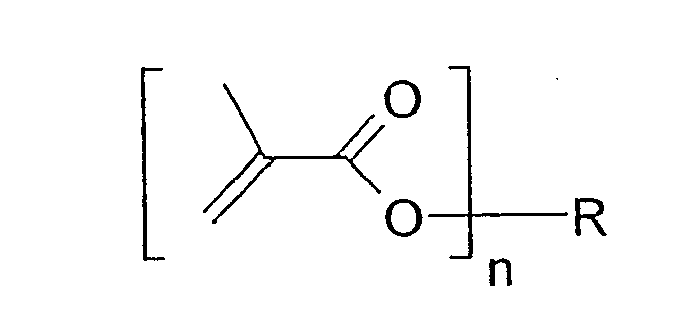
- Diacrylate, Triacrylate, Tetraacrylate der Formel

- R
- eine C1-C15-Alkylgruppe, C5-C20-Aryl oder Heteroarylgruppe, NR', -SO2, PR', Si(R')2 bedeutet, wobei die vorstehenden Reste ihrerseits substituiert sein können,
- R'
- unabhängig voneinander Wasserstoff, eine C1-C15-Alkylgruppe, C1-C15-Alkoxygruppe, C5-C20-Aryl oder Heteroarylgruppe bedeutet und
- n
- mindestens 2 ist.
- Bei den Substituenten des vorstehenden Restes R handelt es sich vorzugsweise um Halogen, Hydroxyl, Carboxy, Carboxyl, Carboxylester, Nitrile, Amine, Silyl, Siloxan Reste.
- Besonders bevorzugte Vernetzer sind Allylmethacrylat, Ethylenglykoldimethacrylat, Diethylenglykoldimethacrylat, Triethylenglykoldimethacrylat, Tetra- und Polyethylenglykoldimethacrylat, 1,3-Butandioldimethacrylat, Glycerindimethacrylat, Diurethandimethacrylat, Trimethylpropantrimethacrylat, N', N-Methylenbisacrylamid, Carbinol, Butadien, Isopren, Chloropren, Divinylbenzol und/oder Bisphenol-A-dimethylacrylat.
- Die Vernetzer werden zwischen 0,5 bis 30 Gew.-% bezogen auf die Vinylhaltige Phosphonsäure bzw. Vinylhaltige Sulfonsäure bzw. deren Gemisch eingesetzt.
- Das Aufbringen der Vinylphosphon-/Vinylsulfonsäurehaltigen Monomer-Flüssigkeit kann mittels an sich bekannter Maßnahmen (z.B. Sprühen, Tauchen etc.) die aus dem Stand der Technik bekannt sind, erfolgen.
- Die Polymerisation der Vinylhaltigen Phosphon-/Sulfonsäure Monomeren in Schritt B) erfolgt bei Temperaturen oberhalb Raumtemperatur (20°C) und kleiner 200°C, vorzugsweise bei Temperaturen zwischen 40°C und 150°C, insbesondere zwischen 50°C und 120°C. Die Polymerisation erfolgt vorzugsweise unter Normaldruck, kann aber auch unter Einwirkung von Druck erfolgen. Die Polymerisation erfolgt vorzugsweise unter Intergas wie Stickstoff. Die Polymerisation führt zu einer Zunahme des Volumens und des Gewichtes. Der Pfropfgrad, charakterisiert durch die Gewichtszunahme während des Pfropfens beträgt mindestens 10%, vorzugsweise grösser 20% und ganz besonders bevorzugt grösser 50%.
Der Pfropfgrad wird aus der Masse des trockenen Filmes vor dem Pfropfen, m0, und der Masse des getrockneten Filmes nach dem Pfropfen und Waschen (gemäß Schritt D), m1, berechnet gemäss
- Nach einmaligem Durchlaufen der Schritte A), B) und C) können diese in der beschriebenen Abfolge mehrmals wiederholt werden. Die Anzahl der Wiederholungen richtet sich nach dem gewünschten Pfropfgrad.
- Die in Schritt C) erhaltene Membran enthält zwischen 0,5 und 94 Gew.-% des organischen Polymeren sowie zwischen 99,5 und 6 Gew.-% Polyvinylphosphonsäure oder Polyvinylsulfonsäure und Polyvinylphosphonsäure. Bevorzugt enthält die in Schritt C) erhaltene Membran zwischen 3 und 90 Gew.-% des organischen Polymeren sowie zwischen 97 und 10 Gew.-% Polyvinylphosphonsäure oder Polyvinylsulfosäure und Polyvinylphosphonsäure.
- In einem weiteren Schritt D) kann die erfindungsgemäß hergestellte gepfropfte Membran durch Waschen mit Wasser oder Alkoholen wie Methanol, 1-Propanol, Isopropanol oder Butanol bzw. Mischungen von nicht umgesetzten Bestandteilen befreit. Das Waschen findet bei Temperaturen von Raumtemperatur (20°C) bis 100°C, insbesondere bei Raumtemperatur bis 80°C und ganz besonders bevorzugt bei Raumtemperatur bis 60°C statt.
- Gemäß einer besonderen Ausführungsform der vorliegenden Erfindung umfasst die Membran mindestens 3 Gew.-%, vorzugsweise mindestens 5 Gew.-% und besonders bevorzugt mindestens 7 Gew.-% Phosphor (als Element), bezogen auf das Gesamtgewicht der Membran. Der Anteil an Phosphor kann über eine Elementaranalyse bestimmt werden. Hierzu wird die Membran bei 110°C für 3 Stunden im Vakuum (1 mbar) getrocknet. Besonders bevorzugt wird dieser Anteil nach dem optionalen Schritt D) bestimmt.
- Im Anschluß an Schritt C) oder an die Behandlung gemäß Schritt D) kann die Membran durch Einwirken von Hitze in Gegenwart von Luftsauerstoff an der Oberfläche noch vernetzt werden. Diese Härtung der Membranoberfläche verbessert die Eigenschaften der Membran zusätzlich.
Die Vernetzung kann auch durch Einwirken von IR bzw. NIR (IR = InfraRot, d. h. Licht mit einer Wellenlänge von mehr als 700 nm; NIR = Nahes IR, d. h. Licht mit einer Wellenlänge im Bereich von ca. 700 bis 2000 nm bzw. einer Energie im Bereich von ca. 0.6 bis 1.75 eV) erfolgen. Eine weitere Methode ist die Bestrahlung mit β-Strahlen. Die Strahlungsdosis beträgt hierbei zwischen 5 und 200 kGy. - Zusätzlich kann die erfindungsgemäße Polymermembran noch weitere Füll- und/oder Hilfsstoffe enthalten.
- Zur weiteren Verbesserung der anwendungstechnischen Eigenschaften können der Membran zusätzlich noch Füllstoffe, insbesondere protonenleitende Füllstoffe, sowie zusätzliche Säuren zugesetzt werden. Die Zugabe kann entweder bei Schritt A erfolgen oder nach der Polymerisation.
- Nicht limitierende Beispiele für Protonenleitende Füllstoffe sind
Sulfate wie: CsHSO4, Fe(SO4)2, (NH4)3H(SO4)2, LiHSO4, NaHSO4, KHSO4, RbSO4, LiN2H5SO4, NH4HSO4, Phosphate wie Zr3(PO4)4, Zr(HPO4)2, HZr2(PO4)3, UO2PO4.3H2O, H8UO2PO4, Ce(HPO4)2, Ti(HPO4)2, KH2PO4, NaH2PO4, LiH2PO4, NH4H2PO4, CsH2PO4, CaHPO4, MgHPO4, HSbP2O8, HSb3P2O14, H5Sb5P2O20, Polysäure wie H3PW12O40.nH2O (n=21-29), H3SiW12O40.nH2O (n=21-29), HxWO3, HSbWO6, H3PMo12O40, H2Sb4O11, HTaWO6, HNbO3, HTiNbO5, HTiTaO5, HSbTeO6, H5Ti4O9, HSbO3, H2MoO4 Selenide und Arsenide wie (NH4)3H(SeO4)2, UO2AsO4, (NH4)3H(SeO4)2, KH2AsO4, Cs3H(SeO4)2, Rb3H(SeO4)2, Oxide wie Al2O3, Sb2O5, ThO2, SnO2, ZrO2, MoO3 Silikate wie Zeolithe, Zeolithe(NH4+), Schichtsilikate, Gerüstsilikate, H-Natrolite, H-Mordenite, NH4-Analcine, NH4-Sodalite, NH4-Gallate, H-Montmorillonite Säuren wie HClO4, SbF5 Füllstoffe wie Carbide, insbesondere SiC, Si3N4, Fasern, insbesondere Glasfasern, Glaspulvern und/oder Polymerfasern, bevorzugt auf Basis von Polyazolen. - Diese Additive können in der protonenleitenden Polymermembran in üblichen Mengen enthalten sein, wobei jedoch die positiven Eigenschaften, wie hohe Leitfähigkeit, hohe Lebensdauer und hohe mechanische Stabilität der Membran durch Zugabe von zu großen Mengen an Additiven nicht allzu stark beeinträchtigt werden sollten. Im allgemeinen umfaßt die Membran nach der Polymerisation gemäß Schritt C) höchstens 80 Gew.-%, vorzugsweise höchstens 50 Gew.-% und besonders bevorzugt höchstens 20 Gew.-% Additive.
- Als weiteres kann diese Membran auch perfluorierte Sulfonsäure Additive (0,1-20 wt%, bevorzugt 0,2-15 wt%, ganz bevorzugt 0,2- 10 wt%) enthalten. Diese Additive führen zur Leistungsverbesserung, in der Nähe der Kathode zur Erhöhung der Sauerstofflöslichkeit und Sauerstoffdiffusion und zur Verringerung der Adsorbtion von Phosphorsäure und Phosphat zu Platin. (Electrolyte additives for phosphoric acid fuel cells. Gang, Xiao; Hjuler, H. A.; Olsen, C.; Berg, R. W.; Bjerrum, N. J.. Chem. Dep. A, Tech. Univ. Denmark, Lyngby, Den. J. Electrochem. Soc. (1993), 140(4), 896-902 und Perfluorosulfonimide as an additive in phosphoric acid fuel cell. Razaq, M.; Razaq, A.; Yeager, E.; DesMarteau, Darryl D.; Singh, S. Case Cent. Electrochem. Sci., Case West. Reserve Univ., Cleveland, OH, USA. J. Electrochem. Soc. (1989), 136(2), 385-90.)
- Nicht limitierende Beispiele für persulfonierte Additive sind: Trifluomethansulfonsäure, Kaliumtrifluormethansulfonat, Natriumtrifluormethansulfonat, Lithiumtrifluormethansulfonat, Ammoniumtrifluormethansulfonat, Kaliumperfluorohexansulfonat, Natriumperfluorohexansulfonat, Lithiumperfluorohexansulfonat, Ammoniumperfluorohexansulfonat, Perfluorohexansulfonsäure, Kaliumnonafluorbutansulfonat, Natriumnonafluorbutansulfonat, Lithiumnonafluorbutansulfonat, Ammoniumnonafluorbutansulfonat, Cäsiumnonafluorbutansulfonat, Triethylammoniumperfluorohexasulfonat, Perflurosulfoimide und Nafion.
- Als weiteres kann die Membran auch als Additive enthalten, die die im Betrieb bei der Sauerstoffreduktion erzeugten Peroxidradikale abfangen (primäre Anitoxidanzien) oder zerstören (sekundäre Antioxidanzien) und dadurch wie in JP2001118591 A2 beschrieben Lebensdauer und Stabilität der Membran und Membranelektrodeneinheit verbessern. Die Funktionsweise und molekularen Strukturen solcher Additive sind in F. Gugumus in Plastics Additives, Hanser Verlag, 1990; N.S. Allen, M. Edge Fundamentals of Polymer Degradation and Stability, Elsevier, 1992; oder H. Zweifel, Stabilization of Polymeric Materials, Springer, 1998 beschrieben.
Nicht limitierende Beispiele für solche Additive sind:
Bis(trifluormethyl)nitroxid, 2,2-Diphenyl-1-pikrinylhydrazyl, Phenole, Alkylphenole, sterisch gehinderte Alkylphenole wie zum Beispiel Irganox, insbesondere Irganox 1135 (Ciba Geigy), aromatische Amine, sterisch gehinderte Amine wie zum Beispiel Chimassorb; sterisch gehinderte Hydroxylamine, sterisch gehinderte Alkylamine, sterisch gehinderte Hydroxylamine, sterisch gehinderte Hydroxylaminether, Phosphite wie zum Beispiel Irgafos, Nitrosobenzol, Methyl.2-nitroso-propan, Benzophenon, Benzaldehyd-tert.-butylnitron, Cysteamin, Melanine, Bleioxide, Manganoxide, Nickeloxide und Cobaltoxide. - Die erfindungsgemäße Polymermembran weist verbesserte Materialeigenschaften gegenüber den bisher bekannten mit Säure dotierten Polymermembranen auf. Insbesondere zeigen sie im Vergleich mit bekannten undotierten Polymermembranen bereits eine intrinsische Leitfähigkeit bei Temperaturen oberhalb 100°C und ohne Befeuchtung. Diese begründet sich insbesondere durch eine kovalent an das Polymergerüst gebundene polymere Polyvinylphosphonsäure und Polyvinylsulfonsäure.
- Die Eigenleitfähigkeit der erfindungsgemäßen Membran beträgt bei Temperaturen von 80°C, gegebenenfalls mit Befeuchtung, im allgemeinen mindestens 0,1 mS/cm, bevorzugt mindestens 1 mS/cm, insbesondere mindestens 2 mS/cm und besonders bevorzugt mindestens 5 mS/cm.
- Bei einem Gewichtsanteil an Polyvinylphosphonsäure größer als 10%, bezogen auf das Gesamtgewicht der Membran, zeigen die Membranen im allgemeinen eine Leitfähigkeit bei Temperaturen von 160°C von mindestens 1 mS/cm, bevorzugt mindestens 3 mS/cm, insbesondere mindestens 5 mS/cm und besonders bevorzugt mindestens 10 mS/cm. Diese Werte werden hierbei ohne Befeuchtung erzielt.
- Die spezifische Leitfähigkeit wird mittels Impedanzspektroskopie in einer 4-Pol-Anordnung im potentiostatischen Modus und unter Verwendung von Platinelektroden (Draht, 0,25 mm Durchmesser) gemessen. Der Abstand zwischen den stromabnehmenden Elektroden beträgt 2 cm. Das erhaltene Spektrum wird mit einem einfachen Modell bestehend aus einer parallelen Anordnung eines ohm'schen Widerstandes und eines Kapazitators ausgewertet. Der Probenquerschnitt der phosphorsäuredotierten Membran wird unmittelbar vor der Probenmontage gemessen. Zur Messung der Temperaturabhängigkeit wird die Messzelle in einem Ofen auf die gewünschte Temperatur gebracht und über eine in unmittelbarer Probennähe positioniertes Pt-1 00 Thermoelement geregelt. Nach Erreichen der Temperatur wird die Probe vor dem Start der Messung 10 Minuten auf dieser Temperatur gehalten.
- Die Durchtritts-Stromdichte beträgt bei Betrieb mit 0,5 M Methanollösung und 90°C in einer so genannten flüssigen Direktmethanolbrennstoffzelle vorzugsweise weniger als 100 mA/cm2, insbesondere weniger als 70 mA/cm2 besonders bevorzugt weniger als 50 mA/cm2 und ganz besonders bevorzugt weniger als 10 mA/cm2. Die Durchtritts-Stromdichte beträgt bei Betrieb mit einer 2 M Methanollösung und 160°C in einer so genannten gasförmigen Direktmethanolbrennstoffzelle vorzugsweise weniger als 100 mA/cm2, insbesondere weniger als 50 mA/cm2 ganz besonders bevorzugt weniger als 10 mA/cm2.
- Zur Bestimmung der Durchtritts-Stromdichte (cross over current density) wird die Kohlendioxidmenge, die an der Kathode freigesetzt wird, mittels eines CO2-Sensors gemessen. Aus dem so erhaltenen Wert der CO2-Menge wird, wie von P. Zelenay, S.C. Thomas, S. Gottesfeld in S. Gottesfeld, T.F. Fuller "Proton Conducting Membrane Fuel Cells II" ECS Proc. Vol. 98-27 S. 300-308 beschrieben, die Durchtritts-Stromdichte berechnet.
- Zu möglichen Einsatzgebieten der erfindungsgemäßen Polymermembranen gehören unter anderem die Verwendung in Brennstoffzellen, bei der Elektrolyse, in Kondensatoren und in Batteriesystemen. Aufgrund ihres Eigenschaftsprofils werden die Polymermembranen vorzugsweise in Brennstoffzellen, ganz besonders bevorzugt in Direkt-Methanol Brennstoffzellen, verwendet.
- Die vorliegende Erfindung betrifft auch eine Membran-Elektroden-Einheit, die mindestens eine erfindungsgemäße Polymermembran aufweist. Die Membran-Elektroden-Einheit weist eine hohe Leistungsfähigkeit auch bei einem geringen Gehalt an katalytisch aktiven Substanzen, wie beispielsweise Platin, Ruthenium oder Palladium, auf. Hierzu können mit einer katalytisch aktiven Schicht versehene Gasdiffusionslagen eingesetzt werden.
- Die Gasdiffusionslage zeigt im allgemeinen eine Elektronenleitfähigkeit. Üblich werden hierfür flächige, elektrisch leitende und säureresistente Gebilde eingesetzt. Zu diesen gehören beispielsweise Kohlefaser-Papiere, graphitisierte Kohlefaser-Papiere, Kohlefasergewebe, graphitisierte Kohlefasergewebe und/oder flächige Gebilde, die durch Zugabe von Ruß leitfähig gemacht wurden.
- Die katalytisch aktive Schicht enthält eine katalytisch aktive Substanz. Zu diesen gehören unter anderem Edelmetalle, insbesondere Platin, Palladium, Rhodium, Iridium und/oder Ruthenium. Diese Substanzen können auch in Form von Legierungen unter einander eingesetzt werden. Des weiteren können diese Substanzen auch in Legierung mit unedlen Metallen, wie beispielsweise Cr, Zr, Ni, Co und/oder Ti verwendet werden. Darüber hinaus können auch die Oxide der zuvor genannten Edelmetalle und/oder unedlen Metalle eingesetzt werden.
Gemäß einem besonderen Aspekt der vorliegenden Erfindung werden die katalytisch aktiven Verbindungen in Form von Partikeln eingesetzt, die vorzugsweise eine Größe im Bereich von 1 bis 1000 nm, insbesondere 10 bis 200 nm und bevorzugt 20 bis 100 nm aufweisen. - Des weiteren kann die katalytisch aktive Schicht übliche Additive enthalten. Hierzu gehören unter anderem Fluorpolymere wie z.B. Polytetrafluorethylen (PTFE) und oberflächenaktive Substanzen.
- Gemäß einer besonderen Ausführungsform der vorliegenden Erfindung ist das Gewichtsverhältnis von Fluorpolymer zu Katalysatormaterial, umfassend mindestens ein Edelmetall und gegebenenfalls ein oder mehrere Trägermaterialien, größer als 0,1, wobei dieses Verhältnis vorzugsweise im Bereich von 0,2 bis 0,6 liegt.
- Gemäß einer besonderen Ausführungsform der vorliegenden Erfindung weist die Katalysatorschicht eine Dicke im Bereich von 1 bis 1000 µm, insbesondere von 5 bis 500, vorzugsweise von 10 bis 300 µm auf. Dieser Wert stellt einen Mittelwert dar, der durch Messung der Schichtdicke im Querschnitt von Aufnahmen bestimmt werden kann, die mit einem Rasterelektronenmikroskop (REM) erhalten werden können.
- Nach einer besonderen Ausführungsform der vorliegenden Erfindung beträgt der Edelmetallgehalt der Katalysatorschicht 0,1 bis 10,0 mg/cm2, vorzugsweise 0,2 bis 6,0 mg/cm2 und besonders bevorzugt 0,3 bis 3,0 mg/cm2. Diese Werte können durch Elementaranalyse einer flächigen Probe bestimmt werden.
- Für weitere Informationen über Membran-Elektroden-Einheiten wird auf die Fachliteratur, insbesondere auf die Patentanmeldungen WO 01/18894 A2, DE-A-195 09 748, DE-A-195 09 749, WO 00/26982, WO 92/15121 und DE-A-197 57 492 verwiesen. Die in den vorstehend genannten Literaturstellen enthaltene Offenbarung hinsichtlich des Aufbaues und der Herstellung von Membran-Elektroden-Einheiten, sowie der zu wählenden Elektroden , Gasdiffusionslagen und Katalysatoren ist auch Bestandteil der Beschreibung.
- In einer weiteren Variante kann auf die erfindungsgemäße Membran eine katalytisch aktive Schicht aufgebracht werden und diese mit einer Gasdiffusionslage verbunden werden.
- Ebenfalls Gegenstand der vorliegenden Erfindung ist eine Membran-Elektroden-Einheit, die mindestens eine erfindungsgemäße Polymermembran ggf. in Kombination mit einer weiteren Polymermembran auf Basis von Polyazolen oder einer Polymerblendmembran enthält.


Claims (8)
- Protonenleitende Elektrolytmembran erhältlich durch ein Verfahren umfassend die SchritteA. Bestrahlen eines flächigen Gebildes umfassend mindestens ein Polymer mit Strahlung unter Erzeugung von Radikalen,B. Aufbringen einer Flüssigkeit enthaltend Vinylphosphonsäurehaltige Monomere oder Vinylphosphonsäurehaltige und Vinylsulfonsäurehaltige Monomere auf mindestens eine Fläche der Folie,C. Polymerisation der in Schritt B) eingebrachten Vinylhaltigen Monomeren, dadurch gekennzeichnet, daß die Membran eine Eigenleitfähigkeit von mindestens 0,001 S/cm gemessen ohne Befeuchtung aufweist.
- Membran gemäß Anspruch 1, dadurch gekennzeichnet, daß es sich bei dem in Schritt A) eingesetzten Polymeren um Polymere, die mindestens ein Fluor, Stickstoff-, Sauerstoff- und/oder Schwefelatom in einer oder in unterschiedlichen Wiederholungseinheit enthalten, handelt, das als Folie oder Schicht vorliegt.
- Membran gemäß Anspruch 1, dadurch gekennzeichnet, daß es sich bei der in Schritt B) verwendeten Vinylhaltigen Phosphonsäure Monomeren um Verbindungen der Formel
 R eine Bindung, eine C1-C15-Alkylgruppe, C1-C15-Alkoxygruppe, Ethylenoxygruppe oder C5-C20-Aryl oder Heteroarylgruppe bedeutet, wobei die vorstehenden Reste ihrerseits mit Halogen, -OH, COOZ, -CN, NZ2 substituiert sein können,Z unabhängig voneinander Wasserstoff, C1-C15-Alkylgruppe, C1-C15-Alkoxygruppe, Ethylenoxygruppe oder C5-C20-Aryl oder Heteroarylgruppe bedeutet, wobei die vorstehenden Reste ihrerseits mit Halogen, -OH, -CN, substituiert sein können undx eine ganze Zahl 1, 2, 3, 4, 5, 6, 7, 8, 9 oder 10 bedeutety eine ganze Zahl 1, 2, 3, 4, 5, 6, 7, 8, 9 oder 10 bedeutetund/oder der Formel
 R eine Bindung, eine C1-C15-Alkylgruppe, C1-C15-Alkoxygruppe, Ethylenoxygruppe oder C5-C20-Aryl oder Heteroarylgruppe bedeutet, wobei die vorstehenden Reste ihrerseits mit Halogen, -OH, COOZ, -CN, NZ2 substituiert sein können,Z unabhängig voneinander Wasserstoff, C1-C15-Alkylgruppe, C1-C15-Alkoxygruppe, Ethylenoxygruppe oder C5-C20-Aryl oder Heteroarylgruppe bedeutet, wobei die vorstehenden Reste ihrerseits mit Halogen, -OH, -CN, substituiert sein können undx eine ganze Zahl 1, 2, 3, 4, 5, 6, 7, 8, 9 oder 10 bedeutetund/oder der Formel
 A eine Gruppe der Formeln COOR2, CN, CONR2 2, OR2 und/oder R2 darstellt,
worin R2 Wasserstoff, eine C1-C15-Alkylgruppe, C1-C15-Alkoxygruppe, Ethylenoxygruppe oder C5-C20-Aryl oder Heteroarylgruppe bedeutet, wobei die vorstehenden Reste ihrerseits mit Halogen, -OH, COOZ, -CN, NZ2 substituiert sein könnenR eine Bindung, eine zweibindige C1-C15-Alkylengruppe, zweibindige C1-C15-Alkylenoxygruppe, beispielsweise Ethylenoxygruppe oder zweibindige C5-C20-Aryl- oder Heteroarylgruppe bedeutet, wobei die vorstehenden Reste ihrerseits mit Halogen, -OH, COOZ, -CN, NZ2 substituiert sein können,Z unabhängig voneinander Wasserstoff, C1-C15-Alkylgruppe, C1-C15-Alkoxygruppe, Ethylenoxygruppe oder C5-C20-Aryl oder Heteroarylgruppe bedeutet, wobei die vorstehenden Reste ihrerseits mit Halogen, -OH, -CN, substituiert sein können undx eine ganze Zahl 1, 2, 3, 4, 5, 6, 7, 8, 9 oder 10 bedeutet,handelt. - Membran gemäß Anspruch 1, dadurch gekennzeichnet, daß es sich bei der in Schritt B) verwendeten Vinylhaltigen Sulfonsäure Monomeren um Verbindungen der Formel
 R eine Bindung, eine C1-C15-Alkylgruppe, C1-C15-Alkoxygruppe, Ethylenoxygruppe oder C5-C20-Aryl oder Heteroarylgruppe bedeutet, wobei die vorstehenden Reste ihrerseits mit Halogen, -OH, COOZ, -CN, NZ2 substituiert sein können,Z unabhängig voneinander Wasserstoff, C1-C15-Alkylgruppe, C1-C15-Alkoxygruppe, Ethylenoxygruppe oder C5-C20-Aryl oder Heteroarylgruppe bedeutet, wobei die vorstehenden Reste ihrerseits mit Halogen, -OH, -CN, substituiert sein können undx eine ganze Zahl 1, 2, 3, 4, 5, 6, 7, 8, 9 oder 10 bedeutety eine ganze Zahl 1, 2, 3, 4, 5, 6, 7, 8, 9 oder 10 bedeutetund/oder der Formel
 R eine Bindung, eine C1-C15-Alkylgruppe, C1-C15-Alkoxygruppe, Ethylenoxygruppe oder C5-C20-Aryl oder Heteroarylgruppe bedeutet, wobei die vorstehenden Reste ihrerseits mit Halogen, -OH, COOZ, -CN, NZ2 substituiert sein können,Z unabhängig voneinander Wasserstoff, C1-C15-Alkylgruppe, C1-C15-Alkoxygruppe, Ethylenoxygruppe oder C5-C20-Aryl oder Heteroarylgruppe bedeutet, wobei die vorstehenden Reste ihrerseits mit Halogen, -OH, -CN, substituiert sein können undx eine ganze Zahl 1, 2, 3, 4, 5, 6, 7, 8, 9 oder 10 bedeutetund/oder der Formel
 A eine Gruppe der Formeln COOR2, CN, CONR2 2, OR2 und/oder R2 darstellt,
worin R2 Wasserstoff, eine C1-C15-Alkyfgruppe, C1-C15-Alkoxygruppe, Ethylenoxygruppe oder C5-C20-Aryl oder Heteroarylgruppe bedeutet, wobei die vorstehenden Reste ihrerseits mit Halogen, -OH, COOZ, -CN, NZ2 substituiert sein könnenR eine Bindung, eine zweibindige C1-C15-Alkylengruppe, zweibindige C1-C15-Alkylenoxygruppe, beispielsweise Ethylenoxygruppe oder zweibindige C5-C20-Aryl- oder Heteroarylgruppe bedeutet, wobei die vorstehenden Reste ihrerseits mit Halogen, -OH, COOZ, -CN, NZ2 substituiert sein können,Z unabhängig voneinander Wasserstoff, C1-C15-Alkylgruppe, C1-C15-Alkoxygruppe, Ethylenoxygruppe oder C5-C20-Aryl oder Heteroarylgruppe bedeutet, wobei die vorstehenden Reste ihrerseits mit Halogen, -OH, -CN, substituiert sein können undx eine ganze Zahl 1, 2, 3, 4, 5, 6, 7, 8, 9 oder 10 bedeutet,handelt. - Membran gemäß Anspruch 1, dadurch gekennzeichnet, daß die Lösungen von Vinylhaltigen Phosphonsäure/Sulfonsäure Monomer weitere zur Vernetzung befähigte Monomere enthalten.
- Membran gemäß Anspruch 1, enthaltend zwischen 0,5 und 94 Gew.-% des Polymeren definiert in Anspruch 2 und zwischen 99,5 und 6 Gew.-% Polyvinylphosphonsäure und Polyvinylsulfonsäure erhältlich durch Polymerisation der Monomeren definiert in Anspruch 3 und 4.
- Membran-Elektroden-Einheit enthaltend mindestens eine Elektrode und mindestens eine Membran gemäß einem oder mehreren der Ansprüche 1 bis 6.
- Brennstoffzelle enthaltend eine oder mehrere Membran-Elektroden-Einheiten gemäß Anspruch 7 und/oder eine oder mehrere Membranen gemäß einem der Ansprüche 1 bis 6.
Applications Claiming Priority (3)
| Application Number | Priority Date | Filing Date | Title |
|---|---|---|---|
| DE10220818A DE10220818A1 (de) | 2002-05-10 | 2002-05-10 | Verfahren zur Herstellung einer gepfropften Polymerelektrolytmembran und deren Anwendung in Brennstoffzellen |
| DE10220818 | 2002-05-10 | ||
| PCT/EP2003/004914 WO2003096465A1 (de) | 2002-05-10 | 2003-05-12 | Polymerelektrolytmembran,verfahren zu deren herstellung und deren anwendung in brennstoffzellen |
Publications (2)
| Publication Number | Publication Date |
|---|---|
| EP1506591A1 EP1506591A1 (de) | 2005-02-16 |
| EP1506591B1 true EP1506591B1 (de) | 2006-11-29 |
Family
ID=29265208
Family Applications (1)
| Application Number | Title | Priority Date | Filing Date |
|---|---|---|---|
| EP03727465A Expired - Lifetime EP1506591B1 (de) | 2002-05-10 | 2003-05-12 | Polymerelektrolytmembran, verfahren zu deren herstellung und deren anwendung in brennstoffzellen |
Country Status (9)
| Country | Link |
|---|---|
| US (2) | US20060166067A1 (de) |
| EP (1) | EP1506591B1 (de) |
| JP (1) | JP2005525683A (de) |
| KR (1) | KR20050010793A (de) |
| CN (1) | CN100350664C (de) |
| AT (1) | ATE347180T1 (de) |
| CA (1) | CA2485564A1 (de) |
| DE (2) | DE10220818A1 (de) |
| WO (1) | WO2003096465A1 (de) |
Families Citing this family (42)
| Publication number | Priority date | Publication date | Assignee | Title |
|---|---|---|---|---|
| DE10117686A1 (de) * | 2001-04-09 | 2002-10-24 | Celanese Ventures Gmbh | Protonenleitende Membran und deren Verwendung |
| DE10209419A1 (de) | 2002-03-05 | 2003-09-25 | Celanese Ventures Gmbh | Verfahren zur Herstellung einer Polymerelektrolytmembran und deren Anwendung in Brennstoffzellen |
| DE10213540A1 (de) * | 2002-03-06 | 2004-02-19 | Celanese Ventures Gmbh | Lösung aus Vinylphosphonsäure, Verfahren zur Herstellung einer Polymerelektrolytmembran aus Polyvinylphosphaonsäure und deren Anwendung in Brennstoffzellen |
| US20050118478A1 (en) * | 2002-03-06 | 2005-06-02 | Joachim Kiefer | Mixture comprising sulphonic acid containing vinyl, polymer electrolyte membrane comprising polyvinylsulphonic acid and the use thereof in fuel cells |
| EP1483316B1 (de) | 2002-03-06 | 2007-09-19 | Pemeas GmbH | PROTONENLEITENDE ELEKTROLYTMEMBRAN MIT GERINGER METHANOLDURCHLÄSSIGKEIT UND DEREN ANWENDUNG IN BRENNSTOFFZELLEN |
| DE10220817A1 (de) * | 2002-05-10 | 2003-11-27 | Celanese Ventures Gmbh | Verfahren zur Herstellung einer gepfropften Polymerelektrolytmembran und deren Anwendung in Brennstoffzellen |
| DE10235358A1 (de) * | 2002-08-02 | 2004-02-12 | Celanese Ventures Gmbh | Protonenleitende Polymermembran umfassend Phosphonsäuregruppen enthaltende Polymere und deren Anwendung in Brennstoffzellen |
| DE10242708A1 (de) | 2002-09-13 | 2004-05-19 | Celanese Ventures Gmbh | Protonenleitende Membranen und deren Verwendung |
| DE10246461A1 (de) * | 2002-10-04 | 2004-04-15 | Celanese Ventures Gmbh | Protonenleitende Polymermembran enthaltend Polyazolblends und deren Anwendung in Brennstoffzellen |
| DE10246372A1 (de) * | 2002-10-04 | 2004-04-15 | Celanese Ventures Gmbh | Mit einer Katalysatorschicht beschichtete protonenleitende Polymermembran enthaltend Polyazole und deren Anwendung in Brennstoffzellen |
| JP3925382B2 (ja) * | 2002-10-11 | 2007-06-06 | トヨタ自動車株式会社 | 高耐久性高分子電解質、同組成物、および燃料電池 |
| EP2258746A2 (de) * | 2003-03-05 | 2010-12-08 | Toray Industries, Inc. | Aromatisches Polymer, Film, Elektrolytische-Membrane und Separator |
| JP4875489B2 (ja) * | 2003-07-27 | 2012-02-15 | ベーアーエスエフ フューエル セル ゲーエムベーハー | プロトン伝導性膜およびその使用 |
| DE10340927A1 (de) * | 2003-09-04 | 2005-03-31 | Celanese Ventures Gmbh | Protonenleitende Polymermembran enthaltend Polymere mit an aromatische Gruppen kovalent gebundene Sulfonsäuregruppen, Membran-Elektoden-Einheit und deren Anwendung in Brennstoffzellen |
| DE10340928A1 (de) * | 2003-09-04 | 2005-04-07 | Celanese Ventures Gmbh | Mit einer Katalysatorschicht beschichtete protonenleitende Polymermembran enthaltend Phosphonensäuregruppen umfassende Polymere, Membran-Elektroden-Einheit und deren Anwendung in Brennstoffzellen |
| JP4352878B2 (ja) * | 2003-11-28 | 2009-10-28 | トヨタ自動車株式会社 | モノマー化合物、グラフト共重合化合物、及びそれらの製造方法、高分子電解質膜、並びに燃料電池 |
| DE102004035309A1 (de) * | 2004-07-21 | 2006-02-16 | Pemeas Gmbh | Membran-Elektrodeneinheiten und Brennstoffzellen mit erhöhter Lebensdauer |
| DE102004035305A1 (de) * | 2004-07-21 | 2006-02-16 | Pemeas Gmbh | Verbesserte Membran-Elektrodeneinheiten und Brennstoffzellen mit hoher Lebensdauer |
| US7419623B2 (en) | 2004-08-03 | 2008-09-02 | Air Products And Chemicals, Inc. | Proton conducting mediums for electrochemical devices and electrochemical devices comprising the same |
| DE102004055129A1 (de) * | 2004-11-16 | 2006-05-18 | Volkswagen Ag | Polymer-Elektrolyt-Membran für eine Brennstoffzelle sowie Verfahren zu deren Herstellung |
| DE102005001599A1 (de) * | 2005-01-12 | 2006-07-20 | Basf Ag | Funktionalisierte Polyarylether |
| JP4682358B2 (ja) | 2005-04-05 | 2011-05-11 | 独立行政法人 日本原子力研究開発機構 | 機能性無機/グラフト高分子ハイブリッドイオン交換膜の製造方法および燃料電池用電解質膜 |
| DE102005020604A1 (de) * | 2005-05-03 | 2006-11-16 | Pemeas Gmbh | Brennstoffzellen mit geringerem Gewicht und Volumen |
| HRP20141100T1 (hr) * | 2005-06-09 | 2014-12-19 | Arturo Solis Herrera | Fotoelektrokemijski postupak za razdvajanje vode na vodik i kisik, uporabom melanina kao centralnog elementa elektrolize |
| CA2613185C (en) * | 2005-07-01 | 2014-09-30 | Basf Fuel Cell Gmbh | Gas diffusion electrodes, membrane-electrode assemblies and method for the production thereof |
| DE102005038195A1 (de) * | 2005-08-12 | 2007-02-15 | Pemeas Gmbh | Verbesserte Membran-Elektrodeneinheiten und Brennstoffzellen mit langer Lebensdauer |
| US8945736B2 (en) | 2005-09-10 | 2015-02-03 | Basf Fuel Cell Gmbh | Method for conditioning membrane-electrode-units for fuel cells |
| DE102005051887A1 (de) * | 2005-10-29 | 2007-05-03 | Pemeas Gmbh | Membran für Brennstoffzellen, enthaltend Polymere, die Phosphonsäure-und/oder Sulfonsäuregruppen umfassen, Membran-Elektroden-Einheit und deren Anwendung in Brennstoffzellen |
| DE102005052378A1 (de) * | 2005-10-31 | 2007-05-03 | Pemeas Gmbh | Verbesserte Membran-Elektrodeneinheiten und Brennstoffzellen mit hoher Lebensdauer |
| JP2007273450A (ja) * | 2006-03-08 | 2007-10-18 | Toyota Motor Corp | 電解質膜及びその製造方法 |
| JP2009144067A (ja) * | 2007-12-14 | 2009-07-02 | Toyota Motor Corp | 機能性膜の製造方法、及び燃料電池用電解質膜の製造方法 |
| WO2009089355A1 (en) * | 2008-01-11 | 2009-07-16 | Indiana University Research And Technology Corpor Ation | Anion exchange membranes |
| US8512909B2 (en) | 2008-08-12 | 2013-08-20 | Samsung Electronics Co., Ltd. | Laminated electrolyte membrane, method of preparing the same, and membrane electrode assembly and fuel cell including the laminated electrolyte membrane |
| DE102009001141A1 (de) * | 2008-10-29 | 2010-05-06 | Volkswagen Ag | Verfahren zur Herstellung einer Polymerelektrolytmembran |
| CA2784974A1 (en) * | 2009-12-04 | 2011-06-09 | Prudent Energy Inc. | Polymer blend proton exchange membrane and preparation method thereof |
| JP2013093260A (ja) | 2011-10-27 | 2013-05-16 | Samsung Electronics Co Ltd | 燃料電池用電解質膜とその製造方法、膜電極接合体、及び燃料電池 |
| US10023705B2 (en) * | 2013-08-30 | 2018-07-17 | Council Of Scientific & Industrial Research | Co-ABPBI membranes and process for the preparation thereof |
| WO2015099208A1 (ko) * | 2013-12-23 | 2015-07-02 | 한국화학연구원 | Pan 부직포 지지체에 탄화수소계 전해질을 함침시켜 제조한 복합막 및 이의 용도 |
| US20170028358A1 (en) * | 2015-07-31 | 2017-02-02 | Pall Corporation | Hydrophilizing ptfe membranes |
| MX392783B (es) * | 2016-06-13 | 2025-03-24 | Herrera Arturo Solis | Método de uso de melanina para fertilizar el suelo |
| JP7460614B2 (ja) * | 2018-10-19 | 2024-04-02 | ソルベイ スペシャルティ ポリマーズ ユーエスエー, エルエルシー | ポリ(アリールエーテルスルホン)とポリジメチルシロキサンとのコポリマー |
| US20220134292A1 (en) * | 2020-11-04 | 2022-05-05 | Uop Llc | Ionically conductive thin film composite membranes for energy storage applications |
Family Cites Families (23)
| Publication number | Priority date | Publication date | Assignee | Title |
|---|---|---|---|---|
| GB935955A (de) * | 1959-11-18 | |||
| NL268724A (de) * | 1960-08-31 | |||
| JPS501707B1 (de) * | 1969-12-20 | 1975-01-21 | ||
| US3808305A (en) * | 1971-07-27 | 1974-04-30 | H Gregor | Crosslinked,interpolymer fixed-charge membranes |
| US4187333A (en) * | 1973-05-23 | 1980-02-05 | California Institute Of Technology | Ion-exchange hollow fibers |
| US4012303A (en) * | 1974-12-23 | 1977-03-15 | Hooker Chemicals & Plastics Corporation | Trifluorostyrene sulfonic acid membranes |
| FR2485395B1 (fr) * | 1980-06-24 | 1986-04-11 | Commissariat Energie Atomique | Membrane echangeuse de cations, son procede de fabrication et son application en tant qu'electrolyte solide |
| US4622276A (en) * | 1983-12-16 | 1986-11-11 | Stauffer Chemical Company | Fuel cell electrolyte |
| DD284475A5 (de) * | 1989-05-30 | 1990-11-14 | Akademie Der Wissenschaften Der Ddr,Dd | Verfahren zur herstellung von neuen anionenaustauschern |
| CA2153973A1 (en) * | 1993-01-15 | 1994-07-21 | Christopher Andreola | Process for producing ion exchange membranes, and the ion exchange membranes produced thereby |
| US5322602A (en) * | 1993-01-28 | 1994-06-21 | Teledyne Industries, Inc. | Gas sensors |
| JPH0750170A (ja) * | 1993-08-03 | 1995-02-21 | Asahi Chem Ind Co Ltd | 燃料電池用イオン交換膜、接合体および燃料電池 |
| CH691209A5 (de) * | 1993-09-06 | 2001-05-15 | Scherrer Inst Paul | Herstellungsverfahren für einen Polmerelektrolyten und elektrochemische Zelle mit diesem Polymerelektrolyten. |
| US5599639A (en) * | 1995-08-31 | 1997-02-04 | Hoechst Celanese Corporation | Acid-modified polybenzimidazole fuel cell elements |
| EP0893165A3 (de) * | 1997-06-28 | 2000-09-20 | Degussa-Hüls Aktiengesellschaft | Bioaktive Beschichtung von Oberflächen unter Verwendung von Makroinitiatoren |
| DE19727554A1 (de) * | 1997-06-28 | 1999-01-07 | Huels Chemische Werke Ag | Verfahren zur Hydrophilierung der Oberfläche polymerer Substrate mit einem Makroinitiator als Primer |
| US6248469B1 (en) * | 1997-08-29 | 2001-06-19 | Foster-Miller, Inc. | Composite solid polymer electrolyte membranes |
| US6030718A (en) * | 1997-11-20 | 2000-02-29 | Avista Corporation | Proton exchange membrane fuel cell power system |
| US6110616A (en) * | 1998-01-30 | 2000-08-29 | Dais-Analytic Corporation | Ion-conducting membrane for fuel cell |
| US6087032A (en) * | 1998-08-13 | 2000-07-11 | Asahi Glass Company Ltd. | Solid polymer electrolyte type fuel cell |
| DE60032956T8 (de) * | 1999-02-22 | 2007-09-13 | Dainichiseika Color & Chemicals Mfg. Co., Ltd. | Ionenselektive membranen, verfahren zu ihrer herstellung, verwendung der ionenselektiven membranen und vorrichtungen, die mit den ionenselektiven membranen versehen sind |
| US6849702B2 (en) * | 1999-02-26 | 2005-02-01 | Robert W. Callahan | Polymer matrix material |
| JP3656244B2 (ja) * | 1999-11-29 | 2005-06-08 | 株式会社豊田中央研究所 | 高耐久性固体高分子電解質及びその高耐久性固体高分子電解質を用いた電極−電解質接合体並びにその電極−電解質接合体を用いた電気化学デバイス |
-
2002
- 2002-05-10 DE DE10220818A patent/DE10220818A1/de not_active Withdrawn
-
2003
- 2003-05-12 DE DE50305848T patent/DE50305848D1/de not_active Expired - Lifetime
- 2003-05-12 EP EP03727465A patent/EP1506591B1/de not_active Expired - Lifetime
- 2003-05-12 AT AT03727465T patent/ATE347180T1/de not_active IP Right Cessation
- 2003-05-12 WO PCT/EP2003/004914 patent/WO2003096465A1/de not_active Ceased
- 2003-05-12 JP JP2004504331A patent/JP2005525683A/ja active Pending
- 2003-05-12 CN CNB038105985A patent/CN100350664C/zh not_active Expired - Fee Related
- 2003-05-12 CA CA002485564A patent/CA2485564A1/en not_active Abandoned
- 2003-05-12 US US10/513,895 patent/US20060166067A1/en not_active Abandoned
- 2003-05-12 KR KR10-2004-7018117A patent/KR20050010793A/ko not_active Withdrawn
-
2007
- 2007-04-25 US US11/789,527 patent/US20070292734A1/en not_active Abandoned
Also Published As
| Publication number | Publication date |
|---|---|
| EP1506591A1 (de) | 2005-02-16 |
| CN1653640A (zh) | 2005-08-10 |
| DE50305848D1 (de) | 2007-01-11 |
| US20070292734A1 (en) | 2007-12-20 |
| KR20050010793A (ko) | 2005-01-28 |
| DE10220818A1 (de) | 2003-11-20 |
| CN100350664C (zh) | 2007-11-21 |
| US20060166067A1 (en) | 2006-07-27 |
| ATE347180T1 (de) | 2006-12-15 |
| JP2005525683A (ja) | 2005-08-25 |
| WO2003096465A1 (de) | 2003-11-20 |
| CA2485564A1 (en) | 2003-11-20 |
Similar Documents
| Publication | Publication Date | Title |
|---|---|---|
| EP1483316B1 (de) | PROTONENLEITENDE ELEKTROLYTMEMBRAN MIT GERINGER METHANOLDURCHL&Auml;SSIGKEIT UND DEREN ANWENDUNG IN BRENNSTOFFZELLEN | |
| EP1488473B1 (de) | Mischungen umfassend vinylhaltige phosphonsäure; polymerelektrolytmembranen umfassend polyvinylphosphonsäure und deren anwendung in brennstoffzellen | |
| WO2003096465A1 (de) | Polymerelektrolytmembran,verfahren zu deren herstellung und deren anwendung in brennstoffzellen | |
| EP1527494B1 (de) | Protonenleitende polymembran, welche sulfonsäuregruppen enthaltende polymere umfasst, und deren anwendung in brennstoffzellen | |
| EP1512190A2 (de) | Gepfropfte polymerelektrolytmembran, verfahren zu deren herstellung und deren anwendung in brennstoffzellen | |
| EP1485427B1 (de) | Mischungen umfassend vinylhaltige sulfonsaure, polymerelektrolytmembranen umfassend polyvinylsulfonsaure und deren anwendung in brennstoffzellen | |
| EP1483314A1 (de) | Protonenleitende elektrolytmembran für hochtemperaturanwendungen und deren anwendung in brennstoffzellen | |
| WO2004015802A1 (de) | Protonenleitende polymermembran umfassend phosphonsäuregruppen enthaltende polymere und deren anwendung in brennstoffzellen | |
| DE10246373A1 (de) | Protonenleitende Polymermembran umfassend Sulfonsäuregruppen enthaltende Polyazole und deren Anwendung in Brennstoffzellen | |
| DE10340927A1 (de) | Protonenleitende Polymermembran enthaltend Polymere mit an aromatische Gruppen kovalent gebundene Sulfonsäuregruppen, Membran-Elektoden-Einheit und deren Anwendung in Brennstoffzellen | |
| EP1927151B1 (de) | Verfahren zur konditionierung von membran-elektroden-einheiten für brennstoffzellen | |
| DE10340928A1 (de) | Mit einer Katalysatorschicht beschichtete protonenleitende Polymermembran enthaltend Phosphonensäuregruppen umfassende Polymere, Membran-Elektroden-Einheit und deren Anwendung in Brennstoffzellen | |
| EP1771911A1 (de) | Membran-elektrodeneinheiten und brennstoffzellen mit hoher lebensdauer | |
| DE10340929A1 (de) | Protonenleitende Polymermembran umfassend mindestens ein poröses Trägermaterial und deren Anwendung in Brennstoffzellen | |
| EP1955400A1 (de) | Verbesserte membran-elektrodeneinheiten und brennstoffzellen mit hoher lebensdauer | |
| DE10210499A1 (de) | Verfahren zur Herstellung einer Polymerelektrolytmembran und deren Anwendung in Brennstoffzellen | |
| DE102005057644A1 (de) | Funktionalisierte Polyazole, Phosphonsäuregruppen aufweisende Polyazole, Polymembranen sowie Verfahren zur Herstellung | |
| DE10209685A1 (de) | Verfahren zur Herstellung einer Polymerelektrolytmembran und deren Anwendung in Brennstoffzellen | |
| DE10210500A1 (de) | Lösung aus Vinylphosphonsäure und Vinylsulfonsäure, Verfahren zur Herstellung einer Polymerelektrolytmembran aus Polyvinylphosphonsäure und Polyvinylsulfonsäure und deren Anwendung in Brennstoffzellen | |
| DE10209684A1 (de) | Lösung aus Vinylsulfonsäure, Verfahren zur Herstellung einer Polymerelektrolytmembran aus Polyvinylsulfonsäure und deren Anwendung in Brennstoffzellen |
Legal Events
| Date | Code | Title | Description |
|---|---|---|---|
| PUAI | Public reference made under article 153(3) epc to a published international application that has entered the european phase |
Free format text: ORIGINAL CODE: 0009012 |
|
| 17P | Request for examination filed |
Effective date: 20041210 |
|
| AK | Designated contracting states |
Kind code of ref document: A1 Designated state(s): AT BE BG CH CY CZ DE DK EE ES FI FR GB GR HU IE IT LI LU MC NL PT RO SE SI SK TR |
|
| GRAP | Despatch of communication of intention to grant a patent |
Free format text: ORIGINAL CODE: EPIDOSNIGR1 |
|
| GRAS | Grant fee paid |
Free format text: ORIGINAL CODE: EPIDOSNIGR3 |
|
| GRAA | (expected) grant |
Free format text: ORIGINAL CODE: 0009210 |
|
| AK | Designated contracting states |
Kind code of ref document: B1 Designated state(s): AT BE BG CH CY CZ DE DK EE ES FI FR GB GR HU IE IT LI LU MC NL PT RO SE SI SK TR |
|
| PG25 | Lapsed in a contracting state [announced via postgrant information from national office to epo] |
Ref country code: IE Free format text: LAPSE BECAUSE OF FAILURE TO SUBMIT A TRANSLATION OF THE DESCRIPTION OR TO PAY THE FEE WITHIN THE PRESCRIBED TIME-LIMIT Effective date: 20061129 Ref country code: IT Free format text: LAPSE BECAUSE OF FAILURE TO SUBMIT A TRANSLATION OF THE DESCRIPTION OR TO PAY THE FEE WITHIN THE PRESCRIBED TIME-LIMIT;WARNING: LAPSES OF ITALIAN PATENTS WITH EFFECTIVE DATE BEFORE 2007 MAY HAVE OCCURRED AT ANY TIME BEFORE 2007. THE CORRECT EFFECTIVE DATE MAY BE DIFFERENT FROM THE ONE RECORDED. Effective date: 20061129 Ref country code: CZ Free format text: LAPSE BECAUSE OF FAILURE TO SUBMIT A TRANSLATION OF THE DESCRIPTION OR TO PAY THE FEE WITHIN THE PRESCRIBED TIME-LIMIT Effective date: 20061129 Ref country code: SI Free format text: LAPSE BECAUSE OF FAILURE TO SUBMIT A TRANSLATION OF THE DESCRIPTION OR TO PAY THE FEE WITHIN THE PRESCRIBED TIME-LIMIT Effective date: 20061129 Ref country code: FI Free format text: LAPSE BECAUSE OF FAILURE TO SUBMIT A TRANSLATION OF THE DESCRIPTION OR TO PAY THE FEE WITHIN THE PRESCRIBED TIME-LIMIT Effective date: 20061129 Ref country code: SK Free format text: LAPSE BECAUSE OF FAILURE TO SUBMIT A TRANSLATION OF THE DESCRIPTION OR TO PAY THE FEE WITHIN THE PRESCRIBED TIME-LIMIT Effective date: 20061129 Ref country code: RO Free format text: LAPSE BECAUSE OF FAILURE TO SUBMIT A TRANSLATION OF THE DESCRIPTION OR TO PAY THE FEE WITHIN THE PRESCRIBED TIME-LIMIT Effective date: 20061129 Ref country code: NL Free format text: LAPSE BECAUSE OF FAILURE TO SUBMIT A TRANSLATION OF THE DESCRIPTION OR TO PAY THE FEE WITHIN THE PRESCRIBED TIME-LIMIT Effective date: 20061129 |
|
| REG | Reference to a national code |
Ref country code: GB Ref legal event code: FG4D Free format text: NOT ENGLISH |
|
| REG | Reference to a national code |
Ref country code: CH Ref legal event code: EP |
|
| REG | Reference to a national code |
Ref country code: IE Ref legal event code: FG4D Free format text: LANGUAGE OF EP DOCUMENT: GERMAN |
|
| REF | Corresponds to: |
Ref document number: 50305848 Country of ref document: DE Date of ref document: 20070111 Kind code of ref document: P |
|
| PG25 | Lapsed in a contracting state [announced via postgrant information from national office to epo] |
Ref country code: DK Free format text: LAPSE BECAUSE OF FAILURE TO SUBMIT A TRANSLATION OF THE DESCRIPTION OR TO PAY THE FEE WITHIN THE PRESCRIBED TIME-LIMIT Effective date: 20070228 Ref country code: SE Free format text: LAPSE BECAUSE OF FAILURE TO SUBMIT A TRANSLATION OF THE DESCRIPTION OR TO PAY THE FEE WITHIN THE PRESCRIBED TIME-LIMIT Effective date: 20070228 Ref country code: BG Free format text: LAPSE BECAUSE OF FAILURE TO SUBMIT A TRANSLATION OF THE DESCRIPTION OR TO PAY THE FEE WITHIN THE PRESCRIBED TIME-LIMIT Effective date: 20070228 |
|
| PG25 | Lapsed in a contracting state [announced via postgrant information from national office to epo] |
Ref country code: ES Free format text: LAPSE BECAUSE OF FAILURE TO SUBMIT A TRANSLATION OF THE DESCRIPTION OR TO PAY THE FEE WITHIN THE PRESCRIBED TIME-LIMIT Effective date: 20070312 |
|
| GBT | Gb: translation of ep patent filed (gb section 77(6)(a)/1977) |
Effective date: 20070305 |
|
| PG25 | Lapsed in a contracting state [announced via postgrant information from national office to epo] |
Ref country code: PT Free format text: LAPSE BECAUSE OF FAILURE TO SUBMIT A TRANSLATION OF THE DESCRIPTION OR TO PAY THE FEE WITHIN THE PRESCRIBED TIME-LIMIT Effective date: 20070430 |
|
| NLV1 | Nl: lapsed or annulled due to failure to fulfill the requirements of art. 29p and 29m of the patents act | ||
| ET | Fr: translation filed | ||
| REG | Reference to a national code |
Ref country code: IE Ref legal event code: FD4D |
|
| PLBE | No opposition filed within time limit |
Free format text: ORIGINAL CODE: 0009261 |
|
| STAA | Information on the status of an ep patent application or granted ep patent |
Free format text: STATUS: NO OPPOSITION FILED WITHIN TIME LIMIT |
|
| 26N | No opposition filed |
Effective date: 20070830 |
|
| BERE | Be: lapsed |
Owner name: PEMEAS G.M.B.H. Effective date: 20070531 |
|
| REG | Reference to a national code |
Ref country code: CH Ref legal event code: PL |
|
| PG25 | Lapsed in a contracting state [announced via postgrant information from national office to epo] |
Ref country code: MC Free format text: LAPSE BECAUSE OF NON-PAYMENT OF DUE FEES Effective date: 20070531 |
|
| PG25 | Lapsed in a contracting state [announced via postgrant information from national office to epo] |
Ref country code: LI Free format text: LAPSE BECAUSE OF NON-PAYMENT OF DUE FEES Effective date: 20070531 Ref country code: CH Free format text: LAPSE BECAUSE OF NON-PAYMENT OF DUE FEES Effective date: 20070531 |
|
| PG25 | Lapsed in a contracting state [announced via postgrant information from national office to epo] |
Ref country code: BE Free format text: LAPSE BECAUSE OF NON-PAYMENT OF DUE FEES Effective date: 20070531 |
|
| PG25 | Lapsed in a contracting state [announced via postgrant information from national office to epo] |
Ref country code: GR Free format text: LAPSE BECAUSE OF FAILURE TO SUBMIT A TRANSLATION OF THE DESCRIPTION OR TO PAY THE FEE WITHIN THE PRESCRIBED TIME-LIMIT Effective date: 20070301 |
|
| PG25 | Lapsed in a contracting state [announced via postgrant information from national office to epo] |
Ref country code: AT Free format text: LAPSE BECAUSE OF NON-PAYMENT OF DUE FEES Effective date: 20070512 |
|
| PG25 | Lapsed in a contracting state [announced via postgrant information from national office to epo] |
Ref country code: EE Free format text: LAPSE BECAUSE OF FAILURE TO SUBMIT A TRANSLATION OF THE DESCRIPTION OR TO PAY THE FEE WITHIN THE PRESCRIBED TIME-LIMIT Effective date: 20061129 |
|
| PG25 | Lapsed in a contracting state [announced via postgrant information from national office to epo] |
Ref country code: LU Free format text: LAPSE BECAUSE OF NON-PAYMENT OF DUE FEES Effective date: 20070512 Ref country code: CY Free format text: LAPSE BECAUSE OF FAILURE TO SUBMIT A TRANSLATION OF THE DESCRIPTION OR TO PAY THE FEE WITHIN THE PRESCRIBED TIME-LIMIT Effective date: 20061129 |
|
| PG25 | Lapsed in a contracting state [announced via postgrant information from national office to epo] |
Ref country code: TR Free format text: LAPSE BECAUSE OF FAILURE TO SUBMIT A TRANSLATION OF THE DESCRIPTION OR TO PAY THE FEE WITHIN THE PRESCRIBED TIME-LIMIT Effective date: 20061129 Ref country code: HU Free format text: LAPSE BECAUSE OF FAILURE TO SUBMIT A TRANSLATION OF THE DESCRIPTION OR TO PAY THE FEE WITHIN THE PRESCRIBED TIME-LIMIT Effective date: 20070530 |
|
| PGFP | Annual fee paid to national office [announced via postgrant information from national office to epo] |
Ref country code: GB Payment date: 20100330 Year of fee payment: 8 |
|
| PGFP | Annual fee paid to national office [announced via postgrant information from national office to epo] |
Ref country code: FR Payment date: 20100611 Year of fee payment: 8 |
|
| PGFP | Annual fee paid to national office [announced via postgrant information from national office to epo] |
Ref country code: DE Payment date: 20100730 Year of fee payment: 8 |
|
| GBPC | Gb: european patent ceased through non-payment of renewal fee |
Effective date: 20110512 |
|
| REG | Reference to a national code |
Ref country code: FR Ref legal event code: ST Effective date: 20120131 |
|
| REG | Reference to a national code |
Ref country code: DE Ref legal event code: R119 Ref document number: 50305848 Country of ref document: DE Effective date: 20111201 |
|
| PG25 | Lapsed in a contracting state [announced via postgrant information from national office to epo] |
Ref country code: FR Free format text: LAPSE BECAUSE OF NON-PAYMENT OF DUE FEES Effective date: 20110531 |
|
| PG25 | Lapsed in a contracting state [announced via postgrant information from national office to epo] |
Ref country code: GB Free format text: LAPSE BECAUSE OF NON-PAYMENT OF DUE FEES Effective date: 20110512 |
|
| PG25 | Lapsed in a contracting state [announced via postgrant information from national office to epo] |
Ref country code: DE Free format text: LAPSE BECAUSE OF NON-PAYMENT OF DUE FEES Effective date: 20111201 |