EP1501445B1 - Flachiges implantat aus textilem fadenmaterial, insbesondere herniennetz - Google Patents
Flachiges implantat aus textilem fadenmaterial, insbesondere herniennetz Download PDFInfo
- Publication number
- EP1501445B1 EP1501445B1 EP03725155A EP03725155A EP1501445B1 EP 1501445 B1 EP1501445 B1 EP 1501445B1 EP 03725155 A EP03725155 A EP 03725155A EP 03725155 A EP03725155 A EP 03725155A EP 1501445 B1 EP1501445 B1 EP 1501445B1
- Authority
- EP
- European Patent Office
- Prior art keywords
- implant according
- mesh fabric
- mesh
- implant
- fabric
- Prior art date
- Legal status (The legal status is an assumption and is not a legal conclusion. Google has not performed a legal analysis and makes no representation as to the accuracy of the status listed.)
- Expired - Lifetime
Links
Images

Classifications
-
- D—TEXTILES; PAPER
- D04—BRAIDING; LACE-MAKING; KNITTING; TRIMMINGS; NON-WOVEN FABRICS
- D04B—KNITTING
- D04B21/00—Warp knitting processes for the production of fabrics or articles not dependent on the use of particular machines; Fabrics or articles defined by such processes
- D04B21/10—Open-work fabrics
-
- A—HUMAN NECESSITIES
- A61—MEDICAL OR VETERINARY SCIENCE; HYGIENE
- A61F—FILTERS IMPLANTABLE INTO BLOOD VESSELS; PROSTHESES; DEVICES PROVIDING PATENCY TO, OR PREVENTING COLLAPSING OF, TUBULAR STRUCTURES OF THE BODY, e.g. STENTS; ORTHOPAEDIC, NURSING OR CONTRACEPTIVE DEVICES; FOMENTATION; TREATMENT OR PROTECTION OF EYES OR EARS; BANDAGES, DRESSINGS OR ABSORBENT PADS; FIRST-AID KITS
- A61F2/00—Filters implantable into blood vessels; Prostheses, i.e. artificial substitutes or replacements for parts of the body; Appliances for connecting them with the body; Devices providing patency to, or preventing collapsing of, tubular structures of the body, e.g. stents
- A61F2/0063—Implantable repair or support meshes, e.g. hernia meshes
-
- A—HUMAN NECESSITIES
- A61—MEDICAL OR VETERINARY SCIENCE; HYGIENE
- A61F—FILTERS IMPLANTABLE INTO BLOOD VESSELS; PROSTHESES; DEVICES PROVIDING PATENCY TO, OR PREVENTING COLLAPSING OF, TUBULAR STRUCTURES OF THE BODY, e.g. STENTS; ORTHOPAEDIC, NURSING OR CONTRACEPTIVE DEVICES; FOMENTATION; TREATMENT OR PROTECTION OF EYES OR EARS; BANDAGES, DRESSINGS OR ABSORBENT PADS; FIRST-AID KITS
- A61F2/00—Filters implantable into blood vessels; Prostheses, i.e. artificial substitutes or replacements for parts of the body; Appliances for connecting them with the body; Devices providing patency to, or preventing collapsing of, tubular structures of the body, e.g. stents
- A61F2/0063—Implantable repair or support meshes, e.g. hernia meshes
- A61F2002/0068—Implantable repair or support meshes, e.g. hernia meshes having a special mesh pattern
-
- D—TEXTILES; PAPER
- D10—INDEXING SCHEME ASSOCIATED WITH SUBLASSES OF SECTION D, RELATING TO TEXTILES
- D10B—INDEXING SCHEME ASSOCIATED WITH SUBLASSES OF SECTION D, RELATING TO TEXTILES
- D10B2509/00—Medical; Hygiene
- D10B2509/08—Hernia repair mesh
-
- Y—GENERAL TAGGING OF NEW TECHNOLOGICAL DEVELOPMENTS; GENERAL TAGGING OF CROSS-SECTIONAL TECHNOLOGIES SPANNING OVER SEVERAL SECTIONS OF THE IPC; TECHNICAL SUBJECTS COVERED BY FORMER USPC CROSS-REFERENCE ART COLLECTIONS [XRACs] AND DIGESTS
- Y10—TECHNICAL SUBJECTS COVERED BY FORMER USPC
- Y10T—TECHNICAL SUBJECTS COVERED BY FORMER US CLASSIFICATION
- Y10T442/00—Fabric [woven, knitted, or nonwoven textile or cloth, etc.]
- Y10T442/10—Scrim [e.g., open net or mesh, gauze, loose or open weave or knit, etc.]
- Y10T442/102—Woven scrim
-
- Y—GENERAL TAGGING OF NEW TECHNOLOGICAL DEVELOPMENTS; GENERAL TAGGING OF CROSS-SECTIONAL TECHNOLOGIES SPANNING OVER SEVERAL SECTIONS OF THE IPC; TECHNICAL SUBJECTS COVERED BY FORMER USPC CROSS-REFERENCE ART COLLECTIONS [XRACs] AND DIGESTS
- Y10—TECHNICAL SUBJECTS COVERED BY FORMER USPC
- Y10T—TECHNICAL SUBJECTS COVERED BY FORMER US CLASSIFICATION
- Y10T442/00—Fabric [woven, knitted, or nonwoven textile or cloth, etc.]
- Y10T442/10—Scrim [e.g., open net or mesh, gauze, loose or open weave or knit, etc.]
- Y10T442/102—Woven scrim
- Y10T442/109—Metal or metal-coated fiber-containing scrim
-
- Y—GENERAL TAGGING OF NEW TECHNOLOGICAL DEVELOPMENTS; GENERAL TAGGING OF CROSS-SECTIONAL TECHNOLOGIES SPANNING OVER SEVERAL SECTIONS OF THE IPC; TECHNICAL SUBJECTS COVERED BY FORMER USPC CROSS-REFERENCE ART COLLECTIONS [XRACs] AND DIGESTS
- Y10—TECHNICAL SUBJECTS COVERED BY FORMER USPC
- Y10T—TECHNICAL SUBJECTS COVERED BY FORMER US CLASSIFICATION
- Y10T442/00—Fabric [woven, knitted, or nonwoven textile or cloth, etc.]
- Y10T442/10—Scrim [e.g., open net or mesh, gauze, loose or open weave or knit, etc.]
- Y10T442/102—Woven scrim
- Y10T442/172—Coated or impregnated
-
- Y—GENERAL TAGGING OF NEW TECHNOLOGICAL DEVELOPMENTS; GENERAL TAGGING OF CROSS-SECTIONAL TECHNOLOGIES SPANNING OVER SEVERAL SECTIONS OF THE IPC; TECHNICAL SUBJECTS COVERED BY FORMER USPC CROSS-REFERENCE ART COLLECTIONS [XRACs] AND DIGESTS
- Y10—TECHNICAL SUBJECTS COVERED BY FORMER USPC
- Y10T—TECHNICAL SUBJECTS COVERED BY FORMER US CLASSIFICATION
- Y10T442/00—Fabric [woven, knitted, or nonwoven textile or cloth, etc.]
- Y10T442/10—Scrim [e.g., open net or mesh, gauze, loose or open weave or knit, etc.]
- Y10T442/102—Woven scrim
- Y10T442/172—Coated or impregnated
- Y10T442/178—Synthetic polymeric fiber
-
- Y—GENERAL TAGGING OF NEW TECHNOLOGICAL DEVELOPMENTS; GENERAL TAGGING OF CROSS-SECTIONAL TECHNOLOGIES SPANNING OVER SEVERAL SECTIONS OF THE IPC; TECHNICAL SUBJECTS COVERED BY FORMER USPC CROSS-REFERENCE ART COLLECTIONS [XRACs] AND DIGESTS
- Y10—TECHNICAL SUBJECTS COVERED BY FORMER USPC
- Y10T—TECHNICAL SUBJECTS COVERED BY FORMER US CLASSIFICATION
- Y10T442/00—Fabric [woven, knitted, or nonwoven textile or cloth, etc.]
- Y10T442/10—Scrim [e.g., open net or mesh, gauze, loose or open weave or knit, etc.]
- Y10T442/102—Woven scrim
- Y10T442/183—Synthetic polymeric fiber
Definitions
- the invention relates to a planar implant made of textile thread material, in particular a hernia mesh.
- a planar implant in a two-layered embodiment is known from EP 1 099 421 A1 known. Both layers consist of a woven or knitted fabric of polymer filaments, for example of polyester, polypropylene or polytetrafluoroethylene. The basis weight of a layer is given as up to 50 g / m 2 .
- hernia mesh About 3% of all inhabitants of a country are affected by a hernia during their lifetime. The operation of a hernia is one of the most frequently performed surgical procedures worldwide. More than 75% of patients are treated with surgical techniques that make it possible to close the abdominal space with a plastic net called a hernia mesh.
- the network design also differs in the weaving or knitting. Monofilament, multifilament and fleece-like meshes are used, which also differ in their mesh size and basis weight. Much of the performed hernia surgery using a plastic net leads to clinically satisfactory results. Recurrence rates are less than 10%. Again and again, however, complications due to the implantation of plastic nets are reported. There is therefore a need to create a network with optimal wearing properties for the patient. The key requirement for new developments is to develop a network that minimizes inflammatory reactions and maximizes the body's compatibility with the body.
- the invention consists in that the planar implant of textile thread material, in particular a hernia mesh, is present in the form of a single-layer net with a basis weight of 5 to 40 g / m 2 and with a surface metallization, in particular containing titanium.
- the network furthermore advantageously has a metallization on the surface, such a metallization containing titanium being preferred.
- a metallization containing titanium being preferred.
- Such metallizations using a PACVD method are for example from DE 199 45 299 A known.
- a surface metallization of the threads, especially with titanium brings a good solubility.
- the basis weight of the network according to the invention is advantageously 10 to 39 g / m 2 , preferably up to 37 g / m 2 .
- the threads are preferably monofilaments.
- the network may be in various embodiments.
- the mesh is made of individually guided monofilaments.
- the basis weight is preferably 10 to 20 g / m 2 , in particular 16 g / m 2 or - in the case of stronger design of the monofilament - 32 up to 39 g / m 2 .
- the network is made of double-guided monofilaments. In this case, the basis weight is in particular 20 to 37 g / m 2 , with about 35 to 37 g / m 2 are the rule.
- the thread size is low. It is preferably in the range of 10 to 150 .mu.m, in particular between 30 and 80 microns. Thread strengths in the range from 70 to 75 ⁇ m, in particular from 60 to 70 ⁇ m, have proven to be particularly advantageous. The fineness is included about 8 to 70 dtex, especially about 30 dtex. But even with a thread thickness of 90 ⁇ m corresponding to 58 dtex, successfully usable implants can be produced.
- the mesh is advantageously a woven fabric, a knitted or knitted fabric, wherein a knitted fabric, in particular a warp knit fabric, is preferred. Particularly advantageous are perforated or non-perforated fabric structures, especially those which are transparent. Warp knitting machines with one or two guide rails are suitable for the production. Preferred weave types are the following: Atlas, tulle, mesh and a journey.
- the mesh density can vary within wide limits and is advantageously from 2500 to 25,000, in particular 4000 to 14,000 meshes per dm 2 , more preferably up to 12,000 meshes per dm 2 . In practice, a mesh density between 5000 and 11000, in particular between 5000 and 7000 has proven to be favorable.
- the mesh size is advantageously E 8 to E 44 (needles per inch).
- the network according to the invention is highly porous. Its porosity is advantageously in the range of 65 to 85%, in particular in the range of 70 to 80%. A porosity of about 73 to 75% has proven to be advantageous in practice. Furthermore, the network is advantageously transparent, which proves to be advantageous in terms of its placement during the operation. It has relatively large clear mesh openings in the size of 0.3 to 2 mm 2 , in particular 0.5 to 1.5 mm 2 . Light meshes of approx. 1 mm 2 have proven to be useful. A grid structure of the network is particularly advantageous. In particularly preferred embodiments, the mesh openings are in the form of squares or parallelograms, those of thin ones Grid bars are framed. The binding of the net is with particular advantage an atlas binding.
- the threads in the region of the grid webs have loops, with single-bound monofilament threads resulting in a strength of the grid webs of 3 thread thicknesses. If two parallel monofilament threads are used, then there is a thickness of the grid bars of 6 threads, as will be apparent from the following description of embodiments.
- a non-resorbable inert plastic is particularly suitable, polypropylene being preferred.
- the implant according to the invention advantageously consists exclusively of non-absorbable material. It is further, apart from metallization, advantageously free of impregnation or coating.
- the thickness of the mesh or implant according to the invention is preferably in the range of 0.10 to 0.40 mm, in particular 0.15 to 0.30 mm. A thickness of about 0.20 mm is particularly advantageous.
- the network according to the invention can be easily applied to the abdominal wall inside in a laparoscopic surgical technique, where it adheres due to its low weight. This is further supported by the existing in particular of a titanium alloy surface metallization, which ensures a hydrophilization of the network. As a result of the wettability which is thus improved, the hernia mesh sucks to some extent on the tissue to be supported, which ensures a more readily unfolding of the laparoscopically introduced mesh. Slipping or wrinkling on resealing the laparoscopically prepared cavity is therefore not to be feared. Overall network placement is thus easier than with comparable heavy network constructions. Due to the small amount of material that is introduced with the network according to the invention, and in particular by the light, thin, coarse-meshed and flexible design of the network results in excellent long-term results.
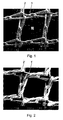
- a section of a hernia network 1 is shown with 40-fold magnification.
- Monofilament polypropylene yarns 2 with a thickness of 66 microns are knit on a warp knitting machine in double-breasted Atlas Ltd to a coarse mesh.
- a grid has been created, the parallelogram-like openings 3, wherein the acute angle of the parallelogram is approximately at about 80 °.
- the opening width of the openings 3 is about 1mm.
- the monofilaments 2 In the lattice structure, the monofilaments 2 always run back under loop formation, so that the monofilaments 2 are 3-fold at each point of the lattice webs.
- the net 1 has about 10800 stitches per dm 2 .
- the basis weight of the net is 16 g / m 2 .
- the tensile strength of the net is well above the tear strength of the fabric to be supported (about 16 N / cm).
- the maximum tensile force in accordance with DIN 53857 is ⁇ 50 N in length and ⁇ 40 N in width.
- the maximum tensile strain is ⁇ 20% in length and ⁇ 40% in width.
- the edges of the net 1 cut to the desired size of about 10 x 10 cm to 30 x 30 cm may be thermally or adhesively bonded.
- the porosity of the net is 80%. It is very transparent.
- the network is single-layered. It has a thickness of approx. 0.20 mm and is very flexible. The mesh can be easily applied to the abdominal wall of the patient during the operation and adheres there by itself.
- the surface of the network is metallized by plasma coating (PACVD) with a titanium layer that is so thin that the metal is not visible to the eye. Due to the small amount of material, the small surface of the plastic threads and the fabric friendliness of the surface of the polypropylene by the metallization, the network shows a very good ingrowth behavior and permanently good results.
- PVGD plasma coating
- the net 1 'of the embodiment shown in Figure 2 is made of the same thread material and has the same effective weave as the embodiment of Figure 1.
- the net is also metallized with titanium.
- two monofilament threads are performed as a double thread 2 'parallel.
- the net 1 ' has an area weight of about 37 g / m 2 which is about twice as large.
- the grid structure is substantially square.
- the binding is again atlas. Due to the parallel guidance of two monofilament threads, the number of threads at each point of the lattice structure is six.
- the clear mesh size of the net 1 ' despite the doubling of the threads approximately the same size as in the embodiment of Figure 1.
- the mesh size is about 10000 stitches per dm second
- the porosity of the net is 73%.
- the thickness of the net is 0.25 mm.
- the maximum tensile force according to DIN 53857 is in the longitudinal direction at ⁇ 200 N in the length and at ⁇ 100 N in the width.
- the maximum tensile strain is ⁇ 3 0% in length and ⁇ 60% in width.
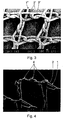
- the mesh 1 "of the embodiment shown in Figure 3 has the same effective weave as the embodiment of Figure 1 and also shows a simple filament guide, however, a thicker yarn 2" with a thickness of 0.090 mm (58 dtex) is used, creating a net which is comparable in properties and mesh construction with the heavy hernia mesh according to FIG.
- the weight per unit area of the net 1 "amounts to 32 to 39 g / m 2 and its thickness is 0.3 mm, whereas for the used satin weave of the net knit the number of stitches is in the order of 8300 to 13300 stitches per dm 2 Values for the maximum tensile force and maximum tensile elongation at the net 1 "according to Figure 3 correspond to those of the net 1 'shown in Figure 2.
- the optical porosity due to the openings 3" is 70%.
- hernia meshes are cut out of a wider, endless knitted fabric.
- a conventional punching free thread ends form, so that threads can solve the knitted fabric.
- the net cutting is advantageously carried out by laser cutting.
- the cut ends 4 of the individual threads 2, 2 ' are fused together, so that the described detachment of free threads is prevented.
- the laser cutting thus increases the power quality.
- the blank of a hernia mesh 1 is applied so that the mesh corners 5 are rounded.
- the outline dimensions of the hernia mesh 1 are at a length 1 of about 15 cm and a width b of about 10 cm.
Landscapes
- Health & Medical Sciences (AREA)
- Engineering & Computer Science (AREA)
- Life Sciences & Earth Sciences (AREA)
- Animal Behavior & Ethology (AREA)
- Oral & Maxillofacial Surgery (AREA)
- Biomedical Technology (AREA)
- Heart & Thoracic Surgery (AREA)
- Vascular Medicine (AREA)
- Cardiology (AREA)
- Transplantation (AREA)
- General Health & Medical Sciences (AREA)
- Public Health (AREA)
- Veterinary Medicine (AREA)
- Textile Engineering (AREA)
- Prostheses (AREA)
- Woven Fabrics (AREA)
- Knitting Of Fabric (AREA)
Description
- Die Erfindung betrifft ein flächiges Implantat aus textilem Fadenmaterial, insbesondere ein Herniennetz.
- Ein flächiges Implantat in einer zweischichtigen Ausführungsform ist aus der
EP 1 099 421 A1 bekannt. Beide Schichten bestehen aus einem Gewebe oder Gewirke aus Polymerfilamenten beispielsweise aus Polyester, Polypropylen oder Polytetrafluorethylen. Das Flächengewicht einer Schicht ist dabei mit bis zu 50 g/m2 angegeben. - Aus der
US-A-4,839,215 ist ein flächiges Implantat auf der Basis eines Netzes mit Webstruktur entnehmbar, bei dem biokompatible Partikel in Form von Hülsen beispielsweise aus Titan perlschnurartig auf den Netzfaden aufgefädelt sind. Das gezeigte Implantat ist offensichtlich für die mikroinvasive Chirurgie nicht geeignet. - Etwa 3 % aller Einwohner eines Landes sind im Laufe Ihres Lebens von einem Leistenbruch betroffen. Die Operation eines Leistenbruches gehört zu den weltweit am häufigsten durchgeführten chirurgischen Eingriffen. Dabei werden über 75 % der Patienten mit Operationstechniken behandelt, die den Verschluss der Bauchlücke mit einem Kunststoffnetz, einem sogenannten Herniennetz, vornehmen.
- Um einen dauerhaften Erfolg einer Hernienversorgung mit einem Kunststoffnetz zu gewährleisten, sollte das implantierte Netz den folgenden Anforderungen gerecht werden:
- chemisch inert
- keine physikalischen Veränderungen im Kontakt mit Körperflüssigkeiten
- keine Auslösung von Entzündungen und Fremdkörperreaktionen
- nicht cancerogen
- nicht allergen
- Widerstandsfähig gegenüber mechanischen Belastungen
- sterilisierbar und
- herstellbar in der benötigten Form.
- Als Grundmaterial für Herniennetze werden in der modernen Chirurgie hauptsächlich die folgenden drei Kunststoffmaterialien eingesetzt:
- Polyester (PET)
- Polytetrafluorethylen (PTFE) und
- Polypropylen (PP).
- Das Netzdesign unterscheidet sich darüber hinaus in der Web- bzw. Wirkart. Es kommen monofile und multifile sowie vliesartige Netze zum Einsatz, die sich zudem in ihrer Maschengröße und ihrem Flächengewicht unterscheiden. Ein großer Teil der durchgeführten Hernienoperationen mit Einsatz eines Kunststoffnetzes führt zu klinisch zufriedenstellenden Ergebnissen. Die Rezidivraten belaufen sich auf weniger als 10 %. Immer wieder wird jedoch auch von Komplikationen aufgrund der Implantation von Kunststoffnetzen berichtet. Es besteht deshalb ein Bedarf, ein Netz mit optimalen Trageigenschaften für den Patienten zu schaffen. Dabei ist die entscheidende Anforderung an Neuentwicklungen, ein Netz zu entwickeln, das die entzündlichen Reaktionen auf ein Minimum verringert bzw. die Körperverträglichkeit des Netzes auf ein Maximum erhöht.
- Die Erfindung besteht darin, dass das flächige Implantat aus textilem Fadenmaterial, insbesondere Herniennetz, in Form eines einschichtigen Netzes mit einem Flächengewicht von 5 bis 40 g/m2 und mit einer Oberflächenmetallisierung insbesondere enthaltend Titan vorliegt.
- Durch die starke Verringerung des Flächengewichtes des Netzes bzw. des Implantates ergeben sich zahlreiche Vorteile für die Handhabung und Einheilung des Implantates. Zunächst wird die Menge an Fremdkörper, die implantiert wird, verringert, was zu einer Verminderung der Reizung des Bindegewebes und zu einer Verringerung von Abwehrreaktionen führt. Durch die geringe MateriaImenge ist es auch außerordentlich flexibel, so dass es sich leicht an Oberflächen des Körpers anschmiegt und dann auch in der einmal eingenommenen Lage und Stellung verbleibt.
- Das Netz besitzt wie oben bereits angegeben weiterhin mit Vorteil eine Metallisierung an der Oberfläche, wobei eine solche Metallisierung, die titanhaltig ist, bevorzugt ist. Solche Metallisierungen unter Anwendung eines PACVD-Verfahrens sind beispielsweise aus der
DE 199 45 299 A bekannt. Eine Oberflächenmetallisierung der Fäden, insbesondere mit Titan bringt eine gute Gewehefreundlichkeit. - Das Flächengewicht des erfindungsgemäßen Netzes liegt mit Vorteil bei 10 bis 39 g/m2, bevorzugt bis 37 g/m2. Die Fäden sind vorzugsweise Monofilamente. Das Netz kann in verschiedenen Ausführungsformen vorliegen. Bei einer besonders bevorzugten Ausführungsform der Erfindung ist das Netz aus einzeln geführten Monofilamenten gefertigt- Bei diesen Ausführungsformen liegt das Flächengewicht bevorzugt bei 10 bis 20 g/m2, insbesondere bei 16 g/m2 bzw. - bei stärkerer Auslegung des Monofilaments - bei 32 bis 39 g/m2. Bei einer anderen Ausführungsform der Erfindung ist das Netz aus doppelt geführten Monofilamenten gefertigt. Hierbei liegt das Flächengewicht insbesondere bei 20 bis 37 g/m2, wobei etwa 35 bis 37 g/m2 die Regel sind.
- Auch die Fadenstärke ist gering. Sie liegt vorzugsweise im Bereich von 10 bis 150 µm, insbesondere zwischen 30 und 80 µm. Als besonders vorteilhaft haben sich Fadenstärken im Bereich von 70 bis 75 µm, insbesondere 60 bis 70 µm erwiesen. Die Feinheit liegt bei etwa 8 bis 70 dtex, insbesondere ca. 30 dtex. Aber auch mit einer Fadenstärke von 90 µm entsprechend 58 dtex lassen sich erfolgreich einsetzbare Implantate herstellen.
- Das Netz ist mit Vorteil ein Gewebe, ein Gewirk oder Gestrick, wobei ein Gewirk, insbesondere ein Kettengewirk, bevorzugt ist. Besonders günstig sind durchbrochene oder undurchbrochene Gewirkkonstruktionen, insbesondere solche, die durchsichtig sind. Zur Herstellung eignen sich Kettenwirkmaschinen mit ein oder zwei Legeschienen. Bevorzugte Bindungsarten sind die folgenden Legungen: Atlas, Tüll, Mesh und Ajour. Die Maschendichte kann in weiten Grenzen variieren und liegt mit Vorteil bei 2500 bis 25000, insbesondere 4000 bis 14000 Maschen pro dm2, bevorzugter bis 12000 Maschen pro dm2. In der Praxis hat sich eine Maschendichte zwischen 5000 und 11000, insbesondere zwischen 5000 und 7000 als günstig erwiesen. Die Maschenfeinheit liegt vorteilhaft bei E 8 bis E 44 (Nadeln pro inch).
- Das erfindungsgemäße Netz ist hochporös. Seine Porosität liegt mit Vorteil im Bereich von 65 bis 85 %, insbesondere im Bereich von 70 bis 80 %. Eine Porosität von ca. 73 bis 75 % hat sich in der Praxis als vorteilhaft gezeigt. Weiterhin ist das Netz mit Vorteil durchsichtig, was sich in Bezug auf seine Platzierung während der Operation als vorteilhaft erweist. Es besitzt relativ große lichte Maschenöffnungen in der Größe von 0,3 bis 2 mm2, insbesondere 0,5 bis 1,5 mm2. Bewährt haben sich lichte Maschenöffnungen von ca. 1 mm2. Eine Gitterstruktur des Netzes ist besonders vorteilhaft. Bei besonders bevorzugten Ausführungsformen haben die Maschenöffnungen die Form von Quadraten oder Parallelogrammen, die von dünnen Gitterstegen eingerahmt sind. Die Bindung des Netzes ist mit besonderem Vorteil eine Atlas-Bindung. Die Fäden im Bereich der Gitterstege weisen Schlaufen auf, wobei sich bei einfach gebundenen monofilen Fäden eine Stärke der Gitterstege von 3 Fadenstärken ergibt. Werden zwei parallele monofile Fäden verwendet, dann ergibt sich eine Stärke der Gitterstege von jeweils 6 Fäden, wie sich aus der nachfolgenden Beschreibung von Ausführungsformen zeigt.
- Als Material für die erfindungsgemäßen Implantate eignet sich besonders ein nicht resorbierbarer inerter Kunststoff, wobei Polypropylen bevorzugt ist. Das erfindungsgemäße Implantat besteht mit Vorteil ausschließlich aus nicht resorbierbarem Material. Es ist weiterhin, abgesehen von einer Metallisierung, mit Vorteil frei von einer Imprägnierung oder Beschichtung.
- Die Dicke des erfindungsgemäßen Netzes bzw. Implantates liegt bevorzugt im Bereich von 0,10 bis 0,40 mm, insbesondere 0,15 bis 0,30 mm. Eine Dicke von ca. 0,20 mm ist besonders vorteilhaft.
- In Versuchen hat sich gezeigt, dass das erfindungsgemäße Netz bei laparoskopischer Operationstechnik in einfacher Weise an die Bauchwandinnenseite angelegt werden kann und dort aufgrund seines geringen Gewichtes haften bleibt. Dies wird noch unterstützt durch die insbesondere aus einer Titanlegierung bestehende Oberflächenmetallisierung, die für eine Hydrophilierung des Netzes sorgt. Durch die damit verbesserte Benetzbarkeit saugt sich das Herniennetz gewissermaßen an das zu stützende Gewebe, was für ein bereitwilligeres Auffalten des laparoskopisch eingebrachten Netzes sorgt. Ein Verrutschen oder eine Faltenbildung beim Wiederverschließen der laparoskopisch präparierten Kavität ist damit nicht zu befürchten. Damit ist insgesamt die Netzplatzierung leichter möglich als bei vergleichbaren schweren Netzkonstruktionen. Durch die geringe Materialmenge, die mit dem erfindungsgemäßen Netz eingebracht wird, und insbesondere durch die leichte, dünne, grobmaschige und flexible Gestaltung des Netzes ergeben sich hervorragende Langzeitergebnisse.
- Weitere Merkmale, Einzelheiten und Vorteile der Erfindung ergeben sich aus der nachfolgenden Beschreibung, in der Ausführungsbeispiele leichter Herniennetze anhand der beigefügten Zeichnungen näher erläutert werden. Es zeigen:
- Fig. 1 bis 3
- ausschnittsweise vergrößerte Darstellungen von leichten Herniennetzen in drei unterschiedlichen Ausführungsformen,
- Fig. 4 und 5
- ausschnittsweise vergrößerte Darstellungen der Herniennetze gemäß Figur 1 und 2 im Bereich deren Schnittkante, sowie
- Fig. 6
- eine Umrissdarstellung eines Herniennetzes.
- Bei der in der Zeichnung in Figur 1 dargestellten Ausführungsform der Erfindung ist ein Ausschnitt eines Herniennetzes 1 mit 40-facher Vergrößerung dargestellt. Monofile Polypropylenfäden 2 mit einer Dicke von 66 µm sind auf einer Kettenwirkmaschine in zweireihiger Atlaslegung zu einem grobmaschigen Netz gewirkt. Durch diese Wirkart ist ein Gitter entstanden, das parallelogrammartige Öffnungen 3 besitzt, wobei der spitze Winkel des Parallelogramms etwa bei ca. 80° liegt. Die Öffnungsweite der Öffnungen 3 beträgt ca. 1mm. In der Gitterstruktur laufen die Einzelfäden 2 unter Schlaufenbildung immer wieder zurück, so dass die Einzelfäden 2 an jeder Stelle der Gitterstege 3-fach liegen. Das Netz 1 besitzt ca. 10800 Maschen pro dm2. Das Flächengewicht des Netzes beträgt 16 g/m2. Die Reißfestigkeit des Netzes liegt deutlich über der Reißfestigkeit des zu stützenden Gewebes (ca. 16 N/cm). Die Höchstzugkraft in Anlehnung an DIN 53857 beträgt ≥ 50 N in der Länge und ≥ 40 N in der Breite. Die Höchstzugkraftdehnung liegt bei ≥ 20 % in der Länge und ≥ 40 % in der Breite.
- Die Ränder des auf die gewünschte Größe von etwa 10 x 10 cm bis 30 x 30 cm zugeschnittenen Netzes 1 können thermisch oder durch Klebemittel abgebunden sein. Die Porosität des Netzes liegt bei 80 %. Es ist gut durchsichtig. Das Netz ist einschichtig aufgebaut. Es besitzt eine Dicke von ca. 0,20 mm und ist sehr flexibel. Das Netz lässt sich bei der Operation leicht an die Bauchwandinnenseite des Patienten anlegen und haftet dort von selbst. Die Oberfläche des Netzes ist durch Plasmabeschichtung (PACVD) mit einer Titanschicht metallisiert, die so dünn ist, dass das Metall mit dem Auge nicht erkennbar ist. Aufgrund der geringen Materialmenge, der geringen Oberfläche der Kunststofffäden und der Gewebefreundlichkeit der Oberfläche des Polypropylens durch die Metallisierung zeigt das Netz ein sehr gutes Einwachsverhalten und dauerhaft gute Ergebnisse.
- Das Netz 1' der in Figur 2 dargestellten Ausführungsform ist aus dem gleichen Fadenmaterial hergestellt und besitzt die gleiche Wirkbindung wie die Ausführungsform nach Figur 1. Das Netz ist ebenfalls mit Titan metallisiert. Im Unterschied zu Figur 1 sind jedoch zwei monofile Fäden als Doppelfaden 2' parallel geführt. Dadurch besitzt das Netz 1' ein etwa doppel so großes Flächengewicht von 37 g/m2. Die Gitterstruktur ist im wesentlichen quadratisch. Die Bindung ist wiederum Atlas. Durch die Parallelführung zweier monofiler Fäden liegt die Fadenzahl an jeder Stelle der Gitterstruktur bei sechs. Die lichte Maschenweite des Netzes 1' ist trotz der Verdopplung der Fäden etwa gleich groß wie bei der Ausführungsform nach Figur 1. Die Maschenzahl liegt bei etwa 10000 Maschen pro dm2. Die Porosität des Netzes liegt bei 73 %. Die Dicke des Netzes beträgt 0,25 mm. Die Höchstzugkraft in Anlehnung an DIN 53857 liegt in Längsrichtung bei ≥ 200 N in der Länge und bei ≥ 100 N in der Breite. Die Höchstzugkraftdehnung liegt bei ≥ 3 0 % in der Länge und bei ≥ 60 % in der Breite.
- Das Netz 1" der in Figur 3 dargestellten Ausführungsform besitzt die gleiche Wirkbindung wie die Ausführungsform nach Figur 1 und zeigt ebenfalls eine einfache Filamentführung. Allerdings findet ein dickerer Faden 2" mit einer Stärke von 0,090 mm (58 dtex) Verwendung, sodass ein Netz geschaffen wird, das in Eigenschaften und Maschenkonstruktion mit dem schweren Herniennetz gemäß Figur 2 vergleichbar ist. Das Flächengewicht des Netzes 1" beträgt insoweit 32 bis 39 g/m2, seine Dicke liegt bei 0,3 mm. Bei der verwendeten Atlas-Bindung des Netzgewirkes liegt die Maschenzahl in der Größenordnung von 8300 bis 13300 Maschen pro dm2. Die Werte für die Höchstzugkraft und Höchstzugkraftdehnung bei dem Netz 1 " gemäß Figur 3 entsprechen denen des in Figur 2 dargestellten Netzes 1'. Die optische Porosität auf Grund der Öffnungen 3" liegt bei 70 %.
- Die Netze nach Figur 2 und 3 sind zwar schwerer als das Netz nach Figur 1, aber immer noch leicht genug, um ein hervorragendes Einwachsverhalten zu zeigen. Bei der Operation faltet sich das Netz leicht auf und legt sich an die Bauchwandinnenseite an, ohne später Verschiebungen oder Faltenbildung zu zeigen. Langzeitversuche bei Tieren ergaben hervorragende Ergebnisse.
- Eine weitere Problematik bei Herniennetzen liegt darin, dass diese aus einer breiteren, endlosen Gewirkebahn herausgeschnitten werden. Bei einem üblichen Stanzen bilden sich freie Fadenenden, sodass sich Fäden aus dem Gewirkeverbund lösen können.
- Um dies zu vermeiden, erfolgt der Netzzuschnitt vorteilhafterweise durch Laserschneiden. Dabei werden - wie aus den Figuren 4 und 5 deutlich wird - die Schnittenden 4 der Einzelfäden 2, 2' miteinander verschmolzen, sodass das geschilderte Herauslösen von freien Fäden unterbunden wird. Der Laserzuschnitt erhöht damit die Netzqualität.
- Wie ferner aus Figur 6 hervorgeht, wird der Zuschnitt eines Herniennetzes 1 so angelegt, dass die Netzecken 5 abgerundet sind. Der Rundungsradius r liegt dabei in einem Bereich von 4 bis 40 mm, bevorzugter Wert liegt bei r = 22 mm. Durch die abgerundeten Ecken wird eine Irritation des Körpergewebes nach der Netzimplantation aufgrund mechanischer Reizung durch spitze Ecken vermieden.
- Die Umrissdimensionen des Herniennetzes 1 liegen bei einer Länge 1 von etwa 15 cm und einer Breite b von etwa 10 cm.
Claims (17)
- Flächiges Implantat aus textilem Fadenmaterial, insbesondere Herniennetz, in Form eines einschichtigen Netzes (1;1'; 1") mit einem Flächengewicht von 5 bis 40 g/m2, dadurch gekennzeichnet, dass das Netz (1;1'; 1") eine Oberflächenmetallisierung aufweist, insbesondere eine solche, die Titan enthält.
- Implantat nach Anspruch 1, dadurch gekennzeichnet, dass sein Flächengewicht bei 10 bis 39 g/m2, insbesondere bis 37 g/m2 liegt.
- Implantat nach einem der vorhergehenden Ansprüche, dadurch gekennzeichnet, dass das Netz (1, 1") aus einem einzelgeführten Monofilament (2; 2") gefertigt ist und das Flächengewicht insbesondere bei 10 bis 20 g/m2 oder 32 bis 39 g/m2 liegt.
- Implantat nach Anspruch 1 oder 2, dadurch gekennzeichnet, dass das Netz (1') aus einem doppelgeführten Monofilament (2') gefertigt ist und das Flächengewicht insbesondere bei 20 bis 37 g/m2 liegt.
- Implantat nach einem der vorhergehenden Ansprüche, dadurch gekennzeichnet, dass die Fäden (2; 2'; 2") eine Fadenstärke von 10 bis 150 µm, insbesondere 30 bis 80 µm oder etwa 90 µm besitzen.
- Implantat nach einem der vorhergehenden Ansprüche, dadurch gekennzeichnet, dass das Netz (1; 1'; 1") ein Gewirk oder ein Gestrick ist, insbesondere ein Gewirk.
- Implantat nach einem der vorhergehenden Ansprüche, dadurch gekennzeichnet, dass das Netz (1; 1') eine Maschendichte von 2500 bis 25000 Maschen pro dm2, insbesondere 4000 bis 14000 Maschen pro dm2, bevorzugter bis 12000 Maschen pro dm2 aufweist.
- Implantat nach einem der vorhergehenden Ansprüche, dadurch gekennzeichnet, dass das Netz (1; 1'; 1'') eine Porosität von 65 bis 85 %, insbesondere von 70 bis 80 % besitzt.
- Implantat nach einem der vorhergehenden Ansprüche, dadurch gekennzeichnet, dass das Netz (1; 1'; 1") durchsichtig ist.
- Implantat nach einem der vorhergehenden Ansprüche, dadurch gekennzeichnet, dass das Netz eine Gitterstruktur besitzt, wobei Öffnungen (3; 3'; 3") der Gitterstruktur vorzugsweise quadratisch oder parallelogrammartig ausgebildet sind.
- Implantat nach einem der vorhergehenden Ansprüche, dadurch gekennzeichnet, dass das Netz lichte Maschenöffnungen (3; 3'; 3") in der Größe von 0,3 bis 2 mm2, insbesondere 0,5 bis 1,5 mm2, besitzt.
- Implantat nach einem der vorhergehenden Ansprüche, dadurch gekennzeichnet, dass das Netz (1; 1'; 1") in Atlas-Legung gewirkt ist.
- Implantat nach einem der vorhergehenden Ansprüche, dadurch gekennzeichnet, dass das Netz (1; 1'; 1") vollständig aus nichtresorbierbarem Material, insbesondere Polypropylen, besteht.
- Implantat nach einem der vorhergehenden Ansprüche, dadurch gekennzeichnet, dass das Netz (1; 1'; 1") aus monofilen Fäden besteht.
- Implantat nach einem der vorhergehenden Ansprüche, dadurch gekennzeichnet, dass das Netz (1; 1'; 1") eine Dicke von 0,10 bis 0,40 mm, insbesondere 0,15 bis 0,30 mm, besitzt.
- Implantat nach einem der vorhergehenden Ansprüche, dadurch gekennzeichnet, dass das einschichtige Netz (1; 1'; 1") in einer rechteckigen Grundform mit abgerundeten Ecken (5) vorliegt, deren Rundungsradius (r) zwischen 4 und 40 mm, vorzugsweise bei 22 mm liegt.
- Implantat nach einem der vorhergehenden Ansprüche, dadurch gekennzeichnet, dass die Kanten (4) des einschichtigen Netzes (1; 1') laserbeschnitten sind.
Applications Claiming Priority (3)
| Application Number | Priority Date | Filing Date | Title |
|---|---|---|---|
| DE2002121320 DE10221320A1 (de) | 2002-05-07 | 2002-05-07 | Flächiges Implantat aus textilem Fadenmaterial, insbesondere Herniennetz |
| DE10221320 | 2002-05-07 | ||
| PCT/EP2003/004732 WO2003094781A1 (de) | 2002-05-07 | 2003-05-06 | Flächiges implantat aus textilem fadenmaterial, insbesondere herniennetz |
Publications (2)
| Publication Number | Publication Date |
|---|---|
| EP1501445A1 EP1501445A1 (de) | 2005-02-02 |
| EP1501445B1 true EP1501445B1 (de) | 2007-07-11 |
Family
ID=29285365
Family Applications (1)
| Application Number | Title | Priority Date | Filing Date |
|---|---|---|---|
| EP03725155A Expired - Lifetime EP1501445B1 (de) | 2002-05-07 | 2003-05-06 | Flachiges implantat aus textilem fadenmaterial, insbesondere herniennetz |
Country Status (7)
| Country | Link |
|---|---|
| US (1) | US7732354B2 (de) |
| EP (1) | EP1501445B1 (de) |
| AT (1) | ATE366555T1 (de) |
| AU (1) | AU2003227722A1 (de) |
| CA (1) | CA2486659C (de) |
| DE (2) | DE10221320A1 (de) |
| WO (1) | WO2003094781A1 (de) |
Cited By (1)
| Publication number | Priority date | Publication date | Assignee | Title |
|---|---|---|---|---|
| CN103534397A (zh) * | 2011-03-16 | 2014-01-22 | 索弗拉狄姆产品公司 | 包括三维镂空编织件的假体 |
Families Citing this family (85)
| Publication number | Priority date | Publication date | Assignee | Title |
|---|---|---|---|---|
| FR2811218B1 (fr) | 2000-07-05 | 2003-02-28 | Patrice Suslian | Dispositif implantable destine a corriger l'incontinence urinaire |
| GB0025068D0 (en) | 2000-10-12 | 2000-11-29 | Browning Healthcare Ltd | Apparatus and method for treating female urinary incontinence |
| US20060205995A1 (en) | 2000-10-12 | 2006-09-14 | Gyne Ideas Limited | Apparatus and method for treating female urinary incontinence |
| US8167785B2 (en) | 2000-10-12 | 2012-05-01 | Coloplast A/S | Urethral support system |
| GB0108088D0 (en) | 2001-03-30 | 2001-05-23 | Browning Healthcare Ltd | Surgical implant |
| US8097007B2 (en) | 2002-08-02 | 2012-01-17 | C. R. Bard, Inc. | Self-anchoring sling and introducer system |
| GB0307082D0 (en) | 2003-03-27 | 2003-04-30 | Gyne Ideas Ltd | Drug delivery device and method |
| DE20306635U1 (de) * | 2003-04-28 | 2003-06-26 | GfE Medizintechnik GmbH, 90431 Nürnberg | Chirurgische Flächeneinlage |
| GB0411360D0 (en) | 2004-05-21 | 2004-06-23 | Mpathy Medical Devices Ltd | Implant |
| DE102004062798A1 (de) * | 2004-12-20 | 2006-06-29 | Aesculap Ag & Co. Kg | Flächiges Implantat und Verfahren zu seiner Herstellung |
| FR2880634B1 (fr) * | 2005-01-12 | 2007-04-20 | Analytic Biosurgical Solutions | Tricot chaine ajoure a usage chirurgical |
| AU2006226961A1 (en) * | 2005-03-22 | 2006-09-28 | Tyco Healthcare Group, Lp | Mesh implant |
| US7614258B2 (en) | 2006-10-19 | 2009-11-10 | C.R. Bard, Inc. | Prosthetic repair fabric |
| US20090036907A1 (en) * | 2007-07-30 | 2009-02-05 | Yves Bayon | Bioresorbable knit |
| US9308068B2 (en) | 2007-12-03 | 2016-04-12 | Sofradim Production | Implant for parastomal hernia |
| US8317808B2 (en) | 2008-02-18 | 2012-11-27 | Covidien Lp | Device and method for rolling and inserting a prosthetic patch into a body cavity |
| US8808314B2 (en) | 2008-02-18 | 2014-08-19 | Covidien Lp | Device and method for deploying and attaching an implant to a biological tissue |
| US8758373B2 (en) | 2008-02-18 | 2014-06-24 | Covidien Lp | Means and method for reversibly connecting a patch to a patch deployment device |
| US9398944B2 (en) | 2008-02-18 | 2016-07-26 | Covidien Lp | Lock bar spring and clip for implant deployment device |
| US9833240B2 (en) | 2008-02-18 | 2017-12-05 | Covidien Lp | Lock bar spring and clip for implant deployment device |
| US9301826B2 (en) | 2008-02-18 | 2016-04-05 | Covidien Lp | Lock bar spring and clip for implant deployment device |
| US9393002B2 (en) | 2008-02-18 | 2016-07-19 | Covidien Lp | Clip for implant deployment device |
| US9044235B2 (en) | 2008-02-18 | 2015-06-02 | Covidien Lp | Magnetic clip for implant deployment device |
| US9034002B2 (en) | 2008-02-18 | 2015-05-19 | Covidien Lp | Lock bar spring and clip for implant deployment device |
| EP2247245B1 (de) | 2008-02-18 | 2017-06-28 | Covidien LP | Vorrichtung zur ablage und befestigung eines pflasters auf biologischem gewebe |
| US9393093B2 (en) | 2008-02-18 | 2016-07-19 | Covidien Lp | Clip for implant deployment device |
| US7966847B2 (en) * | 2008-03-13 | 2011-06-28 | Atex Technologies, Inc. | Elongation resistant fabric and devices |
| US9242026B2 (en) | 2008-06-27 | 2016-01-26 | Sofradim Production | Biosynthetic implant for soft tissue repair |
| EP2337502B1 (de) | 2008-10-20 | 2014-08-06 | Covidien LP | Vorrichtung zur anbringung eines pflasters auf einem biologischen gewebe |
| US20120150204A1 (en) * | 2008-12-15 | 2012-06-14 | Allergan, Inc. | Implantable silk prosthetic device and uses thereof |
| CA2745571C (en) * | 2008-12-15 | 2015-03-24 | Allergan, Inc. | A prosthetic device and method of manufacturing the same |
| US9326840B2 (en) | 2008-12-15 | 2016-05-03 | Allergan, Inc. | Prosthetic device and method of manufacturing the same |
| US20130317526A1 (en) * | 2008-12-15 | 2013-11-28 | Allergan, Inc. | Silk medical device |
| US9308070B2 (en) * | 2008-12-15 | 2016-04-12 | Allergan, Inc. | Pliable silk medical device |
| CA2769666C (en) | 2009-08-17 | 2018-02-13 | Arie Levy | Means and method for reversibly connecting an implant to a deployment device |
| AU2010286117B9 (en) | 2009-08-17 | 2014-07-10 | Covidien Lp | Articulating patch deployment device and method of use |
| FR2949688B1 (fr) | 2009-09-04 | 2012-08-24 | Sofradim Production | Tissu avec picots revetu d'une couche microporeuse bioresorbable |
| DK200970135A (en) * | 2009-09-30 | 2011-03-31 | Coloplast As | Body implantable fabric |
| US8734471B2 (en) * | 2009-10-01 | 2014-05-27 | Coloplast A/S | Method of implanting a fabric to repair a pelvic floor |
| WO2011042811A2 (en) * | 2009-10-05 | 2011-04-14 | Sofradim Production | Isoelastic porous mesh |
| US8870937B2 (en) * | 2010-02-26 | 2014-10-28 | ProMed, Inc. | Method for vessel access closure |
| US9987114B2 (en) | 2010-03-24 | 2018-06-05 | Covidien Lp | Combination three-dimensional surgical implant |
| FR2962646B1 (fr) | 2010-07-16 | 2012-06-22 | Sofradim Production | Prothese avec element radio-opaque |
| US20140039249A1 (en) * | 2011-02-08 | 2014-02-06 | Rami Atalla | Very lightweight surgical mesh for vaginal prolapse repair |
| DE102011007844A1 (de) * | 2011-04-21 | 2012-10-25 | Aesculap Ag | Medizinisches Produkt und Verfahren zu seiner Herstellung |
| FR2977790B1 (fr) | 2011-07-13 | 2013-07-19 | Sofradim Production | Prothese pour hernie ombilicale |
| FR2977789B1 (fr) | 2011-07-13 | 2013-07-19 | Sofradim Production | Prothese pour hernie ombilicale |
| JP2014528264A (ja) | 2011-09-30 | 2014-10-27 | ソフラディム・プロダクション | 軽重量メッシュの可逆性硬さ |
| FR2985170B1 (fr) | 2011-12-29 | 2014-01-24 | Sofradim Production | Prothese pour hernie inguinale |
| FR2985271B1 (fr) | 2011-12-29 | 2014-01-24 | Sofradim Production | Tricot a picots |
| WO2013126718A1 (en) * | 2012-02-24 | 2013-08-29 | Bvw Holding Ag | Anti-erosion soft tissue repair device |
| US20150032135A1 (en) * | 2012-02-28 | 2015-01-29 | Incorpracyl Technologies Ltd. | Tissue support structure |
| US10206769B2 (en) | 2012-03-30 | 2019-02-19 | Covidien Lp | Implantable devices including a film providing folding characteristics |
| CA2868750C (en) * | 2012-04-06 | 2020-08-04 | Poly-Med, Inc. | Polymeric mesh products, method of making and use thereof |
| FR2992662B1 (fr) | 2012-06-28 | 2014-08-08 | Sofradim Production | Tricot avec picots |
| FR2992547B1 (fr) | 2012-06-29 | 2015-04-24 | Sofradim Production | Prothese pour hernie |
| FR2994185B1 (fr) | 2012-08-02 | 2015-07-31 | Sofradim Production | Procede de preparation d’une couche poreuse a base de chitosane |
| FR2995778B1 (fr) | 2012-09-25 | 2015-06-26 | Sofradim Production | Prothese de renfort de la paroi abdominale et procede de fabrication |
| FR2995779B1 (fr) | 2012-09-25 | 2015-09-25 | Sofradim Production | Prothese comprenant un treillis et un moyen de consolidation |
| FR2995788B1 (fr) | 2012-09-25 | 2014-09-26 | Sofradim Production | Patch hemostatique et procede de preparation |
| CA2880380C (en) | 2012-09-28 | 2020-09-15 | Sofradim Production | Packaging for a hernia repair device |
| FR3006578B1 (fr) | 2013-06-07 | 2015-05-29 | Sofradim Production | Prothese a base d’un textile pour voie laparoscopique |
| FR3006581B1 (fr) | 2013-06-07 | 2016-07-22 | Sofradim Production | Prothese a base d’un textile pour voie laparoscopique |
| EP3000433B1 (de) | 2014-09-29 | 2022-09-21 | Sofradim Production | Vorrichtung zur Einführung einer Prothese zur Hernie-Behandlung in einen Einschnitt und flexible textile Prothese |
| EP3000432B1 (de) | 2014-09-29 | 2022-05-04 | Sofradim Production | Textilbasierte Prothese für die Behandlung von Leistenbruch |
| EP3029189B1 (de) | 2014-12-05 | 2021-08-11 | Sofradim Production | Prothetisches poröses Netz, sein Herstellungsverfahren und Hernienprothese |
| EP3059255B1 (de) | 2015-02-17 | 2020-05-13 | Sofradim Production | Verfahren zur Herstellung einer Matrix auf Chitosanbasis mit faseroptischem Verstärkungselement |
| EP3085337B1 (de) | 2015-04-24 | 2022-09-14 | Sofradim Production | Prothese zur unterstützung einer bruststruktur |
| EP3106185B1 (de) | 2015-06-19 | 2018-04-25 | Sofradim Production | Synthetische prothese mit einem gewirk und einem nichtporösen film und verfahren zur formung davon |
| WO2017004136A1 (en) * | 2015-06-30 | 2017-01-05 | Tela Bio, Inc. | Corner-lock stitch patterns |
| US10426587B2 (en) | 2015-07-21 | 2019-10-01 | Tela Bio, Inc. | Compliance control stitching in substrate materials |
| EP3195830B1 (de) | 2016-01-25 | 2020-11-18 | Sofradim Production | Prothese zur hernienreparatur |
| WO2017132405A1 (en) * | 2016-01-26 | 2017-08-03 | Sofregen Medical Ireland Limited | Pliable silk medical device |
| US9820843B2 (en) | 2016-04-26 | 2017-11-21 | Tela Bio, Inc. | Hernia repair grafts having anti-adhesion barriers |
| EP3312325B1 (de) | 2016-10-21 | 2021-09-22 | Sofradim Production | Verfahren zur herstellung eines netzes mit einem daran befestigten nahtmaterial mit widerhaken und dadurch erhaltenes netz |
| EP3398554B1 (de) | 2017-05-02 | 2025-06-25 | Sofradim Production | Prothese zur leistenbruch reparatur |
| WO2019079709A1 (en) | 2017-10-19 | 2019-04-25 | C.R.Bard, Inc. | SELF-AGRIPTING HERNIA PROSTHESIS |
| EP3761963B1 (de) | 2018-03-09 | 2025-01-22 | Tela Bio, Inc. | Chirurgisches reparaturtransplantat |
| EP3879019B1 (de) * | 2018-09-27 | 2024-03-27 | Sofradim Production | Biologisch abbaubare maschenware für hernienreparatur |
| EP3653171B1 (de) | 2018-11-16 | 2024-08-21 | Sofradim Production | Implantate zur weichgewebereparatur |
| EP3934575B1 (de) | 2019-03-08 | 2025-05-07 | Tela Bio, Inc. | Texturierte medizinische textilien |
| IT201900024442A1 (it) * | 2019-12-18 | 2021-06-18 | Bridgestone Europe Nv Sa | Pneumatico con elemento di rinforzo del pacco cinture |
| US12064330B2 (en) | 2020-04-28 | 2024-08-20 | Covidien Lp | Implantable prothesis for minimally invasive hernia repair |
| US12697199B2 (en) | 2020-06-19 | 2026-08-04 | Davol Inc. | Prosthetic repair fabric |
| IT202300018666A1 (it) * | 2023-09-12 | 2025-03-12 | Pfm Medical Ag | Impianto medico per il riempimento di una cavità in un tessuto ghiandolare e metodo di produzione di un impianto medico per il riempimento di una cavità in un tessuto ghiandolare |
Family Cites Families (11)
| Publication number | Priority date | Publication date | Assignee | Title |
|---|---|---|---|---|
| US4839215A (en) * | 1986-06-09 | 1989-06-13 | Ceramed Corporation | Biocompatible particles and cloth-like article made therefrom |
| US5292328A (en) * | 1991-10-18 | 1994-03-08 | United States Surgical Corporation | Polypropylene multifilament warp knitted mesh and its use in surgery |
| WO1998014134A2 (en) * | 1996-10-04 | 1998-04-09 | Ethicon, Inc. | Knitted surgical mesh |
| DE19832634A1 (de) * | 1998-07-09 | 2000-01-13 | Ethicon Endo Surgery Europe | Mehrschichtiges flächiges Implantat |
| DE29817682U1 (de) * | 1998-10-05 | 1999-03-04 | Medimex Holfeld GmbH & Co, 22041 Hamburg | Netz zur chirurgischen Behandlung von Hernien |
| DE19942611C1 (de) * | 1999-08-31 | 2001-07-05 | Ethicon Gmbh | Verstärktes flächiges Implantat |
| DE19945299A1 (de) * | 1999-09-22 | 2001-03-29 | Gfe Met & Mat Gmbh | Plasmabeschichtungsverfahren und dreidimensionales Kunststoffsubstrat mit einer metallhaltigen Beschichtung auf der Kunststoffoberfläche |
| DE19954166A1 (de) * | 1999-11-10 | 2001-05-17 | Inst Textil & Faserforschung | Flächiges Implantat, Verfahren zu seiner Herstellung und Verwendung in der Chirurgie |
| DE10019604C2 (de) * | 2000-04-20 | 2002-06-27 | Ethicon Gmbh | Implantat |
| US7404819B1 (en) * | 2000-09-14 | 2008-07-29 | C.R. Bard, Inc. | Implantable prosthesis |
| GB0108088D0 (en) * | 2001-03-30 | 2001-05-23 | Browning Healthcare Ltd | Surgical implant |
-
2002
- 2002-05-07 DE DE2002121320 patent/DE10221320A1/de not_active Withdrawn
-
2003
- 2003-05-06 EP EP03725155A patent/EP1501445B1/de not_active Expired - Lifetime
- 2003-05-06 WO PCT/EP2003/004732 patent/WO2003094781A1/de not_active Ceased
- 2003-05-06 AT AT03725155T patent/ATE366555T1/de not_active IP Right Cessation
- 2003-05-06 DE DE50307653T patent/DE50307653D1/de not_active Expired - Lifetime
- 2003-05-06 CA CA 2486659 patent/CA2486659C/en not_active Expired - Lifetime
- 2003-05-06 AU AU2003227722A patent/AU2003227722A1/en not_active Abandoned
- 2003-05-06 US US10/513,316 patent/US7732354B2/en active Active
Cited By (2)
| Publication number | Priority date | Publication date | Assignee | Title |
|---|---|---|---|---|
| CN103534397A (zh) * | 2011-03-16 | 2014-01-22 | 索弗拉狄姆产品公司 | 包括三维镂空编织件的假体 |
| CN103534397B (zh) * | 2011-03-16 | 2015-02-18 | 索弗拉狄姆产品公司 | 包括三维镂空编织件的假体 |
Also Published As
| Publication number | Publication date |
|---|---|
| EP1501445A1 (de) | 2005-02-02 |
| AU2003227722A1 (en) | 2003-11-11 |
| WO2003094781A1 (de) | 2003-11-20 |
| CA2486659A1 (en) | 2003-11-20 |
| ATE366555T1 (de) | 2007-08-15 |
| US7732354B2 (en) | 2010-06-08 |
| US20050228408A1 (en) | 2005-10-13 |
| DE10221320A1 (de) | 2003-11-27 |
| DE50307653D1 (de) | 2007-08-23 |
| CA2486659C (en) | 2011-03-29 |
Similar Documents
| Publication | Publication Date | Title |
|---|---|---|
| EP1501445A1 (de) | Flachiges implantat aus textilem fadenmaterial, insbesondere herniennetz | |
| DE60017919T2 (de) | Faserverstärktes flächiges implantat | |
| EP1099422B1 (de) | Hernienimplantat und Verfahren zu seiner Herstellung | |
| DE60111242T2 (de) | Biegsames implantat | |
| DE69801445T2 (de) | Dreidimensionale durchlöcherte gewebeprothese | |
| EP1991160B1 (de) | Flächiges implantat, insbesondere herniennetz | |
| DE69839117T2 (de) | Zur reparatur geeignete textilprothese | |
| DE69109374T2 (de) | Künstliches rohrförmiges Organ. | |
| DE69901254T2 (de) | Durchbrochene isoelastische gewebeprothese | |
| DE69629360T2 (de) | Chirurgische prothese | |
| DE68922319T2 (de) | Bioabsorbierbares chirurgisches Material für die Behandlung von Nervendefekten und Methode zu seiner Herstellung. | |
| DE60108818T2 (de) | Verstärkte Submucosaschicht des Dünndarms | |
| DE69838129T2 (de) | Herstellungsverfahren für gewebe | |
| DE3107189A1 (de) | Flachmaterial fuer kardiovaskulaer-implantate | |
| DE102004020469A1 (de) | Flächiges Netzimplantat zur Hernienversorgung | |
| DE10041347A1 (de) | Flächiges Implantat | |
| DE10231975A1 (de) | Implantierbares textiles Flächengebilde | |
| DE102011007844A1 (de) | Medizinisches Produkt und Verfahren zu seiner Herstellung | |
| DE3830005C1 (en) | Sheet-like implant | |
| DE102005012555B4 (de) | Chirurgisches Implantat | |
| EP1600118A1 (de) | Implantat zur Suspension der Harnblase bei Harninkontinenz der Frau | |
| DE19613317B4 (de) | Parietales Prothesenelement | |
| DE10121193A1 (de) | Flächiges Implantat | |
| DE60319258T2 (de) | Stützprothese für Gewebestrukturen | |
| DE3854579T2 (de) | Gewirktes oder gewobenes textilmaterial, verfahren zur herstellung und blutgefässreparaturblatt sowie kunstblutgefäss daraus. |
Legal Events
| Date | Code | Title | Description |
|---|---|---|---|
| PUAI | Public reference made under article 153(3) epc to a published international application that has entered the european phase |
Free format text: ORIGINAL CODE: 0009012 |
|
| 17P | Request for examination filed |
Effective date: 20041106 |
|
| AK | Designated contracting states |
Kind code of ref document: A1 Designated state(s): AT BE BG CH CY CZ DE DK EE ES FI FR GB GR HU IE IT LI LU MC NL PT RO SE SI SK TR |
|
| AX | Request for extension of the european patent |
Extension state: AL LT LV MK |
|
| RIN1 | Information on inventor provided before grant (corrected) |
Inventor name: BUTTSTAEDT, JOHANNES Inventor name: FRICKE, HELMUT |
|
| 17Q | First examination report despatched |
Effective date: 20050218 |
|
| DAX | Request for extension of the european patent (deleted) | ||
| GRAP | Despatch of communication of intention to grant a patent |
Free format text: ORIGINAL CODE: EPIDOSNIGR1 |
|
| GRAS | Grant fee paid |
Free format text: ORIGINAL CODE: EPIDOSNIGR3 |
|
| GRAA | (expected) grant |
Free format text: ORIGINAL CODE: 0009210 |
|
| AK | Designated contracting states |
Kind code of ref document: B1 Designated state(s): AT BE BG CH CY CZ DE DK EE ES FI FR GB GR HU IE IT LI LU MC NL PT RO SE SI SK TR |
|
| REG | Reference to a national code |
Ref country code: GB Ref legal event code: FG4D Free format text: NOT ENGLISH |
|
| REG | Reference to a national code |
Ref country code: CH Ref legal event code: EP |
|
| GBT | Gb: translation of ep patent filed (gb section 77(6)(a)/1977) |
Effective date: 20070711 |
|
| REF | Corresponds to: |
Ref document number: 50307653 Country of ref document: DE Date of ref document: 20070823 Kind code of ref document: P |
|
| REG | Reference to a national code |
Ref country code: IE Ref legal event code: FG4D Free format text: LANGUAGE OF EP DOCUMENT: GERMAN |
|
| ET | Fr: translation filed | ||
| PG25 | Lapsed in a contracting state [announced via postgrant information from national office to epo] |
Ref country code: PT Free format text: LAPSE BECAUSE OF FAILURE TO SUBMIT A TRANSLATION OF THE DESCRIPTION OR TO PAY THE FEE WITHIN THE PRESCRIBED TIME-LIMIT Effective date: 20071211 Ref country code: BG Free format text: LAPSE BECAUSE OF FAILURE TO SUBMIT A TRANSLATION OF THE DESCRIPTION OR TO PAY THE FEE WITHIN THE PRESCRIBED TIME-LIMIT Effective date: 20071011 Ref country code: NL Free format text: LAPSE BECAUSE OF FAILURE TO SUBMIT A TRANSLATION OF THE DESCRIPTION OR TO PAY THE FEE WITHIN THE PRESCRIBED TIME-LIMIT Effective date: 20070711 Ref country code: ES Free format text: LAPSE BECAUSE OF FAILURE TO SUBMIT A TRANSLATION OF THE DESCRIPTION OR TO PAY THE FEE WITHIN THE PRESCRIBED TIME-LIMIT Effective date: 20071022 Ref country code: FI Free format text: LAPSE BECAUSE OF FAILURE TO SUBMIT A TRANSLATION OF THE DESCRIPTION OR TO PAY THE FEE WITHIN THE PRESCRIBED TIME-LIMIT Effective date: 20070711 |
|
| NLV1 | Nl: lapsed or annulled due to failure to fulfill the requirements of art. 29p and 29m of the patents act | ||
| REG | Reference to a national code |
Ref country code: IE Ref legal event code: FD4D |
|
| PG25 | Lapsed in a contracting state [announced via postgrant information from national office to epo] |
Ref country code: GR Free format text: LAPSE BECAUSE OF FAILURE TO SUBMIT A TRANSLATION OF THE DESCRIPTION OR TO PAY THE FEE WITHIN THE PRESCRIBED TIME-LIMIT Effective date: 20071012 Ref country code: DK Free format text: LAPSE BECAUSE OF FAILURE TO SUBMIT A TRANSLATION OF THE DESCRIPTION OR TO PAY THE FEE WITHIN THE PRESCRIBED TIME-LIMIT Effective date: 20070711 |
|
| PLBE | No opposition filed within time limit |
Free format text: ORIGINAL CODE: 0009261 |
|
| STAA | Information on the status of an ep patent application or granted ep patent |
Free format text: STATUS: NO OPPOSITION FILED WITHIN TIME LIMIT |
|
| PG25 | Lapsed in a contracting state [announced via postgrant information from national office to epo] |
Ref country code: SK Free format text: LAPSE BECAUSE OF FAILURE TO SUBMIT A TRANSLATION OF THE DESCRIPTION OR TO PAY THE FEE WITHIN THE PRESCRIBED TIME-LIMIT Effective date: 20070711 Ref country code: CZ Free format text: LAPSE BECAUSE OF FAILURE TO SUBMIT A TRANSLATION OF THE DESCRIPTION OR TO PAY THE FEE WITHIN THE PRESCRIBED TIME-LIMIT Effective date: 20070711 Ref country code: IE Free format text: LAPSE BECAUSE OF FAILURE TO SUBMIT A TRANSLATION OF THE DESCRIPTION OR TO PAY THE FEE WITHIN THE PRESCRIBED TIME-LIMIT Effective date: 20070711 |
|
| 26N | No opposition filed |
Effective date: 20080414 |
|
| PG25 | Lapsed in a contracting state [announced via postgrant information from national office to epo] |
Ref country code: RO Free format text: LAPSE BECAUSE OF FAILURE TO SUBMIT A TRANSLATION OF THE DESCRIPTION OR TO PAY THE FEE WITHIN THE PRESCRIBED TIME-LIMIT Effective date: 20070711 Ref country code: SE Free format text: LAPSE BECAUSE OF FAILURE TO SUBMIT A TRANSLATION OF THE DESCRIPTION OR TO PAY THE FEE WITHIN THE PRESCRIBED TIME-LIMIT Effective date: 20071011 |
|
| BERE | Be: lapsed |
Owner name: GFE MEDIZINTECHNIK G.M.B.H. Effective date: 20080531 |
|
| PG25 | Lapsed in a contracting state [announced via postgrant information from national office to epo] |
Ref country code: MC Free format text: LAPSE BECAUSE OF NON-PAYMENT OF DUE FEES Effective date: 20080531 |
|
| REG | Reference to a national code |
Ref country code: CH Ref legal event code: PL |
|
| PG25 | Lapsed in a contracting state [announced via postgrant information from national office to epo] |
Ref country code: LI Free format text: LAPSE BECAUSE OF NON-PAYMENT OF DUE FEES Effective date: 20080531 Ref country code: EE Free format text: LAPSE BECAUSE OF FAILURE TO SUBMIT A TRANSLATION OF THE DESCRIPTION OR TO PAY THE FEE WITHIN THE PRESCRIBED TIME-LIMIT Effective date: 20070711 Ref country code: CH Free format text: LAPSE BECAUSE OF NON-PAYMENT OF DUE FEES Effective date: 20080531 |
|
| PG25 | Lapsed in a contracting state [announced via postgrant information from national office to epo] |
Ref country code: BE Free format text: LAPSE BECAUSE OF NON-PAYMENT OF DUE FEES Effective date: 20080531 |
|
| PG25 | Lapsed in a contracting state [announced via postgrant information from national office to epo] |
Ref country code: SI Free format text: LAPSE BECAUSE OF FAILURE TO SUBMIT A TRANSLATION OF THE DESCRIPTION OR TO PAY THE FEE WITHIN THE PRESCRIBED TIME-LIMIT Effective date: 20070711 |
|
| PG25 | Lapsed in a contracting state [announced via postgrant information from national office to epo] |
Ref country code: CY Free format text: LAPSE BECAUSE OF FAILURE TO SUBMIT A TRANSLATION OF THE DESCRIPTION OR TO PAY THE FEE WITHIN THE PRESCRIBED TIME-LIMIT Effective date: 20070711 |
|
| PG25 | Lapsed in a contracting state [announced via postgrant information from national office to epo] |
Ref country code: AT Free format text: LAPSE BECAUSE OF NON-PAYMENT OF DUE FEES Effective date: 20080506 |
|
| PG25 | Lapsed in a contracting state [announced via postgrant information from national office to epo] |
Ref country code: HU Free format text: LAPSE BECAUSE OF FAILURE TO SUBMIT A TRANSLATION OF THE DESCRIPTION OR TO PAY THE FEE WITHIN THE PRESCRIBED TIME-LIMIT Effective date: 20080112 Ref country code: LU Free format text: LAPSE BECAUSE OF NON-PAYMENT OF DUE FEES Effective date: 20080506 |
|
| PG25 | Lapsed in a contracting state [announced via postgrant information from national office to epo] |
Ref country code: TR Free format text: LAPSE BECAUSE OF FAILURE TO SUBMIT A TRANSLATION OF THE DESCRIPTION OR TO PAY THE FEE WITHIN THE PRESCRIBED TIME-LIMIT Effective date: 20070711 |
|
| REG | Reference to a national code |
Ref country code: FR Ref legal event code: CD |
|
| REG | Reference to a national code |
Ref country code: FR Ref legal event code: PLFP Year of fee payment: 14 |
|
| REG | Reference to a national code |
Ref country code: FR Ref legal event code: PLFP Year of fee payment: 15 |
|
| REG | Reference to a national code |
Ref country code: FR Ref legal event code: PLFP Year of fee payment: 16 |
|
| PGFP | Annual fee paid to national office [announced via postgrant information from national office to epo] |
Ref country code: IT Payment date: 20220531 Year of fee payment: 20 Ref country code: GB Payment date: 20220523 Year of fee payment: 20 Ref country code: FR Payment date: 20220523 Year of fee payment: 20 Ref country code: DE Payment date: 20220603 Year of fee payment: 20 |
|
| REG | Reference to a national code |
Ref country code: DE Ref legal event code: R071 Ref document number: 50307653 Country of ref document: DE |
|
| REG | Reference to a national code |
Ref country code: GB Ref legal event code: PE20 Expiry date: 20230505 |
|
| PG25 | Lapsed in a contracting state [announced via postgrant information from national office to epo] |
Ref country code: GB Free format text: LAPSE BECAUSE OF EXPIRATION OF PROTECTION Effective date: 20230505 |