EP3761963B1 - Chirurgisches reparaturtransplantat - Google Patents
Chirurgisches reparaturtransplantat Download PDFInfo
- Publication number
- EP3761963B1 EP3761963B1 EP19764621.9A EP19764621A EP3761963B1 EP 3761963 B1 EP3761963 B1 EP 3761963B1 EP 19764621 A EP19764621 A EP 19764621A EP 3761963 B1 EP3761963 B1 EP 3761963B1
- Authority
- EP
- European Patent Office
- Prior art keywords
- graft
- carrier matrix
- surgical repair
- biotextile
- repair graft
- Prior art date
- Legal status (The legal status is an assumption and is not a legal conclusion. Google has not performed a legal analysis and makes no representation as to the accuracy of the status listed.)
- Active
Links
Images



Classifications
-
- B—PERFORMING OPERATIONS; TRANSPORTING
- B32—LAYERED PRODUCTS
- B32B—LAYERED PRODUCTS, i.e. PRODUCTS BUILT-UP OF STRATA OF FLAT OR NON-FLAT, e.g. CELLULAR OR HONEYCOMB, FORM
- B32B27/00—Layered products comprising a layer of synthetic resin
- B32B27/36—Layered products comprising a layer of synthetic resin comprising polyesters
-
- A—HUMAN NECESSITIES
- A61—MEDICAL OR VETERINARY SCIENCE; HYGIENE
- A61L—METHODS OR APPARATUS FOR STERILISING MATERIALS OR OBJECTS IN GENERAL; DISINFECTION, STERILISATION OR DEODORISATION OF AIR; CHEMICAL ASPECTS OF BANDAGES, DRESSINGS, ABSORBENT PADS OR SURGICAL ARTICLES; MATERIALS FOR BANDAGES, DRESSINGS, ABSORBENT PADS OR SURGICAL ARTICLES
- A61L27/00—Materials for grafts or prostheses or for coating grafts or prostheses
- A61L27/14—Macromolecular materials
- A61L27/22—Polypeptides or derivatives thereof, e.g. degradation products
- A61L27/24—Collagen
-
- A—HUMAN NECESSITIES
- A61—MEDICAL OR VETERINARY SCIENCE; HYGIENE
- A61L—METHODS OR APPARATUS FOR STERILISING MATERIALS OR OBJECTS IN GENERAL; DISINFECTION, STERILISATION OR DEODORISATION OF AIR; CHEMICAL ASPECTS OF BANDAGES, DRESSINGS, ABSORBENT PADS OR SURGICAL ARTICLES; MATERIALS FOR BANDAGES, DRESSINGS, ABSORBENT PADS OR SURGICAL ARTICLES
- A61L27/00—Materials for grafts or prostheses or for coating grafts or prostheses
- A61L27/50—Materials characterised by their function or physical properties, e.g. injectable or lubricating compositions, shape-memory materials, surface modified materials
- A61L27/52—Hydrogels or hydrocolloids
-
- A—HUMAN NECESSITIES
- A61—MEDICAL OR VETERINARY SCIENCE; HYGIENE
- A61L—METHODS OR APPARATUS FOR STERILISING MATERIALS OR OBJECTS IN GENERAL; DISINFECTION, STERILISATION OR DEODORISATION OF AIR; CHEMICAL ASPECTS OF BANDAGES, DRESSINGS, ABSORBENT PADS OR SURGICAL ARTICLES; MATERIALS FOR BANDAGES, DRESSINGS, ABSORBENT PADS OR SURGICAL ARTICLES
- A61L27/00—Materials for grafts or prostheses or for coating grafts or prostheses
- A61L27/50—Materials characterised by their function or physical properties, e.g. injectable or lubricating compositions, shape-memory materials, surface modified materials
- A61L27/54—Biologically active materials, e.g. therapeutic substances
-
- A—HUMAN NECESSITIES
- A61—MEDICAL OR VETERINARY SCIENCE; HYGIENE
- A61L—METHODS OR APPARATUS FOR STERILISING MATERIALS OR OBJECTS IN GENERAL; DISINFECTION, STERILISATION OR DEODORISATION OF AIR; CHEMICAL ASPECTS OF BANDAGES, DRESSINGS, ABSORBENT PADS OR SURGICAL ARTICLES; MATERIALS FOR BANDAGES, DRESSINGS, ABSORBENT PADS OR SURGICAL ARTICLES
- A61L27/00—Materials for grafts or prostheses or for coating grafts or prostheses
- A61L27/50—Materials characterised by their function or physical properties, e.g. injectable or lubricating compositions, shape-memory materials, surface modified materials
- A61L27/56—Porous materials, e.g. foams or sponges
-
- A—HUMAN NECESSITIES
- A61—MEDICAL OR VETERINARY SCIENCE; HYGIENE
- A61L—METHODS OR APPARATUS FOR STERILISING MATERIALS OR OBJECTS IN GENERAL; DISINFECTION, STERILISATION OR DEODORISATION OF AIR; CHEMICAL ASPECTS OF BANDAGES, DRESSINGS, ABSORBENT PADS OR SURGICAL ARTICLES; MATERIALS FOR BANDAGES, DRESSINGS, ABSORBENT PADS OR SURGICAL ARTICLES
- A61L27/00—Materials for grafts or prostheses or for coating grafts or prostheses
- A61L27/50—Materials characterised by their function or physical properties, e.g. injectable or lubricating compositions, shape-memory materials, surface modified materials
- A61L27/58—Materials at least partially resorbable by the body
-
- A—HUMAN NECESSITIES
- A61—MEDICAL OR VETERINARY SCIENCE; HYGIENE
- A61L—METHODS OR APPARATUS FOR STERILISING MATERIALS OR OBJECTS IN GENERAL; DISINFECTION, STERILISATION OR DEODORISATION OF AIR; CHEMICAL ASPECTS OF BANDAGES, DRESSINGS, ABSORBENT PADS OR SURGICAL ARTICLES; MATERIALS FOR BANDAGES, DRESSINGS, ABSORBENT PADS OR SURGICAL ARTICLES
- A61L31/00—Materials for other surgical articles, e.g. stents, stent-grafts, shunts, surgical drapes, guide wires, materials for adhesion prevention, occluding devices, surgical gloves, tissue fixation devices
- A61L31/04—Macromolecular materials
- A61L31/043—Proteins; Polypeptides; Degradation products thereof
- A61L31/044—Collagen
-
- A—HUMAN NECESSITIES
- A61—MEDICAL OR VETERINARY SCIENCE; HYGIENE
- A61L—METHODS OR APPARATUS FOR STERILISING MATERIALS OR OBJECTS IN GENERAL; DISINFECTION, STERILISATION OR DEODORISATION OF AIR; CHEMICAL ASPECTS OF BANDAGES, DRESSINGS, ABSORBENT PADS OR SURGICAL ARTICLES; MATERIALS FOR BANDAGES, DRESSINGS, ABSORBENT PADS OR SURGICAL ARTICLES
- A61L31/00—Materials for other surgical articles, e.g. stents, stent-grafts, shunts, surgical drapes, guide wires, materials for adhesion prevention, occluding devices, surgical gloves, tissue fixation devices
- A61L31/14—Materials characterised by their function or physical properties, e.g. injectable or lubricating compositions, shape-memory materials, surface modified materials
- A61L31/145—Hydrogels or hydrocolloids
-
- A—HUMAN NECESSITIES
- A61—MEDICAL OR VETERINARY SCIENCE; HYGIENE
- A61L—METHODS OR APPARATUS FOR STERILISING MATERIALS OR OBJECTS IN GENERAL; DISINFECTION, STERILISATION OR DEODORISATION OF AIR; CHEMICAL ASPECTS OF BANDAGES, DRESSINGS, ABSORBENT PADS OR SURGICAL ARTICLES; MATERIALS FOR BANDAGES, DRESSINGS, ABSORBENT PADS OR SURGICAL ARTICLES
- A61L31/00—Materials for other surgical articles, e.g. stents, stent-grafts, shunts, surgical drapes, guide wires, materials for adhesion prevention, occluding devices, surgical gloves, tissue fixation devices
- A61L31/14—Materials characterised by their function or physical properties, e.g. injectable or lubricating compositions, shape-memory materials, surface modified materials
- A61L31/146—Porous materials, e.g. foams or sponges
-
- A—HUMAN NECESSITIES
- A61—MEDICAL OR VETERINARY SCIENCE; HYGIENE
- A61L—METHODS OR APPARATUS FOR STERILISING MATERIALS OR OBJECTS IN GENERAL; DISINFECTION, STERILISATION OR DEODORISATION OF AIR; CHEMICAL ASPECTS OF BANDAGES, DRESSINGS, ABSORBENT PADS OR SURGICAL ARTICLES; MATERIALS FOR BANDAGES, DRESSINGS, ABSORBENT PADS OR SURGICAL ARTICLES
- A61L31/00—Materials for other surgical articles, e.g. stents, stent-grafts, shunts, surgical drapes, guide wires, materials for adhesion prevention, occluding devices, surgical gloves, tissue fixation devices
- A61L31/14—Materials characterised by their function or physical properties, e.g. injectable or lubricating compositions, shape-memory materials, surface modified materials
- A61L31/148—Materials at least partially resorbable by the body
-
- A—HUMAN NECESSITIES
- A61—MEDICAL OR VETERINARY SCIENCE; HYGIENE
- A61L—METHODS OR APPARATUS FOR STERILISING MATERIALS OR OBJECTS IN GENERAL; DISINFECTION, STERILISATION OR DEODORISATION OF AIR; CHEMICAL ASPECTS OF BANDAGES, DRESSINGS, ABSORBENT PADS OR SURGICAL ARTICLES; MATERIALS FOR BANDAGES, DRESSINGS, ABSORBENT PADS OR SURGICAL ARTICLES
- A61L31/00—Materials for other surgical articles, e.g. stents, stent-grafts, shunts, surgical drapes, guide wires, materials for adhesion prevention, occluding devices, surgical gloves, tissue fixation devices
- A61L31/14—Materials characterised by their function or physical properties, e.g. injectable or lubricating compositions, shape-memory materials, surface modified materials
- A61L31/16—Biologically active materials, e.g. therapeutic substances
-
- B—PERFORMING OPERATIONS; TRANSPORTING
- B32—LAYERED PRODUCTS
- B32B—LAYERED PRODUCTS, i.e. PRODUCTS BUILT-UP OF STRATA OF FLAT OR NON-FLAT, e.g. CELLULAR OR HONEYCOMB, FORM
- B32B27/00—Layered products comprising a layer of synthetic resin
- B32B27/12—Layered products comprising a layer of synthetic resin next to a fibrous or filamentary layer
-
- B—PERFORMING OPERATIONS; TRANSPORTING
- B32—LAYERED PRODUCTS
- B32B—LAYERED PRODUCTS, i.e. PRODUCTS BUILT-UP OF STRATA OF FLAT OR NON-FLAT, e.g. CELLULAR OR HONEYCOMB, FORM
- B32B27/00—Layered products comprising a layer of synthetic resin
- B32B27/28—Layered products comprising a layer of synthetic resin comprising synthetic resins not wholly covered by any one of the sub-groups B32B27/30 - B32B27/42
-
- B—PERFORMING OPERATIONS; TRANSPORTING
- B32—LAYERED PRODUCTS
- B32B—LAYERED PRODUCTS, i.e. PRODUCTS BUILT-UP OF STRATA OF FLAT OR NON-FLAT, e.g. CELLULAR OR HONEYCOMB, FORM
- B32B3/00—Layered products comprising a layer with external or internal discontinuities or unevennesses, or a layer of non-planar shape; Layered products comprising a layer having particular features of form
- B32B3/26—Layered products comprising a layer with external or internal discontinuities or unevennesses, or a layer of non-planar shape; Layered products comprising a layer having particular features of form characterised by a particular shape of the outline of the cross-section of a continuous layer; characterised by a layer with cavities or internal voids ; characterised by an apertured layer
- B32B3/266—Layered products comprising a layer with external or internal discontinuities or unevennesses, or a layer of non-planar shape; Layered products comprising a layer having particular features of form characterised by a particular shape of the outline of the cross-section of a continuous layer; characterised by a layer with cavities or internal voids ; characterised by an apertured layer characterised by an apertured layer, the apertures going through the whole thickness of the layer, e.g. expanded metal, perforated layer, slit layer regular cells B32B3/12
-
- B—PERFORMING OPERATIONS; TRANSPORTING
- B32—LAYERED PRODUCTS
- B32B—LAYERED PRODUCTS, i.e. PRODUCTS BUILT-UP OF STRATA OF FLAT OR NON-FLAT, e.g. CELLULAR OR HONEYCOMB, FORM
- B32B5/00—Layered products characterised by the non- homogeneity or physical structure, i.e. comprising a fibrous, filamentary, particulate or foam layer; Layered products characterised by having a layer differing constitutionally or physically in different parts
- B32B5/02—Layered products characterised by the non- homogeneity or physical structure, i.e. comprising a fibrous, filamentary, particulate or foam layer; Layered products characterised by having a layer differing constitutionally or physically in different parts characterised by structural features of a fibrous or filamentary layer
- B32B5/028—Net structure, e.g. spaced apart filaments bonded at the crossing points
-
- B—PERFORMING OPERATIONS; TRANSPORTING
- B32—LAYERED PRODUCTS
- B32B—LAYERED PRODUCTS, i.e. PRODUCTS BUILT-UP OF STRATA OF FLAT OR NON-FLAT, e.g. CELLULAR OR HONEYCOMB, FORM
- B32B5/00—Layered products characterised by the non- homogeneity or physical structure, i.e. comprising a fibrous, filamentary, particulate or foam layer; Layered products characterised by having a layer differing constitutionally or physically in different parts
- B32B5/18—Layered products characterised by the non- homogeneity or physical structure, i.e. comprising a fibrous, filamentary, particulate or foam layer; Layered products characterised by having a layer differing constitutionally or physically in different parts characterised by features of a layer of foamed material
-
- B—PERFORMING OPERATIONS; TRANSPORTING
- B32—LAYERED PRODUCTS
- B32B—LAYERED PRODUCTS, i.e. PRODUCTS BUILT-UP OF STRATA OF FLAT OR NON-FLAT, e.g. CELLULAR OR HONEYCOMB, FORM
- B32B5/00—Layered products characterised by the non- homogeneity or physical structure, i.e. comprising a fibrous, filamentary, particulate or foam layer; Layered products characterised by having a layer differing constitutionally or physically in different parts
- B32B5/22—Layered products characterised by the non- homogeneity or physical structure, i.e. comprising a fibrous, filamentary, particulate or foam layer; Layered products characterised by having a layer differing constitutionally or physically in different parts characterised by the presence of two or more layers which are next to each other and are fibrous, filamentary, formed of particles or foamed
- B32B5/24—Layered products characterised by the non- homogeneity or physical structure, i.e. comprising a fibrous, filamentary, particulate or foam layer; Layered products characterised by having a layer differing constitutionally or physically in different parts characterised by the presence of two or more layers which are next to each other and are fibrous, filamentary, formed of particles or foamed one layer being a fibrous or filamentary layer
- B32B5/245—Layered products characterised by the non- homogeneity or physical structure, i.e. comprising a fibrous, filamentary, particulate or foam layer; Layered products characterised by having a layer differing constitutionally or physically in different parts characterised by the presence of two or more layers which are next to each other and are fibrous, filamentary, formed of particles or foamed one layer being a fibrous or filamentary layer another layer next to it being a foam layer
-
- B—PERFORMING OPERATIONS; TRANSPORTING
- B32—LAYERED PRODUCTS
- B32B—LAYERED PRODUCTS, i.e. PRODUCTS BUILT-UP OF STRATA OF FLAT OR NON-FLAT, e.g. CELLULAR OR HONEYCOMB, FORM
- B32B5/00—Layered products characterised by the non- homogeneity or physical structure, i.e. comprising a fibrous, filamentary, particulate or foam layer; Layered products characterised by having a layer differing constitutionally or physically in different parts
- B32B5/22—Layered products characterised by the non- homogeneity or physical structure, i.e. comprising a fibrous, filamentary, particulate or foam layer; Layered products characterised by having a layer differing constitutionally or physically in different parts characterised by the presence of two or more layers which are next to each other and are fibrous, filamentary, formed of particles or foamed
- B32B5/24—Layered products characterised by the non- homogeneity or physical structure, i.e. comprising a fibrous, filamentary, particulate or foam layer; Layered products characterised by having a layer differing constitutionally or physically in different parts characterised by the presence of two or more layers which are next to each other and are fibrous, filamentary, formed of particles or foamed one layer being a fibrous or filamentary layer
- B32B5/26—Layered products characterised by the non- homogeneity or physical structure, i.e. comprising a fibrous, filamentary, particulate or foam layer; Layered products characterised by having a layer differing constitutionally or physically in different parts characterised by the presence of two or more layers which are next to each other and are fibrous, filamentary, formed of particles or foamed one layer being a fibrous or filamentary layer another layer next to it also being fibrous or filamentary
-
- B—PERFORMING OPERATIONS; TRANSPORTING
- B32—LAYERED PRODUCTS
- B32B—LAYERED PRODUCTS, i.e. PRODUCTS BUILT-UP OF STRATA OF FLAT OR NON-FLAT, e.g. CELLULAR OR HONEYCOMB, FORM
- B32B7/00—Layered products characterised by the relation between layers; Layered products characterised by the relative orientation of features between layers, or by the relative values of a measurable parameter between layers, i.e. products comprising layers having different physical, chemical or physicochemical properties; Layered products characterised by the interconnection of layers
- B32B7/04—Interconnection of layers
- B32B7/08—Interconnection of layers by mechanical means
- B32B7/09—Interconnection of layers by mechanical means by stitching, needling or sewing
-
- B—PERFORMING OPERATIONS; TRANSPORTING
- B32—LAYERED PRODUCTS
- B32B—LAYERED PRODUCTS, i.e. PRODUCTS BUILT-UP OF STRATA OF FLAT OR NON-FLAT, e.g. CELLULAR OR HONEYCOMB, FORM
- B32B7/00—Layered products characterised by the relation between layers; Layered products characterised by the relative orientation of features between layers, or by the relative values of a measurable parameter between layers, i.e. products comprising layers having different physical, chemical or physicochemical properties; Layered products characterised by the interconnection of layers
- B32B7/04—Interconnection of layers
- B32B7/12—Interconnection of layers using interposed adhesives or interposed materials with bonding properties
-
- B—PERFORMING OPERATIONS; TRANSPORTING
- B32—LAYERED PRODUCTS
- B32B—LAYERED PRODUCTS, i.e. PRODUCTS BUILT-UP OF STRATA OF FLAT OR NON-FLAT, e.g. CELLULAR OR HONEYCOMB, FORM
- B32B9/00—Layered products comprising a layer of a particular substance not covered by groups B32B11/00 - B32B29/00
- B32B9/02—Layered products comprising a layer of a particular substance not covered by groups B32B11/00 - B32B29/00 comprising animal or vegetable substances, e.g. cork, bamboo, starch
-
- B—PERFORMING OPERATIONS; TRANSPORTING
- B32—LAYERED PRODUCTS
- B32B—LAYERED PRODUCTS, i.e. PRODUCTS BUILT-UP OF STRATA OF FLAT OR NON-FLAT, e.g. CELLULAR OR HONEYCOMB, FORM
- B32B9/00—Layered products comprising a layer of a particular substance not covered by groups B32B11/00 - B32B29/00
- B32B9/04—Layered products comprising a layer of a particular substance not covered by groups B32B11/00 - B32B29/00 comprising such particular substance as the main or only constituent of a layer, which is next to another layer of the same or of a different material
- B32B9/047—Layered products comprising a layer of a particular substance not covered by groups B32B11/00 - B32B29/00 comprising such particular substance as the main or only constituent of a layer, which is next to another layer of the same or of a different material made of fibres or filaments
-
- A—HUMAN NECESSITIES
- A61—MEDICAL OR VETERINARY SCIENCE; HYGIENE
- A61K—PREPARATIONS FOR MEDICAL, DENTAL OR TOILETRY PURPOSES
- A61K9/00—Medicinal preparations characterised by special physical form
- A61K9/10—Dispersions; Emulsions
- A61K9/127—Synthetic bilayered vehicles, e.g. liposomes or liposomes with cholesterol as the only non-phosphatidyl surfactant
-
- A—HUMAN NECESSITIES
- A61—MEDICAL OR VETERINARY SCIENCE; HYGIENE
- A61L—METHODS OR APPARATUS FOR STERILISING MATERIALS OR OBJECTS IN GENERAL; DISINFECTION, STERILISATION OR DEODORISATION OF AIR; CHEMICAL ASPECTS OF BANDAGES, DRESSINGS, ABSORBENT PADS OR SURGICAL ARTICLES; MATERIALS FOR BANDAGES, DRESSINGS, ABSORBENT PADS OR SURGICAL ARTICLES
- A61L2300/00—Biologically active materials used in bandages, wound dressings, absorbent pads or medical devices
- A61L2300/40—Biologically active materials used in bandages, wound dressings, absorbent pads or medical devices characterised by a specific therapeutic activity or mode of action
- A61L2300/402—Anaestetics, analgesics, e.g. lidocaine
-
- A—HUMAN NECESSITIES
- A61—MEDICAL OR VETERINARY SCIENCE; HYGIENE
- A61L—METHODS OR APPARATUS FOR STERILISING MATERIALS OR OBJECTS IN GENERAL; DISINFECTION, STERILISATION OR DEODORISATION OF AIR; CHEMICAL ASPECTS OF BANDAGES, DRESSINGS, ABSORBENT PADS OR SURGICAL ARTICLES; MATERIALS FOR BANDAGES, DRESSINGS, ABSORBENT PADS OR SURGICAL ARTICLES
- A61L2300/00—Biologically active materials used in bandages, wound dressings, absorbent pads or medical devices
- A61L2300/40—Biologically active materials used in bandages, wound dressings, absorbent pads or medical devices characterised by a specific therapeutic activity or mode of action
- A61L2300/404—Biocides, antimicrobial agents, antiseptic agents
-
- A—HUMAN NECESSITIES
- A61—MEDICAL OR VETERINARY SCIENCE; HYGIENE
- A61L—METHODS OR APPARATUS FOR STERILISING MATERIALS OR OBJECTS IN GENERAL; DISINFECTION, STERILISATION OR DEODORISATION OF AIR; CHEMICAL ASPECTS OF BANDAGES, DRESSINGS, ABSORBENT PADS OR SURGICAL ARTICLES; MATERIALS FOR BANDAGES, DRESSINGS, ABSORBENT PADS OR SURGICAL ARTICLES
- A61L2300/00—Biologically active materials used in bandages, wound dressings, absorbent pads or medical devices
- A61L2300/40—Biologically active materials used in bandages, wound dressings, absorbent pads or medical devices characterised by a specific therapeutic activity or mode of action
- A61L2300/404—Biocides, antimicrobial agents, antiseptic agents
- A61L2300/406—Antibiotics
-
- A—HUMAN NECESSITIES
- A61—MEDICAL OR VETERINARY SCIENCE; HYGIENE
- A61L—METHODS OR APPARATUS FOR STERILISING MATERIALS OR OBJECTS IN GENERAL; DISINFECTION, STERILISATION OR DEODORISATION OF AIR; CHEMICAL ASPECTS OF BANDAGES, DRESSINGS, ABSORBENT PADS OR SURGICAL ARTICLES; MATERIALS FOR BANDAGES, DRESSINGS, ABSORBENT PADS OR SURGICAL ARTICLES
- A61L2300/00—Biologically active materials used in bandages, wound dressings, absorbent pads or medical devices
- A61L2300/40—Biologically active materials used in bandages, wound dressings, absorbent pads or medical devices characterised by a specific therapeutic activity or mode of action
- A61L2300/416—Anti-neoplastic or anti-proliferative or anti-restenosis or anti-angiogenic agents, e.g. paclitaxel, sirolimus
-
- A—HUMAN NECESSITIES
- A61—MEDICAL OR VETERINARY SCIENCE; HYGIENE
- A61L—METHODS OR APPARATUS FOR STERILISING MATERIALS OR OBJECTS IN GENERAL; DISINFECTION, STERILISATION OR DEODORISATION OF AIR; CHEMICAL ASPECTS OF BANDAGES, DRESSINGS, ABSORBENT PADS OR SURGICAL ARTICLES; MATERIALS FOR BANDAGES, DRESSINGS, ABSORBENT PADS OR SURGICAL ARTICLES
- A61L2300/00—Biologically active materials used in bandages, wound dressings, absorbent pads or medical devices
- A61L2300/60—Biologically active materials used in bandages, wound dressings, absorbent pads or medical devices characterised by a special physical form
- A61L2300/62—Encapsulated active agents, e.g. emulsified droplets
- A61L2300/626—Liposomes, micelles, vesicles
-
- A—HUMAN NECESSITIES
- A61—MEDICAL OR VETERINARY SCIENCE; HYGIENE
- A61L—METHODS OR APPARATUS FOR STERILISING MATERIALS OR OBJECTS IN GENERAL; DISINFECTION, STERILISATION OR DEODORISATION OF AIR; CHEMICAL ASPECTS OF BANDAGES, DRESSINGS, ABSORBENT PADS OR SURGICAL ARTICLES; MATERIALS FOR BANDAGES, DRESSINGS, ABSORBENT PADS OR SURGICAL ARTICLES
- A61L2430/00—Materials or treatment for tissue regeneration
- A61L2430/04—Materials or treatment for tissue regeneration for mammary reconstruction
-
- A—HUMAN NECESSITIES
- A61—MEDICAL OR VETERINARY SCIENCE; HYGIENE
- A61L—METHODS OR APPARATUS FOR STERILISING MATERIALS OR OBJECTS IN GENERAL; DISINFECTION, STERILISATION OR DEODORISATION OF AIR; CHEMICAL ASPECTS OF BANDAGES, DRESSINGS, ABSORBENT PADS OR SURGICAL ARTICLES; MATERIALS FOR BANDAGES, DRESSINGS, ABSORBENT PADS OR SURGICAL ARTICLES
- A61L2430/00—Materials or treatment for tissue regeneration
- A61L2430/34—Materials or treatment for tissue regeneration for soft tissue reconstruction
-
- B—PERFORMING OPERATIONS; TRANSPORTING
- B32—LAYERED PRODUCTS
- B32B—LAYERED PRODUCTS, i.e. PRODUCTS BUILT-UP OF STRATA OF FLAT OR NON-FLAT, e.g. CELLULAR OR HONEYCOMB, FORM
- B32B2250/00—Layers arrangement
- B32B2250/02—2 layers
-
- B—PERFORMING OPERATIONS; TRANSPORTING
- B32—LAYERED PRODUCTS
- B32B—LAYERED PRODUCTS, i.e. PRODUCTS BUILT-UP OF STRATA OF FLAT OR NON-FLAT, e.g. CELLULAR OR HONEYCOMB, FORM
- B32B2255/00—Coating on the layer surface
- B32B2255/02—Coating on the layer surface on fibrous or filamentary layer
-
- B—PERFORMING OPERATIONS; TRANSPORTING
- B32—LAYERED PRODUCTS
- B32B—LAYERED PRODUCTS, i.e. PRODUCTS BUILT-UP OF STRATA OF FLAT OR NON-FLAT, e.g. CELLULAR OR HONEYCOMB, FORM
- B32B2255/00—Coating on the layer surface
- B32B2255/24—Organic non-macromolecular coating
-
- B—PERFORMING OPERATIONS; TRANSPORTING
- B32—LAYERED PRODUCTS
- B32B—LAYERED PRODUCTS, i.e. PRODUCTS BUILT-UP OF STRATA OF FLAT OR NON-FLAT, e.g. CELLULAR OR HONEYCOMB, FORM
- B32B2262/00—Composition or structural features of fibres which form a fibrous or filamentary layer or are present as additives
- B32B2262/08—Animal fibres, e.g. hair, wool, silk
-
- B—PERFORMING OPERATIONS; TRANSPORTING
- B32—LAYERED PRODUCTS
- B32B—LAYERED PRODUCTS, i.e. PRODUCTS BUILT-UP OF STRATA OF FLAT OR NON-FLAT, e.g. CELLULAR OR HONEYCOMB, FORM
- B32B2266/00—Composition of foam
- B32B2266/06—Open cell foam
-
- B—PERFORMING OPERATIONS; TRANSPORTING
- B32—LAYERED PRODUCTS
- B32B—LAYERED PRODUCTS, i.e. PRODUCTS BUILT-UP OF STRATA OF FLAT OR NON-FLAT, e.g. CELLULAR OR HONEYCOMB, FORM
- B32B2266/00—Composition of foam
- B32B2266/08—Closed cell foam
-
- B—PERFORMING OPERATIONS; TRANSPORTING
- B32—LAYERED PRODUCTS
- B32B—LAYERED PRODUCTS, i.e. PRODUCTS BUILT-UP OF STRATA OF FLAT OR NON-FLAT, e.g. CELLULAR OR HONEYCOMB, FORM
- B32B2266/00—Composition of foam
- B32B2266/12—Gel
- B32B2266/122—Hydrogel, i.e. a gel containing an aqueous composition
-
- B—PERFORMING OPERATIONS; TRANSPORTING
- B32—LAYERED PRODUCTS
- B32B—LAYERED PRODUCTS, i.e. PRODUCTS BUILT-UP OF STRATA OF FLAT OR NON-FLAT, e.g. CELLULAR OR HONEYCOMB, FORM
- B32B2307/00—Properties of the layers or laminate
- B32B2307/50—Properties of the layers or laminate having particular mechanical properties
- B32B2307/538—Roughness
-
- B—PERFORMING OPERATIONS; TRANSPORTING
- B32—LAYERED PRODUCTS
- B32B—LAYERED PRODUCTS, i.e. PRODUCTS BUILT-UP OF STRATA OF FLAT OR NON-FLAT, e.g. CELLULAR OR HONEYCOMB, FORM
- B32B2307/00—Properties of the layers or laminate
- B32B2307/50—Properties of the layers or laminate having particular mechanical properties
- B32B2307/546—Flexural strength; Flexion stiffness
-
- B—PERFORMING OPERATIONS; TRANSPORTING
- B32—LAYERED PRODUCTS
- B32B—LAYERED PRODUCTS, i.e. PRODUCTS BUILT-UP OF STRATA OF FLAT OR NON-FLAT, e.g. CELLULAR OR HONEYCOMB, FORM
- B32B2307/00—Properties of the layers or laminate
- B32B2307/70—Other properties
- B32B2307/716—Degradable
- B32B2307/7163—Biodegradable
-
- B—PERFORMING OPERATIONS; TRANSPORTING
- B32—LAYERED PRODUCTS
- B32B—LAYERED PRODUCTS, i.e. PRODUCTS BUILT-UP OF STRATA OF FLAT OR NON-FLAT, e.g. CELLULAR OR HONEYCOMB, FORM
- B32B2307/00—Properties of the layers or laminate
- B32B2307/70—Other properties
- B32B2307/72—Density
-
- B—PERFORMING OPERATIONS; TRANSPORTING
- B32—LAYERED PRODUCTS
- B32B—LAYERED PRODUCTS, i.e. PRODUCTS BUILT-UP OF STRATA OF FLAT OR NON-FLAT, e.g. CELLULAR OR HONEYCOMB, FORM
- B32B2307/00—Properties of the layers or laminate
- B32B2307/70—Other properties
- B32B2307/732—Dimensional properties
-
- B—PERFORMING OPERATIONS; TRANSPORTING
- B32—LAYERED PRODUCTS
- B32B—LAYERED PRODUCTS, i.e. PRODUCTS BUILT-UP OF STRATA OF FLAT OR NON-FLAT, e.g. CELLULAR OR HONEYCOMB, FORM
- B32B2535/00—Medical equipment, e.g. bandage, prostheses or catheter
Definitions
- the apparatuses and methods described herein relates generally to the field of active agent (drug) release from surgical grafts and medical textiles useful for soft tissue reconstruction, regeneration, or repair. More particularly, described herein are surgical repair grafts and medical textiles for soft tissue repair that include an active agent that is released over time while advantageously matching the biomechanical properties of tissue during healing and recovery.
- Soft tissues within a body may benefit from repair or reinforcement due to a variety of reasons such as disease, enhancement, or trauma.
- An implant or medical textile may be used to repair or reinforce a soft tissue such as an unhealthy or modified tissue in the body.
- the tissue may be, for example, tissue that is no longer able to maintain its shape or physiological function such as a hernia or a tissue for which a shape or size change is desired such as breast size or shape change due to breast enhancement or breast reconstruction.
- a hernia is a condition in which part of an organ or fatty tissue protrudes through the wall of a surrounding tissue. Abdominal wall hernia surgery is one of the most common surgical procedures, and according to the U.S. Food and Drug Administration, more than 1 million hernia repairs are performed in the United States alone.
- Breast reconstruction may be performed to reconstruct a breast after a mastectomy has been performed to remove a diseased due to cancer or as a prophylactic measure to prevent cancer.
- Common adverse events associated with breast reconstruction include infection, pain, delayed healing, and swelling.
- WO 2012/017415 A2 discloses a patch comprising an implantable surgical mesh, a cross-linkable protein matrix and a protein cross-linking enzyme in contact with the matrix for cross-linking the cross-linkable protein.
- the matrix is incorporated into, layered on or surrounding the mesh.
- EP 2 344 133 A2 discloses a composition of matter comprising liposomes encapsulating in their intraliposomal aqueous compartment at least one active agent.
- the liposomes are embedded in a water insoluble, water absorbed cross-linked polymeric matrix.
- EP 2 198 854 A2 discloses sustained-release liposomal anesthetic compositions.
- WO 2017/189772 A1 discloses a hernia repair graft comprising a first layer comprising a mesh and a second layer comprising a sheet of anti-adhesive material.
- the second layer is flexibly attached to the first layer with a pattern of discrete attachment sites
- the pattern of discrete attachment sites alters the compliance of the stacked first and second layers by less than 15% and adjacent regions of the first layer and second layer between the discrete attachment sites may slide relative to each other.
- EP 2 300 066 A2 discloses a multilaminate or multiple layer implantable surgical graft comprising remodelable collagenous sheet material, the graft including one or more interweaving members to stitch together the graft to help prevent the layers from delaminating or separating during handling and the initial stages of remodeling.
- the interweaving members comprise a pharmacologically active substance, such as a drug, growth factors, etc. to elicit a desired biological response in the host tissue.
- Described herein are surgical repair graft devices and medical textile devices configured to carry an agent (e.g., an active agent such as a drug) and methods of making and using such devices.
- a surgical repair graft may serve to release the agent over a period of time (be time-release).
- a surgical repair graft (or medical textile) refers to a device having more than two biotextile layers and a carrier matrix adhered to at least one layer, the graft configured for implanting into a body (e.g., a mammalian body).
- a surgical repair graft or medical textile may release an agent into the body (in vivo release) or external to or on the body.
- the surgical repair graft or medical textile maintains advantageous mechanical properties (e.g., strength, flexibility, compliance, etc.) for use in soft tissue reconstruction, regeneration, or repair.
- a surgical repair graft as described herein may be useful for supporting or repairing a body tissue such as for breast reconstruction, hernia repair, pelvic organ prolapse treatment, and so forth. In some examples it may be implanted or used to serve as a source of a desired agent.
- the surgical repair graft includes one layer or a plurality of stacked layers (e.g., a plurality of stacked biotextile layers), and a bioabsorbable carrier matrix including a multivesicular liposome attached to one or more than one biotextile layers, the multivesicular liposome including an active agent.
- the carrier matrix has a plurality of particles each having a plurality of non-concentric internally aqueous chambers each surrounded by a lipid membrane, wherein at least one or more of the lipid membrane and the aqueous chamber contain an active agent.
- a description of a surgical repair graft may also apply to a medical textile, such as one used for eye treatment, sutures, wound dressing, and so on.
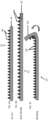
- FIG. 1A, FIG. 1B, and FIG. 1C show an example useful for understanding the invention of a surgical repair graft with a plurality of attached carrier particles, the surgical repair graft having one or more biotextile layers and a carrier matrix adhered to at least one layer, the graft configured for implanting into a body (e.g., an animal or mammalian body).
- a body e.g., an animal or mammalian body
- a layer or layers of a surgical repair graft as described herein generally have biomechanical properties that match or are similar to the biomechanical properties of the tissues they are replacing or repairing.
- biomechanical properties of a surgical implant may be described, for example by bending stiffness, compliance, elasticity, uniaxial tension, burst strength, roughness, and so on.
- a surgical repair graft may be made of any materials or combination of materials that alone or in combination supply desired mechanical properties and other desired characteristics such as biocompatibility and biostability.
- a graft may serve as a time-release depot for agent (e.g., active agent such as a drug) release.
- agent e.g., active agent such as a drug
- a graft may include multiple components such as one or more biotextile layer(s); a carrier matrix containing an agent; an adhesive that adheres carrier matrix to a biotextile layer, etc.).
- a component may be made from naturally occurring materials and/or from synthetic materials.
- a biotextile layer(s) of a surgical repair graft may be made from extracellular matrix (ECM) and/or may be synthesized to mimic the properties of extracellular matrix.
- ECM extracellular matrix
- a biotextile layer may be made from or may include naturally occurring or synthetic extracellular matrix materials such as collagen, elastin, fibronectin, INTERGARD TM , laminin, TIGR ® , ULTRAPRO TM and so on.
- a biotextile layer (or adhesive) is made from a naturally occurring collagen such as avian collagen, bovine collagen, fish collagen, marine animal collagen, ovine collagen, or porcine collagen.
- a collagen or other naturally occurring material may be harvested from any source, such as an organ or part of an organ, such as dermis, forestomach, intestine, pericardium, peritoneum, rumen (stomach), skin, stomach, tail, etc. of any organism.
- collagen or another graft component may be manufactured by recombinant or other synthetic processes.
- a carrier matrix as used herein includes a plurality of particles configured to carry and hold an agent for use in (or on) the body.
- an agent in a carrier matrix is an active agent configured for release into the body to have an effect in the body and a carrier matrix is at least partially biodegradable to release the active agent into the body, but this is not necessarily the case.
- a carrier matrix may hold a fluoroscopic agent for use for imaging purposes and the carrier matrix or part of a carrier matrix may not degrade and the fluoroscopic agent may remain in the carrier matrix.
- a carrier matrix attached to a biotextile layer is discontinuous.
- FIG. 1A, FIG. 1B, and FIG. 1C show the same surgical graft under different conditions.
- FIG. 1A, FIG. 1B, and FIG. 1C show the same surgical graft under different conditions.
- FIG. 1A shows surgical repair graft 2 in an unstretched state.
- Carrier matrix particles 6 are attached to substrate or biotextile layer 4.
- FIG. 1B shows the same graft shown in FIG. 1A that has been subjected to a stretching force (shown by the arrow).
- FIG. 1C shows the same surgical repair graft 2' that has been subject to a bending force. Due to the space between particles 6', the region of substrate 4' between particles 6' is able to stretch (or compress) and thus allow surgical graft 2' to stretch with little or no change to stretchability or relative to a similar surgical graft lacking such particles. Additionally as shown in FIG.
- FIG. 1C substrate 4" is sufficiently flexible to bend and the space between particles 6" and the shape of particles 6" allows room for particles 6" to not interfere with each other as the graft bends and folds towards itself.
- FIG. 1D, FIG. 1E, and FIG. 1F show a surgical repair graft with a covering (e.g., a coating or sheet) that limits axial compliance and increases bending stiffness compared with a similar surgical repair graft without a covering.
- FIG. 1D shows surgical repair graft 12 with covering 16 on substrate 14 in an unstressed state.
- FIG. 1E shows the same surgical repair graft 12' as the one shown in FIG. 1A that has been subject to a stretching force (shown by the arrow).
- FIG. 1F shows the same surgical repair graft 14" as shown in FIG. 1D and FIG. 1E that has been subject to a bending force. Coating 16" deforms and wrinkles when bent and prevents substrate 14" from bending too far. Because the covering resists an applied axial force and wrinkles on bending, the surgical grafts in FIG. 1E and FIG. 1F resist stretching and bending. Bending of such a relatively noncompliant graft may also result in such as wrinkling or separation of the covering from the biotextile.
- Carrier matrix particles can be any shape and can be regularly shaped or irregularly shaped.
- a carrier matrix e.g., of a surgical graft
- a carrier matrix includes particles that are generally block-shaped, conical, cuboidal, cylindrical, ellipsoidal, helical, pyramidal, spherical, square pyramidal, rectangular prism shaped, rectangular pyramidal, or tetrahedral, etc. and a carrier matrix may include one or more than one different shapes of particles.
- a swath of a textile may have one shape of carrier matrix particles while another swath may have another shape.
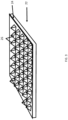
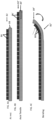
- FIG. 2A, FIG. 2B, and FIG. 2C show a side view of a surgical repair graft with a plurality of pyramidal shaped carrier particles attached to a biotextile layer at rest and under different types of tension and FIG. 3 shows a perspective view.
- FIG. 2A and FIG. 3 show surgical repair graft 22 at rest without added tension on the graft.
- FIG. 2B shows surgical repair graft of FIG.
- FIG. 2A in which surgical repair graft 22' is axially stretched and FIG. 2C shows the surgical repair graft of FIG. 2A when surgical repair graft 22" is bent.
- FIG. 2A, FIG. 2B, and FIG. 2C and FIG. 3 show carrier particles attached to the biotextile layer at an attachment end and unattached to the biotextile layer at an unattached end.
- FIG. 2A, FIG. 2B, and FIG. 2C show carrier matrix particles larger at an attachment end whereby they are attached (either directly or through an intermediate component such as an adhesive) to a biotextile layer and smaller at an unattached end whereby they are unattached to the biotextile layer.
- FIG. 1 carrier matrix particles larger at an attachment end whereby they are attached (either directly or through an intermediate component such as an adhesive) to a biotextile layer and smaller at an unattached end whereby they are unattached to the biotextile layer.
- pyramidal shaped carrier matrix particles 26 are attached to layer 24 of surgical graft 22.
- FIG. 2B as a stretching tension shown by the arrow in FIG. 2B is applied to graft 24' to axially stretch layer 22', sections of layer 22' in between attached particles 26' (particle "nodes") are free to stretch in response to the stretching, allowing the biotextile layer (and graft as a whole) to readily stretch.
- axial compliance of the graft having the carrier matrix attached to the substrate may be not significantly different (e.g., between 0% and 30% different or anything in between such as between 5% and 10%) from axial compliance of a similar graft that does not have the carrier matrix attached.
- bend resistance of the graft having the carrier matrix attached may be or may be not significantly different (e.g., between 0% and 30% different or anything in between such as between 5% and 10%) from bend resistance of a similar graft that does not have carrier matrix attached.
- attached particles 26" are narrower towards their unattached end than at their attached end, attached particles 26" do not bump into each other when graft 22" bends and graft 22" is able to bend without undue interference from attached particles 26". Having a larger attached end may be beneficial for providing space to carry an agent (an active agent) into a body.
- FIG. 4A, FIG. 4B, and FIG.4C show side views of another surgical repair graft with a plurality of block shaped attached carrier matrix particles under different degrees of force, such as those that might be experienced in a patient's body.
- the particles may be for example cuboidal or rectangular prism shaped.
- FIG. 4A shows surgical repair graft 82 at rest without added tension.
- FIG. 4B shows surgical repair graft 84' when the graft is placed under axial tension and stretched.
- FIG.4C shows surgical repair graft 84" of FIG. 4A when the graft is placed under a bending force.
- carrier matrix particles 86 are attached to layer 84.
- FIG. 4A carrier matrix particles 86 are attached to layer 84.
- Axial compliance of the graft having the carrier matrix attached may be or maybe not significantly different (e.g., between 0% and 30% different or anything in between such as between 5% and 10%) from axial compliance of a similar graft that does not have the carrier matrix attached.
- FIG. 4B Axial compliance of the graft having the carrier matrix attached may be or maybe not significantly different (e.g., between 0% and 30% different or anything in between such as between 5% and 10%) from axial compliance of a similar graft that does not have the carrier matrix attached.
- FIG. 5A, FIG. 5B, and FIG. 5C show side views of another surgical repair graft with a plurality of attached soft shell carrier particles at rest and under different types of tension.
- FIG. 5A shows surgical repair graft 102 at rest without added tension.
- FIG. 5B shows surgical repair graft 102' when the graft is axially stretched.
- FIG. 5C shows surgical repair graft 102" when the graft is bent.
- FIG. 5A shows surgical graft 102 with soft shell carrier particles 106 attached to biotextile layer 104.
- FIG. 5B as a stretching tension shown by the arrow is applied to graft 104' to axially stretch layer 102', sections of layer 102' in between attached particles 106' (particle "nodes") are free to stretch in response to the stretching.
- Axial compliance of the graft having the soft shell carrier matrix attached may be or may be not significantly different (e.g., between 0% and 30% different or anything in between such as between 5% and 10%) from axial compliance of a similar graft that does not have the carrier matrix attached.
- FIG. 5C as a force shown by the curved arrow is applied to surgical repair graft 102" to bend surgical repair graft 102", soft shell carrier particles 106" are pressed against one another.
- Soft shell carrier particles are sufficiently soft or pliable and are configured to deform in response to an applied force. In response to being pressed against one another, the particles readily morph, changing shape, indenting or deforming. Bend resistance of the graft having the soft shell carrier matrix attached may be or may not be significantly different (e.g., between 0% and 30% different or anything in between such as between 5% and 10%) from bend resistance of a similar graft that does not have the carrier matrix attached. Although particle morphing is illustrated as occurring when particles contact one another, particles may also or instead morph in response to contacting a biotextile layer, a body part, etc.
- FIG. 6A, FIG. 6B, and FIG. 6C show side views of another surgical repair graft with a plurality of attached relatively short carrier particles at rest and under different types of tension.
- the particles may, for example, be cuboidal or rectangular. Although the particles may be similarly shaped to those of FIG. 4A, FIG. 4B, and FIG. 4C , they are shorter and grafts having them generally show less bending resistance.
- FIG. 6A shows surgical repair graft 122 at rest without added tension.
- FIG. 6B shows surgical repair graft 122' when the graft is placed under axial tension and axially stretched.
- FIG. 6C shows surgical repair graft 122" when the graft is placed under a bending tension and the graft is bent.
- FIG. 6A shows surgical repair graft 122 at rest without added tension.
- FIG. 6B shows surgical repair graft 122' when the graft is placed under axial tension and axially stretched.
- FIG. 6C shows surgical
- carrier matrix particles 126 are attached to biotextile layer 124 of surgical graft 122.
- FIG. 6B as a stretching tension in the direction shown by the large arrow in FIG. 6B is applied to graft 124' to axially stretch biotextile layer 122', sections of layer 122' in between attached particles 126' (particle "nodes") are free to stretch in response to the stretching.
- Axial compliance of the graft having the relatively short carrier matrix particles attached may be or may not be significantly different (e.g., between 0% and 30% different or anything in between these values such as between 5% and 10%) from axial compliance of a similar graft that does not have the carrier matrix attached.
- FIG. 6D, FIG. 6E, and FIG. 6F show side views of a surgical repair graft with a plurality of relatively tall attached carrier particles at rest and under different types of tension.
- FIG. 6D shows surgical repair graft 132 at rest without added tension.
- FIG. 6E shows surgical repair graft 132' placed under an axial tension wherein the graft is axially stretched.
- FIG. 6F shows surgical repair graft 132" when the graft is placed under a bending tension and the graft is bent.
- carrier matrix particles 136' are attached to layer 134 of surgical graft 132.
- FIG. 6E as a stretching tension in the direction shown by the arrow in FIG.
- FIG. 6E is applied to graft 134' to axially stretch layer 132', sections of layer 132' in between attached particles 136' (particle "nodes") are free to stretch in response to the stretching and the graft stretches.
- Axial compliance of the graft having the relatively tall carrier matrix particles attached may be or may not be significantly different (e.g., between 0% and 30% different or anything in between these values such as between 5% and 10%) from axial compliance of a similar graft that does not have the carrier matrix attached.
- FIG. 6F as a force shown by the arrow is applied to graft 132" to bend graft 132".
- a graft or a portion of a graft according to FIG. 6D, FIG. 6E, and FIG. 6F may be useful in an area of the body for which greater bend resistance is desired or unimportant.
- Such a graft with a relatively larger particle size may allow more active agent to be delivered.
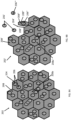
- FIG. 7A and FIG. 7B show views of another surgical repair graft having a relatively homogenous covering of carrier matrix.
- FIG. 7A shows surgical repair graft 152 at rest without added tension.
- FIG. 7B shows surgical repair graft 152' under added tension.
- FIG. 7A shows surgical graft 152 with covering 156 on biotextile layer 154.
- FIG. 7B as a stretching tension shown by the arrows 157a-157d is applied to graft 152' to axially stretch layer 154'.
- covering 156' limits the ability of underlying biotextile layer 154' to stretch, and graft 152' stretches just to the dotted lines. In other examples, a covering and graft may stretch further.
- Such a covering may be very thin (and reduce a moment of inertia), such as less than 10 nm, less than 100 nm, less than 1 um, less than 100 um, less than 500 um or more than any of these values (or any values or range of values in between these values) in thickness.
- a covering may be a lasting (permanent or non-biodegradable) or may be biodegradable in part or in whole.
- a covering may be relatively uniform or may have regions of differing thickness with a first region with a first thickness and a second region with a second thickness.
- a carrier matrix covering may be applied to a graft, a biotextile layer or an adhesive as a plurality of separate particles to coat the graft (such as by solution or electrospray) or carrier matrix may be applied to a graft, biotextile layer, or adhesive as a sheet.
- a sheet of carrier matrix may include or be combined with other components, such as an adhesive.
- a covering may be a foam and may have a plurality of cells and pores. Cells going through a covering may bend and turn within the covering.
- cells in a covering may be open (e.g., at least half of its cells are open via pores at the surface).
- cells in a covering may be closed (having cells totally enclosed by walls). In general a closed foam covering has less than half of its cells open. Open cells in a covering may better allow bodily fluid to penetrate and may be used to control a rate of degradation. Different ratios of open cells to closed cells may provide advantages for different purposes. In some examples, having more open cells may allow a faster degradation while having fewer open cells may slow down degradation and allow agent release over a longer period of time.
- a covering may have up to 10 pores per 645.16 mm 2 (square inch (PPI)), from 10 to 100 pores per 645.16 mm 2 (square inch), more than 100 and fewer than 1000 pores per 645.16 mm 2 (square inch).
- Cells over the whole graft or a region of the graft, such as a 645.16 mm 2 (square inch) region
- Such pores may also allow a fluid, such as a bodily fluid, to flow through the graft and aid in biodegrading the carrier matrix.
- the number and sizes of pores or cells may be chosen, for example, to control a rate of carrier matrix biodegradation and active agent release in a time sensitive manner such as releasing from 1 % to 100% or of an agent (or any amount in between such as 10%, 20%, 30%, 40%, 50%, 60%, 70%, 80%, or 90%) in 1 hour to 24 hours, 1 day to 14 days, 1 week to 4 weeks or 1 month to 1 year or anything in between these times (such as between 7 days and 14 days, 21 days, etc.).
- FIG. 7C and FIG. 7D show views of another surgical repair graft having a relatively homogenous covering with openings.
- FIG. 7C shows the repair graft at rest without added tension.
- FIG. 7D shows the repair graft under added tension; the openings allow the covering and graft to stretch and bend. In general, openings go through the covering, from one side of the covering to the other side.
- FIG. 7C shows surgical graft 162 with covering 166 on biotextile layer 164.
- Covering 166 can be up any thickness, but in general may be relatively thin (less than 500 nm, less than 100 nm, less than 10 nm, less than 1 nm, less than 100 um, or less than 10 um in thickness or any value or range of values in between these).
- FIG. 7C shows the repair graft at rest without added tension.
- FIG. 7D shows the repair graft under added tension; the openings allow the covering and graft to stretch and bend. In general, openings go through the covering
- openings 168 open, lengthen, or widen in response to the stretching tension, relieving axial tension, and covering 166' and underlying layer 164' are free to bend, expand, flex, lengthen, stretch or widen (e.g., in the X, Y, and/or Z directions) in response to the stretching force.
- Axial compliance (in the lengthwise (167a-167b) or widthwise (167c-167d) directions or diagonally) of graft 162' of the graft having a covering with opening may be not significantly different (e.g., between 0% and 30% different or anything in between these values such as between 5% and 10%) from axial compliance of a similar graft that does not have the carrier matrix attached.
- the covering with openings may readily bend when the graft is subject to a bending force and bends.
- Bend resistance of graft 162' having a carrier matrix covering with openings may be not significantly different (e.g., between 0% and 30% different or anything in between these values such as between 5% and 10%) from bend resistance of a similar graft that does not have the carrier matrix attached.
- a graft having covering with openings may additionally have any of the characteristics or properties indicated above for FIG. 7A and FIG. 7B , such as cells, pores, etc.
- Openings may be substantially closed (e.g., be slits and the sides of the opening opposed or touching) when a graft is at rest and the openings only open up when the graft is subject to a force, such as an axial force or a bending force or the openings may be open or partially open even in the absence of an applied force.
- the openings may be any shape when opened, e.g., circular, long rectangular, diamond, etc.
- the openings in the covering may be randomly spaced from each other or may be regularly (geometrically) spaced from one another such as in an array or matrix.
- a coating may have up to 10 openings per 645.16 mm 2 (square inch) (e.g., may have 1, 2, 3, 4, 5, 6, 7, 8, 9 openings per 645.16 mm 2 (square inch), from 10 to 100 openings per 645.16 mm 2 (square inch), or more than 100 openings and less than 1000 openings per 645.16 mm 2 (square inch) (or anything or range in between any of these values).
- Openings may have an average opening diameter or maximum dimension between 10 nm and 10 mm, or anything in between, such as from 0.1 mm to 0.5 mm, from 0.5 mm to 1 mm, etc. Such openings may also allow a fluid, such as a bodily fluid, to flow through the graft and aid in biodegrading the carrier matrix.
- the number and sizes of openings may be chosen, for example, to control a rate of carrier matrix biodegradation and active agent release in a time sensitive manner such as releasing from 1 % to 100% or of an agent (or any amount in between such as 10%, 20%, 30%, 40%, 50%, 60%, 70%, 80%, or 90%) over 1 hour to 24 hours, 1 day to 14 days, 1 week to 4 weeks or 1 month to 1 year or anything or any range in between these values.
- FIG. 8A, FIG. 8B, and FIG. 8C show side views of a surgical repair graft with carrier matrix attached to a biotextile layer through an intermediate adhesive.
- FIG. 8A shows surgical repair graft 182 at rest without added tension.
- FIG. 8B shows surgical repair graft 182' when the graft is subject to an axial force and the graft is axially stretched.
- FIG. 8C shows surgical repair graft 182" when the graft is subject to a bending force and the graft is bent.
- carrier matrix particles 186 are attached through adhesive 188 to biotextile layer 184 of surgical graft 182.
- FIG. 8B as a stretching (axial) tension in the direction shown by the large arrow in FIG. 8B is applied to graft 184', sections of adhesive 188' and underlying biotextile layer 182' in between attached particles 186' (particle "nodes") are free to stretch in response to the axial tension.
- Axial compliance of the graft having an adhesive attached may be or may not be not significantly different (e.g., between 0% and 30% different or anything in between these values such as between 5% and 10%) from the axial compliance of a similar graft that does not have the adhesive attached.
- FIG. 8B, and FIG. 8C also show carrier particles attached to the biotextile layer at an attachment end and are unattached to the biotextile layer at an unattached end.
- FIG. 8A, FIG. 8B, and FIG. 8C show carrier matrix particles are larger at an attachment end whereby they are attached through an adhesive to a biotextile layer and smaller at a free end whereby they are unattached to the biotextile layer.
- pyramidal shaped carrier matrix particles 186 are attached to adhesive 188 and through adhesive 186 to biotextile layer 184 of surgical graft 182.
- FIG. 8B as a stretching tension shown by the arrow in FIG.
- Axial compliance of the graft having carrier matrix attached may be or may not be not significantly different (e.g., between 0% and 30% different or anything in between these values such as between 5% and 10%) from the axial compliance of a similar graft that does not have the carrier matrix attached.
- Axial compliance of the graft having both adhesive and carrier matrix attached may be or may not be not significantly different (e.g., between 0% and 30% different or anything in between these values such as between 5% and 10%) from the axial compliance of a similar graft that does not have the adhesive and carrier matrix attached.
- Adhesive 188" may be sufficiently flexible such that bend resistance of graft 182" having either or both adhesive 188" and carrier matrix 186" attached may be or may not be not significantly different (e.g., between 0% and 30% different or anything in between these values such as between 5% and 10%) from the bend resistance of a similar graft that does not have either or adhesive and carrier matrix attached. Since attached particles 186" narrow from between an attached end and an unattached end (a free end not attached to the biotextile layer), attached particles 186" do not bump into each other when graft 182" bends.
- Sections of layer 182" between attached particles 186" are able to compress together and the opposing side of layer 182" is free to stretch apart and the graft is free to bend.
- adhesive 188" is sufficiently thin and/or otherwise sufficiently flexible as to allow bending and graft 182" is able to bend without undue interference from either attached particles 186" or adhesive 188".
- Bend resistance of the graft having both adhesive and carrier matrix attached may be or may not be not significantly different (e.g., between 0% and 30% different or anything in between these values such as between 5% and 10%) from the bend resistance of a similar graft that does not have the adhesive and carrier matrix attached.
- a surgical repair graft may include an adhesive adhering a carrier matrix to a substrate (a biotextile layer).
- Carrier matrix may be any such as dendrimers, liposomes, micelles, multivesicular liposomes, nanoparticles, quantum dots, non-concentric internally aqueous chambers, each chamber surrounded by a lipid membrane, the lipid membrane containing an active agent, etc. including those described herein.
- a multivesicular liposome includes non-concentric internally aqueous chambers, each chamber surrounded by a lipid membrane.
- a carrier matrix may be applied as a coating or sheet, may be painted onto an adhesive (or substrate) electro sprayed on, printed on, 3-D printed, emulsified with an adhesive and applied, mixed with an adhesive and applied, etc.
- An adhesive for adhering carrier matrix particles to a biotextile layer may be a chemical or mechanical adhesive.
- An adhesive may hold carrier matrix on its surface or carrier matrix may be contained or embedded in the adhesive.
- An adhesive may have a smooth surface or may have a rough or textured surface to further hold or entrap a carrier matrix.
- An adhesive may have a rough surface wherein carrier matrix fills in the roughness to generate a smoother surface with less roughness than found in the adhesive without carrier matrix attached.
- an adhesive may be a gel, such as a dispersion of molecules of a liquid (e.g., the carrier matrix) within a solid.
- an adhesive may be a polymer configured to adhere to both carrier matrix particles and to a biotextile layer.
- an adhesive may be a peptide, a polymeric hydrogel or another hydrogel configured to adhere to both carrier matrix particles and to a biotextile layer or to intermediates between such components.
- a surgical repair graft may include a hydrogel between a carrier matrix and a biotextile layer, the hydrogel adhering the carrier matrix to the biotextile layer.
- the adhesive may be chemically bonded to a carrier matrix and may be bonded to a lipid membrane (including to a component embedded in a lipid membrane of a carrier matrix).
- a chemical bond between a carrier matrix and an adhesive e.g., a hydrogel
- a polymer or hydrogel may be coated or otherwise placed onto a biotextile layer.
- a hydrogel is generally a hydrophilic three-dimensional polymer swellable by or swelled with an aqueous solution (e.g., water or saline).
- Such a hydrogel may be naturally occurring or may be synthetic and may contain carbohydrates, nucleic acids, lipids, proteins, etc.
- a hydrogel include a polymer, a polymer mixture, a copolymer, a gradient polymer, an interpenetrating polymer network (IPN), a semi-interpenetrating IPN, or so forth.
- a hydrogel may be or may be configured to be at least 50% (w/w) aqueous (e.g., by weight of the hydrogel without water), at least 60%, at least 70%, at least 80%, or at least 90% by weight (w/w) water.
- a polymeric hydrogel adhesive between a carrier matrix and the biotextile layer adhering the carrier to the biotextile layer may be or may include for example, alginate, cellulose, chitosan, collagen, polyhydroxyacids, derivatized cellulose, gelatin, polyanhydrides, polycaprolactone, polyhydroxy acids, polyglycolic acid, polylactic acid, polyorthoester, etc.
- a surgical repair graft may include a cross-linked polymer (e.g., a cross-linked polymeric hydrogel between a carrier matrix and a biotextile layer adhering carrier matrix to a biotextile layer), the cross-link deriving from acrylamide, allyl methacrylate, dimethacrylate, dimethyl suberimidate, DMS-treated collagen, dimethyl 3, 3'-dithiobispropionimidate, ethylene glycol, glutaraldehyde, N, N methylene-bisacrylamide, transglutaminase, or tripolyphosphate.
- a cross-linked polymer e.g., a cross-linked polymeric hydrogel between a carrier matrix and a biotextile layer adhering carrier matrix to a biotextile layer
- transglutaminase may be utilized to crosslink components (such as adhesive, biotextile or carrier matrix, by self cross-linking (e.g., cross-linking within any of these materials) or between two different materials (e.g., between a carrier matrix such as a multivesicular liposome and an adhesive or between a carrier matrix such as a multivesicular liposome and a biotextile layer).
- crosslink components such as adhesive, biotextile or carrier matrix
- self cross-linking e.g., cross-linking within any of these materials
- two different materials e.g., between a carrier matrix such as a multivesicular liposome and an adhesive or between a carrier matrix such as a multivesicular liposome and a biotextile layer.
- Such an enzyme may catalyze the formation of a covalent bond to effect cross-linking.
- transglutaminase may be incorporated into a repair graft or otherwise be used to catalyze the formation of a covalent bond between a free amine group and an acyl/alkanoyl group between two different components such as to adhere carrier matrix to a hydrogel adhesive.
- side chains may be found on side chains of certain amino acids such as lysine, glutamate, and aspartate.
- Amino acids may be part of or be incorporated into any of the components of a surgical graft or medical textile.
- a cross-link that also occurs naturally such as those between amino acids mediated by transglutaminase may be more readily degraded by in a patient's body by biological processes than is a non-naturally occurring cross-link, and thus the quality and quantity (e.g., amount and locations) of such cross-links may be especially useful to control the stability or degradability of a component or a surgical repair graft to control active agent release.
- a transglutaminase may be obtained from natural or recombinant sources and may be microbial or non-microbial and may be from fungi, or plants or other eukaryotes.
- Transglutaminase that may be used to generate adhesion includes transglutaminase (e.g., EC 2.3.2.13, protein-glutamine ⁇ -glutamyltransferase, TGase).
- an adhesive may have regions (different subregions) having different properties that facilitate attachment to different components, such as to both a carrier matrix and a biotextile.
- an amphipathic polymer may have a first region that is more biotextile-like and able to attach and/or interpenetrate with a biotextile and may have a second region that is more carrier matrix-like and able to attach and/or interpenetrate with a carrier matrix.
- an amphipathic polymer may have a first region that is collagen-like region able to interpenetrate and bond to collagen and may have a second region that is lipophilic and able to interpenetrate and bond to lipid membranes of a carrier matrix.
- an adhesive may have one or more material gradients that allow a gradual transition from characteristics of a first region to characteristics of a second region, such as from more biotextile-like properties to more carrier matrix like properties.
- Materials such as those or similar to those described in US8236342 , US8853294 , US201000010114 , WO2017/223462 , WO2017/191276 may be used.
- an adhesive such as a polymer, polymeric hydrogel, or other hydrogel may contain a carrier matrix having an encapsulated active agent.
- a carrier matrix having an encapsulated active agent may release carrier matrix and active agent in response to adhesive degradation, diffusion of active agent through the carrier matrix and adhesive, or in response to an applied stimulus, such as a pH change, application of an electric field, application of a magnetic field, change in temperature, treatment with ultrasound and so on.
- the surgical grafts described herein may have contain particles in any density, from a homogenous covering to separated particles. Particles may be separated from each other by (on an average) at least 1 nm, at least 10 nm, at least 100 nm, at least 1 ⁇ m, at least 10 ⁇ m, or at least 100 ⁇ m or any values or range of values in between these.
- One or more components in a surgical repair graft may be modified or treated to change the biomechanical properties of the component(s) or graft and / or to join two or more components together.
- Any of the grafts or graft modifications as described in U.S. 9,775,700 , U.S. 9,820,843 , U.S. 2017/0000597 , U.S. 2017/0020646 , or U.S. 2017/0020647 may be used, alone or in combination.
- Any of these surgical repair grafts may further include compliance control devices that provide compliance control and / or hold two or more than two layers together.
- a surgical repair graft such as described herein may have one or more than one biotextile layer with a pattern of reinforced discrete compliance control sites having a density of sites that is fewer than about 10 attachments/mm 2 .
- a surgical repair graft as described herein may have one or more than one biotextile layer with a pattern of reinforced discrete compliance control sites having a density of sites that is between 10 attachments/mm 2 and 100 attachments/mm 2 or anything in between these values.
- a surgical repair graft as described herein may have one or more than one biotextile layer biotextile layer with a pattern of reinforced discrete compliance control sites having a density of sites that is less than between 100 attachments/mm 2 and 500 attachments/mm 2 or anything in between these values.
- stitches are those described in U.S. 2017/0020646 and may be sewn or embroidered into one or more biotextile (or adhesive) layers. Such stitches may be compliance control stitch patterns and may be configured to control the compliance of the surgical repair graft.
- Mechanical properties of a surgical implant may be described by stiffness, breaking strain, and maximum force.
- material property may be described force per unit width, such as N/cm.
- compliance strain of the biotextile layer or graft with (or without compliance control stitches) may be between 10-30% at 16 N/cm.
- Stitches may include a plurality of lines and / or a plurality of repeating angles oriented at one or more axes of a substrate. Stitches may form a corner-lock stitch pattern.
- Stitches may be non-resorbable (permanent) or may be bioresorbable. Any of these surgical repair grafts may include stitches made from a polymer such as polyethylene or polypropylene and may be a monofilament yarn or thread. Such stitches may form openings that may aid in bioresorbing an active agent from a carrier matrix.
- Two or more components in a graft may be joined together by an adhesive.
- two or more biotextile layers may be joined to each other by an adhesive or a carrier matrix may be joined to a biotextile layer by an adhesive.
- An adhesive may be a chemical adhesive or a material adhesive.
- the discrete attachment sites may be chemical or material adhesives between the layer and the discrete locations, such as an adhesive or glue material that is biocompatible and adheres a first (e.g., ECM) layer to the second layer.
- An adhesive may be any appropriate biologically compatible adhesive.
- the discrete attachment sites may refer to relatively small diameter regions which may be regularly shaped or irregularly shaped and may be uniaxial or biaxial. Any of these surgical repair grafts may further include stitches sewn between two components. Any of these surgical repair grafts include discrete attachment sites with an attachment material (e.g., fiber, thread, yarn, etc.).
- the discrete attachment sites may have a diameter of between about 0.025 mm (0.001 inch) and 5.1 mm (0.20 inches) (e.g., between about 0.025 mm (0.001 inches) to about 0.25 mm (0.010 inches), between about 0.025 to about 1.52 mm (about 0.001 to about 0.060 inches), etc.).
- the attachment between the first layer (substrate layer) and the second layer may be configured to flexibly attach the two layers, so that the attachment of the two layers does not change the compliance more than a nominal (e.g., 15% or less) amount.
- the density of the discrete attachment sites may be uniform or non-uniform.
- the discrete attachment sites may be distributed in a pattern such as a grid (or overlapping grids).
- a second biotextile layer may be (flexibly) attached to a first biotextile layer in a pattern of discrete attachment sites having a density of 10 or fewer than 10 attachment sites/mm2 (e.g., 1, 2, 3, 4, 5, 6, 7, 8, or 9 attachment sites per mm 2 ).
- a second biotextile layer may be (flexibly) attached to a first biotextile layer in a pattern of discrete attachment sites having a density of between 10 attachment sites/mm 2 and 100 attachment sites/mm 2 .
- a second biotextile layer may be (flexibly) attached to a first biotextile layer in a pattern of discrete attachment sites having a density of more than 100 attachment sites/mm 2 .
- a carrier matrix is between two biotextile layers and may be adhered to one or both of the layers.
- a surgical repair graft that includes a carrier matrix or an adhesive (or both considered together) may alter a compliance (e.g., an axial tensile compliance; force per unit stretch) of a surgical repair graft having similarly stacked layers not having the carrier matrix by less than 50%, less than 40%, less than 30%, less than 20 %, less than 25% less than 10 %, less than 5% or anything in between.
- the presence of a carrier matrix in a surgical repair graft decreases the compliance of the graft compared with a repair graft having similarly stacked layers not having the carrier matrix.
- a compliance of surgical repair graft may not change or may increase over time when the carrier matrix is exposed to a bodily fluid or an aqueous fluid.
- a compliance may increase by up to 5%, up to 10%, up to 15%, up to 20%, up to 25 %, up to 30%, up to 35%, up to 40%, up to 50%, or less than 5%, less than 10%, less than 15%, less than 20%, less than 25 %, less than 30%, less than 35%, less than 40%, less than 50% or anything in between such as up to 25% and less than 50% compared with a repair graft having similarly stacked layers not having the carrier matrix.
- the compliance may be measured over any time period, such as one day, from one day to fourteen days, from one week to four weeks, from four weeks to twenty six weeks, from twenty six weeks to fifty two weeks or anything in between these amounts, such as after 8 weeks.
- the compliance may be measured after one or more than one more year. In any of these cases, the remainder of the surgical repair graft may remain intact, thus the (stacked) biotextile layers of the surgical repair graft may remain intact and stacked.
- a compliance strain of a surgical repair graft as described here may between 10-30% at 16 N/cm (e.g., prior to exposure to a bodily fluid for any of the times and conditions described herein, after exposure to a bodily fluid for any of the times and conditions described herein, or both before and after exposure to a bodily fluid for any of the times and conditions described herein).
- a surgical repair graft that includes a carrier matrix or an adhesive (or both considered together) including any type of stitch may alter a uniaxial tension of a surgical repair graft having similarly stacked layers not having the carrier matrix by less than 50%, less than 40%, less than 30%, less than 20 %, less than 25% less than 10 %, less than 5%, less than 1% or anything in between.
- the presence of a carrier matrix in a surgical repair graft decreases the uniaxial tension of the graft compared with a repair graft having similarly stacked layers not having the carrier matrix.
- a uniaxial tension of a surgical repair graft may increase over time when the carrier matrix is exposed to a bodily fluid or an aqueous fluid.
- a uniaxial tension may increase by up to 5%, up to 10%, up to 15%, up to 20%, up to 25 %, up to 30%, up to 35%, up to 40%, up to 50%, or less than 5%, less than 10%, less than 15%, less than 20%, less than 25 %, less than 30%, less than 35%, less than 40%, less than 50% or anything in between such as up to 25% and less than 50% compared with a repair graft having similarly stacked layers not having the carrier matrix.
- the uniaxial tension may be measured over any time period, such as one day, from one day to fourteen days, from one week to four weeks, from four weeks to twenty six weeks, from twenty six weeks to fifty two weeks or anything in between these amounts, such as after 8 weeks.
- the uniaxial tension may be measured after one or more than one more year. In any of these cases, the remainder of the surgical repair graft may remain intact, thus the (stacked) biotextile layers of the surgical repair graft may remain intact and stacked.
- a surgical repair graft that includes a carrier matrix or an adhesive (or both considered together) may alter a bending stiffness of a surgical repair graft having similarly stacked layers not having the carrier matrix by less than 50%, less than 40%, less than 30%, less than 20 %, less than 25% less than 10 %, less than 5%, less than 1% or anything in between.
- the presence of a carrier matrix in a surgical repair graft decreases a bending stiffness of the graft compared with a repair graft having similarly stacked layers not having the carrier matrix.
- a bending stiffness of a surgical repair graft may increase over time when the carrier matrix is exposed to a bodily fluid or an aqueous fluid.
- a uniaxial tension may increase by up to 5%, up to 10%, up to 15%, up to 20%, up to 25 %, up to 30%, up to 35%, up to 40%, up to 50%, or less than 5%, less than 10%, less than 15%, less than 20%, less than 25 %, less than 30%, less than 35%, less than 40%, less than 50% or anything in between such as up to 25% and less than 50% compared with a repair graft having similarly stacked layers not having the carrier matrix.
- a bending stiffness may be measured over any time period, such as one day, from one day to fourteen days, from one week to four weeks, from four weeks to twenty six weeks, from twenty six weeks to fifty two weeks or anything in between these amounts, such as after 8 weeks.
- a bending stiffness may be measured after one or more than one more year.
- the remainder of the surgical repair graft may remain intact, thus the (stacked) biotextile layers of the surgical repair graft may remain intact and stacked.
- a surgical repair graft that includes a carrier matrix or an adhesive (or both considered together) may alter a burst strength of a surgical repair graft having similarly stacked layers not having the carrier matrix by less than 50%, less than 40%, less than 30%, less than 20 %, less than 25% less than 10 %, less than 5%, less than 1% or anything in between.
- the presence of a carrier matrix in a surgical repair graft decreases or increases a burst strength of the graft compared with a repair graft having similarly stacked layers not having the carrier matrix.
- a burst strength of a surgical repair graft may decrease or increase over time when the carrier matrix is exposed to a bodily fluid or an aqueous fluid.
- a burst strength may change by up to 5%, up to 10%, up to 15%, up to 20%, up to 25 %, up to 30%, up to 35%, up to 40%, up to 50%, or less than 5%, less than 10%, less than 15%, less than 20%, less than 25 %, less than 30%, less than 35%, less than 40%, less than 50% or anything in between such as up to 25% and less than 50% compared with a repair graft having similarly stacked layers not having the carrier matrix.
- a burst strength may be measured over any time period, such as one day, from one day to fourteen days, from one week to four weeks, from four weeks to twenty six weeks, from twenty six weeks to fifty two weeks or anything in between these amounts, such as after 8 weeks.
- a burst strength may be measured after one or more than one more year.
- the remainder of the surgical repair graft may remain intact, thus the (stacked) biotextile layers of the surgical repair graft may remain intact and stacked.
- a surgical repair graft that includes a carrier matrix or an adhesive (or both considered together) may alter a roughness of a surgical repair graft having similarly stacked layers not having the carrier matrix by less than 50%, less than 40%, less than 30%, less than 20 %, less than 25% less than 10 %, less than 5%, less than 1% or anything in between.
- a roughness of a surgical repair graft may slightly decrease or increase over time when the carrier matrix is exposed to a bodily fluid or an aqueous fluid. Surface roughness may be made by any means, such as categorizing them by height, depth, and/or interval. Linear roughness or areal roughness (over a rectangular range) may be measured using contact or non-contact (e.g., optical) methods.
- FIG. 9A shows carrier matrix particle 202 having a plurality of non-concentric internally aqueous chambers 208 each surrounded by lipid membrane 204 and containing first agent 206.
- FIG. 9B shows a partially degraded version of carrier matrix particle 202' of FIG. 9A .
- Lipid membrane 204' is partially degraded and the contents of chamber 208' including agent 206' is being released from the particle.
- lipid membrane 204" has reorganized around internally aqueous chamber 208" and agent 206" and part of the contents of the chamber has been released as shown by the presence of agent 206′′′ outside the carrier matrix particle.
- FIG. 9A shows carrier matrix particle 202 having a plurality of non-concentric internally aqueous chambers 208 each surrounded by lipid membrane 204 and containing first agent 206.
- FIG. 9B shows a partially degraded version of carrier matrix particle 202' of FIG. 9A .
- Lipid membrane 204' is partially degraded and the contents of
- FIG. 9B also shows an external part of the particle (e.g., chamber 208' and chamber 208") that degrades and/or reorganizes prior to an internal region 208a of the particle degrading or reorganizing.
- Internal region 208a is the same as internal region 208a'.
- a carrier matrix particle does not readily degrade or reorganize and the carrier matrix particle may serve to hold an agent in its chambers.
- Such a particle may have a structure such as that shown in FIG. 9A , FIG. 10A , FIG. 11A , or FIG. 12A or variations thereof.
- FIG. 10A shows a carrier matrix particle 212 having a plurality of non-concentric internally aqueous chambers 208 each surrounded by lipid membrane 204 and containing first agent 206 and second agent 214 in different chambers.
- FIG. 10B shows a partially degraded version of carrier matrix particle 212' of FIG. 10A . Lipid membrane 204' is partially degraded and the contents of chamber 208' including first agent 206' and second agent 214' is being released.
- FIG. 11A shows carrier matrix particle 222 having a plurality of non-concentric internally aqueous chambers 208 each surrounded by lipid membrane 204 and containing first active agent 206 and second active agent 214 in the same chamber 208.
- FIG. 11B shows a partially degraded version of carrier matrix particle 222' of FIG. 11A . Lipid membrane 204' is partially degraded and the contents of chambers 208' including first agent 206' and second agent 214' is being released.
- FIG. 12A shows carrier matrix particle 232 having a plurality of non-concentric internally aqueous chambers 208 each surrounded by lipid membrane 204 and containing first agent 236 which is lipophilic and substantially entrapped or embedded in lipid membrane 204.
- FIG. 12B shows a partially degraded version of carrier matrix particle 232' of FIG. 12A .
- Lipid membrane 204' is partially degraded and the contents of chamber 208' including first agent 236' which is lipophilic is being released.
- a carrier matrix particle reorganizes as shown by reorganized membrane 204" containing reorganized chamber 208".
- First agent 236" has moved along with reorganized membrane 204" as it reorganized and is still entrapped or embedded within.
- First agent 236′′′ has been released due to the reorganization of reorganized membrane 204".
- a surgical repair graft has a biotextile layer; and a carrier matrix attached to the biotextile layer and comprising a plurality of particles each having a plurality of non-concentric internally aqueous chambers surrounded by a lipid membrane, one or more of the membrane and the aqueous chambers containing an agent.
- an internally aqueous chamber may carry an (active) agent and/or a lipid membrane may carry an (active) active agent.
- a carrier matrix may not have such chambers and membrane and may carry an agent.
- a carrier matrix particle (a liposome) may act as a depot from which an entrapped agent can be slowly released. This may serve to maintain therapeutic levels of the agent in the blood, at the release site, or in another location in a body.
- a therapeutic level of an active agent is from 5% to 100% or anything in between of a C max of an immediate release dosage form of an active agent.
- An internally aqueous chamber may include a buffer, a hydrogel, etc.
- a plurality of particles may be DepoFoam particles.
- An agent carried in an aqueous chamber may be carried as a colloid in the aqueous material, may be dissolved in the aqueous material, or so on.
- An agent carried in an aqueous chamber may be charged, hydrophilic, polar etc. such that it is readily carried in an aqueous material.
- An agent carried in a lipid membrane in general is lipophilic or is coated or otherwise treated to be lipophilic.
- An agent may be hydrophobic or neutral (uncharged).
- An agent may be an active agent such as an active ingredient or an active pharmaceutical ingredient (API) and may be an agent useful for diagnosing, imaging, managing, preventing or treating such as for diagnosing, imaging, managing, preventing and/or treating anxiety, asthma, attention deficit disorder, bipolar disorder, cancer, diabetes, dementia, depression, a disease, a disorder, an eating disorder, inflammation, infection, mental illness, a neurological disorder, pain, panic, sleep disorder, etc.
- An agent may be an active agent such as an active pharmaceutical ingredient (API) approved by the United States Food and Drug Administration / Center for Drug Evaluation and Research and may be a brand name, generic or an over-the-counter pharmaceutical agent.
- An agent may be an antidepressant, an antineoplastic agent, an anxiolytic, antisense oligonucleotide, an antibiotic, an antifungal agent, an antipsychotic, an antithrombolytic, a cell, a drug, a DNA, a fungicide, a hormone, an RNA, an immunoglobulin E blocker (IgG), a non-steroidal anti-inflammatory agent, an opioid, a pain reliever (pain medication), a peptide, a protein, an antirheumatic agent, a sedative, a sense oligonucleotide, a small drug, a steroid.
- An agent may be radiopaque.
- an agent is bupivacaine or salts of bupivacaine or variations thereof.
- An agent may be 5-azacytidine, amikacin, amitriptyline, ampicillin, aripiprazole, betamethasone, chlordiazepoide, chlorpromazine, corticosteroid, cyanocobalamine, cytarabine, daunorubicin, decitabine, delatestryl, delestrogen, desferrioxamine, desferrioxamine mesylate, desmopressin, desmopressin acetate, desoxycorticosterone pivalate, enoxaparin, exenatide, fentanyl, fluphenazine, gentamicin, haloperidol, heparin, hydromorphone, hydromorphone HCL, imitrex, insulin, leuprolide, loflupane, lorazepam, medroxyprogesterone, methotrexate
- a carrier matrix may also contain one or more than one inactive ingredients that do not have a pharmacological or therapeutic effect on the body, such as a binding agent, a coating, a coloring agent, a disintegrant, an excipient, enzyme, a filler, a preservative, a stabilizer, etc.
- a carrier matrix particle generally has a plurality of aqueous chambers each surrounded by a lipid membrane.
- a carrier matrix particle has a plurality of non-concentric internally aqueous chambers each surrounded by lipid membrane and containing an agent in at least one of the membrane and the chambers.
- a lipid membrane of a carrier matrix particle is biocompatible and is configured to biodegrade although in some cases it may not biodegrade and instead may be stable over time.
- an enzyme may be present in a surgical graft or carrier matrix and may function to biodegrade the surgical graft or carrier matrix or may change (breakdown) an agent from an inactive form into an active agent.
- an enzyme may break down a prodrug into a drug that has a therapeutic effect on the body.
- a biodegradable material such as a lipid membrane of a carrier matrix particle, is a material may be broken down and cleared by the body's normal metabolic pathways.
- a lipid membrane of a carrier matrix particle may be naturally occurring lipids or synthetic lipids including synthetic versions of a lipid(s) naturally found in the body. Naturally occurring types of lipids may be those generally found in the body (e.g., a human or mammalian body).
- a lipid membrane may be a lipid monolayer, a lipid bilayer, a lipid trilayer, etc.
- a lipid membrane of a carrier matrix particle may be neutral, may be polar, or may be charged.
- a lipid membrane is a phospholipid bilayer.
- a lipid membrane includes an amphipathic lipid or salt thereof, one or more neutral lipids, and optionally cholesterol and / or plant sterols.
- a carrier matrix particle includes a multivesicular liposome have at least one amphipathic lipid, at least one neutral lipid, and a therapeutic agent.
- a lipid membrane of a carrier matrix particle includes phospholipids, cholesterol, and triglycerides.
- a phospholipid is dioleoylphosphatidylcholine (DOPC).
- the triglyceride is a synthetic version of a lipid found in the body, such as tricaprylin.
- carrier matrix particle is from 1% (w/w) to 10% (w/w) lipid or anything in between such (1% (w/w), 2% (w/w), 3% (w/w), 4% (w/w), 5% (w/w) 6% (w/w), 7% (w/w), 8% (w/w), 9% (w/w), and 10% (w/w) or from between any of these, such as from 3% (w/w) to 6% (w/w) or from 8% (w/w) to 9% (w/w).
- carrier matrix particle is from 10% (w/w) to 20% (w/w) lipid.
- Part (e.g., an outer part, an inner facing part) of a carrier matrix particle may be neutral, polar, or charged and another part may have different properties (e.g., an inner facing surface may be neutral while an outer facing surface is charged, etc.).
- an outer facing surface of a lipid membrane is complementary to an adhesive material such that an adhesive membrane adheres to or binds (e.g., chemically binds) to an outer facing surface of a lipid membrane.
- an outer facing surface of a lipid membrane may be negatively charged and an adhesive positively charged such that the adhesive binds to the outer facing surface of the membrane.
- An outer facing surface may be modified with proteins or amino groups which may be attached such as through amino groups or sulfhydryl groups.
- a carrier matrix particle(s) can be from 80% (w/w) aqueous material to 99% aqueous material or anything or any range in between. In some examples, a carrier matrix particle(s) can be from 90% (w/w) aqueous material to 95% aqueous material of any range in between.
- a carrier matrix particle can be 80% (w/w), 81% (w/w), 82% (w/w), 83% (w/w), 84% (w/w), 85% (w/w), 86% (w/w), 87% (w/w), 88% (w/w), 89% (w/w), 90% (w/w), 91% (w/w), 92% (w/w), 93% (w/w), 94% (w/w), 95% (w/w), 96% (w/w), 97% (w/w), 98% (w/w), and 99% (w/w) aqueous material or anything in between such as from 92% (w/w) to 97% (w/w), etc.
- a carrier matrix particle may have a capture volume (an internal volume) of 10% to 90% or anything in between, such as 20% to 35%.
- a carrier matrix may have any configuration or any materials that carries an agent, such as a polymer such as cellulose esters, ethylcellulose polymer, gelatin, polycaprolactone, poly diaxonone, poly hydroxyl butyrate, poly lactic acid, poly lactide-co-glycolide (PLGA), polyester, poly glycolic acid, polyester amide, polyester urea, polyester urethane, polyethylene oxide, a water soluble resin, and so on. Such materials may be in a liquid dispersion and / or be biodegradable.
- a carrier matrix may contain one or more than one type of materials.
- the more than one type of materials may be configured to degrade or otherwise release an active agent over different times.
- a carrier matrix may have a first material that degrades more quickly and releases a first active agent quickly and a second material that degrades more slowly and releases a second active agent over a longer period of time.
- a first active agent and second active agent may be the same or may be different, including any as described herein.
- a surgical graft or carrier matrix does not contain cyclodextrin.
- a carrier matrix particle is generally a microscopic particle and as indicated elsewhere herein, a carrier matrix particle can be any shape.
- a carrier matrix particle may be from between 1 um to 500 um or longer in a longest dimension (or diameter), from 5 um, 10 um, 20 um, 30 um, 40 um, 50 um, 60 um, 70 um, 80 um, 90 um, 100 um, 200 um, 300 um, 400 um, or 500 um in a longest dimension (or diameter) or any value or range of values in between these values.
- a particle is between 1 um and 60 um, between 5 um and 55 um, between 15 um and 50 um and so on.
- a carrier matrix particle may contain from 1 to 500 or more than 500 internal chambers, such as at least 2, at least 5, at least 10, at least 25, at least 50, at least 100, at least 200, at least 300, at least 400, at least 500, at least 1000 internal chambers or may have fewer than 1000, fewer than 500, fewer than 400, fewer than 300, fewer than 200, fewer than 100, fewer than 50, fewer than 25, fewer than 10, fewer than 5 or anything in between such as at least 50 and fewer than 300, at least 100 and fewer than 500 and so on.
- 500 internal chambers such as at least 2, at least 5, at least 10, at least 25, at least 50, at least 100, at least 200, at least 300, at least 400, at least 500, at least 1000 internal chambers or may have fewer than 1000, fewer than 500, fewer than 400, fewer than 300, fewer than 200, fewer than 100, fewer than 50, fewer than 25, fewer than 10, fewer than 5 or anything in between such as at least 50 and fewer than 300,
- Manipulation of the amounts, types and compositions of adhesives, lipids, aqueous material, and agent material may be used to control the rate and time of degradation and/or lipid membrane reorganization.
- Controlling the particle size may be used to control the rate and time of degradation and/or the rate and time of lipid membrane reorganization.
- the amounts and types of materials and other characteristics of the carrier matrix and surgical graft may be chosen, for example, to control a rate of carrier matrix biodegradation and active agent release in a time sensitive manner such as releasing from 1 % to 100% or of an agent (or any amount in between such as 10%, 20%, 30%, 40%, 50%, 60%, 70%, 80%, or 90%) in 1 hour to 24 hours, 1 day to 14 days, 1 week to 4 weeks or 1 month to 1 year or anything in between these times (such as 6 days, 21 days, etc.) upon continuous exposure to a bodily fluid.
- a rate of carrier matrix biodegradation and active agent release in a time sensitive manner such as releasing from 1 % to 100% or of an agent (or any amount in between such as 10%, 20%, 30%, 40%, 50%, 60%, 70%, 80%, or 90%) in 1 hour to 24 hours, 1 day to 14 days, 1 week to 4 weeks or 1 month to 1 year or anything in between these times (such as 6 days, 21 days, etc.) upon continuous exposure to a bodi
- a carrier matrix is at least 50% degraded after 14 days upon continuous exposure to a bodily fluid or bodily fluid substitute (e.g., a synthetic version of a bodily fluid), at least 95% degraded within one day of continuous exposure to a bodily fluid, at least 95% degraded after 30 days of continuous exposure to a bodily fluid, between 25% and 75% degraded at 7 days of continuous exposure to a bodily fluid, between 25% and 75% degraded at 14 days of continuous exposure to a bodily fluid.
- a bodily fluid may be, for example, ascites, blood, breast milk, gastric fluid, intestinal fluid, interstitial fluid, lymph fluid, menstrual fluid, peritoneal fluid, perspiration, urine, wound exudate and so forth.
- Described herein is a method useful for understanding the invention for controlled release an active agent from a surgical repair graft, including exposing a surgical repair graft having one or more than one stacked biotextile layers and a bioabsorbable carrier matrix attached to the one or at least one of the biotextile layers, the carrier matrix comprising a plurality of particles each having a plurality of non-concentric internally aqueous chambers surrounded by lipid membranes, at least one of the membrane and the aqueous chambers containing an active agent; and degrading over time the lipid membrane by the aqueous fluid to thereby release the active agent from the carrier matrix.
- Also described herein is a method useful for understanding the invention for diagnosing, treating or otherwise relieving the symptoms of an affliction, disease, or disorder (including any of those described herein) comprising administering a formulation to a subject in need thereof by implanting a surgical repair graft having the formulation attached, wherein the formulation comprises multivesicular liposomes, the multivesicular liposomes comprising an amount of an active pharmaceutical ingredient (API), one or more amphipathic lipids or salts thereof, one or more neutral lipids, and optionally cholesterol or plant sterols, wherein the formulation is substantially cyclodextrin free, wherein administration of a single dose of said formulation to the subject in need thereof results in a plasma C max of the active pharmaceutical ingredient of from 5% to 50% of the plasma C max an of immediate release dosage forms of the active pharmaceutical ingredient, and wherein a duration of the active pharmaceutical ingredient in the subject is from about 1 to about 30 days.
- API active pharmaceutical ingredient
- a method useful for understanding the invention of treating post-operative or post-trauma pain in a subject in need thereof comprising administering a multivesicular liposome comprising a therapeutically effective amount of an analgesic attached to a surgical repair graft, wherein the multivesicular liposome comprises the analgesic; a lipid component comprising at least one amphipathic lipid and at least one neutral lipid lacking a hydrophilic head group; and, optionally, a cholesterol and/or a plant sterol.
- the analgesic comprises bupivacaine or a salt or derivative thereof such as bupivacaine phosphate.
- lipid walls on the first set of chambers are degraded first and lipid walls on the second set of chambers are degraded later.
- the method further includes flowing active agent through the pores to thereby release it to a body region adjacent one biotextile layer of the one or more biotextile layers.
- a body may be that of an animal or plant and a body region may be part of a body system, a body organ or part of a body organ, such as a breast, an intestine, a muscle, a stomach etc.
- the method further includes flowing active agent through the hydrogel to thereby release it to a body region adjacent the surgical repair graft.
- the aqueous fluid includes a bodily fluid, such as ascites, blood, breast milk, gastric fluid, intestinal fluid, interstitial fluid, lymph fluid, menstrual fluid, peritoneal fluid, perspiration, urine, wound exudate, etc.
- a compliance strain of the surgical repair graft is between 10-30% at 16 N/cm prior to the degrading step. In some such methods, a compliance strain of the surgical repair graft is between 10-30% at 16 N/cm after the degrading step. In some such methods, a compliance strain of the surgical repair graft is between 10-30% at 16 N/cm after the degrading step. In some such methods, a compliance strain of the surgical repair graft is between 10-30% at 16 N/cm both before and after the degrading step. Such compliance after the degrading step may be measured after 1 hour to 24 hours, 1 day to 14 days, 1 week to 4 weeks or 1 month to 1 year or anything in between these times (such as 6 days, 21 days, etc.) of continuous exposure to a bodily fluid.
- carrier matrix is at least 50% (or at least 95% or between 25% and 75%) degraded one day after beginning the exposing step. In some methods for controlled release an active agent from a surgical repair graft, carrier matrix at least 50% (or at least 95% or between 25% and 75%) degraded 14 days after beginning the exposing step. In some methods for controlled release an active agent from a surgical repair graft, carrier matrix at least 50% (or at least 95% or between 25% and 75%) degraded 90 days after beginning the exposing step.
- carrier matrix particles are at least 50% (or at least 95% or between 25% and 75%) degraded 1 hour to 24 hours, 1 day to 14 days, 1 week to 4 weeks or 1 month to 1 year or anything in between these times (such as 6 days, 21 days, etc.) after beginning the exposing step.
- carrier matrix particles are between 1% (w/w) and 10% (w/w) lipid prior to the degrading step. In some methods for controlled release an active agent from a surgical repair graft, carrier matrix particles are between 1% (w/w) and 10% (w/w) lipid one day after beginning the exposing step. In some methods for controlled release an active agent from a surgical repair graft, carrier matrix particles are between 1% (w/w) and 10% (w/w) lipid 14 days after beginning the exposing step.
- carrier matrix particles are between 1% (w/w) and 10% (w/w) lipid 90 days after beginning the exposing step.
- carrier matrix particles are between 1% (w/w) and 10% (w/w) lipid 1 hour to 24 hours, 1 day to 14 days, 1 week to 4 weeks or 1 month to 1 year or anything in between these times (such as 6 days, 21 days, etc.) after beginning the exposing step.
- carrier matrix particles are between 80% (w/w) and 99% (w/w) aqueous prior to the degrading step. In some methods for controlled release of an active agent from a surgical repair graft, carrier matrix particles are between 80% (w/w) and 99% (w/w) aqueous one day after beginning the exposing step. In some methods for controlled release of an active agent from a surgical repair graft, carrier matrix particles are between 80% (w/w) and 99% (w/w) aqueous 14 days after beginning the exposing step.
- carrier matrix particles are between 80% (w/w) and 99% (w/w) aqueous 90 days after beginning the exposing step.
- carrier matrix particles are between 80% (w/w) and 99% (w/w) aqueous 1 hour to 24 hours, 1 day to 14 days, 1 week to 4 weeks or 1 month to 1 year or anything in between these times (such as 6 days, 21 days, etc.) after beginning the exposing step.
- carrier matrix particles have at least 50 (or at least 10 or at least 100) internally aqueous chambers prior to the degrading step. In some methods for controlled release of an active agent from a surgical repair graft, carrier matrix particles have at least 50 (or at least 10 or at least 100) internally aqueous chambers one day after beginning the exposing step. In some methods for controlled release of an active agent from a surgical repair graft, carrier matrix particles have at least 50 (or at least 10 or at least 100) internally aqueous chambers 14 days after beginning the exposing step.
- carrier matrix particles In some methods for controlled release of an active agent from a surgical repair graft, carrier matrix particles have at least 50 (or at least 10 or at least 100) internally aqueous chambers 90 days after beginning the exposing step. In some methods for time releasing an active agent from a surgical repair graft, carrier matrix particles have at least 50 (or at least 10 or at least 100) internally aqueous chambers 1 hour to 24 hours, 1 day to 14 days, 1 week to 4 weeks or 1 month to 1 year or anything in between these times (such as 6 days, 21 days, etc.) after beginning the exposing step.
- carrier matrix particles have at least 50 (or at least 10 or at least 100) internally aqueous chambers both before the exposing step and 1 hour to 24 hours, 1 day to 14 days, 1 week to 4 weeks or 1 month to 1 year or anything in between these times (such as 6 days, 21 days, etc.) after beginning the exposing step.
- the active agent comprises any active agent as described herein.
- the active agent includes an active pharmaceutical ingredient.
- the active agent includes an antifungal agent, antineoplastic agent, or an antibiotic.
- the active agent includes a pain reliever, e.g., an analgesia.
- the active agent includes bupivacaine.
- a surgical repair graft or carrier matrix may be configured to release active agent such that a therapeutic level of active agent is released into the bloodstream.
- the plasma concentration of the active agent may spike at a particular concentration or may be sustained at a therapeutic concentration for one hour, from one hour to 24 hours (or anything in between, such as 8 hours or 12 hours), 1 day to 14 days, 1 week to 4 weeks or 1 month to 1 year or anything in between these times (such as 6 days, 21 days, etc.) after beginning the exposing step.
- a drug may be bupivacaine (e.g., Exparel) and the plasma level of bupivacaine may be at least 50 ng/mL, at least 100 ng/mL, at least 500 ng/mL, at least 1000 ng/mL, at least 2000 ng/mL, at least 3000 ng/mL, at least 4000 ng/mL, at least 5000 ng/mL or anything in between, such as at least 2,500 ng/mL or between 2000 ng/mL and 4000 ng/mL.
- the concentration may be an FDA approved dosage.
- a surgical repair graft or carrier matrix may be configured to release a therapeutic amount of an active agent, such as releasing 50 mg bupivacaine, 100 mg bupivacaine, 150 mg bupivacaine, 200 mg bupivacaine, 300 mg bupivacaine, 400 mg bupivacaine, 500 mg bupivacaine, or 1000 mg bupivacaine in a certain time period, such as in 24 hours,
- the method further includes an adhesive, such as a chemical or physical adhesive (and including those described herein) adhering the carrier matrix to the biotextile layer.
- the method further includes a polymer (e.g., a hydrogel) adhering the carrier matrix to the biotextile layer.
- a polymer e.g., a hydrogel
- the hydrogel is chemically bonded (e.g., either covalently bonded or non-covalently bonded) to the biotextile layer.
- the method further includes a polymer (e.g., alginate, cellulose, chitosan, collagen, polyhydroxyacids, derivatized cellulose, gelatin, polyanhydrides, polycaprolactone, polyhydroxy acids, polyglycolic acid, polylactic acid, or polyorthoester) adhering the carrier matrix to the biotextile layer.
- a polymer e.g., alginate, cellulose, chitosan, collagen, polyhydroxyacids, derivatized cellulose, gelatin, polyanhydrides, polycaprolactone, polyhydroxy acids, polyglycolic acid, polylactic acid, or polyorthoester
- the method further includes a cross-linked polymeric hydrogel between the carrier and the biotextile layer adhering the carrier to the biotextile layer, the cross-link derived from acrylamide, allyl methacrylate, dimethacrylate, dimethyl suberimidate, DMS-treated collagen, dimethyl 3, 3'-dithiobispropionimidate, ethylene glycol, glutaraldehyde, N, N methylene-bisacrylamide, transglutaminase, or tripolyphosphate.
- the method further includes a second of the biotextile layers which is flexibly attached to a first of the biotextile layers with a pattern of discrete attachment sites.
- a density of discrete attachment sites that is less than about 10 attachments/mm 2 and the number of attachment sites is substantially unchanged 30 days after the beginning of the degrading step.
- a compliance of the stacked layers increases up to 10% 14 days after the beginning of the degrading step.
- a compliance of the stacked layers changes by less than 5% 14 days after the beginning of the degrading step.
- a uniaxial tension of the stacked layers changes by less than 10% 14 days after the beginning of the degrading step. In some methods, uniaxial tension of the stacked layers changes by less than 5% 14 days after the beginning of the degrading step. In some methods, a bending stiffness of the stacked layers changes to 10% 14 days after the beginning of the degrading step. In some methods, a bending stiffness of the stacked layers changes by less than 5% 14 days after the beginning of the degrading step. In some methods, a burst strength of the stacked layers increases up to 10% 14 days after the beginning of the degrading step. In some methods, a burst strength of the stacked layers changes by less than 5% 14 days after the beginning of the degrading step.
- a roughness of the stacked layers changes by less than 20% 14 days after the beginning of the degrading step. In some methods, a roughness of the stacked layers increases up to 10% 14 days after the beginning of the degrading step. In some methods, a roughness of the stacked layers changes by less than 5% 14 days after the beginning of the degrading step. In some methods, a stiffness of the surgical mesh changes by less than 10% when at least 50% of the carrier matrix is degraded by exposure to aqueous fluid for at least 14 days.
- a method of manufacturing a surgical repair graft includes hydrating a biotextile layer having a first compliance; adhering to the biotextile layer a carrier matrix comprising a plurality of particles having non-concentric internally aqueous chambers containing a lipid- encapsulated drug to create an attached biotextile layer having a second compliance to thereby form a surgical mesh, wherein the first compliance and the second compliance differ by less than 20% (or less than 10, less than 30% , less than 40%, less than 50%, less than 10% , less than 5%, or less than 1% ).
- a biotextile may be hydrated in any aqueous solution, such a biocompatible saline (e.g., half normal or normal saline with about 154 mEq/L or 77 mEq/L sodium and about 154 mEq/L or 77 mEq/L chloride or anything near or between these values, at pH 4.5 to 7.0 though other aqueous solutions may be used for the hydrating step).
- Some methods include the step of attaching a hydrogel to the biotextile layer and to the carrier matrix such that the hydrogel is between the biotextile layer and the carrier matrix.
- Some such methods include the step of swelling a hydrogel prior to the attaching a hydrogel step.
- Some methods include the step of diffusing a carrier matrix through a hydrogel, prior to, concomitant with, or after swelling the hydrogel.
- a liposome may be coated with a hydrogel.
- the biotextile layer comprises one or more than one layer of collagen such as described elsewhere herein.
- carrier matrix is attached to at least one of the biotextile layers (e.g., be sandwiched in between two biotextile layers).
- Carrier matrix particles made by emulsifying lipids with an active agent, forming a suspension of multivesicular liposomes having a plurality of non-concentric chambers and including at least one amphipathic lipids, at least one neutral lipid, and a therapeutic agent, or other methods.
- Carrier matrix particles may be formed any method or modifications of such methods, such as those described in US20100305500 , US20110250264 , US20130177633 , US20130177634 , US20130177636A , US20130177637 , US20130195965 , US20130209547 , US20130306759A1 , US20160206580 , US9205052 , US9585838 , US9724302 , US9730892 , US9737482 , US9737483 , US9757336 , US9770414 , and US9808424 .
- Carrier matrix may be attached to a biotextile layer in islands or as a covering.
- carrier matrix may be attached in islands, at a plurality of discrete attachment sites.
- Such an attachment site may correspond to a single particle or may correspond to a plurality of particles at that site and there may be one or more than one islands or attachment sites.
- Carrier matrix may form a depot of increased size. The size may be a depot of greater length or width and in some cases.
- carrier matrix may form a depot containing many particles agglomerated together and carrier matrix may not be a single layer.
- such a depot may be 2, 3, 10, 20 or more particles high (e.g., perpendicular or more or less perpendicular to a plane defined by a biotextile layer.
- Carrier matrix is attached to at least one of the biotextile layers in a random configuration at a plurality of discrete attachment sites or in a regular configuration (regular pattern) at a plurality of discrete attachment sites.
- Some areas of a biotextile layer, such as along an edge, may be free or have less carrier matrix.
- a region of a surgical repair graft that needs to bend may have fewer islands of carrier matrix or less carrier matrix to increase bendability in that region.
- carrier matrix may be layer on over another material, such over a biotextile layer or over an adhesive layer. It may be layer in a solution or may be 3-printed. It may have a random pattern or a regular array pattern.
- references to a structure or feature that is disposed "adjacent" another feature may have portions that overlap or underlie the adjacent feature.
- the device may be otherwise oriented (rotated 90 degrees or at other orientations) and the spatially relative descriptors used herein interpreted accordingly.
- the terms “upwardly”, “downwardly”, “vertical”, “horizontal” and the like are used herein for the purpose of explanation only unless specifically indicated otherwise.
- first and second may be used herein to describe various features/elements (including steps), these features/elements should not be limited by these terms, unless the context indicates otherwise. These terms may be used to distinguish one feature/element from another feature/element. Thus, a first feature/element discussed below could be termed a second feature/element, and similarly, a second feature/element discussed below could be termed a first feature/element without departing from the teachings of the present invention.
- any of the apparatuses and methods described herein should be understood to be inclusive, but all or a sub-set of the components and/or steps may alternatively be exclusive, and may be expressed as “consisting of” or alternatively “consisting essentially of” the various components, steps, sub-components or sub-steps.
- a numeric value may have a value that is +/- 0.1% of the stated value (or range of values), +/- 1% of the stated value (or range of values), +/- 2% of the stated value (or range of values), +/- 5% of the stated value (or range of values), +/- 10% of the stated value (or range of values), etc.
- Any numerical values given herein should also be understood to include about or approximately that value, unless the context indicates otherwise. For example, if the value "10" is disclosed, then “about 10" is also disclosed. Any numerical range recited herein is intended to include all sub-ranges subsumed therein.
Landscapes
- Health & Medical Sciences (AREA)
- Life Sciences & Earth Sciences (AREA)
- Chemical & Material Sciences (AREA)
- General Health & Medical Sciences (AREA)
- Veterinary Medicine (AREA)
- Public Health (AREA)
- Epidemiology (AREA)
- Animal Behavior & Ethology (AREA)
- Medicinal Chemistry (AREA)
- Dermatology (AREA)
- Oral & Maxillofacial Surgery (AREA)
- Transplantation (AREA)
- Engineering & Computer Science (AREA)
- Dispersion Chemistry (AREA)
- Vascular Medicine (AREA)
- Heart & Thoracic Surgery (AREA)
- Surgery (AREA)
- Molecular Biology (AREA)
- Biomedical Technology (AREA)
- Biophysics (AREA)
- Mechanical Engineering (AREA)
- Ceramic Engineering (AREA)
- Materials For Medical Uses (AREA)
- Prostheses (AREA)
- Medicinal Preparation (AREA)
Claims (15)
- Chirurgisches Reparaturtransplantat, umfassend:mehr als zwei gestapelte Biotextilschichten, die aus Kollagen bestehen und miteinander verbunden sind; undeine bioabsorbierbare Trägermatrix, die multivesikuläre Liposomen umfasst, die an die wenigstens eine der Biotextilschichten befestigt sind, wobei die multivesikulären Liposomen einen Wirkstoff umfassen, wobei die multivesikulären Liposomen eine Mehrzahl von Partikeln (202) umfassen, die jeweils eine Mehrzahl nicht-konzentrischer interner wässriger Kammern (208) aufweisen, die jeweils von einer Lipidmembran (204) umgeben sind, wobei wenigstens eine der wässrigen Kammern und die Lipidmembran den Wirkstoff (206) enthalten, wobei die Trägermatrix an der Biotextilschicht an einer Mehrzahl von diskreten Befestigungsstellen befestigt ist, und wobei sich ein erster Satz der wässrigen Kammern an einer Außenseite der Partikel befindet und sich ein zweiter Satz der wässrigen Kammern auf einer Innenseite der Partikel befindet, wobei Lipidmembranen auf dem ersten Satz der wässrigen Kammern dazu konfiguriert sind, sich vor den Lipidmembranen auf dem zweiten Satz der wässrigen Kammern zu zersetzen.
- Chirurgisches Reparaturtransplantat nach Anspruch 1, wobei die internen wässrigen Kammern den Wirkstoff enthalten.
- Chirurgisches Reparaturtransplantat nach Anspruch 1, wobei die Lipidmembran den Wirkstoff umfasst.
- Chirurgisches Reparaturtransplantat nach Anspruch 1, wobei die Trägermatrix, die an der Biotextilschicht befestigt ist, diskontinuierlich ist.
- Chirurgisches Reparaturtransplantat nach Anspruch 1, wobei die Trägermatrix an der Biotextilschicht in einem zufälligen Muster befestigt ist.
- Chirurgisches Reparaturtransplantat nach Anspruch 1, wobei die Trägermatrix an der Biotextilschicht an der Mehrzahl von diskreten Befestigungsstellen in einem festen Muster befestigt ist.
- Chirurgisches Reparaturtransplantat nach Anspruch 1, wobei die Trägermatrix eine Abdeckung umfasst.
- Chirurgisches Reparaturtransplantat nach Anspruch 1, wobei die Trägermatrix eine Abdeckung mit einer Mehrzahl von Öffnungen aufweist.
- Chirurgisches Reparaturtransplantat nach Anspruch 1, wobei wenigstens eine Biotextilschicht eine offenzellige Pore mit einem Durchmesser zwischen 0,5 mm und 6 mm aufweist.
- Chirurgisches Reparaturtransplantat nach Anspruch 1, wobei sich der Träger zwischen zwei der Biotextilschichten befindet.
- Chirurgisches Reparaturtransplantat nach Anspruch 1, wobei der Wirkstoff einen aktiven pharmazeutischen Wirkstoff (API) umfasst.
- Chirurgisches Reparaturtransplantat nach Anspruch 1, das ferner ein Polymer zwischen der Trägermatrix und der Biotextilschicht umfasst, wobei das Polymer die Trägermatrix an die Biotextilschicht haftet.
- Chirurgisches Reparaturtransplantat nach Anspruch 1, das ferner ein Hydrogel zwischen der Trägermatrix und der Biotextilschicht umfasst, wobei das Hydrogel die Trägermatrix oder die multivesikulären Liposomen an die Biotextilschicht haftet, wobei das Hydrogel chemisch an die Trägermatrix beziehungsweise die multivesikulären Liposomen gebunden ist.
- Chirurgisches Reparaturtransplantat nach Anspruch 1, wobei die Mehrzahl der diskreten Befestigungsstellen eine Dichte aufweist, die weniger als etwa 10 Befestigungen/mm2 ist.
- Chirurgisches Reparaturtransplantat nach Anspruch 1, wobei eine Biegesteifigkeit des chirurgischen Reparaturtransplantats dazu konfiguriert ist, sich 14 Tage nach Beginn eines Degradationsschritts um bis zu 20 % zu verändern.
Applications Claiming Priority (2)
| Application Number | Priority Date | Filing Date | Title |
|---|---|---|---|
| US201862641125P | 2018-03-09 | 2018-03-09 | |
| PCT/US2019/021484 WO2019173792A1 (en) | 2018-03-09 | 2019-03-08 | Surgical repair graft |
Publications (4)
| Publication Number | Publication Date |
|---|---|
| EP3761963A1 EP3761963A1 (de) | 2021-01-13 |
| EP3761963A4 EP3761963A4 (de) | 2021-12-08 |
| EP3761963B1 true EP3761963B1 (de) | 2025-01-22 |
| EP3761963C0 EP3761963C0 (de) | 2025-01-22 |
Family
ID=67846379
Family Applications (1)
| Application Number | Title | Priority Date | Filing Date |
|---|---|---|---|
| EP19764621.9A Active EP3761963B1 (de) | 2018-03-09 | 2019-03-08 | Chirurgisches reparaturtransplantat |
Country Status (3)
| Country | Link |
|---|---|
| US (4) | US11590262B2 (de) |
| EP (1) | EP3761963B1 (de) |
| WO (1) | WO2019173792A1 (de) |
Families Citing this family (9)
| Publication number | Priority date | Publication date | Assignee | Title |
|---|---|---|---|---|
| WO2017004136A1 (en) | 2015-06-30 | 2017-01-05 | Tela Bio, Inc. | Corner-lock stitch patterns |
| US10426587B2 (en) | 2015-07-21 | 2019-10-01 | Tela Bio, Inc. | Compliance control stitching in substrate materials |
| US9820843B2 (en) | 2016-04-26 | 2017-11-21 | Tela Bio, Inc. | Hernia repair grafts having anti-adhesion barriers |
| EP3761963B1 (de) | 2018-03-09 | 2025-01-22 | Tela Bio, Inc. | Chirurgisches reparaturtransplantat |
| EP3934575B1 (de) * | 2019-03-08 | 2025-05-07 | Tela Bio, Inc. | Texturierte medizinische textilien |
| US20220323644A1 (en) * | 2019-09-09 | 2022-10-13 | The Board Of Supervisors Of Louisiana State University And Agricultural And Mechanical College | Method of treating or repairing an abdominal wall opening |
| AU2024360922A1 (en) * | 2023-10-10 | 2026-04-23 | Tela Bio, Inc. | Hybridized surgical repair grafts |
| WO2026058299A1 (en) | 2024-09-13 | 2026-03-19 | Deco Med Srl | A medical device for saving the prosthetic implant in the event of infection in breast surgery |
| US12514756B1 (en) | 2024-10-08 | 2026-01-06 | Covidien Lp | Dermal patch and systems, kits, and methods associated therewith |
Citations (2)
| Publication number | Priority date | Publication date | Assignee | Title |
|---|---|---|---|---|
| EP2300066B1 (de) * | 2008-06-10 | 2017-02-15 | Cook Biotech Incorporated | Gestepptes implantierbares graft-transplantat |
| EP2344133B1 (de) * | 2008-10-07 | 2019-06-26 | Yissum Research Development Company of the Hebrew University of Jerusalem, Ltd. | Stoffzusammensetzung mit in einer polymermatrix eingebetteten liposomen und anwendungsverfahren dafür |
Family Cites Families (158)
| Publication number | Priority date | Publication date | Assignee | Title |
|---|---|---|---|---|
| US2259025A (en) | 1941-02-15 | 1941-10-14 | Daniel J Cosgro | Cleaning device for pots and pans and the like |
| US3033139A (en) | 1957-10-31 | 1962-05-08 | Nippon Mishin Seizo Kabushiki | Stitch forming mechanism of lock-stitch sewing machine for zigzag sewing |
| US3054406A (en) | 1958-10-17 | 1962-09-18 | Phillips Petroleum Co | Surgical mesh |
| US3364200A (en) | 1960-03-28 | 1968-01-16 | Johnson & Johnson | Oxidized cellulose product and method for preparing the same |
| US3155095A (en) | 1961-02-07 | 1964-11-03 | Adolph M Brown | Anastomosis method and means |
| US3658023A (en) | 1969-07-15 | 1972-04-25 | Alfred G Rossi | Fabric and method for making the fabric |
| JPS57119781A (en) | 1981-01-19 | 1982-07-26 | Janome Sewing Machine Co Ltd | Hemming sewing method by zigzag sewing machine |
| US5683400A (en) | 1991-12-13 | 1997-11-04 | Mcguire; David A. | Graft preparation table |
| WO1993017635A1 (en) | 1992-03-04 | 1993-09-16 | C.R. Bard, Inc. | Composite prosthesis and method for limiting the incidence of postoperative adhesions |
| FR2720266B1 (fr) | 1994-05-27 | 1996-12-20 | Cogent Sarl | Tissu prothétique. |
| US5634931A (en) | 1994-09-29 | 1997-06-03 | Surgical Sense, Inc. | Hernia mesh patches and methods of their use |
| US6371985B1 (en) | 1995-03-09 | 2002-04-16 | Robert S. Goldberg | Prostheses restrained by immediate attachment while ingrowth proceeds naturally over time |
| EP0734736A1 (de) | 1995-03-31 | 1996-10-02 | Toyo Boseki Kabushiki Kaisha | Medizinische Vorrichtung und Verfahren zu ihrer Herstellung |
| GB9510624D0 (en) | 1995-05-25 | 1995-07-19 | Ellis Dev Ltd | Textile surgical implants |
| US6814748B1 (en) | 1995-06-07 | 2004-11-09 | Endovascular Technologies, Inc. | Intraluminal grafting system |
| WO1997035533A1 (en) | 1996-03-25 | 1997-10-02 | Enrico Nicolo | Surgical mesh prosthetic material and methods of use |
| US5707395A (en) | 1997-01-16 | 1998-01-13 | Li Medical Technologies, Inc. | Surgical fastener and method and apparatus for ligament repair |
| US6120539A (en) | 1997-05-01 | 2000-09-19 | C. R. Bard Inc. | Prosthetic repair fabric |
| US6045824A (en) | 1997-09-18 | 2000-04-04 | Skyepharma Inc. | Sustained-release liposomal anesthetic compositions |
| US6090998A (en) | 1997-10-27 | 2000-07-18 | University Of Florida | Segmentally demineralized bone implant |
| AU752802C (en) | 1997-11-14 | 2006-04-13 | Pacira Pharmaceuticals, Inc. | Production of multivesicular liposomes |
| US6319264B1 (en) | 1998-04-03 | 2001-11-20 | Bionx Implants Oy | Hernia mesh |
| US20030225355A1 (en) | 1998-10-01 | 2003-12-04 | Butler Charles E. | Composite material for wound repair |
| US6287316B1 (en) | 1999-03-26 | 2001-09-11 | Ethicon, Inc. | Knitted surgical mesh |
| US6258124B1 (en) | 1999-05-10 | 2001-07-10 | C. R. Bard, Inc. | Prosthetic repair fabric |
| US6383201B1 (en) | 1999-05-14 | 2002-05-07 | Tennison S. Dong | Surgical prosthesis for repairing a hernia |
| US7273497B2 (en) | 1999-05-28 | 2007-09-25 | Anova Corp. | Methods for treating a defect in the annulus fibrosis |
| FR2807937B1 (fr) | 2000-04-20 | 2002-08-02 | Sofradim Production | Tricot prothetique agrippant, son procede de fabrication et implant de renfort pour le traitement des deficits parietaux |
| US7108721B2 (en) | 2000-05-11 | 2006-09-19 | Massachusetts Institute Of Technology | Tissue regrafting |
| AU2001275746B2 (en) | 2000-07-29 | 2007-04-26 | Smith & Nephew Plc | Tissue implant for cartilage repair |
| US8366787B2 (en) | 2000-08-04 | 2013-02-05 | Depuy Products, Inc. | Hybrid biologic-synthetic bioabsorbable scaffolds |
| US7404819B1 (en) | 2000-09-14 | 2008-07-29 | C.R. Bard, Inc. | Implantable prosthesis |
| GB0024903D0 (en) | 2000-10-11 | 2000-11-22 | Ellis Dev Ltd | A textile prothesis |
| US6537569B2 (en) | 2001-02-14 | 2003-03-25 | Microvention, Inc. | Radiation cross-linked hydrogels |
| GB0108088D0 (en) | 2001-03-30 | 2001-05-23 | Browning Healthcare Ltd | Surgical implant |
| US7056331B2 (en) | 2001-06-29 | 2006-06-06 | Quill Medical, Inc. | Suture method |
| CA2465371A1 (en) * | 2001-10-29 | 2003-05-08 | Charite - Universitaetsmedizin Berlin | Enzyme-deficient c3 botulinum protein species and their use to promote neuronal growth and neuronal regeneration |
| US6790213B2 (en) | 2002-01-07 | 2004-09-14 | C.R. Bard, Inc. | Implantable prosthesis |
| US20100254900A1 (en) | 2002-03-18 | 2010-10-07 | Campbell Phil G | Biocompatible polymers and Methods of use |
| JP3718801B2 (ja) | 2002-03-25 | 2005-11-24 | 株式会社ミカサ | ミシンの縫い目形成方法 |
| US6743463B2 (en) | 2002-03-28 | 2004-06-01 | Scimed Life Systems, Inc. | Method for spray-coating a medical device having a tubular wall such as a stent |
| DE10221320A1 (de) | 2002-05-07 | 2003-11-27 | Gfe Medizintechnik Gmbh | Flächiges Implantat aus textilem Fadenmaterial, insbesondere Herniennetz |
| US20120035608A1 (en) * | 2002-05-20 | 2012-02-09 | Marchitto Kevin S | Electromagnetic treatment of tissues and cells |
| US8142515B2 (en) | 2002-11-04 | 2012-03-27 | Sofradim Production | Prosthesis for reinforcement of tissue structures |
| US20050118236A1 (en) | 2002-12-03 | 2005-06-02 | Gentis Inc. | Bioactive, resorbable scaffolds for tissue engineering |
| US8197837B2 (en) | 2003-03-07 | 2012-06-12 | Depuy Mitek, Inc. | Method of preparation of bioabsorbable porous reinforced tissue implants and implants thereof |
| US7081135B2 (en) | 2003-06-09 | 2006-07-25 | Lane Fielding Smith | Mastopexy stabilization apparatus and method |
| US8226715B2 (en) | 2003-06-30 | 2012-07-24 | Depuy Mitek, Inc. | Scaffold for connective tissue repair |
| JP4675237B2 (ja) | 2003-07-17 | 2011-04-20 | グンゼ株式会社 | 自動縫合器用縫合補綴材 |
| US20050070930A1 (en) | 2003-09-30 | 2005-03-31 | Gene W. Kammerer | Implantable surgical mesh |
| US20050113849A1 (en) | 2003-11-26 | 2005-05-26 | Nicholas Popadiuk | Prosthetic repair device |
| US20070190108A1 (en) | 2004-05-17 | 2007-08-16 | Arindam Datta | High performance reticulated elastomeric matrix preparation, properties, reinforcement, and use in surgical devices, tissue augmentation and/or tissue repair |
| US8007531B2 (en) | 2004-08-06 | 2011-08-30 | Frank Robert E | Implantable prosthesis for positioning and supporting a breast implant |
| US6962120B1 (en) | 2004-09-13 | 2005-11-08 | Mikasa Corporation | Seam forming method using sewing machine |
| DE102004051487A1 (de) | 2004-10-21 | 2006-04-27 | Ethicon Gmbh | Chirurgisches Implantat |
| US8470038B2 (en) | 2005-03-04 | 2013-06-25 | Rti Biologics, Inc. | Adjustable and fixed assembled bone-tendon-bone graft |
| US9788821B2 (en) | 2005-04-29 | 2017-10-17 | Cook Biotech Incorporated | Physically modified extracellular matrix materials and uses thereof |
| AU2006242214B2 (en) | 2005-04-29 | 2012-02-09 | Cook Biotech Incorporated | Volumetric grafts for treatment of fistulae and related methods and systems |
| EP1937183B1 (de) | 2005-09-12 | 2018-11-28 | Proxy Biomedical Limited | Weichgewebeimplantate |
| US8858632B2 (en) | 2006-03-23 | 2014-10-14 | Formae, Inc. | Implants for replacing hyaline cartilage, with hydrogel reinforced by three-dimensional fiber arrays |
| FR2904214B1 (fr) * | 2006-07-28 | 2009-02-27 | Gibaud Soc Par Actions Simplif | Dispositif de protection et/ou de cicatrisation |
| ES2375875T3 (es) | 2006-07-31 | 2012-03-07 | Organogenesis, Inc. | Prótesis de mastopexia y de reconstrucción mamaria. |
| WO2008039497A2 (en) | 2006-09-25 | 2008-04-03 | Nuvasive, Inc | Embroidery using soluble thread |
| US9289279B2 (en) | 2006-10-06 | 2016-03-22 | Promethean Surgical Devices, Llc | Apparatus and method for limiting surgical adhesions |
| MX2009004748A (es) * | 2006-10-30 | 2009-08-25 | Southern Res Inst | Interaccion orientada nbs1-atm para sensibilizar celulas cancerosas a radioterapia y quimioterapia. |
| EP2088962B1 (de) | 2006-11-22 | 2017-10-11 | Inspiremd Ltd. | Optimierter stentmantel |
| US20080181928A1 (en) * | 2006-12-22 | 2008-07-31 | Miv Therapeutics, Inc. | Coatings for implantable medical devices for liposome delivery |
| CA2674859A1 (en) | 2007-01-10 | 2008-07-17 | Cook Biotech Incorporated | Implantable devices useful for reinforcing a surgically created stoma |
| US7946236B2 (en) | 2007-01-31 | 2011-05-24 | Nuvasive, Inc. | Using zigzags to create three-dimensional embroidered structures |
| EP2148887B1 (de) * | 2007-04-19 | 2014-04-30 | Fibralign Corporation | Orientierte, auf kollagen basierende materialien, filme und verfahren zu deren herstellung |
| US20090018655A1 (en) | 2007-07-13 | 2009-01-15 | John Brunelle | Composite Implant for Surgical Repair |
| US7731988B2 (en) | 2007-08-03 | 2010-06-08 | Zimmer, Inc. | Multi-polymer hydrogels |
| JP2010536851A (ja) | 2007-08-22 | 2010-12-02 | ステムニオン,インコーポレイテッド | 新規の細胞性因子含有溶液組成物 |
| EP2190382B1 (de) | 2007-09-19 | 2018-10-24 | Ethicon, Inc | Natürlich profilierte, vorgeformte dreidimensionale geflechtvorrichtung für brustimplantatstütze |
| US20100217388A1 (en) | 2007-10-16 | 2010-08-26 | Orbix Medical Ltd | System and method for reshaping soft tissue |
| GB0722820D0 (en) | 2007-11-21 | 2008-01-02 | Smith & Nephew | Vacuum assisted wound dressing |
| US20100311949A1 (en) | 2007-11-30 | 2010-12-09 | Purdue Research Foundation | Aligned collagen and method therefor |
| WO2009120966A2 (en) | 2008-03-27 | 2009-10-01 | The Cleveland Clinic Foundation | Reinforced tissue graft |
| US20130116799A1 (en) | 2008-03-27 | 2013-05-09 | The Cleveland Clinic Foundation | Reinforced tissue graft |
| PT4233799T (pt) | 2008-06-06 | 2024-08-08 | Edwards Lifesciences Corp | Válvula cardíaca transcateter de baixo perfil |
| US9295757B2 (en) | 2008-06-10 | 2016-03-29 | Cook Biotech Incorporated | Quilted implantable graft |
| WO2010005992A1 (en) | 2008-07-07 | 2010-01-14 | Biomimedica, Inc. | Hydrophilic interpenetrating polymer networks derived from hydrophobic polymers |
| EP2326336B1 (de) | 2008-07-30 | 2015-05-13 | Mesynthes Limited | Gewebegerüste aus extrazellulärer vormagenmatrix |
| WO2010017282A1 (en) | 2008-08-05 | 2010-02-11 | Biomimedica, Inc. | Polyurethane-grafted hydrogels |
| US9387280B2 (en) | 2008-09-05 | 2016-07-12 | Synovis Orthopedic And Woundcare, Inc. | Device for soft tissue repair or replacement |
| WO2010045207A2 (en) | 2008-10-13 | 2010-04-22 | The General Hospital Corporation | Single tunnel, double bundle anterior cruciate ligament reconstruction using bone-patellar tendon-bone grafts |
| US8992568B2 (en) | 2008-10-20 | 2015-03-31 | Neil Duggal | Systems and methods for cerebrospinal fluid repair |
| US9204953B2 (en) | 2008-12-15 | 2015-12-08 | Allergan, Inc. | Biocompatible surgical scaffold with varying stretch |
| US9326840B2 (en) | 2008-12-15 | 2016-05-03 | Allergan, Inc. | Prosthetic device and method of manufacturing the same |
| US20130304098A1 (en) | 2008-12-15 | 2013-11-14 | Allergan, Inc. | Silk medical device for use in breast augmentation and breast reconstruction |
| US20100318108A1 (en) | 2009-02-02 | 2010-12-16 | Biomerix Corporation | Composite mesh devices and methods for soft tissue repair |
| DE102009015302A1 (de) | 2009-03-19 | 2010-09-23 | Aesculap Ag | Chirurgisches Implantat, insbesondere zur Versorgung von Hernien |
| US20100249929A1 (en) | 2009-03-24 | 2010-09-30 | Joint Restoration Foundation | Adjustable patella ligament for acl repair |
| WO2010138918A1 (en) | 2009-05-29 | 2010-12-02 | Pacira Pharmaceuticals, Inc. | Hyaluronidase as an adjuvant for increasing the injection volume and dispersion of large diameter synthetic membrane vesicles containing a therapeutic agent |
| IN2012DN00368A (de) | 2009-07-06 | 2015-08-21 | Coloplast As | |
| US8298586B2 (en) | 2009-07-22 | 2012-10-30 | Acell Inc | Variable density tissue graft composition |
| BR112012010858B8 (pt) * | 2009-11-09 | 2018-10-02 | 3M Innovative Properties Co | ''artigo médico e método para aumentar a taxa de transmissão de vapor de umidade. |
| US8690960B2 (en) | 2009-11-24 | 2014-04-08 | Covidien Lp | Reinforced tissue patch |
| US9510925B2 (en) | 2010-02-02 | 2016-12-06 | Covidien Lp | Surgical meshes |
| WO2011103141A1 (en) | 2010-02-16 | 2011-08-25 | Ams Research Corporation | Bioabsorbable mesh for surgical implants |
| CN104922071A (zh) | 2010-04-09 | 2015-09-23 | 帕西拉制药有限公司 | 用于配制大直径合成膜囊泡的方法 |
| US20120095482A1 (en) | 2010-05-11 | 2012-04-19 | Dale Peterson | Endoprosthetic textile scaffold |
| US9770414B2 (en) | 2010-05-13 | 2017-09-26 | Pacira Pharmaceuticals, Inc. | Sustained release formulation of methotrexate as a disease-modifying antirheumatic drug (DMARD) and an anti-cancer agent |
| US20120184974A1 (en) | 2010-06-03 | 2012-07-19 | Hilton Becker | Supporting and Forming Transitional Material for Use in Supporting Prosthesis Devices, Implants and to Provide Structure in a Human Body |
| US20130172994A1 (en) | 2010-06-03 | 2013-07-04 | Hilton Becker | Supporting and forming transitional material for use in supporting prosthesis devices, implants and to provide structure in a human body |
| US20110301717A1 (en) | 2010-06-03 | 2011-12-08 | Hilton Becker | Supporting and Forming Transitional Material for Use in Supporting Prosthesis Devices, Implants and to Provide Structure in a Human Body |
| US9211175B2 (en) | 2010-07-08 | 2015-12-15 | Covidien Lp | Self-detachable medical devices |
| DK2600910T3 (en) | 2010-08-05 | 2016-04-04 | Lifebond Ltd | Wound dressings and adhesives COMPREHENSIVE DRYING FORMATIONS |
| US9332974B2 (en) | 2010-09-30 | 2016-05-10 | Ethicon Endo-Surgery, Llc | Layered tissue thickness compensator |
| US9572907B2 (en) | 2010-10-01 | 2017-02-21 | Covidien Lp | Implantable polymeric films |
| EP2624783A4 (de) | 2010-10-06 | 2018-01-24 | AMS Research Corporation | Implantate mit absorbierbaren und nicht absorbierbaren elementen zur behandlung von leiden des weiblichen beckens |
| US9192385B2 (en) | 2010-10-12 | 2015-11-24 | Evan Richard Geller | Device and method to facilitate safe, adhesion-free surgical closures |
| JP6194248B2 (ja) | 2010-10-28 | 2017-09-06 | パシラ ファーマシューティカルズ インコーポレーテッド | 非ステロイド性抗炎症薬の徐放性処方物 |
| US8728159B2 (en) | 2010-12-01 | 2014-05-20 | Northwestern University | Prosthetic breast support |
| US20120179176A1 (en) | 2010-12-28 | 2012-07-12 | Promethean Surgical Devices, Llc | Apparatus and method for limiting surgical adhesions |
| PT3199126T (pt) | 2011-03-09 | 2020-01-28 | Tepha Inc | Sistemas para mastopexia |
| FR2972626B1 (fr) | 2011-03-16 | 2014-04-11 | Sofradim Production | Prothese comprenant un tricot tridimensionnel et ajoure |
| US8579924B2 (en) | 2011-07-26 | 2013-11-12 | Covidien Lp | Implantable devices including a mesh and a pivotable film |
| US20150127103A1 (en) | 2011-08-02 | 2015-05-07 | Xiros Limited | Connective tissue repair |
| US20130064772A1 (en) * | 2011-09-08 | 2013-03-14 | Indicator Systems International, Inc. | Infection activated wound caring compositions and devices |
| FR2985171B1 (fr) | 2011-12-29 | 2014-06-06 | Sofradim Production | Prothese pour hernie avec moyen de marquage |
| FR2985169B1 (fr) | 2011-12-29 | 2014-12-05 | Sofradim Production | Tricot avec zones sans picots |
| EP2659800B1 (de) | 2012-01-18 | 2018-02-28 | Mrm Hk Limited | Verstärkter Stoff |
| IN2014DN07626A (de) * | 2012-02-13 | 2015-05-15 | Bsn Medical Inc | |
| WO2013126718A1 (en) | 2012-02-24 | 2013-08-29 | Bvw Holding Ag | Anti-erosion soft tissue repair device |
| CA2868750C (en) | 2012-04-06 | 2020-08-04 | Poly-Med, Inc. | Polymeric mesh products, method of making and use thereof |
| US10736995B2 (en) | 2012-05-02 | 2020-08-11 | Les Entreprises Nanostent Inc. | Bioresorbable medical devices and method of manufacturing the same |
| US9554902B2 (en) | 2012-06-28 | 2017-01-31 | St. Jude Medical, Cardiology Division, Inc. | Leaflet in configuration for function in various shapes and sizes |
| US9433489B2 (en) | 2013-03-12 | 2016-09-06 | Soft Tissue Regeneration, Inc. | Absorbable synthetic braided matrix for breast reconstruction and hernia repair |
| RU2524196C1 (ru) | 2013-03-20 | 2014-07-27 | Общество с ограниченной ответственностью "Линтекс" | Эндопротез сетчатый основовязаный усиленный для пластики вентральных грыж (варианты) и способ его применения |
| US9532867B2 (en) | 2013-07-11 | 2017-01-03 | Tepha, Inc. | Absorbable implants for plastic surgery |
| WO2015006429A1 (en) * | 2013-07-12 | 2015-01-15 | The United States Of America, As Represented By The Secretary, Department Of Health And Human Services | Photoactivatable lipid-based nanoparticles as vehicles for dual agent delivery |
| JP6186982B2 (ja) | 2013-07-24 | 2017-08-30 | 王子ホールディングス株式会社 | 不織布と樹脂の複合体及びその製造方法 |
| US20150057685A1 (en) | 2013-08-22 | 2015-02-26 | Allergan, Inc. | Medical device with anti adhesive property |
| US10286119B2 (en) | 2014-01-24 | 2019-05-14 | University of Pittsburgh—of the Commonwealth System of Higher Education | Extracellular matrix mesh coating |
| US10130457B2 (en) | 2014-03-05 | 2018-11-20 | Tela Bio, Inc. | Surgical attachment device |
| US9574292B2 (en) | 2014-03-24 | 2017-02-21 | L&P Property Management Company | Method of dynamically changing stitch density for optimal quilter throughput |
| US10004586B2 (en) * | 2014-08-27 | 2018-06-26 | The Cleveland Clinic Foundation | Biocompatible tissue graft |
| EP3142656B1 (de) | 2015-01-21 | 2018-10-17 | Pacira Pharmaceuticals, Inc. | Multivesikuläre liposomformulierungen von tranexamsäure |
| WO2016138221A1 (en) | 2015-02-26 | 2016-09-01 | Merit Medical Systems, Inc. | Layered medical appliances and methods |
| US20160262208A1 (en) | 2015-03-06 | 2016-09-08 | Jia-Cheng Hsieh | Fixing method of carbon fiber bundle and flexible gas permeable electric heating structure made thereof |
| WO2017004136A1 (en) | 2015-06-30 | 2017-01-05 | Tela Bio, Inc. | Corner-lock stitch patterns |
| US10426587B2 (en) | 2015-07-21 | 2019-10-01 | Tela Bio, Inc. | Compliance control stitching in substrate materials |
| US10675141B2 (en) | 2015-09-21 | 2020-06-09 | Tela Bio, Inc | Reinforced Orthopedic devices |
| EP3352704B1 (de) | 2015-09-23 | 2023-01-11 | Novus Scientific AB | Dreidimensionales medizinisches implantat zur regeneration von weichgewebe |
| CN112726005B (zh) | 2016-01-14 | 2022-07-22 | 学校法人大阪医科药科大学 | 经编织物和医疗材料 |
| US9820843B2 (en) | 2016-04-26 | 2017-11-21 | Tela Bio, Inc. | Hernia repair grafts having anti-adhesion barriers |
| EP3241895A1 (de) | 2016-05-04 | 2017-11-08 | ETH Zürich, ETH Transfer | Transglutaminasevermittelte hyaluronanhydrogele mit hohem molekulargewicht |
| WO2017223462A1 (en) | 2016-06-24 | 2017-12-28 | President And Fellows Of Harvard College | Composition and method for adhering biomaterials to a target surface |
| JP2019525799A (ja) | 2016-07-08 | 2019-09-12 | コンバテック・テクノロジーズ・インコーポレイテッドConvatec Technologies Inc | 流体収集装置 |
| WO2018013542A1 (en) | 2016-07-12 | 2018-01-18 | The University Of North Carolina At Chapel Hill | Biomatrix scaffolds for use in diagnosing and modeling cancer |
| EP3761963B1 (de) | 2018-03-09 | 2025-01-22 | Tela Bio, Inc. | Chirurgisches reparaturtransplantat |
| WO2019175288A1 (en) | 2018-03-13 | 2019-09-19 | Institut Químic De Sarrià Cets Fundació Privada | Vascular repair patch |
| US10898313B2 (en) | 2018-08-10 | 2021-01-26 | Mentor Worldwide Llc | Systems, devices and methods of making mammary implants and tissue expanders having ribbed shells |
| WO2020154723A1 (en) | 2019-01-25 | 2020-07-30 | Massachusetts Institute Of Technology | Additively manufactured mesh materials, wearable and implantable devices, and systems and methods for manufacturing the same |
| US11058532B2 (en) | 2019-02-07 | 2021-07-13 | Biorez, Inc. | Composite scaffold for the repair, reconstruction, and regeneration of soft tissues |
| EP3934575B1 (de) | 2019-03-08 | 2025-05-07 | Tela Bio, Inc. | Texturierte medizinische textilien |
| US20230338637A1 (en) | 2022-04-26 | 2023-10-26 | Tela Bio, Inc. | Breast pocket irrigation apparatuses and methods |
-
2019
- 2019-03-08 EP EP19764621.9A patent/EP3761963B1/de active Active
- 2019-03-08 US US16/979,150 patent/US11590262B2/en active Active
- 2019-03-08 WO PCT/US2019/021484 patent/WO2019173792A1/en not_active Ceased
-
2023
- 2023-01-20 US US18/157,653 patent/US12016972B2/en active Active
-
2024
- 2024-05-14 US US18/664,253 patent/US12419996B2/en active Active
-
2025
- 2025-08-21 US US19/306,845 patent/US20250387543A1/en active Pending
Patent Citations (2)
| Publication number | Priority date | Publication date | Assignee | Title |
|---|---|---|---|---|
| EP2300066B1 (de) * | 2008-06-10 | 2017-02-15 | Cook Biotech Incorporated | Gestepptes implantierbares graft-transplantat |
| EP2344133B1 (de) * | 2008-10-07 | 2019-06-26 | Yissum Research Development Company of the Hebrew University of Jerusalem, Ltd. | Stoffzusammensetzung mit in einer polymermatrix eingebetteten liposomen und anwendungsverfahren dafür |
Also Published As
| Publication number | Publication date |
|---|---|
| US11590262B2 (en) | 2023-02-28 |
| WO2019173792A1 (en) | 2019-09-12 |
| EP3761963A4 (de) | 2021-12-08 |
| US20200397949A1 (en) | 2020-12-24 |
| US12016972B2 (en) | 2024-06-25 |
| US20230355842A1 (en) | 2023-11-09 |
| US12419996B2 (en) | 2025-09-23 |
| EP3761963A1 (de) | 2021-01-13 |
| EP3761963C0 (de) | 2025-01-22 |
| US20240299628A1 (en) | 2024-09-12 |
| US20250387543A1 (en) | 2025-12-25 |
Similar Documents
| Publication | Publication Date | Title |
|---|---|---|
| US12419996B2 (en) | Surgical repair graft | |
| JP5367692B2 (ja) | 一時的補剛メッシュ補綴具 | |
| CN111840648B (zh) | 多层复合组织修复补片及其制备方法 | |
| JP2012075858A (ja) | 移植可能なポリマーフィルム | |
| KR101538748B1 (ko) | 이식형 의약 투여 장치와 방광과 기타 신체 낭 또는 내강의 치료 방법 | |
| CN101869514B (zh) | 用于治疗冠状动脉狭窄的支架 | |
| JP2012016593A (ja) | 自己解離可能な医療デバイス | |
| US9987115B2 (en) | Film encapsulated pelvic implant system and method | |
| US20080311172A1 (en) | Programmed-release, nanostructured biological construct | |
| JP2014528796A (ja) | 膨潤性把持部材を有する移植可能なデバイス | |
| N Mengatto et al. | Recent advances in chitosan films for controlled release of drugs | |
| JP2011200651A (ja) | 治療用移植片 | |
| JP2011200653A (ja) | 治療用移植片 | |
| JP2011200652A (ja) | 治療用移植片 | |
| JP2011156355A (ja) | 薬物溶出医療デバイスの差示的装填 | |
| US20070100321A1 (en) | Medical device | |
| CN104582748A (zh) | 包括膜的可植入的多孔装置 | |
| CN1204919C (zh) | 长效环孢素眼内释药体系 | |
| EP3373995A1 (de) | Vorrichtung und verfahren zur steuerung der freisetzung bioaktiver und therapeutischer mittel aus einer implantierbaren medizinischen vorrichtung | |
| EP2753370A1 (de) | Beflockte medizinische vorrichtung und verfahren zur herstellung der vorrichtung | |
| US20220241204A1 (en) | Topical time release delivery using layered biopolymer | |
| ES2761287T3 (es) | Dispositivo médico con propiedades contra la formación de cicatrices | |
| US10285794B2 (en) | Hernia repair device and methods | |
| CN101309706A (zh) | 药剂释放控制组合物及药剂释放性医疗器具 | |
| JP2025522790A (ja) | 治療活性物質の持続制御放出デバイス及びその使用 |
Legal Events
| Date | Code | Title | Description |
|---|---|---|---|
| STAA | Information on the status of an ep patent application or granted ep patent |
Free format text: STATUS: THE INTERNATIONAL PUBLICATION HAS BEEN MADE |
|
| PUAI | Public reference made under article 153(3) epc to a published international application that has entered the european phase |
Free format text: ORIGINAL CODE: 0009012 |
|
| STAA | Information on the status of an ep patent application or granted ep patent |
Free format text: STATUS: REQUEST FOR EXAMINATION WAS MADE |
|
| 17P | Request for examination filed |
Effective date: 20201008 |
|
| AK | Designated contracting states |
Kind code of ref document: A1 Designated state(s): AL AT BE BG CH CY CZ DE DK EE ES FI FR GB GR HR HU IE IS IT LI LT LU LV MC MK MT NL NO PL PT RO RS SE SI SK SM TR |
|
| AX | Request for extension of the european patent |
Extension state: BA ME |
|
| DAV | Request for validation of the european patent (deleted) | ||
| DAX | Request for extension of the european patent (deleted) | ||
| REG | Reference to a national code |
Ref country code: DE Free format text: PREVIOUS MAIN CLASS: A61K0009127000 Ipc: A61L0027240000 Ref country code: DE Ref legal event code: R079 Ref document number: 602019065114 Country of ref document: DE Free format text: PREVIOUS MAIN CLASS: A61K0009127000 Ipc: A61L0027240000 |
|
| A4 | Supplementary search report drawn up and despatched |
Effective date: 20211109 |
|
| RIC1 | Information provided on ipc code assigned before grant |
Ipc: B32B 27/36 20060101ALI20211103BHEP Ipc: B32B 27/28 20060101ALI20211103BHEP Ipc: B32B 27/12 20060101ALI20211103BHEP Ipc: B32B 9/04 20060101ALI20211103BHEP Ipc: B32B 9/02 20060101ALI20211103BHEP Ipc: B32B 7/12 20060101ALI20211103BHEP Ipc: B32B 7/09 20190101ALI20211103BHEP Ipc: B32B 5/26 20060101ALI20211103BHEP Ipc: B32B 5/24 20060101ALI20211103BHEP Ipc: B32B 5/18 20060101ALI20211103BHEP Ipc: B32B 5/02 20060101ALI20211103BHEP Ipc: B32B 3/26 20060101ALI20211103BHEP Ipc: A61L 31/14 20060101ALI20211103BHEP Ipc: A61L 31/04 20060101ALI20211103BHEP Ipc: A61L 31/16 20060101ALI20211103BHEP Ipc: A61L 27/58 20060101ALI20211103BHEP Ipc: A61L 27/56 20060101ALI20211103BHEP Ipc: A61L 27/54 20060101ALI20211103BHEP Ipc: A61L 27/52 20060101ALI20211103BHEP Ipc: A61L 27/24 20060101AFI20211103BHEP |
|
| STAA | Information on the status of an ep patent application or granted ep patent |
Free format text: STATUS: EXAMINATION IS IN PROGRESS |
|
| 17Q | First examination report despatched |
Effective date: 20230613 |
|
| GRAP | Despatch of communication of intention to grant a patent |
Free format text: ORIGINAL CODE: EPIDOSNIGR1 |
|
| STAA | Information on the status of an ep patent application or granted ep patent |
Free format text: STATUS: GRANT OF PATENT IS INTENDED |
|
| INTG | Intention to grant announced |
Effective date: 20240814 |
|
| GRAS | Grant fee paid |
Free format text: ORIGINAL CODE: EPIDOSNIGR3 |
|
| GRAA | (expected) grant |
Free format text: ORIGINAL CODE: 0009210 |
|
| STAA | Information on the status of an ep patent application or granted ep patent |
Free format text: STATUS: THE PATENT HAS BEEN GRANTED |
|
| AK | Designated contracting states |
Kind code of ref document: B1 Designated state(s): AL AT BE BG CH CY CZ DE DK EE ES FI FR GB GR HR HU IE IS IT LI LT LU LV MC MK MT NL NO PL PT RO RS SE SI SK SM TR |
|
| REG | Reference to a national code |
Ref country code: GB Ref legal event code: FG4D |
|
| REG | Reference to a national code |
Ref country code: CH Ref legal event code: EP |
|
| REG | Reference to a national code |
Ref country code: IE Ref legal event code: FG4D |
|
| REG | Reference to a national code |
Ref country code: DE Ref legal event code: R096 Ref document number: 602019065114 Country of ref document: DE |
|
| U01 | Request for unitary effect filed |
Effective date: 20250124 |
|
| U07 | Unitary effect registered |
Designated state(s): AT BE BG DE DK EE FI FR IT LT LU LV MT NL PT RO SE SI Effective date: 20250130 |
|
| U20 | Renewal fee for the european patent with unitary effect paid |
Year of fee payment: 7 Effective date: 20250205 |
|
| PG25 | Lapsed in a contracting state [announced via postgrant information from national office to epo] |
Ref country code: RS Free format text: LAPSE BECAUSE OF FAILURE TO SUBMIT A TRANSLATION OF THE DESCRIPTION OR TO PAY THE FEE WITHIN THE PRESCRIBED TIME-LIMIT Effective date: 20250422 |
|
| PG25 | Lapsed in a contracting state [announced via postgrant information from national office to epo] |
Ref country code: PL Free format text: LAPSE BECAUSE OF FAILURE TO SUBMIT A TRANSLATION OF THE DESCRIPTION OR TO PAY THE FEE WITHIN THE PRESCRIBED TIME-LIMIT Effective date: 20250122 |
|
| PG25 | Lapsed in a contracting state [announced via postgrant information from national office to epo] |
Ref country code: ES Free format text: LAPSE BECAUSE OF FAILURE TO SUBMIT A TRANSLATION OF THE DESCRIPTION OR TO PAY THE FEE WITHIN THE PRESCRIBED TIME-LIMIT Effective date: 20250122 |
|
| PG25 | Lapsed in a contracting state [announced via postgrant information from national office to epo] |
Ref country code: NO Free format text: LAPSE BECAUSE OF FAILURE TO SUBMIT A TRANSLATION OF THE DESCRIPTION OR TO PAY THE FEE WITHIN THE PRESCRIBED TIME-LIMIT Effective date: 20250422 Ref country code: IS Free format text: LAPSE BECAUSE OF FAILURE TO SUBMIT A TRANSLATION OF THE DESCRIPTION OR TO PAY THE FEE WITHIN THE PRESCRIBED TIME-LIMIT Effective date: 20250522 |
|
| PG25 | Lapsed in a contracting state [announced via postgrant information from national office to epo] |
Ref country code: HR Free format text: LAPSE BECAUSE OF FAILURE TO SUBMIT A TRANSLATION OF THE DESCRIPTION OR TO PAY THE FEE WITHIN THE PRESCRIBED TIME-LIMIT Effective date: 20250122 |
|
| PG25 | Lapsed in a contracting state [announced via postgrant information from national office to epo] |
Ref country code: GR Free format text: LAPSE BECAUSE OF FAILURE TO SUBMIT A TRANSLATION OF THE DESCRIPTION OR TO PAY THE FEE WITHIN THE PRESCRIBED TIME-LIMIT Effective date: 20250423 |
|
| PG25 | Lapsed in a contracting state [announced via postgrant information from national office to epo] |
Ref country code: SM Free format text: LAPSE BECAUSE OF FAILURE TO SUBMIT A TRANSLATION OF THE DESCRIPTION OR TO PAY THE FEE WITHIN THE PRESCRIBED TIME-LIMIT Effective date: 20250122 |
|
| PG25 | Lapsed in a contracting state [announced via postgrant information from national office to epo] |
Ref country code: MC Free format text: LAPSE BECAUSE OF FAILURE TO SUBMIT A TRANSLATION OF THE DESCRIPTION OR TO PAY THE FEE WITHIN THE PRESCRIBED TIME-LIMIT Effective date: 20250122 |
|
| PG25 | Lapsed in a contracting state [announced via postgrant information from national office to epo] |
Ref country code: CZ Free format text: LAPSE BECAUSE OF FAILURE TO SUBMIT A TRANSLATION OF THE DESCRIPTION OR TO PAY THE FEE WITHIN THE PRESCRIBED TIME-LIMIT Effective date: 20250122 |
|
| REG | Reference to a national code |
Ref country code: CH Ref legal event code: H13 Free format text: ST27 STATUS EVENT CODE: U-0-0-H10-H13 (AS PROVIDED BY THE NATIONAL OFFICE) Effective date: 20251023 |
|
| PG25 | Lapsed in a contracting state [announced via postgrant information from national office to epo] |
Ref country code: SK Free format text: LAPSE BECAUSE OF FAILURE TO SUBMIT A TRANSLATION OF THE DESCRIPTION OR TO PAY THE FEE WITHIN THE PRESCRIBED TIME-LIMIT Effective date: 20250122 |
|
| PLBE | No opposition filed within time limit |
Free format text: ORIGINAL CODE: 0009261 |
|
| STAA | Information on the status of an ep patent application or granted ep patent |
Free format text: STATUS: NO OPPOSITION FILED WITHIN TIME LIMIT |
|
| 26N | No opposition filed |
Effective date: 20251023 |
|
| PG25 | Lapsed in a contracting state [announced via postgrant information from national office to epo] |
Ref country code: CH Free format text: LAPSE BECAUSE OF NON-PAYMENT OF DUE FEES Effective date: 20250331 |
|
| PG25 | Lapsed in a contracting state [announced via postgrant information from national office to epo] |
Ref country code: IE Free format text: LAPSE BECAUSE OF NON-PAYMENT OF DUE FEES Effective date: 20250308 |
|
| U20 | Renewal fee for the european patent with unitary effect paid |
Year of fee payment: 8 Effective date: 20260209 |
|
| PGFP | Annual fee paid to national office [announced via postgrant information from national office to epo] |
Ref country code: GB Payment date: 20260106 Year of fee payment: 8 |
|
| PG25 | Lapsed in a contracting state [announced via postgrant information from national office to epo] |
Ref country code: CY Free format text: LAPSE BECAUSE OF FAILURE TO SUBMIT A TRANSLATION OF THE DESCRIPTION OR TO PAY THE FEE WITHIN THE PRESCRIBED TIME-LIMIT Effective date: 20250122 |
|
| PG25 | Lapsed in a contracting state [announced via postgrant information from national office to epo] |
Ref country code: TR Free format text: LAPSE BECAUSE OF FAILURE TO SUBMIT A TRANSLATION OF THE DESCRIPTION OR TO PAY THE FEE WITHIN THE PRESCRIBED TIME-LIMIT Effective date: 20250122 |