EP1495003B1 - Fredericamycin-derivate - Google Patents
Fredericamycin-derivate Download PDFInfo
- Publication number
- EP1495003B1 EP1495003B1 EP03718715A EP03718715A EP1495003B1 EP 1495003 B1 EP1495003 B1 EP 1495003B1 EP 03718715 A EP03718715 A EP 03718715A EP 03718715 A EP03718715 A EP 03718715A EP 1495003 B1 EP1495003 B1 EP 1495003B1
- Authority
- EP
- European Patent Office
- Prior art keywords
- alkyl
- independently
- heteroaryl
- aryl
- cycloalkyl
- Prior art date
- Legal status (The legal status is an assumption and is not a legal conclusion. Google has not performed a legal analysis and makes no representation as to the accuracy of the status listed.)
- Expired - Lifetime
Links
- 0 CC1(*=C(**=*(C)C)**1(C)C)O Chemical compound CC1(*=C(**=*(C)C)**1(C)C)O 0.000 description 3
- ODFWHCJNRIVQOU-UHFFFAOYSA-N CC(C(C(C(C(N1)=Cc(cc(CCC2(C(c(c3c(c(C(C(OC)=C4)=O)c5C4=O)O)c5O)=O)C3=O)c2c2O)c2C1=O)O)O)O)O Chemical compound CC(C(C(C(C(N1)=Cc(cc(CCC2(C(c(c3c(c(C(C(OC)=C4)=O)c5C4=O)O)c5O)=O)C3=O)c2c2O)c2C1=O)O)O)O)O ODFWHCJNRIVQOU-UHFFFAOYSA-N 0.000 description 1
- PIGGQPHYNFKVMR-UHFFFAOYSA-N COC(C(c1c2c(O)c(C(C(CCc3c(c(C=C(C=O)N4)c5C4=O)I)(c3c5O)C3=O)=O)c3c1O)=O)=CC2=O Chemical compound COC(C(c1c2c(O)c(C(C(CCc3c(c(C=C(C=O)N4)c5C4=O)I)(c3c5O)C3=O)=O)c3c1O)=O)=CC2=O PIGGQPHYNFKVMR-UHFFFAOYSA-N 0.000 description 1
- AIFKEWMRNIBNNU-UHFFFAOYSA-N COC(C(c1c2c(O)c(C(C(CCc3cc(C=C(C=O)N4)c5C4=O)(c3c5O)C3=O)=O)c3c1O)=O)=CC2=O Chemical compound COC(C(c1c2c(O)c(C(C(CCc3cc(C=C(C=O)N4)c5C4=O)(c3c5O)C3=O)=O)c3c1O)=O)=CC2=O AIFKEWMRNIBNNU-UHFFFAOYSA-N 0.000 description 1
- JUGKVRVJTSDEBU-GSVOUGTGSA-N C[C@H](CS1)NC1=O Chemical compound C[C@H](CS1)NC1=O JUGKVRVJTSDEBU-GSVOUGTGSA-N 0.000 description 1
- XLTFRTTTZWMJJQ-UHFFFAOYSA-N Cc1c2[o]c(cccc3)c3c2ccc1 Chemical compound Cc1c2[o]c(cccc3)c3c2ccc1 XLTFRTTTZWMJJQ-UHFFFAOYSA-N 0.000 description 1
Classifications
-
- C—CHEMISTRY; METALLURGY
- C07—ORGANIC CHEMISTRY
- C07D—HETEROCYCLIC COMPOUNDS
- C07D221/00—Heterocyclic compounds containing six-membered rings having one nitrogen atom as the only ring hetero atom, not provided for by groups C07D211/00 - C07D219/00
- C07D221/02—Heterocyclic compounds containing six-membered rings having one nitrogen atom as the only ring hetero atom, not provided for by groups C07D211/00 - C07D219/00 condensed with carbocyclic rings or ring systems
- C07D221/20—Spiro-condensed ring systems
-
- A—HUMAN NECESSITIES
- A61—MEDICAL OR VETERINARY SCIENCE; HYGIENE
- A61P—SPECIFIC THERAPEUTIC ACTIVITY OF CHEMICAL COMPOUNDS OR MEDICINAL PREPARATIONS
- A61P25/00—Drugs for disorders of the nervous system
- A61P25/02—Drugs for disorders of the nervous system for peripheral neuropathies
-
- A—HUMAN NECESSITIES
- A61—MEDICAL OR VETERINARY SCIENCE; HYGIENE
- A61P—SPECIFIC THERAPEUTIC ACTIVITY OF CHEMICAL COMPOUNDS OR MEDICINAL PREPARATIONS
- A61P33/00—Antiparasitic agents
-
- A—HUMAN NECESSITIES
- A61—MEDICAL OR VETERINARY SCIENCE; HYGIENE
- A61P—SPECIFIC THERAPEUTIC ACTIVITY OF CHEMICAL COMPOUNDS OR MEDICINAL PREPARATIONS
- A61P35/00—Antineoplastic agents
-
- A—HUMAN NECESSITIES
- A61—MEDICAL OR VETERINARY SCIENCE; HYGIENE
- A61P—SPECIFIC THERAPEUTIC ACTIVITY OF CHEMICAL COMPOUNDS OR MEDICINAL PREPARATIONS
- A61P37/00—Drugs for immunological or allergic disorders
- A61P37/02—Immunomodulators
- A61P37/06—Immunosuppressants, e.g. drugs for graft rejection
-
- C—CHEMISTRY; METALLURGY
- C07—ORGANIC CHEMISTRY
- C07D—HETEROCYCLIC COMPOUNDS
- C07D401/00—Heterocyclic compounds containing two or more hetero rings, having nitrogen atoms as the only ring hetero atoms, at least one ring being a six-membered ring with only one nitrogen atom
- C07D401/02—Heterocyclic compounds containing two or more hetero rings, having nitrogen atoms as the only ring hetero atoms, at least one ring being a six-membered ring with only one nitrogen atom containing two hetero rings
- C07D401/04—Heterocyclic compounds containing two or more hetero rings, having nitrogen atoms as the only ring hetero atoms, at least one ring being a six-membered ring with only one nitrogen atom containing two hetero rings directly linked by a ring-member-to-ring-member bond
-
- C—CHEMISTRY; METALLURGY
- C07—ORGANIC CHEMISTRY
- C07D—HETEROCYCLIC COMPOUNDS
- C07D405/00—Heterocyclic compounds containing both one or more hetero rings having oxygen atoms as the only ring hetero atoms, and one or more rings having nitrogen as the only ring hetero atom
- C07D405/02—Heterocyclic compounds containing both one or more hetero rings having oxygen atoms as the only ring hetero atoms, and one or more rings having nitrogen as the only ring hetero atom containing two hetero rings
- C07D405/04—Heterocyclic compounds containing both one or more hetero rings having oxygen atoms as the only ring hetero atoms, and one or more rings having nitrogen as the only ring hetero atom containing two hetero rings directly linked by a ring-member-to-ring-member bond
-
- C—CHEMISTRY; METALLURGY
- C07—ORGANIC CHEMISTRY
- C07D—HETEROCYCLIC COMPOUNDS
- C07D409/00—Heterocyclic compounds containing two or more hetero rings, at least one ring having sulfur atoms as the only ring hetero atoms
- C07D409/02—Heterocyclic compounds containing two or more hetero rings, at least one ring having sulfur atoms as the only ring hetero atoms containing two hetero rings
- C07D409/04—Heterocyclic compounds containing two or more hetero rings, at least one ring having sulfur atoms as the only ring hetero atoms containing two hetero rings directly linked by a ring-member-to-ring-member bond
-
- C—CHEMISTRY; METALLURGY
- C07—ORGANIC CHEMISTRY
- C07D—HETEROCYCLIC COMPOUNDS
- C07D413/00—Heterocyclic compounds containing two or more hetero rings, at least one ring having nitrogen and oxygen atoms as the only ring hetero atoms
- C07D413/02—Heterocyclic compounds containing two or more hetero rings, at least one ring having nitrogen and oxygen atoms as the only ring hetero atoms containing two hetero rings
- C07D413/04—Heterocyclic compounds containing two or more hetero rings, at least one ring having nitrogen and oxygen atoms as the only ring hetero atoms containing two hetero rings directly linked by a ring-member-to-ring-member bond
Definitions
- the invention relates to novel Fredericamycin derivatives, medicaments containing these or their salts, and the use of Fredericamycin derivatives for the treatment of diseases, in particular tumors.
- Fredericamycin derivatives which are derivatized in particular on the ring B or on the rings A and B, are potent drugs. It has also been found a semisynthetic possibility to introduce residues on the ring B or on both rings A and B, which allow, inter alia, to increase the water solubility of the derivatives. Further methods of derivatization known from the prior art can additionally be carried out on the derivatives according to the invention. An alternative has also been found to render water-soluble fredericamycin derivatives in which cyclodextrin inclusion compounds are prepared.
- the invention further relates to compounds of the formula Ia, Ib, IIa or IIb in which the radicals R except R3, have the meanings given above and R3 to R3 equal to H at least doubled the water solubility while retaining all other radicals, preferably at least fivefold, more preferably at least tenfold, more preferably at least fiftyfold, especially fifteenfold, or even fivefoldfold.
- the increase in the solubility in water occurs, for example, via the introduction of groups which can increasingly form hydrogen bonds and / or polar and / or ionic.
- Preference is given to radicals R3 having increased water solubility and the meaning given in the formulas.
- the increase in water solubility occurs, for example, via the introduction of groups which can form hydrogen bonds more and / or are polar and / or ionic.
- a key intermediate is compounds with an aldehyde function in R2.
- Preference is given to radicals R2 having increased water solubility and the meaning given in the formulas.
- Particularly preferred are derivatives with increased water solubility in R2 and R3.
- medicaments containing the above compounds of formula I or II in addition to the usual carriers and excipients.
- These compounds of the invention are used for the preparation of medicaments for the treatment of tumors, especially those which can be treated by the inhibition of topoisomerases I and / or II.
- Tumors with the Examples of substances which can be treated according to the invention are leukemia, lung cancer, melanomas, prostate tumors and colon tumors.
- the compounds according to the invention can be used for the preparation of medicaments for the treatment of atopic dermatitis, parasites and for immunosuppression.
- alkyl by itself or as part of another substituent means a linear or branched alkyl chain radical of the particular length specified.
- C 1-4 -alkyl is, for example, methyl, ethyl, 1-propyl, 2-propyl, 2-methyl-2-propyl, 2-methyl-1-propyl, 1-butyl, 2-butyl, C 1-6 - Alkyl, for example, C 1-4 alkyl, pentyl, 1-pentyl, 2-pentyl, 3-pentyl, 1-hexyl, 2-hexyl, 3-hexyl, 4-methyl-1-pentyl or 3,3-dimethyl-butyl ,
- C 1 -C 6 -alkylhydroxy by itself or as part of another substituent means a linear or branched alkyl chain radical of the given length, and carries an OH group, for example hydroxymethyl, hydroxyethyl, 1-hydroxypropyl, 2-hydroxypropyl ,
- C 2-6 alkenyl is ethenyl, 1-propenyl, 2-propenyl, 2-methyl-2-propenyl, 2-methyl-1-propenyl, 1-butenyl, 2-butenyl, 1,3-butadienyl, 2 , 4-butadienyl, 1-pentenyl, 2-pentenyl, 3-pentenyl, 1,3-pentadienyl, 2,4-pentadienyl, 1,4-pentadienyl, 1-hexenyl, 2-hexenyl, 1,3-hexyl, 4 -Methyl-1-pentenyl or 3,3-dimethyl-butenyl.
- alkynyl by itself or as part of another substituent, means a linear or branched alkyl chain radical having one or more C-C triple bonds of the particular length indicated, with additional double bonds also being present can.
- C 2-6 alkynyl is ethynyl, 1-propynyl, 2-propynyl, 2-methyl-2-propynyl, 2-methyl-1-propynyl, 1-butynyl, 2-butynyl, 1-pentynyl, 2-pentynyl , 3-pentynyl, 1,4-pentaninyl, 1-pentyne-4-enyl, 1-hexynyl, 2-hexynyl, 1,3-hexdiynyl, 4-methyl-1-pentynyl or 3,3-dimethylbutynyl.
- halogen is fluorine, chlorine, bromine, iodine, preferably bromine and chlorine.
- cycloalkyl alone or as part of another substituent, includes saturated, cyclic hydrocarbon groups having from 3 to 8 carbon atoms, e.g. Cyclopropyl, cyclobutyl, cyclopentyl, cyclohexyl, 4-methylcyclohexyl, cyclohexylmethylene, cycloheptyl or cyclooctyl.
- Preferred aryls are next to phenyl and 1-naphthyl and 2-naphthyl:
- Preferred heteroaryls are:
- 2-furyl, 3-furyl, 2-thiophenyl, 3-thiophenyl, 3-pyridinyl, 4-pyridinyl, 4-isoxazolyl, 2-N-methylpyrrolyl, and 2-pyrazinyl are preferred.
- Very particularly preferred are these as radical R3.
- ring system generally refers to 3, 4, 5, 6, 7, 8, 9 or 10 membered rings. Preference is given to 5 and 6 membered rings. Furthermore, ring systems with one or two fused rings are preferred.
- the compounds of the formula I can be present as such or, if they have acidic or basic groups, in the form of their salts with physiologically compatible bases or acids.
- acids are: hydrochloric, citric, trifluoroacetic, tartaric, lactic, phosphoric, methanesulfonic, acetic, formic, maleic, fumaric, succinic, succinic, sulfuric, glutaric, aspartic, pyruvic, benzoic, glucuronic, oxalic, ascorbic and acetylglycine.
- bases are alkali metal ions, preferably Na, K, alkaline earth ions, preferably Ca, Mg, ammonium ions.
- the compounds of the invention can be administered orally in the usual way.
- the application can also be carried out i.v., i.m., with vapors or sprays through the nasopharynx.
- the dosage depends on the age, condition and weight of the patient and on the mode of administration.
- the daily dose of active ingredient per person is between about 0.1 ⁇ g / kg and 1 g / kg when given orally. This dose may be given in 2 to 4 single doses or once a day as a slow-release form.
- the new compounds can be used solid or liquid in the usual galenic application forms, for example as tablets, film-coated tablets, capsules, powders, granules, dragees, solutions or sprays. These are produced in the usual way.
- the active ingredients can be mixed with the usual galenic adjuvants such as tablet binders, fillers, preservatives, tablet disintegrants, Flow regulators, plasticizers, wetting agents, dispersants, emulsifiers, solvents, retarding agents, antioxidants and / or propellant gases are processed (see H. Sucker et al .: Pharmaceutical Technology, Thieme Verlag, Stuttgart, 1978).
- the application forms thus obtained normally contain the active substance in an amount of from 0.1 to 99% by weight.
- the reduced forms of the formula I b and II b can be prepared by mild reducing agents from the corresponding compounds of formula I a and II a.
- Fredericamycin (1) can be converted to the 5-bromo and 5-iodo-Fredericamycin derivatives (2) and (3) in good yields with halogenating agents such as N-bromosuccinimide (NBS) and N-iodosuccinimide (NIS) (Scheme 1).
- NBS N-bromosuccinimide
- NMS N-iodosuccinimide
- the Fredericamycin tetrol (10) also serves as an important intermediate for the synthesis of the Fredericamycin derivatives with increased solubility and / or profile of action mentioned in this patent.
- the tetrol side chain can be degraded in very high yields to the Fredericamycin aldehyde (11) (see Scheme 4).
- This aldehyde can be converted to the nucleus-brominated compound (12) by using bromination reagents such as N-bromosuccinimide, bromine or other bromine-generating reagents (see Scheme 5).
- bromination reagents such as N-bromosuccinimide, bromine or other bromine-generating reagents (see Scheme 5).
- the iodinated Fredericamycinaldehyde (13), like the brominated Fredericamycinaldehyde (12), is also suitable for the construction of substance libraries.
- the aldehyde (12) can be catalyzed, for example, with hydroxylamines and hydrazines and with a downstream Pd catalyst CC coupling to the corresponding R3 substituted oximes are reacted (see Scheme 7).
- Compound (24) is the precursor of an N-methylated fredericamycin derivative (Scheme 8).
- Fredericamycin can be almost quantitatively converted into the tetrahydro-Fredericamycin 25 by palladium / hydrogen and, by the methods described above, nuclear-halogenated, for example, converted to the bromine compound 26 (Scheme 9):
- the methoxy moiety in the Fredericamycin and the derivatives according to the invention can be exchanged with alkali metal and alkaline earth metal acetate catalysis by oxygen nucleophiles such as alcohols or polyols.
- oxygen nucleophiles such as alcohols or polyols.
- the alcohols can carry a variety of different substituents.
- the replacement of the methoxy moiety on the F-ring of the Fredericamycins and on the derivatives is possible by primary, secondary or aromatic amines.
- the components are stirred with the appropriate primary or secondary amines at room temperature in DMF or another inert solvent.
- a catalysis with Lewis acids such as tin (IV) chloride, etc. is required.
- Fredericamycin (1) forms inclusion compounds with poly sugars, such as ⁇ -cyclodextrin, such as (22), which are readily soluble in water relative to the starting material.
- the dextrin inclusion compounds are readily formed by mixing the components in the appropriate stoichiometric ratio in a suitable solvent such as DMSO.
- the water solubility of the various Fredericamycin derivatives can be determined in 0.9% NaCl solution with a pH of 7.
Landscapes
- Chemical & Material Sciences (AREA)
- Organic Chemistry (AREA)
- Health & Medical Sciences (AREA)
- Veterinary Medicine (AREA)
- Life Sciences & Earth Sciences (AREA)
- Animal Behavior & Ethology (AREA)
- Chemical Kinetics & Catalysis (AREA)
- General Chemical & Material Sciences (AREA)
- Medicinal Chemistry (AREA)
- Nuclear Medicine, Radiotherapy & Molecular Imaging (AREA)
- Public Health (AREA)
- Pharmacology & Pharmacy (AREA)
- General Health & Medical Sciences (AREA)
- Immunology (AREA)
- Engineering & Computer Science (AREA)
- Bioinformatics & Cheminformatics (AREA)
- Neurosurgery (AREA)
- Tropical Medicine & Parasitology (AREA)
- Biomedical Technology (AREA)
- Neurology (AREA)
- Transplantation (AREA)
- Pharmaceuticals Containing Other Organic And Inorganic Compounds (AREA)
- Other In-Based Heterocyclic Compounds (AREA)
- Plural Heterocyclic Compounds (AREA)
- Polysaccharides And Polysaccharide Derivatives (AREA)
- Chemical And Physical Treatments For Wood And The Like (AREA)
- Saccharide Compounds (AREA)
Description
- Die Erfindung betrifft neue Fredericamycin-Derivate, Arzneimittel die diese oder deren Salze enthalten, und die Verwendung der Fredericamycin-Derivate zur Behandlung von Erkrankungen, insbesondere Tumorerkrankungen.
- Fredericamycin wurde 1981 aus Streptomyces griseus isoliert und zeigt Antitumoraktivität.
- Fredericamycin und einige Fredericamycin-Derivate sind bekannt.
- In Heterocycles 37 (1994) 1893 - 1912, J. Am. Chem. Soc. 116 (1994) 9921 - 9926, J. Am. Chem. Soc. 116 (1994) 11275 -11286, J. Am. Chem. Soc. 117 (1995) 11839 - 11849,
JP 2000-072752 - In
US 4673768 sind Alkalisalze des Fredericamycin A beschrieben. InUS 4584377 Fredericamycin-Derivate, insbesondere am Ring E und F acylierte Derivate, beschrieben. InUS 5,166,208 sind ebenso Fredericamycin-Derivate beschrieben, insbesondere Derivate, die am Ring F Thio- oder Amino-substituenten tragen. Die Derivate werden semisythetisch oder totalsynthetisch hergestellt. - Überraschenderweise wurde gefunden, dass Fredericamycin-Derivate, die insbesondere am Ring B oder an den Ringen A und B derivatisiert sind, potente Arzneimittel darstellen. Es wurde außerdem eine semisynthetische Möglichkeit gefunden Reste am Ring B oder an beiden Ringen A und B einzuführen, die erlauben unter anderem die Wasserlöslichkeit der Derivate zu erhöhen. Weitere aus dem Stand der Technik bekannte Wege zur Derivatisierung können an den erfindungsgemäßen Derivaten zusätzlich durchgeführt werden. Es wurde des weiteren eine Alternative gefunden Fredericamycin-Derivate wasserlöslich zu machen, in dem Cyclodextrin Einschlussverbindungen hergestellt werden.
- Die Erfindung betrifft neue Fredericamycin-Derivate der allgemeinen Formel Ia oder Ib:


- R1
- H, C1-C6-Alkyl, Cycloalkyl, C1-C4-Alkyl-Cycloalkyl,
- R2
- C1-C14-Alkyl, C2-C14-Alkenyl, 1,3-Butadienyl, 1-Butan, C1-C4-Alkyl-Aryl, Heteroaryl, C1-C4-Alkyl-Heteroaryl, Cycloalkyl, C1-C4-Alkyl-Cycloalkyl, Heterocycloalkyl, C1-C4-Alkyl-Heterocycloalkyl, CmH2m+o-pYp (mit m = 1 bis 6, für o = 1, p = 1 bis 2m+o; für m = 2 bis 6, o = -1, p = 1 bis 2m+o; für m = 4 bis 6, o = -2, p = 1 bis 2m+o; Y = unabhängig von einander ausgewählt aus der Gruppe Halogen, OH, OR21, NH2, NHR21, NR21R22, SH, SR21), CH2NHCOR21, CH2NHCSR21, CH2S(O)nR21 mit n=0, 1, 2, CH2SCOR21, CH2OSO2-R21, CHO, CH=NOH, CH(OH)R21, -CH=NOR21, -CH=NOCOR21, -CH=NOCH2CONR21R22, -CH=NOCH(CH3)CONR21R22, -CH=NOC(CH3)2CONR21R22, -CH=N-NHCO-R23, -CH=N-NHCO-CH2NHCOR21, -CH=N-O-CH2NHCOR21, -CH=N-NHCS-R23, -CH=CR24R25 ( trans oder cis ), COOH, COOR21, CONR21R22, -CH=NR21, -CH=N-NR21R22,

-CH=N-NHSO2-Heteroaryl, - R21, R22
- unabhängig voneinander C1-C14-Alkyl, C1-C14-Alkanoyl, C1-C6-Alkylhydroxy, C1-C6-Alkylamino, C1-C6-Alkylamino-C1-C6-Alkyl, C1-C6-Alkylamino-di-C1-C6-Alkyl, Cycloalkyl, C1-C4-Alkyl-Cycloalkyl, Heterocycloalkyl, C1-C4-Alkyl-Heterocycloalkyl, Aryl, Aryloyl, C1-C4-Alkyl-Aryl, Heteroaryl, Heteroaryloyl, C1-C4-Alkyl-Heteroaryl, Cycloalkanoyl, C1-C4-Alkanoyl-Cycloalkyl, Heterocycloalkanoyl, C1-C4-Alkanoyl-Heterocycloalkyl, C1-C4-Alkanoyl-Aryl, C1-C4-Alkanoyl-Heteroaryl, Mono- und Di-Zuckerreste, die verknüpft sind über ein C-Atom, das im Zucker eine OH-Gruppe tragen würde, wobei die Zucker unabhängig voneinander ausgewählt sind aus der Gruppe bestehend aus Glucuronsäure und ihren Stereoisomeren an allen optischen C-Atomen, Aldopentosen, Aldohexosen einschließlich ihren Desoxyverbidungen (wie z.B. Glucose, Desoxyglucose, Ribose, Desoxyribose),
- R23
- unabhängig von R21, die selben Bedeutungen wie R21 oder CH2pyridinium-salze, CH2tri-C1-C6-alkylammonmium-salze,
- R24
- unabhängig von R21, die selben Bedeutungen wie R21 oder H, CN, COCH3, COOH, COOR21, CONR21R22, NH2, NHCOR21
- R25
- unabhängig von R21, die selben Bedeutungen wie R21 oder H, CN, COCH3, COOH, COOR21, CONR21R22, NH2, NHCOR21
- R24,R25
- zusammen C4-C8-Cycloalkyl,
- R3
- C2-C14-Alkyl, C2-C14-Alkenyl, C2-C14-Alkinyl, Aryl, C1-C4-Alkyl-Aryl, Heteroaryl, C1-C4-Alkyl-Heteroaryl, wobei die Aryle oder Herteroaryle mit einem weiteren Aryl, C1-C4-Alkyl-Aryl, 0-Aryl, C1-C4-Alkyl-O-Aryl, Heteroaryl, C1-C4-Alkyl-Heteroaryl, O-Heteroaryl oder C1-C4-Alkyl-O-Heteroaryl substituiert sein können, Cycloalkyl, C1-C4-Alkyl-Cycloalkyl, Heterocycloalkyl, C1-C4-Alkyl-Heterocycloalkyl, CmH2m+o-pYp (mit m = 2 bis 6, für o = 1,-1, p = 1 bis 2m+o; für m = 4 bis 6, o = -3, p = 1 bis 2m+o; Y = unabhängig von einander ausgewählt aus der Gruppe Halogen, OH, OR31, NH2, NHR31, NR31R32, SH, SR31), CH2NHCOR31, CH2NHCSR31, CH2S(O)nR31 mit n=0,1,2, CH2SCOR31, CH2OSO2-R31, CHO, CH=NOH, CH(OH)R31, -CH=NOR31, -CH=NOCOR31, -CH=NOCH2CONR31R32, -CH=NOCH(CH3)CONR31R32, -CH=NOC(CH3)2CONR31R32, -CH=N-NHCO-R33, -CH=N-NHCO-CH2NHCOR31, -CH=N-O-CH2NHCOR31, -CH=N-NHCS-R33, -CH=CR34R35 ( trans oder cis ), COOH, COOR31, CONR31R32, -CH=NR31, -CH=N-NR31R32,

-CH=N-NHSO2-Heteroaryl, - R31, R32
- unabhängig voneinander C1-C14-Alkyl, C1-C14-Alkanoyl, C1-C6-Alkylhydroxy, C1-C6-Alkylamino, C1-C6-Alkylamino-C1-C6-Alkyl, C1-C6-Alkylamino-di-C1-C6-Alkyl, Cycloalkyl, C1-C4-Alkyl-Cycloalkyl, Heterocycloalkyl, C1-C4-Alkyl-Heterocycloalkyl, Aryl, Aryloyl, C1-C4-Alkyl-Aryl, Heteroaryl, Heteroaryloyl, C1-C4-Alkyl-Heteroaryl, Cycloalkanoyl, C1-C4-Alkanoyl-Cycloalkyl, Heterocycloalkanoyl, C1-C4-Alkanoyl-Heterocycloalkyl, C1-C4-Alkanoyl-Aryl, C1-C4-Alkanoyl-Heteroaryl, Mono- und Di-Zuckerreste, die verknüpft sind über ein C-Atom, das im Zucker eine OH-Gruppe tragen würde, wobei die Zucker unabhängig voneinander ausgewählt sind aus der Gruppe bestehend aus Glucuronsäure und ihren Stereoisomeren an allen optischen C-Atomen, Aldopentosen, Aldohexosen einschließlich ihren Desoxyverbidungen (wie z.B. Glucose, Desoxyglucose, Ribose, Desoxyribose),
- R33
- unabhängig von R31, die selben Bedeutungen wie R31 oder CH2pyridinium-salze, CH2tri-C1-C6-alkylammonmium-salze,
- R34
- unabhängig von R21, die selben Bedeutungen wie R31 oder H, CN, COCH3, COOH, COOR21, CONR31R32, NH2, NHCOR31
- R35
- unabhängig von R31, die selben Bedeutungen wie R31 oder H, CN, COCH3, COOH, COOR31, CONR31R32, NH2, NHCOR31
- R34,R35
- zusammen C4-C8-Cycloalkyl,
- R5
- H, C1-C6-Alkyl, Cycloalkyl, C1-C4-Alkyl-Cycloalkyl, Heterocycloalkyl, C1-C4-Alkyl-Heterocycloalkyl, Aryl, C1-C4-Alkyl-Aryl, Heteroaryl, C1-C4-Alkyl-Heteroaryl,
- R4,R6,R7
- unabhängig voneinander H, C1-C6-Alkyl, CO-R41
- R41
- unabhängig von R21, die selben Bedeutungen wie R21
- X
- O, S, NH, N-R8, wobei R8 unabhängig von R5 die gleichen Bedeutung wie R5 annehmen kann oder R5 und R8 zusammen mit dem N eine 4, 5, 6, 7 oder 8 gliedrigen Heterocycloalkylring bilden, der optional noch ein weiteres Heteroatom ausgewählt aus der Gruppe N, O, S enthalten kann,
- Y
- O, S, NR9, wobei R9 Hoder C1-C6-Alkyl sein kann,
- Bevorzugt sind Verbindungen der Formel IIa oder IIb


- Die Erfindung betrifft außerdem Verbindungen der Formel Ia, Ib, IIa oder IIb, bei denen die Reste R außer R3, die oben angegebenen Bedeutungen haben und R3 gegenüber R3 gleich H die Wasserlöslichkeit bei Beibehaltung aller anderer Reste mindestens verdoppelt, bevorzugt mindestens verfünffacht, mehr bevorzugt mindestens verzehnfacht, besonders bevorzugt mindestens verfünfzigfacht, insbesondere verhundertfacht, oder sogar verfünfhundertfacht. Die Erhöhung der Wasserlöslichkeit geschieht z.B. über die Einführung von Gruppen, die vermehrt Wasserstoffbrückenbindungen ausbilden können und/oder polar und/oder ionisch sind. Bevorzugt sind Reste R3 mit erhöhter Wasserlöslichkeit und der bei den Formeln angegebenen Bedeutung.
- Die Erfindung betrifft außerdem Verbindungen der Formel Ia, Ib, IIa oder IIb, bei denen die Reste R außer R2, die oben angegebenen Bedeutungen haben und zusätzlich R2 gegenüber R2 gleich CH=CH-CH=CH-CH3 die Wasserlöslichkeit bei Beibehaltung aller anderer Reste mindestens verdoppelt, bevorzugt mindestens verfünffacht, mehr bevorzugt mindestens verzehnfacht, besonders bevorzugt mindestens verfünfzigfacht, insbesondere verhundertfacht, oder sogar verfünfhundertfacht. Die Erhöhung der Wasserlöslichkeit geschieht z.B. über die Einführung von Gruppen, die vermehrt Wasserstoffbrückenbindungen ausbilden können und/oder polar und/oder ionisch sind. Ein Schlüsselzwischenprodukt sind Verbindungen mit einer Aldehyd Funktion in R2. Bevorzugt sind Reste R2 mit erhöhter Wasserlöslichkeit und der bei den Formeln angegebenen Bedeutung. Besonders bevorzugt sind Derivate mit erhöhter Wasserlöslichkeit in R2 und R3.
- Bevorzugte Reste bei R2 sind Heteroaryl, Cycloalkyl, C1-C4-Alkyl-Cycloalkyl, Heterocycloalkyl, C1-C4-Alkyl-Heterocycloalkyl, CmH2m+o-pYp (mit m = 1 bis 6, für o = 1, p = 1 bis 2m+o; für m = 2 bis 6, o = - 1, p = 1 bis 2m+o; für m = 4 bis 6, o = -2, p = 1 bis 2m+o; Y = unabhängig von einander ausgewählt aus der Gruppe Halogen, OH, OR21, NH2, NHR21, NR21R22, SH, SR21), CH2NHCOR21, CH2NHCSR21, CH2S(O)nR21 mit n=0,1,2, CH2SCOR21, CH2OSO2-R21, CH(OH)R21, - CH=NOCOR21,
-CH=NOCH2CONR21R22, -CH=NOCH(CH3)CONR21R22, -CH=NOC(CH3)2CONR21R22, -CH=N-NHCO-R23, -CH=N-NHCO-CH2NHCOR21, -CH=N-O-CH2NHCOR21, -CH=N-NHCS-R23, -CH=CR24R25 ( trans oder cis ), CONR21R22, -CH=NR21, -CH=N-NR21R22,
- Bevorzugt sind weiterhin Verbindungen wie oben angegeben, wobei die Reste R bevorzugt unabhängig voneinander eine oder mehrere der folgenden Bedeutungen annehmen:
- R1
- H, C1-C5-Alkyl, Cycloalkyl, insbesondere H,
- R2
- C1-C5-Alkyl, C1-C4-Alkyl-Aryl, C2-C5-Alkenyl, Heteroaryl, C1-C4-Alkyl-Heteroaryl, CHF2, CF3, Polyolseitenkette insbesondere CHOH-CHOH-CHOH-CHOH-CH3, CHOH-CHOH-CH=CH-CH3, CH=CH-CHOH-CHOH-CH3, CH2Y (Y=F,Cl,Br,I), ), CH2NH2, CH2NR21R22, CH2NHCOR23, CH2NHCSR23, CH2SH, CH2S(O)nR21 mit n=0,1,2, CH2SCOR21, insbesondere CH2OH, CH2OR21, CH2OSO2-R21, insbesondere CHO, CH(OR21)2, CH(SR21)2, CN, CH=NOH, CH=NOR21, CH=NOCOR21, CH=N-NHCO-R23, CH=CR24,R25 ( trans oder cis ), insbesondere COOH (insbesondere deren physiologisch verträglichen Salze), COOR21, CONR21R22, -CH=NR21, -CH=N-NR21R22,

- R21, R22
- unabhängig voneinander C1-C6-Alkyl, Cycloalkyl, Aryl, C1-C4-Alkyl-Aryl, Heteroaryl, C1-C4-Alkyl-Heteroaryl
- R23
- unabhängig von R21, die selben Bedeutungen wie R21 oder CH2pyridinium-salze, CH2tri-C1-C6-alkylammonmium-salze,
- R24
- unabhängig von R21, die selben Bedeutungen wie R21 oder H, CN, COCH3, COOH, COOR21, CONR21R22, NH2, NHCOR21
- R25
- unabhängig von R21, die selben Bedeutungen wie R21 oder H, CN, COCH3, COOH, COOR21, CONR21R22, NH2, NHCOR21
- R24,R25
- zusammen C4-C8-Cycloalkyl,
- R3
- C2-C14-Alkyl, C2-C14-Alkenyl, C2-C14Alkinyl, Aryl, C1-C4-Alkyl-Aryl, Heteroaryl, C1-C4-Alkyl-Heteroaryl, wobei die Aryle oder Herteroaryle mit einem weiteren Aryl, C1-C4-Alkyl-Aryl, O-Aryl, C1-C4-Alkyl-O-Aryl, Heteroaryl, C1-C4-Alkyl-Heteroaryl, O-Heteroaryl oder C1-C4-Alkyl-O-Heteroaryl substituiert sein können,
- R5
- H, C1-C3-Alkyl, Cycloalkyl
- R4,R6,R7
- unabhängig voneinander H, C1-C5-Alkyl, CO-R41
- R41
- unabhängig von R21, die selben Bedeutungen wie R21
- X
- O, S, NH, N-R8, insbesondere O
- Y
- O, S, NH, insbesondere O
- Ganz besonders bevorzugt sind die Verbindungen, deren Stereoisomere, Tautomere und deren physiologisch verträglichen Salze oder Einschlussverbindungen, ausgewählt aus der Gruppe bestehend aus den Verbindungen der Beispiele 7 - 10 und den Verbindungen, die Kombinationen der verschiedenen Substituenten der Verbindungen dieser Beispiele aufweisen.
- Bevorzugt sind außerdem Arzneimittel enthaltend obige Verbindungen der Formel I oder II neben den üblichen Träger und Hilfsstoffen.
- Bevorzugt sind auch die oben genannten Arzneimittel in Kombination mit weitere Wirkstoffen zur Tumorbehandlung.
- Diese erfindungsgemäßen Verbindungen werden zur Herstellung von Arzneimitteln zur Behandlung von Tumoren, insbesondere von solchen, die durch die Inhibierung der Topoisomerasen I und/oder II behandelt werden können, verwendet. Tumoren, die mit den erfindungsgemäßen Substanzen behandelt werden können sind z.B. Leukemie, Lungenkrebs, Melanome, Prostatatumore und Colontumore.
- Des weiteren können die erfindungsgemäßen Verbindungen zur Herstellung von Arzneimitteln zur Behandlung von Neurodermitis, Parasiten und zur Immunsuppression verwendet werden.
- In der Beschreibung und den Ansprüchen gelten für die einzelnen Substituenten folgende Definitionen:
- Der Term "Alkyl" für sich oder als Teil eines anderen Substituenten bedeutet ein lineares oder verzweigtes Alkylketten-Radikal der jeweils angegebenen Länge. So bedeutet C1-4-Alkyl z.B. Methyl, Ethyl, 1-Propyl, 2-Propyl, 2-Methyl-2-propyl, 2-Methyl-1-propyl, 1-Butyl, 2-Butyl, C1-6-Alkyl z.B. C1-4-Alkyl, Pentyl, 1-Pentyl, 2-Pentyl, 3-Pentyl, 1-Hexyl, 2-Hexyl, 3-Hexyl, 4-Methyl-1-pentyl oder 3,3-Dimethyl-butyl.
- Der Term "C1-C6-Alkylhydroxy" für sich oder als Teil eines anderen Substituenten bedeutet ein lineares oder verzweigtes Alkylketten-Radikal der jeweils angegebenen Länge, und eine OH Gruppe trägt, z.B. Hydroxymethyl, Hydroxyethyl, 1-Hydroxypropyl, 2-Hydroxypropyl.
- Der Term "Alkenyl" für sich oder als Teil eines anderen Substituenten bedeutet ein lineares oder verzweigtes Alkylketten-Radikal mit eine oder mehreren C=C-Doppelbindungen der jeweils angegebenen Länge, wobei mehrere Doppelbindungen bevorzugt konjugiert sind. So bedeutet C2-6-Alkenyl z.B. Ethenyl, 1-Propenyl, 2-Propenyl, 2-Methyl-2-propenyl, 2-Methyl-1-propenyl, 1-Butenyl, 2-Butenyl, 1,3-Butdienyl, 2,4-Butdienyl, 1-Pentenyl, 2-Pentenyl, 3-Pentenyl, 1,3-Pentdienyl, 2,4-Pentdienyl, 1,4-Pentdienyl, 1-Hexenyl, 2-Hexenyl, 1,3-Hediexyl, 4-Methyl-1-pentenyl oder 3,3-Dimethyl-butenyl.
- Der Term "Alkinyl" für sich oder als Teil eines anderen Substituenten bedeutet ein lineares oder verzweigtes Alkylketten-Radikal mit eine oder mehreren C-C-Dreifachbindungen der jeweils angegebenen Länge, wobei auch zusätzliche Doppelbindungen vorliegen können. So bedeutet C2-6-Alkinyl z.B. Ethinyl, 1-Propinyl, 2-Propinyl, 2-Methyl-2-propinyl, 2-Methyl-1-propinyl, 1-Butinyl, 2-Butinyl, 1-Pentinyl, 2-Pentinyl, 3-Pentinyl, 1,4-Pentdiinyl, 1-Pentin-4-enyl, 1-Hexinyl, 2-Hexinyl, 1,3-Hexdiinyl, 4-Methyl-1-pentinyl oder 3,3-Dimethyl-butinyl.
- Der Term "Halogen" steht für Fluor, Chlor, Brom, Jod, bevorzugt Brom und Chlor.
- Der Term "Cycloalkyl" für sich oder als Teil eines anderen Substituenten beinhaltet gesättigte, cyclische Kohlenwasserstoffgruppen, mit 3 bis 8 C-Atomen wie z.B. Cyclopropyl, Cyclobutyl, Cyclopentyl, Cyclohexyl, 4-Methylcyclohexyl, Cyclohexylmethylen, Cycloheptyl oder Cyclooctyl.
- Der Term "Heterocycloalkyl" für sich oder als Teil eines anderen Substituenten beinhaltet Cycloalkylgruppen worin bis zu zwei CH2-Gruppen durch Sauerstoff-, Schwefel- oder Stickstoffatome ersetzt sein können und eine weitere CH2-gruppe durch eine Carbonylfunktion ersetzt sein kann, z.B. Pyrrolidin, Piperidin, Morpholin oder


Y=CH2, S, O, NH, NC1-C6-Alkyl 
- Der Term "Aryl" für sich oder als Teil eines anderen Substituenten beinhaltet aromatische Ringsysteme mit bis zu 3 Ringen, bei denen mindestens 1 Ringsystem aromatisch ist und die mit bis zu 3 Substituenten, bevorzugt bis zu 1 Substituenten, wobei die Substituenten unabhängig voneinander die Bedeutung C1-C6-Alkyl, OH, NO2, CN, CF3, OR11, SH, SR11, C1-C6-Alkylhydroxy, C1-C6-Alkyl-OR11, COCH, COOR11, CONH2, CONR11R12, CHO, CH=NO-C1-C10-Alkyl, C1-C10-Alk-1-enyl, NH2, NHR11, NR11R12, Halogen haben können, wobei die Reste R11, R12 unabhängig von einander C1-C10-Alkyl, Cycloalkyl, C1-C4-Alkyl-Cycloalkyl, bedeuten können.
- Bevorzugte Aryle sind neben Phenyl und 1-Naphtyl und 2-Naphtyl:

- Der Term "Heteroaryl" für sich oder als Teil eines anderen Substituenten beinhaltet aromatische Ringsysteme mit bis zu 3 Ringen, und bis zu 3 gleichen oder verschiedenen Heteroatomen N, S, O bei denen mindestens 1 Ringsystem aromatisch ist und die mit bis zu 3 Substituenten, bevorzugt bis zu 1 Substituenten, wobei die Substituenten unabhängig voneinander die Bedeutung C1-C6-Alkyl, OH, NO2, CN, CF3, OR11, SH, SR11, C1-C6-Alkylhydroxy, C1-C6-Alkyl-OR11, COOH, COOR11, CONH2, CONR11R12, CHO, CH=NO-C1-C10-Alkyl, C1-C10-Alk-1-enyl, NH2, NHR11, NR11R12, Halogen haben können, wobei die Reste R11, R12 unabhängig von einander C1-C10-Alkyl, Cycloalkyl, C1-C4-Alkyl-Cycloalkyl, bedeuten können.
- Bevorzugte Heteroaryle sind:

- Insbesondere sind 2-furyl, 3-furyl, 2-thiophenyl, 3-thiophenyl, 3-pyridinyl, 4-pyridinyl, 4-isoxazolyl, 2-N-methylpyrrolyl, und 2-pyrazinyl bevorzugt. Ganz besonders bevorzugt sind diese als Rest R3.
- Der Term "Ringsystem" bezieht sich im Allgemeinen auf 3, 4, 5, 6, 7, 8, 9 oder 10 gliedrige Ringe. Bevorzugt sind 5 und 6 gliedrige Ringe. Des weiteren sind Ringsysteme mit einem oder 2 anellierten Ringen bevorzugt.
- Die Verbindungen der Formel I können als solche oder falls sie acidische oder basische Gruppen aufweisen in Form ihrer Salze mit physiologisch verträglichen Basen oder Säuren vorliegen. Beispiele für solche Säuren sind: Salzsäure, Zitronensäure, Trifluoressigsäure, Weinsäure, Milchsäure, Phosphorsäure, Methansulfonsäure, Essigsäure, Ameisensäure, Maleinsäure, Fumarsäure, Bernsteinsäure, Hydroxybernsteinsäure, Schwefelsäure, Glutarsäure, Asparaginsäure, Brenztraubensäure, Benzoesäure, Glucuronsäure, Oxalsäure, Ascorbinsäure und Acetylglycin. Beispiele für Basen sind Alkaliionen, bevorzugt Na, K, Erdalkaliionen, bevorzugt Ca, Mg, Ammoniumionen.
- Die erfindungsgemäßen Verbindungen können in üblicher Weise oral verabfolgt werden. Die Applikation kann auch i.v., i.m., mit Dämpfen oder Sprays durch den Nasen-Rachenraum erfolgen.
- Die Dosierung hängt vom Alter, Zustand und Gewicht des Patienten sowie von der Applikationsart ab. In der Regel beträgt die tägliche Wirkstoffdosis pro Person zwischen etwa 0.1 µg/kg und 1 g/Kg bei oraler Gabe. Diese Dosis kann in 2 bis 4 Einzeldosen oder einmalig am Tag als Slow-release-Form gegeben werden.
- Die neuen Verbindungen können in den gebräuchlichen galenischen Applikationsformen fest oder flüssig angewendet werden, z.B. als Tabletten, Filmtabletten, Kapseln, Pulver, Granulate, Dragees, Lösungen, oder Sprays. Diese werden in üblicher Weise hergestellt. Die Wirkstoffe können dabei mit den üblichen galenischen Hilfsmitteln wie Tablettenbindern, Füllstoffen, Konservierungsmitteln, Tablettensprengmitteln, Fließreguliermitteln, Weichmachern, Netzmitteln, Dispergiermitteln, Emulgatoren, Lösungsmitteln, Retardierungsmitteln, Antioxidantien und/oder Treibgasen verarbeitet werden (vgl. H. Sucker et al.: Pharmazeutische Technologie, Thieme-Verlag, Stuttgart, 1978). Die so erhaltenen Applikationsformen enthalten den Wirkstoff normalerweise in einer Menge von 0,1 bis 99 Gew.-%.
- Fredericamycin A ist fermentativ oder totalsynthetisch nach den bekannten Methoden zugänglich. Die reduzierten Formen der Formel I b und II b lassen sich durch milde Reduktionsmittel aus den entsprechenden Verbindungen der Formel I a und II a herstellen.
- Fredericamycin (1) lässt sich mit Halogenierungsmitteln wie N-Bromsuccinimid (NBS) und N-Jodsuccinimid (NIS) in guten Ausbeuten zu den 5-Brom- bzw. 5-Jod Fredericamycin Derivaten (2) und (3) umsetzen (Schema 1).


- Durch palladiumkatalysierte Kreuzkupplungen, nach Suzuki, Stille bzw. nach Heck, mit Organoboronverbindungen bzw. Zinnverbindungen wie z. B.: trans-1-hexen-1yl-boronsäure (4),Phenylboronsäure (5) und 4-Fluorophenylboronsäure (6) sind die entsprechenden C-C verknüpften Fredericamycinderivate (7), (8) und (9) zugänglich. ( s. Schema 2 ).

- In Analogie zu Schema 3 und 4 kann auch Derivate mit X gleich einer Aldehydfunktion hergestellt werden. Beispielsweise für die Sequenz X entsprechend 1) Br, 2) Pentadienyl, 3) Tetrol, 4) Aldehyd. Über die Aldehydfunktion sind dann die weiteren erfindungsgemäßen Derivatisierungen möglich.
- Für die Synthese weiterer wasserlöslichen Fredericamycin Derivaten wurde Fredericamycin (1) zunächst mit Osmium(IV)oxid an der Dienseitenkette hydroxyliert. ( s. Schema 3 ).

- Das Fredericamycin-tetrol (10) dient ebenfalls als wichtige Zwischenstufe für die Synthese der in diesem Patent genannten Fredericamycin Derivate mit erhöhtem Löslichkeit und/oder Wirkprofil. Durch Jodatspaltung mit Natriummetaperjodat bzw. trägergebundenem Perjodat läßt sich die Tetrolseitenkette in sehr hohen Ausbeuten zum Fredericamycin-aldehyd (11) abbauen (s. Schema 4) .

- Dieser Aldehyd läßt sich durch Bromierungsreagenzien wie N-Bromsuccinimid, Brom oder andere bromgenerierende Reagenzien zur kernbromierten Verbindung (12) umsetzen ( s. Schema 5).

- Überraschenderweise hat sich auch gezeigt, dass bei der oben beschriebenen Diolspaltung [ (10) → (11) ] in einer Stufe der kernjodierte Fredericamycin aldehyd (13) entsteht. Diese überraschende Reaktion wird nur beobachtet, wenn man Dimethylsulfoxid (DMSO) anstelle von Dimethylformamid (DMF) als Lösungsmittel verwendet ( s. Schema 6).

- Der jodierte Fredericamycinaldehyd (13) ist wie der bromierte Fredericamycinaldehyd (12)ebenfalls für den Aufbau von Substanzbibliotheken geeignet.
- Als Beispiel einer Substanzbibliothek kann der Aldehyd (12)z.B. mit Hydroxylaminen und Hydrazinen und einer nachgeschalteten Pd- katalysierten C-C Kupplung zu den entsprechenden R3 substituierten Oximen umgesetzt werden( s. Schema 7 ).

- In den folgenden Schematas wird anhand von Fredericamycin und dessen Derivaten gezeigt, wie man zu erfindungsgemäßen Derivaten in Analogie kommen kann.
- Die Verbindung (24) ist die Vorstufe eines N-Methylierten Fredericamycinderivates ( Schema 8 ).

- Fredericamycin kann durch Palladium/Wasserstoff nahezu quantitativ in das Tetrahydro Fredericamycin 25 umgewandelt und nach den oben beschriebenen Methoden kernhalogeniert z.B. zur Bromverbindung 26 umgesetzt werden (Schema 9):

- Überraschend wurde auch gefunden, dass sich die Methoxygruppierung im Fredericamycin und den erfindungsgemäßen Derivaten unter Alkali-und Erdalkaliacetat Katalyse durch Sauerstoff Nukleophile wie Alkohole oder Polyole austauschen lässt. Dabei können die können die Alkohole eine Vielzahl verschiedener Substituenten tragen.

- Der Austausch der Methoxygruppierung am F-Ring des Fredericamycins sowie an den Derivaten ist durch primäre, sekundäre oder aromatische Amine möglich. Dabei werden die Komponenten mit den entsprechenden primären oder sekundären Aminen bei Raumtemperatur in DMF oder einem anderen inerten Lösungsmittel gerührt. Bei aromatischen Aminen ist eine Katalyse mit Lewissäuren wie Zinn(IV)chlorid etc. erforderlich.

- Durch Beschwefelung von Fredericamycin oder seine Derivate mit Lawesson Reagenz oder P4S10 in Pyridin sind die Thiopyridon analogen Derivate zugänglich (s. Schema 12)

- Fredericamycin (1) bildet mit Polyzuckern wie α-Cyclodextrin Einschlussverbindungen, wie (22), die gegenüber der Ausgangssubstanz gut wasserlöslich sind.
- Die Dextrineinschlussverbindungen bilden sich leicht, wenn man die Komponenten im entsprechenden stöchiometrischen Verhältnis in einem geeigneten Lösungsmittel wie DMSO mischt.

- 200mg (0.38 mmol) Fredericamycin A (1) werden in 30ml Dichlormethan gelöst. Nach der Zugabe von 20ml Methanol und 4.4ml Wasser werden 350mg ( 2.6mmol ) N-methylmorpholin-N-oxid eingetragen. Unter kräftigem Rühren tropft man 0.2ml einer 2.5%igen Osmium(IV)oxid-Lösung in t-Butanol zu. Man säuert mit die Reaktionsmischung mit 2-3 Tropfen Trifluoressigsäure an. Nach 48 stündigem Rühren ist die Reaktion laut HPLC-Kontrolle ( RP18, Acetonitril-Wasser (0.2%Essigsäure ) vollständig. Die Reaktionsmischung wird unter kräftigem Rühren in 400ml Wasser eingetragen und der dunkelrote kristalline Feststoff über einen Filter abgesaugt. Im HV trocknen. Ausbeute: 195mg ( 87% d.Th. ) dunkelrotes Pulver. ES-: M/e= 606.2 (M+-H), λmax: 504.0.
-
- 1.) 50mg ( 82.3 µmol ) Tetrahydroxy Fredericamycin (Tetrol (10)) werden in 4ml DMF gelöst. Unter kräftigem Rühren wird einen wässrige Natriumjodat-Lösung ( 300mg NaIO4 in 1ml Wasser ) innerhalb einer Stunde zugetropft. Nach 1h rühren bei Raumtemperatur wird mit 2 Tropfen Trifluoressigsäure versetzt. Nach weiteren 30 Minuten Rühren wird die Reaktionslösung mit 3ml DMF verdünnt und anschließend mit 150mg NaIO4 gelöst in 0.5ml Wasser versetzt.
Nach einer weiteren Stunde trägt man in 100ml Wasser ein. Man saugt vom Niederschlag ab und trocknet im HV. Dunkelrotes Kristallpulver.
Ausbeute: 41mg ( 100% d.Th. ). M/e= 501.3; UVmax : 504,0nm - 2.) 109mg ( 179 µmol ) Fredericamycin tetrol (9) werden in 8ml Pyridin gelöst. Zugabe von 180µl Wasser. In die Reaktionsmischung werden 450mg ( 1.08mmol, 6eq )
( Polystyrylmethyl )trimethylammonium perjodat Harz zugegeben. Anschließend lässt man 12h bei RT rühren. Man filtriert vom Harz ab, wäscht nach und engt zur Trockene ein. Dunkelroter Rückstand. Ausbeute 89.9mg( 100% d.Th. ).
M/e=501.3; UVmax: 504.0nm - 20mg ( 37.1µmol ) Fredericamycin (1) werden in 250µl DMF gelöst und anschließend bei 0°C innerhalb einer Stunde mit 6.3mg ( 35.3 µmol ) N-Bromsuccinimid in 250µl DMF versetzt. Die Reaktion rührt bei langsam auftauendem Eisbad über Nacht. Das DMF wird anschließend im Hochvakuum abgezogen und der Rückstand durch Präparative HPLC gereinigt.
- Ausbeute: 7mg ( 32% d.Th. ) rote Kristallmasse. M/e = 616.1/618.1; λmax = 486.0nm
- 84mg ( 158µmol ) Fredericamycin (1) werden in 1.0 ml DMF gelöst und anschließend bei 0°C innerhalb einer Stunde mit 33.0 mg ( 150.0 µmol) N-Jodsuccinimid in 500µl DMF versetzt. Die Reaktion rührt bei langsam auftauendem Eisbad über Nacht. Das DMF wird anschließend im Hochvakuum abgezogen und der Rückstand ( 120mg (14) mit einem Gehalt von 80% durch präparative HPLC gereinigt ( Gradient CH3CN 50 -90% innerhalb 16min ).
- Ausbeute: 18mg ( 17% d.Th. ) rote Kristallmasse. M/e = 665.0; λmax = 484.0nm
- 100mg ( 200µmol) Fredericamycinaldehyd (11)werden unter Argon in 5ml DMF gelöst. Anschließend wird mit 200µl einer 1M Bromlösung in DMF versetzt. Nach 1.5h rühren bei RT werden noch einmal 20µl Bromlösung eingetragen. Die Reaktionsmischung ist laut HPLC nach insgesamt 3.5h vollständig.
In 150ml Wasser eintragen und mit Dichlormethan ausschütteln. - Ausbeute: 96mg ( 83% d.Th. ) dunkelrotes Pulver. M/e= 579/581, λmax: 504.0.
- 30mg ( 49 µmol ) Fredericamycin tetrol (10) werden in 1ml Dimethylsulfoxid/Wasser 9/1 gelöst. In die Reaktionsmischung werden 309mg ( 2.4mmol/g, 15eq ) ( Polystyrylmethyl )trimethylammonium perjodat Harz zugegeben. Anschließend lässt man 48h bei RT rühren. Man filtriert vom Harz ab, verdünnt mit Wasser und extrahiert 3x mit Dichlormethan dem 1% Trifluoreesigsäure zugestezt wurde. Nach den Trocknen engt man zur Trockene ein. Dunkelroter Rückstand ( HPLC-sauber ). Ausbeute 27.8mg( 90% d.Th. ). M/e=626.2; UVmax: 500.0nm
- 10mg ( 15µmol ) Iodo Fredericamycin (3) werden unter Argon in 1ml DMF gelöst und anschließend mit 4.8mg (37.5µmol) trans 1-hexen-1yl-boronsäure (4), 0.9mg ( 0.78µmol ) Tetrakis(triphenyl) palladium (0) und 75µl (150µmol) 2M Na2CO3-Lösung versetzt. Man rührt 1h bei Raumtemperatur und erwärmt anschließend 12h auf 90°C. Die Reaktionsmischung wird zwischen Dichlormethan und 1N Salzsäure verteilt. Das Produkt wurde mittels präparativer HPLC ( RP18, CH3CN-H2O ) aufgereinigt.
Ausbeute: 4.5mg (48% d.Th.). - 10mg ( 15µmol ) Iodo Fredericamycin (3) werden unter Argon in 1ml DMF gelöst und anschließend mit 4.6mg (37.7µmol) Phenylboronsäure (5), 0.9mg ( 0.78µmol ) Tetrakis ( triphenyl) palladium (0) und 75µl (150µmol) 2M Na2CO3-Lösung versetzt. Man rührt 1h bei Raumtemperatur und erwärmt anschließend 12h auf 90°C. Die Reaktionsmischung wird zwischen Dichlormethan und 1N Salzsäure verteilt. Der Rückstand wurde mittels präparativer HPLC aufgetrennnt.
(RP18, CH3CN-H2O )
Ausbeute: 4.0mg (43%d.Th.). M/e=615.0 - 10mg ( 15µmol ) Iodo Fredericamycin (3) werden unter Argon in 1ml DMF gelöst und anschließend mit 5.3mg (37.8µmol) 4-Fluorphenylboronsäure (6), 1.0mg ( 0.87µmol ) Tetrakis(triphenyl) palladium (0) und 35.2mg (109µmol) Thalliumcarbonat versetzt. Man rührt 12h bei 90°C. Die Reaktionsmischung wird zwischen Dichlormethan und 1N Salzsäure verteilt und derer Rückstand wurde mittels präparativer HPLC aufgetrennt (RP18, CH3CN-H2O ). Ausbeute: 2.5mg (26%d.Th.). M/e=633.0
- In analoger Weise wie bei den obigen Beispiel können die folgenden Verbindungen hergestellt werden:

Bsp. 10 Name R2 R3 A (8S)-5-(3-pyridyl)-4',9.9'-trihydroxy-6'-methoxy-3-[(1E,3E)-penta-1,3-dienyl]-6,7-dihydrospiro[cyclopenta[g]isoquinoline-8,2'-cyclopenta[b]-naphtalene] -1,1'-3',5',8'(2H)-pentone 

B (8S)-5-(4-pyridyl)-4',9.9'-trihydroxy-6'-methoxy-3-[(1E,3E)-penta-1,3-dienyl]-6,7-dihydrospiro[cyclopenta[g]isoquinoline-8,2'-cyclopenta[b]-naphtalene] -1,1'-3',5',8'(2H)-pentone 

C (8S)-5-(5-indolyl)-4',9.9'-trihydroxy-6'-methoxy-3-[(1E,3E)-penta-1,3-dienyl]-6,7-dihydrospiro[cyclopenta[g]isoquin oline-8,2'-cyclopenta[b]-naphtalene] -1,1'-3',5',8'(2H)-pentone 

D (8S)-5-(4-dimethylaminophenyl)-4',9.9'-trihydroxy-6'-methoxy-3-[(1E,3E)-penta-1,3-dienyl]-6,7-dihydrospiro[cyclopenta[g]isoquinoline-8,2'-cyclopenta[b]-naphtalene] -1,1'-3',5',8'(2H)-pentone 

E (8S)-5-[4-(3,4-dimethylisoxazolyl)]-4',9.9'-trihydroxy-6'-methoxy-3-[(1E,3E)-penta-1,3-dienyl]-6,7-dihydrospiro[cyclopenta[g]isoquinoline-8,2'-cyclopenta[b]-naphtalene] -1,1'-3',5',8'(2H)-pentone 

F (8S)-5-(3-furyl)-4',9.9'-trihydroxy-6'-methoxy-3-[(1E,3E)-penta-1,3-dienyl]-6,7-dihydrospiro[cyclopenta[g]isoquinoline-8,2'-cyclopenta[b]-naphtalene] -1,1'-3',5',8'(2H)-pentone 

G (8S)-5-(4-benzyloxyphenyl)-4',9.9'-trihydroxy-6'-methoxy-3-[(1E,3E)-penta-1,3-dienyl]-6,7-dihydrospiro[cyclopenta[g]isoquinoline-8,2'-cyclopenta[b]-naphtalene] -1,1'-3',5',8'(2H)-pentone 

H (8S)-5-(4-methoxyphenyl)-4',9.9'-trihydroxy-6'-methoxy-3-[(1E,3E)-penta-1,3-dienyl]-6,7-dihydrospiro[cyclopenta[g]isoquinoline-8,2'-cyclopenta[b]-naphtalene] -1,1'-3',5',8'(2H)-pentone 

I (8S)-5-(2-thiophenyl)-4',9.9'-trihydroxy-6'-methoxy-3-[(1E,3E)-penta-1,3-dienyl]-6,7-dihydrospiro[cyclopenta[g]isoquinoline-8,2'-cyclopenta[b]-naphtalene] -1,1'-3',5',8'(2H)-pentone 

J (8S)-5-(3-thiophenyl)-4',9.9'-trihydroxy-6'-methoxy-3-[(1E,3E)-penta-1,3-dienyl]-6,7-dihydrospiro[cyclopenta[g]isoquinoline-8,2'-cyclopenta[b]-naphtalene]-1,1'-3',5',8'(2H)-pentone 

K (8S)-5-(4-carboxamidophenyl)-4',9.9'-trihydroxy-6'-methoxy-3-[(1E,3E)-penta-1,3-dienyl]-6,7-dihydrospiro[cyclopenta[g]isoquinoline-8,2'-cyclopenta[b]-naphtalene] -1,1'-3',5',8'(2H)-pentone 

L (8S)-5-(1-dibenzofuranoyl)-4',9.9'-trihydroxy-6'-methoxy-3-[(1E,3E)-penta-1,3-dienyl]-6,7-dihydrospiro[cyclopenta[g]isoquinoline-8,2'-cyclopenta[b]-naphtalene] -1,1'-3',5',8'(2H)-pentone 

M (8S)-5-(2-N-methylpyrrolyl)-4',9.9'-trihydroxy-6'-methoxy-3-[(1E,3E)-penta-1,3-dienyl]-6,7-dihydrospiro[cyclopenta[g]isoquinoline-8,2'-cyclopenta[b]-naphtalene] -1,1'-3',5',8'(2H)-pentone 

N (8S)-5-(2-pyridazinyl)-4',9.9'-trihydroxy-6'-methoxy-3-[(1E,3E)-penta-1,3-dienyl]-6,7-dihydrospiro[cyclopenta[g]isoquinoline-8,2'-cyclopenta[b]-naphtalene] -1,1'-3',5',8'(2H)-pentone 

O (8S)-5-(phenyl)-4',9,9',-tri-hydroxy-6'-methoxy-1,1',3',5',8'-pentaoxol,1',2,3',5',6,7,8'-octahydrospiro[cyclopenta[g]isoquinoline-8,2'-cyclopenta[b]naphthalene]-3-carbaldehyde O-methyloxime 

P (8S)-5-(2-thiophenyl)-4',9,9',-trihydroxy-6'-methoxy-1,1',3',5',8'-pentaoxo-1,1',2,3',5',6,7,8'-octahydrospiro[cyclopenta[g]isoquinoline-8,2'-cyclopenta[b]-naphthalene]-3-carbaldehyde O-methyloxime 

- Die Wasserlöslichkeit der verschiedenen Fredericamycin-Derivate kann in 0.9 %iger NaCl-Lösung mit einem pH-Wert von 7 bestimmt werden.
Claims (12)
- Verbindungen gemäß allgemeiner Formel Ia oder Ib:

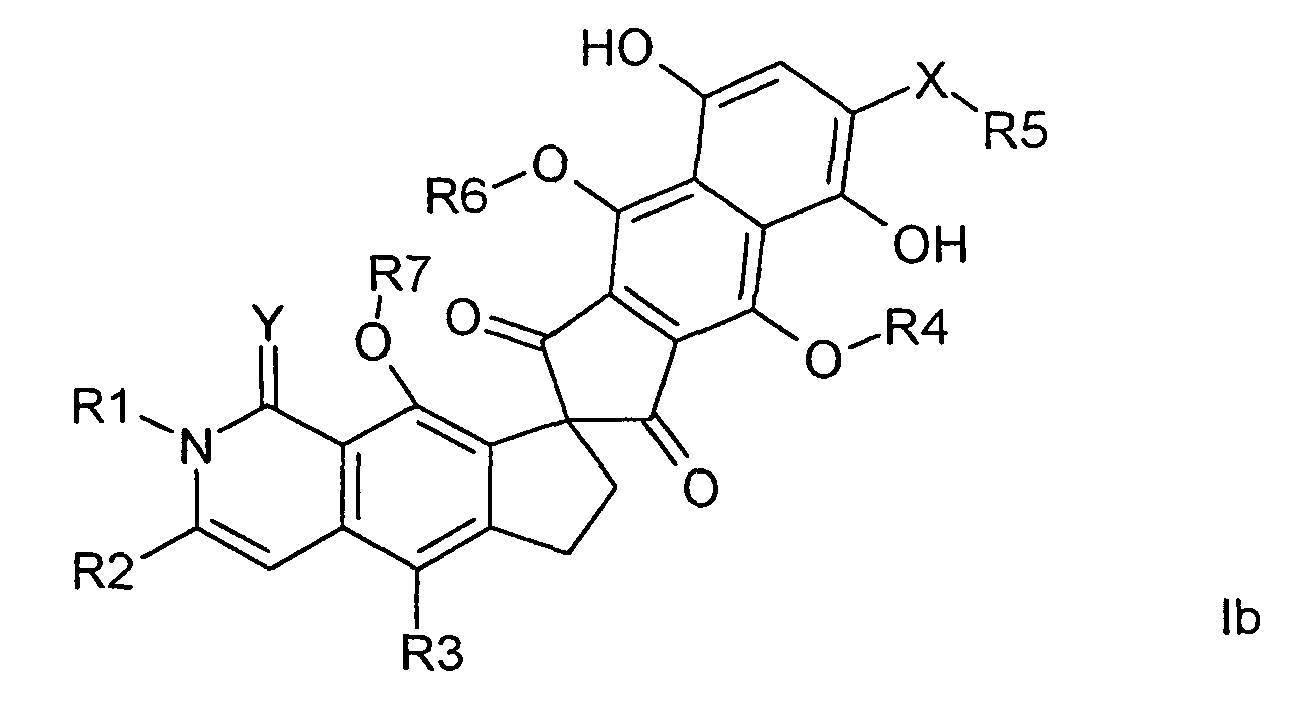 R1 H, C1-C6-Alkyl, Cycloalkyl, C1-C4-Alkyl-Cycloalkyl,R2 C1-C14-Alkyl, C2-C14-Alkenyl, 1,3-Butadienyl, 1-Butan, C1-C4-Alkyl-Aryl,Heteroaryl, C1-C4-Alkyl-Heteroaryl, Cycloalkyl, C1-C4-Alkyl-Cycloalkyl, Heterocycloalkyl, C1-C4-Alkyl-Heterocycloalkyl, CmH2m+o-pYp (mit m = 1 bis 6, für o = 1, p = 1 bis 2m+o; für m = 2 bis 6, o = -1, p = 1 bis 2m+o; für m = 4 bis 6, o = -2, p = 1 bis 2m+o; Y = unabhängig von einander ausgewählt aus der Gruppe Halogen, OH, OR21, NH2, NHR21, NR21R22, SH, SR21), CH2NHCOR21, CH2NHCSR21, CH2S(O)nR21 mit n=0,1,2, CH2SCOR21, CH2OSO2-R21, CHO, CH=NOH, CH(OH)R21, -CH=NOR21, -CH=NOCOR21, -CH=NOCH2CONR21R22, -CH=NOCH(CH3)CONR21R22, -CH=NOC(CH3)2CONR21R22, -CH=N-NHCO-R23, -CH=N-NHCO-CH2NHCOR21, -CH=N-O-CH2NHCOR21, -CH=N-NHCS-R23, -CH=CR24R25 ( trans oder cis ), COOH, COOR21, CONR21R22, -CH=NR21, -CH=N-NR21R22,
-CH=N-NHSO2-Heteroaryl,R21, R22 unabhängig voneinander C1-C14-Alkyl, C1-C14-Alkanoyl, C1-C6-Alkylhydroxy, C1-C6-Alkylamino, C1-C6-Alkylamino-C1-C6-Alkyl, C1-C6-Alkylamino-di-C1-C6-Alkyl, Cycloalkyl, C1-C4-Alkyl-Cycloalkyl, Heterocycloalkyl, C1-C4-Alkyl-Heterocycloalkyl, Aryl, Aryloyl, C1-C4-Alkyl-Aryl, Heteroaryl, Heteroaryloyl, C1-C4-Alkyl-Heteroaryl, Cycloalkanoyl, C1-C4-Alkanoyl-Cycloalkyl, Heterocycloalkanoyl, C1-C4-Alkanoyl-Heterocycloalkyl, C1-C4-Alkanoyl-Aryl, C1-C4-Alkanoyl-Heteroaryl, Mono- und Di-Zuckerreste, die verknüpft sind über ein C-Atom, das im Zucker eine OH-Gruppe tragen würde, wobei die Zucker unabhängig voneinander ausgewählt sind aus der Gruppe bestehend aus Glucuronsäure und ihren Stereoisomeren an allen optischen C-Atomen, Aldopentosen, Aldohexosen einschließlich ihren Desoxyverbidungen (wie z.B. Glucose, Desoxyglucose, Ribose, Desoxyribose),R23 unabhängig von R21, die selben Bedeutungen wie R21 oder CH2pyridinium-salze, CH2tri-C1-C6-alkylammonmium-salze,R24 unabhängig von R21, die selben Bedeutungen wie R21 oder H, CN, COCH3, COOH, COOR21, CONR21R22, NH2, NHCOR21R25 unabhängig von R21, die selben Bedeutungen wie R21 oder H, CN, COCH3, COOH, COOR21, CONR21R22, NH2, NHCOR21R24,R25 zusammen C4-C8-Cycloalkyl,R3 C2-C14-Alkyl, C2-C14-Alkenyl, C2-C14-Alkinyl, Aryl, C1-C4-Alkyl-Aryl, Heteroaryl, C1-C4-Alkyl-Heteroaryl, wobei die Aryle oder Herteroaryle mit einem weiteren Aryl, C1-C4-Alkyl-Aryl, O-Aryl, C1-C4-Alkyl-O-Aryl, Heteroaryl, C1-C4-Alkyl-Heteroaryl, O-Heteroaryl oder C1-C4-Alkyl-O-Heteroaryl substituiert sein können, Cycloalkyl, C1-C4-Alkyl-Cycloalkyl, Heterocycloalkyl, C1-C4-Alkyl-Heterocycloalkyl, CmH2m+o-pYp (mit m = 2 bis 6, für o = 1,-1, p = 1 bis 2m+o; für m = 4 bis 6, o = -3, p = 1 bis 2m+o; Y = unabhängig von einander ausgewählt aus der Gruppe Halogen, OH, OR31, NH2, NHR31, NR31R32, SH, SR31), CH2NHCOR31, CH2NHCSR31, CH2S(O)nR31 mit n=0,1,2, CH2SCOR31, CH2OSO2-R31, CHO, CH=NOH, CH(OH)R31, -CH=NOR31, -CH=NOCOR31, -CH=NOCH2CONR31R32, -CH=NOCH(CH3)CONR31R32, -CH=NOC(CH3)2CONR31R32, -CH=N-NHCO-R33, -CH=N-NHCO-CH2NHCOR31, -CH=N-O-CH2NHCOR31, -CH=N-NHCS-R33, -CH=CR34R35 ( trans oder cis ), COOH, COOR31, CONR31R32, -CH=NR31, -CH=N-NR31R32, R31, R32 unabhängig voneinander C1-C14-Alkyl, C1-C14-Alkanoyl, C1-C6-Alkylhydroxy, C1-C6-Alkylamino, C1-C6-Alkylamino-C1-C6-Alkyl, C1-C6-Alkylamino-di-C1-C6-Alkyl, Cycloalkyl, C1-C4-Alkyl-Cycloalkyl, Heterocycloalkyl, C1-C4-Alkyl-Heterocycloalkyl, Aryl, Aryloyl, C1-C4-Alkyl-Aryl, Heteroaryl, Heteroaryloyl, C1-C4-Alkyl-Heteroaryl, Cycloalkanoyl, C1-C4-Alkanoyl-Cycloalkyl, Heterocycloalkanoyl, C1-C4-Alkanoyl-Heterocycloalkyl, C1-C4-Alkanoyl-Aryl, C1-C4-Alkanoyl-Heteroaryl, Mono- und Di-Zuckerreste, die verknüpft sind über ein C-Atom, das im Zucker eine OH-Gruppe tragen würde, wobei die Zucker unabhängig voneinander ausgewählt sind aus der Gruppe bestehend aus Glucuronsäure und ihren Stereoisomeren an allen optischen C-Atomen, Aldopentosen, Aldohexosen einschließlich ihren Desoxyverbidungen (wie z.B. Glucose, Desoxyglucose, Ribose, Desoxyribose),R33 unabhängig von R31, die selben Bedeutungen wie R31 oder CH2pyridinium-salze, CH2tri-C1-C6-alkylammonmium-salze,R34 unabhängig von R21, die selben Bedeutungen wie R31 oder H, CN, COCH3, COOH, COOR21, CONR31R32, NH2, NHCOR31R35 unabhängig von R31, die selben Bedeutungen wie R31 oder H, CN, COCH3, COOH, COOR31, CONR31R32, NH2, NHCOR31R34, R35 zusammen C4-C8-Cycloalkyl,R5 H, C1-C6-Alkyl, Cycloalkyl, C1-C4-Alkyl-Cycloalkyl, Heterocycloalkyl, C1-C4-Alkyl-Heterocycloalkyl, Aryl, C1-C4-Alkyl-Aryl, Heteroaryl, C1-C4-Alkyl-Heteroaryl,R4,R6,R7 unabhängig voneinander H, C1-C6-Alkyl, CO-R41R41 unabhängig von R21, die selben Bedeutungen wie R21X O, S, NH, N-R8, wobei R8 unabhängig von R5 die gleichen Bedeutung wie R5 annehmen kann oder R5 und R8 zusammen mit dem N eine 4, 5, 6, 7 oder 8 gliedrigen Heteroycloalkylring bilden, der optional noch ein weiteres Heteroatom ausgewählt aus der Gruppe N, O, S enthalten kann,oder X-R5 zusammen gleich H,Y O, S, NR9, wobei R9 Hoder C1-C6-Alkyl sein kann,bedeutet, deren Stereoisomere, Tautomere und deren physiologisch verträglichen Salze oder Einschlussverbindungen.
 - Verbindungen gemäß Anspruch 1, wobei Formel I a oder I b, die Stereochemie von Formel II a oder II b
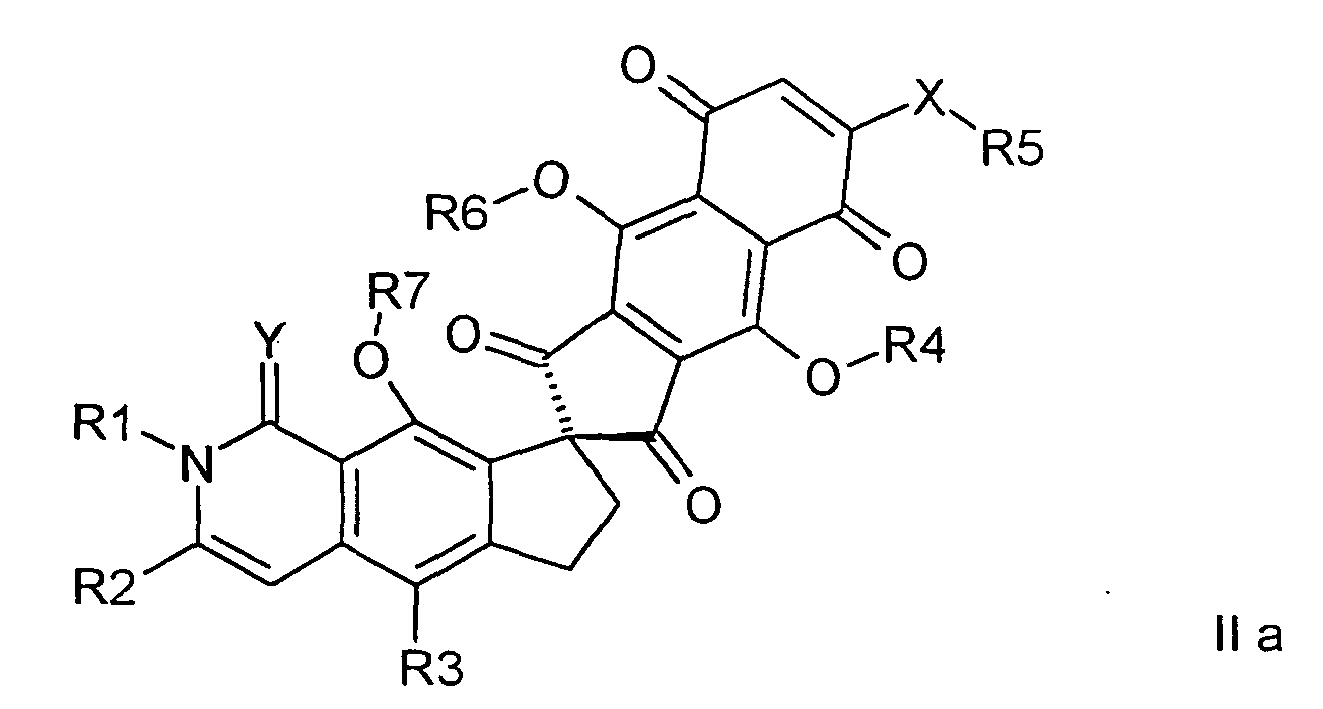

- Verbindungen der allgemeinen Formel Ia, Ib, IIa oder IIb gemäß Anspruch 1 oder 2, bei denen die Reste R außer R3, die in den vorhergehenden Ansprüchen angegebenen Bedeutungen haben und R3 gegenüber R3 gleich H die Wasserlöslichkeit bei Beibehaltung aller anderer Reste mindestens verdoppelt, bevorzugt mindestens verfünffacht, mehr bevorzugt mindestens verzehnfacht, besonders bevorzugt mindestensverfünfzigfacht, insbesondere verhundertfacht, oder sogar verfünfhundertfacht mittels Einführung von Gruppen, die vermehrt Wasserstoffbrückenbindungen ausbilden können, und/oder polar und / oder ionisch sind.
- Verbindungen der allgemeinen Formel Ia, Ib, IIa oder IIb gemäß Anspruch 1 oder 2, bei denen die Reste R außer R2, die in den vorhergehenden Ansprüchen angegebenen Bedeutungen haben und R2 gegenüber R2 gleich CH=CH-CH=CH-CH3 die Wasserlöslichkeit bei Beibehaltung aller anderer Reste mindestens verdoppelt, bevorzugt mindestens verfünffacht, mehr bevorzugt mindestens verzehnfacht, besonders bevorzugt mindestens verfünfzigfacht, insbesondere verhundertfacht, oder sogar verfünfhundertfacht, mittels Einführung von Gruppen, die vermehrt Wasserstoffbrückenbindungen ausbilden können, und/oder polar und / oder ionisch sind.
- Verbindungen gemäß einem der Ansprüche 1 bis 4, wobeiR1 H, C1-C5-Alkyl, Cycloalkyl, insbesondere H,R2 C1-C5-Alkyl, C1-C4-Alkyl-Aryl, C2-C5-Alkenyl, Heteroaryl, C1-C4-Alkyl-Heteroaryl, CHF2, CF3, Polyolseitenkette insbesondere CHOH-CHOH-CHOH-CHOH-CH3, CHOH-CHOH-CH=CH-CH3, CH=CH-CHOH-CHOH-CH3, CH2Y (Y=F,Cl,Br,I), ), CH2NH2, CH2NR21R22, CH2NHCOR23, CH2NHCSR23, CH2SH, CH2S(O)nR21 mit n=0,1,2, CH2SCOR21, insbesondere CH2OH, CH2OR21, CH2OSO2-R21, insbesondere CHO, CH(OR21)2, CH(SR21)2, CN, CH=NOH, CH=NOR21, CH=NOCOR21, CH=N-NHCO-R23, CH=CR24,R25 ( trans oder cis ), insbesondere COOH (insbesondere deren physiologisch verträglichen Salze), COOR21, CONR21R22, -CH=NR21, -CH=N-NR21R22,
 R21, R22 unabhängig voneinander C1-C6-Alkyl, Cycloalkyl, Aryl, C1-C4-Alkyl-Aryl, Heteroaryl, C1-C4-Alkyl-HeteroarylR23 unabhängig von R21, die selben Bedeutungen wie R21 oder CH2pyridinium-salze, CH2tri-C1-C6-alkylammonmium-salze,R24 unabhängig von R21, die selben Bedeutungen wie R21 oder H, CN, COCH3, COOH, COOR21, CONR21R22, NH2, NHCOR21R25 unabhängig von R21, die selben Bedeutungen wie R21 oder H, CN, COCH3, COOH, COOR21, CONR21R22, NH2, NHCOR21R24,R25 zusammen C4-C8-Cycloalkyl,R3 C2-C14-Alkyl, C2-C14-Alkenyl, C2-C14-Alkinyl, Aryl, C1-C4-Alkyl-Aryl, Heteroaryl, C1-C4-Alkyl-Heteroaryl, wobei die Aryle oder Herteroaryle mit einem weiteren Aryl, C1-C4-Alkyl-Aryl, O-Aryl, C1-C4-Alkyl-O-Aryl, Heteroaryl, C1-C4-Alkyl-Heteroaryl, O-Heteroaryl oder C1-C4-Alkyl-O-Heteroaryl substituiert sein können,R5 H, C1-C3-Alkyl, CycloalkylR4,R6,R7 unabhängig voneinander H, C1-C5-Alkyl, CO-R41R41 unabhängig von R21, die selben Bedeutungen wie R21X O, S, NH, N-R8Y O, S, NHbedeutet.
 - Verbindungen gemäß einem der Ansprüche 1 bis 5 in der Form von Einschlussverbindungen mit Cyclodextrin, insbesondere alpha-Cyclodextrin.
- Arzneimittel enthaltend Verbindungen nach einem der Ansprüche 1 bis 6 neben den üblichen Träger und Hilfsstoffen.
- Arzneimittel nach Anspruch 7 in Kombination mit weitere Wirkstoffen zur Tumorbehandlung.
- Verwendung von Verbindungen gemäß einem der Ansprüche 1 bis 6 zur Herstellung von Arzneimitteln zur Behandlung von Tumoren, insbesondere von solchen, die durch die Inhibierung der Topoisomerasen I und/oder II behandelt werden können, verwendet.
- Verwendung von Verbindungen gemäß einem der Ansprüche 1 bis 6 zur Herstellung von Arzneimitteln zur Behandlung von Parasiten.
- Verwendung von Verbindungen gemäß einem der Ansprüche 1 bis 6 zur Herstellung von Arzneimitteln zur Immunsupression.
- Verwendung von Verbindungen gemäß einem der Ansprüche 1 bis 6 zur Herstellung von Arzneimitteln zur Behandlung von Neurodermitis.
Applications Claiming Priority (3)
| Application Number | Priority Date | Filing Date | Title |
|---|---|---|---|
| DE10217046 | 2002-04-17 | ||
| DE10217046A DE10217046A1 (de) | 2002-04-17 | 2002-04-17 | Fredericamycin-Derivate |
| PCT/EP2003/003285 WO2003087060A1 (de) | 2002-04-17 | 2003-03-28 | Fredericamycin-derivate |
Publications (2)
| Publication Number | Publication Date |
|---|---|
| EP1495003A1 EP1495003A1 (de) | 2005-01-12 |
| EP1495003B1 true EP1495003B1 (de) | 2008-09-17 |
Family
ID=28798497
Family Applications (1)
| Application Number | Title | Priority Date | Filing Date |
|---|---|---|---|
| EP03718715A Expired - Lifetime EP1495003B1 (de) | 2002-04-17 | 2003-03-28 | Fredericamycin-derivate |
Country Status (8)
| Country | Link |
|---|---|
| US (1) | US7459462B2 (de) |
| EP (1) | EP1495003B1 (de) |
| JP (1) | JP4624685B2 (de) |
| AT (1) | ATE408601T1 (de) |
| AU (1) | AU2003222785B2 (de) |
| CA (1) | CA2482775A1 (de) |
| DE (2) | DE10217046A1 (de) |
| WO (1) | WO2003087060A1 (de) |
Families Citing this family (38)
| Publication number | Priority date | Publication date | Assignee | Title |
|---|---|---|---|---|
| CA2480468C (en) * | 2002-03-26 | 2012-03-13 | Biofrontera Discovery Gmbh | Fredericamycin derivatives |
| EP1831225A2 (de) | 2004-11-19 | 2007-09-12 | The Regents of the University of California | Entzündungshemmende pyrazolopyrimidine |
| EP1919873A1 (de) * | 2005-09-01 | 2008-05-14 | BioAgency AG | Fredericamycin-derivate |
| EA200870409A1 (ru) | 2006-04-04 | 2009-04-28 | Дзе Риджентс Оф Дзе Юниверсити Оф Калифорния | Антагонисты киназы pi3 |
| GB2467670B (en) | 2007-10-04 | 2012-08-01 | Intellikine Inc | Chemical entities and therapeutic uses thereof |
| CA2711558C (en) | 2008-01-04 | 2016-12-13 | Intellikine, Inc. | Phosphatidyl inositol-3 kinase inhibiting compounds |
| US8193182B2 (en) | 2008-01-04 | 2012-06-05 | Intellikine, Inc. | Substituted isoquinolin-1(2H)-ones, and methods of use thereof |
| US8993580B2 (en) | 2008-03-14 | 2015-03-31 | Intellikine Llc | Benzothiazole kinase inhibitors and methods of use |
| JP5547099B2 (ja) | 2008-03-14 | 2014-07-09 | インテリカイン, エルエルシー | キナーゼ阻害剤および使用方法 |
| WO2010006072A2 (en) | 2008-07-08 | 2010-01-14 | The Regents Of The University Of California | Mtor modulators and uses thereof |
| AU2009268611B2 (en) | 2008-07-08 | 2015-04-09 | Intellikine, Llc | Kinase inhibitors and methods of use |
| JP5731978B2 (ja) | 2008-09-26 | 2015-06-10 | インテリカイン, エルエルシー | 複素環キナーゼ阻害剤 |
| CA2740885C (en) | 2008-10-16 | 2018-04-03 | The Regents Of The University Of California | Fused ring heteroaryl kinase inhibitors |
| US8476282B2 (en) | 2008-11-03 | 2013-07-02 | Intellikine Llc | Benzoxazole kinase inhibitors and methods of use |
| EP2427195B1 (de) | 2009-05-07 | 2019-05-01 | Intellikine, LLC | Heterocyclische verbindungen und ihre verwendung |
| WO2011047384A2 (en) | 2009-10-16 | 2011-04-21 | The Regents Of The University Of California | Methods of inhibiting ire1 |
| AU2011255218B2 (en) | 2010-05-21 | 2015-03-12 | Infinity Pharmaceuticals, Inc. | Chemical compounds, compositions and methods for kinase modulation |
| JP2013545749A (ja) | 2010-11-10 | 2013-12-26 | インフィニティー ファーマシューティカルズ, インコーポレイテッド | 複素環化合物及びその使用 |
| AU2012205669B2 (en) | 2011-01-10 | 2015-08-20 | Infinity Pharmaceuticals Inc. | Processes for preparing isoquinolinones and solid forms of isoquinolinones |
| JP6130305B2 (ja) | 2011-02-23 | 2017-05-17 | インテリカイン, エルエルシー | キナーゼ阻害剤の組み合わせおよびそれらの使用 |
| US9056877B2 (en) | 2011-07-19 | 2015-06-16 | Infinity Pharmaceuticals, Inc. | Heterocyclic compounds and uses thereof |
| JP6027610B2 (ja) | 2011-07-19 | 2016-11-16 | インフィニティー ファーマシューティカルズ, インコーポレイテッド | 複素環式化合物及びその使用 |
| EP2751093A1 (de) | 2011-08-29 | 2014-07-09 | Infinity Pharmaceuticals, Inc. | Heterocyclische verbindungen und ihre verwendung |
| MX370814B (es) | 2011-09-02 | 2020-01-08 | Univ California | Pirazolo[3,4-d]pirimidinas sustituidas y usos de las mismas. |
| US8940742B2 (en) | 2012-04-10 | 2015-01-27 | Infinity Pharmaceuticals, Inc. | Heterocyclic compounds and uses thereof |
| US8828998B2 (en) | 2012-06-25 | 2014-09-09 | Infinity Pharmaceuticals, Inc. | Treatment of lupus, fibrotic conditions, and inflammatory myopathies and other disorders using PI3 kinase inhibitors |
| MX2015003874A (es) | 2012-09-26 | 2015-12-16 | Univ California | Modulacion de ire1. |
| KR102229478B1 (ko) | 2012-11-01 | 2021-03-18 | 인피니티 파마슈티칼스, 인코포레이티드 | Pi3 키나아제 동형단백질 조절인자를 사용하는 암의 치료 |
| US9481667B2 (en) | 2013-03-15 | 2016-11-01 | Infinity Pharmaceuticals, Inc. | Salts and solid forms of isoquinolinones and composition comprising and methods of using the same |
| PE20160685A1 (es) | 2013-10-04 | 2016-07-23 | Infinity Pharmaceuticals Inc | Compuestos heterociclicos y usos de los mismos |
| US9751888B2 (en) | 2013-10-04 | 2017-09-05 | Infinity Pharmaceuticals, Inc. | Heterocyclic compounds and uses thereof |
| SG10201808053XA (en) | 2014-03-19 | 2018-10-30 | Infinity Pharmaceuticals Inc | Heterocyclic compounds for use in the treatment of pi3k-gamma mediated disorders |
| US20150320755A1 (en) | 2014-04-16 | 2015-11-12 | Infinity Pharmaceuticals, Inc. | Combination therapies |
| US9708348B2 (en) | 2014-10-03 | 2017-07-18 | Infinity Pharmaceuticals, Inc. | Trisubstituted bicyclic heterocyclic compounds with kinase activities and uses thereof |
| US10160761B2 (en) | 2015-09-14 | 2018-12-25 | Infinity Pharmaceuticals, Inc. | Solid forms of isoquinolinones, and process of making, composition comprising, and methods of using the same |
| WO2017161116A1 (en) | 2016-03-17 | 2017-09-21 | Infinity Pharmaceuticals, Inc. | Isotopologues of isoquinolinone and quinazolinone compounds and uses thereof as pi3k kinase inhibitors |
| US10919914B2 (en) | 2016-06-08 | 2021-02-16 | Infinity Pharmaceuticals, Inc. | Heterocyclic compounds and uses thereof |
| MX391135B (es) | 2016-06-24 | 2025-03-21 | Infinity Pharmaceuticals Inc | Terapias de combinacion. |
Family Cites Families (5)
| Publication number | Priority date | Publication date | Assignee | Title |
|---|---|---|---|---|
| GB2145084B (en) * | 1983-08-18 | 1987-01-28 | Ss Pharmaceutical Co | Fredericamycin derivatives |
| JPS6144868A (ja) * | 1984-08-09 | 1986-03-04 | Ss Pharmaceut Co Ltd | 新規なフレデリカマイシンa誘導体 |
| US4673678A (en) | 1986-07-25 | 1987-06-16 | The United States Of America As Represented By The Secretary Of The Department Of Health And Human Services | Water soluble derivatives of fredericamycin A |
| US5166208A (en) | 1991-10-09 | 1992-11-24 | Boston College | Fredericamycin A derivatives |
| JP4351310B2 (ja) * | 1998-08-31 | 2009-10-28 | 泰行 北 | 新規スピロ系多環式化合物及びその製造方法 |
-
2002
- 2002-04-17 DE DE10217046A patent/DE10217046A1/de not_active Withdrawn
-
2003
- 2003-03-28 CA CA002482775A patent/CA2482775A1/en not_active Abandoned
- 2003-03-28 WO PCT/EP2003/003285 patent/WO2003087060A1/de not_active Ceased
- 2003-03-28 JP JP2003584016A patent/JP4624685B2/ja not_active Expired - Fee Related
- 2003-03-28 AT AT03718715T patent/ATE408601T1/de active
- 2003-03-28 AU AU2003222785A patent/AU2003222785B2/en not_active Ceased
- 2003-03-28 US US10/511,411 patent/US7459462B2/en not_active Expired - Fee Related
- 2003-03-28 EP EP03718715A patent/EP1495003B1/de not_active Expired - Lifetime
- 2003-03-28 DE DE50310516T patent/DE50310516D1/de not_active Expired - Lifetime
Also Published As
| Publication number | Publication date |
|---|---|
| AU2003222785A1 (en) | 2003-10-27 |
| AU2003222785B2 (en) | 2009-04-23 |
| CA2482775A1 (en) | 2003-10-23 |
| US20050153997A1 (en) | 2005-07-14 |
| ATE408601T1 (de) | 2008-10-15 |
| JP4624685B2 (ja) | 2011-02-02 |
| WO2003087060A1 (de) | 2003-10-23 |
| JP2005528396A (ja) | 2005-09-22 |
| US7459462B2 (en) | 2008-12-02 |
| DE50310516D1 (de) | 2008-10-30 |
| EP1495003A1 (de) | 2005-01-12 |
| DE10217046A1 (de) | 2003-11-06 |
Similar Documents
| Publication | Publication Date | Title |
|---|---|---|
| EP1519724B1 (de) | Fredericamycin-derivate als arzneimittel zur tumorbehandlung | |
| EP1495003A1 (de) | Fredericamycin-derivate | |
| EP1503988B1 (de) | Fredericamycin-derivate | |
| WO2007025534A1 (de) | Fredericamycin-derivate | |
| DD282912A5 (de) | Verfahren zur herstellung eines substituierten imidazols | |
| DE3853863T2 (de) | 4-Aminopyridinderivate. | |
| EP0771799A1 (de) | Purin-6-one-Derivate | |
| EP1444206B1 (de) | Substituierte benzo[b]azepin-2-on-verbindungen als schmerzmittel | |
| EP0973744A1 (de) | 2-amino-substituierte pyridine verwendbar zur behandlung von arteriosklerose und hyperlipoproteinemie | |
| DE69128788T2 (de) | 1,2-dihydro-3h-dibenzoisochinolin-1,3-dione als antitumormittel | |
| DE10153347A1 (de) | Substituierte 1H-Chinolin-2-on-Verbindungen | |
| DE60309511T2 (de) | Verfahren zur herstellung von ondansetron und zwischenprodukte dazu | |
| DE3428945A1 (de) | 4'-halogenanthracyclinglykoside, verfahren zu deren herstellung und diese enthaltende pharmazeutische zubereitung | |
| DE69719071T2 (de) | Phenanthridiniumderivate | |
| DE3142111A1 (de) | "5,6-dideoxyapramycinderivate und diese enthaltende arzneimittel" | |
| EP0186049B1 (de) | N-substituierte Aziridin-2-Carbonsäurederivate, Verfahren zu deren Herstellung sowie diese Substanzen enthaltende Arzneimittel | |
| DE102006005937A1 (de) | Fredericamycin-Derivate | |
| DE69221006T2 (de) | Mitomycinderivate | |
| DE1470314A1 (de) | Verfahren zur Herstellung von 5-substituierten Aza-Dibenzo-Cycloheptenen | |
| DE102006005936A1 (de) | Fredericamycin-Derivate | |
| DE69120348T2 (de) | Cyclopropachromenderivate | |
| DE10248451A1 (de) | Fredericamycin-Derivate | |
| DE2326578A1 (de) | Neue derivate des 6-methyl-2h-pyran2,4(3h)-dions und verfahren zur herstellung dieser derivate | |
| DE69911462T2 (de) | Ein verbessertes verfahren zur herstellung von 3,5-diamino-6-(2,3-dichlorophenyl)-1,2,4-triazin | |
| DE2531108A1 (de) | Vincaminderivate, verfahren zu ihrer herstellung und sie enthaltende arzneimittel |
Legal Events
| Date | Code | Title | Description |
|---|---|---|---|
| PUAI | Public reference made under article 153(3) epc to a published international application that has entered the european phase |
Free format text: ORIGINAL CODE: 0009012 |
|
| 17P | Request for examination filed |
Effective date: 20041012 |
|
| AK | Designated contracting states |
Kind code of ref document: A1 Designated state(s): AT BE BG CH CY CZ DE DK EE ES FI FR GB GR HU IE IT LI LU MC NL PT RO SE SI SK TR |
|
| AX | Request for extension of the european patent |
Extension state: AL LT LV MK |
|
| GRAP | Despatch of communication of intention to grant a patent |
Free format text: ORIGINAL CODE: EPIDOSNIGR1 |
|
| GRAS | Grant fee paid |
Free format text: ORIGINAL CODE: EPIDOSNIGR3 |
|
| GRAA | (expected) grant |
Free format text: ORIGINAL CODE: 0009210 |
|
| AK | Designated contracting states |
Kind code of ref document: B1 Designated state(s): AT BE BG CH CY CZ DE DK EE ES FI FR GB GR HU IE IT LI LU MC NL PT RO SE SI SK TR |
|
| REG | Reference to a national code |
Ref country code: GB Ref legal event code: FG4D Free format text: NOT ENGLISH |
|
| REG | Reference to a national code |
Ref country code: CH Ref legal event code: EP |
|
| REG | Reference to a national code |
Ref country code: IE Ref legal event code: FG4D Free format text: LANGUAGE OF EP DOCUMENT: GERMAN |
|
| REF | Corresponds to: |
Ref document number: 50310516 Country of ref document: DE Date of ref document: 20081030 Kind code of ref document: P |
|
| REG | Reference to a national code |
Ref country code: CH Ref legal event code: NV Representative=s name: KATZAROV S.A. |
|
| REG | Reference to a national code |
Ref country code: SE Ref legal event code: TRGR |
|
| PG25 | Lapsed in a contracting state [announced via postgrant information from national office to epo] |
Ref country code: SI Free format text: LAPSE BECAUSE OF FAILURE TO SUBMIT A TRANSLATION OF THE DESCRIPTION OR TO PAY THE FEE WITHIN THE PRESCRIBED TIME-LIMIT Effective date: 20080917 Ref country code: FI Free format text: LAPSE BECAUSE OF FAILURE TO SUBMIT A TRANSLATION OF THE DESCRIPTION OR TO PAY THE FEE WITHIN THE PRESCRIBED TIME-LIMIT Effective date: 20080917 |
|
| REG | Reference to a national code |
Ref country code: IE Ref legal event code: FD4D |
|
| PG25 | Lapsed in a contracting state [announced via postgrant information from national office to epo] |
Ref country code: ES Free format text: LAPSE BECAUSE OF FAILURE TO SUBMIT A TRANSLATION OF THE DESCRIPTION OR TO PAY THE FEE WITHIN THE PRESCRIBED TIME-LIMIT Effective date: 20081228 Ref country code: BG Free format text: LAPSE BECAUSE OF FAILURE TO SUBMIT A TRANSLATION OF THE DESCRIPTION OR TO PAY THE FEE WITHIN THE PRESCRIBED TIME-LIMIT Effective date: 20081217 |
|
| PG25 | Lapsed in a contracting state [announced via postgrant information from national office to epo] |
Ref country code: PT Free format text: LAPSE BECAUSE OF FAILURE TO SUBMIT A TRANSLATION OF THE DESCRIPTION OR TO PAY THE FEE WITHIN THE PRESCRIBED TIME-LIMIT Effective date: 20090217 Ref country code: SK Free format text: LAPSE BECAUSE OF FAILURE TO SUBMIT A TRANSLATION OF THE DESCRIPTION OR TO PAY THE FEE WITHIN THE PRESCRIBED TIME-LIMIT Effective date: 20080917 Ref country code: CZ Free format text: LAPSE BECAUSE OF FAILURE TO SUBMIT A TRANSLATION OF THE DESCRIPTION OR TO PAY THE FEE WITHIN THE PRESCRIBED TIME-LIMIT Effective date: 20080917 Ref country code: RO Free format text: LAPSE BECAUSE OF FAILURE TO SUBMIT A TRANSLATION OF THE DESCRIPTION OR TO PAY THE FEE WITHIN THE PRESCRIBED TIME-LIMIT Effective date: 20080917 |
|
| PLBE | No opposition filed within time limit |
Free format text: ORIGINAL CODE: 0009261 |
|
| STAA | Information on the status of an ep patent application or granted ep patent |
Free format text: STATUS: NO OPPOSITION FILED WITHIN TIME LIMIT |
|
| PG25 | Lapsed in a contracting state [announced via postgrant information from national office to epo] |
Ref country code: EE Free format text: LAPSE BECAUSE OF FAILURE TO SUBMIT A TRANSLATION OF THE DESCRIPTION OR TO PAY THE FEE WITHIN THE PRESCRIBED TIME-LIMIT Effective date: 20080917 Ref country code: DK Free format text: LAPSE BECAUSE OF FAILURE TO SUBMIT A TRANSLATION OF THE DESCRIPTION OR TO PAY THE FEE WITHIN THE PRESCRIBED TIME-LIMIT Effective date: 20080917 Ref country code: IE Free format text: LAPSE BECAUSE OF FAILURE TO SUBMIT A TRANSLATION OF THE DESCRIPTION OR TO PAY THE FEE WITHIN THE PRESCRIBED TIME-LIMIT Effective date: 20080917 |
|
| 26N | No opposition filed |
Effective date: 20090618 |
|
| PG25 | Lapsed in a contracting state [announced via postgrant information from national office to epo] |
Ref country code: IT Free format text: LAPSE BECAUSE OF FAILURE TO SUBMIT A TRANSLATION OF THE DESCRIPTION OR TO PAY THE FEE WITHIN THE PRESCRIBED TIME-LIMIT Effective date: 20080917 |
|
| BERE | Be: lapsed |
Owner name: BIOFRONTERA DISCOVERY G.M.B.H. Effective date: 20090331 |
|
| REG | Reference to a national code |
Ref country code: DE Ref legal event code: 8364 Ref document number: 50310516 Country of ref document: DE |
|
| PG25 | Lapsed in a contracting state [announced via postgrant information from national office to epo] |
Ref country code: MC Free format text: LAPSE BECAUSE OF NON-PAYMENT OF DUE FEES Effective date: 20090331 |
|
| PG25 | Lapsed in a contracting state [announced via postgrant information from national office to epo] |
Ref country code: BE Free format text: LAPSE BECAUSE OF NON-PAYMENT OF DUE FEES Effective date: 20090331 |
|
| PG25 | Lapsed in a contracting state [announced via postgrant information from national office to epo] |
Ref country code: GR Free format text: LAPSE BECAUSE OF FAILURE TO SUBMIT A TRANSLATION OF THE DESCRIPTION OR TO PAY THE FEE WITHIN THE PRESCRIBED TIME-LIMIT Effective date: 20081218 |
|
| PG25 | Lapsed in a contracting state [announced via postgrant information from national office to epo] |
Ref country code: LU Free format text: LAPSE BECAUSE OF NON-PAYMENT OF DUE FEES Effective date: 20090328 |
|
| PGFP | Annual fee paid to national office [announced via postgrant information from national office to epo] |
Ref country code: AT Payment date: 20110310 Year of fee payment: 9 Ref country code: SE Payment date: 20110329 Year of fee payment: 9 Ref country code: NL Payment date: 20110330 Year of fee payment: 9 Ref country code: FR Payment date: 20110317 Year of fee payment: 9 |
|
| PG25 | Lapsed in a contracting state [announced via postgrant information from national office to epo] |
Ref country code: HU Free format text: LAPSE BECAUSE OF FAILURE TO SUBMIT A TRANSLATION OF THE DESCRIPTION OR TO PAY THE FEE WITHIN THE PRESCRIBED TIME-LIMIT Effective date: 20090318 |
|
| PGFP | Annual fee paid to national office [announced via postgrant information from national office to epo] |
Ref country code: CH Payment date: 20110622 Year of fee payment: 9 Ref country code: GB Payment date: 20110323 Year of fee payment: 9 |
|
| PG25 | Lapsed in a contracting state [announced via postgrant information from national office to epo] |
Ref country code: TR Free format text: LAPSE BECAUSE OF FAILURE TO SUBMIT A TRANSLATION OF THE DESCRIPTION OR TO PAY THE FEE WITHIN THE PRESCRIBED TIME-LIMIT Effective date: 20080917 |
|
| PG25 | Lapsed in a contracting state [announced via postgrant information from national office to epo] |
Ref country code: CY Free format text: LAPSE BECAUSE OF FAILURE TO SUBMIT A TRANSLATION OF THE DESCRIPTION OR TO PAY THE FEE WITHIN THE PRESCRIBED TIME-LIMIT Effective date: 20080917 |
|
| REG | Reference to a national code |
Ref country code: DE Ref legal event code: R409 Ref document number: 50310516 Country of ref document: DE |
|
| REG | Reference to a national code |
Ref country code: NL Ref legal event code: V1 Effective date: 20121001 |
|
| REG | Reference to a national code |
Ref country code: SE Ref legal event code: EUG |
|
| PG25 | Lapsed in a contracting state [announced via postgrant information from national office to epo] |
Ref country code: SE Free format text: LAPSE BECAUSE OF NON-PAYMENT OF DUE FEES Effective date: 20120329 |
|
| REG | Reference to a national code |
Ref country code: CH Ref legal event code: PL |
|
| GBPC | Gb: european patent ceased through non-payment of renewal fee |
Effective date: 20120328 |
|
| REG | Reference to a national code |
Ref country code: AT Ref legal event code: MM01 Ref document number: 408601 Country of ref document: AT Kind code of ref document: T Effective date: 20120328 |
|
| REG | Reference to a national code |
Ref country code: FR Ref legal event code: ST Effective date: 20121130 |
|
| REG | Reference to a national code |
Ref country code: DE Ref legal event code: R409 Ref document number: 50310516 Country of ref document: DE |
|
| PG25 | Lapsed in a contracting state [announced via postgrant information from national office to epo] |
Ref country code: CH Free format text: LAPSE BECAUSE OF NON-PAYMENT OF DUE FEES Effective date: 20120331 Ref country code: GB Free format text: LAPSE BECAUSE OF NON-PAYMENT OF DUE FEES Effective date: 20120328 Ref country code: LI Free format text: LAPSE BECAUSE OF NON-PAYMENT OF DUE FEES Effective date: 20120331 Ref country code: AT Free format text: LAPSE BECAUSE OF NON-PAYMENT OF DUE FEES Effective date: 20120328 Ref country code: FR Free format text: LAPSE BECAUSE OF NON-PAYMENT OF DUE FEES Effective date: 20120402 |
|
| REG | Reference to a national code |
Ref country code: DE Ref legal event code: R119 Ref document number: 50310516 Country of ref document: DE Effective date: 20121002 |
|
| PG25 | Lapsed in a contracting state [announced via postgrant information from national office to epo] |
Ref country code: NL Free format text: LAPSE BECAUSE OF NON-PAYMENT OF DUE FEES Effective date: 20121001 |
|
| PGFP | Annual fee paid to national office [announced via postgrant information from national office to epo] |
Ref country code: DE Payment date: 20120917 Year of fee payment: 10 |
|
| REG | Reference to a national code |
Ref country code: DE Ref legal event code: R119 Ref document number: 50310516 Country of ref document: DE Effective date: 20131001 |
|
| PG25 | Lapsed in a contracting state [announced via postgrant information from national office to epo] |
Ref country code: DE Free format text: LAPSE BECAUSE OF NON-PAYMENT OF DUE FEES Effective date: 20131001 |