EP1493753B1 - A solution containing cellulose dissolved in N-methylmorpholine-N-oxide and high tenacity lyocell multifilament using the same - Google Patents
A solution containing cellulose dissolved in N-methylmorpholine-N-oxide and high tenacity lyocell multifilament using the same Download PDFInfo
- Publication number
- EP1493753B1 EP1493753B1 EP03029111A EP03029111A EP1493753B1 EP 1493753 B1 EP1493753 B1 EP 1493753B1 EP 03029111 A EP03029111 A EP 03029111A EP 03029111 A EP03029111 A EP 03029111A EP 1493753 B1 EP1493753 B1 EP 1493753B1
- Authority
- EP
- European Patent Office
- Prior art keywords
- cellulose
- solution
- extruder
- nmmo
- weight
- Prior art date
- Legal status (The legal status is an assumption and is not a legal conclusion. Google has not performed a legal analysis and makes no representation as to the accuracy of the status listed.)
- Expired - Lifetime
Links
- 229920002678 cellulose Polymers 0.000 title claims abstract description 125
- 239000001913 cellulose Substances 0.000 title claims abstract description 125
- LFTLOKWAGJYHHR-UHFFFAOYSA-N N-methylmorpholine N-oxide Chemical compound CN1(=O)CCOCC1 LFTLOKWAGJYHHR-UHFFFAOYSA-N 0.000 title claims abstract description 122
- 229920000433 Lyocell Polymers 0.000 title 1
- UFHFLCQGNIYNRP-UHFFFAOYSA-N Hydrogen Chemical compound [H][H] UFHFLCQGNIYNRP-UHFFFAOYSA-N 0.000 claims abstract description 88
- 238000000034 method Methods 0.000 claims abstract description 57
- 239000004372 Polyvinyl alcohol Substances 0.000 claims abstract description 34
- 229920002451 polyvinyl alcohol Polymers 0.000 claims abstract description 34
- 235000019422 polyvinyl alcohol Nutrition 0.000 claims abstract description 34
- 239000002245 particle Substances 0.000 claims description 36
- 238000006116 polymerization reaction Methods 0.000 claims description 29
- 239000000835 fiber Substances 0.000 claims description 27
- 239000002904 solvent Substances 0.000 claims description 24
- 230000008961 swelling Effects 0.000 claims description 17
- XLYOFNOQVPJJNP-UHFFFAOYSA-N water Substances O XLYOFNOQVPJJNP-UHFFFAOYSA-N 0.000 claims description 14
- 229920003043 Cellulose fiber Polymers 0.000 claims description 11
- 238000002156 mixing Methods 0.000 claims description 11
- 238000009987 spinning Methods 0.000 claims description 11
- 206010061592 cardiac fibrillation Diseases 0.000 claims description 10
- 230000002600 fibrillogenic effect Effects 0.000 claims description 10
- 238000007127 saponification reaction Methods 0.000 claims description 9
- 229920000642 polymer Polymers 0.000 claims description 8
- 230000010287 polarization Effects 0.000 claims description 6
- 238000002844 melting Methods 0.000 claims description 5
- 230000008018 melting Effects 0.000 claims description 5
- 238000001035 drying Methods 0.000 claims description 4
- 239000011521 glass Substances 0.000 claims description 4
- 239000006200 vaporizer Substances 0.000 claims description 4
- 238000005273 aeration Methods 0.000 claims description 3
- 238000004898 kneading Methods 0.000 claims description 3
- 238000010008 shearing Methods 0.000 claims description 3
- 238000005406 washing Methods 0.000 claims description 3
- 238000004804 winding Methods 0.000 claims description 3
- 239000000243 solution Substances 0.000 description 125
- 239000000843 powder Substances 0.000 description 7
- 239000000126 substance Substances 0.000 description 6
- 238000004519 manufacturing process Methods 0.000 description 5
- VYPSYNLAJGMNEJ-UHFFFAOYSA-N Silicium dioxide Chemical compound O=[Si]=O VYPSYNLAJGMNEJ-UHFFFAOYSA-N 0.000 description 4
- 230000000052 comparative effect Effects 0.000 description 4
- 239000007864 aqueous solution Substances 0.000 description 3
- 238000006731 degradation reaction Methods 0.000 description 3
- 238000010586 diagram Methods 0.000 description 3
- -1 polyethylene Polymers 0.000 description 3
- NLXLAEXVIDQMFP-UHFFFAOYSA-N Ammonia chloride Chemical compound [NH4+].[Cl-] NLXLAEXVIDQMFP-UHFFFAOYSA-N 0.000 description 2
- GWEVSGVZZGPLCZ-UHFFFAOYSA-N Titan oxide Chemical compound O=[Ti]=O GWEVSGVZZGPLCZ-UHFFFAOYSA-N 0.000 description 2
- 239000000654 additive Substances 0.000 description 2
- 230000001070 adhesive effect Effects 0.000 description 2
- 230000000694 effects Effects 0.000 description 2
- 238000011156 evaluation Methods 0.000 description 2
- 239000002657 fibrous material Substances 0.000 description 2
- 230000014759 maintenance of location Effects 0.000 description 2
- 150000004682 monohydrates Chemical class 0.000 description 2
- 239000012779 reinforcing material Substances 0.000 description 2
- 239000000377 silicon dioxide Substances 0.000 description 2
- 238000005979 thermal decomposition reaction Methods 0.000 description 2
- 230000002747 voluntary effect Effects 0.000 description 2
- OKTJSMMVPCPJKN-UHFFFAOYSA-N Carbon Chemical compound [C] OKTJSMMVPCPJKN-UHFFFAOYSA-N 0.000 description 1
- 239000004698 Polyethylene Substances 0.000 description 1
- 239000002202 Polyethylene glycol Substances 0.000 description 1
- 229920000297 Rayon Polymers 0.000 description 1
- 235000019270 ammonium chloride Nutrition 0.000 description 1
- ATSGLBOJGVTHHC-UHFFFAOYSA-N bis(ethane-1,2-diamine)copper(2+) Chemical compound [Cu+2].NCCN.NCCN ATSGLBOJGVTHHC-UHFFFAOYSA-N 0.000 description 1
- 238000004364 calculation method Methods 0.000 description 1
- 229910052799 carbon Inorganic materials 0.000 description 1
- 238000006243 chemical reaction Methods 0.000 description 1
- 239000012141 concentrate Substances 0.000 description 1
- 230000003750 conditioning effect Effects 0.000 description 1
- 238000013213 extrapolation Methods 0.000 description 1
- 238000010438 heat treatment Methods 0.000 description 1
- 239000012456 homogeneous solution Substances 0.000 description 1
- 229910052739 hydrogen Inorganic materials 0.000 description 1
- 239000001257 hydrogen Substances 0.000 description 1
- XLYOFNOQVPJJNP-UHFFFAOYSA-M hydroxide Chemical compound [OH-] XLYOFNOQVPJJNP-UHFFFAOYSA-M 0.000 description 1
- 239000012535 impurity Substances 0.000 description 1
- 238000010309 melting process Methods 0.000 description 1
- 229920003229 poly(methyl methacrylate) Polymers 0.000 description 1
- 229920000573 polyethylene Polymers 0.000 description 1
- 229920001223 polyethylene glycol Polymers 0.000 description 1
- 239000004926 polymethyl methacrylate Substances 0.000 description 1
- 238000004064 recycling Methods 0.000 description 1
- 235000012239 silicon dioxide Nutrition 0.000 description 1
- 150000003512 tertiary amines Chemical class 0.000 description 1
- 239000004408 titanium dioxide Substances 0.000 description 1
Images
Classifications
-
- B—PERFORMING OPERATIONS; TRANSPORTING
- B60—VEHICLES IN GENERAL
- B60C—VEHICLE TYRES; TYRE INFLATION; TYRE CHANGING; CONNECTING VALVES TO INFLATABLE ELASTIC BODIES IN GENERAL; DEVICES OR ARRANGEMENTS RELATED TO TYRES
- B60C9/00—Reinforcements or ply arrangement of pneumatic tyres
- B60C9/0042—Reinforcements made of synthetic materials
-
- C—CHEMISTRY; METALLURGY
- C08—ORGANIC MACROMOLECULAR COMPOUNDS; THEIR PREPARATION OR CHEMICAL WORKING-UP; COMPOSITIONS BASED THEREON
- C08B—POLYSACCHARIDES; DERIVATIVES THEREOF
- C08B1/00—Preparatory treatment of cellulose for making derivatives thereof, e.g. pre-treatment, pre-soaking, activation
- C08B1/003—Preparation of cellulose solutions, i.e. dopes, with different possible solvents, e.g. ionic liquids
-
- D—TEXTILES; PAPER
- D01—NATURAL OR MAN-MADE THREADS OR FIBRES; SPINNING
- D01F—CHEMICAL FEATURES IN THE MANUFACTURE OF ARTIFICIAL FILAMENTS, THREADS, FIBRES, BRISTLES OR RIBBONS; APPARATUS SPECIALLY ADAPTED FOR THE MANUFACTURE OF CARBON FILAMENTS
- D01F2/00—Monocomponent artificial filaments or the like of cellulose or cellulose derivatives; Manufacture thereof
-
- D—TEXTILES; PAPER
- D02—YARNS; MECHANICAL FINISHING OF YARNS OR ROPES; WARPING OR BEAMING
- D02G—CRIMPING OR CURLING FIBRES, FILAMENTS, THREADS, OR YARNS; YARNS OR THREADS
- D02G3/00—Yarns or threads, e.g. fancy yarns; Processes or apparatus for the production thereof, not otherwise provided for
- D02G3/44—Yarns or threads characterised by the purpose for which they are designed
- D02G3/48—Tyre cords
-
- Y—GENERAL TAGGING OF NEW TECHNOLOGICAL DEVELOPMENTS; GENERAL TAGGING OF CROSS-SECTIONAL TECHNOLOGIES SPANNING OVER SEVERAL SECTIONS OF THE IPC; TECHNICAL SUBJECTS COVERED BY FORMER USPC CROSS-REFERENCE ART COLLECTIONS [XRACs] AND DIGESTS
- Y10—TECHNICAL SUBJECTS COVERED BY FORMER USPC
- Y10T—TECHNICAL SUBJECTS COVERED BY FORMER US CLASSIFICATION
- Y10T428/00—Stock material or miscellaneous articles
- Y10T428/29—Coated or structually defined flake, particle, cell, strand, strand portion, rod, filament, macroscopic fiber or mass thereof
- Y10T428/2913—Rod, strand, filament or fiber
Definitions
- the present relates to a method of preparing cellulose solution which is homogeneous at relatively low temperature and, more particularly, to a method of preparing cellulose solution which is homogeneous at relatively low temperature, in which a small amount of cellulose powder or polyvinylalcohol is dissolved in the liquid-state, concentrated N-methylmorpholine-N-oxide (hereinafter, referred to as 'NMMO') to produce a solution, and then, the resulting solution and cellulose powder are fed into an extruder so as to be mixed, swollen and melted in the extruder.
- 'NMMO' concentrated N-methylmorpholine-N-oxide
- the fiber manufactured by using the cellulose solution is excellent in mechanical strength and dimensional stability and may be usefully utilized as industrial filament fiber or reinforcing material of rubber-made products such as tire or belt.
- Cellulose has a good chemical attraction, but is not soluble in the ordinary solvent because of its crystalline structure that is caused by intra- or inter-hydrogen bond of the main chain of the cellulose molecules.
- NMMO is most widely used as a solvent for dissolving the cellulose by breaking the crystalline structure.
- a process of preparing cellulose fiber using NMMO as a solvent is widely used to produce articles made of cellulose such as film or fiber because the process is pollution-free process by recycling all the used solvent and the article such as film or fiber manufactured by the process has high mechanical strength.
- the process is disclosed in the U.S. Patent No. 3,447,935 and so on.
- U.S. Patent Nos. 4,142,913 , 4,144,080 , 4,196,282 and 4,246,221 disclose a process for making a fiber in which cellulose is swollen in NMMO aqueous solution which contains less than 50% water, and then, the water in the resultant NMMO aqueous solution is distilled under reduced pressure so as to make crude spinning solution, followed by extruding into the fiber.
- PCT WO 1994/06530 discloses a process for making cellulose solution by removing water using a thin-layer distilling apparatus. This process, however, has some disadvantages, in that an apparatus for implementing the process is too complicated and the production efficient is too low to make viscose cellulose solution.
- U.S. Patent No. 4,221,574 discloses a process for making fiber by swelling a cellulose sheet using liquid-state tertiary amine oxide containing 5 to 15% by weight water as solvent at 65 to 95°C, followed by agitating and heating, and then, spinning.
- U.S. Patent No. 4,416,698 discloses a process for making fiber by feeding solid-state NMMO(not liquid-state) and cellulose pulp into an extruder, followed by agitating them, and then, spinning. This process, however, is not suitable for a mass production because there remain a great amount of powder particles which are not dissolved in a solution by using two kinds of powder.
- PCT WO 1997/47790 discloses a process for making fiber in which fibril type cellulose powder and high concentration NMMO aqueous solution containing 5 to 20% by weight water at 50 to 130°C instead of a cellulose pulp sheet are fed into a twin-screw type extruder, followed by mixing and melting them, and then, spinning.
- U.S. Patent No. 4,416,698 and PCT WO 1997/47790 disclose a process for making cellulose solution through mixing, swelling (paste) and melting processes in an extruder. These processes, however, has a disadvantage in that they don't fully dissolve the cellulose.
- the present invention has been made in view of the above-mentioned problems and disadvantages, and it is an object of the present invention to provide a method of preparing cellulose solution which is homogeneous at relatively low temperature by dissolving 0.01 to 3% by weight of cellulose powder in the liquid-state, concentrated NMMO solvent so as to lower the solidifying temperature of the NMMO. It can be possible to feed the liquid-state NMMO into an extruder at relatively low temperature. Thereby, it can be possible to proceed the process at wide processing temperature and to produce cellulose solution which is homogeneous at relatively low temperature by swelling the cellulose powder and the NMMO solution at relatively low temperature so as not to form a film on the cellulose powder.
- the cellulose solution is produced continuously without attaching an extra water-vaporizer to the extruder in the step (B).
- the cellulose powder used in the steps (A) and (B) has a particle size of less than 5,000 micrometer.
- the cellulose solution obtained by mixing, swelling and dissolving in the extruder in the step (B) contain 3 to 20% by weight of the cellulose with respect to the total weight of the cellulose solution.
- the NMMO solution in the step (A) contain 10 to 18% by weight of water with respect to the total weight of the NMMO solution.
- the cellulose-containing NMMO solution is fed into the extruder while being maintained at 40 to 90°C in the step (B).
- the extruder used in the step (B) is twin-axis type extruder, and has 3 to 16 barrel or 12 to 64 L/D(length/diameter) of the screw so as to make NMMO solution and cellulose powder swollen and homogeneous.
- the extruder is operated with it maintained at the temperature ranging from 30 to 110°C.
- the extruder is operated at a revolving speed of 100 to 1,200 rpm.
- the cellulose powder mixed with other polymer(s) can be used in the steps (A) or (B).
- the present invention it is possible to lowering the solidifying temperature of NMMO solution by dissolving a small amount of a polymer which can be dissolved in the liquid-state, concentrated NMMO solvent in the place of the cellulose powder (pulp).
- the preferred polymer is polyvinylalcohol.
- a cellulose article more specifically, fiber having a good flexibility and mechanical strength by using the cellulose solution which is homogeneous at relatively low temperature, when spinning by lowering thermal-degradation in the extruder while being maintained at high temperature, the obtained fiber contains a small amount of polyvinylalcohol in the fiber and has a good anti-fibrilation and excellent adhesive property.
- the polyvinylalcohol has a degree of polymerization in the range of 500 to 6,000 and a saponification value in the range of 80 to 99.9%.
- a method of preparing cellulose solution according to the present invention includes: (A) dissolving 0.01 to 3% by weight of cellulose powder in the liquid-state, concentrated N-methylmorpholine-N-oxide(NMMO) solvent to provide cellulose-containing NMMO solution; and (B) feeding the cellulose-containing NMMO solution and the cellulose powder into an extruder having a screw to be subjected to dispersing, mixing, shearing, kneading, melting and measuring processes in the extruder so as to produce cellulose solution that is swollen and homogenized.
- NMMO concentrated N-methylmorpholine-N-oxide
- a method of preparing cellulose solution according to the present invention includes: (A) dissolving 0.1 to 10% by weight of polyvinylalcohol in the liquid-state, concentrated N-methylmorpholine-N-oxide (NMMO) solvent to provide polyvinylalcohol-containing NMMO solution; and (B) feeding the polyvinylalcohol-containing NMMO solution and cellulose powder into an extrude, and then mixing, swelling and dissolving in the extruder so as to produce cellulose solution.
- NMMO concentrated N-methylmorpholine-N-oxide
- the cellulose solution is produced continuously without mounting an extra water-vaporizer to the extruder in the step (B).
- the cellulose powder used in the steps (A) and (B) has a particle size of less than 5,000 micrometer, preferably 500 micrometer.
- the polyvinylalcohol used in the step (A) has a degree of polymerization in the range of 500 to 6,000 and a saponification value in the range of 80 to 99.9%.
- the cellulose solution obtained by mixing, swelling and melting in the extruder in the step (B) contain 3 to 20% by weight of the cellulose with respect to the total weight of the cellulose solution.
- the cellulose-containing NMMO solution is fed into the extruder while being maintained at 40 to 90°C in the step (B).
- the extruder used in the step (B) is twin-axis type extruder, and has 3 to 16 barrel or 12 to 64 L/D(length/diameter) of the screw.
- the extruder is operated at the temperature in the range of 30 to 110°C.
- the extruder is operated at a revolving speed of 100 to 1,200 rpm.
- the cellulose powder mixed with other polymer(s) may be used in the steps (A) or (B).
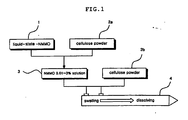
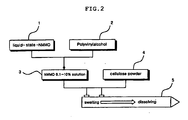
- FIG. 1 and FIG. 2 are examples of this invention, and they are block diagrams illustrating an embodiment of the method of preparing cellulose solution which is homogeneous at relatively low temperature by dissolving a small amount of cellulose powder or polyvinylalcohol in NMMO solvent.
- the cellulose powder(2a, 2b) is well pulverized by using a pulverizer having a knife to have a particle size of less than 5,000 micrometer, and more specifically, less than 500 micrometers.
- the powder will not dispersed and swollen uniformly in the kneader or extruder(4)
- cellulose powder(2a) having a particle size of less than 5,000 micrometers is dissolved in the liquid-state, concentrated NMMO solvent.
- the content of the cellulose powder(2a) in the liquid-state, concentrated NMMO solvent(1) is in the range of 0.01 to 5% by weight, and more specifically, in the range of 0.01 to 3% by weight.
- the content is less than 0.01% by weight, the cellulose powder will not be fully swollen, and if the content is more than 3% by weight, the viscosity of the NMMO solution(3) is too high to feed the NMMO solution into the extruder (4).
- the liquid-state, concentrated NMMO (1) is prepared by concentrating the 50% by weight of NMMO solvent to have 10 to 20% by weight water contents. It is not preferable to concentrate the NMMO solvent to have water content less than 10% by weight, it is not proper economically, and if the water content is more than 20% by weight, the solubility of the NMMO solvent is too low.
- the cellulose powder (2b) and the NMMO solution (3) containing a small amount of cellulose powder(2a) are fed into the extruder(4) maintained at the temperature in the range of 65 to 105°C continuously, and then, mixed, swollen and melted in the extruder(4) to produce homogeneous cellulose solution.
- the NMMO solution (3) containing a small amount of the cellulose powder(2a) can be fed into the extruder(4) by a geared pump or a screw-type feeder, and the cellulose powder(2b) can be introduced preferably into the extruder(4) by a screw-type feeder.
- the content of the cellulose powder (2a) in the cellulose solution mixed, swollen and melted in the extruder (4) is in the range of 3 to 20% by weight, and more specifically, 9 to 14% by weight to the liquid-state, concentrated NMMO (1) according to the degree of polymerization of the cellulose powder.
- the content of the cellulose powder (2a) is less than 3% by weight, the physical and chemical properties of fiber cannot be obtained properly, and if the content of the cellulose powder is more than 20% by weight, the homogeneous solution cannot be obtained because the cellulose powder fully dissolved in the liquid-state NMMO solvent (1).
- the extruder (4) used in the step (B) so as to produce a cellulose solution which is homogeneous at relatively low temperature is a twin-axis type extruder, and the twin-axis type extruder has 3 to 16 barrel or 12 to 64 L/D(length/diameter) of the screw. If the barrel is less than 3 or the L/D of the screw is less than 12, the time the cellulose solution pass through the barrel is too short so as to produce power particles which are not dissolved in the solution, and if the barrel is more than 16 or the L/D of the screw is more than 64, the screw of the extruder can be deformed because of hard stress acted to the screw.
- the cellulose powder (2a, 2b) in the step (A) or (B) can be mixed with other polymer or additives.
- Polyvinylalcohol, polyethylene, polyethyleneglycol or polymethylmethacrylate can be used as the above polymer, and thickner, titanium dioxide, silica (silicon dioxide), carbon or ammonium chloride can be used as the additives.
- the content of the polyvinylalcohol(2) to the liquid-state, concentrated NMMO(1) is in the range of 0.1 to 10% by weight, and more specifically, in the range of 0.5 to 3% by weight.
- the content of the polyvinylalcohol (2) is less than 0.1% by weight, it cannot be contributed to rise swelling of the cellulose powder against lowering temperature of the NMMO, and if the content of the polyvinylalcohol is more than 10% by weight, the cellulose powder in the NMMO solution(3) cannot be dissolved uniformly.
- the degree of polymerization of the polyvinylalcohol using in this invention is in the range of 500 to 6,000, and more specifically, 1,000 to 4,000. If the degree of polymerization is less than 500, the effect to the physical and chemical properties of the cellulose fiber obtained thereby is too low, and if the degree of polymerization is more than 6,000, the solubility to the NMMO (1) and cellulose (4) can be lowered.
- the saponification value of the polyvinylalcohol using in this invention is in the range of 80 to 99.9%, and more specifically, 90 to 99.5%. If the saponification value is less than 80%, it cannot affect to anti-fibrilation of cellulose, and if the saponification value is more than 99.5%, the viscosity stability of the cellulose solution can be lowered.
- the cellulose powder (4) and the NMMO solution (3) containing a small amount of polyvinylalcohol (2) are fed into the extruder(5) maintained at the temperature in the range of 65 to 105°C Continuously, and then, mixed, swollen and melted in the extruder(5) to produce homogeneous cellulose solution.
- the NMMO solution (3) containing a small amount of the polyvinylalcohol(2) can be fed into the extruder(5) by a geared pump or a screw-type feeder, and the cellulose powder(4) can be introduced preferably into the extruder(5) by a screw-type feeder.
- the content of the cellulose powder (4) in the cellulose solution mixed, swollen and melted in the extruder(5) is in the range of 5 to 20% by weight, and more specifically, 9 to 14% by weight to the liquid-state NMMO(1) according to the degree of polymerization of the cellulose powder.
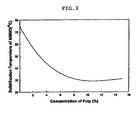
- FIG. 3 is a graph illustrating the history of shift of the solidifying temperature of the NMMO solution versus the concentration of the cellulose pulp.
- the solidifying temperature of the NMMO is greatly lowered from 75°C to 30°C by dissolving a small amount of cellulose (about 0.1 to 6% by weight).
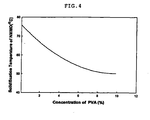
- FIG. 4 is a graph illustrating the history of shift of the solidifying temperature of the NMMO solution versus the concentration of the polyvinylalcohol.
- the solidifying temperature of the NMMO is greatly lowered from 75°C to 50°C by dissolving a small amount of polyvinylalcohol(about 0.1 to 6% by weight).
- the estimation of the solubility of the cellulose powder obtained according to this invention is carried out as follows.
- the 12% by weight of cellulose powder dissolves in the NMMO monohydrate in the reaction vessel. And then, the number of the particles remained(not liquefied) in the area of 5 ⁇ 5 mm 2 of a slide glass which contains the sample through a polarization microscope is calculated.
- the intrinsic viscosity [IV] of the dissolved cellulose is measured as follows. 0.5M cupriethylenediamine hydroxide solution in the range of 0.1 to 0.6g/dl concentration obtained according to ASTM D539-51T is measured by using an Uberod viscometer at 25 ⁇ 0.01°C.
- the intrinsic viscosity is calculated from the specific viscosity by using the calculation method of extrapolation and then Mark-Hauwink's equation to obtain the degree of polymerization.
- IV 0.98 ⁇ 10 - 2 ⁇ DP w 0.9
- the index of fibrillation (F.I.) is estimated as follows.
- Samples of the fibers are aligned according to the increase degree of fibrillation.
- a standard length of each sample fiber is measured, counted the number of fibril according to the standard length, measured length of each fibril, calculated the mean of the length of fibril, and then, evaluate the value which obtained by multiple the number of fibril by the mean of the length of fibril as a index of fibrillation over each fiber.
- the fiber having the highest among the indexes of fibrillation is the most fibrillated fiber. And the value obtained the index of fibrillation by 10 counts as a voluntary value.
- the fiber which is not fibrillated overall counts as the fiber the index of fibrillation is zero, and then, other fibers is aligned according to the above obtained voluntary value in the range of 1 to 10.
- a cellulose sheet that the weight mean degree of polymerization is 1,000 were fed into a pulverizer having a 100 mesh filter to produce cellulose powder having a particle size of less than 500 micrometers, and then, the cellulose powder were dissolved in NMMO to produce a NMMO solution containing cellulose of 1% by weight.
- the NMMO solution containing the cellulose of 1% by weight was fed into an extruder (4) maintained its inner temperature at 78°C through a geared pump at the speed of 6,900g/hour and the cellulose powder was fed into the extruder through a screw-type feeder at the speed of 853g/hour.
- the extruder was controlled to swell the NMMO solution and the cellulose powder fully by controlling them dwelling for 0.1 to 3 minutes in the swelling zone of the extruder. And then, the temperature of each block of the dissolving zone of the extruder was maintained at the range of 90 to 95°C and operated the screw of the extruder at 200 rpm so as to extrude the fully melted solution through the nozzle of the extruder.
- the concentration of the obtained solution is 11% by weight and doesn't contain cellulose particles which are not dissolved in the solution. And the degree of polymerization of the cellulose is 945.
- a cellulose sheet that the weight mean degree of polymerization is 1,000 were fed into a pulverizer having a 100 mesh filter to produce cellulose powder having a particle size of less than 500 micrometers, and then, the cellulose powder were dissolved in NMMO to produce a NMMO solution containing cellulose of 2% by weight.
- the NMMO solution containing the cellulose of 2% by weight was fed into an extruder maintained its inner temperature at 78°C through a geared pump at the speed of 6,900g/hour and the cellulose powder was fed into the extruder through a screw-type feeder at the speed of 853g/hour.
- the extruder was controlled to swell the NMMO solution and the cellulose powder fully by controlling them dwelling for 0.5 to 3 minutes in the swelling zone of the extruder. And then, the temperature of each block of the dissolving zone of the extruder was maintained at the range of 90 to 95°C and operated the screw of the extruder at 200 rpm so as to extrude the melted solution through the nozzle of the extruder.
- the concentration of the obtained solution is 11% by weight and doesn't contain cellulose particles which are not dissolved in the solution. And the degree of polymerization of the cellulose is 930.
- the solution was prepared in the same manner as described in Example 1 except that the temperature of the dissolving zone in the extruder was changed to 100°C.
- a cellulose sheet that the weight mean degree of polymerization is 1,000 were fed into a pulverizer having a 100 mesh filter to produce cellulose powder having a particle size of less than 500 micrometers, and then, the cellulose powder were dissolved in NMMO to produce a NMMO solution containing cellulose of 1% by weight.
- the NMMO solution containing 1% by weight of cellulose and the cellulose powder were fed into a twin-screw type extruder so as to produce a cellulose solution having a final concentration of 11% by weight.
- the temperature of the block of the twin-screw type extruder was maintained at 95°C, and the screw of the twin-screw type extruder is operated at 200 rpm so as to extrude the fully melted solution through the nozzle of the extruder.
- the cellulose particles which were not dissolved were not nearly found in the obtained solution. And the degree of polymerization of the cellulose is 870.
- the cellulose sheet having a weight mean degree of polymerization of 1,000 was pulverized into powder having a particle size of less than 500 micrometers using a pulverizer. And then, the obtained cellulose powder and liquid-state NMMO (monohydrate) having a temperature of 89°C were fed into a twin-screw type extruder, and dissolved while maintaining each block of the extruder at a temperature of 95°C so as to extrude the fully melted solution through the nozzle of the extruder.
- NMMO monohydrate
- Polyvinylalchol having a weight mean degree of polymerization of 1,700 and a saponification value of 99.5% were dissolved in NMMO to produce a NMMO solution containing polyvinylalchol of 1% by weight.
- the NMMO solution containing polyvinylalcohol of 1% by weight was fed into a twin-screw type extruder having its inner temperature maintained at 78°C through a geared pump at a speed of 6,900g/hour.
- the cellulose sheet having a weight mean degree of polymerization of 1,200 was pulverized into cellulose powder having a particle size of less than 500 micrometer using a pulverizer having 100 mesh filter, and then, the cellulose powder was fed into the twin-screw type extruder through a screw-type feeder at the speed of 853g/hour. Meanwhile, the liquid-state NMMO solution containing polyvinylalcohol of 1% by weight was fed into the extruder with it maintained at 74°C.
- the concentration of the obtained solution is 11% by weight and doesn't contain cellulose particles which are not dissolved in the solution. And the degree of polymerization of the cellulose is 945.
- Polyvinylalchol having a weight mean degree of polymerization of 1,700 and a saponification value of 99.5% were dissolved in NMMO to produce a NMMO solution containing polyvinylalchol of 2% by weight.
- the NMMO solution containing polyvinylalcohol of 2% by weight maintained at the temperature of 72°C was fed into the top portion of a twin-screw type extruder maintained its inner temperature at 75°C therein through a geared pump at the speed of 6,900g/hour.
- the cellulose sheet having a weight mean degree of polymerization of 1,200 was pulverized into powder having a particle size of less than 500 micrometers using a pulverizer having 100 mesh filter, and then, the cellulose powder was fed into the twin-screw type extruder through a screw-type feeder at the speed of 853g/hour. Cellulose powder was fully swollen during the retention time of 0.5 to 3 minutes in the cellulose swelling zone of the extruder.
- each block of the dissolving zone in the extruder was maintained at 90 to 95°C.
- the temperature of each block of the dissolving zone of the extruder was maintained at the range of 90 to 95°C and operated the screw of the extruder at 200 rpm so as to extrude the fully melted solution through the nozzle of the extruder.
- the concentration of the obtained solution is 11% by weight and doesn't contain cellulose particles which are not dissolved in the solution. And the degree of polymerization of the cellulose is 980.
- the solution was prepared in the same manner as described in Example 6 except using Polyvinylalchol having a weight mean degree of polymerization of 2,500 and a saponification value of 99%.
- the concentration of the obtained solution is 11% by weight and doesn't contain cellulose particles which are not dissolved in the solution.
- the degree of polymerization of the cellulose is 950.
- the cellulose sheet having a weight mean degree of polymerization of 1,200 was pulverized into powder having a particle size of less than 500 micrometers using a pulverizer. And then, the obtained cellulose powder and liquid-state NMMO (monohydrate) having a temperature of 89°C were fed into a twin-screw type extruder, and dissolved while maintaining each block of the extruder at a temperature of 95°C so as to extrude the fully melted solution through the nozzle of the extruder.
- NMMO monohydrate
- This invention provides a method of preparing cellulose solution which is homogeneous at relatively low temperature by dissolving a small amount of cellulose powder or polyvinylalcohol in the liquid-state, concentrated NMMO solvent so as to lower the solidifying temperature of the NMMO. Because of the said effect, it is possible to feed the liquid-state NMMO into an extruder at relatively low temperature. Thereby, it can be possible to proceed the process at wide processing temperature and to produce cellulose solution which is homogeneous at relatively low temperature by swelling the cellulose powder and the NMMO solution at relatively low temperature so as not to form a film on the cellulose powder.
- the obtained fiber contains a small amount of polyvinylalcohol in the liquid-state, concentrated NMMO and has a good anti-fibrilation and excellent adhesive property.
- This invention also provides a cellulose solution that minimized thermal-degradation and homogenized.
- the cellulose solution can be used to produce a cellulose-made article such as fiber, filament, film, tube, etc. More specifically, the fiber manufactured by using the above cellulose solution is excellent in mechanical strength and dimensional stability and may be used for making industrial filament fiber or reinforcing material of rubber-made products such as tire or belt.
- a method for producing such a cellulose fiber comprises comprising using the cellulose solution prepared by the steps (A) und (B) as outlined above and further (C) spinning the cellulose solution through nozzle of a spinner, solidifying it through an aeration layer and solidifying bath to obtain multi-filament; and D) washing, drying, oil-treating and winding the obtained multi-filament.
- a tire cord can be obtained by using this cellulose fiber and said tire cord represents a further aspect of the invention.
Landscapes
- Engineering & Computer Science (AREA)
- Chemical & Material Sciences (AREA)
- Chemical Kinetics & Catalysis (AREA)
- Mechanical Engineering (AREA)
- Textile Engineering (AREA)
- Biochemistry (AREA)
- Health & Medical Sciences (AREA)
- Materials Engineering (AREA)
- Medicinal Chemistry (AREA)
- Polymers & Plastics (AREA)
- Organic Chemistry (AREA)
- General Chemical & Material Sciences (AREA)
- Life Sciences & Earth Sciences (AREA)
- Artificial Filaments (AREA)
- Processes Of Treating Macromolecular Substances (AREA)
- Polysaccharides And Polysaccharide Derivatives (AREA)
- Compositions Of Macromolecular Compounds (AREA)
Applications Claiming Priority (8)
| Application Number | Priority Date | Filing Date | Title |
|---|---|---|---|
| KR2003043255 | 2003-06-30 | ||
| KR1020030043255A KR100540344B1 (ko) | 2003-06-30 | 2003-06-30 | 고균질 셀룰로오스 용액의 제조방법 |
| KR2003043254 | 2003-06-30 | ||
| KR10-2003-0043254A KR100486811B1 (ko) | 2003-06-30 | 2003-06-30 | 고균질 셀룰로오스 용액으로부터 제조한 셀룰로오스섬유의 제조방법 |
| KR2003051411 | 2003-07-25 | ||
| KR1020030051410A KR100545858B1 (ko) | 2003-07-25 | 2003-07-25 | 고균질 셀룰로오스 용액의 제조방법 |
| KR10-2003-0051411A KR100488603B1 (ko) | 2003-07-25 | 2003-07-25 | 셀룰로오스 섬유의 제조방법 |
| KR2003051410 | 2003-07-25 |
Publications (2)
| Publication Number | Publication Date |
|---|---|
| EP1493753A1 EP1493753A1 (en) | 2005-01-05 |
| EP1493753B1 true EP1493753B1 (en) | 2010-08-11 |
Family
ID=33437167
Family Applications (1)
| Application Number | Title | Priority Date | Filing Date |
|---|---|---|---|
| EP03029111A Expired - Lifetime EP1493753B1 (en) | 2003-06-30 | 2003-12-17 | A solution containing cellulose dissolved in N-methylmorpholine-N-oxide and high tenacity lyocell multifilament using the same |
Country Status (8)
| Country | Link |
|---|---|
| US (2) | US7214727B2 (enExample) |
| EP (1) | EP1493753B1 (enExample) |
| JP (1) | JP4004501B2 (enExample) |
| CN (1) | CN1309886C (enExample) |
| AT (1) | ATE477281T1 (enExample) |
| AU (1) | AU2003273104A1 (enExample) |
| DE (1) | DE60333743D1 (enExample) |
| WO (1) | WO2005001174A1 (enExample) |
Families Citing this family (108)
| Publication number | Priority date | Publication date | Assignee | Title |
|---|---|---|---|---|
| EP1437968B1 (en) | 2001-10-23 | 2013-04-10 | Covidien LP | Surgical fasteners |
| AU2003273104A1 (en) * | 2003-06-30 | 2005-01-13 | Hyosung Corporation | A solution containing cellulose dissolved in n-methylmorpholine-n-oxide and high tenacity lyocell multifilament using the same |
| AU2003273105A1 (en) * | 2003-06-30 | 2005-01-13 | Hyosung Corporation | A jomogeneous cellulose solution and high tenacity lyocell multifilament using the same |
| US7938307B2 (en) | 2004-10-18 | 2011-05-10 | Tyco Healthcare Group Lp | Support structures and methods of using the same |
| US7845536B2 (en) | 2004-10-18 | 2010-12-07 | Tyco Healthcare Group Lp | Annular adhesive structure |
| KR100575378B1 (ko) | 2004-11-10 | 2006-05-02 | 주식회사 효성 | 셀룰로오스 섬유의 제조방법 |
| KR100575388B1 (ko) * | 2004-12-30 | 2006-05-03 | 주식회사 효성 | 고균질 셀룰로오스 용액 및 이로 부터 제조된 섬유 |
| US9364229B2 (en) | 2005-03-15 | 2016-06-14 | Covidien Lp | Circular anastomosis structures |
| KR100966111B1 (ko) * | 2005-03-15 | 2010-06-28 | 주식회사 효성 | 셀룰로오스 멀티 필라멘트의 제조방법 |
| US7845533B2 (en) | 2007-06-22 | 2010-12-07 | Tyco Healthcare Group Lp | Detachable buttress material retention systems for use with a surgical stapling device |
| KR100949556B1 (ko) * | 2006-12-26 | 2010-03-25 | 주식회사 코오롱 | 셀룰로오스-폴리비닐알코올 가교 복합섬유의 제조방법 및이로부터 제조되는 가교 복합섬유 |
| US20080188636A1 (en) * | 2007-02-06 | 2008-08-07 | North Carolina State University | Polymer derivatives and composites from the dissolution of lignocellulosics in ionic liquids |
| GB0702795D0 (en) * | 2007-02-13 | 2007-03-28 | Whitford Plastics Ltd | Process for modifying cellulose |
| CA2680148C (en) | 2007-03-06 | 2015-09-01 | Tyco Healthcare Group Lp | Surgical stapling apparatus |
| US7665646B2 (en) | 2007-06-18 | 2010-02-23 | Tyco Healthcare Group Lp | Interlocking buttress material retention system |
| US20100147921A1 (en) | 2008-12-16 | 2010-06-17 | Lee Olson | Surgical Apparatus Including Surgical Buttress |
| JP5393141B2 (ja) * | 2008-12-29 | 2014-01-22 | 住友ゴム工業株式会社 | ゴム組成物およびそれを用いたタイヤ |
| JP5055314B2 (ja) * | 2009-02-27 | 2012-10-24 | 株式会社日立製作所 | セルロース/樹脂複合体及びその製造方法 |
| US9486215B2 (en) | 2009-03-31 | 2016-11-08 | Covidien Lp | Surgical stapling apparatus |
| US20150231409A1 (en) | 2009-10-15 | 2015-08-20 | Covidien Lp | Buttress brachytherapy and integrated staple line markers for margin identification |
| US10293553B2 (en) | 2009-10-15 | 2019-05-21 | Covidien Lp | Buttress brachytherapy and integrated staple line markers for margin identification |
| JP5534871B2 (ja) * | 2010-03-08 | 2014-07-02 | フタムラ化学株式会社 | セルロースフィルムの製造方法 |
| US8980050B2 (en) | 2012-08-20 | 2015-03-17 | Celanese International Corporation | Methods for removing hemicellulose |
| US9027765B2 (en) | 2010-12-17 | 2015-05-12 | Hollingsworth & Vose Company | Filter media with fibrillated fibers |
| US8479968B2 (en) | 2011-03-10 | 2013-07-09 | Covidien Lp | Surgical instrument buttress attachment |
| EP2726512B1 (en) | 2011-06-29 | 2017-10-11 | Covidien LP | Dissolution of oxidized cellulose |
| US8584920B2 (en) | 2011-11-04 | 2013-11-19 | Covidien Lp | Surgical stapling apparatus including releasable buttress |
| US8967448B2 (en) | 2011-12-14 | 2015-03-03 | Covidien Lp | Surgical stapling apparatus including buttress attachment via tabs |
| US9113885B2 (en) | 2011-12-14 | 2015-08-25 | Covidien Lp | Buttress assembly for use with surgical stapling device |
| US9351731B2 (en) | 2011-12-14 | 2016-05-31 | Covidien Lp | Surgical stapling apparatus including releasable surgical buttress |
| US9237892B2 (en) | 2011-12-14 | 2016-01-19 | Covidien Lp | Buttress attachment to the cartridge surface |
| US9326773B2 (en) | 2012-01-26 | 2016-05-03 | Covidien Lp | Surgical device including buttress material |
| US9010609B2 (en) | 2012-01-26 | 2015-04-21 | Covidien Lp | Circular stapler including buttress |
| US9010612B2 (en) | 2012-01-26 | 2015-04-21 | Covidien Lp | Buttress support design for EEA anvil |
| US8820606B2 (en) | 2012-02-24 | 2014-09-02 | Covidien Lp | Buttress retention system for linear endostaplers |
| US9168227B2 (en) | 2012-05-31 | 2015-10-27 | Covidien Lp | Multi-encapsulated microspheres made with oxidized cellulose for in-situ reactions |
| US9138489B2 (en) | 2012-05-31 | 2015-09-22 | Covidien Lp | Oxidized cellulose miczrospheres including visualization agents |
| US9271937B2 (en) | 2012-05-31 | 2016-03-01 | Covidien Lp | Oxidized cellulose microspheres |
| US8882876B2 (en) | 2012-06-20 | 2014-11-11 | Hollingsworth & Vose Company | Fiber webs including synthetic fibers |
| US9352267B2 (en) | 2012-06-20 | 2016-05-31 | Hollingsworth & Vose Company | Absorbent and/or adsorptive filter media |
| US9511330B2 (en) | 2012-06-20 | 2016-12-06 | Hollingsworth & Vose Company | Fibrillated fibers for liquid filtration media |
| US9447197B2 (en) | 2012-06-28 | 2016-09-20 | Covidien Lp | Dissolution of oxidized cellulose and particle preparation by dispersion and neutralization |
| US9499636B2 (en) | 2012-06-28 | 2016-11-22 | Covidien Lp | Dissolution of oxidized cellulose and particle preparation by cross-linking with multivalent cations |
| US10040871B2 (en) | 2012-06-28 | 2018-08-07 | Covidien Lp | Medical devices based on oxidized cellulose |
| US9447196B2 (en) | 2012-06-28 | 2016-09-20 | Covidien Lp | Dissolution of oxidized cellulose and particle preparation by solvent and non-solvent precipitation |
| US20140048580A1 (en) | 2012-08-20 | 2014-02-20 | Covidien Lp | Buttress attachment features for surgical stapling apparatus |
| US20140048221A1 (en) | 2012-08-20 | 2014-02-20 | Celanese International Corporation | Methods for extracting hemicellulose from a cellulosic material |
| US9161753B2 (en) | 2012-10-10 | 2015-10-20 | Covidien Lp | Buttress fixation for a circular stapler |
| US20140131418A1 (en) | 2012-11-09 | 2014-05-15 | Covidien Lp | Surgical Stapling Apparatus Including Buttress Attachment |
| US10137392B2 (en) | 2012-12-14 | 2018-11-27 | Hollingsworth & Vose Company | Fiber webs coated with fiber-containing resins |
| US20140239047A1 (en) | 2013-02-28 | 2014-08-28 | Covidien Lp | Adherence concepts for non-woven absorbable felt buttresses |
| US9782173B2 (en) | 2013-03-07 | 2017-10-10 | Covidien Lp | Circular stapling device including buttress release mechanism |
| US9782430B2 (en) | 2013-03-15 | 2017-10-10 | Covidien Lp | Resorbable oxidized cellulose embolization solution |
| US10328095B2 (en) | 2013-03-15 | 2019-06-25 | Covidien Lp | Resorbable oxidized cellulose embolization microspheres |
| US10413566B2 (en) | 2013-03-15 | 2019-09-17 | Covidien Lp | Thixotropic oxidized cellulose solutions and medical applications thereof |
| TWI667378B (zh) | 2014-01-03 | 2019-08-01 | 奧地利商蘭精股份有限公司 | 纖維素纖維 |
| FI125522B (en) | 2014-04-15 | 2015-11-13 | Spinnova Oy | Method and apparatus for making a fiber yarn |
| US9844378B2 (en) | 2014-04-29 | 2017-12-19 | Covidien Lp | Surgical stapling apparatus and methods of adhering a surgical buttress thereto |
| US10449152B2 (en) | 2014-09-26 | 2019-10-22 | Covidien Lp | Drug loaded microspheres for post-operative chronic pain |
| US10835216B2 (en) | 2014-12-24 | 2020-11-17 | Covidien Lp | Spinneret for manufacture of melt blown nonwoven fabric |
| US10470767B2 (en) | 2015-02-10 | 2019-11-12 | Covidien Lp | Surgical stapling instrument having ultrasonic energy delivery |
| EP3291745A4 (en) | 2015-04-10 | 2019-02-13 | Covidien LP | Surgical stapler with integrated bladder |
| US10959731B2 (en) | 2016-06-14 | 2021-03-30 | Covidien Lp | Buttress attachment for surgical stapling instrument |
| US11026686B2 (en) | 2016-11-08 | 2021-06-08 | Covidien Lp | Structure for attaching buttress to anvil and/or cartridge of surgical stapling instrument |
| US10874768B2 (en) | 2017-01-20 | 2020-12-29 | Covidien Lp | Drug eluting medical device |
| US10925607B2 (en) | 2017-02-28 | 2021-02-23 | Covidien Lp | Surgical stapling apparatus with staple sheath |
| US10368868B2 (en) | 2017-03-09 | 2019-08-06 | Covidien Lp | Structure for attaching buttress material to anvil and cartridge of surgical stapling instrument |
| US11096610B2 (en) | 2017-03-28 | 2021-08-24 | Covidien Lp | Surgical implants including sensing fibers |
| US10849625B2 (en) | 2017-08-07 | 2020-12-01 | Covidien Lp | Surgical buttress retention systems for surgical stapling apparatus |
| US10945733B2 (en) | 2017-08-23 | 2021-03-16 | Covidien Lp | Surgical buttress reload and tip attachment assemblies for surgical stapling apparatus |
| US11141151B2 (en) | 2017-12-08 | 2021-10-12 | Covidien Lp | Surgical buttress for circular stapling |
| US11065000B2 (en) | 2018-02-22 | 2021-07-20 | Covidien Lp | Surgical buttresses for surgical stapling apparatus |
| US10758237B2 (en) | 2018-04-30 | 2020-09-01 | Covidien Lp | Circular stapling apparatus with pinned buttress |
| US11426163B2 (en) | 2018-05-09 | 2022-08-30 | Covidien Lp | Universal linear surgical stapling buttress |
| US11284896B2 (en) | 2018-05-09 | 2022-03-29 | Covidien Lp | Surgical buttress loading and attaching/detaching assemblies |
| US11432818B2 (en) | 2018-05-09 | 2022-09-06 | Covidien Lp | Surgical buttress assemblies |
| US11219460B2 (en) | 2018-07-02 | 2022-01-11 | Covidien Lp | Surgical stapling apparatus with anvil buttress |
| US10806459B2 (en) | 2018-09-14 | 2020-10-20 | Covidien Lp | Drug patterned reinforcement material for circular anastomosis |
| US10952729B2 (en) | 2018-10-03 | 2021-03-23 | Covidien Lp | Universal linear buttress retention/release assemblies and methods |
| US11730472B2 (en) | 2019-04-25 | 2023-08-22 | Covidien Lp | Surgical system and surgical loading units thereof |
| US11596403B2 (en) | 2019-05-08 | 2023-03-07 | Covidien Lp | Surgical stapling device |
| US11478245B2 (en) | 2019-05-08 | 2022-10-25 | Covidien Lp | Surgical stapling device |
| CN110258162A (zh) * | 2019-06-12 | 2019-09-20 | 当阳市鸿阳新材料科技有限公司 | 制备纤维素纺丝浆液装置及其制备方法 |
| US11969169B2 (en) | 2019-09-10 | 2024-04-30 | Covidien Lp | Anvil buttress loading unit for a surgical stapling apparatus |
| US11571208B2 (en) | 2019-10-11 | 2023-02-07 | Covidien Lp | Surgical buttress loading units |
| CN112679756A (zh) * | 2019-10-17 | 2021-04-20 | 武汉纺织大学 | 一种nmmo醇溶液快速溶解纤维素的方法 |
| CN110818937B (zh) * | 2019-11-19 | 2022-04-29 | 石家庄学院 | 一种纤维素-聚乙烯醇可降解复合膜的制备方法及其抑菌强化方法 |
| US11523824B2 (en) | 2019-12-12 | 2022-12-13 | Covidien Lp | Anvil buttress loading for a surgical stapling apparatus |
| CN110846898A (zh) * | 2020-01-08 | 2020-02-28 | 石家庄学院 | 抑菌可降解复合纤维的制备方法 |
| CN113087927A (zh) * | 2020-01-09 | 2021-07-09 | 雅思雅思拉普 | 使用n-甲基吗啉-n-氧化物的均质纤维素溶液的制备方法 |
| US11547407B2 (en) | 2020-03-19 | 2023-01-10 | Covidien Lp | Staple line reinforcement for surgical stapling apparatus |
| US11337699B2 (en) | 2020-04-28 | 2022-05-24 | Covidien Lp | Magnesium infused surgical buttress for surgical stapler |
| US11707276B2 (en) | 2020-09-08 | 2023-07-25 | Covidien Lp | Surgical buttress assemblies and techniques for surgical stapling |
| US11399833B2 (en) | 2020-10-19 | 2022-08-02 | Covidien Lp | Anvil buttress attachment for surgical stapling apparatus |
| US11534170B2 (en) | 2021-01-04 | 2022-12-27 | Covidien Lp | Anvil buttress attachment for surgical stapling apparatus |
| US11510670B1 (en) | 2021-06-23 | 2022-11-29 | Covidien Lp | Buttress attachment for surgical stapling apparatus |
| US11596399B2 (en) | 2021-06-23 | 2023-03-07 | Covidien Lp | Anvil buttress attachment for surgical stapling apparatus |
| US11672538B2 (en) | 2021-06-24 | 2023-06-13 | Covidien Lp | Surgical stapling device including a buttress retention assembly |
| US11678879B2 (en) | 2021-07-01 | 2023-06-20 | Covidien Lp | Buttress attachment for surgical stapling apparatus |
| US11684368B2 (en) | 2021-07-14 | 2023-06-27 | Covidien Lp | Surgical stapling device including a buttress retention assembly |
| US12076013B2 (en) | 2021-08-03 | 2024-09-03 | Covidien Lp | Surgical buttress attachment assemblies for surgical stapling apparatus |
| US11801052B2 (en) | 2021-08-30 | 2023-10-31 | Covidien Lp | Assemblies for surgical stapling instruments |
| US11751875B2 (en) | 2021-10-13 | 2023-09-12 | Coviden Lp | Surgical buttress attachment assemblies for surgical stapling apparatus |
| US11806017B2 (en) | 2021-11-23 | 2023-11-07 | Covidien Lp | Anvil buttress loading system for surgical stapling apparatus |
| EP4437036A1 (en) | 2021-11-24 | 2024-10-02 | Bolt Threads, Inc. | Compositions for producing cellulose- resilin and cellulose-collagen fibers |
| CN114441259B (zh) * | 2022-01-04 | 2024-04-09 | 中国纺织科学研究院有限公司 | 一种评价纤维素浆粕反应性能的方法及其应用 |
| EP4482400A1 (en) | 2022-02-24 | 2025-01-01 | Covidien LP | Surgical medical devices |
| CN115044985B (zh) * | 2022-06-23 | 2024-10-15 | 赛得利(常州)纤维有限公司 | 一种低温溶解制备纤维纺丝原液的方法 |
Family Cites Families (26)
| Publication number | Priority date | Publication date | Assignee | Title |
|---|---|---|---|---|
| US3447935A (en) * | 1967-12-21 | 1969-06-03 | Lawrence L Marley | Fluid polishing composition and method of making |
| US4246221A (en) * | 1979-03-02 | 1981-01-20 | Akzona Incorporated | Process for shaped cellulose article prepared from a solution containing cellulose dissolved in a tertiary amine N-oxide solvent |
| US4142913A (en) * | 1977-07-26 | 1979-03-06 | Akzona Incorporated | Process for making a precursor of a solution of cellulose |
| US4144080A (en) * | 1977-07-26 | 1979-03-13 | Akzona Incorporated | Process for making amine oxide solution of cellulose |
| US4416698A (en) * | 1977-07-26 | 1983-11-22 | Akzona Incorporated | Shaped cellulose article prepared from a solution containing cellulose dissolved in a tertiary amine N-oxide solvent and a process for making the article |
| US4196282A (en) * | 1977-11-25 | 1980-04-01 | Akzona Incorporated | Process for making a shapeable cellulose and shaped cellulose products |
| US4221574A (en) * | 1979-04-23 | 1980-09-09 | Allis-Chalmers Corporation | Apparatus for removing particulates from the exhaust gases generated in drum mixers and aggregate dryers |
| US4255300A (en) * | 1979-07-02 | 1981-03-10 | Akzona Incorporated | Composition and process for making precipitated cellulose-polyvinyl alcohol biconstituent composition |
| FR2617511B1 (fr) * | 1987-07-01 | 1989-12-15 | Inst Textile De France | Procede de preparation d'une solution de filage de cellulose en presence d'oxyde d'amine tertiaire et d'additif |
| GB9219693D0 (en) | 1992-09-17 | 1992-10-28 | Courtaulds Plc | Forming solutions |
| AT400581B (de) * | 1993-10-19 | 1996-01-25 | Chemiefaser Lenzing Ag | Verfahren zur herstellung von lösungen von cellulose |
| GB9412501D0 (en) * | 1994-06-22 | 1994-08-10 | Courtaulds Fibres Holdings Ltd | Manufacture of fibre |
| ATE233332T1 (de) | 1996-06-10 | 2003-03-15 | Korea Inst Sci & Tech | Verfahren zur herstellung einer homogenen celluloselösung in n-methylmorpholin-n-oxid |
| US5747125A (en) * | 1996-07-18 | 1998-05-05 | Viskase Corporation | Fibrous composite cellulosic film and method |
| US5826798A (en) * | 1996-10-01 | 1998-10-27 | Todd Combustion | Atomizer with array of discharge holes to provide improved combustion efficiency and process |
| AT405531B (de) * | 1997-06-17 | 1999-09-27 | Chemiefaser Lenzing Ag | Verfahren zur herstellung cellulosischer fasern |
| US5951933A (en) * | 1997-07-24 | 1999-09-14 | Alfacel S.A. | Processes for precipitating tertiary amine oxide cellulose solutions containing water soluble polymers and products made therefrom |
| KR100278470B1 (ko) | 1998-12-22 | 2001-02-01 | 박호군 | 셀룰로오스 필라멘트사의 제조방법 및 제조장치 |
| KR20010038732A (ko) | 1999-10-27 | 2001-05-15 | 조정래 | 셀룰로오스 nmmo 용액의 제조방법 및 이를 이용한 셀룰로오스 섬유의 제조방법 |
| KR100365867B1 (ko) * | 2000-09-26 | 2002-12-26 | 한국과학기술연구원 | 과냉각된 액상 n-메틸모르포린-n-옥사이드 수화물용매를 이용한 고균질 셀룰로오스 용액의 제조 방법 |
| KR100385400B1 (ko) | 2001-04-11 | 2003-05-23 | 주식회사 효성 | 승용차용 래디얼 타이어 |
| KR100611890B1 (ko) | 2002-05-31 | 2006-08-11 | 주식회사 효성 | 고균질 셀룰로오스 용액의 제조방법 |
| AU2003273104A1 (en) | 2003-06-30 | 2005-01-13 | Hyosung Corporation | A solution containing cellulose dissolved in n-methylmorpholine-n-oxide and high tenacity lyocell multifilament using the same |
| AU2003273105A1 (en) * | 2003-06-30 | 2005-01-13 | Hyosung Corporation | A jomogeneous cellulose solution and high tenacity lyocell multifilament using the same |
| JP4234057B2 (ja) * | 2003-06-30 | 2009-03-04 | ヒョスング コーポレーション | 高均質セルロース溶液から製造したセルロースディップコード及びタイヤ |
| KR100488604B1 (ko) * | 2003-07-25 | 2005-05-11 | 주식회사 효성 | 라이오셀 멀티 필라멘트 |
-
2003
- 2003-10-24 AU AU2003273104A patent/AU2003273104A1/en not_active Abandoned
- 2003-10-24 CN CNB038004879A patent/CN1309886C/zh not_active Expired - Fee Related
- 2003-10-24 US US10/481,105 patent/US7214727B2/en not_active Expired - Lifetime
- 2003-10-24 WO PCT/KR2003/002250 patent/WO2005001174A1/en not_active Ceased
- 2003-10-24 JP JP2004531661A patent/JP4004501B2/ja not_active Expired - Lifetime
- 2003-12-17 EP EP03029111A patent/EP1493753B1/en not_active Expired - Lifetime
- 2003-12-17 DE DE60333743T patent/DE60333743D1/de not_active Expired - Lifetime
- 2003-12-17 AT AT03029111T patent/ATE477281T1/de active
-
2005
- 2005-11-04 US US11/266,253 patent/US7214335B2/en not_active Expired - Lifetime
Also Published As
| Publication number | Publication date |
|---|---|
| CN1309886C (zh) | 2007-04-11 |
| AU2003273104A1 (en) | 2005-01-13 |
| JP4004501B2 (ja) | 2007-11-07 |
| US7214727B2 (en) | 2007-05-08 |
| US7214335B2 (en) | 2007-05-08 |
| US20060057378A1 (en) | 2006-03-16 |
| ATE477281T1 (de) | 2010-08-15 |
| DE60333743D1 (de) | 2010-09-23 |
| WO2005001174A1 (en) | 2005-01-06 |
| CN1612958A (zh) | 2005-05-04 |
| US20050154093A1 (en) | 2005-07-14 |
| EP1493753A1 (en) | 2005-01-05 |
| JP2005527698A (ja) | 2005-09-15 |
Similar Documents
| Publication | Publication Date | Title |
|---|---|---|
| EP1493753B1 (en) | A solution containing cellulose dissolved in N-methylmorpholine-N-oxide and high tenacity lyocell multifilament using the same | |
| EP1493752B1 (en) | A homogeneous cellulose solution and high tenacity lyocell multifilament using the same | |
| EP2097563B1 (en) | Composite fiber of cellulose-polyvinylalcohol and preparation method thereof | |
| EP1500724B1 (en) | Lyocell multifilament | |
| EP1841905B1 (en) | Method for producing cellulose fiber | |
| KR100611890B1 (ko) | 고균질 셀룰로오스 용액의 제조방법 | |
| EP1657327B1 (en) | Industrial cellulose fiber and process for its production | |
| CN1082102C (zh) | 挤出制品的制造方法 | |
| KR20030097558A (ko) | 가공성이 우수한 셀룰로오즈 용액의 제조방법 | |
| CN1688637A (zh) | 高均质的纤维素溶液及使用该溶液的高强天丝纤维 | |
| KR100486811B1 (ko) | 고균질 셀룰로오스 용액으로부터 제조한 셀룰로오스섬유의 제조방법 | |
| KR100488603B1 (ko) | 셀룰로오스 섬유의 제조방법 | |
| KR100545858B1 (ko) | 고균질 셀룰로오스 용액의 제조방법 | |
| KR100499221B1 (ko) | 셀룰로오스/폴리비닐알콜 복합섬유 | |
| KR100540344B1 (ko) | 고균질 셀룰로오스 용액의 제조방법 | |
| KR20110078122A (ko) | 펄프 용해공정을 개선한 셀룰로오스 용액의 제조방법 | |
| KR100987757B1 (ko) | 셀룰로오스-폴리비닐알코올 복합섬유 및 그 제조방법 | |
| EP0727439A1 (en) | Pelletized pre-dope granules of cellulose and tertiary amine oxide, cellulosic spinning solution, and process for making them |
Legal Events
| Date | Code | Title | Description |
|---|---|---|---|
| PUAI | Public reference made under article 153(3) epc to a published international application that has entered the european phase |
Free format text: ORIGINAL CODE: 0009012 |
|
| AK | Designated contracting states |
Kind code of ref document: A1 Designated state(s): AT BE BG CH CY CZ DE DK EE ES FI FR GB GR HU IE IT LI LU MC NL PT RO SE SI SK TR |
|
| AX | Request for extension of the european patent |
Extension state: AL LT LV MK |
|
| 17P | Request for examination filed |
Effective date: 20050114 |
|
| AKX | Designation fees paid |
Designated state(s): AT BE BG CH CY CZ DE DK EE ES FI FR GB GR HU IE IT LI LU MC NL PT RO SE SI SK TR |
|
| 17Q | First examination report despatched |
Effective date: 20090513 |
|
| GRAP | Despatch of communication of intention to grant a patent |
Free format text: ORIGINAL CODE: EPIDOSNIGR1 |
|
| GRAJ | Information related to disapproval of communication of intention to grant by the applicant or resumption of examination proceedings by the epo deleted |
Free format text: ORIGINAL CODE: EPIDOSDIGR1 |
|
| GRAP | Despatch of communication of intention to grant a patent |
Free format text: ORIGINAL CODE: EPIDOSNIGR1 |
|
| GRAS | Grant fee paid |
Free format text: ORIGINAL CODE: EPIDOSNIGR3 |
|
| GRAA | (expected) grant |
Free format text: ORIGINAL CODE: 0009210 |
|
| AK | Designated contracting states |
Kind code of ref document: B1 Designated state(s): AT BE BG CH CY CZ DE DK EE ES FI FR GB GR HU IE IT LI LU MC NL PT RO SE SI SK TR |
|
| REG | Reference to a national code |
Ref country code: GB Ref legal event code: FG4D |
|
| REG | Reference to a national code |
Ref country code: CH Ref legal event code: EP |
|
| REG | Reference to a national code |
Ref country code: IE Ref legal event code: FG4D |
|
| REF | Corresponds to: |
Ref document number: 60333743 Country of ref document: DE Date of ref document: 20100923 Kind code of ref document: P |
|
| REG | Reference to a national code |
Ref country code: NL Ref legal event code: VDEP Effective date: 20100811 |
|
| PG25 | Lapsed in a contracting state [announced via postgrant information from national office to epo] |
Ref country code: NL Free format text: LAPSE BECAUSE OF FAILURE TO SUBMIT A TRANSLATION OF THE DESCRIPTION OR TO PAY THE FEE WITHIN THE PRESCRIBED TIME-LIMIT Effective date: 20100811 Ref country code: FI Free format text: LAPSE BECAUSE OF FAILURE TO SUBMIT A TRANSLATION OF THE DESCRIPTION OR TO PAY THE FEE WITHIN THE PRESCRIBED TIME-LIMIT Effective date: 20100811 |
|
| PG25 | Lapsed in a contracting state [announced via postgrant information from national office to epo] |
Ref country code: SI Free format text: LAPSE BECAUSE OF FAILURE TO SUBMIT A TRANSLATION OF THE DESCRIPTION OR TO PAY THE FEE WITHIN THE PRESCRIBED TIME-LIMIT Effective date: 20100811 Ref country code: PT Free format text: LAPSE BECAUSE OF FAILURE TO SUBMIT A TRANSLATION OF THE DESCRIPTION OR TO PAY THE FEE WITHIN THE PRESCRIBED TIME-LIMIT Effective date: 20101213 Ref country code: CY Free format text: LAPSE BECAUSE OF FAILURE TO SUBMIT A TRANSLATION OF THE DESCRIPTION OR TO PAY THE FEE WITHIN THE PRESCRIBED TIME-LIMIT Effective date: 20100811 Ref country code: BG Free format text: LAPSE BECAUSE OF FAILURE TO SUBMIT A TRANSLATION OF THE DESCRIPTION OR TO PAY THE FEE WITHIN THE PRESCRIBED TIME-LIMIT Effective date: 20101111 |
|
| PG25 | Lapsed in a contracting state [announced via postgrant information from national office to epo] |
Ref country code: BE Free format text: LAPSE BECAUSE OF FAILURE TO SUBMIT A TRANSLATION OF THE DESCRIPTION OR TO PAY THE FEE WITHIN THE PRESCRIBED TIME-LIMIT Effective date: 20100811 Ref country code: GR Free format text: LAPSE BECAUSE OF FAILURE TO SUBMIT A TRANSLATION OF THE DESCRIPTION OR TO PAY THE FEE WITHIN THE PRESCRIBED TIME-LIMIT Effective date: 20101112 Ref country code: SE Free format text: LAPSE BECAUSE OF FAILURE TO SUBMIT A TRANSLATION OF THE DESCRIPTION OR TO PAY THE FEE WITHIN THE PRESCRIBED TIME-LIMIT Effective date: 20100811 |
|
| PG25 | Lapsed in a contracting state [announced via postgrant information from national office to epo] |
Ref country code: DK Free format text: LAPSE BECAUSE OF FAILURE TO SUBMIT A TRANSLATION OF THE DESCRIPTION OR TO PAY THE FEE WITHIN THE PRESCRIBED TIME-LIMIT Effective date: 20100811 |
|
| PG25 | Lapsed in a contracting state [announced via postgrant information from national office to epo] |
Ref country code: EE Free format text: LAPSE BECAUSE OF FAILURE TO SUBMIT A TRANSLATION OF THE DESCRIPTION OR TO PAY THE FEE WITHIN THE PRESCRIBED TIME-LIMIT Effective date: 20100811 Ref country code: CZ Free format text: LAPSE BECAUSE OF FAILURE TO SUBMIT A TRANSLATION OF THE DESCRIPTION OR TO PAY THE FEE WITHIN THE PRESCRIBED TIME-LIMIT Effective date: 20100811 Ref country code: SK Free format text: LAPSE BECAUSE OF FAILURE TO SUBMIT A TRANSLATION OF THE DESCRIPTION OR TO PAY THE FEE WITHIN THE PRESCRIBED TIME-LIMIT Effective date: 20100811 Ref country code: RO Free format text: LAPSE BECAUSE OF FAILURE TO SUBMIT A TRANSLATION OF THE DESCRIPTION OR TO PAY THE FEE WITHIN THE PRESCRIBED TIME-LIMIT Effective date: 20100811 |
|
| PLBE | No opposition filed within time limit |
Free format text: ORIGINAL CODE: 0009261 |
|
| STAA | Information on the status of an ep patent application or granted ep patent |
Free format text: STATUS: NO OPPOSITION FILED WITHIN TIME LIMIT |
|
| PG25 | Lapsed in a contracting state [announced via postgrant information from national office to epo] |
Ref country code: ES Free format text: LAPSE BECAUSE OF FAILURE TO SUBMIT A TRANSLATION OF THE DESCRIPTION OR TO PAY THE FEE WITHIN THE PRESCRIBED TIME-LIMIT Effective date: 20101122 |
|
| 26N | No opposition filed |
Effective date: 20110512 |
|
| PG25 | Lapsed in a contracting state [announced via postgrant information from national office to epo] |
Ref country code: MC Free format text: LAPSE BECAUSE OF NON-PAYMENT OF DUE FEES Effective date: 20101231 |
|
| REG | Reference to a national code |
Ref country code: CH Ref legal event code: PL |
|
| GBPC | Gb: european patent ceased through non-payment of renewal fee |
Effective date: 20101217 |
|
| REG | Reference to a national code |
Ref country code: DE Ref legal event code: R097 Ref document number: 60333743 Country of ref document: DE Effective date: 20110512 |
|
| PG25 | Lapsed in a contracting state [announced via postgrant information from national office to epo] |
Ref country code: IE Free format text: LAPSE BECAUSE OF NON-PAYMENT OF DUE FEES Effective date: 20101217 Ref country code: CH Free format text: LAPSE BECAUSE OF NON-PAYMENT OF DUE FEES Effective date: 20101231 Ref country code: LI Free format text: LAPSE BECAUSE OF NON-PAYMENT OF DUE FEES Effective date: 20101231 |
|
| PG25 | Lapsed in a contracting state [announced via postgrant information from national office to epo] |
Ref country code: GB Free format text: LAPSE BECAUSE OF NON-PAYMENT OF DUE FEES Effective date: 20101217 |
|
| PG25 | Lapsed in a contracting state [announced via postgrant information from national office to epo] |
Ref country code: HU Free format text: LAPSE BECAUSE OF FAILURE TO SUBMIT A TRANSLATION OF THE DESCRIPTION OR TO PAY THE FEE WITHIN THE PRESCRIBED TIME-LIMIT Effective date: 20110212 Ref country code: LU Free format text: LAPSE BECAUSE OF NON-PAYMENT OF DUE FEES Effective date: 20101217 |
|
| PG25 | Lapsed in a contracting state [announced via postgrant information from national office to epo] |
Ref country code: TR Free format text: LAPSE BECAUSE OF FAILURE TO SUBMIT A TRANSLATION OF THE DESCRIPTION OR TO PAY THE FEE WITHIN THE PRESCRIBED TIME-LIMIT Effective date: 20100811 |
|
| REG | Reference to a national code |
Ref country code: FR Ref legal event code: PLFP Year of fee payment: 13 |
|
| REG | Reference to a national code |
Ref country code: FR Ref legal event code: PLFP Year of fee payment: 14 |
|
| REG | Reference to a national code |
Ref country code: FR Ref legal event code: PLFP Year of fee payment: 15 |
|
| REG | Reference to a national code |
Ref country code: FR Ref legal event code: PLFP Year of fee payment: 16 |
|
| REG | Reference to a national code |
Ref country code: DE Ref legal event code: R082 Ref document number: 60333743 Country of ref document: DE Representative=s name: KUHNEN & WACKER PATENT- UND RECHTSANWALTSBUERO, DE Ref country code: DE Ref legal event code: R081 Ref document number: 60333743 Country of ref document: DE Owner name: HYOSUNG ADVANCED MATERIALS CORP., KR Free format text: FORMER OWNER: HYOSUNG CORP., ANYANG-SI, KYONGGI, KR |
|
| REG | Reference to a national code |
Ref country code: AT Ref legal event code: PC Ref document number: 477281 Country of ref document: AT Kind code of ref document: T Owner name: HYOSUNG ADVANCED MATERIALS CORPORATION, KR Effective date: 20181126 |
|
| REG | Reference to a national code |
Ref country code: DE Ref legal event code: R082 Ref document number: 60333743 Country of ref document: DE |
|
| PGFP | Annual fee paid to national office [announced via postgrant information from national office to epo] |
Ref country code: AT Payment date: 20201006 Year of fee payment: 18 |
|
| REG | Reference to a national code |
Ref country code: AT Ref legal event code: MM01 Ref document number: 477281 Country of ref document: AT Kind code of ref document: T Effective date: 20211217 |
|
| PG25 | Lapsed in a contracting state [announced via postgrant information from national office to epo] |
Ref country code: AT Free format text: LAPSE BECAUSE OF NON-PAYMENT OF DUE FEES Effective date: 20211217 |
|
| PGFP | Annual fee paid to national office [announced via postgrant information from national office to epo] |
Ref country code: IT Payment date: 20220906 Year of fee payment: 20 |
|
| PGFP | Annual fee paid to national office [announced via postgrant information from national office to epo] |
Ref country code: FR Payment date: 20220905 Year of fee payment: 20 |
|
| PGFP | Annual fee paid to national office [announced via postgrant information from national office to epo] |
Ref country code: DE Payment date: 20220905 Year of fee payment: 20 |
|
| REG | Reference to a national code |
Ref country code: DE Ref legal event code: R071 Ref document number: 60333743 Country of ref document: DE |