EP1484341A1 - Herstellung von Saccharidestern - Google Patents
Herstellung von Saccharidestern Download PDFInfo
- Publication number
- EP1484341A1 EP1484341A1 EP04012051A EP04012051A EP1484341A1 EP 1484341 A1 EP1484341 A1 EP 1484341A1 EP 04012051 A EP04012051 A EP 04012051A EP 04012051 A EP04012051 A EP 04012051A EP 1484341 A1 EP1484341 A1 EP 1484341A1
- Authority
- EP
- European Patent Office
- Prior art keywords
- acid
- dextrin
- esters
- activated carboxylic
- carboxylic acids
- Prior art date
- Legal status (The legal status is an assumption and is not a legal conclusion. Google has not performed a legal analysis and makes no representation as to the accuracy of the status listed.)
- Granted
Links
Classifications
-
- C—CHEMISTRY; METALLURGY
- C07—ORGANIC CHEMISTRY
- C07H—SUGARS; DERIVATIVES THEREOF; NUCLEOSIDES; NUCLEOTIDES; NUCLEIC ACIDS
- C07H13/00—Compounds containing saccharide radicals esterified by carbonic acid or derivatives thereof, or by organic acids, e.g. phosphonic acids
- C07H13/02—Compounds containing saccharide radicals esterified by carbonic acid or derivatives thereof, or by organic acids, e.g. phosphonic acids by carboxylic acids
-
- C—CHEMISTRY; METALLURGY
- C08—ORGANIC MACROMOLECULAR COMPOUNDS; THEIR PREPARATION OR CHEMICAL WORKING-UP; COMPOSITIONS BASED THEREON
- C08B—POLYSACCHARIDES; DERIVATIVES THEREOF
- C08B31/00—Preparation of derivatives of starch
- C08B31/02—Esters
- C08B31/04—Esters of organic acids, e.g. alkenyl-succinated starch
Definitions
- the present invention relates to a process for the preparation of saccharide esters in aprotic solvents without the addition of an amine base.
- the visual appearance of a cream or lotion affects the viscosity.
- the sensory properties such as consistency or Distributability determine the individual profile of a cosmetic product.
- the Effectiveness of active substances e.g. deodorants, sun protection filters
- the storage stability of the formulation is closely dependent on the rheological properties of the product. In the cosmetic field comes therefore the thickeners and gelling agents play a major role.
- dextrin with a Fatty acid halide or anhydride takes place in dimethylformamide or formamide, Acetamide compounds, ketone compounds, aromatics, for example benzene, Toluene, xylene, dioxane as a solvent or dispersant in the presence of a tertiary Amines, for example pyridine, triethylamine or picoline.
- Tertiary amines are toxic, affect the smell of the agents and require a lot of effort in terms of Cleaning the dextrin esters and processing the manufacturing-related waste materials.
- WO 00/61079 and US 2002/0072506 describe the production of cellobiose esters described by the conversion of cellobiose and acid anhydride in substance, however, unsatisfactory yields are achieved.
- saccharide esters can be obtained in very good yields are when saccharides with activated carboxylic acids in the absence of a Amine base such as Pyridine, are implemented, and the esterification of saccharides takes place in a dipolar aprotic solvent.
- the invention relates to a process for the preparation of saccharide esters by reacting saccharides with activated carboxylic acids in a dipolar aprotic solvent and in the absence of a basic amine compound.
- solvent mixtures from dipolar aprotic solvent and substances such as e.g. Alcohol or water well are recyclable and therefore only a little solvent for the production of the esters necessary is.
- Another advantage of the method according to the invention is that dispenses with the use of olfactory and toxicologically problematic amines can be.
- Lactams As a dipolar aprotic solvent used in the process according to the invention Lactams, formamides such as e.g. Dimethylformamide and sulfoxides called. Preferably used as a solvent Lactams used, particularly preferably 2-methylpyrrolidone (NMP).
- NMP 2-methylpyrrolidone
- the process according to the invention for the esterification of saccharides comprises the Esterification of monosaccharides as well as oligo- and polysaccharides such as e.g. of disaccharides.
- cane sugar cane sugar, milk sugar trehalose, Lactose, maltose, gentiobiose, melibiose and cellobiose in the invention Method used.
- the oligo- and polysaccharides preferably cellotriose, cellotetrose, raffinose, acarbose, but also starch and their components amylose, amylopectin, and dextrins, dextrans, xanthans or also used cellulose in the process according to the invention.
- saccharides are selected from dextrin and cellobiose used in the process, i.e. it will Compounds selected from dextrin esters and cellobiose esters.
- the Dextrins preferably have a degree of polymerization of 3 to 200, especially preferably from 5 to 100 and particularly preferably from 10 to 50.
- Substances are preferably selected as activated carboxylic acids Carboxylic acid chlorides and carboxylic acid anhydrides in the invention Method used.
- oligo- and polysaccharides are preferred in one Embodiment of the invention activated saturated or unsaturated aliphatic, cyclic aliphatic or aromatic carboxylic acids with 2 to 30 carbon atoms used.
- the acids on which the activated carboxylic acids are based are, for example called caprylic acid, capric acid, pelargonic acid, lauric acid, lauric acid, Myristic acid, myristic acid, palmitic acid, palmitylic acid, stearic acid, Arachidic acid, behenic acid, oleic acid, erucic acid, gadoleic acid, linoceryl acid, Fish oleic acid and soybean oil fatty acid and their derivatives.
- acids on which the activated carboxylic acids are based are for example called short chain acids, e.g. Acetic acid, propionic acid and Butyric acid and its derivatives.
- acids on which the activated carboxylic acids are based are for example called branched, saturated carboxylic acids, e.g. isobutyric, Isovaleric acid, 2-ethyl butyric acid, ethyl methyl acetic acid, isoheptyl acid, 2-ethylhexyl acid, isononanoic acid, isodecanoic acid, isotridecanoic acid, Isomyristylic acid, isopalmitylic acid, isostearic acid, isoarachic acid and Isohexacosanoic acid and its derivatives.
- branched carboxylic acids e.g. isobutyric, Isovaleric acid, 2-ethyl butyric acid, ethyl methyl acetic acid, isoheptyl acid, 2-ethylhexyl acid, isononanoic acid, isodecanoic acid, isotridecanoic acid, Isomy
- acids on which the activated carboxylic acids are based are for example called unsaturated carboxylic acids, e.g. cis-4-decenoic acid, 9-decenoic acid, cis-4-dodecenoic acid, cis-4-tetradecenoic acid, cis-5-tetradecenoic acid, cis-9-tetradecenoic acid, cis-6-hexadecenoic acid, cis-9-hexadecenoic acid, cis-9-octadecenoic acid, trans-9-octadecenoic acid, cis-11-octadecenoic acid, cis-11-eicosenoic acid, cis-17-hexacosenoic acid and cis-21-tricontenoic acid, but also Sorbic acid, linoleic acid, linolenic acid, .gamma.-linolenic acid, stearidonic
- aromatic carboxylic acids e.g. benzoic acid, Anthranilic acid, salicylic acid, phthalic acid, terephthalic acid, isophthalic acid as well their derivatives and araliphatic monocarboxylic acids, e.g. Cinnamic acid and Mandelic acid and its derivatives.
- Particularly preferred acids that the in the inventive method activated carboxylic acids used are straight-chain or branched, saturated or unsaturated fatty acids with 8 to 22 carbon atoms.
- saccharides preferably selected from disaccharides, including preferably cellobiose, and Oligo- and polysaccharides with degrees of polymerization from 3 to 200, including preferably dextrins, with a combination of several activated carboxylic acids esterified.
- Examples of the reaction products obtainable hereby are as follows Dextrin ester mixtures called: dextrin esters of caprylic / isobutyric acid, dextrin esters caprylic / 2-ethylhexyl acid, dextrin ester of caprylic / isoarachic acid, Dextrin esters of caprylic / linoleic acid, dextrin esters of caprylic / acetic acid, Dextrin esters of caprylic / isopalmityl / butyric acid, dextrin esters of caprylic / palmityl / oleic acid, Dextrin esters of caprylic / oleic / acetic acid, dextrin esters of lauryl / ethylmethyl acetic acid, Dextrin esters of lauryl / 2-ethylhexylic acid, dextrin esters of Lauryl / capric acid, dextrin
- dextrin ester mixtures just mentioned can advantageously be e.g. also based on disaccharides, especially cellobiose.
- cellobiose esters according to formula I are produced wherein the radicals R 1 to R 8 each independently represent H or an acyl radical and the groups of the acyl radicals bonded to the CO group are selected from linear or branched saturated and unsaturated hydrocarbon groups having 1 to 29, preferably 7 to 21 carbon atoms or from cyclic or aromatic hydrocarbon groups with 4 to 29 hydrocarbon atoms with the proviso that the number of acyl groups is greater than 0.
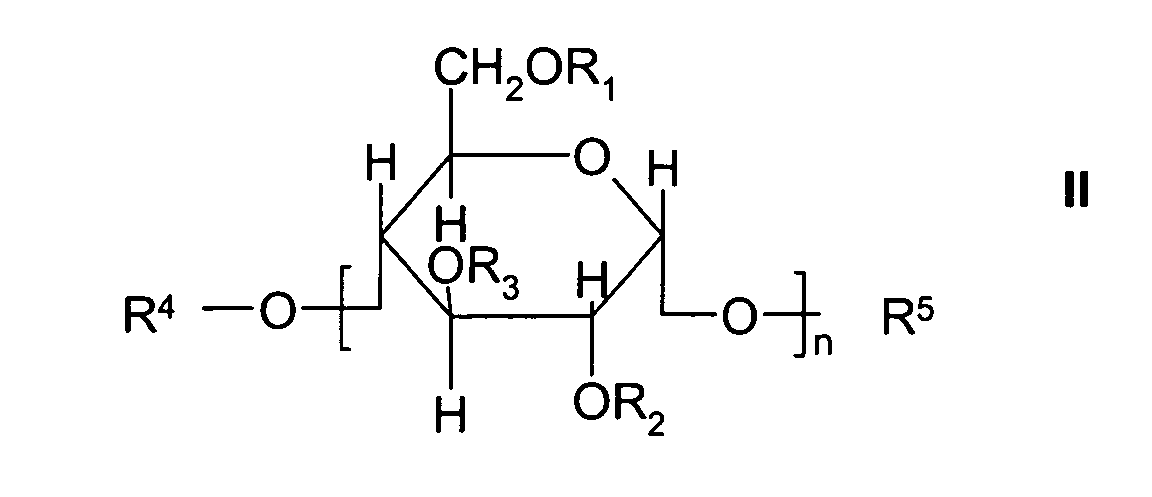
- oligosaccharides or polysaccharides according to formula II are prepared in which the radicals R 1 to R 5 each independently represent H or an acyl radical and the groups of the acyl radicals bonded to the CO group are selected from linear or branched saturated and unsaturated hydrocarbon groups having 1 to 29, preferably 7 to 21 carbon atoms or of cyclic or aromatic hydrocarbon groups with 4 to 29 carbon atoms and the degree of polymerization n is preferably 3 to 200, particularly preferably 5 to 100 and extremely preferably 10 to 50 with the proviso that the number of acyl groups is greater than 0.
- activated carboxylic acids the underlying acid of which is palmitic acid
- the dextrins preferably have a degree of polymerization from 3 to 200, particularly preferably from 5 to 100 and particularly preferably from 10 to 50.
- the degree of esterification per sugar unit is preferably 0.1 for disaccharides to 4 and particularly preferably from 2 to 4.
- Oligo- and polysaccharides with degrees of polymerization from 3 to 200 is the Degree of esterification per sugar unit particularly preferably from 0.1 to 3 and extremely preferred from 2 to 3.
- the molar ratio of activated Carboxylic acid to sugar unit preferred when using disaccharides from 0.1: 1 to 4: 1 and particularly preferably from 2: 1 to 4: 1.
- the molar ratio of activated Carboxylic acid to sugar unit when using oligo- and polysaccharides with degrees of polymerization from 3 to 200, preferably at least 0.1: 1
- the inventive method is the molar ratio of activated carboxylic acid to sugar unit when using oligo- and polysaccharides with Degree of polymerization from 3 to 200, particularly preferably from 0.1: 1 to 3: 1 and extremely preferred from 2: 1 to 3: 1.
- the process according to the invention is preferably carried out at a temperature of 45 to 80 ° C, particularly preferably carried out at a temperature of 65 to 75 ° C.
- the method is as follows explained that the solvent or solvent mixture is recycled.
- the drainage of the sugar component can be done both with and without an entrainer (Petroleum ether) as shown in the examples.
- the reaction mixture can be either an aqueous base or an alcoholic one Base can be used. This is to be demonstrated in the examples.
- the precipitate is then filtered off and with deionized water (adjusted to pH 10) and pure demineralized water for 30 minutes at 40 - Washed 45 ° C.
- the washed precipitate is at 50 ° C overnight Vacuum (20 - 50 mbar) dried.
- the yield of fine crystalline product is 70% (melting point approx. 120 ° C).
- Water-containing dextrin (17.8 g) are placed in a stirred flask with a water separator. and petroleum ether (boiling range 70-90 ° C) and 4 hours at 74-78 ° C Water circled. Then about 75% of the petroleum ether used distilled off again. 100 g of 2-methylpyrrolidone (NMP) are added and until the remaining petroleum ether is distilled off at a bottom temperature of 130 ° C. After that the batch is cooled to 70 ° C and within 60 minutes at 70 - 75 ° C Palmitic acid chloride (82.5 g) metered in.
- NMP 2-methylpyrrolidone
Landscapes
- Chemical & Material Sciences (AREA)
- Organic Chemistry (AREA)
- Health & Medical Sciences (AREA)
- Life Sciences & Earth Sciences (AREA)
- Engineering & Computer Science (AREA)
- Biochemistry (AREA)
- Molecular Biology (AREA)
- Genetics & Genomics (AREA)
- General Health & Medical Sciences (AREA)
- Biotechnology (AREA)
- Materials Engineering (AREA)
- Chemical Kinetics & Catalysis (AREA)
- Medicinal Chemistry (AREA)
- Polymers & Plastics (AREA)
- Polysaccharides And Polysaccharide Derivatives (AREA)
- Saccharide Compounds (AREA)
Abstract
Description

In einer besonders bevorzugten Ausführungsform der Erfindung werden aktivierte Carbonsäuren, deren zugrunde liegende Säure Palmitinsäure ist, in dem erfindungsgemäßen Verfahren verwendet. Außerordentlich bevorzugt werden nach dem erfindungsgemäßen Verfahren Substanzen ausgewählt aus Dextrinpalmitat und Cellobiosepalmitat hergestellt. Hierbei haben die Dextrine vorzugsweise einen Polymerisationsgrad von 3 bis 200, besonders bevorzugt von 5 bis 100 und insbesondere bevorzugt von 10 bis 50.
| Pyridin-Variante (Vergleichsbeispiel) | NMP-Variante (Beispiel 2) | |
| Aussehen bei Raumtemperatur | hellgelbes Pulver | weiß, pulvrig bis körnig |
| Ausbeute | 37,0 % | 79,5 % |
| Säurezahl | 3,4 mgKOH/g | 0,92 mgKOH/g |
| Chloridgehalt | nicht bestimmt | 0,10 % |
| Schmelzpunkt | ca. 99°C | ca. 97°C |
Claims (11)
- Verfahren zur Herstellung von Saccharidestern durch Umsetzung von Sacchariden mit aktivierten Carbonsäuren in einem dipolar aprotischen Lösungsmittel und in Abwesenheit einer basischen Aminverbindung.
- Verfahren nach Anspruch 1, dadurch gekennzeichnet, dass das dipolar aprotische Lösungsmittel ausgewählt ist aus der Gruppe der Lactame.
- Verfahren nach Anspruch 2, dadurch gekennzeichnet, dass das Lactam 2-Methylpyrrolidon ist.
- Verfahren nach einem oder mehreren der Ansprüche 1 bis 3, dadurch gekennzeichnet, dass die Saccharide ausgewählt sind aus Dextrin und Cellobiose.
- Verfahren nach einem oder mehreren der Ansprüche 1 bis 4, dadurch gekennzeichnet, dass die aktivierten Carbonsäuren ausgewählt sind aus Carbonsäurechloriden und Carbonsäureanhydriden.
- Verfahren nach einem oder mehreren der Ansprüche 1 bis 5, dadurch gekennzeichnet, dass die den aktivierten Carbonsäuren zugrunde liegende Säure Palmitinsäure ist.
- Verfahren nach einem oder mehreren der Ansprüche 1 bis 6, dadurch gekennzeichnet, dass das molare Verhältnis von aktivierter Carbonsäure zu Zuckereinheit bei der Verwendung von Disacchariden von 0,1 : 1 bis 4 : 1 beträgt.
- Verfahren nach einem oder mehreren der Ansprüche 1 bis 6, dadurch gekennzeichnet, dass das molare Verhältnis von aktivierter Carbonsäure zu Zuckereinheit bei der Verwendung von Oligo- oder Polysacchariden mit Polymerisationsgraden von 3 bis 200 mindestens 0,1 : 1 ist.
- Verfahren nach einem oder mehreren der Ansprüche 1 bis 8, dadurch gekennzeichnet, dass es bei einer Temperatur von 45 bis 80°C durchgeführt wird.
- Verfahren nach einem oder mehreren der Ansprüche 1 bis 9, dadurch gekennzeichnet, dass das Lösungsmittel recycliert wird.
- Verfahren nach einem oder mehreren der Ansprüche 1 bis 5, 7, 9 und 10, dadurch gekennzeichnet, dass Cellobioseoctanonanoat hergestellt wird.
Applications Claiming Priority (2)
| Application Number | Priority Date | Filing Date | Title |
|---|---|---|---|
| DE10325200A DE10325200A1 (de) | 2003-06-04 | 2003-06-04 | Herstellung von Saccharidestern |
| DE10325200 | 2003-06-04 |
Publications (2)
| Publication Number | Publication Date |
|---|---|
| EP1484341A1 true EP1484341A1 (de) | 2004-12-08 |
| EP1484341B1 EP1484341B1 (de) | 2006-11-08 |
Family
ID=33154538
Family Applications (1)
| Application Number | Title | Priority Date | Filing Date |
|---|---|---|---|
| EP04012051A Expired - Lifetime EP1484341B1 (de) | 2003-06-04 | 2004-05-21 | Herstellung von Saccharidestern |
Country Status (4)
| Country | Link |
|---|---|
| US (1) | US20050019296A1 (de) |
| EP (1) | EP1484341B1 (de) |
| JP (1) | JP2004359682A (de) |
| DE (2) | DE10325200A1 (de) |
Families Citing this family (4)
| Publication number | Priority date | Publication date | Assignee | Title |
|---|---|---|---|---|
| WO2011102123A1 (ja) * | 2010-02-19 | 2011-08-25 | 千葉製粉株式会社 | 液状油のゲル化能を有しない新規デキストリン脂肪酸エステル及びその用途 |
| JP5616091B2 (ja) * | 2010-03-31 | 2014-10-29 | 株式会社コーセー | 毛髪化粧料 |
| JP5616093B2 (ja) * | 2010-03-31 | 2014-10-29 | 株式会社コーセー | エアゾール型毛髪化粧料 |
| KR20230085970A (ko) * | 2021-12-07 | 2023-06-15 | 주식회사 비제이바이오켐 | 덱스트린 다당류 폴리머 유도체의 제조방법 |
Citations (3)
| Publication number | Priority date | Publication date | Assignee | Title |
|---|---|---|---|---|
| US5470969A (en) * | 1990-08-27 | 1995-11-28 | Mcneil-Ppc, Inc. | Catalyzed sucrose-6-ester process |
| DE4423681A1 (de) * | 1994-06-23 | 1996-01-04 | A U F Analytik Umwelttechnik F | Verfahren zur Herstellung partiell substituierter Stärkeacetate |
| US5840883A (en) * | 1995-04-05 | 1998-11-24 | Chiba Flour Milling Co., Ltd. | Dextrin ester of fatty acids and use thereof |
Family Cites Families (4)
| Publication number | Priority date | Publication date | Assignee | Title |
|---|---|---|---|---|
| DE3726015A1 (de) * | 1986-08-05 | 1988-02-11 | Ricoh Kk | Reversibel waermeempfindliche aufzeichnungsmaterialien |
| IT1219587B (it) * | 1988-05-13 | 1990-05-18 | Fidia Farmaceutici | Polisaccaridi carbossiilici autoreticolati |
| GB9908202D0 (en) * | 1999-04-12 | 1999-06-02 | Unilever Plc | Cosmetic compositions |
| GB0025437D0 (en) * | 2000-10-17 | 2000-11-29 | Unilever Plc | Esters |
-
2003
- 2003-06-04 DE DE10325200A patent/DE10325200A1/de not_active Withdrawn
-
2004
- 2004-05-21 DE DE502004001936T patent/DE502004001936D1/de not_active Expired - Fee Related
- 2004-05-21 EP EP04012051A patent/EP1484341B1/de not_active Expired - Lifetime
- 2004-06-01 JP JP2004163154A patent/JP2004359682A/ja not_active Withdrawn
- 2004-06-03 US US10/859,928 patent/US20050019296A1/en not_active Abandoned
Patent Citations (3)
| Publication number | Priority date | Publication date | Assignee | Title |
|---|---|---|---|---|
| US5470969A (en) * | 1990-08-27 | 1995-11-28 | Mcneil-Ppc, Inc. | Catalyzed sucrose-6-ester process |
| DE4423681A1 (de) * | 1994-06-23 | 1996-01-04 | A U F Analytik Umwelttechnik F | Verfahren zur Herstellung partiell substituierter Stärkeacetate |
| US5840883A (en) * | 1995-04-05 | 1998-11-24 | Chiba Flour Milling Co., Ltd. | Dextrin ester of fatty acids and use thereof |
Also Published As
| Publication number | Publication date |
|---|---|
| US20050019296A1 (en) | 2005-01-27 |
| DE10325200A1 (de) | 2004-12-30 |
| EP1484341B1 (de) | 2006-11-08 |
| JP2004359682A (ja) | 2004-12-24 |
| DE502004001936D1 (de) | 2006-12-21 |
Similar Documents
| Publication | Publication Date | Title |
|---|---|---|
| DE69102484T2 (de) | Verfahren zur Herstellung von Sucrose-6-ester. | |
| DE68919566T2 (de) | Verfahren zur Synthese von Rohrzuckerderivaten durch eine regiokselektive Reaktion. | |
| DE69408599T2 (de) | Verfahren zur Herstellung von Taurocholansäure | |
| DE60012366T2 (de) | Verfahren zur herstellung einer milchsäureester-zusammensetzung und deren gebrauch als lösungsmittel | |
| DE69113731T2 (de) | Herstellungsverfahren für katalysierte Sucrose-6-Ester. | |
| DE2353069A1 (de) | Verfahren zur herstellung neuer gemischter partialester | |
| EP1484341B1 (de) | Herstellung von Saccharidestern | |
| DE1152416B (de) | Verfahren zur Herstellung von Carbonsaeurealkylestern | |
| DE69719947T2 (de) | Verfahren zur herstellung von carbonsäurealkylestern | |
| WO2004041769A1 (de) | Verfahren zur herstellung eines esters | |
| DE2734059C3 (de) | Verfahren zur Herstellung von teilweise neutralisierten Mischestern aus Milchsäure, Zitronensäure und partiellen Glycerinfettsäureestern | |
| DE112009001224B4 (de) | Verfahren zur Herstellung von 9,10,12-Triacyloxy-octadecansäurealkylestern | |
| DE69914560T2 (de) | Verfahren zur acylierung von aminoalcoholen | |
| DD156263A1 (de) | Verfahren zur herstellung von kohlenhydrat-fettsaeureestern | |
| DE69913133T2 (de) | Verfahren zur herstellung von aceclofenac | |
| DE2145354C3 (de) | Thioester und Verfahren zu ihrer Herstellung | |
| AT253698B (de) | Verfahren zur Herstellung neuer Aminosteroide | |
| AT326638B (de) | Verfahren zur herstellung von n(beta-diäthylaminoäthyl) -4-amino-5-chlor-2-methoxybenzamid | |
| DE1093797B (de) | Verfahren zur Herstellung von Carbonsaeureestern | |
| DE2449870C3 (de) | Verfahren zur Herstellung von 6,6'-Dichlor-6,6'-didesoxy-saccharose | |
| DE2556615C2 (de) | Verfahren zur Herstellung von 7-Aminodesacetoxycephalosporansäure | |
| DE2333309A1 (de) | Derivate der 6-aminopenizillansaeure sowie verfahren zu ihrer herstellung | |
| DE2252323B2 (de) | 3,6-Dialkyl-23-dihydro-2,9-dioxo-6H,9H-thiazolo [5,4-fJ chinolin-e-carbonyl- Derivate, Verfahren zu ihrer Herstellung und ihre Verwendung als Bakterizide | |
| DE69401286T2 (de) | Verfahren zur Reinigung von Estramustin Phosfat oder Salze davon | |
| US20040192906A1 (en) | Novel process for the preparation of O-acylated glucose derivatives |
Legal Events
| Date | Code | Title | Description |
|---|---|---|---|
| PUAI | Public reference made under article 153(3) epc to a published international application that has entered the european phase |
Free format text: ORIGINAL CODE: 0009012 |
|
| AK | Designated contracting states |
Kind code of ref document: A1 Designated state(s): AT BE BG CH CY CZ DE DK EE ES FI FR GB GR HU IE IT LI LU MC NL PL PT RO SE SI SK TR |
|
| AX | Request for extension of the european patent |
Extension state: AL HR LT LV MK |
|
| 17P | Request for examination filed |
Effective date: 20050608 |
|
| AKX | Designation fees paid |
Designated state(s): DE FR GB IT |
|
| RAP1 | Party data changed (applicant data changed or rights of an application transferred) |
Owner name: CLARIANT PRODUKTE (DEUTSCHLAND) GMBH |
|
| GRAP | Despatch of communication of intention to grant a patent |
Free format text: ORIGINAL CODE: EPIDOSNIGR1 |
|
| GRAS | Grant fee paid |
Free format text: ORIGINAL CODE: EPIDOSNIGR3 |
|
| GRAA | (expected) grant |
Free format text: ORIGINAL CODE: 0009210 |
|
| AK | Designated contracting states |
Kind code of ref document: B1 Designated state(s): DE FR GB IT |
|
| REG | Reference to a national code |
Ref country code: GB Ref legal event code: FG4D Free format text: NOT ENGLISH |
|
| REF | Corresponds to: |
Ref document number: 502004001936 Country of ref document: DE Date of ref document: 20061221 Kind code of ref document: P |
|
| GBT | Gb: translation of ep patent filed (gb section 77(6)(a)/1977) |
Effective date: 20070212 |
|
| ET | Fr: translation filed | ||
| PLBE | No opposition filed within time limit |
Free format text: ORIGINAL CODE: 0009261 |
|
| STAA | Information on the status of an ep patent application or granted ep patent |
Free format text: STATUS: NO OPPOSITION FILED WITHIN TIME LIMIT |
|
| 26N | No opposition filed |
Effective date: 20070809 |
|
| PGFP | Annual fee paid to national office [announced via postgrant information from national office to epo] |
Ref country code: DE Payment date: 20090530 Year of fee payment: 6 Ref country code: FR Payment date: 20090427 Year of fee payment: 6 |
|
| PGFP | Annual fee paid to national office [announced via postgrant information from national office to epo] |
Ref country code: GB Payment date: 20090514 Year of fee payment: 6 |
|
| GBPC | Gb: european patent ceased through non-payment of renewal fee |
Effective date: 20100521 |
|
| REG | Reference to a national code |
Ref country code: FR Ref legal event code: ST Effective date: 20110131 |
|
| PG25 | Lapsed in a contracting state [announced via postgrant information from national office to epo] |
Ref country code: DE Free format text: LAPSE BECAUSE OF NON-PAYMENT OF DUE FEES Effective date: 20101201 |
|
| PG25 | Lapsed in a contracting state [announced via postgrant information from national office to epo] |
Ref country code: FR Free format text: LAPSE BECAUSE OF NON-PAYMENT OF DUE FEES Effective date: 20100531 |
|
| PG25 | Lapsed in a contracting state [announced via postgrant information from national office to epo] |
Ref country code: GB Free format text: LAPSE BECAUSE OF NON-PAYMENT OF DUE FEES Effective date: 20100521 |
|
| PGFP | Annual fee paid to national office [announced via postgrant information from national office to epo] |
Ref country code: IT Payment date: 20070531 Year of fee payment: 4 |