EP1454718A1 - Motorbremsvorrichtung - Google Patents
Motorbremsvorrichtung Download PDFInfo
- Publication number
- EP1454718A1 EP1454718A1 EP02780059A EP02780059A EP1454718A1 EP 1454718 A1 EP1454718 A1 EP 1454718A1 EP 02780059 A EP02780059 A EP 02780059A EP 02780059 A EP02780059 A EP 02780059A EP 1454718 A1 EP1454718 A1 EP 1454718A1
- Authority
- EP
- European Patent Office
- Prior art keywords
- engine
- main body
- rotary shaft
- output
- projections
- Prior art date
- Legal status (The legal status is an assumption and is not a legal conclusion. Google has not performed a legal analysis and makes no representation as to the accuracy of the status listed.)
- Withdrawn
Links
Images


Classifications
-
- E—FIXED CONSTRUCTIONS
- E02—HYDRAULIC ENGINEERING; FOUNDATIONS; SOIL SHIFTING
- E02F—DREDGING; SOIL-SHIFTING
- E02F3/00—Dredgers; Soil-shifting machines
- E02F3/04—Dredgers; Soil-shifting machines mechanically-driven
- E02F3/96—Dredgers; Soil-shifting machines mechanically-driven with arrangements for alternate or simultaneous use of different digging elements
- E02F3/966—Dredgers; Soil-shifting machines mechanically-driven with arrangements for alternate or simultaneous use of different digging elements of hammer-type tools
-
- B—PERFORMING OPERATIONS; TRANSPORTING
- B25—HAND TOOLS; PORTABLE POWER-DRIVEN TOOLS; MANIPULATORS
- B25D—PERCUSSIVE TOOLS
- B25D17/00—Details of, or accessories for, portable power-driven percussive tools
- B25D17/24—Damping the reaction force
Definitions
- the present invention relates to a breaker driven by an engine mounted to the main body.
- a breaking apparatus generally called a concrete breaker is used for breaking a hard object such as asphalt or concrete at a road construction site or a building construction site, for example.
- a typical breaker an engine mounted at an upper portion of the main body drives a striker.
- the striker when driven, causes a work member supported by a lower portion of the main body to move up and down to break the hard object.
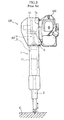
- Fig. 9 illustrates an example of prior art engine breaker.
- the engine breaker 100 includes a vertically extending cylindrical main body 1, a work member 2 supported by a lower portion of the main body for up and down movement, an engine 105 mounted to an upper portion of the main body 1, and a striker 30 incorporated in the main body 1 for successively striking an upper end of the work member 2 by the driving of the engine 105.
- the main body 1 includes a cylindrical member 11, and a crank case 12 mounted to an upper portion of the cylindrical member 11.
- the cylindrical member 11 and the crank case 12 incorporate a hammer 3 and a crank mechanism 4, respectively, which will be described later.
- the work member 2 may be a chisel having a drill-like tip end, and a base end inserted in the cylindrical member 11.
- the engine 105 is so arranged that the output shaft thereof extends horizontally and transmits the rotation output to a rotary shaft 6 incorporated in the crank case 12 of the main body 1.
- the rotary shaft 6 is so arranged in the crank case 12 as to extend horizontally.
- the engine 105 is mounted to the main body 1 via an engine mount plate 7a having an L-shaped cross section. Specifically, a side surface and a lower surface of a housing of the engine 105 are screwed to the engine mount plate 7a, and the engine mount plate 7a in this state is screwed to a side surface of the crank case 12 of the main body 1.
- a two-cycle engine with a displacement of about 50cc is generally used.
- the striker 30 includes a crank mechanism 4 operated by the rotation of the rotary shaft 6, and a hammer 3 which moves up and down by the operation of the crank mechanism 4.
- the hammer 3 has a front end for contacting the work member 2.
- the engine breaker 100 is not connected to an external apparatus such as a compressor for generating compressed air, and hence is relatively easy to handle.
- the main body 1 vibrates much due to the reaction in moving the hammer 3 by the crank mechanism 4 and the impact in striking the work member 2 with the hammer 3.
- the housing of the engine 105 mounted to the main body 1 may be deformed at a portion close to the main body 1 or the engine 105 itself may vibrate to result in a change in the positional relationship between the structural parts of the engine disposed inside or outside of the housing. Such a condition may lead to the malfunction or failure of the engine 105.
- the wall thickness of the housing of the engine 105 may be made to about 5 to 6 mm, which is considerably larger than the wall thickness (2 to 3mm) of a general two-cycle engine with a displacement of about 50cc. Therefore, such a general engine cannot be used as the engine 100, which leads to an increase of the manufacturing cost of the engine breaker 100. Further, the weight of the engine 105 having a housing made of diecast aluminum becomes about 8 kg, which is considerably larger than the weight (about 3 kg) of a general engine. In this way, the large wall thickness of the housing makes it difficult to reduce the weight of the engine breaker 100.
- An object of the present invention which is conceived under the circumstances described above, is to provide a vibration-resistant engine breaker capable of preventing the malfunction or failure of the engine due to the vibration in use.
- an engine breaker comprising a vertically extending cylindrical main body, a work member supported by a lower portion of the main body for up and down movement, an engine mounted to an upper portion of the main body and having an output shaft arranged to extend horizontally, and a striker incorporated in the main body for successively striking an upper end of the work member through rotation of a horizontally extending rotary shaft to which rotation output of the engine is transmitted.
- the engine includes a housing supported by the main body via a resilient member, and a flexible coupling for absorbing vibration in a direction crossing the rotary shaft is interposed between the output shaft and the rotary shaft.
- the flexible coupling means a coupling which connects two shafts together for the transmission of the rotational force therebetween while permitting the movement of at least one of the shafts in the crossing direction.
- the striker includes a crank mechanism operated by rotation of the rotary shaft, and a hammer which moves up and down by the operation of the crank mechanism.
- the housing of the engine includes a side surface and a lower surface respectively supported, via the resilient member, by a side surface of the main body and an engine bracket standing from the side surface of the main body, the resilient member comprising a plurality of resilient pieces made of a resilient material.
- the flexible coupling comprises a vibration absorber made of a resilient material and interposed between the rotary shaft and an output transmitting portion provided at the output shaft of the engine for transmitting output to the rotary shaft.
- the vibration absorber is fitted around an end of the rotary shaft and has an end surface contacting and fixed to the output transmitting portion.
- the engine breaker further comprises an engine mount plate for mounting the engine to the main body, and the engine mount plate is provided with a bearing arranged between the side surface of the engine and the side surface of the main body.
- the output transmitting portion has an end in the form of a boss fitted in the bearing and having an inner circumferential surface formed with a plurality of radially extending first projections.
- the rotary shaft has an end formed with a plurality of axially extending second projections provided correspondingly to the first projections, and each of the second projections is received in the boss end of the output transmitting portion and located between adjacent first projections.
- the vibration absorber includes a plurality of vibration absorbing portions each of which is arranged between a side surface of a respective first projection and a side surface of the adjacent second projection in the boss end of the output transmitting portion.
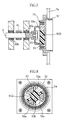
- Fig. 6 is an enlarged perspective view illustrating another example of flexible coupling of Fig. 1.
- Fig. 7 is a sectional view taken along lines VII-VII in Fig. 6.
- Fig. 8 is a sectional view taken along lines VIII-VIII in Fig. 6.
- Fig. 9 is a side view illustrating an example of prior art engine breaker.
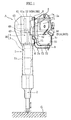
- an engine breaker A is generally used to break a hard object G such as asphalt or concrete at a road construction site or a building construction site, for example.
- the engine breaker includes a vertically extending, generally cylindrical main body 1, a work member 2 supported by a lower portion of the main body 1 for up and down movement, a striker 30 incorporated in the main body 1 for successively striking an upper end of the work member 2, and an engine 5 mounted to an upper portion of the main body 1 for driving the striker 30.
- the main body 1 includes a cylindrical member 11, and a crank case 12 mounted to an upper portion of the cylindrical member 11, which are made of a metal having certain rigidity, for example.
- the cylindrical member 11 has a lower portion which is formed with a boss 11a and hence has a smaller inner diameter.
- a shank 2c of the work member 2, which will be described later, is received in the boss 11a for vertical sliding movement via a bush 24.
- Around the boss 11a is fitted a base end of a cylindrical work member holder 22.
- the work member holder 22 has a front end holding a body 2a of the work member 2 for up and down movement.
- the lower portion of the cylindrical member 11A has an outer surface formed with a male thread 11b.
- a lower cap 13 is attached to the lower portion by mating with the male thread.
- the lower cap 13 has a front end formed with a through-hole 13a from which the work member holder 22 (and the work member 2) projects.
- the work member holder 22 can slide up and down while being guided along the outer surface of the boss 11a and the through-hole 13a of the lower cap 13.
- the base end of the work member holder 22 is formed with a flange 22a for sliding engagement with an inner circumferential surface of the lower cap 13.
- On the flange 22a is provided an annular resilient member 25 fitted in an annular space between the boss 11a and the lower cap 13, whereas under the flange 22a is provided an annular resilient member 26 fitted in an annular space between the work member holder 22 and the lower cap 13.
- the cylindrical member 11 incorporates therein a stationary cylinder 14 so that the cylindrical member 11 overlaps the stationary cylinder.
- the stationary cylinder 14 defines therein a cylinder space 14a communicating with an internal space of the crank case 12.
- the internal space of the crank case 12 and the cylinder space 14a accommodate a crank mechanism 4 and a hammer 3 of the striker 30, respectively.
- a rotary shaft 6 to which rotation output of the engine 5 is to be transmitted is arranged to extend horizontally.
- the rotary shaft 6 is provided with a pinion gear 61 having a relatively small diameter.
- the rotary shaft 6 is held by roller bearings 60a and 60b at opposite sides of the pinion gear 61, for example.
- the work member 2 in this embodiment comprises a chisel suitable for breaking asphalt or concrete and made of a metal having certain rigidity, for example.
- the work member 2 is generally columnar and made up of the body 2a as a central portion, a drill-like cutter portion 2b provided on the front-end side, and the shank 2c provided on the base-end (upper-end) side and having a smaller diameter than that of the body 2a.
- the body 2a has a circumferential surface formed with a flat portion 2d.
- the work member holder 22 is formed with a hole 22b extending in the direction of the sheet surface of Fig. 2 and having an inner surface exposed to the inner circumferential surface of the work member holder 22.
- the work member 2 is so arranged that the flat portion 2d faces the inner surface of the hole 22b, and a stopper pin 27 having a predetermined thickness is inserted in the hole 22b, whereby the work member 2 is prevented from dropping from the work member holder 22.
- the work member 2 is movable up and down relative to the work member holder 22 within the range of the axial length of the flat portion 2d.
- the stopper pin 27 is formed with a segmental cutout 27a. Thus, by appropriately turning the stopper pin 27, it is possible to select a state in which the work member 2 is prevented from dropping or another state in which the dropping is allowed.
- the striker 30 is made up of the crank mechanism 4 operated by the rotation of the rotary shaft 6, and the hammer 3 which moves up and down by the operation of the crank mechanism 4.
- the crank mechanism 4 functions to convert the rotary motion of the output shaft of the engine 5 into reciprocal linear motion, and includes a crank plate 41 which rotates in accordance with the rotation of the rotary shaft 6, and a rod 42 connecting the crank plate 41 and the hammer 3 to each other, as shown in Fig. 2.
- the crank plate 41 rotates about a crank shaft 43 (See Fig. 1) rotatably held at a predetermined position in the crank case 12 by e.g. a non-illustrated bearing.
- the crank plate has a circumferential surface formed with a gear portion 41a for engagement with the pinion gear 61.
- the rod 42 has opposite ends pivotally connected to the crank plate 41 and an upper end of a movable cylinder 31 of the hammer 3, respectively.
- the hammer 3 is made up of the movable cylinder 31 inserted in the stationary cylinder 14 for up and down movement, a free piston 32 inserted in the movable cylinder 31 for up and down movement, and a striking bar 33 integrally formed on and projecting from a lower portion of the free piston 32.
- the movable cylinder 31 is connected to the rod 42 of the crank mechanism 4 and moves up and down in accordance with the rotation of the crank plate 41.
- the movable cylinder 31 has a closed upper end, and a lower end to which a cap 34 is attached.
- the cap is formed with a through-hole 34a for allowing the striking bar 33 to project downward therethrough.
- the free piston 32 has a generally columnar configuration having an upper and a lower surfaces. Between the upper surface of the free piston and an upper wall of the movable cylinder 31 is defined an upper pneumatic chamber 35, whereas between the lower surface of the free piston 32 and the cap 34 attached to the movable cylinder 31 is defined a lower pneumatic chamber 36. An O-ring 37 is fitted around the free piston 32 to hermetically seal between the outer circumferential surface of the free piston 32 and the inner circumferential surface of the movable cylinder 31.
- the striking bar 33 is smaller in outer diameter than the free piston 32.
- the striking bar projects through the through-hole 34a of the cap 34 of the movable cylinder 31 to strike the upper end of the work member 2.
- Between the outer circumferential surface of the striking bar 33 and the inner circumferential surface of the through-hole 34a is hermetically sealed with an O-ring 34b fitted in the through-hole 34a. In this way, each of the upper pneumatic chamber 35 and the lower pneumatic chamber 36 is hermetically sealed.
- the free piston 32 moves up and down following the movement of the movable cylinder 31.
- the lower pneumatic chamber 36 is once compressed due to the inertial delay of the free piston 32.
- the free piston 32 moves upward with the aid of the expansion force of the compressed lower pneumatic chamber 36.
- the movable cylinder 31 moves downward.
- the upper pneumatic chamber 35 is compressed greatly by the upward movement of the free piston 32 due to the inertial delay and the inertial force.
- the engine 5 is a small two-cycle engine with a displacement of 30-50cc and includes a housing 5a made of diecast aluminum.
- the housing 5a has a wall thickness of 2 to 3 mm, which is smaller than that of the prior art structure, whereby the weight of the engine breaker A can be reduced.
- the engine 5 use may be made of a general inexpensive engine such as an engine for a mowing machine or a pump engine, which are widely available in the market. Therefore, the manufacturing cost of the engine breaker A can be reduced.
- the engine 5 is provided, at a lower portion thereof, with a fuel tank 51, and the lower surface of the housing is located at a generally intermediate position in the vertical direction.
- the engine 5 is so arranged that the output shaft extend horizontally.
- the housing 5a is mounted to the main body 1 (crank case 12) via resilient members 8.
- the resilient members 8 are resilient pieces made of a resilient material such as rubber.
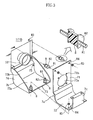
- the engine 5 is mounted to the main body 1a via an engine mount plate 7a for connecting between a side surface of the housing 5a of the engine 5 and a side surface of the main body 1, a stay 7c for supporting the lower surface of the housing of the engine 5, and an engine bracket 7b standing from the side surface of the main body 1.
- the engine mount plate 7a has a generally L-shaped cross section and may be made by bending a metal plate, for example.
- the engine mount plate 7a includes a surface 71 and a surface 72 respectively corresponding to the side surface and the lower surface of the housing of the engine 5.
- the surface 71 is perforated with an insertion hole 71a for inserting a clutch drum 52 of the engine 5, which will be described later.
- Around the insertion hole 71a is formed a plurality of screw holes 71b for fixing the engine mount plate 7a to the engine 5.
- the engine mount plate 7a is fixed to the side surface of the housing 5a of the engine 5 with e.g. bolts (not shown) inserted into the screw holes 71b.
- the plane 72 extends along the lower surface of the fuel tank 51 (See Fig. 1) of the engine 5 and is fixed to the lower surface of the housing 5a of the engine 5 via the stay 7c.
- the stay 7c may be formed by bending e.g. a metal plate into a channel shape.
- the stay 7c is screwed to the lower surface of the housing 5a of the engine 5 and the surface 72 of the engine mount plate 7a.
- the engine bracket 7b supports the engine 5 from below and is fixed to the side surface of the main body 1 (crank case 12) with screws 75, for example.
- the engine bracket 7b comprises a bent plate 73 including a horizontal surface 73a and a vertical surface 73b and hence having an L-shaped cross section, and a pair of side plates 74 attached to opposite side edges of the bent plate 73, so that the engine bracket is unlikely to be bent easily. It is to be noted that only the bent plate 73 of the engine bracket 7b is illustrated in Fig. 1.
- each of the resilient members 8 has a columnar configuration having opposite end surfaces, and a metal plate 82 provided with a threaded pin 81 projecting therefrom is bonded to each of the opposite end surfaces by vulcanization bonding, for example.
- the threaded pin 81 is inserted into a screw hole 83 formed in the side surface of the main body 1 or inserted into a screw hole 84 formed in the surface 71, 72 of the engine mount plate 7a or the horizontal surface 73a of the engine bracket 7b and then a nut 85 is screwed onto the pin.
- each of the resilient members 8 In absorbing the vibration of the main body 1, each of the resilient members 8 is temporarily deformed, which causes positional deviation of the rotary shaft 6 arranged in the main body 1 relative to the engine 5. At this time, if the output shaft of the engine 5 is directly connected to the rotary shaft 6, a load is applied in the direction crossing the rotary shaft 6, which may results in the breakage at the connection portion. To avoid such a problem, in the engine breaker A, a flexible coupling 9 is interposed between the output shaft of the engine 5 and the rotary shaft 6, as shown in Fig. 1.
- the flexible coupling means a coupling which connects two shafts together for the transmission of the rotational force therebetween while permitting the movement of at least one of the shafts in the crossing direction.
- the engine 5 is provided with a centrifugal clutch.
- the output shaft of the engine 5 is provided with a generally cylindrical clutch drum as an output transmitting portion 52 for transmitting output to the rotary shaft 6.
- the flexible coupling 9 serves to absorb vibration in the direction crossing the rotary shaft 6, and includes a vibration absorber 91 made of a resilient member and interposed between the clutch drum (output transmitting portion) 52 and the rotary shaft 6.
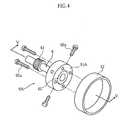
- Figs. 4 and 5 illustrate an example of flexible coupling 9.
- the illustrated flexible coupling 9A includes a generally cylindrical vibration absorber 91A fitted around an end of the rotary shaft 6.
- the vibration absorber 91A has an end surface contacting and fixed to the clutch drum 52.
- a hub 62 is attached to the end of the rotary shaft 6, and the vibration absorber 91A of the flexible coupling 9A is fitted around the hub 62.
- the vibration absorber 91A is fixed to the hub 62 by threading a first screw 92a radially into the hub 62, whereby the vibration absorber is prevented from moving relative to the rotary shaft 6 in the axial direction or rotating about the rotary shaft 6.
- the end surface of the clutch drum 52 on the side of the rotary shaft 6 is formed with a thick wall portion 52a. The end surface of the vibration absorber 91A is held in contact with the thick wall portion 52a.
- the vibration absorber 91A is fixed to the clutch drum 52 by threading a second screw 92b into the thick wall portion 52a in the axial direction. Therefore, the rotary shaft 6 rotates in accordance with the rotation of the clutch drum 52.
- the thickness of the vibration absorber 91A is so set that the hub 62 does not come into contact with the thick wall portion 52a when the vibration absorber is fixed to the hub 62 and the thick wall portion 52a.
- the clutch drum 52 (thick wall portion 52a) is not directly connected to the rotary shaft 6 (hub 62) but connected via the vibration absorber 91A. Therefore, when the positional deviation of the rotary shaft 6 relative to the clutch drum 52 occurs, the vibration absorber 91A is deformed to reduce the load applied to the connection portion in the direction crossing the rotary shaft 6. Further, by removing the first screw 92a and the second screw 92b, the engine 5 and the rotary shaft 6 can be easily separated from each other for maintenance, for example.
- the portions corresponding to the first screw 92a and the second screw 92b may comprise a block made of e.g. metal for preventing the breakage of the vibration absorber 91A.
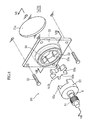
- Figs. 6-8 illustrate another example of flexible coupling 9.
- the end of the clutch drum 52 on the side of the rotary shaft 6 is in the form of a boss.
- the boss end 53 has an inner circumferential surface formed with a plurality of radially extending first projections 53a.
- a bearing 54 is attached to the engine mount plate 7a with screws 55, and the boss end 53 is fitted in the bearing 54.
- a coupler 63 is fitted around an end of the rotary shaft 6.
- the coupler 63 is formed with a plurality of axially extending second projections 63a provided correspondingly to the first projections 53a.
- the coupler 63 is fitted in the clutch drum 52 with each of the second projections 63a received in the boss end 53 and located between two adjacent first projections 53a.
- the outer diameter of the coupler 63 at the portion formed with the second projections 63a is made slightly smaller than the inner diameter of the boss end 53.
- the flexible coupling 9B includes a vibration absorber 91B comprising a generally columnar core 93b and a plurality of frill-like vibration absorbing portions 93a projecting from the circumferential surface of the core 93b.
- the vibration absorber is disposed in the boss end 53 in fitting the coupler 63 into the clutch drum 52.
- each of the vibration absorbing portions 93a is fitted between a side surface of a respective first projection 53a of the boss end 53 and a side surface of the adjacent second projection 63a of the coupler 63.
- the thickness of the vibration absorber 91B is so set that the front end of each second projection 63a of the coupler 63 does not come into contact with a bottom surface of the boss end 53 of the clutch drum 52.
- the speed of the engine 5 is increased with the front end of the work member 2 pressed against the hard object G, as shown in Fig. 1.
- the clutch drum 52 rotates by the operation of the centrifugal clutch, whereby the rotary shaft 6 connected to the drum via the flexible coupling 9 rotates.
- the crank plate 41 of the crank mechanism 4 rotates to cause the movable cylinder 31 to move up and down.
- the lower pneumatic chamber 36 is compressed due to the inertial delay of the free piston 32.
- the main body 1 vibrates up and down due to the reaction to the rapid acceleration of the free piston 32 and the impact of the striking of the upper end of the work member 2 by the striking bar 33.
- the housing 5a of the engine 5 is mounted to the main body 1 via the resilient members 8, the vibration of the main body 1 is absorbed by the resilient members 8.
- the resilient members 8 as small resilient pieces are interposed between the side surface of the housing 5a of the engine 5 and the side surface of the crank case 12 of the main body 1, and between the lower-surface side of the housing and the engine bracket 7b.
- the engine 5 is held by the main body 1 as suspended therefrom.
- each of the resilient members 8 is instantaneously deformed to absorb the vibration. Therefore, it is possible to prevent the deformation of the housing 5a of the engine 5 at a portion close to the main body 1 or the vibration of the engine 5 itself which may cause a change in the positional relationship between the structural parts of the engine disposed inside or outside of the housing. Accordingly, the malfunction or failure of the engine 5 can be avoided. Therefore, as the engine 6, it is possible to use a small, widely available engine having a housing of a relatively small thickness, such as an engine for a mowing machine or a pump engine.
- the engine breaker A is vibration-resistant.
Landscapes
- Engineering & Computer Science (AREA)
- Mechanical Engineering (AREA)
- Mining & Mineral Resources (AREA)
- Civil Engineering (AREA)
- General Engineering & Computer Science (AREA)
- Structural Engineering (AREA)
- Percussive Tools And Related Accessories (AREA)
- Vibration Prevention Devices (AREA)
- Harvester Elements (AREA)
- Road Paving Machines (AREA)
Applications Claiming Priority (3)
| Application Number | Priority Date | Filing Date | Title |
|---|---|---|---|
| JP2001344728A JP2003145446A (ja) | 2001-11-09 | 2001-11-09 | エンジンブレーカ |
| JP2001344728 | 2001-11-09 | ||
| PCT/JP2002/011705 WO2003039815A1 (en) | 2001-11-09 | 2002-11-08 | Engine braker |
Publications (2)
| Publication Number | Publication Date |
|---|---|
| EP1454718A1 true EP1454718A1 (de) | 2004-09-08 |
| EP1454718A4 EP1454718A4 (de) | 2009-06-17 |
Family
ID=19158203
Family Applications (1)
| Application Number | Title | Priority Date | Filing Date |
|---|---|---|---|
| EP02780059A Withdrawn EP1454718A4 (de) | 2001-11-09 | 2002-11-08 | Motorbremsvorrichtung |
Country Status (7)
| Country | Link |
|---|---|
| US (1) | US7124840B2 (de) |
| EP (1) | EP1454718A4 (de) |
| JP (1) | JP2003145446A (de) |
| KR (1) | KR100538764B1 (de) |
| CN (1) | CN100354073C (de) |
| TW (1) | TW200300103A (de) |
| WO (1) | WO2003039815A1 (de) |
Cited By (1)
| Publication number | Priority date | Publication date | Assignee | Title |
|---|---|---|---|---|
| GB2403181A (en) * | 2003-06-24 | 2004-12-29 | Milwaukee Electric Tool Corp | Drive mechanism for power tool |
Families Citing this family (17)
| Publication number | Priority date | Publication date | Assignee | Title |
|---|---|---|---|---|
| JP4525904B2 (ja) * | 2004-06-08 | 2010-08-18 | 日立工機株式会社 | 打撃工具 |
| RU2348508C1 (ru) * | 2007-07-04 | 2009-03-10 | Общество с ограниченной ответственностью "Промтехоснастка" | Переносной ударный инструмент |
| US9851930B2 (en) | 2013-03-28 | 2017-12-26 | Hewlett-Packard Development Company, L.P. | Release codes with print job identifiers and directives |
| KR101606769B1 (ko) * | 2014-01-27 | 2016-03-28 | 최지현 | 쇄빙장치 |
| CN103909499B (zh) * | 2014-03-18 | 2016-06-29 | 永康市嘉宏工具制造有限公司 | 汽油机破碎镐 |
| JP6345045B2 (ja) * | 2014-09-05 | 2018-06-20 | 株式会社マキタ | 打撃工具 |
| US20180180128A1 (en) * | 2015-06-29 | 2018-06-28 | Terminator Ip Limited | Shock absorbing tool connection |
| CN107675598A (zh) * | 2016-05-16 | 2018-02-09 | 贺菊香 | 一种建筑混凝土快速击碎机器人 |
| US10850381B2 (en) * | 2016-05-18 | 2020-12-01 | Makita Corporation | Impact tool |
| CN106012787B (zh) * | 2016-05-31 | 2017-12-19 | 福州麦辽自动化设备有限公司 | 一种基于液压阀控制的钎杆触发破碎锤 |
| WO2018069584A1 (fr) * | 2017-03-28 | 2018-04-19 | Maurice Granger | Mecanisme oscillatoire a centrifugations croisées simultanées, machine et procédé de mise en oeuvre |
| EP3697574B1 (de) | 2017-10-20 | 2025-03-19 | Milwaukee Electric Tool Corporation | Schlagwerkzeug |
| EP3743245B1 (de) | 2018-01-26 | 2024-04-10 | Milwaukee Electric Tool Corporation | Schlagwerkzeug |
| KR102309220B1 (ko) * | 2020-11-16 | 2021-10-07 | (주)비엠티 | 무진동 브레이커 |
| CN116352659A (zh) * | 2021-12-28 | 2023-06-30 | 创科无线普通合伙 | 作业工具及其传动系统 |
| US20230302620A1 (en) * | 2022-03-28 | 2023-09-28 | Milwaukee Electric Tool Corporation | Rotary power tool |
| JPWO2024257166A1 (de) * | 2023-06-12 | 2024-12-19 |
Family Cites Families (28)
| Publication number | Priority date | Publication date | Assignee | Title |
|---|---|---|---|---|
| US1191948A (en) * | 1914-11-09 | 1916-07-25 | Charles B Coates | Power-hammer. |
| GB866645A (en) * | 1957-12-12 | 1961-04-26 | Wacker Hermann | Improvements in hand-guidable motor-driven implements |
| US3224473A (en) * | 1962-04-03 | 1965-12-21 | Dobbertin Gunther Hein Wilhelm | Portable engine-driven chain saws |
| US3525373A (en) * | 1966-12-10 | 1970-08-25 | Kyoritsu Noki Co Ltd | Chain saw |
| SE319134B (de) * | 1968-05-08 | 1969-12-22 | Atlas Copco Ab | |
| GB1254437A (en) * | 1968-11-28 | 1971-11-24 | Sakuji Yamada | Percussion tool |
| US3559751A (en) * | 1969-01-16 | 1971-02-02 | Sakuji Yamada | Percussion device |
| DE1952066A1 (de) * | 1969-10-16 | 1971-06-09 | Stihl Maschf Andreas | Haltevorrichtung fuer Motorsaegen |
| US3698455A (en) * | 1970-06-26 | 1972-10-17 | Mcculloch Corp | Vibration isolation and bumper system |
| US3785465A (en) * | 1972-02-22 | 1974-01-15 | R Johansson | Centrifugal clutches in series with brake |
| US4014392A (en) * | 1973-03-01 | 1977-03-29 | Ross Frederick W | Stabilized piston-cylinder impact device |
| FI53034C (de) * | 1973-04-26 | 1978-01-10 | Keksintoesaeaetioe | |
| US3889763A (en) * | 1973-10-31 | 1975-06-17 | Skil Corp | Vibration isolation handle for portable chain saw or the like |
| US4010544A (en) * | 1975-03-21 | 1977-03-08 | Textron, Inc. | Vibration reducing system for single cylinder fluid pressure engine |
| US3972119A (en) * | 1975-08-25 | 1976-08-03 | Mcculloch Corporation | Chain saw with a bifurcated diaphragm means providing a coaxial vibration-isolating unit |
| US4141143A (en) * | 1977-10-26 | 1979-02-27 | Mcculloch Corporation | Chain saw handle and vibration isolation system |
| US4285405A (en) * | 1979-12-26 | 1981-08-25 | Weir Jr Casper J | Oscillator for reciprocating tool or other device |
| JPS56156927U (de) * | 1980-04-23 | 1981-11-24 | ||
| JPS56156927A (en) | 1980-05-01 | 1981-12-03 | Ricoh Co Ltd | Heat-sensitive record-type magnetic ticket sheet |
| SE443940B (sv) * | 1982-09-22 | 1986-03-17 | Atlas Copco Ab | Slagverktyg drivet av utbytbar motordel |
| DE3447401A1 (de) * | 1984-12-24 | 1986-07-03 | Wacker-Werke Gmbh & Co Kg, 8077 Reichertshofen | Hammer mit schutzhaube |
| US4634391A (en) * | 1985-06-27 | 1987-01-06 | Brunswick Corporation | Engine coupler for stern drive |
| JPS6227226A (ja) | 1985-07-30 | 1987-02-05 | オイ・ヴエルトシレ・エ−ビ− | 真空輸送装置 |
| GB2230728B (en) * | 1989-04-17 | 1992-10-21 | Kioritz Corp | Engine hammer |
| JP3563182B2 (ja) * | 1995-11-13 | 2004-09-08 | 丸善工業株式会社 | エンジン式ブレーカ |
| JPH10266867A (ja) * | 1997-03-19 | 1998-10-06 | Kioritz Corp | 携帯式動力作業機 |
| JPH11188663A (ja) * | 1997-12-22 | 1999-07-13 | Ryobi Ltd | 動力工具の防振装置 |
| US6026909A (en) * | 1998-10-30 | 2000-02-22 | Techtronic Industries Co., Ltd. | Power tool |
-
2001
- 2001-11-09 JP JP2001344728A patent/JP2003145446A/ja active Pending
-
2002
- 2002-11-08 TW TW091132881A patent/TW200300103A/zh unknown
- 2002-11-08 EP EP02780059A patent/EP1454718A4/de not_active Withdrawn
- 2002-11-08 KR KR10-2004-7006947A patent/KR100538764B1/ko not_active Expired - Fee Related
- 2002-11-08 CN CNB028220013A patent/CN100354073C/zh not_active Expired - Fee Related
- 2002-11-08 US US10/494,858 patent/US7124840B2/en not_active Expired - Fee Related
- 2002-11-08 WO PCT/JP2002/011705 patent/WO2003039815A1/ja not_active Ceased
Cited By (2)
| Publication number | Priority date | Publication date | Assignee | Title |
|---|---|---|---|---|
| GB2403181A (en) * | 2003-06-24 | 2004-12-29 | Milwaukee Electric Tool Corp | Drive mechanism for power tool |
| GB2403181B (en) * | 2003-06-24 | 2006-09-27 | Milwaukee Electric Tool Corp | Drive mechanism and power tool |
Also Published As
| Publication number | Publication date |
|---|---|
| US7124840B2 (en) | 2006-10-24 |
| CN100354073C (zh) | 2007-12-12 |
| KR100538764B1 (ko) | 2005-12-26 |
| KR20040063927A (ko) | 2004-07-14 |
| US20050016744A1 (en) | 2005-01-27 |
| CN1582216A (zh) | 2005-02-16 |
| JP2003145446A (ja) | 2003-05-20 |
| EP1454718A4 (de) | 2009-06-17 |
| TW200300103A (en) | 2003-05-16 |
| WO2003039815A1 (en) | 2003-05-15 |
Similar Documents
| Publication | Publication Date | Title |
|---|---|---|
| US7124840B2 (en) | Engine breaker | |
| EP2384860B1 (de) | Gehäuse für Werkzeugmaschine | |
| EP1439038B1 (de) | Elektrischer Hammer | |
| RU2606140C2 (ru) | Ударный инструмент | |
| US7967078B2 (en) | Impact tool | |
| JP4863942B2 (ja) | 打撃工具 | |
| US7766096B2 (en) | Electrical power tool | |
| US20080277128A1 (en) | Impact tool with vibration control mechanism | |
| CN109693211B (zh) | 冲击工具 | |
| EP2415563B9 (de) | Schlagwerkzeug | |
| JP4793755B2 (ja) | 電動工具 | |
| US6250401B1 (en) | Rotary impacting apparatus | |
| CN107084112A (zh) | 压缩机 | |
| EP0280195A2 (de) | Schlaggerät mit einer Haltevorrichtung des Meissels | |
| WO2024257166A1 (ja) | 携帯式撃打作業機 | |
| CN206539477U (zh) | 压缩机 | |
| CN217123075U (zh) | 冲击工具 | |
| JP2004114251A (ja) | 打撃工具 | |
| WO2025032788A1 (ja) | 携帯式杭打ち機 | |
| JP2003245871A (ja) | 打撃工具 | |
| JPS629019Y2 (de) | ||
| JPS62107986A (ja) | ブレ−カ | |
| WO2015133198A1 (ja) | 打撃工具 | |
| JP2007038311A (ja) | 衝撃工具 | |
| JP2001113474A (ja) | 連続衝撃作業機 |
Legal Events
| Date | Code | Title | Description |
|---|---|---|---|
| PUAI | Public reference made under article 153(3) epc to a published international application that has entered the european phase |
Free format text: ORIGINAL CODE: 0009012 |
|
| 17P | Request for examination filed |
Effective date: 20040609 |
|
| AK | Designated contracting states |
Kind code of ref document: A1 Designated state(s): AT BE BG CH CY CZ DE DK EE ES FI FR GB GR IE IT LI LU MC NL PT SE SK TR |
|
| AX | Request for extension of the european patent |
Extension state: AL LT LV MK RO SI |
|
| A4 | Supplementary search report drawn up and despatched |
Effective date: 20090515 |
|
| REG | Reference to a national code |
Ref country code: DE Ref legal event code: 8566 |
|
| 17Q | First examination report despatched |
Effective date: 20100316 |
|
| STAA | Information on the status of an ep patent application or granted ep patent |
Free format text: STATUS: THE APPLICATION HAS BEEN WITHDRAWN |
|
| 18W | Application withdrawn |
Effective date: 20100609 |