EP1449452A1 - Schmuckstück mit Scharnierverschluss mit einstellbarer Federmechanik - Google Patents
Schmuckstück mit Scharnierverschluss mit einstellbarer Federmechanik Download PDFInfo
- Publication number
- EP1449452A1 EP1449452A1 EP04003234A EP04003234A EP1449452A1 EP 1449452 A1 EP1449452 A1 EP 1449452A1 EP 04003234 A EP04003234 A EP 04003234A EP 04003234 A EP04003234 A EP 04003234A EP 1449452 A1 EP1449452 A1 EP 1449452A1
- Authority
- EP
- European Patent Office
- Prior art keywords
- spring
- earring
- hinge
- screw
- base body
- Prior art date
- Legal status (The legal status is an assumption and is not a legal conclusion. Google has not performed a legal analysis and makes no representation as to the accuracy of the status listed.)
- Granted
Links
- 230000007704 transition Effects 0.000 description 3
- 210000000624 ear auricle Anatomy 0.000 description 1
- 230000000694 effects Effects 0.000 description 1
- 238000000465 moulding Methods 0.000 description 1
- 230000007935 neutral effect Effects 0.000 description 1
Images

Classifications
-
- A—HUMAN NECESSITIES
- A44—HABERDASHERY; JEWELLERY
- A44C—PERSONAL ADORNMENTS, e.g. JEWELLERY; COINS
- A44C7/00—Ear-rings; Devices for piercing the ear-lobes
- A44C7/004—Ear-clips
Definitions
- the invention relates to a piece of jewelry, in particular for wearing on the ear, with a Passage opening at least partially enclosing base body, which consists of a first Part with a first end and a second end and a second part with a first End and a second end, the first end of the first part and the first Facing the end of the second part of the base body at an interruption point, and the two parts are connected by a hinge at their second ends.
- Such jewelry parts are predominantly designed as so-called creoles and find as Earrings use. However, you can use it on other parts of the body or clothing be attached.
- the object of the invention is to design a jewelry part in such a way that it can be used and the reliability of the earring clasp are improved.
- the closure designed according to the invention allows the earring to be so form that he has no protruding mechanical parts at his interruption hinge point that prevent pinching the earlobe.
- it is at an ear jewelry with a closure designed according to the invention is no longer special Meaning whether the pin has a recess.
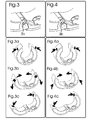
- an earring consists of base body 1 and 2, which consists of a first part 1 with a first end 1a and a second end 1b and a second part 2 with a first end 2a and a second end 2b.
- the first End 1a and first end 2a are cut in parallel.
- the two parts 1 and 2 are on their second ends 1b, 2b connected to each other with a hinge 3 by means of a pin 7.
- the end 1b of the base body 1 is connected to the middle part 3b of the hinge 3.
- the end 2b of the base body 2 is connected to the part 3a of the hinge 3.
- the screw 5 has a groove at one end and a rounded end at its second end Guide pin on which is positioned centrally that it has the underlying spring 6 holds and positions with suitable opening.
- the spring 6 which consists of a first end 6a and a second end 6b.
- the first end 6a of the spring 6 leans against the wall 2c, and the second end 6b of the spring 6 on the middle hinge part 3b, which ends 1b of base body 1 is connected.
- the shape of the middle hinge part 3b influences the running of the earring closing mechanism and earring opening mechanism.
- two possible shapes of the middle hinge part 3b are shown.
- Fig.3a. Fig.3b, Fig.3c as in Fig.4a. Fig.4b Fig.4c show the spring mechanical force effect on the earring closing run and earring opening run .
- 3a shows an earring in the closed state.
- the spring mechanical force pulls the two base bodies 1 and 2 together up to the hinge stop.
- the spring mechanical force automatically brings the two base bodies 1 and 2 together or closes the earring.
- 3b shows an earring in neutral position.
- the shape of the middle hinge part 3b causes the earring to stop moving.
- the spring mechanical force automatically separates the two base bodies 1 and 2 or opens the earring.
- 3c shows an earring in the open state. The spring mechanical force separates the two base bodies 1 and 2 up to the hinge stop.
- Fig.4a shows an earring in the closed state.
- the spring mechanical force pulls the two base bodies 1 and 2 together up to the hinge stop.
- the closing force is smooth and even, and adjustable by screw 5.
- This spring mechanism shape is mainly used for ear clips.
- the spring mechanical force automatically brings the two base bodies 1 and 2 together or closes the earring.
- 4c shows an earring in the open state. The spring mechanical force separates the two base bodies 1 and 2 up to the hinge stop.
- hinge part 3b Other shapes of the hinge part 3b are also possible, the earring running properties changing.
- the earring which has no inner wall 2d used a bridge with a threaded hole.
- the invention is independent of the shape and size of the earrings, as well as the shape and size and placement of individual locking and mechanical parts.
Landscapes
- Adornments (AREA)
Abstract
Description
Beim Übergang von Fig.3a zu Fig.3b führt die Federmechanikkraft selbständig die beiden Grundkörper 1 und 2 zusammen bzw. schließt den Ohrring.
Fig.3b zeigt einen Ohrring in neutraler Stellung. Die Form des mittleren Scharnierteils 3b verursacht den Bewegungsanhalt des Ohrrings.
Beim Übergang von Fig.3b zu Fig.3c trennt die Federmechanikkraft selbständig die beiden Grundkörper 1 und 2 bzw. öffnet den Ohrring.
Fig.3c zeigt einen Ohrring im geöffneten Zustand. Die Federmechanikkraft trennt die beiden Grundkörper 1 und 2 bis zum Scharnieranschlag.
Beim Übergang von Fig.4a über Fig.4b zu Fig.4c führt die Federmechanikkraft selbständig die beiden Grundkörper 1 und 2 zusammen bzw. schließt den Ohrring.
Fig.4c zeigt einen Ohrring im geöffneten Zustand. Die Federmechanikkraft trennt die beiden Grundkörper 1 und 2 bis zum Scharnieranschlag.
Claims (3)
- Schmuckstückteil, sogenannte Kreole, insbesondere zum Tragen am Ohr, mit einem eine Durchlassöffnung wenigstens teilweise umschließenden Grundkörper (1,2), welcher aus einem ersten Teil (1) mit einem ersten Ende (1a) und einem zweiten Ende (1b) und einem zweiten Teil (2) mit einem ersten Ende (2a) und einem zweiten Ende (2b) besteht, wobei sich das erste Ende (1a) des ersten Teils (1) und das erste Ende (2a) des zweiten Teils (2) des Grundkörpers (1, 2) an einer Unterbrechungsstelle gegenüberstehen, und die beide Teile (1, 2) sind an ihren zweiten Enden (1b, 2b) mit einem Scharnier (3) mittels eines Stifts (7) miteinander verbunden, wobei das zweite Ende (1b) ist mit dem Teil (3b) des Scharniers (3) verbunden, und das zweite Ende (2b) mit dem Teil (3a) des Scharniers (3) verbunden, in der Wand (2d) des Grundkörpers (2) befindet sich eine Gewindebohrung (4) mit einer Schraube (5), welche auf eine Feder (6) drückt, wobei das erste Ende (6a) der Feder (6) an der Wand (2c) sich lehnt, und zweite Ende (6b) der Feder (6) an dem mittleren Scharnierteil (3b) sich lehnt, mittels der Schraube (5) wird der Druck auf die Feder (6b) einstellbar, und die Druckkraft des Federende (6b) wird auf den mittleren Scharnierteil (3b) übertragen, wobei die Form des mittleren Scharnierteils (3b) beeinflusst den Lauf des Ohrringsschließmechanismus und Ohrringsöffnungsmechanismus.
- Schmuckstück nach Anspruch 1, dadurch gekennzeichnet, dass die Schraube (5) an ihrem einen Ende eine Nut und an ihrem zweiten Ende einen Führungsstift aufweist, welcher zentrisch positioniert ist, dass er die darunter liegende Feder (6) mit passender Öffnung hält und positioniert.
- Schmuckstück nach Anspruch 1 und 2, dadurch gekennzeichnet, dass beim Ohrring ohne innere Wand (2d) an der Stelle der Gewindebohrung (4) eine Brücke mit einer Gewindebohrung eingesetzt wird.
Applications Claiming Priority (4)
| Application Number | Priority Date | Filing Date | Title |
|---|---|---|---|
| DE10307913 | 2003-02-19 | ||
| DE10307913 | 2003-02-19 | ||
| DE10332189 | 2003-07-11 | ||
| DE10332189A DE10332189A1 (de) | 2003-02-19 | 2003-07-11 | Schmuckstück mit Scharnierverschluss mit einstellbarer Federmechanik |
Publications (2)
| Publication Number | Publication Date |
|---|---|
| EP1449452A1 true EP1449452A1 (de) | 2004-08-25 |
| EP1449452B1 EP1449452B1 (de) | 2012-06-13 |
Family
ID=32737090
Family Applications (1)
| Application Number | Title | Priority Date | Filing Date |
|---|---|---|---|
| EP20040003234 Expired - Lifetime EP1449452B1 (de) | 2003-02-19 | 2004-02-13 | Schmuckstück mit Scharnierverschluss mit einstellbarer Federmechanik |
Country Status (2)
| Country | Link |
|---|---|
| EP (1) | EP1449452B1 (de) |
| PL (1) | PL365363A1 (de) |
Cited By (1)
| Publication number | Priority date | Publication date | Assignee | Title |
|---|---|---|---|---|
| RU2396140C1 (ru) * | 2009-08-12 | 2010-08-10 | Общество с ограниченной ответственностью "Бронницкий ювелир" | Ювелирный замок |
Citations (3)
| Publication number | Priority date | Publication date | Assignee | Title |
|---|---|---|---|---|
| GB788215A (en) * | 1956-03-24 | 1957-12-23 | Coro Inc | Ear wire construction |
| JP2001061519A (ja) * | 1999-08-24 | 2001-03-13 | Yamakatsu:Kk | 耳飾り |
| JP2002165619A (ja) * | 2000-11-29 | 2002-06-11 | Jewelry Takuma:Kk | イヤリング |
-
2004
- 2004-02-13 EP EP20040003234 patent/EP1449452B1/de not_active Expired - Lifetime
- 2004-02-18 PL PL04365363A patent/PL365363A1/xx not_active IP Right Cessation
Patent Citations (3)
| Publication number | Priority date | Publication date | Assignee | Title |
|---|---|---|---|---|
| GB788215A (en) * | 1956-03-24 | 1957-12-23 | Coro Inc | Ear wire construction |
| JP2001061519A (ja) * | 1999-08-24 | 2001-03-13 | Yamakatsu:Kk | 耳飾り |
| JP2002165619A (ja) * | 2000-11-29 | 2002-06-11 | Jewelry Takuma:Kk | イヤリング |
Non-Patent Citations (2)
| Title |
|---|
| PATENT ABSTRACTS OF JAPAN vol. 2000, no. 20 10 July 2001 (2001-07-10) * |
| PATENT ABSTRACTS OF JAPAN vol. 2002, no. 10 10 October 2002 (2002-10-10) * |
Cited By (1)
| Publication number | Priority date | Publication date | Assignee | Title |
|---|---|---|---|---|
| RU2396140C1 (ru) * | 2009-08-12 | 2010-08-10 | Общество с ограниченной ответственностью "Бронницкий ювелир" | Ювелирный замок |
Also Published As
| Publication number | Publication date |
|---|---|
| PL365363A1 (en) | 2004-08-23 |
| EP1449452B1 (de) | 2012-06-13 |
Similar Documents
| Publication | Publication Date | Title |
|---|---|---|
| DE3434475C2 (de) | ||
| DE4423388C2 (de) | Schließe für Schmuckstücke | |
| EP1727954B1 (de) | Scharnier, insbesondere zum verbinden zweier teilklappen einer faltklappe | |
| DE102005020891B4 (de) | Brillenscharnier | |
| DE3242357A1 (de) | Brillengestell-scharnier | |
| DE20018390U1 (de) | Schneidzange | |
| DE3408202C2 (de) | Federscharnier zwischen zwei Teilen einer Brille | |
| DE602004011617T2 (de) | Einbauscharnier um brillenbügel elastisch zu machen | |
| EP4119108A1 (de) | Gelenkanordnung für eine orthese eines extremitätengelenks, set zum konfigurieren der gelenkanordnung und orthese mit einer derartigen gelenkanordnung | |
| EP1449452A1 (de) | Schmuckstück mit Scharnierverschluss mit einstellbarer Federmechanik | |
| DE10332189A1 (de) | Schmuckstück mit Scharnierverschluss mit einstellbarer Federmechanik | |
| DE69007237T2 (de) | Bandverschluss, insbesondere für Armbänder oder Gürtel. | |
| DE473487C (de) | Kniegelenk fuer kuenstliche Beine mit zweifacher Kurvengleitfuehrung | |
| DE69701471T2 (de) | Armbandverschluss | |
| DE202004020564U1 (de) | Brillengestell mit Überöffnung um einen versetzten Stützpunkt | |
| DE3431904A1 (de) | Schuhspanner | |
| DE202011002016U1 (de) | Brillengestell und Brillenbügel | |
| DE3837261A1 (de) | Verschluss fuer ein schmuckstueck und schmuckstueck als solches | |
| DE19700619B4 (de) | Gelenkband mit Schließkraftverstellung | |
| EP0920264A1 (de) | Schmuckstück | |
| EP1215355A1 (de) | Beschlag für Türen, Klappen und Auszüge von Möbeln | |
| AT521327B1 (de) | Brillengestell | |
| DE4323673A1 (de) | Schmuckstückverschluß | |
| DE102013217874B3 (de) | Zange | |
| DE4334731C2 (de) | Verschluß für ein Uhrarmband |
Legal Events
| Date | Code | Title | Description |
|---|---|---|---|
| PUAI | Public reference made under article 153(3) epc to a published international application that has entered the european phase |
Free format text: ORIGINAL CODE: 0009012 |
|
| AK | Designated contracting states |
Kind code of ref document: A1 Designated state(s): AT BE BG CH CY CZ DE DK EE ES FI FR GB GR HU IE IT LI LU MC NL PT RO SE SI SK TR |
|
| AX | Request for extension of the european patent |
Extension state: AL LT LV MK |
|
| RAP1 | Party data changed (applicant data changed or rights of an application transferred) |
Owner name: MORCINEK ROMAN |
|
| RIN1 | Information on inventor provided before grant (corrected) |
Inventor name: MORCINEK ROMAN |
|
| 17P | Request for examination filed |
Effective date: 20050223 |
|
| AKX | Designation fees paid |
Designated state(s): AT BE BG CH CY CZ DE DK EE ES FI FR GB GR HU IE IT LI LU MC NL PT RO SE SI SK TR |
|
| 17Q | First examination report despatched |
Effective date: 20071221 |
|
| RAP1 | Party data changed (applicant data changed or rights of an application transferred) |
Owner name: GOLUCH, TADEUSZ MARIAN |
|
| RIN1 | Information on inventor provided before grant (corrected) |
Inventor name: GOLUCH, TADEUSZ MARIAN |
|
| GRAP | Despatch of communication of intention to grant a patent |
Free format text: ORIGINAL CODE: EPIDOSNIGR1 |
|
| GRAS | Grant fee paid |
Free format text: ORIGINAL CODE: EPIDOSNIGR3 |
|
| GRAA | (expected) grant |
Free format text: ORIGINAL CODE: 0009210 |
|
| RIN1 | Information on inventor provided before grant (corrected) |
Inventor name: MORCINEK, ROMAN |
|
| AK | Designated contracting states |
Kind code of ref document: B1 Designated state(s): AT BE BG CH CY CZ DE DK EE ES FI FR GB GR HU IE IT LI LU MC NL PT RO SE SI SK TR |
|
| REG | Reference to a national code |
Ref country code: GB Ref legal event code: FG4D Free format text: NOT ENGLISH |
|
| REG | Reference to a national code |
Ref country code: CH Ref legal event code: EP Ref country code: AT Ref legal event code: REF Ref document number: 561588 Country of ref document: AT Kind code of ref document: T Effective date: 20120615 |
|
| REG | Reference to a national code |
Ref country code: IE Ref legal event code: FG4D Free format text: LANGUAGE OF EP DOCUMENT: GERMAN |
|
| REG | Reference to a national code |
Ref country code: DE Ref legal event code: R096 Ref document number: 502004013570 Country of ref document: DE Effective date: 20120809 |
|
| REG | Reference to a national code |
Ref country code: DE Ref legal event code: R082 Ref document number: 502004013570 Country of ref document: DE Representative=s name: VOSSIUS & PARTNER, DE Ref country code: DE Ref legal event code: R082 Ref document number: 502004013570 Country of ref document: DE Representative=s name: VOSSIUS & PARTNER PATENTANWAELTE RECHTSANWAELT, DE |
|
| REG | Reference to a national code |
Ref country code: CH Ref legal event code: NV Representative=s name: AMMANN PATENTANWAELTE AG BERN |
|
| REG | Reference to a national code |
Ref country code: NL Ref legal event code: VDEP Effective date: 20120613 |
|
| PG25 | Lapsed in a contracting state [announced via postgrant information from national office to epo] |
Ref country code: SE Free format text: LAPSE BECAUSE OF FAILURE TO SUBMIT A TRANSLATION OF THE DESCRIPTION OR TO PAY THE FEE WITHIN THE PRESCRIBED TIME-LIMIT Effective date: 20120613 Ref country code: FI Free format text: LAPSE BECAUSE OF FAILURE TO SUBMIT A TRANSLATION OF THE DESCRIPTION OR TO PAY THE FEE WITHIN THE PRESCRIBED TIME-LIMIT Effective date: 20120613 Ref country code: CY Free format text: LAPSE BECAUSE OF FAILURE TO SUBMIT A TRANSLATION OF THE DESCRIPTION OR TO PAY THE FEE WITHIN THE PRESCRIBED TIME-LIMIT Effective date: 20120613 |
|
| PG25 | Lapsed in a contracting state [announced via postgrant information from national office to epo] |
Ref country code: SI Free format text: LAPSE BECAUSE OF FAILURE TO SUBMIT A TRANSLATION OF THE DESCRIPTION OR TO PAY THE FEE WITHIN THE PRESCRIBED TIME-LIMIT Effective date: 20120613 Ref country code: GR Free format text: LAPSE BECAUSE OF FAILURE TO SUBMIT A TRANSLATION OF THE DESCRIPTION OR TO PAY THE FEE WITHIN THE PRESCRIBED TIME-LIMIT Effective date: 20120914 |
|
| PG25 | Lapsed in a contracting state [announced via postgrant information from national office to epo] |
Ref country code: CZ Free format text: LAPSE BECAUSE OF FAILURE TO SUBMIT A TRANSLATION OF THE DESCRIPTION OR TO PAY THE FEE WITHIN THE PRESCRIBED TIME-LIMIT Effective date: 20120613 Ref country code: SK Free format text: LAPSE BECAUSE OF FAILURE TO SUBMIT A TRANSLATION OF THE DESCRIPTION OR TO PAY THE FEE WITHIN THE PRESCRIBED TIME-LIMIT Effective date: 20120613 Ref country code: EE Free format text: LAPSE BECAUSE OF FAILURE TO SUBMIT A TRANSLATION OF THE DESCRIPTION OR TO PAY THE FEE WITHIN THE PRESCRIBED TIME-LIMIT Effective date: 20120613 Ref country code: RO Free format text: LAPSE BECAUSE OF FAILURE TO SUBMIT A TRANSLATION OF THE DESCRIPTION OR TO PAY THE FEE WITHIN THE PRESCRIBED TIME-LIMIT Effective date: 20120613 |
|
| PG25 | Lapsed in a contracting state [announced via postgrant information from national office to epo] |
Ref country code: PT Free format text: LAPSE BECAUSE OF FAILURE TO SUBMIT A TRANSLATION OF THE DESCRIPTION OR TO PAY THE FEE WITHIN THE PRESCRIBED TIME-LIMIT Effective date: 20121015 |
|
| PG25 | Lapsed in a contracting state [announced via postgrant information from national office to epo] |
Ref country code: NL Free format text: LAPSE BECAUSE OF FAILURE TO SUBMIT A TRANSLATION OF THE DESCRIPTION OR TO PAY THE FEE WITHIN THE PRESCRIBED TIME-LIMIT Effective date: 20120613 |
|
| PLBE | No opposition filed within time limit |
Free format text: ORIGINAL CODE: 0009261 |
|
| STAA | Information on the status of an ep patent application or granted ep patent |
Free format text: STATUS: NO OPPOSITION FILED WITHIN TIME LIMIT |
|
| PG25 | Lapsed in a contracting state [announced via postgrant information from national office to epo] |
Ref country code: DK Free format text: LAPSE BECAUSE OF FAILURE TO SUBMIT A TRANSLATION OF THE DESCRIPTION OR TO PAY THE FEE WITHIN THE PRESCRIBED TIME-LIMIT Effective date: 20120613 Ref country code: ES Free format text: LAPSE BECAUSE OF FAILURE TO SUBMIT A TRANSLATION OF THE DESCRIPTION OR TO PAY THE FEE WITHIN THE PRESCRIBED TIME-LIMIT Effective date: 20120924 |
|
| 26N | No opposition filed |
Effective date: 20130314 |
|
| PGFP | Annual fee paid to national office [announced via postgrant information from national office to epo] |
Ref country code: AT Payment date: 20130226 Year of fee payment: 10 |
|
| REG | Reference to a national code |
Ref country code: DE Ref legal event code: R097 Ref document number: 502004013570 Country of ref document: DE Effective date: 20130314 |
|
| PG25 | Lapsed in a contracting state [announced via postgrant information from national office to epo] |
Ref country code: BG Free format text: LAPSE BECAUSE OF FAILURE TO SUBMIT A TRANSLATION OF THE DESCRIPTION OR TO PAY THE FEE WITHIN THE PRESCRIBED TIME-LIMIT Effective date: 20120913 |
|
| BERE | Be: lapsed |
Owner name: GOLUCH, TADEUSZ MARIAN Effective date: 20130228 |
|
| PG25 | Lapsed in a contracting state [announced via postgrant information from national office to epo] |
Ref country code: MC Free format text: LAPSE BECAUSE OF NON-PAYMENT OF DUE FEES Effective date: 20130228 |
|
| GBPC | Gb: european patent ceased through non-payment of renewal fee |
Effective date: 20130213 |
|
| REG | Reference to a national code |
Ref country code: IE Ref legal event code: MM4A |
|
| PG25 | Lapsed in a contracting state [announced via postgrant information from national office to epo] |
Ref country code: GB Free format text: LAPSE BECAUSE OF NON-PAYMENT OF DUE FEES Effective date: 20130213 Ref country code: BE Free format text: LAPSE BECAUSE OF NON-PAYMENT OF DUE FEES Effective date: 20130228 Ref country code: IE Free format text: LAPSE BECAUSE OF NON-PAYMENT OF DUE FEES Effective date: 20130213 |
|
| REG | Reference to a national code |
Ref country code: AT Ref legal event code: MM01 Ref document number: 561588 Country of ref document: AT Kind code of ref document: T Effective date: 20140213 |
|
| PG25 | Lapsed in a contracting state [announced via postgrant information from national office to epo] |
Ref country code: AT Free format text: LAPSE BECAUSE OF NON-PAYMENT OF DUE FEES Effective date: 20140213 |
|
| REG | Reference to a national code |
Ref country code: FR Ref legal event code: PLFP Year of fee payment: 12 |
|
| PGFP | Annual fee paid to national office [announced via postgrant information from national office to epo] |
Ref country code: IT Payment date: 20150219 Year of fee payment: 12 |
|
| PGFP | Annual fee paid to national office [announced via postgrant information from national office to epo] |
Ref country code: FR Payment date: 20150213 Year of fee payment: 12 |
|
| PG25 | Lapsed in a contracting state [announced via postgrant information from national office to epo] |
Ref country code: TR Free format text: LAPSE BECAUSE OF FAILURE TO SUBMIT A TRANSLATION OF THE DESCRIPTION OR TO PAY THE FEE WITHIN THE PRESCRIBED TIME-LIMIT Effective date: 20120613 |
|
| PG25 | Lapsed in a contracting state [announced via postgrant information from national office to epo] |
Ref country code: HU Free format text: LAPSE BECAUSE OF FAILURE TO SUBMIT A TRANSLATION OF THE DESCRIPTION OR TO PAY THE FEE WITHIN THE PRESCRIBED TIME-LIMIT; INVALID AB INITIO Effective date: 20040213 Ref country code: LU Free format text: LAPSE BECAUSE OF NON-PAYMENT OF DUE FEES Effective date: 20130213 |
|
| REG | Reference to a national code |
Ref country code: FR Ref legal event code: ST Effective date: 20161028 |
|
| PG25 | Lapsed in a contracting state [announced via postgrant information from national office to epo] |
Ref country code: IT Free format text: LAPSE BECAUSE OF NON-PAYMENT OF DUE FEES Effective date: 20160213 |
|
| PG25 | Lapsed in a contracting state [announced via postgrant information from national office to epo] |
Ref country code: FR Free format text: LAPSE BECAUSE OF NON-PAYMENT OF DUE FEES Effective date: 20160229 |
|
| PGFP | Annual fee paid to national office [announced via postgrant information from national office to epo] |
Ref country code: CH Payment date: 20180220 Year of fee payment: 15 Ref country code: DE Payment date: 20180213 Year of fee payment: 15 |
|
| REG | Reference to a national code |
Ref country code: DE Ref legal event code: R119 Ref document number: 502004013570 Country of ref document: DE |
|
| REG | Reference to a national code |
Ref country code: CH Ref legal event code: PL |
|
| PG25 | Lapsed in a contracting state [announced via postgrant information from national office to epo] |
Ref country code: LI Free format text: LAPSE BECAUSE OF NON-PAYMENT OF DUE FEES Effective date: 20190228 Ref country code: CH Free format text: LAPSE BECAUSE OF NON-PAYMENT OF DUE FEES Effective date: 20190228 |
|
| PG25 | Lapsed in a contracting state [announced via postgrant information from national office to epo] |
Ref country code: DE Free format text: LAPSE BECAUSE OF NON-PAYMENT OF DUE FEES Effective date: 20190903 |